
When you start budgeting for a commercial renovation, the first number everyone wants to know is the cost per square foot. The truth is, it's a huge range. You could be looking at anything from $50 to over $400 per square foot, and sometimes even more.
That massive gap all comes down to the specifics: the scope of your project, where it's located, and the level of quality you're aiming for. A simple cosmetic refresh is one thing; a complete gut job with top-of-the-line finishes is another beast entirely.
Understanding the Typical Cost Ranges
Before we get into the nitty-gritty, let's establish a basic framework. I find it helpful to think about renovation costs in three general tiers: low-end, mid-range, and high-end. Each one represents a different level of work and material quality, giving you a starting point to see where your vision might land financially.
This infographic does a great job of showing what you can expect across these different levels.
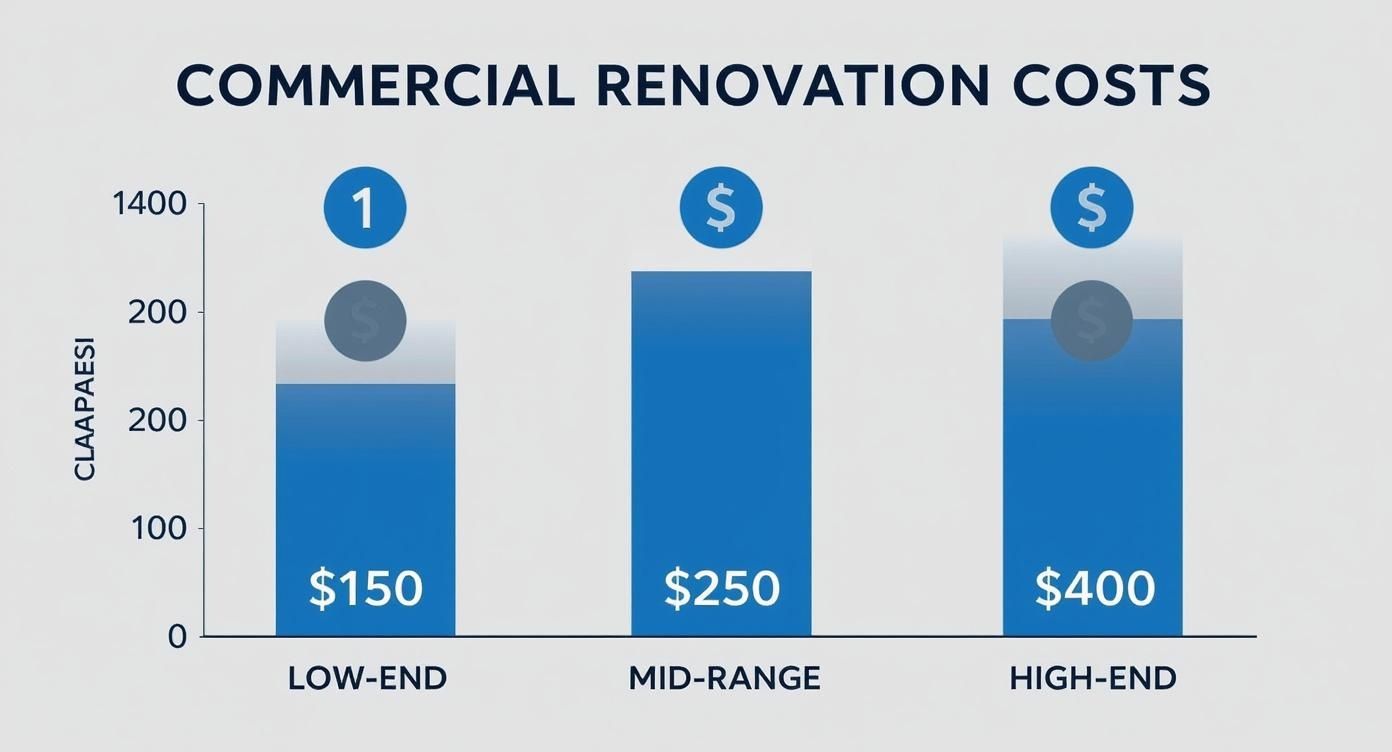
As you can see, jumping from a basic update to a high-end project isn't just about fancier materials. It’s about a massive leap in the complexity of the work and the skilled labor required to pull it off.
Breaking Down the Numbers
So, what do those different tiers actually mean in practice? Let's give those numbers some real-world context. Think of these as flexible guidelines, not concrete rules.
-
Low-End Finish ($50 – $100 per sq. ft.): This is your cosmetic facelift. We're talking fresh paint, new carpet or flooring, updated light fixtures, and maybe some minor patch-and-repair work. It's perfect for sprucing up an office or retail space that’s already in good shape structurally.
-
Mid-Range Finish ($100 – $200 per sq. ft.): Now we're getting into more significant changes. This tier can include things like a full interior finish update, a complete restroom overhaul, some updates to the mechanical systems, or even knocking down non-load-bearing walls to open up the floor plan.
-
High-End Finish ($200 – $400+ per sq. ft.): This is the full-scale, down-to-the-studs gut renovation. You're looking at structural changes, completely replacing the HVAC, electrical, and plumbing systems, and installing premium, often custom, finishes and fixtures. High-end restaurants, boutique hotels, and specialized medical clinics almost always fall into this category.
The key takeaway is that the "per square foot" number is a dynamic metric. It's an output of your decisions on project complexity and material quality, not a fixed input.
Of course, these numbers are also heavily swayed by the type of building and its location. For example, recent data highlights just how much costs can vary. A high-end renovation of a single-story office in a major East Coast city might average $361 per square foot, but a similar quality build-out in a mid-rise building in the same city could easily jump to $719 per square foot. You can discover more insights about U.S. commercial construction costs to see how these trends play out.
Getting a handle on these basic ranges is the crucial first step in building a budget you can actually trust.
Estimated Commercial Renovation Costs Per Square Foot by Project Type
To give you an even clearer picture, I've put together a table breaking down typical cost ranges for some of the most common commercial projects. It’s a helpful snapshot of how finish quality impacts the budget for different types of spaces.
| Project Type | Low-End Finish Cost / Sq Ft | Mid-Range Finish Cost / Sq Ft | High-End Finish Cost / Sq Ft |
|---|---|---|---|
| Standard Office | $50 – $90 | $95 – $180 | $185 – $300+ |
| Retail Store | $60 – $100 | $110 – $200 | $210 – $400+ |
| Restaurant / Kitchen | $150 – $250 | $250 – $400 | $400 – $700+ |
| Medical / Dental Clinic | $150 – $225 | $230 – $350 | $350 – $600+ |
| Industrial / Warehouse | $30 – $70 | $75 – $140 | $150 – $250+ |
As you can see, a project's purpose dramatically influences its cost. A simple warehouse refresh is worlds away from a full restaurant kitchen build-out, which requires specialized plumbing, ventilation, and equipment. Use this as a guide to start placing your own project on the map.
Breaking Down What Really Drives Your Project's Cost
While the square footage gives you a starting point for your budget, the real story of your final bill is told by a few key factors. These are the specific choices and conditions that can make two spaces of the exact same size end up with wildly different price tags. Getting a handle on these variables is the first step toward building a realistic and reliable budget.
Think of it like buying a car. The sticker price for the base model is just the beginning. Once you start adding the bigger engine, the premium sound system, and a custom paint job, the final cost climbs fast. Commercial renovations are no different—every decision layers onto your total investment.
Scope of Work: The Biggest Cost Multiplier
The single most important factor is the scope of your renovation. This is all about how deep you plan to go. Are you just giving the place a fresh coat of paint, or are you tearing everything down to the studs and starting over? The difference in cost is massive.
We can generally break the scope down into a few levels:
- Cosmetic Updates: This is your basic facelift. We're talking new paint, modern flooring, better light fixtures, and a few minor repairs. The core structure and systems of the building are left alone.
- Moderate Renovations: Here, you're making more significant changes without touching the building's main structure. This could mean putting up new walls to reconfigure an office, doing a complete restroom overhaul, or upgrading major parts of the HVAC system.
- Gut Renovations: This is the most intense and expensive option. It means stripping the interior down to the bare studs and rebuilding it from scratch. This almost always involves replacing all the major systems and is common when you’re converting a historic building or changing a space's entire purpose, like turning an old warehouse into a new brewery.
MEP Systems: The Hidden Engine of Your Budget
It's easy to overlook, but the Mechanical, Electrical, and Plumbing (MEP) systems are the heart, brain, and circulatory system of your building. Upgrading or replacing them is a huge expense, but it’s often unavoidable for safety, efficiency, and meeting modern building codes.
If the MEP is outdated or just can't handle what you need it to do, a simple cosmetic fix won't solve the real problem. For instance, a restaurant needs a complex ventilation hood and heavy-duty plumbing that an office would never require. That need alone can drastically increase the commercial renovation cost per square foot.
A building's age is a huge tell. A space from the 1970s might have ancient wiring and an old, inefficient HVAC system that has to be completely ripped out to meet today's energy codes. That work alone can eat up a massive chunk of your total budget.
Material Quality and Finishes
The quality of the materials you choose has a direct and immediate effect on your bottom line. This is where your brand's look and feel comes into play, but it’s always a balancing act.
- Flooring: Basic vinyl tile is a cheap and durable option for a storage room, but if you want custom-milled hardwood or polished concrete for a high-end showroom, you’ll be paying many times more per square foot.
- Fixtures: You can get standard, budget-friendly lighting and plumbing fixtures from any supplier. Or, you can opt for custom architectural lighting and imported designer faucets, which can quickly become major line items on your invoice.
- Millwork: Off-the-shelf cabinets for a breakroom are economical. On the other hand, a custom-built reception desk, unique display cases, or handcrafted wall paneling require skilled labor and premium materials, adding a significant cost.
At the end of the day, every single component—from the door handles to the ceiling tiles—offers a choice between standard, mid-range, and high-end options. Each decision nudges the needle on your final cost, making it critical to match your material choices to both your vision and your wallet. This is where a good architect or designer really earns their keep—helping you navigate these choices to get the most for your money.
How Your Location Shapes Renovation Expenses

Let's imagine you're planning the exact same renovation project—same square footage, same materials, same everything. If you build one in New York City and the other in Dallas, the final invoices will be worlds apart. This isn't a small detail; location is one of the most powerful, non-negotiable forces driving your budget. It acts like an invisible multiplier on almost every line item, from labor to logistics.
Understanding this geographic premium is the first step toward setting a realistic budget. The economic realities of your city create a baseline cost you just can't get around. Things like the local labor market, how far materials have to travel, and regional building codes all have a major say in your final commercial renovation cost per square foot.
The High Cost of Urban Density
It’s no surprise that major metropolitan areas come with higher price tags. This isn’t just about expensive real estate; it’s about the simple, practical challenges of getting work done in a crowded, complex environment.
Think about something as basic as getting materials to your job site. In a suburb, a truck can pull right up, no problem. In a dense city center like Boston or San Francisco, that same delivery means navigating gridlock traffic, paying for ridiculously expensive parking, and maybe even coordinating with the city to shut down a lane of traffic.
These logistical hurdles add time and money. On top of that, labor rates in these urban hubs are way higher because of the increased cost of living and the common presence of union labor, which commands better wages and has stricter working conditions.
Regional Labor and Material Markets
Zooming out from the city-versus-suburb dynamic, broader regional trends have a massive impact. The availability of skilled tradespeople, how close you are to material suppliers, and even the local climate can push your costs up or down.
For example, a region with a red-hot construction market might be facing labor shortages. This drives up wages as contractors compete for the same limited pool of talent. On the flip side, an area with a more stable, predictable market will likely offer more competitive labor rates.
A project’s location sets the stage for its entire financial story. You can control material choices and project scope, but you can't change the local economic conditions. Acknowledging this from the start is the key to avoiding major budget surprises down the road.
The data shows a huge difference in construction costs across the United States. The Northeast, with cities like New York and Boston, consistently sees some of the highest costs, often ranging from $350 to $870 per square foot. This is driven by high urban density and strong union labor markets. In stark contrast, the South, with cities like Atlanta and Dallas, is a more cost-effective environment, with prices typically falling between $240 to $680 per square foot due to lower labor costs and more construction-friendly weather. You can explore the full breakdown of regional construction costs to see just how much these numbers can vary.
Navigating Building Codes and Regulations
Finally, local building codes and the permitting process add another layer of geographic complexity. Every city, county, and state has its own rulebook that will directly affect your renovation plans and your bottom line.
Here’s a quick look at how local rules can inflate your expenses:
- Permit Fees: The cost to simply file for and receive building permits can vary by hundreds or even thousands of dollars from one town to the next.
- Code Stringency: Some areas, especially those prone to earthquakes or hurricanes, enforce much stricter structural or energy codes. This often means you're required to use more expensive materials and specialized building techniques.
- Historic Preservation: If your property is in a designated historic district, get ready for a lengthy and costly review process. You'll likely face specific requirements for materials and methods to preserve the building’s original character.
These location-based factors are foundational to your budget. By doing your homework on the specific economic and regulatory landscape of your project’s location, you can ground your financial plan in reality and build a budget that works.
How Costs Change for Different Commercial Spaces
The phrase "commercial renovation" casts a wide net. A simple office facelift and a full-scale restaurant build-out are two entirely different beasts, and their budgets show it. The whole point of the space—what it's used for—drives everything from the infrastructure it needs to the finishes you see, giving each project type its own financial footprint.
Getting a handle on these differences is the first step to a realistic budget for your commercial renovation cost per square foot. Think about it like this: restoring a classic car and prepping a Formula 1 racer both involve turning wrenches, but the level of precision, the specialty parts, and the final price tag are in different leagues. The same logic applies when you compare a basic office refresh to a complex restaurant construction project.
Office Renovations: Striking a Balance Between Function and Feel
Office renovations are all about finding the sweet spot between practical workflow, employee comfort, and brand image. Costs typically land somewhere between $60 and $150 per square foot, mostly influenced by the floor plan and the tech you need to pack into it.
Switching to a wide-open floor plan might sound like a money-saver because you're building fewer walls, but that's often a misconception. The savings get reallocated to other things, like beefier HVAC systems to handle the open airflow or sophisticated acoustic panels to keep the noise from becoming overwhelming. On the flip side, a design with lots of private offices and meeting rooms drives up the cost of framing, drywall, and electrical for each individual space.
In today's offices, the real budget-buster is often the technology infrastructure. We're not just talking about pulling a few extra network cables anymore. It's about building a rock-solid backbone for everything from high-speed data transfer to integrated AV systems in every conference room.
Here’s where the money goes in an office project:
- The Floor Plan: Every private office, conference room, or collaboration pod adds to the construction bill.
- Tech Integration: Serious expenses can pop up with extensive data cabling, dedicated server room cooling, and built-in audio-visual gear.
- Employee Perks: Things like kitchenettes, lounge areas, and wellness rooms tack on costs for specialized plumbing, custom cabinetry, and nicer finishes.
Retail Renovations: All About the Customer Experience
In the retail world, the budget is almost entirely focused on one thing: creating an unforgettable customer experience. Every design choice is a strategic move to draw people in, make products look irresistible, and broadcast the brand's identity. This intense focus on looks and branding can push renovation costs from $60 to over $200 per square foot, with luxury brands easily soaring past that.
The big-ticket items are always the ones customers see and touch. High-end flooring, dramatic architectural lighting, custom-made display fixtures, and detailed millwork aren't just decorative—they're powerful sales tools. A small boutique with off-the-shelf shelving will have a vastly different budget than a high-end jeweler who needs custom, secure display cases and a multi-layered lighting design.
Plus, everything has to be tough. Retail spaces see a ton of foot traffic, so materials need to be both beautiful and durable, and that combination usually costs more.
Restaurant Renovations: The High Price of Equipment and Compliance
Restaurants are hands-down one of the most complex and costly commercial projects you can tackle. Costs often start at $150 per square foot and can easily blow past $400. Why? Because a restaurant is basically an industrial food factory wrapped in a welcoming, customer-friendly package.
The commercial kitchen is where the budget really gets hammered. It demands a huge investment in heavy-duty, specialized systems that are absolutely non-negotiable:
- Commercial-Grade HVAC: You need powerful ventilation hoods and fire suppression systems that meet incredibly strict health and safety codes.
- Complex Plumbing: Think multiple sinks, floor drains, grease traps, and high-temp dishwashers. It all adds up to an intricate and expensive plumbing network.
- Heavy-Duty Electrical: Commercial ovens, fryers, and walk-in coolers pull a massive amount of power, requiring electrical systems far beyond what an office or shop would ever need.
And that's just the back of the house. The dining area has its own set of challenges, from meeting strict ADA accessibility rules and fire codes to creating the perfect ambiance. To get a better grip on these expenses, many future owners use a detailed restaurant startup costs calculator to itemize both construction and equipment needs.
To help visualize how these priorities shift from one project to another, let's break down the primary cost drivers for each space.
Cost Drivers by Commercial Property Type
| Property Type | Primary Cost Drivers | Typical Budget Allocation |
|---|---|---|
| Office | Technology infrastructure, flexible layouts (open vs. private), employee amenity spaces | A major chunk goes to data/AV cabling and HVAC, with finishes and furniture being key secondary costs. |
| Retail | Customer-facing finishes, custom fixtures/displays, architectural lighting, branding | Budget heavily favors aesthetics: flooring, lighting, and custom millwork often take priority. |
| Restaurant | Commercial kitchen equipment, MEP systems (mechanical, electrical, plumbing), code compliance | The kitchen and its infrastructure can easily consume over half the budget before the dining room is even touched. |
As you can see, while every project involves construction, the specific "why" behind the renovation dramatically changes where the dollars flow.
By digging into the unique financial DNA of your property type, you can leave generic, ballpark figures behind and start building a budget that truly reflects what your project is all about.
Uncovering the Hidden Costs in Your Renovation Budget
If your budget only covers lumber, labor, and paint, it’s already set up to fail. The true commercial renovation cost per square foot is always more than what you see on the surface. Too many business owners get blindsided by what we call "soft costs"—the essential, behind-the-scenes expenses that are absolutely critical to getting a project done right.
Think of it like planning a big road trip. You budget for gas and hotels, but what about insurance, tolls, park fees, and a fund for a flat tire? Forgetting those details can bring your journey to a screeching halt. The same goes for renovations; ignoring these background costs is a recipe for major financial headaches.
Demystifying Soft Costs
So, what are these "soft costs"? They're the professional services and administrative fees that make the physical construction possible in the first place. You can't touch them like a roll of carpet or a light fixture, but without them, your project would never get off the ground.
These costs often pop up before a single hammer swings and continue all the way through to completion. It's a mistake to underestimate them, as they can easily eat up a huge chunk of your total budget.
Here are the key soft costs you need to plan for:
- Architectural and Engineering Fees: This is what you pay the pros who design the space, draft the blueprints, and make sure everything is structurally sound and up to code.
- Permit and Inspection Fees: Your city or county requires official permission to build. These permits ensure your project meets all safety, zoning, and building regulations, and their costs can vary wildly by location.
- Insurance and Legal Costs: You'll need specific policies, like builder's risk insurance, to protect the job site. It's also smart to have a lawyer review contracts and help with any tricky zoning issues.
- Specialty Consultants: Does your project need perfect acoustics, specialized lighting, or a complex IT network? You may need to bring in experts to handle these specific designs.
The Non-Negotiable Contingency Fund
Even after you've accounted for all the planned soft costs, you still need a contingency fund. This isn't a slush fund for last-minute upgrades. It's your project's emergency savings, set aside specifically for the nasty surprises that renovations love to throw at you.
You never really know what’s hiding behind the walls of an older building. Once you start demolition, you might uncover anything from hidden water damage and faulty wiring to asbestos. These discoveries can stop a project in its tracks and send costs soaring.
Your contingency fund is the financial firewall that protects your project from these unforeseen discoveries. A standard contingency is 10% to 20% of your total construction budget. For older buildings or more complex projects, aiming for the higher end of that range is a wise move.
Finally, don't forget to budget for what happens after the construction crew leaves. The space isn't truly move-in ready until it’s been thoroughly cleaned. Factoring in a professional after construction cleaning service is a must. Building these "hidden" expenses into your plan from day one is the only way to create a realistic budget that can handle the inevitable bumps in the road.
Smart Ways to Keep Your Renovation Budget in Check
Knowing what drives your commercial renovation cost per square foot is the first step. The real challenge? Actively controlling those costs. With a good plan, you can guide your project toward your financial targets without sacrificing the quality of the final result. It's all about making smart, informed decisions that find the sweet spot between your vision and your budget.
Don't think of your budget as a set of handcuffs; see it as a roadmap. The aim is to put your money where it will have the biggest impact and find creative ways to save everywhere else. This means getting proactive and shifting from simply estimating costs to strategically managing them from day one.
Get Smart with Value Engineering
One of the best tools in your arsenal for budget control is value engineering. This isn’t just about picking the cheapest option for everything. Instead, it’s a disciplined method of looking at every part of your project to find less expensive alternatives that still get the job done without compromising on quality or function.
Let's say your original design calls for a pricey, imported stone for a big feature wall. A value engineering approach would ask: Can we get a similar look and durability with a locally sourced natural stone? Or what about a high-quality manufactured veneer that costs a fraction of the price? The goal is to achieve the effect you want, not just to tick a box on the original blueprint.
Value engineering is the art of squeezing every bit of function out of every dollar. It’s about making sure the money you spend is working as hard as possible to add real, tangible value to your property.
Break Your Project into Phases to Manage Cash Flow
A massive, all-at-once renovation can put a huge strain on your finances. If the upfront cost looks intimidating, think about breaking the project down into logical phases. This lets you handle the most critical updates first and push the "nice-to-haves" to a later date, spreading the financial hit over time.
- Phase 1: The Must-Haves. Start with the absolute essentials. This means structural repairs, major electrical and plumbing upgrades, and anything required to get the space functional and open for business.
- Phase 2: The Finishes. Once the bones of the space are solid, you can come back to upgrade the finishes, install custom cabinetry, or improve common areas.
- Phase 3: The Extras. Later on, you can tackle things like exterior landscaping, adding advanced technology, or building out premium amenity spaces.
This staggered approach is much easier on your cash flow and makes a huge project feel far more manageable.
The Power of Getting Multiple Bids
Whatever you do, don't just accept the first quote that comes your way. Getting detailed bids from at least three different qualified general contractors is crucial. It’s the only way to know you’re getting a fair market price for the work. This process naturally encourages contractors to be competitive and put their best numbers forward.
A quick word of caution: the lowest bid isn't automatically the best one. You have to compare each proposal line-by-line to make sure everyone is bidding on the exact same scope of work. A bid that seems too good to be true might be missing key details or assuming lower-quality materials, which almost always leads to expensive change orders down the road.
Remember, commercial construction costs are constantly in flux due to economic shifts and supply chain issues. For example, recent data shows a slight 1.9% year-over-year cost decrease for small industrial projects in the Americas, with costs averaging $139 per square foot, even while other sectors see prices climb. This kind of volatility makes getting competitive bids more important than ever.
Answering Your Top Renovation Budget Questions
When you start planning a commercial renovation, a few key questions about the budget always come up. Let's tackle some of the most common ones to give you a clearer financial picture for your project.
How Much Should I Set Aside for a Contingency Fund?
Think of a contingency fund as your project's insurance policy. A good rule of thumb is to set aside 10% to 20% of your total construction budget.
This money isn't for last-minute upgrades or fancy new finishes. It’s there to cover the curveballs—the things you can't see until demolition begins, like hidden water damage, outdated wiring, or asbestos lurking behind a wall. For older buildings or projects with a lot of unknowns, leaning toward that 20% figure is a smart move.
Is It Cheaper to Renovate or Build New?
Most of the time, renovating an existing space will be easier on your wallet than starting from scratch. You’re working with a building that already has a foundation, a structural frame, and utility hookups, which saves a huge amount of time and money.
But this isn't always the case. If a building's bones are bad and it needs a complete overhaul—we’re talking major structural repairs, all-new HVAC and electrical systems, and hazardous material removal—the costs can quickly add up. In some extreme cases, it might even cost more than a new build. This is where a professional feasibility study becomes invaluable.
Renovating is often the more cost-effective path, but only a detailed assessment can confirm if the building's "bones" are strong enough to make it a financially sound choice over starting fresh.
How Can I Get an Accurate Cost Estimate?
To get a truly reliable estimate of your commercial renovation cost per square foot, you need to move beyond ballpark figures and get detailed. The first step is hiring an architect or a design-build firm to translate your vision into a full set of construction drawings.
Once you have those professional plans, you can take them to market. Solicit bids from at least three reputable general contractors. This isn't just about finding the lowest number; it's about seeing how different professionals approach the job and getting a realistic sense of what it will truly cost. This process helps you find a partner who offers the best overall value, not just the cheapest price tag.
At Sherer Architects, LLC, we help clients navigate these questions every day, making sure the final design works with the budget. Whether it's a creative adaptive reuse or a brand-new commercial building, our job is to turn complex challenges into beautiful, functional spaces. Discover how we can bring structure to your vision.