When you need a new commercial space, you typically have two options: lease an existing building or buy one. But what if neither of those works? What if your business has such specific operational needs that an off-the-rack building just won't cut it?
That’s where a built-to-suit (BTS) development comes in. It’s a commercial real estate approach where a developer builds a property from the ground up for one specific tenant, designed to their exact requirements. The tenant gets a custom facility without the massive capital expense of construction and ownership, all in exchange for signing a long-term lease.
What Is Built To Suit Development
Think of it like getting a custom-tailored suit versus buying one off the shelf. A standard commercial lease is the off-the-rack option. It’s available now and gets the job done, but it's rarely a perfect fit. You'll likely have to make compromises—a less-than-ideal layout, an inefficient workflow, or a location that’s just okay.
A built-to-suit project is the bespoke equivalent. It’s a strategic partnership where a developer agrees to construct a building precisely to a tenant's unique specifications. This model is a game-changer for businesses with specialized operational, logistical, or branding needs that existing properties simply can't accommodate.
The whole thing hinges on the tenant committing to a long-term lease before a shovel ever hits the ground. This commitment gives the developer the financial security they need to get financing, buy the land, and build the custom facility.
The Key Players in a BTS Project
A successful built-to-suit project is a team sport. It relies on a tight-knit, collaborative relationship between three key players, each with a critical role to play.
-
The Tenant: This is the business with the unique vision. Maybe it's a QSR chain that needs a very specific kitchen and drive-thru flow, a distribution company that requires 40-foot clear heights, or a medical practice with specialized M.E.P. (mechanical, electrical, plumbing) systems. They drive the design.
-
The Developer: The developer is the project quarterback and investor. They handle the financing, acquire the site, manage the entire construction process, and ultimately own the building. Their return comes from the stable, long-term rental income guaranteed by the tenant's lease.
-
The Architect: The architect acts as the translator, turning the tenant's operational needs into a buildable reality. An experienced firm like Sherer Architects is essential for ensuring the final design is not only perfectly tailored to the tenant but also code-compliant, site-optimized, and on-budget for the developer.
This three-way partnership is what makes a BTS project work. The tenant gets a purpose-built facility without the upfront cost and headache of development, and the developer gets a stable, income-producing asset with a guaranteed tenant from day one.
Understanding this core dynamic makes it easy to see why built-to-suit has become the go-to strategy for so many companies. It takes the speculation out of development and delivers a turnkey solution that perfectly aligns with a business’s goals, making it an ideal path for companies focused on expansion, operational efficiency, or strengthening their brand presence.
Built to Suit vs Traditional Models At a Glance
To really grasp the value of the BTS model, it helps to see it side-by-side with the more traditional routes of speculative development and standard leasing. Each approach serves a different purpose and comes with its own set of trade-offs for both tenants and developers.
This table breaks down the key differences at a high level.
| Feature | Built to Suit (BTS) | Speculative Development | Standard Lease (Existing Space) |
|---|---|---|---|
| Customization | 100% customized to tenant's exact needs and brand specifications. | Designed for a generic market; limited tenant-specific customization. | Minimal to no customization; tenant adapts to existing layout. |
| Tenant Involvement | High; tenant is deeply involved in design and planning from the start. | Low; tenant is found after the building is designed or built. | Low; tenant evaluates finished spaces and negotiates lease terms. |
| Upfront Risk | Lower for developer (tenant secured); tenant commits to long-term lease. | High for developer (no tenant); significant market and leasing risk. | Lower for landlord (existing asset); tenant has minimal upfront risk. |
| Timeline | Longer; includes site selection, design, permitting, and construction. | Shorter for tenant (building may be ready); long for developer. | Fastest; space is immediately available for move-in after lease signing. |
| Lease Term | Typically long-term (10-20+ years) to amortize development costs. | Varies, but often shorter-term leases (3-10 years) are acceptable. | Flexible; can range from short-term to long-term (1-10 years). |
| Ideal For | Businesses with unique operational needs, strong credit, and long-term plans. | Developers in high-demand markets; tenants needing standard space quickly. | Businesses needing flexibility, standard space, and a fast move-in. |
Ultimately, the choice between these models depends entirely on a business's priorities. If speed and flexibility are paramount, a standard lease might be the answer. If a company has specialized needs and a long-term vision, the built-to-suit model offers unparalleled advantages that simply can't be matched by an existing building.
The Built-to-Suit Process, Step by Step
Every built-to-suit project is a journey, a carefully choreographed process that turns a company's specific operational needs into a tangible, physical building. It's not a rush job. From the first handshake to the final key handover, the timeline typically runs anywhere from 12 to 24 months.
Think of it like commissioning a custom-tailored suit. You wouldn't just grab one off the rack. You’d work closely with a tailor, discussing fabric, cut, and function until every detail is perfect. The built-to-suit process is no different; it’s a deliberate progression ensuring the final building fits the tenant's business like a glove while meeting the developer's investment goals.
Phase 1: The Deep Dive—Initial Needs Analysis
It all starts with a conversation. This first phase is all about getting to the heart of what the tenant really needs. We're translating business operations—how things flow, what equipment is needed, where people work—into an architectural program.
- Defining the Space: We go beyond simple square footage. Does the business need 30-foot ceilings for vertical storage? Reinforced concrete floors for heavy machinery? Specialized HVAC for a cleanroom environment? Every operational detail matters.
- Setting the Numbers: The tenant and developer collaborate to land on a realistic construction budget and a target completion date. These numbers are critical, as they directly influence the final lease rate and the entire project schedule.
- Creating a Preliminary Program: An architect takes all this information and distills it into a foundational document that guides the property search and the first design sketches.
Getting this stage right is probably the single most important part of the entire process. A clear, thorough understanding upfront prevents expensive do-overs and frustrating delays later on.
Phase 2: Finding the Right Spot—Site Selection and Due Diligence
With a clear vision in hand, the hunt for the perfect piece of land begins. The developer, usually working with the architect and tenant, scouts potential sites that fit the company’s logistical, branding, and geographical puzzle.
Once a promising property is identified, the real detective work starts. This is the due diligence period, a painstaking investigation to make sure there are no hidden surprises. An experienced architect is your best friend here, helping to untangle zoning laws, setback rules, utility access, and potential environmental hurdles. This step ensures the land can actually support the building we want to put on it.
Phase 3: From Blueprint to Permit—Architectural Design and Entitlements
This is where the vision starts to look like a real building. Working hand-in-hand with the tenant, the architect develops everything from high-level schematic designs to detailed construction documents. It's a highly collaborative back-and-forth, refining layouts, choosing materials, and dialing in the aesthetics until the design is both functional and on-brand.
At the same time, the team is working to secure entitlements—a fancy word for getting all the necessary government approvals. This means navigating local zoning codes, presenting to design review boards, and ultimately, securing the building permits. Having an architect with deep local roots, like our team at Sherer Architects, can make this complex bureaucratic dance much smoother.
The design and entitlements phase is a careful balancing act. The architect must create a design that fulfills the tenant's custom needs while also satisfying the developer's budget and adhering to all municipal codes and regulations.
Phase 4: Boots on the Ground—Construction and Project Management
With permits in hand and the lease signed, it's time to break ground. The developer or their general contractor takes the lead on-site, managing the day-to-day rhythm of construction—from wrangling subcontractors to ordering materials and keeping everything on schedule.
The architect’s role doesn't stop, though. Throughout construction, they provide essential construction administration services. This involves regular site visits to verify that the work matches the plans and to troubleshoot any issues that pop up. This oversight is the key to quality control, keeping the project on time and on budget.
This timeline chart helps visualize how a built-to-suit project compares with other real estate options.
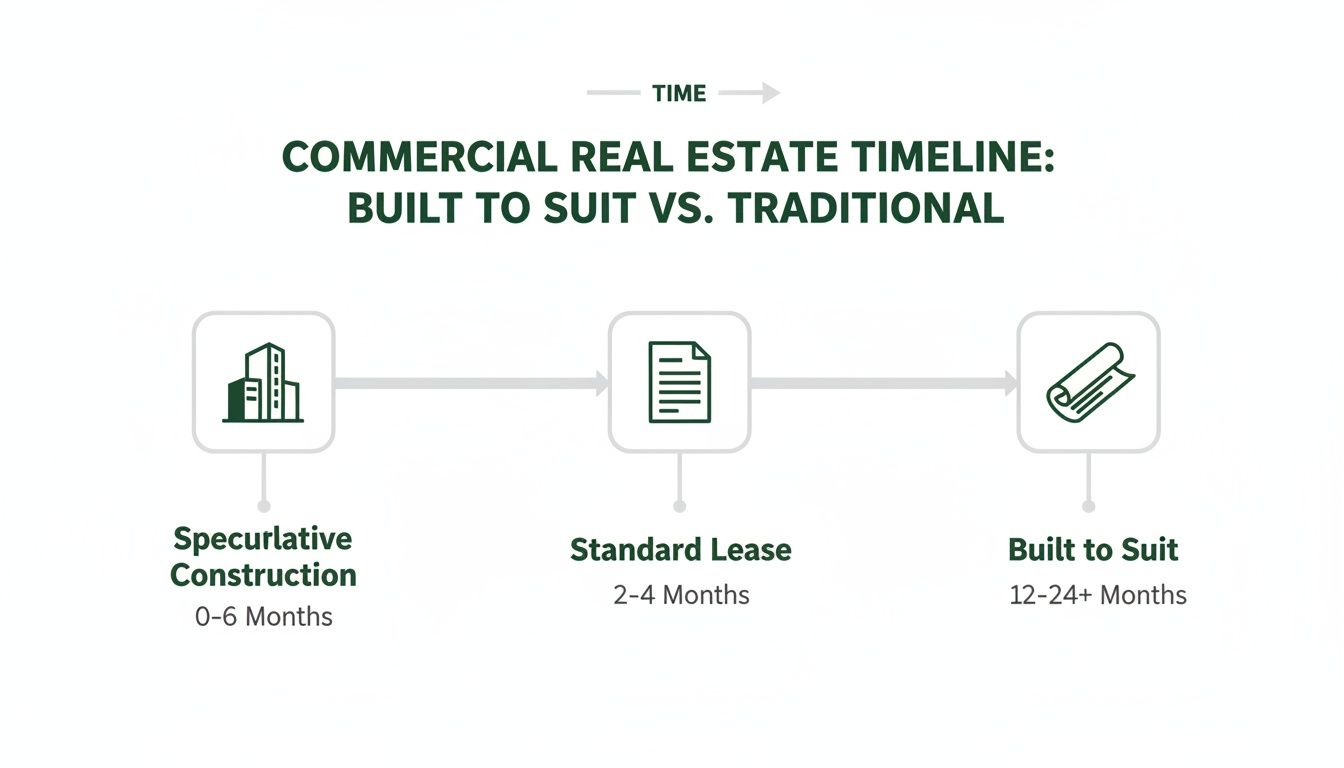
As you can see, while the built-to-suit process requires more time upfront, it completely removes the market risk of an empty speculative building and delivers a perfectly customized facility that a standard lease simply can't offer.
Phase 5: The Finish Line—Final Delivery and Occupancy
We're almost there. The final step is walking through the nearly finished building to create a punch list—a list of any small items that need to be fixed or touched up. The tenant, developer, and architect do this together to ensure everything is perfect.
Once those items are addressed, the city or county issues a Certificate of Occupancy, the official green light that the building is safe and ready. Then comes the best part: the keys are handed over. The tenant can finally move in and start running their business in a space that was designed, from the ground up, just for them. It’s the successful end of the built-to-suit journey and the beginning of a great long-term partnership.
Understanding the Key Players and Their Roles
Think of a successful built-to-suit project as a three-legged stool. Each leg—the tenant, the developer, and the architect—is absolutely critical for stability. If one is weak or out of sync, the whole thing wobbles. It’s a true partnership where shared goals and crystal-clear responsibilities are what take a project from an idea on a napkin to a fully operational building.
When these key players are aligned, the process is smooth. When they’re not, you get the delays and budget overruns that give construction a bad name. The magic happens when the tenant, developer, and architect each bring their unique expertise to the table, focused on a single outcome.

The Tenant: The Visionary
Everything starts with the tenant. They are the business with a specific, often highly specialized, operational need that simply can’t be met by any off-the-shelf building. Their goal isn't just to get a new space; it’s to secure a facility that’s a competitive advantage—one that boosts efficiency, reflects their brand, and gives them a long-term home without the financial headache of owning the real estate.
The tenant’s main contributions are:
- Defining the Vision: They must clearly articulate their spatial requirements, ideal workflows, and all the technical specs that make their business tick.
- Committing to the Lease: This is the linchpin. By signing a long-term lease before a shovel ever hits the ground, they provide the financial security that makes the entire project possible.
- Collaborating on Design: Great tenants stay involved. They work alongside the design team to ensure the final building is a perfect match for their business goals.
The Developer: The Orchestrator
If the tenant provides the vision, the developer is the one who makes it a reality. Acting as the project's quarterback, they manage the financial risks and logistical gymnastics of the entire process. For the developer, the motivation is clear: create a stable, income-generating asset by delivering a top-notch building occupied by a creditworthy tenant for the next 10 to 20 years.
A developer’s success in a built-to-suit project hinges on their ability to balance the tenant's custom requirements with the financial realities of the investment. They are the ultimate risk-takers, but that risk is significantly reduced by having a tenant secured from day one.
The developer's to-do list is massive. They’re responsible for acquiring the land, securing all the financing, and overseeing the entire construction process from groundbreaking to ribbon-cutting. They’re the ones managing the budget, the schedule, and all the moving parts to deliver the project on time and on spec.
The Architect: The Translator
The architect is the crucial bridge connecting the tenant's vision to the developer's investment. They are the design experts tasked with translating abstract business needs into a concrete, buildable set of plans. An architect’s job is to create a building that is not only functional and beautiful but also code-compliant and financially viable for everyone involved.
This role is absolutely central. It involves everything from optimizing the site layout and navigating complex zoning laws to creating the highly detailed documents that builders will use. A seasoned architect ensures the design isn't just innovative but also practical and cost-effective.
This drive for efficiency in built-to-suit projects is getting a boost from new construction methods. The modular construction market, for example, is on track to grow from $104.1 billion to $140.8 billion by 2029, largely because of the demand for faster, more sustainable ways to build. You can discover more insights about these construction trends from market analysts. This shift really highlights the value of having an architect who can integrate modern techniques to deliver projects faster and with less waste—a win for the entire team.
Navigating Financing and Legal Structures
At its core, a built-to-suit project isn't just about construction—it's about a smart financial partnership. The whole model is built on a carefully assembled legal and financial framework that turns a tenant's vision into a developer's bankable asset. Getting this part right is non-negotiable for a successful outcome.
The developer's first hurdle is always funding. How do you pay for the land and the actual build? The answer is typically a construction loan, a form of short-term financing designed specifically to cover these costs. The magic of the BTS model is that because a creditworthy tenant is already signed on, lenders see far less risk compared to a speculative project. That often translates into much better loan terms.
Once the dust settles and the tenant moves in, that short-term loan gets paid off with long-term permanent financing. This new loan is secured by two things: the brand-new building and, even more importantly, the guaranteed income flowing in from the tenant's lease.
The Cornerstone: The Triple Net Lease
The legal heart of almost every built-to-suit deal is the lease itself, and one type reigns supreme: the long-term triple-net (NNN) lease. This document is the key to creating the steady, predictable cash flow that makes the whole venture work for the developer and their bank. We're usually talking about terms of 10 to 20 years, giving everyone involved a lot of stability.
So, what does a "triple-net" lease actually mean for the tenant? It's pretty straightforward. You're on the hook for more than just rent. You also cover the three "nets":
- Property Taxes: You pay the annual property taxes directly.
- Building Insurance: Keeping the property insured is your responsibility.
- Common Area Maintenance (CAM): You cover all the operating costs, from landscaping and parking lot repairs to fixing the roof.
This setup essentially turns the property into a hands-off, passive investment for the developer. For the tenant, it offers a huge amount of control. You can maintain the property to your own exacting standards, almost as if you owned it outright.
Essential Legal Clauses to Negotiate
Beyond the basic NNN structure, the lease is a detailed document that needs a sharp eye. Hammering out the details upfront is the best way to avoid headaches and disputes down the road.
A robust financial and legal strategy for built-to-suit development must include understanding critical project protections like a complete guide to builders risk insurance. This specialized coverage is vital for safeguarding the investment during the vulnerable construction phase.
A few key provisions always deserve close attention:
- Construction Timeline and Delivery: The lease needs to spell out the exact schedule, key milestones, and the final delivery date. What happens if the developer is late? The contract should clearly define any penalties or remedies.
- Default Provisions: This clause outlines the "what ifs." What happens if the tenant stops paying rent or if the developer fails to finish the building? It specifies the consequences for either party breaching the contract.
- Purchase Options: Many tenants like to negotiate the right to buy the property later on, often at a price agreed upon today or at a future fair market value. It's a great way to build in long-term flexibility.
- Exit Strategies: What happens when the 10 or 20 years are up? The lease should detail the process for renewals, termination, and how the property should be left upon vacating.
Nailing down these financial and legal details from the start ensures the built-to-suit partnership is built on solid ground, creating a transparent and mutually beneficial relationship that lasts.
Comparing Development Models: Risk and Reward
Every commercial real estate strategy boils down to a calculated balance of risk and reward. When you're deciding between a built-to-suit project, a speculative build, or a standard lease, you're not just picking a building. You're making a strategic choice that fundamentally changes the financial exposure and potential upside for everyone involved.
For a developer, the built-to-suit model is arguably the ultimate de-risking tool. The biggest ghost that haunts any developer is "vacancy risk"—that gut-wrenching possibility of finishing a multi-million dollar building only to have it sit empty, hemorrhaging cash. A BTS project completely sidesteps this nightmare by locking in a creditworthy, long-term tenant before a single shovel ever hits the ground.
With that pre-secured lease in hand, financing becomes much easier to secure, and the developer can count on a stable, predictable income stream for 10 to 20 years. So, what's the catch? The rental rate is typically negotiated to provide a fair, but not necessarily sky-high, return. In essence, the developer trades the potential for a speculative home run for the certainty of a guaranteed base hit.
Speculative Development: The High-Stakes Gamble
On the complete opposite end of the spectrum is speculative (or "spec") development. This is a high-stakes bet on the future, plain and simple. A developer builds a more generic office, warehouse, or retail space with no tenant signed, banking on the hope that market demand will be roaring when the project is complete.
If that bet pays off and a tenant signs on quickly, the financial rewards can be massive, often fetching higher rental rates than a comparable BTS deal. But if the market goes soft or the building just doesn't land a tenant, the developer is left holding an incredibly expensive, empty asset with debt payments and operating costs piling up. It’s the classic high-risk, high-reward play.
When comparing various development models, a deep understanding of construction project risk management is critical for evaluating the potential downsides and maximizing the returns on a built-to-suit investment. This knowledge helps all parties anticipate and mitigate challenges before they impact the bottom line.
Standard Leasing: The Path of Least Resistance
For tenants, the standard lease is all about speed and minimal commitment. You find an existing space you like, sign a relatively short-term lease (usually 3-10 years), and move in. This approach offers maximum flexibility and is perfect for businesses that need a space right now and can't wait for a new construction timeline.
The major trade-off, of course, is the lack of customization. The tenant has to make their business operations fit the building's existing layout, which can create frustrating inefficiencies and compromises. You're essentially trading a perfect fit for speed and flexibility.
The inherent efficiency of the built-to-suit model is also getting a major boost from modern construction methods. The global modular construction market—a key enabler of faster BTS projects—is projected to nearly double from $112.54 billion to $214.76 billion by 2034. This surge is fueled by the demand for quicker, more efficient building, especially in growing urban areas. You can read the full research on this expanding market to see how it's impacting development. This trend just goes to show how BTS is evolving to deliver custom facilities more effectively than ever before.
Development Model Risk and Reward Comparison
To truly understand the trade-offs, it helps to see the models side-by-side. The following table breaks down the key differences from both the developer's and tenant's perspectives.
| Factor | Built to Suit | Speculative Development | Standard Lease |
|---|---|---|---|
| Vacancy Risk (Developer) | Eliminated | Very High | Not Applicable |
| Financial Reward (Developer) | Stable, predictable return | High potential reward | Not Applicable |
| Financing (Developer) | Easier to secure | More difficult to secure | Not Applicable |
| Customization (Tenant) | 100% customized | Minimal customization | None |
| Timeline to Occupancy | Longest (12-24+ months) | Moderate (if building exists) | Fastest (1-3 months) |
| Lease Term | Long-term (10-20+ years) | Varies (often 5-10 years) | Short-term (3-10 years) |
| Upfront Cost (Tenant) | Minimal capital outlay | Moderate capital outlay | Security deposit, first month's rent |
| Flexibility (Tenant) | Low | Moderate | High |
This comparison highlights the core dynamic: built-to-suit offers certainty and customization in exchange for time and a longer commitment, while other models prioritize speed and flexibility at the cost of a perfect operational fit.
Built to Suit Development in Action
The theory behind a built-to-suit project is straightforward, but its real power comes to light when you see it solve messy, real-world problems. These projects are far more than just putting up new walls; they are about creative problem-solving, turning unique challenges into custom-built, high-value assets.
Let's look at a couple of distinct scenarios where this model really proves its worth.
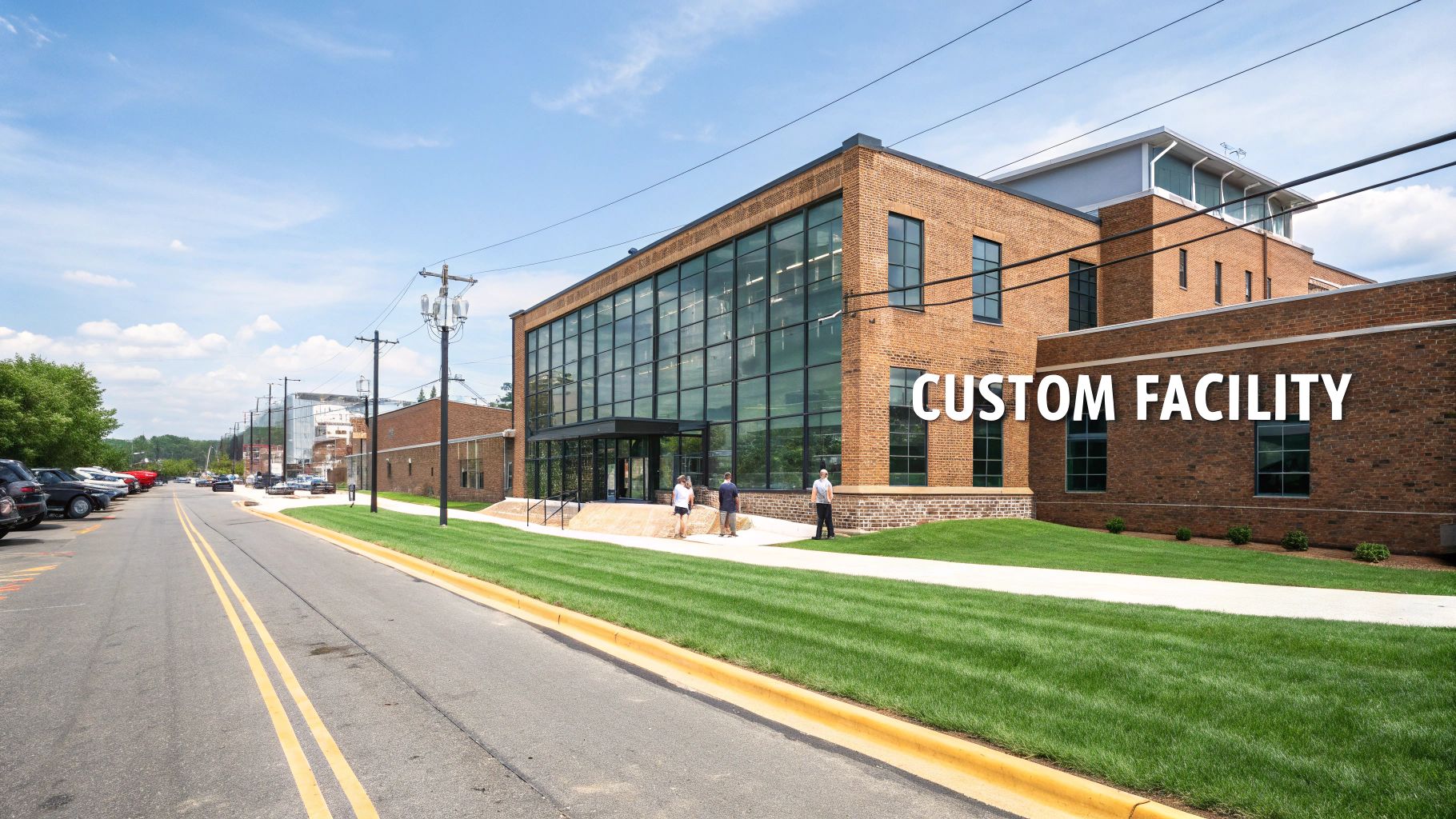
Case Study 1: The Historic Warehouse Transformation
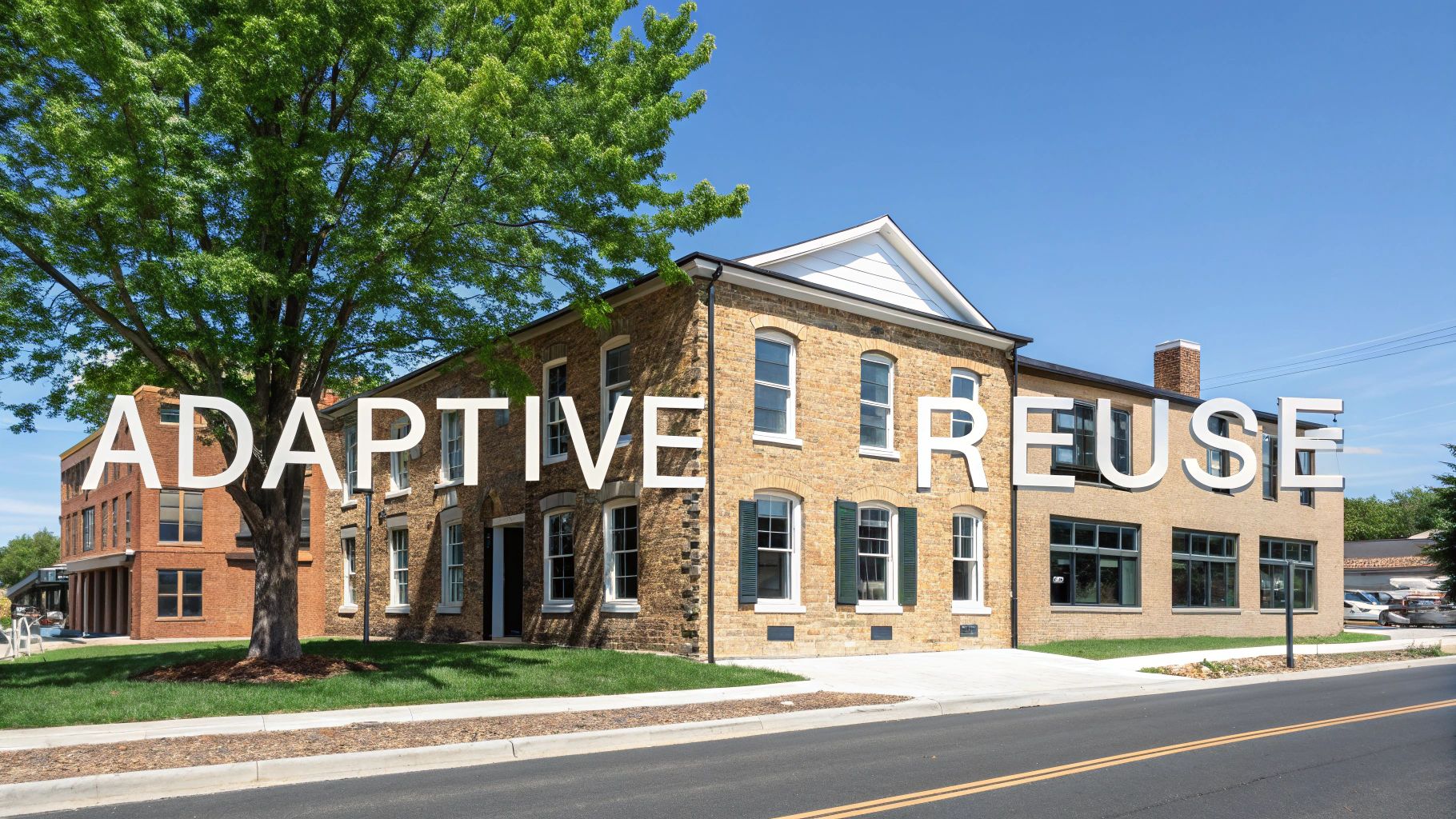
Picture this: a fast-growing tech firm is on the hunt for a new headquarters. They crave a space with real character that screams innovation, but they absolutely need modern, high-tech infrastructure. They stumble upon a gorgeous but derelict historic warehouse in a great downtown spot—the perfect shell, but completely useless for their day-to-day operations.
This is a textbook opportunity for an adaptive reuse project driven by a built-to-suit partnership.
- The Tenant's Goal: Get a one-of-a-kind, modern headquarters that keeps its historic soul, all without the nightmare of managing a massive, complicated renovation.
- The Developer's Goal: Buy and revitalize a forgotten property, turning it into a stable, income-generating asset with a reliable, long-term tenant locked in.
Here's how it plays out. The developer buys the old warehouse and signs a long-term lease with the tech company. Then, an architect with deep experience in historic preservation—someone like Sherer Architects—is brought in. They craft a design that carefully restores the original brick and timber bones while weaving in all the modern necessities: new energy-efficient HVAC systems, high-speed fiber, and a custom open-concept layout that fits the company’s collaborative culture.
The real magic is in the numbers. By taking on a historic property, the developer can tap into federal and state historic tax credits, which can cover up to 40% of the rehabilitation costs. This dramatically reduces their financial risk. The tenant gets their dream space, and the developer transforms a community eyesore into a premium asset.
This example really drives home that built-to-suit isn't just for building from scratch on an empty lot. It’s an incredibly flexible approach for breathing new life into old structures, creating a win-win for everyone involved.
Case Study 2: The Challenging Urban Infill
Now, let's switch gears. Imagine a medical group needs to open a new specialty clinic. They’ve pinpointed the perfect neighborhood to serve their patients, but the only land available is a small, oddly shaped parcel crammed between two existing buildings. It’s a classic urban infill site.
A standard, off-the-shelf building design just won't work here. This is exactly where a built-to-suit project, guided by a sharp architect, is not just helpful—it’s essential.
The medical group partners with a developer who agrees to acquire the tricky piece of land. The architect’s first job is to figure out how to squeeze every bit of value out of the site, designing a multi-story building that uses every available square inch. They have to navigate a maze of complex zoning laws, including strict setback requirements, parking minimums, and height limits.
On top of that, the design has to meet the clinic's very specific operational needs:
- Specialized plumbing and electrical runs for sensitive medical equipment.
- Precise room layouts designed to optimize patient flow and ensure privacy.
- Strict compliance with demanding healthcare building codes.
The architect delivers a brilliant design for a compact, hyper-efficient vertical clinic. The developer handles the entire construction process. Once it's finished, the medical group moves into a brand-new facility, perfectly placed and perfectly designed for their practice. Without the built-to-suit model, that awkward lot would probably still be empty, and the clinic would have been forced to settle for a second-rate location.
Your Built-to-Suit Questions, Answered
Jumping into the world of commercial real estate, especially a specialized area like built-to-suit, naturally comes with a lot of questions. To help clear things up and build on what we’ve already covered, here are some straightforward answers to the most common things people ask about the BTS model.
How Long Does a Typical Built-to-Suit Project Take?
From the first conversation to getting the keys, a typical built-to-suit project takes somewhere between 12 and 24 months. Of course, this all depends on how complex the building is and where it’s located.
Think of it in three main phases:
- Months 1-4: This is the discovery phase. We're figuring out your exact needs, finding the right piece of land, and doing our initial homework (due diligence).
- Months 3-6: Time for design. This is where the architects and engineers draw up the plans while the team works on getting all the necessary permits and approvals from the local authorities.
- Months 9-15: Boots on the ground. This is the actual construction phase, from pouring the foundation to the final finishes.
Things like tricky soil conditions, complex zoning rules, or a tenant needing highly specialized equipment can definitely stretch that timeline. This is exactly why having an experienced architect and developer in your corner from day one is non-negotiable—they know how to anticipate these hurdles and keep things moving.
Is a Built-to-Suit Lease More Expensive?
If you just look at the price per square foot, a built-to-suit lease can seem higher than renting an existing space. But that's not the whole story—you have to look at the total value you’re getting.
The lease rate is calculated to cover the developer’s costs for the land, the design work, and the brand-new construction. What you get in return is a building perfectly molded to your business operations. This custom fit almost always leads to big savings down the line on things like energy bills, smoother logistics, and more efficient use of staff.
When you account for the operational efficiencies, the fact you’re not spending a dime on renovations, and the long-term benefits of a perfect workspace, a BTS lease often turns out to be the smarter financial move for a growing company.
Ultimately, you’re paying a premium for a tailor-made solution that an off-the-shelf space could never match.
What Happens at the End of a Built-to-Suit Lease?
The end of the initial lease term is just a new beginning. Tenants usually have several options baked right into the original agreement, which gives them a ton of flexibility for the future.
Here are the three most common paths:
- Renew the Lease: The simplest option. The tenant can choose to stay for another term, or several. The new rent is usually determined by a pre-agreed formula or the fair market value at the time of renewal.
- Buy the Building: Many BTS deals include a purchase option. This gives the tenant the right to buy the property from the developer, often at a price that was set from the beginning or based on a future appraisal.
- Move On: If the business's needs have evolved, the tenant can simply vacate the property. The developer is then free to lease it to someone new or sell the building on the open market.
These end-of-term scenarios are a critical part of the initial negotiation. Thinking about your long-term plans from the very start ensures the partnership has a clear, beneficial path forward for everyone, no matter what the future holds.
At Sherer Architects, LLC, our passion is turning complex challenges into enduring, valuable assets. We bring thoughtful design and deep expertise to every commercial, adaptive reuse, and historic preservation project. If you're exploring a built-to-suit project in South Carolina, we can guide you through every step.
Explore our portfolio and see how we can bring your vision to life