SHERER ARCHITECTS

Categories
Uncategorized

A Practical Guide to the Commercial Renovation Cost Estimator

A solid preliminary cost estimate is one of the most important tools you can have at the start of a commercial renovation. It's not about nailing down every last penny; it's about checking your vision against reality and getting everyone on the same page before you sink serious money into detailed designs.

This early number moves you from guesswork to a real financial framework.

Laying the Groundwork for Your Renovation Budget

Before you can even think about a line-item spreadsheet, you need to build that financial framework. A well-thought-out preliminary estimate is the first real test of your project's viability. It's what you'll use to talk to lenders and ensure all the stakeholders are aligned on what's possible. This is where you translate the big ideas—the core goals and absolute must-haves—into clear parameters that will shape every decision down the road.

This initial planning forces you to confront the major cost drivers head-on. Take market dynamics, for example. The global commercial renovation service market is currently valued at USD 1,598 million and is expected to climb to USD 2,621 million by 2032. This isn't just a number; it tells a story. Property owners are increasingly choosing to modernize old buildings instead of building new, which directly impacts material costs and the availability of skilled labor in your area. You can dig into the full commercial renovation service market analysis to see how these trends might affect your project.

From Vision to Financial Feasibility

Think of this initial budget as setting the boundaries of the sandbox you'll be playing in. It's less about perfect precision and more about establishing a realistic range. You'll define the scope in broad strokes—what's non-negotiable versus what would be nice to have if the budget allows. This process is crucial for preventing huge miscalculations later, especially on tricky projects like adaptive reuse or historic renovations where surprises are practically guaranteed.

A preliminary budget is your first reality check. It forces an honest conversation between what you want to do and what you can afford to do, keeping scope creep in check from day one.

Before you get bogged down in the details, it helps to understand the big-picture variables that will influence your costs.

Initial Renovation Cost Factors at a Glance

This table breaks down the primary factors that set the stage for your budget before you ever start calculating specific line items.

Cost Factor Description Typical Budget Impact
Project Scope The overall size, complexity, and intended use of the space (e.g., office, retail, restaurant). High
Building Condition The age and state of the existing structure, including MEP systems, roof, and foundation. High
Location Geographic area, which affects labor rates, material costs, and permit fees. Medium to High
Quality of Finishes The level of materials and finishes, from standard "builder-grade" to high-end custom fixtures. Medium to High
Regulatory Requirements Zoning laws, building codes, accessibility standards, and historic preservation rules. Low to High

Understanding these elements gives you a solid foundation for building a more detailed and accurate estimate.

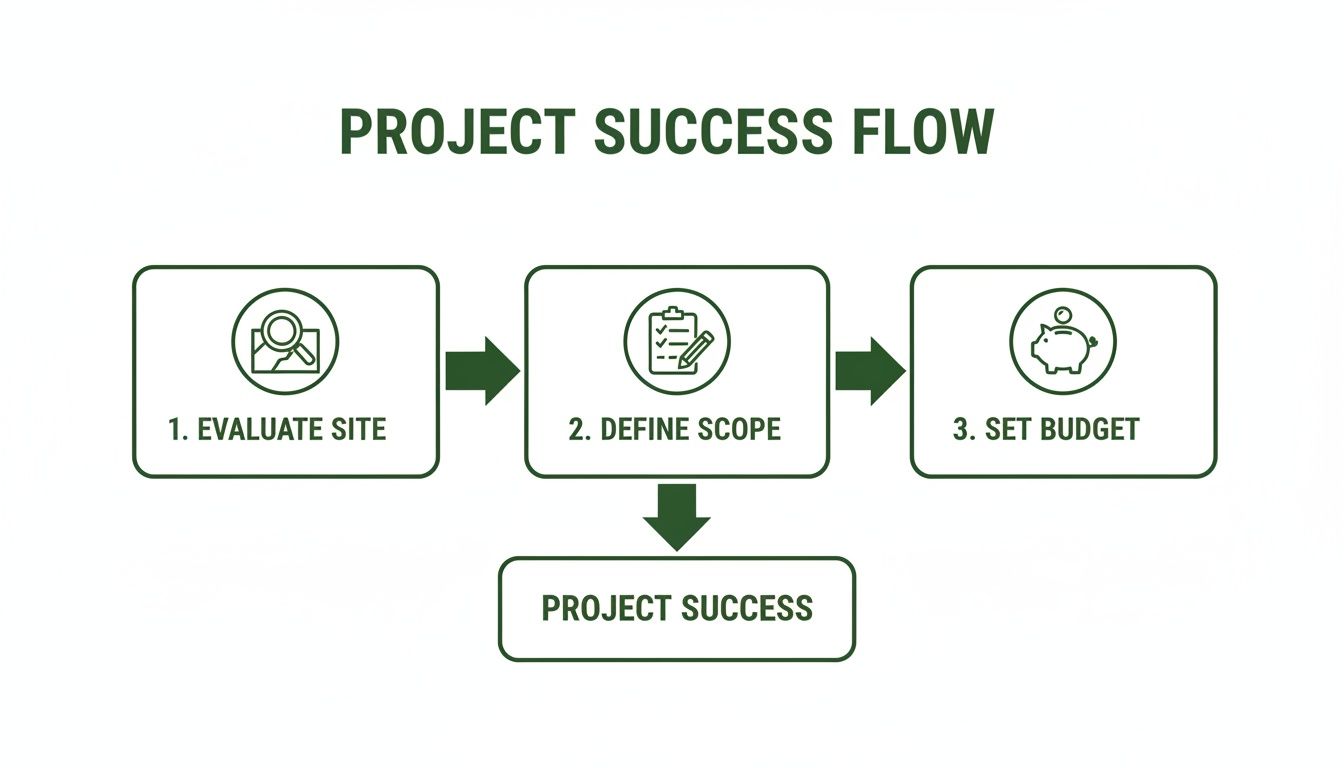
This journey from an idea to a structured plan is a process of refinement.
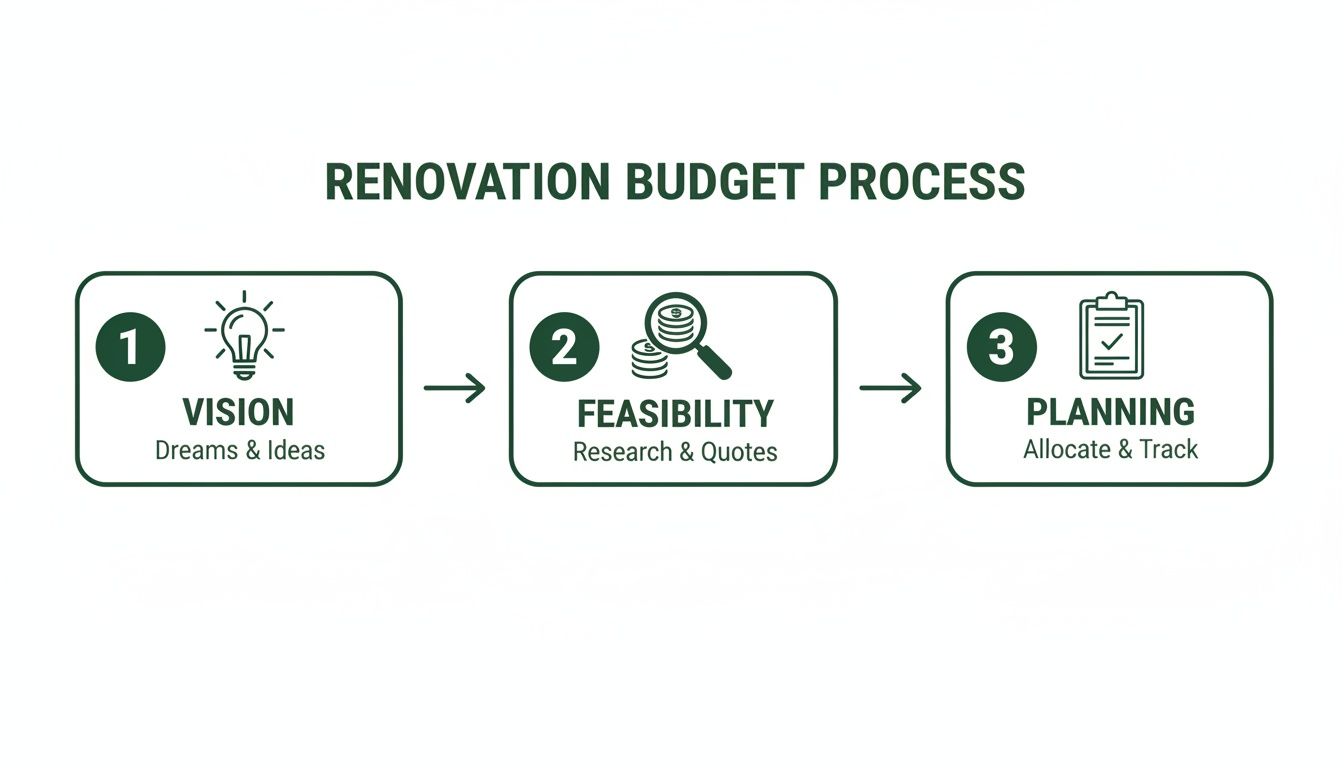
Diagram showing the three-step renovation budget process: Vision, Feasibility, and Planning.

As the graphic shows, a vision has to be tested for feasibility before it can become a real plan. By getting a handle on these high-level cost drivers early, you can build a financial strategy that’s both ambitious and grounded in reality. That’s how you set your project up for success.

Getting a Handle on Hard Costs vs. Soft Costs

When you start mapping out a commercial renovation budget, the first and most crucial step is to split your costs into two buckets: hard costs and soft costs. It’s a simple concept, but one that trips up a lot of people.

Think of it this way: hard costs are for all the tangible, physical stuff. The steel, concrete, drywall, and windows—everything you can physically point to in the finished space. Soft costs are the less visible, but absolutely essential, services and fees that bring the project to life. This includes things like architectural drawings, city permits, and engineering fees.

It’s incredibly common to get laser-focused on the construction itself and completely underestimate the mountain of administrative and professional services required. To get a true financial picture and avoid nasty surprises down the road, you have to understand the difference between hard costs vs soft costs. Separating them is the foundation of a reliable cost model.

Pinpointing Your Project Hard Costs

Hard costs are the direct expenses of the physical build-out. They are usually the most straightforward to itemize because they cover the actual labor and materials that go into the renovation.

Let's say you're converting an old warehouse into a sleek, modern office. Your hard cost line items would be things like:

  • Demolition and Site Prep: The cost to tear out old interiors, deal with any hazardous materials (like asbestos), and get the "canvas" ready.
  • Structural Work: This covers any new steel beams, concrete repairs for the floor, or the lumber needed for framing out new walls.
  • Building Envelope: All things related to the exterior—new energy-efficient windows, façade restoration, insulation, and roof repairs or replacement.
  • MEP Systems: This is a big one. It stands for Mechanical (your HVAC system), Electrical (all the wiring, lighting, and panels), and Plumbing (pipes, drains, and fixtures).
  • Interior Finishes: This is the fun stuff that makes the space look complete: drywall, paint, flooring, custom cabinetry, doors, and hardware.

These are the costs typically managed by your general contractor. They represent the lion's share of your budget, usually making up 70-80% of the total project expense.

The Sneaky Soft Costs You Can’t Ignore

Soft costs, or indirect costs, are all the fees for services that are critical to the project but aren't part of the actual construction. Don't make the mistake of overlooking them—they can easily account for 20-30% of your total budget and sink an otherwise well-planned project.

Imagine you're turning a historic building into a high-end restaurant. The soft costs here would be significant.

A project's success is often determined by how well the soft costs are managed. These are the expenses that require foresight, planning, and professional coordination long before the first hammer swings.

So, what falls into this category?

  • Professional Fees: This is a wide net that catches fees for architects, engineers (structural, MEP, civil), interior designers, and any special consultants you might need, like for acoustics or lighting.
  • Permits and Inspections: The money you pay to the city for building permits, zoning reviews, and all the required inspections throughout the construction process.
  • Legal and Accounting: You'll need lawyers to review contracts and accountants to manage the financial side of the project.
  • Insurance: Builder's risk, general liability, and other policies are non-negotiable to protect the property, the workers, and you from the unexpected.
  • Financing Costs: If you're taking out a loan, this includes loan application fees, appraisal costs, and the interest that accrues during construction.
  • Pre- and Post-Construction Services: Think of costs for initial feasibility studies, land surveys, and even the final professional cleaning and system commissioning before you open the doors.

For that restaurant project, you’d also have soft costs for kitchen design consultants, health department approvals, and maybe even a liquor license application. These business-specific expenses are easy to miss but are absolutely vital. The only way to get a realistic view of your total investment is to build a line item for every single one of them.

Getting Real with Per-Square-Foot Costs

A construction planning setup with blueprints, a laptop, calculator, and "HARD & SOFT COSTS" on a wooden table.

Everyone loves a good per-square-foot (PSF) number—it's fast, simple, and seems to answer the big question. But I've seen too many projects get into trouble by treating this number as gospel. It’s not a price tag; it's a starting point for a much deeper conversation.

Think of PSF costs as a rough map of the territory. They're incredibly helpful for those early, back-of-the-napkin feasibility checks. But their real value only comes when you start layering in the unique details of your project. A quick office refresh in the suburbs is a different world from a gut job on a historic downtown building, and the PSF cost will reflect that. The trick is knowing why and how to adjust.

Finding Your Baseline with Cost Ranges

Before we get into the nitty-gritty adjustments, let's get a feel for the general landscape. The costs can swing wildly depending on how deep you're planning to go. Here are some realistic buckets to start with:

  • Basic Cosmetic Updates ($50 – $95 per square foot): This is the facelift. We're talking fresh paint, new carpet tiles, updated light fixtures, and other minor touch-ups. You're breathing new life into the space without touching its bones or major systems.

  • Moderate Renovations ($95 – $175 per square foot): Now you're making more substantial changes. This could mean moving some non-load-bearing walls around, doing a serious overhaul of the restrooms, making targeted upgrades to the HVAC, and bringing in higher-quality finishes.

  • Full-Gut Renovations ($175 – $300+ per square foot): This is where you strip the interior down to the studs. You’re replacing all the major MEP (mechanical, electrical, plumbing) systems, possibly making structural changes, and installing high-end, custom finishes from the ground up. If you're building out a restaurant or a medical clinic, your project will almost certainly start in this range because of all the specialized systems involved.

These ranges are just your jumping-off point. The real work is figuring out where your project falls and what factors might push it to the high or low end—or even blow past these numbers entirely.

What Makes Per-Square-Foot Costs Swing?

An average is just an average. The art of building a good commercial renovation cost estimator lies in understanding the project's unique DNA. From my experience, four major drivers will have the biggest impact on your final number.

Building Class and Condition
Are you starting with a clean slate in a modern, Class A building? Or are you dealing with a Class C property that's seen better days? The latter might be hiding some nasty surprises—think hazardous material abatement, ancient wiring that’s a code nightmare, or structural gremlins that need fixing before you can even think about finishes. The age and health of the existing building are absolutely critical.

Location and Labor Rates
Construction is a local game. The cost of labor and materials in a major metro area like New York or San Francisco is in a completely different league than in a small Midwestern town. It’s not just about the city, either; labor availability and demand can create cost differences from one county to the next.

Level of Finishes
This one is straightforward but has a massive impact. The difference between standard commercial-grade carpet and polished concrete or imported tile is huge. Prefabricated cabinetry versus custom-built millwork is another classic example. The look and feel you're aiming for will show up directly on the bottom line.

Remember, a per-square-foot estimate is a tool, not a guarantee. Its value comes from understanding the specific project details that can make that number go up or down, ensuring your initial budget is grounded in reality.

Intended Use
What is this space going to be? A typical office has far simpler needs than a restaurant, which requires a full commercial kitchen, specialized fire suppression and ventilation, grease traps, and complex plumbing. A medical clinic is another beast altogether, with needs for specific layouts, sterile surfaces, and even lead-lined walls for X-ray rooms. These special uses dramatically ramp up the complexity and the cost.

Looking Beyond the Basic Numbers: Project-Specific Cost Drivers
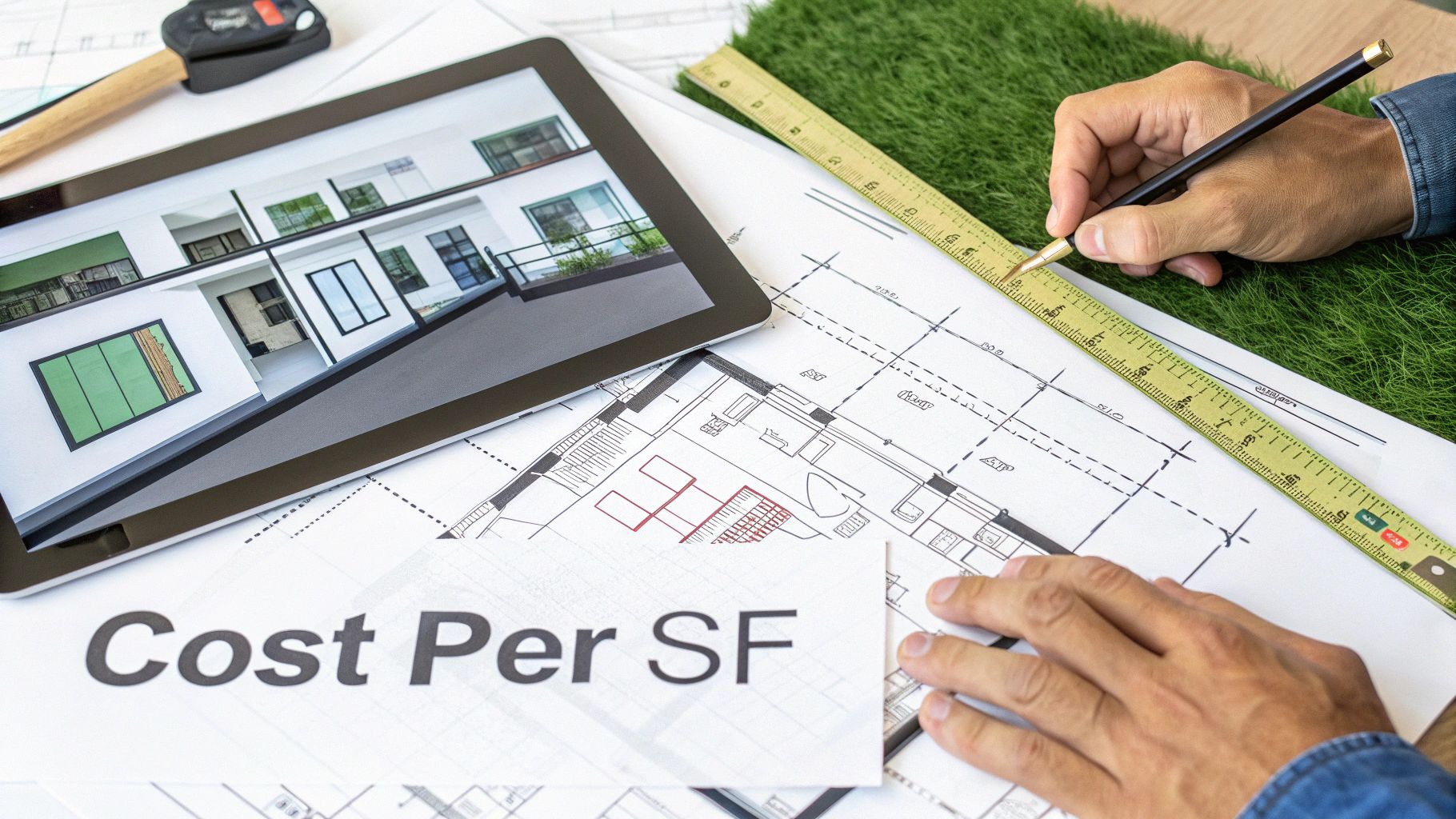
Architect drawing on blueprints with a ruler, tablet showing a 3D house model, and 'Cost Per SF' document.

Here's a hard-earned lesson: a standard cost template will only get you so far. The real accuracy in any commercial renovation estimate comes from digging into the unique quirks and conditions of your specific project. These are the adjustment factors that can quickly inflate a budget, and every savvy developer knows to look for them.

Relying solely on baseline per-square-foot numbers is a rookie mistake, and a costly one at that. Learning to spot these potential cost drivers early on is what separates a smooth, well-managed project from one that careens off the financial rails.

The Financial Realities of Adaptive Reuse

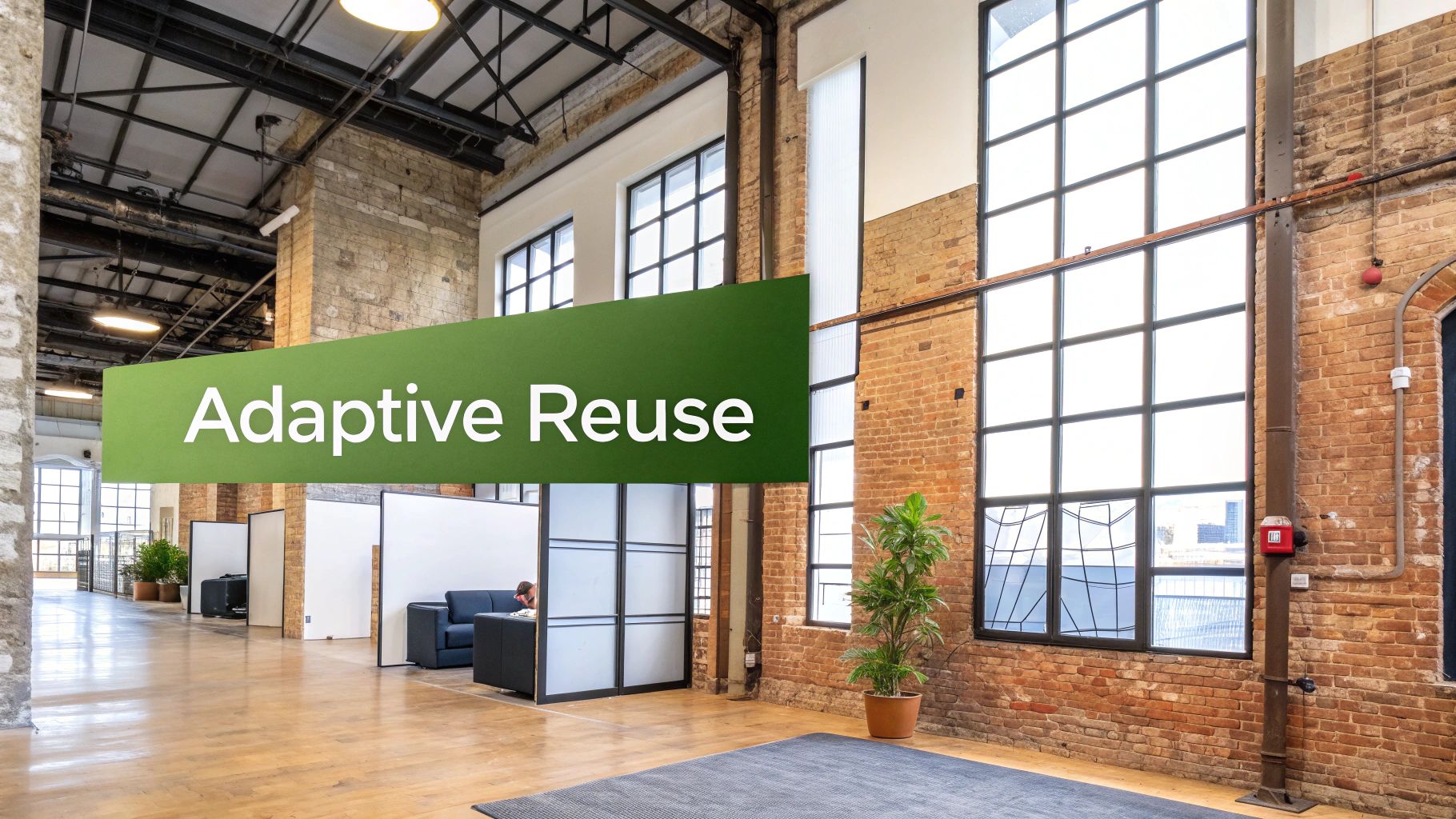
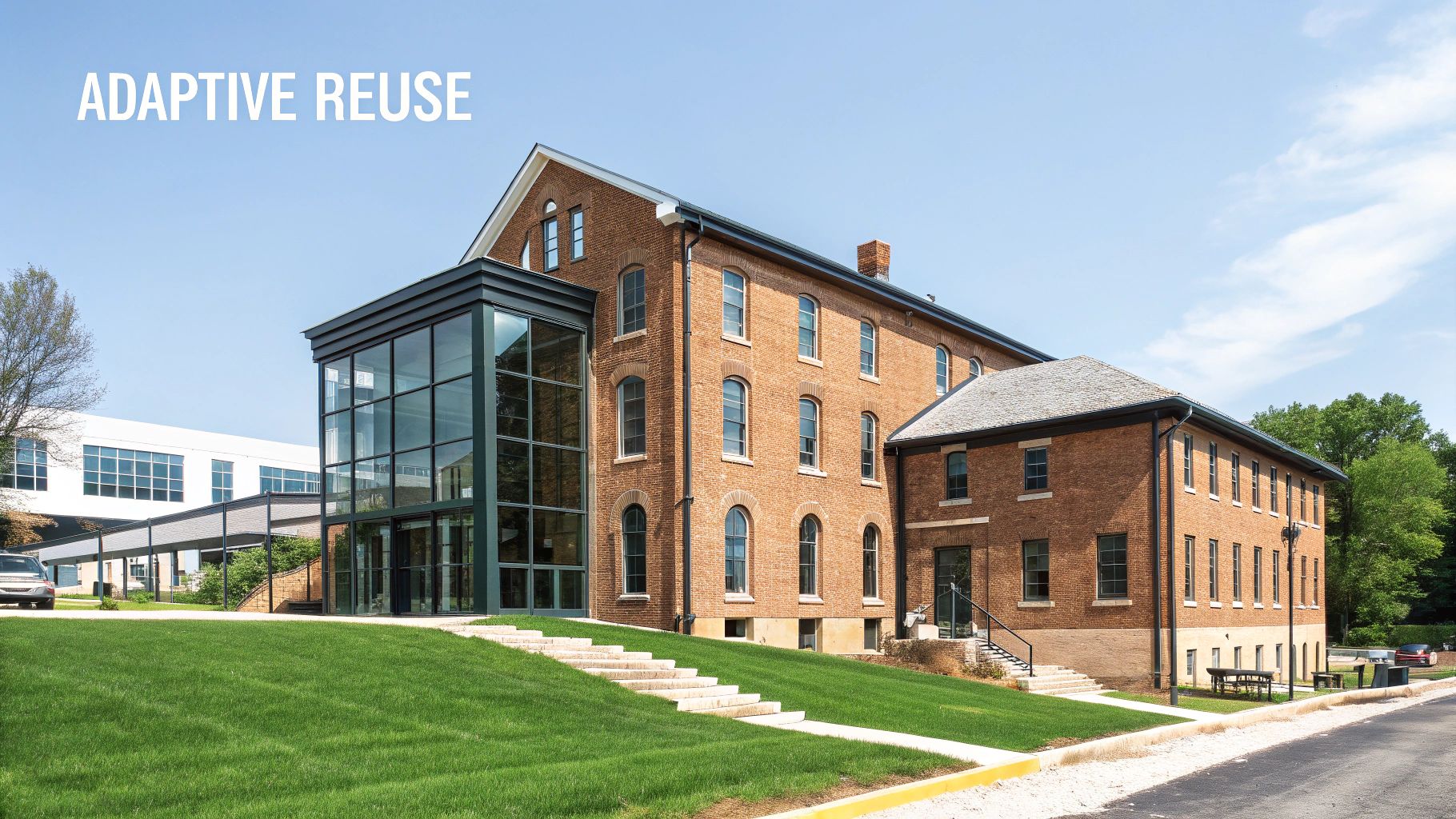
Transforming an old warehouse into apartments or a historic bank into a trendy restaurant—what we call adaptive reuse—is an exciting way to breathe new life into a property. But be warned: these projects are notorious for hiding expensive secrets. You aren't just building; you're performing major surgery on an old structure, and you never know what you'll find once you open it up.

Here’s what we often uncover:

  • Surprise Structural Issues: That beam might look solid, but once you start demolition, you could find decades of hidden decay, compromised steel, or a failing foundation.
  • Hazardous Material Abatement: Older buildings are a minefield for asbestos, lead paint, and other toxins. Removal is heavily regulated and expensive, and it's a non-negotiable cost.
  • Completely Outdated Infrastructure: The original plumbing and electrical systems are almost never up to modern standards. A full MEP (mechanical, electrical, plumbing) overhaul is usually a given, and it’s a massive capital expense.

In an adaptive reuse project, your contingency fund isn't just a "nice-to-have" safety net. It's a fundamental part of your budget. You should go into it expecting to find at least one major problem and have the cash ready to deal with it.

Navigating the Nuances of Historic Preservation

Working on a designated historic property is a completely different ballgame. It comes with its own set of financial and logistical hurdles. The goal isn't just to update the space—it's to do so while preserving its soul, which means playing by a strict set of rules from preservation boards.

Costs can escalate quickly here because of:

  • Period-Correct Materials: You can't just grab materials off the shelf. You'll be sourcing or custom-fabricating everything from specific brick styles to wood windows and plaster moldings. This is both slow and expensive.
  • Specialized Labor: Your average contractor isn't qualified for this work. You'll need to find and pay for skilled artisans who specialize in things like historic masonry repair or window restoration. Their expertise comes at a premium.
  • Lengthy Approval Processes: Getting sign-off from historic review boards can add months to your timeline. That delay translates directly into higher soft costs like insurance, financing, and project management fees.

Mandatory Building Code Upgrades

A major renovation almost always triggers a requirement to bring the building—or at least the renovated areas—up to current building codes. These aren't suggestions; they are legal mandates that can blow a hole in your budget if you haven't planned for them.

This is a huge factor in the U.S., where the commercial remodeling industry is a behemoth, projected to hit $39.9 billion in revenue in 2025. A big piece of that spending is driven by mandatory upgrades. For instance, MEP systems are seeing annual inflation of 5.1% as codes push for greater efficiency and safety. You can dive deeper into the commercial remodeling industry's economic impact to see how these forces shape the market.

Common code-driven expenses include:

  1. ADA Compliance: This might mean adding ramps, widening every doorway, overhauling restrooms for accessibility, or even installing a new elevator.
  2. Fire Safety Systems: You could be on the hook for installing a full fire sprinkler system, upgrading alarms, or redesigning egress routes—all complex and invasive jobs.
  3. Energy Efficiency Standards: Many cities now require renovations to meet tough new energy codes, forcing you to upgrade insulation, install high-performance windows, or replace the entire HVAC system.

Many renovation complexities can seem minor at first but have a cascading effect on your budget.

Common Cost Escalation Scenarios

Scenario Potential Cost Impact Mitigation Strategy
Unforeseen Asbestos 10-15% budget increase Conduct a thorough hazardous materials survey before finalizing the budget. Build a specific abatement line item and a healthy contingency.
Historic Window Replacement 2x-4x cost of standard windows Engage a historic preservation consultant early. Explore repair/restoration options before committing to full, custom-fabricated replacements.
Triggered Sprinkler Requirement $5 – $10 per square foot Involve a fire protection engineer during the initial scope definition to determine if your renovation will trigger a full system requirement.
Required ADA Bathroom Overhaul $25,000 – $50,000+ per restroom Review ADA requirements with your architect at the schematic design phase. Don't assume existing restrooms can be easily modified.

Understanding these scenarios helps you anticipate, rather than react to, major budget shocks.

If you ignore these variables, your initial estimate is fundamentally flawed. A truly reliable cost estimator doesn't just look at the new paint and flooring; it digs deep into the building’s bones, its history, and the local regulations to paint a financial picture you can actually trust.

Building a Resilient Budget with Contingency

Let's be realistic: no commercial renovation ever goes exactly as planned. I've seen it time and time again. A budget that looks perfect on paper can fall apart the moment you open up a wall and find something unexpected. That’s why a professional budget isn't just a plan; it’s a financial tool built to withstand the realities of construction.

To make your budget truly resilient, you need to build in a financial cushion. This comes in two forms: contingency and escalation. It's crucial to understand the difference. Contingency is your defense against project-specific surprises, while escalation protects you from market-wide price hikes that are completely out of your control.

The Role of a Contingency Fund

Think of contingency as your project’s internal shock absorber. It’s a dedicated pot of money, a set percentage of your total costs, specifically for dealing with unforeseen issues that pop up during the build. This isn't a slush fund for adding nice-to-have features on the fly. It's strictly for tackling problems.

What kind of problems?

  • Discovering termite damage or dry rot hiding behind drywall.
  • Finding out the existing electrical system is a tangled, non-compliant mess.
  • Hitting bedrock or an old, undocumented foundation during minor excavation work.

The industry rule of thumb is to set aside 5% to 15% of your total project cost for contingency. But that's just a starting point. A simple cosmetic refresh in a modern building might only need a 5% buffer. But if you’re renovating a century-old historic property? You’d be wise to push that closer to 20%. The older the building, the more secrets it holds.

Preparing for Escalation Costs

While contingency covers the 'known unknowns' within your project, escalation handles the 'unknown unknowns' of the wider market. It’s a separate fund to cover price increases for materials and labor that happen between when you budget and when you actually buy. In a volatile economy, this can make or break a project.

We've seen this play out dramatically in recent years. Office fit-out costs have surged, with 75% of markets reporting raw material price jumps and half struggling with labor shortages. A high-end buildout for a law firm, for example, can run 16% more than a standard office simply due to the cost of premium finishes. You can dig into these global office fit-out cost trends to see just how much pressure budgets are under.

This is precisely why a separate escalation fund, often 2% to 5% for a year-long project, has become standard practice.

A budget without a properly calculated contingency is not a budget—it's a wish list. It ignores the fundamental reality of construction and leaves your project dangerously exposed to financial risk.

Building these financial buffers into your estimate from the very beginning is what separates an amateur guess from a professional financial plan. It turns a fragile spreadsheet into a robust tool that can absorb real-world shocks without derailing your entire vision.

Knowing When to Bring in a Professional
Overhead view of a clipboard, calculator, hard hat, and text 'Contingency Buffer' on wood and grass.

That cost estimator spreadsheet you’ve been working on is a fantastic tool for getting your initial thoughts organized. But let’s be honest—it has its limits. There’s a definite point where a DIY calculation stops being a helpful guide and starts becoming a potential liability.

Knowing when you’ve hit that wall is key. It’s the moment your project goes from a back-of-the-napkin idea to a real-world venture that needs funding, permits, and a team to build it.

Key Triggers for Bringing in the Pros

Certain project milestones demand a level of detail and defensibility that only an architect or professional estimator can deliver. If you wait too long to make the call, you risk painful redesigns, budget overruns, and serious financing delays.

It’s time to bring in an expert when you find yourself in one of these situations:

  • You're Seeking Financing: Lenders aren’t going to fund a project based on your personal spreadsheet. They need to see a detailed, professional cost breakdown that proves the project is financially sound.
  • You're Ready for Contractor Bids: To get realistic, apples-to-apples bids from general contractors, you need to provide them with a comprehensive and professionally vetted scope of work. Otherwise, you’re just guessing.
  • You're Facing Complex Regulations: Is your project in a historic district? Does it involve significant zoning changes or major code upgrades? An expert is essential to navigate the red tape and accurately price the compliance work.

Bringing a firm like Sherer Architects on board early turns cost estimation from a guessing game into a strategic financial roadmap. It sets your project up for a successful, profitable outcome right from the start.

It’s About More Than Just the Numbers

Hiring a professional isn't just about getting a more accurate estimate; it's about adding strategic value that protects your investment. Their expertise goes way beyond simple arithmetic.

While estimators use sophisticated tools like manufacturing quoting software for precision, their real contribution comes from experience and strategic insight.

An experienced architect brings a lot more to the table:

  1. Value Engineering: They are masters at finding smart ways to reduce costs without compromising the final product. This could mean substituting a specific material or tweaking a design element you hadn’t considered.
  2. Cost-Saving Alternatives: With their deep industry knowledge, they can suggest innovative construction methods or materials that might deliver the same result for less money.
  3. Navigating the Code: A good architect anticipates code-related costs that most people would miss entirely, saving you from expensive change orders down the line when the building inspector shows up.

Engaging an expert early ensures your budget isn't just a number—it's a realistic, defensible plan built on a foundation of real-world experience.

Frequently Asked Questions

Navigating the financial side of a renovation can be tricky, especially when you're just getting started. Let's tackle some of the most common questions we hear from property owners and developers about estimating commercial renovation costs.

What Is the Biggest Mistake People Make When Estimating Renovation Costs?

By far, the most common and costly mistake is underestimating soft costs. It’s completely natural to focus on the tangible construction expenses—the steel, the concrete, the drywall—but the indirect costs often get missed.

Things like architectural fees, city permits, engineering reviews, legal consultations, and insurance can easily add up to 20-30% of the total project cost. When you overlook these in your initial budget, you create a huge financial gap that can put the whole project at risk before a single hammer swings.

How Much Should I Budget for Contingency?

A good rule of thumb is to start with a 10% contingency fund, calculated from your total hard and soft costs. But this isn't a hard-and-fast rule; it really needs to be tailored to your project’s specific risks.

For instance, your contingency might look very different depending on the job:

  • A simple cosmetic update in a modern, well-documented building? A 5% contingency might be perfectly fine.
  • A complex historic renovation on an old structure full of unknowns? You'll want to be much more conservative, perhaps setting aside 15% to 20%.

Think of contingency as your project's insurance policy against the unexpected. The higher the risk of surprises—like uncovering hidden structural damage or hazardous materials—the more robust that policy needs to be.

Can I Use an Online Calculator for an Accurate Estimate?

Online calculators are a fantastic starting point. They're great for getting a quick, back-of-the-napkin number to see if an idea is even financially feasible.

But they can't replace a professional estimate. These tools simply can't factor in the critical details that make or break a budget, like your specific site conditions, the current local labor market, or the unique complexities of an adaptive reuse project.

When you need a budget you can confidently take to a lender or use for contractor bids, you absolutely need a detailed, line-item estimate prepared by an experienced architect or professional estimator.


Ready to move beyond ballpark figures and build a real financial plan for your renovation? The team at Sherer Architects, LLC has decades of experience turning complex commercial renovation, adaptive reuse, and historic preservation projects into profitable realities. Contact us today to discuss your vision.
Categories
Uncategorized

A Developer’s Guide to Contract Administration in Construction

Contract administration is what happens after the ink on the construction contract is dry. It’s the hands-on process of making sure everyone involved—from the owner to the general contractor—actually does what they promised to do. This covers everything: the budget, the schedule, the quality of work, and the final deliverables.

Think of it as the project's operating system. It's always running in the background, keeping every moving part coordinated and on track from groundbreaking to ribbon-cutting.

The Blueprint for Project Success

A construction worker in a hard hat writes on a clipboard at a building site with text overlay "Contract Administration".

If a construction project were an orchestra, the architectural drawings would be the sheet music and the contractors the musicians. In this scenario, contract administration in construction is the conductor, cueing each section at the right moment to make sure the final performance is a masterpiece, not a mess.

Without a conductor, things can go sideways fast. Deadlines slip, budgets balloon, and arguments erupt over what was agreed upon in the first place. Good contract administration isn't about sitting back and filing papers; it's the active, daily work of enforcing the contract's rules on the ground.

More Than Just Paperwork

At its heart, this is the process of turning a legal document into a physical building. It’s a chain of critical tasks that connect the vision on paper to the reality of steel and concrete. A huge piece of this is maintaining strict What Is Contract Compliance, which is vital for shielding the project from unnecessary risk and legal trouble.

The core goals of contract administration are pretty straightforward:

  • Ensuring Accountability: Keeping everyone honest. It makes sure the owner, architect, and contractor all stick to the duties laid out in the contract.
  • Managing Communication: Creating a single, official channel for all project communication. This means every question, change, and decision leaves a clear paper trail.
  • Controlling Costs and Schedule: Watching the budget and timeline like a hawk. This includes processing payments correctly and managing any changes that might throw things off course.
  • Verifying Quality: Making sure the work and materials are up to snuff and match the specifications in the construction documents.

For developers and owners, solid contract administration is the most powerful tool you have for managing risk. It sets up the guardrails to prevent expensive fights, stop scope creep in its tracks, and guarantee the finished building is exactly what you paid for.

The Proactive Approach to Building

Ultimately, contract administration is the project’s central nervous system. It takes in information, helps guide decisions, and coordinates action across the entire site. This proactive management is what separates a smooth, successful project from one that's constantly fighting fires. It’s the discipline that ensures the promises made in the contract are the promises kept on completion day.

Understanding the Key Players and Their Roles

Think of a successful construction project like a three-legged stool. It needs the Owner, the Architect, and the Contractor all working in balance to stand strong. When it comes to contract administration, knowing exactly who is responsible for what isn't just about paperwork—it's the very foundation of a smooth, accountable project.

When everyone understands their role, decisions happen faster, disagreements are fewer, and the whole project keeps moving forward. Without that clarity, you’re setting the stage for confusion, delays, and the kind of disputes that can derail a project completely.

Let's break down who does what.

The Owner: The Vision and the Wallet

As the project Owner, you're the one who started it all. You have the vision, you own the property, and most importantly, you provide the funding that makes everything possible. While you hire experts to handle the day-to-day work, your role in administering the contract is anything but passive.

Here’s what’s on your plate:

  • Making Timely Decisions: The project can't move forward without your input. You'll be asked to approve material choices, weigh in on design questions, and give the final say on any changes.
  • Funding the Project: This is more than just writing the initial check. It means making progress payments to the contractor on time as they are certified by the architect. Consistent cash flow is the fuel that keeps the project running.
  • Approving Final Changes: You have the ultimate authority. When changes to the scope, budget, or timeline are proposed, you give the final green light.

Your role is like that of a film producer. You might not be directing every scene, but you provide the resources and make the critical decisions that guide the entire production to a successful finish.

The Architect/Engineer: The Impartial Interpreter

More often than not, the Architect or Engineer who designed the project steps into the critical role of the Contract Administrator. This isn't about taking sides; it's about serving as a fair and impartial interpreter of the contract documents they created. Their loyalty isn't to the owner or the contractor, but to the project itself.

The bedrock of effective contract administration is impartiality. The architect’s duty is to ensure the contract is followed faithfully, protecting the design's integrity and the interests of everyone involved, exactly as laid out in the agreement.

Their list of administrative tasks is long. They review the contractor’s submittals to make sure materials meet specs, they field Requests for Information (RFIs) to clarify design details, and they prepare change orders for the owner’s approval. A huge part of their job is visiting the site to observe the work, verify it matches the plans, and certify the contractor's applications for payment based on the progress they see.

The Contractor: The Hands-On Builder

The General Contractor is the one who brings the blueprints to life. They are the on-the-ground leader, managing all the labor, materials, equipment, and subcontractors needed to turn a two-dimensional drawing into a three-dimensional building.

In the administrative process, their job is to build precisely what the contract calls for and to document everything along the way. This means preparing shop drawings for approval, sending RFIs when they need clarification, and putting together detailed payment applications. The contractor is also the master of the schedule, coordinating all the trades on site and ensuring a safe working environment for everyone.

To make these distinct roles even clearer, let's look at a side-by-side comparison of their core duties.

Key Responsibilities in Construction Contract Administration

This table breaks down the primary responsibilities for each key player during the construction phase, showing how their duties intersect and rely on one another.

Responsibility Area Owner Architect/Engineer (Administrator) Contractor
Project Funding Provides all project financing and pays invoices. Certifies the amount of payment due to the contractor. Submits applications for payment for work completed.
Design & Quality Holds the ultimate vision for the project's outcome. Interprets contract documents and observes work for quality. Builds the project according to the plans and specifications.
Changes & Scope Gives final approval on all change orders and scope adjustments. Prepares change order documents and analyzes cost/schedule impacts. Prices proposed changes and performs the extra work once approved.
Communication Is the primary decision-maker for project-level choices. Acts as the central hub for formal RFI and submittal processes. Initiates RFIs and submittals to clarify and confirm details.

As you can see, successful contract administration is a collaborative effort. While each party has its own distinct lane, clear communication and mutual respect are what truly pave the way for a successful outcome.

The Construction Phase Step-by-Step

Once the ink is dry on the contracts and everyone knows their role, the real work begins. The construction phase is where blueprints start becoming a building, and it’s also where the theory of contract administration in construction gets put into practice every single day. This isn't just one task; it's a whole series of interconnected steps, each one depending on the last to keep the project on track.

You can think of it like a carefully choreographed performance. Every single move—from a contractor submitting a material sample to an architect approving a payment—has to be done precisely and in the right order. One small misstep can throw the whole thing off, leading to delays, budget blowouts, and a whole lot of frustration. This flow of information, approvals, and actions is what drives a project from a dirt lot to a finished building.

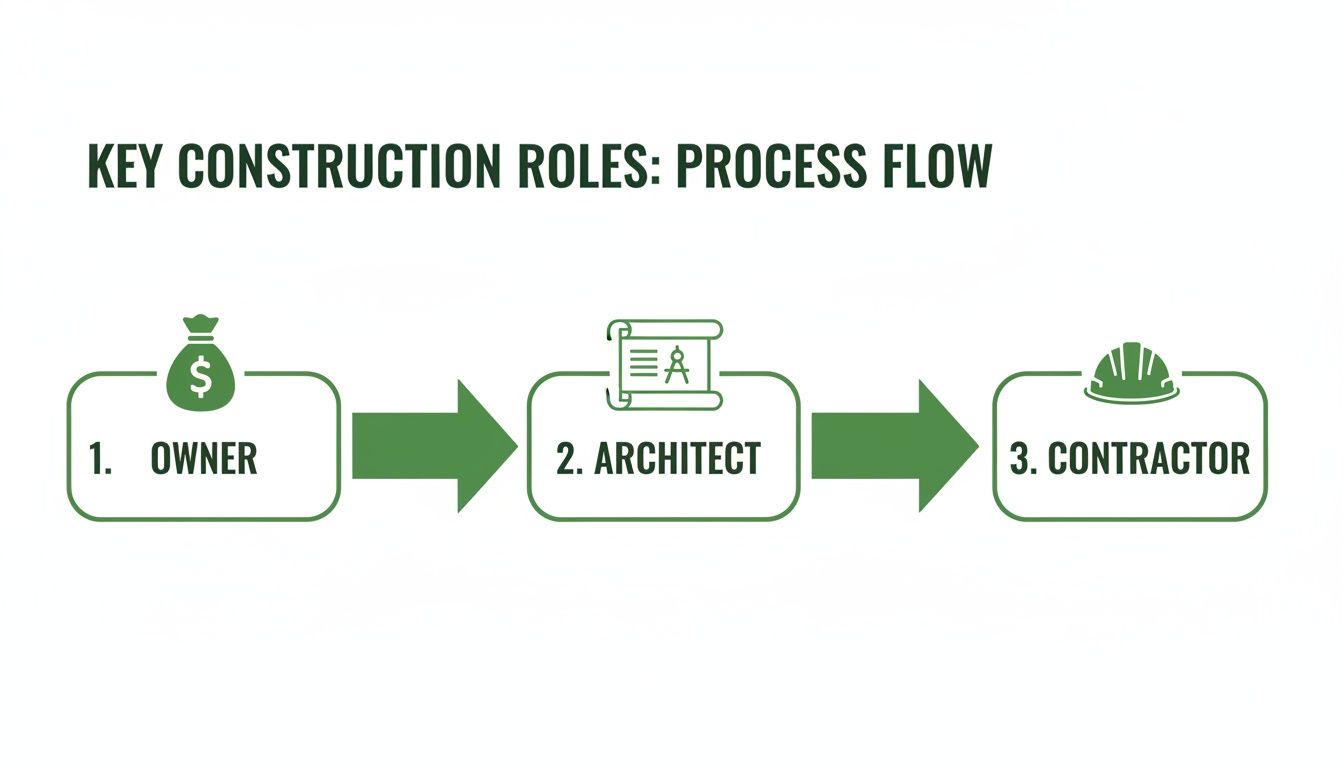
To get a clearer picture of how these roles work together, this diagram shows the essential workflow. It all starts with the owner, moves to the architect for interpretation and oversight, and then to the contractor who brings it all to life.

A flowchart illustrates the key construction roles process: Owner, Architect, and Contractor, linked by arrows.

As you can see, the architect often sits in the middle, acting as the administrator who ensures the owner's vision and budget are translated correctly into the contractor's work on the ground.

Managing Submittals and Shop Drawings

Before a single steel beam is hoisted into place or a window is installed, the contractor needs to prove they’re using the right stuff. This is handled through submittals—a catch-all term for the documents, physical samples, or product data they provide to the architect for review. A critical type of submittal is a shop drawing, which is a super-detailed drawing from a supplier showing exactly how a component will be built and put in place.

Acting as the contract administrator, the architect pores over these submittals, comparing them against the original project specifications.

  • What's the point? To make absolutely sure the materials, equipment, and building methods the contractor wants to use meet the required quality and design intent.
  • Here's an example: Imagine an adaptive reuse project where new window trim needs to match the building's historic character. The contractor submits a sample of the custom-milled wood. The architect checks its species, dimensions, and finish against the specs before giving the green light for fabrication.

This verification step is a big deal. Getting it right upfront prevents the incredibly expensive and time-consuming mistake of having to rip out and replace work that wasn't approved.

Clarifying Details with Requests for Information

Let's be honest: no set of construction drawings is 100% perfect. Out on the job site, questions always come up. A Request for Information (RFI) is the official way contractors ask for clarification on the plans or specifications when they hit a gray area.

An RFI isn't just a quick text message; it's a formal, documented question that demands a formal, written answer from the architect. This process is essential for clearing up confusion before it turns into a construction mistake. A smoothly run RFI process keeps the project moving and leaves a paper trail of how every design question was answered. On the flip side, poor RFI management is a classic project-killer, causing work to grind to a halt while crews wait for answers.

A quick, clear response to an RFI is one of the most important jobs in contract administration. It stops guesswork on the site, slashes the risk of rework, and protects everyone by documenting the decision that was made.

Documenting Changes with Change Orders

Projects almost never finish exactly as they were first drawn. You might hit unexpected soil conditions, the owner might want to add a new feature, or a building code official might interpret something differently. When the original plan has to change, a change order makes it official. It's a formal amendment to the contract that documents the adjustment.

A proper change order does three key things:

  1. Describes the change to the scope of work.
  2. States the adjustment to the contract price (up or down).
  3. Specifies the impact on the project timeline.

This document isn’t valid until it’s signed by the owner, architect, and contractor. It’s the only way to make sure everyone is on the same page about the change and its consequences, which prevents ugly arguments over "he said, she said" agreements down the road. For example, if an owner decides to upgrade to high-efficiency HVAC units midway through the project, a change order will capture the new equipment cost and any extra time needed for installation.

Processing Payment Applications

Contractors don’t just get one big check. They get paid progressively by submitting monthly payment applications, which are detailed invoices showing the value of work completed so far. The application breaks down all the labor, materials, and subcontractor costs based on a "schedule of values" that was agreed upon at the start of the project.

The architect’s job here is to review the application, walk the site to confirm the work has actually been done, and then certify the payment amount for the owner. This crucial step protects the owner from paying for work that's behind schedule or done incorrectly. It keeps the cash flow tied directly to real, tangible progress.

This part of the process is so important because when contract administration gets sloppy, things can go south fast. A recent report pointed to contractual ambiguities as the number one cause of disputes, a problem that’s only gotten worse with global supply chain issues and volatile pricing. For a firm like ours, Sherer Architects, LLC, that specializes in commercial and adaptive reuse projects here in South Carolina, this reality hits home. Rigorous oversight is what ensures critical details like zoning, energy efficiency, and historic tax credits are managed correctly from day one to avoid costly conflicts later. You can get more insights on how these issues impact modern projects in the full report.

Done right, contract administration turns the payment process from a potential conflict into a predictable, transparent transaction. It’s the steady heartbeat of a healthy construction project.

How to Avoid Common Contract Administration Pitfalls

Think of contract administration in construction as the project's immune system. Its job is to spot and fight off problems before they can turn into a full-blown crisis. But without a watchful eye, even the best-laid plans can get derailed by common mistakes that cause delays, blow up the budget, and lead to nasty disputes. Knowing what these traps look like is the first step to keeping your project healthy.

The biggest issues rarely pop up overnight. They’re usually slow-burning problems that start small—a delayed answer to an RFI here, a verbal agreement that never gets written down there. These little slips start to pile up, chipping away at trust and leaving the project vulnerable to major setbacks.

Ineffective Communication and Slow Decision Making

Good, fast communication is the absolute lifeblood of any construction project. When messages get stuck or decisions drag on, everything can grind to a halt. A contractor who has to wait days for a simple design clarification can't move forward, which means crews are sitting idle and the schedule is slipping. Those delays can have a domino effect that lasts for weeks.

This isn't just an inconvenience; it's a huge source of financial loss and legal trouble. A recent industry report pointed to project management failures like poor communication and oversight as major drivers of conflict, made even worse by supply chain problems. For developers working on adaptive reuse projects, where you’re guaranteed to find surprises, tight contracts and quick communication are non-negotiable. You can dig into more of the challenges and how to handle them in the full report.

The best way to fight this is to set up a clear communication plan right from the start:

  • Set Response Times: Your contract should spell out exactly how long someone has to respond to RFIs and submittals. Make it mandatory.
  • Keep It Central: Use one platform or process for all official requests. This stops important things from getting buried in a hundred different email threads.
  • Empower Your People: Make sure the owner's rep on-site has the authority to make decisions quickly to keep things moving.

Inadequate or Inconsistent Documentation

Here’s the golden rule of contract administration: if it’s not in writing, it didn’t happen. Weak documentation is an open invitation for claims, disputes, and "he said, she said" arguments you can't win. Every instruction given on-site, every meeting note, and every approval for a change needs to be documented.

I like to think of project documentation as legal armor. A complete and accurate paper trail is your best defense against claims. It creates an undeniable timeline of every decision, protecting the owner from liability and baseless back-charges.

A classic mistake is giving a verbal "okay" for extra work. A site superintendent might agree to a small tweak with the owner's rep, but if there's no signed change order, there’s no official record of the new scope or cost. You can bet that’s going to cause a massive headache when the invoice shows up.

Mismanaging Changes and Scope Creep

Change is a given in construction, but uncontrolled changes—what we call scope creep—will absolutely wreck a budget and schedule. This is what happens when lots of little adjustments are made without any formal process, and they slowly add up to a huge impact. To keep changes under control and avoid arguments, knowing how to write an addendum or a change order is a must-have skill.

The solution is to be incredibly strict with your change order process:

  1. Formal Request: Any proposed change has to be submitted in writing. No exceptions.
  2. Thorough Review: The architect needs to carefully analyze how the change will affect the cost and the schedule.
  3. Written Approval: No one touches anything until a formal change order is signed by the owner, architect, and contractor.

This disciplined approach means every single change is a deliberate, documented decision—not a casual conversation that comes back to bite you later. By getting ahead of these common pitfalls, you can protect your project from the things that most often cause it to fail and keep it on track for a successful finish.

Navigating Project Closeout and Final Payment

Crossing the finish line on a construction project feels like the final lap of a marathon. The end is in sight, but this last stretch—what we call project closeout—demands meticulous attention. This is where a sharp contract administrator ensures every loose end is tied up, transforming an active job site into a fully operational building and protecting your investment from future headaches.

This phase begins when the heavy lifting is done, but before the keys are officially handed over. It’s all about methodically confirming that every single promise in the contract has been fulfilled. Only then is the final payment released and the project truly complete.

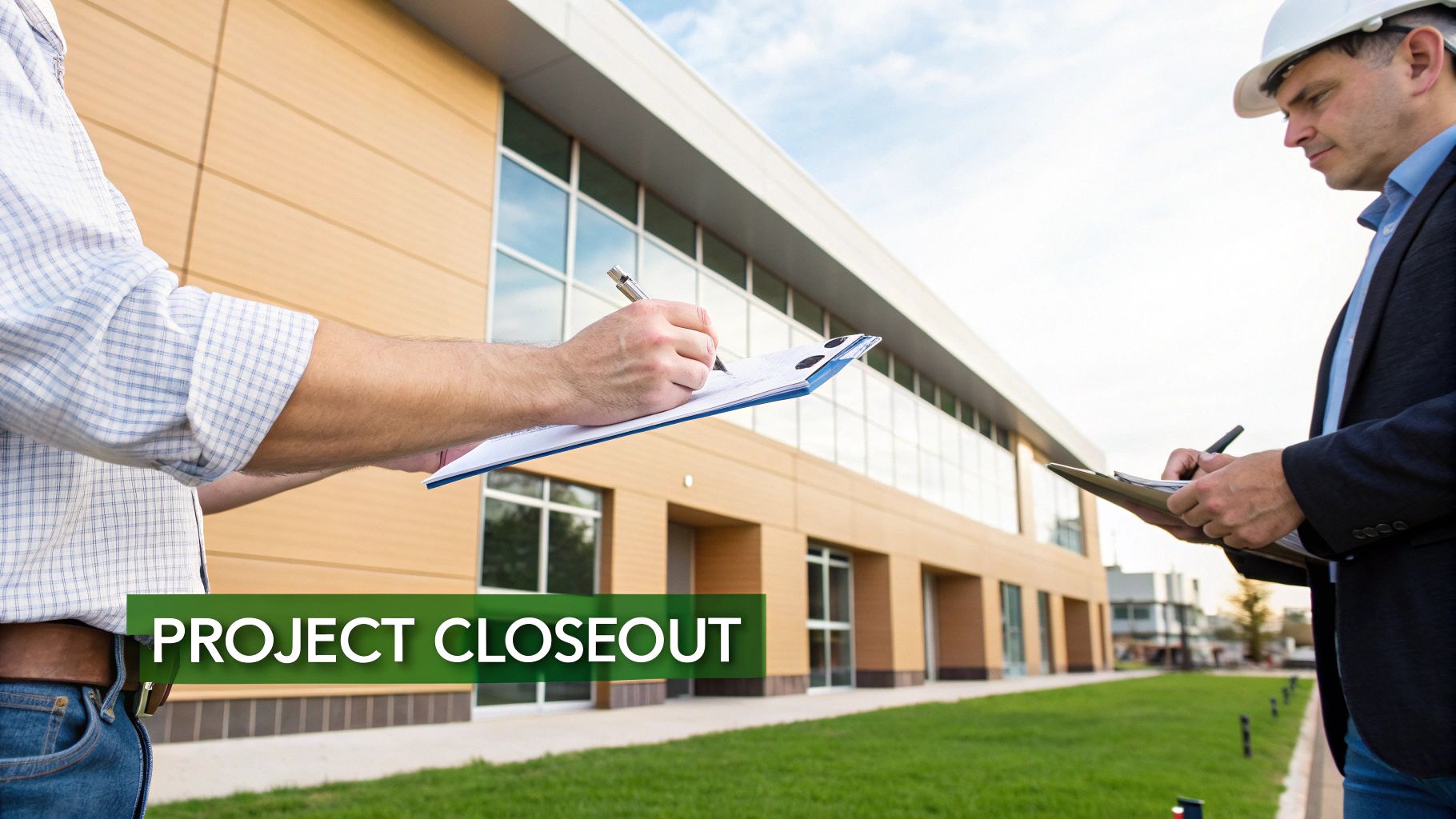
Two men in construction gear inspecting a new building during project closeout, writing on clipboards.

Compiling and Managing the Punch List

The first order of business in the closeout process is to create the punch list. Think of it as the project’s final, detailed to-do list. It’s a formal document cataloging all the minor fixes and finishing touches needed before the owner officially accepts the work.

Punch list items aren't about major flaws; they're the small things that still need attention. You might find a scuff on a newly painted wall, a missing cabinet handle, or a light fixture that needs a final adjustment. Typically, the architect, owner, and contractor walk the site together to build this list, making sure everyone is on the same page about what’s left to do.

Reaching Substantial Completion

Once the contractor has worked through every item on the punch list, the project hits a major milestone: substantial completion. The architect formally certifies that the building is safe and ready for the owner to move in and use as intended. It doesn’t mean every tiny detail is perfect, but the core work is done.

The Certificate of Substantial Completion isn't just a piece of paper; it’s a legally critical document. It typically signals the end of the official construction timeline, which means the clock starts ticking on all warranties. It also transfers responsibility for insurance and security from the contractor to you, the owner.

Getting this certificate is a clear sign that the contractor has delivered on their main contractual obligations, setting the stage for the final handover.

Final Documentation and Handover

With the construction work wrapped up, the focus pivots to paperwork. This is a vital part of contract administration that arms the owner with everything they’ll need to manage and maintain their new building for decades to come.

The contractor is responsible for providing a complete closeout package, which includes:

  • Warranties and Manuals: All the paperwork for equipment like HVAC units, elevators, and appliances, along with operating manuals for the building's core systems.
  • As-Built Drawings: A final set of blueprints updated to reflect exactly how the project was built, capturing any and all changes made along the way.
  • Lien Waivers: Signed legal forms from the general contractor and their subcontractors confirming they've been paid in full. This protects the owner from future claims against the property.

Final Payment and Release of Retainage

After the last punch list item is checked off and every document has been reviewed and accepted, it's time for the final financial step. The contract administrator will approve the contractor's last application for payment.

This final payment almost always includes the release of retainage. Retainage is a percentage of the contract value (usually 5-10%) that the owner withholds throughout the project as a form of insurance. Releasing these funds is the final handshake—it signifies the owner’s formal acceptance of the work and officially brings the project to a successful close.

The Architect's Real-World Impact on Project Success

Think of an experienced architect as the owner's boots on the ground—the expert who turns the black-and-white text of a construction contract into a predictable, successful project. Their role in contract administration goes far beyond just checking drawings. It’s about foreseeing trouble before it snowballs into a budget-breaking crisis.

For instance, an architect with a deep understanding of local zoning quirks, ever-changing building codes, and the nuances of historic preservation can shepherd a project through the approvals labyrinth with ease. This kind of proactive guidance is what sidesteps the bureaucratic logjams that can stall a project for months, saving everyone time and money.

From Problem to Solution: The Architect in Action

Where an architect's value really comes into focus is when the unexpected happens. Picture this: during an adaptive reuse project, workers uncover serious structural issues hidden within the old building. A seasoned architect doesn't panic; they get to work.

Here’s what that looks like in practice:

  • First, they dig into the problem, figuring out the smartest, most effective fix.
  • Next, they draft a crystal-clear change order that details the new work, what it will cost, and how it impacts the timeline.
  • Then, they negotiate with the contractor to make sure the pricing is fair, keeping the project moving without unnecessary friction.

This isn't just problem-solving; it's turning a potential disaster into a managed, well-documented part of the process. It protects the owner’s budget and ensures everyone involved knows exactly what’s happening and why.

In construction, the best risk management tool you have is a rock-solid paper trail. An experienced architect makes sure every decision, every change, and every conversation is logged, creating a clear project history that protects the owner's investment.

Recent studies on construction disputes show that fuzzy contract terms and sloppy management are the root cause of most conflicts. These issues get even worse when you add in economic pressures, like tariffs on building materials. For a firm like Sherer Architects, LLC, guiding clients through intricate commercial and preservation work means leaving nothing to chance. They use modern contract analytics tools and maintain strict compliance with local codes and review boards.

This level of expertise is especially vital in adaptive reuse, where their portfolio of over 200 renovations proves there’s a cost-effective way to build sustainably. You can get more insights on where the industry is heading from this global construction report.

At the end of the day, having a dedicated architect as your partner isn't just an expense; it's an investment in minimizing risk, achieving predictable results, and seeing your vision become a successful reality.

Common Questions We Hear in the Field

Even the most seasoned developers have questions that pop up during the construction process. Let's tackle a few of the most common ones we encounter when managing contracts for our clients.

What’s the One Document I Can’t Live Without?

Hands down, it's the signed contract agreement, along with the complete set of drawings and specifications. This collection of "contract documents" is your project's single source of truth. It dictates the scope, quality standards, budget, and timeline that everyone has agreed to.

Without a rock-solid set of documents that everyone has bought into, you're setting yourself up for confusion and disputes. Every RFI, change order, and payment request gets measured against what's in that agreement.

Think of the contract documents as the project's constitution. It’s the law everyone has to follow on-site, and it's the final word when disagreements arise. A vague constitution is a recipe for chaos.

How Do I Keep Change Orders from Sinking My Project?

The best way to control change orders is to prevent them in the first place with meticulous pre-construction planning. But let's be realistic—some changes are inevitable. The key is having a well-defined process in your contract for how they're handled.

This process should spell out exactly how a change is requested, priced, approved, and formally documented. The golden rule is to get all cost and time impacts in writing and signed off before any new work begins. This transforms a potential budget-buster into a controlled, documented decision.

Who’s on the Hook if the Contractor Doesn’t Follow the Plans?

The contractor is ultimately responsible for executing the work as detailed in the approved plans and specifications. It's the contract administrator’s job—often the architect—to observe the construction and promptly report any deviations to you, the owner.

Once a deviation is identified, the contractor is contractually obligated to fix it on their own dime. This is exactly why regular site visits from an experienced administrator are non-negotiable. Catching a mistake early is a relatively simple fix; finding it after the fact can mean costly demolition and rework, derailing your entire schedule.


Successfully navigating the ins and outs of contract administration isn't just about paperwork; it's about having a partner who knows how to protect your investment. For over 30 years, Sherer Architects, LLC has been that partner for clients, steering projects to successful completion. We ensure the final product is delivered on time, within budget, and to the quality you expect.

Contact us today to discuss how we can bring that same structure and success to your next project.

Categories
Uncategorized

What an Interior Architecture Firm Does and Why You Need One

An interior architecture firm does more than just decorate; it fundamentally reworks a building's structure and flow to reshape how the space actually functions. It's the difference between a stylist choosing an outfit and a surgeon reshaping the body underneath.

These firms are strategic partners. They focus on making your commercial property safe, efficient, and profitable by redesigning its "bones."

Thinking Beyond Decor: What Is an Interior Architecture Firm?

People often use "interior design" and "interior architecture" interchangeably, but they are worlds apart. While an interior designer is brilliant at aesthetics—choosing furniture, fabrics, and paint to make a space beautiful—an interior architecture firm starts much, much deeper. Their work begins long before anyone even thinks about a swatch of fabric.

These are licensed professionals who analyze and redesign the very structure of a building's interior. Their real expertise is in understanding how people move through and interact with their physical environment—a field often called environmental psychology. They solve complex spatial puzzles to make sure a building isn't just attractive, but is fundamentally sound and perfectly tuned for its purpose.

The Architect vs. The Decorator: An Analogy

Think of a building as a human body. An interior decorator is like a personal stylist. They pick the clothes (finishes), the accessories (furniture), and the makeup (color palette) to create an incredible final look. Their role is absolutely vital for appearance and expressing a specific style.

The interior architect, on the other hand, is like a surgeon and a kinesiologist rolled into one. They examine the skeleton (structural walls), the circulatory system (HVAC and plumbing), and the nervous system (electrical wiring). They can perform "surgery" by moving walls, rerouting systems, and completely changing the layout to improve the body's overall health and efficiency. They make sure the body can perform at its peak, not just look the part.

Core Responsibilities of an Interior Architecture Firm

An interior architecture firm's work goes far beyond aesthetics, covering critical technical and strategic ground. The main goal is to make the physical space support the business's objectives, which is especially important in commercial, adaptive reuse, and historic preservation projects.

Here’s a look at what they actually do:

  • Spatial Planning and Reconfiguration: This is all about analyzing and redesigning floor plans. They work to improve traffic flow, maximize every usable square foot, and make the experience better for everyone inside.
  • Structural Modifications: They have the expertise to legally and safely change a building’s interior structure. This includes complex tasks like removing or adding walls and integrating brand-new mechanical systems.
  • Code Compliance and Permitting: This is a big one. They navigate the maze of building codes, zoning laws, and accessibility standards (like the ADA) to ensure the project is fully compliant and can get all the necessary permits.
  • Project Management: They see the project through from the first sketch to the final construction walkthrough. This means coordinating with contractors, engineers, and vendors to make sure the vision becomes a reality, on time and on budget.

The Blueprint for Success: Core Architectural Services

Bringing a vision to life—turning an idea into a functional, beautiful space—isn't a single action. It’s a carefully managed journey. A seasoned interior architecture firm is your guide through a series of distinct phases, with each step building on the one before it to make sure the final result is exactly what you set out to achieve. This process is the blueprint that transforms abstract goals into tangible, valuable assets.

It all kicks off with a critical discovery phase we call Programming. This is so much more than a simple Q&A. Think of it as a deep-dive investigation into how your business operates, what your goals are, and what your space truly needs to accomplish. We ask the tough questions to understand not just what the space should look like, but how it needs to work for you, your staff, and your customers.

The architectural team gathers crucial data on workflow patterns, occupancy needs, brand identity, and even your plans for future growth. All of this information is distilled into a detailed project brief. This document becomes the north star for every single decision that follows.

From Concept to Concrete Plans

With the "what" and "why" sorted out during Programming, we move into the creative phases where the vision starts taking physical form. This is where ideas get explored, sharpened, and ultimately translated into the kind of technical specifications a construction team can build from.

This creative journey unfolds in three main stages:

  • Schematic Design: This is the big-picture, brainstorming part of the process. We develop broad-stroke concepts using tools like bubble diagrams, rough floor plans, and mood boards to pin down the overall look, feel, and flow of the space. The goal here is to explore the possibilities and agree on a clear direction before diving into the details.
  • Design Development (DD): Once a schematic concept gets the green light, the team starts refining it with a much greater level of detail. Specific materials are chosen, lighting plans are created, and interior elevations are drawn up. This phase adds a critical layer of precision, defining the project with enough clarity to start getting realistic cost estimates.
  • Construction Documents (CDs): This is where it all gets real. As the most technical and intensive phase, we produce a comprehensive set of drawings and specifications that become the legal instructions for the contractor. These documents detail everything from how walls are built and where outlets go to the exact paint colors and fixture models. Nothing is left to chance.

This methodical progression from a high-level idea to meticulously detailed plans is what keeps projects on track and on budget, eliminating costly surprises during construction.

The table below outlines this journey, showing how each phase serves a distinct purpose in bringing a project from an initial idea to a completed space.

| The Interior Architecture Project Lifecycle |
| :— | :— | :— |
| Project Phase | Primary Goal | Key Deliverables for the Client |
| Programming | Define project needs, goals, and constraints. | A detailed project brief, space requirements, and budget analysis. |
| Schematic Design | Explore broad concepts and establish the overall design direction. | Conceptual floor plans, mood boards, and initial 3D sketches. |
| Design Development | Refine the chosen concept with specific details and materials. | Detailed floor plans, interior elevations, and preliminary material selections. |
| Construction Documents | Create a complete set of technical drawings for bidding and permits. | A full set of architectural drawings, technical specs, and finish schedules. |
| Bidding & Permitting | Select a qualified contractor and obtain all necessary approvals. | Bid analysis, contractor recommendations, and approved building permits. |
| Construction Admin | Oversee construction to ensure it aligns with the design documents. | Site visit reports, change order management, and final punch list. |

This lifecycle ensures a smooth, predictable process where the client is informed and empowered at every step.

Navigating Regulations and Securing Bids

With a complete set of construction documents in hand, the project shifts from design to the practicalities of getting it built. The interior architecture firm’s role here is absolutely vital, acting as your advocate to navigate complex logistical and regulatory hurdles. This includes managing the Bidding and Negotiation process. We send the construction documents out to qualified general contractors, who then submit bids to build the project. We help you analyze these bids to ensure they are complete and competitive, then assist in negotiating the final contract.

At the same time, we're handling the intricate process of securing permits from local authorities. We submit the construction documents to city and county officials for their review, fielding any questions related to zoning laws, building codes, and safety regulations. This expert navigation is a huge risk-reducer for developers, preventing expensive delays and guaranteeing full compliance.

A skilled interior architecture firm doesn't just design a building; they pilot it through the administrative maze of design review boards, energy codes, and local ordinances, ensuring the project is both buildable and legally sound.

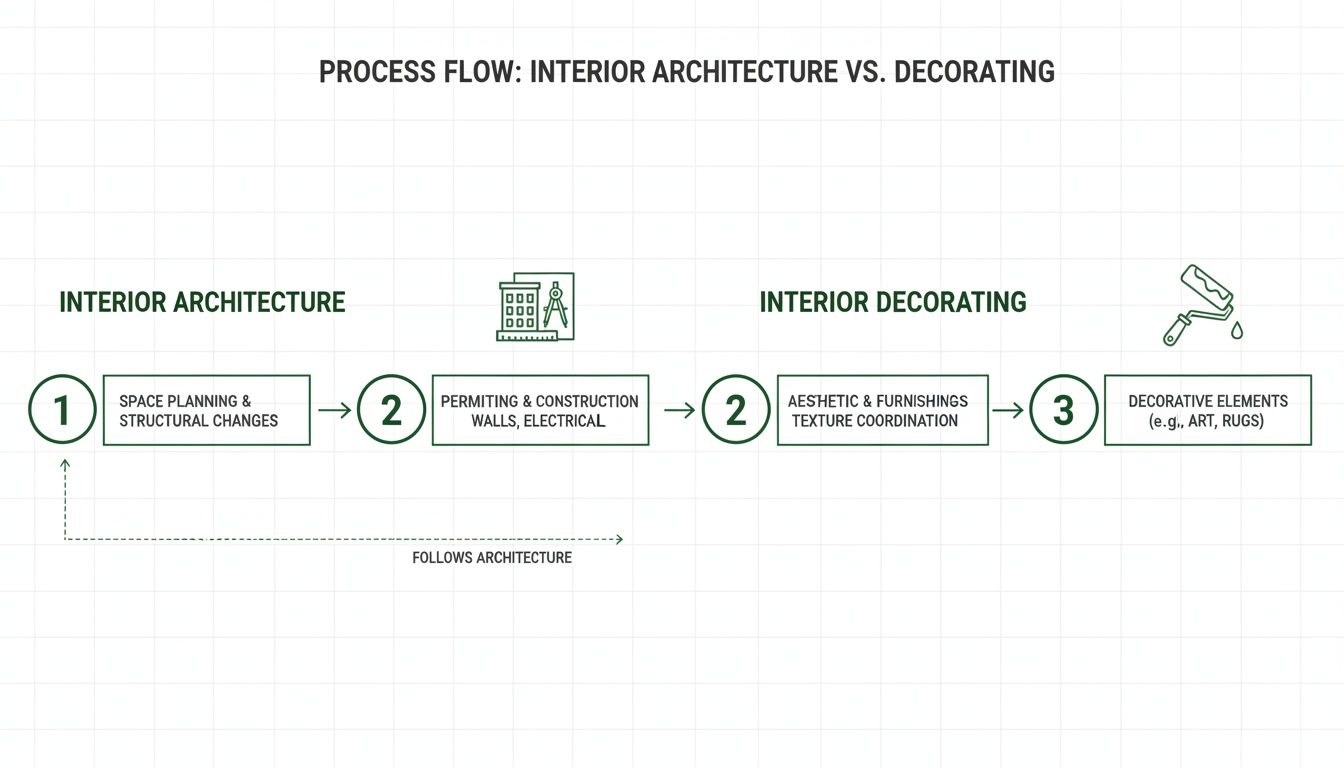
The following graphic helps visualize the different but complementary roles an interior architect and an interior decorator play over the course of a project.

Process flow diagram illustrating the steps for interior architecture and interior decorating services.

As you can see, the architect’s work is foundational—it’s about the structure, systems, and very bones of the space. The decorator’s work then comes in to enhance and complete that environment.

Ensuring Vision Becomes Reality

The final stretch is Construction Administration, and this is where the architect becomes your eyes and ears on the job site. We conduct regular site visits, answer questions from the contractor, review the quality of the work being done, and approve payment applications. This oversight is what protects your investment and ensures the project is built exactly as specified in the documents.

This hands-on management holds the construction team accountable for delivering the quality you paid for. The architect's involvement doesn't stop until the final punch list is complete and you're ready to move into your new, fully realized space. It’s this end-to-end service that showcases the true value of an interior architecture firm, creating a seamless bridge from the first spark of an idea to the day you open your doors.

The U.S. interior design market hit USD 35,010.3 million in revenue in 2024, with remodeling being the fastest-growing segment. This trend perfectly aligns with the adaptive reuse projects we specialize in, which breathe new life into existing structures. You can learn more about the interior design market's growth and how it’s shaping development strategies today.

Unlocking Value with Adaptive Reuse and Preservation

Spacious modern office interior featuring adaptive reuse design with exposed brick and large windows.

When many developers look at an old, tired building, they see a liability—something to be torn down. But a different kind of vision sees immense, untapped potential. This is the world of adaptive reuse, a smart strategy that breathes new life into aging structures, turning them into valuable, high-performing assets for today's market.

Adaptive reuse goes way beyond a simple renovation. It’s about strategically repurposing a building for an entirely new function while celebrating its original character. Think of an old textile mill buzzing with activity as a modern office hub, a forgotten warehouse finding new purpose as luxury lofts, or a grand old bank becoming a chic boutique hotel.

An interior architecture firm that specializes in this work is like a master puzzle-solver. They have the unique expertise to reconfigure outdated layouts for modern needs, weave in new mechanical and electrical systems without disrupting the building's soul, and navigate the intricate maze of historic preservation rules. The goal is always the same: create a space that feels contemporary and works beautifully, but is also rich with history and authenticity.

The Financial Case for Reimagining Old Buildings

The most powerful argument for adaptive reuse often comes down to the bottom line. For developers and property owners, choosing to repurpose an existing building instead of starting from scratch can offer a whole host of financial perks that are simply too good to ignore.

Demolition and new construction are expensive undertakings, both in time and money. Adaptive reuse projects, on the other hand, can be significantly more cost-effective. By keeping the building's "bones"—its core and shell—developers can see huge savings on materials and labor, often slashing project costs considerably.

Globally, the interior design market is projected to reach USD 214.35 billion by 2034, with commercial projects making up a huge piece of that pie. Adaptive reuse projects are frequently 40% cheaper than demolition and new construction, all while preserving historic character and opening doors to valuable tax incentives. Find out more about how market trends are favoring adaptive reuse projects.

These aren't just abstract savings. They directly translate into a healthier pro forma, a faster path to profitability, and a much higher return on investment for the developers who see the potential.

Beyond Cost Savings: The Strategic Advantages

The benefits of adaptive reuse don't stop with the budget. These projects have a built-in competitive edge that brand-new construction often struggles to match.

  • Accelerated Timelines: You get to skip the long demolition and site prep phases, meaning adaptive reuse projects often get to market much faster. This speed is a critical advantage, allowing you to start generating revenue sooner.
  • Unique Market Appeal: Today’s tenants and customers are looking for character. Exposed brick walls, original timber beams, and historic details create a unique sense of place that makes a property stand out from the cookie-cutter new builds, commanding higher rents and attracting top-tier tenants.
  • Environmental Sustainability: Reusing an entire building is one of the greenest things you can do in development. It drastically cuts down on landfill waste, preserves the embodied carbon locked into the original structure, and reduces the environmental toll of producing new materials.

Leveraging Historic Tax Credits for Maximum ROI

If the property has historical significance, the financial picture gets even brighter. A knowledgeable interior architecture firm becomes an essential partner in unlocking valuable historic tax credits. These government programs are specifically designed to encourage the preservation of landmark buildings by offering serious financial rewards.

Navigating the application process for these credits is a specialized skill. It requires a deep understanding of preservation standards, meticulous documentation, and careful negotiation with historical review boards. An experienced firm can guide you through every step, ensuring the design not only honors the building's past but also ticks every box required by the program.

These tax credits can offset 20-30% of qualified renovation costs, which can fundamentally change the financial viability of a project. What might have seemed like a daunting preservation challenge can quickly become a highly profitable venture, turning a community landmark into a cornerstone of your portfolio.

Why This Matters for Your Bottom Line

Choosing to work with an interior architecture firm isn't just about making a space look good; it's a hard-nosed business decision that directly impacts your financial success. Every single design choice, whether it's moving a wall or picking a countertop, is an investment. The right firm makes sure that investment pays off, turning your physical space from a cost center into a high-performing asset.

We're talking about shifting the focus from creating a beautiful space to building a profitable one. It’s the difference between a building that just sits there and one that actively works to boost your revenue, strengthen your brand, and secure your place in the market for years to come.

Enhancing ROI Through Smarter Space Utilization

At the end of the day, commercial real estate is a game of inches—or rather, square feet. The goal is to squeeze maximum value out of every single one. This is where an interior architecture firm really shines, using strategic spatial planning to find revenue potential you didn't even know existed.

Think of them as a master chess player who sees moves on the board that others miss. They might reconfigure a floor plan to create more leasable area, improve the flow of foot traffic, or simply make the space function better for its intended purpose.

For instance, a clever office redesign can fit more employees comfortably, meaning you don't have to lease more space. In a retail shop, rethinking the customer journey can lead to a 10-15% increase in sales just by guiding shoppers past high-margin products. This kind of optimization doesn't just make your property more functional; it makes it far more attractive to top-tier tenants and future buyers, directly boosting occupancy rates and resale value.

A well-designed commercial space is a powerful magnet for tenants and customers. It’s not just about what the space looks like; it’s about how it performs for the businesses operating within it.

There's a reason the U.S. interior design services sector employs around 140,128 professionals. With 38% of global demand coming from offices and retail spaces seeking wellness-focused layouts, developers who get this right can see occupancy jump by 15-20%. You can dive deeper into how strategic design is driving commercial real estate trends on InteriorDesign.net.

Saving Time and Money Through Expert Navigation

The road from a design sketch to a finished building is littered with potential landmines: tangled zoning laws, constantly changing building codes, and bureaucratic permitting processes. Each one is a risk that can lead to expensive delays and budget blowouts.

An experienced interior architecture firm is your guide through this regulatory maze. Their in-depth knowledge of local ordinances and established relationships with review boards mean they can spot trouble long before it becomes a real problem.

This proactive approach takes a huge amount of risk off your plate and keeps the project on a smoother, more predictable timeline. Shaving even a few months off a project schedule by avoiding permitting headaches means you start generating revenue that much sooner—and that's a massive win for any developer's bottom line.

Future-Proofing Your Asset with Flexible Design

The only constant in business is change. The explosion of hybrid work, new patterns in consumer behavior, and emerging technologies all demand that commercial spaces be able to adapt. A forward-thinking interior architecture firm doesn't just design for today; they design for tomorrow.

This foresight is built directly into the space through elements like:

  • Modular Walls: Allowing office layouts to be reconfigured on the fly for different team sizes or project needs.
  • Multi-Use Common Areas: Designing lobbies, cafes, or break rooms that can easily transform into event spaces or collaboration hubs.
  • Scalable Infrastructure: Planning ahead for future tech needs, making upgrades simple and affordable instead of a major renovation.

This kind of thinking protects your investment from becoming outdated. A building designed for flexibility today will stay valuable and relevant for decades, saving you from costly overhauls down the line. It ensures your property can pivot to meet new market opportunities, maintaining its competitive edge and long-term profitability.

How to Choose the Right Firm for Your Project

Two men shaking hands across a table with a laptop and documents in a bright office.

Picking an interior architecture firm is easily one of the most important decisions you'll make for your entire project. This isn't just about flipping through a portfolio of pretty pictures. You’re selecting a long-term partner who will be responsible for guiding you through complex regulations, managing a significant budget, and turning your business goals into a tangible, profitable space.

The "best" firm isn't necessarily the one with the trendiest designs. It's the one whose specific experience and problem-solving skills align directly with the challenges of your project. A great design is the bare minimum; a successful project that meets its goals on time and on budget is the real test of a firm’s value.

Look Beyond the Portfolio

A slick portfolio is a good start, but it really only shows you the final, polished product. To get a real sense of a firm's ability, you have to dig into their process and see how they've handled real-world challenges. Every project looks perfect in a professional photograph, but the true value of a firm emerges in how they navigate the inevitable bumps in the road during design and construction.

Look for a history that matches your project's DNA. If you’re tackling an adaptive reuse project, for example, you need a firm that lives and breathes historic preservation and knows how to bring old buildings into the modern era. Their firsthand experience with the unique structural quirks and regulatory mazes of these projects is absolutely essential.

The right interior architecture firm acts as a translator—they convert your vision into a buildable plan, your budget into a realistic scope, and your business goals into a functional, revenue-generating space. Their role is to de-risk the entire venture for you.

The same logic applies to new commercial construction. A firm with deep roots in South Carolina, strong relationships with local planning departments, and an intimate knowledge of zoning codes is a massive advantage. That kind of local expertise can save you months of delays and thousands in unexpected costs, paving a much smoother road from blueprint to grand opening.

Questions That Reveal True Expertise

When you sit down to interview potential firms, it's time to get past the surface-level questions about their design "style." What you really need to understand is how they think. Their answers to specific, scenario-based questions will tell you far more about their capabilities than any curated gallery of images.

Don't be afraid to come prepared with a list of tough questions that test their practical knowledge and collaborative approach. This is your chance to get a feel for their communication style and determine if they're a good cultural fit for your team.

Here are a few questions that cut to the chase:

  • Problem-Solving: "Tell me about a past project that hit a major zoning or permitting snag. How did you get it back on track, and what was the final result for the client?"
  • Budget Management: "What's your process for keeping the design aligned with our budget from start to finish? How do you approach value engineering if we see costs start to climb?"
  • Collaboration and Communication: "Walk me through how you work with clients, general contractors, and engineers. How do you manage differing opinions or priorities to keep everyone moving forward?"
  • Local Knowledge: "What's your experience with the design review boards and building codes right here in this municipality? Are there any specific local challenges we should be prepared for?"
  • Project Management: "What tools and systems do you use to manage the project schedule and budget? How often will we get updates, and what will they look like?"

The way they answer these questions will paint a very clear picture of their competence, their transparency, and ultimately, whether they are the right strategic partner to bring your vision to life.

Your Partner in Building Lasting Value

Choosing an interior architecture firm isn't like picking a vendor; it's about bringing on a strategic partner who’s fully invested in your commercial success. Think of them as the conductor of a complex orchestra, expertly weaving together your vision, budget, regulations, and market demands to create a space that truly works. They’re the ones who turn abstract business goals into a tangible, high-performing physical asset.

The real value here goes far beyond beautiful finishes or trendy furniture. It’s found in a floor plan that actively maximizes your revenue, a design that sails through the permitting process without costly delays, and a building that will stay relevant and valuable for decades to come. A skilled interior architecture firm makes sure every single choice directly contributes to your bottom line.

The most successful projects begin with a shift in mindset—viewing architectural services not as an expense, but as the foundational investment in building enduring value. Your partner in this process is key to unlocking your property's full potential.

So, as you approach your next commercial or adaptive reuse project, think about the strategic advantage that expert guidance brings to the table. The right architectural partner doesn't just design a space for you. They help build your future, ensuring your investment delivers returns long after the dust has settled. It’s the smartest first step you can take.

Frequently Asked Questions

When you're dealing with commercial real estate and development, questions are bound to come up. Here are some of the most common ones we hear from clients thinking about working with an interior architecture firm.

What's the Difference Between an Interior Architect and an Interior Designer?

It's a common point of confusion, but the distinction is crucial. While both want to create great spaces, their roles are fundamentally different.

An interior architecture firm is run by licensed professionals who are legally qualified to change the structure of a building's interior. Think of them as dealing with the "bones" of the space—moving walls, integrating new plumbing and electrical systems, ensuring everything is up to code, and handling any structural work.

An interior designer, on the other hand, usually works on the surface level. Their expertise is in the finishing touches: furniture, paint colors, fabrics, and accessories that define the aesthetic. If your project involves a gut renovation, adaptive reuse, or major new construction, you need an interior architect to lead the charge.

How Much Does It Cost to Hire an Interior Architecture Firm?

There's no single answer here, as the cost really depends on your project's size, scope, and how complex it is. Generally, fees are handled in one of three ways:

  • A percentage of the total construction cost, typically landing between 8% and 15%.
  • A fixed, flat fee that's agreed upon before any work begins.
  • An hourly rate for design work and consultations.

It might feel like a big line item on the budget, but a good firm provides value that far exceeds its cost. They catch expensive mistakes before they happen, navigate the permitting maze to save you from costly delays, and design your space to get the most out of every square foot. It’s less of a cost and more of an investment in your property's future.

Hiring an expert firm is about risk mitigation. Their fee is a strategic investment to ensure your multi-million dollar project is executed correctly, compliantly, and profitably, preventing far costlier mistakes down the line.

How Long Does a Typical Commercial Project Take?

The timeline is completely tied to the scale of the job. A simple commercial upfit could be wrapped up in a few months. But a major adaptive reuse project or a brand-new building can easily stretch to a year or more.

The whole process breaks down into distinct phases: design (which includes schematics and detailed construction documents), bidding and permitting, and finally, construction itself. A seasoned firm will give you a realistic timeline from the get-go and has the project management chops to keep things moving forward.

Can a Firm Help with Historic Tax Credits?

Absolutely. In fact, this is one of the most valuable services a firm can offer if you're working on a historic property. Finding a local firm that has successfully navigated the state and federal historic tax credit programs is a game-changer. This isn't something you can just wing; it’s a specialized skill that can make or break the financial success of a project.

Firms with this expertise will walk you through the entire application, from documenting the building's historic importance to making sure every single detail of the renovation follows the strict Secretary of the Interior’s Standards. Their guidance is essential for maximizing your tax credits and transforming a piece of history into a profitable, modern asset.


Ready to transform your vision into a valuable, enduring property? At Sherer Architects, LLC, we specialize in guiding clients through every stage of design and construction, from innovative commercial spaces to complex historic preservation projects. Let's discuss how our strategic approach can bring structure, beauty, and profitability to your next venture.

Contact us today to schedule your consultation

Categories
Uncategorized

Architecture Greenville SC: architecture greenville sc Guide to Local Design

Kicking off a commercial building project in Greenville is about more than just finding a piece of dirt and hiring a crew. The projects that truly succeed—the ones that become landmarks and smart investments—are built on a solid foundation of strategy. This all happens long before anyone even thinks about drawing up blueprints. This initial phase is where you sidestep costly blunders and bake real value into your project from the very start.

Setting Your Greenville, SC Building Project Up For Success

A successful project isn't an accident; it's the result of a smart, foundational strategy. This isn't about checking boxes. It’s about making informed, deliberate decisions from day one that prevent expensive headaches later. It means you have to dig deep into the specifics of your site, nail down a crystal-clear scope, and establish a budget that’s grounded in reality, accounting for both what you know and what you don't.

This strategic flow shows how these crucial first steps fit together, from evaluating the site to setting the budget.

A flowchart illustrates the project success flow with steps: Evaluate Site, Define Scope, and Set Budget.

As you can see, each stage builds directly on the one before it. Get this sequence right, and you're laying the groundwork for a smooth and successful project.

Evaluating Your Site and Its Hidden Potential

Your first real move is a thorough site evaluation that goes way beyond just the property lines. In a city like Greenville, with its unique history and distinct neighborhoods, every single property has its own story and context.

Think about its proximity to hotspots like the West End or the Village of West Greenville. Is it nestled within a historic district, like the Pettigru Historic District? That could unlock valuable preservation incentives, but it will also mean navigating extra layers of design review.

Beyond location, you've got to get real about the physical conditions. Does the site’s topography create a nightmare for foundation work? Are utilities already on-site, or is running new infrastructure going to be a major line item on your budget? If you're looking at an existing building, the investigation gets even more critical.

Assessing an Existing Building For Adaptive Reuse

If you’re considering an older building, a comprehensive condition assessment is absolutely non-negotiable. This isn’t a quick walkthrough; it's a deep dive into the building's guts. You need solid answers to some tough questions:

  • Structural Integrity: Is the foundation sound? Are there tell-tale signs of stress or failure in the load-bearing walls or roof structure?
  • MEP Systems: How old are the mechanical, electrical, and plumbing systems? Outdated or non-compliant systems can mean a full replacement, which is a massive budget hit.
  • Hazardous Materials: Are you dealing with asbestos, lead paint, or other nasty surprises that demand specialized—and expensive—abatement?
  • Building Envelope: What’s the state of the roof, windows, and masonry? Water intrusion is a project-killer if you don’t catch it and deal with it early.

Greenville’s rich stock of older buildings presents incredible opportunities for adaptive reuse. The city has a deep inventory of historic properties just waiting to be transformed into profitable, modern assets. A 2003 survey identified around 1,200 historic resources, and another 128 were added later. This just scratches the surface of the potential for preserving these unique structures for another 50–75 years of use. You can explore Greenville's historic property survey to get a feel for the city's amazing architectural heritage.

A classic misstep is underestimating what it costs to bring an old building up to modern code. What looks like a simple cosmetic facelift can quickly spiral into a full-gut renovation when you uncover the need for a new HVAC system, a complete electrical rewire, and major accessibility upgrades.

To guide you through these initial stages, here's a checklist of the key areas to investigate.

Initial Project Scoping Checklist

Evaluation Area Key Questions to Ask Why It Matters
Zoning & Land Use What is the current zoning? Are there overlays (e.g., historic, design review)? What are the permitted uses, setbacks, and height limits? Determines what you can legally build and sets the fundamental design constraints. Ignoring this can stop a project cold.
Site Conditions What is the topography? Are there environmental concerns? Where are the utility connections (water, sewer, electric)? Physical site issues directly impact foundation design, site work costs, and overall construction feasibility.
Building Condition (For existing buildings) What's the state of the structure, roof, and MEP systems? Is there evidence of hazardous materials? Uncovering major deficiencies early prevents catastrophic budget overruns and project delays during construction.
Market Feasibility Who is the target tenant/buyer? What are the current market rents or sales comps for this type of property in this location? Ensures your project vision aligns with market demand, making it a viable and profitable investment.
Preliminary Budget What are the anticipated hard costs (construction) and soft costs (fees, design, legal)? Have you included a contingency? A realistic, all-in budget from the start provides a critical reality check and guides all subsequent decisions.

Working through these questions forces you to think critically about every angle of the project before you've spent a dime on design.

Defining Your Scope and Setting a Realistic Budget

Once you have a complete picture of your site or building, it's time to define your project scope. This is your roadmap. It details everything from the square footage and how the space needs to function to the quality of the finishes. A vague scope is a surefire recipe for budget overruns and endless delays.

Get specific. Don’t just say "a modern office space." Define it as "a 10,000-square-foot office with an open floor plan for 50 employees, two conference rooms with full AV integration, and a Class A lobby finish." See the difference?

With a detailed scope in hand, you can finally build a budget you can trust. This needs to include more than just the hard costs of materials and labor. You have to account for soft costs, too—things like architectural and engineering fees, city permits, legal expenses, and financing.

And whatever you do, always build in a contingency fund. A buffer of 10-15% of the total construction cost is standard practice to cover the inevitable surprises that pop up in every single project. This disciplined approach is what separates the successful projects from the cautionary tales.

Finding the Right Architect for Your Greenville Project

Engineer in hard hat evaluating an industrial site, writing on a clipboard with a 'SITE EVALUATION' sign.

Let's be clear: choosing your architect is probably the most consequential decision you’ll make for your entire commercial project. This isn't just about finding a firm with a slick portfolio. It's about securing a strategic partner who truly gets the intricate development landscape here in Greenville, SC.

The right architect does so much more than design buildings. They are your guide through the complex local systems that can make or break your investment. A stunning rendering is worthless if the design gets shot down by the city's Design Review Board (DRB) or clashes with the neighborhood’s character.

The best architecture Greenville SC has to offer comes from a deep, almost instinctual, understanding of local context. We're talking about everything from the brick facades along Main Street to the industrial grit of the West End. Your ideal partner will have a proven track record of navigating these specific local waters.

Look Beyond the Portfolio

When you start your search, it's incredibly easy to get dazzled by polished photos of finished projects. And while a strong portfolio is definitely a good sign, it's just the beginning of the story. The real value is in an architect's experience with the process, not just the final product.

You need someone who can anticipate the questions and concerns of Greenville's planning officials before they even come up. That kind of foresight only comes from years of hands-on experience and the professional relationships built along the way.

As you vet potential firms, here’s what you should really be focusing on:

  • Local Regulatory Fluency: Have they successfully steered multiple projects through Greenville’s specific zoning, permitting, and DRB hoops? Don't be shy—ask for concrete examples.
  • Adaptive Reuse Expertise: If you're working with an older building, does the firm have a solid portfolio of successful adaptive reuse projects? It's a highly specialized skill that not everyone possesses.
  • Historic Preservation Credentials: Is your project in a historic district or a designated landmark? Make sure the architect has direct experience with historic tax credits and the strict standards that come with preservation work.

This is the kind of specialized knowledge that separates a decent local architect from a truly great one. It’s the difference between a smooth, predictable process and one that’s bogged down by costly delays and frustrating redesigns.

Questions to Uncover True Expertise

When you sit down for interviews, it's time to move past generic questions about design philosophy. Your mission is to understand how a firm thinks on its feet, solves problems, and collaborates when things get tough. You’re not just hiring a designer; you're hiring a problem-solver and a staunch advocate for your investment.

A common mistake is getting hung up on an architect's design style. A far more critical factor is their ability to fuse a great design with your business goals and the city’s regulatory demands. The goal is a project that's not just beautiful, but profitable and buildable.

To really get to the heart of their capabilities, try asking these pointed questions:

  1. Navigating the DRB: "Tell me about a time you presented a project to the Greenville DRB and got some tough feedback. How did you adapt the design to satisfy their concerns while still protecting the project's budget and our main goals?" This question reveals their real-world negotiation and problem-solving skills.

  2. Value Engineering: "Can you give me an example of how you used a creative design solution or a different material to bring down construction costs on a project without compromising the quality or the look?" This gets right to their ability to deliver value, not just a pretty picture.

  3. Collaboration Style: "What's your process for communicating with us and the contractor during the construction phase? How do you handle it when there's an on-site issue or a gap between the plans and what's actually being built?" This peels back the curtain on how they manage the messy, practical reality of a construction site.

The answers you get will tell you far more about a firm’s real-world chops than any portfolio. You’ll get a window into how they handle adversity, protect your bottom line, and ultimately act as a true partner. Your choice of architect shapes everything from day one to completion, so take the time to find a firm that brings both visionary design and pragmatic, on-the-ground expertise to your project.

Navigating Greenville's Zoning and Permitting Maze

Greenville’s rapid growth has, not surprisingly, led to a complex web of regulations. If you're a developer or property owner, this maze of zoning ordinances, landscape rules, and design guidelines can feel like a serious hurdle. Getting a project from a sketch on a napkin to a structure rising from the ground takes more than a great idea; it demands a smart, strategic approach to the entire approvals process.

Thinking about these local rules as just a checklist to get through is a mistake. When you understand them, you can actually use them to create a better, more valuable project that fits right into the city's unique character. This is where a seasoned local architect becomes your most valuable player—they know how to translate your vision into a language city officials and review boards will not only understand but also support.

Understanding Greenville's Zoning and Overlays

Before you fall in love with a specific design, your first reality check is always the city's zoning code. These are the foundational rules that dictate everything from what you can do with the building (its "use") to how tall it can be and how far it must sit from the property lines.

But in Greenville, the real game-changer is often the overlay districts. Think of these as special zones, like a historic district or a design review area, that layer extra standards on top of the basic zoning. A project on Main Street, for instance, is going to get a much closer look at its materials, size, and how it feels to a pedestrian than a warehouse in an industrial park.

Here’s how an experienced team tackles this:

  • Zoning Verification: The first move is to get a zoning verification letter from the city. This document officially confirms all the specific requirements for your property. No guesswork.
  • Deep-Dive Code Analysis: Next, your architect will dig deep, comparing your project goals against the code to spot any potential conflicts right away.
  • Proactive Strategy: This early homework lets you get ahead of problems. You might tweak the design slightly or start building a strong case for a variance if you know you'll need one.

Skipping this initial due diligence is a classic rookie mistake. I’ve seen it lead to months of delays and expensive redesigns when the planning staff flags an issue that could have been caught on day one.

The Influential Design Review Board

For projects in many of Greenville’s most desirable spots, your design’s fate lies with the Design Review Board (DRB). This board's job is to make sure new construction and major renovations add to the city's aesthetic and character, not detract from it. They aren’t just ticking boxes on a form; they’re making a subjective judgment on the quality and fit of your design.

Presenting to the DRB is both an art and a science. You need a compelling story that explains why your design choices make sense for that specific location.

A common pitfall is treating the DRB presentation as just another bureaucratic step. The board wants to see that you've thought deeply about the context, the materials you've chosen, and the building's overall scale. An architect who can clearly and confidently articulate the "why" behind the design is your greatest asset in that room.

Getting the DRB's approval often boils down to good preparation and a collaborative spirit. A smart architect engages with city staff for informal feedback long before the official hearing. This pre-review process helps you iron out the kinks and address concerns early, making the formal presentation a much smoother ride.

From Site Plan Approval to Building Permits

Once you’ve cleared the DRB and have conceptual approval, the process shifts from the big picture to the nitty-gritty technical details. This phase is a whirlwind of submissions to different city departments—engineering, landscaping, fire safety, and more. Each one will scrutinize your plans to ensure they meet every last code and ordinance.

This is where your architect and engineering team work in perfect sync, producing the highly detailed construction documents that will guide the build. These drawings spell out everything, from the structural system holding the building up to the layout of every electrical outlet.

The final leg of the journey is securing all necessary building permits and, at the very end, the project's final blessing. When dealing with Greenville's permitting process, it's vital to remember the last step: obtaining the Certificate of Occupancy. This is the city's official stamp of approval, declaring your building is safe and ready for business. You can't legally open your doors without it. Throughout this entire sequence, your architect acts as the project quarterback, coordinating with all the consultants and responding to city feedback to keep your project on track, on time, and on budget.

Why Adaptive Reuse Is Smart Business in Greenville

In a city like Greenville, where historic brick mills and century-old storefronts tell the story of its past, the bulldozer isn’t always the best tool for the job. We're seeing more and more developers recognize the immense value locked away in these older structures.

Adaptive reuse is simply the practice of breathing new life into old buildings—transforming them for modern uses while keeping their irreplaceable character. This isn't just about nostalgia; it's a savvy business strategy that often delivers a stronger ROI than starting from scratch.

When you choose to repurpose an existing building, you're not just saving a piece of history. You're leveraging its embodied carbon, making it a far more sustainable choice. You also get to sidestep the high costs and unpredictable timelines that come with demolition, site prep, and new foundation work, getting you to market faster. This approach lets you tap into a huge demand for authentic spaces that you just can't replicate with new construction.

Tapping Into Powerful Financial Incentives

One of the most compelling reasons to go the adaptive reuse route in Greenville is the significant financial support available. Renovating a historic property isn't just a feel-good decision; it can dramatically improve your project's bottom line through a range of powerful incentives.

These programs were put in place specifically to make preservation an attractive, and often more profitable, alternative to demolition. They can seriously reduce your initial investment, improve cash flow, and ultimately boost your property's long-term value.

Here are the key financial tools you should know about:

  • Federal Historic Tax Credits: This is the heavyweight champion of preservation incentives. It can provide a 20% income tax credit for the substantial rehabilitation of certified historic structures. For a multi-million dollar renovation, that credit can mean hundreds of thousands of dollars straight back into your pocket.
  • State Historic Tax Credits: South Carolina offers its own set of credits that you can stack with the federal program, making the deal even sweeter for developers.
  • Local Grants and Loans: Don't overlook local programs and specialized lenders. They often provide favorable terms for projects that help preserve Greenville's architectural heritage.

Navigating the complex applications and compliance for these programs is no small feat. This is where an architect with deep experience in historic preservation becomes absolutely essential.

The Balance Between Progress and Preservation

Greenville's story is one of constant evolution, and sometimes that progress came at a cost. During the early 20th century, the city’s push toward modernization led to the loss of some real architectural treasures. For instance, the original 1823 courthouse designed by Robert Mills—the visionary behind the Washington Monument—was torn down for a new "skyscraper." As you can read more about Greenville's Main Street history, this loss really highlights the tension between moving forward and holding onto the past.

Today, the most successful developers and city planners I work with recognize that the best projects find a way to honor the past while building for the future. Adaptive reuse isn't about freezing a building in time; it's about making it relevant and useful for generations to come.

This thoughtful approach is what gives Greenville its distinct sense of place. Buildings like Mills Mill, a Romanesque-style textile factory built in 1897, have been reborn as vibrant residential and commercial hubs. These projects prove that historic structures can be powerful economic engines, attracting tenants and customers who are willing to pay a premium for authenticity and unique design. Choosing adaptive reuse aligns your project with what the community values and helps create a more sustainable and culturally rich city.

Adaptive Reuse vs New Construction A Financial Snapshot

When you really crunch the numbers, especially with the available incentives factored in, the financial case for adaptive reuse becomes crystal clear. Here’s a high-level look at how the two approaches typically stack up for a commercial project in Greenville.

Financial Factor Adaptive Reuse / Historic Preservation New Construction
Initial Capital Outlay Often lower since you're leveraging the existing structure and avoiding major demolition. High costs for demolition, site work, foundation, and all-new structural systems.
Tax Incentives Eligible for substantial federal and state historic tax credits, directly reducing project costs. Generally not eligible for preservation-specific financial incentives.
Construction Timeline Can be faster by avoiding lengthy site prep and foundation phases. Subject to weather delays and potentially longer timelines for ground-up work.
Market Appeal High demand for unique, character-rich spaces that often command premium rents. Competes in a crowded market of standard, modern commercial spaces.

Ultimately, by partnering with an experienced architecture Greenville SC firm that understands the nuances of historic properties, you can transform what might look like a liability into a high-performing asset—creating a landmark that is both profitable and a source of community pride.

Bringing Your Project From Blueprint to Reality

A beautiful historic brick building with a modern glass addition, exemplifying adaptive reuse architecture.

With the city’s stamp of approval on your plans, the project finally moves off the page and onto the job site. This is the construction administration phase—the moment your vision starts becoming a physical asset. Success from here on out hinges on a strong, collaborative partnership between you, your architect, and your general contractor. The real work starts now.

Don't make the mistake of thinking your architect's job is done. In many ways, their role becomes even more crucial during construction. They shift from being your designer to your advocate on the ground, making sure the contractor’s work matches the design's intent with precision and quality. This oversight is what protects your investment and ensures the final building is what you actually paid for.

Your Architect is Your Advocate on the Job Site

During the build, your architect is the essential link between the detailed plans and the day-to-day realities of the construction site. Their main job is to observe the progress and confirm that everything is being built according to the contract documents. This isn’t about micromanaging the crew; it’s about quality assurance.

Regular site visits are the backbone of this process. An experienced architect has a trained eye for the details, spotting potential issues long before they snowball into costly, time-consuming problems.

During these visits, they’re focused on key tasks:

  • Checking Work Conformance: Are the right materials being used? Is the craftsmanship up to standard? They verify that everything from the rebar in the foundation to the window installations matches the specifications.
  • Answering RFIs: Contractors will always have questions. Your architect provides timely, clear answers through Requests for Information (RFIs), which prevents guesswork and keeps the project from stalling.
  • Reviewing Pay Applications: They review the contractor’s invoices to certify that the amount billed accurately reflects the work completed. This simple check protects you from paying for work that hasn't been done yet.

Having your architect consistently on-site is fundamental to maintaining the integrity of high-quality architecture Greenville SC projects, from the first shovel in the ground to the final coat of paint.

It's a common myth that the general contractor is the only one responsible for quality control. While the GC manages the build, your architect is your independent expert, verifying the work is done right, not just done. Their loyalty is to you and the vision you both created.

Building a Problem-Solving Partnership

Let’s be realistic: no construction project goes exactly as planned. You might uncover an unexpected utility line during excavation, or a key material could be hit with a supply chain delay. These things happen. What defines a successful project is how the team—owner, architect, and contractor—handles these bumps in the road.

A collaborative, get-it-done mindset is essential. Pointing fingers only leads to wasted time and money. The goal is to create an environment where problems are brought to the table immediately and solved together. Your architect often leads these conversations, helping analyze the issue and proposing solutions that work for the design, the budget, and the schedule.

For example, if a specified brand of flooring suddenly goes on backorder for six months, your architect can quickly find and vet a suitable alternative that meets the same aesthetic and durability standards, keeping the project on track.

Keeping Timelines, Costs, and Changes in Check

Staying on top of the schedule and budget is a daily effort, and your architect is central to that effort through meticulous documentation and clear communication.

The most critical tool for managing this is the change order. This is a formal document used any time a deviation from the original plan will affect the project's cost or timeline. This could be an upgrade you decide to add or an adjustment needed to deal with an unforeseen site condition.

Here’s how a well-managed change order process works:

  1. Clear Scope: The architect clearly spells out the exact scope of the change.
  2. Transparent Pricing: The contractor provides a detailed cost breakdown for the new work.
  3. Formal Approval: You, as the owner, give the final sign-off before any work begins.

This disciplined approach prevents "scope creep" and eliminates nasty financial surprises when the final bill comes. By working as a tight-knit team with your architect and contractor, you can navigate the complexities of construction and see your vision brought to life—beautiful, durable, and exactly as you intended.

Your Top Questions About Greenville Architecture Projects

Two construction workers in hard hats review blueprints at a building site for a house.

Tackling a commercial development in Greenville brings up a lot of questions. I've seen property owners, seasoned developers, and new investors all start with similar concerns. Let’s walk through some of the most common ones to give you the clarity you need to get started.

How Long Does The Design And Permitting Process Take In Greenville?

This is usually the first question I get, and the honest answer is: it depends entirely on the project's scope. A simple interior upfit for a retail space will, of course, move much faster than a complex, ground-up hotel in a historic district.

As a rule of thumb, it’s smart to budget 3-6 months for the design phase alone. That covers everything from initial sketches to the detailed construction documents a builder needs. After that, you'll need to plan for another 3-5 months to get through the City's permitting process and, if applicable, the Design Review Board (DRB).

Keep in mind, projects with extra layers of complexity—like historic preservation reviews or requests for zoning variances—will add time to that schedule. A local architect who knows the ropes can give you a far more accurate timeline for your specific project and help you sidestep common delays.

What Are The Biggest Benefits Of Adaptive Reuse?

Deciding to repurpose an old building instead of starting from scratch is a smart move in a city like Greenville. The benefits are about much more than just saving a piece of history.

Financially, the advantages are compelling:

  • Cost Savings: You can save a significant amount on big-ticket items like demolition, major site work, and pouring a new foundation.
  • Tax Credits: Many adaptive reuse projects are eligible for federal and state historic tax credits, which can put a substantial amount of money back into your pocket.
  • Faster Timeline: Working with an existing structure often means you can get your doors open—and start generating revenue—much sooner.

Beyond the numbers, renovated historic buildings offer an inherent character and story that you simply can't manufacture. This authenticity is a massive draw, attracting discerning tenants and customers who crave unique, memorable spaces.

What Is The Role Of The Design Review Board?

Greenville’s Design Review Board, or DRB, is instrumental in maintaining the city's architectural quality. The board is responsible for reviewing new construction and major renovations within specific design districts to ensure they contribute positively to the urban fabric.

They look at the whole picture, evaluating key elements like:

  • The quality and type of building materials.
  • The building’s scale and how it relates to its neighbors.
  • Landscaping and how it enhances the streetscape.
  • Overall harmony with the character of the surrounding district.

The goal isn't to kill creativity; it's to foster thoughtful, high-caliber design that respects and improves our city. This is why working with an architect who has a strong, established relationship with the DRB is a non-negotiable for a smooth approval process.

How Do I Know If My Building Qualifies For Historic Tax Credits?

This is a big one. To be eligible for historic tax credits, your property has to be what's called a "certified historic structure." In simple terms, this means it must either be listed on the National Register of Historic Places or be a "contributing" building within a recognized historic district, such as the Pettigru Historic District.

The work itself also has to meet specific criteria. The renovation must be substantial and follow the Secretary of the Interior's Standards for Rehabilitation, which is a detailed set of guidelines. The documentation requirements are rigorous.

An architect who specializes in historic preservation is your most valuable asset here. They can quickly assess a property's eligibility, navigate the entire application maze for you, and design the project to meet every standard, ensuring you get the maximum financial benefit.


Navigating the complexities of a commercial project requires a partner who understands both visionary design and the practical realities of development in South Carolina. At Sherer Architects, LLC, we specialize in guiding clients through every phase, from initial site evaluation to final construction, ensuring your project is a beautiful, enduring, and profitable success.

Discover how we can bring your Greenville project to life.

Categories
Uncategorized

Nature and Interior Design: A Practical Guide to Boost Property Value

Integrating nature into interior design—a practice known as biophilic design—goes far beyond a simple aesthetic choice. It's a strategic business move that can significantly enhance a building's financial performance. For commercial properties, this means creating spaces that aren't just beautiful but are measurably more profitable.

The core idea is to foster a connection to the natural world, which in turn boosts employee productivity, drives tenant demand, and ultimately, strengthens your bottom line.

Why Nature in Design Is a Smart Investment

Let's get one thing straight: weaving nature into a building's design isn't just about a "nice-to-have" upgrade. For smart developers and property owners, it’s a calculated investment with a clear and measurable return. Thoughtful biophilic design creates environments where people genuinely want to be, and that has serious financial upside in the world of commercial real estate.

A modern building lobby featuring a large living green wall with 'INVEST IN NATURE' text, large windows, and a shiny floor.

This investment pays dividends in very real ways, turning what might seem like simple design features into powerful assets that attract and keep high-value tenants and their employees.

Boosting Tenant Demand and Lease Rates

In a crowded market, biophilic elements are a huge differentiator. Properties that offer a connection to nature—whether through a stunning living wall, abundant natural light, or accessible outdoor terraces—are immediately perceived as premium spaces. This isn't just a feeling; it translates directly into higher occupancy and better rental income.

I saw this play out on a project recently. A client was weighing a standard cosmetic refresh against a full biophilic renovation for their aging office building. They went with the biophilic route, adding a central atrium with live trees and reconfiguring layouts to maximize daylight. The result? The building was fully leased months ahead of our projections, commanding lease rates 10% above the local market average.

Improving Occupant Productivity and Wellbeing

The link between nature and human performance is undeniable. When people have access to natural light, views of greenery, and good air quality, their focus and creativity improve. This connection to the natural world is proven to reduce stress and mental fatigue, which means fewer sick days and higher overall productivity.

For any business leasing your space, that's a massive operational advantage. A productive workforce is a profitable one, making biophilic offices a hot commodity for corporate tenants. By incorporating these elements, you significantly increase property value, making it a truly smart investment for long-term growth.

One study I often point to found that offices with plants and natural light see a 15% increase in workplace productivity. That number represents a direct financial benefit to the businesses in your building, making the rent you charge an easier pill to swallow.

The table below breaks down how specific biophilic features translate into tangible financial returns.

Biophilic Features and Their Commercial ROI

Biophilic Element Example Application Direct Financial Impact
Living Green Walls Lobby or common area feature wall. Attracts premium tenants, boosts brand image, and can justify higher lease rates.
Abundant Natural Light Large windows, skylights, open floor plans. Reduces energy costs by 10-40%, improves occupant mood and productivity.
Natural Materials Wood finishes, stone accents, natural textiles. Creates a high-end feel that can increase perceived property value and appeal to luxury tenants.
Indoor Plants & Trees Planters in offices, atrium gardens. Improves air quality, reduces stress, and is linked to a 12% increase in productivity.
Views of Nature Orienting desks toward windows, creating green roof terraces. Shown to reduce employee absenteeism and increase job satisfaction, a key selling point.

Each of these elements contributes to an environment that not only looks and feels better but actively performs better as a commercial asset.

The Growing Market for Biophilic Design

The demand for nature-centric spaces isn't a fad; it's a market that's rapidly expanding. The global biophilic design market is projected to hit $12.94 billion by 2032, which tells you everything you need to know about its importance in commercial development.

We're seeing real data to back this up. Tenants in major urban markets have shown they are willing to pay a 14% rent premium for floors with access to terraces and green spaces. That's proof of a direct ROI right there.

Applying Biophilic Principles to Your Project

Moving biophilic design from a high-level concept to a buildable plan requires a clear framework. For commercial and adaptive reuse projects, we've found it’s best to break it down into three core, actionable categories. This isn't just about scattering a few potted plants around; it’s about weaving nature into the very fabric of the building to create spaces that are both functional and genuinely restorative.

Each category offers a different path to fostering that connection to the natural world. By understanding these approaches, you can pick and choose the strategies that actually make sense for your project’s goals, budget, and physical constraints—whether you're starting from scratch or breathing new life into an old structure.

Direct Experience of Nature

This is the most literal application of biophilic design, and it’s exactly what it sounds like: bringing real, living nature indoors. It’s all about creating immediate, tangible connections to the living world. While a massive living wall in a lobby is a definite showstopper, direct nature can be brought in through countless other accessible ways.

For instance, on a recent adaptive reuse project, we took a dark, forgotten corridor and turned it into a vibrant common area. By installing a series of large skylights directly above a cluster of tall, low-light indoor trees, we didn't just add life—we created a dynamic play of light and shadow that moves and changes all day long.

Common ways to achieve this include:

  • Living Green Walls: These are fantastic for making a powerful first impression in lobbies or amenity spaces, and they do double duty by helping improve indoor air quality.
  • Water Features: The sound of moving water is a proven stress-reducer. Small fountains or water walls are perfect for quiet zones, wellness rooms, or waiting areas.
  • Indoor Planters and Atriums: Strategically placed plants can do so much—they can define different zones, guide foot traffic, and soften hard architectural lines. For smaller nooks or individual offices, you can even create a terrarium to add a self-contained touch of green.

Indirect Experience of Nature

Indirect experiences are all about representation. This approach uses materials, colors, textures, and patterns that feel like nature without being literal copies. It’s an incredibly powerful tool, especially in historic preservation or on projects where a tight budget makes complex living systems impractical.

Think about specifying reclaimed timber for the exposed beams in an old warehouse conversion. The wood’s natural grain, its imperfections, and its warm tones immediately create a sense of organic comfort and history. That single material choice connects people to both a natural process and the building’s own past.

An indirect approach is really about sensory engagement. The cool, smooth feel of a natural stone countertop or the visual texture of a grasscloth wall covering can trigger the same positive psychological responses as direct contact with nature.

Other examples of this principle in action are:

  • Natural Materials: Prioritizing wood, stone, bamboo, and cork for flooring, walls, and furnishings.
  • Biomorphic Forms: Choosing furniture, light fixtures, or architectural details with the kind of curved, organic shapes you’d find in nature.
  • Natural Color Palettes: Drawing inspiration from earthy tones, deep greens, and sky blues to create an atmosphere that feels calming and grounded.

Experience of Space and Place

This third principle is more subtle but just as important. It’s less about what you put in the space and more about how you shape the space itself to mirror our experiences out in the natural world.

A perfect example comes from a new build where we oriented the entire building to maximize views of a nearby wooded area. The floor plan was specifically designed so that the most-used spaces, like collaborative work zones and break rooms, had direct lines of sight to the trees. That strategic move didn't just boost wellbeing; it also slashed the need for artificial lighting, cutting projected energy costs by over 20%.

Key strategies for this approach include:

  • Prospect and Refuge: This is about creating spaces that offer broad, open views (prospect) from a safe, enclosed position (refuge). Think of a comfortable seating nook that overlooks a bustling, open atrium.
  • Dynamic and Diffuse Light: Designing for natural light that changes throughout the day is critical. Using elements like light shelves or fritted glass can help soften and diffuse direct sunlight, preventing harsh glare.
  • Organized Complexity: Nature is full of rich, detailed patterns. We can mimic this by introducing fractal patterns—like those in leaves or snowflakes—through textiles, screens, or architectural details to create visual interest that engages the mind without being overwhelming.

Choosing Natural Materials for Lasting Appeal

This is where your design concept gets real. Selecting materials is the moment your vision for a nature-infused space becomes something tangible—something you can see, touch, and experience. For any new build or adaptive reuse project, this is a critical stage. You're constantly balancing aesthetics with commercial-grade durability, ongoing maintenance needs, and, of course, the budget.

The goal isn't just to pick materials that look good on day one. It's about choosing finishes that perform reliably in high-traffic commercial environments for years to come. Your decisions here directly impact the project's longevity and, ultimately, the property's value. Things like reclaimed wood, natural stone, cork, and bamboo all have their place, but each comes with its own set of practicalities, from sourcing and installation to meeting demanding commercial fire codes.

This decision-making process helps you figure out the best path forward for your specific project.

Flowchart guiding how to incorporate nature into new or existing building designs and spaces.

This decision tree shows how the project type—a fresh new build versus an existing structure—shapes your initial focus. For new construction, you might prioritize maximizing daylight, while a renovation often means celebrating the original materials already there.

Wood and Bamboo Applications

When people think of bringing warmth into a space, wood is usually the first thing that comes to mind. Reclaimed wood, salvaged from old barns or industrial buildings, is a fantastic choice for adaptive reuse projects. Its character is built-in—the saw marks, nail holes, and aged patina all tell a story, adding a layer of authenticity that new materials just can't replicate.

But let's be realistic. For a busy commercial floor, that beautiful old wood might not hold up. This is where engineered hardwood or even a high-quality luxury vinyl tile (LVT) with a photorealistic wood grain can be a more practical call for durability and maintenance. Bamboo, which is technically a grass, is another brilliant sustainable option. It's incredibly fast-growing and, in its strand-woven form, is harder than many traditional hardwoods.

A few ideas for where to use them:

  • Reclaimed Wood: Perfect for feature walls, ceiling beams, or custom furniture where it can be admired without being subjected to constant wear and tear.
  • Bamboo Flooring: A great, durable choice for common areas, offices, and retail spaces. Always opt for strand-woven bamboo for maximum hardness in commercial settings.
  • Engineered Hardwood: Gives you the classic look of solid wood but with much better stability, making it a solid pick for spaces with fluctuating humidity.

Stone, Cork, and Other Natural Surfaces

There's a reason natural stone like granite, marble, and slate has been used for centuries; it brings an unmatched sense of permanence and elegance. A polished granite floor in a corporate lobby makes a powerful first impression. For something more subtle and tactile, a honed slate reception desk provides a grounded, earthy feel.

Cork is one of my favorite unsung heroes in sustainable materials. It's harvested from the bark of cork oak trees without ever harming them, making it wonderfully renewable. It’s also naturally antimicrobial, a fantastic sound absorber, and feels great underfoot. This makes it an ideal choice for places where acoustics and employee comfort are priorities, like open-plan offices or wellness rooms.

The demand for these materials is part of a much bigger trend. The global sustainable home decor market, which absolutely includes commercial projects, is projected to hit $415.7 billion by 2028. The largest slice of that pie? Floor coverings. This just underscores how critical your flooring decisions are during tenant buildouts and renovations. For a deeper dive, you can explore more data on this expanding market and see its trajectory.

For adaptive reuse projects, we always look for opportunities to expose and celebrate original materials. Uncovering an old brick wall or a concrete floor can provide a powerful, authentic backdrop that connects the new design to the building's history.

Sourcing and Certifications

When you're specifying natural materials for a commercial project, it’s not enough for them to just look good. They have to work hard and be safe. Always get the product spec sheets and testing data from your suppliers to ensure they meet strict durability standards and local fire codes.

Beyond compliance, making thoughtful material choices can help your project earn valuable certifications, which can be a huge boost to its marketability and value.

  • LEED (Leadership in Energy and Environmental Design): Using materials with high recycled content, that are sourced regionally, or are rapidly renewable (like bamboo or cork) can all contribute points toward a LEED certification.
  • Historic Preservation Guidelines: In designated historic buildings, your choices must respect the original character. We often find ourselves researching original construction techniques to select modern materials that are compatible in both performance and appearance.

By carefully weighing all these factors, you move beyond just picking finishes. You make smart, informed decisions that result in a space that is beautiful, sustainable, durable, and compliant—an investment that will endure for decades to come.

Navigating Building Codes and Systems

So, you're ready to bring a stunning, living piece of nature into your building. That's the exciting part. Now comes the part where vision meets reality—the nitty-gritty of building systems and local regulations. Getting this right from the start is what separates a successful, thriving installation from a maintenance nightmare.

Think of a multi-story living wall not as a decoration, but as an active, biological system. It breathes, it drinks, and it fundamentally alters the interior environment. This means we have to be proactive and strategic with our engineering, ensuring the building can handle its new living component without breaking a sweat.

HVAC Integration for Interior Green Spaces

The first thing we always tackle with large-scale interior plantings is humidity. Plants release a lot of moisture into the air through transpiration. It’s fantastic for them, but it can absolutely overwhelm an HVAC system that isn't ready for it. This extra load can lead to mold, mildew, and a general feeling of dampness for occupants.

Your typical commercial HVAC system is sized for people and sunlight, not for a wall that's constantly adding moisture to the air. You can't just plug a green wall in and hope for the best. The solution is to either specify a system with enhanced dehumidification capabilities from the outset or, more commonly, install a separate, dedicated dehumidifier just for the zone with the plants. This keeps the building's overall climate perfectly balanced.

Air circulation is another big one. You need gentle, consistent airflow around living walls and large planters to prevent stagnant pockets of air where plant diseases can fester. We often work with mechanical engineers to strategically place HVAC registers and returns, creating a subtle current of air that keeps both the plants and the people in the space healthy.

Lighting That Works for Plants and People

In a biophilic space, your lighting design has two very different clients: the people who work there and the plants that live there. The real art is finding an energy-efficient sweet spot that serves both beautifully.

We almost always rely on full-spectrum LED grow lights to keep plants thriving indoors, but just sticking a few bulbs overhead won't cut it. It’s all about creating a layered lighting strategy.

  • Task Lighting: This is your focused, functional light for workstations.
  • Ambient Lighting: This sets the overall mood, often with warmer, more comfortable tones.
  • Horticultural Lighting: This is the specialized, plant-focused light that delivers the spectrum needed for photosynthesis. Crucially, it's often on a completely different schedule than the general lighting.

This approach prevents the powerful plant lighting from creating harsh glare or an unnatural, sterile feel for employees. We also love specifying fixtures that shift in color temperature throughout the day, mimicking natural circadian rhythms. It's a small touch that has a big impact on well-being.

We once worked on an adaptive reuse project where we integrated grow lights directly into architectural coves and ceiling details. The light source became an invisible, supportive element rather than an ugly, obtrusive fixture. It’s a perfect example of how nature and interior design can be seamlessly blended with the building’s core systems.

Code Compliance and Accessibility

Every single biophilic element has to play by the rules of building codes and accessibility. A gorgeous planter can turn into a serious liability if it blocks an emergency exit or creates a tripping hazard.

Here are the compliance issues we're constantly navigating on these projects:

  • ADA Requirements: Circulation paths have to remain clear. We meticulously plan the placement of planters and water features to ensure they are well outside the minimum clearance zones for wheelchair access and general foot traffic.
  • Fire Codes: This is non-negotiable. The materials used in large installations, especially the backing panels and irrigation components for living walls, must meet strict fire-resistance standards.
  • Zoning Ordinances: Some features, especially if they're visible from the outside or on a rooftop, might require a trip to the local Design Review Board. Having detailed drawings ready is key to a smooth approval process.

By tackling these technical details head-on during the initial design phase, we sidestep costly delays and ensure the final result isn't just beautiful, but completely safe, compliant, and built for the long haul.

The Value of Sustainable Furnishings

Once you’ve got the structural bones and core systems in place, the real character of a space comes from its furniture, fixtures, and equipment (FF&E). This is the stuff people interact with every single day, and it's where your design vision truly comes to life. In today's commercial market, the conversation has moved decisively toward furnishings that are sustainable, non-toxic, and thoughtfully sourced.

A modern lounge with sustainable rattan chairs, wooden tables, and large potted plants, featuring a 'SUSTAINABLE FURNISHINGS' sign.

This isn't just about looking good or being eco-friendly anymore. It’s a smart business move that has a real impact on tenant attraction, occupant health, and the long-term value of your property.

Prioritizing Healthier Indoor Environments

For years, commercial interiors were packed with furniture and materials quietly releasing volatile organic compounds (VOCs) from glues, plastics, and synthetic fabrics. That’s all changing. Tenants are now acutely aware of how indoor air quality affects their teams' well-being and productivity, and they’re demanding healthier spaces.

One of the most direct ways to deliver that is by selecting FF&E made from natural, non-toxic materials. We're talking about solid wood desks with low-VOC finishes, seating upholstered in natural fibers like wool or linen, and systems furniture built without formaldehyde-based adhesives.

We recently worked with a corporate client who made indoor air quality a non-negotiable in their lease. They explicitly required that all new furniture for their upfit meet stringent low-VOC standards. This isn't a niche request anymore; it's quickly becoming the baseline for premium commercial tenants.

Connecting Furnishings to Financial Outcomes

When you choose high-quality, eco-friendly FF&E, you’re sending a clear message: this is a forward-thinking, premium property. This commitment to quality and sustainability resonates with the high-value tenants you want to attract. And the market data backs this up in a big way.

The eco-friendly furniture market hit $43.26 billion in 2022 and is still climbing, signaling a permanent shift in what both consumers and businesses want. Properties that feature sustainable design and furnishings are simply more appealing, and developers are catching on that this is a reliable way to boost a property's worth. You can learn more about the growth of sustainable interior design and see the numbers for yourself.

This investment pays dividends across the board:

  • Tenant Attraction and Retention: A sustainably furnished space is a huge selling point. It proves you’ve invested in a healthy, high-quality environment, which is a powerful tool for attracting and keeping great tenants.
  • Increased Asset Value: Properties with green credentials and superior finishes are often appraised higher and command a stronger position in the market compared to conventional buildings.
  • Durability and Lower Lifecycle Costs: Let’s be practical. Sustainably sourced materials like solid wood are typically much more durable than cheap composites. They last longer and don’t need to be replaced as often, which saves you money in the long run.

Making Smart FF&E Choices

As you're selecting furnishings, the key is to find pieces that weave into your overall nature and interior design strategy. You're looking for items that not only tick the sustainability box but also enhance the biophilic experience you're trying to create.

Think about tables made from reclaimed wood that bring history and texture into a room. Or consider chairs with organic, curved forms that subtly echo shapes found in the natural world. By curating your FF&E with this level of intention, you complete the story, creating a cohesive, healthy, and high-performing commercial space that will genuinely stand out.

Finding the Right Partner to Bring Your Project to Life

We've walked through the tangible ROI of biophilic design, dug into material choices, and untangled the complexities of building systems. But taking a project from a rough concept to a thriving, profitable property is where the real work begins. Pulling all these threads together isn't just about a great idea—it's about having a clear strategy and an experienced guide to navigate the process.

This is exactly where a dedicated architectural partner proves invaluable. I often think of these projects as intricate puzzles. Our job is to see how every single piece, from maximizing natural light in an old warehouse to satisfying historic preservation boards, clicks together seamlessly. We thrive on managing those complexities so you can stay focused on your vision.

From a Napkin Sketch to a Finished Building

An architect who lives and breathes commercial and adaptive reuse projects does a lot more than just draft blueprints. We become your chief strategist and advocate, making sure every single decision aligns with your long-term financial objectives.

Here’s what that partnership looks like in practice:

  • Connecting Design to Your Bottom Line: We’re experts at translating your vision for a high-demand, profitable property into a design that's actually buildable and sails through permitting.
  • Smoothing Out the Approval Process: Having spent years in front of zoning boards and code officials, we know how to anticipate the hurdles that can derail a project, keeping you on schedule and on budget.
  • Creative Problem-Solving on the Fly: When the inevitable surprises pop up—and they always do—we’re the ones at the table with practical, creative solutions that protect your investment.

A truly successful project feels cohesive and intentional from the first conversation to the final walk-through. The right partnership ensures the end result isn’t just a beautiful building, but an enduring, profitable asset that elevates your entire portfolio.

At the end of the day, weaving nature and interior design together is one of the most powerful moves you can make to boost a property's value and market appeal. It’s a direct investment in creating healthier, more productive, and deeply desirable spaces that modern tenants are actively seeking.

If you’re ready to see how these principles could work for your next commercial, adaptive reuse, or historic preservation project, I’d love to start a conversation. Contact Sherer Architects today and let’s discuss how we can bring your vision to life.

Answering Your Questions About Nature in Commercial Design

As biophilic design moves from a buzzword to a project reality, the conversation naturally shifts. Developers, investors, and business owners want to get down to brass tacks. It's no longer just about the why; it's all about the how. Let's tackle the practical questions we hear most often when we're mapping out these projects.

Getting these details sorted out early demystifies the whole process. It’s how we turn an exciting vision into a building that not only looks incredible but also works financially.

What’s the Real Cost of Biophilic Design?

There's a common misconception that bringing nature indoors automatically inflates the budget. That’s not necessarily true. Sure, a dramatic multi-story living wall is a significant line item, but many of the most effective biophilic strategies are either cost-neutral or can actually save you money down the line.

Think about it: orienting a building to maximize natural daylight or choosing locally sourced, natural materials are decisions made early in the planning stage, often without a major budget impact. The real story is in the return on investment. When you factor in a potential 15% boost in productivity, lower energy bills, and the ability to command higher rents, the initial spend often pales in comparison. A good architect knows how to prioritize the high-impact moves that fit the budget you have.

The trick is to stop thinking of biophilic design as an add-on. When it’s baked into the design strategy from the very beginning, you can weave in these elements efficiently, making it a smart, accessible approach for almost any project.

How Much Upkeep Do Living Features Really Need?

This is a big one. No one wants a wilting, high-maintenance headache. For something like a large green wall, an automated irrigation and lighting system is a non-negotiable. It handles the daily grind, but you’ll still need to budget for periodic professional servicing to check nutrient levels and prune everything back. It’s a planned operational cost, not an unexpected problem.

For simpler designs, like strategically placed large planters, bringing in a local horticultural service is usually the easiest path for a commercial property. Part of our job during the design phase is to match the plants and systems to your team’s ability to care for them. The goal is to make sure these natural elements stay a beautiful asset for years to come, not a burden.

Can This Actually Work in an Old Building?

Absolutely. In fact, adaptive reuse and historic preservation projects are fantastic settings for biophilic design. We often get to work with incredible original materials like exposed brick, stone, and old-growth timber—these are powerful, indirect connections to nature right there in the building's bones.

Introducing modern biophilic elements, like cutting in a new skylight or adding a sleek interior garden, creates a stunning dialogue between old and new. You end up honoring the building's history while giving it new life and meeting the wellness demands of modern tenants. Of course, with any historic project, every single move is carefully planned to respect the building's original character and navigate preservation guidelines.


At Sherer Architects, LLC, we specialize in solving these kinds of puzzles. If you're ready to see how biophilic design can elevate your next commercial, adaptive reuse, or historic preservation project, let's start a conversation.