
A historic tax credit consultant is the expert you bring on board to navigate the incredibly complex world of Historic Tax Credits (HTCs). Think of them as part-historian, part-financial wizard, and part-project shepherd, all rolled into one. Their job is to take the confusing maze of government regulations and turn it into a clear, step-by-step plan for bringing a historic building back to life.
What Does a Historic Tax Credit Consultant Do

Imagine trying to assemble a high-stakes jigsaw puzzle where the pieces are a mix of federal, state, and local rules. One wrong move, and the whole picture falls apart, potentially costing you millions in funding. This is the reality of historic rehabilitation, and a good consultant is the person who knows exactly how every single piece is supposed to fit.
Their involvement starts long before the first hammer swings. They begin with a crucial feasibility assessment, digging into whether the building itself and the proposed renovation plans can realistically meet the strict standards set by the National Park Service. This upfront analysis is invaluable—it saves developers from pouring money and time into a project that was never going to qualify for the credits.
From Strategy to Execution
Once a project gets the green light, the consultant’s role shifts. They become the architect of the entire application package, and it’s about so much more than just filling out forms. They build a powerful case that checks every regulatory box.
To get a clearer picture, let's look at the key tasks a consultant manages throughout the process.
Core Functions of a Historic Tax Credit Consultant
| Project Phase | Consultant's Core Responsibility |
|---|---|
| Initial Assessment | Conducts due diligence to confirm the property and project plans are eligible for federal and state HTCs. |
| Application Strategy | Develops a comprehensive application narrative, detailing the building’s historical importance and outlining the rehab scope. |
| Regulatory Liaison | Acts as the primary point of contact with the State Historic Preservation Office (SHPO) and the National Park Service (NPS). |
| Compliance Oversight | Works with the project architect and construction team to ensure all work adheres to the Secretary of the Interior’s Standards. |
| Financial Structuring | Helps structure the deal to attract tax credit investors and secure the necessary project financing. |
As you can see, their responsibilities are woven into every stage of the project. A consultant’s guidance is what ensures the developer’s vision aligns perfectly with what the government programs require.
Part of their strategic role often involves helping developers find the right capital stack to get the project off the ground, which can include exploring alternative business financing to work alongside the tax credit equity.
The real value of a consultant isn’t just in managing paperwork. It’s in unlocking the full financial potential of a project. They are the bridge between a great idea and the funding needed to make it happen, turning old, neglected buildings into vibrant, profitable parts of a community.
Why Consultants Are the Key to Unlocking HTC Investment
Historic Tax Credits aren't just a simple tax deduction; they're a powerful tool for attracting serious institutional capital. But here’s the thing: major investors don't just write checks for any project that comes across their desk. This is where an experienced historic tax credit consultant becomes the essential bridge connecting a developer's vision to the funding that makes it real.
Think of it like an investment banker prepping a company for its big IPO. They don't just dump raw data on potential investors. They meticulously package the company, highlighting its strengths, addressing potential risks, and crafting a compelling story that convinces Wall Street to get on board. An HTC consultant does almost the exact same thing for a historic rehabilitation project.
They take a complex construction plan and translate it into a financially sound, compliant, and—most importantly—an attractive investment. This professional packaging is exactly what national banks and Fortune 500 companies need to see before they’ll commit millions of dollars.
De-Risking the Deal for Big-League Investors
Sophisticated investors are all about due diligence and risk management. They need rock-solid certainty that a project will successfully navigate the maze of HTC program requirements from day one to the finish line. Even a single misstep can put the entire tax credit allocation in jeopardy, which could make their investment worthless.
A consultant's most vital role is to de-risk the entire venture for these investors. They achieve this by:
- Ensuring Flawless Compliance: They manage every single interaction with the State Historic Preservation Office (SHPO) and the National Park Service (NPS). This ensures every blueprint and construction choice adheres to the strict Secretary of the Interior’s Standards.
- Building Financial Credibility: Consultants develop the detailed financial models and proformas that prove the project is viable, giving investors the confidence they crave.
- Managing the Five-Year Compliance Period: Their job isn't over when the construction crews pack up. They provide oversight for the entire five-year recapture period, safeguarding the investment long after the building is complete.
This kind of meticulous management is why institutional investors often prefer—and sometimes flat-out require—that an experienced HTC consultant is part of the team. It’s a clear signal that the project is being handled professionally and is set up for success.
A consultant essentially provides a seal of approval. Their involvement tells large-scale investors that the project has been thoroughly vetted, the compliance risks have been professionally managed, and the financial structure is sound.
The stability that comes with this expert guidance is well-proven. The HTC marketplace is anchored by large institutional investors, many of whom have been in this game for decades. Their deep experience and reliance on expert-led compliance have resulted in an incredibly low recapture rate of less than 0.75% over a 10-year period. This track record speaks volumes about the reliability that consultants bring to the table. For a deeper dive into investor trends and recapture data, check out this detailed survey from Novogradac & Company LLP.
Navigating the Complex HTC Application Process
Applying for Historic Tax Credits isn't like filling out a single form. It's more like a marathon, a multi-stage journey that requires constant, careful coordination between federal and state agencies. I often think of it as a three-act play, and for the final curtain to close successfully, every single act has to be perfect.
Your historic tax credit consultant is the director of this play. They're the ones who know the script—written by the National Park Service (NPS)—inside and out, making sure every detail aligns with the strict requirements. Their job is to turn a daunting bureaucratic maze into a clear, predictable path for your project.
The Three-Part Application Structure
The whole application is built to verify your project's integrity from day one to completion. You start by proving the building's historical importance and finish by certifying that the work you did respected that history.
-
Part 1: Evaluation of Significance: This is where it all begins. Your consultant digs in, pulling together old photos, historical records, and architectural analysis to prove your building is a “certified historic structure.” They’re essentially building a case to convince the State Historic Preservation Office (SHPO) and the NPS that your property is worth preserving and deserves the tax credit investment.
-
Part 2: Description of Rehabilitation: Now, the consultant gets deep in the weeds with your architect. They meticulously detail every planned aspect of the renovation, from window repairs to new HVAC systems. This part of the application needs to show exactly how the proposed work will follow the Secretary of the Interior's Standards for Rehabilitation. It’s all about getting the plan approved before a single hammer swings, saving you from incredibly expensive do-overs later.
-
Part 3: Request for Certification of Completed Work: Once the last coat of paint is dry, it’s time for the finale. This is the "after" to Part 2's "before." The consultant assembles a package of photos and documentation showing the project was completed just as planned and approved. This final certification is the green light that officially unlocks the tax credits for your investors.
This process really highlights the consultant's role as the crucial link between your physical project and the capital that makes it possible.
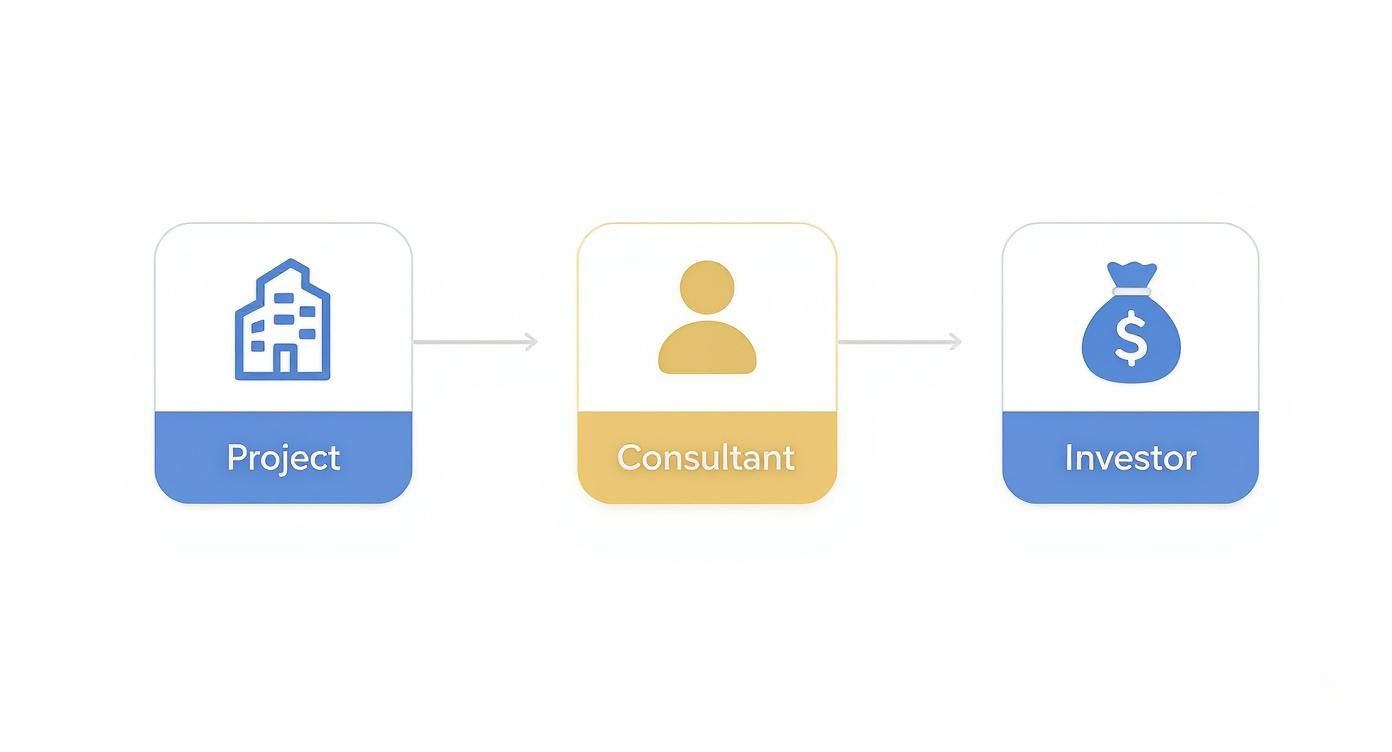
As you can see, without a consultant's expert hand guiding the process, the connection between the project and the investor just doesn't happen.
When it comes down to it, a consultant's job during the application is all about proactive problem-solving. They know what questions the regulators will ask before they ask them. They spot design conflicts that could turn into costly change orders and keep the lines of communication open with the review agencies. That foresight is what prevents the delays and denials that can completely derail a project.
The Financial Powerhouse Behind the Federal HTC Program
Think of the federal Historic Tax Credit (HTC) program as more than just a government perk. It’s an economic engine that can single-handedly transform a historic preservation project from a financial headache into a smart, profitable investment.
At its heart, the program offers a 20% tax credit on all the eligible costs of restoring a building—what the industry calls Qualified Rehabilitation Expenditures (QREs). But this isn't just some minor adjustment to your tax return; it's a game-changer.
To really get why this is so powerful, you need to understand the difference between tax deductions vs. tax credits. A deduction just chips away at your taxable income. A credit, on the other hand, is a dollar-for-dollar knockout punch to what you actually owe in taxes. This is what makes the HTC so incredibly valuable.
A historic tax credit consultant’s real magic is showing developers how to monetize this credit—turning a future tax benefit into cash in hand right now to get the project off the ground. They engineer deals where large investors, often banks or major corporations, buy the rights to the future credits. In return, they provide an immediate equity injection that can get construction started.
Fueling Revitalization Across the Country
This financial mechanism has sparked a quiet revolution in communities nationwide. Since it began, the HTC program has become the go-to tool for breathing new life into forgotten downtowns and rural main streets, turning crumbling old buildings into vibrant, modern assets.
The sheer scale of its impact is staggering. Since 1976, the federal HTC has driven over $235 billion in private investment into restoring historic properties. It’s also been a massive job creator, generating an average of 70,000 jobs every year and adding hundreds of billions to the national GDP. You can dive deeper into these figures in this detailed report from the National Park Service.
This massive economic footprint is precisely why historic tax credit consultants are indispensable. They’re the expert guides who navigate this complex financial world and connect your individual project to its vast resources.
By mastering the program's financial intricacies, a consultant does more than secure a tax benefit. They unlock the capital needed to close the financing gap, turning projects that would otherwise be impossible into profitable, community-enhancing landmarks. Their role is to ensure your project fully leverages the program's immense financial power.
How Consultants Close the Project Financing Gap

Plenty of historic rehabilitation projects hit the same wall: the dreaded "financing gap." This is what happens when the astronomical cost of a proper restoration far outweighs what the building will be worth when it's finished. On paper, the numbers just don't add up, which makes getting a traditional loan next to impossible.
This is where a historic tax credit consultant really earns their keep, shifting from a compliance expert to a financial strategist. Their most critical job is to bridge that gap, turning a project that looks like a money pit into a sound—and often profitable—investment. They become the architects of the deal itself.
Weaving Together a Viable Financial Structure
A consultant rarely relies on a single source of money. Instead, they build a sophisticated financial package by layering multiple streams of capital together. It’s less like getting a simple mortgage and more like assembling a complex machine where every gear has a specific purpose.
This "capital stack" often includes:
- HTC Equity: The consultant finds an investor to buy the tax credits, bringing in a crucial injection of cash right at the beginning.
- Traditional Debt: With the tax credit equity secured, it becomes much easier to approach banks for a standard construction loan.
- Grants and Incentives: A good consultant knows how to hunt down and secure local, state, or federal grants designed to spark community renewal.
By skillfully combining these pieces, the consultant creates a solid financial foundation that finally makes the project pencil out. They build detailed financial models that map out the long-term profitability, giving lenders and investors the confidence they need to sign on. This structuring is what turns a financial problem into a fully funded project, greenlit for construction.
The market for these credits is massive, with big players actively participating. JPMorgan Chase, for example, invested over $1 billion in Historic Tax Credit equity in more than 70 projects between 2014 and 2023. These weren't just random buildings; the investments often targeted properties in neighborhoods ripe for a comeback, proving how smart financing directly fuels revitalization. You can discover more about these community development insights from JPMorgan to see how it works on a large scale.
A skilled consultant doesn’t just find money; they create a compelling financial narrative. They demonstrate how the sum of the parts—credits, loans, and grants—generates a return that makes the whole project an attractive proposition, turning forgotten landmarks into thriving assets.
Choosing the Right Historic Tax Credit Consultant
https://www.youtube.com/embed/W1QYc9HR0LM
Picking a partner for your historic rehabilitation project is one of the most important decisions you'll make. The right firm is a strategic ally, guiding you through the maze of regulations and financial structuring. The wrong one? That can lead to expensive delays, lost tax credits, and a world of frustration.
It's not like hiring a simple vendor. Think of it more like choosing a co-pilot for a long and complicated flight. You need someone who doesn't just know the official rulebook, but also understands how things really get done. The best historic tax credit consultants bring deep technical knowledge, but just as importantly, they have established relationships and a track record you can trust.
Key Evaluation Criteria for Your Consultant
When you start looking, don't just look for a consultant—look for your consultant. You want a firm that can point to specific, relevant experience that mirrors your own project. A team that's great with small, local restorations might not be the right fit for a massive, multi-phase urban redevelopment. Be thorough and ask the tough questions.
To narrow down the field and find the perfect match, focus on these critical areas:
-
Project Portfolio: This is your proof. Ask to see a portfolio of projects that are similar in scale, budget, and complexity to what you're planning. It’s the single best way to gauge if they can handle the unique challenges your development will throw at them.
-
Agency Relationships: How well do they know the people at the State Historic Preservation Office (SHPO) and the National Park Service (NPS)? A consultant with a solid, respected reputation can often smooth out bumps in the road and resolve issues far more quickly.
-
Financial Structuring Expertise: Can they talk the talk? These projects often involve complicated, multi-layered financial deals. Your consultant needs to be completely fluent in structuring these deals to attract equity investors and navigate the various financing streams.
The goal is to find a partner who is genuinely invested in your project's success for the long haul, not just someone checking boxes on an application. Their job doesn't end when the paperwork is filed; they should be your guide through the entire five-year compliance period to protect your investment.
At the end of the day, the best historic tax credit consultants are true partners. They see problems before they happen, keep all the stakeholders on the same page, and stay relentlessly focused on getting you the best possible financial return while bringing a piece of history back to life. Choose carefully—their expertise will be a massive factor in whether your project succeeds or fails.
Common Questions About Historic Tax Credit Consultants
Even after getting the big picture, most developers still have a few practical questions about bringing a historic tax credit consultant onto their team. Let's tackle some of the most common ones we hear from clients.
When Is the Best Time to Hire an HTC Consultant?
The short answer? Yesterday.
Ideally, you should have a consultant on board during the earliest feasibility stages of a project—sometimes even before you’ve officially acquired the property. Getting their eyes on the building and your initial concepts can flag potential compliance headaches right out of the gate.
This early involvement is all about structuring the deal for the biggest financial win from day one. Bringing a consultant in later in the game often means they spend their time putting out fires and trying to reverse costly missteps that could have been easily avoided.
How Are Historic Tax Credit Consultants Paid?
You'll find a few different fee structures out there, but most are designed to tie the consultant's success directly to yours. It’s usually a mix of two components:
- Fixed Fees: These typically cover the nuts and bolts of the work, like preparing and filing the detailed, multi-part application with state and federal agencies.
- Success Fees: This is the real motivator. It's almost always a percentage of the total tax credit equity they help you raise for the project.
This blended model gives your consultant serious skin in the game. They’re not just pushing paper; they’re invested in getting you the maximum funding possible and seeing your project all the way to the finish line.
The key thing to remember is that a good consultant’s guidance almost always delivers a return on investment that blows their fees out of the water. They don’t just find you money—they prevent expensive mistakes and help you negotiate better terms with investors.
Can I Manage the HTC Application Myself?
Technically, yes. Realistically, it’s a bad idea unless you have years of specialized experience doing exactly this. Think of it like trying to represent yourself in a complex court case. You can, but the odds are stacked against you.
The application process is a minefield of hyper-specific architectural standards, tricky financial structuring, and rigid government regulations. One wrong move and the whole thing can fall apart.
A seasoned consultant doesn't just fill out forms correctly; they dramatically boost your chances of a smooth approval. They also bring something you can't get on your own: established relationships with agency reviewers and the investment community. Those connections are often the secret sauce to getting a project funded and built.
At Sherer Architects, LLC, we have decades of experience guiding clients through historic preservation, securing tax credits, and maximizing project value. Learn how our expertise can bring your historic building back to life.