
When you're about to pour a significant amount of capital into remodeling your commercial space, your first hire isn't a contractor—it's an architect. Think of them less as someone who just draws up plans and more as the strategic partner who will safeguard your entire investment. They’re the ones who turn your business vision into a physical space that’s profitable, functional, and, crucially, legal.
Your Architect Is Your Most Important Remodeling Partner

It’s a common—and often costly—mistake to see an architect as just a designer. In a commercial project, their real value is in bridging the gap between what you want to achieve as a business and the physical realities of your building. They are, first and foremost, expert problem-solvers who ensure your remodel adds real, tangible value to your bottom line.
Let's take a real-world example: a boutique hotel owner wants to add a rooftop bar. This isn't just about creating a cool, trendy space. It’s a project loaded with complex challenges that a skilled architect for remodeling is built to handle.
Beyond the Blueprints
An architect’s job goes far beyond the drawing board. Their expertise is what helps you navigate the tangled web of commercial construction.
Here’s a glimpse of what that looks like:
- Navigating Complex Regulations: They are masters of local zoning laws, building codes, and accessibility requirements. Their guidance helps you avoid the kind of missteps that lead to massive fines or forced redesigns. If your building is historic, they're the ones who will secure the necessary approvals from preservation boards.
- Optimizing for Operations: A good architect dives deep into your business model. They analyze everything from customer flow to staff efficiency. For that hotel, they would design a layout that maximizes seating and revenue potential without creating frustrating bottlenecks for servers and bartenders.
- Protecting Your Investment: Through smart planning and material selection, an architect is your best defense against budget blowouts. Their detailed, comprehensive plans leave no room for guesswork, which means contractors can provide more accurate bids and you’ll face fewer expensive change orders mid-project.
A great architect doesn’t just design a space; they design a business asset. They turn your vision into a functional environment that enhances your brand, delights your customers, and supports your operational goals from day one.
Ultimately, your architect acts as your primary advocate throughout the entire process. They ensure the finished construction perfectly aligns with the original vision, budget, and timeline you agreed upon. This partnership is the bedrock of any successful commercial transformation.
Turning Your Big Idea Into a Practical Plan
Before you even think about picking up the phone to call an architect, you need to get your vision down on paper. This isn't just a simple wish list; it's what we in the industry call a project brief. Think of it as the roadmap for your entire remodel. It’s your single best tool for fighting off scope creep—that sneaky habit projects have of growing bigger and more expensive than you planned.
The first step is to draw a clear line between what you absolutely need and what you simply want. A need is something your business can't function without. A want is an aesthetic choice.
For example, a need might be "we have to increase our seating capacity by 30% to meet demand" or "we need another ADA-compliant restroom to meet code." A want, on the other hand, sounds more like "I'd love a minimalist, Scandinavian vibe" or "exposed brick walls would be amazing." Both are important, but you have to know which is which.
Get Specific About Your Goals
Your brief needs to be concrete. Vague statements like "we need a better layout" won't get you very far. What does "better" actually look like for your specific business?
- If you run a restaurant: A better goal would be, "We need to redesign the kitchen to cut ticket times by 15%."
- For a retail space: Try something like, "The new floor plan has to guide customers past our highest-margin products."
- In an office setting: A clear objective is, "We need to build two soundproof conference rooms for confidential client meetings."
When you're this specific, you're not just giving an architect a design problem; you're giving them a business problem to solve. It completely changes the conversation from abstract ideas to tangible results.
Your project brief is more than a creative exercise. It's a business plan that connects your physical space directly to your bottom line. The more clarity you provide upfront, the more accurate and realistic an architect's proposal will be.
Talking Money and Setting the Mood
Now for the big one: the budget. You need to establish a realistic budget range from the get-go. This keeps everyone's feet on the ground and ensures the design proposals you receive are actually achievable. The U.S. remodeling market was valued at a staggering USD 498.3 billion in 2024, and while that shows a lot of activity, a firm budget is what will make your specific project a success. You can find more remodeling market growth projections on fcnews.net to get a sense of the industry landscape.
Finally, start pulling together a mood board. A tool like Pinterest is perfect for this. Gather images that capture the feeling you're after—think textures, lighting styles, color schemes, and even specific furniture. A visual reference like this often communicates your desired aesthetic far better than words ever could. Once you have this detailed brief, you’re truly ready to start the search for the right architect.
How to Find and Vet the Right Architects
Finding the right architect for your commercial remodel isn't about a quick Google search. You're looking for a strategic partner who gets your business goals, so you need to be smart about where you look.
Start by digging into local business journals. See which firms are getting recognized or winning awards for the kind of innovative commercial work you’re after. Another goldmine? Commercial real estate brokers. These folks are on the front lines and know exactly which architects deliver profitable, headache-free projects for their clients.
And don't forget to look around your own community. See a local business similar to yours with a recent renovation you love? Don't be shy. A quick phone call can often point you straight to the talent behind the design.
Analyzing Portfolios and Credentials
Once you've got a shortlist, the real homework begins. It's time to move past the glossy photos and analyze portfolios with a purpose. You’re looking for a deep well of experience specifically in commercial remodeling—not new construction or residential homes.
As you review their work, ask yourself a few key questions:
- Do they know my industry? An architect with a history of successful restaurant designs will inherently understand the unique flow, code, and equipment needs, which is a world away from designing a corporate office.
- Does their style fit my brand? Look for a design language that feels like a natural extension of your business's identity and will resonate with your customers.
- Can they handle the tricky stuff? Projects involving adaptive reuse or renovations in historic districts are great indicators of an architect's problem-solving chops.
Next up, it’s time for a background check. Every architect you consider must be licensed to practice in your state. This is a non-negotiable. You can easily verify their license and check for any disciplinary history on your state’s architectural licensing board website. It's a simple step that protects you from major liability down the road.
Before you get too deep into vetting, it helps to have your own ducks in a row. This infographic shows how your vision, budget, and needs come together to form the brief you'll use to evaluate firms.
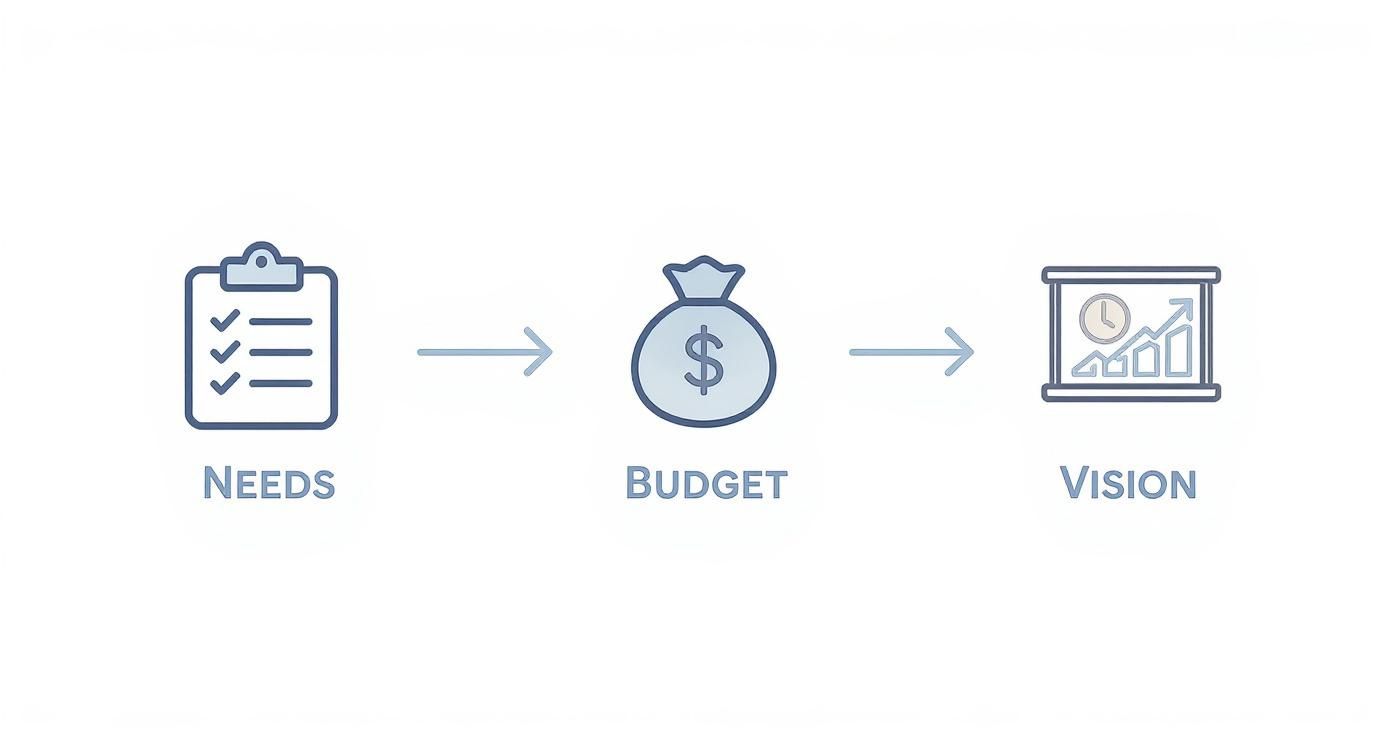
Think of this as the foundation. With a clear brief, you can have much more productive conversations and make a better final decision.
A strong portfolio isn’t just about aesthetics; it's evidence of an architect's ability to solve real-world business problems through smart, compliant, and functional design.
It's also worth noting trends in the broader renovation market. For instance, in residential remodeling, about 38% of projects are kitchens and 26% are bathrooms, usually driven by a need for better layouts and efficiency. While your commercial needs are different, this trend points to a universal demand for thoughtfully designed, high-value spaces. You can explore more residential remodeling market insights at Grand View Research to get a feel for larger industry movements.
Finally, hunt for genuine client reviews and testimonials. Go beyond the curated quotes on their website. Look for patterns in feedback—do clients consistently praise their communication, budget management, and ability to solve problems on the fly? This is where you’ll learn what it's really like to work with them day-to-day.
Architect Evaluation Checklist
Use this framework to systematically evaluate and compare potential architects for your remodeling project.
| Evaluation Criterion | Architect A | Architect B | Architect C |
|---|---|---|---|
| Relevant Industry Experience | |||
| Portfolio Aligns with Brand | |||
| Positive Client Reviews | |||
| Verified State License | |||
| Clear Communication Style | |||
| Initial Project Understanding |
By scoring each candidate across these key areas, you'll have a much clearer, data-driven basis for making your final choice.
What to Ask in an Architect Interview

The interview is where you get to peek behind the curtain. Forget the polished portfolio for a moment; this is your chance to see how an architect for remodeling thinks on their feet and handles the real-world chaos of a construction project.
Generic questions about fees and past projects will only get you so far. What you really need to know is how they problem-solve, how they communicate (especially when things go wrong), and how they’ll manage the project from a messy construction site to a finished space. You’re looking for a partner who can navigate the red tape at city hall and keep contractors in line, not just someone who can produce a pretty rendering.
Questions That Reveal Real-World Experience
Your goal is to get them talking, to hear the stories. Don’t settle for a simple "yes" or "no." Ask questions that force them to walk you through their process, revealing how they handled challenges on past jobs. Those stories are far more valuable than any canned answer.
Here are a few questions I've found that cut through the fluff:
-
On Problem-Solving: "Tell me about a commercial project where you hit a major snag with city permits or a zoning issue. What was the exact problem, and what specific steps did you take to get the project back on track?"
-
On Contractor Management: "How do you make sure the general contractor actually sticks to the schedule and budget? Can you give me an example of a time you had to step in and correct the course?"
-
On Client Communication: "What’s your process for keeping clients in the loop, especially when there’s bad news? How often should I expect updates, and what format do they come in?"
-
On Budgeting: "Let's say our dream design comes in 20% over budget after the first round of contractor bids. What's your go-to process for value engineering? How would you help us cut costs without gutting the core vision of the project?"
Think of this less as a formal interview and more as a collaborative strategy session. You’re not just hiring a designer; you’re entrusting a key business investment to a project leader.
Asking questions this way shifts the conversation from their resume to their actual, on-the-ground performance.
Gauging the Personal and Professional Fit
Beyond their technical chops, you're trying to figure out if you can actually work with this person for the next several months. Is their communication style a good match for yours? Do they seem to genuinely listen to your business goals, or are they more focused on pushing their own aesthetic?
This is where you determine if their working style fits your company's culture. A great architect for remodeling understands that they aren't just creating a space—they are designing a functional asset for your business. Their ability to collaborate and integrate with your team is just as critical as their design talent.
Getting a Handle on Architect Contracts and Fees
Alright, let's talk about the paperwork. Before a single line is drawn, you’ll be looking at the architect’s contract. This isn't just a formality; it's the legal foundation for your entire project. Getting this right from the start is the best way to avoid nasty financial surprises later on.
When you bring on an architect for remodeling, they'll typically propose one of a few common ways to structure their fee. Each has its own quirks, so it’s good to know what you’re walking into.
How Architects Typically Charge
- Percentage of Construction Cost: This is the old standby. The architect’s fee is a set percentage—often in the 8-15% range—of the final construction bill. It's simple to understand, but you can see the potential issue: if project costs go up, so does their fee.
- Fixed Fee: Also called a "stipulated sum," this is exactly what it sounds like. You both agree on a single, fixed price for a very specific scope of work. This is fantastic for budget predictability, especially if you have a crystal-clear vision that isn't going to change.
- Hourly Rate: You pay for the architect's time as they log it. This works well for initial brainstorming sessions, feasibility studies, or very small, undefined projects. For a full-scale remodel, it can be tough to budget without a "not-to-exceed" clause to cap the total.
The global remodeling market is huge—valued at around USD 1 trillion in 2024—because more and more people are choosing to renovate instead of building new. With that much money changing hands, it just highlights how critical it is to have a rock-solid contract. You can read more about the growing remodeling market on maximizemarketresearch.com.
My best advice? Ask for a standard American Institute of Architects (AIA) contract. They are the industry benchmark for a reason—they're fair, thorough, and have been refined over decades to cover nearly every situation, from payment schedules to handling change orders.
Pay close attention to the fine print, especially the scope of services, the proposed timeline, and how disagreements will be handled. Brushing up on your negotiation skills can also be a big help; this a homeowner’s guide to construction contract negotiation has some great pointers that apply here, too.
Common Questions About Hiring a Remodeling Architect
Even with a solid plan, bringing an architect on board for your commercial remodel is bound to spark a few questions. Let's walk through some of the things business owners ask most often, so you can move forward with total confidence.
What Is the Architect's Role During Construction?
You'll work most intensely with your architect during the initial design phases, hammering out every detail to make sure it serves your business. But once the hammers actually start swinging, their role shifts. They become your advocate on the ground.
Don't think for a second they just hand over the blueprints and walk away. A dedicated architect will:
- Make regular site visits to ensure the contractor is building exactly what was designed.
- Field technical questions from the construction team, translating complex plans into actionable steps.
- Review invoices and applications for payment from the contractor.
- Serve as the key problem-solver when unexpected issues pop up—and they always do.
This hands-on management is invaluable. It’s the quality control that keeps your project on track and on budget, freeing you up to run your business instead of the construction site.
An architect's job doesn't end with the design; it extends into construction administration. They are your eyes and ears on-site, safeguarding your investment and making sure the finished space is precisely what you envisioned.
How Do Architects Help Find Contractors?
This is one of the biggest—and most underrated—perks of working with a seasoned local architect. They've spent years building a network of general contractors they know and trust. They've seen who does great work and who… doesn't.
Your architect can run the entire bidding process for you. They’ll send the plans out to a shortlist of qualified builders, help you make sense of the quotes that come back, and give you professional advice on which bid represents the best value—not just the lowest price. This kind of insider knowledge is a huge advantage, helping you sidestep unreliable contractors and build the right team.
If you want to get more comfortable with the plans they'll be sending out, it's a good idea to brush up on architectural drawing basics.
At Sherer Architects, LLC, we're with you from the first sketch to the final walkthrough. Contact us today and let’s talk about how our commercial remodeling expertise can bring your vision to life.