
The Warehouse Theatre in Greenville SC isn't just a place to see a great show; it’s a living blueprint for how to do adaptive reuse right. We're going to dive into how this simple textile warehouse was completely transformed into a vibrant cultural cornerstone for the city's West End, making it a compelling case study for any developer or property owner with an eye for potential.
From Industrial Relic to Cultural Icon in Greenville SC
For anyone in the development world, the Warehouse Theatre is more than just a local success—it’s a masterclass in visionary placemaking. This guide will unpack how smart architectural choices and an unwavering focus on community turned an underused historic property into a profitable, soul-enriching asset.
This transformation really hammers home a core principle of modern urban development: sometimes the most valuable new buildings are the old ones. Instead of bringing in the wrecking ball, adaptive reuse preserves a structure's unique character while breathing new life and economic purpose into it.
A Model for Urban Revitalization
The journey of the Warehouse Theatre is a perfect example of the hidden potential locked inside aging industrial buildings. By reimagining a space once filled with looms and spindles as a venue for drama and art, the project became a true catalyst for change in Greenville's West End. It did more than just give a theater company a new home; it sparked a much wider economic and cultural revival.
The results speak for themselves. The Warehouse Theatre's 2025 season, for example, was a banner year, seeing a 32% surge in patrons across all its productions, education programs, and community events. By employing 143 local artists, the theater became a significant economic engine, driving critical foot traffic into a district that was once quiet after 5 PM. This kind of success mirrors what we see in other adaptive reuse wins, where thoughtful infrastructure upgrades can extend a building's functional life by 50 to 75 years. For more on the local arts scene's growth, check out the coverage in the Greenville Journal.
Adaptive reuse is about more than saving a building; it's about reinterpreting its story for a new generation. The Warehouse Theatre proves that historic structures can become the heart of a modern, thriving community.
This guide will break down the practical steps and strategic thinking that made this project a success, focusing on three key areas:
- Historic Preservation: How to honor a building's original character while bringing it up to modern code and expectations.
- Economic Revitalization: The strategy behind becoming a cultural anchor that boosts surrounding businesses.
- Tangible ROI: A clear look at the financial and community returns that come from thoughtful, forward-thinking design.
To give you a quick, high-level overview, here's a snapshot of the project's key details. This is especially useful for developers weighing the pros and cons of taking on a similar historic property.
The Warehouse Theatre Project at a Glance
| Attribute | Details |
|---|---|
| Project Type | Adaptive Reuse, Cultural Anchor |
| Original Use | Textile Warehouse (circa 1920s) |
| Current Use | Professional Live Theatre & Arts Venue |
| Location | West End Historic District, Greenville, SC |
| Key Impact | Catalyst for neighborhood revitalization |
| Patron Growth (2025) | 32% increase across all programs |
| Local Artist Employment | 143 artists employed in a single season |
| Primary Goal | Create a community-centric cultural hub while preserving historic character. |
This table neatly summarizes how a single project can hit multiple targets—preserving history, driving economic activity, and enriching the local community all at once.
Tracing the Theater's Journey of Transformation
Every great adaptive reuse project has a story, and the Warehouse Theatre’s is a masterclass in vision and grit. Its transformation wasn't a single, dramatic event. Instead, it was a series of smart, deliberate moves that show what it takes to turn an old building into a cultural cornerstone.
The story starts back in 1973. Founders Dr. Peter Smith and Jim Boivin didn't have a grand theater; they had sheer will. They carved out an intimate black box theater from a dingy annex at the Greenville Memorial Auditorium, proving that you don’t need a perfect space to create powerful art.
This humble beginning is a key lesson for any developer. Great projects often start small. They prove their concept, build a following, and create demand before taking on a massive investment. Those early years were about more than just staging plays—they were about building a brand and demonstrating that Greenville not only wanted but needed this kind of theater.
The Strategic Leap to the West End
By the mid-1990s, the theater had outgrown its starter home and was ready for its next act. The leadership team made a bold, calculated bet on Greenville’s West End, a neighborhood that was just beginning to stir with the promise of revitalization. This wasn't a safe move into an established arts district; it was a pioneering jump into an area with untapped potential.
They found their new canvas in a series of three historic storefronts, once part of a sprawling textile warehouse. Working with McMillan Pazdan Smith Architecture, they skillfully transformed the raw, industrial space into a state-of-the-art, 150-seat venue. The design brilliantly preserved the building's historic soul while meeting all the technical demands of a modern performance space.
The project was a triumph. It earned an AIA Greenville Merit Award in 1999 and cemented the Warehouse Theatre in Greenville SC as a true landmark. This kind of thoughtful adaptive reuse shows you can honor a building's past while giving it a vibrant new future. You can read more about this award-winning project and its history in American Theatre magazine.
The decision to move to the West End was more than a change of address; it was an investment in a neighborhood's potential. The theater didn't just join a community—it helped build one.
This history holds powerful lessons for developers today. The theater’s team saw opportunity where others saw decay. They understood that by becoming an early anchor in a neighborhood on the cusp of change, they could secure a unique home and actively shape the area's identity. It was a risk, absolutely, but one that paid off spectacularly for both the theater and the city of Greenville.
Balancing Performance Needs with Historic Preservation
Turning a building meant for storing textiles into a stage for live performance is a heck of a puzzle. The real triumph of the Warehouse Theatre in Greenville SC is how it solved this puzzle, creating a masterclass in how to fuse modern theatrical demands with the soul of a historic building.
For any developer, this is the tightrope you have to walk. Get it right, and you have something special. Get it wrong, and you lose the magic. It's about so much more than just saving old brick—it’s about making that brick work for a purpose it was never designed for. The trick is to weave in all the essential theatrical guts without gutting the building's industrial character.
Think of it like restoring a vintage muscle car. You keep the iconic body and the classic feel, but you install modern brakes, a reliable engine, and air conditioning. You need it to be practical. In the same way, a theater has non-negotiable technical needs that you’d never find in an old warehouse.
Weaving Theatrical Tech into a Historic Shell
The team behind the Warehouse Theatre had to get creative to overcome some serious technical hurdles. Every fix had to complement the building's original bones, not fight against them.
Here’s what they were up against:
- Acoustics: Brick walls and high ceilings are an acoustic nightmare, turning clear dialogue into a muddy echo. The solution involved adding sound-absorbing materials and shaping surfaces to control sound, all while keeping that gorgeous brick exposed.
- Sightlines: Every single seat needs a clean view of the stage. But in a building dotted with original support columns, this meant building a custom-tiered seating plan that worked around the building’s quirks, not in spite of them.
- Accessibility: Old buildings were built long before modern accessibility standards. Adding ramps, proper seating, and compliant restrooms into an existing footprint took some clever spatial gymnastics to meet ADA requirements.
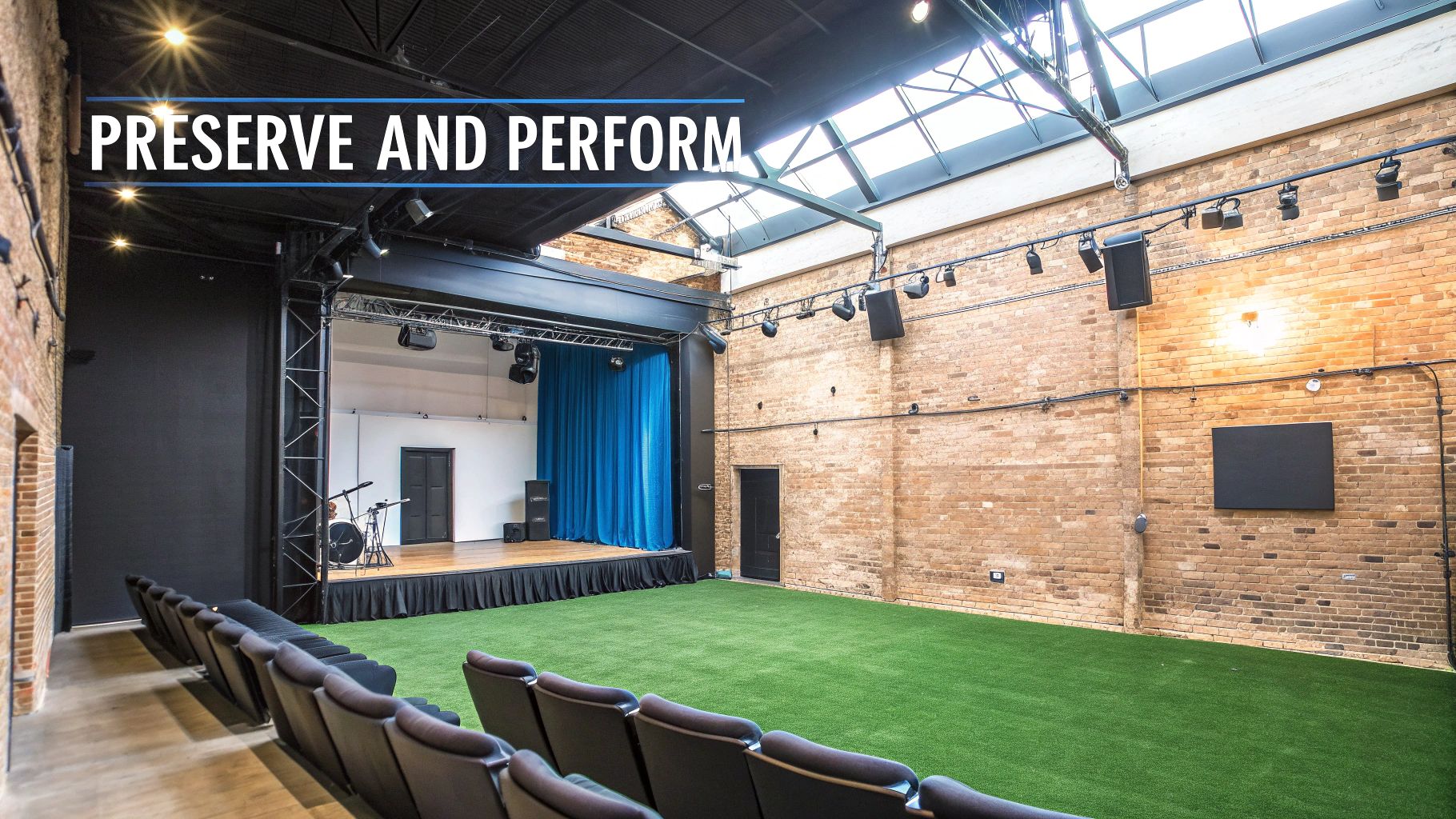
The genius of the Warehouse Theatre’s design is how it makes modern systems look like they belong. HVAC ducts, lighting grids, and sound equipment are integrated so well they become part of the industrial vibe, not a clunky add-on.
Keeping the Character, Building the Function
The designers made a conscious decision to let the building’s history shine through. Instead of covering everything with drywall, they left the original brick walls and hefty structural beams exposed, making them a centerpiece of the design. This gives the space a gritty, authentic warmth a brand-new building could never fake.
Even backstage logistics were a challenge. Carving out space for dressing rooms, set storage, and tech booths from the existing floor plan required an incredibly efficient use of every last square foot. This is a great lesson for developers: sometimes, the limitations of a historic space force you to find smarter, more creative solutions.
The final result is a theater where the past and present are in a constant, beautiful conversation. For anyone looking to tackle a similar project, it’s worth reading up on the best practices for renovating a heritage home while preserving its charm. This delicate balance—honoring a building’s story while fitting it for a new one—is what separates a good project from a truly great one.
How the Theater Kickstarted the West End's Comeback
The real impact of an adaptive reuse project never stays inside its own walls. The Warehouse Theatre in Greenville, SC, is a textbook case of this, showing how one smart project can create economic shockwaves that lift an entire neighborhood. Its move to the West End wasn't just a change of address; it was the deliberate planting of a cultural anchor.
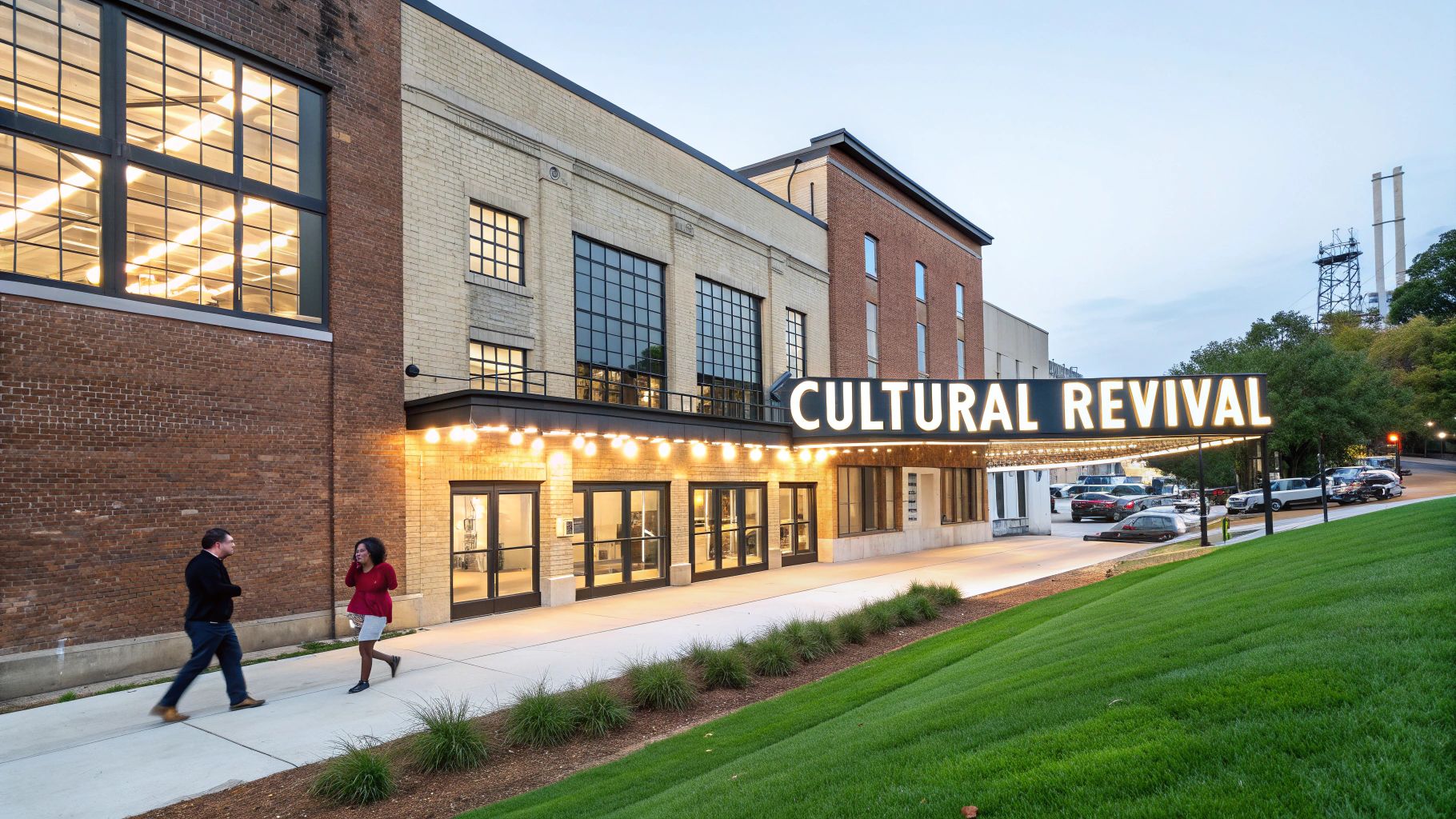
Before the theater's award-winning renovation, the West End was a neighborhood with great bones but no real reason for people to stick around after 5 p.m. By turning a forgotten old cotton warehouse into a lively performance space, the theater created a destination. All of a sudden, hundreds of people were flowing into the area on a regular basis, looking for a place to eat before a show or grab a drink afterward.
That steady stream of people is the secret sauce for urban revitalization. It sends a clear signal to other business owners that there's a market waiting for them. In effect, the theater took a lot of the risk out of the equation for other investors.
The Spark That Lit the Fire
The theater's success set off a chain reaction. Restaurants, bars, and art galleries started popping up nearby, eager to cater to the ready-made crowd the venue delivered night after night. This natural growth turned the West End from a sleepy, post-industrial pocket of the city into one of Greenville's most exciting districts.
Over its remarkable 50-year history, the Warehouse Theatre has come a long way, moving from shared, often animal-scented, spaces at the Municipal Auditorium to its iconic cotton warehouse home in 1999. Today, it’s a pillar of Greenville's arts scene, putting on multiple mainstage shows and the beloved Upstate Shakespeare Festival. It pumps both cultural and financial energy directly into the local economy, employing around 200 artists each year on a budget of less than $1 million. You can get a closer look at the theater's mission and its celebratory 50th anniversary season here.
The Warehouse Theatre didn’t just find a new home in the West End; it gave the West End a reason to come alive after dark. It became the steady heartbeat that attracted more investment and growth.
This really drives home a crucial lesson for developers: putting money into a cultural venue is about more than the direct return on that single property. It's about building an entire economic ecosystem.
The benefits spread out like ripples in a pond, touching the whole area:
- Rising Property Values: As the neighborhood became a place people wanted to be, the value of surrounding properties went up.
- A More Diverse Business Scene: The first wave of restaurants and bars was soon followed by retail stores and new residential projects.
- A New Reputation: The West End became known as a creative and vibrant hub, drawing in even more visitors and new residents.
For any developer weighing a similar project, the story of the Warehouse Theatre is powerful proof of concept. It shows how a single project, when it truly connects with the community, can become a catalyst that delivers returns far beyond its own property lines—a smart way to turn an overlooked district into a thriving destination.
An Actionable Blueprint For Your Next Project
The story of the Warehouse Theatre in Greenville, SC, is more than just an inspiring tale; it's a practical, repeatable roadmap for anyone looking to tackle an adaptive reuse project. By digging into how they turned a forgotten building into a cultural gem, we can pull out real-world lessons that transform historic headaches into development home runs.
Let's move past the theory and get straight to the strategy.
It all starts with a shift in perspective—learning to see the promise where others only see problems. Look for properties with "good bones." We're talking about buildings with solid structural integrity, unique architectural details, and a location that’s just on the verge of a comeback. The team behind the Warehouse Theatre did exactly that, choosing a neglected corner of the West End because they knew a cultural anchor could redefine the whole neighborhood.
This is how a single venue can kickstart a domino effect of urban renewal.
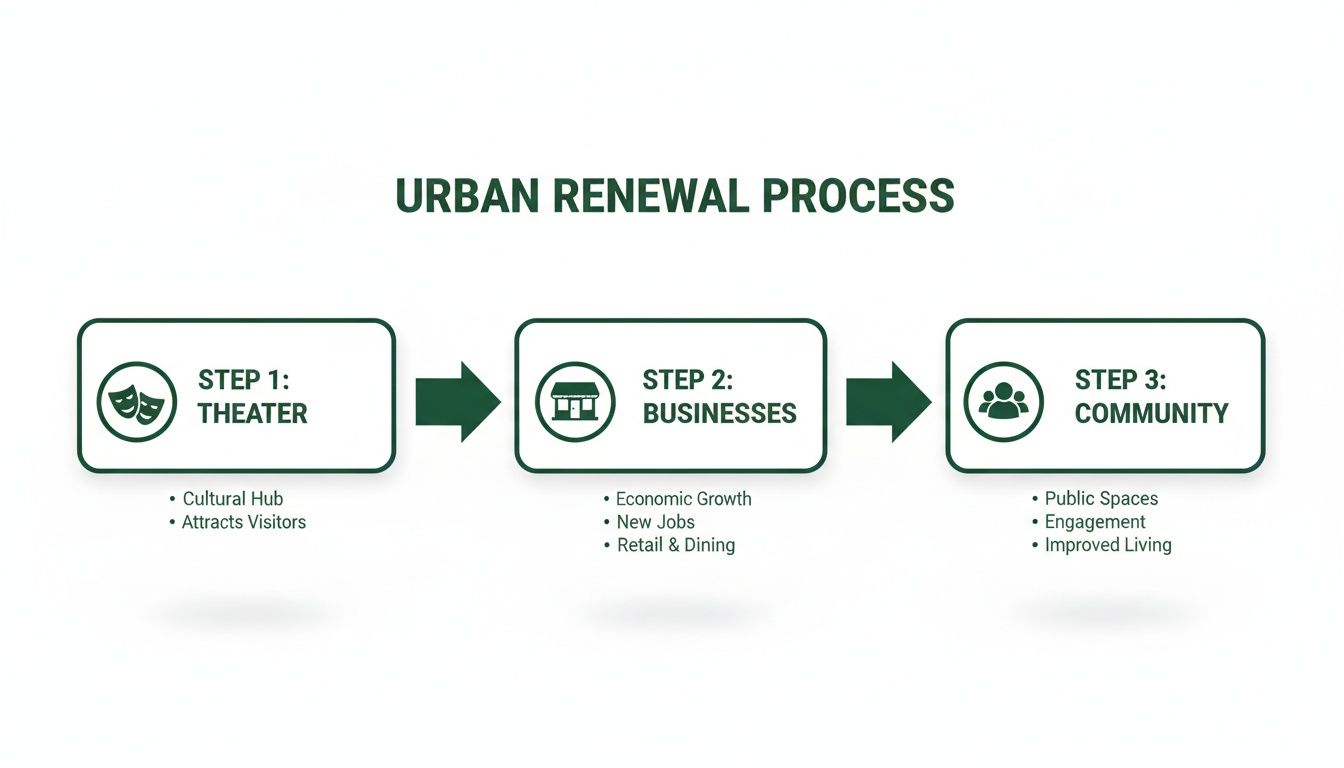
As you can see, the theater’s revival directly feeds local business growth. That growth, in turn, helps build a more vibrant and connected community. It’s a powerful cycle.
Navigating The Financials And Winning Over The Community
Once you’ve found that diamond in the rough, it’s time to tackle the financial puzzle. The good news is that adaptive reuse projects often unlock a host of incentives that can make the numbers work. You just have to do your homework and chase down every lead.
Here are a few of the most powerful financial tools to look into:
- Federal Historic Tax Credits: These are a game-changer, potentially covering 20% of your rehabilitation costs for certified historic buildings.
- State Historic Tax Credits: South Carolina, like many other states, has its own tax credit programs that can often be combined with federal incentives.
- Local Grants and Loans: Don't overlook city hall. Many municipalities have funds set aside to support projects that align with their own revitalization goals.
But money is only half the battle. Getting the community on your side is just as important. The Warehouse Theatre didn't just open its doors; it wove itself into the fabric of Greenville. You need to start conversations with neighborhood groups, local artists, and your future patrons early and often. Their enthusiasm is what gets you through zoning hearings and fills the seats on opening night.
A project's greatest asset isn't brick and mortar; it's the community that claims it as their own. Financial incentives might get a building open, but it's the people who keep it alive for decades.
For anyone taking on a project like this, building a sustainable business model from day one is non-negotiable. If you're new to the space, check out resources like a comprehensive guide to starting an events business. This kind of groundwork ensures your venue has a life long after the construction crews have packed up.
Why Quality Design Is Your Best Long-Term Investment
Finally, never, ever skimp on design. The team behind the Warehouse Theatre didn't just build a functional black box. They created an experience. They paid respect to the building's industrial soul by leaving brick exposed and highlighting original beams, all while seamlessly integrating the high-tech demands of a modern theater.
This commitment to quality design delivers on three critical fronts:
- It Creates a Destination: A truly unique and thoughtfully designed space gets people talking. It earns press, draws in patrons from all over, and becomes a landmark.
- It Enhances the Experience: Great design isn't just about looks; it solves problems. It perfects acoustics, ensures there isn't a bad seat in the house, and makes every visit memorable.
- It Boosts Long-Term Value: A well-designed building is simply worth more. It attracts better talent, stands the test of time, and proves that good design is always good business.
The Warehouse Theatre's success wasn't an accident. It was the result of a clear strategy: identifying hidden potential, mastering the incentives, earning community trust, and investing in quality design. It’s a blueprint for creating projects that are not only profitable but also powerful.
Adaptive Reuse Project Checklist
To make these lessons even more concrete, we’ve put together a checklist based on the Warehouse Theatre's journey. Use this to guide your thinking as you approach your own project.
| Phase | Key Action Item | Why It Matters (Warehouse Example) |
|---|---|---|
| 1. Discovery & Vision | Identify a property with "good bones" in an underserved or emerging area. | The theater was built in a neglected textile warehouse, seeing the potential before the West End became a destination. |
| 2. Financial Strategy | Aggressively research and apply for all available historic tax credits and local grants. | A combination of federal and state incentives was crucial for bridging the funding gap and making the project financially viable. |
| 3. Community Engagement | Meet with neighborhood associations and local stakeholders before finalizing plans. | Early buy-in helped the Warehouse Theatre become a beloved community asset, not an unwelcome disruption, ensuring long-term support. |
| 4. Design & Preservation | Hire architects who specialize in adaptive reuse and value historical character. | The design preserved the building's industrial past (exposed brick, steel) while adding modern theatrical necessities. |
| 5. Operational Planning | Develop a sustainable business model for the venue's long-term operations. | The theater established itself as a professional company with a strong programming schedule, ensuring it would thrive beyond the initial launch. |
| 6. The Launch & Beyond | Market the space not just as a venue, but as a community cultural hub. | By programming diverse shows and events, the Warehouse became a central part of Greenville's cultural identity. |
Following these steps won’t guarantee an easy road, but it provides a battle-tested framework for turning a piece of history into a vibrant part of the future.
Your Project's Turn in the Spotlight
So, what can we take away from the story of the Warehouse Theatre in Greenville, SC? It's more than just a successful project; it's a living blueprint for developers and property owners who see potential where others might only see a problem. The biggest lesson here is a shift in perspective: old buildings aren’t burdens. With the right vision, they’re incredible opportunities waiting to be unlocked.
When you get adaptive reuse right, you're not just restoring brick and mortar. You're creating spaces that deliver real financial returns while becoming the heart and soul of a neighborhood. It's about taking the best of the old and reimagining it for a new generation.
The real takeaway is that you can do this too. Your city is full of overlooked buildings with stories to tell. By applying the strategies we've seen with the Warehouse Theatre, you can build something that doesn't just make money—it makes a difference.
The journey of the Warehouse Theatre proves that one smart, thoughtful project can be the catalyst for so much more. It shows that by respecting a building's history, you can not only secure its future but also ignite the revival of an entire community.
Let this be your guide. Let it be the proof that great design and a genuine focus on community aren't just feel-good ideas; they're the foundation of lasting success.
Frequently Asked Questions About Adaptive Reuse
When developers and property owners look at an old building, they often see both incredible potential and a list of daunting questions. Let's tackle some of the most common concerns head-on, using the Warehouse Theatre in Greenville, SC, as a real-world example of how these challenges can be turned into triumphs.
It’s a bit like finding a classic car in a barn. The style is undeniable, but you're naturally worried about the engine, the rust, and whether the restoration will be worth it. Getting clear answers to a few key questions can make all the difference.
Is Adaptive Reuse More Expensive Than New Construction?
The short answer? Not always. In fact, it can often be the smarter financial move. People tend to focus on the costs of renovating an older structure, but they forget about the massive expenses of a new build—demolition, site preparation, and the soaring price of new materials.
Adaptive reuse gives you a huge head start by keeping the building's "good bones." With the Warehouse Theatre, the team didn't have to build a new structural frame or lay thousands of new bricks; that was all part of the package. That existing structure represented a massive savings in both materials and labor, and it also happened to be the very thing that gives the building its unique character.
Think of the existing building not as a liability, but as your greatest asset. The structure, materials, and history are already paid for.
On top of that, these kinds of projects often qualify for financial incentives that a new build simply can't get.
How Do You Secure Funding for These Projects?
Financing an adaptive reuse project isn't the same as getting a loan for a standard new construction. While traditional financing is certainly part of the mix, the real game-changer lies in the specialized programs designed specifically to encourage this kind of preservation.
Smart developers build a funding strategy that includes:
- Federal Historic Preservation Tax Credits: This is a big one. It offers a 20% tax credit for the qualified costs of rehabilitating a historic building, which can dramatically improve a project's bottom line.
- State and Local Grants: Don't overlook what's available in your own backyard. Many cities and states have grants aimed at revitalizing historic districts and supporting culturally significant projects.
- Community Partnerships: The Warehouse Theatre is a perfect example of this. The project was fueled by incredible community buy-in, opening the door to private donations and local sponsorships that became essential to its success.
What Is the Biggest Non-Financial Hurdle?
Without a doubt, the biggest challenge is often navigating the maze of modern building codes, zoning regulations, and historic preservation standards. Old buildings weren't constructed with today's fire safety, accessibility, or energy efficiency requirements in mind.
The real puzzle is figuring out how to thread the needle—how do you integrate modern systems and meet code without stripping the building of its soul? This is where an experienced guide is non-negotiable. An architect who specializes in historic preservation knows how to find those elegant, creative solutions that satisfy inspectors while respecting the building’s heritage. They can turn what seems like a frustrating roadblock into an award-winning design feature.
At Sherer Architects, LLC, we see historic challenges as profitable opportunities. If you're weighing the potential of an adaptive reuse project, let's talk about how our decades of experience can bring your vision to life. Learn more about our approach to architecture.