
In commercial real estate, architecture and sustainable design has moved far beyond a niche interest—it’s now a core business strategy. It’s an approach that engineers buildings for peak performance, guaranteeing long-term financial health, better well-being for the people inside, and critical environmental responsibility.
Why Sustainable Design Is No Longer Optional
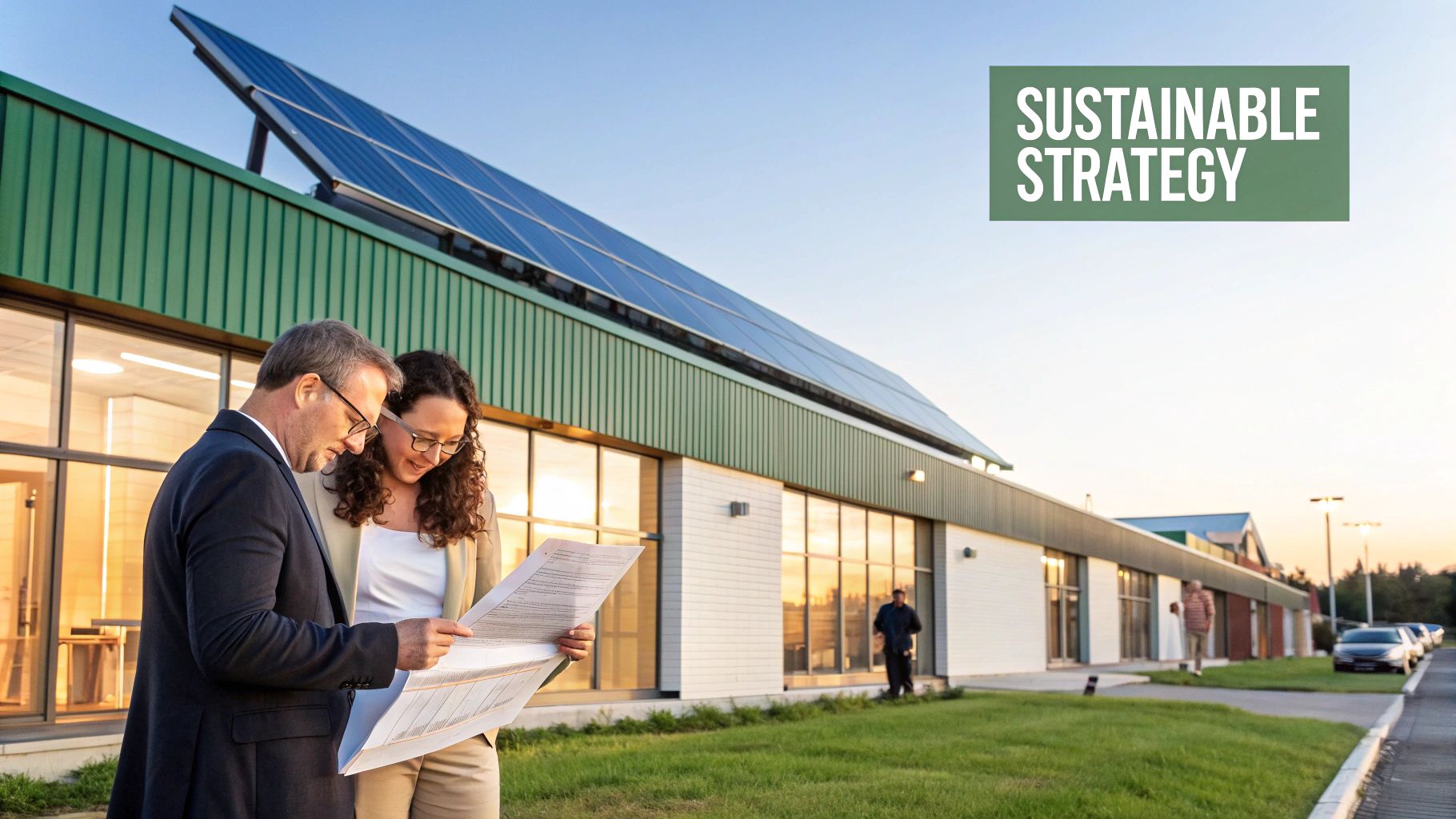
Think of a modern commercial building like a high-performance engine. Every single component, from the windows and insulation to the HVAC system and lighting, has to work together perfectly. When that "engine" is engineered with sustainability in mind, it simply runs better—it consumes less fuel (energy), produces fewer emissions, and needs less maintenance, which all adds up to a superior return on investment.
This isn’t just a nice analogy; it’s a necessary response to a pretty stark reality. The global buildings and construction sector is a massive driver of environmental damage. It’s responsible for a staggering 32 to 37 percent of both global energy demand and CO₂ emissions.
Just last year, operational emissions from buildings hit a record 9.8 gigatonnes, with another 2.9 gigatonnes coming from embodied carbon—that’s all the emissions from making and shipping the materials in the first place. This massive footprint puts a heavy weight on the shoulders of developers, owners, and architects. Ignoring it is no longer an option, not just for ethical reasons, but for smart financial ones, too.
A Fundamental Shift in Commercial Real Estate
The pressure to build sustainably is fundamentally reshaping the industry. Regulations are getting tougher, tenants are actively seeking healthy, green spaces, and investors are putting their money into assets that meet high Environmental, Social, and Governance (ESG) standards. This shift has officially moved sustainable design from the "nice-to-have" column squarely into the "must-have" category for any modern development.
A sustainably designed building isn't just an environmental statement; it's a future-proofed asset. It anticipates regulatory changes, attracts premium tenants, and lowers operational risk, making it a smarter, more resilient investment.
To get a sense of the bigger picture, it’s worth exploring strategies for decarbonizing cities and achieving net-zero goals.
The Immediate Benefits for Developers and Owners
When you bake architecture and sustainable design into a project from day one, the advantages are immediate and tangible. These principles do a lot more than just save on the power bill; they create real value across the board.
Here’s what you stand to gain:
- Lower Operating Costs: An efficient building uses less energy and water, which directly slashes utility bills for the entire life of the asset.
- Increased Asset Value: It’s a fact that green-certified buildings often command higher rents and sale prices, attracting top-tier corporate tenants who want the best.
- Enhanced Occupant Well-being: Features like clean air and abundant natural light are proven to make people more productive, happier, and less likely to call in sick.
Smart Design Before You Build
The biggest wins in sustainable commercial building—and the most cost-effective ones—happen long before anyone breaks ground. Think of the choices made in the earliest design phase as a building's DNA. They set the code for its performance, efficiency, and operating costs for its entire life. This is where architecture and sustainable design delivers its greatest punch.
Trying to bolt "green" tech onto an inefficiently designed building later on is like trying to fix a gas-guzzler by upgrading the sound system. It's a costly patch that misses the point entirely. Instead, by focusing on passive design principles first, you’re baking efficiency right into the building's bones.
These aren't complicated gadgets. They are fundamental, time-tested architectural strategies that work with nature, not against it. By simply respecting the site, the sun, and the local climate from day one, you create a building that naturally needs less energy to run. That means more comfortable occupants and lower bills for owners.
Harnessing the Sun with Smart Orientation
The most powerful resource you have is completely free: the sun. A building’s orientation—the direction it faces—has a massive impact on how much energy it will need. It's the difference between a building that's constantly fighting the climate and one that uses it to its advantage.
In a place like South Carolina, the game is all about letting in useful daylight while blocking the intense solar heat, especially during our long, hot summers. This all comes down to strategic placement.
- North-Facing Facades: These get gentle, indirect sunlight all day. It’s perfect for spaces needing consistent, glare-free light, like offices or design studios.
- South-Facing Facades: In the Northern Hemisphere, south-facing windows catch low-angle sun in the winter, giving you free passive heating. In the summer, the sun is high overhead, so it's easily blocked with simple overhangs or awnings to prevent the building from cooking.
- East and West Facades: These are the real challenge. They get blasted by low-angle sun in the morning (east) and late afternoon (west), causing a ton of heat gain and glare. Smart design either minimizes windows on these sides or uses tools like high-performance glazing and external shading to take the edge off.
Just by rotating a building on the site plan, you can cut its energy use by 20-30% before you’ve even picked out a single brick. It’s a zero-cost move with decades of payoff.
Daylighting for Healthier and More Productive Spaces
Letting in natural light does more than just lower the electricity bill. Daylighting is about creating spaces that feel alive, and it has a direct, measurable effect on the people inside.
Study after study shows that access to natural light boosts mood, reduces eye strain, and can make people up to 15% more productive. For a developer or landlord, that’s a powerful selling point. You're offering a premium space that tenants want because it supports their team's well-being. Good daylighting isn't just about more windows; it's about smart design—using light shelves to bounce sunlight deeper into rooms, choosing interior finishes that reflect light, and opening up floor plans so light can reach the building's core.
A well-daylit space does more than save energy; it connects people to the outdoors and the natural rhythm of the day. This creates a healthier, more engaging environment that sets a property apart from the competition.
Defining the Building Envelope
If a building is a body, its building envelope is the skin. This is the complete physical barrier between the comfortable inside and the weather outside—the roof, walls, windows, doors, and foundation. A high-performance envelope is the single most important factor in achieving top-tier energy efficiency.
A leaky, poorly insulated envelope is like wearing a mesh jacket in a blizzard. You're constantly losing heat and burning energy just to stay comfortable. A truly robust envelope, on the other hand, is like a high-tech thermal shell. It maintains a stable interior temperature with very little help from the HVAC system.
Three things are absolutely critical for a great building envelope:
- Continuous Insulation: This is all about eliminating "thermal bridges"—spots like uninsulated steel studs where heat can zip right through the wall. Wrapping the exterior of the structure with a continuous layer of insulation creates an unbroken thermal blanket.
- High-Performance Windows: You can now get windows tuned for a specific climate. For South Carolina, that means specifying glass with a low Solar Heat Gain Coefficient (SHGC) to block unwanted summer sun while still letting in plenty of visible light.
- Airtight Construction: Tiny, uncontrolled air leaks can add up to huge energy losses. Meticulous air sealing around every joint, seam, and opening is crucial to keep your conditioned air in and the humid outside air out.
Investing in a superior envelope isn't an optional upgrade; it's fundamental. It dramatically shrinks the heating and cooling loads, which often means you can install smaller, less expensive HVAC systems from the start and enjoy lower energy bills for decades.
Choosing Materials That Reduce Your Carbon Footprint
While smart design strategies are fantastic for cutting down a building's operational carbon emissions—the energy it uses day-to-day—there's another huge piece of the puzzle: embodied carbon.
Think of it as the carbon "price tag" already attached to every single material showing up at your job site.
This price tag covers everything from mining raw materials and manufacturing products to shipping them to your project and even their eventual disposal. It’s the carbon debt your building racks up before the lights are even turned on. In some new buildings, embodied carbon can account for up to 75% of the total carbon footprint over the first decade.
Focusing on materials with a lower carbon price tag is a game-changer. It’s about making conscious choices to shrink your project’s immediate environmental impact, looking beyond just long-term efficiency to the building's entire lifecycle.
Understanding The Lifecycle of Building Materials
To really tackle embodied carbon, you have to look at the complete story of a material, from cradle to grave. This is what a lifecycle assessment (LCA) does. An LCA is a deep dive that measures environmental impacts at every stage, giving you the hard data needed to compare different options.
This is where material choices intersect with the foundational principles of smart, sustainable design.
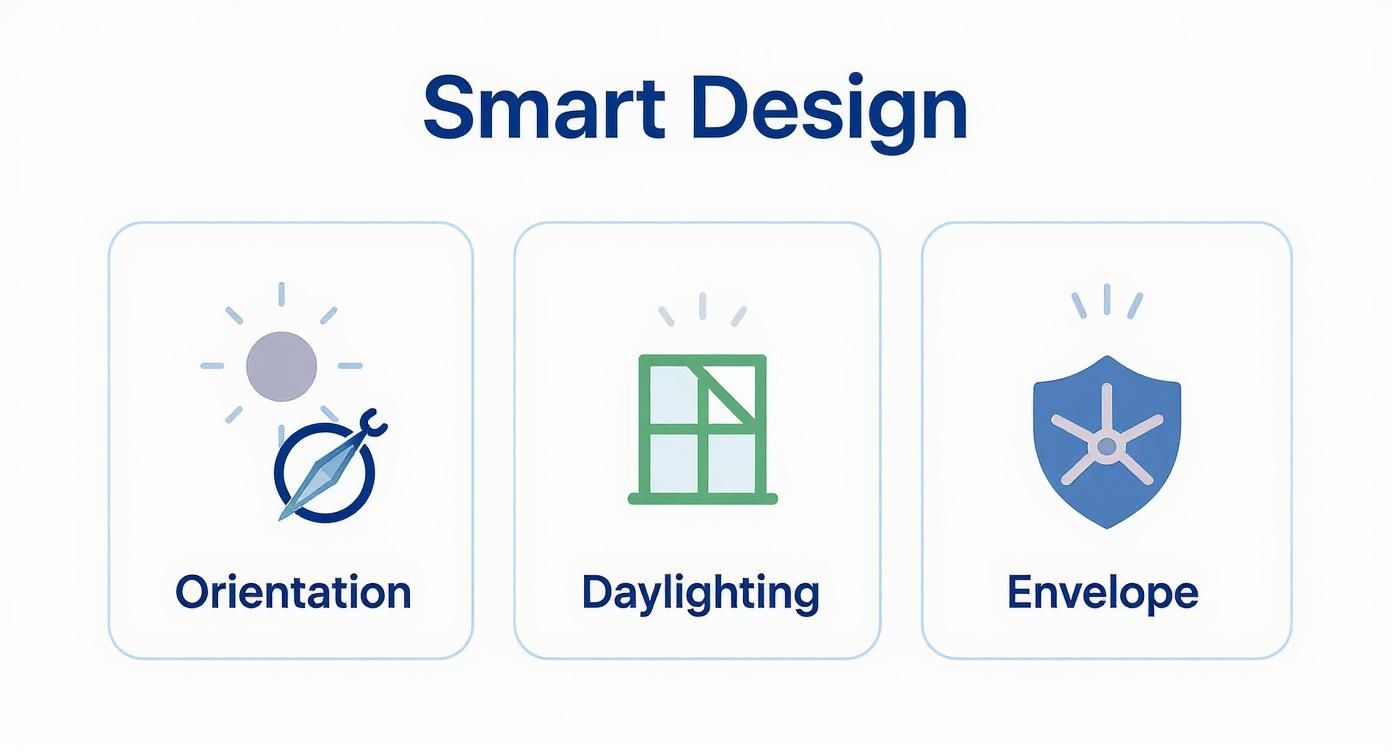
These core strategies—orientation, daylighting, and the building envelope—are the perfect partners for thoughtful material selection. Together, they create a truly high-performance, sustainable building.
Low-Carbon Material Alternatives
The good news? The market for low-carbon building materials is expanding fast. These alternatives often perform just as well—if not better—than conventional options while slashing your project's environmental debt.
Here's where we're seeing some of the biggest wins:
- Mass Timber: Products like cross-laminated timber (CLT) and glulam are engineered wood marvels that can replace steel and concrete for a building's main structure. Since trees absorb and store carbon as they grow, mass timber can have a neutral or even negative carbon footprint.
- Recycled Steel: Making new steel is incredibly energy-intensive. But using recycled steel? That requires about 75% less energy. Simply specifying a high percentage of recycled content is one of the easiest and most effective moves you can make.
- Locally Sourced Materials: This one is just common sense. Choosing materials extracted and made nearby—like stone from a South Carolina quarry—drastically cuts the transportation emissions baked into your project. Plus, it keeps money in the local economy.
Even the smaller details add up. For instance, selecting eco-friendly and sustainable blinds can contribute to both better energy efficiency and a lower overall carbon footprint.
The most sustainable choices are often rooted in simplicity and locality. By prioritizing materials that are renewable, recycled, or sourced nearby, you are directly investing in a healthier planet and a more resilient local supply chain.
When you're evaluating your options, comparing the embodied carbon of different materials can really put things into perspective.
Comparing Common Building Materials by Embodied Carbon
This table gives a quick snapshot of how swapping out just a few key materials can make a significant difference in your project's upfront carbon emissions.
| Material | Conventional Option | Sustainable Alternative | Key Benefit of Alternative |
|---|---|---|---|
| Structure | Concrete, Virgin Steel | Mass Timber (CLT, Glulam) | Carbon sequestering; stores carbon instead of emitting it. |
| Insulation | Polystyrene Foam (XPS) | Cellulose, Cork, Wood Fiber | Made from recycled/renewable sources; lower energy to produce. |
| Cladding | Aluminum Composite Panel | Reclaimed Brick, Local Stone | Drastically reduces manufacturing and transportation emissions. |
| Flooring | Vinyl Composition Tile (VCT) | Bamboo, Polished Concrete | Renewable resource (bamboo) or uses the existing slab. |
Looking at these comparisons makes it clear that sustainable alternatives aren't just hypotheticals—they are practical, available, and powerful tools for reducing embodied carbon.
Using EPDs for Transparent Choices
So, how do you actually compare the carbon footprint of two different products with confidence? The answer is the Environmental Product Declaration (EPD).
Think of an EPD as a nutrition label for a building material. It's a standardized, third-party verified report that clearly lays out a product's environmental impact across its entire lifecycle.
EPDs give you transparent data on factors like global warming potential (the official term for embodied carbon), allowing for a true apples-to-apples comparison. By asking manufacturers for EPDs and specifying products with lower embodied carbon, you can be sure your choices are backed by solid, verifiable data.
This commitment to material transparency is a cornerstone of modern sustainable design. It empowers developers and owners to build not just for today, but for a far more resilient and responsible future.
Unlocking the Hidden Value in Existing Buildings
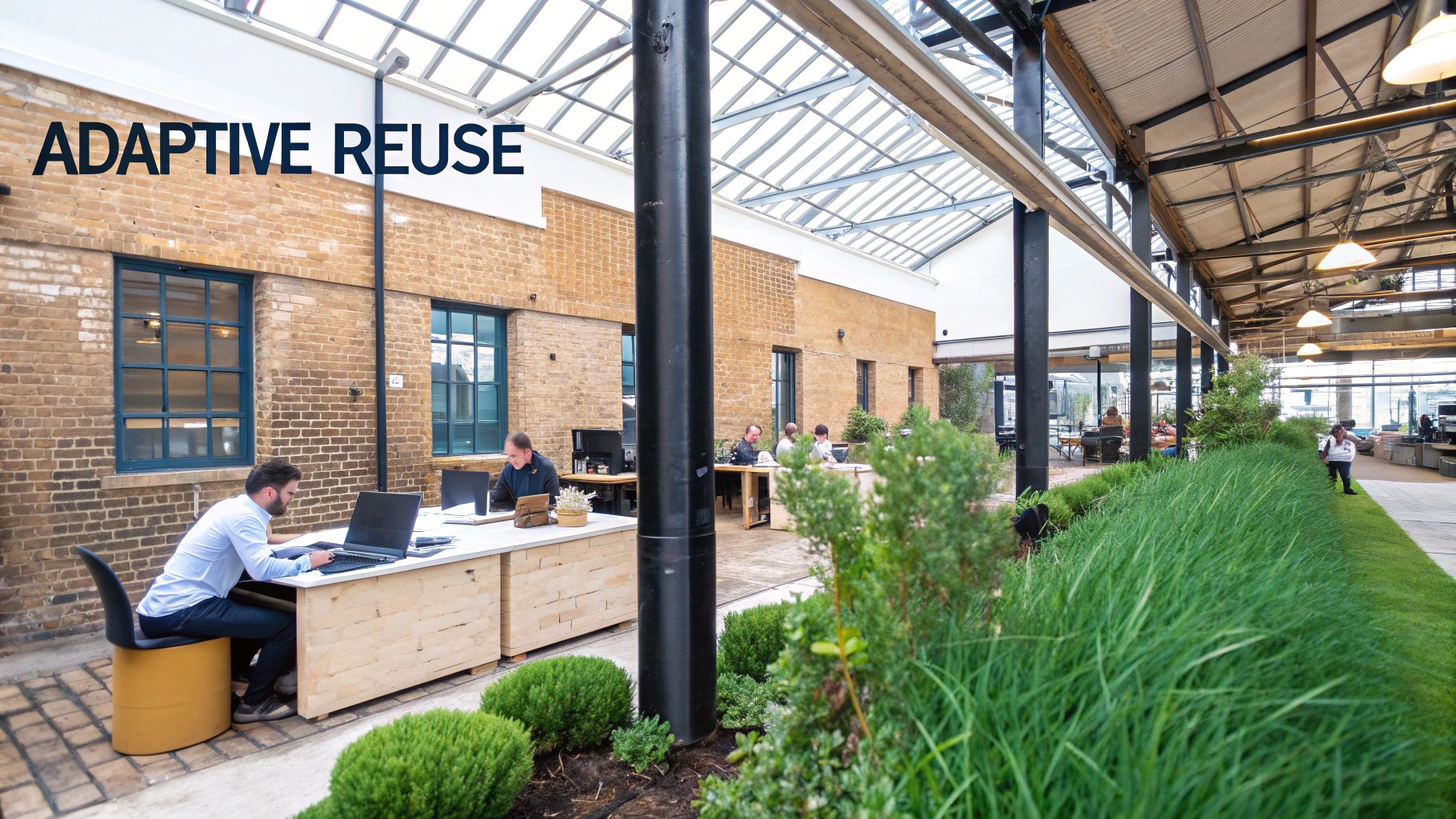
While we often focus on low-carbon materials for new projects, one of the biggest moves we can make in architecture and sustainable design is to look at the buildings we already have. There’s a well-known saying in the industry: "the greenest building is the one that’s already built." And it’s absolutely true. This idea gets to the heart of adaptive reuse—the art of breathing new life into old structures by repurposing them for today's needs.
Think of it this way: every existing building is a massive vault of embodied carbon. All the energy that went into manufacturing its steel, concrete, and bricks is locked right into the structure. When we tear a building down, we not only waste those materials but also release a huge amount of carbon in the demolition and hauling process. Adaptive reuse lets us sidestep that entire carbon hit.
But it's about more than just avoiding waste. This approach preserves the character and history woven into a community's fabric. That forgotten textile mill can become a bustling hub with apartments and shops. A century-old bank can be transformed into a sleek, modern office. You get all the benefits of a new space without sacrificing the architectural soul that gives a place its identity.
Making Adaptive Reuse Work in the Real World
Turning an old building into a modern, high-performing asset is a bit like solving a complex puzzle. It's a different game than starting from scratch on an empty lot, and it demands a thoughtful, strategic approach to get it right.
A successful adaptive reuse project usually follows a few key steps:
- Digging into the Details: It all starts with a deep-dive assessment. We have to understand the building's bones—its structural integrity, the state of its electrical and plumbing systems, and whether there are any hazardous materials like asbestos to deal with.
- Smart Upgrades, Not Just Repairs: The goal isn't to just patch things up. It’s about a strategic modernization. This means weaving in new, energy-efficient systems, beefing up the insulation to tighten the building envelope, and reimagining the interior layout to fit how people live and work now.
- Wrangling the Rules: Getting an older building to meet modern codes for things like accessibility, fire safety, and energy use is often the biggest hurdle. This is where a deep knowledge of both historic preservation rules and current regulations becomes critical.
Navigating these challenges is precisely where an experienced architecture firm proves its worth, finding creative ways to turn potential deal-breakers into design opportunities.
The Financial Incentives That Make Preservation Pay Off
Beyond the obvious environmental wins, adaptive reuse often makes incredible financial sense. This is largely thanks to some powerful incentives designed to make saving old buildings the smart business move. For developers, these programs can completely change the math on a project's profitability.
Adaptive reuse is where sustainability meets smart business. By leveraging historic tax credits and other incentives, developers can turn underutilized properties into highly valuable, sustainable assets with a unique market identity.
Federal and State Historic Tax Credits are the real game-changers here. Together, these programs can offer a tax credit of up to 40% of the project's qualified rehabilitation costs for income-producing historic properties. We’re talking about a direct, dollar-for-dollar reduction in what you owe in taxes, which can dramatically boost a project’s ROI.
- Federal Historic Tax Credit: Provides a 20% income tax credit.
- South Carolina Historic Tax Credit: Offers an additional 10-25% state income tax credit, which can be stacked on top of the federal credit.
These aren't just minor perks; they are fundamental to building a strong financial case for preservation. They make it clear that investing in our existing building stock is a winning strategy that pays dividends—environmentally, socially, and on the bottom line. For developers who know how to tap into this potential, our old buildings represent some of the smartest opportunities on the market today.
Building the Business Case for Green Construction
For years, there’s been a myth floating around that sustainable construction is a noble but costly affair, something best reserved for passion projects with deep pockets. Let’s put that idea to rest, right here and now.
In today's market, choosing architecture and sustainable design isn’t about sacrificing profit for the planet. It’s about making a smarter, more lucrative financial decision. The numbers don't just support this—they prove that green construction is a powerful engine for profitability.
The most common objection I hear is about higher upfront costs. Yes, high-performance insulation, better windows, or an advanced HVAC system might require a greater initial investment. But focusing only on that is incredibly shortsighted. It's like comparing a cheap gas-guzzler to a high-efficiency hybrid based only on the sticker price, completely ignoring what you’ll save on fuel over the car's lifetime.
A sustainably designed building is an operational powerhouse. That efficiency translates directly into substantial, long-term savings that start piling up the day you open the doors.
From Upfront Costs to Long-Term Gains
The return on investment (ROI) for sustainable design isn't some abstract concept; it's a measurable financial reality. And the biggest driver of that ROI? Drastically lower operational expenses.
An energy-efficient building slashes utility bills year after year, creating a predictable and significant boost to the property's net operating income (NOI). On top of that, high-quality, durable materials and systems mean less frequent maintenance and replacement, which cuts down even further on long-term spending. These savings compound over the life of the asset, often paying back that initial "green premium" in just a few years.
The conversation around sustainable building costs has to shift. Instead of asking "how much more will it cost?" we need to be asking, "how much more will it earn?" Lower operational expenses, higher rents, and increased asset value create a financial case that simply outperforms conventional construction.
This financial upside is becoming impossible for the market to ignore. The global green building market is projected to hit a staggering $1.37 trillion by 2034. This explosion is fueled by real, tangible benefits—including 16.9 percent reduced operational costs for green buildings compared to their conventional counterparts. With numbers like that, the financial argument is undeniable. You can find more green building statistics and insights that back this up.
Attracting Premium Tenants and Higher Market Value
Beyond just saving money on operations, sustainable buildings hold a distinct advantage in the open market. They're magnets for high-value tenants and consistently command premium prices.
Think about it from the tenant's perspective. Corporate clients are increasingly driven by their own Environmental, Social, and Governance (ESG) goals. They are actively hunting for office spaces that reflect their values and are absolutely willing to pay more for buildings that offer healthier environments and lower carbon footprints. For building owners, this demand translates directly into stronger financial metrics.
Here’s a look at how green buildings consistently outperform the competition:
- Higher Rental Rates: Study after study shows that green-certified buildings can command rental rates that are up to 20% higher than comparable non-certified properties.
- Lower Vacancy Rates: These highly desirable buildings attract and retain tenants more effectively, which means more stable occupancy and reliable cash flow for you.
- Greater Resale Value: As market awareness and regulations continue to grow, energy-efficient and sustainable properties are seen as less risky, future-proofed assets. This perception results in significantly higher sale prices down the road.
At the end of the day, ESG-focused investors are actively seeking out these exact kinds of properties. A building with strong sustainability credentials isn't just a well-designed structure anymore—it's a top-tier financial asset that perfectly aligns with modern investment priorities. By embracing sustainable design, developers and owners aren't just building better buildings; they're building a more profitable and resilient portfolio.
Bringing Sustainable Design Home to South Carolina
Global principles of sustainable architecture are great on paper, but they only really come to life when you put them to work in a specific place. For anyone building in South Carolina, that means getting real about our biggest local challenge: the relentless heat and humidity. The whole point is to design buildings that work with our climate, not in a constant, energy-guzzling battle against it.
This shift in thinking has to happen right at the start of a project. Instead of just defaulting to a bigger, more powerful air conditioning system, the smarter approach is to lean on passive strategies first. We're talking about simple but powerful moves like orienting a building to avoid the brutal afternoon sun, using deep overhangs to shield windows in the summer, and designing for natural airflow to cut down on how much you have to rely on mechanical cooling.
These aren't just academic ideas. They are tried-and-true methods for making spaces that are genuinely comfortable and efficient, even when the heat index is off the charts.
What's Working Right Here in SC
You don't have to look far to see this in action. South Carolina has a growing roster of commercial projects that prove sustainable design isn't just possible here—it’s a recipe for success. Whether it's the clever adaptive reuse of historic buildings in Charleston or new LEED-certified offices in Columbia and Greenville, these projects offer a practical playbook.
They showcase a few key strategies that really move the needle:
- Airtight Building Envelopes: This is all about top-notch insulation and sealing up every crack and crevice to keep the cool, conditioned air in and the sticky, humid air out.
- Cool Roofs: Simply choosing light-colored, reflective roofing materials can bounce a huge amount of solar heat back into the atmosphere, dramatically lowering the building's cooling demand.
- Smart Landscaping: Using native, drought-tolerant plants doesn't just look good; it slashes irrigation costs and helps support the local ecosystem.
Lessons from Global Innovators
While our focus is local, it never hurts to see what's happening on the world stage. Some truly incredible projects show just how far we can push the envelope. Take Stockholm Wood City in Sweden, set to be the world's largest urban district built from mass timber. Or The Edge in Amsterdam, which earned a near-perfect BREEAM sustainability score of 98.36 out of 100 and is often called the smartest, greenest building on the planet. These examples aren't just inspiring; they prove what’s possible when ambition meets innovation. You can dig into more of these pioneering sustainable buildings and their features to see what the future holds.
Tapping into Local and State Incentives
Let's talk money. Building sustainably in South Carolina isn't just an environmental win; it's a smart financial move, thanks to some valuable incentives. Developers who know where to look can find programs that seriously improve a project's bottom line.
By combining climate-savvy design with the right local and state incentives, developers can build high-performing assets that are good for the planet and great for their portfolio right here in the South Carolina market.
The opportunities are out there. Utility providers like Duke Energy and Dominion Energy offer rebates for everything from high-efficiency lighting and HVAC systems to other major building upgrades. On top of that, the South Carolina State Energy Office frequently has grants and low-interest loans available for projects that integrate renewable energy or achieve major efficiency gains. When you add it all up, these programs make the business case for going green undeniable, giving sustainable design a real competitive edge.
Frequently Asked Questions
What’s the single biggest thing I can do for sustainable design?
If you have to pick just one area to focus on, put your energy into the building envelope. Think of it as the building's skin—its roof, walls, windows, and foundation. A high-performance envelope with top-notch insulation, airtight sealing, and high-efficiency windows is the most powerful move you can make.
This isn't an active, energy-consuming system; it's a passive strategy that works silently, 24/7, for the entire life of the building. It dramatically cuts the energy needed for heating and cooling, which means you can often install smaller, less expensive HVAC systems. The payoff, both for the planet and your wallet, starts immediately.
Are green building certifications like LEED really worth the hassle and cost?
For most commercial developers and owners, the answer is a firm yes. Pursuing a certification like LEED (Leadership in Energy and Environmental Design) isn't just about getting a plaque for the lobby. It’s a rigorous, third-party stamp of approval that tells the world your building is efficient, healthy, and built to last.
This kind of verification makes your property far more attractive to top-tier tenants who increasingly demand sustainable spaces. It can also lead to higher rents and faster lease-ups. Beyond marketing, the certification process itself provides a clear, proven framework for making smart design choices and often opens doors to green financing and tax incentives that can offset the initial investment.
A green building certification is more than a plaque on the wall; it’s a trusted signal to the market that your property is a high-quality, future-focused asset.
How can I make my existing building more sustainable without a massive renovation?
You don't have to gut the building to make a real difference. The smartest first step is a professional commercial energy audit to pinpoint exactly where you're losing the most energy and money. It takes the guesswork out of the equation.
Based on the audit, you can target a few high-impact upgrades:
- Swap out old lighting for LEDs. This is often the fastest, easiest way to slash your electricity bill.
- Install smart thermostats and modern building controls to optimize when and where you use energy.
- Add insulation where it’s easiest to access, like in the attic or roof assembly.
- Replace old fixtures with low-flow toilets and faucets to cut water usage with minimal investment.
Even just one or two of these focused improvements can deliver significant savings on your utility bills and make the building a much more comfortable place for everyone inside.
Ready to unlock the value in your next commercial project through smart, sustainable design? Contact Sherer Architects, LLC to align your vision with enduring, profitable, and responsible architecture. Learn more at https://shererarch.com.