Kicking off a commercial building project in Greenville is about more than just finding a piece of dirt and hiring a crew. The projects that truly succeed—the ones that become landmarks and smart investments—are built on a solid foundation of strategy. This all happens long before anyone even thinks about drawing up blueprints. This initial phase is where you sidestep costly blunders and bake real value into your project from the very start.
Setting Your Greenville, SC Building Project Up For Success
A successful project isn't an accident; it's the result of a smart, foundational strategy. This isn't about checking boxes. It’s about making informed, deliberate decisions from day one that prevent expensive headaches later. It means you have to dig deep into the specifics of your site, nail down a crystal-clear scope, and establish a budget that’s grounded in reality, accounting for both what you know and what you don't.
This strategic flow shows how these crucial first steps fit together, from evaluating the site to setting the budget.
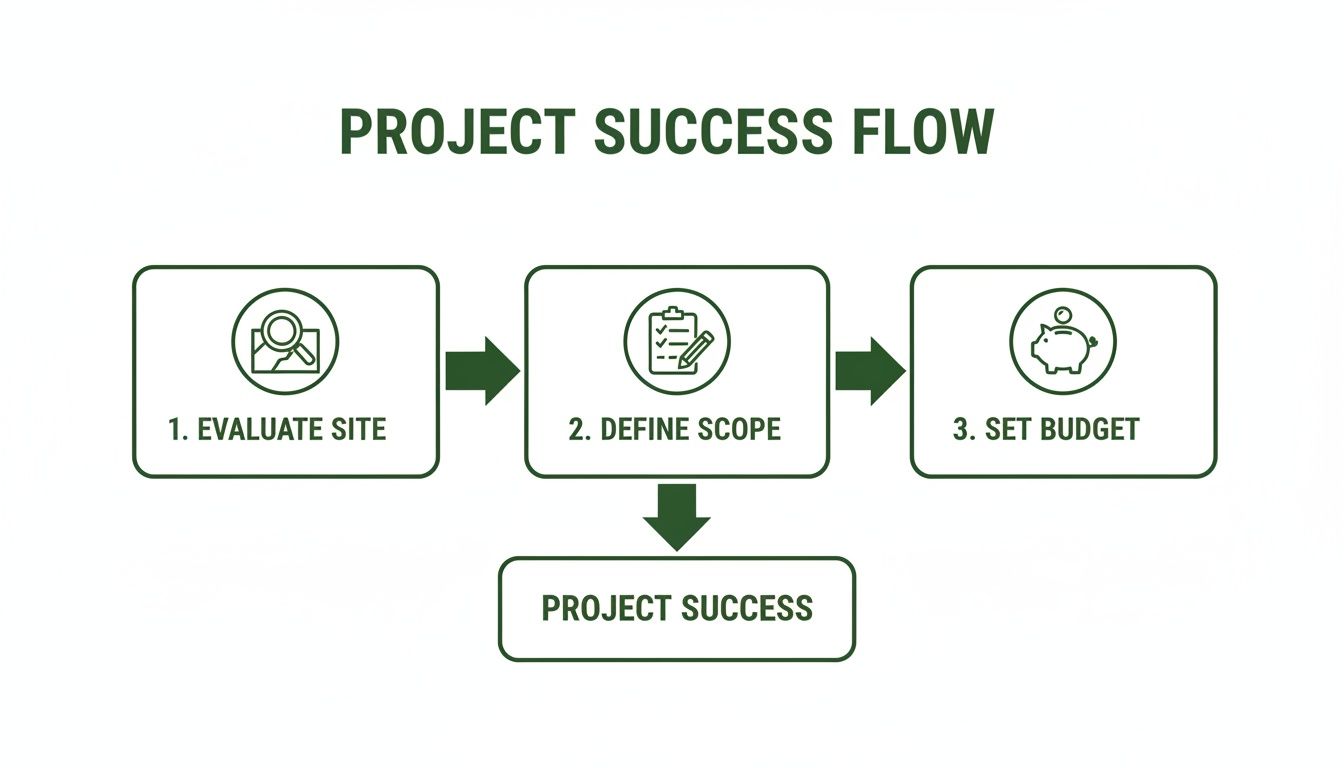
As you can see, each stage builds directly on the one before it. Get this sequence right, and you're laying the groundwork for a smooth and successful project.
Evaluating Your Site and Its Hidden Potential
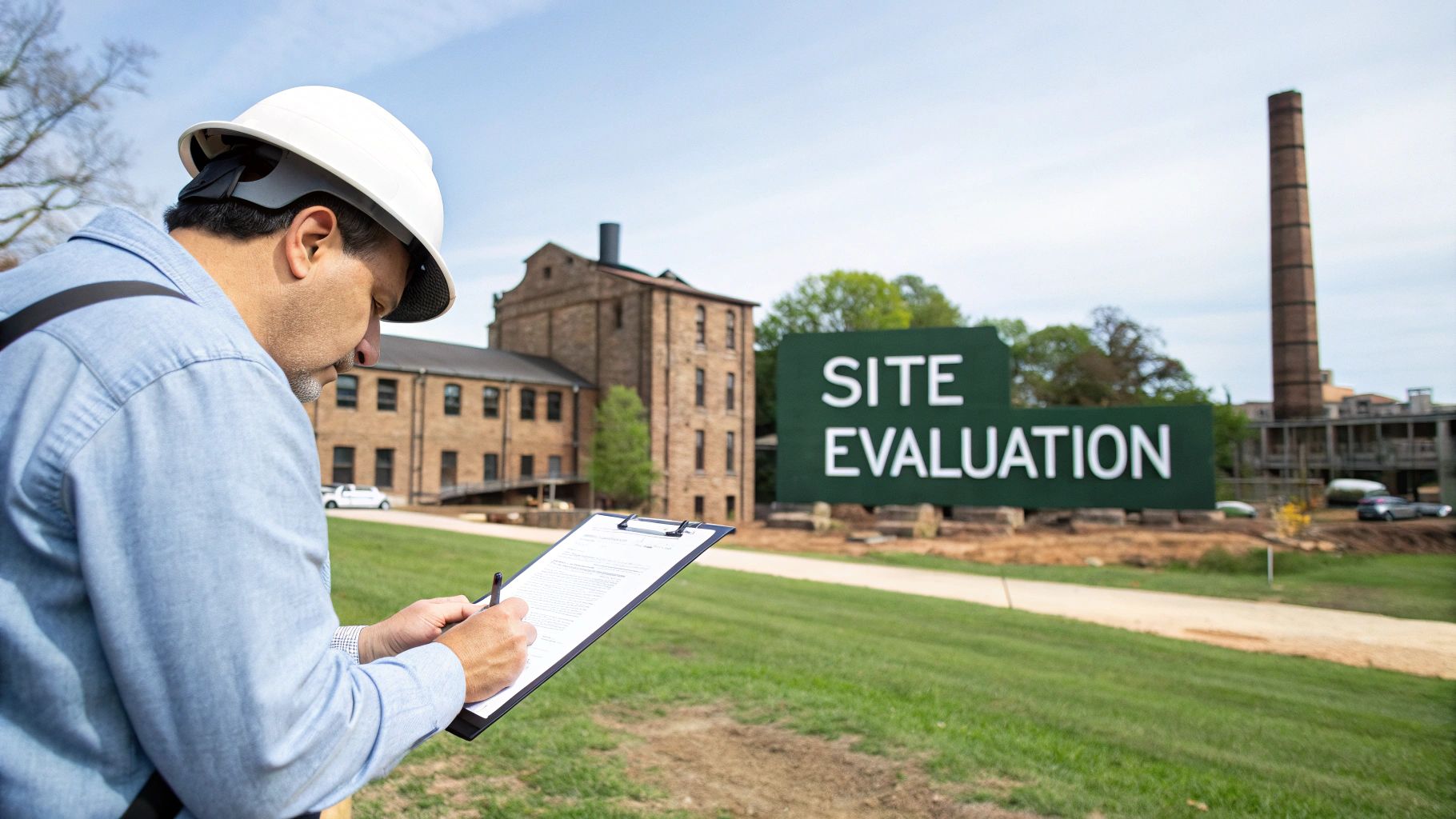
Your first real move is a thorough site evaluation that goes way beyond just the property lines. In a city like Greenville, with its unique history and distinct neighborhoods, every single property has its own story and context.
Think about its proximity to hotspots like the West End or the Village of West Greenville. Is it nestled within a historic district, like the Pettigru Historic District? That could unlock valuable preservation incentives, but it will also mean navigating extra layers of design review.
Beyond location, you've got to get real about the physical conditions. Does the site’s topography create a nightmare for foundation work? Are utilities already on-site, or is running new infrastructure going to be a major line item on your budget? If you're looking at an existing building, the investigation gets even more critical.
Assessing an Existing Building For Adaptive Reuse
If you’re considering an older building, a comprehensive condition assessment is absolutely non-negotiable. This isn’t a quick walkthrough; it's a deep dive into the building's guts. You need solid answers to some tough questions:
- Structural Integrity: Is the foundation sound? Are there tell-tale signs of stress or failure in the load-bearing walls or roof structure?
- MEP Systems: How old are the mechanical, electrical, and plumbing systems? Outdated or non-compliant systems can mean a full replacement, which is a massive budget hit.
- Hazardous Materials: Are you dealing with asbestos, lead paint, or other nasty surprises that demand specialized—and expensive—abatement?
- Building Envelope: What’s the state of the roof, windows, and masonry? Water intrusion is a project-killer if you don’t catch it and deal with it early.
Greenville’s rich stock of older buildings presents incredible opportunities for adaptive reuse. The city has a deep inventory of historic properties just waiting to be transformed into profitable, modern assets. A 2003 survey identified around 1,200 historic resources, and another 128 were added later. This just scratches the surface of the potential for preserving these unique structures for another 50–75 years of use. You can explore Greenville's historic property survey to get a feel for the city's amazing architectural heritage.
A classic misstep is underestimating what it costs to bring an old building up to modern code. What looks like a simple cosmetic facelift can quickly spiral into a full-gut renovation when you uncover the need for a new HVAC system, a complete electrical rewire, and major accessibility upgrades.
To guide you through these initial stages, here's a checklist of the key areas to investigate.
Initial Project Scoping Checklist
| Evaluation Area | Key Questions to Ask | Why It Matters |
|---|---|---|
| Zoning & Land Use | What is the current zoning? Are there overlays (e.g., historic, design review)? What are the permitted uses, setbacks, and height limits? | Determines what you can legally build and sets the fundamental design constraints. Ignoring this can stop a project cold. |
| Site Conditions | What is the topography? Are there environmental concerns? Where are the utility connections (water, sewer, electric)? | Physical site issues directly impact foundation design, site work costs, and overall construction feasibility. |
| Building Condition | (For existing buildings) What's the state of the structure, roof, and MEP systems? Is there evidence of hazardous materials? | Uncovering major deficiencies early prevents catastrophic budget overruns and project delays during construction. |
| Market Feasibility | Who is the target tenant/buyer? What are the current market rents or sales comps for this type of property in this location? | Ensures your project vision aligns with market demand, making it a viable and profitable investment. |
| Preliminary Budget | What are the anticipated hard costs (construction) and soft costs (fees, design, legal)? Have you included a contingency? | A realistic, all-in budget from the start provides a critical reality check and guides all subsequent decisions. |
Working through these questions forces you to think critically about every angle of the project before you've spent a dime on design.
Defining Your Scope and Setting a Realistic Budget
Once you have a complete picture of your site or building, it's time to define your project scope. This is your roadmap. It details everything from the square footage and how the space needs to function to the quality of the finishes. A vague scope is a surefire recipe for budget overruns and endless delays.
Get specific. Don’t just say "a modern office space." Define it as "a 10,000-square-foot office with an open floor plan for 50 employees, two conference rooms with full AV integration, and a Class A lobby finish." See the difference?
With a detailed scope in hand, you can finally build a budget you can trust. This needs to include more than just the hard costs of materials and labor. You have to account for soft costs, too—things like architectural and engineering fees, city permits, legal expenses, and financing.
And whatever you do, always build in a contingency fund. A buffer of 10-15% of the total construction cost is standard practice to cover the inevitable surprises that pop up in every single project. This disciplined approach is what separates the successful projects from the cautionary tales.
Finding the Right Architect for Your Greenville Project
Let's be clear: choosing your architect is probably the most consequential decision you’ll make for your entire commercial project. This isn't just about finding a firm with a slick portfolio. It's about securing a strategic partner who truly gets the intricate development landscape here in Greenville, SC.
The right architect does so much more than design buildings. They are your guide through the complex local systems that can make or break your investment. A stunning rendering is worthless if the design gets shot down by the city's Design Review Board (DRB) or clashes with the neighborhood’s character.
The best architecture Greenville SC has to offer comes from a deep, almost instinctual, understanding of local context. We're talking about everything from the brick facades along Main Street to the industrial grit of the West End. Your ideal partner will have a proven track record of navigating these specific local waters.
Look Beyond the Portfolio
When you start your search, it's incredibly easy to get dazzled by polished photos of finished projects. And while a strong portfolio is definitely a good sign, it's just the beginning of the story. The real value is in an architect's experience with the process, not just the final product.
You need someone who can anticipate the questions and concerns of Greenville's planning officials before they even come up. That kind of foresight only comes from years of hands-on experience and the professional relationships built along the way.
As you vet potential firms, here’s what you should really be focusing on:
- Local Regulatory Fluency: Have they successfully steered multiple projects through Greenville’s specific zoning, permitting, and DRB hoops? Don't be shy—ask for concrete examples.
- Adaptive Reuse Expertise: If you're working with an older building, does the firm have a solid portfolio of successful adaptive reuse projects? It's a highly specialized skill that not everyone possesses.
- Historic Preservation Credentials: Is your project in a historic district or a designated landmark? Make sure the architect has direct experience with historic tax credits and the strict standards that come with preservation work.
This is the kind of specialized knowledge that separates a decent local architect from a truly great one. It’s the difference between a smooth, predictable process and one that’s bogged down by costly delays and frustrating redesigns.
Questions to Uncover True Expertise
When you sit down for interviews, it's time to move past generic questions about design philosophy. Your mission is to understand how a firm thinks on its feet, solves problems, and collaborates when things get tough. You’re not just hiring a designer; you're hiring a problem-solver and a staunch advocate for your investment.
A common mistake is getting hung up on an architect's design style. A far more critical factor is their ability to fuse a great design with your business goals and the city’s regulatory demands. The goal is a project that's not just beautiful, but profitable and buildable.
To really get to the heart of their capabilities, try asking these pointed questions:
Navigating the DRB: "Tell me about a time you presented a project to the Greenville DRB and got some tough feedback. How did you adapt the design to satisfy their concerns while still protecting the project's budget and our main goals?" This question reveals their real-world negotiation and problem-solving skills.
Value Engineering: "Can you give me an example of how you used a creative design solution or a different material to bring down construction costs on a project without compromising the quality or the look?" This gets right to their ability to deliver value, not just a pretty picture.
Collaboration Style: "What's your process for communicating with us and the contractor during the construction phase? How do you handle it when there's an on-site issue or a gap between the plans and what's actually being built?" This peels back the curtain on how they manage the messy, practical reality of a construction site.
The answers you get will tell you far more about a firm’s real-world chops than any portfolio. You’ll get a window into how they handle adversity, protect your bottom line, and ultimately act as a true partner. Your choice of architect shapes everything from day one to completion, so take the time to find a firm that brings both visionary design and pragmatic, on-the-ground expertise to your project.
Navigating Greenville's Zoning and Permitting Maze
Greenville’s rapid growth has, not surprisingly, led to a complex web of regulations. If you're a developer or property owner, this maze of zoning ordinances, landscape rules, and design guidelines can feel like a serious hurdle. Getting a project from a sketch on a napkin to a structure rising from the ground takes more than a great idea; it demands a smart, strategic approach to the entire approvals process.
Thinking about these local rules as just a checklist to get through is a mistake. When you understand them, you can actually use them to create a better, more valuable project that fits right into the city's unique character. This is where a seasoned local architect becomes your most valuable player—they know how to translate your vision into a language city officials and review boards will not only understand but also support.
Understanding Greenville's Zoning and Overlays
Before you fall in love with a specific design, your first reality check is always the city's zoning code. These are the foundational rules that dictate everything from what you can do with the building (its "use") to how tall it can be and how far it must sit from the property lines.
But in Greenville, the real game-changer is often the overlay districts. Think of these as special zones, like a historic district or a design review area, that layer extra standards on top of the basic zoning. A project on Main Street, for instance, is going to get a much closer look at its materials, size, and how it feels to a pedestrian than a warehouse in an industrial park.
Here’s how an experienced team tackles this:
- Zoning Verification: The first move is to get a zoning verification letter from the city. This document officially confirms all the specific requirements for your property. No guesswork.
- Deep-Dive Code Analysis: Next, your architect will dig deep, comparing your project goals against the code to spot any potential conflicts right away.
- Proactive Strategy: This early homework lets you get ahead of problems. You might tweak the design slightly or start building a strong case for a variance if you know you'll need one.
Skipping this initial due diligence is a classic rookie mistake. I’ve seen it lead to months of delays and expensive redesigns when the planning staff flags an issue that could have been caught on day one.
The Influential Design Review Board
For projects in many of Greenville’s most desirable spots, your design’s fate lies with the Design Review Board (DRB). This board's job is to make sure new construction and major renovations add to the city's aesthetic and character, not detract from it. They aren’t just ticking boxes on a form; they’re making a subjective judgment on the quality and fit of your design.
Presenting to the DRB is both an art and a science. You need a compelling story that explains why your design choices make sense for that specific location.
A common pitfall is treating the DRB presentation as just another bureaucratic step. The board wants to see that you've thought deeply about the context, the materials you've chosen, and the building's overall scale. An architect who can clearly and confidently articulate the "why" behind the design is your greatest asset in that room.
Getting the DRB's approval often boils down to good preparation and a collaborative spirit. A smart architect engages with city staff for informal feedback long before the official hearing. This pre-review process helps you iron out the kinks and address concerns early, making the formal presentation a much smoother ride.
From Site Plan Approval to Building Permits
Once you’ve cleared the DRB and have conceptual approval, the process shifts from the big picture to the nitty-gritty technical details. This phase is a whirlwind of submissions to different city departments—engineering, landscaping, fire safety, and more. Each one will scrutinize your plans to ensure they meet every last code and ordinance.
This is where your architect and engineering team work in perfect sync, producing the highly detailed construction documents that will guide the build. These drawings spell out everything, from the structural system holding the building up to the layout of every electrical outlet.
The final leg of the journey is securing all necessary building permits and, at the very end, the project's final blessing. When dealing with Greenville's permitting process, it's vital to remember the last step: obtaining the Certificate of Occupancy. This is the city's official stamp of approval, declaring your building is safe and ready for business. You can't legally open your doors without it. Throughout this entire sequence, your architect acts as the project quarterback, coordinating with all the consultants and responding to city feedback to keep your project on track, on time, and on budget.
Why Adaptive Reuse Is Smart Business in Greenville
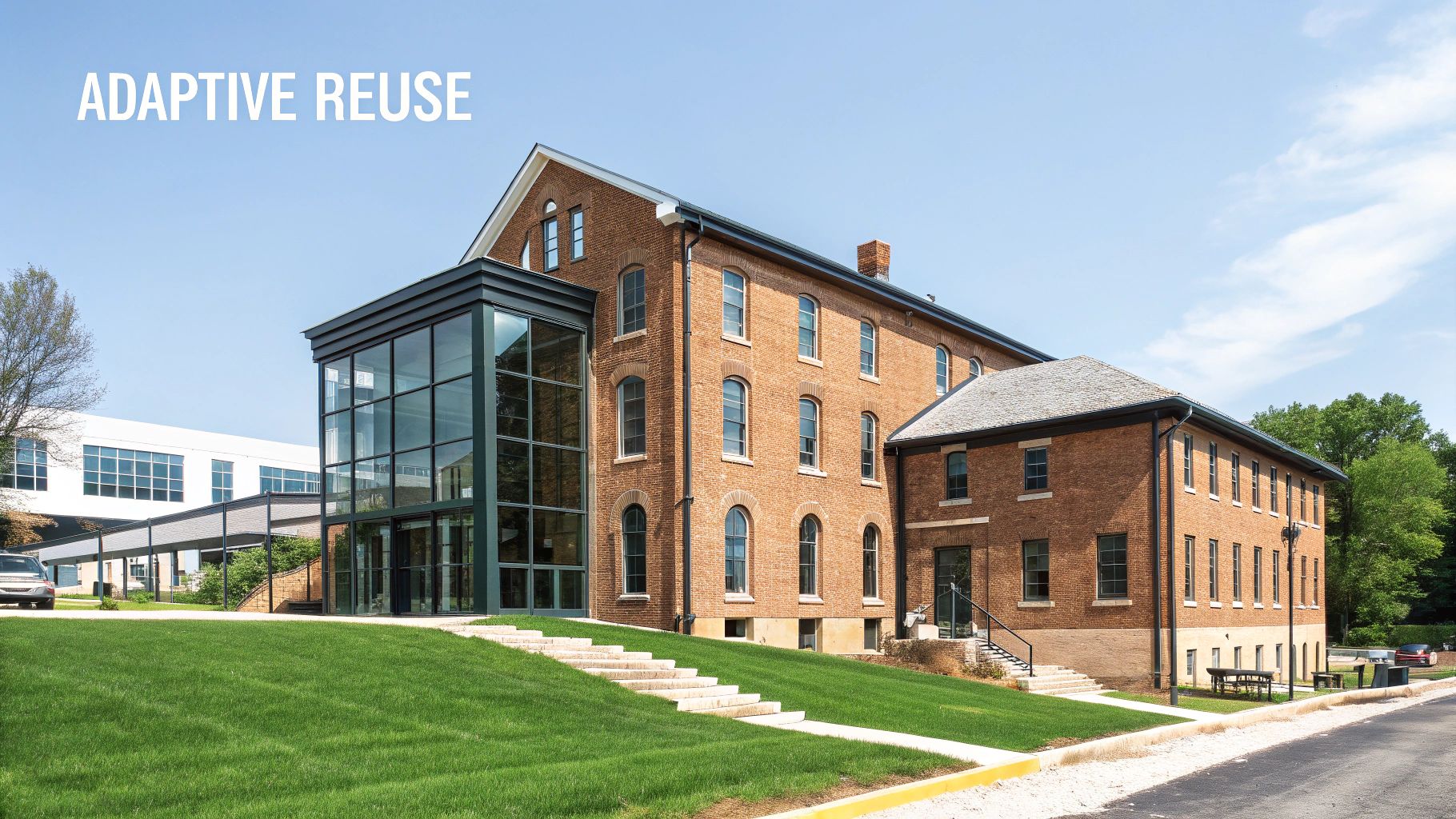
In a city like Greenville, where historic brick mills and century-old storefronts tell the story of its past, the bulldozer isn’t always the best tool for the job. We're seeing more and more developers recognize the immense value locked away in these older structures.
Adaptive reuse is simply the practice of breathing new life into old buildings—transforming them for modern uses while keeping their irreplaceable character. This isn't just about nostalgia; it's a savvy business strategy that often delivers a stronger ROI than starting from scratch.
When you choose to repurpose an existing building, you're not just saving a piece of history. You're leveraging its embodied carbon, making it a far more sustainable choice. You also get to sidestep the high costs and unpredictable timelines that come with demolition, site prep, and new foundation work, getting you to market faster. This approach lets you tap into a huge demand for authentic spaces that you just can't replicate with new construction.
Tapping Into Powerful Financial Incentives
One of the most compelling reasons to go the adaptive reuse route in Greenville is the significant financial support available. Renovating a historic property isn't just a feel-good decision; it can dramatically improve your project's bottom line through a range of powerful incentives.
These programs were put in place specifically to make preservation an attractive, and often more profitable, alternative to demolition. They can seriously reduce your initial investment, improve cash flow, and ultimately boost your property's long-term value.
Here are the key financial tools you should know about:
- Federal Historic Tax Credits: This is the heavyweight champion of preservation incentives. It can provide a 20% income tax credit for the substantial rehabilitation of certified historic structures. For a multi-million dollar renovation, that credit can mean hundreds of thousands of dollars straight back into your pocket.
- State Historic Tax Credits: South Carolina offers its own set of credits that you can stack with the federal program, making the deal even sweeter for developers.
- Local Grants and Loans: Don't overlook local programs and specialized lenders. They often provide favorable terms for projects that help preserve Greenville's architectural heritage.
Navigating the complex applications and compliance for these programs is no small feat. This is where an architect with deep experience in historic preservation becomes absolutely essential.
The Balance Between Progress and Preservation
Greenville's story is one of constant evolution, and sometimes that progress came at a cost. During the early 20th century, the city’s push toward modernization led to the loss of some real architectural treasures. For instance, the original 1823 courthouse designed by Robert Mills—the visionary behind the Washington Monument—was torn down for a new "skyscraper." As you can read more about Greenville's Main Street history, this loss really highlights the tension between moving forward and holding onto the past.
Today, the most successful developers and city planners I work with recognize that the best projects find a way to honor the past while building for the future. Adaptive reuse isn't about freezing a building in time; it's about making it relevant and useful for generations to come.
This thoughtful approach is what gives Greenville its distinct sense of place. Buildings like Mills Mill, a Romanesque-style textile factory built in 1897, have been reborn as vibrant residential and commercial hubs. These projects prove that historic structures can be powerful economic engines, attracting tenants and customers who are willing to pay a premium for authenticity and unique design. Choosing adaptive reuse aligns your project with what the community values and helps create a more sustainable and culturally rich city.
Adaptive Reuse vs New Construction A Financial Snapshot
When you really crunch the numbers, especially with the available incentives factored in, the financial case for adaptive reuse becomes crystal clear. Here’s a high-level look at how the two approaches typically stack up for a commercial project in Greenville.
| Financial Factor | Adaptive Reuse / Historic Preservation | New Construction |
|---|---|---|
| Initial Capital Outlay | Often lower since you're leveraging the existing structure and avoiding major demolition. | High costs for demolition, site work, foundation, and all-new structural systems. |
| Tax Incentives | Eligible for substantial federal and state historic tax credits, directly reducing project costs. | Generally not eligible for preservation-specific financial incentives. |
| Construction Timeline | Can be faster by avoiding lengthy site prep and foundation phases. | Subject to weather delays and potentially longer timelines for ground-up work. |
| Market Appeal | High demand for unique, character-rich spaces that often command premium rents. | Competes in a crowded market of standard, modern commercial spaces. |
Ultimately, by partnering with an experienced architecture Greenville SC firm that understands the nuances of historic properties, you can transform what might look like a liability into a high-performing asset—creating a landmark that is both profitable and a source of community pride.
Bringing Your Project From Blueprint to Reality
With the city’s stamp of approval on your plans, the project finally moves off the page and onto the job site. This is the construction administration phase—the moment your vision starts becoming a physical asset. Success from here on out hinges on a strong, collaborative partnership between you, your architect, and your general contractor. The real work starts now.
Don't make the mistake of thinking your architect's job is done. In many ways, their role becomes even more crucial during construction. They shift from being your designer to your advocate on the ground, making sure the contractor’s work matches the design's intent with precision and quality. This oversight is what protects your investment and ensures the final building is what you actually paid for.
Your Architect is Your Advocate on the Job Site
During the build, your architect is the essential link between the detailed plans and the day-to-day realities of the construction site. Their main job is to observe the progress and confirm that everything is being built according to the contract documents. This isn’t about micromanaging the crew; it’s about quality assurance.
Regular site visits are the backbone of this process. An experienced architect has a trained eye for the details, spotting potential issues long before they snowball into costly, time-consuming problems.
During these visits, they’re focused on key tasks:
- Checking Work Conformance: Are the right materials being used? Is the craftsmanship up to standard? They verify that everything from the rebar in the foundation to the window installations matches the specifications.
- Answering RFIs: Contractors will always have questions. Your architect provides timely, clear answers through Requests for Information (RFIs), which prevents guesswork and keeps the project from stalling.
- Reviewing Pay Applications: They review the contractor’s invoices to certify that the amount billed accurately reflects the work completed. This simple check protects you from paying for work that hasn't been done yet.
Having your architect consistently on-site is fundamental to maintaining the integrity of high-quality architecture Greenville SC projects, from the first shovel in the ground to the final coat of paint.
It's a common myth that the general contractor is the only one responsible for quality control. While the GC manages the build, your architect is your independent expert, verifying the work is done right, not just done. Their loyalty is to you and the vision you both created.
Building a Problem-Solving Partnership
Let’s be realistic: no construction project goes exactly as planned. You might uncover an unexpected utility line during excavation, or a key material could be hit with a supply chain delay. These things happen. What defines a successful project is how the team—owner, architect, and contractor—handles these bumps in the road.
A collaborative, get-it-done mindset is essential. Pointing fingers only leads to wasted time and money. The goal is to create an environment where problems are brought to the table immediately and solved together. Your architect often leads these conversations, helping analyze the issue and proposing solutions that work for the design, the budget, and the schedule.
For example, if a specified brand of flooring suddenly goes on backorder for six months, your architect can quickly find and vet a suitable alternative that meets the same aesthetic and durability standards, keeping the project on track.
Keeping Timelines, Costs, and Changes in Check
Staying on top of the schedule and budget is a daily effort, and your architect is central to that effort through meticulous documentation and clear communication.
The most critical tool for managing this is the change order. This is a formal document used any time a deviation from the original plan will affect the project's cost or timeline. This could be an upgrade you decide to add or an adjustment needed to deal with an unforeseen site condition.
Here’s how a well-managed change order process works:
- Clear Scope: The architect clearly spells out the exact scope of the change.
- Transparent Pricing: The contractor provides a detailed cost breakdown for the new work.
- Formal Approval: You, as the owner, give the final sign-off before any work begins.
This disciplined approach prevents "scope creep" and eliminates nasty financial surprises when the final bill comes. By working as a tight-knit team with your architect and contractor, you can navigate the complexities of construction and see your vision brought to life—beautiful, durable, and exactly as you intended.
Your Top Questions About Greenville Architecture Projects
Tackling a commercial development in Greenville brings up a lot of questions. I've seen property owners, seasoned developers, and new investors all start with similar concerns. Let’s walk through some of the most common ones to give you the clarity you need to get started.
How Long Does The Design And Permitting Process Take In Greenville?
This is usually the first question I get, and the honest answer is: it depends entirely on the project's scope. A simple interior upfit for a retail space will, of course, move much faster than a complex, ground-up hotel in a historic district.
As a rule of thumb, it’s smart to budget 3-6 months for the design phase alone. That covers everything from initial sketches to the detailed construction documents a builder needs. After that, you'll need to plan for another 3-5 months to get through the City's permitting process and, if applicable, the Design Review Board (DRB).
Keep in mind, projects with extra layers of complexity—like historic preservation reviews or requests for zoning variances—will add time to that schedule. A local architect who knows the ropes can give you a far more accurate timeline for your specific project and help you sidestep common delays.
What Are The Biggest Benefits Of Adaptive Reuse?
Deciding to repurpose an old building instead of starting from scratch is a smart move in a city like Greenville. The benefits are about much more than just saving a piece of history.
Financially, the advantages are compelling:
- Cost Savings: You can save a significant amount on big-ticket items like demolition, major site work, and pouring a new foundation.
- Tax Credits: Many adaptive reuse projects are eligible for federal and state historic tax credits, which can put a substantial amount of money back into your pocket.
- Faster Timeline: Working with an existing structure often means you can get your doors open—and start generating revenue—much sooner.
Beyond the numbers, renovated historic buildings offer an inherent character and story that you simply can't manufacture. This authenticity is a massive draw, attracting discerning tenants and customers who crave unique, memorable spaces.
What Is The Role Of The Design Review Board?
Greenville’s Design Review Board, or DRB, is instrumental in maintaining the city's architectural quality. The board is responsible for reviewing new construction and major renovations within specific design districts to ensure they contribute positively to the urban fabric.
They look at the whole picture, evaluating key elements like:
- The quality and type of building materials.
- The building’s scale and how it relates to its neighbors.
- Landscaping and how it enhances the streetscape.
- Overall harmony with the character of the surrounding district.
The goal isn't to kill creativity; it's to foster thoughtful, high-caliber design that respects and improves our city. This is why working with an architect who has a strong, established relationship with the DRB is a non-negotiable for a smooth approval process.
How Do I Know If My Building Qualifies For Historic Tax Credits?
This is a big one. To be eligible for historic tax credits, your property has to be what's called a "certified historic structure." In simple terms, this means it must either be listed on the National Register of Historic Places or be a "contributing" building within a recognized historic district, such as the Pettigru Historic District.
The work itself also has to meet specific criteria. The renovation must be substantial and follow the Secretary of the Interior's Standards for Rehabilitation, which is a detailed set of guidelines. The documentation requirements are rigorous.
An architect who specializes in historic preservation is your most valuable asset here. They can quickly assess a property's eligibility, navigate the entire application maze for you, and design the project to meet every standard, ensuring you get the maximum financial benefit.
Navigating the complexities of a commercial project requires a partner who understands both visionary design and the practical realities of development in South Carolina. At Sherer Architects, LLC, we specialize in guiding clients through every phase, from initial site evaluation to final construction, ensuring your project is a beautiful, enduring, and profitable success.