
SHERER ARCHITECTS

Categories
Uncategorized

Design for assisted living: Essential strategies for residents and developers

Designing an assisted living facility is far more than just architecture; it's about crafting a community. It’s the specialized practice of creating environments that are not only safe and accessible but truly supportive, allowing seniors to maintain their independence and well-being. The best designs seamlessly blend the warmth of a residential home with the practicalities of healthcare, always focusing on universal design principles, efficient staff workflows, and inviting community-building spaces.

Laying the Groundwork for a Successful Project

Long before the first shovel hits the dirt, the fate of an assisted living project is sealed during the pre-design phase. This isn't the glamorous part of design; it’s the nitty-gritty work of ensuring the entire concept is viable. This foundational stage is all about data, logistics, and finance—making smart, informed decisions now to prevent incredibly expensive mistakes later.

The whole process boils down to three critical pillars: a deep analysis of the market, careful site selection, and securing the necessary funding.
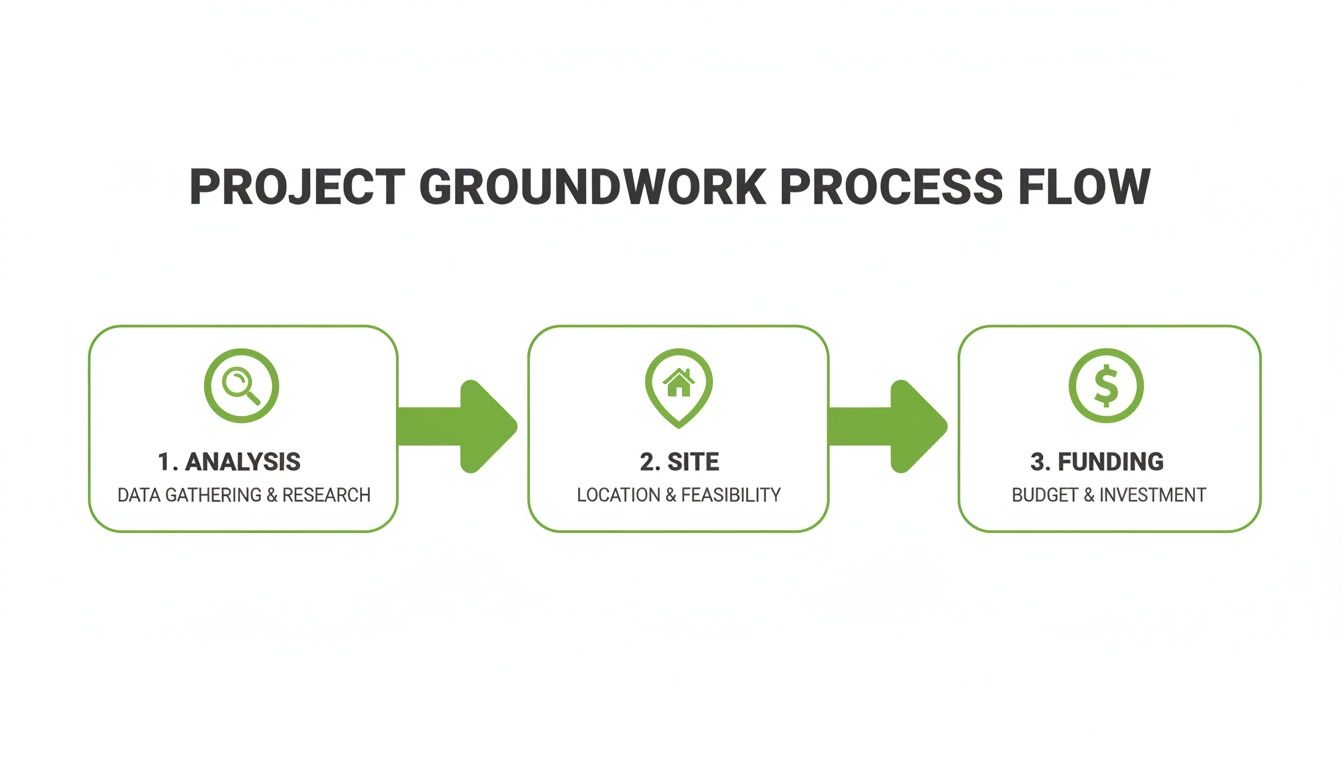
Flowchart illustrating the project groundwork process: Analysis, Site, and Funding, with icons.

As you can see, each step logically builds on the one before it. Get these three things right, and you've created a clear path from a great idea to a financially sound project ready to build.

Conducting In-Depth Market Analysis

First things first: you have to confirm that a real, tangible demand for your project exists in the target area. This goes way beyond simply finding a town with a lot of seniors. You need to dig deep into the local market dynamics.

Your investigation should cover:

  • The Competitive Landscape: Who are the other players in town? Tour existing facilities. What services do they offer? What are their occupancy rates, and what do they charge? Look for the gap. Maybe there’s a desperate need for dedicated memory care or a more accessible price point. This is how you define your unique value.
  • Demographic Nuances: Don't just look at the age distribution. What’s the median income? Is the senior population growing? A key question I always ask is: where do the adult children live? They are often the primary decision-makers.
  • The Local Healthcare Ecosystem: How close are you to good hospitals, physical therapy centers, and specialists? This is a massive selling point for residents and gives their families peace of mind.

This research isn't just for a business plan; it directly shapes the architectural program. If your data points to a rising number of seniors with Alzheimer's in the community, for instance, you'll know to prioritize a secure memory care wing with specialized layouts and safety features from day one.

Strategic Site Selection and Zoning

With the market need validated, the hunt for the right piece of land begins. An ideal site does more than just fit the building; it enhances the daily lives of the people who will call it home.

Accessibility is everything. Think beyond just ambulance access. How easy is it for families to visit? Can residents safely get to a nearby park or shop? I look for sites with good access to main roads but set back enough to minimize traffic noise.

Then comes the real headache: navigating local zoning and land-use regulations. Every town has its own rulebook for building height, setbacks, parking ratios, and landscaping. I can't stress this enough: talk to the city planners early in the process. A site that seems perfect on a map can become a nightmare if it requires a long, unpredictable rezoning battle.

A well-chosen site offers more than just a place to build; it provides a connection to the wider community, reduces resident isolation, and can even become a key marketing advantage for the facility.

Securing Funding and Financial Viability

You have the market research and a promising site. Now you need the money. Lenders and investors need to see a project that is not only thoughtfully conceived but also financially sustainable.

This is where the design itself becomes a financial tool. A facility designed for operational efficiency—with smart staff workflows, durable materials that reduce maintenance, and energy-saving systems—will have lower long-term operating costs. That makes it a much more appealing investment.

The market potential is undeniable. The global assisted living facility market hit USD 168.54 billion in 2024 and is forecasted to climb to an incredible USD 315.3 billion by 2035. This explosive growth highlights the critical need for well-designed facilities. You can explore the full market projections to get a better handle on the financial landscape. By tying your architectural plans directly to a solid business case, you can walk into a lender's office with a project that promises both positive community impact and financial success.

To help tie all these initial steps together, here is a checklist that summarizes the key considerations during this crucial pre-design phase.

Key Pre-Design Considerations Checklist

Consideration Area Key Action Items Impact on Design
Market & Program Analysis – Analyze local senior demographics & income levels.
– Assess competitors' services, pricing, and occupancy.
– Identify unmet needs (e.g., memory care, affordability).
– Determines the number and type of units (AL, MC, IL).
– Influences the amenity mix and service offerings.
– Defines the project's unique value proposition.
Site Selection & Due Diligence – Evaluate proximity to hospitals and community services.
– Assess accessibility for visitors and emergency services.
– Investigate zoning, land-use regulations, and permitting paths.
– Affects building footprint, orientation, and massing.
– Influences site circulation, parking, and landscaping.
– Can add significant time and cost if rezoning is needed.
Financial Feasibility – Develop a preliminary budget and pro forma.
– Identify potential funding sources (debt, equity).
– Model long-term operational costs based on a conceptual design.
– Sets the overall project budget, influencing material choices.
– Pushes for efficient layouts to maximize net rentable area.
– Prioritizes systems that reduce long-term utility costs.

This checklist isn't exhaustive, but it covers the core pillars you must address before any serious design work can begin. Nailing these elements sets a solid foundation for everything that follows.

Navigating Codes and Regulatory Requirements

Let's be honest: diving into the world of building codes and regulations can feel like untangling a massive knot. But for any assisted-living project, this is a non-negotiable step. These aren't just bureaucratic hurdles; they're the very foundation ensuring the safety, dignity, and well-being of every resident. Tackling this proactively from day one is the only way to sidestep costly rework and serious project delays later.

Think of the various codes as overlapping layers of protection. You've got the big federal mandates like the Americans with Disabilities Act (ADA) setting the baseline. Then, you layer on life-safety codes, which are usually adopted at the local level. Finally, state health departments add their own specific rules governing everything from kitchen finishes to medication rooms. A successful design has to satisfy all three.

Decoding ADA Requirements in Practice

The Americans with Disabilities Act (ADA) provides the minimum standard for accessibility in any public building, but in an assisted-living environment, its application gets far more nuanced. We're not just aiming for compliance; we're designing spaces that empower residents to live with independence and grace.

This means you have to think beyond the checklist. For instance, the ADA mandates a minimum clear width of 32 inches for doorways. But from an experiential standpoint, pushing that to a 36-inch clear opening makes a world of difference for someone navigating a wider wheelchair or walker. It’s the difference between merely accessible and truly comfortable.

Here are a few core ADA principles that directly shape your design:

  • Accessible Routes: This is the continuous, unobstructed path that weaves through the facility, connecting all accessible spaces. It dictates everything from corridor width to making sure there are no abrupt changes in floor level.
  • Bathroom Layouts: Getting an ADA-compliant bathroom right is a science. It demands specific clearances around toilets, precise grab bar placement, roll-in showers with integrated seats, and sinks designed for wheelchair access.
  • Ramp Specifications: Any change in elevation needs a ramp, and the ADA is strict here. The maximum slope is 1:12 (one inch of rise for every twelve inches of run), and you must include proper handrails and level landings at the top and bottom.
  • Reachable Controls: Every light switch, thermostat, and emergency call button must be placed within a reach range that accommodates someone seated in a wheelchair.

A common pitfall is treating ADA standards as the finish line. The best designs use these requirements as a starting point, then lean into universal design principles to create spaces that are intuitive for everyone, regardless of their physical abilities.

The Critical Role of Life-Safety Codes

While the ADA is all about access, life-safety codes—primarily the NFPA 101, Life Safety Code®—are squarely focused on protecting residents during an emergency. In a setting where mobility can be limited, these codes are absolutely paramount.

These regulations get into the nuts and bolts of the building’s construction.

Key Life-Safety Design Mandates

Code Element Design Implication Why It Matters for Residents
Fire-Rated Construction Walls, ceilings, and doors separating units and common areas need specific fire-resistance ratings (e.g., 1-hour or 2-hour). This strategy of "compartmentation" is designed to contain a fire to its point of origin, buying precious time for staff to move residents to safety.
Means of Egress The design must provide clear, well-lit, and properly sized exit corridors and stairwells, completely free of obstructions. In a crisis, residents with walkers or wheelchairs need wider, more direct paths out. This is why dead-end corridors are so heavily restricted.
Smoke Detection & Suppression A comprehensive, integrated system of smoke detectors, alarms (with both visual and audible alerts), and automatic sprinklers is required. Sprinklers are the single most effective tool for controlling a fire. They often extinguish a blaze before the fire department even arrives on the scene.

Don't Overlook State Health Regulations

Finally, every state’s department of health has its own set of licensing requirements that will directly influence your architectural plans. These rules are often far more detailed than federal codes and are laser-focused on the practical aspects of delivering care.

For example, a state might dictate the exact square footage for a medication storage room, the type of non-porous finish required in a kitchen for sanitation, or the minimum number of bathing facilities per resident. This is where a local architect who speaks the language of your state’s regulations becomes invaluable. Overlooking these hyper-specific rules early in the process is one of the most common—and expensive—mistakes a developer can make.

Designing Resident-Centric Units and Common Areas

When we talk about great design in assisted living, we're aiming for something much deeper than just meeting code. The goal is to create a genuine home, an environment that actively improves a resident's quality of life. This means leaving sterile, institutional aesthetics in the past and embracing principles that make spaces feel supportive, engaging, and dignified.

The real art lies in balancing privacy with community. A resident's apartment is their personal sanctuary, but the common areas are the lifeblood of the entire facility. The best designs get this balance right, making residents feel secure and independent in their own space while gently encouraging them to step out and connect with others.
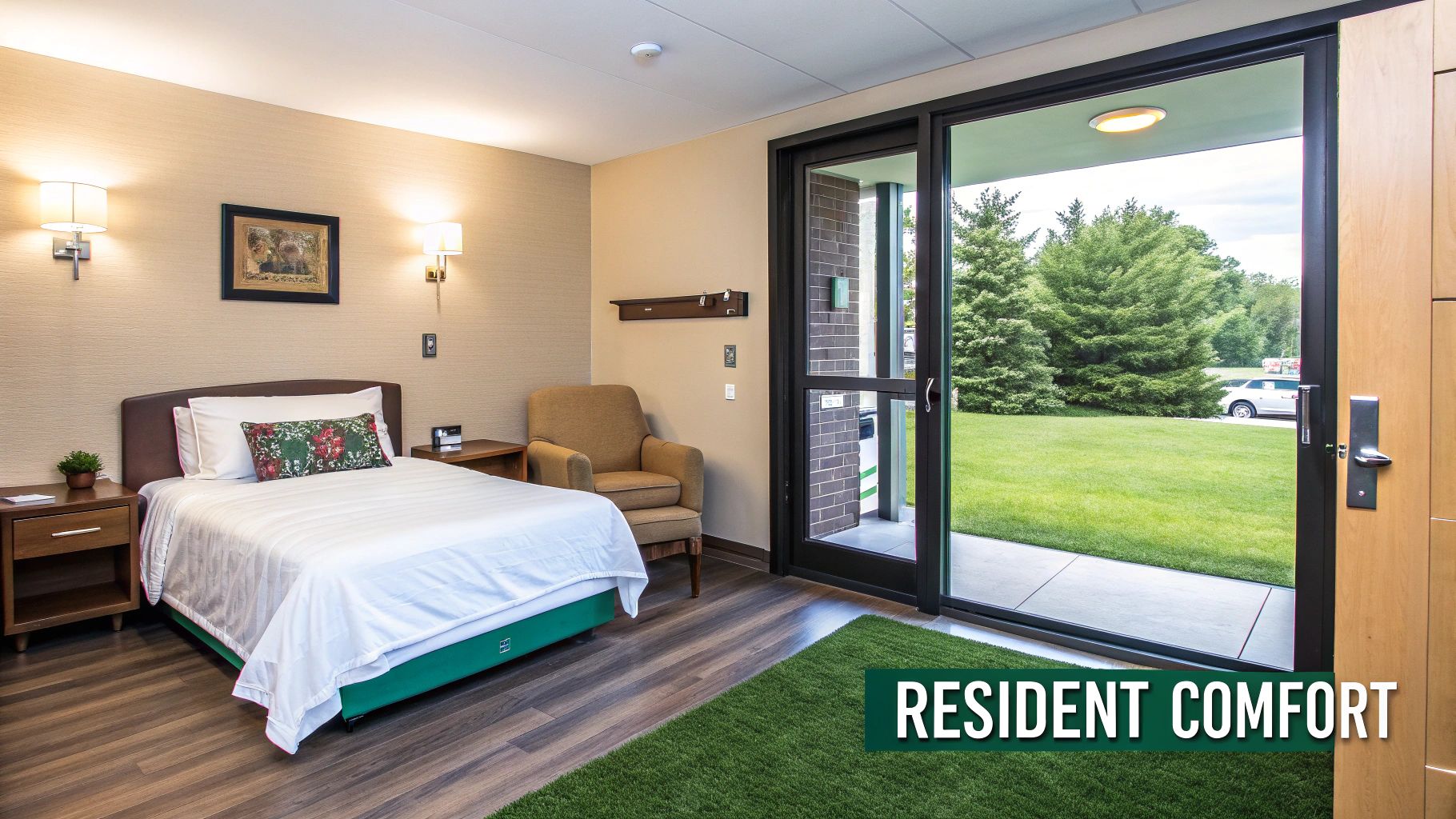
A comfortable assisted living room with a bed, armchair, and a sliding door to a green outdoor space.

Crafting Independence in Private Units

The layout and features of an individual apartment can either foster independence or chip away at it. I've seen firsthand how small, thoughtful details make a monumental difference in a resident's daily autonomy and safety. We're not just designing a room; we're removing barriers to make life easier and more intuitive.

Think about the simple act of entering the apartment. A zero-step entry is an absolute must—no thresholds to trip over. Inside, the layout needs to be open, with clear, wide pathways that can easily accommodate a walker or a wheelchair without feeling like a maze.

It’s the simple hardware choices that often have the biggest impact:

  • Lever-style handles on doors and faucets are a game-changer for someone with arthritis who struggles with traditional round knobs.
  • Rocker-style light switches offer a large, easy-to-press target, unlike tiny toggle switches.
  • Pull-out shelving in kitchenettes and closets is brilliant. It brings items to the resident, which means less risky reaching and bending.

This push for more residential, supportive designs isn't just a trend; it's a market reality. The assisted living sector was valued at USD 171.15 billion in 2024 and is on track to hit USD 271.50 billion by 2032. This growth is fueled by families seeking facilities that truly support "aging in place," a concept that relies heavily on smart architectural choices. You can discover more insights about these market shifts to see just how developers are responding.

Fostering Connection in Common Areas

While private units provide that crucial sanctuary, the common areas are where the community truly comes alive. These spaces have to be intentionally designed to spark social interaction, combat isolation, and support all kinds of activities. They are the heart of the building.

The dining room is usually the primary social hub. Instead of one massive, loud, cafeteria-style room, why not break the space into smaller, more intimate zones? This can be done with half-walls, a mix of seating (booths, small tables for four), and smart acoustic treatments that absorb sound and make conversation possible.

Lounges and activity rooms, on the other hand, need to be chameleons. A space that serves as a quiet reading nook in the morning should be able to transform into a lively bingo hall by the afternoon. Flexibility is key.

Great common area design is about creating destinations. It’s not just a big room; it’s a collection of purposeful spaces—the cozy library, the bright sunroom, the active game corner—that draw residents out of their units and into the community.

Key Features for Engaging Common Areas

Here’s a look at how specific design strategies can shape the resident experience.

Space Design Strategy Impact on Residents
Dining Room Create smaller, acoustically-managed zones with varied seating options. Use warm, non-glare lighting. Reduces overwhelming noise, encourages conversation, and offers choice, making mealtime more enjoyable and less institutional.
Lounge Areas Design multiple, smaller seating clusters with comfortable, supportive furniture. Ensure good sightlines to entrances. Fosters small-group conversations and allows residents to observe activity without feeling pressured to participate immediately.
Activity/Flex Space Use movable partitions, portable storage for supplies, and durable, easily cleaned finishes. Allows staff to easily adapt the room for diverse activities like art classes, fitness sessions, or guest lectures, maximizing space utility.
Outdoor Patios Provide shaded seating, raised garden beds, and smooth, level walking paths with handrails. Offers safe and accessible connections to nature, which is proven to improve mood and well-being, encouraging light physical activity.

By focusing on these resident-centric principles in both private and shared spaces, we can create facilities that do more than just provide care—they cultivate a true sense of belonging and purpose.

Integrating Building Systems for Safety and Efficiency

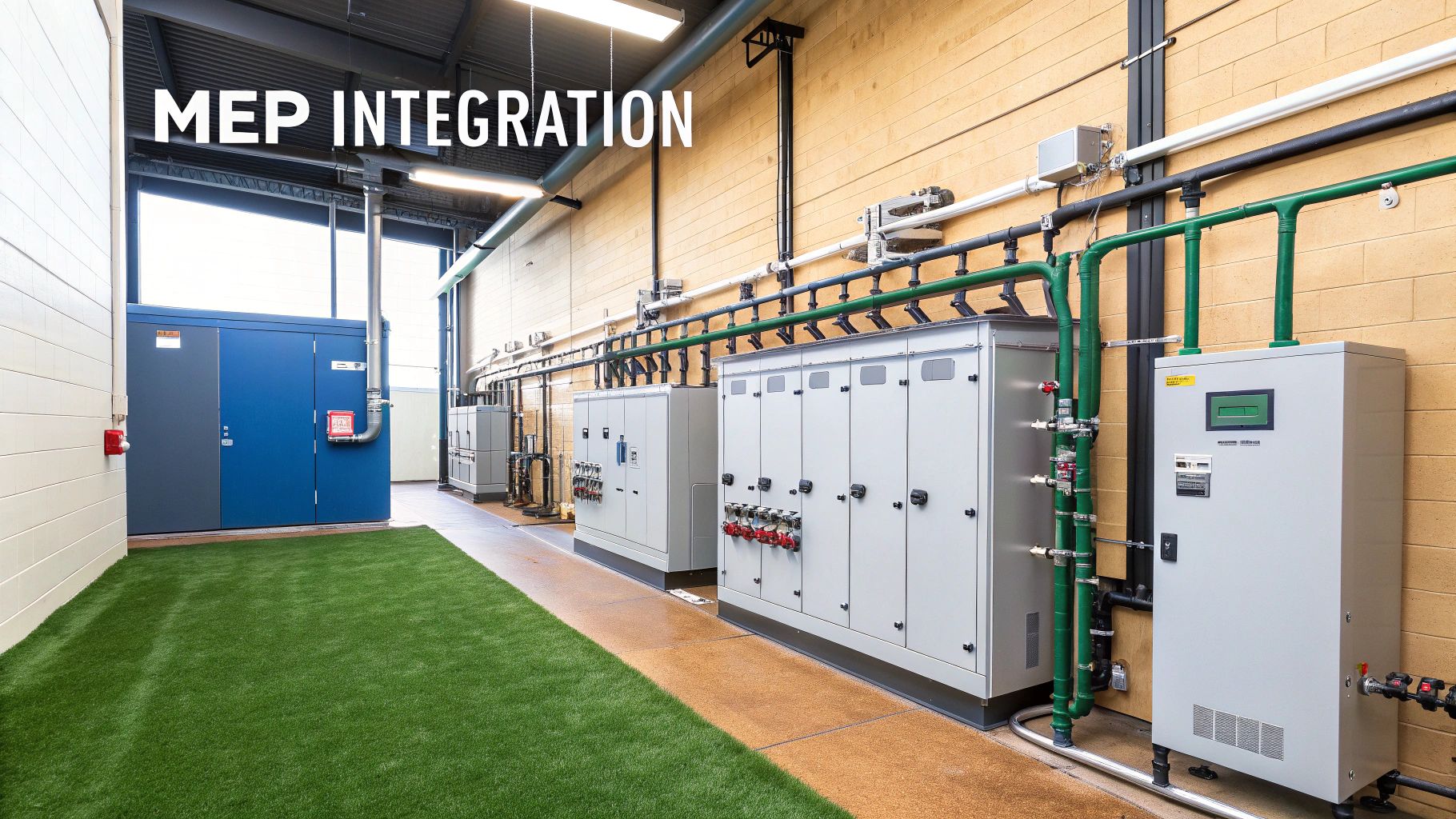
What happens behind the walls is every bit as important as the beautiful spaces you see. The Mechanical, Electrical, and Plumbing (MEP) systems are the workhorses of any assisted living facility. They're the core infrastructure that keeps residents comfortable, healthy, and safe, all while keeping a close eye on long-term operating costs.

A truly thoughtful design for assisted living goes beyond just meeting code. It means creating a building where all these systems work together in harmony. The HVAC system shouldn't just cool a room; it needs to be an active part of promoting respiratory health. The lighting shouldn't just turn on; it should help residents maintain natural sleep cycles.
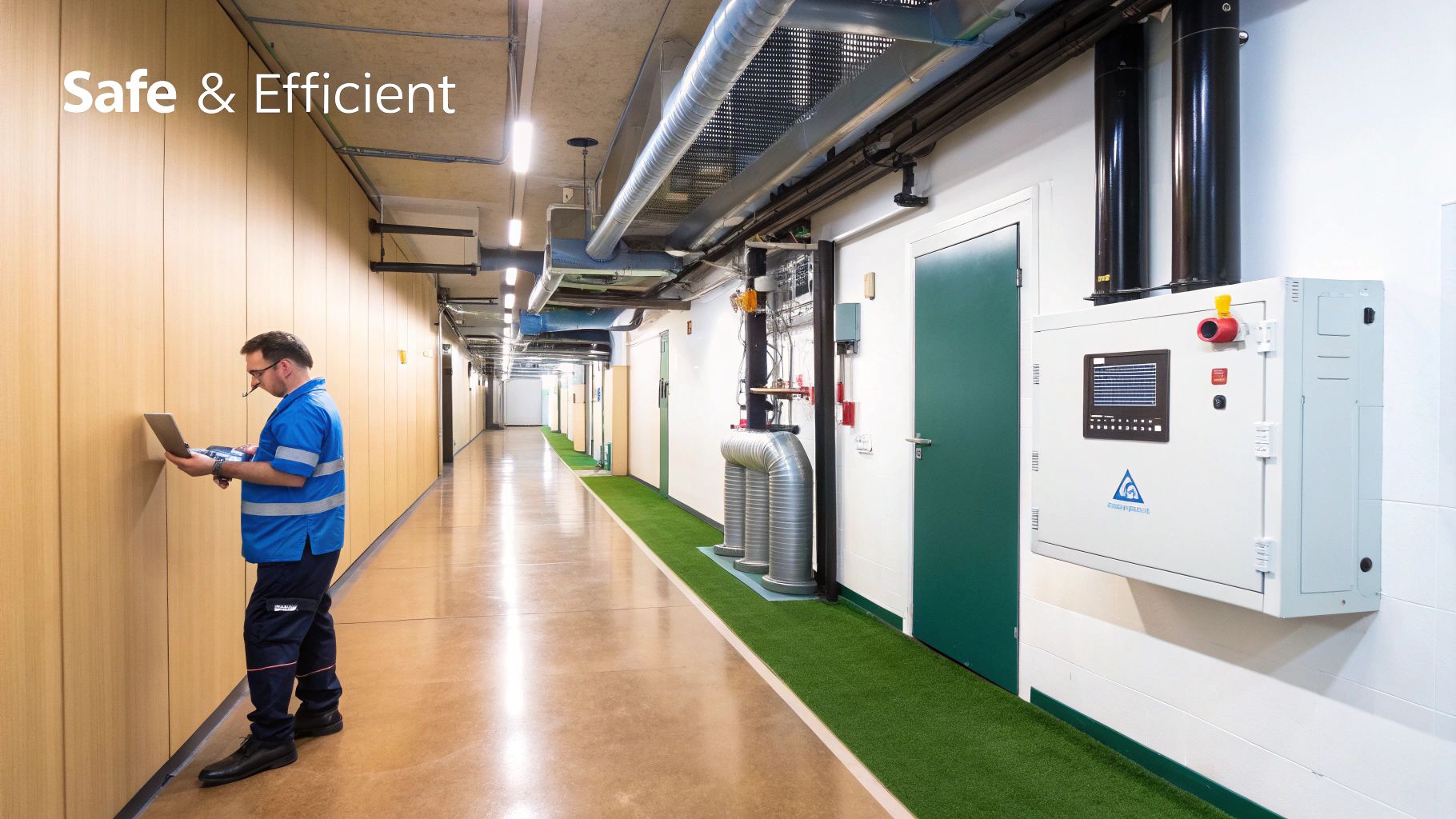
Technician in a blue uniform working on a laptop in a well-lit industrial corridor with exposed pipes and control panels.

Mechanical Systems for Health and Comfort

A high-performing HVAC system is your first line of defense for a healthy indoor environment. This is non-negotiable for seniors, many of whom have compromised respiratory systems. I always specify systems with advanced filtration—think MERV 13 or higher—to catch as many airborne particles, allergens, and pathogens as possible.

But clean air is only half the battle. You also need fresh air. A balanced ventilation strategy with energy recovery is key here. It brings in a constant supply of clean outdoor air while capturing waste heat on its way out, which does wonders for keeping utility bills in check. A well-insulated, airtight building shell makes this whole system work even better, reducing the strain on the equipment and keeping residents comfortable even if the power goes out.

Electrical Design for Well-Being and Efficiency

Good electrical design is about so much more than placing outlets. It has a real impact on mood, safety, and even sleep quality. One of the most powerful tools in our arsenal is circadian rhythm lighting. This is all about using modern LED fixtures that can change their color and intensity throughout the day to mimic the sun's natural patterns.

  • Morning: We use a cooler, brighter light to help residents wake up and feel more alert.
  • Afternoon: The light shifts to a more neutral tone to keep energy levels up for daily activities.
  • Evening: As the day ends, the light becomes warmer and dimmer, sending a natural signal to the body that it's time to wind down for a good night's sleep.

This one strategy can make a huge difference in improving sleep and reducing agitation, especially for residents living with dementia. When you're laying out the units and common areas, think about how advanced senior living technology solutions can be layered in to boost both security and well-being.

Essential Safety and Communication Systems

Beyond the core MEP infrastructure, you need a web of specialized systems dedicated to resident safety and helping staff work smarter. These systems can’t fail—they have to be reliable, easy for staff to use, and woven together into a comprehensive safety net.

The goal is to create a responsive environment where technology works quietly in the background, empowering staff to provide proactive care rather than just reacting to emergencies. This integration transforms a building into an active partner in resident well-being.

A few key systems absolutely must be part of the plan:

  • Nurse Call Stations: Today's systems are far more than a simple button. They integrate with wireless pendants that residents wear and can send alerts directly to a caregiver's smartphone, complete with the resident's name and exact location. You need to place call buttons in obvious spots in bedrooms and bathrooms—and don't forget one near the floor in case of a fall.
  • Wander Management Systems: These are crucial for memory care wings. They use discreet sensors at exits to trigger an alert if a resident who is at risk of elopement gets too close. This provides security without making the environment feel like a fortress for everyone else.
  • Integrated Fire Alarms: Your fire alarm system needs both loud audible alarms and bright visual alerts (strobe lights) to ensure it can reach residents with hearing impairments. The system should be hardwired to automatically notify the local fire department, close fire doors, and send alerts to all staff stations.

Designing for Your Staff's Workflow

A stunning facility is worthless if the care inside is subpar. And that care comes directly from your staff. The building's layout can either be their best tool, helping them work efficiently, or a daily obstacle course that leads straight to burnout. When you give the "back-of-house" areas the same design attention you give resident-facing spaces, you build a foundation that supports your team and elevates the entire care experience.

In assisted living design, a caregiver's time is the most precious commodity. Every extra step they have to take is a moment not spent with a resident. This is why the physical layout of key support areas is so incredibly important.

Cutting Down on Daily Steps and Staff Fatigue

Think about the miles a nurse or care assistant walks every single shift. They're constantly moving between resident rooms, nurse stations, supply closets, and medication rooms. A fragmented layout forces them to backtrack over and over, which is not only physically draining but also wastes valuable time.

I’ve walked through facilities where the main linen closet was on a different floor from the largest resident wing. That single design choice meant staff spent a huge chunk of their day just moving linens around. A much better approach is a decentralized model with smaller supply alcoves tucked into each wing. This simple change keeps essential items right where they're needed.

A core tenet of staff-centric design is to eliminate wasted motion. If we map out the most common staff pathways, we can cluster key services and design a layout that just feels right, reducing physical fatigue and the mental stress that comes with it.

Nailing the Design of Key Support Spaces

It’s not just about where you put these rooms; it’s about how you design them. A chaotic medication room is a recipe for errors, while a thoughtfully designed one becomes a bulwark of patient safety.

Here’s how smart design choices can transform these critical zones:

  • Nursing Stations: They need clear sightlines down the main resident hallways for passive supervision. The best designs have both an open counter for quick chats and a quieter, semi-enclosed space for focused charting and private conversations.

  • Medication Rooms: Lighting is everything here. You absolutely need bright, focused task lighting over the prep counters. Ample, well-organized storage is also crucial to keep everything separated and easy to find, supporting a one-way workflow that minimizes the chance of mix-ups.

  • Staff Break Rooms: This space is a game-changer for staff retention. It must be located away from the hustle and bustle, giving your team a genuine chance to decompress. Make it a place they want to be with comfortable seating, natural light, and a few amenities.

How Smart Workflow Boosts Operational Excellence

Ultimately, designing for your staff's workflow is about creating an efficient, smoothly running system. A great layout leads to faster call-bell responses, fewer medication mistakes, and a care team that feels supported instead of constantly drained. For a deeper dive into streamlining these kinds of processes, check out this practical guide to healthcare operational efficiency.

This focus on operational excellence does more than just help you attract and keep great people—a massive challenge in this industry. It directly translates into a safer, more responsive, and higher-quality home for every single resident.

The Smart Strategy of Adaptive Reuse

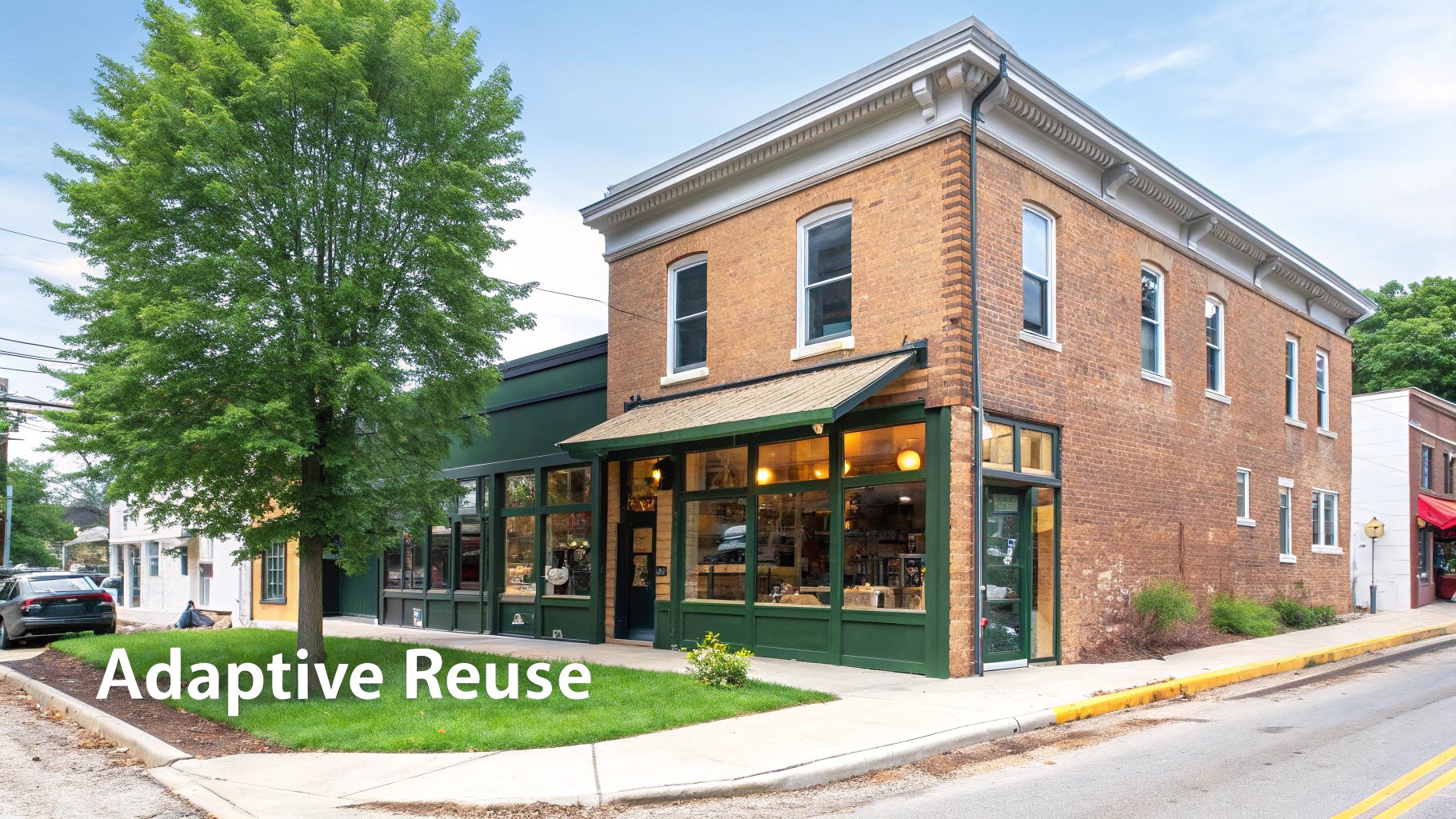
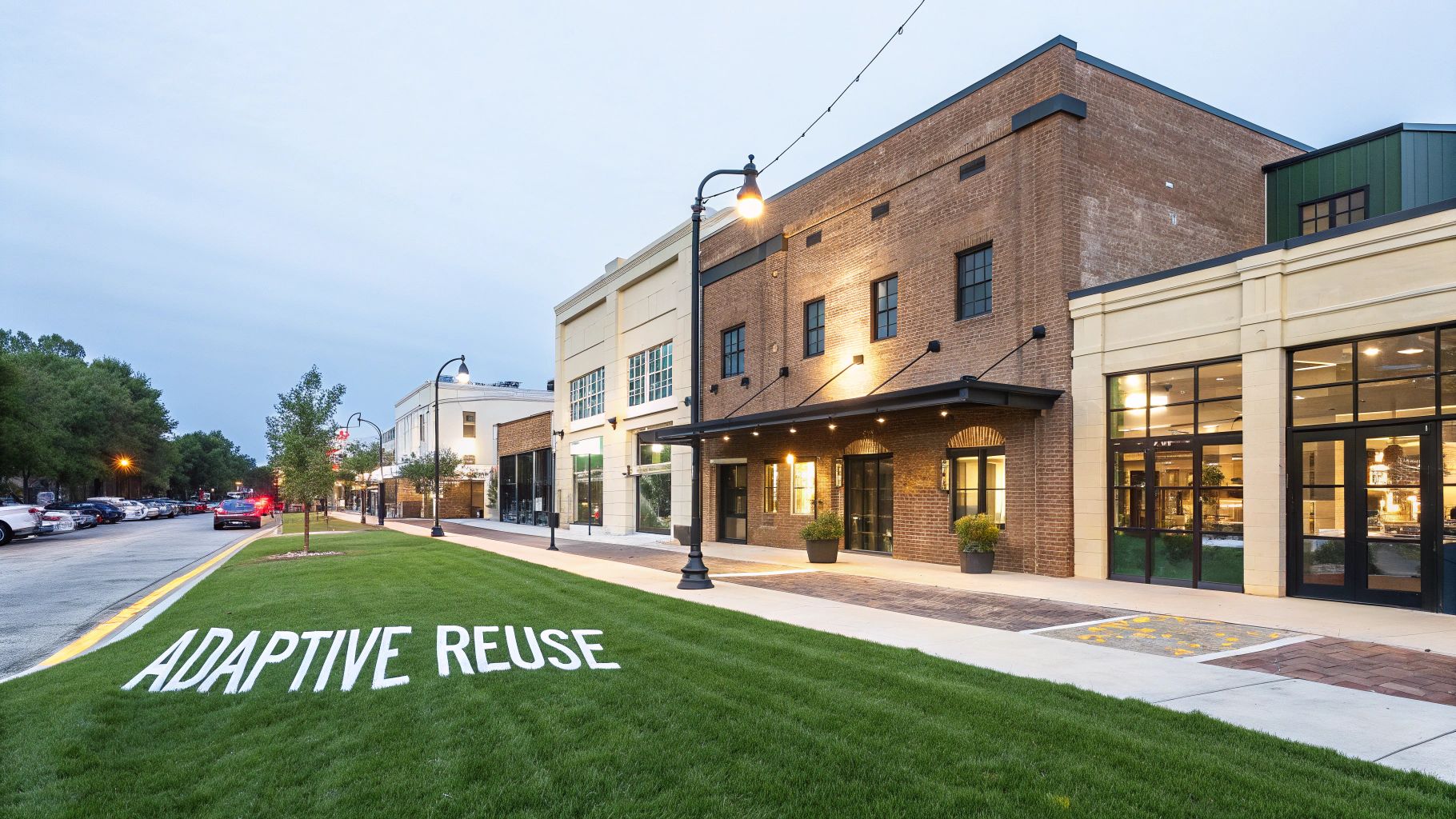
Building from the ground up isn't always the quickest or most sensible route for a new assisted living facility. Sometimes, the best opportunity is an existing building with solid bones, just waiting for a new life. This is the heart of adaptive reuse—a pragmatic approach that can save significant time and money.

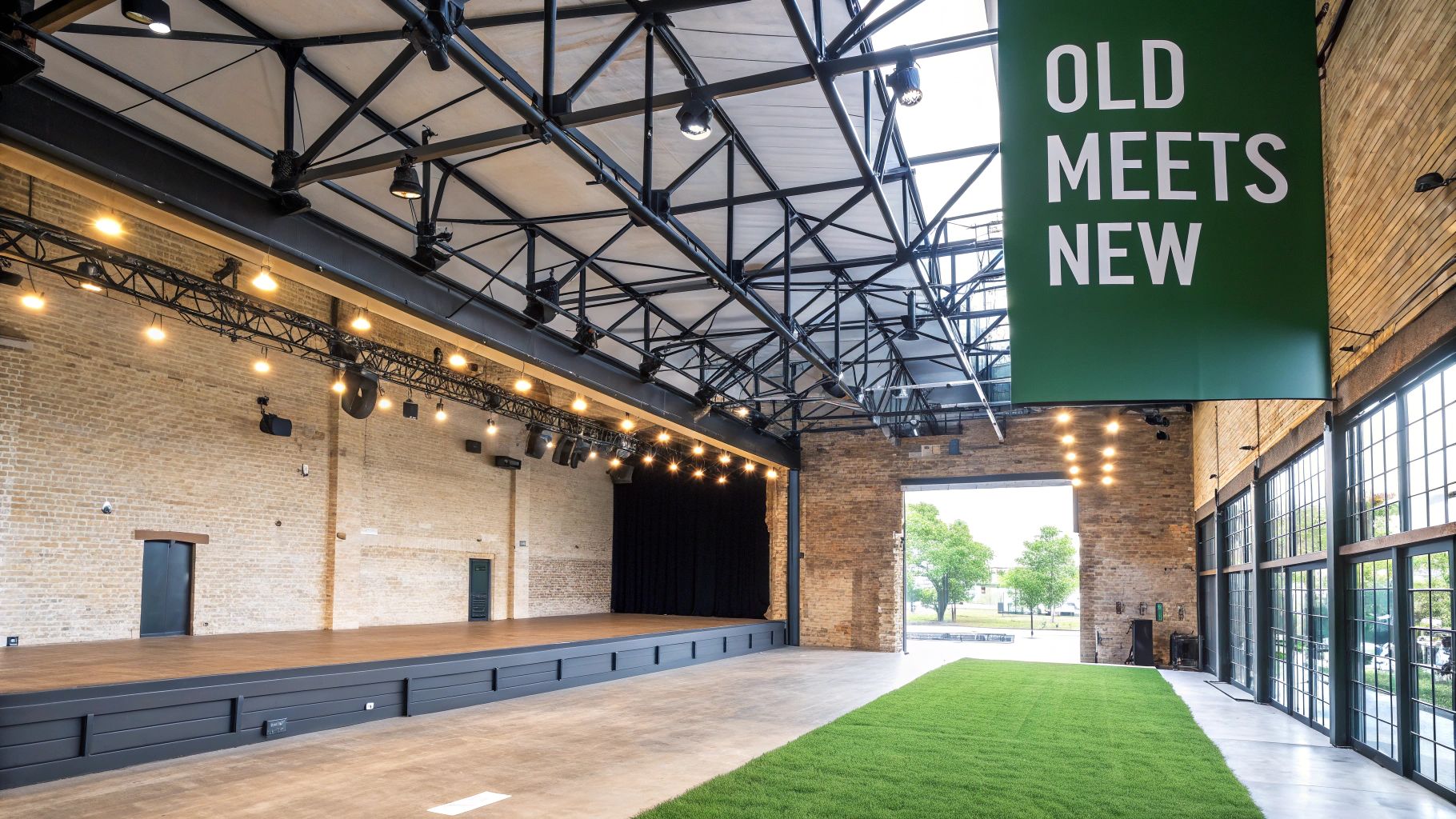
Look around any community, and you'll likely spot underused buildings that are prime candidates for conversion. I've seen successful projects transform everything from older hotels and vacant schools to empty office buildings. Hotels are often a perfect fit; they already have individual rooms with private baths, a commercial-grade kitchen, and built-in common areas, which cuts down on major structural changes.
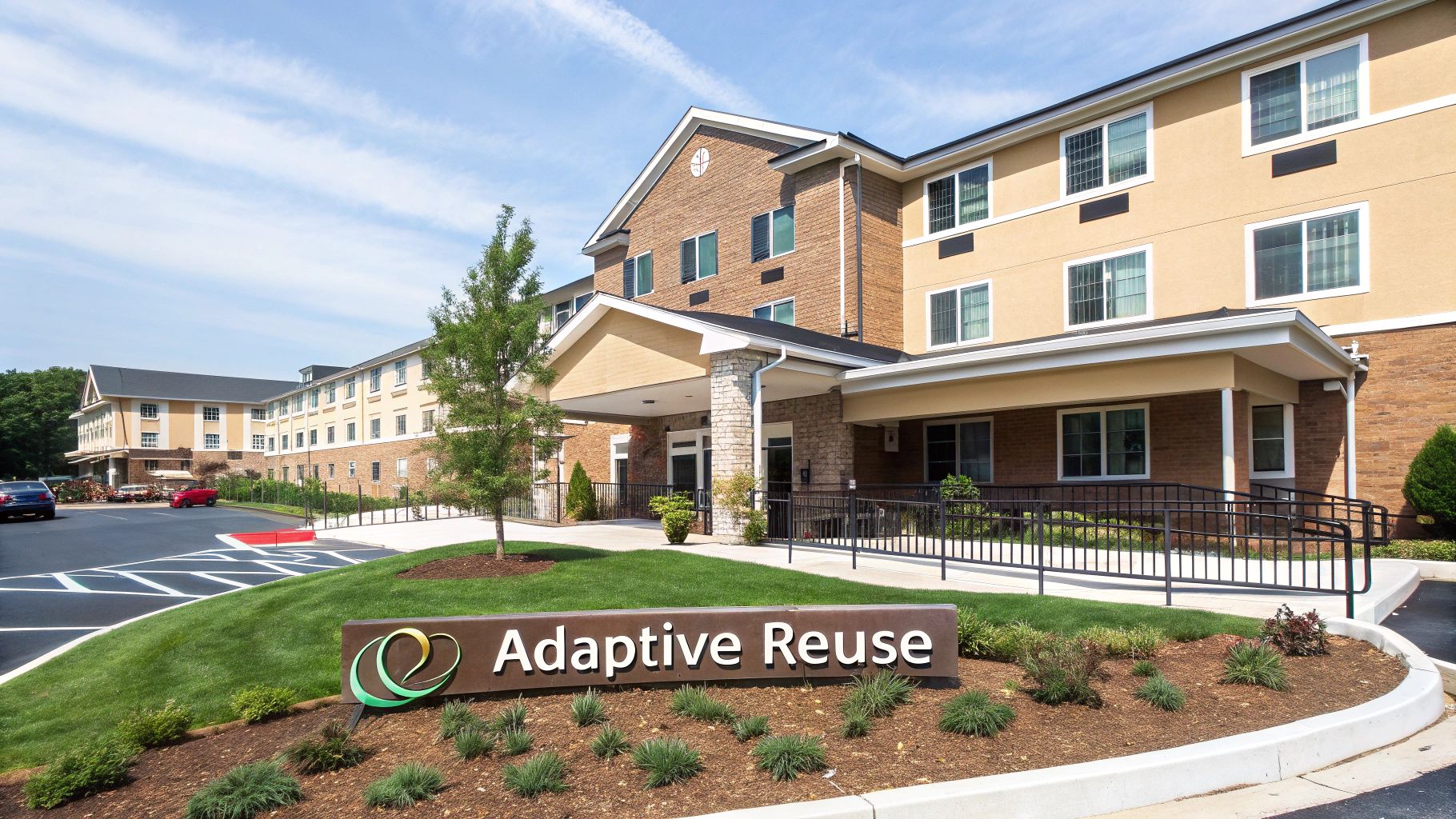
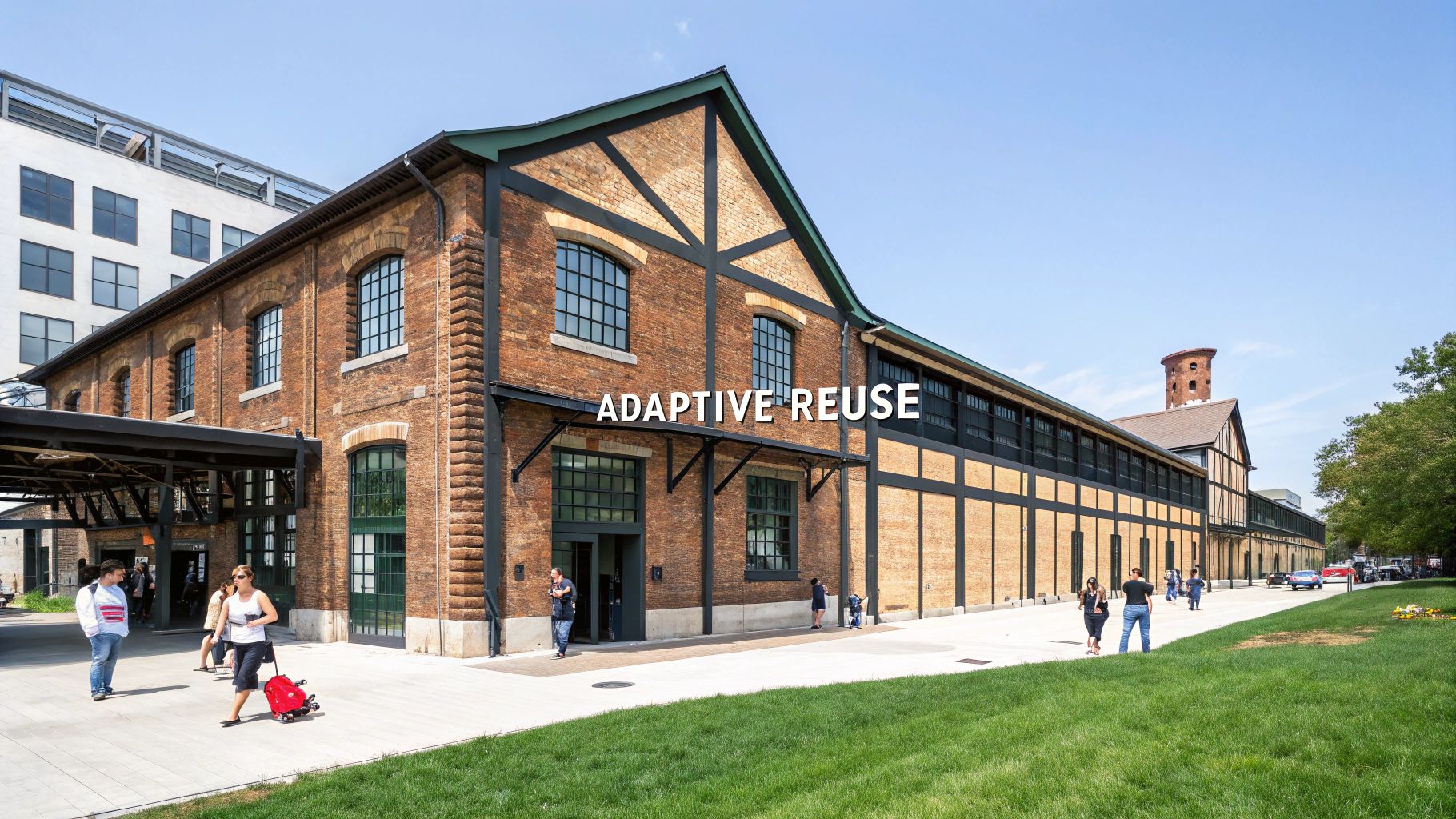
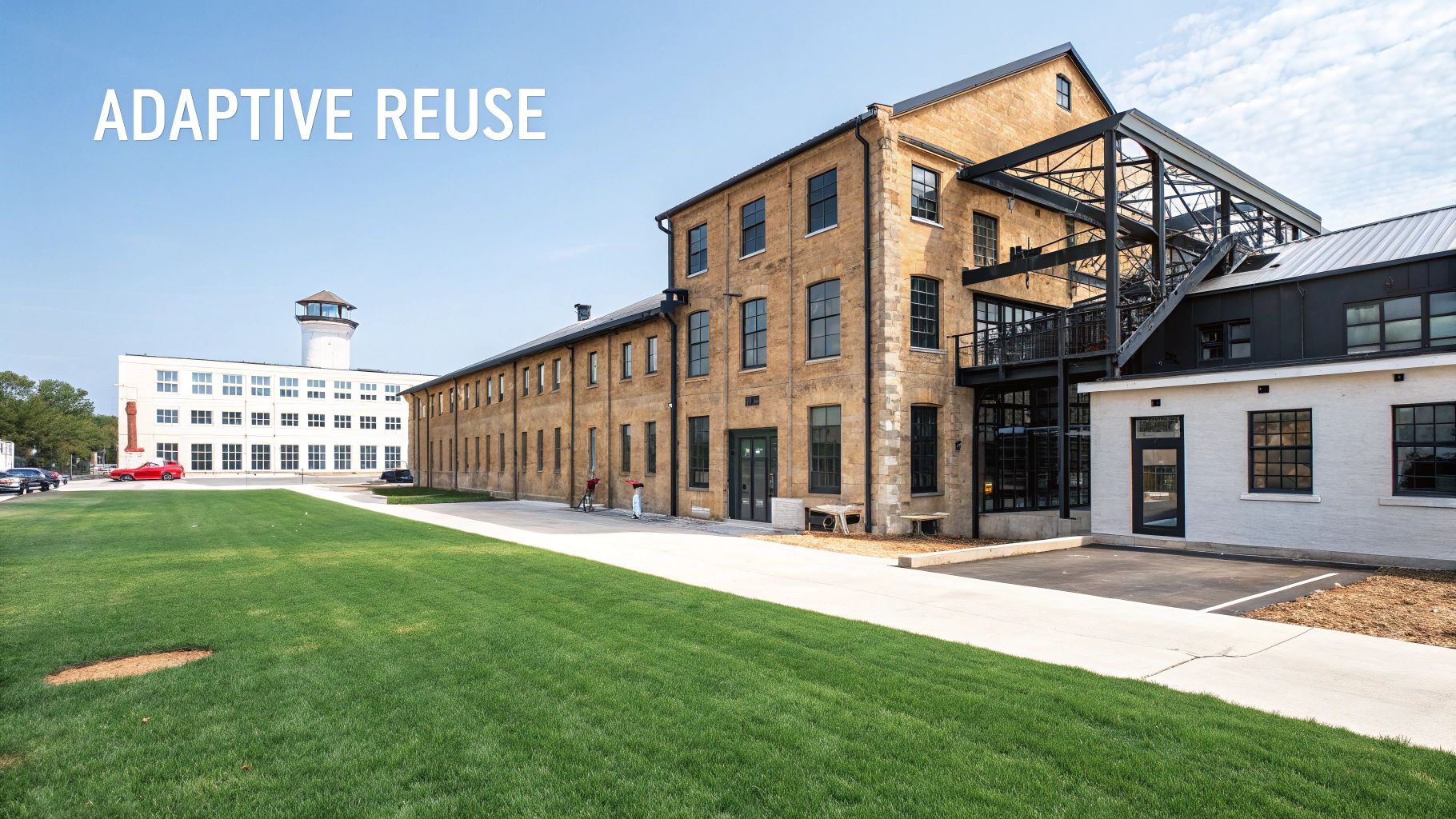
A modern, multi-story building with a 'Adaptive Reuse' sign, surrounded by landscaping and a parking lot.

Tackling Unique Retrofit Challenges

Of course, giving an old building a new purpose comes with its own unique set of puzzles. The biggest hurdle is almost always bringing an older structure up to modern building codes. This usually means a top-to-bottom overhaul of the mechanical, electrical, and plumbing (MEP) systems and meticulously ensuring every inch meets today's stringent accessibility and life-safety requirements.

A successful adaptive reuse project hinges on a few key things:

  • System Upgrades: This isn't just a facelift. It means installing modern, efficient HVAC with proper filtration, new wiring to support healthcare technology, and completely new plumbing for accessible bathrooms.
  • Code Compliance: You'll be widening doorways, adding ramps, installing comprehensive fire sprinkler systems, and making sure all materials and finishes get the green light from the health department.
  • Preserving Character: One of the real advantages of reuse is the built-in character you just can't replicate. The art is in weaving modern necessities into the original architecture, creating a space that feels authentic and welcoming, not sterile.

This strategy also offers a huge sustainability edge. With the global senior living market expected to jump from USD 260.12 billion in 2025 to USD 388.55 billion by 2032, meeting this demand responsibly is key. Renovating is almost always a greener choice than demolition and new construction. You can dig into the numbers and review the assisted living market report for a closer look at this growth.

Adaptive reuse is more than a budget-friendly alternative; it's a strategic decision that can deliver a unique, character-rich facility to the market faster while significantly reducing its environmental footprint.

The Financial Incentives of Reuse

The benefits don't stop at construction savings. Adaptive reuse can also open the door to some powerful financial incentives. Many cities and towns offer tax abatements for bringing vacant properties back to life, which can seriously reduce the project's long-term tax obligations.

If you find a building with historical significance, the rewards can be even greater. Federal and state historic tax credit programs can offset a major chunk of the renovation costs, making a complex project a much smarter financial bet. These programs are designed to reward developers for preserving a community's heritage while creating desperately needed senior housing. It’s a true win-win that savvy investors are taking note of.

Common Questions About Assisted Living Design

Even the most detailed blueprints can't anticipate every question that pops up on a complex assisted living project. From our experience, a few key questions surface time and time again from developers, architects, and investors. Let’s tackle some of the most common ones we hear.

What’s the Ideal Unit Mix?

Figuring out the right blend of independent living (IL), assisted living (AL), and memory care (MC) units is more art than science, but it must be driven by hard data. The answer is always buried in your market analysis.

If you're in a community flush with active, younger seniors, a design heavy on IL apartments makes perfect sense. On the other hand, if local health data points to a rising need for dementia services, dedicating more of your footprint to a secure MC wing isn't just a good idea—it's a smart long-term investment. Avoid the temptation to just copy a successful project from another state; let the local demographics dictate your design program.

How Do We Future-Proof the Design?

A facility we build today has to serve residents for the next 30 to 40 years, so thinking ahead is non-negotiable. "Future-proofing" is really about building in flexibility. Think about designing units with wall systems that can be easily reconfigured—imagine combining two small studios into a larger one-bedroom suite as market preferences shift.

It also means planning for the technology of tomorrow. You don't have to install every smart-home gadget on day one, but putting in robust electrical and data infrastructure is crucial. Simply running extra conduit during construction is a cheap insurance policy that becomes priceless down the road.

The biggest mistake we see is designing solely for the needs of today's 85-year-old. The best designs anticipate what the next generation of seniors—and their kids—will expect, from tech integration to lifestyle amenities.

Does Sustainable Design Actually Pay Off?

The old idea that sustainable design is just a feel-good expense is completely outdated. Yes, a high-performance building envelope or a geothermal system might have a higher upfront cost, but for any long-term owner-operator, the lifecycle savings paint a very different picture.

The payback is real and measurable:

  • Lower Utility Bills: An airtight building with top-tier insulation and efficient systems will slash your monthly energy costs, period.
  • Increased Resilience: When the power goes out, a well-insulated building stays comfortable for far longer, which is a massive safety and operational advantage.
  • Market Differentiation: More and more, prospective residents and their families are choosing communities that show a real commitment to sustainability.

In many projects, we see the payback period for these green investments fall well under 10 years, making it one of the shrewdest financial decisions you can make.


At Sherer Architects, LLC, we specialize in creating enduring, sustainable, and profitable commercial spaces, including expertly planned assisted living facilities. Visit us to see how our decades of experience in adaptive reuse and thoughtful design can bring your next project to life.

Categories
Uncategorized

Designing a Theater (designing a theater): A Practical Guide to Site, Acoustics

Designing a theater is a massive undertaking, one where artistic vision has to mesh perfectly with architectural precision and financial reality. The process is all about defining a clear program, digging into potential sites, and making the big calls that will dictate how the venue works—and whether it succeeds—for decades to come.

Defining Your Vision: Program and Site Selection

Every great theater starts not with a blueprint, but with a question: what is this place for? The answer to that question becomes your "program," a document that essentially serves as the North Star for the entire project. If you don't have a solid program, the project will wander, leading to expensive changes and a final building that doesn't really serve anyone well.

This first phase is all about asking the hard questions. You need to figure out more than just what kind of shows you'll host, whether it's touring Broadway productions, intimate black-box plays, or community concerts. You have to map out the entire ecosystem. Who are you building this for? How many seats do they need? Will you be a presenting house, a producing company, or a rental venue?

Solidifying Your Theater's Program

A truly useful program gets down to the nitty-gritty, creating a detailed checklist for the design team. It's a huge mistake to focus only on the main stage. You have to think through the entire journey for every person who walks through the door.

  • Audience Experience: How big does the lobby need to be so people aren't crammed together before a show? What do you need for concessions, restrooms, and ticketing?
  • Performer Needs: What are the absolute must-haves for dressing rooms, a green room where artists can unwind, and dedicated rehearsal spaces?
  • Technical Support: How much room do you need for building sets (workshops), storing costumes, and housing the administrative staff who keep the place running?

Getting these answers right turns your vision into actual spatial requirements. A theater hoping to land large-scale musicals, for instance, is going to need a cavernous backstage area with a fly loft and ample wing space—far more than a venue designed for spoken-word poetry.

The Critical Choice: New Build vs. Adaptive Reuse

With your program in hand, the next major decision is finding a site. This is a classic fork in the road: do you build something new from the ground up, or do you adapt an existing building? Each option comes with its own unique set of pros and cons that will heavily influence your budget, timeline, and the ultimate feel of the venue.

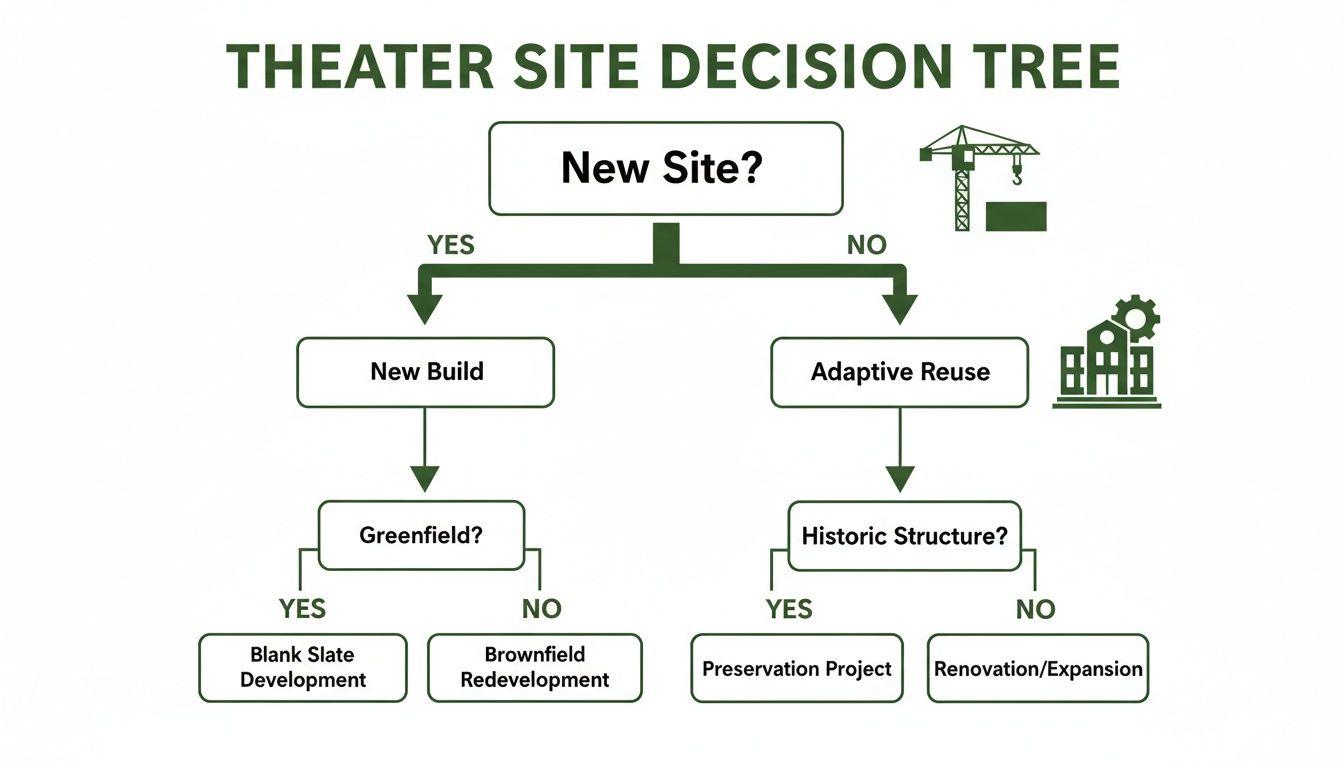
This decision tree lays out the two primary paths you can take when planning your theater.

A flowchart outlining the decision-making process for a theater site development, including new build or adaptive reuse options.

The flowchart makes it clear: a new build offers a blank slate, while adaptive reuse can leverage existing character and sustainability. Neither is inherently better; they just require different strategies.

Let's break down what you're weighing with this decision. The table below compares the key factors you'll need to consider for each approach.

New Build vs Adaptive Reuse Key Considerations

Consideration New Build Approach Adaptive Reuse Approach
Creative Control Total freedom. The design is optimized perfectly for your program from day one. Constrained by the existing structure. You'll need creative solutions to fit your program into the building's bones.
Cost Often higher initial costs for land acquisition and new construction. Potentially lower acquisition cost, but renovation can uncover expensive surprises (e.g., hazmat, structural issues).
Timeline Can be longer due to zoning, permitting, and the entire construction process from scratch. May be faster if the building is sound, but unforeseen conditions can cause significant delays.
Character & Identity You create the identity from the ground up. It’s a blank canvas. Inherits the history and character of the existing building, which can be a huge community asset.
Sustainability An opportunity to incorporate the latest green building technologies and materials. Inherently sustainable by reusing an existing structure. Less embodied carbon.
Funding & Incentives Standard financing, but fewer unique funding streams. Eligible for historic preservation tax credits and specific grants, which can be a game-changer.

Ultimately, the choice between new construction and renovation depends heavily on your specific program, available sites, and, of course, your budget. A new build gives you complete control, but adapting an old building can give you a venue with a soul you just can't replicate.

Navigating Site Analysis and Constraints

Whether you're starting fresh or renovating, a rigorous site analysis is absolutely essential. You have to look at zoning laws, how easily patrons can get there (parking and public transit are huge), and how the building fits into the neighborhood. An urban site, for instance, might offer great visibility and foot traffic but come with headaches like a tight footprint and the need for serious noise control.

Once a site is chosen, one of the first and most critical steps is the foundation work. A detailed guide to footings excavation can give you a solid understanding of this crucial early phase. Getting the groundwork right is vital for the building's structural integrity, whether you're pouring a foundation for a massive new fly tower or reinforcing one that's a century old. The site itself will always shape the design, turning what look like constraints into opportunities for a theater that is truly one-of-a-kind.

The Heart of the House: Seating and Sightlines

The magic of live theater hinges on the connection between the audience and the stage. It’s that shared, electric moment when the house lights dim. As designers, our job is to foster that connection, and it all starts with the physical layout of the auditorium. Seating and sightlines aren't just technical exercises; they are the very tools we use to shape the audience's experience.

Multi-Aisle vs. Continental: Choosing Your Layout

One of the first big decisions you'll make is how to arrange the seats. This choice comes down to two classic approaches: the traditional multi-aisle layout or the more enveloping continental plan. Each one fundamentally changes the feel of the room and has real-world impacts on everything from ticket sales to how quickly the audience can get to their seats.

  • Multi-Aisle Seating: This is the layout most people know. You've got aisles down the center and along the sides. It's straightforward, making it easy for people to find their seats and for the house to clear out quickly. The downside? Those aisles take up space—space that could be filled with paying customers.

  • Continental Seating: Imagine a single, unbroken bank of seats stretching from one side of the room to the other. That’s continental seating. It pulls everyone closer, creating a more intimate, unified feel, and can boost your seat count by up to 15%. The trade-off is that building codes require wider rows and more exit doors along the walls to ensure everyone can get out safely in an emergency.

The choice really depends on the atmosphere you're trying to create. A multi-aisle setup feels familiar and orderly. A continental layout, on the other hand, can make even a large theater feel surprisingly personal, wrapping the performance around the audience.

The Science of a Perfect View

Once you've settled on a layout, the real work begins: ensuring there isn't a single bad seat in the house. A blocked view is more than just an annoyance for a patron; it’s a failure of the design itself. Our goal is to guarantee a completely clear view—both vertically and horizontally—for every single person.

This is where the "isacoustic curve" comes in. It’s a design principle that dictates the slope, or rake, of the seating floor. The concept is simple: your eyes need to clear the top of the head of the person sitting directly in front of you. For live theater, we typically aim this sightline at the stage floor, often called the "point of arrival."

Modeling these sightlines in design software is absolutely essential. We literally draw a line from an audience member's eye in one row, over the head of the person in the next, to the stage. We repeat this for every single row, which generates the perfect curve for the floor. Skipping this step is a recipe for disaster and can lead to incredibly expensive fixes down the line.

A rookie mistake is to design a floor with a single, straight slope. A properly designed rake is actually a parabola—gently sloped at the front and progressively steeper toward the back. This ensures everyone gets a great view, not just the folks in the premium seats.

Accessibility Is Non-Negotiable

Designing for accessibility isn't about ticking boxes on a checklist. It's about building a space where every single patron feels welcome and can enjoy the show without barriers. This thinking has to be baked into the design from day one—it's not only the law, but it's also fundamental to creating a truly public-facing venue.

This goes far beyond just designating a few spots for wheelchairs. We have to think about the entire journey.

  • Integrated Seating: Wheelchair-accessible spots should be distributed throughout the theater at different price points, not just shunted off to one area in the back. And you must have companion seating right next to them.
  • Clear Pathways: Every path—from the lobby to the seats, to the restrooms, to the concession stand—needs to be wide, clear, and easy to navigate. Any ramps have to be built at a comfortable, manageable slope.
  • Assistive Systems: Plan for assistive listening systems (ALS) from the start. Building in the infrastructure for induction loops or infrared systems makes a world of difference for patrons with hearing impairments.

When you treat accessibility as a core design principle instead of an afterthought, you create a theater where everyone can focus on what matters: the performance on stage. That kind of thoughtful, inclusive design is what separates a good venue from a great one.

Engineering the Performance: Stage, Acoustics, and Technology

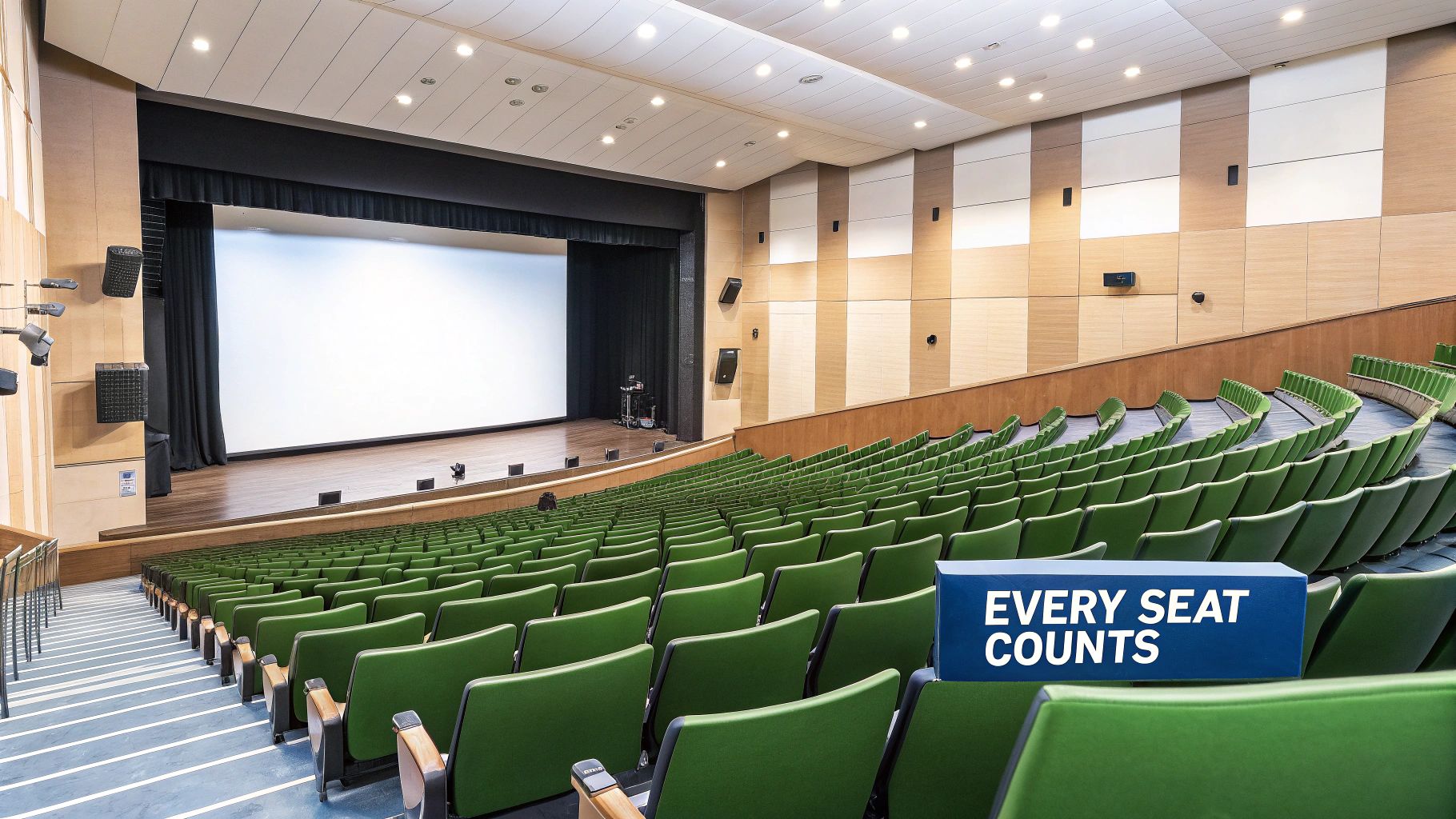
An empty modern auditorium with curving rows of green seats, a large stage, and a bright white screen.

While we obsess over the audience's experience, let's not forget what a theater is really for: what happens on stage. Engineering the performance space is a delicate dance, a balancing act between artistic ambition and the hard realities of backstage logistics, acoustics, and tech. Get this part right, and you've built a space where magic can happen. Get it wrong, and you'll hamstring every production that walks through your doors.

One of the first, and most foundational, decisions you'll make is the type of stage. This choice fundamentally defines the relationship between performer and audience, shaping everything from scenic design to the very feel of a show.

Choosing the Right Stage Configuration

There are three classic stage configurations, and each brings its own unique character and operational demands. It's crucial to understand these nuances to make sure the physical space actually supports your artistic goals.

  • Proscenium Stage: This is the iconic "picture frame" stage. The audience looks through a large arch, creating a clear fourth wall between their world and the world of the play. It's the go-to for productions with elaborate scenery, complex backstage mechanics, and a need for tightly controlled sightlines.

  • Thrust Stage: Here, the stage juts out into the house, with the audience wrapping around three sides. This shatters the fourth wall, creating a much more intimate and dynamic experience. The action is right in your lap, which forces a more three-dimensional approach to directing and design.

  • Arena Stage (or Theatre-in-the-Round): With the audience on all four sides, this is the most intimate setup you can get. It creates an incredibly powerful connection, but it's also the most challenging. There's no "backstage" to hide things, so every entrance, exit, and scene change has to be meticulously choreographed.

The proscenium arch itself was a game-changer, born during the Renaissance. When it emerged in 16th-century Italy, it didn't just frame the action; it enabled a whole new scale of theater. By creating a distinct boundary, it allowed for painted backdrops with incredible perspective, making small stages feel vast. It also let venues pack in more people—sometimes increasing capacity by as much as 300%—and turned theater into the commercial powerhouse we know today. You can explore the rich history of stage design to see just how much this innovation shaped performance.

The Unseen World Backstage

The magic on stage is only possible because of a well-oiled machine running behind the scenes. This is the engine room, and treating it as an afterthought is a rookie mistake that can cripple a venue's potential. A flawless show depends entirely on the smooth flow of people and equipment just out of sight.

Think carefully about these key backstage areas:

  • Fly Loft and Rigging: In a proscenium house, the fly loft is the massive open space above the stage. It's used to fly scenery, lights, and curtains in and out. This requires serious height and robust structural engineering.
  • Wings: These are the offstage areas on either side of the stage. They need to be big enough for performers to wait for their cues and for scenery to be stored and prepped.
  • Dressing Rooms and Green Room: Your performers need functional, comfortable spaces. Don't just stuff them in a basement closet. Plan the number and size of dressing rooms based on the scale of shows you intend to host.
  • Workshops: If you're a producing house (meaning you build your own shows), then dedicated shops for scenery, props, and costumes are absolutely essential.

I’ve seen it a hundred times: backstage gets whatever space is left over. That’s a recipe for disaster. Design these critical support areas at the same time as the auditorium. The path from the loading dock to the workshop to the stage needs to be a straight, unobstructed shot.

Mastering Acoustics and Sound Isolation

Theater acoustics is where science meets art. The goal is simple but incredibly difficult: make sure every line and every note reaches every single seat with perfect clarity—ideally, without a microphone in sight. Achieving this comes down to the room's shape, the materials you choose, and a relentless focus on keeping unwanted noise out.

The shape of the room is your most powerful tool. Parallel walls are the enemy; they create awful "flutter echoes" that bounce sound back and forth. Angled or curved surfaces are your best friend, as they diffuse sound, spreading it evenly and naturally throughout the space.

Your choice of materials is just as critical. Hard surfaces like wood or plaster give a room "liveness," which can be fantastic for musical performances. But for spoken-word plays, you need to control the echo. That's where soft, absorptive materials like heavy curtains and upholstered seats come in. A great design finds the perfect balance to hit the target reverberation time—the time it takes for a sound to fully decay.

Weaving in Lighting and Audiovisual Systems

Modern theater is inseparable from its technology. Sophisticated lighting and audiovisual (AV) systems aren't just accessories; they are integral to the storytelling. You can't just staple them on at the end—the infrastructure has to be baked into the design from day one.

This means bringing lighting designers and AV consultants into the room early. They'll flag the non-negotiables that architects might miss:

  • Serious Power: Stage lighting and professional sound systems are power hogs. You need to plan for a massive electrical load.
  • Conduit and Cable Pathways: Trust me, you don't want to be drilling through finished concrete to run miles of cable. Design dedicated, easily accessible pathways from the very beginning.
  • Control Booth Location: The sound and lighting operators need a clear, dead-center view of the stage. No exceptions.
  • Lighting Positions: You need a flexible grid. That means planning for catwalks, box booms, and lighting bridges that are strategically placed and structurally sound.

By embedding these technical needs right into the architectural plans, you build a versatile, future-proof venue that's ready for whatever creative vision walks in the door.

Integrating Back of House Systems and Safety Codes

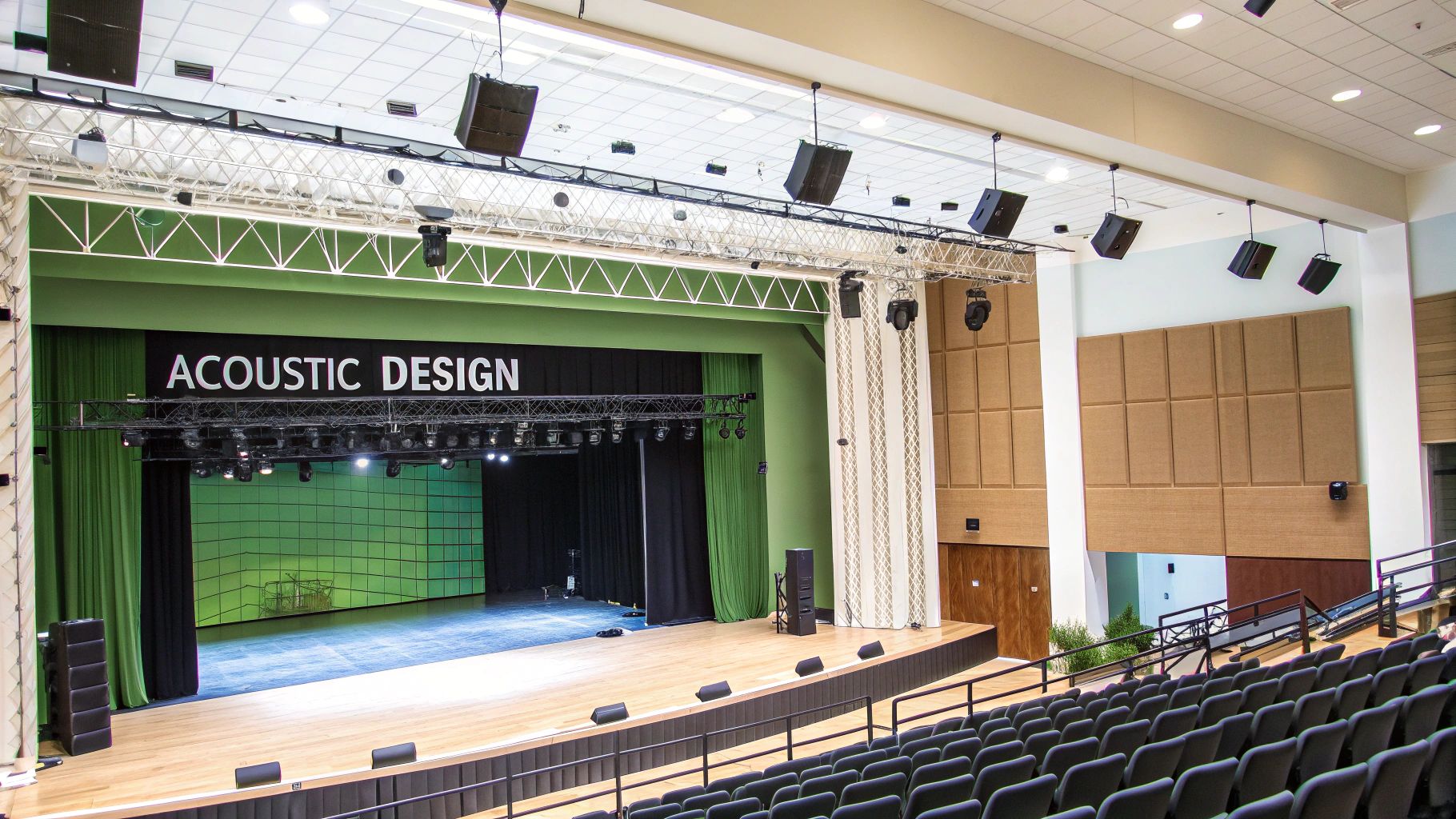
An empty modern theater stage with green and black curtains, acoustic panels, and audience seating.

A truly great theater runs on systems the audience never even thinks about. While everyone's eyes are on the stage, it's the unseen infrastructure—the back of house machinery and life safety features—that makes a venue comfortable, functional, and safe. Getting these systems right from the very beginning isn't just a good idea; it's non-negotiable.

Taming the Mechanical Dragon: HVAC Design

Heating, ventilation, and air conditioning (HVAC) in a theater is a unique beast. The system has to pull double duty, handling two conflicting jobs at once: it must be powerful enough to manage enormous heat loads, yet operate in near-total silence. A noisy air handler can ruin an intimate monologue just as easily as a stuffy room can make an audience antsy.

Think about the heat generated by hundreds of stage lights, racks of A/V equipment, and a full house of people. It’s immense. Your mechanical engineer has to design for this peak load to keep the temperature comfortable. This often means specifying oversized ductwork, which lets a huge volume of air move at a very low speed, dramatically cutting down on that "whooshing" sound you hear in typical commercial buildings.

We also have to be smart about where the vents go. The last thing you want is a draft blowing across the stage or onto the audience. Every detail matters, from acoustic insulation inside the ducts to vibration-dampening mounts for all the equipment. The goal is a system that is felt but never, ever heard.

Navigating Egress and Life Safety

When you gather hundreds of people into a dark room, making sure they can all get out safely in an emergency is your absolute highest priority. Modern building codes are incredibly strict and complex, dictating everything from the width of the aisles to the type of hardware on the exit doors.

A solid egress plan gives everyone a clear, intuitive path out of the building.

  • Exit Capacity: The total width of all your exits is calculated based on the theater’s maximum occupant load. This math directly tells you how many exit doors you need and how big they have to be.
  • Travel Distance: Codes put a hard limit on how far someone can walk before they reach an exit. In a big venue, this often means we have to add cross-aisles or vomitories (those exit tunnels from the seating bowl) that lead directly outside or into a protected corridor.
  • Emergency Lighting & Signage: Every exit path must be lit by emergency lights tied to a backup power source. You'll also need illuminated exit signs, and their placement is highly regulated.

Beyond just getting people out, the building itself has to be designed to contain a fire. This means using fire-rated construction for the walls separating the stage from the audience (the proscenium wall) and enclosing all the stairwells.

A critical, non-negotiable component is the fire curtain, a heavy, fire-resistant barrier tucked away just behind the proscenium arch. If a fire breaks out on stage, this curtain drops automatically, isolating the blaze from the auditorium and buying precious time for everyone to evacuate.

Demystifying Building Codes and Reviews

Life safety has been at the heart of theater design for centuries, especially after some devastating fires in the 1800s. The Industrial Revolution brought huge technological leaps, like the shift from gas lamps in the 1810s to electric lighting by the 1880s. That change alone slashed fire risks by over 90% and opened the door to stage effects no one had ever dreamed of.

Today, navigating building codes and design review boards is a huge part of the process. My best advice? Engage with your local fire marshal and building officials as early as possible. This will save you from costly redesigns down the road. Show up to these meetings prepared, with clear drawings that show exactly how your design meets or exceeds every code requirement. Be ready to answer their questions about fire suppression, accessibility, and structural integrity.

Looking beyond the physical structure, it's also smart to understand the framework of effective health and safety management systems. This kind of proactive approach helps ensure your venue isn't just compliant on opening day, but remains a safe environment for performers, crew, and audiences for years to come.

Making the Numbers Work with Historic Tax Credits

While the artistic vision is what gets everyone excited, the financial reality is what gets a theater built. As an owner, developer, or community leader, you know this is a major investment. So, let's switch gears from design and acoustics to the financial strategy that makes it all possible, especially when you’re breathing new life into an old building.

Financing a theater successfully is about more than just getting a bank loan. It demands a rock-solid budget, tight cost control, and, often, a phased construction plan that moves in lockstep with your funding. This lets you break the project into manageable chunks, finishing work as capital comes in—a common and highly effective approach for non-profits and community-driven projects.

The Power of Adaptive Reuse

In my experience, the smartest financial move in many theater projects isn't building new; it's adaptive reuse. Taking a forgotten old building—a grand former bank, a classic movie palace, or even a gritty industrial warehouse—and turning it into a cultural hub is more than just a sustainable choice. It's an incredibly savvy one.

Renovating an existing building certainly comes with its own set of design puzzles. But it also unlocks some powerful financial tools that new construction simply can't touch. Chief among them are federal and state historic tax credits. These aren't just deductions; they are direct, dollar-for-dollar credits against what you owe in taxes, and they can slash the real cost of a renovation.

The Federal Historic Preservation Tax Incentives program is one of the most effective tools our country has for sparking private investment in our communities. Since its start, it has spurred over $102.64 billion in private funds to save and revitalize historic buildings.

How to Qualify for Historic Tax Credits

So, how do you get your hands on this funding? First, your building has to be a "certified historic structure." This usually means it's already on the National Register of Historic Places or is a "contributing" building within a registered historic district.

Next, the renovation itself has to follow the Secretary of the Interior's Standards for Rehabilitation. This is to ensure you preserve the building's historic character, not destroy it. It’s a detailed process that requires careful coordination with your State Historic Preservation Office (SHPO) and the National Park Service, but the financial payoff is huge. An architect who has been through this gauntlet before is an absolute must.

How These Credits Supercharge Your ROI

Let's break down how these credits can fundamentally change your project's bottom line:

  • Federal Historic Tax Credit: This credit can cover 20% of your Qualified Rehabilitation Expenditures (QREs). On a multi-million dollar project, that's a massive reduction in your net cost.

  • State Historic Tax Credits: Many states offer their own historic credits, which can often be "piggybacked" right on top of the federal one. These vary, but it's not uncommon to see an additional 20-25% credit, making the numbers look even better.

  • New Markets Tax Credits: If your theater is in a designated low-income community, you might also be able to layer in New Markets Tax Credits, which can attract different investors and close a final funding gap.

This strategy isn't new; it's a modern continuation of what's always made American theater possible. The 'New Stagecraft' movement after 1945, for example, influenced theater design worldwide, but its success was tied to the financial viability of its venues. Historic tax credits play a key role today, often offsetting 25% of investment costs and making it profitable to extend the life of these culturally vital buildings. You can learn more about the evolution of American theater design and its financial underpinnings.

It's More Than Just the Money

Beyond the direct financial boost, a building’s historic character is a powerful marketing tool. An old theater with lovingly restored details has a soul and a story that a brand-new building can never replicate. This unique identity is what attracts audiences, inspires donors, and gets media attention, transforming a challenging renovation into a profitable and beloved community landmark.

Common Questions About Designing a Theater

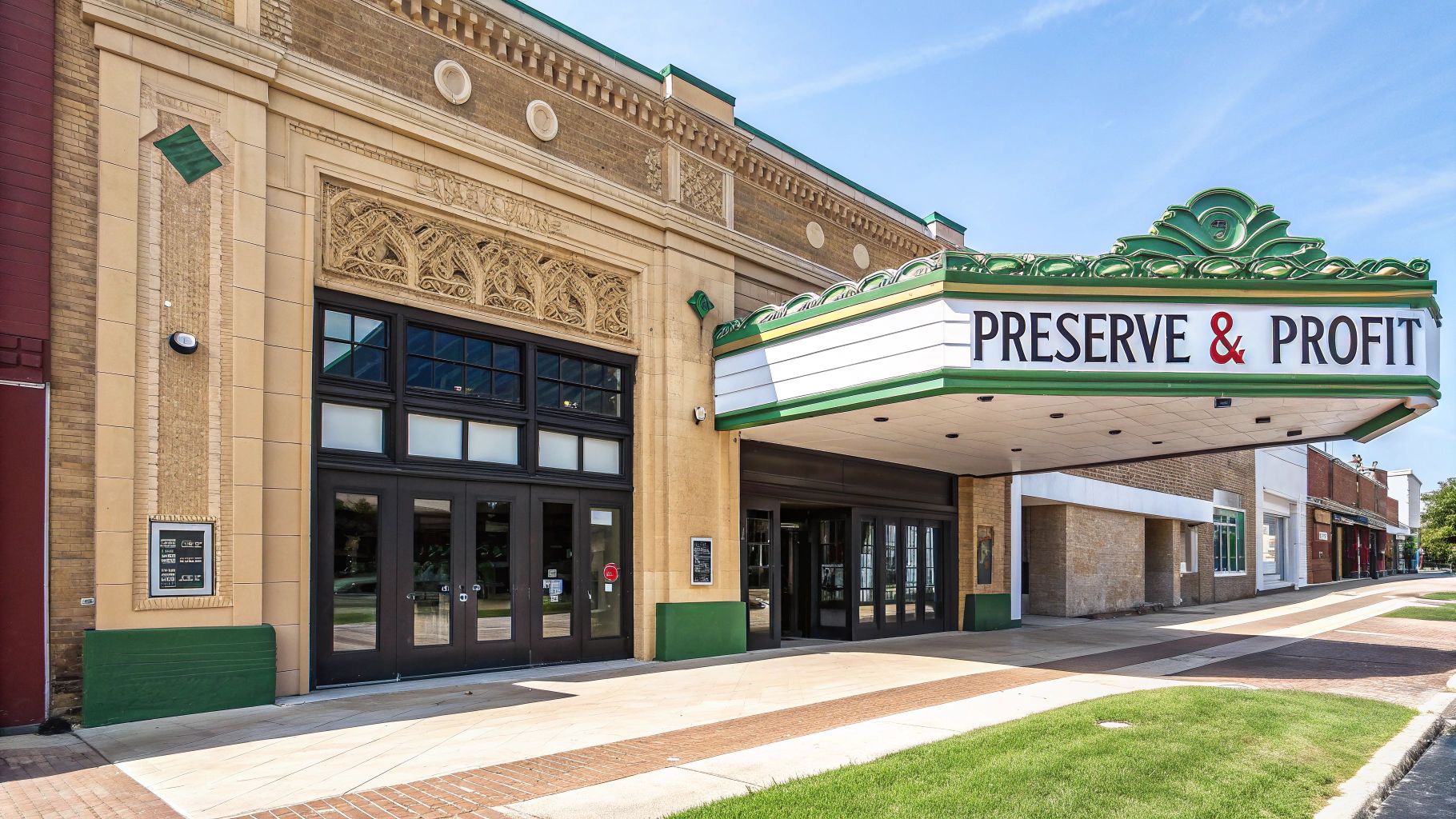
Grand old theater building with 'PRESERVE & PROFIT' marquee and intricate facade details.

When you're starting the journey of bringing a new theater to life, the questions can feel overwhelming. Over the years, we've helped countless developers, owners, and community groups navigate this process, and a few key questions always come up. Here are some straightforward answers based on our experience.

How Long Does It Take to Design and Build a Theater?

There's no single, simple answer to this, as the timeline really depends on the project's scale and complexity. A smaller renovation for a community theater might wrap up in 12-18 months from the first sketch to opening night. But if you're looking at a brand-new, large performing arts center, you're realistically talking about a 3- to 5-year commitment, sometimes even longer.

The whole process unfolds in stages, each with its own rhythm:

  • Schematic Design: Getting the core concept right usually takes about 3-6 months.
  • Construction Documents: This is where we create the detailed blueprints, a process that can take another 6-12 months.
  • Construction: The actual build can be anywhere from 12 months for a simpler project to well over 24 months for a complex one.

And don't forget the external factors. Things like fundraising campaigns, navigating public approval processes, and securing historic preservation reviews can add significant time to the schedule.

What Is the Biggest Mistake to Avoid in Theater Design?

By far, the most common and costly mistake we see is under-planning the backstage and support areas. It's completely understandable to get excited about the auditorium and the lobby—the spaces your audience will see and love. But a theater is, at its heart, a factory for creating art, and that factory can't function without the right tools and space.

When you skimp on the "back-of-house," you create an operational bottleneck that can frustrate artists and severely limit the kinds of shows you can stage. A design simply won't work if it doesn't have:

  • Proper dressing rooms
  • A green room for performers to relax
  • Sufficient scenery workshops and storage
  • Well-designed, accessible loading docks

The best theater designs strike a perfect balance between an incredible audience experience and the practical, everyday needs of the artists and crew. Nail both, and you've got a venue that will thrive.

Is Converting an Old Movie Palace a Good Idea?

It can be a brilliant idea, but you have to go into it with your eyes wide open. Old movie palaces often have an incredible historic charm and a built-in sense of community that's impossible to replicate. The catch? They were built for movies, not live performances.

The most significant hurdles are almost always a shallow stage, a non-existent fly loft for scenery, and virtually no backstage wing space. Before you do anything else, you need a professional feasibility study. This will tell you if the building's structure can even handle the major modifications needed—like adding a proper stage house—without gutting its historic soul.

The good news is that these kinds of projects are often prime candidates for historic tax credits. These credits can be a game-changer, making the extensive structural work financially feasible and helping you create a truly one-of-a-kind venue that honors the past.


At Sherer Architects, LLC, we turn complex design puzzles into beautiful, functional, and successful venues. Whether you're planning a new build, adapting an existing building, or preserving a local landmark, our team has the expertise to guide you. See how we approach these challenges at https://shererarch.com.

Categories
Uncategorized

Restaurant Design Service: Elevate Your Space from Concept to Opening

Hiring a professional for your restaurant's design isn't just about making the place look good. It's a fundamental investment in your business's future, a strategic move to build an experience that drives revenue, smooths out your operations, and carves out a strong brand identity.

Why Strategic Design Is Your Secret Ingredient

Picture two restaurants on the same block. One is always humming with activity, every table taken, with a line stretching out the door. The other? It's often half-empty, fighting to pull in a crowd. The food might be equally good at both, but the difference is often the experience—and that experience is no accident. It’s the result of thoughtful, strategic design.

This is where a professional restaurant design service shifts from being a line-item expense to your most critical investment. It’s easy for new owners to pour all their energy into perfecting the menu, but the physical space is the stage where every meal plays out. Your restaurant's design is the silent partner working around the clock, shaping everything from how comfortable your guests feel to how efficiently your staff can move.

More Than Just a Pretty Space

Expert design is about so much more than choosing paint swatches and light fixtures. It's a calculated, nuts-and-bolts approach to building a high-performing business from the inside out. The process is all about digging into the details to make sure every dollar you spend comes back to you.

Here’s where that strategic thinking really pays off:

  • Elevating the Guest Experience: A great design creates a welcoming vibe with comfortable seating, a natural flow, and acoustics that actually let people talk. This is what turns a first-time visitor into a regular.
  • Boosting Operational Efficiency: It’s about laying out a kitchen and service station that cuts down on wasted steps for your team, slashes ticket times, and prevents those frustrating bottlenecks during the dinner rush.
  • Building Your Brand Identity: Your physical space should tell your story. A cohesive design creates a memorable identity that clicks with the people you want to attract.
  • Driving Profitability: Smart design can do everything from increasing table turnover to subtly encouraging guests to spend more. It can even lower your day-to-day operating costs.

"A classic rookie mistake is falling in love with aesthetics while ignoring function. A gorgeous dining room won't save you if the kitchen workflow is a nightmare. True professional design finds that perfect balance between front-of-house atmosphere and back-of-house efficiency."

In an industry this competitive, you need every advantage you can get. With the average cost to open a full-service restaurant falling anywhere between $375,000 to $700,000, making every square foot count isn't just a good idea—it's essential for survival. This is why many of the best new designs focus on adaptable, flexible spaces that can change as your needs do, making your initial investment work that much harder. If you're curious, you can explore more of the latest restaurant interior design trends to see just how much the industry is evolving.

From Concept To Grand Opening: A Step-By-Step Look

Taking a great restaurant idea from a napkin sketch to a packed opening night can feel overwhelming. A seasoned architecture partner is your guide, providing a clear roadmap for what can otherwise be a complex, winding journey. Think of it as a well-planned expedition—each stage is critical and builds directly on the one before it.

This structured process is all about preventing costly mistakes and keeping the project on track. Your architect’s job is to translate that big vision in your head into a functional, beautiful, and profitable reality.

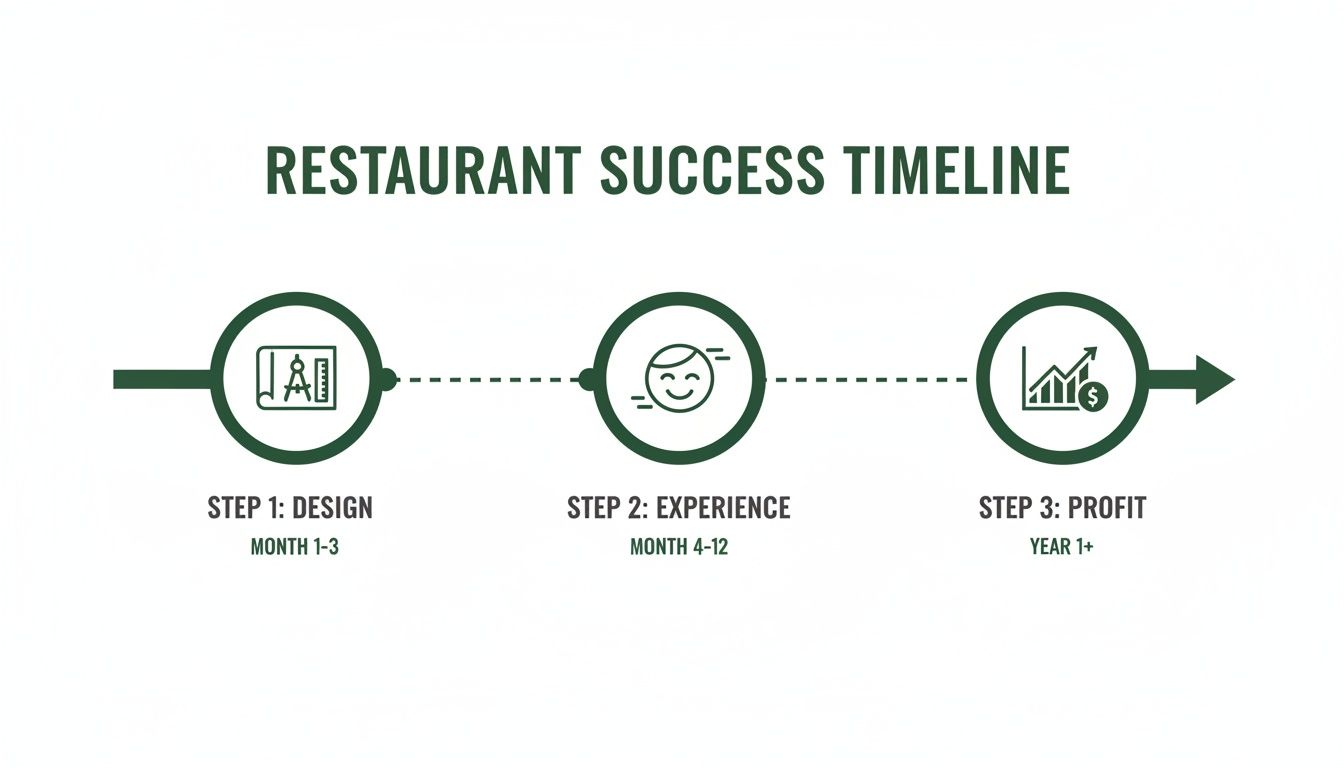
This timeline shows exactly how thoughtful design isn't just an expense; it's the foundation for an unforgettable guest experience and, ultimately, a healthy bottom line.

Restaurant success timeline illustrating design, customer experience, and profit stages with associated timeframes.

As you can see, strategic design is the first domino to fall, setting in motion everything that leads to long-term success. Let's walk through what the process actually looks like.

Key Phases of a Restaurant Design Project

The design and construction of a restaurant follows a predictable, well-defined path. Understanding these phases helps you know what to expect and how to prepare for each step. The table below breaks down the journey from your initial idea to opening day.

Phase Primary Goal Key Activities Typical Duration
Programming Define the project's core identity and functional needs. Brand discovery, operational analysis, budget talks, site review, creating a detailed project brief. 2-4 weeks
Schematic Design Explore the "big picture" layout and spatial flow. Bubble diagrams, rough floor plans, initial 3D massing, exploring multiple layout options. 3-6 weeks
Design Development Refine the design with specific materials and details. Selecting finishes, fixtures, and equipment (FF&E); coordinating with engineers (MEP); creating detailed drawings. 4-8 weeks
Construction Docs Create the final, buildable blueprint for permits and contractors. Producing a complete set of technical drawings and specifications for construction. 6-12 weeks
Construction Admin Oversee construction to ensure it matches the design intent. Site visits, answering contractor questions, reviewing work quality, problem-solving during the build. Varies (4-12+ months)

Each phase is a crucial checkpoint, ensuring that the final build is perfectly aligned with the vision established on day one. Now, let's dig into what each of these stages really involves.

Programming: Defining Your Restaurant's DNA

Before a single line is ever drawn, we start with programming. This is the discovery phase, a deep dive where we listen and ask a ton of questions to get to the heart of your project. We're talking about your brand, your ideal customer, your menu, how the kitchen needs to operate, and of course, your budget.

This isn't just making a wish list. It's about nailing down the "why" behind every decision. How many seats do you need to be profitable? What's the perfect flow between the bar and the dining room? What kind of vibe will make your target demographic feel like they've found their new favorite spot?

This foundational phase sets the project's entire direction. A thorough programming stage ensures that the final design isn't just beautiful but is perfectly aligned with your business goals, preventing expensive changes later on.

Answering these questions results in a detailed project roadmap. This document becomes our north star for all future design choices, guaranteeing every element serves a specific, intentional purpose.

Schematic Design: Sketching The Big Idea

Once the program is locked in, we move to schematic design. This is where your vision starts to become tangible through rough sketches, bubble diagrams, and basic floor plans. It’s a highly creative, exploratory phase where we focus on the big picture.

The main goal here is to organize the space and establish flow. We’ll play with different layouts for the kitchen, dining areas, and entryway, figuring out the most intuitive and efficient way for both staff and guests to move through the restaurant. Think of it as arranging the main puzzle pieces until they click into place perfectly.

To help you really see and feel the space, we often create a realistic architectural rendering. These 3D images give you a true sense of the atmosphere, materials, and lighting long before a single wall goes up.

Design Development: Adding Detail and Dimension

After you've approved a schematic design, the project enters design development. Here, we take those initial sketches and start refining them into more detailed, technical drawings. This is where the abstract concept gets fleshed out with specific materials, finishes, and fixtures.

During this phase, we make decisions on everything—from the type of flooring and wall textures to the lighting design and custom millwork. Your architect also brings in the engineers to seamlessly integrate critical systems like plumbing, electrical, and HVAC into the design. The result is a much clearer, more comprehensive picture of the finished restaurant.

Construction Documents: The Final Blueprint

The construction documents phase is the most technical and intensive stage. The detailed design is translated into a complete set of blueprints and specifications that a contractor will use to build your restaurant. This is the final instruction manual.

These documents are incredibly precise, covering everything needed for permitting and construction:

  • Architectural Drawings: Exact dimensions for every wall, door, and window.
  • Structural Plans: All the details on the building's support systems.
  • MEP Plans: The layouts for Mechanical, Electrical, and Plumbing systems.
  • Specifications: A written guide detailing every single material, product, and finish to be used.

This comprehensive package is absolutely essential for getting accurate bids from contractors and making sure the project is built exactly as we designed it.

Construction Administration: Building The Vision

Finally, during construction administration, your architect becomes your chief advocate on the job site. We don't swing hammers, but we are there regularly to answer the contractor's questions, review the quality of the work, and ensure the build is following the plans to the letter.

This oversight is crucial for protecting your investment. Your architect helps solve the inevitable unforeseen problems that pop up on-site, reviews payment requests, and confirms that the final product perfectly matches the approved design, guiding you all the way to a successful grand opening.

The Core Services That Drive Restaurant Success

Top-tier restaurant design service is about so much more than picking out cool furniture and a great color palette. It’s the entire strategic playbook for building a business that runs like a well-oiled machine from the day you open. These core services are the invisible systems that ensure your restaurant isn't just beautiful—it's efficient, profitable, and built to last.

Think of your architect as the general manager of the entire project. They aren't just drawing a single floor plan; they're coordinating the guest experience, the kitchen's workflow, and all the complex technical systems into a single, winning strategy. Every service is a critical piece of the puzzle.

This is where design moves beyond pure aesthetics and gets into the fundamental mechanics of what makes a restaurant actually work.

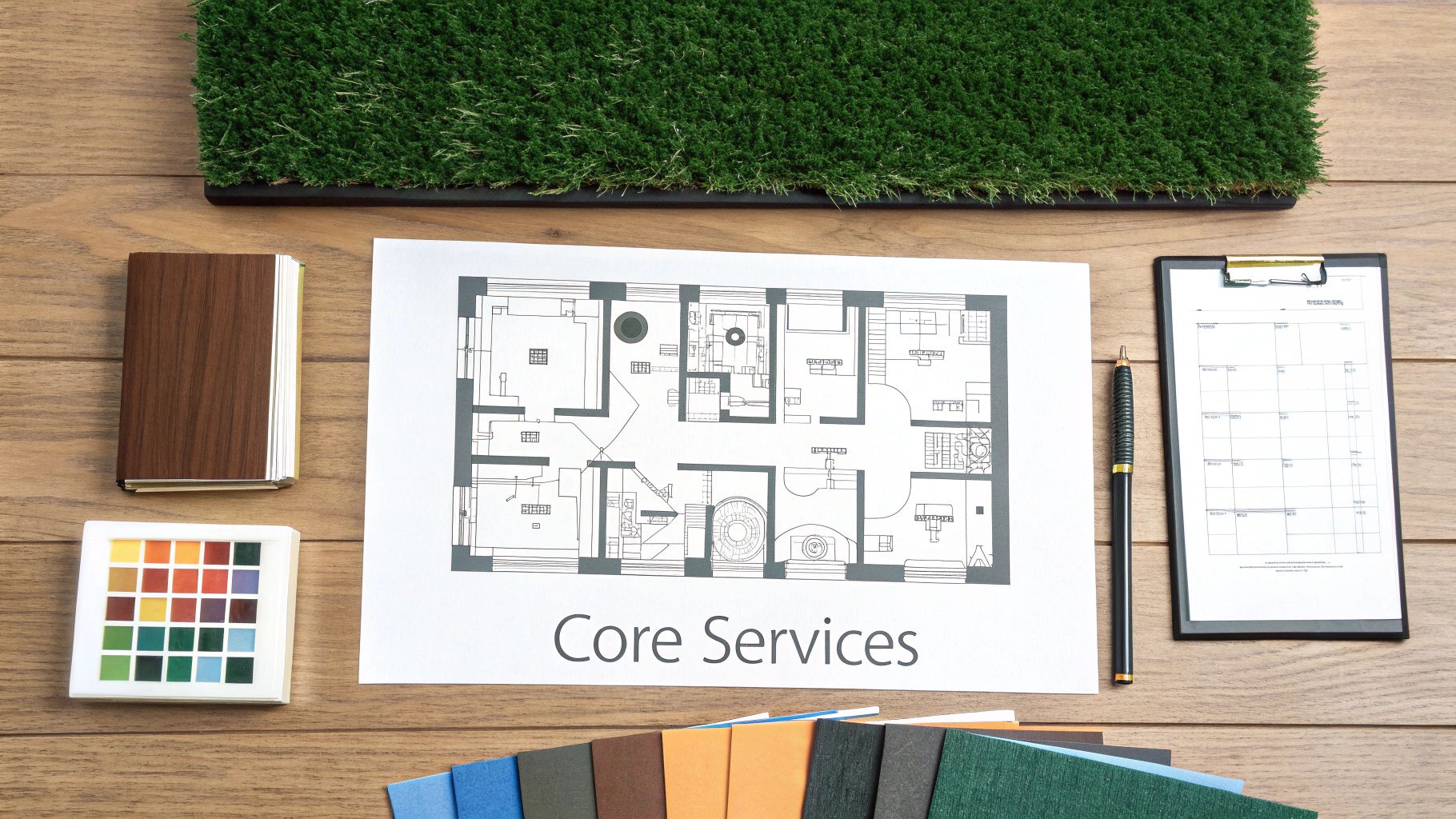
Overhead view of a design workspace with a blueprint, color swatches, and artificial turf.

Site Optimization and Programming

Before a single line is drawn, the first job is to squeeze every drop of potential out of your location. Site optimization is all about analyzing the building or lot to take advantage of what's already there. This could mean orienting the dining room to catch the afternoon sun, cutting down on lighting bills, or placing the main entrance where it naturally captures foot traffic.

At the same time, we dive into programming. This is where we define your restaurant's DNA. It's a detailed process that outlines every functional need, from the number of seats required to hit your revenue goals to how the kitchen, storage, and service areas must relate to one another. It's the essential blueprint for your business model.

Strategic Floor Plans and Kitchen Design

The floor plan is your restaurant's central nervous system. A great layout creates a natural flow, establishing distinct zones for dining, waiting, and service that feel both separate and connected. It guides the customer's journey and, just as importantly, helps your staff move efficiently, preventing those dreaded bottlenecks during a weekend rush.

The kitchen, of course, is the engine. A skilled architect works hand-in-glove with you and your chef to create a workspace that’s not only safe but hyper-efficient. A crucial part of the process is learning how to design a restaurant kitchen for peak performance, where every piece of equipment is placed to minimize steps and slash ticket times.

A rookie mistake is to focus all the attention on the front-of-house glamour while neglecting back-of-house function. An expert knows that a calm, efficient kitchen is the secret to a flawless guest experience out front.

MEP and FF&E Coordination

This is where things get technically complex, and where having a pro quarterbacking the project really pays off. Your architect becomes the central hub for all the engineering disciplines.

  • MEP (Mechanical, Electrical, and Plumbing) Coordination: This is the unseen network of HVAC ducts, wiring, and pipes that makes the building hum. Your architect ensures this complex web is integrated seamlessly into the design so it's effective but invisible. It’s what handles everything from kitchen ventilation and fire suppression to the mood lighting and restroom functions.

  • FF&E (Furniture, Fixtures, and Equipment) Selection: This service covers every tangible item your guests will see and touch. The goal isn't just to find things that match your brand, but to source commercial-grade pieces that can withstand the nightly wear and tear. We're talking tables, chairs, bar stools, light fixtures, and service stations that are built for the long haul.

Ensuring Accessibility and Energy Efficiency

Any modern restaurant design has to clear some important hurdles, from regulations to sustainability. A knowledgeable firm doesn’t just meet these requirements; it turns them into features that benefit your business.

Accessibility (ADA Compliance)
An architect’s job is to make sure every single guest feels welcome. This goes way beyond just adding a ramp. It’s about thoughtful planning for:

  1. Clear Pathways: Ensuring aisles are wide enough for easy wheelchair navigation.
  2. Accessible Seating: Designing tables that are fully integrated into the main dining area, not tucked away in a corner.
  3. Restroom Design: Creating ADA-compliant restrooms with the proper clearances and grab bars from the start.
  4. Service Counters: Making sure bar tops and host stands are at accommodating heights.

Getting this right from day one avoids expensive fixes later and shows your community you’re committed to inclusivity.

Energy Efficiency
Smart, sustainable design choices can make a huge dent in your long-term operating costs. An experienced architect will specify things like energy-efficient windows, high-performance insulation, and smart lighting systems using LEDs and occupancy sensors. These features don't just lower your utility bills; they create a more comfortable environment for everyone and position your restaurant as a forward-thinking, responsible business.

Navigating Zoning, Permits, and Design Review Boards

Let's be honest: zoning laws, building codes, and Design Review Boards can feel like a tangled mess of red tape. It’s easy to see them as bureaucratic roadblocks meant to slow you down. But a better way to think of them is as the official "rules of the game." And to win, you need an expert guide who knows every play in the book.

Every single city and county has its own set of rules dictating what you can build and how. These aren't just gentle suggestions—they're legally binding standards that can completely derail a project if you're not paying attention. For a restaurant, this could be anything from the exact number of parking spots you need to the size and style of your sign out front.

Putting off these details is a classic, and costly, mistake. It almost always leads to painful redesigns, agonizing delays, and in the worst cases, a project that has to be abandoned. This is precisely where a seasoned architect earns their keep.

Your Advocate in the Approvals Game

Think of your architect as your personal translator and diplomat. They fluently speak the technical language of city planners and building inspectors, and they've likely spent years building professional relationships with the very people who will approve your project. That kind of rapport is priceless—it can turn a potentially combative process into a collaborative one.

An architect with deep local roots understands the subtle quirks of your town’s regulations. Here in South Carolina, for example, that might mean navigating the strict guidelines of a historic district in Charleston or satisfying the specific aesthetic demands of a local Design Review Board in Columbia.

This specialized knowledge allows them to see potential roadblocks miles away. They can get ahead of concerns about everything from landscaping ordinances to fire code compliance, making sure your plans are buttoned up and correct the first time they're submitted.

A great local architect doesn't just submit a set of drawings; they shepherd your project through the system. Their grasp of local codes and their relationships with city officials can literally save you months of delays and thousands in revision fees.

Common Hurdles in Restaurant Permitting

The approvals process for a restaurant is notoriously tricky because you're dealing with so many overlapping layers of public health and safety. Your architect’s job is to create a design that makes everyone happy, all at once.

Here are some of the usual suspects that require careful planning:

  • Parking Requirements: Cities have rigid formulas for how many parking spaces you need, usually based on your square footage and seating capacity. Miss the mark, and your project could come to a screeching halt.
  • Signage Restrictions: Zoning codes often have a lot to say about the size, placement, and even the lighting of your exterior signs.
  • Accessibility (ADA): Your design must fully comply with all Americans with Disabilities Act standards for things like ramps, restrooms, and table access. No exceptions.
  • Health Department Codes: Kitchen layouts, equipment, and ventilation systems are under a microscope and must meet tough public health regulations.
  • Historic District Guidelines: If your restaurant is in a designated historic area, every exterior change—from the paint color to the window frames—will face intense scrutiny to protect the neighborhood's character.

A professional restaurant design service tackles these issues from day one. By baking these requirements into the design from the very beginning, your architect paves a much smoother and more predictable path through the approvals maze. This foresight is what turns a potential nightmare into just another checkbox on the way to your grand opening.

Unlocking Value with Adaptive Reuse and Preservation

Some of the most compelling restaurant spaces aren't brand new. They’re born from the clever transformation of forgotten buildings—breathing new life into old warehouses, historic storefronts, or neglected industrial sites. This approach is called adaptive reuse, and it’s a powerful way to create a one-of-a-kind destination.

Think about it: your restaurant could be housed in a building that already has a soul and a story. By repurposing an existing structure, you get instant character and a narrative that new construction just can't buy. It's often more sustainable and cost-effective than a full demolition and new build, extending a building’s useful life by 50-75 years.

A historic brick building with a green storefront and an adaptive reuse sign on a sunny day.

The Rewards of Historic Preservation

Working with historic buildings has its challenges, but the payoff is huge. The goal of historic preservation is to honor a building's original character while carefully updating it for today's world. This is a delicate balancing act, and it’s where a specialized restaurant design service really shines.

It starts with a deep dive into the building’s past, researching original materials and construction methods to make sure any new additions feel right. It requires a sensitive touch to merge history with the demands of a modern restaurant, like figuring out how to integrate a high-tech kitchen ventilation system into a structure built a century ago.

The result is a space that feels deeply connected to its community. Exposed brick, original timber beams, and antique windows become part of the experience, creating an unforgettable atmosphere for your guests.

Historic preservation is about more than just saving an old building; it’s about curating an experience. When you preserve a structure's history, you give your guests a story to connect with, turning a simple meal into a memorable event.

As diners increasingly seek out unique experiences, these one-of-a-kind spaces are more valuable than ever. Architects excel at unlocking this potential, blending casual gathering spots with intimate nooks that encourage guests to stick around. With 60% of permanent restaurant closures tied to recent economic pressures, creating a distinct and resilient brand is crucial. You can dig deeper into these restaurant industry trends to see how they’re shaping design.

Turning History into a Financial Asset

Beyond the look and feel, historic preservation can offer some serious financial perks. But navigating the world of historic tax credits is a beast. An architecture firm with real experience in this niche is an invaluable partner, guiding you through the process to make the most of your investment.

These incentive programs exist at the federal, state, and local levels to encourage the restoration of historic properties. Getting them isn't easy—it involves a tough application and approval process, requiring meticulous documentation and a design that follows strict preservation rules.

An experienced architect can help you:

  • Identify eligible properties and figure out if they’re a good candidate for tax credits.
  • Navigate the application process with bodies like the State Historic Preservation Office (SHPO) and the National Park Service.
  • Develop a design that meets the Secretary of the Interior's Standards for Rehabilitation.
  • Document every single step to ensure you meet all compliance requirements for the credits.

These financial tools can significantly cut the overall cost of your project, turning a challenging renovation into a smart financial move. By using historic tax credits, you're not just creating a fantastic restaurant—you're making a sustainable investment that preserves a piece of your community's heritage.

How to Choose the Right Architecture Partner

Picking the right architect is probably the most critical decision you’ll make for your entire restaurant project. This isn't just about hiring someone to draw up some plans. It's about finding a true partner who gets your vision, protects your investment, and navigates the inevitable bumps in the road.

Think of them as your guide, advocate, and chief problem-solver, from the very first napkin sketch to the day you pass your final inspection.

Getting this choice wrong can be a nightmare. We’re talking about costly design flaws that kill your workflow, budgets that spiral out of control, and maddening delays that push your opening date back. Spending the time to properly vet your options upfront will pay you back tenfold.

Key Evaluation Criteria

How do you sort through the options and find "the one"? It comes down to asking the right questions and looking for specific proof points that separate the experts from the generalists.

Look for Relevant Experience

First things first: you need an architect with specific, hands-on restaurant experience. Sure, any architect can design a building, but a restaurant is a different beast entirely. It’s a highly specialized machine where every square inch matters.

A firm that lives and breathes restaurant design understands the delicate balance between a welcoming front-of-house vibe and a hyper-efficient back-of-house engine. When you're looking at their portfolio, don't just look for pretty pictures. Look for projects that are similar to yours in both size and style. An architect who’s a rockstar at designing fast-casual chains might not be the right fit for your intimate fine-dining concept.

Key Questions for Potential Partners

Once you have a shortlist, it’s time to have some serious conversations. A good interview process helps you get a feel for their working style and whether they’ll mesh with your team.

Here are a few questions you absolutely have to ask:

  • How do you approach budget management? You want a partner who designs to your budget, not one who just tells you when you've gone over. They should be proactive about value engineering and cost-conscious decisions from day one.
  • What does your communication process look like? You’re going to be in the trenches together for months. Make sure their communication style—who your main contact is, how often you’ll get updates—works for you.
  • Can I speak with a few of your past restaurant clients? Talking to other owners is non-negotiable. Ask them the tough questions: How did the architect handle problems? Were they responsive? Did they stick to the timeline?
  • How well do you know the local landscape? Deep knowledge of local zoning codes, permitting quirks, and having established relationships with city officials is a huge advantage. It can literally save you months of delays and thousands of dollars.

Choosing an architect is like casting the lead role in a play. You need someone who not only knows the lines but deeply understands the character of your business, ensuring every decision supports the final performance.

Finally, get total clarity on their fee structure right away. Whether they charge a fixed fee, an hourly rate, or a percentage of construction costs, you need to understand exactly what you're paying for. A true professional will provide a detailed proposal outlining the full scope of their restaurant design service. This kind of transparency is the bedrock of a great working relationship.

Architect Evaluation Checklist

To help you compare firms apples-to-apples, we've put together this checklist. Use it during your interviews to make sure you're covering all the essential bases and making an informed decision.

Evaluation Criteria What to Look For Why It Matters
Restaurant-Specific Portfolio Projects similar in scale, style, and complexity to yours. Look for a variety of concepts. Proves they understand the unique operational and aesthetic demands of food service spaces, not just general commercial design.
Local Knowledge & Relationships Experience navigating local zoning, building codes, and health department rules. Established contacts with city planners. This expertise dramatically speeds up the permitting and approval process, avoiding costly delays and redesigns.
Client References Eager to provide contacts for past restaurant clients. References should speak to problem-solving and communication. Honest feedback from other owners is the best indicator of how they'll perform under pressure and manage your project.
Communication & Process A clear, defined process for communication, meetings, and decision-making. A designated point of contact. A structured process prevents misunderstandings and ensures you're always informed, keeping the project on track.
Budget Management Approach Proactive strategies for cost control, value engineering, and transparent reporting. They design to your budget. Protects your investment by ensuring financial goals are a core part of the design process, not an afterthought.
Team & Consultant Network An established team of engineers (MEP, structural), kitchen designers, and other key consultants. A well-connected firm brings a vetted, cohesive team to the table, ensuring seamless coordination and expertise.

Ultimately, choosing your architect is about more than just qualifications; it's also about chemistry. This is a long-term relationship, so find a team you trust, respect, and genuinely enjoy working with.

Your Top Restaurant Design Questions, Answered

Jumping into a partnership with a design firm for your restaurant naturally brings up a lot of questions. You’re thinking about the process, the budget, and what you’re really getting for your money. Let's tackle some of the most common questions we hear from restaurateurs to clear things up. These are the real-world concerns that pop up when you're trying to bring a dining concept to life.
How Much Does a Restaurant Design Service Cost?

Architectural fees are almost always calculated as a percentage of the total construction cost, usually landing somewhere between 8% and 12%. Where your project falls in that range really depends on its complexity and exactly what you need us to do. A brand-new building from the ground up will be on the higher end, while a simpler interior fit-out for an existing space might be on the lower side.

It's easy to see that number as just another expense, but it's much better to think of it as an investment. A smart architect doesn't just cost you money; they save you money. We do this by designing floor plans that squeeze in more paying customers, creating meticulous construction plans that prevent expensive mistakes, and expertly navigating the permitting maze to avoid costly delays.

How Long Does the Entire Process Take?

The timeline for a restaurant project can swing wildly depending on the scope. A straightforward interior refresh? You might be looking at 4-6 months from our first meeting to your grand opening. But if we're talking about a new build from scratch or a tricky historic renovation, it’s not uncommon for the project to take 12-18 months, sometimes even longer.

To break that down, the design phase itself can take anywhere from 3 to 5 months. After that, you've got the permitting process, which can easily add another 1 to 3 months before a single hammer is swung. A seasoned architect will give you a realistic timeline right from the start and then actively manage that schedule to keep things on track.

The biggest mistake we see? People get so caught up in the look and feel that they forget about how the place actually works. A gorgeous dining room is useless if the kitchen is a chaotic mess or customers are constantly bumping into each other. True professional design is about striking that perfect balance between front-of-house vibe and back-of-house operational genius.

Can I Just Hire a Contractor and Skip the Architect?

For any serious restaurant project, trying to skip the architect is a gamble I wouldn't recommend. Think of your architect as your advocate and the person responsible for quality control. They're the ones who create the detailed "instruction manual"—the construction documents—that contractors use to give you accurate, apples-to-apples bids. This alone protects you from overpaying.

Once construction starts, the architect is on-site, making sure the work is being done correctly and that the finished product matches the vision you signed off on. Going it alone with just a contractor leaves you wide open to major risks like critical design flaws, massive budget overruns, code violations, and ending up with a space that just doesn't work for your business.


At Sherer Architects, LLC, we believe great design is the bedrock of a great business. We’re experts at bringing structure to life, guiding owners through every step to create spaces that are not only beautiful but also durable and profitable. See how we do it at shererarch.com.

Categories
Uncategorized

Warehouse Theatre Greenville SC: warehouse theatre greenville sc Case Study

The Warehouse Theatre is one of those places in Greenville that’s more than just a building; it’s a landmark and a perfect example of what adaptive reuse can achieve. It shows how you can take an old, historic structure and turn it into a modern, lively venue that becomes a real anchor for the community. For developers, this theater is an inspiring model for blending preservation with profitability.

A Blueprint for Adaptive Reuse in Greenville

A row of revitalized brick and cream-colored buildings with 'ADAPTIVE REUSE' written on the grass.

The Warehouse Theatre in Greenville, SC isn't just a place to see a show; it's a living, breathing case study in the power of giving old buildings new life. If you're a developer or investor, its story is a practical guide for turning forgotten structures into valuable community assets that deliver both cultural and financial returns.

The project—transforming historic storefronts into a bustling arts venue—really drives home a key principle we believe in: visionary development, guided by expert architectural insight, can unlock incredible potential. Instead of tearing down our history, we can breathe new life into it. The result is a space with a kind of character and soul that brand-new construction struggles to match.

The Theatre's Foundational Success

This project is a perfect example of what's possible in Greenville's revitalized West End. Back in the mid-1990s, three old storefronts were masterfully converted into the vibrant 150-seat performance venue we know today.

The renovation was a delicate balance of preserving the historic feel while integrating modern needs, a success recognized with an AIA Greenville Merit Award in 1999. It’s been an architectural benchmark ever since. You can see more details about this award-winning project on the McMillan Pazdan Smith project page.

Adaptive reuse isn’t just a fancy term for renovation. It’s about completely reimagining a building’s purpose. You honor the history etched into the walls while outfitting the structure for a new, productive future. It’s a sustainable approach, sure, but it also creates a deep connection with the community.

To provide a clear overview, here's a quick look at the project's key aspects and what they mean for a potential developer.

Warehouse Theatre Project Snapshot

Project Aspect Description Relevance for Developers
Original Structure Three historic storefronts in Greenville's West End, dating back to the textile mill era. Shows the potential of combining smaller, adjacent properties into a single, cohesive project.
New Use A modern 150-seat "black box" theatre for professional stage productions. Demonstrates the viability of cultural venues as anchors for neighborhood revitalization.
Key Challenge Integrating modern HVAC, lighting, and accessibility into a historic shell without losing character. Highlights the need for specialized architectural expertise in navigating code and preservation rules.
Financial Tools The project leveraged community support and was eligible for preservation incentives. Provides a precedent for using historic tax credits and other financing mechanisms in SC.
Community Impact Became a cultural cornerstone that spurred further investment and foot traffic in the West End. Proves that a single project can act as a catalyst, increasing the value of surrounding properties.

This table illustrates that the Warehouse Theatre wasn't just an architectural success; it was a smart, strategic development that paid off for everyone involved.

Why This Matters for Developers

For anyone looking at a historic preservation or commercial renovation project in South Carolina, the Warehouse Theatre offers a clear roadmap. Its journey shows how to:

  • Create Unique Market Value: Repurposed buildings have a story and a character that people are drawn to, attracting tenants and customers who appreciate authenticity.
  • Strengthen Community Ties: When you save a local landmark, you build immense goodwill. These projects become points of pride for the whole neighborhood.
  • Leverage Existing Assets: Working with a building’s existing "bones" is often more cost-effective and environmentally friendly than building new from the ground up.

By looking closely at this project, we can pull out real, actionable strategies for handling the complexities of adaptive reuse—from the first sketch to the final walkthrough. That's exactly what this guide will do: break down the process and show you how to achieve similar success.

From Storage Room to Center Stage: The Theatre's Journey

Every great adaptive reuse project has a story, and the Warehouse Theatre in Greenville, SC has one of the best. It’s a textbook case of how a forgotten space can be transformed into a cultural anchor. For developers, this story isn't just local history; it's a blueprint for turning a building's past into a profitable, identity-defining asset for an entire community.

The theatre didn't start in some grand hall or purpose-built venue. It began in the most unlikely of places, born from a simple need for something different in Greenville’s arts scene.

The Gritty Beginnings

Back in 1973, Dr. Peter Smith, a professor at Furman University, teamed up with Jim Boivin from the Arts Council to bring a new kind of theatre to Greenville. Their first stage? A converted storage room annex at the Greenville Memorial Auditorium—a space that had previously held circus and rodeo animals. Talk about humble beginnings.

That summer, with the slogan 'From the Classics to the Contemporary,' they put on plays that immediately got people talking. The productions felt intimate and raw, a stark contrast to more commercial offerings. They even landed a grant from the South Carolina Arts Commission and formed a board. You can read more about their early days and artistic mission in this piece from American Theatre magazine.

This origin story is more than just a fun fact; it holds a powerful lesson. A great idea doesn't need a perfect starting point. It just needs a functional space and the vision to make something meaningful happen. For a developer, this is critical: a property's potential isn't just what it is today, but what it could become. The theatre’s early success proved the demand was there, setting the stage for a more permanent future.

Milestones in Growth and Adaptation

The journey from a makeshift stage to a professional venue was a series of smart, strategic moves. As the theatre's reputation grew, it outgrew its space. The need for a home that could match its artistic ambitions became obvious, which led to the game-changing move to its current location in the West End.

A few key milestones really defined this transformation:

  • Finding a Permanent Home: Moving from the auditorium annex to the historic storefronts on Augusta Street was the turning point. It anchored the theatre in a neighborhood that was just beginning its own revitalization.
  • Going Pro: The Warehouse Theatre became a professional Actors' Equity Association theatre. This wasn't just a title—it raised the bar for everything, demanding a facility that could support professional-grade productions.
  • The Big Renovation: In the mid-1990s, the building underwent a massive adaptive reuse project. This wasn't just a facelift. It was a complete reimagining of the building's purpose, turning it into a modern performance venue.

The theatre’s growth perfectly mirrors the adaptive reuse process. It began with a solid foundation (the artistic vision), found a new purpose (a professional theatre), and then physically transformed to fulfill that purpose.

Each step was a calculated risk that paid off, proving out a sustainable growth model. The theatre didn't just find a new building; it grew into it, letting its physical space evolve right alongside its artistic and business needs. That kind of organic growth is a fantastic model for any long-term project.

Today, the theatre's success is inseparable from the character of its building. The space isn't just a box to put on plays; it's part of the experience, offering an authenticity that you just can't get with new construction. This story shows developers exactly how investing in a building’s history can forge a deep connection with the community, creating a truly invaluable local landmark.

Architectural Strategies for Blending Old and New

A spacious modern theater venue inside a renovated warehouse, with a stage, brick walls, and a large 'OLD MEETS NEW' banner.

When you pull off a great adaptive reuse project, it feels less like a renovation and more like a conversation between the past and the present. You're not trying to let one voice shout over the other. The magic happens when you create a dialogue where both the building's history and its new purpose are heard and respected. The Warehouse Theatre Greenville SC is a fantastic example of how to pull this off with smart, deliberate architectural choices.

What makes this project so successful is how it honors the building's industrial bones while weaving in all the functionality of a modern performance space. It doesn't try to hide its past behind fresh drywall or a drop ceiling. Instead, it puts the raw, authentic character of the original structure front and center, making those historic elements a key part of the experience.

For any developer looking at an old building, there's a powerful lesson here: authenticity has real value. When you preserve and showcase a building’s history, you create a unique sense of place that new construction just can't replicate. It's that character and story that draws people in.

Honoring the Industrial Exterior

A building’s first impression is its facade, and from the street, the Warehouse Theatre makes a strong one. The team made the crucial decision to meticulously restore the exterior to its original look, which immediately anchors the building in its historical context.

They did this by carefully selecting materials and techniques that felt true to the area's industrial roots. The project brought back the original facades using traditional masonry and exposed steel trusses, a direct nod to the warehouse heritage of Greenville's West End. This commitment to historical accuracy is about more than just aesthetics; it shows a deep respect for the community's story. You can dig into the specific design choices over at the project’s architectural overview.

The decision to restore the facade wasn't just about preservation; it was a strategic move. A building that respects its surroundings becomes a welcome neighbor, fostering goodwill and strengthening its place within the community's identity.

To bridge the gap between the restored exterior and the vibrant life inside, they added large gallery windows. It’s a modern touch with a twofold purpose: flooding the lobby with natural light while also giving people on the street a glimpse of the energy inside. This creates a transparent, inviting link between the theatre and the city.

Weaving Modern Function into Historic Interiors

Step inside the Warehouse Theatre Greenville SC, and that conversation between old and new really comes to life. The design is a masterclass in balancing historic textures with the practical needs of today, creating a space that feels both inspiring and completely functional.
The lobby immediately sets the tone. You're greeted by ornamental tin ceilings, warm wood floors, and skylights that wash the space in light. These restored historic features are then paired with a striking patterned concrete stage entrance—a contemporary element that signals you’re moving into the performance space itself.

This thoughtful mix of materials is a brilliant strategy for any adaptive reuse project. The tactile quality of old brick, the warmth of aged wood, and the gleam of industrial steel can live beautifully alongside modern elements like polished concrete, glass, and sophisticated lighting.

Here are a few key interior strategies they used:

  • Exposing the Structure: Instead of covering them up, the architects left the steel trusses and brick walls exposed. The building's "bones" became a primary design feature.
  • Contrasting Materials: Pairing historic textures like ornamental tin and wood with modern finishes like patterned concrete creates fantastic visual interest and makes you appreciate the unique quality of each.
  • Integrating Advanced Systems: The project seamlessly incorporated advanced theatrical lighting controlled by dimmer panels, ensuring the venue meets professional standards without compromising its historic shell.

Of course, when you’re turning an old building into a public venue, architecture also has to account for safety and operations. This means integrating modern cinema and theatre security systems to keep everything running smoothly. Things like access control and surveillance have to be woven discreetly into the historic framework. The end result is a venue that feels both timeless and perfectly equipped for today.

The Financial Case for Adaptive Reuse

Beautiful architecture and community pride are great, but let's be honest—a development project has to make financial sense. For any developer looking at an old building, the real question is: why save it when I can just demolish it and start fresh?

The story of the Warehouse Theatre Greenville SC gives us a powerful, numbers-driven answer. It shows that adaptive reuse isn't just a feel-good decision; it's a strategic move with a serious return on investment. It's about looking past the initial construction budget to see the long-term value you're creating. By working with a building's bones and character, developers can often unlock greater profitability than new construction, especially when you factor in the financial tools available.

Turning Culture Into Commerce

A place like the Warehouse Theatre is more than just a stage; it's an economic engine for the entire neighborhood. Its success isn't just measured by ticket sales. You can see it in the bustling sidewalks and packed restaurants all around Greenville's West End. That ripple effect makes the whole district more valuable.

For a developer, this creates real, tangible benefits:

  • Higher Property Values: An anchor like the theatre makes the entire area a destination, directly pushing up the value of surrounding properties.
  • Stronger Tenant Demand: The unique vibe of a historic district attracts top-tier commercial and residential tenants who are willing to pay a premium for character.
  • A Magnet for Tourism: Venues like this draw people from all over, bringing fresh spending into the local economy.

The theatre's impact is growing. In 2025, it saw a huge 32% jump in patrons, with its programs hitting all-time highs for revenue and attendance. Add to that its educational outreach, which historically serves over 10,000 students a year across the Carolinas, and you have a true economic and cultural pillar. You can read more about its record-setting year in this Greenville Journal arts recap.

Maximizing Your Return on Investment

Beyond the neighborhood buzz, adaptive reuse offers some very direct financial wins. Think about it: you're starting with a foundation, walls, and a roof already in place. The cost savings compared to building from the ground up can be massive. That frees up capital to invest in the high-impact finishes and modern systems that really drive up rent or resale value.

Of course, a key part of the equation is carefully calculating the risk-adjusted return to make sure the numbers work. But by preserving a building, developers often find a smoother path through zoning and approvals, which means a faster timeline to completion. Less time spent on carrying costs means you get to profitability sooner.

The best projects are always the ones that blend creative vision with financial pragmatism. Adaptive reuse is the sweet spot—it creates a one-of-a-kind building with a story that the market loves, all while using financial tools to de-risk the investment.

The Power of Historic Tax Credits

This is where the financial case gets really compelling. For projects in South Carolina, historic tax credits are one of the most powerful tools in the developer's toolbox. These aren't just deductions; they are direct, dollar-for-dollar reductions in what you owe in taxes.

Here's a quick look at the big ones:

  1. Federal Historic Preservation Tax Credit: This offers a 20% credit on your qualified renovation costs for certified historic buildings.
  2. South Carolina Historic Preservation Tax Credit: The state offers its own credit, which can often be stacked on top of the federal one, sweetening the deal even more.

Now, navigating the application process for these credits requires a steady hand. It's a world of meticulous documentation and strict preservation standards. But with an experienced architectural partner guiding you, these incentives can slash the net investment needed to get the project done.

The bottom line is clear. Saving a building like the Warehouse Theatre in Greenville SC isn't just about preserving history—it's about making a smart, profitable, and lasting investment.

Your Roadmap for a Successful Adaptive Reuse Project

So, you’ve seen what’s possible with the Warehouse Theatre in Greenville, SC, and now you’re looking at an old building with a new sense of potential. It’s an exciting moment. But how do you get from that initial spark of an idea to a finished, profitable reality?

An adaptive reuse project is a different kind of beast. It’s part architecture, part archaeology, and part financial puzzle. Every piece has to fit just right. This isn't about simply tearing down walls; it's a careful dance between honoring a building's history and designing for its future. A clear, structured process guided by an experienced partner is what separates a landmark success from a costly mistake.

Here’s a roadmap we use to break down the journey, making it manageable and setting you up for success.

Phase 1: Kicking the Tires with Feasibility and Due Diligence

Before a single sketch is drawn or dollar is spent on design, you have to answer one critical question: does this project actually make sense? This first phase is all about investigation and risk assessment. It’s the "look before you leap" moment.

The first order of business is a feasibility study. We dig deep into the building’s current state—is the structure sound? Are there hazardous materials lurking? What condition are the core mechanical, electrical, and plumbing (MEP) systems in? At the same time, we'll look at the market to get a realistic picture of potential rental income and rough construction costs to see if the numbers work.

During this stage, we also tackle the biggest regulatory questions upfront:

  • Zoning and Land Use: Does the city's current zoning even permit your idea? If not, we'll need to map out a strategy for a rezoning application or variance, which can be a major hurdle.
  • Historic Designation: Is the building on a historic register? This can be a huge advantage, opening the door to valuable tax credits, but it also means we have to play by a specific set of preservation rules.
  • Preliminary Code Review: We'll do an initial sweep to flag any major red flags related to modern building codes, ADA accessibility, and fire safety requirements that will need to be solved in the design.

Phase 2: From Concept to Approvals

Once we've confirmed the project is viable, it's time to bring the vision to life and get the official green light. This is where your architectural partner really shines, translating your goals into a design that’s functional, beautiful, and, most importantly, approvable.

In a place like Greenville, a key step is navigating the Design Review Board (DRB). The DRB's job is to make sure your project, especially the exterior, fits thoughtfully into the neighborhood's character. An architect with local experience knows what the board is looking for and can build a compelling case for your design from day one.

An adaptive reuse project isn't just construction; it's a negotiation. You're negotiating with a building's past, the city's rules, and the community's vision. A great architect is your chief negotiator, finding the solution that works for everyone.

This phase is also when we formally apply for historic tax credits if the building is eligible. It's a notoriously complex process filled with paperwork, and every detail has to align with the Secretary of the Interior's Standards for Rehabilitation. Getting this part right can make or break the project's finances.

This flowchart shows how these pieces fit together, moving from the initial idea all the way to long-term value creation.

A flowchart detailing the Adaptive Reuse ROI process, moving from project initiation to value creation and community benefits.

As you can see, a well-run project delivers more than just financial returns—it creates real, lasting community benefits.

Phase 3: Making It Real with Construction and Management

With approved designs and permits in hand, the tools come out. Managing construction on an old building is nothing like building from scratch. I can guarantee you one thing: there will be surprises. You’ll find hidden structural quirks, materials that don’t want to cooperate, and plenty of mysteries behind old plaster walls.

Good project management in this context is all about anticipating those surprises and solving problems on the fly. It demands a tight-knit team of architects, engineers, and contractors who have been through this before. Together, we create incredibly detailed construction documents to map out the work and head off challenges before they become expensive delays.

Throughout the build, your architect should be on-site regularly, making sure the work on the ground matches the vision on paper. We act as your eyes and ears, your advocate with the contractor, and your chief problem-solver. It’s this hands-on oversight that ensures an old building like the Warehouse Theatre in Greenville, SC is reborn as a modern, safe, and successful place for decades to come.

Finding the Right Partner for Your Vision

Turning an old building like the Warehouse Theatre in Greenville, SC into something new and profitable is a tough but incredibly rewarding process. It's more than just drawing up a blueprint; you need a partner who can walk the tightrope between honoring the past, building for the future, and making it all financially viable. The entire success of an adaptive reuse project really comes down to finding that perfect expert who can turn your vision into a real, lasting place.

This is where a great architect becomes your most important hire. They act as your guide, your advocate, and your lead problem-solver, untangling the web of regulations, design puzzles, and construction headaches to create a clear, doable plan. The Warehouse Theatre itself shows us what's possible: with the right team, you can blend old with new, weave a building into the community fabric, and create a financially successful venture.

What to Look for in an Architectural Partner

Choosing an architect isn't about finding someone to draw a pretty picture. For a project as intricate as adaptive reuse, you need a specialist—someone with a proven history of transforming historic structures into modern, high-performing properties.

Your ideal partner should have a very specific set of skills:

  • Deep Experience in Adaptive Reuse: Their portfolio should be full of projects where they’ve successfully brought old buildings back to life.
  • Historic Preservation Know-How: This means they know everything from how to research original building materials to navigating the complex demands of the State Historic Preservation Office (SHPO).
  • Local Regulatory Fluency: They have to know Greenville's zoning, Design Review Boards, and building codes like the back of their hand.
  • Financial Acumen: A true partner helps you find the money. They should be experts at identifying and securing historic tax credits and other incentives that make the project work.

The right architect doesn't just design a building; they design a viable business. They see the project through a developer's eyes, aligning every design decision with your ultimate financial goals and long-term vision.

Firms like Sherer Architects, LLC are a great example of this. With over 30 years of experience and more than 200 renovations under their belt, they’ve made a name for themselves in infill and adaptive reuse. They specialize in upgrading old infrastructure to add another 50-75 years of life to a building. This kind of deep expertise means they can move projects smoothly through codes and boards while maximizing value with tax credits, a model you can see in other successful local architectural projects.

Your Actionable Next Steps

Feeling inspired by the Warehouse Theatre Greenville SC and ready to think about your own project? Getting started with a clear plan is the best way to build confidence.

Here are the practical first steps to take:

  1. Initiate a Consultation: Set up a meeting with an architect who specializes in this kind of work. It’s your chance to talk through your vision, get a feel for their process, and see if you click.
  2. Assess Property Potential: Your potential partner can help you run a preliminary feasibility study. This initial look will help you understand the building's bones, its eligibility for tax credits, and whether your idea makes financial sense from the get-go.
  3. Define Your Goals: Get crystal clear on what success looks like for you. Is it maximizing rental income? Creating a community landmark? Achieving a LEED certification? Knowing your destination upfront makes every decision along the way much easier.

Taking on an adaptive reuse project is a major commitment, but with the right partner in your corner, you can turn a piece of local history into a profitable and celebrated part of its future.

Your Adaptive Reuse Questions, Answered

Taking on an adaptive reuse project, especially one involving a piece of local history, naturally comes with a lot of questions. Let's use a place like the Warehouse Theatre in Greenville, SC as our backdrop to tackle some of the most common things developers ask. Getting a handle on these key areas is the first big step toward a successful transformation.

How Do Historic Tax Credits Actually Work in SC?

Think of historic tax credits as a powerful financial partner, not just a simple line-item deduction. For a property with the history of the Warehouse Theatre, you can often tap into both federal and state credits, which can dramatically lower the real cost of the project.

The path to securing them has two major milestones:

  • First, the building has to be officially certified as historic.
  • Second, all the renovation work must follow the strict Secretary of the Interior's Standards for Rehabilitation.

This isn't something you want to navigate alone. An architecture firm with deep experience in this area is your guide, steering your application through the State Historic Preservation Office (SHPO) to make sure you check every box and get the full financial benefit you're entitled to.

Is It Really Cheaper to Adapt an Old Building Than to Build New?

While the initial price tag isn't always lower, adaptive reuse often wins the long game when it comes to value and ROI. Projects can sometimes move faster, you’re using infrastructure that's already in place, and you unlock access to those valuable financial incentives we just talked about.

Beyond the numbers, the one-of-a-kind character of a preserved building is an asset in itself. It’s a story people want to be a part of, which often translates into higher lease rates and stronger property values down the road.

A detailed feasibility study right at the beginning is the only way to truly compare the costs and potential returns against starting from scratch.

What Are the Biggest Headaches When Converting an Old Building?

The main challenges usually boil down to one thing: bringing a vintage structure into the 21st century. This means getting everything up to modern code, from ADA accessibility and fire safety to today's energy efficiency standards.

Weaving new mechanical, electrical, and plumbing systems into the building's historic fabric without destroying its soul is a delicate art. And of course, there’s always the chance of uncovering structural surprises once you start opening up walls. Having a team that's seen it all before is what turns these potential nightmares into celebrated design features, keeping the project on time and on budget.


Ready to see what's possible with your own adaptive reuse project? The team at Sherer Architects, LLC has the expertise to guide you from the first sketch to the final walkthrough. Contact us today to schedule a consultation and let's start the conversation.

Categories
Uncategorized

Firehouse Floor Plan: firehouse floor plan for fast response

A firehouse floor plan is so much more than a set of drawings. It’s the operational heartbeat of the station and a silent partner on every single call. A well-designed layout can shave precious seconds off response times, protect the long-term health of firefighters, and create a building that serves the community for decades.

Beyond the Blueprint: Why Your Firehouse Floor Plan Matters

Looking at a blueprint, you're essentially seeing a puzzle where every single piece has a critical job to do. The ultimate goal is to design a building that runs like a well-oiled machine for emergencies but also functions as a safe, healthy second home for the crew.

A strategic firehouse floor plan isn't just about fitting rooms into a box; it's a careful balancing act between the urgent demands of emergency response and the day-to-day human needs of 24/7 living.

A firefighter and a woman collaborate, reviewing a building floor plan blueprint on a wooden table.

Core Components of a Modern Station

Today's fire stations are incredibly complex buildings. They have to serve multiple, distinct functions all at once, and each zone needs to be positioned just right for maximum efficiency and safety. To get this right, it pays to dig into optimal space planning strategies that can guide the layout.

Every effective plan is built around a few primary components:

  • Apparatus Bay: Think of this as the launchpad. It’s built for getting vehicles out the door fast and maintaining them safely when they return.
  • Decontamination Zone: This is a non-negotiable transition area. It’s the buffer that stops carcinogens and other contaminants from being tracked into the clean living spaces.
  • Living Quarters: Often called the "cold zone," this is where firefighters eat, sleep, and recharge. It includes bunk rooms, a kitchen, a dayroom, and other personal spaces.
  • Support & Administrative Areas: This bucket includes everything else needed to run the station—training rooms, fitness areas, gear storage, and offices.

Balancing Efficiency with Well-Being

The best floor plans manage to accomplish two things that seem completely at odds. First, they create the shortest, most direct path from the living quarters to the apparatus bay to ensure the fastest possible turnout.

But at the same time, they must create a deliberate, multi-step "dirty" path from the bay back into the living quarters to ensure firefighters can properly decontaminate.

A successful firehouse floor plan acts as a critical health and safety tool. It's designed to minimize exposure to hazards and support the long-term physical and mental well-being of the personnel who live and work within its walls.

This dual focus—operational speed on one hand, crew health on the other—is what truly defines modern fire station design. You can see it in projects like the new Bernalillo County Fire Station #36, which integrates 12 bunks and four apparatus bays into a layout that prioritizes both. A thoughtfully designed floor plan isn't an expense; it's a powerful investment in the safety of your crew and your community.

The Apparatus Bay: The Engine of Your Fire Station

You can think of the apparatus bay as the heart of the entire fire station. It's far more than a glorified garage; it's the launchpad for every single emergency response. The design of this space—from the type of doors you choose to the slope of the floor drains—directly impacts how fast and safely your crew can get on the road.

The whole layout is about one thing: rapid deployment. It’s not just about finding a spot to park the trucks. It’s about creating a dead-simple, unobstructed path for firefighters to get from the living quarters into the rigs. Every second shaved off that process is a second that can save a life or a home out in the community.

Red and white fire truck parked in front of a modern fire station's apparatus bay on a sunny day.

Drive-Through or Back-In Bays

One of the first big forks in the road when designing the bay is deciding on its basic flow. The two main options each have their own pros and cons, usually dictated by the size of your lot and your department's standard operating procedures.

  • Back-In Bays: This is the traditional setup you see most often. Vehicles leave through the front doors and have to back in when they get back to the station. This layout is a real space-saver, making it a good fit for smaller or narrower properties. The downside is that it demands a lot of skill from the driver and requires spotters, and the whole process of backing in a massive ladder truck can bring other station activities to a halt.

  • Drive-Through Bays: With this design, the apparatus comes in through doors at the back of the bay and pulls straight through, parking nose-out and ready for the next call. This is by far the safer option because it eliminates almost all the risks that come with backing. Of course, it requires a bigger piece of land to allow access to both the front and rear, but it makes on-site circulation a breeze and dramatically cuts the time it takes to get rigs back in service.

Ultimately, choosing between these two is a classic balancing act between ideal operations and the practical constraints of land and budget. When the site allows for it, though, a drive-through design is almost always the preferred choice for safety and speed.

Calculating Critical Clearances

The geometry of the apparatus bay is a game of inches. Fire trucks, especially the newer ladder trucks and aerials, are bigger and heavier than ever. Your firehouse floor plan can't just account for the vehicle's footprint; it has to include the space people need to hustle around it without tripping over each other.

A rookie mistake is designing for the fleet you have today, not the one you'll have in the future. Apparatus only gets bigger, and the bay needs to be sized to handle vehicles the department might not even buy for another 15-20 years.

This kind of forward-thinking means adding generous clearances that act as a buffer for whatever comes next.

Essential Spatial Math

  • Vertical Clearance: Bay doors need a minimum clear opening of 14 feet high and 14 feet wide. But honestly, 16 feet is becoming the new standard to be safe with modern aerials. The ceiling inside the bay needs to be even higher to give mechanics room to tilt the cab for engine work.
  • Horizontal Clearance: You absolutely need at least four to five feet of clear walking space around every side of a parked rig. This "walk-around" room is non-negotiable for daily truck checks, opening compartments, and letting firefighters throw on their gear without being pinned against a wall.
  • Bay Depth: The bay has to be long enough for your longest vehicle, plus a buffer of at least five feet at the front and the back. This simple cushion prevents expensive mishaps with the overhead doors and equipment.

Integrating Support Functions

A well-designed apparatus bay doesn't work in isolation. Its real power comes from the smart placement of all the support spaces that feed into it. The whole idea is to create a seamless workflow for everything from decontamination to maintenance and storing gear.

Key adjacent zones to plan for:

  • Decontamination Area: This needs to be the first stop for crews coming back from a call. Placing it for immediate access is a critical step in protecting firefighter health.
  • Workshop/Maintenance Bay: A dedicated spot for routine checks and small repairs keeps the fleet ready to roll at a moment's notice.
  • Gear & SCBA Storage: Locating this right off the bay floor shaves critical seconds off turnout times.
  • Hose Storage/Drying Tower: Taking proper care of hoses makes them last longer and perform reliably when it counts.

When you start treating the apparatus bay and its support areas as one integrated system, the firehouse floor plan evolves from a simple parking structure into a finely tuned operational hub.

Designing for the Crew: Crafting Effective Living Quarters

While the apparatus bay is the operational heart of a fire station, the living quarters are its soul. A fire station isn't just a place of work; it's a second home where crews live, eat, and sleep through 24-hour shifts. The environment has to support rest, recovery, and readiness, so a human-centric firehouse floor plan goes far beyond just providing shelter—it has to address the very real needs of modern first responders.

We've come to understand that a firefighter's performance is tied directly to their physical and mental well-being. The days of cramped, noisy communal dorms are fading fast. They're being replaced by thoughtfully designed spaces built to reduce stress, improve sleep, and forge strong team bonds. Every decision made in this "cold zone" is an investment in a healthier, more resilient, and more effective crew.

From Open Dorms to Private Bunk Rooms

One of the biggest shifts in fire station design is the move from large, open-bay dormitories to individual bunk rooms. Sure, the old-school dorms built a certain kind of shared experience, but they completely failed to provide the privacy and quiet needed for quality rest between calls. All it took was one person's snoring or a late-night stir to disrupt the entire shift's sleep.

Individual bunk rooms solve that problem head-on. They give each firefighter a personal space to decompress and get the deep, restorative sleep that's so critical for high-stakes decision-making. This isn't just a creature comfort; it's a powerful tool for recruitment and retention, helping create a more professional and inclusive environment for a diverse workforce.

A well-rested firefighter is a safer, more effective firefighter. Prioritizing individual sleeping quarters isn't an expense—it's an investment in operational readiness and long-term career sustainability.

These rooms don't need to be huge. A typical bunk room is an exercise in efficiency, usually just big enough for a bed, a small desk, and a personal locker or closet. The most important feature is the door that closes, giving each crew member a small slice of control over their own environment.

Where the Crew Becomes a Team: Communal Spaces

While private bunks are essential for individual rest, it's the communal areas where a group of firefighters truly becomes a team. These spaces are intentionally designed to spark interaction, collaboration, and the kind of informal bonding that proves critical in a high-stress profession. More often than not, the kitchen and dining area becomes the social hub of the entire station.

Here’s how these shared spaces bring a crew together:

  • Kitchen & Dining: This is where stories are told and meals are shared. An open layout with a big, sturdy dining table encourages everyone to sit down together, strengthening relationships. The space has to be tough, with commercial-grade appliances and plenty of storage to handle the demands of multiple shifts.
  • Dayroom: Think of this as the station's living room. It’s a place to unwind, watch TV, or hit the books. The key is comfortable, durable seating and a layout that can host a group watching a game or offer a quiet corner for someone to read.
  • Outdoor Patio: Never underestimate the power of fresh air. A simple patio or outdoor seating area provides a much-needed escape, giving crews a place to decompress away from the constant state of readiness inside.

These zones are more than just amenities; they are foundational to building the trust and cohesion that a team relies on during an emergency. The design for Bernalillo County Fire Station #36, for instance, made the spacious kitchen and dayroom central components of its 12-bunk facility for exactly this reason.

Integrating Training and Support Zones

Beyond sleeping and eating, a modern fire station has to support continuous training and physical fitness. Weaving these support zones directly into the firehouse floor plan makes them accessible and encourages their use, which pays dividends in firefighter performance and safety.

Key support areas to include are:

  • Fitness Center: Physical conditioning isn't a hobby; it's a core requirement of the job. An on-site fitness room with a good mix of cardio and strength-training equipment is non-negotiable. Critical design details include excellent ventilation and tough, resilient flooring.
  • Training Classroom: This room is the hub for formal instruction, shift briefings, and studying for certifications. It needs to be a flexible space, outfitted with modern audiovisual tech to support different learning styles.
  • Administrative Offices: The station captain and other officers need a dedicated space to handle reports, scheduling, and other administrative work without constant interruptions from the day-to-day station buzz.

By strategically placing these functions within the station, the design moves beyond a simple garage for fire trucks. It becomes a comprehensive facility where personnel can rest, train, and thrive throughout their careers.

Hot, Warm, and Cold Zones: A Modern Health-First Approach

One of the biggest shifts in fire station design over the past couple of decades has been a laser focus on protecting the long-term health of firefighters. The core principle is straightforward but vital: stop the invisible threats—carcinogens, soot, and chemical residues from a fire scene—from ever migrating into the station's living quarters. A well-designed firehouse floor plan accomplishes this by creating a clear, one-way path through distinct "hot," "warm," and "cold" zones.

Think of it like a cleanroom in a manufacturing plant or a sterile corridor in a hospital. You'd never see a surgeon walk straight from the parking lot into an operating theater. There's a mandatory, multi-step process of scrubbing, gowning, and transitioning. We now apply that same uncompromising logic to fire stations to contain hazardous materials and protect the crew.

This diagram lays out the decontamination workflow that is physically built into a modern firehouse floor plan, showing how a firefighter moves from a contaminated state to a clean one.

Diagram showing the firefighter decontamination process flow from a hot zone to a cold zone.

As you can see, the path from the apparatus bay to the living quarters isn't a straight line. It’s a deliberate, mandatory detour through a decontamination sequence.

Following the Decontamination Path

This entire process kicks off the second a truck pulls back into the station. The apparatus bay is the designated Hot Zone, the most contaminated space in the entire building. Before going any further, firefighters perform a "gross decon" right there, hosing down themselves and their gear to remove the worst of the grime.

Next, they step into the Warm Zone, which acts as a sophisticated airlock between the dirty bay and the clean living spaces. The workflow here is linear and non-negotiable, typically flowing through a few key areas:

  • Turnout Gear Room: First, they enter a "dirty" room to shed all their contaminated bunker gear. That gear goes straight into specialized, heavy-duty extractors (washing machines) designed to handle hazardous materials.
  • Decon Shower: After stripping off their gear, the firefighter moves directly into an adjacent pass-through shower. This isn't just for comfort; it's a critical health step to wash off any lingering particulates from their skin.
  • Clean Room/Locker Area: Once showered, they emerge into a "clean" room on the other side. Here, they can finally access clean uniforms, towels, and personal items from lockers that have never been exposed to contaminants.

This sequence is not just a suggestion; it's a fundamental health and safety protocol that is physically enforced by the building's layout. The floor plan itself becomes an active partner in preventing job-related cancers and illnesses.

Only after running this entire gauntlet can a firefighter enter the Cold Zone—the kitchen, dayroom, bunk rooms, and offices—with full confidence that they aren't dragging carcinogens in with them.

The table below breaks down this essential workflow, showing how each action corresponds to a specific, purpose-built zone within the fire station floor plan.

Fire Station Decontamination Zone Workflow

This table outlines the sequential steps and corresponding floor plan zones for proper firefighter decontamination, preventing cross-contamination into living areas.

Step Action Designated Zone Key Design Feature
1 Truck returns to station, crew performs gross decon on apparatus and gear. Hot Zone (Apparatus Bay) Floor drains, exhaust extraction system, designated decon area.
2 Firefighter enters the station via a dedicated decon entrance. Warm Zone (Transition) Direct, isolated access from the bay, preventing entry to other areas.
3 Contaminated turnout gear, boots, and helmet are removed. Warm Zone (Dirty Utility) Durable, non-porous surfaces; direct access to gear extractor/washer.
4 Firefighter proceeds through a pass-through shower to remove contaminants. Warm Zone (Decon Shower) Pass-through layout connecting the "dirty" and "clean" sides.
5 Firefighter enters a clean space to access fresh clothes and personal items. Warm Zone (Clean Utility) Separate lockers for clean items, physically isolated from dirty gear.
6 Fully decontaminated firefighter enters administrative or living quarters. Cold Zone (Living Quarters) A secure door that can only be accessed after completing the full decon path.

By embedding this process into the architecture, the station actively guides firefighters to follow best practices for their own health and safety every single time they return from a call.

Defending the Cold Zone's Air Quality

Physical separation is the first and most important line of defense, but a truly health-conscious design has to account for airborne threats, too. Contaminated air can easily migrate from one area to another if you're not careful. To combat this, hot zones are often designed with negative pressure ventilation, ensuring air is always being pulled out of the building and never flows into the clean zones.

Even with these precautions, achieving superior indoor air quality throughout the station is the final piece of the puzzle. This is especially true in the Cold Zone, where firefighters need to rest and recover. Exploring advanced solutions for improving indoor air quality like whole-building filtration adds another powerful layer of protection against any particles that may have slipped through. This commitment to clean air creates a genuine safe haven where the crew can breathe easy and recuperate before the next alarm sounds.

Building for Longevity: Site Planning and Sustainability

A great fire station isn't born on the drafting table; it begins with the piece of land it sits on. Before we even think about walls and windows, the big-picture decisions about site planning and orientation set the stage for a station that will serve its community well for decades. This is where you either bake in long-term value or miss the opportunity entirely.

Thinking about the site is a bit like a game of chess—you have to see several moves ahead. We're analyzing traffic patterns to make sure trucks can roll without a hitch, looking at community growth projections to place the station where it'll be needed most in ten or twenty years, and ensuring the site works for both emergency apparatus and public visitors.

Get these initial steps wrong, and it doesn't matter how perfect the interior layout is. A station on a perpetually congested road or in a neighborhood that's emptying out will see its effectiveness slowly bleed away over time.

Smart Orientation for Efficiency and Savings

Once we've got the right spot, the next question is how to place the building on it. The way a station is oriented on its lot directly impacts everything from how quickly crews can respond to how much the department pays in utility bills. A smart firehouse floor plan always works with the site's natural features, not against them.

For example, just aiming the apparatus bay doors toward the most common call direction can shave precious seconds off a response. At the same time, positioning the living quarters and administrative areas to capture natural daylight slashes the need for artificial lighting, which adds up to huge energy savings over the life of the building.

  • Sunlight as an Ally: Placing dayrooms and offices with south-facing windows maximizes natural light and provides passive solar heat in the winter.
  • Blocking the Wind: In colder climates, we can reduce heat loss simply by minimizing openings on the side of the building that gets hit hardest by the wind.
  • Working with the Land: Using the natural slope for drainage can cut down on site prep costs and help manage stormwater more effectively.

The most resilient and cost-effective fire stations are the ones that are in tune with their environment. Thoughtful orientation is a zero-cost strategy that pays dividends for the entire life of the building.

This holistic view, treating the building and its site as one integrated system, is how you create a truly high-performing, sustainable facility. It’s about building a finely-tuned tool for community safety, not just a structure.

Adaptive Reuse: A Sustainable Alternative

While brand-new construction gets all the glory, one of the most powerful moves a community can make is adaptive reuse—taking an existing building and giving it a new life as a fire station. This approach is not only a big win for the environment but can often be a smarter financial decision than building from the ground up.

When you renovate an older building, whether it's a historic firehouse or even a solid commercial structure, you sidestep the massive carbon footprint that comes with demolition and new construction. It’s a way to preserve a piece of the community's story while updating it for modern firefighting. This kind of work is a specialty, requiring a deep understanding of how to weave the old and new together seamlessly.

This isn't a new idea. Back in the post-WWII boom from 1947 to 1963, Los Angeles moved away from ornate city firehouses to more practical, single-story designs to serve its sprawling suburbs. For firms with experience in this area, this history underscores the incredible potential of adaptive reuse. Upgrading these well-built, mid-century stations can extend their service life by another 50-75 years—often at a lower cost than a new build—all while keeping their unique character intact. You can dive deeper into this history by reviewing the City of Los Angeles's survey of post-WWII fire stations.

Benefits of Repurposing Existing Buildings

Opting to adapt an existing building brings a host of advantages that are perfect for communities trying to be both fiscally responsible and environmentally conscious.

  1. Cost Savings: Renovation is often less expensive than new construction, particularly when you factor in land acquisition and major site work.
  2. Faster Timelines: With the main structure already standing, project timelines are often shorter, which means getting the station up and running sooner.
  3. Sustainability: Reusing a building is the ultimate form of recycling. It keeps tons of material out of the landfill and reduces the demand for new resources.
  4. Community Character: Saving a familiar landmark or a well-built structure helps maintain the unique fabric of a neighborhood and fosters a sense of local pride.
  5. Financial Incentives: Many adaptive reuse projects, especially those involving historic buildings, can qualify for historic tax credits and other grants that can seriously lower the final price tag.

In the end, whether you build new or adapt an old structure, the goal is identical: to create a durable, efficient, and healthy firehouse floor plan that will stand the test of time. By starting with smart site planning and seriously considering sustainable options like adaptive reuse, a community can make a wise investment that protects both its first responders and its bottom line for years to come.

Future-Proofing Your Investment in Community Safety

Let's be honest: building a new fire station is a massive financial undertaking for any community. A great firehouse floor plan isn't just a blueprint for a building; it's a long-term investment in public safety, and it demands some serious fiscal stewardship. The days of putting up a simple, four-wall station on a shoestring budget are long behind us.

The sheer complexity and cost of these facilities have skyrocketed. Back in the 1980s, you might have paid $50-60 per square foot. Today, you’re looking at $190-250 per square foot, and often much more. That jump isn't just inflation—it’s because modern stations have to do so much more. They're part training academy, part decontamination facility, and part emergency command center, all wrapped into one, and built to incredibly tough codes.

This is a real challenge, especially when you consider that 43% of the 27,000+ fire departments in the U.S. are working out of stations that are over 40 years old. Smart, forward-thinking financial planning isn't just a good idea; it's essential. You can dig deeper into how modern fire station design is being shaped by these trends to see the full picture.

Smart Strategies for a Fiscally Responsible Build

So, how do you manage these costs without cutting corners on safety and function? The answer isn't just building the biggest station you can afford. It's about being strategic and designing a facility that maximizes value and can evolve over time.

Here are a few proven approaches we've seen work time and again:

  • Phased Construction: Don't try to build for the next 50 years all at once. Design the station with a clear plan for future expansion. This lets you build what you absolutely need today while making it easy and cost-effective to add another apparatus bay or more bunk rooms when the community—and the budget—grows.
  • Multi-Use Spaces: Every square foot should earn its keep. A training room doesn’t have to sit empty most of the week. With a little smart design, it can also serve as a public meeting space or a backup emergency operations center, which makes the building a far greater asset to the entire community.
  • Data-Driven Site Selection: Where you build is just as important as what you build. Use real data—call volume, population growth projections, and response-time modeling—to pick a site that provides the best coverage not just on day one, but 20 years down the road. This simple step helps you avoid the incredibly expensive mistake of building a station that’s in the wrong place a decade from now.

Partnering for Long-Term Value

When you start viewing a fire station as a generational asset, the conversation shifts. It’s no longer just about minimizing upfront costs; it becomes about maximizing long-term value for the community.

An experienced architecture firm can guide you through this process. They help ensure the final design is a home run for your crews operationally while also being a sound and defensible investment of public funds.

By framing the firehouse plan as a strategic investment in safety, operational readiness, and firefighter retention, you build a facility that truly lasts. The right partner helps you navigate the financial realities and delivers a station that will serve your community with distinction for decades.

Common Questions About Firehouse Floor Plan Design

Whenever a community starts talking about a new fire station, a lot of questions pop up. It's natural. Fire chiefs, city managers, and community leaders all want to get it right, and getting on the same page early is key to a successful project. Let's tackle some of the most common questions we hear, breaking them down with straightforward, practical answers.

These aren't just minor details; they get to the heart of the station's purpose, its budget, and its ability to serve for decades to come. And it all comes back to the firehouse floor plan.

What Is the Most Important Factor in a Modern Firehouse Floor Plan?

If I had to pick just one thing, it's the strict separation of "hot" and "cold" zones. Hands down. This isn't just a design trend; it's a critical health and safety strategy.

Think of it as creating a one-way street for decontamination. When firefighters return from a call, they're covered in carcinogens and other nasty stuff. A well-designed floor plan forces them through a deliberate path—from the apparatus bay into a gear washing area, then to showers—before they can ever step foot in the "clean" living quarters. This focus on contaminant control is the single biggest thing we can do to protect the long-term health of the crew.

How Much Space Does a New Fire Station Need?

There’s no magic number here. The station's size is driven entirely by its mission. A small, rural volunteer station housing a single engine might only need 8,000 square feet. On the other hand, a bustling urban headquarters with multiple specialized trucks, administrative wings, and in-house training facilities could easily top 20,000 square feet.

The main factors that determine the final footprint are:

  • The number and type of vehicles you need to house.
  • How many firefighters are on shift, which dictates the size of the living quarters.
  • Whether the building needs to serve other purposes, like a public meeting room or an emergency operations center.

The only way to get a real answer is to start with a thorough needs assessment. That's the first and most important step.

The goal isn't just to build for today's needs, but to anticipate future growth. The floor plan should be flexible enough to accommodate the apparatus and crew of tomorrow.

Should We Renovate Our Old Station or Build New?

This is the classic "renovate or rebuild" debate, and the answer comes down to a hard look at the existing building, the budget, and what you need the station to do. Sometimes, adapting an older station is a fantastic option. It can be more cost-effective, it's a sustainable choice, and it keeps a piece of community history alive.

But there are deal-breakers. If the old bay doors can't fit a modern ladder truck, if the building has major structural problems, or if its location is hamstringing your response times, then a new build on a better site is almost always the smarter long-term investment. An architect with public safety experience can help you weigh the pros and cons to see if the old station is a diamond in the rough or a money pit.


Navigating these decisions requires expertise in balancing modern operational needs with long-term value. At Sherer Architects, LLC, we specialize in designing commercial and public safety facilities that are efficient, sustainable, and built to last. Learn how we can guide you through every stage of your fire station project by visiting us at https://shererarch.com.

Categories
Uncategorized

A Developer’s Guide to the Architecture of Charleston SC

The very soul of Charleston is written in its architecture. You can see the city's story in the graceful piazzas, the weathered brick, and the resilient cobblestones—a direct line to its history of economic booms, climate challenges, and remarkable cultural endurance. For a commercial developer or property owner, this isn't just a scenic backdrop; it's a playbook for smart, profitable investment.

Decoding Charleston's Architectural DNA

Walking through Charleston is like moving through a living timeline. The city's skyline charts a course from a bustling colonial port to the vibrant destination it is today. Every building tells a piece of that story. For anyone looking to develop property on the historic peninsula, learning to read this architectural narrative is the absolute first step to unlocking a project's potential.

This guide isn't just about appreciating pretty buildings. We're going to look at Charleston's architectural heritage as a tangible, strategic asset. We'll explore how iconic styles like the single house didn't just appear out of thin air; they were born from real-world needs—ingenious solutions to a sweltering subtropical climate, devastating fires, and the confines of a dense urban layout. This is the city's "architectural DNA," and once you understand it, you can see the incredible opportunities for modern development.

Preservation Isn't a Hurdle, It's a Strategy

It's easy to see historic preservation as a list of rules and restrictions. But the most successful developers here see it for what it really is: a powerful way to create lasting value. The very regulations and review boards that might seem intimidating are there to protect the unique character that makes Charleston a world-class city.

Getting this from the start is crucial for a few key reasons:

  • A Smoother Path to Approval: Projects that show a genuine understanding of the historic fabric and aim to enhance it are far more likely to sail through approvals with bodies like the Board of Architectural Review (BAR).
  • Boosting Your Bottom Line: Historic buildings often come with access to significant tax credits and grants, turning what could be a cost center into a smart financial play.
  • Standing Out from the Crowd: Let's be honest—a beautifully restored historic building has a story and character that brand-new construction just can't touch. This is a massive draw for high-value tenants and customers.

When you learn to "read" a building—to identify its original materials, trace its stylistic roots, and see how it fits into the larger streetscape—you can design projects that aren't just profitable, but become part of Charleston's legacy.

This shift in perspective changes everything. Potential roadblocks become a clear map for success. It gives you the confidence to take on ambitious projects, whether you're breathing new life into an old waterfront warehouse through adaptive reuse or designing a sensitive infill project on a long-empty lot.

At the end of the day, the projects that truly succeed in Charleston are the ones that blend the new with the old in a thoughtful, harmonious way. They prove that modern commercial ambitions and careful historic preservation aren't opposing forces. In fact, they're two sides of the same coin. This guide will give you the knowledge you need to strike that balance and make your next project a celebrated part of Charleston's ongoing architectural story.

Identifying Key Charleston Architectural Styles

To really get a feel for a Charleston property's potential, you have to learn to speak its architectural language. This isn't just about admiring a beautiful old building; it's about understanding how different historical styles came to be—shaped by everything from the economy to the sweltering summer heat. Reading a building’s style is a bit like reading its original business plan. It tells you what it was built for, the challenges it was designed to overcome, and the opportunities it still holds for a savvy developer.

This section is a practical field guide. We’ll skip the dry, academic descriptions and focus on the real-world features that reveal a property's history, construction quality, and future possibilities. We're looking at these iconic styles not as museum pieces, but as brilliant, functional designs that have stood the test of time.

You can see here how Charleston's history, climate, and economy are all woven into its architectural DNA.

Diagram illustrating how Charleston architecture is shaped by economics, climate, history, and various influences.

It’s clear that no single style developed in a vacuum. Each one is a direct, practical response to the city’s unique environmental and commercial pressures.

The Ingenious Charleston Single House

If there's one building that screams Charleston, it's the Charleston Single House. To a tourist, it might just look like a long, skinny house with a nice porch. But to someone in the business, it's a masterclass in climate-responsive, high-density urban design.

These homes were built one room wide and set perpendicular to the street. This clever layout solved two big problems at once. First, it let builders pack more homes onto the deep, narrow lots that were standard from the city’s original plan. Second, and maybe more importantly, it was an absolutely brilliant way to deal with the oppressive coastal humidity.

The home’s most famous feature is the multi-story porch, which locals call a piazza. This is far more than just a decorative add-on; it's a hard-working outdoor living space.

  • Passive Cooling: By placing the piazza on the south or west side, it shades the main house from the harshest sun. This simple move dramatically lowered indoor temperatures long before anyone had heard of air conditioning.
  • Capturing Breezes: The long, open piazzas are perfectly positioned to catch the prevailing winds, funneling a constant airflow through the home’s aligned windows and doors.
  • Private Entry: The "front door" you see from the street usually opens onto the piazza, creating a semi-private buffer. The real front door is located about halfway down the piazza, adding a layer of privacy.

From a development perspective, the Single House form demonstrates how historic design can inform modern infill projects. Its principles of passive cooling and efficient land use are as relevant today as they were in the 18th century.

Adapting National Trends: Federal and Greek Revival

As Charleston’s wealth and influence grew, national architectural trends started making their way into the city. But Charleston never just copied and pasted. These styles were always adapted to fit the local climate and culture.

The Federal style (roughly 1780-1830) introduced a new level of refined elegance. You can spot it by its symmetrical facades, graceful elliptical fanlights over doorways, and delicate decorative details. Here, you'll often see these features applied to traditional Charleston building forms, blending a new national aesthetic with what was already known to work.

Right after that came the Greek Revival style (c. 1825-1860), which was all about projecting an image of democracy, stability, and power. The features are anything but subtle.

  • Prominent Columns: Look for thick, often fluted, columns holding up grand porticos.
  • Pediments: The classic triangular gables above the portico are a dead giveaway.
  • Symmetrical and Solid: These buildings feel heavy and important, often built from brick or stuccoed to look like solid stone.

For an investor, identifying a Greek Revival building often means you're looking at a structure built to last. These were the banks, churches, and grand homes of wealthy merchants—they were built with serious capital and robust materials.

The Expressive Victorian Era

After the Civil War, the eclectic and ornate Victorian style arrived. This era was about expression, technological progress, and showing off a bit—a huge departure from the restrained classical styles that came before. "Victorian" in Charleston is often a catch-all for several substyles, like Italianate and Queen Anne.

The key identifiers are pretty easy to spot:

  • Asymmetry: Unlike the perfectly balanced facades of earlier periods, Victorian homes are often intentionally unbalanced and complex.
  • Ornate Details: Think intricate woodwork (what some call "gingerbread"), decorative brackets, colorful stained glass, and complicated rooflines with towers and turrets.
  • Varied Textures: Builders loved to mix and match materials like shingles, brick, and siding to create visually rich, textured surfaces.

To help put these styles into context, here’s a quick overview of what to look for on the ground.

Key Charleston Architectural Styles at a Glance

Style Key Features Common Materials Prominent Period
Charleston Single House One room wide, perpendicular to street, multi-story piazzas Wood frame, brick, stucco 1700s–1800s
Federal Symmetrical façade, elliptical fanlights, delicate ornamentation Brick, stucco, wood trim 1780–1830
Greek Revival Large columns, prominent pediments, symmetrical and imposing Brick, stucco (scored to look like stone) 1825–1860
Victorian Asymmetrical design, ornate trim ("gingerbread"), towers, varied textures Wood siding, shingles, brick, cast iron 1860–1900

This table serves as a starting point. Learning to spot these details is the first step in assessing a historic property's unique character and redevelopment potential. Each style tells a story about the era it was built in, the materials they had, and the problems they were trying to solve—all essential intel for any successful project in this city.

The Materials That Built a City

If Charleston's architectural styles are the "what," the materials used to build them are the "how." To really understand what you're working with on a historic property, you have to get to know the very fabric it's made from. The city's material palette tells a story of local resources, smart climate adaptation, and a constant fight against fire and hurricanes.

A display of various historic building materials, including different bricks and wooden planks, outdoors.

This tangible history, from the local clay in the bricks to the old-growth cypress in the framing, dictates everything for a modern project. It impacts structural integrity, renovation costs, and your path to getting approvals. For any successful adaptive reuse or preservation, appreciating these original materials isn't just a quaint historical exercise—it's a critical part of your due diligence.

Brick and Wood: The City's Workhorses

At its core, Charleston was built with two primary materials: brick and wood. That iconic reddish-brown hue you see on so many historic buildings comes from "Charleston Grey" brick. It’s a local material known for its beautiful color variations, a direct result of the high iron content in Lowcountry clay.

But wood was just as, if not more, common because it was cheap and plentiful. The 1861 Charleston census paints a clear picture: the city had 6,692 buildings, with roughly two-thirds made of wood and only one-third of brick. This heavy reliance on timber left the city incredibly vulnerable to fires and storms, a hard lesson that shaped building codes for centuries and remains a key factor for today's renovators.

Understanding this history is vital. When you're assessing a property, figuring out its original primary material—whether it's sturdy brick or resilient heart pine and cypress—gives you immediate insight into its inherent strengths and potential weaknesses.

For a developer, the material makeup of a historic building is its structural resume. It details its past performance, its vulnerabilities, and the kind of expertise needed to get it ready for another century of service.

Specialized Materials of the Lowcountry

Beyond the basics, Charleston's builders got creative with several unique materials perfectly suited to our coastal environment. These are hallmarks of the local architecture of Charleston SC and demand specialized knowledge to properly preserve and repair.

One of the most fascinating is tabby, a kind of old-school concrete made from lime, water, sand, and whole oyster shells. It's a porous yet remarkably tough material that was used for foundations, walls, and floors, especially back in the colonial era. Its ability to "breathe" was a huge plus in our humid climate.

You'll also spot Bermuda stone, a limestone brought in from the islands, often used for quoins (the cornerstone blocks) and other decorative details because it was easy to carve. Other key players include heavy bluestone for paving and steps, and the elegant cast and wrought iron used for the gates, fences, and balconies that became so popular in the 19th century.

Bringing Historic Materials into Modern Practice

Successfully renovating a historic Charleston property means respecting and replicating these original materials and techniques. An experienced architect doesn't just write "brick repair" on the plans; they research the original mortar composition—the specific mix of sand, lime, and shell—to ensure a match that’s both chemically and visually compatible. It’s also interesting to explore the broader context of building components by looking into things like the history of cement tiles and how they evolved over time.

This obsession with detail is critical for a few big reasons:

  • Structural Integrity: Using modern, overly hard mortars can literally destroy soft historic brick, causing it to chip and decay over time.
  • Authenticity and Approvals: The Board of Architectural Review (BAR) puts immense value on material authenticity. Showing you’ve done your homework on historic methods goes a long way toward a smooth approval process.
  • Long-Term Durability: These old materials have survived for centuries because they work together as a system. Proper restoration ensures the building can continue to breathe and function exactly as it was designed to.

This careful, research-driven approach is what transforms a potential headache into a celebrated feature. It ensures your adaptive reuse project isn't just a financial win, but also a genuine contribution to Charleston’s enduring architectural legacy.

Navigating the Board of Architectural Review

In Charleston, historic preservation isn't a bureaucratic hurdle to be cleared. It's a highly structured and predictable process, and for good reason: it’s designed to protect the city's single most valuable economic asset—its incredible architectural character. For developers, learning to work within this system isn't just about getting a permit. It’s about tapping into the very essence of Charleston's identity to build a more valuable and successful project.

The entire process revolves around the Board of Architectural Review (BAR).

Don't think of the BAR as a gatekeeper. A better way to see them is as a project partner, one who is deeply invested in maintaining the quality and authenticity that makes Charleston a global destination. Their job is to make sure that new construction, major renovations, and adaptive reuse projects fit seamlessly within their historic surroundings. When you engage them early with a collaborative mindset, the whole experience changes. It stops being a potential roadblock and becomes a clear path to approval. This is where an experienced architectural partner proves invaluable—they can translate your commercial goals into a design language the BAR understands and respects.

Understanding the BAR's Core Priorities

Success with the BAR starts with a simple step: understanding what they care about most. Their decisions are guided by principles created to preserve the unique architecture of Charleston SC. While no two projects are identical, the BAR consistently zeroes in on a few key areas.

Nailing these elements in your presentation shows you’ve done your homework and respect the city's context. It’s the fastest way to streamline your approval timeline.

  • Scale and Massing: How does your building’s size and shape stack up against its neighbors? The BAR is looking for designs that feel right for the street, avoiding monolithic structures that overwhelm or dwarf the historic buildings nearby.
  • Materials and Details: Authenticity is everything. Your proposal needs to specify materials that are part of the district's historic palette—think "Charleston Grey" brick, slate roofing, or true divided-light windows.
  • Rhythm and Setback: The BAR pays close attention to how your project continues the existing pattern of the street. This means looking at the building's distance from the sidewalk and the spacing of windows, doors, and other features.

A common misstep we see is developers presenting a generic, "Anywhere, USA" design. The BAR wants projects that speak Charleston's unique architectural language, even if the design is modern. The goal is always harmony, not mimicry.

The Path to Project Approval

The BAR’s process is methodical, designed to move from big-picture concepts down to the smallest details. Understanding these stages is critical for preparing effectively and managing your project’s timeline. The journey almost always involves several key presentations, with each one building on the last. A well-prepared team can move through these stages efficiently, avoiding the kind of costly delays and redesigns that can sink a project's budget.

This structured approach makes sure everyone is on the same page before you move forward, which minimizes surprises and keeps the project on track.

Common Pitfalls and How to Avoid Them

Even savvy developers can get tripped up if they aren't used to Charleston's specific expectations. Steering clear of these frequent mistakes will set your project up for a much smoother review and a better outcome.

  1. Inadequate Site Analysis: This is a big one. Failing to thoroughly document and understand the context of the surrounding buildings is a recipe for a "no." Your design must be a direct response to its immediate environment.
  2. Vague Material Specifications: Just writing "brick" on the plans won't cut it. Your submission should detail the specific type, color, mortar profile, and bond pattern. This level of detail shows a real commitment to historical accuracy.
  3. Ignoring Public Feedback: The BAR process is open to public comment. Listening to neighborhood concerns and proactively addressing them in your design demonstrates good faith and can help you build crucial support for your project.

At the end of the day, navigating the BAR successfully boils down to preparation, local expertise, and a genuine appreciation for the architecture of Charleston SC. When you treat the process like a collaboration, you can deliver projects that not only meet your commercial goals but also become celebrated additions to the city’s timeless landscape.

Unlocking Value with Adaptive Reuse and Tax Credits

In Charleston, historic properties aren't just beautiful relics—they're powerful investment opportunities waiting for the right vision. While taking on a centuries-old building might seem intimidating, adaptive reuse is often a far smarter, more profitable path than starting from scratch. It's the art of breathing new life into an old structure for a modern purpose, turning its irreplaceable character and history into your greatest asset.

For developers and investors, the numbers just make sense. Renovating an existing building can slash project timelines by skipping the lengthy excavation and foundation work. It's also a big win for sustainability, conserving materials and avoiding the carbon footprint of demolition. The end result? A project that's not only more cost-effective but also comes with a built-in story that no new build can replicate.

People walk outside a revitalized historic brick building, showcasing adaptive reuse architecture on a sunny day.

The Economic Power of Historic Tax Credits

Here’s the real game-changer when it comes to the architecture of Charleston SC: a powerful set of economic incentives. Federal and state historic tax credits can completely transform a project's ROI, turning a challenging renovation into a financially sound investment. These aren't just small deductions; they're dollar-for-dollar credits that can wipe out a huge portion of your rehabilitation costs.

Think of these tax credits as a financial partner backing your project. They exist to reward investors for choosing to save and revitalize historic buildings instead of tearing them down. This shifts adaptive reuse from a purely sentimental choice to a shrewd business decision that delivers superior returns while fueling the city’s economy.

Navigating these programs takes some know-how, but the payoff is enormous. They can be the single factor that takes a project from merely feasible to exceptionally profitable.

Qualifying for Federal and State Incentives

So, how do you get in on these incentives? It all starts with the building's historical significance. The key is whether your property is a "certified historic structure," which usually means it's either listed on the National Register of Historic Places or is considered a contributing property within a registered historic district.

This is where Charleston's deep history becomes a direct financial asset. Right now, there are 206 properties and districts on the National Register in Charleston County alone, with the city of Charleston holding 104 of them. That's an incredible inventory of commercial properties that are likely eligible for these programs. You can discover more insights about Charleston's historic listings and their significance.

These statistics are incredibly meaningful for developers. A property's listing on the National Register isn't just an honorary title; it's a gateway to tax credits, grants, and specialized financing that can fundamentally alter the economics of a project for the better.

Of course, the renovation itself has to meet certain standards. All work must follow the Secretary of the Interior's Standards for Rehabilitation, a framework designed to ensure the building's historic character is respected. This is precisely why partnering with an architect who is fluent in both preservation principles and modern commercial needs is non-negotiable.

Maximizing Your Investment with Expert Guidance

Successfully navigating an adaptive reuse project and its tax credits is a specialized field. You need a strategic approach that combines deep knowledge of architectural preservation with a savvy understanding of the financial incentives to truly maximize your return.

An experienced partner can guide you through the critical steps:

  • Eligibility Assessment: First things first, we confirm your property qualifies. This means digging into its historical status and designation.
  • Strategic Design: The architectural plans have to be a perfect marriage of two goals: meeting the Secretary of the Interior's Standards while delivering on your modern commercial needs.
  • Application Management: The application process for federal and state tax credits is detailed and has multiple phases. An expert manages the entire submission to the State Historic Preservation Office (SHPO) and the National Park Service (NPS) for you.
  • Construction Oversight: It's crucial that the work on-site is executed exactly as planned to secure final certification for the tax credits.

By treating Charleston’s architectural heritage as the tangible financial asset it is, developers can transform historic properties into high-performing, legacy investments. Adaptive reuse, supercharged by tax credits, is a proven formula for creating lasting value and writing the next chapter in the city's remarkable story.

Finding Your Architectural Partner in Charleston

Developing property in Charleston is unlike anywhere else. It’s not just about a good location and a solid set of plans; it’s about finding a partner who genuinely speaks the city’s unique architectural language and knows the regulatory maze like the back of their hand. The projects that truly succeed here—both at the bank and in the community—are the ones that manage to blend modern ambitions with a deep respect for history.

This is where specialized expertise isn't just a bonus—it's essential. The process is so much more than design. You need to be able to tell a compelling story to the Board of Architectural Review, unlock the financial advantages of adaptive reuse, and handle centuries-old building materials with care. A firm that lives and breathes Charleston's commercial, infill, and preservation work can connect these dots, turning what seem like obstacles into a clear path forward.

Aligning Vision with Viability

Think of your architect as both a translator and a strategist. They have to take your commercial goals and translate them into a design that feels right for Charleston, while also creating a strategy to navigate the financial and regulatory hurdles that will inevitably pop up.

This kind of local knowledge is built on a massive amount of historical data. Since 1973, dedicated surveys have carefully documented the area's historic sites, creating a database of 772 documented survey locations for Charleston alone. This archival work gives an expert a huge head start, providing a baseline for understanding a property’s story and shaping a preservation-minded approach from the very beginning. You can get a sense of this foundational research by exploring South Carolina's historic property surveys.

An expert partner doesn't just design buildings; they build a case for your project. They weave together historical data, material science, and regulatory insight to deliver a project that is not only profitable but becomes an enduring contribution to the city.

Ultimately, successful projects in the architecture of Charleston SC are born from collaboration. When you partner with a team that has a proven record of honoring the past while building for the future, you give your project the best chance to become a celebrated part of Charleston's continuing legacy.

Common Questions About Working with Charleston's Architecture

If you're looking to develop property in a city as historic as Charleston, you're bound to have questions. Here are some straightforward answers to the things we hear most often from investors, developers, and property owners.

What's the Single Biggest Hurdle in Renovating a Historic Building?

Hands down, it’s dealing with the unknown. You can do all the due diligence in the world, but you never truly know what’s hiding behind a 200-year-old wall until you open it up.

Things like hidden water damage, crumbling structural supports, or old hazardous materials often don't show up until demolition is underway. This is just part of the territory when you're working with the historic architecture of Charleston SC. A good team plans for this, building flexibility into both the budget and the timeline to handle surprises without derailing the project.

Is It Really More Profitable to Adapt an Old Building Than to Build New?

In Charleston, the answer is very often yes. While the upfront costs for a historic renovation can feel steep, adaptive reuse frequently offers a much better return on investment in the long run. A huge part of this comes from the federal and state historic tax credits, which can cover a significant chunk of the rehabilitation costs for the right kind of project.

Beyond the tax benefits, there's a market reality here: the character, story, and charm of a beautifully restored historic building simply command higher rents and sale prices. You're creating a one-of-a-kind asset, and that built-in uniqueness generates value that a new build struggles to match.

I'm Looking at a Property in a Historic District. What's My First Move?

Before you do anything else—even before you close on the property—your very first step should be to talk with an architect who has deep experience in Charleston's historic districts. An expert can walk the site with you, give you an honest assessment of the building's potential, and spot the major red flags that could kill a project later.

This initial consultation is invaluable. It helps you understand the real-world scope of what you're taking on and demystifies the entire Board of Architectural Review (BAR) process. It turns what feels like a bureaucratic maze into a clear, predictable path forward, saving you an incredible amount of time and money.


Ready to transform Charleston's historic fabric into your next successful project? Sherer Architects, LLC brings decades of specialized experience to guide you through every stage, from initial concept to final construction. Start the conversation about your vision today.

Categories
Uncategorized

A Guide to Strategic Colors for Classrooms

The best colors for a classroom aren’t just a matter of taste. They’re a strategic blend of calming blues and greens for focus, stimulating yellows to spark creativity, and versatile neutral bases like off-white or light gray.

Choosing the right color is far more than just decoration. It's a powerful, evidence-based tool that directly influences how students learn, engage, and behave. Think of a well-designed palette as a silent partner in the classroom.

How Classroom Color Really Impacts Student Performance

Dismissing wall color as a minor detail is a huge missed opportunity. For anyone owning or developing educational properties, understanding the impact of color is key to creating high-value spaces that actually deliver results. This is less about picking paint and more about calibrating an environment for success.

The right colors can sharpen focus, boost knowledge retention, and even foster a calmer, more cooperative atmosphere. This isn't just theory; it’s a cornerstone of what makes a high-performance learning environment tick. A thoughtful color strategy is a direct investment in academic achievement. When students feel comfortable and engaged, their capacity to learn expands. The opposite is just as true—a poorly chosen color scheme can be distracting or even agitating.

The Evidence Behind Color Choices

The link between classroom design and student progress is well-documented. One major study of 3,766 primary students found that design factors, including color and light, accounted for a staggering 16% of the variation in academic progress over a single school year.

Other research pushes that number even higher, suggesting classroom design can swing student progress by as much as 25%—either positively or negatively, depending on how well the elements are balanced. You can read the full research about these classroom design findings to see the data for yourself.

This data makes one thing crystal clear for anyone involved in educational real estate: design choices have measurable consequences. Smart color selection isn't an expense; it's a value-add that enhances the marketability and effectiveness of any school property.

Key Benefits of Strategic Color Selection

A well-planned color scheme delivers real advantages that go far beyond aesthetics. By influencing the psychological state of students, color can actively support educational goals and improve how the space functions every day.

  • Improved Focus and Concentration: Cool tones like blue and green are known to lower heart rates and create a sense of calm. This makes them ideal for areas requiring deep concentration, like libraries or testing rooms.
  • Enhanced Engagement and Creativity: On the other hand, warm, energetic colors like yellow and orange can stimulate brain activity and encourage participation. They're perfect for art studios or collaborative breakout spaces.
  • Reduced Behavioral Issues: An overly bright or chaotic environment can easily lead to overstimulation and disruptive behavior. A balanced palette helps create a more orderly and manageable atmosphere for everyone.

A classroom’s color is more than just paint on a wall. It is an active participant in the learning process, capable of either supporting or hindering a student's journey.

Ultimately, the goal is to create a supportive backdrop for learning. Understanding effective color combinations for a study room provides valuable insights that can be scaled up to optimize entire classrooms for better student outcomes. The right palette makes a space feel inviting, purposeful, and ready for growth.

The Psychology Behind Learning Space Colors

Color is so much more than a simple aesthetic choice—it's a powerful environmental cue that speaks directly to a student's brain. Different hues can trigger real physiological and psychological responses, shaping everything from a student’s attention span to their creative thinking. Choosing colors for a classroom is like conducting an orchestra; each shade plays a specific part in creating the final experience.

Warm colors—think yellows, oranges, and reds—are the "creative sparks" in a learning space. These shades are naturally energizing and have been shown to stimulate mental activity and build excitement. Yellow, for example, is often connected with optimism and improved memory. This makes a warm palette perfect for spaces designed for collaboration and hands-on activities, like art studios or group project areas.

This flowchart shows how design elements like color and physical layout are directly tied to student well-being and academic progress.

Flowchart showing how color and layout influence classroom design, directly impacting student progress and well-being.

As the visual makes clear, strategic choices in the classroom environment aren't just minor details. They are foundational inputs that have a direct impact on learning outcomes.

The Power of Cool and Calming Hues

On the other side of the spectrum, cool colors like blues and greens act as a sort of "quiet focus filter." These colors are known for their calming effect, capable of lowering heart rates and easing feelings of anxiety. A soft blue can foster a serene, peaceful atmosphere, while green—often reminiscent of nature—is easy on the eyes and can boost concentration.

Because of these properties, cool tones are exceptionally well-suited for environments where deep thought and sustained focus are the goals. You’ll see them used effectively in:

  • Libraries and Quiet Reading Nooks: Promoting a calm, focused environment for individual study.
  • Testing and Examination Rooms: Helping to reduce stress so students can concentrate during assessments.
  • Science and Math Classrooms: Supporting the detailed, analytical thinking needed for complex problem-solving.

Grasping how different shades influence behavior is key. Digging into the psychology of color choices, even down to small details, offers a more complete picture for designing an effective classroom from the ground up.

Finding the Right Balance With Saturation and Brightness

It's not just about picking "blue" or "yellow"—the specific shade matters immensely. Saturation (a color's intensity) and brightness (how light or dark it is) play a huge role in how a space actually feels. A highly saturated, vibrant lime green might be visually jarring and distracting, but a muted sage green can create a sense of calm and balance.

The goal isn’t just to add color, but to add the right color at the right intensity. An accent wall in a bright, stimulating hue can energize a room without overwhelming it, especially when the main walls provide a more neutral canvas for learning.

Let's break down how color properties influence the classroom atmosphere and where to best apply them.

Color Psychology in the Classroom

Color Family Psychological Effect Ideal Application Area Caution When Overused
Warm (Red, Orange, Yellow) Stimulating, energizing, optimistic. Encourages creativity and social interaction. Collaborative zones, art rooms, cafeterias, and active learning spaces. Can feel agitating, increase anxiety, or become visually overwhelming.
Cool (Blue, Green, Purple) Calming, focusing, serene. Reduces stress and promotes concentration. Libraries, quiet reading areas, testing rooms, and spaces for individual study. Can feel cold, impersonal, or sad if the space lacks warmth and light.
Neutral (Gray, Beige, White) Balancing, grounding, clean. Provides a non-distracting background. Main wall colors, hallways, and anywhere you need a versatile backdrop. Can feel sterile, boring, or institutional without pops of accent color.

By carefully modulating these attributes, you can fine-tune the psychological impact of every room. This foundational knowledge is the "why" behind every effective color palette, ensuring that the colors you choose for classrooms are not just beautiful, but are actively supporting the school's educational mission. A strategic approach like this turns a simple renovation into a meaningful investment in student success.

Choosing Age-Appropriate Color Palettes

A color scheme that’s perfect for a classroom of rambunctious preschoolers is going to feel completely out of place for high school seniors cramming for exams. It’s just common sense. As the curriculum changes with a student's age, the color palette of their environment needs to change right along with it. This isn't about just picking pretty colors; it's a strategic, age-specific approach rooted in how we grow and learn.

Bright children's classroom with small tables, art supplies, and extensive toy shelves.

When you get this right, you can zone a single school building with different color schemes, creating distinct environments that actually help students of all ages. This isn't just a win for the kids—it makes the building more flexible and valuable for property owners and developers in the long run.

Colors for Early Learners: Preschool and Kindergarten

For the youngest students, the world is a giant playground of discovery, and their classroom should feel like it. This is where bright, primary, and secondary colors really shine. We’re talking bold yellows, vibrant blues, and cheerful greens. These high-contrast, stimulating colors are fantastic for grabbing a little one’s attention and sparking their natural curiosity.

These colors do more than just make a room feel fun; they support critical developmental milestones. Simple, clear colors are the building blocks that help young children learn to identify and name different shades.

But you can’t just splash them everywhere. A room drenched in powerful colors would be chaotic and overstimulating. The trick is to find the right balance:

  • Start with a neutral base: Walls painted in a soft off-white or a light beige create a calm canvas.
  • Be strategic with color: Use the bright, fun colors for accent walls, storage bins, rugs, and, of course, the toys themselves.
  • Define activity zones: A splash of blue can signal a quiet reading corner, while a pop of sunny yellow might mark the art station.

This approach gives you a space that is vibrant and exciting but also organized—perfect for stimulating young minds without overwhelming them.

Palettes for Elementary School Students

Once kids hit elementary school, their learning style shifts. It becomes more structured, moving from free-form play to focused lessons. The classroom environment needs to keep pace. While bright colors still have a role, the overall palette should become more nuanced and balanced.

This is where secondary and tertiary colors come into their own. Think warm greens, softer oranges, and calming light blues. These hues provide enough visual interest to keep kids engaged but are less intense than primary colors, which helps cut down on distractions during instruction.

A well-designed elementary classroom uses color to support routine and focus. The goal is to create an environment that feels welcoming and energetic but also conducive to concentration and structured learning.

For instance, a soft green accent wall can subtly encourage focus, while a cheerful orange could be used in a breakout space to foster collaboration. The key is to dial back the high-energy saturation and move toward a more thoughtful application of color that gently guides attention instead of demanding it.

Sophisticated Hues for Middle and High School

By the time students get to middle and high school, their needs have completely changed. They’re tackling more complex subjects and need an environment that feels mature and helps them concentrate deeply. The bright, playful palettes from their younger years can now feel distracting, childish, or institutional.

For these older students, more sophisticated and desaturated tones work best. Think about palettes that incorporate:

  • Subtle blues and grays: These create a calm, focused atmosphere that’s ideal for test-taking and individual study.
  • Earthy greens and muted terracottas: These shades bring a sense of grounding and warmth, making a large space feel less sterile and more like a college campus.
  • Deep, rich accent colors: A single navy blue or burgundy accent wall can add a touch of sophistication and visual depth without being distracting.

This kind of palette respects the students' maturity and provides a backdrop that supports higher-level thinking. Research backs this up, showing that while preschoolers love primary colors, teenagers consistently prefer more complex, desaturated tones.

For buildings with a long lifespan—like renovated schools or office-to-education conversions—this suggests a smart path forward: use durable, neutral bases with accent zones that are easy and inexpensive to update as the student population evolves. You can discover more insights about these age-based color findings to help shape long-term design strategies that stand the test of time.

Integrating Color with Light and Materials

Picking the right paint swatch is just the first step. To create a learning environment that truly works, your classroom colors have to play well with the room’s light and materials. Think of it like a three-part orchestra: the paint provides the melody, but the light and textures bring the rhythm and depth that make the entire composition come alive.

Bright classroom with large windows, brick walls, green lockers, and school desks, featuring text 'LIGHT AND MATERIALS'.

Simply painting walls without thinking about these other elements is like choosing an instrument without considering the acoustics of the concert hall. An architectural approach, on the other hand, ensures every element works together. It’s about creating a cohesive, high-performing space that goes way beyond a simple coat of paint.

The Critical Role of Natural Light

Natural daylight isn't static; it’s a dynamic element that dramatically changes how we see color. The exact same shade of blue can feel vibrant and airy in a room flooded with light from south-facing windows, but look muted and even somber in a north-facing room that gets less sun. This is precisely why a one-size-fits-all approach to classroom color so often falls flat.

The direction and quality of light have to guide your palette.

  • South-Facing Rooms: These spaces get intense, warm light all day. To keep them from feeling too hot or overwhelmingly bright, it's smart to balance them with cooler tones like blues and greens.
  • North-Facing Rooms: The light here is much cooler and more indirect. Warm colors—think soft yellows or cozy neutrals—are a great way to counteract the shadows and make the space feel more inviting.
  • East- and West-Facing Rooms: These rooms see big shifts in light. East-facing rooms are bright in the morning, while west-facing rooms get that intense afternoon sun. A balanced, neutral palette often works best, letting you use artificial lighting to stabilize the mood as the day wears on.

A key metric to know is Light Reflectance Value (LRV). A color with a high LRV bounces more light around, making a space feel brighter and bigger. A low LRV absorbs light, creating a cozier or more dramatic feel. For classrooms, we often aim for an LRV between 60 and 70 on main walls to maximize daylight without creating harsh glare.

How Material Finishes Shape the Experience

Beyond light, the textures and finishes inside a classroom have a huge impact on the overall atmosphere. The same color will look and feel completely different depending on whether it’s on a smooth, glossy surface or a rough, matte one. This dance between color and material affects everything from the room's mood to its acoustics.

Just think about the difference a finish makes:

  1. Matte vs. Glossy: A matte finish soaks up light, giving colors a soft, muted look that’s great for hiding minor wall imperfections and cutting down on glare—perfect for the wall behind a smartboard. A glossy finish, on the other hand, reflects light, making colors pop with more intensity. It's durable and easy to clean, but high-gloss surfaces can create distracting reflections.
  2. Wood vs. Metal: Natural materials like wood bring in warmth and texture, grounding a space and making even a cool color palette feel more welcoming. Metal accents, however, can add a sleek, modern touch that fits well with a more contemporary design.
  3. Acoustic Panels vs. Hard Surfaces: Soft, porous materials like acoustic panels don't just absorb sound; they also absorb light, which can make colors appear deeper. Hard surfaces like concrete or tile reflect both sound and light, contributing to a more energetic—and potentially louder—environment.

Creating a Cohesive Architectural Palette

A truly thoughtful design integrates all of these elements right from the start. Instead of just picking paint colors in isolation, an architect looks at how the flooring, ceiling materials, window placement, and even the furniture finishes will interact with the palette. This holistic view is what makes all the pieces work in concert.

For instance, a classroom with exposed brick walls already has a powerful dose of warmth and texture. A great strategy would be to pair it with cool, calming colors on the other walls to create balance, rather than adding more warm tones that could become overwhelming. In the same way, a room with polished concrete floors might feel cold and institutional, but adding softer, warmer wall colors and wood furniture can completely change that feeling.

By considering the entire material and light profile of a room, you move from simple decorating to intentional environmental design—the kind that truly supports student well-being and academic success.

Practical Guidance on Durability and Maintenance

A thoughtfully designed classroom is a beautiful thing, but if it can't stand up to the daily chaos of school life, it’s not a practical design. For anyone managing a school property, the best colors for classrooms are the ones that balance aesthetic appeal with real-world performance. It's about making choices that are not just easy on the eyes, but also durable, safe, and cost-effective over the long haul.

Choosing the right paint finish is your first line of defense. High-traffic areas like hallways, entryways, and bustling classrooms are going to take a beating, and a standard flat paint just won't cut it.

The trick is to match the finish to the function of the space. A paint with a higher sheen is tougher and makes cleaning off scuffs, crayon marks, and fingerprints a whole lot easier.

Selecting the Right Paint Sheen

Different parts of a school have different needs. If you take a one-size-fits-all approach to paint finishes, you're just asking for premature wear and higher maintenance bills down the road.

  • Satin or Eggshell: These finishes are the sweet spot, offering a great mix of durability and low glare. They’re perfect for classroom walls because they’re washable but won't create the distracting shine you'd get from a semi-gloss.
  • Semi-Gloss: This is the workhorse for high-impact zones. Think trim, doors, and messy spaces like art rooms or cafeterias where you know frequent, heavy-duty cleaning is part of the routine.
  • Matte or Flat: While they're fantastic for hiding imperfections on ceilings or behind projector screens, flat finishes are the least durable. It's best to keep them out of any area that gets a lot of traffic.

Beyond just standing up to wear and tear, the health of the indoor environment is critical. Thankfully, modern paints give us options that protect both the building and the people inside it.

Choosing low-VOC (Volatile Organic Compound) or zero-VOC paints isn't just a trend; it's a best practice. These paints drastically cut down on off-gassing, which means better indoor air quality for students and staff.

Designing for Long-Term Value

A smart color strategy can also put a serious dent in your long-term maintenance budget. Instead of painting an entire hallway in a trendy, bold color that will need a complete repaint in a few years, a more strategic approach will deliver much better value.

The key is to use durable, timeless neutrals as your base color throughout the building. Foundational colors like soft grays or warm off-whites won’t go out of style and are incredibly easy to touch up when needed.

Then, you can bring in the vibrant, stimulating colors in smaller, more manageable ways.

  • Accent Walls: It is far cheaper and faster to repaint a single wall in a classroom than it is to do the whole room. This strategy allows for simple updates as teaching needs evolve or just as a cost-effective refresh.
  • Changeable Elements: You can also inject color through less permanent fixtures. Think furniture, colorful storage bins, or acoustic panels. These items can be swapped out to give a room a whole new look without the labor and cost of repainting.

This method—a durable, neutral foundation with easily updated pops of color—creates a flexible and future-proof design. It proves that the right colors for classrooms aren't just an expense, but a smart investment that benefits students while protecting the bottom line.

Your Top Questions About Classroom Color Design, Answered

Even after you're sold on the psychology, putting a new color strategy into practice can feel like a whole different challenge. School administrators and developers I talk to are always wrestling with the same practical questions: How do we handle the cost? How do we get the board to approve it? And does this really make a difference?

These are the real-world hurdles. Let’s walk through the answers to the questions we hear most often, so you can move from theory to a successful repaint.

How Much Does a Strategic Repaint Actually Cost?

The price tag for repainting a school can vary wildly, but it's almost always more manageable than people think. Of course, the final cost depends on the size of the building, the shape the walls are in, the quality of paint you choose, and local labor rates. But here's the thing: a strategic approach doesn't have to mean an expensive one.

You can create a huge impact without a massive budget by being smart about where you put the color. Painting a single accent wall in a dozen classrooms is far more cost-effective than a full repaint of every room. You can also take a phased approach, tackling one wing or grade level at a time to make the investment easier to handle.

The key is to stop thinking of this as a maintenance expense and start seeing it as a capital improvement. When a smart color plan can boost student outcomes, the return on investment goes far beyond just looking good.

How Do I Justify This Investment to Stakeholders?

Getting a school board, a PTO, or a group of investors on board requires a case built on solid data, not just personal taste. You have to frame the conversation around performance and long-term value.

Here are three talking points that work:

  1. Lead with Academic Outcomes: Start with the evidence. Point to studies showing that well-designed classrooms can improve student progress by as much as 16-25%. An investment that directly ties to academic achievement is a much easier sell than one that just "looks nice."
  2. Talk About Better Behavior: Explain how the right color palette can create a calmer, less overstimulating environment. This isn't just fluff—it translates directly to fewer classroom disruptions, which is a tangible win for teachers, students, and administrators alike.
  3. Emphasize Long-Term Value: A well-planned color scheme, built around durable neutrals and easy-to-update accent walls, is a financially sound decision. It actually lowers future maintenance costs and creates a flexible space that can adapt as needs change, which enhances the building's value as an asset.

Will a New Coat of Paint Really Make a Difference?

Absolutely. While paint alone won't fix every problem in education, it's a surprisingly powerful tool that often gets overlooked. Think about it: the classroom environment is a constant, subtle influence on every student, all day long. A chaotic, visually jarring space creates a low-grade, persistent hum of stress and distraction.

On the flip side, a room designed with intentional colors provides a supportive backdrop for learning. It might help an anxious student feel a little calmer before a big test, or encourage a shy kid to join a group activity. It can even help a distracted student stay focused on a tough lesson. These small, daily impacts add up over an entire school year, creating significant, measurable improvements in both performance and well-being.

What’s the Best Way to Get Started?

Taking on a school-wide redesign can feel overwhelming, but a simple, structured approach makes all the difference. The first step isn’t picking paint chips—it’s defining your goals.

  • Step 1: Assess Your Current Environment. Walk the halls and really look at your spaces. Are the hallways dark and gloomy? Do some classrooms feel chaotic while others feel sterile and cold? Make notes on how different areas are used throughout the day.
  • Step 2: Define Goals for Each Space. Decide on the mood and function for each zone. The library obviously needs a palette that encourages quiet focus, while the cafeteria could use colors that spark energy and social connection.
  • Step 3: Talk to an Expert. Bringing in an architect or designer with experience in educational spaces is a game-changer. They can translate your goals into a cohesive, evidence-based plan that also accounts for critical factors like lighting, materials, and building codes.
  • Step 4: Create a Phased Plan. Remember, you don't have to do it all at once. Work with your team to develop a multi-year plan that tackles the highest-priority areas first. This keeps the budget manageable and minimizes disruption to the school day.

By asking the right questions from the start, you can build a color strategy that doesn't just refresh your facility but actively supports its educational mission.


A thoughtful color strategy is a cornerstone of effective educational design. At Sherer Architects, LLC, we combine rigorous research with decades of architectural experience to create learning environments that are beautiful, durable, and optimized for student success. If you're ready to transform your educational facility into a high-performing asset, contact us to see how we can bring structure to your vision. Learn more at Sherer Architects, LLC.

Categories
Uncategorized

Optimizing Fire Station Floor Plans for Peak Performance

When you start sketching out a fire station floor plan, you’re not just designing a building—you’re creating a strategic tool for emergency response. Every hallway, doorway, and room placement is planned to shave precious seconds off the time it takes to get from alarm to on the road, what firefighters call "chute time."

A successful layout is all about maximizing speed, safety, and operational flow.

The Modern Fire Station: A Machine for Rapid Response

Gone are the days of thinking of a fire station as just a big garage for fire trucks. Today's stations are complex, highly specialized facilities where every square foot is engineered for peak performance and, just as importantly, the long-term well-being of the crew. It's less like a house and more like a finely tuned machine built for one critical purpose: saving lives.

At the very core of this modern design philosophy is the ‘Hot-Warm-Cold’ zoning concept. This isn't just a suggestion; it's a non-negotiable strategy for protecting firefighters from the hazards they face on the job.

  • Hot Zone: This is the apparatus bay. It's where the trucks return after a call, often covered in soot, chemicals, and other carcinogens.
  • Warm Zone: Think of this as a crucial airlock. It's home to decontamination showers and turnout gear storage, creating a buffer between the dirty work area and the clean living space.
  • Cold Zone: This is the safe haven—the bunk rooms, kitchen, dayroom, and offices. It's completely sealed off from the Hot Zone's contaminants.

This strict separation is a game-changer. It stops dangerous particles from migrating from the trucks and gear into the areas where firefighters eat and sleep, a major focus in health-conscious station design today.

Layouts Evolving with Shifting Call Demands

The very mission of the fire service has also forced a major rethink of station layouts. Over the past few decades, the types of emergencies have shifted dramatically. For many departments across the U.S., a staggering 60% to 80% of all calls are now for Emergency Medical Services (EMS), a huge jump from the 1970s.

This means modern floor plans must now dedicate significant space to things like medical supply storage, climate-controlled rooms for paramedics to restock, and specialized decontamination zones just for EMS equipment.

This operational reality is backed by hard data and national standards that set benchmarks for response times. Architects use these targets to map out the most efficient travel paths inside the station, ensuring the living quarters are no more than a 60 to 90-second journey to the apparatus bay. This data-driven approach means today's fire station plans are less about grand civic architecture and more about quantifiable results.

Every room-to-room connection is optimized for speed and safety. You can dive deeper into these performance-driven design principles in this in-depth federal report on fire station location and response times.

Planning Key Spaces for Operational Flow

When you look at a fire station floor plan, you're not just looking at rooms and hallways. You're looking at a machine built for speed, where every second counts. The real genius of a great design is how it arranges spaces to create a seamless workflow, a concept we call adjacency planning.

Think of it this way: a poorly designed station creates friction. It forces firefighters to run down long hallways or double back to grab gear, wasting precious time. A smart layout, on the other hand, guides them logically from the moment an alarm sounds all the way through post-incident decontamination. It’s all about creating the straightest, fastest line from point A to point B.

The Heart of the Station: The Apparatus Bay

The apparatus bay is far more than just a big garage. It’s the station's operational command center—the starting line for every call and the place for daily vehicle checks and maintenance. How this space is designed has a ripple effect on the entire station's efficiency.

You'll generally see two main types of bays:

  • Back-In Bays: This is the traditional setup. Trucks return from a call and have to be carefully backed into their spot. It requires a lot of skill from the driver and a good bit of space on the apron (the concrete pad out front), but it can work for sites that aren't very deep.
  • Drive-Thru Bays: This is the gold standard in modern design. The apparatus comes in through a rear door and drives straight out the front for the next call. It's faster, significantly safer, and dramatically cuts down on the risk of accidents. Whenever the property allows for it, this is the way to go for fire station floor plans.

But no matter which style you choose, the bay’s real power comes from its direct connections to the rest of the station.

Creating a Decontamination Corridor

Right next to the apparatus bay, you absolutely must have the decontamination area. This isn't just a room; it's the critical "airlock" that separates the contaminated "Hot Zone" from the clean living areas of the station. A properly designed decon corridor is a one-way street that prevents dangerous cross-contamination.

After a fire, crews step directly from the bay into this zone to scrub their gear and themselves before they go anywhere else. You'll find specialized washing machines for turnout gear, dedicated showers, and storage for clean uniforms here. It's an essential barrier that keeps carcinogens and other toxins out of the living quarters.

A study of one modern station design revealed that a dedicated decontamination corridor can reduce the transfer of harmful particulates into living areas by over 90%. This shows how a floor plan isn't just about logistics—it's a fundamental tool for protecting firefighter health.

This simple diagram shows the ideal flow from a high-risk to a low-risk environment, which is the core principle of modern fire station design.

A process flow diagram shows three zones: hot (fire truck), warm (shower), and cold (bed).

This process flow illustrates the mandatory separation of Hot, Warm, and Cold zones. It ensures that contaminants from an incident (Hot) are systematically removed (Warm) before personnel ever enter the safe living quarters (Cold).

Living Quarters Designed for Readiness

The "Cold Zone" is where you'll find the living quarters—the dayroom, kitchen, and bunk rooms. While this is the area for rest and recovery, its layout is still driven by the absolute need for a rapid response. The name of the game is minimizing travel distance from these spaces to the turnout gear and, ultimately, the apparatus bay.

Bunk rooms are usually clustered in a quieter part of the station, but they're always connected by a direct, clear hallway to the turnout gear corridor. Dayrooms and kitchens are often positioned to have a straight shot or at least a clear line of sight to the bay.

For example, a new station in Bernalillo County was designed with 12 bunks and four apparatus bays, and the layout was obsessed with one goal: ensuring a firefighter could get from deep sleep to the truck in under 90 seconds. Every single wall and doorway was placed to make that journey as short and straight as humanly possible.

Getting the Dimensions Right: Sizing and Circulation

Moving from a floor plan sketch to a real, working fire station is all about the details. Every single inch counts, especially when you’re dealing with response times measured in seconds. Getting the sizing and circulation right isn't just about comfort; it's about designing a facility that performs flawlessly when the pressure is on.

The heart of the station is the apparatus bay, and its dimensions are absolutely non-negotiable. Fire trucks today are bigger than ever, and designing a bay for yesterday’s equipment will hamstring a department from day one. You have to plan for the biggest truck in the current fleet—and ideally, the biggest one you might possibly acquire in the next 20 years.

Interior of a modern fire station with a fire truck and pickup, showing clear floor markings.

Sizing the Apparatus Bay for Safety and Function

The apparatus bay is much more than a parking garage. It's a dynamic workspace where firefighters perform daily checks, stage gear, and handle maintenance. Because of this, generous clearances aren't a luxury—they're a core safety requirement. A cramped, crowded bay is a hazard zone, raising the risk of everything from trips and falls to costly vehicle damage.

Here are a few industry-standard guidelines to keep in mind:

  • Bay Width: Each bay should be at least 18 to 20 feet wide. This gives firefighters enough room to swing open massive cab and compartment doors without banging into walls or adjacent trucks.
  • Bay Depth: For a drive-thru design, you’ll need a minimum of 80 feet. For back-in bays, that number can stretch closer to 100 feet to give drivers the space they need to maneuver safely.
  • Clearances: Always plan for at least five feet of clear walking space around the front, back, and working side of every parked apparatus. This "safe zone" is essential for daily tasks and rapid deployment during a call.
  • Door Dimensions: The doors themselves need to be a bare minimum of 14 feet wide and 14 feet high. Many new stations are opting for 16-foot heights to future-proof the building for taller aerial trucks.

Think of the circulation space around an apparatus like the clear zone around heavy machinery in a factory. It’s not wasted space; it’s an active safety feature that prevents accidents and ensures smooth, predictable operations when every second counts.

These dimensions are the absolute baseline for any functional fire station floor plans. Cutting corners on bay size creates immediate operational headaches and severely limits a department's ability to adapt to new vehicles and technology down the road.

To help you visualize how these areas fit together, here’s a quick breakdown of typical space allocations for a standard two-bay station.

Typical Space Allocation in a Fire Station Floor Plan

This table provides estimated square footage guidelines for key areas within a standard two-bay fire station, helping developers plan for overall building size.

Functional Area Typical Size (Square Feet) Key Design Considerations
Apparatus Bay (Two Bays) 3,000 – 4,000 Must accommodate largest planned vehicle with 5 ft. clearances.
Decontamination Zone 200 – 300 Direct access from bay; includes showers, extractors, gear storage.
Living Quarters (Dorms) 800 – 1,200 Individual bunk rooms for privacy and rest are now standard.
Kitchen/Dayroom 600 – 900 Open concept to foster camaraderie; durable, commercial-grade finishes.
Training/Meeting Room 400 – 600 Flexible space with A/V hookups for training and community use.
Fitness Room 300 – 500 Needs space for cardio and strength equipment; good ventilation.
Administrative Offices 250 – 400 Captain's office, report writing stations, and secure storage.
Restrooms/Showers 350 – 500 Separate facilities for men and women, accessible from living areas.

These figures are a starting point, of course. A department’s specific operational needs, staffing levels, and community roles will ultimately shape the final design.

The Math Behind Movement and Response Time

Beyond the bay, the entire building's layout is governed by one thing: the relentless pursuit of speed. Pathways from the living quarters to the apparatus bay must be direct, wide, and completely free of obstacles. A winding hallway or a poorly placed door can easily add precious seconds to turnout time.

This isn't just a local issue; it's a global standard. In China, for instance, national guidance suggests a typical urban fire station should have a total floor area around 3,300–4,800 m² to properly serve its jurisdiction. Research confirms there's a direct correlation between a station's floor area, its capacity, and its effectiveness. As detailed in this study on station planning and risk coverage, you can actually quantify how new stations or added bays improve a city's overall protection.

The underlying principle is universal: create a "path of travel" that is as straight and simple as humanly possible. Corridors should be a minimum of five feet wide, allowing multiple firefighters to rush past one another without colliding, especially when they're throwing on heavy gear.

Finally, you have to think about the site itself. The apron—that big concrete pad in front of the bay doors—needs to be deep enough for trucks to exit and turn onto the street without executing a complicated three-point turn. A turning radius of at least 50 feet is a common benchmark to ensure apparatus can leave the station quickly and merge safely into traffic.

Making Sense of Critical Building Codes and Standards

When you're laying out a fire station floor plan, you're doing a lot more than just arranging rooms. You're navigating a dense web of building codes and safety standards that are non-negotiable. These aren't just suggestions—they are strict requirements that guarantee the station is safe, accessible, and strong enough to serve as a lynchpin for the community. A fire station isn't treated like a typical commercial building; it's officially classified as an Essential Facility, which bumps it into a much higher category for structural and safety performance.

This special status means the building has to be tough. Really tough. It must be engineered to withstand major disasters like earthquakes or hurricanes and stay standing when everything else might not. The International Building Code (IBC) lays out the specific seismic design criteria and structural standards for these facilities, ensuring they can function as a command post right after a major event hits.

Health and Safety Codes Driven by the NFPA

Beyond just keeping the building upright, the health and well-being of the firefighters are absolutely critical. This is where the National Fire Protection Association (NFPA) comes in. They publish a whole suite of standards that have a massive impact on the floor plan, going far beyond just sprinklers. These rules are designed to protect the long-term health of the people who call the station home 24/7.

A few of the biggest NFPA-driven requirements you'll see are:

  • Vehicle Exhaust Systems: NFPA 1500 requires direct-source capture systems for vehicle exhaust in the apparatus bay. This is a must-have to keep toxic diesel fumes from seeping into the station's air supply.
  • Contaminant Control: The layout must follow a strict "Hot-Warm-Cold" zone system. This prevents firefighters from unknowingly tracking cancer-causing agents from their gear into the living quarters.
  • Electrical Safety: Planning a fire station means following numerous safety regulations, and that includes the electrical systems that power everything. To ensure comprehensive electrical safety, understanding standards like the NFPA 70E electrical safety standards is crucial for designing power systems that are both safe and easy to maintain.

These health-based rules have become increasingly important as the fire service grapples with the high rates of job-related illnesses, especially cancer.

Designing for Accessibility and Inclusion

Like any modern public building, a fire station has to comply with the Americans with Disabilities Act (ADA). This has a huge effect on the floor plan, as it mandates that every part of the facility must be accessible. This isn't just for public-facing areas like a lobby or meeting room; it applies to the crew's work and living areas, too.

Designing for ADA compliance isn't just about ticking a legal box; it's about future-proofing the station. It ensures the facility can accommodate any member of the fire service and the community, creating a more inclusive and effective organization.

This means thinking through details like zero-threshold doorways, fully accessible restrooms and showers, and wide, clear pathways everywhere—from the offices to the kitchen. These considerations can't be an afterthought. They need to be baked into the design from day one, because trying to retrofit a non-compliant building later is a costly and disruptive nightmare. By embracing these codes from the very start, you build a station that isn't just compliant, but fundamentally safer, healthier, and ready to serve for decades.

New Construction Versus Adaptive Reuse Strategies

When a community decides it needs a new fire station, one of the first and most critical decisions is where that station will live. Do you start from scratch with a brand-new building, or can you breathe new life into an existing structure? This is the core question behind new construction versus adaptive reuse.

Both paths have their own unique set of pros and cons, and the right choice directly shapes the final fire station floor plans. It's a major decision that weighs budget, timing, location, and the specific operational needs of the fire department. A new build is a blank canvas, while an adaptive reuse project is more like solving a complex, three-dimensional puzzle.

Two contrasting buildings, a modern structure and a brick fire station, illustrating new vs reuse.

The Blank Canvas of New Construction

There's no denying the appeal of starting with a clean slate. New construction offers complete freedom to design a fire station that is perfectly matched to the department's workflow and future ambitions. Every detail, from the width of apparatus bay doors to the exact layout of the decontamination zone, can be optimized for safety and efficiency without compromise.

Take the new Fire Station #36 in Bernalillo County, for instance. Designing from the ground up allowed for 12 bunks, four apparatus bays, and even an on-site solar energy system. More importantly, it meant they could incorporate New Mexico's first electric fire truck—a feature that would have been incredibly difficult, if not impossible, to shoehorn into a retrofitted building. When you're building new, integrated project delivery methods like Design Build services can really help streamline the entire process, from the first sketch to the final ribbon-cutting.

Ultimately, this approach ensures the floor plan is a true reflection of modern firefighting, free from the constraints of a building designed for another era.

The Intricate Puzzle of Adaptive Reuse

Adaptive reuse is all about transformation—taking an existing building like an old warehouse, a vacant school, or even a historic storefront and giving it a new purpose as a fire station. This route can be a more sustainable and sometimes more affordable option, especially in dense urban areas where open land is either nonexistent or prohibitively expensive.

But this path comes with its own set of significant engineering and design challenges. You’re not just moving in; you’re performing major surgery on the building.

Here are the main hurdles you'll almost always face:

  • Structural Integrity: A fully loaded fire engine can weigh over 80,000 pounds. The existing floor slab in a typical commercial building was never designed for that kind of load and will need massive reinforcement.
  • Sufficient Clearances: Modern fire trucks need tall bay doors, often requiring 14- to 16-foot vertical clearance. Cutting those openings into an existing wall without compromising the entire structure is a major undertaking.
  • Operational Flow: The biggest puzzle is often figuring out how to create a logical circulation path within a fixed footprint. You still have to establish those critical Hot, Warm, and Cold zones, which can be tough when you can't move walls wherever you want.
  • System Upgrades: The building's electrical, plumbing, and HVAC systems will almost certainly need a complete overhaul to handle the 24/7 demands of an essential facility.

While adaptive reuse can seem like a shortcut, it often requires just as much—if not more—creative problem-solving than new construction. The goal is to make the old building perform like a new one, which demands a deep understanding of both modern fire service needs and existing building constraints.

Making the Right Choice

So, how do you decide? The choice to build new or adapt an old building boils down to a careful analysis of your community's specific priorities.

The table below breaks down the key considerations for each approach, giving you a clearer picture of the trade-offs involved.

New Build vs. Adaptive Reuse for Fire Stations

Consideration New Construction Adaptive Reuse
Design Flexibility Total freedom to design a perfect, future-proof floor plan. Constrained by the existing building's footprint and structure.
Initial Cost Typically higher due to land acquisition and ground-up building. Potentially lower, especially if the building is acquired at a good price.
Project Timeline Predictable but can be lengthy, often 18-24 months from design to completion. Can be faster, but unexpected structural issues can cause delays.
Location Limited by the availability of suitable and affordable vacant land. Opens up more possibilities in established, built-out neighborhoods.
Community Impact Can be a symbol of civic investment and progress. Preserves local character and promotes sustainable development.

Whether you're starting fresh on an empty lot or reimagining a piece of your town's history, the fundamental goal is the same: to create a fire station floor plan that helps firefighters respond faster, work safer, and stay healthier for decades to come.

Your Essential Fire Station Planning Checklist

Getting a new fire station from a concept on paper to a fully operational reality is a monumental task. There are dozens of critical decision points along the way, and a successful project really boils down to asking the right questions at the right time.

This checklist is designed to be your guide. Whether you're a fire chief, a city leader, or a developer, it will help you make sure no crucial detail gets missed in your fire station floor plans. Think of it less as a rigid set of rules and more as a strategic roadmap to spark discussion, challenge old assumptions, and keep everyone on the same page.

Phase 1: Foundational and Site Analysis

Before anyone even thinks about drawing a floor plan, you have to do your homework on the ground. The decisions you make here will ripple through every other phase of the project, affecting everything from response times to the station's long-term value.

  • Map Your Response Coverage: Have you run a detailed GIS analysis to prove this site gives you the best possible coverage? It’s critical to confirm you can meet the NFPA 1710 travel time standards.
  • Assess Site Circulation: Is there actually enough room for trucks to get in and out easily, without a 10-point turn? You need to plan for a minimum 50-foot turning radius for the apron, no exceptions.
  • Evaluate Zoning and Utilities: Double-check that the site is zoned for an essential facility. Have you confirmed that the water, sewer, and power lines can handle a 24/7 operation?
  • Conduct Geotechnical and Environmental Surveys: Are there any nasty surprises lurking underground? Hidden soil problems, drainage issues, or environmental contaminants can derail a budget faster than anything else.

A proactive site analysis can prevent 80% of future design and construction headaches. Rushing this initial phase is the single most common mistake that leads to budget overruns and compromised operational flow.

Phase 2: Programming and Operational Planning

This is where your department's day-to-day reality gets translated into an architectural program. You're defining the specific spaces you need and, just as importantly, how they all need to connect to support the mission.

  • Define Your Apparatus Fleet: What’s the biggest rig you have now, or plan on buying in the next 20 years? The entire plan has to be built around that future vehicle, not just what’s sitting in the bay today.
  • Confirm Staffing Levels: How many firefighters will be on-duty per shift, both now and down the road? This number drives everything from the number of bunks and lockers to the size of the dayroom and kitchen.
  • Map the Decontamination Workflow: This is a big one. Have you clearly mapped out the one-way path from the apparatus bay (Hot Zone), through the decon area (Warm Zone), and into the living quarters (Cold Zone)? For the health of your crew, this flow is non-negotiable.
  • Identify Community and Training Needs: Will the station have a community room for public meetings? A dedicated training tower? A real fitness area? These spaces need to be worked into the layout without ever getting in the way of an emergency response.

Phase 3: Future-Proofing and Long-Term Viability

A new fire station is a 50-year investment. Designing just for today's needs is shortsighted. You have to think about what's coming next to make sure this facility serves the community for decades.

  • Plan for Expansion: Does the site plan and building design leave room to grow? Think about adding an extra apparatus bay or more administrative offices later on.
  • Accommodate New Technology: Are you wiring and planning for things that aren't even standard yet? This means infrastructure for electric vehicle charging, better data systems, and even designated areas for drone deployment.
  • Design for Flexibility: Are you building in adaptability? Using things like movable partitions or flexible furniture in training rooms and offices means the space can evolve as your operational needs change.

By working through these questions step-by-step, your team can build a plan that goes beyond just looking good on paper. You’ll create a station that’s effective on day one and remains a resilient, valuable asset for generations to come.

Answering Your Key Questions on Fire Station Design

When you're knee-deep in planning a fire station, the questions come thick and fast. It's a complex project, and everyone from the fire chief to the town council needs to be on the same page. Let's walk through some of the most common questions we hear and get you some clear, straightforward answers.

These aren't just academic points; they get to the heart of what makes a station design work in the real world—efficiency, firefighter safety, and a building that will serve its community for decades.

What’s the One Thing We Absolutely Have to Get Right in the Floor Plan?

If you get one thing right, make it the operational flow. The entire design should be obsessed with minimizing "chute time"—the clock starts the second the alarm sounds and stops when the truck's wheels are rolling out the door.

A great plan accomplishes this with a dead-simple, wide, and totally clear path from the living quarters, through the turnout gear room, and straight to the apparatus. No zig-zags, no narrow hallways, no obstacles. Every second shaved off that response time by good design is a second gained at the scene of an emergency. It's truly the most critical element.

How Much Does Decontamination Really Change the Design?

It changes everything. The growing understanding of cancer risks has completely overhauled how we lay out a modern fire station. A strict ‘Hot-Warm-Cold’ zone system isn't just a trend; it's the new non-negotiable standard for protecting firefighters.

Here’s how it works in practice:

  1. Hot Zone: The crew and their gear come off the truck and enter a dedicated decontamination area directly from the apparatus bay.
  2. Warm Zone: Next, they move through a transition space with special showers and gear washers to remove contaminants.
  3. Cold Zone: Only after they are completely clean do they re-enter the "clean" living side of the station—the kitchen, bunks, and offices.

This isn't an optional add-on anymore. It's a fundamental part of the building's design, crucial for protecting the long-term health of the crew.

A well-designed decontamination workflow is one of the biggest leaps forward in fire station architecture. Think of it as a direct investment in your firefighters' futures, shielding them from the cumulative effects of toxic exposure.

Can We Actually Convert an Old Building into a Fire Station?

Absolutely, and it can be a great, sustainable option. But it's not as simple as just parking a truck inside. An adaptive reuse project demands a very careful and realistic feasibility study right from the start.

You run into some serious engineering puzzles. First, can the existing structure handle the massive weight of a modern fire engine, which can top 80,000 pounds? Second, do you have enough ceiling height for the apparatus bays? And finally, can you carve out a logical and safe circulation path within the constraints of the old building? It takes a creative design team, but with the right building, the results can be fantastic.

What's a Realistic Budget for a New Fire Station?

This is the big question, and the answer varies a lot by location and the specifics of the project. As a starting point, you can expect new construction to fall somewhere between $400 and $700+ per square foot. So, for a pretty standard 12,000–15,000 sq ft station, you're likely looking at a total project cost of $5 million to over $10 million.

That number might seem high, but it reflects the fact that this is a 24/7 essential facility built to last for 50+ years. It requires heavy-duty structural, mechanical, and electrical systems that you just don't see in a typical office building. For a real-world example, a recent project for a new four-bay station in Bernalillo County was budgeted around $15.8 million, which shows the level of investment needed for a resilient, modern public safety facility.


At Sherer Architects, LLC, we specialize in solving complex design puzzles for commercial, adaptive reuse, and historic preservation projects. If you are planning a facility that demands precision, durability, and a deep understanding of operational needs, let our decades of experience guide your project to a successful outcome. Learn more about our approach at https://shererarch.com.

Categories
Uncategorized

Design for hospital: Essential principles for functional, welcoming care spaces

A truly successful hospital project is a masterful blend of clinical precision and human-centric design. It's about creating a space that not only heals patients but also empowers staff and delivers a solid return on investment. This isn't just about architecture; it's about understanding how every wall, window, and workflow directly impacts everything from infection rates to the bottom line.

The Strategic Blueprint for Successful Hospital Design

Think of a hospital less as a building and more as a complex, living ecosystem. For any developer or owner, the smartest move is to treat it as a high-performance asset right from the drawing board. Every single design choice, whether it's the overall campus layout or the exact placement of a hand sanitizer dispenser, has long-term consequences. These decisions echo for decades, influencing patient recovery, staff burnout rates, and the facility's financial health.

This mindset shifts architecture from a simple cost center to a core value driver. When a hospital is designed with intention, it just runs better. Nurses walk fewer miles per shift, and patient flow through high-traffic areas like the emergency department becomes smoother. A key goal is to embed strategies to boost hospital operational efficiency right into the physical DNA of the building.

Pillars of High-Performance Hospital Design

From my experience, every great healthcare facility is built on three pillars. They are completely intertwined—if one is shaky, the whole structure suffers. The real art is designing a building where architectural choices produce measurable, positive results in all three areas.

  • Improved Patient Outcomes: This is all about creating a healing environment. It’s amazing what simple design choices can do. Things like maximizing natural light, designing for quieter corridors, and ensuring a patient can easily find their way around have been proven to lower stress, reduce the need for pain medication, and actually shorten hospital stays.

  • Enhanced Operational Efficiency: A smart layout is a game-changer for staff. By cutting down on how far they have to walk for supplies or to get to a patient, you eliminate workflow bottlenecks. This means clinicians can spend less time running around and more time on what matters: patient care. The impact on operational costs is immediate and significant.

  • Strong Financial ROI: When you improve patient outcomes and boost efficiency, the hospital naturally becomes a more profitable, sustainable asset. It becomes a place that attracts and retains the best medical talent, earns higher patient satisfaction scores, and cements its reputation as a leader in the community.

This diagram really brings home how these core pillars support any successful hospital project.

Diagram illustrating hospital design pillars improving patient outcomes, optimizing efficiency, and increasing financial ROI.

As you can see, patient outcomes, operational efficiency, and financial return are not separate goals. They're all connected, with thoughtful design acting as the foundation that holds everything together.

Mastering Site Planning for Future-Proof Hospitals

The success of a new hospital is often decided long before the first shovel hits the dirt. Strategic site planning isn't just a preliminary step; it's the very foundation of the entire project, shaping everything from patient access and emergency vehicle routes to the hospital's ability to expand down the road. It’s the single most important part of the design for hospital process.

Think of a hospital campus less like a single building and more like a small, highly specialized city. Its success depends entirely on a well-designed road grid. When the Emergency Department has a straight shot to Radiology and the Surgical Suites, you shave off precious minutes, boost efficiency, and directly improve patient outcomes. On the flip side, poor planning creates permanent operational headaches that will cost time, money, and potentially lives for decades.

This is the phase where we, as developers and architects, really dig into a potential site's DNA. The mission is to ensure the property can handle not just the hospital we need today, but also the inevitable growth and technological shifts of the next 20 or 30 years.

Core Factors in Hospital Site Evaluation

Choosing the right spot is a balancing act, weighing community needs against the hard realities of logistics and regulations. Simply finding enough available acreage isn't nearly enough.

A thorough analysis always looks at a few key factors:

  • Community and Demographic Analysis: Is the site actually where patients need it? We have to look at population density, growth projections, and accessibility via major roads and public transit for patients and staff alike.
  • Zoning and Land Use: You can't fight city hall. Navigating local ordinances is non-negotiable, so an ideal site is either already zoned for medical use or has a clear path to getting rezoned. This helps avoid long, expensive approval battles.
  • Topography and Environmental Conditions: A relatively flat site is a gift, saving a fortune in excavation costs. We also have to vet things like soil stability and flood risk to head off major structural problems later on.

Getting this foundational data right from the start helps us make an informed decision. Skipping over any one of these can inject massive risk and unforeseen costs into the project.

A hospital's physical location is its first promise to the community it serves. A well-chosen site says, 'We are here for you, easy to reach in a crisis, and ready to grow with your needs.'

Planning for Today and Tomorrow

Once a solid site is in our sights, the focus shifts to the master plan. This is where we need to balance immediate operational needs with long-term flexibility. A little strategic foresight here can save millions in renovation costs later.

A smart master plan has to nail several critical flows:

  1. Emergency Access: First and foremost, you need clear, unimpeded routes for ambulances. This entrance has to be completely separate from the main public entrance to prevent bottlenecks during a crisis.
  2. Public and Patient Flow: The main entrance should feel welcoming and be simple to navigate. We need intuitive wayfinding to key departments and plenty of accessible parking.
  3. Service and Supply Logistics: Behind the scenes, a dedicated service entrance is essential for deliveries, waste removal, and maintenance. This keeps the backstage operations from ever interfering with patient care.
  4. Future Expansion Zones: The layout must intentionally set aside land for future wings, new service lines, or extra parking structures. Crucially, this has to be planned so that future construction won't disrupt the existing hospital.

This level of detailed planning shows just how much is at stake. The global healthcare architecture market was valued at USD 8.89 billion and is expected to hit USD 13.21 billion by 2032. For developers in the U.S., where design-build is projected to account for 47% of construction spending by 2028, getting the site plan right is the most effective way to secure a return on this massive investment. You can see more on these trends in the latest industry report from Fortune Business Insights.

Designing for Patient Safety and Infection Control

When you're designing a hospital, the architectural decisions you make aren't just about aesthetics or efficiency—they're a matter of life and death. The physical layout of a building can either be your strongest ally in fighting infection or a hidden liability that puts patients at risk. Getting this right is non-negotiable; it's the foundation of any successful healthcare project and directly impacts patient outcomes and the hospital's reputation.

The first step is to think about workflows like a one-way street system designed to prevent collisions. We apply that same logic by creating completely separate “clean” and “dirty” pathways. This isn't just a suggestion; it's a critical strategy to keep sterile supplies from ever crossing paths with used materials or waste, preventing the spread of dangerous pathogens from a soiled utility room to, say, a sterile operating theater.

Building Defenses Against Infection

Stopping hospital-acquired infections (HAIs) requires weaving a multi-layered defense system right into the building's DNA. This goes so much deeper than just good cleaning routines. It’s about creating an environment that is fundamentally hostile to germs.

Here are a few of the most critical design strategies we use:

  • Ventilation and Airflow: You absolutely cannot skimp on specialized HVAC systems, especially in high-risk areas. For instance, negative-pressure isolation rooms are engineered so air flows into the room from the corridor but can’t escape back out. This traps airborne contaminants inside, protecting everyone else in the hospital.
  • Material Selection: Surfaces are the front lines in the war on germs. We have to specify materials for floors, walls, and counters that are non-porous, incredibly durable, and easy to sanitize. Even tiny details matter, like minimizing seams and joints where microbes love to hide.
  • Spatial Separation: Sometimes the simplest solution is the best. Just providing enough space between patient beds makes a huge difference. In fact, single-patient rooms are now the gold standard because they dramatically reduce infection transmission and, as a bonus, let patients rest better.

Beyond powerful ventilation, it’s our job to embed proven principles for preventing cross-contamination into every aspect of the layout. Every single choice, from the type of door handle to the finish on the walls, is an opportunity to make the building safer.

The Healing Power of Evidence-Based Design

But patient safety is more than just fighting infections. The physical environment itself has a real, measurable effect on a patient's mental state, which in turn speeds up—or slows down—their physical recovery. This is the whole idea behind evidence-based design (EBD), a practice that uses solid research to create spaces that actively help people heal.

A healing environment isn't a luxury; it's a clinical tool. Thoughtful design can reduce patient anxiety, lower the need for pain medication, and even shorten the length of a hospital stay, delivering clear returns for both the patient and the provider.

For developers and owners, thinking about EBD isn't an expense; it’s a strategic investment in better outcomes. The key elements are surprisingly straightforward:

  • Maximizing Natural Light: Sunlight isn't just pleasant; it helps regulate a patient's circadian rhythms, leading to better sleep and less depression. Time and again, studies have shown that rooms with large windows and views of nature lead to faster recovery times.
  • Clear Wayfinding: Nothing raises stress levels faster than getting lost in a sprawling, confusing hospital. Intuitive signage, logical floor plans, and memorable landmarks are essential to help anxious patients and visitors navigate with confidence.
  • Acoustic Control: Hospitals are notoriously noisy, and all that racket is a major stressor. Using sound-absorbing materials and designing quieter nurse stations and corridors creates a much more restful, therapeutic atmosphere for everyone.

By weaving these principles into the design from day one, a hospital becomes more than just a place to get treated. It transforms into an active partner in the healing process—a facility that not only safeguards patients but also protects its own operational integrity for years to come.

Integrating Complex MEP and Technology Systems

Well-lit hospital hallway featuring green doors, a large window, and a 'PATIENT SAFETY' message on a green mat.

If a hospital's structure is its skeleton, then the Mechanical, Electrical, and Plumbing (MEP) systems are its vital organs and central nervous system. These intricate networks are the facility's lifeblood, humming away behind the walls to make sure patient care happens without a hitch. For developers and owners, getting a handle on this complexity is non-negotiable for a successful design for hospital project.

Think of the hospital as a living, breathing thing. Its electrical grid is the nervous system, powering everything from life-support machines to the surgeon's overhead light. The plumbing and medical gas lines act as the circulatory system, pushing clean water, oxygen, and vacuum pressure exactly where they need to go. And the HVAC system? That's the lungs, constantly circulating clean, filtered air while whisking away contaminants.

This isn't just a clever analogy—it's the reality of the stakes. A failure in any one of these systems can have immediate, life-threatening consequences. That’s why intelligent, coordinated MEP planning isn't just a technical box to check; it’s a core part of risk management and building a truly resilient facility.

Coordinating Mission-Critical Infrastructure

Seamless integration is the name of the game. In a hospital, the MEP and technology systems are light-years more complex than in your typical office building. They have to work together in a tightly choreographed dance, and it’s the architect’s job to act as the conductor for a massive team of engineers and specialists.

Several areas require absolute precision:

  • Redundant Power Systems: A hospital simply cannot lose power. Period. The design has to include multiple layers of backup, from uninterruptible power supplies (UPS) for instant, momentary support to massive generators capable of running the entire facility for days.
  • Specialized HVAC Requirements: An operating room has drastically different air filtration and pressure needs than a public waiting area. The HVAC system must be meticulously zoned to serve the specific clinical demands of each space, preventing cross-contamination and maintaining sterile fields.
  • Medical Gas Distribution: A dedicated, and highly regulated, network of pipes is needed to safely deliver oxygen, medical air, and vacuum suction. The layout has to be perfect—planned for safety, efficiency, and easy access for future maintenance.
  • Robust Data Infrastructure: Modern medicine runs on data. The building must support a huge network of cabling for electronic health records (EHR), diagnostic imaging, patient monitoring systems, and secure Wi-Fi for both staff and visitors.

The biggest headache is preventing system clashes. Without one person leading the charge, you'll inevitably find a plumbing line routed through the exact same space an HVAC duct needs to occupy. An experienced architect spots these conflicts before they happen, saving immense time and money while ensuring all systems fit together and can be easily maintained later on.

A well-designed MEP system is invisible when it works perfectly but catastrophic when it fails. The architect's role is to ensure its invisibility by orchestrating a flawless integration from day one.

The Architect as System Integrator

Ultimately, the architect is the one responsible for turning a dozen independent systems into a single, high-performing whole. This leadership is what keeps a project on track and on budget, all while making sure the finished building meets every operational and regulatory standard.

The architect’s role in MEP coordination is multifaceted. They become the central hub of communication between mechanical, electrical, plumbing, and structural engineers, ensuring the needs of one system don't compromise another.

They also have to think about the future. This means designing systems with enough spare capacity for the medical technologies of tomorrow. It also means planning for interstitial spaces—the valuable real estate between floors—to allow for easier maintenance and upgrades down the line without shutting down critical hospital operations. A smart design for hospital MEP strategy is truly the cornerstone of an efficient, resilient, and safe healthcare environment.

The following table breaks down the core MEP systems and the specific challenges they present in a hospital setting.

Key MEP System Considerations in Hospital Design

MEP System Primary Function in Hospital Key Design Challenge
HVAC Controls air temperature, humidity, filtration, and pressure to prevent infection spread and maintain sterile environments. Meeting diverse and strict air change rates (ACH) and pressure relationships for different clinical zones (e.g., ORs vs. patient rooms).
Electrical Power Provides reliable normal and emergency power to all equipment, from lighting to critical life-support machines. Designing robust and redundant power sources (generators, UPS) with seamless, automatic transfer to avoid any interruption in care.
Plumbing Delivers potable water, hot water, and manages sanitary and storm drainage. Includes specialized systems for medical waste. Ensuring proper backflow prevention, managing high water demand, and designing specialized drainage for labs and treatment areas.
Medical Gas Systems A dedicated piping network that delivers life-sustaining gases like oxygen, medical air, nitrous oxide, and vacuum suction. Ensuring 100% system integrity and safety through meticulous planning, installation, and rigorous testing to prevent leaks or cross-contamination.
Data & Technology Supports electronic health records (EHR), nurse call systems, patient monitoring, imaging (PACS), and building automation. Planning for massive cable pathways, secure network closets, and sufficient bandwidth while future-proofing for next-gen technologies.

Each of these systems is a project in itself, but in a hospital, they must function as one cohesive, reliable unit.

Navigating Healthcare Codes and Regulations

Interior of a modern facility showcasing integrated MEP systems with various industrial equipment.

For any developer or owner new to the healthcare space, the sheer volume of codes and regulations can be intimidating. It often feels like the biggest roadblock in a design for hospital project—a confusing mix of acronyms and rules that seem built to cause delays.

The best way to approach this isn't to see these codes as obstacles, but as a roadmap. Every rule, from a local building code to a federal accessibility standard, is there for a critical reason: to keep patients and staff safe and ensure the facility operates as it should. Tackling compliance head-on from the very first design meeting isn't just a good idea; it's the only way to manage risk and keep a project on track.

This is where having an experienced architectural partner becomes invaluable. They’ve been down this road before. They know how to spot regulatory pitfalls early, translate dense code requirements into practical design decisions, and ultimately, guide the project through the approvals process without costly surprises.

Understanding the Key Governing Bodies

While you’ll deal with plenty of local and state authorities, a handful of major players establish the standards that influence nearly every healthcare project in the U.S. Knowing who they are and what they do is the first step.

You’ll run into these primary groups constantly:

  • Facility Guidelines Institute (FGI): Think of the FGI Guidelines as the foundational rulebook. They set the minimum standards for almost everything, from the square footage of an operating room to the types of materials you can use on the walls in patient areas. Most states adopt these guidelines as their baseline.
  • Americans with Disabilities Act (ADA): The ADA is about ensuring everyone has equal access. In a hospital, this means much more than just ramps and parking spots. It dictates corridor widths for gurney turning radiuses, clearances needed for patient lifts, and even how easy it is for someone in a wheelchair to use a sink or call button.
  • State Health Departments: Every state has its own health department that licenses and approves hospital construction. They typically start with the FGI Guidelines but almost always add their own unique—and often stricter—requirements.

This is why it's so important to work with a design team that has a strong track record in your specific state. Their local knowledge can save you from having to do expensive redesigns after the first round of plan reviews.

Think of healthcare codes as the "rules of the road" for hospital construction. You wouldn't build a highway without them, and you can't build a safe, licensable hospital without a deep understanding of the regulatory framework.

The Role of Proactive Planning and Documentation

The secret to a smooth regulatory journey is getting ahead of it. Don't wait for a plan reviewer to send back a list of corrections. A smart project anticipates what reviewers are looking for and builds a solid compliance strategy right into the earliest design sketches.

This means documentation can't be an afterthought; it has to be a core part of the process. Every drawing and specification is proof that your design meets all the non-negotiable requirements for life safety, infection control, and patient access.

An architectural team that specializes in healthcare will assemble this evidence meticulously, making the trip through the approvals pipeline far less painful. By taking this proactive stance, you can move forward with confidence, knowing you're building a facility that will be fully licensable from day one. It transforms a potential bottleneck into a predictable, manageable part of the project.

Giving Old Buildings New Life: The Rise of Adaptive Reuse in Healthcare

The old playbook for expanding healthcare services—finding an empty plot of land and building a massive new hospital from the ground up—isn't the only option anymore. In fact, a smarter, more nimble strategy is taking hold: adaptive reuse. This is the art of transforming existing, often overlooked buildings into state-of-the-art medical facilities.

Think of it this way: instead of starting from scratch, your raw material might be an old, shuttered big-box store or a half-empty office building. It’s a story of transformation, one that shows savvy developers and healthcare owners how to unlock the incredible potential hiding in plain sight. By giving an existing structure a new and vital purpose, you're not just building a clinic; you're breathing new life into a community asset.

This isn't just a passing trend; it's a fundamental shift in how the industry thinks about growth. Within the broader design for hospital sector, renovation and adaptive reuse now go toe-to-toe with new greenfield campuses for investment dollars. The healthcare architecture market in the U.S. alone is on track to hit USD 2.79 billion by 2030.

Look at the numbers from a recent survey: while 34% of facilities were planning new or expanded hospitals, a nearly equal number were focused on infrastructure upgrades (18%) and central plant projects (17%). Medical office buildings (MOBs), which are often perfect for reuse projects, continue to be a hotbed of activity. You can dig deeper into the numbers and see the durable opportunity in healthcare conversions for yourself.

Spotting the Right Candidates for Conversion

Not every empty building has what it takes to become a healthcare facility. The best candidates have "good bones"—a solid foundation that can support the intense demands of a clinical setting. Getting this right from the start makes the entire conversion process smoother and more financially sound.

Here are the types of buildings that often make for successful projects:

  • Former Big-Box Retail Stores: These are goldmines for outpatient clinics or ambulatory surgery centers. Their massive, open floor plans, high ceilings, and acres of parking are huge assets. You can easily carve out space for clinical pods, waiting areas, and procedure rooms.
  • Vacant Office Buildings: A multi-story office building can be a great fit for specialty clinics or a multi-tenant medical office building (MOB). While the existing electrical and plumbing will need a serious overhaul, they provide a solid framework to build upon.
  • Underutilized Warehouses: Much like retail stores, warehouses offer vast, flexible spaces. They're especially well-suited for services that need room for bulky equipment, such as imaging centers or large-scale physical therapy facilities.

The Unique Hurdles of a Healthcare Conversion

While the benefits are clear, turning an old building into a modern medical center comes with its own set of challenges. This isn't a blank-slate project; it’s more like skillfully retrofitting a high-performance engine into the chassis of a classic car. You absolutely need an experienced architectural partner to navigate the inevitable twists and turns.

The art of adaptive reuse in healthcare is seeing past what a building was and envisioning what it can become. It's a puzzle of integrating advanced medical systems within an existing frame while honoring the building's original character.

You have to be ready to tackle a few key challenges head-on:

  1. Beefing Up the Structure and Infrastructure: Medical equipment—think MRI and CT scanners—is incredibly heavy. Floors often need to be structurally reinforced to handle the load. Then there's the complex web of MEP (Mechanical, Electrical, Plumbing) systems for medical gases, backup power, and specialized HVAC, all of which must be threaded through a structure that was never designed for them.
  2. Meeting Today's Strict Healthcare Codes: The entire building has to be brought up to modern healthcare codes, including the FGI Guidelines and ADA requirements. This can mean widening corridors, installing new fire suppression systems, and ensuring every finish meets exacting infection control standards—all within the constraints of an existing frame.
  3. Dealing with Hidden Hazards: Older buildings often come with baggage like asbestos or lead-based paint. These hazardous materials have to be completely and safely removed before any real renovation work can start, which adds a critical, and often costly, first step to the project.

By getting ahead of these issues, developers can turn a forgotten building into a vital community healthcare asset, delivering immense value in the process.

Common Questions on Hospital Design Answered

Diving into a hospital design project can feel overwhelming. For developers and owners, the path is filled with questions. Here, we tackle some of the most common ones with straightforward, experience-based answers to help you navigate your next healthcare project.

What Are the Biggest Cost Drivers in a Hospital Design Project?

The most significant costs in a hospital build are rarely the things you see. They're hidden within the walls and ceilings—the complex systems and intense regulatory requirements that keep a modern medical facility running safely.

MEP systems (mechanical, electrical, plumbing) are a huge chunk of the budget. We're not talking about your standard office HVAC. Hospital systems demand sophisticated air filtration, fully redundant power grids with massive backup generators, and specialized medical gas lines. Each of these comes with a serious price tag.

Then there's the medical equipment, which dictates major architectural choices. An MRI machine, for example, is incredibly heavy and requires not just significant structural support but also specialized radio frequency (RF) shielding built directly into the room. This isn't just an equipment purchase; it's a construction project in itself.

Finally, every surface and finish must meet strict infection control standards. This means specifying materials that are non-porous, highly durable, and easy to clean—all of which are more expensive than typical commercial-grade products. A skilled architect will find savings through smart planning and value engineering, but these core requirements are non-negotiable.

How Long Does a Typical Hospital Project Take?

While every project is different, a good rule of thumb for a moderately sized hospital is 3 to 5 years from the first conversation to opening day. It's a marathon, with each leg of the race just as important as the last.

Here's how that timeline usually breaks down:

  • Programming & Schematic Design: This is the foundational stage where we define goals and sketch out the big ideas. It usually takes 6 to 9 months.
  • Design Development & Construction Documents: We spend 12 to 18 months turning those initial concepts into a highly detailed set of blueprints.
  • Permitting & Regulatory Review: Getting the green light from all the necessary agencies can take anywhere from 3 to 6 months, and sometimes longer in certain cities.
  • Construction: The actual build-out is typically the longest phase, requiring 18 to 24 months or more, depending on the project's complexity.

Adaptive reuse projects can sometimes shave time off this schedule, but they come with their own risks—like discovering a surprise in the existing structure that needs to be fixed.

Evidence-Based Design isn't about chasing trends; it's about using solid research to create environments that are clinically proven to improve healing, reduce staff stress, and increase patient safety. It's a strategic investment in better outcomes.

What Is Evidence-Based Design and Why Does It Matter?

Evidence-Based Design (EBD) is about taking the guesswork out of architecture. It’s a disciplined approach where we use credible, data-backed research to make design decisions that have a direct, positive impact on patients and staff. It’s where the science of medicine meets the art of architecture.

This isn't just about creating a pleasant atmosphere. It's about using the physical environment as a tool for healing. For instance, countless studies have shown that patient rooms with large windows and views of nature can actually reduce the need for pain medication and shorten hospital stays. Another great example is using lighting systems that support the body's natural circadian rhythms, helping patients rest better and recover more quickly.

For a hospital owner, EBD is simply good business. It leads to better patient satisfaction scores, helps attract and retain top medical talent, and can even reduce the rate of medical errors. Ultimately, it’s a powerful investment in the facility's bottom line and its reputation for providing world-class care.


At Sherer Architects, LLC, we specialize in guiding developers and owners through every stage of complex commercial projects, including new construction and adaptive reuse for healthcare. We transform challenges into opportunities, delivering beautiful, enduring, and sustainable results. Learn how our expertise can maximize the value of your next project.

Categories
Uncategorized

Hiring a Commercial Building Architect to Maximize ROI

A commercial building architect is much more than someone who just draws up blueprints. Think of them as the master strategist who turns your business vision into a real-world, functional, and profitable asset. Their job is a unique blend of creative design and technical discipline, making sure your project successfully clears every hurdle—from complex zoning laws to construction challenges—all while staying on budget.

Your Architect Is More Than Just a Designer

It’s a common mistake for developers and business owners to see an architect's role as being just about aesthetics and floor plans. And while great design is absolutely part of the equation, a truly skilled commercial architect acts more like a business strategist who happens to be an expert in building design. They are your primary advocate and the master coordinator who brings all the complicated pieces of the development puzzle together.

Here’s an analogy: building a commercial property is like launching a major new product. You'd never do that without a product manager who understands the market, manages the budget, and ensures the final product works for its users. Your architect plays that exact role for your physical investment.

The Strategic Partnership Model

When you start seeing your architect as a strategic partner, the whole dynamic changes. They’re no longer just a vendor you hire to deliver drawings. They become a core part of your team, laser-focused on maximizing the long-term value of your property. This partnership is all about making sure every decision supports your fundamental business goals.

This strategic role involves:

  • Aligning with Financial Goals: Making sure the design supports your ROI, whether that’s through maximizing leasable space, creating operational efficiencies, or elevating your brand.
  • Mitigating Risk: Spotting and solving potential problems—like site restrictions, tricky building codes, or contractor issues—before they turn into expensive headaches.
  • Future-Proofing Your Asset: Designing a building that can adapt to changing market demands, new technologies, and future tenant needs, which extends its lifespan and value.

A great commercial building architect doesn’t just ask, "What do you want to build?" They ask, "What does this building need to achieve for your business?" That single shift in perspective is what separates a decent building from a high-performing investment.

Blending Vision with Practical Execution

The real magic of an experienced commercial architect is their ability to connect an abstract idea to a concrete reality. They are the conductor of a complex orchestra, making sure engineers, contractors, city officials, and investors are all playing from the same sheet of music.

It’s a delicate balancing act between creative vision and disciplined execution. The architect has to protect the project's aesthetic and functional goals while being relentlessly practical about the hard realities of physics, regulations, and budgets. They take your big-picture vision and translate it into a precise set of instructions that a construction team can build perfectly.

Without that expert guidance, even the most brilliant concept can get bogged down by logistical nightmares and regulatory red tape, turning a promising venture into a project full of costly delays and frustration.

How Architects Turn Vision Into Reality

A commercial building architect is the essential bridge between a great idea and a real-world, high-performing asset. They guide a project through a structured journey that turns complexity into clarity, taking it from a rough vision to a physical reality. This isn't just about drawing plans; it's a disciplined approach to managing risk, creating value, and ensuring the finished building is compliant, efficient, and perfectly suited for its purpose.

The work starts long before anyone breaks ground. It begins with a deep dive into the project's core elements to build a solid strategy that informs every single decision down the line.

The diagram below shows how an experienced commercial building architect moves a project from an initial idea, through strategic planning, to the creation of a valuable physical asset.

A process flow diagram illustrating an architect's role, from idea generation to strategy and asset creation.

As you can see, an architect’s main job isn't just design—it's the strategic translation of a concept into a profitable, functional structure.

Mastering Site Analysis And Optimization

The very first step is a thorough site analysis. Here, the architect acts like a detective, uncovering all the hidden potential and limitations of a piece of land. They study everything from sun angles and prevailing winds to soil conditions and traffic patterns.

This isn't about just plopping a box on a lot. It’s about orienting the building to maximize natural light, minimize energy costs, and create the best possible experience for everyone who uses it. For example, simply positioning windows to capture morning sun can slash heating bills, while a well-planned entrance can streamline how cars and people move. This careful upfront work prevents expensive mistakes later and makes sure the building and its environment work together.

Navigating The Regulatory Maze

One of the most valuable things a commercial architect does is navigate the maze of zoning laws, building codes, and local rules. Every town has its own, often confusing, set of regulations about what you can build, where you can build it, and how it must be done. Trying to handle this without an expert is a classic recipe for delays and budget blowouts.

An experienced architect understands the local regulatory landscape inside and out. They anticipate potential hurdles with Design Review Boards or historical commissions, preparing thorough documentation and advocating on the client's behalf to secure necessary approvals efficiently.

This proactive approach keeps the project on track, saving you time, money, and a ton of frustration. It’s the difference between a smooth permitting process and getting stuck in bureaucratic limbo for months.

From Schematic Design To Construction Documents

Once they have a handle on the site and regulations, the architect moves into the design phases. This is where your vision gets tested and refined against the real world in a highly collaborative process.

  • Schematic Design: The architect starts with initial concepts, creating rough sketches, floor plans, and 3D models to explore different options and establish the project's overall look and feel.
  • Design Development: These concepts are then polished into a much more detailed set of drawings. The architect works with engineers to weave in the structural, mechanical, and electrical systems, making sure everything fits together.
  • Construction Documents: This is the final, most detailed phase. The architect creates the complete set of blueprints and specifications that contractors will use for construction. These documents are legally binding and leave no room for guesswork.

A huge part of how architects transform ideas into functional spaces involves meticulous planning, such as expert strategic office design space planning.

Throughout these stages, the architect constantly juggles three critical elements: your vision, your budget, and your schedule. This hands-on management ensures the final design is not just inspiring but also practical and achievable.

The table below breaks down these core project stages, showing what the architect does and how it directly benefits you.

Key Stages in a Commercial Architecture Project

Project Stage Architect's Core Responsibilities Client Outcome
Pre-Design & Feasibility Analyze site potential, research zoning codes, and help define project scope and budget. A clear, data-backed understanding of project viability and a solid strategic foundation.
Schematic Design Develop initial design concepts, floor plans, and 3D visualizations to explore possibilities. A tangible visual representation of the project's direction, allowing for early feedback and alignment.
Design Development Refine the design, coordinate with engineers (structural, MEP), and select key materials and systems. A detailed, integrated design that balances aesthetics, function, and technical requirements.
Construction Documents Create the comprehensive set of technical drawings and specifications for bidding and construction. A complete and legally sound set of "instructions" for contractors, minimizing ambiguity and risk.
Bidding & Permitting Assist in contractor selection, submit documents to authorities, and navigate the approval process. A qualified construction team and all necessary legal approvals to begin building.
Construction Administration Act as the owner's representative on-site, observing construction to ensure it matches the design intent. Quality control and assurance that the final building is constructed to specification and vision.

By following this progressive path, a commercial building architect methodically turns an initial idea into a fully realized, compliant, and valuable property.

Finding the Hidden ROI in Your Building Design

It's easy to look at architectural fees on a project's balance sheet and just see a big expense. But a savvy developer or business owner knows better—they see it as one of the most powerful drivers of return on investment. The decisions made in the design phase ripple out financially for the entire life of the building, creating value that goes way beyond the initial price tag.

This is where a skilled commercial building architect really earns their keep. They turn a simple structure into a high-performing financial asset by finding hidden ROI in places most people never look—from which way a building faces the sun to the exact materials chosen for its exterior. These choices have a direct line to long-term operating costs and the property's future worth.

Modern commercial building with 'HIDDEN ROI' sign, solar panels on the roof, and lush green landscaping.

Driving Long-Term Savings Through Smart Design

The real ROI in commercial architecture isn't just about what it costs to build. It’s about the Total Cost of Ownership (TCO). An experienced firm like Sherer Architects designs for the long haul, zeroing in on details that slash your operational expenses year after year.

This strategic thinking shows up in a few key areas:

  • Energy Efficiency: A well-designed building is a lean machine. Simple moves, like orienting windows to maximize natural daylight or specifying high-performance insulation, can chop a huge chunk off your monthly utility bills.
  • Maintenance Reduction: Architects can specify durable, high-quality materials that don't need constant repair or replacement. Choosing the right roofing system or cladding from the get-go can prevent a world of hurt from costly water damage down the line.
  • System Optimization: A commercial architect works hand-in-glove with engineers to ensure the HVAC and electrical systems are perfectly sized for the building. This avoids the common—and costly—mistake of installing oversized equipment that guzzles energy.

When you add it all up, a building that’s cheaper to run is simply more profitable. It’s also far more attractive to tenants, creating a positive feedback loop of value.

Future-Proofing Your Commercial Asset

A great commercial building isn't just built for today; it's designed with the next 50 years in mind. This idea of future-proofing is central to an architect's value. They create flexible, durable structures ready to adapt to new technologies, shifting tenant needs, and whatever the market throws at them.

A well-designed commercial building is a resilient asset. Its value isn't just in its current use, but in its ability to adapt and remain relevant for decades, ensuring it continues to generate returns long after it's paid for.

For instance, an architect might design an office with modular interior walls that can be reconfigured over a weekend as a tenant's business evolves. Or they might engineer the structure to support future additions like solar panels or EV charging stations. This adaptability is your best defense against your investment becoming obsolete.

The demand for these thoughtfully designed properties is only growing. Globally, the architecture services market is projected to expand from about $215.1 billion in 2025 to $273.9 billion by 2029. In a market this competitive, buildings optimized for their site, for daylight, and for the people inside are the ones that will capture the most value. You can dig deeper into the architecture industry’s growth on Startus Insights.

Connecting Design Choices to Your Bottom Line

Every single line an architect draws has a financial consequence. The trick is making sure those consequences are positive ones that beef up your bottom line. A commercial architect is essentially a translator between design ideas and financial outcomes.

They help you weigh the upfront cost of a feature against its long-term payback. For example:

  • Higher-quality windows might have a bigger price tag initially, but they can easily pay for themselves in energy savings within just a few years.
  • A green roof is a significant investment, but it can lower cooling costs, double the roof’s lifespan, and boost tenant satisfaction.

By guiding you through these strategic trade-offs, your architect ensures every dollar you spend is working to maximize your return. When you look at it that way, great architecture isn't an expense—it's one of the smartest business decisions you can make.

Why Modern Commercial Buildings Demand a Specialist

The landscape of commercial real estate is changing, and it's changing fast. We're seeing a major shift away from the traditional office buildings that once defined our skylines. In their place, highly complex, technology-driven facilities are rising—think massive data centers, advanced manufacturing plants, and sprawling logistics hubs.

These aren't just bigger versions of old buildings; they're a whole different animal. A commercial architect designing one of these mission-critical facilities needs a completely different skillset. They have to think in terms of operational resilience and long-term performance because these buildings are the very engines of modern industry. They’re built to run 24/7 and last for 50 to 75 years, so the stakes couldn't be higher.

The Rise of Mission-Critical Facilities

The numbers tell the story. While the overall Architecture, Engineering, and Construction (AEC) market is growing, the real action is in these complex, tech-focused projects. Data centers, for instance, have become one of the hottest segments in U.S. construction, with projections showing the market will blast past $150 billion by 2030. Meanwhile, spending on conventional office buildings is actually expected to shrink. You can dig deeper into the latest AEC industry trends and market shifts on OpenAsset.

This pivot from offices to operational hubs means architects must bring deep expertise to the table in several critical areas:

  • High-Performance Building Envelopes: The "skin" of the building isn't just for looks. It's a precisely engineered system that has to control temperature and humidity to protect millions of dollars worth of sensitive equipment inside.
  • Complex MEP Coordination: The Mechanical, Electrical, and Plumbing (MEP) systems in these facilities are incredibly sophisticated and intertwined. The architect's job is to act as the conductor, ensuring all these vital systems are perfectly integrated and don't clash.
  • Long-Life Structural Strategies: These buildings are built for the long haul. Their structural "skeletons" must be designed for incredible durability while also being adaptable enough to accommodate decades of technological evolution and operational demands.

Navigating Intricate Systems and Unforgiving Tolerances

Picture a modern data center. It’s less of a building and more of a living, breathing machine. The cooling systems have to hold a specific temperature with pinpoint accuracy to keep servers from frying, and the electrical infrastructure needs layers upon layers of backup power to guarantee 100% uptime. There is absolutely no room for error.

A specialist commercial architect gets this. They know that a one-degree temperature swing or a split-second power flicker could trigger a catastrophic failure, costing a client millions. Their role is to orchestrate the seamless integration of all these complex systems, making sure every component works in perfect concert. It’s a level of technical choreography that’s a universe away from designing a standard office.

In mission-critical facilities, the architecture serves the technology, not the other way around. The building itself is an integral part of the operational hardware, and its design must prioritize resilience, efficiency, and security above all else.

Beyond the high-tech systems, modern commercial buildings also demand expertise in protecting the physical structure itself. Understanding and preventing common environmental problems is key. For example, knowing the risks and signs of mold in commercial buildings allows an architect to design ventilation and moisture control systems that safeguard the asset from day one. It’s about foreseeing these potential issues and designing solutions to make sure they never happen.

Unlocking Value in Existing Buildings

Sometimes, the best commercial real estate opportunity isn’t an empty lot—it’s a building with a story. This is where a sharp commercial building architect truly proves their worth, transforming an overlooked or aging property into a high-performing asset through adaptive reuse and historic preservation. It's more than just a sustainable choice; it's a savvy financial strategy that can unlock incredible potential.

Think of an old building’s core structure as its "good bones." Instead of pouring a fortune into a brand-new foundation and frame, adaptive reuse works with what’s already there. This approach can seriously shorten project timelines and slash costs, giving the building a second life with modern systems and extending its usefulness for decades.

Exterior view of historic commercial buildings undergoing adaptive reuse, featuring brick and modern elements.

The Financial Case for Adaptive Reuse

Adaptive reuse is a smart pivot away from the high costs of demolition and new construction. By preserving a building's foundations and structural frame, developers can often sidestep 15–30% of the costs associated with extensive sitework and new structural systems. The strategy also dramatically cuts down on embodied carbon, making it a win for your bottom line and the planet.

With public-sector and civic modernization projects poised to pump around $29.7 billion into the architecture market this year, it’s clear that renovating existing buildings is a huge driver of work for experienced firms. You can dive deeper into the construction forecast at AIA.org.

An architect specializing in this area sees the possibilities others miss, reimagining an old warehouse as a buzzing mixed-use community hub or a forgotten factory as sleek, modern loft offices. They turn a potential liability into a unique and profitable asset.

Navigating Historic Preservation with an Expert

Historic preservation takes this a step further, focusing on buildings with true architectural or cultural significance. This work is part architecture, part history lesson, and part regulatory puzzle-solving. You absolutely need a commercial building architect with preservation expertise to succeed.

These projects play by a different set of rules. The architect is responsible for:

  • Researching Original Materials: They dig into the original construction techniques and materials to ensure renovations are authentic and respect the building’s heritage.
  • Securing Specialized Approvals: They work hand-in-glove with local historic preservation commissions, providing the meticulous documentation needed to get the project approved.
  • Integrating Modern Systems: The real art is skillfully weaving modern HVAC, electrical, and data infrastructure into the historic fabric without disrupting its character.

It’s a delicate balance that demands a deep understanding of both old-world craftsmanship and modern building science. The goal is a building that feels true to its past but functions perfectly for today's world.

When you preserve a historic building, you're not just saving bricks and mortar; you're preserving the story and soul of a place. An architect’s job is to make that story a tangible, profitable part of the building's future.

Turning History into a Financial Advantage

Beyond the charm and cultural value, historic preservation opens the door to some powerful financial incentives. An experienced commercial architect acts as your guide to leveraging these programs and making your project pencil out.

Key financial tools include:

  • Federal Historic Tax Credits: This is the big one. It can provide a tax credit of up to 20% of qualified rehabilitation expenses, directly knocking down the project's overall cost.
  • State and Local Incentives: Many states and cities sweeten the pot with their own tax credits, grants, or low-interest loans to encourage preservation.
  • Facade Easements: Donating the development rights of a historic facade to a preservation group can result in significant tax deductions.

An architect who knows these programs inside and out can structure the renovation to meet the specific requirements, ensuring you capture every available dollar. They turn the building's history from a potential roadblock into a real financial advantage, proving that our built heritage is full of opportunities just waiting to be rediscovered.

How to Choose the Right Architectural Partner

Choosing a commercial building architect is one of the most important decisions you'll make for your project. You're not just hiring someone to draw up blueprints; you're bringing on a strategic partner who will guide your investment from an idea to a fully realized, profitable asset. It’s tempting to be wowed by a slick portfolio, but finding a firm that truly understands your business goals is what really counts.

The right partner listens. They get your financial targets and have the technical chops to navigate the entire journey, from site selection to the final walkthrough. You need an advocate, someone who ensures every decision adds real, measurable value. That means your vetting process has to go deeper than just looking at pretty pictures.

Vetting Potential Firms Beyond the Portfolio

A beautiful portfolio is table stakes—it’s the bare minimum. While it shows what a firm can do aesthetically, it tells you nothing about how they handle a budget crisis, surprise soil conditions, or a tough zoning board. To really know who you're hiring, you have to look at the process behind the final product.

Focus your evaluation on three key areas:

  • Design Philosophy Alignment: Does their design approach actually line up with what you want to achieve? Some firms chase trends, while others, like us at Sherer Architects, concentrate on creating beautiful, practical, and sustainable buildings that honor the client's vision and the surrounding context.
  • Communication and Collaboration Style: How do they talk to people? A project’s success hinges on clear, proactive communication between you, the architect, the contractors, and the city officials.
  • Relevant Project Experience: Have they actually done this before? Look for experience with projects similar to yours in size, complexity, and type. Deep knowledge of local codes and building environments is a huge plus.

Asking the Right Questions in Your First Meeting

Those first meetings are your chance to see if there’s a real fit. Come prepared with questions that get to the heart of how they operate. This is where you find out how they think, solve problems, and manage the messy reality of a major construction project.

Finding the right architect is like casting the lead role in a movie. You need someone with the right skills and vision, but more importantly, you need a partner you can trust to see the project through when the cameras aren't rolling.

Here are the kinds of questions that will tell you what you really need to know:

  1. Budget and Schedule Management: "Tell me about a time a project went over budget or off schedule. What happened, how did you handle it, and what was the final result for the client?"
  2. Navigating Regulators: "What’s your relationship like with the local Design Review Board and permitting office? How do you get ahead of potential issues to keep the project from getting bogged down?"
  3. Handling Construction Challenges: "What’s your process when there's a disagreement with a contractor on site? Describe your role during the construction administration phase."
  4. Understanding Business Goals: "How will your design help us achieve our specific business goals, whether that’s maximizing leasable space, cutting long-term operating costs, or making our brand look great?"

By focusing on these practical, real-world situations, you’ll find a commercial building architect with more than just a good eye. You'll find a partner with the project management discipline and collaborative spirit to make your venture a genuine success. This kind of thorough vetting is what lays the groundwork for a smooth, predictable, and profitable project.

Got Questions? We've Got Answers

Stepping into a major commercial building project, whether it's a ground-up build or a complex renovation, always brings up some big questions. It’s a huge investment. Here are some straightforward answers to the things we get asked most often, designed to give you clarity on the process, the costs, and the real value an architect brings to the table.

How Much Does a Commercial Building Architect Cost?

There's no single price tag for architectural services because every project is unique. Fees are usually based on the project's specific needs and complexity and can be structured in a few different ways:

  • As a percentage of the total construction cost, which can range from 5% to 15%.
  • As a lump sum or fixed fee that's agreed upon before work begins.
  • Billed at an hourly rate for the time spent on your project.

It’s easy to see that number as just another expense, but that’s missing the forest for the trees. A good architect doesn't just cost money; they save you money. They do this by designing a building that runs more efficiently, making the most of every square foot for your business, and sidestepping costly mistakes during construction. The long-term value they create often far outweighs their fee.

Why Not Just Use a Design-Build Contractor?

Think of a commercial architect as your dedicated expert on the ground, whose only job is to look out for your best interests. While a design-build firm offers a single point of contact, that streamlined approach can remove the essential checks and balances that protect your investment.

Your architect is an independent advocate. Their focus is purely on quality, your vision, and your budget. They hold the contractor accountable to ensure you get exactly what you paid for, without any competing loyalties.

What’s the Difference Between Commercial and Residential Architects?

While both design buildings, a commercial architect operates in a completely different world from a residential one. Their expertise is honed for the unique challenges of buildings meant for business and public use.

They are masters of:

  • Complex Building Codes: They live and breathe the intricate rules for public safety, like the Americans with Disabilities Act (ADA) and fire codes.
  • Commercial Zoning Laws: They know the specific local rules that dictate what you can build and where.
  • Heavy-Duty Materials: They choose materials and systems built to last under the constant stress of public use.

This is a highly specialized skill set that's absolutely critical for creating a commercial space that is safe, legal, and profitable.

How Long Does the Design Process Take?

The timeline for design really depends on the size and scope of the job. A simple interior fit-out might move from concept to permitting in a few months. A brand-new, multi-story building, on the other hand, could easily spend a year or more in the design, documentation, and approval stages before a shovel ever hits the ground.

A reliable architect will give you a realistic schedule from day one, clearly mapping out each milestone so you always know what’s happening and what’s next.


At Sherer Architects, LLC, we're not just designing buildings; we're building value. With decades of proven expertise, we guide you through every step to turn your vision into a high-performing asset. Learn how we can bring structure to your vision and maximize your project's value.