A build-to-suit (BTS) development is a bit like getting a custom-tailored suit instead of buying one off the rack. It’s a commercial real estate deal where a developer agrees to finance and construct a brand-new building to a tenant's exact specifications.
The company gets a facility designed purely for its needs, and in return, it commits to a long-term lease. This setup is a game-changer for businesses that require specialized spaces but don't want to sink a massive amount of capital into buying land and managing construction themselves.
Understanding The Core Build To Suit Concept
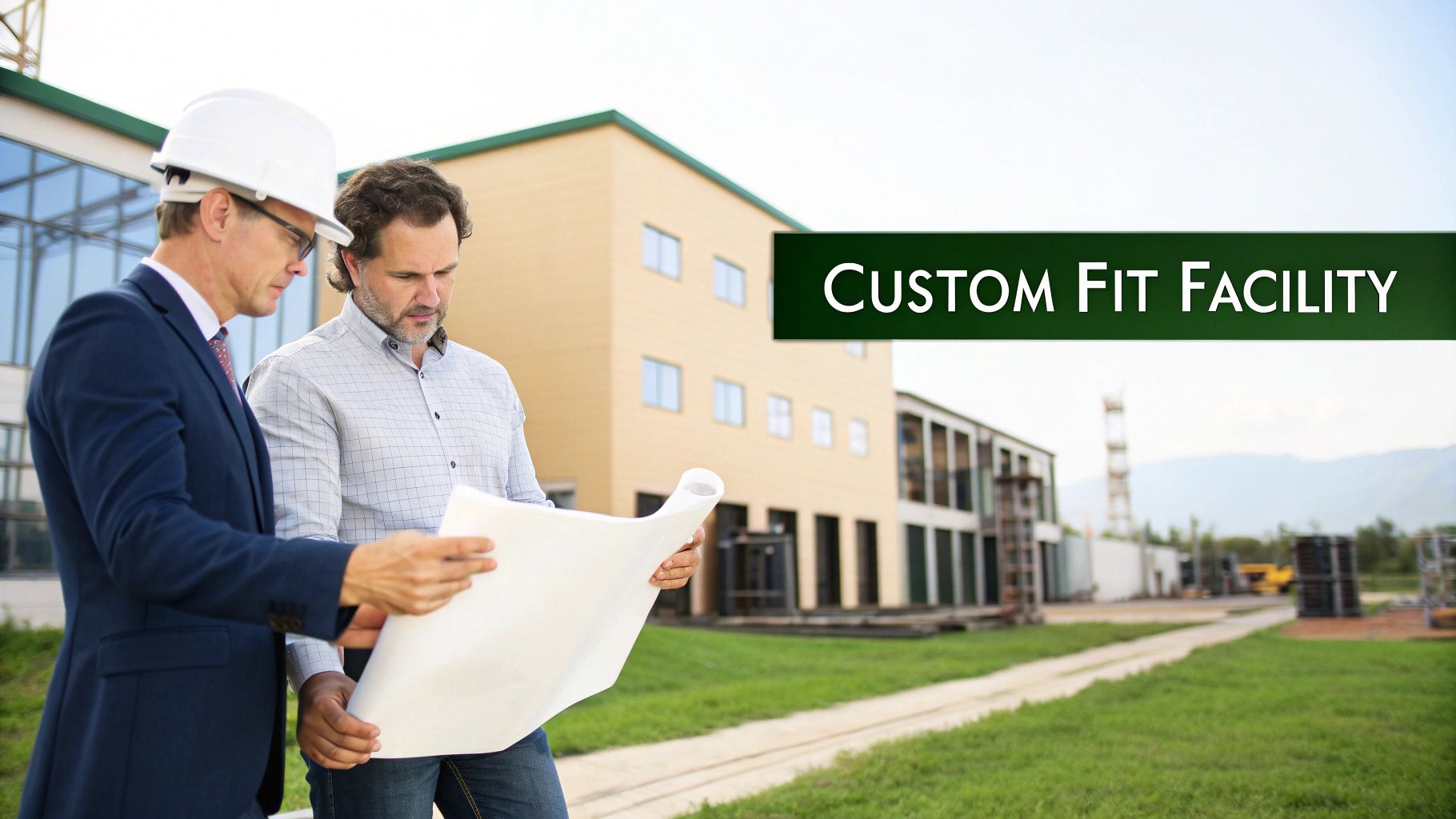
At its heart, a build-to-suit is a partnership. It connects a company with very specific operational needs to a real estate developer who has the funding and know-how to bring that vision to life. The tenant walks away with a perfectly suited building, while the developer secures a steady, long-term income stream from the lease.
This approach is becoming increasingly vital in sectors like industrial real estate. We're seeing a decline in the construction of generic, "speculative" buildings built without a tenant already lined up. For instance, speculative industrial deliveries hit a high of 481 million square feet in 2023 but are forecasted to fall sharply to just 150.2 million square feet in 2025.
As the supply of cookie-cutter space tightens, the build-to-suit model becomes a far more appealing option for companies whose operations are anything but standard.
Key Players in a Build To Suit Project
A successful build-to-suit project isn't a one-person show; it's a carefully coordinated effort between several key players. Each party has a distinct role and objective, and clear communication among them is what keeps the project on track from blueprint to ribbon-cutting.
Here’s a quick rundown of who’s involved and what they’re trying to achieve.
| Player | Primary Role | Key Objective |
|---|---|---|
| The Tenant | The future occupant of the building. | To secure a custom facility that maximizes operational efficiency without tying up capital in real estate. |
| The Developer | The project manager and financier. | To construct a high-quality asset that meets tenant needs and generates a stable return on investment through a long-term lease. |
| The Investor | The long-term owner (often the developer). | To acquire a property with a creditworthy tenant and predictable cash flow, minimizing vacancy risk. |
Understanding these roles is the first step in seeing why this model has become so popular for complex projects.
Why This Model Works
The build-to-suit model truly shines when standard, one-size-fits-all buildings just won't cut it. It’s the go-to solution for industries with highly specific operational demands.
Think about sectors like:
- Logistics and Distribution: These companies often need precise ceiling heights for vertical storage, complex conveyor systems, and a particular layout of dock doors to keep goods moving.
- Manufacturing: A factory might require specialized high-voltage power, reinforced flooring to support heavy machinery, or a custom layout for its production lines.
- Life Sciences and Healthcare: Cleanrooms, labs, and medical centers depend on exacting climate control, specialized ventilation, and other highly technical features that you can't find in a generic building.
- Retail Chains: Even well-known brands like Wendy's use build-to-suit programs to roll out new locations with their standardized, hyper-efficient restaurant designs.
Ultimately, the process requires deep collaboration and meticulous planning. You can see this in action in substantial commercial development projects, where every detail, from the structural engineering down to the specific type of commercial doors, has to be perfectly aligned with the tenant's operational goals.
The Strategic Payoff of Building to Suit
Choosing to go the build-to-suit route is a serious undertaking. We're often talking about a 12 to 36-month journey from the first sketch to moving day. So, why would anyone commit to this long game instead of just signing a lease on an existing building?
The answer is simple: control. A build-to-suit project lets a company create a facility that's more than just real estate—it becomes a high-performance business tool, perfectly molded to its operations.
A Space Engineered for Your Workflow
Think about it. An existing building is always a compromise. You end up bending your processes to fit the space you have, not the space you need. Build-to-suit flips that script completely.
It’s about designing a facility around your unique workflow. You get to create an environment that's built for maximum efficiency and productivity right from the start.
Designing for Peak Performance
Imagine a distribution company getting to decide the exact number and placement of its loading docks to shave minutes off every truck's turnaround time. Or a biotech firm designing a lab with the specific ventilation and power grids it needs for sensitive research. This is the kind of granular control that defines the build-to-suit model.
And this isn't just about solving today's problems. A custom build is your chance to future-proof your operations. You can lay the groundwork for tomorrow's technology, design modular walls that can be reconfigured as teams grow, or even plot out a seamless future expansion on the property.
Key areas where this customization really shines include:
- Workflow Optimization: Laying out a floor plan that creates a natural, efficient flow for people, inventory, and equipment.
- Specialized Infrastructure: Building in the non-negotiables, like reinforced flooring for heavy machinery, clean rooms, or complex climate control systems.
- Technological Integration: Pre-wiring the facility for robotics, automation, and the data infrastructure you'll need in the years ahead.
A custom-built facility is more than just a building; it's a strategic tool engineered to enhance a company's core operations. It turns real estate from a fixed cost into a competitive advantage by directly supporting efficiency and growth.
Ultimately, this level of control ensures the building is an asset that actively works for the business, rather than a liability the business has to work around.
A Savvy Financial and Branding Move
Beyond the day-to-day operations, the build-to-suit model presents some pretty compelling financial and branding upsides.
One of the biggest wins is capital preservation. Instead of sinking millions into buying land and funding construction, a company can keep that cash free for what it does best—investing in R&D, marketing, or hiring top talent.
The developer handles the heavy financial lifting of the real estate project. The tenant’s main obligation is the long-term lease, which translates into predictable operating expenses instead of a massive, upfront capital hit. This structure makes a custom-built facility surprisingly accessible.
A build-to-suit facility also becomes a powerful, three-dimensional representation of a company's brand. The architecture, the materials, the location—all of it can be curated to reflect your corporate identity and values. A sleek, glass-and-steel headquarters can scream innovation, while a building using sustainable materials and green space can broadcast a commitment to corporate responsibility.
This is more than just looks. It’s about making a tangible statement to your employees, your customers, and the community. You get a landmark building in a prime location, all without the risks of ownership, turning your real estate into a powerful symbol of your brand.
A Step-by-Step Guide to the Build-to-Suit Process
Kicking off a build-to-suit project can feel massive, but like any complex endeavor, it becomes much more approachable when you break it down into a clear, step-by-step process. Think of it as a detailed roadmap where each stage builds on the one before it. Following these steps helps ensure every decision is aligned with your ultimate goal: creating a facility that’s a true operational asset.
The entire journey, from the first conversation to opening the doors, typically takes anywhere from 12 to 36 months. The exact timeline will hinge on things like the project's complexity, how ready the site is, and the local permitting landscape. Successfully navigating this requires a solid plan and a strong, collaborative team from day one.
This simple visualization shows how the core advantages of a build-to-suit—customization, capital, and brand—are all intertwined.
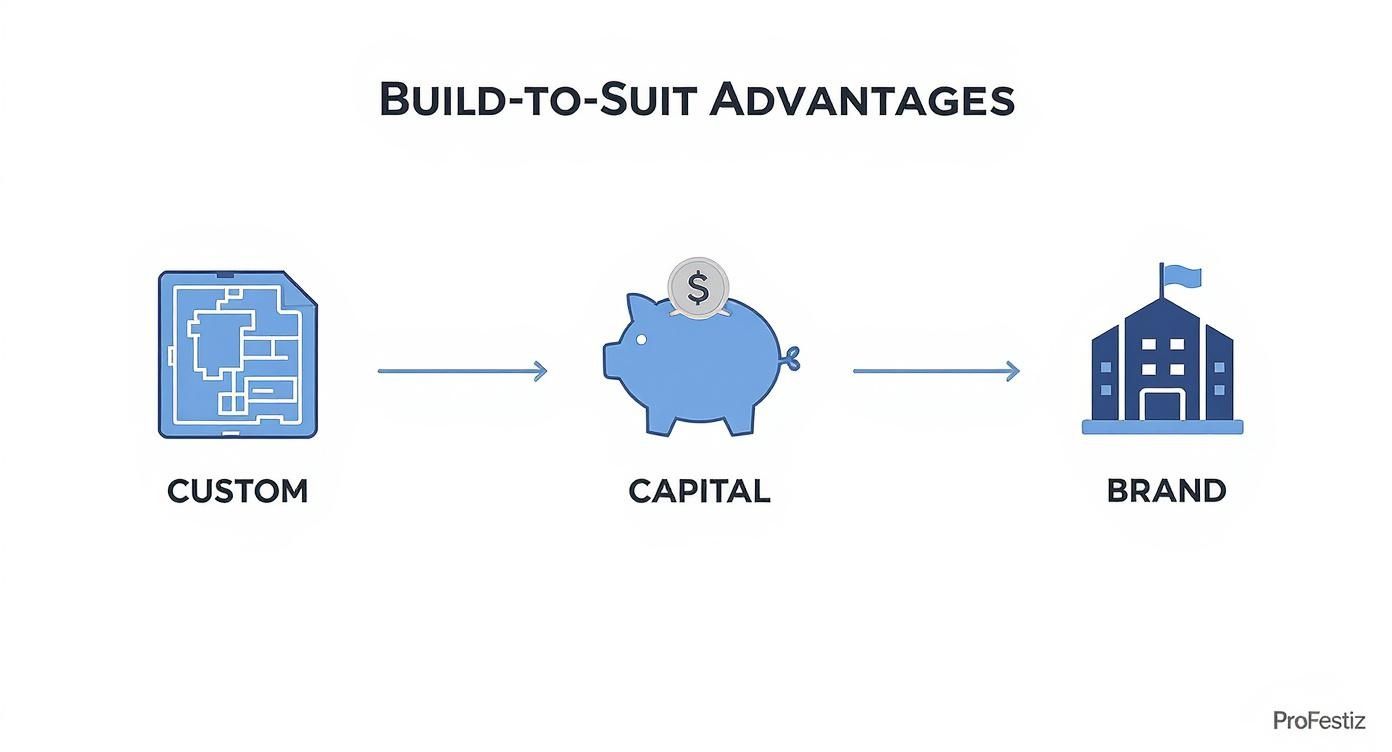
The flow from a custom design to smart capital use and a strong brand presence really highlights how each phase contributes to the project's strategic value.
Phase 1: Assembling Your Team and Defining Your Vision
Long before a single shovel hits the dirt, the most important work happens. This is the foundational stage where you define what you truly need and assemble your expert team. You absolutely cannot over-invest in getting this part right.
Your first job is to translate your business operations into a detailed list of building specifications. This goes way beyond just square footage.
- Operational Must-Haves: What are the non-negotiables? Think specific ceiling heights, floor load capacities, power requirements, or the number and type of docking bays.
- Workflow Essentials: How do people and materials need to move through the space? The layout should make your workflow seamless, not fight against it.
- Future Growth: Where might you need to expand in five or ten years? It’s far cheaper to plan for that possibility now than to try and add it on later.
Once you have your needs outlined, you’ll bring together a team of specialists. This is usually led by a commercial real estate broker with deep experience in build-to-suit deals. Your team will also include architects, engineers, and legal counsel who can protect your interests through what can be a very complex negotiation process.
Phase 2: Site Selection and Due Diligence
With a clear vision and your team in place, the hunt for the perfect location begins. Finding a site for a build-to-suit project is about much more than just finding an empty plot of land. It’s a strategic decision that will impact your logistics, access to labor, and long-term costs for years to come.
Your broker and developer will scout potential sites that check all your boxes for accessibility, zoning, and proximity to suppliers or customers. After you have a shortlist, the due diligence phase kicks in. This is a meticulous investigation designed to uncover any potential red flags.
Due diligence is the project's insurance policy. It involves a thorough review of zoning regulations, environmental assessments, soil testing, and utility access to ensure the site is viable and free of costly surprises.
This stage confirms that the land you’ve chosen can legally and physically support your custom facility, preventing the kind of unforeseen issues that can derail a project's timeline and budget.
Phase 3: Design Finalization and Lease Negotiation
With a viable site locked in, your architect gets to work turning your operational needs into detailed construction blueprints. This is a deeply collaborative phase where your feedback is crucial to ensure the final design is a perfect match for your vision. Every last detail, from the HVAC systems down to the location of data ports, is finalized here.
At the same time, your legal team will be hammering out the details of the build-to-suit lease agreement with the developer. This is a complex document that’s worlds away from a standard rental contract. It clearly outlines who is responsible for what—construction costs, timelines, change orders, and potential delays.
Key negotiation points will include:
- Rent Structure: How the lease rate is calculated based on the total project costs.
- Construction Milestones: Defining key deadlines the developer is contractually obligated to meet.
- Contingency Plans: Agreeing on how cost overruns or schedule delays will be handled.
- Tenant Improvement Allowances: Clarifying what the developer pays for in the base build versus what you’ll cover.
Phase 4: Construction and Final Handover
Once the lease is signed and the developer has secured financing, construction can finally begin. During this phase, your role shifts to monitoring and communication. You’ll be a regular at project meetings to stay updated on progress and help address any issues that pop up.
Demand for build-to-suit facilities, especially in the industrial sector, has exploded. The trend went into overdrive with the e-commerce boom and supply chain disruptions, which pushed companies to hold more inventory and demand more sophisticated warehouses. Just look at Amazon—the company leaned heavily on this strategy, spending an estimated $5.8 billion in 2021 on build-to-suit fulfillment centers. You can learn more about the market drivers behind the build-to-suit surge at Matthews.com.
As construction wraps up, you’ll conduct a final walkthrough of the facility with the developer. This is where you create a "punch list" of any remaining items that need to be fixed or finished. Once those are resolved and the building gets its certificate of occupancy, the developer officially hands over the keys, and your lease term begins. Your custom-built facility is now ready for business.
How Build To Suit Projects Are Financed
Figuring out how a build-to-suit project gets funded is the key to understanding why it's such a game-changer for so many companies. The financing structure is what dictates who holds the risk, who ultimately owns the property, and where all the money comes from. While the fine print can get complicated, nearly all deals boil down to one of two main approaches.
Each path offers a different blend of control, financial obligation, and long-term ownership. Let’s pull back the curtain on these two common financing models to see how an idea on a blueprint becomes a fully operational facility.
https://www.youtube.com/embed/opu6nzPBjbg
The Traditional Developer-Led Model
By far, the most common route is developer-led financing. In this scenario, you can think of the developer as both the project captain and its banker. The developer shoulders the full responsibility—and the risk—of buying the land, securing the hefty construction loans, and managing the entire build-out from day one.
The tenant’s job is to provide the detailed specs for their dream building and, crucially, to sign a long-term lease before any dirt is moved. That lease agreement is the financial linchpin for the entire deal.
The tenant's signed lease is what gives the developer's lenders the confidence to fund the project. It proves there’s a guaranteed, long-term revenue stream ready to flow the moment the doors open.
Basically, the developer puts up all the initial cash and uses the tenant’s strong credit and lease commitment to secure the financing needed to build. Once construction is finished, the developer owns the building and collects rent, while the tenant gets a brand-new, custom facility without tying up a dime of their own capital in real estate.
The Sale-Leaseback Structure
Another popular method is the sale-leaseback, which is sometimes called a reverse build-to-suit. This approach flips the script on who takes the initial lead. Here, the company that will become the tenant manages its own development. They might already own a piece of land or go out and buy the perfect site, then oversee the design and construction of their own facility.
So, why is it called a "sale-leaseback"? Because as soon as the building is complete, the company sells the property to an investor, often a real estate investment trust (REIT). At the very same time, they sign a long-term lease to become the tenant in the building they just built and sold.
This move allows the company to immediately get back 100% of the capital it spent on the project. That cash is now free to be pumped back into the core business—hiring more people, buying new equipment, or funding R&D—instead of being stuck on the balance sheet as a real estate asset.
Comparing Build To Suit Financing Models
So, which one is better? It really depends on a company's financial situation, its appetite for risk, and how much control it wants over the development process. Each model comes with its own set of pros and cons.
To make the differences crystal clear, here’s a simple side-by-side comparison.
| Feature | Developer-Led Financing | Sale-Leaseback Structure |
|---|---|---|
| Initial Capital Outlay | None for the tenant. The developer covers all upfront costs. | Significant for the tenant. They fund the entire construction. |
| Development Risk | Held by the developer. They manage construction risks and costs. | Held by the tenant. They are responsible for project execution. |
| Process Control | Shared. Tenant controls design, but the developer manages the build. | Full control for the tenant. They manage the entire process. |
| Final Ownership | The developer/investor owns the property. | The investor owns the property after the sale is complete. |
| Key Benefit | Preserves tenant capital and outsources development complexity. | Maximizes tenant control and unlocks capital post-construction. |
At the end of the day, both paths lead to the same great outcome: a tenant moving into a facility built exactly for their needs. The real difference is who’s in the driver's seat during construction and how the capital and risk are handled along the way.
Understanding the Risks and How to Mitigate Them
Let's be realistic: while getting a custom-built facility sounds perfect, a build-to-suit project is a massive undertaking. It comes with its own unique set of challenges, and ignoring them is a recipe for disaster. Knowing the potential pitfalls from the very beginning is the best way to steer clear of them and keep your project on track.
The first thing you’ll notice is the significant time commitment. We're not talking about a few months here. A typical build-to-suit project can take anywhere from 12 to 36 months from the first sketch to the day you move in. That timeline demands serious patience and a solid long-term vision, because a lot can change—in the market and in your own business—over two or three years.
Managing Costs and Long-Term Commitments
Every tenant's biggest fear? Cost overruns. It's a classic construction problem. Maybe the crew discovers unexpected issues with the land, material prices suddenly spike, or you decide on a last-minute design change. Any of these can blow up the budget. And since your lease rate is tied directly to the final project cost, a bigger price tag means a higher rent payment for the next decade or two.
This is where a rock-solid lease agreement becomes your best friend.
- Guaranteed Maximum Price (GMP): This is non-negotiable. A GMP clause puts a cap on the total project cost that the developer can use to calculate your rent. It shifts the financial risk of most overruns from your shoulders to theirs.
- Clear Change Order Process: Things change, but how you handle them matters. Your agreement needs a formal process for any deviation from the original plan. This forces everyone to agree in writing on the cost and schedule implications before any new work starts.
The sheer inflexibility of a long-term lease—often 15 to 20 years or more—is another major risk. Committing to a space for that long means you need to be incredibly confident in your company's future growth and operational plans.
Before you put ink on paper, really stress-test your financial forecasts. What if your business pivots in year seven and you need a completely different kind of space? A savvy negotiator will push for clauses that offer an exit ramp, like rights to sublet, options for future expansion, or even early termination penalties under specific circumstances. A little flexibility now can save you a world of hurt later.
The Importance of Your Development Partner
When it comes down to it, the single best way to sidestep almost every potential problem is to choose the right development partner. This isn't just a contractor you're hiring. They are your guide, your financier, and your project manager all rolled into one. Their experience, financial health, and track record are the bedrock of your project's success.
A developer who has been around the block has seen it all—zoning battles, supply chain nightmares, and permitting delays. That hard-won expertise means they can see problems coming a mile away and solve them before they derail the timeline or the budget.
When you're vetting potential partners, dig deep and look for:
- A Strong Track Record: Don't just take their word for it. Ask to see a portfolio of similar build-to-suit projects they’ve completed.
- Financial Stability: Make sure they have the capital and banking relationships to finish a project of this scale, even when things get bumpy.
- Transparent Communication: The best partners are an open book. They should provide regular, honest updates and keep the lines of communication open from day one to the ribbon-cutting.
A great partnership doesn't eliminate risks, but it turns them into manageable challenges. It transforms a complex, high-stakes construction project into a predictable and successful investment in your company's future.
The Future of Custom Commercial Real Estate
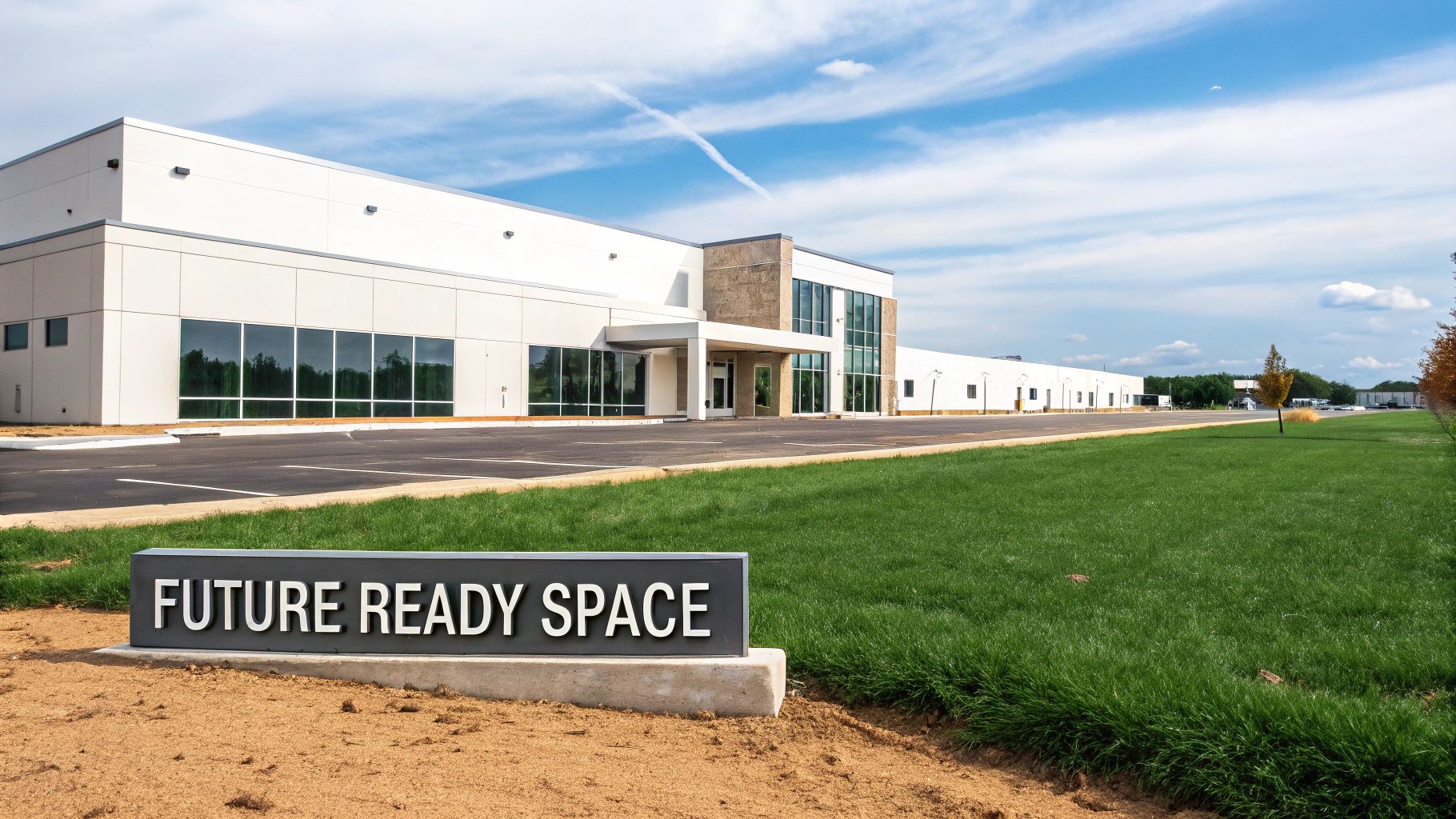
The days of one-size-fits-all commercial real estate are numbered. We're seeing a clear shift in the market, where the build-to-suit model is moving from a niche alternative to a core strategy for ambitious, forward-looking companies. This isn't just a trend; it's a response to powerful forces in technology, sustainability, and specialized industries that need facilities as unique as their operations.
Simply put, a generic warehouse or a standard office park just can't keep up with the complex demands of today's most dynamic businesses. The result? A surge in demand for highly specialized properties that have to be designed and built from scratch.
The Rise of Specialized Facilities
The future of build-to-suit is really being written by industries with very specific, often technical, needs. You just can't retrofit a standard building to become a cutting-edge facility for sectors like these:
- Data Centers: These digital fortresses require massive power loads, advanced cooling systems, and layouts designed for security and airflow—features you'll never find on the open market.
- Life Science Labs: For R&D, non-negotiable elements like clean rooms, specialized HVAC, and precisely controlled environments are the price of entry.
- Advanced Manufacturing: As robotics and automation become the norm, facilities need custom floor plans, heavily reinforced foundations, and specific power grids to support them.
For businesses in these fields, build-to-suit isn't just an option; it's the only practical way to get the job done. It allows them to engineer an environment built for pure innovation and peak performance.
As businesses become more specialized, their real estate must follow suit. The build-to-suit model is evolving from a real estate transaction into a core strategic decision that directly enables a company’s long-term growth and resilience.
Sustainability and Technology as Standard
Not too long ago, Environmental, Social, and Governance (ESG) criteria were a nice-to-have. Now, they are a fundamental driver of real estate decisions. A build-to-suit project is the perfect opportunity to weave sustainability into a building's DNA right from the initial blueprints.
This means creating green-certified, highly energy-efficient buildings that not only slash operational costs but also bolster a company's reputation. Looking ahead, integrating the principles of sustainable real estate development isn't just good practice—it's essential for creating assets that will hold their value.
The global market is already reacting. Data centers, for instance, are in such high demand that 100% of new constructions across nine major markets were pre-leased before they were even finished. With the commercial real estate market projected to hit an incredible $120 trillion by 2025, it’s clear that properties designed for customization and sustainability are becoming the most valuable assets out there.
Got Questions? Let's Talk Build-to-Suit Realities
Even with a solid grasp of the build-to-suit process, a few practical questions almost always come up. It's one thing to understand the theory, but it's another to know how it all plays out in the real world. Let's tackle some of the most common "what ifs" that pop up.
How Long Does This Actually Take?
There’s no one-size-fits-all answer here, as the timeline really depends on what you’re building. For a relatively straightforward industrial warehouse, you could be looking at 12-18 months from start to finish. But for a highly specialized facility, like a life science lab with complex systems, that timeline can easily stretch to 24-36 months or even longer.
Several big variables will shape your project’s schedule:
- Permitting and Zoning: Honestly, navigating the local government approval process can be the most unpredictable and time-consuming part of the whole deal.
- Site Conditions: Starting with a raw piece of land that needs significant groundwork will add months compared to a site that’s already prepped and ready for construction.
- Design Complexity: The more unique your architectural plans and the more specialized your internal infrastructure, the more time you'll need to build it right.
Who's on the Hook If Construction Goes Over Budget?
This is the million-dollar question, isn't it? The answer should be clearly spelled out in your lease agreement. In a properly structured deal where the developer is leading the charge, the tenant is typically protected by a Guaranteed Maximum Price (GMP).
This clause is your safety net. It means the developer takes on the financial risk for most cost overruns. The key exception is when the tenant makes changes after the plans are locked and construction is underway. These "change orders" will almost always add costs, which are then passed back to the tenant, usually by adjusting the final lease rate.
What Happens When the Lease Is Up?
A build-to-suit lease is a marathon, not a sprint. We're talking long-term commitments, often 15 to 20 years. When that initial term finally comes to an end, the tenant typically has a few paths forward, all of which should have been negotiated right at the start.
You have to plan for the end at the very beginning. Getting renewal terms, purchase options, or fair market value adjustments locked in upfront is crucial. It gives you long-term flexibility and saves you from major headaches down the road.
Here are the most common scenarios when the lease ends:
- Renew the Lease: You can choose to extend your stay for another set period. The new rate is often based on the property's current fair market value.
- Buy the Building: Many agreements include a purchase option, allowing you to buy the property at a price that was either predetermined or is based on its market value at the time.
- Move On: You can simply pack up and move out. The developer then takes back the property and finds a new tenant.
At Sherer Architects, LLC, we live and breathe this stuff. We're experts at steering clients through every stage of commercial design and construction, transforming even the most complex ideas into buildings that are efficient, lasting, and beautiful. If a custom facility is on your radar, let our decades of experience help shape your vision. See how we can make it happen by visiting https://shererarch.com.