
SHERER ARCHITECTS

Categories
news

Historic preservation architecture firms: Top Picks for 2025

Historic buildings are more than just structures; they are tangible links to our past, holding stories and architectural significance. Yet, preserving them while adapting them for modern use presents a complex puzzle. This specialized field requires a unique blend of historical reverence, advanced technical expertise, and financial savvy to navigate everything from material science to preservation tax credits. Choosing the right partner is the most critical first step in ensuring a project's success.

This guide is designed to simplify that decision. We've curated a definitive list of top historic preservation architecture firms and specialized online directories that connect developers, property owners, and investors with qualified professionals. Whether your project involves intricate material conservation, large-scale adaptive reuse, or navigating complex local regulations, the right team is essential.

Each entry provides a direct overview of their unique strengths, project specializations, and regional focus. We include screenshots and direct links to help you quickly assess which firm or platform best aligns with your specific project goals. This resource will help you identify a partner who can honor the past while building a profitable, functional, and sustainable future for your historic property.

1. Sherer Architects, LLC

For developers and investors focused on maximizing the value of historic properties, Sherer Architects, LLC stands out as a premier choice among historic preservation architecture firms. Based in Columbia, South Carolina, the firm has built a formidable reputation over 30 years by transforming complex building challenges into profitable, enduring assets. Their portfolio, featuring over 200 successful renovation projects, demonstrates a deep commitment to designs that are not only aesthetically respectful but also financially and environmentally sound.
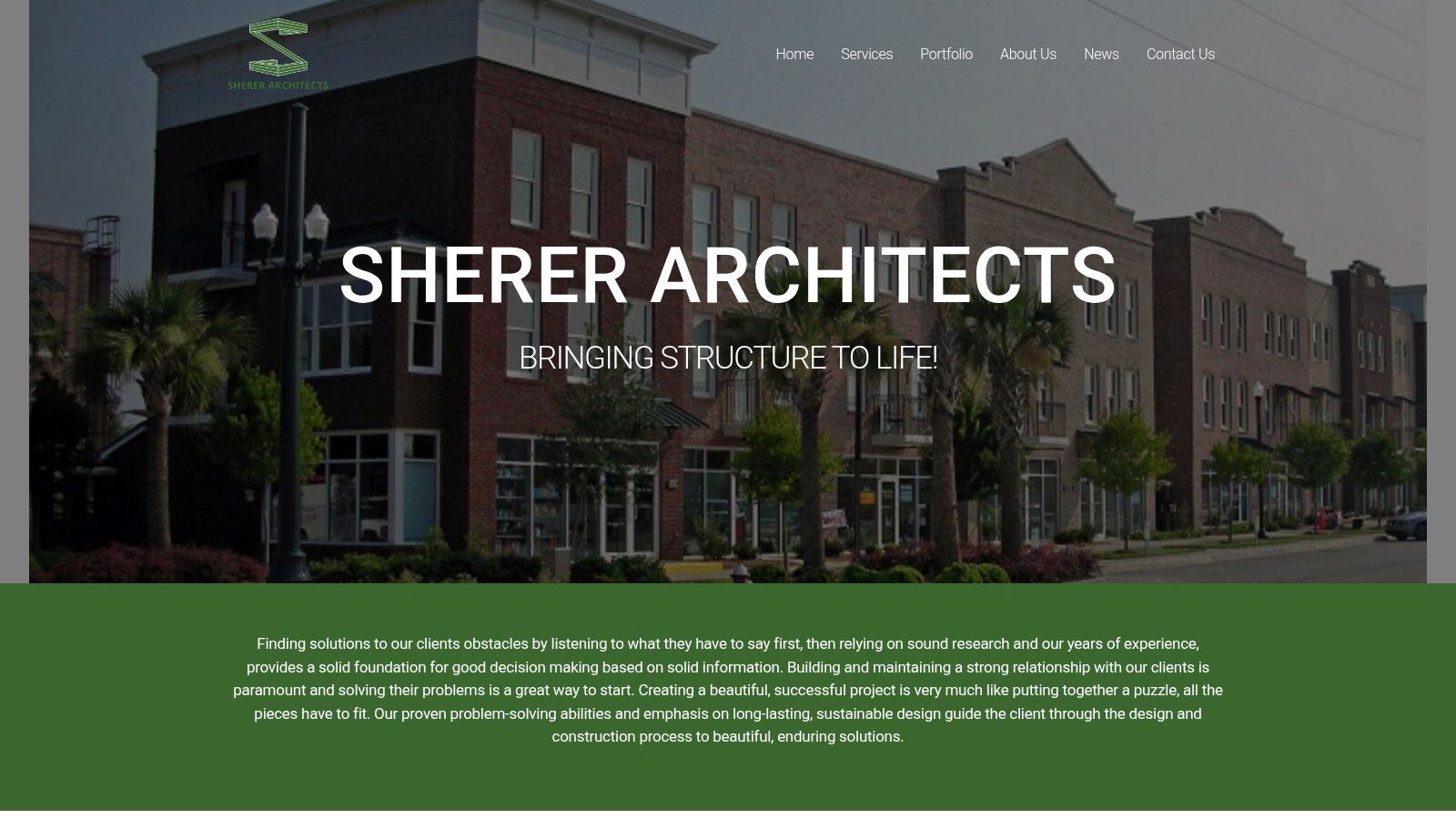
Sherer Architects, LLC

What truly distinguishes Sherer Architects is its specialized expertise in adaptive reuse, a practice that breathes new life into aging structures. The firm’s methodology routinely extends a building's useful life by 50 to 75 years, a strategy that is significantly more cost-effective and sustainable than demolition and new construction. This approach preserves the irreplaceable character of a historic site while modernizing its infrastructure for contemporary commercial use.

Key Strengths & Services

Sherer Architects offers a holistic suite of services that guide clients from initial concept to final construction, ensuring a seamless and profitable project lifecycle.

  • Financial & Regulatory Guidance: A major advantage of working with Sherer is their practical expertise in securing financial incentives. The team actively assists clients in navigating the complexities of historic tax credits, specialized loans, and preservation grants, which can substantially reduce upfront investment costs and improve the project's overall return.
  • Full-Service Design & Permitting: The firm manages every detail, from site optimization and energy-efficient design to navigating local zoning ordinances, Design Review Boards, and building codes. This comprehensive oversight minimizes costly delays and ensures compliance.
  • Authentic Preservation Techniques: For historic projects, the team conducts meticulous research into original materials and construction methods. This dedication ensures that renovations maintain the building's authentic character while integrating modern systems and functionality.

Who It's For

Sherer Architects is an ideal partner for commercial real estate developers, property owners, and investors in the Southeast, particularly those undertaking adaptive reuse or historic preservation projects in South Carolina. Their proven track record of delivering profitable outcomes makes them a dependable choice for clients seeking a collaborative and results-oriented architectural firm. Prospective clients are encouraged to contact the firm directly for a custom proposal, as pricing is tailored to each project's specific scope and requirements.

Website: https://shererarch.com

2. PreservationDirectory.com

PreservationDirectory.com serves as a comprehensive national portal, acting less like a single firm and more like a master key to the entire historic preservation industry in the United States and Canada. For developers and property owners, its primary value lies in its extensive, location-based directories that aggregate a wide array of preservation professionals. This makes it an essential first stop for building a shortlist of potential partners for any restoration or adaptive reuse project.
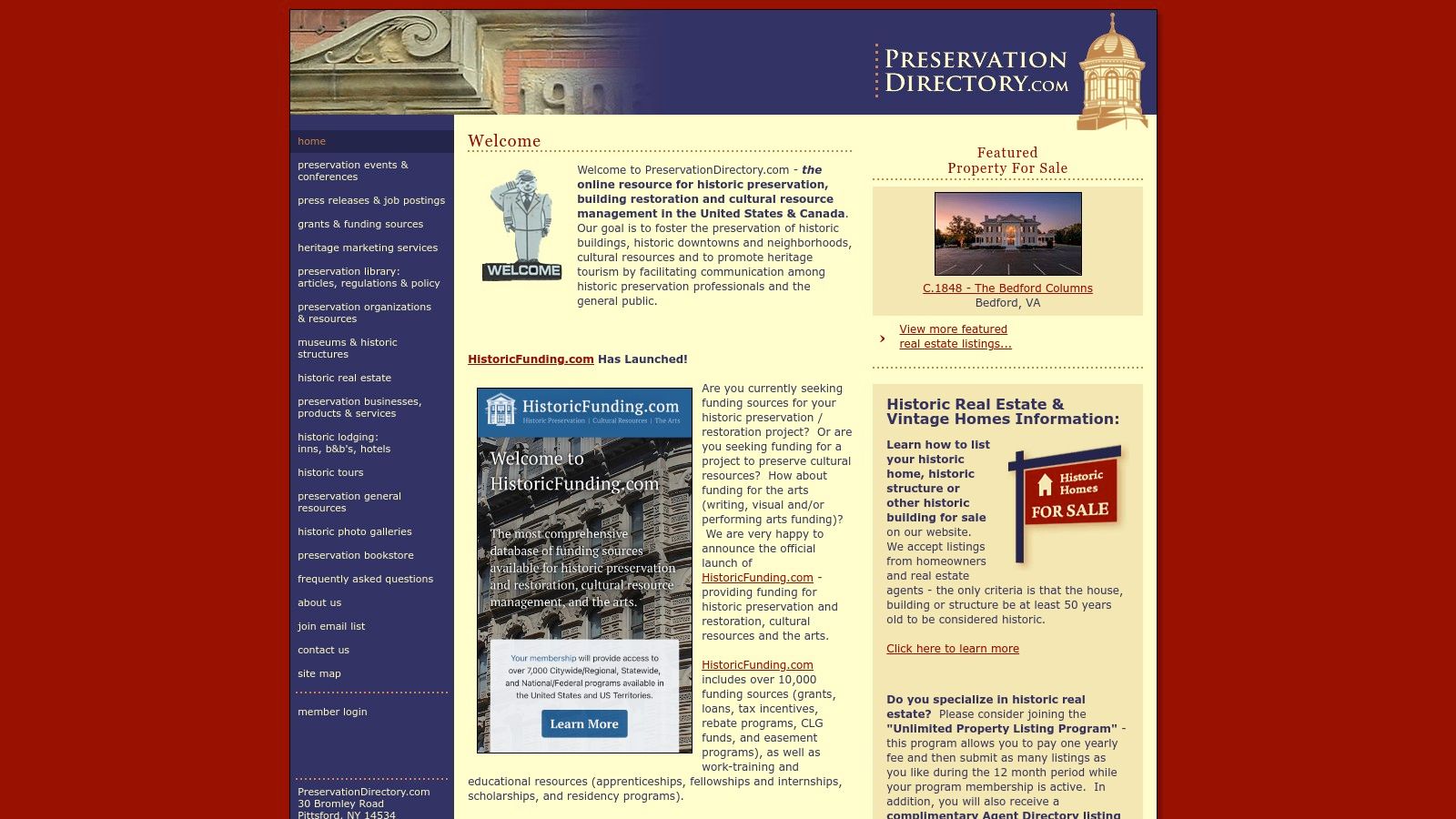
PreservationDirectory.com

Unlike typical search engines, the platform is exclusively focused on the preservation ecosystem. This targeted approach saves valuable time by filtering out irrelevant results, connecting you directly with historic preservation architecture firms, specialized consultants, and skilled craftspeople who understand the nuances of working with historic structures.

Key Features and User Experience

The website's interface is straightforward and utility-focused, prioritizing function over aesthetics. Browsing the professional directories is free and a core feature of the platform. You can easily navigate by state or specialty to find local experts.

  • Professional Listings: Search for architects, contractors, artisans, and consultants.
  • SHPO Connections: Provides direct links to State Historic Preservation Offices (SHPOs), which is critical for navigating regulatory requirements and potential tax credits.
  • Job & Event Boards: These sections offer a real-time glimpse into the industry's pulse, helping you vet firms by observing their hiring needs and community involvement.

The user experience is simple, though some listings are more detailed than others. While the platform provides the connections, you are responsible for the final vetting.

Practical Tip: Use the directory to identify 3-5 local or regional historic preservation architecture firms. Then, cross-reference their listings with their official websites and check their credentials with the relevant state licensing boards and SHPO to ensure they are a good fit for your commercial project.

Platform Access and Value Proposition

Feature Access & Cost Value for Developers & Investors
Professional Directory Free to browse Quickly build a geographically-specific list of potential architectural partners and specialized consultants for your project.
Resource Center Free access Gain direct links to SHPOs, preservation societies, and educational materials essential for project planning and compliance.
Preservation Funding DB Paid subscription required For those seeking grants, provides a searchable database of funding opportunities that can be crucial for project financial viability.

PreservationDirectory.com’s strength is its breadth. It centralizes a fragmented industry, offering a powerful, no-cost starting point for any developer embarking on a historic preservation venture.

Website: https://www.preservationdirectory.com/

3. HistoricPreservation.com

HistoricPreservation.com offers a highly focused and streamlined directory dedicated to connecting developers and property owners with preservation professionals across the United States. Its core strength is its simplicity, providing a direct, no-frills portal specifically for sourcing historic preservation architecture firms and related consultants. For investors needing to quickly identify qualified design partners, this platform serves as a specialized, easy-to-scan contact list.
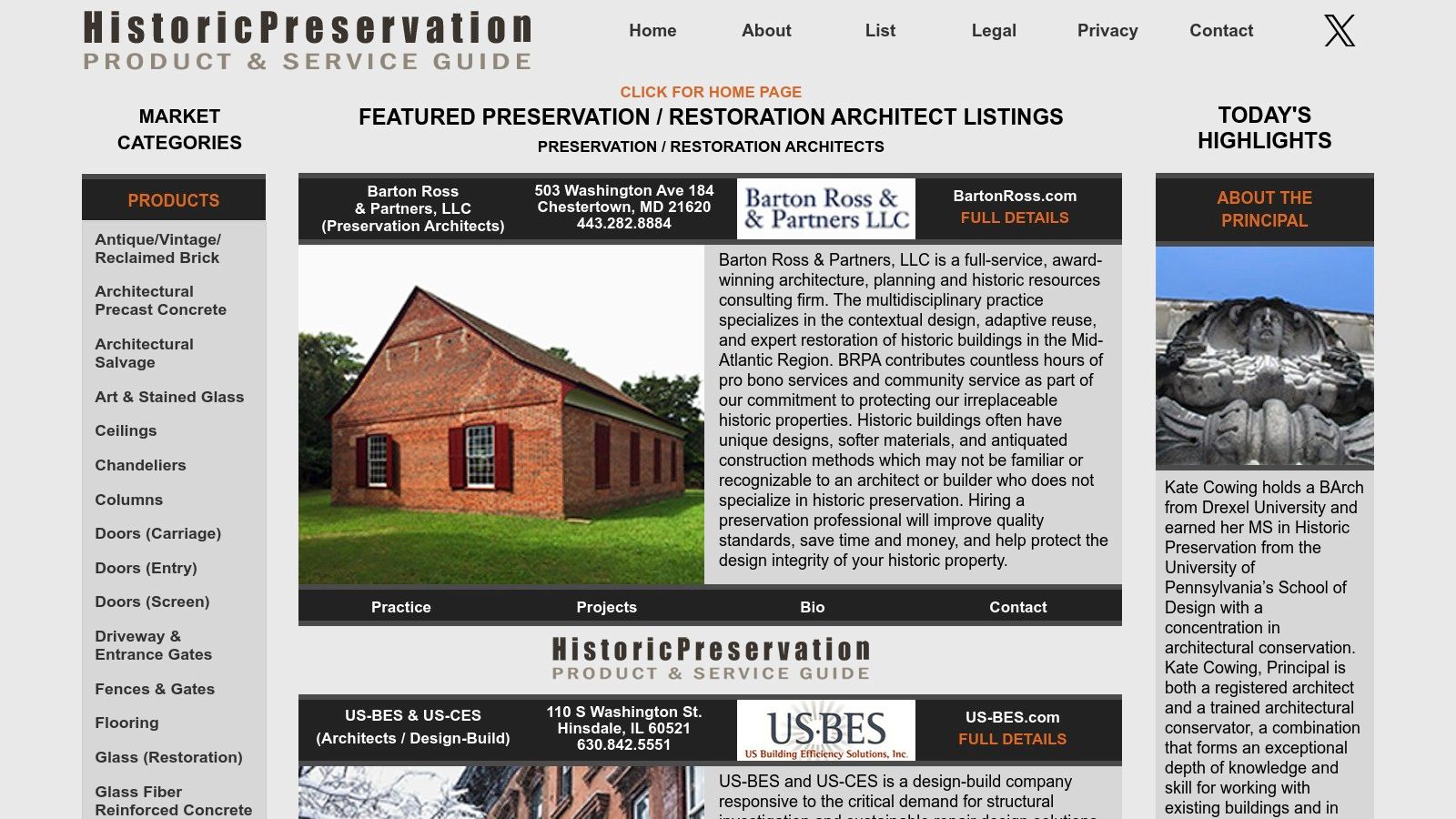
HistoricPreservation.com

Unlike broader professional directories, this website is laser-focused on the preservation niche. This specificity eliminates the noise of generalist firms, ensuring that every listing represents a practice with stated experience in restoration or adaptive reuse. Its straightforward organization makes it an efficient tool for the initial discovery phase of assembling a project team.

Key Features and User Experience

The platform's design is utilitarian, prioritizing direct access to information over a complex interface. The main draw is the "Preservation/Restoration Architects" category, which lists firms alphabetically by state, providing immediate geographic context.

  • Architect-Specific Directory: A dedicated U.S. section for architects simplifies the search.
  • Direct Firm Contact: Listings typically include phone numbers, physical addresses, and direct links to firm websites.
  • Related Trade Categories: Easily find specialists in areas like historic windows, masonry, or decorative finishes.

The user experience is very basic, with minimal search or filtering capabilities. This is not a review platform; you are entirely responsible for conducting due diligence, requesting references, and vetting each firm’s qualifications for your specific project needs.

Practical Tip: Use the state-by-state architect list to create a primary contact sheet. Visit the linked website for each firm to review their portfolio of commercial or adaptive reuse projects. A strong portfolio that aligns with your project's scale and building type is the best initial indicator of a good fit.

Platform Access and Value Proposition

Feature Access & Cost Value for Developers & Investors
Architect Directory Free to browse Provides a fast, cost-free method to generate a list of potential historic preservation architecture firms in your project's region.
Consultant Listings Free to browse Access a curated list of related specialists, from structural engineers to materials experts, to support the architectural team.
Direct Website Links Free access Immediately jump to a firm's official website to view their portfolio and assess their experience without intermediary steps.

HistoricPreservation.com excels as a quick-reference tool. Its value lies in its focused, uncluttered approach, allowing developers to efficiently identify and contact preservation-focused architects without navigating the complexities of a larger, multi-faceted platform.

Website: https://www.historicpreservation.com/usa/consultants/architects.html

4. Association for Preservation Technology International (APTI) – Member Directory

The Association for Preservation Technology International (APTI) is a premier cross-disciplinary organization for professionals dedicated to the practical application of technology in historic preservation. For developers tackling technically complex or nationally significant landmark projects, APTI’s member directory is an invaluable, highly-vetted resource. It connects you with experts who are deeply engaged in the science and methodology of conservation.
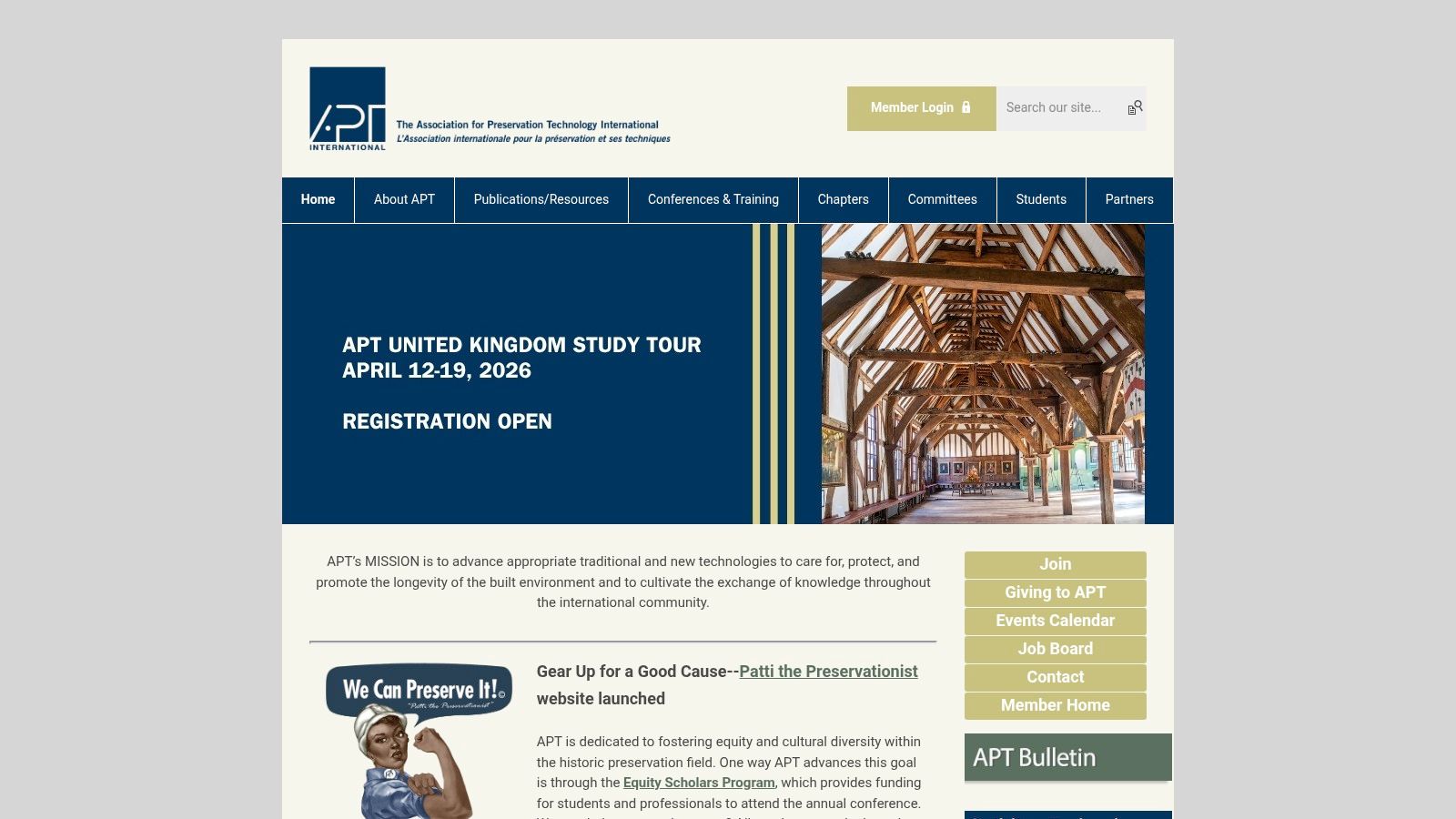
Association for Preservation Technology International (APTI) – Member Directory

Unlike public-facing directories, access to this list is a benefit of membership, which acts as a powerful filter. The members listed are not just practitioners; they are often leaders and innovators in the field. This platform is ideal when you need to find historic preservation architecture firms or specialized consultants with proven expertise in areas like materials science, non-destructive evaluation, or the creation of detailed Historic Structure Reports.

Key Features and User Experience

The value of APTI lies in the quality of its network rather than the flashiness of its website. The platform is geared toward professionals, with a focus on knowledge-sharing and connection. The member directory is the primary tool for developers seeking project partners.

  • Vetted Professional Network: Access a directory of individuals and firms who have committed to APTI's high standards of practice.
  • Specialized Expertise: Easily find experts in niche fields like masonry conservation, historic window restoration, or structural engineering for historic buildings.
  • Local Chapter Connections: APTI has regional chapters, providing a gateway to local networking and identifying firms with on-the-ground experience in your project area.

While the directory is a powerful tool, it requires membership to access. The user experience is straightforward, but its purpose is professional networking, not consumer reviews.

Practical Tip: When evaluating a firm from the APTI directory, note their level of involvement. Are their staff members presenting at conferences or publishing in the APT Bulletin? This signals a deep commitment to the field and can be an indicator of leading-edge expertise.

Platform Access and Value Proposition

Feature Access & Cost Value for Developers & Investors
Member Directory Requires paid APTI membership (various tiers available) Provides a high-quality, pre-vetted list of top-tier historic preservation architecture firms and specialists for high-stakes, technically demanding projects.
Training & Publications Included with membership Offers insight into the latest preservation technologies and methodologies, helping you ask more informed questions during the vetting process.
Local Chapters Included with membership Facilitates regional networking to find local experts and gain referrals from trusted professionals within the preservation community.

APTI is the go-to resource when a project's success hinges on specialized technical skill. The membership fee is a small investment to gain access to a network of the industry's most dedicated and knowledgeable professionals.

Website: https://www.apti.org/

5. Houzz – Architect Directory

While widely known as a consumer-focused platform for residential design, Houzz's extensive architect directory can be a surprisingly effective tool for finding partners for smaller-scale historic projects. Its strength lies in its highly visual format, allowing developers and property owners to quickly assess a firm's aesthetic and experience with historical styles through detailed project portfolios and client reviews.

Houzz – Architect Directory

The platform is not built exclusively for preservation, so savvy searching is key. By using targeted keywords like "historic," "restoration," or "adaptive reuse" in combination with geographic filters, you can uncover local and regional historic preservation architecture firms that have a strong residential or light commercial track record.

Key Features and User Experience

Houzz excels in its user-friendly, visually driven interface, making the initial discovery and comparison phase intuitive. The platform is designed to connect property owners with design professionals, offering robust profiles that often feel more comprehensive than a firm's own website.

  • Visual Portfolios: Architects upload extensive photo galleries of their work, which can be filtered by project type and style.
  • Client Reviews & Q&A: Abundant homeowner feedback provides real-world insights into a firm's communication, process, and quality.
  • Direct Messaging: Built-in tools allow you to contact firms, request information, and solicit quotes directly through the platform.

The user experience is seamless for browsing, but requires diligence. You must vet each firm’s credentials and specific preservation experience beyond the photos.

Practical Tip: Use the "Ask a Question" feature on a firm’s project photos. Inquire about specific challenges they faced with historic materials or regulatory hurdles on a project similar to yours. Their answer can reveal more about their expertise than a standard portfolio review.

Platform Access and Value Proposition

Feature Access & Cost Value for Developers & Investors
Architect Directory Free to browse and contact professionals Provides a visually rich, review-based method for discovering local architects with a demonstrated sensibility for historic styles.
Project Photos & Ideabooks Free access Allows you to gather visual inspiration and better articulate your project goals when communicating with potential partners.
Professional Reviews Free to read Offers valuable third-party social proof regarding a firm's professionalism, budget management, and client collaboration skills.

For small commercial, mixed-use, or high-end residential historic projects, Houzz provides a powerful, free discovery tool. It shines a light on smaller, talented firms that may not appear on larger, industry-specific directories.

Website: https://www.houzz.com/professionals/architect

6. The Blue Book Building & Construction Network

While not exclusively focused on preservation, The Blue Book Building & Construction Network is a powerful B2B resource for developers and investors undertaking large-scale commercial or institutional historic projects. It serves as a vast digital directory and project bidding platform, connecting general contractors and property owners with a wide range of A/E/C (Architecture, Engineering, and Construction) professionals across the United States. Its primary strength lies in its comprehensive database and built-in tools for soliciting interest and managing bids.
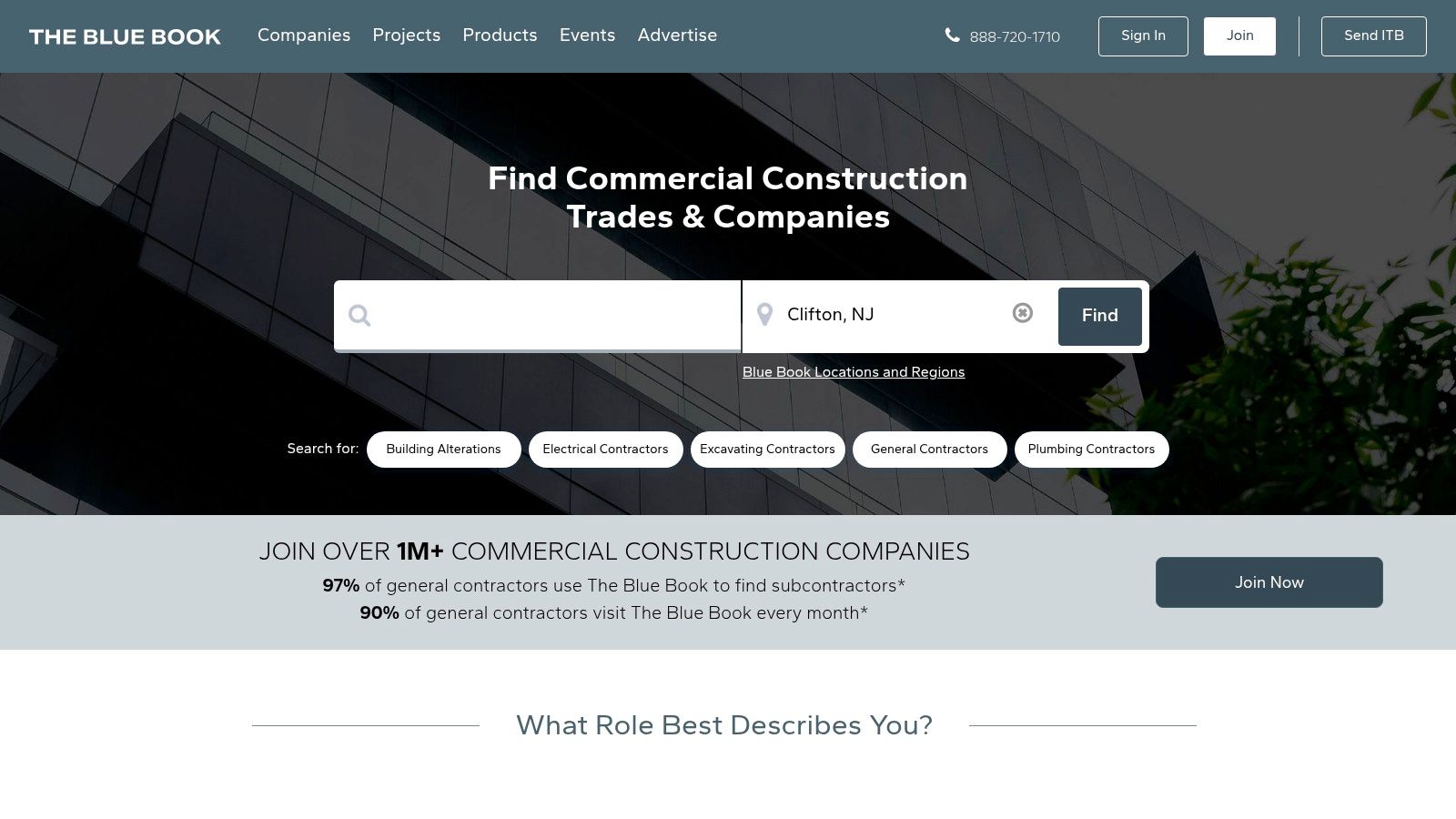
The Blue Book Building & Construction Network

Unlike preservation-specific directories, The Blue Book casts a much wider net, which is advantageous for complex adaptive reuse projects that require a diverse team. The platform allows you to find historic preservation architecture firms and then immediately identify qualified structural engineers, MEP consultants, and specialty contractors all within the same ecosystem. This integrated approach is ideal for assembling a full project team efficiently.

Key Features and User Experience

The Blue Book is designed for commercial construction workflows. Its interface is robust and information-dense, centered on classifications and project-based communication. Browsing the directory is free, but creating a free account is necessary to access deeper contact information and utilize the platform's bidding and messaging tools.

  • Detailed Classifications: Search for professionals across more than 560 specific trade classifications, including "Architects – Historic Preservation."
  • Invitation to Bid (ITB) Tools: Directly solicit interest or request pricing from a list of firms you identify, streamlining the initial outreach process.
  • Project & Network Activity: View information on which firms are active on recent projects, helping you gauge their current workload and relevance in your market.

The user experience is geared toward industry professionals, so it may feel less intuitive for a first-time user compared to a simple directory.

Practical Tip: Use the platform to build a comprehensive team. After identifying a historic preservation architecture firm, use the same keyword searches to find specialized consultants (e.g., "historic window restoration," "masonry restoration") and invite them all to review your project scope through the platform's messaging system.

Platform Access and Value Proposition

Feature Access & Cost Value for Developers & Investors
Professional Directory Free to browse; free account needed for full access Find and qualify architects, GCs, and specialty subcontractors for large-scale commercial or civic historic projects.
Bidding & Messaging Free with account Streamlines the RFI/RFQ process by managing communication and bid invitations directly within the platform.
Project Leads & Data Primarily a tool for subscribers (contractors) Provides insight into which firms are actively bidding and winning work in your region, signaling their market strength.

The Blue Book excels at facilitating the business end of construction. For developers leading major historic renovations, its ability to connect you with and manage outreach to an entire team of qualified professionals makes it an indispensable, high-value resource.

Website: https://www.thebluebook.com/

7. PreserveList.org

PreserveList.org operates as a specialized, no-frills directory designed to connect users with preservation professionals across the United States. Its core strength lies in its streamlined focus on preservation, cultural resource management (CRM), and archaeology, making it a highly relevant resource for the initial phases of a historic development project where identifying specialized consultants is key.
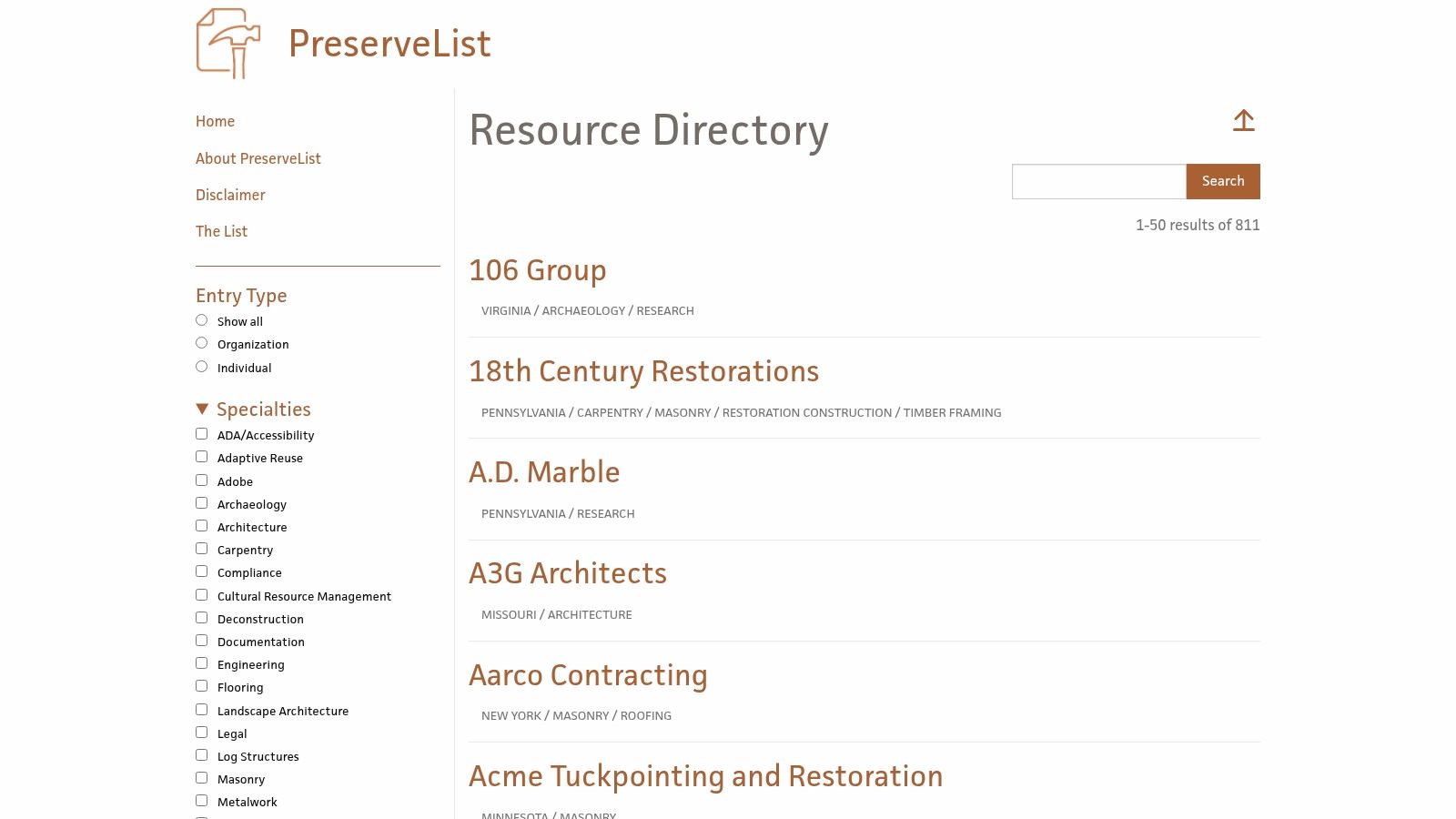
PreserveList.org

Unlike broader professional directories, PreserveList.org filters out the noise by concentrating exclusively on the preservation ecosystem. This targeted approach is invaluable for developers needing to quickly find historic preservation architecture firms or consultants with specific expertise in areas like historical surveys, regulatory compliance, or materials conservation. The platform’s uncluttered nature helps expedite the search for qualified partners.

Key Features and User Experience

The website's design is minimalist and function-driven, prioritizing quick access to information over elaborate presentation. Its main feature is a straightforward, searchable list of firms categorized by state and service type, which makes finding regional experts an efficient process. The user experience is simple, direct, and entirely free for browsing.

  • State and Service Filtering: Easily narrow your search to find firms in a specific U.S. state and by specialty, such as architecture, preservation planning, or archaeology.
  • Direct Firm Links: Each listing provides direct links to the firm’s website and contact information, streamlining the process of outreach and due diligence.
  • Focused Categories: The emphasis on preservation-adjacent fields like CRM ensures you can find consultants for every stage of a project, from initial assessment to design and construction.

While effective, the directory's depth can vary by region, and it relies on users to perform their own vetting.

Practical Tip: Use PreserveList.org to build an initial list of potential historic preservation architecture firms and specialized consultants in your project's state. Because the platform doesn't offer reviews, use the direct links to thoroughly investigate each firm's portfolio, client history, and professional credentials on their own websites.

Platform Access and Value Proposition

Feature Access & Cost Value for Developers & Investors
Professional Directory Free to browse Provides a rapid, targeted method for locating specialized preservation firms and consultants without sifting through irrelevant listings.
State-Based Filtering Free to use Quickly identifies local and regional experts who are familiar with state-specific regulations, materials, and SHPO requirements.
Direct Contact Info Free access Speeds up the vetting and outreach process by providing immediate links to firm websites, portfolios, and contact details.

PreserveList.org excels in its simplicity and focus. For developers who need to quickly identify and contact a shortlist of qualified preservation professionals, it serves as an efficient and valuable starting point.

Website: https://www.preservelist.org/list

Historic Preservation Architecture: 7-Firm Comparison

Service Implementation complexity 🔄 Resource requirements ⚡ Expected outcomes 📊 Ideal use cases 💡 Key advantages ⭐
Sherer Architects, LLC High (🔄🔄) — full design, permitting, historic research Moderate–High — project budgets, local coordination, consultant teams Durable, sustainable adaptive reuse; improved ROI; +50–75 yr extended life (📊) Regional commercial, adaptive reuse, certified historic projects Deep adaptive‑reuse & preservation expertise; tax‑credit guidance; proven client relationships
PreservationDirectory.com Low (🔄) — browse & shortlist nationally Low — free browsing; optional paid funding DB Broad shortlist of professionals and resources (📊) Early research and statewide firm discovery Nationwide preservation coverage; SHPO & funding links
HistoricPreservation.com Low (🔄) — direct, focused listings Low — free; basic firm profiles Quick access to preservation architects and contacts (📊) Fast lookup for preservation‑focused firms Preservation‑specific listings; easy scanning
APTI – Member Directory Medium (🔄🔄) — membership/login required Medium — paid membership; time for networking High‑quality, technically specialized professionals (📊) Complex, landmark, or highly technical conservation projects Membership signal of professional standards; access to specialists
Houzz – Architect Directory Low–Medium (🔄) — consumer marketplace, filtering needed Low — free to browse; time to vet portfolios & reviews Visual portfolios and homeowner reviews to assess fit (📊) Residential or small commercial historic renovations Rich photo portfolios; client reviews and contact workflows
The Blue Book Building & Construction Network Medium (🔄🔄) — classification and bid workflows Medium — account for advanced contact/bid tools Solicited bids and commercial/institutional firm matches (📊) Commercial or institutional historic projects requiring bids Built‑in bid/ITB tools; broad commercial network
PreserveList.org Low (🔄) — state/service tagging for filtering Low — free, link‑rich profiles Fast outreach to preservation specialists by state (📊) Multi‑state searches for preservation planners & consultants Preservation‑specific filtering; direct website/contact links

Choosing the Right Architect to Steward Your Historic Property

Embarking on a historic preservation project is a significant undertaking, blending the art of design with the science of building conservation. The resources and firms detailed in this article, from specialized platforms like PreservationDirectory.com and APTI to broader networks like Houzz and The Blue Book, offer a powerful starting point. They provide the tools to identify potential partners who possess the unique blend of technical skill, historical knowledge, and creative vision necessary to breathe new life into heritage structures.

Your search for the ideal collaborator should be as meticulous as the restoration work itself. The journey from a long list of possibilities to a single, trusted partner requires a structured approach. Use these directories to build a shortlist of historic preservation architecture firms whose portfolios resonate with your project's scale, style, and complexity. An expert firm like Sherer Architects, for instance, exemplifies the value of combining deep preservation expertise with practical experience in adaptive reuse and modern commercial design, a crucial balance for today's market.

Actionable Next Steps for Selecting Your Firm

Once you have a shortlist, the real due diligence begins. This phase is less about browsing websites and more about engaging directly with potential partners. To ensure you find the right fit, consider the following steps:

  • Portfolio Deep Dive: Go beyond the highlight reel. Request case studies or project summaries for work similar to yours. Pay close attention to how they addressed unforeseen challenges, managed budgets, and navigated the regulatory landscape.
  • Reference Verification: Speak directly with past clients, particularly those who completed adaptive reuse or commercial upfit projects. Ask about the firm's communication style, problem-solving abilities, and their capacity to stay on schedule and within budget.
  • Regulatory & Financial Acumen: A key differentiator for top-tier historic preservation architecture firms is their fluency in local, state, and federal regulations. Inquire about their experience with the Secretary of the Interior's Standards and their track record in securing historic tax credits and other financial incentives for clients.

Understanding Your Property's Foundational Value

Before engaging in deep discussions or making significant decisions about your historic property, understanding its current market value is crucial. This baseline knowledge informs your budget, financing strategy, and overall project feasibility. For a detailed overview of this critical step, you can consult a comprehensive guide to the home appraisal process. A professional appraisal provides an objective valuation that can be instrumental when seeking loans or negotiating with stakeholders.

Ultimately, selecting a historic preservation architect is about finding a steward for your property's enduring legacy. It’s a partnership built on shared vision and mutual trust. By leveraging the tools provided and conducting a thorough vetting process, you can confidently choose a firm that will not only respect your building's past but will also secure its vibrant and profitable future for generations to come.


Ready to transform your historic property with a team that masterfully blends preservation and innovation? Contact Sherer Architects, LLC to discuss how our expertise in adaptive reuse and commercial design can bring your vision to life. Visit Sherer Architects, LLC to explore our portfolio and schedule a consultation.
Categories
news

Core contrasts: difference between architecture and engineer

At its most fundamental level, the difference between an architect and an engineer really boils down to vision versus execution. The architect is the creative mind, the one who imagines what a space could be, focusing on the art and science of designing places for people. The engineer, on the other hand, is the technical expert who figures out how to make that vision a reality—safely and efficiently.

The Art and Science of Building

Both architects and engineers are absolutely critical to any construction project, but their day-to-day thinking and core responsibilities couldn't be more different. An architect’s first question is often, "What will this space feel like?" They're obsessed with the human experience: the flow from one room to another, the visual appeal, and how the building will ultimately serve the people inside it. Their work is a delicate balance of artistic expression and practical design.

Engineers start from a completely different place. Their primary question is, "How will this structure stand up?" They apply hard science—physics, mathematics, and material science—to solve very concrete problems. They ensure the building is stable, the systems work, and everything meets strict safety codes. This core difference in perspective shapes everything they do, from their education all the way to the final project deliverables.

I've always said the simplest way to put it is this: Architects design the dream, and engineers make sure the dream doesn't collapse.

Here’s a quick look at where their priorities lie.

Aspect Architect's Focus Engineer's Focus
Primary Goal Design, Aesthetics, User Experience Safety, Structural Integrity, Functionality
Core Question "What is the vision?" "Will the vision work?"
Main Skillset Creative Design, Spatial Planning Technical Analysis, Problem-Solving
Key Priority Form and Space Systems and Structure

Comparing Education and Professional Licensing

The path to becoming a licensed architect or engineer is a demanding one, but the journeys look very different. These foundational differences start in the classroom and shape how each professional approaches their work on a project.

The Architect's Path: A Holistic Approach

For architects, it all starts with a professional degree from a program accredited by the National Architecture Accrediting Board (NAAB). This is typically a five-year Bachelor of Architecture (B.Arch) or a Master of Architecture (M.Arch). Their education is a deep dive into design theory, history, and countless hours in the studio, honing their creative and spatial reasoning skills.

After getting their degree, the real-world training begins. They have to complete the Architectural Experience Program (AXP), which is an intensive, paid internship program. This ensures they get hands-on experience in every aspect of the profession before they're even allowed to sit for the grueling, multi-part Architect Registration Examination (ARE).

The Engineer's Path: A Technical Specialization

Engineers take a much more specialized, analytical route. Their education begins with a four-year bachelor's degree in a specific discipline—like civil, structural, or mechanical engineering—from a program accredited by the Accreditation Board for Engineering and Technology (ABET). Their coursework is heavy on math, physics, and materials science.

The core difference is this: architects are trained to think broadly and creatively about the entire design, while engineers are trained to develop deep, technical expertise in specific systems.

To earn the coveted Professional Engineer (PE) license, a graduate first has to pass the Fundamentals of Engineering (FE) exam. Then, after clocking several years of supervised work experience under a licensed PE, they must pass the comprehensive Principles and Practice of Engineering (PE) exam for their chosen specialty.

So, when you look at an architect vs. an engineer, you're seeing the results of two distinct training philosophies. An architect’s training creates a design-minded generalist who understands the entire building process. An engineer’s training, on the other hand, produces a specialist laser-focused on making sure the building's systems are safe, stable, and functional.

Defining Roles and Project Responsibilities

When you step onto a commercial project site, you’ll find the architect and engineer working in tandem, each with distinct but deeply connected responsibilities. Think of the architect as the project visionary—the one who translates a client's abstract ideas into a tangible, functional design.

Their job is incredibly broad, covering everything that shapes the building's look and feel. They're the ones developing the initial concepts, sketching out detailed floor plans, and choosing materials that bring the visual story to life. Often, the process starts with simple conceptual tools, like an interior design bubble diagram, to map out how spaces will flow and connect.

An architect is the guardian of the project's form, function, and user experience, ensuring the final building not only stands but also inspires.

Ultimately, the architect owns the big picture. They ensure the design is beautiful, meets the client’s goals, and complies with all the local zoning laws and building codes.

The Engineer's Specialized Function

While the architect shapes the vision, the engineers are the technical masters who figure out how to make it a reality—safely and efficiently. They take the architect’s creative plans and apply hard science and mathematics to solve the practical puzzles of construction. This isn't just one person; it's a team of specialists.

Engineers are responsible for all the hidden systems that make a building work. Their specific contributions break down like this:

  • Structural Engineers: These experts design the building’s skeleton. They meticulously calculate the loads for every beam, column, and foundation to ensure the structure can handle everything from its own weight to high winds or even earthquakes.
  • MEP Engineers: This group is all about the building’s circulatory and nervous systems—Mechanical, Electrical, and Plumbing. They design the HVAC networks, lighting, power grids, and water systems that keep occupants comfortable and the building running.
  • Civil Engineers: Their focus is on the land itself. They handle site grading, design drainage systems, and make sure the ground is perfectly prepped to support the building for decades to come.

This partnership is what makes modern construction possible. The architect dreams up what a building can be, and the engineering teams provide the technical blueprint to build it right.

A Look at Key Project Deliverables

If you want to understand the real difference between an architect and an engineer, just look at the documents they produce. An architect’s deliverables are focused on communicating the vision, the feel, and the flow of a space. They’re essentially writing the building's story in a visual language.

Engineers, on the other hand, create highly technical and analytical documents. Their deliverables provide the precise, data-driven instructions that guarantee the architect's vision can be built safely and will perform as expected. These documents form the technical backbone of the project.

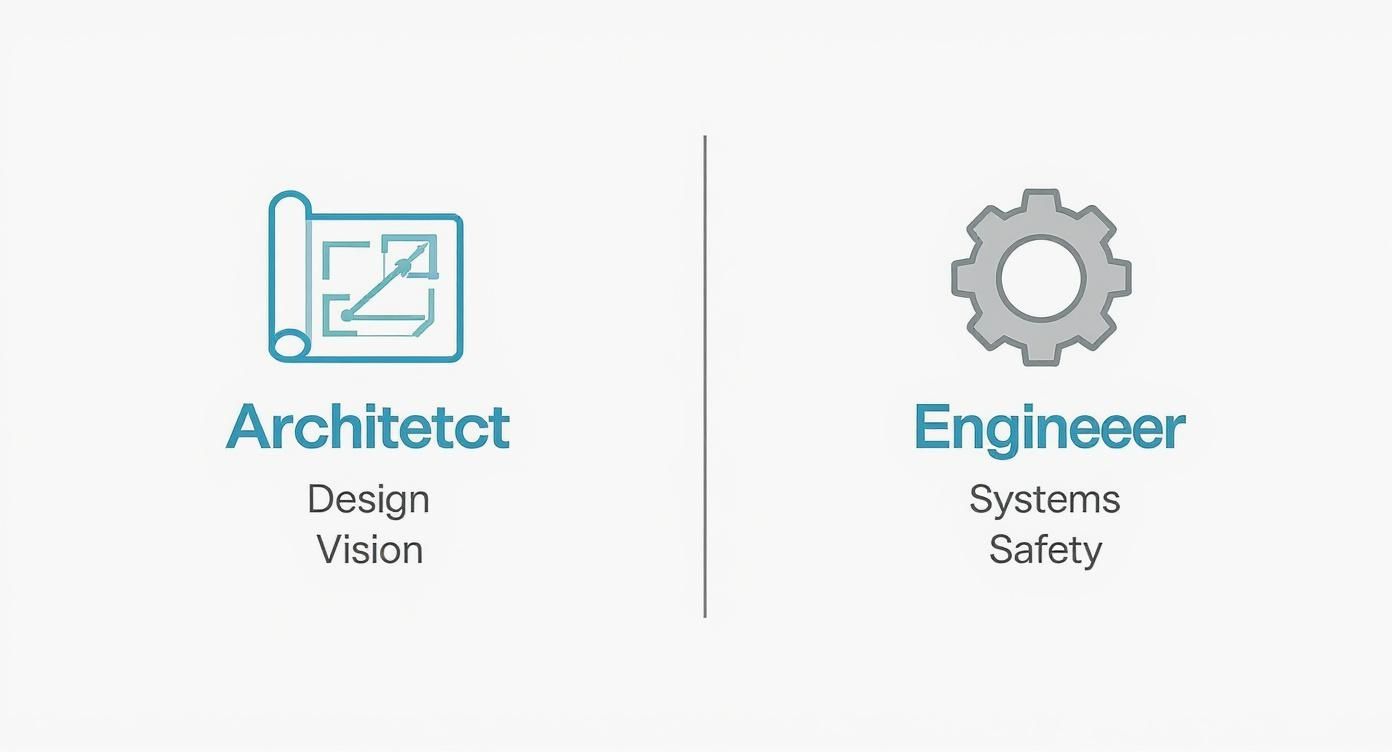
This infographic breaks down the core distinction between an architect's design-centric vision and an engineer's focus on systems and structural integrity.

Infographic about difference between architecture and engineer

The image clearly shows how an architect's world revolves around the overall design concept, while an engineer is responsible for making sure the functional and safety systems are sound.

Defining the What vs. The How

The simplest way to think about it is this: architectural plans define the 'what', and engineering plans define the 'how'. One deals with creative intent and user experience; the other is all about execution and performance.

An architect’s blueprints might show a beautiful, expansive glass wall to maximize natural light. The structural engineer’s calculations and drawings will specify the exact steel beam thickness, bolt patterns, and foundation support needed to ensure that glass wall doesn't collapse under wind load.

Let’s take a look at the typical documents each professional creates during a commercial project.

Architect vs. Engineer: Key Project Deliverables

The table below offers a side-by-side comparison of the primary documents and plans you'll get from each discipline.

Deliverable Type Architect's Output Engineer's Output
Conceptual Plans Schematic designs and 3D renderings that show the building's form, layout, and appearance. Feasibility studies and preliminary structural system analysis reports.
Construction Docs Detailed architectural drawings (blueprints) with floor plans, elevations, and sections. Structural load calculations, mechanical HVAC diagrams, and electrical schematics.
System Details Specifications for materials, finishes, fixtures, and aesthetic components. Plumbing and fire protection plans, and energy performance models.
Final Approvals Documents for zoning and design review board approvals. Calculations and reports for building code safety and compliance.

Ultimately, while the architect's plans capture the soul of the building, the engineer's documents provide the critical instructions that ensure it will stand strong and function correctly for decades to come.

A Look at Salary and Career Paths

When you're weighing a career in architecture against one in engineering, money and long-term growth are always part of the conversation. It's a practical reality. An engineering degree often opens doors to a much broader range of industries—think technology, energy, or manufacturing, not just construction. This versatility can translate into higher average starting salaries and a wider net for job opportunities.

An architect's career path, on the other hand, is almost exclusively tied to the building and design world. It's a more focused journey, but that doesn't mean it's less lucrative. Elite architects who run their own successful firms or lead design at globally recognized studios can absolutely command high incomes, often on par with or even exceeding their engineering peers.

Comparing Earning Potential

Let's talk numbers, because they tell a big part of the story. According to the U.S. Bureau of Labor Statistics, the median annual salary for engineers across all disciplines hovers around $92,000. The top 10% in the field can pull in over $135,000.

For architects, the median salary is a bit lower at $89,000. However, that figure doesn't capture the whole picture. A senior architect leading high-profile commercial projects in a major city like New York or San Francisco can easily earn well into the six figures. You can find more detail on the earning potential for each profession in various analyses.

While the median salary might give engineers a slight edge on paper, an architect's earning potential is heavily tied to their reputation, design creativity, and business savvy. A successful firm owner can earn significantly more than a mid-level engineer.

At the end of the day, both fields offer stable, rewarding, and financially sound career paths. The choice really boils down to what drives you. Are you drawn to the wide-ranging technical problem-solving of engineering, or the focused, creative world of architecture? Both professions provide plenty of room to grow, lead, and earn a great living if you're dedicated and excel at what you do. The fundamental difference is simply in the nature of the work and the industries you'll be a part of.

How Architects and Engineers Work Together

Forget the idea of architects and engineers as separate players. The best projects emerge when their collaboration is seamless, a constant dialogue between creative vision and technical reality. It's not a simple hand-off from one to the other; it's an ongoing feedback loop that refines and strengthens the final design.

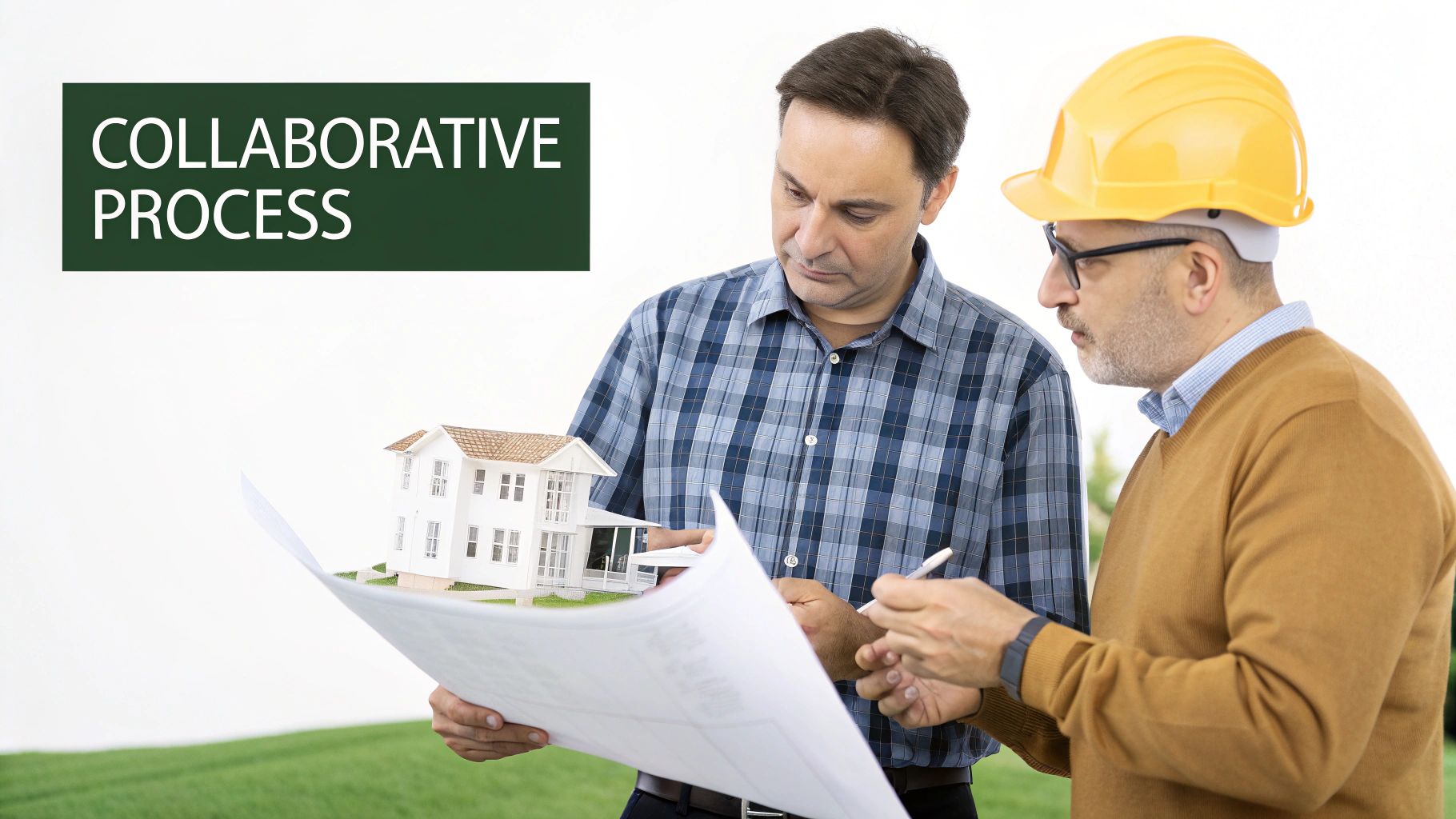
Two professionals, an architect and an engineer, reviewing blueprints on a construction site.

Imagine a modern library being designed. The architect might dream up a grand, open-span reading room with a soaring glass facade, designed to flood the space with natural light. This is the initial concept—the "what."

The Iterative Feedback Process

Once that initial vision takes shape, the engineering team steps in to figure out the "how." They don't analyze the architect’s plans to poke holes in them, but to find the smartest, most effective way to bring that vision to life. This back-and-forth involves a few key steps:

  • Structural Review: A structural engineer looks at the open-span concept. They might suggest using laminated timber beams instead of steel to achieve the desired aesthetic while guaranteeing the roof can handle heavy snow loads.
  • Systems Integration: An MEP (Mechanical, Electrical, and Plumbing) engineer calculates the exact HVAC requirements to maintain a stable climate for a rare book archive, carefully integrating ductwork so it doesn’t disrupt the architectural flow.

This partnership transforms an ambitious design into a functional, enduring building. The architect provides the creative direction, while the engineer ensures that direction is grounded in sound scientific and structural principles.

Constant communication is the bedrock of this process. Engineering requirements have to be integrated early, or you risk expensive redesigns down the line. While architects and engineers have always worked closely in traditional construction, new technologies are opening up different kinds of interactions. For example, a team might explore applications of additive manufacturing in architecture for creating complex, custom facade elements.

Ultimately, this partnership ensures the final structure is not only beautiful but also built to last, proving that the best results always happen when art and science work in lockstep.

Common Questions About Architects and Engineers

It’s easy to get the roles of architect and engineer mixed up. They work so closely together, but their training, skills, and perspectives are fundamentally different. Let's clear up a couple of the most common questions we hear.

Is Architecture or Engineering Harder?

This is a tough one, and the real answer is: it depends entirely on you and your natural abilities. There's no single "harder" path, just different kinds of challenges.

Architecture is incredibly demanding on your creative and artistic side. It requires a knack for spatial reasoning, a deep well of creativity, and the stamina to spend countless hours refining designs. If turning abstract ideas into visual, functional art doesn't come naturally to you, you'll find architecture to be a serious uphill battle.

Engineering, on the other hand, is all about cold, hard science. The difficulty here lies in the rigorous math and physics—applying complex calculations to make sure a structure is safe, sound, and efficient. If you’re a born problem-solver who loves logic and data, you’ll likely feel more at home in the engineering world.

Can an Architectural Engineer Become a Licensed Architect?

Absolutely, but it's not as simple as just switching hats. It’s a dedicated journey because the professions have completely separate licensing and educational requirements.

An engineer looking to become a licensed architect would need to go back to the drawing board, so to speak. They'd have to:

  1. Earn a professional degree from a program accredited by the National Architecture Accrediting Board (NAAB).
  2. Log the required real-world internship hours through the Architectural Experience Program (AXP).
  3. Pass all sections of the rigorous Architect Registration Examination (ARE).

Their engineering background gives them a huge advantage in understanding building systems, but they still have to prove their competency in architectural design and theory.

The core of the matter is that an engineer’s training focuses on making a building work, while an architect's focuses on how a building is experienced. Transitioning between them requires formally learning the other’s core discipline and meeting its unique professional standards.

Ultimately, this process ensures every licensed professional has mastered the essential skills for their title, whether they lean more creative or analytical. Both are crucial for a successful project, but they are built on different foundations.


Are you planning a commercial construction, adaptive reuse, or historic preservation project in South Carolina? The team at Sherer Architects, LLC brings decades of experience to transform your vision into an enduring, valuable asset. Start your project with us today.

Categories
news

Your Guide to Extension and Loft Conversion

You’ve made the big decision to expand your home, which is exciting! But now comes the tricky part: figuring out how to do it. For most homeowners, this boils down to one fundamental choice: do you build an extension or a loft conversion?

Think of it this way: an extension adds a brand-new wing to your home, pushing the walls outwards to create more ground-floor space. A loft conversion, on the other hand, takes that forgotten, dusty attic and turns it into a bright, usable room.

Build Up or Build Out: Which Is Right for You?

This is the first, and most important, question you'll answer. Deciding whether to build up into the loft or out into the garden will shape everything about your project, from the final cost to the type of space you create. Neither option is automatically better; the right path really depends on your property, your budget, and what your family truly needs.

An extension physically expands your home’s footprint, usually into your garden or side return. This is the go-to choice if you're dreaming of a large, open-plan kitchen and dining area that flows into the garden, or a spacious new living room. It's all about reimagining your main living area.

A loft conversion is a clever way to add space by using what you already have. It's often the perfect solution for adding a private master bedroom with an en-suite, a quiet home office, or a playroom for the kids, all without sacrificing a single inch of your precious garden.

It’s no surprise that making use of existing space is becoming more and more popular.

The global loft conversion market is currently valued at over $10.6 billion and is expected to nearly double by 2033. This boom is fueled by homeowners in urban areas looking for smart ways to gain more living space.

This massive market growth shows just how many people are realizing the untapped potential sitting right above their heads. You can dive deeper into these trends in this global loft conversion market report.

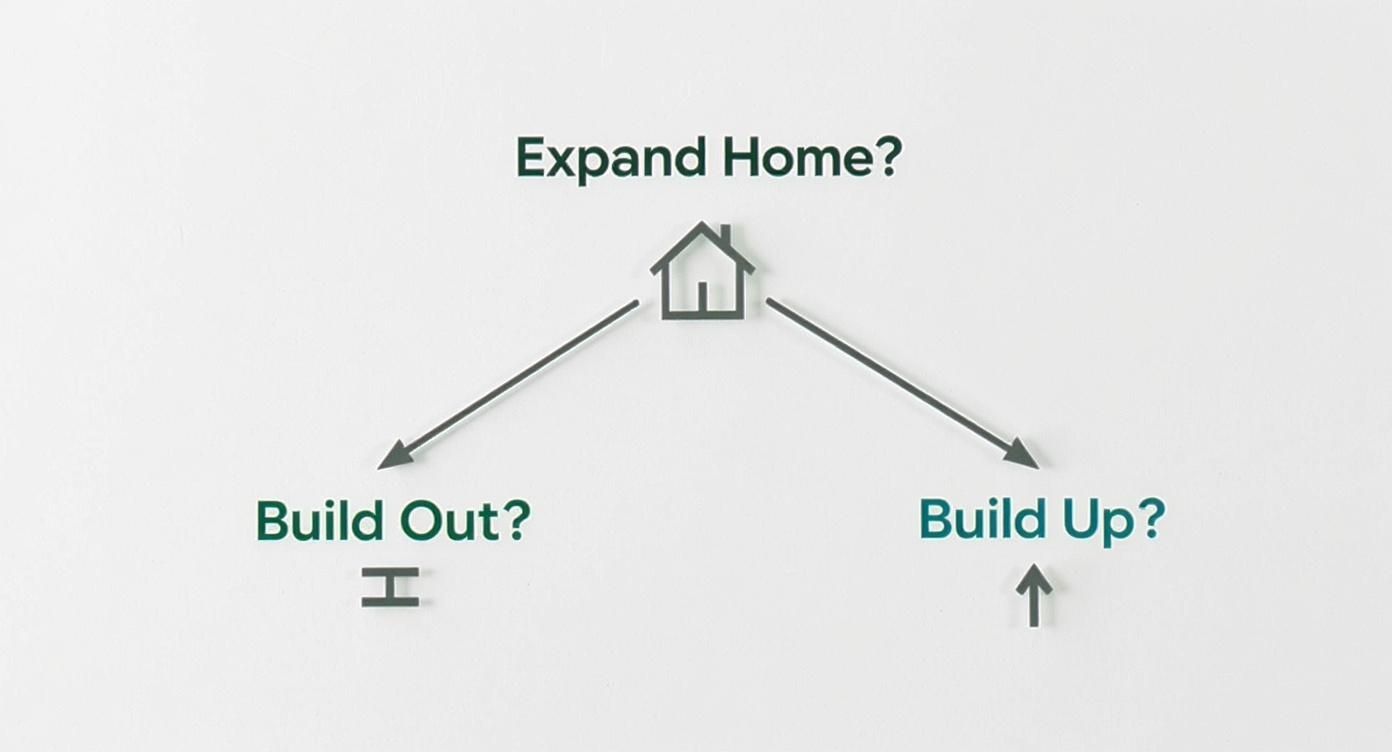
To help you visualize the decision-making process, this infographic walks you through the key questions you should be asking.

Infographic about extension and loft conversion

As you can see, the choice often hinges on whether you can afford to lose garden space and what kind of room you’re hoping to create—a new bedroom versus a bigger kitchen, for example.

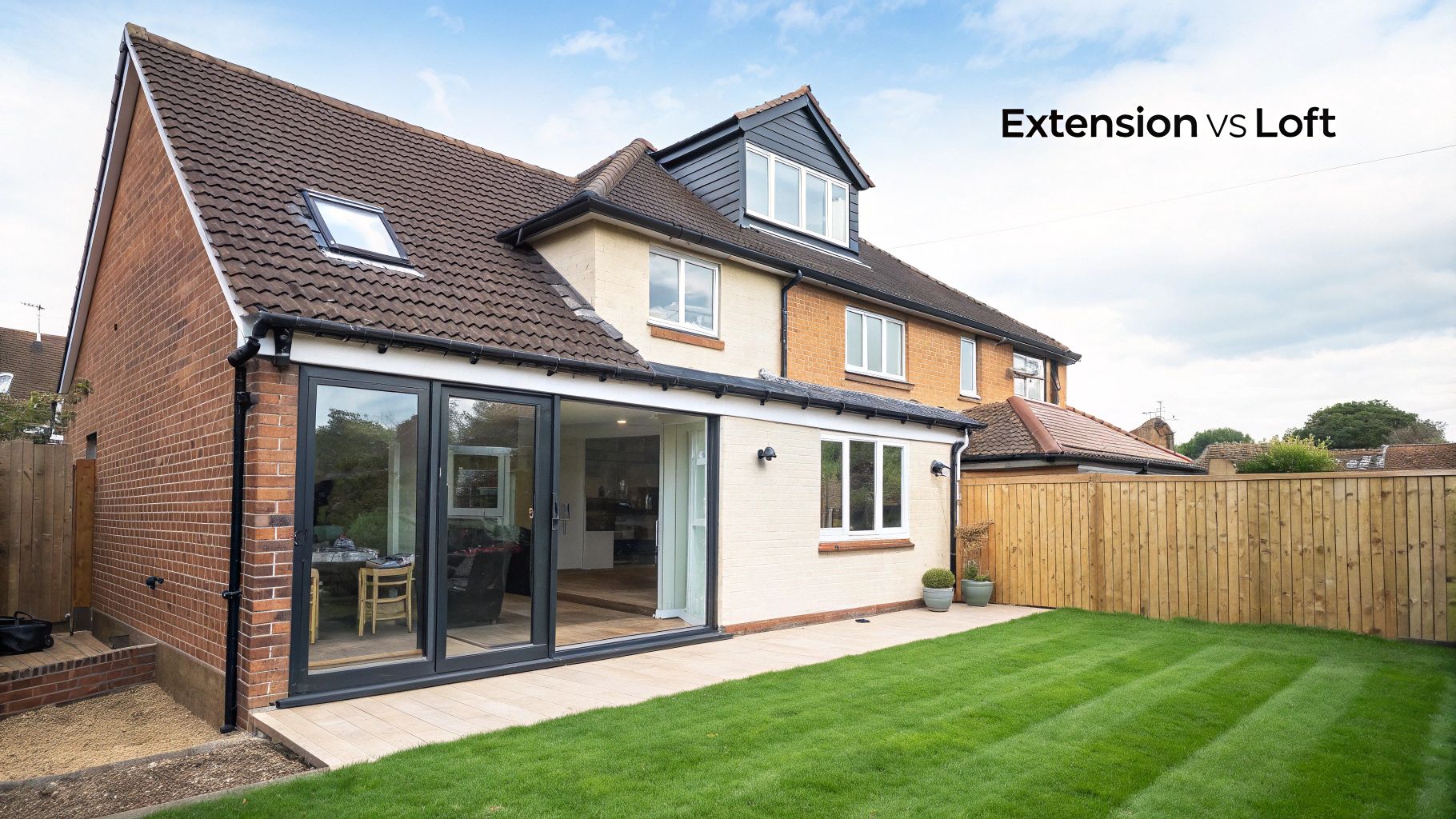
Extension vs Loft Conversion At a Glance

To make things even clearer, let's put the two options side-by-side. Understanding the key differences in cost, disruption, and planning from the very beginning is essential for setting a realistic budget and timeline for your project.

Here’s a quick comparison to help you weigh your options:

Factor Home Extension Loft Conversion
Space Gained Brand new ground-floor square footage. Uses the existing, often wasted, attic space.
Garden Impact Will reduce the size of your garden or outdoor area. Little to no impact on your garden.
Typical Use Great for kitchens, dining areas, and living rooms. Ideal for bedrooms, home offices, and bathrooms.
Disruption Level High. Involves significant groundworks and is quite invasive. Moderate. Most of the work is contained upstairs.
Planning More likely to require full planning permission. Often falls under Permitted Development rights.

This table gives you a snapshot of the pros and cons, but remember that the best choice is always the one that fits your home and your lifestyle perfectly.

Exploring Your Renovation Options

So, you've made the big call: you're either building up or building out. Now for the fun part—diving into the specific designs that will make your vision a reality. Getting to know the different kinds of extensions and loft conversions is key to making sure your home's potential perfectly aligns with what your family actually needs.

Diagrams showing different types of extensions and loft conversions

Think of it this way: you've decided you need an SUV, but now you have to pick the specific model. They all add space, but each type of extension and loft conversion comes with its own unique benefits, layout possibilities, and price tag.

Common Types of Home Extensions

When you decide to extend outwards, you're not just stuck with a boring box. Extensions can be cleverly designed to flood your home with light, create a feeling of spaciousness, and completely change how you use your home.

  • Rear Extension: This is the go-to for a reason. You're simply pushing the back wall of your house out into the garden. It’s the classic way to get that big, beautiful open-plan kitchen and dining area, often with bi-fold doors that create a seamless flow between inside and out.
  • Side-Return Extension: If you live in a terraced or semi-detached house, you probably have a narrow, gloomy alleyway down the side. A side-return extension fills in this dead space, making your rear room wider and transforming a cramped kitchen into a bright, far more usable area.
  • Wraparound Extension: This is the one for a truly dramatic change. A wraparound is basically a side-return and a rear extension combined into a single L-shaped structure. It adds a huge amount of ground-floor space, letting you completely rethink the layout and flow of your home.
  • Multi-Storey Extension: When you need the absolute maximum amount of new space, a two-storey (or even three-storey) extension is the way to go. This isn't just about one room; you can add a bigger living area downstairs and a whole new bedroom or bathroom upstairs at the same time.

Of course, each of these options has a direct impact on your garden. A side-return barely touches it, but a big rear or wraparound extension means you'll have to say goodbye to a piece of your lawn or patio.

Popular Loft Conversion Styles

If you've opted to go up instead of out, the style you choose will hinge on your roof's shape, your budget, and how much headroom you want. Turning a dusty old attic into a proper living space is a serious structural job.

A loft conversion is so much more than just sticking a room in the roof. It’s about unlocking the hidden value locked away in your home's existing footprint. All it takes is seeing a neighbour’s finished project—with its incredible views and light-filled spaces—to realise what’s possible.

Let's break down the most common ways to bring your loft to life.

  • Velux (Rooflight) Conversion: This is the simplest and most budget-friendly route. It’s all about fitting skylight windows into the existing roof slope with very few structural changes. It’s a great fit for lofts that already have decent headroom.
  • Dormer Conversion: A hugely popular choice, a dormer adds a box-like structure that projects from the roof. This gives you vertical walls and a flat ceiling inside, which dramatically increases the usable floor space and headroom. It makes the new room feel less like an attic and more like a proper bedroom or office.
  • Hip-to-Gable Conversion: This one's specifically for houses with a hipped roof (where the roof slopes down on three or four sides). The project involves replacing one of the sloping "hips" with a vertical wall, known as a gable end. This single change massively increases the internal volume, and a dormer is often added to the back as well.
  • Mansard Conversion: As the most extensive and costly option, a mansard conversion essentially changes your entire roof structure. It creates what feels like a whole new storey with nearly vertical walls, giving you the maximum possible space. Planners in conservation areas sometimes prefer this style as it can be more in keeping with older properties.

Picking the right type of extension and loft conversion is a balancing act. You have to weigh your dream space against the real-world limits of your property and local planning rules. By getting a handle on these options, you can start building a much clearer picture of how to best improve your home.

Getting to Grips with Planning and Regulations

Architectural blueprints and a hard hat on a wooden table.

Starting an extension or loft conversion is exciting, but it also means wading into the less glamorous, but absolutely crucial, world of paperwork. The two big hurdles you'll encounter are Planning Permission and Building Regulations. It’s easy to mix them up, but they look at your project through completely different lenses.

Think of Planning Permission as being concerned with the bigger picture—how your project affects your neighbourhood's look and feel. It asks questions like: "Will this extension block your neighbour's light?" or "Does the design fit with the character of the street?" It’s all about the external impact.

Building Regulations, on the other hand, are the guardians of safety and quality. They don’t care what colour your new windows are, but they care a great deal about whether the structure is sound, properly insulated, and safe in a fire. Both are legal requirements, but you won't always need a full application for both.

The Shortcut: Permitted Development Rights

The good news is that many smaller extensions and loft conversions can sidestep a full planning application. This is thanks to something called Permitted Development (PD) Rights. These are essentially a green light from the government allowing certain home improvements, as long as you play by a strict set of rules on size and design.

Sticking within these limits means a faster, simpler approval process. But be warned: the rules are incredibly specific, and local councils can withdraw these rights, especially for listed buildings or homes in conservation areas.

To keep a loft conversion under PD rights, you generally need to follow these rules:

  • Volume Limits: You can’t add more than 40 cubic metres of space to a terraced house, or 50 cubic metres to a semi-detached or detached home.
  • Height Rules: The new structure can’t sit any higher than the highest point of your existing roof.
  • Matching Materials: Exterior materials should be similar in appearance to the rest of the house.
  • No Balconies: Verandas and balconies are a definite no-go under Permitted Development.

For a single-storey rear extension, the main rule is how far out you can build:

  • Terraced/Semi-Detached: The limit is usually 3 metres from the original back wall.
  • Detached Homes: You get a bit more leeway, up to 4 metres from the original back wall.

If your dream design steps over these lines, you'll have to go down the full planning application route.

A quick pro-tip: even if your project is covered by Permitted Development, I always recommend applying for a Lawful Development Certificate (LDC). It’s an official document from the council confirming your build was legal. You’ll be very glad you have it when it comes time to sell your home.

The One You Can't Skip: Building Regulations

Here’s the key takeaway: whether you need Planning Permission or not, you will always need Building Regulations approval. This is non-negotiable. It’s a separate process that ensures your new space is safe, structurally sound, and energy-efficient.

A building control inspector—either from the council or a private approved company—will visit your site at key stages to sign off on the work. They have a checklist of critical areas they need to see.

Here's what they'll be looking at:

  • Structural Integrity: This involves an engineer's calculations to prove the new floors and beams can handle the load.
  • Fire Safety: This is a huge one, especially for lofts. It means installing mains-powered smoke alarms, fire-resistant doors, and having a clear escape route.
  • Staircase Design: The stairs to your new space must meet specific rules for steepness, width, and headroom to prevent accidents.
  • Insulation: To meet modern energy standards, the walls, floor, and roof must be insulated to a very high level.
  • Ventilation: The space needs proper ventilation to stop damp and keep the air fresh.

Trying to bypass Building Regulations is a recipe for disaster. The council has the power to make you tear the work down at your own expense. Getting these two processes right from the very start is the bedrock of a smooth, successful project.

Creating a Realistic Project Budget

Let's talk about money. A solid, realistic budget is the foundation of any successful home renovation, long before the first brick is laid. While those quick per-square-metre estimates you see online can give you a ballpark figure, they rarely paint the full picture of what an extension and loft conversion truly costs.

To get this right, you have to dig deeper. You need a financial roadmap that accounts for everything—from the architect's first sketch and the engineer's calculations right down to the final lick of paint and the light fittings. This isn't just about avoiding nasty surprises; it's about being in control of your project from start to finish.

Breaking Down the Core Costs

Every building project is a cocktail of professional fees, materials, and labour. Getting a handle on these individual parts is the first step to building a budget you can actually rely on.

Of course, these costs aren't set in stone. They can swing quite a bit depending on a few key things:

  • Location: Where you live matters. Building costs in London and the South East can easily be 20% higher than in other parts of the UK.
  • Complexity: A straightforward, box-shaped extension is a different beast entirely from a custom design with intricate rooflines, huge glass panels, or other unique architectural quirks. The more complex, the higher the cost.
  • Specification: This is a big one. The quality of finishes you choose—from the tiles and flooring to the kitchen cabinets and taps—will have a massive impact on the final number on your invoice.

To get a head start on estimating some of the major expenses, you might find it helpful to use tools like a roofing cost calculator to get a feel for those big-ticket items.

Sample Project Cost Breakdown

To show you what this looks like in practice, here’s a sample breakdown comparing how the budget might be split for a typical mid-range rear extension versus a standard Dormer loft conversion. These are just estimates, but they give you a clear idea of where the money goes.

Cost Component Mid-Range Rear Extension (Est. £) Dormer Loft Conversion (Est. £)
Professional Fees £4,000 – £8,000 £3,000 – £6,000
(Architect, Engineer, Surveys)
Main Structure £25,000 – £40,000 £20,000 – £30,000
(Foundations, Walls, Roof)
External Finishes £5,000 – £10,000 £4,000 – £8,000
(Doors, Windows, Cladding)
Internal Finishes £8,000 – £15,000 £7,000 – £12,000
(Plastering, Electrics, Plumbing)
Kitchen/Bathroom Fit-Out £10,000 – £20,000 £5,000 – £10,000
Decorating & Flooring £3,000 – £6,000 £2,000 – £5,000
VAT (at 20%) Included in above estimates Included in above estimates

What's clear is that while the structural work is a huge chunk, the fit-out and finishing touches add up fast. It’s a classic homeowner mistake to focus only on the shell and then get caught out by the cost of making the space actually liveable.

The Essential Role of a Contingency Fund

Here's a piece of advice I give every single client: no matter how perfectly you plan, something unexpected will happen. It’s the nature of construction. You might uncover a hidden structural issue, a supplier might delay a crucial delivery, or you might just change your mind about the tiles you picked out months ago.

That's precisely why you need a contingency fund.

Think of a contingency fund as your project's insurance policy. It's not 'extra' money; it's a planned part of the budget specifically set aside to handle the unexpected without derailing the entire project or forcing you to compromise on quality.

I always recommend setting aside 10-15% of your total construction cost. So, if your build is budgeted at £50,000, that’s a £5,000 to £7,500 buffer.

Having that safety net gives you incredible peace of mind. It turns a potential crisis into a manageable problem, allowing you to make smart decisions under pressure. Honestly, it’s the difference between a stressful, compromised build and one that runs smoothly and ends successfully.

Designing a Smart and Functional Living Space

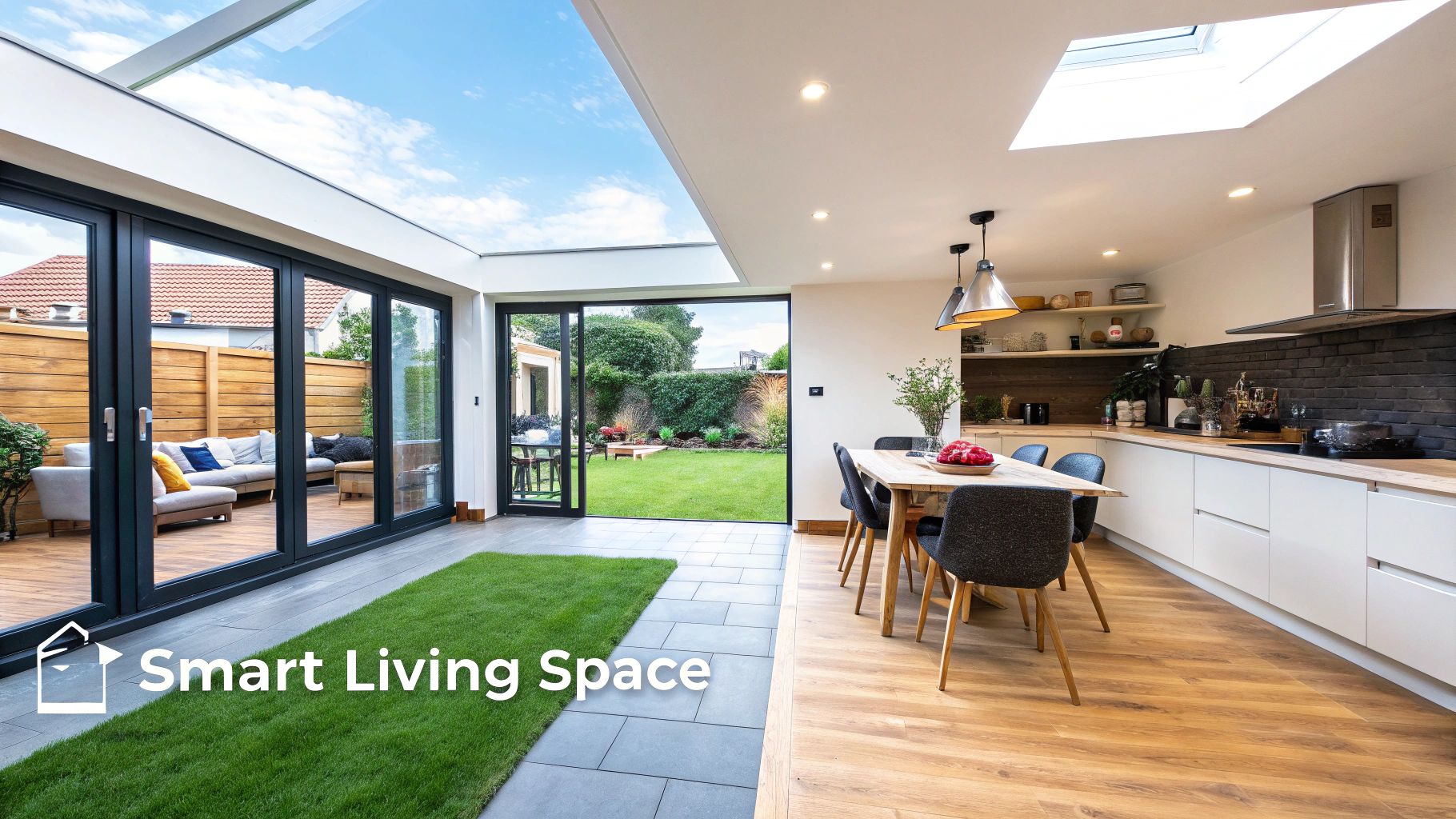
Great design is what turns extra square footage into a space that genuinely makes your home, and your life, better. This is the point where you stop thinking about bricks and blueprints and start imagining how the new room will actually feel. It’s about creating a space you’ll love spending time in, day in and day out.

A truly successful design comes down to getting three things right: light, flow, and the clever practical details. Nail these, and your new addition will feel like it was always meant to be there, not just a box tacked onto the side of your house.

Let There Be Light

Natural light is probably the most powerful tool in any designer's arsenal. A bright, sun-filled space just feels bigger and more welcoming, and it’s a proven mood-booster. Making the most of daylight should be one of your biggest priorities right from the start.

Here are a few tried-and-true ways to do it:

  • Skylights and Rooflights: These are absolute game-changers, especially in a loft. They can drench areas in light that normal windows could never reach, like a dark stairwell or the middle of a room. A well-placed skylight isn’t just a window; it’s a beautiful architectural feature.
  • Glazing with a Purpose: For an extension, big glass elements like bifold or sliding doors are perfect for erasing the boundary between inside and out. But don't just stop at the back wall. Think about adding high-level windows or thin vertical panes to catch the sun as it moves across the sky.
  • Internal Glazing: Want to pull light deeper into the rest of your home? Consider using glass partitions or doors internally. This is a brilliant trick to "borrow" sunlight from your bright new extension and share it with darker, central parts of the original house.

Creating a Seamless Flow

The journey from your existing home into the new space should feel completely natural. The last thing you want is an awkward corridor or a pinch point that makes the layout feel clunky and disconnected. The goal is an intuitive path that ties the old and new together seamlessly.

If you're planning on opening up walls or making any other major structural changes to improve this flow, you'll need expert structural engineering solutions to make sure it’s all done safely. An engineer will figure out the best way to reconfigure the layout without compromising your home’s structural integrity.

In a loft conversion, the staircase isn't just for getting up and down. It's a crucial piece of the design puzzle that dictates the flow of the entire floor below it. Its placement and style need to feel deliberate and integrated.

The Practical Details That Matter Most

Beyond the big picture, a truly great space is comfortable, quiet, and just plain easy to live with. It’s easy to overlook the practical stuff, but getting it wrong can ruin an otherwise beautiful design.

Insulation and soundproofing are two of the most critical elements people underestimate. Good insulation isn't just about ticking a box for building regulations; it’s what keeps your new room cozy in the winter and cool in the summer without sending your energy bills through the roof.

This is especially true for loft insulation, a market that's booming as everyone focuses on energy efficiency. The right materials can slash your heating and cooling costs by 30% or more in a well-insulated space, a huge step towards a more sustainable home. You can find out more about the growing loft insulation market on archivemarketresearch.com.

Likewise, soundproofing is a must, particularly for loft bedrooms sitting above living areas. Using acoustic insulation in the walls and floors stops noise from travelling, keeping things peaceful for everyone. Finally, don't forget the small things—get the placement of your plug sockets, light switches, and radiators right from the start. This is how you make sure your new space isn't just bigger, but genuinely better.

Managing Your Project from Start to Finish

A builder reviewing architectural plans on a construction site.

Alright, the plans are signed off and the budget is set. Now for the exciting part—turning those drawings into a real, physical space. Managing your extension or loft conversion is where the rubber meets the road. It’s all about finding the right team to bring your vision to life, knowing what to expect from the schedule, and keeping the lines of communication wide open.

Honestly, the single biggest decision you’ll make from here on out is choosing your builder. A great contractor is your partner in this, not just a hired hand. Get this choice wrong, and you could be facing stressful delays and expensive mistakes. Taking your time to vet them properly is absolutely essential.

Finding and Vetting Your Builder

Don’t rush this. The best place to start is often by asking for recommendations from friends, family, or even your architect. A word-of-mouth referral is worth its weight in gold. Aim to get a shortlist of three or four potential builders, and then it's time to do some digging.

Here's a simple checklist to follow when you're vetting them:

  • See Their Work: Ask to look at past projects, especially ones similar in scale to yours. If you can, chat with their previous clients to get a real feel for how they work.
  • Check Their Credentials: At a bare minimum, they must have public liability insurance. For bigger jobs, it’s a good sign if they’re members of a trade body like the Federation of Master Builders, as it adds another layer of accountability.
  • Get Detailed Quotes: Never settle for a single figure scribbled on a piece of paper. A professional quote breaks everything down—labour, materials, specialist trades. This transparency is the only way you can compare offers like-for-like.
  • Talk Timelines: Get a proposed start date and a realistic estimate for completion. Things can and do shift, but a good builder will be able to give you a clear schedule from the outset.

Think of the relationship with your builder as a partnership. It has to be built on trust and clear communication. Choosing a team you can actually talk to is just as vital as their technical skill. It's what will get you through the small bumps in the road that pop up on any project.

Understanding the Project Timeline

While no two jobs are identical, the construction process usually follows a well-trodden path. Knowing these stages helps you make sense of the activity on-site and anticipate what decisions are coming your way next. From digging the foundations to putting up the structural frame and finishing with the final lick of paint, there’s a logical flow to it all.

Your job during the build is to stay involved. Be ready to answer questions on the fly—things like where exactly you want the plug sockets or what paint finish you've chosen. Popping by the site regularly keeps the project moving, catches small issues before they become big ones, and ensures everyone is on the same page. Staying engaged is the best way to make sure the project finishes on time, within budget, and to the standard you dreamed of.

Got Questions? We've Got Answers

Thinking about a major home renovation like an extension or loft conversion is a huge step, and it's only natural to have a long list of questions. Getting the right information upfront is the key to a smooth, successful project.

Which Adds More Value: An Extension or a Loft Conversion?

Honestly, both can give your home's value a serious bump, often adding 15-20%. The smart money is often on a loft conversion, which tends to offer a better return on your investment simply because you're making use of space you already own.

That said, a beautifully designed ground-floor extension creating a stunning open-plan kitchen and living area can sometimes add more in pure pounds. This is especially true in family neighbourhoods where a big, sociable kitchen is a top priority for buyers.

The real answer is found in your local market. Take a look at what's selling nearby. Are buyers paying a premium for an extra bedroom upstairs or for that sprawling ground-floor living space? That will tell you everything you need to know.

How Long Does the Actual Build Take?

This really depends on how big and complex your plans are. Timelines can shift, but here's a general guide for the construction phase itself:

  • Loft Conversions: A straightforward Velux conversion can be wrapped up in just 6-8 weeks. A more involved Dormer or Hip-to-Gable loft will likely take 10-14 weeks.
  • Extensions: For a typical single-storey rear extension, you should budget around 12-16 weeks from the day the builders break ground.

Remember, these timeframes don't include the initial design and planning permission stages, which can easily add a few months to the total project timeline.

Can We Live in the House While the Work is Happening?

For a loft conversion, absolutely. It's usually quite straightforward to stay put. Most of the messy, noisy work happens up in the roof, and the builders won't need to break through into your main living space until the very end to fit the new staircase.

Living through an extension can be a bit more disruptive, particularly if the project involves your kitchen or main living room. It's definitely possible to stay, but you have to be prepared for the dust, noise, and general chaos. Some people choose to move out for a few weeks during the most intense parts of the build just to keep their sanity.

Categories
news

Interior Architecture vs Interior Design What to Choose

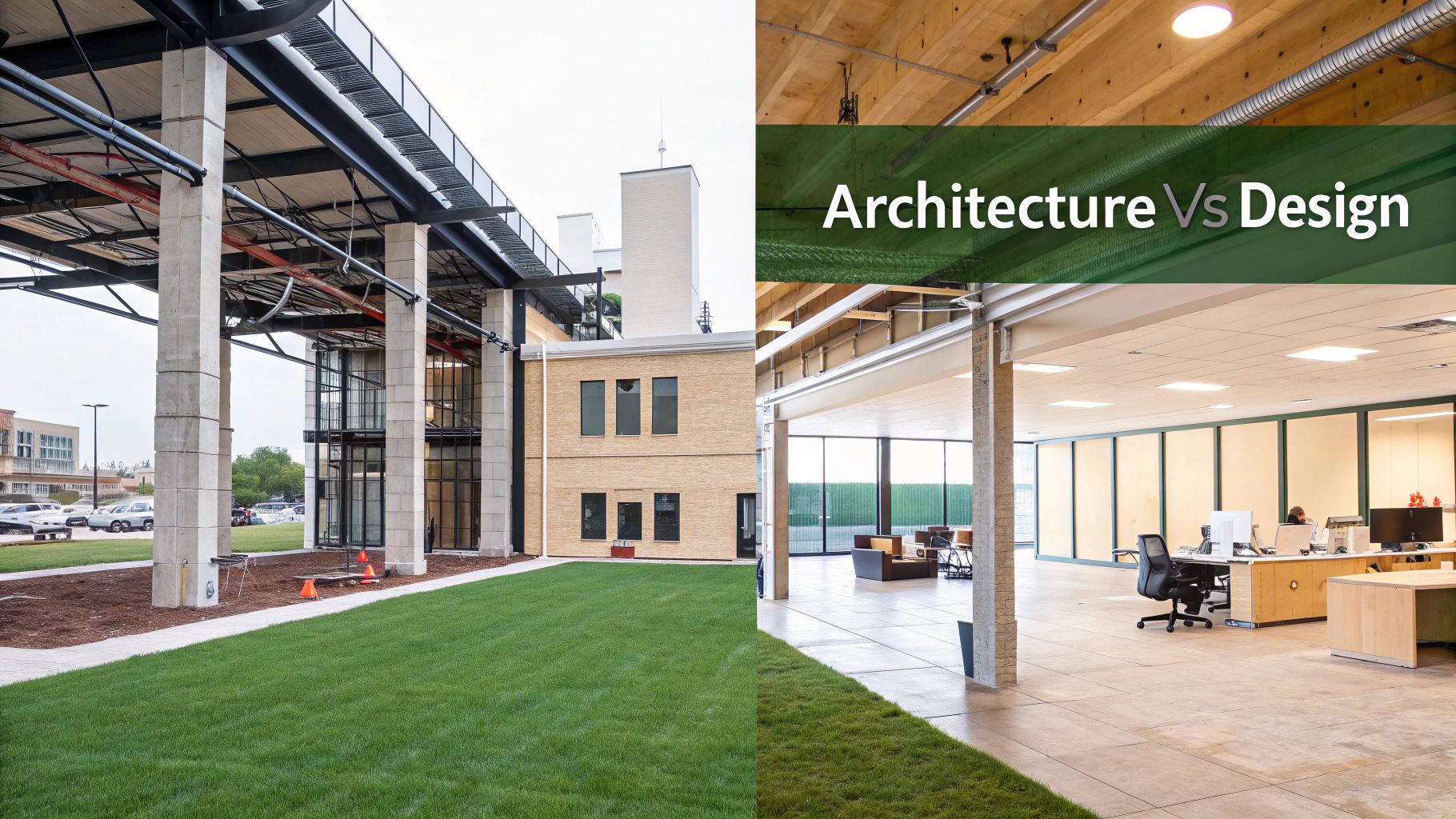
People often use the terms "interior architecture" and "interior design" interchangeably, but they're fundamentally different disciplines. Think of it like this: one professional reshapes the structural bones of a building, while the other perfects its aesthetic skin.

Interior architecture digs deep into structural integrity, building systems, and how the volume of a space works. Interior design, on the other hand, is all about the look, feel, and function within those spaces once they're defined.

Clarifying Core Professional Roles

An expansive, modern commercial interior with high ceilings and structured lighting, showcasing both architectural form and designed decor.

Getting this distinction right is absolutely critical for any commercial project. While these pros often work together, their primary responsibilities, qualifications, and the scope of what they do are worlds apart. Making the right choice from day one ensures your project isn't just beautiful but also structurally sound, legally compliant, and perfectly aligned with your business goals.

The demand for these skills is undeniable. The combined global Architecture and Interior Design market was valued at around USD 1.3 billion in 2023 and is expected to climb to about USD 2.44 billion by 2032. That growth shows just how much businesses rely on experts to create spaces that are both practical and inviting.

At a Glance Interior Architecture vs Interior Design

To really nail down the differences, this table offers a quick breakdown of their core functions. It's a handy cheat sheet for understanding where their expertise lies.

Aspect Interior Architecture Interior Design
Primary Focus The structural and technical "bones" of an interior. The aesthetic and functional "skin" of an interior.
Core Skills Structural engineering, building codes, spatial planning. Color theory, materials, furniture selection, styling.
Typical Changes Moves walls, alters layouts, integrates building systems. Selects finishes, arranges furniture, designs lighting.
Legal Authority Can sign off on construction drawings and permits. Typically cannot approve structural modifications.

The key takeaway is that interior architects create the space, while interior designers make that space livable and functional. One builds the canvas; the other paints the masterpiece.

This becomes even clearer when you look at their day-to-day duties and the kind of problems they solve. If you're interested in digging deeper into the creative side of the equation, it's worth understanding interior design in more detail. Ultimately, knowing their unique contributions is the first step in building the right team for a successful project.

Comparing Project Scope and Core Responsibilities

A sleek commercial office interior with defined zones, glass partitions, and integrated lighting, demonstrating the interplay between architectural layout and design elements.

The clearest way to tell interior architecture and interior design apart is to look at what they actually do on a project. While their paths definitely cross, their core responsibilities are rooted in different phases of the work. At its simplest, one fundamentally changes the space, while the other curates the human experience within it.

An interior architect’s world revolves around the structural and technical integrity of an interior. You bring them in when the layout itself is the problem. Their job is to redesign the space from a macro level, long before anyone starts thinking about paint colors or furniture.

The Architect's Role in Reshaping Space

Interior architects work on the "bones" of a building, a job that involves a whole host of complex and heavily regulated tasks. They are the ones legally qualified to make changes that affect a building’s safety, usability, and compliance with the law.

Their main responsibilities usually involve:

  • Altering Structural Layouts: This is their biggest differentiator. They have the expertise to design plans for moving or even removing walls—both load-bearing and non-load-bearing—to completely transform a floor plan.
  • Integrating Building Systems: They work hand-in-glove with engineers to make sure HVAC, electrical, and plumbing systems are woven seamlessly into the new layout. This requires technical drawings and a serious understanding of how these systems work together.
  • Ensuring Code Compliance: Every structural change is governed by strict building codes and accessibility standards. The interior architect is the one who steers the project through this legal maze and secures all the necessary permits.

An interior architect is constantly asking, "How can we change the physical container to better serve its purpose?" Their work lays the foundation for everything that comes after.

The Designer's Role in Optimizing Space

By contrast, an interior designer takes the baton once the structural "container" is set. They operate within the existing architectural footprint to make the space functional, efficient, and visually aligned with a client's brand and culture. Their focus is squarely on how people will interact with the space.

An interior architect makes sure a building is safe and structurally sound for people. An interior designer makes sure it’s an effective, comfortable, and inspiring place for them to be.

Key responsibilities for an interior designer include:

  • Optimizing Space Plans: They dive into the details, creating layouts for furniture, workstations, and traffic patterns within the given walls to boost efficiency and collaboration.
  • Selecting Materials and Finishes: This is the tactile part of the job—everything from flooring and paint to textiles and wallcoverings that create the desired atmosphere.
  • Procuring FF&E: They manage the whole process of selecting, sourcing, and installing Furniture, Fixtures, and Equipment (FF&E).
  • Designing Lighting Schemes: This is more than just picking pretty fixtures. They plan layered lighting—ambient, task, and accent—to set the mood and make the space work better.

A Commercial Office Renovation Example

Let's say a company wants to renovate an outdated office to make room for new teams.

  • They'd hire the interior architect first to knock down walls between small, private offices and create a large, open-plan area. This architect would also handle rerouting electrical wiring for the new workstations and adjusting the HVAC ducts to maintain proper airflow in the reconfigured space.
  • Once those structural changes get the green light and are finished, the interior designer steps in. They would be tasked with choosing ergonomic furniture, developing a branded color palette, selecting durable flooring, and crafting a lighting plan that cuts down on screen glare, ultimately making the new space both productive and welcoming for employees.

A Look at Professional Education and Credentials

When you're trying to figure out who to hire, understanding the training behind the titles is a great place to start. The journey to becoming an interior architect is steeped in the demanding, technical world of architecture. It’s a long road.

This path almost always requires a professional degree—either a Bachelor of Architecture (B.Arch) or a Master of Architecture (M.Arch) from an accredited program. The curriculum is a deep dive into structural engineering, complex building systems, and materials science. After graduation, they face a multi-year internship and must pass the grueling Architect Registration Examination (ARE) to get their state license. This isn't optional; it's a legal requirement that gives them the authority to sign off on structural plans and be legally responsible for public safety.

The Designer’s Path to Expertise

An interior designer's education, on the other hand, is all about the human experience inside a space. Many earn a bachelor's degree in interior design, and their studies focus on things like color theory, how people move through a room, the properties of textiles, lighting design, and ergonomics. Their training sharpens their skills in creating spaces that are not only beautiful but also work well and feel right.

While not every state requires a license for interior designers, the best in the field prove their expertise through certification. The gold standard is the National Council for Interior Design Qualification (NCIDQ) certification. Earning it involves a combination of formal education and real-world experience, capped off by a tough exam.

Key takeaway: An architectural license is a legal necessity for anyone changing a building's structure. A design certification like the NCIDQ, however, is a badge of professional excellence, signaling mastery in creating beautiful, functional interiors.

How Credentials Shape Careers

These different training paths naturally lead to different career focuses. A quick look at the numbers from the U.S. Bureau of Labor Statistics tells the story. In 2023, about 14,000 interior designers worked within architectural and engineering firms, collaborating closely with architects on projects.

At the same time, around 6,750 designers were employed directly in the furniture and home furnishings retail sector. This highlights how a large part of the profession is centered on aesthetics and sourcing products, not structural overhauls. You can dig deeper into the employment statistics for interior designers on the BLS website.

Ultimately, the credentials clarify the roles. An interior architect is a licensed architect with a specialty in interiors, fully qualified to knock down walls and reconfigure a building’s bones. An interior designer is a certified expert at elevating the function and feel within that existing structure, mastering the art and science of everything you see, touch, and experience inside.

Choosing The Right Expert For Your Project

Figuring out who to hire really boils down to a single, critical question: does your project involve changing the building's structure, or just what's inside it? It sounds simple, but getting this right from the start is the key to matching your project's needs with the right professional.

To make it tangible, let's walk through two very different commercial projects. Each one presents a unique set of problems that clearly points toward either an interior architect or an interior designer.

Case Study 1: The Warehouse Conversion

Picture this: a rapidly expanding tech startup buys an old, cavernous warehouse. They want to turn this raw, industrial shell into a dynamic, modern headquarters. This isn't just a simple paint-and-carpet job.

The challenges here are foundational and complex:

  • Structural Alterations: They need to build out a new second floor for executive suites, which means calculating loads and adding new support columns and beams.
  • Systems Integration: The entire building needs brand-new HVAC, electrical wiring, and plumbing to handle the demands of a high-density office.
  • Code Compliance: New doorways and stairwells must be created, and the whole space needs to be brought up to current fire safety and accessibility standards. This is a non-negotiable legal requirement.

The Right Hire: This job has interior architect written all over it. Only a licensed professional has the technical expertise to fundamentally redesign the building's interior structure, coordinate with engineers, and successfully navigate the maze of building permits. The result is a space that's not only transformed but also safe and legally sound.

Case Study 2: The Retail Brand Refresh

Now, let's consider a well-known retail brand looking to update its 50 stores across the country. Their goal is to create a fresh, consistent brand look and a more compelling customer experience. Critically, the building's structure won't be touched.

Here, the project's focus is on aesthetics and flow:

  • Customer Experience: The plan is to rethink store layouts for better traffic flow, design eye-catching product displays, and create a new, more efficient checkout area.
  • Brand Aesthetics: A new color palette, modern lighting, and custom fixtures are needed to communicate the brand's evolving identity.
  • Material and Furniture Sourcing: All the new furniture, fixtures, and finishes have to be carefully selected, purchased, and installed consistently across every single location.

The Right Hire: This is a perfect fit for an interior designer. Their expertise in spatial planning, color theory, material selection, and brand identity is exactly what this project needs to succeed. The designer will work within the existing architectural footprint to completely reimagine the customer experience, delivering a cohesive and attractive environment that helps boost sales.

This decision tree gives you a quick visual guide. Does your project go to the bones of the building, or does it focus on the look and feel within the existing walls?

Infographic decision tree showing 'Structural' projects leading to an 'Architect' and 'Aesthetic' projects leading to a 'Designer'.

This simple chart helps steer you in the right direction from the get-go. No matter who you hire, always look closely at their portfolio. Professionals who understand architectural photography best practices will be able to clearly showcase the quality and scope of their work.

In short: if you need to move walls, hire an interior architect. If you need to make the space within the walls work beautifully, hire an interior designer.

To help you decide with more clarity, here’s a quick-reference table matching common project tasks to the right expert.

Match Your Project to the Right Professional

Your Project Involves… Hire an Interior Architect Hire an Interior Designer
Knocking down or adding internal walls
Selecting new furniture, art, and décor
Changing window or door placements
Redesigning the lighting plan
Adding a mezzanine or new floor
Developing a new color scheme and material palette
Complying with building codes and permits
Space planning for better workflow or traffic

This table isn't exhaustive, but it covers the most common scenarios. Notice the overlap in areas like lighting and space planning—this is where collaboration often produces the best results. The key is identifying the primary driver of your project: is it structural change or aesthetic enhancement? Your answer points you to your lead professional.

Understanding Project Costs and Budgeting

When you’re weighing interior architecture against interior design, the financial side of things can often feel murky. It’s not just about the final price tag; it's about how that price is calculated. The way these professionals structure their fees is a direct reflection of the work they do and the risks they take on.

An interior architect’s fee is almost always tied to the high-stakes nature of their involvement. Think about it: they’re dealing with structural changes, building codes, and complex technical systems. Because of this, their fee is typically a percentage of the total construction cost. This isn't just an arbitrary number; it mirrors the immense responsibility and comprehensive oversight they provide, ensuring your project is safe, compliant, and built to last.

How Interior Designers Structure Fees

Interior designers, on the other hand, tend to have more flexible fee structures. Their focus is on the aesthetics, furnishings, and flow of a space within its existing shell, so their billing can be adapted to fit the project's unique demands.

You'll commonly see a few different models:

  • Hourly Rates: Perfect for consultations, space planning sessions, or ongoing project management.
  • Fixed Fees: A flat rate for the entire project, which gives you clear budget predictability from the start.
  • Cost-Plus Model: Here, the designer sources furniture and materials at their trade cost and then adds an agreed-upon percentage. It’s a transparent way to handle procurement.

The real story behind the cost difference is liability and scope. An architect’s percentage-based fee is baked into the massive responsibility of changing a building's bones. A designer’s flexible fees reflect their craft in curating the human experience within those walls.

Scope as the Primary Cost Driver

At the end of the day, what truly dictates your budget is the scope of your project. There's a world of difference between knocking down walls and simply refreshing the decor. A renovation that requires moving plumbing, rewiring electrical, and pulling permits will have a much higher cost base than one focused on aesthetics and workflow.

The interior design market, which thrives on these aesthetic and functional enhancements, is a massive industry for a reason. Valued at roughly USD 145.3 billion in 2024, it’s clear that businesses and homeowners invest heavily in refining the spaces they already have. In fact, the residential sector alone accounts for over 60% of that market. You can read more about the growth of the interior design market on grandviewresearch.com.

Knowing this helps you put your budget where it matters most. Are you looking to fundamentally change the structure, or are you aiming to perfect the experience inside it? Your answer will point you to the right professional and the right budget.

Finalizing Your Decision for a Commercial Project

Making the final call between an interior architect and an interior designer really comes down to the bones of your project. Before you even start making calls, a quick self-assessment can point you in the right direction and save you a lot of time.

Think of it as a simple gut check: are you changing the container, or are you changing the contents? That's the core difference.

Key Questions to Define Your Scope

Here are a few practical questions to ask yourself. The answers will make your choice a lot clearer.

  • Do I need a building permit? If you’re moving walls, rerouting plumbing, or touching anything that affects the building's core structure, the answer is a firm yes. That’s interior architect territory.

  • Is my main goal to improve workflow and aesthetics within the existing walls? If you’re focused on making the space work better and look great without demolition, an interior designer is who you need.

  • Does the project need both structural and aesthetic expertise? For a major gut renovation or a complete commercial fit-out, you’ll likely need both. It’s not an either/or situation.

On large-scale commercial jobs, these two roles are partners, not competitors. It's common for an interior architect to handle the heavy lifting of space planning and construction documents, with an interior designer then taking the lead on finishes, furniture, and bringing the brand's personality to life.

The best outcomes on complex renovations come from collaboration. The architect builds the stage, and the designer directs the play. This ensures the final space isn't just structurally sound and legally compliant, but also a place where people truly want to be.

When you get right down to it, defining whether you need structural change or aesthetic refinement is the key. Once you have that answer, you can confidently hire the right expert—or team—to execute your vision safely and effectively.

Frequently Asked Questions

When you're trying to figure out who to hire for your commercial project, the lines between interior architecture and interior design can seem blurry. Let's clear up a few of the most common questions that come up.

Can an Interior Designer Remove a Wall?

The short answer is no. Knocking down a wall—especially if it’s load-bearing—is a structural change. That means it requires a building permit and the trained eye of a licensed professional to ensure everything is safe and up to code.

This kind of work is the bread and butter of an interior architect. They have the technical training and legal sign-off to handle structural modifications. While a designer can certainly suggest new layouts, they can't approve or carry out the actual structural work themselves.

Is an Interior Architect More Expensive Than an Interior Designer?

This is a bit like comparing apples and oranges because their fees are based on completely different types of work. It’s not that one is inherently more expensive than the other.

An interior architect’s fee is often calculated as a percentage of the total construction budget. This makes sense when you consider the high liability and technical oversight involved in structural projects. A designer, on the other hand, might charge by the hour, a flat fee for the project, or a cost-plus model on furnishings and decor.

If your project involves moving walls or altering the building's core, it’s going to be more expensive by nature, which in turn makes the architect's fee seem larger.

The real question isn't about who costs more, but which fee structure fits your project. If you're making structural changes, you need to budget for architectural oversight. If you're focusing on aesthetics and furnishings, your budget will be geared toward design services and procurement.

Do I Need Both for My Commercial Renovation?

For a major overhaul, the answer is often a resounding yes. If you're planning a full commercial fit-out or a gut renovation, bringing both an interior architect and an interior designer to the table is a smart move.

Think of it this way: the architect handles the "bones" of the space—the structural redesign, permitting, and construction documents. The designer then steps in to bring that space to life, focusing on creating an environment that’s functional, on-brand, and beautiful. When they work together, you get a seamless result that’s both technically solid and perfectly aligned with your business goals.


For complex commercial projects involving adaptive reuse, historic preservation, or new construction in South Carolina, the expert team at Sherer Architects, LLC can bring structure to your vision. Learn more about our architectural services and how we can guide your project from concept to completion.

Categories
news

What is commercial architecture? A quick guide

At its core, commercial architecture is the art and science behind designing the buildings where business gets done. We're talking about everything from the high-rise office tower that defines a city's skyline to the cozy local coffee shop on the corner. Unlike a private home, these spaces are built from the ground up to support commerce, welcome the public, and drive economic activity.

Designing the Spaces Where Business Thrives

To really get what commercial architecture is all about, you have to think beyond just the building materials. It's about crafting a strategic environment. A good commercial architect isn't just drawing up a floor plan; they’re creating a functional ecosystem designed to solve a business problem. That might mean designing a retail store layout that naturally guides customers toward key products to boost sales, or it could be an office that encourages spontaneous collaboration.

These buildings are active participants in our economy. They're purpose-built for specific business functions, but they also have a huge responsibility to the public. This dual focus—serving both the business and the people—adds a whole layer of complexity you don't see in other types of architecture. A commercial architect's checklist is long and varied, covering critical points like:

  • Public Safety and Accessibility: This is non-negotiable. It means rigorously following building codes, fire regulations, and accessibility laws like the Americans with Disabilities Act (ADA).
  • Brand Expression: The building itself becomes a physical extension of a company's identity and what it stands for.
  • Economic Viability: It's a constant balancing act between the client's upfront budget, the building's long-term running costs, and the potential for a solid return on investment.

A Tale of Three Architectures

Putting commercial architecture into context helps clarify what makes it so unique. It’s useful to see how it stands apart from its two main counterparts: residential and industrial architecture. While all three involve designing structures, their end goals and the problems they solve are worlds apart. Residential architecture is all about creating personal, private living spaces. Industrial architecture, on the other hand, is driven by process, heavy machinery, and the demands of large-scale production.

Commercial architecture sits squarely in the middle, blending the human-centric focus of residential design with the functional efficiency required by industrial operations. It's a unique discipline that must serve both the business operating within its walls and the public interacting with it.

For a deeper dive into the field, including various applications and considerations, you can explore further resources on commercial design.

The table below breaks down these key differences, showing exactly what makes each field tick.

Commercial vs Residential vs Industrial Architecture At a Glance

Here’s a quick comparison of the three main branches of architecture, looking at their primary purpose, key design considerations, and typical scale.

Attribute Commercial Architecture Residential Architecture Industrial Architecture
Primary Purpose To facilitate commerce, public services, and business operations. To provide private living spaces for individuals and families. To support manufacturing, storage, and industrial processes.
Key Considerations Public accessibility, brand identity, customer flow, building codes, and ROI. Comfort, privacy, aesthetics, personal lifestyle, and family needs. Workflow efficiency, equipment layout, logistics, and durability.
Typical Scale Varies widely, from small storefronts to large mixed-use developments. Typically smaller-scale projects like single-family homes or apartments. Often involves large-scale facilities like warehouses or factories.

As you can see, each discipline operates in its own world, solving for very different human and operational needs.

The Four Pillars of Commercial Design

Every great commercial building, from a massive corporate headquarters to your favorite corner coffee shop, stands on four fundamental principles. I like to think of them as the legs of a table—if one is shaky or missing, the whole thing comes crashing down. These pillars are what architects use to navigate the complex world of balancing a client's dream with the hard realities of construction, public use, and ultimately, the bottom line.

These principles ensure a building is more than just a pretty face. It has to work. It has to do its job, represent the brand behind it, keep everyone inside safe, and make good business sense. Let's break down these four essential pillars that every thoughtful commercial design is built upon.

Functionality and Flow

At its absolute core, a commercial building is a tool for business. Its main purpose is to function flawlessly for the people who use it, whether they're employees, customers, or patients. This is the pillar of functionality and flow, and it's all about how people move and operate within the space.

An architect obsesses over the path people will take through a building. In a retail store, for instance, the layout isn't accidental; it’s carefully crafted to guide you past key products and encourage you to buy. In a modern office, the flow might be designed to spark collaboration, with pathways that naturally lead to common areas and impromptu meeting spots. The goal is to create an experience so intuitive that it feels effortless.

A well-designed space is almost invisible because everything is just where you expect it to be. You know a functional design is a success when people can move through it and get things done without ever feeling lost, confused, or held back by the building itself.

Brand Identity and Aesthetics

A commercial building is one of the most visible, permanent statements a company can make. This second pillar, brand identity and aesthetics, is what turns a generic box into a physical extension of a company’s personality and values. It’s storytelling through architecture.

This is so much more than just slapping a logo on the door. The materials, the colors, the way light fills a room, and the architectural style all work together to send a message. A young tech company might choose an open, industrial look with raw concrete and exposed steel to project a feeling of innovation and transparency. A luxury hotel, on the other hand, will use rich materials and classic forms to communicate elegance and comfort. The building itself becomes a powerful marketing tool, reinforcing the brand for everyone who walks inside.

Safety and Compliance

This third pillar is the one you can't compromise on. It's the absolute foundation of public trust: safety and compliance. Commercial buildings are for the public, and architects have a serious responsibility to protect the health and well-being of every single person who steps inside. This means sticking to a whole host of complex rules and regulations.

This pillar is less about creative flair and more about technical mastery. Key elements include:

  • Building Codes: These are the local and national rulebooks that govern everything from how strong the structure must be to fire safety, proper ventilation, and electrical systems.
  • The Americans with Disabilities Act (ADA): This is a federal law ensuring that public spaces are accessible to everyone. It dictates the design of ramps, doorways, bathrooms, and much more.
  • Public Safety Measures: This covers things like clearly marked fire exits, emergency lighting, and setting limits on how many people can be in a space at one time.

Getting this right requires a deep well of technical knowledge. The architect is the client’s guide through this maze of regulations, making sure the finished building is not only beautiful and functional but, most importantly, legal and safe.

Economic Viability

At the end of the day, commercial architecture has to make financial sense. The pillar of economic viability is what keeps a project grounded, ensuring the design fits the budget, delivers a solid return on investment (ROI), and accounts for long-term running costs. A stunning design that bankrupts the owner is, quite simply, a failure.

Architects work hand-in-hand with clients to find the sweet spot between their vision and their budget. This means making smart choices about materials, construction techniques, and building systems to manage those initial costs. But a good design also has an eye on the future. It incorporates energy-efficient systems and durable materials that will cut down on utility bills and maintenance for years to come. By focusing on economic viability, the architect ensures the project isn’t just a creative achievement but a profitable, long-lasting asset.

Exploring the Diverse World of Commercial Buildings

Commercial architecture isn't one-size-fits-all. It's a collection of specialties, much like how a doctor might focus on cardiology or pediatrics. Architects, too, often develop a deep expertise in specific types of commercial buildings.

Think about it: the design challenges for a bustling shopping mall are worlds apart from those of a sterile hospital. Yet, both are commercial architecture. This variety is what keeps the field so interesting. Let’s dive into a few of the major categories you see every day.

Office Buildings: From Corporate Campuses to Coworking Hubs

Offices are probably the first thing that comes to mind when you hear "commercial building." But the modern office has come a long way from the sea of cubicles we all picture. Today, architects are designing everything from sprawling corporate headquarters for tech giants to flexible coworking spaces for freelancers and startups.

The real puzzle is creating a space that actually supports how a company works. An open floor plan can be great for collaboration, but you also need quiet zones for focused tasks. Things like great natural light, good air quality, and access to amenities aren't just perks anymore—they're essential for attracting and keeping great people.

Retail Spaces: Crafting the Customer Journey

Retail architecture is all about the experience. The goal? To encourage people to buy. Whether it's a massive mall, a tiny boutique, or a big-box store, the design is meant to guide a customer on a carefully planned journey.

Architects who specialize in retail are part psychologist, part merchandiser. They use layout, lighting, and materials to highlight products and build a powerful brand atmosphere.

  • Boutiques: These aim for an immersive, brand-focused vibe that feels exclusive and special.
  • Shopping Malls: They're designed like mini-communities, with traffic flows that ensure shoppers see as many storefronts as possible.
  • Big-Box Stores: Here, it’s all about efficiency. Think wide aisles and clear sightlines to make finding things—and restocking shelves—as easy as possible.

Ultimately, the architecture is there to turn a visitor into a customer by making their shopping trip smooth and enjoyable.

Hospitality and Healthcare: Designing for People

At first glance, hotels and hospitals seem completely different. But they share one critical mission: they are designed entirely around the human experience, often during very important moments in people's lives.

In a hotel or restaurant, the building itself is part of the product. The architecture creates a sense of welcome, comfort, or even luxury. From the grand lobby entrance to the mood of the dining room, every detail is considered to make a guest's stay memorable.

In healthcare, the design priorities shift to patient well-being, safety, and efficiency for the medical staff. A well-designed hospital might use clear signage to reduce stress, place nursing stations for the best patient visibility, and use materials that are both tough and easy to keep sterile. Good architecture can genuinely contribute to healing.

The Rise of Mixed-Use Developments

One of the most powerful trends in commercial architecture right now is the mixed-use development. These projects are like self-contained mini-neighborhoods, blending retail, housing, offices, and entertainment into one seamless complex.

They create vibrant, walkable communities where you can live, work, and play without ever getting in your car. For an architect, this is a fascinating challenge: how do you make these different functions flow into one another to create a lively, energetic urban space?

This growing demand for specialized and diverse commercial spaces is driving a lot of activity. The architectural services market was valued at around $184.1 billion in 2025 and is expected to jump to nearly $330.1 billion by 2033. This boom shows just how vital architects are in shaping how we live and work together. You can read more about the trends driving this architectural services market growth.

The Journey from Concept to Concrete

Turning a great idea for a commercial space into a real, standing building is a marathon, not a sprint. It's a journey with a clear roadmap, moving step-by-step from a rough concept to a fully-realized structure. Think of it less like a single flash of inspiration and more like a carefully orchestrated expedition.

Every stage builds directly on the one before it, ensuring that from the moment you pick a site to the day the final coat of paint dries, every decision serves the project's ultimate purpose. This process is a massive collaborative effort, bringing together clients, architects, engineers, and builders. The architect is like the conductor of an orchestra, making sure everyone is playing in harmony to create a building that works, meets all the rules, and actually delivers on that initial vision.

Let's walk through the five key phases of how it all comes together.

Image

Pre-Design and Feasibility

This is where it all begins—the "is this even possible?" stage. Before a single line is drawn, the architect sits down with the client to hash out the absolute fundamentals: the project's goals, its size and scope, and, of course, the budget. It’s all about asking the tough questions right from the start.

Key activities here are all about due diligence:

  • Goal Setting: Nailing down precisely what this building needs to do for the business. Is it about attracting customers, boosting employee productivity, or streamlining logistics?
  • Site Analysis: Scrutinizing potential locations. This means digging into zoning laws, checking for environmental issues, and making sure there's proper access to utilities and roads.
  • Budgeting: Creating a realistic financial plan that will guide the entire project.

This deep dive ensures the project is built on solid ground—both figuratively and literally. This is also when you start thinking about the physical groundwork, which often means bringing in experienced commercial excavation contractors to prepare the site for construction.

Schematic Design

With the groundwork laid, the creative part really kicks into gear. In Schematic Design, the architect starts translating all those goals and requirements into actual drawings. These aren’t hyper-detailed blueprints yet; they’re more like conceptual sketches, rough floor plans, and basic 3D models that explore the overall look, feel, and flow of the building.

This is the big-picture phase. The architect will often present a few different approaches to see what resonates most. Client feedback is everything here, as the initial sketches are tweaked and refined until they perfectly capture the project’s spirit.

Design Development

Once everyone agrees on the schematic design, it’s time to add the meat to the bones. During Design Development, the architect fleshes out the approved concept with a much deeper layer of detail. This is when decisions are made on major materials, the structural system is locked in, and all the mechanical, electrical, and plumbing (MEP) systems are mapped out.

Think of it like this: Schematic Design is the pencil sketch of a portrait. Design Development is when the artist starts laying down the base colors, defining the shadows, and bringing the subject to life with texture and depth. The basic form is there, but now it’s getting the character and substance that will define it.

Construction Documents

Here's where things get incredibly technical. The architect and the team of engineers produce a massive, highly detailed set of drawings and specifications known as construction documents. These are the official, legally binding instructions for the construction crew. Nothing is left to chance.

These documents spell out everything—from the precise thickness of a wall and the type of bolts to use in the steel frame, to the model number of the light fixtures in the lobby. These blueprints are what the builder will use to price the job, pull permits, and actually build the structure.

Construction Administration

With the plans finalized, the dirt starts to move. But the architect's job is far from over. Their role now pivots from designer to quality control manager. During Construction Administration, the architect is on-site regularly, making sure the builder is following the plans to the letter.

They act as the client’s eyes and ears, answering contractors' questions, reviewing the quality of the work, and signing off on payments. This final, hands-on phase is what guarantees the integrity of the design is carried all the way to the finish line, turning a well-laid plan into a concrete reality.

Future-Proofing Commercial Spaces

Commercial architecture isn’t about building for today; it’s about designing for the next several decades. A great building has to anticipate the twists and turns of technology, culture, and the economy to stay relevant and valuable. This is what we call future-proofing—creating spaces that are resilient and flexible enough to meet tomorrow's needs.

The most successful commercial projects are designed with change baked right into their DNA. They can evolve without needing a gut renovation every few years. This foresight really comes down to mastering three key areas: sustainability, technology integration, and adapting to how people actually live and work. When an architect gets these right, the result isn't just a structure, but a dynamic asset ready for whatever comes next.

Embracing Sustainability and Green Building

Sustainability has moved from a "nice-to-have" feature to a core requirement in modern commercial design. It's what clients and tenants expect. They want spaces that are good for the planet and, just as importantly, healthier for the people inside them. This shift means architects are weaving green building principles into the fabric of a project from the very first sketch.

This isn't just about sticking solar panels on the roof. It’s a comprehensive approach that considers a building’s entire lifecycle, from where the materials come from to how much energy it uses every day. Some of the key strategies include:

  • LEED Certification: Leadership in Energy and Environmental Design (LEED) provides a proven framework for creating buildings that are healthy, efficient, and save money on operations.
  • Net-Zero Energy Goals: The ambition to design buildings that generate as much renewable energy as they consume is no longer a distant dream. It's a tangible goal for many projects.
  • Passive Design: This is just smart design. It means orienting the building to capture natural light and airflow, which drastically cuts down on the need for artificial lighting and HVAC systems.

Integrating Smart Building Technology

Technology is completely rewiring how commercial buildings function. Smart buildings use an interconnected network of sensors and systems—the Internet of Things (IoT)—to gather data and automate everything from lighting to security. The payoff is a massive boost in efficiency and a much better experience for everyone inside.

An architect's job now involves planning the digital backbone that makes this all work. We have to design spaces with integrated sensors that can automatically dim the lights or adjust the temperature when a room is empty, saving a ton of energy. These systems can also monitor air quality, tighten up security, and ensure flawless connectivity for tenants. The end game is to create an environment that’s not just smart, but truly responsive to its occupants.

Adapting to New Lifestyles and Market Realities

The way we work, shop, and live is always changing, and architecture has to keep up. Just look at the rise of hybrid work. It has completely upended traditional office design. Architects are now creating flexible workspaces that blend private offices for focused work with open collaborative zones and comfortable social areas, all to support a workforce that isn't chained to one desk.

This need for flexibility isn't limited to new builds. Adaptive reuse—the art of repurposing old, often historic, buildings for new uses—is a powerful tool for sustainable urban growth. It breathes new life into existing structures, preserving a city's character while serving modern needs.

Market pressures also steer the architectural ship. Global trends in supply and demand are causing huge shifts in what's being built. For example, soaring costs are projected to trigger a 73% decrease in new office completions in the U.S. in 2025. This forces the industry to pivot, with architects focusing more on renovating existing buildings and creating mixed-use developments instead of building new offices from the ground up. It’s a perfect example of how the field evolves with the economic landscape. You can explore more about these global construction trends on HospitalityNet.org.

Choosing the Right Architect for Your Vision

Picking an architect might be the single most important decision you make for your entire commercial project. This isn't just about hiring someone to draw up plans; it's about finding a partner who can take your business goals and turn them into a real, functional, and profitable building. The right firm will be your guide, your advocate, and your creative problem-solver from that first sketch on a napkin all the way to the final punch list.

A flashy portfolio is a nice starting point, but it's just that—a start. You need to dig deeper. You’re looking for a team that gets the nitty-gritty of commercial work, from wrestling with dense zoning codes to keeping a sharp eye on your return on investment.

Evaluating Potential Partners

First things first, look for a portfolio that actually matches what you're trying to do. If you're building a new restaurant, you want a firm that has hospitality design in its DNA. Their past projects are proof they understand the unique headaches of that world, like optimizing kitchen workflow, creating a great customer experience, and satisfying the health inspector.

When you're looking at their past work, try to see beyond the pretty pictures. Ask yourself how their designs solved a business problem. Is there a clear sense of branding? Does the layout make sense for customers and staff? This is where a great commercial architect really earns their fee.

Next up: check their references. This is non-negotiable. Talking to past clients gives you the unvarnished truth about what it’s really like to work with the firm day-to-day.

An architect's talent for design is only half the equation. Their ability to stick to a budget, meet deadlines, and communicate clearly is just as critical. Ask former clients how the architect handled unexpected problems and whether they truly felt heard throughout the project.

Asking the Right Questions

Once you've narrowed it down to a shortlist, it's time for interviews. This is your chance to see if you click and if your visions are truly in sync. Come prepared with questions that get to the heart of how they operate as a business, not just as designers.

Here are a few essential questions to get the conversation started:

  • Budget Management: How do you put together a project budget? More importantly, what's your game plan for keeping us on track financially when surprises pop up?
  • Local Regulations: What's your track record with the local zoning boards, building codes, and permitting offices in this specific area?
  • Collaborative Process: What happens when we disagree on a design choice? Walk me through how you typically communicate with clients and contractors.
  • Fee Structure: Can you break down your fees for me? I want to know exactly what's included and what might end up costing extra down the line.

Finding the right architect is about finding a shared vision. When you connect with a partner who not only gets your goals but also has the street-smart expertise to make them happen, you’re not just building a building—you’re setting your business up for long-term success.

Got Questions About Commercial Architecture? We've Got Answers.

Diving into a commercial building project can feel like you're learning a whole new language, filled with unfamiliar terms and processes. It’s completely normal to have questions. To clear up some of the initial confusion, I've put together some straightforward answers to the questions we hear most often.

Architect vs. Commercial Interior Designer: What's the Difference?

This one comes up all the time. While an architect and a commercial interior designer often work hand-in-hand, their roles are fundamentally different.

Think of the architect as the creator of the building's "bones" and "skin." They're responsible for the core structure, the exterior look, the overall layout, and all the essential systems—plumbing, electrical, HVAC. Their job is to make sure the building is safe, functional, and up to code. They create the foundational canvas.

The commercial interior designer then brings the experience within those walls to life. They focus on everything you touch and see inside: the finishes, furniture, lighting, and how the space flows. Their goal is to support the business's operations, reflect the brand's identity, and create a specific mood for everyone who walks through the door.

In a nutshell: The architect builds the sturdy, functional shell. The interior designer transforms that shell into a living, breathing, branded environment.

How Long Does a Commercial Project Usually Take?

Ah, the million-dollar question. The honest, expert answer is: it really depends on the scale and complexity of your project. There's no single timeline that fits all.

A simple interior renovation for a small coffee shop might be wrapped up in a few months. But if you're talking about designing and building a new multi-story office building from the ground up, you could easily be looking at a timeline that spans several years.

Here are the big factors that always influence the schedule:

  • The Permitting Maze: Getting the green light from local authorities can take anywhere from a few weeks to many, many months.
  • Design Intricacy: A highly custom design with unique technical challenges will naturally take longer than a standard, straightforward one.
  • Surprises on Site: You never truly know what's underground until you start digging. Unexpected soil conditions or other site issues can cause delays.
  • Decision Speed: The project moves at the speed of decisions. Quick, clear feedback from you, the client, is crucial for keeping things on track.

How Are Architectural Design Fees Calculated?

The cost of architectural design isn't a simple, off-the-shelf price. Fees are usually structured in one of two ways: either as a percentage of the total construction cost or as a fixed, flat fee that's agreed upon before work begins.

For percentage-based fees, the rate typically falls somewhere between 5% and 15% of the final construction budget. What determines that percentage? It comes down to a few key things: the project's overall size, the difficulty of the design, and exactly how many services the architect is providing. A large, complex hospital with tons of regulations will, of course, have a higher design fee than a simple, open-plan warehouse.


At Sherer Architects, LLC, our job is to be your guide through every phase, making sure you have total clarity on timelines, costs, and design choices. If you're ready to turn your vision into a real, tangible space, stop by https://shererarch.com to see how our team can help you build something lasting and successful.

Categories
news

Mastering Construction Project Risk Management

When we talk about risk management in construction, we’re really talking about a systematic way of looking into the future. It’s the process of identifying, analyzing, and responding to any potential threat that could throw a project off its timeline, bust the budget, or compromise quality. Think of it less as a rigid procedure and more as a proactive strategy—a way to turn uncertainty into a manageable part of the building process.

Why Proactive Risk Management Is Non-Negotiable

In construction, waiting for problems to happen is a recipe for disaster. That old-school "fire-fighting" approach just doesn't cut it anymore, especially with today’s volatile market conditions. A proactive mindset isn't just a nice-to-have; it's the only way to steer a modern project through its complexities and protect your bottom line.

Let's be clear: effective construction project risk management isn't about trying to create a risk-free project. That’s a fantasy. It’s about making smart, informed decisions that transform potential disasters into controllable challenges. This forward-thinking approach gives stakeholders confidence and provides a clear roadmap for handling whatever comes your way, from groundbreaking to the final punch list.

The Soaring Stakes of Modern Construction

The sheer scale of the industry underscores why a formal risk strategy is so critical. By 2025, global construction spending is projected to reach an astounding $15.7 trillion. But with that massive growth comes intensified risk. In fact, a staggering 98% of megaprojects hit delays or go over budget, often due to unpredictable factors like spiking material costs and persistent labor shortages.

A formal risk management process is your project's insurance policy against the unpredictable. It provides the structure needed to anticipate threats, from supply chain disruptions to sudden regulatory changes, rather than being blindsided by them.

The Four Pillars of Construction Risk Management

A solid risk management strategy isn't a one-time event; it's a continuous cycle built on four essential pillars. Each stage flows into the next, creating a living system that helps you stay in control of project outcomes.

This table breaks down the essential stages of the risk management lifecycle, showing the core objective of each phase.

Stage Core Objective
Identify To uncover all potential risks that could affect the project, no matter how small.
Analyze To evaluate the likelihood and potential impact of each identified risk.
Respond To develop a clear action plan for addressing each significant risk.
Monitor To continuously track risks and the effectiveness of your response plans.

Getting these four stages right is the foundation of a resilient project. To get a better handle on the fundamentals, diving into some practical guides on effective risk management strategies in project management can be incredibly helpful. Now, let’s walk through what each of these critical stages looks like in the real world.

Uncovering Risks Before They Become Problems

You can't manage a risk you don't see coming. The whole game in construction risk management starts with a thorough, honest, and collaborative effort to hunt for potential trouble spots. This isn't about ticking boxes on a generic checklist; it's about digging deep into your project's unique DNA and tapping into the collective wisdom of your entire team.

The most effective tool I've seen is also the simplest: structured brainstorming sessions. Get everyone in a room—the architect, lead engineer, site supervisor, and even key subcontractors. You need to create an atmosphere where the plumbing foreman feels just as comfortable raising a red flag about material delivery as the project manager does about permitting delays.

Going Beyond the Conference Room

Team huddles are crucial, but some of the most expensive risks are found with boots on the ground. A comprehensive site investigation is completely non-negotiable. And I mean looking for more than just the obvious topographical challenges.

Are there tell-tale signs of undocumented utility lines? What about potential soil contamination from a previous industrial use that the initial survey missed? A solid walkthrough can expose issues like poor site access for heavy machinery or neighborhood noise restrictions that could absolutely wreck your schedule.

The most dangerous risks are often the ones you assume aren't there. Never take historical data or initial site surveys at face value; always verify with your own eyes. This simple act of due diligence can prevent catastrophic surprises down the line.

Another goldmine of information is your own company’s project history. Dig into the data from similar jobs you’ve wrapped up in the last five years. What were the most common change orders? Did you see recurring delays caused by a specific supplier? Spotting these patterns is how you stop history from repeating itself on your current job.

This process flow shows exactly why identification is the critical first step in the whole risk management cycle.

Infographic about construction project risk management

As you can see, if you fail to properly identify risks at the start, any analysis, response, and monitoring you do later will be far less effective. It all starts here.

Structuring Your Findings

Once you have a list of potential threats, you need a system to make sense of it all. This is where a Risk Breakdown Structure (RBS) becomes your best friend. Think of an RBS as a hierarchical chart that sorts your risks into logical buckets, making them much easier to analyze and tackle.

Common categories in a construction RBS might include:

  • Technical Risks: Things like using an unproven building material or dealing with complex design elements that are a nightmare to execute.
  • External Risks: These are the curveballs you can't directly control, like a sudden change in zoning laws or major supply chain disruptions.
  • Organizational Risks: Problems that start from within the project team, such as poor communication between departments or a project that's underfunded from the get-go.
  • Project Management Risks: Inadequate planning, wildly inaccurate cost estimates, or an unclear project scope all fall into this category.

By breaking down risks this way, you create a clear framework that turns a long, intimidating list of worries into a manageable set of categories. The ultimate goal is to build out a dynamic risk register—a living document that acts as the central hub for your entire construction project risk management plan.

How to Prioritize Your Project Risks Effectively

A group of construction professionals reviewing plans and discussing risk management.

Okay, you’ve done the hard work of identifying risks, and now you have a risk register that’s probably a mile long. That’s actually a good sign—it means your team has been thorough. But now comes the real challenge: where do you even start?

You can’t treat every risk equally. Some are minor bumps in the road, while others are absolute project-killers waiting to happen. The key is to separate the serious threats from the background noise. Trying to tackle everything at once is a recipe for burning out your team and wasting valuable resources. This is where smart risk analysis comes into play.

Using the Probability-Impact Matrix

The most effective tool I've used for this is the probability-impact matrix. It’s a straightforward grid that helps you sort and visualize risks by asking two simple but critical questions: how likely is this to happen, and how bad will it be if it does?

You basically assign a score for both probability (say, from 1 for 'rare' to 5 for 'almost certain') and impact (1 for 'insignificant' to 5 for 'catastrophic'). Plotting these on the matrix gives you an instant, clear picture of your risk landscape.

It breaks down like this:

  • High-Priority Risks: These are the ones in the top-right corner—high probability, high impact. Think of a critical supplier with a shaky track record on a project with zero float. These are your red alerts that need an immediate, robust response plan.
  • Medium-Priority Risks: These land in the middle. Maybe it’s something very likely to happen but with a low impact (like a few days of rain slowing down earthwork), or something with a massive impact that’s extremely unlikely. These warrant attention, but not the all-hands-on-deck approach of the high-priority ones.
  • Low-Priority Risks: Tucked away in the bottom-left, these are both unlikely and would have minimal impact if they occurred. For example, a brief shortage of a non-essential finishing material. You can often just accept these risks and move on.

This simple, qualitative approach is the foundation of solid construction project risk management and provides a clear roadmap for what to do next.

A probability-impact matrix is an excellent tool for visualizing and prioritizing risks. It helps teams quickly understand which issues demand immediate attention versus those that can be monitored or accepted. Below is a practical example of how you might structure one.

A Practical Probability-Impact Matrix

Likelihood Impact (Low) Impact (Medium) Impact (High)
High Medium Priority High Priority High Priority
Medium Low Priority Medium Priority High Priority
Low Low Priority Low Priority Medium Priority

By plotting each identified risk into a grid like this, your team can move from a long, overwhelming list to a clear, actionable set of priorities. This visual clarity ensures everyone is on the same page about where to focus their energy.

The real power of a risk matrix isn't just in the final scores; it's in the conversations your team has while assigning them. This process forces everyone to align on what truly matters and builds a shared understanding of the project's biggest vulnerabilities.

When Qualitative Isn't Enough

For massive, complex megaprojects with millions on the line, a simple matrix might not cut it. You’ll need to dig deeper with a quantitative approach. Methods like a Monte Carlo simulation, for example, use software to run a project through thousands of potential scenarios, modeling the combined financial fallout if multiple risks hit at once.

This level of detailed analysis is becoming more important as the industry faces growing disruption. Recent analyses have shown that up to 13.7% of planned global construction projects are being canceled due to geopolitical instability and soaring costs. Digging deeper, about one in every four projects gets scrapped during the planning stage alone, which really drives home the need for rigorous risk assessment right from the get-go. You can read more about how global uncertainty is impacting construction pipelines to understand the bigger picture.

No matter which method you choose, the goal is the same: to create a prioritized list that tells you exactly where to focus. Once you know which risks pose the greatest threat, you're ready to start building a smart, targeted response.

Building a Bulletproof Risk Response Plan

So, you’ve identified your project risks and figured out which ones could really cause some damage. That’s a huge step. But now comes the real work: deciding what you’re actually going to do about them.

This is where your analysis becomes an action plan. A solid response plan isn't just a list of potential fixes. It’s a playbook that gives clear ownership for each risk and defines exactly when to pull the trigger on a response. Nothing can be left to chance.

Every construction project risk management strategy I've ever seen boils down to four fundamental responses. The trick is knowing which one to use for the threat you’re facing. You have to be deliberate here, not just reactive.

The Four Core Response Strategies

Think of your response plan as your game plan for handling the unknown. Let's walk through the four main strategies you’ll use, with some real-world examples of how they play out on a construction site.

Sidestep the Problem Entirely (Avoidance)

This is your most direct move. When a risk is so big or so certain that it threatens the project's success, you find a way to cut it out of the plan completely. You're not ignoring it; you're fundamentally changing your approach to make it a non-issue.

For example, imagine a geotechnical survey comes back showing a pocket of highly unstable soil right where you planned to pour the main foundation. Instead of gambling on expensive and unpredictable soil remediation, the design team might redesign the building's footprint. By shifting the foundation onto solid ground, they've avoided that massive risk altogether.

Reduce the Threat (Mitigation)

Mitigation is your bread and butter. It's all about taking steps to reduce the chances of a risk happening, or at least lessening its impact if it does. This is the go-to strategy for most high-priority risks that you simply can't avoid.

A classic example is working at height, which is a leading cause of injuries on site. You can’t avoid it, but you can certainly mitigate it. A crucial part of any risk response plan is mandating appropriate working at height safety equipment and ensuring everyone follows the safety protocols to the letter. These proactive steps directly reduce the likelihood of a serious accident.

A risk response plan without clear ownership is just a piece of paper. For every risk, you absolutely must assign an "owner"—a specific person or team responsible for implementing the plan and keeping an eye on it. Accountability is everything.

Pass the Buck (Transfer)

Sometimes, the best move is to shift the financial hit of a risk onto someone else. This doesn't make the risk disappear, but it shields your project's budget from the direct fallout. Insurance and contracts are your primary tools here.

Let's say your project is in a flood-prone area. The general contractor can transfer the financial risk by getting a comprehensive builder's risk insurance policy that specifically covers flood damage. Another common move is subcontracting complex or dangerous work, like deep excavation. A good contract makes the subcontractor liable for any issues, like a shoring failure.

The scale of this is huge. Economic losses from natural disasters hit over $380 billion in 2024, putting immense pressure on construction insurance. This makes it critical for brokers, insurers, and contractors to communicate constantly to get the right coverage in place.

Live with It (Acceptance)

Finally, there are times when the cost and effort of fighting a risk are far greater than the potential damage it could cause. In these situations, the smart play is to simply accept it. This can be a passive choice (doing nothing) or an active one, where you put a little money aside in a contingency fund just in case.

Here’s a low-stakes scenario: a supplier for a non-critical material is known to have occasional shipping hiccups, potentially causing a one or two-day delay. The impact on the overall schedule is tiny. The project manager accepts this risk and allocates a small amount to the management reserve to cover minor overtime costs if the delay happens. No need to overreact.

Keeping Your Risk Plan Alive and Effective

A construction manager and an engineer discussing plans on a tablet at a busy construction site, indicating ongoing monitoring.

Here’s a hard truth: a risk management plan isn't a trophy you put on a shelf. If you’re not actively using it, reviewing it, and updating it, the whole exercise was a waste of time. The real payoff in construction project risk management comes when you turn that plan into a living, breathing guide that informs daily decisions and bends with the project's reality.

This is where monitoring and communication come in. It’s all about keeping a constant pulse on the project’s health. Think of it as creating a feedback loop that tells you if your risk responses are actually working and helps you spot new threats before they become full-blown crises. Without this active oversight, your carefully crafted plan is obsolete the moment the first truck rolls onto the site.

More Than Just Another Meeting

The heart of good monitoring is the regular risk review meeting. But let's be honest, nobody needs more meetings. The trick is to make these sessions sharp, efficient, and action-oriented—not just a status update where everyone nods along.

This should be a dedicated time to tackle the highest-priority items in your risk register. For each major risk, you need to be asking a few tough questions:

  • Is this risk still relevant? Some threats naturally fade as a project moves from foundation to finishing.
  • Has its probability or impact shifted? A once-minor risk can suddenly become a much bigger deal.
  • Is our response plan actually working? If it’s not, what are we going to do about it right now?

This process keeps your risk register dynamic and accurate, not just a static snapshot from week one. The whole point is to walk out of that room with clear action items and updated ownership, so everyone stays accountable.

Using Key Risk Indicators as an Early Warning System

Beyond meetings, you need a way to see trouble brewing in real time. That's where Key Risk Indicators (KRIs) are a game-changer. KRIs are specific, measurable metrics that act like a project's early warning system for your most significant threats. They give you data-driven signals that a risk is getting closer to becoming a reality.

Here are a few practical examples from the field:

  • Financial KRI: If you're worried about budget overruns, a great KRI is "weekly material costs exceeding projections by more than 10%."
  • Schedule KRI: To get ahead of delays, you could track "the number of RFIs taking longer than 5 days to close."
  • Safety KRI: A critical safety KRI might be "the number of reported near-miss incidents per week."

When a KRI crosses a threshold you’ve already set, it automatically triggers a review of that risk and its response plan. It’s a proactive approach that lets you get ahead of problems instead of constantly putting out fires.

The most effective risk management culture is one where anyone on the site feels empowered to raise a concern without fear of blame. From the newest laborer to the senior architect, every person is an extra set of eyes, and their perspective is invaluable for catching risks others might miss.

Communicating Risk Across the Board

Finally, a plan is useless if it's locked in the site office. You have to get the right information to the right people, and that means tailoring your communication.

  • The Client: They need high-level updates on the major risks that could hit the budget and final delivery. Keep it concise and focused on your mitigation strategy.
  • The Project Team: This group needs the details. They need to know their specific responsibilities within the risk response plans.
  • The On-Site Crew: Communication here needs to be clear, simple, and direct. Think toolbox talks about immediate safety hazards or process changes that affect their work today.

Opening up these channels of communication is the final, crucial piece of the puzzle. It builds a culture of shared ownership and turns your risk plan from a document into a powerful, collective mindset that guides the entire project to a successful finish.

Answering the Tough Questions About Construction Risk

Even the most meticulously crafted risk management plan is going to spark questions on the job site. That's just the nature of construction. Being able to answer those questions with confidence is what separates a good project manager from a great one. Let’s walk through a few of the questions I hear all the time.

"How much time should we really be spending on identifying risks?" The short answer? Probably more than you think. Cutting corners here is a rookie mistake I’ve seen cost teams dearly. When you rush through identification, you're almost guaranteed to overlook subtle threats that will inevitably blow up later, usually when fixing them is ten times more expensive.

Another big one is about getting the whole team on board. "How do I get my site super to care about this stuff when they're swamped?" You have to make it about their world. Forget abstract talk of "risk mitigation." Instead, talk about how a new safety check prevents the kind of accident that shuts down the site for a day, or how better material tracking means they won't have to scramble for a delivery over the weekend.

The only way to build a real risk-aware culture is to make it personal. You have to connect the dots between your risk plan and the day-to-day headaches and goals of every single person on the project, from the top brass to the crew pouring the concrete.

How Often Should a Risk Register Actually Be Updated?

Think of your risk register as a living document, not a "set it and forget it" file. It needs constant attention. As a baseline, I recommend a dedicated risk review meeting at least bi-weekly on a fast-paced job. For projects with a longer, steadier timeline, you can probably stretch that to monthly.

But schedules aren't everything. Certain events should automatically trigger a review, no matter when your next meeting is planned. These are the big ones:

  • A major change order gets the green light.
  • There's a serious safety incident or even a close call.
  • Something outside your control happens, like a major supplier's facility flooding, threatening your material pipeline.

What's the Real Difference Between a Risk and an Issue?

This is a critical distinction that teams often get wrong, and it muddies the water. A risk is something that might happen in the future. For example, "There's a chance our primary concrete supplier's union will go on strike next month." It’s a potential problem.

An issue is a problem that is happening right now. For instance, "Our concrete supplier is on strike, and today's pour was just canceled."

Your entire risk management plan is built to stop risks from turning into issues. The moment one does, you have to shift gears from proactive planning to reactive firefighting. Keeping these two concepts separate helps the team stay focused on preventing future problems while effectively dealing with the ones already at their doorstep.


At Sherer Architects, LLC, we see expert architectural planning as the ultimate form of risk management. With decades of hands-on experience in commercial design, adaptive reuse, and historic preservation, we know how to spot and design around potential project pitfalls from day one. This ensures your project starts on a foundation of certainty, not guesswork. See how our forward-thinking approach can protect your next investment by visiting us at https://shererarch.com.

Categories
news

Commercial Property Due Diligence Checklist: 2025 Guide

Investing in commercial real estate offers immense opportunities, but overlooking a single detail can transform a promising venture into a significant financial liability. A meticulous due diligence process is your primary defense against unforeseen risks, ensuring the property you acquire aligns perfectly with your financial goals and operational requirements. This is where a robust commercial property due diligence checklist becomes an indispensable tool, acting as a systematic roadmap to navigate the complexities of any transaction. It protects you from costly surprises and hidden issues that could derail your investment long after closing.

This comprehensive guide is designed to walk you through every critical phase, from verifying legal ownership and assessing physical conditions to analyzing tenant leases and confirming regulatory compliance. We will break down each essential step with actionable insights and practical examples to empower you to make an informed, confident, and ultimately profitable investment decision. Think of this checklist not as a mere suggestion, but as a non-negotiable part of your acquisition strategy. In the high-stakes world of commercial property, neglecting these steps isn't just risky, it's a gamble you simply can't afford to take. Let's dive into the specifics of what you need to verify before you sign.

1. Title Search and Property Ownership Verification

A comprehensive title search is the bedrock of any sound commercial real estate transaction. This legal investigation delves into the property's history to confirm the seller possesses a "clear and marketable title." This means they have the undisputed right to sell the property, free from unexpected claims or encumbrances that could jeopardize your investment and ownership rights. The process involves a meticulous review of public records, including deeds, mortgages, and court records.

Title Search and Property Ownership Verification

This step is non-negotiable because it uncovers potential deal-breakers that aren't visible during a physical inspection. Without it, you could unknowingly purchase a property with unresolved liens or boundary disputes.

Key Issues Uncovered by a Title Search

  • Financial Encumbrances: Identifies outstanding mortgages, judgments, or mechanics' liens from contractors who were never paid for previous work.
  • Ownership Claims: Reveals unresolved ownership claims, such as those from heirs of a previous owner or an ex-spouse.
  • Use Restrictions: Uncovers easements granting others (like a utility company) the right to use a portion of your property, or covenants that restrict how the land can be developed.
  • Clerical Errors: Detects errors in public records or deeds that could cloud the title.

Expert Insight: "A preliminary title report is your roadmap. Treat every exception or potential issue it lists as a red flag that requires immediate investigation and resolution before you proceed to closing."

Actionable Steps for Implementation

To properly execute this part of your commercial property due diligence checklist, engage a reputable title company or real estate attorney early in the process. They will issue a preliminary title report outlining their findings. Carefully review this document with your legal counsel and demand that the seller resolves (or "cures") any identified defects before the closing date. Finally, secure both an owner's and a lender's title insurance policy to protect your investment against any future claims that may arise from undiscovered historical issues.

2. Property Inspection and Condition Assessment

A detailed physical examination of the commercial property’s structural integrity, systems, and overall condition is vital in any commercial property due diligence checklist. Conducted by ASHI-certified or state-licensed inspectors, this process uncovers hidden defects, deferred maintenance, and safety concerns before you close the deal.

This step is non-negotiable because unseen issues can derail your ROI or expose you to major repair costs after acquisition.

Key Issues Uncovered by a Property Inspection

  • HVAC Failure: Discovery of a failing HVAC system requiring a $50,000 replacement
  • Roof Degradation: Identification of a roof nearing end-of-life that threatens interior damage
  • Structural Defects: Detection of foundation settling or structural cracks compromising safety
  • Electrical Hazards: Finding an outdated electrical panel creating a fire risk

Expert Insight: "Attending the inspection walkthrough lets you ask real-time questions and understand the full scope of repairs needed to protect your investment."

Actionable Steps for Implementation

  1. Engage ASHI-certified or state-licensed inspectors and schedule specialized roofing, HVAC, and structural evaluations.
  2. Participate in the on-site inspection to observe conditions firsthand and clarify concerns.
  3. Request a detailed written report with photos, cost estimates, and recommended timelines.
  4. Leverage inspection findings to negotiate seller concessions, repair allowances, or price adjustments.
  5. If major structural issues arise, consult a licensed structural engineer before finalizing your purchase.

For more on inspector credentials, visit the American Society of Home Inspectors (ASHI) at https://www.homeinspector.org.

3. Environmental Due Diligence and Phase I ESA

Environmental due diligence is a critical process for identifying potential environmental liabilities from past or present activities on a property. This investigation protects buyers from inheriting costly cleanup responsibilities and regulatory violations. The standard first step is a Phase I Environmental Site Assessment (ESA), which involves a non-intrusive review of records, a site inspection, and interviews to identify "recognized environmental conditions" (RECs).

Environmental Due Diligence and Phase I ESA

This step is essential because contamination issues are often hidden and can render a property undevelopable or require remediation costing millions. A Phase I ESA is a key part of any comprehensive commercial property due diligence checklist, providing crucial liability protection.

Key Issues Uncovered by a Phase I ESA

  • Soil and Groundwater Contamination: Identifies potential contamination from sources like leaking underground storage tanks at former gas stations or hazardous spills from industrial operations.
  • Hazardous Building Materials: Detects the likely presence of materials like asbestos-containing insulation, lead-based paint, or PCB-containing electrical equipment.
  • Historical Land Use Concerns: Reveals if the property or adjacent sites were used for environmentally sensitive operations, such as dry cleaners, manufacturing plants, or landfills.
  • Regulatory Non-Compliance: Uncovers recorded violations, permits, or enforcement actions from agencies like the EPA or state environmental departments.

Expert Insight: "A 'clean' Phase I ESA report is your green light. However, if it identifies any RECs, it's not a deal-killer; it's a signal to proceed with a Phase II investigation to quantify the risk before making a final decision."

Actionable Steps for Implementation

To properly conduct environmental due diligence, hire a qualified Environmental Professional who adheres to ASTM E1527 standards to perform the Phase I ESA. Thoroughly review their report for any identified RECs. If any are found, you must commission a Phase II ESA, which involves collecting and testing soil, groundwater, or building material samples. The results will determine the extent of contamination and the estimated cost of remediation, which can then be negotiated with the seller or used to obtain environmental liability insurance before closing.

4. Financial Analysis and Income Verification

A rigorous financial analysis is the engine driving a successful commercial real estate investment. This process moves beyond the seller's marketing materials to scrutinize the property's actual economic performance. It involves a deep dive into historical income and expenses to verify profitability and project future cash flows with confidence. A thorough financial review ensures the property can genuinely support its purchase price and your investment goals.

This step is critical because a seller's proforma often presents an idealized financial picture. Without independent verification, you risk overpaying for an underperforming asset, discovering undisclosed costs, or facing lower-than-expected returns.

Key Issues Uncovered by Financial Analysis

  • Income Discrepancies: Identifies overstated rental income, uncollected rent (delinquencies), or non-recurring income that inflates performance.
  • Hidden Expenses: Uncovers costs the seller may have paid personally or omitted, such as deferred maintenance, non-standard management fees, or upcoming capital expenditures.
  • Unsustainable Projections: Reveals overly optimistic assumptions about future rent growth, vacancy rates, or expense control that don't align with market realities.
  • Tenant Risk: Highlights issues with tenant creditworthiness, upcoming lease expirations, or concentration risk with a single large tenant.

Expert Insight: "Trust, but verify. The seller’s proforma is a sales document; your verified operating statements and tax returns are the reality. Base your underwriting solely on what you can prove."

Actionable Steps for Implementation

To properly complete this part of your commercial property due diligence checklist, start by requesting at least three years of financial documents, including profit and loss statements, rent rolls, and Schedule E tax forms. Cross-reference these documents with bank statements to confirm rent deposits and expense payments. Normalize the financials by removing any one-time expenses and adjusting for market-rate management fees. Finally, create your own conservative five-year proforma based on this verified data to model your expected return on investment.

5. Tenant Lease Review and Analysis

The tenants are the lifeblood of an income-producing commercial property, making a meticulous review of their leases a critical component of financial due diligence. This process involves a deep dive into every lease agreement to verify the property's income stream, understand tenant obligations, and identify potential risks. It confirms the rent roll is accurate and reveals the true operational and financial stability of the asset.

This step is essential because the leases dictate the property’s future cash flow. Without a thorough analysis, a buyer could inherit a property with significant near-term vacancy risk, below-market rents, or burdensome landlord obligations that severely impact profitability.

Key Issues Uncovered by a Lease Review

  • Income Stability Risks: Identifies lease expiration clustering, where multiple major leases expire around the same time, threatening a sudden drop in revenue.
  • Hidden Landlord Costs: Reveals obligations for significant tenant improvement allowances upon renewal or expensive maintenance responsibilities.
  • Below-Market Rents: Uncovers leases with rental rates significantly lower than the current market, limiting the property's immediate income potential.
  • Operational Restrictions: Discovers exclusivity clauses that prevent you from leasing space to competitors of an existing tenant, or co-tenancy clauses that could trigger rent reductions if an anchor tenant vacates.

Expert Insight: "The rent roll tells you what you should be collecting; the leases tell you what you're actually getting. Every discrepancy, every clause, and every date must be verified to understand the true value and risk profile of the asset."

Actionable Steps for Implementation

Begin by requesting and verifying a certified rent roll from the seller. Obtain complete, executed copies of all leases, amendments, and related correspondence. Create a lease abstract or summary for each tenant, noting key dates, financial terms, renewal options, and any unusual clauses. Effective tenant lease review is crucial to commercial property due diligence, and utilizing advanced best practices for contract management can significantly streamline this complex process. Pay close attention to the lease expiration schedule to assess rollover risk. Finally, send tenant estoppel certificates to have tenants formally confirm their lease terms, which prevents future disputes after closing.

6. Zoning Compliance and Land Use Verification

Confirming a property's zoning and land use permissions is a critical step in any commercial property due diligence checklist. This investigation ensures your intended use for the property is legally permissible under local municipal codes. It involves a detailed review of the property’s zoning classification, permitted uses, setback requirements, parking ratios, and other specific regulations that govern how the land and its structures can be utilized.

This step is fundamental because a zoning mismatch can render a property unusable for your business plan, leading to costly delays, required variances, or complete project failure. It protects you from purchasing a property based on assumptions that don't align with legal reality.

Key Issues Uncovered by Zoning Verification

  • Prohibited Uses: Discovering that your intended use, such as a restaurant or light industrial facility, is not permitted in the current zone.
  • Non-Conforming Status: Identifying if the property is a "legal non-conforming use," which may restrict your ability to rebuild or expand if the structure is significantly damaged.
  • Physical Limitations: Revealing setback, height, or lot coverage restrictions that prevent planned expansions or additions, such as adding a new wing or expanding a parking lot.
  • Parking Deficiencies: Finding that the existing number of parking spaces does not meet the required ratio for your proposed tenant or use, a common deal-breaker for retail and office properties.

Expert Insight: "Never assume the current use is the legally permitted use. Always obtain an official Zoning Verification Letter from the local planning department to get a definitive, written confirmation of the property's compliance and restrictions."

Actionable Steps for Implementation

To properly conduct this part of your due diligence, start by requesting an official zoning letter from the local municipality’s planning or zoning department. Review this document carefully alongside the full text of the local zoning ordinance to understand all nuances. If your plan requires a variance or a conditional use permit, investigate the likelihood of approval and the associated timeline. For complex situations or when future zoning changes are anticipated, engage a specialized land use attorney to provide a thorough analysis and guide your strategy.

7. Building Code and Regulatory Compliance

An assessment of the property's compliance with current building codes and regulations is a critical component of any commercial property due diligence checklist. This investigation ensures the asset is safe, legally occupiable, and not harboring hidden violations that could trigger expensive, mandatory retrofits. The process involves a thorough review of local ordinances, zoning laws, fire codes, and federal mandates like the Americans with Disabilities Act (ADA).

This step is vital because non-compliance can halt operations, result in significant fines, or require capital-intensive upgrades. Discovering that an office building lacks ADA-compliant access or that an industrial space violates fire codes post-acquisition can severely impact your investment's profitability.

Key Issues Uncovered by a Compliance Audit

  • Accessibility Deficiencies: Identifies non-compliance with ADA requirements, such as a lack of ramps, accessible parking, or compliant restrooms.
  • Fire & Safety Hazards: Reveals outdated or missing fire suppression systems (like sprinklers), inadequate emergency exits, or improper fire-rated construction.
  • Occupancy Violations: Determines if the property's current use aligns with its official Certificate of Occupancy and local zoning laws.
  • System Deficiencies: Uncovers issues with electrical, plumbing, or mechanical systems that do not meet current safety or energy codes.

Expert Insight: "Don't assume an existing Certificate of Occupancy means full compliance. Codes evolve, and a 'grandfathered' status may not protect you from required upgrades, especially if you plan significant renovations."

Actionable Steps for Implementation

To ensure a property is compliant, begin by obtaining its Certificate of Occupancy from the local municipality and reviewing any violation history with the building department. Hire a specialized consultant, such as an ADA expert or a building code professional, to conduct a thorough audit, especially for older or complex properties. Request and review fire marshal inspection reports and confirm that all life-safety systems, like elevators and fire alarms, have current certifications. Factoring potential code-mandated upgrades into your financial projections is an essential part of a complete due diligence process.

8. Survey and Boundary Verification

A professional land survey provides a precise, legally recognized map of a property, ensuring what you see in person matches the official legal description. This critical step in your commercial property due diligence checklist establishes the exact boundaries, identifies easements, and reveals any encroachments from neighboring properties. It is the only definitive way to confirm the physical extent and limitations of the land you intend to purchase.

Survey and Boundary Verification

Neglecting a survey can lead to costly disputes over property lines or future development restrictions. It confirms you have the physical space and legal right to execute your business plans, whether that involves expansion, new construction, or simply utilizing the existing footprint.

Key Issues Uncovered by a Survey

  • Boundary Discrepancies: Reveals if fences, structures, or natural features do not align with the legally recorded property lines.
  • Encroachments: Identifies situations where a neighboring building, parking lot, or fence extends onto your property, or vice-versa.
  • Undisclosed Easements: Uncovers physical evidence of utility lines or access roads not mentioned in the title report that grant others rights to use part of the land.
  • Zoning Setback Violations: Confirms whether existing structures comply with local zoning regulations regarding distance from property lines.

Expert Insight: "An ALTA/NSPS Land Title Survey is the gold standard. It provides the comprehensive detail that both lenders and savvy investors require to fully understand a property's physical limitations and potential liabilities before closing the deal."

Actionable Steps for Implementation

Hire a licensed surveyor with extensive experience in commercial properties to conduct an ALTA/NSPS Land Title Survey, which is the most detailed type and often required by lenders. Review the completed survey map with your attorney, comparing it against the title report to identify any inconsistencies. If the survey reveals encroachments or other boundary issues, you must negotiate a resolution with the seller or the adjacent property owner before closing. These resolutions could include creating a formal easement or adjusting the purchase price to compensate for the issue.

9. Insurance Review and Risk Assessment

A thorough insurance review is a critical component of risk management in any commercial property transaction. This process involves a detailed evaluation of the property's existing insurance coverage, its claims history, and its overall insurability. The goal is to ensure you can obtain adequate and affordable coverage while identifying any potential risks, gaps, or historical issues that could lead to future liabilities or unexpected expenses. This analysis protects your investment from catastrophic loss.

This step is essential because a property's loss history can directly impact your future premiums and even its eligibility for certain types of coverage. Overlooking it could mean inheriting a high-risk asset with uninsurable problems or facing lender requirements you cannot meet.

Key Issues Uncovered by an Insurance Review

  • High-Risk History: Reveals a history of frequent claims (e.g., multiple flood or fire incidents) that could lead to significantly higher premiums or make the property uninsurable.
  • Coverage Gaps: Identifies missing endorsements or policy exclusions that leave your asset exposed to specific perils, such as windstorms or building code ordinance changes.
  • Insurability Obstacles: Discovers conditions, like the property's location in a high-risk flood zone, that require expensive specialized policies.
  • Lender Compliance Issues: Determines if existing or obtainable coverage meets the stringent requirements set forth by your lender.

Expert Insight: "The seller's loss-run report is the property's risk-and-liability resume. Analyze it closely, as it tells a story that a physical inspection alone cannot reveal about past problems and potential future costs."

Actionable Steps for Implementation

As a key part of your commercial property due diligence checklist, request a 3-to-5-year insurance claims history (a "loss-run report") from the current owner. Simultaneously, engage an experienced insurance broker to obtain new quotes based on the property’s specifics and your intended use. Review all policy details carefully, paying close attention to exclusions and coverage limits. For a deeper understanding of what to look for, consult a comprehensive guide to commercial property insurance to understand essential coverage details. Ensure all potential policies satisfy your lender’s requirements and consider adding business interruption coverage if it is an income-producing property.

10. Permits, Licenses, Conditional Use, and Debt/Lien Verification

This dual-focused investigation confirms the property's operational legality and financial clarity. It involves verifying all permits and licenses required for the current or intended business are active and transferable, while simultaneously conducting a deep search for any outstanding debts, liens, or encumbrances that could cloud the title. This process ensures the property can be legally operated as planned and that you will not inherit the seller's financial obligations.

Neglecting this step can lead to costly surprises, from being unable to operate your business due to a non-transferable liquor license to discovering a six-figure mechanic's lien that must be paid before you can secure a clear title. It is a critical part of any comprehensive commercial property due diligence checklist.

Key Issues Uncovered by this Verification

  • Operational Restrictions: Reveals that a crucial Conditional Use Permit for something like outdoor seating or extended hours is set to expire soon.
  • Transferability Problems: Uncovers that essential licenses, such as those for food service or specific professional practices, cannot be transferred to a new owner and require a lengthy re-application process.
  • Hidden Debts: Identifies outstanding mechanics' liens from unpaid contractors or federal tax liens from the IRS that attach to the property.
  • Compliance Violations: Discloses existing violations of health department or environmental permit conditions that could trigger fines or operational shutdowns.

Expert Insight: "Never assume a permit or license is a given. Always verify its status, conditions, and transferability directly with the issuing agency. A business's ability to operate legally is as important as the physical building itself."

Actionable Steps for Implementation

Begin by requesting a complete list of all current business licenses and operational permits from the seller. Independently contact each issuing agency (e.g., health department, zoning board, environmental protection) to confirm the status, compliance history, and transfer process for each one. For the financial component, scrutinize the preliminary title report for any recorded liens. Additionally, order a UCC search for liens against personal property included in the sale and have your attorney search public records for judgments or tax liens. Demand the seller provide payoff statements for all identified financial encumbrances to be settled at or before closing.

Commercial Property Due Diligence: 10-Point Comparison

Item Process Complexity 🔄 Resource & Time ⚡ Expected Outcomes 📊 Ideal Use Cases 💡 Key Advantages ⭐
Title Search and Property Ownership Verification Moderate — records review, legal analysis; may need title attorney Document access and title company; typically 1–2 weeks Clear chain of title; liens/easements and title defects identified All purchases, high‑value or disputed‑history properties Prevents disputed ownership; identifies hidden financial obligations
Property Inspection and Condition Assessment Moderate — on‑site inspection with potential specialist follow‑ups Inspector fees $500–$3,000+; 1–2 weeks; extra for specialists Physical defects, safety/code issues, repair cost estimates Older buildings, renovation projects, risk‑averse investors Reveals costly repairs; provides negotiation leverage
Environmental Due Diligence and Phase I ESA High — records review, site inspection; may trigger Phase II testing Phase I $1.5k–$4k; Phase II $5k–$25k+; weeks to months Recognized environmental conditions; remediation and liability assessment Industrial sites, former gas stations, properties with hazardous past Identifies contamination liabilities; informs remediation budgeting
Financial Analysis and Income Verification Moderate — financial document review and tenant income verification Time‑intensive; may require accountant/underwriter; several weeks Verified NOI, cash flow, cap rate; income/expense discrepancies flagged Income‑producing assets, refinancing, investment underwriting Reveals true profitability; supports financing and valuation
Tenant Lease Review and Analysis Moderate–High — legal lease interpretation and credit checks Legal/consultant fees; rent roll verification; 1–3 weeks Lease obligations, expirations, tenant credit and renewal risks Multi‑tenant properties, retail centers, properties with anchors Clarifies income stability; identifies contingent lease liabilities
Zoning Compliance and Land Use Verification Moderate — regulatory research and municipal contact Time to obtain zoning letter; weeks; possible planning dept fees Permitted uses, setbacks, variances and development constraints Change‑of‑use projects, expansions, new developments Confirms legal use; prevents costly prohibited‑use surprises
Building Code and Regulatory Compliance High — technical code review, specialist consultants and inspections Consultant and retrofit costs; weeks to months; potential large upgrade costs Code violations, ADA/fire safety issues, retrofit scope and costs Renovations, occupancy transfers, older or historic buildings Identifies safety risks and required upgrades; reduces liability
Survey and Boundary Verification Moderate — licensed surveyor on‑site and legal comparison Survey fees $1k–$5k+; typically 2–4 weeks Accurate boundaries, easements, encroachments and legal match Development, construction, financing, boundary dispute resolution Confirms legal description; reveals encroachments affecting use
Insurance Review and Risk Assessment Moderate — policy and claims history review with broker Broker/insurer review and quotes; ~1–2 weeks; premium impacts Coverage gaps, exclusions, premium expectations and insurability All income properties, high‑risk locations, refinancing Identifies insurance gaps; protects against catastrophic financial loss
Permits, Licenses, Conditional Use, and Debt/Lien Verification High — multi‑agency checks plus lien and title searches 5–10 business days typical; legal/title fees; possible long transfer timelines Valid/transferable permits, outstanding liens, payoff amounts Hospitality, regulated operations, properties with recent improvements Ensures licenses/permits transferable; reveals liens before closing

Turning Diligence into a Deal: Your Next Steps

Navigating the complexities of a commercial real estate transaction can feel like charting a course through a dense, unfamiliar landscape. The comprehensive commercial property due diligence checklist detailed in this guide serves as your essential map and compass, transforming potential pitfalls into strategic opportunities. By systematically addressing each checkpoint, from the legal intricacies of title searches to the physical realities of property inspections and the financial scrutiny of tenant lease reviews, you move beyond mere speculation into a position of informed power.

Due diligence is far more than a procedural formality; it is the bedrock of a sound investment strategy. It is the process that uncovers the hidden environmental liabilities during a Phase I ESA, verifies the true income potential through meticulous financial analysis, and confirms that the property’s zoning and land use align with your long-term vision. Each item on the checklist, whether it’s a boundary survey or a deep dive into building code compliance, provides a critical piece of the puzzle.

From Checklist to Confident Action

The true value of this process lies not just in identifying problems, but in quantifying them. An unexpected roof repair or an unresolved lien is not necessarily a deal-breaker. Instead, armed with concrete data and professional assessments, these findings become powerful negotiating tools. They allow you to:

  • Renegotiate the Purchase Price: Presenting a well-documented list of necessary repairs or compliance issues can lead to significant price reductions.
  • Secure Seller Concessions: You might negotiate for the seller to cover closing costs, fund an escrow account for future repairs, or resolve outstanding permit issues before closing.
  • Make an Informed "Go/No-Go" Decision: Ultimately, the goal is to proceed with confidence. A thorough due diligence process ensures that if you move forward, you do so with a clear understanding of the property's risks and a solid plan to manage them.

Building Your Foundation for Success

Completing a rigorous due diligence investigation is the first step toward realizing the full potential of your commercial property. It mitigates risk, protects your capital, and sets the stage for a profitable and sustainable future. This checklist is your framework for building a team of experts-attorneys, environmental consultants, architects, and engineers-who will help you interpret the findings and make strategic decisions.

Remember, every question asked and every document reviewed contributes to the strength of your investment foundation. The effort invested in due diligence today pays dividends for the entire lifecycle of your asset, ensuring that your commercial real estate venture is not just a transaction, but a lasting success built on a platform of certainty and insight.


Ready to translate your due diligence findings into a viable project design? At Sherer Architects, LLC, we specialize in helping investors and developers navigate the complexities of adaptive reuse, historic preservation, and new commercial construction. Contact Sherer Architects, LLC today to see how our architectural expertise can help you maximize your property’s potential and bring your vision to life.

Categories
news

commercial real estate due diligence checklist – Quick guide

Investing in commercial real estate offers immense opportunities, but overlooking a single critical detail during the due diligence phase can transform a promising deal into a costly liability. A structured, exhaustive investigation is the bedrock of any successful acquisition, serving as your primary defense against hidden risks while validating the property’s true financial potential. This process is far more than a simple formality; it is the strategic blueprint that informs your final decision, negotiation leverage, and long-term asset management plan.

This comprehensive commercial real estate due diligence checklist is designed to guide you through the ten most critical areas of investigation. We move beyond surface-level reviews to provide actionable steps, specific examples, and expert insights needed to analyze every facet of a potential investment. From scrutinizing legal title and tenant lease agreements to assessing physical building integrity and environmental liabilities, each step is essential for a complete picture.

Use this guide as your definitive roadmap to navigate the complexities of your next transaction with confidence and precision. Whether you are a seasoned investor or new to the commercial market, this checklist will help you identify red flags, confirm value propositions, and ensure the property you acquire aligns perfectly with your strategic objectives. By systematically addressing each of these key areas, you empower yourself to make a well-informed decision, mitigating risk and maximizing your return on investment. This is your essential pre-purchase blueprint for success.

1. Title and Ownership Verification

The cornerstone of any commercial real estate due diligence checklist is a thorough investigation of the property's title. This process confirms that the seller possesses a clear, unencumbered, and marketable title, ensuring they have the legal right to sell the property. It involves a deep dive into public records to trace the chain of ownership and identify any issues that could jeopardize your investment or future development plans.

Title and Ownership Verification

Neglecting this step can lead to catastrophic consequences. Imagine discovering after closing that a previous owner's lender still holds an undisclosed mortgage against the property, or that a significant tax lien must be settled before you can obtain clear ownership. A proper title search uncovers these potential deal-breakers early on.

Key Actions for Title Verification

To fully understand the scope of title research, it's important to recognize the role of abstractors in reviewing historical records. Their work forms the basis of the title commitment you'll receive.

  • Engage a Professional Title Company: Do not attempt this yourself. A reputable title company has the expertise and resources to conduct a comprehensive search of deeds, mortgages, liens, judgments, and tax records.
  • Obtain a Preliminary Title Report: Request this document as soon as you go under contract. It provides an initial look at the property's title status, listing any current encumbrances or exceptions that need to be resolved.
  • Scrutinize the Title Commitment: This document is the title company's promise to issue an insurance policy based on specific conditions and exceptions. Carefully review every listed exception with your legal counsel. These could include easements granting a utility company access or restrictive covenants limiting land use.
  • Secure Title Insurance: Always purchase an owner's title insurance policy. This protects you financially from undiscovered title defects that may arise after closing, such as fraudulent deeds or undisclosed heirs with a claim to the property. It is a one-time premium paid at closing that provides protection for as long as you own the property.

2. Physical Inspection and Condition Assessment

A fundamental component of any commercial real estate due diligence checklist is the physical inspection. This is a comprehensive examination of the property's structural integrity, major systems (HVAC, electrical, plumbing), roof, foundation, and overall condition. The goal is to identify any deferred maintenance, existing defects, code violations, or potential safety hazards that could lead to significant future expenses.

Failing to conduct a thorough physical assessment can have severe financial repercussions. For instance, discovering after purchase that the HVAC systems are at the end of their useful life could mean an immediate, unbudgeted capital expenditure of hundreds of thousands of dollars. Similarly, identifying hidden structural damage from water infiltration or asbestos that requires professional remediation allows you to negotiate repairs or a price reduction before closing.

Key Actions for Physical Assessment

A proper inspection requires specialized knowledge, and organizations like the American Society of Home Inspectors (ASHI) set professional standards for inspectors. Relying on qualified experts is crucial to uncovering issues a layperson would miss.

  • Hire Certified Professionals: Engage a qualified commercial property inspector, ideally a Certified Commercial Property Inspector (CCPI), to perform a general property condition assessment (PCA). For complex buildings, bring in specialists such as a structural engineer, a commercial roofer, or elevator and fire suppression system experts.
  • Include an Inspection Contingency: Your purchase agreement must include a contingency clause that gives you adequate time to conduct inspections and the right to terminate the deal or renegotiate terms based on the findings without forfeiting your earnest money.
  • Review Detailed Inspection Reports: Insist on comprehensive written reports that include photographs, descriptions of all identified issues, and estimated costs for repairs or replacements. This documentation is your primary tool for negotiation with the seller.
  • Assess Accessibility Compliance: Have an expert evaluate the property for compliance with the Americans with Disabilities Act (ADA). Non-compliance can result in costly mandatory upgrades and potential legal action, making this a critical part of your physical due diligence.

3. Environmental Assessment and Phase I/II Studies

A critical component of any commercial real estate due diligence checklist is the environmental assessment. This investigation identifies potential contamination and environmental liabilities associated with the property, which can lead to staggering remediation costs and legal issues. The process evaluates historical and current land use to uncover recognized environmental conditions (RECs) that could impact the property's value and your liability as the new owner.

Ignoring this step can be financially devastating. For instance, purchasing a former gas station without assessing for leaking underground storage tanks could leave you responsible for a multi-million-dollar soil and groundwater cleanup. Similarly, unidentified asbestos or lead-based paint in an older building can halt renovations and trigger expensive abatement protocols.

Key Actions for Environmental Assessment

The process is typically governed by standards from ASTM International and the EPA, starting with a Phase I Environmental Site Assessment (ESA). This initial, non-intrusive investigation is crucial for establishing an "innocent landowner defense" against future liability claims.

  • Commission a Phase I ESA Immediately: Engage a qualified environmental professional to conduct a Phase I ESA early in the due diligence period. This report reviews historical records, government databases, aerial photographs, and includes a site inspection to identify potential contamination.
  • Analyze Historical and Current Operations: Pay close attention to the property's past uses. Sites previously occupied by dry cleaners, manufacturing plants, or automotive repair shops have a higher risk of contamination and warrant close scrutiny.
  • Proceed to Phase II if Necessary: If the Phase I ESA identifies RECs, a Phase II ESA is required. This involves physical sampling of soil, groundwater, or building materials to confirm the presence and extent of hazardous substances. The environmental assessment also examines potential hazards within the structure, including a detailed look at understanding mold issues specific to commercial buildings.
  • Negotiate and Mitigate Risk: Use the findings to negotiate with the seller. This could involve a price reduction to cover remediation costs, a seller-funded cleanup before closing, or an environmental indemnification agreement that protects you from pre-existing contamination liabilities. Securing environmental insurance can also provide an additional layer of financial protection.

4. Financial and Operating Performance Review

Beyond the physical structure and legal paperwork, the heart of any commercial real estate investment lies in its financial performance. This step in the due diligence checklist involves a meticulous analysis of the property's historical and projected financial health. You are essentially auditing the asset's economic engine to validate the seller's claims, establish an accurate valuation, and ensure it aligns with your investment assumptions.

Financial and Operating Performance Review

A comprehensive financial review moves past surface-level income statements. It uncovers the true net operating income (NOI), identifies unsustainable expense levels, and flags potential risks like declining rent collection rates or over-reliance on a single tenant. For instance, discovering that the seller consistently understated maintenance expenses or deferred major repairs can lead to a significant price renegotiation, saving you from a cash flow crisis post-acquisition.

Key Actions for Financial Review

Analyzing a property's financials requires a forensic approach. Platforms like Argus and CoStar provide sophisticated tools for this, but the core principles rely on diligent verification and critical thinking.

  • Request and Audit Financial Statements: Obtain at least three to five years of audited financial statements, including profit and loss statements, rent rolls, and general ledgers. Cross-verify the stated revenue on the rent roll against the actual lease agreements for every tenant.
  • Analyze Operating Expenses: Scrutinize every line item in the operating expenses. Compare them to market benchmarks for similar properties to identify anomalies. For example, if the property's utility costs are significantly lower than average, it may indicate deferred maintenance or outdated, inefficient systems that will soon require costly upgrades.
  • Verify Revenue Streams: Dig into the quality and stability of the income. Review tenant payment histories to identify patterns of late payments or delinquencies, which signal tenant instability. Also, analyze lease expiration dates to understand future vacancy risks.
  • Model Future Performance: Do not rely solely on historical data. Create your own pro forma financial projections using various scenarios (base, optimistic, pessimistic). This stress-tests your investment thesis against potential market downturns or unexpected capital expenditures, providing a realistic view of potential returns.

5. Tenant and Lease Review

For any income-producing commercial property, the tenants and their leases are the lifeblood of your investment. A meticulous tenant and lease review is a critical component of a commercial real estate due diligence checklist, designed to validate the property's income stream and uncover potential risks. This process involves a deep analysis of every lease agreement, tenant financial health, and payment history to ensure the revenue is as stable and reliable as presented.

Tenant and Lease Review

Failing to properly vet tenants can lead to disastrous financial outcomes. Imagine discovering post-acquisition that your anchor tenant, responsible for 40% of the rent, has a declining credit score and is on the verge of bankruptcy. Or, you might find that multiple leases expire within the next 12 months, creating a significant vacancy risk. A thorough lease review identifies these threats before they can impact your bottom line.

Key Actions for Tenant and Lease Review

A detailed lease analysis goes beyond just confirming rental rates. As noted by leading property management software like Yardi, abstracting lease data is essential for managing risk and forecasting performance.

  • Request Complete Lease Documents: Insist on receiving full copies of all leases, amendments, and addendums, not just summaries or abstracts. These documents contain critical clauses regarding renewal options, expense reimbursements, and tenant rights.
  • Create a Detailed Rent Roll Abstract: Build a comprehensive spreadsheet that outlines key terms for each tenant: lease start and end dates, rental rates, escalation clauses, renewal options, and any special provisions like a right of first refusal. This helps visualize income stability.
  • Verify Tenant Financial Health: For significant tenants, request financial statements and run credit checks to assess their stability. You are not just buying a building; you are buying the income stream generated by these businesses.
  • Audit Payment Histories: Obtain and scrutinize tenant ledgers and bank deposit records to verify a consistent and timely payment history. This confirms the rent roll is accurate and identifies any patterns of delinquency.
  • Analyze Lease Expiration Schedules: Calculate the Weighted Average Lease Term (WALT) to understand the long-term stability of the income. A high concentration of near-term expirations is a major red flag that requires a solid tenant retention or re-leasing strategy.

6. Market Analysis and Competitive Positioning

A critical component of any commercial real estate due diligence checklist is a comprehensive market analysis. This process evaluates the property's standing within its local market, ensuring the purchase price, projected income, and overall investment thesis are grounded in reality. It involves a detailed review of local economic trends, comparable property performance, and the competitive landscape to validate the asset's long-term viability.

Failing to conduct this analysis can lead to overpaying for an asset or misjudging future performance. For instance, you might acquire an office building based on its current rent roll, only to discover that two new, more modern buildings are under construction nearby, threatening your ability to retain tenants at lease expiration. A robust market analysis identifies these opportunities and threats before you commit capital.

Key Actions for Market Analysis

To properly gauge the market, you must look beyond the property's four walls and understand the external forces that will dictate its success. Utilizing data from industry leaders like CoStar Group is essential for gathering accurate, real-time market intelligence.

  • Analyze Comparable Sales and Leases: Review recent sale prices and rental rates for similar properties in the submarket. This "comps" analysis helps verify that your purchase price is in line with current market values and that the property's existing leases are at, above, or below market rates.
  • Investigate Market Fundamentals: Scrutinize key metrics like vacancy rates, absorption rates, and new construction pipelines. High vacancy and slow absorption could signal a softening market, indicating it may take longer to lease up any empty space than initially projected.
  • Assess the Competitive Set: Personally visit competing properties to compare their location, amenities, condition, and tenant mix to your target asset. This firsthand research provides invaluable context that data alone cannot, revealing why one building commands higher rents than another.
  • Evaluate Economic and Demographic Trends: Research local employment statistics, population growth, and major infrastructure projects. A growing job market in industries that align with your property's tenant profile is a strong positive indicator, while a declining demographic base could be a significant red flag for future demand.

7. Legal and Regulatory Compliance Review

A critical step in any commercial real estate due diligence checklist is a comprehensive review of the property's legal and regulatory standing. This process verifies that the asset adheres to all applicable zoning regulations, building codes, local ordinances, and federal mandates like the Americans with Disabilities Act (ADA). It is designed to uncover any legal non-conformities that could lead to significant fines, costly mandatory modifications, or severe operational limitations after you take ownership.

Failing to conduct a thorough compliance review can have disastrous financial and legal repercussions. For example, you might purchase a building intended for retail use only to discover its zoning classification prohibits it, or that a previous owner’s unpermitted renovations must be torn out. Identifying these issues upfront allows you to negotiate remedies, adjust your purchase price, or walk away from a problematic deal.

Key Actions for Compliance Verification

Ensuring a property is compliant requires a multi-faceted approach, often involving specialized legal and technical experts. This review protects your investment by confirming the property can be legally operated as intended, a principle heavily supported by organizations like the International Code Council (ICC) which develops widely adopted building safety codes.

  • Engage a Local Real Estate Attorney: Hire legal counsel with specific expertise in the property’s jurisdiction. They can navigate complex local ordinances, interpret zoning maps, and identify potential regulatory hurdles that a non-local professional might miss.
  • Audit Zoning and Land Use Records: Obtain official zoning verification letters from the local planning department. This document will confirm the property's designated use, setback requirements, parking ratios, and any existing variances or special use permits that may or may not transfer to a new owner.
  • Conduct an ADA and Code Compliance Audit: Commission a physical inspection from a qualified expert to check for compliance with current building, fire, and safety codes, as well as ADA accessibility standards. Deficiencies, such as inadequate wheelchair ramps or fire suppression systems, can be extremely expensive to rectify.
  • Verify All Permits and Certifications: Scrutinize municipal records for all historical building permits, certificates of occupancy, and inspection reports. This ensures that all previous construction, renovations, and system installations (HVAC, electrical, plumbing) were completed legally and signed off on by the proper authorities.

8. Insurance Coverage and Risk Assessment

A crucial, yet often overlooked, part of any commercial real estate due diligence checklist is a meticulous review of the property's insurance landscape. This process involves evaluating the seller's existing policies, identifying potential gaps in coverage, and assessing the full spectrum of insurable and uninsurable risks associated with the asset. Proper risk assessment ensures you are not inheriting unforeseen liabilities that could drastically affect your investment's profitability.

Failing to analyze insurance can have severe financial repercussions. For instance, you could acquire a building in a newly designated flood zone without adequate flood insurance, or discover that a history of frequent claims has made the property prohibitively expensive to insure. A comprehensive assessment protects your capital and ensures the asset can be adequately shielded from future losses.

Key Actions for Insurance and Risk Assessment

A thorough review requires looking beyond the current policy's declaration page. Understanding the property's loss history is a critical component of predicting future insurance costs and availability, a process often guided by specialists in commercial property risk.

  • Request and Review the Seller's Insurance Files: Obtain complete copies of all current insurance policies, including property, general liability, environmental, and any specialty coverages. Scrutinize the limits, deductibles, and exclusions to understand the existing protection.
  • Analyze the Claims History (Loss Runs): Ask the seller for a "loss run" report from their insurer for the past three to five years. This document details all claims filed against the property, revealing patterns of loss, such as recurring water damage or security incidents, that may signal underlying physical or operational issues.
  • Engage an Insurance Broker: Consult an insurance broker who specializes in commercial real estate early in the due diligence period. They can analyze the property’s risks, review the seller’s coverage, and provide quotes for the policies you will need post-closing. This helps you accurately underwrite insurance expenses.
  • Verify Tenant Insurance Compliance: If the property is leased, audit tenant leases to confirm their insurance requirements and then obtain certificates of insurance (COIs) from each tenant to ensure they are in compliance. Non-compliant tenants represent a significant liability risk. An insurance contingency in your purchase agreement provides an exit if the property is found to be uninsurable or if premiums are unexpectedly high.

9. Financing and Debt Structure Review

A crucial component of any commercial real estate due diligence checklist involves a deep analysis of the property's existing financing. This review examines any debt encumbering the asset, including loan terms, lender requirements, and covenants that could impact your ownership. Understanding the current debt structure is essential for determining if you can assume the loan, need to refinance, or if there are restrictions that might limit your investment strategy.

Neglecting this step can lead to significant financial surprises. For instance, you might acquire a property expecting to assume a favorable loan, only to find a "due-on-sale" clause that forces an immediate and costly refinancing. A thorough review of all loan documents exposes these critical details, allowing you to accurately model your returns and avoid assuming unfavorable or restrictive debt obligations.

Key Actions for Financing and Debt Review

A comprehensive analysis of loan documents is non-negotiable for anyone considering assuming existing debt. As noted by the Mortgage Bankers Association (MBA), understanding the nuances of commercial loan agreements is fundamental to mitigating risk in real estate transactions.

  • Obtain and Scrutinize All Loan Documents: Request complete copies of the promissory note, mortgage or deed of trust, loan agreement, and any amendments. Pay close attention to the interest rate, maturity date, amortization schedule, and any clauses related to prepayment or assumption.
  • Verify Loan Balance and Status: Obtain an estoppel certificate or formal statement from the current lender. This document confirms the outstanding principal balance, interest rate, monthly payment, and whether the loan is in good standing without any existing defaults.
  • Analyze Prepayment Penalties: Many commercial loans have significant penalties for paying off the debt early, often structured as yield maintenance or defeasance. Calculate the exact cost of any prepayment penalty, as this could dramatically affect your decision to refinance.
  • Assess Loan Covenants and Restrictions: Identify all operational and financial covenants. These could include minimum occupancy levels, debt-service coverage ratio (DSCR) requirements, or restrictions on making capital improvements without lender consent. A violation could trigger a default, so you must confirm that you can operate the property in compliance with these rules.
  • Confirm Loan Assumability: If you plan to assume the existing loan, you must understand the lender's exact process and requirements. Request the formal assumption terms in writing, including any fees, required financial documentation, and the timeline for approval. This process can be lengthy and should be factored into your acquisition schedule.

10. Appraisal and Valuation Analysis

A crucial component of any commercial real estate due diligence checklist is an independent appraisal and valuation analysis. This process provides an impartial, professional opinion of the property's fair market value. It serves as a critical reality check, ensuring the agreed-upon purchase price is justified by market data, property condition, and income potential, which is essential for securing financing and validating your investment thesis.

Failing to conduct a thorough valuation can expose you to significant financial risk. Overpaying for a property based on an inflated asking price can cripple your expected returns from day one. For instance, if an appraisal comes in 10% below your offer price, your lender will likely reduce the loan amount, forcing you to cover a larger equity gap or providing you with powerful leverage to renegotiate the purchase price.

Key Actions for Appraisal and Valuation

A credible appraisal relies on standardized methodologies to establish value. Organizations like The Appraisal Institute set the professional standards for appraisers, with designations like MAI (Member, Appraisal Institute) signifying the highest level of expertise in commercial property valuation.

  • Engage a Certified Commercial Appraiser: Hire an independent, state-certified appraiser, preferably one holding a respected designation like MAI or CCIM. Their expertise is vital for navigating the complexities of commercial valuation.
  • Order the Appraisal Early: Initiate the appraisal process as soon as the property is under contract. This gives you ample time to receive the report and address any valuation discrepancies before your financing and due diligence contingencies expire.
  • Provide Comprehensive Information: Arm your appraiser with all relevant documents, including the purchase agreement, rent roll, operating statements, capital expenditure history, and your own financial projections. This ensures their analysis is based on a complete and accurate picture.
  • Analyze the Appraisal Report: Do not just look at the final number. Scrutinize the appraiser’s methodology (income, sales comparison, and cost approaches), the comparable properties used, and the assumptions made about rent growth and vacancy rates. Challenge any data points or adjustments that seem questionable.

10-Item Commercial Real Estate Due Diligence Comparison

Due Diligence Item 🔄 Implementation complexity ⚡ Resource requirements 📊 Expected outcomes 💡 Ideal use cases ⭐ Key advantages
Title and Ownership Verification Medium — legal record search, chain review Moderate — title company, attorney time, fees Clear ownership, liens/encumbrances identified Property closings, complex ownership histories Prevents clouded title; enables title insurance
Physical Inspection and Condition Assessment Medium–High — multiple systems and specialists High — inspectors, specialty consultants, testing Structural/MEP defects and capital needs documented Older buildings, unknown maintenance history Reveals hidden defects; supports negotiation
Environmental Assessment and Phase I/II Studies High — phased investigation, sampling, lab work High — environmental consultants, lab testing, remedial estimates Contamination liability and remediation scope identified Industrial sites, gas stations, brownfields Identifies environmental liabilities; CERCLA defense when compliant
Financial and Operating Performance Review Medium — historic analysis and modeling Moderate — accountants, rent rolls, management data Validated cash flow, expense drivers, return projections Income properties, refinancing, investor underwriting Confirms valuation assumptions; supports lender approval
Tenant and Lease Review Medium — lease abstraction and credit checks Moderate — legal review, property manager input Income stability, lease risks, expirations highlighted Multi-tenant assets, retail, office portfolios Clarifies revenue durability; uncovers unfavorable lease terms
Market Analysis and Competitive Positioning Medium — comps, market metrics, broker intel Low–Moderate — market data subscriptions, brokerage input Market value context, demand/supply and competitive risks Price validation, repositioning, exit planning Protects against overpaying; reveals market opportunities
Legal and Regulatory Compliance Review High — jurisdictional legal analysis required Moderate — local counsel, municipal records checks Zoning/code issues and compliance obligations identified Redevelopment, change of use, regulated properties Prevents fines/forced changes; informs remediation planning
Insurance Coverage and Risk Assessment Medium — policy and claims review Low–Moderate — insurance broker, historical claims data Coverage gaps, cost exposure, insurability issues Properties with prior claims or high-risk exposures Identifies uninsured risks; supports lender insurance needs
Financing and Debt Structure Review Medium — loan docs and covenant analysis Low–Moderate — lender communications, legal review Existing debt obligations, covenants, prepayment constraints Properties with assumed or complex financing Reveals restrictions affecting ownership, refinance, exit
Appraisal and Valuation Analysis Medium — multi‑approach valuation work Moderate — certified appraiser, market data Independent fair market value and valuation rationale Financing, purchase price validation, insurance Independent verification for lenders; supports negotiation

Turning Due Diligence into Decisive Action

Navigating the complexities of a commercial real estate acquisition can feel like assembling a high-stakes, thousand-piece puzzle without the box top for reference. Each item on this comprehensive commercial real estate due diligence checklist represents a critical piece of that puzzle. From verifying title and ownership to conducting in-depth environmental assessments and scrutinizing tenant leases, every step is designed to bring the complete picture into focus, revealing both the hidden risks and the untapped opportunities. This process is far more than a procedural requirement; it is the strategic foundation upon which a profitable and sustainable investment is built.

The true power of diligent investigation lies not just in identifying problems, but in transforming those findings into a strategic advantage. An uncovered deferred maintenance issue is not merely a cost; it is a point of negotiation. A zoning variance requirement is not just a hurdle; it is a roadmap for future development. A meticulous financial audit that reveals underperforming assets provides a clear blueprint for value-add initiatives post-acquisition. By systematically working through each checkpoint, from the physical inspection to the final appraisal analysis, you are actively de-risking your investment and building a data-driven case for your final decision.

From Checklist to Actionable Intelligence

The goal of this exhaustive process is to convert raw data into actionable intelligence. Here are the key takeaways to remember as you move from diligence to decision:

  • Financial Foresight: The review of operating statements, rent rolls, and service contracts does more than verify past performance. It allows you to build a more accurate pro forma, stress-test your financial models with real-world data, and confidently project future cash flows.
  • Physical and Structural Clarity: A thorough property condition assessment, combined with an environmental site assessment, provides a clear capital expenditure forecast. This moves essential repairs and upgrades from the realm of "unforeseen costs" to a planned, budgeted part of your investment strategy.
  • Legal and Regulatory Armor: Confirming compliance with zoning laws, building codes, and ADA regulations protects you from costly violations and future legal liabilities. It ensures the property’s current and intended use is legally sound, safeguarding the long-term viability of your investment.
  • Market-Driven Confidence: A robust market analysis validates the property’s position and potential. Understanding local supply and demand dynamics, comparable sales, and economic trends gives you the confidence that you are not just buying a building, but investing in a location with strong fundamentals for growth.

Ultimately, a well-executed due diligence process is your primary tool for creating value. It is the mechanism that empowers you to negotiate from a position of strength, secure favorable financing terms, and develop a precise, post-closing business plan. The discoveries you make during this critical period will directly influence your property’s trajectory for years to come. By treating this checklist not as a series of hurdles but as a strategic playbook, you transform a transactional necessity into a powerful competitive advantage. The work done here ensures that when you finally close the deal, you are not taking a leap of faith, but making a calculated, decisive, and intelligent move toward achieving your investment goals.


For complex projects, particularly those involving adaptive reuse, historic properties, or significant renovations in South Carolina, turning due diligence findings into a viable architectural plan is critical. The team at Sherer Architects, LLC specializes in this transition, helping investors and developers assess a building's true potential and navigate the intricate design and regulatory challenges. Partner with an expert who can transform your due diligence insights into a tangible vision for success by visiting Sherer Architects, LLC.

Categories
news

Remodel vs New Construction The Definitive Guide

At its core, the choice is pretty straightforward: a remodel is often faster and lets you keep your location's history, while new construction gives you total design freedom and modern efficiency. The right path for you really depends on what you value more—adapting what's already there or creating a custom space from the ground up.

Making the Foundational Choice

Deciding between a remodel and new construction is one of the biggest calls a commercial property owner can make. It isn't about which one is "better." It's about which approach truly lines up with your business goals, the condition of your site, and your long-term vision. This decision shapes everything that comes next—your budget, your timeline, and the final result.

This isn't just a theoretical debate; it's happening all around us. The remodeling market in the United States is booming, largely because we're dealing with an aging building stock. Think about it: with nearly 48% of owner-occupied homes built before 1980 and a median age of 41 years, updating existing structures is no longer a niche—it's a massive part of the construction industry. You can learn more about the growth of the home remodeling market and see just how significant this trend is.

Image

Key Decision Factors at a Glance

To start, it helps to see the main trade-offs. A remodel takes advantage of an existing foundation and character, but you can also run into unexpected problems lurking behind the walls. On the flip side, new construction offers a clean, predictable slate but demands a much bigger upfront investment in land and site development.

A remodel forces you to solve a puzzle with existing pieces, often leading to creative solutions. New construction lets you design the puzzle from scratch, giving you total control over the final picture.

To help frame your thinking, let’s quickly break down the core differences.

Quick Look: Remodel vs. New Construction Key Differences

This table offers a high-level summary of the most critical factors that differentiate a remodel from a new build.

Factor Remodeling (Renovation) New Construction
Project Timeline Generally shorter, but can be derailed by unforeseen issues hidden in the old structure. Longer upfront planning and site prep, but the build schedule is usually more predictable.
Initial Cost Typically lower upfront costs because the main structure and site already exist. Higher initial investment due to land purchase, extensive site work, and new utility hookups.
Design Flexibility Limited by the existing building footprint, structural walls, and core systems. Complete freedom to design the layout, look, and functionality from the ground up.
Location You get to stay in an established location, which could be historic or in a prime, developed area. Limited to whatever land is available, which might be in less developed or outlying areas.
Sustainability Great potential for adaptive reuse, which preserves the embodied carbon of the existing structure. Opportunity to build with the latest green technologies and high-efficiency systems from the start.

In the end, the right choice always comes down to a careful look at your project's specific needs. By digging into each of these factors, you can make a smart, informed decision that boosts your return on investment and gets you closer to your strategic goals.

Analyzing the Financial Realities of Each Path

A modern, glass-walled commercial building under construction with a crane in the background

When you're weighing a remodel against new construction, the financial analysis has to go much deeper than the initial quote. Each path comes with its own unique set of costs, risks, and potential returns that demand a close look. A quick, surface-level comparison can be incredibly misleading because the hidden expenses and long-term value are worlds apart.

At first glance, remodeling often looks like the more budget-friendly option. It’s a massive market for a reason. Americans spent around $603 billion on property improvements in a single year, and 57% of contracting pros say projects are only getting bigger. For a detailed breakdown, you can check out the full report on these remodeling market findings. The catch? This path is notorious for unforeseen expenses that can blow up a budget in a hurry.

The Hidden Costs of Remodeling

When you decide to renovate, you’re not just buying new materials; you're inheriting the building's entire history, warts and all. Those "hidden" costs aren't just hypothetical possibilities—they’re common hurdles we see on projects all the time and must be baked into any realistic financial plan.

Here are a few of the usual suspects:

  • Structural Deficiencies: Finding a compromised foundation, termite damage, or walls that can't handle the new load is a project-stopper. These discoveries trigger extensive, and very expensive, repairs.
  • Hazardous Material Abatement: It's almost a given that older buildings contain asbestos, lead paint, or mold. Getting rid of them safely requires specialized (and costly) remediation crews.
  • Code Compliance Upgrades: A renovation often forces you to bring the entire building, or at least major systems, up to current building, electrical, and plumbing codes. This can be a huge, un-budgeted expense.

Beyond the upfront work, you have to think about long-term operational costs, especially utilities. For example, simply understanding SEER ratings and their impact on energy bills can highlight massive long-term savings. Swapping out an old HVAC system for a high-efficiency one is practically a must in any major remodel today.

Remodeling budgets are often derailed not by the planned work, but by the mandatory fixes discovered along the way. A robust contingency fund—typically 15-20% of the total project cost—is non-negotiable.

The Upfront Investment of New Construction

New construction, on the other hand, is a much heavier lift financially from day one. You'll face fewer surprises once you break ground, but getting to that point requires serious capital before a single wall goes up.

The primary costs you’re looking at include:

  • Land Acquisition: Finding and buying a suitable piece of land in a good location is often the single biggest line item.
  • Site Preparation: This is a huge undertaking. It involves clearing the land, grading it, excavation, and soil testing to make sure the ground can support your structure.
  • Utility Infrastructure: Tying into water, sewer, electrical, and gas lines can be a complex and expensive process, particularly if the site is undeveloped.
  • Permits and Impact Fees: Don't underestimate what local municipalities charge. The fees for permits and to offset the new development's impact on public services can be staggering.

How Each Path Builds Long-Term Value

So, where does the real financial value come from? It all depends on the project's context.

Think about a historic warehouse conversion in a revitalized downtown area. Here, the value is tied to the building’s authentic character—exposed brick, high ceilings, a story to tell. That's something you simply can't replicate with new construction, and it can command premium rents for commercial lofts or apartments. You're also preserving embodied carbon, which is a big plus.

Now, contrast that with a modern commercial building on a suburban plot. Its value comes from pure efficiency and customization. The facility can be designed from the ground up to support a specific company’s workflow, fitted with the latest energy-saving systems, and tailored to a tenant's exact needs. This approach creates value by slashing long-term operating costs and maximizing functionality—a huge draw for businesses looking for a predictable, purpose-built space.

Ultimately, the choice between remodel vs. new construction comes down to which financial model best serves your long-term strategy for the asset.

Comparing Project Timelines and Management Hurdles

In commercial real estate, time is money—it's that simple. Your choice between remodeling an existing space or building from the ground up will have a massive impact on your project's schedule and the management headaches you'll face along the way. Each path forces a trade-off between speed and predictability, a decision that ripples through everything from your financing to when your tenants can finally move in.

A remodel almost always looks faster on paper. You have a structure, so you can skip the long slog of land acquisition and major site work. Design and demolition can often kick off in short order. But that early speed can be deceptive, hiding the very real risk of unexpected, and often costly, delays.

The Predictability of New Construction Timelines

Building new is a marathon, not a sprint, especially in the beginning. The pre-construction phase is a beast, involving a long checklist of permits, environmental studies, site prep, and getting utilities in place. It can feel agonizingly slow, but there's a huge upside: you're dealing with all the big unknowns upfront.

Once you actually break ground, the schedule becomes remarkably linear and predictable. The process follows a logical sequence:

  1. Foundation and Site Work: The slab gets poured and the building's skeleton goes up.
  2. Exterior and Roofing: The structure is "dried in," protecting it from the weather.
  3. Interior Systems: All the guts get installed—HVAC, plumbing, and electrical.
  4. Finishes and Landscaping: The final details come together inside, and the site work is completed.

This step-by-step progression leaves very little room for surprises. A good general contractor can map this out with incredible accuracy. Unless you're hit with a major weather disaster or a significant supply chain breakdown, the completion date they give you is usually one you can take to the bank.

The Unpredictability of Remodeling Timelines

Remodeling timelines, on the other hand, are infamous for being a moving target. The biggest wildcard is what you’ll find once you start opening up walls. A straightforward interior refresh can spiral into a full-blown crisis when your crew discovers ancient wiring that isn't up to code, asbestos hiding in the walls, a crumbling foundation, or years of hidden water damage.

Here's the core timeline dilemma in the remodel vs. new construction debate: New construction is a predictable but longer journey. Remodeling offers a faster start but with the constant threat of unpredictable detours that can derail your schedule and budget.

Every one of these discoveries brings work to a screeching halt. Progress stops while you figure out a solution, which almost always costs more time and money. This creates a domino effect, pushing back every subsequent phase of the project and making it nearly impossible to guarantee a firm deadline. It’s not uncommon for a simple three-month renovation to drag on for six months or more, wreaking havoc on business operations and leasing agreements.

External Factors and Management Hurdles

Of course, both project types are at the mercy of outside forces. Economic shifts, labor shortages, and wild swings in material costs can throw a wrench into the most carefully crafted plans. For instance, while new construction is key to supply, its pace can be volatile. In August 2025, building permits were issued for about 1,312,000 housing units on an annual basis—a drop of 11.1% from the previous year, partly driven by these economic headwinds. You can dig into the specifics in the official new residential construction report.

With all the moving parts and potential chaos, adopting effective project scheduling isn't just a good idea; it's essential. Solid project management is what helps you navigate the hurdles, whether you’re coordinating a dozen trades in a tight renovation or wrangling the massive logistics of a new build.

Ultimately, your decision comes down to your tolerance for risk. If a rock-solid move-in date is non-negotiable for your business, the longer but far more stable timeline of new construction is probably your best bet. If getting operational quickly is the top priority and you have a healthy contingency fund for whatever surprises pop up, a remodel could get you across the finish line faster.

Evaluating Design Flexibility and Structural Limits

Architectural blueprints and a hard hat on a wooden table, symbolizing design and construction.

Beyond the numbers and schedules, the choice between remodeling and new construction really comes down to your architectural freedom. One approach gives you a completely blank canvas, while the other is more like solving a puzzle—challenging your team to innovate within an existing framework. This decision will shape not just how your space looks, but how it functions for years to come.

New construction is all about total design control. From the way the building is oriented on the lot to the precise layout of every last room, you’re in the driver’s seat. This "blank slate" is perfect for businesses with very specific operational needs that an existing building simply can't meet.

The Creative Freedom of New Construction

Picture designing a custom corporate headquarters from scratch. With a new build, you can engineer every detail for optimal workflow, bring in abundant natural light, and maximize energy efficiency right from the start. You're not just building walls; you're creating an environment that embodies your company culture.

The upsides are pretty clear:

  • Unlimited Layout Options: There are no load-bearing walls or odd footprints from a previous life to work around. You can design for perfect traffic flow and logical adjacencies.
  • Modern Systems Integration: New projects allow you to seamlessly weave in the latest HVAC, IT infrastructure, and security systems from day one.
  • No Compromising on Your Vision: The finished building is a direct reflection of your goals, with no concessions made to a past design.

This is exactly why companies needing specific, non-negotiable features—like a high-tech manufacturing plant or a specialized medical clinic—almost always choose to build new. It avoids costly workarounds and guarantees the building actively supports its purpose.

New construction offers the ultimate design authority, allowing you to create a purpose-built asset from the ground up. Remodeling, in contrast, is an exercise in creative adaptation, blending new vision with existing character.

Working Within Remodeling Constraints

Remodeling is a whole different ball game. You’re working with the building's "bones"—its foundation, structural grid, and overall footprint. While that might sound restrictive, these limitations often force the kind of creative thinking that leads to truly innovative, character-rich spaces.

Take the classic example of converting an old warehouse into modern office lofts. The original brick walls, massive industrial windows, and soaring ceilings aren't constraints; they're the very features that give the space its unique appeal. The real art is in adding modern functionality without stripping the building of its history.

Of course, those constraints are real. Load-bearing walls will dictate where you can create open areas, sometimes limiting your layout options. If the building is in a historic district, preservation rules can add another layer of complexity, putting strict limits on what you can change, especially on the exterior.

A renovation project might run into these common hurdles:

  • Load-Bearing Walls: Taking these out or moving them requires serious engineering and can drive up costs significantly, making some layout changes impractical.
  • Low Ceilings or Awkward Columns: An existing building may have features that are incredibly difficult or expensive to change, forcing designers to get creative with their plans.
  • Historic Preservation Overlays: In designated areas, any modification visible from the street could require approval from a design review board, adding time and potential restrictions to the project.

In the end, it all comes down to your priorities. If your project demands a very specific layout and fully integrated modern systems, the freedom of new construction is the obvious choice. But if your goal is to create a one-of-a-kind space with a story to tell, tackling the design puzzle of a remodel can result in a truly remarkable building.

Comparing Sustainability and Environmental Impact

The environmental footprint of a project is no longer just a box to check—it's a massive factor in the remodel vs. new build debate. Each path has a totally different sustainability story, forcing you to weigh the benefits of preserving what's already there against building for peak future efficiency. The right call comes down to looking at the entire lifecycle, from the carbon spent on day one to the energy used for the next 50 years.

When you remodel, you’re essentially practicing the ultimate form of recycling. By going the adaptive reuse route, you’re preserving the embodied carbon that’s already locked into the building’s bones—the concrete, steel, and wood. Think of it as all the energy that was spent years ago to create and assemble those materials in the first place.

This immediately keeps tons of demolition waste out of our landfills, which is a huge environmental win. Since construction and demolition debris makes up a startling amount of total waste, simply keeping a building standing is a major victory for sustainability right out of the gate.

The Value of Adaptive Reuse

There's a saying in the industry: the greenest building is the one that's already built. Adaptive reuse embodies this idea, using the past to build a more sustainable future. But it’s not always a simple path. While you save big on embodied carbon, getting an older structure to meet today's tough energy codes can be a real headache.

The core environmental trade-off is clear: Remodeling saves embodied carbon and reduces landfill waste upfront, while new construction offers a clean slate to maximize long-term operational energy efficiency.

Achieving high-end insulation, airtightness, and modern system performance in a building designed decades ago demands clever engineering and investment. Still, the environmental payoff from avoiding a total teardown is immense.

Building for Future Efficiency

New construction offers a different flavor of green. It gives you a blank canvas to design a hyper-efficient building from the ground up, perfectly optimized to sip energy for its entire lifespan. You can integrate the latest green tech without having to work around the constraints of an old structure.

Here's where new builds really shine:

  • Advanced Building Envelope: You can engineer walls, roofs, and foundations for maximum insulation and air-sealing—something that’s often impossible to achieve in a retrofit.
  • Passive Design Integration: New construction allows you to orient the building perfectly on its site to capture natural light and take advantage of passive solar heating, cutting down on lighting and HVAC costs.
  • Modern Systems and Materials: Everything from geothermal HVAC systems and sustainably harvested wood to high-performance windows can be chosen for peak efficiency and minimal impact.

The result is a building with a much lower operational carbon footprint—that's the energy it consumes every day just to run. Over the 50+ year lifespan of a typical commercial building, those operational savings can become massive, sometimes even offsetting the higher initial carbon cost of construction.

Let's break down how these two approaches stack up on key environmental metrics.

Environmental Impact Comparison

Environmental Factor Remodeling (Adaptive Reuse) New Construction
Embodied Carbon Low. Preserves the carbon already "spent" on the original structure and materials. The biggest green advantage. High. Requires a massive upfront carbon investment for manufacturing and transporting all new materials.
Construction Waste Minimal. Significantly reduces demolition debris sent to landfills, a major source of waste. High. Demolition of any existing structure and new construction generate substantial waste.
Operational Efficiency Variable. Can be challenging and costly to bring an old building up to modern energy performance standards. Excellent. A blank slate to design for maximum long-term energy efficiency with the latest tech and materials.

Ultimately, there’s no single right answer. It all comes back to your project’s goals. If preserving resources and minimizing your upfront environmental impact is the top priority, remodeling is a powerful choice. But if you’re aiming to build a facility that will perform at peak efficiency for the next half-century, new construction gives you the tools to do it right. A full lifecycle analysis is really the only way to know for sure which path delivers the best long-term environmental return on your investment.

Making the Right Choice for Your Project

After weighing the financial, scheduling, design, and sustainability angles, the choice between remodeling and new construction really comes down to your project's core mission. There’s no single right answer here—just the path that best aligns with your goals, budget, and vision.

The decision often pivots on a handful of non-negotiables. For some clients, preserving the soul and history of an existing building is everything. For others, the only acceptable outcome is a facility built for maximum efficiency and future growth.

This decision tree gives you a visual shortcut, showing how your primary goal can point you in the right direction.

Infographic decision tree for choosing between a remodel vs new construction project

As you can see, when priorities like historic preservation or a tight timeline lead the way, remodeling is the natural fit. But if custom functionality and peak performance are what you’re after, new construction is probably your answer.

When Remodeling Is the Undisputed Winner

In certain situations, a remodel or adaptive reuse project isn't just a good idea—it's the smartest move. If your project ticks any of these boxes, renovation should be your first consideration.

  • Historic Significance: Is the property a landmark or located in a historic district? Preservation is the name of the game. Remodeling lets you respect the building's architectural heritage while upgrading its function. It can also unlock some very valuable historic tax credits.
  • Prime, Developed Location: When your building sits on an irreplaceable piece of real estate in a dense urban core, demolition is almost never the best option. A renovation helps you cash in on that premium location without losing your footprint.
  • Speed is Critical: If you need a commercial space up and running fast, a well-planned remodel can often get you there quicker than a new build. Even with a few surprises, you can frequently beat the lengthy permitting and site prep timelines that come with starting from scratch.
  • Budget Constraints: When upfront capital is the biggest hurdle, remodeling typically demands a lower initial investment. It’s often a more financially accessible route than buying land and building from the ground up.

For projects where the story and location of a building are its greatest assets, remodeling isn't just a choice—it's the strategy that unlocks its highest value.

When New Construction Is the Only Logical Choice

On the flip side, some project goals simply can’t be met within the confines of an existing structure. Trying to force a remodel in these cases leads to frustrating compromises and a finished product that doesn't quite hit the mark.

Here are a few scenarios where building new is the clear winner:

  • Highly Specific Operational Needs: Think about a specialized manufacturing plant, a state-of-the-art medical clinic, or a high-tech data center. These facilities demand a specific layout and infrastructure that’s nearly impossible to retrofit into an old building without major sacrifices.
  • Long-Term Efficiency is Paramount: If your objective is to create a building with the lowest possible running costs for years to come, new construction is the way to go. You can design everything from the ground up for peak performance, from passive solar design to geothermal HVAC.
  • The Existing Structure is Unsalvageable: Let’s be honest—sometimes a building has too many issues. Between deep structural deficiencies, hazardous materials, and widespread code violations, there's a tipping point where the cost of fixing it all exceeds the cost of a fresh start.
  • Maximizing Site Potential: If you have an old, undersized building sitting on a large, valuable piece of land, a teardown is often the best financial move. It allows you to construct a larger, more profitable building that makes much better use of the property.

Ultimately, the best decision is an informed one. By getting crystal clear on your project's main objectives and taking an honest look at the existing conditions, you can confidently choose the path that will deliver a successful and enduring result.

Frequently Asked Questions

When you're weighing a remodel against new construction, the big picture is important, but it's the specific, practical questions that often make or break the decision. Let's tackle a few of the most common ones we hear from our commercial clients.

What Are the Most Common Hidden Costs in a Remodel?

It's almost always what's lurking behind the walls. Once demolition starts, we often find things like outdated (and unsafe) electrical wiring, plumbing that's nowhere near current code, or even structural damage from long-term water leaks or pests.

Another major budget-buster is abatement. Discovering hazardous materials like asbestos or lead paint is common in older buildings, and removing them safely is a non-negotiable expense that can quickly inflate your costs.

We always tell clients that a healthy contingency fund is their best defense. For a commercial remodel, you should plan on setting aside 15-20% of your total project budget just for these kinds of surprises. It's not a matter of if you'll find something, but what.

How Do Property Taxes and Insurance Differ?

Building from the ground up will almost certainly result in a higher property tax assessment—you’re creating a brand-new asset with a high market value. The flip side is that insurance premiums are often lower. New buildings are constructed to the latest safety codes for fire, wind, and flood resistance, which insurers love to see.

A major remodel will also trigger a property value reassessment, which means a higher tax bill. While your insurance rates might dip a bit thanks to upgraded systems, they could just as easily go up if the building's overall value increases significantly or if it's in an area with changing risks, like an updated flood map.

Is One Option Always Better in a Flood Zone?

If your property is in a designated flood zone, the decision might already be made for you. Regulations like FEMA's 50% rule are a major factor. In short, if your planned improvements cost more than 50% of the building's market value, the entire structure has to be brought up to modern flood-resilience standards. That can mean incredibly expensive work, like physically elevating the whole building.

When faced with that scenario, the cost of compliance can make a new build the only practical choice. It allows you to design and construct a fully resilient building from the start, which often proves to be a smarter long-term investment that saves on future repairs and insurance.


Choosing between preserving a piece of the past and building for the future is a complex puzzle. Sherer Architects, LLC has spent decades helping clients put the pieces together, ensuring the final result is beautiful, sustainable, and profitable. You can see how we've navigated this for others in our portfolio of commercial, adaptive reuse, and historic preservation projects.

Categories
news

Hiring an Architect for Remodeling Your Business

When you're about to pour a significant amount of capital into remodeling your commercial space, your first hire isn't a contractor—it's an architect. Think of them less as someone who just draws up plans and more as the strategic partner who will safeguard your entire investment. They’re the ones who turn your business vision into a physical space that’s profitable, functional, and, crucially, legal.

Your Architect Is Your Most Important Remodeling Partner

Two architects reviewing blueprints on a table in a modern office setting.

It’s a common—and often costly—mistake to see an architect as just a designer. In a commercial project, their real value is in bridging the gap between what you want to achieve as a business and the physical realities of your building. They are, first and foremost, expert problem-solvers who ensure your remodel adds real, tangible value to your bottom line.

Let's take a real-world example: a boutique hotel owner wants to add a rooftop bar. This isn't just about creating a cool, trendy space. It’s a project loaded with complex challenges that a skilled architect for remodeling is built to handle.

Beyond the Blueprints

An architect’s job goes far beyond the drawing board. Their expertise is what helps you navigate the tangled web of commercial construction.

Here’s a glimpse of what that looks like:

  • Navigating Complex Regulations: They are masters of local zoning laws, building codes, and accessibility requirements. Their guidance helps you avoid the kind of missteps that lead to massive fines or forced redesigns. If your building is historic, they're the ones who will secure the necessary approvals from preservation boards.
  • Optimizing for Operations: A good architect dives deep into your business model. They analyze everything from customer flow to staff efficiency. For that hotel, they would design a layout that maximizes seating and revenue potential without creating frustrating bottlenecks for servers and bartenders.
  • Protecting Your Investment: Through smart planning and material selection, an architect is your best defense against budget blowouts. Their detailed, comprehensive plans leave no room for guesswork, which means contractors can provide more accurate bids and you’ll face fewer expensive change orders mid-project.

A great architect doesn’t just design a space; they design a business asset. They turn your vision into a functional environment that enhances your brand, delights your customers, and supports your operational goals from day one.

Ultimately, your architect acts as your primary advocate throughout the entire process. They ensure the finished construction perfectly aligns with the original vision, budget, and timeline you agreed upon. This partnership is the bedrock of any successful commercial transformation.

Turning Your Big Idea Into a Practical Plan

Before you even think about picking up the phone to call an architect, you need to get your vision down on paper. This isn't just a simple wish list; it's what we in the industry call a project brief. Think of it as the roadmap for your entire remodel. It’s your single best tool for fighting off scope creep—that sneaky habit projects have of growing bigger and more expensive than you planned.

The first step is to draw a clear line between what you absolutely need and what you simply want. A need is something your business can't function without. A want is an aesthetic choice.

For example, a need might be "we have to increase our seating capacity by 30% to meet demand" or "we need another ADA-compliant restroom to meet code." A want, on the other hand, sounds more like "I'd love a minimalist, Scandinavian vibe" or "exposed brick walls would be amazing." Both are important, but you have to know which is which.

Get Specific About Your Goals

Your brief needs to be concrete. Vague statements like "we need a better layout" won't get you very far. What does "better" actually look like for your specific business?

  • If you run a restaurant: A better goal would be, "We need to redesign the kitchen to cut ticket times by 15%."
  • For a retail space: Try something like, "The new floor plan has to guide customers past our highest-margin products."
  • In an office setting: A clear objective is, "We need to build two soundproof conference rooms for confidential client meetings."

When you're this specific, you're not just giving an architect a design problem; you're giving them a business problem to solve. It completely changes the conversation from abstract ideas to tangible results.

Your project brief is more than a creative exercise. It's a business plan that connects your physical space directly to your bottom line. The more clarity you provide upfront, the more accurate and realistic an architect's proposal will be.

Talking Money and Setting the Mood

Now for the big one: the budget. You need to establish a realistic budget range from the get-go. This keeps everyone's feet on the ground and ensures the design proposals you receive are actually achievable. The U.S. remodeling market was valued at a staggering USD 498.3 billion in 2024, and while that shows a lot of activity, a firm budget is what will make your specific project a success. You can find more remodeling market growth projections on fcnews.net to get a sense of the industry landscape.

Finally, start pulling together a mood board. A tool like Pinterest is perfect for this. Gather images that capture the feeling you're after—think textures, lighting styles, color schemes, and even specific furniture. A visual reference like this often communicates your desired aesthetic far better than words ever could. Once you have this detailed brief, you’re truly ready to start the search for the right architect.

How to Find and Vet the Right Architects

Finding the right architect for your commercial remodel isn't about a quick Google search. You're looking for a strategic partner who gets your business goals, so you need to be smart about where you look.

Start by digging into local business journals. See which firms are getting recognized or winning awards for the kind of innovative commercial work you’re after. Another goldmine? Commercial real estate brokers. These folks are on the front lines and know exactly which architects deliver profitable, headache-free projects for their clients.

And don't forget to look around your own community. See a local business similar to yours with a recent renovation you love? Don't be shy. A quick phone call can often point you straight to the talent behind the design.

Analyzing Portfolios and Credentials

Once you've got a shortlist, the real homework begins. It's time to move past the glossy photos and analyze portfolios with a purpose. You’re looking for a deep well of experience specifically in commercial remodeling—not new construction or residential homes.

As you review their work, ask yourself a few key questions:

  • Do they know my industry? An architect with a history of successful restaurant designs will inherently understand the unique flow, code, and equipment needs, which is a world away from designing a corporate office.
  • Does their style fit my brand? Look for a design language that feels like a natural extension of your business's identity and will resonate with your customers.
  • Can they handle the tricky stuff? Projects involving adaptive reuse or renovations in historic districts are great indicators of an architect's problem-solving chops.

Next up, it’s time for a background check. Every architect you consider must be licensed to practice in your state. This is a non-negotiable. You can easily verify their license and check for any disciplinary history on your state’s architectural licensing board website. It's a simple step that protects you from major liability down the road.

Before you get too deep into vetting, it helps to have your own ducks in a row. This infographic shows how your vision, budget, and needs come together to form the brief you'll use to evaluate firms.

Infographic about architect for remodeling

Think of this as the foundation. With a clear brief, you can have much more productive conversations and make a better final decision.

A strong portfolio isn’t just about aesthetics; it's evidence of an architect's ability to solve real-world business problems through smart, compliant, and functional design.

It's also worth noting trends in the broader renovation market. For instance, in residential remodeling, about 38% of projects are kitchens and 26% are bathrooms, usually driven by a need for better layouts and efficiency. While your commercial needs are different, this trend points to a universal demand for thoughtfully designed, high-value spaces. You can explore more residential remodeling market insights at Grand View Research to get a feel for larger industry movements.

Finally, hunt for genuine client reviews and testimonials. Go beyond the curated quotes on their website. Look for patterns in feedback—do clients consistently praise their communication, budget management, and ability to solve problems on the fly? This is where you’ll learn what it's really like to work with them day-to-day.

Architect Evaluation Checklist

Use this framework to systematically evaluate and compare potential architects for your remodeling project.

Evaluation Criterion Architect A Architect B Architect C
Relevant Industry Experience
Portfolio Aligns with Brand
Positive Client Reviews
Verified State License
Clear Communication Style
Initial Project Understanding

By scoring each candidate across these key areas, you'll have a much clearer, data-driven basis for making your final choice.

What to Ask in an Architect Interview

An architect and a client having a discussion in a professional office setting.

The interview is where you get to peek behind the curtain. Forget the polished portfolio for a moment; this is your chance to see how an architect for remodeling thinks on their feet and handles the real-world chaos of a construction project.

Generic questions about fees and past projects will only get you so far. What you really need to know is how they problem-solve, how they communicate (especially when things go wrong), and how they’ll manage the project from a messy construction site to a finished space. You’re looking for a partner who can navigate the red tape at city hall and keep contractors in line, not just someone who can produce a pretty rendering.

Questions That Reveal Real-World Experience

Your goal is to get them talking, to hear the stories. Don’t settle for a simple "yes" or "no." Ask questions that force them to walk you through their process, revealing how they handled challenges on past jobs. Those stories are far more valuable than any canned answer.

Here are a few questions I've found that cut through the fluff:

  • On Problem-Solving: "Tell me about a commercial project where you hit a major snag with city permits or a zoning issue. What was the exact problem, and what specific steps did you take to get the project back on track?"

  • On Contractor Management: "How do you make sure the general contractor actually sticks to the schedule and budget? Can you give me an example of a time you had to step in and correct the course?"

  • On Client Communication: "What’s your process for keeping clients in the loop, especially when there’s bad news? How often should I expect updates, and what format do they come in?"

  • On Budgeting: "Let's say our dream design comes in 20% over budget after the first round of contractor bids. What's your go-to process for value engineering? How would you help us cut costs without gutting the core vision of the project?"

Think of this less as a formal interview and more as a collaborative strategy session. You’re not just hiring a designer; you’re entrusting a key business investment to a project leader.

Asking questions this way shifts the conversation from their resume to their actual, on-the-ground performance.

Gauging the Personal and Professional Fit

Beyond their technical chops, you're trying to figure out if you can actually work with this person for the next several months. Is their communication style a good match for yours? Do they seem to genuinely listen to your business goals, or are they more focused on pushing their own aesthetic?

This is where you determine if their working style fits your company's culture. A great architect for remodeling understands that they aren't just creating a space—they are designing a functional asset for your business. Their ability to collaborate and integrate with your team is just as critical as their design talent.

Getting a Handle on Architect Contracts and Fees

Alright, let's talk about the paperwork. Before a single line is drawn, you’ll be looking at the architect’s contract. This isn't just a formality; it's the legal foundation for your entire project. Getting this right from the start is the best way to avoid nasty financial surprises later on.

When you bring on an architect for remodeling, they'll typically propose one of a few common ways to structure their fee. Each has its own quirks, so it’s good to know what you’re walking into.

How Architects Typically Charge

  • Percentage of Construction Cost: This is the old standby. The architect’s fee is a set percentage—often in the 8-15% range—of the final construction bill. It's simple to understand, but you can see the potential issue: if project costs go up, so does their fee.
  • Fixed Fee: Also called a "stipulated sum," this is exactly what it sounds like. You both agree on a single, fixed price for a very specific scope of work. This is fantastic for budget predictability, especially if you have a crystal-clear vision that isn't going to change.
  • Hourly Rate: You pay for the architect's time as they log it. This works well for initial brainstorming sessions, feasibility studies, or very small, undefined projects. For a full-scale remodel, it can be tough to budget without a "not-to-exceed" clause to cap the total.

The global remodeling market is huge—valued at around USD 1 trillion in 2024—because more and more people are choosing to renovate instead of building new. With that much money changing hands, it just highlights how critical it is to have a rock-solid contract. You can read more about the growing remodeling market on maximizemarketresearch.com.

My best advice? Ask for a standard American Institute of Architects (AIA) contract. They are the industry benchmark for a reason—they're fair, thorough, and have been refined over decades to cover nearly every situation, from payment schedules to handling change orders.

Pay close attention to the fine print, especially the scope of services, the proposed timeline, and how disagreements will be handled. Brushing up on your negotiation skills can also be a big help; this a homeowner’s guide to construction contract negotiation has some great pointers that apply here, too.

Common Questions About Hiring a Remodeling Architect

Even with a solid plan, bringing an architect on board for your commercial remodel is bound to spark a few questions. Let's walk through some of the things business owners ask most often, so you can move forward with total confidence.

What Is the Architect's Role During Construction?

You'll work most intensely with your architect during the initial design phases, hammering out every detail to make sure it serves your business. But once the hammers actually start swinging, their role shifts. They become your advocate on the ground.

Don't think for a second they just hand over the blueprints and walk away. A dedicated architect will:

  • Make regular site visits to ensure the contractor is building exactly what was designed.
  • Field technical questions from the construction team, translating complex plans into actionable steps.
  • Review invoices and applications for payment from the contractor.
  • Serve as the key problem-solver when unexpected issues pop up—and they always do.

This hands-on management is invaluable. It’s the quality control that keeps your project on track and on budget, freeing you up to run your business instead of the construction site.

An architect's job doesn't end with the design; it extends into construction administration. They are your eyes and ears on-site, safeguarding your investment and making sure the finished space is precisely what you envisioned.

How Do Architects Help Find Contractors?

This is one of the biggest—and most underrated—perks of working with a seasoned local architect. They've spent years building a network of general contractors they know and trust. They've seen who does great work and who… doesn't.

Your architect can run the entire bidding process for you. They’ll send the plans out to a shortlist of qualified builders, help you make sense of the quotes that come back, and give you professional advice on which bid represents the best value—not just the lowest price. This kind of insider knowledge is a huge advantage, helping you sidestep unreliable contractors and build the right team.

If you want to get more comfortable with the plans they'll be sending out, it's a good idea to brush up on architectural drawing basics.


At Sherer Architects, LLC, we're with you from the first sketch to the final walkthrough. Contact us today and let’s talk about how our commercial remodeling expertise can bring your vision to life.