Choosing the right material for an interior space is about so much more than just looks. It’s a foundational decision that directly shapes the building's performance, how tenants experience the space, and ultimately, its long-term value. Every material you specify is a piece of a larger puzzle, a careful balancing act between durability, cost, sustainability, and code compliance.
Why Your Choice of Interior Material Matters
For anyone developing or owning commercial, adaptive reuse, or historic properties, this isn't a minor detail—it's a critical part of the investment. This guide is designed to take you past the surface-level swatches and into the core of how materials influence everything from day-to-day operational budgets to the building's overall market appeal.
Think about it this way: deciding on something like hardwood flooring for kitchens in a multi-family project isn't just about aesthetics; it's a real-world test of balancing beautiful design with the practical demands of a high-traffic, spill-prone area.
We’ve built this framework to help you make smart, profitable decisions that ensure your project doesn't just look impressive on day one, but thrives for decades.
The Three Pillars of Material Performance
Before we even start talking about colors and textures, every single material for interior selection has to pass a tough, three-part exam. Think of it as the non-negotiable foundation: Durability, Fire Safety, and Acoustics. Get these wrong, and you’re looking at materials that wear out too fast, create serious safety risks, or make a space completely unusable for its occupants. It’s a surefire way to see your investment go down the drain.
I always think of durability like choosing the right tires for a car. You wouldn't put standard sedan tires on a heavy-duty truck that hauls materials all day, right? A high-traffic hotel lobby needs the architectural equivalent of those truck tires—something built to withstand constant punishment. Evaluating a material’s real-world wear resistance is absolutely critical.
Then there's fire safety. These codes aren't just bureaucratic red tape; they're hard-learned lessons written to save lives. Understanding the flame-spread ratings and classifications for your materials is a fundamental part of protecting not just the building, but everyone inside it.
Finally, you have acoustics—the unsung hero of good design. The right acoustic strategy can transform a space. By digging into metrics like NRC (Noise Reduction Coefficient) and STC (Sound Transmission Class), you can turn a noisy, chaotic open office into a place where people can actually focus and get work done.
Balancing Preservation and Modernization in Historic Buildings
Working on an adaptive reuse project feels like a delicate dance between the past and the present. When you're selecting interior materials for a historic building, you can't just pick what's new and popular; you need a strategy that blends the building's original character with today's performance standards.
The first step is always a deep dive into the building itself—a material audit, if you will. You have to figure out which architectural details define the building's soul and are worth preserving at all costs. At the same time, you need to identify what’s beyond repair and needs a modern, yet compatible, replacement.
This is where the real challenge begins: sourcing materials that look and feel like they belong to the building's original era but also meet all of today's stringent building codes. You're aiming for that sweet spot where your choices feel completely authentic to the space while still functioning for a 21st-century tenant.
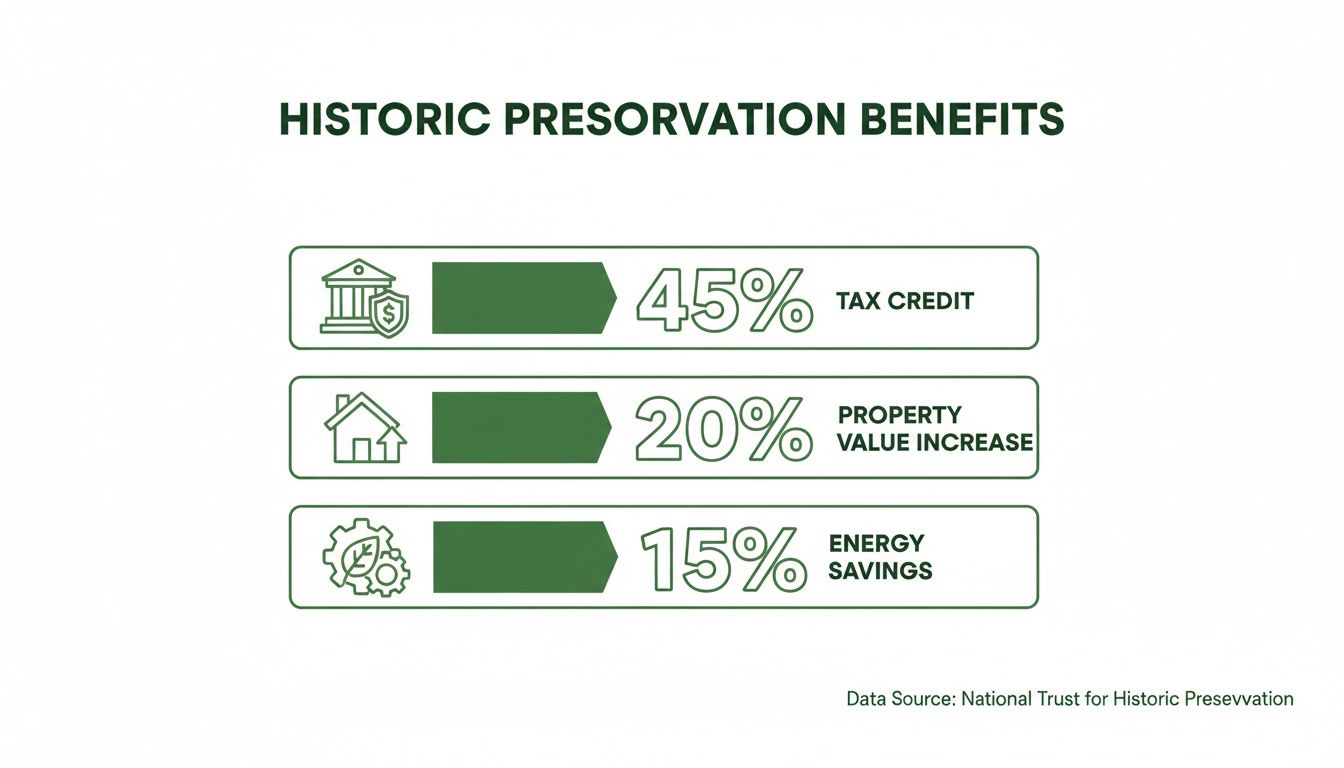
Thoughtful material choices do more than just preserve history—they can be instrumental in securing historic tax credits. This turns preservation requirements into a significant financial advantage, boosting both your property's value and its unique story. This approach ensures the building's legacy continues for decades to come.
The True Cost of Interior Materials
When you're looking at a material's price tag, you're only seeing the first chapter of its financial story. The real cost—what we call lifecycle cost—unfolds over decades. It’s a shift in perspective, moving beyond the initial purchase price to consider the long-term expenses of maintenance, repairs, and eventual replacement.
Think about it this way: that cheaper flooring might seem like a win today, but if it needs constant upkeep and wears out in half the time, its lifetime expense can easily dwarf that of a more durable, premium alternative. It's the classic "buy nice or buy twice" scenario, but on a commercial scale.
This long-term view also has to account for sustainability. We're now looking closely at metrics like embodied carbon, which is the total greenhouse gas emissions generated to produce and transport a material. It's the environmental "cost" baked into the product before it ever reaches the job site.
As you can see, making smart, forward-thinking choices isn't just about avoiding headaches; it can yield significant financial returns through incentives like tax credits and ongoing energy savings. Ultimately, selecting a durable, low-impact material for interior spaces isn't just an expense—it's a financially sound strategy for the entire life of the building.
Lifecycle Cost Comparison For Common Flooring Materials
To put this into practice, let's look at how three common commercial flooring options stack up when you consider their full lifecycle. The upfront cost is just one piece of the puzzle.
Material
Upfront Cost (per sq ft)
Average Lifespan
Annual Maintenance
Embodied Carbon
End-of-Life
VCT (Vinyl Composite Tile)
$2 – $4
15-20 years
High (requires frequent stripping, waxing, buffing)
Moderate to High
Landfill; difficult to recycle
LVT (Luxury Vinyl Tile)
$4 – $7
20-25 years
Low (simple sweeping and mopping)
Moderate
Recyclable in some programs; often landfilled
Polished Concrete
$3 – $8
50+ years
Very Low (occasional cleaning and resealing)
Low (utilizes existing slab)
Reusable; can be covered or refinished
The table makes it clear: while VCT has the lowest initial price, its high maintenance needs and shorter lifespan mean you'll be paying for it over and over again. Polished concrete, on the other hand, might cost more upfront but delivers a much lower total cost of ownership over the long haul. This is the kind of analysis that separates good projects from great ones.
Best Practices for Material Procurement and Specification
You can pick the most brilliant material in the world, but if you don't specify and procure it correctly, that choice means nothing. It’s a classic project pitfall.
Vague specifications are where good intentions go to die. Using lazy terms like "or equal" in your documents is an open invitation for substitutions that might look the part but fail on performance. The key is to write iron-clad specs that leave no room for interpretation—define the exact performance criteria you expect.
Then there's the supply chain. You have to be realistic about what you can actually get. Global market forces have a huge impact on the material for interior finishes, influencing everything from cost to availability.
For example, the Asia-Pacific region dominates up to 58.1% of the automotive interior materials market. As you can imagine, that kind of market share affects lead times and pricing for related materials across the board. Diving into these market trends can give you a real edge in planning.
The secret to navigating all of this? Get everyone in the same room—metaphorically or literally. When architects, contractors, and owners are aligned from day one, you head off budget blow-ups and ensure the finished space actually reflects the original vision. No costly surprises.
Frequently Asked Questions About Interior Materials
When it's time to choose materials for a commercial interior, property owners and developers tend to ask the same handful of questions. It's completely understandable—the stakes are high, and the choices you make have long-term consequences.
For high-traffic areas, the big question is always durability versus budget. It's tempting to go with the cheaper option upfront, but experienced owners know to think in terms of lifecycle cost. A more expensive, hard-wearing material often pays for itself by avoiding replacement and repair costs down the road.
When you're working with a historic building, the first question is different: what has to stay? Before anything else, you need a thorough investigation to identify the character-defining features. This dictates everything that follows.
What about sustainability? The greenest choice is almost always the one you already have. Reusing existing materials is paramount. If that's not possible, look for locally sourced products with clear environmental product declarations (EPDs).
Getting a handle on the basics is key. For example, simply understanding the different cabinets types of material available can give you a solid foundation for making smarter, more informed decisions across the entire project.
A new fire station is far more than just a garage for fire trucks. It's the nerve center for community safety, a second home for its crew, and a high-performance building engineered for speed and efficiency. Before a single line is drawn on a blueprint, the success of the entire project hinges on getting the foundational planning right.
This initial phase is all about balancing the immediate operational needs of the fire department with the long-term vision for the community it serves.
Laying the Groundwork for a Modern Fire Station
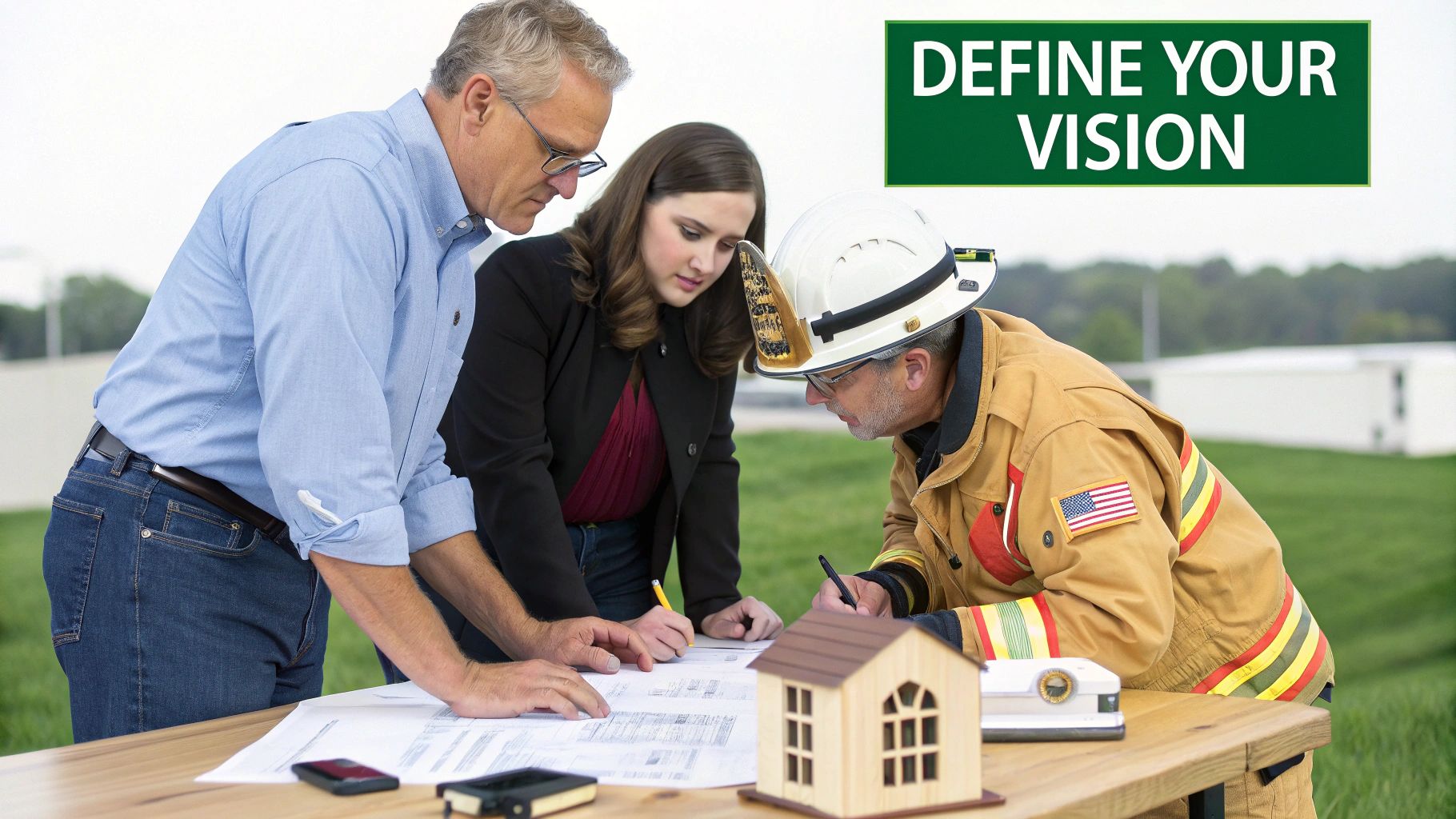
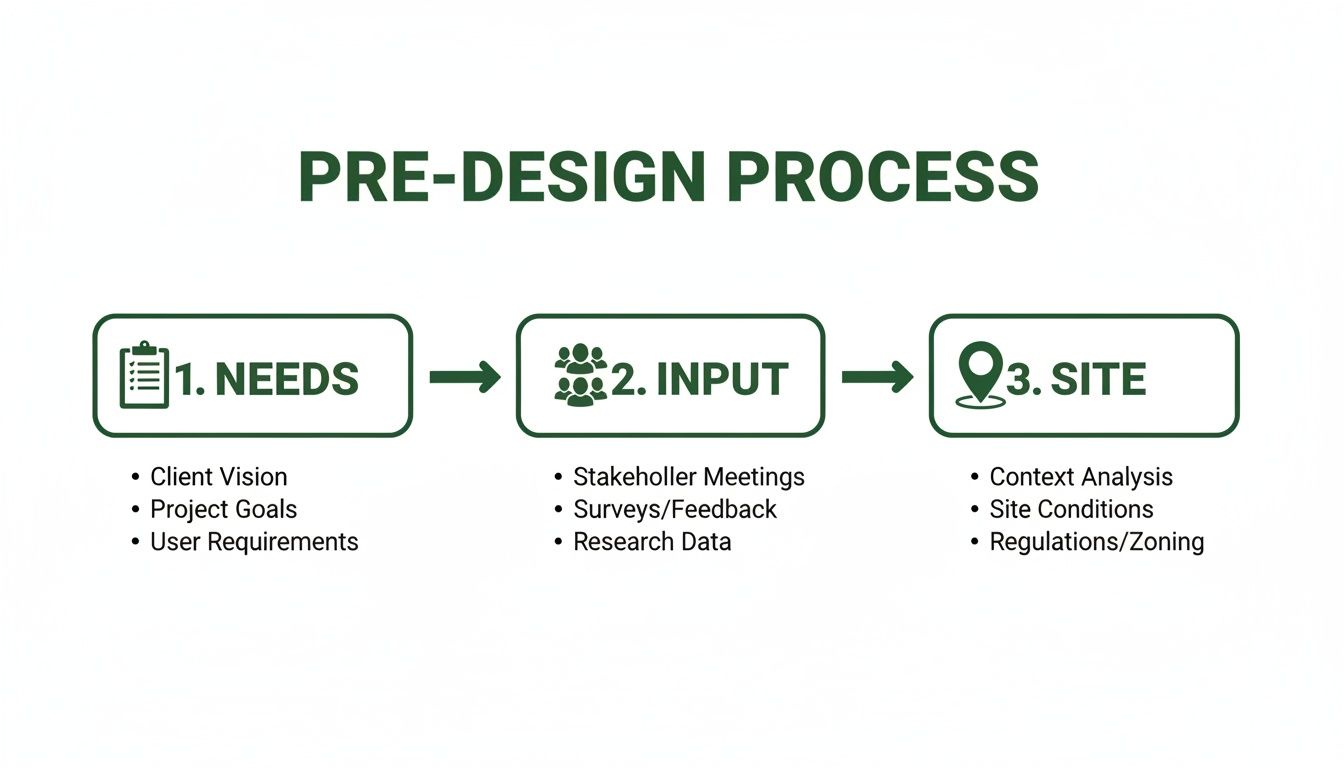
Before you can even think about floor plans or building materials, you have to answer a fundamental question: What is this station's mission? Is it a small satellite station for a new subdivision, a major headquarters housing administrative staff, or a specialized facility for complex operations like hazmat or technical rescue?
The answer to that question drives everything else. This initial "program development" is a collaborative deep dive where fire chiefs, city planners, architects, and community leaders hash out a detailed list of every single requirement. It’s a meticulous process, but it’s the only way to ensure the final building truly meets its purpose.
Defining the Station's Core Program
Think of this programming phase as translating the department's day-to-day operations into a concrete architectural wish list. It’s all about function over form at this stage. Nailing down these details now prevents expensive and frustrating change orders down the road.
Here are some of the key questions we work through:
Apparatus Bays: How many bays do you need today, and how many might you need in 10-20 years? The size and height must accommodate the latest, larger fire apparatus—a modern ladder truck needs a lot more clearance than one from the 1990s.
Administrative and Support Spaces: Is this station just for response crews, or will it also house the fire chief's office, investigators, or the training division? Each of these roles demands unique layouts, from secure evidence storage to conference rooms.
Living Quarters: We need to know exactly how many bunk rooms are required, how large the kitchen and dining areas need to be, and what the dayroom should look like to comfortably support crews through long 24- or 48-hour shifts.
Community Engagement: Will the station have a public-facing role? Including a community meeting room or a small historical display is a fantastic way to build local ties, but these spaces must be carefully designed to keep the operational side of the building secure.
A common mistake I see is underestimating future growth. A station built with just enough bays for the current fleet can become obsolete in less than a decade. I always advise clients to plan for one or two "empty" bays. It's a smart, forward-thinking investment that buys you invaluable flexibility.
Strategic Site Selection with Data
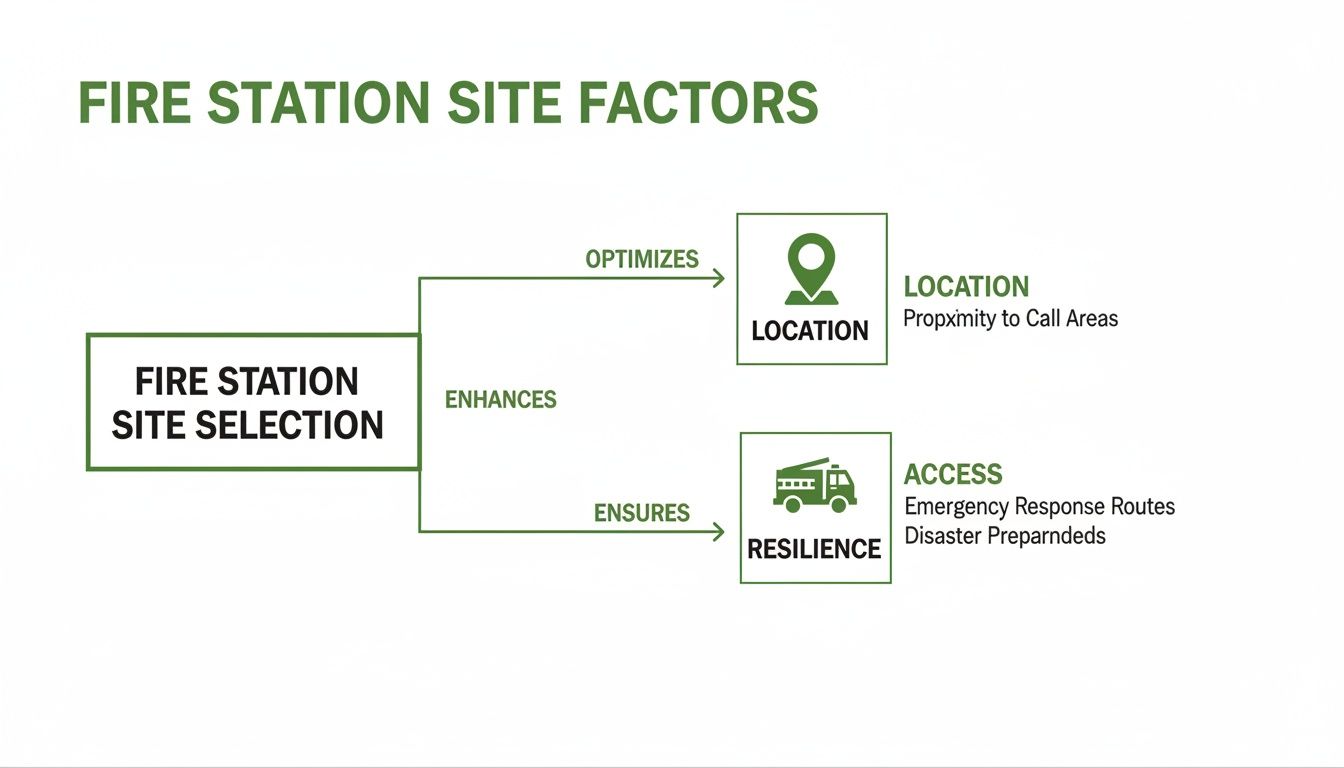
With a solid program in hand, the hunt for the right piece of land begins. These days, choosing a site isn't about finding a convenient, available lot. It’s a data-driven science focused on one thing: minimizing response times to save lives and property.
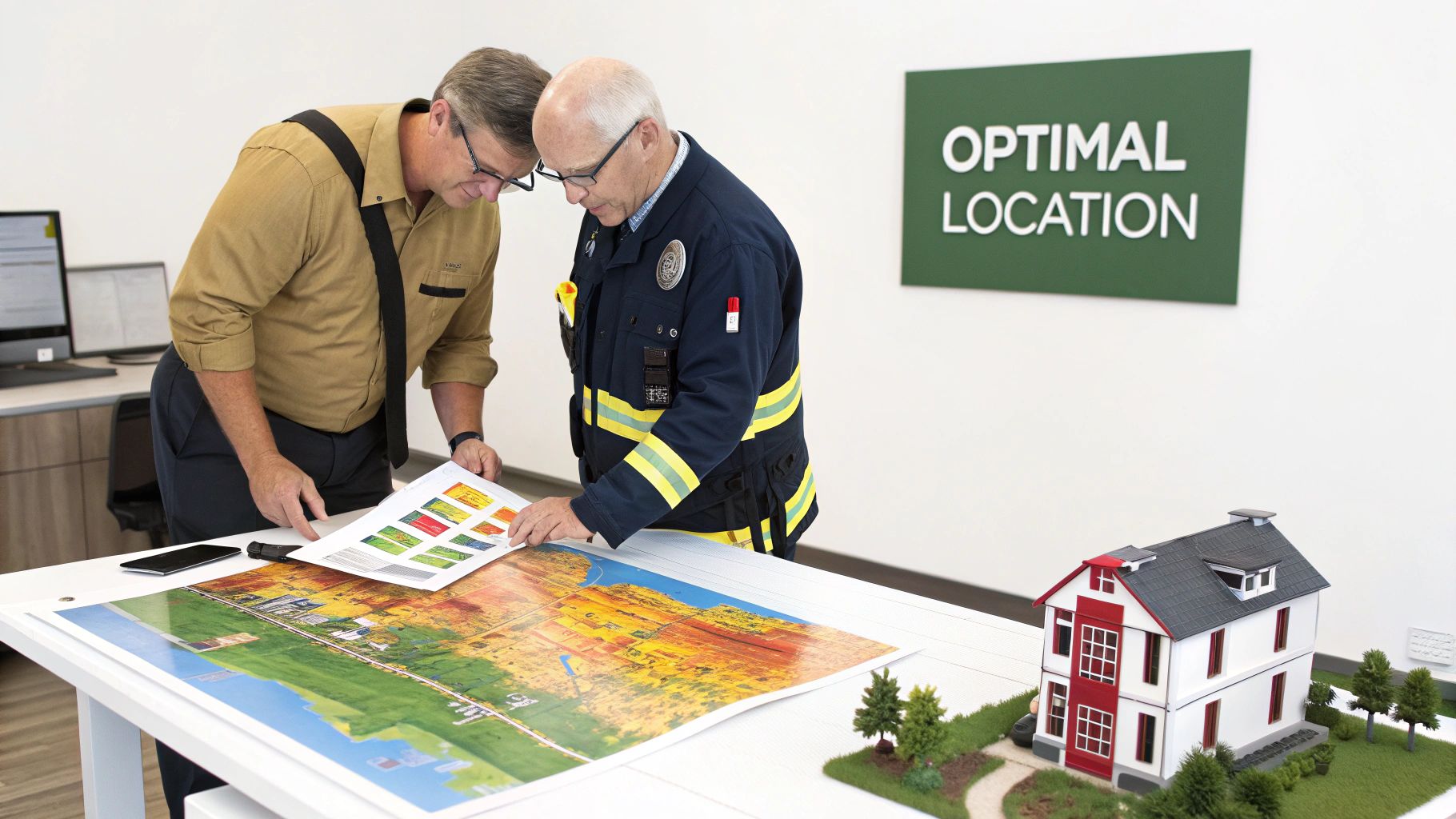
We use powerful Geographic Information System (GIS) tools to layer critical data onto a map, creating a clear picture of the ideal location. This analysis isn't guesswork; it's based on hard facts.
The analysis almost always includes:
911 Call Heat Maps: These maps show us exactly where emergency calls are coming from, highlighting the areas of highest demand.
Travel Time Analysis: We use mapping software to run simulations, calculating response times from potential sites to every corner of the service area. This accounts for real-world factors like traffic patterns, one-way streets, and road networks.
Community Growth Projections: We don't just look at the community today. By analyzing zoning maps and new development plans, we can position the new station to serve neighborhoods that don't even exist yet.
A site that looks perfect on paper can be a disaster if it has poor road access or is surrounded by future traffic bottlenecks. When you combine a well-defined program with data-backed site selection, you create an unshakeable foundation for a fire station that will serve its community effectively for decades.
Getting a Handle on Codes and Standards
When you're designing a fire station, you’re creating more than just a building—you’re engineering a critical piece of community infrastructure. The International Building Code (IBC) drives this point home by classifying fire stations as Risk Category IV. This is the highest level of importance, meaning the station absolutely must stay standing and fully functional during and after a major event like a hurricane, tornado, or earthquake.
This single designation sets the tone for the entire project, impacting everything from the structural design to the MEP systems. It's the non-negotiable foundation that guarantees your fire station can protect the community when it’s needed most. Getting familiar with this web of codes early on is the secret to keeping your project on track.
The Bedrock of Fire Station Design: NFPA Standards
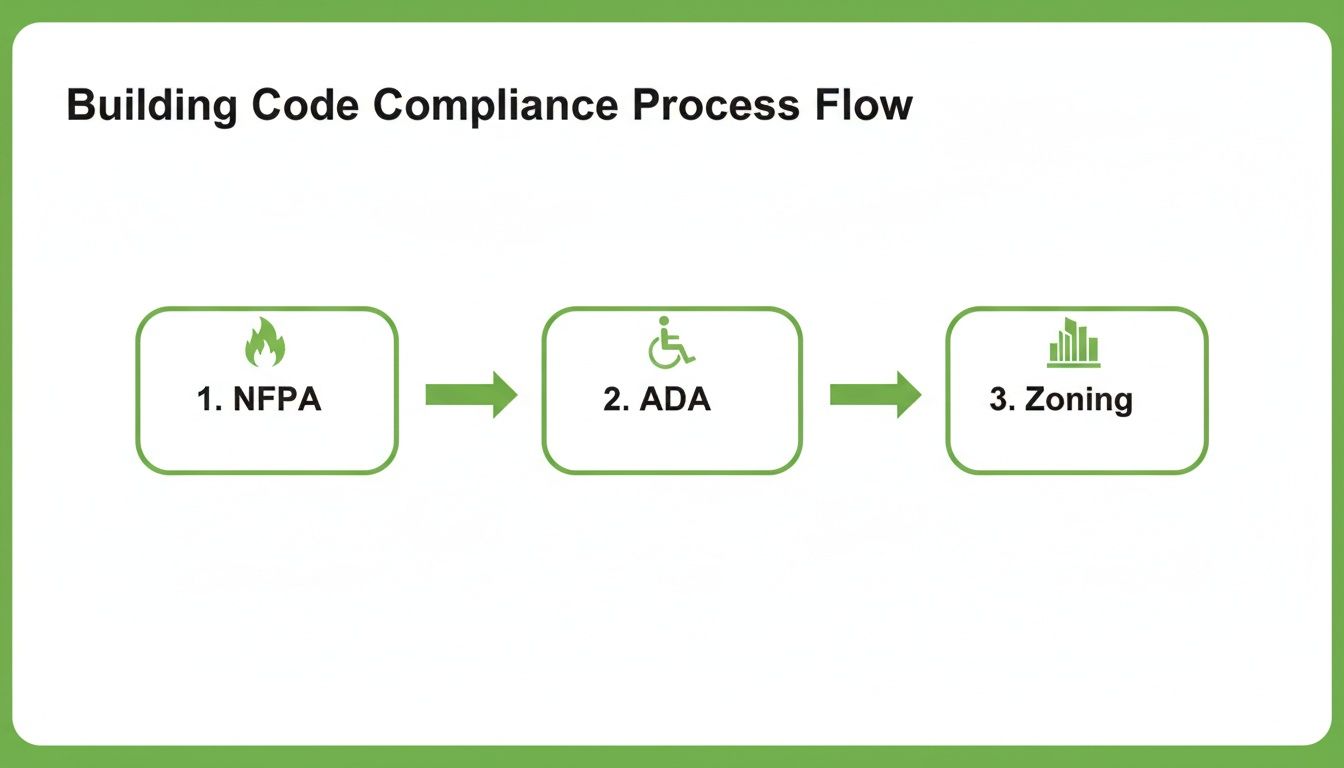
The National Fire Protection Association (NFPA) provides the most specific and critical guidelines for fire service facilities. While your local building codes always have the final say, NFPA standards are the industry’s gold standard for firefighter safety and operational best practices. You simply can't ignore them.
Two documents, in particular, should become your design team's best friends:
NFPA 1500: This is the Standard on Fire Department Occupational Safety, Health, and Wellness Program. It directly influences the station's layout, calling for things like vehicle exhaust removal systems in the apparatus bay and distinct zones for decontaminating gear to keep carcinogens out of the living quarters.
NFPA 1901: The Standard for Automotive Fire Apparatus might sound like it’s just about the trucks, but its impact on the building is huge. It dictates the size, weight, and turning radius of modern fire apparatus, which in turn determines the dimensions of your bay doors, the strength of your slab, and the layout of the entire site.
A lot of design headaches come from underestimating the sheer scale of modern fire trucks. I’ve seen projects where the apron—the concrete pad just outside the bay doors—was designed with too steep a slope or not enough room to maneuver. That's a costly mistake that can damage million-dollar equipment or, even worse, slow down a crew on their way to an emergency.
Beyond the Bay Doors: Local and Federal Rules
While the NFPA gets you dialed in on the core fire operations, a whole other set of regulations governs the rest of the facility. These rules are just as important and ensure the station is safe for everyone, accessible, and meets broader community standards.
This is where your architect, engineers, and local planning officials really need to be in sync. Local zoning ordinances, for instance, will tell you about building setbacks, height restrictions, and maybe even what materials you can use on the exterior. At the same time, state and local energy codes will shape your choices for insulation, windows, and HVAC systems, which has a direct impact on the station's utility bills for decades to come.
Making the Station Accessible for Everyone
Like any public building, fire stations must be accessible. The Americans with Disabilities Act (ADA) lays out clear requirements to make sure that anyone, regardless of physical ability, can access public-facing areas of the station.
This applies to more than you might think—from the front lobby and community rooms to the public restrooms and parking lot. It’s also important to understand the very specific ADA handicap parking space requirements to ensure your site plan is compliant right from the start.
Proper ADA planning means thinking through things like:
Clear Paths of Travel: You need unobstructed routes from the parking lot and public sidewalks to every public entrance.
Interior Room to Move: Hallways, doorways, and restrooms must meet specific width and clearance standards for wheelchair access.
Adaptable Workstations: Administrative offices and other workspaces should be designed to accommodate employees with disabilities.
Ultimately, a successful fire station design is one that seamlessly integrates all these different codes and standards. It’s a complex puzzle, but solving it transforms a list of regulations into a blueprint for a safe, resilient, and highly functional facility built to serve its community for generations.
Designing For Firefighter Health With Zoned Layouts
A fire station has to be more than just a garage for the trucks and a place for the crew to sleep. It needs to be a sanctuary, a place that actively protects firefighters from the invisible dangers they bring back from a call. We're talking about carcinogens—the toxic soot and smoke particles that cling to their gear and pose a massive, long-term cancer risk.
This isn't a minor concern; it's a driving force behind a complete shift in how we design modern stations. The most effective solution we have is an evidence-based layout known as the Red/Yellow/Green zoning model. Think of it as a life-safety system built right into the station's DNA.
The concept is straightforward: create a non-negotiable, one-way path for anyone and anything returning from an incident. This path moves from the contaminated "dirty" side of the building to the "clean" living side, with a crucial transition zone in the middle. This design makes it physically impossible to track hazardous materials into the kitchen, bunk rooms, or offices.
The Red Zone: First Line of Defense
The decontamination process starts the second a truck pulls back into the station. The apparatus bay itself is the Red Zone, or the "hot zone." Every surface here is considered grossly contaminated.
Your design for the Red Zone is all about containment and immediate decon. This means including:
Robust Apparatus Bay: The floors must be durable, non-porous, and sloped to trench drains. This is non-negotiable for washing down vehicles and the bay floor, ensuring contaminated water is properly contained and removed.
Dedicated Decon Area: Within or just off the bay, there should be a clearly marked area for the initial, gross rinse-down of Personal Protective Equipment (PPE). This happens before a firefighter even steps into the next zone.
Exhaust Capture Systems: Direct-source capture systems that hook right onto the vehicle exhaust are an absolute must. These systems prevent toxic diesel fumes from ever filling the bay and migrating into other areas of the station.
The workflow here is rigid. Nothing—and no one—goes directly from the Red Zone into the living quarters. Personnel must follow a specific path out of this zone to begin their own decontamination process.
This entire process is just one part of a larger safety framework. As you can see below, designing a station involves a complex interplay between various codes and regulations to ensure a safe, functional facility.
The Yellow Zone: The Decontamination Corridor
After leaving the "hot" apparatus bay, firefighters immediately enter the Yellow Zone. This is the transition or "warm zone" where the real work of decontamination happens. Getting the design of this space right is absolutely critical to stopping cross-contamination in its tracks.
This area must function as a one-way corridor, forcing a clear path toward the clean side of the station. Key design elements include:
Walk-Through Decon Showers: These are completely separate from the showers in the living quarters. Firefighters use these showers to thoroughly remove contaminants from their bodies before proceeding further.
Specialized Gear Storage: Contaminated turnout gear is doffed and left in a dedicated, heavily ventilated room within this zone. This space must have its own HVAC system with negative air pressure, which is crucial for pulling airborne contaminants out of the building instead of letting them seep into other areas.
PPE Washers/Extractors: This is where you'll find the commercial-grade washing machines specifically designed to clean turnout gear according to manufacturer and NFPA standards.
The Red/Yellow/Green model isn't just a best practice; it's an urgent response to a health crisis. Endorsed by the NFPA, this design directly addresses the alarming fact that firefighters face a 9% to 14% higher risk of being diagnosed with cancer than the general public. It's about designing to save their lives long after the fire is out.
The table below breaks down how these three zones work together to create a comprehensive decontamination system.
The Three-Zone Decontamination Model
Zone
Primary Function
Key Areas
Essential Design Features
Red (Hot Zone)
Containment of gross contaminants from incidents.
Apparatus Bays, Exterior Aprons, Initial Gear Rinse-Down Area
One-way circulation path; negative air pressure ventilation; separation from both Red and Green zones; durable, water-resistant finishes.
Green (Cold Zone)
Safe, clean living and administrative areas.
Kitchen, Dayroom, Bunk Rooms, Fitness Area, Offices, Training Rooms
No direct access from the Red Zone; positive air pressure relative to Yellow Zone; physically separated by corridors and airlocks.
This systematic approach ensures that carcinogens and other contaminants are progressively stripped away, protecting the sanctity of the station's clean living areas.
The Green Zone: Clean Living Quarters
Only after moving through both the Red and Yellow zones can a firefighter enter the Green Zone, or the "cold zone." This is the clean half of the station—the kitchen, dayroom, bunk rooms, fitness center, and administrative offices.
The single most important design principle for the Green Zone is total separation. There can be no shortcuts or direct doors from the apparatus bay into any Green Zone space. The layout must make it physically impossible to bypass the decontamination corridor.
Of course, a safe station also depends on clear communication. Ensuring the crew has effective communication devices is vital for maintaining situational awareness and rapid response, especially during high-stress calls. By implementing a strict zoned layout, you are building health and safety into the very foundation of the facility, creating a station that truly protects its protectors.
Optimizing Station Operations and Living Quarters
A fire station is really two buildings in one: a high-stakes industrial garage fused with a residential home. The design challenge is to make these two halves work together flawlessly. When an alarm blares, the path from the dayroom to the apparatus bay has to be as direct and safe as humanly possible.
This delicate balance between operational efficiency and firefighter well-being is everything. Every single design choice, from the workflow in the apparatus bay to the comfort of the living quarters, directly impacts response times and crew morale. A well-designed station works with the crew, not against them, creating an environment that supports peak performance under pressure while also offering a genuine space to recover.
The Modern Apparatus Bay and Support Areas
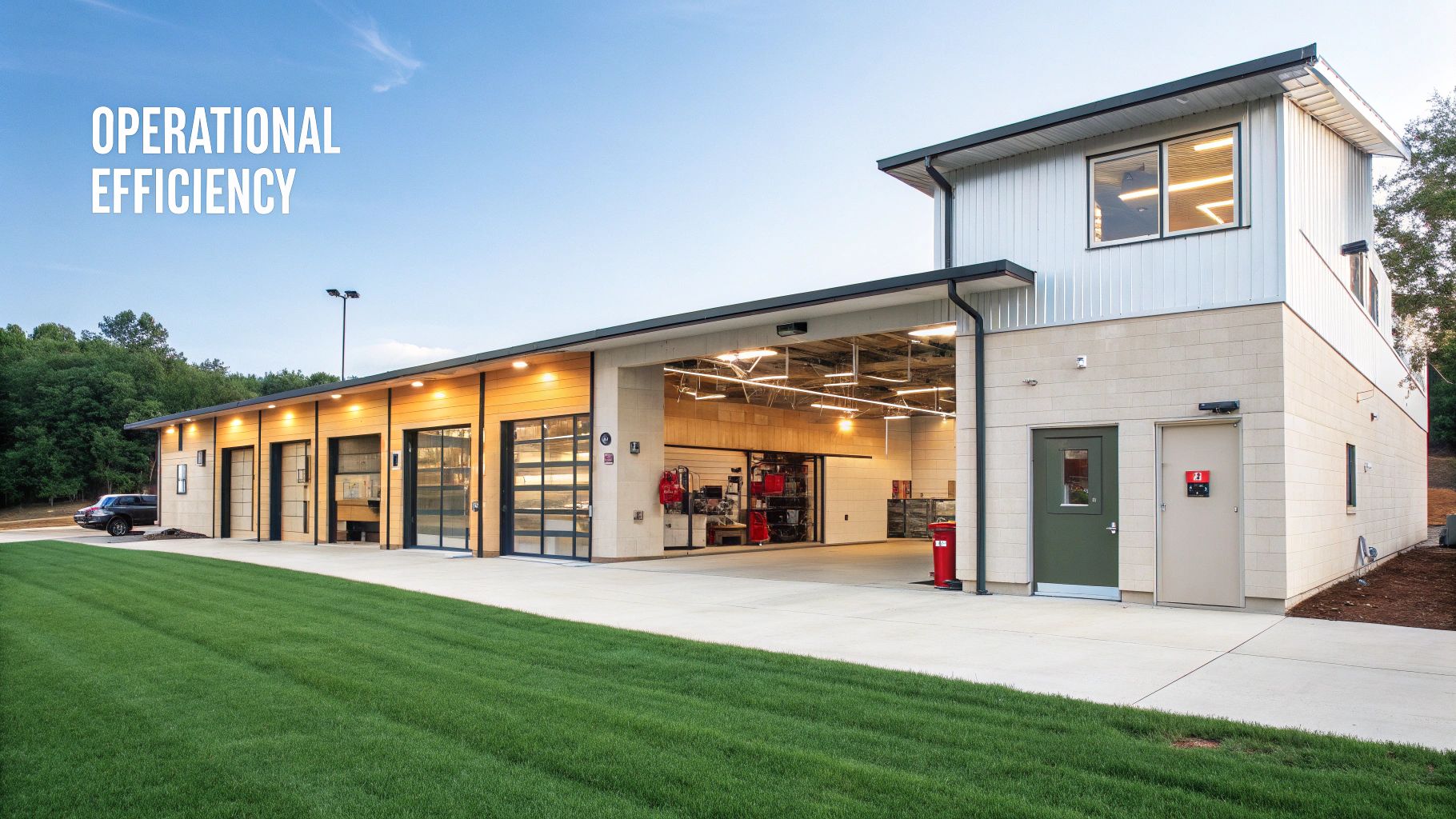
The apparatus bay is the heart of the station, and its design has come a long way. Gone are the days when multi-story stations with iconic fire poles were the standard. The modern trend is a decisive move toward single-story layouts, a shift driven by two critical factors: safety and speed.
Moving to a single level practically eliminates the fall risk from poles and stairs, which have historically been a major source of non-incident injuries. More importantly, it creates a straight shot to the trucks. When we design a fire station this way, we've seen bay access speed up by 15-20%, shaving precious seconds off turnout times. For more on this, it's worth reading about the renovation needs of the U.S. fire service, which details these efficiency gains.
Of course, the bay is more than just a parking garage. The support areas are what keep the operation in a constant state of readiness, and they need to be right next to the apparatus for an efficient workflow.
SCBA Room: This isn't just a closet. It needs to be a dedicated, well-ventilated space for inspecting, refilling, and maintaining Self-Contained Breathing Apparatus.
Workshop: A compact workshop for routine tool and equipment maintenance keeps everything ready for the next call.
Medical Supply Storage: A climate-controlled, organized room is a must for quickly restocking ambulances and engines.
A common mistake I see is tucking these support functions away in a distant corner of the building. Firefighters shouldn't have to cross the entire station to grab fresh medical supplies or work on a tool. Every step you save them is a second gained on a call.
Creating a Home Away From Home
Firefighters don't just work here; they live here, often for 24 to 48 hours straight. This makes the living quarters just as vital as the operational zones. These spaces need to be incredibly durable and low-maintenance, but they also have to be designed to promote both physical and mental well-being. The goal is a comfortable, restorative environment where crews can actually decompress between calls.
This means we have to move beyond purely utilitarian design. Things like maximizing natural light, choosing comfortable furnishings, and thinking about acoustics can make a world of difference in reducing stress and boosting morale.
Key Living and Community Spaces
When you get down to designing the living quarters, you have to think about the crew's daily routines. Each space has a distinct job to do, from providing private rest to encouraging communal interaction.
Bunk Rooms The old open-dormitory-style sleeping quarters are a thing of the past. Modern stations almost exclusively use individual bunk rooms. This gives firefighters much-needed privacy, dramatically improves sleep quality by cutting down on disturbances, and is simply more accommodating for a diverse workforce.
Kitchen and Dayroom The kitchen is the social hub of any station. It requires a commercial-grade setup with tough appliances, tons of counter space, and a dining table big enough for the entire on-duty crew to share a meal. Right next to it, the dayroom should have comfortable seating for training, studying, or just relaxing.
Fitness Area Physical fitness is a non-negotiable part of the job. A dedicated fitness area with professional-grade equipment isn't a luxury; it's a necessity for promoting crew health and reducing injury risks. This space demands proper ventilation and durable, shock-absorbent flooring.
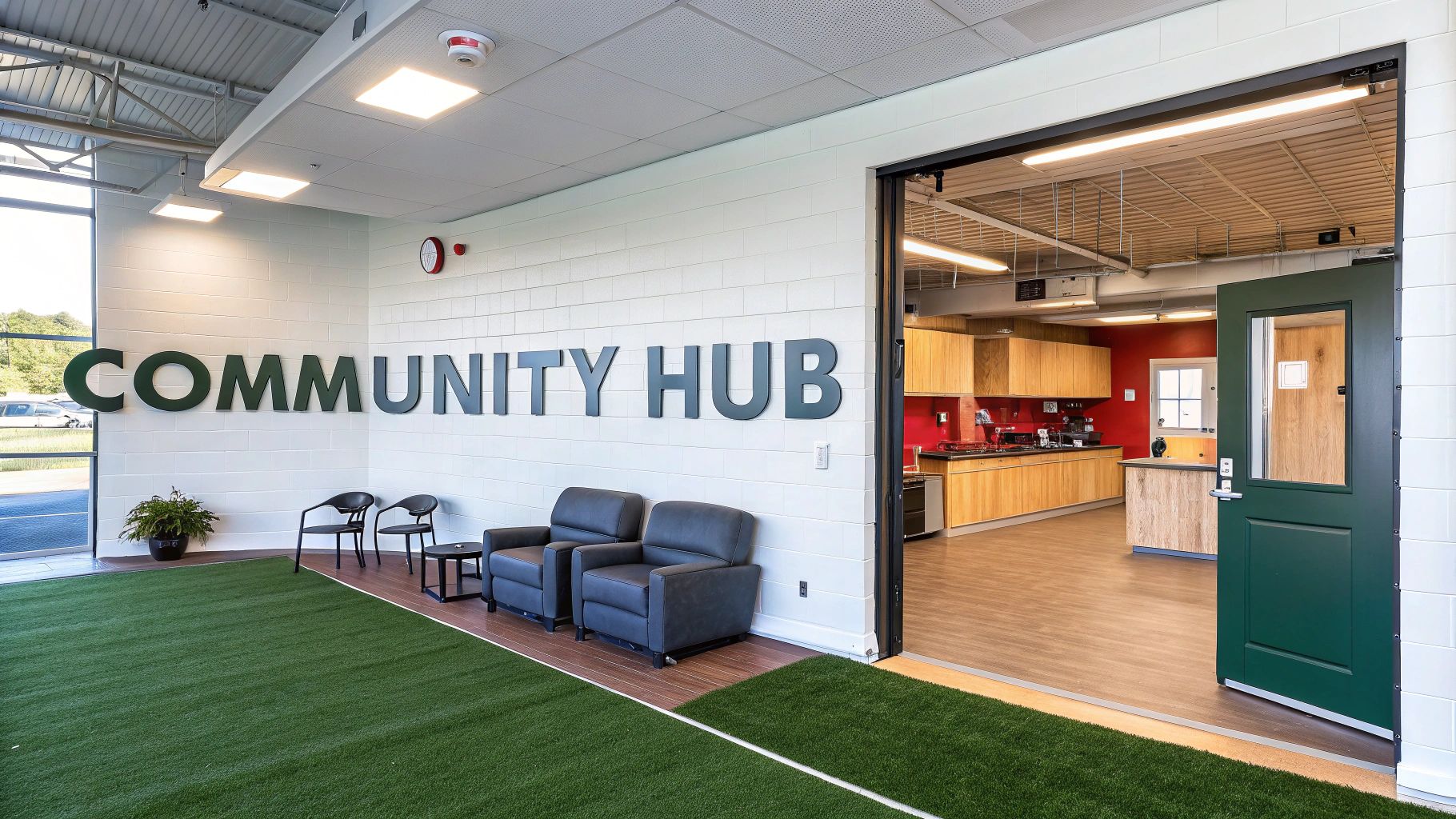
Multi-Functional Training and Community Rooms Here's a smart way to add tremendous value: design flexible spaces. A station’s training room can easily be designed to double as a community meeting area. This simple strategy builds goodwill with the public and provides a valuable neighborhood resource without a huge impact on cost or square footage. It turns the fire station from just an emergency facility into a true community asset.
Building for Sustainability and Resilience
When you're building a fire station, you’re not just putting up a structure; you’re creating a cornerstone of the community designed to last for 50 years or more. With that kind of lifespan, sustainability and resilience aren't just buzzwords. They are practical, long-term strategies that have a massive impact on your bottom line and the station's ability to perform when it's needed most.
A station built with this foresight will have lower operating costs, a lighter environmental touch, and the ruggedness to stay online through any crisis. It’s all about looking past the initial price tag and thinking about the total cost of ownership over the next half-century. Every decision you make today—from insulation to energy systems—will echo in the municipal budget for decades.
Driving Down Operational Costs with Smart Design
Let’s be honest: energy is one of the biggest line items in the budget for any 24/7 facility. The good news is that we have powerful ways to slash those costs right from the drawing board. It all starts with a high-performance building envelope and highly efficient systems that stop energy waste before it begins.
As we moved into the 21st century, sustainability became a core part of the design conversation. Things like solar panels and LED lighting are no longer niche—they're standard practice. Incorporating these technologies can cut energy costs by 25-40% in a new build.
Take the 25,000 sq ft station in Kaukauna, for example. By integrating geothermal and photovoltaic technology, they’re saving an estimated $37,000 every year. It’s a perfect illustration of how fire station design has evolved to embrace these cost-saving measures.
Here are some of the most effective strategies I’ve seen work in the field:
Geothermal Heating and Cooling: Tapping into the earth's stable temperature is a game-changer. These systems are incredibly efficient and can dramatically lower utility bills compared to traditional HVAC.
Solar PV Arrays: A fire station's large, flat roof is prime real estate for photovoltaic panels. Generating your own clean electricity on-site can offset a huge chunk of the building's energy demand.
High-Performance Building Envelope: This is your first line of defense. Superior insulation, meticulous air sealing, and high-quality windows create a tight building that isn’t constantly fighting the weather outside.
LED Lighting and Controls: It's a simple switch with a big impact. Combining all-LED fixtures with motion sensors and daylight harvesting can slash your lighting-related energy use by over 50%.
By weaving these systems into the design from day one, you're not just shrinking the station's carbon footprint. You’re building a predictable, manageable operating budget. Those energy savings can free up vital funds for new equipment, better training, or other critical department needs.
Engineering for Uninterrupted Operation
Resilience is the other side of the sustainability coin. A fire station is a Risk Category IV facility, which means it must stay operational during and after a disaster. This isn’t a "nice to have"; it’s a requirement. This means designing systems that can stand on their own when the grid goes down.
The heart of a resilient design is a bulletproof backup power source. A natural gas or diesel generator, properly sized to power the entire station, is non-negotiable. And I mean the whole thing, not just the emergency lights.
This generator has to cover:
All Apparatus Bay Doors: The top priority is getting trucks out the door.
HVAC Systems: You need to keep your crew safe and functional, not freezing or sweating through a crisis.
Communications Equipment: Radios, servers, and dispatch systems must stay online. No exceptions.
Kitchen and Living Quarters: During an extended event, you’re providing a home base. The crew needs to be able to eat, sleep, and recharge.
Beyond backup power, resilience is also built into the very materials you choose. Things like polished concrete floors, sturdy masonry walls, and durable metal roofing are smart, long-term investments. They stand up to the daily abuse of a firehouse and cut down on maintenance and replacement costs for years to come.
Thinking this way doesn't just future-proof the station—it can also open the door to federal and state grants that are specifically aimed at building more resilient community infrastructure.
Smart Budgeting and The Value of Adaptive Reuse
Let's talk about the bottom line. Designing and building a fire station is one of the most significant investments a community can make, so getting the budget right is every bit as important as nailing the floor plan. With construction costs going through the roof, smart financial planning isn't just a good idea anymore—it's absolutely essential.
The money side of public projects has changed in a big way. Back in the 1980s, you might have built a station for $50-60 per square foot. Today, you're looking at costs closer to $190-250 per square foot. That's a huge jump. You can get a deeper sense of how these rising costs are affecting departments across the country by checking out the latest fire station renovation data on NFPA.org. This new reality means we have to be incredibly careful with every dollar.
Thinking Beyond New Construction
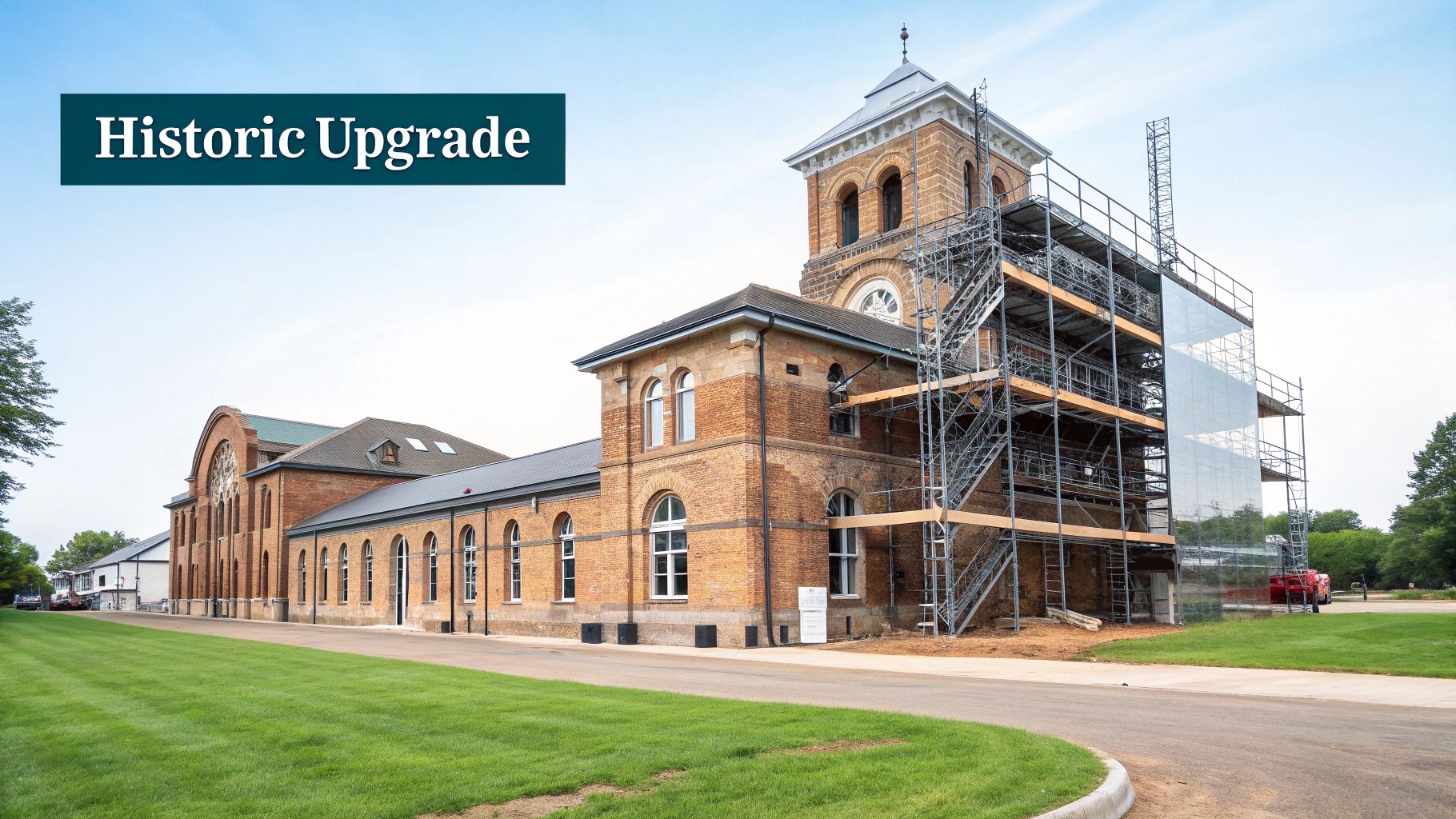
Everyone loves the idea of a shiny new station, but that's not always the most practical or affordable path. Think about this: over 40% of fire stations in the U.S. are now more than 40 years old. Many of these older buildings are structurally solid and represent a huge, untapped opportunity for adaptive reuse.
Giving an existing station a major overhaul can save a ton of money and is a far more sustainable choice than tearing down and starting over. You're not just saving on demolition and new materials; you're also preserving a piece of the community's history. A well-planned renovation can get a station back in service faster and extend its life by another 50 years or more.
Adaptive reuse isn't just about saving a buck; it's a strategic move. I've been on projects where we took a dated, inefficient station and completely transformed it. By gutting the interior, we were able to carve out a modern Red/Yellow/Green zone layout for decontamination, all without ever touching the original building's footprint.
Strategic Upgrades for Older Stations
The first step in any potential reuse project is a serious look at the building’s “bones.” If the foundation is solid and the structure is sound, you can upgrade almost everything else to meet modern standards.
When we tackle a renovation, the focus usually lands on a few key areas:
Integrating Modern Safety: The number one priority is almost always creating a proper decontamination corridor. This means rethinking the flow of the building to establish clear Red, Yellow, and Green zones to protect firefighters from carcinogens.
Upgrading MEP Systems: This is the perfect time to rip out old, inefficient HVAC, plumbing, and electrical systems. Swapping them for high-efficiency modern equipment can dramatically slash the station's operating costs for decades to come.
Enlarging Apparatus Bays: Older stations were built for smaller trucks. One of the biggest hurdles is making sure today's larger apparatus can fit. Often, with some clever structural work, we can raise the roof and widen the bay doors to accommodate modern rigs.
The Power of Phased Construction
Whether you’re building from the ground up or renovating, breaking the project into phases can turn a daunting budget into a series of manageable steps. Phasing allows a community to tackle the project in smaller, more affordable chunks.
For instance, a department might decide to build the essential operational spaces first—the apparatus bays and core support areas. Then, a few years down the line when another round of funding is secured, they can add the administrative wing or expand the living quarters. This approach lets a community solve its most pressing needs right away while spreading the financial load over time, ensuring the final station is everything it needs to be without breaking the bank in a single year.
What We're Asked Most About Fire Station Design
When a community decides it's time to build a new fire station, a few critical questions always come up right at the start. Sorting these out early on is the best way to keep the project on track and avoid major headaches later.
Everyone's first question is, "How long will this take?" For a project of this size and importance, you're looking at a design phase of about 6 to 12 months. After that, construction will typically take another 12 to 24 months. Of course, this timeline can shift based on how complex the design is, what we find at the site, and how smoothly the local approvals process goes.
Avoiding Common Mistakes
Another big concern we hear is about getting the design right from the get-go. What are the major pitfalls?
Without a doubt, the biggest mistake is not planning for the future. A station designed only for today's needs—with apparatus bays that are too small for the next generation of trucks or not enough storage space—can be obsolete in just 10 years. The key is to start with a rock-solid needs assessment and build in flexibility for future expansion.
We also get a lot of questions about blending a modern facility into a town with a distinct historic feel. This is where an architect's experience really pays off. The goal is to respect the local character through materials, scale, and overall massing while ensuring the inside is a high-performance, modern facility. For example, a classic brick facade can fit beautifully into a historic district, while the interior is laid out with clear, efficient zoning for firefighter health and safety.
Having an experienced design partner on board from day one is the single best way to manage the timeline and budget. They've seen the regulatory hurdles before and know how to get all the stakeholders pulling in the same direction.
At Sherer Architects, LLC, we live and breathe complex commercial projects, guiding clients from the first sketch to the final walkthrough. Our deep experience in adaptive reuse and navigating the nuances of historic preservation means your project will be as enduring as it is functional. See how we bring structure to your vision at https://shererarch.com.
When we talk about the design of a hospital, we're not just talking about architecture. We're talking about a highly specialized discipline where every wall, window, and workflow has a direct impact on patient healing, staff effectiveness, and the facility's bottom line. The goal is to create a high-performance environment that marries clinical precision with a deeply human touch.
Modern hospital design is no longer about guesswork; it’s about using data to get better health outcomes, slash infection rates, and make the entire experience of giving and receiving care better for everyone involved.
The Blueprint for a Healing Environment
A hospital today is so much more than a building filled with medical gear. It’s a carefully orchestrated ecosystem built for one purpose: healing. The sterile, intimidating hallways of the past are giving way to spaces that feel welcoming, are easy to navigate, and actively contribute to recovery.
This whole shift is powered by a concept called Evidence-Based Design (EBD).
Think of EBD like a clinical trial for architecture. A doctor wouldn't prescribe a medication without solid research proving it works, right? In the same way, architects and developers now use hard data to make design choices proven to improve patient results. Every decision, from the view out a patient's window to the acoustics in a nurse's station, is backed by research showing it makes a real difference.
Key Pillars of Modern Hospital Design
A truly successful hospital design is built on three fundamental pillars. Get these right, and you create a facility that not only serves the community today but is ready for whatever comes next.
Patient Experience: This isn't just about comfy beds. It's about designing spaces that actively reduce stress, encourage rest, and empower patients. Things like single-patient rooms, plenty of natural light, and signage that makes sense aren't just nice-to-haves; they lead to higher satisfaction scores and measurably better clinical outcomes.
Operational Workflow: In healthcare, efficiency saves lives. A smart design streamlines the movement of staff, patients, and supplies. It’s about logical adjacencies that cut down on footsteps and flexible spaces that can easily adapt to a sudden influx of patients or the arrival of a new piece of medical technology.
Future-Proofing and Resilience: A hospital is a massive, long-term investment for a community. Its design must look ahead to anticipate new medical breakthroughs, potential pandemics, and evolving technology. That means building in modularity and robust infrastructure from day one, ensuring the facility remains a vital asset for decades to come.
For commercial developers and owners, putting money into thoughtful hospital design isn't just another line item on a budget—it's a core strategic investment. A well-designed facility directly leads to better patient safety, higher staff retention, and a much stronger financial position in a fiercely competitive healthcare market.
A Quick Look Back: How We Got Here
To really get a handle on what goes into designing a modern hospital, it helps to understand where we've been. The hyper-efficient, sterile facilities we're familiar with today didn't just appear overnight. They are the product of centuries of trial and error, often sparked by crisis and always chasing better outcomes for patients. The story of hospital architecture is really the story of medicine itself.
It all started back in the 19th century. Hospitals then were often scary places—overcrowded, stuffy, and rife with infection. Mortality rates were shockingly high. It was obvious that something drastic had to change, and that change came in the form of the Pavilion Plan. This wasn't just a new building style; it was a philosophy that treated the building itself as part of the cure.
Think of it like a collection of separate, smaller buildings (the "pavilions") connected by open-air walkways. The genius was in its simplicity: isolate infectious diseases and flood the wards with two of nature's best healers—fresh air and sunlight.
From Open-Air Pavilions to Standardized Towers
The Pavilion Plan was a massive leap forward. First appearing in the 1860s, this design literally saved lives by using natural ventilation to stop germs from spreading between wards. The results were dramatic, with mortality rates in some hospitals dropping from a staggering 30% to less than 10% by the turn of the century. The idea caught on fast; by 1875, more than 200 hospitals across the U.S. had adopted it.
Then, the mid-20th century brought a different set of priorities. After World War II, the name of the game was efficiency. In the U.S., the 1946 Hill-Burton Act poured money into building over 4,600 healthcare facilities. The catch? They had to be "modern," which meant centralized nursing stations and cookie-cutter room layouts designed to make staff workflows as smooth as possible. This is when we started moving away from the sprawling pavilion campuses and toward the compact, vertical hospital towers we see everywhere today. You can find more great historical context on this shift over at Healthcare Design Magazine.
This push for efficiency set the stage for the next major revolution in hospital design—one that would swing the focus right back to the patient.
The Shift to the Single-Patient Room
For a long time, putting multiple patients in a single large ward was just how it was done. It seemed cheaper on paper, but the hidden costs were huge: rampant infections, constant noise, and a complete lack of privacy. Eventually, data from Evidence-Based Design confirmed what common sense already told us: a shared room is a terrible place to recover.
The modern push for single-occupancy, or private, rooms is a fundamental change in thinking. It treats the patient room not just as a bed in a building, but as a critical tool in the healing process itself.
A private room is no longer a luxury amenity. It's a strategic investment with a clear ROI, impacting everything from patient safety and staff efficiency to the hospital's bottom line.
This isn't just a gut feeling; the numbers back it up. Switching to single-patient rooms has been shown to:
Slash Hospital-Acquired Infections (HAIs). It's simple: fewer people in a room means fewer germs to share, and it makes deep cleaning far more effective.
Improve sleep and lower stress. By getting rid of the noise and constant interruptions of a roommate, patients can actually rest and heal.
Boost patient privacy and communication. Patients and their families can have sensitive conversations with doctors without being overheard.
Increase patient satisfaction scores. In today's value-based care models, happy patients are crucial, as their satisfaction scores are often tied directly to how much a hospital gets reimbursed.
By giving each patient their own space, hospitals create a controlled environment that protects the vulnerable and promotes genuine recovery. This journey from wide-open wards to private rooms tells you everything you need to know about where hospital design is headed: it’s all about building for the individual.
Core Principles of Patient-Centered Design
Patient-centered design isn’t just some feel-good philosophy. It’s a practical, data-backed strategy that treats the physical environment as an active partner in the healing process. The whole idea is to shift away from a purely clinical, process-driven model toward one that puts the comfort, safety, and emotional well-being of patients—and the staff caring for them—first.
Let’s be honest, a hospital can be an intimidating, confusing place. Every single design choice, from the layout of a room to the type of lighting in a hallway, is a chance to lessen that stress.
The thinking here is straightforward: when patients feel safe, respected, and comfortable, their bodies can focus on healing. For developers and owners, this approach creates tangible returns, including shorter hospital stays, fewer medical errors, and better patient satisfaction scores, which are increasingly tied directly to financial reimbursements.
The Power of Single-Occupancy Rooms
If there's one design decision that has a massive impact on modern hospitals, it’s the shift to single-occupancy patient rooms. For decades, multi-bed wards were the norm, but the evidence is now overwhelming—giving patients their own private space is a game-changer. This isn't about luxury; it's a fundamental component of effective infection control and patient recovery.
Moving to private rooms, a trend that really took off after the 2000s, delivers a clear return on investment through improved safety, satisfaction, and day-to-day efficiency.
Let's look at the numbers. When Sutter Health's Eden Medical Center in California was built with 100% private rooms, they saw hospital-acquired infections (HAIs) drop by a staggering 42%. Even more, staff injuries from patient handling fell by 65%, and noise levels dipped by 5-7 decibels, helping patients get much-needed rest.
Across the U.S., hospitals making this switch have seen patient stays shorten by 10-16% and satisfaction scores jump by 20%. These aren't small figures—they translate into millions of dollars in annual reimbursements.
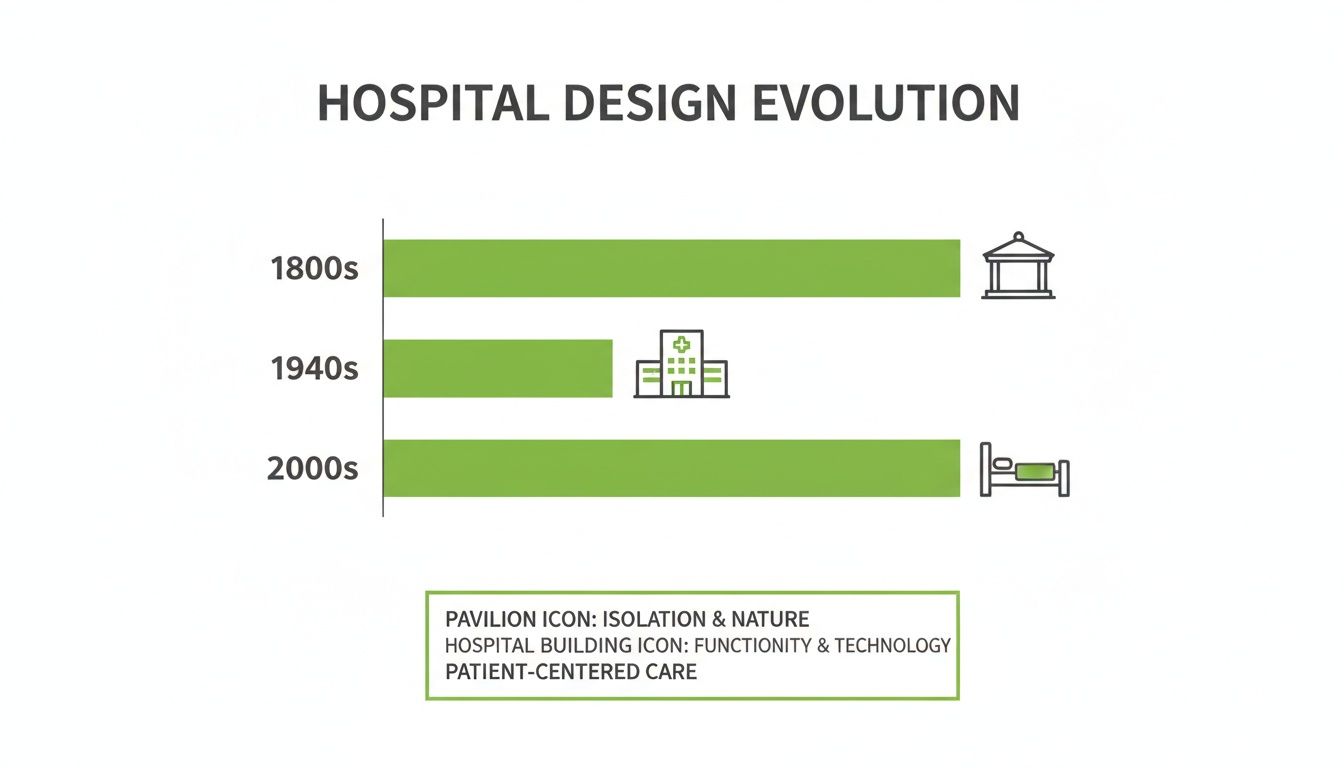
This chart shows just how far hospital design has come, landing on the modern, patient-focused model.
As you can see, the priorities have evolved from just basic sanitation and efficiency to a sophisticated model that puts the individual patient’s experience at the heart of everything.
The contrast between old-school multi-bed wards and modern private rooms is stark, and the data speaks for itself.
Impact of Single-Occupancy vs Multi-Bed Rooms
Metric
Multi-Bed Ward (Baseline)
Single-Occupancy Room (Improvement)
Hospital-Acquired Infections (HAIs)
Higher risk of cross-contamination
40-50% reduction in transmission rates.
Patient Satisfaction Scores
Lower due to noise and privacy issues
20% average increase in HCAHPS scores.
Average Length of Stay
Longer recovery times
10-16% shorter stays, leading to higher bed turnover.
Staff Injuries
Higher rates of handling-related injuries
Up to 65% reduction in patient handling injuries.
Medical Errors
Increased risk due to distractions
Fewer errors from improved communication and fewer interruptions.
Patient Privacy & Dignity
Severely compromised
Fully supported, leading to better patient-doctor communication.
Ultimately, investing in single-occupancy rooms isn't just a capital expense; it's a strategic investment in better outcomes, lower operational risk, and a stronger financial position for the hospital.
Designing for Staff Efficiency and Safety
A patient-focused design is only half the story. It has to be a staff-focused design, too. A burned-out, stressed, or inefficient clinical team simply can't deliver top-tier care. The hospital's layout can either be a constant source of friction or a powerful tool for boosting workflow and morale.
Think of it like a Formula 1 pit crew, where every tool and every movement is optimized for speed and precision. That’s the kind of thinking we need to apply to hospital design.
By optimizing workflows and reducing physical strain, a well-designed hospital becomes a safer and more efficient workplace. This directly leads to lower staff turnover, fewer errors, and a higher quality of care.
Here are a few key strategies that make a real difference for staff:
Decentralized Nursing Stations: Instead of one massive, central hub, smaller substations are placed much closer to patient rooms. This simple change dramatically cuts down on the miles nurses walk each shift, freeing up valuable time for actual patient care.
Clear Sightlines: Smart layouts that give nurses a direct line of sight into patient rooms from hallways or workstations enable passive monitoring. This enhances safety without making patients feel like they’re constantly being watched.
Ergonomic Design: Every detail matters, from the height of countertops to the strategic placement of patient lifts. These considerations are all about reducing the physical wear-and-tear that leads to costly workplace injuries.
Staff Respite Areas: It’s crucial to provide dedicated quiet zones—away from the clinical chaos—where staff can decompress and recharge. These spaces are essential for preventing burnout and keeping the team focused and resilient.
Of course, a core part of any patient-centered design is implementing robust safety measures for everyone. This runs the gamut from slip-resistant flooring to highly specialized fixtures in certain environments. For instance, in behavioral health settings, a key focus is on enhancing patient safety with anti-ligature solutions in NHS hospital wards.
At the end of the day, an investment in a design that supports the staff is a direct investment in patient safety and the hospital’s long-term operational health.
Using Nature to Improve Healing and Efficiency
Bringing nature into a hospital isn't just about making the place look nice. It's a strategic, evidence-based approach called biophilic design, and it's a powerful tool for improving health outcomes, boosting staff morale, and delivering a real return on investment.
At its core, the idea is simple: people have an innate need to connect with the natural world. When you fulfill that need within a clinical setting, you can actually speed up the healing process.
This isn't some new fad. The core principles of biophilic design have been around for decades, built on a long-standing understanding of nature's therapeutic power. Today, it’s a non-negotiable part of modern hospital design. Natural light, views of greenery, and even natural materials aren't just amenities anymore—they're necessities that create a calmer, more restorative environment for everyone.
The Proven Link Between Nature and Recovery
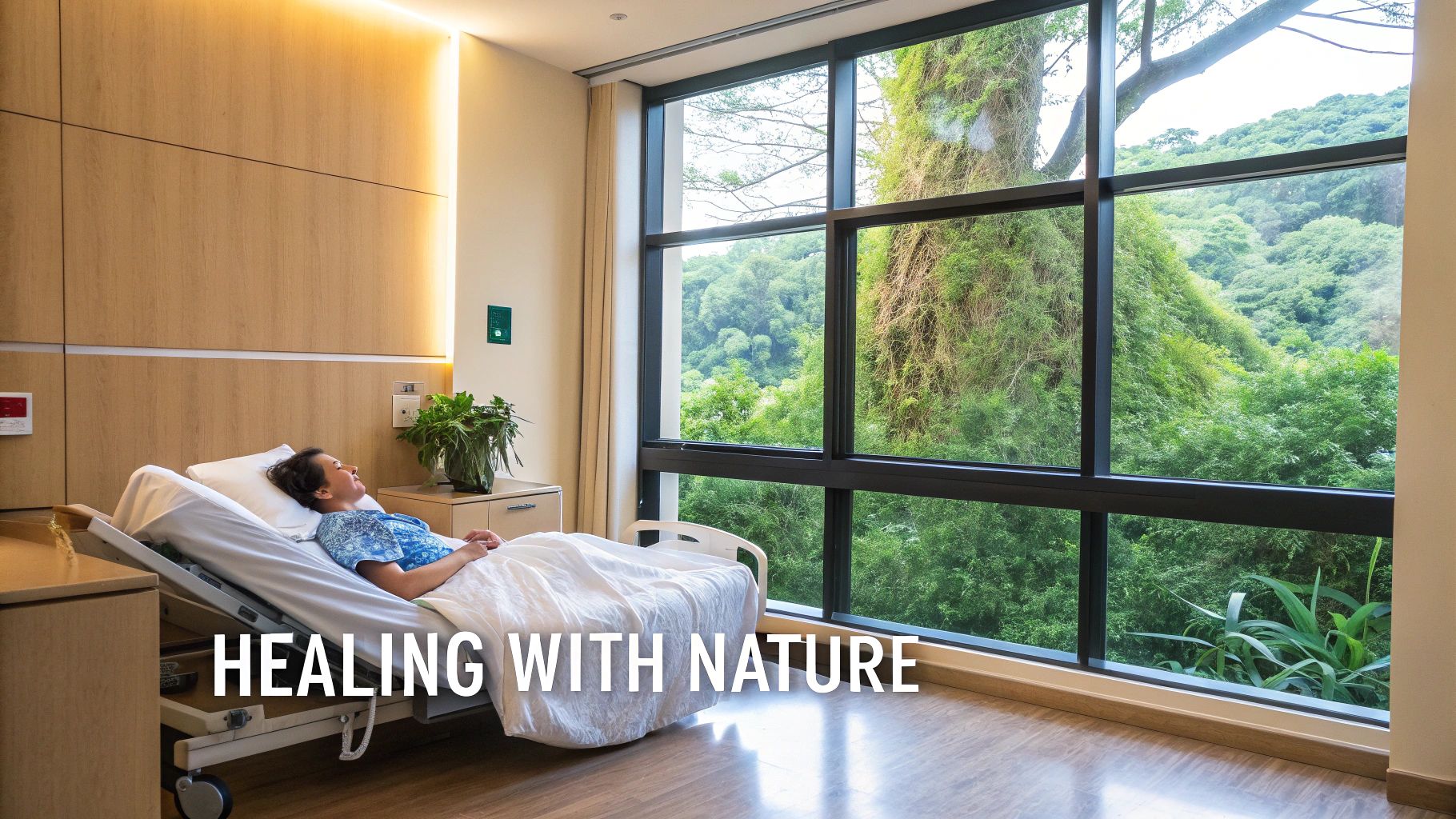
The credibility behind this approach is built on a mountain of solid research. The real turning point was a landmark 1984 study by Roger Ulrich, which gave us the first hard proof of what many intuitively knew. His research showed that post-op patients who could see trees from their window recovered faster and needed less pain medication than those staring at a brick wall.
That study essentially launched the "Healing by Design" era, and countless analyses since have backed it up. The data is clear: exposure to nature directly correlates with better health outcomes.
By thoughtfully weaving elements of the natural world into the building itself, a hospital becomes an active participant in the healing process—measurably shortening recovery times and reducing patient stress.
For patients, the benefits are tangible and well-documented:
Reduced need for pain medication: Exposure to natural light and green views has been shown to lower patients' reliance on analgesics.
Shorter hospital stays: Patients in rooms with plenty of daylight and nature views are often discharged sooner.
Lower rates of depression: Natural light helps regulate our internal clocks, which can improve mood and combat feelings of depression and anxiety.
These patient benefits have a ripple effect, leading to higher satisfaction scores and bolstering the facility’s reputation in the community.
The Financial Case for Biophilic Design
For developers, contractors, and hospital administrators, here’s the bottom line: biophilic design pays for itself. The upfront investment in larger windows, healing gardens, or interior green spaces generates substantial, long-term financial returns. It’s a smart business decision, not just an aesthetic one.
This connection between nature and operational efficiency is well-documented. Natural light is now foundational to modern layouts because it delivers proven gains, making it highly attractive to developers focused on hitting energy codes and sustainability goals.
The numbers tell the story. Ulrich's 1984 study found patients with garden views recovered 8.5% faster and needed 22% fewer analgesics. Fast forward to 2023, and 85% of new U.S. hospitals are being built with 20-30% more glazing, leading to measurable drops in infections and stress. Facilities that adopt standards like the WELL Building Standard, which mandate daylight, can see huge energy savings; some have cut costs by $500,000 per year in a single tower just by optimizing window designs. You can explore more global medical trends on WTW's insights page.
The financial upside doesn't stop with energy savings. A work environment filled with natural light and views is proven to reduce staff stress and burnout. In an industry with notoriously high turnover, that translates directly to better employee retention and massive cost savings. A happier, more focused staff also makes fewer errors, which improves patient safety and lowers the risk of costly litigation. When you look at every design choice through a financial lens, biophilic design stands out as a high-impact, high-value strategy.
Designing for Compliance and Future Demands
Once you get past the patient-focused layouts and welcoming lobbies, you run headlong into the non-negotiable world of technical compliance. A modern hospital is one of the most intensely regulated buildings you can possibly build, wrapped in a thick web of codes that dictate everything from safety to patient privacy.
For anyone on the development or construction side, getting this part right isn’t just important—it’s everything. This regulatory framework is the building’s DNA, spelling out the rules for corridor widths, operating room air pressure, and thousands of other details. It's not about checking boxes; it's about building a facility that’s safe, legal, and functional from the moment the doors open.
Navigating the Regulatory Maze
In the United States, the conversation starts with the FGI Guidelines for Design and Construction of Hospitals. Think of these as the industry bible. They aren't just suggestions; most states adopt them directly into law, making them the baseline for the entire physical environment.
But FGI is just one piece of the puzzle. Several other major regulations are just as critical:
HIPAA (Health Insurance Portability and Accountability Act): Most people think of HIPAA in terms of digital records, but its privacy rules deeply influence physical design. How do you stop sensitive conversations from being overheard in a busy waiting area? You design for acoustic privacy, ensuring exam rooms are properly soundproofed and reception desks are positioned thoughtfully.
ADA (Americans with Disabilities Act): This federal law demands complete accessibility, which in a hospital setting goes way beyond just adding ramps. It means specifying patient lifts, guaranteeing clear floor space in every bathroom, and making sure counters and equipment can be used by everyone, regardless of their physical abilities.
Don't look at these codes as restrictions. See them as a blueprint for excellence. They give us a standardized, peer-reviewed playbook that ensures every new hospital is built to an incredibly high standard, protecting patients, staff, and the owner’s investment.
The Beating Heart of the Hospital: MEP Systems
If the building’s structure is its skeleton, then the Mechanical, Electrical, and Plumbing (MEP) systems are its vital organs. These incredibly complex networks are the hospital's beating heart, running 24/7 to support life-sustaining functions. It's no surprise they represent a huge chunk of the budget—often 30-40%—and getting them right is paramount.
The HVAC system alone is a perfect example. Understanding the different commercial HVAC system types is fundamental because in a hospital, it’s a primary weapon against infection. These aren’t your typical office building systems. They create negative pressure rooms to contain airborne pathogens and positive pressure suites to shield vulnerable patients in operating rooms.
Then there's the electrical grid, which needs to be designed for 100% redundancy. A power outage isn't an inconvenience; it can be a life-or-death event. This means robust emergency generators and uninterruptible power supply (UPS) systems must be ready to kick in instantly, keeping ventilators, surgical lights, and other critical gear running without a flicker.
Finally, the plumbing network includes a whole separate infrastructure for medical gases. This intricate system of pipes delivers oxygen, medical air, and suction directly to the patient’s bedside, making it as vital as the water supply itself.
Building for Tomorrow: Flexible and Resilient Design
A hospital built today needs to be ready to serve its community for the next 50 years. That’s a long time, and it demands a design that can adapt to new technologies and withstand the unexpected.
Future-proofing is all about designing for change. Instead of building rigid, single-use spaces, the smart move is to use modular components and universal room layouts. A room might be a standard patient room today but could be easily converted into a higher-acuity unit tomorrow with minimal disruption. This is achieved by planning for "soft spaces" (like offices) next to clinical areas for easy expansion and running oversized utility chases to accommodate future wiring and tech.
At the same time, resilient design focuses on keeping the hospital running during a crisis. Think of a natural disaster or a regional blackout. A resilient hospital can essentially become a self-sufficient island, with its own on-site water storage, robust backup power, and a structure built to handle extreme weather. It doesn’t just survive the event—it stays fully operational to care for the community when it’s needed most. This isn't a "nice-to-have" anymore; it's a core expectation.
The Strategic Value of Adaptive Reuse in Healthcare
When we talk about building hospitals, the conversation usually defaults to new, ground-up construction. But there’s a powerful, often-overlooked strategy that savvy developers are turning to: adaptive reuse. This is the art of transforming an existing building—maybe a struggling office complex, an empty big-box store, or even a warehouse—into a state-of-the-art healthcare facility.
For developers and owners, this is more than just a nod to sustainability; it’s a brilliant financial play. Adaptive reuse can slash project timelines by leapfrogging the often-painful entitlement and site prep stages. Buying an existing building is almost always cheaper than acquiring raw land and building from scratch, and you might even qualify for historic preservation tax credits. It's about seeing the untapped potential in a property and turning it into a vital community asset.
Overcoming Unique Design Hurdles
Of course, retrofitting a building for healthcare isn't a simple paint-and-carpet job. It comes with its own set of puzzles that require some serious expertise to solve. The biggest challenge, time and again, is the MEP (Mechanical, Electrical, and Plumbing) systems. A standard office building’s infrastructure just can’t handle the load of a medical clinic. You need specialized HVAC for infection control, dedicated medical gas lines, and beefy electrical systems with robust emergency backup power.
Then there’s the challenge of making the floor plan actually work for a clinical setting. You have to completely rethink a layout designed for cubicles or retail shelves to create smooth, logical pathways for patients and staff. This means creating smart adjacencies—like putting exam rooms near labs—and ensuring every inch meets strict HIPAA privacy rules and ADA accessibility standards.
The core task in adaptive reuse is to surgically insert the complex systems of a modern healthcare environment into the shell of a building designed for a completely different purpose, all while maintaining structural integrity and meeting rigorous codes.
Real-World Applications and Success
The beauty of adaptive reuse is its flexibility. It opens the door to some really creative solutions that meet specific healthcare needs. We see it working successfully all the time in these kinds of scenarios:
Office Building to Outpatient Clinic: A half-empty suburban office park is a prime candidate. The existing offices can be converted into exam rooms with relative ease, while larger conference rooms make perfect waiting areas or physical therapy gyms.
Big-Box Retail to Imaging Center: A former "big-box" store offers exactly what you need for an imaging center: vast, open floor plans and high ceilings. This makes it much easier to install bulky equipment like MRI and CT scanners, which have very specific structural and shielding requirements.
Warehouse to Ambulatory Surgery Center: Warehouses are fantastic for this. Their wide-open, column-free spaces are ideal for laying out operating rooms and sterile processing departments, and their strong frames can easily support heavy equipment and new MEP infrastructure.
At the end of the day, adaptive reuse is a strategy that perfectly marries financial pragmatism with community need. By reimagining our existing buildings, developers can bring essential healthcare services to a community faster and more affordably, breathing new life into old structures and creating incredible, lasting value.
Common Questions About Hospital Design
When you're staring down the barrel of a hospital project, the questions can feel endless. For developers, owners, and contractors stepping into this highly specialized world, a few key questions always seem to pop up. Let's break down some of the most common ones with practical answers to get you started on the right foot.
What Are the Biggest Cost Drivers in Hospital Construction?
Forget what you know about typical commercial builds. In a hospital, the lion's share of the budget—often 30-40%—gets eaten up by the incredibly complex MEP (Mechanical, Electrical, Plumbing) systems. We're not just talking about standard HVAC; this includes sophisticated air handling for infection control, a web of medical gas lines, and a robust electrical grid with non-negotiable emergency backup power.
Beyond the MEP, a few other big-ticket items will drive up your costs:
Heavy-duty medical equipment is a major factor. Things like MRI or CT scanners are not only expensive on their own, but they also demand serious structural reinforcement and sometimes even radiation shielding built right into the walls.
Interior finishes have to be tough as nails. Every surface must withstand harsh cleaning protocols and relentless wear while meeting strict infection control standards.
The building's structure itself needs to be beefier to handle the weight of all that equipment and designed with future changes in mind.
Getting a handle on these expenses early in the design phase is the single best way to keep the budget from spiraling out of control without cutting corners on safety or long-term function.
How Can Design Help a Hospital Adapt to Future Needs?
The secret is thinking in terms of flexibility and modularity. A well-designed hospital isn't a rigid, static monument; it's more like an adaptable platform built to handle decades of unpredictable change.
The real goal here is to create a building that can grow and change right alongside medical technology and community health demands, all without needing a complete—and completely unaffordable—overhaul every few years. That’s how you ensure the building remains a valuable asset for the long haul.
This means using smart strategies like universal room layouts that can shift purpose with minimal effort—turning a standard patient room into a higher-acuity ICU space, for example. It also involves strategically placing "soft space," like administrative offices, next to clinical departments so they can easily expand when needed. Simple but brilliant tactics like using modular wall systems and designing oversized utility corridors for future tech are also game-changers.
What Is the First Step in Planning a Hospital Project?
Before you even think about breaking ground, the most critical step is deep-dive pre-design planning and programming. This is the foundation upon which everything else is built, and getting it right is the best predictor of a successful project.
This phase is all about assembling your core team—architects, engineers, clinical staff, and facility managers—to hammer out the project's goals, scope, and functional needs in painstaking detail. You'll run feasibility studies, analyze the site or existing structure, forecast patient numbers, and map out how every department needs to connect and flow. A rock-solid programming phase is your best insurance against costly changes down the line, ensuring the final building truly works for the healthcare provider.
At Sherer Architects, LLC, we thrive on turning these complex requirements into healthcare environments that are functional, beautiful, and built to last. Whether you're planning a new facility from the ground up, a strategic renovation, or an adaptive reuse project, our team knows how to navigate every stage. We ensure your investment delivers real value for decades to come.
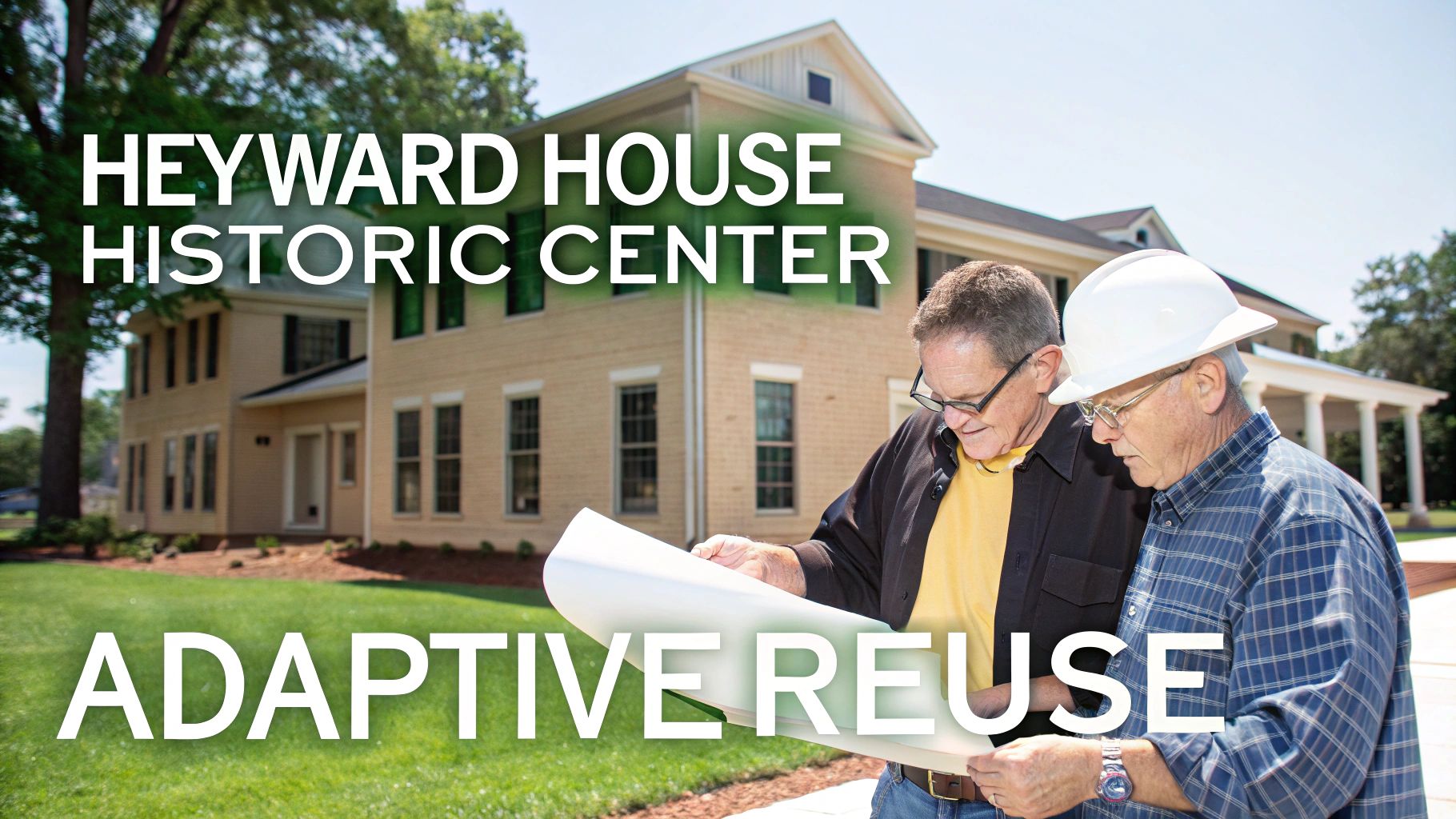
For today's real estate developers, the Heyward House Historic Center is more than just a charming relic; it's a powerful case study in turning historic properties into profitable, community-building assets. Its evolution from a private home into a public institution offers a masterclass in adaptive reuse and generating long-term ROI.
The Heyward House: A Blueprint For Modern Developers
Too often, developers see historic buildings as liabilities—riddled with constraints, hidden costs, and regulatory nightmares. But that mindset misses the bigger picture. An old structure isn't just a pile of aging materials; it’s a vessel of stories, character, and deep-seated community value just waiting to be tapped. The Heyward House proves that heritage can be a serious competitive advantage.
Its story is one of incredible resilience. Nestled in the heart of Bluffton's historic district, the Heyward House is a remarkable survivor. On June 4, 1863, Union troops shelled the town, starting fires that wiped out an astonishing 75% of Bluffton. Only eight homes and two churches from the antebellum era were left standing. The Heyward House is one of those precious few. You can learn more about its story as one of the few Civil War survivors directly from the Heyward House Historic Center.
This dramatic history of survival is the bedrock of its modern success. By leaning into its past, the property was reborn not as a stuffy, static museum, but as Bluffton’s official welcome center—a living, breathing part of the local economy.
The table below offers a quick snapshot of the building's key details.
Heyward House Historic Center At-a-Glance
Attribute
Details
Built
Circa 1841
Architecture
Carolina Farmhouse (Carpenter Gothic)
Location
70 Boundary Street, Bluffton, SC
Historical Note
One of only eight homes to survive the 1863 Burning of Bluffton.
Current Use
Official Welcome Center for the Town of Bluffton.
This blend of history and modern function is what makes the property so compelling today.
From Private Home To Public Institution
The journey of the Heyward House provides a clear, practical roadmap for any developer considering an adaptive reuse project. The secret wasn't to erase its history but to build on it. This strategy delivers tangible benefits for modern developments:
Built-in Marketability: A property with a one-of-a-kind story and unique architecture already has a marketing narrative that new construction could never hope to match.
Community Buy-In: When you restore a beloved local landmark, you often get a groundswell of public goodwill and support. This can smooth the path for approvals and help build a loyal base of customers or tenants from day one.
Sustainable Development: Reusing an existing structure is simply a smarter, more environmentally responsible choice that dramatically reduces waste and conserves resources.
The journey of the Heyward House demonstrates a core principle we champion at Sherer Architects: thoughtful preservation isn't about freezing a building in time. It's about adapting it for the future to create lasting financial and cultural value.
Why the Carolina Farmhouse Design Endures
The Heyward House is far more than just an old building; it's a living lesson in architectural intelligence, perfectly adapted to its surroundings. Its design, what we know as the Carolina Farmhouse style, wasn't created to follow a trend. It was a deeply practical and brilliant solution to the unique challenges of living in the South Carolina Lowcountry.
For anyone looking at a historic property, understanding this connection between form and function is absolutely crucial. The building's original design isn't some dusty relic—it’s a roadmap to its inherent value. I often compare it to a classic car; the original engineering is what makes it a timeless, high-performance machine. If you start swapping out parts without understanding why they were chosen in the first place, you risk destroying the very thing that makes it special.
When you look at the Heyward House Historic Center, every architectural detail tells a story of survival and clever design. These features weren't just for looks; they were essential tools for living comfortably in a place that’s hot, humid, and prone to flooding.
Built for the Lowcountry Climate
The real genius of the Carolina Farmhouse is how it works with nature, not against it. Long before we had modern air conditioning, several key features allowed these homes to breathe and keep their inhabitants comfortable. It’s a masterclass in understanding local materials and the environment.
Expansive Porches: These weren't just for sipping sweet tea. They were the building's first line of defense against the relentless sun, creating a wide shade buffer that kept the interior walls cool and drastically reduced the heat beating down on the house.
Raised Foundations: Lifting the main living area off the ground on brick piers served two critical purposes. First, it protected the wooden structure from damp ground and potential floodwaters. Second, it created a pocket for air to circulate underneath the house, acting as a natural cooling system.
Timber Framing: The home’s skeleton was built with a robust timber frame, often using dense, resilient heart pine that could stand up to hurricane-force winds. The simple, open floor plans weren't just a style choice; they were designed to encourage cross-ventilation, letting breezes flow freely from room to room.
These elements prove that the original builders were master problem-solvers. This is precisely why our first step in any preservation project at Sherer Architects is deep architectural research.
By studying the original materials and building methods, we uncover the "architectural DNA" of a structure. This knowledge allows us to make informed decisions that honor the building's history while adapting it for a profitable, modern future.
Jumping into a project without this foundational knowledge is a recipe for expensive mistakes. A developer who doesn't grasp why the foundation was raised might accidentally introduce moisture problems. Someone who removes a porch for a more modern look could see their future energy costs skyrocket. The original design holds the keys not just to the building’s past, but to unlocking its future potential in a way that is both authentic and economically sound.
How the Heyward House Found Its New Purpose
For most of its life, the Heyward House was simply a private home. Its architectural importance and deep connection to the community were treasures known mainly to the people of Bluffton. But by the late 20th century, the house, like so many historic buildings, was facing a very uncertain future. A building’s story can easily end with a wrecking ball if no one steps in with a vision to carry it forward.
That critical moment came in 1998. The Bluffton Historical Preservation Society saw the building for what it was—irreplaceable—and acquired the property. This wasn't just a real estate transaction; it was a deliberate investment in the town's future. The plan wasn't just to save an old house, but to give it a new mission as Bluffton's official welcome center and a public museum.
From Private Residence to Public Asset
This journey from a quiet family home to a bustling public landmark is a perfect case study in adaptive reuse. Making it happen took a lot more than a fresh coat of paint. It required a meticulous restoration that honored the building's history while outfitting it for a new, public-facing role. The Preservation Society’s work guaranteed the structure would once again be at the heart of Bluffton's daily life.
The careful work became a masterclass in breathing new purpose into an old frame. Understanding the potential locked inside a distressed property is the first step in giving historic sites a second chance, just as the Heyward House found its calling.
This timeline illustrates how some of the key design elements of the Carolina Farmhouse style have evolved over the years.
You can see how enduring features like timber frames, wide porches, and raised foundations were fundamental to the building’s original, climate-smart design.
By turning the Heyward House into a welcome center, the community created a powerful hub for tourism and local pride. It became the first stop for visitors, instantly connecting them to the town's story. This strategy gets to the heart of what we believe at Sherer Architects.
Extending a building's useful life by 50-75 years through thoughtful adaptation is almost always a smarter, more sustainable, and more profitable investment than demolition and new construction. The Heyward House is proof that preservation pays dividends.
The project’s success isn't just measured in the historic materials saved, but in the real economic and cultural value it brings to the Town of Bluffton every single day. It shows how one building, repurposed with foresight, can energize a community and generate a return on investment that far outweighs the initial costs. It stands today as a living monument to strategic preservation.
Unlocking the Financial Value of Historic Properties
Preserving a landmark like the Heyward House Historic Center obviously pays off in cultural and historical rewards. But for savvy developers and investors, the real question is: does it make financial sense?
Too often, historic properties are seen as risky ventures, tangled in red tape and hidden costs. But here's the thing—with the right expert guidance, these buildings represent a fantastic opportunity to generate serious returns.
This is where a seasoned preservation architect becomes the most valuable player on your team. It's not just about restoring old features. It's a strategic puzzle that involves digging into materials research, navigating complex approval bodies like Design Review Boards, and, most importantly, unlocking a deep well of financial incentives. Your architect is your guide, turning potential headaches into profitable assets.
Think of it like restoring a classic car. Anyone can give it a new coat of paint, but a master mechanic—or in our case, a specialized architect—knows how to rebuild the engine for peak performance, ensuring every detail is authentic and adds to its long-term value.
Tapping into Powerful Financial Incentives
The financial landscape for historic preservation is surprisingly rich with opportunity, but you have to know where to look. Getting your hands on these benefits takes deep institutional knowledge and a proven process for documentation and applications. This is precisely where a firm like Sherer Architects can create immense value for clients.
Here are a few of the key financial tools available:
Federal Historic Tax Credits: This is the big one. It offers a 20% income tax credit for the qualified rehabilitation of historic, income-producing buildings. This isn't just a deduction; it's a direct, dollar-for-dollar reduction in what you owe in taxes, which can dramatically improve a project's bottom line.
State Historic Tax Credits: Many states, including South Carolina, have their own tax credit programs. The best part? They can often be stacked on top of federal incentives, making the financial picture even more attractive for developers.
Preservation Grants and Specialized Loans: Beyond tax credits, numerous foundations and government programs offer grants specifically for historic preservation. There are also specialized loan programs out there that can provide more favorable terms for projects that save historic structures.
For anyone looking at South Carolina's Lowcountry market, the Heyward House is a perfect example of this strategy in action. Honoring the building's historic character through detailed research—while securing tax credits and grants—delivers lasting value. It also builds community goodwill, which is a huge advantage in a major tourism-driven market. You can learn more about how the Heyward House serves its community.
De-Risking the Investment with Expert Guidance
Trying to navigate this complex world on your own is a huge risk. An architect specializing in historic preservation does more than just design; they build a financial and regulatory strategy from the ground up.
They do the legwork to prove a building's historical significance, prepare the mountains of documentation required for tax credit applications, and represent your project with credibility in front of review boards.
By partnering with an expert who knows how to unlock these financial tools, a developer can transform a historic property from a high-risk gamble into a predictable, high-return investment. The incentives are designed to make preservation the smart financial choice.
This kind of partnership effectively de-risks the entire project. It ensures that your renovation not only meets all historical standards but is also set up for maximum financial success right from the start, turning a community treasure into a profitable, legacy-building asset.
What Today's Developers Can Learn From This Project
The story of the Heyward House Historic Center isn't just a fascinating piece of local history; it’s a practical playbook for developers aiming to build projects with both profit and legacy in mind. It teaches a powerful lesson: a building’s past isn't a liability to be managed, but its single greatest asset.
At the end of the day, successful development is about creating places people genuinely want to be. The Heyward House nails this by embracing its incredible story of survival and resilience. That narrative is more than just a historical footnote—it’s a powerful marketing tool that a brand-new building simply can't buy. Developers can learn from this by digging into the history of their own properties and using that story to build a real, authentic connection with the community.
Turning Character into Commerce
The Heyward House is living proof that preserving a building’s character pays real dividends, both financially and in terms of reputation. Its role as Bluffton's official welcome center shows how weaving a project into the fabric of the community drives foot traffic and creates lasting value.
The numbers back this up. Today, the Heyward House Historic Center is a major draw, earning a stellar 4.5/5 rating from 111 TripAdvisor reviews, with 71 of those visitors rating their experience as 'excellent.' This kind of public enthusiasm isn't an accident. It’s the direct result of a smart decision to make the building an essential part of the town’s modern identity, as highlighted in its heritage site overview.
The lesson for developers is crystal clear: adaptive reuse isn't just a sustainable choice; it's a smart business move. When you give a historic building a new life that serves the surrounding community, you create an asset with deep roots and a built-in audience.
Strategies for Your Next Project
Putting these ideas into practice means shifting your mindset. Stop seeing old buildings as problems to be solved and start seeing them as puzzles with incredible potential waiting to be unlocked.
Here are a few core strategies to take from the Heyward House model:
Lead with the Story: Don’t hide the building’s history in a dusty plaque. Make it the star of your design and marketing. This is what gives your property an identity that no one else can copy.
Find a Community Fit: The building’s new purpose should fill a real need, whether that’s retail, housing, or a public gathering place. A project that serves the community is a project that will last.
Bring in the Experts Early: Working with architects who live and breathe historic preservation, like Sherer Architects, isn't just another line item on the budget. It's an investment in getting the details right and maximizing the property's financial and cultural worth.
We Help Developers Build a Lasting Legacy
Historic properties are so much more than just old buildings; they're opportunities waiting to be rediscovered. Think of a place like the Heyward House Historic Center—each one is a unique puzzle. Cracking the code requires a deep dive into its history, meticulous research, and a clear vision for how to marry its heritage with the demands of today. It’s about seeing a vibrant future waiting within a structure's storied past.
Turning a potential headache into a profitable, legacy-building asset is no accident. It’s a deliberate process that hinges on a partnership built on genuine experience and a shared passion for preservation. For developers looking to make a real mark in South Carolina, the first step is always choosing the right guide.
Turning History into Opportunity
At Sherer Architects, we specialize in bringing these complex projects to life in a way that’s beautiful, sustainable, and built to last. We have a knack for looking past the immediate hurdles—the peeling paint, the outdated systems—to see the immense financial and cultural value locked within those historic walls.
Our approach is straightforward but thorough:
We start with a deep dive. Our team investigates every detail, from the original building materials to the construction techniques used, ensuring any restoration feels authentic.
We design for the future. Our plans don't just restore; they adapt. We thoughtfully extend a building's life, making sure it meets modern needs and building codes without sacrificing its character.
We navigate the financial side. We guide our clients through the process of securing historic tax credits and other incentives, helping them make the project financially successful.
For any developer serious about creating lasting value, the single most important decision you'll make is choosing an architect who lives and breathes preservation. It's the move that turns a piece of history into your next great opportunity. Let's build your legacy together.
Common Questions About Historic Preservation
For developers and property owners, taking on a historic preservation project can feel like stepping into a whole new world. It’s only natural to have questions about costs, regulations, and whether it’s a sound investment. Let’s tackle some of the most common concerns to clear things up.
Isn't Historic Preservation Just More Expensive Than Building New?
This is probably the number one question we get, and the answer might surprise you. While every project is different, adapting an existing historic building is often more cost-effective in the long run.
Think about it: the building’s core structure—its "good bones"—is already in place. That represents a massive amount of material and labor that's already been paid for. When you add powerful financial tools like federal and state historic tax credits into the mix, the final investment can be significantly lower. It's often the smarter financial move.
The goal isn't just about saving an old building; it's about creating a financially successful asset. A great preservation project strikes a perfect balance between historical character and modern needs, resulting in a one-of-a-kind property that new construction simply can't match.
How Can You Possibly Meet Modern Building Codes in a Centuries-Old Structure?
This is where the real expertise comes in. Bringing a historic building up to today's standards for safety, accessibility, and energy efficiency is a central part of any preservation project. The trick isn't to force modern systems into an old frame but to integrate them with skill and creativity.
This could mean:
Cleverly routing new electrical and plumbing to keep them out of sight.
Restoring and upgrading original windows for modern thermal performance instead of tearing them out.
Designing innovative accessibility features that feel like they belong, rather than being tacked on as an afterthought.
A seasoned preservation architect knows how to work with building officials to find solutions that satisfy the spirit of the code without sacrificing the building's historic soul. Beyond a landmark like the Heyward House, countless properties need this kind of thoughtful care. For anyone tasked with this responsibility, understanding what is property preservation is fundamental to protecting the investment for the long haul. It’s all about respecting the past while building a safe, functional, and valuable asset for the future.
At Sherer Architects, LLC, we live for these kinds of complex challenges. We help developers navigate every single step of a historic preservation project, turning what seem like obstacles into unique, profitable opportunities. Contact us today to see how we can help bring your vision to life.
The Warehouse Theatre in Greenville SC isn't just a place to see a great show; it’s a living blueprint for how to do adaptive reuse right. We're going to dive into how this simple textile warehouse was completely transformed into a vibrant cultural cornerstone for the city's West End, making it a compelling case study for any developer or property owner with an eye for potential.
From Industrial Relic to Cultural Icon in Greenville SC
For anyone in the development world, the Warehouse Theatre is more than just a local success—it’s a masterclass in visionary placemaking. This guide will unpack how smart architectural choices and an unwavering focus on community turned an underused historic property into a profitable, soul-enriching asset.
This transformation really hammers home a core principle of modern urban development: sometimes the most valuable new buildings are the old ones. Instead of bringing in the wrecking ball, adaptive reuse preserves a structure's unique character while breathing new life and economic purpose into it.
A Model for Urban Revitalization
The journey of the Warehouse Theatre is a perfect example of the hidden potential locked inside aging industrial buildings. By reimagining a space once filled with looms and spindles as a venue for drama and art, the project became a true catalyst for change in Greenville's West End. It did more than just give a theater company a new home; it sparked a much wider economic and cultural revival.
The results speak for themselves. The Warehouse Theatre's 2025 season, for example, was a banner year, seeing a 32% surge in patrons across all its productions, education programs, and community events. By employing 143 local artists, the theater became a significant economic engine, driving critical foot traffic into a district that was once quiet after 5 PM. This kind of success mirrors what we see in other adaptive reuse wins, where thoughtful infrastructure upgrades can extend a building's functional life by 50 to 75 years. For more on the local arts scene's growth, check out the coverage in the Greenville Journal.
Adaptive reuse is about more than saving a building; it's about reinterpreting its story for a new generation. The Warehouse Theatre proves that historic structures can become the heart of a modern, thriving community.
This guide will break down the practical steps and strategic thinking that made this project a success, focusing on three key areas:
Historic Preservation: How to honor a building's original character while bringing it up to modern code and expectations.
Economic Revitalization: The strategy behind becoming a cultural anchor that boosts surrounding businesses.
Tangible ROI: A clear look at the financial and community returns that come from thoughtful, forward-thinking design.
To give you a quick, high-level overview, here's a snapshot of the project's key details. This is especially useful for developers weighing the pros and cons of taking on a similar historic property.
The Warehouse Theatre Project at a Glance
Attribute
Details
Project Type
Adaptive Reuse, Cultural Anchor
Original Use
Textile Warehouse (circa 1920s)
Current Use
Professional Live Theatre & Arts Venue
Location
West End Historic District, Greenville, SC
Key Impact
Catalyst for neighborhood revitalization
Patron Growth (2025)
32% increase across all programs
Local Artist Employment
143 artists employed in a single season
Primary Goal
Create a community-centric cultural hub while preserving historic character.
This table neatly summarizes how a single project can hit multiple targets—preserving history, driving economic activity, and enriching the local community all at once.
Tracing the Theater's Journey of Transformation
Every great adaptive reuse project has a story, and the Warehouse Theatre’s is a masterclass in vision and grit. Its transformation wasn't a single, dramatic event. Instead, it was a series of smart, deliberate moves that show what it takes to turn an old building into a cultural cornerstone.
The story starts back in 1973. Founders Dr. Peter Smith and Jim Boivin didn't have a grand theater; they had sheer will. They carved out an intimate black box theater from a dingy annex at the Greenville Memorial Auditorium, proving that you don’t need a perfect space to create powerful art.
This humble beginning is a key lesson for any developer. Great projects often start small. They prove their concept, build a following, and create demand before taking on a massive investment. Those early years were about more than just staging plays—they were about building a brand and demonstrating that Greenville not only wanted but needed this kind of theater.
The Strategic Leap to the West End
By the mid-1990s, the theater had outgrown its starter home and was ready for its next act. The leadership team made a bold, calculated bet on Greenville’s West End, a neighborhood that was just beginning to stir with the promise of revitalization. This wasn't a safe move into an established arts district; it was a pioneering jump into an area with untapped potential.
They found their new canvas in a series of three historic storefronts, once part of a sprawling textile warehouse. Working with McMillan Pazdan Smith Architecture, they skillfully transformed the raw, industrial space into a state-of-the-art, 150-seat venue. The design brilliantly preserved the building's historic soul while meeting all the technical demands of a modern performance space.
The project was a triumph. It earned an AIA Greenville Merit Award in 1999 and cemented the Warehouse Theatre in Greenville SC as a true landmark. This kind of thoughtful adaptive reuse shows you can honor a building's past while giving it a vibrant new future. You can read more about this award-winning project and its history in American Theatre magazine.
The decision to move to the West End was more than a change of address; it was an investment in a neighborhood's potential. The theater didn't just join a community—it helped build one.
This history holds powerful lessons for developers today. The theater’s team saw opportunity where others saw decay. They understood that by becoming an early anchor in a neighborhood on the cusp of change, they could secure a unique home and actively shape the area's identity. It was a risk, absolutely, but one that paid off spectacularly for both the theater and the city of Greenville.
Balancing Performance Needs with Historic Preservation
Turning a building meant for storing textiles into a stage for live performance is a heck of a puzzle. The real triumph of the Warehouse Theatre in Greenville SC is how it solved this puzzle, creating a masterclass in how to fuse modern theatrical demands with the soul of a historic building.
For any developer, this is the tightrope you have to walk. Get it right, and you have something special. Get it wrong, and you lose the magic. It's about so much more than just saving old brick—it’s about making that brick work for a purpose it was never designed for. The trick is to weave in all the essential theatrical guts without gutting the building's industrial character.
Think of it like restoring a vintage muscle car. You keep the iconic body and the classic feel, but you install modern brakes, a reliable engine, and air conditioning. You need it to be practical. In the same way, a theater has non-negotiable technical needs that you’d never find in an old warehouse.
Weaving Theatrical Tech into a Historic Shell
The team behind the Warehouse Theatre had to get creative to overcome some serious technical hurdles. Every fix had to complement the building's original bones, not fight against them.
Here’s what they were up against:
Acoustics: Brick walls and high ceilings are an acoustic nightmare, turning clear dialogue into a muddy echo. The solution involved adding sound-absorbing materials and shaping surfaces to control sound, all while keeping that gorgeous brick exposed.
Sightlines: Every single seat needs a clean view of the stage. But in a building dotted with original support columns, this meant building a custom-tiered seating plan that worked around the building’s quirks, not in spite of them.
Accessibility: Old buildings were built long before modern accessibility standards. Adding ramps, proper seating, and compliant restrooms into an existing footprint took some clever spatial gymnastics to meet ADA requirements.
The genius of the Warehouse Theatre’s design is how it makes modern systems look like they belong. HVAC ducts, lighting grids, and sound equipment are integrated so well they become part of the industrial vibe, not a clunky add-on.
Keeping the Character, Building the Function
The designers made a conscious decision to let the building’s history shine through. Instead of covering everything with drywall, they left the original brick walls and hefty structural beams exposed, making them a centerpiece of the design. This gives the space a gritty, authentic warmth a brand-new building could never fake.
Even backstage logistics were a challenge. Carving out space for dressing rooms, set storage, and tech booths from the existing floor plan required an incredibly efficient use of every last square foot. This is a great lesson for developers: sometimes, the limitations of a historic space force you to find smarter, more creative solutions.
The final result is a theater where the past and present are in a constant, beautiful conversation. For anyone looking to tackle a similar project, it’s worth reading up on the best practices for renovating a heritage home while preserving its charm. This delicate balance—honoring a building’s story while fitting it for a new one—is what separates a good project from a truly great one.
How the Theater Kickstarted the West End's Comeback
The real impact of an adaptive reuse project never stays inside its own walls. The Warehouse Theatre in Greenville, SC, is a textbook case of this, showing how one smart project can create economic shockwaves that lift an entire neighborhood. Its move to the West End wasn't just a change of address; it was the deliberate planting of a cultural anchor.
Before the theater's award-winning renovation, the West End was a neighborhood with great bones but no real reason for people to stick around after 5 p.m. By turning a forgotten old cotton warehouse into a lively performance space, the theater created a destination. All of a sudden, hundreds of people were flowing into the area on a regular basis, looking for a place to eat before a show or grab a drink afterward.
That steady stream of people is the secret sauce for urban revitalization. It sends a clear signal to other business owners that there's a market waiting for them. In effect, the theater took a lot of the risk out of the equation for other investors.
The Spark That Lit the Fire
The theater's success set off a chain reaction. Restaurants, bars, and art galleries started popping up nearby, eager to cater to the ready-made crowd the venue delivered night after night. This natural growth turned the West End from a sleepy, post-industrial pocket of the city into one of Greenville's most exciting districts.
Over its remarkable 50-year history, the Warehouse Theatre has come a long way, moving from shared, often animal-scented, spaces at the Municipal Auditorium to its iconic cotton warehouse home in 1999. Today, it’s a pillar of Greenville's arts scene, putting on multiple mainstage shows and the beloved Upstate Shakespeare Festival. It pumps both cultural and financial energy directly into the local economy, employing around 200 artists each year on a budget of less than $1 million. You can get a closer look at the theater's mission and its celebratory 50th anniversary season here.
The Warehouse Theatre didn’t just find a new home in the West End; it gave the West End a reason to come alive after dark. It became the steady heartbeat that attracted more investment and growth.
This really drives home a crucial lesson for developers: putting money into a cultural venue is about more than the direct return on that single property. It's about building an entire economic ecosystem.
The benefits spread out like ripples in a pond, touching the whole area:
Rising Property Values: As the neighborhood became a place people wanted to be, the value of surrounding properties went up.
A More Diverse Business Scene: The first wave of restaurants and bars was soon followed by retail stores and new residential projects.
A New Reputation: The West End became known as a creative and vibrant hub, drawing in even more visitors and new residents.
For any developer weighing a similar project, the story of the Warehouse Theatre is powerful proof of concept. It shows how a single project, when it truly connects with the community, can become a catalyst that delivers returns far beyond its own property lines—a smart way to turn an overlooked district into a thriving destination.
An Actionable Blueprint For Your Next Project
The story of the Warehouse Theatre in Greenville, SC, is more than just an inspiring tale; it's a practical, repeatable roadmap for anyone looking to tackle an adaptive reuse project. By digging into how they turned a forgotten building into a cultural gem, we can pull out real-world lessons that transform historic headaches into development home runs.
Let's move past the theory and get straight to the strategy.
It all starts with a shift in perspective—learning to see the promise where others only see problems. Look for properties with "good bones." We're talking about buildings with solid structural integrity, unique architectural details, and a location that’s just on the verge of a comeback. The team behind the Warehouse Theatre did exactly that, choosing a neglected corner of the West End because they knew a cultural anchor could redefine the whole neighborhood.
This is how a single venue can kickstart a domino effect of urban renewal.
As you can see, the theater’s revival directly feeds local business growth. That growth, in turn, helps build a more vibrant and connected community. It’s a powerful cycle.
Navigating The Financials And Winning Over The Community
Once you’ve found that diamond in the rough, it’s time to tackle the financial puzzle. The good news is that adaptive reuse projects often unlock a host of incentives that can make the numbers work. You just have to do your homework and chase down every lead.
Here are a few of the most powerful financial tools to look into:
Federal Historic Tax Credits: These are a game-changer, potentially covering 20% of your rehabilitation costs for certified historic buildings.
State Historic Tax Credits: South Carolina, like many other states, has its own tax credit programs that can often be combined with federal incentives.
Local Grants and Loans: Don't overlook city hall. Many municipalities have funds set aside to support projects that align with their own revitalization goals.
But money is only half the battle. Getting the community on your side is just as important. The Warehouse Theatre didn't just open its doors; it wove itself into the fabric of Greenville. You need to start conversations with neighborhood groups, local artists, and your future patrons early and often. Their enthusiasm is what gets you through zoning hearings and fills the seats on opening night.
A project's greatest asset isn't brick and mortar; it's the community that claims it as their own. Financial incentives might get a building open, but it's the people who keep it alive for decades.
For anyone taking on a project like this, building a sustainable business model from day one is non-negotiable. If you're new to the space, check out resources like a comprehensive guide to starting an events business. This kind of groundwork ensures your venue has a life long after the construction crews have packed up.
Why Quality Design Is Your Best Long-Term Investment
Finally, never, ever skimp on design. The team behind the Warehouse Theatre didn't just build a functional black box. They created an experience. They paid respect to the building's industrial soul by leaving brick exposed and highlighting original beams, all while seamlessly integrating the high-tech demands of a modern theater.
This commitment to quality design delivers on three critical fronts:
It Creates a Destination: A truly unique and thoughtfully designed space gets people talking. It earns press, draws in patrons from all over, and becomes a landmark.
It Enhances the Experience: Great design isn't just about looks; it solves problems. It perfects acoustics, ensures there isn't a bad seat in the house, and makes every visit memorable.
It Boosts Long-Term Value: A well-designed building is simply worth more. It attracts better talent, stands the test of time, and proves that good design is always good business.
The Warehouse Theatre's success wasn't an accident. It was the result of a clear strategy: identifying hidden potential, mastering the incentives, earning community trust, and investing in quality design. It’s a blueprint for creating projects that are not only profitable but also powerful.
Adaptive Reuse Project Checklist
To make these lessons even more concrete, we’ve put together a checklist based on the Warehouse Theatre's journey. Use this to guide your thinking as you approach your own project.
Phase
Key Action Item
Why It Matters (Warehouse Example)
1. Discovery & Vision
Identify a property with "good bones" in an underserved or emerging area.
The theater was built in a neglected textile warehouse, seeing the potential before the West End became a destination.
2. Financial Strategy
Aggressively research and apply for all available historic tax credits and local grants.
A combination of federal and state incentives was crucial for bridging the funding gap and making the project financially viable.
3. Community Engagement
Meet with neighborhood associations and local stakeholders before finalizing plans.
Early buy-in helped the Warehouse Theatre become a beloved community asset, not an unwelcome disruption, ensuring long-term support.
4. Design & Preservation
Hire architects who specialize in adaptive reuse and value historical character.
The design preserved the building's industrial past (exposed brick, steel) while adding modern theatrical necessities.
5. Operational Planning
Develop a sustainable business model for the venue's long-term operations.
The theater established itself as a professional company with a strong programming schedule, ensuring it would thrive beyond the initial launch.
6. The Launch & Beyond
Market the space not just as a venue, but as a community cultural hub.
By programming diverse shows and events, the Warehouse became a central part of Greenville's cultural identity.
Following these steps won’t guarantee an easy road, but it provides a battle-tested framework for turning a piece of history into a vibrant part of the future.
Your Project's Turn in the Spotlight
So, what can we take away from the story of the Warehouse Theatre in Greenville, SC? It's more than just a successful project; it's a living blueprint for developers and property owners who see potential where others might only see a problem. The biggest lesson here is a shift in perspective: old buildings aren’t burdens. With the right vision, they’re incredible opportunities waiting to be unlocked.
When you get adaptive reuse right, you're not just restoring brick and mortar. You're creating spaces that deliver real financial returns while becoming the heart and soul of a neighborhood. It's about taking the best of the old and reimagining it for a new generation.
The real takeaway is that you can do this too. Your city is full of overlooked buildings with stories to tell. By applying the strategies we've seen with the Warehouse Theatre, you can build something that doesn't just make money—it makes a difference.
The journey of the Warehouse Theatre proves that one smart, thoughtful project can be the catalyst for so much more. It shows that by respecting a building's history, you can not only secure its future but also ignite the revival of an entire community.
Let this be your guide. Let it be the proof that great design and a genuine focus on community aren't just feel-good ideas; they're the foundation of lasting success.
Frequently Asked Questions About Adaptive Reuse
When developers and property owners look at an old building, they often see both incredible potential and a list of daunting questions. Let's tackle some of the most common concerns head-on, using the Warehouse Theatre in Greenville, SC, as a real-world example of how these challenges can be turned into triumphs.
It’s a bit like finding a classic car in a barn. The style is undeniable, but you're naturally worried about the engine, the rust, and whether the restoration will be worth it. Getting clear answers to a few key questions can make all the difference.
Is Adaptive Reuse More Expensive Than New Construction?
The short answer? Not always. In fact, it can often be the smarter financial move. People tend to focus on the costs of renovating an older structure, but they forget about the massive expenses of a new build—demolition, site preparation, and the soaring price of new materials.
Adaptive reuse gives you a huge head start by keeping the building's "good bones." With the Warehouse Theatre, the team didn't have to build a new structural frame or lay thousands of new bricks; that was all part of the package. That existing structure represented a massive savings in both materials and labor, and it also happened to be the very thing that gives the building its unique character.
Think of the existing building not as a liability, but as your greatest asset. The structure, materials, and history are already paid for.
On top of that, these kinds of projects often qualify for financial incentives that a new build simply can't get.
How Do You Secure Funding for These Projects?
Financing an adaptive reuse project isn't the same as getting a loan for a standard new construction. While traditional financing is certainly part of the mix, the real game-changer lies in the specialized programs designed specifically to encourage this kind of preservation.
Smart developers build a funding strategy that includes:
Federal Historic Preservation Tax Credits: This is a big one. It offers a 20% tax credit for the qualified costs of rehabilitating a historic building, which can dramatically improve a project's bottom line.
State and Local Grants: Don't overlook what's available in your own backyard. Many cities and states have grants aimed at revitalizing historic districts and supporting culturally significant projects.
Community Partnerships: The Warehouse Theatre is a perfect example of this. The project was fueled by incredible community buy-in, opening the door to private donations and local sponsorships that became essential to its success.
What Is the Biggest Non-Financial Hurdle?
Without a doubt, the biggest challenge is often navigating the maze of modern building codes, zoning regulations, and historic preservation standards. Old buildings weren't constructed with today's fire safety, accessibility, or energy efficiency requirements in mind.
The real puzzle is figuring out how to thread the needle—how do you integrate modern systems and meet code without stripping the building of its soul? This is where an experienced guide is non-negotiable. An architect who specializes in historic preservation knows how to find those elegant, creative solutions that satisfy inspectors while respecting the building’s heritage. They can turn what seems like a frustrating roadblock into an award-winning design feature.
At Sherer Architects, LLC, we see historic challenges as profitable opportunities. If you're weighing the potential of an adaptive reuse project, let's talk about how our decades of experience can bring your vision to life. Learn more about our approach to architecture.
A fire station architect does more than just draw up plans; they turn a community's vision for safety and readiness into a living, breathing building. These are specialists who get the unique pressures of a 24/7 facility, from the split-second logistics of a turnout to the long-term health of the crew. Honestly, hiring a firm with real-world fire station experience is the most important decision you'll make for the project's success.
Defining Your Vision Before You Build
The fate of your new or renovated fire station is sealed long before any dirt is moved. This initial planning stage, which we call programming, is all about creating a bulletproof foundation for everything that follows. It's a collaborative deep dive that turns your department's specific operational needs into a clear, tangible plan.
This "program" becomes the master guide for your architect. It's an incredibly detailed document that maps out every single functional space, making sure the final design is a perfect match for the day-to-day reality your first responders face.
Gathering Input From Key Stakeholders
The best programs come from talking to people. A good architect will lead detailed interviews with everyone who has a stake in the station to get the full picture. This isn't just about checking boxes; it’s about understanding the culture and the real workflow of your department.
You’ll want to make sure these groups are at the table:
Fire Chief and Command Staff: They’ll share the big-picture vision—where the department is heading, what administrative functions are needed, and how this station fits into the city's broader emergency plan.
Firefighters and Paramedics: These are your end-users, and their feedback is gold. They can point out what’s wrong with the current station, how the flow from the living quarters to the bay needs to work, and exactly what they need for gear storage and decontamination.
Community Leaders and Officials: They bring the public perspective. Do you need a community meeting room? Should the station double as a safe haven during a disaster? They also keep everyone grounded in the reality of budgets and municipal approvals.
Translating Needs Into a Detailed Program
With all this feedback in hand, the architect gets to work translating it into the program document. This is way more than a simple list of rooms. It’s a comprehensive guide that defines how every space functions and connects to the others.
For example, it won't just say "Decontamination Room." It will specify that it must be right next to the apparatus bay and map out the exact sequence of movement from the bay, through decon, and into the showers and locker rooms. This is how you design for firefighter health and safety.
This process forces you to think through every detail. A solid program will nail down spatial needs for everything, from sizing the apparatus bays for the bigger trucks you might buy in 10 years, to laying out the kitchen and dayroom in a way that actually helps the crew bond.
A fire station isn't just a building; it's a critical piece of community infrastructure and a 24-hour home for its crew. The programming phase ensures that the design supports the human element of firefighting just as much as the operational one.
By putting in the time and effort during this upfront discovery, you hand your architect a crystal-clear roadmap. This clarity saves a fortune by preventing major design changes down the road, keeps the project from spiraling out of control, and ultimately delivers a facility that’s safe, efficient, and ready to serve your community for decades. This groundwork is what makes the rest of the project run smoothly.
Finding the Right Spot and Nailing the Codes
Where you put a new fire station is every bit as important as how you build it. The perfect location can shave precious seconds off response times, but the wrong one can turn into a daily logistical headache. From an experienced architect’s perspective, finding that right spot isn't just a real estate transaction; it's a deeply technical process.
These days, site selection has become a precise science. Fire departments lean heavily on run-time analyses, digging into historical response data and using GIS mapping to model different scenarios. They’ll often evaluate a handful of potential sites to find the one that mathematically minimizes response times across their entire service area.
Planning the Site for Split-Second Departures
Once you’ve zeroed in on a general area, the specific piece of land brings its own set of puzzles to solve. A good architect’s first move is to analyze the parcel for operational flow, looking far beyond simple square footage.
Here’s what’s immediately on our minds:
Apparatus Turning Radii: Today's ladder trucks are massive and need a lot of room to maneuver. The site has to accommodate those wide turns without forcing drivers into a clumsy, multi-point turn that wastes time when it matters most.
Secure Site Access: You need more than just a driveway. The site requires controlled entry and exit points for apparatus, staff, and the public to keep civilian traffic from blocking a rig that's trying to leave on a call.
Drive-Through vs. Back-In Bays: This is a big one. Whenever humanly possible, drive-through apparatus bays are the gold standard. They completely eliminate the dangerous and slow process of backing a huge rig into the station, which is a massive win for both safety and speed. An architect can quickly tell you if a site’s shape and size make this best-practice layout a reality.
Think about a corner lot that looks perfect on paper because it's so central. An experienced architect might spot that the busy intersection will create a 30-second delay during rush hour, or that the property is too narrow to allow for drive-through bays. That's the kind of insight that saves a city from a multimillion-dollar mistake.
Why Fire Stations Are Built Like Bunkers: Risk Category IV
Beyond the location, the building itself has to be absolutely bomb-proof. A fire station isn't just another commercial building; it’s an essential facility that must be standing and fully functional after the worst has happened. This isn't just a good idea—it's written into the building codes an architect has to follow.
Fire stations today are designed to the Risk Category IV classification under the International Building Code. In simple terms, this means they're engineered to handle much higher structural loads from things like hurricanes, earthquakes, floods, and heavy snow. This beefed-up standard ensures first responders can actually work out of the station during a disaster, right when their community needs them most. You can dive deeper into how these standards create truly resilient community hubs by reading more about safe fire station design on RedstoneArchitects.com.
A Risk Category IV fire station is the community's last line of defense. When a hurricane or earthquake rolls through, the station can't be a casualty—it has to be the command center where the recovery effort begins.
Weaving Through the Codes with an Expert Guide
Building to that level of resilience is about more than just a strong foundation. A fire station architect has to stitch hundreds of code requirements into a cohesive design that makes the building a safe and effective place to work.
This means getting the details right on critical systems and materials, including:
Emergency Power: The station needs a powerful backup generator that can run everything—bay doors, communication gear, lights, and living quarters—for days on end if the grid goes down.
Seismic Bracing: In earthquake country, it’s not just the building that has to stay up. Everything inside it, like light fixtures, ductwork, and pipes, must be seismically braced so they don't fall and injure people or damage equipment.
Impact Resistance: For stations in areas prone to hurricanes or tornadoes, the exterior materials, windows, and especially the large bay doors often need to meet specific ratings to resist impacts from flying debris.
An architect who lives and breathes public safety design knows how to navigate these complex codes without breaking the budget. Their expertise is what turns a book of rules into a functional, resilient building that protects both the firefighters and the people they serve.
Designing for Firefighter Health and Safety
Today's fire station is a world away from the designs of even a generation ago. It has to be more than just a garage for the apparatus; it's a 24/7 home where the long-term health and well-being of the crew are paramount. A fire station architect's most critical job is to design a building that actively protects first responders from the hidden dangers of their work, especially the constant exposure to carcinogens.
The key to this is a design philosophy known as the "Hot Zone" concept. This isn't just about how you arrange rooms on a floor plan. It's a deliberate, strategic approach that creates a one-way path from the contaminated apparatus bay to the clean living quarters, stripping away hazards at every step.
Understanding the Hot Zone Design
This approach divides the entire station into three distinct zones based on contamination risk. The whole point is to establish a non-negotiable flow for firefighters returning from a call, ensuring they decontaminate themselves and their gear before ever setting foot in the administrative or living areas. A skilled architect makes this process feel intuitive.
The zones create a series of essential buffers:
Red Zone (Hot): This is the apparatus bay and anywhere contaminated gear and vehicles live. It's the highest-risk zone, full of vehicle exhaust, soot, and chemical residue from fire scenes.
Yellow Zone (Transition): This is the crucial buffer. It houses decontamination showers, turnout gear storage, and dedicated laundry facilities. Firefighters move from the Red Zone into the Yellow to get clean.
Green Zone (Cold): These are the clean zones—the kitchen, dayroom, dorms, and offices. No contaminated gear, boots, or clothing ever crosses this threshold. Period.
To explain this system more clearly, here’s a breakdown of how the zones function.
Fire Station Hot Zone Design Explained
This table breaks down the three-zone system for fire station design, outlining the purpose and key spaces within each zone to ensure firefighter health and safety.
Zone
Purpose
Typical Spaces Included
Red (Hot) Zone
To contain all contaminants brought back from an incident scene. This is the highest-risk area.
Apparatus Bays, Vehicle Maintenance Areas, Support Spaces (e.g., SCBA fill station, tool storage).
Yellow (Transition) Zone
To provide a buffer where firefighters can decontaminate themselves and their gear before entering clean areas.
To provide a safe, contaminant-free environment for administration, rest, and daily living.
Kitchen, Dayroom/Lounge, Sleeping Quarters (Dorms), Offices, Fitness Room, Public Lobby.
A seasoned fire station architect will use physical separations, like air locks with positive pressure systems, to make sure contaminated air from the bay can't migrate into the living quarters. It’s about building a fortress against invisible threats.
The Hot Zone layout is the single most important design strategy for cancer prevention in the fire service. It's a proactive architectural solution to a known occupational hazard, directly protecting the long-term health of every firefighter in the building.
Key Spaces in a Health-Focused Station
Putting the Hot Zone concept into practice means creating specific spaces with very specific jobs. These aren't just rooms—they're critical stations in the decontamination workflow.
A dedicated decontamination shower and transition area is the first stop after an incident. It must be located right off the apparatus bay, allowing firefighters to shower immediately after doffing their gear and wash away soot and chemicals before they have a chance to absorb into the skin. This space needs to be built tough with durable, easy-to-clean surfaces.
Proper turnout gear storage is just as vital. Gear can't just be hung on a rack in the bay anymore. It needs a dedicated, well-ventilated room with commercial-grade exhaust systems that pull contaminated air directly outside. This is crucial for preventing the off-gassing of carcinogenic particles that would otherwise get sucked into the station’s HVAC system and circulated right into the Green Zone.
Of course, getting these zones right depends heavily on the site itself.
As you can see, the site's location and accessibility are the foundation. They directly influence how an architect can lay out the building to create a station that is not only operationally efficient but fundamentally safe for its crew.
Beyond Decontamination: Physical and Mental Wellness
Firefighter health goes far beyond just avoiding toxins. The immense physical and mental stress of the job demands spaces designed specifically for wellness and recovery. A fire station architect who truly understands the life of a first responder will integrate these areas into the design from day one.
A dedicated fitness area, for example, is non-negotiable. Firefighting is an incredibly demanding job, and providing modern, on-site exercise equipment helps crews maintain the peak physical condition they need to perform safely and effectively. This space needs proper impact-resistant flooring, great ventilation, and enough room for both cardio and strength training.
Finally, the design of the living quarters has a massive impact on mental well-being. This means creating a comfortable dayroom where the crew can decompress after a tough call, a functional kitchen that encourages communal meals and camaraderie, and individual sleeping quarters that offer privacy and quiet for much-needed rest. These "soft" spaces are just as mission-critical as the operational ones when it comes to building a healthy, resilient, and sustainable work environment.
Modernizing Historic and Existing Fire Stations
Not every new fire station starts with a blank slate. Many communities have older stations that are woven into the very fabric of the local identity. The problem is, these beautiful, historic structures often fall dangerously short of what’s needed for modern firefighting. This creates a fascinating puzzle: how do you blend historic preservation with the non-negotiable demands of today's fire service?
The first and most obvious hurdle is usually scale. Firefighting apparatus has changed dramatically over the last century, and the buildings that house them simply haven't kept up. Many older stations were built for horse-drawn steamers, meaning their bays are far too short, narrow, or low for a modern ladder truck. A skilled fire station architect has to find creative solutions, like complex structural modifications or thoughtfully designed additions, that expand the bays while respecting the building’s original character. This journey from horse-drawn to motorized apparatus is a constant theme in adaptive reuse. You can actually see more on this in a great piece about the evolution of fire station design on dkillerbuildsnov.mystagingwebsite.com.
Weaving in Modern Health and Safety
Beyond just making the rigs fit, the real heavy lifting comes from retrofitting modern health and safety features into a historic footprint. This is where an architect's specialized expertise is put to the test. The goal is to introduce contemporary concepts like "Hot Zone" design into a building that was never conceived with carcinogen control in mind.
It’s about strategically creating clear separation between contaminated and clean zones. For instance, an architect might:
Repurpose an old storage room adjacent to the bay, transforming it into a dedicated decontamination shower and transition area.
Design a small, seamless addition to house turnout gear, complete with the heavy-duty ventilation systems needed to pull contaminants out of the air.
Install positive pressure air locks at key doorways, creating an invisible barrier that stops contaminated air from migrating from the apparatus bay into the living quarters.
These are surgical interventions. They demand a deep understanding of how to thread new systems—like high-tech HVAC and vehicle exhaust extraction—through an old structure without destroying its integrity.
Renovating a historic fire station isn’t about forcing a modern layout onto an old building. It’s a respectful dialogue between past and present, finding clever ways to meet today's needs while honoring the building's story.
Navigating Regulations and Finding Opportunities
Working with historic buildings adds another layer of complexity: regulations. A fire station architect who specializes in preservation is your guide through the maze of local, state, and even federal historic preservation guidelines. Their experience is absolutely critical for getting the necessary approvals for any significant structural changes.
But this process isn't just about red tape; it can open up some incredible opportunities. Historic status can unlock valuable financial incentives that might make a renovation far more feasible than building new.
Potential Financial Advantages
Historic Tax Credits: Federal and state programs can offer substantial tax credits for the certified rehabilitation of historic buildings, directly slashing the project's overall cost.
Grants and Loans: Preservation societies and government agencies often provide grants or low-interest loans specifically for projects that protect community landmarks.
An architect with a background in historic preservation knows how to navigate these programs and can help you prepare the extensive documentation needed to secure that funding. Their expertise can turn what looks like a costly constraint into a major financial asset.
In the end, modernizing an existing station is a powerful act of sustainability. It gives a beloved community building a new lease on life, keeps tons of demolition waste out of landfills, and preserves a tangible piece of local history. While it’s certainly a challenge, the result is a facility that bridges the past and the future—fully equipped to protect both its firefighters and the community for generations to come.
How to Select the Right Architect for Your Project
Choosing your architect is, without a doubt, the single most important decision you'll make for the entire project. This isn't just about hiring a vendor. It's about finding a long-term partner who will turn your department's vision into a functional, safe, and resilient building that will stand for decades.
Let's be clear: a generalist firm won't do. You need a specialized fire station architect who lives and breathes the unique operational rhythms and life-safety demands of a 24/7 emergency facility.
For public projects, the selection process is typically more structured than in the private sector, usually kicking off with a formal Request for Qualifications (RFQ) or Request for Proposal (RFP). This document is your first real chance to signal that you’re serious about finding genuine expertise, not just the lowest price tag.
A well-written RFQ or RFP should be sharp and specific. It needs to clearly map out your project's scope, timeline, and budget, while compelling firms to prove their direct experience with public safety buildings. This is how you attract the right talent from the start and filter out those who simply aren't a good fit.
Drafting an Effective RFQ or RFP
Think of your request document as a strategic tool, not just a formality. Vague requests get you vague, unhelpful responses. You want to ask for specific information that lets you make a true apples-to-apples comparison between firms.
Here’s what your RFQ or RFP absolutely must demand:
A Detailed Portfolio of Relevant Projects: Don’t settle for a simple list. Require photos, project descriptions, final construction costs, and client references for at least 3-5 completed fire stations or similar public safety projects.
Team Resumes and Roles: You need to know exactly who will be working on your station. Ask for the resumes of the principal architect, the project manager, and key consultants, making sure they highlight their specific fire station design experience.
Understanding of Public Bidding: Ask firms to describe their approach to the public bidding process. How do they handle cost estimating and construction administration for municipal projects? Their answer will tell you a lot.
A Statement of Approach: How will they actually work with your stakeholders? What does their communication and collaboration process look like? This gives you a crucial feel for their working style.
This level of detail ensures that the firms responding have the proven track record you need. It shifts the conversation from a simple fee comparison to a value-based decision focused on experience and qualifications.
Evaluating Potential Architecture Firms
Once the proposals land on your desk, your selection committee has its work cut out for it. It’s time to look past the glossy marketing brochures and dig into the real substance of what they’ve provided. The mission is to find a partner who will champion your vision and guide you confidently through a very complex process.
An architect’s portfolio tells a story. As you review their past fire station work, don't just get caught up in the aesthetics. Look closer. How do their designs tackle modern challenges like Hot Zone layouts, apparatus bay functionality, and the need for long-term durability?
For example, look at how top-tier architects are designing stations in environmentally sensitive areas. A station in Chamonix-Mont-Blanc, France, cleverly embeds its vehicle bay underground to minimize its visual impact on the stunning mountain terrain. In Italy's Trentino-Alto Adige region, Fire Station Fleres was built using locally excavated rocks packed into wire gabion walls, allowing it to blend seamlessly into the Dolomite landscape. These projects show how the best architects see a fire station as an opportunity to demonstrate sustainability and environmental stewardship—a quality you might want for your own community. You can see more examples of how architects blend fire stations with the landscape on Architizer.com.
Your ideal architect is a trusted advisor, not just a drafter. They should be able to challenge assumptions, offer creative solutions, and clearly explain the pros and cons of every major design decision.
Building a Productive Partnership
After you’ve narrowed the field to your top firms—usually 2-3 candidates—it's time for interviews. This is your chance to see if the chemistry is right and confirm that their collaborative style aligns with your team’s culture.
Come prepared with pointed, scenario-based questions that get to the heart of their experience:
"Describe a time when a fire station project hit an unexpected budget snag. How did you get it back on track?"
"How do you keep the lines of communication open and clear between the fire department, city officials, and the construction team?"
"Walk us through your process for engaging our firefighters and command staff during the programming phase."
Their answers will reveal their real-world problem-solving skills and their commitment to a transparent process. You’re looking for a firm that provides clear, confident answers backed by years of hands-on experience.
Getting the architect selection right sets the entire project up for success. By focusing on proven expertise, a collaborative spirit, and a deep understanding of public safety design, you can build a partnership that delivers a facility ready to serve your community for decades to come.
Common Questions About Fire Station Projects
Building a new fire station is a massive undertaking, and it's not something most municipalities or development committees do more than once a generation. It’s only natural to have a lot of questions. Getting clear, honest answers from the start is the key to setting realistic expectations for your timeline, budget, and long-term goals.
Here are some of the first questions we typically hear from clients as they begin the process of working with a fire station architect.
How Long Does It Take to Build a Fire Station?
This is almost always the first thing people want to know. While every project is different, a solid rule of thumb for a new build is 2 to 2.5 years—from the day you hire an architect to the day the firefighters move in.
That timeline breaks down into a few distinct stages:
Design Phase (9-12 months): This is where the real deep work happens. It covers everything from programming and stakeholder meetings to hashing out the schematic design, developing the details, and ultimately producing a full set of construction documents.
Bidding and Permitting (2-3 months): With plans in hand, the project is put out to bid for general contractors. At the same time, we're navigating the local permitting process with the authorities.
Construction (12-18 months): This is the longest stretch, involving everything from breaking ground and pouring foundations to the final interior finishes and commissioning all the building's systems.
Renovations can sometimes move a bit faster, but they often come with their own unique surprises that can affect the schedule.
What Are the Biggest Budget Risks?
Even the most carefully planned projects have financial risks. The biggest headaches usually come from things you simply couldn't know about during the design phase.
Unforeseen site conditions are a classic example. You might hit bad soil that needs expensive over-excavation or discover abandoned utility lines right where the new foundation is supposed to go.
Another huge factor is the volatility in material costs. A sudden spike in the price of steel or lumber after the project has been bid can throw a budget into chaos. Finally, scope changes made after the design is locked in will almost always cost you money and time. A good architect will help you get ahead of these risks with detailed site analysis and, most importantly, by building a healthy 5-10% construction contingency into the budget from day one.
Future-proofing isn't just about preparing for what you know is coming; it's about building in the flexibility to adapt to what you can't yet predict. An adaptable design is a resilient one.
How Can We Future-Proof Our New Station?
A new fire station is a 50-year investment, at a minimum. Designing for tomorrow's needs is absolutely critical. "Future-proofing" isn't about having a crystal ball; it's about making smart, strategic decisions now that give you options later.
An experienced fire station architect will guide you through this, focusing on a few key areas:
Designing for Expansion: The site layout should anticipate growth. Think about where a future building addition or an extra apparatus bay could go without causing major disruptions down the line.
Oversizing Apparatus Bays: Always go bigger than you think you need. Bays should be longer, wider, and taller than your largest current vehicle requires because one thing is certain: fire trucks aren't getting any smaller.
Flexible Interior Spaces: Using non-load-bearing walls for living quarters and administrative areas makes future reconfigurations much simpler and far less expensive.
Planning for Technology: You can't predict the tech of 2050, but you can prepare for it. That means installing ample conduit, data ports, and robust electrical capacity to handle whatever comes next.
A little forethought today ensures your station remains a functional, valuable community asset for decades.
At Sherer Architects, LLC, we specialize in guiding clients through every phase of complex projects, from historic preservation to new commercial construction. Our collaborative process ensures your vision is realized with enduring quality and a strong return on investment.
A fire station architect is a specialist, plain and simple. They design facilities that have to meet a complex web of operational, health, and safety needs unique to modern fire departments. You wouldn't hire a family doctor to perform heart surgery, and the same logic applies here. Going with a generalist architect for a project this critical is a huge risk; only a specialist truly gets the intricate dance between rapid response, contamination control, and firefighter well-being.
From Garage to High-Tech Hub
It’s a costly mistake to think of a fire station as just a big garage with a kitchen and some beds attached. Today’s facilities are sophisticated public safety hubs that have come a long way from their origins. Early firehouses were little more than barns for horse-drawn wagons. The real game-changer was the motorized fire engine in the late 19th century, which completely rewrote the rulebook for building design and laid the groundwork for the modern station. This is when we first saw concepts like drive-through apparatus bays and the need for specific turning radiuses. To really grasp where we are now, it helps to understand the history and evolution of fire station design.
That evolution hasn't stopped; in fact, it's accelerating. Modern stations are complex environments where operational readiness and human health are deeply connected. A specialist architect brings a career's worth of knowledge to these specific challenges.
Balancing Durability with Human Factors
A fire station has to be built like a fortress. It needs durable, low-maintenance materials that can handle the constant abuse of 24/7 operations and heavy gear. But it’s also a home. Firefighters are living, eating, and sleeping there for long, stressful shifts. The design of their living quarters is absolutely critical for their mental and physical health.
An experienced architect knows how to design spaces that:
Reduce Stress: It's about more than just putting a couch in a room. Thoughtful layouts for kitchens, dayrooms, and bunk rooms can build camaraderie while also carving out quiet spaces for rest and recovery.
Promote Health: Good ventilation to clear the air, ample natural light, and smart acoustic separation between the living quarters and the noisy apparatus bay are non-negotiable for long-term well-being.
Ensure Readiness: Every inch of the facility has to be geared toward minimizing turnout times. This means thinking through everything from the placement of turnout gear storage to the directness of the path from the dorms to the bay.
A fire station isn't just a building; it's a critical tool for public safety and a sanctuary for the responders who use it. The design must support both functions without compromise.
Navigating Complex Codes and Community Needs
Beyond the station's four walls, a fire station architect acts as a strategic guide through a maze of regulations and community interests. They speak the language of specialized codes, like those from the National Fire Protection Association (NFPA), and they understand the unique pressures of public-funded projects.
This expertise is essential for tackling a few key areas:
Contamination Control: Implementing “Hot Zone” design principles is now the standard of care. This is all about creating clear separation to protect firefighters and their families from carcinogens and other toxins brought back from a call.
Community Integration: A modern station can be a true community asset. The design might include public meeting rooms or function as a safe haven during emergencies, all while maintaining strict operational security.
Future-Proofing: The last thing you want is a brand-new station that’s obsolete in ten years. A good architect plans for future growth, new apparatus types, and evolving technology, ensuring the building serves its community for decades and maximizes every taxpayer dollar.
Laying the Groundwork for a Successful Station
Long before the first shovel breaks ground, the real work of building a successful fire station begins. This isn't about blueprints or floor plans just yet. It's about deep-diving into the data, understanding the mission, and aligning everyone involved. This is the pre-design phase, and it's where an experienced fire station architect earns their keep by preventing expensive mistakes down the line.
The entire process kicks off with a detailed Needs Assessment. Forget simple checklists; this is a comprehensive discovery process that brings everyone to the table. From fire department leadership and first responders on every shift to key community stakeholders, getting all these voices heard is the only way to build a complete picture of what this facility truly needs to be.
Getting to the Heart of Your Operational Needs
Your architect's most important job at this stage is to listen. They're there to facilitate the tough conversations, moving the team from a list of "wants" to a concrete set of operational requirements. It’s a true partnership to define the station's core functions.
We need to get specific on key areas:
Apparatus Bays: How many bays do you need right now? More importantly, how many will you need in 10 years? What kind of apparatus will you be housing? These answers drive the bay's depth, width, and door clearances.
Personnel & Living Quarters: Think about the number of firefighters per shift, the pros and cons of individual dorms versus open bunk rooms, and how the kitchen, dayroom, and fitness areas need to function for the crew.
Specialized Training Zones: Does the plan include a training tower for ladder and rappelling drills? What about props for confined space rescue or dedicated areas for advanced medical training?
Admin & Public Spaces: Many modern stations need offices for command staff, a secure public lobby, or even a community meeting room that can be isolated from the station's operational zones.
A classic misstep is designing a fire station for the department you are today, not the one you'll need to be tomorrow. A forward-thinking needs assessment anticipates future growth in both personnel and apparatus, which can save millions in renovation costs later.
This isn't just about what happens in meetings. A great architect will insist on doing ride-alongs and spending time in your current stations. They need to see your workflow—and your workarounds—firsthand. Those daily bottlenecks and inefficiencies you've learned to live with are exactly what they'll translate into smarter, more effective design solutions.
Using Data to Pinpoint the Perfect Site
Choosing a spot for a new fire station can't be based on convenience or politics. The decision has to be driven by cold, hard data with one single-minded goal: cutting down emergency response times. A specialist fire station architect uses sophisticated mapping tools to make sure the site you choose provides the best possible coverage for the community.
This analysis, often called run-time analysis or response mapping, is non-negotiable. Using GIS (Geographic Information System) software and your department's historical response data, the architectural team models how quickly units can get from a proposed site to every corner of their response district.
They'll dig into factors like:
Traffic patterns at all hours of the day and night
The layout of road networks and any natural barriers like rivers or highways
Locations of high-risk populations or buildings (schools, hospitals, industrial parks)
This data-first approach takes all the guesswork out of the equation. For example, a site that looks perfectly central on a map might be bottlenecked by a chronically congested intersection. Meanwhile, a less obvious location could offer much faster access to major roads. A fire station on the wrong site is a permanent handicap to public safety, making this analysis one of the most critical investments in the entire project. A specialist architect also ensures every design choice adheres to the latest building regulations fire safety, guaranteeing the plans are solid from every angle.
The outcome of all this foundational work is a detailed document called the program. Think of it as the project's DNA. It outlines every single space, its size, its function, and how it connects to every other space. This program becomes the definitive roadmap the architect uses to start the schematic design, confident that the building they create will be a direct reflection of the department’s carefully defined needs.
Designing for Firefighter Health and Operational Readiness
A fire station's job is to protect the community, but its first and most fundamental duty is to protect its own crew. We've come to understand that this means protecting them not just from the obvious dangers of a call, but from the invisible hazards embedded in their work. The building itself is now seen as a critical piece of personal protective equipment, a tool for safeguarding long-term health.
This shift in thinking puts firefighter well-being and operational readiness on equal footing. You can't have one without the other. The primary focus? Aggressively controlling crew exposure to carcinogens and other contaminants from the moment a truck rolls back into the station.
The single most effective strategy we have for this is the Hot Zone design concept. It's not just a trend; it's the established standard for creating a healthy environment. This approach meticulously separates the facility into distinct zones to manage the flow of people and gear from dirty to clean.
The Red, Yellow, and Green Zoning Strategy
At its heart, Hot Zone design is about creating a clear, one-way path for firefighters and their gear after a call. This path is designed to stop toxic soot, chemicals, and particulates from migrating into the station's living and administrative areas. Any architect specializing in fire stations will tell you this is a non-negotiable part of the modern floor plan.
The Red/Yellow/Green zoning concept has become the gold standard for a reason. What started as a conversation at the 2014 FIERO Station Design Symposium is now embedded in multiple National Fire Protection Association (NFPA) standards. It’s a direct architectural response to the very real health risks firefighters face. You can learn more about how this zoning concept became an industry standard from the experts who helped develop it.
The table below breaks down how these zones work together to create a protective barrier for the crew.
Fire Station Zone Design Principles
Zone
Purpose
Included Spaces
Key Architectural Considerations
Red (Hot Zone)
Direct Contamination Area
Apparatus Bays, Support Spaces (e.g., tool room, workshop)
Durable, non-porous floor finishes, robust trench drains, direct exterior access, physical separation from all other zones.
One-way traffic flow from Red to Green, isolated HVAC system, moisture-resistant and easily cleanable surfaces.
Green (Cold Zone)
Clean Living & Work Area
Dorms, Kitchen/Dayroom, Fitness Room, Admin Offices, Public Lobby
Positive air pressure relative to other zones, no direct access from the Red Zone, durable but comfortable finishes.
Integrating this zoning from the earliest design stages is what separates a functional station from a truly protective one. It ensures health and safety are baked into the building's DNA, not just added on as an afterthought.
Engineering the Apparatus Bay for Safety
The apparatus bay is the heart of the Red Zone, and it’s far more than a simple garage. This is a highly technical space where every detail—from the floor drains to the ceiling height—impacts crew health and response efficiency. Getting these specifications right is absolutely critical.
Apparatus Bay Dimensions
Width: A comfortable bay width is 18 to 20 feet. This gives crews enough "walk-around" room for daily truck checks and maintenance without feeling pinched.
Depth: Bay depth can vary wildly, from 70 to 90 feet or even more. The final number depends entirely on the apparatus. A modern ladder truck needs a much deeper bay than a standard engine or ambulance.
Door Clearances: The old standard of 14 feet wide by 14 feet high is quickly being replaced. We now design for 16×16 feet doors to accommodate the newer, larger aerial apparatus hitting the market. Forgetting to account for the door opening mechanism itself is a classic, costly blunder.
One of the most expensive mistakes you can make is undersizing the apparatus bay. If a future vehicle doesn't fit, the only fix is a disruptive and incredibly expensive renovation. A smart architect designs for the apparatus your department will own 20 years from now, not just what's in the bay today.
Beyond sheer size, the bay's most critical health feature is air quality. Diesel exhaust is a known carcinogen, and letting it linger is unacceptable. Vehicle exhaust capture systems are mandatory. These systems hook directly to a truck's exhaust pipe and vent the fumes safely outside, preventing them from contaminating the air and migrating deeper into the station.
This works in tandem with the HVAC system. Your architect should specify a positive pressure system for the Green Zone. This small but crucial detail ensures that clean air is always flowing from the living quarters toward the contaminated zones, creating an invisible barrier that stops harmful particulates from drifting into the places where firefighters eat, sleep, and recover.
Creating a Resilient and Community-Focused Facility
A fire station is so much more than just a garage for fire trucks and a place to store gear. It's a second home for the crew—the place where they decompress, build camaraderie, and recover from the intense stress of the job. It's also a landmark in the community it serves. A great fire station architect never loses sight of this dual role.
The real goal is to create an environment that promotes both rest and readiness. This means striking a delicate balance between private and communal areas, giving firefighters the choice to either connect with their team or find a quiet moment alone.
Designing a Home Away From Home
We've come a long way from the old open bunk rooms. While they were cheap, they offered zero privacy and made quality sleep nearly impossible—a huge problem when rest is critical for firefighter health. Today, we're seeing a major shift toward individual sleeping quarters or small pods. This simple change gives each person control over their own light, sound, and temperature.
This same thoughtful approach has to carry through to the shared spaces:
The Kitchen: Everyone knows the kitchen is the "heart of the station." It's where crews bond over meals. The design needs to be bulletproof, with commercial-grade appliances and tough, easy-to-clean surfaces. The layout is just as important; it should encourage conversation while still being functional enough for multiple people to cook at once.
The Dayroom: Think of this as the station's living room. The best designs offer flexible seating—some for watching a game as a group, others for quiet reading. It’s also absolutely critical to acoustically separate the dayroom from both the apparatus bay and the sleeping quarters. Nothing's worse than trying to relax with constant noise bleeding through the walls.
Fitness Areas: Physical fitness isn't optional in this line of work. A dedicated fitness room with proper ventilation and shock-absorbent flooring is a must-have. It's a direct investment in crew health and can significantly reduce the risk of on-the-job injuries.
The design of these living quarters has a direct, measurable impact on morale and mental health. A station that feels less like an institution and more like a home helps firefighters manage the immense, cumulative stress of their profession. That leads to better retention and better performance on calls.
Building a Bridge to the Community
A new fire station is a huge investment for any community, and the building itself can send a message of openness and service. Many modern facilities now cleverly include public-facing elements, turning the station into a true community hub without ever compromising operational security.
For instance, you might see a public meeting room with its own separate entrance and restrooms. This allows local groups to use the space after hours without ever needing access to the secure side of the facility. Some stations even incorporate a "safe haven" lobby, where a person in crisis can seek help at any time of day or night.
The exterior of the building is just as important. An architect can use materials, landscaping, and lighting to create a civic presence that feels welcoming and professional, not cold and intimidating. This goes a long way toward building public trust and reinforcing the fire department’s role as an integral part of the community.
Prioritizing Durability and Long-Term Value
Fire stations aren't built for the short term; they're expected to last 50 years or more. This means long-term operating costs are a massive consideration. An experienced architect will always focus on specifying materials and systems that deliver both durability and efficiency, reducing the strain on municipal budgets for decades to come.
This means choosing robust, low-maintenance finishes that can take the abuse of 24/7 use. It also involves designing smart, highly efficient building systems.
Here are a few key areas we focus on:
Energy-Efficient Systems: High-performance HVAC, LED lighting, and superior insulation aren't just buzzwords; they can slash utility bills.
Sustainable Materials: Using locally sourced or recycled materials can lower the project's environmental footprint and sometimes even its cost.
Resilient Design: The station absolutely must remain operational during a power outage or natural disaster. This often requires backup generators and hardened infrastructure.
When designing a facility that is both safe and resilient, a specialist architect will also incorporate advanced fire containment features, such as compliant fire shutters for windows. By making these smart choices upfront, the architect ensures the station is not just a functional and respected community asset, but a fiscally responsible one, too.
Finding Your Architect and Choosing the Right Project Delivery Method
With a solid program in hand, you’ve arrived at one of the most pivotal moments in your project’s life: picking your team. This isn’t just about finding an architect; it’s about establishing the entire framework for how your station will be designed, priced, and built.
This involves two decisions that have to happen almost at the same time. You need to find a fire station architect who genuinely understands public safety, and you have to select a project delivery method that fits your municipality’s budget, timeline, and tolerance for risk. Get this right, and you're set up for success. Get it wrong, and you could be facing costly delays and a building that just doesn't work for your crew.
How to Identify a True Specialist
Let's be clear: not all architects are created equal. Plenty of firms can design a beautiful building, but very few have the deep, hands-on experience needed to design a high-performance fire station. You're not looking for a generalist; you need a specialist who lives and breathes public safety.
When you start putting together a list of firms, you have to look past the slick marketing materials and glossy photos. It's time to get serious with your vetting process.
Start by issuing a Request for Qualifications (RFQ) or Request for Proposal (RFP) that asks the tough questions. You're trying to find out:
Their Real-World Track Record: How many fire stations have they actually designed in the last 10 years? Don't just take their word for it. Ask for a list of projects, locations, and contacts at the municipality you can call for an honest reference.
Code Fluency: Can they talk intelligently about NFPA standards? A true expert won't need to look up the basics. They should be able to discuss the nuances of these codes from memory.
Experience with Stakeholders: What’s their game plan for managing input from fire chiefs, union reps, shift crews, and local officials? Ask for a specific example of a time they had to navigate conflicting requests and how they resolved it.
Construction Oversight: How involved are they once the shovels hit the ground? You want a partner who is on-site regularly, not an architect who disappears after the drawings are done. They should be there to work through issues with the contractor and ensure the quality is up to par.
A common mistake is hiring a local firm just because they’re local or choosing a big-name firm that offers the lowest design fee. A fire station is far too specialized for that. Investing in the right architect upfront might seem more expensive, but they will save you a fortune down the road by preventing costly design errors and operational headaches.
Breaking Down Project Delivery Methods
While you're searching for your architect, you also need to decide how the station will be managed and constructed. This is your "project delivery method," and the three most common options for public projects come with their own trade-offs.
Design-Bid-Build (DBB)
This is the old-school, traditional route. You hire an architect to design the entire station. Once the construction drawings are 100% complete, the project goes out for public bid. In most cases, the job is awarded to the contractor with the lowest qualified bid.
The Good: It's a straightforward process most municipalities are familiar with and often required by public procurement laws. It creates a competitive bidding environment that can drive down the initial construction price.
The Bad: It's almost always the slowest path. Because the architect and contractor are hired separately, it can sometimes create an "us vs. them" dynamic if problems come up during construction.
Construction Manager at Risk (CMAR)
With CMAR, you bring both the architect and the construction manager (CM) on board early in the process. The CM acts as a consultant during the design phase, giving you real-time feedback on costs and buildability. Before construction starts, they give you a Guaranteed Maximum Price (GMP).
The Good: This method fosters teamwork from day one. You get much better cost control and can often shorten the overall schedule because you’re not waiting for a full bid process.
The Bad: The final price might be a bit higher than a low-bid scenario, but that premium buys you a huge amount of cost certainty and a much smoother process.
Design-Build (DB)
Here, you hire a single entity—usually a team made up of a contractor and an architect—to handle everything under one contract, from the first sketch to the final walkthrough.
The Good: It’s typically the fastest way to get a building built and gives you a single point of contact for everything. If something goes wrong, there's no finger-pointing.
The Bad: You give up a significant amount of control over the design details. The architect works for the contractor, not directly for you, which can create a conflict of interest when balancing your needs against the contractor's bottom line.
For public fire stations, Design-Bid-Build and CMAR are the most common choices. Your architect will be your best guide here, helping you weigh your community’s priorities—be it speed, budget security, or design control—to pick the method that makes the most sense for your project.
Common Questions About Fire Station Architecture
When you're staring down the barrel of a project as complex and critical as a new fire station, a lot of questions pop up. It’s completely normal. From sticker shock over the budget to the nitty-gritty of the design, city leaders and fire chiefs are often navigating this process for the first time.
Getting straight answers from an architect who actually specializes in this stuff is the only way to move forward with real confidence. Here are some of the most common questions we hear, along with the kind of straightforward advice you should expect.
How Long Does It Take to Design and Build a Fire Station?
This is almost always the first thing people ask. The honest answer? It depends. A typical project, from the day you hire an architect to the day the crew moves in, usually lands somewhere between 24 to 36 months. It's a marathon, not a sprint.
Think of it in phases. The initial design and pre-construction work—needs assessments, site selection, drawing up construction documents, and getting permits—can easily take 6 to 12 months. If you go the traditional route, the bidding and contractor selection process will add another 2 to 3 months.
Then comes the actual build. Construction itself often lasts 14 to 18 months, though this can shift based on weather, supply chain issues, or the complexity of your design. Finally, you have about 1 to 2 months for closeout and move-in, which covers final inspections, fixing any last-minute issues, and commissioning all the building systems before the station goes live.
What Is the Average Cost of a New Fire Station?
Let's talk numbers. For any publicly funded project, the budget is king. Pinning down a national average is tough because labor and material costs vary so much by region, but a good rule of thumb for a new fire station is $600 to $900 per square foot.
But here’s something that gets missed all the time: the initial construction cost is just one piece of the puzzle. A well-designed station is built with its entire life cycle in mind, factoring in decades of utility bills and maintenance. A cheaper build today could easily cost your municipality far more over the facility's 50-year lifespan.
So, for a new 20,000-square-foot station, you're likely looking at a total project budget in the $12 million to $18 million range once you factor in design fees, furniture, and all the necessary equipment. An experienced fire station architect can give you a detailed cost estimate early on, which is invaluable for budgeting and securing funding.
How Do We Choose the Best Site for Our New Station?
Picking a location for a new station shouldn't be about which piece of land is cheapest or most convenient. It has to be driven by data. The single most important goal is cutting down response times across your entire service area. This is a science, not a guessing game.
Today, we rely on sophisticated 'run-time analysis.' We use your department's own data to model how quickly crews could respond from different potential sites. This ensures the final location provides the best possible coverage where it's needed most. Considering that residential buildings accounted for 24.2% of all fires globally in 2020, rapid deployment to populated areas is non-negotiable. You can learn more about how global data shapes emergency planning in the CTIF's World Fire Statistics report.
How Can We Future-Proof the Design?
A fire station you build today has to serve your community for the next 50 years or more. That means the design can't be rigid. It needs the flexibility to adapt to bigger trucks, new technology, and changing crew sizes.
Here are a few ways we bake that flexibility right into the design:
Bigger Apparatus Bays: We design bays that can handle not just today's fleet, but also the larger aerials and specialized rescue vehicles your department might need ten years from now.
Smart Site Planning: The building should be positioned on the site to allow for future additions—like more bunk rooms or administrative offices—without disrupting daily operations.
Adaptable Interiors: In the living and admin areas, using non-load-bearing walls makes it far easier and cheaper to reconfigure the space down the road.
Robust IT Infrastructure: We plan for the future by installing plenty of conduit and server room space to handle whatever technological upgrades are coming in the next few decades.
At Sherer Architects, LLC, we believe in creating buildings that are not only functional and beautiful but also enduring assets for the communities they serve. Our team has the expertise to guide you through every stage of your commercial project, from initial concept to final construction. Contact us today to discuss how we can bring structure to your vision.
When you think of an architect, you might picture someone designing a skyscraper or a modern home. But a special kind of architect focuses exclusively on the places where our children learn and grow: K-12 schools. These aren't just any buildings; they're the physical foundation for education, designed by professionals who understand that a school’s layout directly shapes a student's future.
Unpacking the Role of a K–12 Architect
A K–12 architect does far more than just draw up blueprints for classrooms and cafeterias. They are master planners of educational environments. Think of them as choreographers of the daily school experience, carefully crafting spaces that support how students learn, teachers teach, and communities connect.
Their real job is to take a school district's unique vision for education and translate it into a physical reality. This requires a delicate balancing act, blending the needs of students, the practicalities for faculty and staff, and the long-term goals of administrators and the community. It’s a role that demands a deep understanding of everything from child psychology and teaching methods to safety codes and sustainable building practices.
Beyond Walls and Windows
The difference between a generic building and a thoughtfully designed school is immense. The right architectural partner creates spaces that don't just house students but actively help them thrive.
Student Engagement: Imagine classrooms that can easily shift from a lecture setup to small group pods for project-based learning. These flexible spaces naturally encourage collaboration and keep students motivated.
Faculty Well-being: A well-designed school is also a functional and supportive workplace. When teachers have the resources and spaces they need to succeed, it has a massive impact on their morale and retention.
Community Connection: Schools are often the heart of a neighborhood. An architect can design a building that feels welcoming, serving as a hub for after-hours events and strengthening the bond between the school and the people it serves.
A school is not just a container for education; it's an active participant in it. The layout of a classroom, the quality of light in a library, and the flow of a hallway all send subtle messages about how learning should happen. The K–12 architect’s primary job is to ensure those messages are positive, empowering, and supportive.
A Specialized and Growing Field
Because districts recognize how much school design matters, K–12 architecture has become a significant and growing field. This isn't a small niche; it's a major industry.
In 2023, the top 170 K-12 architecture firms saw major revenue growth. Industry leaders like PBK Architects brought in over $173 million from K-12 projects alone. This level of investment shows a clear, widespread understanding that the physical school environment is a critical tool for success. You can explore the full industry report on school architecture firm earnings to see the true scale for yourself.
Ultimately, choosing a K–12 architect is one of the most important decisions a school district can make. You’re not just putting up a building—you’re creating a lasting foundation for generations of students. The right firm acts as a true strategic partner, helping shape the future of education in your community for decades.
Core Priorities for Modern School Design
What really turns a school building into a powerful learning tool? It's not just about bricks and mortar. It’s about a handful of core design priorities that experienced K-12 architects know are absolutely non-negotiable.
These pillars are less about aesthetics and more about creating an environment where students and staff feel safe, focused, and ready to learn. Every choice, from window placement to wall material, has a direct, measurable impact on the daily life inside that school. It's a carefully calibrated ecosystem built for success.
Fostering Safety and Security
Before anything else, a school has to be safe. That’s the foundation. But the trick is achieving real security without making the campus feel like a fortress. An experienced architect knows how to strike that delicate balance between robust protection and a welcoming atmosphere.
We do this through smart, subtle strategies known as Crime Prevention Through Environmental Design (CPTED). This means designing clear sightlines across common areas, creating a single, easily monitored main entrance, and using landscaping to naturally guide visitors where you want them to go. Architects might also integrate solutions like security window film for schools to strengthen vulnerable glass without creating a visual barrier. The end goal is a campus that feels open and positive but is inherently secure by design.
The diagram below really captures how an architect’s role is to connect the big-picture vision with the day-to-day student experience, creating a complete learning ecosystem.
It’s a great visual reminder that our work isn't just about the physical building; it's about orchestrating an entire environment that helps a school achieve its goals.
Mastering Acoustic Design
Ever try to focus in a loud coffee shop? It’s nearly impossible. The same thing happens in a classroom, yet acoustics are often an afterthought in school design. When acoustics are poor, it leads directly to distractions, frustration, and students simply not hearing what the teacher is saying.
Skilled school architects tackle this head-on with a few key strategies:
Sound Absorption: We use materials like acoustic ceiling tiles, carpet, and special wall panels that soak up ambient noise and kill echoes.
Sound Isolation: This involves designing walls and floor-ceiling systems that actually block sound from traveling between spaces. You don’t want the library right next to the band room without it.
HVAC Noise Control: We ensure the heating and air conditioning systems run quietly, eliminating that constant low-level hum that can be incredibly distracting.
Getting the acoustics right is critical. Research shows that in classrooms with bad acoustics, students can miss as much as one-third of what their teacher says. That's a huge barrier to learning.
A well-designed school minimizes unwanted noise, allowing the teacher's voice to be the primary sound students hear. It's about creating an auditory environment that supports concentration rather than competing with it.
Harnessing Daylighting and Views
Natural light is so much more than just a way to light up a room. It has a powerful, proven effect on our mood, health, and even our ability to learn. Giving students access to daylight and views of nature can lower stress, improve focus, and lead to better test scores.
That’s why K–12 architects obsess over daylighting. We orient buildings to catch the sun and use large windows, skylights, and light shelves to bounce natural light deep into the building’s core. It’s not just about brightness, either; it’s about quality. We have to control glare with shades or smart window placement to keep everyone comfortable. Simply connecting indoor spaces with views of green areas outside can make a world of difference for student and teacher well-being.
Designing for Future Flexibility
If there's one constant in education, it's change. Teaching methods evolve, technology marches on, and student needs shift. A school designed today has to be ready for whatever the future of education holds.
We call this future-proofing, and it’s all about designing spaces that are adaptable.
Movable Walls: Think of partitions that can turn one large, open area into several smaller learning nooks in minutes.
Flexible Furniture: Lightweight, modular desks and chairs that can be quickly rearranged for group projects, individual work, or lectures.
Robust Infrastructure: This is the unseen stuff—making sure there’s plenty of power, great data connectivity, and systems that can be easily upgraded to support whatever technology comes next.
By building in this kind of flexibility from day one, an architect ensures a school district's investment will continue to pay dividends for decades, adapting to new educational models without needing a constant stream of expensive renovations.
Navigating School Project Regulations and Funding
Getting a school built is a lot like planning a major expedition. You know where you want to end up—with a beautiful, functional new school—but the journey is filled with a maze of state laws, local ordinances, and financial hurdles. A seasoned K-12 architect is your indispensable guide for that journey, navigating the entire complex process so you don't get lost.
Without that expert guidance, projects often hit dead ends. Trying to build without a deep knowledge of local zoning codes or state-specific educational facility standards is a recipe for disaster. These aren't just polite suggestions; they're rigid requirements that control everything from the square footage of a classroom to the placement of every fire exit. An architect who lives and breathes school design already knows this terrain, saving you from costly mistakes and frustrating delays down the road.
The Intricate Web of Compliance
Building a school isn't as simple as getting a standard construction permit. It means satisfying multiple, overlapping layers of regulations. An experienced school architect pieces this compliance puzzle together, protecting the district from the headaches of potential fines, stop-work orders, and expensive redesigns.
This process involves juggling several key oversight bodies:
State Building Codes: These form the baseline safety rules for any construction, but states almost always have specific, more stringent addendums for K-12 facilities.
Local Zoning Ordinances: These hyper-local rules govern how land can be used. They'll dictate everything from building height and setback from the street to parking ratios and stormwater management.
Educational Facility Standards: Many states have incredibly detailed guidelines specifically for schools, covering everything from classroom acoustics and lighting to air quality. The goal is always to ensure a healthy and effective learning environment.
A great K-12 architect doesn't just design a building; they design a compliant building from day one. They see regulatory hurdles coming from a mile away and design solutions right into the blueprints, turning a potential roadblock into just another checked box on the project plan.
Unlocking Diverse Funding Streams
Beyond the red tape, the financial side of a school project is its own beast. Most districts piece together funding from multiple sources. A good architect becomes a key partner in this process, not just by aligning the design with the budget but also by helping to uncover new financial opportunities.
The funding landscape is rarely straightforward, often involving a patchwork of public and private money. When you're trying to fund a new school or a major renovation, it's critical to think strategically about how certain design elements, like integrating donor recognition into school capital projects, can be connected to specific fundraising campaigns.
Here are a few ways an architect helps a district make the most of its budget:
Bond Referendum Support: They create clear, compelling visuals and realistic cost projections that help the community truly see and understand the value of a project. This kind of clarity is absolutely essential for getting public bond measures passed.
Grant Application Assistance: Countless federal and state grants are available for projects that meet specific goals, like improving energy efficiency or upgrading security systems. Architects can design features that check all the right boxes for these grants and provide the technical documentation needed to submit a winning application.
Value Engineering: This isn't just about cutting costs. It's the smart process of identifying more cost-effective materials or systems that don't compromise on quality or function. It’s about making every single dollar count.
Phasing Strategy: For massive, multi-year projects, an architect can map out a logical construction sequence. This allows parts of the school to remain operational, which minimizes disruption for students and staff and helps spread the costs out over time.
In the end, a K-12 architect acts as a district's strategic partner. They steer the project through the maze of regulations and work tirelessly to maximize every available dollar, ensuring the final building is not only inspiring and functional but also fully compliant and financially sound.
How to Select the Right K-12 Architecture Firm
Picking an architectural partner for your school district is one of the most consequential decisions you’ll ever make. The buildings that result will shape your community’s educational experience for decades, long after the construction dust settles. This isn't just about hiring a vendor to draw up some blueprints; it's about finding a strategic partner who will walk with you from the earliest brainstorming sessions to the ribbon-cutting ceremony.
The whole selection process comes down to finding a team whose expertise, design philosophy, and even communication style truly click with your community's specific goals. To do that, you need a methodical approach—one that goes beyond the glossy portfolios and gets to the heart of a firm's real-world capabilities.
Evaluating Past Performance and Specialization
Let's be direct: the most reliable clue to future success is a firm’s past work. A generalist firm might be talented, but the tangled web of modern school design really calls for a specialist. You need a partner who is completely immersed in educational architecture—someone who keeps up with evolving teaching methods, new safety protocols, and the unique funding streams that schools rely on.
When you look at a firm’s history, look for depth, not just a wide array of projects. Having a couple of schools in a portfolio is one thing; having a deep, proven history of solving the exact kinds of problems your district is wrestling with is something else entirely. Get ready to ask some tough questions.
Portfolio Relevance: Are their past projects for schools of a similar size, budget, and student population as yours?
Project Challenges: Ask them to tell you a story about a project that hit major snags—a shoestring budget, a tricky site, or vocal community opposition. How did they navigate those problems?
Longevity and Durability: How are their buildings holding up after 10 or 15 years? Are they still functional, beautiful spaces, or are they showing their age? Good design and durable materials should stand the test of time.
Assessing the Community Engagement Process
A new school isn't just a district project; it’s a community landmark. The design process has to reflect that reality from day one. A top-tier K–12 architecture firm will come to the table with a clear, well-oiled plan for bringing everyone into the conversation—not just the school board, but teachers, students, parents, and local residents.
This can't be just a box-checking exercise. It needs to be a genuine effort to listen and gather insights that will directly influence the final design. Ask them how they make this happen. Do they run interactive workshops? Use surveys and focus groups? A firm that truly prioritizes listening is far more likely to design a building that your whole community will feel proud of.
The best K–12 architects act as facilitators, translating the diverse voices of a community into a unified architectural vision. They don’t arrive with preconceived solutions; they arrive with a process for discovering the right solution together.
This collaborative spirit ensures the finished school meets the real, day-to-day needs of the people who will actually use it.
Verifying Financial Acumen and Budget Management
Now for the most pragmatic—and critical—part of the evaluation: managing the budget. School projects are funded with public money and operate under a microscope. There’s simply no room for financial surprises or mistakes. An architect’s ability to deliver on time and on budget isn't a "nice to have," it's non-negotiable.
Don't get tempted by a firm that just throws out the lowest number. Instead, dig into their process for cost control and financial transparency.
Initial Cost Estimating: How do they build their first cost estimates? Ask to see examples. They should be detailed and grounded in current, local market data.
Change Order History: What is their average change order rate on past K–12 projects? A low number is a good sign—it points to meticulous planning and solid bid documents.
Reference Checks: When you call their past clients, get specific about budget management. Did the firm provide regular, easy-to-understand updates? Were there any last-minute financial shocks?
This financial due diligence is essential. You’re looking for a partner who respects taxpayer dollars as much as you do and has the proven systems in place to manage them with care. Fortunately, the talent pipeline for this demanding field remains strong. A recent report showed that 85% of new architects hold accredited degrees, ensuring a steady stream of qualified professionals. You can find more insights about the qualifications of today's architects to understand the high standard of expertise available. Finding the right fit is all about connecting that expertise with your district’s specific needs.
The Power of Adaptive Reuse for Schools
When a school district faces the need for a new building, the default image is often a groundbreaking ceremony on a patch of empty land. But building from scratch isn't the only way forward, and frankly, it's often not the best one. There's a smarter, more sustainable alternative that’s catching on: adaptive reuse, which is the art of transforming an existing building into a vibrant, modern school.
This approach takes forgotten structures—old warehouses, vacant office buildings, or even historic landmarks—and gives them a brand new purpose as centers for learning. For an experienced K-12 architect, these projects are like fascinating puzzles. They demand a special mix of creativity and deep technical skill to honor a building's history while outfitting it for the future of education.
Rewards Beyond the Classroom
Opting for adaptive reuse is about so much more than just slapping a new label on an old building. It’s a strategic move with ripple effects that benefit both the school district and the entire community, making it a powerful tool for revitalization and smart resource management.
The advantages are hard to ignore:
Cost-Effectiveness: It's almost always cheaper to renovate an existing structure than to build a new one from the ground up. This frees up tight budgets, allowing districts to invest more in what really matters—educational programs and technology—instead of pouring it all into concrete and steel.
Sustainability: Reusing a building is one of the greenest things you can do. It drastically cuts down the carbon footprint tied to demolition and new construction, keeping tons of materials out of landfills. It's recycling on an architectural scale.
Community Revitalization: Turning a derelict, vacant building into a lively school can completely change the feel of a neighborhood. It brings in daily activity, positive energy, and a renewed sense of purpose that can become a source of community pride.
Unique Character: You simply can't replicate the character of a repurposed building. Think exposed brick walls, soaring industrial ceilings, or one-of-a-kind historic details. These features create memorable, inspiring learning environments that stand out from the cookie-cutter norm.
Navigating the Unique Challenges
Of course, transforming an old building into a modern school has its own set of hurdles. This is exactly where the specialized experience of a K-12 architect who truly gets adaptive reuse becomes non-negotiable. They are the essential link between a building's past and its future.
Adaptive reuse is a dialogue between the old and the new. The architect's job is to respect the building's original story while seamlessly weaving in the modern chapters of safety, accessibility, and 21st-century learning.
An architect specializing in these projects knows how to expertly manage the critical tasks. They start with a deep-dive assessment of the existing structure, figuring out what can be saved and what must be upgraded—from the foundation right up to the roof.
A huge part of the puzzle is integrating modern systems into a building that was never designed for them. This means finding clever ways to route new HVAC, plumbing, and electrical systems without destroying the building’s historic charm. It also means making sure every last corner of the renovated space meets today's stringent building codes for K-12 facilities, covering everything from fire suppression to accessibility standards.
At the end of the day, the real power of adaptive reuse is its ability to create something truly special. These projects deliver state-of-the-art schools that honor the past, serve the present, and stand as powerful symbols of smart, sustainable community investment for years to come.
Finding the Right Partner for Your Next School Project
We’ve covered a lot of ground in this guide, and hopefully, it's clear just how much a dedicated, experienced K-12 architect brings to the table. This isn't just about hiring someone to draw up plans. It's about finding a true partner—a firm that will get in the trenches with you, listen intently, and help navigate your district from a glimmer of an idea to a fully realized learning environment.
At Sherer Architects, that’s exactly how we see our role. Every school project is a unique puzzle. Our job is to listen, ask the right questions, and then meticulously piece everything together to create a solution that’s not only beautiful and enduring but also a perfect fit for your community's specific needs.
Your Expert Guide in South Carolina
We know the ins and outs of South Carolina's specific zoning regulations and energy codes. It’s our home turf. That local knowledge is critical for guiding your project smoothly through every phase, avoiding the kinds of costly delays and compliance headaches that can derail a project.
We also have a special passion for adaptive reuse and historic preservation. So often, the most cost-effective and sustainable path isn’t to build new, but to breathe new life into an existing structure. With the global K-12 education market projected to hit $5.66 trillion by 2030, finding smart ways to modernize facilities is more important than ever. You can read more about the growth of the K-12 education market to get a sense of the scale.
We don't just see old buildings; we see opportunities. Our passion lies in transforming existing structures into state-of-the-art schools that honor their history while fully embracing the future of education. This approach maximizes your investment and creates truly one-of-a-kind learning environments.
Let's Build the Future Together
Choosing a K-12 architect is a decision with a long legacy—one that will impact your community for generations. You need a partner who gets the nuances of educational design, respects your budget, and truly shares your vision for helping students succeed.
At Sherer Architects, we are that partner. Let's start a conversation about your next project.
A Few Common Questions About K–12 Architecture
When your district is looking at a major construction or renovation project, a lot of questions come up. We've heard many of them over the years from school boards and community members. Here are some straightforward answers to the most common ones to help you feel more confident about the path ahead.
How Long Does It Take to Design and Build a School?
There's no single answer here, as every project is different. But we can give you a solid rule of thumb. Generally, the full design process—from kicking around initial ideas to having a final set of construction-ready plans—will take somewhere between 9 and 15 months.
Once the design is locked in, building a brand-new K-12 school from the ground up typically takes another 18 to 24 months. Of course, things like major renovations or adaptive reuse projects can often move a bit faster. A seasoned K–12 architect can give you a much more precise timeline after they've had a chance to really dig into your goals, the site conditions, and the local permitting landscape.
What Is 21st-Century Learning, and How Do Architects Design for It?
At its heart, 21st-century learning is a shift away from rote memorization and toward skills like collaboration, critical thinking, creativity, and communication. From an architect's point of view, our job is to create physical spaces that support this shift, moving beyond the old model of identical classrooms lined up along a hallway.
The goal is to create environments that are fluid and can adapt to different teaching methods and student needs, sometimes in the same day. It's about getting away from rigid rows of desks and embracing spaces that encourage hands-on, interactive learning.
So what does that actually look like? Here are a few key features:
Movable walls that let you combine two classrooms into one large project space, or divide a larger area for small-group instruction.
Flexible furniture—think tables on wheels and different types of seating—that can be quickly reconfigured for group work, presentations, or quiet study.
Built-in technology that supports everything from laptops and tablets to interactive displays.
Central "learning commons" that replace the old, quiet libraries with vibrant hubs for research, team projects, and collaboration.
How Can We Make Sure Our New School Is Sustainable?
Building a genuinely sustainable and energy-efficient school is about much more than just using recycled materials. A good architect will approach it with a comprehensive strategy, designing a high-performance building that not only lowers your long-term operating costs but also fosters a healthier environment for students and staff.
Your architect should be focused on a few key areas. For starters, maximizing natural daylight is huge—it slashes electricity bills and studies have shown it actually improves student performance. They'll also specify modern, high-performance HVAC systems for clean indoor air and select durable, locally sourced building materials to shrink the project's carbon footprint.
Beyond the basics, an architect can integrate clever features like rainwater harvesting systems to handle irrigation or design roofs that are ready for solar panels down the road. For districts that want to go all-in, pursuing a green building certification like LEED offers a clear, third-party framework for setting and hitting ambitious sustainability targets.
At Sherer Architects, LLC, we see ourselves as your partners in creating learning environments that are not just beautiful and functional, but also sustainable and built to last. Let's talk about your vision and how our team's experience can make it a reality.
Senior living design is much more than just architecture; it’s about crafting entire communities that support the health, safety, and social lives of older adults. It's a move away from the sterile, institutional models of the past and a full embrace of vibrant, hospitality-driven environments where residents can thrive. The best new communities feel more like a high-end resort than a traditional care facility, focusing on wellness, connection, and an active lifestyle.
Why Thoughtful Design Is the New Market Reality
The world of senior housing has completely changed. We've left behind the era of cookie-cutter facilities. Today’s market is all about creating dynamic, engaging communities for a generation of older adults who are more active and have higher expectations than ever before. This isn't just a fleeting trend—it's a massive shift driven by powerful demographic and economic realities.
The global senior living market is booming. Valued at USD 260.12 billion in a recent year, it's on track to hit USD 388.55 billion by 2032. This incredible growth is a direct result of an aging global population seeking specialized living options that expertly blend independence with just the right amount of support. You can learn more about the senior living market's impressive growth and see firsthand what it means for developers and owners.
Connecting Architecture to Profitability
In such a competitive field, architecture has become the primary engine for profitability and what makes a community stand out. It’s no longer just about providing shelter. A well-designed community is a powerful strategic investment that directly impacts your bottom line.
Think about it like this: a generic, uninspired building is just a commodity, forced to compete almost entirely on price. A thoughtfully designed community, on the other hand, becomes a destination—a place people genuinely want to live. This kind of desirability creates tangible business advantages:
Higher Occupancy Rates: Premium, beautifully designed spaces attract residents faster and keep them happier, reducing turnover.
Increased Revenue Streams: Hospitality-style amenities like bistros, wellness centers, and theaters add value and create new income opportunities.
Stronger Brand Identity: Unique architecture tells a compelling story, making your property memorable and much easier to market.
Enhanced Resident Satisfaction: When you focus on wellness and social connection, you get happier residents and powerful, positive word-of-mouth.
The core concept is simple: great senior living design creates a product so compelling that it sells itself. It transforms a real estate asset into a thriving community, delivering a strong return on investment by meeting the sophisticated demands of today’s seniors.
Understanding the Spectrum of Care
To create a successful senior living community, you first have to understand the different needs of residents across the continuum of care. Each model, or typology, serves a distinct purpose and demands its own unique architectural strategy. Many of the most successful projects cleverly blend these models on a single campus, giving residents the peace of mind that they can age in place as their needs evolve.
This table breaks down the main senior living typologies to give you a clearer picture of how they differ.
Key Senior Living Typologies at a Glance
Typology
Target Resident Profile
Level of Care
Primary Design Focus
Independent Living (IL)
Active, self-sufficient older adults (55+) seeking a maintenance-free lifestyle.
None to minimal. Primarily hospitality and social services.
High-end amenities, social spaces, upscale apartment/condo-style units, walkability.
Assisted Living (AL)
Seniors needing help with Activities of Daily Living (ADLs) like bathing, dressing, and medication.
Daily support. Non-medical assistance from on-site staff.
Balance of private residential units with easily accessible common areas, dining, and caregiver support stations.
Memory Care (MC)
Residents with Alzheimer's, dementia, or other forms of cognitive impairment.
24/7 specialized care. Staff trained in dementia care.
Secure environment, circular pathways to prevent confusion, clear sightlines, sensory gardens, and familiar visual cues.
Skilled Nursing (SNF)
Individuals requiring 24/7 medical supervision and post-acute rehabilitative care.
Intensive medical care. Licensed nurses and therapists on staff.
Clinical efficiency, therapy spaces, accessible rooms designed for medical equipment, comfortable but functional environment.
By really digging into these typologies, developers and architects can design purpose-built environments that do more than just meet code. They can create places that foster dignity, independence, and a genuinely high quality of life. This is the strategic thinking that separates a struggling facility from a community that leads the market.
Designing for Resident Wellbeing and Dignity
Great design in senior living isn't about how a space looks; it’s about how it feels and how it works for the people who call it home. We're crafting environments that champion dignity, foster independence, and provide genuine comfort. It's a move away from simply providing shelter and toward creating a premium living experience that supports every aspect of a resident's health—physical, cognitive, and emotional.
To get this right, you have to layer several key design philosophies. It’s a lot like a master chef building a complex flavor profile; each ingredient is distinct but essential to the final result. Principles like universal design, biophilic design, and evidence-based strategies all come together to create a community that feels safe, empowering, and truly desirable to residents and their families.
Blending Autonomy with Safety Through Universal Design
At its core, universal design is about making spaces usable for everyone, no matter their age, mobility, or ability. The real magic of it is when you don’t even notice it’s there. Instead of tacking on accessibility features as an afterthought, we integrate them seamlessly so the environment is just naturally intuitive and easy to navigate. This is absolutely fundamental to preserving a resident’s sense of independence.
A perfect example is the bathroom grab bar. Instead of a sterile, clinical-looking bar, a universal design approach might specify a beautifully crafted towel rack that is also structurally rated for support. It’s a simple switch, but it maintains the high-end residential feel of the space while delivering the safety that’s needed.
Other practical applications we see every day include:
Zero-Threshold Showers: These not only look sleek and modern, but they completely eliminate a major tripping hazard and allow for easy roll-in access.
Lever-Style Door Handles: A small detail that makes a world of difference for someone with arthritis or limited grip strength compared to a traditional knob.
Wider Corridors and Doorways: This isn’t just about accommodating wheelchairs. It makes the entire community feel more open, gracious, and less institutional.
Bringing Nature Indoors with Biophilic Principles
There's a reason we feel better when we're connected to nature—it’s baked into our DNA. Biophilic design taps into this innate human need. By weaving natural elements into the built environment, we can see real, measurable health benefits, like reduced stress, better cognitive function, and an improved mood. In a senior living context, this isn’t a luxury; it’s a necessity.
This is a much bigger idea than just putting a few potted plants in the lobby. It’s a holistic strategy for blurring the lines between the indoors and the outdoors.
A well-executed biophilic design strategy can transform a building from a simple structure into a restorative sanctuary. Studies have shown that even views of nature can speed up recovery times and lower blood pressure, making this a powerful tool for promoting resident wellness.
Here are some key biophilic elements to consider:
Maximizing Natural Light: Think huge windows, skylights, and spaces designed to catch the sun as it moves through the day.
Natural Materials and Textures: Using real wood, stone, and other natural finishes creates a tactile, calming environment that feels authentic.
Views of Nature: Every room should have a purpose. We strategically orient spaces to look out onto gardens, courtyards, or whatever natural landscape is available.
Indoor Gardens and Living Walls: Bringing vibrant, living plants directly into the building creates focal points and improves air quality.
Using Evidence-Based Design for Cognitive Health
Evidence-based design (EBD) is about taking the guesswork out of the equation. It means using credible research and hard data to make decisions about the physical environment to get the best possible outcomes for residents. In senior living, and especially in memory care, EBD is our most powerful tool for supporting cognitive health and physical safety.
Take lighting, for instance. Research has proven that the right lighting strategy can dramatically reduce fall risks. Beyond that, tunable LED systems that mimic the natural cycle of daylight can help regulate residents' circadian rhythms, which leads to better sleep and can even reduce "sundowning" behaviors in those with dementia.
Acoustics are another critical piece of the puzzle. The constant hum of an HVAC system or chatter from a busy hallway can be incredibly stressful and agitating. EBD guides us to use sound-absorbing materials and design layouts that create a peaceful, serene atmosphere. We also use color and texture with intention, providing subtle visual cues that help residents find their way, which fosters a sense of control and reduces confusion.
Mastering Community Flow and Amenity Planning
Beyond the four walls of an apartment, the real heart of a senior living community beats in its master plan. This is where we get into programming—the art and science of placing spaces to generate social energy, pull residents into activities, and make life easier for staff. Think of it like designing a great little town; you want the streets and public squares to have a clear purpose, guiding people and creating natural opportunities for them to connect.
Smart adjacencies are the secret sauce here. Imagine placing a lively bistro right near the main entrance. Suddenly, the lobby isn't just a pass-through space; it's a dynamic social hub, filled with the hum of conversation. Or picture connecting therapy rooms directly to an outdoor rehab garden. This creates a seamless wellness journey, making it feel natural for a resident to move from an indoor session to gentle activity in the fresh air.
The Evolution of Senior Living Amenities
Today’s seniors aren't just looking for a place to live; they're shopping for a lifestyle. The amenities on offer have become a massive differentiator in a crowded market. The days of the lonely, stuffy multipurpose room are long gone. The modern approach to senior living design is all about creating dedicated, high-quality venues that support a huge range of interests and wellness goals.
The best new communities feature amenities that feel more like a boutique hotel or a high-end club:
Dedicated Fitness and Wellness Centers with everything from low-impact cardio machines to group classes like chair yoga and tai chi.
Creative Art Studios fully equipped for painting, pottery, or other crafts, giving residents a real sense of purpose and a chance to learn new skills.
Modern Cinemas with truly comfortable seating and top-notch A/V for movie nights and special events.
Tech Lounges where residents can get help with their devices, learn new digital skills, or video chat with family.
This all comes down to a central focus on resident wellbeing, where every design choice is interconnected.
As you can see, a holistic design marries safety, nature, and health to build an environment where people don't just live—they thrive.
The market data backs this up completely. Senior housing occupancy in primary U.S. markets recently hit 87.4%, with demand outpacing new construction. It's telling that independent living led the pack with 89.0% occupancy, sending a clear signal that today's residents want an active, wellness-driven lifestyle that high-quality amenities make possible. You can discover more insights about the latest senior housing trends to see where the industry is heading.
Designing for Flexibility and Maximum ROI
A wide variety of amenities is critical, but smart developers know every square foot has to earn its keep. The key is designing flexible, multi-use spaces that can pivot to meet different needs and maximize their use throughout the day. A room with only one purpose is an operational liability. A room that can serve three is a powerful asset.
Think of a well-designed common area not as a fixed room, but as a flexible stage. In the morning, it's a bustling coffee social. In the afternoon, it can be reconfigured for a bridge tournament or a guest lecture. At night, it could be the setting for a resident wine-tasting event.
This chameleon-like approach delivers a much higher return on investment than building separate, single-purpose rooms that sit empty for hours. It also gives the community the agility to evolve its programming over time to match the unique interests of whoever is living there.
In the end, mastering community flow is about creating a layout that is functional, beautiful, and profitable. It’s an exercise in choreography, where the architecture itself guides movement, encourages interaction, and organically builds a sense of community. When you get the harmony right between social spaces, wellness amenities, and operational pathways, you create a senior living design that not only attracts new residents but also works seamlessly for your staff, ensuring success for the long haul.
Navigating Building Codes and Accessibility
For developers and owners, this is where the ambitious vision for a senior living community meets the hard reality of regulation. It's tempting to see building codes as just another frustrating checklist—a series of hoops to jump through that add cost and complexity.
But the most successful projects flip that script. They don't treat codes as a burden. They see compliance as a strategic advantage, the essential foundation for creating environments that are safer, more comfortable, and ultimately, far more marketable.
The web of regulations governing senior living design is dense, weaving together federal mandates, state laws, and local ordinances. Getting this right from day one isn't just about passing inspections; it's about smart risk management. A single misstep can trigger costly rework, frustrating delays, and even legal challenges down the road.
This is exactly why bringing an architect with deep sector experience on board early is non-negotiable. They are your guide, translating the dense language of codes into practical, elegant design solutions that actually boost your property's value.
Key Regulations in Senior Living Design
While codes vary by location, a few core regulations form the bedrock of compliant senior living design across the country. Think of them as overlapping layers of safety and accessibility, each with a different focus.
Americans with Disabilities Act (ADA): This is the federal civil rights law that sets the baseline for accessibility. In senior living, it primarily dictates the design of common areas—think lobbies, dining rooms, and amenity spaces that are open to the public.
Fair Housing Act (FHA): The FHA hones in on the residential units themselves. It requires specific accessibility features within multifamily housing, directly shaping the layout and function of resident apartments.
NFPA 101 Life Safety Code®: You could argue this is the most critical code of all for senior living. It's laser-focused on fire safety and emergency egress, dictating everything from smoke detection and sprinkler systems to the fire-resistance ratings of walls and doors.
The real goal isn't just to meet the letter of the law, but to embrace its spirit. A truly exceptional design goes beyond the bare minimum, creating spaces that feel generous and intuitive, not just compliant. This approach turns a regulatory hurdle into a powerful marketing tool.
From Compliance to Competitive Advantage
The true artistry is in weaving these requirements into the design so seamlessly that residents never even notice them. The space should feel intentional and upscale, not like a place that was grudgingly retrofitted for accessibility. This is where clever, thoughtful solutions make all the difference.
For example, a code might mandate a minimum corridor width for wheelchair access. An average design meets that number exactly. A superior design, however, makes the corridor a bit wider, transforming a simple hallway into a gracious gallery with curated lighting and finishes.
When it comes to the details, accessible bathroom remodeling for the elderly offers a great real-world example of this principle in action. It’s about installing zero-threshold showers that look sleek and modern while completely eliminating a major trip hazard. It’s about integrating grab bars that double as stylish towel racks, blending safety with sophisticated decor.
Ultimately, mastering building codes is about more than just avoiding fines. It’s a fundamental commitment to the safety and dignity of your residents. When you approach regulations with a design-forward mindset, you create a community that isn’t just safe and accessible—it's beautiful and desirable, giving you a powerful edge in a competitive market.
The Power of Adaptive Reuse in Senior Living
With construction costs on the rise and prime land becoming harder to find, the best site for your next senior living project might just be the one that’s already built. Instead of starting from a patch of dirt, adaptive reuse—the art of renovating and repurposing existing buildings—is proving to be a smarter, more sustainable, and often more profitable path than new construction.
This is all about seeing the potential in structures others have overlooked. It’s about breathing new life into a historic school, a vacant hotel, or an old industrial mill and transforming it into a vibrant, modern senior living community. This strategy does more than just save a piece of local history; it delivers some serious business advantages that go straight to the bottom line.
Why Adaptive Reuse Makes Financial Sense
It’s no surprise that more and more developers are looking at adaptive reuse for its compelling financial upside. A new build is a long, expensive journey filled with uncertainties, from land acquisition and zoning fights to unpredictable supply chains. Retrofitting an existing building helps you sidestep many of those headaches, creating a much cleaner, and often faster, path to opening your doors.
Think about the project timeline. An adaptive reuse project can get to market significantly faster because the building’s skeleton—the foundation, walls, and roof—is already standing. That accelerated schedule means you start generating revenue sooner, which can make a huge difference to your project's internal rate of return (IRR).
On top of that, the cost savings can be massive. While every project has its own quirks, renovating an existing shell is almost always more cost-effective than building the same square footage from the ground up.
Adaptive reuse isn't just a sustainable choice; it's a strategic business decision. By leveraging the bones of an existing building, developers can reduce construction timelines, mitigate financial risks, and create a final product with unmatched character and market appeal.
The current market makes this strategy even more compelling. The U.S. senior living market is on track to grow from USD 97.85 billion to a staggering USD 154.55 billion by 2033. But with new construction slowing down and inventory tightening in key markets, smart renovations are becoming one of the most effective ways to meet this skyrocketing demand. You can discover more insights about the expanding U.S. senior living market to see how adaptive reuse fits into the big picture.
The Uniqueness of Repurposed Spaces
One of the biggest wins for adaptive reuse is something a new build can never manufacture: genuine character. A converted 1920s hotel or a repurposed textile mill comes with a built-in story and architectural soul that really connects with prospective residents and their families.
This built-in uniqueness is a powerful marketing tool. You aren't just selling another new apartment; you’re offering a home with history. These one-of-a-kind features often include:
Soaring Ceilings: Old industrial or institutional buildings frequently boast high ceilings, creating a sense of light and airiness that’s hard to justify in a new build budget.
Large, Historic Windows: The kind of oversized, character-filled windows from a bygone era can drench units in natural light and offer incredible views.
Exposed Brick and Original Wood Beams: These elements bring a warmth, texture, and tangible link to the building's past that residents love.
Unique Floor Plans: Working within the constraints of an existing structure forces creativity, often leading to far more interesting and varied unit layouts than the cookie-cutter plans of many new developments.
This distinct character forges a strong sense of place, turning the property into a local landmark and a truly desirable community to call home.
Unlocking Value with Historic Tax Credits
If the building you’re eyeing has historical significance, adaptive reuse opens up an incredibly powerful financial tool: historic tax credits. These federal and state programs are designed to encourage the preservation of historic properties by giving developers a dollar-for-dollar reduction in their tax liability.
Now, securing these credits is a detailed process that demands careful documentation and following strict preservation standards. But the reward is well worth the effort. The Federal Historic Preservation Tax Incentives program, for example, offers a 20% tax credit for the certified rehabilitation of historic buildings. Many states have their own programs that can be "stacked" on top, which can dramatically lower your total project cost.
This is where working with an architectural firm that specializes in historic preservation is absolutely essential. They know how to navigate the complex approval process with State Historic Preservation Offices (SHPOs) and the National Park Service. Their expertise ensures your design both honors the building's past and meets all the needs of a modern senior living community. This transforms a building’s history from a nice story into a real financial asset, maximizing your return and setting the project up for long-term success.
Straight Talk on Senior Living Design: Answering the Big Questions
When you're developing a senior living community, the questions come thick and fast. Developers and owners need clear, practical answers to make smart decisions about planning, budgeting, and ultimately, creating a place that will thrive. Let's tackle some of the most common questions we hear from our clients.
What Is the Biggest Design Mistake We Can Make?
Hands down, the single most expensive mistake is designing for an outdated idea of what it means to be old. This thinking leads to sterile, institutional-feeling buildings with a cookie-cutter approach, boring amenities, and no real sense of energy. You end up with a property that feels more like a clinic than a home.
That model is dead. Today’s seniors are savvy consumers who expect a hospitality experience, not just a place to receive care. They're looking for a vibrant community where they can truly live, not just a place to move into when they have to. A design that misses this point will struggle from day one to attract residents and keep occupancy high.
The goal should always be to prioritize choice, community, and well-being. That means creating multiple dining options, offering top-notch fitness and social programs, and weaving in technology that actually helps. It's about designing a place people genuinely want to live.
How Can Good Design Help with Operations and Staffing?
Smart design is one of the most effective, yet often overlooked, tools for making daily operations run smoothly and keeping your staff happy. It’s all about creating a physical space where workflows just make sense, which saves time, reduces frustration, and lessens the physical toll on your team. This has a massive ripple effect on everything from the quality of care to your bottom line.
Think about it this way: strategically placing laundry rooms, supply closets, and nurse's stations can shave miles off the distance your staff walks every day. Designing logical service corridors that keep back-of-house hustle and bustle away from resident areas creates a more peaceful, pleasant environment for everyone.
Well-designed staff spaces aren't a frill; they are a critical investment in your most valuable asset. A nice break room with natural light and comfortable chairs sends a powerful message: "we value you." In an industry plagued by high turnover, that simple act can do wonders for morale and retention.
A supported, efficient staff provides better care. Better care leads to happier residents and glowing reviews from families. Good design creates a positive cycle that benefits the entire community.
Is It Really Cheaper to Repurpose an Old Building?
While every project is different, adapting an existing building can often be more cost-effective and get you to profitability faster than starting from scratch. When you renovate, you typically save a huge chunk of capital on big-ticket items like site work, foundations, and the basic building shell.
The timeline is another huge advantage. With the main structure already standing, the journey from purchase to opening day is often much shorter. That accelerated schedule means you start bringing in revenue sooner, which is a game-changer for your financial projections.
And it’s not just about the upfront costs. If you’re working with a historic building, you may be able to tap into valuable federal and state historic tax credits. These credits can cover a significant portion of your renovation costs, turning the building's past into a real financial advantage. Plus, these projects have a built-in character and story that new construction just can't match, giving you a powerful marketing edge.
What Future Trends Should We Be Paying Attention To?
The world of senior living is changing fast, and design is evolving with it. Looking ahead, three things are really shaping the future: technology, a broader definition of wellness, and a much bigger emphasis on flexibility. Developers who get ahead of these trends will be setting themselves up for success for years to come.
Technology is moving beyond being a simple convenience and becoming deeply woven into the fabric of daily life.
Smart-Home Features: Things like voice-activated lights and thermostats will become standard, making life much easier for residents with mobility issues.
Safety and Health Monitoring: We'll see more passive sensors for things like fall detection and wearable tech that tracks vitals, giving residents and their families incredible peace of mind.
Seamless Connectivity: Rock-solid Wi-Fi and easy-to-access tech support are already non-negotiable.
The concept of wellness is also getting a major upgrade. It's no longer just about a small gym in the basement. The new focus is on a holistic approach that nurtures mental, social, and spiritual health. That means designing dedicated spaces for yoga, meditation gardens, art studios, and classrooms for lifelong learning.
Finally, flexibility is everything. Tomorrow's successful communities will be designed to adapt. Think multi-purpose spaces that can host a fitness class in the morning, a lecture in the afternoon, and a concert at night. This adaptability extends to the units themselves, with layouts that can be modified as a resident's care needs change, allowing them to age in place gracefully.
At Sherer Architects, LLC, we specialize in turning complex challenges into enduring, profitable results. Whether you're looking to unlock the value of an old building with historic tax credits or planning a new commercial development from the ground up, our team knows how to navigate the process. Let's talk about how our expertise in historic preservation and thoughtful design can make your next project a success. Visit us at shererarch.com to start the conversation.
When you're staring at a potential commercial real estate deal, how do you separate a genuine opportunity from a money pit? You run the numbers. A commercial property ROI calculator is the tool that lets you do just that, translating a spreadsheet full of figures into a clear, concise story about profitability.
It's designed to take all the key variables—purchase price, renovation costs, projected rent, and operating expenses—and distill them into the metrics that actually matter. This isn't just about number-crunching; it's about gaining a precise understanding of an asset's financial health before you ever sign a contract.
What a Commercial Property ROI Calculator Really Tells You
Think of an ROI calculator less like a simple machine and more like your financial co-pilot for an investment. It’s built to cut through the noise and ambiguity that often surrounds real estate deals. Gut feelings have their place, but this tool ensures your final decision is anchored in solid, verifiable data.
Ultimately, its job is to paint a clear picture of an investment’s viability before you commit a single dollar. It creates a standardized framework, allowing you to compare vastly different properties on an even playing field. Whether it’s a modern office building or a historic warehouse you plan to convert, a good calculation provides the clarity you need to move forward with confidence.
The Inputs Your Analysis Depends On
There's an old saying in data analysis: garbage in, garbage out. It couldn't be more true here. The accuracy of your ROI forecast is only as good as the numbers you put into it.
To get a realistic projection, you'll need to gather some key data points:
Purchase Price: This is the all-in acquisition cost of the property.
Renovation & Upfit Costs: Your budget for any construction, major repairs, or tenant improvements.
Projected Rental Income: Be realistic here. What can you genuinely expect for gross annual rent?
Financing Details: If you're using debt, you'll need the loan amount, interest rate, and term.
Pulling this together takes some real legwork. You'll be researching comparable market rents, getting firm quotes from contractors, and digging into local tax assessments. This initial diligence is the foundation of a trustworthy ROI calculation. While we're focused on commercial deals here, a general real estate ROI calculator can provide a broader context for how these tools work across different property types.
The Outputs That Drive Your Decisions
With your inputs loaded, the calculator gets to work and delivers the metrics that professional investors live and breathe by. These outputs are the language of commercial real estate and will form the core of your investment strategy.
Here’s a quick look at the kind of data you can expect to see.
Before we dive into the details of each metric, here's a quick cheat sheet to keep the key players straight. This table summarizes the core ROI metrics we'll be exploring, what they measure, and why they are so critical for making smart investment choices.
Key ROI Metrics at a Glance
Metric
What It Measures
Why It Matters for Your Decision
NOI
A property's income after operating expenses but before debt service or taxes.
It shows the raw profitability of the asset itself, independent of financing.
Cap Rate
The rate of return based on the income a property is expected to generate.
It's a quick way to compare the relative value of similar properties in the same market.
Cash-on-Cash
The annual pre-tax cash flow relative to the total cash invested.
This tells you the direct return on your out-of-pocket capital, which is crucial when using leverage.
IRR (Internal Rate of Return)
The annualized rate of return on an investment over its entire holding period.
It accounts for the time value of money, making it a sophisticated metric for long-term projects.
NPV (Net Present Value)
The difference between the present value of cash inflows and outflows.
It helps determine if an investment will be profitable by translating future returns into today's dollars.
These metrics aren't just static numbers; they're tools for dynamic analysis. They let you stress-test your assumptions and model different outcomes. What happens to your returns if vacancy hits 10% instead of the projected 5%? How much does an unexpected $50,000 in renovation costs eat into your cash-on-cash return? A good calculator helps you answer these "what-if" questions in seconds.
For example, say you buy a tired commercial building for $1 million. You put $300,000 into a full renovation, and five years later, it appraises for $2 million. Using a simple cost-based calculation, your ROI would be a very attractive 53.8%—a figure that helps justify the upfront risk and effort.
A great investment is born from great analysis. A commercial property ROI calculator doesn't make the decision for you, but it provides the critical intelligence needed to make the right decision. It illuminates risks, highlights opportunities, and grounds your strategy in financial reality.
Getting to Grips with the Core ROI Metrics
To really get a feel for an investment's potential, you need to speak its language. The numbers a good commercial property ROI calculator spits out aren't just figures; they're the vocabulary of professional real estate. They take you way beyond a simple "profit vs. loss" view and reveal the true financial pulse of a property.
Let's walk through the essential formulas that drive any serious investment analysis. To keep things grounded, we'll use a single, consistent example: a hypothetical $2,000,000 office building you're thinking about buying.
The Foundation: Net Operating Income (NOI)
Before you even start thinking about your mortgage or taxes, you have to answer one critical question: does this property actually make money on its own? That's exactly what Net Operating Income (NOI) tells you. Think of it as the purest measure of a property's cash-generating power, completely separate from how you choose to finance it.
The formula itself is pretty straightforward:
NOI = Gross Operating Income (GOI) – Operating Expenses
Gross Operating Income is all the rent you could possibly collect, minus what you realistically lose to empty units or tenants who don't pay. Your operating expenses are everything it takes to keep the lights on and the building running—property taxes, insurance, maintenance, management fees, you name it.
What’s crucial here is what’s not included: your loan payments (debt service), depreciation, and income taxes. Those are about your financial situation, not the building's intrinsic performance.
Let's plug in the numbers for our $2,000,000 office building:
Gross Potential Rent: $220,000/year
Vacancy Allowance (a realistic 5%): -$11,000
Gross Operating Income (GOI): $209,000
Total Operating Expenses: -$75,000
Net Operating Income (NOI):$134,000
This $134,000 is the engine of your investment. It's the raw cash the property generates all by itself.
The Market Benchmark: Capitalization Rate (Cap Rate)
Once you've got your NOI, you can quickly figure out the Capitalization Rate, or Cap Rate. In the world of commercial real estate, this is one of the most common metrics for a quick side-by-side comparison of similar properties in the same market.
It essentially shows you the rate of return you'd get if you bought the property with all cash.
Here's the calculation:
Cap Rate = Net Operating Income (NOI) / Current Market Value (or Purchase Price)
Using our example:
$134,000 (NOI) / $2,000,000 (Purchase Price) = 0.067 or 6.7%
Our building has a Cap Rate of 6.7%. Now, that number means nothing on its own. Its real power is in comparison. If similar office buildings down the street are selling at a 5.5% cap rate, this deal might be a bargain. But if they're trading at an 8% cap rate, it could be a red flag that you're about to overpay.
Pro Tip: Think of the Cap Rate as your market barometer. A lower cap rate often points to a lower-risk, higher-value asset in a prime location. A higher cap rate might signal more risk, more required management, or a less desirable property.
Your Actual Return: Cash-on-Cash
Let's be real—most investors aren't buying a $2,000,000 building with a briefcase full of cash. They're using a loan, or leverage. That's why the Cash-on-Cash Return is so vital. It hones in on the return you're getting on the actual money you've pulled out of your own pocket. It's the ultimate gauge of how well your financing is working for you.
First, we need that Annual Pre-Tax Cash Flow. It's simply your NOI minus your total mortgage payments for the year (your debt service).
Sticking with our example, let's say you put down $500,000 (your total cash invested) and your annual mortgage payments come to $90,000:
Net Operating Income (NOI): $134,000
Annual Debt Service: -$90,000
Annual Pre-Tax Cash Flow:$44,000
Now we can calculate your Cash-on-Cash Return:
$44,000 / $500,000 = 0.088 or 8.8%
Your Cash-on-Cash Return is 8.8%. This tells you that for every single dollar you personally invested in this deal, you're getting almost nine cents back each year before taxes. It’s a direct reflection of how your money is performing, not just how the building is performing.
The Big Picture: Internal Rate of Return (IRR)
The metrics we've covered so far are great snapshots of a single year. But what about the entire life of the investment, from the day you buy it to the day you sell it? That’s where the Internal Rate of Return (IRR) steps in.
IRR is a more sophisticated metric that calculates your total annualized return over the entire holding period. Its secret weapon is that it accounts for the time value of money—the fundamental idea that a dollar in your hand today is worth more than a dollar you expect to get next year.
You won't find a simple pen-and-paper formula for IRR; it's the kind of thing you solve for using a financial calculator or a spreadsheet program like Excel. It essentially works backward to find the discount rate that would make the net present value (NPV) of all your cash flows—your initial investment, the annual cash flows, and the final payout from the sale—add up to zero.
While the math gets a little heavy, the concept is simple. IRR boils down your entire investment journey into a single percentage. This makes it an incredibly powerful tool for comparing totally different projects, especially those with unique timelines and irregular cash flow.
Putting the ROI Calculator to Work on Real Projects
Theory is one thing, but the real power of these metrics comes to life when you start plugging in numbers from actual deals. This is where an ROI calculator stops being a textbook exercise and becomes your guide for navigating risk, spotting opportunities, and mapping out your potential profit.
But before you can model anything, you have to get your hands dirty and gather the foundational data. This isn't about pulling rough estimates from a quick online search. We're talking about sourcing accurate, defensible figures for every key variable, because the quality of what you put in absolutely dictates the reliability of what you get out. Think of this initial due diligence as non-negotiable.
Your starting data checklist should always include:
Total Acquisition Cost: This is the purchase price, of course, but don't forget to add all the associated closing costs—things like legal fees, title insurance, and appraisal fees add up.
Renovation and Upfit Budget: Get detailed, quote-based estimates for all the work you have planned. This covers everything from major structural changes to the cosmetic touches needed for a specific tenant.
Projected Operating Expenses: Be realistic. Your annual costs for property taxes, insurance, maintenance, utilities, and management need to be grounded in reality. The best way to do this is to pull data from comparable properties in the area.
This whole process is about building a clear financial picture, piece by piece.
As you can see, each metric really just builds on the one before it. You start with income, factor in costs, and end up with a progressively sharper view of an asset's true financial performance.
Comparing Investment Scenarios
To really see how a commercial property ROI calculator flexes its muscles, let's compare two completely different strategies for the same urban site: building a brand-new property from the ground up versus an adaptive reuse of a historic building that's already there. Each path comes with its own unique set of costs, timelines, and potential returns that a good calculator can lay bare.
By modeling different scenarios, you turn your ROI calculator from a simple number-cruncher into a powerful strategic tool. It lets you pressure-test your own assumptions and find the most profitable path forward before a single dollar is committed.
Financing, for example, can dramatically change the outcome. Take a real-world case of a Toronto rental property bought with a $109,000 down payment. It generated $12,792 in gross annual rent. After accounting for $4,000 in expenses, the NOI landed at $8,792, giving the investor a first-year ROI of 8.07%. But the story doesn't end there. As the mortgage gets paid down, the ROI is projected to hit 10-12% within just five years. It's a perfect illustration of how leverage can amplify your returns over time. You can see how different financing structures play out by using a good rental property calculator.
Scenario Comparison: New Build vs. Adaptive Reuse
Let's dig into the financials for our two hypothetical projects. For this exercise, we'll assume both are targeting a 20,000 square foot mixed-use commercial space. They're on the exact same piece of land, which was purchased for $1,000,000.
Financial Factor
New Construction Scenario
Adaptive Reuse Scenario
Initial Investment
Land: $1,000,000 Hard Costs: $4,000,000 Soft Costs: $600,000 Total: $5,600,000
Land/Building: $1,000,000 Hard Costs: $2,500,000 Soft Costs: $375,000 Total: $3,875,000
Financing (25% Down)
Down Payment: $1,400,000
Down Payment: $968,750
Project Timeline
18-24 months
12-16 months
Gross Potential Rent
$500,000 / year
$450,000 / year (lower due to layout constraints)
Operating Expenses
$150,000 / year (lower due to new systems)
$165,000 / year (higher due to older infrastructure)
Special Incentives
None
20% Federal Historic Tax Credit on qualified expenses ($500,000)
The table lays out the raw numbers, but the story is in how they interact to produce a final return. The new build looks clean and predictable, while the adaptive reuse has some compelling financial quirks.
Analyzing the New Construction ROI
For the new build, the math is pretty straightforward. You're building a modern property with brand-new systems, which means you can command higher rents and expect lower maintenance costs. That all adds up to a strong NOI.
Net Operating Income (NOI): $500,000 (Rent) – $150,000 (Expenses) = $350,000
A 7.0% cash-on-cash return is solid and dependable for a new Class A asset. The trade-off for that stability is a much higher initial investment and a longer timeline where your capital is tied up before it starts earning.
Unpacking the Adaptive Reuse ROI
Now, let's look at the adaptive reuse project. The numbers here tell a more complex, but potentially far more rewarding, story. The upfront investment is significantly lower, and you'll get to cash flow much faster. While the gross rent is a little lower and operating costs are a bit higher, there’s a massive financial incentive that changes the entire game.
Net Operating Income (NOI): $450,000 (Rent) – $165,000 (Expenses) = $285,000
Cap Rate: $285,000 / $3,875,000 = 7.35%
Right off the bat, that higher cap rate suggests you're getting a better value relative to the cost. But the real magic happens when you factor in the Historic Tax Credit.
That $500,000 tax credit isn't just a paper deduction; it directly reduces the amount of cash you need to bring to the table. Instead of a $968,750 down payment, your effective out-of-pocket investment drops to just $468,750. This has a colossal impact on your return.
The difference is staggering. Even though it generates less cash flow in absolute dollars, the adaptive reuse project delivers a cash-on-cash return more than three times higher than the new build. This is the kind of insight that a detailed, side-by-side analysis gives you. It proves that the most obvious path isn't always the most profitable one and shows how creative strategies and incentives can produce truly outstanding returns.
How Smart Design Choices Can Supercharge Your Returns
The numbers that pop out of a commercial property roi calculator aren't just theoretical. They’re a direct reflection of real-world decisions about a building's design, its materials, and the systems that make it run. An investment’s profitability isn’t set in stone; you can actively shape it with strategic architectural choices that boost value and slash long-term costs.
This is where the spreadsheet meets the stud wall. Smart design is far more than just making a place look good—it's one of the most powerful financial levers you can pull. By focusing on elements that improve efficiency and unlock incentives, you can directly tweak the inputs of your ROI calculation for a much more attractive outcome.
Driving Down Expenses with Energy Efficiency
One of the most direct ways to fatten up your Net Operating Income (NOI) is to relentlessly attack your operating expenses. Utility bills are a constant, significant drain on any commercial property, but they’re also one of the most manageable if you get the design right from the start.
Investing in energy efficiency pays you back for the entire life of the property. And I’m not just talking about swapping out a few light bulbs. This is about a whole-building approach to performance.
High-Performance HVAC Systems: Modern, efficient heating and cooling systems can make a massive dent in your monthly utility spend.
A Tighter Building Envelope: Think of superior insulation and sealing as wrapping your investment in a warm blanket. It stops energy from leaking out, so your HVAC system doesn't have to work nearly as hard.
Strategic Daylighting: Designing spaces to pull in as much natural light as possible cuts down on the need for artificial lighting, which is a constant drain on electricity.
Solar Integration: The upfront cost is real, but commercial solar can wipe out a huge chunk of your energy expenses. A typical system costs between $1.00 and $2.50 per watt before you even factor in incentives.
Remember, every single dollar you save on utilities is a dollar added straight to your NOI. That not only improves your annual cash flow but also directly increases the building’s market value.
A building designed for peak energy performance is fundamentally a more profitable asset. It commands higher tenant satisfaction, boasts lower operating costs, and holds its value better over time, making it a clear winner in any ROI analysis.
The Financial Power of Historic Preservation
If you're looking at older properties, historic preservation offers one of the most powerful financial tools in the entire game: historic tax credits. These aren't just minor deductions. They are game-changing incentives that can completely reshape the economics of an adaptive reuse project, turning a borderline deal into a home run.
Take the Federal Historic Preservation Tax Incentives program. It gives you a 20% income tax credit for the qualified rehabilitation costs of a certified historic building. That credit is a dollar-for-dollar reduction of your tax bill, which dramatically cuts the amount of your own capital tied up in the project.
The ripple effect on your ROI is huge. For a project with $1 million in qualified rehab expenses, you’d get a $200,000 tax credit. That cash infusion effectively lowers your equity contribution and can juice your final cash-on-cash return by as much as 25%.
We're seeing a similar trend in Europe, where new energy mandates are pushing investors to retrofit historic assets. Those updated properties are showing returns of 11% compared to just 7% for their unoptimized counterparts. Expertly navigating complex building codes is also key—doing it right can save 5-10% of potential yield that would otherwise get eaten up by delays. You can dig deeper into how these financial strategies work with expert guidance in this analysis of commercial property ROI.
By using these credits, you turn a building's history from a potential headache into a massive financial asset. It’s a perfect example of how knowing the rules and incentives can turn the dials on your ROI calculator firmly in your favor.
Avoiding Common Mistakes in Your ROI Analysis
Even the most sophisticated commercial property roi calculator is only as good as the numbers you plug into it. Let's be blunt: an overly optimistic projection isn't just a simple miscalculation—it's a direct route to a disastrous investment. I’ve seen it happen. The most critical part of any analysis is stress-testing every single assumption you make.
This is where you have to separate wishful thinking from verifiable reality. The single biggest mistake I see investors make is taking a rosy view of future income and expenses. It leads to a beautifully inflated ROI on paper that will never, ever show up in your bank account.
Overly Optimistic Projections
It's surprisingly easy to fall into the trap of assuming a 100% occupancy rate. Or maybe you underestimate how long it will take to find tenants for a vacant space. Markets shift, tenants move on, and securing the right replacement always takes time. A realistic vacancy allowance, usually somewhere between 5% and 10%, isn't just a suggestion; it’s an absolute necessity for an accurate forecast.
Likewise, it's tempting to project aggressive rent growth right out of the gate. While we all hope for strong appreciation, your initial analysis must be firmly planted in current, verifiable market rates.
Don't confuse your investment goals with your market analysis. Your projections should reflect what the market is, not what you hope it will become. Ground your numbers in comparable property data, not aspirations.
Another danger zone is the renovation budget. Assuming timelines and costs will go exactly as planned is a rookie move. Delays are inevitable, and unexpected problems always surface once you start opening up walls. Building a contingency fund of 10-15% into your renovation budget isn't pessimism; it's professionalism.
Ignoring Hidden and Future Costs
A truly professional ROI analysis peers beyond the immediate, obvious expenses. It meticulously accounts for the big-ticket, infrequent costs—often called capital expenditures, or CapEx—that can ambush an unprepared owner years down the road.
If you forget to budget for these future costs, your cash flow will look deceptively healthy.
Roof Replacement: Every commercial roof has a finite lifespan. You have to set aside funds annually for the day it needs to be replaced.
HVAC Systems: These are complex, costly systems. Eventually, they will demand major repairs or a full replacement.
Parking Lot Repaving: Over time, asphalt breaks down. Resurfacing it requires a significant capital outlay.
Major System Upgrades: Think about the big stuff in an older building—elevators, plumbing, or electrical systems that will eventually need a complete overhaul.
Failing to account for these items means you're effectively overstating your property's profitability every single year. A proper analysis always includes a "replacement reserve" in the operating expenses, which ensures you’re building that financial cushion for these certainties. While the specifics differ, learning about the common pitfalls of online short-term rental calculators can offer valuable lessons. The core principle is universal: you have to scrutinize your inputs and understand the limitations of any tool you use.
Your Top Commercial Property ROI Questions, Answered
Even with the best tools, you're going to have questions when you're deep in the numbers on a potential deal. It's just part of the process. Below, I’ve tackled some of the most common questions investors ask when they’re trying to make sense of a property's real potential.
Think of this as a quick reference to clear up those nagging uncertainties that pop up right when you're trying to decide whether to move forward.
What Is a Good ROI for a Commercial Property?
This is the million-dollar question, isn't it? The honest answer is, "it depends." There’s no single number that works everywhere, for every building. It all comes down to the market, the property type, and how much risk you're willing to take on.
That said, a good rule of thumb for a stable, low-risk commercial property is a cash-on-cash return in the 8-12% range. But if you’re looking at something riskier—say, a major value-add project or building from the ground up—you need to aim much higher. For those deals, you should be targeting an ROI of 15-20% or even more to make the extra risk and headache worthwhile. The key is to compare apples to apples with similar local investments.
How Does Financing Affect My ROI Calculation?
Financing completely changes the game. It’s the lever that can turn a decent deal into a fantastic one. By using a loan, you reduce your upfront cash investment, which can send your cash-on-cash return through the roof.
Of course, there's no free lunch. A loan means a mortgage payment, which eats into your monthly cash flow. This is exactly why a good commercial property ROI calculator is non-negotiable. It lets you play with different loan scenarios—adjusting interest rates, loan amounts, and payment schedules—to see precisely how financing impacts your bottom line before you sign on the dotted line.
Your financing structure is one of the most powerful levers you can pull to optimize an investment. Using a calculator to compare different debt options isn't just good practice; it's a critical step in maximizing your financial outcome.
How Often Should I Recalculate My Property ROI?
Your initial analysis is just the starting line. You should be re-running the numbers on your property at least once a year. This keeps you honest about its actual performance and shows you how changes in rent, expenses, or market conditions are affecting your investment.
It's also crucial to recalculate ROI after any major event. Did you just put on a new roof? Sign a big, long-term lease? Refinance your loan? Each of these events changes the financial picture. Staying on top of your numbers means you’re always making decisions based on what’s happening now, not what you hoped would happen a year ago.
Can I Use a Simple ROI Calculator for an Adaptive Reuse Project?
A simple calculator is fine for a quick, back-of-the-napkin look, but for something as complex as an adaptive reuse project, it just won’t cut it. These deals are a different beast entirely. They come with unpredictable renovation costs, long construction timelines, and unique financial incentives that a basic tool simply isn't built to handle.
For example, incentives like the 20% Federal Historic Tax Credit can fundamentally change the economics of a project, making a seemingly impossible deal incredibly profitable. To get a real sense of an adaptive reuse project's potential, you need a more sophisticated calculator or a custom spreadsheet that can account for these high-impact variables.
At Sherer Architects, LLC, we specialize in turning complex commercial, adaptive reuse, and historic preservation projects into profitable realities. Our expertise in design, navigating tax credits, and optimizing building performance ensures your investment is sound from blueprint to bottom line. Let's build something enduring together. https://shererarch.com