
SHERER ARCHITECTS

Categories
Uncategorized

A Developer’s Guide to Materials of Interior Design

When an architect chooses the materials for an interior design project, they're doing more than just picking finishes. They are writing a story, solving practical problems, and building value from the ground up. For developers and business owners, these decisions go way past looks—they directly shape a building's durability, its day-to-day running costs, and how it’s perceived in the market.

The Architect's Palette: Understanding Interior Design Materials
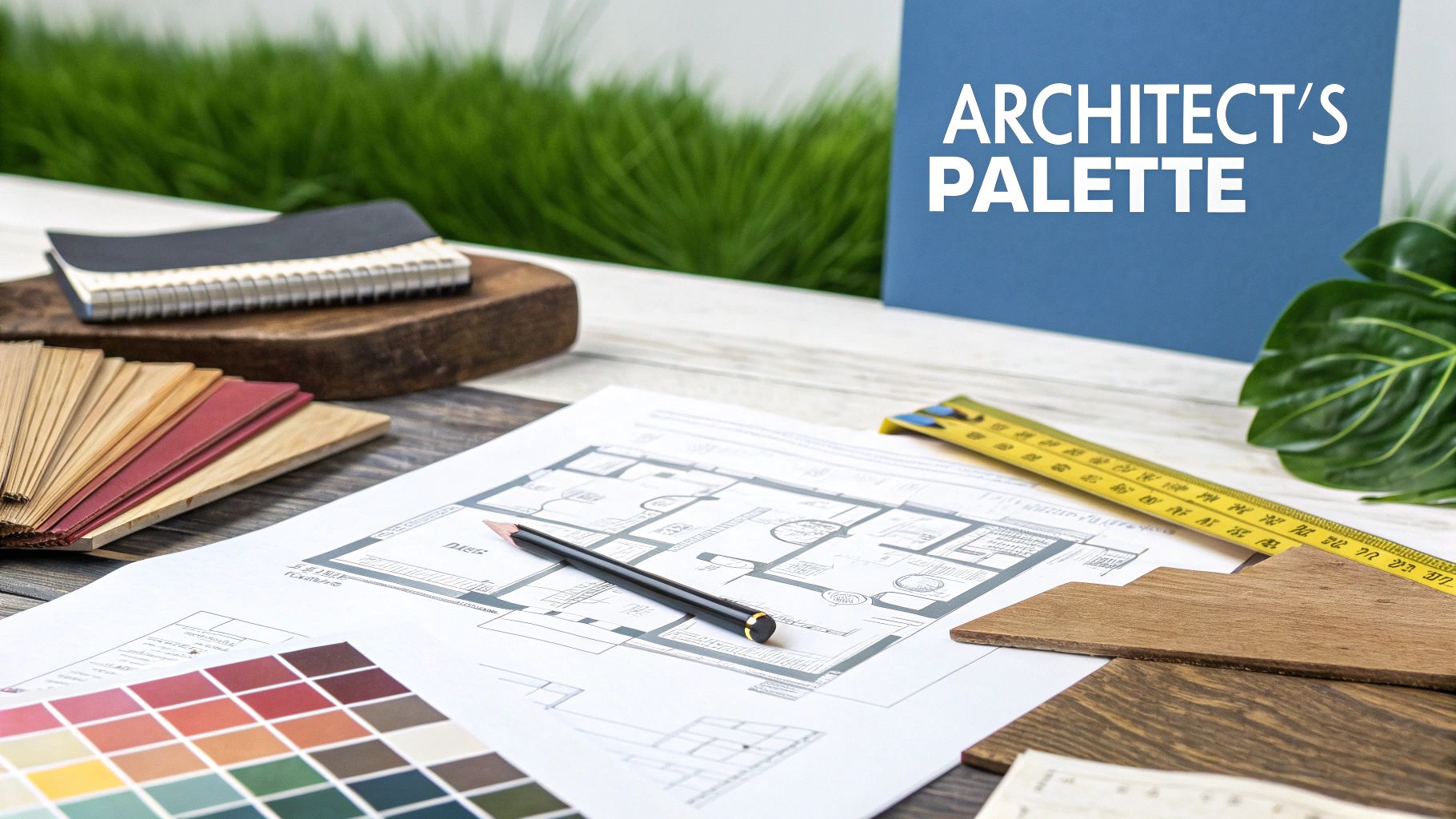
An architect's desk with blueprints, color palette, wood samples, ruler, and a pencil, featuring an "Architect's Palette" sign.

Think of an architect's material library as their palette. A painter uses pigments to create a mood; an architect uses materials to craft an experience. A sleek, polished concrete floor instantly signals modern durability. On the other hand, reclaimed heart pine in an old warehouse conversion tells a story of history and warmth. Every single choice is a deliberate move, balancing creative vision with real-world practicality.

This guide is all about the thinking behind smart material selection, especially for commercial spaces, adaptive reuse projects, and historic restorations. Getting these choices right from the start means your investment won't just look great—it will be financially sound and built to endure. It's about setting up a framework for making informed decisions that line up with your business goals.

The Foundation of Strategic Material Selection

Before we get into specific materials, it’s critical to understand the "why" behind each selection. This isn’t about flipping through a catalog and picking what looks nice. It's a careful evaluation of performance, long-term cost, and compliance. Great material selection is a discipline where art and science meet, making sure every surface and fixture works toward the project's success.

Here's what's always on the checklist:

  • Function and Performance: How is the space actually going to be used? A busy corporate lobby needs flooring that can take a beating, while a focused office environment requires acoustic ceiling tiles to keep noise levels down.
  • Lifecycle and Maintenance: What will this cost over time? A cheaper initial material might end up costing a fortune in frequent replacements or specialized cleaning, wiping out any upfront savings.
  • Sustainability and Occupant Health: Is this a healthy choice for the people inside? Using low-VOC (Volatile Organic Compound) paints and responsibly sourced wood isn't a bonus anymore—it's an expectation.
  • Code Compliance: Does the material meet all fire, safety, and accessibility codes? A wrong choice here can trigger expensive rework and frustrating project delays.

Material selection is where design intent meets real-world constraints. The most successful projects are those where materials are chosen not just for how they look, but for how they perform under pressure, contribute to the building's narrative, and support the owner's financial objectives.

To see how this plays out in a highly specialized setting, a guide to lab workstation materials offers a great example of how performance needs dictate every choice, from countertops to finishes. Once you master these foundational principles, you can approach any design challenge with clarity and confidence.

Core Material Categories in Commercial Design

Diving into the world of commercial interior design materials can feel like trying to navigate a massive warehouse without a map. But there’s a simple way to make sense of it all: think in terms of functional categories. You wouldn't organize a library by the color of the book covers; you'd use sections like fiction, history, and science. We do the same with materials, grouping them by how they're used in a building.

This simple shift in thinking provides a clear roadmap. It helps you make smarter decisions, weigh your options, and see how every single choice—from the floor under your feet to the handle on a door—shapes the final space. It moves the conversation beyond "How does it look?" and into the real question: "What does this space need to do?"

To give you a high-level overview, here's a quick breakdown of the major material families and where they fit in.

Key Commercial Material Categories and Common Options

This table summarizes the main categories of materials you'll be working with, their primary role in a commercial project, and some of the most common options designers specify today.

Material Category Primary Function Common Material Examples
Flooring Withstanding traffic, defining zones, acoustics Luxury Vinyl Tile (LVT), Polished Concrete, Carpet Tile, Terrazzo, Engineered Wood
Wall & Ceiling Finishes Enclosing space, sound control, light reflection, brand identity Commercial-Grade Paint, Acoustic Panels, Type II Vinyl Wallcovering, Specialty Plasters
Millwork Custom-built functional elements, storage, feature pieces Plastic Laminate, Solid Surface, Wood Veneer, Engineered Quartz, Metal
Textiles Upholstery, drapery, acoustic absorption, softness & texture High-Performance Fabrics, Commercial-Grade Leather/Faux Leather, Acoustical Felts
Fixtures & Hardware Functional touchpoints, lighting, plumbing, accessibility Architectural Hardware, Commercial Lighting Fixtures, Plumbing Fittings, Signage

Each of these categories has its own set of performance requirements, aesthetic possibilities, and budget implications. Let's dig a little deeper into the big three.

The Groundwork: Flooring Materials

Flooring is easily the hardest-working surface in any commercial space. It's the literal foundation of the design, taking a constant beating from foot traffic, rolling carts, and inevitable spills, all while shaping the room's sound and look.

Your choice here has a massive impact on maintenance routines and long-term operational costs. What works for a high-traffic corporate lobby is completely different from what you'd put in a quiet hotel room.

Here are a few of the go-to options on the commercial side:

  • Luxury Vinyl Tile (LVT): LVT has become a dominant force for a reason. It's tough, water-resistant, and comes in an endless array of designs that convincingly mimic wood, stone, or abstract patterns. Because it’s modular, you can pop out a damaged tile without replacing the whole floor.
  • Polished Concrete: If you need something nearly indestructible with a modern, industrial vibe, this is it. Once sealed, polished concrete is a breeze to clean, making it perfect for busy retail stores, art galleries, and lobbies.
  • Carpet Tile: The standard for most office spaces. Carpet tile is fantastic for soaking up sound, it's comfortable to walk on, and offers huge design flexibility. The best part? If someone spills coffee, you just replace one tile. This can lead to a 20-30% maintenance saving over the carpet's life compared to traditional broadloom.
  • Engineered Hardwood: While you rarely see solid hardwood in busy commercial zones, engineered wood is a great compromise. It gives you the authentic warmth of real wood but with better stability, making it a solid choice for boardrooms, private offices, or high-end retail spots.

Vertical Surfaces: Wall and Ceiling Finishes

Walls and ceilings are much more than just the "box" that contains a room. They're active surfaces that bounce light, control sound, and set the entire mood of the interior. The right finish can make a cramped space feel open or a loud restaurant feel intimate.

In commercial design, wall and ceiling finishes are active participants in the building's performance. They manage sound, contribute to fire safety, and endure daily wear and tear far beyond what's expected in a residential setting.

Some of the key players here include:

  • Commercial-Grade Paint: This isn't the stuff you buy at the local hardware store. Commercial formulas are built to be scrubbed, resist stains, and hold up to abuse. Low-VOC and zero-VOC paints are now the industry standard to protect indoor air quality.
  • Acoustic Panels: Absolutely essential for open offices, conference rooms, and anywhere else noise is a problem. These panels absorb sound waves, cutting down on echo and making it easier to hear conversations. They come in countless decorative forms, so they can be a design feature, not an afterthought.
  • Wallcoverings (Vinyl and Textiles): Heavy-duty vinyl wallcovering is a workhorse in hotels and hospitals because it's tough as nails and easy to clean. For a more upscale feel, textile wallcoverings can add incredible texture, warmth, and a touch of luxury.
  • Specialty Finishes: This is where things get really creative. Think hand-troweled plaster, Venetian stucco, rich wood paneling, or even metal sheets. These are often reserved for feature walls to create a strong focal point that speaks to a company's brand.

The Finer Details: Millwork, Textiles, and Fixtures

This final group covers all the custom-built pieces and specified items that give a space its personality and make it work. Millwork is all the custom woodwork—reception desks, cabinetry, shelving. Textiles bring in color and softness. Fixtures are the functional workhorses of the space.

Getting these details right is what elevates a project from good to great. When exploring material options, for example, understanding what you can do with specialized glass products like Mirrors and Specialty Glass Styles can open up new possibilities for unique partitions, backsplashes, or eye-catching decorative elements.

Here’s a quick look at what’s involved:

  • Millwork Materials: The spectrum runs from budget-friendly and durable plastic laminates to premium wood veneers, solid surfaces, and engineered quartz for countertops. The final choice always comes down to a balance of look, budget, and performance needs.
  • Commercial Textiles: These are the fabrics for chairs, sofas, curtains, and wall panels. They are rigorously tested and rated for abrasion (look for Wyzenbeek or Martindale test results), fading, and fire resistance to meet strict building codes.
  • Fixtures and Hardware: This covers everything you touch—door handles, cabinet pulls, light switches—as well as light fixtures and plumbing. Every piece has to be tough enough for constant public use and comply with accessibility laws like the ADA (Americans with Disabilities Act).

Evaluating the Performance of Interior Materials

Picking the right materials of interior design goes way beyond aesthetics. It's a strategic move, an investment in how a property will perform and hold its value over the long haul.

Think of it like outfitting a delivery fleet. You could go with budget tires to save a few bucks upfront, but you know that premium all-season tires will give you better grip, last longer, and even improve fuel efficiency. In the end, they save you money. The same logic applies to design materials—the sticker price is just the beginning of the story.

To make smart choices, we have to evaluate materials against a core set of performance metrics. These criteria are our filter, helping us see past the surface and focus on how a material will actually hold up in a real-world commercial space. When you get this framework, you can translate technical jargon into practical business decisions, ensuring every selection boosts durability and operational efficiency.

Durability and Abrasion Resistance

First thing's first: can it take a beating? The most fundamental test for any commercial material is its ability to withstand daily abuse. Durability isn't some fuzzy concept; it's a measurable quality that tells you how well a surface will resist scratches, scuffs, impacts, and general wear and tear. A material that looks amazing on day one but falls apart in six months is just a future maintenance headache.

Take flooring in a busy hotel lobby or office hallway. It needs a high abrasion resistance rating, no question. We measure this with standardized tests like the Wyzenbeek method for fabrics or the Taber test for hard surfaces, which essentially simulate years of friction in a very short time. A fabric rated for 100,000 double rubs is built for public life, while a standard residential fabric might give out after just 15,000. Specifying the right durability rating from the start is your best defense against having to replace things prematurely.

The most expensive material is the one you have to replace. Investing in durability upfront is one of the most reliable ways to lower the total cost of ownership for a building's interior.

This decision tree shows that initial filtering process. Before you even think about specific products, you're sorting your needs into major categories based on how and where they’ll be used.
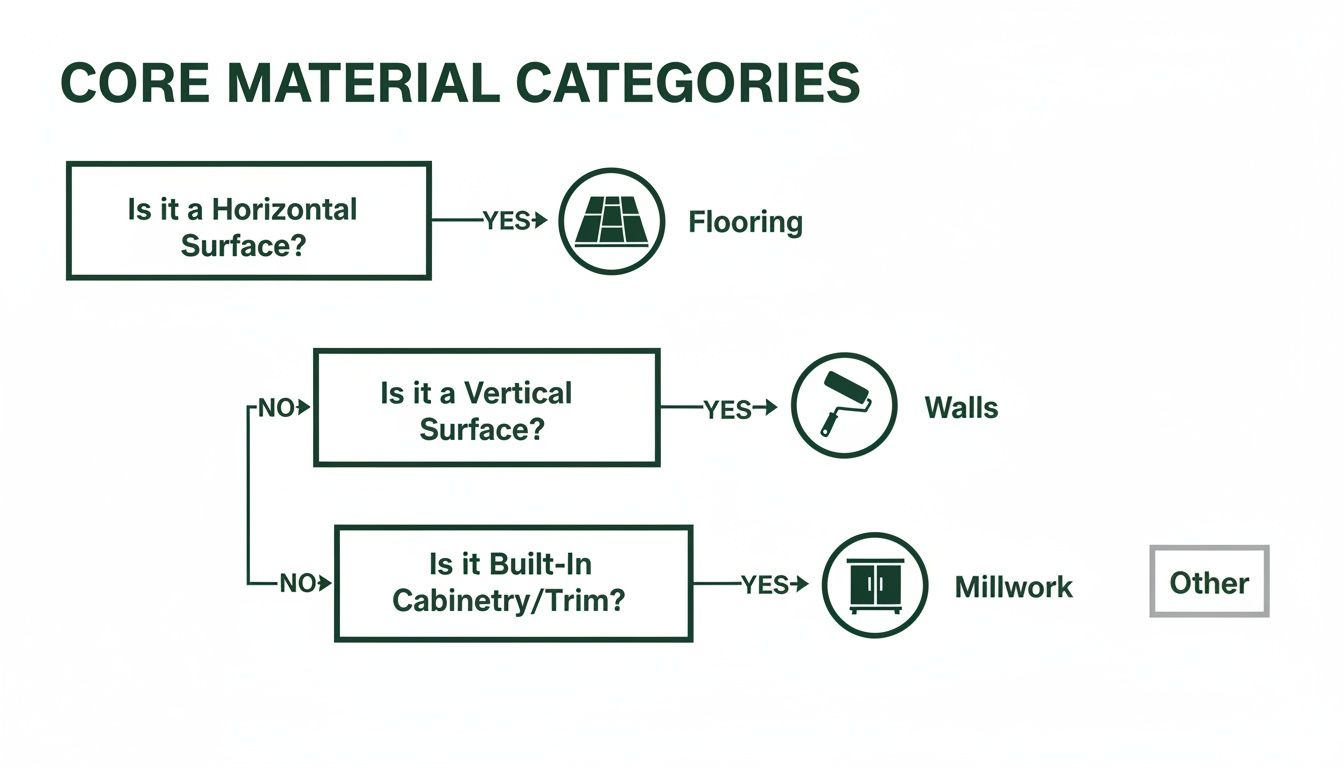
A flowchart illustrates core material categories, guiding classification into flooring, walls, millwork, or other.

By starting here, you immediately narrow down the universe of options, which makes the whole specification process much more manageable.

Fire and Life Safety Ratings

After durability, nothing is more important than how a material behaves in a fire. Building codes are, for very good reason, incredibly strict. They demand specific fire ratings for materials in commercial spaces to keep people safe and to slow the spread of fire and smoke.

Materials are tested and given a class rating based on two key things:

  1. Flame Spread Index: How quickly do flames move across the material's surface?
  2. Smoke Developed Index: How much smoke does it produce when it burns? This is crucial for keeping evacuation routes visible.

These tests result in a classification, usually Class A, B, or C. Class A materials—things like gypsum board or specially treated wood—have the lowest flame spread and produce the least smoke. They are mandatory for exit corridors, stairwells, and other critical escape paths. Choosing a non-compliant material isn't just a design mistake; it's a huge liability that will bring a project to a screeching halt during inspection, forcing costly tear-outs and delays.

Acoustic and Moisture Performance

Finally, let's talk about two environmental factors that have a massive impact on a building's success: sound and water. How a material handles these can be the difference between a comfortable, productive space and one filled with complaints and expensive repairs.

Acoustic performance is a huge deal in modern offices, healthcare, and hospitality settings. The name of the game is controlling noise transfer and echo. Materials are rated with a few key metrics:

  • Noise Reduction Coefficient (NRC): Measures how much sound a material absorbs. An NRC of 0.75 means it absorbs 75% of the sound that hits it.
  • Sound Transmission Class (STC): Rates how well a partition, like a wall, blocks sound from passing through to the other side.

Specifying acoustic ceiling tiles with a high NRC in an open office or building walls with the right STC rating between hotel rooms isn't a luxury—it directly improves the occupant experience.

Likewise, moisture resistance is non-negotiable in places like commercial kitchens, bathrooms, or basements in adaptive reuse projects. Materials have to stand up to humidity, water, and constant cleaning without warping, swelling, or growing mold. We specify products like porcelain tile, epoxy flooring, and water-resistant drywall not just because they look good, but because they prevent the kind of expensive water damage that causes buildings to decay from the inside out.

By consistently evaluating these performance criteria, you ensure the materials of interior design are truly working for you, protecting your investment for years to come.

The Business Case for Sustainable Materials

A retail store interior showcasing clothing on racks and a sign highlighting sustainable materials.

Choosing sustainable materials of interior design isn't just an ethical box to check anymore—it’s a powerful business strategy. What used to be a niche interest is now a core requirement for high-value commercial and adaptive-reuse projects. It’s about making decisions that are both financially sharp and environmentally sound, creating spaces that are healthier, more efficient, and far more marketable.

For developers and property owners, this means looking past the initial price tag on a material and thinking about its entire lifecycle. It’s a shift in perspective, one that allows you to build properties that not only lower their environmental footprint but also pull in premium tenants and deliver real, long-term value.

Demystifying Core Sustainability Concepts

To make truly smart decisions, you need to speak the language. These aren't just buzzwords; they are measurable frameworks that we as designers use to weigh the real-world impact of one material against another.

Here are the three big ideas you’ll run into:

  • Embodied Carbon: Think of this as the "carbon footprint" a material has before it even gets to your site. It’s all the CO2 emitted during its extraction, manufacturing, and shipping. A material like reclaimed wood has incredibly low embodied carbon, while something like new aluminum has a massive carbon bill attached.
  • Lifecycle Assessment (LCA): This is the full story of a material’s environmental impact, from cradle to grave. An LCA digs into everything—where the raw materials came from, the energy used to make it, how long it will last in the building, and what happens to it when it's eventually torn out.
  • The Circular Economy: The old model was "take, make, waste." A circular economy flips that script, aiming to keep materials in use for as long as humanly possible. This means designing with products that can be repaired, reused, or recycled back into something new, which radically cuts down on waste.

Choosing sustainable materials is fundamentally an act of future-proofing your investment. It reduces operational risks, enhances brand reputation, and creates healthier environments that people want to work and live in, all of which directly contributes to a stronger bottom line.

Tangible Benefits of Going Green

So, what does this actually do for your project’s performance? The advantages are clear and measurable, impacting everything from the air people breathe to your property's appeal in the market.

In our world, sustainable materials are a must-have, especially for firms focused on adaptive reuse projects that can extend a building's lifespan by 50-75 years. The global interior design market, valued at USD 145.3 billion, is set to climb to USD 222.2 billion by 2032, and a huge part of that growth is driven by client demand for green certifications. This has pushed materials like bamboo, reclaimed wood, and low-VOC paints from the fringe to the mainstream. You can discover more about these market trends and their financial implications.

Connecting Sustainability to Business Outcomes

Every sustainable choice you make can be tied directly to a positive business outcome. The logic is simple: better materials create better buildings, which attract better tenants and command higher value.

Here’s how these choices translate into real-world gains:

  • Improved Indoor Air Quality (IAQ): Specifying materials with low or zero Volatile Organic Compounds (VOCs) immediately improves the health of anyone using the space. Better IAQ is directly linked to higher productivity and fewer sick days—a huge selling point for corporate tenants.
  • Enhanced Marketability and Brand Value: Certifications like LEED or WELL are more than just plaques on the wall; they are powerful marketing tools. They broadcast a commitment to quality and responsibility that attracts top-tier tenants who will often pay a premium for a space that aligns with their values.
  • Operational Efficiency and Reduced Costs: Good material choices often lead to long-term savings. Using locally sourced materials cuts down on transportation costs, while specifying durable, recycled products means spending less on maintenance and replacement over the building's life.

Choosing Materials for Adaptive Reuse and Historic Preservation
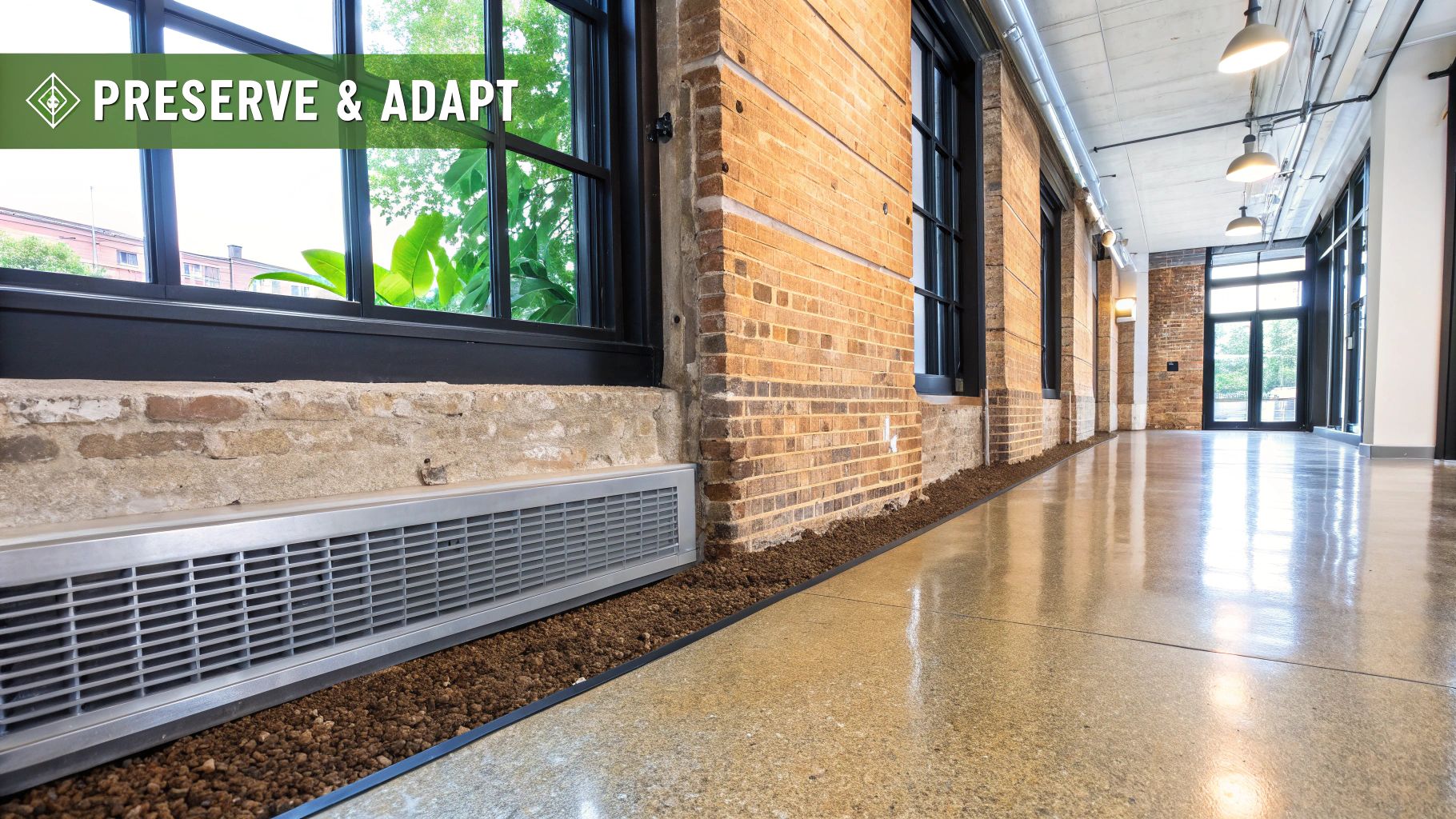
A modern industrial corridor featuring exposed brick walls, large windows, a polished concrete floor, and overhead lighting.

Adaptive reuse and historic preservation projects are where the real art of material selection comes into play. You’re not starting with a blank canvas; you’re entering into a conversation with a building that already has a story. These projects challenge us to honor the past while designing a functional, profitable future—turning what looks like a set of constraints into a powerful design narrative.

Picking the right materials of interior design in this setting is like solving a complex puzzle. The goal is to gracefully integrate new, high-performance systems with the building's original character, creating a space that feels both authentic and current. This requires a deep dive into what’s already there and a clear vision for what the building is about to become.

Assessing a Building’s Material DNA

Before a single new material is specified, the first step is a thorough investigation of what you’re working with. Think of it as architectural archaeology. We aren't just looking at surfaces; we’re analyzing the building's very DNA to understand its history, its strengths, and its hidden vulnerabilities.

This detailed assessment means identifying the original materials—everything from the species of wood in the floorboards to the exact composition of the mortar. Getting this right is critical for two reasons: it tells us what we can save, and it guides how we can introduce new materials without accidentally causing long-term damage.

In adaptive reuse, the most valuable material is often the one you don't have to add. Preserving and showcasing a building's original fabric not only saves on costs and reduces embodied carbon but also creates a unique market identity that new construction can't replicate.

This deep dive into the building’s history is what allows us to make smart decisions that respect the structure's soul while preparing it for another century of life.

The Art of Blending Old and New

Once you have a handle on the existing materials, the real design challenge begins. You have to decide what to restore, what to replicate, and where to introduce modern elements. This isn't about creating a museum piece; it’s about weaving a coherent story where old and new can coexist and even elevate each other.

The key is to establish a clear visual language. Sometimes, this means making new interventions intentionally distinct—using sleek steel and glass, for instance, to contrast beautifully with historic brick and timber. Other times, the job requires meticulously replicating historic details to maintain a seamless look, especially when you're dealing with protected facades or significant interior features.

This strategic blend is especially obvious when it comes to modern building systems:

  • Mechanical Systems: HVAC ductwork can be artfully exposed to create an industrial vibe or cleverly concealed within custom millwork designed to match the historical period.
  • Lighting: You could integrate modern, energy-efficient LED fixtures into historic chandeliers, or use track lighting to highlight original architectural details like exposed beams or ornate plasterwork.
  • Accessibility: Adding ramps or elevators demands careful material choices to ensure they are functional and code-compliant without clashing with the historical flow of the space.

Sourcing and Financial Incentives

Finding historically appropriate materials is a specialized skill. It often means sourcing from salvage yards, working with specialty suppliers who can mill period-correct moldings, or even commissioning artisans to replicate unique tile patterns or plaster details. These choices aren't just for aesthetics—they’re crucial for projects seeking historic tax credits.

Government programs at both the federal and state level offer significant financial incentives for preserving historic buildings. Correctly restoring or replicating key architectural elements with the right materials is often a prerequisite for qualifying, turning a commitment to historical accuracy into a real financial benefit for the property owner.

This focus on revitalizing existing structures is a major force in the design world. Remodeling projects now drive a huge portion of material choices, with the global interior design market hitting USD 137,930.0 million thanks largely to this trend. As global remodeling spending surpasses USD 4.9 trillion, the demand for woods, metals, and textiles that can bridge the gap between old and new will only continue to grow. You can learn more about how remodeling is shaping the global interior design market and see the numbers for yourself.

Keeping a Lid on Material Costs and Market Swings

For any developer, the success of a project really boils down to the bottom line. But managing the cost of interior design materials isn't just about grabbing the cheapest option available. It’s a delicate balancing act—a strategic game of weighing upfront costs against long-term value to bring a vision to life without torpedoing the budget.

You have to look past the initial price tag and think about the material's entire lifecycle. That cheaper flooring might look great on the initial invoice, but it could end up costing you a small fortune in repairs and early replacement. On the flip side, investing in a higher-quality, more durable material often pays for itself through lower maintenance and a better return over the building's lifespan.

Riding Out Supply Chain and Price Waves

Beyond the long-term view, we’re all dealing with the very real headaches of price volatility and supply chain snags. These issues can completely derail project timelines and budgets if you aren't prepared for them. Imagine a sudden price hike on a specified material forcing you to make tough choices mid-stream—that’s how design integrity gets compromised.

Material costs have been all over the map, but smart choices in sustainable and engineered products can provide some much-needed stability. To give you an idea, recent market shifts saw steel jump by about $75 per ton and lumber by $120 per thousand board feet. Those aren't small numbers; they’re the kind of budget-busters that put projects on hold. For a deeper dive into these trends, you can read a full analysis of the interior design market. This is where seasoned architects earn their keep, building flexibility right into the project specs from day one.

It’s all about protecting the investment through proactive planning.

Smart Moves for Controlling Costs

To keep a project on track financially without cutting corners on quality, the pros have a few tricks up their sleeves. These aren't secrets, just smart strategies that build a financial cushion into the project, ensuring market surprises don't derail the final product.

Here are a few of the most reliable tactics:

  • Specify Viable Alternates: A good architect will almost always list a primary material and then one or two pre-approved alternatives. This gives the contractor the wiggle room they need to find the most cost-effective option when it's time to buy, all without a time-consuming redesign.
  • Buy Early and Store It: For materials known for wild price swings, purchasing them early and warehousing them on-site can lock in a good price before it has a chance to climb.
  • Think Local: Sourcing materials from local or regional manufacturers can slash shipping costs and lead times. It’s also a great way to sidestep the drama of international supply chain bottlenecks.

Protecting a project's budget isn't about being cheap; it's about being smart. When you anticipate market volatility and plan for it, you ensure the design's integrity and the quality of the materials never have to be sacrificed.

At the end of the day, skillful cost management is what separates a successful project from a stressful one. It’s how you safeguard both the financial goals and the aesthetic vision of the entire development.

Got Questions About Interior Design Materials? We've Got Answers.

When it comes to commercial interior design, the materials you choose can make or break your project—and your budget. Here are some straightforward answers to the questions we hear most often from developers, investors, and business owners.

What's the Single Biggest Mistake People Make When Choosing Materials?

Hands down, the most common and expensive mistake is chasing the lowest upfront price instead of thinking about lifecycle value.

It's tempting to go with a cheaper option, but if it can't handle the real-world wear and tear of your space—like putting light residential carpet in a busy office hallway—you're just setting yourself up for failure. Those initial savings get completely wiped out by the cost of repairs, replacements, and the operational headaches that come with it all.

How Much of My Budget Should Go to Interior Finishes?

This is a tough one because there's no magic number; it really depends on the project.

For a high-end space like a corporate headquarters or a boutique hotel, you could see finishes making up 20-30% of the total construction cost. In a more standard, functional commercial space, it might be closer to 10-15%. A good architect can give you a solid estimate tailored to your project's specific needs and goals.

Think of your finishes budget less as a "cost" and more as an investment. The right materials are workhorses that boost your property's performance, appeal, and long-term value, directly contributing to your bottom line.

Can I Save Money If I Source Materials Myself?

It seems like a smart way to cut costs, but this approach almost always backfires.

Architects and contractors have long-standing relationships with suppliers, which gives them access to trade pricing you simply can't get on your own. More importantly, they handle the entire logistical nightmare of ordering, coordinating deliveries, and checking materials for damage—all of which are critical for keeping your project on schedule and avoiding expensive delays.


At Sherer Architects, LLC, our job is to make the material selection process clear and strategic, making sure every choice supports your budget, brand, and financial goals. To see how our expertise in commercial, adaptive reuse, and historic preservation can add serious value to your next project, visit us at https://shererarch.com.
Categories
Uncategorized

Financial study feasibility: Boost Project Profitability with Forecasting

A financial feasibility study is where the rubber meets the road. It's a deep dive that determines whether a potential project is actually a sound investment. Before you sink serious capital into a commercial build, adaptive reuse, or historic preservation project, this analysis answers the most important question: Will this actually make money?

Think of it as a data-driven blueprint for your investment, showing you the potential returns, shining a light on hidden risks, and giving you the solid ground you need to make confident decisions.

Why Financial Feasibility Is Your Project's Most Critical Step

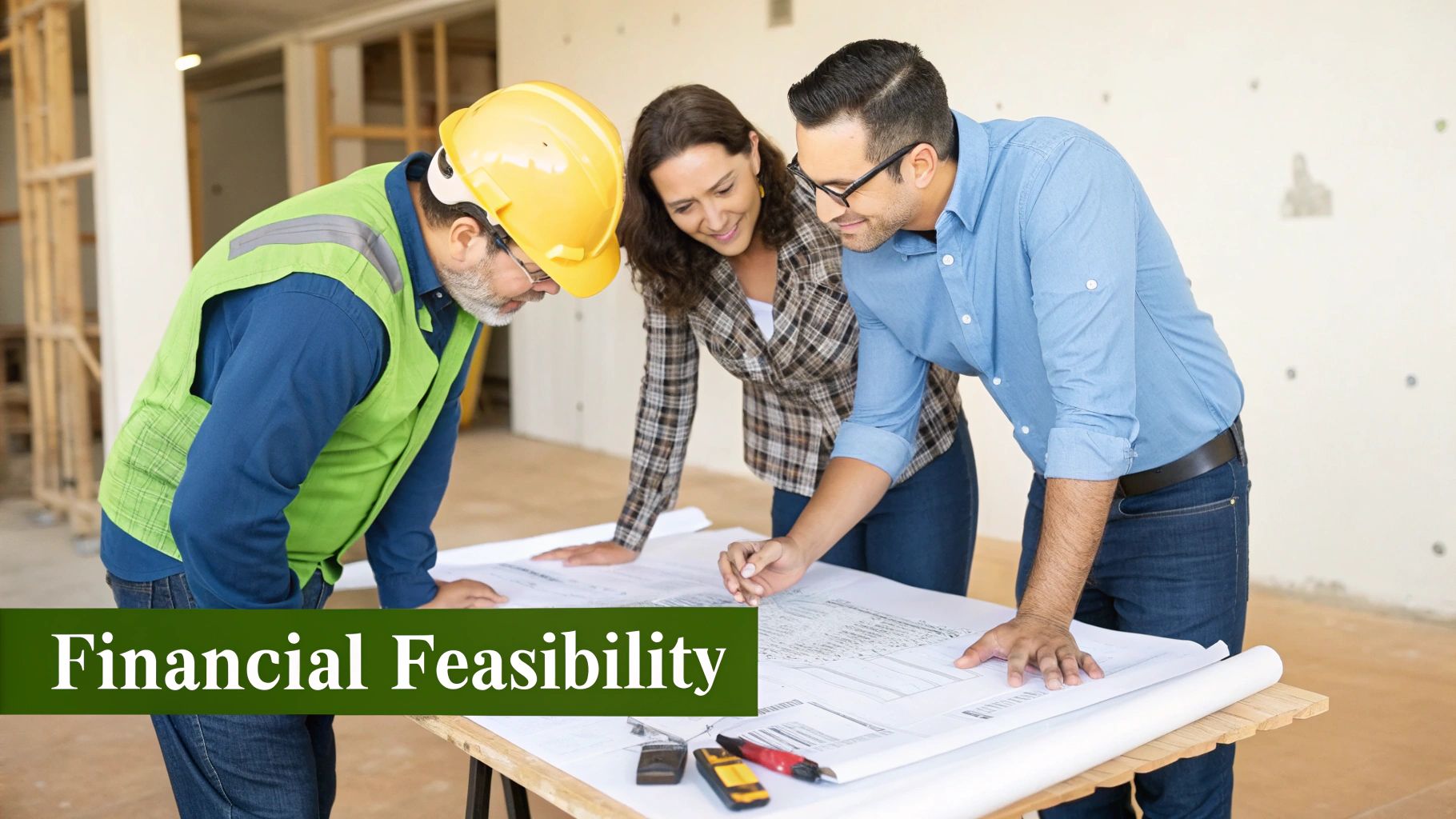
A diverse team of construction professionals reviewing blueprints on a job site, discussing financial feasibility.

Jumping into a major development without a proper financial feasibility study is like setting sail without a map or a compass. It's a huge gamble, and it leaves investors and developers wide open to financial disaster. This goes way beyond a simple back-of-the-napkin calculation; it takes your big ideas and turns them into a concrete financial story.

A good study forces you to challenge every single assumption. From market rental rates to the price of steel, it makes sure your projections are firmly planted in reality, not wishful thinking.

This analysis isn't just a box-checking exercise to get a bank loan—it’s a core piece of your strategy. For complex projects like adaptive reuse or historic preservation, the number of financial moving parts can be staggering. A proper study corrals all those variables into a clear, understandable model.

A well-executed feasibility study is the ultimate risk mitigation tool. It stress-tests a project's financial structure against market fluctuations, cost overruns, and unforeseen challenges, providing a clear path to profitability or an early warning to pivot.

Grounding Financial Models in Reality

One of the most common mistakes we see in financial forecasting is relying on generic data or pie-in-the-sky assumptions. This is exactly where an architect’s expertise becomes so valuable. An experienced architect, like our team at Sherer Architects, provides the critical, real-world inputs that make a financial model truly solid.

When an architect is involved from the start, the study can properly account for things like:

  • Zoning and Code Compliance: An architect can spot potential compliance headaches or design requirements early on that could blow up your construction costs and timeline.
  • Design Efficiency: They know how a building's layout and systems will impact everything from long-term utility bills to its overall revenue potential.
  • Historic Tax Credits: For preservation projects, an architect’s guidance is absolutely essential for navigating the maze of securing tax credits, which can completely change a project’s bottom line.

This kind of expert insight is more in demand than ever. The architectural services market is expected to grow from USD 215.13 billion in 2025 to USD 273.97 billion by 2029, largely fueled by interest in sustainable design and adaptive reuse. It makes sense when you consider that adaptive reuse can be 20-40% cheaper than new construction and often qualifies for lucrative historic tax credits. You can get a deeper understanding of this shift by reading a recent architecture industry outlook.

By baking this practical, on-the-ground knowledge into your financial study from day one, you transform it from a simple forecast into a powerful and accurate roadmap for success.

Laying the Groundwork: Defining Your Project and Forecasting Revenue

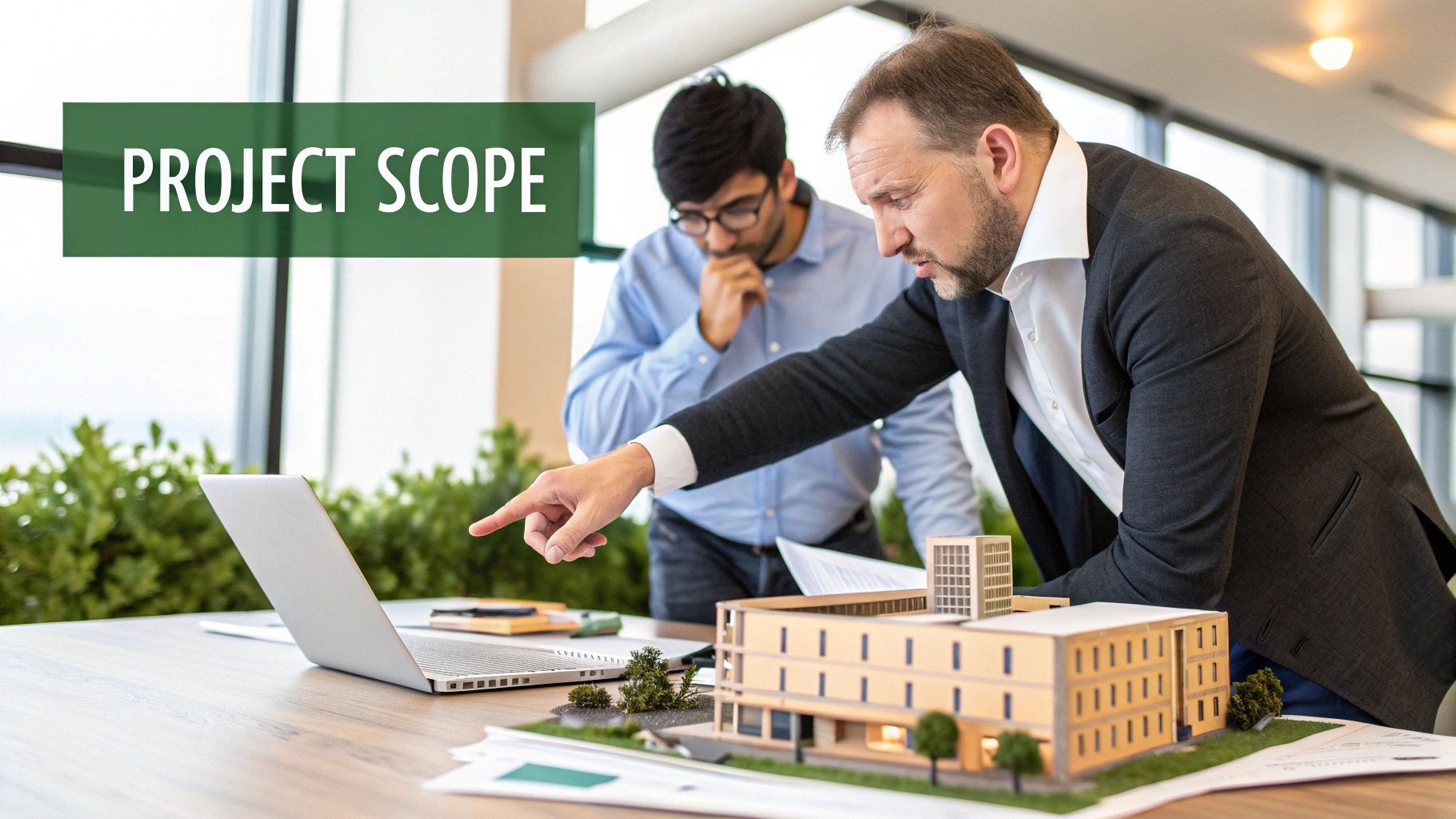
Two men discuss project scope, pointing at a building model and laptop on a table.

Every successful financial study feasibility analysis starts long before the first spreadsheet is opened. It begins with a vision—a clear, detailed picture of the final product. Before you can even think about projecting income, you need to nail down a precise project scope. This isn't just paperwork; it's the critical step that prevents costly scope creep and ensures every subsequent calculation is grounded in reality.

Think of the scope as the project’s constitution. It must clearly articulate what you’re building or renovating, from the total square footage and intended use down to the specific amenities and quality of finishes. For an adaptive reuse project, this means defining exactly how a historic warehouse will be reimagined as residential lofts, including the number of units, common areas, and parking solutions.

This needs to be specific. "Renovate an old building" is an idea, not a scope. A well-defined scope sounds more like: "Convert the 50,000-square-foot 'Standard Mill' building into 45 mixed-income rental apartments, preserving key historical architectural elements to qualify for historic tax credits." That’s a blueprint you can build on.

From Big Idea to Tangible Scope

This is where bringing in an architect early on is a game-changer. An experienced firm like Sherer Architects doesn't just draw plans; they help you test the limits of your site's potential. They'll dig into zoning ordinances, flag potential building code hurdles, and assess the structural integrity of an existing building—all factors that directly dictate what’s actually possible.

This early architectural gut-check grounds your vision in reality. It might reveal that the site can handle more density than you assumed, unlocking unexpected revenue. Or, it could uncover a critical structural flaw in that old warehouse, forcing a budget shift but saving you from a catastrophic financial surprise later.

Your project's scope is the bedrock of your financial projections. A poorly defined scope leads to inaccurate forecasts and a feasibility study built on shaky ground. Clarity at this stage is non-negotiable for a reliable outcome.

A well-defined scope provides the essential inputs for robust strategic budgeting and forecasting, making your cost and revenue models much more precise.

Forecasting Revenue You Can Count On

With a solid scope in hand, it’s time to project potential income. This is where you move past wishful thinking and into hard, data-driven market analysis. The goal here is to build a credible revenue forecast for a typical 5 to 10-year horizon.

The type of project dictates your revenue model. The most common streams include:

  • Rental Income: For multifamily, office, or retail spaces, you'll need to forecast monthly rents per square foot, factoring in realistic vacancy rates and annual rent increases.
  • Sales Profits: If you're building condos or commercial-for-sale properties, the key is projecting the final sales price per unit based on what the market is actually paying for similar properties.
  • Other Income: Don't forget the smaller streams—revenue from parking fees, laundry facilities, tenant storage, or other ancillary services can add up.

Digging Deep with Market Analysis

To forecast these streams with any accuracy, you have to do your homework. This isn’t a quick Zillow search; it’s a detailed investigation into the local market dynamics.

Let’s go back to our warehouse-to-lofts project. A proper analysis would involve a few key steps:

  1. Find Your "Comps": Identify comparable loft-style apartment buildings in the same or nearby neighborhoods. What are their current rental rates, unit sizes, and occupancy levels? What amenities do they offer? This is your baseline.
  2. Check Absorption Rates: How quickly are new rental units getting leased in the area? A high absorption rate—for instance, a new 100-unit building hitting 95% occupancy in just six months—is a powerful signal of strong demand.
  3. Read the Tea Leaves (Market Trends): Look at the bigger picture. Is the population growing? Is a major employer setting up shop nearby? Are there city infrastructure projects planned? These macro trends can justify projecting stronger rent growth over your 5-10 year forecast.

This detailed market data becomes the revenue side of your financial study feasibility. By pairing a well-defined, architect-vetted scope with a realistic, data-backed revenue forecast, you build the solid foundation needed for the rest of your analysis.

Getting a Handle on Total Project Costs

Once you have a solid idea of potential revenue, it's time to flip the coin and get brutally honest about the costs. This is where the rubber meets the road. A project's viability lives or dies by your ability to forecast and manage every single expense. Underestimate here, and a promising development can quickly become a money pit.

We generally break down total project costs into two buckets: soft costs and hard costs. Knowing the difference is fundamental to building a budget that can actually withstand the pressures of a real-world project.

Decoding Soft Costs

Soft costs are all the necessary expenses that don’t involve swinging a hammer or pouring concrete. Think of them as the "brains" of the operation—the professional services and administrative hurdles you have to clear before and during construction. It's easy to downplay these figures, but they pack a punch and often account for a huge chunk of your total budget.

You'll need to account for a whole range of these intangible but critical items:

  • Design and Engineering Fees: This is what you pay your architect and engineers for the plans, structural calculations, and MEP (mechanical, electrical, plumbing) systems design.
  • Permits and Inspections: The price of admission to build, set by the local municipality. These fees can vary dramatically depending on your city and the project's complexity.
  • Professional Services: Don't forget the lawyers needed for zoning battles or the accountants structuring the deal.
  • Financing Costs: Loan origination fees, appraisal costs, and the interest you’ll pay on your construction loan before the building generates income.
  • Insurance: Builder’s risk, liability, and other policies are non-negotiable to protect the project.

For context, on a $5 million adaptive reuse project, it's not unusual for soft costs to land somewhere between $1 million and $1.5 million (20-30%). You're spending a lot of money before the first wall even comes down, which is why getting architects and legal counsel involved early is so important—they know the local landscape and can help you project these numbers accurately.

Nailing Down Hard Costs

Hard costs are exactly what they sound like: the tangible, physical expenses of construction. This is the "brick-and-mortar" part of the budget that covers everything from the dirt work to the final coat of paint. While they're easier to visualize, their prices can swing wildly with market demand for materials and labor.

This category is all about the physical build-out:

  • Materials: Concrete, steel, lumber, drywall, roofing, windows, and all the finishes.
  • Labor: The wages for every trade on site, from the excavation crew to the electricians and painters.
  • Site Work: Getting the site ready—grading, running utility lines, paving parking lots, and landscaping.
  • Major Systems: The big-ticket items like HVAC, plumbing, and electrical infrastructure.

Getting preliminary bids from a few general contractors is an essential reality check. An experienced architect, like our team at Sherer Architects, adds immense value here by preparing a detailed set of documents for bidding. This ensures every contractor is pricing the exact same scope of work, so you can make a true apples-to-apples comparison instead of guessing what’s behind their numbers.

The allocation of these costs can look quite different depending on the project type.

Typical Project Cost Allocation for Commercial vs Adaptive Reuse

This table gives a high-level look at how budgets are typically broken down for a new build versus an adaptive reuse project. Notice how things like demolition and structural upgrades demand a much larger piece of the pie in reuse projects.

Cost Category New Commercial Build (% of Total) Adaptive Reuse Project (% of Total)
Site Acquisition & Prep 10-15% 5-10%
Demolition & Abatement 1-2% 5-15%
Foundation & Structure 20-25% 15-25% (Repairs/Upgrades)
Exterior & Roofing 10-15% 10-20% (Restoration)
Interior & Finishes 15-20% 15-25%
MEP Systems 15-20% 15-25% (Complex Integration)
Soft Costs (Fees, Permits) 10-15% 15-20%
Contingency 5-10% 10-20%

As you can see, the financial DNA of an adaptive reuse project is fundamentally different. You're shifting funds from site prep and new structure costs toward abatement, restoration, and a much larger contingency to handle the inevitable surprises.

The Unique Challenges of Adaptive Reuse

Speaking of surprises, adaptive reuse and historic preservation projects are in a class of their own. They come with a whole layer of cost variables you simply don't encounter when building from scratch. Your financial study has to reflect this uncertainty.

In an adaptive reuse project, what you can't see is often what costs the most. Unforeseen structural issues, hazardous material abatement, and the need for specialized artisans can significantly impact the budget if not properly anticipated.

You absolutely have to dig into these potential cost centers:

  • Hazardous Material Abatement: Old buildings can be a minefield of asbestos, lead paint, and other unpleasant materials that require certified (and expensive) professionals to remove.
  • Structural Upgrades: Bringing a century-old structure up to modern building and seismic codes can mean serious, costly reinforcements.
  • Historic Fabric Repair: Restoring original masonry, ornate woodwork, or historic windows requires true craftspeople, and their skills come at a premium compared to off-the-shelf modern materials.
  • Systems Integration: The puzzle of threading modern HVAC, IT, and electrical systems through a historic building without destroying its character is both an art and a significant expense.

Because of all these unknowns, your contingency fund is your best friend. For a new build, a 5-10% contingency might be fine. For an adaptive reuse project, anything less than 15-20% of total construction costs is asking for trouble. Think of it as the project’s financial shock absorber—it’s there to ensure a few nasty surprises don’t sink the entire ship.

Building a Pro Forma to Analyze Financial Scenarios

Once you have your revenue forecasts and cost estimates nailed down, you're ready to build the most critical tool in your feasibility toolkit: the pro forma statement. Don't think of this as just a spreadsheet. A well-built pro forma is a dynamic financial model where you can truly bring your project's story to life. It's the place where all your data comes together to project cash flow over the next five to ten years.

This isn't just about plugging in numbers and hoping for the best. It’s about building a logical financial narrative that shows how money flows from top-line income all the way down to your final cash position. The real power here is in seeing how the project holds up under different conditions, stress-testing your assumptions, and finding out if the numbers actually work before you put serious capital on the line.

From Gross Income to Net Operating Income

The bedrock of any real estate pro forma is the cash flow projection. You always start with the Gross Potential Income (GPI)—the absolute maximum revenue you could pull in if the property were 100% occupied all year long. From that high point, you start methodically subtracting costs to get to the numbers that really matter.

The typical flow looks something like this:

  • First, you calculate your Gross Potential Income (GPI), which is the total possible rental and ancillary income.
  • Next, you subtract a Vacancy Loss allowance. Be realistic here; something like 5-7% is a common starting point. This gives you your Effective Gross Income (EGI).
  • From EGI, you deduct all Operating Expenses—property taxes, insurance, management fees, utilities, repairs, you name it.
  • What’s left is your Net Operating Income (NOI). This is a crucial metric because it shows you exactly how profitable the property is before you even think about loan payments or income taxes.

This structured approach is the industry standard for a reason. It gives investors, lenders, and you a crystal-clear picture of the property's pure earning power.

Modeling Financing and Tax Credit Scenarios

With a solid NOI projection, your pro forma transforms from a simple calculator into a strategic playground. This is where you get to play "what if."

You can model different financing structures to see how they ripple through your returns. For instance, what happens with a 70% loan-to-value (LTV) loan at a 6.5% interest rate versus a more aggressive 80% LTV loan at 7.0%? The pro forma shows you precisely how changes in leverage and interest rates hit your bottom-line cash flow after paying the bank.

For adaptive reuse projects, this is where you can see the massive impact of incentives like historic tax credits. These aren't just a nice little bonus; they can single-handedly make or break a deal.

By modeling scenarios with and without historic tax credits, you can put an exact dollar value on their impact. Seeing a project's Internal Rate of Return (IRR) jump from a borderline 12% to a much more compelling 18% gives you the hard data needed to justify the headaches of the historic preservation process.

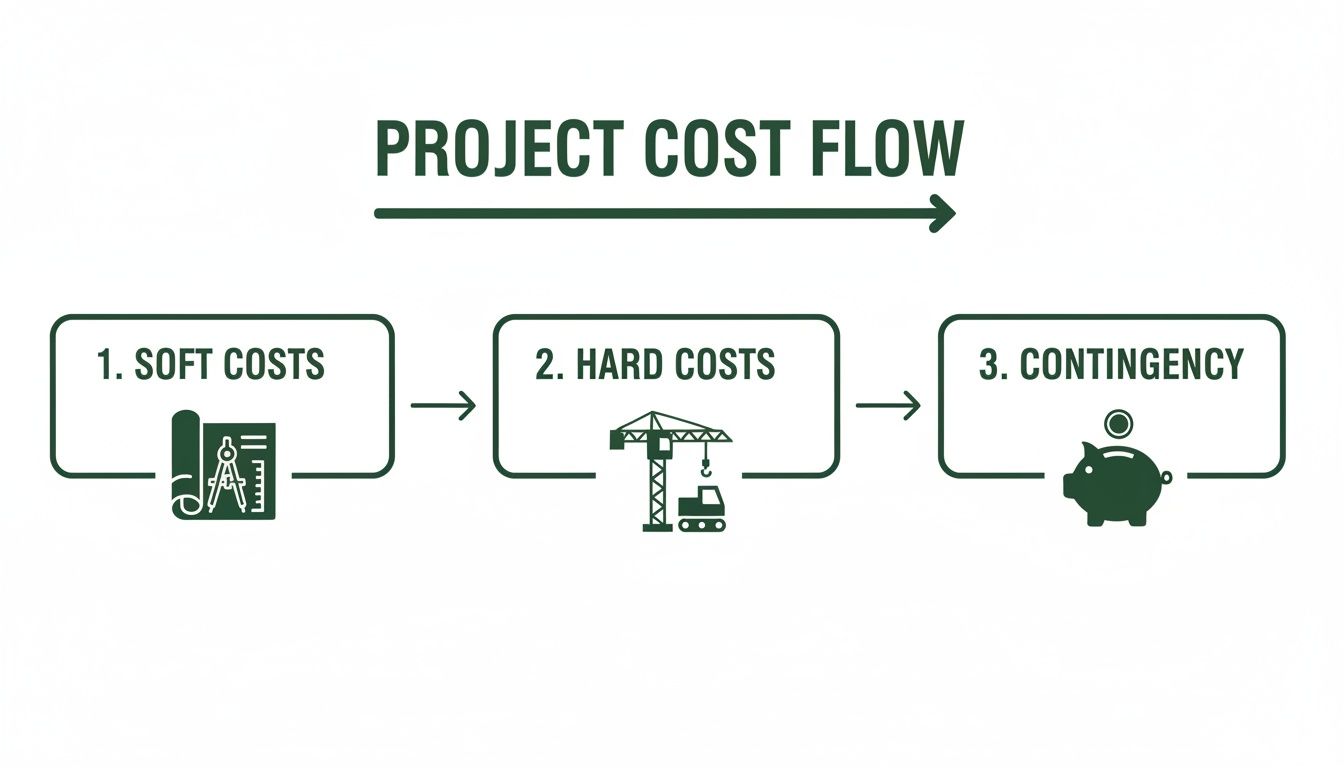
Understanding how all the costs feed into this model is essential.

Infographic illustrating the project cost flow, detailing soft costs, hard costs, and contingency.

This flow from soft costs to hard costs and finally to contingency planning shows how every dollar needs to be accounted for in your financial model to ensure accuracy.

Key Metrics and Actionable Insights

At the end of the day, a pro forma is only as good as the decisions it helps you make. A huge part of the financial study feasibility process is seeing how smart project decisions translate into better numbers.

For example, our experience shows that adaptive reuse can make a project 20-50% more cost-effective than new construction. When you layer on tax credits that can offset 20-45% of rehabilitation costs, the financial picture improves dramatically. Your pro forma is where you see these efficiencies reflected in your key return metrics.

The pro forma gives you a dashboard to visualize performance and make smarter choices. If you really want to get under the hood, building your own rental property calculator in Excel is a fantastic way to understand the mechanics. It turns abstract numbers into a tangible tool that helps you steer your project toward financial success.

Making the Final Go or No-Go Decision

Three professionals analyze data on a tablet and book, discussing a 'Go OR No-Go' decision.

After all the number-crunching and modeling, you've reached the moment of truth. The final phase of a financial study feasibility analysis boils down to translating a mountain of data into a single, definitive answer: should you move forward or walk away?

This isn’t about gut feelings. It’s about using specific, industry-standard metrics to evaluate the project's potential from every critical angle. These metrics—Net Present Value (NPV), Internal Rate of Return (IRR), and the Payback Period—each tell a unique part of the financial story, giving you a clear, data-backed foundation for your choice.

Key Metrics That Drive the Decision

Think of these three core metrics as different lenses for viewing the same financial landscape. Each one gives you a distinct perspective on the project's viability.

  • Net Present Value (NPV): This is the king of investment metrics. NPV tells you the total value of all future cash flows, both incoming and outgoing, all discounted back to what they're worth today. In plain English, it answers the big question: "Will this project create more value than it costs?" A positive NPV is your green light—it means the project is expected to beat your minimum required rate of return. A negative NPV is a clear stop sign.

  • Internal Rate of Return (IRR): While NPV gives you a dollar amount, IRR delivers a percentage. It’s the estimated annual rate of growth the project is expected to generate. So, if your project’s IRR is 15%, you're anticipating an average annual return of 15% over its lifetime. You then weigh this against your "hurdle rate"—the absolute minimum return you need to justify the risk. If the IRR clears that hurdle, the project looks financially attractive.

  • Payback Period: This is the simplest of the three, but don't underestimate its importance. It calculates exactly how long it will take for the project to generate enough cash to recover your initial investment. A shorter payback period almost always means lower risk. A project that pays for itself in four years is far less risky than one that takes ten, simply because your capital isn't tied up for as long.

Stress-Testing Your Assumptions with Sensitivity Analysis

Let’s be honest: no forecast is perfect. The real world is messy, and a smart feasibility study has to account for that. This is where sensitivity and break-even analyses become your best friends. They are powerful tools for figuring out which of your assumptions carry the most financial weight.

Sensitivity analysis is all about playing "what-if." You tweak one key variable at a time—like construction costs, rental rates, or vacancy—to see how it ripples through your bottom line. What happens to your NPV if construction costs run 10% over budget? What if rental income dips 5% below your projection? Running these scenarios helps you pinpoint the project's financial Achilles' heel.

A sensitivity analysis reveals which variables pose the greatest threat to your profitability. If a minor dip in rental rates sends your IRR plummeting, you know that your revenue projections need to be rock-solid and perhaps even conservative.

This is also where broader market data provides invaluable context. For instance, an indicator like the AIA/Deltek Architecture Billings Index (ABI), which posted a soft 45.6 in early 2025, can signal a downturn. But that could also mean an opportunity for cost savings on labor and materials. A good financial study feasibility can model how capitalizing on such a market might boost returns, especially since adaptive reuse is often 30-50% cheaper than new construction. Understanding salary benchmarks, like an Architectural Director's median base of $160,924, also helps you forecast soft costs with much greater precision. Get more insights on recent architecture firm billings.

The Break-Even Point

Finally, you need to know your break-even point. This analysis pinpoints the exact moment when your project's total revenues equal its total costs.

For a real estate project, this is usually expressed as the occupancy rate required to cover all operating expenses and debt service. Knowing your project breaks even at 75% occupancy gives you a clear, tangible target and a crucial benchmark for measuring performance once you're up and running. It's the baseline for survival.

Answering Your Top Questions About Financial Feasibility Studies

Even with a roadmap in hand, you're bound to have questions when you're deep in the numbers. We get it. Here are some of the most common questions we hear from developers and investors, along with straight answers based on our experience in the field.

How Long Does a Feasibility Study Take?

There's no single answer here—it all comes down to complexity.

For a relatively straightforward commercial infill project, you're probably looking at a 4 to 6-week timeline. That's usually enough time to do the necessary market research and pull together solid initial cost estimates.

But if you're tackling something like an adaptive reuse or historic preservation project, you need to budget more time. These can easily take 8 to 12 weeks, sometimes longer. Why the extra time? You're digging into zoning variances, researching historic tax credit eligibility, and getting detailed assessments on things like structural integrity or environmental issues. The more unknowns you start with, the longer that discovery phase will naturally be.

What's the Typical Cost for a Study?

Just like the timeline, the cost is a direct reflection of the project's scope.

A feasibility study for a smaller commercial project might land somewhere in the $5,000 to $15,000 range. This typically gets you professional market analysis, preliminary cost estimates, and foundational financial modeling.

For larger, more complex projects—especially those with historic elements or major zoning hurdles—the cost can climb to $20,000 to $50,000 or even more. That higher price tag accounts for bringing in specialists like structural engineers, environmental consultants, or historic preservation advisors whose expertise is absolutely critical for an accurate financial picture.

Think of the cost of a feasibility study not as an expense, but as an investment in de-risking your project. Spending $30,000 upfront to uncover a fatal flaw in a $10 million project is one of the smartest investments you can make.

Can I Do a Feasibility Study Myself?

You can certainly run some preliminary numbers on your own, and many savvy developers do. But for a truly bulletproof financial study feasibility assessment, bringing in third-party experts is a game-changer.

The biggest risk with a DIY approach is confirmation bias. It’s human nature to want a project to work, and you might unintentionally cherry-pick data that paints a rosier picture than reality.

An architect and other consultants bring an objective eye. They're trained to spot the red flags you might miss and can ground your cost estimates in reality, not just what an online calculator says. That layer of credibility is exactly what lenders and investors need to see.

What if the Study Shows the Project Isn’t Viable?

First off, that’s not a failure. It’s a success. A feasibility study is designed to give you a clear "go" or "no-go" signal before you sink serious capital into a project. If the numbers don't add up, the study has saved you from a potentially massive financial headache.

A "no-go" doesn't mean the idea is dead in the water, either. It points you directly to the weak spots.

  • Projected rent too low? Maybe a design tweak to add premium amenities could justify higher lease rates.
  • Construction costs too high? An architect can explore value engineering or alternative construction methods to bring the budget in line.
  • Financing crippling cash flow? It might be time to look at different loan products, seek out new equity partners, or explore tax credit scenarios.

Think of the study as a roadmap for what needs to change. It gives you the chance to pivot, refine your strategy, and build a stronger, more profitable plan.


Ready to find out if your next project is built on a solid financial foundation? The team at Sherer Architects has spent decades grounding financial models in real-world design, zoning, and construction realities. We help you find the opportunities and flag the risks from day one. Let's discuss the feasibility of your vision today.

Categories
Uncategorized

Discover architecture firms in charleston sc: Your Charleston project partner

Charleston's unique blend of historic charm and modern growth presents a complex landscape for developers and property owners. Navigating the Board of Architectural Review (BAR), securing historic tax credits, and mastering local zoning codes requires an architectural partner with deep regional expertise. This guide moves beyond a simple list of firms. Instead, it focuses on the essential directories and platforms where you can discover, vet, and ultimately select the best architecture firms in Charleston SC for your specific project.

Whether you're planning a new commercial build, a sensitive adaptive reuse, or a meticulous historic preservation, this article will help you build a qualified shortlist with confidence. Before you can effectively choose a firm, gaining insight into understanding different architectural styles will help you articulate your project's vision.

We will explore the strengths of each platform, from AIA-vetted professional directories to construction-focused networks and visually-driven portfolio sites. Each entry includes direct links and a practical overview to help you efficiently identify potential partners who possess the specific skills and local knowledge your project demands. This resource is designed to streamline your search process, connecting you with the most effective tools for finding and hiring the right architectural talent in the Holy City.

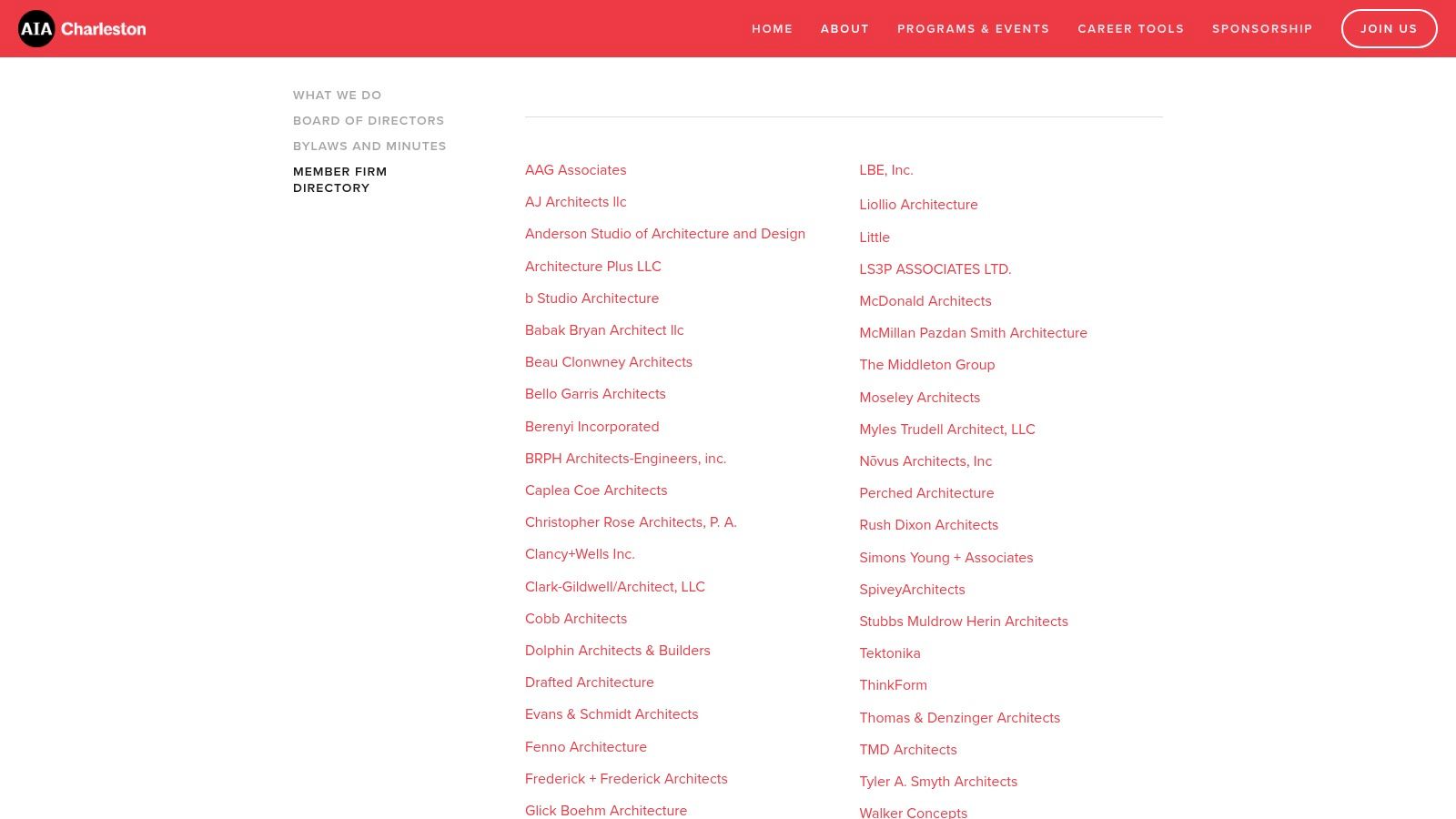
1. AIA Charleston – Member Firm Directory

For those starting their search for architecture firms in Charleston, SC, the AIA Charleston Member Firm Directory is an essential first stop. This platform is not a single firm but a curated, official roster of local firms that are members of the American Institute of Architects (AIA). This affiliation serves as a pre-vetting mechanism, ensuring every firm listed adheres to the AIA's stringent professional and ethical standards. It’s a powerful tool for building a shortlist of credible, locally engaged professionals.

AIA Charleston – Member Firm Directory

The directory’s main advantage is its hyper-local focus and professional credibility. Unlike broad national directories, every listing here has a direct connection to the Charleston and Lowcountry architectural community. This is particularly valuable for projects requiring a deep understanding of local zoning, historical precedents, and the Board of Architectural Review (BAR) process.

Using the Directory Effectively

The interface is straightforward, presenting an alphabetical list of member firms with direct links to their websites and phone numbers. There's no complex search filter, which makes it simple to navigate but requires users to click through to each firm's site for detailed portfolio information.

Practical Tips for Use:

  • Cross-Reference with Award Winners: Visit the AIA Charleston Design Awards page. Note the firms that have won recent awards and then locate them in the directory. This helps identify teams recognized by their peers for excellence.
  • Assess Local Engagement: Check if a firm's principals or staff are involved in AIA Charleston events or leadership. Active local participation often indicates a strong commitment to the community and a robust professional network.
  • Initial Vetting, Not Final Selection: Use the directory to build a preliminary list of 5-10 firms. The real research begins when you explore each firm's individual portfolio and project history on their respective websites.

Platform Breakdown

Feature Details
Access & Cost Completely free and open to the public.
Best For Commercial developers, historic preservationists, and business owners looking for a pre-vetted list of local, professionally affiliated firms.
Unique Offering Provides a direct line to firms committed to professional standards, acting as an implicit seal of quality and local credibility.

Pros & Cons

  • Pro: High relevance to the Charleston market; all listed firms meet AIA professional standards.
  • Pro: Serves as an indicator of a firm's local engagement and professional standing.
  • Con: Not all qualified local firms are AIA members, so it isn't a fully comprehensive list.
  • Con: The level of detail in each listing is minimal, requiring further research on individual firm websites.

Website: AIA Charleston – Firm Directory

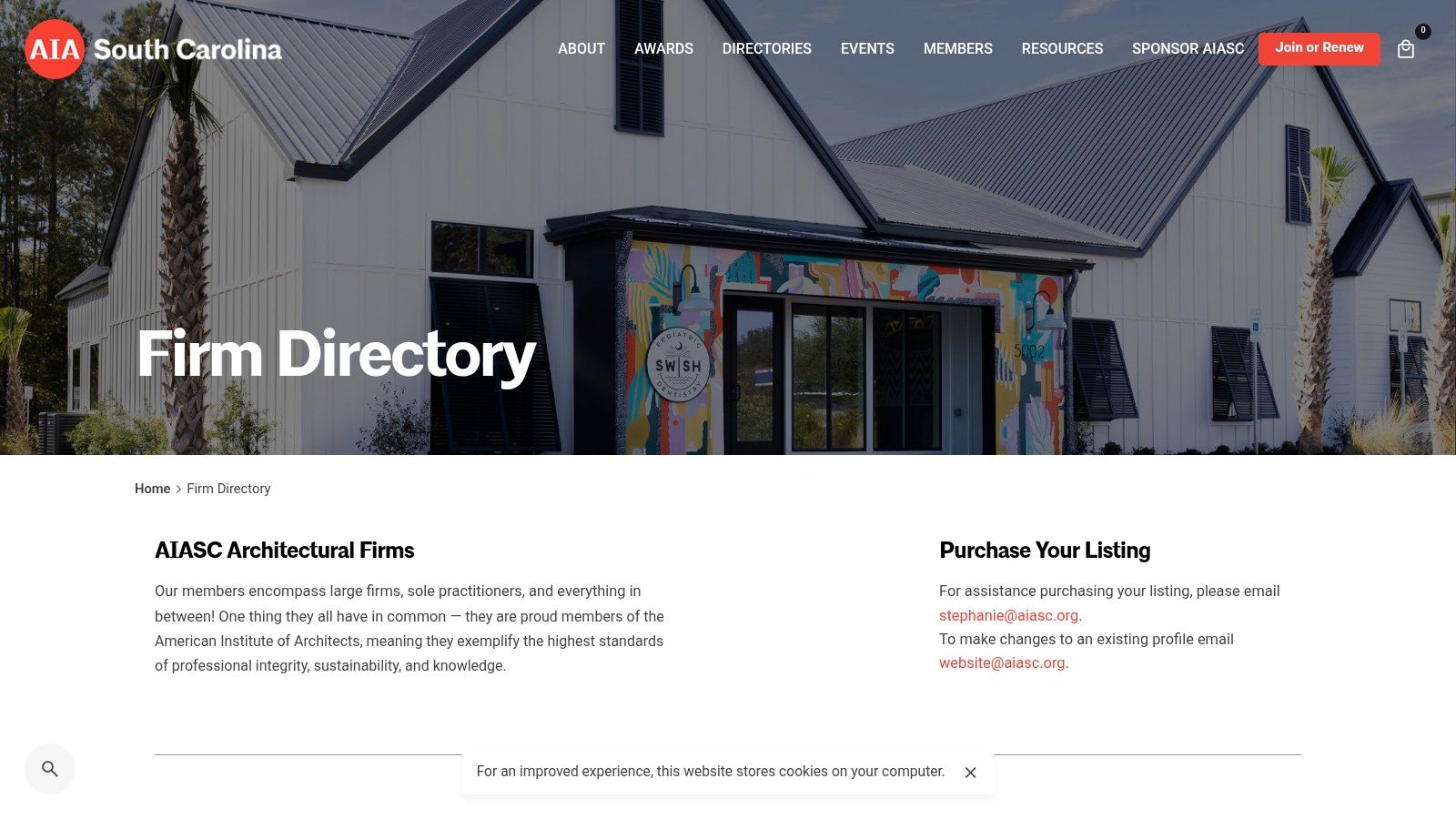
2. AIA South Carolina – Firm Directory

Expanding the search to a statewide level, the AIA South Carolina Firm Directory offers a broader perspective on professional architectural services. Like its Charleston-specific counterpart, this directory lists firms that are members of the American Institute of Architects, ensuring a baseline of quality and adherence to professional ethics. This platform is particularly useful for developers or business owners whose projects might span multiple South Carolina cities or who are looking for specialized expertise that may exist outside the immediate Charleston area.

AIA South Carolina – Firm Directory

The directory’s key advantage is its filtering capability. Users can narrow their search by specific market sectors, including Commercial, Hospitality, Education, and Historic Preservation. This makes it an efficient tool for identifying architecture firms in Charleston, SC, with proven experience in a particular project type, saving significant time during the initial research phase.

Using the Directory Effectively

The platform allows users to view detailed firm profiles that often include project images, a mission statement, and direct contact information. The level of detail varies, as each firm manages its own profile. This state-level view is ideal for comparing the capabilities of Charleston-based firms against those in other South Carolina metros like Columbia or Greenville.

Practical Tips for Use:

  • Leverage Sector Filters: Start by using the filters to isolate firms specializing in your project type (e.g., healthcare, multi-family residential). This immediately creates a relevant shortlist.
  • Compare Regional Expertise: For projects with a statewide footprint, use the directory to identify firms with offices or significant project experience in both Charleston and other key SC markets.
  • Evaluate Profile Completeness: A well-maintained and detailed profile can be an early indicator of a firm's professionalism and marketing savvy. Pay attention to those who invest in presenting their work clearly.

Platform Breakdown

Feature Details
Access & Cost Free and publicly accessible online.
Best For Developers with multi-city projects in South Carolina, clients seeking highly specialized sector experience, and those wanting to compare Charleston talent with other regional firms.
Unique Offering Sector-specific filtering that allows users to quickly find firms with relevant project experience across the entire state, including the Charleston market.

Pros & Cons

  • Pro: Powerful filtering tools to find firms by specific expertise (e.g., preservation, commercial).
  • Pro: Provides a baseline of quality and professionalism through AIA membership requirements.
  • Con: Not all great firms are AIA members, so it doesn't represent the entire market.
  • Con: The detail and quality of firm profiles can be inconsistent, as they are self-managed.

Website: AIA South Carolina – Firm Profiles

3. AIA (National) – Architect Finder

While the local AIA Charleston directory is ideal for a focused Lowcountry search, the national AIA Architect Finder offers a broader perspective. This powerful, nationwide database allows users to search for licensed AIA-member firms by city, project type, and specific expertise. It's an excellent tool for clients who want to benchmark local talent against national standards or find firms with highly specialized skills that may be less common in a smaller market.

The key advantage of the national finder is its robust filtering capability. You can search specifically for architecture firms in Charleston, SC and then narrow the results by project types like "Historic Preservation," "Retail," or "Multifamily Housing." This helps identify firms that not only work locally but also carry deep experience in a particular commercial or institutional sector, backed by the credibility of AIA membership.

Using the Directory Effectively

The platform functions like a sophisticated search engine. Users input their location and can then select from dozens of project categories and firm specializations. Each resulting profile provides firm details, project photos, and contact information, though the depth of each profile is managed by the individual firm.

Practical Tips for Use:

  • Identify Niche Specialists: Use the filters to find Charleston firms with specific, hard-to-find expertise. For example, search for “Adaptive Reuse” or “Energy & Carbon” to pinpoint architects with proven skills in these technical areas.
  • Benchmark and Compare: After creating a shortlist of local firms, use the Architect Finder to look at similarly specialized firms in other historic cities like Savannah or New Orleans. This can provide valuable context on design trends and capabilities.
  • Verify Credentials: Use this tool to confirm that a firm you are considering is an active member of the American Institute of Architects, reinforcing their commitment to professional practice and ethics.

Platform Breakdown

Feature Details
Access & Cost Completely free and open to the public.
Best For Developers, national brands, and clients needing to find architects with specific, niche expertise (e.g., sustainable design, advanced building technology) within the Charleston market.
Unique Offering Advanced search filters that allow users to drill down by project type and specialization, connecting them with highly relevant AIA-member firms.

Pros & Cons

  • Pro: Powerful filtering helps find specialists quickly and efficiently.
  • Pro: Provides a national-level quality benchmark for firms operating in Charleston.
  • Con: The level of detail and quality of project imagery can vary significantly from one firm's profile to another.
  • Con: Excludes excellent local firms that are not AIA members, so it should be used in conjunction with other resources.

Website: AIA Architect Finder

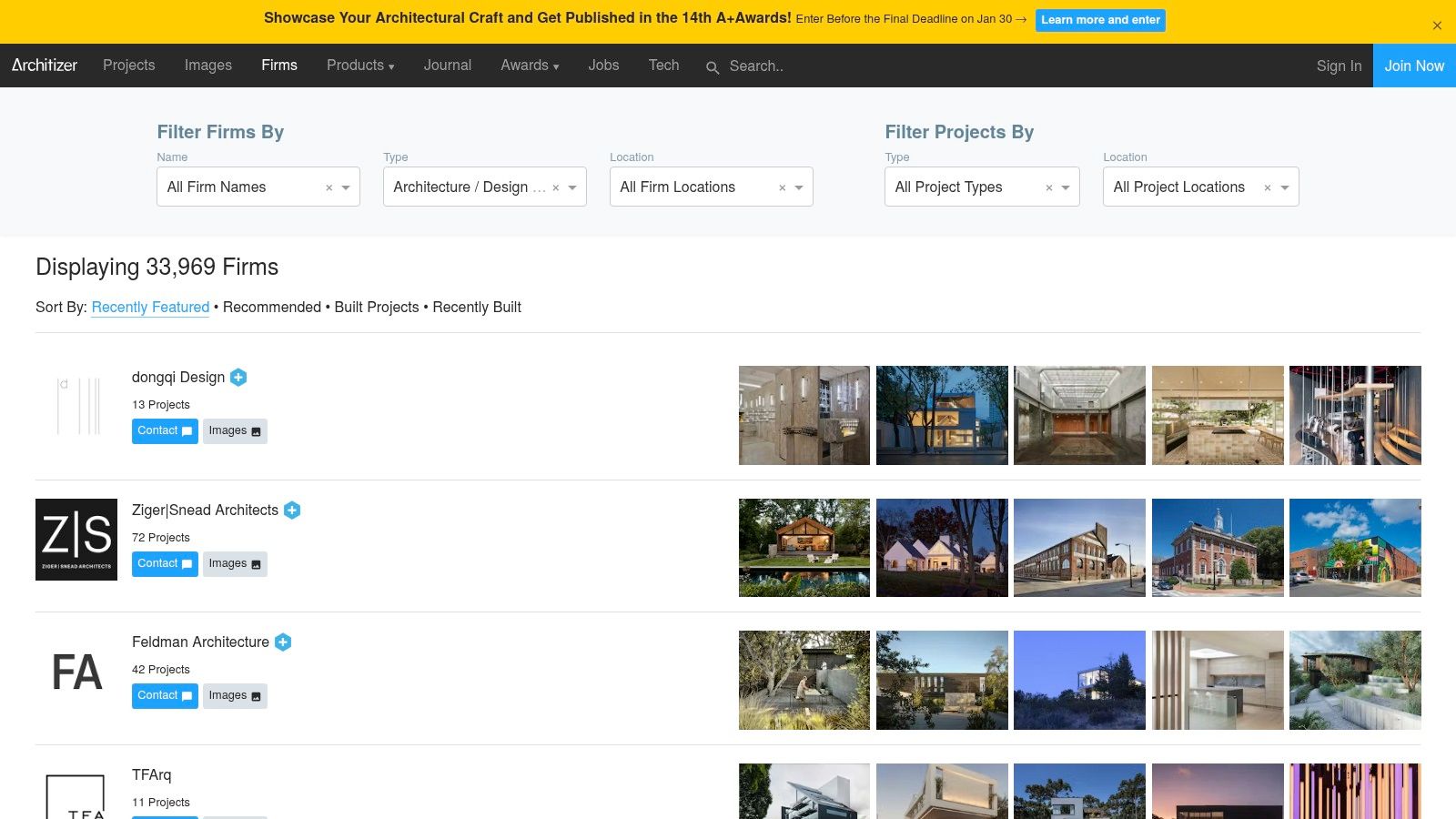
4. Architizer – Firms Directory

While local directories provide a foundational list, Architizer offers a global stage where design-forward architecture firms in Charleston, SC, showcase their work. This platform is portfolio-driven, prioritizing high-quality project imagery and detailed case studies. It’s an ideal resource for clients who want to perform visual due diligence, allowing for a quick comparison of aesthetic styles, project scales, and design quality across multiple firms.

Architizer – Firms Directory

Architizer’s main strength is its focus on the finished product. The platform functions like a digital design magazine, connecting projects with the firms that designed them and the products used to build them. This makes it particularly useful for commercial developers or business owners who are looking for inspiration and want to see how firms handle specific building types, such as boutique hotels, adaptive reuse projects, or modern office spaces.

Using the Directory Effectively

The search function allows you to filter firms by location ("Charleston") and project type (e.g., "Commercial," "Hospitality"). This lets you quickly zero in on firms with a proven track record in your specific sector. Once you find a firm, you can explore their project galleries, which often include rich imagery and descriptions.

Practical Tips for Use:

  • Filter by Project Type: Use the search filters to find firms that specialize in your project category. A firm excelling in historic residential work may not be the best fit for a new commercial development.
  • Review Award Context: Pay attention to projects that have won A+Awards or have been featured editorially. This indicates peer recognition and a high standard of design excellence.
  • Analyze Project Details: Look beyond the "hero" shots. Dive into the project details to see floor plans, material selections, and construction photos. This gives a more complete picture of a firm’s capabilities.

Platform Breakdown

Feature Details
Access & Cost Free to browse and search for firms.
Best For Clients prioritizing visual design and aesthetic fit, especially for commercial, hospitality, and contemporary projects.
Unique Offering A visually rich, portfolio-first approach that allows for direct comparison of design quality and project types on a global platform.

Pros & Cons

  • Pro: Excellent for reviewing portfolio depth and quickly assessing a firm's design quality.
  • Pro: Strong presence of award-winning and preservation-savvy firms that are active in design media.
  • Con: Not all Charleston firms are active on the platform, so it’s not a comprehensive local list.
  • Con: The quality and depth of a firm's profile depend on how frequently they update it.

Website: Architizer – Firms

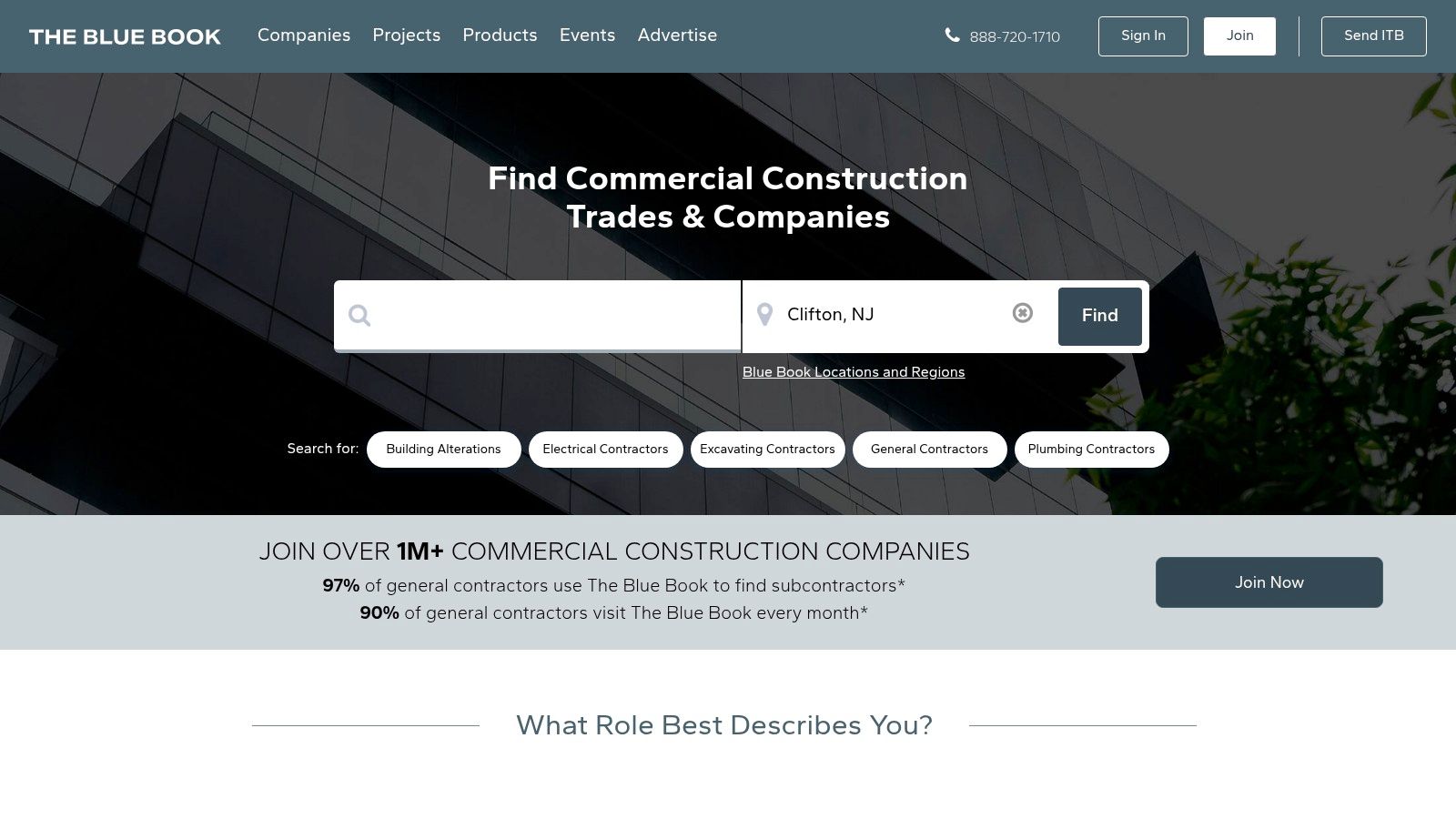
5. The Blue Book Building & Construction Network (Dodge)

For commercial developers, general contractors, and business owners operating within the construction procurement ecosystem, The Blue Book is a foundational resource. More than a simple directory, this platform is a B2B network designed to connect project stakeholders. It is widely used for sourcing design teams, distributing invitations to bid (ITBs), and managing pre-construction workflows, making it a powerful tool for finding architecture firms in Charleston, SC, that are active in the commercial and industrial sectors.

The Blue Book Building & Construction Network (Dodge)

The primary advantage of The Blue Book is its alignment with the needs of the construction industry. Unlike design-centric platforms, its functionality is built around project procurement. Users can filter by discipline and region, identifying firms that serve the Charleston market and have experience with specific project types, from healthcare facilities to retail upfits. The network is an efficient way to assemble a team for a competitive Request for Proposal (RFP) process.

Using the Directory Effectively

The platform allows users to search for architects and view company profiles, which often include market coverage, project history, and contact information. The interface is geared toward construction professionals, so it may feel less intuitive for a private homeowner.

Practical Tips for Use:

  • Leverage Regional Filters: Use the search function to specifically target "Architects" within the Charleston or broader South Carolina region to narrow down the vast national database.
  • Review Market Sectors: Pay close attention to the "Markets" section in a firm’s profile. This quickly tells you if they specialize in commercial, industrial, institutional, or other sectors relevant to your project.
  • Utilize for Procurement: For those managing a formal bidding process, use the platform's tools to send out RFPs or ITBs directly to a shortlist of qualified architectural firms.

Platform Breakdown

Feature Details
Access & Cost Free to search and view company profiles. Advanced features for bid management and project communication may require a Pro subscription.
Best For General contractors, commercial developers, and project managers looking to source architectural partners for competitive bids and large-scale projects.
Unique Offering Integrates firm discovery with the actual construction procurement workflow, connecting users directly to firms through a B2B network.

Pros & Cons

  • Pro: Built specifically for B2B construction, aligning perfectly with developer and general contractor needs.
  • Pro: Excellent tool for efficiently sourcing multiple firms for a competitive RFP or bid process.
  • Con: The user interface is more functional than aesthetic, favoring industry insiders over the general public.
  • Con: Firm profiles can be brief and may require visiting the architect’s own website for detailed portfolio viewing.

Website: The Blue Book

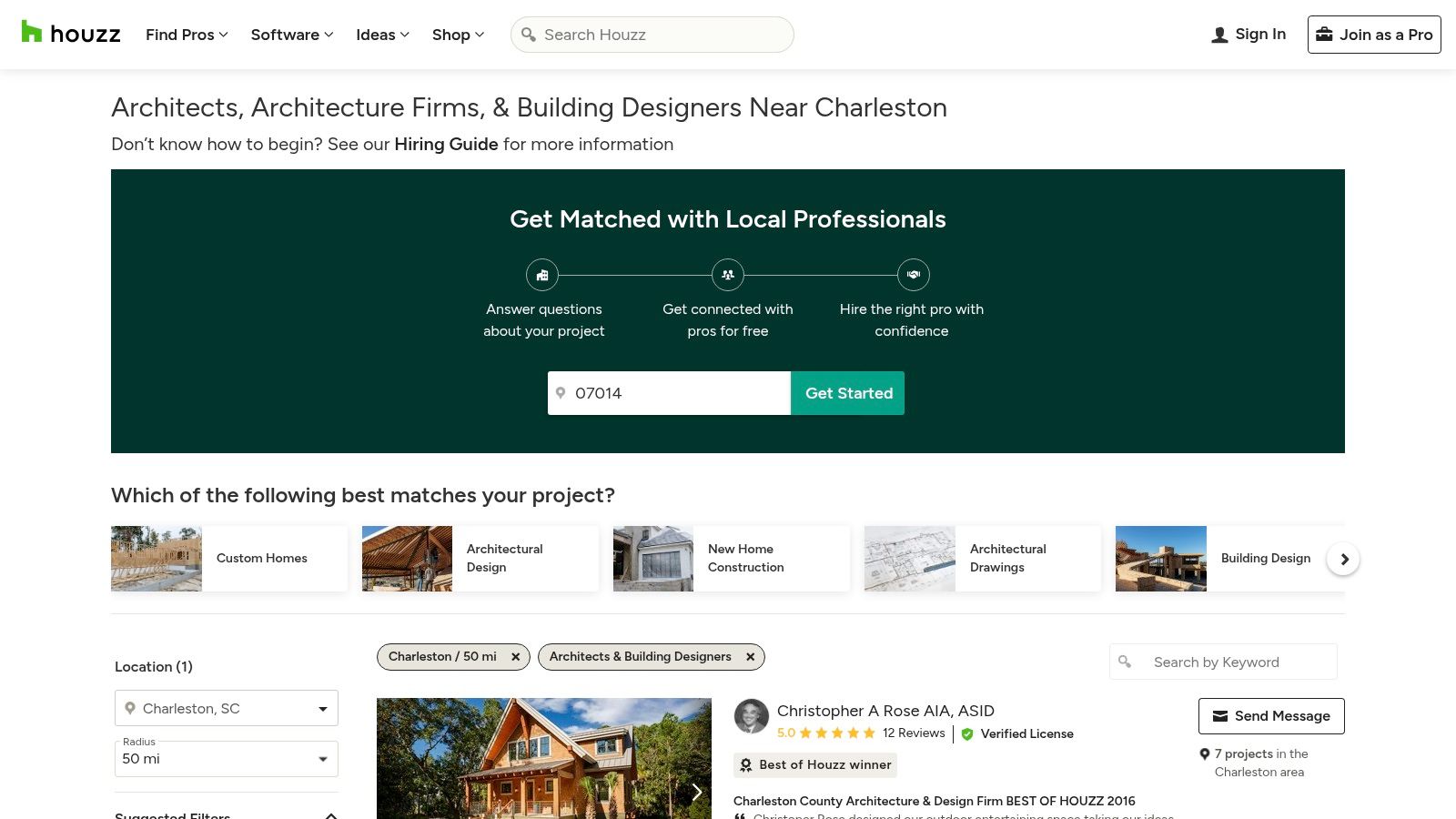
6. Houzz – Charleston, SC Architects Category

For clients focused on visual inspiration and direct feedback, Houzz is a powerful, consumer-facing directory. While it has a strong residential reputation, its dedicated category for Charleston, SC architects includes numerous firms with robust commercial and historic preservation portfolios. Its primary value lies in the rich visual content and extensive client reviews, offering a unique window into a firm's design aesthetic and customer service experience.

Houzz – Charleston, SC Architects Category

The platform’s major advantage is its side-by-side comparison format, blending professional portfolios with unfiltered client testimonials. Badges like "Best of Houzz Service" or "Best of Houzz Design" are awarded based on community engagement and reviews, serving as a quick signal of a firm's reputation. This makes it an excellent tool for gauging how a firm’s finished product and process are perceived by past clients.

Using the Directory Effectively

The interface is image-heavy, allowing users to filter by project type and save inspirational photos to "Ideabooks." This helps you organize visual concepts before even contacting a firm. The built-in messaging feature simplifies the initial outreach and quote request process.

Practical Tips for Use:

  • Filter for Project Type: While browsing, use filters to search for specific commercial projects like "office," "retail," or "restaurant" to narrow the results and find firms with relevant experience.
  • Scrutinize Reviews: Look for detailed reviews that describe the working relationship, communication style, and problem-solving abilities of the architect. This provides insight beyond the finished photos.
  • Be Aware of Sponsored Content: Note that some firms pay for premium placement, which can appear higher in search results. Ensure you scroll through all pages to see a full range of organic listings.

Platform Breakdown

Feature Details
Access & Cost Free to browse and contact professionals. Firms pay for premium features and advertising.
Best For Business owners and developers who prioritize visual style and want to vet firms based on extensive client reviews and photo galleries.
Unique Offering A rich combination of project photos, detailed client reviews, and direct messaging tools, all in one place.

Pros & Cons

  • Pro: Easy side-by-side comparison with rich visuals and validated client reviews.
  • Pro: A fast way to gauge a firm’s design aesthetic and client service reputation.
  • Con: Has a heavy residential focus; finding commercial expertise requires closer reading of profiles.
  • Con: Sponsored placements can rank above more established, organic results, potentially skewing the initial view.

Website: Houzz – Charleston Architects

7. Google Maps – Local Business Profiles for “Architecture firms, Charleston SC”

For a ground-level, immediate overview of architecture firms in Charleston, SC, Google Maps is an indispensable tool. It transforms a simple search into an interactive map, plotting the physical locations of studios across the peninsula and greater metro area. This platform excels at providing quick, practical information like business hours, phone numbers, and direct website links, making it ideal for the initial discovery and logistical planning phase of your search.

Google Maps – Local Business Profiles for “Architecture firms, Charleston SC”

The platform's primary strength is its integration of location, contact details, and user-generated reviews in one view. You can instantly see which firms are located near your project site or in a specific neighborhood, which is a significant advantage for coordinating meetings and site visits. Furthermore, the user reviews, while needing careful assessment, can offer candid insights into past client experiences with communication, project management, and final outcomes.

Using the Directory Effectively

Beyond just finding a location, Google Maps profiles serve as mini-dashboards for each firm. Look for well-maintained profiles with recent photos, prompt responses to reviews, and up-to-date business hours, as this often reflects a firm's overall professionalism and attention to detail.

Practical Tips for Use:

  • Filter by Proximity: Use the map to identify firms closest to your potential project site. This can be a practical advantage for firms that need to make frequent site visits.
  • Scan for Social Proof: Read through both positive and negative reviews. Look for patterns in feedback related to project types similar to yours, such as historic renovations or commercial new builds.
  • Evaluate Digital Presence: A robust Google Business Profile is a modern business essential. For architecture firms looking to maximize their exposure, understanding the nuances of local SEO is key; there are many proven strategies to rank higher in Google Maps that can significantly increase visibility.

Platform Breakdown

Feature Details
Access & Cost Free for public use.
Best For Anyone needing a quick, geographically-based list of local firms; ideal for checking business hours, finding contact information, and reading recent client reviews.
Unique Offering Real-time map-based discovery with integrated user reviews, providing immediate logistical information and a layer of social proof.

Pros & Cons

  • Pro: The fastest way to see nearby firms and their operational status.
  • Pro: Extremely useful for logistics, including planning site visits and in-person meetings.
  • Con: Search rankings can be influenced by SEO efforts and ad spending, not just merit.
  • Con: Google reviews can be unreliable; always verify a firm's credentials and portfolio independently.

Website: Google Maps

7-Directory Comparison: Charleston, SC Architecture Firms

Directory Implementation complexity 🔄 Resource requirements ⚡ Expected outcomes 📊 Ideal use cases 💡 Key advantages ⭐
AIA Charleston – Member Firm Directory Low — simple web browsing and local roster Low — internet access, shortlisting time Vetted local shortlist; strong local credibility. ⭐⭐⭐ Shortlisting Charleston teams for commercial, adaptive reuse, historic projects Local focus; AIA vetting; ties to events/awards
AIA South Carolina – Firm Directory Low–Medium — filtering by sector and comparing profiles Low — browsing, some cross-city comparison time Statewide comparison of capabilities across SC. ⭐⭐⭐ Projects spanning multiple SC metros or needing sector matches Sector filters; state-level benchmarking; AIA quality baseline
AIA (National) – Architect Finder Low — simple search by location/project type Low — web search; some filtering effort Broad coverage for benchmarking; find niche expertise. ⭐⭐⭐ Identifying licensed AIA firms and specialty skills across cities National reach; consistent professional criteria
Architizer – Firms Directory Medium — portfolio review and visual comparison Medium — time to review galleries and awards context Strong visual assessment of design quality and portfolio depth. ⭐⭐⭐⭐ Visual due diligence; comparing design quality for commercial/adaptive reuse Rich imagery; awards context; curated portfolios
The Blue Book (Dodge) Medium–High — set up for procurement and bid workflows Medium — account/tools for messaging and ITBs Efficient sourcing for RFPs/ITBs; aligns with construction workflows. ⭐⭐⭐ Commercial/industrial procurement and GC/developer sourcing Built for B2B workflows; regional trade filters; bid tools
Houzz – Charleston, SC Architects Category Low — consumer-style browsing with reviews/photos Low — browsing, client-review reading Quick gauge of client satisfaction and aesthetic fit. ⭐⭐ Residential work and initial contractor outreach; aesthetic fit checks Extensive reviews/photos; badges (e.g., Best of Houzz); easy comparison
Google Maps – Local Business Profiles Very Low — instant map-based lookup Very Low — mobile or desktop, minimal time Fast local discovery, contact info, and recent reviews. ⭐⭐ Quick radius scouting, site-visit logistics, contact checks Map-based directions, hours, aggregated reviews, real-time visibility

Your Next Steps: From Shortlist to Groundbreaking

Navigating the landscape of architecture firms in Charleston SC can feel complex, but with the right tools and a structured approach, you can confidently identify the ideal partner for your commercial project. We've explored a powerful toolkit, from the hyper-local AIA Charleston directory to the visually-driven portfolios on Houzz and Architizer. Each resource offers a unique lens through which to view a firm's capabilities, design philosophy, and project history.

Your initial research has equipped you with a broad understanding of the market. Now, the real work of curation begins. The goal is to move from a long list of possibilities to a targeted shortlist of two or three firms that align perfectly with your project's specific needs, whether it's historic preservation, adaptive reuse, or new commercial construction.

From Digital Research to Direct Dialogue

Transitioning from online directories to in-person interviews is the most critical step in this process. Your objective is to vet not just a firm's portfolio, but its process, team, and communication style.

1. Develop Your Project Brief: Before you initiate contact, consolidate your vision into a concise project brief. This document should clearly articulate your:

  • Project Goals: What problem are you solving? What is the primary function of the space?
  • Site & Scope: Location, square footage, and key program requirements.
  • Budget & Timeline: Realistic financial parameters and critical deadlines.
  • Success Metrics: How will you define a successful project outcome?

2. Initiate Strategic Outreach: Armed with your brief, reach out to your top 5-7 firms. An initial email or phone call should be professional and direct. Pay close attention to their responsiveness and the quality of their initial questions. A firm that asks insightful questions is a firm that is already engaged with your vision.

3. Conduct Structured Interviews: For your final 2-3 candidates, schedule formal interviews. This is your opportunity to dig deeper than the portfolio.

Key Interview Questions:

  • "Can you walk me through your process for a project of similar scale and complexity?"
  • "Who from your team would be our primary point of contact, and what is their experience?"
  • "How do you handle budget management and value engineering throughout the design process?"
  • "Based on our brief, what do you see as the biggest opportunities and potential challenges for this project?"

Making the Final Selection

Your final decision should be a balanced assessment of skill, experience, and chemistry. The right architect is more than a designer; they are your strategic partner, advocate, and problem-solver. Consider how each firm's approach aligns with your own business objectives and communication preferences. The firm you choose will guide you through complex zoning, permitting, and construction phases, making a strong, trust-based relationship paramount. Choosing the right partner from the many qualified architecture firms in Charleston SC sets the foundation for a project that not only meets your functional needs but also delivers lasting value for your investment.


As you evaluate your options, consider a firm with deep roots in the Lowcountry's unique commercial landscape. For a partner dedicated to client-centric design and meticulous project execution, explore the portfolio of Sherer Architects, LLC. Sherer Architects, LLC specializes in navigating the complexities of Charleston's commercial architecture, from modern new builds to sensitive historic renovations.

Categories
Uncategorized

Discover warehouse theater greenville sc: A Guide to Adaptive Reuse

Greenville, South Carolina's Warehouse Theatre is a masterclass in adaptive reuse. It stands as a brilliant example of how you can breathe new life into a historic textile warehouse, transforming it into a buzzing cultural hub.

For developers and property owners, this project isn't just a success story; it's a practical blueprint. It shows how to perfectly blend historic preservation with a smart, profitable investment. This is a story of vision, community, and some really sharp design.

A brightly lit "WAREHOUSE REBORN" sign on a theater building at dusk with people walking outside.

Unpacking the Warehouse Theater Blueprint

We’re going to use the Warehouse Theatre as our core case study. Think of it as a detailed roadmap for anyone looking to turn an old industrial building into a thriving community asset. Its journey—from a basic textile storage space to a cultural and economic linchpin for Greenville’s West End—offers some incredibly valuable lessons.

We'll walk through the entire lifecycle of this project, from the first spark of an idea to its current status as a local landmark. This is about more than just saving an old building; it’s about unlocking the massive potential trapped inside its walls.

From Humble Beginnings to Cultural Anchor

The Warehouse Theatre's story is all about ambition. It was started back in 1973 by a handful of local artists and a Furman University professor who found a rent-free black box space to get going. Fast forward to 1998, and they made the move to their current home in the West End, taking on the challenge of converting historic mill buildings into a modern performance venue.

This project did more than just save a piece of Greenville’s textile heritage. It gave the building a new purpose and extended its life for decades to come.

Why This Model Works for Developers

The Warehouse Theatre’s success offers a compelling argument for developers and investors for a few key reasons:

  • Economic Viability: It proves that cultural venues can be profitable ventures, attracting patrons and driving real dollars into the local economy.
  • Community Integration: Creating a space that people genuinely love generates immense goodwill. It becomes a landmark, not just a building.
  • Sustainable Practice: Adaptive reuse is, at its heart, a sustainable choice. You sidestep demolition costs and drastically reduce the project's environmental footprint.

Of course, before you dive headfirst into a project like this, you have to do your homework. It’s absolutely essential to assess the project’s viability and understand the potential hurdles. The first step is to conduct a feasibility study. This is the foundation for a solid financial and operational plan, making sure every move you make is backed by solid data.

The Financial Case for Adaptive Reuse Theaters

Beyond the cool architecture and the good feelings, converting a warehouse into a theater has to make financial sense. Developers and investors need to see hard numbers that show a clear path to a solid, lasting return. At the end of the day, the data has to tell a story of real growth and profitability.

For a project like a warehouse theater in Greenville SC, success is measured by more than just ticket sales. You have to look at audience growth, how deeply the community is involved, and whether the venue can pull in money from different sources. A smart conversion becomes an economic driver for the neighborhood, not just a place to see a show.

The Warehouse Theatre's recent track record gives us a fantastic real-world example of this in action. It’s a perfect case study of how a strategic adaptive reuse project can meet market demand and deliver impressive financial results, making a strong argument for similar investments.

Measuring Success in Greenville

Greenville’s vibrant arts scene is the perfect backdrop for a project like this. In a standout year, the Warehouse Theatre saw its audience jump by a massive 32%. That’s a powerful sign of its growing appeal and importance to the community.

This wasn't just a fluke in one area. The growth was across the board—from main stage shows to educational programs and community events. In fact, their education initiatives hit their highest-ever revenues and attendance numbers.

This isn't happening in a vacuum. Other local arts venues have also been reporting record-breaking years and seeing a big uptick in donations from individuals. This all points to a healthy, supportive market for the performing arts in Greenville. It’s tangible proof that putting money into cultural venues pays off. You can get more details on these impacts directly from the Warehouse Theatre's success story.

A thriving arts venue does more than sell tickets; it becomes a destination. The increased foot traffic benefits surrounding businesses, boosts property values, and contributes to the overall economic vitality of a district, creating a halo effect for investors.

Key Performance Indicators for a Cultural Adaptive Reuse Project

For developers and investors, looking beyond a simple profit and loss statement is crucial. The following table highlights the tangible growth metrics from the Warehouse Theatre, providing a benchmark for what a successful cultural adaptive reuse project can deliver.

Metric Warehouse Theatre Performance Implication for Developers
Audience Growth Rate 32% increase in patrons served in a single year. Demonstrates strong market penetration and growing brand loyalty. A clear sign of a sustainable customer base.
Revenue Diversification Highest-ever revenues from educational programming and community events. Multiple income streams reduce risk and create financial stability beyond the box office.
Community & Donor Support Significant jumps in individual giving across the local arts scene. Strong community buy-in and philanthropic support validate the project's cultural value and reduce financial risk.
Local Economic Impact Increased foot traffic and evening commerce in the surrounding district. Creates a "halo effect," boosting neighboring property values and making the entire area more attractive for future investment.

These KPIs show a project that's not just culturally significant but is also a sound, data-backed investment. They paint a clear picture of how a well-executed adaptive reuse theater can become a cornerstone of both community and commerce.

Tackling the Core Design Puzzles of Conversion

Architects or engineers review design blueprints in a large event space or warehouse.

Turning an industrial shell into a place of performance isn't just a renovation; it's like solving a giant, three-dimensional puzzle. Every piece, from the steel beams overhead to the way sound travels through the room, has to fit together perfectly. For any warehouse theater in Greenville SC, getting these foundational, technical details right from the start is what separates a successful venue from a failed experiment.

The first, and arguably most important, challenge is the building's skeleton. Warehouses are built for the simple, static weight of goods, not the dynamic loads of lighting rigs, catwalks, and hundreds of people. A deep-dive structural analysis is always step one, figuring out exactly where we need to add muscle to the original frame to carry the weight of a modern theater safely.

From Echo Chamber to Acoustic Sanctuary

Let's be honest: the very things that give a warehouse its character—soaring ceilings, concrete floors, and hard, flat walls—are an acoustic disaster. They create a massive echo chamber where sound just bounces around endlessly. For a theater, where the clarity of every line and note is paramount, this is a non-starter.

Taming that chaotic sound requires a layered approach, not just a single fix. We have to bring in a combination of strategies to absorb and scatter sound waves.

  • Acoustic Paneling: You'll see these installed strategically on walls and ceilings. Their job is to act like sponges, soaking up stray sound before it can reflect back into the room.
  • Irregular Surfaces: We intentionally break up those big, flat planes by adding varied textures and angles. This scatters the sound, preventing harsh echoes and creating a much warmer, more intimate feel.
  • Smart Layout: Even the way we arrange seating and interior walls can help. A good design directs sound right where you want it—to the audience's ears. When planning a new warehouse theater, it’s vital to consider every element, including carefully choosing the right stage that complements the unique acoustic fingerprint of the space.

Weaving in the Modern Essentials

Beyond sound, a performance venue needs a whole network of complex systems that do their job without anyone noticing. HVAC (heating, ventilation, and air conditioning) is a perfect example. You need a system that keeps a full house comfortable but remains completely silent. That’s a world away from the loud, clunky industrial units you usually find bolted to the roof of an old warehouse.

A great adaptive reuse project respects the soul of the original building while making it ready for today. The real artistry is in weaving in modern life-safety systems—like fire suppression and accessible exits—without erasing the historic industrial character that drew you to the space in the first place.

This means designing custom ductwork, often lined with sound-dampening material, and picking air handlers that are whisper-quiet. At the same time, we have to meet all current codes for fire safety and accessibility. This involves integrating ramps, accessible restrooms, and clear emergency egress routes in a way that feels like it was always part of the building's design, not just tacked on.

It’s a delicate dance between preservation and modernization. The best projects make these critical upgrades feel so natural that you'd never guess they weren't part of the original plan, resulting in a venue that’s safe, welcoming, and full of history.

Navigating Approvals and Maximizing Incentives

Taking an old building and giving it new life as a modern venue means you're stepping into a world of regulations and financial strategy. For anyone looking at a project like a warehouse theater in Greenville SC, this part of the process can feel daunting. But with the right team, what looks like a mountain of bureaucratic hurdles can actually become your biggest financial advantage.

The trick is to see zoning ordinances, Design Review Board presentations, and historic preservation rules not as roadblocks, but as a roadmap. When you know how to navigate it, this process can actively lower your project costs and significantly improve your return on investment. It's less about fighting red tape and more about lining up your project's goals with what the city and preservation groups want to see. You just have to learn how to make the system work for you.

Turning Regulations into ROI

Let's be clear: the regulatory maze isn't there to kill projects. It's designed to make sure development is safe, sustainable, and genuinely adds value to the community—and in a historic area like Greenville's West End, that's doubly true. Think of the approvals process as your first, best chance to prove that your project respects the neighborhood's character while breathing new economic life into an old building.

For example, when you stand in front of a Design Review Board, you’re not just checking a box. A well-researched presentation showing how you'll save the original brickwork or restore those iconic old windows builds incredible goodwill. That proactive approach signals you're a partner in preservation, not just another developer, and can make every subsequent step a whole lot smoother.

And that partnership mentality is precisely what unlocks the real financial wins.

A project that nails the balance between modern needs and historic preservation doesn't just get a green light. It gets a key to a powerful set of financial incentives that can completely change the numbers on your pro forma. These aren't handouts; they're rewards for doing it right.

Unlocking Historic Tax Credits and Grants

This is where the financial picture gets really interesting. Programs like the Federal Historic Preservation Tax Incentives program and South Carolina's own state-level credits are game-changers. They can be incredibly lucrative, but they don't mess around—you need precision and real expertise to qualify.

Getting these benefits isn't a simple form-fill. It involves a few critical steps:

  • Deep-Dive Documentation: First, you have to meticulously research and document the building's original bones—how it was built and what materials were used. This research becomes the foundation of your entire preservation plan.
  • Smart, Sensitive Design: Your architectural plans have to be clever. They need to show exactly how you'll integrate modern systems like HVAC and electrical with the least possible impact on the historic fabric of the building.
  • Airtight Application: The application process is rigorous. You need to provide clear, undeniable proof that your renovation follows the Secretary of the Interior's Standards for Rehabilitation to the letter.

The story of The Warehouse Theatre is a perfect real-world example. It's set to celebrate 52 years in 2025, and its journey from a scrappy black box experiment in 1973 to a top-tier professional theater shows what’s possible when vision and preservation come together. The theater got its start with a grant from the South Carolina Arts Commission, proving how smart financing and a commitment to preservation build lasting value.

This history shows that knowing how to navigate design reviews and tap into historic tax credits can reduce costs by 50-75% compared to just tearing the building down. You can dig into their foundational story to see how those early grants and community buy-in laid the groundwork for decades of success.

5. Budgeting and Timeline: The Bottom Line on Your Warehouse Conversion

When you're looking at a project like this, it really boils down to two things: how much is it going to cost, and how long is it going to take? For a developer, getting these answers right is everything. A predictable budget for a warehouse-to-theater conversion isn't about guesswork; it's about building a detailed financial roadmap from the very beginning.

Think of it less as a single price tag and more as a series of building blocks. You have your big-ticket items, like buying the property and paying for the architectural design. But then you start layering in the unique challenges of adaptive reuse—things like beefing up the structure for theatrical loads, installing specialized acoustic treatments, and wiring up the sophisticated lighting and sound systems that make a performance space come alive. A solid budget for a warehouse theater in Greenville, SC, has to account for all of it.

Breaking Down the Major Cost Centers

One of the easiest traps to fall into is underestimating the "soft costs" and forgetting to build in a healthy contingency fund. A well-planned budget expects the unexpected. Old buildings always have secrets, so you need to be prepared.

Here's how we typically break it down:

  • Hard Costs: This is the steel, the concrete, the drywall. It covers all the physical construction—structural work, HVAC, electrical, plumbing, interior finishes, and all the specialized theater gear like rigging and seating.
  • Soft Costs: These are the professional services that get the project off the ground and keep it on track. Think architectural and engineering fees, permits, legal reviews, and insurance.
  • Contingency Fund: This is your safety net. We recommend setting aside 10-15% of the total construction cost for those inevitable surprises, like discovering hidden structural damage or dealing with unforeseen site conditions.

The process of securing approvals and incentives plays a huge role in your financial planning. As the flowchart below shows, these steps aren't just bureaucratic hurdles; they're gateways to unlocking real money for your project.

A flowchart illustrates the Project Incentives Process with steps: Zoning, Approvals, and Credits.

As you can see, getting your zoning and historic designations locked in early is the key. Those foundational steps are what allow you to tap into financial credits, turning what feels like red tape into a real benefit for your budget.

Adaptive Reuse vs. New Construction: A Cost and Timeline Overview

To really understand the trade-offs, it helps to see how a warehouse conversion stacks up against starting from scratch. Here’s a high-level comparison to help you weigh the financial and scheduling implications.

Factor Adaptive Reuse (Warehouse) New Construction (Theater)
Upfront Costs Acquisition + major retrofitting. Can be variable based on building condition. Land acquisition + ground-up build. Often higher initial capital outlay.
Design & Approval More complex upfront; involves historic reviews, structural analysis, and creative problem-solving. More straightforward design process but can face lengthy zoning and site plan approvals.
Construction Time Generally faster once permits are secured, as the primary structure already exists. Longer construction phase from foundation to finishing.
Incentives High potential for historic tax credits, grants, and other revitalization funds. Limited to standard development incentives; no historic benefits.
Contingency Needs Higher (10-15%) due to the potential for unforeseen conditions in an existing structure. Lower (5-10%) as conditions are more controlled and predictable.
Marketability Strong narrative appeal; unique character and historic charm can be a major draw. A blank slate; appeal is based entirely on new design and amenities.

While the numbers can vary wildly from one project to the next, this table gives you a framework for thinking about the decision. Adaptive reuse often presents a compelling case, especially when you factor in the speed to market and the financial perks.

Phasing Your Project for a Predictable Path

A realistic project timeline is just as crucial as the budget. We always advocate for a phased approach, starting with feasibility studies and design development before ever breaking ground. This methodical process helps prevent the kinds of costly delays that can sink a project.

The real value of adaptive reuse shines when you compare it to new construction. While initial costs can sometimes be similar, the accelerated timeline, potential for tax credits, and the built-in character of a historic space often deliver a superior long-term ROI.

This is where having an experienced architectural partner becomes invaluable. By performing thorough due diligence at the outset and drawing on a deep well of experience with local regulations and incentive programs, a good firm can cut through the uncertainty. They help mitigate risks and keep the project on a steady, financially sound path—from that first concept sketch all the way to opening night.

Lessons Learned: Your Blueprint for a Successful Theater Project

Taking an old, forgotten building and turning it into a cultural cornerstone is an ambitious journey. But as the story of the Warehouse Theatre in Greenville, SC, shows, it’s a journey that can be incredibly successful when you blend a great vision with a smart financial plan. Here are the key takeaways from that project that can guide your own.

If there's one thing to take away from our experience, it's this: do your homework upfront. A deep-dive feasibility study before you even think about design is absolutely critical. This is where you uncover the hidden structural gremlins, the regulatory roadblocks, and the real financial picture.

Getting this right from the start is the difference between building on solid rock and building on quicksand. It saves you from those heart-stopping, budget-blowing surprises down the line.

You Can't Do It Alone: Building Your A-Team

Adaptive reuse projects are team sports, and the Warehouse Theatre is a perfect example of what happens when you get the right players on the field early. Your project's success truly depends on the specialists you bring to the table from day one.

Your core team should absolutely include:

  • A Preservation-Savvy Architect: You need someone who not only has a great design eye but also knows how to navigate the complex world of historic tax credits and respect the soul of the original building.
  • An Acoustician: Old industrial spaces are notorious echo chambers. An acoustician is the magician who turns that cavernous space into an intimate venue where every word from the stage is crystal clear.
  • A Creative Structural Engineer: This is the person who figures out how to make a century-old frame support modern lighting grids and seating without gutting its historic character.

The most successful projects are the ones that become part of the community's fabric. Think beyond the four walls. The goal is to create a destination that pulls people in, drives foot traffic, and becomes a place the neighborhood can't imagine living without.

Ultimately, your architectural partner is your quarterback through this entire game. They’re the ones who see the whole field—coordinating the design, wrangling the permits, managing the budget, and overseeing construction. With a solid team and a clear vision, your own warehouse theater in Greenville SC can be more than just a beautifully restored building. It can become a thriving, profitable hub for your community for years to come.

Got Questions? We've Got Answers

If you're looking at an old warehouse in Greenville and thinking "theater," you're not alone. It's an exciting idea, but it also comes with a lot of questions. We've been through this process many times, and a few key concerns always come up.

Let's walk through some of the most common questions developers and property owners ask when they're on the fence about turning an industrial shell into a cultural landmark.

What's Going to Surprise Me on the Budget?

The biggest budget-busters are almost always the things you can't see. When you peel back the layers of an old building, you might find structural issues that need serious reinforcement, old wiring that can't handle a modern theatrical load, or even hazardous materials like asbestos that have to be professionally removed.

These aren't just about meeting today's building codes; they're about supporting the intense demands of a performance space. The best money you can spend upfront is on a deep, thorough assessment with an architect who knows what to look for. It’s how you turn "unforeseen costs" into a predictable line item.

Here's a hard-won piece of advice: don't treat the theater-specific systems as an add-on. Things like theatrical lighting, rigging, and especially acoustic treatments, are core infrastructure, not just finishes. If you budget for them like an afterthought, you risk blowing your budget and compromising the entire reason you're building the theater in the first place.

How Can I Actually Use Historic Tax Credits in South Carolina?

South Carolina offers some fantastic incentives for bringing historic buildings back to life, but you have to play by the rules. The big ones are the state and federal historic tax credits. To get them, your building first needs to be on the National Register of Historic Places.

Then comes the critical part: every single piece of renovation work has to follow the Secretary of the Interior's Standards for Rehabilitation. This isn't a suggestion—it's a strict requirement. You absolutely need an architect who has been through the wringer with the State Historic Preservation Office (SHPO). They'll know how to design a project that meets the standards and helps you get the most out of these powerful financial tools.

Is My Smaller Warehouse Big Enough?

You bet. In fact, some of the most compelling performance spaces are created in smaller warehouses. A building in the 5,000 to 10,000 square foot range can be the perfect candidate for an intimate, flexible black box theater.

When looking at a smaller space, here’s what really matters:

  • Look Up: Do you have enough ceiling height for a lighting grid? This is non-negotiable for a real theater experience.
  • Look Around: Is the main space a wide-open, clear span? The fewer columns, the more freedom you have to arrange seating and staging.
  • Look Next Door: Is there enough room for the essentials? You'll need a lobby, restrooms, and at least a small dressing room area.

A smaller project can be a smart, cost-effective way to get into the adaptive reuse game and create something truly special for the community.


Tackling an adaptive reuse project takes more than just a blueprint; it requires a partner who understands the soul of old buildings and the demands of new ones. At Sherer Architects, LLC, we've spent decades helping developers navigate this exact journey, from the first feasibility sketch to the final curtain call. We make sure your vision becomes a building that's beautiful, functional, and built to last. Find out how we do it at https://shererarch.com.
Categories
Uncategorized

Parking Deck Layouts: Optimize Space and ROI

When you’re a commercial developer, a parking structure isn't just a box to check on a permit application. It's a strategic asset, a machine for generating revenue that can make or break your project's financial success. A smart design turns what could be a logistical headache into a powerful tool for maximizing vehicle capacity, elevating the user experience, and ultimately, boosting the value of your property.

Unlocking Property Value with Smart Parking Deck Layouts

Think of a well-designed parking deck as the silent workhorse of your commercial property. It’s the very first and last impression you make on every tenant, customer, and visitor. Its efficiency quietly dictates the daily rhythm and profitability of the building it serves.

Getting this right means moving beyond just meeting minimum requirements. A truly thoughtful layout understands the intricate dance between how cars move, the realities of structural engineering, and simple human behavior. It means looking at every single detail—from the angle of a parking stall to the slope of a ramp—through the lens of financial return. The goal isn't just to cram in more cars; it's to create a system that runs so smoothly it lowers your operational costs, improves safety, and can even be adapted for different uses down the road.

The Foundation of a Profitable Design

At its heart, a successful parking layout is all about getting a few key things to work together in harmony. Get these fundamentals right, and you're building a high-performing asset.

  • Efficient Circulation: You need clear, intuitive paths for both cars and people. This isn't just about avoiding traffic jams; it's about safety and ease of use. Well-planned entries and exits are critical for managing the ebb and flow of traffic without causing backups.
  • Maximized Capacity: Every square foot of a parking deck costs money to build, so it has to earn its keep. The objective is always to achieve the highest possible density of parking stalls without making the space feel cramped, unusable, or violating building codes.
  • Structural and MEP Integration: This is a big one. The parking layout has to be planned in lockstep with the structural grid (where the columns go) and the mechanical, electrical, and plumbing systems. Failing to do this early on leads to costly rework and frustrating inefficiencies.
  • Enhanced User Experience: A garage that's easy to navigate, well-lit, and feels safe encourages people to come back. Clear wayfinding is non-negotiable. And for modern properties, integrating systems that follow essential access control best practices can significantly elevate both security and functionality.

The sheer dominance of off-street structures is hard to ignore—they command a staggering 69.2% market share in global parking management. This is no surprise, really. They're the go-to solution for maximizing vertical space where land is at a premium. Architects are constantly refining designs to optimize traffic flow and integrate modern must-haves like EV charging stations.

The Three Core Parking Layout Patterns

Every parking garage, no matter how complex, starts with one of three basic layout patterns. It’s a bit like arranging books on a shelf—you can place them spine-out, at an angle, or stacked flat. Each method changes how many books fit and how easy it is to pull one out. The same fundamental trade-offs apply to parking.

For developers, getting a handle on these patterns is the first real step in designing a garage that works. The choice between perpendicular, angled, or parallel parking is a foundational decision that dictates everything else, from stall count and traffic flow to the overall feel of the structure.

This choice isn't just about geometry; it's about balancing capacity with the user experience, which ultimately drives revenue.

Concept map illustrating how smart parking optimizes capacity, enhances user experience, and increases revenue.

As you can see, a well-thought-out layout isn't an isolated design feature. It's directly tied to the financial performance of the asset.

Perpendicular or 90-Degree Parking

The workhorse of the industry is 90-degree parking. It’s the most common layout you’ll see because it's the most spatially efficient. This pattern arranges stalls straight-on, perpendicular to the drive aisle, packing the maximum number of cars into a given footprint.

But that density comes with a trade-off. Perpendicular layouts demand the widest drive aisles, typically 24 feet or more, to give drivers enough room for two-way traffic and the sharp turn needed to get into a spot. While you get the most stalls, those wide aisles eat up a lot of square footage.

Angled Parking

For a more driver-friendly approach, we turn to angled parking, usually set at 45 or 60 degrees. By slanting the stalls, the entry maneuver becomes much gentler, which makes parking faster and less stressful for most people.

This layout is a huge win for circulation. It naturally guides traffic in one direction, which cuts down on the risk of head-on encounters and keeps cars moving smoothly. A 60-degree layout strikes a nice balance, but you can expect to fit about 10-15% fewer stalls compared to a 90-degree design in the same space. It's a classic case of capacity versus user experience.

The core principle is simple: angled parking sacrifices some density for superior circulation and ease of use. This often makes it the preferred choice for high-turnover environments like retail centers or airports, where getting drivers in and out quickly is a top priority.

Parallel Parking

While you won’t see it as the primary layout, parallel parking is a fantastic problem-solver for those awkward, narrow spaces where nothing else fits. We often use it to line the perimeter walls of a deck or to squeeze value out of tight corners that would otherwise be dead space.

It’s the least efficient layout from a pure density standpoint, but it’s invaluable for optimization. A smart designer can use a few parallel spots along a structural wall or a ramp to turn unusable real estate into revenue-generating stalls.

Parking Stall Layout Comparison

Choosing the right layout depends entirely on the project's goals. The table below breaks down the key differences to help guide that decision.

Layout Type Space Efficiency (Stalls per SF) Ease of Parking Traffic Flow Best Use Case
90-Degree Highest More difficult Two-way Maximizing capacity in long-term or employee parking
Angled Moderate Easiest One-way High-turnover retail, airports, visitor garages
Parallel Lowest Moderate One or two-way Filling in narrow, leftover spaces along walls

Ultimately, the best designs often blend these layouts, using 90-degree for the bulk of the space and angled or parallel parking to solve specific circulation or efficiency challenges.

This kind of strategic thinking is pushing the industry forward. The global parking garage design market is booming, with projections hitting $15.6 billion by 2027. This growth is fueled by innovative designs, where 60% of new projects now integrate automated systems that can park cars in 60% less space. For more traditional structures, even small tweaks can make a big impact. You can find more parking statistics on how these designs are changing the industry landscape.

Mastering Vertical Flow with Efficient Ramp Systems

Once you've nailed down the floor layout, the next big challenge is moving cars between levels. That's the job of the ramp system—it's the circulatory system of your garage. Picking the right ramp is like choosing between a scenic country road and a six-lane expressway; they’ll both get you there, but they serve completely different needs when it comes to speed, space, and cost.

A clumsy ramp system is a recipe for disaster. It creates frustrating bottlenecks, slows down turnover, and ultimately limits how many people can actually use your facility. The real goal here is to design a seamless vertical flow that gets drivers to an open spot and back onto the street with as little friction as possible. This decision is huge—it directly shapes the user experience and the bottom-line performance of the whole structure.

A modern multi-level parking garage with cars navigating curved ramps and a sign for efficient ramps.

Comparing Common Ramp Designs

Most parking structures you see will use one of a few tried-and-true ramp configurations. Each one is a different mix of space-saving and traffic-handling, making them a better or worse fit depending on the project.

  • Single Helix Ramps: Think of a simple corkscrew. A single helix offers one continuous, circular path for cars going either up or down. It's a very straightforward and relatively inexpensive solution, which is why you see it a lot in smaller garages where the traffic flow isn't overwhelming.
  • Double Helix Ramps: Now, imagine two corkscrews twisted together. A double helix uses two completely separate ramps—one just for going up, one just for going down. This separation is a game-changer for high-volume locations. It prevents traffic conflicts and lets you move a massive number of cars quickly, making it the go-to for airports and major event venues.
  • Scissor Ramps: This is a clever design that uses two straight, back-and-forth ramps that cross over each other between floors. Scissor ramps are incredibly compact and are perfect for long, skinny sites where a big circular helix just won't fit. You'll often find them in tight urban infill projects.

The big-picture decision often comes down to this: do you separate travel from parking? Express ramps, like a double helix, are basically elevators for cars—their only job is vertical movement. On the other hand, speed ramps have parking stalls built right onto the sloped ramp, combining parking and circulation into one to maximize space.

Ramp Slopes and Clearances

The steepness of your ramps—their slope—is one of those details you absolutely can't get wrong. It's dictated by building codes and the simple physics of cars. Make a ramp too steep, and drivers will feel uneasy. Worse, they’ll scrape their bumpers, which is a surefire way to get a bad reputation.

Most building codes will cap the main ramp slope somewhere between 15% and 20%. But the real art is in the transitions. At the top and bottom of the ramp, you have to flatten the slope out—usually to half the grade of the main ramp. This gentle transition prevents cars from "bottoming out" as they move from a flat floor onto the incline.

Getting the slope right is critical for a few reasons:

  • Driver Comfort: A steep ramp is intimidating, especially in the rain or snow. A more moderate, well-designed slope creates a much safer and more pleasant experience.
  • Construction Costs: Sure, steeper ramps are shorter and can technically save on materials. But that's a foolish trade-off if it violates code or makes the garage unusable.
  • Vertical Clearance: The slope directly affects the usable headroom. You have to do the math carefully to ensure taller vehicles, like vans or trucks, can clear every part of the structure without a problem.

Ultimately, designing a great ramp system is about creating a path that's predictable, efficient, and comfortable. When you choose the right system and stick to proven standards for slope and clearance, you're building an asset that functions like a well-oiled machine.

Navigating Critical Codes and ADA Requirements

Before you ever put pencil to paper on a parking deck layout, you're already working within a strict set of rules. These aren't just guidelines; they're the building codes and federal laws that form the very DNA of your design. Thinking of these regulations as a final checkbox is a surefire way to get hit with expensive redesigns and legal trouble. The best developers I know treat them as foundational design parameters right from the start.

These rules dictate the basic geometry of every single parking space and the aisles connecting them. A standard stall usually starts around 8 feet 6 inches wide by 18 feet long, but don't take that as gospel. Local zoning ordinances often demand more generous dimensions, so your first move should always be to check the specific municipal code.

Drive aisle widths are just as tightly controlled. For a simple two-way aisle with 90-degree parking, you'll almost always need a minimum of 24 feet to give cars enough room to maneuver safely past each other. Vertical clearance is another big one. While 7 feet is a common minimum for most cars, this has to be increased for accessible van spaces, a detail that can easily be missed.

Designing for Universal Accessibility

Beyond the basic dimensions, the Americans with Disabilities Act (ADA) introduces requirements that are absolutely critical for ensuring everyone has equal access. This is about much more than just painting a few blue spaces near the elevator. It’s about creating a completely accessible path of travel from the moment someone parks their car to the moment they enter the building.

When it comes to ADA compliance, the numbers are precise and non-negotiable. The number of accessible spaces you need is directly tied to the total capacity of your garage.

  • 1 to 25 total spaces: 1 accessible space required
  • 51 to 75 total spaces: 3 accessible spaces required
  • 101 to 150 total spaces: 5 accessible spaces required
  • Over 500 total spaces: 2% of the total, plus one more for every 100 spaces over 1,000

This tiered system ensures that larger facilities provide a proportional level of accessibility. And for every six accessible spaces, at least one of them must be designated as van-accessible, which requires a much wider 8-foot access aisle for wheelchair lifts.

An accessible parking space is more than just a painted symbol on the ground. It is part of an integrated system that includes proper signage, an adjacent access aisle, and a curb-free, sloped route to the building’s primary entrance, guaranteeing a safe and dignified experience for individuals with mobility challenges.

The Anatomy of an ADA-Compliant Stall

The devil is truly in the details with ADA stall design. A standard accessible car space must have an adjacent access aisle that's at least 5 feet wide. Crucially, the entire area—both the stall and the aisle—has to be nearly flat, with a slope no greater than 2% in any direction to keep wheelchairs from rolling.

Van-accessible spaces are even more demanding. They not only need that wider 8-foot access aisle but also require a minimum vertical clearance of 98 inches (or 8 feet 2 inches). This clearance must be maintained along the entire vehicle route to and from the space, a requirement that can have a major impact on your ramp design and ceiling heights on specific floors.

If you don't bake these requirements into your initial parking layouts, the consequences can ripple through the entire project. You could be forced into major structural changes or have to completely rework your circulation patterns late in the game. By mastering these codes and ADA standards upfront, you turn a compliance headache into a strategic advantage, ensuring your facility is safe, legal, and welcoming to every single person who uses it.

How Structural Choices Make or Break Your Layout and ROI

Every line on a parking garage blueprint has a price tag attached. The structure you choose isn't just about holding the building up; it's the very foundation of your project's financial performance. The column grid and beam spans directly dictate how many cars you can park, how much it costs to build, and even what you might be able to do with the building decades from now.

Getting this right is where smart design translates directly into a healthier bottom line. We're moving past the theoretical and into the real-world numbers that define a successful parking asset.

The One Metric That Matters Most

When architects and developers talk about parking efficiency, one number comes up again and again: Net Parking Area per Stall. This isn't just the size of the painted space; it's the total square footage each car occupies, including its slice of the drive aisles, ramps, and circulation paths.

Think of it as the true real estate footprint of a single parking spot. For a typical above-ground garage, the gold standard is somewhere between 300 to 325 square feet per stall. If your number is climbing higher than that, it's a red flag that your layout or structural system is eating into your potential revenue.

The name of the game is to get this number as low as you can without making the garage feel cramped or breaking building codes. Shaving just a few square feet off this metric might seem small, but multiply that by 500 stalls, and you're looking at massive construction savings and a higher-capacity garage.

How Columns and Beams Dictate Your Floor Plan

The structural system you pick will have the single biggest impact on your layout's efficiency. It all comes down to the structural bay—the space between a set of four columns. The dimensions of that bay determine if you get clean, open rows of parking or an awkward mess of obstructed stalls.

  • Precast Concrete: This is the go-to for a reason. Precast systems are built off-site and assembled quickly, and they excel at creating long, clear spans of 55 to 65 feet. This is the perfect width to accommodate two rows of parking with a drive aisle down the middle, completely free of interior columns. It's the blueprint for an incredibly efficient layout.
  • Cast-in-Place Concrete: Pouring concrete on-site gives you more flexibility in shape and form, but you often pay a price with shorter spans. More columns mean more potential for them to land right where you want to put a car, which complicates the layout, reduces your stall count, and frustrates drivers.
  • Steel Frames: You don't see as many standalone steel garages because the fireproofing adds significant cost. However, steel is fantastic for achieving very long spans, making it a great choice when parking is tucked under another building (like an office or apartment complex) and you need to align with a specific column grid from above.

Ultimately, the most efficient parking garages almost always use a long-span structural system. Getting rid of those interior columns doesn't just let you park more cars; it creates a wide-open, flexible floor plate that could be more easily repurposed for another use in the future.

Weaving in the MEP Systems

It’s not just about columns and concrete. You also have to thread the building’s mechanical, electrical, and plumbing (MEP) systems through your structure. These are the guts of the garage—the ventilation, lighting, and fire suppression—and they need to be planned from day one, not shoehorned in later.

Ignoring this integration is a recipe for headaches and budget overruns.

  • Ventilation: Any enclosed or below-grade levels need massive ducts to move air. If you don't account for them early, they’ll hang down and eat into your vertical clearance. Suddenly, that space is no longer accessible for taller vehicles, and you might even fail to meet crucial ADA van-accessibility requirements.
  • Lighting and Fire Protection: Sprinkler pipes, drains, and electrical conduits all have to run somewhere. A smart structural plan creates logical pathways for these systems, keeping them tucked up between beams so they don't lower the effective ceiling height.

When the structural grid and MEP systems are designed in harmony with the parking layout, everything just works. You avoid costly rework on-site, use materials more efficiently, and end up with a garage that’s safe, functional, and built for long-term value.

Future-Proofing Your Parking Asset

A truly smart parking deck isn’t just built for the cars we drive today; it’s designed with an eye toward what’s coming down the road. Thinking about the future isn't a luxury anymore—it's a core strategy for keeping a major commercial asset valuable for the long haul. This means building a structure that’s both tough and adaptable.

Modern EV charging station with shaded parking, green turf, and cars, highlighting future-proof design.

This kind of forward thinking turns a simple place to park cars into a versatile piece of real estate that can change with the times, protecting your investment for decades.

Designing for Adaptive Reuse

Think about it: what happens in a future where self-driving cars slash the need for personal vehicle storage? Or when city growth makes apartments more valuable than parking spots? A garage designed for adaptive reuse is ready for that shift. The whole game is about making structural decisions now that keep your options open later.

This strategy really boils down to a few key design moves:

  • Flat Floor Plates: This is the big one. Opting for flat or nearly flat floors instead of the typical sloped ones is crucial. Sloped floors are a nightmare to convert into anything else.
  • Higher Ceilings: Most parking decks have tight, low ceilings. If you want to convert the space later, you need to plan for floor-to-floor heights of 12 to 15 feet. That leaves enough room for apartments or offices once you factor in all the necessary mechanical, electrical, and plumbing systems.
  • Robust Structural Capacity: You also have to design for heavier loads from the get-go. Residential or commercial spaces weigh a lot more than a floor full of cars, so the structure needs to be able to handle it without major reinforcement down the line.

By prioritizing flat floors and more generous vertical clearance from day one, you’re basically building a blank canvas. This approach lets you convert a parking garage into apartments or shops with minimal demolition, turning what could become a liability into a prime asset.

Integrating Modern Amenities and Technologies

Future-proofing also means weaving in the tech that adds value today and will be expected tomorrow. These aren’t just bells and whistles; they improve the user experience, open up new revenue streams, and give your property a competitive edge.

It all starts with smart infrastructure planning.

  • EV Charging Infrastructure: Don't just stick a few chargers in a corner. You need to plan the electrical capacity and run conduit to a significant chunk of your stalls. Creating "EV-ready" spaces—where the wiring is all set for a future charger—is a savvy, cost-effective way to prepare for the inevitable surge in demand.
  • Smart Parking Guidance: We’ve all been there, circling endlessly for a spot. Systems that use sensors and digital signs to point drivers directly to an open space are a game-changer. They cut down on frustration, reduce emissions, and keep traffic flowing smoothly.
  • Enhanced Security: A safe garage is non-negotiable. It's not an afterthought. For a truly durable asset, it’s worth consulting a complete guide to car park security and building things like well-placed cameras and bright, efficient LED lighting into the design from the start.

By building these features into your parking deck layouts from the beginning, you’re not just building a garage. You’re creating a flexible, high-performing asset that's ready for whatever the future throws at it.

Your Parking Deck Questions, Answered

Even the most well-thought-out project plans run into real-world questions. When it comes to designing a parking structure, a few common ones always seem to pop up. Here are some straightforward, practical answers to the questions developers ask most often.

What’s the Most Space-Efficient Parking Layout?

When it comes to pure density, the 90-degree (perpendicular) layout almost always wins. It lets you pack the most stalls into a given footprint. The trade-off? You need wider drive aisles—think 24 feet or more—to make two-way traffic flow smoothly without constant three-point turns.

But pure efficiency isn't always the best solution. On a site with awkward dimensions or where driver experience is paramount, a 60-degree angled layout is often the smarter choice. You might lose a few stalls, but you gain narrower, one-way aisles that are far easier for drivers to navigate, which can seriously speed up how quickly cars get in and out.

How Do I Figure Out How Many ADA Spaces I Need?

This isn’t a flat number. The required number of ADA spaces is based on a sliding scale that’s tied directly to the total number of stalls in your garage, as laid out by the Americans with Disabilities Act. The logic is simple: the bigger the facility, the more accessible it needs to be.

Here's a quick cheat sheet for the requirements:

  • 1 to 25 total stalls: 1 accessible space
  • 51 to 75 total stalls: 3 accessible spaces
  • 101 to 150 total stalls: 5 accessible spaces

This is one area where you absolutely cannot afford to guess. Always bring in an architect who knows the local and federal codes inside and out. They'll make sure you have the right mix of standard and van-accessible stalls in the right locations, saving you from expensive compliance headaches later on.

Can We Rework an Existing Parking Deck to Make It More Efficient?

Absolutely. Modifying an existing garage is often a much savvier move—both financially and sustainably—than building new. A thorough architectural assessment can uncover hidden opportunities, like re-striping for a tighter layout, adding a level or two, or even carving out underused areas for other income streams like self-storage or a last-mile delivery hub.

The big limitation is always the original structure. The building’s column spacing and floor-to-floor heights are the hard constraints that will dictate what’s actually possible.

What’s the Ballpark Cost Per Space to Build a Parking Deck?

The cost per space swings wildly depending on where you're building, the materials you choose, and the complexity of the design. That said, a reliable working range for a standard above-ground parking structure is usually somewhere between $25,000 and $40,000 per space.

A few things can drive that number up. Digging down for below-grade levels, incorporating ground-floor retail, or adding a complex, high-design facade will all add significant cost to the project. Your architect can dial in a much more accurate estimate once they understand your specific site and goals.


At Sherer Architects, LLC, our focus is on designing commercial structures that don't just look good, but are strategically engineered for maximum value and long-term performance. If you're planning a project and need an expert to connect the dots—from navigating tricky codes to delivering a design that’s both efficient and built to last—we can help. See our approach to commercial architecture and adaptive reuse.

Categories
Uncategorized

A Complete Guide to Built to Suit Development

When you need a new commercial space, you typically have two options: lease an existing building or buy one. But what if neither of those works? What if your business has such specific operational needs that an off-the-rack building just won't cut it?

That’s where a built-to-suit (BTS) development comes in. It’s a commercial real estate approach where a developer builds a property from the ground up for one specific tenant, designed to their exact requirements. The tenant gets a custom facility without the massive capital expense of construction and ownership, all in exchange for signing a long-term lease.

What Is Built To Suit Development

Think of it like getting a custom-tailored suit versus buying one off the shelf. A standard commercial lease is the off-the-rack option. It’s available now and gets the job done, but it's rarely a perfect fit. You'll likely have to make compromises—a less-than-ideal layout, an inefficient workflow, or a location that’s just okay.

A built-to-suit project is the bespoke equivalent. It’s a strategic partnership where a developer agrees to construct a building precisely to a tenant's unique specifications. This model is a game-changer for businesses with specialized operational, logistical, or branding needs that existing properties simply can't accommodate.

The whole thing hinges on the tenant committing to a long-term lease before a shovel ever hits the ground. This commitment gives the developer the financial security they need to get financing, buy the land, and build the custom facility.

The Key Players in a BTS Project

A successful built-to-suit project is a team sport. It relies on a tight-knit, collaborative relationship between three key players, each with a critical role to play.

  • The Tenant: This is the business with the unique vision. Maybe it's a QSR chain that needs a very specific kitchen and drive-thru flow, a distribution company that requires 40-foot clear heights, or a medical practice with specialized M.E.P. (mechanical, electrical, plumbing) systems. They drive the design.

  • The Developer: The developer is the project quarterback and investor. They handle the financing, acquire the site, manage the entire construction process, and ultimately own the building. Their return comes from the stable, long-term rental income guaranteed by the tenant's lease.

  • The Architect: The architect acts as the translator, turning the tenant's operational needs into a buildable reality. An experienced firm like Sherer Architects is essential for ensuring the final design is not only perfectly tailored to the tenant but also code-compliant, site-optimized, and on-budget for the developer.

This three-way partnership is what makes a BTS project work. The tenant gets a purpose-built facility without the upfront cost and headache of development, and the developer gets a stable, income-producing asset with a guaranteed tenant from day one.

Understanding this core dynamic makes it easy to see why built-to-suit has become the go-to strategy for so many companies. It takes the speculation out of development and delivers a turnkey solution that perfectly aligns with a business’s goals, making it an ideal path for companies focused on expansion, operational efficiency, or strengthening their brand presence.

Built to Suit vs Traditional Models At a Glance

To really grasp the value of the BTS model, it helps to see it side-by-side with the more traditional routes of speculative development and standard leasing. Each approach serves a different purpose and comes with its own set of trade-offs for both tenants and developers.

This table breaks down the key differences at a high level.

Feature Built to Suit (BTS) Speculative Development Standard Lease (Existing Space)
Customization 100% customized to tenant's exact needs and brand specifications. Designed for a generic market; limited tenant-specific customization. Minimal to no customization; tenant adapts to existing layout.
Tenant Involvement High; tenant is deeply involved in design and planning from the start. Low; tenant is found after the building is designed or built. Low; tenant evaluates finished spaces and negotiates lease terms.
Upfront Risk Lower for developer (tenant secured); tenant commits to long-term lease. High for developer (no tenant); significant market and leasing risk. Lower for landlord (existing asset); tenant has minimal upfront risk.
Timeline Longer; includes site selection, design, permitting, and construction. Shorter for tenant (building may be ready); long for developer. Fastest; space is immediately available for move-in after lease signing.
Lease Term Typically long-term (10-20+ years) to amortize development costs. Varies, but often shorter-term leases (3-10 years) are acceptable. Flexible; can range from short-term to long-term (1-10 years).
Ideal For Businesses with unique operational needs, strong credit, and long-term plans. Developers in high-demand markets; tenants needing standard space quickly. Businesses needing flexibility, standard space, and a fast move-in.

Ultimately, the choice between these models depends entirely on a business's priorities. If speed and flexibility are paramount, a standard lease might be the answer. If a company has specialized needs and a long-term vision, the built-to-suit model offers unparalleled advantages that simply can't be matched by an existing building.

The Built-to-Suit Process, Step by Step

Every built-to-suit project is a journey, a carefully choreographed process that turns a company's specific operational needs into a tangible, physical building. It's not a rush job. From the first handshake to the final key handover, the timeline typically runs anywhere from 12 to 24 months.

Think of it like commissioning a custom-tailored suit. You wouldn't just grab one off the rack. You’d work closely with a tailor, discussing fabric, cut, and function until every detail is perfect. The built-to-suit process is no different; it’s a deliberate progression ensuring the final building fits the tenant's business like a glove while meeting the developer's investment goals.

Phase 1: The Deep Dive—Initial Needs Analysis

It all starts with a conversation. This first phase is all about getting to the heart of what the tenant really needs. We're translating business operations—how things flow, what equipment is needed, where people work—into an architectural program.

  • Defining the Space: We go beyond simple square footage. Does the business need 30-foot ceilings for vertical storage? Reinforced concrete floors for heavy machinery? Specialized HVAC for a cleanroom environment? Every operational detail matters.
  • Setting the Numbers: The tenant and developer collaborate to land on a realistic construction budget and a target completion date. These numbers are critical, as they directly influence the final lease rate and the entire project schedule.
  • Creating a Preliminary Program: An architect takes all this information and distills it into a foundational document that guides the property search and the first design sketches.

Getting this stage right is probably the single most important part of the entire process. A clear, thorough understanding upfront prevents expensive do-overs and frustrating delays later on.

Phase 2: Finding the Right Spot—Site Selection and Due Diligence

With a clear vision in hand, the hunt for the perfect piece of land begins. The developer, usually working with the architect and tenant, scouts potential sites that fit the company’s logistical, branding, and geographical puzzle.

Once a promising property is identified, the real detective work starts. This is the due diligence period, a painstaking investigation to make sure there are no hidden surprises. An experienced architect is your best friend here, helping to untangle zoning laws, setback rules, utility access, and potential environmental hurdles. This step ensures the land can actually support the building we want to put on it.

Phase 3: From Blueprint to Permit—Architectural Design and Entitlements

This is where the vision starts to look like a real building. Working hand-in-hand with the tenant, the architect develops everything from high-level schematic designs to detailed construction documents. It's a highly collaborative back-and-forth, refining layouts, choosing materials, and dialing in the aesthetics until the design is both functional and on-brand.

At the same time, the team is working to secure entitlements—a fancy word for getting all the necessary government approvals. This means navigating local zoning codes, presenting to design review boards, and ultimately, securing the building permits. Having an architect with deep local roots, like our team at Sherer Architects, can make this complex bureaucratic dance much smoother.

The design and entitlements phase is a careful balancing act. The architect must create a design that fulfills the tenant's custom needs while also satisfying the developer's budget and adhering to all municipal codes and regulations.

Phase 4: Boots on the Ground—Construction and Project Management

With permits in hand and the lease signed, it's time to break ground. The developer or their general contractor takes the lead on-site, managing the day-to-day rhythm of construction—from wrangling subcontractors to ordering materials and keeping everything on schedule.

The architect’s role doesn't stop, though. Throughout construction, they provide essential construction administration services. This involves regular site visits to verify that the work matches the plans and to troubleshoot any issues that pop up. This oversight is the key to quality control, keeping the project on time and on budget.

This timeline chart helps visualize how a built-to-suit project compares with other real estate options.

Timeline comparing commercial real estate options: speculative construction, standard lease, and built to suit, with their respective durations.

As you can see, while the built-to-suit process requires more time upfront, it completely removes the market risk of an empty speculative building and delivers a perfectly customized facility that a standard lease simply can't offer.

Phase 5: The Finish Line—Final Delivery and Occupancy

We're almost there. The final step is walking through the nearly finished building to create a punch list—a list of any small items that need to be fixed or touched up. The tenant, developer, and architect do this together to ensure everything is perfect.

Once those items are addressed, the city or county issues a Certificate of Occupancy, the official green light that the building is safe and ready. Then comes the best part: the keys are handed over. The tenant can finally move in and start running their business in a space that was designed, from the ground up, just for them. It’s the successful end of the built-to-suit journey and the beginning of a great long-term partnership.

Understanding the Key Players and Their Roles

Think of a successful built-to-suit project as a three-legged stool. Each leg—the tenant, the developer, and the architect—is absolutely critical for stability. If one is weak or out of sync, the whole thing wobbles. It’s a true partnership where shared goals and crystal-clear responsibilities are what take a project from an idea on a napkin to a fully operational building.

When these key players are aligned, the process is smooth. When they’re not, you get the delays and budget overruns that give construction a bad name. The magic happens when the tenant, developer, and architect each bring their unique expertise to the table, focused on a single outcome.

Three professionals collaborate at a desk, reviewing documents and a laptop in a modern office.

The Tenant: The Visionary

Everything starts with the tenant. They are the business with a specific, often highly specialized, operational need that simply can’t be met by any off-the-shelf building. Their goal isn't just to get a new space; it’s to secure a facility that’s a competitive advantage—one that boosts efficiency, reflects their brand, and gives them a long-term home without the financial headache of owning the real estate.

The tenant’s main contributions are:

  • Defining the Vision: They must clearly articulate their spatial requirements, ideal workflows, and all the technical specs that make their business tick.
  • Committing to the Lease: This is the linchpin. By signing a long-term lease before a shovel ever hits the ground, they provide the financial security that makes the entire project possible.
  • Collaborating on Design: Great tenants stay involved. They work alongside the design team to ensure the final building is a perfect match for their business goals.

The Developer: The Orchestrator

If the tenant provides the vision, the developer is the one who makes it a reality. Acting as the project's quarterback, they manage the financial risks and logistical gymnastics of the entire process. For the developer, the motivation is clear: create a stable, income-generating asset by delivering a top-notch building occupied by a creditworthy tenant for the next 10 to 20 years.

A developer’s success in a built-to-suit project hinges on their ability to balance the tenant's custom requirements with the financial realities of the investment. They are the ultimate risk-takers, but that risk is significantly reduced by having a tenant secured from day one.

The developer's to-do list is massive. They’re responsible for acquiring the land, securing all the financing, and overseeing the entire construction process from groundbreaking to ribbon-cutting. They’re the ones managing the budget, the schedule, and all the moving parts to deliver the project on time and on spec.

The Architect: The Translator

The architect is the crucial bridge connecting the tenant's vision to the developer's investment. They are the design experts tasked with translating abstract business needs into a concrete, buildable set of plans. An architect’s job is to create a building that is not only functional and beautiful but also code-compliant and financially viable for everyone involved.

This role is absolutely central. It involves everything from optimizing the site layout and navigating complex zoning laws to creating the highly detailed documents that builders will use. A seasoned architect ensures the design isn't just innovative but also practical and cost-effective.

This drive for efficiency in built-to-suit projects is getting a boost from new construction methods. The modular construction market, for example, is on track to grow from $104.1 billion to $140.8 billion by 2029, largely because of the demand for faster, more sustainable ways to build. You can discover more insights about these construction trends from market analysts. This shift really highlights the value of having an architect who can integrate modern techniques to deliver projects faster and with less waste—a win for the entire team.

Navigating Financing and Legal Structures

At its core, a built-to-suit project isn't just about construction—it's about a smart financial partnership. The whole model is built on a carefully assembled legal and financial framework that turns a tenant's vision into a developer's bankable asset. Getting this part right is non-negotiable for a successful outcome.

The developer's first hurdle is always funding. How do you pay for the land and the actual build? The answer is typically a construction loan, a form of short-term financing designed specifically to cover these costs. The magic of the BTS model is that because a creditworthy tenant is already signed on, lenders see far less risk compared to a speculative project. That often translates into much better loan terms.

Once the dust settles and the tenant moves in, that short-term loan gets paid off with long-term permanent financing. This new loan is secured by two things: the brand-new building and, even more importantly, the guaranteed income flowing in from the tenant's lease.

The Cornerstone: The Triple Net Lease

The legal heart of almost every built-to-suit deal is the lease itself, and one type reigns supreme: the long-term triple-net (NNN) lease. This document is the key to creating the steady, predictable cash flow that makes the whole venture work for the developer and their bank. We're usually talking about terms of 10 to 20 years, giving everyone involved a lot of stability.

So, what does a "triple-net" lease actually mean for the tenant? It's pretty straightforward. You're on the hook for more than just rent. You also cover the three "nets":

  • Property Taxes: You pay the annual property taxes directly.
  • Building Insurance: Keeping the property insured is your responsibility.
  • Common Area Maintenance (CAM): You cover all the operating costs, from landscaping and parking lot repairs to fixing the roof.

This setup essentially turns the property into a hands-off, passive investment for the developer. For the tenant, it offers a huge amount of control. You can maintain the property to your own exacting standards, almost as if you owned it outright.

Essential Legal Clauses to Negotiate

Beyond the basic NNN structure, the lease is a detailed document that needs a sharp eye. Hammering out the details upfront is the best way to avoid headaches and disputes down the road.

A robust financial and legal strategy for built-to-suit development must include understanding critical project protections like a complete guide to builders risk insurance. This specialized coverage is vital for safeguarding the investment during the vulnerable construction phase.

A few key provisions always deserve close attention:

  • Construction Timeline and Delivery: The lease needs to spell out the exact schedule, key milestones, and the final delivery date. What happens if the developer is late? The contract should clearly define any penalties or remedies.
  • Default Provisions: This clause outlines the "what ifs." What happens if the tenant stops paying rent or if the developer fails to finish the building? It specifies the consequences for either party breaching the contract.
  • Purchase Options: Many tenants like to negotiate the right to buy the property later on, often at a price agreed upon today or at a future fair market value. It's a great way to build in long-term flexibility.
  • Exit Strategies: What happens when the 10 or 20 years are up? The lease should detail the process for renewals, termination, and how the property should be left upon vacating.

Nailing down these financial and legal details from the start ensures the built-to-suit partnership is built on solid ground, creating a transparent and mutually beneficial relationship that lasts.

Comparing Development Models: Risk and Reward

Every commercial real estate strategy boils down to a calculated balance of risk and reward. When you're deciding between a built-to-suit project, a speculative build, or a standard lease, you're not just picking a building. You're making a strategic choice that fundamentally changes the financial exposure and potential upside for everyone involved.

For a developer, the built-to-suit model is arguably the ultimate de-risking tool. The biggest ghost that haunts any developer is "vacancy risk"—that gut-wrenching possibility of finishing a multi-million dollar building only to have it sit empty, hemorrhaging cash. A BTS project completely sidesteps this nightmare by locking in a creditworthy, long-term tenant before a single shovel ever hits the ground.

With that pre-secured lease in hand, financing becomes much easier to secure, and the developer can count on a stable, predictable income stream for 10 to 20 years. So, what's the catch? The rental rate is typically negotiated to provide a fair, but not necessarily sky-high, return. In essence, the developer trades the potential for a speculative home run for the certainty of a guaranteed base hit.

Speculative Development: The High-Stakes Gamble

On the complete opposite end of the spectrum is speculative (or "spec") development. This is a high-stakes bet on the future, plain and simple. A developer builds a more generic office, warehouse, or retail space with no tenant signed, banking on the hope that market demand will be roaring when the project is complete.

If that bet pays off and a tenant signs on quickly, the financial rewards can be massive, often fetching higher rental rates than a comparable BTS deal. But if the market goes soft or the building just doesn't land a tenant, the developer is left holding an incredibly expensive, empty asset with debt payments and operating costs piling up. It’s the classic high-risk, high-reward play.

When comparing various development models, a deep understanding of construction project risk management is critical for evaluating the potential downsides and maximizing the returns on a built-to-suit investment. This knowledge helps all parties anticipate and mitigate challenges before they impact the bottom line.

Standard Leasing: The Path of Least Resistance

For tenants, the standard lease is all about speed and minimal commitment. You find an existing space you like, sign a relatively short-term lease (usually 3-10 years), and move in. This approach offers maximum flexibility and is perfect for businesses that need a space right now and can't wait for a new construction timeline.

The major trade-off, of course, is the lack of customization. The tenant has to make their business operations fit the building's existing layout, which can create frustrating inefficiencies and compromises. You're essentially trading a perfect fit for speed and flexibility.

The inherent efficiency of the built-to-suit model is also getting a major boost from modern construction methods. The global modular construction market—a key enabler of faster BTS projects—is projected to nearly double from $112.54 billion to $214.76 billion by 2034. This surge is fueled by the demand for quicker, more efficient building, especially in growing urban areas. You can read the full research on this expanding market to see how it's impacting development. This trend just goes to show how BTS is evolving to deliver custom facilities more effectively than ever before.

Development Model Risk and Reward Comparison

To truly understand the trade-offs, it helps to see the models side-by-side. The following table breaks down the key differences from both the developer's and tenant's perspectives.

Factor Built to Suit Speculative Development Standard Lease
Vacancy Risk (Developer) Eliminated Very High Not Applicable
Financial Reward (Developer) Stable, predictable return High potential reward Not Applicable
Financing (Developer) Easier to secure More difficult to secure Not Applicable
Customization (Tenant) 100% customized Minimal customization None
Timeline to Occupancy Longest (12-24+ months) Moderate (if building exists) Fastest (1-3 months)
Lease Term Long-term (10-20+ years) Varies (often 5-10 years) Short-term (3-10 years)
Upfront Cost (Tenant) Minimal capital outlay Moderate capital outlay Security deposit, first month's rent
Flexibility (Tenant) Low Moderate High

This comparison highlights the core dynamic: built-to-suit offers certainty and customization in exchange for time and a longer commitment, while other models prioritize speed and flexibility at the cost of a perfect operational fit.

Built to Suit Development in Action

The theory behind a built-to-suit project is straightforward, but its real power comes to light when you see it solve messy, real-world problems. These projects are far more than just putting up new walls; they are about creative problem-solving, turning unique challenges into custom-built, high-value assets.

Let's look at a couple of distinct scenarios where this model really proves its worth.

A modern custom-built brick facility with large glass windows, a green lawn, and people outside.

Case Study 1: The Historic Warehouse Transformation

Picture this: a fast-growing tech firm is on the hunt for a new headquarters. They crave a space with real character that screams innovation, but they absolutely need modern, high-tech infrastructure. They stumble upon a gorgeous but derelict historic warehouse in a great downtown spot—the perfect shell, but completely useless for their day-to-day operations.

This is a textbook opportunity for an adaptive reuse project driven by a built-to-suit partnership.

  • The Tenant's Goal: Get a one-of-a-kind, modern headquarters that keeps its historic soul, all without the nightmare of managing a massive, complicated renovation.
  • The Developer's Goal: Buy and revitalize a forgotten property, turning it into a stable, income-generating asset with a reliable, long-term tenant locked in.

Here's how it plays out. The developer buys the old warehouse and signs a long-term lease with the tech company. Then, an architect with deep experience in historic preservation—someone like Sherer Architects—is brought in. They craft a design that carefully restores the original brick and timber bones while weaving in all the modern necessities: new energy-efficient HVAC systems, high-speed fiber, and a custom open-concept layout that fits the company’s collaborative culture.

The real magic is in the numbers. By taking on a historic property, the developer can tap into federal and state historic tax credits, which can cover up to 40% of the rehabilitation costs. This dramatically reduces their financial risk. The tenant gets their dream space, and the developer transforms a community eyesore into a premium asset.

This example really drives home that built-to-suit isn't just for building from scratch on an empty lot. It’s an incredibly flexible approach for breathing new life into old structures, creating a win-win for everyone involved.

Case Study 2: The Challenging Urban Infill

Now, let's switch gears. Imagine a medical group needs to open a new specialty clinic. They’ve pinpointed the perfect neighborhood to serve their patients, but the only land available is a small, oddly shaped parcel crammed between two existing buildings. It’s a classic urban infill site.

A standard, off-the-shelf building design just won't work here. This is exactly where a built-to-suit project, guided by a sharp architect, is not just helpful—it’s essential.

The medical group partners with a developer who agrees to acquire the tricky piece of land. The architect’s first job is to figure out how to squeeze every bit of value out of the site, designing a multi-story building that uses every available square inch. They have to navigate a maze of complex zoning laws, including strict setback requirements, parking minimums, and height limits.

On top of that, the design has to meet the clinic's very specific operational needs:

  • Specialized plumbing and electrical runs for sensitive medical equipment.
  • Precise room layouts designed to optimize patient flow and ensure privacy.
  • Strict compliance with demanding healthcare building codes.

The architect delivers a brilliant design for a compact, hyper-efficient vertical clinic. The developer handles the entire construction process. Once it's finished, the medical group moves into a brand-new facility, perfectly placed and perfectly designed for their practice. Without the built-to-suit model, that awkward lot would probably still be empty, and the clinic would have been forced to settle for a second-rate location.

Your Built-to-Suit Questions, Answered

Jumping into the world of commercial real estate, especially a specialized area like built-to-suit, naturally comes with a lot of questions. To help clear things up and build on what we’ve already covered, here are some straightforward answers to the most common things people ask about the BTS model.

How Long Does a Typical Built-to-Suit Project Take?

From the first conversation to getting the keys, a typical built-to-suit project takes somewhere between 12 and 24 months. Of course, this all depends on how complex the building is and where it’s located.

Think of it in three main phases:

  • Months 1-4: This is the discovery phase. We're figuring out your exact needs, finding the right piece of land, and doing our initial homework (due diligence).
  • Months 3-6: Time for design. This is where the architects and engineers draw up the plans while the team works on getting all the necessary permits and approvals from the local authorities.
  • Months 9-15: Boots on the ground. This is the actual construction phase, from pouring the foundation to the final finishes.

Things like tricky soil conditions, complex zoning rules, or a tenant needing highly specialized equipment can definitely stretch that timeline. This is exactly why having an experienced architect and developer in your corner from day one is non-negotiable—they know how to anticipate these hurdles and keep things moving.

Is a Built-to-Suit Lease More Expensive?

If you just look at the price per square foot, a built-to-suit lease can seem higher than renting an existing space. But that's not the whole story—you have to look at the total value you’re getting.

The lease rate is calculated to cover the developer’s costs for the land, the design work, and the brand-new construction. What you get in return is a building perfectly molded to your business operations. This custom fit almost always leads to big savings down the line on things like energy bills, smoother logistics, and more efficient use of staff.

When you account for the operational efficiencies, the fact you’re not spending a dime on renovations, and the long-term benefits of a perfect workspace, a BTS lease often turns out to be the smarter financial move for a growing company.

Ultimately, you’re paying a premium for a tailor-made solution that an off-the-shelf space could never match.

What Happens at the End of a Built-to-Suit Lease?

The end of the initial lease term is just a new beginning. Tenants usually have several options baked right into the original agreement, which gives them a ton of flexibility for the future.

Here are the three most common paths:

  1. Renew the Lease: The simplest option. The tenant can choose to stay for another term, or several. The new rent is usually determined by a pre-agreed formula or the fair market value at the time of renewal.
  2. Buy the Building: Many BTS deals include a purchase option. This gives the tenant the right to buy the property from the developer, often at a price that was set from the beginning or based on a future appraisal.
  3. Move On: If the business's needs have evolved, the tenant can simply vacate the property. The developer is then free to lease it to someone new or sell the building on the open market.

These end-of-term scenarios are a critical part of the initial negotiation. Thinking about your long-term plans from the very start ensures the partnership has a clear, beneficial path forward for everyone, no matter what the future holds.


At Sherer Architects, LLC, our passion is turning complex challenges into enduring, valuable assets. We bring thoughtful design and deep expertise to every commercial, adaptive reuse, and historic preservation project. If you're exploring a built-to-suit project in South Carolina, we can guide you through every step.

Explore our portfolio and see how we can bring your vision to life

Categories
Uncategorized

How to Choose a Commercial Architecture Firm for Your Project

A commercial architecture firm does more than just design buildings for businesses. They are the specialists who translate your business plan into a physical space—be it an office, a retail hub, or a sprawling mixed-use development. They're your guide through the labyrinth of zoning laws and building codes, ensuring the final structure is functional, safe, and actually looks good. Getting this partnership right is the difference between a real estate investment and a genuinely profitable asset.

Matching Your Vision with the Right Architectural Partner

Two architects collaboratively review blueprints and documents on a desk, defining their vision.

Before you even think about picking up the phone to call an architect, the most critical work needs to happen in-house. A fuzzy concept like "a new office building" isn't a starting point; it's a recipe for confusion. To find a firm that can nail your vision, you have to define that vision with absolute clarity first.

This isn't about picking out paint colors. It's about nailing down your business objectives, getting real about the budget, and listing out every functional need.

Think of it as creating a detailed project brief. This document becomes your project's constitution, the single source of truth that keeps everyone—you and your future architect—on the same page from day one. Skipping this step is asking for trouble: miscommunication, scope creep, and a final building that doesn't do what you needed it to do. You're the expert on the problem you're trying to solve; a successful project starts there.

Defining Your Project Scope and Goals

First things first, you need to pin down the "what" and the "why" of your project. Are you building a new headquarters to become a talent magnet? Breathing new life into a historic property to launch a boutique hotel? Or are you developing a mixed-use space to kickstart a neighborhood's revival? Each of these goals demands a completely different design approach.

For example, a retail developer trying to boost foot traffic is going to obsess over visibility, easy access, and a storefront that practically pulls people in off the street. On the other hand, a company building a logistics center will be all about operational flow, truck circulation, and materials that can take a beating. Your business goals are the compass for the entire architectural process.

To get this on paper, it's helpful to answer a few key questions:

  • Primary Business Objective: What’s the number one thing this project must achieve? Maybe it's increasing production capacity, fostering better team collaboration, or simply maximizing rental income.
  • Target Audience: Who is this space for? Get specific. Think about the customers, employees, tenants, and even the local community who will interact with it.
  • Functional Needs: What are the absolute non-negotiables? This could be specific square footage for different teams, hookups for specialized equipment, or ensuring certain departments are right next to each other.
  • Future Growth: Where do you see the business in five or ten years? A smart design doesn't just solve today's problems; it leaves room for future expansion or changes.

A project’s success isn’t just measured by its size or the materials used. It's measured by its ability to solve a real business problem. A great commercial architect doesn’t just design buildings; they design solutions that drive revenue, improve efficiency, and build your brand.

Understanding Your Financial Realities

Once your goals are set, it’s time for a reality check. A clear, honest budget is one of the most important things you can give a potential architect. And it’s not just about the construction cost. You need to account for the total project cost.

This includes all the "soft costs"—things like permit fees, engineering studies, legal help, and land surveys. These can easily add a huge chunk to the overall budget. And please, don't forget a contingency fund. Plan for 5-10% of the construction cost to cover the unexpected hiccups that always pop up.

Being upfront about your budget from the get-go allows an architecture firm to give you real, actionable feedback. They can tell you what’s possible, suggest different materials or strategies, or even propose a phased approach to help you hit your goals without breaking the bank. That early financial honesty saves everyone a ton of time and builds a partnership on a foundation of trust.

Before you start interviewing firms, take the time to answer the key questions below. Having this information organized will make your initial conversations far more productive.

Project Clarity Checklist Before You Hire

Use this checklist to define essential project details before starting your search for a commercial architecture firm.

Checklist Item Key Questions to Answer Why It's Critical
Business Goals What is the primary business problem this project solves? What does success look like in 2-5 years? Aligns design with business outcomes, not just aesthetics.
User Profile Who will use this space daily (employees, customers, tenants)? What are their specific needs and workflows? Ensures the design is functional and user-centric from the start.
Site Information Do you own the land/building? What are the address, zoning restrictions, and known site constraints? Provides immediate context for feasibility, code navigation, and initial design concepts.
Total Project Budget What is the all-in budget, including construction, soft costs (fees, permits), and contingency? Sets realistic financial guardrails and helps firms propose viable solutions.
Project Timeline What is your ideal start date and desired completion/occupancy date? Are there hard deadlines? Helps assess a firm's availability and capacity to meet your schedule.
Key Stakeholders Who are the decision-makers on your team? Who will be the primary point of contact for the architect? Clarifies communication channels and prevents delays from internal indecision.

Having clear answers to these questions transforms your first meeting from a vague introductory chat into a focused, problem-solving session. You’ll immediately see which firms grasp your vision and are ready to be a true partner in bringing it to life.

Evaluating a Firm's Portfolio and Proven Expertise

A beautiful website and a slick brochure are just the beginning. To really know if a commercial architecture firm can deliver on your investment, you have to dig much deeper than their marketing materials and take a hard look at their portfolio. This isn't just about looking at pretty pictures; it's about finding real proof that they've solved business problems similar to yours.

You’re looking for a firm with a proven track record, not just in design, but in actually getting things built and solving the inevitable problems that pop up along the way. Look for projects that mirror yours in scale, complexity, and type. If you’re planning a large-scale adaptive reuse project, a portfolio full of small, new-construction retail spaces isn't the right fit, no matter how stylish they look.

Looking Beyond Aesthetics for Relevant Experience

When you’re looking through a firm's past work, try to see past the polished final photos and focus on the challenges they had to overcome. Did they successfully navigate a thorny rezoning process for a mixed-use development? Have they managed to secure historic tax credits for a preservation project? These are the skills that ultimately protect your budget and timeline.

A strong portfolio shows you both their range and their specific expertise. You should be able to find clear examples that line up with what you need:

  • Project Type: Do they have a lot of experience in your specific sector, whether that’s healthcare facilities, industrial warehouses, or multi-family housing? Each one has its own unique codes, user needs, and operational headaches.
  • Scale and Complexity: Has the firm managed projects with budgets and square footage similar to yours? A team that’s used to handling $50 million projects thinks and operates very differently from one that typically handles smaller commercial upfits.
  • Specialized Skills: Look for proof of expertise in the areas that matter most to your project. This could be anything from sustainable design certifications to approvals from historic preservation boards or figuring out tricky site logistics in a dense downtown area.

Getting a real feel for a firm's capabilities means reviewing a wide range of their work. A great way to do this is to view examples of architectural works to see how they’ve tackled different challenges with creative, yet practical, solutions. This kind of deep dive helps you understand how they think and solve problems.

Asking the Right Questions About Past Projects

Once you've looked through their portfolio, it's time to ask targeted questions that get to the story behind the images. A good firm won't hesitate to be transparent about their successes and the challenges they had to work through. If you get vague answers, that’s a major red flag.

Don’t just ask what they built. Ask how they built it and what the results were. This is how you find a true partner, not just someone you hire to draw up plans.

A firm’s portfolio should do more than just show off finished buildings. It should tell a story of partnership, problem-solving, and real, measurable success. Look for the narrative behind the architecture—how did their design actually impact the client’s bottom line, the user experience, or the community?

To get the full picture, you have to drill down with specific questions. Use these as a starting point during your interviews to get a sense of their real-world capabilities and how they work with clients.

Questions That Uncover True Expertise

  1. "Can you walk me through a project similar to ours, from the initial idea to the day it opened? What were the biggest hurdles you ran into?" This question gets right to their process and shows how honest they are about the tough stuff.
  2. "What was the original budget for that project, and what was the final cost? Can you explain why they were different, if they were?" This is a direct, no-nonsense way to see how well they manage money and control costs.
  3. "For [specific project], how did your design decisions directly help the client achieve their main business goals?" This tells you if they think like business partners or just as designers.
  4. "Could you put me in touch with two or three clients from projects of a similar scope?" Talking directly with past clients is the best verification you can get. Ask those references about communication, how responsive the firm was, and the ultimate question: would they hire them again?

By digging into the details of their past work, you get past subjective feelings and start gathering hard evidence of their ability to deliver. A commercial architecture firm with a portfolio of relevant, successfully completed projects—and happy clients to back it up—is one that can confidently guide your investment to a profitable outcome.

Understanding the Commercial Project Development Process

Bringing a commercial building from an idea to a tangible asset is a seriously complex journey. You’re not just hiring a designer; you’re bringing on a strategic partner to guide you through every phase, making sure your vision becomes a functional and, most importantly, profitable reality. A great commercial architecture firm anticipates challenges and solves problems long before they have a chance to blow up your budget or timeline.

Think of it as a marathon, not a sprint. Every stage, from initial sketches to the final walkthrough, builds on the last. One misstep early on can create a domino effect of costly problems. A proactive architect is your first line of defense, managing all the intricate details right from the get-go.

This kind of expert management is more critical than ever. The global architecture, engineering, and construction (AEC) market is projected to hit an incredible $16.3 trillion by 2025. We're also seeing nonresidential construction starts jump by 6% year-to-date. This boom, especially in hot sectors like data centers, means the development landscape is only getting more complicated.

Site Analysis and Feasibility Studies

Before a single line is ever drawn, the success of your project is often decided by its location. The very first thing your architect will do is a deep dive into site analysis and feasibility. This is way more than just glancing at a property map.

They'll dig into zoning laws, land-use restrictions, and any potential environmental red flags. Is the site in a floodplain? Are there easements or utility right-of-ways that will dictate where you can build? Answering these questions upfront saves you from massive headaches later. For instance, a firm might discover that a seemingly perfect parcel has terrible soil conditions, requiring an expensive and complex foundation—making a different site a much smarter investment.

Navigating Zoning and Regulatory Hurdles

Every city and county has its own tangled web of zoning ordinances, building codes, and review boards. This is where an architecture firm with deep local roots becomes invaluable. They know the people at the planning department and can anticipate what review boards, like a Historic Preservation Commission, will be looking for.

Imagine you want to build a sleek, modern retail space right in the middle of a historic downtown district. A good architect knows exactly how to design a building that meets your commercial needs while also respecting the strict aesthetic guidelines of the preservation board. They handle the mountain of paperwork, show up to the public hearings, and advocate on your behalf, which dramatically smooths out the approval process.

An experienced architect doesn't just react to code requirements; they design with them in mind from the start. This integrated approach ensures the final building is not only compliant but also efficient, safe, and aligned with your long-term goals.

The evaluation process below shows how to spot a firm that can really handle these complexities.

A firm evaluation process flow diagram outlining three steps: Portfolio, Expertise, and Track Record.

This highlights how a firm's past work, specific expertise, and proven track record all connect to create a successful project outcome.

From Design Development to Construction Administration

Once you've cleared those early hurdles, you get to the fun part: the design phases. This is where your architect collaborates with you to translate your vision into a highly detailed set of construction documents—the blueprints the contractor will use to bring your project to life.

These documents are incredibly specific and cover everything imaginable:

  • Structural Systems: The building's entire skeleton, from the foundation to the roof beams.
  • Mechanical and Electrical Plans: The full layout for HVAC, plumbing, and electrical systems, which is critical for operational efficiency and meeting modern energy codes.
  • Material Specifications: Detailed callouts for every single finish, from the type of brick on the outside to the brand of flooring inside.

But the architect’s job isn’t over when the shovels hit the ground. During the construction administration phase, they become your eyes and ears on-site. They make regular visits to check on progress, answer the contractor’s questions, review payment applications, and make sure the work is being done exactly as planned.

This oversight is your best insurance policy against construction errors or cut corners. For a deeper look into the many facets of bringing a commercial project to life, you can Explore insights on commercial project development from the Timbercloud blog. This constant involvement is what protects the quality and integrity of your investment, all the way from groundbreaking to grand opening.

Creating Value Through Adaptive Reuse and Preservation

A historic brick building with 'ADAPTIVE REUSE' text on its facade, a large tree, and a street.

It's easy to assume that the best path forward is a clean slate. But in commercial development, starting from scratch isn't always the smartest or most profitable move. There’s a massive amount of untapped value sitting in our existing building stock.

This is where adaptive reuse comes in. It’s the art of taking an old building and giving it a completely new purpose. Imagine that old, forgotten factory on the edge of town. A skilled architecture firm can see its potential, transforming it into modern lofts, a boutique hotel, or a bustling retail hub.

This isn't just about saving a piece of local history; it's a strategic move. You’re preserving the unique character that new construction struggles to replicate, and you're doing it in a way that makes financial sense. Giving an old building a new life can extend its usefulness by another 50 to 75 years, often for less than the cost of demolition and a new build.

The Financial and Community Benefits

When you choose to repurpose a building, you're making a decision that pays off on multiple fronts. The existing structure—the foundation, the frame, the exterior shell—represents a huge head start in both materials and labor costs. In many cases, the project timeline can be significantly shorter than building from the ground up.

But the real magic happens when the project is finished. Consumers and tenants are hungry for spaces with a story. That authenticity and character translate directly into tangible returns:

  • Higher Lease Rates and Property Values: Those unique, historic spaces almost always command premium rents and sale prices.
  • Faster Lease-Up Times: A distinctive building generates buzz and attracts tenants far more quickly than a generic new box.
  • Positive Community Perception: Saving a local landmark wins you a lot of goodwill, which can make getting approvals much smoother.

Adaptive reuse projects aren't just renovations; they're economic engines. By turning underutilized properties into valuable assets, they create jobs, boost the local tax base, and can breathe new life into entire neighborhoods, turning forgotten corners into destinations.

This approach is becoming more and more central to the industry. Sustainability is a major driver, and as the global commercial building market is projected to grow from USD 215.13 billion in 2025 to USD 273.97 billion by 2029, repurposing existing structures just makes sense. Firms that specialize in adaptive reuse are set to lead the way. If you want to dig deeper into these numbers, you can explore the architecture industry outlook.

Honoring Heritage While Modernizing for the Future

Pulling off an adaptive reuse project takes a very specific blend of skills. A commercial architecture firm with this expertise is part historian, part innovator. Their first step is always a deep dive into the building’s past—researching its original materials, construction methods, and historical significance.

This understanding allows them to respect the building’s soul while carefully weaving in modern necessities. They know how to integrate new HVAC, electrical, and plumbing systems without destroying the historic fabric that makes the building special. They are also masters at navigating the complex web of approvals from historic review boards and preservation commissions.

Unlocking Financial Incentives Through Preservation Expertise

Here’s one of the biggest reasons to bring in an expert: money. A preservation-focused architect knows how to unlock significant financial incentives that can completely change a project's pro forma. Many local, state, and federal programs offer grants and tax credits to encourage the preservation of historic buildings.

An experienced firm is your guide through this often-confusing landscape. They can help you secure funding that dramatically lowers your initial investment and boosts your overall ROI. Their expertise covers:

  • Identifying eligible tax credit programs and managing the entire application process.
  • Preparing all the documentation needed to prove historical significance.
  • Ensuring the design and construction follow the strict standards required to qualify.

With this specialized knowledge, your architect can transform what looks like a challenging historic property into a profitable landmark asset. They don't just save a building—they unlock its full economic potential.

Asking the Right Questions (And Spotting the Red Flags)

Once you’ve narrowed down your list, the interview is where the rubber meets the road. This is your chance to get a feel for the people behind the portfolio. Are they a cultural fit? Do they get your business? A great commercial architecture firm becomes an extension of your team, not just another vendor you have to manage.

You’re looking for a true partner here. The conversation should go way beyond just fees and schedules. You need a team that listens, understands what success looks like for you commercially, and can clearly articulate how they’ll protect your investment from start to finish.

Questions That Get to the Heart of Their Process

The best firms aren't just creative; they're systematic. They have a well-oiled machine for communication, problem-solving, and everything in between. Their answers should feel concrete and reassuring, not fluffy.

  • How do you keep your clients in the loop? What’s your typical response time? Don't settle for a vague "we'll keep in touch." A solid answer will mention specific tools, like project management software, and a regular meeting cadence, like a standing weekly call.
  • Give me an example of a time a project went sideways—a surprise zoning issue or a major contractor mistake. How did you handle it? This is where you see their real-world problem-solving chops. A confident, experienced team will have a story ready to go, showing you how they navigate chaos under pressure.
  • Who will be my day-to-day contact? And who is the final decision-maker on your end? You need to know you won’t be handed off to a junior staffer after the ink is dry on the contract. Make sure you have a clear line to the people who can actually make things happen.

These kinds of questions help you picture exactly what it will be like working with them when things inevitably get complicated.

Talking Money and Stability

A firm's design vision means nothing if they can't stick to a budget or are on shaky financial ground themselves. In the current economic climate, you have to be extra vigilant here.

Let’s be honest, the market has seen some turbulence. The AIA/Deltek Architecture Billings Index, a key indicator for commercial construction, clocked in at 43.2 in April 2025, showing a continued slowdown in billings. That said, it’s not all doom and gloom. Regional performance varies wildly, with some areas, like the South, showing much more resilience. You can dig into the specifics by checking out the latest ABI report from AIA Chicago.

Key Takeaway: A firm that gets defensive about your budget questions or can't explain their cost-control process is a massive risk. You want a team that treats your money like it’s their own.

Learning to Spot the Warning Signs

Listening for the wrong answers is just as important as asking the right questions. Some responses (or lack thereof) should set off alarm bells immediately.

Here are a few classic red flags I've learned to watch for over the years:

  • Vague, Canned Answers: If you ask for a specific example and they give you a generic, textbook response, it often means they don't have the hands-on experience you need.
  • All Art, No Commerce: Is the team only jazzed about the building's aesthetics? If they aren't asking you sharp questions about your revenue model, operational flow, or customer experience, they aren't a true commercial partner.
  • "We'll Get You Those References…": A top-tier firm is proud of its work and will have a list of happy clients ready to go. Any hemming and hawing here is a major warning.
  • The Overly Agreeable Architect: Be wary of the "yes-man." A good architect should push back, challenge your assumptions, and bring new ideas to the table. You're hiring them for their expertise, not just to draft up your every command.

Picking your commercial architecture firm is one of the most critical decisions you'll make. By digging deep with insightful questions and keeping an eye out for these red flags, you can find a partner who is transparent, capable, and genuinely invested in seeing your project succeed.

A Few Common Questions Before You Sign the Dotted Line

Once you've narrowed down your list to a top contender, a few practical questions almost always pop up. It's smart to get these answered before you sign any contracts. Clearing the air on these points early on prevents a lot of headaches and makes for a much smoother partnership down the road.

Here’s a look at the questions we hear most often from developers and property owners.

How Do You Structure Your Fees?

This is the big one, and there’s no single answer. Commercial architecture fees usually fall into one of three buckets, and the best fit really depends on your project's size and complexity.

  • Percentage of Construction Cost: This is pretty common. The fee is a set percentage—often in the 5-15% range—of the total construction budget. It’s straightforward, but if your construction costs go up, so does the architect's fee.
  • Fixed Fee (Stipulated Sum): Here, you agree on a flat fee for a very specific scope of work. I find this works best when the project is clearly defined from the get-go. It gives you cost certainty, which is a huge plus.
  • Hourly Rate: This is your classic "time and materials" setup. It's great for smaller jobs or when the full scope is still a bit fuzzy. You get flexibility, but it’s harder to predict the final number.

No matter the structure, always ask for a detailed proposal. It should spell out exactly what's included in their base fee—things like initial designs, construction documents, and help with permitting. The most important part? Get them to clarify what counts as an "additional service." That's where surprise bills come from.

A good proposal is a road map, not a puzzle. Your architect should be able to give you a crystal-clear breakdown of their fees and services. If it feels vague, press for more detail until you know exactly what you’re paying for.

What’s Your Role Once Construction Starts?

An architect’s work is far from over when the drawings are done. Once the shovels hit the ground, they move into a crucial phase called construction administration.

Think of them as your eyes and ears on the job site—your quality control expert.

Their job is to make sure what's being built actually matches the plans you approved. This means they’ll be on-site observing progress, answering technical questions from the contractor, and making sure the build quality is up to snuff. They also review the contractor’s payment requests, so you're only paying for work that’s been completed correctly. If changes are needed, they manage that process to protect the design and your budget. This oversight is absolutely essential.

What Else Do I Need to Budget For?

The architect's fee and the contractor's bid are the heavy hitters, but they're not the whole story. You also have a list of "soft costs" that can add up fast if you’re not prepared for them.

I've seen projects get into financial trouble because these were overlooked. Make sure your budget includes line items for:

  • Land surveys and soil testing (geotechnical reports)
  • City permit and review fees
  • Structural, mechanical, and civil engineering consultants
  • Legal and financing expenses
  • Specialty inspections or material testing

And here’s a pro tip: always, always have a contingency fund of at least 5-10% of your total construction cost. This isn't "extra" money; it's your safety net for the inevitable surprises that pop up during any project.


Ready to build a partnership based on clarity and expertise? At Sherer Architects, LLC, we guide our clients through every question and decision, ensuring your project is built on a foundation of trust. Let's start the conversation about your next commercial, adaptive reuse, or historic preservation project.

Categories
Uncategorized

Unlocking Value with Principles of Design in Architecture

You can’t design a great building by accident. The most successful, memorable, and valuable properties are always the product of deliberate choices, guided by a set of foundational design principles.

Think of these principles not as rigid rules, but as the architect's essential toolkit. They're the proven concepts used to arrange space, shape form, and select materials in a way that creates value far beyond what’s on the blueprint. For developers, owners, and investors, grasping these ideas is the first step in turning a good project into a great one.

Unlocking Value Beyond the Blueprint

These principles are the invisible forces that dictate how we feel and function within a space. They govern everything from the intuitive flow of people through a hotel lobby to the sense of calm in a well-lit office. When handled with skill, they produce buildings that aren’t just beautiful, but are also efficient, profitable, and enduring assets.

The Business Case for Architectural Principles

Why should a developer care about abstract ideas like rhythm or proportion? Because they have a direct and measurable impact on your project's financial success. Learning to speak this language helps you have more productive conversations with your design team and make smarter, more informed decisions from the very beginning.

Let's translate these core ideas into tangible business outcomes:

  • Enhanced Marketability: A building with a strong sense of balance and unity simply has more curb appeal. It stands out, attracts higher-quality tenants, and can often command premium lease rates.
  • Improved User Experience: Smart application of circulation and daylighting creates environments where people genuinely want to spend time. This can boost employee productivity in an office or encourage customers to linger longer in a retail space.
  • Increased Longevity and Value: Incorporating principles like sustainability and context lowers operating costs over the building's life and ensures it remains a relevant, valued part of its community for decades to come.

A building is more than just shelter; it's an investment in the community and a reflection of its owner's vision. The principles of architectural design are the tools we use to ensure that investment pays dividends in functionality, beauty, and financial return.

This guide is designed to pull these concepts out of the textbook and show you how they work in the real world. We’ll explore how architects use balance, scale, hierarchy, and other key principles to solve real-world challenges in commercial new builds, adaptive reuse projects, and historic preservation.

By the end, you'll have a practical framework for understanding how thoughtful design is one of the most critical drivers of your return on investment. It’s time to stop seeing architecture as a line-item expense and start seeing it as your most powerful tool for creating lasting value.

The Eleven Core Principles of Architectural Design

To turn a set of blueprints into a high-performing, valuable asset, architects work with a foundational set of concepts. These eleven core principles of design in architecture aren’t abstract academic rules; they are the practical, hands-on tools we use to shape how a building feels, how it works, and ultimately, how it succeeds as an investment. Getting a handle on this vocabulary is the first step toward a more effective and profitable collaboration.

Think of these principles as the underlying grammar of a building. Just as sentence structure gives meaning to words, these principles give purpose and clarity to steel, glass, and concrete. They’re the invisible forces that guide a visitor intuitively through a space, create a sense of belonging, and ensure a building works in harmony with its surroundings.

This map illustrates how these principles connect the three pillars of any successful project: appeal, function, and profit.

A concept map illustrates design principles, connecting appeal, function, and profit, showing their relationships.

As you can see, every design choice has a ripple effect. A building’s aesthetic appeal is directly tied to its functional efficiency and, by extension, its financial viability.

Balance and Proportion

Balance in architecture is all about creating visual equilibrium. It's how we distribute the visual weight of different elements—like windows, columns, and materials—to create a feeling of stability and restfulness. A balanced design just feels right. It feels intentional and solid, much like a well-structured business plan. This can be achieved in two main ways:

  • Symmetrical Balance: This is the classic, formal approach where elements are mirrored on either side of a central line. Think of government buildings or historic estates—they convey a sense of order and tradition.
  • Asymmetrical Balance: Here, we achieve equilibrium using different elements that have equal visual heft, resulting in a more dynamic and modern composition.

Closely tied to this is proportion and scale, which focuses on the size of different elements relative to each other and, most importantly, to the human body. Good proportion is what makes a grand hotel lobby feel welcoming rather than overwhelming, or an office feel comfortable instead of cramped. It’s the principle that makes a space just feel right.

Hierarchy and Rhythm

Hierarchy is the art of telling people what to look at first. It’s about creating visual importance to guide attention to the most critical elements, like the main entrance of a commercial building or the central atrium of a hotel. We use size, color, and placement to establish a clear visual path, making navigation completely intuitive.

From hierarchy flows rhythm, which is the organized repetition of elements throughout a design. You can think of it as the building's pulse. Rhythm is created by repeating windows, columns, or structural bays, establishing a pattern that guides the eye and creates a powerful sense of order and coherence. It’s what turns a collection of separate parts into a unified whole.

Good architecture is like a good story—it has a clear beginning (hierarchy), a consistent pace (rhythm), and a satisfying sense of completeness (unity). Every element serves the larger narrative of the building.

Contrast and Unity

Contrast is a powerful tool for creating visual interest and highlighting important features. We can achieve it by placing different materials, colors, or forms next to each other—a classic example is pairing the rough, historic brick of an old warehouse with sleek, modern glass in an adaptive reuse project. Contrast keeps a design from becoming monotonous and helps define distinct zones within a building.

The ultimate goal, however, is always unity. This principle ensures that all the individual parts of the design work together to form a cohesive, harmonious whole. You know you’ve achieved unity when balance, rhythm, and contrast are all working in concert, creating a building that feels complete and resolved.

Circulation and Context

Circulation is simply how people move through, and around, a space. It’s the building’s circulatory system, dictating the flow from the entrance to lobbies, down hallways, and into individual rooms. Getting this right is absolutely critical for functionality. Efficient circulation prevents bottlenecks in a busy office and ensures an intuitive, pleasant journey for customers in a retail store.

Of course, a building never exists in a vacuum, which is where context comes in. This principle involves designing in response to the building’s unique surroundings—the climate, the landscape, the local culture, and the neighboring structures. A design that respects its context feels like it truly belongs, enhancing the character of the entire streetscape rather than disrupting it.

Sustainability and Materiality

Sustainability is no longer a nice-to-have; it's a core principle guiding all responsible modern architecture. It’s about designing buildings that are energy-efficient, use ethically sourced materials, and minimize their environmental footprint. From orienting a building to maximize natural light to incorporating green roofs, sustainable choices reduce long-term operational costs and significantly increase asset value.

This is directly tied to materiality—the thoughtful selection and application of materials. It’s about choosing materials not just for their aesthetic qualities but also for their durability, performance, and environmental impact. The principle of honest material expression, a key tenet of Modernist architecture, rejected superficial decoration in favor of showcasing the raw truth of materials like concrete and steel. After World War II, this philosophy fueled a construction boom where Modernist designs made up 60% of new builds, using materials that slashed costs by 40%. You can learn more about how these modernist principles were developed on ModernSanDiego.com.
Finally, daylighting is the specific practice of designing spaces to take full advantage of natural light. It’s so much more than just placing windows; it involves shaping rooms, choosing the right kind of glass, and adding features like light shelves to draw sunlight deep into the building’s core. Buildings with ample daylight are proven to improve occupant well-being and productivity while dramatically cutting electricity costs.

How Core Architectural Principles Drive Project Value

Understanding these principles isn't just an academic exercise. For developers and building owners, each one translates directly into tangible, bottom-line benefits that enhance a property's marketability, efficiency, and long-term value.

Design Principle Core Concept Analogy Impact on Commercial Value
Balance A well-structured business plan Creates a sense of stability and quality, boosting perceived value and tenant confidence.
Proportion/Scale A perfectly tailored suit Ensures spaces feel comfortable and usable, improving tenant satisfaction and reducing vacancy rates.
Hierarchy A clear website navigation menu Makes a building intuitive to navigate, enhancing user experience and drawing focus to high-value areas like main entrances.
Rhythm The steady beat in a piece of music Creates a cohesive and orderly look, which makes the property feel more premium and well-managed.
Contrast A spotlight on a stage actor Generates visual interest and can highlight unique features or amenities, making the property more memorable and marketable.
Unity A high-performing team Ensures all design elements work together, resulting in a stronger brand identity and a more resolved, valuable asset.
Circulation A city's traffic grid Optimizes flow and prevents congestion, directly improving operational efficiency, especially in retail or office settings.
Context A good neighbor Creates a building that "fits in," often speeding up approvals and increasing community goodwill and long-term property value.
Sustainability A high-yield, low-risk investment Reduces operational costs (energy, water), attracts eco-conscious tenants, and future-proofs the asset against regulations.
Materiality The quality of ingredients in a gourmet meal Influences durability, maintenance costs, and aesthetic appeal. High-quality materials signal a premium, long-lasting investment.
Daylighting A natural productivity tool Lowers electricity bills and is proven to boost employee productivity and well-being, a key selling point for office tenants.

Ultimately, these principles are the bridge between a good idea and a great investment. When applied with skill and experience, they transform a structure from a simple collection of spaces into a thriving, valuable, and successful place.

Designing Commercial Spaces That Perform

When we talk about commercial architecture, design principles aren't just about making a building look good—they're powerful business tools. A building that truly performs is one where every choice, from the window placement to the hallway width, is a direct investment in its long-term financial health. The gap between an average commercial property and a high-value asset is often bridged by the strategic use of these core concepts.

At the heart of it all is a deep understanding of how people move, work, and interact within a space. A developer's vision for a profitable, desirable property only comes to life when an architect skillfully manipulates light, flow, and form. This is where theory turns into a tangible return on investment.

Circulation: The Unsung Hero of Tenant Satisfaction

Think of circulation as the building's central nervous system. It dictates how efficiently and pleasantly every single person moves through the space, from the front door to their desk to the breakroom. In an office, poor circulation creates constant, low-grade friction—cramped hallways, confusing layouts, or long, winding paths to meeting rooms. These small daily frustrations add up, dragging down productivity and employee morale.
On the flip side, a design with intuitive circulation creates a seamless, almost invisible experience. Clear pathways, logical groupings of departments, and well-placed common areas don't just ease foot traffic; they actively encourage collaboration and make the workplace a more enjoyable place to be. For a developer, this translates directly to happier tenants, which means higher retention rates—a critical metric for any stable real estate investment.

In commercial architecture, a great design solves problems before tenants even know they exist. Efficient circulation isn't a luxury; it's a fundamental component of a building's performance and profitability.

Daylighting: A Tangible Asset

More than just a buzzword, daylighting is one of the single most impactful ways to boost a commercial building's value. Study after study confirms that ample natural light dramatically improves employee well-being, focus, and productivity. For companies competing to attract and retain the best people, an office flooded with daylight is a serious competitive edge.

From an owner's perspective, the benefits are two-fold. First, maximizing daylight slashes operational costs. A building intelligently designed to capture sunlight can see a huge reduction in its electricity bills for lighting and even heating. Over the life of a building, those savings are massive. Second, properties known for their bright, airy interiors can command premium lease rates. This is why a comprehensive guide to office space planning and design is so essential; it merges these aesthetic and functional principles into a profitable whole.

A Practical Scenario: New Office Construction

Let's walk through how these ideas come together in the development of a new suburban office building. Applying the principles of design in architecture from the very beginning is what separates a successful project from a struggling one.

  • Context and Site Orientation: Before a single line is drawn, the architect analyzes the site. The building gets oriented to maximize southern exposure for passive winter heating, while features like overhangs are used to block the harsh summer sun. This one decision, made at zero cost, sets the stage for decades of energy savings.

  • Hierarchy and Circulation Planning: The main entrance is given a clear hierarchy with a prominent canopy and a welcoming lobby, immediately making a strong first impression. Internally, the layout is built around a central "spine" for clear circulation, with departmental "neighborhoods" branching off to create a mix of collaborative zones and quiet heads-down workspaces.

  • Unity and Materiality: A cohesive palette of durable, sustainable materials is chosen. The exterior might combine locally sourced brick with high-performance glass, creating a design that respects its context while signaling modern efficiency. This unified materiality also simplifies long-term maintenance, saving money down the road.

  • Flexibility and Scale: The interior floor plates are designed with a human scale in mind, avoiding those vast, impersonal open-plan deserts. Critically, they are also planned for flexibility. The structural grid is set up to allow future tenants to easily reconfigure layouts, which future-proofs the building and broadens its appeal to a much wider market.

By weaving these principles together, the finished product is far more than just a structure. It’s an efficient, desirable, and profitable asset engineered for long-term performance.

Breathing New Life into Old Buildings with Adaptive Reuse

Adaptive reuse is where a building’s past and future collide—in the best possible way. Instead of sending a wrecking ball into a structure that’s outlived its original job, we find a new purpose for it. This isn't just a facelift; it's about turning an old warehouse, factory, or school into a modern hub of activity, all while keeping its soul intact.

This kind of work is a masterclass in applying the principles of design in architecture to start a conversation between what a building was and what it’s about to become.

Grand hall showcasing adaptive reuse principles with a glass ceiling, brick walls, indoor lawn, and balconies.

It requires a delicate touch. The idea isn’t to erase a building’s history but to weave it into a fresh, functional story. To get this balance right, we rely heavily on principles like contrast, context, and materiality.

Blending Old and New with Contrast and Materiality

One of the most effective tools in our belt is contrast. Think about the rugged, time-worn brick of an old factory set against sleek, minimalist glass and steel. This isn’t a clash; it’s a dialogue. The modern elements actually make you appreciate the beauty and authenticity of the old, and the historic shell gives the new additions a sense of place.

This brings us right to materiality. A great project respects the building’s original palette—the aged wood beams, the exposed concrete floors, the unique patina on old metal. An architect’s job is to choose new materials that complement this history without trying to fake it.

Take the conversion of a historic textile mill into residential lofts:

  • Original Materials Honored: The massive timber columns and sprawling brick walls aren't covered up; they become the main event. Their texture and story are put on full display.
  • New Materials Introduced: Modern kitchens with polished quartz countertops and stainless steel appliances are slid in like clean, functional "pods" inside the historic frame. The contrast makes both the old and new shine.

The soul of an adaptive reuse project lies in its honesty. It’s about clearly distinguishing between the building's original story and the new chapter being written, allowing both to coexist beautifully.

Respecting the Building’s Rhythm and Context

Every old building has its own natural rhythm, a pattern set by its structural columns, its window openings, its roofline. A huge part of successful adaptive reuse is listening to that rhythm and designing with it, not against it. If you fight it, the new design will always feel awkward and out of place.

For instance, when carving up an old warehouse, new interior walls should align with the existing column grid. New windows should follow the size and spacing of the originals. It’s this kind of respect for the building’s bones that creates a seamless sense of unity.

The principle of context also gets a bigger spotlight here. The project has to respect not just its own history, but its place in the neighborhood. A thoughtful adaptive reuse project can be the spark that revitalizes an entire district, preserving architectural character while injecting new energy. It becomes an anchor connecting a community's past to its future.

The Financial and Sustainable Case for Reuse

Beyond the history and aesthetics, adaptive reuse is just plain smart. It’s an economically and environmentally sound alternative to the incredible waste of demolition and new construction.

Done right, these projects can extend a building's useful life by 50–75 years and often cost 30-50% less than building new. The green credentials are just as impressive, with studies showing they can produce up to 70% lower embodied carbon than a new build. To dig deeper into the data, you can find great information on the principles of modernism and sustainability.

By thoughtfully applying the core principles of design in architecture, we can unlock the enormous potential sitting in our existing buildings, creating spaces that are rich with character, financially viable, and good for the planet.

Navigating Historic Preservation with Purposeful Design

Historic preservation puts architectural principles to their toughest test. You aren't starting with a blank slate; you're entering into a conversation with the past. Every decision becomes a delicate balancing act, weighing a deep respect for a building's story against the real-world needs of today. The goal is to turn these historic structures into protected, valuable assets for generations to come.

This work is so much more than patching up old walls. It’s about using the core principles of design in architecture as a guide for making interventions that are both sensitive and, ideally, reversible.

Man on scaffolding inspecting an ornate historic building facade with a camera for preservation.

Here, principles like proportion, scale, and unity aren't just about making things look good. They’re about preserving the building's soul—its fundamental character and historical integrity. The aim is to ensure any new work feels like it truly belongs, without ever resorting to a cheap copy.

Maintaining Integrity Through Proportion and Scale

In preservation, proportion is the golden rule. It’s about getting inside the head of the original designer to understand their intent, from the height of a window to the span of a doorway. The ancient Greeks were masters of this. Their classical structures, like the Parthenon, were built with mathematical precision, using a modular 'foot-unit.' In fact, over 70% of their temples followed strict geometric ratios, often with deviations of less than 1%.

When we introduce something new—a modern staircase, an accessible entrance—it has to respect this established visual language. If a new addition is out of scale, it can completely overwhelm the historic features and shatter the building's harmony. A skilled architect will design new elements to be subservient to the original structure, making sure the building's story always remains the main event.

The Role of Materiality and Unity

Materiality in historic preservation is part detective work, part artistry. It starts with digging in and researching the original materials and construction techniques. This is crucial for a few big reasons:

  • Authenticity: Using historically appropriate materials—or modern equivalents chosen with extreme care—is essential for maintaining the building’s authentic feel.
  • Compatibility: Old buildings settle and breathe in ways modern ones don't. Slapping a rigid modern mortar on soft, historic brick, for example, is a recipe for long-term damage.
  • Reversibility: One of the core tenets of modern preservation is that any new work should be removable in the future without harming the original fabric. This gives future generations the chance to make their own informed choices.

This careful selection of materials is what ultimately creates unity. It’s what ensures the entire building, old and new, reads as a single, cohesive story. Every design choice gets filtered through one question: what best serves the building’s history? The result is a project that feels resolved and whole.

In historic preservation, the architect's ego takes a back seat. The building itself is the primary client, and our job is to listen to its story and ensure it can be told for centuries to come.

Connecting Design to Financial Incentives

Thoughtful design in preservation isn't just about being a good steward of history; it’s a smart business strategy. Getting your project through the complex maze of approvals from Design Review Boards and State Historic Preservation Offices depends entirely on proving you understand and respect these principles. For anyone navigating the specific rules for historic sites, a practical guide to listed building renovation can offer invaluable insight.

A well-researched, sensitive design is what unlocks significant financial incentives. Programs like Federal and State Historic Tax Credits can offset a huge chunk of rehabilitation costs, turning what looks like a challenging project into a financially sound investment. In the end, expert guidance is what transforms historic properties from potential liabilities into cherished, high-value assets.

Got Questions? Let's Talk Design.

Even when you've got a handle on the concepts, turning architectural principles into a real-world project brings up a lot of practical questions. As a developer, investor, or property owner, you're rightfully focused on the bottom line. Here are some of the most common questions we hear, with straight answers that connect design theory to project outcomes.

How Do Architectural Design Principles Actually Affect My ROI?

This is the big one, and the answer comes down to one word: value. Good design isn't just about aesthetics; it's a core driver of a building's financial performance. For example, smart daylighting and sustainability strategies can slash a building's annual energy costs by 25-35%. That's a direct, measurable return.

Beyond that, think about user experience. Principles like circulation and hierarchy aren't abstract ideas—they're what make an office building a place people want to work in or a retail space that keeps customers coming back. Better experience means higher tenant satisfaction, which leads to lower vacancy and better retention rates.

A well-designed building isn't just an expense; it's a high-performing asset. It commands higher rents, holds its value longer, and stands out in a crowded market. These principles are a direct investment in your project’s long-term health.

The financial case gets even clearer with specialized projects. In adaptive reuse and historic preservation, a skillful application of context and proportion is often the key to unlocking historic tax credits—a powerful tool that can cover a huge chunk of your renovation costs.

Which Principle Matters Most for an Adaptive Reuse Project?

While they all work together, context and materiality really take center stage in adaptive reuse. You have to get these two right.

Context is all about respecting the building’s past and its place in the neighborhood. Getting this right is critical for winning over historic review boards and the local community. It shows you understand the building's story.

Materiality is about the tactile blend of old and new. It’s about celebrating the original brick, timber, or steel while weaving in modern systems so they feel like they belong. This is what gives adaptive reuse projects their unique character and market value—something brand-new construction struggles to replicate. You're not erasing history; you're adding the next chapter.

Can Good Design Really Make It Easier to Get Through Review Boards?

Absolutely. In fact, it's one of your best tools. Zoning commissions and design review boards are there to make sure new projects are a net positive for the community. When you present a plan that clearly uses principles like scale, proportion, and context, you're showing them you've done your homework.

Your design is proactively answering their biggest questions. It demonstrates how the building will fit in, manage traffic flow, and improve the streetscape. This approach speaks a language of quality and community respect that streamlines approvals and saves you an incredible amount of time, money, and headaches.

Isn't Implementing Strong Design Principles Just More Expensive?

That’s a common myth. The real expense comes from poor design—things like inefficient layouts that waste square footage, high long-term operating costs, and a building that just doesn't attract tenants.

Strong design is about making smart decisions upfront, not just throwing money at fancy finishes.

  • Simple decisions, big impact: Orienting a building to maximize natural light costs nothing extra in the planning stage but can save thousands in energy bills down the road.
  • Skill over spending: Creating a sense of good proportion and scale is about the masterful arrangement of elements, not necessarily about using the most expensive materials.
  • Thinking long-term: While some sustainable materials might have a higher initial price tag, their durability and energy efficiency deliver a lower total cost of ownership, generating savings year after year.

Investing in thoughtful architecture from the get-go is one of the most cost-effective moves you can make. It prevents expensive missteps and builds lasting value right into the bones of the property.


At Sherer Architects, LLC, our job is to turn these principles into tangible value for our clients. Whether you're planning a new commercial building, breathing new life into a historic structure, or exploring the potential of adaptive reuse, our team has the experience to guide you through every stage. We turn complex design puzzles into beautiful, enduring, and profitable realities.

Ready to build with purpose? Visit us at https://shererarch.com to see how our expertise can maximize your return on investment.

Categories
Uncategorized

A Guide to Modern Design for Hospitals

Designing a hospital today is about so much more than just bricks and mortar. It’s about creating a living, breathing environment that promotes healing, drives efficiency, and ensures long-term financial viability. Think of it less as a building and more as a strategic asset, one where patient-focused layouts and smart infection control are just as critical as the foundation itself. This approach builds resilient, future-proof, and profitable facilities from the very start.

The New Blueprint for Hospital Design

An architect points at a modern hospital building model and blueprints on a wooden table.

For commercial developers and investors, healthcare is a massive opportunity, fueled by an aging population and changing medical needs. The old view of a hospital as simply a place to treat the sick is long gone. Today, a successful facility is a complex system where every square foot is meticulously planned to improve patient outcomes, streamline operations, and deliver a solid return on investment.

This means that design choices have real financial weight. A thoughtfully designed hospital can lead to lower staff turnover, fewer hospital-acquired infections, and better patient satisfaction scores—all factors that directly impact the bottom line. You're not just building a structure; you're investing in a high-performance asset built to last and adapt.

Why Strategic Design Matters Now More Than Ever

The need for new and updated healthcare facilities is picking up speed. With the global population aged 60 and older expected to hit 2 billion by 2025, the demand for hospitals, clinics, and senior care centers is soaring. You can learn more about these healthcare construction industry trends and how they're shaping what’s next.

To really make the most of this boom, developers need to get a handle on the core principles of modern hospital architecture. These aren't just nice-to-haves anymore; they're the pillars of a successful project.

A modern hospital is a puzzle where every piece—from the emergency room's location to the choice of flooring material—must fit perfectly. The goal is to create an environment that actively supports healing for patients and provides an efficient, safe workplace for staff.

This guide is your roadmap. We’ll walk through how to create facilities that are not only compliant and functional but also resilient and financially sound. We'll dig into key areas like:

  • Patient-Centered Layouts: Designing intuitive spaces that lower stress and make the patient’s journey smoother.
  • Robust Infection Control: Building in features that stop pathogens in their tracks.
  • Sustainable Infrastructure: Creating efficient systems that cut operating costs and improve durability.
  • Adaptive Reuse Strategies: Finding hidden value by converting existing buildings for healthcare purposes.

At the end of the day, working with an experienced architecture firm is non-negotiable. They are the ones who can untangle the web of building codes, get the most out of your site, and deliver a facility that’s ready for whatever the future holds.

Strategic Site Planning: The Blueprint for a High-Performing Hospital

Aerial view of a modern hospital campus with an efficient road system, featuring a roundabout and 'EFFICIENT FLOW' text.

Long before the first shovel hits the ground, the ultimate success of a hospital is already taking shape in its master plan. Getting the site planning right is the absolute bedrock of a well-run healthcare facility. Think of it as choreographing a complex ballet: you have patients, staff, ambulances, and supply trucks, and they all need to move across the stage without ever colliding.

This initial phase sets the tone for everything. A site plan that’s an afterthought will create daily headaches, from gridlocked parking lots to inefficient patient transfers. On the other hand, a strategic layout is a direct investment in staff efficiency, a better patient experience, and the long-term value of the property itself.

Establishing Clear Zones of Access

A hospital campus is a convergence point for many different groups, each with their own unique path and purpose. The first order of business is carving out dedicated, intuitive routes to prevent a logistical nightmare. This isn't just about being organized; it’s about safety and speed when seconds truly matter.

You have to separate and optimize key access points:

  • Public and Patient Access: The main entrance needs to be obvious, welcoming, and easy to find from the road. It requires convenient drop-off zones and plenty of parking. This is the hospital's first impression—your chance to reduce stress before patients even walk through the door.
  • Emergency Vehicle Access: Ambulances need their own straight shot from the main road to the emergency department. This route has to be completely isolated from public traffic to guarantee a clear path for life-or-death situations.
  • Staff and Service Access: A dedicated staff entrance helps manage the flow of people during shift changes. A separate service corridor for deliveries, waste removal, and maintenance keeps all the crucial "backstage" operations out of the public eye.

This careful separation means a delivery truck will never block an ambulance, and a visitor looking for the cafeteria won't accidentally end up in a restricted staff hallway. For a developer, this translates directly into a safer, more professional, and highly functional asset.

The Logic of Departmental Adjacency

Once you’ve nailed the external flow, the internal layout demands just as much attention. Departmental adjacency is the art of placing related functions next to each other to slash travel time for both patients and staff. Picture a trauma patient arriving in the ER. The trip to get an X-ray or CT scan has to be measured in feet, not hallways.

The goal is to build an efficient "clinical core." By clustering the emergency department, surgical suites, intensive care units (ICUs), and diagnostic imaging together, you create a powerful hub for acute care. This saves precious minutes and reduces the immense physical strain on staff, who can easily walk several miles during a single shift.

This logic applies everywhere. Outpatient services, for instance, should be clustered near the main entrance with their own reception areas. This keeps outpatients from having to navigate the maze of inpatient wings, which streamlines their visit and cuts down on foot traffic in critical care zones.

Planning for Future Growth and Adaptability

A hospital is never really "finished." Medical technology marches on, community demographics shift, and new service lines are always being added. One of the biggest mistakes in site planning is failing to look ahead. A smart master plan bakes in modular design and earmarks land for future vertical or horizontal expansion.

Think about incorporating these forward-thinking strategies from day one:

  • Phased Construction: Design the initial building so that new wings can be seamlessly added later without shutting down existing operations.
  • "Soft Space": Place departments that are relatively easy to move—like administrative offices—next to clinical areas that are prime candidates for expansion, such as radiology or the surgical department.
  • Infrastructure Scalability: Make sure the central energy plant, data closets, and MEP (mechanical, electrical, plumbing) systems are built to handle a larger load down the road.

By planning for expansion from the very beginning, developers can sidestep the massive costs and disruptions of a major retrofit later on. This foresight doesn't just future-proof the facility; it dramatically increases its value as a long-term investment.

Designing For Patient Healing And Staff Well-Being

Once you get past the technical blueprints for MEP systems and the logistics of site planning, you arrive at the real heart of hospital design: creating spaces that actively help people heal. This isn't just about building a functional box to house medical equipment. A truly well-designed hospital treats the environment itself as a powerful tool in a patient's recovery.

At the same time, we have to remember the people providing the care—the nurses, doctors, and support staff. Their work is incredibly demanding, and the physical space can either be a source of constant friction or a genuine support system. Focusing on these human factors isn't a fluffy extra; it's a strategic move with a clear return on investment.
When patients feel safe and comfortable, their stress levels plummet, which is clinically proven to speed up recovery. For staff, a supportive workspace boosts efficiency, reduces medical errors, and improves retention. In short, every hospital design has to serve two clients at once: the patient and the provider.

Creating Environments That Promote Healing

This is where evidence-based design comes into play. It’s all about using solid research to connect specific design choices to real-world health benefits. For example, one of the single most impactful decisions a hospital can make is moving away from old-school multi-bed wards to private patient rooms. It’s not just about privacy; studies show that single rooms can slash the risk of healthcare-associated infections (HAIs) by more than 50% and lead to much better sleep.

Another game-changer is biophilic design—the simple idea of bringing the outdoors in. It’s amazing what a view of nature from a window can do. Research has shown it can actually reduce a patient's need for pain medication and shorten their hospital stay.

By incorporating natural light, views of greenery, indoor plants, and materials like wood and stone, we tap into our innate connection to nature. This simple strategy has a profound impact on reducing patient anxiety and creating a sense of calm in what is often a highly stressful setting.

We also have to think about the psychological stress of just getting around. A massive, unfamiliar building is intimidating. Clear and intuitive wayfinding systems that use color-coding, logical layouts, and simple signage empower patients and visitors. When people aren't worried about getting lost, they arrive at their appointments much calmer and more prepared.

Designing For Staff Efficiency And Morale

The well-being of hospital staff is just as critical as patient care. A burned-out, exhausted team is more likely to make mistakes, and high turnover is incredibly expensive. Smart hospital design tackles these problems head-on by creating workflows and support spaces that make a tough job more manageable.

A great example is the shift toward decentralized nursing stations. Instead of one massive, noisy hub, smaller stations are tucked closer to patient rooms. This one change dramatically cuts down on the miles nurses have to walk each day, keeps them more visible to patients, and gives them quieter spots for focused work.

And let's not forget the staff-only spaces. Thoughtfully designed break rooms with natural light, comfortable furniture, and quiet zones give staff a place where they can actually recharge. When you’re creating spaces for recovery and comfort, strategies for preventing sick building syndrome are essential to protect everyone’s health.

Weaving Technology Into The Human Experience

Looking ahead, technology is being woven into the very fabric of the hospital. We're seeing a major shift away from rigid, sterile buildings toward adaptive healing environments. In fact, the smart hospital market is growing at a staggering 21.9% annually worldwide. This means integrating IoT sensors, AI, telemedicine capabilities, and modular zones that can be easily reconfigured. You can find out more about how these hospital design trends are shaping the future.

The key is that all this tech has to serve the human experience, not complicate it. For a patient, this might be a smart bed that tracks vitals and adjusts for comfort, or a tablet to control the room's lighting and video chat with family. For staff, it could be a real-time location system that finds the nearest available IV pump, saving precious minutes. The goal is always to use technology to free up caregivers to do what only they can do: care for people.

The connection between patient-centered features and tangible returns is undeniable. The table below breaks down how specific design choices translate into operational and financial wins.

Patient-Centered Design Features And Their ROI

Design Feature Patient Benefit Operational/Financial ROI
Private Patient Rooms Reduced stress, improved sleep, better confidentiality, lower infection risk. Lower rates of costly HAIs, higher patient satisfaction scores (HCAHPS), shorter lengths of stay.
Biophilic Design (Views of Nature, Natural Light) Lowered anxiety, reduced need for pain medication, faster recovery. Decreased pharmacy costs, shorter patient stays, improved patient and staff morale.
Clear Wayfinding & Signage Reduced confusion and anxiety, on-time arrivals for appointments. Fewer missed appointments, less staff time spent giving directions, improved patient flow.
Family-Friendly Spaces (In-Room Sleepers, Lounges) Increased family support and involvement in care, improved comfort. Higher patient satisfaction, better care coordination with family caregivers.

Investing in these elements isn't just about creating a more pleasant space; it's a core business strategy for a modern healthcare facility. These features directly contribute to better patient outcomes, a more efficient staff, and a stronger financial bottom line.

Architectural Strategies for Infection Control

When you think about fighting infections in a hospital, you probably picture hand sanitizer and sterilization. But the truth is, a hospital’s first line of defense is its own architecture. The building itself—its layout, its airflow, the very materials used in its construction—can either help spread dangerous pathogens or actively work to contain them.

Good design builds safety right into the walls. It’s about creating an environment that inherently protects everyone inside, from the most vulnerable patients to the clinical staff on the front lines. For developers, this isn't just an added expense; it's a fundamental investment in patient safety, risk reduction, and the long-term viability of the facility.

Mastering Air Quality and Ventilation

A hospital's HVAC system is so much more than a climate control unit. Think of it as the building’s respiratory system, engineered to manage airflow with surgical precision. The entire goal is to trap and remove airborne contaminants before they can travel from a high-risk area into a clean one.

It’s a surprisingly sophisticated process, relying on a few key engineering principles:

  • Pressure Differentials: This is where the magic happens. We design isolation rooms for patients with infectious diseases to have negative air pressure. This means air is constantly pulled into the room from the hallway and then exhausted directly outside through special filters. Contaminated air can't escape. On the flip side, rooms for highly vulnerable patients, like operating theaters or transplant units, use positive air pressure. Filtered air is pushed out of the room, creating a protective bubble that keeps germs from getting in.
  • Advanced Filtration: All that air is run through high-efficiency particulate air (HEPA) filters. These aren't your standard home air filters; they are designed to capture microscopic particles like viruses and bacteria with 99.97% efficiency, constantly scrubbing the air clean as it circulates.
  • Dedicated Exhaust Systems: You can't have the air from a pathology lab mixing with the air from the maternity ward. Critical areas like labs and isolation zones have their own dedicated exhaust systems to ensure contaminated air is removed from the building entirely, never entering the main circulation.

Material Selection and Surface Integrity

Every single surface in a hospital is a potential breeding ground for pathogens. Floors, countertops, door handles, bedrails—you name it. This makes material selection a critical part of a passive infection control strategy.

The best materials are smooth, non-porous, and tough enough to withstand constant, harsh cleaning without breaking down.

The core principle is to create a seamless environment with nowhere for germs to hide. This means choosing materials like solid-surface countertops, resilient sheet flooring with heat-welded seams, and even antimicrobial coatings for high-touch surfaces like elevator buttons and light switches.

Following effective strategies for preventing hospital-acquired infections is essential, and that includes specifying furniture and fixtures that are easy to wipe down, without lots of nooks and crannies where dust and microbes can settle.

Layout Strategies and Workflow Separation

Finally, the floor plan itself is a powerful tool for preventing cross-contamination. Smart design creates a clear separation between "clean" and "dirty" workflows. A great example is a sterile processing department, which should be designed as a one-way street. Dirty instruments come in one door, go through the sterilization process, and exit, clean and packaged, through another door on the other side. The two paths should never cross.

But perhaps the single biggest layout change in modern hospital design has been the shift to single-patient rooms. Eliminating shared rooms dramatically cuts down on the risk of infections spreading from one patient to another. It’s a simple change with a massive impact on safety.

This shift is part of a larger movement toward patient-centered design, where every architectural choice supports healing.

Flowchart showing how design supports patient healing through private rooms, natural light, and clear wayfinding.

As you can see, things like private rooms, access to natural light, and easy-to-navigate hallways all work together. These aren't just features; they are carefully considered decisions that create a safer, calmer environment that actively helps people get well.

Building Resilient and Sustainable Hospitals

In the world of hospital design, "sustainability" has officially graduated from a buzzword to a core business strategy. Going green is no longer just about environmental stewardship; it's one of the smartest ways to create facilities that are both financially robust and operationally resilient. For developers, this approach isn't an expense—it's how you future-proof the investment by slashing long-term operating costs and boosting the property's market value.

Think of a sustainable hospital as its own self-sufficient ecosystem. Instead of being a massive drain on the local power grid and water supply, it's engineered to conserve resources at every turn. This creates a building that's not only cheaper to run day-to-day but is also far better equipped to handle disruptions, from a city-wide blackout to a hurricane.

The Financial Case for Green MEP Systems

If you want to find the real money-saver in a hospital's budget, look no further than its mechanical, electrical, and plumbing (MEP) systems. These networks are the building's heart and lungs, running 24/7. They're also where you can find the most dramatic cost savings through intelligent, sustainable design.

Putting capital into high-efficiency systems isn't just a one-time upgrade; it pays dividends for the entire life of the building.

  • Energy-Efficient HVAC: Modern heating, ventilation, and air conditioning systems can cut a hospital's energy consumption by a staggering 40%. We're talking about technologies like geothermal heating and cooling, variable refrigerant flow (VRF) systems, and heat recovery ventilators that recycle energy from exhaust air.
  • Smart Lighting and Controls: The switch to LED lighting is a no-brainer, but the real magic happens when you pair it with motion sensors and daylight harvesting systems. This ensures electricity is only used exactly when and where it's needed, often cutting lighting-related energy costs by half or more.
  • Water Conservation Strategies: Simple things like low-flow fixtures make a big difference at scale. But you can go further with rainwater harvesting for landscaping and systems that recycle "greywater" from sinks and showers, drastically reducing a hospital's water bill.

A sustainable hospital design isn’t about compromise; it’s about optimization. By engineering efficiency into the building’s DNA, developers create an asset that’s less exposed to volatile energy prices and contributes directly to a healthier bottom line.

Building for Resilience and Continuity of Care

Beyond the daily savings, sustainability is inextricably linked to a hospital's ability to keep its doors open during a crisis. A truly resilient hospital is designed to function as an island, capable of providing uninterrupted care even when the surrounding infrastructure goes down. This is absolutely critical for community safety and a massive value proposition for any healthcare facility.

Key resilience strategies start with on-site power generation. Think solar panels on the roof paired with battery storage systems and robust backup generators. This ensures that life-support equipment, surgical suites, and critical IT systems stay online through any outage.

But resilience goes deeper than just power. The building's physical structure needs to withstand whatever Mother Nature throws at it. This could mean reinforcing the building envelope to handle high winds, elevating critical equipment above potential flood lines, or using durable, locally sourced materials that are proven to hold up in the regional climate. These steps don't just protect the physical asset—they ensure the hospital can stand as a beacon for the community when it's needed most.

Integrating Sustainable Practices into Construction

The push for more resilient and adaptable facilities is also changing how we build them. In the hospital design space, we're seeing a major shift toward design-build methodologies, and for good reason. This approach brings designers and contractors together as a single, unified team from day one.

It’s a far more collaborative and efficient way to work, which is why studies project design-build will account for over 47% of all U.S. construction spending by 2028—a figure representing $2.6 trillion. This integrated model is perfect for ensuring sustainability and resilience goals are woven into the project's fabric from the very beginning, not just tacked on as an afterthought.

The Value of Adaptive Reuse in Healthcare

Not every new hospital needs to start with a shovel in the ground. A powerful, practical approach is taking hold in healthcare development: adaptive reuse. This is simply the art of turning old, underused buildings—think empty big-box stores, quiet office parks, or even warehouses—into modern, efficient medical centers. For developers, this can be a much smarter play than building from scratch.

Instead of starting with a blank slate, you're unlocking the potential that's already there. It's often faster, more budget-friendly, and a whole lot greener. By working with the "bones" of an existing structure, you can slash project timelines and get the doors open far sooner than with a traditional build.

Navigating the Unique Challenges

Of course, it’s not as simple as just moving in some exam tables. A former Best Buy wasn't built to handle the complex needs of an outpatient surgery center. Success hinges on tackling a few key challenges that are specific to healthcare design.

This is where a good architectural partner earns their keep—they can spot the potential deal-breakers and turn them into solvable puzzles. The big things to watch for are:

  • Upgrading Core Infrastructure: Medical facilities are power hogs. They have massive demands for electricity, data, specialized plumbing, and complex HVAC systems. The skeleton infrastructure in an old retail or office building just won't cut it.
  • Meeting Modern Building Codes: Healthcare is one of the most heavily regulated industries for a reason. You'll be dealing with incredibly strict codes for everything from fire safety and accessibility (ADA) to very specific requirements for clinical spaces.
  • Reconfiguring Inefficient Layouts: Good healthcare is all about flow—for patients, staff, and supplies. The wide-open floor plan of a department store or the choppy, cubicle-filled layout of an office building has to be completely rethought to create logical connections between departments.

Adaptive reuse is like solving a puzzle. You have to fit the demanding standards of modern medicine into a frame that was built for something else entirely. The goal isn't just to make it fit, but to make it feel like it was designed for patient care from day one.

The Strategic Advantages for Developers

Even with the technical hurdles, the payoff for adaptive reuse can be huge. For smart investors and developers, it offers a clear strategic edge.

The biggest win is often speed to market. You get to skip a lot of the time-consuming early steps, like lengthy site acquisition, zoning battles, and pouring a new foundation. This can easily shave months—sometimes even years—off a project, which means you start generating revenue that much faster.

Then there's the cost. Yes, you'll spend money on system upgrades, but reusing the main structure (the foundation, walls, and roof) can lead to major savings on materials and labor compared to a ground-up build. It’s also an inherently sustainable choice, which is more than just a feel-good story. Less landfill waste and a smaller carbon footprint can open the door to green building incentives and grants. For property owners, it’s a brilliant way to breathe new life into a struggling asset and turn it into a vital community resource.

Common Questions from Developers on Hospital Projects

If you're coming from a commercial development background, stepping into the world of hospital projects can feel like learning a new language. The stakes are higher, the regulations are tighter, and the entire process is just… different.

Let's tackle some of the most frequent questions we hear from developers and investors to help demystify the process.

How Long Is This Going to Take, Really?

There's no sugarcoating it: building a new hospital is a marathon, not a sprint. From the first sketch to the day the doors open, you're typically looking at a three- to five-year timeline. That window covers everything—initial strategy, finding and securing the right site, architectural design, navigating the maze of permits, and finally, construction.

Can you speed things up with an adaptive reuse project? Sometimes. Converting an existing building gives you a structural head start. But don't underestimate the challenge of retrofitting highly complex mechanical systems and bringing everything up to today's exacting healthcare codes. It’s still a massive undertaking.

Where Does All the Money Go? What Are the Biggest Cost Drivers?

While every project has its unique quirks, the big-ticket items in a hospital budget are remarkably consistent. The costs that often surprise developers new to healthcare are:

  • Specialized MEP Systems: The mechanical, electrical, and plumbing systems are the hospital's circulatory and nervous systems. They are exponentially more complex and expensive than what you'd find in an office building or retail center, easily consuming a huge chunk of the budget.
  • Medical Equipment: This is a major capital investment. Think MRI machines, CT scanners, and robotic surgical suites. The price tags for this kind of technology are astronomical.
  • Interior Finishes: You can't just use standard commercial-grade materials. Everything from the flooring to the paint has to meet stringent requirements for infection control and durability, and that performance comes at a premium.

One of the easiest traps to fall into is underestimating the "soft costs." The fees for specialized design, engineering, consultants, and navigating the complex permitting process can be substantial. Getting an experienced healthcare architect involved from day one is the best way to build a realistic budget that won't give you sticker shock later on.

Why Can't I Just Use My Usual Commercial Architect?

Simply put, a hospital is not just another commercial building. It's one of the most complex and highly regulated environments you can build. An architect with deep healthcare experience isn't just drawing plans; they're your strategic guide through a minefield of regulations and operational complexities.

They understand how a surgeon moves in an OR, how a nurse's workflow can be made more efficient, and how to design spaces that prevent the spread of infection. This isn't just about meeting code—it's about creating a facility that is safe, efficient for staff, and healing for patients. That expertise directly protects your investment and ensures the final building actually works for the people inside it.


Ready to turn your vision for a healthcare facility into a successful, enduring asset? The team at Sherer Architects, LLC brings decades of expertise in commercial design, adaptive reuse, and strategic planning to guide you through every stage of your project. Contact us today to start the conversation.

Categories
Uncategorized

A Developer’s Guide to Material in Interior Design

When you’re developing a commercial property, the materials you choose are doing a lot more than just looking good. They’re a core part of your business strategy. The right choices can directly boost a building's profitability and long-term value, while the wrong ones can become a financial drain.

Why Material Selection Is a Critical Business Decision

For developers and property owners, materials aren't just finishes; they're working assets. Shifting your perspective from "what looks good" to "what performs best" is the key. Every single choice—from the flooring in a bustling lobby to the insulation you can't even see—carries serious financial weight.

Think of it like you're building a team. Each material has a job to do. One might need to withstand a constant stream of foot traffic, another's job is to slash energy bills, and a third has to meet strict fire codes. If you "hire" the wrong material for the job, you're setting yourself up for constant maintenance headaches, early replacement costs, and unhappy tenants. All of that eats away at your bottom line.

Balancing Aesthetics with Business Goals

The real trick is finding that sweet spot where great design meets smart business. It’s a puzzle with a few key pieces that all need to fit together perfectly.

  • Durability and Maintenance: How tough is this material, really? What’s it going to cost us in time and money to keep it looking good year after year?
  • Life-Cycle Cost: Don't just look at the purchase price. What's the total cost of ownership when you factor in installation, upkeep, and eventual replacement?
  • Regulatory Compliance: Is this material up to code? Does it meet all the building, safety, and energy requirements for where and how we’re using it?
  • Sustainability and Marketability: Does this choice resonate with today’s tenants? Does it align with green building standards that are becoming less of an option and more of an expectation?

For a developer, the spec sheet is a direct reflection of the asset's quality. Choosing materials wisely isn't just an operational decision; it's a strategic move that pays dividends for years to come.

This mindset is more important than ever. The global interior design market was valued at a staggering USD 145.3 billion in 2024, and it's still growing. Within that market, sustainable and durable materials are becoming the cornerstone of smart investment, especially in adaptive reuse projects that can give a building another 50 years of life. You can dive deeper into these financial trends in this PR Newswire report on the interior design market.

Understanding Materials for High-Traffic Environments

Choosing the right materials for a commercial space is a lot like casting for a movie. You need the right actor for the right role. You wouldn't cast a delicate, dramatic actor for a high-action stunt scene, and you certainly wouldn't put elegant hardwood flooring in a hospital emergency room. Each material has its own set of skills, and success comes from matching those skills to the demands of the environment.

Porcelain tile, for instance, is your rugged action hero. It’s tough, stands up to immense pressure, and resists scratches and stains, making it the go-to choice for punishing environments like lobbies and corridors. Luxury Vinyl Tile (LVT) is the versatile character actor; it can convincingly mimic stone, wood, or even abstract designs, giving you aesthetic flexibility without sacrificing performance in tenant spaces or retail shops.

This decision-making process isn't just about looks—it's about the money. Every choice ties directly back to the asset's profitability.

Flowchart illustrating material selection criteria: profitability, durability, maintenance, and compliance.

As you can see, durability, maintenance needs, and code compliance are all fundamental building blocks that support the financial performance of the property.

Core Properties for Commercial Success

To make smart choices, you have to look past the sample chip and understand the properties that dictate long-term value. These are the non-negotiables for any commercial project.

  • Durability: This isn't just about being "hard." True durability is a material's power to withstand constant foot traffic, resist scuffs from rolling carts, and shrug off daily impacts without showing its age. When you're dealing with a busy entryway or a bustling corridor, finding the best flooring for high-traffic areas is mission-critical to avoid constant, costly repairs.

  • Maintenance: What will it really cost to keep this surface looking good? Some materials look fantastic on day one but demand expensive, specialized cleaning crews and chemicals. Opting for low-maintenance finishes like sealed concrete or quartz directly reduces your operating expenses and boosts the property's Net Operating Income (NOI). It's that simple.

  • Acoustics: This is the one everyone forgets until it's too late. Hard surfaces bounce sound waves all over the place, creating an echo chamber that feels chaotic and kills productivity. Materials with good sound absorption—think acoustic ceiling tiles, commercial-grade carpet, or even fabric wall panels—can transform a noisy, stressful environment into a calm and focused one.

Comparing Core Commercial Flooring Materials

With so many options on the market, a side-by-side comparison can help clarify which material fits your specific needs. This table breaks down the essentials for some of the most common commercial flooring choices.

Material Type Durability Rating (1-5) Maintenance Level Typical Lifespan Best For
Luxury Vinyl Tile (LVT) 4 Low 15-25 years Retail, Healthcare, Corporate Offices
Porcelain Tile 5 Low 50+ years Lobbies, Restrooms, High-Traffic Corridors
Commercial Carpet Tile 3 Medium 10-15 years Offices, Conference Rooms, Hospitality
Sealed Concrete 5 Low 50+ years Industrial, Retail, Modern Lobbies
Sheet Vinyl 3 Low 10-20 years Healthcare, Labs, Educational Facilities

Ultimately, this table shows there's no single "best" material, only the best material for the job at hand. The goal is to align the performance characteristics with the demands of the space and your long-term budget.

Getting a handle on these core concepts allows you to have more productive conversations with your design and construction teams. It’s about ensuring the material palette doesn't just look great for the grand opening but continues to perform for years, protecting your investment and keeping tenants happy.

Calculating the True Cost and ROI of Materials

The price tag on a material is just the beginning of the story. For developers and property owners who know their stuff, the conversation quickly moves from the initial sticker shock to long-term value. This is where a life-cycle cost analysis (LCCA) becomes your best friend, giving you the full financial picture of a material over its entire life in your building.

Think of it this way: an LCCA goes way beyond the purchase price. It factors in everything—installation, ongoing maintenance, repairs, and even the eventual replacement cost. It’s the classic printer analogy: you can buy a cheap printer that guzzles expensive ink, or invest in a better model with affordable, high-yield cartridges. The first one feels like a win at the checkout, but the second one almost always saves you money in the long run.

Various material samples (wood, grass), a calculator, and financial documents with 'LONG-TERM VALUE' banner.

A Practical Flooring Example

Let’s put this into practice with a decision every building owner faces: flooring for a high-traffic commercial lobby.

  • Option A (Low Upfront Cost): You go with a budget-friendly commercial carpet tile. It looks great on day one, but it demands frequent deep cleaning, shows wear and tear fast, and will likely need to be completely ripped out and replaced in about seven years.
  • Option B (Higher Upfront Cost): You opt for a durable porcelain tile. Yes, the initial investment is much higher. But its maintenance is a breeze—just routine cleaning—and it can easily last for over 30 years without needing a second thought.

Do the math over a 30-year timeframe. You might end up replacing that "cheap" carpet four separate times, paying for new materials and installation with every cycle. Meanwhile, the porcelain tile just keeps performing. When you add it all up, the "expensive" tile is revealed as the smarter, more economical choice by a long shot.

The most expensive material in interior design is often the one you have to replace. Focusing on life-cycle cost rather than the initial purchase price is a core strategy for maximizing asset value and minimizing operational drag.

This kind of forward-thinking is more critical than ever. Remodeling is now outpacing new construction, and with global spending in the sector hitting USD 4.9 trillion in 2023, every choice matters. You can dig into the numbers yourself by reviewing the latest interior design market outlook.

Ultimately, choosing durable, long-lasting materials is one of the most direct ways to protect and grow your property's Net Operating Income (NOI). It turns a simple design choice into a powerful financial lever.

Navigating Sustainability and Building Codes

For developers and owners, "sustainability" isn't just a buzzword anymore—it's a critical piece of a smart business plan. Choosing the right materials for your interior isn't just about ethics; it's a strategic move that directly boosts your asset's financial performance.

When you specify materials with high recycled content or insist on FSC-certified wood from well-managed forests, you're doing more than making an eco-conscious choice. You're building a more resilient, more marketable property that attracts the kind of tenants who will pay a premium for healthier, high-performance spaces.

The Financial Upside of Green Materials

The market is clearly rewarding this approach. Sustainable materials are no longer a niche product; they’re seeing a 12.5% compound annual growth rate from 2021-2024. This isn’t just a trend. It's driven by real demand from tenants looking for green certifications like LEED and the practical need for budget predictability when conventional material prices are all over the map. You can dig deeper into this in a market analysis of interior design trends.

These decisions ripple directly to your operational budget in a few key ways:

  • Lower Utility Bills: Think about high-performance insulation, low-emissivity (low-E) window coatings, or even something as simple as light-colored roofing. These choices actively reduce heating and cooling loads, which means lower energy bills month after month.
  • Tax Incentives and Rebates: Many government programs at the local and federal levels will literally pay you to use energy-efficient materials and systems. It’s direct cash back for making the right call.
  • Enhanced Marketability: A LEED certification isn't just a plaque for the lobby. It's a clear signal to potential tenants that your building is a high-quality, low-cost place to operate. That often translates directly to higher rents and lower vacancy rates.

Meeting and Exceeding Building Codes

Building and energy codes get stricter with every cycle. If you see them as just another hurdle to clear, you're missing the point. The smart way to think about codes is as a baseline for quality, not the finish line.

When you select materials with performance in mind from the start, code compliance becomes a natural result of good design, not a frantic scramble before an inspection.

Choosing sustainable materials is a proactive strategy for compliance. It ensures your building not only meets today's standards but is also prepared for the more stringent regulations of tomorrow, protecting its long-term value.

One of the most important areas to get right is indoor air quality. Specifying low-VOC (Volatile Organic Compound) paints, adhesives, and flooring is non-negotiable. These materials don't off-gas harmful chemicals, creating a much healthier environment for the people inside.

For designers and contractors, this means that verifying a material's safety is crucial. This is where professional indoor air quality VOC testing becomes essential to ensure the space isn't just code-compliant, but genuinely healthy. In a competitive commercial market, that commitment to wellness is a powerful differentiator.

Material Strategies for Adaptive Reuse and Historic Preservation

Stepping into an existing building project is a world away from starting with a clean slate. You’re not just building; you’re entering a conversation with the past. Instead of a blank canvas, you have a structure with a story, complete with all its character, quirks, and hidden potential. When we talk about materials for these projects, it's less about picking from a catalog and more about strategically weaving the old with the new.

This is the heart of adaptive reuse—taking a building designed for one purpose and giving it a new life. Think of an old textile mill being reborn as modern loft apartments. The first, most critical step is an honest, hands-on evaluation of what’s already there. Can that original heart pine flooring be salvaged? Is the exposed brick strong enough to be a feature wall, not just a facade?

Modern interior with glass partitions, old wooden beams, brick, and a "HISTORIC MEETS MODERN" wall.

The real artistry is in the blend. It's about letting those beautiful, old-growth timber beams tell their story while seamlessly integrating a modern, energy-efficient HVAC system. It’s about pairing a historic masonry wall with high-R-value insulation, bringing a century-old structure up to today’s demanding energy codes without losing its soul.

Honoring The Past In Historic Preservation

Historic preservation projects take this philosophy even deeper. Here, the number one goal is to maintain the building’s historical integrity with painstaking accuracy. This work is part architectural forensics, part detective story, requiring deep dives into archives to identify the original materials and construction techniques.

But this isn’t just about being sentimental; it’s a savvy business strategy. The ability to carefully preserve a building’s character while artfully meeting modern code requirements is often the key to unlocking significant financial incentives.

For developers, historic preservation is a specialized field. Meticulous material choices can directly unlock substantial returns through state and federal historic tax credits, grants, and other programs designed to encourage the thoughtful stewardship of our built environment.

The Financial And Sustainable Case

Simply choosing to work with an existing building is a profoundly sustainable act. An adaptive reuse project can extend a building's functional life by 50 years or more, preventing the enormous carbon emissions and landfill waste that come with demolition and new construction.

The numbers often make a compelling case, too. While these projects certainly have their unique challenges, they can be far more cost-effective than building from the ground up. By leveraging the embodied energy and irreplaceable character of the original structure, developers can deliver a truly one-of-a-kind property that commands attention in a crowded market.

This specialized approach demands a team that knows how to:

  • Assess Existing Conditions: Perform a thorough analysis of all original materials to figure out what can be salvaged, what needs to be restored, and what must be replaced.
  • Specify Compatible New Materials: Choose modern products that work with—not against—historic elements. A great example is using breathable insulation on old brick to prevent trapping moisture that could cause serious damage over time.
  • Navigate Regulatory Approvals: Skillfully work with historic commissions and preservation boards to ensure every material choice satisfies their strict guidelines.

In the end, both adaptive reuse and historic preservation are about creating immense value from what already exists. It’s powerful proof that sometimes the most compelling material in interior design is the one that’s been there all along.

A Practical Framework for Your Next Project

So, how do we pull all of this together into a process you can actually use? The goal here is to stop guessing and start making confident, strategic decisions about the materials that define your space.

Picking the right material shouldn't be an overwhelming, last-minute choice. Think of it as a structured process that gets your entire team—from the architect to the contractor to the building manager—speaking the same language and working toward the same business goals. This isn't just about design; it's about building a common ground based on long-term value and smart operations.

Your Essential Material Selection Checklist

Before you sign off on any material specification, put it through this five-point filter. It’s a simple but powerful tool to spark the right conversations and ensure your choices will pay off for years to come.

  • Function and Program Alignment: Does this material actually work for what people will be doing in this space? Think hard about foot traffic, acoustics, and the real-world activities of your tenants. A beautiful floor that can't handle a rolling chair is a failure.

  • Durability and Maintenance: What’s the reality of wear and tear here? Even more critically, what will it cost in labor and specialized cleaning products to keep this material looking good year after year?

  • Life-Cycle Cost Analysis: Have you looked past the initial price tag? Do the math on the total cost of ownership over a 15 to 20-year period. That includes installation, regular upkeep, and eventual replacement.

  • Sustainability and Compliance: Does this material help you meet modern energy codes and green building standards like LEED? Is it a low-VOC product that contributes to a healthy indoor environment for the people inside?

This structured approach takes the mystery out of material selection. It shifts the focus from aesthetics alone to a balanced evaluation of performance, cost, and long-term asset value, empowering you to build with greater confidence and strategic foresight.

Answering Your Key Questions

When it comes to commercial real estate, developers and owners often have pointed questions about how design choices play out in the real world. Let's tackle some of the most common ones we hear about selecting materials for interior design.

How Does Material Selection Impact My Project Timeline and Budget?

Material selection is one of the biggest factors controlling your project's schedule and bottom line. If you specify custom or imported materials, be prepared for long lead times that can easily stall construction for weeks, if not months. On the flip side, choosing readily available, standard materials is a great way to keep a project humming along without those costly delays.

Financially, it’s all about balancing the upfront price tag with the total cost of ownership. A cheaper material might look great on the initial bid, but if it needs constant maintenance or has to be replaced in just a few years, it's going to cost you a lot more in the long run. A good architect helps you find that sweet spot—materials with reliable supply chains that offer the best life-cycle value for your investment.

Choosing a material isn't just an expense; it's a strategic decision that dictates future operational costs and capital expenditures. The goal is to minimize both timeline risk and long-term financial drain.

What’s the Most Important Factor for an Adaptive Reuse Project?

For any adaptive reuse project, the most critical element is the thoughtful integration of old and new. You want to honor the building's original character while making sure it meets modern standards for safety, comfort, and energy efficiency.

This always starts with a deep dive into the existing materials—think exposed brick, original heart pine floors, or heavy structural timbers. From there, the real work begins: selecting new materials that are both visually harmonious and functionally compatible. For example, pairing a historic masonry wall with modern insulation that still allows the wall to breathe is absolutely vital to prevent moisture damage down the line. It's a delicate and crucial balance between preservation and performance.

Can Sustainable Materials Be As Durable As Traditional Ones?

Absolutely. The old idea that "green" means "weak" is simply outdated. Many of today’s sustainable materials have been specifically engineered to withstand the punishing demands of a commercial environment.

Just look at these high-performance examples:

  • Commercial-grade bamboo flooring offers incredible hardness and durability, often outperforming traditional hardwoods.
  • Recycled-content carpet tiles are built from the ground up for high-traffic areas and allow for easy replacement of individual sections, which is a huge maintenance win.
  • Low-VOC paints now provide excellent longevity and washability without off-gassing chemicals that can harm your building's indoor air quality.

The key is simply proper specification. When you work with a firm that really understands the technical properties of these materials, you can be confident you're getting a solution that is both eco-friendly and built to last.


At Sherer Architects, LLC, we solve complex puzzles by aligning every material choice with your project's long-term business goals. See how our expertise in commercial design, adaptive reuse, and historic preservation can maximize the value of your next project by visiting our website.