
A solid preliminary cost estimate is one of the most important tools you can have at the start of a commercial renovation. It's not about nailing down every last penny; it's about checking your vision against reality and getting everyone on the same page before you sink serious money into detailed designs.
This early number moves you from guesswork to a real financial framework.
Laying the Groundwork for Your Renovation Budget
Before you can even think about a line-item spreadsheet, you need to build that financial framework. A well-thought-out preliminary estimate is the first real test of your project's viability. It's what you'll use to talk to lenders and ensure all the stakeholders are aligned on what's possible. This is where you translate the big ideas—the core goals and absolute must-haves—into clear parameters that will shape every decision down the road.
This initial planning forces you to confront the major cost drivers head-on. Take market dynamics, for example. The global commercial renovation service market is currently valued at USD 1,598 million and is expected to climb to USD 2,621 million by 2032. This isn't just a number; it tells a story. Property owners are increasingly choosing to modernize old buildings instead of building new, which directly impacts material costs and the availability of skilled labor in your area. You can dig into the full commercial renovation service market analysis to see how these trends might affect your project.
From Vision to Financial Feasibility
Think of this initial budget as setting the boundaries of the sandbox you'll be playing in. It's less about perfect precision and more about establishing a realistic range. You'll define the scope in broad strokes—what's non-negotiable versus what would be nice to have if the budget allows. This process is crucial for preventing huge miscalculations later, especially on tricky projects like adaptive reuse or historic renovations where surprises are practically guaranteed.
A preliminary budget is your first reality check. It forces an honest conversation between what you want to do and what you can afford to do, keeping scope creep in check from day one.
Before you get bogged down in the details, it helps to understand the big-picture variables that will influence your costs.
Initial Renovation Cost Factors at a Glance
This table breaks down the primary factors that set the stage for your budget before you ever start calculating specific line items.
| Cost Factor | Description | Typical Budget Impact |
|---|---|---|
| Project Scope | The overall size, complexity, and intended use of the space (e.g., office, retail, restaurant). | High |
| Building Condition | The age and state of the existing structure, including MEP systems, roof, and foundation. | High |
| Location | Geographic area, which affects labor rates, material costs, and permit fees. | Medium to High |
| Quality of Finishes | The level of materials and finishes, from standard "builder-grade" to high-end custom fixtures. | Medium to High |
| Regulatory Requirements | Zoning laws, building codes, accessibility standards, and historic preservation rules. | Low to High |
Understanding these elements gives you a solid foundation for building a more detailed and accurate estimate.
This journey from an idea to a structured plan is a process of refinement.
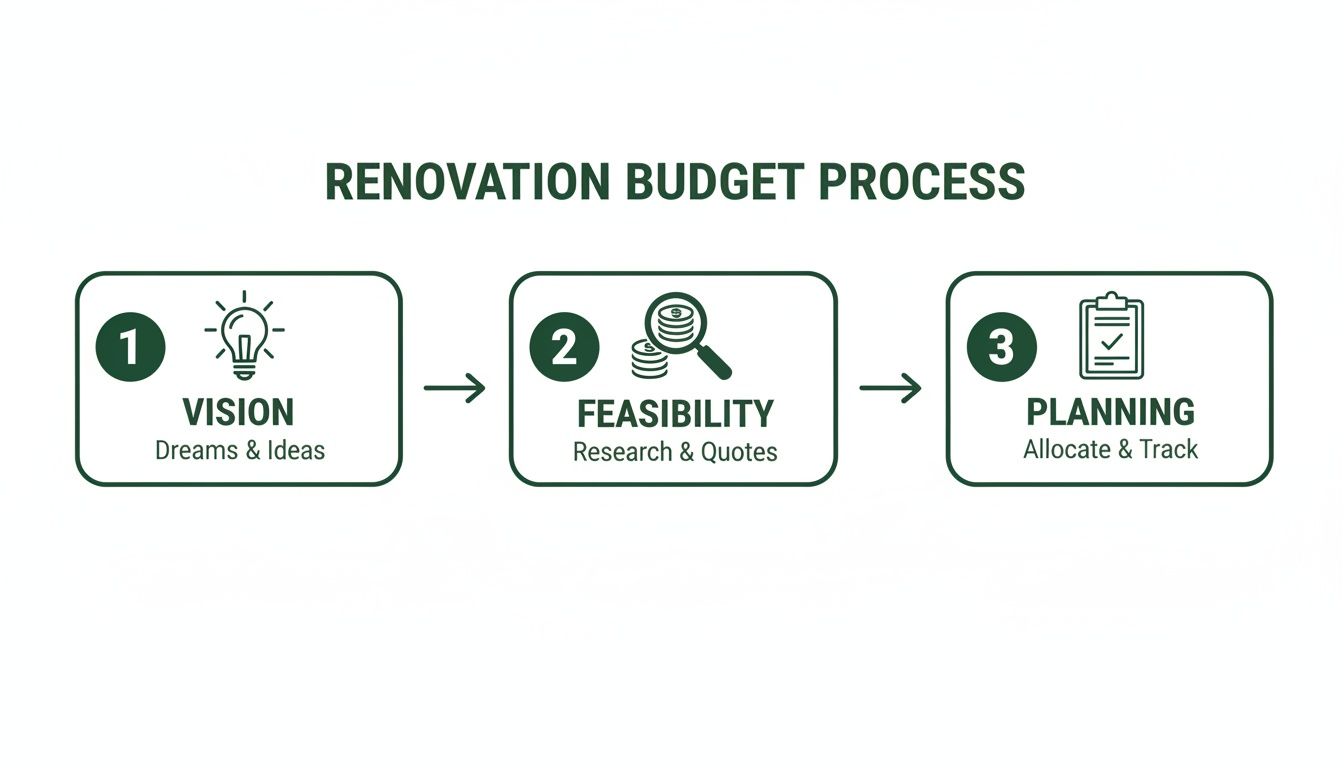
As the graphic shows, a vision has to be tested for feasibility before it can become a real plan. By getting a handle on these high-level cost drivers early, you can build a financial strategy that’s both ambitious and grounded in reality. That’s how you set your project up for success.
Getting a Handle on Hard Costs vs. Soft Costs
When you start mapping out a commercial renovation budget, the first and most crucial step is to split your costs into two buckets: hard costs and soft costs. It’s a simple concept, but one that trips up a lot of people.
Think of it this way: hard costs are for all the tangible, physical stuff. The steel, concrete, drywall, and windows—everything you can physically point to in the finished space. Soft costs are the less visible, but absolutely essential, services and fees that bring the project to life. This includes things like architectural drawings, city permits, and engineering fees.
It’s incredibly common to get laser-focused on the construction itself and completely underestimate the mountain of administrative and professional services required. To get a true financial picture and avoid nasty surprises down the road, you have to understand the difference between hard costs vs soft costs. Separating them is the foundation of a reliable cost model.
Pinpointing Your Project Hard Costs
Hard costs are the direct expenses of the physical build-out. They are usually the most straightforward to itemize because they cover the actual labor and materials that go into the renovation.
Let's say you're converting an old warehouse into a sleek, modern office. Your hard cost line items would be things like:
- Demolition and Site Prep: The cost to tear out old interiors, deal with any hazardous materials (like asbestos), and get the "canvas" ready.
- Structural Work: This covers any new steel beams, concrete repairs for the floor, or the lumber needed for framing out new walls.
- Building Envelope: All things related to the exterior—new energy-efficient windows, façade restoration, insulation, and roof repairs or replacement.
- MEP Systems: This is a big one. It stands for Mechanical (your HVAC system), Electrical (all the wiring, lighting, and panels), and Plumbing (pipes, drains, and fixtures).
- Interior Finishes: This is the fun stuff that makes the space look complete: drywall, paint, flooring, custom cabinetry, doors, and hardware.
These are the costs typically managed by your general contractor. They represent the lion's share of your budget, usually making up 70-80% of the total project expense.
The Sneaky Soft Costs You Can’t Ignore
Soft costs, or indirect costs, are all the fees for services that are critical to the project but aren't part of the actual construction. Don't make the mistake of overlooking them—they can easily account for 20-30% of your total budget and sink an otherwise well-planned project.
Imagine you're turning a historic building into a high-end restaurant. The soft costs here would be significant.
A project's success is often determined by how well the soft costs are managed. These are the expenses that require foresight, planning, and professional coordination long before the first hammer swings.
So, what falls into this category?
- Professional Fees: This is a wide net that catches fees for architects, engineers (structural, MEP, civil), interior designers, and any special consultants you might need, like for acoustics or lighting.
- Permits and Inspections: The money you pay to the city for building permits, zoning reviews, and all the required inspections throughout the construction process.
- Legal and Accounting: You'll need lawyers to review contracts and accountants to manage the financial side of the project.
- Insurance: Builder's risk, general liability, and other policies are non-negotiable to protect the property, the workers, and you from the unexpected.
- Financing Costs: If you're taking out a loan, this includes loan application fees, appraisal costs, and the interest that accrues during construction.
- Pre- and Post-Construction Services: Think of costs for initial feasibility studies, land surveys, and even the final professional cleaning and system commissioning before you open the doors.
For that restaurant project, you’d also have soft costs for kitchen design consultants, health department approvals, and maybe even a liquor license application. These business-specific expenses are easy to miss but are absolutely vital. The only way to get a realistic view of your total investment is to build a line item for every single one of them.
Getting Real with Per-Square-Foot Costs
Everyone loves a good per-square-foot (PSF) number—it's fast, simple, and seems to answer the big question. But I've seen too many projects get into trouble by treating this number as gospel. It’s not a price tag; it's a starting point for a much deeper conversation.
Think of PSF costs as a rough map of the territory. They're incredibly helpful for those early, back-of-the-napkin feasibility checks. But their real value only comes when you start layering in the unique details of your project. A quick office refresh in the suburbs is a different world from a gut job on a historic downtown building, and the PSF cost will reflect that. The trick is knowing why and how to adjust.
Finding Your Baseline with Cost Ranges
Before we get into the nitty-gritty adjustments, let's get a feel for the general landscape. The costs can swing wildly depending on how deep you're planning to go. Here are some realistic buckets to start with:
Basic Cosmetic Updates ($50 – $95 per square foot): This is the facelift. We're talking fresh paint, new carpet tiles, updated light fixtures, and other minor touch-ups. You're breathing new life into the space without touching its bones or major systems.
Moderate Renovations ($95 – $175 per square foot): Now you're making more substantial changes. This could mean moving some non-load-bearing walls around, doing a serious overhaul of the restrooms, making targeted upgrades to the HVAC, and bringing in higher-quality finishes.
Full-Gut Renovations ($175 – $300+ per square foot): This is where you strip the interior down to the studs. You’re replacing all the major MEP (mechanical, electrical, plumbing) systems, possibly making structural changes, and installing high-end, custom finishes from the ground up. If you're building out a restaurant or a medical clinic, your project will almost certainly start in this range because of all the specialized systems involved.
These ranges are just your jumping-off point. The real work is figuring out where your project falls and what factors might push it to the high or low end—or even blow past these numbers entirely.
What Makes Per-Square-Foot Costs Swing?
An average is just an average. The art of building a good commercial renovation cost estimator lies in understanding the project's unique DNA. From my experience, four major drivers will have the biggest impact on your final number.
Building Class and Condition
Are you starting with a clean slate in a modern, Class A building? Or are you dealing with a Class C property that's seen better days? The latter might be hiding some nasty surprises—think hazardous material abatement, ancient wiring that’s a code nightmare, or structural gremlins that need fixing before you can even think about finishes. The age and health of the existing building are absolutely critical.
Location and Labor Rates
Construction is a local game. The cost of labor and materials in a major metro area like New York or San Francisco is in a completely different league than in a small Midwestern town. It’s not just about the city, either; labor availability and demand can create cost differences from one county to the next.
Level of Finishes
This one is straightforward but has a massive impact. The difference between standard commercial-grade carpet and polished concrete or imported tile is huge. Prefabricated cabinetry versus custom-built millwork is another classic example. The look and feel you're aiming for will show up directly on the bottom line.
Remember, a per-square-foot estimate is a tool, not a guarantee. Its value comes from understanding the specific project details that can make that number go up or down, ensuring your initial budget is grounded in reality.
Intended Use
What is this space going to be? A typical office has far simpler needs than a restaurant, which requires a full commercial kitchen, specialized fire suppression and ventilation, grease traps, and complex plumbing. A medical clinic is another beast altogether, with needs for specific layouts, sterile surfaces, and even lead-lined walls for X-ray rooms. These special uses dramatically ramp up the complexity and the cost.
Looking Beyond the Basic Numbers: Project-Specific Cost Drivers
Here's a hard-earned lesson: a standard cost template will only get you so far. The real accuracy in any commercial renovation estimate comes from digging into the unique quirks and conditions of your specific project. These are the adjustment factors that can quickly inflate a budget, and every savvy developer knows to look for them.
Relying solely on baseline per-square-foot numbers is a rookie mistake, and a costly one at that. Learning to spot these potential cost drivers early on is what separates a smooth, well-managed project from one that careens off the financial rails.
The Financial Realities of Adaptive Reuse
Transforming an old warehouse into apartments or a historic bank into a trendy restaurant—what we call adaptive reuse—is an exciting way to breathe new life into a property. But be warned: these projects are notorious for hiding expensive secrets. You aren't just building; you're performing major surgery on an old structure, and you never know what you'll find once you open it up.
Here’s what we often uncover:
- Surprise Structural Issues: That beam might look solid, but once you start demolition, you could find decades of hidden decay, compromised steel, or a failing foundation.
- Hazardous Material Abatement: Older buildings are a minefield for asbestos, lead paint, and other toxins. Removal is heavily regulated and expensive, and it's a non-negotiable cost.
- Completely Outdated Infrastructure: The original plumbing and electrical systems are almost never up to modern standards. A full MEP (mechanical, electrical, plumbing) overhaul is usually a given, and it’s a massive capital expense.
In an adaptive reuse project, your contingency fund isn't just a "nice-to-have" safety net. It's a fundamental part of your budget. You should go into it expecting to find at least one major problem and have the cash ready to deal with it.
Navigating the Nuances of Historic Preservation
Working on a designated historic property is a completely different ballgame. It comes with its own set of financial and logistical hurdles. The goal isn't just to update the space—it's to do so while preserving its soul, which means playing by a strict set of rules from preservation boards.
Costs can escalate quickly here because of:
- Period-Correct Materials: You can't just grab materials off the shelf. You'll be sourcing or custom-fabricating everything from specific brick styles to wood windows and plaster moldings. This is both slow and expensive.
- Specialized Labor: Your average contractor isn't qualified for this work. You'll need to find and pay for skilled artisans who specialize in things like historic masonry repair or window restoration. Their expertise comes at a premium.
- Lengthy Approval Processes: Getting sign-off from historic review boards can add months to your timeline. That delay translates directly into higher soft costs like insurance, financing, and project management fees.
Mandatory Building Code Upgrades
A major renovation almost always triggers a requirement to bring the building—or at least the renovated areas—up to current building codes. These aren't suggestions; they are legal mandates that can blow a hole in your budget if you haven't planned for them.
This is a huge factor in the U.S., where the commercial remodeling industry is a behemoth, projected to hit $39.9 billion in revenue in 2025. A big piece of that spending is driven by mandatory upgrades. For instance, MEP systems are seeing annual inflation of 5.1% as codes push for greater efficiency and safety. You can dive deeper into the commercial remodeling industry's economic impact to see how these forces shape the market.
Common code-driven expenses include:
- ADA Compliance: This might mean adding ramps, widening every doorway, overhauling restrooms for accessibility, or even installing a new elevator.
- Fire Safety Systems: You could be on the hook for installing a full fire sprinkler system, upgrading alarms, or redesigning egress routes—all complex and invasive jobs.
- Energy Efficiency Standards: Many cities now require renovations to meet tough new energy codes, forcing you to upgrade insulation, install high-performance windows, or replace the entire HVAC system.
Many renovation complexities can seem minor at first but have a cascading effect on your budget.
Common Cost Escalation Scenarios
| Scenario | Potential Cost Impact | Mitigation Strategy |
|---|---|---|
| Unforeseen Asbestos | 10-15% budget increase | Conduct a thorough hazardous materials survey before finalizing the budget. Build a specific abatement line item and a healthy contingency. |
| Historic Window Replacement | 2x-4x cost of standard windows | Engage a historic preservation consultant early. Explore repair/restoration options before committing to full, custom-fabricated replacements. |
| Triggered Sprinkler Requirement | $5 – $10 per square foot | Involve a fire protection engineer during the initial scope definition to determine if your renovation will trigger a full system requirement. |
| Required ADA Bathroom Overhaul | $25,000 – $50,000+ per restroom | Review ADA requirements with your architect at the schematic design phase. Don't assume existing restrooms can be easily modified. |
Understanding these scenarios helps you anticipate, rather than react to, major budget shocks.
If you ignore these variables, your initial estimate is fundamentally flawed. A truly reliable cost estimator doesn't just look at the new paint and flooring; it digs deep into the building’s bones, its history, and the local regulations to paint a financial picture you can actually trust.
Building a Resilient Budget with Contingency
Let's be realistic: no commercial renovation ever goes exactly as planned. I've seen it time and time again. A budget that looks perfect on paper can fall apart the moment you open up a wall and find something unexpected. That’s why a professional budget isn't just a plan; it’s a financial tool built to withstand the realities of construction.
To make your budget truly resilient, you need to build in a financial cushion. This comes in two forms: contingency and escalation. It's crucial to understand the difference. Contingency is your defense against project-specific surprises, while escalation protects you from market-wide price hikes that are completely out of your control.
The Role of a Contingency Fund
Think of contingency as your project’s internal shock absorber. It’s a dedicated pot of money, a set percentage of your total costs, specifically for dealing with unforeseen issues that pop up during the build. This isn't a slush fund for adding nice-to-have features on the fly. It's strictly for tackling problems.
What kind of problems?
- Discovering termite damage or dry rot hiding behind drywall.
- Finding out the existing electrical system is a tangled, non-compliant mess.
- Hitting bedrock or an old, undocumented foundation during minor excavation work.
The industry rule of thumb is to set aside 5% to 15% of your total project cost for contingency. But that's just a starting point. A simple cosmetic refresh in a modern building might only need a 5% buffer. But if you’re renovating a century-old historic property? You’d be wise to push that closer to 20%. The older the building, the more secrets it holds.
Preparing for Escalation Costs
While contingency covers the 'known unknowns' within your project, escalation handles the 'unknown unknowns' of the wider market. It’s a separate fund to cover price increases for materials and labor that happen between when you budget and when you actually buy. In a volatile economy, this can make or break a project.
We've seen this play out dramatically in recent years. Office fit-out costs have surged, with 75% of markets reporting raw material price jumps and half struggling with labor shortages. A high-end buildout for a law firm, for example, can run 16% more than a standard office simply due to the cost of premium finishes. You can dig into these global office fit-out cost trends to see just how much pressure budgets are under.
This is precisely why a separate escalation fund, often 2% to 5% for a year-long project, has become standard practice.
A budget without a properly calculated contingency is not a budget—it's a wish list. It ignores the fundamental reality of construction and leaves your project dangerously exposed to financial risk.
Building these financial buffers into your estimate from the very beginning is what separates an amateur guess from a professional financial plan. It turns a fragile spreadsheet into a robust tool that can absorb real-world shocks without derailing your entire vision.
Knowing When to Bring in a Professional

That cost estimator spreadsheet you’ve been working on is a fantastic tool for getting your initial thoughts organized. But let’s be honest—it has its limits. There’s a definite point where a DIY calculation stops being a helpful guide and starts becoming a potential liability.
Knowing when you’ve hit that wall is key. It’s the moment your project goes from a back-of-the-napkin idea to a real-world venture that needs funding, permits, and a team to build it.
Key Triggers for Bringing in the Pros
Certain project milestones demand a level of detail and defensibility that only an architect or professional estimator can deliver. If you wait too long to make the call, you risk painful redesigns, budget overruns, and serious financing delays.
It’s time to bring in an expert when you find yourself in one of these situations:
- You're Seeking Financing: Lenders aren’t going to fund a project based on your personal spreadsheet. They need to see a detailed, professional cost breakdown that proves the project is financially sound.
- You're Ready for Contractor Bids: To get realistic, apples-to-apples bids from general contractors, you need to provide them with a comprehensive and professionally vetted scope of work. Otherwise, you’re just guessing.
- You're Facing Complex Regulations: Is your project in a historic district? Does it involve significant zoning changes or major code upgrades? An expert is essential to navigate the red tape and accurately price the compliance work.
Bringing a firm like Sherer Architects on board early turns cost estimation from a guessing game into a strategic financial roadmap. It sets your project up for a successful, profitable outcome right from the start.
It’s About More Than Just the Numbers
Hiring a professional isn't just about getting a more accurate estimate; it's about adding strategic value that protects your investment. Their expertise goes way beyond simple arithmetic.
While estimators use sophisticated tools like manufacturing quoting software for precision, their real contribution comes from experience and strategic insight.
An experienced architect brings a lot more to the table:
- Value Engineering: They are masters at finding smart ways to reduce costs without compromising the final product. This could mean substituting a specific material or tweaking a design element you hadn’t considered.
- Cost-Saving Alternatives: With their deep industry knowledge, they can suggest innovative construction methods or materials that might deliver the same result for less money.
- Navigating the Code: A good architect anticipates code-related costs that most people would miss entirely, saving you from expensive change orders down the line when the building inspector shows up.
Engaging an expert early ensures your budget isn't just a number—it's a realistic, defensible plan built on a foundation of real-world experience.
Frequently Asked Questions
Navigating the financial side of a renovation can be tricky, especially when you're just getting started. Let's tackle some of the most common questions we hear from property owners and developers about estimating commercial renovation costs.
What Is the Biggest Mistake People Make When Estimating Renovation Costs?
By far, the most common and costly mistake is underestimating soft costs. It’s completely natural to focus on the tangible construction expenses—the steel, the concrete, the drywall—but the indirect costs often get missed.
Things like architectural fees, city permits, engineering reviews, legal consultations, and insurance can easily add up to 20-30% of the total project cost. When you overlook these in your initial budget, you create a huge financial gap that can put the whole project at risk before a single hammer swings.
How Much Should I Budget for Contingency?
A good rule of thumb is to start with a 10% contingency fund, calculated from your total hard and soft costs. But this isn't a hard-and-fast rule; it really needs to be tailored to your project’s specific risks.
For instance, your contingency might look very different depending on the job:
- A simple cosmetic update in a modern, well-documented building? A 5% contingency might be perfectly fine.
- A complex historic renovation on an old structure full of unknowns? You'll want to be much more conservative, perhaps setting aside 15% to 20%.
Think of contingency as your project's insurance policy against the unexpected. The higher the risk of surprises—like uncovering hidden structural damage or hazardous materials—the more robust that policy needs to be.
Can I Use an Online Calculator for an Accurate Estimate?
Online calculators are a fantastic starting point. They're great for getting a quick, back-of-the-napkin number to see if an idea is even financially feasible.
But they can't replace a professional estimate. These tools simply can't factor in the critical details that make or break a budget, like your specific site conditions, the current local labor market, or the unique complexities of an adaptive reuse project.
When you need a budget you can confidently take to a lender or use for contractor bids, you absolutely need a detailed, line-item estimate prepared by an experienced architect or professional estimator.
Ready to move beyond ballpark figures and build a real financial plan for your renovation? The team at Sherer Architects, LLC has decades of experience turning complex commercial renovation, adaptive reuse, and historic preservation projects into profitable realities. Contact us today to discuss your vision.