
A financial feasibility study is where the rubber meets the road. It's a deep dive that determines whether a potential project is actually a sound investment. Before you sink serious capital into a commercial build, adaptive reuse, or historic preservation project, this analysis answers the most important question: Will this actually make money?
Think of it as a data-driven blueprint for your investment, showing you the potential returns, shining a light on hidden risks, and giving you the solid ground you need to make confident decisions.
Why Financial Feasibility Is Your Project's Most Critical Step
Jumping into a major development without a proper financial feasibility study is like setting sail without a map or a compass. It's a huge gamble, and it leaves investors and developers wide open to financial disaster. This goes way beyond a simple back-of-the-napkin calculation; it takes your big ideas and turns them into a concrete financial story.
A good study forces you to challenge every single assumption. From market rental rates to the price of steel, it makes sure your projections are firmly planted in reality, not wishful thinking.
This analysis isn't just a box-checking exercise to get a bank loan—it’s a core piece of your strategy. For complex projects like adaptive reuse or historic preservation, the number of financial moving parts can be staggering. A proper study corrals all those variables into a clear, understandable model.
A well-executed feasibility study is the ultimate risk mitigation tool. It stress-tests a project's financial structure against market fluctuations, cost overruns, and unforeseen challenges, providing a clear path to profitability or an early warning to pivot.
Grounding Financial Models in Reality
One of the most common mistakes we see in financial forecasting is relying on generic data or pie-in-the-sky assumptions. This is exactly where an architect’s expertise becomes so valuable. An experienced architect, like our team at Sherer Architects, provides the critical, real-world inputs that make a financial model truly solid.
When an architect is involved from the start, the study can properly account for things like:
- Zoning and Code Compliance: An architect can spot potential compliance headaches or design requirements early on that could blow up your construction costs and timeline.
- Design Efficiency: They know how a building's layout and systems will impact everything from long-term utility bills to its overall revenue potential.
- Historic Tax Credits: For preservation projects, an architect’s guidance is absolutely essential for navigating the maze of securing tax credits, which can completely change a project’s bottom line.
This kind of expert insight is more in demand than ever. The architectural services market is expected to grow from USD 215.13 billion in 2025 to USD 273.97 billion by 2029, largely fueled by interest in sustainable design and adaptive reuse. It makes sense when you consider that adaptive reuse can be 20-40% cheaper than new construction and often qualifies for lucrative historic tax credits. You can get a deeper understanding of this shift by reading a recent architecture industry outlook.
By baking this practical, on-the-ground knowledge into your financial study from day one, you transform it from a simple forecast into a powerful and accurate roadmap for success.
Laying the Groundwork: Defining Your Project and Forecasting Revenue
Every successful financial study feasibility analysis starts long before the first spreadsheet is opened. It begins with a vision—a clear, detailed picture of the final product. Before you can even think about projecting income, you need to nail down a precise project scope. This isn't just paperwork; it's the critical step that prevents costly scope creep and ensures every subsequent calculation is grounded in reality.
Think of the scope as the project’s constitution. It must clearly articulate what you’re building or renovating, from the total square footage and intended use down to the specific amenities and quality of finishes. For an adaptive reuse project, this means defining exactly how a historic warehouse will be reimagined as residential lofts, including the number of units, common areas, and parking solutions.
This needs to be specific. "Renovate an old building" is an idea, not a scope. A well-defined scope sounds more like: "Convert the 50,000-square-foot 'Standard Mill' building into 45 mixed-income rental apartments, preserving key historical architectural elements to qualify for historic tax credits." That’s a blueprint you can build on.
From Big Idea to Tangible Scope
This is where bringing in an architect early on is a game-changer. An experienced firm like Sherer Architects doesn't just draw plans; they help you test the limits of your site's potential. They'll dig into zoning ordinances, flag potential building code hurdles, and assess the structural integrity of an existing building—all factors that directly dictate what’s actually possible.
This early architectural gut-check grounds your vision in reality. It might reveal that the site can handle more density than you assumed, unlocking unexpected revenue. Or, it could uncover a critical structural flaw in that old warehouse, forcing a budget shift but saving you from a catastrophic financial surprise later.
Your project's scope is the bedrock of your financial projections. A poorly defined scope leads to inaccurate forecasts and a feasibility study built on shaky ground. Clarity at this stage is non-negotiable for a reliable outcome.
A well-defined scope provides the essential inputs for robust strategic budgeting and forecasting, making your cost and revenue models much more precise.
Forecasting Revenue You Can Count On
With a solid scope in hand, it’s time to project potential income. This is where you move past wishful thinking and into hard, data-driven market analysis. The goal here is to build a credible revenue forecast for a typical 5 to 10-year horizon.
The type of project dictates your revenue model. The most common streams include:
- Rental Income: For multifamily, office, or retail spaces, you'll need to forecast monthly rents per square foot, factoring in realistic vacancy rates and annual rent increases.
- Sales Profits: If you're building condos or commercial-for-sale properties, the key is projecting the final sales price per unit based on what the market is actually paying for similar properties.
- Other Income: Don't forget the smaller streams—revenue from parking fees, laundry facilities, tenant storage, or other ancillary services can add up.
Digging Deep with Market Analysis
To forecast these streams with any accuracy, you have to do your homework. This isn’t a quick Zillow search; it’s a detailed investigation into the local market dynamics.
Let’s go back to our warehouse-to-lofts project. A proper analysis would involve a few key steps:
- Find Your "Comps": Identify comparable loft-style apartment buildings in the same or nearby neighborhoods. What are their current rental rates, unit sizes, and occupancy levels? What amenities do they offer? This is your baseline.
- Check Absorption Rates: How quickly are new rental units getting leased in the area? A high absorption rate—for instance, a new 100-unit building hitting 95% occupancy in just six months—is a powerful signal of strong demand.
- Read the Tea Leaves (Market Trends): Look at the bigger picture. Is the population growing? Is a major employer setting up shop nearby? Are there city infrastructure projects planned? These macro trends can justify projecting stronger rent growth over your 5-10 year forecast.
This detailed market data becomes the revenue side of your financial study feasibility. By pairing a well-defined, architect-vetted scope with a realistic, data-backed revenue forecast, you build the solid foundation needed for the rest of your analysis.
Getting a Handle on Total Project Costs
Once you have a solid idea of potential revenue, it's time to flip the coin and get brutally honest about the costs. This is where the rubber meets the road. A project's viability lives or dies by your ability to forecast and manage every single expense. Underestimate here, and a promising development can quickly become a money pit.
We generally break down total project costs into two buckets: soft costs and hard costs. Knowing the difference is fundamental to building a budget that can actually withstand the pressures of a real-world project.
Decoding Soft Costs
Soft costs are all the necessary expenses that don’t involve swinging a hammer or pouring concrete. Think of them as the "brains" of the operation—the professional services and administrative hurdles you have to clear before and during construction. It's easy to downplay these figures, but they pack a punch and often account for a huge chunk of your total budget.
You'll need to account for a whole range of these intangible but critical items:
- Design and Engineering Fees: This is what you pay your architect and engineers for the plans, structural calculations, and MEP (mechanical, electrical, plumbing) systems design.
- Permits and Inspections: The price of admission to build, set by the local municipality. These fees can vary dramatically depending on your city and the project's complexity.
- Professional Services: Don't forget the lawyers needed for zoning battles or the accountants structuring the deal.
- Financing Costs: Loan origination fees, appraisal costs, and the interest you’ll pay on your construction loan before the building generates income.
- Insurance: Builder’s risk, liability, and other policies are non-negotiable to protect the project.
For context, on a $5 million adaptive reuse project, it's not unusual for soft costs to land somewhere between $1 million and $1.5 million (20-30%). You're spending a lot of money before the first wall even comes down, which is why getting architects and legal counsel involved early is so important—they know the local landscape and can help you project these numbers accurately.
Nailing Down Hard Costs
Hard costs are exactly what they sound like: the tangible, physical expenses of construction. This is the "brick-and-mortar" part of the budget that covers everything from the dirt work to the final coat of paint. While they're easier to visualize, their prices can swing wildly with market demand for materials and labor.
This category is all about the physical build-out:
- Materials: Concrete, steel, lumber, drywall, roofing, windows, and all the finishes.
- Labor: The wages for every trade on site, from the excavation crew to the electricians and painters.
- Site Work: Getting the site ready—grading, running utility lines, paving parking lots, and landscaping.
- Major Systems: The big-ticket items like HVAC, plumbing, and electrical infrastructure.
Getting preliminary bids from a few general contractors is an essential reality check. An experienced architect, like our team at Sherer Architects, adds immense value here by preparing a detailed set of documents for bidding. This ensures every contractor is pricing the exact same scope of work, so you can make a true apples-to-apples comparison instead of guessing what’s behind their numbers.
The allocation of these costs can look quite different depending on the project type.
Typical Project Cost Allocation for Commercial vs Adaptive Reuse
This table gives a high-level look at how budgets are typically broken down for a new build versus an adaptive reuse project. Notice how things like demolition and structural upgrades demand a much larger piece of the pie in reuse projects.
| Cost Category | New Commercial Build (% of Total) | Adaptive Reuse Project (% of Total) |
|---|---|---|
| Site Acquisition & Prep | 10-15% | 5-10% |
| Demolition & Abatement | 1-2% | 5-15% |
| Foundation & Structure | 20-25% | 15-25% (Repairs/Upgrades) |
| Exterior & Roofing | 10-15% | 10-20% (Restoration) |
| Interior & Finishes | 15-20% | 15-25% |
| MEP Systems | 15-20% | 15-25% (Complex Integration) |
| Soft Costs (Fees, Permits) | 10-15% | 15-20% |
| Contingency | 5-10% | 10-20% |
As you can see, the financial DNA of an adaptive reuse project is fundamentally different. You're shifting funds from site prep and new structure costs toward abatement, restoration, and a much larger contingency to handle the inevitable surprises.
The Unique Challenges of Adaptive Reuse
Speaking of surprises, adaptive reuse and historic preservation projects are in a class of their own. They come with a whole layer of cost variables you simply don't encounter when building from scratch. Your financial study has to reflect this uncertainty.
In an adaptive reuse project, what you can't see is often what costs the most. Unforeseen structural issues, hazardous material abatement, and the need for specialized artisans can significantly impact the budget if not properly anticipated.
You absolutely have to dig into these potential cost centers:
- Hazardous Material Abatement: Old buildings can be a minefield of asbestos, lead paint, and other unpleasant materials that require certified (and expensive) professionals to remove.
- Structural Upgrades: Bringing a century-old structure up to modern building and seismic codes can mean serious, costly reinforcements.
- Historic Fabric Repair: Restoring original masonry, ornate woodwork, or historic windows requires true craftspeople, and their skills come at a premium compared to off-the-shelf modern materials.
- Systems Integration: The puzzle of threading modern HVAC, IT, and electrical systems through a historic building without destroying its character is both an art and a significant expense.
Because of all these unknowns, your contingency fund is your best friend. For a new build, a 5-10% contingency might be fine. For an adaptive reuse project, anything less than 15-20% of total construction costs is asking for trouble. Think of it as the project’s financial shock absorber—it’s there to ensure a few nasty surprises don’t sink the entire ship.
Building a Pro Forma to Analyze Financial Scenarios
Once you have your revenue forecasts and cost estimates nailed down, you're ready to build the most critical tool in your feasibility toolkit: the pro forma statement. Don't think of this as just a spreadsheet. A well-built pro forma is a dynamic financial model where you can truly bring your project's story to life. It's the place where all your data comes together to project cash flow over the next five to ten years.
This isn't just about plugging in numbers and hoping for the best. It’s about building a logical financial narrative that shows how money flows from top-line income all the way down to your final cash position. The real power here is in seeing how the project holds up under different conditions, stress-testing your assumptions, and finding out if the numbers actually work before you put serious capital on the line.
From Gross Income to Net Operating Income
The bedrock of any real estate pro forma is the cash flow projection. You always start with the Gross Potential Income (GPI)—the absolute maximum revenue you could pull in if the property were 100% occupied all year long. From that high point, you start methodically subtracting costs to get to the numbers that really matter.
The typical flow looks something like this:
- First, you calculate your Gross Potential Income (GPI), which is the total possible rental and ancillary income.
- Next, you subtract a Vacancy Loss allowance. Be realistic here; something like 5-7% is a common starting point. This gives you your Effective Gross Income (EGI).
- From EGI, you deduct all Operating Expenses—property taxes, insurance, management fees, utilities, repairs, you name it.
- What’s left is your Net Operating Income (NOI). This is a crucial metric because it shows you exactly how profitable the property is before you even think about loan payments or income taxes.
This structured approach is the industry standard for a reason. It gives investors, lenders, and you a crystal-clear picture of the property's pure earning power.
Modeling Financing and Tax Credit Scenarios
With a solid NOI projection, your pro forma transforms from a simple calculator into a strategic playground. This is where you get to play "what if."
You can model different financing structures to see how they ripple through your returns. For instance, what happens with a 70% loan-to-value (LTV) loan at a 6.5% interest rate versus a more aggressive 80% LTV loan at 7.0%? The pro forma shows you precisely how changes in leverage and interest rates hit your bottom-line cash flow after paying the bank.
For adaptive reuse projects, this is where you can see the massive impact of incentives like historic tax credits. These aren't just a nice little bonus; they can single-handedly make or break a deal.
By modeling scenarios with and without historic tax credits, you can put an exact dollar value on their impact. Seeing a project's Internal Rate of Return (IRR) jump from a borderline 12% to a much more compelling 18% gives you the hard data needed to justify the headaches of the historic preservation process.
Understanding how all the costs feed into this model is essential.
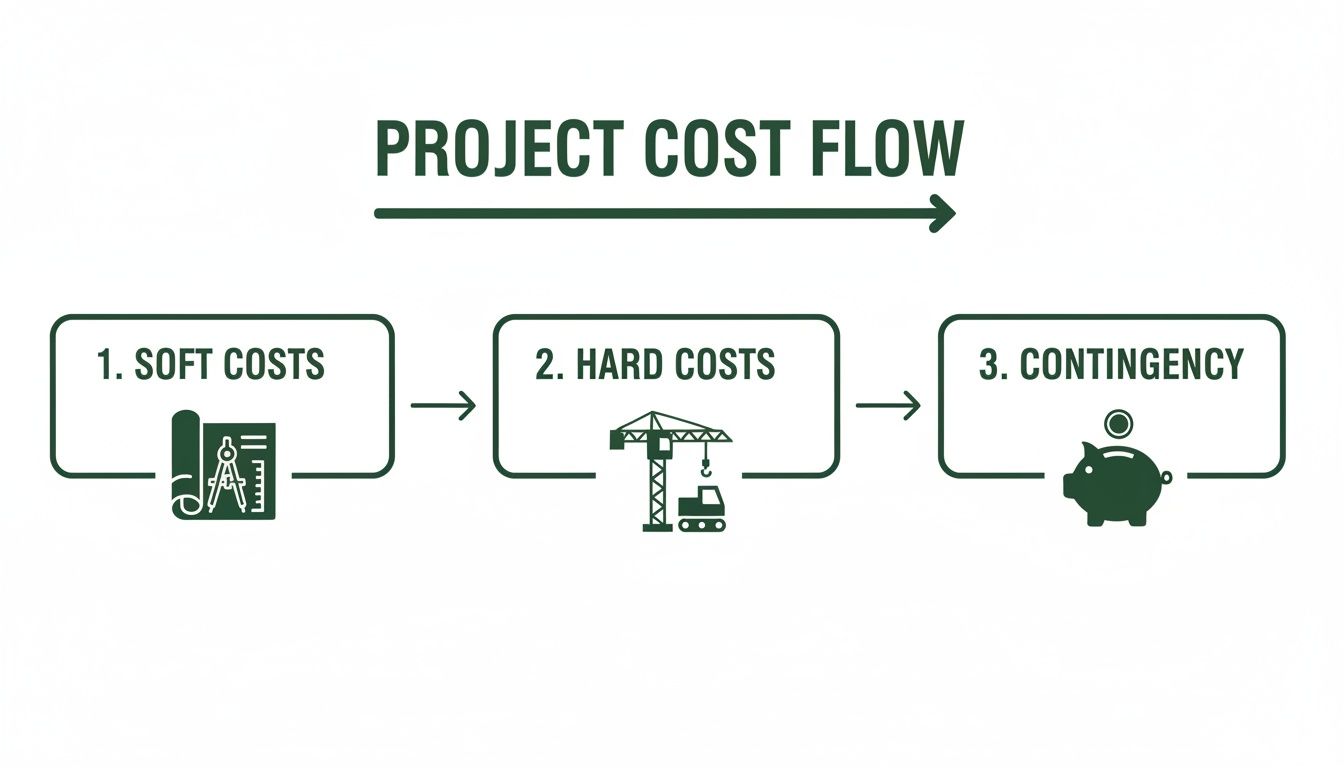
This flow from soft costs to hard costs and finally to contingency planning shows how every dollar needs to be accounted for in your financial model to ensure accuracy.
Key Metrics and Actionable Insights
At the end of the day, a pro forma is only as good as the decisions it helps you make. A huge part of the financial study feasibility process is seeing how smart project decisions translate into better numbers.
For example, our experience shows that adaptive reuse can make a project 20-50% more cost-effective than new construction. When you layer on tax credits that can offset 20-45% of rehabilitation costs, the financial picture improves dramatically. Your pro forma is where you see these efficiencies reflected in your key return metrics.
The pro forma gives you a dashboard to visualize performance and make smarter choices. If you really want to get under the hood, building your own rental property calculator in Excel is a fantastic way to understand the mechanics. It turns abstract numbers into a tangible tool that helps you steer your project toward financial success.
Making the Final Go or No-Go Decision

After all the number-crunching and modeling, you've reached the moment of truth. The final phase of a financial study feasibility analysis boils down to translating a mountain of data into a single, definitive answer: should you move forward or walk away?
This isn’t about gut feelings. It’s about using specific, industry-standard metrics to evaluate the project's potential from every critical angle. These metrics—Net Present Value (NPV), Internal Rate of Return (IRR), and the Payback Period—each tell a unique part of the financial story, giving you a clear, data-backed foundation for your choice.
Key Metrics That Drive the Decision
Think of these three core metrics as different lenses for viewing the same financial landscape. Each one gives you a distinct perspective on the project's viability.
-
Net Present Value (NPV): This is the king of investment metrics. NPV tells you the total value of all future cash flows, both incoming and outgoing, all discounted back to what they're worth today. In plain English, it answers the big question: "Will this project create more value than it costs?" A positive NPV is your green light—it means the project is expected to beat your minimum required rate of return. A negative NPV is a clear stop sign.
-
Internal Rate of Return (IRR): While NPV gives you a dollar amount, IRR delivers a percentage. It’s the estimated annual rate of growth the project is expected to generate. So, if your project’s IRR is 15%, you're anticipating an average annual return of 15% over its lifetime. You then weigh this against your "hurdle rate"—the absolute minimum return you need to justify the risk. If the IRR clears that hurdle, the project looks financially attractive.
-
Payback Period: This is the simplest of the three, but don't underestimate its importance. It calculates exactly how long it will take for the project to generate enough cash to recover your initial investment. A shorter payback period almost always means lower risk. A project that pays for itself in four years is far less risky than one that takes ten, simply because your capital isn't tied up for as long.
Stress-Testing Your Assumptions with Sensitivity Analysis
Let’s be honest: no forecast is perfect. The real world is messy, and a smart feasibility study has to account for that. This is where sensitivity and break-even analyses become your best friends. They are powerful tools for figuring out which of your assumptions carry the most financial weight.
Sensitivity analysis is all about playing "what-if." You tweak one key variable at a time—like construction costs, rental rates, or vacancy—to see how it ripples through your bottom line. What happens to your NPV if construction costs run 10% over budget? What if rental income dips 5% below your projection? Running these scenarios helps you pinpoint the project's financial Achilles' heel.
A sensitivity analysis reveals which variables pose the greatest threat to your profitability. If a minor dip in rental rates sends your IRR plummeting, you know that your revenue projections need to be rock-solid and perhaps even conservative.
This is also where broader market data provides invaluable context. For instance, an indicator like the AIA/Deltek Architecture Billings Index (ABI), which posted a soft 45.6 in early 2025, can signal a downturn. But that could also mean an opportunity for cost savings on labor and materials. A good financial study feasibility can model how capitalizing on such a market might boost returns, especially since adaptive reuse is often 30-50% cheaper than new construction. Understanding salary benchmarks, like an Architectural Director's median base of $160,924, also helps you forecast soft costs with much greater precision. Get more insights on recent architecture firm billings.
The Break-Even Point
Finally, you need to know your break-even point. This analysis pinpoints the exact moment when your project's total revenues equal its total costs.
For a real estate project, this is usually expressed as the occupancy rate required to cover all operating expenses and debt service. Knowing your project breaks even at 75% occupancy gives you a clear, tangible target and a crucial benchmark for measuring performance once you're up and running. It's the baseline for survival.
Answering Your Top Questions About Financial Feasibility Studies
Even with a roadmap in hand, you're bound to have questions when you're deep in the numbers. We get it. Here are some of the most common questions we hear from developers and investors, along with straight answers based on our experience in the field.
How Long Does a Feasibility Study Take?
There's no single answer here—it all comes down to complexity.
For a relatively straightforward commercial infill project, you're probably looking at a 4 to 6-week timeline. That's usually enough time to do the necessary market research and pull together solid initial cost estimates.
But if you're tackling something like an adaptive reuse or historic preservation project, you need to budget more time. These can easily take 8 to 12 weeks, sometimes longer. Why the extra time? You're digging into zoning variances, researching historic tax credit eligibility, and getting detailed assessments on things like structural integrity or environmental issues. The more unknowns you start with, the longer that discovery phase will naturally be.
What's the Typical Cost for a Study?
Just like the timeline, the cost is a direct reflection of the project's scope.
A feasibility study for a smaller commercial project might land somewhere in the $5,000 to $15,000 range. This typically gets you professional market analysis, preliminary cost estimates, and foundational financial modeling.
For larger, more complex projects—especially those with historic elements or major zoning hurdles—the cost can climb to $20,000 to $50,000 or even more. That higher price tag accounts for bringing in specialists like structural engineers, environmental consultants, or historic preservation advisors whose expertise is absolutely critical for an accurate financial picture.
Think of the cost of a feasibility study not as an expense, but as an investment in de-risking your project. Spending $30,000 upfront to uncover a fatal flaw in a $10 million project is one of the smartest investments you can make.
Can I Do a Feasibility Study Myself?
You can certainly run some preliminary numbers on your own, and many savvy developers do. But for a truly bulletproof financial study feasibility assessment, bringing in third-party experts is a game-changer.
The biggest risk with a DIY approach is confirmation bias. It’s human nature to want a project to work, and you might unintentionally cherry-pick data that paints a rosier picture than reality.
An architect and other consultants bring an objective eye. They're trained to spot the red flags you might miss and can ground your cost estimates in reality, not just what an online calculator says. That layer of credibility is exactly what lenders and investors need to see.
What if the Study Shows the Project Isn’t Viable?
First off, that’s not a failure. It’s a success. A feasibility study is designed to give you a clear "go" or "no-go" signal before you sink serious capital into a project. If the numbers don't add up, the study has saved you from a potentially massive financial headache.
A "no-go" doesn't mean the idea is dead in the water, either. It points you directly to the weak spots.
- Projected rent too low? Maybe a design tweak to add premium amenities could justify higher lease rates.
- Construction costs too high? An architect can explore value engineering or alternative construction methods to bring the budget in line.
- Financing crippling cash flow? It might be time to look at different loan products, seek out new equity partners, or explore tax credit scenarios.
Think of the study as a roadmap for what needs to change. It gives you the chance to pivot, refine your strategy, and build a stronger, more profitable plan.
Ready to find out if your next project is built on a solid financial foundation? The team at Sherer Architects has spent decades grounding financial models in real-world design, zoning, and construction realities. We help you find the opportunities and flag the risks from day one. Let's discuss the feasibility of your vision today.