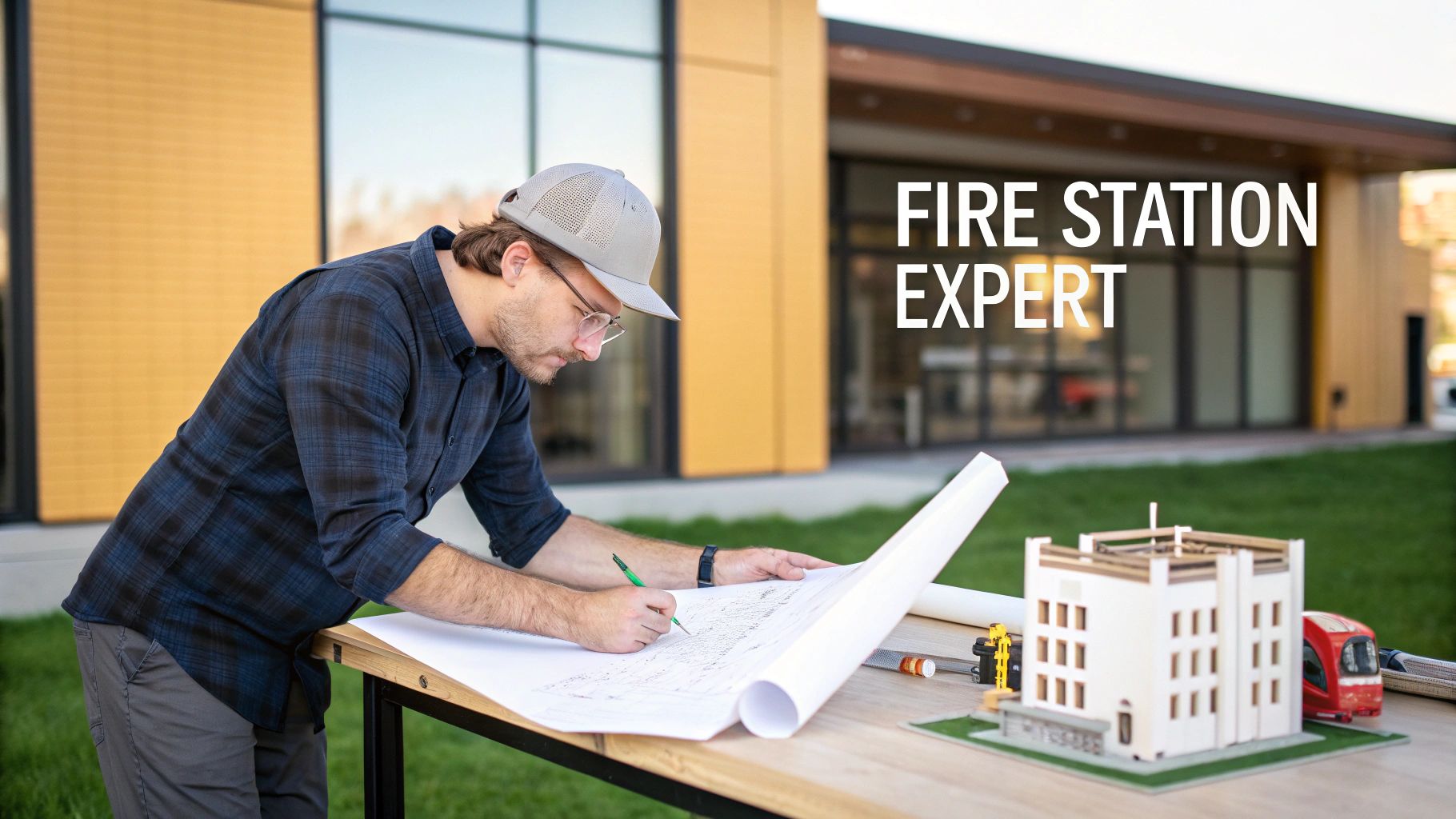
A fire station architect is a specialist, plain and simple. They design facilities that have to meet a complex web of operational, health, and safety needs unique to modern fire departments. You wouldn't hire a family doctor to perform heart surgery, and the same logic applies here. Going with a generalist architect for a project this critical is a huge risk; only a specialist truly gets the intricate dance between rapid response, contamination control, and firefighter well-being.
From Garage to High-Tech Hub
It’s a costly mistake to think of a fire station as just a big garage with a kitchen and some beds attached. Today’s facilities are sophisticated public safety hubs that have come a long way from their origins. Early firehouses were little more than barns for horse-drawn wagons. The real game-changer was the motorized fire engine in the late 19th century, which completely rewrote the rulebook for building design and laid the groundwork for the modern station. This is when we first saw concepts like drive-through apparatus bays and the need for specific turning radiuses. To really grasp where we are now, it helps to understand the history and evolution of fire station design.
That evolution hasn't stopped; in fact, it's accelerating. Modern stations are complex environments where operational readiness and human health are deeply connected. A specialist architect brings a career's worth of knowledge to these specific challenges.
Balancing Durability with Human Factors
A fire station has to be built like a fortress. It needs durable, low-maintenance materials that can handle the constant abuse of 24/7 operations and heavy gear. But it’s also a home. Firefighters are living, eating, and sleeping there for long, stressful shifts. The design of their living quarters is absolutely critical for their mental and physical health.
An experienced architect knows how to design spaces that:
- Reduce Stress: It's about more than just putting a couch in a room. Thoughtful layouts for kitchens, dayrooms, and bunk rooms can build camaraderie while also carving out quiet spaces for rest and recovery.
- Promote Health: Good ventilation to clear the air, ample natural light, and smart acoustic separation between the living quarters and the noisy apparatus bay are non-negotiable for long-term well-being.
- Ensure Readiness: Every inch of the facility has to be geared toward minimizing turnout times. This means thinking through everything from the placement of turnout gear storage to the directness of the path from the dorms to the bay.
A fire station isn't just a building; it's a critical tool for public safety and a sanctuary for the responders who use it. The design must support both functions without compromise.
Navigating Complex Codes and Community Needs
Beyond the station's four walls, a fire station architect acts as a strategic guide through a maze of regulations and community interests. They speak the language of specialized codes, like those from the National Fire Protection Association (NFPA), and they understand the unique pressures of public-funded projects.
This expertise is essential for tackling a few key areas:
- Contamination Control: Implementing “Hot Zone” design principles is now the standard of care. This is all about creating clear separation to protect firefighters and their families from carcinogens and other toxins brought back from a call.
- Community Integration: A modern station can be a true community asset. The design might include public meeting rooms or function as a safe haven during emergencies, all while maintaining strict operational security.
- Future-Proofing: The last thing you want is a brand-new station that’s obsolete in ten years. A good architect plans for future growth, new apparatus types, and evolving technology, ensuring the building serves its community for decades and maximizes every taxpayer dollar.
Laying the Groundwork for a Successful Station
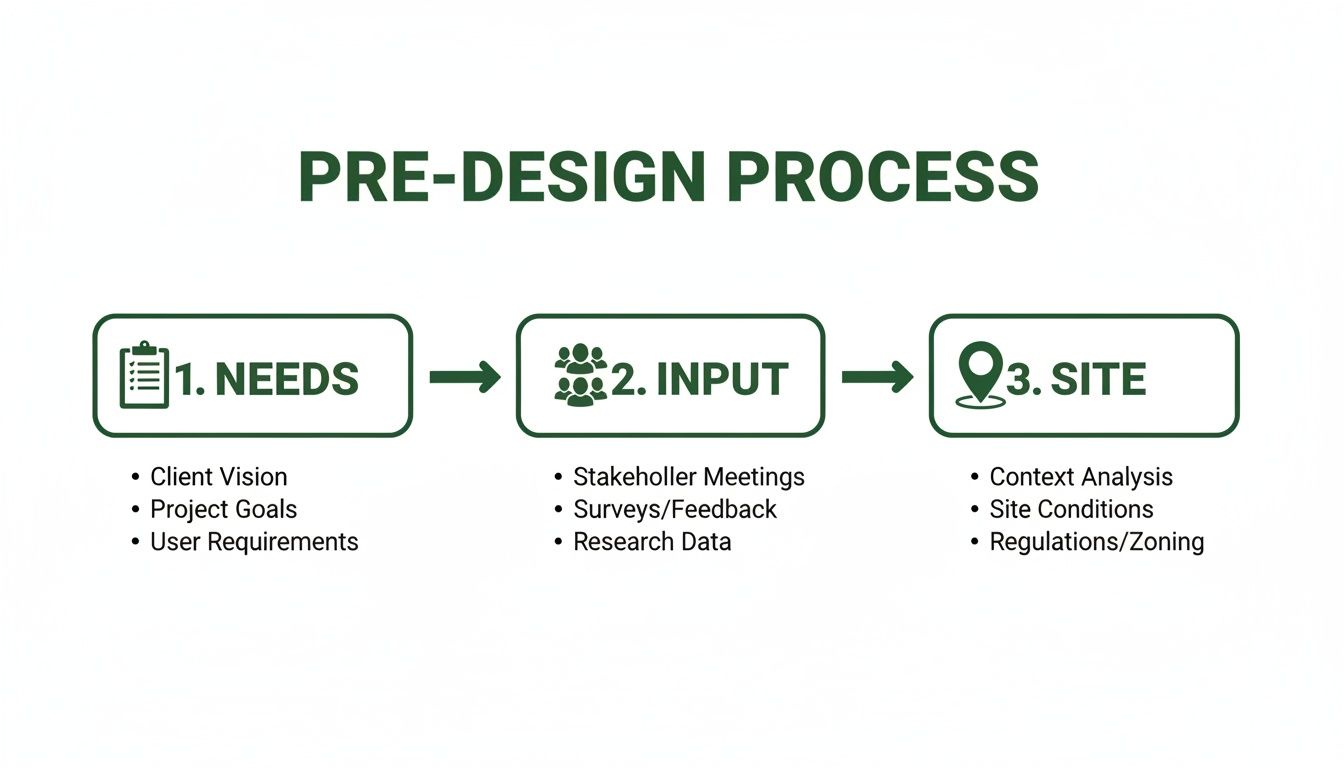
Long before the first shovel breaks ground, the real work of building a successful fire station begins. This isn't about blueprints or floor plans just yet. It's about deep-diving into the data, understanding the mission, and aligning everyone involved. This is the pre-design phase, and it's where an experienced fire station architect earns their keep by preventing expensive mistakes down the line.
The entire process kicks off with a detailed Needs Assessment. Forget simple checklists; this is a comprehensive discovery process that brings everyone to the table. From fire department leadership and first responders on every shift to key community stakeholders, getting all these voices heard is the only way to build a complete picture of what this facility truly needs to be.
Getting to the Heart of Your Operational Needs
Your architect's most important job at this stage is to listen. They're there to facilitate the tough conversations, moving the team from a list of "wants" to a concrete set of operational requirements. It’s a true partnership to define the station's core functions.
We need to get specific on key areas:
- Apparatus Bays: How many bays do you need right now? More importantly, how many will you need in 10 years? What kind of apparatus will you be housing? These answers drive the bay's depth, width, and door clearances.
- Personnel & Living Quarters: Think about the number of firefighters per shift, the pros and cons of individual dorms versus open bunk rooms, and how the kitchen, dayroom, and fitness areas need to function for the crew.
- Specialized Training Zones: Does the plan include a training tower for ladder and rappelling drills? What about props for confined space rescue or dedicated areas for advanced medical training?
- Admin & Public Spaces: Many modern stations need offices for command staff, a secure public lobby, or even a community meeting room that can be isolated from the station's operational zones.
A classic misstep is designing a fire station for the department you are today, not the one you'll need to be tomorrow. A forward-thinking needs assessment anticipates future growth in both personnel and apparatus, which can save millions in renovation costs later.
This isn't just about what happens in meetings. A great architect will insist on doing ride-alongs and spending time in your current stations. They need to see your workflow—and your workarounds—firsthand. Those daily bottlenecks and inefficiencies you've learned to live with are exactly what they'll translate into smarter, more effective design solutions.
Using Data to Pinpoint the Perfect Site
Choosing a spot for a new fire station can't be based on convenience or politics. The decision has to be driven by cold, hard data with one single-minded goal: cutting down emergency response times. A specialist fire station architect uses sophisticated mapping tools to make sure the site you choose provides the best possible coverage for the community.
This analysis, often called run-time analysis or response mapping, is non-negotiable. Using GIS (Geographic Information System) software and your department's historical response data, the architectural team models how quickly units can get from a proposed site to every corner of their response district.
They'll dig into factors like:
- Traffic patterns at all hours of the day and night
- The layout of road networks and any natural barriers like rivers or highways
- Locations of high-risk populations or buildings (schools, hospitals, industrial parks)
This data-first approach takes all the guesswork out of the equation. For example, a site that looks perfectly central on a map might be bottlenecked by a chronically congested intersection. Meanwhile, a less obvious location could offer much faster access to major roads. A fire station on the wrong site is a permanent handicap to public safety, making this analysis one of the most critical investments in the entire project. A specialist architect also ensures every design choice adheres to the latest building regulations fire safety, guaranteeing the plans are solid from every angle.
The outcome of all this foundational work is a detailed document called the program. Think of it as the project's DNA. It outlines every single space, its size, its function, and how it connects to every other space. This program becomes the definitive roadmap the architect uses to start the schematic design, confident that the building they create will be a direct reflection of the department’s carefully defined needs.
Designing for Firefighter Health and Operational Readiness
A fire station's job is to protect the community, but its first and most fundamental duty is to protect its own crew. We've come to understand that this means protecting them not just from the obvious dangers of a call, but from the invisible hazards embedded in their work. The building itself is now seen as a critical piece of personal protective equipment, a tool for safeguarding long-term health.
This shift in thinking puts firefighter well-being and operational readiness on equal footing. You can't have one without the other. The primary focus? Aggressively controlling crew exposure to carcinogens and other contaminants from the moment a truck rolls back into the station.
The single most effective strategy we have for this is the Hot Zone design concept. It's not just a trend; it's the established standard for creating a healthy environment. This approach meticulously separates the facility into distinct zones to manage the flow of people and gear from dirty to clean.
The Red, Yellow, and Green Zoning Strategy
At its heart, Hot Zone design is about creating a clear, one-way path for firefighters and their gear after a call. This path is designed to stop toxic soot, chemicals, and particulates from migrating into the station's living and administrative areas. Any architect specializing in fire stations will tell you this is a non-negotiable part of the modern floor plan.
The Red/Yellow/Green zoning concept has become the gold standard for a reason. What started as a conversation at the 2014 FIERO Station Design Symposium is now embedded in multiple National Fire Protection Association (NFPA) standards. It’s a direct architectural response to the very real health risks firefighters face. You can learn more about how this zoning concept became an industry standard from the experts who helped develop it.
The table below breaks down how these zones work together to create a protective barrier for the crew.
Fire Station Zone Design Principles
| Zone | Purpose | Included Spaces | Key Architectural Considerations |
|---|---|---|---|
| Red (Hot Zone) | Direct Contamination Area | Apparatus Bays, Support Spaces (e.g., tool room, workshop) | Durable, non-porous floor finishes, robust trench drains, direct exterior access, physical separation from all other zones. |
| Yellow (Transition) | Decontamination Corridor | Decon Laundry (Gear Extractors), SCBA & Tool Cleaning, Decon Showers, Turnout Gear Storage | One-way traffic flow from Red to Green, isolated HVAC system, moisture-resistant and easily cleanable surfaces. |
| Green (Cold Zone) | Clean Living & Work Area | Dorms, Kitchen/Dayroom, Fitness Room, Admin Offices, Public Lobby | Positive air pressure relative to other zones, no direct access from the Red Zone, durable but comfortable finishes. |
Integrating this zoning from the earliest design stages is what separates a functional station from a truly protective one. It ensures health and safety are baked into the building's DNA, not just added on as an afterthought.
Engineering the Apparatus Bay for Safety
The apparatus bay is the heart of the Red Zone, and it’s far more than a simple garage. This is a highly technical space where every detail—from the floor drains to the ceiling height—impacts crew health and response efficiency. Getting these specifications right is absolutely critical.
Apparatus Bay Dimensions
- Width: A comfortable bay width is 18 to 20 feet. This gives crews enough "walk-around" room for daily truck checks and maintenance without feeling pinched.
- Depth: Bay depth can vary wildly, from 70 to 90 feet or even more. The final number depends entirely on the apparatus. A modern ladder truck needs a much deeper bay than a standard engine or ambulance.
- Door Clearances: The old standard of 14 feet wide by 14 feet high is quickly being replaced. We now design for 16×16 feet doors to accommodate the newer, larger aerial apparatus hitting the market. Forgetting to account for the door opening mechanism itself is a classic, costly blunder.
One of the most expensive mistakes you can make is undersizing the apparatus bay. If a future vehicle doesn't fit, the only fix is a disruptive and incredibly expensive renovation. A smart architect designs for the apparatus your department will own 20 years from now, not just what's in the bay today.
Beyond sheer size, the bay's most critical health feature is air quality. Diesel exhaust is a known carcinogen, and letting it linger is unacceptable. Vehicle exhaust capture systems are mandatory. These systems hook directly to a truck's exhaust pipe and vent the fumes safely outside, preventing them from contaminating the air and migrating deeper into the station.
This works in tandem with the HVAC system. Your architect should specify a positive pressure system for the Green Zone. This small but crucial detail ensures that clean air is always flowing from the living quarters toward the contaminated zones, creating an invisible barrier that stops harmful particulates from drifting into the places where firefighters eat, sleep, and recover.
Creating a Resilient and Community-Focused Facility
A fire station is so much more than just a garage for fire trucks and a place to store gear. It's a second home for the crew—the place where they decompress, build camaraderie, and recover from the intense stress of the job. It's also a landmark in the community it serves. A great fire station architect never loses sight of this dual role.
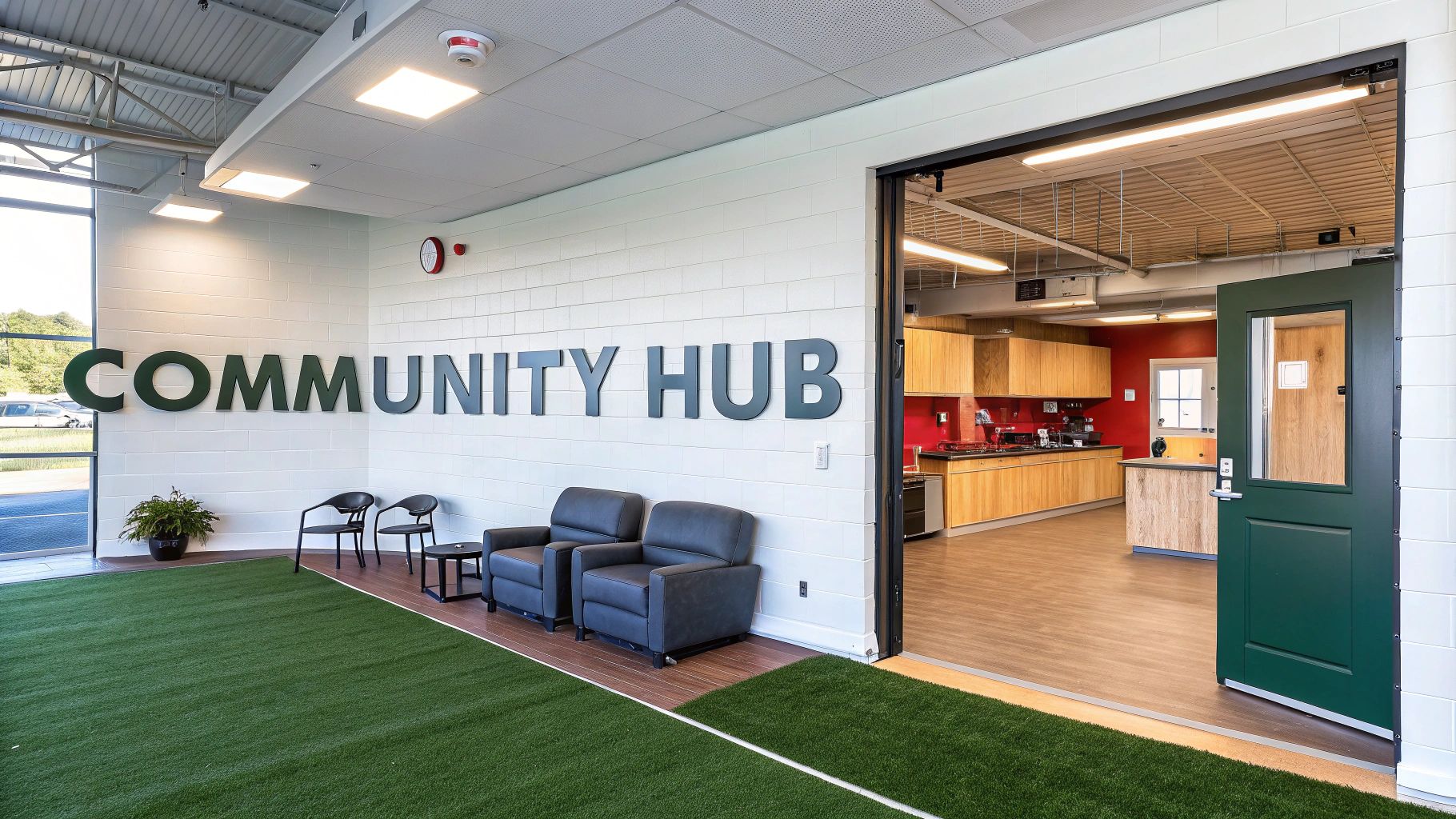
The real goal is to create an environment that promotes both rest and readiness. This means striking a delicate balance between private and communal areas, giving firefighters the choice to either connect with their team or find a quiet moment alone.
Designing a Home Away From Home
We've come a long way from the old open bunk rooms. While they were cheap, they offered zero privacy and made quality sleep nearly impossible—a huge problem when rest is critical for firefighter health. Today, we're seeing a major shift toward individual sleeping quarters or small pods. This simple change gives each person control over their own light, sound, and temperature.
This same thoughtful approach has to carry through to the shared spaces:
- The Kitchen: Everyone knows the kitchen is the "heart of the station." It's where crews bond over meals. The design needs to be bulletproof, with commercial-grade appliances and tough, easy-to-clean surfaces. The layout is just as important; it should encourage conversation while still being functional enough for multiple people to cook at once.
- The Dayroom: Think of this as the station's living room. The best designs offer flexible seating—some for watching a game as a group, others for quiet reading. It’s also absolutely critical to acoustically separate the dayroom from both the apparatus bay and the sleeping quarters. Nothing's worse than trying to relax with constant noise bleeding through the walls.
- Fitness Areas: Physical fitness isn't optional in this line of work. A dedicated fitness room with proper ventilation and shock-absorbent flooring is a must-have. It's a direct investment in crew health and can significantly reduce the risk of on-the-job injuries.
The design of these living quarters has a direct, measurable impact on morale and mental health. A station that feels less like an institution and more like a home helps firefighters manage the immense, cumulative stress of their profession. That leads to better retention and better performance on calls.
Building a Bridge to the Community
A new fire station is a huge investment for any community, and the building itself can send a message of openness and service. Many modern facilities now cleverly include public-facing elements, turning the station into a true community hub without ever compromising operational security.
For instance, you might see a public meeting room with its own separate entrance and restrooms. This allows local groups to use the space after hours without ever needing access to the secure side of the facility. Some stations even incorporate a "safe haven" lobby, where a person in crisis can seek help at any time of day or night.
The exterior of the building is just as important. An architect can use materials, landscaping, and lighting to create a civic presence that feels welcoming and professional, not cold and intimidating. This goes a long way toward building public trust and reinforcing the fire department’s role as an integral part of the community.
Prioritizing Durability and Long-Term Value
Fire stations aren't built for the short term; they're expected to last 50 years or more. This means long-term operating costs are a massive consideration. An experienced architect will always focus on specifying materials and systems that deliver both durability and efficiency, reducing the strain on municipal budgets for decades to come.
This means choosing robust, low-maintenance finishes that can take the abuse of 24/7 use. It also involves designing smart, highly efficient building systems.
Here are a few key areas we focus on:
- Energy-Efficient Systems: High-performance HVAC, LED lighting, and superior insulation aren't just buzzwords; they can slash utility bills.
- Sustainable Materials: Using locally sourced or recycled materials can lower the project's environmental footprint and sometimes even its cost.
- Resilient Design: The station absolutely must remain operational during a power outage or natural disaster. This often requires backup generators and hardened infrastructure.
When designing a facility that is both safe and resilient, a specialist architect will also incorporate advanced fire containment features, such as compliant fire shutters for windows. By making these smart choices upfront, the architect ensures the station is not just a functional and respected community asset, but a fiscally responsible one, too.
Finding Your Architect and Choosing the Right Project Delivery Method
With a solid program in hand, you’ve arrived at one of the most pivotal moments in your project’s life: picking your team. This isn’t just about finding an architect; it’s about establishing the entire framework for how your station will be designed, priced, and built.
This involves two decisions that have to happen almost at the same time. You need to find a fire station architect who genuinely understands public safety, and you have to select a project delivery method that fits your municipality’s budget, timeline, and tolerance for risk. Get this right, and you're set up for success. Get it wrong, and you could be facing costly delays and a building that just doesn't work for your crew.
How to Identify a True Specialist
Let's be clear: not all architects are created equal. Plenty of firms can design a beautiful building, but very few have the deep, hands-on experience needed to design a high-performance fire station. You're not looking for a generalist; you need a specialist who lives and breathes public safety.
When you start putting together a list of firms, you have to look past the slick marketing materials and glossy photos. It's time to get serious with your vetting process.
Start by issuing a Request for Qualifications (RFQ) or Request for Proposal (RFP) that asks the tough questions. You're trying to find out:
- Their Real-World Track Record: How many fire stations have they actually designed in the last 10 years? Don't just take their word for it. Ask for a list of projects, locations, and contacts at the municipality you can call for an honest reference.
- Code Fluency: Can they talk intelligently about NFPA standards? A true expert won't need to look up the basics. They should be able to discuss the nuances of these codes from memory.
- Experience with Stakeholders: What’s their game plan for managing input from fire chiefs, union reps, shift crews, and local officials? Ask for a specific example of a time they had to navigate conflicting requests and how they resolved it.
- Construction Oversight: How involved are they once the shovels hit the ground? You want a partner who is on-site regularly, not an architect who disappears after the drawings are done. They should be there to work through issues with the contractor and ensure the quality is up to par.
A common mistake is hiring a local firm just because they’re local or choosing a big-name firm that offers the lowest design fee. A fire station is far too specialized for that. Investing in the right architect upfront might seem more expensive, but they will save you a fortune down the road by preventing costly design errors and operational headaches.
Breaking Down Project Delivery Methods
While you're searching for your architect, you also need to decide how the station will be managed and constructed. This is your "project delivery method," and the three most common options for public projects come with their own trade-offs.
Design-Bid-Build (DBB)
This is the old-school, traditional route. You hire an architect to design the entire station. Once the construction drawings are 100% complete, the project goes out for public bid. In most cases, the job is awarded to the contractor with the lowest qualified bid.
- The Good: It's a straightforward process most municipalities are familiar with and often required by public procurement laws. It creates a competitive bidding environment that can drive down the initial construction price.
- The Bad: It's almost always the slowest path. Because the architect and contractor are hired separately, it can sometimes create an "us vs. them" dynamic if problems come up during construction.
Construction Manager at Risk (CMAR)
With CMAR, you bring both the architect and the construction manager (CM) on board early in the process. The CM acts as a consultant during the design phase, giving you real-time feedback on costs and buildability. Before construction starts, they give you a Guaranteed Maximum Price (GMP).
- The Good: This method fosters teamwork from day one. You get much better cost control and can often shorten the overall schedule because you’re not waiting for a full bid process.
- The Bad: The final price might be a bit higher than a low-bid scenario, but that premium buys you a huge amount of cost certainty and a much smoother process.
Design-Build (DB)
Here, you hire a single entity—usually a team made up of a contractor and an architect—to handle everything under one contract, from the first sketch to the final walkthrough.
- The Good: It’s typically the fastest way to get a building built and gives you a single point of contact for everything. If something goes wrong, there's no finger-pointing.
- The Bad: You give up a significant amount of control over the design details. The architect works for the contractor, not directly for you, which can create a conflict of interest when balancing your needs against the contractor's bottom line.
For public fire stations, Design-Bid-Build and CMAR are the most common choices. Your architect will be your best guide here, helping you weigh your community’s priorities—be it speed, budget security, or design control—to pick the method that makes the most sense for your project.
Common Questions About Fire Station Architecture
When you're staring down the barrel of a project as complex and critical as a new fire station, a lot of questions pop up. It’s completely normal. From sticker shock over the budget to the nitty-gritty of the design, city leaders and fire chiefs are often navigating this process for the first time.
Getting straight answers from an architect who actually specializes in this stuff is the only way to move forward with real confidence. Here are some of the most common questions we hear, along with the kind of straightforward advice you should expect.
How Long Does It Take to Design and Build a Fire Station?
This is almost always the first thing people ask. The honest answer? It depends. A typical project, from the day you hire an architect to the day the crew moves in, usually lands somewhere between 24 to 36 months. It's a marathon, not a sprint.
Think of it in phases. The initial design and pre-construction work—needs assessments, site selection, drawing up construction documents, and getting permits—can easily take 6 to 12 months. If you go the traditional route, the bidding and contractor selection process will add another 2 to 3 months.
Then comes the actual build. Construction itself often lasts 14 to 18 months, though this can shift based on weather, supply chain issues, or the complexity of your design. Finally, you have about 1 to 2 months for closeout and move-in, which covers final inspections, fixing any last-minute issues, and commissioning all the building systems before the station goes live.
What Is the Average Cost of a New Fire Station?
Let's talk numbers. For any publicly funded project, the budget is king. Pinning down a national average is tough because labor and material costs vary so much by region, but a good rule of thumb for a new fire station is $600 to $900 per square foot.
But here’s something that gets missed all the time: the initial construction cost is just one piece of the puzzle. A well-designed station is built with its entire life cycle in mind, factoring in decades of utility bills and maintenance. A cheaper build today could easily cost your municipality far more over the facility's 50-year lifespan.
So, for a new 20,000-square-foot station, you're likely looking at a total project budget in the $12 million to $18 million range once you factor in design fees, furniture, and all the necessary equipment. An experienced fire station architect can give you a detailed cost estimate early on, which is invaluable for budgeting and securing funding.
How Do We Choose the Best Site for Our New Station?
Picking a location for a new station shouldn't be about which piece of land is cheapest or most convenient. It has to be driven by data. The single most important goal is cutting down response times across your entire service area. This is a science, not a guessing game.
Today, we rely on sophisticated 'run-time analysis.' We use your department's own data to model how quickly crews could respond from different potential sites. This ensures the final location provides the best possible coverage where it's needed most. Considering that residential buildings accounted for 24.2% of all fires globally in 2020, rapid deployment to populated areas is non-negotiable. You can learn more about how global data shapes emergency planning in the CTIF's World Fire Statistics report.
How Can We Future-Proof the Design?
A fire station you build today has to serve your community for the next 50 years or more. That means the design can't be rigid. It needs the flexibility to adapt to bigger trucks, new technology, and changing crew sizes.
Here are a few ways we bake that flexibility right into the design:
- Bigger Apparatus Bays: We design bays that can handle not just today's fleet, but also the larger aerials and specialized rescue vehicles your department might need ten years from now.
- Smart Site Planning: The building should be positioned on the site to allow for future additions—like more bunk rooms or administrative offices—without disrupting daily operations.
- Adaptable Interiors: In the living and admin areas, using non-load-bearing walls makes it far easier and cheaper to reconfigure the space down the road.
- Robust IT Infrastructure: We plan for the future by installing plenty of conduit and server room space to handle whatever technological upgrades are coming in the next few decades.
At Sherer Architects, LLC, we believe in creating buildings that are not only functional and beautiful but also enduring assets for the communities they serve. Our team has the expertise to guide you through every stage of your commercial project, from initial concept to final construction. Contact us today to discuss how we can bring structure to your vision.