
Historic building restoration grants are, quite simply, financial awards designed to help preserve, rehabilitate, or restore buildings that have a significant story to tell. These aren't loans—the money is yours to keep and does not need to be repaid. For property owners, this can make all the difference in covering the often-steep costs of a restoration project.
Why Historic Restoration Grants Are So Important
There's a certain magic in bringing a historic building back to life, but let's be honest: the financial reality can be daunting. The right materials, specialized craftspeople, and the need to follow strict preservation guidelines all add up, and the price tag can quickly become overwhelming. This is exactly where historic building restoration grants come into play.
Think of these grants as more than just a check. They represent a powerful partnership between public preservation goals and private development. By injecting critical capital into a project, programs at the federal, state, and private levels can dramatically lower the financial hurdles that stop many incredible restoration projects before they even start. They’re the key to turning an ambitious vision into a tangible, community-enhancing reality.
Fueling a Growing Preservation Movement
The interest in restoring historic properties isn't just a passing trend; it's a booming global market. In fact, the global restoration market is expected to grow from $15 billion in 2025 to a staggering $28 billion by 2033. This surge is driven by a renewed appreciation for cultural heritage and a rise in historical tourism, underscoring the economic power of preservation. You can dig deeper into these trends and market drivers with this report from Data Insights Market.
Historic building grants are the catalyst that turns a potential liability into a celebrated asset. They empower owners to tackle the high upfront costs of restoration, ensuring these meaningful buildings can continue to serve their communities for generations.
This guide is designed to help you navigate this complex but rewarding world. We'll walk through the main sources of grant funding and share the insights you need to successfully secure the money for your project. With the right support, you can transform a piece of history into a valuable modern asset.
Here’s why this kind of funding is so crucial:
- Bridging Financial Gaps: Grants can cover very specific, often expensive, work that traditional financing might shy away from, like intricate facade repairs or restoring original windows.
- Encouraging Best Practices: Most grant funding is tied to meeting high-quality preservation standards, which ensures the work is done right and truly honors the building's character.
- Boosting Local Economies: Restoration projects are job creators, hiring skilled tradespeople and often sparking a wave of revitalization in the surrounding neighborhood.
Where to Find Restoration Grants: Mapping the Funding Landscape
Trying to find grants for a historic restoration project can feel like you've been sent on a treasure hunt without a map. But here's the good news: there are plenty of funding sources out there. You just need to know where to look. Understanding the different types of grants and who offers them is the first real step to getting your project off the ground.
Think of the funding world as having a few different layers. At the top, you have the big federal programs. Below that, you find state-level opportunities. And at the base, there's a huge variety of local and private sources. The most successful projects I've ever seen almost always pull from multiple layers. It's a strategy we call a funding stack—layering different grants and financial incentives to cover as much of the project cost as possible.
This chart gives you a quick visual breakdown of the main grant sources you'll be dealing with.
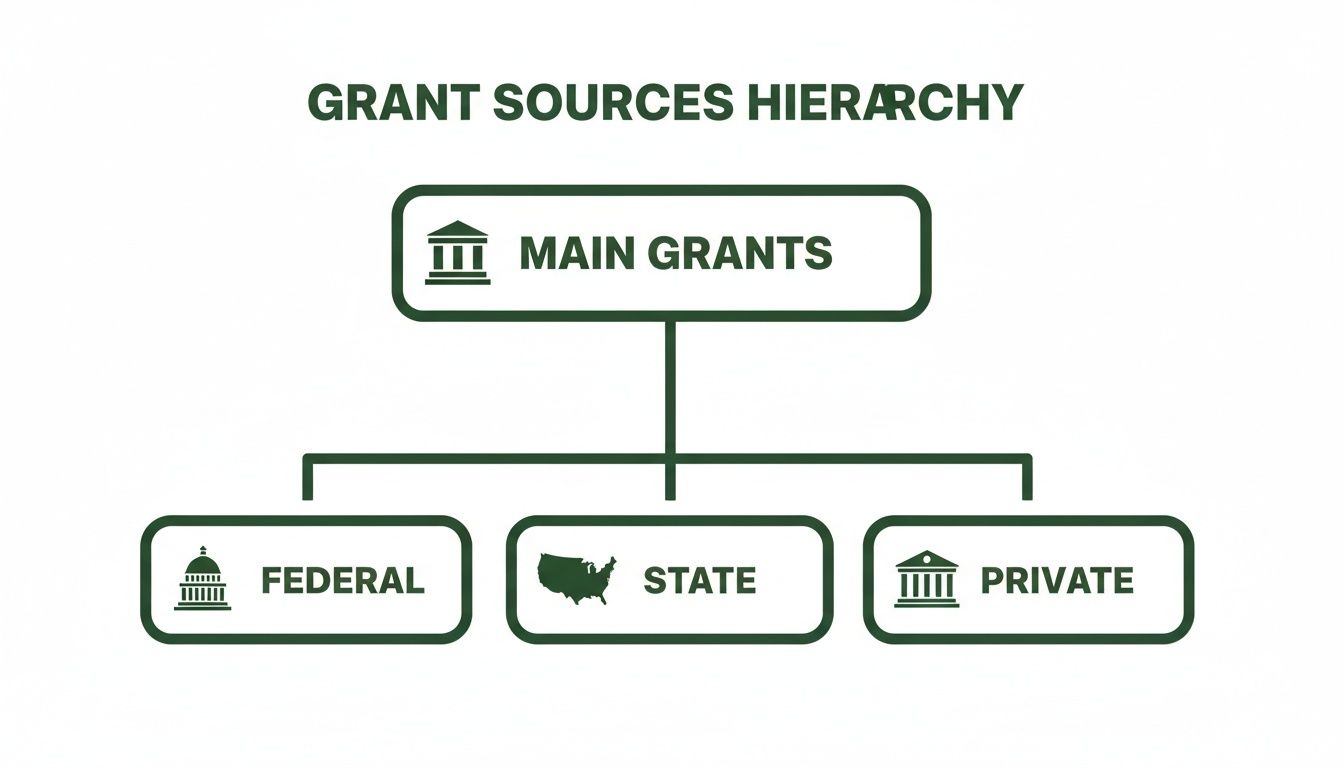
As you can see, money flows from federal, state, and private entities. This gives you a few different avenues to explore as you start your search.
Federal Grant Programs
At the very top of the funding pyramid are the major federal programs. These are the ones that really set the national standard for preservation work.
The biggest player by far is the Historic Preservation Fund (HPF), which is managed by the National Park Service. Now, you don't apply to the HPF directly. Instead, the HPF gives money to each State Historic Preservation Office (SHPO), and those offices are the ones who distribute it through their own state-level grant programs.
These government-backed funds are absolute game-changers. The HPF alone has fueled over 51 standout projects in every single state and D.C., helping to kickstart revitalization in both rural towns and big cities. You can see the real-world impact of these HPF-funded projects across the nation to get a feel for what’s possible.
A few other key federal grants to know about include:
- Save America’s Treasures: This one is for preserving nationally significant historic properties and collections—think major landmarks.
- National Maritime Heritage Grants: As the name suggests, this fund is specifically for maritime projects, like restoring historic ships or lighthouses.
Be prepared, though. These grants are incredibly competitive and are usually reserved for projects of major historical importance. This is where having a great relationship with your SHPO becomes non-negotiable.
State and Local Funding Opportunities
One level down from federal programs, state grants are often much more accessible for a wider variety of projects. Your SHPO is, once again, your go-to resource here. They're the gatekeepers for the federal HPF money, and they also manage any grant programs funded directly by your state's legislature.
These grants can be really versatile, covering everything from the initial planning and documentation phases all the way to the actual brick-and-mortar work. Don't stop at the state level, either. Many cities and counties have their own funding pots for things like façade improvements, code compliance upgrades, or downtown revitalization efforts. These local programs are designed to directly boost neighborhood economies and can be a fantastic piece of your overall funding stack.
A successful funding strategy is rarely about finding one perfect grant. It’s about skillfully layering multiple sources—federal, state, local, and private—to build a financial foundation strong enough to support the entire restoration.
Private Foundations and Nonprofit Grants
The foundation of the funding pyramid is made up of a huge network of private foundations and nonprofit organizations that are passionate about preservation. These groups often have very specific missions. Some focus on a particular type of building, while others are dedicated to a certain region or a specific chapter of history.
For example, the National Trust for Historic Preservation offers several different funds, including its African American Cultural Heritage Action Fund, which targets a very specific need. You can also find highly specialized funding streams, like grants for church repairs, that might be a perfect fit for your project.
The key to unlocking this funding is research. You need to find the foundations whose mission aligns with your project's story. When you piece these varied sources together, what once looked like a daunting restoration project starts to look like a smart, achievable investment.
Major Grant Sources at a Glance
To help you keep these sources straight, here is a simple breakdown of the main funding players.
| Funding Source | Governing Body | Typical Project Scope | Ideal Applicant Profile |
|---|---|---|---|
| Federal | National Park Service (NPS) | Projects of national significance, disaster recovery, maritime heritage | Nationally recognized landmarks, major non-profits, government entities |
| State | State Historic Preservation Office (SHPO) | Planning, documentation, "brick-and-mortar" restoration | Non-profits, municipalities, owners of state-registered properties |
| Local | Municipal or County Governments | Façade improvements, main street revitalization, code compliance | Downtown businesses, local non-profits, individual property owners |
| Private/Nonprofit | Foundations, National Trusts | Niche projects (e.g., cultural heritage sites, endangered places) | Organizations with a mission that aligns with the funder's specific goals |
Understanding these distinctions will help you target your efforts and focus on the grants where your project has the best chance of success.
Understanding Grant Eligibility and What It Takes
Trying to get a grant for a historic building isn't like buying a lottery ticket; it's more like meticulously assembling a complex model kit. Every single piece has to be in the right place. Granting agencies aren’t just handing out cash—they're making strategic investments in projects that meet a very strict, non-negotiable set of rules designed to protect our shared architectural history.
Before you even dream of writing a proposal, the first, most critical step is to figure out if your project is even eligible. Honestly assessing this upfront can save you a mountain of time and money. It means taking a hard look at your building's official status, your own financial situation, and whether you're truly prepared to follow some incredibly rigorous preservation standards.
The National Register: Your Golden Ticket
For most federal and state grants, one thing matters more than anything else: your property must be listed on the National Register of Historic Places. Think of this as the ultimate seal of approval. It’s the official certification that your building is significant to American history and is worth saving.
Generally, a building makes it onto the Register if it’s tied to important historical events, connected to significant people, or is a prime example of a particular architectural style. Without that listing, most of the big-money grant programs are simply off-limits. It's the first and most important hurdle you have to clear.
Getting on the National Register isn’t just some bureaucratic checkbox. It’s the formal acknowledgment that your building has a story worth telling. To funders, it’s a clear signal that your project is a serious contender aligned with national preservation goals.
The Reality of "Matching Funds"
Here’s a crucial piece of financial reality: very few grants will ever cover 100% of your project's costs. The vast majority work on a cost-sharing model, often called "matching funds." You have to understand this from day one, because it directly affects whether you can actually afford to see your project through.
A match requirement means you, the grant recipient, have to put up a certain amount of the project's total cost. For example, a common 1:1 match on a $100,000 grant means you have to bring another $100,000 to the table, making the total project budget $200,000. This money doesn't have to be sitting in a single bank account; it can come from a few places:
- Your Own Capital: Cash on hand from your business or personal funds.
- Bank Loans: Standard financing you’ve secured for the project.
- Other Grants: Sometimes, you can use funds from a different (non-federal) grant.
- In-Kind Donations: Properly documented donations of professional services or materials can count, too.
Grant agencies aren't just being difficult. They see matching funds as proof of your commitment. It shows you have real "skin in the game" and are a dedicated partner, not just someone with their hand out. Always, always check the specific match rules, as they change from one program to another.
Playing by the Rules: The Secretary of the Interior’s Standards
At the very core of every federally funded restoration project, you'll find The Secretary of the Interior’s Standards for the Treatment of Historic Properties. These aren't gentle suggestions. They are the official rulebook for ensuring a building’s historical integrity isn't compromised during renovation. If you fail to follow them, you could be forced to pay the grant money back.
The Standards lay out four different ways to approach a historic property. Your project has to fit neatly into one of these.
- Preservation: This is all about maintenance and careful repair of what’s already there. It’s the most conservative route, focused on keeping the building in its current state as it has evolved over the years.
- Rehabilitation: This is the go-to for most projects, especially those involving "adaptive reuse" (like turning an old factory into apartments). It allows for alterations and additions to meet modern needs, but only if the key historic and architectural features are protected and maintained.
- Restoration: This approach is more like a time machine. It aims to make a property look exactly as it did during one specific, significant period in its history. This often means removing additions or changes made in other eras to get back to that "pure" state, like taking a Victorian home back to its 1880s glory.
- Reconstruction: This is the most dramatic and rarely used option. It involves re-creating a building that no longer exists, using all-new construction. It's only considered when the original building is absolutely vital for understanding history and there's enough documentation (photos, blueprints) to do it accurately.
Choosing the right approach is foundational; it will guide every decision you make, from the architectural plans and material choices to the actual construction techniques. For almost any commercial project looking for historic building restoration grants, Rehabilitation is the name of the game, as it strikes that perfect balance between preserving history and creating a functional, modern space.
How to Craft a Winning Grant Application
Securing a grant for your historic building isn't about luck—it's about strategy. Think of your application as the ultimate sales pitch. You have to convince a review committee that your project is more than just a worthy cause; it's a smart, responsible investment in your community’s heritage. It's where you build a powerful business case for preservation.
A winning application is a story, meticulously told. It needs to clearly articulate your vision, prove the project is feasible, and demonstrate the positive ripple effect it will have. This takes a special blend of reverence for the past and sharp, modern-day business sense. Funders need to see both the cultural heart and the economic value of what you’re proposing.

This is more important than ever. With government policies and major incentives fueling heritage conservation, the restoration sector is booming. Projections show it growing from $5.79 billion in 2025 to $9.78 billion by 2034. A standout proposal is your ticket to accessing a piece of that growing pie. You can learn more about the growth of the historic building restoration market on Proficient Market Insights.
Assemble Your Core Application Components
While every grant has its own specific requirements, most applications are built from the same set of core documents. Nailing these from the get-go makes the whole process run a lot smoother.
Here's what you'll almost always need:
- A Compelling Project Narrative: This is your story. You need to explain the building's history, its current problems, and your vision for bringing it back to life.
- Detailed Architectural Plans: Professional drawings and specs are non-negotiable. They must clearly show how the work will follow The Secretary of the Interior’s Standards.
- A Meticulous Project Budget: Itemize everything. From materials and labor to consultant fees, a detailed budget shows you've done your homework and are financially responsible.
- Documentation of Historical Significance: Pull together National Register forms, old photos, and anything else that proves the building’s importance. This is your evidence.
The Power of Meticulous Research
A strong application is built on a foundation of deep, thorough research. This is about so much more than just stating the building’s age. You have to dig into its past to make a compelling case for its future.
For example, digging up historic photographs can give you the proof you need to restore lost features, like an original storefront or a specific window design. A materials analysis helps you specify the correct, historically accurate materials for repairs—a make-or-break detail for many grant programs. This level of detail screams competence and commitment to the review committee.
A grant proposal without deep historical research is like an architectural plan without measurements. It might look good on the surface, but it lacks the substance and credibility needed to build something real and lasting.
Start Early and Build Relationships
Grant cycles are long. I mean, really long. It can easily take a year or more from the day you submit to the day you see any funding. Procrastination is the single biggest enemy of a successful grant application. Always start the process well before you hope to break ground.
Starting early also buys you something incredibly valuable: time to build relationships. One of the smartest things you can do is get in touch with your State Historic Preservation Office (SHPO) right away. They're not gatekeepers; they're your partners. Their guidance can be invaluable in strengthening your proposal.
Finally, don't underestimate the power of local buy-in. Compelling letters of support from city officials, neighborhood groups, and future tenants can completely change the game. They turn your application from a simple funding request into a community-backed vision for the future.
Real-World Examples of Grant-Funded Success
Knowing the theory behind historic preservation grants is one thing. Seeing what they actually accomplish is another. These aren't just abstract financial programs; they're the fuel that turns decaying buildings back into beloved community landmarks. These success stories show how a smart "funding stack" can transform an overwhelming project into a sustainable, often profitable, reality.
So, let's look at how this works on the ground. These examples show how developers, nonprofits, and property owners have successfully navigated the grant process to save buildings that were once on the brink.
From a Vacant School to a Cultural Hub
Imagine a beautiful old public school, empty for decades and slated for demolition. The building’s bones were good, but it was suffering from a leaky roof, shattered windows, and ancient mechanical systems. Everyone knew it was historically important, but the cost to fix it was way too high for a private developer using only traditional loans.
A local nonprofit, however, saw its potential as a much-needed cultural center and museum. Their first big step was getting the building on the National Register of Historic Places. That single action unlocked a whole new world of funding possibilities.
Their funding stack was a strategic blend:
- A state historic preservation grant from their SHPO paid for a new, historically accurate slate roof.
- A Save America's Treasures grant was secured to restore the building’s magnificent but crumbling exterior stonework.
- Local municipal funds set aside for community revitalization covered critical accessibility upgrades like ramps and elevators.
The project pulled together over $2.5 million in grant money, which was combined with private donations. Today, that old school is a vibrant cultural institution, proving how historic building restoration grants can save a landmark while serving the public.
Adaptive Reuse: The Mill District Transformation
In another town, a developer took on a massive, abandoned textile mill complex—a perfect candidate for adaptive reuse. The vision was huge: convert the sprawling industrial buildings into a mixed-use village with apartments, shops, and artist studios. But the scale of the project, not to mention the environmental cleanup needed, was daunting.
The most successful restoration projects view grants not as a simple handout, but as a strategic partnership. Funders invest in projects that promise a clear return—whether that's economic revitalization, community engagement, or the preservation of a shared story.
Working closely with us at Sherer Architects, the developer created a phased plan that followed The Secretary of the Interior’s Standards for Rehabilitation to the letter. This careful, compliant planning was the secret to unlocking a sophisticated mix of financial incentives. The funding stack was a masterclass in financial creativity, layering federal historic tax credits with several grant sources.
One of the key pieces was a grant from the Environmental Protection Agency's Brownfields Program, which helped pay for cleaning up old industrial contaminants on the site. They layered that with a state-level grant designed to spur development in former industrial areas. The result? A breathtaking transformation that kept the mill’s historic industrial vibe while creating over 150 apartments and dozens of new businesses, turning a derelict property into the heart of a new neighborhood.
Finding an Architectural Partner for Your Project
Trying to navigate the maze of historic building restoration grants can feel overwhelming. It’s not just about filling out paperwork; it’s about mastering a complex world of historical standards, building codes, and the unique priorities of each funding organization. This is precisely where bringing in an experienced architectural partner becomes your greatest advantage.

Think of your architect as part creative visionary, part strategic guide. A firm that lives and breathes historic preservation doesn’t just design buildings—they map out a realistic path to getting your project funded. They know the landscape and can pinpoint the best grant opportunities, from major federal programs down to obscure local funds that are a perfect fit for your building.
Getting them involved from the very beginning is absolutely key. The right partner will ensure your plans are built from the ground up to meet The Secretary of the Interior’s Standards. For most grant funders, this is non-negotiable.
More Than Just Blueprints
The architect's job goes well beyond the drawing board. They become the central hub for the entire complex approvals process, serving as your expert liaison in discussions with State Historic Preservation Offices (SHPOs) and local review boards. This role is often the difference between a successful application and a rejected one.
An experienced firm will handle the heavy lifting:
- Prepare all the required documentation, from detailed condition assessments and historical research to the compliant architectural drawings that grant committees demand.
- Weave a compelling story that clearly shows your building’s historical importance and its future value to the community.
- Build a detailed and justifiable budget that accounts for every dollar, proving to funders that your project is not just a dream but a viable plan.
- Oversee compliance during construction, making sure the work on-site strictly follows the grant requirements and protecting you from the nightmare of having to repay funds.
Choosing an architect is like picking a co-pilot for a long flight. You need someone who doesn’t just know the destination but can read the maps, navigate the turbulence of regulatory approvals, and land you safely with your funding secured.
Maximizing Your Investment and Minimizing Risk
At the end of the day, partnering with a preservation-focused architect is a direct investment in your project's success. Their deep expertise helps you sidestep common mistakes, like submitting a flawed application or designing something that accidentally violates preservation rules. This proactive guidance saves you from costly delays and significantly boosts your odds of winning the grants you need.
By handing off the intricate details of the grant and approvals process, you're free to focus on the big picture. With a skilled architectural partner by your side, you can confidently turn a challenging historic property into a valuable, lasting, and profitable asset for both your portfolio and the community.
Answering Your Top Questions About Restoration Grants
If you're new to historic restoration, the grant process can feel like a maze of rules and paperwork. It's totally normal to have a lot of questions. Let's walk through some of the most common ones we hear from property owners and developers, clearing up the confusion along the way.
Can I Combine Historic Grants with Tax Credits?
Yes, and you absolutely should! This is one of the smartest ways to finance a historic restoration project. Think of it as “stacking” your funding—grants give you upfront cash for specific work, while tax credits slash your tax bill later on, reducing the total project cost.
This combination is a cornerstone of historic redevelopment. For instance, you might use a state grant to cover the painstaking restoration of your building's original wood windows. At the same time, the Federal Historic Tax Credit could give you a 20% credit on the entire qualified cost of the rehabilitation. An experienced architect is key here; they can help you structure the financing so you get the most out of both programs without running into compliance issues.
Why Do Grant Applications Get Rejected?
It’s a competitive world out there, and grant applications often get turned down for a handful of recurring reasons. The biggest showstopper? The building simply isn't eligible, most often because it’s not listed on the National Register of Historic Places. That’s the first gate you have to pass through, and there’s no way around it.
Beyond basic eligibility, other common mistakes trip people up:
- A sloppy or incomplete application. If it’s missing details or doesn't tell a compelling story, it's going in the "no" pile.
- The project doesn't match the funder's goals. Every organization has priorities, and if your project doesn't align, it won't get a second look.
- A flimsy budget. A budget that seems poorly planned or unjustified is a major red flag for any review committee.
- Not showing you have matching funds. Grantors want to see you have skin in the game; failing to prove you have your share of the funds secured suggests the project isn't on solid footing.
The best way to sidestep these pitfalls is to work with someone who’s been through this process countless times. They know what each grant program is looking for and can help you put together a polished, persuasive proposal.
How Long Does It Take to Get Grant Money?
This is where you need to practice your patience. The timeline for grant approval varies wildly depending on the source. For most federal and state programs that run on an annual cycle, you could be waiting anywhere from six months to over a year from the day you apply to the day the check clears.
This is exactly why you can't wait until the last minute. You need to map out your grant strategy and start the application process well before you ever plan to break ground.
Private foundations can sometimes move faster, but the core principle is the same. Planning ahead is the only way to successfully weave grant funding into your timeline without throwing your entire construction schedule into chaos.
Navigating grant compliance and crafting an application that stands out takes a specific kind of expertise. The team at Sherer Architects, LLC has spent decades helping clients secure the funding they need to bring historic properties back to life. Contact us to discuss your project today and let’s get started.