Applying for a historic preservation grant isn't just about filling out forms. It's about matching your project's soul with a funder's mission. Success comes from a well-researched, targeted approach that shows you understand what they care about and how your building fits into that picture.
Decoding the Historic Preservation Grant Landscape
Before you even think about writing the application, you need to map out where the money is. The world of preservation funding is a web of federal, state, and private players, and each one operates on its own schedule with its own set of rules. Think of this early research as your strategic planning phase—get this right, and everything else falls into place.
The big player at the federal level is the Historic Preservation Fund (HPF), which is run by the National Park Service. It's the primary source of preservation funding in the U.S. In a recent fiscal year, Congress set aside nearly $189 million for the HPF, which then gets funneled out to various programs. You can dive deeper into the numbers and see exactly where that money went on the NPS website.
A big chunk of that federal money goes directly to State Historic Preservation Offices (SHPOs), which then run their own grant programs. These are often your best bet for local projects, but be warned: they are fiercely competitive. And don't forget about the vast network of private foundations and nonprofits, each with its own niche focus, from saving old theaters to preserving rural farmsteads.
The Three Main Types of Preservation Grants
Knowing the different buckets of money is crucial. Applying for the wrong type of grant is the fastest way to get a rejection letter. Funders are incredibly specific about how their dollars can be spent.
- Capital Grants: This is the money for the actual "bricks-and-mortar" work. Think roof repairs, window restoration, or foundation stabilization. If you're physically touching the building, you're likely looking for a capital grant.
- Planning Grants: This funding covers all the critical prep work that comes before a single hammer is swung. It pays for things like architectural drawings, engineering studies, historic structure reports, and archaeological surveys.
- Educational or Interpretive Grants: These grants are all about telling the building's story. The funds might be used to create a museum exhibit, develop a walking tour app, publish a local history book, or run workshops for the community.
I’ve seen it happen countless times: someone applies for a major capital grant when their project is still just an idea. Funders need to see a well-developed, "shovel-ready" plan before they'll commit to construction costs.
For a great overview of how public funding works, which is a major component of preservation efforts, this Federal Grants for Nonprofits Funding Guide is a fantastic resource. Zeroing in on the right grant type from the start shows funders you’ve done your homework and respect their process.
Finding the Right Grant for Your Project
Securing a grant isn't a numbers game—it's a matching game. The most successful applicants I’ve seen are the ones who stop shotgunning applications and start doing their homework. The goal is to find a funder whose mission and priorities genuinely align with your project’s needs.
Your search should really have two parallel tracks running at the same time: national and state.
On the national level, the National Trust for Historic Preservation is an essential first stop. While many of their grants focus on planning and education, they are a major player. It's a big ecosystem, too; annually, over $1 billion in grant money is available from a variety of sources, including more than 10 federal agencies. You can get a sense of this landscape by exploring compilations of historical preservation grants.
At the same time, you need to be exploring your State Historic Preservation Office (SHPO) website. Frankly, for many local projects, this is where you’ll find the best fit. These grants are specifically designed to address preservation challenges within your state, making them a much more practical target.
Reading Between the Lines of Eligibility
The eligibility requirements are your filter. This is where you separate the real opportunities from the time-wasters. Before you ever write a single word of a proposal, you need to dissect the fine print. I can't tell you how many hours I've seen people waste on applications they were never qualified for.
Here’s what to look for immediately:
- Property Designation: Does your building need to be on the National Register of Historic Places? Some funders won't look at anything else. Others are more flexible, accepting properties that are eligible for listing or have a local landmark designation.
- Applicant Type: Who can actually apply? Many of the biggest grants are only open to 501(c)(3) nonprofits or government bodies. If you’re a private owner, don't despair—your options are just more specific.
- Project Scope: Is the funder interested in "bricks-and-mortar" capital work, or do they stick to planning, research, and education? Applying for a new roof from a grant that only funds interpretive signage is an automatic "no."
A classic rookie mistake is getting distracted by the largest dollar amounts. I’d much rather see a project go after a smaller, perfectly aligned grant than a huge one where the eligibility is a stretch. Alignment is what gets you funded.
Aligning Your Project with a Funder's Mission
With a shortlist of potential grants in hand, your next job is to put on your grant reviewer hat. Every single funder has a mission—a reason they exist. One foundation might be dedicated to saving rural churches, while a federal program may be laser-focused on revitalizing downtowns in economically distressed areas.
Let's look at how this plays out in the real world:
- Scenario A: The Small Town Museum: A local historical society wants to digitize its photo archive and build a new exhibit. This project is small, educational, and deeply rooted in the community. Their best shot is a private foundation that cares about local history or a modest educational grant from their SHPO. Chasing a massive federal grant for building restoration would be a total mismatch.
- Scenario B: The Landmark Bridge Restoration: A city needs millions for the structural rehabilitation of a nationally registered bridge. This is a big-ticket infrastructure project. They should be looking at large-scale federal transportation grants, probably supplemented by significant state funding. A small private grant for educational programming just isn't relevant to their core need.
By digging into each grant's purpose and looking at what they've funded in the past, you can frame your project in a way that speaks directly to their passions. That shift in perspective can make all the difference.
Comparing Historic Preservation Grant Sources
Navigating the grant landscape requires understanding the key differences between federal, state, and private funding streams. Each has its own priorities, requirements, and typical award sizes. The table below breaks down these distinctions to help you zero in on the best source for your specific preservation project.
| Funding Source | Typical Project Focus | Average Grant Size | Matching Funds Requirement | Common Eligibility |
|---|---|---|---|---|
| Federal Agencies | Large-scale capital projects, infrastructure, disaster recovery, national significance | $100k – $1M+ | Often 50% (1:1 match) or more; can be complex | National Register listing, government agencies, 501(c)(3)s |
| State (SHPO) | "Bricks-and-mortar" restoration, planning, surveys, local historic districts | $10k – $100k | Typically 50%; sometimes lower for planning grants | National or State Register listing, nonprofits, local governments |
| Private Foundations | Niche areas (e.g., sacred places, rural preservation), planning, education, seed money | $5k – $50k | Varies widely; some require no match, others 1:1 | Often 501(c)(3) status; may have specific geographic or thematic focus |
Choosing the right source is the first and most critical step. A large federal grant might seem appealing, but the compliance and matching fund requirements can be overwhelming. In contrast, a smaller foundation grant might be the perfect catalyst to get a community-based project off the ground.
Crafting an Unforgettable Grant Proposal
A great grant application does more than just ask for money—it tells a compelling story backed by cold, hard facts. This is where you prove your project isn't just historically important, but that it's also meticulously planned and primed for success. Your job is to make the review committee feel as passionate about your building’s future as you do.
Think of your grant application as a high-stakes business plan for a non-renewable cultural asset. The same principles that make for successful strategies for writing winning business proposals apply here. You have to lay out a clear problem (a historic building at risk), present a well-researched solution (your preservation plan), and show a clear return on their investment (the public good).
Writing a Powerful Statement of Significance
The Statement of Significance is the soul of your proposal. This is where you make your case for why this building, right here, actually matters. Vague descriptions won't cut it. You need to build your argument with concrete evidence that ties your property to bigger historical themes.
To pull this off, you have to dig deeper than just listing the construction date. You need to answer these questions with documented proof:
- Architectural Importance: Is the building a rare or exceptional example of a specific architectural style? Maybe it was designed by a well-known architect?
- Historical Association: Can you link the property to significant people or pivotal events in your town's history? You’ll need names, dates, and the real-world context of their impact.
- Cultural Context: Does the building tell a story about how your community grew? For example, was it the first general store in town, a key meeting spot for a social movement, or a symbol of an immigrant community’s success?
I see this all the time: applicants assume the reviewer knows their local history. You absolutely have to write as if they’ve never even heard of your town. Connect the dots for them. Don't just explain what happened, explain why it was important.
For instance, don’t just say, "The Miller Building is an old commercial building downtown." That's a missed opportunity.
Instead, try something like this: "The Miller Building (1922) is the city's only surviving example of commercial Art Deco architecture and was home to the first female-owned law practice in the county from 1925 to 1950." See the difference? The second statement is packed with specific, verifiable details that anchor the building in history.
Developing a Professional Preservation Plan
Once you've established why the building is important, you have to detail exactly what you're going to do to save it. A professional Preservation Plan (sometimes called a Treatment Plan) shows the grant committee you're following established best practices, not just patching things up as you go.
Your plan needs to lay out the proposed work in detail, and it must follow the Secretary of the Interior's Standards for the Treatment of Historic Properties. It's critical to be clear about which of the four official treatment approaches you're taking:
- Preservation: The focus here is on maintenance and repairing existing historic materials. It's about keeping what's there in good shape.
- Rehabilitation: This approach accepts that you might need to alter or add to a building for a new use, but you do it while protecting its historic character.
- Restoration: This is about taking the property back to a specific period in its history, which often means removing changes made in other eras.
- Reconstruction: You're essentially re-creating a lost part of a property, usually for interpretive purposes.
Break the project down into logical phases. If you're tackling a roof replacement, for example, your plan would detail the careful removal of non-historic shingles, the repair of the original underlying structure using period-appropriate methods, and the installation of new materials that match the original in both look and composition.
Creating a Realistic Budget and Compelling Visuals
An unrealistic budget is the quickest way to land your application in the rejection pile. Grant reviewers have seen it all; they can spot inflated costs or underfunded line items from a mile away. You need to get at least two, and ideally three, detailed cost estimates from contractors who actually have experience with historic preservation work.
Your budget has to be transparent and dead simple to understand. Break everything down into clear categories:
- Pre-construction: permits, architectural drawings, engineering fees
- Materials: specialty lumber, historic window glazing, custom millwork
- Labor: masonry, carpentry, plastering, etc.
- Contingency: This is non-negotiable. Always include a 10-15% contingency for the inevitable surprises you'll find behind the walls.
Finally, never forget that a picture is worth a thousand words—especially in a grant proposal. High-quality, clearly labeled photos are a must. You need sharp "before" shots that document the existing problems. Then, use diagrams, historical photos, or even architectural renderings to show your proposed "after" vision. Help the reviewers see the incredible, successful project you’re asking them to fund.
Mastering the Grant Submission Calendar
https://www.youtube.com/embed/bw7IgeMHtGY
Let me be blunt: even the most compelling, perfectly written grant proposal is worthless if it arrives a day late. I’ve seen it happen. Understanding and respecting the grant submission calendar isn't just a final step—it’s the backbone of your entire strategy. The whole grant game, from the first announcement to the final award, runs on a strict timeline. You have to master it.
Grant cycles are all over the map, and it really depends on who holds the purse strings. Federal grants, for instance, often have these long, drawn-out timelines tied to the government's fiscal year. You might find yourself submitting an application in the spring for a project that won’t see a dime until the following year. For big, multi-phase restorations, you absolutely have to plan for that kind of long game.
On the other hand, many private foundations move a lot faster and on a more predictable schedule. You’ll often see a flurry of grant deadlines in the fall, with application windows opening up in late summer and slamming shut before the holidays. This rhythm means you have to be ready to move when the opportunity appears.
Mapping Your Submission Timeline
Here’s a rookie mistake I see all the time: waiting for a grant to be announced before starting the proposal. The folks who consistently win grants are working months ahead. They treat the grant calendar as a year-round strategic tool, identifying potential funders and drafting their core documents long before any application portal goes live.
Take the Daughters of the American Revolution (DAR), a major source of private funding. They typically open their historic preservation grant program from August 1 to October 31 each year, with the winners announced the following May. Knowing that pattern, you can spend June and July polishing your proposal and getting your ducks in a row, ready to submit on day one. You can get a feel for their process on the DAR website.
My best advice is to create a master calendar for your top three to five target grants. Mark down the expected announcement dates, submission windows, and decision timelines. Working backward from those deadlines is the only sane way to manage this process without descending into last-minute chaos.
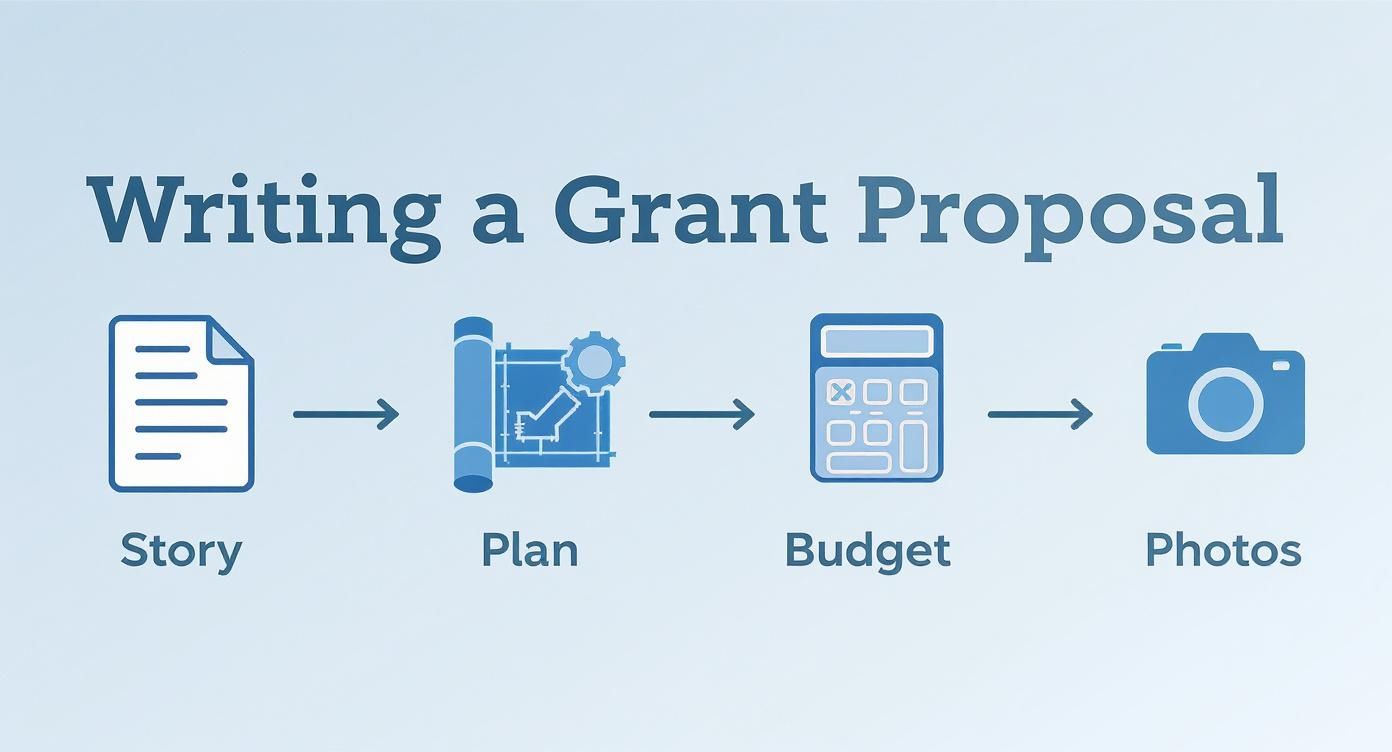
As you can see, a winning application really boils down to four key pillars: telling a compelling story, laying out a detailed plan, nailing down an accurate budget, and backing it all up with great photos.
The Final Push: Submission and Follow-Up
Once all your documents are assembled and polished, you’re in the home stretch. This is where meticulous, eagle-eyed review comes in. You’ll be navigating the specific mechanics of submission, whether it’s a modern online portal or an old-school physical package. Seriously, do not underestimate how long this can take. Wrestling with a clunky online system at 11 p.m. on deadline day is a special kind of hell you can easily avoid with a little planning.
Before you dare hit "submit," run through one last checklist:
- All Fields Complete: Have you double-checked every single required field? Yes, every single one.
- Signatures Secured: Are all the necessary signatures from your board members or partners actually on the document?
- Attachments Correct: Did you upload the final versions of your budget, photos, and plans? Not the draft from last Tuesday.
- File Names Clear: Make the reviewer's life easier. Use a clear naming convention like "ProjectName_Budget_2024.pdf".
After you've submitted, the waiting game begins. This is the perfect time to send a brief, professional email to the program officer. A simple note thanking them for the opportunity and confirming they received your materials does two things: it keeps your project on their radar and reinforces your professionalism. It’s a small touch, but it can make a real difference.
Managing Your Grant After You Win
Winning the grant is a huge victory. It's a moment of validation for your project and a real testament to your team's hard work. But once the celebration is over, the real work begins. How you manage the grant is every bit as important as how you won it, setting the stage for a successful project and building the credibility you'll need for future funding.
The first thing you’ll get is the grant agreement. This isn't just a congratulatory letter; it's a binding legal contract. Read every single word before you sign. Pay special attention to the reporting deadlines, what records you need to keep, and the specific rules for hiring contractors or buying materials. I’ve seen projects get into hot water by misunderstanding these terms right from the start.
For instance, many state and federal grants come with strict procurement guidelines. You might be required to get three competitive bids for any work exceeding a certain threshold, say $10,000. If you can't show you followed that process, those expenses could be deemed ineligible for reimbursement, forcing you to cover the costs yourself.
Setting Up for Financial Success
Your first move should be to open a separate bank account just for the grant funds and your matching share. Mixing grant money with your general operating funds is an accounting nightmare waiting to happen and a major red flag for auditors. A dedicated account gives you a clean, transparent financial trail from day one.
Next, get your tracking system in order. This doesn't require fancy software; a well-organized spreadsheet is often all you need.
Make sure your system tracks:
- Detailed Expenses: Log every single cost and tie it directly to a line item in your approved grant budget.
- Matching Funds: Carefully document all your contributions, whether it’s cash, donated materials, or volunteer labor hours. You have to prove you met your match.
- Invoices and Receipts: Scan and file everything. Keep digital and physical copies. If you don't have a receipt, you can't get reimbursed. Simple as that.
The golden rule of grant management is simple: If you can't document it, it didn't happen. From a funder's perspective, a detailed paper trail is the only proof of your progress and compliance.
The Art of Reporting and Communication
Think of reporting as more than just a requirement—it's your best tool for building trust with the funder. Most grants require periodic progress reports, usually quarterly or semi-annually, which have both a narrative and a financial component.
The narrative report is where you tell the story of your project's progress. Use good, clear photos to show the work in action. Be upfront about any roadblocks you've hit and, most importantly, explain your plan to overcome them. Funders appreciate transparency far more than being blindsided by a problem down the road.
The financial report needs to be a straightforward summary of your expenses that matches your internal spreadsheet perfectly. It shows the funder exactly how their investment is being used and how you’re tracking against the budget you all agreed on.
Beyond the formal reports, your secret weapon is an open line of communication with your grant program officer. Treat them like a partner, not an auditor. If a supply chain issue is delaying materials or bad weather is pushing back the schedule, call them. A proactive heads-up is always better than a panicked email after a minor issue has snowballed. They’ve seen it all and can often provide guidance or approve budget adjustments, but only if you keep them in the loop. This rapport is what turns a successfully completed project into a powerful foundation for your next grant application.
Your Top Questions About Historic Preservation Grants, Answered
When you're wading into the world of preservation funding, questions pop up at every turn. It’s completely normal. From deciphering eligibility rules to figuring out what on earth "matching funds" are, the process can feel a bit overwhelming. Let's tackle some of the most common questions I hear from property owners, so you can move forward with confidence.
Think of this as your field guide for those moments of doubt. Getting these fundamentals right from the start can be the difference between a successful application and a frustrating rejection letter.
Do I Really Need to Be on the National Register to Get a Grant?
This is the big one, and here’s the straight answer: it’s not always a requirement, but it helps immensely. For the major federal and state grants—the ones with the biggest dollar amounts—being listed on the National Register of Historic Places is often a prerequisite. That listing is a seal of approval; it tells reviewers that your property's significance has already been officially vetted.
But don't lose hope if you're not listed yet. Some private foundations or local grant programs are more flexible. They might fund a property that's been formally determined eligible for the Register, or one that holds a strong local landmark designation. The single most important thing you can do is read the eligibility criteria for each grant, line by line.
If you find that a National Register listing is holding you back, consider looking for a smaller planning grant. Many programs are designed specifically to help fund the research and documentation needed to complete the nomination process itself.
What Exactly Are "Matching Funds" and Where Do I Get Them?
You’ll almost never find a grant that covers 100% of your project costs. Grantors want to see that you're just as invested in the project as they are, which is where matching funds come into play. This is simply your share of the project's cost.
A 1:1 match is pretty standard, meaning you have to bring one dollar to the table for every dollar the grant provides. The good news is that your "match" doesn't have to be a pile of cash. It can be assembled from several sources:
- Cash on Hand: Your organization’s own reserves or capital funds.
- Other Grants: Sometimes you can use funds from one grant as the match for another, but you have to check the rules for both programs to make sure this is allowed.
- Bank Loans: A committed line of credit or a loan secured for the project counts.
- In-Kind Contributions: This is a game-changer. It’s the documented value of donated professional services (like an architect or engineer’s time) or donated materials.
The key is to start securing these commitments early. You can’t just say you’ll find the money; you'll need letters of commitment and other documentation to prove your match is ready to go.
Most rejections happen for avoidable reasons. A thorough self-review or asking a colleague to read your application with fresh eyes can help you catch common mistakes before you hit submit. A simple typo or a missing signature can disqualify an otherwise brilliant proposal.
What Are the Top Reasons Grant Applications Get Rejected?
Having sat on review panels, I can tell you that the same mistakes sink applications time and time again. Surprisingly, it’s rarely about the project's merit. More often, it's about the application itself.
Here are the most common reasons a proposal ends up in the "no" pile:
- Missed the Mark on Eligibility: The project or property simply doesn't fit the grant's rules. This is the #1 reason for rejection, and it's 100% preventable.
- An Incomplete Package: A missing signature, a budget that doesn't add up, or a forgotten attachment can get an otherwise perfect application tossed out before it's even read.
- A Fuzzy Project Scope: Reviewers are left wondering what work will actually be done. The proposal needs to clearly explain the what, why, and how, all while adhering to preservation standards.
- A Weak Case for Significance: The application fails to make a compelling argument for why the property is important and why it deserves this public or private investment.
- An Unrealistic Plan: The budget seems pulled out of thin air, the costs aren't backed by professional estimates, or the timeline feels completely unachievable.
Navigating the complexities of historic preservation—from securing grants to executing a faithful restoration—requires specialized expertise. At Sherer Architects, LLC, we guide property owners through every stage of the process, helping you honor your building's character while maximizing its value.
Learn more about our historic preservation services and how we can bring structure to your vision.