
When you think "library," you probably picture dusty, silent stacks of books. It’s time to update that mental image. The library in the future is a buzzing, multi-purpose community hub—and, surprisingly, a highly valuable asset for developers and property owners. This isn't just a place for books; it's a dynamic platform for technology, education, and community connection that can drive real financial returns.
Reimagining the Library Beyond Bookshelves
The library has grown far beyond its original mission of lending books. For developers and investors, this evolution opens up a powerful opportunity. Instead of seeing a library as just a civic cost, it's time to see it as an economic driver.
A well-executed library project can anchor a neighborhood, pull in foot traffic, and bump up the value of surrounding properties. A modern library becomes a "third place"—that essential social spot that isn't home or work, where community life happens.
This new identity means the very design and purpose of a library have changed. The focus is less on the size of the collection and more on creating flexible, human-centered spaces that can adapt to a whole range of community needs, from quiet study nooks to lively workshop areas and public event venues.
This diagram breaks down the three pillars holding up this modern library model.
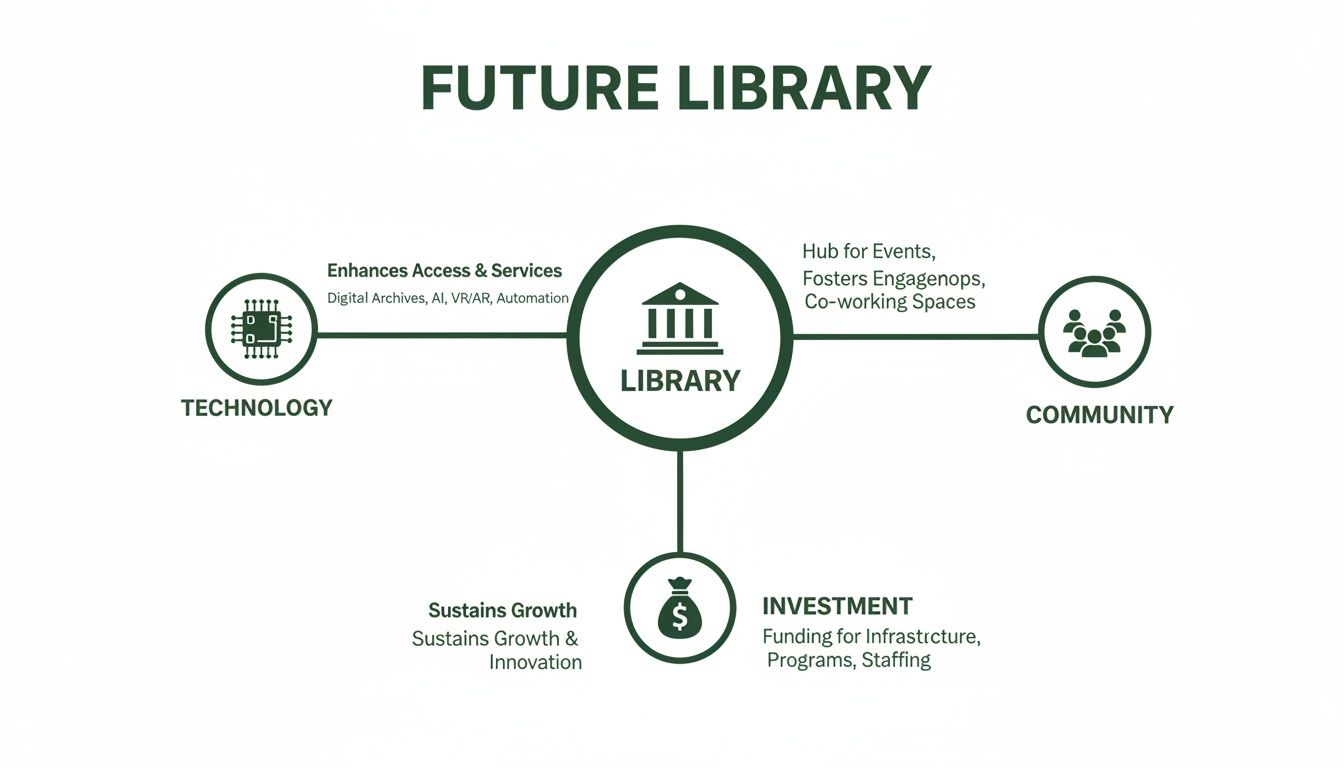
As you can see, the success of the modern library depends on weaving together technology, a deep community focus, and smart investment.
A New Model for Community Investment
Getting a handle on this new model is the key to unlocking a library's true potential. The library in the future is a strategic asset that pays dividends across the board. For developers, this means figuring out how a new library can hit both civic and business targets. The secret is recognizing all the different hats it wears.
- A Hub for Digital Equity: It offers free high-speed internet, computers, and digital skills training, closing the digital divide for local residents.
- An Incubator for Local Talent: It provides maker spaces with 3D printers, recording studios, and co-working areas that give entrepreneurs and small businesses a leg up.
- A Center for Lifelong Learning: It hosts everything from children's storytime to coding classes for adults and workshops for seniors, drawing in a huge cross-section of the community.
By designing spaces that support these activities, developers create a property that becomes an indispensable part of daily life. This deep engagement keeps the library relevant and busy, cementing its long-term value as both a community landmark and a solid investment.
Ultimately, investing in a library isn't just about putting up a building; it's about building a more resilient, connected, and prosperous community. Whether you're starting from scratch or giving an old building a new life, the opportunities are massive. This guide will walk you through the practical strategies—from digital infrastructure and flexible design to funding models and historic tax credits—that transform a library project into a smart, sustainable asset that can anchor urban renewal and deliver a clear return on investment.
Weaving Technology into the Architectural DNA
When we think about the library of the future, we need to stop treating digital infrastructure as an afterthought. It's not just another line item in the budget; it's as critical as the building's foundation. For developers and owners, this means planning for technology from the absolute beginning, treating it as the building’s central nervous system. This approach—embedding a robust and flexible tech ecosystem right into the blueprints—is the only way to avoid painful, expensive retrofits and ensure the library remains a vital asset for decades.
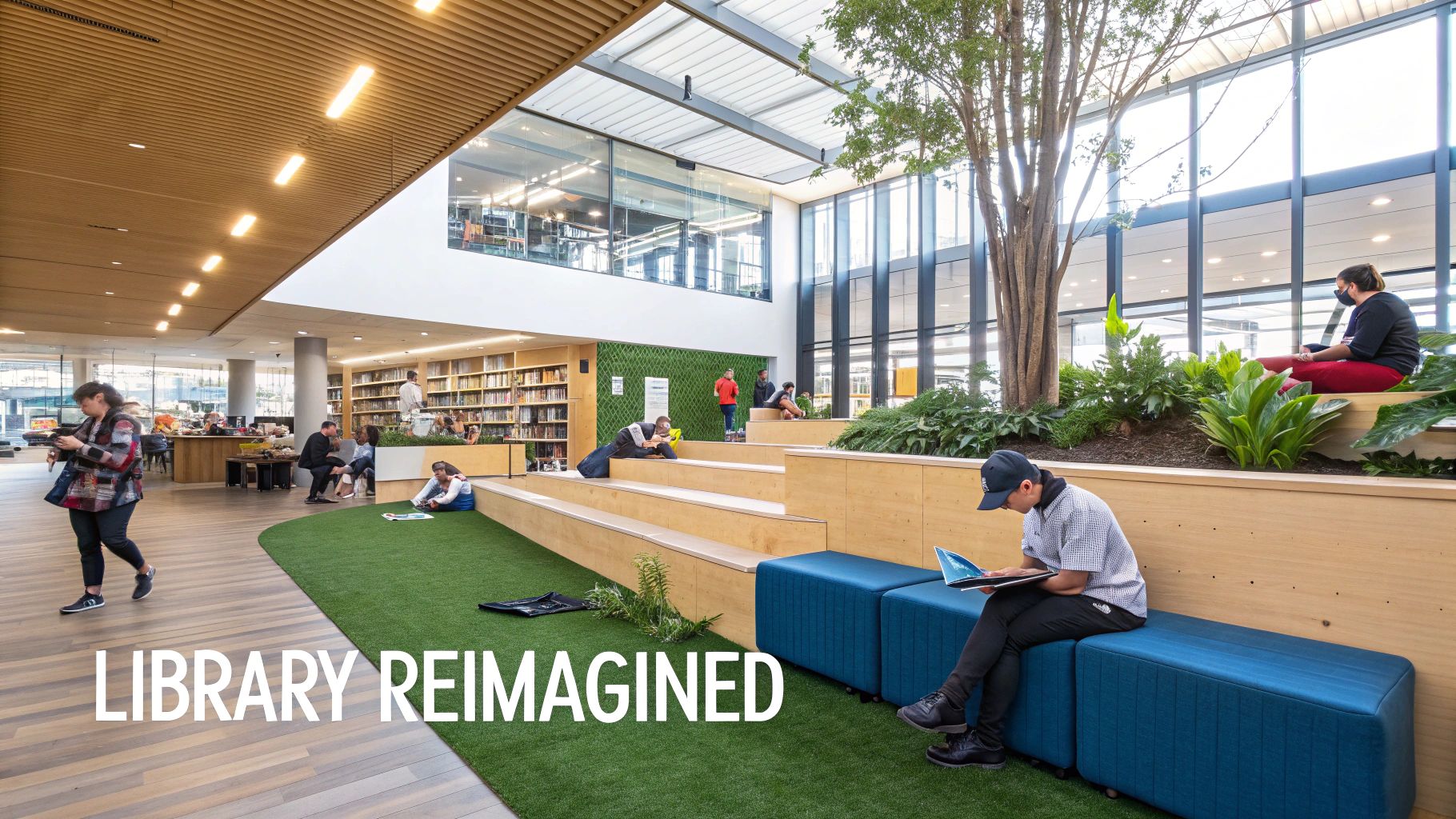
This isn’t just about offering public Wi-Fi. It’s a fundamental shift in how we design a building's core systems. The real goal is to create an environment where technology is invisible, supportive, and ready for whatever comes next.
Moving Beyond the Server Room
The old model of walling off a huge, climate-controlled room for racks of servers is quickly becoming a relic. A forward-looking design doesn't get bogged down by today's hardware; it plans for agility and the certainty of future upgrades.
This is all about creating flexible pathways for power and data. Instead of dedicating a permanent server closet, architects need to design accessible, easily upgradable conduits and raceways that run throughout the building. This simple change allows technology to evolve without forcing disruptive—and costly—structural renovations later on.
Think of it like the plumbing in a house. You wouldn't build a new home without meticulously planning where the pipes need to go. Data flows the same way. It's a core utility that has to be designed into the very fabric of a modern library, powering everything from interactive displays to the countless devices visitors bring with them.
This design shift has a real impact on space allocation, too. By ditching the traditional server room, developers can reclaim valuable square footage. That space can then be used for revenue-generating or community-focused purposes, like a small café, private meeting pods, or an expanded area for workshops and events.
And the clock is ticking. Projections show that by 2026, academic libraries will be operating in almost completely digital environments. Cloud computing is set to become the standard for nearly all services, which demands ubiquitous, high-speed internet. With mobile devices already far outnumbering desktops, the need for seamless wireless connectivity will only intensify.
The Bones of a Modern Library: Power and Connectivity
To build a library that’s truly ready for the future, developers have to get two things right from the start: power and data. The old way of sprinkling a few outlets along the walls just doesn't cut it anymore for a community that depends on personal devices for everything.
Architectural planning needs to address these modern demands head-on. Here’s how:
- Smart Electrical Grids: Design electrical systems that are built to expand. This means installing floor boxes with both power and data ports in open areas, placing outlets in unexpected places like outdoor seating, and using modular power systems that can be rearranged as the library’s layout evolves.
- Pervasive Wireless Access: The building’s very structure must be designed to support flawless Wi-Fi coverage. This involves thinking critically about where to place wireless access points and avoiding signal-blocking materials like thick concrete or metal walls in key areas where people gather.
- Redundant Connections: Don't rely on a single point of failure. The building should have multiple points of entry for fiber optic cables. This redundancy protects against service outages and provides the massive bandwidth needed for cloud services, virtual reality experiences, and large-scale data access.
The table below breaks down the shift in thinking required when designing a library's infrastructure.
Future Library Tech vs. Traditional Library Infrastructure
| Architectural Feature | Traditional Library Approach | Future Library Requirement |
|---|---|---|
| Data Infrastructure | Centralized, fixed server room with heavy HVAC. | Distributed, flexible conduits and raceways for easy upgrades. |
| Power Distribution | Wall-mounted outlets placed intermittently. | Integrated power grids with floor boxes, modular systems, and outdoor access. |
| Connectivity | Basic Wi-Fi as an amenity. | Building-wide, high-density Wi-Fi as a core utility. |
| Structural Planning | Materials chosen for aesthetics and durability alone. | Materials chosen to minimize signal interference; planned pathways for cabling. |
| Space Allocation | Significant square footage lost to server and IT closets. | Reclaimed square footage for public-facing programs or leasable space. |
| Future-Proofing | Retrofits are expensive and structurally invasive. | Upgrades are managed through accessible pathways with minimal disruption. |
As you can see, the architectural DNA of a future-ready library is fundamentally different. It anticipates change rather than reacting to it.
Of course, successfully weaving this digital framework into a building requires smart financial planning. Understanding how to secure specialized funding is a crucial piece of the puzzle. You can learn more about accessing this capital through resources focused on Winning Nonprofit Grants for Technology. By embedding this digital foundation from day one, developers create a resilient, adaptable asset that will maximize its utility and value for years to come.
Designing Spaces for People, Not Just Collections
Once you have a solid technology backbone, the real work begins. The focus for the library in the future isn't about infrastructure; it's about experience. We’re moving past the idea of libraries as mere warehouses for books and embracing them as dynamic, human-centric community hubs.
A library's true value lies in its role as a community "third place"—that essential spot that isn't home and isn't work. How well a library fills this role directly impacts its success and, from a developer's perspective, its return on investment.
This means we have to think beyond static, rigid layouts. Imagine a single large, open space that completely transforms throughout the day. It could be a quiet study zone in the morning, a buzzing, collaborative workshop in the afternoon, and an elegant event venue by night. This is the kind of flexibility that attracts a wide range of people and keeps them coming back.
To pull this off, you need a smart approach to space planning. For anyone looking to get a better handle on the fundamentals, there's a practical guide to interior design and space planning that offers a great starting point.
Creating Multifunctional Zones
The secret to a truly adaptable building is creating multifunctional zones. This isn't about adding more rooms; it's about making every single square foot work harder. Architects and developers can achieve this fluid design with a few key strategies that allow for rapid changes with minimal effort.
When these elements work in concert, they create an environment that can be reconfigured on the fly, responding almost instantly to what the community needs right then and there. This adaptability is what turns a good building into a great community asset.
Here are the core components that make it happen:
- Modular Furniture: Think lightweight tables, chairs, and shelving on casters. These can be rearranged in minutes to support anything from individual work to large group sessions.
- Smart Acoustic Paneling: Deployable acoustic dividers or smart panels can absorb or reflect sound as needed. This simple feature allows a noisy kids' program and a quiet reading group to exist peacefully in the same open space.
- Adaptable Lighting Systems: With zoned, dimmable lighting controlled by a central system, you can instantly change the mood of a space—shifting from bright, focused task lighting to warm, ambient light for a social mixer.
Practical Examples of Human-Centric Design
Bringing these principles to life is where the magic happens. It’s all about adding features and amenities that fit modern lifestyles and solve real problems for patrons, making the library an indispensable part of their daily routine.
Take something as simple as integrating a small café or coffee bar. It does more than just serve refreshments; it encourages people to stay longer and use the library as a social meeting point. This one addition can completely change the building's atmosphere and dramatically increase how long people stick around.
Soundproof pods are another powerful example. These small, private enclosures are a perfect solution for patrons needing to take a video call, record a podcast, or just find a moment of true quiet in a busy public space. They directly meet the needs of an increasingly remote and flexible workforce.
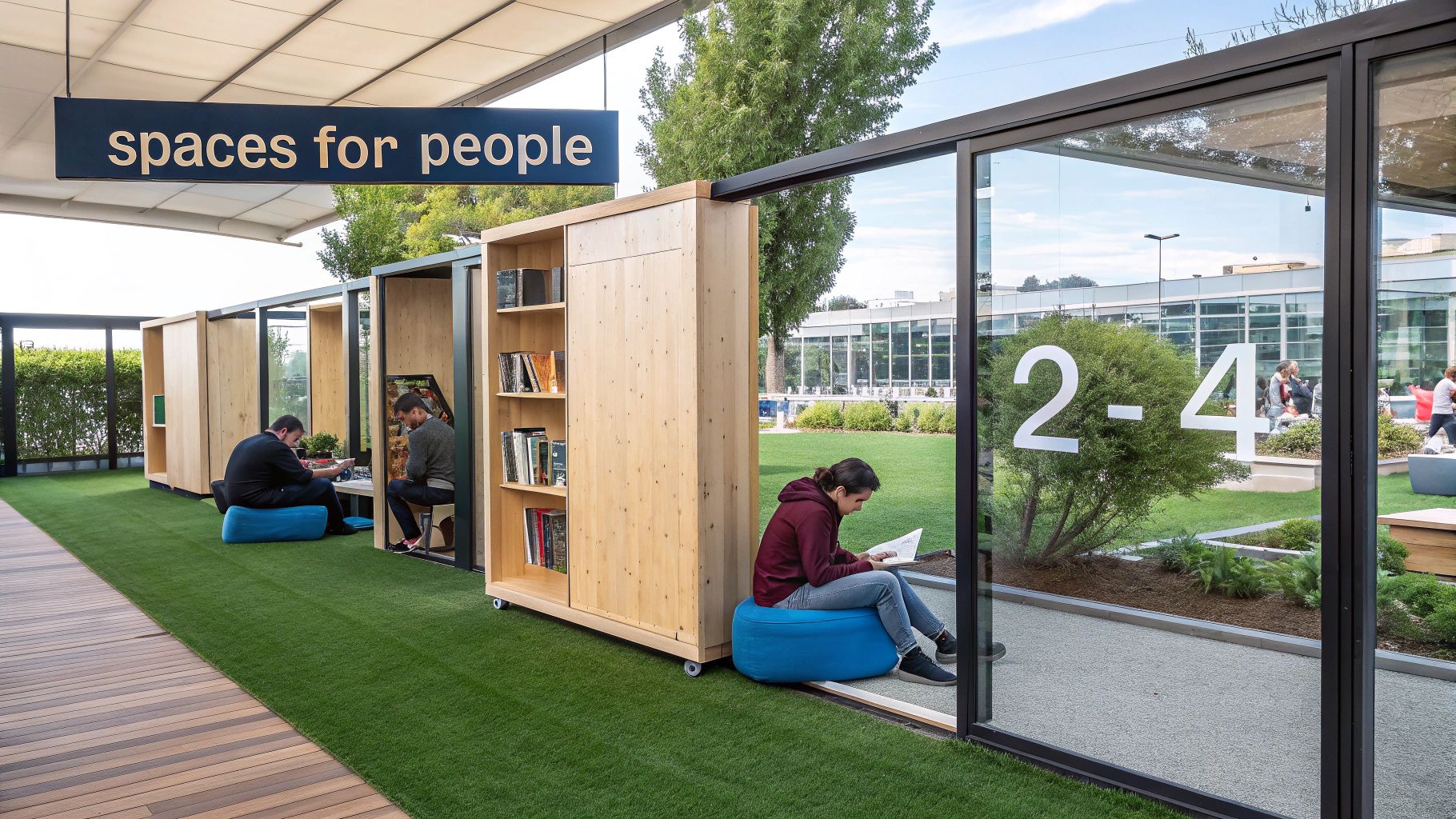
The most forward-thinking libraries are even extending their footprint outdoors. Designing inviting outdoor reading gardens, patios with Wi-Fi access, or even children's nature-play areas creates new destinations within the library grounds, offering fresh air and a connection to the environment.
These design choices aren't just nice-to-haves; they are strategic investments in community engagement. Recent industry data confirms this shift in priorities. A 2025-2026 survey found that increasing physical visits is now the top goal for library marketers. The data, which saw a 15% increase in responses over the previous year, underscores that libraries are laser-focused on in-person experiences and building community trust. You can dive deeper into how libraries are prioritizing this in the latest state of library marketing report. This is clear proof that thoughtful, human-centric design directly supports core operational goals by drawing people in and keeping them there.
The Business Case for Adaptive Reuse and Historic Preservation
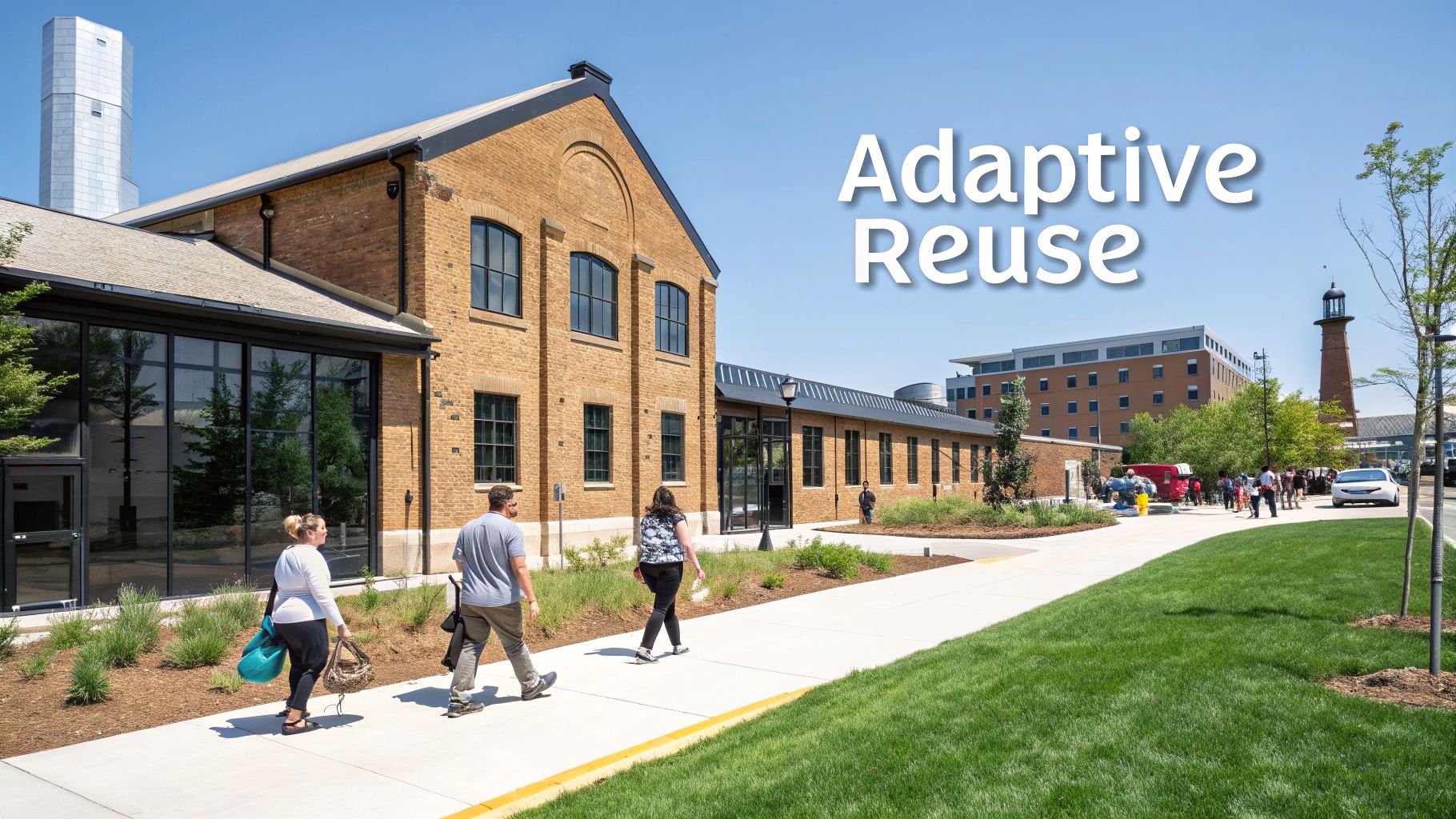
When you think about building a new library, starting from a clean slate seems like the obvious choice. But there’s a powerful, and frankly, often more profitable alternative: adaptive reuse. This is the art of taking an existing building and giving it a completely new purpose. For a savvy developer, this isn't about nostalgia; it's a strategic business move loaded with financial and logistical perks that can create an incredible vision for the library of the future.
Right off the bat, this approach tackles some of the biggest headaches in modern development. The upfront costs are often much lower than new construction because you already have the bones—the foundation, exterior walls, and maybe even major systems are in place. This translates into a more predictable budget and a much quicker path from acquisition to ribbon-cutting.
On top of that, adaptive reuse is inherently sustainable. By breathing new life into an old structure, you’re dramatically cutting the carbon footprint that comes from demolition and manufacturing new materials. This isn’t just good for the planet; it's a compelling story that resonates with communities and attracts environmentally-minded partners and patrons.
Unlocking Value with Historic Tax Credits
The financial picture gets even brighter when the building has a little history to it. Historic preservation is more than just protecting the past—it’s a proven economic engine. Developers can tap into substantial federal and state historic tax credits that can slash rehabilitation costs and make a project’s numbers work beautifully.
The Federal Historic Preservation Tax Incentives program, for example, offers a 20% income tax credit for the certified rehab of historic, income-producing buildings. This is a true credit, not a deduction. It’s a dollar-for-dollar reduction of your tax bill, making it one of the most powerful redevelopment tools out there.
This kind of financial leverage flips the script, turning a building’s unique character from a potential headache into a genuine asset. The very things that make a building historic—its detailed brickwork, soaring ceilings, or gritty industrial past—become the foundation for a landmark that draws in the community and builds real pride.
Think of an old, vacant downtown bank with its grand lobby and echoing ceilings. Through adaptive reuse, this eyesore can be reborn as a cutting-edge community hub. The vault becomes a one-of-a-kind children's reading nook, and the open teller hall transforms into a flexible event space—all while keeping the building’s soul intact.
Turning Perceived Liabilities into Profitable Assets
The potential for adaptive reuse is hiding in plain sight all over our cities. Visionary developers can spot opportunity where others just see decay. That forgotten warehouse, an empty big-box store, or even a decommissioned church can have the "good bones" needed for a spectacular library transformation.
These old structures often bring distinct advantages you just can't get with new builds:
- Generous Interior Volume: Older industrial and commercial buildings frequently boast high ceilings and wide-open floor plans. This is a perfect canvas for creating the flexible, multi-use zones that modern libraries thrive on.
- Prime Locations: Many of these buildings sit right in the heart of established neighborhoods. That means built-in foot traffic and community access that would be incredibly expensive—or even impossible—to secure with a new plot of land.
- Unique Character and Story: An existing building comes with its own narrative. A library housed in a former textile mill, for instance, can weave the area's industrial heritage right into its identity. It creates an authentic sense of place that a new building could never replicate.
This mindset empowers developers to think beyond the default of demolition. You can create a project that is more cost-effective, gets to market faster, and is deeply woven into the fabric of its community. By using the financial tools of historic preservation and the sustainable nature of adaptive reuse, an old building becomes a profitable, community-enriching asset—the perfect home for the library of the future.
Funding Models and Measuring Your Return on Investment
A beautiful design for a future-focused library is one thing, but it's just a drawing without a smart financial strategy to back it up. For developers and property owners, the question is always the same: How do we pay for this, and what’s the actual return? It’s time to look past traditional municipal bonds and embrace a more diverse, collaborative toolkit for funding.
This approach reframes the library not as a simple public expense but as a joint venture in community building. It’s about creating a coalition of stakeholders—from private investors to local businesses—who all see a tangible benefit from the library's success.
Creative Capital Stacks
Putting together the financing for a modern library is a bit like assembling a puzzle. Each piece is a different funding source, and when you combine them, you create a stable financial foundation that doesn't depend too heavily on any single stream.
- Public-Private Partnerships (P3s): These are agreements where private developers might finance, build, and even operate a public asset like a library. The payoff? It could be a long-term lease, the air rights to build apartments above the library, or other commercial perks that make the numbers work.
- Corporate Sponsorships: Local and national companies are often looking for ways to connect with the community. This can be as straightforward as sponsoring a specific room—like a children’s wing or a tech lab—or funding entire programs, which provides a reliable stream of operational cash.
- New Markets Tax Credits (NMTC): This federal program is designed to spark development in lower-income areas. By funneling investment into a library project through a Community Development Entity (CDE), investors get a significant tax credit, making it a very appealing financial tool.
The modern library is an economic engine, not a cost center. Proving this requires a shift from measuring circulation numbers to tracking tangible economic and social impacts that resonate with investors, city planners, and the community.
Thinking this way turns the library into a legitimate commercial real estate opportunity. This is especially true when you consider the booming market for digital services it supports. The global digital library market was already valued at $5,463 million by the end of 2025 and is on track to hit nearly $12 billion by 2033. North America is leading the charge, holding a 67.70% regional share. You can dig into the full market report to see just how significant this trend is.
Measuring Success Beyond the Books
To get these diverse funding partners on board, you have to prove the library delivers a measurable return on investment (ROI). The trick is to look beyond old-school metrics and start tracking the library's broader economic and social halo effect. You have to think like an analyst tracking the performance of any other commercial asset.
This data-driven approach doesn't just justify the investment; it builds a compelling story. It shows, in black and white, that a modern library is a catalyst for urban renewal and a sound financial bet.
Here are the key performance indicators (KPIs) to start tracking:
- Increased Property Values: Pull the real estate data for the blocks immediately surrounding the library. A lively community hub almost always leads to a noticeable bump in both commercial and residential property values.
- Local Business Revenue Growth: Team up with nearby cafes, shops, and restaurants to track foot traffic and sales. The library brings a steady flow of people into the area, which directly benefits the businesses next door.
- Community Engagement Metrics: Don't just count heads at the door. Track workshop attendance, meeting room bookings, and public Wi-Fi usage. These numbers show deep community integration and prove the library is providing real value.
- Workforce Development Outcomes: Find out how many people are using the library’s resources for job searching, resume writing, or skills training. This data positions the library as a vital part of the local economic development engine.
So, What's Next? Turning Vision into Reality
Bringing the library of the future to life isn’t about checking boxes on a generic development plan. It’s a creative process, a blend of smart technology, people-focused design, and strategic real estate development that creates a powerful anchor for any community. We’ve covered the core ingredients; now it's time to put them together into a practical game plan for your project.
It all starts with a mental shift: see the library not just as a public service, but as a genuine economic driver and a central community hub. Once you've made that leap, every decision—from wiring the building for future tech to designing spaces that can be a classroom one day and an event space the next—falls into place. This integrated approach is what elevates a library from a simple public amenity to a smart, lasting investment.
Your First Moves
To get from a great idea to breaking ground, you need to focus on a few critical first steps. Getting these right lays a solid foundation, reduces risk, and sets your project up for success right from the start.
- Get the Lay of the Land: Before you do anything else, you need to understand the context. Dive deep into local demographics, figure out what the community is missing, and weigh the pros and cons of adaptive reuse versus a brand-new build. This foundational data will shape every decision you make down the line.
- Build a Realistic Financial Model: It's time to map out your capital stack. Start exploring the public-private partnerships, historic tax credits, and other creative funding avenues we talked about. A solid, realistic financial proforma is non-negotiable for getting investors and partners on board.
- Find the Right Architect: This is a make-or-break decision. Look for a firm that has real-world, proven experience in commercial development, especially with projects involving historic preservation and adaptive reuse. Their expertise will be your guide through the maze of zoning laws, city approvals, and the practical challenges of turning a vision into a beautiful, functional building.
The modern library is a premier investment that anchors communities, stimulates local economies, and leaves a lasting legacy. It's a testament to what's possible when strategic development meets genuine community need.
With this roadmap in hand, you can confidently move your project forward. The next step is finding an expert partner who can help you navigate each stage, ensuring your library becomes both a profitable landmark and a source of community pride.
Frequently Asked Questions
When you’re thinking about a modern library project, a lot of practical questions come up, especially for developers, investors, and property owners. Let's tackle some of the most common ones, from keeping costs in check and getting the community on your side to making sure the investment pays off for years to come.
How Much Does a Modern Library Project Cost?
Trying to nail down a precise number is tough. The biggest factor is whether you're building from the ground up or breathing new life into an existing building through adaptive reuse.
New construction will almost always cost more per square foot. You're dealing with everything—site work, foundations, the whole structural system. It adds up quickly.
Adaptive reuse, on the other hand, can be a smarter financial move. This is especially true if you can tap into historic tax credits, which can cover up to 20% of the rehab costs. The trick is to get a solid feasibility study done right at the start. It will give you a clear picture, comparing the cost of upgrading an old building’s bones and systems against the price tag of a brand-new one.
How Do We Get Community Buy-In for a New Library?
Getting the community behind your project isn't just about good PR; it’s absolutely essential for navigating zoning approvals and unlocking public funding. The only way to do it right is to bring people into the conversation from day one.
Forget the old top-down approach. Instead, think about hands-on workshops and widespread surveys to find out what people in the neighborhood actually want and need.
- Be direct: What services are they missing out on? What hours would make their lives easier? What kinds of spaces would really help out families, students, or the growing number of remote workers?
- Build alliances: Team up with local schools, neighborhood groups, and business associations. A strong coalition is your best advocate.
- Talk about the bottom line: Show them the data. A great library can boost property values, drive foot traffic to local businesses, and offer crucial job skills training.
When you take this kind of collaborative path, the project stops being something you’re doing to the community and becomes something you’re all building together.
What Makes a Library Project Sustainable Long-Term?
For a library in the future to truly last, it needs to stand on three strong pillars: financial stability, environmental responsibility, and unwavering community relevance.
A truly sustainable library isn't just about saving energy. It needs to be financially sound on its own and woven into the very fabric of its community. The design has to be nimble enough to meet needs that will change over the next 50 years.
Financially, this means getting creative with revenue. Think public-private partnerships, leasing space to a café or retailer, and renting out rooms for events. Environmentally, it’s about smart choices—durable materials, super-efficient HVAC systems, and a design that lets in plenty of natural light to slash utility bills.
But the most critical piece is relevance. By creating flexible spaces that can shift and change, and by offering programs that people genuinely need—from digital skills workshops to resources for small business owners—the library stays essential. It becomes a place people can't live without, securing its value for generations.
Are you ready to turn your vision for a modern community anchor into a profitable reality? The team at Sherer Architects, LLC has decades of experience in commercial development, adaptive reuse, and historic preservation. We guide owners through every stage of design and construction, transforming complex projects into beautiful, enduring, and sustainable assets. Learn how we can bring structure to your life's work at shererarch.com.