

A site plan architect is the person who looks at a raw piece of land—whether it's an empty lot or a property ready for a new chapter—and figures out the absolute best way to use it. They are the master planners who turn a developer's vision into a practical, buildable, and profitable reality.
They don't just plop a building down in the middle of a site. Instead, they solve a complex puzzle involving zoning codes, traffic flow, utility access, environmental constraints, and the overall human experience. They are the critical link between a great idea and a project that actually gets approved and built.
What a Site Plan Architect Actually Does
Imagine a site plan architect as the quarterback of the development team. The building itself might be the star receiver, but the quarterback reads the entire field—the zoning regulations, the slope of the land, the flow of traffic—and calls the plays that set the project up for success. They coordinate the entire team of engineers, surveyors, and landscape designers to execute a winning strategy.
Their job is to create a comprehensive blueprint for the entire property, not just the building. This involves thinking through every variable from the very beginning to maximize a property's potential.
The Strategic Visionary for Your Property
The whole process starts with a deep dive into the property itself. The architect walks the site, studies the topography, and analyzes everything from sun angles to existing trees and neighboring properties. Their first goal is to understand the land’s natural strengths and weaknesses.
This strategic thinking is absolutely essential for projects like:
- New Commercial Construction: Figuring out the best spot for the main building, where to put parking for easy access, and how to create inviting green spaces that draw in customers.
- Complex Renovations: Overhauling an existing site to improve traffic circulation, add an outdoor patio, or meet modern accessibility (ADA) requirements.
- Adaptive Reuse Projects: Taking an old warehouse or a forgotten mill and creating a site plan that transforms it into a vibrant mixed-use space, like the Olympia & Granby Mills redevelopment here in Columbia, SC.
To give you a clearer picture, let's break down their core duties and why each one matters so much to your bottom line.
Core Responsibilities of a Site Plan Architect
| Responsibility | Impact On Your Project |
|---|---|
| Zoning & Code Analysis | Ensures your project is compliant from the start, avoiding costly delays and redesigns with the city. |
| Site Layout & Massing | Determines the optimal placement and orientation of buildings, parking, and open spaces to maximize usability and value. |
| Circulation & Access Planning | Designs safe and efficient flow for vehicles and pedestrians, which is crucial for retail and commercial success. |
| Utility Coordination | Works with engineers to map out connections for water, sewer, and power, preventing expensive infrastructure surprises. |
| Permit & Approvals Navigation | Acts as your expert guide through complex Design Review Board (DRB) and zoning commission meetings. |
| Team & Consultant Coordination | Keeps civil engineers, landscape architects, and surveyors aligned, ensuring everyone is working from the same playbook. |
Ultimately, a site plan architect’s work prevents the kind of expensive, project-killing mistakes that come from a lack of foresight.
The Link Between Vision and Reality
At the end of the day, the site plan architect is the one who translates big ideas into a set of approved documents that a construction crew can actually build from. They become the central point of communication, working with civil engineers to figure out site grading and stormwater drainage, collaborating with landscape architects on creating beautiful and functional outdoor areas, and negotiating with city planners to get the green light.
A great site plan isn’t just about where the building sits; it's about how the entire property works. It dictates how people arrive, where they park, how they interact with the space, and how the project impacts its neighbors. This foundational work prevents costly mistakes and ensures long-term value.
Their expertise is often the single most important factor in keeping a project on budget, securing permits on time, and delivering a final product that meets its financial and functional goals. Without this expert guidance, even the most brilliant building design can be crippled by a poorly planned site.
The Site Planning Process from Concept to Approval
Getting from a rough idea to a city-approved, buildable site plan isn’t a single leap; it’s a journey with clear, deliberate steps. Think of a site plan architect as your guide through this entire process, making sure each phase builds logically on the one before. It's less about a one-off task and more about a structured progression that methodically turns your vision into a blueprint ready for dirt to move.
It all starts with getting the lay of the land—literally. Before any real planning can begin, the first order of business is getting a comprehensive site survey done. This initial step, which you can learn more about by understanding the site survey, gives us the critical topographic, boundary, and utility data that will influence every single decision we make down the line.
Initial Feasibility and Conceptual Design
This first phase is all about discovery and big-picture thinking. Your architect rolls up their sleeves and digs into the property's potential and its limitations, asking the core question: "What can we really do here?" This means a deep dive into local zoning ordinances, land use regulations, and any environmental constraints that set the rules of the game.
From that research, the architect develops a conceptual site plan. This isn't a technical drawing; it’s more of a high-level sketch that explores different ways the puzzle pieces can fit together. It's where we test out building footprints, access points, and how traffic might flow, letting you see the project's direction before a major investment is made.
Key takeaways from this stage usually include:
- A Zoning and Code Analysis Report, which is basically a cheat sheet of all the rules that will shape the design.
- Initial Site Analysis Diagrams that visualize things like sun paths, wind direction, and key access points.
- Two or three conceptual layouts to give us a few different high-level options to discuss and kick around.
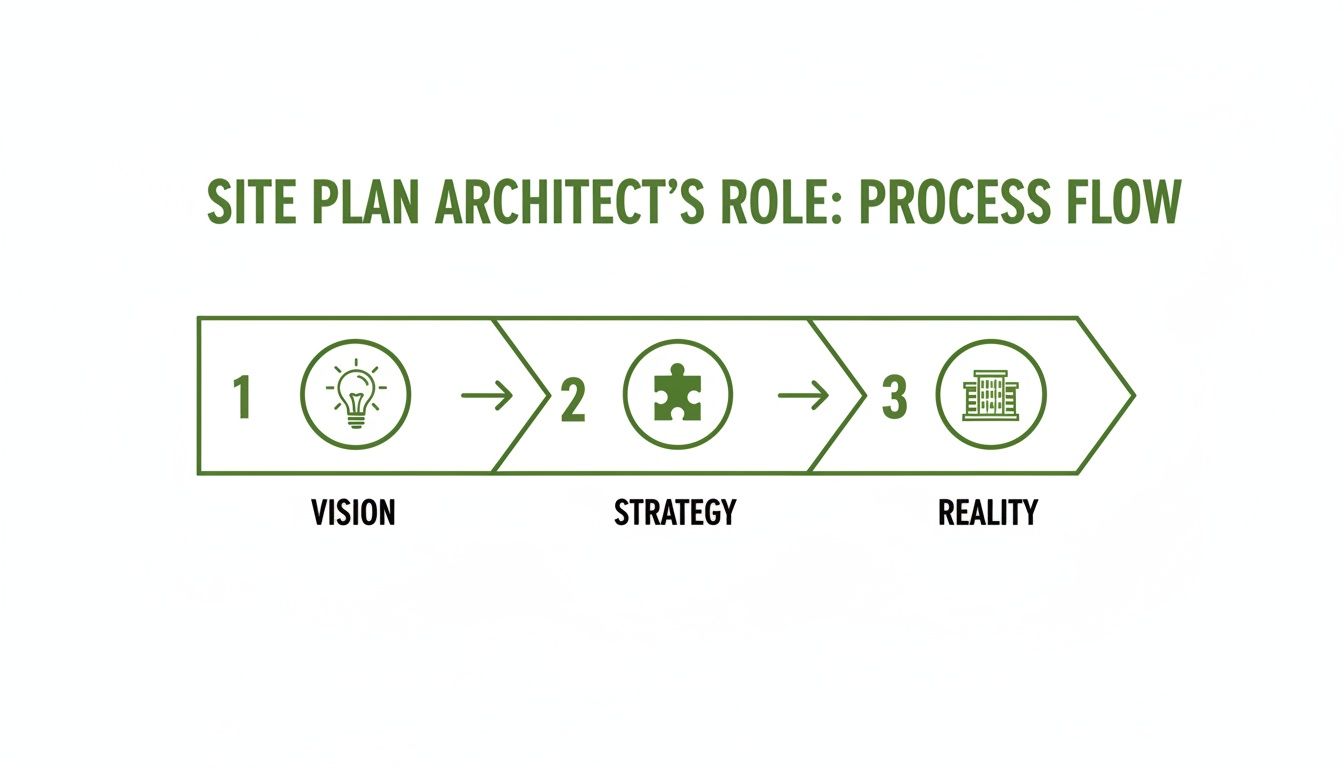
As this graphic shows, successful development isn't magic. It's about moving methodically from a broad vision to a concrete strategy, and finally, to a built reality.
Schematic Design and Municipal Coordination
Once we've landed on a concept you love, we move into schematic design. This is where we start adding layers of detail to the chosen layout. The building's placement gets locked in, the parking layout is finalized, and we begin weaving in preliminary landscaping ideas. The project really starts to feel real at this point.
This phase is also where teamwork becomes crucial. The site plan architect essentially becomes the project's quarterback, coordinating a whole team of specialized consultants.
The architect’s job is to orchestrate a symphony of experts. They make sure the civil engineer’s grading plan, the landscape architect’s planting design, and the surveyor’s boundary lines all sing from the same sheet of music, meeting both your goals and the city's rules.
This collaborative push results in a unified design package, ready for its first look by the local review boards.
Design Development and Construction Documents
Finally, we get into the most technical part of the journey. The architect and engineering team take the approved schematic design and translate it into a highly detailed set of construction documents. These are the exhaustive drawings and specifications a contractor will use to actually build the project. No stone is left unturned.
These documents detail everything, from precise grading and drainage plans to utility hookups and landscape material specifications. The full set is then formally submitted to the local authorities—like the Zoning Department and Design Review Boards—to get the final permits. A good site plan architect is invaluable here, navigating the often-tricky approvals process, making any needed tweaks, and advocating for the project to get that final green light for construction.
Unlocking Value in Commercial and Adaptive Reuse Projects
A well-designed site plan is more than just a drawing; it's a strategic financial tool that can make or break a project's profitability. For developers working on commercial and adaptive reuse projects, a site plan architect is the key to unlocking hidden value and heading off costly risks before a single shovel ever hits the ground. They're the ones who transform a property's layout into a high-performing asset.
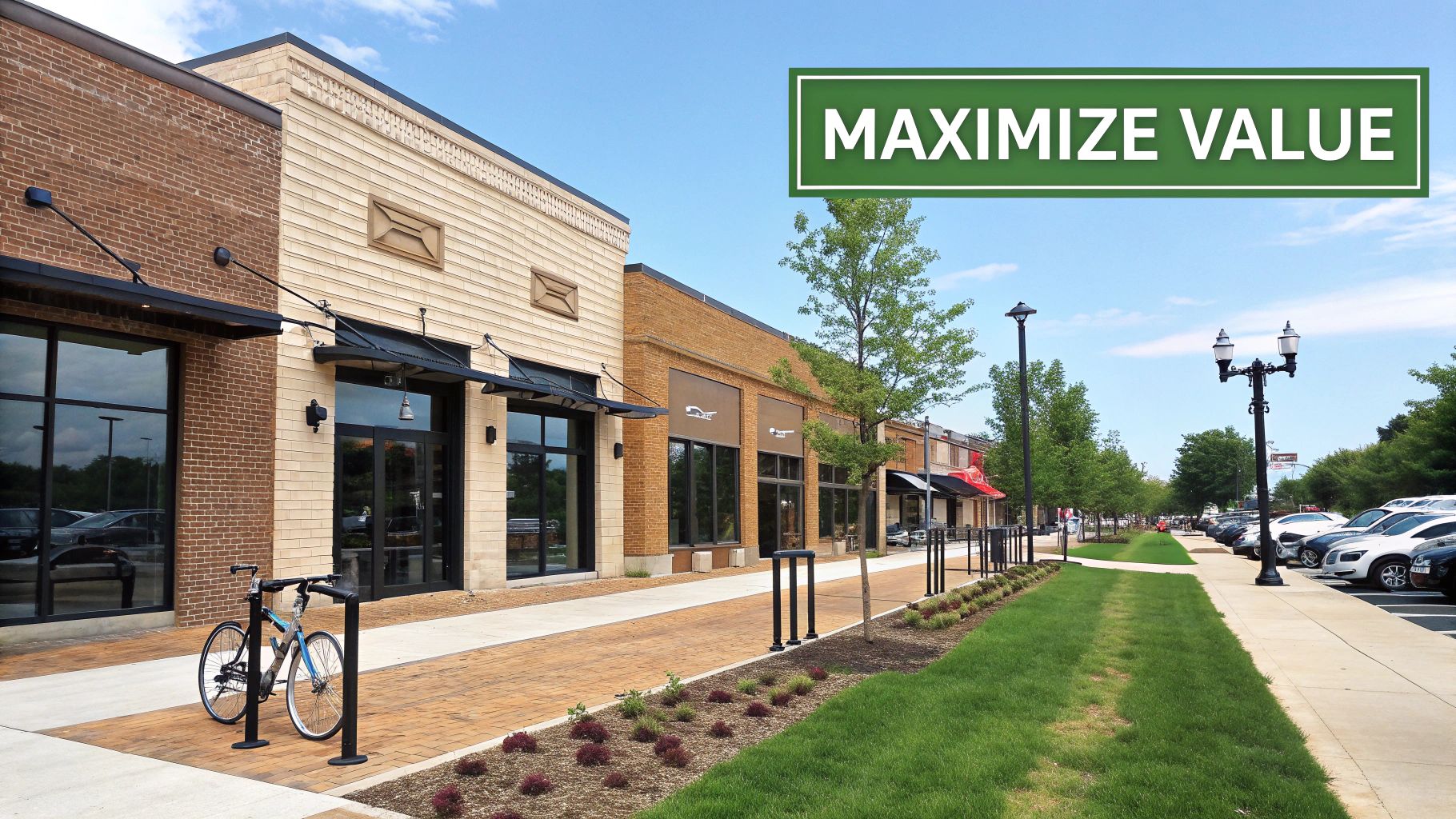
With new commercial construction, the value an architect adds is almost immediate. A thoughtful site plan squeezes the most out of every square foot, ensuring cars can move without creating traffic jams, people can walk safely, and buildings are positioned to catch the best natural light. This isn't just about aesthetics—it cuts long-term energy costs and creates a place tenants actually want to be, which directly boosts property value and keeps occupancy rates high.
Breathing New Life into Old Structures
Adaptive reuse projects are a whole different ballgame, and this is where a site plan architect's expertise becomes even more critical. The challenge here is to thread modern function and today's building codes into the very fabric of an older structure, all while preserving the character that makes it special.
Think of it as solving a complex puzzle with several key pieces:
- Integrating Modern Infrastructure: How do you run new HVAC, electrical, and plumbing systems without gutting the historical integrity of the building? It takes a deft hand.
- Meeting Current Codes: The revitalized site has to meet today's tough standards for accessibility (ADA), fire safety, and energy efficiency.
- Enhancing Site Functionality: You have to completely rethink how parking, landscaping, and access work to serve the building’s new purpose, whether it's becoming a boutique hotel or a bustling retail hub.
The Financial Case for Adaptive Reuse
The adaptive reuse revolution is far more than a trend; it's a smart, sustainable strategy for turning outdated buildings into valuable commercial assets. This movement is a huge driver of growth in the architectural world, with U.S. services projected to hit $158 billion by 2034. Firms like Sherer Architects, LLC, have successfully completed over 200 renovations, adding decades to building lifespans.
This approach is often 40% more cost-effective than tearing down a building and starting from scratch. Better yet, projects focused on historic preservation can often qualify for tax credits that cover 20-45% of the rehabilitation costs, which significantly lowers the initial investment while increasing the property's long-term value.
By preserving the embodied carbon and unique character of an existing building, adaptive reuse delivers a powerful combination of environmental sustainability and economic return. It’s not just renovation; it’s a strategic reinvestment in a community's heritage and future.
A site plan architect is the conductor of this entire transformation, proving that saving an old building can be far more profitable than demolishing it. While the architect lays the groundwork for maximizing value, the long-term success of these properties often hinges on what happens after construction. To keep that value growing, it's worth exploring how effective property management applications can help streamline operations.
2. Navigating Costs, Timelines, and Common Pitfalls
Let’s talk about the two things that keep every developer up at night: time and money. Getting a handle on the financial and scheduling realities of site planning isn’t just good practice—it's absolutely essential for a successful project.
Think of your architect’s fee not as a simple line item, but as a strategic investment. You're paying for predictability, a clear path forward, and a massive reduction in risk.
Architectural fees for site planning aren't a flat rate; they're tailored to the unique demands of your project. A straightforward commercial build on a clean, level lot is a completely different ballgame than an adaptive reuse project on a historic site with tricky grading and a mountain of city regulations to climb. The fee naturally reflects that complexity.
What Really Drives a Project’s Timeline?
More than anything else, the approvals process sets the pace. While we can map out the design phases with a good degree of certainty, navigating zoning commissions and Design Review Boards (DRBs) is where things can get unpredictable.
This is where having a site plan architect with deep local knowledge becomes invaluable. They know the code, anticipate what reviewers are looking for, and prepare submissions designed to sail through. But even with the best preparation, the review cycle itself often has its own rhythm.
A typical project timeline usually breaks down like this:
- Initial Design & Feasibility: 2-4 weeks
- Schematic Design & Consultant Coordination: 4-6 weeks
- Municipal Submittal & Review: 8-16 weeks (This is always the wild card)
- Final Construction Documents: 4-6 weeks
When you add it all up, you’re looking at five to eight months just to get through the planning and approvals gauntlet. And that's before a single shovel hits the ground.
Avoiding the Mistakes That Break Budgets
The real, tangible value of a skilled site plan architect is their knack for seeing problems before they happen. Inexperience in site planning often leads to devastatingly expensive errors that don’t show up until construction is well underway. Your architect’s foresight is your best defense against these all-too-common traps.
The most expensive mistake is the one you have to fix after construction has already started. A thorough site plan identifies and solves problems on paper, saving you immense costs and headaches in the field.
These issues pop up more often than you'd think. A seasoned architect knows how to steer you clear of them from the very beginning.
Here’s a look at some of the most frequent missteps we see and how we get ahead of them.
Common Site Planning Pitfalls and How to Avoid Them
| Common Pitfall | Architect's Proactive Solution |
|---|---|
| Underestimating Utility Costs | Engages civil engineers right away to accurately map and price connections for water, sewer, and power, preventing six-figure surprises. |
| Neglecting Stormwater Rules | Designs a compliant and efficient stormwater management system from day one, avoiding fines and mandated redesigns from the city. |
| Inefficient Site Layout | Creates a construction-friendly layout that minimizes earthmoving and optimizes material staging, saving significant time and labor costs. |
| Ignoring Accessibility (ADA) | Integrates ADA requirements for paths, ramps, and parking into the initial design, preventing expensive retrofits and potential legal issues. |
By tackling these critical issues during the planning phase, your site plan architect turns their fee from a cost into a high-return investment in your project's financial health and overall success.
How to Choose the Right Site Plan Architect
Picking a site plan architect is one of the most critical decisions you’ll make for your development project. This isn't just about hiring someone who can draw; it's about finding a strategic partner who will become your advocate, your problem-solver, and your guide through what can be a winding and unpredictable process.
The right architect doesn't just understand your vision—they have the experience and local know-how to make it a profitable reality. Finding that person means asking the right questions, ones that dig deeper than a simple portfolio review. You're vetting a key business partner, and their expertise will directly shape your project's timeline, budget, and ultimate success.

Key Questions to Vet Potential Architects
Before you sign on the dotted line, you need to have a frank conversation with any potential candidates about their experience and how they work. A good discussion will give you a real feel for their capabilities and whether their style meshes with yours.
Here are the questions I always recommend asking:
- Local Project Experience: "Can you walk me through a few site plans for projects you've successfully permitted right here in this municipality? I'm especially interested in ones similar in scale and use to what I'm planning."
- Regulatory Familiarity: "How do you keep up with the constant changes in local zoning codes and Design Review Board preferences? Tell me about a time you had to navigate a particularly tricky approval process."
- Team Collaboration: "What does your process look like for coordinating with civil engineers, surveyors, and landscape architects? How do you resolve disagreements when consultants have conflicting requirements?"
- Communication Style: "What can I expect in terms of project updates—how often and in what format? Who will be my day-to-day point of contact?"
The answers you get reveal far more than just technical skill. They show you how an architect thinks on their feet, the strength of their professional network, and how they approach client communication. These qualities are every bit as important as their design talent.
Look Beyond the Portfolio
A slick portfolio is a great start, but it shouldn't be the only thing you consider. Pay close attention to how a site plan architect talks about challenges. Do they see them as frustrating roadblocks, or are they puzzles waiting to be solved? You want a partner who is upfront about potential hurdles and already thinking about solutions.
At Sherer Architects, for instance, we see every project as a unique puzzle. Our job is to fit all the pieces together perfectly: your goals, the site's limitations, the city's rules, and the budget. The goal is always a final picture that’s not just functional, but smart, sustainable, and built to last. It’s that collaborative, puzzle-solving approach that turns a good architect into a great strategic partner who will protect your investment from day one.
Common Questions About Site Plan Architecture
If you're a developer or property owner, you know that getting a project off the ground involves a lot of moving parts. Site planning is one of the most critical, yet often misunderstood, stages. To help clear things up, here are some straightforward answers to the questions we hear most often.
Think of this as your practical guide to understanding the site plan architect's role and how it all comes together.
How Is a Site Plan Different from a Floor Plan or Survey?
This is a great question, and it's easy to get them mixed up. The simplest way to think about it is in terms of scale and perspective.
A survey is the starting point—it's the official map showing your property's legal boundaries, elevation changes, and any existing features. A floor plan, on the other hand, zooms way in to show the interior of the building itself, detailing rooms, walls, doors, and windows.
The site plan is the master document that connects everything. It’s the bird's-eye view that shows how your building, parking lots, landscaping, and utility connections all fit together on the piece of land defined by the survey. It's the strategic roadmap for the entire property.
Can a Site Plan Architect Help Secure Financing or Tax Credits?
Absolutely. In fact, a professional site plan isn't just helpful—it's usually a requirement. Lenders need to see that your project is well-thought-out, viable, and compliant with all local rules. A clear, detailed site plan gives them the confidence that their investment is sound by minimizing perceived risk.
This becomes even more critical for adaptive reuse projects.
An experienced site plan architect is your key to unlocking historic preservation incentives. They know how to create designs that satisfy the strict standards for federal and state tax credits, which can completely change the financial picture of your project and boost your return on investment.
What Is the First Step to Start a Site Plan?
It all starts with a conversation. The first step is an initial consultation with a site plan architect to talk through your vision. This meeting is really a discovery session where you can explain what you want to achieve and the architect can give you a gut check on the property's potential and foreseeable hurdles.
To get the most out of this first meeting, try to bring a few things with you:
- The property deed
- Any existing surveys of the land
- A simple summary of your goals for the project
From there, the architect will walk you through their process for the deep-dive research and feasibility work that has to happen before any design work begins.
How Does an Architect Handle Unexpected Issues During Construction?
Even the best-laid plans can hit a snag during construction. A good site plan architect doesn't just deliver a set of drawings and walk away; they remain your advocate and problem-solver on the job site.
When something unexpected happens—like discovering poor soil conditions or dealing with a material shortage—the architect steps in. They work directly with the contractors and engineers to find smart, efficient solutions. Because they know the design and the regulations inside and out, they can make necessary adjustments on the fly that keep the project moving, control costs, and ensure the final building is true to the original vision.
At Sherer Architects, LLC, we believe a well-executed site plan is the foundation of any successful development. If you're ready to unlock your property's full potential, contact us to start the conversation.