
SHERER ARCHITECTS

Categories
Uncategorized

Mastering Commercial Real Estate Investment Strategies

When it comes to commercial real estate, there's no single "right" way to invest. It's really a spectrum, a sliding scale where you balance the risk you're willing to take with the reward you hope to achieve. The industry generally breaks this down into four main approaches: Core, Core-Plus, Value-Add, and Opportunistic.

Getting a handle on this framework is your first real step toward matching your capital with a strategy that actually fits your financial goals.

Understanding The Four Core Investment Strategies

Diving into commercial real estate can feel like you're learning a whole new language, but the entire investment landscape really rests on these four pillars. Each of these strategies simply represents a different appetite for risk and, in turn, a different potential for returns.

Let's make this simple with an analogy I like to use: owning a car. Each strategy is like a different kind of car ownership, from buying a brand-new, reliable daily driver to taking on a high-stakes classic car restoration. This comparison makes it much clearer what you're getting into with each approach.

The Core Strategy: A Dependable Daily Driver

A Core investment is the most conservative play you can make. Think of it as buying a new, top-of-the-line sedan right off the lot. It’s a high-quality, fully functional asset that needs little more than regular oil changes and a car wash.

Properties in this category are usually:

  • Located in prime, stable markets with strong fundamentals.
  • Fully leased to creditworthy, long-term tenants (think national brands or government agencies).
  • Generating consistent, predictable cash flow from the day you close the deal.

The goal here isn't to hit a home run with appreciation. It's about generating stable, low-risk income, much like enjoying a smooth, predictable commute without any surprise breakdowns. The returns are modest but incredibly reliable, which is why this is a favorite for big players like pension funds and insurance companies.

The Core-Plus Strategy: Minor Upgrades for Better Performance

Moving just a bit further up the risk ladder, we land on Core-Plus. This is like buying a well-maintained, three-year-old car. It runs great, but you know a few minor upgrades—maybe some new tires, a modern infotainment system, or a deep interior detailing—could boost its value and performance.

Core-Plus properties are still high-quality, but they have some clear, manageable upside. This might mean making light renovations to common areas, leasing up a few small vacancies, or bumping up below-market rents as leases turn over. As an investor, you’re taking on a little more risk for a shot at slightly higher returns than a pure Core deal.

The Value-Add Strategy: The Major Overhaul

This is where the real hands-on work begins. A Value-Add strategy is like buying a solid but dated car that needs a new engine and a fresh paint job. The vehicle has good "bones," but it’s going to take a significant injection of cash and effort to bring it up to its full potential.

Value-Add properties typically have real problems to solve. We're talking high vacancy rates, years of deferred maintenance, or a need for a complete repositioning to compete in the current market. This approach carries moderate to high risk, but it also offers the potential for a huge payoff in appreciation once you've stabilized the property and executed your business plan.
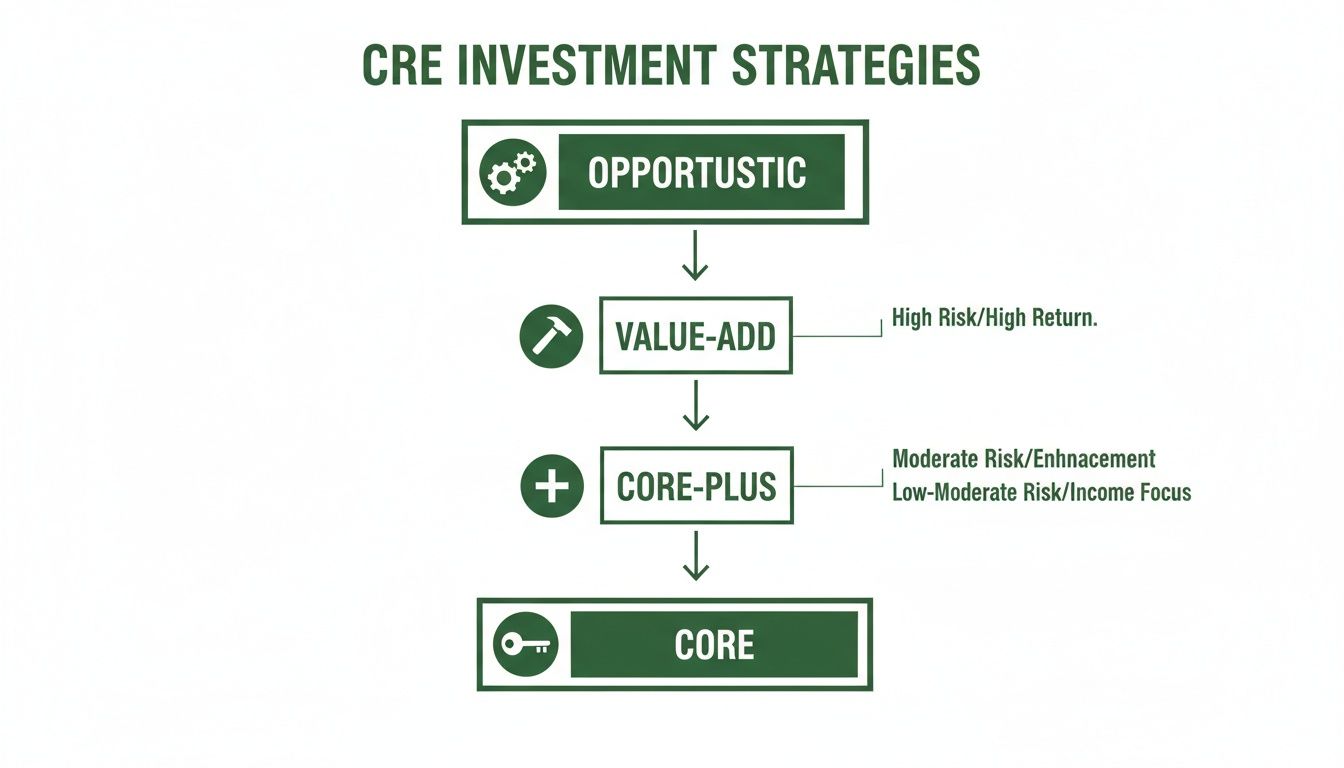
A flowchart detailing Commercial Real Estate (CRE) investment strategies, from opportunistic to core, with varying risk levels.

As this flowchart shows, as you move from Core toward Opportunistic, both the work involved and the potential returns ramp up significantly.

The Opportunistic Strategy: The Frame-Up Restoration

At the very top of the risk-reward pyramid sits the Opportunistic strategy. This is the most aggressive approach, easily compared to a full, frame-up restoration of a rare classic car. You might literally be starting with just a rusted-out frame, which in real estate terms means ground-up development, a massive redevelopment of an obsolete building, or navigating a jungle of complex entitlement and zoning issues.

Opportunistic investing is all about creating value where very little exists today. It demands a ton of capital, deep expertise, and a long-term vision, targeting the highest possible returns to compensate for the immense risk involved.

Comparing CRE Investment Strategy Risk and Return Profiles

To give you a quick at-a-glance reference, here’s how the four strategies stack up against one another. This table breaks down what you can generally expect in terms of risk, returns, and the type of property you’ll be dealing with.

Strategy Risk Level Target IRR (%) Typical Property Condition
Core Low 7% – 10% Stabilized, fully leased, prime location, Class A
Core-Plus Low to Moderate 9% – 12% Mostly stable with minor leasing or cosmetic upgrade potential
Value-Add Moderate to High 12% – 18% Significant vacancy, deferred maintenance, needs repositioning
Opportunistic High 18%+ Ground-up development, major redevelopment, raw land

Remember, these are just general guidelines. The exact numbers can shift based on the market cycle, property type, and the specifics of any given deal. Still, this gives you a solid framework for understanding where a potential investment fits on the risk-reward spectrum.

How Market Dynamics Shape Your Investment Approach

Classic and modern cars parked in a garage with 'INVESTMENT SPECTRUM' text overlay.

Knowing the core strategies is just the starting line. The real art is knowing when to use them. A brilliant value-add plan can get wiped out in a down market, while even a simple core investment can look like a genius move during an economic upswing. The best investors I know don't operate in a bubble; they align every move with the broader economic currents and market sentiment.

I like to think of the market as the weather and your strategy as your vehicle. You wouldn't take a classic convertible out for a spin in a blizzard, right? In the same way, you wouldn’t launch an aggressive ground-up development when financing has dried up and tenant demand is weak. Reading the economic forecast lets you pick the right vehicle—and the right route—for the road ahead.

This is all about turning abstract economic data into on-the-ground intelligence. Are interest rates finally leveling off? Is capital getting easier to find? Are specific cities or property types showing unexpected strength? Answering these questions helps you pivot, adapt, and put your money where it will have the biggest impact.

Riding The Waves Of Investor Confidence

One of the biggest factors at play right now is a major comeback in investor confidence. After a few years of sitting on the sidelines, people are feeling better. Stabilizing interest rates and more realistic asset prices have opened a window of opportunity, and savvy investors are climbing through it.

This isn't just a gut feeling; the numbers back it up. In 2025, global commercial real estate investment volumes bounced back hard, hitting US$213 billion in the third quarter alone. That's a 17% jump from the previous year, with the year-to-date total up 21% over 2024. This wave of capital shows that confidence is returning, especially in the Americas, where activity shot up 26% in Q3, led by the U.S. You can discover more insights about global investment trends and see what they signal for the market.

This kind of capital flow creates its own momentum. When deals get done and people make money, it pulls hesitant investors off the fence, which injects more cash into the market and helps support asset values. For developers and owners, the message is clear: get your projects ready and start deploying capital.

Following The Capital To Hot Sectors

Of course, not all real estate is created equal. Market dynamics always favor certain asset classes, and right now, the money is flowing toward sectors with undeniable, long-term demand. Figuring out why these sectors are so popular is the key to aligning your own commercial real estate investment strategies.

Two clear winners have pulled away from the pack:

  • Multifamily: Thanks to a chronic housing shortage and a cultural shift toward renting, apartment buildings are still a go-to for investors. There’s a built-in stability that comes from the constant need for housing, making multifamily a prime target for Core, Core-Plus, and certain Value-Add strategies.
  • Industrial & Logistics: The e-commerce boom just keeps going, and the push for more robust supply chains has lit a fire under the industrial sector. Warehouses, distribution hubs, and last-mile facilities are in high demand, making this a hotbed for new development (Opportunistic) and for buying and upgrading older buildings (Value-Add).

The key takeaway here is to hitch your wagon to sectors with a compelling, long-term story. Chasing fads is a good way to lose money, but positioning yourself within a trend driven by fundamental economic shifts dramatically improves your odds.

While multifamily and industrial are grabbing the headlines, that doesn't mean there aren't opportunities elsewhere. The office market, for example, is full of unique adaptive reuse projects where underused buildings are being transformed into exciting mixed-use properties. The secret is matching your own risk appetite and expertise to the specific needs—and potential—of each sector in today's climate.

Unlocking Hidden Value With Adaptive Reuse

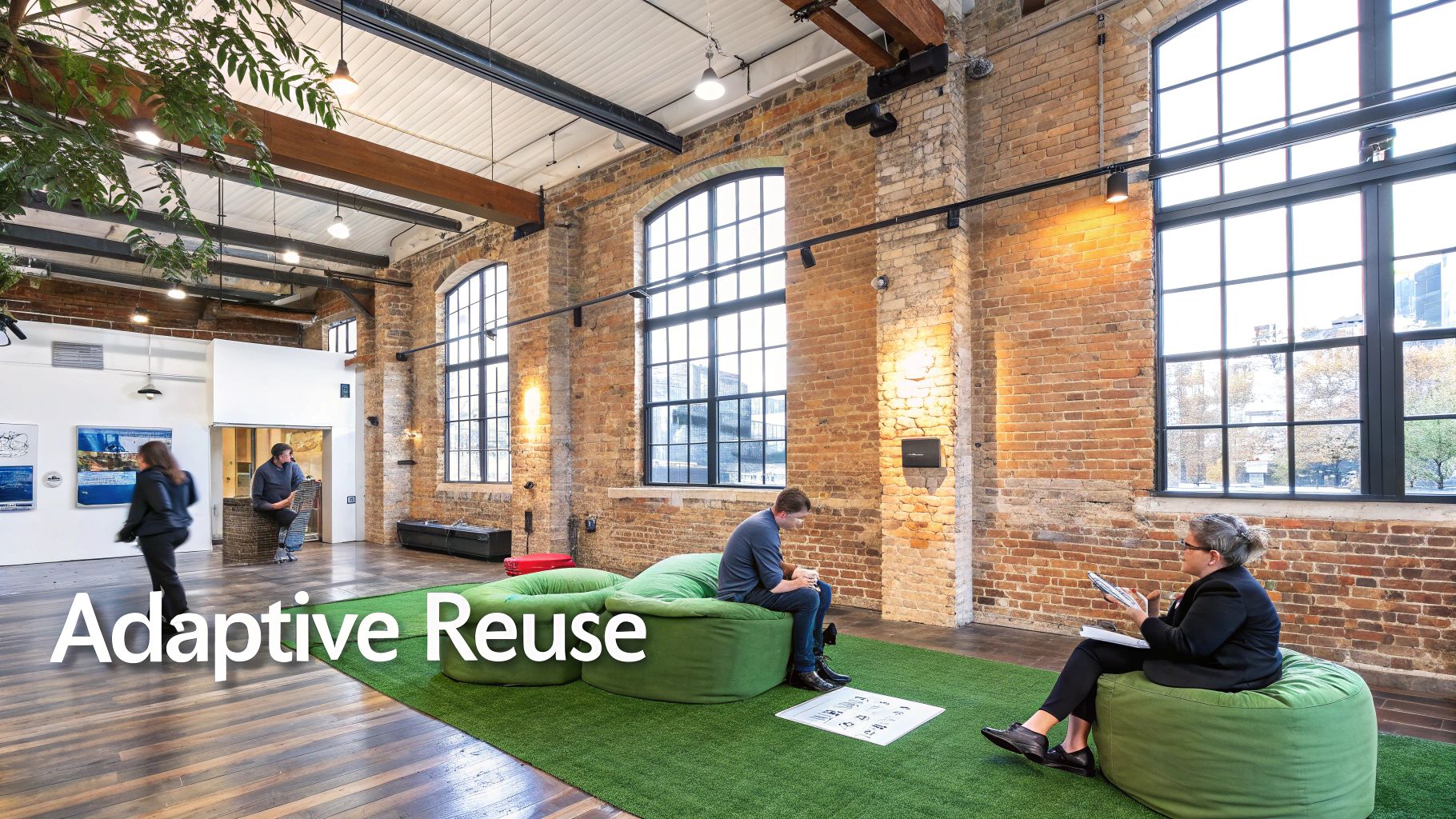
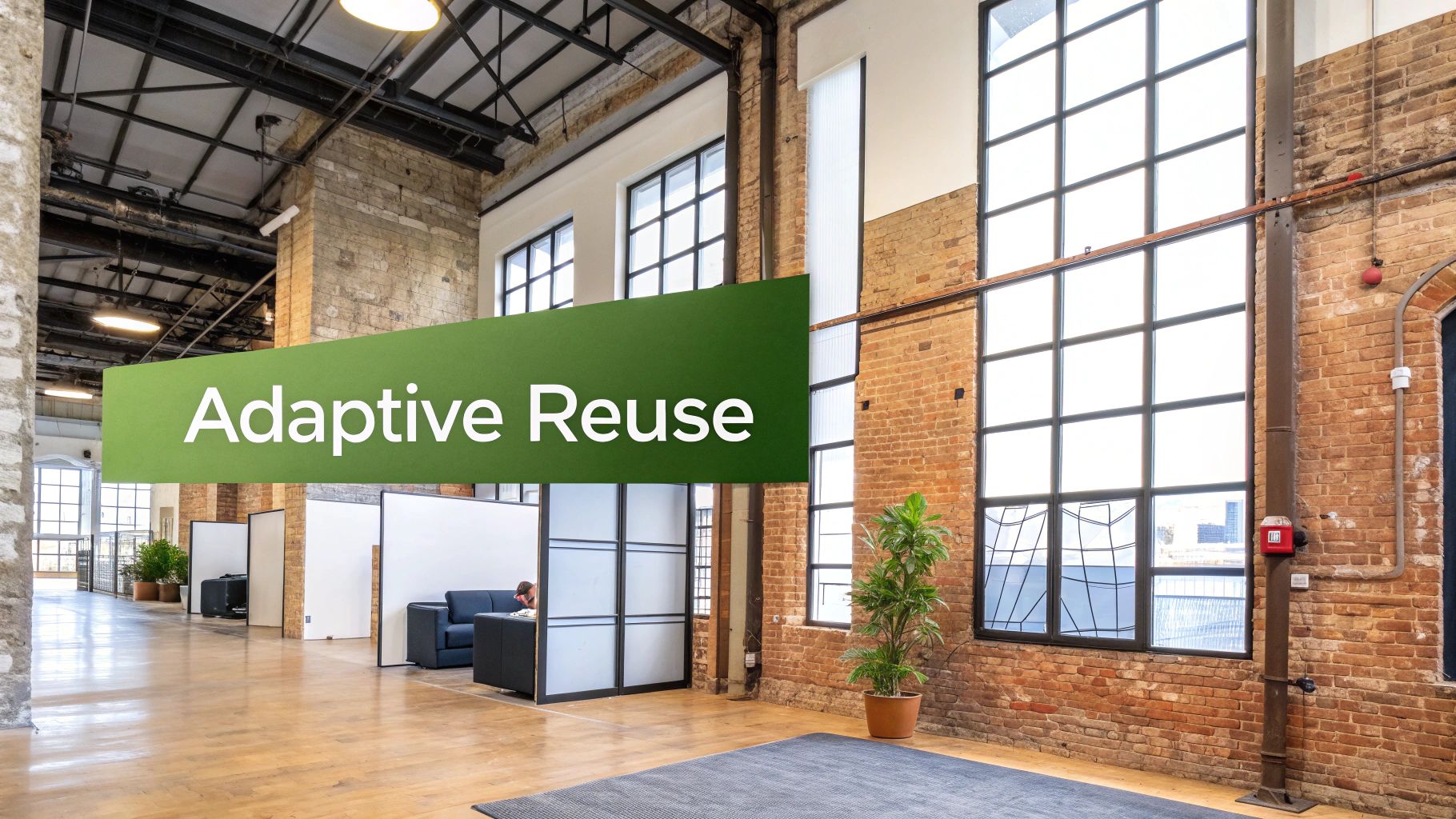
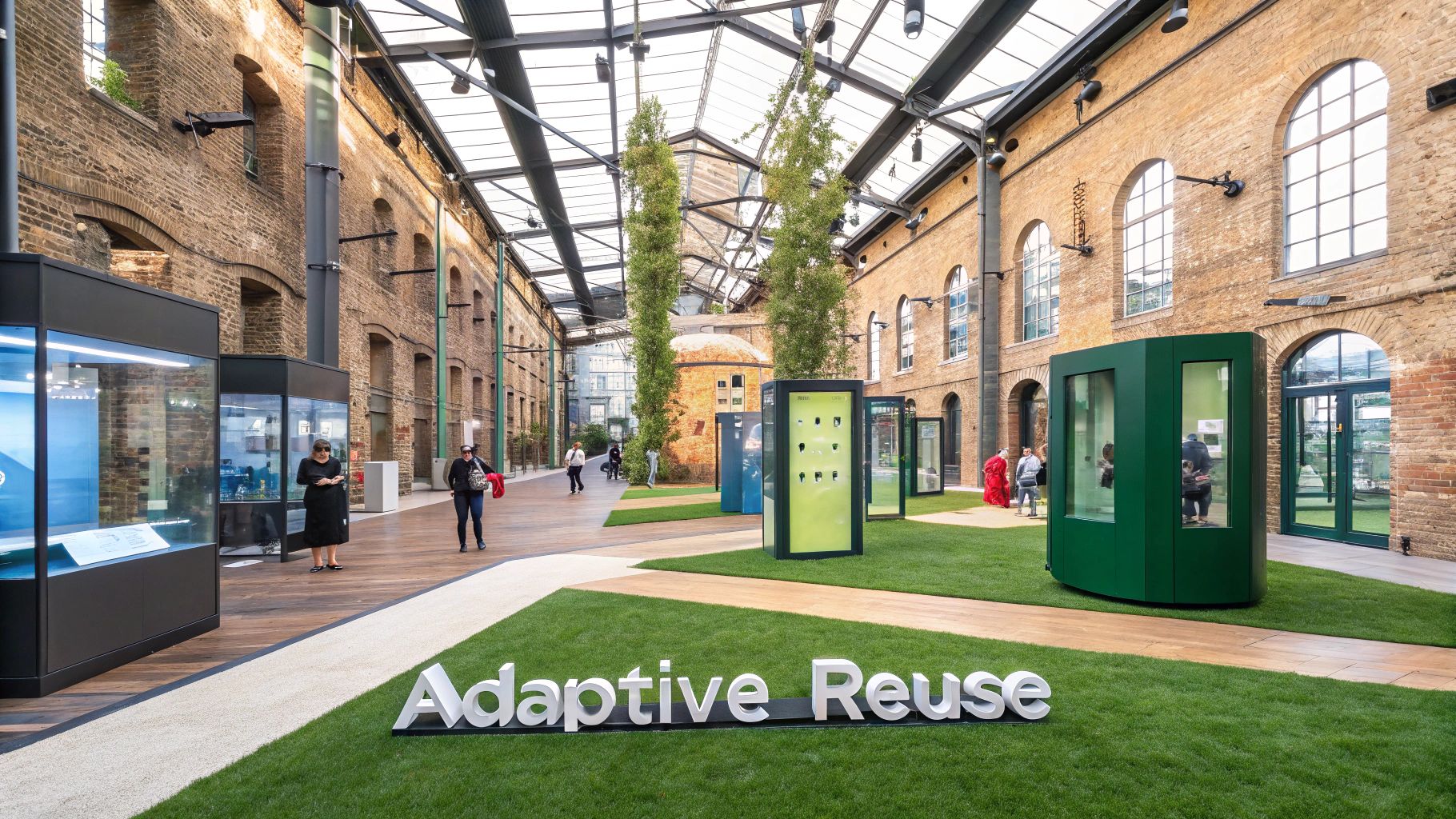
While core and value-add strategies work within a building's existing purpose, some of the most exciting returns come from seeing a property not for what it is, but for what it could be. This is the world of adaptive reuse—a strategy that breathes new life into obsolete buildings, turning forgotten properties into high-demand, profitable assets.

It’s all about rewriting a building’s story.

Imagine an old, forgotten textile mill with gorgeous brickwork and soaring ceilings. Through adaptive reuse, it becomes sought-after loft-style apartments. Or that vacant downtown department store? It could be transformed into a sleek, modern tech hub with bustling retail on the ground floor. You're not just renovating; you're giving the structure a completely new economic purpose.

This approach revitalizes communities and often delivers returns that blow more conventional investments out of the water.

The Financial Case For Transformation

Repurposing an old building might sound complicated, maybe even more so than starting from scratch. But for savvy developers, the financial and strategic upsides are often too good to ignore. The benefits go way beyond just saving a piece of local history.

The most obvious advantage is cost. By preserving the building’s “bones”—the foundation, walls, and roof—you can sidestep the massive expense of demolition and ground-up construction. This can save you a fortune on materials and labor, directly padding your project's bottom line.

Beyond the upfront savings, adaptive reuse plugs directly into what the market wants right now:

  • Sustainability: Today’s tenants, especially in office and multifamily spaces, actively seek out sustainable buildings. Repurposing a structure is about as green as it gets, slashing landfill waste and the carbon footprint that comes with new construction.
  • Authenticity and Character: People are tired of cookie-cutter spaces. An old warehouse with exposed brick and original timber beams has a soul that a brand-new building can't fake. This "cool factor" often leads to premium rents and rock-solid occupancy.
  • Faster Timelines: In many jurisdictions, an adaptive reuse project can get you to the finish line faster than a new build. That means you start collecting rent sooner, which is a huge win for your ROI.

Navigating Incentives And Tax Credits

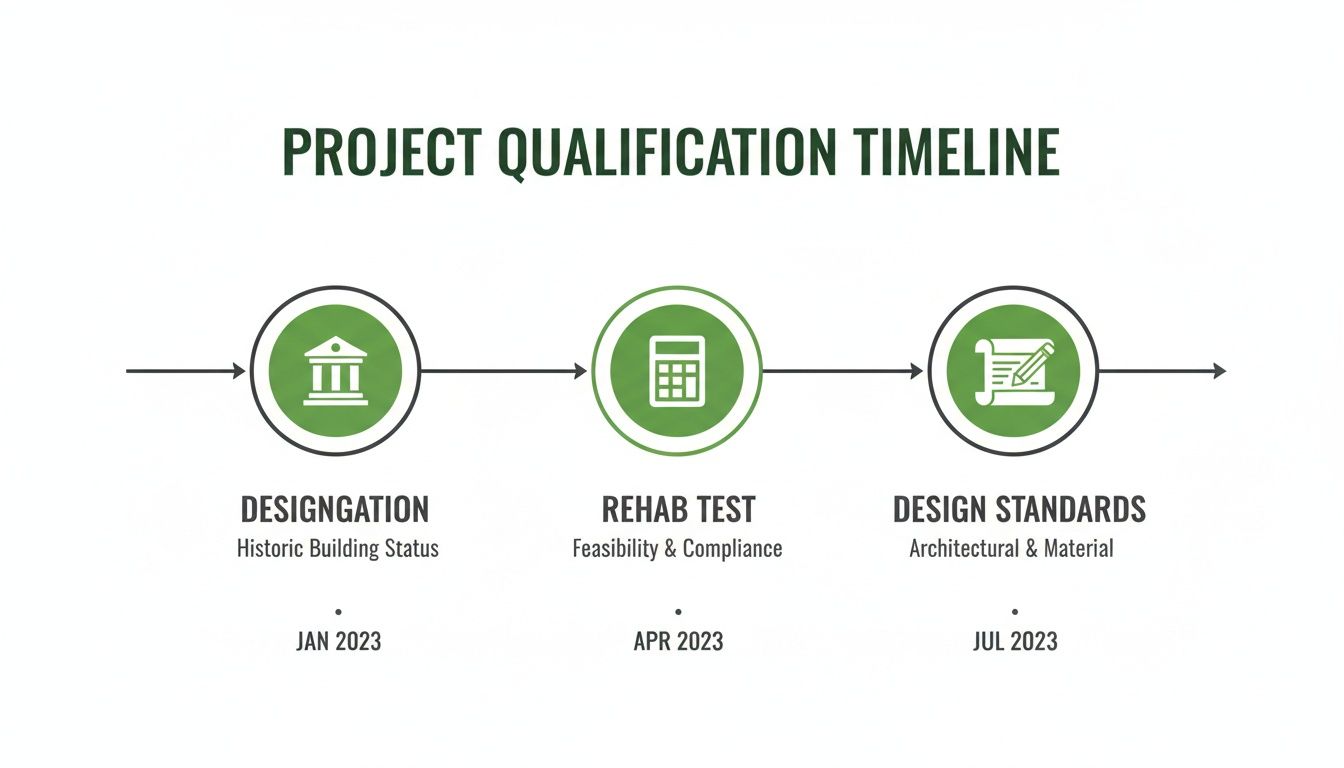
Here’s where it gets really interesting. One of the biggest financial levers you can pull in adaptive reuse is tax incentives, especially for historic properties. These programs are specifically designed to encourage private investors to save and revitalize older buildings. Knowing how to use them is key.

The Federal Historic Preservation Tax Incentives program is the big one. It offers a 20% income tax credit for the certified rehabilitation of a historic, income-producing building. Let’s be clear: this isn't a deduction. It's a direct, dollar-for-dollar credit against your tax bill, which can completely change the math on a deal.

Think about it: on a $5 million rehab of a certified historic building, a 20% tax credit means you get $1 million back. That’s a game-changer. It can make a project that looked marginal on paper suddenly look incredibly profitable.

Of course, it’s not just free money. There’s a process. You need to get the building on the National Register of Historic Places and ensure your rehab work meets the Secretary of the Interior's Standards. This is why having an architect who knows this process inside and out is non-negotiable.

On top of that, many states and cities have their own historic tax credits and grants you can stack on top of the federal program. This layering of incentives is where the most skilled developers create incredible value, all while saving irreplaceable landmarks for the next generation.

Executing Flawless Due Diligence and Financing
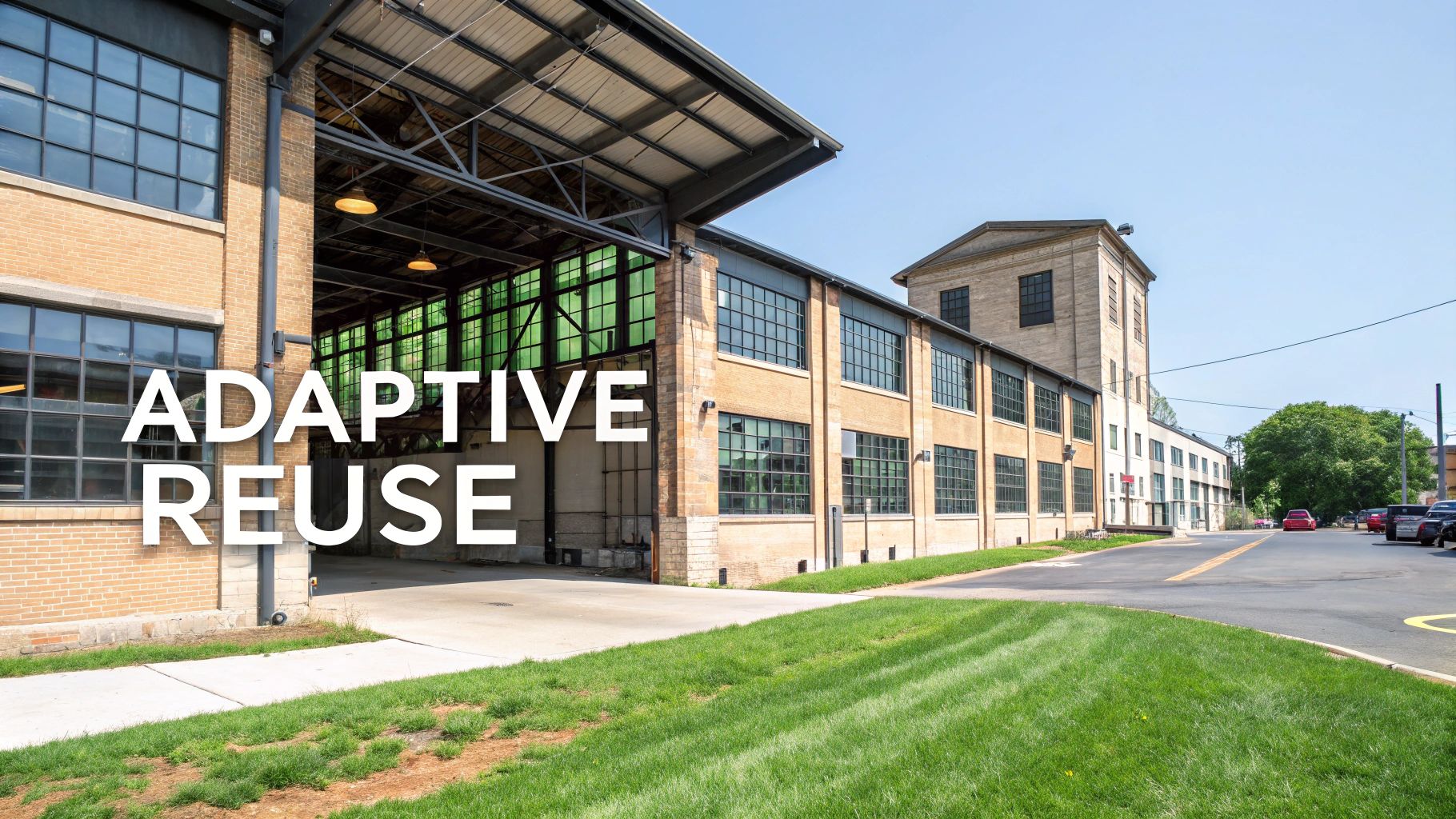
A large brick building with many windows and an open bay, showcasing adaptive reuse architecture.

Once you've zeroed in on a property and have a solid strategy in mind, the real work starts. This is where seasoned pros separate themselves from the amateurs, and it all comes down to two things: due diligence and financing. A great deal can completely fall apart at this stage, while a seemingly average one can turn into a home run with the right investigation and capital structure.

Think of due diligence less like a checklist and more like an investigation. You're the lead detective, and your mission is to uncover every single clue about the property’s past, present, and future. This is where you either confirm your initial assumptions or, more importantly, discover the hidden gremlins that could sink your entire investment.

This process is all about digging deep into the property's health. You have to validate every number, inspect every corner, and understand every legal document tied to the asset.

The Three Pillars of Property Investigation

Smart due diligence can be broken down into three key components. If you skimp on any one of these, you’re setting yourself up for a world of expensive surprises after closing.

  1. Physical Due Diligence: This is the hands-on part. It means a thorough, top-to-bottom inspection of the building's physical condition—from the foundation right up to the roof. You'll bring in engineers and other specialists to assess structural integrity, HVAC systems, electrical, plumbing, and any potential environmental issues. Any deferred maintenance you find here isn't just a problem; it's a powerful negotiation tool.

  2. Financial Due Diligence: Now it's time to put the seller’s claims under a microscope. This involves a deep audit of the rent rolls, verifying every line of the income statements, scrutinizing operating expenses, and reviewing each tenant lease. You're hunting for discrepancies, confirming the income stream's stability, and projecting future cash flow based on cold, hard facts—not the seller's rosy pro forma.

  3. Legal Due Diligence: This piece is about diving into titles, surveys, zoning regulations, and service contracts. Is the title clean? Are there any hidden easements or encroachments that could kill your development plans? Does local zoning even permit your intended use? Answering these questions is your best defense against legal headaches that could derail your whole business plan.

A massive part of your financial homework is knowing how to accurately assess a property's worth. Mastering how to value a commercial property is non-negotiable for making smart investment decisions and ensuring you don't overpay.

Structuring the Right Capital Stack

Once your investigation confirms the deal is solid, the next mountain to climb is financing. The way you structure your capital stack—the mix of debt and equity you use to buy the property—is just as strategic as the investment itself. A well-designed stack minimizes your risk while maximizing your returns.

Sure, you can get a traditional senior loan from a bank, but the most successful CRE strategies often get creative with financing. This is especially true for value-add or adaptive reuse projects, where lenders might see a bit more risk.

The goal of creative financing isn't just to get the deal done; it's to align the capital with your specific business plan. The right structure provides the flexibility you need to execute renovations, lease up the property, and stabilize the asset.

Some of these alternative options include:

  • Mezzanine Debt: This is a hybrid of debt and equity that slots in between your senior loan and your own cash. It's more expensive than a bank loan, but it’s a lot cheaper than giving away precious equity.
  • Preferred Equity: This gives an investor a priority return on their capital—they get paid before you, the sponsor, see a dime. In exchange, they typically have no say in day-to-day operations.
  • Joint Ventures (JVs): This means partnering with an individual or firm that brings the cash to the table. You provide the expertise and "sweat equity," they provide the capital, and you split the profits based on a pre-negotiated agreement.

The good news is that the financing landscape seems to be shifting in your favor. A broader sentiment shift shows that 69% of industry leaders expect financing to get easier this year, and 68% anticipate it will get cheaper. This optimism is fueled in part by a growing focus on sustainable projects, which are increasingly seen as more resilient and less risky. That's a huge tailwind for ambitious adaptive reuse projects that breathe new life into a building's infrastructure for the long haul.

Matching Your Strategy to the Right Property Sector

Having a killer investment strategy is one thing, but applying it to the wrong property type is like putting a brand-new engine in a car with four flat tires. You've got all the power, but you're not going anywhere. The best investors I know don't just master the how of a strategy; they're obsessed with the where. They meticulously align their approach with the property sectors best positioned to win in the current market.

This alignment is absolutely critical. Every property sector dances to its own beat, swayed by different economic drivers and demographic tides. A value-add plan that crushes it for a suburban apartment complex could completely fall apart if you tried the same thing on a Class B office building just down the street.

So, before you deploy a single dollar, you need to understand which sectors are attracting capital and, more importantly, why.

Targeting the High-Conviction Plays: Multifamily and Industrial

For the foreseeable future, multifamily and industrial properties are the undisputed darlings of the commercial real estate world. This isn't just a passing fad. It’s a direct response to deep, structural shifts in how we live and how we buy things. Both sectors offer a potent mix of steady demand and clear runways for creating value, making them a great fit for nearly any investment strategy.

The market has already voted with its checkbook. A 2025 survey showed that a whopping 75% of U.S. investors are actively hunting for multifamily deals. At the same time, 37% have their sights set on industrial and logistics properties.

And with 70% of investors saying they plan to buy more real estate in 2025 than they did in 2024, a wave of capital is heading straight for these two sectors. You can read the full analysis on investor sentiment to see how many are viewing today's pricing as a golden opportunity.

Putting Capital to Work in Apartments

  • Core and Core-Plus: The play here is to buy stabilized Class A or high-end Class B properties in growing submarkets. You're acquiring solid, cash-flowing assets and looking for small wins—light cosmetic upgrades to common areas or unit interiors that justify small, steady rent bumps over time.

  • Value-Add: This is where you roll up your sleeves. You're targeting older Class B or C apartment buildings that are tired, poorly managed, and have rents way below the market rate. The plan involves a heavy capital lift to renovate units, add modern amenities, and rebrand the entire property to attract a better tenant and command higher rents.

Seizing Opportunities in Logistics

  • Opportunistic: With e-commerce demand still roaring, ground-up development of modern distribution centers and last-mile fulfillment hubs near major cities remains a top-tier strategy.

  • Value-Add: Find an older, functionally obsolete warehouse—the kind with low ceilings or not enough loading docks—and bring it into the 21st century. This could mean literally raising the roof, punching in new dock doors, or reconfiguring the truck courts to handle modern logistics.

The key is to see these sectors not just as "safe bets," but as dynamic arenas where specific, well-executed commercial real estate investment strategies can unlock significant value. The demand is there; the challenge is to deliver the right product.

Finding Opportunity Where Others Aren't Looking

While everyone is chasing apartments and warehouses, savvy investors know that real opportunity often lies in sectors that are temporarily out of favor. Both retail and office, despite the negative headlines, have pockets of incredible value if you know where to look and aren't afraid to get creative.

Think about it: not all retail is dying. Grocery-anchored neighborhood centers are as resilient as ever. A great value-add play might be to buy a center where the anchor grocery store has a short-term lease, lock them into a new long-term deal, and then use that stability to attract better tenants for the smaller shops.

In the residential and hospitality space, understanding the nuances of short-term leasing apartments can give you a serious edge, turning a standard multifamily asset into a high-yield, flexible-stay property. And don't write off those underperforming office buildings. A well-located but empty office tower could be a prime candidate for adaptive reuse—think conversion to medical offices, apartments, or even a self-storage facility.

Bringing Your Investment Strategy to Life

A slick pro forma is one thing, but bringing a commercial real estate deal to life is where the real work begins. Even the sharpest investment strategies can fall apart if the on-the-ground execution—the actual design, permitting, and construction—isn't handled with expertise.

Success isn’t just about finding the right deal. It’s about navigating that deal through the gauntlet of design decisions and municipal approvals to create a profitable, physical asset. This is the phase where paper profits become brick-and-mortar reality, and every choice can either build or erode your returns.

Your Architect Is More Than a Designer; They're a Navigator

Choosing an architectural partner isn't like hiring any other vendor. Think of them as a crucial part of your investment team, one whose role goes way beyond just drawing up blueprints. They are your expert guide through the maze of local government regulations, a process that can easily sink a project if you don't know the terrain.

A good architect acts as the translator between your financial goals and the physical building. They’re the ones who will tackle the nitty-gritty of:

  • Zoning and Land Use Rules: They make sure your project is compliant from the get-go, saving you from the nightmare of having to go back to the drawing board.
  • Permitting and Approvals: They handle the submissions and back-and-forth with planning commissions and design review boards, which can be a bureaucratic headache for anyone unfamiliar with the process.
  • Building and Energy Codes: They design a building that's not just up to code but is also safe, efficient, and durable for the long haul.

This kind of local knowledge is priceless. An architect who knows the ins and outs of the local planning department can spot potential roadblocks a mile away and steer your project clear, saving you an incredible amount of time and money.

How Smart Design Directly Impacts Your Bottom Line

Getting your plans approved is just the first step. Smart design is also one of the most powerful levers you can pull to maximize the long-term value of your investment. Every design choice has a direct financial impact, influencing everything from your operating expenses to how much tenants are willing to pay.

A well-designed building is simply a better-performing asset. It’s cheaper to run, attracts and keeps high-quality tenants, and holds its value far better over time by thinking ahead about future needs and environmental changes.

Let's break down how design choices translate into real dollars:

  • Serious Energy Savings: Simple things like building orientation, high-performance windows, and modern HVAC systems can cut utility bills by 20-30% or even more. That savings goes straight to your Net Operating Income (NOI).
  • Getting More from Your Site: A clever site plan can squeeze out more rentable square footage, create better parking and traffic flow, or add valuable outdoor amenities that tenants love.
  • A Better Tenant Experience: It's no longer just about four walls and a roof. Thoughtful layouts, lots of natural light, and modern amenities are what today's tenants expect. Delivering on that means lower vacancy and the ability to command higher rents.

At the end of the day, turning a strategy into a successful reality means finding a partner who gets that great design isn’t an expense—it’s a fundamental driver of your financial success. By bringing that architectural expertise in early, you ensure the brilliant numbers on your spreadsheet become a profitable, tangible asset.

Frequently Asked Questions
Two construction workers in hard hats reviewing blueprints at a building construction site.

What Is The Best CRE Investment Strategy For Beginners?

If you're just getting into the commercial real estate world, your best bet is to stick with Core or Core-Plus strategies. Think of a Core investment as the blue-chip stock of real estate—it's a stable, fully leased property that provides predictable cash flow with very little drama.

Core-Plus is the next logical step. You're still dealing with high-quality properties, but they have some minor, easy-to-fix issues that present a clear path to adding value. These approaches let you learn the ropes of the market without taking on the massive risks that come with ground-up development or speculative plays.

How Does Adaptive Reuse Compare Financially To New Construction?

From a financial standpoint, adaptive reuse often comes out ahead of new construction. You're typically looking at lower upfront costs because you get to keep the building's essential structure, which can also mean a much faster project timeline.

The real game-changer, though, is that adaptive reuse projects can unlock valuable historic preservation tax credits and other local incentives. These can dramatically lower your total investment, giving you a faster route to profitability with a unique, in-demand building.

When you find the right asset, it's an incredibly powerful way to create value.

How Important Is ESG In The CRE Investment Climate?

ESG—that’s Environmental, Social, and Governance—is no longer a "nice-to-have." It’s become a critical piece of the puzzle. Everyone from investors and lenders to the tenants themselves sees sustainable, energy-efficient buildings as safer, more valuable long-term assets.

It's simple, really. Properties with solid ESG credentials tend to pull in higher rents, attract better tenants, and run on lower operating costs. If you ignore ESG today, you risk facing hurdles with financing and could end up with a property that's worth less as the market continues to demand more sustainable buildings.


At Sherer Architects, LLC, we help turn ambitious commercial real estate investment strategies into tangible, profitable realities. Whether you're navigating the complexities of a historic preservation project or executing a challenging adaptive reuse, our team has the hands-on expertise to guide you from concept to completion.

Find out how we can help maximize your investment’s potential at https://shererarch.com.
Categories
Uncategorized

A Guide to Construction Contract Administration

Construction contract administration is, simply put, the process of making sure what was designed and agreed upon is actually what gets built. Once the contracts are signed and the shovels hit the ground, this is the crucial phase where an architect or a designated administrator oversees the project to ensure it sticks to the plan—protecting the owner's interests every step of the way.

It’s about managing the relationship and the legal agreement between the owner and the contractor throughout the entire construction process. This isn’t just about shuffling papers; it’s the active, on-the-ground management that ensures the project is delivered on time, within budget, and to the quality standards laid out in the blueprints.

The Conductor of Your Construction Project

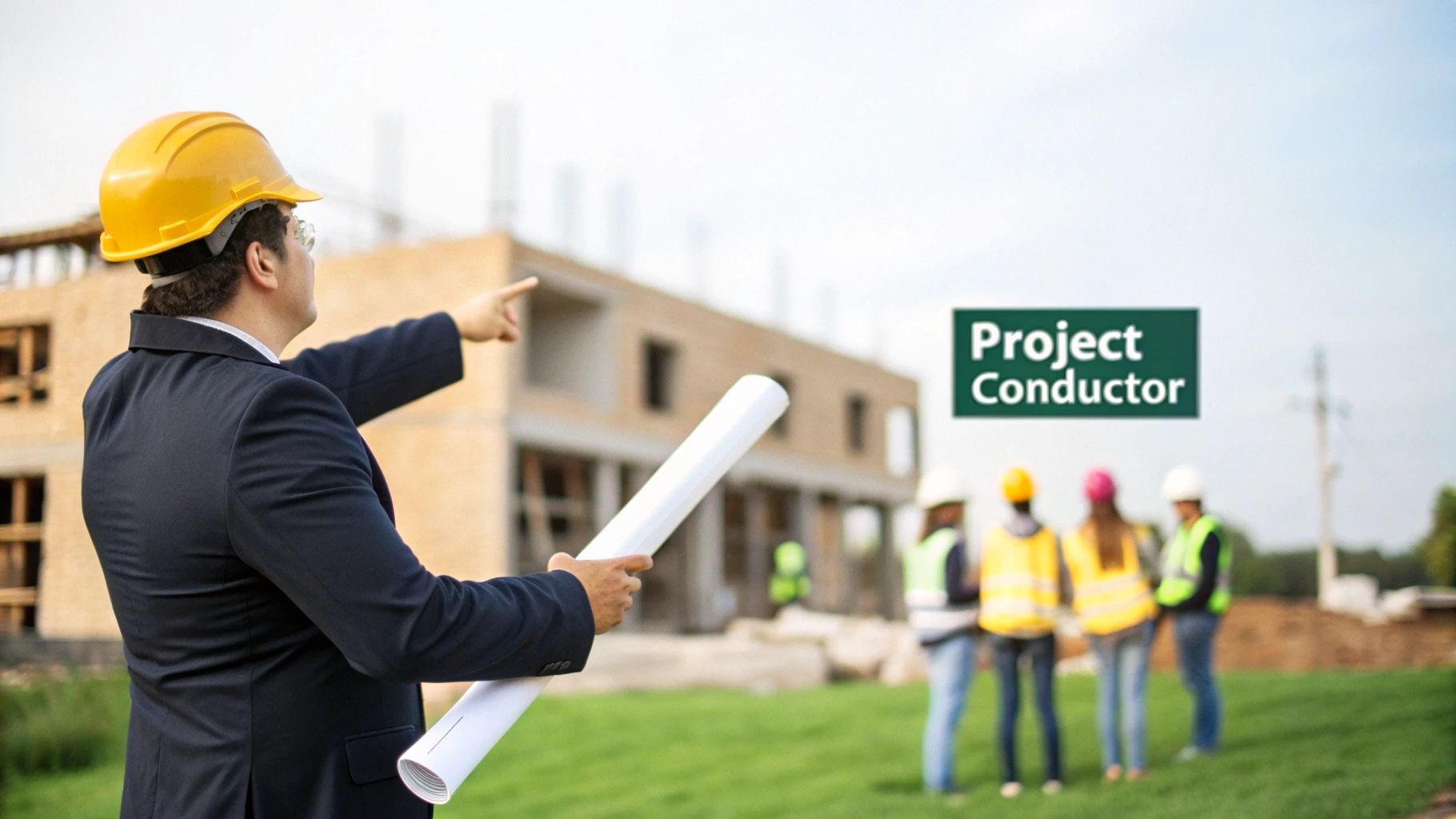
A project conductor in a hard hat points to a building under construction with blueprints.

Think of the person handling construction contract administration as the conductor of an orchestra. The architectural plans and specifications are the musical score, and all the different players—the owner, the general contractor, the subcontractors—are the musicians.

Each musician is a master of their own instrument, but without a conductor to interpret the score and keep everyone in sync, you’d get noise instead of music. The contract administrator ensures every trade performs their part correctly and at the right time. They don't micromanage the "how" (like telling a violinist how to hold their bow), but they verify the "what"—making sure the final result perfectly matches the requirements of the contract documents. This oversight is what closes the gap between the design vision and the built reality.

Why This Process Matters More Than Ever

In today's booming construction market, having this kind of structured oversight is non-negotiable. The global market is massive and growing, expanding from $15.78 trillion in one year to $16.45 trillion the next. As projects become more complex, the need for skilled, professional administration only grows.

This isn’t just an extra layer of bureaucracy; it's a strategic shield for your project that provides real, tangible benefits.

  • Protecting Your Investment: It’s the ultimate accountability check, ensuring you get exactly the quality and scope of work you paid for.
  • Maintaining Quality Control: Through regular site visits and detailed reviews of materials and shop drawings, the administrator serves as your eyes and ears on the job site.
  • Preventing Costly Disputes: By documenting everything and making impartial decisions based on the contract, potential issues are resolved long before they can escalate into messy, expensive conflicts.

A well-administered contract transforms the potentially adversarial relationship between owner and contractor into a collaborative partnership focused on a shared goal: a successfully completed building. It replaces assumptions with accountability.

This table provides a scannable overview of the primary responsibilities in CCA, helping you quickly grasp its scope and importance.

Core Functions of Construction Contract Administration

Function Primary Goal Key Activities
Document Management Ensure all parties work from the correct, most current set of plans and documents. Processing RFIs, managing submittals and shop drawings, distributing contract updates.
Quality Assurance Verify that work conforms to the contract documents, plans, and specifications. Conducting regular site observations, reviewing materials, and inspecting work quality.
Financial Oversight Keep the project on budget and ensure fair and timely payment for completed work. Reviewing and certifying contractor pay applications, processing change orders, tracking costs.
Schedule Monitoring Facilitate on-time project completion by tracking progress against the master schedule. Attending project meetings, reviewing progress reports, identifying potential delays.
Risk Mitigation Proactively identify and resolve issues before they become major problems or disputes. Facilitating communication, mediating conflicts, documenting decisions and changes.

Ultimately, these functions work together to provide a comprehensive system of checks and balances that keeps the project on track from start to finish.

The Legal Foundation

At its core, construction contract administration is about upholding the legal documents that bind the project together. The contract is the rulebook—it sets out everyone's responsibilities, defines the timeline, and dictates the payment terms.

To get a feel for the complexity, it's worth understanding the different types of architectural contracts and how they lay the groundwork for a project. By actively managing every clause in that agreement, the administrator gives the owner peace of mind and sets the stage for a successful build, from groundbreaking all the way to final handover.

The Key Players: Understanding Roles and Responsibilities

A construction project is like a three-legged stool, with each leg representing one of the core players: the Owner, the Architect, and the General Contractor. For the project to stay upright and stable, each leg has to be strong and do its job. Get this part wrong, and the whole thing wobbles.

This isn't just about titles on a business card. It’s a well-established system of checks and balances that fosters accountability and, when it works right, true collaboration. When everyone knows their role and respects the boundaries, what could easily become a contentious process turns into a partnership aimed at one thing: getting the project built successfully.

The Owner: The Vision and the Wallet

The Owner is the one who initiates the project, holds the vision, and, crucially, pays the bills. They are the ultimate decision-maker, and their role is far from passive once the shovels hit the ground. A disengaged owner is a recipe for delays and misunderstandings.

Think of the owner as the project's fuel. Their key responsibilities are all about keeping the engine running:

  • Providing Timely Information: When the team needs an answer on a design choice or a scope question, the project can't wait. Quick, clear decisions are essential.
  • Making Prompt Payments: Nothing grinds a project to a halt faster than late payments. Paying the contractor on time, as laid out in the contract, is fundamental to maintaining momentum and goodwill.
  • Giving Necessary Approvals: From signing off on granite samples to authorizing a change order, the owner’s approval is the green light that allows work to proceed.

The Architect: The Impartial Administrator

In the world of construction contracts, the Architect often wears a second hat: that of the Contract Administrator. This is a unique and vital position. The architect serves as the owner's trusted agent, but they must also act as an impartial interpreter of the contract documents. They’re not there to tell the contractor how to do their job, but to observe that the job is being done according to the design.

The Architect’s role as administrator is to be the objective link between the owner’s vision and the contractor’s execution. They ensure fairness and adherence to the contract, protecting all parties by holding the project to the agreed-upon standards.

This dual function is what makes the system work. Here’s what it looks like in practice:

  • Observing Progress: The architect conducts regular site visits to see how the work is progressing and check if it aligns with the plans and specifications.
  • Certifying Payments: They review the contractor’s payment applications, verifying that the amount requested lines up with the actual work completed on site.
  • Interpreting Documents: If there's a disagreement or confusion about what a drawing means, the architect is the one to provide clarification based on the original design intent.
  • Managing Changes: When changes are needed, the architect processes the paperwork (the change orders) to make sure any shifts in scope, cost, or schedule are formally documented and approved by everyone.

The Contractor: The Master Builder

The General Contractor is the one who turns the two-dimensional drawings into a three-dimensional building. They are the experts in the how—the means, methods, techniques, and sequencing of construction. The job site is their domain.

The contractor’s focus is squarely on execution and safety:

  • Construction Means and Methods: They are responsible for figuring out the best way to build the project, from managing subcontractors to choosing the right equipment.
  • Site Safety: The contractor has sole responsibility for job site safety. This means ensuring a safe environment for every single person on site, period.
  • Project Schedule and Budget: They are on the hook for getting the project built on time and within the agreed-upon budget, managing all the moving parts to hit those targets.

When these three roles are clearly defined and respected, you get a powerful, self-regulating system. The owner provides the vision and resources, the architect ensures that vision is being followed faithfully, and the contractor brings it all to life. That’s the foundation of good construction contract administration.

Navigating the Project Lifecycle Step by Step

Effective construction contract administration isn't a single action, but a journey that unfolds across the entire project. Think of it as the project’s operating system, guiding everything from the first planning meeting to the final handover and ensuring every milestone is met with precision and accountability.

This process is best understood as four distinct phases, each with its own mission-critical tasks. Knowing what to expect at each stage helps you anticipate challenges, manage expectations, and keep a firm hand on the tiller of your investment. Let’s walk through what this looks like on the ground.

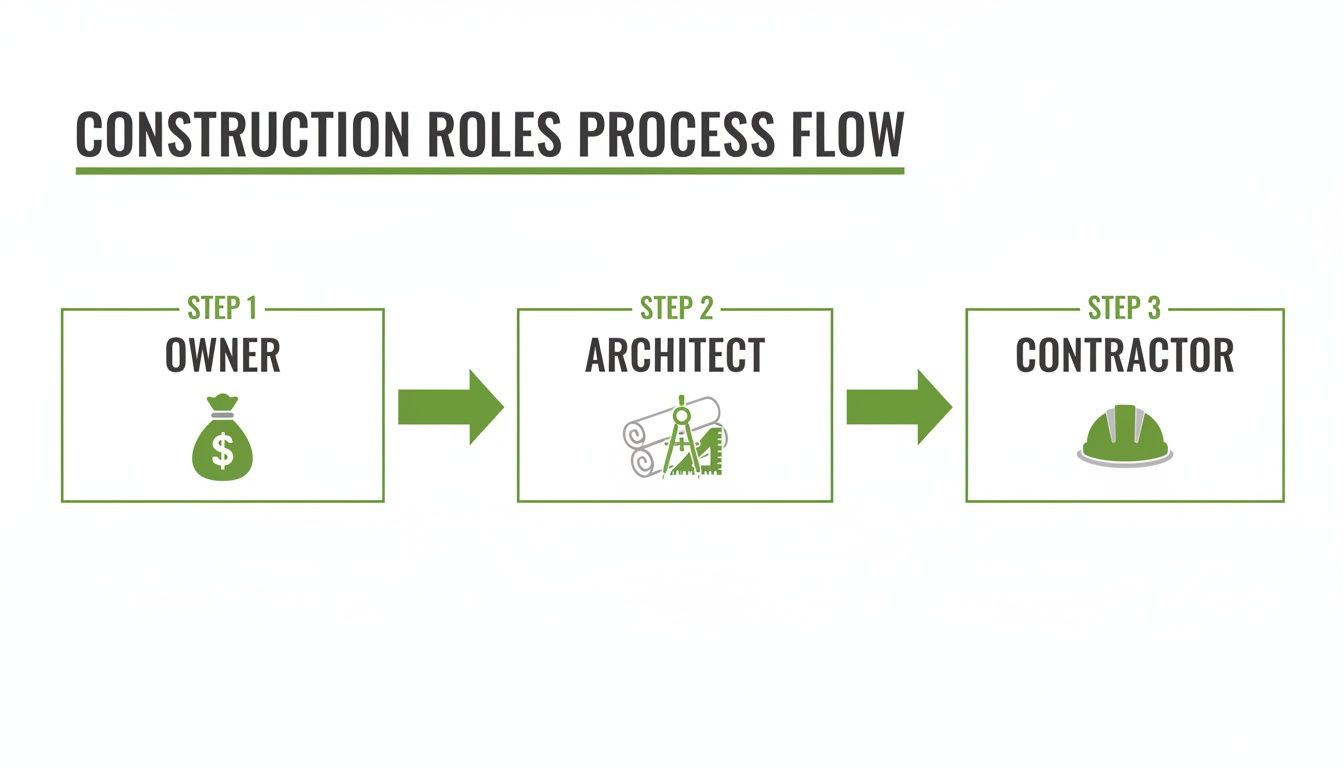
This simple diagram shows the fundamental flow of responsibility in a typical construction project.

A process flow diagram illustrates construction roles: Owner (Step 1), Architect (Step 2), and Contractor (Step 3).

As you can see, the Owner kicks things off, the Architect translates that vision into the official contract documents, and the Contractor builds according to those plans.

Phase 1: The Pre-Construction Kickoff

Long before a single shovel hits the ground, the entire project team gathers for a pre-construction meeting. This is the bedrock of the project. Here, we set the rules of engagement, align on goals and schedules, and establish how we're all going to communicate. The whole point is to start with absolute clarity to head off confusion down the road.

A crucial document comes out of this phase: the Schedule of Values, submitted by the contractor.

What is a Schedule of Values?
It’s essentially a detailed, itemized breakdown of the total contract price, assigning a dollar value to every part of the work. This document becomes the basis for every payment application, allowing the contract administrator to accurately track progress and approve payments. A clean, logical Schedule of Values is often the first sign of a well-organized contractor.

This initial phase sets the tone for everything that follows, creating a collaborative framework for the owner, architect, and contractor.

Phase 2: The Active Construction Phase

Once construction starts, the project enters its most dynamic—and demanding—phase. Now, the contract administrator's role shifts into high gear. The focus is on constant monitoring, meticulous documentation, and clear communication to keep the project on schedule and on budget.

This is where the real work of construction contract administration happens day in and day out. Key activities include:

  • Processing Submittals: The contractor will submit shop drawings, material data, and physical samples for review. The architect, acting as the administrator, meticulously checks these against the contract documents to confirm everything meets the specified quality and design intent.
  • Managing Requests for Information (RFIs): When a contractor hits a snag or finds a discrepancy in the plans, they issue an RFI. The administrator’s job is to chase down a clear, timely answer from the design team so work doesn't grind to a halt.
  • Handling Change Orders: Let's be honest, no project goes exactly to plan. When changes are needed, the administrator manages the formal process, making sure any adjustments to the scope, cost, or schedule are properly documented, justified, and approved by the owner before the work proceeds.

This phase is also where financial pressures really mount. With intense market competition, contractor profit margins can be razor-thin. Recent data shows that smaller commercial projects often see better margins at 10.6%, while larger ones average just 8.4%. This context is important—it highlights the cost pressures contractors are under and underscores why fair, efficient payment and change order processes are so critical. You can explore more on this in Turner & Townsend's global construction cost analysis.

Phase 3: Reaching Substantial Completion

Substantial Completion is arguably the single most important milestone in the project. It’s the official point where the building is complete enough for the owner to move in and use it for its intended purpose. It doesn't mean every last detail is perfect, but all the big stuff—like major systems—is operational, and the space is safe and functional.

Getting here is a formal process:

  1. The contractor declares they believe the project has reached Substantial Completion.
  2. The architect performs a thorough inspection to verify this claim.
  3. If the architect agrees, they issue a Certificate of Substantial Completion.

This certificate is a big deal legally. It officially marks the end of the construction period, which starts the clock on all warranties and formally transfers responsibility for the property (like utilities and insurance) from the contractor back to the owner.

Phase 4: Final Project Closeout

The final phase is all about tying up loose ends to officially close the books on the project. After Substantial Completion, the architect and owner will walk the site and create a punch list—a detailed list of all the minor fixes or incomplete items the contractor needs to address.

This could be anything from a paint touch-up to adjusting a finicky door or installing a final piece of hardware. The contractor works their way through this list, and once everything is done to the architect’s satisfaction, the final payment is released.

Closeout also involves the critical handover of all project documentation to the owner, which typically includes:

  • Warranties for all materials and equipment
  • Operation and maintenance (O&M) manuals for building systems
  • Final "as-built" drawings that show exactly how the project was constructed, including any changes made along the way

With the final payment made and all documents in hand, the contract is fulfilled, and the project is truly complete. This structured, four-phase approach is what provides the control and oversight needed to turn a blueprint into a successful building.

Managing Risk with Proactive Administration

Think of construction contract administration as your project’s most powerful defense mechanism. It’s far more than just shuffling papers or checking off boxes; it’s a strategic form of project insurance. The architect, acting in this capacity, doesn’t just react to problems—they actively anticipate and neutralize threats before they ever have a chance to derail your budget, schedule, or the final quality.

This isn’t about being reactive. It's about a constant, forward-looking process of identifying what could go wrong—from a budget creep to a timeline slip—and using the right administrative tools to stop it in its tracks. It's about protecting your investment with genuine foresight.

Countering Common Project Threats

Every construction project, no matter its size, faces a predictable set of potential hurdles. An experienced contract administrator knows exactly what these hazards look like and has a proven playbook for dealing with them. This isn't about hoping for the best; it’s about preparing for reality.

Here’s a look at the most common risks and how we tackle them head-on:

  • Budget Overruns: We meticulously review every single pay application, cross-referencing it against the Schedule of Values to ensure you only pay for work that is verifiably complete and correct. We also put all change order requests under a microscope to confirm their validity and fairness, preventing scope creep from silently inflating your costs.

  • Schedule Delays: Through consistent monitoring of the contractor's schedule and regular site observations, we can spot the early warning signs of a project falling behind. From there, we step in to facilitate communication and resolve bottlenecks—whether it’s a late material delivery or a coordination jam between subcontractors—to keep things moving.

  • Quality Issues: The submittal and shop drawing review process is one of our most critical quality control checkpoints. We confirm that every material, fixture, and piece of equipment meets the exact standards defined in the contract documents before it gets installed. This simple step prevents incredibly costly and time-consuming rework down the line.

Proactive administration completely reframes the conversation. Instead of asking, "What went wrong?" after a crisis, a good administrator is constantly asking, "What could go wrong?" and putting measures in place to make sure it doesn't.

To make this process even more robust, we can use modern tools for things like ai contract review. This technology helps quickly flag non-standard clauses or potential liabilities, adding another valuable layer of protection.

Common Risks and Corresponding Administrative Solutions

To make this crystal clear, here’s a table connecting common project risks with the specific administrative tools used to mitigate them. This is how we turn abstract worries into concrete, actionable solutions.

Project Risk Key Administrative Tool How It Protects the Owner
Scope Creep & Unauthorized Changes Strict Change Order Management Ensures every change is documented, justified, and fairly priced before approval.
Paying for Incomplete/Incorrect Work Pay Application Certification Verifies that billings accurately reflect the work completed on-site, preventing overpayment.
Substandard Materials or Workmanship Submittal & Shop Drawing Review Confirms all materials and methods align with design intent before installation.
Unforeseen Site Conditions Request for Information (RFI) Process Provides a formal channel to clarify uncertainties quickly, avoiding costly assumptions.
Project Falling Behind Schedule Regular Progress Monitoring Identifies potential delays early, allowing for corrective action before they cascade.
Disputes Over Contract Terms Detailed Meeting Minutes Creates a clear, agreed-upon record of all decisions and discussions.

This systematic approach demystifies risk management, giving you a clear line of sight into how your interests are being protected at every stage.

Responding to External Pressures

Beyond the typical on-site challenges, today's projects are often impacted by major external forces. Diligent oversight becomes even more critical when factors outside the immediate project team—like the state of the labor market—come into play.

Right now, labor shortages are a serious challenge. The global construction industry is feeling the pressure, with North America alone needing to recruit roughly 500,000 additional skilled workers to meet current demand. This has a direct impact on projects, as contractors may be forced to rely on less experienced teams, which can unfortunately lead to lower-quality work and safety issues.

In this kind of environment, the administrator’s role in verifying quality is no longer just a best practice; it's an essential countermeasure. Meticulous site observations and a rigorous submittal review process are what ensure the integrity of your building isn't compromised by a stretched-thin workforce.

Ultimately, by viewing contract administration through a risk-management lens, we transform a standard process into your most reliable tool for achieving a predictable, high-quality outcome.

Navigating Complex Adaptive Reuse Projects

Managing a standard construction project has its challenges. But when you step into the world of adaptive reuse and historic preservation, you’re not just building something new—you’re in a constant dialogue with the past. The rulebook changes completely.

In these projects, the building itself is practically a key stakeholder, one filled with secrets and surprises that no set of blueprints could ever fully capture. The unexpected isn't just a risk; it's a guarantee. This is where an expert hand in contract administration becomes absolutely essential. It’s less about just checking boxes on a drawing and more about managing a live process of discovery, where unforeseen conditions are the norm, not the exception.

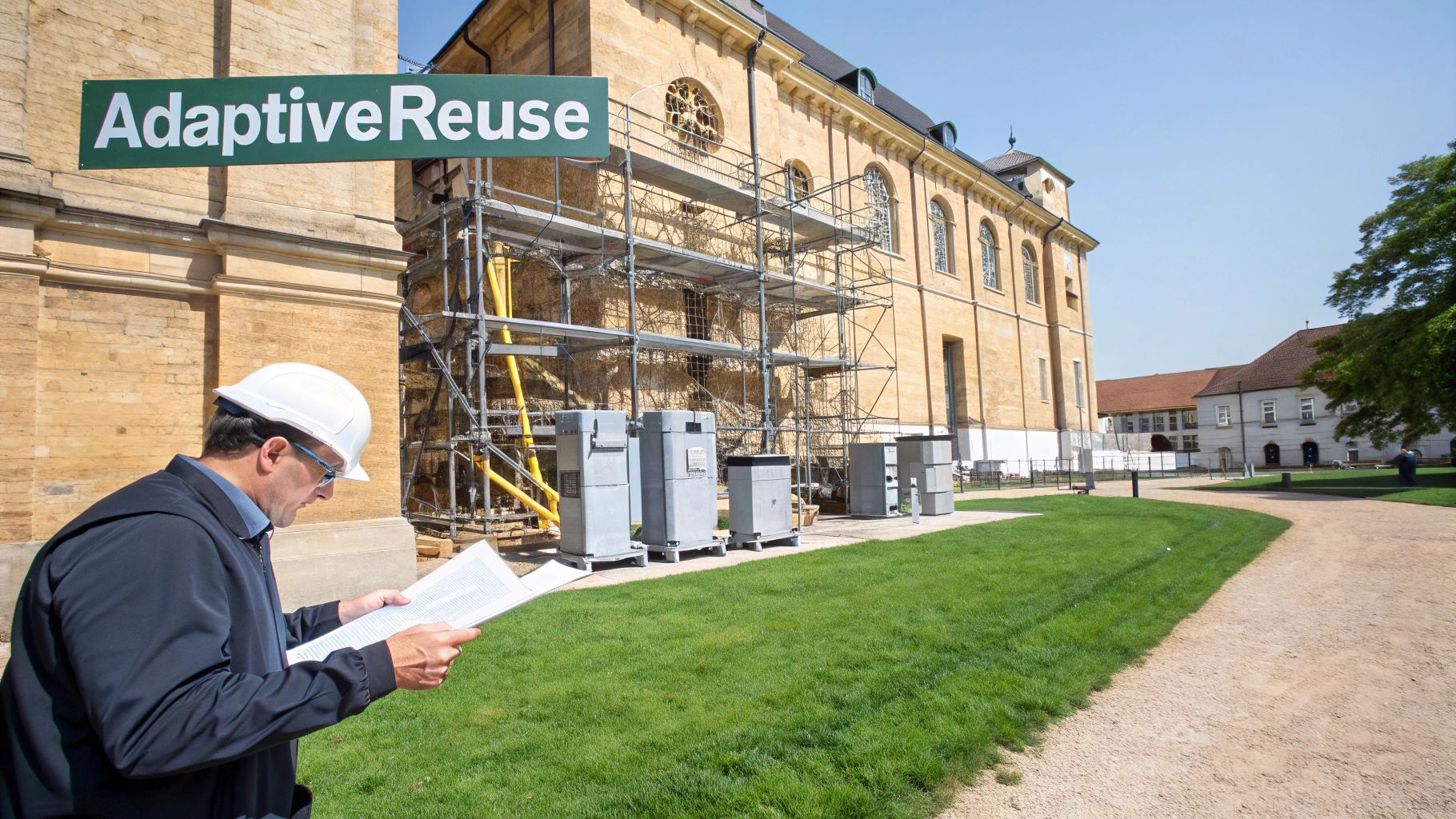
A man in a hard hat reviews construction plans in front of a historic building undergoing adaptive reuse.

Anticipating the Unforeseen

Unlike a new build on a clean, predictable site, renovating a historic structure means peeling back layers of history. What you find behind a wall can completely derail the original scope, from discovering termite-ridden structural beams to realizing the century-old plumbing system is beyond repair and needs to be replaced entirely.

A seasoned contract administrator sees this coming. They work with the team to build contingencies right into the contract and, more importantly, establish clear, pre-agreed-upon protocols for how to handle these discoveries when they happen. This proactive mindset prevents the project from grinding to a halt in a state of panic. It turns a potential crisis into a manageable, documented problem that everyone knows how to solve.

The goal is to create a framework where surprises don’t immediately spark disputes. Instead, they trigger a fair and transparent process for evaluation, problem-solving, and resolution.

The Art of the Change Order in Historic Projects

In adaptive reuse, change orders aren't just for when an owner wants to add a new feature; they are the fundamental tool for responding to the building's hidden conditions. Navigating this process requires a delicate balance of fairness, meticulous documentation, and genuine creativity.

When an unforeseen issue pops up, a skilled administrator orchestrates a methodical response:

  1. Immediate Documentation: Before anything is touched, the condition is thoroughly photographed, measured, and documented in detail. This creates an objective record.
  2. Collaborative Evaluation: The administrator gets the owner, contractor, and relevant engineers in a room (or on a call) to assess the problem and brainstorm practical solutions.
  3. Transparent Quoting: The contractor provides a clear, itemized quote for the necessary work. The administrator then carefully vets it for fairness and accuracy.
  4. Formal Approval: A formal change order is drafted and issued, capturing the new scope, associated costs, and any impact on the schedule. Once signed, it officially amends the contract.

This rigorous process protects the owner from getting hit with inflated costs while making sure the contractor is compensated fairly for legitimate work that was impossible to foresee.

In historic preservation, the contract administrator often acts like a diplomat. They have to negotiate between the non-negotiable demands of modern building codes, the historical integrity of the structure, and the owner’s budget, finding a path forward that respects all three.

A Case Study in Discovery

Picture this: we’re overseeing the renovation of a beautiful 1920s commercial building. During interior demolition, the contractor uncovers a nasty surprise. A shoddy renovation back in the 1970s had removed a critical load-bearing wall, replacing it with a dangerously undersized beam. The ceiling above had been slowly sagging for decades.

Work stops immediately. Our team, acting as the contract administrator, gets on-site with structural engineers to document the finding. We then sit down with the owner and present clear, understandable options. We could go with a costly but straightforward steel beam replacement, or we could explore a more creative (and less expensive) solution involving reinforced columns that could be cleverly integrated into the new floor plan.

By carefully managing the RFI and change order process, we helped the owner make an informed decision that was structurally sound, budget-conscious, and actually enhanced the building’s historic character. The unforeseen problem was solved without conflict, and the project moved forward with minimal delay. This is construction contract administration at its most valuable—turning a potential disaster into a well-managed, successful outcome.

Your Blueprint for a Successful Project

If there’s one thing to take away from this guide, it’s that great construction contract administration isn't just about paperwork. It’s about building a proactive, collaborative partnership—the kind of solid foundation every project needs to finish on time, on budget, and to the quality you expect. This isn’t some final hurdle; it's the active stewardship of your vision from the first day on-site to the final handover.

Think back to our conductor analogy. The architect's role in administration is to make sure every trade, every material delivery, and every stakeholder is playing their part in perfect harmony. That leadership is what turns a potentially chaotic process into a well-orchestrated performance, delivering a final building that truly reflects the original design intent.

A well-administered contract is far more than a legal safety net. It's your project's single most important blueprint for success. It swaps ambiguity for accountability and turns risk into manageable, predictable outcomes.

This is the structured oversight that bridges the gap between a brilliant design on paper and a profitable, beautifully built reality. It gives you the control and certainty you need to protect your investment at every single stage.

These principles aren't just theory; they are fundamental to how we manage projects at Sherer Architects. We've seen time and again that expert administration unlocks the full potential of a building, whether it's a new commercial development or a sensitive historic preservation project. Our team is here to provide the diligent oversight that delivers certainty, value, and most importantly, peace of mind to owners and developers.

If you’re ready to bring this level of clarity and control to your next project, reach out to us at Sherer Architects. Let's talk about how our expert administration services can help you build with confidence.

Frequently Asked Questions

It’s natural to have questions when you’re navigating the complexities of a construction project. Let's clear up a few of the most common ones we hear from owners and developers about construction contract administration.

What Is the Difference Between Project Management and Contract Administration?

It's a great question, and the distinction is crucial. Think of it like this: project management is the big picture, while contract administration is the fine print.

A project manager, often the general contractor, is focused on the "what" and "when"—coordinating subcontractors, managing the overall schedule, and handling the day-to-day logistics of getting the job done.

Contract administration, on the other hand, is a specialized role typically handled by the architect. We act as your eyes and ears on-site, focusing on the "how." Our job is to make sure the work being done exactly matches what was agreed upon in the contract documents, from materials to workmanship. We observe progress and certify payments, but we don't tell the contractor how to do their job.

Who Is Responsible for Paying for a Change Order?

This really boils down to one thing: what caused the change? A good contract administrator is an impartial referee here, digging into the specifics to determine who should foot the bill.

Here’s a quick rundown of how it usually works:

  • Owner-Requested Changes: If you decide you want marble countertops instead of granite, or want to add a new room, that cost is on you.
  • Unforeseen Conditions: This is the stuff no one could have reasonably predicted. Think hitting solid rock during excavation or finding hidden structural rot in a historic renovation. These are generally considered owner-paid costs.
  • Errors or Omissions: If a change is needed because something was missed or drawn incorrectly in the plans, the design professional may be responsible for the cost.

How Does Administration Work on Fast-Track Projects?

On a fast-track project—where construction kicks off before the design is 100% complete—contract administration goes from important to absolutely essential. Things are moving at lightning speed, so you need intense, real-time coordination.

On a fast-track job, the administrator becomes the central nervous system for information. We have to ensure the crew is always building from the most current set of drawings and that every single design tweak is tracked for its impact on cost and schedule. It’s a high-stakes, dynamic process that demands an incredibly responsive and experienced team.


Protecting your investment and ensuring a predictable, high-quality outcome all comes down to effective administration. At Sherer Architects, LLC, we provide the expert oversight needed to guide your project to a successful completion. Contact us to learn how we can bring clarity and control to your next build.

Categories
Uncategorized

The Architecture of Hospital Design A Developer’s Blueprint

When you talk about the architecture of a hospital, you’re not just talking about putting up a building. You’re talking about crafting a dynamic, living ecosystem that’s engineered from the ground up to promote healing. It’s a blueprint where clinical precision has to meet human compassion, and every single space, from a corridor to a patient room, plays a role in someone's recovery.

The Blueprint For Healing: Understanding Hospital Architecture

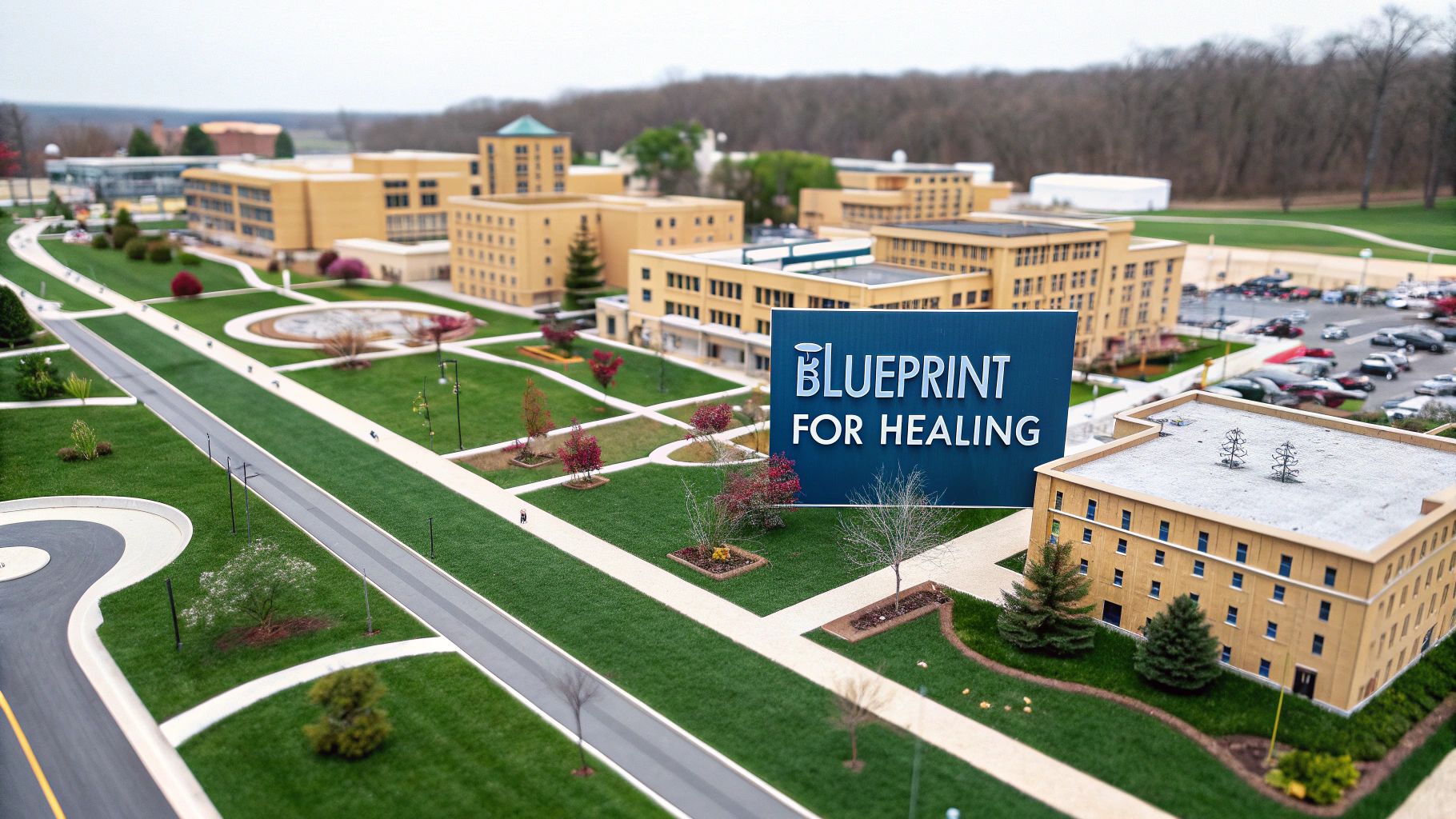
Aerial view of a modern campus with tan buildings, green lawns, and a 'Blueprint for Healing' sign.

The best way to think about a modern hospital is as a "city within a city." This isn't just a clever phrase; it’s the key to understanding the sheer complexity involved. Every department—the emergency room, surgical suites, patient wards, the cafeteria—is like its own distinct neighborhood. Each has a specific function, a unique population, and its own set of needs.

And just like a real city, a hospital needs infrastructure to survive. It relies on a carefully planned network of corridors (the streets), specialized MEP (Mechanical, Electrical, and Plumbing) systems (the utilities), and shared resources. The success of this entire "city" hinges on how well these different neighborhoods connect and support each other.

More Than Just Rooms and Hallways

A poorly designed hospital creates constant, daily friction. It's like a city where the fire station is miles from the main business district, or the grocery stores are nowhere near the residential areas. In a hospital setting, that translates into life-threatening delays in care, staff burning out from walking miles every shift, and an incredibly stressful environment for patients and their families.

The real craft of hospital architecture is in preventing these problems by focusing on a few core principles:

  • Logical Adjacency: This means putting related departments right next to each other. Think imaging right beside the ER. It’s a simple concept that shaves critical minutes off travel time for patients and staff.
  • Clear Circulation: You need separate, intuitive pathways for patients, staff, and supplies. This isn't just for efficiency; it’s a critical measure to prevent cross-contamination and operational gridlock.
  • Patient-Centered Spaces: Designing rooms and waiting areas that actually make people feel better is non-negotiable. We're talking about reducing anxiety, providing comfort, and maximizing natural light, which is proven to speed up recovery.
  • Operational Efficiency: Support services—the labs, pharmacies, and sterilization facilities—need to be centrally located so they can effectively serve every single department without becoming a bottleneck.

The Impact of Thoughtful Design

The architecture of a hospital directly impacts its viability for decades to come. When you’re developing the blueprint for a healing environment, every detail has consequences. For example, a detailed guide on choosing healthcare furniture for modern facilities is an essential piece of the puzzle, influencing everything from patient comfort to staff workflow.

A well-designed hospital is a strategic asset. It not only improves patient outcomes but also enhances staff retention, reduces operational costs, and strengthens the facility's reputation within the community.

Ultimately, the goal is to create a building that actively participates in the healing process. For developers and owners, grasping this is what separates a standard construction project from the creation of a vital community anchor—a place where good design literally saves time, money, and lives.

Choosing The Right Model: Hospital Typologies Explained

When you're at the very beginning of a hospital project, one of the first big decisions on the table is the foundational layout, or what we in the industry call the typology. This isn't just an aesthetic choice; it's a strategic move that sets the stage for everything that follows—from how much land you'll need and how the budget gets allocated to how easily the facility can grow and how smoothly it runs day-to-day.

Think of it like this: are you building a skyscraper, a sprawling suburban subdivision, or a town center? Each has a completely different footprint and serves a unique purpose. The same logic applies to hospitals.

The models we use today really started taking shape in the 1960s. As medicine became more specialized, the design of hospitals had to follow suit. The old, monolithic do-it-all buildings gave way to campuses with distinct, free-standing structures, each dedicated to a specific function. If you're interested, you can learn more about how specialization reshaped healthcare design in the 1960s.

The Vertical Tower Model

The vertical tower is exactly what it sounds like: the high-rise of the hospital world. In this model, we stack departments one on top of the other in a compact, multi-story building. It's the go-to solution for tight urban sites where every square foot of land comes at a premium.

The biggest win here is efficiency on a small footprint. You can pack a full-service medical center onto just a couple of acres by building up, not out. This approach also centralizes the building's guts—elevators and core MEP (Mechanical, Electrical, and Plumbing) systems—which can make logistics feel a lot simpler. But that compactness has its trade-offs. The entire building lives and dies by its elevators, which can easily become bottlenecks for moving patients, staff, and supplies.

The Horizontal Campus Model

On the complete opposite end of the spectrum is the horizontal campus. This model feels more like a small village or a low-rise corporate park, spreading departments out across a large piece of land in a series of interconnected, one or two-story buildings. It’s a natural fit for suburban or rural areas where land is abundant and affordable.

The real beauty of the campus model is its built-in flexibility for phased construction and future growth. Adding a new wing or even an entirely new building is far more straightforward than trying to tack another floor onto a tower. These layouts also tend to feel less institutional and more calming, with plenty of opportunities for green spaces and courtyards. The major drawback? The sheer distances people have to cover. Staff and patients might face long walks between departments, which can affect everything from emergency response times to simple navigation.

A key consideration for developers is that the chosen typology directly impacts long-term flexibility. A horizontal campus offers modular growth, while a vertical tower locks in a more rigid structure, making future adaptation more complex and costly.

The Hybrid Model

The hybrid model is an attempt to get the best of both worlds. It usually involves a central, multi-story tower for acute care services—think surgery and the ICU—which is then connected to lower-rise wings that house outpatient clinics, administrative offices, and diagnostic centers. This blended approach is getting more and more popular because it strikes a great balance between density and flexibility.

With this setup, you can centralize the critical, high-traffic departments vertically for peak efficiency while letting less urgent services spread out horizontally. It creates a natural, logical separation between inpatient and outpatient traffic, which makes the experience better for everyone. By pairing a dense core with expandable outer buildings, the hybrid model gives owners a practical design that can actually adapt as healthcare needs change over time.

Comparing Hospital Architectural Models

To see how these models stack up against one another, it helps to put their core features side-by-side. This table breaks down the key characteristics of each typology to help developers get a clearer picture of what might work best for their specific site and long-term vision.

Model Type Key Characteristic Best For Primary Challenge
Vertical Tower A compact, multi-story high-rise with stacked departments. Dense urban areas with limited land availability. Reliance on elevators and limited options for future expansion.
Horizontal Campus A sprawling, low-rise layout with interconnected buildings. Suburban or rural sites with ample land for growth. Long travel distances between departments and potential wayfinding issues.
Hybrid Model A central tower connected to lower-profile outpatient wings. Sites that need to balance density with future flexibility. Requires careful master planning to ensure seamless integration.

Ultimately, there's no single "right" answer. The best model depends entirely on the project's unique constraints and goals, from the available land and budget to the community it will serve and the vision for its future.

Designing for Seamless Patient and Staff Flow

Once you’ve settled on a hospital's big-picture model, the real work begins inside. We have to design the internal logic—that complex web of hallways, elevators, and rooms that dictates how everyone and everything moves through the space.

It’s a bit like designing a major airport terminal. The path for an international traveler heading through security and customs is completely different from someone being dropped off for a quick domestic flight. In the same way, the architecture of a hospital must create clear, efficient, and separate routes for patients, staff, and the public.

Get this wrong, and you get chaos. You’ll have crowded hallways where a patient on a gurney is trying to get past a food delivery cart while a lost family is looking for the cafeteria. This isn't just an annoyance; it’s a direct risk to patient safety, a huge source of stress for staff, and a major drain on efficiency. The goal is to design a building where movement is so logical it feels effortless.

Mapping the Patient Journey

To get there, architects start by mapping out what we call "patient journeys." Let’s take someone arriving at the emergency department (ED) with chest pain. A well-designed flow gets them from the ambulance bay to a trauma room, then to an adjacent imaging suite for a scan, and finally up to a cardiac cath lab or the intensive care unit (ICU).

Every single step in that journey demands immediate access to the next. This is why clinical adjacencies are one of the most critical rules in hospital design. Putting imaging services right next to the ED means you avoid long, risky trips down public hallways. Similarly, situating surgical suites close to the ICU ensures post-op patients get to critical care without delay.

The guiding principle is simple: shrink the distance and time for the most critical pathways. A layout that saves a nurse 30 steps every time they perform a task can add up to miles of walking over a single shift. That means less fatigue and more time spent on actual patient care.

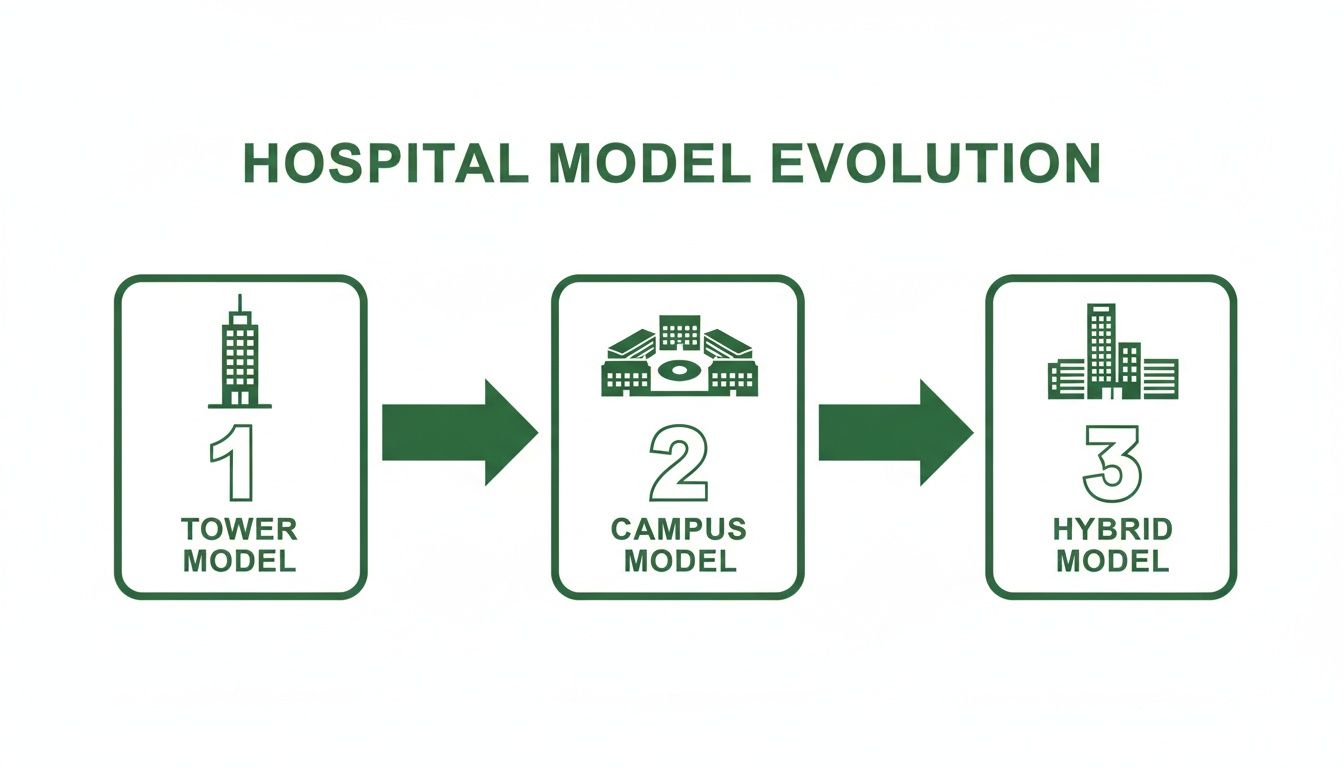
This evolution in hospital models directly influences how these internal flows are designed.

Infographic showing the evolution of hospital models: 1 Tower, 2 Campus, and 3 Hybrid, with building icons.

As you can see, each typology—from a dense vertical Tower to a sprawling Campus and a more balanced Hybrid—creates its own set of challenges and opportunities for laying out these vital patient and staff routes.

Separating "Onstage" and "Offstage" Traffic

Great hospital design also borrows a concept from the theater: separating the "onstage" action from the "offstage" work.

  • Public/Onstage Flow: Think of these as the main arteries—the lobbies, waiting rooms, and public corridors that patients and visitors use. They need to feel welcoming, be easy to navigate with clear signage, and be kept separate from the clinical and service hustle.

  • Staff/Offstage Flow: These are the dedicated, staff-only corridors and elevators. They’re the secret sauce that allows doctors and nurses to move quickly between departments without fighting public crowds. They also provide a clean route for moving sterile supplies and medication.

  • Service Flow: This is the circulation for things like food carts, linen services, and waste removal. These pathways have to be completely isolated from everything else to maintain hygiene and stop cross-contamination.

This onstage/offstage separation is fundamental. It prevents bottlenecks, keeps patient areas quieter, and protects the sterility of clinical zones. In the end, a hospital’s internal layout is the invisible force shaping its daily rhythm. When done right, it creates a calm, safe, and intuitive environment that leads to better patient outcomes, happier staff, and a far more successful healthcare facility.

The Hidden Infrastructure Of A Modern Hospital

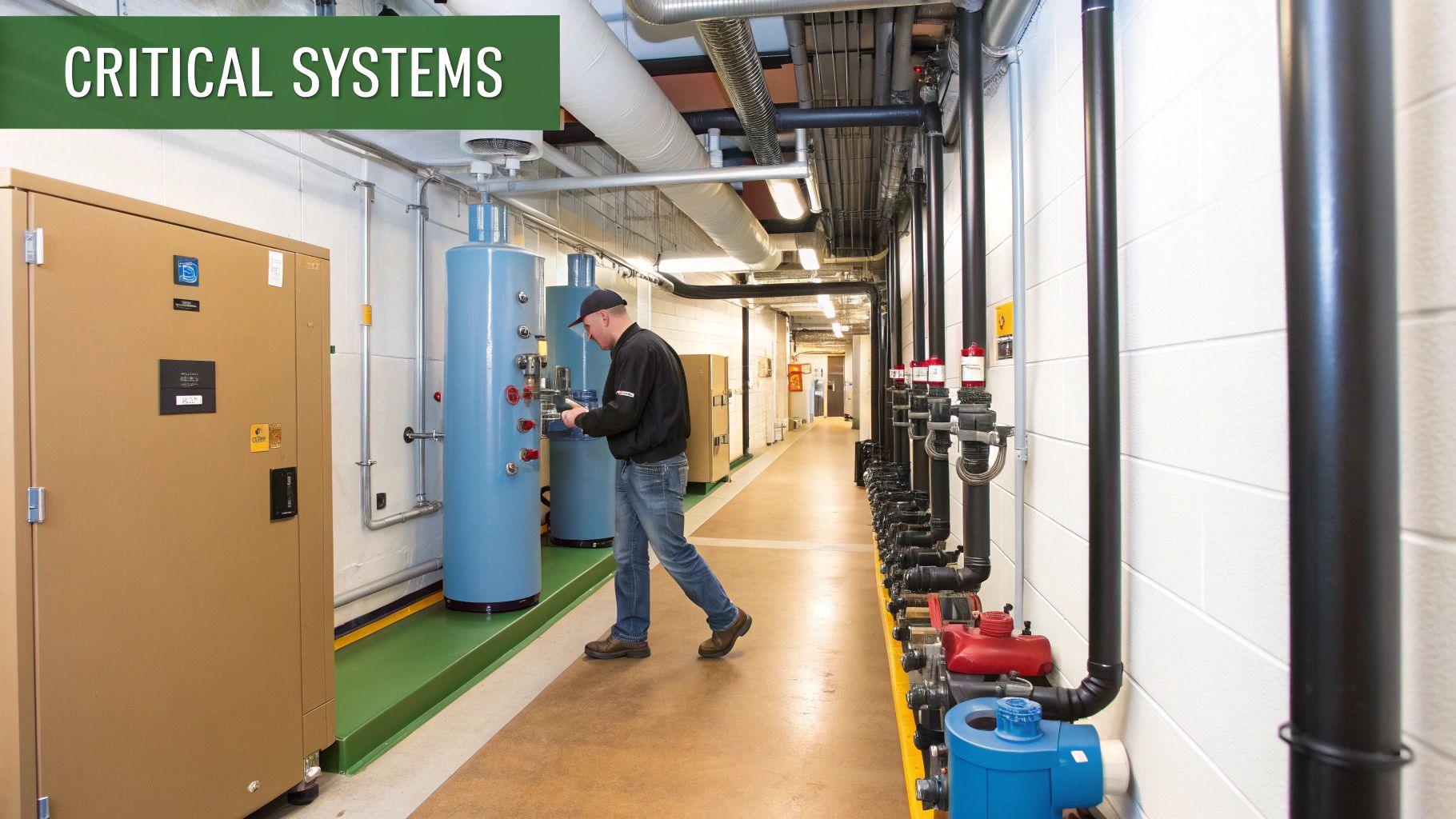
A man inspects critical system tanks and pipes in a modern hospital utility room.

Look past the patient rooms and surgical suites, and you'll find the true heart of a hospital: a massive, unseen network of critical systems. This is the building’s Mechanical, Electrical, and Plumbing (MEP) infrastructure. It's best to think of it as the facility's central nervous and circulatory systems combined—a complex web of pipes, wires, and ducts keeping everything alive and safe, 24/7.

These systems are anything but standard. A hospital's MEP infrastructure is built to support life-critical functions, often under extreme pressure. For any developer or owner, getting a handle on the sheer scale and cost of this hidden world is crucial. It can easily eat up a huge chunk of the construction budget and demands specialized expertise right from the start.

HVAC Systems That Do More Than Control Temperature

In a hospital, the Heating, Ventilation, and Air Conditioning (HVAC) system is a front-line defense in infection control. It's not just about keeping people comfortable. This system is engineered to maintain clinically mandated temperatures, humidity levels, and precise air change rates. Some areas, like isolation wings, may even require 100% fresh air intake with zero recirculation to stop airborne pathogens in their tracks.

These complex environmental controls are a core part of the hospital's infrastructure, and accurately projecting their cost is essential—often done using tools like Exayard HVAC estimating software. The system’s main job is creating specific pressure zones, which are absolutely non-negotiable for keeping patients safe.

Two great examples of this in action are:

  • Negative Pressure Rooms: Built for patients with contagious airborne illnesses, these rooms constantly pull air in and filter it before sending it outside. This simple principle ensures infectious particles can't escape into the hallways.
  • Positive Pressure Rooms: On the flip side, operating theaters and rooms for immunocompromised patients are pressurized to constantly push air out. This creates a sterile bubble, preventing contaminants from the surrounding areas from ever getting in.

The Unseen Lifelines: Medical Gas And Emergency Power

Tucked away inside the walls and ceilings is another lifeline: a dedicated network of pipelines delivering essential medical gases. These systems pipe oxygen, medical air, and vacuum suction directly to the bedside and into operating rooms. The codes governing their design are incredibly strict for one simple reason—failure is not an option.

Just as important is the electrical system’s resilience. A hospital simply has to stay running, even during a city-wide blackout. This demands a bulletproof emergency power setup, complete with massive generators and uninterruptible power supply (UPS) systems.

A hospital's emergency power system isn't just for the lights. It is legally required to support all life-sustaining equipment, from ventilators in the ICU to the surgical equipment in the operating room, without a moment's interruption.

Building in this level of redundancy is a major driver of cost and complexity. The electrical switchgear and generator plants required are massive, expensive, and need a significant amount of physical space planned into the building's footprint from day one.

Water Management And Specialized Plumbing

Finally, a hospital’s plumbing is worlds away from what you’d find in any other commercial building. It has to handle everything from the ultra-pure water required for labs and dialysis to the safe disposal of hazardous medical waste. These systems are designed with extensive backflow prevention to ensure there’s zero chance of cross-contamination between drinking water and waste streams.

Weaving all these intricate MEP systems together is a monumental challenge. It requires tight, constant coordination between architects, engineers, and contractors from the very first sketch. If you fail to plan for the spatial and structural needs of this hidden infrastructure, you’re setting yourself up for catastrophic budget overruns, crippling delays, and a final design that could compromise patient safety.

The Rules of the Game: Mastering Healthcare Codes and Regulations

Hospital architecture is a game played on a field defined by codes and standards. These aren't just bureaucratic red tape; they're the hard-won lessons from decades of medical practice, crystallized into rules that make healthcare facilities fundamentally safe, accessible, and ready for anything. For any owner or developer, getting a handle on this regulatory world isn't just a good idea—it's the only way to deliver a building that works.

Think of these regulations less as a checklist and more as the DNA of a successful hospital. They influence everything, from how wide a hallway needs to be for a gurney to pass a crash cart, to the specific fire-rating of a door separating an operating room from a corridor. Nail this from the beginning, and you avoid the nightmare of costly rework and delays in getting your doors open.

The Must-Know Codes and Standards

While the full library of codes can be intimidating, a few key documents are the foundation of nearly all hospital design in the U.S. The big one is the FGI Guidelines for Design and Construction. This is the go-to resource for minimum standards on everything from planning to building hospitals and clinics. It's so well-regarded that most states adopt it, either in full or with minor tweaks, as their legal standard.

Right alongside it is the Americans with Disabilities Act (ADA). This is non-negotiable. The ADA dictates that every corner of the facility—from the slope of the parking lot ramps to the height of a check-in counter and the layout of a patient bathroom—is usable by everyone. This isn't just about avoiding a lawsuit; it's about a core ethical commitment to providing equal access to care.

A rookie mistake is to treat code compliance like a final inspection item. The pros integrate these requirements into the schematic design from the very first meeting. Weaving FGI and ADA principles into the project from day one saves an incredible amount of time, money, and headaches later on.

Marrying Compliance with Green Building Goals

These days, smart design is all about hitting two targets with one stone: meeting strict regulatory demands while also pursuing ambitious sustainability goals. The good news is that these two objectives often go hand-in-hand. For example, modern energy codes practically demand the same high-performance building envelopes and efficient HVAC systems that are central to green building certifications like LEED.

This overlap creates a compelling financial argument for building green. A hospital designed for energy efficiency doesn't just shrink its carbon footprint; it also slashes its operating expenses for decades to come, which can mean millions in savings over the life of the building.

Here are a few practical examples of how this works:

  • High-Performance Glazing: Installing advanced windows that block summer heat and retain winter warmth helps you meet tough new energy codes. It also makes patients more comfortable and takes a huge load off your HVAC system.
  • LED Lighting and Controls: Shifting to smart lighting with occupancy sensors is a great way to meet energy efficiency requirements. The bonus? It can easily cut your lighting-related electricity costs by 50% or more.
  • Water-Saving Fixtures: Specifying low-flow faucets and toilets is often required by modern plumbing codes, but it also directly cuts your facility's massive water and sewer bills.
  • Durable, Healthy Materials: Choosing materials that are built to last and don't off-gas harmful chemicals (low-VOC) helps satisfy health and safety regulations while also improving indoor air quality—a huge win for both patients and green building credits.

In the end, navigating the web of healthcare regulations is about much more than just ticking boxes to avoid fines. It's a chance to build a smarter facility—one that's safer for patients, more functional for staff, and far cheaper to run. When you bake these requirements into the design from the start, you create a high-performing asset that will deliver value for years to come.

The Business Case For Hospital Development And Reuse

For any developer or property owner eyeing the healthcare space, one thing is clear: a hospital is as much a financial equation as it is a design marvel. You have to look past the blueprints and building codes to see the intricate business case—a delicate balance between massive upfront investment, long-term operational health, and profound community value.

Whether you're breaking ground on a new campus or breathing new life into an old building, the numbers are daunting. Hospitals are among the most expensive commercial projects to get built, largely because of the complex, often invisible infrastructure that makes them work. Specialized MEP (Mechanical, Electrical, and Plumbing) systems—think medical gas lines, redundant emergency power, and hospital-grade HVAC—chew up a huge slice of the budget.

These systems aren't optional extras; they're the lifeblood of the facility. They must be integrated perfectly from day one, which makes getting those estimates right early on absolutely crucial for keeping the project financially on track.

The Phasing Puzzle: Maintaining Operations During Construction

One of the biggest headaches in healthcare projects is trying to renovate or expand a hospital that can't simply close its doors. This is where a sharp project phasing strategy comes in. You have to break the entire construction process down into a series of manageable, carefully sequenced stages.

It’s a lot like performing surgery on the building itself. Every move has to be meticulously planned to cause the least possible disruption to patient care happening just a few feet away.

A typical phasing plan usually involves a few key steps:

  • Decanting: This is the process of temporarily moving a whole department to another part of the hospital or even into a modular unit outside.
  • Containment: We use heavy-duty physical barriers and negative air pressure systems to completely seal off construction zones. This is vital for controlling dust, noise, and vibration.
  • Sequenced Handovers: Once a section is finished, it's fully commissioned and tested. Only then do we move staff and patients in before we even think about starting the next phase.

This approach keeps the hospital running, but there's no sugar-coating it—it adds significant time, complexity, and cost to the project.

The real art of phasing is creating a series of self-contained construction "bubbles" inside a living, breathing hospital. It allows the facility to continue its life-saving work uninterrupted while the building literally evolves around it.

The Value of Adaptive Reuse: A Sustainable Strategy

While starting with a clean slate is tempting, the adaptive reuse of existing buildings presents a really compelling business case. Turning an old office building, a warehouse, or a dated medical facility into a modern hospital can be a smarter, faster, and more sustainable path.

History gives us some great perspective here. Back in Renaissance Florence, a hospital building boom was directly linked to the city's explosive growth. As the population grew, these institutions transformed from simple shelters into wealthy, powerful anchors of the urban landscape. It’s a perfect example of the deep-rooted connection between healthcare infrastructure and a thriving community. You can dig deeper into this fascinating connection and the origins of hospital architecture.

Today, adaptive reuse is the modern version of that story. By giving an old building a new purpose, developers can meet today's medical needs while preserving a piece of the community's character. It's an approach that sidesteps the huge carbon footprint of demolition and new construction and often allows you to tap into existing infrastructure. For a developer, it's a chance to build a forward-thinking healthcare asset that's both a nod to the past and a very shrewd investment in the future.

Common Questions About Hospital Architecture

If you're a developer, investor, or property owner stepping into the world of healthcare projects, you've probably got a few questions. Hospital architecture is its own beast, and this section is here to give you straightforward, practical answers to what we hear most often.

How Long Does It Take to Design a Hospital?

There's no cookie-cutter answer, but for a typical mid-sized hospital, you should plan on 18 to 24 months just for the design phase. That's before a single shovel hits the dirt. This window covers everything from the initial programming and high-level master planning all the way down to the fine-grained construction documents.

Why so long? It's a massive coordination effort. Architects have to work hand-in-glove with specialized MEP engineers, get constant feedback from clinical teams who will actually use the space, and navigate a maze of regulatory approvals. Trying to shortcut this phase is a recipe for expensive change orders and frustrating delays during construction.

What's the Most Expensive Part of Building a Hospital?

While the concrete and steel are significant, the real budget-buster in hospital construction is almost always the Mechanical, Electrical, and Plumbing (MEP) systems. You can expect these complex networks to eat up anywhere from 30% to 50% of your total construction cost—a much bigger slice of the pie than in a standard office or retail building.

Several things drive this high price tag:

  • Sophisticated HVAC: You're not just cooling a building. You're creating meticulously controlled environments, like negative-pressure rooms for infection control, which requires powerful and highly specialized air-handling equipment.
  • Medical Gas Lines: Hospitals need a dedicated plumbing system for life-saving gases like oxygen, medical air, and vacuum. It's an essential, non-negotiable utility.
  • Fail-Safe Power: When the power goes out, critical life-support machines can't. That means redundant generators and uninterruptible power supplies are an absolute must.

When you're putting together a pro forma for a hospital, seriously front-load the MEP budget. Underestimating this line item is one of the quickest ways for a healthcare development project to go off the rails financially.

Is It Better to Renovate an Old Hospital or Build a New One?

This is the million-dollar question, and the answer comes down to a tough cost-benefit analysis. On one hand, renovating an existing building—a form of adaptive reuse—can be cheaper and faster. If the building's structural "bones" are good, you get a huge head start. It's also a big win for sustainability, as you're saving tons of material from the landfill.

The catch is that older buildings often hide a hornet's nest of problems. Their infrastructure might be completely inadequate for today's high-tech medical equipment, or they might be a nightmare to bring up to current building codes. A new build, while more expensive upfront, gives you a blank canvas. You can design for perfect patient flow, seamlessly integrate the latest technology, and plan for future growth without being boxed in by an old layout. The best path forward really depends on the state of the old building, your site, the budget, and what you want the hospital to be in 10 or 20 years.


At Sherer Architects, LLC, we help owners and developers make these kinds of complex decisions every day. With our deep experience in commercial architecture, adaptive reuse, and historic preservation, we know how to transform challenging projects into valuable, lasting assets.

Let us help you put the pieces together.

Discover how our expertise can bring structure to your vision.

Categories
Uncategorized

Historic Preservation Tax Credits Your Guide to ROI

So, you're standing in front of a beautiful old building, one with character, history, and incredible potential. But when you start running the numbers on a renovation, the costs can feel overwhelming. This is exactly where historic preservation tax credits come into play, turning what seems like a daunting project into a smart financial move.

Turn Historic Buildings into Profitable Ventures

A man in a cap stands on a street with a grand historic building behind him.

These credits aren't just some minor tax break; they are powerful incentives that can dramatically lower your project costs. This guide will walk you through how combining federal and state programs can unlock the full financial potential of a historic property. It’s more than just restoration—it’s a strategic business decision that can seriously boost your return on investment.

Think of it this way: a tax credit isn't a simple deduction that just lowers your taxable income. It’s a direct, dollar-for-dollar reduction of the taxes you actually owe. It’s like having a financial partner in the project, making the restoration of architectural treasures not just possible, but often highly profitable.

A Proven Engine for Economic Growth

The ripple effect of these incentives goes far beyond a single project's bottom line. Since it kicked off in 1976, the Federal Historic Preservation Tax Credit (HTC) program has become a true powerhouse for community revitalization. It has sparked over $235 billion in private investment to bring more than 48,000 historic properties back to life.

For developers working with experienced firms like Sherer Architects, this program is a key tool for turning fading landmarks into thriving, profitable assets.

What’s really compelling is where these projects happen. A staggering 78% are in economically distressed areas, 50% are in low- to moderate-income neighborhoods, and 29% are in small communities. This isn't just about saving buildings; it’s about directly tackling urban decay and breathing new life into rural towns.

More Than Just Preservation

At its heart, this is a program about smart, sustainable development. By using historic preservation tax credits, you’re doing much more than just fixing up an old building. You can:

  • Boost Your ROI: The credits directly lower your project costs, which naturally increases your final return on investment.
  • Enhance Community Value: Revitalized buildings create jobs, bring energy back to neighborhoods, and adapt unique structures for modern commercial use.
  • Access More Capital: When you walk into a bank with approved tax credits, your project instantly looks more financially sound to lenders and investors.

To get the most out of these opportunities, it's wise to weave these credits into a broader set of real estate investment tax strategies. By understanding how to navigate the process, you can transform architectural treasures into profitable, community-enhancing assets.

Combining Federal and State Tax Credits

The real magic in financing a historic renovation isn't just finding one tax credit program; it's learning how to stack them. Think of it as building a financial engine with multiple, powerful parts. You don't just use the federal program or the state one—you combine them to create a much more substantial, profitable outcome for your project.

This strategy is especially potent here in South Carolina. We have a fantastic state-level program that dovetails perfectly with the long-standing federal credits. By understanding how these two systems work together, developers and property owners can dramatically cut their out-of-pocket costs and tax burdens, turning what might seem like a passion project into a truly smart investment.

The Foundation: The Federal Historic Tax Credit

The bedrock of this strategy is the Federal Historic Tax Credit (HTC). This is the big one, but it’s designed specifically for income-producing properties. If you're bringing a commercial building back to life, converting an old warehouse into lofts, or renovating a rental property, this is where you start.

The federal program offers a 20% tax credit on your Qualified Rehabilitation Expenses (QREs). And let’s be clear: this isn’t a deduction. It's a direct, dollar-for-dollar reduction of what you owe in federal income taxes. If your project has $1 million in eligible costs, that’s a $200,000 credit in your pocket. That kind of number can completely change the financial viability of a project right from the get-go.

Of course, this incentive comes with high standards. You have to follow the Secretary of the Interior’s Standards for Rehabilitation, but for those who plan carefully, the financial reward is more than worth the effort.

South Carolina's State-Level Power-Up

While the federal credit is a game-changer on its own, South Carolina’s own incentives are what make stacking so incredibly lucrative here. The state actually offers two different historic tax credits, which opens the door to more than just commercial developers.

  • For Income-Producing Properties: For these projects, South Carolina adds a generous 25% state income tax credit on top of the federal one. This stacks directly with the 20% federal credit, giving you a combined 45% of your costs back in credits. That synergy is powerful enough to make almost any historic project financially compelling.
  • For Owner-Occupied Homes: Here’s where South Carolina really stands out. Unlike the federal program, our state also offers a 25% state income tax credit for homeowners who rehab their personal historic residence. This is a fantastic opportunity for individuals to preserve their own piece of history and get a significant financial benefit for doing so.

This dual-pronged approach makes South Carolina one of the best places in the country for historic preservation. The combined federal and state incentives create a financial package that’s tough to beat.

Imagine you're a developer in Charleston or Columbia looking at a $2 million rehabilitation. Stacking the 20% federal credit ($400,000) with the 25% state credit ($500,000) gives you $900,000 in tax credits. That’s nearly half the project cost covered, which is often the key to getting a "yes" from lenders and investors.

Federal HTC vs South Carolina State Historic Tax Credits at a Glance

To really get a handle on how these programs work together, it helps to see them side-by-side. They’re designed to be partners, but they have their own distinct rules about property use, credit value, and ownership terms that you need to understand for smart project planning.

Feature Federal Historic Tax Credit (HTC) South Carolina State Tax Credit
Credit Percentage 20% of Qualified Rehabilitation Expenses. 25% of Qualified Rehabilitation Expenses.
Eligible Properties Income-producing only (commercial, industrial, rental). Both income-producing and owner-occupied residential properties.
Minimum Investment Rehab cost must exceed the building's adjusted basis (the "Substantial Rehabilitation Test"). A minimum investment threshold applies, which varies by property type.
Recapture Period A 5-year holding period is required to avoid credit recapture. A 5-year holding period is also required for the state credit.

This table really drives home the opportunity we have here in South Carolina. For commercial developers, the ability to combine these credits creates an incredible financial synergy. It maximizes the total return on investment and transforms the preservation of our state's beautiful historic architecture from a noble cause into a sound, profitable business strategy.

Does Your Renovation Project Qualify?

Figuring out if your project qualifies for historic preservation tax credits can seem daunting, but I always tell clients to think of it as a simple, three-part checklist. Before you get lost in the details of floor plans and budgets, we need to make sure your building and your project tick these fundamental boxes.

Think of it like this: there are three main gates you have to pass through to unlock the financial power of these credits. Each one looks at a different piece of the puzzle—the building's official status, the size of your investment, and the quality of the restoration work itself. Nailing these three things from the get-go is the most critical step you can take.

Is Your Building Historically Significant?

First things first, the building has to be officially recognized as historic. It's not enough for a building to just be old or have character; it needs a formal designation. This is the absolute, non-negotiable starting point for both the federal and state tax credit programs.

So, how do you know if your property makes the cut? It needs to meet one of two conditions:

  • It’s individually listed on the National Register of Historic Places. This is the clearest path, meaning the building is considered significant all on its own.
  • It's a contributing structure within a Registered Historic District. This means your building is a key piece of the neighborhood's historic fabric, even if it isn't a standalone landmark.

We can quickly help you verify your property’s status. If it's not yet certified as "contributing," we have experience guiding clients through that process.

Passing the Substantial Rehabilitation Test

Once you've confirmed the building's historic status, the next gate is all about the money. These programs are designed to reward major, transformative investments, not just a quick coat of paint or some minor updates. To qualify, your project has to pass the “Substantial Rehabilitation Test.”

It sounds technical, but the logic is straightforward: you have to spend more on the renovation than the building is currently worth.

The official rule is that your Qualified Rehabilitation Expenses (QREs) must be greater than the "adjusted basis" of the building. In simple terms, the adjusted basis is usually what you paid for the building (minus the land value), minus any depreciation you’ve claimed, plus the cost of any capital improvements you’ve already made.

Meeting this financial bar proves your project is a serious, significant undertaking. It's the government's way of ensuring the tax incentives go to projects that are making a real commitment to bringing these old buildings back to life.

Following the Secretary of the Interior’s Standards

The final gate is about the quality and sensitivity of the renovation itself. All the work you do must adhere to the Secretary of the Interior's Standards for Rehabilitation. A lot of people hear "standards" and think of rigid, stifling rules, but that’s not the case at all.

These ten standards are really just a set of best-practice principles for making smart design choices that honor a building's past while preparing it for a modern future. They guide everything from repairing old brick and windows to designing new additions, always emphasizing repair over replacement and ensuring new work complements the old. This is where an architect's experience is absolutely crucial. A firm like ours, that lives and breathes historic preservation, knows how to design a project that achieves your business goals while effortlessly aligning with these standards.

The ripple effect of these projects is incredible, often breathing new life into areas that need it most. It's no accident that half of all historic tax credit projects are in low-income communities and 78% are in economically distressed areas. These credits are a powerful engine for community growth. Exciting proposals are even on the table to make it easier for nonprofits to get involved, potentially allowing these credits to be combined with Low-Income Housing Tax Credits. You can learn more about how these incentives drive inclusive growth from this fact sheet from Preservation Action.

Navigating the Application Process Step by Step

Chasing historic preservation tax credits can feel like navigating a maze, but it's really just a straightforward, three-part journey. Think of the application as a story with a beginning, a middle, and an end. Each part builds on the last, and you have to complete them in the right order.

It’s a lot like building a house. You can't frame the walls (Part 2) until you've poured the foundation (Part 1). And you certainly can't get the final sign-off (Part 3) until the work is done. An experienced architect acts as your guide, making sure every document is filed correctly and on time, keeping the whole project on track from start to finish.

This timeline breaks down the three main checkpoints you’ll need to clear.

Project qualification timeline for historic buildings showing designation, rehab test, and design standards stages.

Each stage—proving the building's historic Designation, passing the Rehab Test, and following the Design Standards—is a non-negotiable step on the path to securing these credits.

Part 1: Certifying Your Building’s Historic Status

The whole process kicks off with the Historic Preservation Certification Application, Part 1—Evaluation of Significance. This is where you officially prove your building is worth preserving. Even if the property is already listed on the National Register, this step is required to get it formally recognized for your specific tax credit project.

Part 1 is all about documentation. You'll need to pull together:

  • Photographs: Clear, current photos are a must. They need to show the building's overall condition and highlight its important architectural details.
  • Historical Information: You'll write a narrative explaining the building's history and why it matters to the local historic district (if it’s in one).
  • Maps: A simple map showing exactly where the property sits within the historic district.

Your architect will take this information and weave it into a compelling story for the reviewers at the State Historic Preservation Office (SHPO) and the National Park Service (NPS). Getting Part 1 approved is the green light that confirms your building is a deserving candidate.

Part 2: Getting Your Rehabilitation Plan Approved

Once your building's historic status is locked in, you’re ready for Part 2—Description of Rehabilitation. This is the heart of the application and, frankly, the most intensive phase. Here, you submit your full architectural plans and project details for review before you start any major work.

Let me be clear: this is a forward-looking step, not a look back. You're asking for permission, not forgiveness. The goal is to get the SHPO and NPS to sign off on your proposed work, confirming it follows the Secretary of the Interior’s Standards. Nailing Part 2 prevents expensive do-overs and frustrating delays later on.

A rock-solid Part 2 submission is your best insurance policy against project headaches. When it's put together by an architect who knows preservation inside and out, it shows reviewers you have a smart, respectful plan for bringing the building into the 21st century.

Part 3: Certifying the Completed Work

The final step is Part 3—Request for Certification of Completed Work. After the last nail is hammered and the paint is dry, you submit this application to show that the finished project matches the plans approved in Part 2. This is the finish line—where your project gets its final certification and the tax credits are officially unlocked.

This last package includes "after" photos that mirror the "before" shots from Part 1, plus a formal statement confirming everything meets the program's requirements. The NPS issues the final certification, which you then file with your income tax return to claim your credits.

Getting through these three stages takes foresight, an expert understanding of preservation rules, and constant communication with state and federal agencies. It’s a process where having the right professional in your corner isn't just helpful—it’s what protects your investment and turns your vision into a financial success.

How These Credits Impact Your Bottom Line

It’s easy to talk about percentages, but to really understand the power of historic preservation tax credits, you have to see what they do to a project's budget. These aren't just a nice little bonus; they completely reshape the financial DNA of a renovation, often turning a project that’s on the bubble into a fantastic investment. By directly cutting down your tax bill, these credits free up an enormous amount of capital and can seriously boost your return.

A miniature house model on grass with a calculator, financial documents, and a pen for real estate planning.

Let’s walk through a real-world example. The numbers really tell the story of how stacking federal and state credits can be the deciding factor between a project that just breaks even and one that’s a home run.

A Practical Case Study

Let's imagine a developer who has just purchased a historic warehouse in a part of town that's seeing new life. The purchase price was $800,000. The vision is to convert it into a mixed-use commercial space, and the budget for the full rehabilitation is $1,500,000.

First, we need to figure out the Qualified Rehabilitation Expenses (QREs). Think of these as the "hard costs"—the money spent directly on the building itself. This includes things like structural work, restoring original windows, or putting in new HVAC and electrical systems. In our scenario, the entire $1,500,000 budget qualifies.

Now, let's do the math on the credits.

  • Federal Historic Tax Credit: The federal government offers a 20% credit on the QREs. For this project, that’s a $300,000 credit ($1,500,000 x 0.20).
  • South Carolina State Tax Credit: Our state program offers an even more generous 25% credit. That adds another $375,000 to the mix ($1,500,000 x 0.25).

By combining these two programs, the developer gets a staggering $675,000 in total tax credits. And remember, this isn’t a deduction that just lowers your taxable income. It's a true, dollar-for-dollar credit that erases what you owe in future taxes.

Analyzing the Financial Impact

The effect of these credits goes way beyond that initial $675,000 figure. That savings changes the entire financial picture, making the deal far more secure and appealing from every possible angle.

Right off the bat, the project's net cost plummets. That $1.5 million renovation now effectively costs the developer only $825,000 out of pocket once the credits are accounted for. This drastically reduces the capital they need to raise and lowers the overall financial risk.

A project with nearly half of its rehabilitation costs covered by tax credits is fundamentally different from one financed entirely with debt and equity. It allows for a more conservative capital stack, better loan terms, and a faster path to profitability for investors.

This stronger financial footing creates a positive ripple effect. When you walk into a bank with approved tax credits, you're essentially showing them a form of secured equity. It signals that the project is not only financially viable but also has the backing of both federal and state preservation programs. This adds a layer of credibility that lenders love, often leading to better financing terms.

In the end, these historic preservation tax credits turn abstract ideas into tangible cash. They make projects more attractive to banks and investors alike, proving that saving our architectural heritage isn't just a good cause—it's smart business.

Why Your Architect Is Your Most Valuable Partner

When you kick off a project involving historic preservation tax credits, it’s natural to see your architect primarily as the person drawing up plans. But in this very specific arena, they are so much more. Think of them as your strategic partner, the person who safeguards your investment and makes sure your vision actually pays off.

Their job goes way beyond the blueprints. They’re your guide through the red tape, your advocate with review boards, and your quality control expert, all wrapped into one.

An architect who’s been down this road before—like our team at Sherer Architects—knows the process is a delicate dance. It’s about fitting modern needs into a historic shell in a way that checks all the boxes for the tax credit programs and for you. That kind of experience is what stops expensive mistakes before they happen and keeps the whole project on track.

Masters of Meticulous Documentation

The application for historic tax credits is a mountain of paperwork. And I mean a mountain. Every single detail is scrutinized. Your architect is the one responsible for creating the exhaustive documentation that the State Historic Preservation Office (SHPO) and the National Park Service (NPS) demand.

This isn’t just a set of floor plans. It’s a deep dive into the specifics:

  • Detailed Drawings and Specifications: These aren't your average construction plans. They have to outline the exact methods and materials that will be used to repair or bring back historic features, from window glazing to masonry techniques.
  • Comprehensive Photographic Records: A thorough “before” and “after” photo survey is non-negotiable. An experienced architect knows precisely what angles and details to capture to tell a compelling story of rehabilitation for the officials reviewing your file.

Getting this documentation right from the start is your first line of defense. It shows the review boards you’re serious and professional, leaving no room for questions or doubt.

Navigating the Secretary of the Interior’s Standards

The entire historic tax credit world revolves around one thing: The Secretary of the Interior’s 10 Standards for Rehabilitation. These are the commandments of preservation. A good architect doesn't just know them; they know how to interpret them creatively to solve real-world problems.

For instance, how do you install a modern, high-efficiency HVAC system without tearing apart the historic fabric of the building? How do you upgrade the electrical wiring to meet today's code while respecting original plaster walls? This is where an expert's guidance is absolutely essential to getting your historic preservation tax credits.

An architect’s true value is in being a translator. They translate your project goals into a language the government’s preservation requirements can understand, ensuring your design gets approved without killing your vision or your ROI.

This proactive approach to design saves you from soul-crushing (and budget-busting) revisions later.

Finally, your architect acts as your professional go-between. They handle all the communication with the SHPO and NPS, speaking their language and building the kind of rapport that makes the review process go smoothly. This constant advocacy protects your timeline and your bottom line, making sure your project successfully qualifies for every last credit it deserves.

Got Questions About Historic Tax Credits? We've Got Answers.

Jumping into a historic renovation project is exciting, but the financial details—especially tax credits—can feel a little daunting. It's completely normal to have questions as you try to line up your budget and timeline. We hear them all the time from developers and property owners just like you.

Let's clear up some of the most common points of confusion. Think of this as your go-to cheat sheet for navigating the process with confidence.

What Renovation Costs Actually Qualify?

This is the big one, right? It all comes down to what the government calls Qualified Rehabilitation Expenses, or QREs. Generally, this covers the hard costs of bringing the building back to life—things that are integral to its structure and function. We're talking about work on the walls, floors, roof, windows, and major systems like plumbing and electrical.

What's not included? Costs for buying the property itself, building a brand-new addition, or doing site work like paving a parking lot or landscaping. This is where an architect who knows the ropes is invaluable; they can help you meticulously categorize every expense to make sure you're maximizing every dollar of your potential credit.

What if I’ve Already Started the Renovation? Can I Still Get Credits?

Timing is absolutely critical here. Your entire rehabilitation plan needs the green light from both the State Historic Preservation Office (SHPO) and the National Park Service (NPS) before you finish the project. If you start swinging hammers and doing major work before getting that approval, you could lose your eligibility entirely.

It's a hard and fast rule: start the application process at the very beginning of your planning. The system is designed to approve a plan before work happens. Trying to get approval after the fact is a recipe for disappointment and a very expensive mistake.

How Long Do I Have to Own the Property?

Both the federal and state programs want to see long-term investment, not just a quick flip. That's why they have a five-year recapture period. If you sell the property within five years of completing the renovation (also known as "placing it in service"), you may have to pay back some or all of the tax credits.

The good news is that the amount you'd owe is prorated. It decreases by 20% for each full year you hold onto the property. After five years, you're in the clear.

Can I Get These Credits for My Own House?

This is a really common question, and the answer depends on which credit you're talking about. The Federal 20% Historic Tax Credit is designed specifically for income-producing properties. Think office buildings, retail storefronts, or apartment rentals.

But if you live in South Carolina, you're in luck. The state offers a separate 25% state tax credit just for owner-occupied historic homes. It's a fantastic incentive that helps homeowners invest in preserving the character of their own primary residence.


Ready to see how historic tax credits could make your next project's numbers work? The team at Sherer Architects, LLC lives and breathes this stuff. We can guide you through every single step, from figuring out if your building qualifies to getting that final certification. Let's talk about your project—get in touch with us today.

Categories
Uncategorized

How to Increase Property Value with Smart Commercial Upgrades

Before you even think about picking up a hammer or calling a contractor, you need a solid game plan. Trying to boost your property's value without one is like navigating without a map—you'll spend a lot of time and money and likely end up lost. The real secret to smart, profitable upgrades starts with a clear-eyed look at what you have and where it sits in the market.

This foundational work is what separates a successful investment from a costly mistake. It shows you exactly where to put your money for the best and fastest returns.

Your Strategic Foundation for Adding Property Value

Every dollar you spend on a commercial property should be a strategic investment, not just an expense. The most critical phase happens before you allocate any budget for capital improvements. It’s about building a roadmap that ensures every single upgrade directly pushes your property's valuation and strengthens your cash flow. This means thoroughly assessing the physical building, analyzing its financial performance, and then—and only then—planning targeted improvements.

The process is straightforward but essential: assess, analyze, and plan.

Three-step diagram for strategic property analysis, outlining Assess, Analyze, and Plan stages.

As you can see, a winning value-add strategy flows from a deep understanding of the property and its market. Jumping straight to planning without this groundwork leads to reactive, inefficient spending.

To guide this initial phase, a simple checklist can keep your analysis focused and on track.

Initial Property Value Assessment Checklist

This table breaks down the essential areas to evaluate before committing to any capital improvements, ensuring your decisions are backed by solid data.

Assessment Area Key Metrics to Evaluate Goal of Analysis
Physical Condition Age/condition of roof, HVAC, plumbing, electrical; structural integrity; interior/exterior finishes. Identify immediate needs, deferred maintenance, and opportunities for modernization that tenants value.
Financial Health Current rental rates vs. market, lease expiration dates, tenant quality, vacancy rates, Net Operating Income (NOI). Find "low-hanging fruit" like under-market leases and opportunities to boost NOI with minimal capital.
Market Position Competitor rental rates, amenities offered by nearby properties, local occupancy rates, neighborhood development trends. Understand what the local market expects and is willing to pay for, so your upgrades meet real demand.

By systematically working through these areas, you build a comprehensive picture of your property's current state and its potential, setting the stage for a highly effective improvement strategy.

Conduct a Property Condition Assessment

Your first concrete step is a professional Property Condition Assessment (PCA). This isn't just a casual walkthrough. It’s a deep, technical dive into the building’s core systems—from the roof and foundation right down to the HVAC, electrical, and plumbing. A good PCA uncovers both the urgent problems (like a boiler on its last legs) and the hidden gems (like an underused common area perfect for a new amenity).

The report you get is your playbook. It gives you a clear hierarchy of necessary repairs and potential upgrades, letting you prioritize spending based on urgency and potential ROI. For instance, finding an outdated electrical panel isn't just a safety flag; it's an opportunity to upgrade for modern tenant power needs, a feature that absolutely justifies higher rents.

Analyze Your Tenant Mix and Leases

The financial engine of your property is its tenants and their leases. It's time to get surgical with your rent roll. Are your current rates in line with the market, or are they lagging behind? Discovering under-market leases is the easiest way to find untapped revenue without a big capital spend.

Look at the tenant mix, too. Could specific upgrades attract a more desirable class of tenant? A deeper dive into how to increase property value with upgrades tailored to market demand is essential here. You also need to pay close attention to lease expiration dates. This allows you to schedule renovations strategically, minimizing vacancy and disruption as you bring the property up to its full potential.

By truly understanding your lease structures, you can find opportunities to introduce value-add services or adjust Common Area Maintenance (CAM) charges. These moves directly boost your Net Operating Income (NOI)—the number one driver of property valuation.

Perform a Hyper-Local Market Analysis

Finally, you need to zoom out and look at the world immediately around your building. National real estate trends are one thing, but your property lives and dies by its local market. That means analyzing the direct competition in your submarket.

  • What are their rental rates? Don't just glance at the numbers. Compare apples to apples—price per square foot for similar spaces and finishes.
  • What amenities are they offering? If the building next door just added a modern lobby or a tenant fitness center, they could be pulling tenants you want to attract.
  • What are their occupancy rates? High occupancy in neighboring properties is a great sign. It signals strong demand and validates your plan to invest in upgrades to capture a piece of that action.

This hyper-local data takes the guesswork out of the equation. It tells you precisely what your market values and what tenants are willing to pay for, allowing you to build a targeted plan that delivers maximum ROI.

Quick Wins: High-Impact Upgrades for Immediate ROI

Modern white apartment buildings with well-maintained landscaping and a prominent 'Quick Value Wins' sign.

Not every project needs a massive budget and a year-long timeline to move the needle on your property's value. From my experience, some of the smartest moves are the ones that deliver a swift, noticeable return. These are the quick wins—high-visibility improvements that immediately enhance the tenant experience, sharpen your curb appeal, and justify stronger rental rates.

By zeroing in on aesthetics, safety, and modern comforts, you can make your property far more competitive, almost overnight. These are the practical, efficient upgrades that pack a serious ROI punch without the headache of a major renovation.

Revitalize with Modern Lighting

One of the fastest and most effective upgrades you can make is swapping out every old bulb and fixture for modern LED lighting. It’s a simple change, but the ripple effect is powerful.

Think about it: dim, buzzing fluorescent lights in hallways or poorly lit parking lots don't just look bad; they feel unsafe. Bright, clean LED light instantly makes a space feel more secure, modern, and welcoming.

But the real magic is on your P&L statement. LED systems use a fraction of the energy of their old-school counterparts, which means an immediate and often substantial drop in your utility bills. That savings goes straight to your bottom line, boosting your Net Operating Income (NOI)—the holy grail for property valuation.

A well-lit property is a marketable property. It tells prospective tenants you care about their safety and comfort, and that's a huge differentiator in a competitive market like Columbia, SC.

Transform the Exterior with a Façade Facelift

You never get a second chance to make a first impression. In real estate, that impression happens at the curb. The building's façade is the very first thing a potential tenant or investor sees, and if it looks tired, you’ve already lost ground.

A strategic façade facelift is a relatively low-cost investment with an enormous visual payoff. This doesn't always mean expensive new siding. Often, a professional power washing and a fresh coat of paint in a contemporary color scheme can completely transform a building’s entire vibe.

Look at these high-impact exterior touches:

  • Landscaping Overhaul: Nothing screams "neglected" like overgrown shrubs and patchy grass. Clean lines, fresh mulch, and some seasonal color create a polished, inviting atmosphere that says the property is well-managed.
  • Modern Signage: Is your main sign faded, cracked, or just plain dated? Upgrading to crisp, modern signage is a small detail that speaks volumes about professionalism and quality.
  • Architectural Accents: Adding new awnings over doorways, updating exterior sconces, or even just painting the trim can add character and a touch of sophistication that helps your building stand out from the pack.

These changes work together to create undeniable curb appeal that not only attracts higher-quality tenants but also supports the premium lease rates you're aiming for.

Upgrade Common Areas and Tenant Spaces

While what's inside a tenant’s unit is key, the shared spaces they walk through every single day are just as important for satisfaction and retention. Upgrading lobbies, hallways, and common restrooms can make a bigger difference than you might think.

Put yourself in your tenants' shoes. A dated lobby with worn-out furniture or a dimly lit hallway sends a message of indifference. A simple refresh can change that perception entirely.

Focus on practical, noticeable improvements that tenants will appreciate daily:

  • Lobby Modernization: New LVT flooring, stylish furniture, and updated décor can make your lobby a truly impressive entry point instead of just a pass-through.
  • Restroom Refreshes: You don’t need a full gut job. New fixtures, modern vanities, touchless dispensers, and better lighting can make restrooms feel clean, modern, and high-end.
  • Amenity Enhancements: If you have a shared space, make it count. Adding secure package lockers, a small coffee bar, or even just fresh paint and flooring in a community room adds significant value for tenants.

These upgrades aren’t just cosmetic. They show you’re invested in providing a superior environment, which leads to happier tenants, longer lease terms, and lower turnover costs—all of which directly contribute to a higher, more stable property valuation.

Long-Term Investments for Sustainable Growth

While quick fixes can give you an immediate boost, real, lasting value is built through significant capital investments. These are the big-ticket upgrades that secure your property’s future, turning it from just another asset into a long-term revenue engine.

Moving past the cosmetic touches means getting serious about the core systems and structural integrity that tenants and future buyers really care about. Yes, these projects demand more upfront cash and careful planning, but the payoff comes back for years—sometimes decades—in the form of lower operating costs, better tenant attraction, and a fundamentally more resilient building.

Man in hard hat inspecting sustainable air purification units in a bright, modern building hallway.

Embrace Comprehensive Energy Efficiency

In today’s market, energy efficiency isn’t some optional bonus—it’s a financial imperative. Tenants are sharper than ever, and they know high utility bills carve into their bottom line. A building that actively helps them save money is simply more desirable and can justify higher rents.

This is about more than just swapping out lightbulbs. A true energy retrofit involves looking at the entire building envelope and its mechanical systems. It's a major undertaking, but the ROI is undeniable, mainly by slashing operating expenses, which directly juices your Net Operating Income (NOI).

Here's where to focus your energy investments:

  • HVAC Modernization: Ripping out that old, clunky HVAC and replacing it with a modern, high-efficiency unit is probably the single most impactful upgrade you can make. The energy savings alone often pay for the project in just a few years.
  • High-Performance Windows: Old, single-pane windows are basically holes in your wall bleeding out heated or cooled air. Installing new double- or even triple-pane windows with low-E coatings boosts insulation, kills drafts, and keeps tenants comfortable.
  • Upgraded Insulation: It’s not glamorous, but adding proper insulation in the walls and attic is one of the most cost-effective ways to regulate indoor temperatures. This takes a huge load off your HVAC system and cuts down on energy bills.

The bottom line is, you're not just saving a few bucks on utilities. You're future-proofing your building against rising energy costs and making a powerful statement to the growing number of eco-conscious corporate tenants.

Overhaul Core Building Systems

The systems you can't see—electrical, plumbing, roofing—are the lifeblood of your property. When they go, it’s not just an inconvenience. It’s a full-blown, expensive emergency that can drive tenants away and tank your reputation. Upgrading these systems proactively isn't just spending money; it's a defensive move that prevents disaster.

Think about it: an old electrical panel can’t handle the power demands of a modern, tech-heavy office. A full upgrade means you can confidently support any tenant's needs. The same goes for plumbing. It’s far better to replace old pipes on your own schedule than to wait for one to burst and flood two floors.

And let's not forget the roof. Protecting everything underneath it is fundamental. You can check out the essential benefits of a new roof to see how it improves everything from energy efficiency to structural integrity. It's a foundational capital improvement that pays for itself over and over.

Future-Proof with Technology and Accessibility

To stay competitive, your property has to keep up with the times. That means investing in upgrades that make life easier, safer, and more inclusive for everyone. Two of the most critical areas here are smart building technology and full ADA compliance.

Smart building features are no longer a sci-fi fantasy; they’re a basic expectation. These aren't just cool gadgets, either. They are practical tools that make the building cheaper to run and a better place to work.

Consider these high-impact tech integrations:

  • Smart Access Control: Keycard or mobile-based entry systems are far more secure and manageable than old-school locks and keys.
  • Automated Building Management Systems (BMS): A BMS is like a central brain for your property, intelligently controlling lighting, HVAC, and security to optimize energy use and reduce manual effort.
  • High-Speed Connectivity: Making sure your building is wired for top-tier fiber optic internet is completely non-negotiable for attracting modern businesses.

At the same time, investing in Americans with Disabilities Act (ADA) compliance is more than just a legal box to check—it's a smart business move. An accessible building immediately expands your pool of potential tenants and their clients. Going beyond the bare minimum with things like automatic door openers, modern elevators, and thoughtfully designed common areas shows you care and makes your property more valuable to everyone.

Unlocking Hidden Value with Adaptive Reuse

Sometimes the biggest leap in property value comes not from a fresh coat of paint, but from completely rethinking a building's purpose. This is the heart of adaptive reuse—the art of giving old structures a new life. Instead of tearing down a building that’s solid but outdated, you transform it to meet what the market needs today.

It’s a strategy that requires seeing potential where others might just see an old, obsolete building. That forgotten warehouse on the edge of the industrial park? It could be the next hot creative office hub. An old textile mill, woven into the city’s history, can be reborn as a destination mixed-use development with retail, apartments, and restaurants. These projects don't just get updated; they become one-of-a-kind properties that stand out from the cookie-cutter new builds.

People in a modern adaptive reuse workspace with brick walls and large windows.

The Business Case for Repurposing Buildings

From a purely practical standpoint, adaptive reuse is often smarter, greener, and more cost-effective than starting from scratch. New construction comes with staggering costs for materials, labor, and site prep. When you repurpose an existing structure, you're keeping all that embodied carbon out of the landfill and leveraging the building's original bones, which lets you focus your budget on high-impact systems and interior work.

This isn't just a niche strategy anymore; it's a proven value-add. Renovating older buildings can extend their useful life by 50-75 years while saving a bundle compared to demolition and new construction. The global real estate market is catching on, with investors hunting for assets they can actively reposition, especially as interest rates stabilize. You can find more details on these global real estate trends and how they're shaping investment decisions.

But it goes beyond the numbers. Adaptive reuse creates a story. Tenants and customers are drawn to spaces with character—the exposed brick, original timber beams, and massive industrial windows of a converted factory are features you simply can't fake. This unique vibe often translates directly into higher rents and lower vacancy rates.

Navigating Historic Preservation and Tax Credits

Many of the best candidates for adaptive reuse are historic properties. This might sound like it adds a layer of red tape, and it can, but it also opens the door to a game-changing financial tool: historic preservation tax credits. These aren't just minor deductions. They are powerful credits that can slash your upfront investment and seriously boost your project's ROI.

To get these incentives, you have to be meticulous. The renovation work must respect the building’s historical integrity, following both local and national guidelines. This is where you absolutely need an architectural firm with deep experience in historic preservation on your team. They'll guide you through the maze, ensuring your design modernizes the building for today's tenants while honoring its past.

Expert Insight: An architect experienced in historic preservation does more than just draw up plans. They are your navigator for the entire approval process. They know how to speak the language of the Design Review Board or Historic Preservation Committee, finding that sweet spot between your financial goals and the community’s preservation standards to get your project across the finish line.

The financial upside can be enormous. Federal and state programs offer tax credits covering a significant percentage of qualified rehabilitation expenses. Beyond credits, you'll often find local grants and low-interest loans earmarked for preserving historic structures. These programs are designed to make saving a building the smart financial choice.

Real-World Scenarios Creating Unique Destinations

You can really see the power of adaptive reuse when you look at real-world examples. Think about these kinds of transformations, which are popping up in cities like Columbia and all over the country:

  • From Warehouse to Workspace: A cavernous, single-user warehouse is carved up into flexible office suites for creative tenants. By keeping the high ceilings, massive windows, and open layouts, you attract tech startups and design firms that want anything but a bland corporate office. The old loading dock area? It's now a shared amenity space with a coffee bar and conference rooms.
  • From Mill to Mixed-Use Hub: A historic mill on the river is turned into a true destination. The ground floor becomes a lively mix of boutique shops and local restaurants with patios overlooking the water. The upper floors are converted into high-end lofts that command premium rents because of their unique character, great views, and built-in walkable lifestyle.
  • From Bank to Boutique Hotel: An old, ornate downtown bank building with a soaring lobby gets a new life as a luxury boutique hotel. The grand banking hall becomes a memorable lobby and bar. The former offices are turned into distinctive guest suites. It's an experience no new chain hotel could ever replicate.

In each of these scenarios, you're increasing property value not just by upgrading a building, but by fundamentally changing its role in the community. You aren't just renovating a property; you're creating a landmark.

Getting Your Project Approved: Don't Go It Alone

A brilliant plan to boost your property's value is just a stack of paper until it gets a stamp of approval. Too many owners get excited about the design and the construction numbers, completely underestimating the maze of local regulations waiting for them. It’s a classic mistake, and one that can easily tangle up timelines, bloat budgets, and stop a great project dead in its tracks.

Moving from blueprint to reality means you have to speak the language of zoning laws, building codes, and, most importantly, the local officials who hold the keys. Getting this part wrong isn't just an inconvenience; it’s a costly error that can put your entire investment at risk.

The Real Cost of a Regulatory 'Oops'

Imagine spending months and a small fortune on architectural plans, only to discover you’ve run afoul of an obscure local ordinance or that the Design Review Board simply doesn't like your building's look. It happens. A lot.

Here are a few all-too-common ways projects get stuck in the mud:

  • Zoning Gotchas: You might think your commercial C-2 zoning is straightforward, but did you know about the new overlay district that adds surprise restrictions on building height or business type?
  • Design Review Rejection: Boards, especially in historic districts like we have here in Columbia, SC, often have "unwritten rules" about aesthetics. Walking in with a design that doesn't respect the local vibe is a fast track to a "no."
  • Fumbling with Historic Preservation: If you're seeking historic tax credits, a poorly researched presentation to the preservation committee can get you denied on the spot. They want to see you’ve done your homework.

Each one of these mistakes means you're headed back to the drawing board, burning through cash on redesigns and losing precious time.

Why a Local Architect is Your Secret Weapon

This is exactly where partnering with an experienced, local architecture firm pays for itself ten times over. A good architect is so much more than a designer. They're your guide, your translator, and your advocate through the entire approvals process. They don’t just react to the rules; they build a strategy around them from the very beginning.

Think about it: an architect with deep roots in the community has probably stood in front of the same board members and city planners you're about to face, dozens of times. They know the personalities, the politics, and the arguments that actually work. That's not something you can Google.

An experienced architect translates your financial goals into a language that city planners and review boards understand and respect. They build a compelling case for your project, showing how it enhances the community while meeting all technical requirements.

Turning Red Tape into a Clear Path Forward

A true expert partner doesn’t just fill out the forms. They weave the regulatory strategy into the design DNA from day one.

They Spot Problems Before They Exist: A local firm lives and breathes the area's building, energy, and accessibility codes. They’ll catch a potential ADA violation or an energy code issue in the earliest sketches, saving you from a nightmare of changes later on. This proactive compliance doesn't just avoid fines; it expands your pool of potential tenants.

They Build a Winning Case: When you're up in front of the Design Review Board, your architect is your champion. They'll prepare a polished, persuasive presentation with clear renderings and a story that anticipates the board’s questions before they’re even asked. It changes the dynamic from a tense hearing to a productive conversation.

In the end, learning how to increase property value is as much about navigating city hall as it is about swinging a hammer. Bringing on an expert who knows the local landscape is the single best way to turn this challenge from a huge risk into a clear, manageable process. It’s how you make sure your vision becomes a profitable reality.

Frequently Asked Questions on Increasing Property Value

When it comes to commercial real estate, there’s no shortage of questions. Property owners are always looking for the smartest way to invest their capital, whether it's tackling a first, small upgrade or weighing the pros and cons of a major renovation.

We hear these questions all the time from clients aiming to get the most out of their assets. Here are some of the most common ones, with straight-to-the-point answers to help you move forward with confidence.

What’s the Very First Thing I Should Do to Increase My Property’s Value?

Before you spend a single dime, you need a baseline. The most critical first step is a thorough, honest assessment of where you stand right now. This means looking at your property from three different angles: its physical condition, its place in the current market, and its financial performance.

Start by getting a professional property condition assessment (PCA). This will give you a clear, unbiased look at what needs fixing and where the real opportunities are. At the same time, a solid market analysis will show you how you stack up against the competition and what local tenants are actually paying for. Round it out by reviewing your leases, and you'll have a complete picture to guide every decision you make.

Do I Have to Spend a Fortune on Renovations to Add Real Value?

Not at all. The name of the game is return on investment (ROI), and a bigger price tag doesn't always mean a bigger return. While a huge project like a full HVAC replacement can add significant long-term value, it's a major capital expense that takes time to pay off.

Often, the quicker wins come from smaller, high-impact upgrades that deliver a much faster payback. Think about things like:

  • Upgrading to modern LED lighting: This is a no-brainer. It instantly cuts utility bills and makes the whole property feel safer and more contemporary.
  • Refreshing the façade: Never underestimate curb appeal. A fresh coat of paint, modern signage, or professional landscaping can completely change how a building is perceived and attract better tenants.
  • Updating common areas: Small tweaks to lobbies, hallways, and restrooms go a long way in keeping current tenants happy and can help justify higher lease rates when it's time to renew.

The smartest approach usually involves a mix of these quick, high-impact projects alongside a plan for bigger, long-term investments. It's about building value steadily and strategically.

How Much Does Energy Efficiency Really Matter Anymore?

It's absolutely vital. In today's market, energy efficiency is no longer a "nice-to-have"—it's a core expectation. Tenants, especially larger corporate clients, are laser-focused on sustainability and, more practically, on their total operating costs. A building that costs less to run is simply a more valuable asset.

Upgrades like better insulation, high-performance windows, or a modern HVAC system directly lower your property's operating expenses. That drop in expenses boosts your net operating income (NOI), which is the number one driver of your property's valuation.

Investing in energy efficiency does more than just save on utility bills. It makes your property more resilient, marketable, and competitive for years to come, appealing to a broader and higher-quality tenant base.

Can I Really Get Financial Help to Renovate a Historic Building?

You absolutely can, and you should. Tackling a designated historic property opens up some powerful financial incentives that can make the project far more affordable than you might think. Both federal and state historic tax credit programs exist specifically to offset a huge portion of rehabilitation costs.

On top of the major tax credits, you'll often find local grants and low-interest loans geared toward preservation projects. The secret is to work with an architecture firm that has deep experience in historic preservation. They are indispensable for navigating the complex application maze and ensuring your renovation plans meet the strict government standards needed to qualify. Their expertise can be the difference-maker, dramatically reducing your out-of-pocket costs while you create a truly valuable, one-of-a-kind property.


At Sherer Architects, LLC, our specialty is guiding property owners through every phase of a project, from the initial sketch to the final ribbon-cutting. We turn complex challenges into profitable, successful buildings. Whether you're planning an adaptive reuse project, a historic preservation effort, or a strategic commercial upgrade, our team brings the local knowledge and technical skill to make it happen.

Ready to see what your property is truly capable of? Find out more about our services.

Categories
Uncategorized

What an Interior Architecture Firm Does and Why You Need One

An interior architecture firm does more than just decorate; it fundamentally reworks a building's structure and flow to reshape how the space actually functions. It's the difference between a stylist choosing an outfit and a surgeon reshaping the body underneath.

These firms are strategic partners. They focus on making your commercial property safe, efficient, and profitable by redesigning its "bones."

Thinking Beyond Decor: What Is an Interior Architecture Firm?

People often use "interior design" and "interior architecture" interchangeably, but they are worlds apart. While an interior designer is brilliant at aesthetics—choosing furniture, fabrics, and paint to make a space beautiful—an interior architecture firm starts much, much deeper. Their work begins long before anyone even thinks about a swatch of fabric.

These are licensed professionals who analyze and redesign the very structure of a building's interior. Their real expertise is in understanding how people move through and interact with their physical environment—a field often called environmental psychology. They solve complex spatial puzzles to make sure a building isn't just attractive, but is fundamentally sound and perfectly tuned for its purpose.

The Architect vs. The Decorator: An Analogy

Think of a building as a human body. An interior decorator is like a personal stylist. They pick the clothes (finishes), the accessories (furniture), and the makeup (color palette) to create an incredible final look. Their role is absolutely vital for appearance and expressing a specific style.

The interior architect, on the other hand, is like a surgeon and a kinesiologist rolled into one. They examine the skeleton (structural walls), the circulatory system (HVAC and plumbing), and the nervous system (electrical wiring). They can perform "surgery" by moving walls, rerouting systems, and completely changing the layout to improve the body's overall health and efficiency. They make sure the body can perform at its peak, not just look the part.

Core Responsibilities of an Interior Architecture Firm

An interior architecture firm's work goes far beyond aesthetics, covering critical technical and strategic ground. The main goal is to make the physical space support the business's objectives, which is especially important in commercial, adaptive reuse, and historic preservation projects.

Here’s a look at what they actually do:

  • Spatial Planning and Reconfiguration: This is all about analyzing and redesigning floor plans. They work to improve traffic flow, maximize every usable square foot, and make the experience better for everyone inside.
  • Structural Modifications: They have the expertise to legally and safely change a building’s interior structure. This includes complex tasks like removing or adding walls and integrating brand-new mechanical systems.
  • Code Compliance and Permitting: This is a big one. They navigate the maze of building codes, zoning laws, and accessibility standards (like the ADA) to ensure the project is fully compliant and can get all the necessary permits.
  • Project Management: They see the project through from the first sketch to the final construction walkthrough. This means coordinating with contractors, engineers, and vendors to make sure the vision becomes a reality, on time and on budget.

The Blueprint for Success: Core Architectural Services

Bringing a vision to life—turning an idea into a functional, beautiful space—isn't a single action. It’s a carefully managed journey. A seasoned interior architecture firm is your guide through a series of distinct phases, with each step building on the one before it to make sure the final result is exactly what you set out to achieve. This process is the blueprint that transforms abstract goals into tangible, valuable assets.

It all kicks off with a critical discovery phase we call Programming. This is so much more than a simple Q&A. Think of it as a deep-dive investigation into how your business operates, what your goals are, and what your space truly needs to accomplish. We ask the tough questions to understand not just what the space should look like, but how it needs to work for you, your staff, and your customers.

The architectural team gathers crucial data on workflow patterns, occupancy needs, brand identity, and even your plans for future growth. All of this information is distilled into a detailed project brief. This document becomes the north star for every single decision that follows.

From Concept to Concrete Plans

With the "what" and "why" sorted out during Programming, we move into the creative phases where the vision starts taking physical form. This is where ideas get explored, sharpened, and ultimately translated into the kind of technical specifications a construction team can build from.

This creative journey unfolds in three main stages:

  • Schematic Design: This is the big-picture, brainstorming part of the process. We develop broad-stroke concepts using tools like bubble diagrams, rough floor plans, and mood boards to pin down the overall look, feel, and flow of the space. The goal here is to explore the possibilities and agree on a clear direction before diving into the details.
  • Design Development (DD): Once a schematic concept gets the green light, the team starts refining it with a much greater level of detail. Specific materials are chosen, lighting plans are created, and interior elevations are drawn up. This phase adds a critical layer of precision, defining the project with enough clarity to start getting realistic cost estimates.
  • Construction Documents (CDs): This is where it all gets real. As the most technical and intensive phase, we produce a comprehensive set of drawings and specifications that become the legal instructions for the contractor. These documents detail everything from how walls are built and where outlets go to the exact paint colors and fixture models. Nothing is left to chance.

This methodical progression from a high-level idea to meticulously detailed plans is what keeps projects on track and on budget, eliminating costly surprises during construction.

The table below outlines this journey, showing how each phase serves a distinct purpose in bringing a project from an initial idea to a completed space.

| The Interior Architecture Project Lifecycle |
| :— | :— | :— |
| Project Phase | Primary Goal | Key Deliverables for the Client |
| Programming | Define project needs, goals, and constraints. | A detailed project brief, space requirements, and budget analysis. |
| Schematic Design | Explore broad concepts and establish the overall design direction. | Conceptual floor plans, mood boards, and initial 3D sketches. |
| Design Development | Refine the chosen concept with specific details and materials. | Detailed floor plans, interior elevations, and preliminary material selections. |
| Construction Documents | Create a complete set of technical drawings for bidding and permits. | A full set of architectural drawings, technical specs, and finish schedules. |
| Bidding & Permitting | Select a qualified contractor and obtain all necessary approvals. | Bid analysis, contractor recommendations, and approved building permits. |
| Construction Admin | Oversee construction to ensure it aligns with the design documents. | Site visit reports, change order management, and final punch list. |

This lifecycle ensures a smooth, predictable process where the client is informed and empowered at every step.

Navigating Regulations and Securing Bids

With a complete set of construction documents in hand, the project shifts from design to the practicalities of getting it built. The interior architecture firm’s role here is absolutely vital, acting as your advocate to navigate complex logistical and regulatory hurdles. This includes managing the Bidding and Negotiation process. We send the construction documents out to qualified general contractors, who then submit bids to build the project. We help you analyze these bids to ensure they are complete and competitive, then assist in negotiating the final contract.

At the same time, we're handling the intricate process of securing permits from local authorities. We submit the construction documents to city and county officials for their review, fielding any questions related to zoning laws, building codes, and safety regulations. This expert navigation is a huge risk-reducer for developers, preventing expensive delays and guaranteeing full compliance.

A skilled interior architecture firm doesn't just design a building; they pilot it through the administrative maze of design review boards, energy codes, and local ordinances, ensuring the project is both buildable and legally sound.

The following graphic helps visualize the different but complementary roles an interior architect and an interior decorator play over the course of a project.

Process flow diagram illustrating the steps for interior architecture and interior decorating services.

As you can see, the architect’s work is foundational—it’s about the structure, systems, and very bones of the space. The decorator’s work then comes in to enhance and complete that environment.

Ensuring Vision Becomes Reality

The final stretch is Construction Administration, and this is where the architect becomes your eyes and ears on the job site. We conduct regular site visits, answer questions from the contractor, review the quality of the work being done, and approve payment applications. This oversight is what protects your investment and ensures the project is built exactly as specified in the documents.

This hands-on management holds the construction team accountable for delivering the quality you paid for. The architect's involvement doesn't stop until the final punch list is complete and you're ready to move into your new, fully realized space. It’s this end-to-end service that showcases the true value of an interior architecture firm, creating a seamless bridge from the first spark of an idea to the day you open your doors.

The U.S. interior design market hit USD 35,010.3 million in revenue in 2024, with remodeling being the fastest-growing segment. This trend perfectly aligns with the adaptive reuse projects we specialize in, which breathe new life into existing structures. You can learn more about the interior design market's growth and how it’s shaping development strategies today.

Unlocking Value with Adaptive Reuse and Preservation

Spacious modern office interior featuring adaptive reuse design with exposed brick and large windows.

When many developers look at an old, tired building, they see a liability—something to be torn down. But a different kind of vision sees immense, untapped potential. This is the world of adaptive reuse, a smart strategy that breathes new life into aging structures, turning them into valuable, high-performing assets for today's market.

Adaptive reuse goes way beyond a simple renovation. It’s about strategically repurposing a building for an entirely new function while celebrating its original character. Think of an old textile mill buzzing with activity as a modern office hub, a forgotten warehouse finding new purpose as luxury lofts, or a grand old bank becoming a chic boutique hotel.

An interior architecture firm that specializes in this work is like a master puzzle-solver. They have the unique expertise to reconfigure outdated layouts for modern needs, weave in new mechanical and electrical systems without disrupting the building's soul, and navigate the intricate maze of historic preservation rules. The goal is always the same: create a space that feels contemporary and works beautifully, but is also rich with history and authenticity.

The Financial Case for Reimagining Old Buildings

The most powerful argument for adaptive reuse often comes down to the bottom line. For developers and property owners, choosing to repurpose an existing building instead of starting from scratch can offer a whole host of financial perks that are simply too good to ignore.

Demolition and new construction are expensive undertakings, both in time and money. Adaptive reuse projects, on the other hand, can be significantly more cost-effective. By keeping the building's "bones"—its core and shell—developers can see huge savings on materials and labor, often slashing project costs considerably.

Globally, the interior design market is projected to reach USD 214.35 billion by 2034, with commercial projects making up a huge piece of that pie. Adaptive reuse projects are frequently 40% cheaper than demolition and new construction, all while preserving historic character and opening doors to valuable tax incentives. Find out more about how market trends are favoring adaptive reuse projects.

These aren't just abstract savings. They directly translate into a healthier pro forma, a faster path to profitability, and a much higher return on investment for the developers who see the potential.

Beyond Cost Savings: The Strategic Advantages

The benefits of adaptive reuse don't stop with the budget. These projects have a built-in competitive edge that brand-new construction often struggles to match.

  • Accelerated Timelines: You get to skip the long demolition and site prep phases, meaning adaptive reuse projects often get to market much faster. This speed is a critical advantage, allowing you to start generating revenue sooner.
  • Unique Market Appeal: Today’s tenants and customers are looking for character. Exposed brick walls, original timber beams, and historic details create a unique sense of place that makes a property stand out from the cookie-cutter new builds, commanding higher rents and attracting top-tier tenants.
  • Environmental Sustainability: Reusing an entire building is one of the greenest things you can do in development. It drastically cuts down on landfill waste, preserves the embodied carbon locked into the original structure, and reduces the environmental toll of producing new materials.

Leveraging Historic Tax Credits for Maximum ROI

If the property has historical significance, the financial picture gets even brighter. A knowledgeable interior architecture firm becomes an essential partner in unlocking valuable historic tax credits. These government programs are specifically designed to encourage the preservation of landmark buildings by offering serious financial rewards.

Navigating the application process for these credits is a specialized skill. It requires a deep understanding of preservation standards, meticulous documentation, and careful negotiation with historical review boards. An experienced firm can guide you through every step, ensuring the design not only honors the building's past but also ticks every box required by the program.

These tax credits can offset 20-30% of qualified renovation costs, which can fundamentally change the financial viability of a project. What might have seemed like a daunting preservation challenge can quickly become a highly profitable venture, turning a community landmark into a cornerstone of your portfolio.

Why This Matters for Your Bottom Line

Choosing to work with an interior architecture firm isn't just about making a space look good; it's a hard-nosed business decision that directly impacts your financial success. Every single design choice, whether it's moving a wall or picking a countertop, is an investment. The right firm makes sure that investment pays off, turning your physical space from a cost center into a high-performing asset.

We're talking about shifting the focus from creating a beautiful space to building a profitable one. It’s the difference between a building that just sits there and one that actively works to boost your revenue, strengthen your brand, and secure your place in the market for years to come.

Enhancing ROI Through Smarter Space Utilization

At the end of the day, commercial real estate is a game of inches—or rather, square feet. The goal is to squeeze maximum value out of every single one. This is where an interior architecture firm really shines, using strategic spatial planning to find revenue potential you didn't even know existed.

Think of them as a master chess player who sees moves on the board that others miss. They might reconfigure a floor plan to create more leasable area, improve the flow of foot traffic, or simply make the space function better for its intended purpose.

For instance, a clever office redesign can fit more employees comfortably, meaning you don't have to lease more space. In a retail shop, rethinking the customer journey can lead to a 10-15% increase in sales just by guiding shoppers past high-margin products. This kind of optimization doesn't just make your property more functional; it makes it far more attractive to top-tier tenants and future buyers, directly boosting occupancy rates and resale value.

A well-designed commercial space is a powerful magnet for tenants and customers. It’s not just about what the space looks like; it’s about how it performs for the businesses operating within it.

There's a reason the U.S. interior design services sector employs around 140,128 professionals. With 38% of global demand coming from offices and retail spaces seeking wellness-focused layouts, developers who get this right can see occupancy jump by 15-20%. You can dive deeper into how strategic design is driving commercial real estate trends on InteriorDesign.net.

Saving Time and Money Through Expert Navigation

The road from a design sketch to a finished building is littered with potential landmines: tangled zoning laws, constantly changing building codes, and bureaucratic permitting processes. Each one is a risk that can lead to expensive delays and budget blowouts.

An experienced interior architecture firm is your guide through this regulatory maze. Their in-depth knowledge of local ordinances and established relationships with review boards mean they can spot trouble long before it becomes a real problem.

This proactive approach takes a huge amount of risk off your plate and keeps the project on a smoother, more predictable timeline. Shaving even a few months off a project schedule by avoiding permitting headaches means you start generating revenue that much sooner—and that's a massive win for any developer's bottom line.

Future-Proofing Your Asset with Flexible Design

The only constant in business is change. The explosion of hybrid work, new patterns in consumer behavior, and emerging technologies all demand that commercial spaces be able to adapt. A forward-thinking interior architecture firm doesn't just design for today; they design for tomorrow.

This foresight is built directly into the space through elements like:

  • Modular Walls: Allowing office layouts to be reconfigured on the fly for different team sizes or project needs.
  • Multi-Use Common Areas: Designing lobbies, cafes, or break rooms that can easily transform into event spaces or collaboration hubs.
  • Scalable Infrastructure: Planning ahead for future tech needs, making upgrades simple and affordable instead of a major renovation.

This kind of thinking protects your investment from becoming outdated. A building designed for flexibility today will stay valuable and relevant for decades, saving you from costly overhauls down the line. It ensures your property can pivot to meet new market opportunities, maintaining its competitive edge and long-term profitability.

How to Choose the Right Firm for Your Project

Two men shaking hands across a table with a laptop and documents in a bright office.

Picking an interior architecture firm is easily one of the most important decisions you'll make for your entire project. This isn't just about flipping through a portfolio of pretty pictures. You’re selecting a long-term partner who will be responsible for guiding you through complex regulations, managing a significant budget, and turning your business goals into a tangible, profitable space.

The "best" firm isn't necessarily the one with the trendiest designs. It's the one whose specific experience and problem-solving skills align directly with the challenges of your project. A great design is the bare minimum; a successful project that meets its goals on time and on budget is the real test of a firm’s value.

Look Beyond the Portfolio

A slick portfolio is a good start, but it really only shows you the final, polished product. To get a real sense of a firm's ability, you have to dig into their process and see how they've handled real-world challenges. Every project looks perfect in a professional photograph, but the true value of a firm emerges in how they navigate the inevitable bumps in the road during design and construction.

Look for a history that matches your project's DNA. If you’re tackling an adaptive reuse project, for example, you need a firm that lives and breathes historic preservation and knows how to bring old buildings into the modern era. Their firsthand experience with the unique structural quirks and regulatory mazes of these projects is absolutely essential.

The right interior architecture firm acts as a translator—they convert your vision into a buildable plan, your budget into a realistic scope, and your business goals into a functional, revenue-generating space. Their role is to de-risk the entire venture for you.

The same logic applies to new commercial construction. A firm with deep roots in South Carolina, strong relationships with local planning departments, and an intimate knowledge of zoning codes is a massive advantage. That kind of local expertise can save you months of delays and thousands in unexpected costs, paving a much smoother road from blueprint to grand opening.

Questions That Reveal True Expertise

When you sit down to interview potential firms, it's time to get past the surface-level questions about their design "style." What you really need to understand is how they think. Their answers to specific, scenario-based questions will tell you far more about their capabilities than any curated gallery of images.

Don't be afraid to come prepared with a list of tough questions that test their practical knowledge and collaborative approach. This is your chance to get a feel for their communication style and determine if they're a good cultural fit for your team.

Here are a few questions that cut to the chase:

  • Problem-Solving: "Tell me about a past project that hit a major zoning or permitting snag. How did you get it back on track, and what was the final result for the client?"
  • Budget Management: "What's your process for keeping the design aligned with our budget from start to finish? How do you approach value engineering if we see costs start to climb?"
  • Collaboration and Communication: "Walk me through how you work with clients, general contractors, and engineers. How do you manage differing opinions or priorities to keep everyone moving forward?"
  • Local Knowledge: "What's your experience with the design review boards and building codes right here in this municipality? Are there any specific local challenges we should be prepared for?"
  • Project Management: "What tools and systems do you use to manage the project schedule and budget? How often will we get updates, and what will they look like?"

The way they answer these questions will paint a very clear picture of their competence, their transparency, and ultimately, whether they are the right strategic partner to bring your vision to life.

Your Partner in Building Lasting Value

Choosing an interior architecture firm isn't like picking a vendor; it's about bringing on a strategic partner who’s fully invested in your commercial success. Think of them as the conductor of a complex orchestra, expertly weaving together your vision, budget, regulations, and market demands to create a space that truly works. They’re the ones who turn abstract business goals into a tangible, high-performing physical asset.

The real value here goes far beyond beautiful finishes or trendy furniture. It’s found in a floor plan that actively maximizes your revenue, a design that sails through the permitting process without costly delays, and a building that will stay relevant and valuable for decades to come. A skilled interior architecture firm makes sure every single choice directly contributes to your bottom line.

The most successful projects begin with a shift in mindset—viewing architectural services not as an expense, but as the foundational investment in building enduring value. Your partner in this process is key to unlocking your property's full potential.

So, as you approach your next commercial or adaptive reuse project, think about the strategic advantage that expert guidance brings to the table. The right architectural partner doesn't just design a space for you. They help build your future, ensuring your investment delivers returns long after the dust has settled. It’s the smartest first step you can take.

Frequently Asked Questions

When you're dealing with commercial real estate and development, questions are bound to come up. Here are some of the most common ones we hear from clients thinking about working with an interior architecture firm.

What's the Difference Between an Interior Architect and an Interior Designer?

It's a common point of confusion, but the distinction is crucial. While both want to create great spaces, their roles are fundamentally different.

An interior architecture firm is run by licensed professionals who are legally qualified to change the structure of a building's interior. Think of them as dealing with the "bones" of the space—moving walls, integrating new plumbing and electrical systems, ensuring everything is up to code, and handling any structural work.

An interior designer, on the other hand, usually works on the surface level. Their expertise is in the finishing touches: furniture, paint colors, fabrics, and accessories that define the aesthetic. If your project involves a gut renovation, adaptive reuse, or major new construction, you need an interior architect to lead the charge.

How Much Does It Cost to Hire an Interior Architecture Firm?

There's no single answer here, as the cost really depends on your project's size, scope, and how complex it is. Generally, fees are handled in one of three ways:

  • A percentage of the total construction cost, typically landing between 8% and 15%.
  • A fixed, flat fee that's agreed upon before any work begins.
  • An hourly rate for design work and consultations.

It might feel like a big line item on the budget, but a good firm provides value that far exceeds its cost. They catch expensive mistakes before they happen, navigate the permitting maze to save you from costly delays, and design your space to get the most out of every square foot. It’s less of a cost and more of an investment in your property's future.

Hiring an expert firm is about risk mitigation. Their fee is a strategic investment to ensure your multi-million dollar project is executed correctly, compliantly, and profitably, preventing far costlier mistakes down the line.

How Long Does a Typical Commercial Project Take?

The timeline is completely tied to the scale of the job. A simple commercial upfit could be wrapped up in a few months. But a major adaptive reuse project or a brand-new building can easily stretch to a year or more.

The whole process breaks down into distinct phases: design (which includes schematics and detailed construction documents), bidding and permitting, and finally, construction itself. A seasoned firm will give you a realistic timeline from the get-go and has the project management chops to keep things moving forward.

Can a Firm Help with Historic Tax Credits?

Absolutely. In fact, this is one of the most valuable services a firm can offer if you're working on a historic property. Finding a local firm that has successfully navigated the state and federal historic tax credit programs is a game-changer. This isn't something you can just wing; it’s a specialized skill that can make or break the financial success of a project.

Firms with this expertise will walk you through the entire application, from documenting the building's historic importance to making sure every single detail of the renovation follows the strict Secretary of the Interior’s Standards. Their guidance is essential for maximizing your tax credits and transforming a piece of history into a profitable, modern asset.


Ready to transform your vision into a valuable, enduring property? At Sherer Architects, LLC, we specialize in guiding clients through every stage of design and construction, from innovative commercial spaces to complex historic preservation projects. Let's discuss how our strategic approach can bring structure, beauty, and profitability to your next venture.

Contact us today to schedule your consultation

Categories
Uncategorized

Nature and Interior Design: A Practical Guide to Boost Property Value

Integrating nature into interior design—a practice known as biophilic design—goes far beyond a simple aesthetic choice. It's a strategic business move that can significantly enhance a building's financial performance. For commercial properties, this means creating spaces that aren't just beautiful but are measurably more profitable.

The core idea is to foster a connection to the natural world, which in turn boosts employee productivity, drives tenant demand, and ultimately, strengthens your bottom line.

Why Nature in Design Is a Smart Investment

Let's get one thing straight: weaving nature into a building's design isn't just about a "nice-to-have" upgrade. For smart developers and property owners, it’s a calculated investment with a clear and measurable return. Thoughtful biophilic design creates environments where people genuinely want to be, and that has serious financial upside in the world of commercial real estate.

A modern building lobby featuring a large living green wall with 'INVEST IN NATURE' text, large windows, and a shiny floor.

This investment pays dividends in very real ways, turning what might seem like simple design features into powerful assets that attract and keep high-value tenants and their employees.

Boosting Tenant Demand and Lease Rates

In a crowded market, biophilic elements are a huge differentiator. Properties that offer a connection to nature—whether through a stunning living wall, abundant natural light, or accessible outdoor terraces—are immediately perceived as premium spaces. This isn't just a feeling; it translates directly into higher occupancy and better rental income.

I saw this play out on a project recently. A client was weighing a standard cosmetic refresh against a full biophilic renovation for their aging office building. They went with the biophilic route, adding a central atrium with live trees and reconfiguring layouts to maximize daylight. The result? The building was fully leased months ahead of our projections, commanding lease rates 10% above the local market average.

Improving Occupant Productivity and Wellbeing

The link between nature and human performance is undeniable. When people have access to natural light, views of greenery, and good air quality, their focus and creativity improve. This connection to the natural world is proven to reduce stress and mental fatigue, which means fewer sick days and higher overall productivity.

For any business leasing your space, that's a massive operational advantage. A productive workforce is a profitable one, making biophilic offices a hot commodity for corporate tenants. By incorporating these elements, you significantly increase property value, making it a truly smart investment for long-term growth.

One study I often point to found that offices with plants and natural light see a 15% increase in workplace productivity. That number represents a direct financial benefit to the businesses in your building, making the rent you charge an easier pill to swallow.

The table below breaks down how specific biophilic features translate into tangible financial returns.

Biophilic Features and Their Commercial ROI

Biophilic Element Example Application Direct Financial Impact
Living Green Walls Lobby or common area feature wall. Attracts premium tenants, boosts brand image, and can justify higher lease rates.
Abundant Natural Light Large windows, skylights, open floor plans. Reduces energy costs by 10-40%, improves occupant mood and productivity.
Natural Materials Wood finishes, stone accents, natural textiles. Creates a high-end feel that can increase perceived property value and appeal to luxury tenants.
Indoor Plants & Trees Planters in offices, atrium gardens. Improves air quality, reduces stress, and is linked to a 12% increase in productivity.
Views of Nature Orienting desks toward windows, creating green roof terraces. Shown to reduce employee absenteeism and increase job satisfaction, a key selling point.

Each of these elements contributes to an environment that not only looks and feels better but actively performs better as a commercial asset.

The Growing Market for Biophilic Design

The demand for nature-centric spaces isn't a fad; it's a market that's rapidly expanding. The global biophilic design market is projected to hit $12.94 billion by 2032, which tells you everything you need to know about its importance in commercial development.

We're seeing real data to back this up. Tenants in major urban markets have shown they are willing to pay a 14% rent premium for floors with access to terraces and green spaces. That's proof of a direct ROI right there.

Applying Biophilic Principles to Your Project

Moving biophilic design from a high-level concept to a buildable plan requires a clear framework. For commercial and adaptive reuse projects, we've found it’s best to break it down into three core, actionable categories. This isn't just about scattering a few potted plants around; it’s about weaving nature into the very fabric of the building to create spaces that are both functional and genuinely restorative.

Each category offers a different path to fostering that connection to the natural world. By understanding these approaches, you can pick and choose the strategies that actually make sense for your project’s goals, budget, and physical constraints—whether you're starting from scratch or breathing new life into an old structure.

Direct Experience of Nature

This is the most literal application of biophilic design, and it’s exactly what it sounds like: bringing real, living nature indoors. It’s all about creating immediate, tangible connections to the living world. While a massive living wall in a lobby is a definite showstopper, direct nature can be brought in through countless other accessible ways.

For instance, on a recent adaptive reuse project, we took a dark, forgotten corridor and turned it into a vibrant common area. By installing a series of large skylights directly above a cluster of tall, low-light indoor trees, we didn't just add life—we created a dynamic play of light and shadow that moves and changes all day long.

Common ways to achieve this include:

  • Living Green Walls: These are fantastic for making a powerful first impression in lobbies or amenity spaces, and they do double duty by helping improve indoor air quality.
  • Water Features: The sound of moving water is a proven stress-reducer. Small fountains or water walls are perfect for quiet zones, wellness rooms, or waiting areas.
  • Indoor Planters and Atriums: Strategically placed plants can do so much—they can define different zones, guide foot traffic, and soften hard architectural lines. For smaller nooks or individual offices, you can even create a terrarium to add a self-contained touch of green.

Indirect Experience of Nature

Indirect experiences are all about representation. This approach uses materials, colors, textures, and patterns that feel like nature without being literal copies. It’s an incredibly powerful tool, especially in historic preservation or on projects where a tight budget makes complex living systems impractical.

Think about specifying reclaimed timber for the exposed beams in an old warehouse conversion. The wood’s natural grain, its imperfections, and its warm tones immediately create a sense of organic comfort and history. That single material choice connects people to both a natural process and the building’s own past.

An indirect approach is really about sensory engagement. The cool, smooth feel of a natural stone countertop or the visual texture of a grasscloth wall covering can trigger the same positive psychological responses as direct contact with nature.

Other examples of this principle in action are:

  • Natural Materials: Prioritizing wood, stone, bamboo, and cork for flooring, walls, and furnishings.
  • Biomorphic Forms: Choosing furniture, light fixtures, or architectural details with the kind of curved, organic shapes you’d find in nature.
  • Natural Color Palettes: Drawing inspiration from earthy tones, deep greens, and sky blues to create an atmosphere that feels calming and grounded.

Experience of Space and Place

This third principle is more subtle but just as important. It’s less about what you put in the space and more about how you shape the space itself to mirror our experiences out in the natural world.

A perfect example comes from a new build where we oriented the entire building to maximize views of a nearby wooded area. The floor plan was specifically designed so that the most-used spaces, like collaborative work zones and break rooms, had direct lines of sight to the trees. That strategic move didn't just boost wellbeing; it also slashed the need for artificial lighting, cutting projected energy costs by over 20%.

Key strategies for this approach include:

  • Prospect and Refuge: This is about creating spaces that offer broad, open views (prospect) from a safe, enclosed position (refuge). Think of a comfortable seating nook that overlooks a bustling, open atrium.
  • Dynamic and Diffuse Light: Designing for natural light that changes throughout the day is critical. Using elements like light shelves or fritted glass can help soften and diffuse direct sunlight, preventing harsh glare.
  • Organized Complexity: Nature is full of rich, detailed patterns. We can mimic this by introducing fractal patterns—like those in leaves or snowflakes—through textiles, screens, or architectural details to create visual interest that engages the mind without being overwhelming.

Choosing Natural Materials for Lasting Appeal

This is where your design concept gets real. Selecting materials is the moment your vision for a nature-infused space becomes something tangible—something you can see, touch, and experience. For any new build or adaptive reuse project, this is a critical stage. You're constantly balancing aesthetics with commercial-grade durability, ongoing maintenance needs, and, of course, the budget.

The goal isn't just to pick materials that look good on day one. It's about choosing finishes that perform reliably in high-traffic commercial environments for years to come. Your decisions here directly impact the project's longevity and, ultimately, the property's value. Things like reclaimed wood, natural stone, cork, and bamboo all have their place, but each comes with its own set of practicalities, from sourcing and installation to meeting demanding commercial fire codes.

This decision-making process helps you figure out the best path forward for your specific project.

Flowchart guiding how to incorporate nature into new or existing building designs and spaces.

This decision tree shows how the project type—a fresh new build versus an existing structure—shapes your initial focus. For new construction, you might prioritize maximizing daylight, while a renovation often means celebrating the original materials already there.

Wood and Bamboo Applications

When people think of bringing warmth into a space, wood is usually the first thing that comes to mind. Reclaimed wood, salvaged from old barns or industrial buildings, is a fantastic choice for adaptive reuse projects. Its character is built-in—the saw marks, nail holes, and aged patina all tell a story, adding a layer of authenticity that new materials just can't replicate.

But let's be realistic. For a busy commercial floor, that beautiful old wood might not hold up. This is where engineered hardwood or even a high-quality luxury vinyl tile (LVT) with a photorealistic wood grain can be a more practical call for durability and maintenance. Bamboo, which is technically a grass, is another brilliant sustainable option. It's incredibly fast-growing and, in its strand-woven form, is harder than many traditional hardwoods.

A few ideas for where to use them:

  • Reclaimed Wood: Perfect for feature walls, ceiling beams, or custom furniture where it can be admired without being subjected to constant wear and tear.
  • Bamboo Flooring: A great, durable choice for common areas, offices, and retail spaces. Always opt for strand-woven bamboo for maximum hardness in commercial settings.
  • Engineered Hardwood: Gives you the classic look of solid wood but with much better stability, making it a solid pick for spaces with fluctuating humidity.

Stone, Cork, and Other Natural Surfaces

There's a reason natural stone like granite, marble, and slate has been used for centuries; it brings an unmatched sense of permanence and elegance. A polished granite floor in a corporate lobby makes a powerful first impression. For something more subtle and tactile, a honed slate reception desk provides a grounded, earthy feel.

Cork is one of my favorite unsung heroes in sustainable materials. It's harvested from the bark of cork oak trees without ever harming them, making it wonderfully renewable. It’s also naturally antimicrobial, a fantastic sound absorber, and feels great underfoot. This makes it an ideal choice for places where acoustics and employee comfort are priorities, like open-plan offices or wellness rooms.

The demand for these materials is part of a much bigger trend. The global sustainable home decor market, which absolutely includes commercial projects, is projected to hit $415.7 billion by 2028. The largest slice of that pie? Floor coverings. This just underscores how critical your flooring decisions are during tenant buildouts and renovations. For a deeper dive, you can explore more data on this expanding market and see its trajectory.

For adaptive reuse projects, we always look for opportunities to expose and celebrate original materials. Uncovering an old brick wall or a concrete floor can provide a powerful, authentic backdrop that connects the new design to the building's history.

Sourcing and Certifications

When you're specifying natural materials for a commercial project, it’s not enough for them to just look good. They have to work hard and be safe. Always get the product spec sheets and testing data from your suppliers to ensure they meet strict durability standards and local fire codes.

Beyond compliance, making thoughtful material choices can help your project earn valuable certifications, which can be a huge boost to its marketability and value.

  • LEED (Leadership in Energy and Environmental Design): Using materials with high recycled content, that are sourced regionally, or are rapidly renewable (like bamboo or cork) can all contribute points toward a LEED certification.
  • Historic Preservation Guidelines: In designated historic buildings, your choices must respect the original character. We often find ourselves researching original construction techniques to select modern materials that are compatible in both performance and appearance.

By carefully weighing all these factors, you move beyond just picking finishes. You make smart, informed decisions that result in a space that is beautiful, sustainable, durable, and compliant—an investment that will endure for decades to come.

Navigating Building Codes and Systems

So, you're ready to bring a stunning, living piece of nature into your building. That's the exciting part. Now comes the part where vision meets reality—the nitty-gritty of building systems and local regulations. Getting this right from the start is what separates a successful, thriving installation from a maintenance nightmare.

Think of a multi-story living wall not as a decoration, but as an active, biological system. It breathes, it drinks, and it fundamentally alters the interior environment. This means we have to be proactive and strategic with our engineering, ensuring the building can handle its new living component without breaking a sweat.

HVAC Integration for Interior Green Spaces

The first thing we always tackle with large-scale interior plantings is humidity. Plants release a lot of moisture into the air through transpiration. It’s fantastic for them, but it can absolutely overwhelm an HVAC system that isn't ready for it. This extra load can lead to mold, mildew, and a general feeling of dampness for occupants.

Your typical commercial HVAC system is sized for people and sunlight, not for a wall that's constantly adding moisture to the air. You can't just plug a green wall in and hope for the best. The solution is to either specify a system with enhanced dehumidification capabilities from the outset or, more commonly, install a separate, dedicated dehumidifier just for the zone with the plants. This keeps the building's overall climate perfectly balanced.

Air circulation is another big one. You need gentle, consistent airflow around living walls and large planters to prevent stagnant pockets of air where plant diseases can fester. We often work with mechanical engineers to strategically place HVAC registers and returns, creating a subtle current of air that keeps both the plants and the people in the space healthy.

Lighting That Works for Plants and People

In a biophilic space, your lighting design has two very different clients: the people who work there and the plants that live there. The real art is finding an energy-efficient sweet spot that serves both beautifully.

We almost always rely on full-spectrum LED grow lights to keep plants thriving indoors, but just sticking a few bulbs overhead won't cut it. It’s all about creating a layered lighting strategy.

  • Task Lighting: This is your focused, functional light for workstations.
  • Ambient Lighting: This sets the overall mood, often with warmer, more comfortable tones.
  • Horticultural Lighting: This is the specialized, plant-focused light that delivers the spectrum needed for photosynthesis. Crucially, it's often on a completely different schedule than the general lighting.

This approach prevents the powerful plant lighting from creating harsh glare or an unnatural, sterile feel for employees. We also love specifying fixtures that shift in color temperature throughout the day, mimicking natural circadian rhythms. It's a small touch that has a big impact on well-being.

We once worked on an adaptive reuse project where we integrated grow lights directly into architectural coves and ceiling details. The light source became an invisible, supportive element rather than an ugly, obtrusive fixture. It’s a perfect example of how nature and interior design can be seamlessly blended with the building’s core systems.

Code Compliance and Accessibility

Every single biophilic element has to play by the rules of building codes and accessibility. A gorgeous planter can turn into a serious liability if it blocks an emergency exit or creates a tripping hazard.

Here are the compliance issues we're constantly navigating on these projects:

  • ADA Requirements: Circulation paths have to remain clear. We meticulously plan the placement of planters and water features to ensure they are well outside the minimum clearance zones for wheelchair access and general foot traffic.
  • Fire Codes: This is non-negotiable. The materials used in large installations, especially the backing panels and irrigation components for living walls, must meet strict fire-resistance standards.
  • Zoning Ordinances: Some features, especially if they're visible from the outside or on a rooftop, might require a trip to the local Design Review Board. Having detailed drawings ready is key to a smooth approval process.

By tackling these technical details head-on during the initial design phase, we sidestep costly delays and ensure the final result isn't just beautiful, but completely safe, compliant, and built for the long haul.

The Value of Sustainable Furnishings

Once you’ve got the structural bones and core systems in place, the real character of a space comes from its furniture, fixtures, and equipment (FF&E). This is the stuff people interact with every single day, and it's where your design vision truly comes to life. In today's commercial market, the conversation has moved decisively toward furnishings that are sustainable, non-toxic, and thoughtfully sourced.

A modern lounge with sustainable rattan chairs, wooden tables, and large potted plants, featuring a 'SUSTAINABLE FURNISHINGS' sign.

This isn't just about looking good or being eco-friendly anymore. It’s a smart business move that has a real impact on tenant attraction, occupant health, and the long-term value of your property.

Prioritizing Healthier Indoor Environments

For years, commercial interiors were packed with furniture and materials quietly releasing volatile organic compounds (VOCs) from glues, plastics, and synthetic fabrics. That’s all changing. Tenants are now acutely aware of how indoor air quality affects their teams' well-being and productivity, and they’re demanding healthier spaces.

One of the most direct ways to deliver that is by selecting FF&E made from natural, non-toxic materials. We're talking about solid wood desks with low-VOC finishes, seating upholstered in natural fibers like wool or linen, and systems furniture built without formaldehyde-based adhesives.

We recently worked with a corporate client who made indoor air quality a non-negotiable in their lease. They explicitly required that all new furniture for their upfit meet stringent low-VOC standards. This isn't a niche request anymore; it's quickly becoming the baseline for premium commercial tenants.

Connecting Furnishings to Financial Outcomes

When you choose high-quality, eco-friendly FF&E, you’re sending a clear message: this is a forward-thinking, premium property. This commitment to quality and sustainability resonates with the high-value tenants you want to attract. And the market data backs this up in a big way.

The eco-friendly furniture market hit $43.26 billion in 2022 and is still climbing, signaling a permanent shift in what both consumers and businesses want. Properties that feature sustainable design and furnishings are simply more appealing, and developers are catching on that this is a reliable way to boost a property's worth. You can learn more about the growth of sustainable interior design and see the numbers for yourself.

This investment pays dividends across the board:

  • Tenant Attraction and Retention: A sustainably furnished space is a huge selling point. It proves you’ve invested in a healthy, high-quality environment, which is a powerful tool for attracting and keeping great tenants.
  • Increased Asset Value: Properties with green credentials and superior finishes are often appraised higher and command a stronger position in the market compared to conventional buildings.
  • Durability and Lower Lifecycle Costs: Let’s be practical. Sustainably sourced materials like solid wood are typically much more durable than cheap composites. They last longer and don’t need to be replaced as often, which saves you money in the long run.

Making Smart FF&E Choices

As you're selecting furnishings, the key is to find pieces that weave into your overall nature and interior design strategy. You're looking for items that not only tick the sustainability box but also enhance the biophilic experience you're trying to create.

Think about tables made from reclaimed wood that bring history and texture into a room. Or consider chairs with organic, curved forms that subtly echo shapes found in the natural world. By curating your FF&E with this level of intention, you complete the story, creating a cohesive, healthy, and high-performing commercial space that will genuinely stand out.

Finding the Right Partner to Bring Your Project to Life

We've walked through the tangible ROI of biophilic design, dug into material choices, and untangled the complexities of building systems. But taking a project from a rough concept to a thriving, profitable property is where the real work begins. Pulling all these threads together isn't just about a great idea—it's about having a clear strategy and an experienced guide to navigate the process.

This is exactly where a dedicated architectural partner proves invaluable. I often think of these projects as intricate puzzles. Our job is to see how every single piece, from maximizing natural light in an old warehouse to satisfying historic preservation boards, clicks together seamlessly. We thrive on managing those complexities so you can stay focused on your vision.

From a Napkin Sketch to a Finished Building

An architect who lives and breathes commercial and adaptive reuse projects does a lot more than just draft blueprints. We become your chief strategist and advocate, making sure every single decision aligns with your long-term financial objectives.

Here’s what that partnership looks like in practice:

  • Connecting Design to Your Bottom Line: We’re experts at translating your vision for a high-demand, profitable property into a design that's actually buildable and sails through permitting.
  • Smoothing Out the Approval Process: Having spent years in front of zoning boards and code officials, we know how to anticipate the hurdles that can derail a project, keeping you on schedule and on budget.
  • Creative Problem-Solving on the Fly: When the inevitable surprises pop up—and they always do—we’re the ones at the table with practical, creative solutions that protect your investment.

A truly successful project feels cohesive and intentional from the first conversation to the final walk-through. The right partnership ensures the end result isn’t just a beautiful building, but an enduring, profitable asset that elevates your entire portfolio.

At the end of the day, weaving nature and interior design together is one of the most powerful moves you can make to boost a property's value and market appeal. It’s a direct investment in creating healthier, more productive, and deeply desirable spaces that modern tenants are actively seeking.

If you’re ready to see how these principles could work for your next commercial, adaptive reuse, or historic preservation project, I’d love to start a conversation. Contact Sherer Architects today and let’s discuss how we can bring your vision to life.

Answering Your Questions About Nature in Commercial Design

As biophilic design moves from a buzzword to a project reality, the conversation naturally shifts. Developers, investors, and business owners want to get down to brass tacks. It's no longer just about the why; it's all about the how. Let's tackle the practical questions we hear most often when we're mapping out these projects.

Getting these details sorted out early demystifies the whole process. It’s how we turn an exciting vision into a building that not only looks incredible but also works financially.

What’s the Real Cost of Biophilic Design?

There's a common misconception that bringing nature indoors automatically inflates the budget. That’s not necessarily true. Sure, a dramatic multi-story living wall is a significant line item, but many of the most effective biophilic strategies are either cost-neutral or can actually save you money down the line.

Think about it: orienting a building to maximize natural daylight or choosing locally sourced, natural materials are decisions made early in the planning stage, often without a major budget impact. The real story is in the return on investment. When you factor in a potential 15% boost in productivity, lower energy bills, and the ability to command higher rents, the initial spend often pales in comparison. A good architect knows how to prioritize the high-impact moves that fit the budget you have.

The trick is to stop thinking of biophilic design as an add-on. When it’s baked into the design strategy from the very beginning, you can weave in these elements efficiently, making it a smart, accessible approach for almost any project.

How Much Upkeep Do Living Features Really Need?

This is a big one. No one wants a wilting, high-maintenance headache. For something like a large green wall, an automated irrigation and lighting system is a non-negotiable. It handles the daily grind, but you’ll still need to budget for periodic professional servicing to check nutrient levels and prune everything back. It’s a planned operational cost, not an unexpected problem.

For simpler designs, like strategically placed large planters, bringing in a local horticultural service is usually the easiest path for a commercial property. Part of our job during the design phase is to match the plants and systems to your team’s ability to care for them. The goal is to make sure these natural elements stay a beautiful asset for years to come, not a burden.

Can This Actually Work in an Old Building?

Absolutely. In fact, adaptive reuse and historic preservation projects are fantastic settings for biophilic design. We often get to work with incredible original materials like exposed brick, stone, and old-growth timber—these are powerful, indirect connections to nature right there in the building's bones.

Introducing modern biophilic elements, like cutting in a new skylight or adding a sleek interior garden, creates a stunning dialogue between old and new. You end up honoring the building's history while giving it new life and meeting the wellness demands of modern tenants. Of course, with any historic project, every single move is carefully planned to respect the building's original character and navigate preservation guidelines.


At Sherer Architects, LLC, we specialize in solving these kinds of puzzles. If you're ready to see how biophilic design can elevate your next commercial, adaptive reuse, or historic preservation project, let's start a conversation.

Categories
Uncategorized

Mastering the Financial Feasibility Study in Real Estate

At its core, a financial feasibility study answers the most important question you can ask before breaking ground: Will this project actually make money? It's a hard-nosed, data-driven look at a proposed venture's viability, weighing everything from the initial cash outlay and projected income to potential risks and the ultimate return on investment.

This analysis is the critical go/no-go signal for any serious developer or investor.

Your Blueprint for a Profitable Real Estate Venture

Long before we sketch the first line or a single shovel hits the dirt, a financial feasibility study acts as the project's strategic roadmap. It's about moving past a gut feeling and transforming a promising idea into a bankable business case supported by cold, hard numbers.

For complex undertakings like commercial real estate development and especially adaptive reuse, this analysis isn't just a preliminary step—it's the bedrock for every decision that follows. It forces you to pressure-test your assumptions against market realities, ensuring the architectural vision is firmly tethered to financial practicality.

Think of it as the business plan for the building itself. A well-executed study becomes your most powerful tool for securing financing, as it proves to lenders and investors that you’ve done your homework and have a clear-eyed view of the path to profitability.

What We Aim to Achieve

The main objective is to determine if a project makes economic sense before anyone commits serious capital. This means digging deep into several key areas:

  • Validating the Concept: Does the market demand and projected revenue justify the development costs? Simple as that.
  • Spotting Financial Risks: The study is designed to uncover hidden vulnerabilities—things like potential construction overruns, a slower-than-expected lease-up, or a sudden shift in interest rates.
  • Fine-Tuning the Project Plan: Often, the findings reveal opportunities to tweak the project's scope, scale, or even the design to get a better financial result.
  • Building Investor Confidence: Nothing speaks louder to capital partners and lenders than a transparent report filled with data-backed evidence.

The whole process is about simplifying complex financial decisions by breaking them down into a clear, logical workflow.

A diagram outlining the three-step Financial Feasibility Process: Gather Data, Analyze, and Make Decision.

As you can see, every solid study follows this progression. We gather the right data, run the numbers, and empower you to make a smart, informed decision.

A well-structured study pulls together several critical pieces of analysis. This table gives a snapshot of the core components we always include to build a complete financial picture.

Key Components of a Financial Feasibility Study

Component Objective Key Metric Examples
Market Analysis Assess demand, competition, and rental/sale price potential. Vacancy Rates, Absorption Rates, Comparable Rents/Sales
Cost Estimation Project all hard and soft costs from acquisition to stabilization. Cost per Square Foot, Contingency Budgets (e.g., 10-15%)
Revenue Forecasting Model potential income streams over the project's lifecycle. Gross Potential Rent, Vacancy Loss, Effective Gross Income
Financing Structure Determine sources and uses of funds, including debt and equity. Loan-to-Value (LTV) Ratio, Debt Service Coverage Ratio (DSCR)
Profitability Analysis Calculate the expected return on investment. Cash-on-Cash Return, Internal Rate of Return (IRR), ROI
Sensitivity Analysis Stress-test the pro forma against potential market shifts. Best/Worst/Base Case Scenarios for Rent, Costs, and Vacancy

Each of these components informs the others, creating a dynamic financial model that accurately reflects the project's potential.

Why It's Non-Negotiable for Adaptive Reuse

For adaptive reuse projects, particularly those involving historic buildings, the financial feasibility study becomes even more crucial. These ventures come with a unique set of challenges and opportunities that you just don't see in new construction.

A study for an adaptive reuse project has to meticulously account for variables like historic tax credits, the cost of unforeseen structural repairs, and the potential for premium rents that come with a building's unique character. Getting this wrong leads to flawed projections and serious financial exposure.

For example, turning an old warehouse into loft apartments involves far more than standard construction estimates. We have to factor in the real costs of things like hazardous material abatement, navigating the demands of preservation boards, and sourcing specialized labor.

But on the flip side, we can model the enormous financial upside of state and federal historic tax credits, which can completely change a project’s capital stack and supercharge its ROI.

In the end, this study isn't just another box to check. It’s a powerful risk-mitigation tool that protects your investment, gets all your stakeholders on the same page, and sets the stage for a project that isn't just an architectural landmark, but a genuine financial success.

Building an Accurate Project Cost Estimate

Two male architects discussing house plans and a model with "WILL IT PROFIT" sign in office.

A financial feasibility study lives and dies by the quality of its cost projections. If you lowball the budget, you're setting yourself up for a cash flow crisis down the road. But if you pad the numbers too much, you might walk away from a project that could have been a real winner.

The key to a realistic budget is a meticulous breakdown of every single expense, separating the physical construction from all the other essential costs. It all starts with two fundamental categories: hard costs and soft costs. Nail these, and you’ll have a pro forma that can withstand scrutiny from lenders, investors, and even your own team.

Decoding Hard Costs

Hard costs are the most tangible part of your budget—they’re what most people think of when they imagine construction. We're talking about the bricks, mortar, steel, and labor that bring architectural plans to life. If you can physically touch it or watch it being installed on-site, it’s a hard cost.

To get your arms around these numbers, you need to be grounded in current market data. Keeping an eye on regional benchmarks, like the latest UK building costs per square metre, can give you a solid starting point for back-of-the-envelope calculations, no matter where your project is located.

A typical hard cost breakdown will always include:

  • Site Work: All the prep work before you can go vertical, including demolition, excavation, grading, and running utilities.
  • Foundation and Structure: The building's skeleton—concrete, steel beams, framing, and the roof.
  • Exterior Finishes: Everything that makes up the building's skin, like siding, masonry, windows, and doors.
  • Interior Finishes: Drywall, flooring, paint, cabinetry, light fixtures, and all the details that make a space usable.
  • MEP Systems: A huge line item covering all mechanical, electrical, and plumbing work.
  • Landscaping and Paving: The final touches, from sidewalks and parking lots to green spaces.

While these are often estimated on a per-square-foot basis initially, a truly reliable estimate only comes from getting detailed quotes from general contractors and subs who know the local labor and materials market inside and out.

In our experience, the biggest budget surprises often come from what’s hidden. For adaptive reuse projects, this could be anything from asbestos that needs abatement to a foundation that requires unexpected reinforcement. A thorough pre-construction assessment is non-negotiable.

Accounting for Soft Costs

While hard costs are about the physical build, soft costs cover all the essential—yet less tangible—expenses needed to design, permit, and manage the project. It's a common mistake to overlook these in early estimates, but they can easily swallow 25-30% of your total project budget. Ignoring them is a recipe for disaster.

Think of soft costs as the professional services and administrative fees that make the whole thing possible. They are just as vital to your financial study as the price of concrete.

Make sure you've budgeted for these key soft costs:

  • Architectural and Engineering Fees: The price for the design, blueprints, and structural engineering expertise.
  • Permits and Inspection Fees: The non-negotiable municipal charges for building permits, zoning applications, and site inspections.
  • Legal and Accounting Fees: Costs tied to property acquisition, reviewing contracts, and financial oversight.
  • Financing Costs: Fees from your lender, like loan origination, appraisals, and the interest you'll pay during construction.
  • Insurance: Builder’s risk, liability, and other policies needed to protect the project during construction.
  • Real Estate Commissions: Broker fees for acquiring the land or property.

Budgeting for the Unpredictable

No project ever goes exactly as planned. This is especially true for adaptive reuse and historic preservation. That’s why a contingency fund isn't a "nice to have"—it's a critical line item in any credible budget. This isn’t a slush fund; it's a calculated reserve set aside for unforeseen problems, scope changes, or sudden material price spikes.

For brand-new construction, a contingency of 5-10% of hard costs is a safe bet. But for complex adaptive reuse projects where you’re almost guaranteed to uncover surprises, we strongly recommend a contingency of 15-20%, sometimes even more.

This buffer is what protects your project from delays and financial strain, giving you the capital to handle surprises without derailing the entire venture. A healthy contingency is what turns a hopeful guess into a resilient financial plan.

Forecasting Revenue to Project Long-Term Profitability

A close-up of a desk with a 'Project Costs' document, pen, calculator, material samples, and a model house.

Once you've nailed down your project costs, you have to pivot to the other side of the ledger: income. A building's success isn't just about controlling what you spend; it's about what it can earn. This is where we shift from construction budgets to the art and science of revenue forecasting, which truly forms the heart of your pro forma.

A believable revenue model isn't just wishful thinking. It's a detailed, multi-year projection built on hard market data, a clear-eyed look at the competition, and a solid grasp of what makes your property special. This process is how you turn an architectural vision into a financial story that makes lenders and investors feel secure.

Grounding Your Projections in Market Reality

Any credible forecast starts with a deep dive into the local market. You have to anchor every assumption in what's happening on the ground, right now. This means getting granular—forget city-wide trends and focus on your specific neighborhood and property type.

The first number to establish is your Gross Potential Rent (GPR). Think of this as the absolute best-case scenario: the total income you’d collect if every square foot was leased 100% of the time at full market rates. To get this number right, you need to run a thorough competitive analysis, or "comp study."

Here’s what that looks like in practice:

  • Find Your Rivals: Pinpoint at least 3-5 similar properties right in your area. You’re looking for buildings of a similar age, class (A, B, or C), and size, with amenities that match what you're offering.
  • Analyze Real Rents: What are they actually charging per square foot? Don't get distracted by the asking price on a website; find out what tenants are truly paying.
  • Check Vacancy Rates: If the building next door is half-empty, that’s a huge red flag. It points to weak demand or too much supply. On the flip side, if everything is leased up, you're in a healthy market.

This legwork gives you the hard data you need to set a realistic market rent for your own units, creating the baseline for your entire income model.

When it comes to adaptive reuse, a standard comp study might not capture the full picture. The unique character of a historic building—think exposed brick, soaring ceilings, or original hardwood—can often demand a premium. We’ve seen tenants gladly pay 10-15% more for a space with authentic soul compared to a new, cookie-cutter box.

From Gross Potential to Realistic Income

Let's be honest: no building is ever 100% full all the time. To get from a theoretical maximum to a real-world projection, you have to factor in vacancies and potential credit loss. This calculation gives you the Effective Gross Income (EGI), a much truer picture of the cash you'll actually collect.

Your EGI is simply your GPR minus a vacancy allowance. In a strong market with a stabilized property, assuming a 5-7% vacancy rate is a safe bet. But if you’re launching a new development, you have to be more realistic. For the initial lease-up period, you might model a much higher vacancy that slowly shrinks over the first 12-24 months.

And don't overlook other income streams, often called ancillary income. This is money that comes from sources other than rent checks.

This could include things like:

  • Parking fees
  • Renting out storage units
  • Coin-operated laundry
  • Vending machines
  • Common Area Maintenance (CAM) charges passed through to tenants

These might seem small, but together they can make a real difference to your bottom line.

Calculating Key Profitability Metrics

With your income and expenses mapped out, you can finally calculate the core metrics every investor is waiting for. These numbers are the bottom line; they distill your entire pro forma into a few powerful figures that signal whether the project is a winner.

These are the three most critical metrics you'll need:

  1. Net Operating Income (NOI): This is the pure profit your property generates before you pay the mortgage or taxes. It's the cleanest measure of performance, calculated as: EGI – Operating Expenses = NOI. This is the single most important number in real estate investment.

  2. Capitalization Rate (Cap Rate): This metric connects the NOI to the property's value, giving you a snapshot of its potential return. The formula is: NOI / Property Value = Cap Rate. A higher cap rate often signals a higher return (but can also mean higher risk).

  3. Cash-on-Cash Return: This gets personal. It answers the investor's main question: "For every dollar I put in, what do I get back each year?" It's calculated as: (NOI – Debt Service) / Total Cash Invested = Cash-on-Cash Return.

By carefully building your revenue forecast from the ground up and translating it into these essential metrics, your financial feasibility study moves beyond theory. It becomes a clear, defensible roadmap to profitability that makes your project an irresistible opportunity.

Structuring Your Capital Stack and Securing Financing

Man viewing a revenue forecast on a tablet with charts, outdoors near city buildings.

You’ve done the hard work. Costs are tallied, revenues are projected, and your financial feasibility study has laid out a clear business case for the project. Now comes the moment of truth: turning all that data into actual capital.

This is where the rubber meets the road. Your study is no longer just a planning document; it’s the single most important tool you have for building confidence with lenders and investors. A well-built capital stack isn't just about getting a loan. It's about strategically blending different funding sources to fit your project’s specific goals, especially for something as complex as adaptive reuse.

The "capital stack" is simply how a project is paid for, layer by layer. Picture it like a pyramid. The most secure, lowest-cost debt sits at the bottom, and the riskiest, highest-return equity lives at the top. Finding the right mix is a balancing act between managing risk and maximizing your potential return. When a lender asks to "see the numbers," your feasibility study is the only answer that matters.

Understanding the Layers of Capital

The foundation for most deals is senior debt, which is usually a commercial mortgage from a bank. It’s the biggest and cheapest piece of the financing puzzle because it’s the safest for the lender—if things go south, they get paid back first. The quality of your feasibility study has a direct impact on the terms you get here. Strong NOI projections and reasonable cost estimates can help you land a higher loan-to-value (LTV) ratio and a more favorable interest rate.

What if senior debt doesn't cover everything? That’s where you might see mezzanine debt or preferred equity. These are more expensive, higher-risk options that bridge the gap between your primary loan and your own cash. Let’s say the bank will only finance 70% of your project. Mezzanine financing could potentially cover another 10-15%. These lenders take on more risk, so they expect a higher return, but they are often the key to getting a deal across the finish line.

At the very top of the pyramid is common equity. This is your skin in the game—the cash you and your partners invest. It’s the riskiest position, but it also gets the biggest rewards when a project succeeds.

Your financial feasibility study is not just an internal document; it's a marketing tool for capital. It proves you've thought through the risks, validated your assumptions, and have a clear, data-driven plan to repay debt and deliver returns.

Specialized Financing for Adaptive Reuse and Preservation

When you’re working on adaptive reuse or historic preservation projects, the capital stack can get far more creative—and much more profitable. These projects often qualify for powerful incentives that can completely change the financial equation. Walking away from these opportunities is like leaving money on the table.

Here are a few programs we see making a huge impact:

  • Federal Historic Tax Credits: This is a true game-changer. The federal program offers a tax credit for 20% of qualified rehabilitation costs. For a $10 million renovation, that's a $2 million direct, dollar-for-dollar reduction in your tax bill. Better yet, these credits can often be sold to investors to generate upfront equity.
  • State Historic Tax Credits: Many states, including South Carolina, have their own historic tax credit programs. These can be "stacked" on top of the federal credit, shrinking the amount of cash you need to bring to the table even further.
  • Preservation Grants and Easements: Don’t overlook grants from local and national organizations dedicated to preserving historic properties. You can also explore placing a facade easement on a building, which can generate a significant tax deduction.

Navigating the complex application process for these programs takes real expertise. An experienced architect can guide you through the compliance maze, making sure your design qualifies while maximizing the financial benefit. What looks like an administrative headache can actually become a cornerstone of your financing strategy.

The entire industry is moving in this direction. Recent AIA data shows that reconstruction projects now make up 62% of revenue from commercial and industrial facilities. That’s a massive jump from just 38% fifteen years ago, highlighting the clear economic momentum behind adaptive reuse.

In the end, assembling your capital stack is all about telling a convincing story. Your financial feasibility study is the script, filled with credible data that shows capital partners your vision isn't just a beautiful design, but a sound, profitable investment.

How to Stress-Test Your Financial Model

So, you’ve built your pro forma. Every cost is itemized and every revenue stream is meticulously projected. But what happens when the real world throws a curveball at your perfect spreadsheet? A truly solid financial feasibility study doesn't just paint a pretty picture; it prepares for a storm.

This is where stress-testing your numbers comes into play. By running a sensitivity and scenario analysis, you can see just how much pressure your project can handle before it breaks. It's how you shift from a static prediction to a dynamic tool that reveals your deal’s true resilience and shows lenders you’ve done your homework.

Identifying Your Project’s Key Variables

First things first, you need to pinpoint the handful of assumptions that really move the needle on your bottom line. These are the variables where a tiny shift can create a massive ripple effect across your returns. For any real estate deal, a few usual suspects always make the list.

The goal is to isolate the numbers that truly drive the financial outcome. To do this right, you first need a solid foundation in building winning real estate financial models that can accurately reflect different outcomes and risks.

Look for variables like these:

  • Construction Costs: What happens if material prices jump 10% because of a supply chain snag?
  • Interest Rates: How does a 1% or 2% hike in your construction loan rate eat into your profits and impact debt service?
  • Lease-Up Period: What if it takes 18 months to hit stabilization instead of your planned 12?
  • Market Rents: How would a 5% dip in achievable rents hit your Net Operating Income (NOI)?
  • Exit Cap Rate: What if the market cools off and your exit cap rate ticks up by 50 basis points, knocking down your final sale price?

You don't need to test every single line item. Just focus on the big ones—the levers with enough power to fundamentally change your project's financial story.

Running a Sensitivity Analysis

Once you’ve identified your key variables, it's time for a sensitivity analysis. This is where you tweak one variable at a time, keeping everything else the same, to see how it affects your most important metrics, like your Cash-on-Cash Return or Internal Rate of Return (IRR).

You can set this up easily in a spreadsheet with a data table. For instance, put a range of potential construction costs on one axis (e.g., -10%, -5%, Base Case, +5%, +10%) and your IRR on the other. The table will instantly show you just how sensitive your returns are to budget overruns.

This simple exercise is incredibly powerful. You might discover your project can absorb a 10% cost increase without much trouble, but that a slight delay in leasing is absolutely devastating. That kind of insight tells you exactly where to focus your energy on mitigating risk.

It helps you find the true "load-bearing walls" in your financial structure.

Building Out Scenarios

While sensitivity analysis looks at risks one-by-one, scenario analysis bundles them together to tell a more complete story about what the future might look like. Instead of just changing single numbers, you create entire narratives for different potential outcomes.

The common practice is to build out three distinct scenarios to really understand the full spectrum of possibilities.

  1. Best-Case Scenario: This is your blue-sky, everything-goes-right outlook. Construction finishes early, you lease up faster than planned, rents are higher than you projected, and financing stays cheap. This is your project’s maximum potential upside.
  2. Most-Likely Scenario: This is your base case—the realistic, grounded projection you’ve already built. It's what you actually expect to happen based on today's market data and reasonable assumptions.
  3. Worst-Case Scenario: Here's where you model a perfect storm. Costs balloon, the economy dips, leasing grinds to a halt, and interest rates spike. The point isn't to be a pessimist; it's to find out if your project can actually survive a serious downturn. Can it still make its debt payments even under intense pressure?

By modeling these different futures, you get a much deeper understanding of your project’s risk profile. Your financial feasibility study transforms from a simple forecast into a strategic roadmap, letting you make decisions with your eyes wide open to what could be coming.

Answering Your Key Questions About Financial Feasibility Studies

Even with a roadmap in hand, it’s natural to have questions when you’re getting started. Over the years, we’ve found that most developers, investors, and property owners circle back to the same core concerns. Let's tackle some of the most common questions we hear, clearing up the practical details so you can move forward with confidence.

How Much Does a Feasibility Study Cost?

This is usually the first thing people ask, and the honest answer is, it really depends. The price tag is directly tied to how complex and large your project is. A quick look at a small commercial upfit will be a modest expense, but a deep-dive analysis for a massive adaptive reuse project with historic tax credits is a much bigger undertaking.

But here’s how we encourage our clients to think about it: this isn't a cost, it's an investment in de-risking your entire project. A solid, upfront study can save you from sinking millions into a deal that was flawed from the start.

The cost of a good feasibility study is a tiny fraction of the potential loss from a bad investment. It's the cheapest insurance policy you can buy for a multi-million dollar venture.

Ultimately, the fee for a detailed study will be a reflection of the overall project budget. It’s a specialized service that pulls together market research, complex financial modeling, and architectural expertise, and the price reflects that high-level insight.

When Is the Right Time to Perform a Study?

As early as humanly possible. The best time to dig in is often before you even have a property under contract. What you learn can be a powerful tool for negotiating the purchase price and shaping the terms of the deal. The sweet spot is when you have a solid concept but before you’ve committed any serious, non-refundable money.

Here are the key moments in a project's life when a study makes the most sense:

  • Before Buying the Property: A preliminary study can validate your offer, making sure the numbers work from day one.
  • During Your Due Diligence Period: This is the perfect window for a more detailed analysis. You can uncover any red flags before the deal is final.
  • Before You Go Out for Financing: A complete, professional study isn't just a document—it's the foundation of your pitch to lenders and investors.

If you wait until after you’ve hired the full design team or closed on the property, you're too late. The study is meant to guide these big decisions, not just rubber-stamp them after the fact.

How Does It Differ for New Builds vs. Adaptive Reuse?

The basic formula—costs versus revenue—is the same, but that's where the similarities end. The focus and complexity of a study shift dramatically when you're comparing a new build to an adaptive reuse project. Frankly, a new construction study is often more straightforward. The costs are more predictable, and you’re dealing with fewer unknowns.

With adaptive reuse, especially when you’re talking about historic buildings, the analysis gets a lot more interesting.

Factor New Construction Adaptive Reuse
Cost Estimation Based on current material/labor rates; fewer surprises. Must account for unforeseen conditions, abatement, and specialized labor.
Revenue Projections Based on market comps for new, modern spaces. Can often command premium rents due to unique character and history.
Financing Sources Primarily traditional debt and equity. Can tap into powerful tools like historic tax credits and preservation grants.
Risk Profile Risks are typically market-driven (e.g., lease-up pace). Risks include both market factors and hidden construction challenges.

A feasibility study for an adaptive reuse project requires a much deeper bench of experience. You have to be able to accurately model not just the unique construction risks but also the significant financial incentives that can make these projects so rewarding. It’s a trickier puzzle, but the payoff is often much greater.


Navigating the complexities of a financial feasibility study, especially for adaptive reuse and historic preservation, is our specialty. At Sherer Architects, LLC, we combine rigorous financial analysis with decades of design experience to ensure your vision is both beautiful and profitable. Contact us today to discuss your next project.

Categories
Uncategorized

What Is Experiential Design and How Does It Transform Spaces?

Experiential design is a philosophy that treats buildings not just as structures, but as stages for human experience. It's the practice of carefully shaping an environment to tell a story, guide a journey, and make people feel something specific. It’s about moving past pure function to choreograph the moments that happen within a space, turning people from passive visitors into active participants.

Beyond Blueprints: Shaping The Human Experience

A business person walks in a sunlit modern building lobby with reflections on the floor.

Think of it this way: a standard building is a functional tool. It gets the job done. But a building shaped by experiential design is a finely crafted instrument, one that feels intuitive and resonates with the people inside it. It’s a deliberate approach where every single choice—from the way sunlight moves across a lobby floor to the tactile feel of a door handle—is a calculated part of a larger narrative.

This isn't just about making things look good; it's about starting a multisensory conversation between a person and their environment. The real goal is to make people feel something intentional—be it inspired, calm, productive, or deeply connected. It’s the critical difference between a building that simply exists and one that truly lives.

The Four Pillars Of Experiential Design

So, how does this actually work in practice? We can break experiential design down into four core pillars. These principles are the foundation for creating a space that feels cohesive, impactful, and memorable for everyone who walks through its doors.

The table below gives a quick overview of these foundational concepts.

Pillar Core Concept Application in Architecture
Narrative/Story Every building has a purpose or story. This principle embeds that story into the very fabric of the design. Using historical elements, brand identity, or a guiding theme to inform material choices, layout, and visual motifs.
Multi-Sensory Feel Experience goes beyond sight. This pillar engages touch, sound, and even smell. Selecting textured materials, managing room acoustics for comfort, and incorporating natural elements like plants or water features.
Human-Centric Focus The design starts and ends with the people who will use the space—their needs, behaviors, and emotions. Designing for intuitive flow, comfort, and well-being. Asking "How will this make someone feel?" at every stage.
Active Engagement Spaces should invite people to interact, not just observe. Creating flexible workspaces, installing interactive art, or designing intuitive wayfinding that encourages exploration.

By weaving these four pillars together, we can design spaces that aren't just occupied, but are truly experienced.

Experiential design is the intentional shaping of how people feel, think, and act during an interaction or event. It goes beyond planning activities; it’s about creating emotional resonance, prompting reflection, and designing moments that leave a lasting impact.

Why It Matters Now More Than Ever

In a world saturated with digital notifications and fleeting online interactions, the hunger for authentic, tangible experiences is stronger than ever. It's a real trend with serious economic backing—the global experiential market is on track to hit USD 1.2 trillion by 2033. This boom signals a massive shift in what people value.

For commercial property owners, this isn't just a buzzword; it's a strategic advantage. Creating emotionally resonant environments is what attracts and keeps great tenants.

When we talk about experiential design in architecture, it often comes down to the thoughtful, almost poetic, use of fundamental elements like light. A well-designed space does more than just provide illumination; a proper architectural lighting design can craft a mood, guide the eye, and completely define a sensory experience. By focusing on the human journey, buildings become more than just structures—they become destinations.

How Experiential Design Evolved from Function to Feeling

Experiential design isn't some passing fad. It's a real shift in how we think about architecture, moving beyond simple utility and into the realm of human psychology. For most of history, a building's job was simple: provide shelter and serve a function. Now, we have a much deeper understanding of how the spaces we inhabit directly shape our moods, our behaviors, and even our decisions.

This evolution is all about moving from designing for function to designing for feeling. It's the difference between a building that just contains activities and one that actively makes those activities better. The whole point is to create environments that aren't just occupied, but are truly lived in.

Mapping the Human Journey

At the core of this shift is something called user journey mapping. The idea originally comes from the world of digital design, where teams map out a user's clicks and swipes. We've adapted that same thinking for architecture. Instead of tracking clicks, we're mapping footsteps, sightlines, and emotional reactions as a person moves through a physical space.

Think about charting a guest's path through a renovated historic hotel. This process lets us pinpoint the exact spots where a design choice can create a specific, intentional moment.

  • Awe and Arrival: Where do we place a stunning piece of art or a dramatic light fixture to create that perfect "wow" moment in the lobby?
  • Comfort and Pause: Which corner gets the best afternoon light? That’s the perfect spot for a cozy chair where a guest can take a moment to themselves.
  • Reflection and Discovery: How can we subtly reveal original architectural details along a hallway to spark a visitor's curiosity about the building's past?

When you choreograph the journey like this, the building stops being a static box and becomes a dynamic story, guiding people from one feeling to the next.

Engaging All the Senses

Another major principle here is multi-sensory engagement. For a long time, architecture was treated as a purely visual art. But experiential design gets that we perceive the world through all our senses, and a truly immersive space has to do more than just look good.

This means we're paying close attention to the details that often get overlooked:

  • Tactile Sensations: The cool, smooth feel of a marble countertop, the rough texture of exposed historic brick, or the warmth of a wooden handrail under your palm.
  • Acoustic Environments: The intentional hush of a library compared to the energetic buzz of a collaborative office.
  • Ambient Scents: The subtle aroma of fresh coffee wafting through a lobby or the clean, earthy smell of plants in a sunlit atrium.

By engaging multiple senses, a design creates a richer, more memorable and emotionally resonant experience. It’s this depth that elevates a good design to a great one, leaving a lasting impression long after a person has left the space.

Designing for Emotion

Ultimately, this entire evolution is driven by emotional design theory. This framework is built on a simple truth: our emotional response to a place is a huge part of our overall experience. Architects who embrace this deliberately craft spaces to evoke specific feelings, whether that’s security, inspiration, collaboration, or peace.

This isn't about manipulation; it’s about alignment. A well-designed office should make people feel productive and valued. A revitalized historic landmark should give visitors a tangible connection to the past. This focus on feeling is what takes a building beyond bricks and mortar and turns it into a powerful tool for connection and well-being. The structure becomes more than just a place to be—it becomes a place to feel.

Putting Experiential Design into Practice

It's one thing to talk about the theory behind experiential design, but it’s something else entirely to see those principles breathe life into a project of concrete and steel. This is where the abstract becomes tangible, solving real-world challenges for developers, property owners, and the people who ultimately use the space.

How we apply these ideas changes dramatically with each project. A brand-new office tower is a blank canvas. An old factory repurposed for modern use comes with a rich, built-in story. A historic landmark demands a delicate dance between past and present. While the starting points are different, the end goal is always the same: create a place that connects with people and delivers measurable results.

People working comfortably in a modern, plant-filled office space with large windows and 'Productive Spaces' wall.

New Construction: The Modern Office Tower

When it comes to a new office tower, experiential design is our answer to the modern workforce's demand for something more than a desk and a Wi-Fi signal. It’s about building a complete ecosystem that supports productivity, well-being, and a genuine sense of community. This runs much deeper than surface-level aesthetics.

We focus on strategic choices that shape the daily experience:

  • Daylight Harvesting: We orient the building and size the windows not just for pretty views, but to pull in as much natural light as possible. It’s a proven way to boost mood and slash energy costs.
  • Collaborative Zones: We design a mix of spaces—from quiet pods for deep focus to open, buzzing common areas—giving people the freedom to choose the environment that fits their task.
  • Biophilic Elements: We bring the outdoors in. Living walls, natural materials, and interior greenery actively reduce stress and improve air quality, making the office a fundamentally healthier place to spend the day.

These elements aren't just perks; they create an environment where people truly want to be. For a business, that’s a powerful tool for attracting and keeping top talent.

Adaptive Reuse: The Soul of an Old Factory

Adaptive reuse projects give us a powerful story to work with from day one. The existing building isn't a limitation—it’s the main character. Our job is to honor its history while weaving in modern functionality that attracts today’s top-tier tenants.

Imagine an old textile mill being reimagined as a mixed-use development. An experiential approach would mean:

  • Celebrating the original brickwork, massive industrial windows, and exposed steel beams. These aren't just architectural features; they are authentic, tactile links to the building's heritage.
  • Pairing those historic elements with sleek, modern amenities. Think high-speed fiber running alongside century-old timber, contemporary lighting illuminating original masonry, and state-of-the-art HVAC systems.
  • Using the building’s unique history to forge a brand identity that connects with businesses and residents who crave character and authenticity.

This strategy doesn’t just renovate a forgotten structure; it turns it into a landmark destination. It creates a powerful narrative that a brand-new building simply can't replicate.

In adaptive reuse, experiential design doesn't just create a new space; it resurrects an old one, giving it a second life. It respects the layers of history and makes them a tangible part of the daily experience for every person who walks through the doors.

Technology is a huge part of this, as we future-proof these historic structures. For instance, the immersive marketing field—a key aspect of the experiential economy—is projected to skyrocket from USD 6.90 billion in 2024 to USD 29.68 billion by 2030. By integrating the right electrical and network infrastructure from the start, we ensure an adaptive reuse project can support future technologies without compromising its soul.

Historic Preservation: A Tactile Link to the Past

With historic preservation, our focus narrows to authenticity and reverence. The design must make history feel immediate and real, creating a tangible connection for every visitor. Here, experiential design works in subtle, respectful ways, using materials and sensory details to pull people back in time.

This isn't guesswork; it's meticulous research and execution. We use historically accurate materials, replicate original construction techniques, and restore period-specific fixtures. The distinct feel of a hand-planed wooden floor underfoot or the way light filters through authentically reproduced wavy glass creates an immersive experience that a simple museum placard never could.

To see how hands-on engagement deepens connection across different fields, you can explore these experiential learning examples. From a new skyscraper to the careful preservation of a landmark, each application shows how experiential design elevates architecture beyond mere shelter. We create spaces that are meaningful, memorable, and ultimately, more valuable.

The Measurable ROI of Designing for Experience

So, how does crafting a better experience actually improve the balance sheet? For any developer, investor, or property owner, that’s the real question. Experiential design is far more than a simple aesthetic upgrade; it's a powerful engine for creating value, delivering concrete, measurable returns by putting the human journey at the heart of the space.

This approach has a direct line to key financial metrics. A building that offers a genuinely superior user experience stands out in a crowded market, which almost always leads to faster lease-up periods and higher occupancy rates. It's simple: when tenants love where they are, they stick around. That dramatically cuts turnover costs and boosts long-term retention.

Beyond just keeping tenants, properties known for their exceptional design and atmosphere can command premium lease rates. People—whether in a commercial or residential setting—are willing to pay more for spaces that enhance well-being, build community, and support what they need to do. This elevates a property from a commodity to a destination, directly increasing its long-term asset value.

Boosting Tenant Success and Brand Value

Think of it this way: an investment in experiential design is an investment in your tenants' success. For retail, design choices like intuitive wayfinding, engaging common areas, and touches of nature can lead to more foot traffic and longer dwell times. You’re creating a more profitable environment for them, which makes your property the place to be.

The same logic applies to an office. A human-centric design has a direct impact on employee wellness and productivity. Things like great natural light, flexible workspaces, and zones for both collaboration and quiet focus can reduce absenteeism and improve job satisfaction. This helps your commercial tenants attract and retain top talent—a huge selling point that adds immense value to your building.

Experiential design transforms a property from a cost center into a strategic asset. By prioritizing the user journey, you create a feedback loop where an enhanced experience leads to tenant success. That success, in turn, drives higher leasing demand, stronger retention, and ultimately, a more profitable and valuable building.

Connecting with Consumers to Drive Revenue

The financial impact doesn't stop with your immediate occupants. Your commercial tenants serve their own customers, and creating an environment that supports engaging brand experiences is critical for them. Thoughtful design can provide the perfect backdrop for events, pop-ups, and interactive displays that build real customer loyalty.

The data backs this up. An incredible 85% of consumers say they are more likely to buy from a brand after participating in an engaging event or experience. This shows how the design of a commercial space directly influences purchasing decisions and builds the kind of brand connection that keeps tenants thriving—and renewing their leases. If you're interested, you can explore more insights on creating unforgettable brand experiences.

At the end of the day, designing for experience isn’t about adding extra costs; it's about making smarter, more strategic investments. By linking every design choice to a measurable business outcome—like higher lease rates, better tenant retention, or increased foot traffic—it becomes clear that this approach is one of the most effective ways to maximize a property’s financial performance and secure its place in the market for years to come.

Integrating Experiential Design Into Your Next Project

Bringing the principles of experiential design to life isn't about guesswork; it's a structured, intentional process. Think of it as a practical roadmap for telling a building’s story, making sure every single choice—from the lobby layout to the doorknobs—serves a clear purpose. This isn't just about adding some nice features at the end. It's a foundational approach that begins long before the first shovel ever hits the ground.

The whole process is built on a simple, powerful idea: a building should respond to the needs, emotions, and aspirations of the people inside it. By following a clear, phased strategy, we can directly connect architectural decisions to a project's core business goals. The result? Spaces that create both a memorable experience and a measurable return.

Phase 1: Discovery and Deep Listening

The journey starts not with sketches, but with questions. This initial discovery phase is easily the most critical step, as it sets the strategic direction for the entire project. Here, we prioritize deep listening to understand the true goals for the space and, just as importantly, the unspoken needs of its future occupants.

We dive in with collaborative workshops and detailed research to figure out the core narrative. What story should this building tell? Who are the people walking its halls every day, and what do they need to feel successful, comfortable, or inspired? Answering these questions gives us a clear filter for every decision that follows.

Experiential design starts with the feelings you want to inspire, and the activities follow. By defining the desired emotional outcome first, the physical design becomes a direct response to a human need, rather than just an assembly of materials.

This first phase ensures the final design is grounded in a strong, authentic identity that actually connects with its intended audience.

Phase 2: Programming and Narrative Development

With a clear vision locked in, we move into programming. This is where we translate the building’s story into a functional spatial plan. We map out the user journey in painstaking detail, choreographing how people will move through, interact with, and feel within the environment from the very moment they arrive.

This involves defining the specific functions and emotional tones for different zones. We outline which areas should spark collaboration, which should offer quiet refuge, and how the transitions between them should feel. The building’s story informs every part of the layout, creating a flow that’s both logical and emotionally cohesive.

The flowchart below shows how this intentional design process directly contributes to user retention and long-term business value.

Flowchart illustrating the Design ROI Process, moving from design principles to user retention and business value.

As the visual makes clear, a human-centered design approach is the first domino in a chain reaction that ultimately strengthens a property's financial performance.

Phase 3: Strategic Design and Material Selection

Now, the architectural details come into focus, all guided by the narrative we’ve carefully developed. Every material, lighting fixture, and landscape element is chosen for its unique ability to contribute to the desired experience.

Here are a few key strategies we often put into play:

  • Materiality for Tactile Engagement: We select materials not just for how they look but for how they feel. The warmth of reclaimed wood, the coolness of natural stone, or the rugged texture of exposed brick can forge powerful, unspoken sensory connections.
  • Lighting to Shape Mood: Light is one of our most potent tools. We use a combination of natural daylighting and meticulously designed artificial light to define spaces, guide attention, and evoke specific emotions—from energetic and bright to calm and focused.
  • Landscaping to Blur Boundaries: A building's experience doesn't start at the front door. We integrate landscaping to create a seamless transition from outside to inside, using plant life to improve air quality, reduce stress, and establish a tangible connection to nature.

Phase 4: Post-Occupancy Evaluation

Our work doesn’t stop when the construction crews pack up. The final step is a crucial feedback loop: post-occupancy evaluation. By observing how people actually use the space, we gain invaluable insights that prove the design’s impact and inform every future project we take on.

This evaluation can range from formal surveys to informal observation. Did the new collaborative zones really boost interaction? Are the quiet areas being used for focused work? This data provides tangible proof of the project's success and demonstrates the real-world value of designing for experience.

To help visualize this process from start to finish, here's a simple checklist that outlines the key steps.

Experiential Design Project Checklist

This checklist provides a high-level overview of the key actions and goals at each stage of an experiential design project, ensuring the focus remains on the end-user from conception through completion.

Phase Key Action Desired Outcome
1. Discovery Conduct stakeholder workshops and user research. A clear, unified project vision and a defined "user story."
2. Programming Map the user journey and define spatial functions. A detailed spatial program that aligns with the project narrative and user needs.
3. Strategic Design Select materials, lighting, and finishes that support the experience. A cohesive design where every element serves a specific emotional and functional purpose.
4. Post-Occupancy Gather user feedback and analyze usage data. Actionable insights that validate design choices and inform future improvements.

By following this structured approach, we ensure that the final built environment is not just a building, but a place that works better for everyone.

Putting Experiential Design to Work: Real-World Examples

It’s one thing to talk about principles, but it’s another to see them come to life. The true power of experiential design is most obvious when you see how it solves real business problems through thoughtful, human-focused architecture.

Let’s look at a couple of scenarios that show how this works. These aren't just about blueprints; they're about shaping behavior, fostering community, and delivering clear business results.

A large, light-filled hall repurposed from an old brick building with grass, exhibits, and people.

Case Study 1: The Forgotten Warehouse Turned Tech Hub

Picture an old, abandoned brick warehouse sitting downtown. It's a relic from another time—structurally solid, but dark, massive, and totally wrong for today’s workforce. For the property owner, it's a dead asset, unable to attract any tenants in a crowded market.

  • The Challenge: How do you turn an obsolete industrial building into a vibrant, multi-tenant tech hub that not only attracts top companies but also creates a genuine sense of community?

  • The Experiential Solution: Instead of gutting the building and erasing its past, we lean into it. The design preserves the soul of the place—the exposed brick, the huge timber beams, the high ceilings—while weaving in modern essentials. We cut massive skylights into the roof to drench the deep interior spaces with natural light. A new central atrium acts as the building’s heart, creating a visual and physical connection between floors with a "living staircase" designed to spark impromptu conversations.

  • The Measurable Outcome: The repurposed building leases up 40% faster than new construction in the area. Its unique character becomes a major selling point for tenants, who use the authentic, inspiring workspace to recruit top talent. The building itself becomes a local landmark, boosting property values for the entire neighborhood.

Case Study 2: The Underperforming Corporate Campus

Think of a corporate campus from the 1990s—a collection of disconnected buildings surrounded by parking lots. The common areas are sterile and empty, and employees feel siloed in their departments. The company is struggling with employee retention and a lack of the spontaneous collaboration that drives innovation.

The beginning of the experience is your opportunity to set the tone and the rules of engagement. It shows the people you've invited what the experience is going to be all about.

This idea is central to turning an isolating space into a connected one.

  • The Challenge: To overhaul a dated and isolating campus to improve employee satisfaction, encourage teams to work together, and build a culture that puts people first.

  • The Experiential Solution: The strategy is to create a central "heart" for the campus. A cavernous, underused lobby is transformed into a buzzing community hub with a great coffee bar, comfortable seating, green walls, and rotating local art. We then add covered walkways to link the separate buildings, making it easy and enjoyable for people to move around and bump into colleagues from other teams.

  • The Measurable Outcome: After the renovation, post-occupancy surveys reveal a 30% jump in employee satisfaction. The company also sees a clear increase in informal meetings and cross-departmental projects. The campus is no longer just a place to work; it's a destination that strengthens the company's brand and makes it a far more desirable employer.

Answering Your Questions About Experiential Design

Even when the benefits are clear, we find that property owners and developers still have some very practical questions about what experiential design actually looks like for their specific project. Let's tackle a few of the most common ones we hear.

Is This Just for Big-Budget Projects?

Absolutely not. Experiential design is fundamentally about a strategic mindset, not just expensive bells and whistles. It’s an approach that can be scaled to fit any size project or budget.

Something as simple as a thoughtful decision about window placement to maximize natural light, or a carefully planned circulation path that makes a building intuitive to navigate, can dramatically improve the user experience. The real key is prioritizing that human element right from the start, not adding it on at the end.

How Do You Even Measure Something Like "Experience"?

It might seem abstract, but the ROI of a well-executed experiential design is surprisingly concrete. We track its impact through a mix of hard data and real-world feedback.

  • The numbers tell a clear story: we look at things like higher lease rates, shorter vacancy periods, increased foot traffic, and better tenant retention.
  • The human impact is just as important: we see it in post-occupancy surveys showing higher satisfaction, glowing online reviews, and the kind of positive word-of-mouth that gives a building real buzz.

Together, these factors directly boost a property's long-term value.

Isn't This Just a Fancy Term for Interior Design?

That’s a fair question, but experiential design is much broader. Think of it this way: traditional architecture gives you the building's bones and ensures it meets code. Interior design then comes in to handle the aesthetics and furnishings within that structure.

Experiential design is the overarching strategy that connects everything. It weaves architecture, interiors, branding, psychology, and even landscaping into a single, cohesive journey for the user—from the moment they see the building from the street to the smallest detail they notice inside.

It's the "why" that guides all the other design decisions.


At Sherer Architects, LLC, we believe every building has a story just waiting to be told. Our specialty is turning that story into a tangible, valuable experience for commercial, adaptive reuse, and historic preservation projects. Let us help you align every piece of the puzzle to deliver a result that's not just beautiful, but built to last.

Visit us at https://shererarch.com to see how we bring structure to life.

Categories
Uncategorized

How to Hire South Carolina Architects for Your Commercial Project

Finding the right South Carolina architects for your project is more than just flipping through portfolios. You’re looking for a partner who gets the local landscape—someone who can navigate the demanding Design Review Boards in Charleston just as easily as they can meet Greenville's specific energy codes.

This decision is about finding a team with a proven track record of delivering profitable, lasting results, especially for complex commercial, adaptive reuse, and historic preservation work.

Finding the Right Architectural Partner in South Carolina

Two professionals review documents at an outdoor table, symbolizing partnership and agreement.

The success of your project really comes down to this one choice: picking an architect who not only understands your vision but also has deep roots in the local community. Here in South Carolina, that means finding a firm that is well-versed in the unique challenges and opportunities our region presents. A great local architect isn't just a vendor; they're your strategic guide from the first sketch to the final punch list.

This partnership is everything. An architect with a strong network can connect you with trusted contractors, steer you through byzantine zoning laws, and see potential roadblocks long before they become expensive problems. They know the climate, the materials, and what it takes to build something that isn't just visually striking but also durable and efficient.

Beyond the Blueprint: Why Local Expertise Matters

Let’s put this into a real-world context. Imagine you’re a developer planning to convert an old warehouse in Columbia's historic district into a boutique hotel. A firm without specific South Carolina experience might give you a decent design. But a team that specializes in local historic preservation? They bring a whole different level of value.

They’ll know precisely how to:

  • Secure Historic Tax Credits: They’ve been through the application process with the South Carolina Department of Archives and History (SCDAH) countless times.
  • Navigate Local Approvals: They have working relationships with the folks on local review boards, which can make all the difference in a smooth approval process.
  • Source Appropriate Materials: They know where to find materials that honor the building's history while still meeting today's building codes and performance standards.

This kind of specialized insight is what turns a decent project into a landmark investment. It’s the gap between just getting by and creating real, long-term value.

Your architect should be your advocate, using their local expertise to protect your interests, streamline approvals, and maximize your return on investment. A deep understanding of the Palmetto State’s regulatory and cultural environment is non-negotiable.

A Thriving Professional Landscape

Fortunately, South Carolina's architectural community is strong and growing. While national figures show a slight recent dip in the total number of licensed architects, the pipeline for new talent is actually expanding—the number of candidates working toward licensure has increased by 5%.

This creates a competitive, skilled pool of professionals for your project. You can learn more about these national trends from industry reports, but the bottom line is that developers have excellent options here when searching for a firm that’s the perfect fit for their project’s unique demands.

Turning Your Big Idea into a Clear Blueprint

Before you even pick up the phone to call a South Carolina architect, you need to get your own thoughts in order. The single most important tool you'll create is a project brief. This isn't just a simple wish list; it's the foundational document that can make the difference between a project that runs smoothly and one that spirals into a mess of delays and budget blowouts.

Think of it as the business plan for your building. It’s where you translate that brilliant vision in your head into a concrete set of requirements an architect can actually build from. A great brief tells the story of your project—its purpose, who it’s for, and the role you want it to play in the community.

Getting to the Heart of Your Project

Let's imagine you're an investor eyeing a historic warehouse on Charleston's Upper King Street for an adaptive reuse project. A vague brief might just say, "Convert this warehouse into a mixed-use space." That's not helpful. A strong brief digs much, much deeper.

You need to answer the questions that will truly drive the design. Start here:

  • What’s the Real Goal? Are you trying to maximize rental income? Create a landmark community hub? Or is the main objective to capitalize on historic tax credits for a specific ROI? Get specific about the business objective.
  • Who Is This For? Picture the people who will be in this space every day. Are they tech startups, high-end retail customers, or residents? Define their needs and what they expect from the environment.
  • What Are the Must-Haves? List the non-negotiables. This means things like the number of units, essential connections between spaces (like a kitchen needing to be next to a dining area), and any critical infrastructure.
  • What’s the Vibe? How should the space feel? Use descriptive words—industrial, sleek, traditional, welcoming. Go find images that capture the mood you're after. While many tools are for residential projects, even looking at things like exterior home design visualizer tools can help you gather ideas and visual language to share with your architect.

This deep dive is where the magic happens. It forces you to clarify your priorities, ensuring that every decision made down the line—from the floor plan to the faucet handles—supports your original strategic goals.

Talking Money and Time

Your brief is useless without a realistic budget and timeline. Be completely transparent about your numbers. This includes your "hard costs" for the actual construction and your "soft costs"—all the other things like architect fees, permits, engineering, and furniture.

A good architect can look at your vision and your budget and tell you immediately if they're in the same ballpark. If not, they can suggest smart ways to get more for your money without sacrificing the core idea.

A detailed project brief doesn’t just inform architects—it protects you. By clearly defining the scope from day one, you drastically reduce the risk of "scope creep" and ensure everyone is on the same page about what you're trying to achieve.

Finally, lay out your ideal schedule. Do you have a hard deadline, like a grand opening for the tourist season or an expiring lease? Being clear about this lets an architect honestly assess if they have the bandwidth to meet your needs.

With this comprehensive brief in your hands, you’re no longer just a dreamer. You’re a serious developer, ready to find the right firm to bring your vision to life.

How to Evaluate an Architect's Portfolio

A tablet displays a property portfolio on a wooden desk, surrounded by office supplies, suggesting evaluation.

An architect’s portfolio is much more than a collection of glossy photos. Think of it as a series of case studies. You’re looking for evidence of how they solve problems, not just how they design beautiful buildings. As you review work from potential South Carolina architects, your job is to look past the aesthetics and see if they’ve tackled challenges similar to yours.

Did they wrestle a functional commercial space out of a tight urban lot? Have they threaded modern HVAC and electrical systems through a historic structure without destroying its soul? The project descriptions are where you’ll find these stories. Don't just skim the pictures; read the narrative. A great portfolio explains the why behind the design, showing how the final building helped the client achieve their business goals.

Look for Relevant Local Experience

Your project's success hinges on finding an architect who gets South Carolina. This isn’t just about style; it’s about understanding the local regulations, climate, and culture. As you dig into their portfolio, keep an eye out for direct experience in three critical areas:

  • Commercial Expertise: Search for new builds or significant renovations of offices, retail storefronts, or mixed-use developments. Notice how they handled practicalities like customer flow, site access, and energy performance.
  • Adaptive Reuse Projects: Has the firm brought an old mill, warehouse, or downtown building back to life? This shows they can navigate the complexities of modernizing outdated infrastructure and meeting current building codes.
  • Historic Preservation: This is non-negotiable in cities like Charleston and Columbia. Look for specific examples where an architect successfully balanced strict preservation guidelines with the commercial realities of a project, earning approvals from tough local review boards.

The architectural fabric of South Carolina is woven from its colonial and antebellum history. This isn't just a quaint backdrop; it actively influences modern development. The Carnegie Survey documented many of our state's key architectural sites way back in the 1930s, and many of those landmarks inform the preservation standards we follow today. A good architect understands this lineage.

Analyze the Technical Details

Once you've confirmed they have the right kind of experience, it's time to look at how they do their work. The way a firm presents its technical drawings and visualizations tells you a lot about their process and attention to detail.

Pay attention to their use of tools like 3D architectural visualization. These renderings are more than just marketing fluff; they are critical for helping you and your stakeholders see the final product and make key decisions before a single shovel hits the ground.

Look for evidence of tangible results. Did their design help a client secure state and federal historic tax credits? Did they navigate a complex zoning variance that unlocked a property's true potential? These are the real-world wins that separate a great architect from a good one.

Finally, think about project scale and budget. A firm that exclusively designs massive corporate headquarters might not be the right fit for your boutique retail upfit, but their experience could still be relevant. The goal is to find a portfolio that shows you both a compelling creative vision and the practical, boots-on-the-ground expertise needed to bring your South Carolina project across the finish line.

To help you stay organized during your review, I've put together a simple checklist. Use it to compare firms side-by-side and make a more objective decision.

Architect Evaluation Checklist

Evaluation Criteria What to Look For Notes/Firm Rating
Local Commercial Experience Projects of similar type (office, retail, mixed-use) in South Carolina.
Adaptive Reuse/Historic Work Examples of successfully repurposing older buildings and navigating historic review boards.
Project Scale & Budget Past projects are in a similar financial and size range to yours.
Design Philosophy Does their aesthetic and problem-solving approach align with your vision?
Technical Documentation Clear, detailed drawings, plans, and visualizations.
Problem Solving "Before and after" examples, case studies showing how they overcame zoning, site, or budget challenges.
Client Goals Does the portfolio explain how the design met the client's business objectives?

This checklist isn't about finding a "perfect" score. It's about finding the firm that checks the most important boxes for your specific project.

Asking the Right Questions: How to Interview a South Carolina Architect

You’ve reviewed the portfolios and have a solid shortlist of architects. Now comes the real test: the interview. This isn’t just a chat about their design philosophy; it’s your chance to see if they have the grit, local savvy, and collaborative mindset to be a true partner on your project.

Forget the generic questions. They get you generic, rehearsed answers. To really understand how a firm operates, you need to dig deeper. Your goal is to hear how they’ve solved real-world problems, not just listen to them rattle off a list of past successes. You’re looking for a team that has navigated the trenches of South Carolina's unique building environment and come out the other side with successful, profitable projects for clients just like you.

Can They Handle the Local Red Tape?

This is where many projects get bogged down. An architect’s experience with local boards and commissions is often the difference between a smooth process and a costly delay. Don't be afraid to press them for specific examples that prove they know the landscape.

Here are a few questions I’ve found get right to the heart of their local expertise:

  • Zoning & Permitting: "Tell me about a time you had to get a complex zoning variance for a client in a tough jurisdiction like Charleston or Greenville. What was the sticking point, and what specific steps did you take to get it approved?"
  • Design Review Boards: "Walk me through your most challenging experience with a local Design Review Board. What was the issue, and how did you negotiate a solution that worked for both the board and your client's vision?"
  • Historic Tax Credits: "Let's talk about your process for securing state and federal historic tax credits. Can you describe the key documentation you prepared for a recent successful application?"

What you're listening for are detailed stories, not vague assurances. A seasoned pro will be able to recall the specific ordinances, the key players on the board, and the exact strategy they used to move the project forward.

How Do They Handle a Crisis?

Every single project hits a snag. It could be a contractor dispute, an unforeseen site condition, or a budget that suddenly tightens. How your architect responds in these moments is everything. You need a proactive problem-solver, not just a messenger of bad news.

The best architects don't just design beautiful buildings; they manage chaos. Your questions should force them to show you how they perform under pressure and protect your investment when things go sideways.

Try these to get a sense of their real-world approach:

  • Budget Management: "Let's imagine our material costs suddenly spike by 15% because of a supply chain disruption. What are the first three things you do?"
  • Contractor Issues: "Describe a situation where the general contractor was falling behind schedule or wasn't meeting quality standards. How did you step in to fix it?"
  • Client Communication: "What's your system for keeping me in the loop on progress and, more importantly, on potential problems? What's the frequency and format of your updates?"

Their answers here open a window into their communication style and their ability to think on their feet. A great architect will almost always talk in terms of "we" and "us," signaling they see your project's success as their own. That's the kind of partner you want.

Getting the Paperwork Right: Architectural Fees and Contracts

Once you’ve found the right South Carolina architect, the next big step is getting the contract finalized. This isn’t just a formality—it’s the single most important document that will guide your project. It lays out the scope, the schedule, and, of course, the cost. A solid contract is your best tool for keeping everyone on the same page and protecting your investment.

One of the first things you'll need to figure out is the project delivery method. In the commercial world, two models are most common: Design-Bid-Build and Design-Build.

With the traditional Design-Bid-Build approach, your architect designs the entire project first. You get a complete set of plans, which you then put out to bid with several general contractors. It’s a very linear process that clearly separates design from construction, which many owners appreciate for its transparency.

The other route is Design-Build. Here, you hire one firm—a team made up of the architect and contractor working together from day one. This unified approach can seriously speed things up and often saves money because the builder can provide cost feedback during the design phase. Which one is right for you? It really comes down to your project's complexity, your timeline, and how you prefer to manage the process.

How Architects Get Paid: Breaking Down the Fee Structures

With the delivery method sorted, you’ll dive into the architect's fee structure. There’s no single way architects charge for their work, so you’ll probably see a few different options. Knowing the pros and cons of each will help you negotiate a fair agreement.

You'll most likely encounter one of these common fee models:

  • Percentage of Construction Cost: This is a classic. The architect’s fee is simply a percentage of the total construction budget. It's easy to understand, but it's worth noting that if the project cost goes up, so does their fee.
  • Fixed Fee (Stipulated Sum): Everyone agrees on a single, fixed price for the architectural services. This is a great option when the project scope is crystal clear from the start because it gives you total cost certainty.
  • Hourly Rate (Time and Materials): You pay for the time spent on your project. This is perfect for initial planning phases, small-scale work, or when the full scope is still a big question mark. It offers flexibility but doesn’t have the budget predictability of a fixed fee.

Think of it this way: for a complicated historic renovation in Charleston where surprises are almost guaranteed, a fixed fee might give you the budget control you need. But for a straightforward new office building in a Greenville business park, a percentage-based fee could be a perfect fit. Talk through the options with your architect.

This flowchart lays out some of the crucial questions to ask during your interviews, which will naturally lead to a discussion about which contract and fee structure makes the most sense.

Flowchart detailing architect interview questions, covering local knowledge, problem-solving, portfolio review, and cultural fit.

As you can see, understanding an architect's local expertise and how they tackle problems is key to figuring out if they can deliver your project on time and on budget. These conversations are foundational to building a contract that sets everyone up for success.

Navigating Historic Tax Credits and Local Regulations

A man in a hard hat examines documents about historic tax credits near ancient brick buildings.

South Carolina’s historic properties are more than just beautiful old buildings—they’re serious investment opportunities. But transforming a piece of history into a profitable, modern asset means navigating a tangled web of local regulations and financial incentives. This is precisely where an architect with deep preservation experience becomes your most critical partner.

Let's be honest: the process of getting approvals and funding for a historic project can feel like a bureaucratic nightmare. An architect who’s been down this road before knows the shortcuts and the pitfalls. They aren’t just designing a building; they’re your guide, strategist, and advocate, helping you cut through the red tape.

Unlocking Value with Historic Tax Credits

For any developer looking at an adaptive reuse or preservation project, federal and state historic tax credits are the magic ingredient. These programs can fundamentally change your pro forma, turning a financially challenging renovation into a smart, lucrative venture. The trick is knowing how to qualify and what the demanding application process actually involves.

A seasoned architect doesn't just know about these programs—they know how to make them work for you.

Their expertise ensures your design doesn’t just meet your business goals but also ticks all the boxes needed to unlock these powerful financial tools.

The Role of the SCDAH and Local Expertise

Think of the SCDAH as the gatekeeper for historic preservation in the state. They manage the tax credit programs and oversee the South Carolina Statewide Survey of Historic Properties, a massive and invaluable resource for anyone working on these projects.

With a legacy as rich as South Carolina’s, that’s no small task. The Statewide Survey tracks over 82,000 buildings, structures, and sites across all 46 counties. A great architect uses this database to build a rock-solid case for your renovation plans, grounding your proposal in historical fact.

Choosing a South Carolina architect with a strong, established relationship with the SCDAH and local review boards is a strategic move. Their familiarity with the people and processes can dramatically smooth the path to project approval, saving you both time and money.

At the end of the day, bringing a preservation expert onto your team is about more than just compliance. It’s about using their specialized knowledge to turn a piece of South Carolina’s history into a thriving modern asset—all while maximizing your return on investment.

Getting Your Questions Answered About South Carolina Architects

If you're gearing up for a commercial project for the first time, it's natural to have a lot of questions. For developers and property owners, getting a handle on costs, timelines, and the legal side of things is the foundation of a successful venture. Let's tackle some of the most common questions we hear from clients looking to hire an architect in South Carolina.

How Much Does an Architect Actually Cost?

Architectural fees in South Carolina usually land somewhere between 5% and 15% of the total construction cost. Where your project falls on that spectrum really comes down to complexity. A straightforward new build will be on the lower end of that scale.

On the other hand, a complex historic renovation or an adaptive reuse project will naturally command a higher fee. This is because of the sheer amount of detailed research, documentation, and coordination with preservation boards and consultants that these projects demand.

Some firms might offer a fixed fee if the scope is crystal clear from the start, which is great for budget predictability. Others might work on an hourly rate, especially for initial consultations or feasibility studies. No matter the structure, make sure the contract spells out exactly what services are included for that fee.

What Kind of Timeline Should I Expect?

Project timelines can be all over the map, depending on the scale of your project and which municipality you’re working in.

  • A small commercial upfit? You could be looking at 3-6 months from initial design to grand opening.
  • A new, mid-sized commercial building? That’s a bigger lift, often requiring 12-24 months.

The process breaks down into phases: schematic design (1-2 months), design development (2-4 months), and then the creation of construction documents (3-6 months). Don't forget permitting—that alone can tack on another 1-3 months, and that window can vary wildly between places like Charleston, Greenville, and Columbia. A local architect who knows the ropes with the local review boards can give you the most realistic schedule.

Here's the bottom line: in South Carolina, a licensed architect's stamp is required for most commercial building permits. If your project involves structural changes, fire safety systems, or ADA compliance, it's not a suggestion—it's the law.

Do I Really Need an Architect for a Small Renovation?

The short answer is yes, almost certainly. It goes way beyond just the legal requirement for a permit stamp. An architect’s real value is in their ability to see potential you might miss.

They’ll optimize your space for the best possible flow and efficiency, maximizing your return on investment. They also navigate the labyrinth of building codes and help you manage contractors to sidestep expensive errors. Think of hiring an architect not as a cost, but as a critical investment in your property's future.


At Sherer Architects, LLC, we guide commercial property owners through every stage of design and construction, turning complex challenges into profitable, enduring results. If you're ready to bring your vision to life, visit us at https://shererarch.com.