SHERER ARCHITECTS

Categories
Uncategorized

A Guide to Modern Assisted Living Facility Design

When we talk about designing an assisted living facility, we're not just talking about architecture. We're talking about crafting a community from the ground up—a place where seniors can live with dignity and support for their daily lives.

This specialized field is all about creating environments that are safe, easy to navigate, and genuinely engaging. The real magic happens when we move beyond the old, sterile models and create settings that feel like home, with a touch of hospitality. The ultimate goal is to build a place that fosters wellness, community, and a true sense of belonging.

From Institution to Home: The New Philosophy in Senior Living

The blueprint for senior living has been completely redrawn. Gone are the days of sterile, hospital-like facilities with long, impersonal hallways and a cold, clinical feel. Today’s best designs are built on a simple yet powerful idea: we're creating a vibrant neighborhood, not just a building that provides care.

This philosophy puts the resident first, prioritizing their independence, well-being, and ability to connect with others.

This change didn't happen in a vacuum. The whole concept of assisted living design has transformed dramatically since the late 20th century. Back in the 1980s and 1990s, pioneers in the field started introducing private apartments and communal dining rooms—a huge departure from the old dormitory-style nursing homes.

This shift was driven by a growing understanding that seniors thrive when they feel at home. It sparked a new wave of designs featuring residential-style kitchens, cozy lounges, and beautiful courtyards that encouraged people to gather. You can learn more about this market evolution on imarcgroup.com.

The Shift from Clinical to Communal

Think about the old institutional model. It saw residents primarily through the lens of their medical needs, and the design reflected that. The result was often a cold, efficient building that felt stripped of any personal choice. Hallways were just for getting from point A to point B, rooms were just for sleeping, and common areas often sat empty. It was an approach that often led to isolation and a diminished sense of self.

Now, contrast that with the modern philosophy, which is all about hospitality. Picture a boutique hotel or a thoughtfully planned residential community.

The core idea is that the physical environment should actively support a high quality of life. It’s not just about providing shelter and care; it's about creating a place where residents feel empowered, engaged, and genuinely at home.

Why This Design Philosophy Matters

Getting the design philosophy right isn't just about aesthetics—it's a critical business decision that directly impacts your facility's success. A community designed to feel like a real home has a tangible effect on everything.

  • Marketability: Today’s seniors and their families are savvy. They're looking for a place that feels warm, inviting, and modern. A facility with that appeal will always have a leg up on the competition.
  • Resident Satisfaction and Retention: It's simple, really. When residents feel comfortable and connected, they're happier and healthier. This leads directly to higher satisfaction and longer stays.
  • Operational Efficiency: A smart layout isn't just for residents; it makes life better for your staff, too. It can improve workflows, reduce on-the-job stress, and create a more positive work environment, which is a huge factor in staff retention.

Your Blueprint for a Profitable and Purposeful Facility

Before the first shovel ever hits the dirt, the most important work in assisted living design happens on paper. This initial phase, what we in the industry call programming, is where your business goals and architectural vision finally meet. It's so much more than just deciding on the number of rooms; it's about crafting the very DNA of your future community.

Think of programming as the detailed business plan for the building itself. Every single choice made here—from the specific mix of care levels you'll offer to the style of the dining hall—directly shapes your facility's market position, day-to-day operational efficiency, and long-term financial health. A poorly programmed building might look fantastic on the outside but completely miss the mark on meeting resident needs or your own financial projections.

The whole process kicks off with a deep dive into the local market. Who are your potential residents? What do they truly need, what are they looking for, and what can they afford? A rock-solid analysis of local demographics isn't just a good idea; it's non-negotiable.

Defining Your Market Position

Knowing your competition is every bit as crucial as understanding your future residents. What are the other facilities in the area doing? Where are the gaps? You might find the market is saturated with high-end memory care but has a real shortage of options for more independent, active seniors.

This kind of analysis helps you carve out a unique position. Maybe you'll decide to specialize in a certain acuity level, or perhaps you'll build a community centered around a specific lifestyle, like wellness or the arts.

A successful assisted living facility doesn't try to be everything to everyone. It identifies a specific need within the community and designs an environment that masterfully meets that need, creating a clear and compelling choice for prospective residents and their families.

Once you have a clear vision for your market position, you can start making those foundational programming decisions. This is where you translate that high-level strategy into a concrete plan for the building and its operations.

These choices are all tangled together. A focus on memory care, for instance, is going to demand a very different site plan with secure outdoor spaces. A model built for active seniors, on the other hand, will need far more extensive fitness and social amenities.

The chart below shows the bigger philosophical shift that’s happened in senior care, moving away from sterile, institutional models toward environments that feel like a real home.
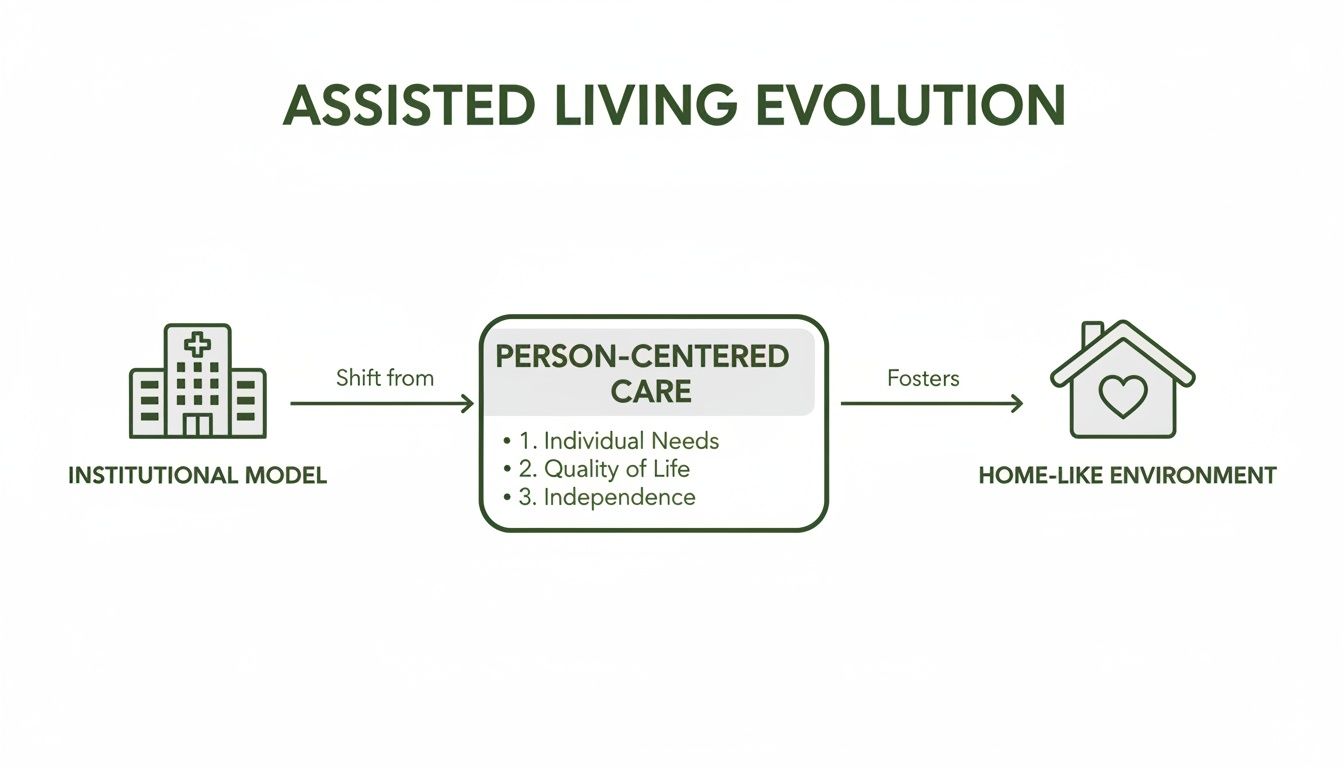
Flowchart showing assisted living evolution from an institutional model to person-centered care fostering a home-like environment.

This evolution underscores how modern design puts dignity and community first, which directly influences the kind and quality of amenities you'll need to build into your plan.

Key Programming Decisions and Their Impact

Every choice you make during programming creates a ripple effect. A seemingly small decision about unit size impacts construction costs, while your dining style dictates staffing models for years to come. The table below outlines some of these critical decisions and their direct consequences.

Key Programming Decisions and Their Impact

Programming Decision Design Implication Operational Impact Financial Consideration
Mix of Care Levels Requires varied unit types and specialized common areas (e.g., secure memory care wings). Necessitates different staffing ratios and training for each care level. Impacts revenue streams, construction costs, and licensing fees.
Unit Type and Size Dictates overall building footprint, corridor lengths, and MEP system complexity. Affects housekeeping workload and resident independence. Directly drives rental rates and overall project budget.
Amenity Package Determines the size and location of spaces like gyms, theaters, and dining venues. Requires dedicated staff for activities, wellness, and food service. Major factor in marketability and can generate ancillary revenue.
Operational Workflow Influences the layout of back-of-house areas like kitchens, laundry, and staff offices. Streamlines or complicates daily tasks for staff, affecting efficiency. Smart workflow design can reduce labor costs over the long term.

Ultimately, the programming phase is all about alignment. It's about ensuring the physical building is perfectly tuned to support your operational goals and financial model. By meticulously nailing down these details upfront, you lay the groundwork for a facility that is not only profitable but also a genuinely purposeful and desirable place to live. Getting this blueprint right is the first, and most important, step.

Navigating Codes and Regulations with Confidence

If you're diving into assisted living design, you're also diving headfirst into a dense thicket of codes and regulations. It’s easy to see them as a bureaucratic checklist, but that’s a dangerous mistake. These rules are the very foundation of resident safety, dignity, and quality of life. Pushing compliance to the back burner is just asking for costly delays, frustrating redesigns, and a whole lot of legal trouble down the road.

A better way to look at it? Think of these codes as a partner in your design process. When you get the "why" behind each rule—like how a specific corridor width helps with a swift fire evacuation or why a certain grab bar placement prevents falls—compliance stops being a hurdle. It becomes a strategic tool for creating a genuinely safer, better community. The secret to a smooth project is weaving these standards into the design from the very first sketch.

Understanding the Key Players in Compliance

The rulebook for assisted living is a layered cake, with regulations coming from national, state, and even local levels. While the specifics will change depending on where you're building, a few key players always have a seat at the table. Getting to know them is non-negotiable for any developer or owner.

These aren't just abstract documents; they're practical blueprints for creating spaces that actually work. For example, the International Building Code lays down the law on fundamental structural safety and fire protection, while the ADA ensures every single resident, no matter their mobility, can live with independence.

Regulations give you the minimum standard for safety, but great design uses them as a springboard for excellence. Meeting code is just the starting line. The real goal is to create an environment that goes far beyond compliance to actively make residents' lives better.

Integrating the Americans with Disabilities Act

The Americans with Disabilities Act (ADA) is a landmark civil rights law, and its standards are absolutely critical in assisted living design. It's all about ensuring equal access for everyone, everywhere—from private apartments to the dining hall.

This is about so much more than just adding a ramp at the entrance. It means thinking through the details, like providing the proper turning radius in a bathroom for someone using a wheelchair. It means making sure countertops and light switches are at reachable heights and choosing lever-style door handles that don't require a firm grip. When these details are woven into the design from the start, they create a space that’s truly empowering for every resident.

The Role of FGI Guidelines

The Facility Guidelines Institute (FGI) publishes evidence-based guidelines that many states bake directly into their licensing requirements. While the building code and ADA cover broad safety and accessibility, the FGI guidelines get very specific about healthcare and residential care settings.

  • Resident Safety: FGI offers detailed advice on everything from handrail dimensions and placement to the best slip-resistant flooring finishes to prevent falls.
  • Infection Control: You'll find best practices for designing HVAC systems to filter air properly, choosing surface materials that are a breeze to sanitize, and laying out spaces to stop pathogens in their tracks.
  • Operational Efficiency: The guidelines also think about the staff, offering smart recommendations for laying out nurse stations, medication rooms, and other support areas to make their jobs easier and more efficient.

A Proactive Approach to Code Compliance

Waiting for a building inspector to show up and flag a problem is the most expensive and stressful way to handle compliance. The smart move is to be proactive, embedding code compliance into the design process from day one with the help of an experienced architect.

  1. Early Code Analysis: The very first step is a deep dive into all applicable federal, state, and local codes for your specific site. This gives the design team a clear roadmap and prevents surprises.
  2. Integrated Design Meetings: Your architect should make code compliance a regular agenda item in every design meeting. This ensures that every decision, from corridor width to window selection, is checked against the rules.
  3. Regular Agency Consultations: Don't be a stranger to your local building and fire officials. Engaging with them early and often builds goodwill and helps clarify any fuzzy interpretations of the code long before you break ground.

This proactive mindset doesn’t just keep you out of trouble; it helps you build a better facility. By thoughtfully integrating these essential safety and accessibility standards, you’re not only protecting your schedule and budget—you’re delivering a truly safe, dignified, and welcoming home for the people who will live there.

Designing for Dignity and Independence
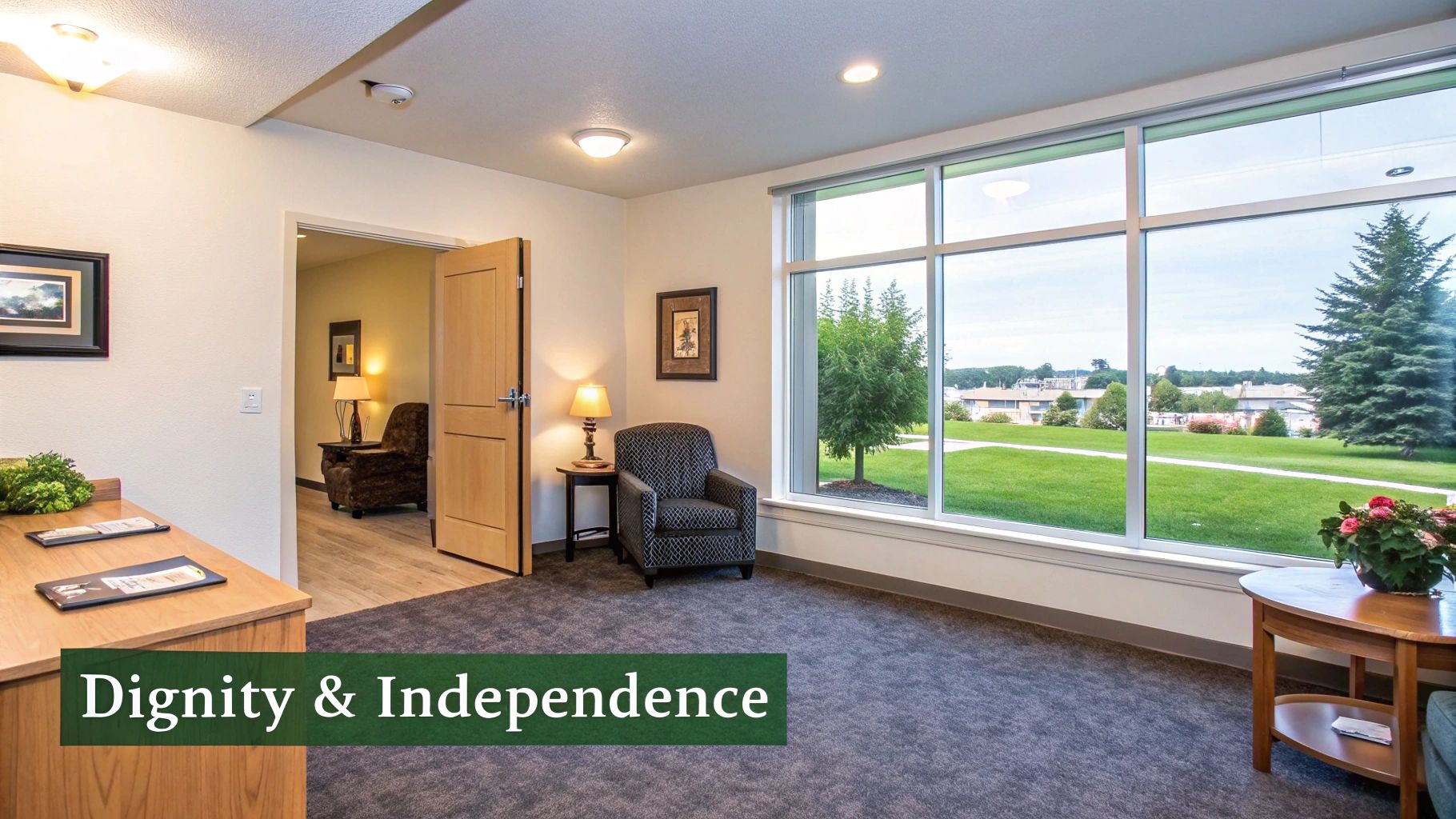
Bright and inviting lounge area in an assisted living facility with large windows overlooking a green lawn.

The real heart of an assisted living facility isn’t the grand lobby or the perfectly manicured lawn. It’s found in the private apartments and shared spaces where people actually live. This is where a facility's philosophy of care stops being a mission statement and becomes a tangible reality for its residents.

Good design has a profound impact. It can boost a resident's sense of self, foster confidence, and give them a feeling of genuine control over their own life. It's all about understanding the psychology of creating a home for seniors, balancing critical safety features with a warm, residential feel so that accessibility feels empowering, not clinical.

Crafting Empowering Private Spaces

The design of a resident's apartment is the absolute cornerstone of their independence. These spaces have to be intuitive, safe, and ready to adapt as needs change over time. It’s the small, thoughtful details that make all the difference.

Think about the path from the bed to the bathroom. Is it a straight shot? Is it well-lit for a 2 a.m. trip? Are there subtle supports along the way—like sturdy furniture or walls reinforced for future grab bars—that offer stability without making the room feel like a hospital?

Great assisted living facility design is often invisible. It seamlessly integrates safety and accessibility into a comfortable, homelike environment, allowing residents to live with confidence and dignity without constant reminders of their physical limitations.

Here are a few key elements that make private units work:

  • Maximizing Natural Light: Large windows are a must. They don't just improve mood and help regulate sleep cycles; they make a space feel bigger and more inviting.
  • Clear Sightlines: From the bed, a resident should be able to see the door to their apartment and the door to their bathroom. This simple layout choice can dramatically reduce anxiety and disorientation.
  • Accessible Bathrooms: Zero-threshold showers, toilets set at a comfortable height, and easy-to-use lever-style faucets shouldn't be special requests. They should be the standard.
  • Ample and Accessible Storage: Closets with lower rods and shelves within easy reach are empowering. They allow residents to manage their own belongings and maintain a sense of autonomy.

Transforming Corridors into Community Connectors

One of the most common design mistakes is the long, monotonous hallway. These institutional-feeling corridors can be confusing, intimidating, and frankly, isolating for residents, especially those with cognitive or mobility challenges.

The trick is to stop thinking of them as hallways and start seeing them as neighborhood streets.

Imagine you're designing a small town. The streets wouldn't be endless, sterile tunnels. They'd have landmarks, benches, and little points of interest that make the journey engaging and easy to follow. Applying that same logic can completely transform a facility’s circulation paths.

This means intentionally breaking up long corridors. A small seating nook by a window becomes a spot for a quiet chat. A curated art display acts as a visual landmark, helping residents find their way. The goal is to make the trip from a private apartment to a common area a pleasant, socially encouraging experience. It’s also vital to ensure these spaces are safe, which requires a firm grasp on building codes like stair handrail height regulations.

The Growing Need for Thoughtful Design

This resident-first approach is more critical now than ever before. A massive demographic shift is reshaping senior living. With projections showing that by 2030, one in six people on the planet will be 60 or older, the demand for new communities is exploding.

This boom is fueling a market expected to reach USD 177.97 billion by 2025, with major growth continuing through 2032. As developers and designers, this rapid expansion gives us a huge responsibility. By focusing on creating places that foster dignity and independence, we can build communities that don't just meet market demand, but genuinely enrich the lives of the people who call them home.

Amenities and Systems That Elevate the Resident Experience

A truly exceptional assisted living facility is more than just a place to live; it's a place to thrive. The design needs to go far beyond the basics of shelter and care to create a vibrant, engaging community. This comes from a smart blend of highly visible amenities that encourage an active life and the critical, often invisible, systems that keep everyone safe and healthy.

Think of the visible amenities as the "front of house." These are the spaces that draw people in, build a sense of community, and make your facility feel like home. The goal is to ditch the old-school, single multi-purpose room and instead offer a diverse range of venues that cater to different interests and social styles.
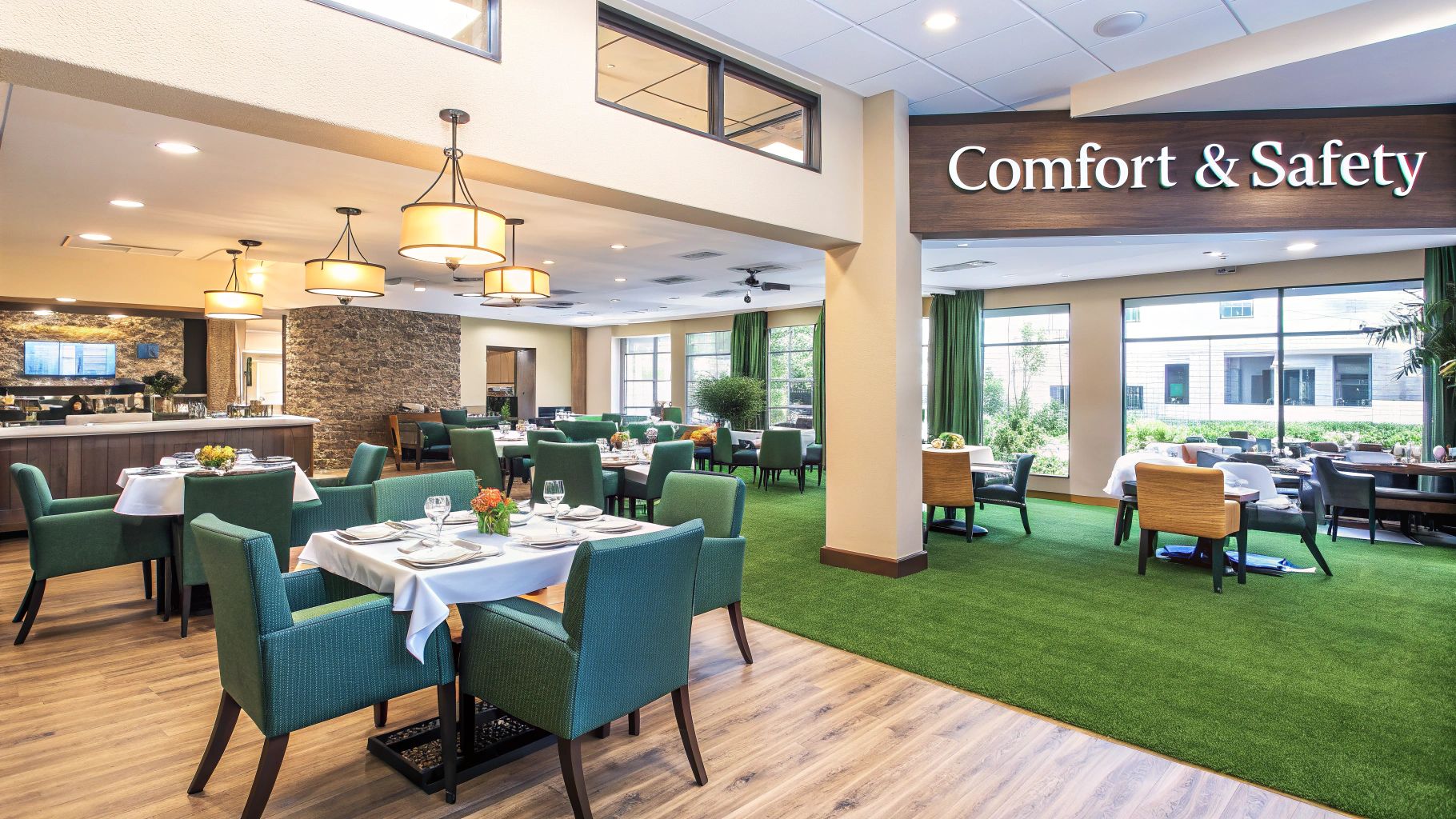
Bright dining room in an assisted living facility featuring green chairs, set tables, and a 'Comfort & Safety' sign.

When you adopt this hospitality-focused approach, it directly boosts your marketability and keeps residents happy, turning your facility into a place people genuinely want to be.

Designing Amenities for a Vibrant Lifestyle

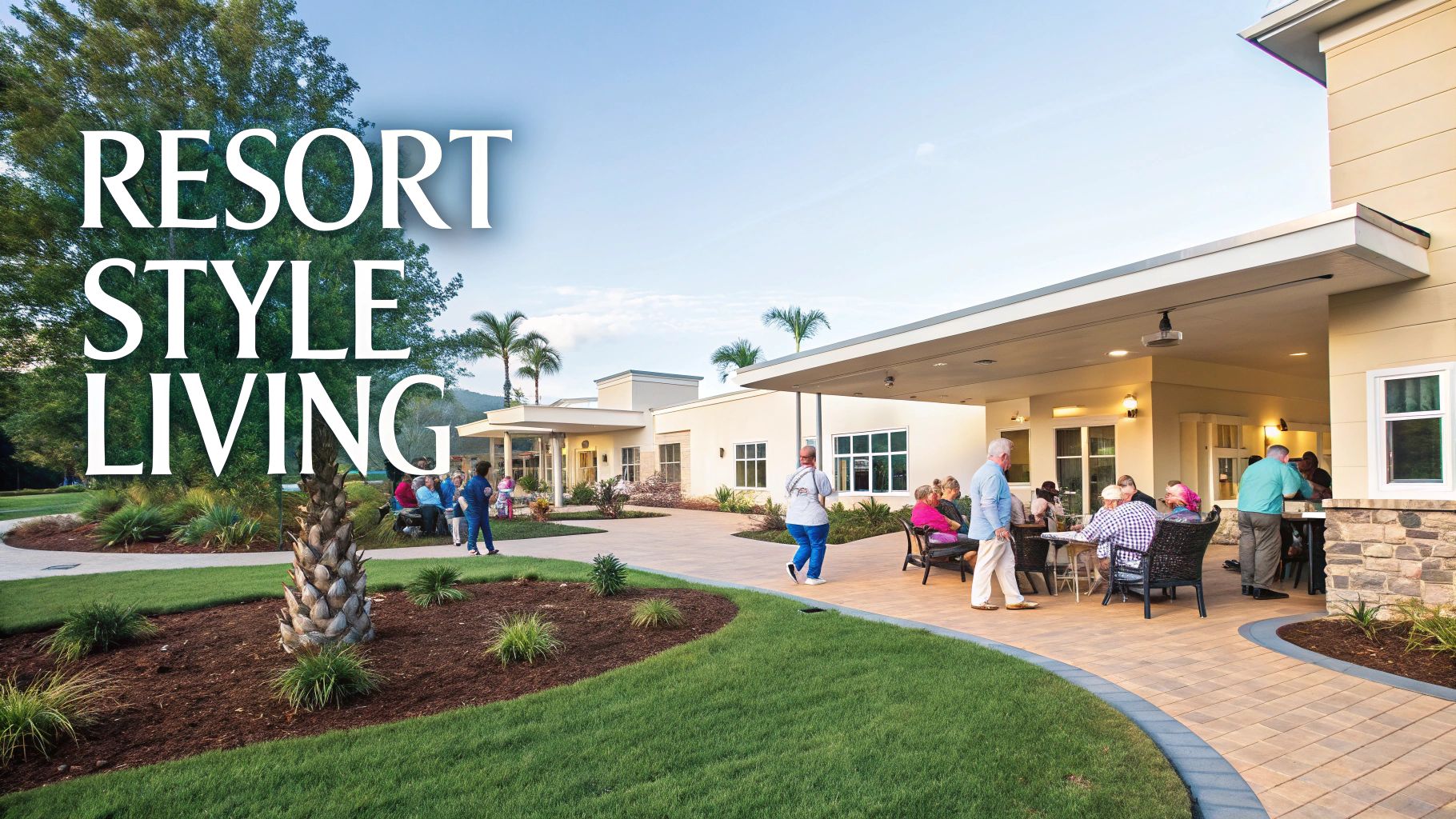
Modern assisted living communities are taking cues from luxury resorts and boutique hotels, offering a rich variety of experiences right on-site. The secret sauce is providing choice and quality.

  • Restaurant-Style Dining: Move away from the single-cafeteria model. Offer multiple dining venues, like a formal dining room, a casual bistro for a quick coffee and sandwich, and a private dining space families can reserve for celebrations.
  • Comprehensive Wellness Centers: A small room with a treadmill just doesn't cut it anymore. A true wellness center needs equipment adapted for seniors, dedicated space for group classes like yoga or tai chi, and maybe even a heated therapy pool.
  • Dedicated Social and Creative Spaces: Residents need places to pursue hobbies and connect with others. Consider a small movie theater, a cozy library with great lighting, a dedicated arts and crafts studio, or a game room.

The best amenities are the ones that build community naturally. A well-designed pub, a sunny patio with raised gardening beds, or a bustling coffee bar can easily become the social heart of the facility, sparking spontaneous conversations and friendships.

These spaces aren't just bullet points on a brochure. They are the engines of community life. They give residents a reason to leave their apartments and engage with their neighbors, which is absolutely crucial for fighting the loneliness that can affect so many older adults.

Critical Infrastructure Powering Modern Care

While the amenities shape the daily experience, it's the unseen infrastructure that guarantees residents' health and safety. These complex systems are the backbone of a high-functioning facility, and investing in them properly is non-negotiable.

Take the HVAC system, for example. Modern Heating, Ventilation, and Air Conditioning (HVAC) systems in senior living do more than just maintain a comfortable temperature. They are a first line of defense against illness, using advanced filtration and ventilation strategies to improve air quality and cut down on the spread of airborne germs.

Robust emergency power is another must-have. Your facility has to maintain life-safety systems, keep medications refrigerated, and power essential lighting during an outage. A reliable generator isn't a luxury; it's a fundamental requirement, especially when you consider that a fire can be devastating for a vulnerable population.

Integrating Invisible Technology for Safety

The best technology is often the kind you don’t even notice. In assisted living design, the aim is to integrate smart systems that enhance safety without making the environment feel cold or clinical.

Discreet, modern nurse call systems have replaced old-fashioned pull cords with wearable pendants or even voice-activated devices. In the same way, motion sensors can monitor for falls or unusual inactivity, alerting staff to potential problems without invasive cameras. Smart-home features, like automated lighting that illuminates a path to the restroom at night, can also dramatically reduce fall risks. Knowing which bathroom safety equipment for the elderly to install is a core part of creating these secure living spaces.

By thoughtfully layering these visible amenities and invisible systems, you create a facility that is not only beautiful and engaging but also safe, resilient, and ready to provide exceptional care for years to come.

9. Leveraging Site Planning and Adaptive Reuse

An assisted living facility doesn't exist in a vacuum. Its success is deeply intertwined with its physical location and the building itself, whether it's built from the ground up or is a thoughtfully restored piece of local history. Two powerful strategies—smart site planning and adaptive reuse—offer distinct paths to creating a remarkable and profitable community.

For any new build, site planning is about so much more than just making a building fit on a piece of land. It’s the art of choreographing the relationship between the structure, its residents, and the surrounding environment. The real goal is to create a setting that feels both secure and seamlessly woven into the local community.
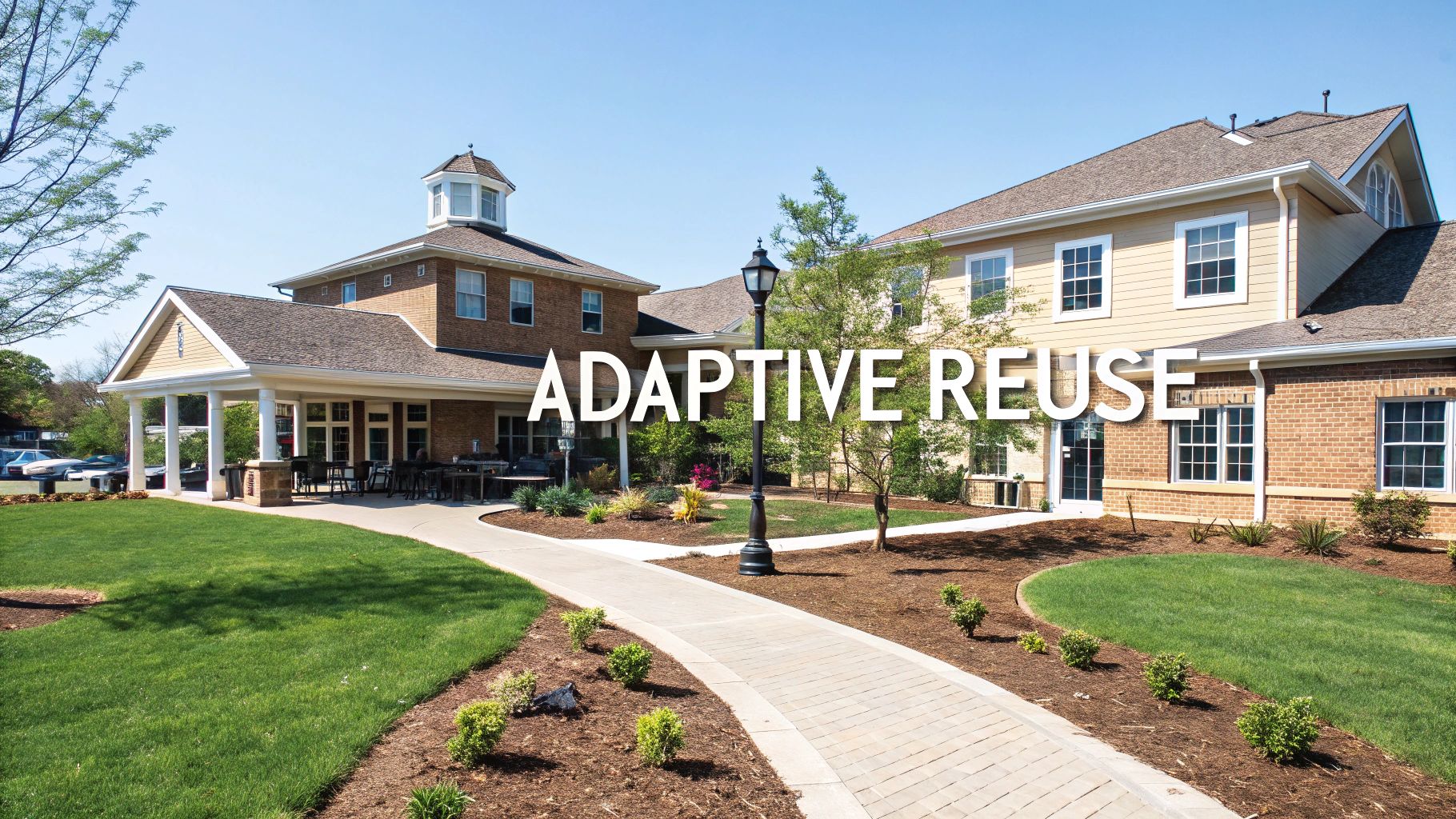
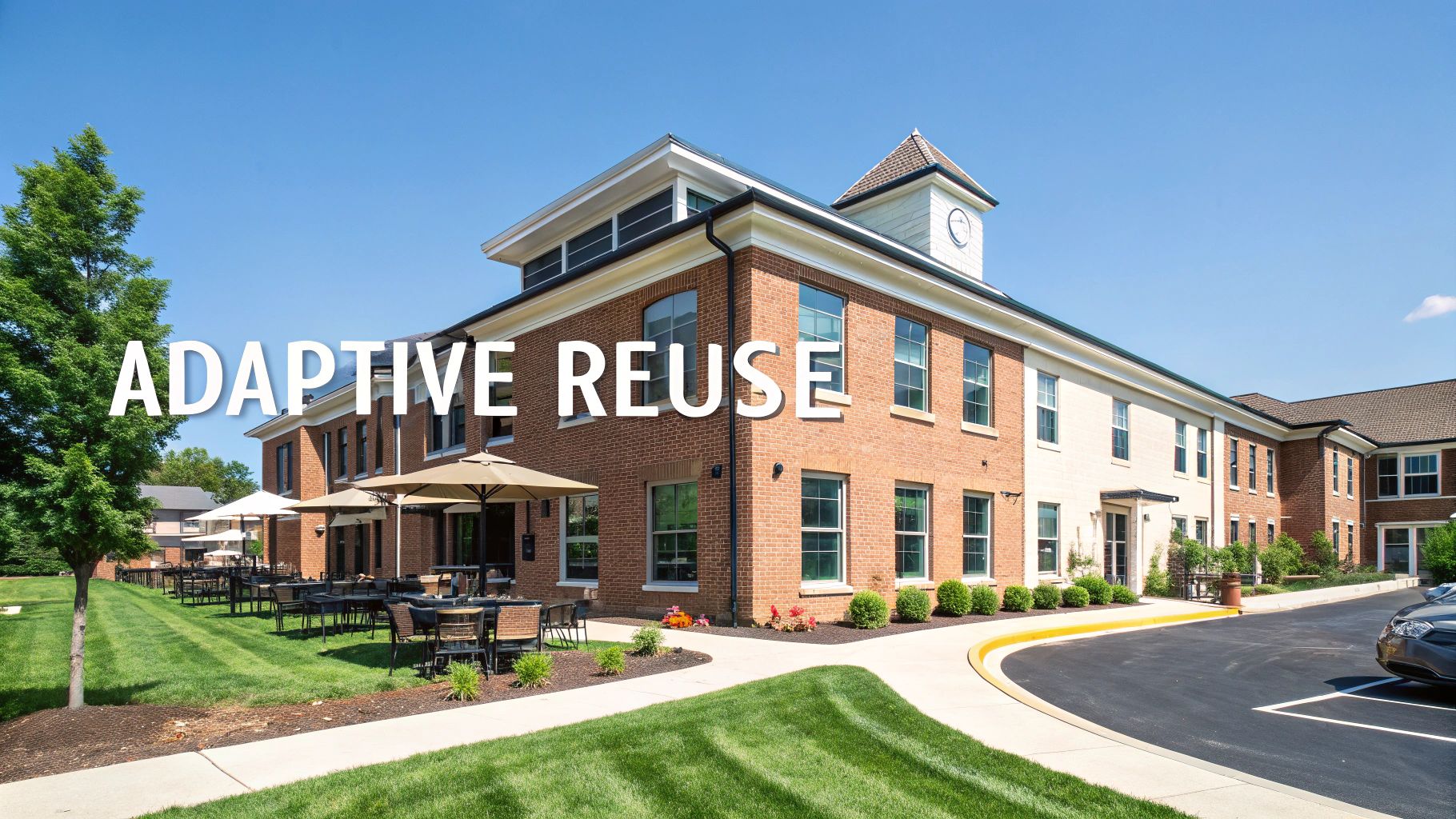
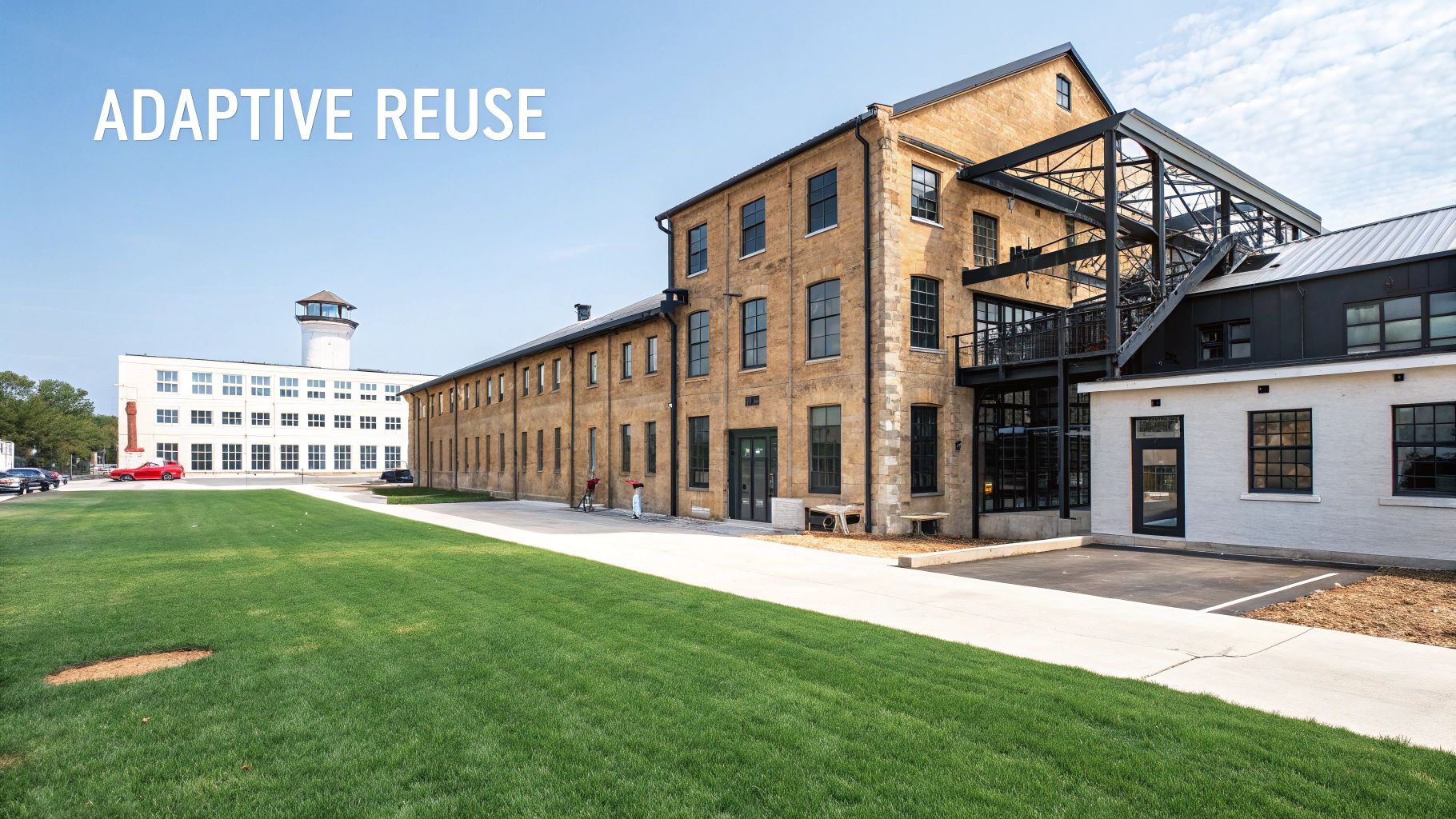
An exterior view of an assisted living facility featuring green lawns and a walkway, with 'ADAPTIVE REUSE' text.

Optimizing the Site for New Construction

Thoughtful site planning for a new assisted living facility can transform a property from a simple location into a therapeutic asset. It all starts by carefully orienting the building to maximize views of nature and access to sunlight, both of which have proven benefits for mood and well-being.

Creating secure and engaging outdoor spaces is another non-negotiable piece of the puzzle. These areas aren't just afterthoughts; they are vital extensions of the living environment.

  • Therapeutic Gardens: Think of spaces that offer gentle sensory stimulation with fragrant plants, varied textures, and the soothing sound of a water feature. They need to provide safe, accessible pathways for residents to walk and simply connect with nature.
  • Secure Courtyards: For memory care units, enclosed courtyards are absolutely essential. They have to be designed to allow freedom of movement without the risk of wandering, giving residents a safe way to enjoy fresh air on their own terms.
  • Community Integration: The site plan also needs to look beyond the property line. Walking paths that link to local parks or sidewalks that lead to nearby shops can help residents feel less isolated and more a part of their community.

The Unique Advantages of Adaptive Reuse

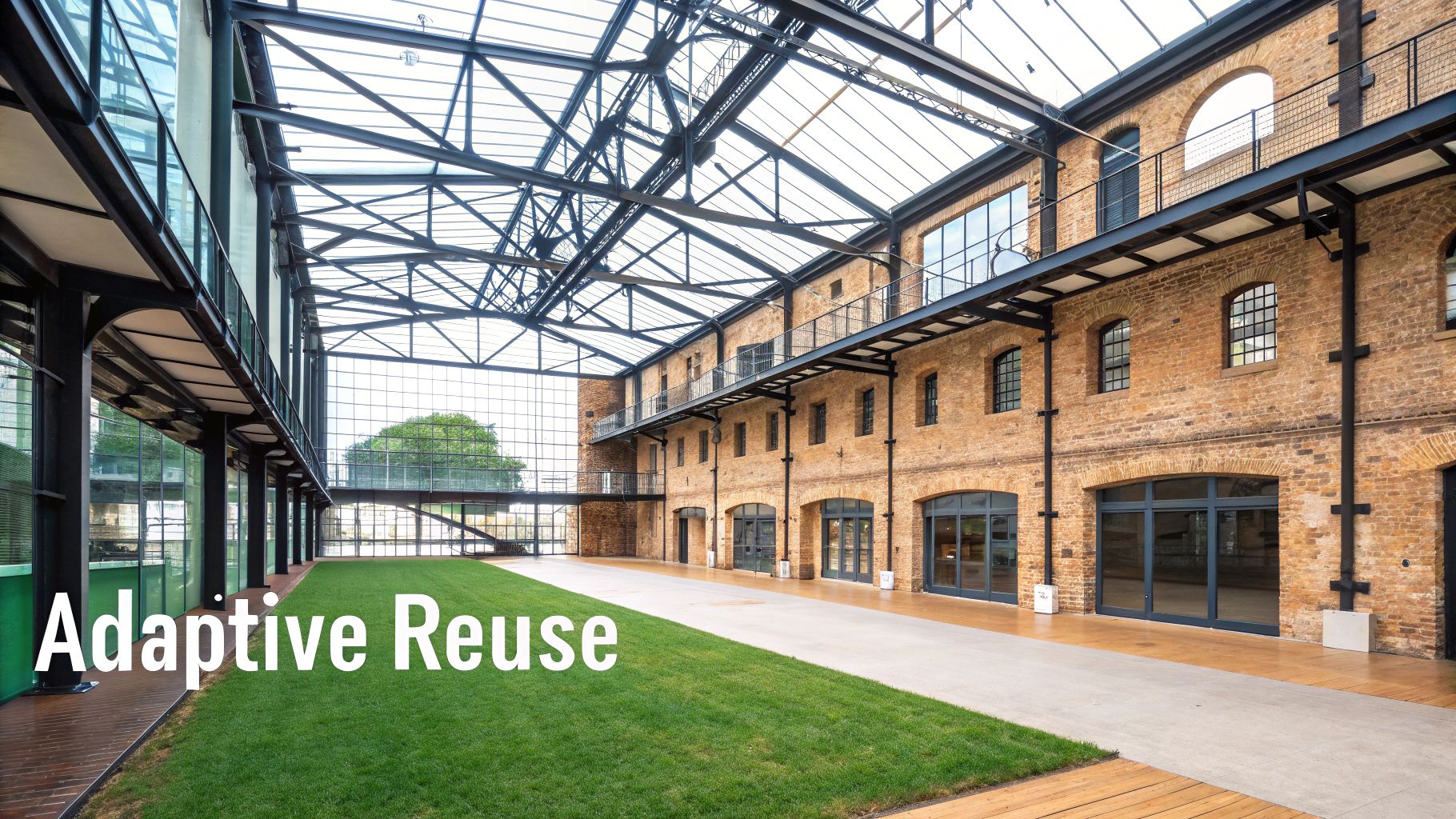
While new construction offers a blank slate, adaptive reuse is an opportunity to create a facility with a character and story that simply can't be manufactured. This approach means transforming an existing structure—maybe a historic hotel, an old school, or even a converted mill—into a modern senior living community.

This strategy is often far more sustainable than demolishing and rebuilding. It preserves the embodied carbon of the original structure and can significantly shorten the project timeline. For developers, this often means a faster path to market and a quicker return on investment.

Adaptive reuse breathes new life into forgotten buildings, weaving the story of a community's past into its future. It delivers a project with a built-in sense of place and authenticity that is impossible to replicate with new construction.

Navigating the Challenges of Conversion

Of course, converting an old building for a completely new purpose comes with its own set of hurdles. A thorough feasibility study is the first, and arguably most important, step to see what you're up against.

You'll need to dig into a few key areas:

  • Structural Integrity: Is the existing frame sound? Can it actually support the new layout and loads required for a residential healthcare setting?
  • MEP Systems: How can you integrate modern mechanical, electrical, and plumbing systems without completely compromising the building's historic character? It's a delicate balance.
  • Accessibility and Code Compliance: How do you meet modern accessibility standards, like ADA requirements, within the constraints of a structure built in a different era?

Successfully navigating these complexities demands an architectural partner with deep experience in both historic preservation and modern building codes. By getting all the pieces aligned, developers can transform a historic asset into a one-of-a-kind senior living destination that truly stands out. This approach doesn't just offer potential cost savings; it delivers a product rich with character and genuine community connection.

Answering Your Top Questions on Assisted Living Design

When you're diving into the world of assisted living development, a lot of questions come up. Let's tackle some of the most common ones I hear from developers and operators, focusing on the practical side of creating a community that truly works.

What’s the Single Biggest Design Mistake People Make?

Hands down, the biggest mistake is designing long, institutional-style corridors. You know the ones I mean—double-loaded hallways that feel more like a sterile hospital or an old-school hotel than a home. They can be incredibly disorienting and frankly, a little intimidating for residents.

This kind of layout can lead to social isolation and anxiety, especially for anyone with cognitive decline. The fix? Break up those long sightlines. We do this by introducing natural light, creating cozy seating nooks, and using distinct visual cues to create smaller, more navigable "neighborhoods" within the larger building. It makes the entire space feel more intimate and manageable.

How Can the Building’s Design Actually Help with Staffing?

It’s no secret that staffing is one of the biggest challenges in this industry. Smart design can't solve it entirely, but it can make a huge difference in staff efficiency and burnout. It starts with simple logistics.

Think about centralizing nurse stations, supply closets, and other key support areas. This cuts down on the miles your team has to walk every day.

Good design is a silent partner for your staff. When you give them clear sightlines across common areas, they can keep a subtle, respectful eye on residents. And don't forget their spaces—a well-designed break room sends a powerful message that you value your team, which does wonders for morale and retention.

Is It a Good Idea to Repurpose an Old Building?

Absolutely, and it can be a brilliant move. Adaptive reuse of buildings like old hotels, schools, or even vacant commercial properties can be a fantastic strategy. You often gain benefits in cost, get to market faster, and create a building with genuine character that new construction can't always replicate.

The trick is doing your homework with a thorough feasibility study. You need to know what you're getting into with the building's structure, accessibility hurdles, and the cost to bring all the mechanical, electrical, and plumbing systems up to modern code. With the right architecture partner, you can turn an old gem into a unique, high-performing community that adds real value to the neighborhood.


At Sherer Architects, LLC, we're experts at solving these complex design puzzles and creating assisted living communities that are functional, beautiful, and profitable. Whether you’re starting from scratch or have an adaptive reuse project in mind, our team has the experience to make it a success. Visit shererarch.com to see how we bring structure to life.

Categories
Uncategorized

A Developer’s Blueprint for the Library in the Future

When you think "library," you probably picture dusty, silent stacks of books. It’s time to update that mental image. The library in the future is a buzzing, multi-purpose community hub—and, surprisingly, a highly valuable asset for developers and property owners. This isn't just a place for books; it's a dynamic platform for technology, education, and community connection that can drive real financial returns.

Reimagining the Library Beyond Bookshelves

The library has grown far beyond its original mission of lending books. For developers and investors, this evolution opens up a powerful opportunity. Instead of seeing a library as just a civic cost, it's time to see it as an economic driver.

A well-executed library project can anchor a neighborhood, pull in foot traffic, and bump up the value of surrounding properties. A modern library becomes a "third place"—that essential social spot that isn't home or work, where community life happens.

This new identity means the very design and purpose of a library have changed. The focus is less on the size of the collection and more on creating flexible, human-centered spaces that can adapt to a whole range of community needs, from quiet study nooks to lively workshop areas and public event venues.

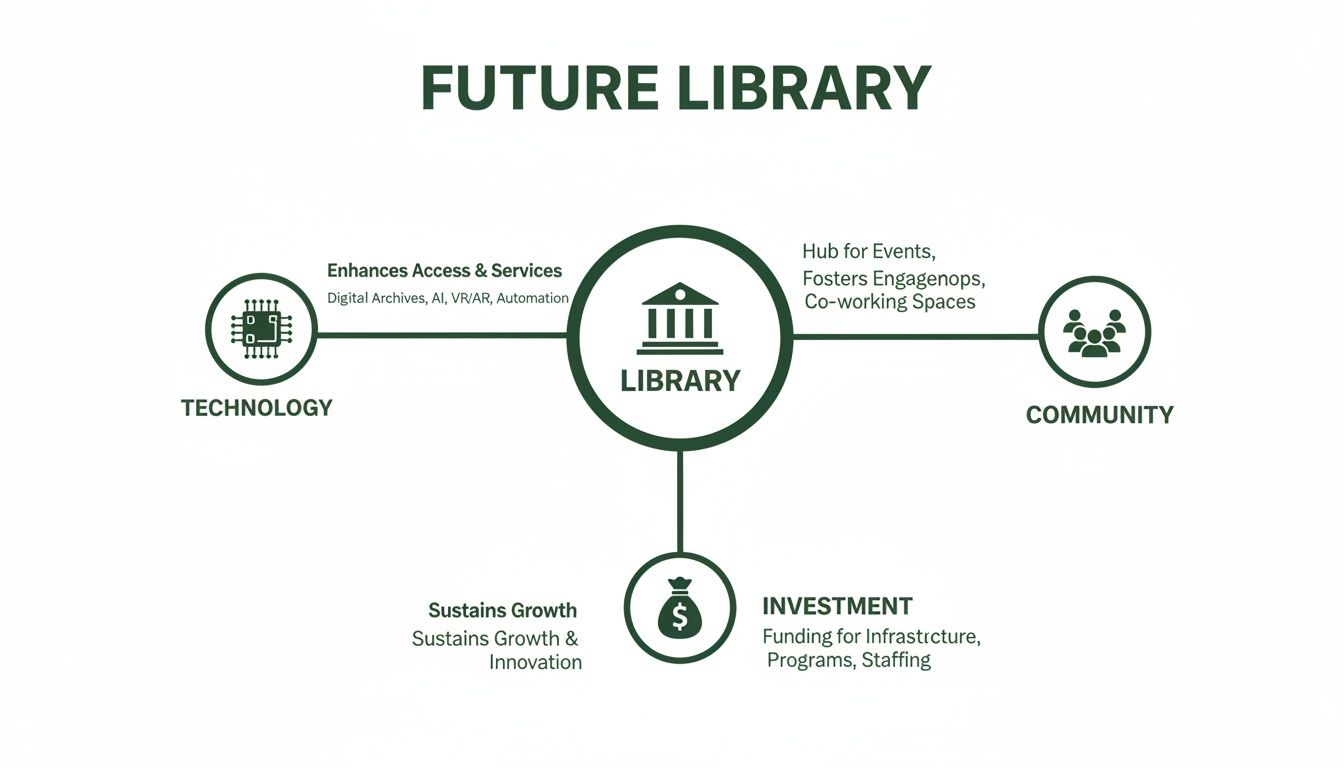
This diagram breaks down the three pillars holding up this modern library model.

A diagram illustrates the future library supported by technology, community, and investment pillars.

As you can see, the success of the modern library depends on weaving together technology, a deep community focus, and smart investment.

A New Model for Community Investment

Getting a handle on this new model is the key to unlocking a library's true potential. The library in the future is a strategic asset that pays dividends across the board. For developers, this means figuring out how a new library can hit both civic and business targets. The secret is recognizing all the different hats it wears.

  • A Hub for Digital Equity: It offers free high-speed internet, computers, and digital skills training, closing the digital divide for local residents.
  • An Incubator for Local Talent: It provides maker spaces with 3D printers, recording studios, and co-working areas that give entrepreneurs and small businesses a leg up.
  • A Center for Lifelong Learning: It hosts everything from children's storytime to coding classes for adults and workshops for seniors, drawing in a huge cross-section of the community.

By designing spaces that support these activities, developers create a property that becomes an indispensable part of daily life. This deep engagement keeps the library relevant and busy, cementing its long-term value as both a community landmark and a solid investment.

Ultimately, investing in a library isn't just about putting up a building; it's about building a more resilient, connected, and prosperous community. Whether you're starting from scratch or giving an old building a new life, the opportunities are massive. This guide will walk you through the practical strategies—from digital infrastructure and flexible design to funding models and historic tax credits—that transform a library project into a smart, sustainable asset that can anchor urban renewal and deliver a clear return on investment.

Weaving Technology into the Architectural DNA

When we think about the library of the future, we need to stop treating digital infrastructure as an afterthought. It's not just another line item in the budget; it's as critical as the building's foundation. For developers and owners, this means planning for technology from the absolute beginning, treating it as the building’s central nervous system. This approach—embedding a robust and flexible tech ecosystem right into the blueprints—is the only way to avoid painful, expensive retrofits and ensure the library remains a vital asset for decades.

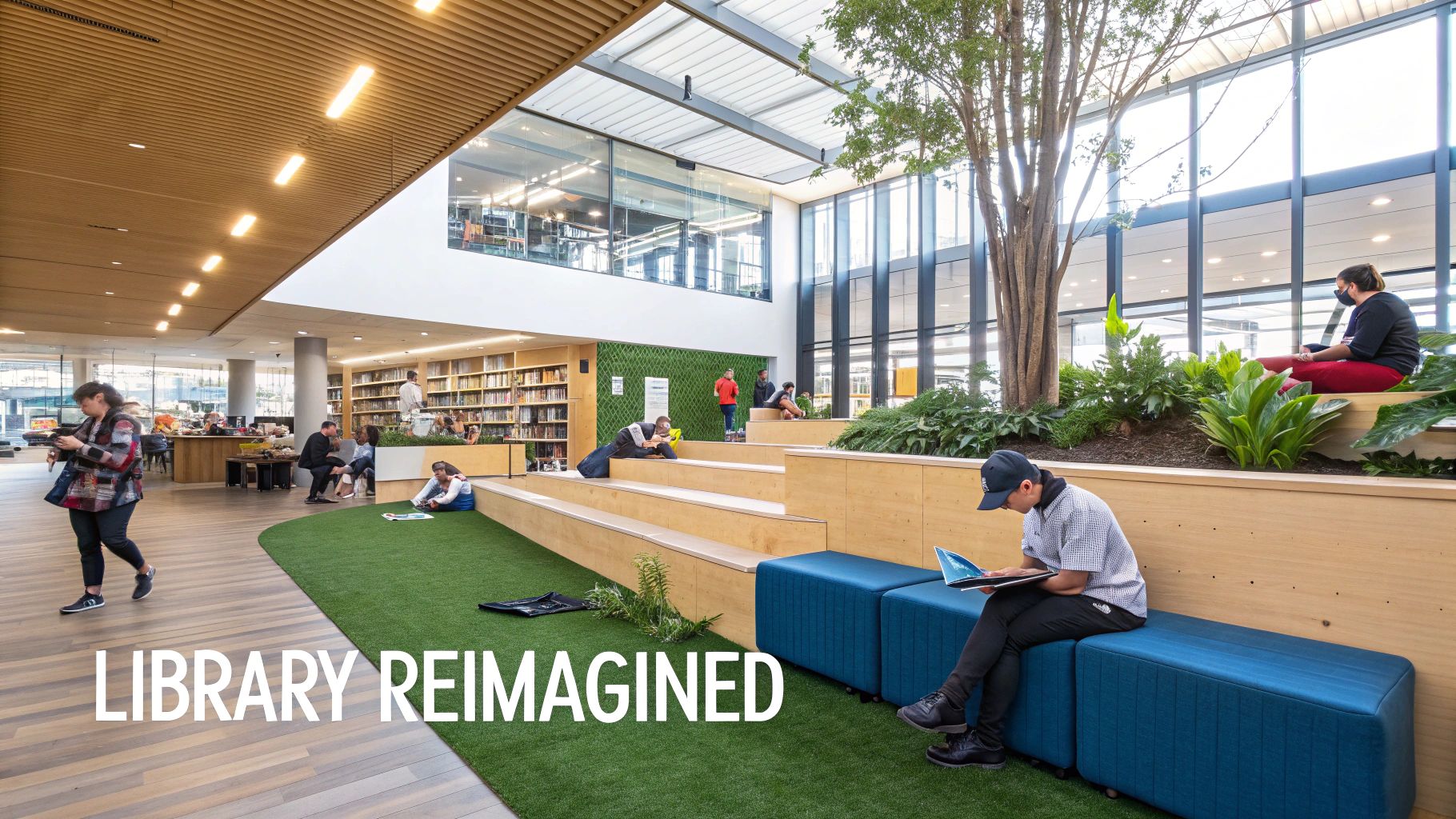
Modern library interior with people studying, reading, and relaxing in a bright, spacious environment.

This isn’t just about offering public Wi-Fi. It’s a fundamental shift in how we design a building's core systems. The real goal is to create an environment where technology is invisible, supportive, and ready for whatever comes next.

Moving Beyond the Server Room

The old model of walling off a huge, climate-controlled room for racks of servers is quickly becoming a relic. A forward-looking design doesn't get bogged down by today's hardware; it plans for agility and the certainty of future upgrades.

This is all about creating flexible pathways for power and data. Instead of dedicating a permanent server closet, architects need to design accessible, easily upgradable conduits and raceways that run throughout the building. This simple change allows technology to evolve without forcing disruptive—and costly—structural renovations later on.

Think of it like the plumbing in a house. You wouldn't build a new home without meticulously planning where the pipes need to go. Data flows the same way. It's a core utility that has to be designed into the very fabric of a modern library, powering everything from interactive displays to the countless devices visitors bring with them.

This design shift has a real impact on space allocation, too. By ditching the traditional server room, developers can reclaim valuable square footage. That space can then be used for revenue-generating or community-focused purposes, like a small café, private meeting pods, or an expanded area for workshops and events.

And the clock is ticking. Projections show that by 2026, academic libraries will be operating in almost completely digital environments. Cloud computing is set to become the standard for nearly all services, which demands ubiquitous, high-speed internet. With mobile devices already far outnumbering desktops, the need for seamless wireless connectivity will only intensify.

The Bones of a Modern Library: Power and Connectivity

To build a library that’s truly ready for the future, developers have to get two things right from the start: power and data. The old way of sprinkling a few outlets along the walls just doesn't cut it anymore for a community that depends on personal devices for everything.

Architectural planning needs to address these modern demands head-on. Here’s how:

  • Smart Electrical Grids: Design electrical systems that are built to expand. This means installing floor boxes with both power and data ports in open areas, placing outlets in unexpected places like outdoor seating, and using modular power systems that can be rearranged as the library’s layout evolves.
  • Pervasive Wireless Access: The building’s very structure must be designed to support flawless Wi-Fi coverage. This involves thinking critically about where to place wireless access points and avoiding signal-blocking materials like thick concrete or metal walls in key areas where people gather.
  • Redundant Connections: Don't rely on a single point of failure. The building should have multiple points of entry for fiber optic cables. This redundancy protects against service outages and provides the massive bandwidth needed for cloud services, virtual reality experiences, and large-scale data access.

The table below breaks down the shift in thinking required when designing a library's infrastructure.

Future Library Tech vs. Traditional Library Infrastructure

Architectural Feature Traditional Library Approach Future Library Requirement
Data Infrastructure Centralized, fixed server room with heavy HVAC. Distributed, flexible conduits and raceways for easy upgrades.
Power Distribution Wall-mounted outlets placed intermittently. Integrated power grids with floor boxes, modular systems, and outdoor access.
Connectivity Basic Wi-Fi as an amenity. Building-wide, high-density Wi-Fi as a core utility.
Structural Planning Materials chosen for aesthetics and durability alone. Materials chosen to minimize signal interference; planned pathways for cabling.
Space Allocation Significant square footage lost to server and IT closets. Reclaimed square footage for public-facing programs or leasable space.
Future-Proofing Retrofits are expensive and structurally invasive. Upgrades are managed through accessible pathways with minimal disruption.

As you can see, the architectural DNA of a future-ready library is fundamentally different. It anticipates change rather than reacting to it.

Of course, successfully weaving this digital framework into a building requires smart financial planning. Understanding how to secure specialized funding is a crucial piece of the puzzle. You can learn more about accessing this capital through resources focused on Winning Nonprofit Grants for Technology. By embedding this digital foundation from day one, developers create a resilient, adaptable asset that will maximize its utility and value for years to come.

Designing Spaces for People, Not Just Collections

Once you have a solid technology backbone, the real work begins. The focus for the library in the future isn't about infrastructure; it's about experience. We’re moving past the idea of libraries as mere warehouses for books and embracing them as dynamic, human-centric community hubs.

A library's true value lies in its role as a community "third place"—that essential spot that isn't home and isn't work. How well a library fills this role directly impacts its success and, from a developer's perspective, its return on investment.

This means we have to think beyond static, rigid layouts. Imagine a single large, open space that completely transforms throughout the day. It could be a quiet study zone in the morning, a buzzing, collaborative workshop in the afternoon, and an elegant event venue by night. This is the kind of flexibility that attracts a wide range of people and keeps them coming back.

To pull this off, you need a smart approach to space planning. For anyone looking to get a better handle on the fundamentals, there's a practical guide to interior design and space planning that offers a great starting point.

Creating Multifunctional Zones

The secret to a truly adaptable building is creating multifunctional zones. This isn't about adding more rooms; it's about making every single square foot work harder. Architects and developers can achieve this fluid design with a few key strategies that allow for rapid changes with minimal effort.

When these elements work in concert, they create an environment that can be reconfigured on the fly, responding almost instantly to what the community needs right then and there. This adaptability is what turns a good building into a great community asset.

Here are the core components that make it happen:

  • Modular Furniture: Think lightweight tables, chairs, and shelving on casters. These can be rearranged in minutes to support anything from individual work to large group sessions.
  • Smart Acoustic Paneling: Deployable acoustic dividers or smart panels can absorb or reflect sound as needed. This simple feature allows a noisy kids' program and a quiet reading group to exist peacefully in the same open space.
  • Adaptable Lighting Systems: With zoned, dimmable lighting controlled by a central system, you can instantly change the mood of a space—shifting from bright, focused task lighting to warm, ambient light for a social mixer.

Practical Examples of Human-Centric Design

Bringing these principles to life is where the magic happens. It’s all about adding features and amenities that fit modern lifestyles and solve real problems for patrons, making the library an indispensable part of their daily routine.

Take something as simple as integrating a small café or coffee bar. It does more than just serve refreshments; it encourages people to stay longer and use the library as a social meeting point. This one addition can completely change the building's atmosphere and dramatically increase how long people stick around.

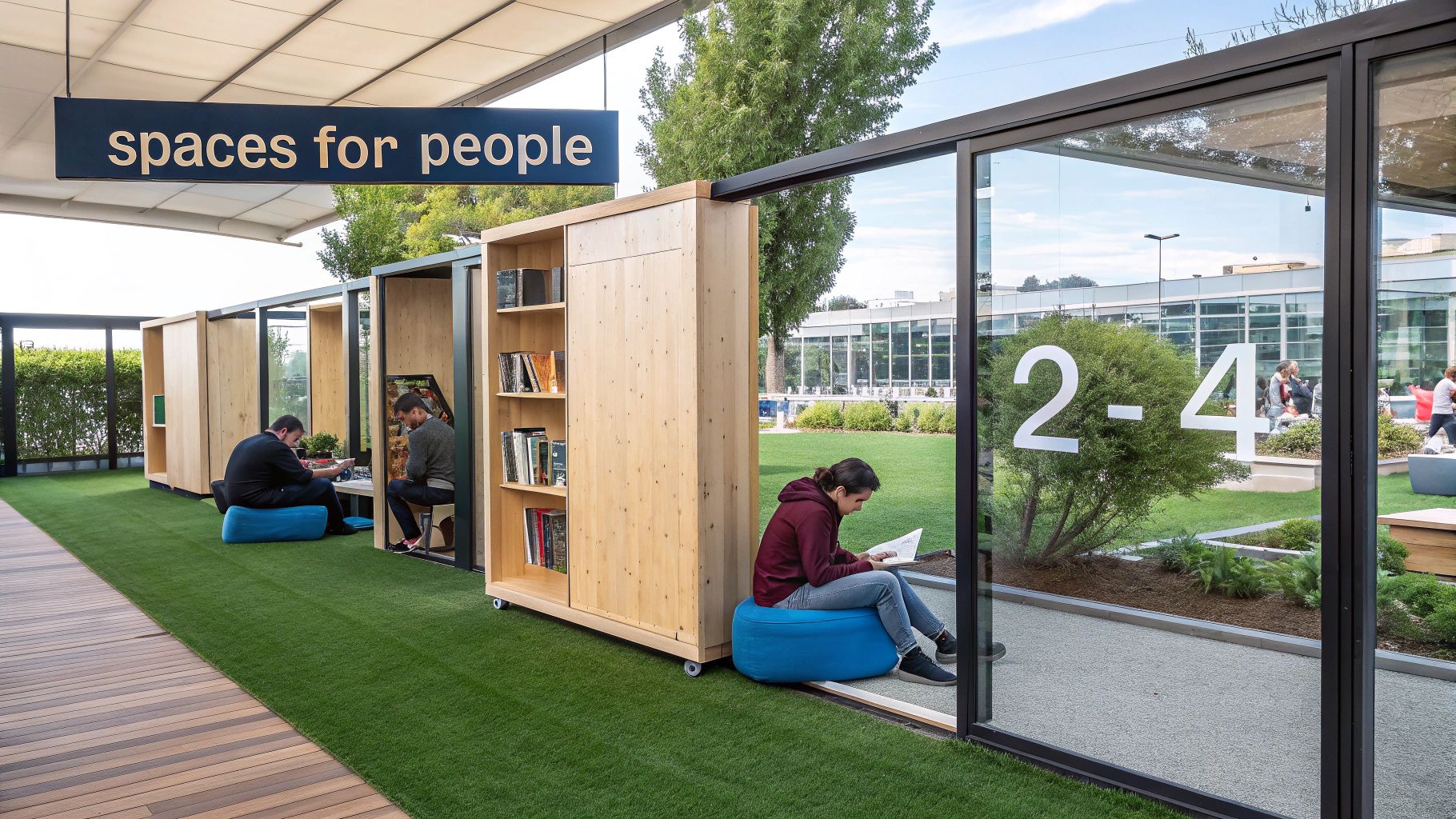
Soundproof pods are another powerful example. These small, private enclosures are a perfect solution for patrons needing to take a video call, record a podcast, or just find a moment of true quiet in a busy public space. They directly meet the needs of an increasingly remote and flexible workforce.

The most forward-thinking libraries are even extending their footprint outdoors. Designing inviting outdoor reading gardens, patios with Wi-Fi access, or even children's nature-play areas creates new destinations within the library grounds, offering fresh air and a connection to the environment.

These design choices aren't just nice-to-haves; they are strategic investments in community engagement. Recent industry data confirms this shift in priorities. A 2025-2026 survey found that increasing physical visits is now the top goal for library marketers. The data, which saw a 15% increase in responses over the previous year, underscores that libraries are laser-focused on in-person experiences and building community trust. You can dive deeper into how libraries are prioritizing this in the latest state of library marketing report. This is clear proof that thoughtful, human-centric design directly supports core operational goals by drawing people in and keeping them there.

The Business Case for Adaptive Reuse and Historic Preservation

When you think about building a new library, starting from a clean slate seems like the obvious choice. But there’s a powerful, and frankly, often more profitable alternative: adaptive reuse. This is the art of taking an existing building and giving it a completely new purpose. For a savvy developer, this isn't about nostalgia; it's a strategic business move loaded with financial and logistical perks that can create an incredible vision for the library of the future.

Modern outdoor library with people reading and working in wooden pods on a sunny day.

Right off the bat, this approach tackles some of the biggest headaches in modern development. The upfront costs are often much lower than new construction because you already have the bones—the foundation, exterior walls, and maybe even major systems are in place. This translates into a more predictable budget and a much quicker path from acquisition to ribbon-cutting.

On top of that, adaptive reuse is inherently sustainable. By breathing new life into an old structure, you’re dramatically cutting the carbon footprint that comes from demolition and manufacturing new materials. This isn’t just good for the planet; it's a compelling story that resonates with communities and attracts environmentally-minded partners and patrons.

Unlocking Value with Historic Tax Credits

The financial picture gets even brighter when the building has a little history to it. Historic preservation is more than just protecting the past—it’s a proven economic engine. Developers can tap into substantial federal and state historic tax credits that can slash rehabilitation costs and make a project’s numbers work beautifully.

The Federal Historic Preservation Tax Incentives program, for example, offers a 20% income tax credit for the certified rehab of historic, income-producing buildings. This is a true credit, not a deduction. It’s a dollar-for-dollar reduction of your tax bill, making it one of the most powerful redevelopment tools out there.

This kind of financial leverage flips the script, turning a building’s unique character from a potential headache into a genuine asset. The very things that make a building historic—its detailed brickwork, soaring ceilings, or gritty industrial past—become the foundation for a landmark that draws in the community and builds real pride.

Think of an old, vacant downtown bank with its grand lobby and echoing ceilings. Through adaptive reuse, this eyesore can be reborn as a cutting-edge community hub. The vault becomes a one-of-a-kind children's reading nook, and the open teller hall transforms into a flexible event space—all while keeping the building’s soul intact.

Turning Perceived Liabilities into Profitable Assets

The potential for adaptive reuse is hiding in plain sight all over our cities. Visionary developers can spot opportunity where others just see decay. That forgotten warehouse, an empty big-box store, or even a decommissioned church can have the "good bones" needed for a spectacular library transformation.

These old structures often bring distinct advantages you just can't get with new builds:

  • Generous Interior Volume: Older industrial and commercial buildings frequently boast high ceilings and wide-open floor plans. This is a perfect canvas for creating the flexible, multi-use zones that modern libraries thrive on.
  • Prime Locations: Many of these buildings sit right in the heart of established neighborhoods. That means built-in foot traffic and community access that would be incredibly expensive—or even impossible—to secure with a new plot of land.
  • Unique Character and Story: An existing building comes with its own narrative. A library housed in a former textile mill, for instance, can weave the area's industrial heritage right into its identity. It creates an authentic sense of place that a new building could never replicate.

This mindset empowers developers to think beyond the default of demolition. You can create a project that is more cost-effective, gets to market faster, and is deeply woven into the fabric of its community. By using the financial tools of historic preservation and the sustainable nature of adaptive reuse, an old building becomes a profitable, community-enriching asset—the perfect home for the library of the future.

Funding Models and Measuring Your Return on Investment

A beautiful design for a future-focused library is one thing, but it's just a drawing without a smart financial strategy to back it up. For developers and property owners, the question is always the same: How do we pay for this, and what’s the actual return? It’s time to look past traditional municipal bonds and embrace a more diverse, collaborative toolkit for funding.

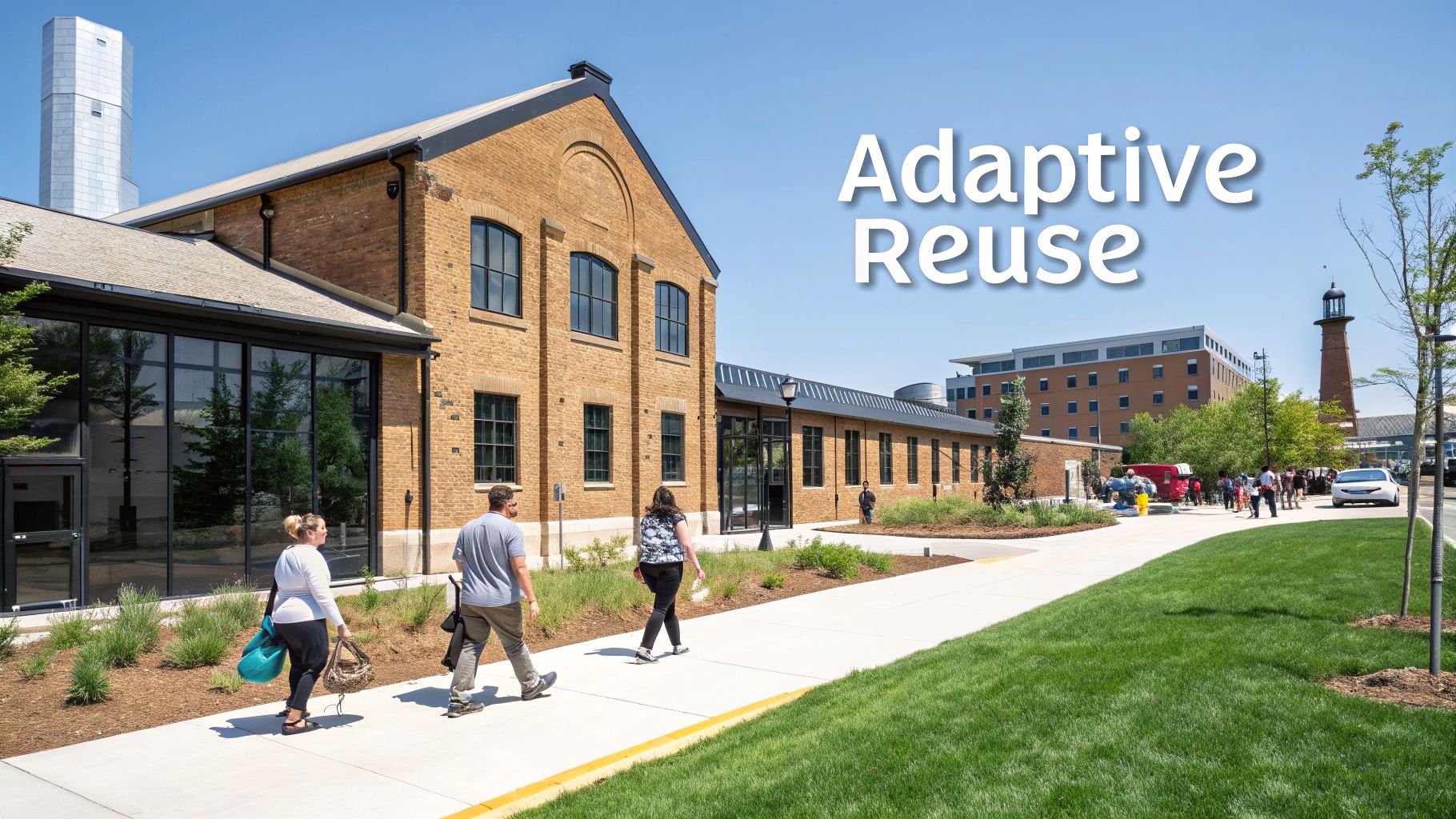
Modernly renovated historic brick building with large windows and people walking on a sunny day.

This approach reframes the library not as a simple public expense but as a joint venture in community building. It’s about creating a coalition of stakeholders—from private investors to local businesses—who all see a tangible benefit from the library's success.

Creative Capital Stacks

Putting together the financing for a modern library is a bit like assembling a puzzle. Each piece is a different funding source, and when you combine them, you create a stable financial foundation that doesn't depend too heavily on any single stream.

  • Public-Private Partnerships (P3s): These are agreements where private developers might finance, build, and even operate a public asset like a library. The payoff? It could be a long-term lease, the air rights to build apartments above the library, or other commercial perks that make the numbers work.
  • Corporate Sponsorships: Local and national companies are often looking for ways to connect with the community. This can be as straightforward as sponsoring a specific room—like a children’s wing or a tech lab—or funding entire programs, which provides a reliable stream of operational cash.
  • New Markets Tax Credits (NMTC): This federal program is designed to spark development in lower-income areas. By funneling investment into a library project through a Community Development Entity (CDE), investors get a significant tax credit, making it a very appealing financial tool.

The modern library is an economic engine, not a cost center. Proving this requires a shift from measuring circulation numbers to tracking tangible economic and social impacts that resonate with investors, city planners, and the community.

Thinking this way turns the library into a legitimate commercial real estate opportunity. This is especially true when you consider the booming market for digital services it supports. The global digital library market was already valued at $5,463 million by the end of 2025 and is on track to hit nearly $12 billion by 2033. North America is leading the charge, holding a 67.70% regional share. You can dig into the full market report to see just how significant this trend is.

Measuring Success Beyond the Books

To get these diverse funding partners on board, you have to prove the library delivers a measurable return on investment (ROI). The trick is to look beyond old-school metrics and start tracking the library's broader economic and social halo effect. You have to think like an analyst tracking the performance of any other commercial asset.

This data-driven approach doesn't just justify the investment; it builds a compelling story. It shows, in black and white, that a modern library is a catalyst for urban renewal and a sound financial bet.

Here are the key performance indicators (KPIs) to start tracking:

  1. Increased Property Values: Pull the real estate data for the blocks immediately surrounding the library. A lively community hub almost always leads to a noticeable bump in both commercial and residential property values.
  2. Local Business Revenue Growth: Team up with nearby cafes, shops, and restaurants to track foot traffic and sales. The library brings a steady flow of people into the area, which directly benefits the businesses next door.
  3. Community Engagement Metrics: Don't just count heads at the door. Track workshop attendance, meeting room bookings, and public Wi-Fi usage. These numbers show deep community integration and prove the library is providing real value.
  4. Workforce Development Outcomes: Find out how many people are using the library’s resources for job searching, resume writing, or skills training. This data positions the library as a vital part of the local economic development engine.

So, What's Next? Turning Vision into Reality

Bringing the library of the future to life isn’t about checking boxes on a generic development plan. It’s a creative process, a blend of smart technology, people-focused design, and strategic real estate development that creates a powerful anchor for any community. We’ve covered the core ingredients; now it's time to put them together into a practical game plan for your project.

It all starts with a mental shift: see the library not just as a public service, but as a genuine economic driver and a central community hub. Once you've made that leap, every decision—from wiring the building for future tech to designing spaces that can be a classroom one day and an event space the next—falls into place. This integrated approach is what elevates a library from a simple public amenity to a smart, lasting investment.

Your First Moves

To get from a great idea to breaking ground, you need to focus on a few critical first steps. Getting these right lays a solid foundation, reduces risk, and sets your project up for success right from the start.

  1. Get the Lay of the Land: Before you do anything else, you need to understand the context. Dive deep into local demographics, figure out what the community is missing, and weigh the pros and cons of adaptive reuse versus a brand-new build. This foundational data will shape every decision you make down the line.
  2. Build a Realistic Financial Model: It's time to map out your capital stack. Start exploring the public-private partnerships, historic tax credits, and other creative funding avenues we talked about. A solid, realistic financial proforma is non-negotiable for getting investors and partners on board.
  3. Find the Right Architect: This is a make-or-break decision. Look for a firm that has real-world, proven experience in commercial development, especially with projects involving historic preservation and adaptive reuse. Their expertise will be your guide through the maze of zoning laws, city approvals, and the practical challenges of turning a vision into a beautiful, functional building.

The modern library is a premier investment that anchors communities, stimulates local economies, and leaves a lasting legacy. It's a testament to what's possible when strategic development meets genuine community need.

With this roadmap in hand, you can confidently move your project forward. The next step is finding an expert partner who can help you navigate each stage, ensuring your library becomes both a profitable landmark and a source of community pride.

Frequently Asked Questions

When you’re thinking about a modern library project, a lot of practical questions come up, especially for developers, investors, and property owners. Let's tackle some of the most common ones, from keeping costs in check and getting the community on your side to making sure the investment pays off for years to come.

How Much Does a Modern Library Project Cost?

Trying to nail down a precise number is tough. The biggest factor is whether you're building from the ground up or breathing new life into an existing building through adaptive reuse.

New construction will almost always cost more per square foot. You're dealing with everything—site work, foundations, the whole structural system. It adds up quickly.

Adaptive reuse, on the other hand, can be a smarter financial move. This is especially true if you can tap into historic tax credits, which can cover up to 20% of the rehab costs. The trick is to get a solid feasibility study done right at the start. It will give you a clear picture, comparing the cost of upgrading an old building’s bones and systems against the price tag of a brand-new one.

How Do We Get Community Buy-In for a New Library?

Getting the community behind your project isn't just about good PR; it’s absolutely essential for navigating zoning approvals and unlocking public funding. The only way to do it right is to bring people into the conversation from day one.

Forget the old top-down approach. Instead, think about hands-on workshops and widespread surveys to find out what people in the neighborhood actually want and need.

  • Be direct: What services are they missing out on? What hours would make their lives easier? What kinds of spaces would really help out families, students, or the growing number of remote workers?
  • Build alliances: Team up with local schools, neighborhood groups, and business associations. A strong coalition is your best advocate.
  • Talk about the bottom line: Show them the data. A great library can boost property values, drive foot traffic to local businesses, and offer crucial job skills training.

When you take this kind of collaborative path, the project stops being something you’re doing to the community and becomes something you’re all building together.

What Makes a Library Project Sustainable Long-Term?

For a library in the future to truly last, it needs to stand on three strong pillars: financial stability, environmental responsibility, and unwavering community relevance.

A truly sustainable library isn't just about saving energy. It needs to be financially sound on its own and woven into the very fabric of its community. The design has to be nimble enough to meet needs that will change over the next 50 years.

Financially, this means getting creative with revenue. Think public-private partnerships, leasing space to a café or retailer, and renting out rooms for events. Environmentally, it’s about smart choices—durable materials, super-efficient HVAC systems, and a design that lets in plenty of natural light to slash utility bills.

But the most critical piece is relevance. By creating flexible spaces that can shift and change, and by offering programs that people genuinely need—from digital skills workshops to resources for small business owners—the library stays essential. It becomes a place people can't live without, securing its value for generations.


Are you ready to turn your vision for a modern community anchor into a profitable reality? The team at Sherer Architects, LLC has decades of experience in commercial development, adaptive reuse, and historic preservation. We guide owners through every stage of design and construction, transforming complex projects into beautiful, enduring, and sustainable assets. Learn how we can bring structure to your life's work at shererarch.com.

Categories
Uncategorized

A Developer’s Guide to the Heyward House Historic Center

For today's real estate developers, the Heyward House Historic Center is more than just a charming relic; it's a powerful case study in turning historic properties into profitable, community-building assets. Its evolution from a private home into a public institution offers a masterclass in adaptive reuse and generating long-term ROI.

The Heyward House: A Blueprint For Modern Developers

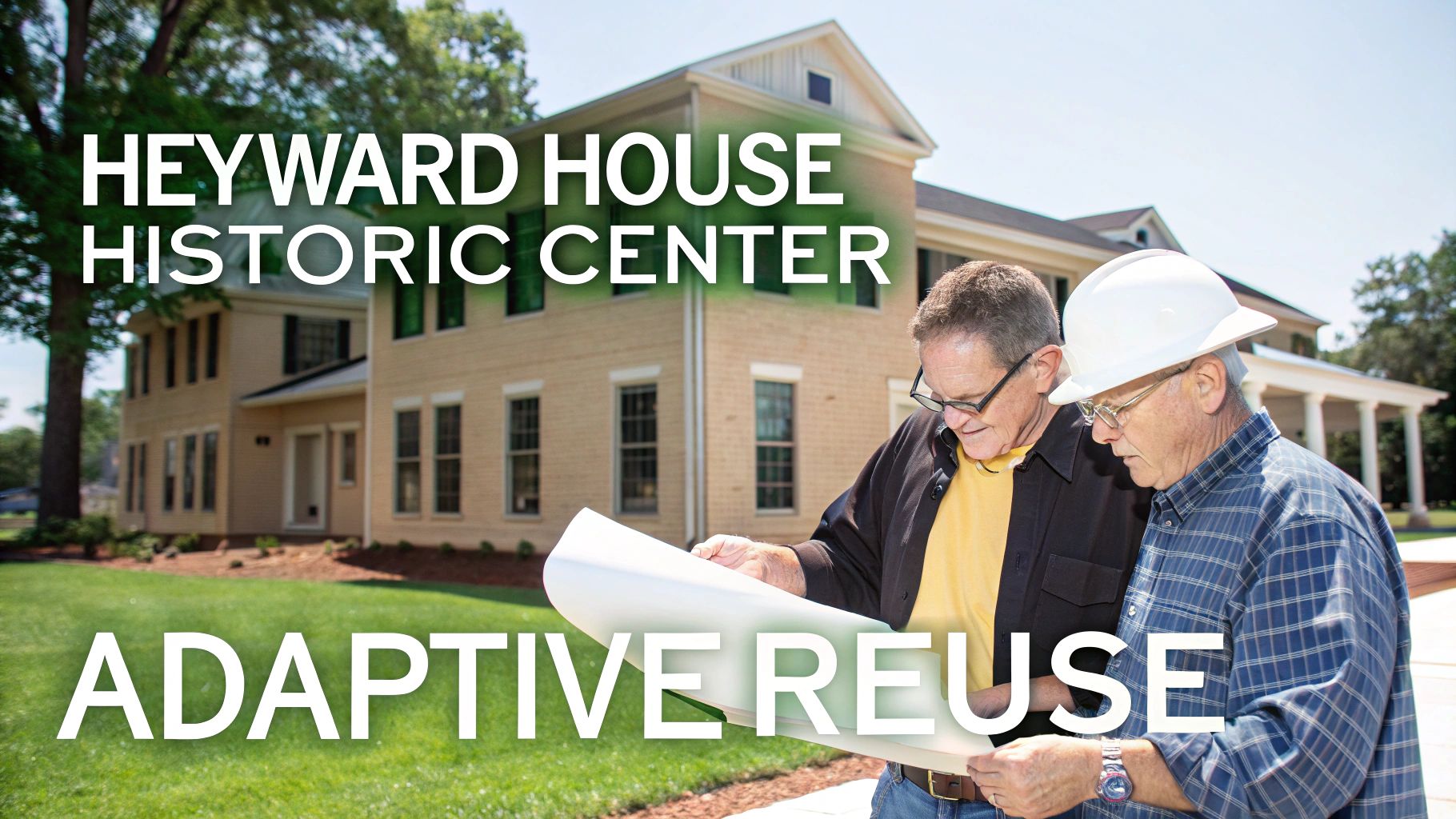
Two men review blueprints for adaptive reuse in front of the Heyward House Historic Center.

Too often, developers see historic buildings as liabilities—riddled with constraints, hidden costs, and regulatory nightmares. But that mindset misses the bigger picture. An old structure isn't just a pile of aging materials; it’s a vessel of stories, character, and deep-seated community value just waiting to be tapped. The Heyward House proves that heritage can be a serious competitive advantage.

Its story is one of incredible resilience. Nestled in the heart of Bluffton's historic district, the Heyward House is a remarkable survivor. On June 4, 1863, Union troops shelled the town, starting fires that wiped out an astonishing 75% of Bluffton. Only eight homes and two churches from the antebellum era were left standing. The Heyward House is one of those precious few. You can learn more about its story as one of the few Civil War survivors directly from the Heyward House Historic Center.

This dramatic history of survival is the bedrock of its modern success. By leaning into its past, the property was reborn not as a stuffy, static museum, but as Bluffton’s official welcome center—a living, breathing part of the local economy.

The table below offers a quick snapshot of the building's key details.

Heyward House Historic Center At-a-Glance

Attribute Details
Built Circa 1841
Architecture Carolina Farmhouse (Carpenter Gothic)
Location 70 Boundary Street, Bluffton, SC
Historical Note One of only eight homes to survive the 1863 Burning of Bluffton.
Current Use Official Welcome Center for the Town of Bluffton.

This blend of history and modern function is what makes the property so compelling today.

From Private Home To Public Institution

The journey of the Heyward House provides a clear, practical roadmap for any developer considering an adaptive reuse project. The secret wasn't to erase its history but to build on it. This strategy delivers tangible benefits for modern developments:

  • Built-in Marketability: A property with a one-of-a-kind story and unique architecture already has a marketing narrative that new construction could never hope to match.
  • Community Buy-In: When you restore a beloved local landmark, you often get a groundswell of public goodwill and support. This can smooth the path for approvals and help build a loyal base of customers or tenants from day one.
  • Sustainable Development: Reusing an existing structure is simply a smarter, more environmentally responsible choice that dramatically reduces waste and conserves resources.

The journey of the Heyward House demonstrates a core principle we champion at Sherer Architects: thoughtful preservation isn't about freezing a building in time. It's about adapting it for the future to create lasting financial and cultural value.

Why the Carolina Farmhouse Design Endures

The Heyward House is far more than just an old building; it's a living lesson in architectural intelligence, perfectly adapted to its surroundings. Its design, what we know as the Carolina Farmhouse style, wasn't created to follow a trend. It was a deeply practical and brilliant solution to the unique challenges of living in the South Carolina Lowcountry.

For anyone looking at a historic property, understanding this connection between form and function is absolutely crucial. The building's original design isn't some dusty relic—it’s a roadmap to its inherent value. I often compare it to a classic car; the original engineering is what makes it a timeless, high-performance machine. If you start swapping out parts without understanding why they were chosen in the first place, you risk destroying the very thing that makes it special.

When you look at the Heyward House Historic Center, every architectural detail tells a story of survival and clever design. These features weren't just for looks; they were essential tools for living comfortably in a place that’s hot, humid, and prone to flooding.

Built for the Lowcountry Climate

The real genius of the Carolina Farmhouse is how it works with nature, not against it. Long before we had modern air conditioning, several key features allowed these homes to breathe and keep their inhabitants comfortable. It’s a masterclass in understanding local materials and the environment.

  • Expansive Porches: These weren't just for sipping sweet tea. They were the building's first line of defense against the relentless sun, creating a wide shade buffer that kept the interior walls cool and drastically reduced the heat beating down on the house.
  • Raised Foundations: Lifting the main living area off the ground on brick piers served two critical purposes. First, it protected the wooden structure from damp ground and potential floodwaters. Second, it created a pocket for air to circulate underneath the house, acting as a natural cooling system.
  • Timber Framing: The home’s skeleton was built with a robust timber frame, often using dense, resilient heart pine that could stand up to hurricane-force winds. The simple, open floor plans weren't just a style choice; they were designed to encourage cross-ventilation, letting breezes flow freely from room to room.

These elements prove that the original builders were master problem-solvers. This is precisely why our first step in any preservation project at Sherer Architects is deep architectural research.

By studying the original materials and building methods, we uncover the "architectural DNA" of a structure. This knowledge allows us to make informed decisions that honor the building's history while adapting it for a profitable, modern future.

Jumping into a project without this foundational knowledge is a recipe for expensive mistakes. A developer who doesn't grasp why the foundation was raised might accidentally introduce moisture problems. Someone who removes a porch for a more modern look could see their future energy costs skyrocket. The original design holds the keys not just to the building’s past, but to unlocking its future potential in a way that is both authentic and economically sound.

How the Heyward House Found Its New Purpose

For most of its life, the Heyward House was simply a private home. Its architectural importance and deep connection to the community were treasures known mainly to the people of Bluffton. But by the late 20th century, the house, like so many historic buildings, was facing a very uncertain future. A building’s story can easily end with a wrecking ball if no one steps in with a vision to carry it forward.

That critical moment came in 1998. The Bluffton Historical Preservation Society saw the building for what it was—irreplaceable—and acquired the property. This wasn't just a real estate transaction; it was a deliberate investment in the town's future. The plan wasn't just to save an old house, but to give it a new mission as Bluffton's official welcome center and a public museum.

From Private Residence to Public Asset

This journey from a quiet family home to a bustling public landmark is a perfect case study in adaptive reuse. Making it happen took a lot more than a fresh coat of paint. It required a meticulous restoration that honored the building's history while outfitting it for a new, public-facing role. The Preservation Society’s work guaranteed the structure would once again be at the heart of Bluffton's daily life.

The careful work became a masterclass in breathing new purpose into an old frame. Understanding the potential locked inside a distressed property is the first step in giving historic sites a second chance, just as the Heyward House found its calling.

This timeline illustrates how some of the key design elements of the Carolina Farmhouse style have evolved over the years.

You can see how enduring features like timber frames, wide porches, and raised foundations were fundamental to the building’s original, climate-smart design.

By turning the Heyward House into a welcome center, the community created a powerful hub for tourism and local pride. It became the first stop for visitors, instantly connecting them to the town's story. This strategy gets to the heart of what we believe at Sherer Architects.

Extending a building's useful life by 50-75 years through thoughtful adaptation is almost always a smarter, more sustainable, and more profitable investment than demolition and new construction. The Heyward House is proof that preservation pays dividends.

The project’s success isn't just measured in the historic materials saved, but in the real economic and cultural value it brings to the Town of Bluffton every single day. It shows how one building, repurposed with foresight, can energize a community and generate a return on investment that far outweighs the initial costs. It stands today as a living monument to strategic preservation.

Unlocking the Financial Value of Historic Properties

Preserving a landmark like the Heyward House Historic Center obviously pays off in cultural and historical rewards. But for savvy developers and investors, the real question is: does it make financial sense?

Too often, historic properties are seen as risky ventures, tangled in red tape and hidden costs. But here's the thing—with the right expert guidance, these buildings represent a fantastic opportunity to generate serious returns.

This is where a seasoned preservation architect becomes the most valuable player on your team. It's not just about restoring old features. It's a strategic puzzle that involves digging into materials research, navigating complex approval bodies like Design Review Boards, and, most importantly, unlocking a deep well of financial incentives. Your architect is your guide, turning potential headaches into profitable assets.

Think of it like restoring a classic car. Anyone can give it a new coat of paint, but a master mechanic—or in our case, a specialized architect—knows how to rebuild the engine for peak performance, ensuring every detail is authentic and adds to its long-term value.

Tapping into Powerful Financial Incentives

The financial landscape for historic preservation is surprisingly rich with opportunity, but you have to know where to look. Getting your hands on these benefits takes deep institutional knowledge and a proven process for documentation and applications. This is precisely where a firm like Sherer Architects can create immense value for clients.

Here are a few of the key financial tools available:

  • Federal Historic Tax Credits: This is the big one. It offers a 20% income tax credit for the qualified rehabilitation of historic, income-producing buildings. This isn't just a deduction; it's a direct, dollar-for-dollar reduction in what you owe in taxes, which can dramatically improve a project's bottom line.
  • State Historic Tax Credits: Many states, including South Carolina, have their own tax credit programs. The best part? They can often be stacked on top of federal incentives, making the financial picture even more attractive for developers.
  • Preservation Grants and Specialized Loans: Beyond tax credits, numerous foundations and government programs offer grants specifically for historic preservation. There are also specialized loan programs out there that can provide more favorable terms for projects that save historic structures.

For anyone looking at South Carolina's Lowcountry market, the Heyward House is a perfect example of this strategy in action. Honoring the building's historic character through detailed research—while securing tax credits and grants—delivers lasting value. It also builds community goodwill, which is a huge advantage in a major tourism-driven market. You can learn more about how the Heyward House serves its community.

De-Risking the Investment with Expert Guidance

Trying to navigate this complex world on your own is a huge risk. An architect specializing in historic preservation does more than just design; they build a financial and regulatory strategy from the ground up.

They do the legwork to prove a building's historical significance, prepare the mountains of documentation required for tax credit applications, and represent your project with credibility in front of review boards.

By partnering with an expert who knows how to unlock these financial tools, a developer can transform a historic property from a high-risk gamble into a predictable, high-return investment. The incentives are designed to make preservation the smart financial choice.

This kind of partnership effectively de-risks the entire project. It ensures that your renovation not only meets all historical standards but is also set up for maximum financial success right from the start, turning a community treasure into a profitable, legacy-building asset.

What Today's Developers Can Learn From This Project

Two men, a construction worker and a client, shake hands with a house in the background.

The story of the Heyward House Historic Center isn't just a fascinating piece of local history; it’s a practical playbook for developers aiming to build projects with both profit and legacy in mind. It teaches a powerful lesson: a building’s past isn't a liability to be managed, but its single greatest asset.

At the end of the day, successful development is about creating places people genuinely want to be. The Heyward House nails this by embracing its incredible story of survival and resilience. That narrative is more than just a historical footnote—it’s a powerful marketing tool that a brand-new building simply can't buy. Developers can learn from this by digging into the history of their own properties and using that story to build a real, authentic connection with the community.

Turning Character into Commerce

The Heyward House is living proof that preserving a building’s character pays real dividends, both financially and in terms of reputation. Its role as Bluffton's official welcome center shows how weaving a project into the fabric of the community drives foot traffic and creates lasting value.

The numbers back this up. Today, the Heyward House Historic Center is a major draw, earning a stellar 4.5/5 rating from 111 TripAdvisor reviews, with 71 of those visitors rating their experience as 'excellent.' This kind of public enthusiasm isn't an accident. It’s the direct result of a smart decision to make the building an essential part of the town’s modern identity, as highlighted in its heritage site overview.

The lesson for developers is crystal clear: adaptive reuse isn't just a sustainable choice; it's a smart business move. When you give a historic building a new life that serves the surrounding community, you create an asset with deep roots and a built-in audience.

Strategies for Your Next Project

Putting these ideas into practice means shifting your mindset. Stop seeing old buildings as problems to be solved and start seeing them as puzzles with incredible potential waiting to be unlocked.

Here are a few core strategies to take from the Heyward House model:

  • Lead with the Story: Don’t hide the building’s history in a dusty plaque. Make it the star of your design and marketing. This is what gives your property an identity that no one else can copy.
  • Find a Community Fit: The building’s new purpose should fill a real need, whether that’s retail, housing, or a public gathering place. A project that serves the community is a project that will last.
  • Bring in the Experts Early: Working with architects who live and breathe historic preservation, like Sherer Architects, isn't just another line item on the budget. It's an investment in getting the details right and maximizing the property's financial and cultural worth.

We Help Developers Build a Lasting Legacy

Historic properties are so much more than just old buildings; they're opportunities waiting to be rediscovered. Think of a place like the Heyward House Historic Center—each one is a unique puzzle. Cracking the code requires a deep dive into its history, meticulous research, and a clear vision for how to marry its heritage with the demands of today. It’s about seeing a vibrant future waiting within a structure's storied past.

Turning a potential headache into a profitable, legacy-building asset is no accident. It’s a deliberate process that hinges on a partnership built on genuine experience and a shared passion for preservation. For developers looking to make a real mark in South Carolina, the first step is always choosing the right guide.

Turning History into Opportunity

At Sherer Architects, we specialize in bringing these complex projects to life in a way that’s beautiful, sustainable, and built to last. We have a knack for looking past the immediate hurdles—the peeling paint, the outdated systems—to see the immense financial and cultural value locked within those historic walls.

Our approach is straightforward but thorough:

  • We start with a deep dive. Our team investigates every detail, from the original building materials to the construction techniques used, ensuring any restoration feels authentic.
  • We design for the future. Our plans don't just restore; they adapt. We thoughtfully extend a building's life, making sure it meets modern needs and building codes without sacrificing its character.
  • We navigate the financial side. We guide our clients through the process of securing historic tax credits and other incentives, helping them make the project financially successful.

For any developer serious about creating lasting value, the single most important decision you'll make is choosing an architect who lives and breathes preservation. It's the move that turns a piece of history into your next great opportunity. Let's build your legacy together.

Common Questions About Historic Preservation

For developers and property owners, taking on a historic preservation project can feel like stepping into a whole new world. It’s only natural to have questions about costs, regulations, and whether it’s a sound investment. Let’s tackle some of the most common concerns to clear things up.

Isn't Historic Preservation Just More Expensive Than Building New?

This is probably the number one question we get, and the answer might surprise you. While every project is different, adapting an existing historic building is often more cost-effective in the long run.

Think about it: the building’s core structure—its "good bones"—is already in place. That represents a massive amount of material and labor that's already been paid for. When you add powerful financial tools like federal and state historic tax credits into the mix, the final investment can be significantly lower. It's often the smarter financial move.

The goal isn't just about saving an old building; it's about creating a financially successful asset. A great preservation project strikes a perfect balance between historical character and modern needs, resulting in a one-of-a-kind property that new construction simply can't match.

How Can You Possibly Meet Modern Building Codes in a Centuries-Old Structure?

This is where the real expertise comes in. Bringing a historic building up to today's standards for safety, accessibility, and energy efficiency is a central part of any preservation project. The trick isn't to force modern systems into an old frame but to integrate them with skill and creativity.

This could mean:

  • Cleverly routing new electrical and plumbing to keep them out of sight.
  • Restoring and upgrading original windows for modern thermal performance instead of tearing them out.
  • Designing innovative accessibility features that feel like they belong, rather than being tacked on as an afterthought.

A seasoned preservation architect knows how to work with building officials to find solutions that satisfy the spirit of the code without sacrificing the building's historic soul. Beyond a landmark like the Heyward House, countless properties need this kind of thoughtful care. For anyone tasked with this responsibility, understanding what is property preservation is fundamental to protecting the investment for the long haul. It’s all about respecting the past while building a safe, functional, and valuable asset for the future.


At Sherer Architects, LLC, we live for these kinds of complex challenges. We help developers navigate every single step of a historic preservation project, turning what seem like obstacles into unique, profitable opportunities. Contact us today to see how we can help bring your vision to life.

Categories
Uncategorized

Senior Living Design: A Practical Guide to Profitable, Resident-Focused Living

Senior living design is much more than just architecture; it’s about crafting entire communities that support the health, safety, and social lives of older adults. It's a move away from the sterile, institutional models of the past and a full embrace of vibrant, hospitality-driven environments where residents can thrive. The best new communities feel more like a high-end resort than a traditional care facility, focusing on wellness, connection, and an active lifestyle.

Why Thoughtful Design Is the New Market Reality

Seniors socialize on a sunny resort-style patio with modern buildings and lush landscaping.

The world of senior housing has completely changed. We've left behind the era of cookie-cutter facilities. Today’s market is all about creating dynamic, engaging communities for a generation of older adults who are more active and have higher expectations than ever before. This isn't just a fleeting trend—it's a massive shift driven by powerful demographic and economic realities.

The global senior living market is booming. Valued at USD 260.12 billion in a recent year, it's on track to hit USD 388.55 billion by 2032. This incredible growth is a direct result of an aging global population seeking specialized living options that expertly blend independence with just the right amount of support. You can learn more about the senior living market's impressive growth and see firsthand what it means for developers and owners.

Connecting Architecture to Profitability

In such a competitive field, architecture has become the primary engine for profitability and what makes a community stand out. It’s no longer just about providing shelter. A well-designed community is a powerful strategic investment that directly impacts your bottom line.

Think about it like this: a generic, uninspired building is just a commodity, forced to compete almost entirely on price. A thoughtfully designed community, on the other hand, becomes a destination—a place people genuinely want to live. This kind of desirability creates tangible business advantages:

  • Higher Occupancy Rates: Premium, beautifully designed spaces attract residents faster and keep them happier, reducing turnover.
  • Increased Revenue Streams: Hospitality-style amenities like bistros, wellness centers, and theaters add value and create new income opportunities.
  • Stronger Brand Identity: Unique architecture tells a compelling story, making your property memorable and much easier to market.
  • Enhanced Resident Satisfaction: When you focus on wellness and social connection, you get happier residents and powerful, positive word-of-mouth.

The core concept is simple: great senior living design creates a product so compelling that it sells itself. It transforms a real estate asset into a thriving community, delivering a strong return on investment by meeting the sophisticated demands of today’s seniors.

Understanding the Spectrum of Care

To create a successful senior living community, you first have to understand the different needs of residents across the continuum of care. Each model, or typology, serves a distinct purpose and demands its own unique architectural strategy. Many of the most successful projects cleverly blend these models on a single campus, giving residents the peace of mind that they can age in place as their needs evolve.

This table breaks down the main senior living typologies to give you a clearer picture of how they differ.

Key Senior Living Typologies at a Glance

Typology Target Resident Profile Level of Care Primary Design Focus
Independent Living (IL) Active, self-sufficient older adults (55+) seeking a maintenance-free lifestyle. None to minimal. Primarily hospitality and social services. High-end amenities, social spaces, upscale apartment/condo-style units, walkability.
Assisted Living (AL) Seniors needing help with Activities of Daily Living (ADLs) like bathing, dressing, and medication. Daily support. Non-medical assistance from on-site staff. Balance of private residential units with easily accessible common areas, dining, and caregiver support stations.
Memory Care (MC) Residents with Alzheimer's, dementia, or other forms of cognitive impairment. 24/7 specialized care. Staff trained in dementia care. Secure environment, circular pathways to prevent confusion, clear sightlines, sensory gardens, and familiar visual cues.
Skilled Nursing (SNF) Individuals requiring 24/7 medical supervision and post-acute rehabilitative care. Intensive medical care. Licensed nurses and therapists on staff. Clinical efficiency, therapy spaces, accessible rooms designed for medical equipment, comfortable but functional environment.

By really digging into these typologies, developers and architects can design purpose-built environments that do more than just meet code. They can create places that foster dignity, independence, and a genuinely high quality of life. This is the strategic thinking that separates a struggling facility from a community that leads the market.

Designing for Resident Wellbeing and Dignity

Great design in senior living isn't about how a space looks; it’s about how it feels and how it works for the people who call it home. We're crafting environments that champion dignity, foster independence, and provide genuine comfort. It's a move away from simply providing shelter and toward creating a premium living experience that supports every aspect of a resident's health—physical, cognitive, and emotional.

To get this right, you have to layer several key design philosophies. It’s a lot like a master chef building a complex flavor profile; each ingredient is distinct but essential to the final result. Principles like universal design, biophilic design, and evidence-based strategies all come together to create a community that feels safe, empowering, and truly desirable to residents and their families.

Blending Autonomy with Safety Through Universal Design

At its core, universal design is about making spaces usable for everyone, no matter their age, mobility, or ability. The real magic of it is when you don’t even notice it’s there. Instead of tacking on accessibility features as an afterthought, we integrate them seamlessly so the environment is just naturally intuitive and easy to navigate. This is absolutely fundamental to preserving a resident’s sense of independence.

A perfect example is the bathroom grab bar. Instead of a sterile, clinical-looking bar, a universal design approach might specify a beautifully crafted towel rack that is also structurally rated for support. It’s a simple switch, but it maintains the high-end residential feel of the space while delivering the safety that’s needed.

Other practical applications we see every day include:

  • Zero-Threshold Showers: These not only look sleek and modern, but they completely eliminate a major tripping hazard and allow for easy roll-in access.
  • Lever-Style Door Handles: A small detail that makes a world of difference for someone with arthritis or limited grip strength compared to a traditional knob.
  • Wider Corridors and Doorways: This isn’t just about accommodating wheelchairs. It makes the entire community feel more open, gracious, and less institutional.

Bringing Nature Indoors with Biophilic Principles

There's a reason we feel better when we're connected to nature—it’s baked into our DNA. Biophilic design taps into this innate human need. By weaving natural elements into the built environment, we can see real, measurable health benefits, like reduced stress, better cognitive function, and an improved mood. In a senior living context, this isn’t a luxury; it’s a necessity.

This is a much bigger idea than just putting a few potted plants in the lobby. It’s a holistic strategy for blurring the lines between the indoors and the outdoors.

A well-executed biophilic design strategy can transform a building from a simple structure into a restorative sanctuary. Studies have shown that even views of nature can speed up recovery times and lower blood pressure, making this a powerful tool for promoting resident wellness.

Here are some key biophilic elements to consider:

  • Maximizing Natural Light: Think huge windows, skylights, and spaces designed to catch the sun as it moves through the day.
  • Natural Materials and Textures: Using real wood, stone, and other natural finishes creates a tactile, calming environment that feels authentic.
  • Views of Nature: Every room should have a purpose. We strategically orient spaces to look out onto gardens, courtyards, or whatever natural landscape is available.
  • Indoor Gardens and Living Walls: Bringing vibrant, living plants directly into the building creates focal points and improves air quality.

Using Evidence-Based Design for Cognitive Health

Evidence-based design (EBD) is about taking the guesswork out of the equation. It means using credible research and hard data to make decisions about the physical environment to get the best possible outcomes for residents. In senior living, and especially in memory care, EBD is our most powerful tool for supporting cognitive health and physical safety.

Take lighting, for instance. Research has proven that the right lighting strategy can dramatically reduce fall risks. Beyond that, tunable LED systems that mimic the natural cycle of daylight can help regulate residents' circadian rhythms, which leads to better sleep and can even reduce "sundowning" behaviors in those with dementia.

Acoustics are another critical piece of the puzzle. The constant hum of an HVAC system or chatter from a busy hallway can be incredibly stressful and agitating. EBD guides us to use sound-absorbing materials and design layouts that create a peaceful, serene atmosphere. We also use color and texture with intention, providing subtle visual cues that help residents find their way, which fosters a sense of control and reduces confusion.

Mastering Community Flow and Amenity Planning

Beyond the four walls of an apartment, the real heart of a senior living community beats in its master plan. This is where we get into programming—the art and science of placing spaces to generate social energy, pull residents into activities, and make life easier for staff. Think of it like designing a great little town; you want the streets and public squares to have a clear purpose, guiding people and creating natural opportunities for them to connect.

Smart adjacencies are the secret sauce here. Imagine placing a lively bistro right near the main entrance. Suddenly, the lobby isn't just a pass-through space; it's a dynamic social hub, filled with the hum of conversation. Or picture connecting therapy rooms directly to an outdoor rehab garden. This creates a seamless wellness journey, making it feel natural for a resident to move from an indoor session to gentle activity in the fresh air.

The Evolution of Senior Living Amenities

Today’s seniors aren't just looking for a place to live; they're shopping for a lifestyle. The amenities on offer have become a massive differentiator in a crowded market. The days of the lonely, stuffy multipurpose room are long gone. The modern approach to senior living design is all about creating dedicated, high-quality venues that support a huge range of interests and wellness goals.

The best new communities feature amenities that feel more like a boutique hotel or a high-end club:

  • Dedicated Fitness and Wellness Centers with everything from low-impact cardio machines to group classes like chair yoga and tai chi.
  • Creative Art Studios fully equipped for painting, pottery, or other crafts, giving residents a real sense of purpose and a chance to learn new skills.
  • Modern Cinemas with truly comfortable seating and top-notch A/V for movie nights and special events.
  • Tech Lounges where residents can get help with their devices, learn new digital skills, or video chat with family.

This all comes down to a central focus on resident wellbeing, where every design choice is interconnected.

A concept map showing Resident Wellbeing connected to Safety, Nature, and Health with key benefits and metrics.

As you can see, a holistic design marries safety, nature, and health to build an environment where people don't just live—they thrive.

The market data backs this up completely. Senior housing occupancy in primary U.S. markets recently hit 87.4%, with demand outpacing new construction. It's telling that independent living led the pack with 89.0% occupancy, sending a clear signal that today's residents want an active, wellness-driven lifestyle that high-quality amenities make possible. You can discover more insights about the latest senior housing trends to see where the industry is heading.

Designing for Flexibility and Maximum ROI

A wide variety of amenities is critical, but smart developers know every square foot has to earn its keep. The key is designing flexible, multi-use spaces that can pivot to meet different needs and maximize their use throughout the day. A room with only one purpose is an operational liability. A room that can serve three is a powerful asset.

Think of a well-designed common area not as a fixed room, but as a flexible stage. In the morning, it's a bustling coffee social. In the afternoon, it can be reconfigured for a bridge tournament or a guest lecture. At night, it could be the setting for a resident wine-tasting event.

This chameleon-like approach delivers a much higher return on investment than building separate, single-purpose rooms that sit empty for hours. It also gives the community the agility to evolve its programming over time to match the unique interests of whoever is living there.

In the end, mastering community flow is about creating a layout that is functional, beautiful, and profitable. It’s an exercise in choreography, where the architecture itself guides movement, encourages interaction, and organically builds a sense of community. When you get the harmony right between social spaces, wellness amenities, and operational pathways, you create a senior living design that not only attracts new residents but also works seamlessly for your staff, ensuring success for the long haul.

Navigating Building Codes and Accessibility

For developers and owners, this is where the ambitious vision for a senior living community meets the hard reality of regulation. It's tempting to see building codes as just another frustrating checklist—a series of hoops to jump through that add cost and complexity.

But the most successful projects flip that script. They don't treat codes as a burden. They see compliance as a strategic advantage, the essential foundation for creating environments that are safer, more comfortable, and ultimately, far more marketable.

The web of regulations governing senior living design is dense, weaving together federal mandates, state laws, and local ordinances. Getting this right from day one isn't just about passing inspections; it's about smart risk management. A single misstep can trigger costly rework, frustrating delays, and even legal challenges down the road.

This is exactly why bringing an architect with deep sector experience on board early is non-negotiable. They are your guide, translating the dense language of codes into practical, elegant design solutions that actually boost your property's value.

Key Regulations in Senior Living Design

While codes vary by location, a few core regulations form the bedrock of compliant senior living design across the country. Think of them as overlapping layers of safety and accessibility, each with a different focus.

  • Americans with Disabilities Act (ADA): This is the federal civil rights law that sets the baseline for accessibility. In senior living, it primarily dictates the design of common areas—think lobbies, dining rooms, and amenity spaces that are open to the public.
  • Fair Housing Act (FHA): The FHA hones in on the residential units themselves. It requires specific accessibility features within multifamily housing, directly shaping the layout and function of resident apartments.
  • NFPA 101 Life Safety Code®: You could argue this is the most critical code of all for senior living. It's laser-focused on fire safety and emergency egress, dictating everything from smoke detection and sprinkler systems to the fire-resistance ratings of walls and doors.

The real goal isn't just to meet the letter of the law, but to embrace its spirit. A truly exceptional design goes beyond the bare minimum, creating spaces that feel generous and intuitive, not just compliant. This approach turns a regulatory hurdle into a powerful marketing tool.

From Compliance to Competitive Advantage

The true artistry is in weaving these requirements into the design so seamlessly that residents never even notice them. The space should feel intentional and upscale, not like a place that was grudgingly retrofitted for accessibility. This is where clever, thoughtful solutions make all the difference.

For example, a code might mandate a minimum corridor width for wheelchair access. An average design meets that number exactly. A superior design, however, makes the corridor a bit wider, transforming a simple hallway into a gracious gallery with curated lighting and finishes.

When it comes to the details, accessible bathroom remodeling for the elderly offers a great real-world example of this principle in action. It’s about installing zero-threshold showers that look sleek and modern while completely eliminating a major trip hazard. It’s about integrating grab bars that double as stylish towel racks, blending safety with sophisticated decor.

Ultimately, mastering building codes is about more than just avoiding fines. It’s a fundamental commitment to the safety and dignity of your residents. When you approach regulations with a design-forward mindset, you create a community that isn’t just safe and accessible—it's beautiful and desirable, giving you a powerful edge in a competitive market.

The Power of Adaptive Reuse in Senior Living

Modern building, a successful adaptive reuse project, features a clock tower and inviting outdoor patio.

With construction costs on the rise and prime land becoming harder to find, the best site for your next senior living project might just be the one that’s already built. Instead of starting from a patch of dirt, adaptive reuse—the art of renovating and repurposing existing buildings—is proving to be a smarter, more sustainable, and often more profitable path than new construction.

This is all about seeing the potential in structures others have overlooked. It’s about breathing new life into a historic school, a vacant hotel, or an old industrial mill and transforming it into a vibrant, modern senior living community. This strategy does more than just save a piece of local history; it delivers some serious business advantages that go straight to the bottom line.

Why Adaptive Reuse Makes Financial Sense

It’s no surprise that more and more developers are looking at adaptive reuse for its compelling financial upside. A new build is a long, expensive journey filled with uncertainties, from land acquisition and zoning fights to unpredictable supply chains. Retrofitting an existing building helps you sidestep many of those headaches, creating a much cleaner, and often faster, path to opening your doors.

Think about the project timeline. An adaptive reuse project can get to market significantly faster because the building’s skeleton—the foundation, walls, and roof—is already standing. That accelerated schedule means you start generating revenue sooner, which can make a huge difference to your project's internal rate of return (IRR).

On top of that, the cost savings can be massive. While every project has its own quirks, renovating an existing shell is almost always more cost-effective than building the same square footage from the ground up.

Adaptive reuse isn't just a sustainable choice; it's a strategic business decision. By leveraging the bones of an existing building, developers can reduce construction timelines, mitigate financial risks, and create a final product with unmatched character and market appeal.

The current market makes this strategy even more compelling. The U.S. senior living market is on track to grow from USD 97.85 billion to a staggering USD 154.55 billion by 2033. But with new construction slowing down and inventory tightening in key markets, smart renovations are becoming one of the most effective ways to meet this skyrocketing demand. You can discover more insights about the expanding U.S. senior living market to see how adaptive reuse fits into the big picture.

The Uniqueness of Repurposed Spaces

One of the biggest wins for adaptive reuse is something a new build can never manufacture: genuine character. A converted 1920s hotel or a repurposed textile mill comes with a built-in story and architectural soul that really connects with prospective residents and their families.

This built-in uniqueness is a powerful marketing tool. You aren't just selling another new apartment; you’re offering a home with history. These one-of-a-kind features often include:

  • Soaring Ceilings: Old industrial or institutional buildings frequently boast high ceilings, creating a sense of light and airiness that’s hard to justify in a new build budget.
  • Large, Historic Windows: The kind of oversized, character-filled windows from a bygone era can drench units in natural light and offer incredible views.
  • Exposed Brick and Original Wood Beams: These elements bring a warmth, texture, and tangible link to the building's past that residents love.
  • Unique Floor Plans: Working within the constraints of an existing structure forces creativity, often leading to far more interesting and varied unit layouts than the cookie-cutter plans of many new developments.

This distinct character forges a strong sense of place, turning the property into a local landmark and a truly desirable community to call home.

Unlocking Value with Historic Tax Credits

If the building you’re eyeing has historical significance, adaptive reuse opens up an incredibly powerful financial tool: historic tax credits. These federal and state programs are designed to encourage the preservation of historic properties by giving developers a dollar-for-dollar reduction in their tax liability.

Now, securing these credits is a detailed process that demands careful documentation and following strict preservation standards. But the reward is well worth the effort. The Federal Historic Preservation Tax Incentives program, for example, offers a 20% tax credit for the certified rehabilitation of historic buildings. Many states have their own programs that can be "stacked" on top, which can dramatically lower your total project cost.

This is where working with an architectural firm that specializes in historic preservation is absolutely essential. They know how to navigate the complex approval process with State Historic Preservation Offices (SHPOs) and the National Park Service. Their expertise ensures your design both honors the building's past and meets all the needs of a modern senior living community. This transforms a building’s history from a nice story into a real financial asset, maximizing your return and setting the project up for long-term success.

Straight Talk on Senior Living Design: Answering the Big Questions

When you're developing a senior living community, the questions come thick and fast. Developers and owners need clear, practical answers to make smart decisions about planning, budgeting, and ultimately, creating a place that will thrive. Let's tackle some of the most common questions we hear from our clients.

What Is the Biggest Design Mistake We Can Make?

Hands down, the single most expensive mistake is designing for an outdated idea of what it means to be old. This thinking leads to sterile, institutional-feeling buildings with a cookie-cutter approach, boring amenities, and no real sense of energy. You end up with a property that feels more like a clinic than a home.

That model is dead. Today’s seniors are savvy consumers who expect a hospitality experience, not just a place to receive care. They're looking for a vibrant community where they can truly live, not just a place to move into when they have to. A design that misses this point will struggle from day one to attract residents and keep occupancy high.

The goal should always be to prioritize choice, community, and well-being. That means creating multiple dining options, offering top-notch fitness and social programs, and weaving in technology that actually helps. It's about designing a place people genuinely want to live.

How Can Good Design Help with Operations and Staffing?

Smart design is one of the most effective, yet often overlooked, tools for making daily operations run smoothly and keeping your staff happy. It’s all about creating a physical space where workflows just make sense, which saves time, reduces frustration, and lessens the physical toll on your team. This has a massive ripple effect on everything from the quality of care to your bottom line.

Think about it this way: strategically placing laundry rooms, supply closets, and nurse's stations can shave miles off the distance your staff walks every day. Designing logical service corridors that keep back-of-house hustle and bustle away from resident areas creates a more peaceful, pleasant environment for everyone.

Well-designed staff spaces aren't a frill; they are a critical investment in your most valuable asset. A nice break room with natural light and comfortable chairs sends a powerful message: "we value you." In an industry plagued by high turnover, that simple act can do wonders for morale and retention.

A supported, efficient staff provides better care. Better care leads to happier residents and glowing reviews from families. Good design creates a positive cycle that benefits the entire community.

Is It Really Cheaper to Repurpose an Old Building?

While every project is different, adapting an existing building can often be more cost-effective and get you to profitability faster than starting from scratch. When you renovate, you typically save a huge chunk of capital on big-ticket items like site work, foundations, and the basic building shell.

The timeline is another huge advantage. With the main structure already standing, the journey from purchase to opening day is often much shorter. That accelerated schedule means you start bringing in revenue sooner, which is a game-changer for your financial projections.

And it’s not just about the upfront costs. If you’re working with a historic building, you may be able to tap into valuable federal and state historic tax credits. These credits can cover a significant portion of your renovation costs, turning the building's past into a real financial advantage. Plus, these projects have a built-in character and story that new construction just can't match, giving you a powerful marketing edge.

What Future Trends Should We Be Paying Attention To?

The world of senior living is changing fast, and design is evolving with it. Looking ahead, three things are really shaping the future: technology, a broader definition of wellness, and a much bigger emphasis on flexibility. Developers who get ahead of these trends will be setting themselves up for success for years to come.

Technology is moving beyond being a simple convenience and becoming deeply woven into the fabric of daily life.

  • Smart-Home Features: Things like voice-activated lights and thermostats will become standard, making life much easier for residents with mobility issues.
  • Safety and Health Monitoring: We'll see more passive sensors for things like fall detection and wearable tech that tracks vitals, giving residents and their families incredible peace of mind.
  • Seamless Connectivity: Rock-solid Wi-Fi and easy-to-access tech support are already non-negotiable.

The concept of wellness is also getting a major upgrade. It's no longer just about a small gym in the basement. The new focus is on a holistic approach that nurtures mental, social, and spiritual health. That means designing dedicated spaces for yoga, meditation gardens, art studios, and classrooms for lifelong learning.

Finally, flexibility is everything. Tomorrow's successful communities will be designed to adapt. Think multi-purpose spaces that can host a fitness class in the morning, a lecture in the afternoon, and a concert at night. This adaptability extends to the units themselves, with layouts that can be modified as a resident's care needs change, allowing them to age in place gracefully.


At Sherer Architects, LLC, we specialize in turning complex challenges into enduring, profitable results. Whether you're looking to unlock the value of an old building with historic tax credits or planning a new commercial development from the ground up, our team knows how to navigate the process. Let's talk about how our expertise in historic preservation and thoughtful design can make your next project a success. Visit us at shererarch.com to start the conversation.

Categories
Uncategorized

Hiring a Commercial Building Architect to Maximize ROI

A commercial building architect is much more than someone who just draws up blueprints. Think of them as the master strategist who turns your business vision into a real-world, functional, and profitable asset. Their job is a unique blend of creative design and technical discipline, making sure your project successfully clears every hurdle—from complex zoning laws to construction challenges—all while staying on budget.

Your Architect Is More Than Just a Designer

It’s a common mistake for developers and business owners to see an architect's role as being just about aesthetics and floor plans. And while great design is absolutely part of the equation, a truly skilled commercial architect acts more like a business strategist who happens to be an expert in building design. They are your primary advocate and the master coordinator who brings all the complicated pieces of the development puzzle together.

Here’s an analogy: building a commercial property is like launching a major new product. You'd never do that without a product manager who understands the market, manages the budget, and ensures the final product works for its users. Your architect plays that exact role for your physical investment.

The Strategic Partnership Model

When you start seeing your architect as a strategic partner, the whole dynamic changes. They’re no longer just a vendor you hire to deliver drawings. They become a core part of your team, laser-focused on maximizing the long-term value of your property. This partnership is all about making sure every decision supports your fundamental business goals.

This strategic role involves:

  • Aligning with Financial Goals: Making sure the design supports your ROI, whether that’s through maximizing leasable space, creating operational efficiencies, or elevating your brand.
  • Mitigating Risk: Spotting and solving potential problems—like site restrictions, tricky building codes, or contractor issues—before they turn into expensive headaches.
  • Future-Proofing Your Asset: Designing a building that can adapt to changing market demands, new technologies, and future tenant needs, which extends its lifespan and value.

A great commercial building architect doesn’t just ask, "What do you want to build?" They ask, "What does this building need to achieve for your business?" That single shift in perspective is what separates a decent building from a high-performing investment.

Blending Vision with Practical Execution

The real magic of an experienced commercial architect is their ability to connect an abstract idea to a concrete reality. They are the conductor of a complex orchestra, making sure engineers, contractors, city officials, and investors are all playing from the same sheet of music.

It’s a delicate balancing act between creative vision and disciplined execution. The architect has to protect the project's aesthetic and functional goals while being relentlessly practical about the hard realities of physics, regulations, and budgets. They take your big-picture vision and translate it into a precise set of instructions that a construction team can build perfectly.

Without that expert guidance, even the most brilliant concept can get bogged down by logistical nightmares and regulatory red tape, turning a promising venture into a project full of costly delays and frustration.

How Architects Turn Vision Into Reality

A commercial building architect is the essential bridge between a great idea and a real-world, high-performing asset. They guide a project through a structured journey that turns complexity into clarity, taking it from a rough vision to a physical reality. This isn't just about drawing plans; it's a disciplined approach to managing risk, creating value, and ensuring the finished building is compliant, efficient, and perfectly suited for its purpose.

The work starts long before anyone breaks ground. It begins with a deep dive into the project's core elements to build a solid strategy that informs every single decision down the line.

The diagram below shows how an experienced commercial building architect moves a project from an initial idea, through strategic planning, to the creation of a valuable physical asset.

A process flow diagram illustrating an architect's role, from idea generation to strategy and asset creation.

As you can see, an architect’s main job isn't just design—it's the strategic translation of a concept into a profitable, functional structure.

Mastering Site Analysis And Optimization

The very first step is a thorough site analysis. Here, the architect acts like a detective, uncovering all the hidden potential and limitations of a piece of land. They study everything from sun angles and prevailing winds to soil conditions and traffic patterns.

This isn't about just plopping a box on a lot. It’s about orienting the building to maximize natural light, minimize energy costs, and create the best possible experience for everyone who uses it. For example, simply positioning windows to capture morning sun can slash heating bills, while a well-planned entrance can streamline how cars and people move. This careful upfront work prevents expensive mistakes later and makes sure the building and its environment work together.

Navigating The Regulatory Maze

One of the most valuable things a commercial architect does is navigate the maze of zoning laws, building codes, and local rules. Every town has its own, often confusing, set of regulations about what you can build, where you can build it, and how it must be done. Trying to handle this without an expert is a classic recipe for delays and budget blowouts.

An experienced architect understands the local regulatory landscape inside and out. They anticipate potential hurdles with Design Review Boards or historical commissions, preparing thorough documentation and advocating on the client's behalf to secure necessary approvals efficiently.

This proactive approach keeps the project on track, saving you time, money, and a ton of frustration. It’s the difference between a smooth permitting process and getting stuck in bureaucratic limbo for months.

From Schematic Design To Construction Documents

Once they have a handle on the site and regulations, the architect moves into the design phases. This is where your vision gets tested and refined against the real world in a highly collaborative process.

  • Schematic Design: The architect starts with initial concepts, creating rough sketches, floor plans, and 3D models to explore different options and establish the project's overall look and feel.
  • Design Development: These concepts are then polished into a much more detailed set of drawings. The architect works with engineers to weave in the structural, mechanical, and electrical systems, making sure everything fits together.
  • Construction Documents: This is the final, most detailed phase. The architect creates the complete set of blueprints and specifications that contractors will use for construction. These documents are legally binding and leave no room for guesswork.

A huge part of how architects transform ideas into functional spaces involves meticulous planning, such as expert strategic office design space planning.

Throughout these stages, the architect constantly juggles three critical elements: your vision, your budget, and your schedule. This hands-on management ensures the final design is not just inspiring but also practical and achievable.

The table below breaks down these core project stages, showing what the architect does and how it directly benefits you.

Key Stages in a Commercial Architecture Project

Project Stage Architect's Core Responsibilities Client Outcome
Pre-Design & Feasibility Analyze site potential, research zoning codes, and help define project scope and budget. A clear, data-backed understanding of project viability and a solid strategic foundation.
Schematic Design Develop initial design concepts, floor plans, and 3D visualizations to explore possibilities. A tangible visual representation of the project's direction, allowing for early feedback and alignment.
Design Development Refine the design, coordinate with engineers (structural, MEP), and select key materials and systems. A detailed, integrated design that balances aesthetics, function, and technical requirements.
Construction Documents Create the comprehensive set of technical drawings and specifications for bidding and construction. A complete and legally sound set of "instructions" for contractors, minimizing ambiguity and risk.
Bidding & Permitting Assist in contractor selection, submit documents to authorities, and navigate the approval process. A qualified construction team and all necessary legal approvals to begin building.
Construction Administration Act as the owner's representative on-site, observing construction to ensure it matches the design intent. Quality control and assurance that the final building is constructed to specification and vision.

By following this progressive path, a commercial building architect methodically turns an initial idea into a fully realized, compliant, and valuable property.

Finding the Hidden ROI in Your Building Design

It's easy to look at architectural fees on a project's balance sheet and just see a big expense. But a savvy developer or business owner knows better—they see it as one of the most powerful drivers of return on investment. The decisions made in the design phase ripple out financially for the entire life of the building, creating value that goes way beyond the initial price tag.

This is where a skilled commercial building architect really earns their keep. They turn a simple structure into a high-performing financial asset by finding hidden ROI in places most people never look—from which way a building faces the sun to the exact materials chosen for its exterior. These choices have a direct line to long-term operating costs and the property's future worth.

Modern commercial building with 'HIDDEN ROI' sign, solar panels on the roof, and lush green landscaping.

Driving Long-Term Savings Through Smart Design

The real ROI in commercial architecture isn't just about what it costs to build. It’s about the Total Cost of Ownership (TCO). An experienced firm like Sherer Architects designs for the long haul, zeroing in on details that slash your operational expenses year after year.

This strategic thinking shows up in a few key areas:

  • Energy Efficiency: A well-designed building is a lean machine. Simple moves, like orienting windows to maximize natural daylight or specifying high-performance insulation, can chop a huge chunk off your monthly utility bills.
  • Maintenance Reduction: Architects can specify durable, high-quality materials that don't need constant repair or replacement. Choosing the right roofing system or cladding from the get-go can prevent a world of hurt from costly water damage down the line.
  • System Optimization: A commercial architect works hand-in-glove with engineers to ensure the HVAC and electrical systems are perfectly sized for the building. This avoids the common—and costly—mistake of installing oversized equipment that guzzles energy.

When you add it all up, a building that’s cheaper to run is simply more profitable. It’s also far more attractive to tenants, creating a positive feedback loop of value.

Future-Proofing Your Commercial Asset

A great commercial building isn't just built for today; it's designed with the next 50 years in mind. This idea of future-proofing is central to an architect's value. They create flexible, durable structures ready to adapt to new technologies, shifting tenant needs, and whatever the market throws at them.

A well-designed commercial building is a resilient asset. Its value isn't just in its current use, but in its ability to adapt and remain relevant for decades, ensuring it continues to generate returns long after it's paid for.

For instance, an architect might design an office with modular interior walls that can be reconfigured over a weekend as a tenant's business evolves. Or they might engineer the structure to support future additions like solar panels or EV charging stations. This adaptability is your best defense against your investment becoming obsolete.

The demand for these thoughtfully designed properties is only growing. Globally, the architecture services market is projected to expand from about $215.1 billion in 2025 to $273.9 billion by 2029. In a market this competitive, buildings optimized for their site, for daylight, and for the people inside are the ones that will capture the most value. You can dig deeper into the architecture industry’s growth on Startus Insights.

Connecting Design Choices to Your Bottom Line

Every single line an architect draws has a financial consequence. The trick is making sure those consequences are positive ones that beef up your bottom line. A commercial architect is essentially a translator between design ideas and financial outcomes.

They help you weigh the upfront cost of a feature against its long-term payback. For example:

  • Higher-quality windows might have a bigger price tag initially, but they can easily pay for themselves in energy savings within just a few years.
  • A green roof is a significant investment, but it can lower cooling costs, double the roof’s lifespan, and boost tenant satisfaction.

By guiding you through these strategic trade-offs, your architect ensures every dollar you spend is working to maximize your return. When you look at it that way, great architecture isn't an expense—it's one of the smartest business decisions you can make.

Why Modern Commercial Buildings Demand a Specialist

The landscape of commercial real estate is changing, and it's changing fast. We're seeing a major shift away from the traditional office buildings that once defined our skylines. In their place, highly complex, technology-driven facilities are rising—think massive data centers, advanced manufacturing plants, and sprawling logistics hubs.

These aren't just bigger versions of old buildings; they're a whole different animal. A commercial architect designing one of these mission-critical facilities needs a completely different skillset. They have to think in terms of operational resilience and long-term performance because these buildings are the very engines of modern industry. They’re built to run 24/7 and last for 50 to 75 years, so the stakes couldn't be higher.

The Rise of Mission-Critical Facilities

The numbers tell the story. While the overall Architecture, Engineering, and Construction (AEC) market is growing, the real action is in these complex, tech-focused projects. Data centers, for instance, have become one of the hottest segments in U.S. construction, with projections showing the market will blast past $150 billion by 2030. Meanwhile, spending on conventional office buildings is actually expected to shrink. You can dig deeper into the latest AEC industry trends and market shifts on OpenAsset.

This pivot from offices to operational hubs means architects must bring deep expertise to the table in several critical areas:

  • High-Performance Building Envelopes: The "skin" of the building isn't just for looks. It's a precisely engineered system that has to control temperature and humidity to protect millions of dollars worth of sensitive equipment inside.
  • Complex MEP Coordination: The Mechanical, Electrical, and Plumbing (MEP) systems in these facilities are incredibly sophisticated and intertwined. The architect's job is to act as the conductor, ensuring all these vital systems are perfectly integrated and don't clash.
  • Long-Life Structural Strategies: These buildings are built for the long haul. Their structural "skeletons" must be designed for incredible durability while also being adaptable enough to accommodate decades of technological evolution and operational demands.

Navigating Intricate Systems and Unforgiving Tolerances

Picture a modern data center. It’s less of a building and more of a living, breathing machine. The cooling systems have to hold a specific temperature with pinpoint accuracy to keep servers from frying, and the electrical infrastructure needs layers upon layers of backup power to guarantee 100% uptime. There is absolutely no room for error.

A specialist commercial architect gets this. They know that a one-degree temperature swing or a split-second power flicker could trigger a catastrophic failure, costing a client millions. Their role is to orchestrate the seamless integration of all these complex systems, making sure every component works in perfect concert. It’s a level of technical choreography that’s a universe away from designing a standard office.

In mission-critical facilities, the architecture serves the technology, not the other way around. The building itself is an integral part of the operational hardware, and its design must prioritize resilience, efficiency, and security above all else.

Beyond the high-tech systems, modern commercial buildings also demand expertise in protecting the physical structure itself. Understanding and preventing common environmental problems is key. For example, knowing the risks and signs of mold in commercial buildings allows an architect to design ventilation and moisture control systems that safeguard the asset from day one. It’s about foreseeing these potential issues and designing solutions to make sure they never happen.

Unlocking Value in Existing Buildings

Sometimes, the best commercial real estate opportunity isn’t an empty lot—it’s a building with a story. This is where a sharp commercial building architect truly proves their worth, transforming an overlooked or aging property into a high-performing asset through adaptive reuse and historic preservation. It's more than just a sustainable choice; it's a savvy financial strategy that can unlock incredible potential.

Think of an old building’s core structure as its "good bones." Instead of pouring a fortune into a brand-new foundation and frame, adaptive reuse works with what’s already there. This approach can seriously shorten project timelines and slash costs, giving the building a second life with modern systems and extending its usefulness for decades.

Exterior view of historic commercial buildings undergoing adaptive reuse, featuring brick and modern elements.

The Financial Case for Adaptive Reuse

Adaptive reuse is a smart pivot away from the high costs of demolition and new construction. By preserving a building's foundations and structural frame, developers can often sidestep 15–30% of the costs associated with extensive sitework and new structural systems. The strategy also dramatically cuts down on embodied carbon, making it a win for your bottom line and the planet.

With public-sector and civic modernization projects poised to pump around $29.7 billion into the architecture market this year, it’s clear that renovating existing buildings is a huge driver of work for experienced firms. You can dive deeper into the construction forecast at AIA.org.

An architect specializing in this area sees the possibilities others miss, reimagining an old warehouse as a buzzing mixed-use community hub or a forgotten factory as sleek, modern loft offices. They turn a potential liability into a unique and profitable asset.

Navigating Historic Preservation with an Expert

Historic preservation takes this a step further, focusing on buildings with true architectural or cultural significance. This work is part architecture, part history lesson, and part regulatory puzzle-solving. You absolutely need a commercial building architect with preservation expertise to succeed.

These projects play by a different set of rules. The architect is responsible for:

  • Researching Original Materials: They dig into the original construction techniques and materials to ensure renovations are authentic and respect the building’s heritage.
  • Securing Specialized Approvals: They work hand-in-glove with local historic preservation commissions, providing the meticulous documentation needed to get the project approved.
  • Integrating Modern Systems: The real art is skillfully weaving modern HVAC, electrical, and data infrastructure into the historic fabric without disrupting its character.

It’s a delicate balance that demands a deep understanding of both old-world craftsmanship and modern building science. The goal is a building that feels true to its past but functions perfectly for today's world.

When you preserve a historic building, you're not just saving bricks and mortar; you're preserving the story and soul of a place. An architect’s job is to make that story a tangible, profitable part of the building's future.

Turning History into a Financial Advantage

Beyond the charm and cultural value, historic preservation opens the door to some powerful financial incentives. An experienced commercial architect acts as your guide to leveraging these programs and making your project pencil out.

Key financial tools include:

  • Federal Historic Tax Credits: This is the big one. It can provide a tax credit of up to 20% of qualified rehabilitation expenses, directly knocking down the project's overall cost.
  • State and Local Incentives: Many states and cities sweeten the pot with their own tax credits, grants, or low-interest loans to encourage preservation.
  • Facade Easements: Donating the development rights of a historic facade to a preservation group can result in significant tax deductions.

An architect who knows these programs inside and out can structure the renovation to meet the specific requirements, ensuring you capture every available dollar. They turn the building's history from a potential roadblock into a real financial advantage, proving that our built heritage is full of opportunities just waiting to be rediscovered.

How to Choose the Right Architectural Partner

Choosing a commercial building architect is one of the most important decisions you'll make for your project. You're not just hiring someone to draw up blueprints; you're bringing on a strategic partner who will guide your investment from an idea to a fully realized, profitable asset. It’s tempting to be wowed by a slick portfolio, but finding a firm that truly understands your business goals is what really counts.

The right partner listens. They get your financial targets and have the technical chops to navigate the entire journey, from site selection to the final walkthrough. You need an advocate, someone who ensures every decision adds real, measurable value. That means your vetting process has to go deeper than just looking at pretty pictures.

Vetting Potential Firms Beyond the Portfolio

A beautiful portfolio is table stakes—it’s the bare minimum. While it shows what a firm can do aesthetically, it tells you nothing about how they handle a budget crisis, surprise soil conditions, or a tough zoning board. To really know who you're hiring, you have to look at the process behind the final product.

Focus your evaluation on three key areas:

  • Design Philosophy Alignment: Does their design approach actually line up with what you want to achieve? Some firms chase trends, while others, like us at Sherer Architects, concentrate on creating beautiful, practical, and sustainable buildings that honor the client's vision and the surrounding context.
  • Communication and Collaboration Style: How do they talk to people? A project’s success hinges on clear, proactive communication between you, the architect, the contractors, and the city officials.
  • Relevant Project Experience: Have they actually done this before? Look for experience with projects similar to yours in size, complexity, and type. Deep knowledge of local codes and building environments is a huge plus.

Asking the Right Questions in Your First Meeting

Those first meetings are your chance to see if there’s a real fit. Come prepared with questions that get to the heart of how they operate. This is where you find out how they think, solve problems, and manage the messy reality of a major construction project.

Finding the right architect is like casting the lead role in a movie. You need someone with the right skills and vision, but more importantly, you need a partner you can trust to see the project through when the cameras aren't rolling.

Here are the kinds of questions that will tell you what you really need to know:

  1. Budget and Schedule Management: "Tell me about a time a project went over budget or off schedule. What happened, how did you handle it, and what was the final result for the client?"
  2. Navigating Regulators: "What’s your relationship like with the local Design Review Board and permitting office? How do you get ahead of potential issues to keep the project from getting bogged down?"
  3. Handling Construction Challenges: "What’s your process when there's a disagreement with a contractor on site? Describe your role during the construction administration phase."
  4. Understanding Business Goals: "How will your design help us achieve our specific business goals, whether that’s maximizing leasable space, cutting long-term operating costs, or making our brand look great?"

By focusing on these practical, real-world situations, you’ll find a commercial building architect with more than just a good eye. You'll find a partner with the project management discipline and collaborative spirit to make your venture a genuine success. This kind of thorough vetting is what lays the groundwork for a smooth, predictable, and profitable project.

Got Questions? We've Got Answers

Stepping into a major commercial building project, whether it's a ground-up build or a complex renovation, always brings up some big questions. It’s a huge investment. Here are some straightforward answers to the things we get asked most often, designed to give you clarity on the process, the costs, and the real value an architect brings to the table.

How Much Does a Commercial Building Architect Cost?

There's no single price tag for architectural services because every project is unique. Fees are usually based on the project's specific needs and complexity and can be structured in a few different ways:

  • As a percentage of the total construction cost, which can range from 5% to 15%.
  • As a lump sum or fixed fee that's agreed upon before work begins.
  • Billed at an hourly rate for the time spent on your project.

It’s easy to see that number as just another expense, but that’s missing the forest for the trees. A good architect doesn't just cost money; they save you money. They do this by designing a building that runs more efficiently, making the most of every square foot for your business, and sidestepping costly mistakes during construction. The long-term value they create often far outweighs their fee.

Why Not Just Use a Design-Build Contractor?

Think of a commercial architect as your dedicated expert on the ground, whose only job is to look out for your best interests. While a design-build firm offers a single point of contact, that streamlined approach can remove the essential checks and balances that protect your investment.

Your architect is an independent advocate. Their focus is purely on quality, your vision, and your budget. They hold the contractor accountable to ensure you get exactly what you paid for, without any competing loyalties.

What’s the Difference Between Commercial and Residential Architects?

While both design buildings, a commercial architect operates in a completely different world from a residential one. Their expertise is honed for the unique challenges of buildings meant for business and public use.

They are masters of:

  • Complex Building Codes: They live and breathe the intricate rules for public safety, like the Americans with Disabilities Act (ADA) and fire codes.
  • Commercial Zoning Laws: They know the specific local rules that dictate what you can build and where.
  • Heavy-Duty Materials: They choose materials and systems built to last under the constant stress of public use.

This is a highly specialized skill set that's absolutely critical for creating a commercial space that is safe, legal, and profitable.

How Long Does the Design Process Take?

The timeline for design really depends on the size and scope of the job. A simple interior fit-out might move from concept to permitting in a few months. A brand-new, multi-story building, on the other hand, could easily spend a year or more in the design, documentation, and approval stages before a shovel ever hits the ground.

A reliable architect will give you a realistic schedule from day one, clearly mapping out each milestone so you always know what’s happening and what’s next.


At Sherer Architects, LLC, we're not just designing buildings; we're building value. With decades of proven expertise, we guide you through every step to turn your vision into a high-performing asset. Learn how we can bring structure to your vision and maximize your project's value.

Categories
Uncategorized

Unlocking Value with Principles of Design in Architecture

You can’t design a great building by accident. The most successful, memorable, and valuable properties are always the product of deliberate choices, guided by a set of foundational design principles.

Think of these principles not as rigid rules, but as the architect's essential toolkit. They're the proven concepts used to arrange space, shape form, and select materials in a way that creates value far beyond what’s on the blueprint. For developers, owners, and investors, grasping these ideas is the first step in turning a good project into a great one.

Unlocking Value Beyond the Blueprint

These principles are the invisible forces that dictate how we feel and function within a space. They govern everything from the intuitive flow of people through a hotel lobby to the sense of calm in a well-lit office. When handled with skill, they produce buildings that aren’t just beautiful, but are also efficient, profitable, and enduring assets.

The Business Case for Architectural Principles

Why should a developer care about abstract ideas like rhythm or proportion? Because they have a direct and measurable impact on your project's financial success. Learning to speak this language helps you have more productive conversations with your design team and make smarter, more informed decisions from the very beginning.

Let's translate these core ideas into tangible business outcomes:

  • Enhanced Marketability: A building with a strong sense of balance and unity simply has more curb appeal. It stands out, attracts higher-quality tenants, and can often command premium lease rates.
  • Improved User Experience: Smart application of circulation and daylighting creates environments where people genuinely want to spend time. This can boost employee productivity in an office or encourage customers to linger longer in a retail space.
  • Increased Longevity and Value: Incorporating principles like sustainability and context lowers operating costs over the building's life and ensures it remains a relevant, valued part of its community for decades to come.

A building is more than just shelter; it's an investment in the community and a reflection of its owner's vision. The principles of architectural design are the tools we use to ensure that investment pays dividends in functionality, beauty, and financial return.

This guide is designed to pull these concepts out of the textbook and show you how they work in the real world. We’ll explore how architects use balance, scale, hierarchy, and other key principles to solve real-world challenges in commercial new builds, adaptive reuse projects, and historic preservation.

By the end, you'll have a practical framework for understanding how thoughtful design is one of the most critical drivers of your return on investment. It’s time to stop seeing architecture as a line-item expense and start seeing it as your most powerful tool for creating lasting value.

The Eleven Core Principles of Architectural Design

To turn a set of blueprints into a high-performing, valuable asset, architects work with a foundational set of concepts. These eleven core principles of design in architecture aren’t abstract academic rules; they are the practical, hands-on tools we use to shape how a building feels, how it works, and ultimately, how it succeeds as an investment. Getting a handle on this vocabulary is the first step toward a more effective and profitable collaboration.

Think of these principles as the underlying grammar of a building. Just as sentence structure gives meaning to words, these principles give purpose and clarity to steel, glass, and concrete. They’re the invisible forces that guide a visitor intuitively through a space, create a sense of belonging, and ensure a building works in harmony with its surroundings.

This map illustrates how these principles connect the three pillars of any successful project: appeal, function, and profit.

A concept map illustrates design principles, connecting appeal, function, and profit, showing their relationships.

As you can see, every design choice has a ripple effect. A building’s aesthetic appeal is directly tied to its functional efficiency and, by extension, its financial viability.

Balance and Proportion

Balance in architecture is all about creating visual equilibrium. It's how we distribute the visual weight of different elements—like windows, columns, and materials—to create a feeling of stability and restfulness. A balanced design just feels right. It feels intentional and solid, much like a well-structured business plan. This can be achieved in two main ways:

  • Symmetrical Balance: This is the classic, formal approach where elements are mirrored on either side of a central line. Think of government buildings or historic estates—they convey a sense of order and tradition.
  • Asymmetrical Balance: Here, we achieve equilibrium using different elements that have equal visual heft, resulting in a more dynamic and modern composition.

Closely tied to this is proportion and scale, which focuses on the size of different elements relative to each other and, most importantly, to the human body. Good proportion is what makes a grand hotel lobby feel welcoming rather than overwhelming, or an office feel comfortable instead of cramped. It’s the principle that makes a space just feel right.

Hierarchy and Rhythm

Hierarchy is the art of telling people what to look at first. It’s about creating visual importance to guide attention to the most critical elements, like the main entrance of a commercial building or the central atrium of a hotel. We use size, color, and placement to establish a clear visual path, making navigation completely intuitive.

From hierarchy flows rhythm, which is the organized repetition of elements throughout a design. You can think of it as the building's pulse. Rhythm is created by repeating windows, columns, or structural bays, establishing a pattern that guides the eye and creates a powerful sense of order and coherence. It’s what turns a collection of separate parts into a unified whole.

Good architecture is like a good story—it has a clear beginning (hierarchy), a consistent pace (rhythm), and a satisfying sense of completeness (unity). Every element serves the larger narrative of the building.

Contrast and Unity

Contrast is a powerful tool for creating visual interest and highlighting important features. We can achieve it by placing different materials, colors, or forms next to each other—a classic example is pairing the rough, historic brick of an old warehouse with sleek, modern glass in an adaptive reuse project. Contrast keeps a design from becoming monotonous and helps define distinct zones within a building.

The ultimate goal, however, is always unity. This principle ensures that all the individual parts of the design work together to form a cohesive, harmonious whole. You know you’ve achieved unity when balance, rhythm, and contrast are all working in concert, creating a building that feels complete and resolved.

Circulation and Context

Circulation is simply how people move through, and around, a space. It’s the building’s circulatory system, dictating the flow from the entrance to lobbies, down hallways, and into individual rooms. Getting this right is absolutely critical for functionality. Efficient circulation prevents bottlenecks in a busy office and ensures an intuitive, pleasant journey for customers in a retail store.

Of course, a building never exists in a vacuum, which is where context comes in. This principle involves designing in response to the building’s unique surroundings—the climate, the landscape, the local culture, and the neighboring structures. A design that respects its context feels like it truly belongs, enhancing the character of the entire streetscape rather than disrupting it.

Sustainability and Materiality

Sustainability is no longer a nice-to-have; it's a core principle guiding all responsible modern architecture. It’s about designing buildings that are energy-efficient, use ethically sourced materials, and minimize their environmental footprint. From orienting a building to maximize natural light to incorporating green roofs, sustainable choices reduce long-term operational costs and significantly increase asset value.

This is directly tied to materiality—the thoughtful selection and application of materials. It’s about choosing materials not just for their aesthetic qualities but also for their durability, performance, and environmental impact. The principle of honest material expression, a key tenet of Modernist architecture, rejected superficial decoration in favor of showcasing the raw truth of materials like concrete and steel. After World War II, this philosophy fueled a construction boom where Modernist designs made up 60% of new builds, using materials that slashed costs by 40%. You can learn more about how these modernist principles were developed on ModernSanDiego.com.

Finally, daylighting is the specific practice of designing spaces to take full advantage of natural light. It’s so much more than just placing windows; it involves shaping rooms, choosing the right kind of glass, and adding features like light shelves to draw sunlight deep into the building’s core. Buildings with ample daylight are proven to improve occupant well-being and productivity while dramatically cutting electricity costs.

How Core Architectural Principles Drive Project Value

Understanding these principles isn't just an academic exercise. For developers and building owners, each one translates directly into tangible, bottom-line benefits that enhance a property's marketability, efficiency, and long-term value.

Design Principle Core Concept Analogy Impact on Commercial Value
Balance A well-structured business plan Creates a sense of stability and quality, boosting perceived value and tenant confidence.
Proportion/Scale A perfectly tailored suit Ensures spaces feel comfortable and usable, improving tenant satisfaction and reducing vacancy rates.
Hierarchy A clear website navigation menu Makes a building intuitive to navigate, enhancing user experience and drawing focus to high-value areas like main entrances.
Rhythm The steady beat in a piece of music Creates a cohesive and orderly look, which makes the property feel more premium and well-managed.
Contrast A spotlight on a stage actor Generates visual interest and can highlight unique features or amenities, making the property more memorable and marketable.
Unity A high-performing team Ensures all design elements work together, resulting in a stronger brand identity and a more resolved, valuable asset.
Circulation A city's traffic grid Optimizes flow and prevents congestion, directly improving operational efficiency, especially in retail or office settings.
Context A good neighbor Creates a building that "fits in," often speeding up approvals and increasing community goodwill and long-term property value.
Sustainability A high-yield, low-risk investment Reduces operational costs (energy, water), attracts eco-conscious tenants, and future-proofs the asset against regulations.
Materiality The quality of ingredients in a gourmet meal Influences durability, maintenance costs, and aesthetic appeal. High-quality materials signal a premium, long-lasting investment.
Daylighting A natural productivity tool Lowers electricity bills and is proven to boost employee productivity and well-being, a key selling point for office tenants.

Ultimately, these principles are the bridge between a good idea and a great investment. When applied with skill and experience, they transform a structure from a simple collection of spaces into a thriving, valuable, and successful place.

Designing Commercial Spaces That Perform

When we talk about commercial architecture, design principles aren't just about making a building look good—they're powerful business tools. A building that truly performs is one where every choice, from the window placement to the hallway width, is a direct investment in its long-term financial health. The gap between an average commercial property and a high-value asset is often bridged by the strategic use of these core concepts.

At the heart of it all is a deep understanding of how people move, work, and interact within a space. A developer's vision for a profitable, desirable property only comes to life when an architect skillfully manipulates light, flow, and form. This is where theory turns into a tangible return on investment.

Circulation: The Unsung Hero of Tenant Satisfaction

Think of circulation as the building's central nervous system. It dictates how efficiently and pleasantly every single person moves through the space, from the front door to their desk to the breakroom. In an office, poor circulation creates constant, low-grade friction—cramped hallways, confusing layouts, or long, winding paths to meeting rooms. These small daily frustrations add up, dragging down productivity and employee morale.

On the flip side, a design with intuitive circulation creates a seamless, almost invisible experience. Clear pathways, logical groupings of departments, and well-placed common areas don't just ease foot traffic; they actively encourage collaboration and make the workplace a more enjoyable place to be. For a developer, this translates directly to happier tenants, which means higher retention rates—a critical metric for any stable real estate investment.

In commercial architecture, a great design solves problems before tenants even know they exist. Efficient circulation isn't a luxury; it's a fundamental component of a building's performance and profitability.

Daylighting: A Tangible Asset

More than just a buzzword, daylighting is one of the single most impactful ways to boost a commercial building's value. Study after study confirms that ample natural light dramatically improves employee well-being, focus, and productivity. For companies competing to attract and retain the best people, an office flooded with daylight is a serious competitive edge.

From an owner's perspective, the benefits are two-fold. First, maximizing daylight slashes operational costs. A building intelligently designed to capture sunlight can see a huge reduction in its electricity bills for lighting and even heating. Over the life of a building, those savings are massive. Second, properties known for their bright, airy interiors can command premium lease rates. This is why a comprehensive guide to office space planning and design is so essential; it merges these aesthetic and functional principles into a profitable whole.

A Practical Scenario: New Office Construction

Let's walk through how these ideas come together in the development of a new suburban office building. Applying the principles of design in architecture from the very beginning is what separates a successful project from a struggling one.

  • Context and Site Orientation: Before a single line is drawn, the architect analyzes the site. The building gets oriented to maximize southern exposure for passive winter heating, while features like overhangs are used to block the harsh summer sun. This one decision, made at zero cost, sets the stage for decades of energy savings.

  • Hierarchy and Circulation Planning: The main entrance is given a clear hierarchy with a prominent canopy and a welcoming lobby, immediately making a strong first impression. Internally, the layout is built around a central "spine" for clear circulation, with departmental "neighborhoods" branching off to create a mix of collaborative zones and quiet heads-down workspaces.

  • Unity and Materiality: A cohesive palette of durable, sustainable materials is chosen. The exterior might combine locally sourced brick with high-performance glass, creating a design that respects its context while signaling modern efficiency. This unified materiality also simplifies long-term maintenance, saving money down the road.

  • Flexibility and Scale: The interior floor plates are designed with a human scale in mind, avoiding those vast, impersonal open-plan deserts. Critically, they are also planned for flexibility. The structural grid is set up to allow future tenants to easily reconfigure layouts, which future-proofs the building and broadens its appeal to a much wider market.

By weaving these principles together, the finished product is far more than just a structure. It’s an efficient, desirable, and profitable asset engineered for long-term performance.

Breathing New Life into Old Buildings with Adaptive Reuse

Adaptive reuse is where a building’s past and future collide—in the best possible way. Instead of sending a wrecking ball into a structure that’s outlived its original job, we find a new purpose for it. This isn't just a facelift; it's about turning an old warehouse, factory, or school into a modern hub of activity, all while keeping its soul intact.

This kind of work is a masterclass in applying the principles of design in architecture to start a conversation between what a building was and what it’s about to become.

Grand hall showcasing adaptive reuse principles with a glass ceiling, brick walls, indoor lawn, and balconies.

It requires a delicate touch. The idea isn’t to erase a building’s history but to weave it into a fresh, functional story. To get this balance right, we rely heavily on principles like contrast, context, and materiality.

Blending Old and New with Contrast and Materiality

One of the most effective tools in our belt is contrast. Think about the rugged, time-worn brick of an old factory set against sleek, minimalist glass and steel. This isn’t a clash; it’s a dialogue. The modern elements actually make you appreciate the beauty and authenticity of the old, and the historic shell gives the new additions a sense of place.

This brings us right to materiality. A great project respects the building’s original palette—the aged wood beams, the exposed concrete floors, the unique patina on old metal. An architect’s job is to choose new materials that complement this history without trying to fake it.

Take the conversion of a historic textile mill into residential lofts:

  • Original Materials Honored: The massive timber columns and sprawling brick walls aren't covered up; they become the main event. Their texture and story are put on full display.
  • New Materials Introduced: Modern kitchens with polished quartz countertops and stainless steel appliances are slid in like clean, functional "pods" inside the historic frame. The contrast makes both the old and new shine.

The soul of an adaptive reuse project lies in its honesty. It’s about clearly distinguishing between the building's original story and the new chapter being written, allowing both to coexist beautifully.

Respecting the Building’s Rhythm and Context

Every old building has its own natural rhythm, a pattern set by its structural columns, its window openings, its roofline. A huge part of successful adaptive reuse is listening to that rhythm and designing with it, not against it. If you fight it, the new design will always feel awkward and out of place.

For instance, when carving up an old warehouse, new interior walls should align with the existing column grid. New windows should follow the size and spacing of the originals. It’s this kind of respect for the building’s bones that creates a seamless sense of unity.

The principle of context also gets a bigger spotlight here. The project has to respect not just its own history, but its place in the neighborhood. A thoughtful adaptive reuse project can be the spark that revitalizes an entire district, preserving architectural character while injecting new energy. It becomes an anchor connecting a community's past to its future.

The Financial and Sustainable Case for Reuse

Beyond the history and aesthetics, adaptive reuse is just plain smart. It’s an economically and environmentally sound alternative to the incredible waste of demolition and new construction.

Done right, these projects can extend a building's useful life by 50–75 years and often cost 30-50% less than building new. The green credentials are just as impressive, with studies showing they can produce up to 70% lower embodied carbon than a new build. To dig deeper into the data, you can find great information on the principles of modernism and sustainability.

By thoughtfully applying the core principles of design in architecture, we can unlock the enormous potential sitting in our existing buildings, creating spaces that are rich with character, financially viable, and good for the planet.

Navigating Historic Preservation with Purposeful Design

Historic preservation puts architectural principles to their toughest test. You aren't starting with a blank slate; you're entering into a conversation with the past. Every decision becomes a delicate balancing act, weighing a deep respect for a building's story against the real-world needs of today. The goal is to turn these historic structures into protected, valuable assets for generations to come.

This work is so much more than patching up old walls. It’s about using the core principles of design in architecture as a guide for making interventions that are both sensitive and, ideally, reversible.

Man on scaffolding inspecting an ornate historic building facade with a camera for preservation.

Here, principles like proportion, scale, and unity aren't just about making things look good. They’re about preserving the building's soul—its fundamental character and historical integrity. The aim is to ensure any new work feels like it truly belongs, without ever resorting to a cheap copy.

Maintaining Integrity Through Proportion and Scale

In preservation, proportion is the golden rule. It’s about getting inside the head of the original designer to understand their intent, from the height of a window to the span of a doorway. The ancient Greeks were masters of this. Their classical structures, like the Parthenon, were built with mathematical precision, using a modular 'foot-unit.' In fact, over 70% of their temples followed strict geometric ratios, often with deviations of less than 1%.

When we introduce something new—a modern staircase, an accessible entrance—it has to respect this established visual language. If a new addition is out of scale, it can completely overwhelm the historic features and shatter the building's harmony. A skilled architect will design new elements to be subservient to the original structure, making sure the building's story always remains the main event.

The Role of Materiality and Unity

Materiality in historic preservation is part detective work, part artistry. It starts with digging in and researching the original materials and construction techniques. This is crucial for a few big reasons:

  • Authenticity: Using historically appropriate materials—or modern equivalents chosen with extreme care—is essential for maintaining the building’s authentic feel.
  • Compatibility: Old buildings settle and breathe in ways modern ones don't. Slapping a rigid modern mortar on soft, historic brick, for example, is a recipe for long-term damage.
  • Reversibility: One of the core tenets of modern preservation is that any new work should be removable in the future without harming the original fabric. This gives future generations the chance to make their own informed choices.

This careful selection of materials is what ultimately creates unity. It’s what ensures the entire building, old and new, reads as a single, cohesive story. Every design choice gets filtered through one question: what best serves the building’s history? The result is a project that feels resolved and whole.

In historic preservation, the architect's ego takes a back seat. The building itself is the primary client, and our job is to listen to its story and ensure it can be told for centuries to come.

Connecting Design to Financial Incentives

Thoughtful design in preservation isn't just about being a good steward of history; it’s a smart business strategy. Getting your project through the complex maze of approvals from Design Review Boards and State Historic Preservation Offices depends entirely on proving you understand and respect these principles. For anyone navigating the specific rules for historic sites, a practical guide to listed building renovation can offer invaluable insight.

A well-researched, sensitive design is what unlocks significant financial incentives. Programs like Federal and State Historic Tax Credits can offset a huge chunk of rehabilitation costs, turning what looks like a challenging project into a financially sound investment. In the end, expert guidance is what transforms historic properties from potential liabilities into cherished, high-value assets.

Got Questions? Let's Talk Design.

Even when you've got a handle on the concepts, turning architectural principles into a real-world project brings up a lot of practical questions. As a developer, investor, or property owner, you're rightfully focused on the bottom line. Here are some of the most common questions we hear, with straight answers that connect design theory to project outcomes.

How Do Architectural Design Principles Actually Affect My ROI?

This is the big one, and the answer comes down to one word: value. Good design isn't just about aesthetics; it's a core driver of a building's financial performance. For example, smart daylighting and sustainability strategies can slash a building's annual energy costs by 25-35%. That's a direct, measurable return.

Beyond that, think about user experience. Principles like circulation and hierarchy aren't abstract ideas—they're what make an office building a place people want to work in or a retail space that keeps customers coming back. Better experience means higher tenant satisfaction, which leads to lower vacancy and better retention rates.

A well-designed building isn't just an expense; it's a high-performing asset. It commands higher rents, holds its value longer, and stands out in a crowded market. These principles are a direct investment in your project’s long-term health.

The financial case gets even clearer with specialized projects. In adaptive reuse and historic preservation, a skillful application of context and proportion is often the key to unlocking historic tax credits—a powerful tool that can cover a huge chunk of your renovation costs.

Which Principle Matters Most for an Adaptive Reuse Project?

While they all work together, context and materiality really take center stage in adaptive reuse. You have to get these two right.

Context is all about respecting the building’s past and its place in the neighborhood. Getting this right is critical for winning over historic review boards and the local community. It shows you understand the building's story.

Materiality is about the tactile blend of old and new. It’s about celebrating the original brick, timber, or steel while weaving in modern systems so they feel like they belong. This is what gives adaptive reuse projects their unique character and market value—something brand-new construction struggles to replicate. You're not erasing history; you're adding the next chapter.

Can Good Design Really Make It Easier to Get Through Review Boards?

Absolutely. In fact, it's one of your best tools. Zoning commissions and design review boards are there to make sure new projects are a net positive for the community. When you present a plan that clearly uses principles like scale, proportion, and context, you're showing them you've done your homework.

Your design is proactively answering their biggest questions. It demonstrates how the building will fit in, manage traffic flow, and improve the streetscape. This approach speaks a language of quality and community respect that streamlines approvals and saves you an incredible amount of time, money, and headaches.

Isn't Implementing Strong Design Principles Just More Expensive?

That’s a common myth. The real expense comes from poor design—things like inefficient layouts that waste square footage, high long-term operating costs, and a building that just doesn't attract tenants.

Strong design is about making smart decisions upfront, not just throwing money at fancy finishes.

  • Simple decisions, big impact: Orienting a building to maximize natural light costs nothing extra in the planning stage but can save thousands in energy bills down the road.
  • Skill over spending: Creating a sense of good proportion and scale is about the masterful arrangement of elements, not necessarily about using the most expensive materials.
  • Thinking long-term: While some sustainable materials might have a higher initial price tag, their durability and energy efficiency deliver a lower total cost of ownership, generating savings year after year.

Investing in thoughtful architecture from the get-go is one of the most cost-effective moves you can make. It prevents expensive missteps and builds lasting value right into the bones of the property.


At Sherer Architects, LLC, our job is to turn these principles into tangible value for our clients. Whether you're planning a new commercial building, breathing new life into a historic structure, or exploring the potential of adaptive reuse, our team has the experience to guide you through every stage. We turn complex design puzzles into beautiful, enduring, and profitable realities.

Ready to build with purpose? Visit us at https://shererarch.com to see how our expertise can maximize your return on investment.