
A fire station floor plan is far more than just a blueprint for a building. It's the operational DNA of the entire facility, a strategic map that directly impacts response times, firefighter safety, and the crew's well-being. Think of it this way: every hallway, every doorway, every designated zone is meticulously planned to shave precious seconds off a call when it matters most.
Why a Modern Fire Station Floor Plan Matters
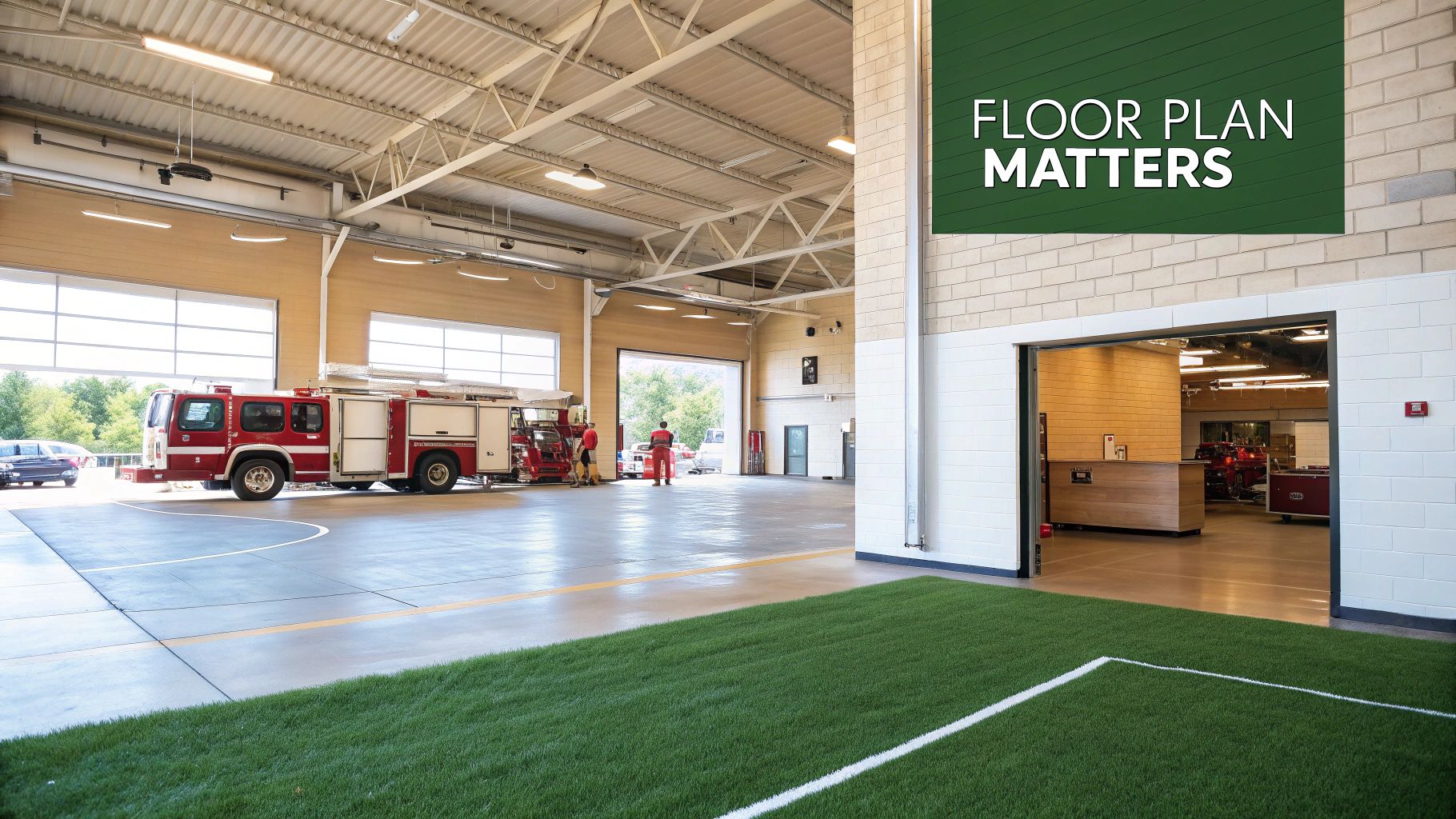
Imagine a high-performance engine. For it to run at peak capacity, every single component must work in perfect harmony. The same is true for a fire station, and the floor plan is the engineering schematic that ensures this synergy. It dictates the flow of people, equipment, and information, all under the immense pressure of an emergency.
A poorly designed station introduces friction. It adds seconds to turnout times and creates unnecessary risks for the crew. On the other hand, a thoughtfully designed fire station floor plan creates a facility that’s both a rapid-response launchpad and a safe, restorative home for its firefighters.
The Core Concept of Zoning
The absolute cornerstone of modern fire station design is zoning. This isn't just about labeling rooms; it's a philosophy that divides the station into distinct areas based on their function. This strategic separation is crucial for preventing cross-contamination and streamlining movement.
Every layout decision comes back to how these three primary zones interact:
- Operational Zone: This is the "hot" zone. It's where the action happens, containing the apparatus bay for vehicle storage and the critical decontamination areas. Durability, safety, and direct, unimpeded access to the exterior are the top priorities here.
- Living Zone: This is the "clean" zone—a sanctuary. It includes bunk rooms, the kitchen, the dayroom, and fitness areas. The entire focus is on creating a healthy and restful environment, completely isolated from the toxins and carcinogens of the operational side.
- Administrative and Public Zone: This area serves as the station's front office, housing command staff, reporting rooms, and public-facing spaces like a lobby. It acts as a necessary buffer between the public and the private living quarters of the firefighters.
A fire station is one of the few building types that must function as a high-stakes industrial facility, a residential dwelling, and a public administrative building all at once. The floor plan is the key to making these competing needs coexist effectively.
From Blueprint to Lifeline
The way these zones connect is non-negotiable. For example, the path leading from the apparatus bay back into the station must pass directly through a decontamination corridor. This isn't optional; it’s a critical health and safety measure that prevents dangerous particulates from being tracked into the kitchen or sleeping areas.
Likewise, the route from the bunk rooms to the apparatus bay needs to be as short and straight as humanly possible. An efficient plan gets rid of sharp turns, extra doors, and cluttered hallways. This isn't just about convenience; it’s about shaving critical seconds off the response when the alarm sounds. Every single choice, from the width of a corridor to the placement of a door, directly impacts the station's ability to protect its community and keep its own people safe.
Exploring the Core Zones of a Fire Station
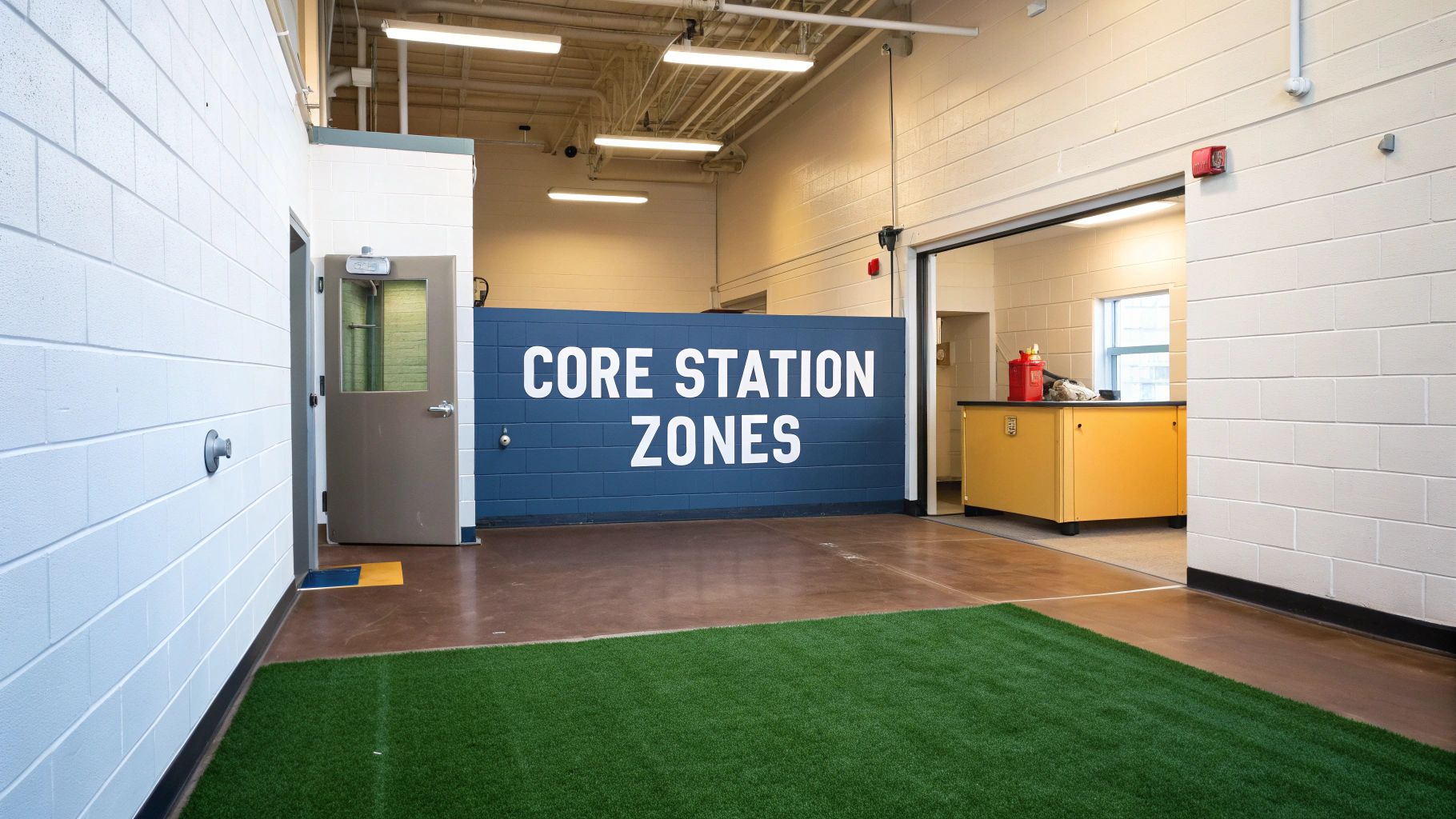
A fire station is much more than just a building; it’s a high-performance machine fine-tuned for rapid response and a sanctuary for the crew who calls it home. Every space has a very specific job, from the adrenaline-fueled operational areas to the quiet, restorative living quarters.
Getting the fire station floor plan right means understanding how these distinct zones work together. The goal is to create a seamless flow that enhances safety, efficiency, and the well-being of the firefighters. Let's break down the essential components.
The Apparatus Bay: The Heart of Operations
The apparatus bay is the undeniable nerve center of the station. This isn't just a fancy garage—it's the launchpad where every single emergency response begins. The design here is all about durability, space, and, most importantly, speed.
Floors have to be heavily reinforced to support the massive weight of modern fire trucks, and ceiling heights must be generous enough to clear the tallest aerial ladders. Even the doors are a critical decision; fast-acting bifold or four-fold models are often chosen over traditional overhead doors because they can shave precious seconds off a crew's departure time.
Of course, proper ventilation is non-negotiable. Sophisticated systems are designed to capture and vent harmful diesel exhaust fumes immediately, preventing them from creeping into the station’s other zones.
The Decontamination Zone: A Critical Buffer
Tucked right next to the apparatus bay is arguably one of the most vital areas in any modern fire station: the decontamination (decon) zone. This space functions as a one-way corridor, designed to trap carcinogens and other contaminants before they can find their way into the living quarters.
The decon zone is the single most important design element for long-term firefighter health. It creates an essential airlock between the "hot" operational side and the "clean" living side of the station.
Firefighters returning from a call must follow a strict protocol that moves them through this area. The zone is typically broken down into a few key spaces:
- Gross Decon: Where firefighters get an initial rinsing of their turnout gear.
- Gear Storage: Dedicated, separately ventilated rooms to store contaminated gear away from everything else.
- Transition Showers: A required stop for firefighters to shower before they're allowed to enter the clean living areas.
Living Quarters: The Sanctuary
Once through the decon zone, firefighters step into the "clean" side of the station. This is their home away from home for grueling 24 or 48-hour shifts, so the floor plan must be designed to support genuine rest and recovery.
- Bunk Rooms: We've seen a major shift away from large, open-bay dormitories toward individual or semi-private bunk rooms. This one change can drastically improve sleep quality—a vital component for maintaining mental and physical health in such a high-stress profession.
- Kitchen and Dayroom: This is the communal hub, the heart of the station's social life. An open-concept kitchen flowing into a comfortable dayroom helps build camaraderie and teamwork. The design should feel less institutional and more residential, giving crews a real space to decompress.
- Fitness Center: Staying in peak physical condition is part of the job. A well-equipped, dedicated fitness area—often with easy access to an outdoor space—is now a standard feature in any new fire station floor plan.
Administrative and Specialized Support Areas
Beyond the main operational and living zones, today's stations require a handful of other key spaces. A watch room or communications center often acts as the station's brain, requiring specific layouts for dispatch equipment and monitoring systems. When designing these high-tech hubs, it’s wise to account for advanced emergency management system features to ensure the physical space can support the technology.
You'll also find training rooms, administrative offices for the captain or chief, and even public-facing community rooms becoming standard. Each zone, from the rugged apparatus bay to the quiet bunk room, has a distinct and crucial role to play. A successful design orchestrates their functions into a seamless whole, creating a facility that is safe, efficient, and truly supportive of its crew.
To give you a clearer picture, here's a quick summary of how these zones are organized:
Core Zones in a Fire Station Floor Plan
| Zone | Key Spaces Included | Primary Design Goal |
|---|---|---|
| Apparatus Bay | Vehicle Bays, Tool Storage, Workshop | Maximize speed, durability, and operational readiness. |
| Decontamination | Gross Decon, Gear Storage, Showers | Isolate contaminants and protect firefighter health. |
| Living Quarters | Bunk Rooms, Kitchen, Dayroom, Fitness | Promote rest, recovery, and crew camaraderie. |
| Support & Admin | Offices, Watch Room, Training, Public Areas | Manage station operations and community engagement. |
Ultimately, a thoughtfully zoned floor plan ensures that every part of the station works in harmony, supporting the health and readiness of the firefighters who depend on it.
Designing for Safety and Rapid Response
A fire station floor plan isn't just about arranging rooms logically—it's a life-saving tool where every single design choice shaves seconds off a response time. This is where the rubber meets the road, turning architectural theory into a facility that has to perform flawlessly under extreme pressure. When an alarm blares, seconds count, and the building's layout is the crew's first and best advantage.
The goal is to create a sense of controlled urgency. This means circulation paths need to be dead simple, direct, and completely free of obstacles. When a call comes in, firefighters have less than a minute to go from zero to one hundred. A great floor plan makes that transition feel like second nature.
It all boils down to two key principles: creating the fastest possible path to the trucks and protecting the crew's long-term health by keeping the "dirty" part of the job separate from the "clean" living spaces. These aren't just nice ideas; they're critical goals we achieve with smart, deliberate design.
Optimizing the Response Path
The path from the bunk room to the apparatus bay is the single most important route in the station. The mission is simple: keep it as short and as straight as humanly possible. No zig-zagging hallways, no unnecessary doors, no clutter to trip over in the dark.
Put yourself in the boots of a firefighter jolted awake at 3 AM. The path needs to be so ingrained that they can navigate it on muscle memory alone. This is why you'll often see living quarters placed right next to the apparatus bay, sometimes with several direct-access doors to prevent a traffic jam when everyone is scrambling at once.
A fantastic real-world example of this principle comes from a large-scale project in Australia. By building new stations and relocating older, poorly-sited ones across Greater Sydney, they saw a measurable drop in average fire engine arrival times. The data proved that better layouts and locations didn't just improve response times—they led to better fire containment and less property damage. It’s a powerful testament to how a building's design directly impacts community safety. You can read more about these findings on the U.S. Fire Administration website.
The Critical Separation of Hot and Clean Zones
Just as critical as getting out the door quickly is protecting the crew's health when they get back. We now know far more about the long-term dangers of carcinogens and other toxins that cling to gear and equipment after a fire. A modern fire station floor plan has to tackle this head-on with an uncompromising approach to zoning.
We think about it in terms of "hot," "warm," and "clean" zones.
- Hot Zone: This is the apparatus bay itself, where contaminated trucks and gear first return.
- Warm Zone: Think of this as an airlock. It’s a dedicated decontamination corridor where firefighters can do a gross decon of their gear, store it in specially ventilated rooms, and shower before going any further.
- Clean Zone: This includes the living quarters, kitchen, administrative offices, and any public-facing areas. Contaminated gear or personnel are never allowed to cross into this space.
By forcing a one-way flow from the hot zone, through the warm zone, and into the clean zone, the floor plan itself becomes an active defense mechanism. It protects firefighters from chronic exposure to hazardous materials long after the fire is out.
This isn't just a "best practice"—it's a non-negotiable standard for protecting the health and careers of first responders. Following strict building codes, like those from the National Fire Protection Association (NFPA), is mandatory. For a look at how technology is helping manage these complex requirements, it's worth exploring the role of AI in navigating building codes and regulations.
Smart Apparatus Bay Design
The design of the apparatus bay is where speed and safety converge. There are two primary models, and the right choice often comes down to the site's limitations and the department's operational needs.
Drive-Through Bays:
This layout is the gold standard for safety, period. It allows apparatus to pull in from one side of the station and drive straight out the other, completely eliminating the need for slow, dangerous backing maneuvers. This forward-only flow is much safer on-site and can shave precious seconds off a departure. The only real downside is that it requires a larger lot with access on two sides, which can be tough to find in dense urban areas.
Back-In Bays:
This is the more traditional and space-efficient approach, but it requires drivers to reverse massive vehicles into tight spots. While it’s incredibly common, it inherently brings a higher risk of accidents. To make it work safely, the design must include a generous concrete "apron" in front of the station for maneuvering, clear sightlines, and is often supplemented with sophisticated vehicle cameras and sensor systems to give drivers an extra set of eyes.
No matter which model you choose, every bay must have a robust vehicle exhaust capture system. These are typically hose-based systems that connect directly to a vehicle's tailpipe to vent toxic diesel fumes outside. It’s an absolutely critical health and safety feature that prevents those fumes from building up inside the station where people live and work.
Common Fire Station Layouts and When to Use Them
Not every fire station is built from the same blueprint. What works for a quiet, rural volunteer department will be completely wrong for a high-call-volume urban crew. Choosing a layout isn’t about picking what looks best—it’s a critical decision that has to balance the reality of your site, your budget, and the daily operational needs of your firefighters.
Think of it like choosing a tool for a job. You wouldn't use a screwdriver to hammer a nail. In the same way, the right floor plan is the one that’s perfectly suited to the unique demands of the community it serves. The first step is getting familiar with the most common designs.
Before we dive into specific layouts, this graphic illustrates the three core principles that guide every modern fire station design: speed, safety, and readiness.
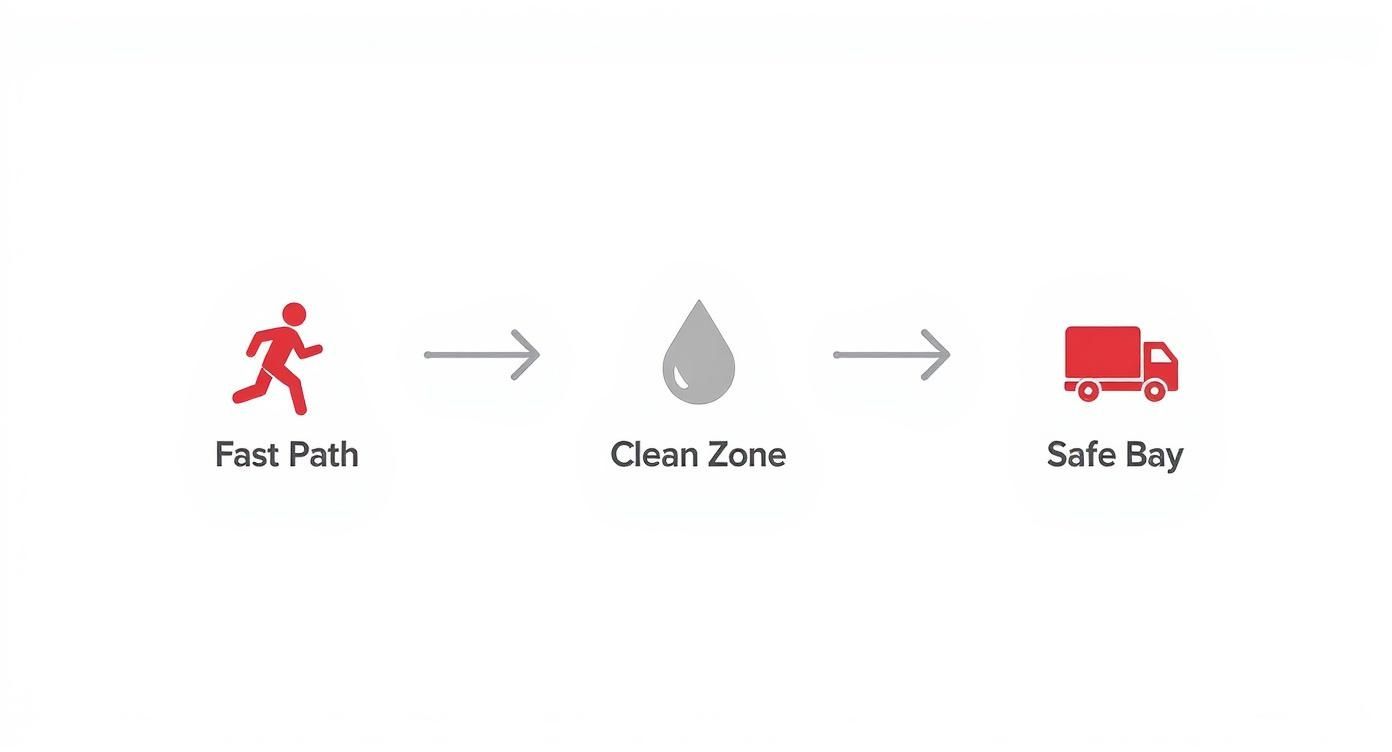
This flow—from a rapid response path to controlling contaminants and maintaining a secure apparatus bay—is the foundation of an efficient and safe station.
The Single-Story Layout
When you have the land to work with, the single-story layout is king. It’s the most common design for a reason: it’s simple, efficient, and fast. By placing all the essential zones—apparatus bays, living quarters, and administrative offices—on the same level, you create the shortest, most direct path from the bunk room to the truck.
This design naturally eliminates stairs and fire poles. While poles are an iconic part of fire station lore, they also represent a significant fall risk. Keeping everything on one floor creates a safer, more intuitive environment that shaves precious seconds off turnout times and makes meeting ADA requirements much simpler.
Of course, the big catch is its footprint. A single-story station needs a lot of real estate, which can be a deal-breaker in dense urban areas where land is either unavailable or prohibitively expensive.
The Two-Story Configuration
What do you do when your site is tight? You build up. The two-story fire station floor plan is the classic solution for compact urban lots. Typically, the apparatus bay and support spaces occupy the ground floor, while the living quarters—bunks, kitchen, dayroom—are stacked directly above.
This vertical design dramatically shrinks the building’s footprint, allowing a full-service station to fit on a much smaller piece of land. It’s also the reason the fire pole was invented, offering a gravity-powered shortcut to get crews from the living area down to the trucks. Modern designs also rely on well-placed, wide staircases as a safer alternative.
The decision to go multi-story is almost always driven by site constraints. It’s a brilliant way to save space, but it adds complexity. You have to carefully engineer the flow to ensure crews can still get from the second floor to the bay safely and without delay.
Back-In Versus Drive-Through Designs
This is one of the most fundamental decisions you'll make, and it shapes the entire site plan. The traditional back-in model is a space-saver, but it forces firefighters to perform tricky, high-risk backing maneuvers every time they return to the station. This layout can be made much safer with a large concrete apron for maneuvering and the help of modern vehicle cameras and sensors.
The drive-through design, on the other hand, is the gold standard for on-site vehicle safety. It allows apparatus to enter through one set of bay doors and exit through another, completely eliminating the need to back in. This simple forward flow dramatically cuts the risk of accidents. For instance, a new station proposed in Huntington, Indiana, made this a core safety feature of its design.
The trade-off is obvious: land. A drive-through station needs a "through lot" with access from two streets or a very deep parcel to accommodate the flow. That’s a luxury many municipalities just don't have.
Ultimately, the best fire station floor plan is the one that gives its crew the safest and most efficient path to response, all while respecting the real-world constraints of the budget and the building site. Whether it’s a sprawling single-story campus or a compact two-story urban station, the goal is always the same: a fast, safe, and effective response.
How Fire Station Design Has Evolved
To get a real handle on the modern fire station floor plan, it helps to look at where it came from. The fire stations we build today didn't just appear overnight; they're the result of centuries of trial, error, and adaptation, with each era leaving its own distinct mark on the blueprint.
Imagine the earliest firehouses. They were little more than basic sheds or barns, built for one simple purpose: to keep horse-drawn pumpers and handcarts out of the rain and snow.
Their job was straightforward—store the gear. The designs were purely practical, usually just a big central door and maybe a small stable off to the side. You wouldn't find living quarters, decontamination zones, or fitness rooms. The mission was purely logistical.
The Shift to Motorized Apparatus
The invention of the motorized fire engine in the late 19th and early 20th centuries changed everything. This one piece of technology forced a ground-up rethink of fire station design. The story of how fire station layouts evolved is really the story of these technological and social shifts.
As engines replaced horses, stations had to get bigger and stronger to accommodate larger, heavier vehicles that needed to get out the door fast. This meant designing larger apparatus bays with wider doors and reinforced floors. You can take a deeper dive into this architectural shift and how it still influences us today by exploring the history of fire station design.
But this wasn't just about making space for bigger trucks. Motorized apparatus gave fire departments incredible speed and range, turning firefighting from a small-scale neighborhood effort into a professional, city-wide service. This new level of professionalism demanded full-time firefighters on duty around the clock.
From Garage to Home
The introduction of 24-hour shifts created a whole new list of design needs. A fire station could no longer just be a garage for a truck; it had to function as a second home for the crew. This is when the idea of separate "living zones" really started to emerge.
- Bunk Rooms: What started as large, open dormitories slowly evolved into more private sleeping quarters.
- Kitchens: A shared kitchen became the heart of the station, a necessity for crews living and eating together.
- Dayrooms: Spaces for training, unwinding, and building camaraderie became standard.
This dual purpose added new layers of complexity to the floor plan. The building was now serving two very different masters: the urgent, industrial demands of the apparatus bay and the everyday residential needs of the firefighters.
The modern fire station floor plan is a direct response to an expanded mission. It has evolved from a simple equipment shed into a multi-functional facility that must support not only emergency response but also the long-term health, wellness, and operational readiness of its firefighters.
And that evolution is still happening. Today, we're focused on firefighter health and safety like never before. New designs include sophisticated decontamination corridors to keep carcinogens out of the living areas and create more restorative environments for the crew. Every new challenge continues to shape the blueprint for the fire station of tomorrow.
Answering the Big Questions About Fire Station Design
When you're planning a project as vital as a fire station, a lot of questions come up. It's only natural. From city officials to the design team, everyone needs solid answers to make the right calls. Let's tackle some of the most common questions we hear when developing a modern fire station floor plan.
Getting these fundamentals right is the first step toward building a station that's a smart investment in the safety of both the community and its firefighters.
What Is the Most Critical Factor in a Fire Station Floor Plan?
Hands down, the single most critical factor is the speed and clarity of the response path. When the alarm sounds, there needs to be a straight, unobstructed shot from the living quarters to the apparatus bay. Every single second shaved off that time can make a life-or-death difference out in the field.
This means thinking carefully about where you put every room, doorway, and hall to cut down travel time and remove any bottlenecks. Running a very close second is the non-negotiable separation of "hot zones"—areas contaminated by carcinogens and soot from a fire—from the "clean zones" where the crew eats and sleeps. That division is absolutely essential for protecting their long-term health.
How Much Does a New Fire Station Typically Cost?
The final price tag can swing pretty wildly depending on the region, the station's size, and the features you include. That said, you can generally expect construction costs to fall somewhere between $190 and over $250 per square foot in today's market.
For a smaller station of around 15,000 square feet, you're looking at a construction budget in the neighborhood of $2.8 million to $3.75 million. And that's just for the building itself. Don't forget that this number doesn't cover land costs, architectural fees, site work, or the specialized equipment, all of which will add a significant amount to the total project cost.
What Are the Benefits of a Drive-Through Apparatus Bay?
The biggest win here is safety. A drive-through bay means firefighters don't have to back those massive, heavy engines into a tight space—a tricky maneuver that’s a recipe for accidents, injuries, and expensive vehicle damage.
A drive-through apparatus bay simplifies vehicle movement into a continuous forward motion, improving both on-site safety and operational speed during departures and returns.
This design naturally makes things run smoother, since trucks can get in and out faster. The main trade-off? You need a bigger piece of land with access from two sides. Securing a site like that, especially in a built-up urban area, can be a major challenge and a big-ticket item.
How Do Modern Floor Plans Support Firefighter Wellness?
Today’s fire station designs are worlds away from the old models, with a much bigger focus on both physical and mental well-being. It all starts with those distinct contamination control zones we mentioned, which are designed to keep toxic exposures from fires from following firefighters into their living spaces.
The living quarters themselves are also designed to be places of rest and recovery. We're seeing a major shift toward private or semi-private bunk rooms because good sleep is no longer a luxury—it's a necessity. Other features that are now becoming standard include:
- Dedicated Fitness Rooms: To help the crew stay in peak physical condition.
- Quiet Rooms or Decompression Areas: Giving firefighters a space to mentally recharge after a tough call.
- Natural Lighting: Flooding dayrooms and common areas with daylight has a proven positive effect on mood.
- Access to Outdoor Spaces: A simple patio or green space offers a welcome place to unwind.
These aren't just amenities; they are crucial components that help firefighters manage the incredible stress that comes with the job.
At Sherer Architects, LLC, we see every fire station as a unique puzzle where every piece—from operational flow to firefighter wellness—must fit together perfectly. We walk owners and developers through each phase of the design and construction process, making sure the final building is not only beautiful and built to last but is perfectly tuned for its critical mission. See how our attentive listening and decades of experience can bring structure to your vision at https://shererarch.com.