SHERER ARCHITECTS

Categories
Uncategorized

A Practical Guide to Hiring Your Next Fire Station Architect

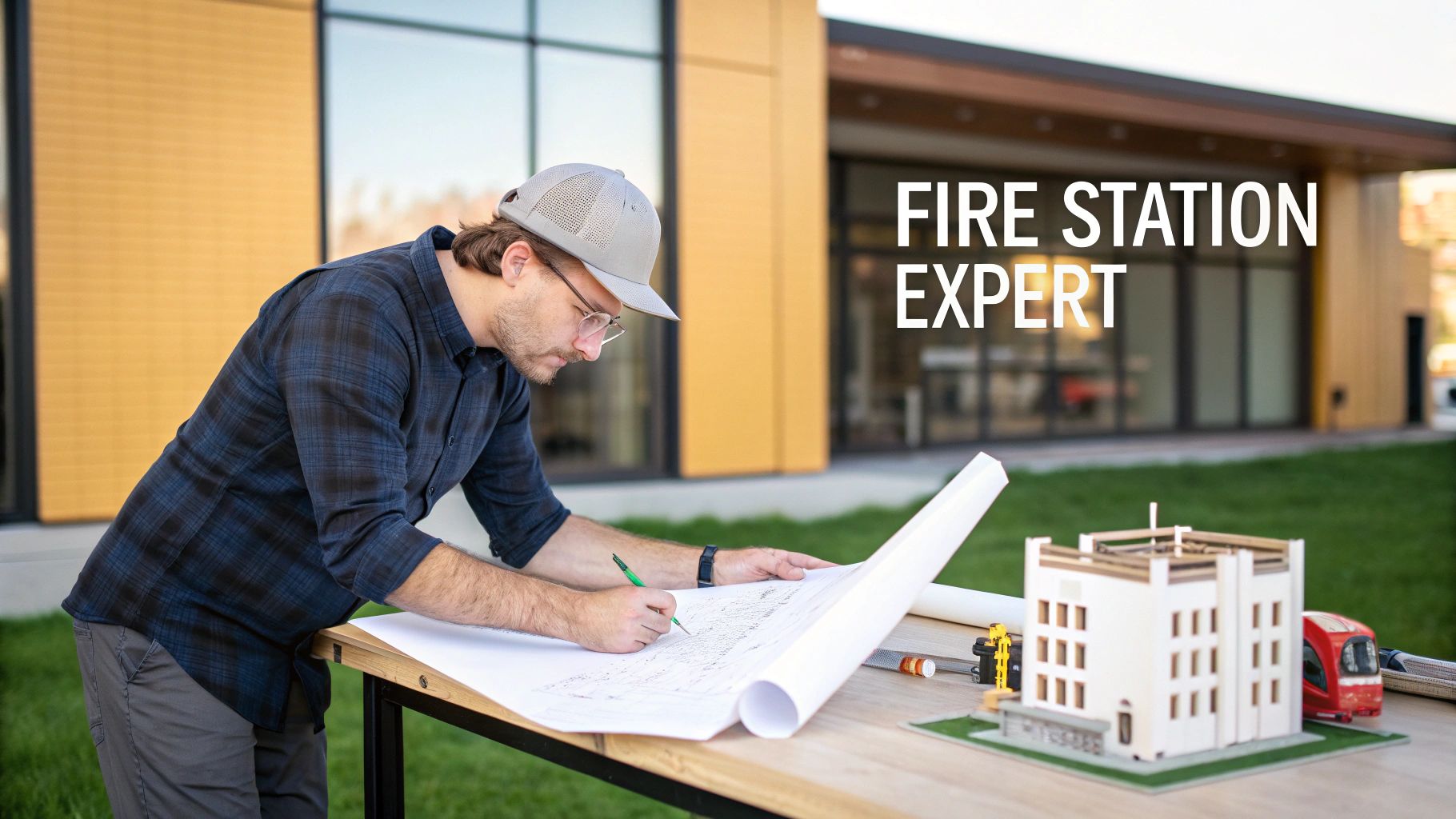
A fire station architect does more than just draw up plans; they turn a community's vision for safety and readiness into a living, breathing building. These are specialists who get the unique pressures of a 24/7 facility, from the split-second logistics of a turnout to the long-term health of the crew. Honestly, hiring a firm with real-world fire station experience is the most important decision you'll make for the project's success.

Defining Your Vision Before You Build

The fate of your new or renovated fire station is sealed long before any dirt is moved. This initial planning stage, which we call programming, is all about creating a bulletproof foundation for everything that follows. It's a collaborative deep dive that turns your department's specific operational needs into a clear, tangible plan.

This "program" becomes the master guide for your architect. It's an incredibly detailed document that maps out every single functional space, making sure the final design is a perfect match for the day-to-day reality your first responders face.
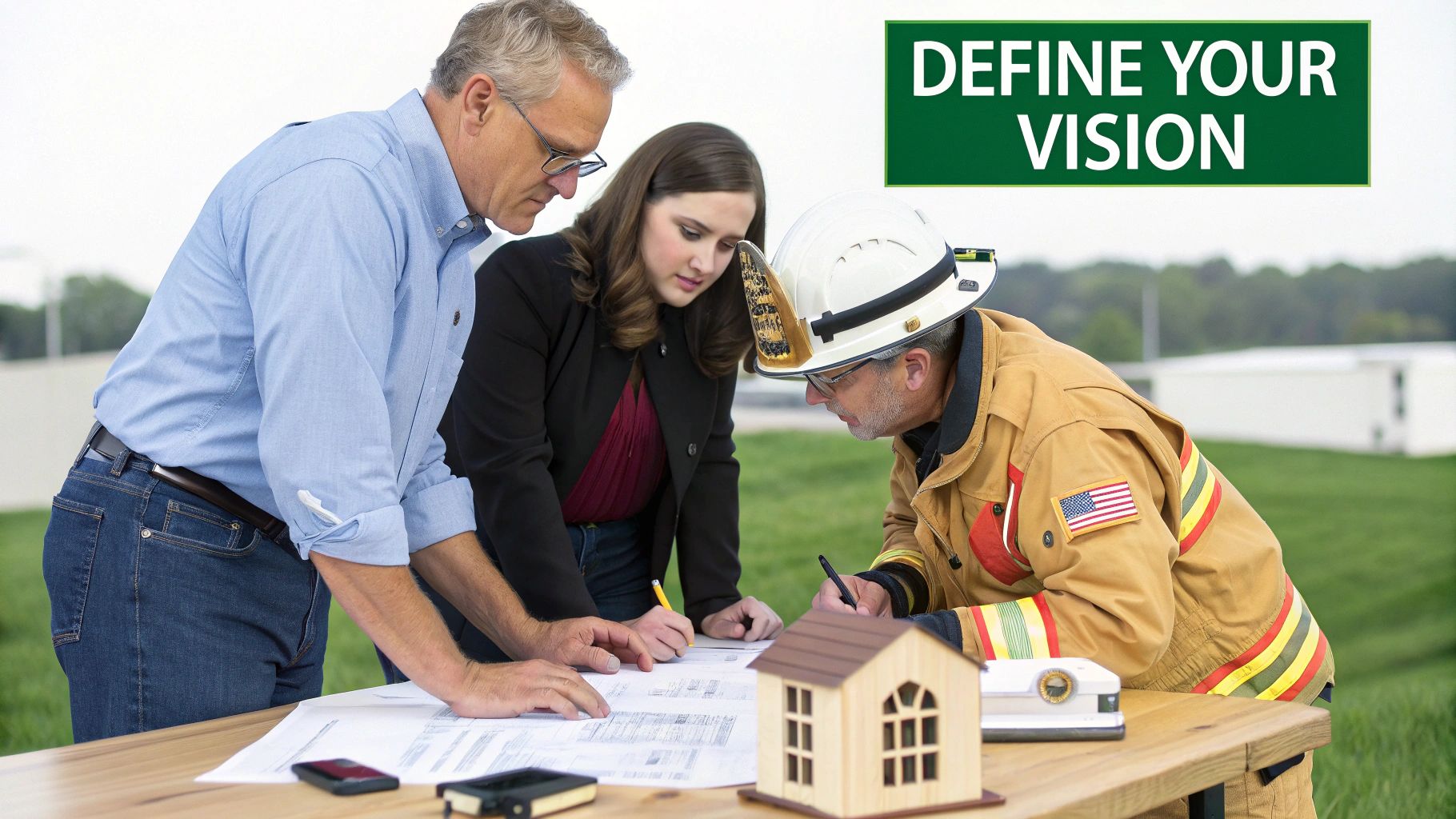
A firefighter, architect, and client discuss building plans around a table with a house model.

Gathering Input From Key Stakeholders

The best programs come from talking to people. A good architect will lead detailed interviews with everyone who has a stake in the station to get the full picture. This isn't just about checking boxes; it’s about understanding the culture and the real workflow of your department.

You’ll want to make sure these groups are at the table:

  • Fire Chief and Command Staff: They’ll share the big-picture vision—where the department is heading, what administrative functions are needed, and how this station fits into the city's broader emergency plan.
  • Firefighters and Paramedics: These are your end-users, and their feedback is gold. They can point out what’s wrong with the current station, how the flow from the living quarters to the bay needs to work, and exactly what they need for gear storage and decontamination.
  • Community Leaders and Officials: They bring the public perspective. Do you need a community meeting room? Should the station double as a safe haven during a disaster? They also keep everyone grounded in the reality of budgets and municipal approvals.

Translating Needs Into a Detailed Program

With all this feedback in hand, the architect gets to work translating it into the program document. This is way more than a simple list of rooms. It’s a comprehensive guide that defines how every space functions and connects to the others.

For example, it won't just say "Decontamination Room." It will specify that it must be right next to the apparatus bay and map out the exact sequence of movement from the bay, through decon, and into the showers and locker rooms. This is how you design for firefighter health and safety.

This process forces you to think through every detail. A solid program will nail down spatial needs for everything, from sizing the apparatus bays for the bigger trucks you might buy in 10 years, to laying out the kitchen and dayroom in a way that actually helps the crew bond.

A fire station isn't just a building; it's a critical piece of community infrastructure and a 24-hour home for its crew. The programming phase ensures that the design supports the human element of firefighting just as much as the operational one.

By putting in the time and effort during this upfront discovery, you hand your architect a crystal-clear roadmap. This clarity saves a fortune by preventing major design changes down the road, keeps the project from spiraling out of control, and ultimately delivers a facility that’s safe, efficient, and ready to serve your community for decades. This groundwork is what makes the rest of the project run smoothly.

Finding the Right Spot and Nailing the Codes

Where you put a new fire station is every bit as important as how you build it. The perfect location can shave precious seconds off response times, but the wrong one can turn into a daily logistical headache. From an experienced architect’s perspective, finding that right spot isn't just a real estate transaction; it's a deeply technical process.

These days, site selection has become a precise science. Fire departments lean heavily on run-time analyses, digging into historical response data and using GIS mapping to model different scenarios. They’ll often evaluate a handful of potential sites to find the one that mathematically minimizes response times across their entire service area.

Planning the Site for Split-Second Departures

Once you’ve zeroed in on a general area, the specific piece of land brings its own set of puzzles to solve. A good architect’s first move is to analyze the parcel for operational flow, looking far beyond simple square footage.

Here’s what’s immediately on our minds:

  • Apparatus Turning Radii: Today's ladder trucks are massive and need a lot of room to maneuver. The site has to accommodate those wide turns without forcing drivers into a clumsy, multi-point turn that wastes time when it matters most.
  • Secure Site Access: You need more than just a driveway. The site requires controlled entry and exit points for apparatus, staff, and the public to keep civilian traffic from blocking a rig that's trying to leave on a call.
  • Drive-Through vs. Back-In Bays: This is a big one. Whenever humanly possible, drive-through apparatus bays are the gold standard. They completely eliminate the dangerous and slow process of backing a huge rig into the station, which is a massive win for both safety and speed. An architect can quickly tell you if a site’s shape and size make this best-practice layout a reality.

Think about a corner lot that looks perfect on paper because it's so central. An experienced architect might spot that the busy intersection will create a 30-second delay during rush hour, or that the property is too narrow to allow for drive-through bays. That's the kind of insight that saves a city from a multimillion-dollar mistake.

Why Fire Stations Are Built Like Bunkers: Risk Category IV

Beyond the location, the building itself has to be absolutely bomb-proof. A fire station isn't just another commercial building; it’s an essential facility that must be standing and fully functional after the worst has happened. This isn't just a good idea—it's written into the building codes an architect has to follow.

Fire stations today are designed to the Risk Category IV classification under the International Building Code. In simple terms, this means they're engineered to handle much higher structural loads from things like hurricanes, earthquakes, floods, and heavy snow. This beefed-up standard ensures first responders can actually work out of the station during a disaster, right when their community needs them most. You can dive deeper into how these standards create truly resilient community hubs by reading more about safe fire station design on RedstoneArchitects.com.

A Risk Category IV fire station is the community's last line of defense. When a hurricane or earthquake rolls through, the station can't be a casualty—it has to be the command center where the recovery effort begins.

Weaving Through the Codes with an Expert Guide

Building to that level of resilience is about more than just a strong foundation. A fire station architect has to stitch hundreds of code requirements into a cohesive design that makes the building a safe and effective place to work.

This means getting the details right on critical systems and materials, including:

  • Emergency Power: The station needs a powerful backup generator that can run everything—bay doors, communication gear, lights, and living quarters—for days on end if the grid goes down.
  • Seismic Bracing: In earthquake country, it’s not just the building that has to stay up. Everything inside it, like light fixtures, ductwork, and pipes, must be seismically braced so they don't fall and injure people or damage equipment.
  • Impact Resistance: For stations in areas prone to hurricanes or tornadoes, the exterior materials, windows, and especially the large bay doors often need to meet specific ratings to resist impacts from flying debris.

An architect who lives and breathes public safety design knows how to navigate these complex codes without breaking the budget. Their expertise is what turns a book of rules into a functional, resilient building that protects both the firefighters and the people they serve.

Designing for Firefighter Health and Safety

Today's fire station is a world away from the designs of even a generation ago. It has to be more than just a garage for the apparatus; it's a 24/7 home where the long-term health and well-being of the crew are paramount. A fire station architect's most critical job is to design a building that actively protects first responders from the hidden dangers of their work, especially the constant exposure to carcinogens.

The key to this is a design philosophy known as the "Hot Zone" concept. This isn't just about how you arrange rooms on a floor plan. It's a deliberate, strategic approach that creates a one-way path from the contaminated apparatus bay to the clean living quarters, stripping away hazards at every step.

Understanding the Hot Zone Design

This approach divides the entire station into three distinct zones based on contamination risk. The whole point is to establish a non-negotiable flow for firefighters returning from a call, ensuring they decontaminate themselves and their gear before ever setting foot in the administrative or living areas. A skilled architect makes this process feel intuitive.

The zones create a series of essential buffers:

  • Red Zone (Hot): This is the apparatus bay and anywhere contaminated gear and vehicles live. It's the highest-risk zone, full of vehicle exhaust, soot, and chemical residue from fire scenes.
  • Yellow Zone (Transition): This is the crucial buffer. It houses decontamination showers, turnout gear storage, and dedicated laundry facilities. Firefighters move from the Red Zone into the Yellow to get clean.
  • Green Zone (Cold): These are the clean zones—the kitchen, dayroom, dorms, and offices. No contaminated gear, boots, or clothing ever crosses this threshold. Period.

To explain this system more clearly, here’s a breakdown of how the zones function.

Fire Station Hot Zone Design Explained

This table breaks down the three-zone system for fire station design, outlining the purpose and key spaces within each zone to ensure firefighter health and safety.

Zone Purpose Typical Spaces Included
Red (Hot) Zone To contain all contaminants brought back from an incident scene. This is the highest-risk area. Apparatus Bays, Vehicle Maintenance Areas, Support Spaces (e.g., SCBA fill station, tool storage).
Yellow (Transition) Zone To provide a buffer where firefighters can decontaminate themselves and their gear before entering clean areas. Decontamination Showers, Turnout Gear Storage, Gear Laundry/Extractor Room, PPE Cleaning & Repair.
Green (Cold) Zone To provide a safe, contaminant-free environment for administration, rest, and daily living. Kitchen, Dayroom/Lounge, Sleeping Quarters (Dorms), Offices, Fitness Room, Public Lobby.

A seasoned fire station architect will use physical separations, like air locks with positive pressure systems, to make sure contaminated air from the bay can't migrate into the living quarters. It’s about building a fortress against invisible threats.

The Hot Zone layout is the single most important design strategy for cancer prevention in the fire service. It's a proactive architectural solution to a known occupational hazard, directly protecting the long-term health of every firefighter in the building.

Key Spaces in a Health-Focused Station

Putting the Hot Zone concept into practice means creating specific spaces with very specific jobs. These aren't just rooms—they're critical stations in the decontamination workflow.

A dedicated decontamination shower and transition area is the first stop after an incident. It must be located right off the apparatus bay, allowing firefighters to shower immediately after doffing their gear and wash away soot and chemicals before they have a chance to absorb into the skin. This space needs to be built tough with durable, easy-to-clean surfaces.

Proper turnout gear storage is just as vital. Gear can't just be hung on a rack in the bay anymore. It needs a dedicated, well-ventilated room with commercial-grade exhaust systems that pull contaminated air directly outside. This is crucial for preventing the off-gassing of carcinogenic particles that would otherwise get sucked into the station’s HVAC system and circulated right into the Green Zone.

Of course, getting these zones right depends heavily on the site itself.
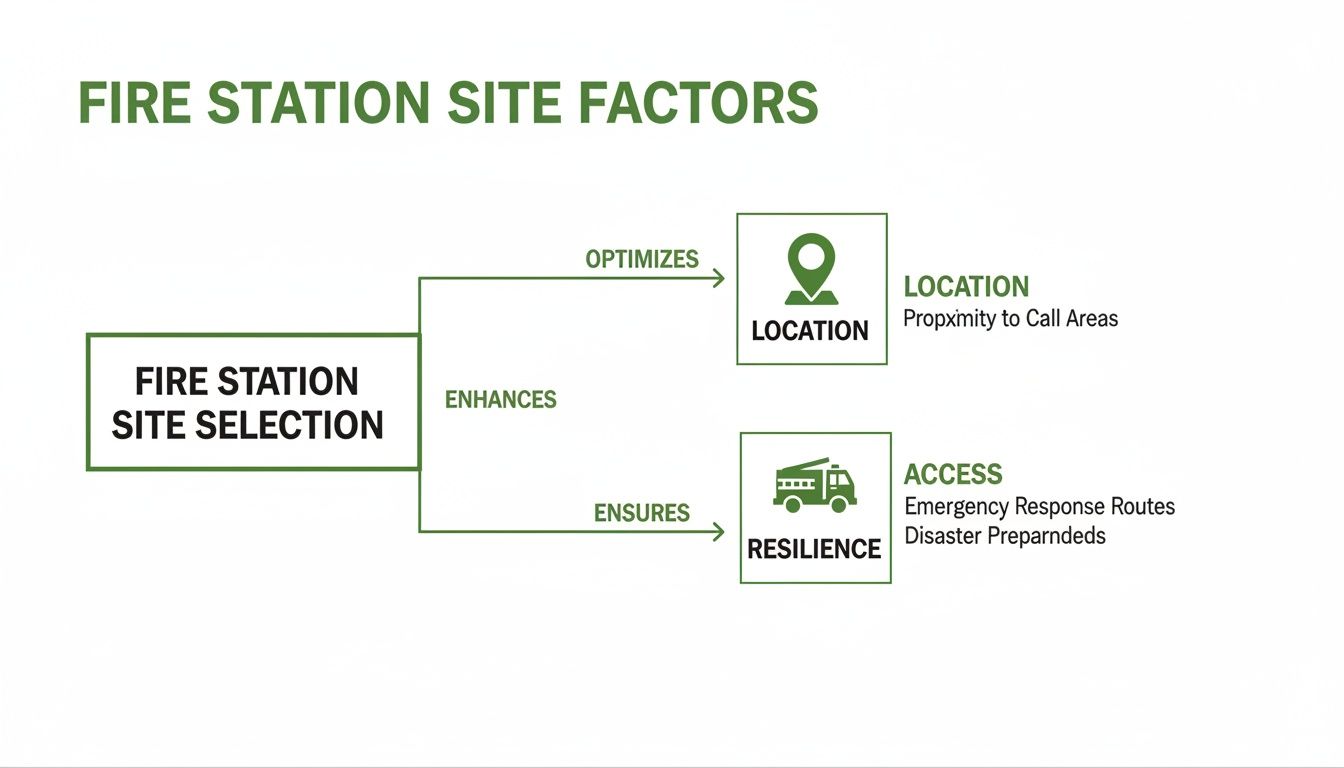
Flowchart detailing fire station site selection factors: location for proximity, and resilience for access and disaster preparedness.

As you can see, the site's location and accessibility are the foundation. They directly influence how an architect can lay out the building to create a station that is not only operationally efficient but fundamentally safe for its crew.

Beyond Decontamination: Physical and Mental Wellness

Firefighter health goes far beyond just avoiding toxins. The immense physical and mental stress of the job demands spaces designed specifically for wellness and recovery. A fire station architect who truly understands the life of a first responder will integrate these areas into the design from day one.

A dedicated fitness area, for example, is non-negotiable. Firefighting is an incredibly demanding job, and providing modern, on-site exercise equipment helps crews maintain the peak physical condition they need to perform safely and effectively. This space needs proper impact-resistant flooring, great ventilation, and enough room for both cardio and strength training.

Finally, the design of the living quarters has a massive impact on mental well-being. This means creating a comfortable dayroom where the crew can decompress after a tough call, a functional kitchen that encourages communal meals and camaraderie, and individual sleeping quarters that offer privacy and quiet for much-needed rest. These "soft" spaces are just as mission-critical as the operational ones when it comes to building a healthy, resilient, and sustainable work environment.

Modernizing Historic and Existing Fire Stations

Not every new fire station starts with a blank slate. Many communities have older stations that are woven into the very fabric of the local identity. The problem is, these beautiful, historic structures often fall dangerously short of what’s needed for modern firefighting. This creates a fascinating puzzle: how do you blend historic preservation with the non-negotiable demands of today's fire service?

The first and most obvious hurdle is usually scale. Firefighting apparatus has changed dramatically over the last century, and the buildings that house them simply haven't kept up. Many older stations were built for horse-drawn steamers, meaning their bays are far too short, narrow, or low for a modern ladder truck. A skilled fire station architect has to find creative solutions, like complex structural modifications or thoughtfully designed additions, that expand the bays while respecting the building’s original character. This journey from horse-drawn to motorized apparatus is a constant theme in adaptive reuse. You can actually see more on this in a great piece about the evolution of fire station design on dkillerbuildsnov.mystagingwebsite.com.
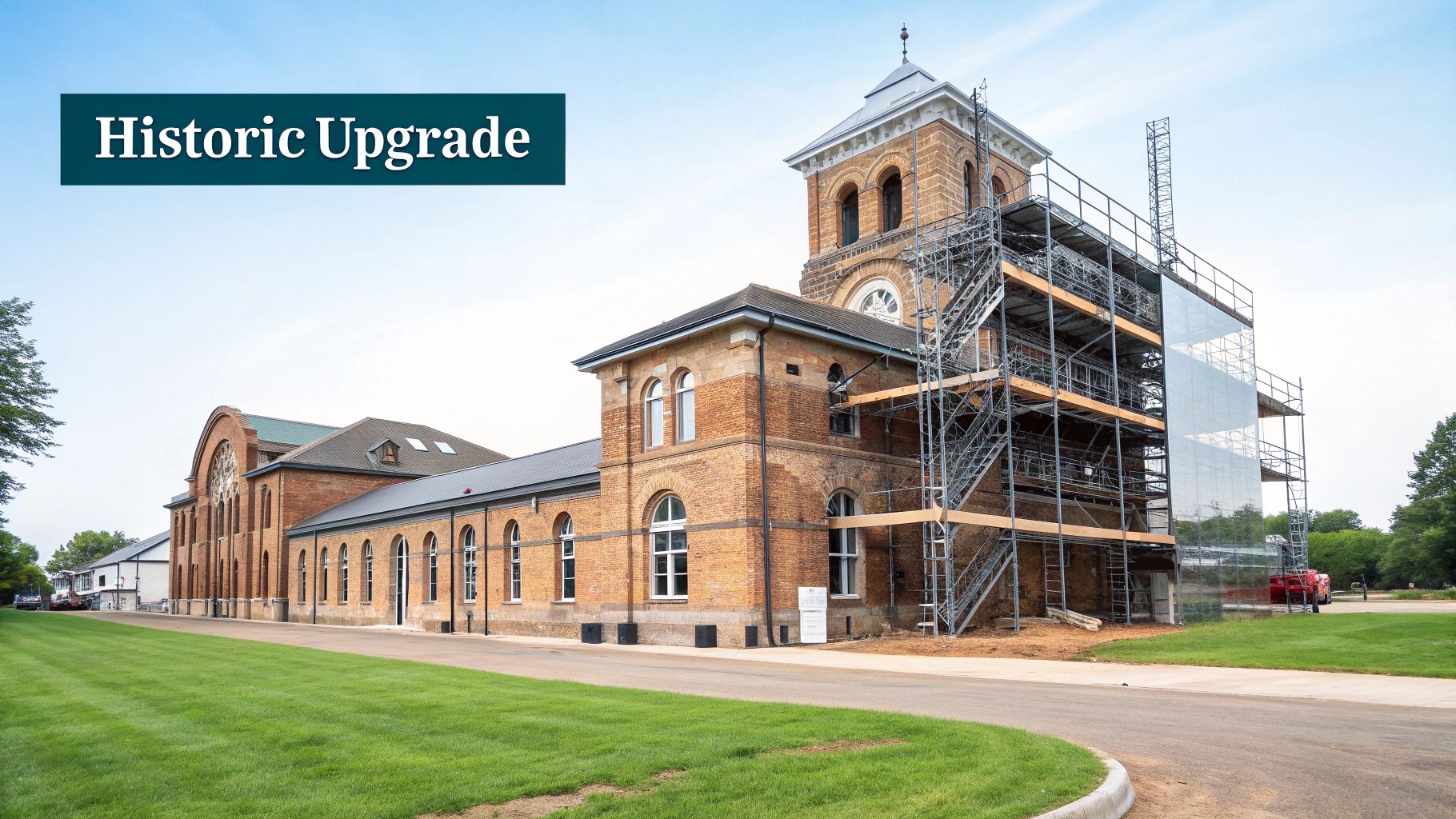
Historic brick building with a prominent tower undergoing a "Historic Upgrade" renovation with scaffolding.

Weaving in Modern Health and Safety

Beyond just making the rigs fit, the real heavy lifting comes from retrofitting modern health and safety features into a historic footprint. This is where an architect's specialized expertise is put to the test. The goal is to introduce contemporary concepts like "Hot Zone" design into a building that was never conceived with carcinogen control in mind.

It’s about strategically creating clear separation between contaminated and clean zones. For instance, an architect might:

  • Repurpose an old storage room adjacent to the bay, transforming it into a dedicated decontamination shower and transition area.
  • Design a small, seamless addition to house turnout gear, complete with the heavy-duty ventilation systems needed to pull contaminants out of the air.
  • Install positive pressure air locks at key doorways, creating an invisible barrier that stops contaminated air from migrating from the apparatus bay into the living quarters.

These are surgical interventions. They demand a deep understanding of how to thread new systems—like high-tech HVAC and vehicle exhaust extraction—through an old structure without destroying its integrity.

Renovating a historic fire station isn’t about forcing a modern layout onto an old building. It’s a respectful dialogue between past and present, finding clever ways to meet today's needs while honoring the building's story.

Navigating Regulations and Finding Opportunities

Working with historic buildings adds another layer of complexity: regulations. A fire station architect who specializes in preservation is your guide through the maze of local, state, and even federal historic preservation guidelines. Their experience is absolutely critical for getting the necessary approvals for any significant structural changes.

But this process isn't just about red tape; it can open up some incredible opportunities. Historic status can unlock valuable financial incentives that might make a renovation far more feasible than building new.

Potential Financial Advantages

  • Historic Tax Credits: Federal and state programs can offer substantial tax credits for the certified rehabilitation of historic buildings, directly slashing the project's overall cost.
  • Grants and Loans: Preservation societies and government agencies often provide grants or low-interest loans specifically for projects that protect community landmarks.

An architect with a background in historic preservation knows how to navigate these programs and can help you prepare the extensive documentation needed to secure that funding. Their expertise can turn what looks like a costly constraint into a major financial asset.

In the end, modernizing an existing station is a powerful act of sustainability. It gives a beloved community building a new lease on life, keeps tons of demolition waste out of landfills, and preserves a tangible piece of local history. While it’s certainly a challenge, the result is a facility that bridges the past and the future—fully equipped to protect both its firefighters and the community for generations to come.

How to Select the Right Architect for Your Project

Choosing your architect is, without a doubt, the single most important decision you'll make for the entire project. This isn't just about hiring a vendor. It's about finding a long-term partner who will turn your department's vision into a functional, safe, and resilient building that will stand for decades.

Let's be clear: a generalist firm won't do. You need a specialized fire station architect who lives and breathes the unique operational rhythms and life-safety demands of a 24/7 emergency facility.

For public projects, the selection process is typically more structured than in the private sector, usually kicking off with a formal Request for Qualifications (RFQ) or Request for Proposal (RFP). This document is your first real chance to signal that you’re serious about finding genuine expertise, not just the lowest price tag.

A well-written RFQ or RFP should be sharp and specific. It needs to clearly map out your project's scope, timeline, and budget, while compelling firms to prove their direct experience with public safety buildings. This is how you attract the right talent from the start and filter out those who simply aren't a good fit.

Drafting an Effective RFQ or RFP

Think of your request document as a strategic tool, not just a formality. Vague requests get you vague, unhelpful responses. You want to ask for specific information that lets you make a true apples-to-apples comparison between firms.

Here’s what your RFQ or RFP absolutely must demand:

  • A Detailed Portfolio of Relevant Projects: Don’t settle for a simple list. Require photos, project descriptions, final construction costs, and client references for at least 3-5 completed fire stations or similar public safety projects.
  • Team Resumes and Roles: You need to know exactly who will be working on your station. Ask for the resumes of the principal architect, the project manager, and key consultants, making sure they highlight their specific fire station design experience.
  • Understanding of Public Bidding: Ask firms to describe their approach to the public bidding process. How do they handle cost estimating and construction administration for municipal projects? Their answer will tell you a lot.
  • A Statement of Approach: How will they actually work with your stakeholders? What does their communication and collaboration process look like? This gives you a crucial feel for their working style.

This level of detail ensures that the firms responding have the proven track record you need. It shifts the conversation from a simple fee comparison to a value-based decision focused on experience and qualifications.

Evaluating Potential Architecture Firms

Once the proposals land on your desk, your selection committee has its work cut out for it. It’s time to look past the glossy marketing brochures and dig into the real substance of what they’ve provided. The mission is to find a partner who will champion your vision and guide you confidently through a very complex process.

An architect’s portfolio tells a story. As you review their past fire station work, don't just get caught up in the aesthetics. Look closer. How do their designs tackle modern challenges like Hot Zone layouts, apparatus bay functionality, and the need for long-term durability?

For example, look at how top-tier architects are designing stations in environmentally sensitive areas. A station in Chamonix-Mont-Blanc, France, cleverly embeds its vehicle bay underground to minimize its visual impact on the stunning mountain terrain. In Italy's Trentino-Alto Adige region, Fire Station Fleres was built using locally excavated rocks packed into wire gabion walls, allowing it to blend seamlessly into the Dolomite landscape. These projects show how the best architects see a fire station as an opportunity to demonstrate sustainability and environmental stewardship—a quality you might want for your own community. You can see more examples of how architects blend fire stations with the landscape on Architizer.com.

Your ideal architect is a trusted advisor, not just a drafter. They should be able to challenge assumptions, offer creative solutions, and clearly explain the pros and cons of every major design decision.

Building a Productive Partnership

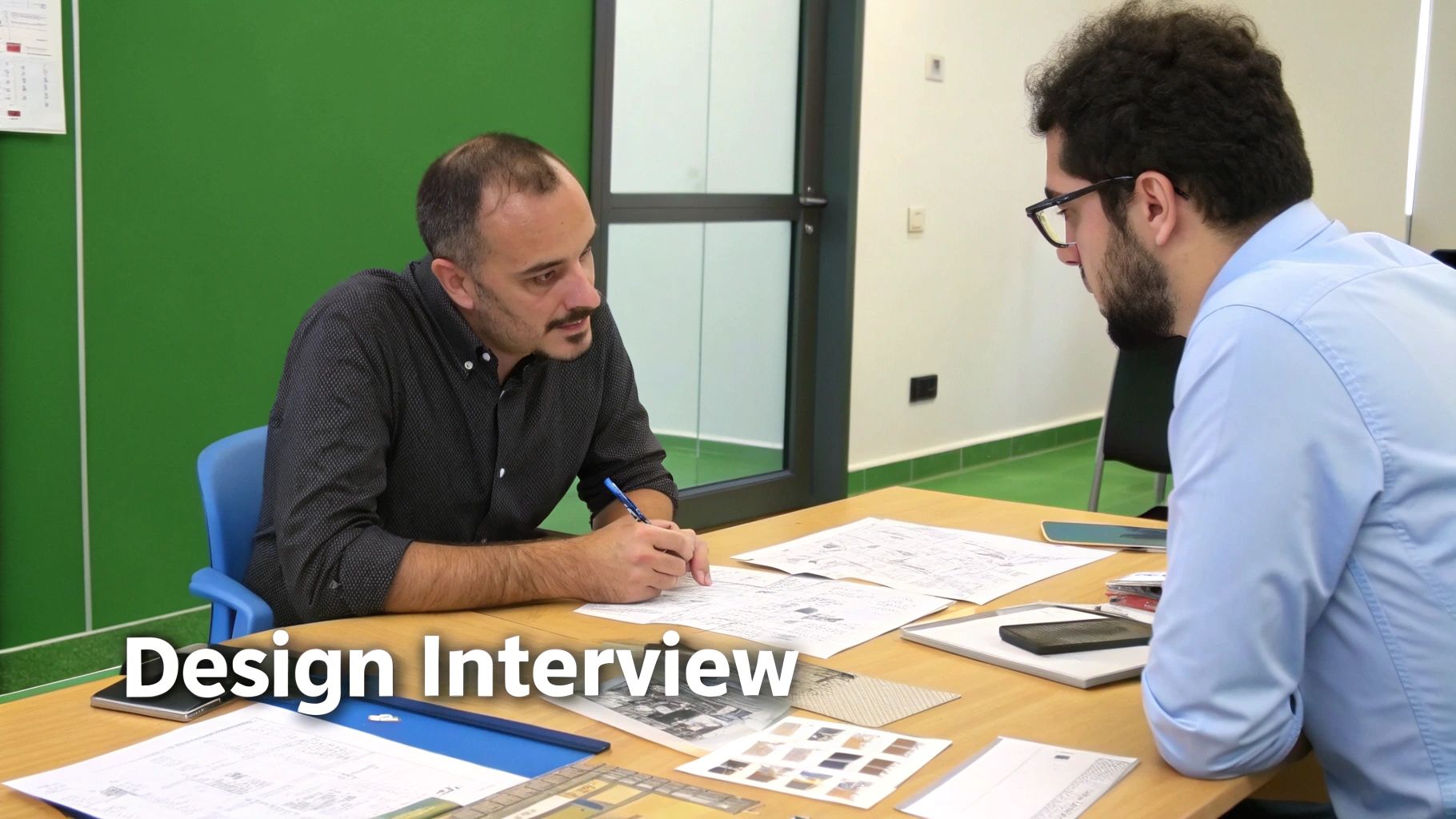
After you’ve narrowed the field to your top firms—usually 2-3 candidates—it's time for interviews. This is your chance to see if the chemistry is right and confirm that their collaborative style aligns with your team’s culture.

Come prepared with pointed, scenario-based questions that get to the heart of their experience:

  • "Describe a time when a fire station project hit an unexpected budget snag. How did you get it back on track?"
  • "How do you keep the lines of communication open and clear between the fire department, city officials, and the construction team?"
  • "Walk us through your process for engaging our firefighters and command staff during the programming phase."

Their answers will reveal their real-world problem-solving skills and their commitment to a transparent process. You’re looking for a firm that provides clear, confident answers backed by years of hands-on experience.

Getting the architect selection right sets the entire project up for success. By focusing on proven expertise, a collaborative spirit, and a deep understanding of public safety design, you can build a partnership that delivers a facility ready to serve your community for decades to come.

Common Questions About Fire Station Projects

Building a new fire station is a massive undertaking, and it's not something most municipalities or development committees do more than once a generation. It’s only natural to have a lot of questions. Getting clear, honest answers from the start is the key to setting realistic expectations for your timeline, budget, and long-term goals.

Here are some of the first questions we typically hear from clients as they begin the process of working with a fire station architect.

How Long Does It Take to Build a Fire Station?

This is almost always the first thing people want to know. While every project is different, a solid rule of thumb for a new build is 2 to 2.5 years—from the day you hire an architect to the day the firefighters move in.

That timeline breaks down into a few distinct stages:

  • Design Phase (9-12 months): This is where the real deep work happens. It covers everything from programming and stakeholder meetings to hashing out the schematic design, developing the details, and ultimately producing a full set of construction documents.
  • Bidding and Permitting (2-3 months): With plans in hand, the project is put out to bid for general contractors. At the same time, we're navigating the local permitting process with the authorities.
  • Construction (12-18 months): This is the longest stretch, involving everything from breaking ground and pouring foundations to the final interior finishes and commissioning all the building's systems.

Renovations can sometimes move a bit faster, but they often come with their own unique surprises that can affect the schedule.

What Are the Biggest Budget Risks?

Even the most carefully planned projects have financial risks. The biggest headaches usually come from things you simply couldn't know about during the design phase.

Unforeseen site conditions are a classic example. You might hit bad soil that needs expensive over-excavation or discover abandoned utility lines right where the new foundation is supposed to go.

Another huge factor is the volatility in material costs. A sudden spike in the price of steel or lumber after the project has been bid can throw a budget into chaos. Finally, scope changes made after the design is locked in will almost always cost you money and time. A good architect will help you get ahead of these risks with detailed site analysis and, most importantly, by building a healthy 5-10% construction contingency into the budget from day one.

Future-proofing isn't just about preparing for what you know is coming; it's about building in the flexibility to adapt to what you can't yet predict. An adaptable design is a resilient one.

How Can We Future-Proof Our New Station?

A new fire station is a 50-year investment, at a minimum. Designing for tomorrow's needs is absolutely critical. "Future-proofing" isn't about having a crystal ball; it's about making smart, strategic decisions now that give you options later.

An experienced fire station architect will guide you through this, focusing on a few key areas:

  • Designing for Expansion: The site layout should anticipate growth. Think about where a future building addition or an extra apparatus bay could go without causing major disruptions down the line.
  • Oversizing Apparatus Bays: Always go bigger than you think you need. Bays should be longer, wider, and taller than your largest current vehicle requires because one thing is certain: fire trucks aren't getting any smaller.
  • Flexible Interior Spaces: Using non-load-bearing walls for living quarters and administrative areas makes future reconfigurations much simpler and far less expensive.
  • Planning for Technology: You can't predict the tech of 2050, but you can prepare for it. That means installing ample conduit, data ports, and robust electrical capacity to handle whatever comes next.

A little forethought today ensures your station remains a functional, valuable community asset for decades.


At Sherer Architects, LLC, we specialize in guiding clients through every phase of complex projects, from historic preservation to new commercial construction. Our collaborative process ensures your vision is realized with enduring quality and a strong return on investment.

Discover how our architectural expertise can bring your next project to life.
Categories
Uncategorized

Fire Station Architect: Hire the Right Partner (fire station architect)

A fire station architect is a specialist, plain and simple. They design facilities that have to meet a complex web of operational, health, and safety needs unique to modern fire departments. You wouldn't hire a family doctor to perform heart surgery, and the same logic applies here. Going with a generalist architect for a project this critical is a huge risk; only a specialist truly gets the intricate dance between rapid response, contamination control, and firefighter well-being.

From Garage to High-Tech Hub

An architect works on blueprints for a fire station design, with a building model and fire truck nearby.

It’s a costly mistake to think of a fire station as just a big garage with a kitchen and some beds attached. Today’s facilities are sophisticated public safety hubs that have come a long way from their origins. Early firehouses were little more than barns for horse-drawn wagons. The real game-changer was the motorized fire engine in the late 19th century, which completely rewrote the rulebook for building design and laid the groundwork for the modern station. This is when we first saw concepts like drive-through apparatus bays and the need for specific turning radiuses. To really grasp where we are now, it helps to understand the history and evolution of fire station design.

That evolution hasn't stopped; in fact, it's accelerating. Modern stations are complex environments where operational readiness and human health are deeply connected. A specialist architect brings a career's worth of knowledge to these specific challenges.

Balancing Durability with Human Factors

A fire station has to be built like a fortress. It needs durable, low-maintenance materials that can handle the constant abuse of 24/7 operations and heavy gear. But it’s also a home. Firefighters are living, eating, and sleeping there for long, stressful shifts. The design of their living quarters is absolutely critical for their mental and physical health.

An experienced architect knows how to design spaces that:

  • Reduce Stress: It's about more than just putting a couch in a room. Thoughtful layouts for kitchens, dayrooms, and bunk rooms can build camaraderie while also carving out quiet spaces for rest and recovery.
  • Promote Health: Good ventilation to clear the air, ample natural light, and smart acoustic separation between the living quarters and the noisy apparatus bay are non-negotiable for long-term well-being.
  • Ensure Readiness: Every inch of the facility has to be geared toward minimizing turnout times. This means thinking through everything from the placement of turnout gear storage to the directness of the path from the dorms to the bay.

A fire station isn't just a building; it's a critical tool for public safety and a sanctuary for the responders who use it. The design must support both functions without compromise.

Navigating Complex Codes and Community Needs

Beyond the station's four walls, a fire station architect acts as a strategic guide through a maze of regulations and community interests. They speak the language of specialized codes, like those from the National Fire Protection Association (NFPA), and they understand the unique pressures of public-funded projects.

This expertise is essential for tackling a few key areas:

  • Contamination Control: Implementing “Hot Zone” design principles is now the standard of care. This is all about creating clear separation to protect firefighters and their families from carcinogens and other toxins brought back from a call.
  • Community Integration: A modern station can be a true community asset. The design might include public meeting rooms or function as a safe haven during emergencies, all while maintaining strict operational security.
  • Future-Proofing: The last thing you want is a brand-new station that’s obsolete in ten years. A good architect plans for future growth, new apparatus types, and evolving technology, ensuring the building serves its community for decades and maximizes every taxpayer dollar.

Laying the Groundwork for a Successful Station

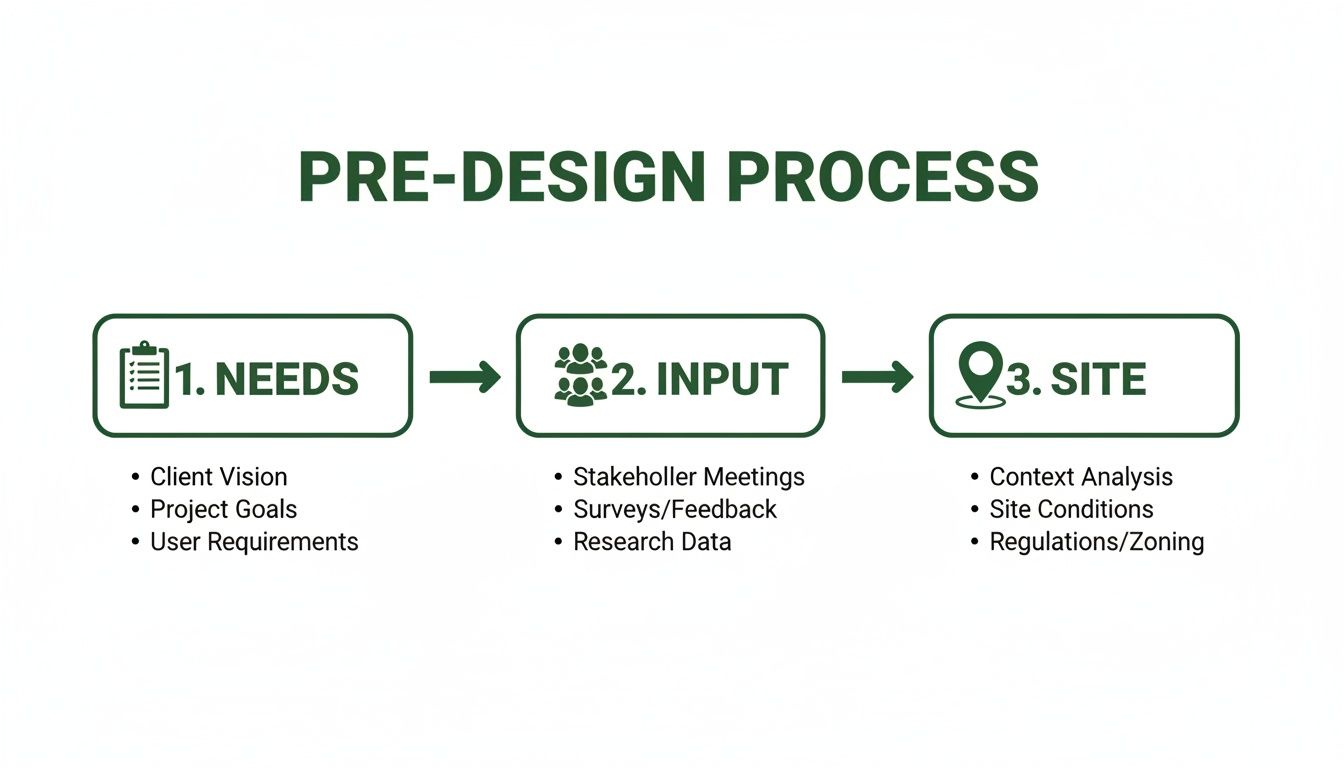
Long before the first shovel breaks ground, the real work of building a successful fire station begins. This isn't about blueprints or floor plans just yet. It's about deep-diving into the data, understanding the mission, and aligning everyone involved. This is the pre-design phase, and it's where an experienced fire station architect earns their keep by preventing expensive mistakes down the line.

The entire process kicks off with a detailed Needs Assessment. Forget simple checklists; this is a comprehensive discovery process that brings everyone to the table. From fire department leadership and first responders on every shift to key community stakeholders, getting all these voices heard is the only way to build a complete picture of what this facility truly needs to be.

Getting to the Heart of Your Operational Needs

Your architect's most important job at this stage is to listen. They're there to facilitate the tough conversations, moving the team from a list of "wants" to a concrete set of operational requirements. It’s a true partnership to define the station's core functions.

We need to get specific on key areas:

  • Apparatus Bays: How many bays do you need right now? More importantly, how many will you need in 10 years? What kind of apparatus will you be housing? These answers drive the bay's depth, width, and door clearances.
  • Personnel & Living Quarters: Think about the number of firefighters per shift, the pros and cons of individual dorms versus open bunk rooms, and how the kitchen, dayroom, and fitness areas need to function for the crew.
  • Specialized Training Zones: Does the plan include a training tower for ladder and rappelling drills? What about props for confined space rescue or dedicated areas for advanced medical training?
  • Admin & Public Spaces: Many modern stations need offices for command staff, a secure public lobby, or even a community meeting room that can be isolated from the station's operational zones.

A classic misstep is designing a fire station for the department you are today, not the one you'll need to be tomorrow. A forward-thinking needs assessment anticipates future growth in both personnel and apparatus, which can save millions in renovation costs later.

This isn't just about what happens in meetings. A great architect will insist on doing ride-alongs and spending time in your current stations. They need to see your workflow—and your workarounds—firsthand. Those daily bottlenecks and inefficiencies you've learned to live with are exactly what they'll translate into smarter, more effective design solutions.

Using Data to Pinpoint the Perfect Site

Choosing a spot for a new fire station can't be based on convenience or politics. The decision has to be driven by cold, hard data with one single-minded goal: cutting down emergency response times. A specialist fire station architect uses sophisticated mapping tools to make sure the site you choose provides the best possible coverage for the community.

This analysis, often called run-time analysis or response mapping, is non-negotiable. Using GIS (Geographic Information System) software and your department's historical response data, the architectural team models how quickly units can get from a proposed site to every corner of their response district.

They'll dig into factors like:

  • Traffic patterns at all hours of the day and night
  • The layout of road networks and any natural barriers like rivers or highways
  • Locations of high-risk populations or buildings (schools, hospitals, industrial parks)

This data-first approach takes all the guesswork out of the equation. For example, a site that looks perfectly central on a map might be bottlenecked by a chronically congested intersection. Meanwhile, a less obvious location could offer much faster access to major roads. A fire station on the wrong site is a permanent handicap to public safety, making this analysis one of the most critical investments in the entire project. A specialist architect also ensures every design choice adheres to the latest building regulations fire safety, guaranteeing the plans are solid from every angle.

The outcome of all this foundational work is a detailed document called the program. Think of it as the project's DNA. It outlines every single space, its size, its function, and how it connects to every other space. This program becomes the definitive roadmap the architect uses to start the schematic design, confident that the building they create will be a direct reflection of the department’s carefully defined needs.

Designing for Firefighter Health and Operational Readiness

A fire station's job is to protect the community, but its first and most fundamental duty is to protect its own crew. We've come to understand that this means protecting them not just from the obvious dangers of a call, but from the invisible hazards embedded in their work. The building itself is now seen as a critical piece of personal protective equipment, a tool for safeguarding long-term health.

This shift in thinking puts firefighter well-being and operational readiness on equal footing. You can't have one without the other. The primary focus? Aggressively controlling crew exposure to carcinogens and other contaminants from the moment a truck rolls back into the station.

The single most effective strategy we have for this is the Hot Zone design concept. It's not just a trend; it's the established standard for creating a healthy environment. This approach meticulously separates the facility into distinct zones to manage the flow of people and gear from dirty to clean.

The Red, Yellow, and Green Zoning Strategy

At its heart, Hot Zone design is about creating a clear, one-way path for firefighters and their gear after a call. This path is designed to stop toxic soot, chemicals, and particulates from migrating into the station's living and administrative areas. Any architect specializing in fire stations will tell you this is a non-negotiable part of the modern floor plan.

Flowchart outlining the pre-design process, detailing needs, input, and site analysis steps.

The Red/Yellow/Green zoning concept has become the gold standard for a reason. What started as a conversation at the 2014 FIERO Station Design Symposium is now embedded in multiple National Fire Protection Association (NFPA) standards. It’s a direct architectural response to the very real health risks firefighters face. You can learn more about how this zoning concept became an industry standard from the experts who helped develop it.

The table below breaks down how these zones work together to create a protective barrier for the crew.

Fire Station Zone Design Principles

Zone Purpose Included Spaces Key Architectural Considerations
Red (Hot Zone) Direct Contamination Area Apparatus Bays, Support Spaces (e.g., tool room, workshop) Durable, non-porous floor finishes, robust trench drains, direct exterior access, physical separation from all other zones.
Yellow (Transition) Decontamination Corridor Decon Laundry (Gear Extractors), SCBA & Tool Cleaning, Decon Showers, Turnout Gear Storage One-way traffic flow from Red to Green, isolated HVAC system, moisture-resistant and easily cleanable surfaces.
Green (Cold Zone) Clean Living & Work Area Dorms, Kitchen/Dayroom, Fitness Room, Admin Offices, Public Lobby Positive air pressure relative to other zones, no direct access from the Red Zone, durable but comfortable finishes.

Integrating this zoning from the earliest design stages is what separates a functional station from a truly protective one. It ensures health and safety are baked into the building's DNA, not just added on as an afterthought.

Engineering the Apparatus Bay for Safety

The apparatus bay is the heart of the Red Zone, and it’s far more than a simple garage. This is a highly technical space where every detail—from the floor drains to the ceiling height—impacts crew health and response efficiency. Getting these specifications right is absolutely critical.

Apparatus Bay Dimensions

  • Width: A comfortable bay width is 18 to 20 feet. This gives crews enough "walk-around" room for daily truck checks and maintenance without feeling pinched.
  • Depth: Bay depth can vary wildly, from 70 to 90 feet or even more. The final number depends entirely on the apparatus. A modern ladder truck needs a much deeper bay than a standard engine or ambulance.
  • Door Clearances: The old standard of 14 feet wide by 14 feet high is quickly being replaced. We now design for 16×16 feet doors to accommodate the newer, larger aerial apparatus hitting the market. Forgetting to account for the door opening mechanism itself is a classic, costly blunder.

One of the most expensive mistakes you can make is undersizing the apparatus bay. If a future vehicle doesn't fit, the only fix is a disruptive and incredibly expensive renovation. A smart architect designs for the apparatus your department will own 20 years from now, not just what's in the bay today.

Beyond sheer size, the bay's most critical health feature is air quality. Diesel exhaust is a known carcinogen, and letting it linger is unacceptable. Vehicle exhaust capture systems are mandatory. These systems hook directly to a truck's exhaust pipe and vent the fumes safely outside, preventing them from contaminating the air and migrating deeper into the station.

This works in tandem with the HVAC system. Your architect should specify a positive pressure system for the Green Zone. This small but crucial detail ensures that clean air is always flowing from the living quarters toward the contaminated zones, creating an invisible barrier that stops harmful particulates from drifting into the places where firefighters eat, sleep, and recover.

Creating a Resilient and Community-Focused Facility

A fire station is so much more than just a garage for fire trucks and a place to store gear. It's a second home for the crew—the place where they decompress, build camaraderie, and recover from the intense stress of the job. It's also a landmark in the community it serves. A great fire station architect never loses sight of this dual role.

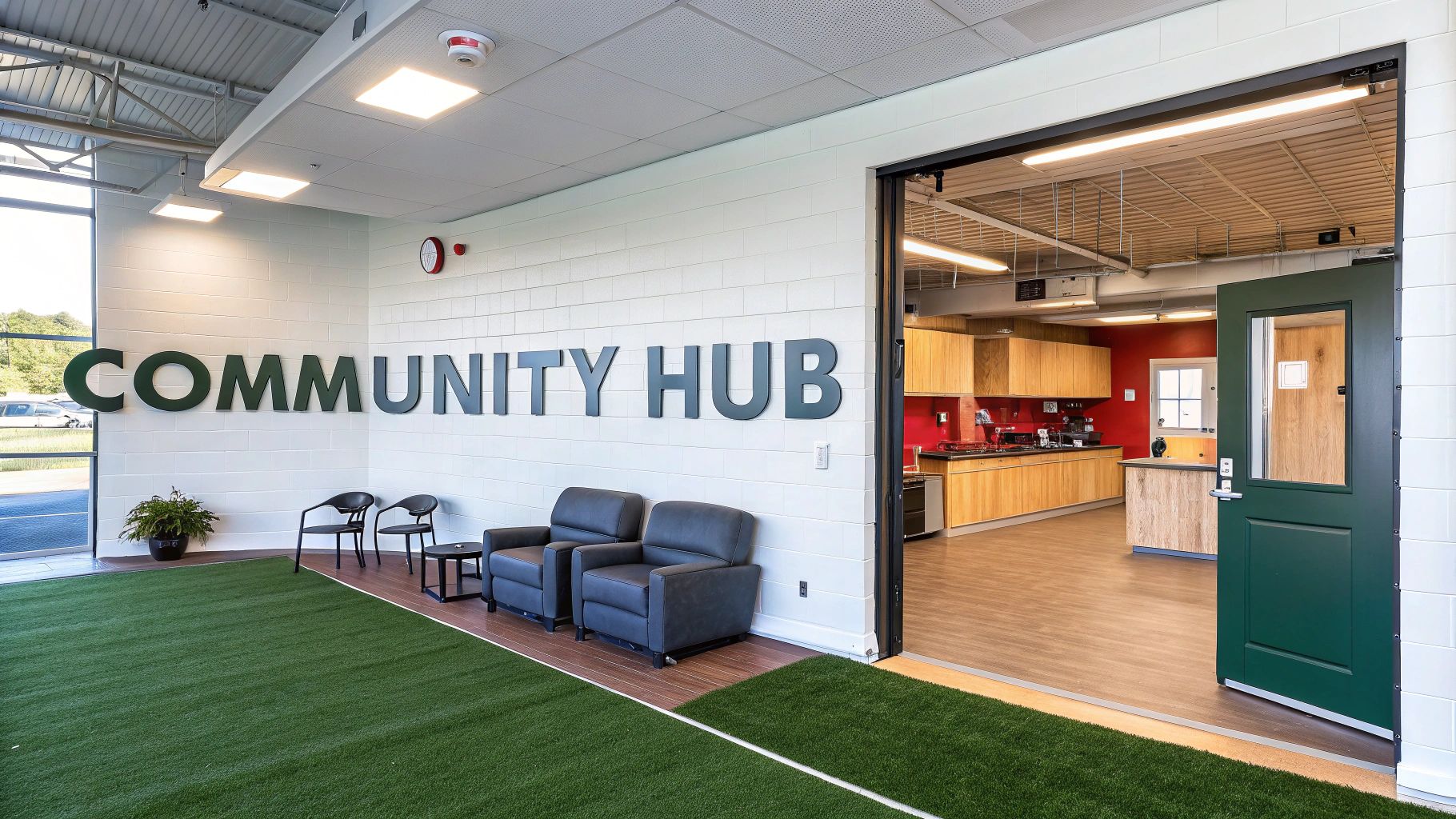
Welcoming interior of a modern community hub with seating, artificial turf, and an open kitchen area.

The real goal is to create an environment that promotes both rest and readiness. This means striking a delicate balance between private and communal areas, giving firefighters the choice to either connect with their team or find a quiet moment alone.

Designing a Home Away From Home

We've come a long way from the old open bunk rooms. While they were cheap, they offered zero privacy and made quality sleep nearly impossible—a huge problem when rest is critical for firefighter health. Today, we're seeing a major shift toward individual sleeping quarters or small pods. This simple change gives each person control over their own light, sound, and temperature.

This same thoughtful approach has to carry through to the shared spaces:

  • The Kitchen: Everyone knows the kitchen is the "heart of the station." It's where crews bond over meals. The design needs to be bulletproof, with commercial-grade appliances and tough, easy-to-clean surfaces. The layout is just as important; it should encourage conversation while still being functional enough for multiple people to cook at once.
  • The Dayroom: Think of this as the station's living room. The best designs offer flexible seating—some for watching a game as a group, others for quiet reading. It’s also absolutely critical to acoustically separate the dayroom from both the apparatus bay and the sleeping quarters. Nothing's worse than trying to relax with constant noise bleeding through the walls.
  • Fitness Areas: Physical fitness isn't optional in this line of work. A dedicated fitness room with proper ventilation and shock-absorbent flooring is a must-have. It's a direct investment in crew health and can significantly reduce the risk of on-the-job injuries.

The design of these living quarters has a direct, measurable impact on morale and mental health. A station that feels less like an institution and more like a home helps firefighters manage the immense, cumulative stress of their profession. That leads to better retention and better performance on calls.

Building a Bridge to the Community

A new fire station is a huge investment for any community, and the building itself can send a message of openness and service. Many modern facilities now cleverly include public-facing elements, turning the station into a true community hub without ever compromising operational security.

For instance, you might see a public meeting room with its own separate entrance and restrooms. This allows local groups to use the space after hours without ever needing access to the secure side of the facility. Some stations even incorporate a "safe haven" lobby, where a person in crisis can seek help at any time of day or night.

The exterior of the building is just as important. An architect can use materials, landscaping, and lighting to create a civic presence that feels welcoming and professional, not cold and intimidating. This goes a long way toward building public trust and reinforcing the fire department’s role as an integral part of the community.

Prioritizing Durability and Long-Term Value

Fire stations aren't built for the short term; they're expected to last 50 years or more. This means long-term operating costs are a massive consideration. An experienced architect will always focus on specifying materials and systems that deliver both durability and efficiency, reducing the strain on municipal budgets for decades to come.

This means choosing robust, low-maintenance finishes that can take the abuse of 24/7 use. It also involves designing smart, highly efficient building systems.

Here are a few key areas we focus on:

  • Energy-Efficient Systems: High-performance HVAC, LED lighting, and superior insulation aren't just buzzwords; they can slash utility bills.
  • Sustainable Materials: Using locally sourced or recycled materials can lower the project's environmental footprint and sometimes even its cost.
  • Resilient Design: The station absolutely must remain operational during a power outage or natural disaster. This often requires backup generators and hardened infrastructure.

When designing a facility that is both safe and resilient, a specialist architect will also incorporate advanced fire containment features, such as compliant fire shutters for windows. By making these smart choices upfront, the architect ensures the station is not just a functional and respected community asset, but a fiscally responsible one, too.

Finding Your Architect and Choosing the Right Project Delivery Method

With a solid program in hand, you’ve arrived at one of the most pivotal moments in your project’s life: picking your team. This isn’t just about finding an architect; it’s about establishing the entire framework for how your station will be designed, priced, and built.

This involves two decisions that have to happen almost at the same time. You need to find a fire station architect who genuinely understands public safety, and you have to select a project delivery method that fits your municipality’s budget, timeline, and tolerance for risk. Get this right, and you're set up for success. Get it wrong, and you could be facing costly delays and a building that just doesn't work for your crew.

How to Identify a True Specialist

Let's be clear: not all architects are created equal. Plenty of firms can design a beautiful building, but very few have the deep, hands-on experience needed to design a high-performance fire station. You're not looking for a generalist; you need a specialist who lives and breathes public safety.

When you start putting together a list of firms, you have to look past the slick marketing materials and glossy photos. It's time to get serious with your vetting process.

Start by issuing a Request for Qualifications (RFQ) or Request for Proposal (RFP) that asks the tough questions. You're trying to find out:

  • Their Real-World Track Record: How many fire stations have they actually designed in the last 10 years? Don't just take their word for it. Ask for a list of projects, locations, and contacts at the municipality you can call for an honest reference.
  • Code Fluency: Can they talk intelligently about NFPA standards? A true expert won't need to look up the basics. They should be able to discuss the nuances of these codes from memory.
  • Experience with Stakeholders: What’s their game plan for managing input from fire chiefs, union reps, shift crews, and local officials? Ask for a specific example of a time they had to navigate conflicting requests and how they resolved it.
  • Construction Oversight: How involved are they once the shovels hit the ground? You want a partner who is on-site regularly, not an architect who disappears after the drawings are done. They should be there to work through issues with the contractor and ensure the quality is up to par.

A common mistake is hiring a local firm just because they’re local or choosing a big-name firm that offers the lowest design fee. A fire station is far too specialized for that. Investing in the right architect upfront might seem more expensive, but they will save you a fortune down the road by preventing costly design errors and operational headaches.

Breaking Down Project Delivery Methods

While you're searching for your architect, you also need to decide how the station will be managed and constructed. This is your "project delivery method," and the three most common options for public projects come with their own trade-offs.

Design-Bid-Build (DBB)

This is the old-school, traditional route. You hire an architect to design the entire station. Once the construction drawings are 100% complete, the project goes out for public bid. In most cases, the job is awarded to the contractor with the lowest qualified bid.

  • The Good: It's a straightforward process most municipalities are familiar with and often required by public procurement laws. It creates a competitive bidding environment that can drive down the initial construction price.
  • The Bad: It's almost always the slowest path. Because the architect and contractor are hired separately, it can sometimes create an "us vs. them" dynamic if problems come up during construction.

Construction Manager at Risk (CMAR)

With CMAR, you bring both the architect and the construction manager (CM) on board early in the process. The CM acts as a consultant during the design phase, giving you real-time feedback on costs and buildability. Before construction starts, they give you a Guaranteed Maximum Price (GMP).

  • The Good: This method fosters teamwork from day one. You get much better cost control and can often shorten the overall schedule because you’re not waiting for a full bid process.
  • The Bad: The final price might be a bit higher than a low-bid scenario, but that premium buys you a huge amount of cost certainty and a much smoother process.

Design-Build (DB)

Here, you hire a single entity—usually a team made up of a contractor and an architect—to handle everything under one contract, from the first sketch to the final walkthrough.

  • The Good: It’s typically the fastest way to get a building built and gives you a single point of contact for everything. If something goes wrong, there's no finger-pointing.
  • The Bad: You give up a significant amount of control over the design details. The architect works for the contractor, not directly for you, which can create a conflict of interest when balancing your needs against the contractor's bottom line.

For public fire stations, Design-Bid-Build and CMAR are the most common choices. Your architect will be your best guide here, helping you weigh your community’s priorities—be it speed, budget security, or design control—to pick the method that makes the most sense for your project.

Common Questions About Fire Station Architecture

When you're staring down the barrel of a project as complex and critical as a new fire station, a lot of questions pop up. It’s completely normal. From sticker shock over the budget to the nitty-gritty of the design, city leaders and fire chiefs are often navigating this process for the first time.

Getting straight answers from an architect who actually specializes in this stuff is the only way to move forward with real confidence. Here are some of the most common questions we hear, along with the kind of straightforward advice you should expect.

How Long Does It Take to Design and Build a Fire Station?

This is almost always the first thing people ask. The honest answer? It depends. A typical project, from the day you hire an architect to the day the crew moves in, usually lands somewhere between 24 to 36 months. It's a marathon, not a sprint.

Think of it in phases. The initial design and pre-construction work—needs assessments, site selection, drawing up construction documents, and getting permits—can easily take 6 to 12 months. If you go the traditional route, the bidding and contractor selection process will add another 2 to 3 months.

Then comes the actual build. Construction itself often lasts 14 to 18 months, though this can shift based on weather, supply chain issues, or the complexity of your design. Finally, you have about 1 to 2 months for closeout and move-in, which covers final inspections, fixing any last-minute issues, and commissioning all the building systems before the station goes live.

What Is the Average Cost of a New Fire Station?

Let's talk numbers. For any publicly funded project, the budget is king. Pinning down a national average is tough because labor and material costs vary so much by region, but a good rule of thumb for a new fire station is $600 to $900 per square foot.

But here’s something that gets missed all the time: the initial construction cost is just one piece of the puzzle. A well-designed station is built with its entire life cycle in mind, factoring in decades of utility bills and maintenance. A cheaper build today could easily cost your municipality far more over the facility's 50-year lifespan.

So, for a new 20,000-square-foot station, you're likely looking at a total project budget in the $12 million to $18 million range once you factor in design fees, furniture, and all the necessary equipment. An experienced fire station architect can give you a detailed cost estimate early on, which is invaluable for budgeting and securing funding.

How Do We Choose the Best Site for Our New Station?

Picking a location for a new station shouldn't be about which piece of land is cheapest or most convenient. It has to be driven by data. The single most important goal is cutting down response times across your entire service area. This is a science, not a guessing game.

Today, we rely on sophisticated 'run-time analysis.' We use your department's own data to model how quickly crews could respond from different potential sites. This ensures the final location provides the best possible coverage where it's needed most. Considering that residential buildings accounted for 24.2% of all fires globally in 2020, rapid deployment to populated areas is non-negotiable. You can learn more about how global data shapes emergency planning in the CTIF's World Fire Statistics report.

How Can We Future-Proof the Design?

A fire station you build today has to serve your community for the next 50 years or more. That means the design can't be rigid. It needs the flexibility to adapt to bigger trucks, new technology, and changing crew sizes.

Here are a few ways we bake that flexibility right into the design:

  • Bigger Apparatus Bays: We design bays that can handle not just today's fleet, but also the larger aerials and specialized rescue vehicles your department might need ten years from now.
  • Smart Site Planning: The building should be positioned on the site to allow for future additions—like more bunk rooms or administrative offices—without disrupting daily operations.
  • Adaptable Interiors: In the living and admin areas, using non-load-bearing walls makes it far easier and cheaper to reconfigure the space down the road.
  • Robust IT Infrastructure: We plan for the future by installing plenty of conduit and server room space to handle whatever technological upgrades are coming in the next few decades.

At Sherer Architects, LLC, we believe in creating buildings that are not only functional and beautiful but also enduring assets for the communities they serve. Our team has the expertise to guide you through every stage of your commercial project, from initial concept to final construction. Contact us today to discuss how we can bring structure to your vision.

Categories
Uncategorized

Finding Your Commercial Architectural Firm

Before you even think about searching for a commercial architectural firm, you need to do your homework. The single most important step you can take is creating a rock-solid project brief. This isn't just a simple wish list; it's the foundational document that translates your business goals into an architectural vision.

Get this right, and you'll attract firms that are a perfect fit for your project. Think of it as the blueprint before the blueprint.

Defining Your Project Before You Search

Jumping into calls with architects without a clear plan is a recipe for disaster. It's like setting sail without a map. A detailed project brief becomes your compass, guiding the entire selection process and paving the way for a successful partnership.

This document forces you to get specific about your goals, constraints, and non-negotiables. Taking the time now saves you from massive headaches and costly misunderstandings down the road. It’s a strategic tool that aligns your operational needs, brand aesthetic, and financial reality from day one.

The architectural services market is huge—it was projected to hit $249.2 billion globally by 2025. With so many firms out there, a clear brief is your best tool for cutting through the noise and connecting with the right talent. You can dig deeper into these market dynamics from IBISWorld.

Translate Business Goals into an Architectural Vision

Your building isn’t just a structure; it's a critical part of your business operations. How will this space actually support your day-to-day workflow? A restaurant, for instance, lives and dies by the seamless flow between the kitchen and the dining room. A medical clinic, on the other hand, must prioritize patient privacy and meet strict accessibility standards.

Start by thinking through these core elements:

  • Operational Workflow: Literally map out how people (employees, customers) and things (products, supplies) will move through the space. Where are the potential bottlenecks? Where can you build in efficiency?
  • Brand Aesthetics: What’s the vibe? Define the look and feel that tells your brand’s story. Are you going for modern and minimalist or something more traditional and welcoming?
  • Future Growth: What will your business look like in five or ten years? A smart, scalable design can save you from a gut-wrenching renovation later on.

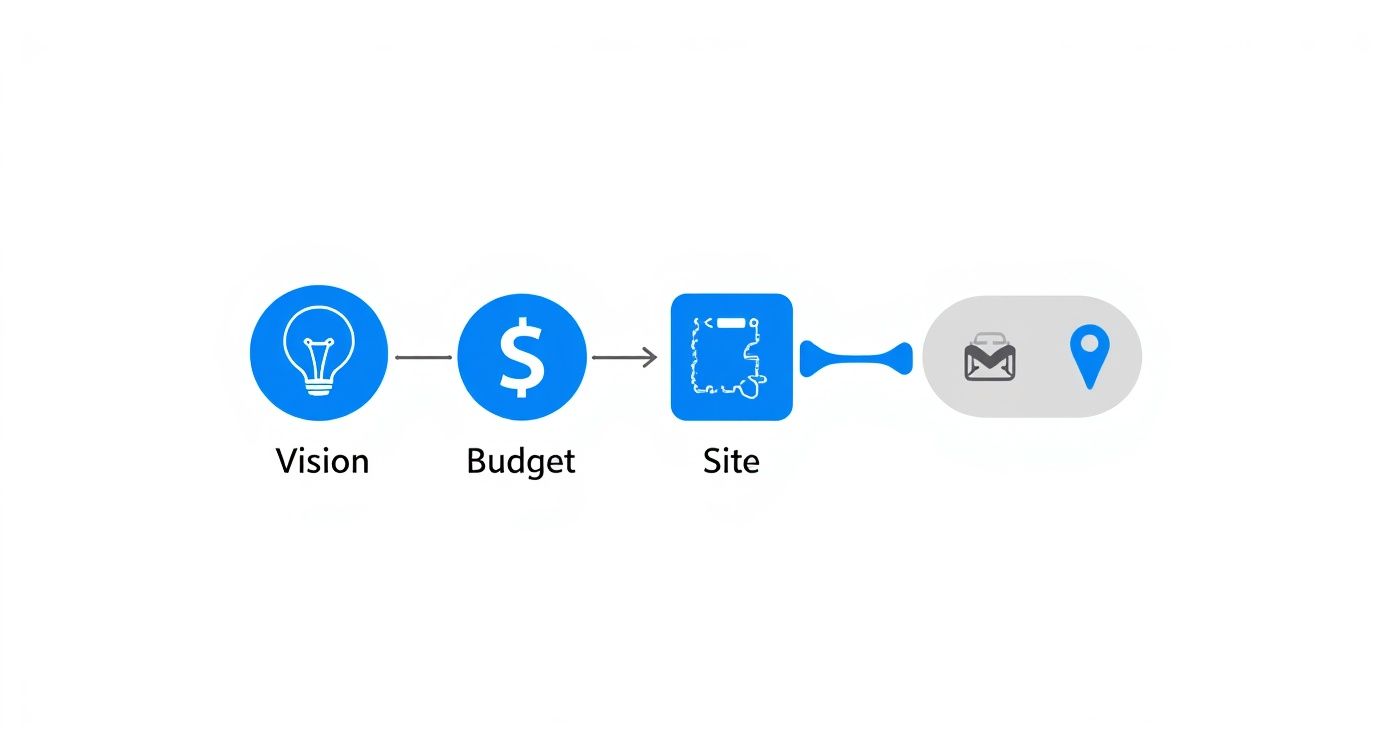
This whole process of clarifying your vision, budget, and site is the foundation of your project brief.

A process flow diagram with icons for Vision, Budget, and Site, connected to mail and location symbols.

As the diagram shows, these three pillars—vision, budget, and site—are completely interconnected. One can't exist without the others.

Ground Your Project in Financial Reality

A vision without a budget is just a daydream. You need to establish a realistic preliminary budget and timeline to keep the project tethered to reality. Do some research on local construction costs, but don't forget to factor in all the "soft costs"—things like permits, engineering fees, furniture, and technology.

A well-defined budget does more than just limit spending; it forces creative problem-solving. When a commercial architectural firm understands your financial guardrails, they can propose innovative design solutions and material choices that deliver maximum impact without breaking the bank.

Finally, get a handle on your site's potential and its limitations. Local zoning laws, environmental regulations, and existing infrastructure will all shape what's possible. Understanding these constraints upfront means an architect can hit the ground running with a feasible plan from day one.

How to Vet Potential Architectural Partners

With your project brief finalized, you're ready to start the search for the right commercial architectural firm. This isn't just about scrolling through slick websites; it's a careful process of finding, evaluating, and shortlisting firms that genuinely have the chops for your specific project.

The real goal here is to get past the glossy photos and see a firm's actual, hands-on experience in your world. A beautiful portfolio is great, but a proven track record of solving the unique problems of your industry—whether it's retail, hospitality, or a tricky historic preservation project—is what really matters. That’s how you find a truly great partner.

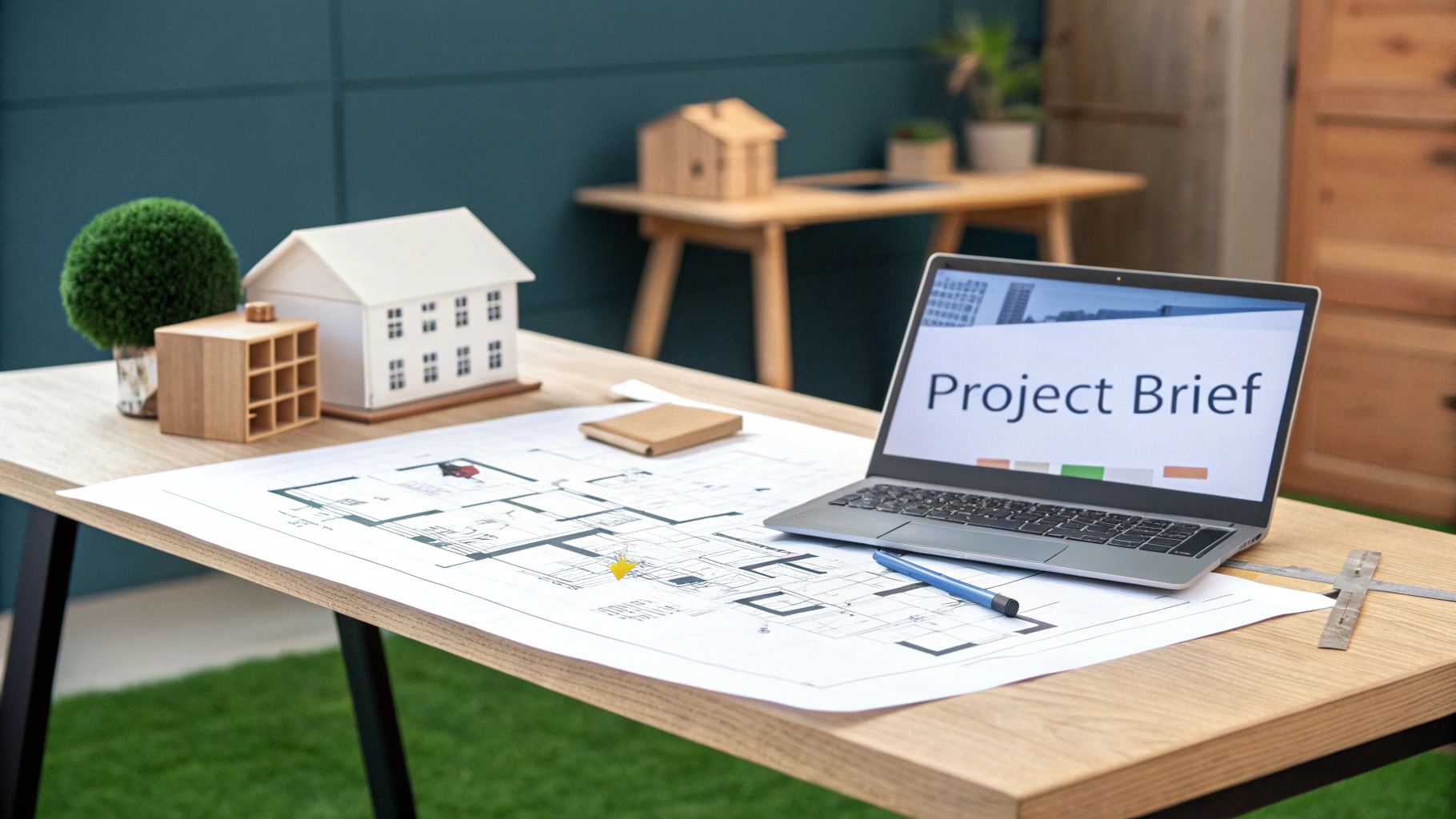
A bright architectural workspace with house models, blueprints, and a laptop displaying a 'Project Brief'.

Sourcing and Initial Screening

Often, the best partners come from word-of-mouth. Start by asking around your professional circle—talk to contractors, commercial real estate brokers, and other business owners you trust. You can also check out professional directories from organizations like the American Institute of Architects (AIA), which let you filter by specialty.

As you start compiling a long list, do a quick sanity check against your project brief. Does a firm’s portfolio feature projects that are similar in scale and type to yours? If your project is a complex adaptive reuse, a firm that only shows off shiny new builds probably isn’t the right match.

Look Beyond the Polished Portfolio

Every portfolio is a sales pitch, carefully curated to look impressive. Your job is to dig deeper and analyze it with a critical eye. You're looking for proof that a commercial architectural firm gets the business side of things, not just the aesthetics.

Here’s what to zero in on:

  • Project Niche: Do they have a clear specialty? Deep experience in your specific project type, like medical facilities or mixed-use developments, is a huge plus.
  • Real-World Problem-Solving: Look for case studies that explain how they tackled tough challenges. Did they successfully navigate a complex zoning issue or solve an unexpected structural problem? That’s gold.
  • The Technical Nitty-Gritty: If you can, ask to see a sample set of construction documents. These technical drawings reveal a firm’s attention to detail in a way a photograph never can.

The core ideas behind picking a professional partner hold true across different fields. In fact, many of the same principles apply, and you can get a good perspective by reviewing these things to consider before hiring a consulting firm. It really drives home the importance of doing your homework, no matter the industry.

To help structure your review, a simple evaluation matrix can be incredibly useful for comparing firms apples-to-apples.

Key Evaluation Criteria for Shortlisting Firms

Evaluation Area What to Look For Red Flags to Watch For
Relevant Experience A portfolio with multiple projects similar to yours in size, scope, and industry. All their "relevant" projects are from over a decade ago; no recent work in your sector.
Design Philosophy An approach that aligns with your brand and functional goals (e.g., focus on sustainability, user experience). A rigid, "one-size-fits-all" design style that they apply to every project, regardless of the client.
Problem-Solving Case studies that detail how they navigated complex zoning, budget, or construction challenges. Vague project descriptions that focus only on the finished look, not the process.
Local Knowledge Proven experience with local building codes, permitting processes, and relationships with city officials. They are based out-of-state with no local office or demonstrated experience in your municipality.
Client Testimonials Specific, positive feedback from past clients; willingness to provide references. No testimonials available, or they are hesitant to connect you with previous clients.

Using a checklist like this ensures you don’t get swayed by a single flashy project and instead focus on the qualifications that will truly drive your project's success.

Verifying Experience and Expertise

Client needs are always changing, and today there’s a huge focus on things like sustainable design and adaptive reuse. These trends are driving major growth in the industry, with the global architectural services market projected to jump from $214.19 billion in 2025 to $275.16 billion by 2029.

You're not just hiring a designer. You're bringing on a strategic partner who needs to understand the business drivers behind your project. Their ability to turn your operational needs into a functional, efficient space is everything.

This makes verifying a firm’s actual experience more important than ever. Don't be shy about asking for references from clients with projects like yours. Call them and ask about the firm's communication style, how they handled the budget, and their knack for solving problems on the fly. This kind of direct feedback is invaluable and will help you narrow your list down to the real contenders.

Crafting a Request for Proposal That Gets Results

Let’s be honest: a generic Request for Proposal (RFP) will land you a pile of equally generic, uninspired responses. If you want to really understand what a commercial architectural firm can do for you, your RFP needs to push them past the marketing fluff and get to the heart of their expertise. This document is your best tool for getting clear, comparable proposals.

Think of your RFP as the first real test of a firm's competence and attention to detail. A well-crafted RFP shows you're a serious client, and that attracts serious, high-quality firms. It sets the tone for a professional relationship built on clarity from day one.

A person reviews architectural plans and property images on a tablet and paper during an outdoor portfolio review.

Core Components of an Effective RFP

The best RFPs strike a delicate balance. They need to be detailed enough to paint a clear picture of your project but flexible enough to let firms show off their unique problem-solving skills. The goal is to make it easy for you to compare apples to apples while still seeing what makes each firm tick.

Make sure to include these key elements:

  • Your Comprehensive Project Brief: Attach the detailed brief you've already put together. This is crucial for giving firms the full context—your vision, operational needs, budget constraints, and site specifics.
  • Specific Questions About Their Approach: Don't just ask for a portfolio. Ask how they would tackle your project's unique challenges. A good example would be, "Given our site's zoning restrictions, what would be your initial strategy for securing the necessary approvals?"
  • Team and Project Management Details: You need to know who you’ll be working with. Request an organizational chart for the proposed team, complete with bios for the key people who will be hands-on with your project. It's also wise to ask about their communication protocols and the project management software they use.

When you demand this level of detail, you force firms to actually think about your project before they even hit "send" on their proposal.

An RFP is more than a questionnaire; it’s a diagnostic tool. The quality and specificity of a firm's response directly reflect their engagement, expertise, and genuine interest. A boilerplate proposal is a major red flag.

What to Ask to Get Real Answers

To cut through the noise, your questions need to be sharp and focused on tangible outcomes. Don’t just ask about their experience; ask for proof. This pushes firms to back up their claims with real-world evidence.

Try including prompts like these:

  1. Past Performance: "Please provide 2-3 case studies of projects similar to ours in scale and complexity. Detail the initial budget, the final cost, and an explanation for any significant variances."
  2. Challenge Resolution: "Describe a major unforeseen challenge on a past commercial project and walk us through the specific steps your team took to resolve it."
  3. Value Proposition: "Beyond simply meeting the requirements, what unique value or innovative approach does your firm bring to this specific project?"

Questions like these get to the core of a firm’s process, their problem-solving chops, and their ability to deliver on budget. The answers will tell you far more about who they are as a partner than any glossy portfolio ever could, helping you find the right commercial architectural firm to bring your vision to life.

Leading Interviews That Reveal the Real Story

A slick portfolio and a polished RFP might get a firm on your shortlist, but the interview is where you truly discover if they’re the right partner for your project. This is where you move past the glossy photos and scripted case studies to get a feel for the people you’ll be working with. You need to understand their culture, how they communicate, and how they solve problems when things don’t go according to plan.

Think of it less as an interrogation and more as the beginning of a crucial conversation. You’re looking for a team you can trust to navigate the inevitable complexities of a commercial build. This means asking the kinds of questions that reveal how they think, not just showing off what they’ve already built.

Go Beyond the Standard Script

Anyone can give you a canned answer to, "What's your design philosophy?" The real gold is in the situational questions. Your job is to push past the rehearsed pitches and see how they think on their feet. This is how you find out who can actually walk the walk.

Instead of asking broad, generic questions, frame them around specific, real-world challenges you anticipate. This tests their practical know-how and gives you a genuine glimpse into their working style.

Here are a few questions that get to the heart of the matter:

  • On Budgeting: "Tell me about a time a commercial project hit a major budget snag. What caused it, how did you break the news to the client, and what specific steps did you take to get things back on track?"
  • On Red Tape: "Our site has some tricky zoning overlays. Walk me through your process for dealing with the local planning department to clear up conflicts and get approvals without major delays."
  • On Collaboration: "Describe a project where you and the client had a serious disagreement on a key design element. How did you handle that conversation and what was the outcome?"

There are no single "right" answers here. What you're listening for is honesty, a clear process, and a problem-solving approach that puts the client first.

Why Local Know-How Is a Game-Changer

Never underestimate the advantage of a firm that knows your local turf inside and out. This is especially true when you consider how concentrated the architectural services market is. With North America's market projected to hit $159.088 billion by 2025 and Europe's expected to reach $185.503 billion, deep regional expertise is a powerful asset. You can find more details in these regional architectural market trends.

An architect with strong local connections understands the unwritten rules. They know who to call at the planning department, they have a network of trusted local contractors, and they have an instinct for the regional style and environmental quirks. That kind of intelligence can save you an incredible amount of time, money, and headaches.

Put Them to the Test with a Real Problem

To see how they really operate, end the interview with a hands-on challenge. Think of it as a mini-workshop. Give them a simplified version of a real problem your project is facing—a weirdly shaped site, a conflicting program need, or a tough budget target.

For instance, you could pose this challenge: "We have to fit 10,000 square feet of usable space on this awkward lot. The catch is we need to maximize natural light and can't go over a 25-foot height limit. What are your immediate thoughts on how we could approach the building's massing and orientation?"

Their reaction will tell you almost everything you need to know. You're not looking for a perfect, finalized design on the spot. You're watching their process unfold.

  1. What are their first questions? Do they jump right into solutions, or do they ask clarifying questions to better understand your goals?
  2. How do they work together? Does one person dominate, or do they brainstorm as a team, building on each other's ideas?
  3. How do they communicate their ideas? Are they able to explain their thinking clearly? Do they grab a pen and start sketching to help you visualize their concepts?

This simple exercise gives you a real-life preview of what it would be like to sit in a room and solve problems with their team, making your final decision that much easier.

Sorting Out Contracts and Fee Structures

You've done the legwork, vetted the firms, and found the perfect architectural partner. Now comes the final, critical step before anyone even thinks about breaking ground: getting the agreement down on paper. This is where verbal promises and great conversations become a binding contract that protects everyone involved. Getting a firm grip on architectural fees and contract details is essential—it sets the stage for a financially clear and successful project.

A solid, well-defined contract is the bedrock of a good client-architect relationship. It cuts through ambiguity, lays out exactly what to expect, and gives you a clear path for handling any bumps in the road. Think of it as the legal blueprint that goes hand-in-hand with the architectural one.

Two male designers collaborating on architectural plans and material samples in an office setting.

Decoding Architectural Fee Structures

Architects don't have a one-size-fits-all price tag. Their fees are usually structured in one of a few common ways, and the best fit for you will depend on your project's size, complexity, and how predictable the work is. Knowing your options here is key to negotiating a fair deal.

  • Percentage of Construction Cost: This is a classic model, especially for larger projects. The fee is a set percentage of the total construction cost, often between 5% and 12%. The nice thing is that it aligns your architect's incentives with keeping the budget in check. The downside? If construction costs unexpectedly balloon, so does their fee.
  • Fixed Fee (Stipulated Sum): This is exactly what it sounds like—a single, all-in price for the entire scope of work. It’s fantastic for budget certainty and works best when your project is clearly defined from the get-go. Just remember that if you add work later, it'll likely require a separate agreement.
  • Hourly Rate (Time and Materials): If your project is small or the scope is still a bit fuzzy, an hourly rate might be the way to go. You pay for the actual time spent, which offers a ton of flexibility. The risk, of course, is that costs can get unpredictable if the project scope creeps. Many firms use specialized time tracking software for architects to keep this transparent and accurate, so don't be afraid to ask how they log their hours.

Key Clauses to Look For in Your Contract

Before you put pen to paper, read that contract. Every word of it. It might feel like a chore, but doing your due diligence now can save you from massive headaches down the line. I always tell my clients to pay extra close attention to a few key areas that really define the working relationship.

A contract is more than just a legal document—it's a communication tool. It forces everyone to get on the same page about what's being done, what's being delivered, and how payments will work. It nips misunderstandings in the bud.

Be sure to comb through these sections:

  1. Scope of Work: This needs to be crystal clear. It should spell out every single service the firm will provide, from the first rough sketch to the final construction oversight. Leave no room for interpretation.
  2. Deliverables and Schedule: What are you getting and when are you getting it? The contract should list the tangible documents (drawings, models, reports) you'll receive at each phase and the deadlines for each.
  3. Payment Schedule: This section should clearly state when payments are due. Usually, payments are tied to hitting specific project milestones, which is a great way to ensure progress is being made.
  4. Ownership of Designs: This is a big one. Typically, the architect retains the copyright to their designs, but you get a license to use them for your specific project. Make sure you understand exactly what that means for you.

By carefully working through the fee structure and the fine print of the contract, you're not just hiring a firm—you're building a solid foundation for a great partnership.

Common Questions About Hiring an Architect

https://www.youtube.com/embed/Q7hRuC67rfQ

When you're looking to hire a commercial architectural firm, a few big questions almost always come up. It's totally normal. Getting straight answers to these is the key to feeling confident about your decision.

Let's break down some of the most common things business owners and developers ask when they're trying to find the right architectural partner.

What Should I Expect to Pay in Architectural Fees?

This is the big one, right? Let's get right to it. For a commercial project, you can generally expect architectural fees to fall somewhere between 5% and 12% of the total construction cost.

That's a pretty wide range, and the final number isn't just pulled out of a hat. It really hinges on the complexity of your project, the firm's level of experience in your specific niche, and exactly what services you need them to handle. A highly technical historic renovation with tricky structural issues is going to land on the higher end of that scale. On the other hand, a more straightforward new build on a clean, simple site will likely be on the lower end.

Pro Tip: Never accept a fee without a detailed proposal breaking down exactly what's included. A transparent fee structure is your best defense against surprise costs for things like permitting help, interior design work, or construction oversight. You need the full financial picture upfront.

Knowing this range helps you budget properly from the get-go and compare different proposals fairly.

How Long Does the Architect Selection Process Take?

Finding the right architect isn't something you want to rush. A solid, thoughtful selection process usually takes anywhere from four to twelve weeks. This timeline gives you enough breathing room to do your homework without letting the process drag on forever.

Here’s a rough idea of how that time breaks down:

  • Initial Research (1-2 weeks): This is when you're digging in, finding potential firms, and doing a first pass based on their online portfolios and reputation.
  • RFP & Proposal Review (2-3 weeks): You'll send out your Request for Proposal (RFP) and give firms time to put together a quality response. Then it's your turn to review what they send back.
  • Interviews & Final Selection (2-4 weeks): The final stretch. You'll meet with your top contenders, talk to their references, and hammer out a contract with the firm you choose.

It might feel like a long time, but trust me, investing this time now pays huge dividends later. It ensures you find a team that genuinely gets your vision.

What Is the Most Important Factor in Choosing a Firm?

A slick portfolio is great, and a competitive price is obviously important. But if I had to name the single most critical factor, it’s this: direct, proven experience with projects just like yours. I’m talking about similar scope, scale, and complexity.

Think about it. A firm that has already navigated the specific challenges of your industry—whether that’s complex healthcare codes, the logistics of a retail space, or the workflow of an industrial facility—is bringing so much more to the table than just a design.

That kind of specialized experience means they can anticipate problems before they happen, leading to smarter design decisions, a much smoother permitting process, and far fewer costly surprises once construction starts. It’s the difference between hiring a firm to design a building and partnering with an expert who knows how to design a high-performing asset for your business.


Ready to build a partnership that brings structure to your vision? At Sherer Architects, LLC, we combine decades of specialized experience in commercial, adaptive reuse, and historic preservation projects with a commitment to attentive listening and rigorous research. Let's start the conversation about your project today.

Categories
Uncategorized

How to Choose an Architect for Your Project

Choosing the right architect for your commercial project is a critical decision. It starts with defining your project inside and out, building a targeted shortlist, digging into portfolios, and conducting sharp interviews. Ultimately, you'll compare detailed proposals to find the firm whose skills perfectly match the unique demands of your project—whether it's a new build, an adaptive reuse, or a historic preservation.

Before You Even Think About Architects, Define Your Vision

Before you start looking for an architect, you need to become the undisputed expert on your own project. This is the bedrock. It’s less about architectural drawings and more about translating your business goals into a clear, actionable roadmap.

Honestly, a well-defined project brief is the most powerful tool you have. It attracts the right talent and saves you from expensive missteps later. It acts as a filter, making sure only firms who get what you're trying to do even make it to the table.

Think of it this way: you're defining the problem. An architect's job is to solve that problem with creativity and skill. If you can't articulate the problem clearly, even the best architect in the world will be flying blind.

Getting Specific: Articulating Your Project's Core Needs

You need to move past fuzzy ideas and get down to specifics. This isn't just a wish list; it's a strategic outline of what this project must accomplish to be a success. A developer planning a new retail center has completely different priorities than an investor turning an old warehouse into loft offices.

Start by hammering out the fundamentals. I always break it down into three key areas:

  • Functionality: How will people actually use this space every day? Think about workflow, how many people it needs to hold, accessibility (ADA compliance is non-negotiable), and which spaces need to be next to each other. For example, a restaurant kitchen has incredibly specific health code and equipment requirements that will dictate a huge part of the design.
  • Aesthetics: What's the vibe? Are you going for a sleek, modern look for a tech company's headquarters, or a classic, warm feel for a historic hotel? Don't just pull images from a magazine; try to define the feeling you want the space to evoke for your employees, customers, or tenants.
  • Long-Term Goals: Look beyond day one. What's the building's bigger purpose? Are you aiming for LEED certification to attract high-value tenants? Is the goal to create an iconic landmark, or is it purely about maximizing leasable square footage on a tight budget? These big-picture goals will drive major decisions on design, materials, and systems.

Nailing this down clarifies your project's DNA, which in turn informs everything from scope to budget.

A three-step process diagram illustrating the flow from vision to scope to budget for project planning.

This process shows you can't just jump to the budget. A clear vision defines the scope, and only then can you build a realistic budget. Get the order wrong, and you're setting yourself up for failure.

Tailoring Your Brief for the Type of Project

A generic brief is a waste of time. It won't attract the specialized expertise you need for complex projects like adaptive reuse or historic preservation. You have to tailor your "ask" to the challenge at hand.

Here's a framework to help you think through the specific criteria for your project type before you even speak to an architect.

| Key Project Criteria to Define for Your Architect |
| :— | :— | :— | :— |
| Criteria | New Commercial Build | Adaptive Reuse | Historic Preservation |
| Primary Goal | Maximize ROI, efficiency, and brand identity on a clean slate. | Unlock hidden value in an underutilized structure; blend old with new. | Faithfully restore and protect a building's historical character. |
| Key Challenges | Site constraints, zoning hurdles, entitlement process, new utility infrastructure. | Unknown structural issues, hazardous materials, integrating modern systems. | Strict material/method requirements, navigating review boards, sourcing rare materials. |
| Architect's Role | Visionary creator, master planner, and entitlement navigator. | Creative problem-solver, building detective, and repurposing expert. | Historian, materials scientist, and skilled diplomat with preservation agencies. |
| Must-Have Info | Market analysis, pro forma, desired tenant mix, branding guidelines. | Existing building survey, structural assessment, history of the property. | Historic designation reports, list of character-defining features, SHPO guidelines. |

This table should give you a starting point. By being this specific, you're not just outlining a building; you're setting the terms for a successful partnership and finding a firm that can actually deliver what you need.

For an adaptive reuse project, your brief needs to be all about investigation. What are the structural skeletons in the closet of that old textile mill you want to convert? Is there asbestos or lead paint? The architect you need is part detective, skilled at uncovering a building's secrets and finding creative ways to turn its quirks into strengths.

A great architect for an adaptive reuse project doesn't just see the old building; they see the new building dormant within it. Their expertise lies in unlocking that potential while navigating the constraints of the existing structure.

On the other hand, a historic preservation brief is about authenticity and strict compliance. Your document has to detail the property's historical significance and pinpoint the specific elements that must be preserved. It also needs to acknowledge the governing bodies—like the State Historic Preservation Office or local landmark commissions—whose approval is everything. The right architect for this job is part historian, part diplomat, and part materials expert.

This upfront clarity is your single best asset in finding a firm that will turn your vision into a profitable, lasting reality.

Okay, you've done the foundational work—you know what you want to build, what the constraints are, and what the budget looks like. Now it’s time to find the right architect to bring that vision to life. This isn't about a quick Google search; it's about building a highly curated list of real contenders.

The goal here is to narrow the field to a solid shortlist of three to five firms. These should be architects who don't just have a great portfolio but are genuinely a good fit for your specific project's DNA.

Architectural blueprints, house model, tablet, and pen on a desk, representing real estate project vision.

Where to Find Qualified Architects

Finding the best talent means tapping into established professional networks. A warm referral from a trusted source is worth more than a dozen slick websites.

  • Industry Peers and Referrals: This is your first stop. Talk to other commercial developers, general contractors, or property managers you respect. Who did they love working with? Who actually delivered what they promised? You want to hear about the architects who solved problems, not the ones who created them.
  • Professional Organizations: The American Institute of Architects (AIA) is the industry's gold standard. Local AIA chapters are fantastic resources, often with searchable directories you can filter by specialty. Need someone with deep expertise in historic preservation? This is the place to look.
  • Real Estate and Development Circles: Don't overlook the experts on the ground. Commercial real estate brokers and land-use attorneys are in the trenches every day. They have firsthand knowledge of which firms are skilled at navigating the local entitlement process and who has a reputation for being reliable.

Once you have a handful of names, the real detective work begins.

How to Critically Review a Portfolio

An architect’s portfolio is their resume, and you need to read between the lines. It's easy to be wowed by glossy photos, but your job is to look past the surface and evaluate their work through the lens of your own project.

Think relevance above all else. If you're tackling an adaptive reuse of a 1920s warehouse, a firm that only showcases new-build suburban office parks probably isn't the right partner, no matter how beautiful their work is. You're looking for demonstrated experience with projects that share your project's scale, complexity, and typology.

Don't just look at the glamour shots of the finished building. Dig into the project descriptions. Look for clues about how they handled tight budgets, navigated tough zoning challenges, or solved unique structural problems. That’s where you’ll see their real-world problem-solving skills in action.

You should also get a feel for their design philosophy. Do their projects feel thoughtful? Do they consistently prioritize things you care about, like sustainability or creating flexible commercial spaces? Their past work is the single best predictor of what they’ll do for you.

Essential Due Diligence Checklist

Before you even think about picking up the phone, a final background check is non-negotiable. This step protects you and your investment by verifying every firm's professional standing.

Make sure you confirm these details for every candidate on your long list:

  • State Licensure: Is the firm and its principal architect licensed to practice in your state? This is a basic, must-have legal requirement.
  • Professional Liability Insurance: Ask for their certificate of Errors and Omissions (E&O) insurance. This is critical—it protects your project from financial losses if a design mistake happens down the road.
  • Disciplinary History: A quick check with your state’s architectural licensing board can reveal any public complaints, sanctions, or disciplinary actions. Better to know now.
  • Geographic Reach and Capacity: Can they actually handle a project in your location? It’s an interesting time in the industry; while the total number of licensed architects in the U.S. is around 116,000, the number of reciprocal (out-of-state) licenses has soared to over 150,000. This trend means many elite firms are expanding their reach, which could be a huge plus for your project. You can dig into more of this data on the National Council of Architectural Registration Boards.

Completing this vetting process leaves you with a powerful, pre-qualified shortlist. Now you're ready for the most important part: the interviews.

How to Conduct an Insightful Architect Interview

The portfolio got them on your shortlist, but the interview is where you decide if they're the right partner to build your vision. This is your chance to get past the polished images and see the real-world chemistry, problem-solving skills, and communication style of a potential architect. Think of it less as an interrogation and more as a strategic dialogue.

A successful commercial project is a long-term relationship. You'll likely be working together for years, navigating high-stakes challenges along the way. You need to know, without a doubt, that you can collaborate effectively with this team, especially when the unexpected happens.

A green folder with a laptop and documents on a wooden table, near a 'SHORTLIST ARCHITECTS' sign.

Go Beyond the Standard Questions

To really understand how a firm operates, you have to ask questions that reveal how they think, not just what they've done. Generic questions will only get you generic, rehearsed answers. Instead, frame your inquiries around real-world scenarios that relate directly to your project.

Let's say you're planning an adaptive reuse of a historic downtown building. Don't just ask, "Have you worked on historic projects?" That's a simple yes-or-no question.

Instead, try a more probing approach: "Our project involves converting a 1930s textile mill with known structural unknowns. Can you walk me through a similar project where you uncovered unexpected conditions, and how your team navigated the technical and budgetary fallout?" This kind of question forces them to tell a story, revealing their process, transparency, and problem-solving grit.

Structure Your Interview for Clarity

A well-structured interview ensures you cover all your bases and can compare firms apples-to-apples later. By organizing the conversation into distinct phases, you respect everyone's time and get the specific insights you need.

A smart interview flow might look something like this:

  • Project Grasp: First, see if they've truly absorbed your project brief. Do they understand the core business objectives driving the architecture?
  • Process and Philosophy: Next, dig into how they work. This is where you explore their design philosophy, project management style, and communication habits.
  • Team Dynamics: Get a clear picture of who you'll actually be working with day-to-day. Who is the project manager? Who will be your primary point of contact?
  • Real-Time Problem-Solving: Present them with a hypothetical challenge specific to your project. Their response will be incredibly telling.

This framework moves the conversation from the general to the specific, helping you build a comprehensive picture of each candidate.

The goal of the interview isn't just to validate their portfolio; it's to simulate the working relationship. You're looking for a partner who listens intently, communicates clearly, and demonstrates a genuine enthusiasm for solving your project's unique puzzles.

To help you get the most out of this critical conversation, I’ve put together a table of key questions. Think of this as a checklist to guide your interview and ensure you don’t miss anything important.

Key Interview Questions to Ask Potential Architects

A checklist of essential questions, categorized by topic, to help you conduct a comprehensive and effective evaluation.

Category Sample Question What to Listen For
Project Understanding Based on our brief, what do you see as the biggest challenge and the greatest opportunity for this project? Do they grasp the core business goals? Do they offer a fresh perspective or just repeat your brief back to you?
Experience & Expertise Walk me through a past project that faced significant zoning hurdles or community opposition. How did you resolve it? Look for strategic thinking, diplomacy, and a realistic understanding of the approvals process.
Design & Philosophy How do you balance your design vision with the client's budget and functional requirements? A good partner prioritizes the client's success. Red flags are architects who seem fixated on their own "vision" at all costs.
Project Management Describe your process for managing the project budget during the design phase to avoid surprises in construction. Listen for specific methods like cost estimating at key milestones, value engineering, and transparent reporting.
Collaboration & Team Who from your firm will be my primary point of contact, and who will be leading the project day-to-day? You want to meet the people you'll actually be working with, not just the firm's principals who handle sales.
Technical Skills What software and technology (e.g., BIM, project management tools) do you use to coordinate with engineers and contractors? Look for a modern, efficient workflow. Proficiency with BIM (Building Information Modeling) is a strong plus for complex projects.

These questions are a starting point. Tailor them to your specific needs, and don’t be afraid to ask follow-up questions to dig deeper into their answers.

Probing for Project Management and Communication Style

Beautiful design is only half the battle. A project’s success often lives or dies by meticulous project management and proactive communication. This is where many projects go off the rails, so it's critical to dig deep here.

Ask direct questions about their process:

  • How do you keep clients informed of progress and potential issues?
  • What is your approach to budget management and cost control?
  • Can you describe how you coordinate with engineers, contractors, and other consultants?

Their answers should give you confidence that they have robust systems in place. You're listening for specifics—mentions of software, regular meeting cadences, and clear reporting structures. Vague answers about "staying in touch" are a major red flag.

For example, a great answer might be: "We hold bi-weekly owner-architect-contractor (OAC) meetings with a shared action-item log. Every Friday, you'll get a concise project update email summarizing progress, upcoming decisions, and any budget impacts. We also manage all project documents through a cloud-based portal like Procore for 24/7 access." Now that's a systematic approach that signals professionalism and reliability.

Decoding Proposals and Architect Fee Structures

Getting that first stack of proposals is a fantastic feeling. It’s the moment your project starts to feel real, and you've got qualified firms eager to help you build it. But this is where the real work begins. Comparing these documents is more art than science, and you have to look well beyond the bottom-line number.

A proposal isn't just a price tag; it's a firm's strategic plan for turning your vision into a physical asset. Your job is to decode that plan, understand the value hiding behind the cost, and make sure there are no expensive surprises down the road. If you misinterpret a fee structure or a scope of work now, you're setting yourself up for budget overruns and a lot of friction later on.

Understanding the Three Main Fee Models

Architects generally price their work in one of three ways. Each approach has its own rhythm, and the best fit really depends on how complex and predictable your project is. Getting a handle on these is the first step to making a true apples-to-apples comparison.

Here’s a quick rundown of the structures you’ll likely see:

  • Percentage of Construction Cost: This is the old-school model. The architect’s fee is a set percentage—say, 8-12%—of the total construction bill. It’s simple to understand, but it can create a weird incentive. The more the project costs to build, the more they make.
  • Fixed Fee (Stipulated Sum): This is exactly what it sounds like. The architect quotes one flat price for a clearly defined scope of services. Developers and investors love this because it offers budget certainty. The catch? The scope has to be crystal clear from day one, because any changes will mean extra service requests and extra costs.
  • Hourly Rate (Time and Materials): Here, you pay for the actual hours the team puts in, usually with a "not-to-exceed" cap to protect you. This is perfect for the early, messy stages of a project when the scope is still squishy, like a feasibility study for an old building. It offers transparency, but it can be tough to budget for.

For instance, on a tricky adaptive reuse project with tons of unknowns, you might start with an hourly agreement for the initial discovery phase. Once the scope is locked in, you could switch to a fixed fee for the rest of the work. For a straightforward new commercial build, though, a fixed fee from the get-go makes perfect sense.

Look Beyond the Final Number

Let me be blunt: the cheapest proposal is almost never the best one. A lowball bid is a massive red flag. It could mean the firm is inexperienced, they’ve completely misunderstood the project's complexity, or they're giving you a bare-bones scope and plan to hit you with add-on fees for every little thing. A smart proposal review is about finding the best value, not the lowest cost.

So, when you get those proposals, it's time to get surgical. I recommend creating a simple spreadsheet to compare the key components of each one side-by-side.

A great proposal is a clear and comprehensive roadmap. A weak one is vague and full of holes. Pay just as much attention to what isn't said—that’s often where the real risk is hiding.

Look for a detailed breakdown of what they’ll deliver in each project phase:

  • Schematic Design
  • Design Development
  • Construction Documents
  • Bidding & Negotiation
  • Construction Administration

Does one proposal include 3D renderings and early cost estimates as part of their standard service, while another lists them as an add-on? Little differences like that can add up fast and seriously affect your ability to make good decisions.

What a Comprehensive Proposal Includes

A strong proposal doesn’t leave you with a bunch of questions. It shows you that the architect was actually listening, that they get your goals, and that they’ve already put some real thought into how to get you there.

Here’s a checklist of what you should be looking for:

  1. A Detailed Scope of Services: It needs to clearly list every task and deliverable for each phase. Vague phrases like "general project coordination" are a warning sign.
  2. A Clear Fee Breakdown: The proposal must explain exactly how the fee is calculated and what the payment schedule looks like.
  3. The Project Team: Who are you actually going to be working with day-to-day? It should name the principal-in-charge, the project manager, and other key players.
  4. Proposed Timeline: You want to see a realistic schedule with major milestones. A good one will also acknowledge potential hurdles like permitting or public reviews.
  5. List of Consultants: The architect manages a team of engineers (structural, MEP, civil). The proposal should be explicit about whether their fees are baked into the architect's fee or are a separate cost.
  6. Exclusions and Additional Services: A transparent firm will tell you exactly what is not included (e.g., city permit fees, hazardous material testing) and what their rates are for any work that falls outside the base scope.

By methodically taking each proposal apart, you shift from just comparing prices to truly evaluating potential partners. This deep-dive analysis is the only way to pick a firm that not only offers a fair price but also provides the comprehensive service and straight-shooting transparency your project deserves.

Evaluating an Architect's Tech and Sustainability Skills

A beautiful design is one thing. A building that is efficient, digitally managed, and environmentally responsible is another entirely. When you’re vetting an architect, their portfolio is just the starting point. How they handle technology and sustainability tells you a lot about their firm's readiness for the future. This isn't about finding a "nice-to-have" bonus—it's a critical step to protect your investment and keep your project running smoothly from day one.

Proficiency with modern tools isn't optional anymore. The industry is deep into a digital shift, and an architect's fluency with data modeling, visualization, and collaborative software is a huge differentiator. With over 1 million patents in the global architecture industry and an annual patent growth rate of 5.11%, innovation is moving fast. Tech competency is a core requirement for any firm you should be considering. You can find more insights on these architecture market trends on lviassociates.com.

Assessing Proficiency with BIM and Digital Tools

The single most important technology in commercial architecture today is Building Information Modeling (BIM). Don’t mistake it for simple 3D modeling. BIM is a whole process for creating and managing all the information about your project, from the first sketch to final demolition. Think of it as a shared digital blueprint of the building, where every single component contains intelligent data.

For commercial projects, this approach is a complete game-changer. It gets the architect, structural engineer, and MEP (mechanical, electrical, plumbing) consultant all working from the same coordinated model. This drastically cuts down on clashes—like a duct trying to run through a steel beam—that would otherwise turn into expensive change orders and painful delays on site.

BIM transforms the design process from a stack of disconnected drawings into a single source of truth. It lets you catch errors on a screen, where they cost nothing to fix, instead of on-site, where they can blow up budgets and timelines.

So, when you interview architects, ask them to show you how they use BIM. Don't just tick a box if they say "yes." Ask them to walk you through a real project example. You're looking for them to articulate tangible benefits, such as:

  • Clash Detection: How did they spot and fix conflicts between building systems before a single shovel hit the ground?
  • Visualization: Can they generate realistic renderings and virtual walkthroughs that help you see the space and make better decisions?
  • Data Management: How does the model help with material take-offs, cost estimates, or even planning for future facility management?

To get a better handle on their tech stack, it’s worth familiarizing yourself with the top architectural rendering software that leading firms use to create their designs.

This image is a perfect example of how BIM pulls together all the layers of a building—structural, architectural, and MEP systems—into one intelligent model. This integrated view is exactly what allows teams to coordinate complex designs with incredible precision, spotting problems long before construction begins.

Verifying Sustainability and Green Building Credentials

Sustainability is no longer a fringe interest; it's a core business driver. Between regulatory pressures, tenant expectations, and the clear benefit of long-term operational savings, it's something you can't afford to ignore. A savvy architect won't just talk about "green" materials; they will guide you through the intricate systems and certifications that define a high-performance building.

Their expertise needs to be specific and proven. During your evaluation, dig into their experience with actual standards and practices.

Ask targeted questions about their track record:

  • LEED Certification: Have they successfully taken projects to LEED Silver, Gold, or Platinum? Ask for the story—what were the challenges and how did they solve them?
  • Net-Zero Design: What's their experience with principles that let a building produce as much energy as it uses?
  • Energy-Efficient Systems: How do they approach high-performance HVAC, advanced insulation, and smart lighting controls?
  • Sustainable Materials: What's their process for sourcing materials with a low environmental impact, like those with recycled content or from local suppliers?

A truly skilled architect will connect these sustainable strategies directly to your bottom line. They should be able to clearly explain how an upfront investment in better systems translates into significant long-term savings and a higher property valuation.

Making Your Final Decision and Signing the Contract

An architect uses a computer to design a modern building, showcasing technology and sustainability.

You’ve made it through the portfolios, the proposals, and the interviews. Now comes the moment of truth: pulling all that information together—from hard data to your own gut instinct—to make a confident choice. This is where you connect the dots, making sure a firm's philosophy matches its real-world performance.

The most powerful tool you have left is the reference check. A lot of people treat this as a formality, but that’s a huge mistake. A well-conducted reference call can give you insights into a firm’s communication style and problem-solving abilities that you simply can't find anywhere else.

Digging Deep with Reference Checks

When you get a past client on the phone, don't just ask, "Were you happy with them?" You need to dig deeper. Ask specific, scenario-based questions that reveal how the architect really performs when things get complicated.

Try a few of these to get to the heart of the matter:

  • "Can you walk me through a time an unexpected issue came up during construction? How, specifically, did the architect handle it?"
  • "How was the team's responsiveness once construction was underway? Were your questions and concerns addressed promptly?"
  • "Did the architect do a good job of managing the budget? Were you alerted to potential cost overruns ahead of time, or were they a surprise?"
  • "Were the final construction documents clear and well-coordinated? Did you see a lot of change orders because of them?"

Pay close attention not just to what they say, but how they say it. Any hesitation or vague answers can be just as telling as a direct comment. Your goal here is to paint a complete picture of what it’s like to work with this firm from beginning to end.

Putting It All Together for the Final Call

With feedback from references in hand, it’s time to make the decision. The best choice is almost never based on a single factor; it’s a balanced assessment of everything you’ve learned.

The right architect isn’t just the one with the most beautiful portfolio or the lowest fee. It’s the firm that acts like a true partner—a team that brings the right blend of creative vision, technical chops, and reliable communication to meet your business goals.

Weigh all the elements together: the portfolio’s relevance, the proposal’s clarity, the chemistry from the interview, and what you heard in the reference checks. Trust your intuition, but make sure it’s grounded in the solid due diligence you've just completed. Once you've notified the winning firm, the next immediate step is to make the partnership official.

Inking the Deal

Before a single line is drawn, you need a signed contract. Most architects use standard agreements from the American Institute of Architects (AIA), which are generally well-regarded and fair. Still, never sign anything without having your own legal counsel review it thoroughly.

It's also a good idea to understand the essential elements of a contract yourself. Pay extra attention to the scope of services, fee structure and payment schedule, project timelines, and the process for handling changes or disputes.

If certain terms don't quite match your verbal agreements, don't be afraid to negotiate. This document will be the official roadmap for your project, so make sure it's right. Once it’s signed, you're ready to start building a successful collaboration.


At Sherer Architects, LLC, we guide clients through every stage of design and construction, transforming complex puzzles into enduring, profitable results. Whether you're planning a new commercial build, an adaptive reuse, or a historic preservation, we bring decades of experience to the table. Start the conversation about your project today.

Categories
news

Finding Expert Historic Preservation Architects

When you’re dealing with a historic building, you're not just renovating—you're becoming a steward of its legacy. This is where a historic preservation architect comes in. They're a unique breed of professional, blending the roles of designer, historian, and materials scientist to breathe new life into old structures.

Their job is to research a building's unique story, navigate the maze of preservation laws, and apply traditional construction methods to honor its past. It's a far cry from just a standard remodel.

What a Preservation Architect Really Does

Architect reviewing blueprints inside a historic building

It’s a common misconception that any good architect can tackle a historic project. While any licensed architect can certainly design a building, a preservation specialist brings a completely different toolkit to the table. Their role is so much more than aesthetics; think of them as part historian, part detective, and part materials expert, all rolled into one.

This isn't just a niche field anymore. The global market for building preservation services was valued at around $45.22 billion this year and is expected to climb to $48.47 billion next year. That growth signals a real shift in valuing our architectural heritage, and with it, a demand for people who know how to do this work right. You can explore the full market report on building preservation services to see the trend for yourself.

To truly understand what sets them apart, it's helpful to see a direct comparison.

Key Differences Between a General Architect and a Preservation Architect

Area of Focus General Architect Preservation Architect
Primary Goal Create new, functional, and aesthetically pleasing spaces. Conserve and restore existing historic fabric while adapting for modern use.
Materials Focuses on modern, efficient, and readily available materials. Specializes in historic materials (old-growth wood, lime mortar, etc.) and their repair.
Design Process Starts with a "blank slate" or major demolition and redesign. Begins with in-depth research and analysis of the existing structure.
Regulations Navigates standard building codes and zoning laws. Must also navigate complex preservation guidelines like the Secretary of the Interior's Standards.
Problem-Solving Often solves problems by replacing old components with new systems. Prioritizes repairing and retaining original features whenever possible.

This table just scratches the surface, but it highlights the fundamental difference in mindset. One is about creating something new; the other is about carefully curating the old.

Beyond Standard Design Principles

A preservation architect’s main objective is a delicate balancing act: keep the building’s historic integrity intact while making it work for today. To do this, they have to understand not just how a building was put together, but why it was built that way, right down to the specific materials and techniques of its time.

Their work is incredibly hands-on and detailed. You can expect them to be responsible for:

  • Digging into the Past: They’ll spend hours in archives, poring over old photos and blueprints to uncover the building’s original design, materials, and any changes made over the decades. This isn't just for fun—this research drives every decision.
  • Analyzing Materials and Conditions: They assess the health of everything from the foundation masonry to the window glazing, determining what can be saved versus what truly needs to be replaced.
  • Navigating a Labyrinth of Rules: These architects are fluent in local, state, and federal preservation standards. They know how to get a project approved without compromising its historic status.
  • Integrating Modern Systems Sensitively: Their real magic is in figuring out how to thread modern HVAC, plumbing, and electrical systems through a historic structure without tearing its soul out.

A preservation architect doesn’t just see a building; they see a timeline. Their job is to read that timeline, respect its layers, and thoughtfully add the next chapter without erasing the ones that came before.

Here's a real-world example: Imagine you're restoring a 19th-century storefront. A general architect might suggest fiber cement siding—it's durable and low-maintenance. A preservation architect, on the other hand, would research the original wood clapboard, track down a historically accurate match, and specify an installation method that mirrors the original. That's the difference between a simple renovation and authentic preservation.

How to Vet Credentials and Real-World Experience

https://www.youtube.com/embed/UzawyIfI7gc

Finding a true historic preservation architect means digging deeper than a standard resume or a slick website. You're not just hiring a designer; you're bringing on a custodian for a piece of history. The trick is to verify the qualifications that genuinely matter in this niche field.

Start with their formal training. A standard architecture degree is the baseline, of course, but you should really look for advanced degrees or specialized certificates in historic preservation. These programs dive into the nitty-gritty of architectural history, materials conservation, and the specific standards that govern this kind of work.

Professional affiliations are another great sign of a dedicated expert. Being a member of organizations like the AIA Historic Resources Committee or local preservation societies shows an architect is invested and active in their community.

Look Beyond the Paper Trail

While credentials lay the groundwork, it's the real-world, hands-on experience that separates a passionate specialist from someone just dipping their toes in. An architect's project history is your best window into their capabilities, but you have to know what to look for.

When vetting credentials, it's also smart to look beyond the basics by understanding their engagement with professional bodies like the Royal Institution of Chartered Surveyors (RICS). Involvement like this shows a commitment to professional growth and staying on top of industry-wide practices.

A strong portfolio for a preservation architect should do more than just show off glossy "after" photos—it needs to tell a story. Keep an eye out for projects with these specific details:

  • Similar Building Eras: Have they worked on buildings from the same period as yours? An architect who's a master of Victorian-era homes might not be the right person for a mid-century modern commercial space.
  • Local Regulatory Success: Look for projects in your city or county. This is a huge plus because it means they likely know the local historic commission, the zoning quirks, and even the personalities you'll be dealing with.
  • Material-Specific Expertise: Does your building have unique elements like a cast-iron facade or original terrazzo floors? Find an architect who has a proven track record with those exact materials.

Don't underestimate the complexity here. The global market for restoring historic buildings is valued at a massive USD 316 billion, but it’s a field with serious challenges. Roughly 25% of these projects get bogged down by high costs and a real shortage of craftspeople skilled in traditional techniques. An architect with proven, relevant experience is your best defense against these very common problems.

The best historic preservation architects have a portfolio that reads like a collection of solved puzzles. Each project should demonstrate not just a successful design, but a thoughtful solution to a unique historical challenge.

Ultimately, your goal is to find someone whose past work gives you total confidence. You need an architect who can delicately balance sensitive restoration with the practical needs of today, honoring your property’s past while securing its future.

Reading a Portfolio Like an Expert

A historic preservation architect presenting a portfolio of building restoration projects.

An architect's portfolio is so much more than a gallery of finished projects. Think of it as a roadmap of their problem-solving skills, their design philosophy, and their respect for a building's past. When you're flipping through the work of a historic preservation architect, you're not just looking at pretty pictures—you're uncovering the story of how they tackle unique challenges.

The best portfolios tell the whole story, not just the happy ending. Your goal is to see their process and understand their approach to the complex, often messy, issues that are part of any real preservation project.

Look for the Story Behind the Images

A truly strong preservation portfolio offers a clear narrative for each building. You should be able to instantly grasp the "before" state and understand the architect's specific interventions. The most revealing portfolios go way beyond simple glamour shots of a finished facade.

As you look through their work, keep an eye out for these crucial elements:

  • Detailed 'Before and After' Photos: This is non-negotiable. I'm not talking about a wide shot of a crumbling building next to a shiny new one. Look for images that really document the state of disrepair and the meticulous work that followed.
  • Examples of Material Conservation: Does the portfolio include close-ups of repaired masonry, restored original windows, or expertly patched plaster? This shows a genuine, hands-on commitment to preserving historic fabric, not just ripping it out and replacing it.
  • Clever Integration of Modern Systems: Let's be honest, this is one of the biggest hurdles. We need modern HVAC, electrical, and plumbing, but you can't just tear through historic walls to install it. Look for projects that showcase how they creatively concealed ductwork or sensitively integrated new technology.

A great portfolio doesn't just show you what an architect can do; it teaches you how they think. It should reveal a deep respect for the original structure paired with creative solutions for modern living.

For instance, a project might detail the restoration of a historic cast-iron facade. A good portfolio won't just show you the gleaming final product. It will explain the research into original paint colors, detail the methods used to repair cracks, and show how they protected that delicate material during the entire process. That’s the kind of depth you’re looking for.

Asking Questions That Reveal True Expertise

Once you've done your homework and reviewed their work, the portfolio becomes the perfect springboard for a deeper conversation. The questions you ask should probe their technical skills, how they work with others, and their problem-solving mindset. Remember, vague questions get vague answers.

Come to the interview ready with questions tied directly to their projects. It immediately shows you’ve paid attention and helps you gauge if their approach is the right fit for your own property.

Smart Questions to Ask About Their Portfolio

  • "What was the biggest surprise you uncovered during this restoration?" This question is great because it reveals their adaptability. Historic projects are full of surprises, and you want to know how they think on their feet.
  • "How did you collaborate with the local historic commission on this specific project?" Their answer here is gold. It will show you how much experience they have navigating the regulatory maze and whether they see the commission as an adversary or a partner.
  • "Can you walk me through your decision to repair versus replace the original windows in this building?" This gets right to the heart of their conservation philosophy and their ability to balance preservation ideals with practical things like budget and energy performance.

Asking pointed questions like these transforms a simple portfolio review into a powerful vetting tool. It helps you see past the polished images to understand the real-world expertise of the historic preservation architects you're considering.

Making Sense of Regulations and Financial Incentives

Working on a historic property is so much more than just picking out period-appropriate materials and drawing up plans. It’s about successfully navigating a complex web of regulations that protect these treasures. But here's the upside: that same web of rules often comes with financial programs designed to make these projects possible. An experienced historic preservation architect is the person who can guide you through it all, turning what look like bureaucratic roadblocks into real financial opportunities.

This dual expertise is what makes a great preservation architect invaluable. They aren't just designing a building; they’re crafting a strategy that meets strict preservation standards while unlocking significant savings for you. It’s a specialized skill that has a direct, positive impact on your project's budget.

The infographic below puts some numbers to the financial and regulatory side of preservation projects.

Infographic about historic preservation architects

As you can see, the chance to get a 20% federal tax credit or secure various state grants can make a huge difference. But getting that money is entirely dependent on clearing every regulatory hurdle along the way.

Cracking the Regulatory Code

Every historic project has multiple layers of oversight. The big one at the federal level is the Secretary of the Interior's Standards for Rehabilitation. Think of these ten standards as the guiding principles for any work you do, ensuring you maintain the property's historic character even while making necessary updates.

Then you have the local rules. These come from your city's historic district commission or landmarks board, and they can be just as demanding. A huge part of a preservation architect's job involves navigating conservation area planning permission and securing heritage approvals for any work in these protected zones. An architect with a solid local reputation will already have relationships with these boards. They know what the reviewers are looking for and how to present your project to get a green light.

The right architect knows that regulations aren't just obstacles. They're the playbook. When you follow the plays correctly, you unlock the financial incentives. They see the direct line from compliance to credit.

This kind of expertise is becoming more critical. The market for building preservation services is currently valued at $62 million and is expected to grow at a 5.8% CAGR over the next ten years. With cities growing and heritage laws getting stricter, having a skilled architect on your team is no longer a luxury—it's a necessity.

Unlocking the Financial Benefits

This is where a preservation architect truly pays for themselves. They speak the language of financial incentives and know how to design a project from the very beginning to meet the qualifications.

Here are a few of the key programs they can help you tap into:

  • Federal Historic Preservation Tax Incentives: This is the big one. It offers a 20% tax credit on qualified rehabilitation costs for income-producing properties. Your architect will make sure the entire project, from design to the final nail, follows the Secretary's Standards to the letter so you can claim this credit.
  • State Historic Tax Credits: Many states have their own tax credit programs. The best part? You can often stack these on top of the federal credit, which means even bigger savings.
  • Preservation Grants and Easements: Your architect will be on the lookout for grant money from groups like the National Trust for Historic Preservation or local heritage foundations. They can also walk you through preservation easements, which can offer tax deductions if you agree to legally protect your property's historic character forever.

With the right expert in your corner, what seems like a costly and over-regulated headache becomes a smart, sustainable investment in preserving a piece of history.

Asking the Right Questions in Your Interview

You’ve checked their credentials and poured over their portfolio. Now comes the real test: the interview. This is where you find out if the architect who looks great on paper is actually the right partner for your project. Think of it less like a formal Q&A and more like a conversation to see if you truly click.

This is your chance to get past the polished portfolio photos and understand their real-world process. How do they handle surprises? What’s their communication style really like? You're looking for someone who has both the technical chops and the right temperament for the unique journey of a historic renovation.

Digging Into Their Process and Philosophy

First, you need to get a feel for how they think. A historic project is a delicate balancing act between preservation ideals and the practical realities of modern life—budgets, building codes, and your own needs.

Try asking a few questions that get to the heart of their approach:

  • Walk me through how you handle unforeseen conditions—like finding structural damage behind a wall. Can you give me a specific example from a past project?
  • How would you describe your working relationship with contractors, engineers, and the local historic commission?
  • What’s your philosophy on integrating modern systems (like HVAC or updated electrical) into a historic building while respecting its character?

What you're listening for is a sense of collaboration and flexibility. You want an architect who sees contractors as partners in problem-solving, not adversaries. If they talk about open communication and creative solutions, that’s a fantastic sign.

A great preservation architect won’t just have all the answers; they’ll ask you thoughtful questions. It shows they're already engaging with your project and thinking about its unique challenges.

Putting Their Problem-Solving Skills to the Test

This is where you can separate the good architects from the great ones. Anyone can talk a good game, but you want to see how they think on their feet. The best way to do that is with a real-world scenario.

Historic projects are full of these little conflicts. For example, a modern code requirement often clashes with a significant historic feature. Don't just ask if they've handled it; ask them how.

Try this one: "Tell me about a time a modern accessibility or fire code requirement conflicted with a key historic element. How did you navigate that with the building officials and the client?"

A boilerplate answer is a red flag. What you want to hear is the story—the research they did into alternative compliance paths, the conversations they had with code officials, and the clever design workarounds they developed. This is what a true historic preservation architect does: they find a way to meet modern standards without sacrificing the building's soul.

Before we get to checking references, it's crucial to have a solid list of questions ready for your interview. I've put together a table with some essential questions to help guide your conversation and ensure you cover all the important bases.

| Essential Questions to Ask a Preservation Architect |
| :— | :— | :— |
| Category | Sample Question | What to Listen For |
| Experience & Philosophy | "Can you walk me through a project similar to mine, from initial concept to completion?" | Details about their process, how they handled challenges, and their role in managing the project. |
| Technical Skills | "How do you approach documenting existing conditions before design work begins?" | Mention of specific techniques like HABS/HAER documentation, laser scanning, or material analysis. |
| Problem-Solving | "Describe a time you discovered a major unforeseen issue during construction. How did you resolve it?" | A calm, methodical approach. Evidence of clear communication with the client and contractor. |
| Regulatory Navigation | "What's your experience with the local historic district commission and securing approvals?" | Familiarity with local officials and processes. Stories of successful negotiations. |
| Collaboration & Communication | "How do you prefer to communicate with clients and the project team during the construction phase?" | A clear plan for regular updates (e.g., weekly meetings, site reports). A collaborative tone. |
| Budget & Schedule | "How do you develop a project budget and what's your track record for staying on track?" | Honesty about the unpredictability of historic projects, but a solid process for estimating and tracking costs. |

Having these questions in your back pocket will help you steer the conversation and get the specific, detailed answers you need to make a confident decision.

Checking References the Right Way

Finally, don’t treat reference checks as a box-ticking exercise. This is your opportunity for a candid conversation with people who have already been through this process with the architect you're considering.

Get beyond the generic "Were you happy with them?" and ask pointed questions that will give you real insight.

  • Budget and Timeline: "How did the final project cost and timeline compare to the initial estimates? How did the architect communicate and manage any changes?"
  • Communication: "On a scale of 1-10, how would you rate their responsiveness? Were you kept in the loop on key decisions and potential issues?"
  • Advocacy: "Can you give me an example of a time the architect went to bat for you, whether it was with the city or a contractor?"

Hearing directly from past clients is invaluable. It helps you confirm that the person you met in the interview is the same person who will show up on the job site, ready to be a dedicated partner in preserving your building's legacy.

Common Questions About Hiring a Preservation Architect

Architect discussing plans with a client inside a historic home

Stepping into a historic renovation for the first time is bound to bring up a lot of questions. It's totally normal to wonder about everything from budgets and timelines to what, exactly, the architect will be doing day-to-day. Getting these common concerns out on the table early on helps clear the air and lets you move forward with a solid plan.

One of the first things on every property owner's mind is cost. How are the fees for a historic project structured, and should you expect to pay more than for a standard renovation?

The short answer is, typically, yes. The fees for historic preservation architects often reflect the added layers of complexity. These projects demand intensive research, detailed documentation, and specialized consulting that you just don't see in new construction. While the fee structure might be familiar—a percentage of construction cost, an hourly rate, or a fixed fee—the total will account for navigating preservation standards and the inevitable surprises that old buildings hold.

What Is the Typical Timeline for a Historic Project?

Another big question mark is the timeline. I tell all my clients upfront: historic projects almost always take longer than new construction or a standard remodel. This isn't about being inefficient; it's about being deliberate and respectful of the building's story.

Several things unique to preservation work stretch out the schedule:

  • The Deep Dive: Before a single line is drawn, your architect has to become a historian, digging into the building's past. This research phase can easily take weeks or even months.
  • The Approval Gauntlet: Getting the green light from local historic commissions or state preservation offices is a major time factor. It's not uncommon to go through multiple review meetings before breaking ground.
  • The Materials Hunt: Sourcing authentic materials or finding craftspeople to custom-fabricate them is a specialized—and often slow—process.
  • The Unexpected: You never really know what’s behind a 100-year-old wall until you open it up. Hidden structural problems or decay can add significant time to the construction phase.

A good preservation architect doesn't just hope for the best; they plan for these realities. They’ll build contingencies into the project schedule from the get-go, so you have a realistic picture of the commitment you're making.

The most successful historic preservation projects are built on a foundation of patience and meticulous planning. Rushing the process compromises the very integrity you're trying to save.

How Involved Is the Architect During Construction?

So, the plans are approved and the crew is on site. What happens next? In a historic project, your architect's job is far from over. In fact, it's just getting started. Their role during the build is much more hands-on than simply handing over a set of drawings.

This phase is often called construction administration, and it's where your architect becomes your chief advocate and quality control expert. They'll be on-site regularly, making sure the contractor is following the plans to the letter and using the right techniques for historic materials. They're there to troubleshoot problems on the fly, review payment requests, and ensure every detail honors the preservation goals. This oversight is absolutely essential to protect both the historic fabric of your building and your investment.


At Sherer Architects, LLC, we've guided countless clients through every stage of the historic preservation journey, from that first spark of an idea to the final walkthrough. Our team has the expertise to navigate the complex regulations and bring your property's unique legacy into the future.

See how we can bring your historic project to life by visiting us at https://shererarch.com.

Article created using Outrank