When you’re developing a commercial property, the architect's design process isn't just about drawing up plans. It’s a strategic, six-phase roadmap that systematically turns a concept into a tangible, profitable asset. For anyone with a stake in commercial real estate—developers, investors, or future tenants—getting a handle on this journey is crucial for managing risk and making sure the final building hits its financial and operational targets.
Demystifying the Architectural Roadmap
Think of the architects design process as the project's central nervous system. It’s far more than just sketching; it's a disciplined framework that ensures every single decision, from the initial site analysis to the final doorknob, is intentional and directly supports the project's business goals. This structured approach coordinates everyone involved—engineers, contractors, and investors—and provides clear checkpoints for approvals, budget reviews, and strategic adjustments along the way.
The infographic below lays out this journey, showing how a simple idea progresses through distinct stages to become a valuable property.
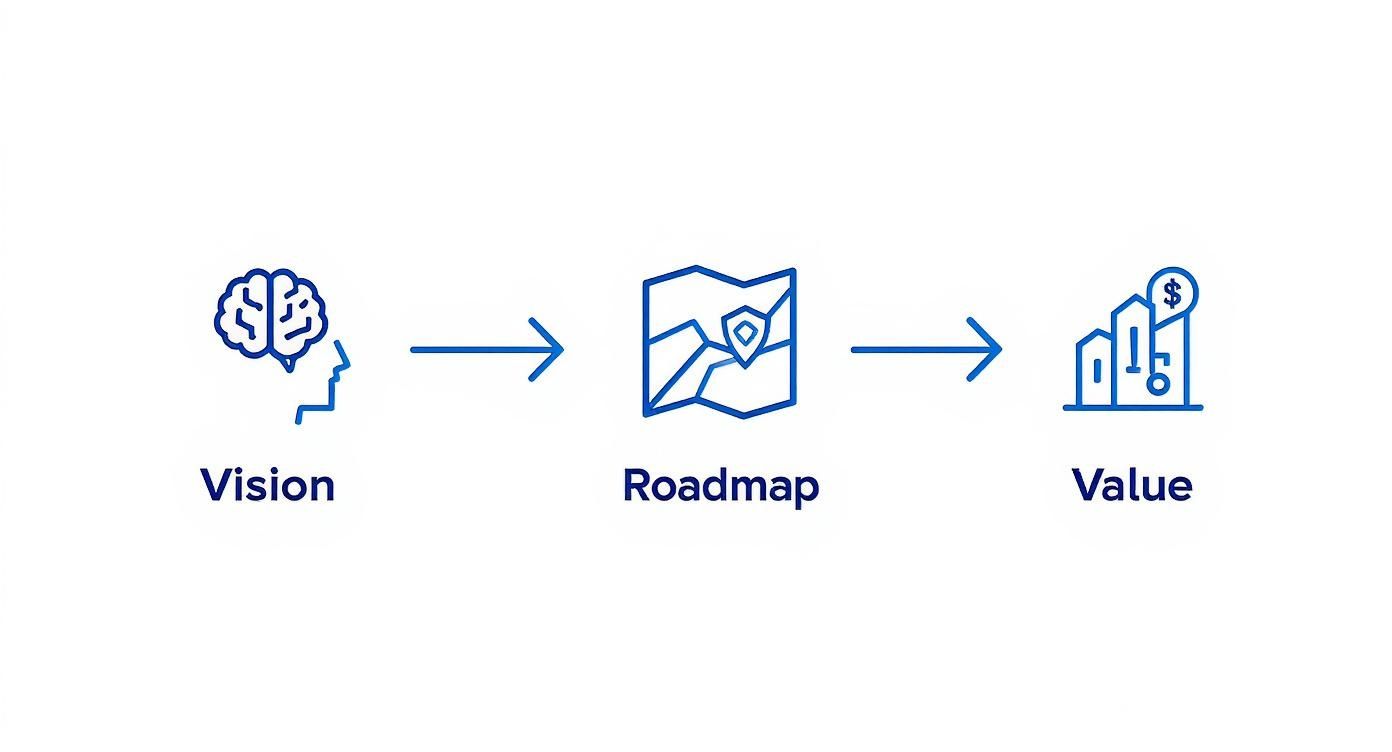
As you can see, each phase logically builds on the one before it. This step-by-step progression is designed to eliminate guesswork and give stakeholders a firm grip on the project's direction.
The Value of a Structured Process
Following a well-defined process isn't just about good project management—it’s about profitability. The global architectural services market was valued at a massive $360.8 billion in 2022 and is expected to climb to $549.6 billion by 2032. What's really telling is that roughly 70% of an architectural firm's revenue is generated in the early design and planning stages. This highlights just how critical these initial phases are to the financial success of the entire construction lifecycle.
A structured design process is your best defense against the classic project killers: scope creep, budget overruns, and mismatched expectations. It breaks down the immense complexity of construction into a predictable and manageable series of steps.
Before we dive into the details of each stage, here's a quick overview of what to expect.
The Six Phases of the Architectural Design Process
| Phase | Primary Goal | Key Outcome for Stakeholders |
|---|---|---|
| 1. Programming | Define what the building needs to do and be. | A clear project scope, budget, and list of requirements. |
| 2. Schematic Design | Explore initial design concepts and spatial relationships. | Basic floor plans, sketches, and a general sense of the building's look and feel. |
| 3. Design Development | Refine the design and specify major systems and materials. | Detailed drawings and specifications for stakeholder review and cost analysis. |
| 4. Construction Documents | Create the detailed technical "instruction manual" for construction. | A complete set of drawings and specs for bidding, permitting, and building. |
| 5. Bidding & Approvals | Select a contractor and obtain necessary permits. | A signed construction contract and official permission to start building. |
| 6. Construction Administration | Oversee the construction to ensure it matches the design. | A completed, quality-checked building ready for occupancy. |
This table provides a high-level roadmap of the journey from an idea to a finished building, highlighting the critical decision points for stakeholders at each step.
A Roadmap for All Building Types
This six-phase framework is incredibly versatile and applies to nearly any commercial project you can imagine. Whether you’re developing a sleek new office tower, retrofitting a historic warehouse, or planning a sprawling industrial park, the fundamental principles hold true. The process can also be adapted for specific construction methods, like understanding the nuances of a custom steel building design process.
Ultimately, this roadmap provides three essential benefits:
- Clarity: It forces everyone to agree on the project's goals and requirements right from the start.
- Accountability: Roles and responsibilities are clearly defined for every person involved.
- Risk Mitigation: Potential problems with the design, budget, or regulations are spotted early, when they're easiest to fix.
By understanding and embracing this process, you can steer your next commercial real estate project with confidence, knowing you have a proven system for turning architectural vision into measurable financial value.
Building the Strategic Foundation with Programming
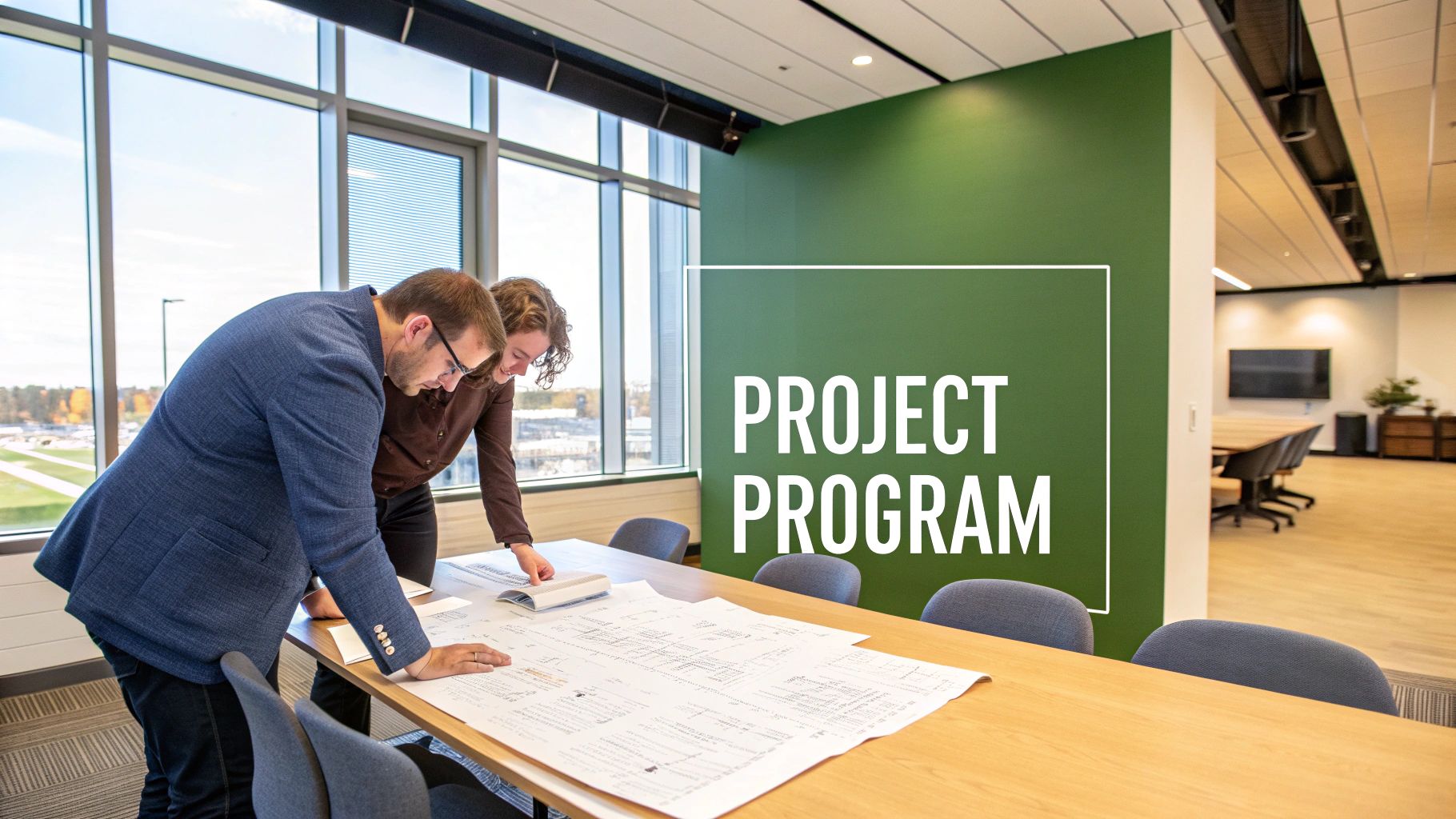
Before a single line is drawn, every great building starts with a conversation. This foundational phase is called Programming, or sometimes Pre-Design, and it’s where we essentially write the business plan for the building itself. It's a critical deep-dive where the architect and key stakeholders get together to figure out the project's "why" long before we get to the "what."
Think of it like developing a recipe before you even touch a mixing bowl. You wouldn't start baking without knowing the ingredients (who will use the space and how), the measurements (how much space they need), and the instructions (the budget and timeline). Programming is all about getting that recipe perfect to eliminate the guesswork.
During this phase, the architect acts more like an investigator, gathering and analyzing all the crucial data needed to create a comprehensive project brief—the official architectural program.
Key Discovery Areas in Programming
To build this solid foundation, architects dig into a few key areas:
- Stakeholder Interviews: We sit down with everyone who has a stake in the project—developers, investors, department heads, and even potential future tenants—to truly understand their goals, day-to-day operational needs, and what success looks like to them.
- Site Analysis: This involves getting to know the property inside and out. We look at the topography, where the access points are, how the sun moves across the site, and what existing infrastructure is in place. This helps us spot both big opportunities and potential roadblocks.
- Zoning and Code Research: Here, we dive headfirst into the maze of local regulations, land-use laws, and building codes. The goal is to get a crystal-clear picture of what's legally possible to build on that specific piece of land.
- Budget and Schedule Alignment: It’s all about a reality check. We work to establish financial parameters and a project timeline that actually make sense for the owner’s business goals and the current market.
You could argue this is the single most important part of the entire architectural design process. Why? Because it ensures every single design decision made later on is directly tied to clear, measurable business objectives.
For commercial real estate developers and investors, the Programming phase is your point of maximum leverage. The decisions made here have the biggest impact on project ROI and long-term operational efficiency for the lowest relative cost.
The Final Deliverable: An Architectural Program
The outcome of all this work isn't a drawing; it's a document. The architectural program is a detailed report that spells out the entire scope of the project. It usually includes a list of all required spaces, their approximate sizes, how they need to relate to each other functionally, and, of course, the overall project goals and budget.
This document becomes the strategic roadmap for the rest of the design journey. Getting it right from the start is the best way to prevent expensive changes down the road and ensures the architectural vision is perfectly aligned with the business vision from day one.
Turning Ideas into Concepts in Schematic Design
Once the programming phase has laid the strategic groundwork, the real fun begins. We move from the 'what' and 'why' to the 'how'—this is the Schematic Design phase, where abstract needs start to take on a physical form. It's easily the most creative and visually exciting part of the whole process.
Think of the program as a detailed recipe. Schematic design is like making the first rough draft of the dish. The architect starts sketching, building simple 3D "massing" models (which often look like digital blocks), and drawing up basic floor plans. The goal isn't to get bogged down in details but to get the big-picture relationships right.
Exploring the Core Design Questions
During this phase, the design team is wrestling with the fundamental questions that will define the entire project. It's all about establishing a clear direction by exploring:
- Spatial Relationships: How do the different spaces connect? Where are the main hallways and stairwells that people will use to move through the building?
- Site Integration: How does the building actually sit on the property? We're looking at its orientation to the sun, the best views, and where people will enter and exit.
- Scale and Form: What will be the building's overall size and shape? What will it generally look like from the outside?
This stage is all about iteration. The architect will likely sketch out several different concepts and present them to you and other stakeholders. This back-and-forth is critical; it ensures the design is heading in a direction everyone agrees with before a ton of time is spent fleshing it out.
The Role of Technology in Creative Exploration
New technology is making this creative loop faster than ever. The tools of the trade, especially architecture design software, are evolving constantly. For instance, new AI-powered tools are popping up that can take a single hand sketch and generate multiple detailed renderings almost instantly. This kind of tech, like the toolkit developed by SRI International, lets architects test more ideas in less time, helping them navigate complex projects and stay focused on the creative solutions.
Schematic Design is the first major go/no-go moment for stakeholders. This is your chance to validate the project's core direction and make high-impact choices before committing serious money to the next phases.
Key Deliverables and Stakeholder Decisions
The Schematic Design phase wraps up with a package of drawings that gives everyone a clear picture of the proposed design. It’s not the final blueprint by any means, but it’s more than enough to get stakeholder buy-in.
This package usually includes:
- A Site Plan: Shows exactly where the building will be placed on the property.
- Basic Floor Plans: Outlines the general layout and flow of the rooms inside.
- Key Elevations: Drawings of the main exterior walls to show the building's look and feel.
- Preliminary Building Sections: A few cross-section views to show things like floor-to-ceiling heights.
For anyone involved in the commercial real estate side, this is your moment. You'll confirm the concept fits market needs, aligns with the financial projections, and properly reflects the intended brand. Giving the green light on the schematic design means you're ready to start digging into the details.
Refining the Details During Design Development
Once the schematic design gets the green light, we move into what's known as Design Development, or DD. If the schematic was the broad-stroke sketch of the building, DD is where we start adding the color, texture, and real-world details. This is the critical stage where abstract ideas get hammered into a tangible, buildable reality.
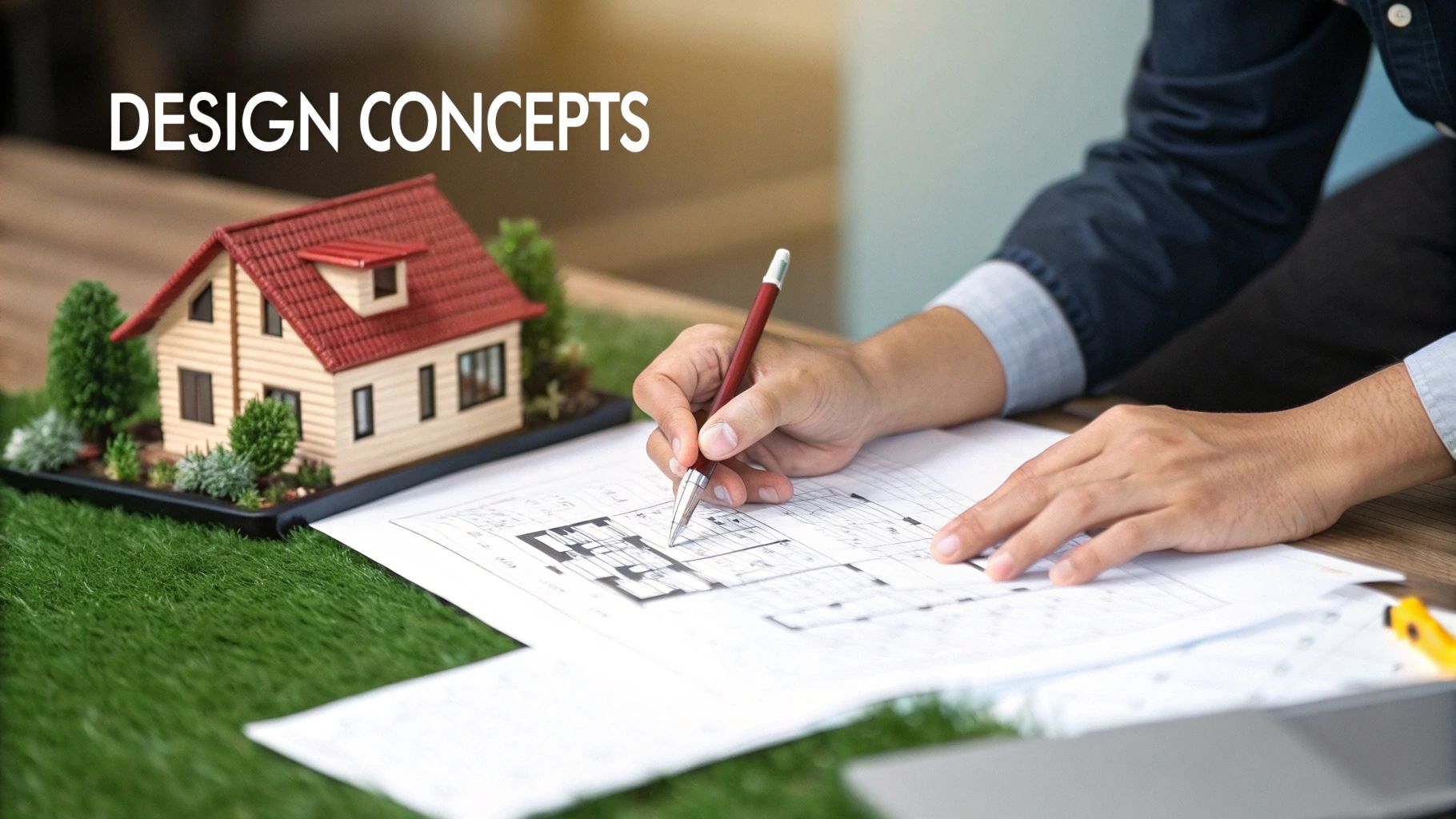
This whole phase is an exercise in intense coordination. The architectural team now works hand-in-glove with the engineers to weave the building’s essential systems into the design. Think of it like giving the building its vital organs—the structural frame is the skeleton, the plumbing is its circulatory system, the electrical wiring its nervous system, and the HVAC its respiratory system. They all have to fit and function together perfectly.
For commercial real estate stakeholders, the decisions made during Design Development have a direct and significant impact on three key areas: initial construction costs, long-term operational expenses, and the overall quality and marketability of the final asset.
From Concepts to Concrete Specifications
During DD, the level of detail skyrockets. Those general ideas about materials and systems from the last phase? They now become specific, researched selections. We stop talking in generalities and start defining exactly how this building will be constructed and what it will be made of.
Here’s a look at what’s happening on the ground:
- Material Selection: We go from "a brick exterior" to choosing a specific brick from a particular manufacturer, right down to its color, texture, and the mortar that will hold it together.
- System Integration: The engineers are finalizing their layouts. They’re figuring out where every structural beam, every foot of ductwork, and every plumbing line goes, running clash detection to make sure they don’t all try to occupy the same space.
- Detailed Drawings: Floor plans are sharpened with precise dimensions. The building elevations are updated to show the exact models of windows and doors we've selected.
- Interior Finishes: This is where we lock in the final choices for flooring, wall coverings, lighting fixtures, and all the other interior elements that shape the user experience.
The Stakeholder's Role in DD
As the owner or developer, your input here is crucial. The decisions get more technical, but they are all fundamentally tied to your budget and the building's future performance.
For example, the architect might present two HVAC options. One has a lower initial cost, but the other, more expensive system could deliver substantial energy savings over the building’s life, directly boosting your net operating income. That's a classic DD-phase decision.
The same goes for the exterior. Choosing a more durable, low-maintenance cladding might cost more upfront but will slash long-term repair and upkeep costs, protecting the asset's value. The architect’s job is to present these options clearly, often with cost-benefit analyses, to help you make the best investment decisions.
The goal is to walk away from the Design Development phase with a comprehensive set of drawings and specifications so detailed that a contractor can put a firm budget to it. This package represents a clear, coordinated vision of the final building, ensuring everything is aligned before we dive into the massive effort of creating construction documents.
4. Crafting the Blueprint: The Construction Documents Phase
After the whirlwind of decisions and coordination in Design Development, the process gets laser-focused. This is the Construction Documents (CD) phase, where every single choice we’ve made is translated into a precise, legally-binding set of instructions for the builder.
If the last phase was about refining the vision, this one is all about creating the instruction manual.
Think of it this way: DD gave us a detailed recipe, but the CDs are the full-scale culinary textbook. There’s absolutely no room left for guesswork. This final package consists of dozens—sometimes hundreds—of drawings, all paired with a massive specification book that details every last material, product, and installation method.
This isn't just about making a guide; it’s one of the most important risk management steps in the entire project. These documents become the backbone of the construction contract, giving contractors the exact information they need to provide solid, apples-to-apples bids. Getting this right prevents a world of hurt—and a lot of expensive change orders—down the road.
The Complete Instruction Manual
The ultimate goal here is creating construction drawings and specifications that are so clear, anyone can build from them. The final CD set is a masterclass in coordination, weaving together the work of the architects and every engineering consultant into a single, seamless package.
This comprehensive set typically breaks down into a few key parts:
- Architectural Drawings: These are the nitty-gritty plans, elevations, sections, and schedules. They specify everything from the exact construction of a wall to the model number of the door handles.
- Structural Drawings: This is the complete plan for the building’s skeleton. It includes every foundation detail, beam size, and steel connection point.
- MEP Drawings: The full schematic for the building’s circulatory and nervous systems—Mechanical, Electrical, and Plumbing. This shows all the ductwork, wiring conduits, and pipe runs.
- Project Specifications: Often called the "spec book," this is a detailed written document that goes hand-in-hand with the drawings. It outlines quality standards, installation requirements, and performance criteria for every single component in the building.
The level of detail in these documents evolves significantly from the early sketches. What starts as a simple outline becomes a fully articulated set of instructions.
Document Evolution Through Design Phases
| Document Type | Schematic Design (SD) | Design Development (DD) | Construction Documents (CD) |
|---|---|---|---|
| Floor Plan | Shows basic room layout and overall dimensions. | Adds wall thicknesses, door/window locations, and key fixture placements. | Includes precise dimensions, wall type tags, and detailed notes for construction. |
| Building Section | A simple cut-through showing floor heights and overall massing. | Details structural elements, ceiling heights, and major MEP systems. | Fully detailed with material callouts, insulation, and assembly connections. |
| Specifications | A brief outline of major materials and systems. | A more detailed spec book defining key products and quality standards. | A comprehensive, legally binding volume for every material and installation. |
As you can see, each phase layers on more information, moving from broad strokes to microscopic detail, ensuring the final set of documents is ready for the real world of construction.
How Modern Teams Get It Done
Pulling this all together is a monumental task, often requiring large teams of specialists working in perfect sync. The way architects work has changed, too. A 2020 industry survey showed just how much, with 39.1% of architects in a hybrid model and 34.8% working fully remote. This has only pushed the industry to get better at using technology to manage these complex workflows and keep everyone on the same page.
A complete and thoroughly coordinated set of Construction Documents is a project's best insurance policy. It ensures that the final asset delivered by the contractor perfectly matches the vision approved by the stakeholders, both on time and on budget.
Once this exhaustive set is complete, it goes through a final round of intense internal review. After it’s been checked and double-checked for accuracy and coordination, it’s ready for the next big milestone: submission to the local building department to secure the permits needed to finally break ground.
From Blueprint to Reality: Bidding, Approvals, and Construction
With the exhaustive construction documents finally in hand, the architect’s role shifts gears. We move from the world of pure design into the physical reality of building. This final leg of the journey is all about execution, and it’s where your architect becomes your chief advocate and quality enforcer on the ground.
This is where the rubber meets the road—transforming stacks of paper into a tangible, valuable asset.
First up is the Bidding and Approvals stage. The architect will guide you through the maze of selecting a contractor, making sure you get competitive bids that are actually comparable—an apples-to-apples review based on the detailed plans. At the same time, they'll be quarterbacking the submission of these documents to local authorities to secure all the necessary building permits. This is a non-negotiable legal step before a single shovel can hit the dirt.
Keeping the Project on Track with Construction Administration
Once you’ve hired a contractor and have the permits, the architect’s job transitions into Construction Administration. Don't mistake this for micromanaging the builder. Think of it as having your expert representative right there on the site, protecting your interests.
The architect’s focus now is to:
- Guard the Design Intent: They make regular site visits to see the work firsthand and make sure it’s being built exactly as specified in the drawings.
- Solve Problems on the Fly: Construction is unpredictable. When unexpected issues pop up, the architect is there to find solutions that won't compromise the design or blow the budget.
- Vet Materials and Methods: They review "submittals"—the specific materials, fixtures, and shop drawings the contractor proposes to use—to confirm everything meets the project's quality standards.
- Approve Payments: Before you cut a check, the architect reviews the contractor’s payment applications to verify that the work you’re paying for has actually been completed to spec.
This phase is arguably your most important quality control mechanism. It’s the safety net that protects your investment and ensures the final building is what you signed up for.
An architect's presence during construction isn't just another line item on the budget; it's an investment in risk management. Their job is to catch mistakes before they become expensive, solve problems, and champion quality, making sure the final asset is delivered exactly as envisioned.
By serving as the central hub for communication and clarification, the architect smooths out the construction process, heads off costly errors, and defends the project's vision from groundbreaking to the final walkthrough. This is what brings the entire architectural journey to a successful, tangible, and profitable conclusion.
Common Questions About the Architect's Design Process
Even with a solid roadmap, you're bound to have questions, especially if you're new to the architect's design process. Let's walk through some of the most common things we hear from commercial real estate stakeholders to give you a clearer picture of the journey ahead.
How Long Does the Design Process Take?
There’s no single answer to this one—it all comes down to the project's scale and complexity.
For a straightforward commercial interior fit-out, you might be looking at 2-4 months for the design phases. If you're planning a medium-sized new build, it’s more realistic to expect 6-12 months of design work before a shovel ever hits the ground.
Large, intricate projects can easily stretch into several years. The biggest variables are the speed of client approvals, how quickly the local jurisdiction moves on permits, and the sheer level of detail required. The best way to keep a project on schedule is to establish a rock-solid program upfront and make firm decisions during the early phases.
What Is the Owner’s Most Important Role?
Your most critical role is to be an active, decisive partner, especially in the early stages of Programming and Schematic Design. Kicking things off with a clear vision, a realistic budget, and a well-defined list of needs is what sets the entire project up for success. When we get into schematic design, your timely feedback is what prevents us from going down paths that lead to expensive changes later on.
As the owner, you are the ultimate decision-maker. Your ability to provide clear, consolidated direction is the single biggest factor in moving a project forward efficiently and ensuring we hit the target.
Simply put, your clarity and decisiveness are what fuel the project's momentum and protect your budget.
How Does BIM Improve the Design Process?
Think of Building Information Modeling (BIM) as creating a single, intelligent 3D digital twin of the project. This isn't just a pretty picture; it’s a game-changer for coordination.
BIM allows the entire team—architects, engineers, and consultants—to work within the same model. We can spot and resolve clashes digitally, like a plumbing line running through a structural beam, long before they become costly rework orders on the construction site.
For you, the owner, this means you get a much better feel for the space through realistic renderings and virtual walkthroughs. This clarity makes decision-making easier and more confident. It also leads to more accurate cost estimates from the get-go and gives you a valuable digital asset for managing the facility long after the doors open.
Navigating the architectural design process is a complex undertaking, but the right partner makes all the difference. At Sherer Architects, LLC, we guide clients through every stage with rigorous research and decades of experience, turning your vision into an enduring, valuable asset. Learn more about our collaborative approach.