
Calculating the cost per square foot of a commercial construction project is pretty straightforward in principle. You just add up every single project expense—from materials and labor to permits and design fees—and divide that grand total by the building's Gross Floor Area (GFA). But the devil, as they say, is in the details.
This figure is the foundational benchmark for budgeting almost any commercial project, giving everyone from investors to contractors a standardized way to compare apples to apples.
Understanding Per-Square-Foot Construction Costs
Before you can build an accurate budget, you have to get a real feel for what 'construction cost per square foot' actually represents. It’s not just a number on a spreadsheet; it’s a vital sign that reflects a project's location, complexity, and overall quality. Think of it as the financial pulse of your build—a quick but powerful snapshot of the investment you're looking at.
This single metric is the bedrock of financial planning in commercial real estate. It creates a common language for developers, architects, and contractors to talk about budgets. Whether you're trying to figure out if a new office tower is feasible or pricing out an adaptive reuse project, the per-square-foot cost is the universal starting point for every important conversation.
What Drives the Cost Per Square Foot
That final dollar figure is the result of a ton of different variables. Every single decision, from the type of structural steel you use to the light fixtures in the lobby, has a price tag attached. Understanding what drives these costs is the first real step toward building an estimate you can stand behind.
The main factors that can make this number swing wildly are:
- Building Type and Use: A simple, open-plan warehouse will always have a much lower cost per square foot than a sophisticated medical facility packed with specialized MEP (Mechanical, Electrical, and Plumbing) systems.
- Quality of Finishes: The difference between standard-grade carpet and high-end terrazzo flooring can be massive. These choices can easily double the cost for certain parts of a project.
- Project Complexity: A basic rectangular building on a flat, prepped lot is one thing. A uniquely designed structure on a tight urban site with challenging soil conditions is a whole different ballgame—and a much more expensive one.
- Geographic Location: Labor rates in New York City are not the same as in Omaha. Material availability, shipping costs, and local regulations all vary significantly from one city to another, hitting your bottom line directly.
As a general rule, commercial construction costs can range anywhere from $240 to $870 per square foot nationally as of 2024. Healthcare facilities are often at the top end, running from $450 to $1,020 per square foot thanks to strict regulations and the need for highly specialized medical systems.
You'll also see major regional differences. The Northeast is almost always the most expensive region to build in, while the South tends to be the most cost-effective. These numbers show that you can't just slap a single, uniform rate on a project; you have to dig into the specifics. You can discover more insights about average commercial construction costs to see how your project stacks up.
The table below breaks down the key factors that influence your per-square-foot costs and the kind of impact you can expect from each.
Key Drivers of Construction Cost Per Square Foot
| Factor | Description | Typical Impact on Cost |
|---|---|---|
| Building Type | The intended use of the building (e.g., office, retail, warehouse, medical). | High |
| Location | The geographic region, city, and specific site of the project. | High |
| Material Quality | The grade of materials and finishes specified (e.g., standard vs. luxury). | Medium to High |
| Project Complexity | The intricacy of the design, structural system, and site conditions. | Medium to High |
| Labor Rates | Prevailing wages for skilled and unskilled labor in the local market. | Medium |
| Site Conditions | The existing state of the land, including soil quality, topography, and access. | Low to Medium |
Understanding these drivers is crucial because they directly inform how you'll put together a realistic budget.
Key Takeaway: The cost per square foot isn't a fixed price—it's a dynamic budgeting tool. It's an average built from countless individual costs, and its real value comes from understanding the pieces that make it up.
By breaking down these primary cost drivers first, you create a solid framework for the more detailed calculations to come. This turns a fuzzy concept into a financial plan you can actually work with. With this foundation in place, we can move on to categorizing the specific expenses.
Building Your Cost Framework from the Ground Up
A reliable estimate starts with a solid framework for organizing your expenses. To get an accurate cost per square foot, you need a practical system for categorizing every dollar—it's the single best way to prevent costly oversights down the road.
Let's move past generic lists and group your project costs into three core buckets. Think of this as your master checklist, something you can use to gather detailed quotes and pull from your historical data. This structured approach helps you build a defensible cost basis before you even touch a calculator.
The three primary categories are:
- Hard Costs: The tangible, physical parts of the building.
- Soft Costs: The intangible but essential services and fees.
- Site Development Costs: All the work needed to get the land ready for construction.
Breaking Down Hard Costs
Hard costs are usually the most straightforward expenses. They represent the physical materials and labor that go directly into the building itself—the line items you can actually see and touch. This is the core of your construction budget.
For a typical commercial project, hard costs include things like:
- Structure: Concrete foundations, structural steel, and framing.
- Exterior: Roofing systems, windows, doors, and facade materials.
- Interior Finishes: Drywall, flooring, paint, ceilings, and millwork.
- MEP Systems: All mechanical, electrical, and plumbing infrastructure.
- Specialty Equipment: Elevators, built-in kitchen equipment, or manufacturing machinery.
You'll source these costs from subcontractor bids and material supplier quotes. While they're the easiest to quantify, remember they're also highly susceptible to market volatility and inflation.
Accounting for Soft Costs
While hard costs build the structure, soft costs are what make the project possible in the first place. These are the indirect, often intangible expenses needed to plan, design, and manage the whole process. Overlooking them is a common and very expensive mistake.
Soft costs are the "brains" of the operation. They represent the professional services and administrative hurdles you must clear before a single shovel hits the ground and long after the last nail is hammered.
Key soft costs to budget for include:
- Architectural & Engineering Fees: Payments to your design professionals.
- Permits & Inspection Fees: Costs paid to local authorities for approvals.
- Insurance: Builder's risk, general liability, and other necessary policies.
- Legal & Accounting Fees: Professional services for contracts and financial oversight.
- Project Management Salaries: If you have an in-house team managing the build.
These are often estimated as a percentage of total hard costs, but it’s always better to get direct proposals from each professional service provider to dial in your numbers.
Don't Forget Site Development
Site development costs cover everything required to prepare the land and hook it up to public services. For raw, undeveloped land, these expenses can be substantial and need to be accounted for separately from the building's direct hard costs.
To build a robust cost framework, it's essential to understand various pricing methodologies like cost-plus, unit pricing, and markup. Having a firm grasp on these concepts helps you better evaluate bids from excavation and landscaping contractors. You can explore a detailed guide to pricing in construction projects to sharpen your knowledge here.
Site development usually involves:
- Earthwork: Excavation, grading, and soil compaction.
- Utilities: Tapping into water, sewer, gas, and electrical lines.
- Paving & Landscaping: Driveways, parking lots, sidewalks, and greenery.
- Demolition: If an existing structure needs to be removed first.
These figures can vary wildly depending on the site's condition. A flat, clear lot will have minimal site costs, whereas a sloped, rocky site in a dense urban area will require a significant budget.
Finally, you have to factor in historical cost inflation. Material costs saw dramatic increases between 2018 and 2023, with escalation rates surging as high as 50-85 percent in 2023 alone. Labor costs followed different patterns but also saw steady increases. For instance, an industrial warehouse that costs $95-$139 per square foot in 2025 would have been substantially cheaper just two years prior due to these cycles. You can learn more about historical cost inflation trends to help you forecast more accurately.
Putting the Calculation into Practice with Real Scenarios
Theory is great, but the real test is applying these numbers to actual projects. Let’s dive into two very different commercial scenarios to see how this framework holds up in the wild. By comparing a brand-new build with an adaptive reuse project, you'll get a feel for how the core formula flexes to meet wildly different challenges.
First, it helps to visualize how the main cost buckets fit together. Think of it as a hierarchy of expenses that all funnel into your final number.
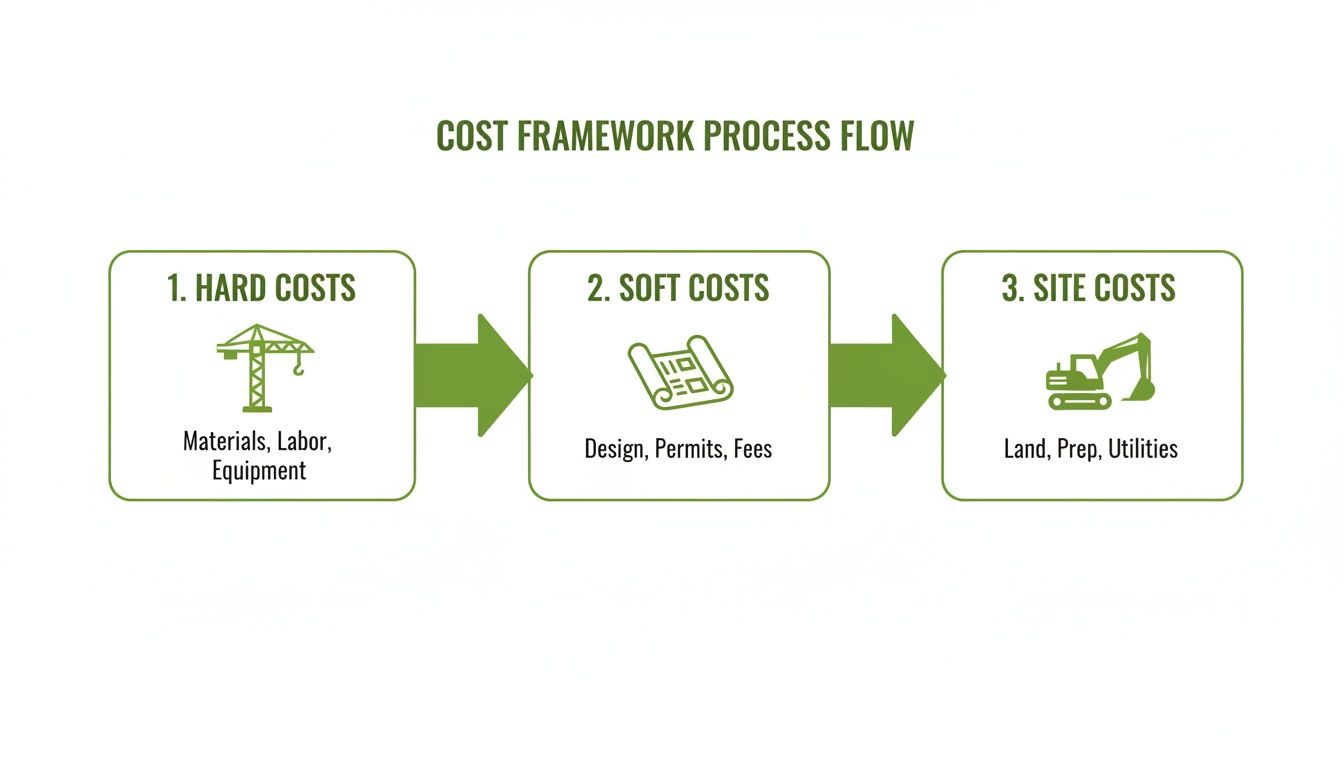
As you can see, the hard costs, soft costs, and site costs all come together to form the total project budget—the number we'll use to get our final per-square-foot metric.
Example 1: New Suburban Office Building
Let's say we're putting up a two-story, Class A office building in a suburban business park. The first thing we need to nail down is the project's Gross Floor Area (GFA). This is crucial—it includes all the space within the building's exterior walls, not just the leasable tenant areas.
- Building Footprint: 15,000 square feet
- Number of Floors: 2
- Total GFA: 30,000 square feet
With our GFA locked in, we can start plugging in some realistic numbers. A ground-up project like this on undeveloped land will have some serious site development costs, which we need to account for.
Let's Break Down the Costs:
- Hard Costs: This is the big one—the money for bricks and mortar. It covers everything from the foundation and steel frame to the rooftop HVAC units and interior finishes. For a modern 30,000 sq. ft. office, a solid hard cost estimate is $7,500,000.
- Soft Costs: These are all the professional services and administrative hurdles. We're talking architectural design, engineering, permits, legal fees, and insurance. A good rule of thumb is 25-30% of hard costs, so let's pencil in $2,250,000.
- Site Development Costs: Building on a raw suburban lot means major site work. This isn't just a line item; it's a huge part of the budget that covers earthwork, running utilities, paving a massive parking lot, and landscaping. We'll allocate a hefty $1,500,000 for this.
Now, we just add it all up to get our total project cost.
Total Project Cost = Hard Costs + Soft Costs + Site Costs
$7,500,000 + $2,250,000 + $1,500,000 = $11,250,000
Finally, the moment of truth.
Cost per Square Foot = Total Project Cost / GFA
$11,250,000 / 30,000 sq. ft. = $375 per square foot
This single number becomes an incredibly powerful benchmark for the project's financial feasibility from day one.
Example 2: Urban Warehouse Adaptive Reuse
Now for something completely different. Imagine we're converting an old, 20,000-square-foot urban warehouse into a high-end retail space. This kind of adaptive reuse project brings its own unique financial puzzle, with a heavy emphasis on demolition, structural upgrades, and sometimes even historic preservation.
The GFA is easy since we're working within an existing shell: 20,000 square feet.
Here, the cost profile flips. Site development is minimal—we've got the existing footprint and utilities. The hard costs, however, are where the complexity lies. We have to budget for selective demolition, potential asbestos or lead paint abatement, and major structural work to bring the old building up to modern code.
Let's Break Down the Costs:
- Hard Costs: The budget has to cover gutting the interior, beefing up the structure, installing brand-new MEP (mechanical, electrical, plumbing) systems, and adding premium retail finishes. A realistic budget here would be $4,000,000.
- Soft Costs: Designing for an adaptive reuse project is often more complex and requires specialized consultants to navigate the existing conditions. We’ll budget $1,400,000 to cover these expert fees and associated costs.
- Site Development Costs: We don't have to do much outside. Maybe some minor sidewalk repairs and utility tie-ins. A modest $100,000 should cover it.
Adaptive reuse projects often trade lower site development costs for higher hard costs related to demolition, remediation, and structural retrofitting. It's a different financial puzzle, but the same calculation principles apply.
Let's run the numbers for the total cost.
Total Project Cost = Hard Costs + Soft Costs + Site Costs
$4,000,000 + $1,400,000 + $100,000 = $5,500,000
And now for the final cost per square foot.
Cost per Square Foot = Total Project Cost / GFA
$5,500,000 / 20,000 sq. ft. = $275 per square foot
By walking through these two scenarios, you can see how the same simple formula gives you the power to analyze and compare vastly different projects. The magic isn't in the formula itself, but in building a detailed, realistic cost framework tailored to the specific DNA of each job.
How to Refine Your Estimate for True Accuracy
Your initial calculation is a great starting point, but let’s be honest—it’s just a draft. To turn that raw number into a budget that can withstand the pressures of a real project, you have to layer in some critical adjustments. This is where a good estimate evolves into a truly reliable financial forecast.
The process involves accounting for the variables that always come into play: location, time, and the inevitable unknowns. We'll walk through three essential refinements: regional cost adjustments, market escalation, and strategic contingency planning. Getting these right will give your budget the resilience it needs to hold up under scrutiny.
Adjusting for Regional Cost Differences
Construction costs are anything but uniform. The same office building that costs $350 per square foot in one city could easily run you $500 per square foot just a few hundred miles away. Why the huge gap? It all comes down to local labor rates, material availability, and even regional regulations.
To nail down a realistic local number, you need a location-based cost index. These indices give you multipliers that let you adjust a national average cost to your specific city or zip code. For example, if the national average index is 100 and your city's index is 115, you'd multiply your base estimate by 1.15. Simple, but crucial.
This isn’t a step you can afford to skip. Between 2020 and 2023, global construction markets saw massive cost swings. As of 2024, New York City remains the most expensive market in the world, averaging around $532 per square foot. That really drives home how vital it is to understand geographic disparities. You can dig deeper into global construction cost performance to see just how much markets can differ.
Factoring in Market Escalation
The price you calculate today is not the price you’ll pay six or twelve months from now. That’s a guarantee. The costs for materials, labor, and even fuel are always moving targets. Escalation is how you project these future cost increases to protect your budget from getting blindsided by market volatility.
To apply an escalation factor, you have to do some homework. Research current market trends for key commodities like steel, lumber, and concrete, and look at local labor wage forecasts. If industry analysts are predicting a 4% annual increase in construction costs and your project is on a one-year timeline, you should build that 4% right into your total estimate.
This is especially critical for long-term, multi-phase projects where the risk of inflation is much higher. Ignoring escalation is like planning a budget with yesterday's prices—it's a recipe for coming up short.
Planning for the Unexpected with Contingency
No project goes perfectly to plan. It's just the nature of the business. You might hit unforeseen rock during excavation, uncover hazardous materials in a demolition, or get hit with a week of non-stop rain. A contingency fund is your dedicated buffer, set aside specifically to cover these curveballs.
Contingency isn't "extra" money; it's a calculated buffer against risk. It’s the difference between a project that can absorb a surprise and one that gets derailed by it.
A standard contingency usually falls between 5% and 15% of your total hard and soft costs. The right percentage really depends on the project's complexity and risk profile:
- Low-Risk Projects (5-7%): Think simple new builds on a clear site with a complete set of design documents.
- Medium-Risk Projects (8-12%): This is more for renovations or projects with some design ambiguity or site challenges.
- High-Risk Projects (13-15%+): Reserved for complex adaptive reuse, historic preservation, or builds with significant unknown site conditions.
By layering in these three refinements—regional adjustments, escalation, and contingency—you transform a basic estimate into a sophisticated financial tool. Once these costs are dialed in, they also become invaluable for spotting opportunities. You can even explore practical operational cost reduction strategies with Excel and AI to find more ways to optimize your project's financial performance. This rigorous process is what separates an amateur guess from a professional, defensible budget.
Communicating Costs and Managing Expectations
Running the numbers is only half the battle. I've seen perfectly good projects go sideways simply because the costs weren't communicated effectively. The real test comes down to how well you can explain those numbers to clients, investors, and stakeholders.
An accurate calculation is useless if it creates confusion or mistrust. Think of your cost estimate not as a final figure, but as a tool for collaboration. When you get this right, you build confidence and manage expectations from the very first conversation, turning a potential source of conflict into a foundation for a successful partnership.
Build Trust Through Transparency
The cornerstone of any solid client relationship is trust. In this business, that trust is built on absolute transparency. Vague, lump-sum estimates just don't cut it—they breed suspicion and invite questions.
Instead, always provide a clear, line-by-line breakdown that shows exactly where the money is going. Walk your stakeholders through the major cost buckets: hard costs, soft costs, and site development. Don't just show them the numbers; explain the why behind them. For instance, point out how much of the budget is allocated to high-performance MEP systems or specific exterior finishes. This connects the cost directly to the project's quality and long-term goals.
This level of detail does two critical things:
- It justifies the numbers. By showing your work, you demonstrate that your estimate is based on solid research and real-world data, not just a guess.
- It educates the client. Many clients simply don't understand the sheer complexity of construction costs. A detailed breakdown helps them see the true value they're getting for their investment.
Frame the Estimate as a Cost Range
Here’s a piece of advice that has saved me countless headaches: never present a single, rigid number in the early stages. A fixed price can set a dangerously firm expectation in a client's mind. The moment you give them a hard number, that becomes the benchmark, leaving zero room for the inevitable realities of construction.
Present your initial estimate as a cost range. So, instead of saying the project will cost $5,000,000, frame it as, "We're projecting a total cost in the range of $4.8 million to $5.2 million."
Pro Tip: A cost range immediately introduces the concept of variability and sets a realistic tone from day one. It tells the client you have a strong handle on the numbers, but that unforeseen factors can and will arise. This simple shift in language builds in crucial flexibility.
This approach provides a psychological buffer. It prepares the client for potential fluctuations and makes future conversations about change orders or unforeseen site conditions much, much smoother.
Justify the Contingency Fund
The contingency fund is probably the most misunderstood line item in any construction budget. Clients often see it as "extra" money or padding, which can lead to pushback. Your job is to reframe it as what it truly is: an essential risk management tool.
You have to explain that the contingency is there to protect the project from the unknowns inherent in any build. Use concrete examples they can easily grasp.
- "This 10% contingency is our protection against things we can't see yet, like hitting unexpected rock during excavation or dealing with a sudden spike in steel prices."
- "Without this fund, a single surprise could force us to make cuts elsewhere, potentially compromising the quality of the finishes or delaying the entire schedule."
When you justify contingency with real-world scenarios, it stops being a questionable expense and becomes a shared safety net protecting everyone's interests. It shows you’re not just an estimator but a strategic partner who anticipates and plans for risk.
Make the Per-Square-Foot Cost a Dynamic Tool
Finally, it’s vital to communicate that the cost per square foot is a dynamic budgeting tool, not an unchangeable price tag carved in stone. It's a benchmark, an average derived from countless variables that we can influence.
Explain that this number can shift based on decisions made throughout the design process. If the initial per-square-foot cost comes in higher than their target, you can use the detailed breakdown to explore options together.
For example, you could open a dialogue like this:
- "Our current finish package is contributing $35 per square foot to the total. If we need to find some savings, we could explore alternative flooring and lighting that might save $5 per square foot without sacrificing the overall aesthetic."
This collaborative approach empowers the client, giving them a degree of control over the final cost. It reinforces your role as a problem-solver and turns a tense budget discussion into a productive workshop. When you communicate costs this effectively, you build the trust and alignment needed to guide any project to a successful conclusion.
Digging Deeper: Common Questions on Construction Costs
Even with a clear process, a few key questions always come up when you start running the numbers. Let's tackle some of the most common ones I hear from clients to help you nail down your budget.
What's The Real Difference Between Hard Costs and Soft Costs?
Think of it this way: Hard costs are everything that physically goes into the building—the tangible stuff. We're talking about steel, concrete, lumber, drywall, and all the labor needed to put it together. If you can walk up and touch it as part of the finished structure, it’s a hard cost.
Soft costs, on the other hand, are all the essential but non-physical expenses. This bucket includes things like architectural and engineering fees, city permits, legal services, and project insurance. They're absolutely critical to getting the project off the ground, but they don't become part of the actual building itself.
How Should I Handle Tenant Improvement Allowances?
A Tenant Improvement (TI) allowance is the budget you give a tenant to customize their space. When you're calculating your base building cost per square foot, you need to pull that TI number out completely.
Why? Because TI costs are all over the map. One tenant might need a simple open-plan office, while another wants a high-end restaurant kitchen. Including TIs in your core building cost will skew your numbers and make it impossible to compare your project apples-to-apples with other buildings.
Instead, calculate your base building cost first. Then, add the TI allowance (often quoted per square foot, like $50/sq ft) back in as a separate line item to see the full financial picture.
A Pro Tip: Keeping the base building cost separate from the TI cost gives you a clean, accurate metric for the core and shell. This is a much more reliable way to track costs and benchmark against other projects.
Can I Trust Those Online Construction Cost Calculators?
Honestly, not for anything serious. Online calculators are fine for a back-of-the-napkin guess at the very, very beginning. But they are far too generic for real-world budgeting.
These tools almost never account for the factors that truly drive costs:
- Site Conditions: What if your site has terrible soil or a steep slope? The calculator won't know.
- Design Complexity: A simple box costs less than a building with complex curves and unique features.
- Local Market: Is there a local labor shortage? Are material costs spiking in your city?
- Quality of Finishes: The difference between standard and high-end materials is massive.
Use them for a ballpark figure to see if a project is even in the realm of possibility, but never, ever use them to make a financial decision. A detailed, bottoms-up estimate is the only path to a budget you can actually rely on.
My Contractor's Bid Is Higher Than My Estimate. What Gives?
It’s completely normal for a contractor’s bid to come in differently than your own calculation—in fact, you should expect it. The key is to understand why.
Usually, the discrepancy comes down to a few things. First, their bid always includes their overhead and profit (O&P), which you might have overlooked. Second, they have boots-on-the-ground pricing from their subcontractors that is more current than any database you're using.
Finally, a good contractor might have spotted a potential construction challenge in the plans that you missed. Don't just look at the final number; ask for a detailed breakdown and compare it line-by-line with your estimate. That's how you uncover the differences and get to a truly accurate budget.
At Sherer Architects, LLC, we believe a well-managed budget is the foundation of a successful project. With decades of experience in commercial architecture, adaptive reuse, and historic preservation, we guide clients through every financial detail, ensuring your vision is realized beautifully and responsibly. Partner with us to bring structure to your life's work. Learn more at https://shererarch.com.