
You can’t design a great building by accident. The most successful, memorable, and valuable properties are always the product of deliberate choices, guided by a set of foundational design principles.
Think of these principles not as rigid rules, but as the architect's essential toolkit. They're the proven concepts used to arrange space, shape form, and select materials in a way that creates value far beyond what’s on the blueprint. For developers, owners, and investors, grasping these ideas is the first step in turning a good project into a great one.
Unlocking Value Beyond the Blueprint
These principles are the invisible forces that dictate how we feel and function within a space. They govern everything from the intuitive flow of people through a hotel lobby to the sense of calm in a well-lit office. When handled with skill, they produce buildings that aren’t just beautiful, but are also efficient, profitable, and enduring assets.
The Business Case for Architectural Principles
Why should a developer care about abstract ideas like rhythm or proportion? Because they have a direct and measurable impact on your project's financial success. Learning to speak this language helps you have more productive conversations with your design team and make smarter, more informed decisions from the very beginning.
Let's translate these core ideas into tangible business outcomes:
- Enhanced Marketability: A building with a strong sense of balance and unity simply has more curb appeal. It stands out, attracts higher-quality tenants, and can often command premium lease rates.
- Improved User Experience: Smart application of circulation and daylighting creates environments where people genuinely want to spend time. This can boost employee productivity in an office or encourage customers to linger longer in a retail space.
- Increased Longevity and Value: Incorporating principles like sustainability and context lowers operating costs over the building's life and ensures it remains a relevant, valued part of its community for decades to come.
A building is more than just shelter; it's an investment in the community and a reflection of its owner's vision. The principles of architectural design are the tools we use to ensure that investment pays dividends in functionality, beauty, and financial return.
This guide is designed to pull these concepts out of the textbook and show you how they work in the real world. We’ll explore how architects use balance, scale, hierarchy, and other key principles to solve real-world challenges in commercial new builds, adaptive reuse projects, and historic preservation.
By the end, you'll have a practical framework for understanding how thoughtful design is one of the most critical drivers of your return on investment. It’s time to stop seeing architecture as a line-item expense and start seeing it as your most powerful tool for creating lasting value.
The Eleven Core Principles of Architectural Design
To turn a set of blueprints into a high-performing, valuable asset, architects work with a foundational set of concepts. These eleven core principles of design in architecture aren’t abstract academic rules; they are the practical, hands-on tools we use to shape how a building feels, how it works, and ultimately, how it succeeds as an investment. Getting a handle on this vocabulary is the first step toward a more effective and profitable collaboration.
Think of these principles as the underlying grammar of a building. Just as sentence structure gives meaning to words, these principles give purpose and clarity to steel, glass, and concrete. They’re the invisible forces that guide a visitor intuitively through a space, create a sense of belonging, and ensure a building works in harmony with its surroundings.
This map illustrates how these principles connect the three pillars of any successful project: appeal, function, and profit.

As you can see, every design choice has a ripple effect. A building’s aesthetic appeal is directly tied to its functional efficiency and, by extension, its financial viability.
Balance and Proportion
Balance in architecture is all about creating visual equilibrium. It's how we distribute the visual weight of different elements—like windows, columns, and materials—to create a feeling of stability and restfulness. A balanced design just feels right. It feels intentional and solid, much like a well-structured business plan. This can be achieved in two main ways:
- Symmetrical Balance: This is the classic, formal approach where elements are mirrored on either side of a central line. Think of government buildings or historic estates—they convey a sense of order and tradition.
- Asymmetrical Balance: Here, we achieve equilibrium using different elements that have equal visual heft, resulting in a more dynamic and modern composition.
Closely tied to this is proportion and scale, which focuses on the size of different elements relative to each other and, most importantly, to the human body. Good proportion is what makes a grand hotel lobby feel welcoming rather than overwhelming, or an office feel comfortable instead of cramped. It’s the principle that makes a space just feel right.
Hierarchy and Rhythm
Hierarchy is the art of telling people what to look at first. It’s about creating visual importance to guide attention to the most critical elements, like the main entrance of a commercial building or the central atrium of a hotel. We use size, color, and placement to establish a clear visual path, making navigation completely intuitive.
From hierarchy flows rhythm, which is the organized repetition of elements throughout a design. You can think of it as the building's pulse. Rhythm is created by repeating windows, columns, or structural bays, establishing a pattern that guides the eye and creates a powerful sense of order and coherence. It’s what turns a collection of separate parts into a unified whole.
Good architecture is like a good story—it has a clear beginning (hierarchy), a consistent pace (rhythm), and a satisfying sense of completeness (unity). Every element serves the larger narrative of the building.
Contrast and Unity
Contrast is a powerful tool for creating visual interest and highlighting important features. We can achieve it by placing different materials, colors, or forms next to each other—a classic example is pairing the rough, historic brick of an old warehouse with sleek, modern glass in an adaptive reuse project. Contrast keeps a design from becoming monotonous and helps define distinct zones within a building.
The ultimate goal, however, is always unity. This principle ensures that all the individual parts of the design work together to form a cohesive, harmonious whole. You know you’ve achieved unity when balance, rhythm, and contrast are all working in concert, creating a building that feels complete and resolved.
Circulation and Context
Circulation is simply how people move through, and around, a space. It’s the building’s circulatory system, dictating the flow from the entrance to lobbies, down hallways, and into individual rooms. Getting this right is absolutely critical for functionality. Efficient circulation prevents bottlenecks in a busy office and ensures an intuitive, pleasant journey for customers in a retail store.
Of course, a building never exists in a vacuum, which is where context comes in. This principle involves designing in response to the building’s unique surroundings—the climate, the landscape, the local culture, and the neighboring structures. A design that respects its context feels like it truly belongs, enhancing the character of the entire streetscape rather than disrupting it.
Sustainability and Materiality
Sustainability is no longer a nice-to-have; it's a core principle guiding all responsible modern architecture. It’s about designing buildings that are energy-efficient, use ethically sourced materials, and minimize their environmental footprint. From orienting a building to maximize natural light to incorporating green roofs, sustainable choices reduce long-term operational costs and significantly increase asset value.
This is directly tied to materiality—the thoughtful selection and application of materials. It’s about choosing materials not just for their aesthetic qualities but also for their durability, performance, and environmental impact. The principle of honest material expression, a key tenet of Modernist architecture, rejected superficial decoration in favor of showcasing the raw truth of materials like concrete and steel. After World War II, this philosophy fueled a construction boom where Modernist designs made up 60% of new builds, using materials that slashed costs by 40%. You can learn more about how these modernist principles were developed on ModernSanDiego.com.
Finally, daylighting is the specific practice of designing spaces to take full advantage of natural light. It’s so much more than just placing windows; it involves shaping rooms, choosing the right kind of glass, and adding features like light shelves to draw sunlight deep into the building’s core. Buildings with ample daylight are proven to improve occupant well-being and productivity while dramatically cutting electricity costs.
How Core Architectural Principles Drive Project Value
Understanding these principles isn't just an academic exercise. For developers and building owners, each one translates directly into tangible, bottom-line benefits that enhance a property's marketability, efficiency, and long-term value.
| Design Principle | Core Concept Analogy | Impact on Commercial Value |
|---|---|---|
| Balance | A well-structured business plan | Creates a sense of stability and quality, boosting perceived value and tenant confidence. |
| Proportion/Scale | A perfectly tailored suit | Ensures spaces feel comfortable and usable, improving tenant satisfaction and reducing vacancy rates. |
| Hierarchy | A clear website navigation menu | Makes a building intuitive to navigate, enhancing user experience and drawing focus to high-value areas like main entrances. |
| Rhythm | The steady beat in a piece of music | Creates a cohesive and orderly look, which makes the property feel more premium and well-managed. |
| Contrast | A spotlight on a stage actor | Generates visual interest and can highlight unique features or amenities, making the property more memorable and marketable. |
| Unity | A high-performing team | Ensures all design elements work together, resulting in a stronger brand identity and a more resolved, valuable asset. |
| Circulation | A city's traffic grid | Optimizes flow and prevents congestion, directly improving operational efficiency, especially in retail or office settings. |
| Context | A good neighbor | Creates a building that "fits in," often speeding up approvals and increasing community goodwill and long-term property value. |
| Sustainability | A high-yield, low-risk investment | Reduces operational costs (energy, water), attracts eco-conscious tenants, and future-proofs the asset against regulations. |
| Materiality | The quality of ingredients in a gourmet meal | Influences durability, maintenance costs, and aesthetic appeal. High-quality materials signal a premium, long-lasting investment. |
| Daylighting | A natural productivity tool | Lowers electricity bills and is proven to boost employee productivity and well-being, a key selling point for office tenants. |
Ultimately, these principles are the bridge between a good idea and a great investment. When applied with skill and experience, they transform a structure from a simple collection of spaces into a thriving, valuable, and successful place.
Designing Commercial Spaces That Perform
When we talk about commercial architecture, design principles aren't just about making a building look good—they're powerful business tools. A building that truly performs is one where every choice, from the window placement to the hallway width, is a direct investment in its long-term financial health. The gap between an average commercial property and a high-value asset is often bridged by the strategic use of these core concepts.
At the heart of it all is a deep understanding of how people move, work, and interact within a space. A developer's vision for a profitable, desirable property only comes to life when an architect skillfully manipulates light, flow, and form. This is where theory turns into a tangible return on investment.
Circulation: The Unsung Hero of Tenant Satisfaction
Think of circulation as the building's central nervous system. It dictates how efficiently and pleasantly every single person moves through the space, from the front door to their desk to the breakroom. In an office, poor circulation creates constant, low-grade friction—cramped hallways, confusing layouts, or long, winding paths to meeting rooms. These small daily frustrations add up, dragging down productivity and employee morale.
On the flip side, a design with intuitive circulation creates a seamless, almost invisible experience. Clear pathways, logical groupings of departments, and well-placed common areas don't just ease foot traffic; they actively encourage collaboration and make the workplace a more enjoyable place to be. For a developer, this translates directly to happier tenants, which means higher retention rates—a critical metric for any stable real estate investment.
In commercial architecture, a great design solves problems before tenants even know they exist. Efficient circulation isn't a luxury; it's a fundamental component of a building's performance and profitability.
Daylighting: A Tangible Asset
More than just a buzzword, daylighting is one of the single most impactful ways to boost a commercial building's value. Study after study confirms that ample natural light dramatically improves employee well-being, focus, and productivity. For companies competing to attract and retain the best people, an office flooded with daylight is a serious competitive edge.
From an owner's perspective, the benefits are two-fold. First, maximizing daylight slashes operational costs. A building intelligently designed to capture sunlight can see a huge reduction in its electricity bills for lighting and even heating. Over the life of a building, those savings are massive. Second, properties known for their bright, airy interiors can command premium lease rates. This is why a comprehensive guide to office space planning and design is so essential; it merges these aesthetic and functional principles into a profitable whole.
A Practical Scenario: New Office Construction
Let's walk through how these ideas come together in the development of a new suburban office building. Applying the principles of design in architecture from the very beginning is what separates a successful project from a struggling one.
-
Context and Site Orientation: Before a single line is drawn, the architect analyzes the site. The building gets oriented to maximize southern exposure for passive winter heating, while features like overhangs are used to block the harsh summer sun. This one decision, made at zero cost, sets the stage for decades of energy savings.
-
Hierarchy and Circulation Planning: The main entrance is given a clear hierarchy with a prominent canopy and a welcoming lobby, immediately making a strong first impression. Internally, the layout is built around a central "spine" for clear circulation, with departmental "neighborhoods" branching off to create a mix of collaborative zones and quiet heads-down workspaces.
-
Unity and Materiality: A cohesive palette of durable, sustainable materials is chosen. The exterior might combine locally sourced brick with high-performance glass, creating a design that respects its context while signaling modern efficiency. This unified materiality also simplifies long-term maintenance, saving money down the road.
-
Flexibility and Scale: The interior floor plates are designed with a human scale in mind, avoiding those vast, impersonal open-plan deserts. Critically, they are also planned for flexibility. The structural grid is set up to allow future tenants to easily reconfigure layouts, which future-proofs the building and broadens its appeal to a much wider market.
By weaving these principles together, the finished product is far more than just a structure. It’s an efficient, desirable, and profitable asset engineered for long-term performance.
Breathing New Life into Old Buildings with Adaptive Reuse
Adaptive reuse is where a building’s past and future collide—in the best possible way. Instead of sending a wrecking ball into a structure that’s outlived its original job, we find a new purpose for it. This isn't just a facelift; it's about turning an old warehouse, factory, or school into a modern hub of activity, all while keeping its soul intact.
This kind of work is a masterclass in applying the principles of design in architecture to start a conversation between what a building was and what it’s about to become.
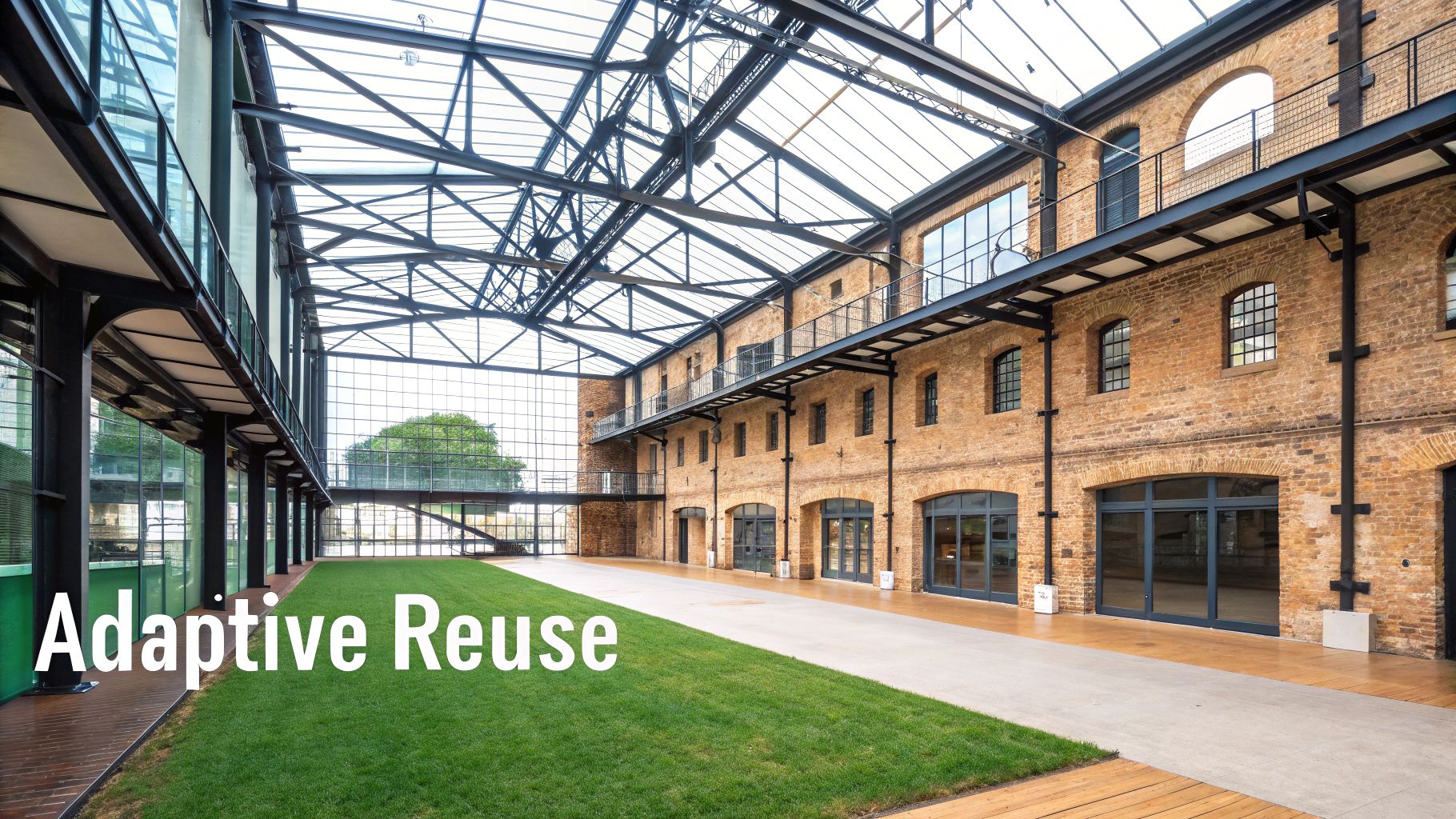
It requires a delicate touch. The idea isn’t to erase a building’s history but to weave it into a fresh, functional story. To get this balance right, we rely heavily on principles like contrast, context, and materiality.
Blending Old and New with Contrast and Materiality
One of the most effective tools in our belt is contrast. Think about the rugged, time-worn brick of an old factory set against sleek, minimalist glass and steel. This isn’t a clash; it’s a dialogue. The modern elements actually make you appreciate the beauty and authenticity of the old, and the historic shell gives the new additions a sense of place.
This brings us right to materiality. A great project respects the building’s original palette—the aged wood beams, the exposed concrete floors, the unique patina on old metal. An architect’s job is to choose new materials that complement this history without trying to fake it.
Take the conversion of a historic textile mill into residential lofts:
- Original Materials Honored: The massive timber columns and sprawling brick walls aren't covered up; they become the main event. Their texture and story are put on full display.
- New Materials Introduced: Modern kitchens with polished quartz countertops and stainless steel appliances are slid in like clean, functional "pods" inside the historic frame. The contrast makes both the old and new shine.
The soul of an adaptive reuse project lies in its honesty. It’s about clearly distinguishing between the building's original story and the new chapter being written, allowing both to coexist beautifully.
Respecting the Building’s Rhythm and Context
Every old building has its own natural rhythm, a pattern set by its structural columns, its window openings, its roofline. A huge part of successful adaptive reuse is listening to that rhythm and designing with it, not against it. If you fight it, the new design will always feel awkward and out of place.
For instance, when carving up an old warehouse, new interior walls should align with the existing column grid. New windows should follow the size and spacing of the originals. It’s this kind of respect for the building’s bones that creates a seamless sense of unity.
The principle of context also gets a bigger spotlight here. The project has to respect not just its own history, but its place in the neighborhood. A thoughtful adaptive reuse project can be the spark that revitalizes an entire district, preserving architectural character while injecting new energy. It becomes an anchor connecting a community's past to its future.
The Financial and Sustainable Case for Reuse
Beyond the history and aesthetics, adaptive reuse is just plain smart. It’s an economically and environmentally sound alternative to the incredible waste of demolition and new construction.
Done right, these projects can extend a building's useful life by 50–75 years and often cost 30-50% less than building new. The green credentials are just as impressive, with studies showing they can produce up to 70% lower embodied carbon than a new build. To dig deeper into the data, you can find great information on the principles of modernism and sustainability.
By thoughtfully applying the core principles of design in architecture, we can unlock the enormous potential sitting in our existing buildings, creating spaces that are rich with character, financially viable, and good for the planet.
Navigating Historic Preservation with Purposeful Design
Historic preservation puts architectural principles to their toughest test. You aren't starting with a blank slate; you're entering into a conversation with the past. Every decision becomes a delicate balancing act, weighing a deep respect for a building's story against the real-world needs of today. The goal is to turn these historic structures into protected, valuable assets for generations to come.
This work is so much more than patching up old walls. It’s about using the core principles of design in architecture as a guide for making interventions that are both sensitive and, ideally, reversible.
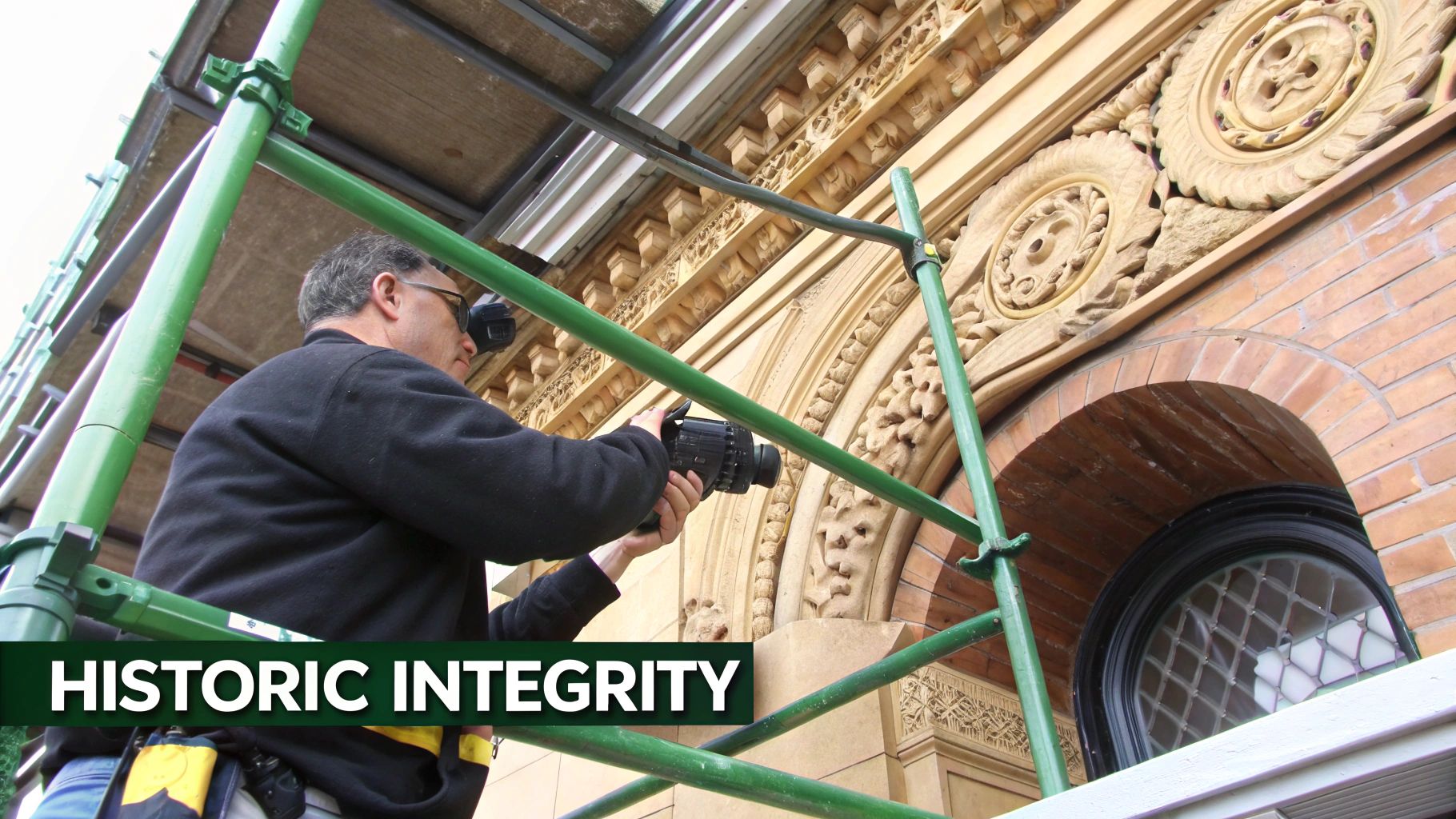
Here, principles like proportion, scale, and unity aren't just about making things look good. They’re about preserving the building's soul—its fundamental character and historical integrity. The aim is to ensure any new work feels like it truly belongs, without ever resorting to a cheap copy.
Maintaining Integrity Through Proportion and Scale
In preservation, proportion is the golden rule. It’s about getting inside the head of the original designer to understand their intent, from the height of a window to the span of a doorway. The ancient Greeks were masters of this. Their classical structures, like the Parthenon, were built with mathematical precision, using a modular 'foot-unit.' In fact, over 70% of their temples followed strict geometric ratios, often with deviations of less than 1%.
When we introduce something new—a modern staircase, an accessible entrance—it has to respect this established visual language. If a new addition is out of scale, it can completely overwhelm the historic features and shatter the building's harmony. A skilled architect will design new elements to be subservient to the original structure, making sure the building's story always remains the main event.
The Role of Materiality and Unity
Materiality in historic preservation is part detective work, part artistry. It starts with digging in and researching the original materials and construction techniques. This is crucial for a few big reasons:
- Authenticity: Using historically appropriate materials—or modern equivalents chosen with extreme care—is essential for maintaining the building’s authentic feel.
- Compatibility: Old buildings settle and breathe in ways modern ones don't. Slapping a rigid modern mortar on soft, historic brick, for example, is a recipe for long-term damage.
- Reversibility: One of the core tenets of modern preservation is that any new work should be removable in the future without harming the original fabric. This gives future generations the chance to make their own informed choices.
This careful selection of materials is what ultimately creates unity. It’s what ensures the entire building, old and new, reads as a single, cohesive story. Every design choice gets filtered through one question: what best serves the building’s history? The result is a project that feels resolved and whole.
In historic preservation, the architect's ego takes a back seat. The building itself is the primary client, and our job is to listen to its story and ensure it can be told for centuries to come.
Connecting Design to Financial Incentives
Thoughtful design in preservation isn't just about being a good steward of history; it’s a smart business strategy. Getting your project through the complex maze of approvals from Design Review Boards and State Historic Preservation Offices depends entirely on proving you understand and respect these principles. For anyone navigating the specific rules for historic sites, a practical guide to listed building renovation can offer invaluable insight.
A well-researched, sensitive design is what unlocks significant financial incentives. Programs like Federal and State Historic Tax Credits can offset a huge chunk of rehabilitation costs, turning what looks like a challenging project into a financially sound investment. In the end, expert guidance is what transforms historic properties from potential liabilities into cherished, high-value assets.
Got Questions? Let's Talk Design.
Even when you've got a handle on the concepts, turning architectural principles into a real-world project brings up a lot of practical questions. As a developer, investor, or property owner, you're rightfully focused on the bottom line. Here are some of the most common questions we hear, with straight answers that connect design theory to project outcomes.
How Do Architectural Design Principles Actually Affect My ROI?
This is the big one, and the answer comes down to one word: value. Good design isn't just about aesthetics; it's a core driver of a building's financial performance. For example, smart daylighting and sustainability strategies can slash a building's annual energy costs by 25-35%. That's a direct, measurable return.
Beyond that, think about user experience. Principles like circulation and hierarchy aren't abstract ideas—they're what make an office building a place people want to work in or a retail space that keeps customers coming back. Better experience means higher tenant satisfaction, which leads to lower vacancy and better retention rates.
A well-designed building isn't just an expense; it's a high-performing asset. It commands higher rents, holds its value longer, and stands out in a crowded market. These principles are a direct investment in your project’s long-term health.
The financial case gets even clearer with specialized projects. In adaptive reuse and historic preservation, a skillful application of context and proportion is often the key to unlocking historic tax credits—a powerful tool that can cover a huge chunk of your renovation costs.
Which Principle Matters Most for an Adaptive Reuse Project?
While they all work together, context and materiality really take center stage in adaptive reuse. You have to get these two right.
Context is all about respecting the building’s past and its place in the neighborhood. Getting this right is critical for winning over historic review boards and the local community. It shows you understand the building's story.
Materiality is about the tactile blend of old and new. It’s about celebrating the original brick, timber, or steel while weaving in modern systems so they feel like they belong. This is what gives adaptive reuse projects their unique character and market value—something brand-new construction struggles to replicate. You're not erasing history; you're adding the next chapter.
Can Good Design Really Make It Easier to Get Through Review Boards?
Absolutely. In fact, it's one of your best tools. Zoning commissions and design review boards are there to make sure new projects are a net positive for the community. When you present a plan that clearly uses principles like scale, proportion, and context, you're showing them you've done your homework.
Your design is proactively answering their biggest questions. It demonstrates how the building will fit in, manage traffic flow, and improve the streetscape. This approach speaks a language of quality and community respect that streamlines approvals and saves you an incredible amount of time, money, and headaches.
Isn't Implementing Strong Design Principles Just More Expensive?
That’s a common myth. The real expense comes from poor design—things like inefficient layouts that waste square footage, high long-term operating costs, and a building that just doesn't attract tenants.
Strong design is about making smart decisions upfront, not just throwing money at fancy finishes.
- Simple decisions, big impact: Orienting a building to maximize natural light costs nothing extra in the planning stage but can save thousands in energy bills down the road.
- Skill over spending: Creating a sense of good proportion and scale is about the masterful arrangement of elements, not necessarily about using the most expensive materials.
- Thinking long-term: While some sustainable materials might have a higher initial price tag, their durability and energy efficiency deliver a lower total cost of ownership, generating savings year after year.
Investing in thoughtful architecture from the get-go is one of the most cost-effective moves you can make. It prevents expensive missteps and builds lasting value right into the bones of the property.
At Sherer Architects, LLC, our job is to turn these principles into tangible value for our clients. Whether you're planning a new commercial building, breathing new life into a historic structure, or exploring the potential of adaptive reuse, our team has the experience to guide you through every stage. We turn complex design puzzles into beautiful, enduring, and profitable realities.
Ready to build with purpose? Visit us at https://shererarch.com to see how our expertise can maximize your return on investment.