
Bringing a building from a rough idea to a physical reality is a complex dance of creativity, engineering, and meticulous planning. It's about a lot more than just drawing up some floor plans. This guide breaks down that entire process, giving you a clear, step-by-step look at what it really takes to design a modern building.
We'll cover everything from the very first spark of an idea all the way to the final construction documents that a builder can actually use.
Your Roadmap to a Successful Building Design
Kicking off a new construction project is a huge undertaking. The road from a concept sketched on a napkin to a fully-realized structure is filled with potential pitfalls. True success comes from a design process that’s structured to balance creative vision with the hard realities of technical specs, budgets, and regulations.
Think of it this way: the design process is the foundation you build before you even break ground. Each decision you make early on has a ripple effect on everything that follows. This guide is built to follow that same logical flow, helping you understand not just what to do, but why each stage is so critical to the final building.
What We'll Cover
Whether you’re a developer eyeing a new commercial project or a business owner looking to build your own space, this walkthrough will give you the practical knowledge you need. We're going to dive into how to:
- Properly evaluate a site to understand its potential and its constraints.
- Flesh out a strong concept that truly aligns with your project goals.
- Navigate the maze of building codes and zoning laws without getting stuck.
- Incorporate sustainable design for better long-term performance and value.
- Prepare the construction documents that turn your vision into a buildable plan.
A great building design doesn't just produce a structure that works. It creates a space that genuinely enhances its surroundings, serves the people inside it, and holds its value for years to come.
The Tools of the Trade
These days, bringing a design to life is about more than just pen and paper. Architects and designers rely on sophisticated software to model, test, and perfect their ideas in a digital space long before any dirt is moved. This approach leads to incredible precision and makes it far easier for everyone—from engineers to clients—to stay on the same page.
To really sell a vision and get buy-in, you need the right tools. We're talking 3D models, virtual walk-throughs, and photorealistic images that make the project feel real. Checking out the Top Programs for Architectural Rendering is a great way to see how the pros create the stunning visuals that guide a project from a simple concept to a finished building.
With that, let's start by laying the groundwork for your project.
Starting with the Site and Concept
Every great building starts not with a floor plan, but with the piece of earth it will call home. You can always tell when a structure was designed in a vacuum, without any real connection to its surroundings. The best architecture, however, feels like it grew right out of the land.
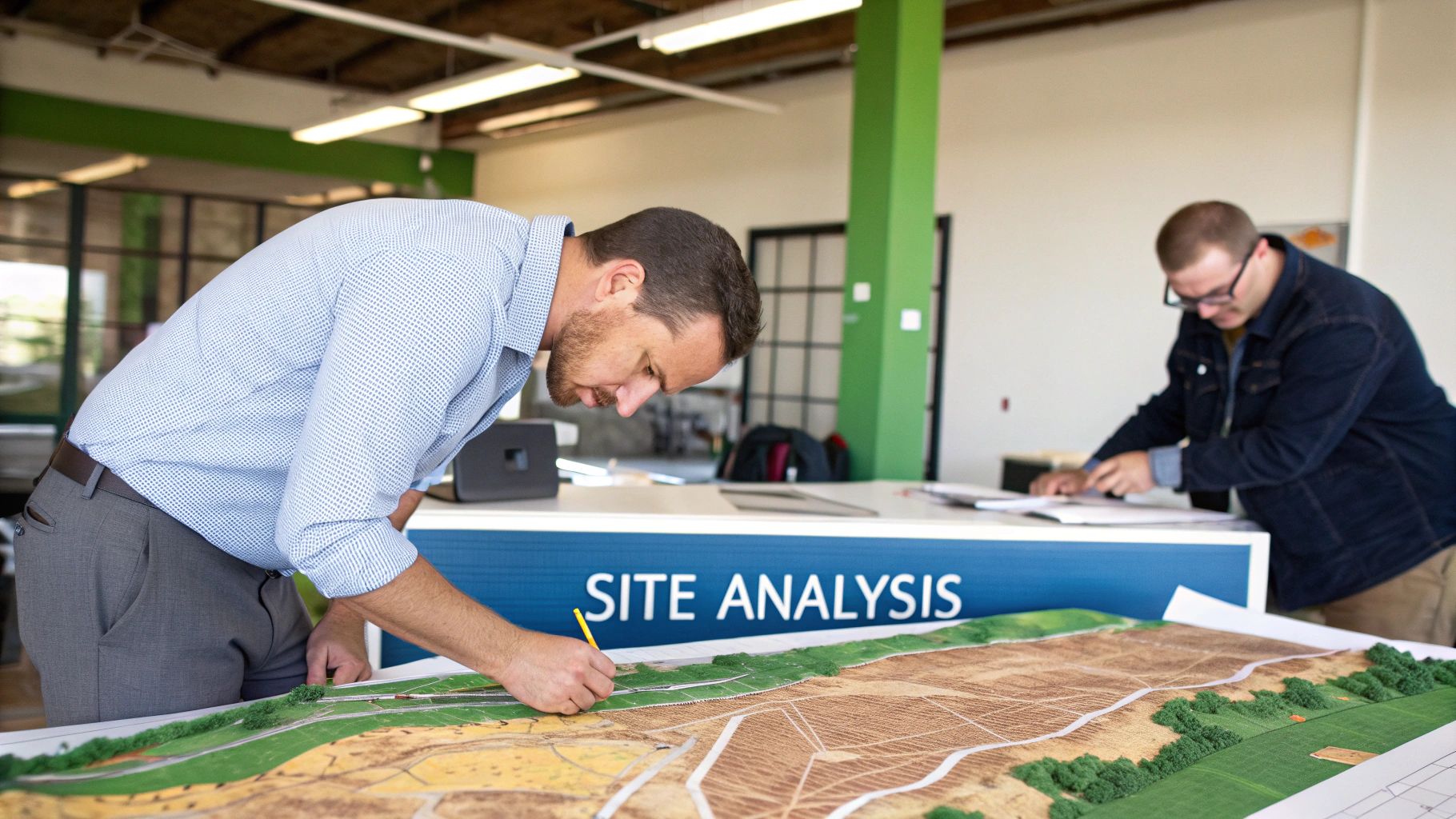
This is why a deep-dive site analysis is the non-negotiable first step. It’s far more than just verifying property lines; it’s about getting to know the land’s personality. We're looking for its quirks—the gentle slope you can use to your advantage, the path the sun takes across the sky, and even how the wind behaves on a blustery afternoon.
Uncovering the Story of the Site
Every site has a story, and our job is to listen. This means blending hard data with simple, careful observation. We’re searching for clues that will directly shape the building’s form, its placement, and its overall feel.
Here’s what a proper site analysis really digs into:
- Topography and Slope: Is the site pancake-flat or does it have a dramatic grade? A slope isn’t a hurdle; it’s an opportunity. I’ve seen hillside lots become the perfect setting for stunning multi-level homes with walk-out basements that capture incredible views.
- Solar Orientation: We literally track the sun's path across the property through the seasons. This isn't just for fun—it tells us exactly where to place windows to flood rooms with natural light in the winter and where to use overhangs to block the harsh summer sun, which has a huge impact on energy costs down the line.
- Prevailing Winds and Climate: Knowing which way the wind blows helps us place windows for cross-ventilation or create sheltered outdoor spaces. Local climate data dictates everything from insulation requirements to the type of exterior cladding that can withstand the elements.
- Surrounding Context: What’s the neighborhood vibe? A good design respects the scale and materials of the buildings next door without being a carbon copy. We also map out views to capture, noise sources to mitigate, and how people will approach the building.
This isn't just a checklist. It's the raw material for genuine, creative problem-solving.
Translating Site Data into a Strong Concept
With a solid understanding of the site, we can finally start talking about the big idea. This is the conceptual design phase, where raw data gets an architectural soul. The goal here is to land on a core concept that brilliantly marries what the client wants with what the site offers.
Think of the concept as the project's north star—the single idea that guides every decision that follows. We're not drawing walls yet; we're establishing the "why" behind the design.
For example, on a tight urban lot, the concept might be "a column of light," using a central staircase and skylights to pull daylight down through multiple floors. For a retail store on a bustling corner, the concept could be "the community front porch," with massive windows and a welcoming entrance that engages everyone walking by.
The conceptual design is the crucial bridge between raw information and a compelling architectural vision. It ensures the final building isn't just placed on the site, but is truly of the site.
Developing Initial Massing and Layouts
Once the big idea is in place, we start exploring how the building will physically take up space. This is done through massing studies, which are basically simple 3D block models. These aren't fancy renderings; they're quick, iterative tools to figure out the building’s general shape, scale, and position.
These studies help us answer some fundamental questions:
- How does our building's size and shape feel next to its neighbors?
- Where are the absolute best spots for windows to frame a view or catch the morning sun?
- Can we shape the building to carve out a private courtyard or a sunny patio?
At the same time, we begin sketching out preliminary layouts, often as "bubble diagrams." These aren't detailed floor plans, but simple diagrams showing how different spaces relate to each other. In an office, for instance, it helps us map the journey from the public reception area to collaborative zones and quiet, private offices.
This part of the process is all about rapid exploration. We might create dozens of sketches and digital models, testing ideas and refining the approach until something just clicks. Getting this right early on is critical, because it sets the entire strategic direction, ensuring the final design is smart, responsive, and truly connected to its place in the world.
Navigating Building Codes and Zoning Rules
To an outsider, zoning laws and building codes can feel like an impossible web of red tape. But for those of us in the industry, we know they're the bedrock of safe, functional communities. They aren't there to kill your design creativity; they’re a framework to make sure every new building is a good neighbor and, most importantly, a safe place to be.
Getting a handle on this framework isn't just about checking a box for compliance—it's about designing smarter from day one.
Think of it this way: zoning ordinances tell you what you can build and where. They dictate things like land use (is it for homes or shops?), building height, how far you have to set back from the property line, and even how much parking you need. On the other hand, building codes are all about how you build it. They cover the nuts and bolts of construction—structural integrity, fire safety, accessibility, and mechanical systems.
Weaving these rules into your project from the very start is what separates a smooth permitting process from one that ends in costly, soul-crushing redesigns.
Decoding Local Zoning Ordinances
Before a single line gets sketched, your first move should be to dig into the local planning or zoning department's website. You'll usually find the zoning maps and ordinances right there online, and these documents are your roadmap for what's even possible on a property.
Let’s say you’re designing a small shop in a historic downtown. The zoning code will give you the hard facts:
- Use Restrictions: Can you even put a retail store here? Sometimes it has to be a "mixed-use" zone.
- Setbacks: How far back from the sidewalk does the building need to be? In many historic districts, the answer is zero to maintain that classic, continuous streetscape.
- Height Limits: You might be capped at two or three stories to keep the new structure in scale with its older neighbors.
- Parking Requirements: The code will have a formula for how many parking spots you need based on your square footage, which can dramatically impact your site layout.
Ignoring these details early on is a classic mistake. I once saw a great project get completely derailed because the initial design didn't account for a required 20-foot rear setback. The entire building footprint had to be redrawn, wasting weeks of work and a lot of money.
Interpreting Major Building Codes
While zoning is intensely local, building codes often stem from standardized models like the International Building Code (IBC). These provide a baseline for safety and performance that local governments adopt, sometimes with their own tweaks.
A huge part of an architect's job is translating these dense, technical manuals into real-world design features. The code influences almost everything, from the minimum width of a hallway to the specific type of fire-rated drywall required between apartments.
The real goal isn't just to meet the bare minimum. It's to understand the "why" behind the rule. That knowledge is what lets you find creative solutions that keep people safe without compromising your design vision.
Energy codes are a perfect example. The push for efficiency is global, but the follow-through can be inconsistent. Between 2022 and 2023, global floorspace grew by about five billion square meters. The problem? In emerging economies where most of that growth happened, over half of the new buildings went up without any energy codes at all. You can get a deeper look at these trends in the full 2024 report on the global status of buildings. It's a stark reminder of how critical robust local codes are for pushing energy performance forward.
A Practical Approach to Compliance
So, how do you actually make this work without getting buried in regulations? It all comes down to being proactive.
- Start with a Code Analysis. Early in the schematic design phase, your architect should put together a document that outlines every code that applies to your project. This flags key parameters like building type, occupancy classification, and required fire-resistance ratings right from the start.
- Talk to Officials Early. Don't be a stranger. A preliminary meeting with someone from the planning department to walk them through your concept can uncover red flags you might have missed. It also starts building a good working relationship with the very people who will review your final plans.
- Document Everything. As you make design decisions to meet code, note them directly on your drawings. This shows the plan reviewer you’ve done your homework and makes their job—and your approval—a whole lot easier.
If you treat codes and zoning as design partners instead of obstacles, you end up with buildings that aren't just beautiful, but are also safe, legal, and a true part of their community.
Integrating Smart and Sustainable Strategies
Great building design today is about more than just a striking look and a functional layout. It's about creating structures that are intelligent, highly efficient, and have a light touch on our planet. Thinking about sustainability isn't an afterthought or a "nice-to-have" anymore; it's a foundational principle that informs every decision, right from the first sketch.
The best approach blends timeless, low-tech wisdom with the sharpest new technology. The result? Buildings that cost less to run, are healthier for the people inside, and are ready for the future.
We always start with passive design strategies. This is about cleverly using the building's orientation, shape, and materials to work with the surrounding environment, not against it. Think of it as giving the building a huge head start on efficiency before a single switch is even flipped.
Once that foundation is solid, we layer in the active systems—the tech that generates and manages energy, like solar panels or high-efficiency HVAC. The final piece is smart building technology, which acts as the building's brain, using data and automation to fine-tune everything in real-time.
This infographic neatly breaks down these three pillars of modern, sustainable design.
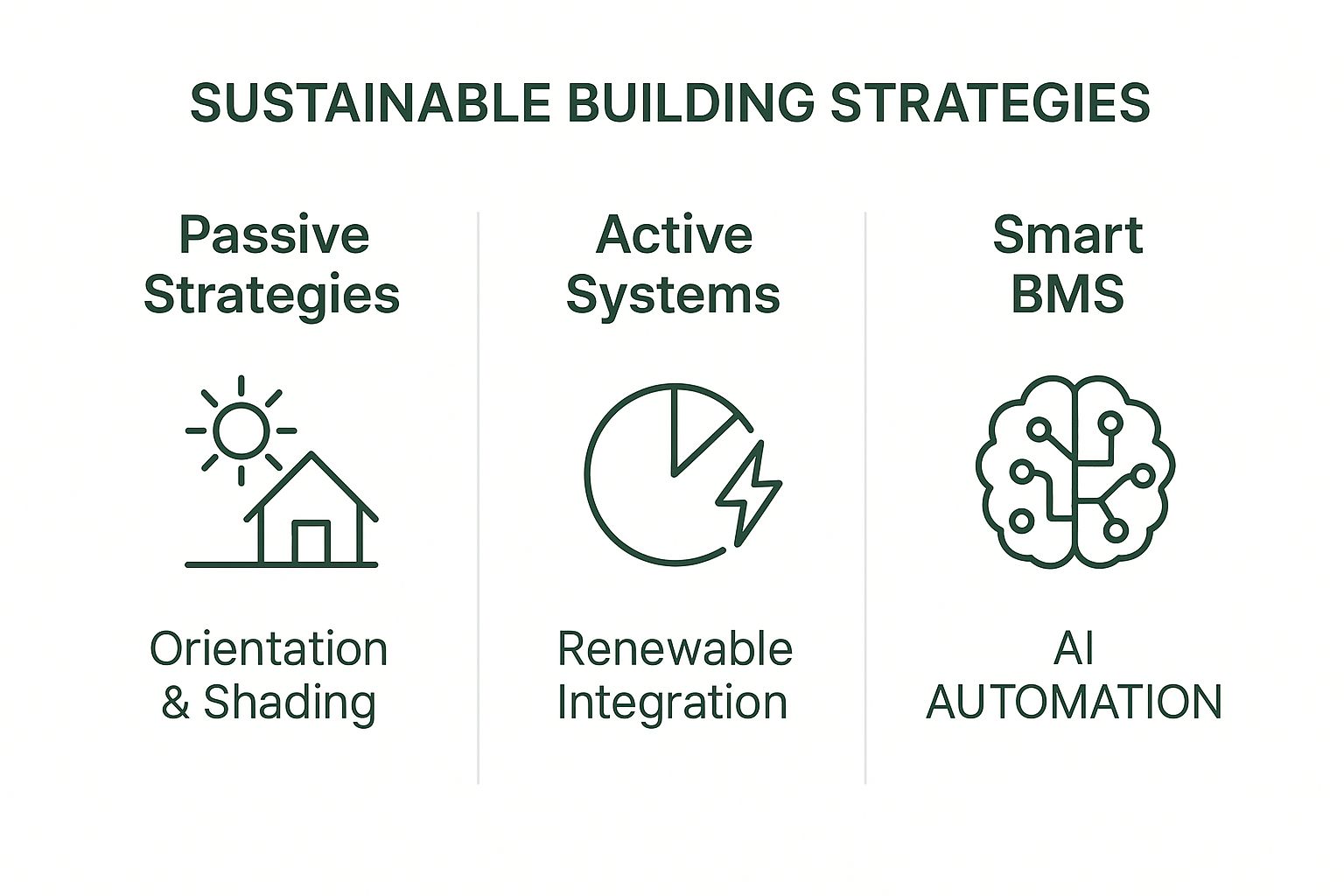
As you can see, a truly effective design layers these approaches, starting with simple, low-cost passive techniques and building up to sophisticated, data-driven automation.
Laying the Groundwork with Passive Design
Before we even think about specifying a solar panel, the most significant and cost-effective sustainable moves are made by thoughtfully shaping the building itself. These passive strategies are baked directly into the architectural DNA of a project, slashing the building's long-term energy needs from day one.
A perfect example is solar orientation. Here in South Carolina, we can orient a building to maximize sun exposure on its south-facing walls during the winter, giving us free passive heat. Then, we use carefully calculated roof overhangs or external shades to block the high-angle summer sun, which can dramatically cut cooling costs. It's a simple, elegant solution.
Other crucial passive strategies we always consider include:
- Natural Ventilation: We design floor plans and window placements to encourage cross-breezes. This simple trick can eliminate the need for air conditioning during the milder months.
- A High-Performance Envelope: This is the building's "skin"—its walls, roof, windows, and foundation. Using superior insulation and high-performance windows creates an airtight seal that prevents heat from escaping in the winter and seeping in during the summer.
- Thermal Mass: We strategically use materials like concrete or stone that absorb the sun's heat during the day and slowly release it at night. This helps to naturally stabilize indoor temperatures year-round.
"The smartest building is the one that needs the least amount of energy in the first place. Passive design is the art of achieving that by working with nature, not fighting it."
Powering Up with Active Systems
Once our passive strategies have trimmed the building's energy appetite down to a minimum, we bring in active systems to meet the remaining demand as efficiently as possible. This is where modern technology really shines, generating clean energy on-site and using it with incredible precision.
To help you understand the two core philosophies, here’s a quick comparison of passive and active design approaches.
Comparing Passive vs Active Sustainable Design Strategies
This table outlines the key differences, benefits, and examples of passive and active strategies in sustainable building design to help readers understand their distinct roles.
| Strategy Type | Core Principle | Examples | Primary Benefit |
|---|---|---|---|
| Passive | Uses natural elements and building form to manage energy. | Building orientation, natural ventilation, shading, thermal mass. | Reduces energy demand from the start with low ongoing costs. |
| Active | Uses technology and mechanical systems to generate or conserve energy. | Solar panels, geothermal heat pumps, high-efficiency HVAC. | Meets remaining energy needs efficiently with clean sources. |
By combining these two, we create a powerful, resilient, and low-impact building.
Sustainability is a global force in design now, influencing everything from regulations to material choices. A major trend is integrating multiple renewable sources—like solar, wind, and geothermal—with better energy storage to get buildings closer to self-sufficiency. You can learn more about how these sustainable building trends are shaping the future on blog.zeroconsulting.com.
Key active systems include:
- Renewable Energy Generation: Photovoltaic (solar) panels are the most common choice, turning unused rooftops into mini power plants. Geothermal systems are another fantastic option, tapping into the earth's stable underground temperature for super-efficient heating and cooling.
- High-Efficiency HVAC: Today's heating, ventilation, and air conditioning systems are miles ahead of older models. Technologies like Variable Refrigerant Flow (VRF) systems can deliver heating and cooling to different zones at the same time, using a fraction of the energy.
- Water Conservation: While low-flow fixtures are a given, active systems take it further. We can design rainwater harvesting systems for landscape irrigation or even greywater recycling systems for non-potable uses, easing the burden on local water supplies.
Optimizing Performance with Smart Building Management
The final, powerful layer is intelligence. A Building Management System (BMS) is the central nervous system that monitors and controls all of a building's mechanical and electrical equipment. Today’s smart BMS platforms, powered by AI and the Internet of Things (IoT), are completely changing how buildings operate.
Instead of just running on a fixed schedule, a smart BMS uses a network of sensors to pull in real-time data on everything from room occupancy to outdoor air quality. For example, sensors can detect when a meeting room is empty and automatically dim the lights and dial back the thermostat.
This AI-driven automation doesn't just cut energy bills; it also creates a healthier, more comfortable environment for occupants. The system can monitor CO2 levels and automatically boost fresh air ventilation when the room gets stuffy. Over time, it learns occupant behavior, anticipates needs, and continually fine-tunes operations for peak efficiency. This constant, quiet optimization is what makes a building truly responsive and sustainable for the long haul.
How AI Is Reshaping Architectural Design
Artificial intelligence isn't some far-off concept anymore; it's a real tool in the modern architect's belt, and it's fundamentally changing how we design buildings. This isn't about AI replacing designers. It’s about arming them with incredible new capabilities to explore, optimize, and create in ways we couldn't just a few years ago.
This shift is helping firms solve incredibly complex problems with remarkable speed and creativity, truly pushing the envelope of what a building can be.
Exploring Possibilities with Generative Design
One of the most powerful applications of AI we're seeing is generative design. Instead of an architect sketching out one idea at a time, we now feed a set of goals and constraints directly into an algorithm. These parameters can be anything—from tight budget limits and material choices to specific structural loads and energy performance targets.
The AI then gets to work, generating thousands of viable design options, each one a distinct solution to the puzzle. This process lets architects stumble upon brilliant, highly optimized solutions they might never have landed on otherwise. Imagine designing a hospital and finding a layout that shaves minutes off nurses' walking times while giving every patient a view of natural light—that's the kind of problem generative design excels at solving.
AI-driven generative design doesn't just make us faster; it blows the doors wide open on creativity. The architect’s role evolves from being the sole creator to a curator, sifting through thousands of possibilities to find the most elegant and effective solution.
This approach gives design teams a huge head start. They can spend their valuable time and expertise refining the best computer-generated options instead of starting every project from scratch.
Making Building Information Modeling Smarter
Building Information Modeling (BIM) has long been the standard for creating detailed, data-rich 3D models. AI is now making those models exponentially more intelligent. By running machine learning algorithms on BIM data, systems can now automatically spot potential conflicts—or "clashes"—with an impressive degree of accuracy.
For example, an AI can flag a design where a new HVAC duct is routed straight through a primary structural beam. Catching that kind of mistake in the digital phase saves a massive amount of time, money, and headaches during construction.
AI also elevates project management within BIM. By analyzing data from past projects, it can generate much more precise construction schedules and cost estimates. It can even identify potential bottlenecks before they bring work to a standstill, leading to a much smoother, more predictable project from start to finish. We're seeing this play out across building systems, with new insights into how AI is transforming HVAC systems for unparalleled efficiency.
Revolutionizing Construction and Fabrication
The influence of AI doesn't stop at the digital model; it extends right onto the job site. AI-guided robotics and 3D printing are paving the way for new construction methods that are faster, safer, and generate significantly less waste.
We're in the middle of a major shift, with firms like Zaha Hadid Architects using AI not just for stunning aesthetics but to fine-tune a building's thermal performance. On the fabrication side, 3D printing guided by AI is completely changing how we use materials. We can now print complex components designed for maximum strength with an absolute minimum of waste.
These technologies make it possible to build complex, organic shapes that would be ridiculously expensive—if not impossible—with traditional methods. A huge win here is material optimization. An AI algorithm can design a structural element using the precise minimum amount of material required to meet all strength and safety codes.
This marriage of AI and fabrication isn't science fiction—it's happening right now, creating a more efficient and sustainable construction industry. As these tools become more common, they’ll continue to unlock new creative paths for designing the buildings of tomorrow.
Answering Your Questions About the Building Design Process
Even with a solid plan, you’re bound to have questions. Designing a building is a complex dance between timelines, professional roles, finances, and technology. Getting clear on these common points of confusion from the start helps demystify everything and gets the whole team—from you to the designers—on the same page.
Let’s tackle some of the most frequent questions that pop up during a project. Think of these as direct, practical insights into what you can really expect.
How Long Does the Building Design Process Typically Take?
This is probably the number one question we get, and honestly, it’s one of the toughest to answer with a single number. The real timeline comes down to a few key things: the project’s size, how complicated it is, and how quickly your local permitting office moves. No two jobs are ever the same.
A custom home, for instance, might sail through design and permitting in 6 to 12 months. But a big commercial project, like a new office building or a multi-family apartment complex, could easily take a few years of planning and approvals before anyone even thinks about breaking ground.
It helps to remember the process is broken into distinct phases, each with its own rhythm:
- Schematic Design: Getting the big ideas on paper. This usually takes 1-2 months.
- Design Development: This is where we flesh out the details and systems. Expect another 2-4 months.
- Construction Documents: Creating the highly detailed blueprints for the builders is a heavy lift, often taking 3-6 months.
The real wild card here is permitting. Depending on your local jurisdiction and how complex the project is, getting all the necessary stamps of approval can take anywhere from a few months to over a year. The best thing you can do is sit down with your architect at the very beginning and map out a realistic schedule to manage everyone’s expectations.
What Is the Difference Between an Architect and a Building Designer?
People often use these terms interchangeably, but there's a major distinction, and it’s legally defined. The main differences boil down to licensing, education, and who is legally on the hook for the final product.
An architect is a licensed professional. You don't just get to call yourself one. The title is earned after completing a demanding, accredited degree, followed by a multi-year internship under other licensed architects, and finally, passing a grueling series of exams. This license legally empowers them to design any type of building, from a small house to a towering skyscraper.
A building designer, on the other hand, usually isn't a licensed architect. While many are very talented and have a ton of experience, their scope is often legally limited to certain projects, like single-family homes or small-scale commercial buildings, depending on state and local laws. An architect’s license is a seal of proven professional competence, and it holds them legally accountable for the health, safety, and welfare of the public.
How Can I Keep My Building Design on Budget?
Keeping a project on budget isn't magic—it's a team effort that starts on day one and doesn't stop until the keys are handed over. The whole game is about proactive communication and making disciplined decisions along the way.
First things first: set a realistic budget and be completely transparent about it with your design team. Your architect should be giving you detailed cost estimates at key milestones, like after the initial concept is done and again after the design is more developed. This gives you a chance to make smart adjustments before you’re too far down a path that’s getting expensive. It's also a good time to make a "must-have" vs. "nice-to-have" list.
The single biggest budget-killer? Late-stage design changes. Deciding to move a wall when the construction documents are nearly finished can create a ripple effect of costly revisions to the structural, mechanical, and electrical plans.
To protect yourself from surprises, always build a contingency fund of 10-15% of the total construction cost right into your budget. Another pro tip: bring a contractor into the loop early on for pre-construction feedback. Their real-world cost insights can be incredibly valuable.
What Is Building Information Modeling and Why Is It Important?
Building Information Modeling, or BIM, is a 3D model-based process that has become an absolute cornerstone of modern design. It’s so much more than just a digital drawing. A BIM model is an intelligent, data-rich digital version of the building itself.
Unlike a simple 3D model that just shows shapes, a BIM model has layers upon layers of information embedded within it. Every single element—from a wall to a window to a light fixture—carries data about its material, manufacturer, and even its cost. It effectively creates a "digital twin" of the physical building.
BIM is a game-changer for a few huge reasons:
- It boosts collaboration. Architects, engineers, and contractors can all work from a single, coordinated model, which cuts down on miscommunication and mistakes.
- It finds problems before they happen. The software can automatically run a "clash detection" to see where building systems conflict—like a pipe scheduled to run right through a structural beam. Catching this stuff on a screen saves a fortune compared to finding it on the construction site.
- It helps manage the building for life. After the project is built, the owner can use the BIM model for ongoing facility management, tracking maintenance, and planning future renovations.
Navigating the world of building design, from the first sketch to the final walkthrough, requires a partner with deep expertise and a genuine commitment to your vision. The team at Sherer Architects, LLC brings decades of experience to every project, ensuring your commercial, adaptive reuse, or historic preservation goals are met with precision and creativity.