Before you ever type a single word of a grant application, there’s some critical homework to do. Think of this as the foundation work. A winning application isn’t just well-written; it’s built on a rock-solid understanding of your project’s story, its official standing, and the funding sources that actually make sense for it.
Laying the Groundwork for Your Grant Application
Too many grant applications get rejected right out of the gate, not because the project is bad, but because the prep work was flimsy. It’s easy to get excited about the restoration itself, but you have to move from a vague idea like "fix up this old place" to a specific, compelling, and—most importantly—fundable project.
The first thing you need to nail down is the "so what?" Why does this specific building matter? Grant reviewers see hundreds of applications. Yours needs to stand out by showing a real, tangible connection to your community's heritage. Was it designed by a well-known local architect? Does it represent the last vestige of a certain building style in your town? Maybe a significant historical event happened right on the front steps. Answering these questions is how you start building your case.
What’s Your Property’s Story? Defining its Historical Significance
Every single grant application you write will live or die by its Statement of Significance. This isn't a dry history report; it's the heart and soul of your pitch. You're telling the story of your property and explaining why it deserves to be saved.
For instance, saying a building was "built in 1890" is a fact, but it's not a story. A much stronger angle would be to frame it as "one of only three remaining examples of commercial Romanesque Revival architecture in the original downtown, built during the city’s post-railroad boom." See the difference? That context gives the project an undeniable sense of urgency and importance.
Check Your Property's Official Status
Next up, you need to figure out your property's official designation. This is a big one. For many state and federal grants, having a specific listing is non-negotiable.
- National Register of Historic Places: This is the gold standard. Being on the official federal list opens up the most funding doors.
- State or Local Register: Don't overlook these! Many states and even cities have their own historic registers that qualify you for specific local grant programs.
- No Designation? If your property isn't listed anywhere, don't panic. Your first step might be to get it nominated. In fact, some smaller planning grants exist specifically to help fund that nomination process.
Knowing where you stand on these lists is key because it dictates which grants you can even consider applying for.
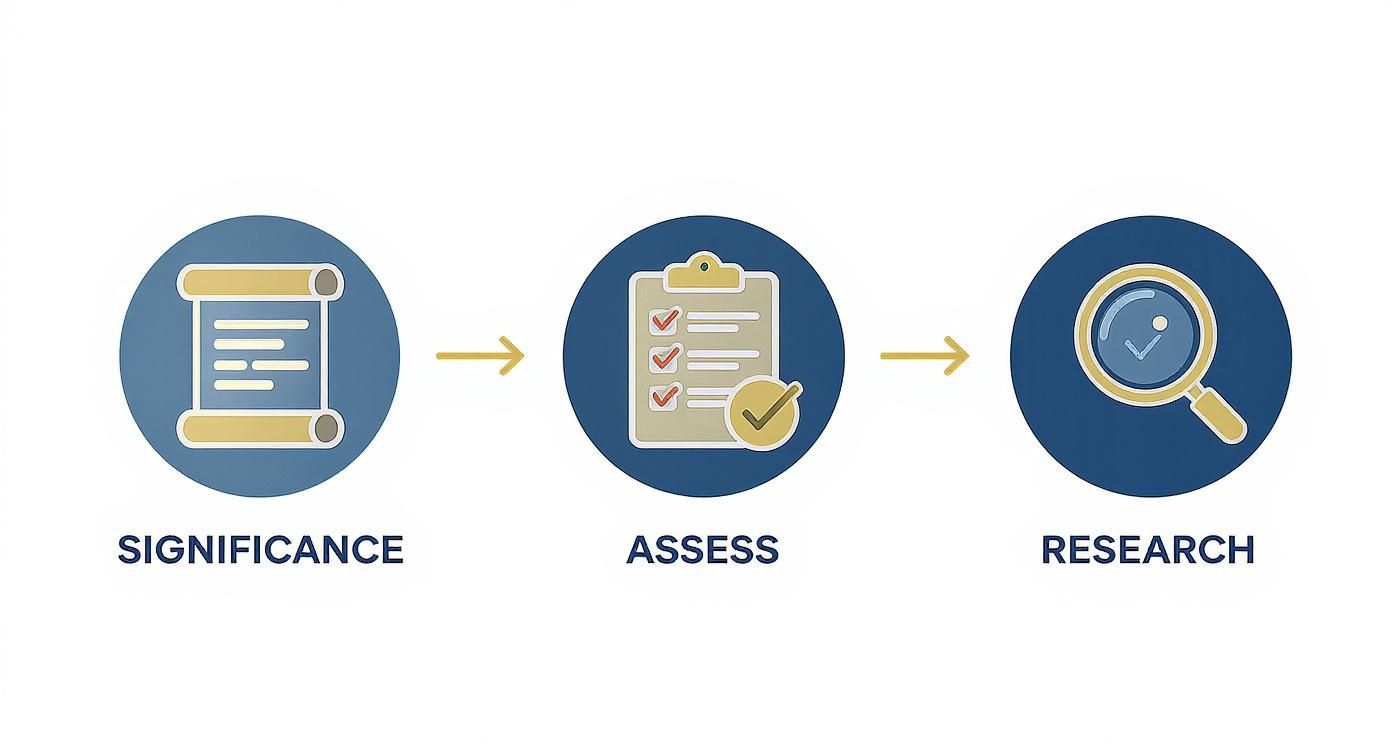
This simple workflow—Significance, Assess, Research—is a tried-and-true method. Each step builds on the last, so by the time you're ready to write, you have a clear, defensible project.
Start Surveying the Grant Landscape
Finally, it’s time to start looking at what's out there. The world of preservation funding is incredibly varied, from massive federal programs to tiny foundations focused on a single county. It’s a competitive field. Just look at the U.S. Historic Preservation Fund (HPF), which recently had appropriations of nearly $189 million for a single fiscal year. Those funds, managed by the National Park Service, get distributed across all kinds of state, tribal, and local grant categories. You can dig into the specifics by checking out the HPF statistical reports and funding data on the NPS website.
One of the biggest mistakes I see people make is taking a shotgun approach—applying for every grant they can find. You’ll burn yourself out. Be a sniper. Focus your energy only on the opportunities that are a perfect match for your project’s scope, budget, and story. A targeted approach will always win.
Finding the Right Grant for Your Preservation Project
So you have a preservation project. The first question is always: where does the money come from? The world of grants can feel overwhelming, but the secret isn't applying for everything you see—it's about smart, targeted research.
A nonprofit saving an old downtown theater and a county trying to restore its historic courthouse are playing in different sandboxes. Your project's ownership, scale, and specific needs will point you toward the right funding streams. Don't waste time casting a wide net; a focused strategy is what wins grants.

Start with State and Federal Programs
For most people, the grant journey begins with public money. These are typically the largest grants available, but they also come with the most paperwork and the strictest rules. You have to play by their game.
Your first call should always be to your State Historic Preservation Office (SHPO). Every state has one, and they are the primary gatekeepers for federal dollars flowing from the Historic Preservation Fund (HPF). Think of them as your guide. They don't just administer grants; they offer invaluable technical advice that can make or break your application.
Beyond the SHPO, a number of federal agencies offer direct grants. In the U.S., more than 10 federal agencies, from the National Park Service to the National Endowment for the Arts, have preservation-related programs. Another well-known source is the Daughters of the American Revolution (DAR), which funds a wide range of projects. Just remember, these big players have rigid deadlines, so you need to plan months, sometimes even a year, in advance.
Here are the heavy hitters in government funding:
- Historic Preservation Fund (HPF) Grants: This is the bedrock of public funding. The National Park Service funnels this money to the SHPOs, who then grant it out for state and local projects.
- Certified Local Government (CLG) Grants: Is your town or county a designated CLG? If so, you've got access to a dedicated pot of money. Since 2001, just in Maryland, the CLG program has invested over $2.4 million in local projects.
- Save America's Treasures Grants: These are the big leagues. We're talking highly competitive, high-dollar grants for nationally significant properties.
Exploring Private Foundations and Niche Grants
Don't overlook private money. Foundations often offer smaller grants, but they come with far more flexibility and can fill crucial funding gaps. These are the specialists.
You'll find foundations that only fund the restoration of rural churches, others that focus on historic theaters, and some dedicated to preserving sites related to a specific community's heritage. Digging into databases like Candid’s Foundation Directory Online is how you uncover these hidden gems that most people miss.
A targeted search is everything. I once worked on a project to restore a historic firehouse. We were struggling with a funding gap until we discovered a small, family foundation dedicated to honoring first responders. Our project fit their mission perfectly, and they became a key funder.
As you look for historic preservation grants, it’s a good idea to also explore various funding options. Sometimes a combination of grants, loans, and other financing is the most effective approach.
Matching Grant Sources to Your Project Needs
To build a smart search strategy, you have to know who funds what. The table below is a practical comparison to help you identify the best funding source for your specific preservation goals.
Matching Grant Sources to Your Project Needs
| Grant Source | Typical Recipient | Project Focus | Average Grant Size |
|---|---|---|---|
| Federal (NPS/HPF) | SHPOs, CLGs, Nonprofits | Large-scale restoration, surveys, planning | $50,000 – $500,000+ |
| State (SHPO) | Nonprofits, Municipalities, Private Owners | Brick-and-mortar repair, architectural plans | $10,000 – $100,000 |
| Local (CLG) | Property Owners in CLG communities | Facade improvements, roof repair, planning | $5,000 – $25,000 |
| Private Foundations | Mostly Nonprofits | Varies widely by foundation's mission | $2,500 – $50,000 |
This table shows you the general landscape. A museum planning a multi-million dollar restoration should be looking at a Save America's Treasures grant. A homeowner needing to restore original wood windows in a historic district should start with their local CLG program.
By identifying the right category from the get-go, you instantly improve your chances of finding a funder who is genuinely excited about your project.
Pulling Together a Winning Grant Application
Think of your grant application as the ultimate sales pitch for your project. Reviewers are buried under a mountain of proposals, so yours has to do more than just check the boxes. It needs to be sharp, persuasive, and perfectly organized to tell a story that makes them want to fund you.
A rookie mistake is treating the application like a homework assignment. You're not just filling in blanks. You're building a case, piece by piece, that your project is vital, urgent, and—most importantly—achievable. Every single document, from the historical narrative to the budget spreadsheet, has to hammer home that same message.
Crafting a Powerful Statement of Significance
This is where you bring your building to life. The Statement of Significance is your chance to connect the bricks and mortar to a bigger, more meaningful story. Grantors aren't just paying for repairs; they're investing in the tangible history and identity of a community.
A weak statement just says, "This building is old." A strong one shows the reviewer why its age matters. Don't just say it was a general store. Explain how it served as the social and economic heart of a rural town for a century, using details from original ledgers or stories from locals to prove it.
Your statement absolutely must answer these questions:
- What’s the historical context? Link the property to local, state, or even national events and trends.
- What makes it architecturally special? Is it a rare example of a specific style? Was it designed by a well-known architect?
- Who are the people connected to it? Did important figures or groups live, work, or meet here?
- Why does it matter culturally? Does it hold a special meaning for a particular community or group?
Your Statement of Significance should be a story backed by hard evidence. It’s not just about what happened inside the walls, but how those events shaped the world outside. Make the reviewer feel the loss if that story were to disappear.
Laying Out a Professional Treatment Plan
Okay, you’ve convinced them the place is important. Now you have to show them you know how to fix it. A fuzzy or unprofessional treatment plan is a massive red flag for funders. They need to see a clear, well-defined scope of work that’s rooted in sound preservation practices.
The gold standard here is a Historic Structures Report (HSR). This is a deep-dive document that analyzes a building's history, details its current condition, and lays out a professional plan for its restoration. While a full HSR can be pricey, many grantors will accept a more focused "conditions assessment and treatment plan" from a qualified preservation architect or contractor.
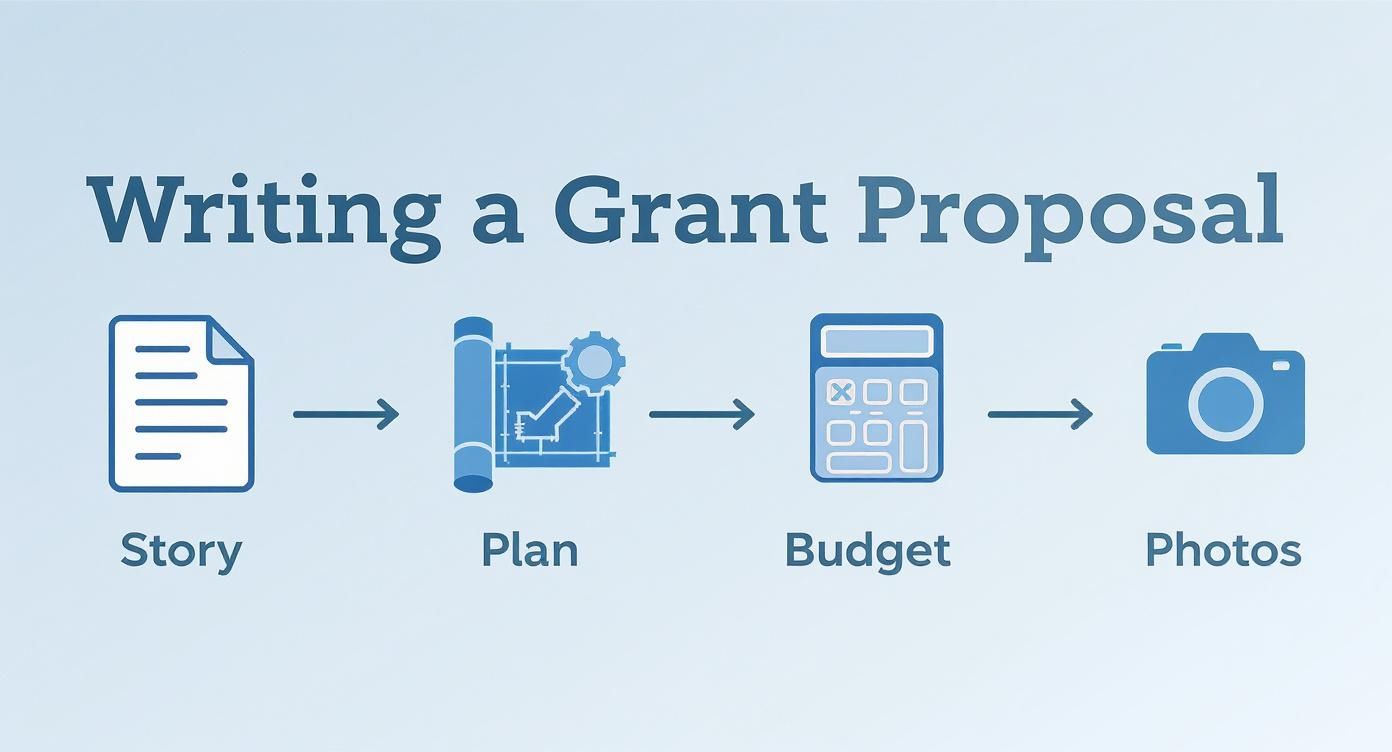
Make your plan easy for a layperson to grasp. Use clear headings, annotated photos, and architectural drawings to show what you're planning. For example, don’t just write "repair roof." Get specific: "Replace 300 square feet of deteriorated slate shingles in-kind on the south-facing slope, using salvaged slate where possible, and install new copper flashing…" See the difference?
Getting the Project Budget Right
This is where so many good applications go to die. A sloppy budget screams "bad planning" and can sink your proposal before it even gets a serious read. Your numbers need to be detailed, realistic, and completely justified.
Get rid of round numbers. A line item for "$10,000 for masonry repair" looks like you pulled it out of thin air. But an entry for "$9,750 for repointing 650 square feet of the north facade using Type N mortar, based on a quote from Acme Preservation" proves you've done the legwork.
Break your budget down into logical chunks:
- Pre-Development Costs: This is for the planning work—architectural drawings, engineering studies, permit fees.
- Hard Costs (Construction): The actual hands-on work. List specific tasks like foundation repair, window restoration, or HVAC updates.
- Soft Costs (Administration): The overhead. Think project management, insurance, and legal fees.
- Contingency: This is non-negotiable. Always budget a contingency of 10-15% of your hard costs. Trust me, you’ll need it for the surprises that always pop up.
Finally, back everything up with strong supporting documents. You'll need high-quality photos (before, during, and after shots are fantastic if you have them), architectural plans, and, critically, letters of support. Getting letters from community leaders, elected officials, and partner organizations shows the grant committee that this isn't just your pet project—it's a valued community asset.
The Review Process and the All-Important Matching Funds
Once you’ve hit 'submit,' your grant application begins its journey. This isn’t the end; it's the start of a formal review process where your proposal will be judged by people who have seen it all before. Knowing what happens behind the scenes can help you manage expectations and prepare for what's next.
First, your application usually lands with the staff at the granting organization, like your State Historic Preservation Office (SHPO). They'll do an initial once-over to make sure it's complete and meets the basic eligibility rules. Think of it as a gatekeeper check.
From there, it goes to a review committee. This group is typically made up of seasoned architects, historians, and community leaders who will score your application against a very specific set of criteria.
Why Your Match is More Than Just Money
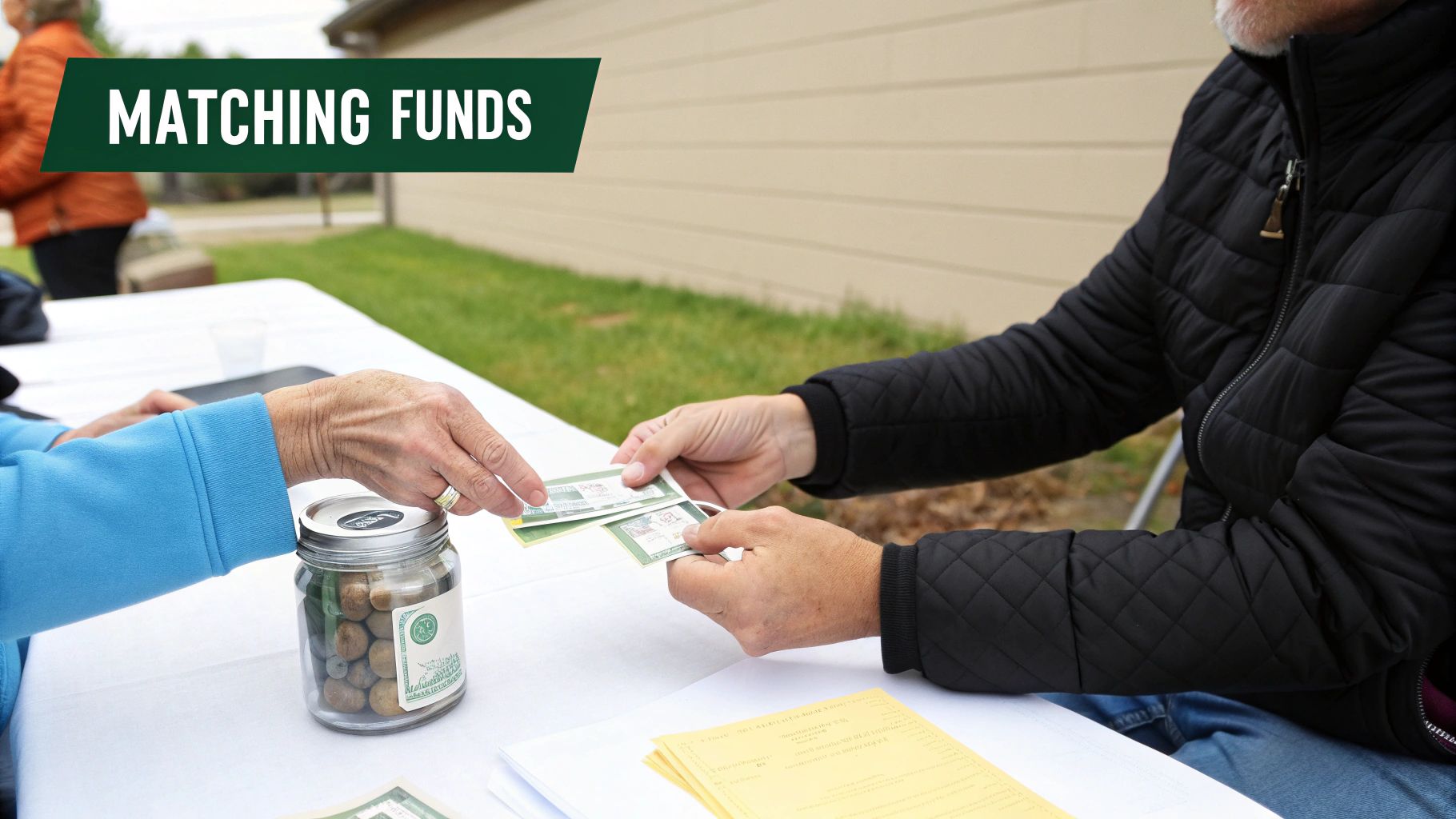
One of the most heavily weighted criteria? Your ability to come up with matching funds. It's rare for a preservation grant to cover 100% of your project cost. Funders want to see that you have skin in the game. A 1:1 match is standard, meaning you need to secure a dollar from another source for every dollar they give you.
Frankly, this is where many promising applications stumble. The competition is fierce. The National Trust for Historic Preservation, for instance, often gives grants around $25,000 (capping out at $50,000) for planning and educational projects. With so many applicants vying for limited funds, a solid plan for your match shows you're financially serious and gives your proposal a major boost. If you want a real sense of the competition, you should understand how to make your preservation funding application stand out.
Grant reviewers look at a strong matching funds plan as a sign of community buy-in and overall project health. If you can’t rally local support, they'll question if the project is as vital as you say it is. It's less about the cash itself and more about the momentum it proves you have.
Getting Creative with Your Match
Don't let the match requirement intimidate you—you don't necessarily need a pile of cash sitting in the bank. Grantors know that resources can be tight, which is why they usually allow a combination of cash and "in-kind" contributions. This opens up some really effective ways to build your match.
Here are a few strategies I've seen work time and again:
- A "Buy-a-Brick" Campaign: Small, grassroots fundraising efforts are perfect. They not only bring in cash but also create a dedicated group of locals who are emotionally and financially invested in your success.
- "Stacking" Smaller Grants: This is a smart move. Use a confirmed grant from one foundation as the matching funds to apply for another. It shows other funders that your project has already been vetted and approved elsewhere.
- Documenting In-Kind Contributions: This is a powerful, yet often overlooked, tool. In-kind matches are simply non-cash contributions like professional services, volunteer labor, or donated materials.
Valuing and Documenting In-Kind Support
The trick with in-kind support is to value and document it properly. If a preservation architect donates 20 hours of their time to draft drawings, that's a legitimate contribution. You document it by calculating the value of their services at their standard hourly rate.
Here’s what that looks like in the real world:
- Professional Services: An architect donates their time, a lawyer reviews contracts pro-bono, or a marketing expert helps with your fundraising campaign.
- Volunteer Labor: If community members show up for a clean-up day or help with non-specialized painting, you can value their hours at the state's official volunteer labor rate.
- Donated Materials: A local lumberyard gives you historically accurate wood, or a paint store provides the right kind of primer. These are counted at their fair market retail value.
By mixing cash fundraising with meticulously documented in-kind support, you can build a powerful matching funds package. It not only meets the grant requirements but also proves your project has the broad community backing it needs to truly succeed.
Avoiding Common Grant Application Mistakes
You've spent months pulling everything together. The research, the plans, the budget—it's all there. But after all that work, a simple, avoidable mistake can be the thing that lands your application in the "no" pile. It’s rarely the obvious stuff like missing a deadline; the most damaging errors are often far more subtle.
Trust me, experienced grant reviewers can spot a half-baked application from a mile away. They’re looking for well-conceived projects with a clear path to success. Little inconsistencies or vague language can suggest a project isn’t fully thought out, making it seem like a risky investment for them. Let's walk through some of the classic trip-ups I've seen over the years so you can catch them before you hit "submit."
The Unfocused Project Scope
One of the fastest ways to lose a reviewer is with a project scope that’s either too vague or wildly ambitious. This usually comes from a place of passion—you want to fix everything!—but to a funder, it just looks like poor planning. It screams, "I haven't really thought through the nuts and bolts of this."
For example, don't just say your goal is to "restore the historic community hall." That's an idea, not a plan.
Get laser-focused instead. A much stronger proposal would define the scope as: "Phase 1 restoration of the community hall, focused on structural stabilization of the west wall, replacement of the cedar shake roof in-kind, and restoration of 12 original double-hung wood windows." Now that sounds like a concrete, actionable plan that can realistically be done on time and on budget.
I see this all the time: applicants try to do everything at once. Funders would much rather back a successful, well-defined Phase 1 than pour money into a sprawling, multi-year effort that might never see the finish line. Bite-sized, achievable phases are always more fundable.
Understanding common pitfalls and traps to avoid is crucial whether you're seeking grants or crowdfunding. The core principles of clear communication and realistic goals are universal.
A Budget That Raises Red Flags
Your budget isn’t just a spreadsheet; it’s the financial story of your project, and it absolutely must match your narrative. An unrealistic budget—whether it’s inflated or suspiciously low—is an immediate warning sign for any seasoned reviewer. It tells them you haven't done your homework.
Here are a few budget blunders that can sink an otherwise good application:
- Using Round Numbers: A budget full of clean estimates like $20,000 for plumbing or $50,000 for masonry looks like guesswork. It signals you haven’t gotten actual quotes from qualified contractors.
- Forgetting the Contingency: Old buildings are notorious for surprises. If you don't include a contingency line item of at least 10-15% of your construction costs, it shows a lack of real-world experience.
- No Justification for Costs: Your numbers need a narrative. Why did you pick that contractor? How did you calculate the material costs? Explain the "why" behind the numbers.
Weak Arguments and Missing Support
Finally, a lot of applications fail because they don’t make a powerful case for why the project matters and who is behind it. Your passion for the building is essential, but you have to translate that feeling into a compelling argument backed by solid evidence.
A weak Statement of Significance is a killer. You have to connect your property to broader historical themes and clearly spell out its architectural or cultural value. Just saying it's old isn't nearly enough.
Just as damaging is a lack of community buy-in. An application that arrives without strong letters of support from local officials, community organizations, and neighborhood leaders feels like it exists in a vacuum. Grantmakers want to invest in projects the whole community values, not just one person. That collective backing proves your project is a shared priority with a much better shot at long-term success.
Your Questions About Preservation Grants Answered
Navigating the grant application process can feel like you're trying to solve a puzzle with a few pieces missing. It’s completely normal to have questions swirling around—about how long this will all take, what the money can really be used for, and what happens if you get a "no."
Let's clear the air on some of the most common questions I hear from property owners. Getting these answers straight from the start will save you a lot of headaches down the road.
How Long Does the Historic Preservation Grant Process Take?
The honest answer? Longer than you think. In the world of preservation funding, speed is not part of the equation. From the day you start your research to the moment funds actually hit your bank account, you should realistically budget for a 6 to 18-month timeline, and sometimes even up to two years.
Federal and state grant cycles have a predictable, albeit slow, rhythm:
- The Application Window: You'll typically have a two- to three-month period to submit your proposal.
- The Review Period: This is the long wait. After the deadline, it can take anywhere from four to six months for committees to review, score, and rank all the applications.
- The Announcement: Finally, notifications go out, and grant agreements are drawn up.
The big takeaway here is that you have to plan way ahead. Grants are a strategic tool for a future project, not a quick fix for an immediate cash-flow problem.
Can I Use Grant Money to Buy a Historic Property?
This question comes up all the time, and the answer is almost always a firm no.
The vast majority of preservation grants are earmarked for the physical work of saving a building you already own or have legal control over. Think of it as funding for restoration, rehabilitation, or stabilization—the "doing" part of preservation.
Funders want to see their money go directly into the bricks and mortar: fixing a leaking roof, restoring original wood windows, or shoring up a failing foundation. The funds to actually purchase a historic property come from entirely different pots of money, like:
- Specialized loan programs from preservation nonprofits
- Land trusts or conservancies
- Traditional bank financing or private investment
Grants are for implementing the preservation plan, not for acquiring the property itself.
Rejection is not a dead end; it's a detour with a map. The feedback from a rejected application is often the very thing you need to succeed the next time around. If reviewer comments are available, treat them like gold—they are your roadmap to a stronger proposal.
What Should I Do If My Grant Application Is Rejected?
First, take a deep breath and don't take it personally. The grant world is incredibly competitive. There are always more fantastic projects than there is money to go around, and sometimes a rejection is simply a matter of a slight mismatch with that year's specific priorities.
The most critical thing you can do is turn it into a learning experience.
If the funding agency offers feedback, ask for the reviewer's comments immediately. This is, without a doubt, the most valuable tool you have. Those notes will pinpoint exactly where your application fell short. Was the budget unclear? Was the scope of work too ambitious? Was the statement of significance not compelling enough? Use that direct, honest feedback to rework your proposal and come back stronger in the next cycle.
Is Hiring a Professional Grant Writer Worth It?
For large, complex federal grants like Save America's Treasures, it can absolutely be a game-changer. An experienced grant writer understands the nuances and speaks the specific language that reviewers are looking for. They know how to frame a project to align perfectly with a funder's mission and can help you avoid common but critical mistakes.
That said, you don't always need a pro. For many smaller state or local grants, a well-organized person with strong writing skills and a passion for the project can definitely pull off a winning application. The secret is meticulous attention to detail. Follow every single instruction, answer every question completely, and let your genuine enthusiasm for saving your building shine through.
At Sherer Architects, LLC, we've spent decades helping property owners navigate the intricate world of historic preservation, from the initial building assessment all the way through the grant and tax credit process. We know how to build a compelling case for your project to give you the best possible shot at securing funding. Learn more about how we can help you reach your preservation goals at https://shererarch.com.