

Before you even think about searching for a commercial architectural firm, you need to do your homework. The single most important step you can take is creating a rock-solid project brief. This isn't just a simple wish list; it's the foundational document that translates your business goals into an architectural vision.
Get this right, and you'll attract firms that are a perfect fit for your project. Think of it as the blueprint before the blueprint.
Defining Your Project Before You Search
Jumping into calls with architects without a clear plan is a recipe for disaster. It's like setting sail without a map. A detailed project brief becomes your compass, guiding the entire selection process and paving the way for a successful partnership.
This document forces you to get specific about your goals, constraints, and non-negotiables. Taking the time now saves you from massive headaches and costly misunderstandings down the road. It’s a strategic tool that aligns your operational needs, brand aesthetic, and financial reality from day one.
The architectural services market is huge—it was projected to hit $249.2 billion globally by 2025. With so many firms out there, a clear brief is your best tool for cutting through the noise and connecting with the right talent. You can dig deeper into these market dynamics from IBISWorld.
Translate Business Goals into an Architectural Vision
Your building isn’t just a structure; it's a critical part of your business operations. How will this space actually support your day-to-day workflow? A restaurant, for instance, lives and dies by the seamless flow between the kitchen and the dining room. A medical clinic, on the other hand, must prioritize patient privacy and meet strict accessibility standards.
Start by thinking through these core elements:
- Operational Workflow: Literally map out how people (employees, customers) and things (products, supplies) will move through the space. Where are the potential bottlenecks? Where can you build in efficiency?
- Brand Aesthetics: What’s the vibe? Define the look and feel that tells your brand’s story. Are you going for modern and minimalist or something more traditional and welcoming?
- Future Growth: What will your business look like in five or ten years? A smart, scalable design can save you from a gut-wrenching renovation later on.
This whole process of clarifying your vision, budget, and site is the foundation of your project brief.
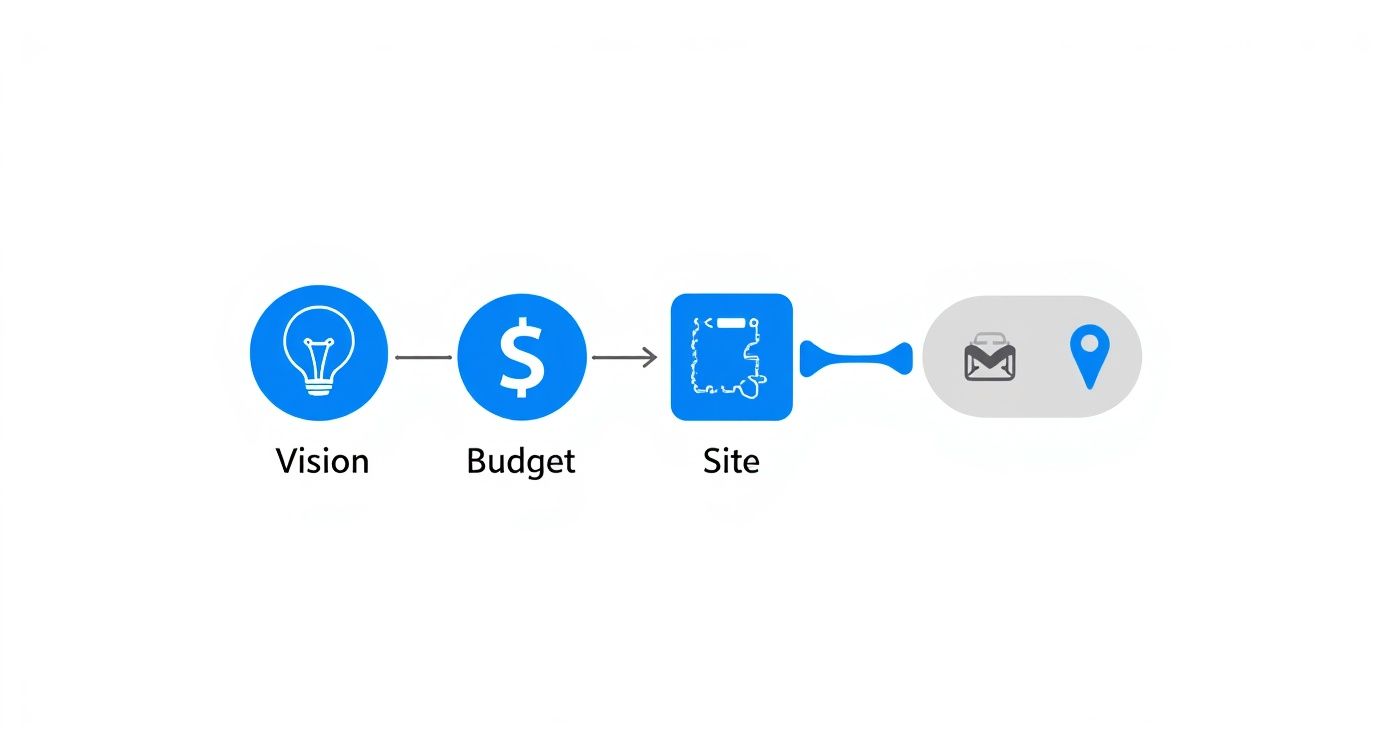
As the diagram shows, these three pillars—vision, budget, and site—are completely interconnected. One can't exist without the others.
Ground Your Project in Financial Reality
A vision without a budget is just a daydream. You need to establish a realistic preliminary budget and timeline to keep the project tethered to reality. Do some research on local construction costs, but don't forget to factor in all the "soft costs"—things like permits, engineering fees, furniture, and technology.
A well-defined budget does more than just limit spending; it forces creative problem-solving. When a commercial architectural firm understands your financial guardrails, they can propose innovative design solutions and material choices that deliver maximum impact without breaking the bank.
Finally, get a handle on your site's potential and its limitations. Local zoning laws, environmental regulations, and existing infrastructure will all shape what's possible. Understanding these constraints upfront means an architect can hit the ground running with a feasible plan from day one.
How to Vet Potential Architectural Partners
With your project brief finalized, you're ready to start the search for the right commercial architectural firm. This isn't just about scrolling through slick websites; it's a careful process of finding, evaluating, and shortlisting firms that genuinely have the chops for your specific project.
The real goal here is to get past the glossy photos and see a firm's actual, hands-on experience in your world. A beautiful portfolio is great, but a proven track record of solving the unique problems of your industry—whether it's retail, hospitality, or a tricky historic preservation project—is what really matters. That’s how you find a truly great partner.

Sourcing and Initial Screening
Often, the best partners come from word-of-mouth. Start by asking around your professional circle—talk to contractors, commercial real estate brokers, and other business owners you trust. You can also check out professional directories from organizations like the American Institute of Architects (AIA), which let you filter by specialty.
As you start compiling a long list, do a quick sanity check against your project brief. Does a firm’s portfolio feature projects that are similar in scale and type to yours? If your project is a complex adaptive reuse, a firm that only shows off shiny new builds probably isn’t the right match.
Look Beyond the Polished Portfolio
Every portfolio is a sales pitch, carefully curated to look impressive. Your job is to dig deeper and analyze it with a critical eye. You're looking for proof that a commercial architectural firm gets the business side of things, not just the aesthetics.
Here’s what to zero in on:
- Project Niche: Do they have a clear specialty? Deep experience in your specific project type, like medical facilities or mixed-use developments, is a huge plus.
- Real-World Problem-Solving: Look for case studies that explain how they tackled tough challenges. Did they successfully navigate a complex zoning issue or solve an unexpected structural problem? That’s gold.
- The Technical Nitty-Gritty: If you can, ask to see a sample set of construction documents. These technical drawings reveal a firm’s attention to detail in a way a photograph never can.
The core ideas behind picking a professional partner hold true across different fields. In fact, many of the same principles apply, and you can get a good perspective by reviewing these things to consider before hiring a consulting firm. It really drives home the importance of doing your homework, no matter the industry.
To help structure your review, a simple evaluation matrix can be incredibly useful for comparing firms apples-to-apples.
Key Evaluation Criteria for Shortlisting Firms
| Evaluation Area | What to Look For | Red Flags to Watch For |
|---|---|---|
| Relevant Experience | A portfolio with multiple projects similar to yours in size, scope, and industry. | All their "relevant" projects are from over a decade ago; no recent work in your sector. |
| Design Philosophy | An approach that aligns with your brand and functional goals (e.g., focus on sustainability, user experience). | A rigid, "one-size-fits-all" design style that they apply to every project, regardless of the client. |
| Problem-Solving | Case studies that detail how they navigated complex zoning, budget, or construction challenges. | Vague project descriptions that focus only on the finished look, not the process. |
| Local Knowledge | Proven experience with local building codes, permitting processes, and relationships with city officials. | They are based out-of-state with no local office or demonstrated experience in your municipality. |
| Client Testimonials | Specific, positive feedback from past clients; willingness to provide references. | No testimonials available, or they are hesitant to connect you with previous clients. |
Using a checklist like this ensures you don’t get swayed by a single flashy project and instead focus on the qualifications that will truly drive your project's success.
Verifying Experience and Expertise
Client needs are always changing, and today there’s a huge focus on things like sustainable design and adaptive reuse. These trends are driving major growth in the industry, with the global architectural services market projected to jump from $214.19 billion in 2025 to $275.16 billion by 2029.
You're not just hiring a designer. You're bringing on a strategic partner who needs to understand the business drivers behind your project. Their ability to turn your operational needs into a functional, efficient space is everything.
This makes verifying a firm’s actual experience more important than ever. Don't be shy about asking for references from clients with projects like yours. Call them and ask about the firm's communication style, how they handled the budget, and their knack for solving problems on the fly. This kind of direct feedback is invaluable and will help you narrow your list down to the real contenders.
Crafting a Request for Proposal That Gets Results
Let’s be honest: a generic Request for Proposal (RFP) will land you a pile of equally generic, uninspired responses. If you want to really understand what a commercial architectural firm can do for you, your RFP needs to push them past the marketing fluff and get to the heart of their expertise. This document is your best tool for getting clear, comparable proposals.
Think of your RFP as the first real test of a firm's competence and attention to detail. A well-crafted RFP shows you're a serious client, and that attracts serious, high-quality firms. It sets the tone for a professional relationship built on clarity from day one.

Core Components of an Effective RFP
The best RFPs strike a delicate balance. They need to be detailed enough to paint a clear picture of your project but flexible enough to let firms show off their unique problem-solving skills. The goal is to make it easy for you to compare apples to apples while still seeing what makes each firm tick.
Make sure to include these key elements:
- Your Comprehensive Project Brief: Attach the detailed brief you've already put together. This is crucial for giving firms the full context—your vision, operational needs, budget constraints, and site specifics.
- Specific Questions About Their Approach: Don't just ask for a portfolio. Ask how they would tackle your project's unique challenges. A good example would be, "Given our site's zoning restrictions, what would be your initial strategy for securing the necessary approvals?"
- Team and Project Management Details: You need to know who you’ll be working with. Request an organizational chart for the proposed team, complete with bios for the key people who will be hands-on with your project. It's also wise to ask about their communication protocols and the project management software they use.
When you demand this level of detail, you force firms to actually think about your project before they even hit "send" on their proposal.
An RFP is more than a questionnaire; it’s a diagnostic tool. The quality and specificity of a firm's response directly reflect their engagement, expertise, and genuine interest. A boilerplate proposal is a major red flag.
What to Ask to Get Real Answers
To cut through the noise, your questions need to be sharp and focused on tangible outcomes. Don’t just ask about their experience; ask for proof. This pushes firms to back up their claims with real-world evidence.
Try including prompts like these:
- Past Performance: "Please provide 2-3 case studies of projects similar to ours in scale and complexity. Detail the initial budget, the final cost, and an explanation for any significant variances."
- Challenge Resolution: "Describe a major unforeseen challenge on a past commercial project and walk us through the specific steps your team took to resolve it."
- Value Proposition: "Beyond simply meeting the requirements, what unique value or innovative approach does your firm bring to this specific project?"
Questions like these get to the core of a firm’s process, their problem-solving chops, and their ability to deliver on budget. The answers will tell you far more about who they are as a partner than any glossy portfolio ever could, helping you find the right commercial architectural firm to bring your vision to life.
Leading Interviews That Reveal the Real Story
A slick portfolio and a polished RFP might get a firm on your shortlist, but the interview is where you truly discover if they’re the right partner for your project. This is where you move past the glossy photos and scripted case studies to get a feel for the people you’ll be working with. You need to understand their culture, how they communicate, and how they solve problems when things don’t go according to plan.
Think of it less as an interrogation and more as the beginning of a crucial conversation. You’re looking for a team you can trust to navigate the inevitable complexities of a commercial build. This means asking the kinds of questions that reveal how they think, not just showing off what they’ve already built.
Go Beyond the Standard Script
Anyone can give you a canned answer to, "What's your design philosophy?" The real gold is in the situational questions. Your job is to push past the rehearsed pitches and see how they think on their feet. This is how you find out who can actually walk the walk.
Instead of asking broad, generic questions, frame them around specific, real-world challenges you anticipate. This tests their practical know-how and gives you a genuine glimpse into their working style.
Here are a few questions that get to the heart of the matter:
- On Budgeting: "Tell me about a time a commercial project hit a major budget snag. What caused it, how did you break the news to the client, and what specific steps did you take to get things back on track?"
- On Red Tape: "Our site has some tricky zoning overlays. Walk me through your process for dealing with the local planning department to clear up conflicts and get approvals without major delays."
- On Collaboration: "Describe a project where you and the client had a serious disagreement on a key design element. How did you handle that conversation and what was the outcome?"
There are no single "right" answers here. What you're listening for is honesty, a clear process, and a problem-solving approach that puts the client first.
Why Local Know-How Is a Game-Changer
Never underestimate the advantage of a firm that knows your local turf inside and out. This is especially true when you consider how concentrated the architectural services market is. With North America's market projected to hit $159.088 billion by 2025 and Europe's expected to reach $185.503 billion, deep regional expertise is a powerful asset. You can find more details in these regional architectural market trends.
An architect with strong local connections understands the unwritten rules. They know who to call at the planning department, they have a network of trusted local contractors, and they have an instinct for the regional style and environmental quirks. That kind of intelligence can save you an incredible amount of time, money, and headaches.
Put Them to the Test with a Real Problem
To see how they really operate, end the interview with a hands-on challenge. Think of it as a mini-workshop. Give them a simplified version of a real problem your project is facing—a weirdly shaped site, a conflicting program need, or a tough budget target.
For instance, you could pose this challenge: "We have to fit 10,000 square feet of usable space on this awkward lot. The catch is we need to maximize natural light and can't go over a 25-foot height limit. What are your immediate thoughts on how we could approach the building's massing and orientation?"
Their reaction will tell you almost everything you need to know. You're not looking for a perfect, finalized design on the spot. You're watching their process unfold.
- What are their first questions? Do they jump right into solutions, or do they ask clarifying questions to better understand your goals?
- How do they work together? Does one person dominate, or do they brainstorm as a team, building on each other's ideas?
- How do they communicate their ideas? Are they able to explain their thinking clearly? Do they grab a pen and start sketching to help you visualize their concepts?
This simple exercise gives you a real-life preview of what it would be like to sit in a room and solve problems with their team, making your final decision that much easier.
Sorting Out Contracts and Fee Structures
You've done the legwork, vetted the firms, and found the perfect architectural partner. Now comes the final, critical step before anyone even thinks about breaking ground: getting the agreement down on paper. This is where verbal promises and great conversations become a binding contract that protects everyone involved. Getting a firm grip on architectural fees and contract details is essential—it sets the stage for a financially clear and successful project.
A solid, well-defined contract is the bedrock of a good client-architect relationship. It cuts through ambiguity, lays out exactly what to expect, and gives you a clear path for handling any bumps in the road. Think of it as the legal blueprint that goes hand-in-hand with the architectural one.
Decoding Architectural Fee Structures
Architects don't have a one-size-fits-all price tag. Their fees are usually structured in one of a few common ways, and the best fit for you will depend on your project's size, complexity, and how predictable the work is. Knowing your options here is key to negotiating a fair deal.
- Percentage of Construction Cost: This is a classic model, especially for larger projects. The fee is a set percentage of the total construction cost, often between 5% and 12%. The nice thing is that it aligns your architect's incentives with keeping the budget in check. The downside? If construction costs unexpectedly balloon, so does their fee.
- Fixed Fee (Stipulated Sum): This is exactly what it sounds like—a single, all-in price for the entire scope of work. It’s fantastic for budget certainty and works best when your project is clearly defined from the get-go. Just remember that if you add work later, it'll likely require a separate agreement.
- Hourly Rate (Time and Materials): If your project is small or the scope is still a bit fuzzy, an hourly rate might be the way to go. You pay for the actual time spent, which offers a ton of flexibility. The risk, of course, is that costs can get unpredictable if the project scope creeps. Many firms use specialized time tracking software for architects to keep this transparent and accurate, so don't be afraid to ask how they log their hours.
Key Clauses to Look For in Your Contract
Before you put pen to paper, read that contract. Every word of it. It might feel like a chore, but doing your due diligence now can save you from massive headaches down the line. I always tell my clients to pay extra close attention to a few key areas that really define the working relationship.
A contract is more than just a legal document—it's a communication tool. It forces everyone to get on the same page about what's being done, what's being delivered, and how payments will work. It nips misunderstandings in the bud.
Be sure to comb through these sections:
- Scope of Work: This needs to be crystal clear. It should spell out every single service the firm will provide, from the first rough sketch to the final construction oversight. Leave no room for interpretation.
- Deliverables and Schedule: What are you getting and when are you getting it? The contract should list the tangible documents (drawings, models, reports) you'll receive at each phase and the deadlines for each.
- Payment Schedule: This section should clearly state when payments are due. Usually, payments are tied to hitting specific project milestones, which is a great way to ensure progress is being made.
- Ownership of Designs: This is a big one. Typically, the architect retains the copyright to their designs, but you get a license to use them for your specific project. Make sure you understand exactly what that means for you.
By carefully working through the fee structure and the fine print of the contract, you're not just hiring a firm—you're building a solid foundation for a great partnership.
Common Questions About Hiring an Architect
https://www.youtube.com/embed/Q7hRuC67rfQ
When you're looking to hire a commercial architectural firm, a few big questions almost always come up. It's totally normal. Getting straight answers to these is the key to feeling confident about your decision.
Let's break down some of the most common things business owners and developers ask when they're trying to find the right architectural partner.
What Should I Expect to Pay in Architectural Fees?
This is the big one, right? Let's get right to it. For a commercial project, you can generally expect architectural fees to fall somewhere between 5% and 12% of the total construction cost.
That's a pretty wide range, and the final number isn't just pulled out of a hat. It really hinges on the complexity of your project, the firm's level of experience in your specific niche, and exactly what services you need them to handle. A highly technical historic renovation with tricky structural issues is going to land on the higher end of that scale. On the other hand, a more straightforward new build on a clean, simple site will likely be on the lower end.
Pro Tip: Never accept a fee without a detailed proposal breaking down exactly what's included. A transparent fee structure is your best defense against surprise costs for things like permitting help, interior design work, or construction oversight. You need the full financial picture upfront.
Knowing this range helps you budget properly from the get-go and compare different proposals fairly.
How Long Does the Architect Selection Process Take?
Finding the right architect isn't something you want to rush. A solid, thoughtful selection process usually takes anywhere from four to twelve weeks. This timeline gives you enough breathing room to do your homework without letting the process drag on forever.
Here’s a rough idea of how that time breaks down:
- Initial Research (1-2 weeks): This is when you're digging in, finding potential firms, and doing a first pass based on their online portfolios and reputation.
- RFP & Proposal Review (2-3 weeks): You'll send out your Request for Proposal (RFP) and give firms time to put together a quality response. Then it's your turn to review what they send back.
- Interviews & Final Selection (2-4 weeks): The final stretch. You'll meet with your top contenders, talk to their references, and hammer out a contract with the firm you choose.
It might feel like a long time, but trust me, investing this time now pays huge dividends later. It ensures you find a team that genuinely gets your vision.
What Is the Most Important Factor in Choosing a Firm?
A slick portfolio is great, and a competitive price is obviously important. But if I had to name the single most critical factor, it’s this: direct, proven experience with projects just like yours. I’m talking about similar scope, scale, and complexity.
Think about it. A firm that has already navigated the specific challenges of your industry—whether that’s complex healthcare codes, the logistics of a retail space, or the workflow of an industrial facility—is bringing so much more to the table than just a design.
That kind of specialized experience means they can anticipate problems before they happen, leading to smarter design decisions, a much smoother permitting process, and far fewer costly surprises once construction starts. It’s the difference between hiring a firm to design a building and partnering with an expert who knows how to design a high-performing asset for your business.
Ready to build a partnership that brings structure to your vision? At Sherer Architects, LLC, we combine decades of specialized experience in commercial, adaptive reuse, and historic preservation projects with a commitment to attentive listening and rigorous research. Let's start the conversation about your project today.