SHERER ARCHITECTS

Categories
Uncategorized

A Guide to Architect Design Development

If you've ever planned a big trip, you know there's a huge difference between deciding where you want to go and actually figuring out the flights, hotels, and daily itinerary. In architecture, the Design Development (DD) phase is that crucial itinerary-planning stage. It's where the big, exciting ideas from the initial sketches get translated into a concrete, buildable plan.

Think of it as the bridge connecting the "what if" of a concept to the practical "how-to" of construction.

What is Design Development?

If the initial Schematic Design phase was about creating a great floor plan and a compelling exterior concept, Design Development is where we get into the nitty-gritty. It’s where your architect digs in and defines the project’s essential systems and materials—the "bones" of the building.

This means making firm decisions on the structural grid, the type of heating and cooling systems, and the specific materials for the roof, windows, and exterior walls. We move from general ideas to specific, detailed choices that will shape the final look, feel, and performance of the building. Getting this right is everything; it prevents expensive surprises and delays later on.

Where Design Development Fits in the Overall Process

To really grasp its importance, you need to see where this phase sits in the grand scheme of a project. An architectural project isn't just one long sprint; it’s a series of distinct stages, each building on the last.
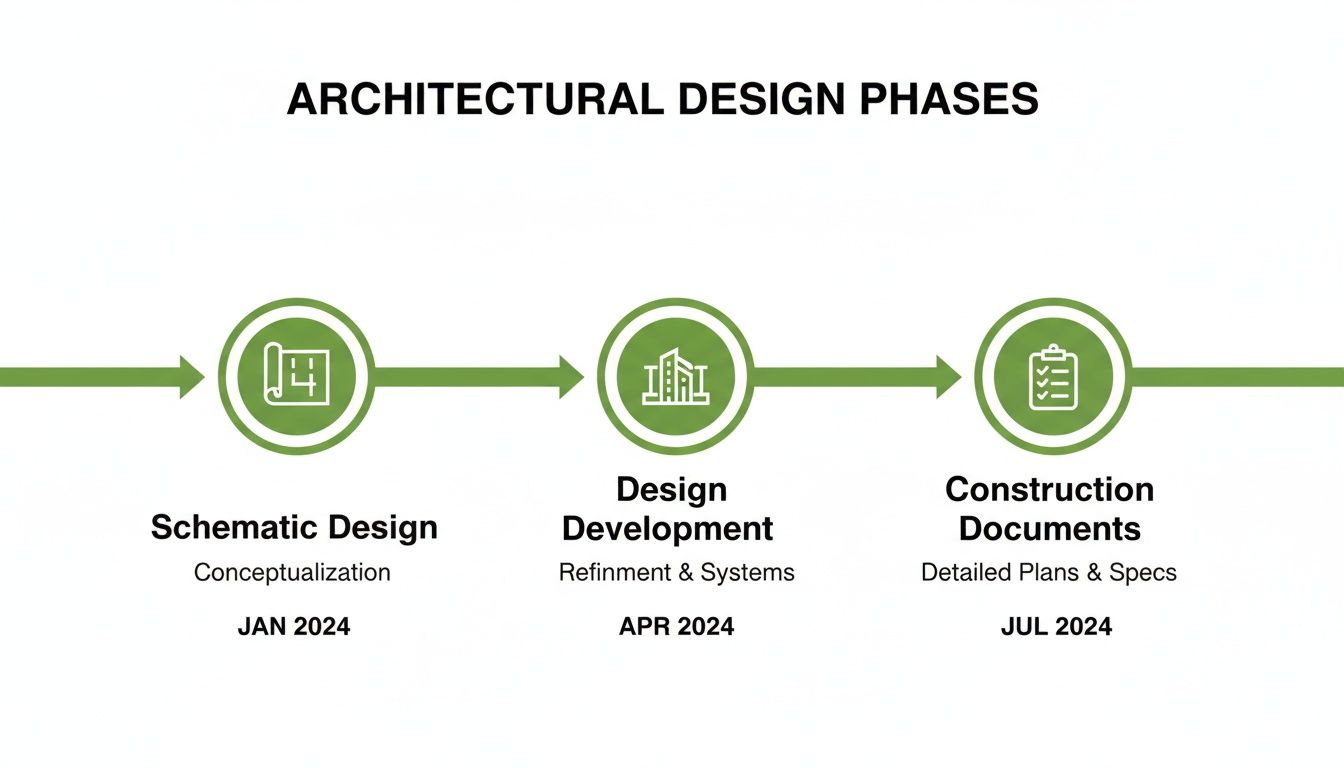
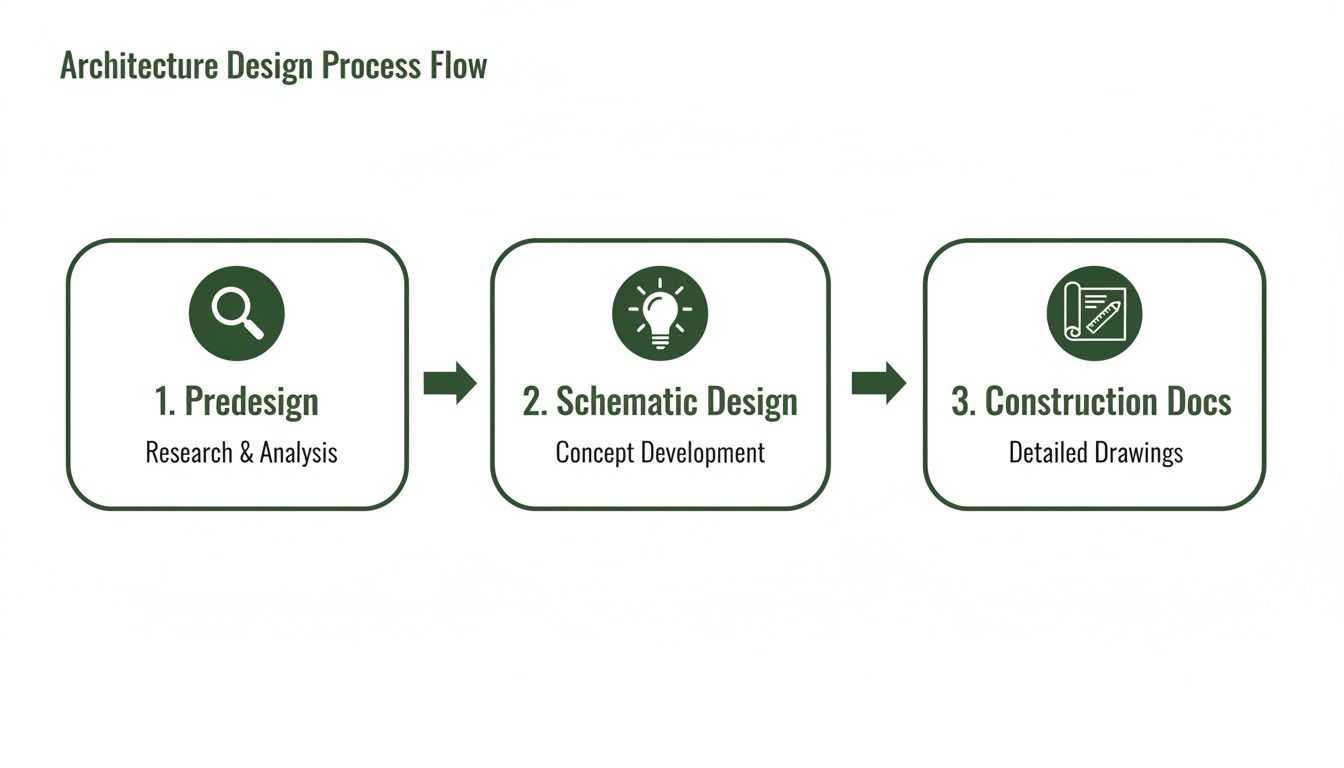
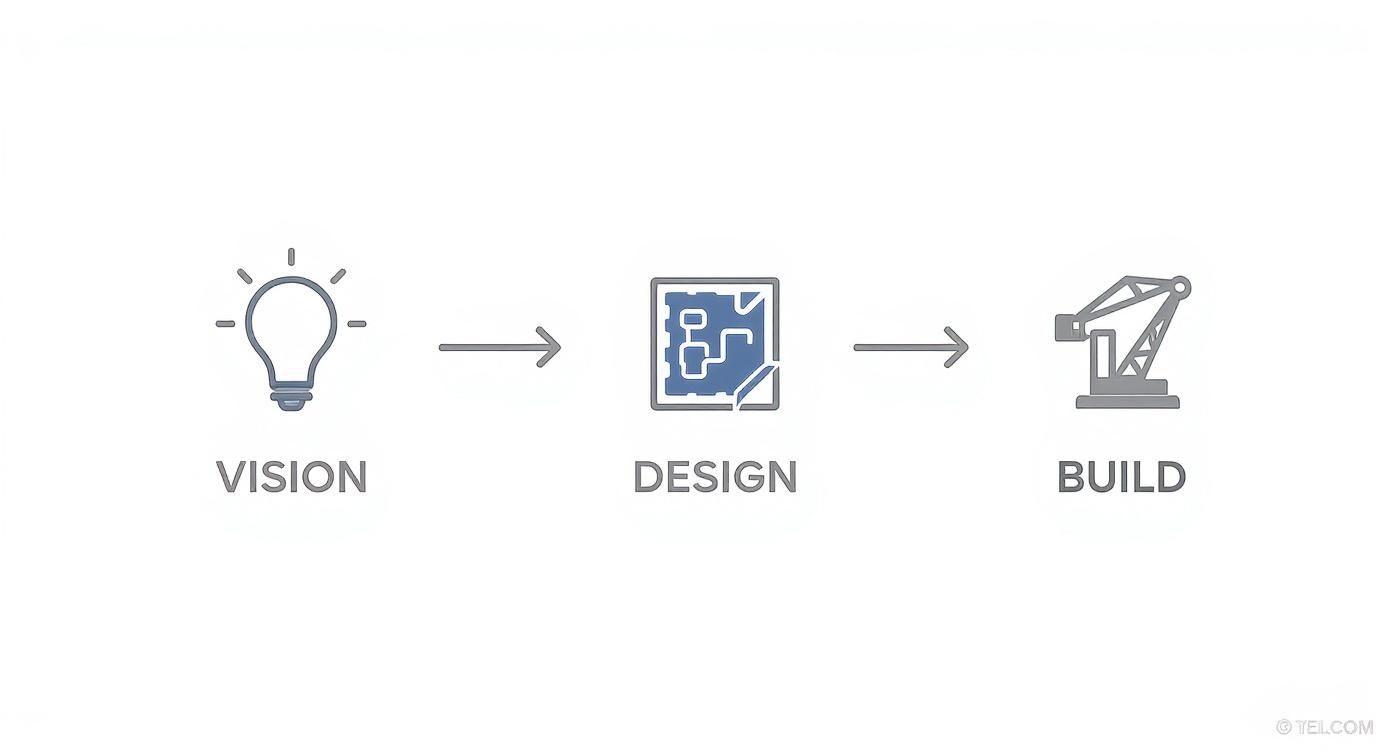
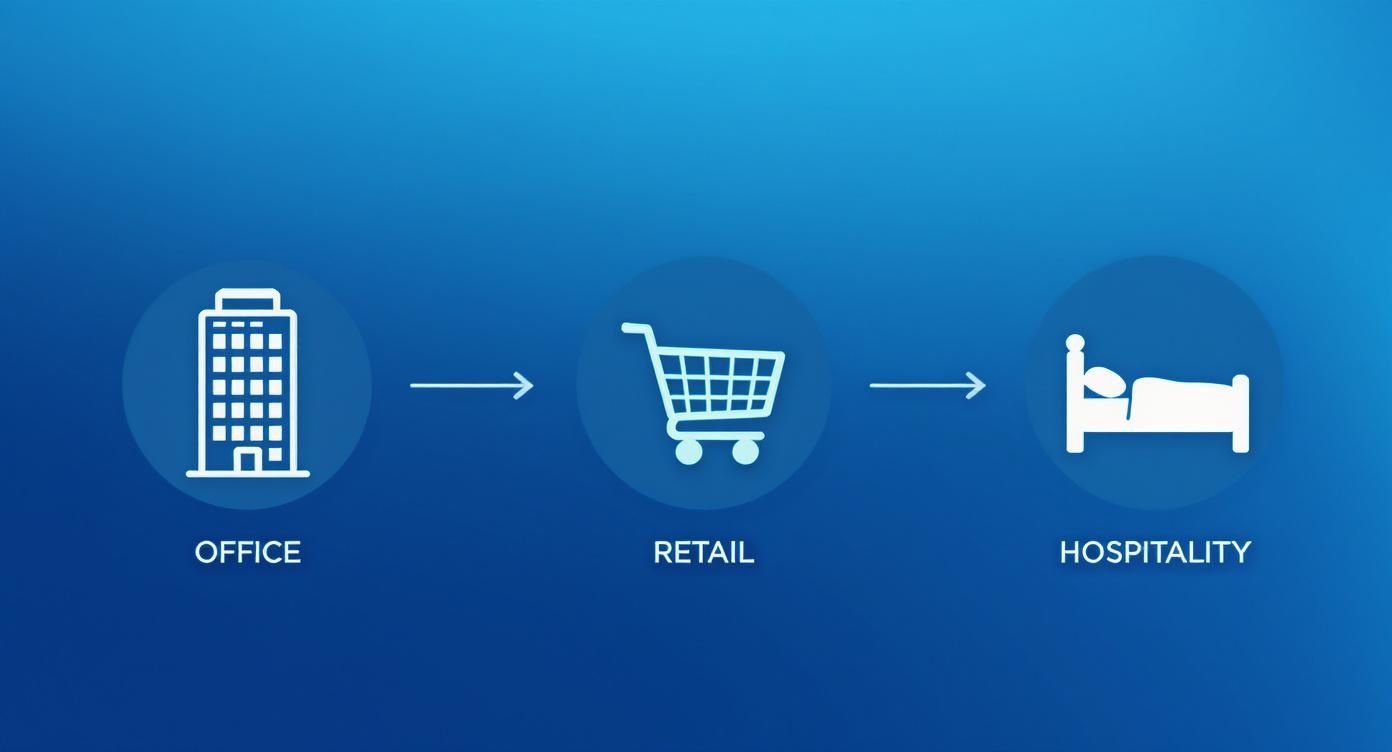
A timeline depicting architectural design phases: Schematic Design, Design Development, and Construction Documents.

As you can see, Design Development is the essential middle step. It takes the approved concept and fleshes it out with enough technical detail to ensure the final construction drawings are accurate and fully coordinated.

Here’s a quick breakdown of all the primary stages of architectural design to put it all into context.

The 5 Key Phases of Architectural Design

Phase Primary Goal Key Outcome
1. Schematic Design Explore broad concepts, spatial relationships, and the project's overall look and feel. Approved floor plans and basic exterior concepts.
2. Design Development Refine and detail the approved design, integrating all major systems and materials. A detailed, coordinated set of drawings and outline specifications.
3. Construction Documents Create the comprehensive technical drawings and specifications for bidding and construction. A "permit set" and "construction set" of documents.
4. Bidding/Negotiation Select a general contractor to build the project based on the final documents. A signed construction contract with a qualified builder.
5. Construction Admin The architect observes construction to ensure it aligns with the design documents. A successfully completed building.

This table shows how each phase logically flows into the next, with Design Development serving as the critical link between the creative vision and the technical execution.

The Real Goal of This Phase: Making Decisions

At its core, Design Development is all about making and documenting decisions. The primary job for your architect is to coordinate every element—from the structure to the window selections—to make sure they all work together seamlessly.

This involves several key activities:

  • Finalizing the building layout with exact dimensions for every room, hallway, and opening.
  • Selecting the major building systems, like HVAC, electrical, and plumbing, and figuring out how they fit.
  • Choosing specific interior and exterior materials, such as flooring types, roofing materials, and siding.
  • Developing detailed drawings, including building elevations and key wall sections, that show how it all assembles.

This is your last, best chance to make significant changes without major cost implications. A simple tweak on paper during Design Development is free. That same change once construction starts could easily cost thousands.

This detailed planning also allows contractors to provide much more accurate cost estimates, giving you a clearer financial picture before breaking ground. By nailing down these details now, you create a solid foundation for a predictable and successful construction process.

Why Design Development Can Make or Break Your Project

If Schematic Design is the beautiful sketch of your project's big idea, then the Design Development (DD) phase is where that sketch gets real. This is the moment we roll up our sleeves and figure out exactly how to build it. It’s less about the broad concept and all about the nitty-gritty details that turn a great idea into a functional, buildable, and financially sound reality.

Think of it as turning a concept car into a production model. The initial design was exciting, but now we have to make it work in the real world—coordinating the engine, the frame, the electronics, and the interior so everything fits and functions perfectly.

Locking in Decisions to Control Your Budget

If there’s one thing to take away about this phase, it’s this: Design Development is all about budget control. Every major decision made here—from the type of HVAC system to the specific windows we use—directly impacts the final construction cost. Getting these choices nailed down before a single shovel hits the ground is the single best way to avoid painful and expensive changes later on.

A detailed DD set gives contractors a clear, comprehensive roadmap, which means they can give you a much more accurate price. That kind of financial clarity is gold, giving you the confidence that the project you've envisioned is the one you can actually afford to build.

An hour spent debating a detail in Design Development can save a hundred hours and thousands of dollars in construction. It's the most effective risk management you can do.

By making firm decisions now, we eliminate guesswork and ambiguity. Everyone knows the scope, the materials are locked in, and the core systems are integrated. The result? A smoother, more predictable construction process for everyone involved.

Giving Substance to the Architectural Vision

Beyond the budget, this is where the building's true character comes to life. Your architect’s job is to weave all the separate threads together—structure, systems, materials, and aesthetics—into a cohesive whole.

This is where we get into the specifics:

  • Finalizing the Structural System: We work closely with the structural engineers to define the building’s skeleton, making sure it supports the design intent.
  • Integrating MEP Systems: This involves figuring out the intricate puzzle of the Mechanical, Electrical, and Plumbing (MEP) systems and how they will run through the building without conflicts.
  • Selecting Exterior Materials: We’ll choose the exact cladding, roofing, and window products that create the building’s look while meeting performance standards.
  • Defining Interior Finishes: It’s time to make firm selections for flooring, wall materials, lighting, and other key interior elements that shape the user experience.

This level of detailed coordination is essential. The U.S. architectural services market is expected to hit around USD 158 billion by 2034, and a huge part of that growth comes from complex projects where early, precise planning is non-negotiable. Sectors like healthcare architecture, for example, have incredibly specific needs that absolutely must be ironed out in DD. Diving into these U.S. architecture market trends really highlights how critical this planning stage is.

Ultimately, a robust Design Development phase ensures the final building is more than just a structure—it's a thoughtful, well-executed asset. It’s the bridge that connects a client's vision to the hard realities of construction, setting the project up for success from day one.

Key Deliverables Produced During Design Development

This is where the vision starts to get real. As the design development phase wraps up, you'll see the abstract ideas and rough sketches from earlier conversations transform into a set of tangible, highly detailed documents.

Think of this package as the official instruction manual for your project. It's the bridge between imagination and construction, translating months of decisions into a clear, unified language that everyone—engineers, contractors, city officials—can understand and follow. Knowing what to expect here is key to giving sharp feedback and feeling confident about where things are headed.
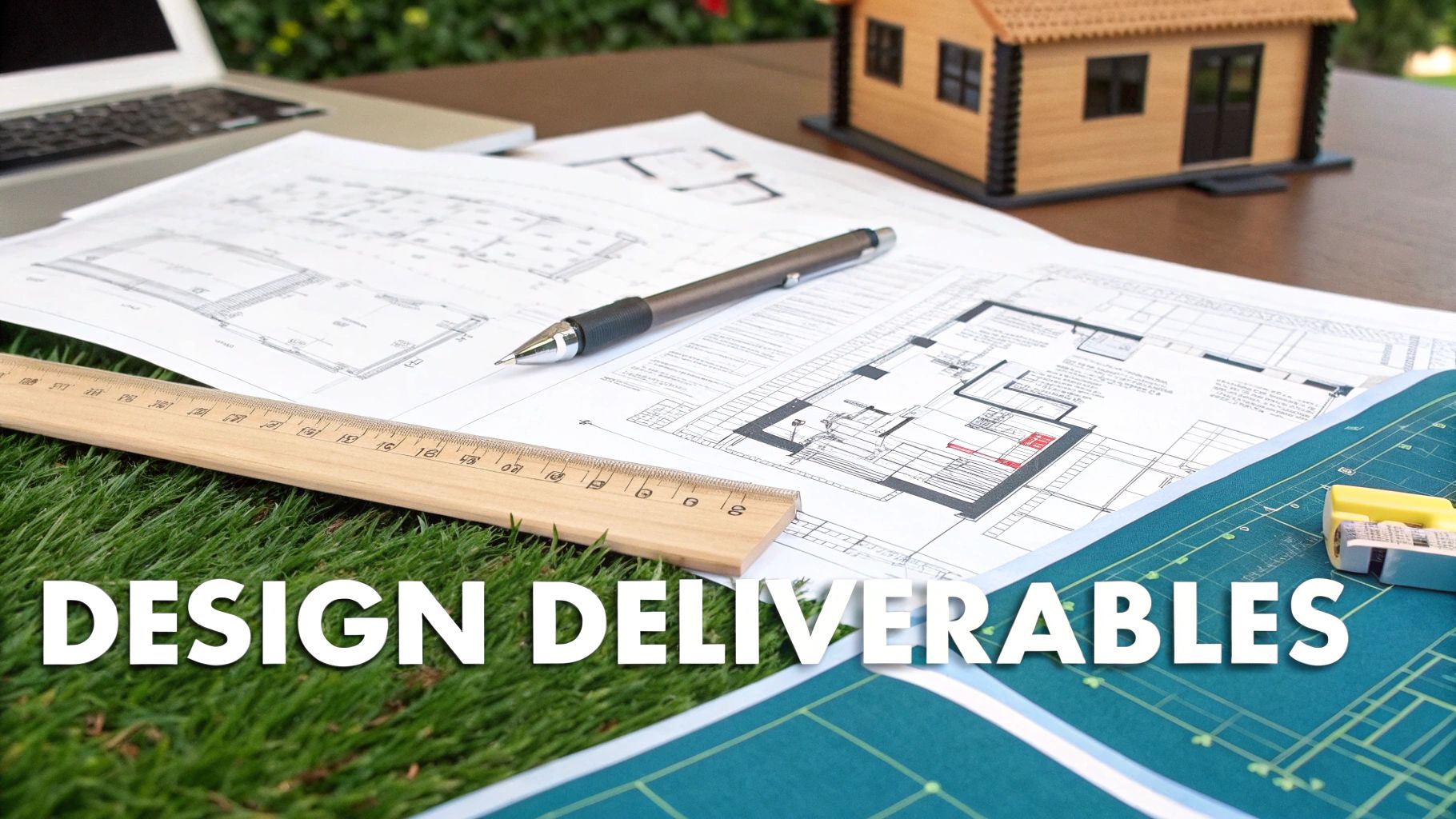
Architectural blueprints, ruler, pen, and a model house on a desk with grass, showing design deliverables.

I like to tell clients to view these deliverables as the first complete draft of their building's biography. Each document tells a specific part of the story, from how it sits on the land to the exact materials that will give it character. Let's walk through what you'll actually be holding in your hands.

The Detailed Drawing Set

The heart of the design development package is a much more robust set of architectural drawings. We're moving way beyond the conceptual sketches of the schematic phase. Now, everything is coordinated, measured, and drawn to scale.

  • Refined Floor Plans: These aren't just bubbles and arrows anymore. You'll see precise dimensions for every single room, wall, door, and window. We also lock in the locations for major fixtures like sinks and toilets, built-in cabinetry, and any other critical clearances to make sure the space actually works.

  • Building Elevations: These are the exterior "portraits" of your building from every angle—north, south, east, and west. This is where the final look is defined. We specify the exact window styles, door designs, and where exterior materials like brick, metal panels, or siding begin and end.

  • Key Building and Wall Sections: If a floor plan is like looking down from the ceiling, a section drawing is like slicing the building in half and looking at it from the side. These drawings are crucial for understanding the building’s vertical relationships—showing true ceiling heights, roof pitches, and how the different floors stack up on top of one another.

A huge piece of this is the comprehensive site plan, which lays out exactly how the building relates to the property. It covers everything from grading and drainage to parking layouts and major landscaping features.

The Recipe Book: Preliminary Specifications

Along with the drawings, you'll get what we call an "outline specification" or a preliminary "spec book." This document is the project's recipe book. It’s a detailed list of all the ingredients needed to build it right.

This is where we get specific. For instance, "brick exterior" becomes a specific brick from a particular manufacturer. "Commercial windows" turns into a detailed set of performance criteria, like required U-values for energy efficiency. This document is absolutely essential for getting an accurate cost estimate.

The spec book is where quality is defined. A set of drawings shows you what the building looks like, but the specifications tell you what it’s made of and how it has to perform.

This detailed list leaves no room for guessing about the quality standards. It covers everything from the grade of structural steel and the type of drywall to the performance specs for the roofing membrane.

The Integrated Engineering Drawings

Design development is also the phase where the architect’s vision truly merges with the technical know-how of our engineering consultants. Your deliverable package will include the first real drawing sets from these key partners, showing how the building’s vital systems are woven into the architectural design.

These coordinated drawing sets typically include:

  1. Structural Drawings: The structural engineer provides the plans for the building’s skeleton. These drawings detail the foundation, columns, beams, and floor framing—everything that holds the building up.
  2. MEP System Layouts: The Mechanical, Electrical, and Plumbing (MEP) engineers map out the building’s circulatory and nervous systems. This means you'll see layouts for the HVAC ductwork, primary electrical conduit runs, and the main plumbing lines.

By the end of this phase, all these deliverables come together to form a cohesive, deeply detailed picture of your project. They give everyone the clarity needed for a final budget check and create the solid foundation we’ll use to produce the final construction documents.

Coordinating the Full Project Team

If Schematic Design is the broad-strokes sketch of your project, Design Development is where the entire team of specialists rolls up their sleeves and gets to work. Think of your architect as the quarterback. They’re no longer just talking to you; they're now directing a whole roster of experts to make sure every single piece of the puzzle fits together.

This isn't just about making a concept look pretty—it's about making it buildable, functional, and sound. It’s a carefully orchestrated process where the structural engineer’s plan for the steel frame has to perfectly align with the mechanical engineer’s ductwork, and neither can conflict with the architect's vision for the interior spaces. This is the behind-the-scenes collaboration that truly brings a building to life.
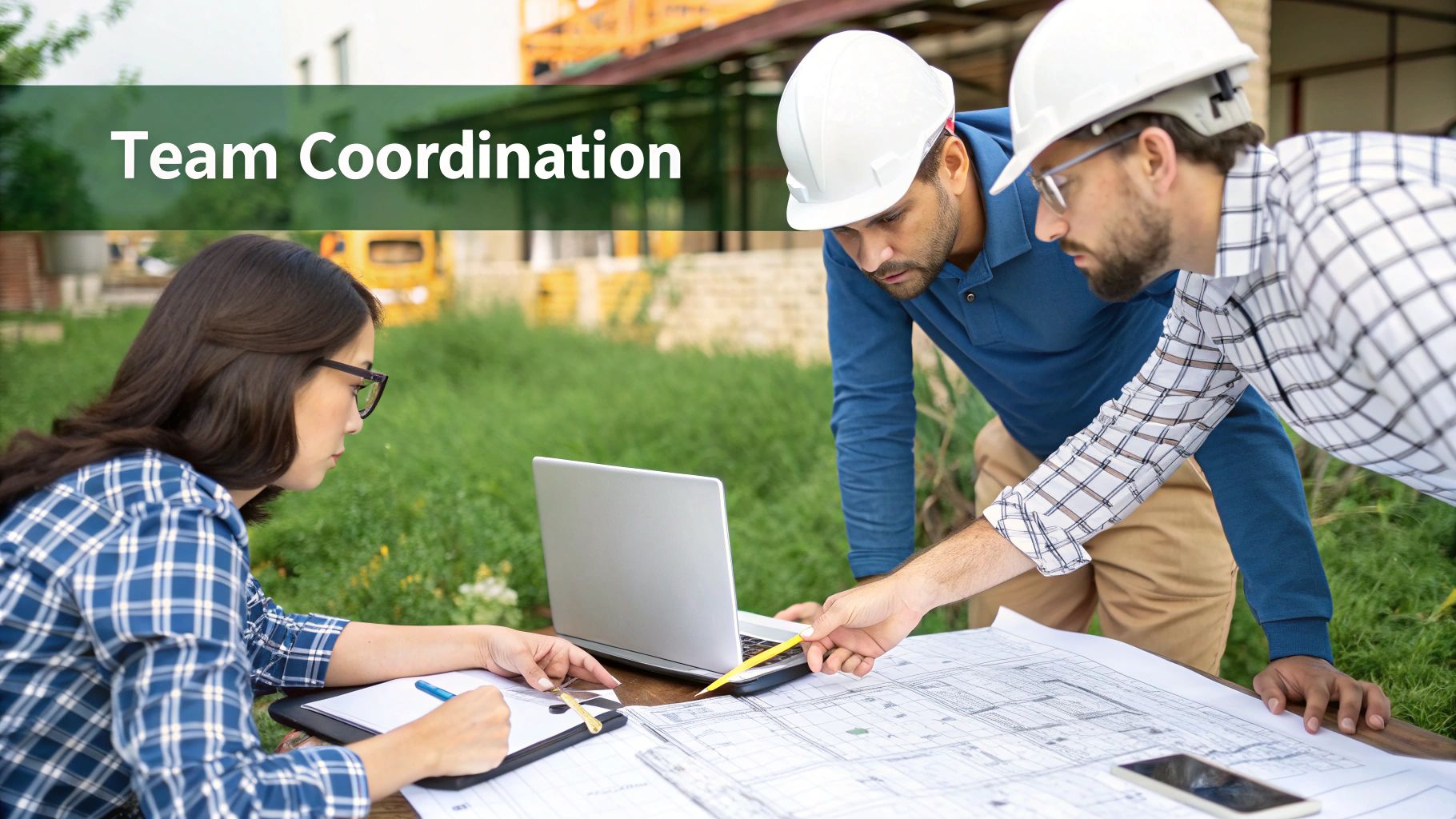
Three construction professionals, two men in hard hats and a woman, collaborating on blueprints and a laptop outdoors.

Assembling the Core Consultant Team

During Design Development, the project roster expands quite a bit. Your architect will bring in a hand-picked group of engineering consultants, each a specialist in their own right, to layer in the technical details that are critical for the building’s performance and safety.

  • Structural Engineers: These are the folks who figure out the building’s “skeleton.” They’re responsible for designing the foundation, columns, and beams that will hold everything up, ensuring the structure is strong enough to withstand all the forces it will face.

  • MEP (Mechanical, Electrical, and Plumbing) Engineers: This team handles the building’s central nervous system and vital organs. They design the HVAC systems for climate control, lay out the entire electrical grid, and map out every pipe for water supply and drainage.

  • Civil Engineers and Landscape Architects: The civil engineer deals with everything happening on the site outside the building's foundation—things like grading, stormwater drainage, and connecting to public utilities. The landscape architect then comes in to shape the outdoor experience, from green spaces and parking to walkways that guide people to the front door.

This collaborative model is essential in today's market. The architectural profession is constantly changing, with new technologies and economic shifts redefining how projects get done. For instance, with rising interest rates impacting private development, many firms are seeing more opportunities in public-sector work like healthcare and education. You can discover more about these U.S. design industry trends to get a better sense of the evolving landscape.

The Value of Early Contractor Involvement

It used to be common to wait until the plans were nearly finished before bringing a general contractor on board. That's changing, and for good reason. Involving a contractor during Design Development, often under what's called a pre-construction services agreement, is one of the smartest moves a client can make.

Bringing a contractor into the fold early for a constructability review provides an invaluable reality check. They see the project through the eyes of the people who will actually build it, and they can spot potential headaches or cost-saving opportunities that are invisible on a set of drawings.

Their practical, on-the-ground experience is priceless in a few key areas:

  1. Constructability Reviews: The contractor can look at a proposed detail and immediately know if it’s going to be a nightmare to build. They might suggest a simpler, more efficient way to achieve the exact same design intent, saving time and money.

  2. More Accurate Cost Estimating: As the design gets more detailed, the contractor can provide increasingly accurate cost feedback. This running tally helps keep the project tethered to the budget, preventing the shock of bids coming in way over what you expected.

  3. Material and System Suggestions: Contractors are in the trenches every day. They know which materials have long lead times, what local subcontractors excel at, and which new building systems might be a better fit for your project.

Navigating Codes and Authorities

Finally, a huge part of the coordination effort is managing the maze of building codes, zoning ordinances, and local review boards. Your architect takes the lead here, ensuring the design doesn't just look good, but is also fully compliant with all legal requirements.

This often means submitting the drawing set to the local building department for a preliminary review. It is far, far easier to adjust a wall or move a plumbing line during Design Development than it is after the final construction documents are complete. Finding a code issue late in the game can trigger significant delays and expensive redesigns.

By managing this complex dance between designers, engineers, builders, and city officials, the architect ensures the project moves steadily toward the finish line. This intensive coordination is the invisible foundation of every great building.

How Design Development Adapts to Different Project Types

The design development process isn't a rigid, one-size-fits-all formula. Think of it more like a flexible framework that adapts to the unique personality and challenges of each project.

Just as a chef uses different techniques for grilling a steak versus baking a cake, an architect has to tailor their approach for a brand-new skyscraper, a historic landmark, or an old warehouse being given a second chance. This adaptability is what makes the phase so critical. The core goals—refining the design, integrating systems, and defining materials—are always there, but the priorities shift dramatically depending on the building's history and future.

New Commercial Construction

When you're dealing with a brand-new commercial building, Design Development is all about optimization. With a clean slate, the main focus is on wringing every last drop of potential out of the site to create a high-performance, future-proof asset.

The team’s energy gets channeled into a few key areas:

  • Site and Systems Integration: This is where we fine-tune the building’s orientation to capture the best natural light, reduce unwanted solar heat, and weave in hyper-efficient MEP (Mechanical, Electrical, and Plumbing) systems. Every decision, from where a window goes to which HVAC unit gets specified, is weighed against its impact on long-term running costs.
  • Code and Zoning Navigation: New builds have to perfectly align with a dense web of modern zoning laws, building codes, and accessibility standards. This phase involves painstaking coordination to ensure every nut and bolt of the design is fully compliant before a shovel ever hits the ground, preventing very expensive delays later on.

Adaptive Reuse Projects

Adaptive reuse projects are a completely different beast. Here, the architect plays part detective, part surgeon. The mission is to breathe new life into an existing structure by seamlessly blending the old with the new.

This demands a highly investigative approach during Design Development. The team has to conduct thorough assessments of the building's structural integrity, the condition of its materials, and whatever infrastructure might be hiding in the walls.

The core puzzle in adaptive reuse is honoring the building's past while making it viable for the future. It’s about strategically inserting modern systems without compromising the character that made the building worth saving in the first place.

Key activities often include detailed surveys and sometimes even selective demolition just to see what you're really working with. The design then has to cleverly weave new, efficient systems around the existing framework, a process that requires a ton of creative problem-solving.

Historic Preservation

With historic preservation, you take that level of care and turn it up to eleven. The guiding principle here is reverence for the building's original craftsmanship and historical significance. Design Development in this context is less about invention and more about meticulous restoration and incredibly sensitive intervention.

The focus shifts to deep research and careful specification:

  1. Material and Technique Research: Architects and specialist consultants dig into the original construction methods and materials. The goal is to repair and replace elements in a way that is historically accurate and authentic.
  2. Meeting Modern Codes Sensitively: One of the biggest hurdles is upgrading the building to meet contemporary safety and accessibility codes without destroying its historic fabric. This often means sitting down with historic preservation offices to find creative, acceptable compromises.

The global demand for these specialized skills is on the rise. Driven by infrastructure modernization, the architectural services market was valued at USD 215.13 billion in 2025 and is projected to climb to USD 273.97 billion by 2029. You can explore more findings in this architecture industry outlook that show just how complex modern projects are becoming.

Ultimately, whether it’s a new build, a clever reuse, or a careful restoration, the architect's design development phase is where specialized knowledge is applied to turn unique challenges into a successful building.

Answering Your Questions About Design Development

Jumping into the design development phase can feel a bit like learning a new language. It's a technical, collaborative, and incredibly important part of the journey from a big idea to a finished building.

Getting your questions answered upfront helps you feel confident and ready to make the smart decisions this stage requires. Here are some of the most common questions we hear from clients as we dive into this critical part of the process.

How Long Does This Phase Typically Take?

The honest answer? It depends entirely on the project's scale and complexity.

For a fairly straightforward commercial building, you're likely looking at a timeline of two to four months. That's usually enough time to get all the engineering disciplines—structural, mechanical, electrical—fully coordinated and to give you, the client, a chance for thoughtful reviews without feeling rushed.

But what about a more complex project? Something like a large-scale adaptive reuse or a delicate historic preservation can easily stretch to six months or even longer. These projects demand a lot of upfront investigation and coordination with specialized consultants, which naturally adds to the timeline. A good architect will lay out a realistic schedule from day one so there are no surprises.

How Much Does Design Development Cost?

Architectural fees are usually calculated as a percentage of the total construction cost. Within that overall fee, the design development phase itself typically represents 15% to 20% of the total. So, if the total architectural fee for a project is $100,000, you can expect the DD portion to be in the ballpark of $15,000 to $20,000.

It’s better to see this not as a cost, but as an investment in clarity. A meticulously planned design development phase is the single best tool you have for locking in an accurate construction budget and avoiding expensive changes later on.

This investment pays huge dividends. It ensures the project is clearly defined, the moving parts are all working together, and the budget is solid before a single shovel hits the dirt. It’s all about preventing those costly surprises during construction.

What Is the Client's Role During This Phase?

Your role is absolutely essential. This is where your vision really starts to take physical form, and your input is needed to make it happen. You'll be making the final calls on materials, building systems, and specific layouts that give the project its character and functionality.

Your architect will come to you with detailed drawings, physical material samples, and product specifications for you to review and approve. Your job is to provide clear, timely feedback. Being engaged and decisive at this stage is what keeps the project moving smoothly and ensures the final design is exactly what you envisioned and budgeted for.


At Sherer Architects, LLC, we make it our job to walk you through every question and decision during the design development phase. We're here to make sure your vision becomes a detailed, buildable, and ultimately successful reality. Learn how our collaborative process can bring your commercial, adaptive reuse, or historic preservation project to life.
Categories
Uncategorized

What Is Experiential Design and How Does It Transform Spaces?

Experiential design is a philosophy that treats buildings not just as structures, but as stages for human experience. It's the practice of carefully shaping an environment to tell a story, guide a journey, and make people feel something specific. It’s about moving past pure function to choreograph the moments that happen within a space, turning people from passive visitors into active participants.

Beyond Blueprints: Shaping The Human Experience

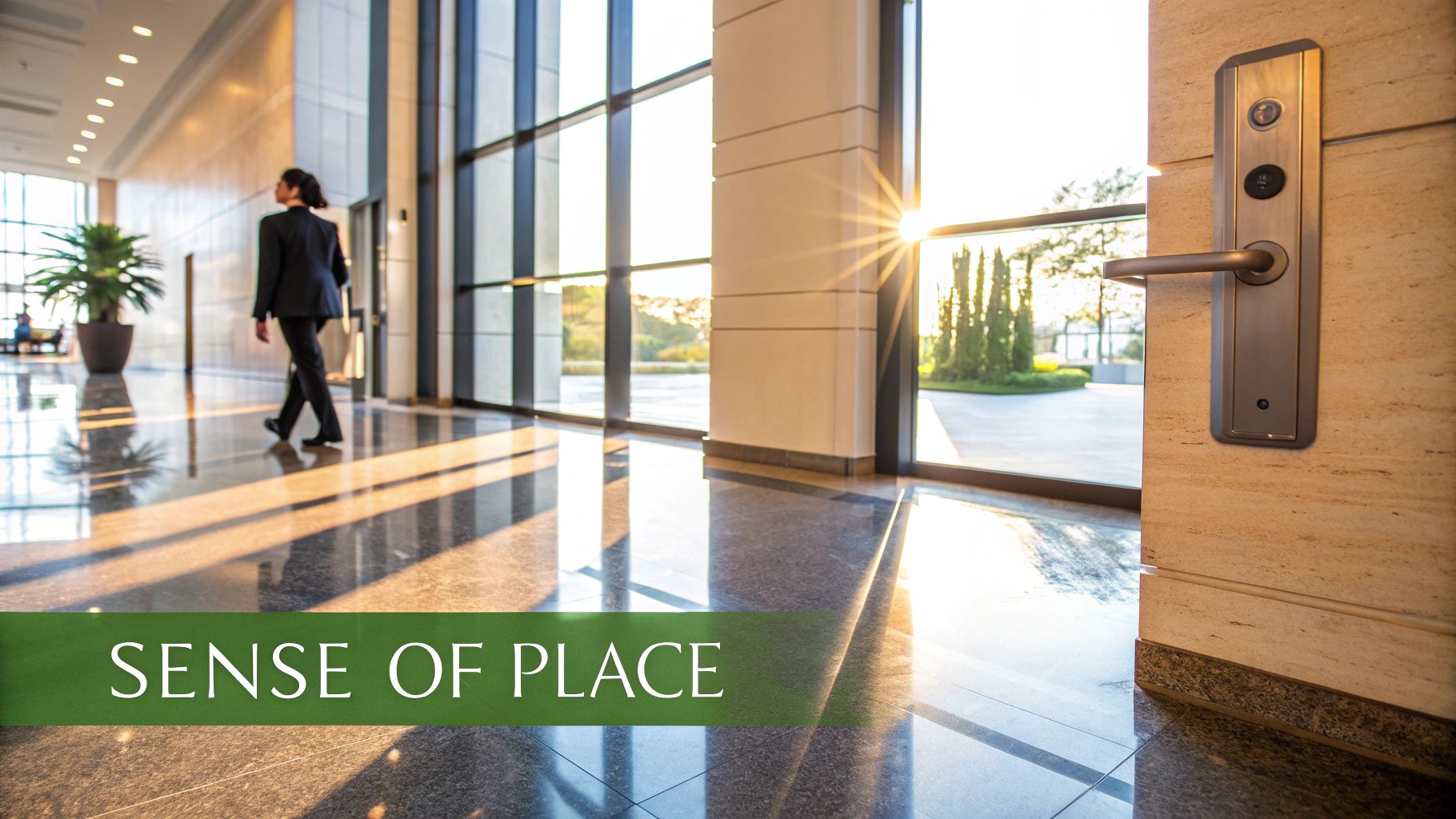
A business person walks in a sunlit modern building lobby with reflections on the floor.

Think of it this way: a standard building is a functional tool. It gets the job done. But a building shaped by experiential design is a finely crafted instrument, one that feels intuitive and resonates with the people inside it. It’s a deliberate approach where every single choice—from the way sunlight moves across a lobby floor to the tactile feel of a door handle—is a calculated part of a larger narrative.

This isn't just about making things look good; it's about starting a multisensory conversation between a person and their environment. The real goal is to make people feel something intentional—be it inspired, calm, productive, or deeply connected. It’s the critical difference between a building that simply exists and one that truly lives.

The Four Pillars Of Experiential Design

So, how does this actually work in practice? We can break experiential design down into four core pillars. These principles are the foundation for creating a space that feels cohesive, impactful, and memorable for everyone who walks through its doors.

The table below gives a quick overview of these foundational concepts.

Pillar Core Concept Application in Architecture
Narrative/Story Every building has a purpose or story. This principle embeds that story into the very fabric of the design. Using historical elements, brand identity, or a guiding theme to inform material choices, layout, and visual motifs.
Multi-Sensory Feel Experience goes beyond sight. This pillar engages touch, sound, and even smell. Selecting textured materials, managing room acoustics for comfort, and incorporating natural elements like plants or water features.
Human-Centric Focus The design starts and ends with the people who will use the space—their needs, behaviors, and emotions. Designing for intuitive flow, comfort, and well-being. Asking "How will this make someone feel?" at every stage.
Active Engagement Spaces should invite people to interact, not just observe. Creating flexible workspaces, installing interactive art, or designing intuitive wayfinding that encourages exploration.

By weaving these four pillars together, we can design spaces that aren't just occupied, but are truly experienced.

Experiential design is the intentional shaping of how people feel, think, and act during an interaction or event. It goes beyond planning activities; it’s about creating emotional resonance, prompting reflection, and designing moments that leave a lasting impact.

Why It Matters Now More Than Ever

In a world saturated with digital notifications and fleeting online interactions, the hunger for authentic, tangible experiences is stronger than ever. It's a real trend with serious economic backing—the global experiential market is on track to hit USD 1.2 trillion by 2033. This boom signals a massive shift in what people value.

For commercial property owners, this isn't just a buzzword; it's a strategic advantage. Creating emotionally resonant environments is what attracts and keeps great tenants.

When we talk about experiential design in architecture, it often comes down to the thoughtful, almost poetic, use of fundamental elements like light. A well-designed space does more than just provide illumination; a proper architectural lighting design can craft a mood, guide the eye, and completely define a sensory experience. By focusing on the human journey, buildings become more than just structures—they become destinations.

How Experiential Design Evolved from Function to Feeling

Experiential design isn't some passing fad. It's a real shift in how we think about architecture, moving beyond simple utility and into the realm of human psychology. For most of history, a building's job was simple: provide shelter and serve a function. Now, we have a much deeper understanding of how the spaces we inhabit directly shape our moods, our behaviors, and even our decisions.

This evolution is all about moving from designing for function to designing for feeling. It's the difference between a building that just contains activities and one that actively makes those activities better. The whole point is to create environments that aren't just occupied, but are truly lived in.

Mapping the Human Journey

At the core of this shift is something called user journey mapping. The idea originally comes from the world of digital design, where teams map out a user's clicks and swipes. We've adapted that same thinking for architecture. Instead of tracking clicks, we're mapping footsteps, sightlines, and emotional reactions as a person moves through a physical space.

Think about charting a guest's path through a renovated historic hotel. This process lets us pinpoint the exact spots where a design choice can create a specific, intentional moment.

  • Awe and Arrival: Where do we place a stunning piece of art or a dramatic light fixture to create that perfect "wow" moment in the lobby?
  • Comfort and Pause: Which corner gets the best afternoon light? That’s the perfect spot for a cozy chair where a guest can take a moment to themselves.
  • Reflection and Discovery: How can we subtly reveal original architectural details along a hallway to spark a visitor's curiosity about the building's past?

When you choreograph the journey like this, the building stops being a static box and becomes a dynamic story, guiding people from one feeling to the next.

Engaging All the Senses

Another major principle here is multi-sensory engagement. For a long time, architecture was treated as a purely visual art. But experiential design gets that we perceive the world through all our senses, and a truly immersive space has to do more than just look good.

This means we're paying close attention to the details that often get overlooked:

  • Tactile Sensations: The cool, smooth feel of a marble countertop, the rough texture of exposed historic brick, or the warmth of a wooden handrail under your palm.
  • Acoustic Environments: The intentional hush of a library compared to the energetic buzz of a collaborative office.
  • Ambient Scents: The subtle aroma of fresh coffee wafting through a lobby or the clean, earthy smell of plants in a sunlit atrium.

By engaging multiple senses, a design creates a richer, more memorable and emotionally resonant experience. It’s this depth that elevates a good design to a great one, leaving a lasting impression long after a person has left the space.

Designing for Emotion

Ultimately, this entire evolution is driven by emotional design theory. This framework is built on a simple truth: our emotional response to a place is a huge part of our overall experience. Architects who embrace this deliberately craft spaces to evoke specific feelings, whether that’s security, inspiration, collaboration, or peace.

This isn't about manipulation; it’s about alignment. A well-designed office should make people feel productive and valued. A revitalized historic landmark should give visitors a tangible connection to the past. This focus on feeling is what takes a building beyond bricks and mortar and turns it into a powerful tool for connection and well-being. The structure becomes more than just a place to be—it becomes a place to feel.

Putting Experiential Design into Practice

It's one thing to talk about the theory behind experiential design, but it’s something else entirely to see those principles breathe life into a project of concrete and steel. This is where the abstract becomes tangible, solving real-world challenges for developers, property owners, and the people who ultimately use the space.

How we apply these ideas changes dramatically with each project. A brand-new office tower is a blank canvas. An old factory repurposed for modern use comes with a rich, built-in story. A historic landmark demands a delicate dance between past and present. While the starting points are different, the end goal is always the same: create a place that connects with people and delivers measurable results.

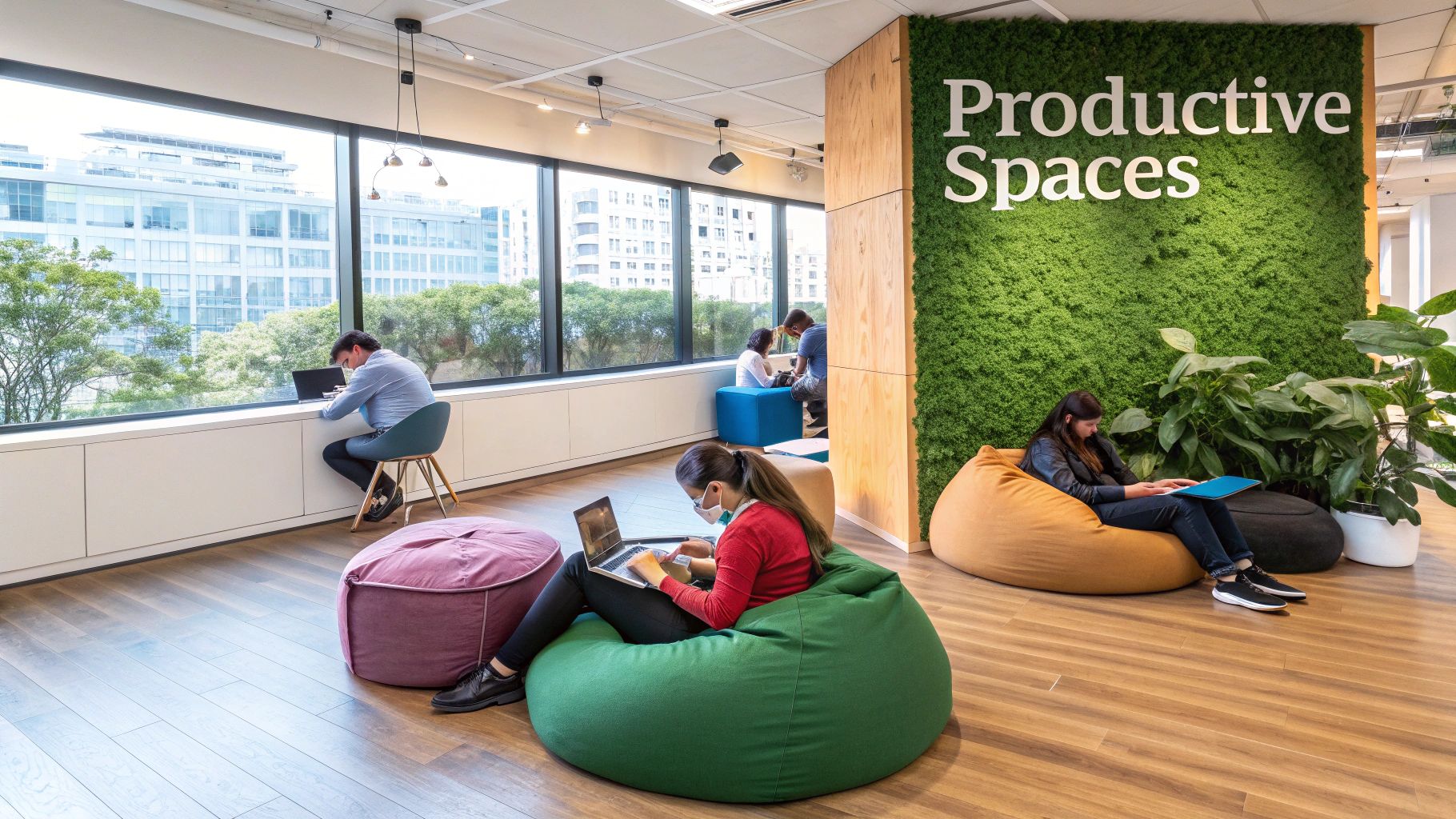
People working comfortably in a modern, plant-filled office space with large windows and 'Productive Spaces' wall.

New Construction: The Modern Office Tower

When it comes to a new office tower, experiential design is our answer to the modern workforce's demand for something more than a desk and a Wi-Fi signal. It’s about building a complete ecosystem that supports productivity, well-being, and a genuine sense of community. This runs much deeper than surface-level aesthetics.

We focus on strategic choices that shape the daily experience:

  • Daylight Harvesting: We orient the building and size the windows not just for pretty views, but to pull in as much natural light as possible. It’s a proven way to boost mood and slash energy costs.
  • Collaborative Zones: We design a mix of spaces—from quiet pods for deep focus to open, buzzing common areas—giving people the freedom to choose the environment that fits their task.
  • Biophilic Elements: We bring the outdoors in. Living walls, natural materials, and interior greenery actively reduce stress and improve air quality, making the office a fundamentally healthier place to spend the day.

These elements aren't just perks; they create an environment where people truly want to be. For a business, that’s a powerful tool for attracting and keeping top talent.

Adaptive Reuse: The Soul of an Old Factory

Adaptive reuse projects give us a powerful story to work with from day one. The existing building isn't a limitation—it’s the main character. Our job is to honor its history while weaving in modern functionality that attracts today’s top-tier tenants.

Imagine an old textile mill being reimagined as a mixed-use development. An experiential approach would mean:

  • Celebrating the original brickwork, massive industrial windows, and exposed steel beams. These aren't just architectural features; they are authentic, tactile links to the building's heritage.
  • Pairing those historic elements with sleek, modern amenities. Think high-speed fiber running alongside century-old timber, contemporary lighting illuminating original masonry, and state-of-the-art HVAC systems.
  • Using the building’s unique history to forge a brand identity that connects with businesses and residents who crave character and authenticity.

This strategy doesn’t just renovate a forgotten structure; it turns it into a landmark destination. It creates a powerful narrative that a brand-new building simply can't replicate.

In adaptive reuse, experiential design doesn't just create a new space; it resurrects an old one, giving it a second life. It respects the layers of history and makes them a tangible part of the daily experience for every person who walks through the doors.

Technology is a huge part of this, as we future-proof these historic structures. For instance, the immersive marketing field—a key aspect of the experiential economy—is projected to skyrocket from USD 6.90 billion in 2024 to USD 29.68 billion by 2030. By integrating the right electrical and network infrastructure from the start, we ensure an adaptive reuse project can support future technologies without compromising its soul.

Historic Preservation: A Tactile Link to the Past

With historic preservation, our focus narrows to authenticity and reverence. The design must make history feel immediate and real, creating a tangible connection for every visitor. Here, experiential design works in subtle, respectful ways, using materials and sensory details to pull people back in time.

This isn't guesswork; it's meticulous research and execution. We use historically accurate materials, replicate original construction techniques, and restore period-specific fixtures. The distinct feel of a hand-planed wooden floor underfoot or the way light filters through authentically reproduced wavy glass creates an immersive experience that a simple museum placard never could.

To see how hands-on engagement deepens connection across different fields, you can explore these experiential learning examples. From a new skyscraper to the careful preservation of a landmark, each application shows how experiential design elevates architecture beyond mere shelter. We create spaces that are meaningful, memorable, and ultimately, more valuable.

The Measurable ROI of Designing for Experience

So, how does crafting a better experience actually improve the balance sheet? For any developer, investor, or property owner, that’s the real question. Experiential design is far more than a simple aesthetic upgrade; it's a powerful engine for creating value, delivering concrete, measurable returns by putting the human journey at the heart of the space.

This approach has a direct line to key financial metrics. A building that offers a genuinely superior user experience stands out in a crowded market, which almost always leads to faster lease-up periods and higher occupancy rates. It's simple: when tenants love where they are, they stick around. That dramatically cuts turnover costs and boosts long-term retention.

Beyond just keeping tenants, properties known for their exceptional design and atmosphere can command premium lease rates. People—whether in a commercial or residential setting—are willing to pay more for spaces that enhance well-being, build community, and support what they need to do. This elevates a property from a commodity to a destination, directly increasing its long-term asset value.

Boosting Tenant Success and Brand Value

Think of it this way: an investment in experiential design is an investment in your tenants' success. For retail, design choices like intuitive wayfinding, engaging common areas, and touches of nature can lead to more foot traffic and longer dwell times. You’re creating a more profitable environment for them, which makes your property the place to be.

The same logic applies to an office. A human-centric design has a direct impact on employee wellness and productivity. Things like great natural light, flexible workspaces, and zones for both collaboration and quiet focus can reduce absenteeism and improve job satisfaction. This helps your commercial tenants attract and retain top talent—a huge selling point that adds immense value to your building.

Experiential design transforms a property from a cost center into a strategic asset. By prioritizing the user journey, you create a feedback loop where an enhanced experience leads to tenant success. That success, in turn, drives higher leasing demand, stronger retention, and ultimately, a more profitable and valuable building.

Connecting with Consumers to Drive Revenue

The financial impact doesn't stop with your immediate occupants. Your commercial tenants serve their own customers, and creating an environment that supports engaging brand experiences is critical for them. Thoughtful design can provide the perfect backdrop for events, pop-ups, and interactive displays that build real customer loyalty.

The data backs this up. An incredible 85% of consumers say they are more likely to buy from a brand after participating in an engaging event or experience. This shows how the design of a commercial space directly influences purchasing decisions and builds the kind of brand connection that keeps tenants thriving—and renewing their leases. If you're interested, you can explore more insights on creating unforgettable brand experiences.

At the end of the day, designing for experience isn’t about adding extra costs; it's about making smarter, more strategic investments. By linking every design choice to a measurable business outcome—like higher lease rates, better tenant retention, or increased foot traffic—it becomes clear that this approach is one of the most effective ways to maximize a property’s financial performance and secure its place in the market for years to come.

Integrating Experiential Design Into Your Next Project

Bringing the principles of experiential design to life isn't about guesswork; it's a structured, intentional process. Think of it as a practical roadmap for telling a building’s story, making sure every single choice—from the lobby layout to the doorknobs—serves a clear purpose. This isn't just about adding some nice features at the end. It's a foundational approach that begins long before the first shovel ever hits the ground.

The whole process is built on a simple, powerful idea: a building should respond to the needs, emotions, and aspirations of the people inside it. By following a clear, phased strategy, we can directly connect architectural decisions to a project's core business goals. The result? Spaces that create both a memorable experience and a measurable return.

Phase 1: Discovery and Deep Listening

The journey starts not with sketches, but with questions. This initial discovery phase is easily the most critical step, as it sets the strategic direction for the entire project. Here, we prioritize deep listening to understand the true goals for the space and, just as importantly, the unspoken needs of its future occupants.

We dive in with collaborative workshops and detailed research to figure out the core narrative. What story should this building tell? Who are the people walking its halls every day, and what do they need to feel successful, comfortable, or inspired? Answering these questions gives us a clear filter for every decision that follows.

Experiential design starts with the feelings you want to inspire, and the activities follow. By defining the desired emotional outcome first, the physical design becomes a direct response to a human need, rather than just an assembly of materials.

This first phase ensures the final design is grounded in a strong, authentic identity that actually connects with its intended audience.

Phase 2: Programming and Narrative Development

With a clear vision locked in, we move into programming. This is where we translate the building’s story into a functional spatial plan. We map out the user journey in painstaking detail, choreographing how people will move through, interact with, and feel within the environment from the very moment they arrive.

This involves defining the specific functions and emotional tones for different zones. We outline which areas should spark collaboration, which should offer quiet refuge, and how the transitions between them should feel. The building’s story informs every part of the layout, creating a flow that’s both logical and emotionally cohesive.

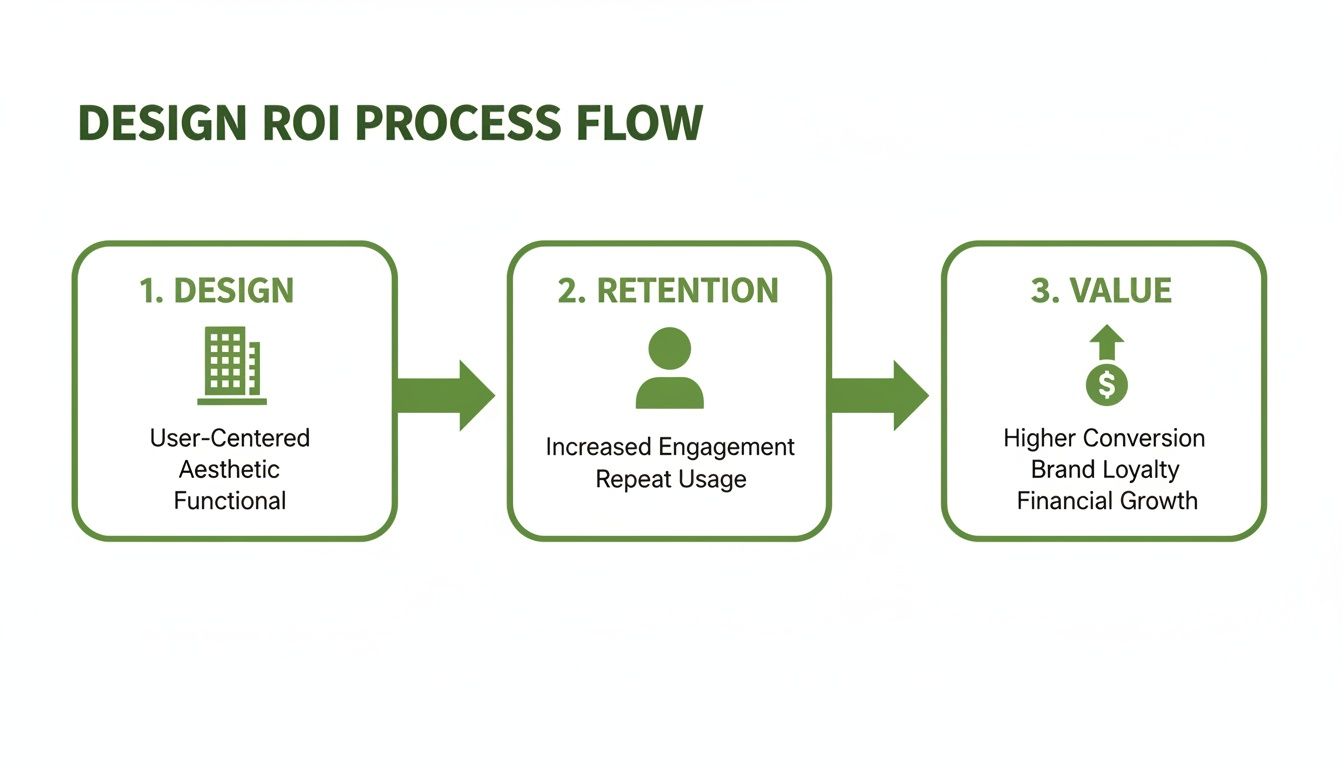
The flowchart below shows how this intentional design process directly contributes to user retention and long-term business value.

Flowchart illustrating the Design ROI Process, moving from design principles to user retention and business value.

As the visual makes clear, a human-centered design approach is the first domino in a chain reaction that ultimately strengthens a property's financial performance.

Phase 3: Strategic Design and Material Selection

Now, the architectural details come into focus, all guided by the narrative we’ve carefully developed. Every material, lighting fixture, and landscape element is chosen for its unique ability to contribute to the desired experience.

Here are a few key strategies we often put into play:

  • Materiality for Tactile Engagement: We select materials not just for how they look but for how they feel. The warmth of reclaimed wood, the coolness of natural stone, or the rugged texture of exposed brick can forge powerful, unspoken sensory connections.
  • Lighting to Shape Mood: Light is one of our most potent tools. We use a combination of natural daylighting and meticulously designed artificial light to define spaces, guide attention, and evoke specific emotions—from energetic and bright to calm and focused.
  • Landscaping to Blur Boundaries: A building's experience doesn't start at the front door. We integrate landscaping to create a seamless transition from outside to inside, using plant life to improve air quality, reduce stress, and establish a tangible connection to nature.

Phase 4: Post-Occupancy Evaluation

Our work doesn’t stop when the construction crews pack up. The final step is a crucial feedback loop: post-occupancy evaluation. By observing how people actually use the space, we gain invaluable insights that prove the design’s impact and inform every future project we take on.

This evaluation can range from formal surveys to informal observation. Did the new collaborative zones really boost interaction? Are the quiet areas being used for focused work? This data provides tangible proof of the project's success and demonstrates the real-world value of designing for experience.

To help visualize this process from start to finish, here's a simple checklist that outlines the key steps.

Experiential Design Project Checklist

This checklist provides a high-level overview of the key actions and goals at each stage of an experiential design project, ensuring the focus remains on the end-user from conception through completion.

Phase Key Action Desired Outcome
1. Discovery Conduct stakeholder workshops and user research. A clear, unified project vision and a defined "user story."
2. Programming Map the user journey and define spatial functions. A detailed spatial program that aligns with the project narrative and user needs.
3. Strategic Design Select materials, lighting, and finishes that support the experience. A cohesive design where every element serves a specific emotional and functional purpose.
4. Post-Occupancy Gather user feedback and analyze usage data. Actionable insights that validate design choices and inform future improvements.

By following this structured approach, we ensure that the final built environment is not just a building, but a place that works better for everyone.

Putting Experiential Design to Work: Real-World Examples

It’s one thing to talk about principles, but it’s another to see them come to life. The true power of experiential design is most obvious when you see how it solves real business problems through thoughtful, human-focused architecture.

Let’s look at a couple of scenarios that show how this works. These aren't just about blueprints; they're about shaping behavior, fostering community, and delivering clear business results.

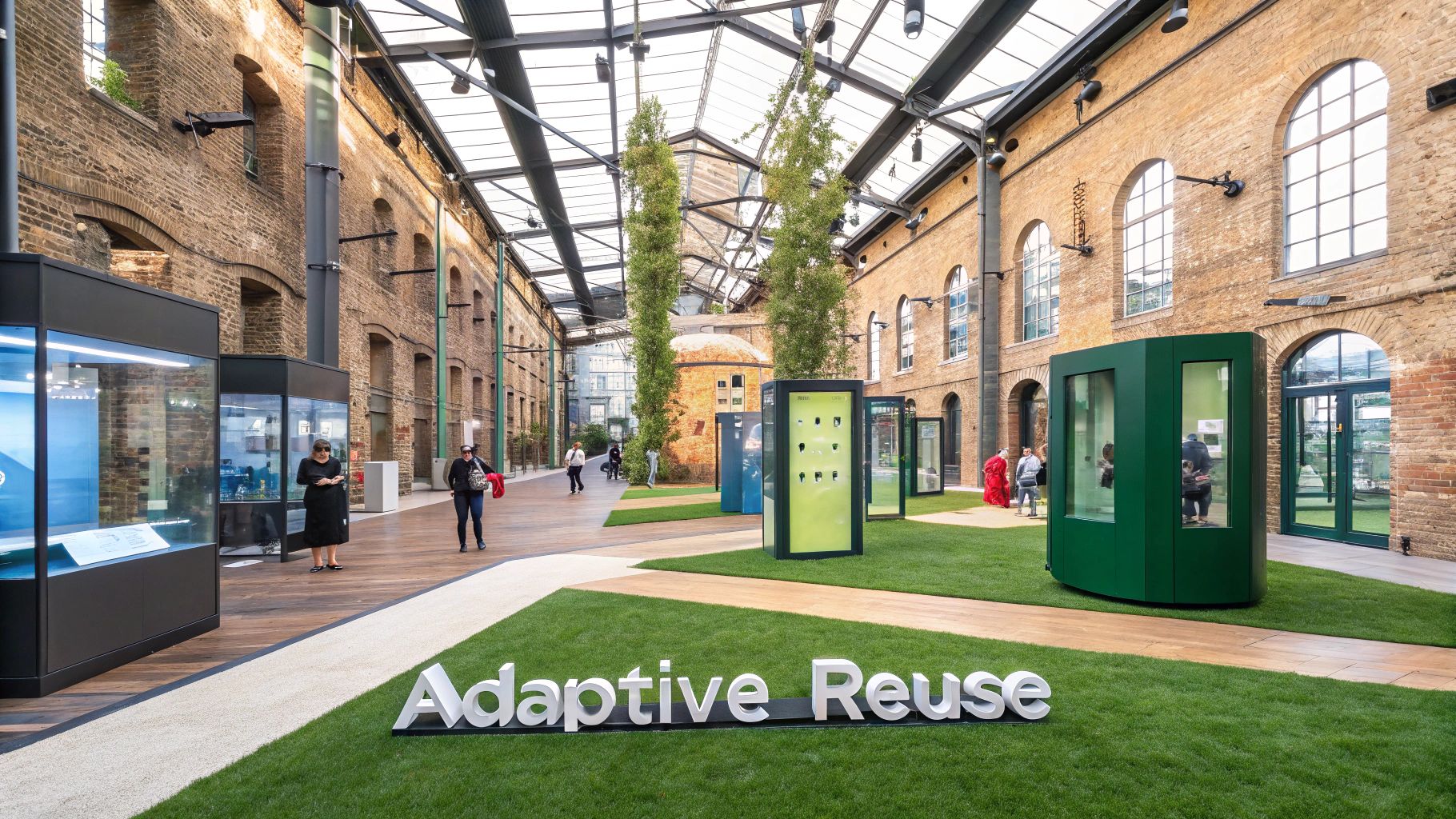
A large, light-filled hall repurposed from an old brick building with grass, exhibits, and people.

Case Study 1: The Forgotten Warehouse Turned Tech Hub

Picture an old, abandoned brick warehouse sitting downtown. It's a relic from another time—structurally solid, but dark, massive, and totally wrong for today’s workforce. For the property owner, it's a dead asset, unable to attract any tenants in a crowded market.

  • The Challenge: How do you turn an obsolete industrial building into a vibrant, multi-tenant tech hub that not only attracts top companies but also creates a genuine sense of community?

  • The Experiential Solution: Instead of gutting the building and erasing its past, we lean into it. The design preserves the soul of the place—the exposed brick, the huge timber beams, the high ceilings—while weaving in modern essentials. We cut massive skylights into the roof to drench the deep interior spaces with natural light. A new central atrium acts as the building’s heart, creating a visual and physical connection between floors with a "living staircase" designed to spark impromptu conversations.

  • The Measurable Outcome: The repurposed building leases up 40% faster than new construction in the area. Its unique character becomes a major selling point for tenants, who use the authentic, inspiring workspace to recruit top talent. The building itself becomes a local landmark, boosting property values for the entire neighborhood.

Case Study 2: The Underperforming Corporate Campus

Think of a corporate campus from the 1990s—a collection of disconnected buildings surrounded by parking lots. The common areas are sterile and empty, and employees feel siloed in their departments. The company is struggling with employee retention and a lack of the spontaneous collaboration that drives innovation.

The beginning of the experience is your opportunity to set the tone and the rules of engagement. It shows the people you've invited what the experience is going to be all about.

This idea is central to turning an isolating space into a connected one.

  • The Challenge: To overhaul a dated and isolating campus to improve employee satisfaction, encourage teams to work together, and build a culture that puts people first.

  • The Experiential Solution: The strategy is to create a central "heart" for the campus. A cavernous, underused lobby is transformed into a buzzing community hub with a great coffee bar, comfortable seating, green walls, and rotating local art. We then add covered walkways to link the separate buildings, making it easy and enjoyable for people to move around and bump into colleagues from other teams.

  • The Measurable Outcome: After the renovation, post-occupancy surveys reveal a 30% jump in employee satisfaction. The company also sees a clear increase in informal meetings and cross-departmental projects. The campus is no longer just a place to work; it's a destination that strengthens the company's brand and makes it a far more desirable employer.

Answering Your Questions About Experiential Design

Even when the benefits are clear, we find that property owners and developers still have some very practical questions about what experiential design actually looks like for their specific project. Let's tackle a few of the most common ones we hear.

Is This Just for Big-Budget Projects?

Absolutely not. Experiential design is fundamentally about a strategic mindset, not just expensive bells and whistles. It’s an approach that can be scaled to fit any size project or budget.

Something as simple as a thoughtful decision about window placement to maximize natural light, or a carefully planned circulation path that makes a building intuitive to navigate, can dramatically improve the user experience. The real key is prioritizing that human element right from the start, not adding it on at the end.

How Do You Even Measure Something Like "Experience"?

It might seem abstract, but the ROI of a well-executed experiential design is surprisingly concrete. We track its impact through a mix of hard data and real-world feedback.

  • The numbers tell a clear story: we look at things like higher lease rates, shorter vacancy periods, increased foot traffic, and better tenant retention.
  • The human impact is just as important: we see it in post-occupancy surveys showing higher satisfaction, glowing online reviews, and the kind of positive word-of-mouth that gives a building real buzz.

Together, these factors directly boost a property's long-term value.

Isn't This Just a Fancy Term for Interior Design?

That’s a fair question, but experiential design is much broader. Think of it this way: traditional architecture gives you the building's bones and ensures it meets code. Interior design then comes in to handle the aesthetics and furnishings within that structure.

Experiential design is the overarching strategy that connects everything. It weaves architecture, interiors, branding, psychology, and even landscaping into a single, cohesive journey for the user—from the moment they see the building from the street to the smallest detail they notice inside.

It's the "why" that guides all the other design decisions.


At Sherer Architects, LLC, we believe every building has a story just waiting to be told. Our specialty is turning that story into a tangible, valuable experience for commercial, adaptive reuse, and historic preservation projects. Let us help you align every piece of the puzzle to deliver a result that's not just beautiful, but built to last.

Visit us at https://shererarch.com to see how we bring structure to life.

Categories
Uncategorized

Warehouse Theatre in Greenville SC A Blueprint for Adaptive Reuse

The Warehouse Theatre in Greenville SC isn't just a place to see a great show; it’s a living blueprint for how to do adaptive reuse right. We're going to dive into how this simple textile warehouse was completely transformed into a vibrant cultural cornerstone for the city's West End, making it a compelling case study for any developer or property owner with an eye for potential.

From Industrial Relic to Cultural Icon in Greenville SC

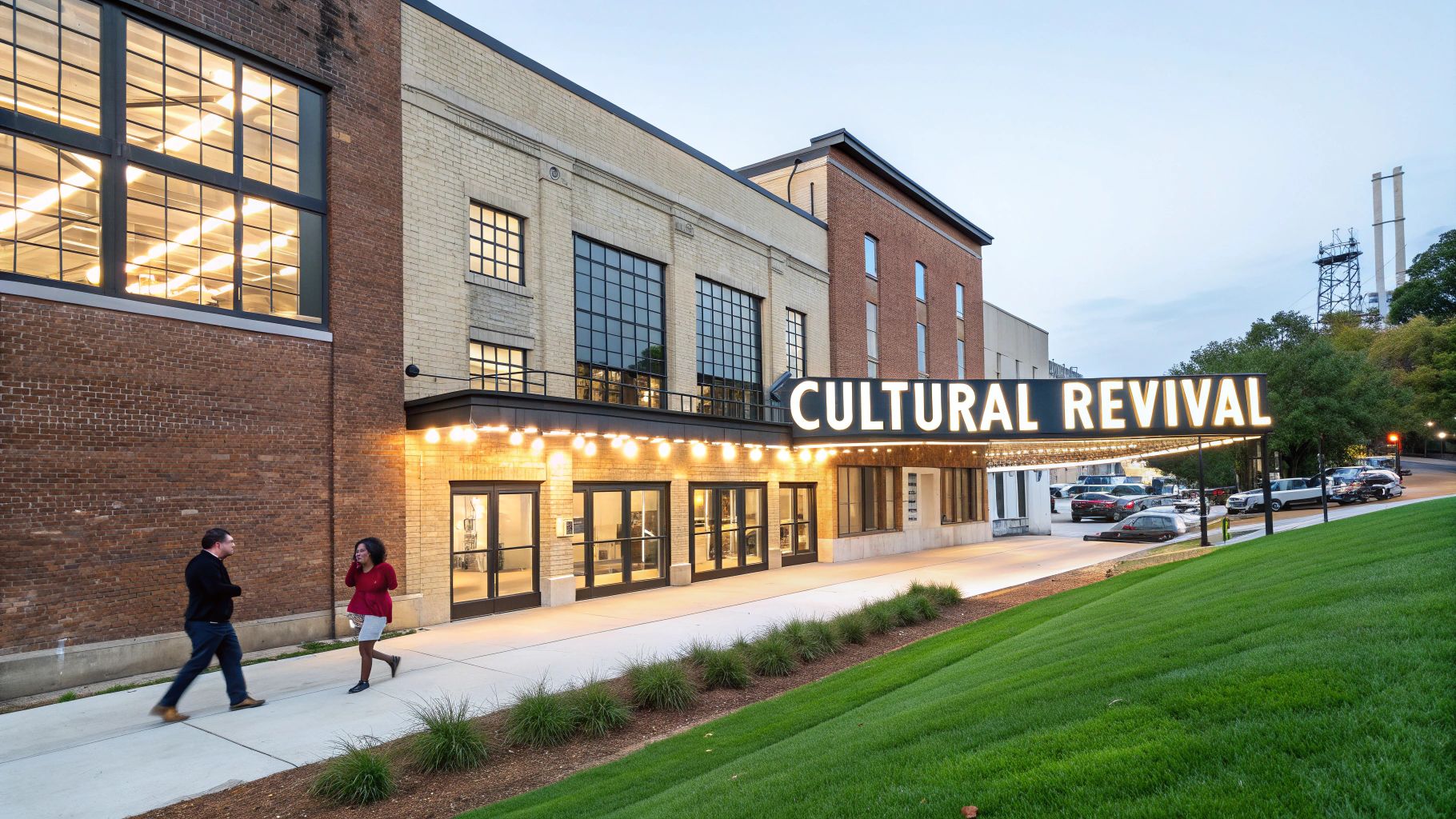
Exterior view of the Cultural Revival building with illuminated marquee, people on the sidewalk, and a green lawn.

For anyone in the development world, the Warehouse Theatre is more than just a local success—it’s a masterclass in visionary placemaking. This guide will unpack how smart architectural choices and an unwavering focus on community turned an underused historic property into a profitable, soul-enriching asset.

This transformation really hammers home a core principle of modern urban development: sometimes the most valuable new buildings are the old ones. Instead of bringing in the wrecking ball, adaptive reuse preserves a structure's unique character while breathing new life and economic purpose into it.

A Model for Urban Revitalization

The journey of the Warehouse Theatre is a perfect example of the hidden potential locked inside aging industrial buildings. By reimagining a space once filled with looms and spindles as a venue for drama and art, the project became a true catalyst for change in Greenville's West End. It did more than just give a theater company a new home; it sparked a much wider economic and cultural revival.

The results speak for themselves. The Warehouse Theatre's 2025 season, for example, was a banner year, seeing a 32% surge in patrons across all its productions, education programs, and community events. By employing 143 local artists, the theater became a significant economic engine, driving critical foot traffic into a district that was once quiet after 5 PM. This kind of success mirrors what we see in other adaptive reuse wins, where thoughtful infrastructure upgrades can extend a building's functional life by 50 to 75 years. For more on the local arts scene's growth, check out the coverage in the Greenville Journal.

Adaptive reuse is about more than saving a building; it's about reinterpreting its story for a new generation. The Warehouse Theatre proves that historic structures can become the heart of a modern, thriving community.

This guide will break down the practical steps and strategic thinking that made this project a success, focusing on three key areas:

  • Historic Preservation: How to honor a building's original character while bringing it up to modern code and expectations.
  • Economic Revitalization: The strategy behind becoming a cultural anchor that boosts surrounding businesses.
  • Tangible ROI: A clear look at the financial and community returns that come from thoughtful, forward-thinking design.

To give you a quick, high-level overview, here's a snapshot of the project's key details. This is especially useful for developers weighing the pros and cons of taking on a similar historic property.

The Warehouse Theatre Project at a Glance

Attribute Details
Project Type Adaptive Reuse, Cultural Anchor
Original Use Textile Warehouse (circa 1920s)
Current Use Professional Live Theatre & Arts Venue
Location West End Historic District, Greenville, SC
Key Impact Catalyst for neighborhood revitalization
Patron Growth (2025) 32% increase across all programs
Local Artist Employment 143 artists employed in a single season
Primary Goal Create a community-centric cultural hub while preserving historic character.

This table neatly summarizes how a single project can hit multiple targets—preserving history, driving economic activity, and enriching the local community all at once.

Tracing the Theater's Journey of Transformation

Every great adaptive reuse project has a story, and the Warehouse Theatre’s is a masterclass in vision and grit. Its transformation wasn't a single, dramatic event. Instead, it was a series of smart, deliberate moves that show what it takes to turn an old building into a cultural cornerstone.

The story starts back in 1973. Founders Dr. Peter Smith and Jim Boivin didn't have a grand theater; they had sheer will. They carved out an intimate black box theater from a dingy annex at the Greenville Memorial Auditorium, proving that you don’t need a perfect space to create powerful art.

This humble beginning is a key lesson for any developer. Great projects often start small. They prove their concept, build a following, and create demand before taking on a massive investment. Those early years were about more than just staging plays—they were about building a brand and demonstrating that Greenville not only wanted but needed this kind of theater.

The Strategic Leap to the West End

By the mid-1990s, the theater had outgrown its starter home and was ready for its next act. The leadership team made a bold, calculated bet on Greenville’s West End, a neighborhood that was just beginning to stir with the promise of revitalization. This wasn't a safe move into an established arts district; it was a pioneering jump into an area with untapped potential.

They found their new canvas in a series of three historic storefronts, once part of a sprawling textile warehouse. Working with McMillan Pazdan Smith Architecture, they skillfully transformed the raw, industrial space into a state-of-the-art, 150-seat venue. The design brilliantly preserved the building's historic soul while meeting all the technical demands of a modern performance space.

The project was a triumph. It earned an AIA Greenville Merit Award in 1999 and cemented the Warehouse Theatre in Greenville SC as a true landmark. This kind of thoughtful adaptive reuse shows you can honor a building's past while giving it a vibrant new future. You can read more about this award-winning project and its history in American Theatre magazine.

The decision to move to the West End was more than a change of address; it was an investment in a neighborhood's potential. The theater didn't just join a community—it helped build one.

This history holds powerful lessons for developers today. The theater’s team saw opportunity where others saw decay. They understood that by becoming an early anchor in a neighborhood on the cusp of change, they could secure a unique home and actively shape the area's identity. It was a risk, absolutely, but one that paid off spectacularly for both the theater and the city of Greenville.

Balancing Performance Needs with Historic Preservation

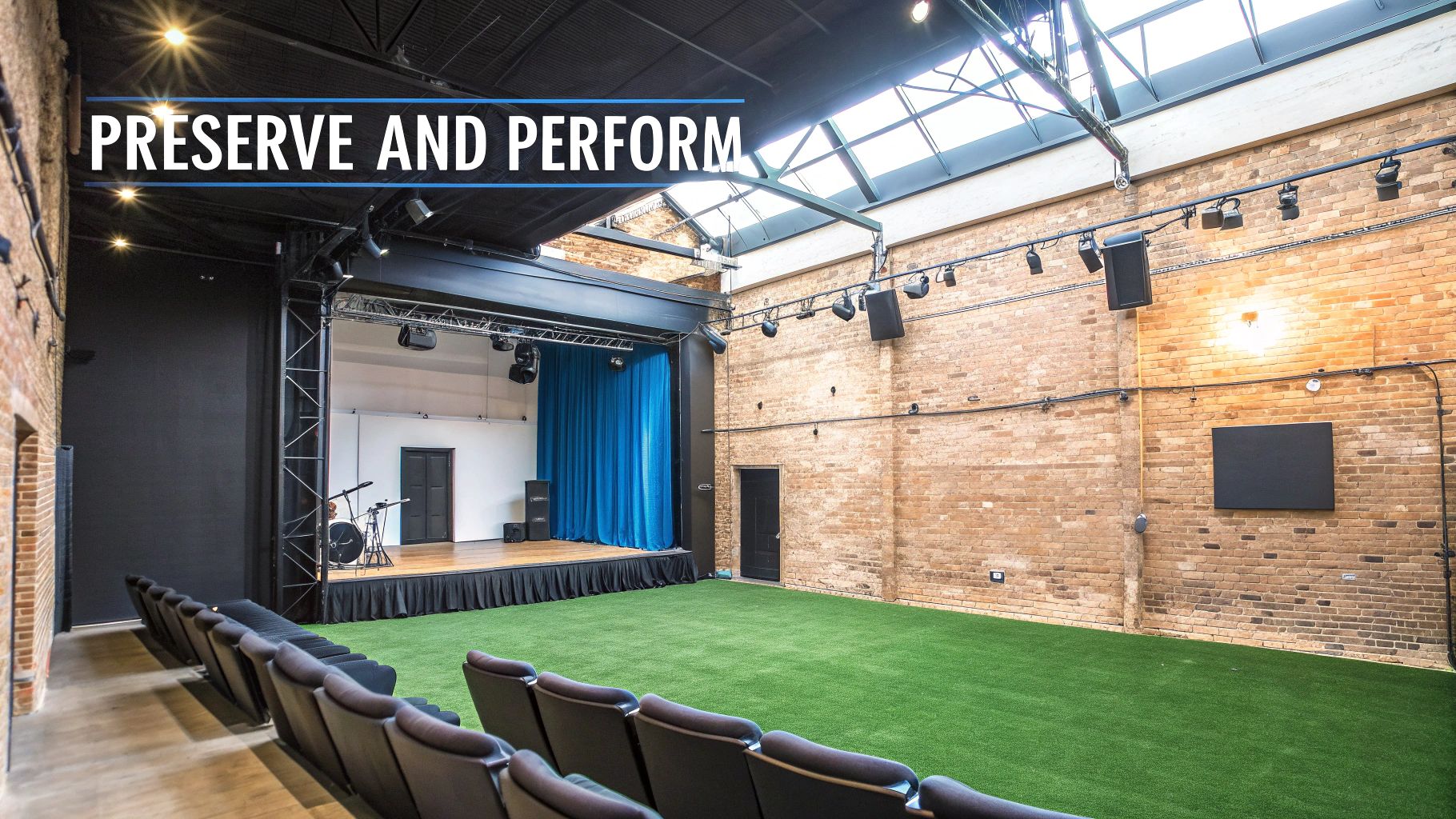
Modern warehouse theater with a stage, blue curtains, rows of seats, green turf floor, and brick walls.

Turning a building meant for storing textiles into a stage for live performance is a heck of a puzzle. The real triumph of the Warehouse Theatre in Greenville SC is how it solved this puzzle, creating a masterclass in how to fuse modern theatrical demands with the soul of a historic building.

For any developer, this is the tightrope you have to walk. Get it right, and you have something special. Get it wrong, and you lose the magic. It's about so much more than just saving old brick—it’s about making that brick work for a purpose it was never designed for. The trick is to weave in all the essential theatrical guts without gutting the building's industrial character.

Think of it like restoring a vintage muscle car. You keep the iconic body and the classic feel, but you install modern brakes, a reliable engine, and air conditioning. You need it to be practical. In the same way, a theater has non-negotiable technical needs that you’d never find in an old warehouse.

Weaving Theatrical Tech into a Historic Shell

The team behind the Warehouse Theatre had to get creative to overcome some serious technical hurdles. Every fix had to complement the building's original bones, not fight against them.

Here’s what they were up against:

  • Acoustics: Brick walls and high ceilings are an acoustic nightmare, turning clear dialogue into a muddy echo. The solution involved adding sound-absorbing materials and shaping surfaces to control sound, all while keeping that gorgeous brick exposed.
  • Sightlines: Every single seat needs a clean view of the stage. But in a building dotted with original support columns, this meant building a custom-tiered seating plan that worked around the building’s quirks, not in spite of them.
  • Accessibility: Old buildings were built long before modern accessibility standards. Adding ramps, proper seating, and compliant restrooms into an existing footprint took some clever spatial gymnastics to meet ADA requirements.

The genius of the Warehouse Theatre’s design is how it makes modern systems look like they belong. HVAC ducts, lighting grids, and sound equipment are integrated so well they become part of the industrial vibe, not a clunky add-on.

Keeping the Character, Building the Function

The designers made a conscious decision to let the building’s history shine through. Instead of covering everything with drywall, they left the original brick walls and hefty structural beams exposed, making them a centerpiece of the design. This gives the space a gritty, authentic warmth a brand-new building could never fake.

Even backstage logistics were a challenge. Carving out space for dressing rooms, set storage, and tech booths from the existing floor plan required an incredibly efficient use of every last square foot. This is a great lesson for developers: sometimes, the limitations of a historic space force you to find smarter, more creative solutions.

The final result is a theater where the past and present are in a constant, beautiful conversation. For anyone looking to tackle a similar project, it’s worth reading up on the best practices for renovating a heritage home while preserving its charm. This delicate balance—honoring a building’s story while fitting it for a new one—is what separates a good project from a truly great one.

How the Theater Kickstarted the West End's Comeback

The real impact of an adaptive reuse project never stays inside its own walls. The Warehouse Theatre in Greenville, SC, is a textbook case of this, showing how one smart project can create economic shockwaves that lift an entire neighborhood. Its move to the West End wasn't just a change of address; it was the deliberate planting of a cultural anchor.

Before the theater's award-winning renovation, the West End was a neighborhood with great bones but no real reason for people to stick around after 5 p.m. By turning a forgotten old cotton warehouse into a lively performance space, the theater created a destination. All of a sudden, hundreds of people were flowing into the area on a regular basis, looking for a place to eat before a show or grab a drink afterward.

That steady stream of people is the secret sauce for urban revitalization. It sends a clear signal to other business owners that there's a market waiting for them. In effect, the theater took a lot of the risk out of the equation for other investors.

The Spark That Lit the Fire

The theater's success set off a chain reaction. Restaurants, bars, and art galleries started popping up nearby, eager to cater to the ready-made crowd the venue delivered night after night. This natural growth turned the West End from a sleepy, post-industrial pocket of the city into one of Greenville's most exciting districts.

Over its remarkable 50-year history, the Warehouse Theatre has come a long way, moving from shared, often animal-scented, spaces at the Municipal Auditorium to its iconic cotton warehouse home in 1999. Today, it’s a pillar of Greenville's arts scene, putting on multiple mainstage shows and the beloved Upstate Shakespeare Festival. It pumps both cultural and financial energy directly into the local economy, employing around 200 artists each year on a budget of less than $1 million. You can get a closer look at the theater's mission and its celebratory 50th anniversary season here.

The Warehouse Theatre didn’t just find a new home in the West End; it gave the West End a reason to come alive after dark. It became the steady heartbeat that attracted more investment and growth.

This really drives home a crucial lesson for developers: putting money into a cultural venue is about more than the direct return on that single property. It's about building an entire economic ecosystem.

The benefits spread out like ripples in a pond, touching the whole area:

  • Rising Property Values: As the neighborhood became a place people wanted to be, the value of surrounding properties went up.
  • A More Diverse Business Scene: The first wave of restaurants and bars was soon followed by retail stores and new residential projects.
  • A New Reputation: The West End became known as a creative and vibrant hub, drawing in even more visitors and new residents.

For any developer weighing a similar project, the story of the Warehouse Theatre is powerful proof of concept. It shows how a single project, when it truly connects with the community, can become a catalyst that delivers returns far beyond its own property lines—a smart way to turn an overlooked district into a thriving destination.

An Actionable Blueprint For Your Next Project

The story of the Warehouse Theatre in Greenville, SC, is more than just an inspiring tale; it's a practical, repeatable roadmap for anyone looking to tackle an adaptive reuse project. By digging into how they turned a forgotten building into a cultural gem, we can pull out real-world lessons that transform historic headaches into development home runs.

Let's move past the theory and get straight to the strategy.

It all starts with a shift in perspective—learning to see the promise where others only see problems. Look for properties with "good bones." We're talking about buildings with solid structural integrity, unique architectural details, and a location that’s just on the verge of a comeback. The team behind the Warehouse Theatre did exactly that, choosing a neglected corner of the West End because they knew a cultural anchor could redefine the whole neighborhood.

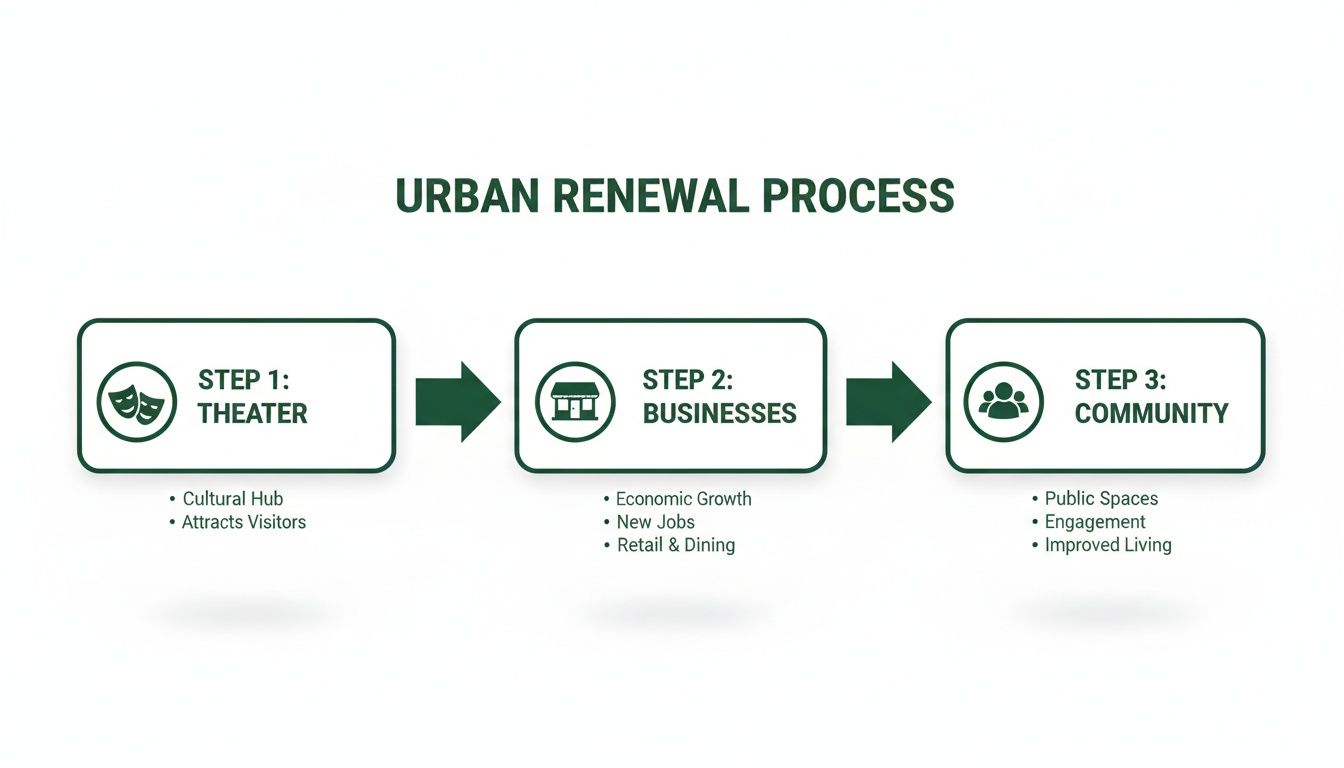
This is how a single venue can kickstart a domino effect of urban renewal.

Diagram showing a three-step urban renewal process, starting with a theater and ending with community.

As you can see, the theater’s revival directly feeds local business growth. That growth, in turn, helps build a more vibrant and connected community. It’s a powerful cycle.

Navigating The Financials And Winning Over The Community

Once you’ve found that diamond in the rough, it’s time to tackle the financial puzzle. The good news is that adaptive reuse projects often unlock a host of incentives that can make the numbers work. You just have to do your homework and chase down every lead.

Here are a few of the most powerful financial tools to look into:

  • Federal Historic Tax Credits: These are a game-changer, potentially covering 20% of your rehabilitation costs for certified historic buildings.
  • State Historic Tax Credits: South Carolina, like many other states, has its own tax credit programs that can often be combined with federal incentives.
  • Local Grants and Loans: Don't overlook city hall. Many municipalities have funds set aside to support projects that align with their own revitalization goals.

But money is only half the battle. Getting the community on your side is just as important. The Warehouse Theatre didn't just open its doors; it wove itself into the fabric of Greenville. You need to start conversations with neighborhood groups, local artists, and your future patrons early and often. Their enthusiasm is what gets you through zoning hearings and fills the seats on opening night.

A project's greatest asset isn't brick and mortar; it's the community that claims it as their own. Financial incentives might get a building open, but it's the people who keep it alive for decades.

For anyone taking on a project like this, building a sustainable business model from day one is non-negotiable. If you're new to the space, check out resources like a comprehensive guide to starting an events business. This kind of groundwork ensures your venue has a life long after the construction crews have packed up.

Why Quality Design Is Your Best Long-Term Investment

Finally, never, ever skimp on design. The team behind the Warehouse Theatre didn't just build a functional black box. They created an experience. They paid respect to the building's industrial soul by leaving brick exposed and highlighting original beams, all while seamlessly integrating the high-tech demands of a modern theater.

This commitment to quality design delivers on three critical fronts:

  1. It Creates a Destination: A truly unique and thoughtfully designed space gets people talking. It earns press, draws in patrons from all over, and becomes a landmark.
  2. It Enhances the Experience: Great design isn't just about looks; it solves problems. It perfects acoustics, ensures there isn't a bad seat in the house, and makes every visit memorable.
  3. It Boosts Long-Term Value: A well-designed building is simply worth more. It attracts better talent, stands the test of time, and proves that good design is always good business.

The Warehouse Theatre's success wasn't an accident. It was the result of a clear strategy: identifying hidden potential, mastering the incentives, earning community trust, and investing in quality design. It’s a blueprint for creating projects that are not only profitable but also powerful.

Adaptive Reuse Project Checklist

To make these lessons even more concrete, we’ve put together a checklist based on the Warehouse Theatre's journey. Use this to guide your thinking as you approach your own project.

Phase Key Action Item Why It Matters (Warehouse Example)
1. Discovery & Vision Identify a property with "good bones" in an underserved or emerging area. The theater was built in a neglected textile warehouse, seeing the potential before the West End became a destination.
2. Financial Strategy Aggressively research and apply for all available historic tax credits and local grants. A combination of federal and state incentives was crucial for bridging the funding gap and making the project financially viable.
3. Community Engagement Meet with neighborhood associations and local stakeholders before finalizing plans. Early buy-in helped the Warehouse Theatre become a beloved community asset, not an unwelcome disruption, ensuring long-term support.
4. Design & Preservation Hire architects who specialize in adaptive reuse and value historical character. The design preserved the building's industrial past (exposed brick, steel) while adding modern theatrical necessities.
5. Operational Planning Develop a sustainable business model for the venue's long-term operations. The theater established itself as a professional company with a strong programming schedule, ensuring it would thrive beyond the initial launch.
6. The Launch & Beyond Market the space not just as a venue, but as a community cultural hub. By programming diverse shows and events, the Warehouse became a central part of Greenville's cultural identity.

Following these steps won’t guarantee an easy road, but it provides a battle-tested framework for turning a piece of history into a vibrant part of the future.

Your Project's Turn in the Spotlight

So, what can we take away from the story of the Warehouse Theatre in Greenville, SC? It's more than just a successful project; it's a living blueprint for developers and property owners who see potential where others might only see a problem. The biggest lesson here is a shift in perspective: old buildings aren’t burdens. With the right vision, they’re incredible opportunities waiting to be unlocked.

When you get adaptive reuse right, you're not just restoring brick and mortar. You're creating spaces that deliver real financial returns while becoming the heart and soul of a neighborhood. It's about taking the best of the old and reimagining it for a new generation.

The real takeaway is that you can do this too. Your city is full of overlooked buildings with stories to tell. By applying the strategies we've seen with the Warehouse Theatre, you can build something that doesn't just make money—it makes a difference.

The journey of the Warehouse Theatre proves that one smart, thoughtful project can be the catalyst for so much more. It shows that by respecting a building's history, you can not only secure its future but also ignite the revival of an entire community.

Let this be your guide. Let it be the proof that great design and a genuine focus on community aren't just feel-good ideas; they're the foundation of lasting success.

Frequently Asked Questions About Adaptive Reuse

When developers and property owners look at an old building, they often see both incredible potential and a list of daunting questions. Let's tackle some of the most common concerns head-on, using the Warehouse Theatre in Greenville, SC, as a real-world example of how these challenges can be turned into triumphs.

It’s a bit like finding a classic car in a barn. The style is undeniable, but you're naturally worried about the engine, the rust, and whether the restoration will be worth it. Getting clear answers to a few key questions can make all the difference.

Is Adaptive Reuse More Expensive Than New Construction?

The short answer? Not always. In fact, it can often be the smarter financial move. People tend to focus on the costs of renovating an older structure, but they forget about the massive expenses of a new build—demolition, site preparation, and the soaring price of new materials.

Adaptive reuse gives you a huge head start by keeping the building's "good bones." With the Warehouse Theatre, the team didn't have to build a new structural frame or lay thousands of new bricks; that was all part of the package. That existing structure represented a massive savings in both materials and labor, and it also happened to be the very thing that gives the building its unique character.

Think of the existing building not as a liability, but as your greatest asset. The structure, materials, and history are already paid for.

On top of that, these kinds of projects often qualify for financial incentives that a new build simply can't get.

How Do You Secure Funding for These Projects?

Financing an adaptive reuse project isn't the same as getting a loan for a standard new construction. While traditional financing is certainly part of the mix, the real game-changer lies in the specialized programs designed specifically to encourage this kind of preservation.

Smart developers build a funding strategy that includes:

  • Federal Historic Preservation Tax Credits: This is a big one. It offers a 20% tax credit for the qualified costs of rehabilitating a historic building, which can dramatically improve a project's bottom line.
  • State and Local Grants: Don't overlook what's available in your own backyard. Many cities and states have grants aimed at revitalizing historic districts and supporting culturally significant projects.
  • Community Partnerships: The Warehouse Theatre is a perfect example of this. The project was fueled by incredible community buy-in, opening the door to private donations and local sponsorships that became essential to its success.

What Is the Biggest Non-Financial Hurdle?

Without a doubt, the biggest challenge is often navigating the maze of modern building codes, zoning regulations, and historic preservation standards. Old buildings weren't constructed with today's fire safety, accessibility, or energy efficiency requirements in mind.

The real puzzle is figuring out how to thread the needle—how do you integrate modern systems and meet code without stripping the building of its soul? This is where an experienced guide is non-negotiable. An architect who specializes in historic preservation knows how to find those elegant, creative solutions that satisfy inspectors while respecting the building’s heritage. They can turn what seems like a frustrating roadblock into an award-winning design feature.


At Sherer Architects, LLC, we see historic challenges as profitable opportunities. If you're weighing the potential of an adaptive reuse project, let's talk about how our decades of experience can bring your vision to life. Learn more about our approach to architecture.

Categories
Uncategorized

Discover architecture firms in charleston sc: Your Charleston project partner

Charleston's unique blend of historic charm and modern growth presents a complex landscape for developers and property owners. Navigating the Board of Architectural Review (BAR), securing historic tax credits, and mastering local zoning codes requires an architectural partner with deep regional expertise. This guide moves beyond a simple list of firms. Instead, it focuses on the essential directories and platforms where you can discover, vet, and ultimately select the best architecture firms in Charleston SC for your specific project.

Whether you're planning a new commercial build, a sensitive adaptive reuse, or a meticulous historic preservation, this article will help you build a qualified shortlist with confidence. Before you can effectively choose a firm, gaining insight into understanding different architectural styles will help you articulate your project's vision.

We will explore the strengths of each platform, from AIA-vetted professional directories to construction-focused networks and visually-driven portfolio sites. Each entry includes direct links and a practical overview to help you efficiently identify potential partners who possess the specific skills and local knowledge your project demands. This resource is designed to streamline your search process, connecting you with the most effective tools for finding and hiring the right architectural talent in the Holy City.

1. AIA Charleston – Member Firm Directory

For those starting their search for architecture firms in Charleston, SC, the AIA Charleston Member Firm Directory is an essential first stop. This platform is not a single firm but a curated, official roster of local firms that are members of the American Institute of Architects (AIA). This affiliation serves as a pre-vetting mechanism, ensuring every firm listed adheres to the AIA's stringent professional and ethical standards. It’s a powerful tool for building a shortlist of credible, locally engaged professionals.

AIA Charleston – Member Firm Directory

The directory’s main advantage is its hyper-local focus and professional credibility. Unlike broad national directories, every listing here has a direct connection to the Charleston and Lowcountry architectural community. This is particularly valuable for projects requiring a deep understanding of local zoning, historical precedents, and the Board of Architectural Review (BAR) process.

Using the Directory Effectively

The interface is straightforward, presenting an alphabetical list of member firms with direct links to their websites and phone numbers. There's no complex search filter, which makes it simple to navigate but requires users to click through to each firm's site for detailed portfolio information.

Practical Tips for Use:

  • Cross-Reference with Award Winners: Visit the AIA Charleston Design Awards page. Note the firms that have won recent awards and then locate them in the directory. This helps identify teams recognized by their peers for excellence.
  • Assess Local Engagement: Check if a firm's principals or staff are involved in AIA Charleston events or leadership. Active local participation often indicates a strong commitment to the community and a robust professional network.
  • Initial Vetting, Not Final Selection: Use the directory to build a preliminary list of 5-10 firms. The real research begins when you explore each firm's individual portfolio and project history on their respective websites.

Platform Breakdown

Feature Details
Access & Cost Completely free and open to the public.
Best For Commercial developers, historic preservationists, and business owners looking for a pre-vetted list of local, professionally affiliated firms.
Unique Offering Provides a direct line to firms committed to professional standards, acting as an implicit seal of quality and local credibility.

Pros & Cons

  • Pro: High relevance to the Charleston market; all listed firms meet AIA professional standards.
  • Pro: Serves as an indicator of a firm's local engagement and professional standing.
  • Con: Not all qualified local firms are AIA members, so it isn't a fully comprehensive list.
  • Con: The level of detail in each listing is minimal, requiring further research on individual firm websites.

Website: AIA Charleston – Firm Directory

2. AIA South Carolina – Firm Directory

Expanding the search to a statewide level, the AIA South Carolina Firm Directory offers a broader perspective on professional architectural services. Like its Charleston-specific counterpart, this directory lists firms that are members of the American Institute of Architects, ensuring a baseline of quality and adherence to professional ethics. This platform is particularly useful for developers or business owners whose projects might span multiple South Carolina cities or who are looking for specialized expertise that may exist outside the immediate Charleston area.

AIA South Carolina – Firm Directory

The directory’s key advantage is its filtering capability. Users can narrow their search by specific market sectors, including Commercial, Hospitality, Education, and Historic Preservation. This makes it an efficient tool for identifying architecture firms in Charleston, SC, with proven experience in a particular project type, saving significant time during the initial research phase.

Using the Directory Effectively

The platform allows users to view detailed firm profiles that often include project images, a mission statement, and direct contact information. The level of detail varies, as each firm manages its own profile. This state-level view is ideal for comparing the capabilities of Charleston-based firms against those in other South Carolina metros like Columbia or Greenville.

Practical Tips for Use:

  • Leverage Sector Filters: Start by using the filters to isolate firms specializing in your project type (e.g., healthcare, multi-family residential). This immediately creates a relevant shortlist.
  • Compare Regional Expertise: For projects with a statewide footprint, use the directory to identify firms with offices or significant project experience in both Charleston and other key SC markets.
  • Evaluate Profile Completeness: A well-maintained and detailed profile can be an early indicator of a firm's professionalism and marketing savvy. Pay attention to those who invest in presenting their work clearly.

Platform Breakdown

Feature Details
Access & Cost Free and publicly accessible online.
Best For Developers with multi-city projects in South Carolina, clients seeking highly specialized sector experience, and those wanting to compare Charleston talent with other regional firms.
Unique Offering Sector-specific filtering that allows users to quickly find firms with relevant project experience across the entire state, including the Charleston market.

Pros & Cons

  • Pro: Powerful filtering tools to find firms by specific expertise (e.g., preservation, commercial).
  • Pro: Provides a baseline of quality and professionalism through AIA membership requirements.
  • Con: Not all great firms are AIA members, so it doesn't represent the entire market.
  • Con: The detail and quality of firm profiles can be inconsistent, as they are self-managed.

Website: AIA South Carolina – Firm Profiles

3. AIA (National) – Architect Finder

While the local AIA Charleston directory is ideal for a focused Lowcountry search, the national AIA Architect Finder offers a broader perspective. This powerful, nationwide database allows users to search for licensed AIA-member firms by city, project type, and specific expertise. It's an excellent tool for clients who want to benchmark local talent against national standards or find firms with highly specialized skills that may be less common in a smaller market.

The key advantage of the national finder is its robust filtering capability. You can search specifically for architecture firms in Charleston, SC and then narrow the results by project types like "Historic Preservation," "Retail," or "Multifamily Housing." This helps identify firms that not only work locally but also carry deep experience in a particular commercial or institutional sector, backed by the credibility of AIA membership.

Using the Directory Effectively

The platform functions like a sophisticated search engine. Users input their location and can then select from dozens of project categories and firm specializations. Each resulting profile provides firm details, project photos, and contact information, though the depth of each profile is managed by the individual firm.

Practical Tips for Use:

  • Identify Niche Specialists: Use the filters to find Charleston firms with specific, hard-to-find expertise. For example, search for “Adaptive Reuse” or “Energy & Carbon” to pinpoint architects with proven skills in these technical areas.
  • Benchmark and Compare: After creating a shortlist of local firms, use the Architect Finder to look at similarly specialized firms in other historic cities like Savannah or New Orleans. This can provide valuable context on design trends and capabilities.
  • Verify Credentials: Use this tool to confirm that a firm you are considering is an active member of the American Institute of Architects, reinforcing their commitment to professional practice and ethics.

Platform Breakdown

Feature Details
Access & Cost Completely free and open to the public.
Best For Developers, national brands, and clients needing to find architects with specific, niche expertise (e.g., sustainable design, advanced building technology) within the Charleston market.
Unique Offering Advanced search filters that allow users to drill down by project type and specialization, connecting them with highly relevant AIA-member firms.

Pros & Cons

  • Pro: Powerful filtering helps find specialists quickly and efficiently.
  • Pro: Provides a national-level quality benchmark for firms operating in Charleston.
  • Con: The level of detail and quality of project imagery can vary significantly from one firm's profile to another.
  • Con: Excludes excellent local firms that are not AIA members, so it should be used in conjunction with other resources.

Website: AIA Architect Finder

4. Architizer – Firms Directory

While local directories provide a foundational list, Architizer offers a global stage where design-forward architecture firms in Charleston, SC, showcase their work. This platform is portfolio-driven, prioritizing high-quality project imagery and detailed case studies. It’s an ideal resource for clients who want to perform visual due diligence, allowing for a quick comparison of aesthetic styles, project scales, and design quality across multiple firms.

Architizer – Firms Directory

Architizer’s main strength is its focus on the finished product. The platform functions like a digital design magazine, connecting projects with the firms that designed them and the products used to build them. This makes it particularly useful for commercial developers or business owners who are looking for inspiration and want to see how firms handle specific building types, such as boutique hotels, adaptive reuse projects, or modern office spaces.

Using the Directory Effectively

The search function allows you to filter firms by location ("Charleston") and project type (e.g., "Commercial," "Hospitality"). This lets you quickly zero in on firms with a proven track record in your specific sector. Once you find a firm, you can explore their project galleries, which often include rich imagery and descriptions.

Practical Tips for Use:

  • Filter by Project Type: Use the search filters to find firms that specialize in your project category. A firm excelling in historic residential work may not be the best fit for a new commercial development.
  • Review Award Context: Pay attention to projects that have won A+Awards or have been featured editorially. This indicates peer recognition and a high standard of design excellence.
  • Analyze Project Details: Look beyond the "hero" shots. Dive into the project details to see floor plans, material selections, and construction photos. This gives a more complete picture of a firm’s capabilities.

Platform Breakdown

Feature Details
Access & Cost Free to browse and search for firms.
Best For Clients prioritizing visual design and aesthetic fit, especially for commercial, hospitality, and contemporary projects.
Unique Offering A visually rich, portfolio-first approach that allows for direct comparison of design quality and project types on a global platform.

Pros & Cons

  • Pro: Excellent for reviewing portfolio depth and quickly assessing a firm's design quality.
  • Pro: Strong presence of award-winning and preservation-savvy firms that are active in design media.
  • Con: Not all Charleston firms are active on the platform, so it’s not a comprehensive local list.
  • Con: The quality and depth of a firm's profile depend on how frequently they update it.

Website: Architizer – Firms

5. The Blue Book Building & Construction Network (Dodge)

For commercial developers, general contractors, and business owners operating within the construction procurement ecosystem, The Blue Book is a foundational resource. More than a simple directory, this platform is a B2B network designed to connect project stakeholders. It is widely used for sourcing design teams, distributing invitations to bid (ITBs), and managing pre-construction workflows, making it a powerful tool for finding architecture firms in Charleston, SC, that are active in the commercial and industrial sectors.

The Blue Book Building & Construction Network (Dodge)

The primary advantage of The Blue Book is its alignment with the needs of the construction industry. Unlike design-centric platforms, its functionality is built around project procurement. Users can filter by discipline and region, identifying firms that serve the Charleston market and have experience with specific project types, from healthcare facilities to retail upfits. The network is an efficient way to assemble a team for a competitive Request for Proposal (RFP) process.

Using the Directory Effectively

The platform allows users to search for architects and view company profiles, which often include market coverage, project history, and contact information. The interface is geared toward construction professionals, so it may feel less intuitive for a private homeowner.

Practical Tips for Use:

  • Leverage Regional Filters: Use the search function to specifically target "Architects" within the Charleston or broader South Carolina region to narrow down the vast national database.
  • Review Market Sectors: Pay close attention to the "Markets" section in a firm’s profile. This quickly tells you if they specialize in commercial, industrial, institutional, or other sectors relevant to your project.
  • Utilize for Procurement: For those managing a formal bidding process, use the platform's tools to send out RFPs or ITBs directly to a shortlist of qualified architectural firms.

Platform Breakdown

Feature Details
Access & Cost Free to search and view company profiles. Advanced features for bid management and project communication may require a Pro subscription.
Best For General contractors, commercial developers, and project managers looking to source architectural partners for competitive bids and large-scale projects.
Unique Offering Integrates firm discovery with the actual construction procurement workflow, connecting users directly to firms through a B2B network.

Pros & Cons

  • Pro: Built specifically for B2B construction, aligning perfectly with developer and general contractor needs.
  • Pro: Excellent tool for efficiently sourcing multiple firms for a competitive RFP or bid process.
  • Con: The user interface is more functional than aesthetic, favoring industry insiders over the general public.
  • Con: Firm profiles can be brief and may require visiting the architect’s own website for detailed portfolio viewing.

Website: The Blue Book

6. Houzz – Charleston, SC Architects Category

For clients focused on visual inspiration and direct feedback, Houzz is a powerful, consumer-facing directory. While it has a strong residential reputation, its dedicated category for Charleston, SC architects includes numerous firms with robust commercial and historic preservation portfolios. Its primary value lies in the rich visual content and extensive client reviews, offering a unique window into a firm's design aesthetic and customer service experience.

Houzz – Charleston, SC Architects Category

The platform’s major advantage is its side-by-side comparison format, blending professional portfolios with unfiltered client testimonials. Badges like "Best of Houzz Service" or "Best of Houzz Design" are awarded based on community engagement and reviews, serving as a quick signal of a firm's reputation. This makes it an excellent tool for gauging how a firm’s finished product and process are perceived by past clients.

Using the Directory Effectively

The interface is image-heavy, allowing users to filter by project type and save inspirational photos to "Ideabooks." This helps you organize visual concepts before even contacting a firm. The built-in messaging feature simplifies the initial outreach and quote request process.

Practical Tips for Use:

  • Filter for Project Type: While browsing, use filters to search for specific commercial projects like "office," "retail," or "restaurant" to narrow the results and find firms with relevant experience.
  • Scrutinize Reviews: Look for detailed reviews that describe the working relationship, communication style, and problem-solving abilities of the architect. This provides insight beyond the finished photos.
  • Be Aware of Sponsored Content: Note that some firms pay for premium placement, which can appear higher in search results. Ensure you scroll through all pages to see a full range of organic listings.

Platform Breakdown

Feature Details
Access & Cost Free to browse and contact professionals. Firms pay for premium features and advertising.
Best For Business owners and developers who prioritize visual style and want to vet firms based on extensive client reviews and photo galleries.
Unique Offering A rich combination of project photos, detailed client reviews, and direct messaging tools, all in one place.

Pros & Cons

  • Pro: Easy side-by-side comparison with rich visuals and validated client reviews.
  • Pro: A fast way to gauge a firm’s design aesthetic and client service reputation.
  • Con: Has a heavy residential focus; finding commercial expertise requires closer reading of profiles.
  • Con: Sponsored placements can rank above more established, organic results, potentially skewing the initial view.

Website: Houzz – Charleston Architects

7. Google Maps – Local Business Profiles for “Architecture firms, Charleston SC”

For a ground-level, immediate overview of architecture firms in Charleston, SC, Google Maps is an indispensable tool. It transforms a simple search into an interactive map, plotting the physical locations of studios across the peninsula and greater metro area. This platform excels at providing quick, practical information like business hours, phone numbers, and direct website links, making it ideal for the initial discovery and logistical planning phase of your search.

Google Maps – Local Business Profiles for “Architecture firms, Charleston SC”

The platform's primary strength is its integration of location, contact details, and user-generated reviews in one view. You can instantly see which firms are located near your project site or in a specific neighborhood, which is a significant advantage for coordinating meetings and site visits. Furthermore, the user reviews, while needing careful assessment, can offer candid insights into past client experiences with communication, project management, and final outcomes.

Using the Directory Effectively

Beyond just finding a location, Google Maps profiles serve as mini-dashboards for each firm. Look for well-maintained profiles with recent photos, prompt responses to reviews, and up-to-date business hours, as this often reflects a firm's overall professionalism and attention to detail.

Practical Tips for Use:

  • Filter by Proximity: Use the map to identify firms closest to your potential project site. This can be a practical advantage for firms that need to make frequent site visits.
  • Scan for Social Proof: Read through both positive and negative reviews. Look for patterns in feedback related to project types similar to yours, such as historic renovations or commercial new builds.
  • Evaluate Digital Presence: A robust Google Business Profile is a modern business essential. For architecture firms looking to maximize their exposure, understanding the nuances of local SEO is key; there are many proven strategies to rank higher in Google Maps that can significantly increase visibility.

Platform Breakdown

Feature Details
Access & Cost Free for public use.
Best For Anyone needing a quick, geographically-based list of local firms; ideal for checking business hours, finding contact information, and reading recent client reviews.
Unique Offering Real-time map-based discovery with integrated user reviews, providing immediate logistical information and a layer of social proof.

Pros & Cons

  • Pro: The fastest way to see nearby firms and their operational status.
  • Pro: Extremely useful for logistics, including planning site visits and in-person meetings.
  • Con: Search rankings can be influenced by SEO efforts and ad spending, not just merit.
  • Con: Google reviews can be unreliable; always verify a firm's credentials and portfolio independently.

Website: Google Maps

7-Directory Comparison: Charleston, SC Architecture Firms

Directory Implementation complexity 🔄 Resource requirements ⚡ Expected outcomes 📊 Ideal use cases 💡 Key advantages ⭐
AIA Charleston – Member Firm Directory Low — simple web browsing and local roster Low — internet access, shortlisting time Vetted local shortlist; strong local credibility. ⭐⭐⭐ Shortlisting Charleston teams for commercial, adaptive reuse, historic projects Local focus; AIA vetting; ties to events/awards
AIA South Carolina – Firm Directory Low–Medium — filtering by sector and comparing profiles Low — browsing, some cross-city comparison time Statewide comparison of capabilities across SC. ⭐⭐⭐ Projects spanning multiple SC metros or needing sector matches Sector filters; state-level benchmarking; AIA quality baseline
AIA (National) – Architect Finder Low — simple search by location/project type Low — web search; some filtering effort Broad coverage for benchmarking; find niche expertise. ⭐⭐⭐ Identifying licensed AIA firms and specialty skills across cities National reach; consistent professional criteria
Architizer – Firms Directory Medium — portfolio review and visual comparison Medium — time to review galleries and awards context Strong visual assessment of design quality and portfolio depth. ⭐⭐⭐⭐ Visual due diligence; comparing design quality for commercial/adaptive reuse Rich imagery; awards context; curated portfolios
The Blue Book (Dodge) Medium–High — set up for procurement and bid workflows Medium — account/tools for messaging and ITBs Efficient sourcing for RFPs/ITBs; aligns with construction workflows. ⭐⭐⭐ Commercial/industrial procurement and GC/developer sourcing Built for B2B workflows; regional trade filters; bid tools
Houzz – Charleston, SC Architects Category Low — consumer-style browsing with reviews/photos Low — browsing, client-review reading Quick gauge of client satisfaction and aesthetic fit. ⭐⭐ Residential work and initial contractor outreach; aesthetic fit checks Extensive reviews/photos; badges (e.g., Best of Houzz); easy comparison
Google Maps – Local Business Profiles Very Low — instant map-based lookup Very Low — mobile or desktop, minimal time Fast local discovery, contact info, and recent reviews. ⭐⭐ Quick radius scouting, site-visit logistics, contact checks Map-based directions, hours, aggregated reviews, real-time visibility

Your Next Steps: From Shortlist to Groundbreaking

Navigating the landscape of architecture firms in Charleston SC can feel complex, but with the right tools and a structured approach, you can confidently identify the ideal partner for your commercial project. We've explored a powerful toolkit, from the hyper-local AIA Charleston directory to the visually-driven portfolios on Houzz and Architizer. Each resource offers a unique lens through which to view a firm's capabilities, design philosophy, and project history.

Your initial research has equipped you with a broad understanding of the market. Now, the real work of curation begins. The goal is to move from a long list of possibilities to a targeted shortlist of two or three firms that align perfectly with your project's specific needs, whether it's historic preservation, adaptive reuse, or new commercial construction.

From Digital Research to Direct Dialogue

Transitioning from online directories to in-person interviews is the most critical step in this process. Your objective is to vet not just a firm's portfolio, but its process, team, and communication style.

1. Develop Your Project Brief: Before you initiate contact, consolidate your vision into a concise project brief. This document should clearly articulate your:

  • Project Goals: What problem are you solving? What is the primary function of the space?
  • Site & Scope: Location, square footage, and key program requirements.
  • Budget & Timeline: Realistic financial parameters and critical deadlines.
  • Success Metrics: How will you define a successful project outcome?

2. Initiate Strategic Outreach: Armed with your brief, reach out to your top 5-7 firms. An initial email or phone call should be professional and direct. Pay close attention to their responsiveness and the quality of their initial questions. A firm that asks insightful questions is a firm that is already engaged with your vision.

3. Conduct Structured Interviews: For your final 2-3 candidates, schedule formal interviews. This is your opportunity to dig deeper than the portfolio.

Key Interview Questions:

  • "Can you walk me through your process for a project of similar scale and complexity?"
  • "Who from your team would be our primary point of contact, and what is their experience?"
  • "How do you handle budget management and value engineering throughout the design process?"
  • "Based on our brief, what do you see as the biggest opportunities and potential challenges for this project?"

Making the Final Selection

Your final decision should be a balanced assessment of skill, experience, and chemistry. The right architect is more than a designer; they are your strategic partner, advocate, and problem-solver. Consider how each firm's approach aligns with your own business objectives and communication preferences. The firm you choose will guide you through complex zoning, permitting, and construction phases, making a strong, trust-based relationship paramount. Choosing the right partner from the many qualified architecture firms in Charleston SC sets the foundation for a project that not only meets your functional needs but also delivers lasting value for your investment.


As you evaluate your options, consider a firm with deep roots in the Lowcountry's unique commercial landscape. For a partner dedicated to client-centric design and meticulous project execution, explore the portfolio of Sherer Architects, LLC. Sherer Architects, LLC specializes in navigating the complexities of Charleston's commercial architecture, from modern new builds to sensitive historic renovations.

Categories
Uncategorized

The Architecture Process of Design From Blueprint to Reality

The journey from a promising idea to a finished building isn't a single, lightning-strike moment of inspiration. It’s a structured, collaborative process that carefully translates a client's vision into a tangible reality. Think of it as moving from an abstract concept to a highly detailed, buildable plan, with checkpoints all along the way to keep everything on track, on budget, and aligned with your goals.

Your Blueprint for Success: Understanding the Design Process

Many people imagine architectural design as one big creative sprint. A better way to think about it is like directing a movie. You start with a script (the pre-design phase), move to storyboards and concept art (schematic design), and only then do you create the final, detailed shot list for production (the construction documents). This deliberate progression is crucial for managing the immense complexity of a building project and heading off expensive problems before they start.

This guide is here to pull back the curtain on that entire process. We'll turn what can feel like an intimidating puzzle into a clear, step-by-step roadmap. When you understand what happens in each phase, you’re empowered to make smart, confident decisions that ensure the final building is exactly what you envisioned.

A Journey of Progressive Refinement

At its heart, the architectural design process is sequential. Each phase logically builds on the decisions and discoveries of the one before it. This is a critical feature, not a bug, because it prevents the kind of costly, eleventh-hour changes that can derail a project. It’s infinitely easier—and cheaper—to move a wall on paper during the early design stages than it is after the steel has been erected.

This methodical approach ensures that every critical element—from tricky site constraints and local zoning laws to material choices and the structural system—is thoughtfully considered and woven into one cohesive plan. The goal is to build the entire project perfectly on paper before a single shovel ever hits the ground.

The flowchart below shows this basic progression, moving from initial discovery and big-picture ideas to the nitty-gritty details needed for construction.

Flowchart illustrating the architecture design process in three stages: Predesign, Schematic Design, and Construction Documents.

As you can see, the early-stage work—all that discovery and conceptual thinking—forms the essential foundation for the technical precision required in the later phases.

Why a Structured Process Matters

Following a defined architectural process isn’t just about neat project management; it’s the very backbone of the industry. The global architectural services market hit a staggering $249.2 billion between 2020 and 2025, which speaks volumes about the consistent need for professional, well-managed design. And with construction output expected to jump by 42.0% by 2030, that reliance is only growing. You can dive deeper into these trends in IBISWorld's comprehensive global report.

This industry-wide commitment to a phased approach brings some major advantages to your project:

  • Financial Control: The process creates natural checkpoints for reviewing the budget and getting approvals before moving forward.
  • Risk Mitigation: Problems with zoning, engineering, or costs are flushed out early when they are easiest to solve.
  • Predictable Outcomes: You always know what deliverables to expect and have a clear sense of the timeline for each stage.
  • Stakeholder Alignment: It gets everyone—you, the architect, engineers, and future contractors—on the same page, working from a single, unified plan.

To give you a high-level overview, here are the standard phases you can expect in nearly any architectural project.

The Five Core Phases of Architectural Design

Design Phase Primary Goal Typical Timeline Allocation
1. Predesign Define the project's goals, scope, budget, and constraints. Feasibility studies. 5% – 15%
2. Schematic Design Develop the big-picture concept, including floor plans, massing, and aesthetics. 15% – 25%
3. Design Development Refine the design, selecting materials, systems, and detailing key components. 15% – 25%
4. Construction Docs Create the detailed technical drawings and specifications for bidding & building. 35% – 45%
5. Construction Admin Architect oversees construction to ensure it aligns with the design documents. Varies (Ongoing)

Think of this table as your project’s roadmap. Now, let’s break down each of these steps in detail so you can navigate your next project like a seasoned pro.

Phase 1: Laying the Groundwork with Predesign and Feasibility

Before a single line is ever drawn, the most critical work of the entire architectural process begins. This initial stage, often called predesign or feasibility, is pure discovery. Think of it as the foundational investigation before a single brick is laid—it’s where we gather the facts, understand the "why," and define the absolute boundaries of what's possible.

This phase is all about answering the big, fundamental questions: What are we actually building? Why are we building it here? And, most importantly, can it even be done? We’re not talking about aesthetics yet; this is about pure viability. We work right alongside you to nail down clear project goals, analyze the site's quirks and constraints, and map out a realistic budget, all while navigating the often-tricky maze of local zoning laws. This is where your vision first shakes hands with the hard realities of land, law, and finances.

Two architects discuss blueprints on a desk, analyzing site plans in a modern office.

Defining the Project Program

The main deliverable from this phase isn’t a drawing; it's the project program. This is essentially the project's detailed written brief, a master document that outlines every last requirement and objective.

To create it, we do a deep dive into your operational DNA. We ask pointed questions to understand not just the spaces you need, but precisely how they need to function and interact.

  • Quantitative Needs: How many offices do you need? What’s the target square footage for the retail floor? How many parking spots does the city require?
  • Qualitative Goals: What’s the feeling you want in the lobby? Should the office layout promote loud collaboration or quiet, focused work? What identity should the building project?
  • Adjacency Requirements: Which teams need to be right next to each other for peak efficiency? How do we intelligently separate public-facing areas from private, secure zones?

This program becomes our North Star. It’s the definitive checklist we’ll measure every future design decision against to make sure the final building doesn’t just look good, but works brilliantly.

Conducting a Thorough Feasibility Study

At the same time, we run a feasibility study to determine if the project is actually a sound investment. We put the idea under a microscope, examining it from every critical angle to spot any potential "deal-breakers" before you've committed serious capital.

A feasibility study is your project’s reality check. It rigorously tests the idea against real-world constraints, providing the data needed to make a confident go/no-go decision. This step can save clients hundreds of thousands of dollars by preventing them from pursuing a project that is fundamentally flawed.

For a commercial developer, this means a serious market analysis to confirm there's real demand. For an adaptive reuse project, it means a deep structural assessment to understand the old building’s bones and the true scope of repairs needed.

The study typically breaks down into three parts:

  1. Site Analysis: We dig into the property’s physical DNA—topography, soil conditions, access to utilities, and how the sun hits the lot. For a look at how similar foundational analysis is applied in other design fields, you can explore this guide on how to design landscape plans.
  2. Zoning and Code Review: We pore over local ordinances to figure out exactly what you can build, including tough limits on height, setbacks, and land use. This gets especially complicated with historic properties, where we have to balance preserving character with meeting modern safety codes.
  3. Preliminary Budgeting: We pull together a high-level cost estimate based on the program and our initial findings. This isn’t just construction—it includes all the "soft costs" like design fees, permits, and financing that are easy to forget.

By the end of the predesign phase, you won’t have a design for a building. You’ll have something far more valuable: clarity. You'll be armed with a detailed program, a realistic budget, and a comprehensive report confirming your vision is viable. It’s the solid ground we need to build everything that comes next.

Phase 2: Translating Vision into Form with Schematic Design

Okay, the foundational research from pre-design is done. Now for the exciting part. The schematic design phase is where your project's abstract vision starts to take on a real, tangible shape. This is where ideas leap off the page and become three-dimensional concepts. I like to think of this as the storyboarding stage for a film—we're creating the key scenes and visual narrative that will define the entire project.

Our main job here is to translate the written program—all those needs, wants, and requirements we defined—into broad-stroke design solutions. We'll be creating rough sketches, simple floor plans, and basic 3D "massing" models. These aren't detailed blueprints yet. They're conceptual tools to help us all see the building's overall form, feel its flow, and understand how it sits on the site and connects with its surroundings. We’re focused on the big picture, exploring a few different paths forward.

Hands sketch designs on paper while a tablet displays detailed architectural schematics, surrounded by models and blueprints.

From Bubbles to Buildings

The process often starts with something surprisingly simple: a "bubble diagram." It’s exactly what it sounds like—a drawing of circles and lines that maps out the relationships between spaces. Which rooms need to be next to each other? Which ones need to be separate? How will people move from one area to another? This basic exercise ensures the building's layout is driven by pure function first, not just aesthetics.

From there, those bubble diagrams evolve into more refined, scaled drawings. We establish the building's general footprint, nail down the location of major spaces, and map out the core circulation like hallways and stairs. For a new commercial building, we might be testing how a retail floor plan can maximize customer flow and visibility. For an adaptive reuse project, the puzzle is figuring out how to thread modern systems and layouts into a historic structure without destroying its character.

Key Deliverables in Schematic Design

During this phase, we produce a core set of documents to communicate the concept and get your feedback. These aren't for construction, but they are absolutely essential for making informed decisions.

  • Conceptual Site Plan: A bird's-eye view showing where the building sits on the property, along with parking, landscaping, and how people get in and out.
  • Basic Floor Plans: Simple layouts for each floor, showing the general arrangement of rooms and their approximate sizes.
  • Key Elevations and Sections: These are the first glimpses of what the building will look like. Elevations show the exterior from different sides, while sections slice through the building to show its height and volume.
  • Narrative Description: A straightforward written summary that explains the design concept and the thinking behind our major decisions.

Together, these documents give you a complete, holistic picture of the proposed design long before we get buried in the technical details.

The Most Important Decision Point

Schematic design is, without a doubt, the most critical checkpoint for you as the owner. This is your moment to give honest, thorough feedback. Does the layout actually work for your business operations? Does the look and feel align with your brand? Is the scale of the building right for the neighborhood?

Your approval at the end of this phase is the green light. Making a huge change here—like rethinking the entire floor plan—is relatively easy and inexpensive. Trying to make that same change after the engineers have started their detailed work can lead to major budget overruns and painful schedule delays.

This phase typically accounts for 15% to 25% of the total architectural fee, and for good reason—it sets the direction for everything that follows. We'll often present two or three distinct concepts for you to review. This allows you to compare different approaches and choose the one that truly hits the mark.

When you sign off on a schematic design, you're locking in the project's soul. It gives the entire team the confidence to move forward into the more technical phases of design.

Phase 3: From Broad Strokes to a Builder's Blueprint

With your approval of the schematic design, we shift gears in a big way. The process moves from the big, exciting ideas of what the building will be to the nitty-gritty reality of exactly how it gets built.

Think of it like this: schematic design was the beautiful concept painting. Now, we’re drafting the full set of engineering blueprints for a high-performance engine. Every single bolt, wire, and connection has to be specified, coordinated, and drawn with absolute precision.

This phase is where the technical heavy lifting happens, and it's typically divided into two key stages: Design Development (DD) and Construction Documents (CDs). This is where we build the entire project on paper before a single shovel hits the dirt. It's no surprise that the bulk of the design fee—often 55% to 70%—is invested right here.

Design Development: Fleshing Out the Details

The Design Development (DD) stage acts as the crucial bridge connecting the approved concept to the final buildable plans. We take the conceptual floor plans and elevations and start layering in the real-world systems and materials that make a building function.

This is a period of intense collaboration. Our architectural team works hand-in-glove with our specialized consultants. Structural engineers nail down the steel or concrete frame, mechanical engineers map out every inch of HVAC ductwork, and electrical engineers plot the pathways for power and data.

Here’s a look at what we’re focused on during DD:

  • Finalizing Materials: We make firm decisions on the major building components—from the exterior brick and window systems down to the specific flooring and ceiling types for each room.
  • Integrating the Guts: This is where we coordinate the structural, mechanical, electrical, and plumbing (MEP) systems, making sure they all fit together without clashing.
  • Adding Detail to Drawings: The initial sketches are transformed into much more detailed drawings, showing how walls are assembled, how key elements connect, and clarifying critical dimensions.
  • Writing the Specs: We start drafting the "spec book," a formal document that describes the quality, performance, and installation requirements for everything in the building.

At its core, this stage is all about problem-solving and refinement. We are essentially building a highly detailed, virtual version of the building to iron out all the wrinkles ahead of time.

How Technology Gives Us a Sharper Pencil

Modern technology has completely changed how this detailed work gets done. With Building Information Modeling (BIM), the entire project team—architects, engineers, and consultants—collaborates on a single, shared 3D model in real time.

This approach allows us to run "clash detection," a digital process that can flag where a plumbing line might try to run through a steel beam. Finding these issues on a screen, long before they become expensive on-site rework, can reduce errors by as much as 20-30% on complex projects.

Construction Documents: The Final Set of Instructions

Once the Design Development phase is complete and you’ve signed off, we move into the final and most intensive stage: creating the Construction Documents (CDs). This is the culmination of all our work, resulting in the comprehensive set of drawings and specifications that will become part of a legally binding contract.

The Construction Documents aren't just drawings; they are the definitive, legal instructions for the contractor. Their purpose is twofold: to secure a building permit from the city and to give contractors the exact information they need to provide an accurate bid and build the project correctly.

This set of documents is incredibly detailed, deliberately leaving zero room for interpretation. It specifies everything from the exact type of screw for a particular wall assembly to the precise finish on a door handle.

This meticulous level of detail is essential for controlling costs and ensuring quality. A bulletproof set of CDs guarantees that every bidding contractor is pricing the exact same building, allowing for true, apples-to-apples comparisons.

As we finalize the plans, creating compelling visuals for final approvals or marketing becomes key. This is where we explore the top programs for architectural rendering to produce photorealistic images that truly bring the vision to life.

By the end of this phase, the design is locked in. The documents we produce are the final, unambiguous roadmap that will guide your project from paper to physical reality.

Phase 4: From Paper to Permit to Physical Construction

With a complete set of construction documents in hand, the project is ready to leap off the page and into the real world. This is the moment where all the meticulous planning, design work, and technical detailing face their ultimate test.

This phase is all about execution. It involves a critical sequence of events: selecting a builder, securing the legal permissions to build, and overseeing the construction itself. Each step is essential to turn your vision into a physical reality and protect your investment along the way.

A male construction engineer wearing a hard hat and safety vest holds blueprints on a construction site, looking up.

Finding the Right Builder: Bidding and Negotiation

First things first: we need to select the general contractor who will actually build your project. The best way to do this is through a formal bidding process. We issue the construction documents we’ve prepared to a hand-picked list of pre-qualified contractors.

The detail in these documents is crucial. It ensures every contractor is pricing out the exact same scope of work, which gives you a true apples-to-apples comparison.

There are a couple of ways to approach this:

  • Competitive Bid: This is the most common path. We invite several contractors to submit sealed bids, and the project usually goes to the lowest qualified bidder. It’s a great way to ensure price transparency.
  • Negotiated Bid: Sometimes, it makes sense to select a preferred contractor early on and work with them directly to negotiate a fair price. This can create a more collaborative partnership from the get-go.

As your architect, we run this entire process for you. We send out the documents, field contractors' questions to make sure everyone is on the same page, and then analyze the bids that come back. We look beyond just the price, weighing their qualifications and experience before giving you our final recommendation.

Navigating the Gauntlet of Permitting

At the same time we’re managing the bidding, we submit the "permit set" of drawings to the local building department. Depending on the project, we may also need to submit to zoning boards or historic preservation commissions.

This is a formal review where officials check that our design complies with all building codes, life safety regulations, energy standards, and local ordinances. It can be an intricate and sometimes slow-moving process, but it’s an absolute must for building legally and safely.

The permitting stage is where having an experienced architect really pays off. We act as your expert advocate, speaking the technical language of city officials, quickly addressing their comments, and navigating the bureaucracy to get the approvals you need as efficiently as possible.

Once the permit is issued, the contractor can finally break ground. But our job is far from over.

Protecting Your Vision: Construction Administration

With a builder on board and permits in hand, construction begins. Our role now shifts into oversight, a phase known as Construction Administration (CA). Our main goal here is to make sure the building is constructed exactly as specified in our documents. It’s how we protect the integrity of the design and the quality of your final product.

Here’s what our hands-on involvement looks like during construction:

  • Regular Site Visits: We’re on-site regularly to observe the progress and quality of the work, checking that it aligns with the design intent.
  • Reviewing Submittals: Before any materials are ordered or installed, the contractor sends us shop drawings and product samples. We meticulously check these against our specifications to make sure they're right.
  • Answering RFIs: Questions always come up on a job site. We respond quickly to contractor Requests for Information (RFIs) to clarify design details and solve problems before they cause delays.
  • Approving Payment Applications: We review the contractor's monthly invoices, confirming that the work they’re billing for has actually been completed to the right standard before you release payment.
  • Managing Change Orders: If a change is needed, we manage all the paperwork. We ensure costs are fair and that any adjustments are properly integrated into the project without compromising the design.

This active oversight is your best assurance that you’re getting the building you paid for—one that is safe, functional, and completely true to the vision we developed together.

Even with the best team, construction projects are complex and can present unexpected hurdles. Below are some of the most common issues clients run into and how a proactive approach can help you sidestep them.

Common Pitfalls in the Design and Construction Process

Common Pitfall Potential Impact Mitigation Strategy
Incomplete or Vague Construction Documents Inaccurate bids, frequent change orders, construction delays, and budget overruns. Invest in a thorough and highly detailed set of construction documents from the start. Clarity on paper prevents confusion in the field.
Unrealistic Budget Expectations Project stalls or requires significant "value engineering" (cuts) that compromise the original vision. Engage in transparent cost discussions early and often. Conduct preliminary cost estimates at key milestones in the design process.
Poor Contractor Selection Subpar workmanship, missed deadlines, communication breakdowns, and potential legal disputes. Pre-qualify bidders based on experience, reputation, and financial stability, not just the lowest price. We help vet potential partners.
Delayed Decision-Making Halts construction progress, creates a domino effect of schedule delays, and increases costs. Establish clear communication channels and decision-making authority before construction begins. Trust the expert team you've assembled.
Ignoring a Contingency Fund Unforeseen issues (like hidden structural problems in a renovation) can derail the project's finances completely. Always budget a contingency fund (10-15% of construction costs is standard) to cover unexpected but necessary expenses.

Being aware of these potential challenges is the first step in avoiding them. Our role as your architect is to anticipate these issues and guide you through a process designed to deliver a smooth and successful project from start to finish.

How Historic Buildings Change the Game

When you’re dealing with an existing or historic structure, the standard architectural playbook gets tossed out the window. Instead of a blank canvas, you start with a complex, living document—the building itself. Our first job is to act like forensic investigators, treating the building as our most important client.

It’s less about inventing something from whole cloth and more about a thoughtful conversation with the past. We're skillfully weaving modern needs into a rich, historic fabric, letting the original structure guide the new design.

Starting with a Deep Dive

This specialized approach kicks in right from the very beginning, even before design. We can't talk about new floor plans until we've completed a meticulous conditions assessment. Think of it as part architectural archaeology, part structural engineering.

We use tools like 3D laser scanning to capture hyper-accurate measurements of every nook and cranny. At the same time, we're digging through city archives, old photographs, and historical records to piece together the building's original story and how it was built. This intensive upfront work is the foundation for everything that follows.

Uncovering the Building's Story

The goal of this initial phase is to learn the building's "bones" and its unique history. We’re identifying the irreplaceable, character-defining features that absolutely must be preserved. We're also on the hunt for hidden structural problems or outdated systems that need a modern solution. This mapping of the existing conditions is non-negotiable for a successful historic project.

With adaptive reuse, every constraint is an opportunity in disguise. An old brick wall isn't an obstacle; it's a future centerpiece. A weathered timber beam isn't just a problem to solve; it's the soul of the new space. The real art is turning these "found" conditions into celebrated features.

Balancing Past and Present

During the design development phase, the work becomes a delicate balancing act. We have to thread today's building codes, accessibility standards, and your specific needs through the historic framework without damaging its soul.

This often leads to some really creative problem-solving. It might mean hiding state-of-the-art HVAC systems inside old service chases or designing a custom fire-suppression system that leaves historic plasterwork untouched.

Sustainability and preservation are natural partners. At its core, adaptive reuse is a powerful act of conservation—it saves a building from the landfill and dramatically reduces waste. This aligns perfectly with the current push for green building, a trend driving major growth in the $79.06 billion U.S. architectural services market. As a bonus, these thoughtful, sustainable projects are increasingly commanding premium prices. You can explore more on how the economy is shaping architecture at AIA.org.

Finally, getting the project approved adds another layer of complexity. We shift into an advocacy role, presenting our designs to historic preservation commissions. Our job is to show them exactly how the project honors the building’s past while giving it a vibrant, viable future.

Common Questions About the Design Process

If you're new to working with an architect, you probably have a lot of questions. That’s completely normal. Most of our clients come to us wondering about the same things: how long this will all take, how much it will cost, and what their role in the process will be.

Let's break down some of those common questions to give you a clearer picture of the road ahead.

How Long Does the Design Process Take?

This is the classic "it depends" answer, but for good reason. The timeline is tied directly to your project's size and complexity. For example, a straightforward interior renovation for a small retail space might breeze through the design phases in a few months.

On the other hand, designing a new multi-story building from the ground up can easily take more than a year before you ever break ground.

A few key things really drive the schedule:

  • Project Scope: Bigger, more intricate buildings simply demand more time for design, engineering, and coordination.
  • Permitting & Approvals: Every city and county is different. Some have notoriously slow review boards that can add months to your pre-construction timeline. We factor this in from the start.
  • Decision-Making: The project moves at the speed of your decisions. Quick, clear feedback from you and your team is one of the best ways to keep everything on track.

When Is the Best Time to Hire an Architect?

The short answer? As early as you possibly can.

Ideally, you'd bring an architect on board before you've even bought the property or signed a lease. This is the pre-design or feasibility stage, and it’s the single most effective way to manage your risk.

An architect's initial feasibility study can save you from a multi-million-dollar mistake. Their first job is to confirm that what you want to build is legally, physically, and financially possible before you commit serious capital.

Having an expert in your corner from day one means they can perform critical due diligence, like analyzing the site and digging into zoning codes. This early research ensures you're not investing in a dead-end property or a project that can't get off the ground. It sets the entire endeavor on a solid foundation, making the rest of the process much smoother and more predictable.


Ready to transform your vision into a landmark building? The team at Sherer Architects, LLC is here to guide you through every step with expertise and dedication. Contact us today to discuss your project.

Categories
Uncategorized

Top 7 Architecture Firms Charleston SC to Elevate Your Projects in 2025

Exploring Charleston’s Dynamic Architecture Landscape

Charleston’s built environment blends deep history with modern innovation. Finding the right architecture firms charleston sc often means sifting through scattered directories and outdated portfolios. This roundup speeds your search by spotlighting seven top websites and platforms tailored for: commercial real estate developers, adaptive reuse investors, general contractors, and property owners.

You’ll learn how to:

  • Compare firm listings across AIA Charleston’s Member Directory, Houzz, Clutch, LS3P, Liollio Architecture, The Middleton Group, and Goff D’Antonio Associates
  • Navigate interface features with screenshots and direct links for each resource
  • Analyze specialty filters for commercial projects, historic preservation, and adaptive reuse
  • Access pricing insights and best practices for initial consultations

Each entry includes a brief platform overview, key interface highlights, and practical tips to streamline outreach. Whether you need gallery-driven inspiration or B2B ratings, this listicle helps you pinpoint the most efficient route from research to hire.

By focusing on actionable insights and real-world examples, you’ll bypass generic advice and go straight to tools that solve your specific problem: connecting with top Charleston architecture talent without wasted time. Scroll down to explore the platforms that bring your next project to life.
Each profile includes a comparison table of filter options, screenshot previews, direct links, and consult fee ranges where available. Use these insights to match project scale and budget with the ideal design partner. No more guesswork or endless searching – hiring Charleston firms becomes a streamlined process.

1. AIA Charleston – Member Firm Directory

AIA Charleston’s Member Firm Directory is the go-to resource for finding licensed, locally active architecture firms in Charleston SC. Managed by the local American Institute of Architects section, it offers a professionally curated listing of residential, commercial, civic, and specialty practitioners.

AIA Charleston – Member Firm Directory

H3 Key Features

  • Curated Listings
    All firms are vetted members of AIA Charleston, ensuring up-to-date licensing and local expertise.
  • Direct Links
    One-click access to firm websites, email addresses, and phone numbers.
  • Comprehensive Coverage
    Includes firms specializing in historic preservation, adaptive reuse, commercial design, and residential projects.
  • Professional Credibility
    Association-run directory boosts confidence for developers, owners, and contractors.

H3 How to Search and Filter

  1. Use the alphabetical index to jump to firm names starting with A–Z.
  2. Browse by specialty (historic, commercial, residential) via dropdown menus.
  3. Click “View Details” on any firm to see project galleries and contact forms.
  4. Bookmark individual listings for quick reference in your project RFP process.

H3 Feature Overview

Feature Details
Firm Count Over 100 member firms in the Charleston metro area
Specialties Covered Preservation, adaptive reuse, new construction
Sorting Options Alphabetical, specialty filter, location proximity
Pricing Transparency Firms set their own rates – contact required for quotes

H3 Pros and Cons

Pros

  • High credibility from AIA vetting
  • Simple, uncluttered interface
  • Direct access to each firm’s portfolio and contact details

Cons

  • No price comparisons or standard rate cards
  • Limited advanced filtering compared with large marketplaces
  • Requires direct outreach for availability and proposals

H3 Practical Tips for Developers

  • Create a shortlist of 5–7 firms and request scope-specific proposals.
  • Use the “Project Type” dropdown to narrow results to adaptive reuse or historic work.
  • Note peak seasons (spring/fall) to schedule consultations early.

H3 Access & Pricing

  • Availability: Publicly accessible at no cost
  • Registration: Not required for basic search, optional for newsletter
  • Proposals: Firms set rates individually; prepare a concise RFP to expedite quotes

H3 Why It Stands Out

  • Association-backed credibility assures licensed, local expertise
  • Focused on Charleston SC market — ideal for region-specific code knowledge
  • Quick jump-off links reduce admin time when vetting multiple architecture firms

Visit the directory here: https://aiacharleston.org/firm-directory

2. Houzz – Charleston, SC Architects & Residential Architecture Firms

Houzz is a visual-centric marketplace connecting homeowners and commercial clients with hundreds of Charleston-area architecture firms. Its focus on portfolio-driven browsing, verified client reviews, and built-in messaging tools makes it a top choice for comparing residential and mixed-use designers. Whether you need modern infill, historic renovation, or upscale custom homes, Houzz simplifies outreach and inspiration gathering for architecture firms Charleston SC.

Houzz – Charleston, SC Architects & Residential Architecture Firms

H3 Key Features

  • Extensive Project Galleries
    High-resolution photos showcase residential, adaptive reuse, and commercial portfolios.
  • Star Ratings & Reviews
    Verified client feedback and badges for response rate, project cost brackets, and tenure.
  • Direct Quote Requests
    “Request a Quote” button lets you message multiple firms with project details instantly.
  • Advanced Filtering
    Narrow by service offered (architecture, interior design), project size, style, and proximity in Charleston SC.

H3 How to Search and Filter

  1. Enter “Charleston, SC” in location field and select “Architect.”
  2. Apply filters: project type (new build, remodel), average build cost, minimum review rating.
  3. Sort listings by Most Reviewed or Highest Rated to vet top firms.
  4. Click “Contact” on each profile to send project specs and timeline in one message thread.

H3 Feature Overview

Feature Details
Portfolio Size Over 250 Charleston SC firm profiles
User Reviews 4.5-star average, with project cost and timeline tags
Messaging Tools Free built-in request form, direct email forwarding
Mobile App iOS and Android apps for browsing and chat on the go

H3 Pros and Cons

Pros

  • Exceptional visual inspiration for new construction and historic preservation
  • Social proof via verified reviews and firm badges
  • Streamlined quoting to multiple firms at once

Cons

  • Emphasis on residential may underrepresent large-scale commercial firms
  • Interface includes sponsored listings and ads
  • Some firm profiles lack full project details

H3 Practical Tips for Developers

  • Compile a list of 8–10 firms and compare sample budgets listed in reviews.
  • Use the “Past Projects” filter to isolate adaptive reuse and preservation specialists.
  • Save favorite profiles to your Houzz project folder for side-by-side portfolio comparison.

H3 Access & Pricing

  • Availability: Publicly accessible with free browsing
  • Registration: Required to send quote requests and save projects
  • Costs: No subscription fees; architecture firms set their own rates upon contact

H3 Why It Stands Out

  • Combines rich visual galleries with real client feedback for confident selection
  • Instant multi-firm quoting accelerates RFP timelines
  • Localized filter options ensure you find top architecture firms Charleston SC with exact expertise

Visit Houzz here: https://www.houzz.com/professionals/architect/charleston-sc-us-probr0-bo~t_11784~r_4574324

3. Clutch – Top Charleston Architectural Companies (B2B)

Clutch is a leading B2B resource that ranks top architecture firms in Charleston SC based on verified client feedback, project portfolios, and market presence. Commercial real estate developers, property owners, and general contractors can filter by firm size, specialties, and industry focus. The interface highlights key metrics such as average hourly rates and client satisfaction scores for informed shortlist building.

Clutch – Top Charleston Architectural Companies (B2B)

H3 Key Features

  • Ranked firm profiles with verified client reviews and star ratings
  • Service breakdowns by commercial, civic, mixed-use, hospitality, retail
  • Business-focused filters for industry sector, project budget, and team size
  • Portfolio snapshots showcasing representative photos, budgets, and timelines
  • Direct outreach buttons for quick contact, quote requests, and RFP submission

H3 How to Search and Filter

  1. Select “Design” > “Architectural” > “Charleston” at the top navigation.
  2. Apply filters for industry (hospitality, healthcare, retail) and project size.
  3. Sort by “Most Reviewed,” “Highest Rated,” or “Alphabetical” to refine results.
  4. Click on a firm card to view client case studies, service focus, and contact links.

H3 Feature Overview

Feature Details
Company Count Over 50 Charleston-area architecture firms
Specialties Covered Commercial, adaptive reuse, historic preservation, mixed-use
Sorting Options Ratings, reviews count, alphabetic, newest profiles
Average Client Rating 4.8 out of 5 stars
Pricing Transparency Hourly rate ranges and project fees disclosed by firms

H3 Pros and Cons

Pros

  • Fast comparison of credentials for commercial/civic clients
  • Extensive client references and project summaries
  • Business-oriented design filters and sorting

Cons

  • Limited coverage of pure custom-residential studios
  • Some firms have sparse public reviews or incomplete profiles

H3 Practical Tips for Developers

  • Narrow search to firms with adaptive reuse experience by applying that filter first.
  • Bookmark top five firms and download their PDF profiles for side-by-side review.
  • Use the “Get a Quote” button to submit a concise scope document and budget range.

H3 Access & Pricing

  • Availability: Publicly accessible directory at no cost
  • Registration: Optional account for saving favorites and writing reviews
  • Contacting Firms: Instant “Contact” buttons link to email or Clutch messaging

H3 Why It Stands Out

  • Deep B2B focus gives commercial and mixed-use developers the credentials they need
  • Verified feedback adds marketplace credibility and reduces vetting time
  • Unified platform for ratings, portfolio details, and direct outreach speeds RFP cycles

Visit the directory here: https://clutch.co/agencies/design/architectural/charleston

4. LS3P (Charleston Office)

LS3P’s Charleston office provides a regional hub for architecture, interiors, and planning solutions adapted for medium-to-large complexity. Among architecture firms charleston sc, LS3P’s website stands out by showcasing a diverse portfolio spanning education, healthcare, civic, commercial, and mixed-use sectors.

LS3P (Charleston Office)

H3 Key Features

  • Broad sector coverage including education, healthcare, civic, commercial, and mixed-use
  • Integrated service lines for architecture, interior design, and urban planning
  • Named local leadership with direct Charleston office contact details
  • Extensive project portfolio with industry awards and case studies
  • Multi-office resources to support large program scopes

H3 How to Explore Services

  1. Navigate to the “Services” menu and select a sector such as healthcare or education.
  2. Use project filters on the portfolio page to narrow by size, budget, or typology.
  3. Click individual case studies for images, client metrics, and technical details.
  4. Access “Contact” then choose Charleston office for direct inquiries or RFP submission.

H3 Feature Overview

Feature Details
Sector Coverage Education, healthcare, civic, commercial, mixed-use
Service Lines Architecture, interiors, planning
Contact Access Direct Charleston office email and phone
Project Archive 150+ case studies with images and performance data
Awards & Recognition Regional AIA awards, design honors from national publications

H3 Pros and Cons

Pros

  • Deep bench for complex, multi-phase developments
  • Strong local leadership with large firm backing
  • Seamless integration of planning, architecture, and interiors

Cons

  • Designed for medium-to-large budgets and scopes
  • No published pricing; requires formal RFP or proposal
  • May appear overbuilt for small-scale renovations

H3 Practical Tips for Developers

  • Prepare a concise project brief highlighting performance targets and budget.
  • Request sector-specific case study PDFs to evaluate comparable metrics.
  • Leverage joint charrettes to align planning and design teams early.
  • Use the “Team” page to identify key contacts and streamline approvals.

H3 Access & Pricing

  • Availability: Fully public website with open browsing
  • Registration: Not required for portfolio review
  • Pricing: Fee proposals provided post-RFP, tailored to project scope
  • Turnaround: Initial response within 48 hours for RFP inquiries

H3 Why It Stands Out

  • Offers a one-stop solution across architecture, interiors, and planning
  • Deep regional expertise backed by a multi-office network
  • Award-winning project library provides proven performance insights
  • Direct Charleston office access ensures local code and context knowledge

Visit LS3P Charleston office website: https://www.ls3p.com/

5. Liollio Architecture (Charleston)

Liollio Architecture is an award-winning Charleston-based studio focusing on civic, cultural, healthcare, educational and preservation work. The website showcases high-resolution project galleries, case studies and local news updates that highlight their context-driven, community-oriented approach for architecture firms charleston sc.

Liollio Architecture (Charleston)

H3 Key Features

  • Context-Driven Design
    Detailed project narratives explain how local history and environment shape each design.
  • Preservation Expertise
    Dedicated sections for adaptive reuse and historic preservation projects.
  • Public-Sector Focus
    Clear filters for civic, cultural, educational and healthcare portfolios.
  • Award Showcase
    Highlights national and regional awards with press mentions and images.
  • Local AIA Involvement
    Links to AIA Charleston events and ongoing community initiatives.

H3 How to Explore and Engage

  1. Visit the Projects menu and filter by sector (Civic, Cultural, Healthcare).
  2. Click any thumbnail to view high-resolution images and downloadable case studies.
  3. Use the Preservation filter to compare restored vs new construction work.
  4. Navigate to Contact to request a consultation or submit an RFP via form.

H3 Feature Overview

Feature Details
Specialties Covered Civic, cultural, healthcare, educational, historic preservation
Project Gallery High-res images, project briefs, material palettes
Awards & Recognition Design awards from AIA, RIBA and local preservation societies
Location Charleston SC studio; local code and community expertise
Contact Options Email, phone, online RFP form; AIA network referrals

H3 Pros and Cons

Pros

  • Deep Lowcountry and public-sector experience with preservation sensibility
  • Right-sized studio ideal for community and mission-driven clients
  • Local presence and AIA recognitions boost credibility

Cons

  • Limited custom-residential portfolio compared with boutique residential firms
  • No public fee schedules; pricing provided by RFP or consultation
  • Focused primarily on non-residential sectors, limited commercial interiors

H3 Practical Tips for Developers

  • Create a shortlist of 3–5 projects from similar sectors before outreach.
  • Download PDF case studies to review scope, budget ranges and materials.
  • Schedule an on-site meeting to assess team familiarity with local codes.

H3 Access & Pricing

  • Availability: Publicly accessible portfolio and news at no cost
  • Registration: No login required; optional newsletter signup for updates
  • Proposals: Custom fee proposals via online RFP submission

H3 Why It Stands Out

  • Emphasis on community and context drives designs that resonate locally
  • Award-winning civic architecture confirms proven expertise in public-sector projects
  • Direct AIA Charleston connections simplify collaboration for developers

Visit Liollio Architecture here: https://www.liollio.com/

6. The Middleton Group (North Charleston)

The Middleton Group is a woman-owned architecture and interior design firm based in North Charleston’s Park Circle. With expertise in adaptive reuse, commercial, hospitality, medical, education, and residential projects, they blend context-sensitive solutions with modern aesthetics. Verified by AIA South Carolina and the North Charleston Chamber of Commerce, this platform showcases their complete portfolio and service offerings.

The Middleton Group (North Charleston)

H3 Key Features

  • Adaptive Reuse Expertise
    Transforming historic warehouses and mills into modern offices or residential lofts.
  • Full-Service Interiors
    In-house interior design team provides finish selection, FF&E, and space planning.
  • Woman-Owned Certification
    Certified SBE/WBE status for public and private sector projects in South Carolina.
  • Local Engagement
    Active in Park Circle community events and commercial revitalization efforts.
  • Verified Credentials
    Profiles on AIA SC and local chamber sites confirm licensing and project history.

H3 How to Explore Projects and Services

  1. Visit the “Projects” gallery to filter by sector: commercial, residential, hospitality.
  2. Click any thumbnail to view high-resolution images and scope summaries.
  3. Navigate to “Services” to compare architecture-only vs architecture + interior design packages.
  4. Use the contact form for initial consultations or to request a detailed RFP.

H3 Feature Overview

Feature Details
Service Range Architecture, interior design, master planning
Project Types Adaptive reuse, hospitality, medical, education, residential
Firm Size Small-to-midscale teams for personalized client attention
Certification Woman-owned business, AIA SC membership

H3 Pros and Cons

Pros

  • Contemporary, context-sensitive design reflecting Charleston heritage
  • Accessible team size ideal for midscale commercial or residential work
  • Strong local network ensures smooth permitting and contractor coordination

Cons

  • No published standard rates; proposals require consultation
  • Inconsistent web domains (.net vs .com) may confuse new clients
  • Limited advanced filtering on the website for quick service comparison

H3 Practical Tips for Developers

  • Ask for past project budgets to benchmark your RFP scope.
  • Schedule initial meetings in Park Circle to tour local case studies.
  • Leverage their interior design add-on for cohesive finish deliverables.

H3 Access & Pricing

  • Availability: Public website with full project galleries and service descriptions
  • Registration: No sign-up required; contact form initiates proposal process
  • Pricing: Custom quotes based on project type, size, and interior design scope

H3 Why It Stands Out

  • Woman-owned certification appeals to diversity goals in public contracts
  • In-house interior design ensures a one-stop solution for architecture and finishes
  • Deep Park Circle roots facilitate community buy-in and local permitting speed

Visit the website here: https://themiddletongroup.net

7. Goff D’Antonio Associates (Charleston)

Goff D’Antonio Associates is a longstanding Charleston architecture firm specializing in office, hospitality, civic and renovation projects. The website showcases detailed project pages with awards history and Board of Architectural Review approvals. Clients benefit from direct contact details and a clear demonstration of context-sensitive design rooted in Charleston’s regulatory environment.

Goff D’Antonio Associates (Charleston)

H3 Key Features

  • Local Project Portfolio
    Office, hospitality, public sector and historic renovation examples.
  • Award & BAR Approval Details
    Each project page lists design awards and municipal review outcomes.
  • Direct Contact Options
    Phone number and inquiry form prominently displayed for RFPs.
  • Context-Sensitive Expertise
    Proven track record navigating Charleston design guidelines and preservation codes.

H3 How to Search and Filter

  1. Open the main menu and click “Projects.”
  2. Select categories: Office, Hospitality, Civic or Renovations.
  3. Scan project thumbnails for award icons and BAR approval badges.
  4. Click any project to view scope, images and regulatory notes.
  5. Use the “Contact” button or listed phone to initiate a proposal request.

H3 Feature Overview

Feature Details
Project Count 40+ completed projects across four key sectors
Award Recognition Local design awards, AIA citations, BAR approvals
Contact Methods Direct phone line, email form, office address
Regulatory Experience In-depth knowledge of Charleston Historic Preservation standards

H3 Pros and Cons

Pros

  • Deep familiarity with Charleston’s historic context and review process
  • Award-winning portfolio builds trust among developers
  • Straightforward contact flow reduces lead time

Cons

  • Website is relatively minimal with fewer case studies than larger firms
  • No published pricing; proposals follow a scoping conversation
  • Limited interactive filtering compared to larger platforms

H3 Practical Tips for Developers

  • Prepare a concise project brief highlighting budget and timeline.
  • Reference similar award-winning projects during inquiry to align expectations.
  • Ask for an estimated BAR review timeline to coordinate your permitting schedule.

H3 Access & Pricing

  • Availability: Publicly accessible at no cost
  • Registration: Not required
  • Proposals: Custom quotes provided after initial scoping call

H3 Why It Stands Out

  • Focused on Charleston SC market with deep municipal expertise
  • Transparent display of awards and review outcomes on each project page
  • Direct link to key staff accelerates RFP and pre-design conversations

Visit the website here: https://www.goffdantonio.com/

7-Point Comparison: Charleston, SC Architecture Firms

Source Implementation Complexity 🔄 Resource Requirements ⚡ Expected Outcomes ⭐📊 Ideal Use Cases 💡 Key Advantages ⭐
AIA Charleston – Member Firm Directory Low 🔄 — browse vetted listings and contact firms Low ⚡ — minimal time to search; follow-up required for proposals High credibility; licensed local matches ⭐📊 Finding licensed, locally active practitioners AIA‑curated, vetted listings with direct firm links ⭐
Houzz – Charleston, SC Architects & Residential Architecture Firms Medium 🔄 — browse galleries, filter, message multiple firms Moderate ⚡ — time for portfolio review and messaging Strong visual inspiration; variable firm fit ⭐📊 Homeowner/residential design selection and quote requests Large photo galleries, client reviews, built‑in quote tools ⭐
Clutch – Top Charleston Architectural Companies (B2B) Medium 🔄 — review ranked profiles and references Moderate ⚡ — good for credential vetting and shortlist building High for commercial credentialing and vendor selection ⭐📊 Commercial, civic, and mixed‑use procurements Rankings, client references, business‑oriented filters ⭐
LS3P (Charleston Office) High 🔄 — formal RFPs and multi‑discipline coordination High ⚡ — suited to large budgets and complex program management High-quality delivery for large, complex projects; award history ⭐📊 Medium‑to‑large commercial, healthcare, education, civic projects Scale, multi‑office resources, architecture + interiors + planning ⭐
Liollio Architecture (Charleston) Medium 🔄 — stakeholder coordination for context‑driven work Moderate ⚡ — specialist skills in preservation and public projects Strong context‑sensitive public and preservation outcomes ⭐📊 Preservation, civic, cultural, healthcare, educational projects Deep local preservation expertise; award‑winning studio ⭐
The Middleton Group (North Charleston) Medium 🔄 — consultative process for small‑to‑mid projects Moderate ⚡ — accessible team with interior design capability Good contemporary, context‑sensitive local design outcomes ⭐📊 Adaptive reuse, hospitality, small‑mid commercial, residential Woman‑owned, locally engaged, interior + architecture services ⭐
Goff D’Antonio Associates (Charleston) Low–Medium 🔄 — direct contact and scoped proposals Moderate ⚡ — experienced with municipal review processes Reliable results for historic/contextual renovations and hospitality ⭐📊 Historic renovations, hospitality, public‑sector projects needing BAR approvals Deep familiarity with Charleston review processes; award track record ⭐

Bringing It All Together: Choosing Your Ideal Charleston Architect

As you conclude this roundup of leading architecture firms charleston sc, you have an arsenal of research tools, firm profiles, and hiring tips at your fingertips. This final section crystallizes the most important takeaways, offers clear next steps, and lays out practical factors to weigh when making your selection.

Key Takeaways from Our Firm Profiles

  • AIA Charleston Directory gives you access to certified professionals and member benefits.
  • Houzz reviews showcase homeowner feedback and visual portfolios for residential and smaller commercial projects.
  • Clutch highlights B2B ratings, making it easier to gauge firm performance on larger developments.
  • LS3P, Liollio, The Middleton Group, and Goff D’Antonio each bring local expertise in commercial design and adaptive reuse.
  • Consistent in every profile: strong portfolios, transparent pricing models, and client-centric communication.

Factors to Consider When Evaluating Firms

  1. Project Scope and Specialty
    • Commercial builds vs adaptive reuse projects require different technical skill sets
    • Historic preservation demands local codes knowledge and sensitive restoration practices
  2. Budget and Fee Structure
    • Hourly vs fixed-fee pricing models can affect total project cost
    • Ask for detailed fee breakdowns before signing an agreement
  3. Timeline and Capacity
    • Confirm a firm’s current workload to avoid scheduling delays
    • Look for clear milestone-based schedules in the proposal
  4. Local Knowledge and Network
    • Past Charleston projects indicate familiarity with zoning, historic boards, and subcontractor rates
    • Strong relationships with local craftsmen can streamline approvals and build quality

Actionable Next Steps

  • Narrow your list to two or three firms based on specialty and available budget
  • Request a detailed scope of work and project timeline from each shortlisted firm
  • Review past project case studies for similarities to your scope
  • Conduct in-person or virtual interviews to assess communication styles and team fit

Practical Implementation Tips

  • Use AIA Charleston’s member directory to verify licensure and confirmed project scales
  • Leverage Houzz’s project galleries for real-world before-and-after photos
  • Check Clutch’s client interviews and star ratings for large-scale commercial assignments
  • Ask LS3P or The Middleton Group about their adaptive reuse workflow, from feasibility studies to construction documents
  • Inquire with Liollio or Goff D’Antonio on how they address historic preservation challenges, including material sourcing and regulatory compliance

Blockquote for key insight
“Align your firm choice with project complexity, local codes experience, and proven process documentation.”

Solidify Your Decision with Confidence

By combining directory listings, review platforms, and in-depth firm profiles, you can make an informed decision that aligns with your vision, timeline, and budget. Whether you are a developer planning a new office tower, a landlord upfitting a heritage warehouse, or an investor expanding your portfolio, these steps will streamline your architect selection process.

An Inspiring Final Thought

The right architecture partner does more than draft plans—they shape how your project interacts with Charleston’s rich cultural tapestry. Choose a firm that not only meets your technical requirements but also shares your passion for creating spaces that resonate with people and place.


Ready to bring your Charleston project from concept to completion with an expert on your side? Contact Sherer Architects, LLC today and benefit from over 30 years of regional design leadership. Visit Sherer Architects, LLC to get started.

Categories
Uncategorized

Design for Lean: Learn how design for lean boosts value

Design for Lean isn't just another buzzword for cutting costs. It’s a completely different way of thinking about a project, one that’s laser-focused on maximizing value by systematically hunting down and eliminating waste. It all starts by defining what the client truly values and then engineering the entire workflow—from the first sketch to the final punch list—to deliver exactly that.

The Foundation of Lean Design in Modern Architecture

An engineer wearing a hard hat and a female colleague review design blueprints outdoors.

When developers and property owners hear the word "lean," they often picture a car factory or a fast-moving tech startup. But its core ideas are incredibly powerful when applied to architecture and construction. At its heart, a design for lean approach is a promise: deliver precisely what the client needs with the absolute minimum of wasted resources.

This isn't about using cheaper materials or cutting corners. It's about designing a smarter process that sidesteps the usual pitfalls of budget overruns, infuriating schedule delays, and costly rework.

The entire dynamic of a project shifts when you move from asking "what can we build?" to "what creates the most value for the end-user?" This mindset forces you to systematically target and eliminate the "eight wastes" that plague nearly every construction site, from crews waiting on materials to correcting defects and unnecessary movement of people and equipment.

Core Concepts You Need to Know

To really make lean design work, you have to get comfortable with a few key concepts that will pop up again and again. These aren't just jargon; they represent a fundamental change in how project teams need to think, act, and collaborate.

  • Integrated Project Delivery (IPD): This is a game-changer. IPD is a collaborative framework that contractually binds the owner, architect, and contractor, forcing them to share both the risks and the rewards. It replaces the traditional, often adversarial, relationships with genuine teamwork because everyone's goals are finally aligned.
  • Design for Manufacture and Assembly (DfMA): Think of this as building with precision-engineered components rather than just raw materials. DfMA means designing elements like modular bathroom pods or prefabricated facade panels that can be built efficiently off-site in a controlled environment and then quickly assembled on-site. The boost to quality control and construction speed is immense.

If there's one thing for developers to take away, it's this: embracing lean means doing the heavy thinking upfront. More time invested in collaborative planning and design directly translates to less time, money, and frustration wasted during construction.

The table below breaks down how these foundational lean ideas from manufacturing translate directly into the world of architecture and construction.

Core Lean Principles and Their Architectural Application

Lean Principle Definition in Manufacturing Application in Architecture & Construction
Value Defined solely from the customer's perspective. Understanding the owner's and end-user's core needs (e.g., specific tenant requirements, energy efficiency goals, long-term operational costs).
Value Stream All the steps required to bring a product from concept to customer. Mapping the entire project lifecycle—from initial feasibility studies and design phases to permitting, construction, and handover—to identify and eliminate non-value-adding activities.
Flow Creating a smooth, uninterrupted production process. Ensuring a continuous workflow on-site by removing bottlenecks. This includes just-in-time material delivery, coordinated trade sequencing, and pull planning.
Pull Producing only what is needed, when it is needed by the next step. Using pull planning sessions where downstream trades (like electricians) "pull" work from upstream trades (like framers) only when they are ready, preventing overproduction and waiting.
Perfection The relentless pursuit of continuous improvement. Implementing feedback loops, post-project reviews, and performance metrics to learn from every project and refine processes for the next one.

This isn’t just theory; it’s a practical roadmap to a more efficient and predictable project.

This fusion of lean principles with modern technology is also pushing the industry forward. We're now seeing the rise of Lean 4.0, where digital tools amplify these strategies. By 2025, an estimated 70% of manufacturers will be using Internet of Things (IoT) devices for real-time monitoring. This trend is already shaping how building components are designed and fabricated for minimal waste. You can discover more about these trends and their growing impact on our industry.

Ultimately, a lean approach is about creating a predictable, continuous workflow. It replaces the chaos of constant firefighting with a structured, proactive system that gets ahead of problems before they start. For any developer aiming for profitable and predictable outcomes, it’s no longer just an option—it’s a critical strategy.

Defining Value and Mapping the Workflow

Every truly successful lean project starts by flipping the script. Instead of architects and builders immediately jumping into what they can design, the entire team has to first rally around a much more important question: What does the client truly value?

This isn't about the basic project scope. It’s about digging deep into the business drivers, the day-to-day operational headaches, and the long-term vision that the owner and end-users have for the space.

The only way to do this right is to get everyone in the same room from the get-go. I'm talking about early-stage workshops that include the owner, key stakeholders, architects, engineers, and if you can swing it, even the people who will eventually work in the building. The whole point is to turn vague ideas into solid design criteria.

Think about a common goal like creating "a more collaborative workspace." That sounds nice, but it's not something you can draw on a blueprint. The workshop is where you break that down into something real.

  • Does "collaborative" mean more casual, unbookable huddle rooms?
  • Does it mean designing specific sightlines between departments that need to interact?
  • Are we talking about an acoustic strategy that lets people have lively conversations without disrupting those who need to focus?

Answering these kinds of granular questions creates concrete, measurable objectives. This initial alignment is the absolute foundation of a design for lean approach. It’s how you prevent the expensive, soul-crushing rework that happens when different teams are working off their own assumptions.

The most expensive mistake on any project is perfectly executing a design that fails to deliver what the client actually needed. Defining value isn't a "soft" step; it's the single most important risk mitigation activity you can perform.

From Value to Workflow: The Power of Mapping

Once you’ve got a crystal-clear definition of value, the next move is to map out how you’ll deliver it. We do this with Value Stream Mapping (VSM), a ridiculously powerful tool that creates a visual of the entire project lifecycle, from that first napkin sketch to the final handover.

A VSM is so much more than a simple flowchart. Its real job is to make waste visible. By mapping every single process—including design reviews, permit approvals, information handoffs, and all the time spent just waiting—the team can finally see the non-value-adding activities that cause delays and bloat the budget.

You kick things off by mapping the "current state." Honestly, this is often a rude awakening. You might find that a critical structural review consistently sits in someone's inbox for a week, or that RFIs (Requests for Information) take days to bounce between all the necessary people. These are the classic examples of waste hiding in plain sight.

The magic happens when the team gets together to design the "future state" map. This is where you get to slash and burn, eliminating or simplifying the wasteful steps you just uncovered. Maybe you decide to co-locate key decision-makers during schematic design to kill approval delays. To really tighten up these workflows, you could even explore advanced workflow automation solutions to handle the repetitive, administrative tasks.

This mapping exercise forces a brutally honest conversation about how work actually gets done, not just how the project schedule says it's supposed to. By tackling these bottlenecks before a single shovel hits the ground, you're building a project on a foundation of smooth, predictable flow instead of constant firefighting.

Weaving Collaboration into the Project DNA

Lean projects don’t just happen; they’re built on a bedrock of genuine collaboration. The old way of doing things—architects tossing drawings over the wall to engineers, who then pass them to contractors—is fundamentally broken. That siloed approach is a recipe for rework, delays, and wasted money.

To truly design for Lean, we need a complete operational shift. It’s about moving away from an adversarial mindset and embracing a genuine partnership from day one.

This cultural change often starts with a contractual one, like Integrated Project Delivery (IPD). IPD is more than just a handshake agreement to get along. It's a formal, multi-party contract that legally binds the owner, architect, and contractor into a single, unified team.

Suddenly, everyone shares in the risk and the reward. If the project comes in under budget and ahead of schedule, everybody wins. If problems arise, everyone shares the pain. This structure completely changes the dynamic, erasing the "us vs. them" mentality and forcing every decision to serve the project's best interests, not just one company's bottom line.

Putting Pull Planning into Practice

One of the most powerful tools for making this collaboration real is the Pull Planning session. It’s a world away from traditional, top-down scheduling where a project manager builds a Gantt chart in a vacuum. Instead, Pull Planning starts with the final goal and works backward.

A workflow diagram outlining three steps: 1. Define Value (handshake), 2. Map Stream (organizational chart), 3. Find Waste (trash can).

This process is about getting hands-on. In a Pull Planning workshop, the people who actually do the work—the electricians, plumbers, drywallers, and painters—are the ones who create the schedule. They get in a room and physically map out their tasks on a wall with sticky notes, starting from key milestones and pulling work forward.

It’s a simple but profound shift. Instead of being told when to show up, trade partners are asked, "What do you need from the team before you can start?" This simple question fosters ownership and creates a schedule built on reliable commitments, not hopeful guesses.

Imagine a commercial tenant fit-out. Here’s how it unfolds:

  • Set the Finish Line: The team agrees on the major milestones. Let’s say the most important one is "Ready for Furniture Installation."
  • Work Backward from the Goal: The flooring installer puts up a sticky note for their work. Then, they state what they need before they can begin—like "final coat of paint is dry." This "pulls" the painter's work into the timeline.
  • Uncover the Chain Reaction: The painter, in turn, needs the drywall to be finished and sanded. That pulls in the drywall contractor, who needs the MEP (mechanical, electrical, plumbing) rough-ins to be complete.

This highly visual, interactive process immediately highlights dependencies and potential logjams that a standard schedule would completely miss. It’s no longer just a timeline; it's a network of promises made between the people on the ground.

Designing for Manufacture and Modularity

Two men discuss plans and inspect modular construction units in a large factory.

This is where the rubber meets the road. All the high-level strategy sessions and workflow mapping lead to this point: making design decisions that directly shape how the building is physically constructed. We do this through a game-changing approach called Design for Manufacture and Assembly (DfMA).

Instead of designing a building to be stick-built piece-by-piece on a potentially chaotic job site, DfMA shifts the mindset entirely. You start thinking about the building as a kit of parts. You design components—from entire bathroom pods to intricate facade panels—that can be built with precision in a controlled factory setting. These pieces then arrive on-site ready for a clean, fast, and accurate installation.

This method is a direct attack on some of the biggest culprits of waste in construction. Think about it: on-site work is messy. It's at the mercy of weather delays, material damage, and the classic coordination failures between trades. Off-site manufacturing, on the other hand, gives you incredible quality control, slashes material waste, and creates a much safer work environment. The payoff is a faster, more predictable timeline.

Bridging the Gap Between Design and Fabrication

Here’s the biggest mistake I see teams make: designing in a silo. What looks brilliant in a BIM model might be a nightmare to actually build. This is why a non-negotiable principle of design for lean is getting manufacturers and fabricators in the room from day one.

Their input is pure gold. They’ll give you instant, real-world feedback on everything from material choices and connection details to transportation logistics. Their early involvement ensures the design is actually optimized for efficient production, not just aesthetically pleasing.

A design isn't truly "lean" until it has been vetted by the people who will actually build it. Early collaboration with manufacturers isn't a nice-to-have; it's a critical step that prevents costly redesigns and fabrication headaches down the line.

DfMA in Action Real-World Examples

So, what does this look like on an actual project? The applications are incredibly versatile, and you can scale the approach to fit the needs of almost any commercial or adaptive reuse project.

  • Modular MEP Racks: For a multi-story office building, designing mechanical, electrical, and plumbing systems on prefabricated racks is a massive win. These racks get assembled and pressure-tested in a factory, then hoisted into place on-site. This all but eliminates the slow, error-prone overhead work that bogs down so many jobs.
  • Standardized Apartment Layouts: In a new residential tower or hotel, standardizing the layouts allows for the prefabrication of entire units, especially the complex parts like bathrooms and kitchens. You get consistent quality across hundreds of units, and the on-site crews can focus on core construction and final hookups.
  • Prefabricated Facade Systems: Designing the building’s exterior as a system of panels is another great example. These are manufactured off-site and craned into place, making the building watertight in a fraction of the time. That means interior work can start much, much sooner.

This isn't a niche concept anymore; it's rapidly becoming a cornerstone of modern construction. Industry data shows that in major global markets, 90% of contract manufacturers now offer Design for Manufacturing (DFM) services to help teams get it right from the start. You can explore more manufacturing statistics to see just how deep this industry shift runs.

By fully embracing DfMA, you're directly minimizing waste from transportation, waiting, and defects. The end result is a faster, more valuable, and less risky project.

Strategies for Eliminating Waste on Your Project

A construction worker in a hard hat and vest uses a tablet at a site with an 'Eliminate Waste' sign.

When we talk about "waste" in construction, most people picture a overflowing dumpster. That’s part of it, but it’s just the tip of the iceberg. The real project-killers are the invisible wastes: wasted time, wasted movement, and the colossal waste of not using your team's full brainpower.

Adopting a design for lean approach means training your eyes to spot these inefficiencies—all "eight wastes"—and then systematically designing them out of your workflow. This isn't just theory; it's a practical way to sharpen project performance and protect your budget.

Tackling the Eight Wastes on Your Job Site

Let's get practical. Here’s what these wastes actually look like in the wild and how you can start fighting back.

  • Defects: This is the easy one to spot. It’s any work that has to be torn out and redone. Picture a crew ripping out freshly installed ductwork because it clashes with plumbing lines that were never coordinated in the design phase. A costly, frustrating, and entirely preventable mess.

    • The Fix: Use digital clash detection in your BIM models before a single component is fabricated. For tricky assemblies, build physical mock-ups. It’s far cheaper to solve a problem with plywood and 2x4s than with finished materials on-site.
  • Overproduction: This is the waste of doing work before it’s actually needed. A classic example is the design team issuing a 500-page drawing set when the site crew only needs the foundation plan for the next 90 days.

    • The Fix: Ditch the massive document dumps. Instead, align design releases with the construction schedule and issue drawing packages in smaller, targeted batches. This ensures everyone is working from the latest information and prevents crews from accidentally building off outdated plans.
  • Waiting: Idle time is a project killer. It's a framing crew standing around because their lumber delivery is late, or a project manager losing two days waiting for an answer to a critical RFI.

    • The Fix: This is where pull planning is a game-changer, as it forces trade partners to coordinate handoffs. Pair that with just-in-time material deliveries to keep the site clear and crews productive. The core idea is eliminating bottlenecks, a principle also seen in tools like real estate marketing automation software that focus on streamlining workflows.

Uncovering the Less Obvious Wastes

The next few wastes are more subtle but can be just as damaging to your schedule and budget.

  • Non-Utilized Talent: This is the massive opportunity cost of ignoring the expertise of the people actually doing the work. It’s the architect who specifies a connection detail that’s impossible to build, or the PM who dictates a schedule without talking to the foremen who know how long things really take.
    • The Fix: Get your key subcontractors and fabricators in the room during design. Ask them simple questions: "How would you build this? How can we make it safer and faster for your crew?" Their insights are pure gold.

The greatest untapped resource on any project is the collective intelligence of the entire team. Failing to ask for input from trade experts isn't just a missed opportunity; it's a guaranteed way to bake inefficiency into your plan.

  • Transportation: This is the unnecessary movement of materials. Think about a shipment of steel studs dropped in a central yard, only to be moved again to the third floor, and then moved a third time to the actual installation point. Every move adds cost and risk, but zero value.

    • The Fix: Plan your site logistics with military precision. Coordinate deliveries to land materials as close as possible to their final destination, minimizing double-handling.
  • Inventory: Excess material sitting on-site is a liability. It gets damaged, stolen, or simply gets in the way. Pallets of drywall stacked in a hallway for weeks are a prime example of inventory waste.

    • The Fix: Shift from large bulk orders to smaller, more frequent material drops that align with the construction pace. This requires tight coordination but keeps the site clean and capital free.
  • Motion: This is the wasted energy of people moving unnecessarily. An electrician walking 200 feet back and forth to a gang box for parts is burning time and their own energy, which adds up fast over a full day with a full crew.

    • The Fix: Set up the job site for efficiency. Use mobile tool carts, pre-stocked material kits, and strategically placed supply caches to keep everything workers need within arm's reach.
  • Extra-Processing: This is work that adds no value for the client. The classic example is specifying a Level 5 paint finish for the walls inside a mechanical closet no one will ever see. It’s gold-plating that the owner didn't ask for and won't benefit from.

    • The Fix: Stay laser-focused on the definition of value established with the client. Before adding a step or a feature, ask the team, "Does the owner care about this?" If the answer is no, it's a prime candidate for elimination.

The shift from a traditional mindset to a Lean one requires looking at the entire project through a different lens. Below is a quick comparison of how these two approaches handle common sources of waste.

Waste Reduction Traditional vs Lean Approach

Type of Waste Common Example in Traditional Projects Lean Design Mitigation Strategy
Defects Reworking clashing MEP systems found during installation. Using BIM for digital clash detection before fabrication.
Overproduction Releasing 100% of drawings at once, causing confusion. Releasing design packages aligned with the pull plan sequence.
Waiting Crews idle while waiting for material deliveries or RFI answers. Just-in-time deliveries and co-locating the project team.
Non-Utilized Talent Designers create details without input from the installers. Involving trade partners in early design charrettes.
Transportation Materials moved multiple times from laydown yard to install point. Planning deliveries to the point-of-use to avoid handling.
Inventory Bulk ordering materials that get damaged or lost on site. Ordering smaller material quantities based on immediate need.
Motion Workers walking long distances to retrieve tools or parts. Creating mobile tool kits and strategically placed material caches.
Extra-Processing Applying high-end finishes in non-public, utility spaces. Constantly validating design choices against client-defined value.

By learning to see these eight wastes, you empower your entire team to become active problem-solvers. They move from simply completing tasks to continuously improving the process, which is where real, sustainable gains are made.

How to Tell if It's Working (And What to Do When It Isn't)

Adopting Lean principles isn't a "set it and forget it" kind of deal. It's a real commitment. After you've got the team on board and started using practices like pull planning, you need to ask the crucial question: Is this actually making a difference?

Success in a Lean framework isn't just about hitting the final deadline or budget—that's table stakes. We need to look deeper. The real signs of progress are found in the health of your day-to-day workflow and the reliability of your plans.

Measuring What Matters on a Lean Project

Forget vanity metrics. To get a real pulse on how your team is doing, you need to track a few key indicators that show how effective your Lean implementation truly is.

  • Plan Percent Complete (PPC): This is the bread and butter of the Last Planner System. Simply put, it's the percentage of tasks planned for the week that actually got done. If you're consistently hitting 80% or higher, it’s a strong sign that your workflow is predictable and your team is making reliable commitments.
  • First-Pass Quality Yield: How much work is being done right the first time, with no need for fixes or rework? That's what this metric tracks. A high yield tells you that your early collaboration, clash detection, and quality checks are working exactly as they should be.
  • Cycle Time: This is all about speed and predictability. It measures how long it takes to get something done from start to finish—whether that's an RFI, a submittal approval, or the fabrication of a modular bathroom pod. When you see cycle times getting shorter and more consistent, you know you're successfully squeezing waste out of the process.

Tracking these numbers changes the entire conversation. Instead of just staring at a finish date on a calendar, you start focusing on the daily and weekly reliability that actually leads to a great outcome.

Navigating the Inevitable Hurdles

Let’s be honest: shifting to a Lean approach can be tough. It’s as much a cultural change as it is a process change, and that means you're going to hit some friction. Knowing where the common roadblocks are is the first step to getting around them.

The number one reason Lean initiatives fail is when people treat it like a checklist. Lean is a mindset—a commitment to getting better every single day—not just a box to tick. Without real leadership and a team that’s willing to learn from mistakes, the whole effort will eventually fizzle out.

Here are a few of the classic challenges I see time and again, and how to get ahead of them:

  • Resistance to Change: Most people are comfortable with the way they've always done things. When you introduce a new way of working, like a pull planning session, some folks might see it as just more work or a challenge to their expertise. The trick is to show them what’s in it for them: fewer frantic emergencies, less rework, and a workday that’s a lot more predictable.
  • Superficial Buy-In: It’s easy for leadership to say they support Lean. It’s another thing entirely for them to provide the time, resources, and authority the team needs to actually make it work. Real buy-in means leaders show up, help clear roadblocks, and protect the team from the constant "firefighting" that kills any chance for process improvement.
  • Inconsistent Application: Lean is an all-or-nothing game. If only half the team shows up for the daily huddle or if waste-reduction walks are sporadic, you'll just create new problems and erode trust in the whole system. Consistency from everyone, every day, is what makes it stick.

Getting Lean right takes patience and a willingness to stick with it. By keeping an eye on the right metrics and being prepared for these cultural hurdles, you can make sure these powerful ideas deliver real, lasting value to your projects.


At Sherer Architects, LLC, we believe that a well-designed process is the foundation of a successful project. Our expertise in commercial architecture and adaptive reuse is built on decades of experience in creating efficient, valuable, and enduring spaces. If you're ready to bring structure to your vision and maximize your investment, let's start the conversation. Learn more about our collaborative approach at https://shererarch.com.

Categories
Uncategorized

10 Sustainable Architecture Strategies for 2025 Projects

In today's commercial real estate landscape, sustainability is no longer a niche interest; it's a core driver of value, resilience, and profitability. For developers and building owners, adopting forward-thinking sustainable architecture strategies is critical for attracting top-tier tenants, reducing long-term operational costs, and future-proofing assets against regulatory shifts and climate-related risks. Integrating these approaches creates buildings that are not only environmentally responsible but also more desirable and economical to operate.

This is especially true for complex projects like commercial new builds, adaptive reuse, and historic preservation, where the right approach can turn challenges into significant opportunities. The financial upside is substantial. By carefully planning for energy efficiency and renewable generation from the outset, owners can drastically lower utility expenditures over the building's lifecycle. To help quantify the financial benefits of integrating renewable energy and contributing to a profitable future, you can understand the return on investment for solar panels and model long-term gains.

This guide moves beyond the abstract to provide a comprehensive roundup of 10 actionable strategies, detailing how to implement them effectively in your next project. From passive design and green roofs to material selection and smart building systems, you will gain practical insights for achieving both environmental and economic success. Each point is designed to be a clear, implementable step toward creating more valuable, efficient, and resilient properties.

1. Passive Design & Natural Ventilation

Passive design is one of the most fundamental sustainable architecture strategies, leveraging a building’s site, climate, and materials to maintain occupant comfort and reduce energy demand. This approach works with the environment, using natural sunlight for heating and daylighting, and airflow for cooling, rather than fighting against it with active mechanical systems. For developers and owners, integrating passive design from the project's inception translates to significant long-term operational savings and enhanced tenant well-being.

Modern room with open windows and green shutters demonstrating passive cooling ventilation strategy

This strategy hinges on smart, site-specific decisions. Building orientation is optimized to control solar gain, using south-facing windows (in the Northern Hemisphere) to capture winter sun while incorporating overhangs or louvers to block high summer sun. Natural ventilation relies on pressure differentials and the "stack effect," where cool air enters through low openings and warm air exits through high ones, creating a natural cooling cycle without air conditioning.

How to Implement Passive Design

Successfully integrating these principles requires a data-driven approach early in the design phase.

  • Analyze Climate Data: Begin with a thorough analysis of local climate patterns, including sun paths, prevailing wind directions, and temperature fluctuations. This data informs every subsequent design choice.
  • Utilize Building Simulation: Employ energy modeling software (like IES-VE or EnergyPlus) to simulate airflow, solar exposure, and thermal performance. This allows architects to test and refine design elements before construction.
  • Design for Cross-Ventilation: Strategically place operable windows and vents on opposite sides of a building to encourage natural airflow, a key component of passive cooling.
  • Integrate Thermal Mass: Use materials like concrete, brick, or stone that can absorb and store heat. In a passive solar design, this thermal mass absorbs heat during the day and slowly releases it at night, stabilizing interior temperatures.

The Eastgate Centre in Harare, Zimbabwe, famously mimicked the self-cooling mounds of termites, using less than 10% of the energy of a conventional building its size. By prioritizing passive design, you create a resilient and efficient structure that costs less to operate and provides a healthier indoor environment.

2. Green Roofs & Living Walls

Green roofs and living walls transform inert building surfaces into dynamic, living ecosystems. These vegetated systems, also known as living architecture, involve growing plants on a building’s roof or facades, providing a powerful tool for insulation, stormwater management, and biodiversity. For developers, this strategy not only boosts a building’s environmental performance but also adds significant aesthetic value and usable amenity space, attracting tenants and enhancing property value.

Worker maintaining vertical green roof garden with lush vegetation on modern sustainable building

This sustainable architecture strategy works by adding layers of vegetation, growing medium, a root barrier, and a drainage system to a standard roof or wall. This assembly absorbs rainwater, mitigates the urban heat island effect by reducing surface temperatures, and adds a layer of thermal insulation that lowers heating and cooling costs. Furthermore, these systems can double the lifespan of a roof membrane by protecting it from UV radiation and extreme temperature fluctuations.

How to Implement Green Roofs & Living Walls

Successful implementation requires careful planning around structural capacity, plant selection, and long-term maintenance.

  • Conduct a Structural Assessment: Before any design work, a structural engineer must confirm the building can support the additional weight of a green roof system (including soil, plants, and saturated water). This is especially critical in adaptive reuse projects.
  • Select Appropriate Plant Species: Choose native, drought-tolerant, and low-maintenance plants suited to the local climate and specific rooftop conditions (sun, wind exposure). Extensive systems often use sedums, while intensive systems can support a wider variety of plants.
  • Integrate with Stormwater Systems: Design the green roof to capture and slow rainwater runoff. Consider integrating it with a rainwater harvesting system to provide irrigation for the roof itself or for other non-potable uses in the building.
  • Plan for Ongoing Maintenance: While many systems are low-maintenance, they are not "no-maintenance." Develop a clear maintenance plan that includes regular inspections, weeding, and irrigation system checks to ensure the system's long-term health and performance.

Iconic projects like Chicago City Hall’s 20,000-square-foot green roof and Stefano Boeri’s Bosco Verticale in Milan showcase how living architecture can radically redefine the urban environment. By integrating these systems, you create resilient, high-performing buildings that actively contribute to ecological health.

3. Daylighting & Façade Optimization

Daylighting is a powerful sustainable architecture strategy that designs building façades and interior layouts to maximize the use of natural light. This approach significantly reduces the need for artificial lighting, which can account for 25-40% of the energy consumed in a commercial building. For developers, optimizing daylight creates more desirable, productive spaces for tenants and directly slashes operational energy costs, boosting the building's net operating income.

Modern building interior courtyard with skylights maximizing natural daylight and sustainable design features

The strategy goes beyond simply adding more windows. It involves a sophisticated optimization of the building envelope, using tools like light shelves, atria, clerestory windows, and advanced glazing technologies to harvest sunlight and distribute it deep into the building’s core. The goal is to create visually comfortable and stimulating environments that enhance occupant well-being while balancing heat gain and glare, ensuring the building remains energy-efficient year-round.

How to Implement Daylighting Strategies

Effective daylighting requires detailed analysis and a holistic design approach from the very beginning of a project.

  • Utilize Daylighting Simulation: Employ specialized software like DIVA for Rhino or Radiance to model daylight performance. These tools help predict illuminance levels, identify glare issues, and optimize façade elements like window size and shading devices before construction.
  • Integrate Advanced Glazing: Select high-performance glazing with appropriate Solar Heat Gain Coefficients (SHGC) and Visible Transmittance (VT) values based on climate and orientation. Consider dynamic glass that tints automatically to control glare and heat gain.
  • Design Reflective Interior Surfaces: Use light-colored finishes on ceilings, walls, and floors to help reflect and propagate natural light deeper into the space, reducing the contrast between perimeter zones and the building core.
  • Balance with Automated Controls: Combine daylighting with smart lighting systems that use photosensors to dim or switch off electric lights when sufficient natural light is available, maximizing energy savings automatically.

The Edge in Amsterdam, often called the world's most sustainable office building, uses a daylight-responsive LED lighting system and a carefully oriented glass façade to ensure 70% of its workspaces receive abundant natural light. By prioritizing daylighting, you can deliver a premium, energy-efficient building that actively supports the health and productivity of its occupants.

4. Renewable Energy Integration (Solar & Wind)

Integrating on-site renewable energy systems is a powerful sustainable architecture strategy that directly reduces a building's operational carbon footprint and reliance on the electrical grid. By generating clean electricity with technologies like photovoltaic (PV) panels or wind turbines, developers can transform a building from a passive energy consumer into an active energy producer. For property owners, this strategy offers long-term operational cost stability, protection against rising utility rates, and a highly visible commitment to sustainability that attracts premium tenants.

This approach involves installing systems that capture natural energy sources specific to the site. Solar PV panels convert sunlight directly into electricity, making them ideal for rooftops, parking canopies, or building facades with high solar exposure. In locations with consistent wind patterns, small-scale or building-integrated wind turbines can supplement energy production, further diversifying the on-site generation portfolio and enhancing energy resilience.

How to Implement Renewable Energy Systems

A strategic, phased approach ensures that renewable energy integration is both effective and financially sound. It's crucial to optimize the building first before generating power.

  • Prioritize Efficiency First: Before investing in generation, conduct a comprehensive energy audit to identify and implement efficiency upgrades. Reducing the building's overall energy demand is the most cost-effective first step and allows for a smaller, less expensive renewable system.
  • Assess Site Viability: Analyze the site's solar and wind resources. This includes evaluating roof orientation, shading from adjacent structures, and local wind speed data to determine the most suitable technology and optimal placement.
  • Size the System Strategically: Design the system to meet a significant portion, but not necessarily all, of the building's energy needs. Sizing for 50-75% of demand is often a sweet spot for maximizing return on investment, especially when paired with net metering agreements.
  • Integrate Battery Storage: Pair renewable systems with battery storage to capture excess energy generated during peak production times. This stored energy can be used during periods of low generation or high electricity costs, maximizing self-consumption and providing backup power.

Tesla's solar-powered Gigafactories and the Masdar City development in Abu Dhabi are large-scale examples of this strategy in action. To evaluate the economic viability for your specific project, consider using a solar return on investment calculator to project your potential savings and profits.

5. Water Management & Rainwater Harvesting

Effective water management is a cornerstone of sustainable architecture strategies, focusing on reducing potable water consumption and mitigating stormwater runoff. This approach involves capturing, treating, and reusing water on-site through systems like rainwater harvesting and greywater recycling. For developers, integrating these systems reduces reliance on strained municipal water supplies, lowers long-term utility costs, and enhances a property's resilience against drought and water restrictions.

The core principle is to treat water as a valuable, cyclical resource rather than a disposable commodity. Rainwater is collected from rooftops and other surfaces, filtered, and stored in cisterns for non-potable uses like landscape irrigation, toilet flushing, and cooling tower makeup. Similarly, greywater from sinks and showers can be treated and recycled for the same purposes, significantly cutting a building’s demand for fresh water.

How to Implement Water Management Systems

A successful water management strategy requires careful planning and integration from the earliest design stages to maximize efficiency and ROI.

  • Calculate Building Water Needs: Conduct a comprehensive water balance analysis to quantify the building's projected potable and non-potable water demands. This data is crucial for sizing collection, storage, and treatment systems appropriately.
  • Prioritize High Water-Use Areas: Target systems like toilets, urinals, and landscape irrigation for non-potable water use, as they represent the largest consumption points in most commercial buildings.
  • Integrate Greywater & Rainwater Systems: Design a cohesive system where rainwater harvesting provides the primary supply for non-potable needs, supplemented by greywater recycling to ensure a consistent, year-round water source.
  • Optimize Water Storage: Plan for water storage tanks (cisterns) in non-prime real estate areas like basements or underground to maximize usable floor space. Ensure easy access for filtration maintenance.

Singapore’s city-wide ABC (Active, Beautiful, Clean) Waters Program masterfully integrates water management into the urban landscape, turning canals and reservoirs into community assets. By adopting a holistic approach to water, you create a more self-sufficient and environmentally responsible property.

6. Biomimicry & Nature-Inspired Design

Biomimicry is a powerful sustainable architecture strategy that looks to nature for time-tested solutions to human design challenges. Instead of inventing new methods, this approach studies and emulates the strategies found in nature's forms, processes, and ecosystems to create efficient and resilient buildings. For developers, biomimicry offers a pathway to innovation, creating high-performance buildings that are inherently optimized, resource-efficient, and attuned to their environment.

This discipline operates on the principle that nature, through 3.8 billion years of evolution, has already solved many of the problems we face: energy management, temperature regulation, material efficiency, and water conservation. By applying these evolved principles, architects can move beyond simple green features to create deeply integrated, systems-based designs that function more like living organisms than static structures.

How to Implement Biomimicry

Integrating nature’s genius into a project requires a shift in perspective, moving from a human-centric to a nature-centric design process.

  • Consult Nature's Database: Start by translating your design challenge into a functional question, then explore how nature solves it using resources like AskNature.org. For example, "How does nature cool a structure in an arid climate?"
  • Observe Local Ecosystems: Look to local flora and fauna for inspiration. A building in a humid climate might emulate the moisture-wicking properties of a specific plant leaf, creating a culturally relevant and site-specific solution.
  • Form Interdisciplinary Teams: Collaborate with biologists and ecologists early in the design phase. Their expertise can help identify relevant natural models and validate the application of biological principles to architectural systems.
  • Test and Validate Principles: Abstract a natural strategy and then test its application through digital modeling and physical prototypes. The goal is to understand the underlying principle, not just copy the form.

The aforementioned Eastgate Centre in Zimbabwe, designed by architect Mick Pearce, famously uses a passive cooling system modeled after the self-regulating mounds of African termites. This approach allows the building to use less than 10% of the energy of a conventional building of its size, demonstrating the immense potential of biomimicry.

7. Modular & Prefabrication Construction

Modular and prefabrication construction is a sustainable architecture strategy that shifts a significant portion of the building process from the construction site to a controlled factory environment. This method involves manufacturing standardized components or entire volumetric modules off-site, which are then transported and assembled on location. For developers, this approach dramatically reduces material waste, accelerates project timelines, and enhances quality control, leading to more predictable outcomes and a smaller environmental footprint.

The core benefit lies in efficiency. In a factory setting, materials can be precision-cut and optimized, reducing waste by up to 90% compared to traditional site-built projects. This controlled process also minimizes weather-related delays and improves worker safety. Furthermore, this method supports circular economy principles, as components can be designed for disassembly and reuse (DfMA – Design for Manufacture and Assembly), extending the building's material lifecycle.

How to Implement Modular & Prefabrication

Adopting a modular approach requires a shift in project planning, with detailed design decisions made much earlier in the process.

  • Invest in Detailed BIM Modeling: Use Building Information Modeling (BIM) software to create a highly detailed digital twin of the building before any manufacturing begins. This resolves clashes and finalizes specifications, preventing costly changes later.
  • Standardize Components: Work with the design team to standardize dimensions and components as much as possible. This leverages the efficiencies of mass production and simplifies the assembly process on-site.
  • Plan Logistics Meticulously: Carefully plan the transportation of modules from the factory to the site, considering route limitations, delivery schedules, and crane access. Site logistics and assembly sequencing must be clearly established.
  • Choose Local Manufacturing: Whenever possible, partner with a local or regional manufacturer to reduce the carbon footprint associated with transportation and support the local economy.

Companies like Blokable have used this model to deliver hundreds of energy-efficient apartment units, while Skender has applied it to healthcare facilities, showcasing its versatility. By embracing prefabrication, you can build faster, cleaner, and with greater precision, making it a powerful tool for sustainable development.

8. Material Selection & Circular Economy

Moving beyond just operational energy, one of the most impactful sustainable architecture strategies involves the careful selection of building materials. This approach prioritizes resources that are recycled, renewable, non-toxic, and designed for disassembly and reuse. By integrating circular economy principles, developers can shift from the traditional linear "take-make-waste" model to a cyclical system where materials are continuously recaptured, reducing waste and minimizing embodied carbon.

The core idea is to treat building components as valuable assets that can be recovered at the end of a structure's life. This minimizes landfill waste, conserves natural resources, and often reduces the carbon footprint associated with manufacturing and transporting new materials. Pioneered by thinkers like William McDonough through the "Cradle to Cradle" concept, this strategy is now a cornerstone of leading green building certifications and a key focus for forward-thinking property owners.

How to Implement Circular Material Strategies

Effective material selection requires due diligence and clear communication throughout the supply chain.

  • Specify Materials with Transparency Labels: Use products with Environmental Product Declarations (EPDs), Health Product Declarations (HPDs), and Declare labels. These documents provide standardized data on a material's life cycle impact, ingredients, and recyclability.
  • Prioritize Recycled and Bio-Based Content: Mandate minimum recycled content percentages in project specifications for materials like steel, aluminum, insulation, and concrete. Explore innovative bio-based materials like mass timber, cork, and mycelium.
  • Design for Disassembly (DfD): Work with architects and engineers to design connections and assemblies that can be easily taken apart. Using mechanical fasteners like screws and bolts instead of permanent adhesives or welds allows for future material recovery.
  • Source Locally and Responsibly: Reduce transportation emissions by sourcing materials from regional suppliers whenever possible. Partner with manufacturers who demonstrate a commitment to sustainable harvesting, ethical labor, and transparent supply chains.

Microsoft's Silicon Valley Campus, for example, utilized CarbonCure concrete, which mineralizes captured CO2, and sourced 90% of its structural wood from a sustainably managed forest. By focusing on material life cycles, you not only create a healthier building but also build long-term asset value and resilience.

9. Smart Building Systems & IoT Integration

Smart building technology moves beyond static design elements, creating a dynamic and responsive structure that actively manages its own performance. By integrating a network of Internet of Things (IoT) sensors, controls, and advanced analytics platforms, these systems optimize energy, water, and occupant comfort in real-time. For developers and owners, this data-driven approach transforms a building from a passive asset into an intelligent, high-performance machine that continuously seeks efficiency.

At its core, this strategy uses real-time data to make automated, intelligent decisions. Sensors monitor everything from room occupancy and CO2 levels to HVAC performance and lighting usage. A central Building Management System (BMS) analyzes this information, adjusting systems to match actual demand rather than operating on a fixed schedule. This not only slashes operational costs but also provides unparalleled insight into how the building is truly being used.

How to Implement Smart Building Systems

Deploying an effective smart building strategy requires careful planning around data, interoperability, and security.

  • Prioritize with Sub-Metering: Start by installing sub-meters on the highest energy-consuming systems, like chillers and lighting circuits. This provides granular data to identify the biggest opportunities for savings first.
  • Ensure Open Data Standards: Specify systems that use open protocols like BACnet or Modbus. This prevents vendor lock-in and ensures different systems (HVAC, lighting, security) can communicate and work together seamlessly.
  • Integrate Occupant Feedback: Use apps or QR codes to allow tenants to provide real-time feedback on comfort levels. This data can be fed into the BMS to fine-tune temperature and lighting, improving satisfaction while optimizing energy use.
  • Plan Cybersecurity Architecture: From day one, design a robust cybersecurity plan to protect the building's operational technology (OT) network from potential threats.

The Edge in Amsterdam, often called the world's smartest building, uses over 28,000 sensors to manage its environment, resulting in a 70% reduction in electricity use compared to typical office buildings. This level of integration proves that smart systems are one of the most powerful sustainable architecture strategies for creating truly adaptive and efficient properties.

10. Biophilic Design & Human Connection to Nature

Biophilic design is a sustainable architecture strategy centered on connecting building occupants more closely to nature. This approach integrates natural light, vegetation, natural materials, and other experiences of the natural world into the modern built environment. For developers and owners, it moves beyond simple aesthetics to create spaces that measurably improve cognitive function, reduce stress, and enhance occupant well-being, leading to higher productivity and tenant satisfaction.

Popularized by E.O. Wilson's "biophilia hypothesis," this strategy posits that humans have an innate tendency to seek connections with nature. In architecture, this translates to incorporating living walls, indoor plants, water features, and views of nature. It also involves using natural materials like wood and stone and mimicking natural patterns and forms in the building's design, creating a restorative and engaging indoor environment.

How to Implement Biophilic Design

Successfully integrating biophilic design requires a holistic approach that balances aesthetics, human experience, and practical maintenance.

  • Prioritize Natural Views: Design floor plans to maximize views of outdoor green spaces, parks, or water. Studies have shown that even a simple view of nature can speed up patient recovery in hospitals and boost office productivity.
  • Incorporate Living Elements: Integrate features like green walls, indoor gardens, or potted plants throughout the building. Plan for their maintenance from the outset, including access to light, water, and care.
  • Use Natural Materials and Patterns: Select interior finishes like wood, stone, bamboo, and cork. Incorporate patterns, textures, and forms that mimic those found in nature to create a subtle, subconscious connection to the outdoors.
  • Engage Multiple Senses: Add a water feature for soothing ambient sound, ensure ample natural light, and design spaces that provide good airflow. The goal is to create a multisensory experience of nature.

Amazon's Spheres in Seattle serves as a landmark example, housing thousands of plants in a workplace to inspire creativity. By weaving biophilic design into a project, you create a high-value asset that supports human health, boosts morale, and provides a powerful differentiator in the commercial real estate market.

10-Point Comparison: Sustainable Architecture Strategies

Strategy Implementation Complexity 🔄 Resource Requirements & Cost ⚡ Expected Outcomes ⭐📊 Ideal Use Cases 💡 Key Advantages ⭐
Passive Design & Natural Ventilation Moderate–high: requires early-stage climate-driven design and simulations Low operational cost; modest upfront design investment; minimal mechanical systems High energy reduction in suitable climates; improved indoor air quality New builds and retrofits in temperate climates; naturally ventilated buildings Low operating energy; improved health and reduced HVAC reliance
Green Roofs & Living Walls High: structural, waterproofing and horticultural coordination High upfront installation; structural reinforcement; recurring maintenance Strong thermal insulation, stormwater reduction, extended roof life Urban rooftops, stormwater management, biodiversity and amenity projects Insulation, stormwater control, urban heat island mitigation
Daylighting & Façade Optimization Moderate–high: façade engineering, controls and simulation needed Higher upfront for advanced glazing and control systems; design tools required Large lighting energy savings; better occupant comfort and productivity Offices, atria, classrooms and high-occupancy zones Reduces artificial lighting; supports circadian health and productivity
Renewable Energy Integration (Solar & Wind) Moderate: electrical integration, permits, and siting considerations High capital cost; storage raises cost; dependent on roof/ site orientation Significant carbon reduction and long-term energy cost savings Buildings with good solar/wind resource; resilience and net‑zero goals Energy independence, incentives, increased asset value
Water Management & Rainwater Harvesting High: plumbing, treatment and regulatory coordination Moderate–high capital; storage space needed; ongoing maintenance Major potable water savings; reduced runoff and flood risk Drought-prone sites, large landscapes, campuses and high-use facilities Lowers water demand, mitigates stormwater, increases resilience
Biomimicry & Nature-Inspired Design High: multidisciplinary research, testing and translation to engineering Variable costs; R&D and specialist expertise often required Potentially very efficient, innovative solutions; performance varies by case Performance-driven or signature projects seeking innovation Optimized natural strategies, unique designs, regenerative alignment
Modular & Prefabrication Construction High: requires precise up‑front planning, BIM and logistics Moderate–high capital for factory production; transport and storage needs Reduced waste, faster schedules, consistent quality Housing, repeatable units, healthcare modules, fast timelines Speed of delivery, waste reduction, improved quality control
Material Selection & Circular Economy Moderate: procurement, verification and design-for-disassembly Potentially higher upfront material costs; supply-chain management Significant embodied carbon reduction; healthier indoor environments Projects prioritizing low-carbon and end‑of‑life recovery Lowers embodied carbon, enables reuse and supply transparency
Smart Building Systems & IoT Integration High: complex integration, cybersecurity and data strategies Significant tech investment; sensors, platforms and skilled operators 10–30% operational energy reductions; predictive maintenance and insights Large commercial portfolios, complex systems seeking optimization Real-time optimization, analytics-driven efficiency and fault detection
Biophilic Design & Human Connection to Nature Low–moderate: design integration and maintenance planning Moderate initial cost for materials and planting; ongoing care Improved well‑being, productivity (+15%+), reduced stress and absenteeism Offices, healthcare, education and interiors prioritizing occupant health Psychological and performance benefits; enhanced occupant retention

From Strategy to Structure: Implementing Your Sustainable Vision

We have journeyed through a comprehensive roundup of sustainable architecture strategies, moving from foundational passive design principles to the high-tech integration of smart building systems. The path forward is clear: sustainable design is no longer a niche specialty but the new benchmark for intelligent, future-proof development. It represents a paradigm shift from viewing buildings as static resource consumers to seeing them as dynamic, high-performance assets that generate value for occupants, owners, and the surrounding community.

The strategies detailed in this article, from daylighting and green roofs to material circularity and modular construction, are not isolated tactics to be cherry-picked. Instead, they are interdependent components of a holistic system. A well-designed building envelope, for instance, reduces the load on HVAC systems, making a smaller renewable energy array more effective. Similarly, biophilic design elements can improve occupant well-being, which in turn enhances the value proposition for tenants in a commercial space.

Synthesizing Strategy into a Cohesive Plan

The true art of sustainable architecture lies in the synthesis. It’s about understanding how these individual strategies can be layered and integrated to create a building that performs better than the sum of its parts. For commercial developers and property owners, especially those tackling the unique challenges of adaptive reuse, this integration is paramount.

An effective implementation plan must address three core pillars:

  • Performance: What are the specific energy, water, and carbon reduction targets? Using tools like energy modeling early in the design process provides the data needed to make informed decisions rather than relying on guesswork.
  • Profitability: How do these strategies align with the project's financial goals? This involves a long-term view that accounts for lower operating costs, increased tenant attraction and retention, and potential financial incentives like tax credits.
  • Practicality: Which strategies are most appropriate for the specific site, climate, and building typology? A rainwater harvesting system that is a game-changer in a wet climate might be less impactful than an advanced solar facade in an arid one.

Key Takeaway: The most impactful sustainable projects are not defined by a single "green" feature but by the thoughtful integration of multiple strategies that work in concert. This synergy creates a resilient, efficient, and valuable asset.

Navigating Complexity and Realizing Value

Mastering these sustainable architecture strategies is not merely an exercise in environmental stewardship; it is a critical business imperative. Buildings designed with these principles are more resilient to fluctuating energy costs, better aligned with evolving regulatory landscapes, and more appealing to a growing market of ESG-conscious tenants and investors. They command higher rents, enjoy lower vacancy rates, and hold their value over the long term.

For historic preservation and adaptive reuse projects, the stakes are even higher. The challenge is to weave modern performance standards into the irreplaceable fabric of a historic structure without compromising its character. This requires a nuanced approach and deep expertise in navigating the specific constraints and opportunities, such as leveraging historic tax credits to fund sustainable upgrades.

Ultimately, the journey from a list of strategies to a fully realized, high-performing building requires a clear vision and an expert guide. The most successful outcomes are born from a collaborative process that balances ambitious goals with the grounded realities of construction, budget, and schedule. By embracing this integrated approach, you can transform your next project from a simple structure into a lasting legacy of innovation, profitability, and positive environmental impact.


Ready to translate these sustainable architecture strategies into a tangible, profitable asset for your portfolio? The team at Sherer Architects, LLC specializes in guiding developers and owners through the complexities of sustainable design, adaptive reuse, and historic preservation. Contact us today to start a conversation about your project's potential.

Categories
Uncategorized

The Design Process Architecture Explained

The architectural design process is, at its heart, a detailed and collaborative roadmap. It’s the proven method architects use to take a client's initial spark of an idea and carefully shape it into a tangible, finished building. Think of it less as a rigid set of rules and more as a strategic framework for managing complexity, keeping an eye on costs, and making sure the project hits every one of its goals.

Your Blueprint for Project Success

Stepping into a major commercial, adaptive reuse, or historic preservation project can feel overwhelming. The sheer volume of decisions to be made, regulations to follow, and people to coordinate with is enough to make anyone’s head spin. This is exactly where the design process comes in—it brings order to the chaos.

It functions like your project’s operating system, breaking down thousands of individual tasks into a logical sequence of phases. Each stage has its own clear objectives, specific deliverables, and crucial decision points. This ensures every choice builds intelligently on the one before it, preventing expensive do-overs and keeping the entire team—from client to contractor—on the same page.

This simple workflow shows the high-level journey from an initial idea to the final built reality.

Three-stage workflow diagram showing vision lightbulb, design blueprint, and build crane icons in sequence

Here, the entire process is distilled into three core ideas: Vision, Design, and Build. It’s a powerful reminder of how each step logically flows into the next.

Why a Phased Approach Matters

Modern building projects are incredibly complex, and a disciplined process is no longer optional. The phased approach to architecture has evolved over decades into a global standard for a reason. A typical large-scale commercial project can easily require over 1,000 individual drawings and specifications, a number that demands a structured, methodical workflow. You can dive deeper into the evolution of these design phases to see how they became so essential.

This structured method delivers several critical benefits:

  • Financial Predictability: By staging decisions at the right moments, you gain a much firmer grip on the budget and help prevent "scope creep"—when small additions slowly inflate the final cost.
  • Risk Mitigation: The process front-loads all the important homework, like zoning research and site analysis, to uncover potential roadblocks before they become expensive problems.
  • Informed Decision-Making: You get the right information at the right time, empowering you to make confident choices on everything from the big-picture layout to the fine details of material finishes.
  • Quality Assurance: Every phase acts as a crucial quality-control checkpoint. The design is reviewed, refined, and vetted multiple times before a single shovel hits the ground.

To give you a clearer picture, here’s a quick overview of the stages we’ll be exploring.

The Architectural Design Process at a Glance

This table breaks down the entire journey into its core phases, showing what we aim to achieve at each step and the kinds of activities involved.

Phase Primary Goal Key Activities
Discovery & Programming Define project goals, constraints, and requirements. Client interviews, site analysis, zoning research, budget and schedule definition.
Schematic Design Explore broad concepts and establish the overall design direction. Sketches, massing models, basic floor plans, initial site layouts.
Design Development Refine the chosen design and select major building systems. Detailed floor plans, elevations, material selection, structural/MEP coordination.
Construction Documents Create detailed technical drawings and specifications for construction. Final construction drawings, technical specs, material schedules, quality standards.
Permitting & Bidding Secure building permits and select a contractor. Submit documents to the city, manage bid process, negotiate contracts.
Construction Admin Oversee construction to ensure it aligns with the design intent. Site visits, review contractor submittals, answer questions, approve payments.
Post-Occupancy Evaluate the building's performance and address any final issues. Final walkthrough, project closeout, performance evaluation.

This table provides a high-level map, but we'll be diving into the specifics of each phase throughout this guide.

Ultimately, the architectural design process is about the careful translation of abstract goals into a concrete, buildable reality. It provides the clarity and organization needed to guide your investment from a simple idea to an enduring, functional, and inspiring space.

Without this framework, a project can quickly spiral into a chaotic and reactive mess. But with it, you and your architect share a common language and a clear path forward, empowering you to navigate the complexities of design and construction with confidence.

Laying the Groundwork in Programming and Discovery

Every great building starts not with a sketch, but with a conversation. The programming and discovery phase is arguably the most critical stage in the entire design process architecture. It’s where we lay the foundation for everything that follows, translating your vision into a detailed, actionable brief. Think of it as mapping out the project's DNA—a unique code that will guide every single decision from here on out.

This isn't about jumping straight into floor plans. It's a deep dive into the core purpose of your project. We move beyond "what do you want to build?" to really get at the fundamental "why." Through a series of stakeholder interviews, careful site analysis, and digging into zoning regulations, your architect gets to the heart of your business goals, operational needs, and the specific ways the space needs to function.

Defining the Project Program

In the world of architecture, "programming" is simply the process of defining what the building needs to do. It's a methodical exercise where we outline every single requirement, from the exact square footage of each area to the intricate relationships between different departments or activities.

But this is much more than just making a list of rooms. It’s about understanding flow, efficiency, and human interaction. For an office redesign, for example, the program would map out things like:

  • How many workstations are needed for focused, heads-down work?
  • What kinds of collaborative spaces are required, and how big should they be?
  • Which teams need to be close to each other? Should the engineers be right next to the workshop?
  • How will people and materials move through the space without creating bottlenecks?

This strategic definition of needs is what separates a building that’s merely functional from one that actively boosts productivity and makes people’s day better. It ensures the final design is a solution built for your reality, not just a generic collection of spaces.

Of course, before a single wall goes up, the site itself must be ready. You can explore an in-depth guide to site preparation excavation to see just how much goes into the initial land clearing, grading, and compliance work. Getting this right ensures the physical ground is prepared for the vision we're establishing right now.

Your Role in the Discovery Phase

As the client, your active participation here is absolutely essential. This is your moment to get everything on the table—your vision, your worries, your budget, and your priorities. The more you share, the more closely the architectural solution will align with what you actually need.

To get the most out of these early meetings, try to pull together some key information:

  1. Business Objectives: Get specific about what this project needs to accomplish. Are you trying to improve efficiency, attract top-tier talent, or make a bold statement with your brand?
  2. Functional Needs: Show us how your team works. Bring organizational charts, walk us through a "day in the life," and point out the pain points in your current space.
  3. Budget and Schedule: Be upfront about your financial comfort zone and your ideal timeline. An honest conversation about money now saves a world of headaches and costly redesigns later.
  4. Aesthetic Vision: Feel free to bring inspiration images, but try to focus on the feeling you want the space to evoke, not just specific fixtures or colors.

This phase wraps up when we produce a key document: the architectural program. It summarizes everything we've learned—space requirements, project goals, site conditions, and budget—and becomes the official guidebook for the next stage. With this solid foundation in place, we can start exploring creative concepts with confidence, knowing we're solving the right problems from the very beginning.

Bringing Your Vision to Life with Design

With a solid program in hand, we move from investigation to creation. This is the exciting part where your project’s goals—things like efficiency, collaboration, and brand identity—start to take on a real, physical form. We’re essentially translating abstract ideas into tangible concepts, starting with broad sketches and methodically refining them into detailed plans.

This journey happens in two key phases: Schematic Design and Design Development. Think of them as the creative engine of the whole process, bridging the gap between your initial vision and the final construction-ready blueprints. It's a progressive refinement, moving from the big picture to the smallest, most crucial details.

Two architects reviewing construction blueprints and floor plans on desk with laptop and hard hat

From Big Ideas to Broad Concepts in Schematic Design

Schematic Design is all about exploring the possibilities. Your architect takes the approved program and begins sketching out broad design concepts. This is truly the "30,000-foot view," where the focus is on nailing down the overall form, flow, and character of the building without getting bogged down in the technical weeds.

During this phase, we test ideas quickly and efficiently. Your architect will generate a series of drawings to show the main design direction. It's important to remember these aren't final construction plans; they're tools for conversation and decision-making.

Here’s what you can expect to see during Schematic Design:

  • Conceptual Site Plans: These show how the building sits on the property, mapping out key elements like parking, landscaping, and the main entry points.
  • Basic Floor Plans: You’ll see the general arrangement of spaces, illustrating how different rooms and functions connect to one another.
  • Simple Elevations or Massing Models: These give you a first glimpse of the building's exterior shape, scale, and proportions, often as simple 3D computer models or hand sketches.

Your main job at this checkpoint is to confirm the overall direction feels right. Does the layout work? Does the building’s form capture the spirit of your vision? Now is the time to make big changes, because adjusting a conceptual sketch is far easier and much less expensive than altering a fully detailed design later on.

Refining the Details in Design Development

Once you’ve signed off on a schematic direction, the project moves into Design Development (DD). This is where that broad-stroke concept gets meticulously refined and layered with a much greater level of detail. The "what" and "where" from the schematic phase now get a "how" and "with what" attached to them.

The building really starts to feel real here. The initial sketches are transformed into precise, scaled drawings, and we start making critical decisions about materials, systems, and finishes. Your architect also begins coordinating with other key consultants, like structural and mechanical engineers, to make sure their systems integrate seamlessly into the design.

For example, a simple line on a floor plan that represented a wall now becomes a detailed assembly—we define the studs, insulation, drywall, and even a specific paint color. Modern technology has massively improved this phase; computer-aided design (CAD) and building information modeling (BIM) are now standard tools in over 90% of architectural firms. BIM, in particular, lets us create highly detailed 3D models that help everyone visualize and coordinate every single component of the building. You can learn more about the technological tools architects use and see how they’ve shaped the modern design process.

Key Decisions in Design Development

During this phase, you’ll be asked to make more specific and lasting decisions. Don't worry, your architect will guide you through these choices with material samples, detailed drawings, and 3D renderings to help you visualize the final outcome.

Expect to make decisions on things like:

  • Exterior Materials: Choosing the specific brick, stone, metal paneling, or siding.
  • Interior Finishes: Selecting flooring, wall coverings, ceiling types, and paint colors.
  • Building Systems: Finalizing the approach for HVAC, plumbing, and electrical systems.
  • Windows and Doors: Deciding on the exact style, material, and performance features.

By the time Design Development is complete, the project is largely set in stone. The result is a comprehensive set of drawings and outline specifications that describe the size, character, and key components of the entire project. This creates a solid foundation for the final construction documents that follow.

Creating the Blueprint for Construction

With the creative vision locked in during Design Development, our focus now shifts to pure technical execution. This is where the design process architecture gets incredibly detailed. We're essentially translating the approved design into an exhaustive, highly specific set of instructions that a contractor will follow to the letter. The main goal here is to produce the Construction Documents (CDs)—a package that's far more than just a few floor plans.

Architect drawing plans with pencil on paper beside house model and blueprints on wooden desk

Think of the CDs as the project’s official instruction manual. These documents aren’t just guidelines; they become a legally binding part of your agreement with the builder, defining the exact quality, quantity, and assembly of every single element. Any ambiguity here can lead directly to expensive change orders and frustrating delays on site, so getting these documents right is absolutely crucial.

The Anatomy of Construction Documents

The CDs are an incredibly dense, coordinated set of drawings and written text. They leave nothing to chance, spelling out everything from the precise size of a steel beam to the exact brand and color of paint for the walls.

At this point, your role as the client is less about big design moves and more about a final review. You'll be confirming that this technical translation perfectly matches the decisions we made together in the earlier phases.

A complete set of Construction Documents almost always includes:

  • Detailed Drawings: A comprehensive set of plans covering every discipline—architectural, structural, mechanical, electrical, and plumbing (MEP).
  • Specifications (Specs): A book of written requirements detailing material quality, installation methods, and performance standards for everything from concrete to doorknobs.
  • Schedules: These are organized tables that list every door, window, light fixture, and finish, ensuring total clarity and consistency across the project.

The details are the design. They show how every discipline, constraint, and regulation was reconciled into a coherent system. This is where abstract ambitions become physical agreements, ensuring the final build matches the intended vision.

Once you’ve signed off on these documents, they become the key that unlocks the next two steps: getting a building permit and finding the right contractor to bring your project to life.
As we move through the design journey, the deliverables from our team become progressively more detailed. Here's a quick look at what you can typically expect at each major milestone.

Key Deliverables Across Design Phases

Design Phase Typical Client Deliverables Purpose
Discovery & Programming Meeting notes, program document, existing conditions report, initial budget & schedule To define the project's goals, scope, constraints, and functional needs.
Schematic Design Conceptual sketches, simple floor plans, massing models, precedent imagery To explore the big ideas and establish the overall design direction and feel.
Design Development Detailed floor plans & elevations, 3D renderings, outline specifications, material samples To refine the design, make key material choices, and define building systems.
Construction Documents Complete set of drawings (all disciplines), detailed specifications book, final schedules To provide a complete, legally binding set of instructions for permitting and construction.
Construction Administration Site observation reports, responses to RFIs, submittal reviews, change order documentation To ensure the project is built according to the documents and handle issues as they arise.

This table provides a roadmap, so you always know what information you should have in hand to make informed decisions at every checkpoint.

Securing Permits and Navigating Approvals

Before a single shovel can hit the dirt, the Construction Documents have to be submitted to the local building department for review. This is the permitting process, and it’s a critical check to ensure the project meets all building codes, zoning laws, and life-safety requirements.

For historic preservation projects or buildings in special design districts, this step often includes another layer of review from a Design Review Board or Landmark Commission. It can be a winding road, but your architect manages the entire submission. We'll answer any questions from the plan reviewers and make any required tweaks to get that final, approved permit. A well-prepared set of CDs makes this process go much more smoothly.

Finding the Right Builder Through Bidding

With permitted documents in hand, it’s finally time to choose your builder. This usually happens through a bidding (or tendering) process where we send the CDs to a short list of qualified general contractors. They then use those documents to put together a proposal to build the project for a set price.

Your architect will guide you through this, step by step:

  1. Contractor Selection: We'll help you identify and vet builders who have proven experience with your specific type of project.
  2. Bid Distribution: The complete CDs are sent out to the chosen contractors.
  3. Answering Questions: We act as the single point of contact for all bidder questions, ensuring everyone is working from the same information.
  4. Bid Analysis: When the bids come in, we’ll help you analyze them to make sure they are complete and truly comparable, looking beyond just the bottom-line number.

Having a highly detailed set of Construction Documents is what makes this all work. It forces contractors to give you "apples-to-apples" bids, which is the only way to make a sound financial decision. This detailed blueprint removes the guesswork for the builder, dramatically lowers the risk of surprise costs, and sets the stage for a successful construction phase.

Guiding the Project Through Construction and Beyond

An architect’s role doesn't stop when the contractor breaks ground. In fact, some of their most critical work happens during construction and even after you’ve moved in.

With the detailed blueprints finalized, the project transitions into its last two major stages: Construction Administration and Post-Occupancy Evaluation. This is when your architect shifts from being a designer to your on-site advocate, making sure the vision you've spent months carefully crafting becomes a reality—exactly as planned.

Construction documents with blueprints, pencils, glasses, and ruler on wooden desk outdoors

This oversight is more important than ever. With global construction output projected to climb by 42% by 2030, projects are only getting more complex. Expert administration is essential to protect your investment in this growing market, a trend highlighted in this architectural industry report.

Acting as Your Eyes and Ears on Site

During the Construction Administration (CA) phase, your architect becomes your quality control expert and chief problem-solver on the job site. Construction is never a straight line; unexpected issues always pop up. Your architect is the one who navigates these challenges, protecting both the design’s integrity and your budget.

Think of them as the official translator between the paper plans and the physical structure. They're there to ensure the construction team doesn't just follow the drawings, but truly understands and correctly implements every detail.

Key responsibilities during this phase include:

  • Regular Site Visits: The architect is your boots on the ground, visiting the site to monitor progress and workmanship. They’re checking to make sure everything aligns with the construction documents.
  • Responding to RFIs: Contractors will have questions, formally known as Requests for Information (RFIs). The architect provides clear, timely answers to keep the project moving without delays.
  • Reviewing Submittals: They meticulously review material samples, shop drawings, and product data from the contractor to ensure every window, fixture, and finish meets the specified quality.
  • Approving Payment Applications: Before you release funds, the architect reviews the contractor's monthly payment requests, verifying that the work you’re paying for has been completed correctly.

This continuous oversight is your greatest defense against costly mistakes and shortcuts. It ensures that the quality you paid for is the quality you receive, transforming the detailed documents into a well-built, lasting structure.

Learning from the Finished Product

The final piece of a comprehensive design process is the Post-Occupancy Evaluation (POE). Once construction is wrapped up and you’ve had some time to use the space, the architect returns to see how the building is really performing. This isn't just a courtesy check-in; it’s an invaluable feedback loop.

This evaluation is all about answering practical questions:

  • Does the floor plan actually work for your day-to-day operations?
  • Are the building systems, like heating, cooling, and lighting, efficient and comfortable?
  • Are there any unforeseen quirks or "pain points" that need tweaking?

By gathering this real-world feedback directly from you and your team, the architect can help troubleshoot any lingering issues and gain priceless insights. This commitment to evaluating the final product shows a genuine focus on your long-term success, not just on finishing the job. It’s what closes the loop on the design process architecture, ensuring the building truly serves your needs for years to come.

Navigating Adaptive Reuse and Historic Projects

When we’re working with an existing building—especially one with a story to tell—the standard design process architecture gets a serious makeover. Adaptive reuse and historic preservation aren't about starting from a blank slate. Instead, it’s more like a careful conversation with the past, demanding a unique mix of forensic investigation, creative problem-solving, and a deep respect for a building's soul.

Breathing new life into an old structure kicks off with an even more intensive discovery phase. Forget analyzing an empty lot; here, the architect becomes a building detective. We carefully peel back layers from past renovations to find the original structure, hunt for hidden decay, and piece together the story of how the building has evolved. This detective work is absolutely essential for understanding the building's "bones" and figuring out what can be saved, what needs restoration, and what can be thoughtfully adapted for a new purpose.

This deep dive goes beyond the physical structure; it’s also about wading through a complex maze of regulations. When you’re dealing with projects like this, understanding the ins and outs of renovating a heritage home is a non-negotiable part of the process.

Balancing Preservation With Modern Needs

The real tightrope walk in these projects is balancing our duty to protect historic character with the very real need to meet modern building codes and performance standards. Think about an old warehouse being turned into modern offices. It has to keep that raw, industrial vibe but also seamlessly integrate high-efficiency HVAC, modern data cables, and meet today’s accessibility requirements. Pulling that off takes a ton of skill and creativity.

Architects who specialize in this niche have to be masters of a few key things:

  • Historic Materials: They need to know the right way to repair and bring back to life original materials like old-growth wood, historic brickwork, or original steel windows.
  • Regulatory Navigation: This means working hand-in-glove with State Historic Preservation Offices (SHPOs) and local landmark commissions to make sure every change follows their strict guidelines.
  • Sensitive Integration: It's about designing new systems and additions that feel like they belong, complementing the historic fabric of the building instead of clashing with it.

These projects are a masterclass in negotiation—a constant give-and-take between the building’s past and its future. The architect’s job is to find the elegant solution that honors both, creating a space that feels both timeless and perfectly suited for today.

The Powerful Sustainability of Reuse

Beyond saving a piece of history, adaptive reuse is one of the most powerful forms of sustainable design you can find. It’s true what they say: the greenest building is very often the one that’s already standing. Reusing an existing building has profound environmental benefits that new construction just can't touch.

The biggest win is the massive reduction in embodied carbon—that’s the sum of all the greenhouse gas emissions that come from making, shipping, and installing building materials. By keeping the original structure and shell, we dodge the huge carbon footprint that comes with producing new concrete, steel, and other materials from scratch.

Even better, adaptive reuse brings communities back to life by turning neglected or empty buildings into vibrant hubs, which helps prevent urban sprawl and encourages walkable neighborhoods. This approach doesn't just save buildings; it strengthens the very fabric of our cities, proving that thoughtful preservation is a forward-thinking investment in a more sustainable future.

Common Questions About the Design Process

Going through an architectural project for the first time can feel like learning a new language. You'll naturally have questions about how it all works. Getting a handle on the basics of timelines, costs, and your role will make you a much more confident and effective partner in the process.

Let's break down some of the most common questions we hear from clients.

How Long Does the Design Process Take?

This is the big one, and the honest answer is: it depends. A project’s timeline is a direct reflection of its size, complexity, and how fast the local permitting office moves. The design phase itself can vary dramatically.

For instance, a simple commercial interior refresh might get through the entire design process in just 3-6 months. But if you're building a new, medium-sized commercial building from the ground up, you should expect the design work alone to take anywhere from 9-18 months before a shovel ever hits the dirt.

Projects involving historic preservation or adaptive reuse almost always take longer. There’s a lot more detective work involved upfront to uncover what’s behind the walls, and these projects often face extra layers of review from historical commissions or design review boards. Your architect will map out a detailed, project-specific schedule early on so you know what to expect.

Think of your project schedule as a living document. Your architect sets the initial roadmap, but your ability to make timely decisions at key moments is the single biggest factor in keeping everything on track and avoiding expensive delays.

What Are the Biggest Project Cost Drivers?

It's crucial to understand where the money is really going. Architectural fees are part of the budget, of course—often calculated as a percentage of the total construction cost—but the real heavy hitters are the construction costs themselves.

A few key things tend to drive the budget up:

  • Site Conditions: A challenging site with steep slopes, bad soil, or a lack of utility connections can add significant costs right from the start.
  • Structural and MEP Systems: The building’s skeleton (structural system) and its nervous system (mechanical, electrical, and plumbing) are huge parts of the budget. The more complex they are, the more they cost.
  • Quality of Materials: The level of finish you choose has a massive impact. From the type of brick on the outside to the light fixtures inside, high-end materials and custom-made elements will naturally cost more.
  • Unforeseen Conditions: This is the wild card, especially in renovations. Tearing down a wall and discovering rotted framing or old, hazardous materials is the number one cause of unexpected costs.

How Can I Help the Process Go Smoothly?

The secret to being a great client boils down to two things: clear communication and decisive action. Your focused participation is the fuel that keeps the project moving forward successfully.

It all starts with being completely open about your goals, budget, and must-haves during the initial programming phase. The more your architect understands from the get-go, the more accurately they can design a space that truly works for you. Once design is rolling, your main job is to give clear feedback and make firm decisions when they're needed.

It's also incredibly helpful to name one person on your team as the official point of contact. This prevents your architect from getting mixed signals from different people, which is a classic recipe for confusion and delays. At the end of the day, trust the expertise you hired. Your architect’s guidance on building codes, materials, and construction methods is what will ultimately turn your vision into a real, functional building.


At Sherer Architects, LLC, we believe a transparent, collaborative design process is the foundation of every great project. We’re here to guide you through each stage, making sure your vision comes to life beautifully, on schedule, and within your budget. Learn more about our architectural design approach.

Categories
news

What is commercial architecture? A quick guide

At its core, commercial architecture is the art and science behind designing the buildings where business gets done. We're talking about everything from the high-rise office tower that defines a city's skyline to the cozy local coffee shop on the corner. Unlike a private home, these spaces are built from the ground up to support commerce, welcome the public, and drive economic activity.

Designing the Spaces Where Business Thrives

To really get what commercial architecture is all about, you have to think beyond just the building materials. It's about crafting a strategic environment. A good commercial architect isn't just drawing up a floor plan; they’re creating a functional ecosystem designed to solve a business problem. That might mean designing a retail store layout that naturally guides customers toward key products to boost sales, or it could be an office that encourages spontaneous collaboration.

These buildings are active participants in our economy. They're purpose-built for specific business functions, but they also have a huge responsibility to the public. This dual focus—serving both the business and the people—adds a whole layer of complexity you don't see in other types of architecture. A commercial architect's checklist is long and varied, covering critical points like:

  • Public Safety and Accessibility: This is non-negotiable. It means rigorously following building codes, fire regulations, and accessibility laws like the Americans with Disabilities Act (ADA).
  • Brand Expression: The building itself becomes a physical extension of a company's identity and what it stands for.
  • Economic Viability: It's a constant balancing act between the client's upfront budget, the building's long-term running costs, and the potential for a solid return on investment.

A Tale of Three Architectures

Putting commercial architecture into context helps clarify what makes it so unique. It’s useful to see how it stands apart from its two main counterparts: residential and industrial architecture. While all three involve designing structures, their end goals and the problems they solve are worlds apart. Residential architecture is all about creating personal, private living spaces. Industrial architecture, on the other hand, is driven by process, heavy machinery, and the demands of large-scale production.

Commercial architecture sits squarely in the middle, blending the human-centric focus of residential design with the functional efficiency required by industrial operations. It's a unique discipline that must serve both the business operating within its walls and the public interacting with it.

For a deeper dive into the field, including various applications and considerations, you can explore further resources on commercial design.

The table below breaks down these key differences, showing exactly what makes each field tick.

Commercial vs Residential vs Industrial Architecture At a Glance

Here’s a quick comparison of the three main branches of architecture, looking at their primary purpose, key design considerations, and typical scale.

Attribute Commercial Architecture Residential Architecture Industrial Architecture
Primary Purpose To facilitate commerce, public services, and business operations. To provide private living spaces for individuals and families. To support manufacturing, storage, and industrial processes.
Key Considerations Public accessibility, brand identity, customer flow, building codes, and ROI. Comfort, privacy, aesthetics, personal lifestyle, and family needs. Workflow efficiency, equipment layout, logistics, and durability.
Typical Scale Varies widely, from small storefronts to large mixed-use developments. Typically smaller-scale projects like single-family homes or apartments. Often involves large-scale facilities like warehouses or factories.

As you can see, each discipline operates in its own world, solving for very different human and operational needs.

The Four Pillars of Commercial Design

Every great commercial building, from a massive corporate headquarters to your favorite corner coffee shop, stands on four fundamental principles. I like to think of them as the legs of a table—if one is shaky or missing, the whole thing comes crashing down. These pillars are what architects use to navigate the complex world of balancing a client's dream with the hard realities of construction, public use, and ultimately, the bottom line.

These principles ensure a building is more than just a pretty face. It has to work. It has to do its job, represent the brand behind it, keep everyone inside safe, and make good business sense. Let's break down these four essential pillars that every thoughtful commercial design is built upon.

Functionality and Flow

At its absolute core, a commercial building is a tool for business. Its main purpose is to function flawlessly for the people who use it, whether they're employees, customers, or patients. This is the pillar of functionality and flow, and it's all about how people move and operate within the space.

An architect obsesses over the path people will take through a building. In a retail store, for instance, the layout isn't accidental; it’s carefully crafted to guide you past key products and encourage you to buy. In a modern office, the flow might be designed to spark collaboration, with pathways that naturally lead to common areas and impromptu meeting spots. The goal is to create an experience so intuitive that it feels effortless.

A well-designed space is almost invisible because everything is just where you expect it to be. You know a functional design is a success when people can move through it and get things done without ever feeling lost, confused, or held back by the building itself.

Brand Identity and Aesthetics

A commercial building is one of the most visible, permanent statements a company can make. This second pillar, brand identity and aesthetics, is what turns a generic box into a physical extension of a company’s personality and values. It’s storytelling through architecture.

This is so much more than just slapping a logo on the door. The materials, the colors, the way light fills a room, and the architectural style all work together to send a message. A young tech company might choose an open, industrial look with raw concrete and exposed steel to project a feeling of innovation and transparency. A luxury hotel, on the other hand, will use rich materials and classic forms to communicate elegance and comfort. The building itself becomes a powerful marketing tool, reinforcing the brand for everyone who walks inside.

Safety and Compliance

This third pillar is the one you can't compromise on. It's the absolute foundation of public trust: safety and compliance. Commercial buildings are for the public, and architects have a serious responsibility to protect the health and well-being of every single person who steps inside. This means sticking to a whole host of complex rules and regulations.

This pillar is less about creative flair and more about technical mastery. Key elements include:

  • Building Codes: These are the local and national rulebooks that govern everything from how strong the structure must be to fire safety, proper ventilation, and electrical systems.
  • The Americans with Disabilities Act (ADA): This is a federal law ensuring that public spaces are accessible to everyone. It dictates the design of ramps, doorways, bathrooms, and much more.
  • Public Safety Measures: This covers things like clearly marked fire exits, emergency lighting, and setting limits on how many people can be in a space at one time.

Getting this right requires a deep well of technical knowledge. The architect is the client’s guide through this maze of regulations, making sure the finished building is not only beautiful and functional but, most importantly, legal and safe.

Economic Viability

At the end of the day, commercial architecture has to make financial sense. The pillar of economic viability is what keeps a project grounded, ensuring the design fits the budget, delivers a solid return on investment (ROI), and accounts for long-term running costs. A stunning design that bankrupts the owner is, quite simply, a failure.

Architects work hand-in-hand with clients to find the sweet spot between their vision and their budget. This means making smart choices about materials, construction techniques, and building systems to manage those initial costs. But a good design also has an eye on the future. It incorporates energy-efficient systems and durable materials that will cut down on utility bills and maintenance for years to come. By focusing on economic viability, the architect ensures the project isn’t just a creative achievement but a profitable, long-lasting asset.

Exploring the Diverse World of Commercial Buildings

Commercial architecture isn't one-size-fits-all. It's a collection of specialties, much like how a doctor might focus on cardiology or pediatrics. Architects, too, often develop a deep expertise in specific types of commercial buildings.

Think about it: the design challenges for a bustling shopping mall are worlds apart from those of a sterile hospital. Yet, both are commercial architecture. This variety is what keeps the field so interesting. Let’s dive into a few of the major categories you see every day.

Office Buildings: From Corporate Campuses to Coworking Hubs

Offices are probably the first thing that comes to mind when you hear "commercial building." But the modern office has come a long way from the sea of cubicles we all picture. Today, architects are designing everything from sprawling corporate headquarters for tech giants to flexible coworking spaces for freelancers and startups.

The real puzzle is creating a space that actually supports how a company works. An open floor plan can be great for collaboration, but you also need quiet zones for focused tasks. Things like great natural light, good air quality, and access to amenities aren't just perks anymore—they're essential for attracting and keeping great people.

Retail Spaces: Crafting the Customer Journey

Retail architecture is all about the experience. The goal? To encourage people to buy. Whether it's a massive mall, a tiny boutique, or a big-box store, the design is meant to guide a customer on a carefully planned journey.

Architects who specialize in retail are part psychologist, part merchandiser. They use layout, lighting, and materials to highlight products and build a powerful brand atmosphere.

  • Boutiques: These aim for an immersive, brand-focused vibe that feels exclusive and special.
  • Shopping Malls: They're designed like mini-communities, with traffic flows that ensure shoppers see as many storefronts as possible.
  • Big-Box Stores: Here, it’s all about efficiency. Think wide aisles and clear sightlines to make finding things—and restocking shelves—as easy as possible.

Ultimately, the architecture is there to turn a visitor into a customer by making their shopping trip smooth and enjoyable.

Hospitality and Healthcare: Designing for People

At first glance, hotels and hospitals seem completely different. But they share one critical mission: they are designed entirely around the human experience, often during very important moments in people's lives.

In a hotel or restaurant, the building itself is part of the product. The architecture creates a sense of welcome, comfort, or even luxury. From the grand lobby entrance to the mood of the dining room, every detail is considered to make a guest's stay memorable.

In healthcare, the design priorities shift to patient well-being, safety, and efficiency for the medical staff. A well-designed hospital might use clear signage to reduce stress, place nursing stations for the best patient visibility, and use materials that are both tough and easy to keep sterile. Good architecture can genuinely contribute to healing.

The Rise of Mixed-Use Developments

One of the most powerful trends in commercial architecture right now is the mixed-use development. These projects are like self-contained mini-neighborhoods, blending retail, housing, offices, and entertainment into one seamless complex.

They create vibrant, walkable communities where you can live, work, and play without ever getting in your car. For an architect, this is a fascinating challenge: how do you make these different functions flow into one another to create a lively, energetic urban space?

This growing demand for specialized and diverse commercial spaces is driving a lot of activity. The architectural services market was valued at around $184.1 billion in 2025 and is expected to jump to nearly $330.1 billion by 2033. This boom shows just how vital architects are in shaping how we live and work together. You can read more about the trends driving this architectural services market growth.

The Journey from Concept to Concrete

Turning a great idea for a commercial space into a real, standing building is a marathon, not a sprint. It's a journey with a clear roadmap, moving step-by-step from a rough concept to a fully-realized structure. Think of it less like a single flash of inspiration and more like a carefully orchestrated expedition.

Every stage builds directly on the one before it, ensuring that from the moment you pick a site to the day the final coat of paint dries, every decision serves the project's ultimate purpose. This process is a massive collaborative effort, bringing together clients, architects, engineers, and builders. The architect is like the conductor of an orchestra, making sure everyone is playing in harmony to create a building that works, meets all the rules, and actually delivers on that initial vision.

Let's walk through the five key phases of how it all comes together.

Image

Pre-Design and Feasibility

This is where it all begins—the "is this even possible?" stage. Before a single line is drawn, the architect sits down with the client to hash out the absolute fundamentals: the project's goals, its size and scope, and, of course, the budget. It’s all about asking the tough questions right from the start.

Key activities here are all about due diligence:

  • Goal Setting: Nailing down precisely what this building needs to do for the business. Is it about attracting customers, boosting employee productivity, or streamlining logistics?
  • Site Analysis: Scrutinizing potential locations. This means digging into zoning laws, checking for environmental issues, and making sure there's proper access to utilities and roads.
  • Budgeting: Creating a realistic financial plan that will guide the entire project.

This deep dive ensures the project is built on solid ground—both figuratively and literally. This is also when you start thinking about the physical groundwork, which often means bringing in experienced commercial excavation contractors to prepare the site for construction.

Schematic Design

With the groundwork laid, the creative part really kicks into gear. In Schematic Design, the architect starts translating all those goals and requirements into actual drawings. These aren’t hyper-detailed blueprints yet; they’re more like conceptual sketches, rough floor plans, and basic 3D models that explore the overall look, feel, and flow of the building.

This is the big-picture phase. The architect will often present a few different approaches to see what resonates most. Client feedback is everything here, as the initial sketches are tweaked and refined until they perfectly capture the project’s spirit.

Design Development

Once everyone agrees on the schematic design, it’s time to add the meat to the bones. During Design Development, the architect fleshes out the approved concept with a much deeper layer of detail. This is when decisions are made on major materials, the structural system is locked in, and all the mechanical, electrical, and plumbing (MEP) systems are mapped out.

Think of it like this: Schematic Design is the pencil sketch of a portrait. Design Development is when the artist starts laying down the base colors, defining the shadows, and bringing the subject to life with texture and depth. The basic form is there, but now it’s getting the character and substance that will define it.

Construction Documents

Here's where things get incredibly technical. The architect and the team of engineers produce a massive, highly detailed set of drawings and specifications known as construction documents. These are the official, legally binding instructions for the construction crew. Nothing is left to chance.

These documents spell out everything—from the precise thickness of a wall and the type of bolts to use in the steel frame, to the model number of the light fixtures in the lobby. These blueprints are what the builder will use to price the job, pull permits, and actually build the structure.

Construction Administration

With the plans finalized, the dirt starts to move. But the architect's job is far from over. Their role now pivots from designer to quality control manager. During Construction Administration, the architect is on-site regularly, making sure the builder is following the plans to the letter.

They act as the client’s eyes and ears, answering contractors' questions, reviewing the quality of the work, and signing off on payments. This final, hands-on phase is what guarantees the integrity of the design is carried all the way to the finish line, turning a well-laid plan into a concrete reality.

Future-Proofing Commercial Spaces

Commercial architecture isn’t about building for today; it’s about designing for the next several decades. A great building has to anticipate the twists and turns of technology, culture, and the economy to stay relevant and valuable. This is what we call future-proofing—creating spaces that are resilient and flexible enough to meet tomorrow's needs.

The most successful commercial projects are designed with change baked right into their DNA. They can evolve without needing a gut renovation every few years. This foresight really comes down to mastering three key areas: sustainability, technology integration, and adapting to how people actually live and work. When an architect gets these right, the result isn't just a structure, but a dynamic asset ready for whatever comes next.

Embracing Sustainability and Green Building

Sustainability has moved from a "nice-to-have" feature to a core requirement in modern commercial design. It's what clients and tenants expect. They want spaces that are good for the planet and, just as importantly, healthier for the people inside them. This shift means architects are weaving green building principles into the fabric of a project from the very first sketch.

This isn't just about sticking solar panels on the roof. It’s a comprehensive approach that considers a building’s entire lifecycle, from where the materials come from to how much energy it uses every day. Some of the key strategies include:

  • LEED Certification: Leadership in Energy and Environmental Design (LEED) provides a proven framework for creating buildings that are healthy, efficient, and save money on operations.
  • Net-Zero Energy Goals: The ambition to design buildings that generate as much renewable energy as they consume is no longer a distant dream. It's a tangible goal for many projects.
  • Passive Design: This is just smart design. It means orienting the building to capture natural light and airflow, which drastically cuts down on the need for artificial lighting and HVAC systems.

Integrating Smart Building Technology

Technology is completely rewiring how commercial buildings function. Smart buildings use an interconnected network of sensors and systems—the Internet of Things (IoT)—to gather data and automate everything from lighting to security. The payoff is a massive boost in efficiency and a much better experience for everyone inside.

An architect's job now involves planning the digital backbone that makes this all work. We have to design spaces with integrated sensors that can automatically dim the lights or adjust the temperature when a room is empty, saving a ton of energy. These systems can also monitor air quality, tighten up security, and ensure flawless connectivity for tenants. The end game is to create an environment that’s not just smart, but truly responsive to its occupants.

Adapting to New Lifestyles and Market Realities

The way we work, shop, and live is always changing, and architecture has to keep up. Just look at the rise of hybrid work. It has completely upended traditional office design. Architects are now creating flexible workspaces that blend private offices for focused work with open collaborative zones and comfortable social areas, all to support a workforce that isn't chained to one desk.

This need for flexibility isn't limited to new builds. Adaptive reuse—the art of repurposing old, often historic, buildings for new uses—is a powerful tool for sustainable urban growth. It breathes new life into existing structures, preserving a city's character while serving modern needs.

Market pressures also steer the architectural ship. Global trends in supply and demand are causing huge shifts in what's being built. For example, soaring costs are projected to trigger a 73% decrease in new office completions in the U.S. in 2025. This forces the industry to pivot, with architects focusing more on renovating existing buildings and creating mixed-use developments instead of building new offices from the ground up. It’s a perfect example of how the field evolves with the economic landscape. You can explore more about these global construction trends on HospitalityNet.org.

Choosing the Right Architect for Your Vision

Picking an architect might be the single most important decision you make for your entire commercial project. This isn't just about hiring someone to draw up plans; it's about finding a partner who can take your business goals and turn them into a real, functional, and profitable building. The right firm will be your guide, your advocate, and your creative problem-solver from that first sketch on a napkin all the way to the final punch list.

A flashy portfolio is a nice starting point, but it's just that—a start. You need to dig deeper. You’re looking for a team that gets the nitty-gritty of commercial work, from wrestling with dense zoning codes to keeping a sharp eye on your return on investment.

Evaluating Potential Partners

First things first, look for a portfolio that actually matches what you're trying to do. If you're building a new restaurant, you want a firm that has hospitality design in its DNA. Their past projects are proof they understand the unique headaches of that world, like optimizing kitchen workflow, creating a great customer experience, and satisfying the health inspector.

When you're looking at their past work, try to see beyond the pretty pictures. Ask yourself how their designs solved a business problem. Is there a clear sense of branding? Does the layout make sense for customers and staff? This is where a great commercial architect really earns their fee.

Next up: check their references. This is non-negotiable. Talking to past clients gives you the unvarnished truth about what it’s really like to work with the firm day-to-day.

An architect's talent for design is only half the equation. Their ability to stick to a budget, meet deadlines, and communicate clearly is just as critical. Ask former clients how the architect handled unexpected problems and whether they truly felt heard throughout the project.

Asking the Right Questions

Once you've narrowed it down to a shortlist, it's time for interviews. This is your chance to see if you click and if your visions are truly in sync. Come prepared with questions that get to the heart of how they operate as a business, not just as designers.

Here are a few essential questions to get the conversation started:

  • Budget Management: How do you put together a project budget? More importantly, what's your game plan for keeping us on track financially when surprises pop up?
  • Local Regulations: What's your track record with the local zoning boards, building codes, and permitting offices in this specific area?
  • Collaborative Process: What happens when we disagree on a design choice? Walk me through how you typically communicate with clients and contractors.
  • Fee Structure: Can you break down your fees for me? I want to know exactly what's included and what might end up costing extra down the line.

Finding the right architect is about finding a shared vision. When you connect with a partner who not only gets your goals but also has the street-smart expertise to make them happen, you’re not just building a building—you’re setting your business up for long-term success.

Got Questions About Commercial Architecture? We've Got Answers.

Diving into a commercial building project can feel like you're learning a whole new language, filled with unfamiliar terms and processes. It’s completely normal to have questions. To clear up some of the initial confusion, I've put together some straightforward answers to the questions we hear most often.

Architect vs. Commercial Interior Designer: What's the Difference?

This one comes up all the time. While an architect and a commercial interior designer often work hand-in-hand, their roles are fundamentally different.

Think of the architect as the creator of the building's "bones" and "skin." They're responsible for the core structure, the exterior look, the overall layout, and all the essential systems—plumbing, electrical, HVAC. Their job is to make sure the building is safe, functional, and up to code. They create the foundational canvas.

The commercial interior designer then brings the experience within those walls to life. They focus on everything you touch and see inside: the finishes, furniture, lighting, and how the space flows. Their goal is to support the business's operations, reflect the brand's identity, and create a specific mood for everyone who walks through the door.
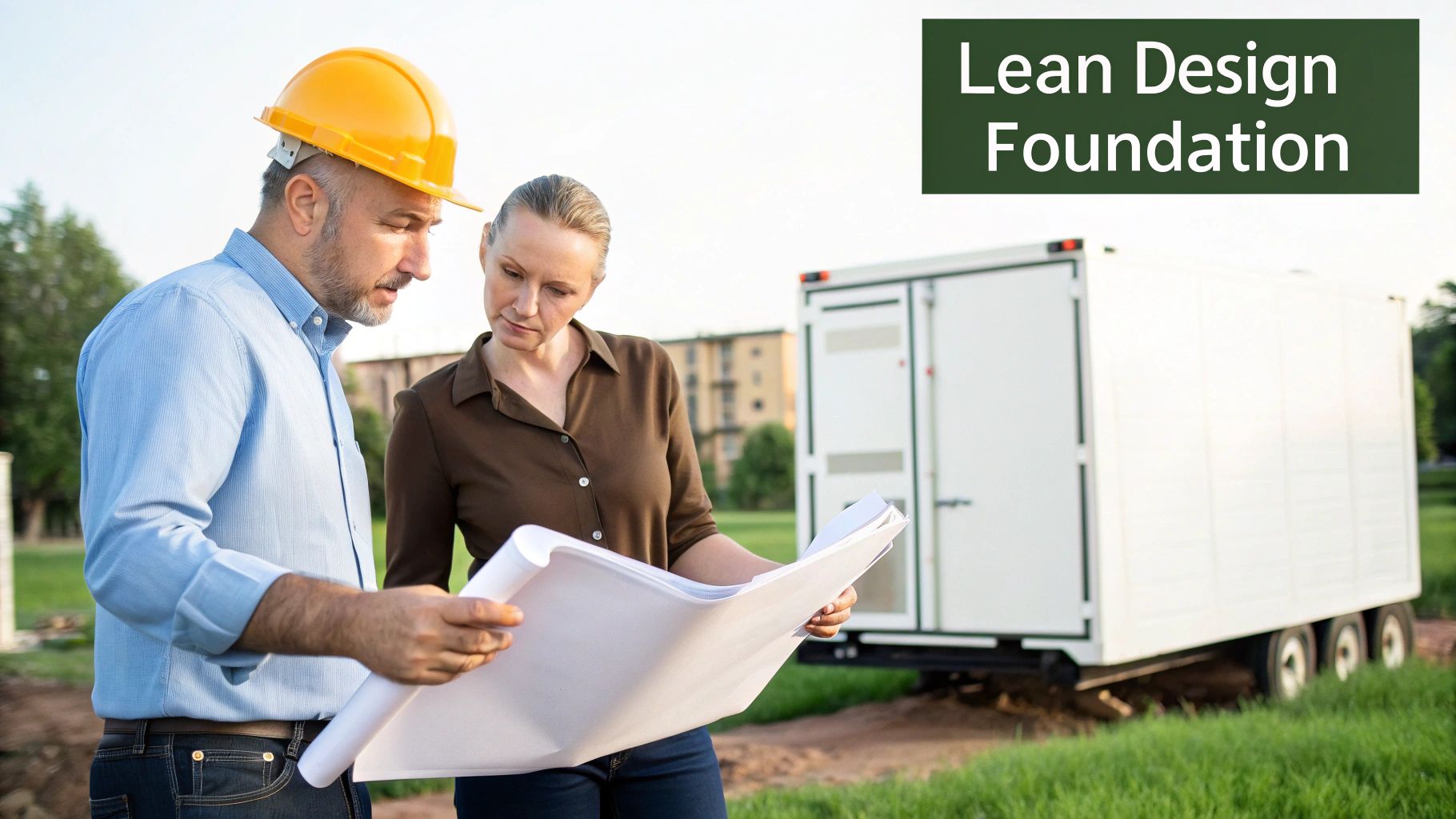
In a nutshell: The architect builds the sturdy, functional shell. The interior designer transforms that shell into a living, breathing, branded environment.

How Long Does a Commercial Project Usually Take?

Ah, the million-dollar question. The honest, expert answer is: it really depends on the scale and complexity of your project. There's no single timeline that fits all.

A simple interior renovation for a small coffee shop might be wrapped up in a few months. But if you're talking about designing and building a new multi-story office building from the ground up, you could easily be looking at a timeline that spans several years.

Here are the big factors that always influence the schedule:

  • The Permitting Maze: Getting the green light from local authorities can take anywhere from a few weeks to many, many months.
  • Design Intricacy: A highly custom design with unique technical challenges will naturally take longer than a standard, straightforward one.
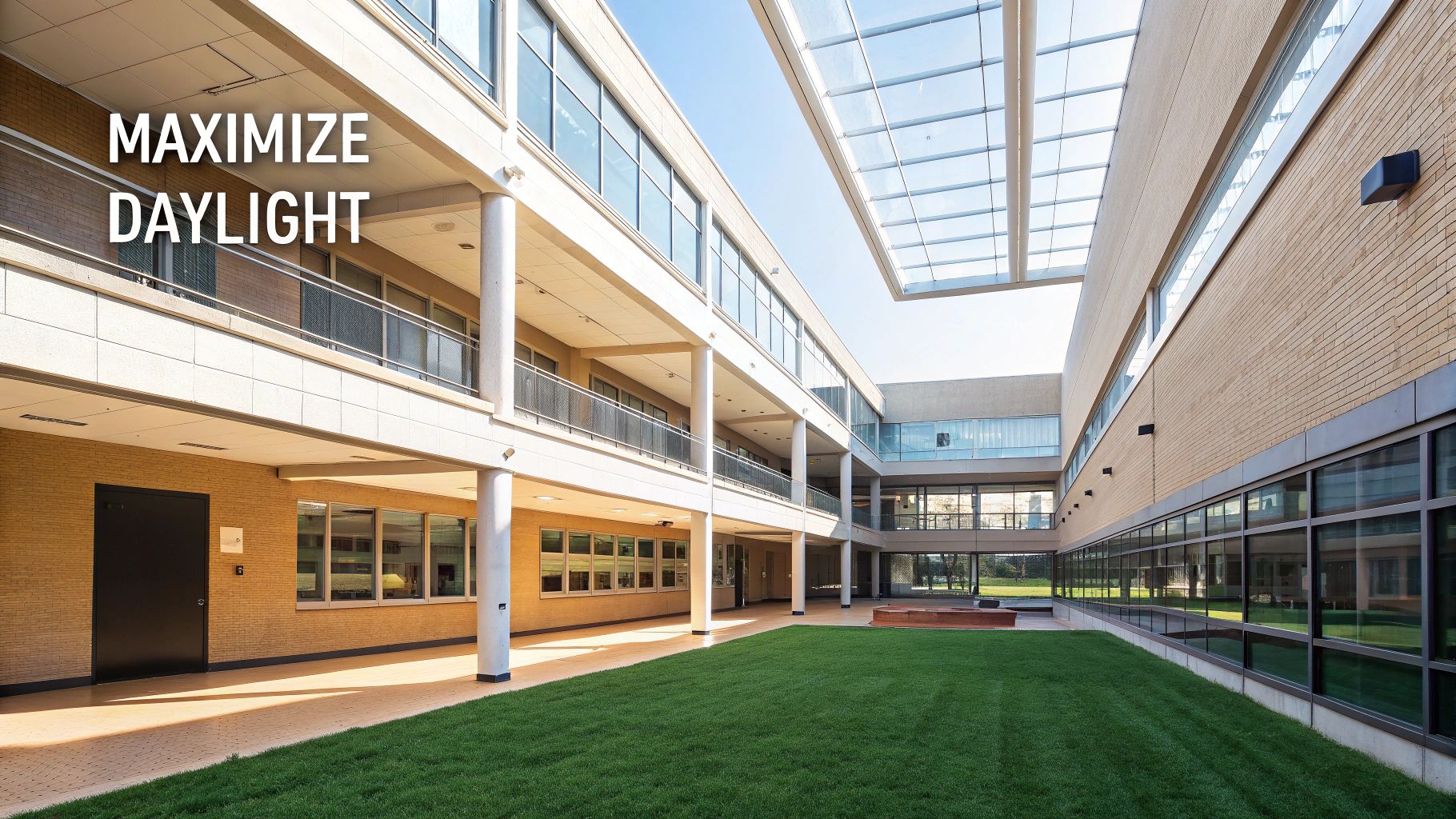
  • Surprises on Site: You never truly know what's underground until you start digging. Unexpected soil conditions or other site issues can cause delays.
  • Decision Speed: The project moves at the speed of decisions. Quick, clear feedback from you, the client, is crucial for keeping things on track.

How Are Architectural Design Fees Calculated?

The cost of architectural design isn't a simple, off-the-shelf price. Fees are usually structured in one of two ways: either as a percentage of the total construction cost or as a fixed, flat fee that's agreed upon before work begins.

For percentage-based fees, the rate typically falls somewhere between 5% and 15% of the final construction budget. What determines that percentage? It comes down to a few key things: the project's overall size, the difficulty of the design, and exactly how many services the architect is providing. A large, complex hospital with tons of regulations will, of course, have a higher design fee than a simple, open-plan warehouse.


At Sherer Architects, LLC, our job is to be your guide through every phase, making sure you have total clarity on timelines, costs, and design choices. If you're ready to turn your vision into a real, tangible space, stop by https://shererarch.com to see how our team can help you build something lasting and successful.