When you start sketching out a fire station floor plan, you’re not just designing a building—you’re creating a strategic tool for emergency response. Every hallway, doorway, and room placement is planned to shave precious seconds off the time it takes to get from alarm to on the road, what firefighters call "chute time."
A successful layout is all about maximizing speed, safety, and operational flow.
The Modern Fire Station: A Machine for Rapid Response
Gone are the days of thinking of a fire station as just a big garage for fire trucks. Today's stations are complex, highly specialized facilities where every square foot is engineered for peak performance and, just as importantly, the long-term well-being of the crew. It's less like a house and more like a finely tuned machine built for one critical purpose: saving lives.
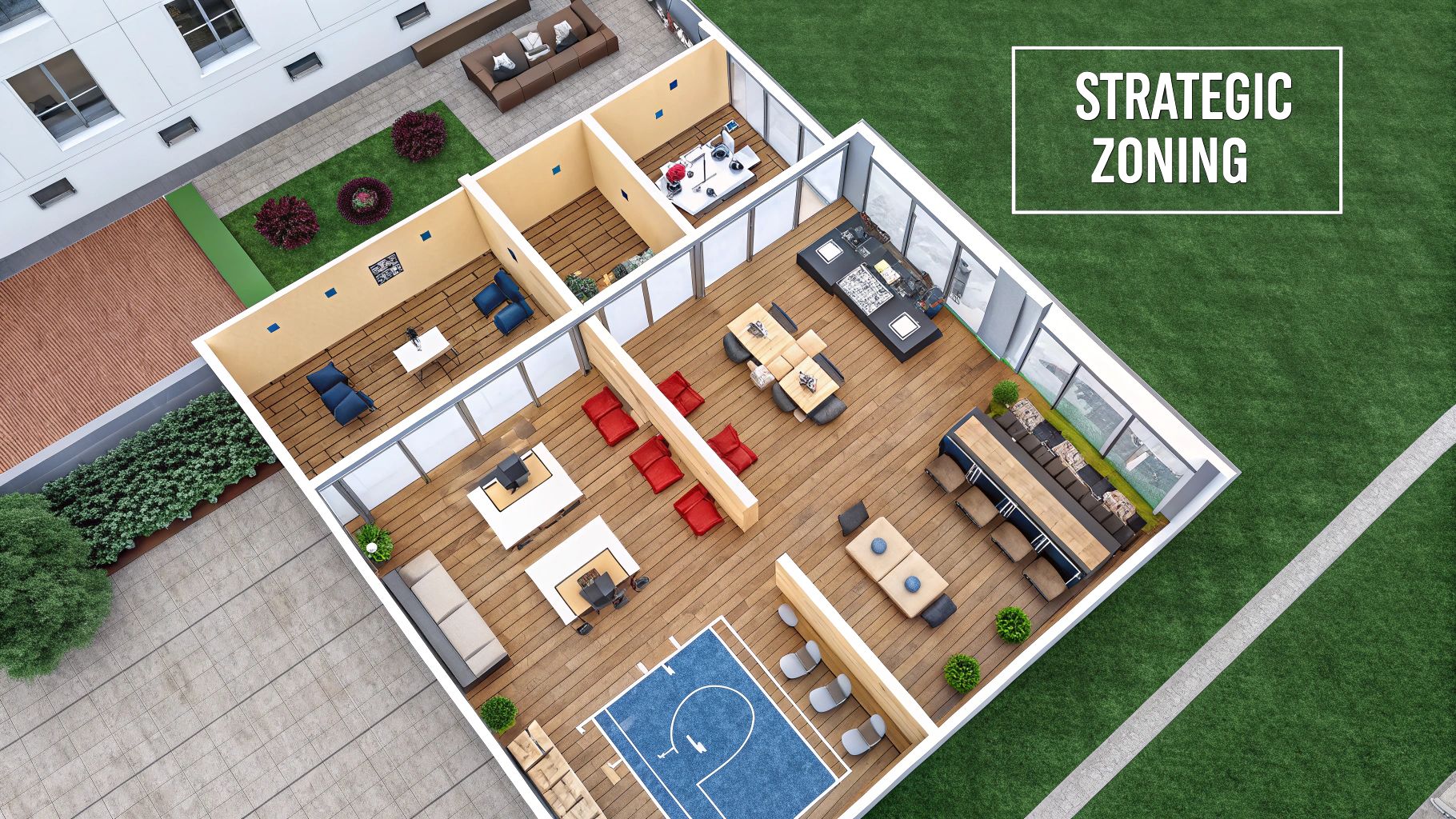
At the very core of this modern design philosophy is the ‘Hot-Warm-Cold’ zoning concept. This isn't just a suggestion; it's a non-negotiable strategy for protecting firefighters from the hazards they face on the job.
- Hot Zone: This is the apparatus bay. It's where the trucks return after a call, often covered in soot, chemicals, and other carcinogens.
- Warm Zone: Think of this as a crucial airlock. It's home to decontamination showers and turnout gear storage, creating a buffer between the dirty work area and the clean living space.
- Cold Zone: This is the safe haven—the bunk rooms, kitchen, dayroom, and offices. It's completely sealed off from the Hot Zone's contaminants.
This strict separation is a game-changer. It stops dangerous particles from migrating from the trucks and gear into the areas where firefighters eat and sleep, a major focus in health-conscious station design today.
Layouts Evolving with Shifting Call Demands
The very mission of the fire service has also forced a major rethink of station layouts. Over the past few decades, the types of emergencies have shifted dramatically. For many departments across the U.S., a staggering 60% to 80% of all calls are now for Emergency Medical Services (EMS), a huge jump from the 1970s.
This means modern floor plans must now dedicate significant space to things like medical supply storage, climate-controlled rooms for paramedics to restock, and specialized decontamination zones just for EMS equipment.
This operational reality is backed by hard data and national standards that set benchmarks for response times. Architects use these targets to map out the most efficient travel paths inside the station, ensuring the living quarters are no more than a 60 to 90-second journey to the apparatus bay. This data-driven approach means today's fire station plans are less about grand civic architecture and more about quantifiable results.
Every room-to-room connection is optimized for speed and safety. You can dive deeper into these performance-driven design principles in this in-depth federal report on fire station location and response times.
Planning Key Spaces for Operational Flow
When you look at a fire station floor plan, you're not just looking at rooms and hallways. You're looking at a machine built for speed, where every second counts. The real genius of a great design is how it arranges spaces to create a seamless workflow, a concept we call adjacency planning.
Think of it this way: a poorly designed station creates friction. It forces firefighters to run down long hallways or double back to grab gear, wasting precious time. A smart layout, on the other hand, guides them logically from the moment an alarm sounds all the way through post-incident decontamination. It’s all about creating the straightest, fastest line from point A to point B.
The Heart of the Station: The Apparatus Bay
The apparatus bay is far more than just a big garage. It’s the station's operational command center—the starting line for every call and the place for daily vehicle checks and maintenance. How this space is designed has a ripple effect on the entire station's efficiency.
You'll generally see two main types of bays:
- Back-In Bays: This is the traditional setup. Trucks return from a call and have to be carefully backed into their spot. It requires a lot of skill from the driver and a good bit of space on the apron (the concrete pad out front), but it can work for sites that aren't very deep.
- Drive-Thru Bays: This is the gold standard in modern design. The apparatus comes in through a rear door and drives straight out the front for the next call. It's faster, significantly safer, and dramatically cuts down on the risk of accidents. Whenever the property allows for it, this is the way to go for fire station floor plans.
But no matter which style you choose, the bay’s real power comes from its direct connections to the rest of the station.
Creating a Decontamination Corridor
Right next to the apparatus bay, you absolutely must have the decontamination area. This isn't just a room; it's the critical "airlock" that separates the contaminated "Hot Zone" from the clean living areas of the station. A properly designed decon corridor is a one-way street that prevents dangerous cross-contamination.
After a fire, crews step directly from the bay into this zone to scrub their gear and themselves before they go anywhere else. You'll find specialized washing machines for turnout gear, dedicated showers, and storage for clean uniforms here. It's an essential barrier that keeps carcinogens and other toxins out of the living quarters.
A study of one modern station design revealed that a dedicated decontamination corridor can reduce the transfer of harmful particulates into living areas by over 90%. This shows how a floor plan isn't just about logistics—it's a fundamental tool for protecting firefighter health.
This simple diagram shows the ideal flow from a high-risk to a low-risk environment, which is the core principle of modern fire station design.
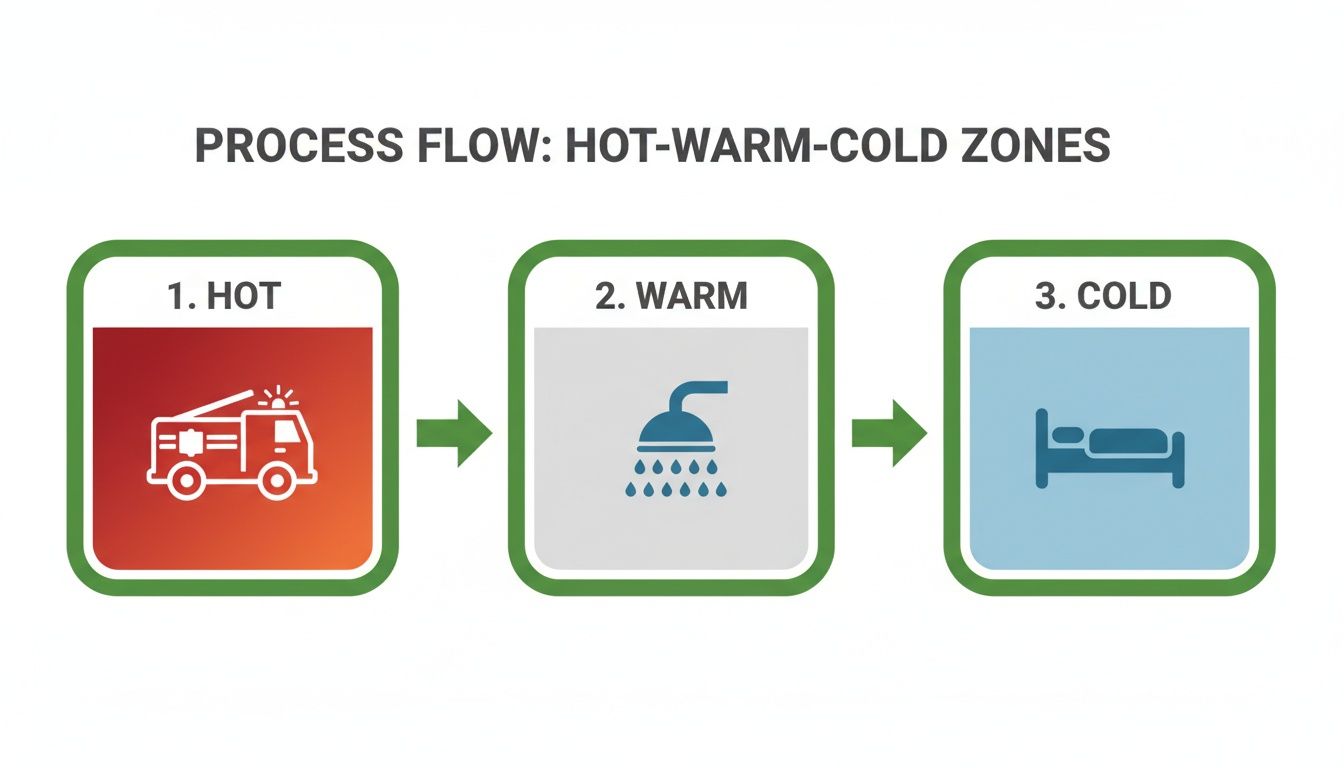
This process flow illustrates the mandatory separation of Hot, Warm, and Cold zones. It ensures that contaminants from an incident (Hot) are systematically removed (Warm) before personnel ever enter the safe living quarters (Cold).
Living Quarters Designed for Readiness
The "Cold Zone" is where you'll find the living quarters—the dayroom, kitchen, and bunk rooms. While this is the area for rest and recovery, its layout is still driven by the absolute need for a rapid response. The name of the game is minimizing travel distance from these spaces to the turnout gear and, ultimately, the apparatus bay.
Bunk rooms are usually clustered in a quieter part of the station, but they're always connected by a direct, clear hallway to the turnout gear corridor. Dayrooms and kitchens are often positioned to have a straight shot or at least a clear line of sight to the bay.
For example, a new station in Bernalillo County was designed with 12 bunks and four apparatus bays, and the layout was obsessed with one goal: ensuring a firefighter could get from deep sleep to the truck in under 90 seconds. Every single wall and doorway was placed to make that journey as short and straight as humanly possible.
Getting the Dimensions Right: Sizing and Circulation
Moving from a floor plan sketch to a real, working fire station is all about the details. Every single inch counts, especially when you’re dealing with response times measured in seconds. Getting the sizing and circulation right isn't just about comfort; it's about designing a facility that performs flawlessly when the pressure is on.
The heart of the station is the apparatus bay, and its dimensions are absolutely non-negotiable. Fire trucks today are bigger than ever, and designing a bay for yesterday’s equipment will hamstring a department from day one. You have to plan for the biggest truck in the current fleet—and ideally, the biggest one you might possibly acquire in the next 20 years.
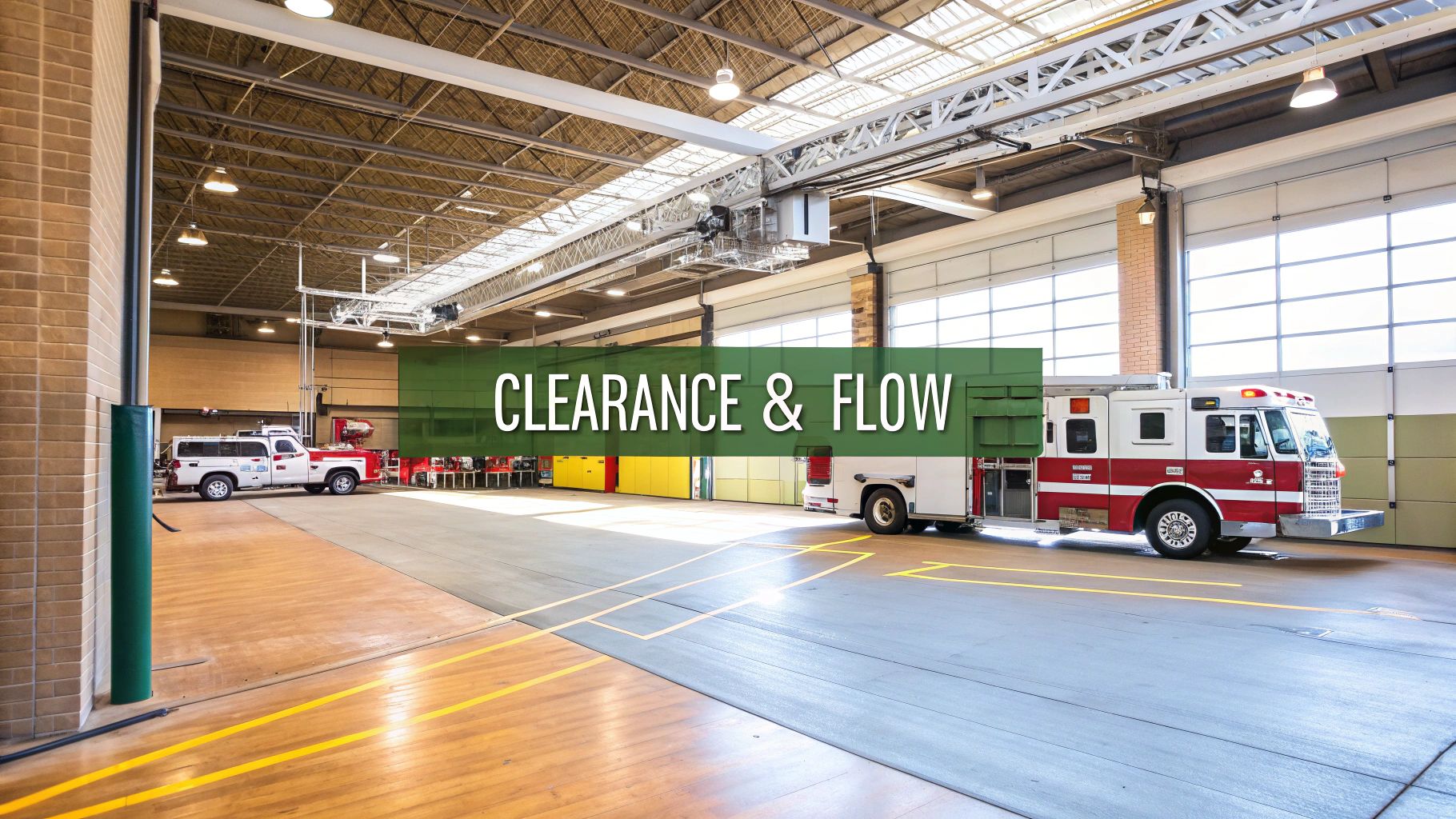
Sizing the Apparatus Bay for Safety and Function
The apparatus bay is much more than a parking garage. It's a dynamic workspace where firefighters perform daily checks, stage gear, and handle maintenance. Because of this, generous clearances aren't a luxury—they're a core safety requirement. A cramped, crowded bay is a hazard zone, raising the risk of everything from trips and falls to costly vehicle damage.
Here are a few industry-standard guidelines to keep in mind:
- Bay Width: Each bay should be at least 18 to 20 feet wide. This gives firefighters enough room to swing open massive cab and compartment doors without banging into walls or adjacent trucks.
- Bay Depth: For a drive-thru design, you’ll need a minimum of 80 feet. For back-in bays, that number can stretch closer to 100 feet to give drivers the space they need to maneuver safely.
- Clearances: Always plan for at least five feet of clear walking space around the front, back, and working side of every parked apparatus. This "safe zone" is essential for daily tasks and rapid deployment during a call.
- Door Dimensions: The doors themselves need to be a bare minimum of 14 feet wide and 14 feet high. Many new stations are opting for 16-foot heights to future-proof the building for taller aerial trucks.
Think of the circulation space around an apparatus like the clear zone around heavy machinery in a factory. It’s not wasted space; it’s an active safety feature that prevents accidents and ensures smooth, predictable operations when every second counts.
These dimensions are the absolute baseline for any functional fire station floor plans. Cutting corners on bay size creates immediate operational headaches and severely limits a department's ability to adapt to new vehicles and technology down the road.
To help you visualize how these areas fit together, here’s a quick breakdown of typical space allocations for a standard two-bay station.
Typical Space Allocation in a Fire Station Floor Plan
This table provides estimated square footage guidelines for key areas within a standard two-bay fire station, helping developers plan for overall building size.
| Functional Area | Typical Size (Square Feet) | Key Design Considerations |
|---|---|---|
| Apparatus Bay (Two Bays) | 3,000 – 4,000 | Must accommodate largest planned vehicle with 5 ft. clearances. |
| Decontamination Zone | 200 – 300 | Direct access from bay; includes showers, extractors, gear storage. |
| Living Quarters (Dorms) | 800 – 1,200 | Individual bunk rooms for privacy and rest are now standard. |
| Kitchen/Dayroom | 600 – 900 | Open concept to foster camaraderie; durable, commercial-grade finishes. |
| Training/Meeting Room | 400 – 600 | Flexible space with A/V hookups for training and community use. |
| Fitness Room | 300 – 500 | Needs space for cardio and strength equipment; good ventilation. |
| Administrative Offices | 250 – 400 | Captain's office, report writing stations, and secure storage. |
| Restrooms/Showers | 350 – 500 | Separate facilities for men and women, accessible from living areas. |
These figures are a starting point, of course. A department’s specific operational needs, staffing levels, and community roles will ultimately shape the final design.
The Math Behind Movement and Response Time
Beyond the bay, the entire building's layout is governed by one thing: the relentless pursuit of speed. Pathways from the living quarters to the apparatus bay must be direct, wide, and completely free of obstacles. A winding hallway or a poorly placed door can easily add precious seconds to turnout time.
This isn't just a local issue; it's a global standard. In China, for instance, national guidance suggests a typical urban fire station should have a total floor area around 3,300–4,800 m² to properly serve its jurisdiction. Research confirms there's a direct correlation between a station's floor area, its capacity, and its effectiveness. As detailed in this study on station planning and risk coverage, you can actually quantify how new stations or added bays improve a city's overall protection.
The underlying principle is universal: create a "path of travel" that is as straight and simple as humanly possible. Corridors should be a minimum of five feet wide, allowing multiple firefighters to rush past one another without colliding, especially when they're throwing on heavy gear.
Finally, you have to think about the site itself. The apron—that big concrete pad in front of the bay doors—needs to be deep enough for trucks to exit and turn onto the street without executing a complicated three-point turn. A turning radius of at least 50 feet is a common benchmark to ensure apparatus can leave the station quickly and merge safely into traffic.
Making Sense of Critical Building Codes and Standards
When you're laying out a fire station floor plan, you're doing a lot more than just arranging rooms. You're navigating a dense web of building codes and safety standards that are non-negotiable. These aren't just suggestions—they are strict requirements that guarantee the station is safe, accessible, and strong enough to serve as a lynchpin for the community. A fire station isn't treated like a typical commercial building; it's officially classified as an Essential Facility, which bumps it into a much higher category for structural and safety performance.
This special status means the building has to be tough. Really tough. It must be engineered to withstand major disasters like earthquakes or hurricanes and stay standing when everything else might not. The International Building Code (IBC) lays out the specific seismic design criteria and structural standards for these facilities, ensuring they can function as a command post right after a major event hits.
Health and Safety Codes Driven by the NFPA
Beyond just keeping the building upright, the health and well-being of the firefighters are absolutely critical. This is where the National Fire Protection Association (NFPA) comes in. They publish a whole suite of standards that have a massive impact on the floor plan, going far beyond just sprinklers. These rules are designed to protect the long-term health of the people who call the station home 24/7.
A few of the biggest NFPA-driven requirements you'll see are:
- Vehicle Exhaust Systems: NFPA 1500 requires direct-source capture systems for vehicle exhaust in the apparatus bay. This is a must-have to keep toxic diesel fumes from seeping into the station's air supply.
- Contaminant Control: The layout must follow a strict "Hot-Warm-Cold" zone system. This prevents firefighters from unknowingly tracking cancer-causing agents from their gear into the living quarters.
- Electrical Safety: Planning a fire station means following numerous safety regulations, and that includes the electrical systems that power everything. To ensure comprehensive electrical safety, understanding standards like the NFPA 70E electrical safety standards is crucial for designing power systems that are both safe and easy to maintain.
These health-based rules have become increasingly important as the fire service grapples with the high rates of job-related illnesses, especially cancer.
Designing for Accessibility and Inclusion
Like any modern public building, a fire station has to comply with the Americans with Disabilities Act (ADA). This has a huge effect on the floor plan, as it mandates that every part of the facility must be accessible. This isn't just for public-facing areas like a lobby or meeting room; it applies to the crew's work and living areas, too.
Designing for ADA compliance isn't just about ticking a legal box; it's about future-proofing the station. It ensures the facility can accommodate any member of the fire service and the community, creating a more inclusive and effective organization.
This means thinking through details like zero-threshold doorways, fully accessible restrooms and showers, and wide, clear pathways everywhere—from the offices to the kitchen. These considerations can't be an afterthought. They need to be baked into the design from day one, because trying to retrofit a non-compliant building later is a costly and disruptive nightmare. By embracing these codes from the very start, you build a station that isn't just compliant, but fundamentally safer, healthier, and ready to serve for decades.
New Construction Versus Adaptive Reuse Strategies
When a community decides it needs a new fire station, one of the first and most critical decisions is where that station will live. Do you start from scratch with a brand-new building, or can you breathe new life into an existing structure? This is the core question behind new construction versus adaptive reuse.
Both paths have their own unique set of pros and cons, and the right choice directly shapes the final fire station floor plans. It's a major decision that weighs budget, timing, location, and the specific operational needs of the fire department. A new build is a blank canvas, while an adaptive reuse project is more like solving a complex, three-dimensional puzzle.
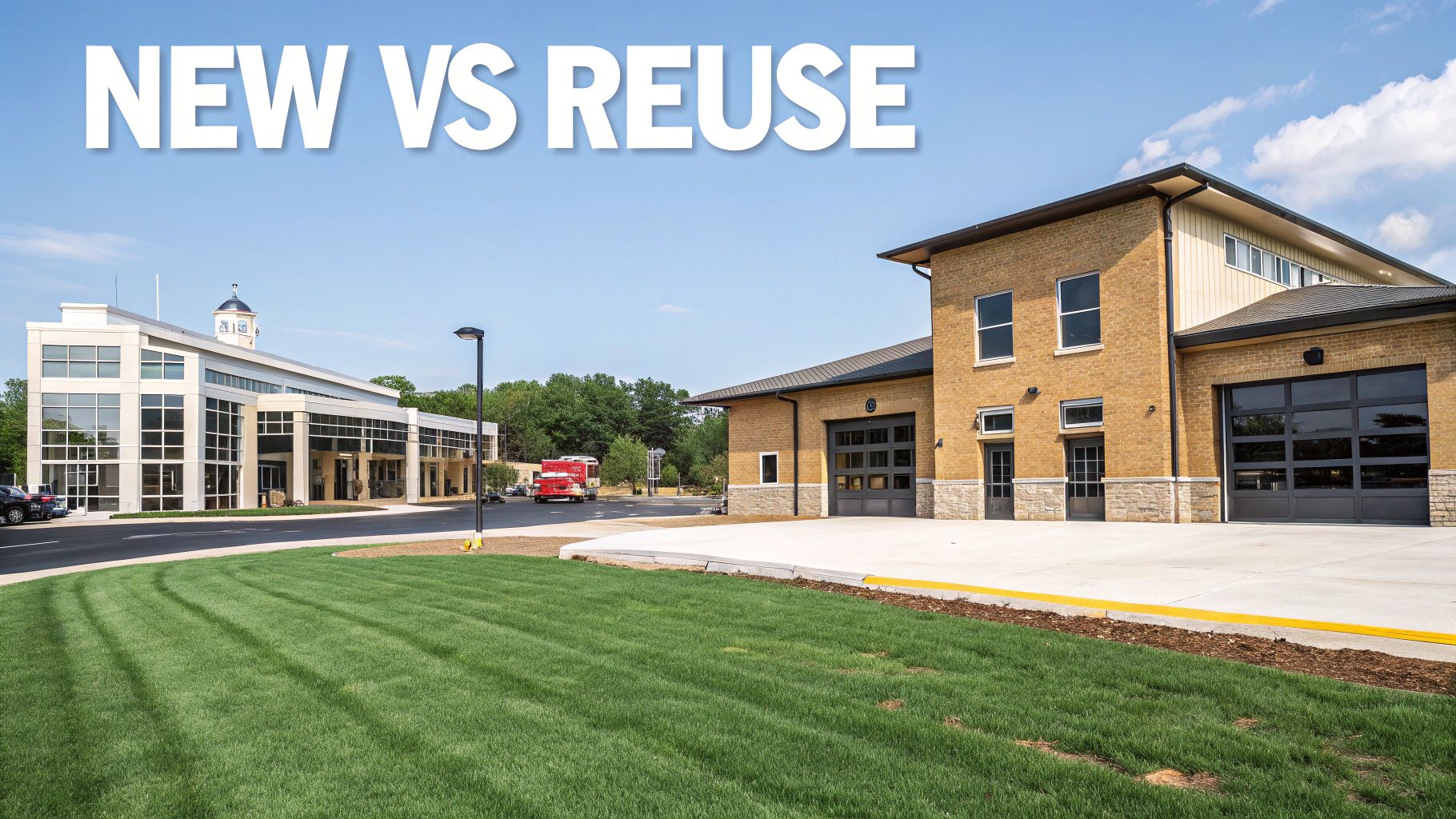
The Blank Canvas of New Construction
There's no denying the appeal of starting with a clean slate. New construction offers complete freedom to design a fire station that is perfectly matched to the department's workflow and future ambitions. Every detail, from the width of apparatus bay doors to the exact layout of the decontamination zone, can be optimized for safety and efficiency without compromise.
Take the new Fire Station #36 in Bernalillo County, for instance. Designing from the ground up allowed for 12 bunks, four apparatus bays, and even an on-site solar energy system. More importantly, it meant they could incorporate New Mexico's first electric fire truck—a feature that would have been incredibly difficult, if not impossible, to shoehorn into a retrofitted building. When you're building new, integrated project delivery methods like Design Build services can really help streamline the entire process, from the first sketch to the final ribbon-cutting.
Ultimately, this approach ensures the floor plan is a true reflection of modern firefighting, free from the constraints of a building designed for another era.
The Intricate Puzzle of Adaptive Reuse
Adaptive reuse is all about transformation—taking an existing building like an old warehouse, a vacant school, or even a historic storefront and giving it a new purpose as a fire station. This route can be a more sustainable and sometimes more affordable option, especially in dense urban areas where open land is either nonexistent or prohibitively expensive.
But this path comes with its own set of significant engineering and design challenges. You’re not just moving in; you’re performing major surgery on the building.
Here are the main hurdles you'll almost always face:
- Structural Integrity: A fully loaded fire engine can weigh over 80,000 pounds. The existing floor slab in a typical commercial building was never designed for that kind of load and will need massive reinforcement.
- Sufficient Clearances: Modern fire trucks need tall bay doors, often requiring 14- to 16-foot vertical clearance. Cutting those openings into an existing wall without compromising the entire structure is a major undertaking.
- Operational Flow: The biggest puzzle is often figuring out how to create a logical circulation path within a fixed footprint. You still have to establish those critical Hot, Warm, and Cold zones, which can be tough when you can't move walls wherever you want.
- System Upgrades: The building's electrical, plumbing, and HVAC systems will almost certainly need a complete overhaul to handle the 24/7 demands of an essential facility.
While adaptive reuse can seem like a shortcut, it often requires just as much—if not more—creative problem-solving than new construction. The goal is to make the old building perform like a new one, which demands a deep understanding of both modern fire service needs and existing building constraints.
Making the Right Choice
So, how do you decide? The choice to build new or adapt an old building boils down to a careful analysis of your community's specific priorities.
The table below breaks down the key considerations for each approach, giving you a clearer picture of the trade-offs involved.
New Build vs. Adaptive Reuse for Fire Stations
| Consideration | New Construction | Adaptive Reuse |
|---|---|---|
| Design Flexibility | Total freedom to design a perfect, future-proof floor plan. | Constrained by the existing building's footprint and structure. |
| Initial Cost | Typically higher due to land acquisition and ground-up building. | Potentially lower, especially if the building is acquired at a good price. |
| Project Timeline | Predictable but can be lengthy, often 18-24 months from design to completion. | Can be faster, but unexpected structural issues can cause delays. |
| Location | Limited by the availability of suitable and affordable vacant land. | Opens up more possibilities in established, built-out neighborhoods. |
| Community Impact | Can be a symbol of civic investment and progress. | Preserves local character and promotes sustainable development. |
Whether you're starting fresh on an empty lot or reimagining a piece of your town's history, the fundamental goal is the same: to create a fire station floor plan that helps firefighters respond faster, work safer, and stay healthier for decades to come.
Your Essential Fire Station Planning Checklist
Getting a new fire station from a concept on paper to a fully operational reality is a monumental task. There are dozens of critical decision points along the way, and a successful project really boils down to asking the right questions at the right time.
This checklist is designed to be your guide. Whether you're a fire chief, a city leader, or a developer, it will help you make sure no crucial detail gets missed in your fire station floor plans. Think of it less as a rigid set of rules and more as a strategic roadmap to spark discussion, challenge old assumptions, and keep everyone on the same page.
Phase 1: Foundational and Site Analysis
Before anyone even thinks about drawing a floor plan, you have to do your homework on the ground. The decisions you make here will ripple through every other phase of the project, affecting everything from response times to the station's long-term value.
- Map Your Response Coverage: Have you run a detailed GIS analysis to prove this site gives you the best possible coverage? It’s critical to confirm you can meet the NFPA 1710 travel time standards.
- Assess Site Circulation: Is there actually enough room for trucks to get in and out easily, without a 10-point turn? You need to plan for a minimum 50-foot turning radius for the apron, no exceptions.
- Evaluate Zoning and Utilities: Double-check that the site is zoned for an essential facility. Have you confirmed that the water, sewer, and power lines can handle a 24/7 operation?
- Conduct Geotechnical and Environmental Surveys: Are there any nasty surprises lurking underground? Hidden soil problems, drainage issues, or environmental contaminants can derail a budget faster than anything else.
A proactive site analysis can prevent 80% of future design and construction headaches. Rushing this initial phase is the single most common mistake that leads to budget overruns and compromised operational flow.
Phase 2: Programming and Operational Planning
This is where your department's day-to-day reality gets translated into an architectural program. You're defining the specific spaces you need and, just as importantly, how they all need to connect to support the mission.
- Define Your Apparatus Fleet: What’s the biggest rig you have now, or plan on buying in the next 20 years? The entire plan has to be built around that future vehicle, not just what’s sitting in the bay today.
- Confirm Staffing Levels: How many firefighters will be on-duty per shift, both now and down the road? This number drives everything from the number of bunks and lockers to the size of the dayroom and kitchen.
- Map the Decontamination Workflow: This is a big one. Have you clearly mapped out the one-way path from the apparatus bay (Hot Zone), through the decon area (Warm Zone), and into the living quarters (Cold Zone)? For the health of your crew, this flow is non-negotiable.
- Identify Community and Training Needs: Will the station have a community room for public meetings? A dedicated training tower? A real fitness area? These spaces need to be worked into the layout without ever getting in the way of an emergency response.
Phase 3: Future-Proofing and Long-Term Viability
A new fire station is a 50-year investment. Designing just for today's needs is shortsighted. You have to think about what's coming next to make sure this facility serves the community for decades.
- Plan for Expansion: Does the site plan and building design leave room to grow? Think about adding an extra apparatus bay or more administrative offices later on.
- Accommodate New Technology: Are you wiring and planning for things that aren't even standard yet? This means infrastructure for electric vehicle charging, better data systems, and even designated areas for drone deployment.
- Design for Flexibility: Are you building in adaptability? Using things like movable partitions or flexible furniture in training rooms and offices means the space can evolve as your operational needs change.
By working through these questions step-by-step, your team can build a plan that goes beyond just looking good on paper. You’ll create a station that’s effective on day one and remains a resilient, valuable asset for generations to come.
Answering Your Key Questions on Fire Station Design
When you're knee-deep in planning a fire station, the questions come thick and fast. It's a complex project, and everyone from the fire chief to the town council needs to be on the same page. Let's walk through some of the most common questions we hear and get you some clear, straightforward answers.
These aren't just academic points; they get to the heart of what makes a station design work in the real world—efficiency, firefighter safety, and a building that will serve its community for decades.
What’s the One Thing We Absolutely Have to Get Right in the Floor Plan?
If you get one thing right, make it the operational flow. The entire design should be obsessed with minimizing "chute time"—the clock starts the second the alarm sounds and stops when the truck's wheels are rolling out the door.
A great plan accomplishes this with a dead-simple, wide, and totally clear path from the living quarters, through the turnout gear room, and straight to the apparatus. No zig-zags, no narrow hallways, no obstacles. Every second shaved off that response time by good design is a second gained at the scene of an emergency. It's truly the most critical element.
How Much Does Decontamination Really Change the Design?
It changes everything. The growing understanding of cancer risks has completely overhauled how we lay out a modern fire station. A strict ‘Hot-Warm-Cold’ zone system isn't just a trend; it's the new non-negotiable standard for protecting firefighters.
Here’s how it works in practice:
- Hot Zone: The crew and their gear come off the truck and enter a dedicated decontamination area directly from the apparatus bay.
- Warm Zone: Next, they move through a transition space with special showers and gear washers to remove contaminants.
- Cold Zone: Only after they are completely clean do they re-enter the "clean" living side of the station—the kitchen, bunks, and offices.
This isn't an optional add-on anymore. It's a fundamental part of the building's design, crucial for protecting the long-term health of the crew.
A well-designed decontamination workflow is one of the biggest leaps forward in fire station architecture. Think of it as a direct investment in your firefighters' futures, shielding them from the cumulative effects of toxic exposure.
Can We Actually Convert an Old Building into a Fire Station?
Absolutely, and it can be a great, sustainable option. But it's not as simple as just parking a truck inside. An adaptive reuse project demands a very careful and realistic feasibility study right from the start.
You run into some serious engineering puzzles. First, can the existing structure handle the massive weight of a modern fire engine, which can top 80,000 pounds? Second, do you have enough ceiling height for the apparatus bays? And finally, can you carve out a logical and safe circulation path within the constraints of the old building? It takes a creative design team, but with the right building, the results can be fantastic.
What's a Realistic Budget for a New Fire Station?
This is the big question, and the answer varies a lot by location and the specifics of the project. As a starting point, you can expect new construction to fall somewhere between $400 and $700+ per square foot. So, for a pretty standard 12,000–15,000 sq ft station, you're likely looking at a total project cost of $5 million to over $10 million.
That number might seem high, but it reflects the fact that this is a 24/7 essential facility built to last for 50+ years. It requires heavy-duty structural, mechanical, and electrical systems that you just don't see in a typical office building. For a real-world example, a recent project for a new four-bay station in Bernalillo County was budgeted around $15.8 million, which shows the level of investment needed for a resilient, modern public safety facility.
At Sherer Architects, LLC, we specialize in solving complex design puzzles for commercial, adaptive reuse, and historic preservation projects. If you are planning a facility that demands precision, durability, and a deep understanding of operational needs, let our decades of experience guide your project to a successful outcome. Learn more about our approach at https://shererarch.com.