SHERER ARCHITECTS

Categories
Uncategorized

A Guide to Modern Assisted Living Facility Design

When we talk about designing an assisted living facility, we're not just talking about architecture. We're talking about crafting a community from the ground up—a place where seniors can live with dignity and support for their daily lives.

This specialized field is all about creating environments that are safe, easy to navigate, and genuinely engaging. The real magic happens when we move beyond the old, sterile models and create settings that feel like home, with a touch of hospitality. The ultimate goal is to build a place that fosters wellness, community, and a true sense of belonging.

From Institution to Home: The New Philosophy in Senior Living

The blueprint for senior living has been completely redrawn. Gone are the days of sterile, hospital-like facilities with long, impersonal hallways and a cold, clinical feel. Today’s best designs are built on a simple yet powerful idea: we're creating a vibrant neighborhood, not just a building that provides care.

This philosophy puts the resident first, prioritizing their independence, well-being, and ability to connect with others.

This change didn't happen in a vacuum. The whole concept of assisted living design has transformed dramatically since the late 20th century. Back in the 1980s and 1990s, pioneers in the field started introducing private apartments and communal dining rooms—a huge departure from the old dormitory-style nursing homes.

This shift was driven by a growing understanding that seniors thrive when they feel at home. It sparked a new wave of designs featuring residential-style kitchens, cozy lounges, and beautiful courtyards that encouraged people to gather. You can learn more about this market evolution on imarcgroup.com.

The Shift from Clinical to Communal

Think about the old institutional model. It saw residents primarily through the lens of their medical needs, and the design reflected that. The result was often a cold, efficient building that felt stripped of any personal choice. Hallways were just for getting from point A to point B, rooms were just for sleeping, and common areas often sat empty. It was an approach that often led to isolation and a diminished sense of self.

Now, contrast that with the modern philosophy, which is all about hospitality. Picture a boutique hotel or a thoughtfully planned residential community.

The core idea is that the physical environment should actively support a high quality of life. It’s not just about providing shelter and care; it's about creating a place where residents feel empowered, engaged, and genuinely at home.

Why This Design Philosophy Matters

Getting the design philosophy right isn't just about aesthetics—it's a critical business decision that directly impacts your facility's success. A community designed to feel like a real home has a tangible effect on everything.

  • Marketability: Today’s seniors and their families are savvy. They're looking for a place that feels warm, inviting, and modern. A facility with that appeal will always have a leg up on the competition.
  • Resident Satisfaction and Retention: It's simple, really. When residents feel comfortable and connected, they're happier and healthier. This leads directly to higher satisfaction and longer stays.
  • Operational Efficiency: A smart layout isn't just for residents; it makes life better for your staff, too. It can improve workflows, reduce on-the-job stress, and create a more positive work environment, which is a huge factor in staff retention.

Your Blueprint for a Profitable and Purposeful Facility

Before the first shovel ever hits the dirt, the most important work in assisted living design happens on paper. This initial phase, what we in the industry call programming, is where your business goals and architectural vision finally meet. It's so much more than just deciding on the number of rooms; it's about crafting the very DNA of your future community.

Think of programming as the detailed business plan for the building itself. Every single choice made here—from the specific mix of care levels you'll offer to the style of the dining hall—directly shapes your facility's market position, day-to-day operational efficiency, and long-term financial health. A poorly programmed building might look fantastic on the outside but completely miss the mark on meeting resident needs or your own financial projections.

The whole process kicks off with a deep dive into the local market. Who are your potential residents? What do they truly need, what are they looking for, and what can they afford? A rock-solid analysis of local demographics isn't just a good idea; it's non-negotiable.

Defining Your Market Position

Knowing your competition is every bit as crucial as understanding your future residents. What are the other facilities in the area doing? Where are the gaps? You might find the market is saturated with high-end memory care but has a real shortage of options for more independent, active seniors.

This kind of analysis helps you carve out a unique position. Maybe you'll decide to specialize in a certain acuity level, or perhaps you'll build a community centered around a specific lifestyle, like wellness or the arts.

A successful assisted living facility doesn't try to be everything to everyone. It identifies a specific need within the community and designs an environment that masterfully meets that need, creating a clear and compelling choice for prospective residents and their families.

Once you have a clear vision for your market position, you can start making those foundational programming decisions. This is where you translate that high-level strategy into a concrete plan for the building and its operations.

These choices are all tangled together. A focus on memory care, for instance, is going to demand a very different site plan with secure outdoor spaces. A model built for active seniors, on the other hand, will need far more extensive fitness and social amenities.

The chart below shows the bigger philosophical shift that’s happened in senior care, moving away from sterile, institutional models toward environments that feel like a real home.
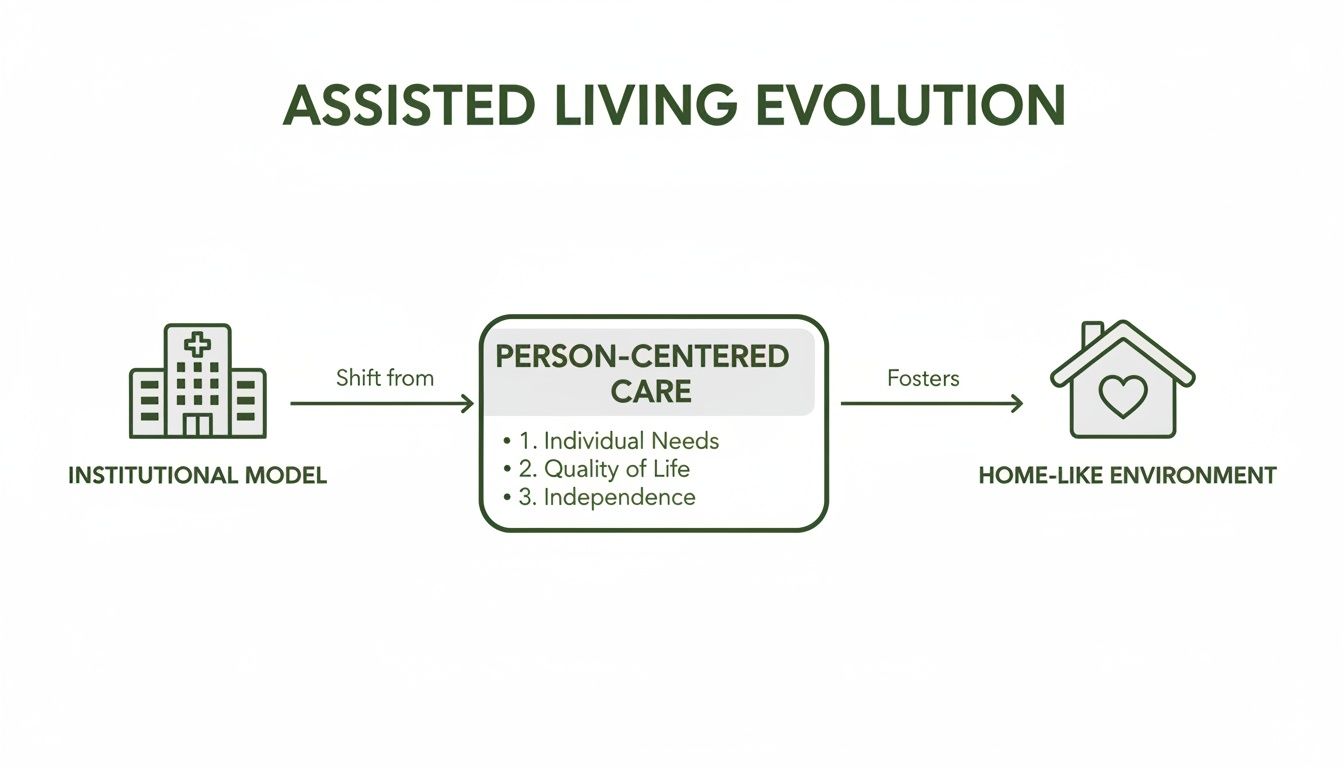
Flowchart showing assisted living evolution from an institutional model to person-centered care fostering a home-like environment.

This evolution underscores how modern design puts dignity and community first, which directly influences the kind and quality of amenities you'll need to build into your plan.

Key Programming Decisions and Their Impact

Every choice you make during programming creates a ripple effect. A seemingly small decision about unit size impacts construction costs, while your dining style dictates staffing models for years to come. The table below outlines some of these critical decisions and their direct consequences.

Key Programming Decisions and Their Impact

Programming Decision Design Implication Operational Impact Financial Consideration
Mix of Care Levels Requires varied unit types and specialized common areas (e.g., secure memory care wings). Necessitates different staffing ratios and training for each care level. Impacts revenue streams, construction costs, and licensing fees.
Unit Type and Size Dictates overall building footprint, corridor lengths, and MEP system complexity. Affects housekeeping workload and resident independence. Directly drives rental rates and overall project budget.
Amenity Package Determines the size and location of spaces like gyms, theaters, and dining venues. Requires dedicated staff for activities, wellness, and food service. Major factor in marketability and can generate ancillary revenue.
Operational Workflow Influences the layout of back-of-house areas like kitchens, laundry, and staff offices. Streamlines or complicates daily tasks for staff, affecting efficiency. Smart workflow design can reduce labor costs over the long term.

Ultimately, the programming phase is all about alignment. It's about ensuring the physical building is perfectly tuned to support your operational goals and financial model. By meticulously nailing down these details upfront, you lay the groundwork for a facility that is not only profitable but also a genuinely purposeful and desirable place to live. Getting this blueprint right is the first, and most important, step.

Navigating Codes and Regulations with Confidence

If you're diving into assisted living design, you're also diving headfirst into a dense thicket of codes and regulations. It’s easy to see them as a bureaucratic checklist, but that’s a dangerous mistake. These rules are the very foundation of resident safety, dignity, and quality of life. Pushing compliance to the back burner is just asking for costly delays, frustrating redesigns, and a whole lot of legal trouble down the road.

A better way to look at it? Think of these codes as a partner in your design process. When you get the "why" behind each rule—like how a specific corridor width helps with a swift fire evacuation or why a certain grab bar placement prevents falls—compliance stops being a hurdle. It becomes a strategic tool for creating a genuinely safer, better community. The secret to a smooth project is weaving these standards into the design from the very first sketch.

Understanding the Key Players in Compliance

The rulebook for assisted living is a layered cake, with regulations coming from national, state, and even local levels. While the specifics will change depending on where you're building, a few key players always have a seat at the table. Getting to know them is non-negotiable for any developer or owner.

These aren't just abstract documents; they're practical blueprints for creating spaces that actually work. For example, the International Building Code lays down the law on fundamental structural safety and fire protection, while the ADA ensures every single resident, no matter their mobility, can live with independence.

Regulations give you the minimum standard for safety, but great design uses them as a springboard for excellence. Meeting code is just the starting line. The real goal is to create an environment that goes far beyond compliance to actively make residents' lives better.

Integrating the Americans with Disabilities Act

The Americans with Disabilities Act (ADA) is a landmark civil rights law, and its standards are absolutely critical in assisted living design. It's all about ensuring equal access for everyone, everywhere—from private apartments to the dining hall.

This is about so much more than just adding a ramp at the entrance. It means thinking through the details, like providing the proper turning radius in a bathroom for someone using a wheelchair. It means making sure countertops and light switches are at reachable heights and choosing lever-style door handles that don't require a firm grip. When these details are woven into the design from the start, they create a space that’s truly empowering for every resident.

The Role of FGI Guidelines

The Facility Guidelines Institute (FGI) publishes evidence-based guidelines that many states bake directly into their licensing requirements. While the building code and ADA cover broad safety and accessibility, the FGI guidelines get very specific about healthcare and residential care settings.

  • Resident Safety: FGI offers detailed advice on everything from handrail dimensions and placement to the best slip-resistant flooring finishes to prevent falls.
  • Infection Control: You'll find best practices for designing HVAC systems to filter air properly, choosing surface materials that are a breeze to sanitize, and laying out spaces to stop pathogens in their tracks.
  • Operational Efficiency: The guidelines also think about the staff, offering smart recommendations for laying out nurse stations, medication rooms, and other support areas to make their jobs easier and more efficient.

A Proactive Approach to Code Compliance

Waiting for a building inspector to show up and flag a problem is the most expensive and stressful way to handle compliance. The smart move is to be proactive, embedding code compliance into the design process from day one with the help of an experienced architect.

  1. Early Code Analysis: The very first step is a deep dive into all applicable federal, state, and local codes for your specific site. This gives the design team a clear roadmap and prevents surprises.
  2. Integrated Design Meetings: Your architect should make code compliance a regular agenda item in every design meeting. This ensures that every decision, from corridor width to window selection, is checked against the rules.
  3. Regular Agency Consultations: Don't be a stranger to your local building and fire officials. Engaging with them early and often builds goodwill and helps clarify any fuzzy interpretations of the code long before you break ground.

This proactive mindset doesn’t just keep you out of trouble; it helps you build a better facility. By thoughtfully integrating these essential safety and accessibility standards, you’re not only protecting your schedule and budget—you’re delivering a truly safe, dignified, and welcoming home for the people who will live there.

Designing for Dignity and Independence
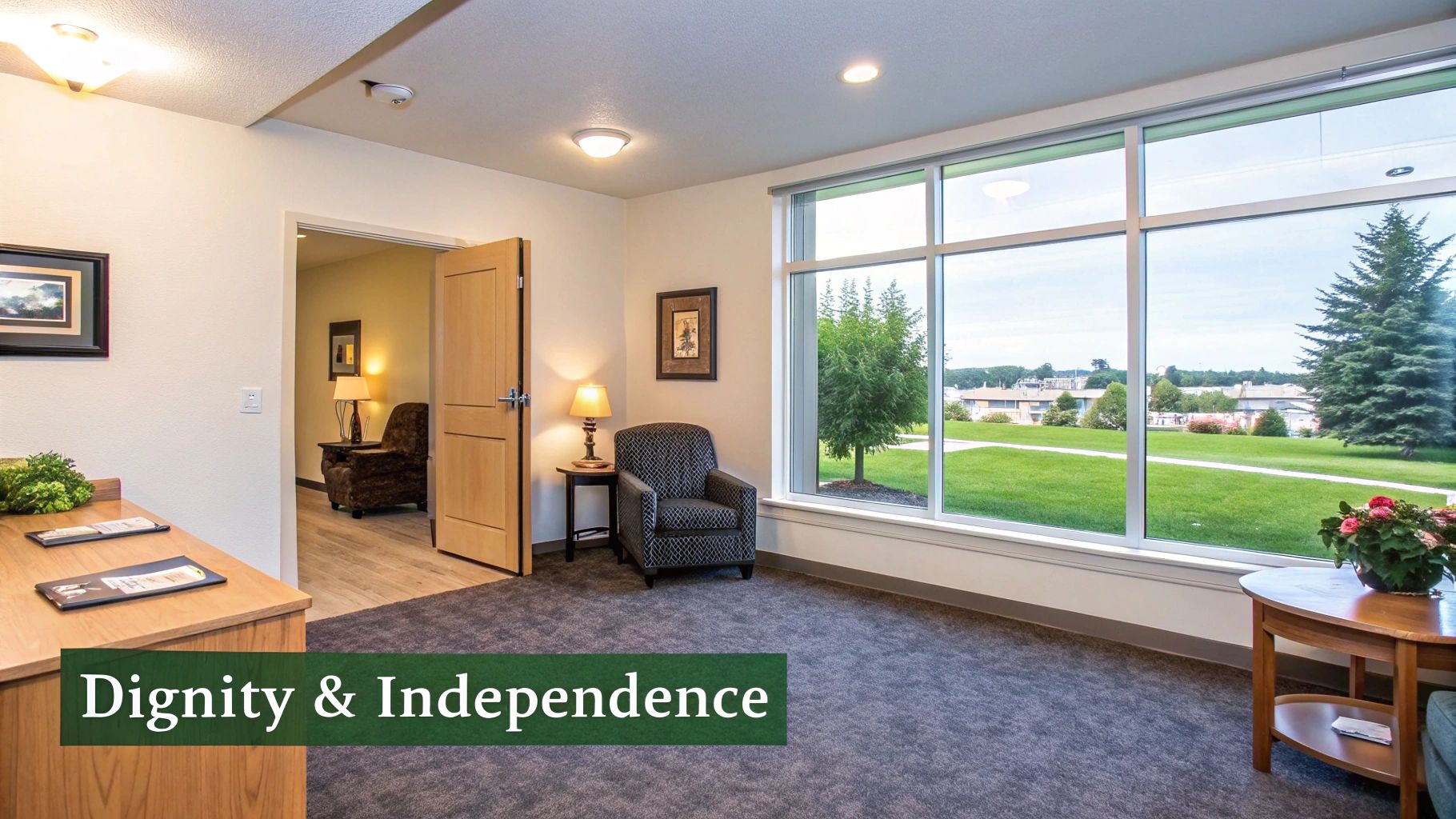
Bright and inviting lounge area in an assisted living facility with large windows overlooking a green lawn.

The real heart of an assisted living facility isn’t the grand lobby or the perfectly manicured lawn. It’s found in the private apartments and shared spaces where people actually live. This is where a facility's philosophy of care stops being a mission statement and becomes a tangible reality for its residents.

Good design has a profound impact. It can boost a resident's sense of self, foster confidence, and give them a feeling of genuine control over their own life. It's all about understanding the psychology of creating a home for seniors, balancing critical safety features with a warm, residential feel so that accessibility feels empowering, not clinical.

Crafting Empowering Private Spaces

The design of a resident's apartment is the absolute cornerstone of their independence. These spaces have to be intuitive, safe, and ready to adapt as needs change over time. It’s the small, thoughtful details that make all the difference.

Think about the path from the bed to the bathroom. Is it a straight shot? Is it well-lit for a 2 a.m. trip? Are there subtle supports along the way—like sturdy furniture or walls reinforced for future grab bars—that offer stability without making the room feel like a hospital?

Great assisted living facility design is often invisible. It seamlessly integrates safety and accessibility into a comfortable, homelike environment, allowing residents to live with confidence and dignity without constant reminders of their physical limitations.

Here are a few key elements that make private units work:

  • Maximizing Natural Light: Large windows are a must. They don't just improve mood and help regulate sleep cycles; they make a space feel bigger and more inviting.
  • Clear Sightlines: From the bed, a resident should be able to see the door to their apartment and the door to their bathroom. This simple layout choice can dramatically reduce anxiety and disorientation.
  • Accessible Bathrooms: Zero-threshold showers, toilets set at a comfortable height, and easy-to-use lever-style faucets shouldn't be special requests. They should be the standard.
  • Ample and Accessible Storage: Closets with lower rods and shelves within easy reach are empowering. They allow residents to manage their own belongings and maintain a sense of autonomy.

Transforming Corridors into Community Connectors

One of the most common design mistakes is the long, monotonous hallway. These institutional-feeling corridors can be confusing, intimidating, and frankly, isolating for residents, especially those with cognitive or mobility challenges.

The trick is to stop thinking of them as hallways and start seeing them as neighborhood streets.

Imagine you're designing a small town. The streets wouldn't be endless, sterile tunnels. They'd have landmarks, benches, and little points of interest that make the journey engaging and easy to follow. Applying that same logic can completely transform a facility’s circulation paths.

This means intentionally breaking up long corridors. A small seating nook by a window becomes a spot for a quiet chat. A curated art display acts as a visual landmark, helping residents find their way. The goal is to make the trip from a private apartment to a common area a pleasant, socially encouraging experience. It’s also vital to ensure these spaces are safe, which requires a firm grasp on building codes like stair handrail height regulations.

The Growing Need for Thoughtful Design

This resident-first approach is more critical now than ever before. A massive demographic shift is reshaping senior living. With projections showing that by 2030, one in six people on the planet will be 60 or older, the demand for new communities is exploding.

This boom is fueling a market expected to reach USD 177.97 billion by 2025, with major growth continuing through 2032. As developers and designers, this rapid expansion gives us a huge responsibility. By focusing on creating places that foster dignity and independence, we can build communities that don't just meet market demand, but genuinely enrich the lives of the people who call them home.

Amenities and Systems That Elevate the Resident Experience

A truly exceptional assisted living facility is more than just a place to live; it's a place to thrive. The design needs to go far beyond the basics of shelter and care to create a vibrant, engaging community. This comes from a smart blend of highly visible amenities that encourage an active life and the critical, often invisible, systems that keep everyone safe and healthy.

Think of the visible amenities as the "front of house." These are the spaces that draw people in, build a sense of community, and make your facility feel like home. The goal is to ditch the old-school, single multi-purpose room and instead offer a diverse range of venues that cater to different interests and social styles.
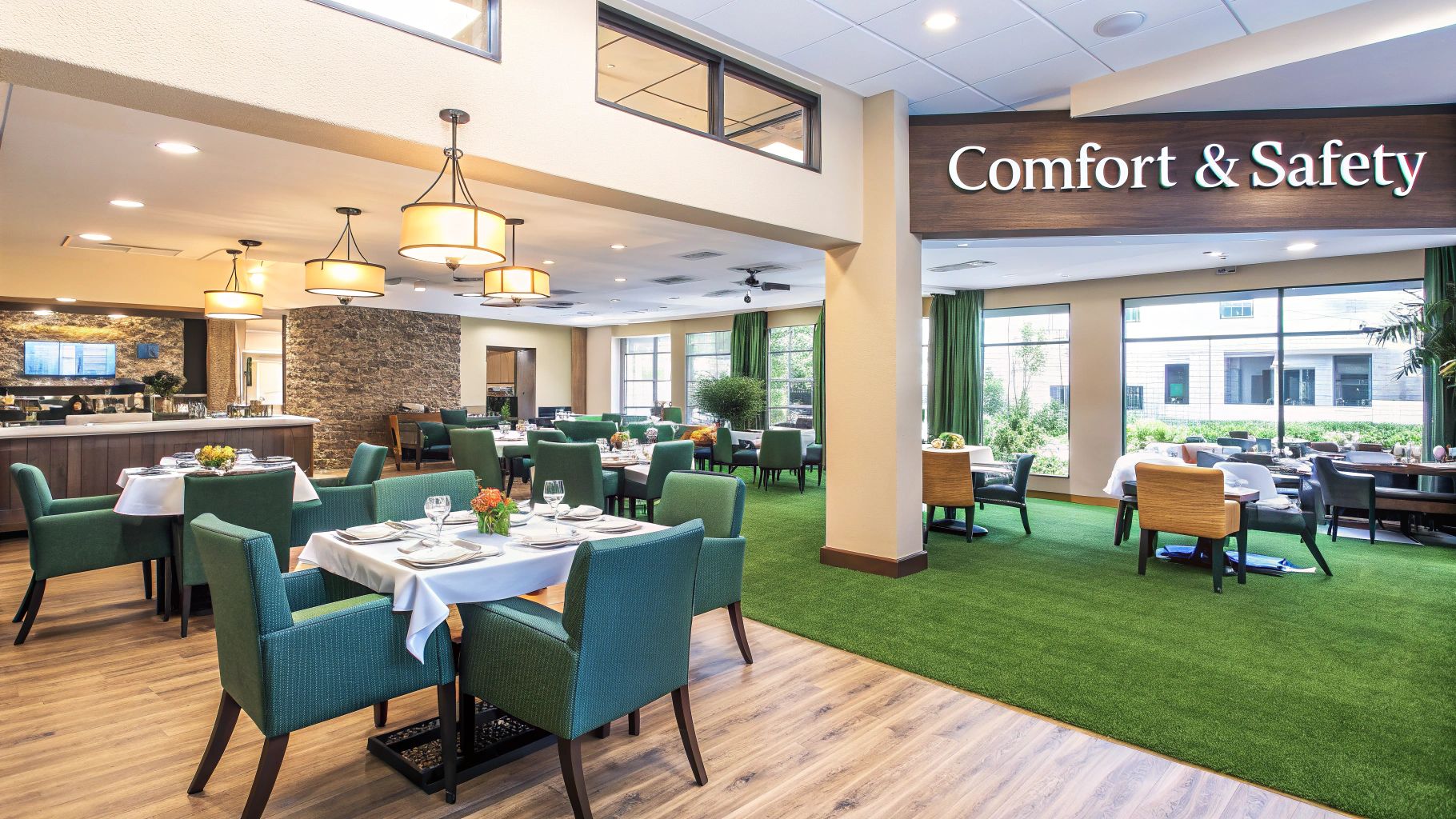
Bright dining room in an assisted living facility featuring green chairs, set tables, and a 'Comfort & Safety' sign.

When you adopt this hospitality-focused approach, it directly boosts your marketability and keeps residents happy, turning your facility into a place people genuinely want to be.

Designing Amenities for a Vibrant Lifestyle

Modern assisted living communities are taking cues from luxury resorts and boutique hotels, offering a rich variety of experiences right on-site. The secret sauce is providing choice and quality.

  • Restaurant-Style Dining: Move away from the single-cafeteria model. Offer multiple dining venues, like a formal dining room, a casual bistro for a quick coffee and sandwich, and a private dining space families can reserve for celebrations.
  • Comprehensive Wellness Centers: A small room with a treadmill just doesn't cut it anymore. A true wellness center needs equipment adapted for seniors, dedicated space for group classes like yoga or tai chi, and maybe even a heated therapy pool.
  • Dedicated Social and Creative Spaces: Residents need places to pursue hobbies and connect with others. Consider a small movie theater, a cozy library with great lighting, a dedicated arts and crafts studio, or a game room.

The best amenities are the ones that build community naturally. A well-designed pub, a sunny patio with raised gardening beds, or a bustling coffee bar can easily become the social heart of the facility, sparking spontaneous conversations and friendships.

These spaces aren't just bullet points on a brochure. They are the engines of community life. They give residents a reason to leave their apartments and engage with their neighbors, which is absolutely crucial for fighting the loneliness that can affect so many older adults.

Critical Infrastructure Powering Modern Care

While the amenities shape the daily experience, it's the unseen infrastructure that guarantees residents' health and safety. These complex systems are the backbone of a high-functioning facility, and investing in them properly is non-negotiable.

Take the HVAC system, for example. Modern Heating, Ventilation, and Air Conditioning (HVAC) systems in senior living do more than just maintain a comfortable temperature. They are a first line of defense against illness, using advanced filtration and ventilation strategies to improve air quality and cut down on the spread of airborne germs.

Robust emergency power is another must-have. Your facility has to maintain life-safety systems, keep medications refrigerated, and power essential lighting during an outage. A reliable generator isn't a luxury; it's a fundamental requirement, especially when you consider that a fire can be devastating for a vulnerable population.

Integrating Invisible Technology for Safety

The best technology is often the kind you don’t even notice. In assisted living design, the aim is to integrate smart systems that enhance safety without making the environment feel cold or clinical.

Discreet, modern nurse call systems have replaced old-fashioned pull cords with wearable pendants or even voice-activated devices. In the same way, motion sensors can monitor for falls or unusual inactivity, alerting staff to potential problems without invasive cameras. Smart-home features, like automated lighting that illuminates a path to the restroom at night, can also dramatically reduce fall risks. Knowing which bathroom safety equipment for the elderly to install is a core part of creating these secure living spaces.

By thoughtfully layering these visible amenities and invisible systems, you create a facility that is not only beautiful and engaging but also safe, resilient, and ready to provide exceptional care for years to come.

9. Leveraging Site Planning and Adaptive Reuse

An assisted living facility doesn't exist in a vacuum. Its success is deeply intertwined with its physical location and the building itself, whether it's built from the ground up or is a thoughtfully restored piece of local history. Two powerful strategies—smart site planning and adaptive reuse—offer distinct paths to creating a remarkable and profitable community.

For any new build, site planning is about so much more than just making a building fit on a piece of land. It’s the art of choreographing the relationship between the structure, its residents, and the surrounding environment. The real goal is to create a setting that feels both secure and seamlessly woven into the local community.
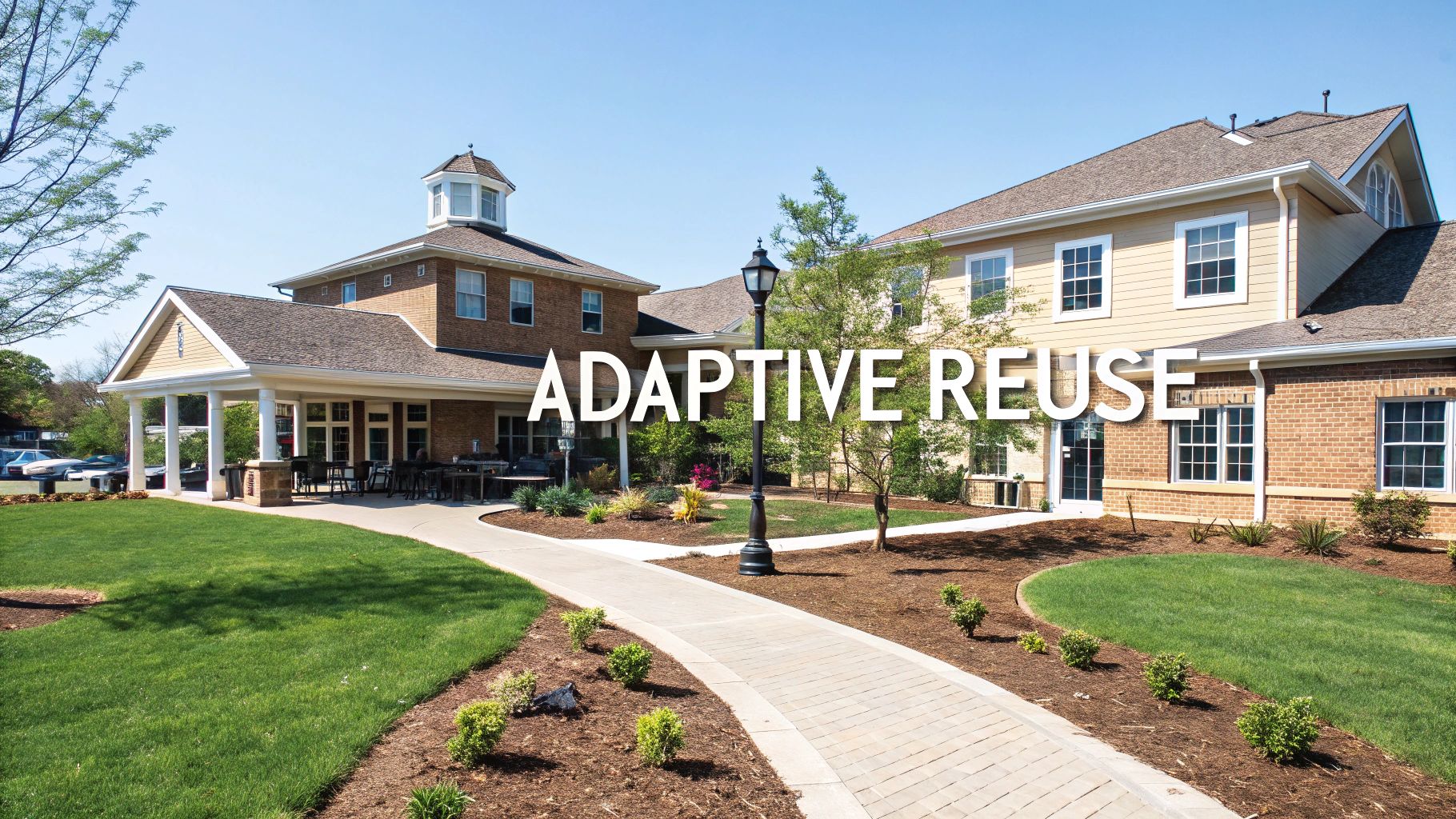
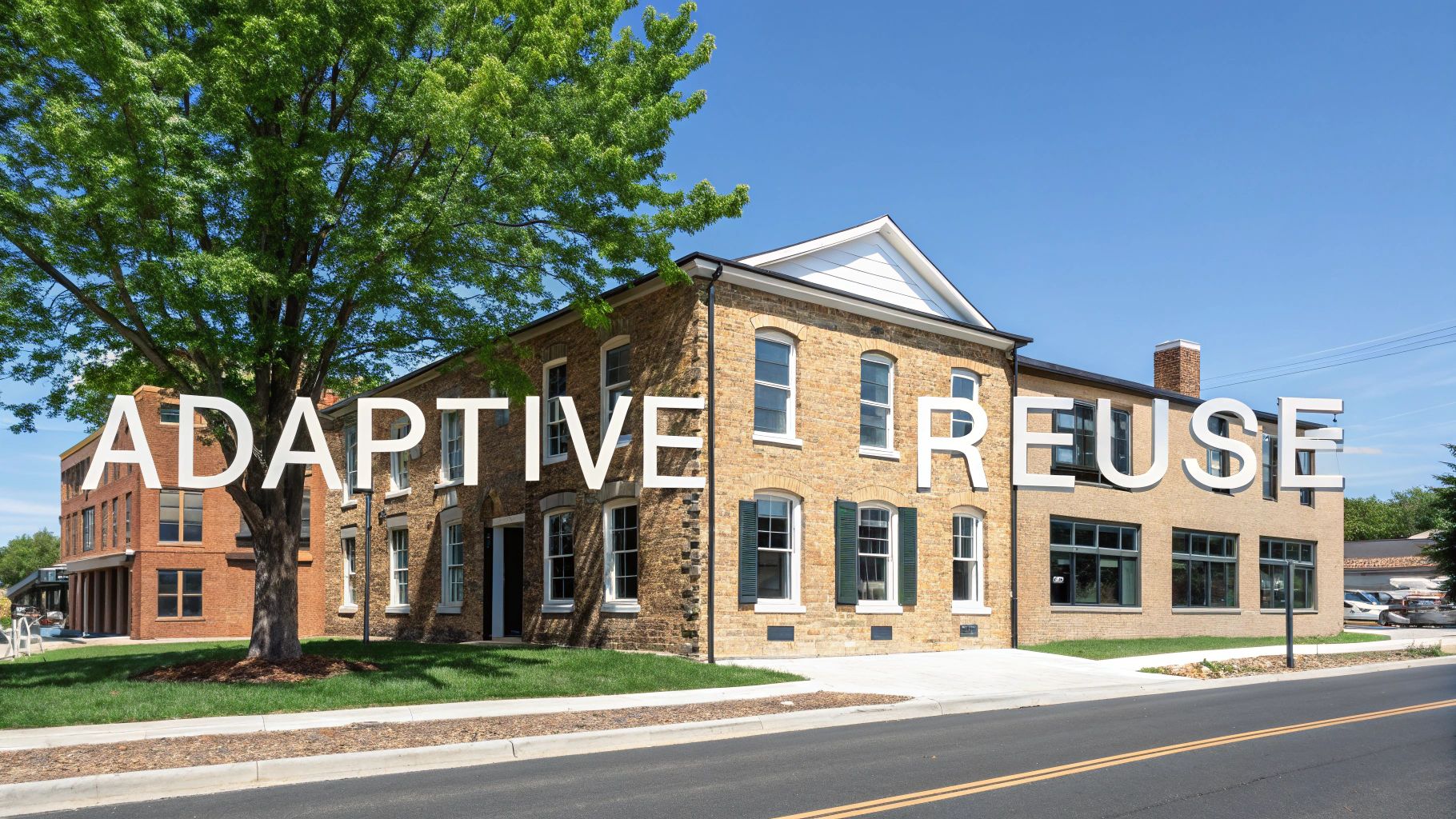
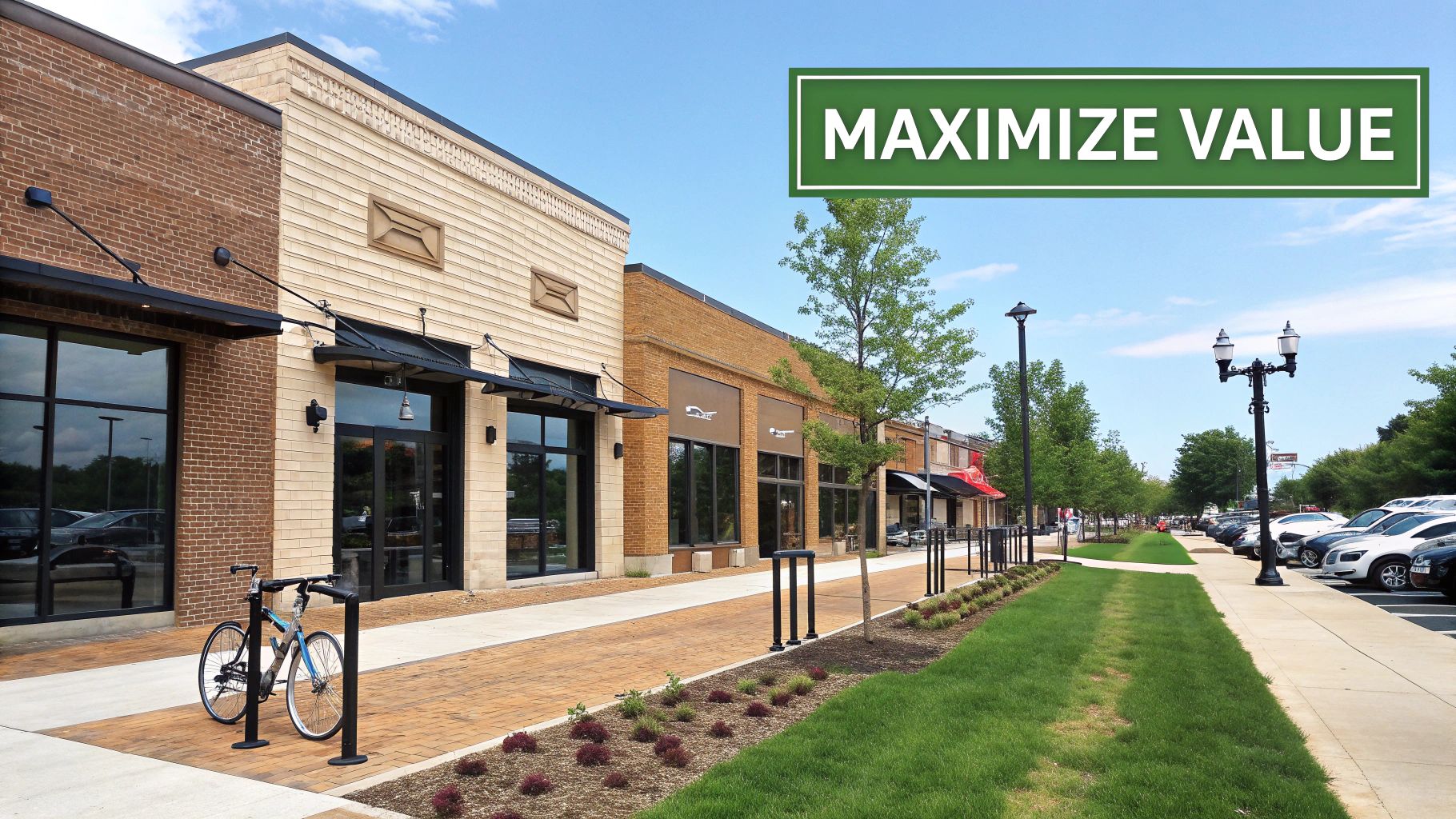
An exterior view of an assisted living facility featuring green lawns and a walkway, with 'ADAPTIVE REUSE' text.

Optimizing the Site for New Construction

Thoughtful site planning for a new assisted living facility can transform a property from a simple location into a therapeutic asset. It all starts by carefully orienting the building to maximize views of nature and access to sunlight, both of which have proven benefits for mood and well-being.

Creating secure and engaging outdoor spaces is another non-negotiable piece of the puzzle. These areas aren't just afterthoughts; they are vital extensions of the living environment.

  • Therapeutic Gardens: Think of spaces that offer gentle sensory stimulation with fragrant plants, varied textures, and the soothing sound of a water feature. They need to provide safe, accessible pathways for residents to walk and simply connect with nature.
  • Secure Courtyards: For memory care units, enclosed courtyards are absolutely essential. They have to be designed to allow freedom of movement without the risk of wandering, giving residents a safe way to enjoy fresh air on their own terms.
  • Community Integration: The site plan also needs to look beyond the property line. Walking paths that link to local parks or sidewalks that lead to nearby shops can help residents feel less isolated and more a part of their community.

The Unique Advantages of Adaptive Reuse

While new construction offers a blank slate, adaptive reuse is an opportunity to create a facility with a character and story that simply can't be manufactured. This approach means transforming an existing structure—maybe a historic hotel, an old school, or even a converted mill—into a modern senior living community.

This strategy is often far more sustainable than demolishing and rebuilding. It preserves the embodied carbon of the original structure and can significantly shorten the project timeline. For developers, this often means a faster path to market and a quicker return on investment.

Adaptive reuse breathes new life into forgotten buildings, weaving the story of a community's past into its future. It delivers a project with a built-in sense of place and authenticity that is impossible to replicate with new construction.

Navigating the Challenges of Conversion

Of course, converting an old building for a completely new purpose comes with its own set of hurdles. A thorough feasibility study is the first, and arguably most important, step to see what you're up against.

You'll need to dig into a few key areas:

  • Structural Integrity: Is the existing frame sound? Can it actually support the new layout and loads required for a residential healthcare setting?
  • MEP Systems: How can you integrate modern mechanical, electrical, and plumbing systems without completely compromising the building's historic character? It's a delicate balance.
  • Accessibility and Code Compliance: How do you meet modern accessibility standards, like ADA requirements, within the constraints of a structure built in a different era?

Successfully navigating these complexities demands an architectural partner with deep experience in both historic preservation and modern building codes. By getting all the pieces aligned, developers can transform a historic asset into a one-of-a-kind senior living destination that truly stands out. This approach doesn't just offer potential cost savings; it delivers a product rich with character and genuine community connection.

Answering Your Top Questions on Assisted Living Design

When you're diving into the world of assisted living development, a lot of questions come up. Let's tackle some of the most common ones I hear from developers and operators, focusing on the practical side of creating a community that truly works.

What’s the Single Biggest Design Mistake People Make?

Hands down, the biggest mistake is designing long, institutional-style corridors. You know the ones I mean—double-loaded hallways that feel more like a sterile hospital or an old-school hotel than a home. They can be incredibly disorienting and frankly, a little intimidating for residents.

This kind of layout can lead to social isolation and anxiety, especially for anyone with cognitive decline. The fix? Break up those long sightlines. We do this by introducing natural light, creating cozy seating nooks, and using distinct visual cues to create smaller, more navigable "neighborhoods" within the larger building. It makes the entire space feel more intimate and manageable.

How Can the Building’s Design Actually Help with Staffing?

It’s no secret that staffing is one of the biggest challenges in this industry. Smart design can't solve it entirely, but it can make a huge difference in staff efficiency and burnout. It starts with simple logistics.

Think about centralizing nurse stations, supply closets, and other key support areas. This cuts down on the miles your team has to walk every day.

Good design is a silent partner for your staff. When you give them clear sightlines across common areas, they can keep a subtle, respectful eye on residents. And don't forget their spaces—a well-designed break room sends a powerful message that you value your team, which does wonders for morale and retention.

Is It a Good Idea to Repurpose an Old Building?

Absolutely, and it can be a brilliant move. Adaptive reuse of buildings like old hotels, schools, or even vacant commercial properties can be a fantastic strategy. You often gain benefits in cost, get to market faster, and create a building with genuine character that new construction can't always replicate.

The trick is doing your homework with a thorough feasibility study. You need to know what you're getting into with the building's structure, accessibility hurdles, and the cost to bring all the mechanical, electrical, and plumbing systems up to modern code. With the right architecture partner, you can turn an old gem into a unique, high-performing community that adds real value to the neighborhood.


At Sherer Architects, LLC, we're experts at solving these complex design puzzles and creating assisted living communities that are functional, beautiful, and profitable. Whether you’re starting from scratch or have an adaptive reuse project in mind, our team has the experience to make it a success. Visit shererarch.com to see how we bring structure to life.

Categories
Uncategorized

A Developer’s Blueprint for the Library in the Future

When you think "library," you probably picture dusty, silent stacks of books. It’s time to update that mental image. The library in the future is a buzzing, multi-purpose community hub—and, surprisingly, a highly valuable asset for developers and property owners. This isn't just a place for books; it's a dynamic platform for technology, education, and community connection that can drive real financial returns.

Reimagining the Library Beyond Bookshelves

The library has grown far beyond its original mission of lending books. For developers and investors, this evolution opens up a powerful opportunity. Instead of seeing a library as just a civic cost, it's time to see it as an economic driver.

A well-executed library project can anchor a neighborhood, pull in foot traffic, and bump up the value of surrounding properties. A modern library becomes a "third place"—that essential social spot that isn't home or work, where community life happens.

This new identity means the very design and purpose of a library have changed. The focus is less on the size of the collection and more on creating flexible, human-centered spaces that can adapt to a whole range of community needs, from quiet study nooks to lively workshop areas and public event venues.

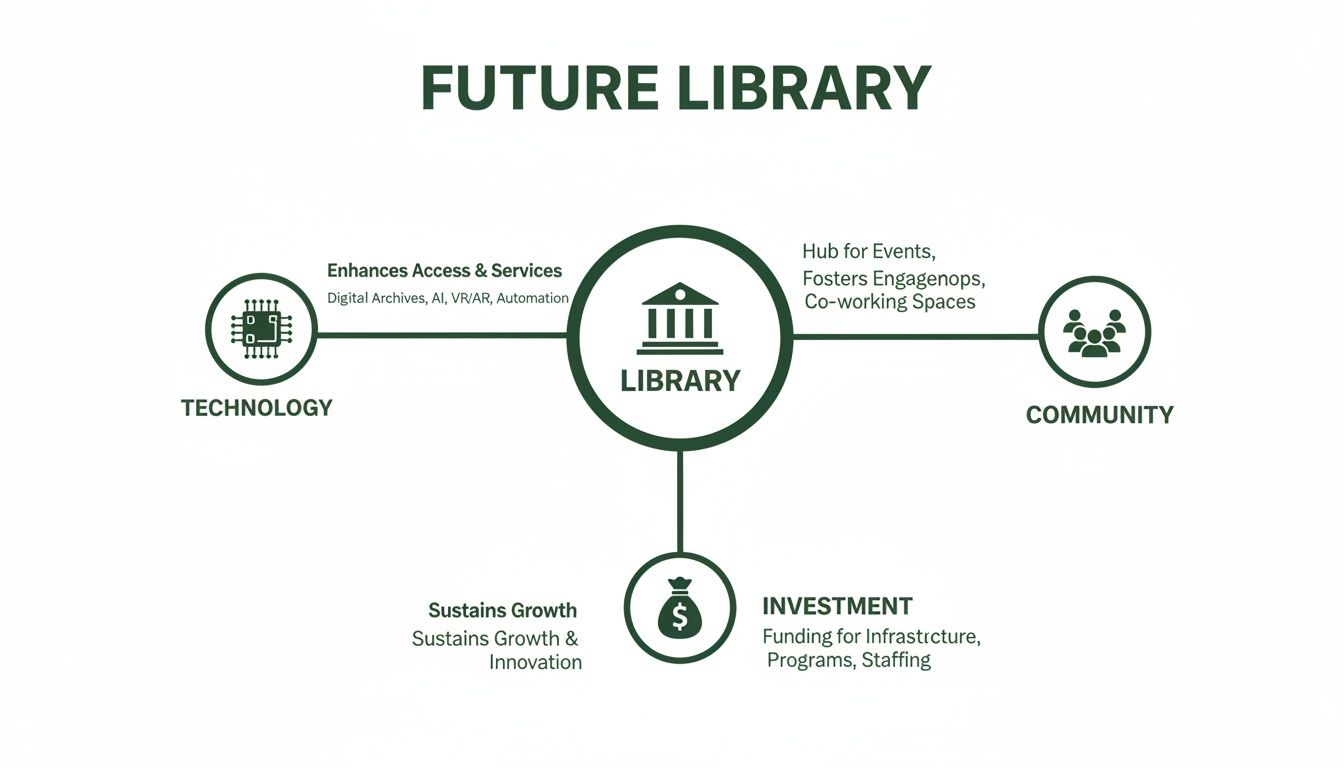
This diagram breaks down the three pillars holding up this modern library model.

A diagram illustrates the future library supported by technology, community, and investment pillars.

As you can see, the success of the modern library depends on weaving together technology, a deep community focus, and smart investment.

A New Model for Community Investment

Getting a handle on this new model is the key to unlocking a library's true potential. The library in the future is a strategic asset that pays dividends across the board. For developers, this means figuring out how a new library can hit both civic and business targets. The secret is recognizing all the different hats it wears.

  • A Hub for Digital Equity: It offers free high-speed internet, computers, and digital skills training, closing the digital divide for local residents.
  • An Incubator for Local Talent: It provides maker spaces with 3D printers, recording studios, and co-working areas that give entrepreneurs and small businesses a leg up.
  • A Center for Lifelong Learning: It hosts everything from children's storytime to coding classes for adults and workshops for seniors, drawing in a huge cross-section of the community.

By designing spaces that support these activities, developers create a property that becomes an indispensable part of daily life. This deep engagement keeps the library relevant and busy, cementing its long-term value as both a community landmark and a solid investment.

Ultimately, investing in a library isn't just about putting up a building; it's about building a more resilient, connected, and prosperous community. Whether you're starting from scratch or giving an old building a new life, the opportunities are massive. This guide will walk you through the practical strategies—from digital infrastructure and flexible design to funding models and historic tax credits—that transform a library project into a smart, sustainable asset that can anchor urban renewal and deliver a clear return on investment.

Weaving Technology into the Architectural DNA

When we think about the library of the future, we need to stop treating digital infrastructure as an afterthought. It's not just another line item in the budget; it's as critical as the building's foundation. For developers and owners, this means planning for technology from the absolute beginning, treating it as the building’s central nervous system. This approach—embedding a robust and flexible tech ecosystem right into the blueprints—is the only way to avoid painful, expensive retrofits and ensure the library remains a vital asset for decades.

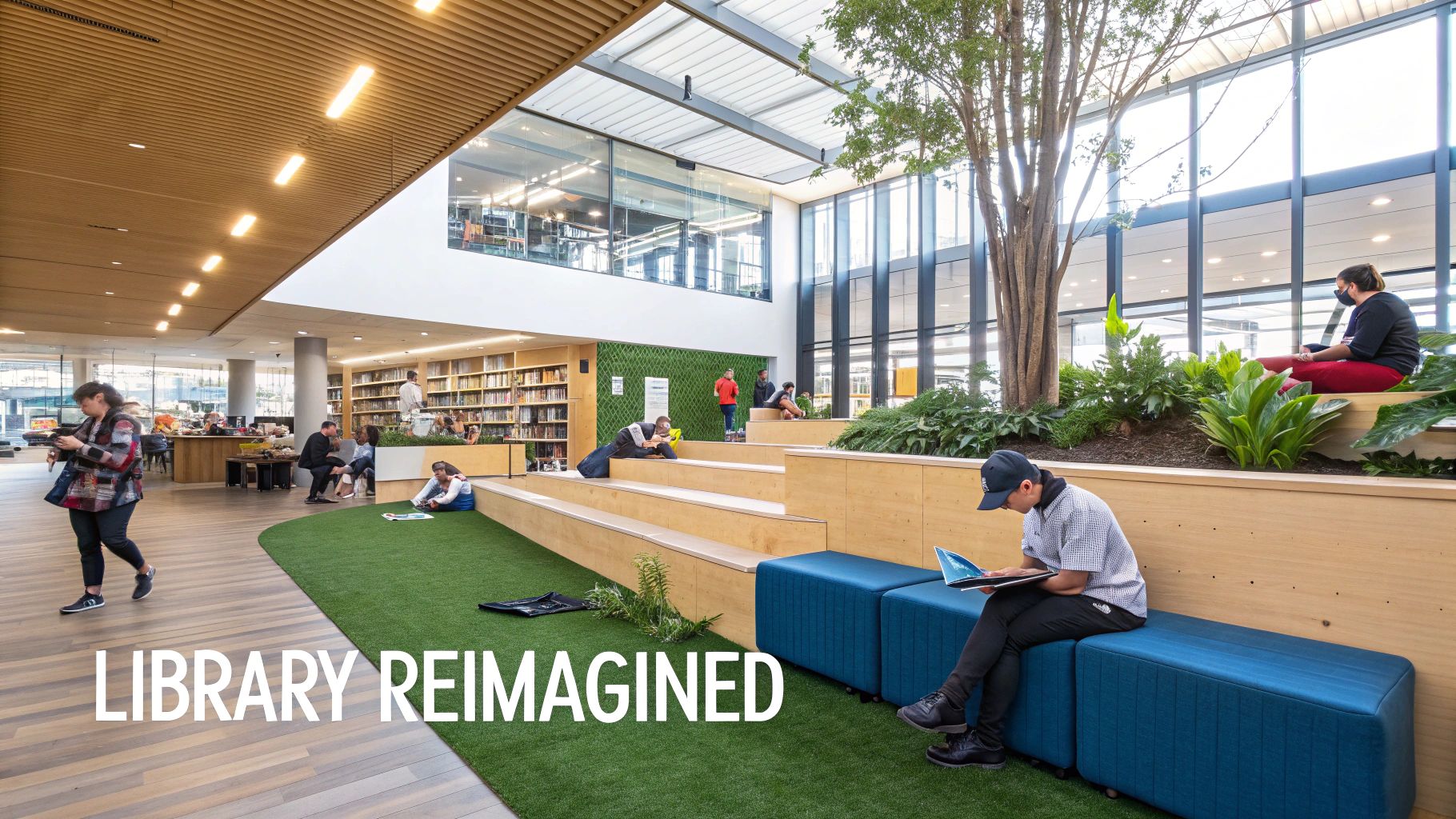
Modern library interior with people studying, reading, and relaxing in a bright, spacious environment.

This isn’t just about offering public Wi-Fi. It’s a fundamental shift in how we design a building's core systems. The real goal is to create an environment where technology is invisible, supportive, and ready for whatever comes next.

Moving Beyond the Server Room

The old model of walling off a huge, climate-controlled room for racks of servers is quickly becoming a relic. A forward-looking design doesn't get bogged down by today's hardware; it plans for agility and the certainty of future upgrades.

This is all about creating flexible pathways for power and data. Instead of dedicating a permanent server closet, architects need to design accessible, easily upgradable conduits and raceways that run throughout the building. This simple change allows technology to evolve without forcing disruptive—and costly—structural renovations later on.

Think of it like the plumbing in a house. You wouldn't build a new home without meticulously planning where the pipes need to go. Data flows the same way. It's a core utility that has to be designed into the very fabric of a modern library, powering everything from interactive displays to the countless devices visitors bring with them.

This design shift has a real impact on space allocation, too. By ditching the traditional server room, developers can reclaim valuable square footage. That space can then be used for revenue-generating or community-focused purposes, like a small café, private meeting pods, or an expanded area for workshops and events.

And the clock is ticking. Projections show that by 2026, academic libraries will be operating in almost completely digital environments. Cloud computing is set to become the standard for nearly all services, which demands ubiquitous, high-speed internet. With mobile devices already far outnumbering desktops, the need for seamless wireless connectivity will only intensify.

The Bones of a Modern Library: Power and Connectivity

To build a library that’s truly ready for the future, developers have to get two things right from the start: power and data. The old way of sprinkling a few outlets along the walls just doesn't cut it anymore for a community that depends on personal devices for everything.

Architectural planning needs to address these modern demands head-on. Here’s how:

  • Smart Electrical Grids: Design electrical systems that are built to expand. This means installing floor boxes with both power and data ports in open areas, placing outlets in unexpected places like outdoor seating, and using modular power systems that can be rearranged as the library’s layout evolves.
  • Pervasive Wireless Access: The building’s very structure must be designed to support flawless Wi-Fi coverage. This involves thinking critically about where to place wireless access points and avoiding signal-blocking materials like thick concrete or metal walls in key areas where people gather.
  • Redundant Connections: Don't rely on a single point of failure. The building should have multiple points of entry for fiber optic cables. This redundancy protects against service outages and provides the massive bandwidth needed for cloud services, virtual reality experiences, and large-scale data access.

The table below breaks down the shift in thinking required when designing a library's infrastructure.

Future Library Tech vs. Traditional Library Infrastructure

Architectural Feature Traditional Library Approach Future Library Requirement
Data Infrastructure Centralized, fixed server room with heavy HVAC. Distributed, flexible conduits and raceways for easy upgrades.
Power Distribution Wall-mounted outlets placed intermittently. Integrated power grids with floor boxes, modular systems, and outdoor access.
Connectivity Basic Wi-Fi as an amenity. Building-wide, high-density Wi-Fi as a core utility.
Structural Planning Materials chosen for aesthetics and durability alone. Materials chosen to minimize signal interference; planned pathways for cabling.
Space Allocation Significant square footage lost to server and IT closets. Reclaimed square footage for public-facing programs or leasable space.
Future-Proofing Retrofits are expensive and structurally invasive. Upgrades are managed through accessible pathways with minimal disruption.

As you can see, the architectural DNA of a future-ready library is fundamentally different. It anticipates change rather than reacting to it.

Of course, successfully weaving this digital framework into a building requires smart financial planning. Understanding how to secure specialized funding is a crucial piece of the puzzle. You can learn more about accessing this capital through resources focused on Winning Nonprofit Grants for Technology. By embedding this digital foundation from day one, developers create a resilient, adaptable asset that will maximize its utility and value for years to come.

Designing Spaces for People, Not Just Collections

Once you have a solid technology backbone, the real work begins. The focus for the library in the future isn't about infrastructure; it's about experience. We’re moving past the idea of libraries as mere warehouses for books and embracing them as dynamic, human-centric community hubs.

A library's true value lies in its role as a community "third place"—that essential spot that isn't home and isn't work. How well a library fills this role directly impacts its success and, from a developer's perspective, its return on investment.

This means we have to think beyond static, rigid layouts. Imagine a single large, open space that completely transforms throughout the day. It could be a quiet study zone in the morning, a buzzing, collaborative workshop in the afternoon, and an elegant event venue by night. This is the kind of flexibility that attracts a wide range of people and keeps them coming back.

To pull this off, you need a smart approach to space planning. For anyone looking to get a better handle on the fundamentals, there's a practical guide to interior design and space planning that offers a great starting point.

Creating Multifunctional Zones

The secret to a truly adaptable building is creating multifunctional zones. This isn't about adding more rooms; it's about making every single square foot work harder. Architects and developers can achieve this fluid design with a few key strategies that allow for rapid changes with minimal effort.

When these elements work in concert, they create an environment that can be reconfigured on the fly, responding almost instantly to what the community needs right then and there. This adaptability is what turns a good building into a great community asset.

Here are the core components that make it happen:

  • Modular Furniture: Think lightweight tables, chairs, and shelving on casters. These can be rearranged in minutes to support anything from individual work to large group sessions.
  • Smart Acoustic Paneling: Deployable acoustic dividers or smart panels can absorb or reflect sound as needed. This simple feature allows a noisy kids' program and a quiet reading group to exist peacefully in the same open space.
  • Adaptable Lighting Systems: With zoned, dimmable lighting controlled by a central system, you can instantly change the mood of a space—shifting from bright, focused task lighting to warm, ambient light for a social mixer.

Practical Examples of Human-Centric Design

Bringing these principles to life is where the magic happens. It’s all about adding features and amenities that fit modern lifestyles and solve real problems for patrons, making the library an indispensable part of their daily routine.

Take something as simple as integrating a small café or coffee bar. It does more than just serve refreshments; it encourages people to stay longer and use the library as a social meeting point. This one addition can completely change the building's atmosphere and dramatically increase how long people stick around.

Soundproof pods are another powerful example. These small, private enclosures are a perfect solution for patrons needing to take a video call, record a podcast, or just find a moment of true quiet in a busy public space. They directly meet the needs of an increasingly remote and flexible workforce.

The most forward-thinking libraries are even extending their footprint outdoors. Designing inviting outdoor reading gardens, patios with Wi-Fi access, or even children's nature-play areas creates new destinations within the library grounds, offering fresh air and a connection to the environment.

These design choices aren't just nice-to-haves; they are strategic investments in community engagement. Recent industry data confirms this shift in priorities. A 2025-2026 survey found that increasing physical visits is now the top goal for library marketers. The data, which saw a 15% increase in responses over the previous year, underscores that libraries are laser-focused on in-person experiences and building community trust. You can dive deeper into how libraries are prioritizing this in the latest state of library marketing report. This is clear proof that thoughtful, human-centric design directly supports core operational goals by drawing people in and keeping them there.

The Business Case for Adaptive Reuse and Historic Preservation

When you think about building a new library, starting from a clean slate seems like the obvious choice. But there’s a powerful, and frankly, often more profitable alternative: adaptive reuse. This is the art of taking an existing building and giving it a completely new purpose. For a savvy developer, this isn't about nostalgia; it's a strategic business move loaded with financial and logistical perks that can create an incredible vision for the library of the future.

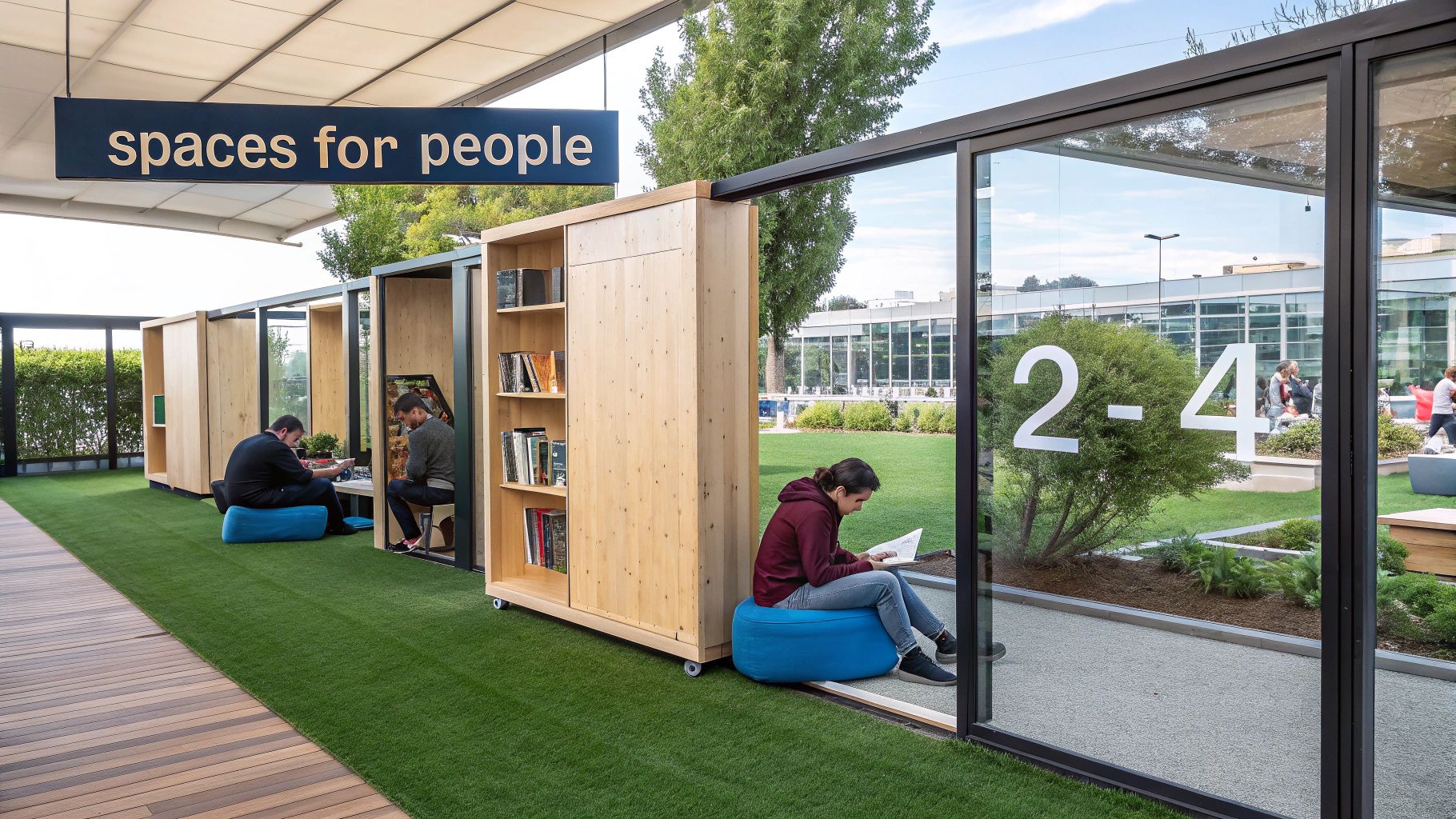
Modern outdoor library with people reading and working in wooden pods on a sunny day.

Right off the bat, this approach tackles some of the biggest headaches in modern development. The upfront costs are often much lower than new construction because you already have the bones—the foundation, exterior walls, and maybe even major systems are in place. This translates into a more predictable budget and a much quicker path from acquisition to ribbon-cutting.

On top of that, adaptive reuse is inherently sustainable. By breathing new life into an old structure, you’re dramatically cutting the carbon footprint that comes from demolition and manufacturing new materials. This isn’t just good for the planet; it's a compelling story that resonates with communities and attracts environmentally-minded partners and patrons.

Unlocking Value with Historic Tax Credits

The financial picture gets even brighter when the building has a little history to it. Historic preservation is more than just protecting the past—it’s a proven economic engine. Developers can tap into substantial federal and state historic tax credits that can slash rehabilitation costs and make a project’s numbers work beautifully.

The Federal Historic Preservation Tax Incentives program, for example, offers a 20% income tax credit for the certified rehab of historic, income-producing buildings. This is a true credit, not a deduction. It’s a dollar-for-dollar reduction of your tax bill, making it one of the most powerful redevelopment tools out there.

This kind of financial leverage flips the script, turning a building’s unique character from a potential headache into a genuine asset. The very things that make a building historic—its detailed brickwork, soaring ceilings, or gritty industrial past—become the foundation for a landmark that draws in the community and builds real pride.

Think of an old, vacant downtown bank with its grand lobby and echoing ceilings. Through adaptive reuse, this eyesore can be reborn as a cutting-edge community hub. The vault becomes a one-of-a-kind children's reading nook, and the open teller hall transforms into a flexible event space—all while keeping the building’s soul intact.

Turning Perceived Liabilities into Profitable Assets

The potential for adaptive reuse is hiding in plain sight all over our cities. Visionary developers can spot opportunity where others just see decay. That forgotten warehouse, an empty big-box store, or even a decommissioned church can have the "good bones" needed for a spectacular library transformation.

These old structures often bring distinct advantages you just can't get with new builds:

  • Generous Interior Volume: Older industrial and commercial buildings frequently boast high ceilings and wide-open floor plans. This is a perfect canvas for creating the flexible, multi-use zones that modern libraries thrive on.
  • Prime Locations: Many of these buildings sit right in the heart of established neighborhoods. That means built-in foot traffic and community access that would be incredibly expensive—or even impossible—to secure with a new plot of land.
  • Unique Character and Story: An existing building comes with its own narrative. A library housed in a former textile mill, for instance, can weave the area's industrial heritage right into its identity. It creates an authentic sense of place that a new building could never replicate.

This mindset empowers developers to think beyond the default of demolition. You can create a project that is more cost-effective, gets to market faster, and is deeply woven into the fabric of its community. By using the financial tools of historic preservation and the sustainable nature of adaptive reuse, an old building becomes a profitable, community-enriching asset—the perfect home for the library of the future.

Funding Models and Measuring Your Return on Investment

A beautiful design for a future-focused library is one thing, but it's just a drawing without a smart financial strategy to back it up. For developers and property owners, the question is always the same: How do we pay for this, and what’s the actual return? It’s time to look past traditional municipal bonds and embrace a more diverse, collaborative toolkit for funding.

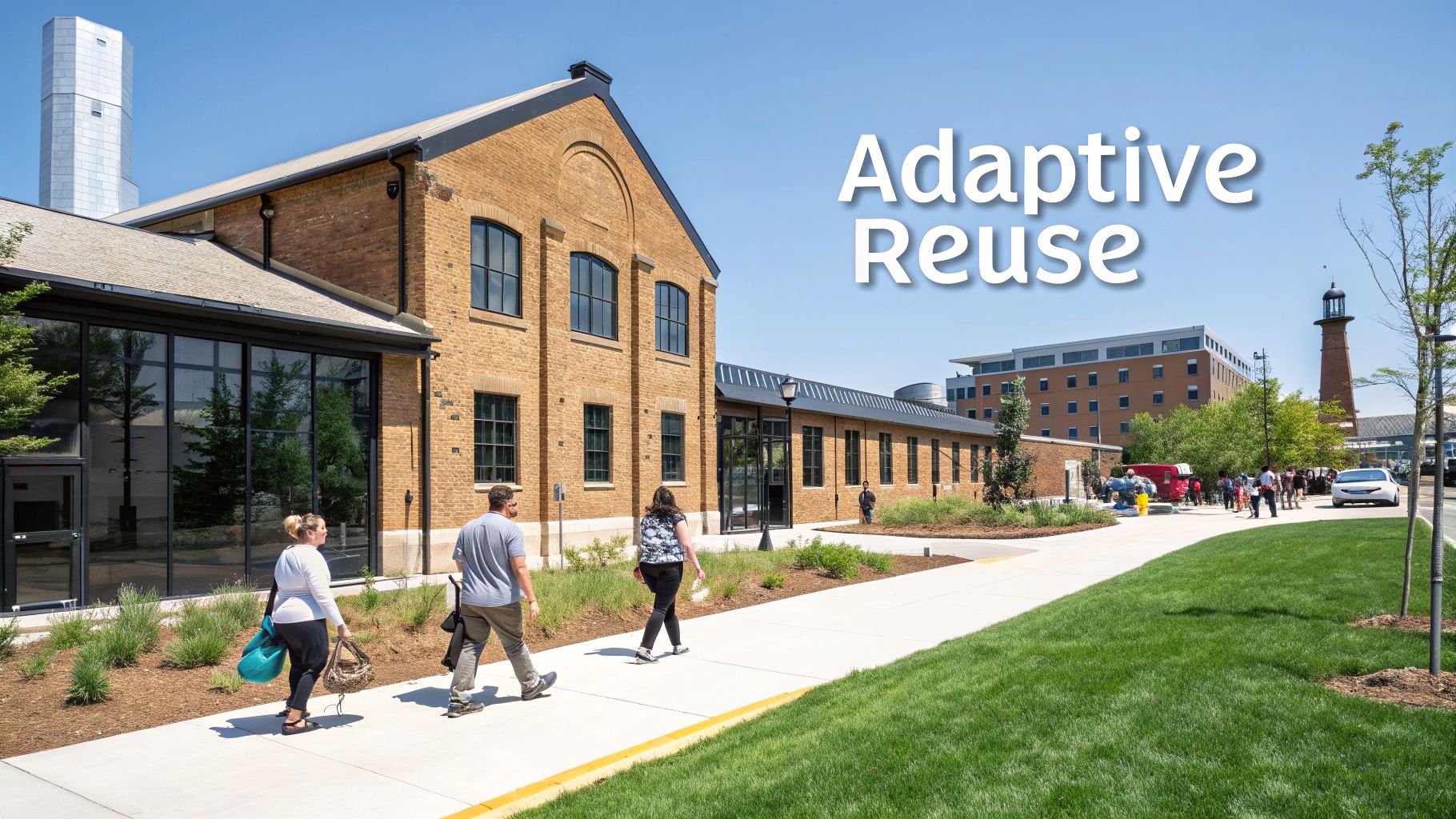
Modernly renovated historic brick building with large windows and people walking on a sunny day.

This approach reframes the library not as a simple public expense but as a joint venture in community building. It’s about creating a coalition of stakeholders—from private investors to local businesses—who all see a tangible benefit from the library's success.

Creative Capital Stacks

Putting together the financing for a modern library is a bit like assembling a puzzle. Each piece is a different funding source, and when you combine them, you create a stable financial foundation that doesn't depend too heavily on any single stream.

  • Public-Private Partnerships (P3s): These are agreements where private developers might finance, build, and even operate a public asset like a library. The payoff? It could be a long-term lease, the air rights to build apartments above the library, or other commercial perks that make the numbers work.
  • Corporate Sponsorships: Local and national companies are often looking for ways to connect with the community. This can be as straightforward as sponsoring a specific room—like a children’s wing or a tech lab—or funding entire programs, which provides a reliable stream of operational cash.
  • New Markets Tax Credits (NMTC): This federal program is designed to spark development in lower-income areas. By funneling investment into a library project through a Community Development Entity (CDE), investors get a significant tax credit, making it a very appealing financial tool.

The modern library is an economic engine, not a cost center. Proving this requires a shift from measuring circulation numbers to tracking tangible economic and social impacts that resonate with investors, city planners, and the community.

Thinking this way turns the library into a legitimate commercial real estate opportunity. This is especially true when you consider the booming market for digital services it supports. The global digital library market was already valued at $5,463 million by the end of 2025 and is on track to hit nearly $12 billion by 2033. North America is leading the charge, holding a 67.70% regional share. You can dig into the full market report to see just how significant this trend is.

Measuring Success Beyond the Books

To get these diverse funding partners on board, you have to prove the library delivers a measurable return on investment (ROI). The trick is to look beyond old-school metrics and start tracking the library's broader economic and social halo effect. You have to think like an analyst tracking the performance of any other commercial asset.

This data-driven approach doesn't just justify the investment; it builds a compelling story. It shows, in black and white, that a modern library is a catalyst for urban renewal and a sound financial bet.

Here are the key performance indicators (KPIs) to start tracking:

  1. Increased Property Values: Pull the real estate data for the blocks immediately surrounding the library. A lively community hub almost always leads to a noticeable bump in both commercial and residential property values.
  2. Local Business Revenue Growth: Team up with nearby cafes, shops, and restaurants to track foot traffic and sales. The library brings a steady flow of people into the area, which directly benefits the businesses next door.
  3. Community Engagement Metrics: Don't just count heads at the door. Track workshop attendance, meeting room bookings, and public Wi-Fi usage. These numbers show deep community integration and prove the library is providing real value.
  4. Workforce Development Outcomes: Find out how many people are using the library’s resources for job searching, resume writing, or skills training. This data positions the library as a vital part of the local economic development engine.

So, What's Next? Turning Vision into Reality

Bringing the library of the future to life isn’t about checking boxes on a generic development plan. It’s a creative process, a blend of smart technology, people-focused design, and strategic real estate development that creates a powerful anchor for any community. We’ve covered the core ingredients; now it's time to put them together into a practical game plan for your project.

It all starts with a mental shift: see the library not just as a public service, but as a genuine economic driver and a central community hub. Once you've made that leap, every decision—from wiring the building for future tech to designing spaces that can be a classroom one day and an event space the next—falls into place. This integrated approach is what elevates a library from a simple public amenity to a smart, lasting investment.

Your First Moves

To get from a great idea to breaking ground, you need to focus on a few critical first steps. Getting these right lays a solid foundation, reduces risk, and sets your project up for success right from the start.

  1. Get the Lay of the Land: Before you do anything else, you need to understand the context. Dive deep into local demographics, figure out what the community is missing, and weigh the pros and cons of adaptive reuse versus a brand-new build. This foundational data will shape every decision you make down the line.
  2. Build a Realistic Financial Model: It's time to map out your capital stack. Start exploring the public-private partnerships, historic tax credits, and other creative funding avenues we talked about. A solid, realistic financial proforma is non-negotiable for getting investors and partners on board.
  3. Find the Right Architect: This is a make-or-break decision. Look for a firm that has real-world, proven experience in commercial development, especially with projects involving historic preservation and adaptive reuse. Their expertise will be your guide through the maze of zoning laws, city approvals, and the practical challenges of turning a vision into a beautiful, functional building.

The modern library is a premier investment that anchors communities, stimulates local economies, and leaves a lasting legacy. It's a testament to what's possible when strategic development meets genuine community need.

With this roadmap in hand, you can confidently move your project forward. The next step is finding an expert partner who can help you navigate each stage, ensuring your library becomes both a profitable landmark and a source of community pride.

Frequently Asked Questions

When you’re thinking about a modern library project, a lot of practical questions come up, especially for developers, investors, and property owners. Let's tackle some of the most common ones, from keeping costs in check and getting the community on your side to making sure the investment pays off for years to come.

How Much Does a Modern Library Project Cost?

Trying to nail down a precise number is tough. The biggest factor is whether you're building from the ground up or breathing new life into an existing building through adaptive reuse.

New construction will almost always cost more per square foot. You're dealing with everything—site work, foundations, the whole structural system. It adds up quickly.

Adaptive reuse, on the other hand, can be a smarter financial move. This is especially true if you can tap into historic tax credits, which can cover up to 20% of the rehab costs. The trick is to get a solid feasibility study done right at the start. It will give you a clear picture, comparing the cost of upgrading an old building’s bones and systems against the price tag of a brand-new one.

How Do We Get Community Buy-In for a New Library?

Getting the community behind your project isn't just about good PR; it’s absolutely essential for navigating zoning approvals and unlocking public funding. The only way to do it right is to bring people into the conversation from day one.

Forget the old top-down approach. Instead, think about hands-on workshops and widespread surveys to find out what people in the neighborhood actually want and need.

  • Be direct: What services are they missing out on? What hours would make their lives easier? What kinds of spaces would really help out families, students, or the growing number of remote workers?
  • Build alliances: Team up with local schools, neighborhood groups, and business associations. A strong coalition is your best advocate.
  • Talk about the bottom line: Show them the data. A great library can boost property values, drive foot traffic to local businesses, and offer crucial job skills training.

When you take this kind of collaborative path, the project stops being something you’re doing to the community and becomes something you’re all building together.

What Makes a Library Project Sustainable Long-Term?

For a library in the future to truly last, it needs to stand on three strong pillars: financial stability, environmental responsibility, and unwavering community relevance.

A truly sustainable library isn't just about saving energy. It needs to be financially sound on its own and woven into the very fabric of its community. The design has to be nimble enough to meet needs that will change over the next 50 years.

Financially, this means getting creative with revenue. Think public-private partnerships, leasing space to a café or retailer, and renting out rooms for events. Environmentally, it’s about smart choices—durable materials, super-efficient HVAC systems, and a design that lets in plenty of natural light to slash utility bills.

But the most critical piece is relevance. By creating flexible spaces that can shift and change, and by offering programs that people genuinely need—from digital skills workshops to resources for small business owners—the library stays essential. It becomes a place people can't live without, securing its value for generations.


Are you ready to turn your vision for a modern community anchor into a profitable reality? The team at Sherer Architects, LLC has decades of experience in commercial development, adaptive reuse, and historic preservation. We guide owners through every stage of design and construction, transforming complex projects into beautiful, enduring, and sustainable assets. Learn how we can bring structure to your life's work at shererarch.com.

Categories
Uncategorized

Financial study feasibility: Boost Project Profitability with Forecasting

A financial feasibility study is where the rubber meets the road. It's a deep dive that determines whether a potential project is actually a sound investment. Before you sink serious capital into a commercial build, adaptive reuse, or historic preservation project, this analysis answers the most important question: Will this actually make money?

Think of it as a data-driven blueprint for your investment, showing you the potential returns, shining a light on hidden risks, and giving you the solid ground you need to make confident decisions.

Why Financial Feasibility Is Your Project's Most Critical Step

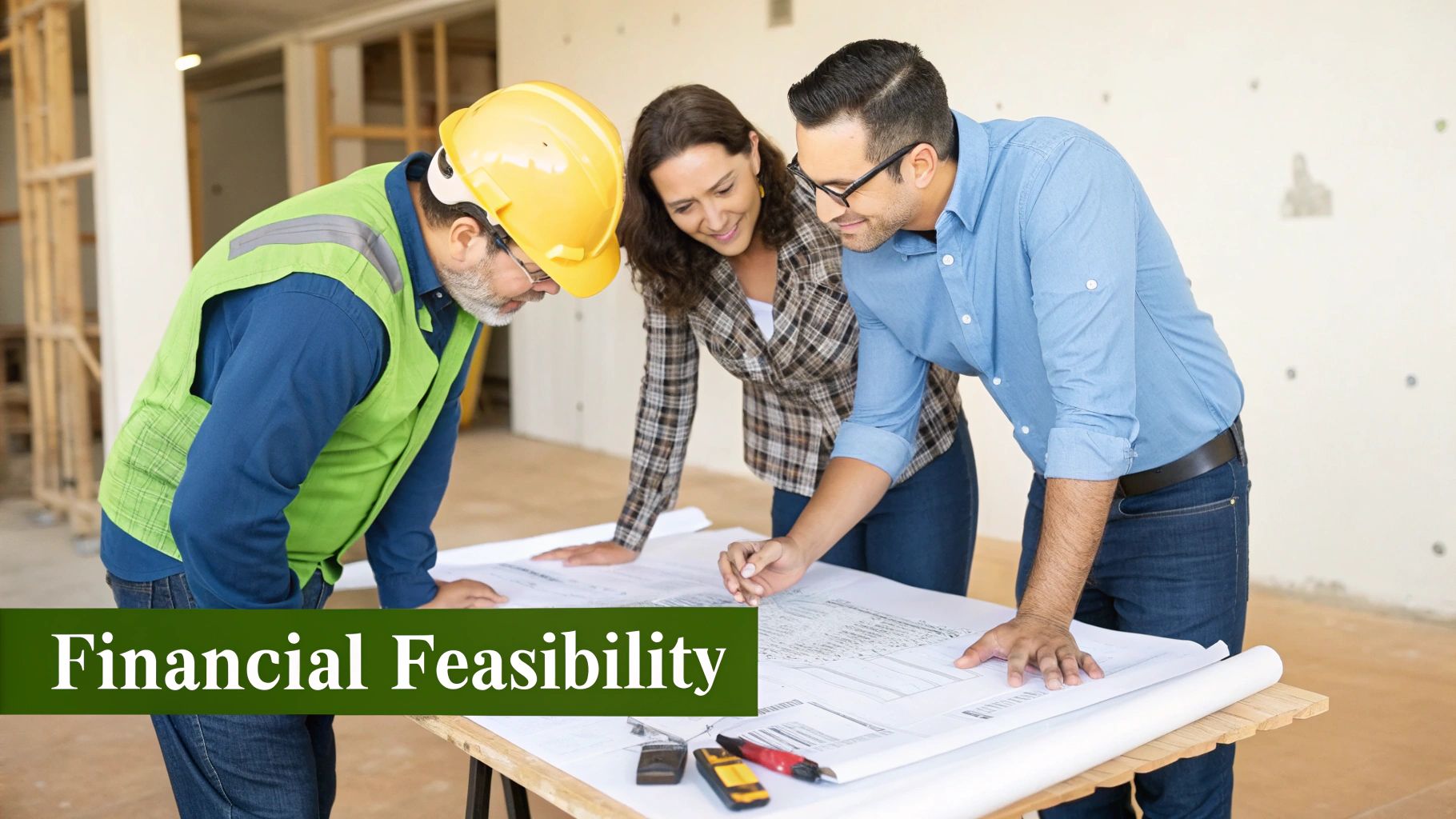
A diverse team of construction professionals reviewing blueprints on a job site, discussing financial feasibility.

Jumping into a major development without a proper financial feasibility study is like setting sail without a map or a compass. It's a huge gamble, and it leaves investors and developers wide open to financial disaster. This goes way beyond a simple back-of-the-napkin calculation; it takes your big ideas and turns them into a concrete financial story.

A good study forces you to challenge every single assumption. From market rental rates to the price of steel, it makes sure your projections are firmly planted in reality, not wishful thinking.

This analysis isn't just a box-checking exercise to get a bank loan—it’s a core piece of your strategy. For complex projects like adaptive reuse or historic preservation, the number of financial moving parts can be staggering. A proper study corrals all those variables into a clear, understandable model.

A well-executed feasibility study is the ultimate risk mitigation tool. It stress-tests a project's financial structure against market fluctuations, cost overruns, and unforeseen challenges, providing a clear path to profitability or an early warning to pivot.

Grounding Financial Models in Reality

One of the most common mistakes we see in financial forecasting is relying on generic data or pie-in-the-sky assumptions. This is exactly where an architect’s expertise becomes so valuable. An experienced architect, like our team at Sherer Architects, provides the critical, real-world inputs that make a financial model truly solid.

When an architect is involved from the start, the study can properly account for things like:

  • Zoning and Code Compliance: An architect can spot potential compliance headaches or design requirements early on that could blow up your construction costs and timeline.
  • Design Efficiency: They know how a building's layout and systems will impact everything from long-term utility bills to its overall revenue potential.
  • Historic Tax Credits: For preservation projects, an architect’s guidance is absolutely essential for navigating the maze of securing tax credits, which can completely change a project’s bottom line.

This kind of expert insight is more in demand than ever. The architectural services market is expected to grow from USD 215.13 billion in 2025 to USD 273.97 billion by 2029, largely fueled by interest in sustainable design and adaptive reuse. It makes sense when you consider that adaptive reuse can be 20-40% cheaper than new construction and often qualifies for lucrative historic tax credits. You can get a deeper understanding of this shift by reading a recent architecture industry outlook.

By baking this practical, on-the-ground knowledge into your financial study from day one, you transform it from a simple forecast into a powerful and accurate roadmap for success.

Laying the Groundwork: Defining Your Project and Forecasting Revenue

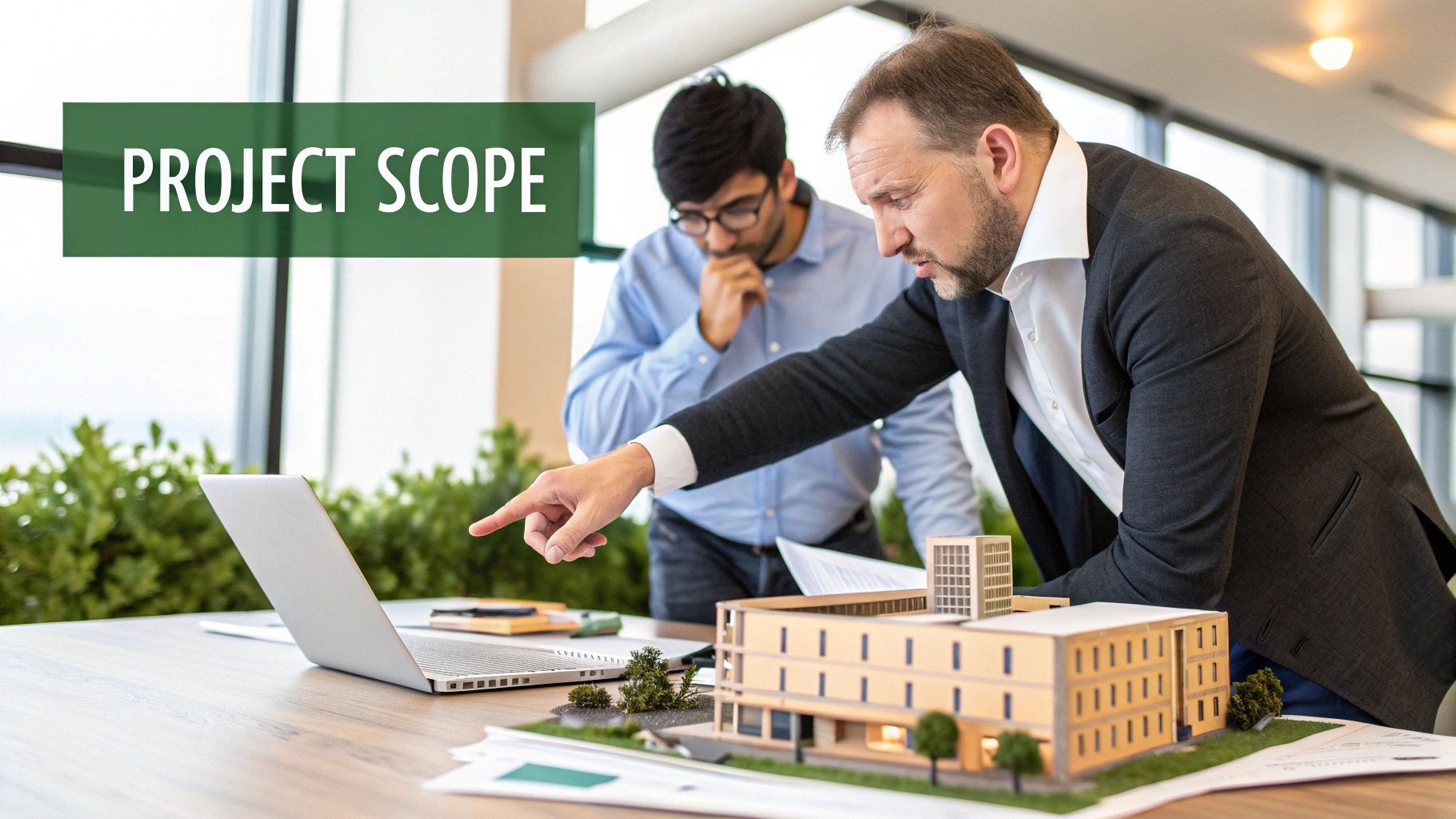
Two men discuss project scope, pointing at a building model and laptop on a table.

Every successful financial study feasibility analysis starts long before the first spreadsheet is opened. It begins with a vision—a clear, detailed picture of the final product. Before you can even think about projecting income, you need to nail down a precise project scope. This isn't just paperwork; it's the critical step that prevents costly scope creep and ensures every subsequent calculation is grounded in reality.

Think of the scope as the project’s constitution. It must clearly articulate what you’re building or renovating, from the total square footage and intended use down to the specific amenities and quality of finishes. For an adaptive reuse project, this means defining exactly how a historic warehouse will be reimagined as residential lofts, including the number of units, common areas, and parking solutions.

This needs to be specific. "Renovate an old building" is an idea, not a scope. A well-defined scope sounds more like: "Convert the 50,000-square-foot 'Standard Mill' building into 45 mixed-income rental apartments, preserving key historical architectural elements to qualify for historic tax credits." That’s a blueprint you can build on.

From Big Idea to Tangible Scope

This is where bringing in an architect early on is a game-changer. An experienced firm like Sherer Architects doesn't just draw plans; they help you test the limits of your site's potential. They'll dig into zoning ordinances, flag potential building code hurdles, and assess the structural integrity of an existing building—all factors that directly dictate what’s actually possible.

This early architectural gut-check grounds your vision in reality. It might reveal that the site can handle more density than you assumed, unlocking unexpected revenue. Or, it could uncover a critical structural flaw in that old warehouse, forcing a budget shift but saving you from a catastrophic financial surprise later.

Your project's scope is the bedrock of your financial projections. A poorly defined scope leads to inaccurate forecasts and a feasibility study built on shaky ground. Clarity at this stage is non-negotiable for a reliable outcome.

A well-defined scope provides the essential inputs for robust strategic budgeting and forecasting, making your cost and revenue models much more precise.

Forecasting Revenue You Can Count On

With a solid scope in hand, it’s time to project potential income. This is where you move past wishful thinking and into hard, data-driven market analysis. The goal here is to build a credible revenue forecast for a typical 5 to 10-year horizon.

The type of project dictates your revenue model. The most common streams include:

  • Rental Income: For multifamily, office, or retail spaces, you'll need to forecast monthly rents per square foot, factoring in realistic vacancy rates and annual rent increases.
  • Sales Profits: If you're building condos or commercial-for-sale properties, the key is projecting the final sales price per unit based on what the market is actually paying for similar properties.
  • Other Income: Don't forget the smaller streams—revenue from parking fees, laundry facilities, tenant storage, or other ancillary services can add up.

Digging Deep with Market Analysis

To forecast these streams with any accuracy, you have to do your homework. This isn’t a quick Zillow search; it’s a detailed investigation into the local market dynamics.

Let’s go back to our warehouse-to-lofts project. A proper analysis would involve a few key steps:

  1. Find Your "Comps": Identify comparable loft-style apartment buildings in the same or nearby neighborhoods. What are their current rental rates, unit sizes, and occupancy levels? What amenities do they offer? This is your baseline.
  2. Check Absorption Rates: How quickly are new rental units getting leased in the area? A high absorption rate—for instance, a new 100-unit building hitting 95% occupancy in just six months—is a powerful signal of strong demand.
  3. Read the Tea Leaves (Market Trends): Look at the bigger picture. Is the population growing? Is a major employer setting up shop nearby? Are there city infrastructure projects planned? These macro trends can justify projecting stronger rent growth over your 5-10 year forecast.

This detailed market data becomes the revenue side of your financial study feasibility. By pairing a well-defined, architect-vetted scope with a realistic, data-backed revenue forecast, you build the solid foundation needed for the rest of your analysis.

Getting a Handle on Total Project Costs

Once you have a solid idea of potential revenue, it's time to flip the coin and get brutally honest about the costs. This is where the rubber meets the road. A project's viability lives or dies by your ability to forecast and manage every single expense. Underestimate here, and a promising development can quickly become a money pit.

We generally break down total project costs into two buckets: soft costs and hard costs. Knowing the difference is fundamental to building a budget that can actually withstand the pressures of a real-world project.

Decoding Soft Costs

Soft costs are all the necessary expenses that don’t involve swinging a hammer or pouring concrete. Think of them as the "brains" of the operation—the professional services and administrative hurdles you have to clear before and during construction. It's easy to downplay these figures, but they pack a punch and often account for a huge chunk of your total budget.

You'll need to account for a whole range of these intangible but critical items:

  • Design and Engineering Fees: This is what you pay your architect and engineers for the plans, structural calculations, and MEP (mechanical, electrical, plumbing) systems design.
  • Permits and Inspections: The price of admission to build, set by the local municipality. These fees can vary dramatically depending on your city and the project's complexity.
  • Professional Services: Don't forget the lawyers needed for zoning battles or the accountants structuring the deal.
  • Financing Costs: Loan origination fees, appraisal costs, and the interest you’ll pay on your construction loan before the building generates income.
  • Insurance: Builder’s risk, liability, and other policies are non-negotiable to protect the project.

For context, on a $5 million adaptive reuse project, it's not unusual for soft costs to land somewhere between $1 million and $1.5 million (20-30%). You're spending a lot of money before the first wall even comes down, which is why getting architects and legal counsel involved early is so important—they know the local landscape and can help you project these numbers accurately.

Nailing Down Hard Costs

Hard costs are exactly what they sound like: the tangible, physical expenses of construction. This is the "brick-and-mortar" part of the budget that covers everything from the dirt work to the final coat of paint. While they're easier to visualize, their prices can swing wildly with market demand for materials and labor.

This category is all about the physical build-out:

  • Materials: Concrete, steel, lumber, drywall, roofing, windows, and all the finishes.
  • Labor: The wages for every trade on site, from the excavation crew to the electricians and painters.
  • Site Work: Getting the site ready—grading, running utility lines, paving parking lots, and landscaping.
  • Major Systems: The big-ticket items like HVAC, plumbing, and electrical infrastructure.

Getting preliminary bids from a few general contractors is an essential reality check. An experienced architect, like our team at Sherer Architects, adds immense value here by preparing a detailed set of documents for bidding. This ensures every contractor is pricing the exact same scope of work, so you can make a true apples-to-apples comparison instead of guessing what’s behind their numbers.

The allocation of these costs can look quite different depending on the project type.

Typical Project Cost Allocation for Commercial vs Adaptive Reuse

This table gives a high-level look at how budgets are typically broken down for a new build versus an adaptive reuse project. Notice how things like demolition and structural upgrades demand a much larger piece of the pie in reuse projects.

Cost Category New Commercial Build (% of Total) Adaptive Reuse Project (% of Total)
Site Acquisition & Prep 10-15% 5-10%
Demolition & Abatement 1-2% 5-15%
Foundation & Structure 20-25% 15-25% (Repairs/Upgrades)
Exterior & Roofing 10-15% 10-20% (Restoration)
Interior & Finishes 15-20% 15-25%
MEP Systems 15-20% 15-25% (Complex Integration)
Soft Costs (Fees, Permits) 10-15% 15-20%
Contingency 5-10% 10-20%

As you can see, the financial DNA of an adaptive reuse project is fundamentally different. You're shifting funds from site prep and new structure costs toward abatement, restoration, and a much larger contingency to handle the inevitable surprises.

The Unique Challenges of Adaptive Reuse

Speaking of surprises, adaptive reuse and historic preservation projects are in a class of their own. They come with a whole layer of cost variables you simply don't encounter when building from scratch. Your financial study has to reflect this uncertainty.

In an adaptive reuse project, what you can't see is often what costs the most. Unforeseen structural issues, hazardous material abatement, and the need for specialized artisans can significantly impact the budget if not properly anticipated.

You absolutely have to dig into these potential cost centers:

  • Hazardous Material Abatement: Old buildings can be a minefield of asbestos, lead paint, and other unpleasant materials that require certified (and expensive) professionals to remove.
  • Structural Upgrades: Bringing a century-old structure up to modern building and seismic codes can mean serious, costly reinforcements.
  • Historic Fabric Repair: Restoring original masonry, ornate woodwork, or historic windows requires true craftspeople, and their skills come at a premium compared to off-the-shelf modern materials.
  • Systems Integration: The puzzle of threading modern HVAC, IT, and electrical systems through a historic building without destroying its character is both an art and a significant expense.

Because of all these unknowns, your contingency fund is your best friend. For a new build, a 5-10% contingency might be fine. For an adaptive reuse project, anything less than 15-20% of total construction costs is asking for trouble. Think of it as the project’s financial shock absorber—it’s there to ensure a few nasty surprises don’t sink the entire ship.

Building a Pro Forma to Analyze Financial Scenarios

Once you have your revenue forecasts and cost estimates nailed down, you're ready to build the most critical tool in your feasibility toolkit: the pro forma statement. Don't think of this as just a spreadsheet. A well-built pro forma is a dynamic financial model where you can truly bring your project's story to life. It's the place where all your data comes together to project cash flow over the next five to ten years.

This isn't just about plugging in numbers and hoping for the best. It’s about building a logical financial narrative that shows how money flows from top-line income all the way down to your final cash position. The real power here is in seeing how the project holds up under different conditions, stress-testing your assumptions, and finding out if the numbers actually work before you put serious capital on the line.

From Gross Income to Net Operating Income

The bedrock of any real estate pro forma is the cash flow projection. You always start with the Gross Potential Income (GPI)—the absolute maximum revenue you could pull in if the property were 100% occupied all year long. From that high point, you start methodically subtracting costs to get to the numbers that really matter.

The typical flow looks something like this:

  • First, you calculate your Gross Potential Income (GPI), which is the total possible rental and ancillary income.
  • Next, you subtract a Vacancy Loss allowance. Be realistic here; something like 5-7% is a common starting point. This gives you your Effective Gross Income (EGI).
  • From EGI, you deduct all Operating Expenses—property taxes, insurance, management fees, utilities, repairs, you name it.
  • What’s left is your Net Operating Income (NOI). This is a crucial metric because it shows you exactly how profitable the property is before you even think about loan payments or income taxes.

This structured approach is the industry standard for a reason. It gives investors, lenders, and you a crystal-clear picture of the property's pure earning power.

Modeling Financing and Tax Credit Scenarios

With a solid NOI projection, your pro forma transforms from a simple calculator into a strategic playground. This is where you get to play "what if."

You can model different financing structures to see how they ripple through your returns. For instance, what happens with a 70% loan-to-value (LTV) loan at a 6.5% interest rate versus a more aggressive 80% LTV loan at 7.0%? The pro forma shows you precisely how changes in leverage and interest rates hit your bottom-line cash flow after paying the bank.

For adaptive reuse projects, this is where you can see the massive impact of incentives like historic tax credits. These aren't just a nice little bonus; they can single-handedly make or break a deal.

By modeling scenarios with and without historic tax credits, you can put an exact dollar value on their impact. Seeing a project's Internal Rate of Return (IRR) jump from a borderline 12% to a much more compelling 18% gives you the hard data needed to justify the headaches of the historic preservation process.

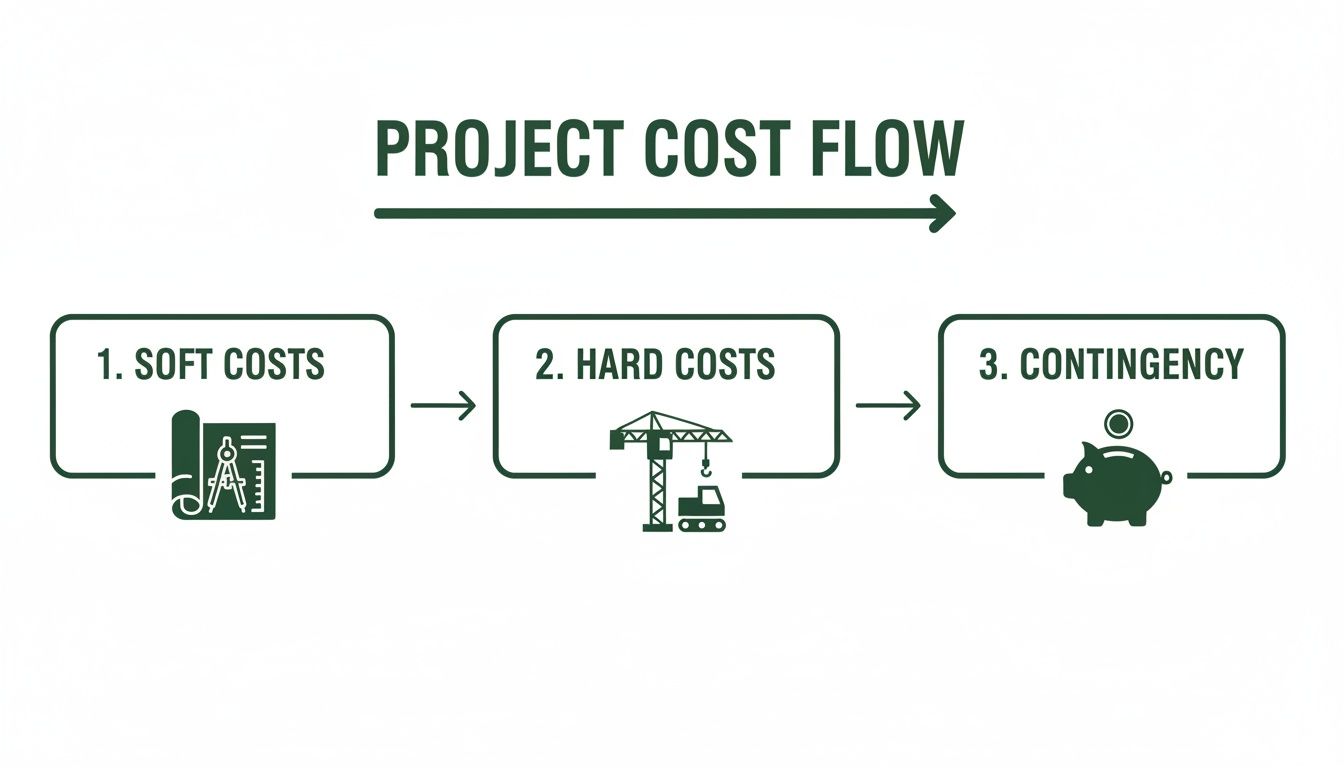
Understanding how all the costs feed into this model is essential.

Infographic illustrating the project cost flow, detailing soft costs, hard costs, and contingency.

This flow from soft costs to hard costs and finally to contingency planning shows how every dollar needs to be accounted for in your financial model to ensure accuracy.

Key Metrics and Actionable Insights

At the end of the day, a pro forma is only as good as the decisions it helps you make. A huge part of the financial study feasibility process is seeing how smart project decisions translate into better numbers.

For example, our experience shows that adaptive reuse can make a project 20-50% more cost-effective than new construction. When you layer on tax credits that can offset 20-45% of rehabilitation costs, the financial picture improves dramatically. Your pro forma is where you see these efficiencies reflected in your key return metrics.

The pro forma gives you a dashboard to visualize performance and make smarter choices. If you really want to get under the hood, building your own rental property calculator in Excel is a fantastic way to understand the mechanics. It turns abstract numbers into a tangible tool that helps you steer your project toward financial success.

Making the Final Go or No-Go Decision

Three professionals analyze data on a tablet and book, discussing a 'Go OR No-Go' decision.

After all the number-crunching and modeling, you've reached the moment of truth. The final phase of a financial study feasibility analysis boils down to translating a mountain of data into a single, definitive answer: should you move forward or walk away?

This isn’t about gut feelings. It’s about using specific, industry-standard metrics to evaluate the project's potential from every critical angle. These metrics—Net Present Value (NPV), Internal Rate of Return (IRR), and the Payback Period—each tell a unique part of the financial story, giving you a clear, data-backed foundation for your choice.

Key Metrics That Drive the Decision

Think of these three core metrics as different lenses for viewing the same financial landscape. Each one gives you a distinct perspective on the project's viability.

  • Net Present Value (NPV): This is the king of investment metrics. NPV tells you the total value of all future cash flows, both incoming and outgoing, all discounted back to what they're worth today. In plain English, it answers the big question: "Will this project create more value than it costs?" A positive NPV is your green light—it means the project is expected to beat your minimum required rate of return. A negative NPV is a clear stop sign.

  • Internal Rate of Return (IRR): While NPV gives you a dollar amount, IRR delivers a percentage. It’s the estimated annual rate of growth the project is expected to generate. So, if your project’s IRR is 15%, you're anticipating an average annual return of 15% over its lifetime. You then weigh this against your "hurdle rate"—the absolute minimum return you need to justify the risk. If the IRR clears that hurdle, the project looks financially attractive.

  • Payback Period: This is the simplest of the three, but don't underestimate its importance. It calculates exactly how long it will take for the project to generate enough cash to recover your initial investment. A shorter payback period almost always means lower risk. A project that pays for itself in four years is far less risky than one that takes ten, simply because your capital isn't tied up for as long.

Stress-Testing Your Assumptions with Sensitivity Analysis

Let’s be honest: no forecast is perfect. The real world is messy, and a smart feasibility study has to account for that. This is where sensitivity and break-even analyses become your best friends. They are powerful tools for figuring out which of your assumptions carry the most financial weight.

Sensitivity analysis is all about playing "what-if." You tweak one key variable at a time—like construction costs, rental rates, or vacancy—to see how it ripples through your bottom line. What happens to your NPV if construction costs run 10% over budget? What if rental income dips 5% below your projection? Running these scenarios helps you pinpoint the project's financial Achilles' heel.

A sensitivity analysis reveals which variables pose the greatest threat to your profitability. If a minor dip in rental rates sends your IRR plummeting, you know that your revenue projections need to be rock-solid and perhaps even conservative.

This is also where broader market data provides invaluable context. For instance, an indicator like the AIA/Deltek Architecture Billings Index (ABI), which posted a soft 45.6 in early 2025, can signal a downturn. But that could also mean an opportunity for cost savings on labor and materials. A good financial study feasibility can model how capitalizing on such a market might boost returns, especially since adaptive reuse is often 30-50% cheaper than new construction. Understanding salary benchmarks, like an Architectural Director's median base of $160,924, also helps you forecast soft costs with much greater precision. Get more insights on recent architecture firm billings.

The Break-Even Point

Finally, you need to know your break-even point. This analysis pinpoints the exact moment when your project's total revenues equal its total costs.

For a real estate project, this is usually expressed as the occupancy rate required to cover all operating expenses and debt service. Knowing your project breaks even at 75% occupancy gives you a clear, tangible target and a crucial benchmark for measuring performance once you're up and running. It's the baseline for survival.

Answering Your Top Questions About Financial Feasibility Studies

Even with a roadmap in hand, you're bound to have questions when you're deep in the numbers. We get it. Here are some of the most common questions we hear from developers and investors, along with straight answers based on our experience in the field.

How Long Does a Feasibility Study Take?

There's no single answer here—it all comes down to complexity.

For a relatively straightforward commercial infill project, you're probably looking at a 4 to 6-week timeline. That's usually enough time to do the necessary market research and pull together solid initial cost estimates.

But if you're tackling something like an adaptive reuse or historic preservation project, you need to budget more time. These can easily take 8 to 12 weeks, sometimes longer. Why the extra time? You're digging into zoning variances, researching historic tax credit eligibility, and getting detailed assessments on things like structural integrity or environmental issues. The more unknowns you start with, the longer that discovery phase will naturally be.

What's the Typical Cost for a Study?

Just like the timeline, the cost is a direct reflection of the project's scope.

A feasibility study for a smaller commercial project might land somewhere in the $5,000 to $15,000 range. This typically gets you professional market analysis, preliminary cost estimates, and foundational financial modeling.

For larger, more complex projects—especially those with historic elements or major zoning hurdles—the cost can climb to $20,000 to $50,000 or even more. That higher price tag accounts for bringing in specialists like structural engineers, environmental consultants, or historic preservation advisors whose expertise is absolutely critical for an accurate financial picture.

Think of the cost of a feasibility study not as an expense, but as an investment in de-risking your project. Spending $30,000 upfront to uncover a fatal flaw in a $10 million project is one of the smartest investments you can make.

Can I Do a Feasibility Study Myself?

You can certainly run some preliminary numbers on your own, and many savvy developers do. But for a truly bulletproof financial study feasibility assessment, bringing in third-party experts is a game-changer.

The biggest risk with a DIY approach is confirmation bias. It’s human nature to want a project to work, and you might unintentionally cherry-pick data that paints a rosier picture than reality.

An architect and other consultants bring an objective eye. They're trained to spot the red flags you might miss and can ground your cost estimates in reality, not just what an online calculator says. That layer of credibility is exactly what lenders and investors need to see.

What if the Study Shows the Project Isn’t Viable?

First off, that’s not a failure. It’s a success. A feasibility study is designed to give you a clear "go" or "no-go" signal before you sink serious capital into a project. If the numbers don't add up, the study has saved you from a potentially massive financial headache.

A "no-go" doesn't mean the idea is dead in the water, either. It points you directly to the weak spots.

  • Projected rent too low? Maybe a design tweak to add premium amenities could justify higher lease rates.
  • Construction costs too high? An architect can explore value engineering or alternative construction methods to bring the budget in line.
  • Financing crippling cash flow? It might be time to look at different loan products, seek out new equity partners, or explore tax credit scenarios.

Think of the study as a roadmap for what needs to change. It gives you the chance to pivot, refine your strategy, and build a stronger, more profitable plan.


Ready to find out if your next project is built on a solid financial foundation? The team at Sherer Architects has spent decades grounding financial models in real-world design, zoning, and construction realities. We help you find the opportunities and flag the risks from day one. Let's discuss the feasibility of your vision today.

Categories
Uncategorized

Discover warehouse theater greenville sc: A Guide to Adaptive Reuse

Greenville, South Carolina's Warehouse Theatre is a masterclass in adaptive reuse. It stands as a brilliant example of how you can breathe new life into a historic textile warehouse, transforming it into a buzzing cultural hub.

For developers and property owners, this project isn't just a success story; it's a practical blueprint. It shows how to perfectly blend historic preservation with a smart, profitable investment. This is a story of vision, community, and some really sharp design.

A brightly lit "WAREHOUSE REBORN" sign on a theater building at dusk with people walking outside.

Unpacking the Warehouse Theater Blueprint

We’re going to use the Warehouse Theatre as our core case study. Think of it as a detailed roadmap for anyone looking to turn an old industrial building into a thriving community asset. Its journey—from a basic textile storage space to a cultural and economic linchpin for Greenville’s West End—offers some incredibly valuable lessons.

We'll walk through the entire lifecycle of this project, from the first spark of an idea to its current status as a local landmark. This is about more than just saving an old building; it’s about unlocking the massive potential trapped inside its walls.

From Humble Beginnings to Cultural Anchor

The Warehouse Theatre's story is all about ambition. It was started back in 1973 by a handful of local artists and a Furman University professor who found a rent-free black box space to get going. Fast forward to 1998, and they made the move to their current home in the West End, taking on the challenge of converting historic mill buildings into a modern performance venue.

This project did more than just save a piece of Greenville’s textile heritage. It gave the building a new purpose and extended its life for decades to come.

Why This Model Works for Developers

The Warehouse Theatre’s success offers a compelling argument for developers and investors for a few key reasons:

  • Economic Viability: It proves that cultural venues can be profitable ventures, attracting patrons and driving real dollars into the local economy.
  • Community Integration: Creating a space that people genuinely love generates immense goodwill. It becomes a landmark, not just a building.
  • Sustainable Practice: Adaptive reuse is, at its heart, a sustainable choice. You sidestep demolition costs and drastically reduce the project's environmental footprint.

Of course, before you dive headfirst into a project like this, you have to do your homework. It’s absolutely essential to assess the project’s viability and understand the potential hurdles. The first step is to conduct a feasibility study. This is the foundation for a solid financial and operational plan, making sure every move you make is backed by solid data.

The Financial Case for Adaptive Reuse Theaters

Beyond the cool architecture and the good feelings, converting a warehouse into a theater has to make financial sense. Developers and investors need to see hard numbers that show a clear path to a solid, lasting return. At the end of the day, the data has to tell a story of real growth and profitability.

For a project like a warehouse theater in Greenville SC, success is measured by more than just ticket sales. You have to look at audience growth, how deeply the community is involved, and whether the venue can pull in money from different sources. A smart conversion becomes an economic driver for the neighborhood, not just a place to see a show.

The Warehouse Theatre's recent track record gives us a fantastic real-world example of this in action. It’s a perfect case study of how a strategic adaptive reuse project can meet market demand and deliver impressive financial results, making a strong argument for similar investments.

Measuring Success in Greenville

Greenville’s vibrant arts scene is the perfect backdrop for a project like this. In a standout year, the Warehouse Theatre saw its audience jump by a massive 32%. That’s a powerful sign of its growing appeal and importance to the community.

This wasn't just a fluke in one area. The growth was across the board—from main stage shows to educational programs and community events. In fact, their education initiatives hit their highest-ever revenues and attendance numbers.

This isn't happening in a vacuum. Other local arts venues have also been reporting record-breaking years and seeing a big uptick in donations from individuals. This all points to a healthy, supportive market for the performing arts in Greenville. It’s tangible proof that putting money into cultural venues pays off. You can get more details on these impacts directly from the Warehouse Theatre's success story.

A thriving arts venue does more than sell tickets; it becomes a destination. The increased foot traffic benefits surrounding businesses, boosts property values, and contributes to the overall economic vitality of a district, creating a halo effect for investors.

Key Performance Indicators for a Cultural Adaptive Reuse Project

For developers and investors, looking beyond a simple profit and loss statement is crucial. The following table highlights the tangible growth metrics from the Warehouse Theatre, providing a benchmark for what a successful cultural adaptive reuse project can deliver.

Metric Warehouse Theatre Performance Implication for Developers
Audience Growth Rate 32% increase in patrons served in a single year. Demonstrates strong market penetration and growing brand loyalty. A clear sign of a sustainable customer base.
Revenue Diversification Highest-ever revenues from educational programming and community events. Multiple income streams reduce risk and create financial stability beyond the box office.
Community & Donor Support Significant jumps in individual giving across the local arts scene. Strong community buy-in and philanthropic support validate the project's cultural value and reduce financial risk.
Local Economic Impact Increased foot traffic and evening commerce in the surrounding district. Creates a "halo effect," boosting neighboring property values and making the entire area more attractive for future investment.

These KPIs show a project that's not just culturally significant but is also a sound, data-backed investment. They paint a clear picture of how a well-executed adaptive reuse theater can become a cornerstone of both community and commerce.

Tackling the Core Design Puzzles of Conversion

Architects or engineers review design blueprints in a large event space or warehouse.

Turning an industrial shell into a place of performance isn't just a renovation; it's like solving a giant, three-dimensional puzzle. Every piece, from the steel beams overhead to the way sound travels through the room, has to fit together perfectly. For any warehouse theater in Greenville SC, getting these foundational, technical details right from the start is what separates a successful venue from a failed experiment.

The first, and arguably most important, challenge is the building's skeleton. Warehouses are built for the simple, static weight of goods, not the dynamic loads of lighting rigs, catwalks, and hundreds of people. A deep-dive structural analysis is always step one, figuring out exactly where we need to add muscle to the original frame to carry the weight of a modern theater safely.

From Echo Chamber to Acoustic Sanctuary

Let's be honest: the very things that give a warehouse its character—soaring ceilings, concrete floors, and hard, flat walls—are an acoustic disaster. They create a massive echo chamber where sound just bounces around endlessly. For a theater, where the clarity of every line and note is paramount, this is a non-starter.

Taming that chaotic sound requires a layered approach, not just a single fix. We have to bring in a combination of strategies to absorb and scatter sound waves.

  • Acoustic Paneling: You'll see these installed strategically on walls and ceilings. Their job is to act like sponges, soaking up stray sound before it can reflect back into the room.
  • Irregular Surfaces: We intentionally break up those big, flat planes by adding varied textures and angles. This scatters the sound, preventing harsh echoes and creating a much warmer, more intimate feel.
  • Smart Layout: Even the way we arrange seating and interior walls can help. A good design directs sound right where you want it—to the audience's ears. When planning a new warehouse theater, it’s vital to consider every element, including carefully choosing the right stage that complements the unique acoustic fingerprint of the space.

Weaving in the Modern Essentials

Beyond sound, a performance venue needs a whole network of complex systems that do their job without anyone noticing. HVAC (heating, ventilation, and air conditioning) is a perfect example. You need a system that keeps a full house comfortable but remains completely silent. That’s a world away from the loud, clunky industrial units you usually find bolted to the roof of an old warehouse.

A great adaptive reuse project respects the soul of the original building while making it ready for today. The real artistry is in weaving in modern life-safety systems—like fire suppression and accessible exits—without erasing the historic industrial character that drew you to the space in the first place.

This means designing custom ductwork, often lined with sound-dampening material, and picking air handlers that are whisper-quiet. At the same time, we have to meet all current codes for fire safety and accessibility. This involves integrating ramps, accessible restrooms, and clear emergency egress routes in a way that feels like it was always part of the building's design, not just tacked on.

It’s a delicate dance between preservation and modernization. The best projects make these critical upgrades feel so natural that you'd never guess they weren't part of the original plan, resulting in a venue that’s safe, welcoming, and full of history.

Navigating Approvals and Maximizing Incentives

Taking an old building and giving it new life as a modern venue means you're stepping into a world of regulations and financial strategy. For anyone looking at a project like a warehouse theater in Greenville SC, this part of the process can feel daunting. But with the right team, what looks like a mountain of bureaucratic hurdles can actually become your biggest financial advantage.

The trick is to see zoning ordinances, Design Review Board presentations, and historic preservation rules not as roadblocks, but as a roadmap. When you know how to navigate it, this process can actively lower your project costs and significantly improve your return on investment. It's less about fighting red tape and more about lining up your project's goals with what the city and preservation groups want to see. You just have to learn how to make the system work for you.

Turning Regulations into ROI

Let's be clear: the regulatory maze isn't there to kill projects. It's designed to make sure development is safe, sustainable, and genuinely adds value to the community—and in a historic area like Greenville's West End, that's doubly true. Think of the approvals process as your first, best chance to prove that your project respects the neighborhood's character while breathing new economic life into an old building.

For example, when you stand in front of a Design Review Board, you’re not just checking a box. A well-researched presentation showing how you'll save the original brickwork or restore those iconic old windows builds incredible goodwill. That proactive approach signals you're a partner in preservation, not just another developer, and can make every subsequent step a whole lot smoother.

And that partnership mentality is precisely what unlocks the real financial wins.

A project that nails the balance between modern needs and historic preservation doesn't just get a green light. It gets a key to a powerful set of financial incentives that can completely change the numbers on your pro forma. These aren't handouts; they're rewards for doing it right.

Unlocking Historic Tax Credits and Grants

This is where the financial picture gets really interesting. Programs like the Federal Historic Preservation Tax Incentives program and South Carolina's own state-level credits are game-changers. They can be incredibly lucrative, but they don't mess around—you need precision and real expertise to qualify.

Getting these benefits isn't a simple form-fill. It involves a few critical steps:

  • Deep-Dive Documentation: First, you have to meticulously research and document the building's original bones—how it was built and what materials were used. This research becomes the foundation of your entire preservation plan.
  • Smart, Sensitive Design: Your architectural plans have to be clever. They need to show exactly how you'll integrate modern systems like HVAC and electrical with the least possible impact on the historic fabric of the building.
  • Airtight Application: The application process is rigorous. You need to provide clear, undeniable proof that your renovation follows the Secretary of the Interior's Standards for Rehabilitation to the letter.

The story of The Warehouse Theatre is a perfect real-world example. It's set to celebrate 52 years in 2025, and its journey from a scrappy black box experiment in 1973 to a top-tier professional theater shows what’s possible when vision and preservation come together. The theater got its start with a grant from the South Carolina Arts Commission, proving how smart financing and a commitment to preservation build lasting value.

This history shows that knowing how to navigate design reviews and tap into historic tax credits can reduce costs by 50-75% compared to just tearing the building down. You can dig into their foundational story to see how those early grants and community buy-in laid the groundwork for decades of success.

5. Budgeting and Timeline: The Bottom Line on Your Warehouse Conversion

When you're looking at a project like this, it really boils down to two things: how much is it going to cost, and how long is it going to take? For a developer, getting these answers right is everything. A predictable budget for a warehouse-to-theater conversion isn't about guesswork; it's about building a detailed financial roadmap from the very beginning.

Think of it less as a single price tag and more as a series of building blocks. You have your big-ticket items, like buying the property and paying for the architectural design. But then you start layering in the unique challenges of adaptive reuse—things like beefing up the structure for theatrical loads, installing specialized acoustic treatments, and wiring up the sophisticated lighting and sound systems that make a performance space come alive. A solid budget for a warehouse theater in Greenville, SC, has to account for all of it.

Breaking Down the Major Cost Centers

One of the easiest traps to fall into is underestimating the "soft costs" and forgetting to build in a healthy contingency fund. A well-planned budget expects the unexpected. Old buildings always have secrets, so you need to be prepared.

Here's how we typically break it down:

  • Hard Costs: This is the steel, the concrete, the drywall. It covers all the physical construction—structural work, HVAC, electrical, plumbing, interior finishes, and all the specialized theater gear like rigging and seating.
  • Soft Costs: These are the professional services that get the project off the ground and keep it on track. Think architectural and engineering fees, permits, legal reviews, and insurance.
  • Contingency Fund: This is your safety net. We recommend setting aside 10-15% of the total construction cost for those inevitable surprises, like discovering hidden structural damage or dealing with unforeseen site conditions.

The process of securing approvals and incentives plays a huge role in your financial planning. As the flowchart below shows, these steps aren't just bureaucratic hurdles; they're gateways to unlocking real money for your project.

A flowchart illustrates the Project Incentives Process with steps: Zoning, Approvals, and Credits.

As you can see, getting your zoning and historic designations locked in early is the key. Those foundational steps are what allow you to tap into financial credits, turning what feels like red tape into a real benefit for your budget.

Adaptive Reuse vs. New Construction: A Cost and Timeline Overview

To really understand the trade-offs, it helps to see how a warehouse conversion stacks up against starting from scratch. Here’s a high-level comparison to help you weigh the financial and scheduling implications.

Factor Adaptive Reuse (Warehouse) New Construction (Theater)
Upfront Costs Acquisition + major retrofitting. Can be variable based on building condition. Land acquisition + ground-up build. Often higher initial capital outlay.
Design & Approval More complex upfront; involves historic reviews, structural analysis, and creative problem-solving. More straightforward design process but can face lengthy zoning and site plan approvals.
Construction Time Generally faster once permits are secured, as the primary structure already exists. Longer construction phase from foundation to finishing.
Incentives High potential for historic tax credits, grants, and other revitalization funds. Limited to standard development incentives; no historic benefits.
Contingency Needs Higher (10-15%) due to the potential for unforeseen conditions in an existing structure. Lower (5-10%) as conditions are more controlled and predictable.
Marketability Strong narrative appeal; unique character and historic charm can be a major draw. A blank slate; appeal is based entirely on new design and amenities.

While the numbers can vary wildly from one project to the next, this table gives you a framework for thinking about the decision. Adaptive reuse often presents a compelling case, especially when you factor in the speed to market and the financial perks.

Phasing Your Project for a Predictable Path

A realistic project timeline is just as crucial as the budget. We always advocate for a phased approach, starting with feasibility studies and design development before ever breaking ground. This methodical process helps prevent the kinds of costly delays that can sink a project.

The real value of adaptive reuse shines when you compare it to new construction. While initial costs can sometimes be similar, the accelerated timeline, potential for tax credits, and the built-in character of a historic space often deliver a superior long-term ROI.

This is where having an experienced architectural partner becomes invaluable. By performing thorough due diligence at the outset and drawing on a deep well of experience with local regulations and incentive programs, a good firm can cut through the uncertainty. They help mitigate risks and keep the project on a steady, financially sound path—from that first concept sketch all the way to opening night.

Lessons Learned: Your Blueprint for a Successful Theater Project

Taking an old, forgotten building and turning it into a cultural cornerstone is an ambitious journey. But as the story of the Warehouse Theatre in Greenville, SC, shows, it’s a journey that can be incredibly successful when you blend a great vision with a smart financial plan. Here are the key takeaways from that project that can guide your own.

If there's one thing to take away from our experience, it's this: do your homework upfront. A deep-dive feasibility study before you even think about design is absolutely critical. This is where you uncover the hidden structural gremlins, the regulatory roadblocks, and the real financial picture.

Getting this right from the start is the difference between building on solid rock and building on quicksand. It saves you from those heart-stopping, budget-blowing surprises down the line.

You Can't Do It Alone: Building Your A-Team

Adaptive reuse projects are team sports, and the Warehouse Theatre is a perfect example of what happens when you get the right players on the field early. Your project's success truly depends on the specialists you bring to the table from day one.

Your core team should absolutely include:

  • A Preservation-Savvy Architect: You need someone who not only has a great design eye but also knows how to navigate the complex world of historic tax credits and respect the soul of the original building.
  • An Acoustician: Old industrial spaces are notorious echo chambers. An acoustician is the magician who turns that cavernous space into an intimate venue where every word from the stage is crystal clear.
  • A Creative Structural Engineer: This is the person who figures out how to make a century-old frame support modern lighting grids and seating without gutting its historic character.

The most successful projects are the ones that become part of the community's fabric. Think beyond the four walls. The goal is to create a destination that pulls people in, drives foot traffic, and becomes a place the neighborhood can't imagine living without.

Ultimately, your architectural partner is your quarterback through this entire game. They’re the ones who see the whole field—coordinating the design, wrangling the permits, managing the budget, and overseeing construction. With a solid team and a clear vision, your own warehouse theater in Greenville SC can be more than just a beautifully restored building. It can become a thriving, profitable hub for your community for years to come.

Got Questions? We've Got Answers

If you're looking at an old warehouse in Greenville and thinking "theater," you're not alone. It's an exciting idea, but it also comes with a lot of questions. We've been through this process many times, and a few key concerns always come up.

Let's walk through some of the most common questions developers and property owners ask when they're on the fence about turning an industrial shell into a cultural landmark.

What's Going to Surprise Me on the Budget?

The biggest budget-busters are almost always the things you can't see. When you peel back the layers of an old building, you might find structural issues that need serious reinforcement, old wiring that can't handle a modern theatrical load, or even hazardous materials like asbestos that have to be professionally removed.

These aren't just about meeting today's building codes; they're about supporting the intense demands of a performance space. The best money you can spend upfront is on a deep, thorough assessment with an architect who knows what to look for. It’s how you turn "unforeseen costs" into a predictable line item.

Here's a hard-won piece of advice: don't treat the theater-specific systems as an add-on. Things like theatrical lighting, rigging, and especially acoustic treatments, are core infrastructure, not just finishes. If you budget for them like an afterthought, you risk blowing your budget and compromising the entire reason you're building the theater in the first place.

How Can I Actually Use Historic Tax Credits in South Carolina?

South Carolina offers some fantastic incentives for bringing historic buildings back to life, but you have to play by the rules. The big ones are the state and federal historic tax credits. To get them, your building first needs to be on the National Register of Historic Places.

Then comes the critical part: every single piece of renovation work has to follow the Secretary of the Interior's Standards for Rehabilitation. This isn't a suggestion—it's a strict requirement. You absolutely need an architect who has been through the wringer with the State Historic Preservation Office (SHPO). They'll know how to design a project that meets the standards and helps you get the most out of these powerful financial tools.

Is My Smaller Warehouse Big Enough?

You bet. In fact, some of the most compelling performance spaces are created in smaller warehouses. A building in the 5,000 to 10,000 square foot range can be the perfect candidate for an intimate, flexible black box theater.

When looking at a smaller space, here’s what really matters:

  • Look Up: Do you have enough ceiling height for a lighting grid? This is non-negotiable for a real theater experience.
  • Look Around: Is the main space a wide-open, clear span? The fewer columns, the more freedom you have to arrange seating and staging.
  • Look Next Door: Is there enough room for the essentials? You'll need a lobby, restrooms, and at least a small dressing room area.

A smaller project can be a smart, cost-effective way to get into the adaptive reuse game and create something truly special for the community.


Tackling an adaptive reuse project takes more than just a blueprint; it requires a partner who understands the soul of old buildings and the demands of new ones. At Sherer Architects, LLC, we've spent decades helping developers navigate this exact journey, from the first feasibility sketch to the final curtain call. We make sure your vision becomes a building that's beautiful, functional, and built to last. Find out how we do it at https://shererarch.com.

Categories
Uncategorized

A Complete Guide to Built to Suit Development

When you need a new commercial space, you typically have two options: lease an existing building or buy one. But what if neither of those works? What if your business has such specific operational needs that an off-the-rack building just won't cut it?

That’s where a built-to-suit (BTS) development comes in. It’s a commercial real estate approach where a developer builds a property from the ground up for one specific tenant, designed to their exact requirements. The tenant gets a custom facility without the massive capital expense of construction and ownership, all in exchange for signing a long-term lease.

What Is Built To Suit Development

Think of it like getting a custom-tailored suit versus buying one off the shelf. A standard commercial lease is the off-the-rack option. It’s available now and gets the job done, but it's rarely a perfect fit. You'll likely have to make compromises—a less-than-ideal layout, an inefficient workflow, or a location that’s just okay.

A built-to-suit project is the bespoke equivalent. It’s a strategic partnership where a developer agrees to construct a building precisely to a tenant's unique specifications. This model is a game-changer for businesses with specialized operational, logistical, or branding needs that existing properties simply can't accommodate.

The whole thing hinges on the tenant committing to a long-term lease before a shovel ever hits the ground. This commitment gives the developer the financial security they need to get financing, buy the land, and build the custom facility.

The Key Players in a BTS Project

A successful built-to-suit project is a team sport. It relies on a tight-knit, collaborative relationship between three key players, each with a critical role to play.

  • The Tenant: This is the business with the unique vision. Maybe it's a QSR chain that needs a very specific kitchen and drive-thru flow, a distribution company that requires 40-foot clear heights, or a medical practice with specialized M.E.P. (mechanical, electrical, plumbing) systems. They drive the design.

  • The Developer: The developer is the project quarterback and investor. They handle the financing, acquire the site, manage the entire construction process, and ultimately own the building. Their return comes from the stable, long-term rental income guaranteed by the tenant's lease.

  • The Architect: The architect acts as the translator, turning the tenant's operational needs into a buildable reality. An experienced firm like Sherer Architects is essential for ensuring the final design is not only perfectly tailored to the tenant but also code-compliant, site-optimized, and on-budget for the developer.

This three-way partnership is what makes a BTS project work. The tenant gets a purpose-built facility without the upfront cost and headache of development, and the developer gets a stable, income-producing asset with a guaranteed tenant from day one.

Understanding this core dynamic makes it easy to see why built-to-suit has become the go-to strategy for so many companies. It takes the speculation out of development and delivers a turnkey solution that perfectly aligns with a business’s goals, making it an ideal path for companies focused on expansion, operational efficiency, or strengthening their brand presence.

Built to Suit vs Traditional Models At a Glance

To really grasp the value of the BTS model, it helps to see it side-by-side with the more traditional routes of speculative development and standard leasing. Each approach serves a different purpose and comes with its own set of trade-offs for both tenants and developers.

This table breaks down the key differences at a high level.

Feature Built to Suit (BTS) Speculative Development Standard Lease (Existing Space)
Customization 100% customized to tenant's exact needs and brand specifications. Designed for a generic market; limited tenant-specific customization. Minimal to no customization; tenant adapts to existing layout.
Tenant Involvement High; tenant is deeply involved in design and planning from the start. Low; tenant is found after the building is designed or built. Low; tenant evaluates finished spaces and negotiates lease terms.
Upfront Risk Lower for developer (tenant secured); tenant commits to long-term lease. High for developer (no tenant); significant market and leasing risk. Lower for landlord (existing asset); tenant has minimal upfront risk.
Timeline Longer; includes site selection, design, permitting, and construction. Shorter for tenant (building may be ready); long for developer. Fastest; space is immediately available for move-in after lease signing.
Lease Term Typically long-term (10-20+ years) to amortize development costs. Varies, but often shorter-term leases (3-10 years) are acceptable. Flexible; can range from short-term to long-term (1-10 years).
Ideal For Businesses with unique operational needs, strong credit, and long-term plans. Developers in high-demand markets; tenants needing standard space quickly. Businesses needing flexibility, standard space, and a fast move-in.

Ultimately, the choice between these models depends entirely on a business's priorities. If speed and flexibility are paramount, a standard lease might be the answer. If a company has specialized needs and a long-term vision, the built-to-suit model offers unparalleled advantages that simply can't be matched by an existing building.

The Built-to-Suit Process, Step by Step

Every built-to-suit project is a journey, a carefully choreographed process that turns a company's specific operational needs into a tangible, physical building. It's not a rush job. From the first handshake to the final key handover, the timeline typically runs anywhere from 12 to 24 months.

Think of it like commissioning a custom-tailored suit. You wouldn't just grab one off the rack. You’d work closely with a tailor, discussing fabric, cut, and function until every detail is perfect. The built-to-suit process is no different; it’s a deliberate progression ensuring the final building fits the tenant's business like a glove while meeting the developer's investment goals.

Phase 1: The Deep Dive—Initial Needs Analysis

It all starts with a conversation. This first phase is all about getting to the heart of what the tenant really needs. We're translating business operations—how things flow, what equipment is needed, where people work—into an architectural program.

  • Defining the Space: We go beyond simple square footage. Does the business need 30-foot ceilings for vertical storage? Reinforced concrete floors for heavy machinery? Specialized HVAC for a cleanroom environment? Every operational detail matters.
  • Setting the Numbers: The tenant and developer collaborate to land on a realistic construction budget and a target completion date. These numbers are critical, as they directly influence the final lease rate and the entire project schedule.
  • Creating a Preliminary Program: An architect takes all this information and distills it into a foundational document that guides the property search and the first design sketches.

Getting this stage right is probably the single most important part of the entire process. A clear, thorough understanding upfront prevents expensive do-overs and frustrating delays later on.

Phase 2: Finding the Right Spot—Site Selection and Due Diligence

With a clear vision in hand, the hunt for the perfect piece of land begins. The developer, usually working with the architect and tenant, scouts potential sites that fit the company’s logistical, branding, and geographical puzzle.

Once a promising property is identified, the real detective work starts. This is the due diligence period, a painstaking investigation to make sure there are no hidden surprises. An experienced architect is your best friend here, helping to untangle zoning laws, setback rules, utility access, and potential environmental hurdles. This step ensures the land can actually support the building we want to put on it.

Phase 3: From Blueprint to Permit—Architectural Design and Entitlements

This is where the vision starts to look like a real building. Working hand-in-hand with the tenant, the architect develops everything from high-level schematic designs to detailed construction documents. It's a highly collaborative back-and-forth, refining layouts, choosing materials, and dialing in the aesthetics until the design is both functional and on-brand.

At the same time, the team is working to secure entitlements—a fancy word for getting all the necessary government approvals. This means navigating local zoning codes, presenting to design review boards, and ultimately, securing the building permits. Having an architect with deep local roots, like our team at Sherer Architects, can make this complex bureaucratic dance much smoother.

The design and entitlements phase is a careful balancing act. The architect must create a design that fulfills the tenant's custom needs while also satisfying the developer's budget and adhering to all municipal codes and regulations.

Phase 4: Boots on the Ground—Construction and Project Management

With permits in hand and the lease signed, it's time to break ground. The developer or their general contractor takes the lead on-site, managing the day-to-day rhythm of construction—from wrangling subcontractors to ordering materials and keeping everything on schedule.

The architect’s role doesn't stop, though. Throughout construction, they provide essential construction administration services. This involves regular site visits to verify that the work matches the plans and to troubleshoot any issues that pop up. This oversight is the key to quality control, keeping the project on time and on budget.

This timeline chart helps visualize how a built-to-suit project compares with other real estate options.

Timeline comparing commercial real estate options: speculative construction, standard lease, and built to suit, with their respective durations.

As you can see, while the built-to-suit process requires more time upfront, it completely removes the market risk of an empty speculative building and delivers a perfectly customized facility that a standard lease simply can't offer.

Phase 5: The Finish Line—Final Delivery and Occupancy

We're almost there. The final step is walking through the nearly finished building to create a punch list—a list of any small items that need to be fixed or touched up. The tenant, developer, and architect do this together to ensure everything is perfect.

Once those items are addressed, the city or county issues a Certificate of Occupancy, the official green light that the building is safe and ready. Then comes the best part: the keys are handed over. The tenant can finally move in and start running their business in a space that was designed, from the ground up, just for them. It’s the successful end of the built-to-suit journey and the beginning of a great long-term partnership.

Understanding the Key Players and Their Roles

Think of a successful built-to-suit project as a three-legged stool. Each leg—the tenant, the developer, and the architect—is absolutely critical for stability. If one is weak or out of sync, the whole thing wobbles. It’s a true partnership where shared goals and crystal-clear responsibilities are what take a project from an idea on a napkin to a fully operational building.

When these key players are aligned, the process is smooth. When they’re not, you get the delays and budget overruns that give construction a bad name. The magic happens when the tenant, developer, and architect each bring their unique expertise to the table, focused on a single outcome.

Three professionals collaborate at a desk, reviewing documents and a laptop in a modern office.

The Tenant: The Visionary

Everything starts with the tenant. They are the business with a specific, often highly specialized, operational need that simply can’t be met by any off-the-shelf building. Their goal isn't just to get a new space; it’s to secure a facility that’s a competitive advantage—one that boosts efficiency, reflects their brand, and gives them a long-term home without the financial headache of owning the real estate.

The tenant’s main contributions are:

  • Defining the Vision: They must clearly articulate their spatial requirements, ideal workflows, and all the technical specs that make their business tick.
  • Committing to the Lease: This is the linchpin. By signing a long-term lease before a shovel ever hits the ground, they provide the financial security that makes the entire project possible.
  • Collaborating on Design: Great tenants stay involved. They work alongside the design team to ensure the final building is a perfect match for their business goals.

The Developer: The Orchestrator

If the tenant provides the vision, the developer is the one who makes it a reality. Acting as the project's quarterback, they manage the financial risks and logistical gymnastics of the entire process. For the developer, the motivation is clear: create a stable, income-generating asset by delivering a top-notch building occupied by a creditworthy tenant for the next 10 to 20 years.

A developer’s success in a built-to-suit project hinges on their ability to balance the tenant's custom requirements with the financial realities of the investment. They are the ultimate risk-takers, but that risk is significantly reduced by having a tenant secured from day one.

The developer's to-do list is massive. They’re responsible for acquiring the land, securing all the financing, and overseeing the entire construction process from groundbreaking to ribbon-cutting. They’re the ones managing the budget, the schedule, and all the moving parts to deliver the project on time and on spec.

The Architect: The Translator

The architect is the crucial bridge connecting the tenant's vision to the developer's investment. They are the design experts tasked with translating abstract business needs into a concrete, buildable set of plans. An architect’s job is to create a building that is not only functional and beautiful but also code-compliant and financially viable for everyone involved.

This role is absolutely central. It involves everything from optimizing the site layout and navigating complex zoning laws to creating the highly detailed documents that builders will use. A seasoned architect ensures the design isn't just innovative but also practical and cost-effective.

This drive for efficiency in built-to-suit projects is getting a boost from new construction methods. The modular construction market, for example, is on track to grow from $104.1 billion to $140.8 billion by 2029, largely because of the demand for faster, more sustainable ways to build. You can discover more insights about these construction trends from market analysts. This shift really highlights the value of having an architect who can integrate modern techniques to deliver projects faster and with less waste—a win for the entire team.

Navigating Financing and Legal Structures

At its core, a built-to-suit project isn't just about construction—it's about a smart financial partnership. The whole model is built on a carefully assembled legal and financial framework that turns a tenant's vision into a developer's bankable asset. Getting this part right is non-negotiable for a successful outcome.

The developer's first hurdle is always funding. How do you pay for the land and the actual build? The answer is typically a construction loan, a form of short-term financing designed specifically to cover these costs. The magic of the BTS model is that because a creditworthy tenant is already signed on, lenders see far less risk compared to a speculative project. That often translates into much better loan terms.

Once the dust settles and the tenant moves in, that short-term loan gets paid off with long-term permanent financing. This new loan is secured by two things: the brand-new building and, even more importantly, the guaranteed income flowing in from the tenant's lease.

The Cornerstone: The Triple Net Lease

The legal heart of almost every built-to-suit deal is the lease itself, and one type reigns supreme: the long-term triple-net (NNN) lease. This document is the key to creating the steady, predictable cash flow that makes the whole venture work for the developer and their bank. We're usually talking about terms of 10 to 20 years, giving everyone involved a lot of stability.

So, what does a "triple-net" lease actually mean for the tenant? It's pretty straightforward. You're on the hook for more than just rent. You also cover the three "nets":

  • Property Taxes: You pay the annual property taxes directly.
  • Building Insurance: Keeping the property insured is your responsibility.
  • Common Area Maintenance (CAM): You cover all the operating costs, from landscaping and parking lot repairs to fixing the roof.

This setup essentially turns the property into a hands-off, passive investment for the developer. For the tenant, it offers a huge amount of control. You can maintain the property to your own exacting standards, almost as if you owned it outright.

Essential Legal Clauses to Negotiate

Beyond the basic NNN structure, the lease is a detailed document that needs a sharp eye. Hammering out the details upfront is the best way to avoid headaches and disputes down the road.

A robust financial and legal strategy for built-to-suit development must include understanding critical project protections like a complete guide to builders risk insurance. This specialized coverage is vital for safeguarding the investment during the vulnerable construction phase.

A few key provisions always deserve close attention:

  • Construction Timeline and Delivery: The lease needs to spell out the exact schedule, key milestones, and the final delivery date. What happens if the developer is late? The contract should clearly define any penalties or remedies.
  • Default Provisions: This clause outlines the "what ifs." What happens if the tenant stops paying rent or if the developer fails to finish the building? It specifies the consequences for either party breaching the contract.
  • Purchase Options: Many tenants like to negotiate the right to buy the property later on, often at a price agreed upon today or at a future fair market value. It's a great way to build in long-term flexibility.
  • Exit Strategies: What happens when the 10 or 20 years are up? The lease should detail the process for renewals, termination, and how the property should be left upon vacating.

Nailing down these financial and legal details from the start ensures the built-to-suit partnership is built on solid ground, creating a transparent and mutually beneficial relationship that lasts.

Comparing Development Models: Risk and Reward

Every commercial real estate strategy boils down to a calculated balance of risk and reward. When you're deciding between a built-to-suit project, a speculative build, or a standard lease, you're not just picking a building. You're making a strategic choice that fundamentally changes the financial exposure and potential upside for everyone involved.

For a developer, the built-to-suit model is arguably the ultimate de-risking tool. The biggest ghost that haunts any developer is "vacancy risk"—that gut-wrenching possibility of finishing a multi-million dollar building only to have it sit empty, hemorrhaging cash. A BTS project completely sidesteps this nightmare by locking in a creditworthy, long-term tenant before a single shovel ever hits the ground.

With that pre-secured lease in hand, financing becomes much easier to secure, and the developer can count on a stable, predictable income stream for 10 to 20 years. So, what's the catch? The rental rate is typically negotiated to provide a fair, but not necessarily sky-high, return. In essence, the developer trades the potential for a speculative home run for the certainty of a guaranteed base hit.

Speculative Development: The High-Stakes Gamble

On the complete opposite end of the spectrum is speculative (or "spec") development. This is a high-stakes bet on the future, plain and simple. A developer builds a more generic office, warehouse, or retail space with no tenant signed, banking on the hope that market demand will be roaring when the project is complete.

If that bet pays off and a tenant signs on quickly, the financial rewards can be massive, often fetching higher rental rates than a comparable BTS deal. But if the market goes soft or the building just doesn't land a tenant, the developer is left holding an incredibly expensive, empty asset with debt payments and operating costs piling up. It’s the classic high-risk, high-reward play.

When comparing various development models, a deep understanding of construction project risk management is critical for evaluating the potential downsides and maximizing the returns on a built-to-suit investment. This knowledge helps all parties anticipate and mitigate challenges before they impact the bottom line.

Standard Leasing: The Path of Least Resistance

For tenants, the standard lease is all about speed and minimal commitment. You find an existing space you like, sign a relatively short-term lease (usually 3-10 years), and move in. This approach offers maximum flexibility and is perfect for businesses that need a space right now and can't wait for a new construction timeline.

The major trade-off, of course, is the lack of customization. The tenant has to make their business operations fit the building's existing layout, which can create frustrating inefficiencies and compromises. You're essentially trading a perfect fit for speed and flexibility.

The inherent efficiency of the built-to-suit model is also getting a major boost from modern construction methods. The global modular construction market—a key enabler of faster BTS projects—is projected to nearly double from $112.54 billion to $214.76 billion by 2034. This surge is fueled by the demand for quicker, more efficient building, especially in growing urban areas. You can read the full research on this expanding market to see how it's impacting development. This trend just goes to show how BTS is evolving to deliver custom facilities more effectively than ever before.

Development Model Risk and Reward Comparison

To truly understand the trade-offs, it helps to see the models side-by-side. The following table breaks down the key differences from both the developer's and tenant's perspectives.

Factor Built to Suit Speculative Development Standard Lease
Vacancy Risk (Developer) Eliminated Very High Not Applicable
Financial Reward (Developer) Stable, predictable return High potential reward Not Applicable
Financing (Developer) Easier to secure More difficult to secure Not Applicable
Customization (Tenant) 100% customized Minimal customization None
Timeline to Occupancy Longest (12-24+ months) Moderate (if building exists) Fastest (1-3 months)
Lease Term Long-term (10-20+ years) Varies (often 5-10 years) Short-term (3-10 years)
Upfront Cost (Tenant) Minimal capital outlay Moderate capital outlay Security deposit, first month's rent
Flexibility (Tenant) Low Moderate High

This comparison highlights the core dynamic: built-to-suit offers certainty and customization in exchange for time and a longer commitment, while other models prioritize speed and flexibility at the cost of a perfect operational fit.

Built to Suit Development in Action

The theory behind a built-to-suit project is straightforward, but its real power comes to light when you see it solve messy, real-world problems. These projects are far more than just putting up new walls; they are about creative problem-solving, turning unique challenges into custom-built, high-value assets.

Let's look at a couple of distinct scenarios where this model really proves its worth.

A modern custom-built brick facility with large glass windows, a green lawn, and people outside.

Case Study 1: The Historic Warehouse Transformation

Picture this: a fast-growing tech firm is on the hunt for a new headquarters. They crave a space with real character that screams innovation, but they absolutely need modern, high-tech infrastructure. They stumble upon a gorgeous but derelict historic warehouse in a great downtown spot—the perfect shell, but completely useless for their day-to-day operations.

This is a textbook opportunity for an adaptive reuse project driven by a built-to-suit partnership.

  • The Tenant's Goal: Get a one-of-a-kind, modern headquarters that keeps its historic soul, all without the nightmare of managing a massive, complicated renovation.
  • The Developer's Goal: Buy and revitalize a forgotten property, turning it into a stable, income-generating asset with a reliable, long-term tenant locked in.

Here's how it plays out. The developer buys the old warehouse and signs a long-term lease with the tech company. Then, an architect with deep experience in historic preservation—someone like Sherer Architects—is brought in. They craft a design that carefully restores the original brick and timber bones while weaving in all the modern necessities: new energy-efficient HVAC systems, high-speed fiber, and a custom open-concept layout that fits the company’s collaborative culture.

The real magic is in the numbers. By taking on a historic property, the developer can tap into federal and state historic tax credits, which can cover up to 40% of the rehabilitation costs. This dramatically reduces their financial risk. The tenant gets their dream space, and the developer transforms a community eyesore into a premium asset.

This example really drives home that built-to-suit isn't just for building from scratch on an empty lot. It’s an incredibly flexible approach for breathing new life into old structures, creating a win-win for everyone involved.

Case Study 2: The Challenging Urban Infill

Now, let's switch gears. Imagine a medical group needs to open a new specialty clinic. They’ve pinpointed the perfect neighborhood to serve their patients, but the only land available is a small, oddly shaped parcel crammed between two existing buildings. It’s a classic urban infill site.

A standard, off-the-shelf building design just won't work here. This is exactly where a built-to-suit project, guided by a sharp architect, is not just helpful—it’s essential.

The medical group partners with a developer who agrees to acquire the tricky piece of land. The architect’s first job is to figure out how to squeeze every bit of value out of the site, designing a multi-story building that uses every available square inch. They have to navigate a maze of complex zoning laws, including strict setback requirements, parking minimums, and height limits.

On top of that, the design has to meet the clinic's very specific operational needs:

  • Specialized plumbing and electrical runs for sensitive medical equipment.
  • Precise room layouts designed to optimize patient flow and ensure privacy.
  • Strict compliance with demanding healthcare building codes.

The architect delivers a brilliant design for a compact, hyper-efficient vertical clinic. The developer handles the entire construction process. Once it's finished, the medical group moves into a brand-new facility, perfectly placed and perfectly designed for their practice. Without the built-to-suit model, that awkward lot would probably still be empty, and the clinic would have been forced to settle for a second-rate location.

Your Built-to-Suit Questions, Answered

Jumping into the world of commercial real estate, especially a specialized area like built-to-suit, naturally comes with a lot of questions. To help clear things up and build on what we’ve already covered, here are some straightforward answers to the most common things people ask about the BTS model.

How Long Does a Typical Built-to-Suit Project Take?

From the first conversation to getting the keys, a typical built-to-suit project takes somewhere between 12 and 24 months. Of course, this all depends on how complex the building is and where it’s located.

Think of it in three main phases:

  • Months 1-4: This is the discovery phase. We're figuring out your exact needs, finding the right piece of land, and doing our initial homework (due diligence).
  • Months 3-6: Time for design. This is where the architects and engineers draw up the plans while the team works on getting all the necessary permits and approvals from the local authorities.
  • Months 9-15: Boots on the ground. This is the actual construction phase, from pouring the foundation to the final finishes.

Things like tricky soil conditions, complex zoning rules, or a tenant needing highly specialized equipment can definitely stretch that timeline. This is exactly why having an experienced architect and developer in your corner from day one is non-negotiable—they know how to anticipate these hurdles and keep things moving.

Is a Built-to-Suit Lease More Expensive?

If you just look at the price per square foot, a built-to-suit lease can seem higher than renting an existing space. But that's not the whole story—you have to look at the total value you’re getting.

The lease rate is calculated to cover the developer’s costs for the land, the design work, and the brand-new construction. What you get in return is a building perfectly molded to your business operations. This custom fit almost always leads to big savings down the line on things like energy bills, smoother logistics, and more efficient use of staff.

When you account for the operational efficiencies, the fact you’re not spending a dime on renovations, and the long-term benefits of a perfect workspace, a BTS lease often turns out to be the smarter financial move for a growing company.

Ultimately, you’re paying a premium for a tailor-made solution that an off-the-shelf space could never match.

What Happens at the End of a Built-to-Suit Lease?

The end of the initial lease term is just a new beginning. Tenants usually have several options baked right into the original agreement, which gives them a ton of flexibility for the future.

Here are the three most common paths:

  1. Renew the Lease: The simplest option. The tenant can choose to stay for another term, or several. The new rent is usually determined by a pre-agreed formula or the fair market value at the time of renewal.
  2. Buy the Building: Many BTS deals include a purchase option. This gives the tenant the right to buy the property from the developer, often at a price that was set from the beginning or based on a future appraisal.
  3. Move On: If the business's needs have evolved, the tenant can simply vacate the property. The developer is then free to lease it to someone new or sell the building on the open market.

These end-of-term scenarios are a critical part of the initial negotiation. Thinking about your long-term plans from the very start ensures the partnership has a clear, beneficial path forward for everyone, no matter what the future holds.


At Sherer Architects, LLC, our passion is turning complex challenges into enduring, valuable assets. We bring thoughtful design and deep expertise to every commercial, adaptive reuse, and historic preservation project. If you're exploring a built-to-suit project in South Carolina, we can guide you through every step.

Explore our portfolio and see how we can bring your vision to life

Categories
Uncategorized

How to Choose a Commercial Architecture Firm for Your Project

A commercial architecture firm does more than just design buildings for businesses. They are the specialists who translate your business plan into a physical space—be it an office, a retail hub, or a sprawling mixed-use development. They're your guide through the labyrinth of zoning laws and building codes, ensuring the final structure is functional, safe, and actually looks good. Getting this partnership right is the difference between a real estate investment and a genuinely profitable asset.

Matching Your Vision with the Right Architectural Partner

Two architects collaboratively review blueprints and documents on a desk, defining their vision.

Before you even think about picking up the phone to call an architect, the most critical work needs to happen in-house. A fuzzy concept like "a new office building" isn't a starting point; it's a recipe for confusion. To find a firm that can nail your vision, you have to define that vision with absolute clarity first.

This isn't about picking out paint colors. It's about nailing down your business objectives, getting real about the budget, and listing out every functional need.

Think of it as creating a detailed project brief. This document becomes your project's constitution, the single source of truth that keeps everyone—you and your future architect—on the same page from day one. Skipping this step is asking for trouble: miscommunication, scope creep, and a final building that doesn't do what you needed it to do. You're the expert on the problem you're trying to solve; a successful project starts there.

Defining Your Project Scope and Goals

First things first, you need to pin down the "what" and the "why" of your project. Are you building a new headquarters to become a talent magnet? Breathing new life into a historic property to launch a boutique hotel? Or are you developing a mixed-use space to kickstart a neighborhood's revival? Each of these goals demands a completely different design approach.

For example, a retail developer trying to boost foot traffic is going to obsess over visibility, easy access, and a storefront that practically pulls people in off the street. On the other hand, a company building a logistics center will be all about operational flow, truck circulation, and materials that can take a beating. Your business goals are the compass for the entire architectural process.

To get this on paper, it's helpful to answer a few key questions:

  • Primary Business Objective: What’s the number one thing this project must achieve? Maybe it's increasing production capacity, fostering better team collaboration, or simply maximizing rental income.
  • Target Audience: Who is this space for? Get specific. Think about the customers, employees, tenants, and even the local community who will interact with it.
  • Functional Needs: What are the absolute non-negotiables? This could be specific square footage for different teams, hookups for specialized equipment, or ensuring certain departments are right next to each other.
  • Future Growth: Where do you see the business in five or ten years? A smart design doesn't just solve today's problems; it leaves room for future expansion or changes.

A project’s success isn’t just measured by its size or the materials used. It's measured by its ability to solve a real business problem. A great commercial architect doesn’t just design buildings; they design solutions that drive revenue, improve efficiency, and build your brand.

Understanding Your Financial Realities

Once your goals are set, it’s time for a reality check. A clear, honest budget is one of the most important things you can give a potential architect. And it’s not just about the construction cost. You need to account for the total project cost.

This includes all the "soft costs"—things like permit fees, engineering studies, legal help, and land surveys. These can easily add a huge chunk to the overall budget. And please, don't forget a contingency fund. Plan for 5-10% of the construction cost to cover the unexpected hiccups that always pop up.

Being upfront about your budget from the get-go allows an architecture firm to give you real, actionable feedback. They can tell you what’s possible, suggest different materials or strategies, or even propose a phased approach to help you hit your goals without breaking the bank. That early financial honesty saves everyone a ton of time and builds a partnership on a foundation of trust.

Before you start interviewing firms, take the time to answer the key questions below. Having this information organized will make your initial conversations far more productive.

Project Clarity Checklist Before You Hire

Use this checklist to define essential project details before starting your search for a commercial architecture firm.

Checklist Item Key Questions to Answer Why It's Critical
Business Goals What is the primary business problem this project solves? What does success look like in 2-5 years? Aligns design with business outcomes, not just aesthetics.
User Profile Who will use this space daily (employees, customers, tenants)? What are their specific needs and workflows? Ensures the design is functional and user-centric from the start.
Site Information Do you own the land/building? What are the address, zoning restrictions, and known site constraints? Provides immediate context for feasibility, code navigation, and initial design concepts.
Total Project Budget What is the all-in budget, including construction, soft costs (fees, permits), and contingency? Sets realistic financial guardrails and helps firms propose viable solutions.
Project Timeline What is your ideal start date and desired completion/occupancy date? Are there hard deadlines? Helps assess a firm's availability and capacity to meet your schedule.
Key Stakeholders Who are the decision-makers on your team? Who will be the primary point of contact for the architect? Clarifies communication channels and prevents delays from internal indecision.

Having clear answers to these questions transforms your first meeting from a vague introductory chat into a focused, problem-solving session. You’ll immediately see which firms grasp your vision and are ready to be a true partner in bringing it to life.

Evaluating a Firm's Portfolio and Proven Expertise

A beautiful website and a slick brochure are just the beginning. To really know if a commercial architecture firm can deliver on your investment, you have to dig much deeper than their marketing materials and take a hard look at their portfolio. This isn't just about looking at pretty pictures; it's about finding real proof that they've solved business problems similar to yours.

You’re looking for a firm with a proven track record, not just in design, but in actually getting things built and solving the inevitable problems that pop up along the way. Look for projects that mirror yours in scale, complexity, and type. If you’re planning a large-scale adaptive reuse project, a portfolio full of small, new-construction retail spaces isn't the right fit, no matter how stylish they look.

Looking Beyond Aesthetics for Relevant Experience

When you’re looking through a firm's past work, try to see past the polished final photos and focus on the challenges they had to overcome. Did they successfully navigate a thorny rezoning process for a mixed-use development? Have they managed to secure historic tax credits for a preservation project? These are the skills that ultimately protect your budget and timeline.

A strong portfolio shows you both their range and their specific expertise. You should be able to find clear examples that line up with what you need:

  • Project Type: Do they have a lot of experience in your specific sector, whether that’s healthcare facilities, industrial warehouses, or multi-family housing? Each one has its own unique codes, user needs, and operational headaches.
  • Scale and Complexity: Has the firm managed projects with budgets and square footage similar to yours? A team that’s used to handling $50 million projects thinks and operates very differently from one that typically handles smaller commercial upfits.
  • Specialized Skills: Look for proof of expertise in the areas that matter most to your project. This could be anything from sustainable design certifications to approvals from historic preservation boards or figuring out tricky site logistics in a dense downtown area.

Getting a real feel for a firm's capabilities means reviewing a wide range of their work. A great way to do this is to view examples of architectural works to see how they’ve tackled different challenges with creative, yet practical, solutions. This kind of deep dive helps you understand how they think and solve problems.

Asking the Right Questions About Past Projects

Once you've looked through their portfolio, it's time to ask targeted questions that get to the story behind the images. A good firm won't hesitate to be transparent about their successes and the challenges they had to work through. If you get vague answers, that’s a major red flag.

Don’t just ask what they built. Ask how they built it and what the results were. This is how you find a true partner, not just someone you hire to draw up plans.

A firm’s portfolio should do more than just show off finished buildings. It should tell a story of partnership, problem-solving, and real, measurable success. Look for the narrative behind the architecture—how did their design actually impact the client’s bottom line, the user experience, or the community?

To get the full picture, you have to drill down with specific questions. Use these as a starting point during your interviews to get a sense of their real-world capabilities and how they work with clients.

Questions That Uncover True Expertise

  1. "Can you walk me through a project similar to ours, from the initial idea to the day it opened? What were the biggest hurdles you ran into?" This question gets right to their process and shows how honest they are about the tough stuff.
  2. "What was the original budget for that project, and what was the final cost? Can you explain why they were different, if they were?" This is a direct, no-nonsense way to see how well they manage money and control costs.
  3. "For [specific project], how did your design decisions directly help the client achieve their main business goals?" This tells you if they think like business partners or just as designers.
  4. "Could you put me in touch with two or three clients from projects of a similar scope?" Talking directly with past clients is the best verification you can get. Ask those references about communication, how responsive the firm was, and the ultimate question: would they hire them again?

By digging into the details of their past work, you get past subjective feelings and start gathering hard evidence of their ability to deliver. A commercial architecture firm with a portfolio of relevant, successfully completed projects—and happy clients to back it up—is one that can confidently guide your investment to a profitable outcome.

Understanding the Commercial Project Development Process

Bringing a commercial building from an idea to a tangible asset is a seriously complex journey. You’re not just hiring a designer; you’re bringing on a strategic partner to guide you through every phase, making sure your vision becomes a functional and, most importantly, profitable reality. A great commercial architecture firm anticipates challenges and solves problems long before they have a chance to blow up your budget or timeline.

Think of it as a marathon, not a sprint. Every stage, from initial sketches to the final walkthrough, builds on the last. One misstep early on can create a domino effect of costly problems. A proactive architect is your first line of defense, managing all the intricate details right from the get-go.

This kind of expert management is more critical than ever. The global architecture, engineering, and construction (AEC) market is projected to hit an incredible $16.3 trillion by 2025. We're also seeing nonresidential construction starts jump by 6% year-to-date. This boom, especially in hot sectors like data centers, means the development landscape is only getting more complicated.

Site Analysis and Feasibility Studies

Before a single line is ever drawn, the success of your project is often decided by its location. The very first thing your architect will do is a deep dive into site analysis and feasibility. This is way more than just glancing at a property map.

They'll dig into zoning laws, land-use restrictions, and any potential environmental red flags. Is the site in a floodplain? Are there easements or utility right-of-ways that will dictate where you can build? Answering these questions upfront saves you from massive headaches later. For instance, a firm might discover that a seemingly perfect parcel has terrible soil conditions, requiring an expensive and complex foundation—making a different site a much smarter investment.

Navigating Zoning and Regulatory Hurdles

Every city and county has its own tangled web of zoning ordinances, building codes, and review boards. This is where an architecture firm with deep local roots becomes invaluable. They know the people at the planning department and can anticipate what review boards, like a Historic Preservation Commission, will be looking for.

Imagine you want to build a sleek, modern retail space right in the middle of a historic downtown district. A good architect knows exactly how to design a building that meets your commercial needs while also respecting the strict aesthetic guidelines of the preservation board. They handle the mountain of paperwork, show up to the public hearings, and advocate on your behalf, which dramatically smooths out the approval process.

An experienced architect doesn't just react to code requirements; they design with them in mind from the start. This integrated approach ensures the final building is not only compliant but also efficient, safe, and aligned with your long-term goals.

The evaluation process below shows how to spot a firm that can really handle these complexities.

A firm evaluation process flow diagram outlining three steps: Portfolio, Expertise, and Track Record.

This highlights how a firm's past work, specific expertise, and proven track record all connect to create a successful project outcome.

From Design Development to Construction Administration

Once you've cleared those early hurdles, you get to the fun part: the design phases. This is where your architect collaborates with you to translate your vision into a highly detailed set of construction documents—the blueprints the contractor will use to bring your project to life.

These documents are incredibly specific and cover everything imaginable:

  • Structural Systems: The building's entire skeleton, from the foundation to the roof beams.
  • Mechanical and Electrical Plans: The full layout for HVAC, plumbing, and electrical systems, which is critical for operational efficiency and meeting modern energy codes.
  • Material Specifications: Detailed callouts for every single finish, from the type of brick on the outside to the brand of flooring inside.

But the architect’s job isn’t over when the shovels hit the ground. During the construction administration phase, they become your eyes and ears on-site. They make regular visits to check on progress, answer the contractor’s questions, review payment applications, and make sure the work is being done exactly as planned.

This oversight is your best insurance policy against construction errors or cut corners. For a deeper look into the many facets of bringing a commercial project to life, you can Explore insights on commercial project development from the Timbercloud blog. This constant involvement is what protects the quality and integrity of your investment, all the way from groundbreaking to grand opening.

Creating Value Through Adaptive Reuse and Preservation

A historic brick building with 'ADAPTIVE REUSE' text on its facade, a large tree, and a street.

It's easy to assume that the best path forward is a clean slate. But in commercial development, starting from scratch isn't always the smartest or most profitable move. There’s a massive amount of untapped value sitting in our existing building stock.

This is where adaptive reuse comes in. It’s the art of taking an old building and giving it a completely new purpose. Imagine that old, forgotten factory on the edge of town. A skilled architecture firm can see its potential, transforming it into modern lofts, a boutique hotel, or a bustling retail hub.

This isn't just about saving a piece of local history; it's a strategic move. You’re preserving the unique character that new construction struggles to replicate, and you're doing it in a way that makes financial sense. Giving an old building a new life can extend its usefulness by another 50 to 75 years, often for less than the cost of demolition and a new build.

The Financial and Community Benefits

When you choose to repurpose a building, you're making a decision that pays off on multiple fronts. The existing structure—the foundation, the frame, the exterior shell—represents a huge head start in both materials and labor costs. In many cases, the project timeline can be significantly shorter than building from the ground up.

But the real magic happens when the project is finished. Consumers and tenants are hungry for spaces with a story. That authenticity and character translate directly into tangible returns:

  • Higher Lease Rates and Property Values: Those unique, historic spaces almost always command premium rents and sale prices.
  • Faster Lease-Up Times: A distinctive building generates buzz and attracts tenants far more quickly than a generic new box.
  • Positive Community Perception: Saving a local landmark wins you a lot of goodwill, which can make getting approvals much smoother.

Adaptive reuse projects aren't just renovations; they're economic engines. By turning underutilized properties into valuable assets, they create jobs, boost the local tax base, and can breathe new life into entire neighborhoods, turning forgotten corners into destinations.

This approach is becoming more and more central to the industry. Sustainability is a major driver, and as the global commercial building market is projected to grow from USD 215.13 billion in 2025 to USD 273.97 billion by 2029, repurposing existing structures just makes sense. Firms that specialize in adaptive reuse are set to lead the way. If you want to dig deeper into these numbers, you can explore the architecture industry outlook.

Honoring Heritage While Modernizing for the Future

Pulling off an adaptive reuse project takes a very specific blend of skills. A commercial architecture firm with this expertise is part historian, part innovator. Their first step is always a deep dive into the building’s past—researching its original materials, construction methods, and historical significance.

This understanding allows them to respect the building’s soul while carefully weaving in modern necessities. They know how to integrate new HVAC, electrical, and plumbing systems without destroying the historic fabric that makes the building special. They are also masters at navigating the complex web of approvals from historic review boards and preservation commissions.

Unlocking Financial Incentives Through Preservation Expertise

Here’s one of the biggest reasons to bring in an expert: money. A preservation-focused architect knows how to unlock significant financial incentives that can completely change a project's pro forma. Many local, state, and federal programs offer grants and tax credits to encourage the preservation of historic buildings.

An experienced firm is your guide through this often-confusing landscape. They can help you secure funding that dramatically lowers your initial investment and boosts your overall ROI. Their expertise covers:

  • Identifying eligible tax credit programs and managing the entire application process.
  • Preparing all the documentation needed to prove historical significance.
  • Ensuring the design and construction follow the strict standards required to qualify.

With this specialized knowledge, your architect can transform what looks like a challenging historic property into a profitable landmark asset. They don't just save a building—they unlock its full economic potential.

Asking the Right Questions (And Spotting the Red Flags)

Once you’ve narrowed down your list, the interview is where the rubber meets the road. This is your chance to get a feel for the people behind the portfolio. Are they a cultural fit? Do they get your business? A great commercial architecture firm becomes an extension of your team, not just another vendor you have to manage.

You’re looking for a true partner here. The conversation should go way beyond just fees and schedules. You need a team that listens, understands what success looks like for you commercially, and can clearly articulate how they’ll protect your investment from start to finish.

Questions That Get to the Heart of Their Process

The best firms aren't just creative; they're systematic. They have a well-oiled machine for communication, problem-solving, and everything in between. Their answers should feel concrete and reassuring, not fluffy.

  • How do you keep your clients in the loop? What’s your typical response time? Don't settle for a vague "we'll keep in touch." A solid answer will mention specific tools, like project management software, and a regular meeting cadence, like a standing weekly call.
  • Give me an example of a time a project went sideways—a surprise zoning issue or a major contractor mistake. How did you handle it? This is where you see their real-world problem-solving chops. A confident, experienced team will have a story ready to go, showing you how they navigate chaos under pressure.
  • Who will be my day-to-day contact? And who is the final decision-maker on your end? You need to know you won’t be handed off to a junior staffer after the ink is dry on the contract. Make sure you have a clear line to the people who can actually make things happen.

These kinds of questions help you picture exactly what it will be like working with them when things inevitably get complicated.

Talking Money and Stability

A firm's design vision means nothing if they can't stick to a budget or are on shaky financial ground themselves. In the current economic climate, you have to be extra vigilant here.

Let’s be honest, the market has seen some turbulence. The AIA/Deltek Architecture Billings Index, a key indicator for commercial construction, clocked in at 43.2 in April 2025, showing a continued slowdown in billings. That said, it’s not all doom and gloom. Regional performance varies wildly, with some areas, like the South, showing much more resilience. You can dig into the specifics by checking out the latest ABI report from AIA Chicago.

Key Takeaway: A firm that gets defensive about your budget questions or can't explain their cost-control process is a massive risk. You want a team that treats your money like it’s their own.

Learning to Spot the Warning Signs

Listening for the wrong answers is just as important as asking the right questions. Some responses (or lack thereof) should set off alarm bells immediately.

Here are a few classic red flags I've learned to watch for over the years:

  • Vague, Canned Answers: If you ask for a specific example and they give you a generic, textbook response, it often means they don't have the hands-on experience you need.
  • All Art, No Commerce: Is the team only jazzed about the building's aesthetics? If they aren't asking you sharp questions about your revenue model, operational flow, or customer experience, they aren't a true commercial partner.
  • "We'll Get You Those References…": A top-tier firm is proud of its work and will have a list of happy clients ready to go. Any hemming and hawing here is a major warning.
  • The Overly Agreeable Architect: Be wary of the "yes-man." A good architect should push back, challenge your assumptions, and bring new ideas to the table. You're hiring them for their expertise, not just to draft up your every command.

Picking your commercial architecture firm is one of the most critical decisions you'll make. By digging deep with insightful questions and keeping an eye out for these red flags, you can find a partner who is transparent, capable, and genuinely invested in seeing your project succeed.

A Few Common Questions Before You Sign the Dotted Line

Once you've narrowed down your list to a top contender, a few practical questions almost always pop up. It's smart to get these answered before you sign any contracts. Clearing the air on these points early on prevents a lot of headaches and makes for a much smoother partnership down the road.

Here’s a look at the questions we hear most often from developers and property owners.

How Do You Structure Your Fees?

This is the big one, and there’s no single answer. Commercial architecture fees usually fall into one of three buckets, and the best fit really depends on your project's size and complexity.

  • Percentage of Construction Cost: This is pretty common. The fee is a set percentage—often in the 5-15% range—of the total construction budget. It’s straightforward, but if your construction costs go up, so does the architect's fee.
  • Fixed Fee (Stipulated Sum): Here, you agree on a flat fee for a very specific scope of work. I find this works best when the project is clearly defined from the get-go. It gives you cost certainty, which is a huge plus.
  • Hourly Rate: This is your classic "time and materials" setup. It's great for smaller jobs or when the full scope is still a bit fuzzy. You get flexibility, but it’s harder to predict the final number.

No matter the structure, always ask for a detailed proposal. It should spell out exactly what's included in their base fee—things like initial designs, construction documents, and help with permitting. The most important part? Get them to clarify what counts as an "additional service." That's where surprise bills come from.

A good proposal is a road map, not a puzzle. Your architect should be able to give you a crystal-clear breakdown of their fees and services. If it feels vague, press for more detail until you know exactly what you’re paying for.

What’s Your Role Once Construction Starts?

An architect’s work is far from over when the drawings are done. Once the shovels hit the ground, they move into a crucial phase called construction administration.

Think of them as your eyes and ears on the job site—your quality control expert.

Their job is to make sure what's being built actually matches the plans you approved. This means they’ll be on-site observing progress, answering technical questions from the contractor, and making sure the build quality is up to snuff. They also review the contractor’s payment requests, so you're only paying for work that’s been completed correctly. If changes are needed, they manage that process to protect the design and your budget. This oversight is absolutely essential.

What Else Do I Need to Budget For?

The architect's fee and the contractor's bid are the heavy hitters, but they're not the whole story. You also have a list of "soft costs" that can add up fast if you’re not prepared for them.

I've seen projects get into financial trouble because these were overlooked. Make sure your budget includes line items for:

  • Land surveys and soil testing (geotechnical reports)
  • City permit and review fees
  • Structural, mechanical, and civil engineering consultants
  • Legal and financing expenses
  • Specialty inspections or material testing

And here’s a pro tip: always, always have a contingency fund of at least 5-10% of your total construction cost. This isn't "extra" money; it's your safety net for the inevitable surprises that pop up during any project.


Ready to build a partnership based on clarity and expertise? At Sherer Architects, LLC, we guide our clients through every question and decision, ensuring your project is built on a foundation of trust. Let's start the conversation about your next commercial, adaptive reuse, or historic preservation project.

Categories
Uncategorized

How a Site Plan Architect Unlocks Your Property’s Full Potential

A site plan architect is the person who looks at a raw piece of land—whether it's an empty lot or a property ready for a new chapter—and figures out the absolute best way to use it. They are the master planners who turn a developer's vision into a practical, buildable, and profitable reality.

They don't just plop a building down in the middle of a site. Instead, they solve a complex puzzle involving zoning codes, traffic flow, utility access, environmental constraints, and the overall human experience. They are the critical link between a great idea and a project that actually gets approved and built.

What a Site Plan Architect Actually Does

Imagine a site plan architect as the quarterback of the development team. The building itself might be the star receiver, but the quarterback reads the entire field—the zoning regulations, the slope of the land, the flow of traffic—and calls the plays that set the project up for success. They coordinate the entire team of engineers, surveyors, and landscape designers to execute a winning strategy.

Their job is to create a comprehensive blueprint for the entire property, not just the building. This involves thinking through every variable from the very beginning to maximize a property's potential.

The Strategic Visionary for Your Property

The whole process starts with a deep dive into the property itself. The architect walks the site, studies the topography, and analyzes everything from sun angles to existing trees and neighboring properties. Their first goal is to understand the land’s natural strengths and weaknesses.

This strategic thinking is absolutely essential for projects like:

  • New Commercial Construction: Figuring out the best spot for the main building, where to put parking for easy access, and how to create inviting green spaces that draw in customers.
  • Complex Renovations: Overhauling an existing site to improve traffic circulation, add an outdoor patio, or meet modern accessibility (ADA) requirements.
  • Adaptive Reuse Projects: Taking an old warehouse or a forgotten mill and creating a site plan that transforms it into a vibrant mixed-use space, like the Olympia & Granby Mills redevelopment here in Columbia, SC.

To give you a clearer picture, let's break down their core duties and why each one matters so much to your bottom line.

Core Responsibilities of a Site Plan Architect

Responsibility Impact On Your Project
Zoning & Code Analysis Ensures your project is compliant from the start, avoiding costly delays and redesigns with the city.
Site Layout & Massing Determines the optimal placement and orientation of buildings, parking, and open spaces to maximize usability and value.
Circulation & Access Planning Designs safe and efficient flow for vehicles and pedestrians, which is crucial for retail and commercial success.
Utility Coordination Works with engineers to map out connections for water, sewer, and power, preventing expensive infrastructure surprises.
Permit & Approvals Navigation Acts as your expert guide through complex Design Review Board (DRB) and zoning commission meetings.
Team & Consultant Coordination Keeps civil engineers, landscape architects, and surveyors aligned, ensuring everyone is working from the same playbook.

Ultimately, a site plan architect’s work prevents the kind of expensive, project-killing mistakes that come from a lack of foresight.

The Link Between Vision and Reality

At the end of the day, the site plan architect is the one who translates big ideas into a set of approved documents that a construction crew can actually build from. They become the central point of communication, working with civil engineers to figure out site grading and stormwater drainage, collaborating with landscape architects on creating beautiful and functional outdoor areas, and negotiating with city planners to get the green light.

A great site plan isn’t just about where the building sits; it's about how the entire property works. It dictates how people arrive, where they park, how they interact with the space, and how the project impacts its neighbors. This foundational work prevents costly mistakes and ensures long-term value.

Their expertise is often the single most important factor in keeping a project on budget, securing permits on time, and delivering a final product that meets its financial and functional goals. Without this expert guidance, even the most brilliant building design can be crippled by a poorly planned site.

The Site Planning Process from Concept to Approval

Getting from a rough idea to a city-approved, buildable site plan isn’t a single leap; it’s a journey with clear, deliberate steps. Think of a site plan architect as your guide through this entire process, making sure each phase builds logically on the one before. It's less about a one-off task and more about a structured progression that methodically turns your vision into a blueprint ready for dirt to move.

It all starts with getting the lay of the land—literally. Before any real planning can begin, the first order of business is getting a comprehensive site survey done. This initial step, which you can learn more about by understanding the site survey, gives us the critical topographic, boundary, and utility data that will influence every single decision we make down the line.

Initial Feasibility and Conceptual Design

This first phase is all about discovery and big-picture thinking. Your architect rolls up their sleeves and digs into the property's potential and its limitations, asking the core question: "What can we really do here?" This means a deep dive into local zoning ordinances, land use regulations, and any environmental constraints that set the rules of the game.

From that research, the architect develops a conceptual site plan. This isn't a technical drawing; it’s more of a high-level sketch that explores different ways the puzzle pieces can fit together. It's where we test out building footprints, access points, and how traffic might flow, letting you see the project's direction before a major investment is made.

Key takeaways from this stage usually include:

  • A Zoning and Code Analysis Report, which is basically a cheat sheet of all the rules that will shape the design.
  • Initial Site Analysis Diagrams that visualize things like sun paths, wind direction, and key access points.
  • Two or three conceptual layouts to give us a few different high-level options to discuss and kick around.

A green infographic illustrates a site plan architect's 3-step role: Vision, Strategy, Reality.

As this graphic shows, successful development isn't magic. It's about moving methodically from a broad vision to a concrete strategy, and finally, to a built reality.

Schematic Design and Municipal Coordination

Once we've landed on a concept you love, we move into schematic design. This is where we start adding layers of detail to the chosen layout. The building's placement gets locked in, the parking layout is finalized, and we begin weaving in preliminary landscaping ideas. The project really starts to feel real at this point.

This phase is also where teamwork becomes crucial. The site plan architect essentially becomes the project's quarterback, coordinating a whole team of specialized consultants.

The architect’s job is to orchestrate a symphony of experts. They make sure the civil engineer’s grading plan, the landscape architect’s planting design, and the surveyor’s boundary lines all sing from the same sheet of music, meeting both your goals and the city's rules.

This collaborative push results in a unified design package, ready for its first look by the local review boards.

Design Development and Construction Documents

Finally, we get into the most technical part of the journey. The architect and engineering team take the approved schematic design and translate it into a highly detailed set of construction documents. These are the exhaustive drawings and specifications a contractor will use to actually build the project. No stone is left unturned.

These documents detail everything, from precise grading and drainage plans to utility hookups and landscape material specifications. The full set is then formally submitted to the local authorities—like the Zoning Department and Design Review Boards—to get the final permits. A good site plan architect is invaluable here, navigating the often-tricky approvals process, making any needed tweaks, and advocating for the project to get that final green light for construction.

Unlocking Value in Commercial and Adaptive Reuse Projects

A well-designed site plan is more than just a drawing; it's a strategic financial tool that can make or break a project's profitability. For developers working on commercial and adaptive reuse projects, a site plan architect is the key to unlocking hidden value and heading off costly risks before a single shovel ever hits the ground. They're the ones who transform a property's layout into a high-performing asset.

With new commercial construction, the value an architect adds is almost immediate. A thoughtful site plan squeezes the most out of every square foot, ensuring cars can move without creating traffic jams, people can walk safely, and buildings are positioned to catch the best natural light. This isn't just about aesthetics—it cuts long-term energy costs and creates a place tenants actually want to be, which directly boosts property value and keeps occupancy rates high.

A vibrant retail street with modern commercial buildings, a bicycle, green space, and a busy parking lot.

Breathing New Life into Old Structures

Adaptive reuse projects are a whole different ballgame, and this is where a site plan architect's expertise becomes even more critical. The challenge here is to thread modern function and today's building codes into the very fabric of an older structure, all while preserving the character that makes it special.

Think of it as solving a complex puzzle with several key pieces:

  • Integrating Modern Infrastructure: How do you run new HVAC, electrical, and plumbing systems without gutting the historical integrity of the building? It takes a deft hand.
  • Meeting Current Codes: The revitalized site has to meet today's tough standards for accessibility (ADA), fire safety, and energy efficiency.
  • Enhancing Site Functionality: You have to completely rethink how parking, landscaping, and access work to serve the building’s new purpose, whether it's becoming a boutique hotel or a bustling retail hub.

The Financial Case for Adaptive Reuse

The adaptive reuse revolution is far more than a trend; it's a smart, sustainable strategy for turning outdated buildings into valuable commercial assets. This movement is a huge driver of growth in the architectural world, with U.S. services projected to hit $158 billion by 2034. Firms like Sherer Architects, LLC, have successfully completed over 200 renovations, adding decades to building lifespans.

This approach is often 40% more cost-effective than tearing down a building and starting from scratch. Better yet, projects focused on historic preservation can often qualify for tax credits that cover 20-45% of the rehabilitation costs, which significantly lowers the initial investment while increasing the property's long-term value.

By preserving the embodied carbon and unique character of an existing building, adaptive reuse delivers a powerful combination of environmental sustainability and economic return. It’s not just renovation; it’s a strategic reinvestment in a community's heritage and future.

A site plan architect is the conductor of this entire transformation, proving that saving an old building can be far more profitable than demolishing it. While the architect lays the groundwork for maximizing value, the long-term success of these properties often hinges on what happens after construction. To keep that value growing, it's worth exploring how effective property management applications can help streamline operations.

2. Navigating Costs, Timelines, and Common Pitfalls

Let’s talk about the two things that keep every developer up at night: time and money. Getting a handle on the financial and scheduling realities of site planning isn’t just good practice—it's absolutely essential for a successful project.

Think of your architect’s fee not as a simple line item, but as a strategic investment. You're paying for predictability, a clear path forward, and a massive reduction in risk.

Architectural fees for site planning aren't a flat rate; they're tailored to the unique demands of your project. A straightforward commercial build on a clean, level lot is a completely different ballgame than an adaptive reuse project on a historic site with tricky grading and a mountain of city regulations to climb. The fee naturally reflects that complexity.

What Really Drives a Project’s Timeline?

More than anything else, the approvals process sets the pace. While we can map out the design phases with a good degree of certainty, navigating zoning commissions and Design Review Boards (DRBs) is where things can get unpredictable.

This is where having a site plan architect with deep local knowledge becomes invaluable. They know the code, anticipate what reviewers are looking for, and prepare submissions designed to sail through. But even with the best preparation, the review cycle itself often has its own rhythm.

A typical project timeline usually breaks down like this:

  • Initial Design & Feasibility: 2-4 weeks
  • Schematic Design & Consultant Coordination: 4-6 weeks
  • Municipal Submittal & Review: 8-16 weeks (This is always the wild card)
  • Final Construction Documents: 4-6 weeks

When you add it all up, you’re looking at five to eight months just to get through the planning and approvals gauntlet. And that's before a single shovel hits the ground.

Avoiding the Mistakes That Break Budgets

The real, tangible value of a skilled site plan architect is their knack for seeing problems before they happen. Inexperience in site planning often leads to devastatingly expensive errors that don’t show up until construction is well underway. Your architect’s foresight is your best defense against these all-too-common traps.

The most expensive mistake is the one you have to fix after construction has already started. A thorough site plan identifies and solves problems on paper, saving you immense costs and headaches in the field.

These issues pop up more often than you'd think. A seasoned architect knows how to steer you clear of them from the very beginning.

Here’s a look at some of the most frequent missteps we see and how we get ahead of them.

Common Site Planning Pitfalls and How to Avoid Them

Common Pitfall Architect's Proactive Solution
Underestimating Utility Costs Engages civil engineers right away to accurately map and price connections for water, sewer, and power, preventing six-figure surprises.
Neglecting Stormwater Rules Designs a compliant and efficient stormwater management system from day one, avoiding fines and mandated redesigns from the city.
Inefficient Site Layout Creates a construction-friendly layout that minimizes earthmoving and optimizes material staging, saving significant time and labor costs.
Ignoring Accessibility (ADA) Integrates ADA requirements for paths, ramps, and parking into the initial design, preventing expensive retrofits and potential legal issues.

By tackling these critical issues during the planning phase, your site plan architect turns their fee from a cost into a high-return investment in your project's financial health and overall success.

How to Choose the Right Site Plan Architect

Picking a site plan architect is one of the most critical decisions you’ll make for your development project. This isn't just about hiring someone who can draw; it's about finding a strategic partner who will become your advocate, your problem-solver, and your guide through what can be a winding and unpredictable process.

The right architect doesn't just understand your vision—they have the experience and local know-how to make it a profitable reality. Finding that person means asking the right questions, ones that dig deeper than a simple portfolio review. You're vetting a key business partner, and their expertise will directly shape your project's timeline, budget, and ultimate success.

Two architects collaborate on building plans and designs, reviewing blueprints and a laptop.

Key Questions to Vet Potential Architects

Before you sign on the dotted line, you need to have a frank conversation with any potential candidates about their experience and how they work. A good discussion will give you a real feel for their capabilities and whether their style meshes with yours.

Here are the questions I always recommend asking:

  • Local Project Experience: "Can you walk me through a few site plans for projects you've successfully permitted right here in this municipality? I'm especially interested in ones similar in scale and use to what I'm planning."
  • Regulatory Familiarity: "How do you keep up with the constant changes in local zoning codes and Design Review Board preferences? Tell me about a time you had to navigate a particularly tricky approval process."
  • Team Collaboration: "What does your process look like for coordinating with civil engineers, surveyors, and landscape architects? How do you resolve disagreements when consultants have conflicting requirements?"
  • Communication Style: "What can I expect in terms of project updates—how often and in what format? Who will be my day-to-day point of contact?"

The answers you get reveal far more than just technical skill. They show you how an architect thinks on their feet, the strength of their professional network, and how they approach client communication. These qualities are every bit as important as their design talent.

Look Beyond the Portfolio

A slick portfolio is a great start, but it shouldn't be the only thing you consider. Pay close attention to how a site plan architect talks about challenges. Do they see them as frustrating roadblocks, or are they puzzles waiting to be solved? You want a partner who is upfront about potential hurdles and already thinking about solutions.

At Sherer Architects, for instance, we see every project as a unique puzzle. Our job is to fit all the pieces together perfectly: your goals, the site's limitations, the city's rules, and the budget. The goal is always a final picture that’s not just functional, but smart, sustainable, and built to last. It’s that collaborative, puzzle-solving approach that turns a good architect into a great strategic partner who will protect your investment from day one.

Common Questions About Site Plan Architecture

If you're a developer or property owner, you know that getting a project off the ground involves a lot of moving parts. Site planning is one of the most critical, yet often misunderstood, stages. To help clear things up, here are some straightforward answers to the questions we hear most often.

Think of this as your practical guide to understanding the site plan architect's role and how it all comes together.

How Is a Site Plan Different from a Floor Plan or Survey?

This is a great question, and it's easy to get them mixed up. The simplest way to think about it is in terms of scale and perspective.

A survey is the starting point—it's the official map showing your property's legal boundaries, elevation changes, and any existing features. A floor plan, on the other hand, zooms way in to show the interior of the building itself, detailing rooms, walls, doors, and windows.

The site plan is the master document that connects everything. It’s the bird's-eye view that shows how your building, parking lots, landscaping, and utility connections all fit together on the piece of land defined by the survey. It's the strategic roadmap for the entire property.

Can a Site Plan Architect Help Secure Financing or Tax Credits?

Absolutely. In fact, a professional site plan isn't just helpful—it's usually a requirement. Lenders need to see that your project is well-thought-out, viable, and compliant with all local rules. A clear, detailed site plan gives them the confidence that their investment is sound by minimizing perceived risk.

This becomes even more critical for adaptive reuse projects.

An experienced site plan architect is your key to unlocking historic preservation incentives. They know how to create designs that satisfy the strict standards for federal and state tax credits, which can completely change the financial picture of your project and boost your return on investment.

What Is the First Step to Start a Site Plan?

It all starts with a conversation. The first step is an initial consultation with a site plan architect to talk through your vision. This meeting is really a discovery session where you can explain what you want to achieve and the architect can give you a gut check on the property's potential and foreseeable hurdles.

To get the most out of this first meeting, try to bring a few things with you:

  • The property deed
  • Any existing surveys of the land
  • A simple summary of your goals for the project

From there, the architect will walk you through their process for the deep-dive research and feasibility work that has to happen before any design work begins.

How Does an Architect Handle Unexpected Issues During Construction?

Even the best-laid plans can hit a snag during construction. A good site plan architect doesn't just deliver a set of drawings and walk away; they remain your advocate and problem-solver on the job site.

When something unexpected happens—like discovering poor soil conditions or dealing with a material shortage—the architect steps in. They work directly with the contractors and engineers to find smart, efficient solutions. Because they know the design and the regulations inside and out, they can make necessary adjustments on the fly that keep the project moving, control costs, and ensure the final building is true to the original vision.


At Sherer Architects, LLC, we believe a well-executed site plan is the foundation of any successful development. If you're ready to unlock your property's full potential, contact us to start the conversation.