SHERER ARCHITECTS

Categories
Uncategorized

What an Interior Architecture Firm Does and Why You Need One

An interior architecture firm does more than just decorate; it fundamentally reworks a building's structure and flow to reshape how the space actually functions. It's the difference between a stylist choosing an outfit and a surgeon reshaping the body underneath.

These firms are strategic partners. They focus on making your commercial property safe, efficient, and profitable by redesigning its "bones."

Thinking Beyond Decor: What Is an Interior Architecture Firm?

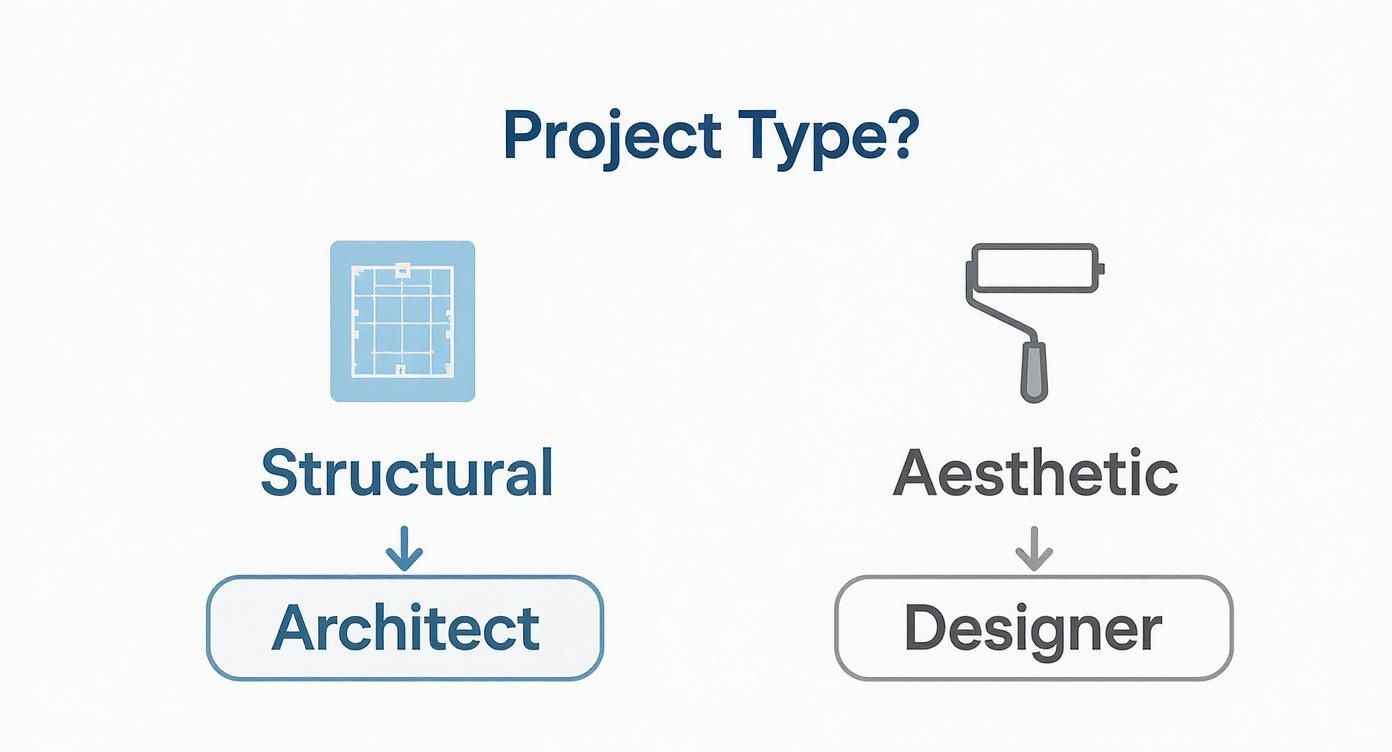
People often use "interior design" and "interior architecture" interchangeably, but they are worlds apart. While an interior designer is brilliant at aesthetics—choosing furniture, fabrics, and paint to make a space beautiful—an interior architecture firm starts much, much deeper. Their work begins long before anyone even thinks about a swatch of fabric.

These are licensed professionals who analyze and redesign the very structure of a building's interior. Their real expertise is in understanding how people move through and interact with their physical environment—a field often called environmental psychology. They solve complex spatial puzzles to make sure a building isn't just attractive, but is fundamentally sound and perfectly tuned for its purpose.

The Architect vs. The Decorator: An Analogy

Think of a building as a human body. An interior decorator is like a personal stylist. They pick the clothes (finishes), the accessories (furniture), and the makeup (color palette) to create an incredible final look. Their role is absolutely vital for appearance and expressing a specific style.

The interior architect, on the other hand, is like a surgeon and a kinesiologist rolled into one. They examine the skeleton (structural walls), the circulatory system (HVAC and plumbing), and the nervous system (electrical wiring). They can perform "surgery" by moving walls, rerouting systems, and completely changing the layout to improve the body's overall health and efficiency. They make sure the body can perform at its peak, not just look the part.

Core Responsibilities of an Interior Architecture Firm

An interior architecture firm's work goes far beyond aesthetics, covering critical technical and strategic ground. The main goal is to make the physical space support the business's objectives, which is especially important in commercial, adaptive reuse, and historic preservation projects.

Here’s a look at what they actually do:

  • Spatial Planning and Reconfiguration: This is all about analyzing and redesigning floor plans. They work to improve traffic flow, maximize every usable square foot, and make the experience better for everyone inside.
  • Structural Modifications: They have the expertise to legally and safely change a building’s interior structure. This includes complex tasks like removing or adding walls and integrating brand-new mechanical systems.
  • Code Compliance and Permitting: This is a big one. They navigate the maze of building codes, zoning laws, and accessibility standards (like the ADA) to ensure the project is fully compliant and can get all the necessary permits.
  • Project Management: They see the project through from the first sketch to the final construction walkthrough. This means coordinating with contractors, engineers, and vendors to make sure the vision becomes a reality, on time and on budget.

The Blueprint for Success: Core Architectural Services

Bringing a vision to life—turning an idea into a functional, beautiful space—isn't a single action. It’s a carefully managed journey. A seasoned interior architecture firm is your guide through a series of distinct phases, with each step building on the one before it to make sure the final result is exactly what you set out to achieve. This process is the blueprint that transforms abstract goals into tangible, valuable assets.

It all kicks off with a critical discovery phase we call Programming. This is so much more than a simple Q&A. Think of it as a deep-dive investigation into how your business operates, what your goals are, and what your space truly needs to accomplish. We ask the tough questions to understand not just what the space should look like, but how it needs to work for you, your staff, and your customers.

The architectural team gathers crucial data on workflow patterns, occupancy needs, brand identity, and even your plans for future growth. All of this information is distilled into a detailed project brief. This document becomes the north star for every single decision that follows.

From Concept to Concrete Plans

With the "what" and "why" sorted out during Programming, we move into the creative phases where the vision starts taking physical form. This is where ideas get explored, sharpened, and ultimately translated into the kind of technical specifications a construction team can build from.

This creative journey unfolds in three main stages:

  • Schematic Design: This is the big-picture, brainstorming part of the process. We develop broad-stroke concepts using tools like bubble diagrams, rough floor plans, and mood boards to pin down the overall look, feel, and flow of the space. The goal here is to explore the possibilities and agree on a clear direction before diving into the details.
  • Design Development (DD): Once a schematic concept gets the green light, the team starts refining it with a much greater level of detail. Specific materials are chosen, lighting plans are created, and interior elevations are drawn up. This phase adds a critical layer of precision, defining the project with enough clarity to start getting realistic cost estimates.
  • Construction Documents (CDs): This is where it all gets real. As the most technical and intensive phase, we produce a comprehensive set of drawings and specifications that become the legal instructions for the contractor. These documents detail everything from how walls are built and where outlets go to the exact paint colors and fixture models. Nothing is left to chance.

This methodical progression from a high-level idea to meticulously detailed plans is what keeps projects on track and on budget, eliminating costly surprises during construction.

The table below outlines this journey, showing how each phase serves a distinct purpose in bringing a project from an initial idea to a completed space.

| The Interior Architecture Project Lifecycle |
| :— | :— | :— |
| Project Phase | Primary Goal | Key Deliverables for the Client |
| Programming | Define project needs, goals, and constraints. | A detailed project brief, space requirements, and budget analysis. |
| Schematic Design | Explore broad concepts and establish the overall design direction. | Conceptual floor plans, mood boards, and initial 3D sketches. |
| Design Development | Refine the chosen concept with specific details and materials. | Detailed floor plans, interior elevations, and preliminary material selections. |
| Construction Documents | Create a complete set of technical drawings for bidding and permits. | A full set of architectural drawings, technical specs, and finish schedules. |
| Bidding & Permitting | Select a qualified contractor and obtain all necessary approvals. | Bid analysis, contractor recommendations, and approved building permits. |
| Construction Admin | Oversee construction to ensure it aligns with the design documents. | Site visit reports, change order management, and final punch list. |

This lifecycle ensures a smooth, predictable process where the client is informed and empowered at every step.

Navigating Regulations and Securing Bids

With a complete set of construction documents in hand, the project shifts from design to the practicalities of getting it built. The interior architecture firm’s role here is absolutely vital, acting as your advocate to navigate complex logistical and regulatory hurdles. This includes managing the Bidding and Negotiation process. We send the construction documents out to qualified general contractors, who then submit bids to build the project. We help you analyze these bids to ensure they are complete and competitive, then assist in negotiating the final contract.

At the same time, we're handling the intricate process of securing permits from local authorities. We submit the construction documents to city and county officials for their review, fielding any questions related to zoning laws, building codes, and safety regulations. This expert navigation is a huge risk-reducer for developers, preventing expensive delays and guaranteeing full compliance.

A skilled interior architecture firm doesn't just design a building; they pilot it through the administrative maze of design review boards, energy codes, and local ordinances, ensuring the project is both buildable and legally sound.

The following graphic helps visualize the different but complementary roles an interior architect and an interior decorator play over the course of a project.
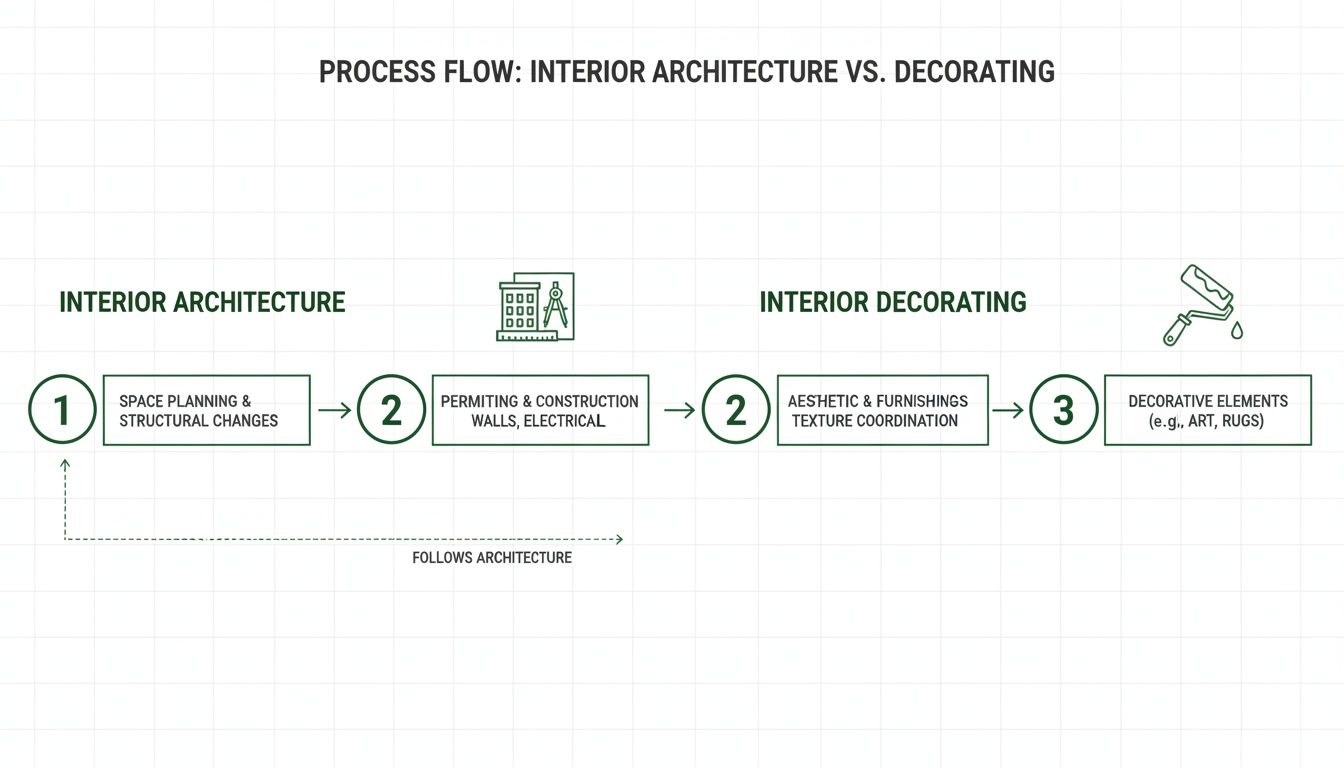
Process flow diagram illustrating the steps for interior architecture and interior decorating services.

As you can see, the architect’s work is foundational—it’s about the structure, systems, and very bones of the space. The decorator’s work then comes in to enhance and complete that environment.

Ensuring Vision Becomes Reality

The final stretch is Construction Administration, and this is where the architect becomes your eyes and ears on the job site. We conduct regular site visits, answer questions from the contractor, review the quality of the work being done, and approve payment applications. This oversight is what protects your investment and ensures the project is built exactly as specified in the documents.

This hands-on management holds the construction team accountable for delivering the quality you paid for. The architect's involvement doesn't stop until the final punch list is complete and you're ready to move into your new, fully realized space. It’s this end-to-end service that showcases the true value of an interior architecture firm, creating a seamless bridge from the first spark of an idea to the day you open your doors.

The U.S. interior design market hit USD 35,010.3 million in revenue in 2024, with remodeling being the fastest-growing segment. This trend perfectly aligns with the adaptive reuse projects we specialize in, which breathe new life into existing structures. You can learn more about the interior design market's growth and how it’s shaping development strategies today.

Unlocking Value with Adaptive Reuse and Preservation

Spacious modern office interior featuring adaptive reuse design with exposed brick and large windows.

When many developers look at an old, tired building, they see a liability—something to be torn down. But a different kind of vision sees immense, untapped potential. This is the world of adaptive reuse, a smart strategy that breathes new life into aging structures, turning them into valuable, high-performing assets for today's market.

Adaptive reuse goes way beyond a simple renovation. It’s about strategically repurposing a building for an entirely new function while celebrating its original character. Think of an old textile mill buzzing with activity as a modern office hub, a forgotten warehouse finding new purpose as luxury lofts, or a grand old bank becoming a chic boutique hotel.

An interior architecture firm that specializes in this work is like a master puzzle-solver. They have the unique expertise to reconfigure outdated layouts for modern needs, weave in new mechanical and electrical systems without disrupting the building's soul, and navigate the intricate maze of historic preservation rules. The goal is always the same: create a space that feels contemporary and works beautifully, but is also rich with history and authenticity.

The Financial Case for Reimagining Old Buildings

The most powerful argument for adaptive reuse often comes down to the bottom line. For developers and property owners, choosing to repurpose an existing building instead of starting from scratch can offer a whole host of financial perks that are simply too good to ignore.

Demolition and new construction are expensive undertakings, both in time and money. Adaptive reuse projects, on the other hand, can be significantly more cost-effective. By keeping the building's "bones"—its core and shell—developers can see huge savings on materials and labor, often slashing project costs considerably.

Globally, the interior design market is projected to reach USD 214.35 billion by 2034, with commercial projects making up a huge piece of that pie. Adaptive reuse projects are frequently 40% cheaper than demolition and new construction, all while preserving historic character and opening doors to valuable tax incentives. Find out more about how market trends are favoring adaptive reuse projects.

These aren't just abstract savings. They directly translate into a healthier pro forma, a faster path to profitability, and a much higher return on investment for the developers who see the potential.

Beyond Cost Savings: The Strategic Advantages

The benefits of adaptive reuse don't stop with the budget. These projects have a built-in competitive edge that brand-new construction often struggles to match.

  • Accelerated Timelines: You get to skip the long demolition and site prep phases, meaning adaptive reuse projects often get to market much faster. This speed is a critical advantage, allowing you to start generating revenue sooner.
  • Unique Market Appeal: Today’s tenants and customers are looking for character. Exposed brick walls, original timber beams, and historic details create a unique sense of place that makes a property stand out from the cookie-cutter new builds, commanding higher rents and attracting top-tier tenants.
  • Environmental Sustainability: Reusing an entire building is one of the greenest things you can do in development. It drastically cuts down on landfill waste, preserves the embodied carbon locked into the original structure, and reduces the environmental toll of producing new materials.

Leveraging Historic Tax Credits for Maximum ROI

If the property has historical significance, the financial picture gets even brighter. A knowledgeable interior architecture firm becomes an essential partner in unlocking valuable historic tax credits. These government programs are specifically designed to encourage the preservation of landmark buildings by offering serious financial rewards.

Navigating the application process for these credits is a specialized skill. It requires a deep understanding of preservation standards, meticulous documentation, and careful negotiation with historical review boards. An experienced firm can guide you through every step, ensuring the design not only honors the building's past but also ticks every box required by the program.

These tax credits can offset 20-30% of qualified renovation costs, which can fundamentally change the financial viability of a project. What might have seemed like a daunting preservation challenge can quickly become a highly profitable venture, turning a community landmark into a cornerstone of your portfolio.

Why This Matters for Your Bottom Line

Choosing to work with an interior architecture firm isn't just about making a space look good; it's a hard-nosed business decision that directly impacts your financial success. Every single design choice, whether it's moving a wall or picking a countertop, is an investment. The right firm makes sure that investment pays off, turning your physical space from a cost center into a high-performing asset.

We're talking about shifting the focus from creating a beautiful space to building a profitable one. It’s the difference between a building that just sits there and one that actively works to boost your revenue, strengthen your brand, and secure your place in the market for years to come.

Enhancing ROI Through Smarter Space Utilization

At the end of the day, commercial real estate is a game of inches—or rather, square feet. The goal is to squeeze maximum value out of every single one. This is where an interior architecture firm really shines, using strategic spatial planning to find revenue potential you didn't even know existed.

Think of them as a master chess player who sees moves on the board that others miss. They might reconfigure a floor plan to create more leasable area, improve the flow of foot traffic, or simply make the space function better for its intended purpose.

For instance, a clever office redesign can fit more employees comfortably, meaning you don't have to lease more space. In a retail shop, rethinking the customer journey can lead to a 10-15% increase in sales just by guiding shoppers past high-margin products. This kind of optimization doesn't just make your property more functional; it makes it far more attractive to top-tier tenants and future buyers, directly boosting occupancy rates and resale value.

A well-designed commercial space is a powerful magnet for tenants and customers. It’s not just about what the space looks like; it’s about how it performs for the businesses operating within it.

There's a reason the U.S. interior design services sector employs around 140,128 professionals. With 38% of global demand coming from offices and retail spaces seeking wellness-focused layouts, developers who get this right can see occupancy jump by 15-20%. You can dive deeper into how strategic design is driving commercial real estate trends on InteriorDesign.net.

Saving Time and Money Through Expert Navigation

The road from a design sketch to a finished building is littered with potential landmines: tangled zoning laws, constantly changing building codes, and bureaucratic permitting processes. Each one is a risk that can lead to expensive delays and budget blowouts.

An experienced interior architecture firm is your guide through this regulatory maze. Their in-depth knowledge of local ordinances and established relationships with review boards mean they can spot trouble long before it becomes a real problem.

This proactive approach takes a huge amount of risk off your plate and keeps the project on a smoother, more predictable timeline. Shaving even a few months off a project schedule by avoiding permitting headaches means you start generating revenue that much sooner—and that's a massive win for any developer's bottom line.

Future-Proofing Your Asset with Flexible Design

The only constant in business is change. The explosion of hybrid work, new patterns in consumer behavior, and emerging technologies all demand that commercial spaces be able to adapt. A forward-thinking interior architecture firm doesn't just design for today; they design for tomorrow.

This foresight is built directly into the space through elements like:

  • Modular Walls: Allowing office layouts to be reconfigured on the fly for different team sizes or project needs.
  • Multi-Use Common Areas: Designing lobbies, cafes, or break rooms that can easily transform into event spaces or collaboration hubs.
  • Scalable Infrastructure: Planning ahead for future tech needs, making upgrades simple and affordable instead of a major renovation.

This kind of thinking protects your investment from becoming outdated. A building designed for flexibility today will stay valuable and relevant for decades, saving you from costly overhauls down the line. It ensures your property can pivot to meet new market opportunities, maintaining its competitive edge and long-term profitability.

How to Choose the Right Firm for Your Project

Two men shaking hands across a table with a laptop and documents in a bright office.

Picking an interior architecture firm is easily one of the most important decisions you'll make for your entire project. This isn't just about flipping through a portfolio of pretty pictures. You’re selecting a long-term partner who will be responsible for guiding you through complex regulations, managing a significant budget, and turning your business goals into a tangible, profitable space.

The "best" firm isn't necessarily the one with the trendiest designs. It's the one whose specific experience and problem-solving skills align directly with the challenges of your project. A great design is the bare minimum; a successful project that meets its goals on time and on budget is the real test of a firm’s value.

Look Beyond the Portfolio

A slick portfolio is a good start, but it really only shows you the final, polished product. To get a real sense of a firm's ability, you have to dig into their process and see how they've handled real-world challenges. Every project looks perfect in a professional photograph, but the true value of a firm emerges in how they navigate the inevitable bumps in the road during design and construction.

Look for a history that matches your project's DNA. If you’re tackling an adaptive reuse project, for example, you need a firm that lives and breathes historic preservation and knows how to bring old buildings into the modern era. Their firsthand experience with the unique structural quirks and regulatory mazes of these projects is absolutely essential.

The right interior architecture firm acts as a translator—they convert your vision into a buildable plan, your budget into a realistic scope, and your business goals into a functional, revenue-generating space. Their role is to de-risk the entire venture for you.

The same logic applies to new commercial construction. A firm with deep roots in South Carolina, strong relationships with local planning departments, and an intimate knowledge of zoning codes is a massive advantage. That kind of local expertise can save you months of delays and thousands in unexpected costs, paving a much smoother road from blueprint to grand opening.

Questions That Reveal True Expertise

When you sit down to interview potential firms, it's time to get past the surface-level questions about their design "style." What you really need to understand is how they think. Their answers to specific, scenario-based questions will tell you far more about their capabilities than any curated gallery of images.

Don't be afraid to come prepared with a list of tough questions that test their practical knowledge and collaborative approach. This is your chance to get a feel for their communication style and determine if they're a good cultural fit for your team.

Here are a few questions that cut to the chase:

  • Problem-Solving: "Tell me about a past project that hit a major zoning or permitting snag. How did you get it back on track, and what was the final result for the client?"
  • Budget Management: "What's your process for keeping the design aligned with our budget from start to finish? How do you approach value engineering if we see costs start to climb?"
  • Collaboration and Communication: "Walk me through how you work with clients, general contractors, and engineers. How do you manage differing opinions or priorities to keep everyone moving forward?"
  • Local Knowledge: "What's your experience with the design review boards and building codes right here in this municipality? Are there any specific local challenges we should be prepared for?"
  • Project Management: "What tools and systems do you use to manage the project schedule and budget? How often will we get updates, and what will they look like?"

The way they answer these questions will paint a very clear picture of their competence, their transparency, and ultimately, whether they are the right strategic partner to bring your vision to life.

Your Partner in Building Lasting Value

Choosing an interior architecture firm isn't like picking a vendor; it's about bringing on a strategic partner who’s fully invested in your commercial success. Think of them as the conductor of a complex orchestra, expertly weaving together your vision, budget, regulations, and market demands to create a space that truly works. They’re the ones who turn abstract business goals into a tangible, high-performing physical asset.

The real value here goes far beyond beautiful finishes or trendy furniture. It’s found in a floor plan that actively maximizes your revenue, a design that sails through the permitting process without costly delays, and a building that will stay relevant and valuable for decades to come. A skilled interior architecture firm makes sure every single choice directly contributes to your bottom line.

The most successful projects begin with a shift in mindset—viewing architectural services not as an expense, but as the foundational investment in building enduring value. Your partner in this process is key to unlocking your property's full potential.

So, as you approach your next commercial or adaptive reuse project, think about the strategic advantage that expert guidance brings to the table. The right architectural partner doesn't just design a space for you. They help build your future, ensuring your investment delivers returns long after the dust has settled. It’s the smartest first step you can take.

Frequently Asked Questions

When you're dealing with commercial real estate and development, questions are bound to come up. Here are some of the most common ones we hear from clients thinking about working with an interior architecture firm.

What's the Difference Between an Interior Architect and an Interior Designer?

It's a common point of confusion, but the distinction is crucial. While both want to create great spaces, their roles are fundamentally different.

An interior architecture firm is run by licensed professionals who are legally qualified to change the structure of a building's interior. Think of them as dealing with the "bones" of the space—moving walls, integrating new plumbing and electrical systems, ensuring everything is up to code, and handling any structural work.

An interior designer, on the other hand, usually works on the surface level. Their expertise is in the finishing touches: furniture, paint colors, fabrics, and accessories that define the aesthetic. If your project involves a gut renovation, adaptive reuse, or major new construction, you need an interior architect to lead the charge.

How Much Does It Cost to Hire an Interior Architecture Firm?

There's no single answer here, as the cost really depends on your project's size, scope, and how complex it is. Generally, fees are handled in one of three ways:

  • A percentage of the total construction cost, typically landing between 8% and 15%.
  • A fixed, flat fee that's agreed upon before any work begins.
  • An hourly rate for design work and consultations.

It might feel like a big line item on the budget, but a good firm provides value that far exceeds its cost. They catch expensive mistakes before they happen, navigate the permitting maze to save you from costly delays, and design your space to get the most out of every square foot. It’s less of a cost and more of an investment in your property's future.

Hiring an expert firm is about risk mitigation. Their fee is a strategic investment to ensure your multi-million dollar project is executed correctly, compliantly, and profitably, preventing far costlier mistakes down the line.

How Long Does a Typical Commercial Project Take?

The timeline is completely tied to the scale of the job. A simple commercial upfit could be wrapped up in a few months. But a major adaptive reuse project or a brand-new building can easily stretch to a year or more.

The whole process breaks down into distinct phases: design (which includes schematics and detailed construction documents), bidding and permitting, and finally, construction itself. A seasoned firm will give you a realistic timeline from the get-go and has the project management chops to keep things moving forward.

Can a Firm Help with Historic Tax Credits?

Absolutely. In fact, this is one of the most valuable services a firm can offer if you're working on a historic property. Finding a local firm that has successfully navigated the state and federal historic tax credit programs is a game-changer. This isn't something you can just wing; it’s a specialized skill that can make or break the financial success of a project.

Firms with this expertise will walk you through the entire application, from documenting the building's historic importance to making sure every single detail of the renovation follows the strict Secretary of the Interior’s Standards. Their guidance is essential for maximizing your tax credits and transforming a piece of history into a profitable, modern asset.


Ready to transform your vision into a valuable, enduring property? At Sherer Architects, LLC, we specialize in guiding clients through every stage of design and construction, from innovative commercial spaces to complex historic preservation projects. Let's discuss how our strategic approach can bring structure, beauty, and profitability to your next venture.
Contact us today to schedule your consultation

Categories
Uncategorized

Restaurant Design Service: Elevate Your Space from Concept to Opening

Hiring a professional for your restaurant's design isn't just about making the place look good. It's a fundamental investment in your business's future, a strategic move to build an experience that drives revenue, smooths out your operations, and carves out a strong brand identity.

Why Strategic Design Is Your Secret Ingredient

Picture two restaurants on the same block. One is always humming with activity, every table taken, with a line stretching out the door. The other? It's often half-empty, fighting to pull in a crowd. The food might be equally good at both, but the difference is often the experience—and that experience is no accident. It’s the result of thoughtful, strategic design.

This is where a professional restaurant design service shifts from being a line-item expense to your most critical investment. It’s easy for new owners to pour all their energy into perfecting the menu, but the physical space is the stage where every meal plays out. Your restaurant's design is the silent partner working around the clock, shaping everything from how comfortable your guests feel to how efficiently your staff can move.

More Than Just a Pretty Space

Expert design is about so much more than choosing paint swatches and light fixtures. It's a calculated, nuts-and-bolts approach to building a high-performing business from the inside out. The process is all about digging into the details to make sure every dollar you spend comes back to you.

Here’s where that strategic thinking really pays off:

  • Elevating the Guest Experience: A great design creates a welcoming vibe with comfortable seating, a natural flow, and acoustics that actually let people talk. This is what turns a first-time visitor into a regular.
  • Boosting Operational Efficiency: It’s about laying out a kitchen and service station that cuts down on wasted steps for your team, slashes ticket times, and prevents those frustrating bottlenecks during the dinner rush.
  • Building Your Brand Identity: Your physical space should tell your story. A cohesive design creates a memorable identity that clicks with the people you want to attract.
  • Driving Profitability: Smart design can do everything from increasing table turnover to subtly encouraging guests to spend more. It can even lower your day-to-day operating costs.

"A classic rookie mistake is falling in love with aesthetics while ignoring function. A gorgeous dining room won't save you if the kitchen workflow is a nightmare. True professional design finds that perfect balance between front-of-house atmosphere and back-of-house efficiency."

In an industry this competitive, you need every advantage you can get. With the average cost to open a full-service restaurant falling anywhere between $375,000 to $700,000, making every square foot count isn't just a good idea—it's essential for survival. This is why many of the best new designs focus on adaptable, flexible spaces that can change as your needs do, making your initial investment work that much harder. If you're curious, you can explore more of the latest restaurant interior design trends to see just how much the industry is evolving.

From Concept To Grand Opening: A Step-By-Step Look

Taking a great restaurant idea from a napkin sketch to a packed opening night can feel overwhelming. A seasoned architecture partner is your guide, providing a clear roadmap for what can otherwise be a complex, winding journey. Think of it as a well-planned expedition—each stage is critical and builds directly on the one before it.

This structured process is all about preventing costly mistakes and keeping the project on track. Your architect’s job is to translate that big vision in your head into a functional, beautiful, and profitable reality.

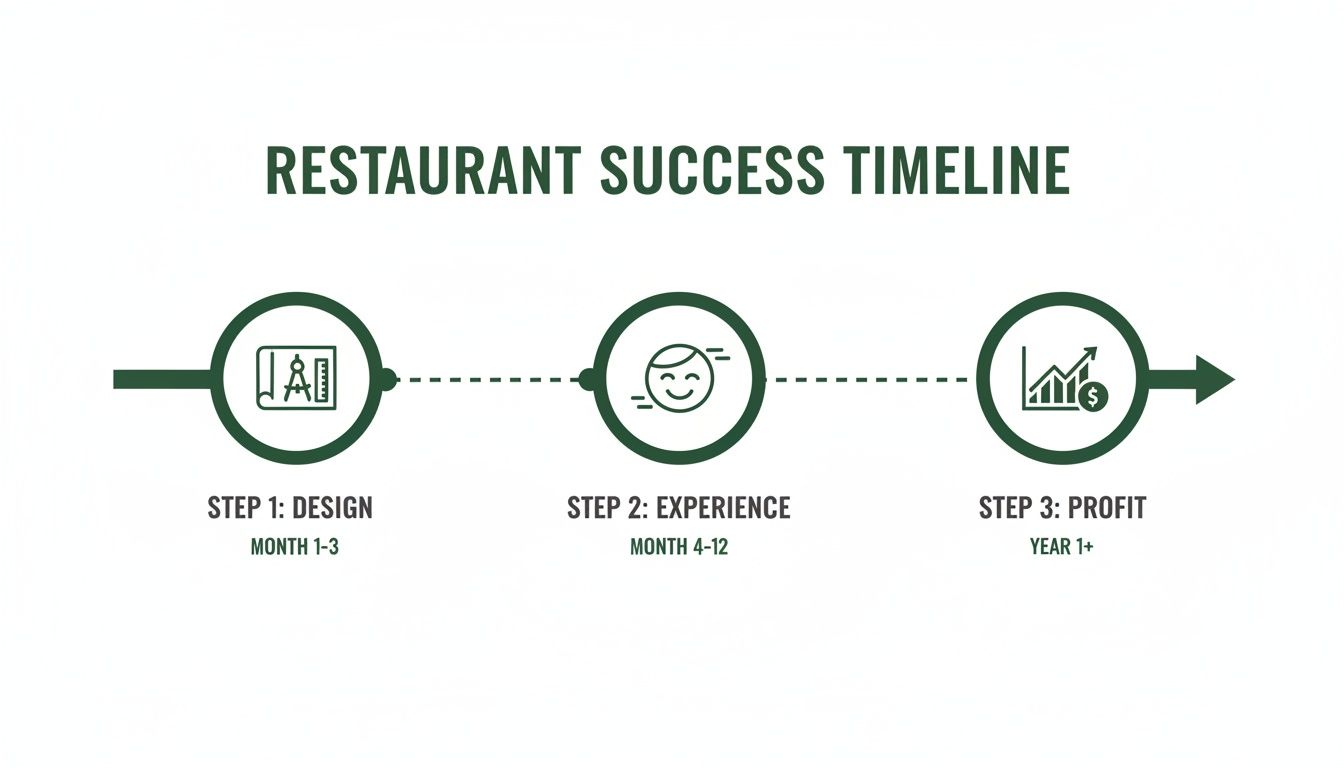
This timeline shows exactly how thoughtful design isn't just an expense; it's the foundation for an unforgettable guest experience and, ultimately, a healthy bottom line.

Restaurant success timeline illustrating design, customer experience, and profit stages with associated timeframes.

As you can see, strategic design is the first domino to fall, setting in motion everything that leads to long-term success. Let's walk through what the process actually looks like.

Key Phases of a Restaurant Design Project

The design and construction of a restaurant follows a predictable, well-defined path. Understanding these phases helps you know what to expect and how to prepare for each step. The table below breaks down the journey from your initial idea to opening day.

Phase Primary Goal Key Activities Typical Duration
Programming Define the project's core identity and functional needs. Brand discovery, operational analysis, budget talks, site review, creating a detailed project brief. 2-4 weeks
Schematic Design Explore the "big picture" layout and spatial flow. Bubble diagrams, rough floor plans, initial 3D massing, exploring multiple layout options. 3-6 weeks
Design Development Refine the design with specific materials and details. Selecting finishes, fixtures, and equipment (FF&E); coordinating with engineers (MEP); creating detailed drawings. 4-8 weeks
Construction Docs Create the final, buildable blueprint for permits and contractors. Producing a complete set of technical drawings and specifications for construction. 6-12 weeks
Construction Admin Oversee construction to ensure it matches the design intent. Site visits, answering contractor questions, reviewing work quality, problem-solving during the build. Varies (4-12+ months)

Each phase is a crucial checkpoint, ensuring that the final build is perfectly aligned with the vision established on day one. Now, let's dig into what each of these stages really involves.

Programming: Defining Your Restaurant's DNA

Before a single line is ever drawn, we start with programming. This is the discovery phase, a deep dive where we listen and ask a ton of questions to get to the heart of your project. We're talking about your brand, your ideal customer, your menu, how the kitchen needs to operate, and of course, your budget.

This isn't just making a wish list. It's about nailing down the "why" behind every decision. How many seats do you need to be profitable? What's the perfect flow between the bar and the dining room? What kind of vibe will make your target demographic feel like they've found their new favorite spot?

This foundational phase sets the project's entire direction. A thorough programming stage ensures that the final design isn't just beautiful but is perfectly aligned with your business goals, preventing expensive changes later on.

Answering these questions results in a detailed project roadmap. This document becomes our north star for all future design choices, guaranteeing every element serves a specific, intentional purpose.

Schematic Design: Sketching The Big Idea

Once the program is locked in, we move to schematic design. This is where your vision starts to become tangible through rough sketches, bubble diagrams, and basic floor plans. It’s a highly creative, exploratory phase where we focus on the big picture.

The main goal here is to organize the space and establish flow. We’ll play with different layouts for the kitchen, dining areas, and entryway, figuring out the most intuitive and efficient way for both staff and guests to move through the restaurant. Think of it as arranging the main puzzle pieces until they click into place perfectly.

To help you really see and feel the space, we often create a realistic architectural rendering. These 3D images give you a true sense of the atmosphere, materials, and lighting long before a single wall goes up.

Design Development: Adding Detail and Dimension

After you've approved a schematic design, the project enters design development. Here, we take those initial sketches and start refining them into more detailed, technical drawings. This is where the abstract concept gets fleshed out with specific materials, finishes, and fixtures.

During this phase, we make decisions on everything—from the type of flooring and wall textures to the lighting design and custom millwork. Your architect also brings in the engineers to seamlessly integrate critical systems like plumbing, electrical, and HVAC into the design. The result is a much clearer, more comprehensive picture of the finished restaurant.

Construction Documents: The Final Blueprint

The construction documents phase is the most technical and intensive stage. The detailed design is translated into a complete set of blueprints and specifications that a contractor will use to build your restaurant. This is the final instruction manual.

These documents are incredibly precise, covering everything needed for permitting and construction:

  • Architectural Drawings: Exact dimensions for every wall, door, and window.
  • Structural Plans: All the details on the building's support systems.
  • MEP Plans: The layouts for Mechanical, Electrical, and Plumbing systems.
  • Specifications: A written guide detailing every single material, product, and finish to be used.

This comprehensive package is absolutely essential for getting accurate bids from contractors and making sure the project is built exactly as we designed it.

Construction Administration: Building The Vision

Finally, during construction administration, your architect becomes your chief advocate on the job site. We don't swing hammers, but we are there regularly to answer the contractor's questions, review the quality of the work, and ensure the build is following the plans to the letter.

This oversight is crucial for protecting your investment. Your architect helps solve the inevitable unforeseen problems that pop up on-site, reviews payment requests, and confirms that the final product perfectly matches the approved design, guiding you all the way to a successful grand opening.

The Core Services That Drive Restaurant Success

Top-tier restaurant design service is about so much more than picking out cool furniture and a great color palette. It’s the entire strategic playbook for building a business that runs like a well-oiled machine from the day you open. These core services are the invisible systems that ensure your restaurant isn't just beautiful—it's efficient, profitable, and built to last.

Think of your architect as the general manager of the entire project. They aren't just drawing a single floor plan; they're coordinating the guest experience, the kitchen's workflow, and all the complex technical systems into a single, winning strategy. Every service is a critical piece of the puzzle.

This is where design moves beyond pure aesthetics and gets into the fundamental mechanics of what makes a restaurant actually work.

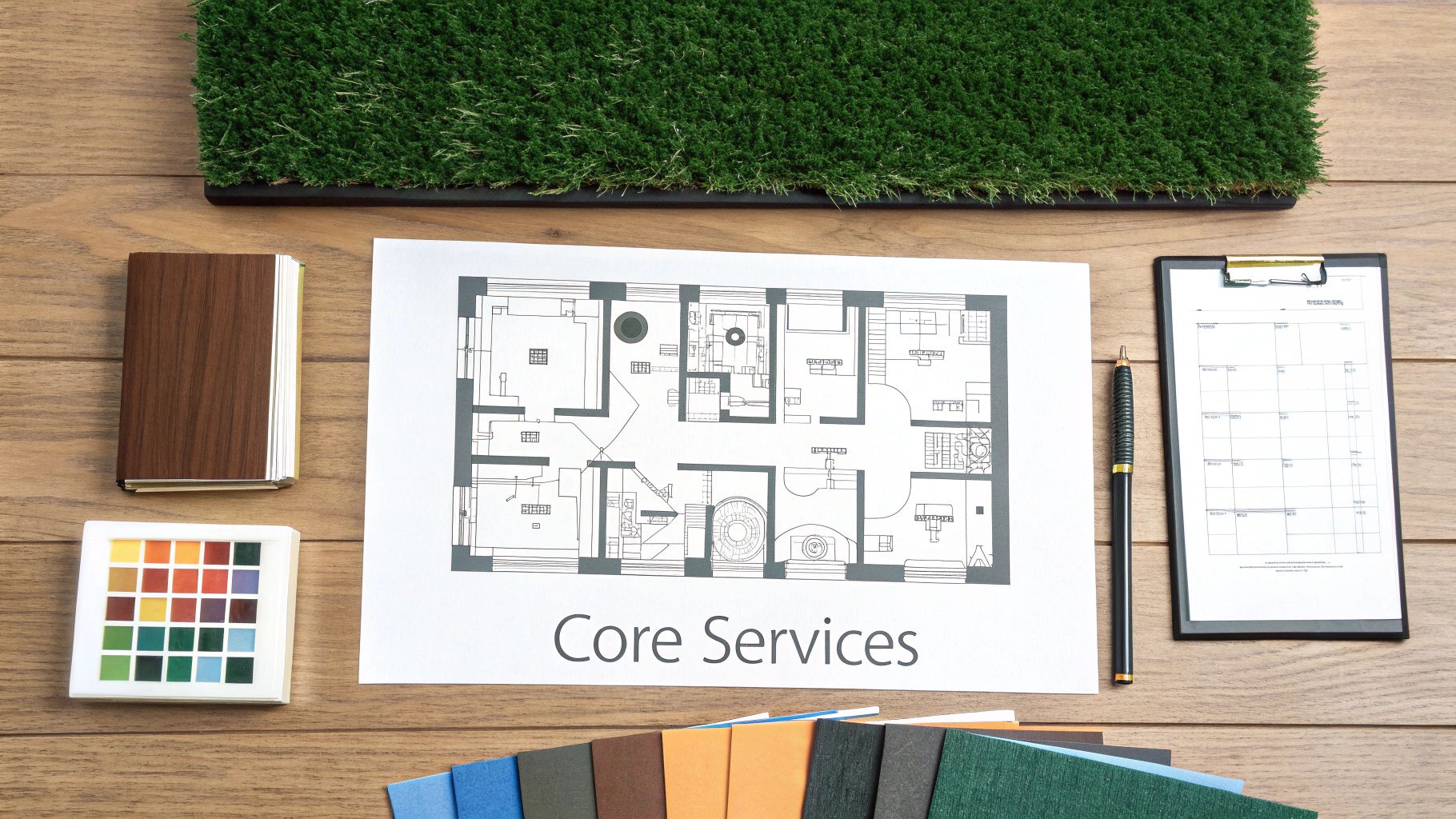
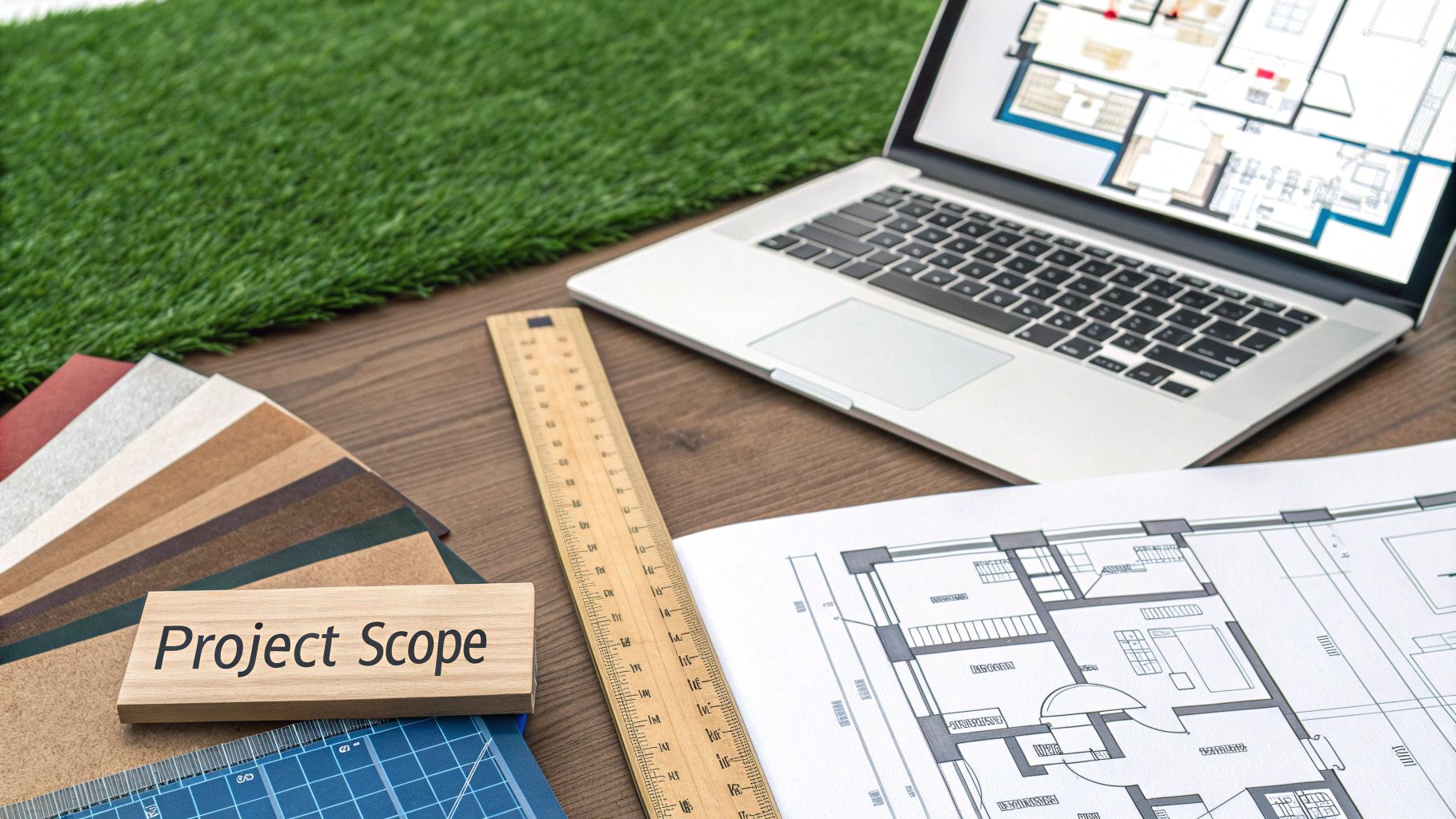
Overhead view of a design workspace with a blueprint, color swatches, and artificial turf.

Site Optimization and Programming

Before a single line is drawn, the first job is to squeeze every drop of potential out of your location. Site optimization is all about analyzing the building or lot to take advantage of what's already there. This could mean orienting the dining room to catch the afternoon sun, cutting down on lighting bills, or placing the main entrance where it naturally captures foot traffic.

At the same time, we dive into programming. This is where we define your restaurant's DNA. It's a detailed process that outlines every functional need, from the number of seats required to hit your revenue goals to how the kitchen, storage, and service areas must relate to one another. It's the essential blueprint for your business model.

Strategic Floor Plans and Kitchen Design

The floor plan is your restaurant's central nervous system. A great layout creates a natural flow, establishing distinct zones for dining, waiting, and service that feel both separate and connected. It guides the customer's journey and, just as importantly, helps your staff move efficiently, preventing those dreaded bottlenecks during a weekend rush.

The kitchen, of course, is the engine. A skilled architect works hand-in-glove with you and your chef to create a workspace that’s not only safe but hyper-efficient. A crucial part of the process is learning how to design a restaurant kitchen for peak performance, where every piece of equipment is placed to minimize steps and slash ticket times.

A rookie mistake is to focus all the attention on the front-of-house glamour while neglecting back-of-house function. An expert knows that a calm, efficient kitchen is the secret to a flawless guest experience out front.

MEP and FF&E Coordination

This is where things get technically complex, and where having a pro quarterbacking the project really pays off. Your architect becomes the central hub for all the engineering disciplines.

  • MEP (Mechanical, Electrical, and Plumbing) Coordination: This is the unseen network of HVAC ducts, wiring, and pipes that makes the building hum. Your architect ensures this complex web is integrated seamlessly into the design so it's effective but invisible. It’s what handles everything from kitchen ventilation and fire suppression to the mood lighting and restroom functions.

  • FF&E (Furniture, Fixtures, and Equipment) Selection: This service covers every tangible item your guests will see and touch. The goal isn't just to find things that match your brand, but to source commercial-grade pieces that can withstand the nightly wear and tear. We're talking tables, chairs, bar stools, light fixtures, and service stations that are built for the long haul.

Ensuring Accessibility and Energy Efficiency

Any modern restaurant design has to clear some important hurdles, from regulations to sustainability. A knowledgeable firm doesn’t just meet these requirements; it turns them into features that benefit your business.

Accessibility (ADA Compliance)
An architect’s job is to make sure every single guest feels welcome. This goes way beyond just adding a ramp. It’s about thoughtful planning for:

  1. Clear Pathways: Ensuring aisles are wide enough for easy wheelchair navigation.
  2. Accessible Seating: Designing tables that are fully integrated into the main dining area, not tucked away in a corner.
  3. Restroom Design: Creating ADA-compliant restrooms with the proper clearances and grab bars from the start.
  4. Service Counters: Making sure bar tops and host stands are at accommodating heights.

Getting this right from day one avoids expensive fixes later and shows your community you’re committed to inclusivity.

Energy Efficiency
Smart, sustainable design choices can make a huge dent in your long-term operating costs. An experienced architect will specify things like energy-efficient windows, high-performance insulation, and smart lighting systems using LEDs and occupancy sensors. These features don't just lower your utility bills; they create a more comfortable environment for everyone and position your restaurant as a forward-thinking, responsible business.

Navigating Zoning, Permits, and Design Review Boards

Let's be honest: zoning laws, building codes, and Design Review Boards can feel like a tangled mess of red tape. It’s easy to see them as bureaucratic roadblocks meant to slow you down. But a better way to think of them is as the official "rules of the game." And to win, you need an expert guide who knows every play in the book.

Every single city and county has its own set of rules dictating what you can build and how. These aren't just gentle suggestions—they're legally binding standards that can completely derail a project if you're not paying attention. For a restaurant, this could be anything from the exact number of parking spots you need to the size and style of your sign out front.

Putting off these details is a classic, and costly, mistake. It almost always leads to painful redesigns, agonizing delays, and in the worst cases, a project that has to be abandoned. This is precisely where a seasoned architect earns their keep.

Your Advocate in the Approvals Game

Think of your architect as your personal translator and diplomat. They fluently speak the technical language of city planners and building inspectors, and they've likely spent years building professional relationships with the very people who will approve your project. That kind of rapport is priceless—it can turn a potentially combative process into a collaborative one.

An architect with deep local roots understands the subtle quirks of your town’s regulations. Here in South Carolina, for example, that might mean navigating the strict guidelines of a historic district in Charleston or satisfying the specific aesthetic demands of a local Design Review Board in Columbia.

This specialized knowledge allows them to see potential roadblocks miles away. They can get ahead of concerns about everything from landscaping ordinances to fire code compliance, making sure your plans are buttoned up and correct the first time they're submitted.

A great local architect doesn't just submit a set of drawings; they shepherd your project through the system. Their grasp of local codes and their relationships with city officials can literally save you months of delays and thousands in revision fees.

Common Hurdles in Restaurant Permitting

The approvals process for a restaurant is notoriously tricky because you're dealing with so many overlapping layers of public health and safety. Your architect’s job is to create a design that makes everyone happy, all at once.

Here are some of the usual suspects that require careful planning:

  • Parking Requirements: Cities have rigid formulas for how many parking spaces you need, usually based on your square footage and seating capacity. Miss the mark, and your project could come to a screeching halt.
  • Signage Restrictions: Zoning codes often have a lot to say about the size, placement, and even the lighting of your exterior signs.
  • Accessibility (ADA): Your design must fully comply with all Americans with Disabilities Act standards for things like ramps, restrooms, and table access. No exceptions.
  • Health Department Codes: Kitchen layouts, equipment, and ventilation systems are under a microscope and must meet tough public health regulations.
  • Historic District Guidelines: If your restaurant is in a designated historic area, every exterior change—from the paint color to the window frames—will face intense scrutiny to protect the neighborhood's character.

A professional restaurant design service tackles these issues from day one. By baking these requirements into the design from the very beginning, your architect paves a much smoother and more predictable path through the approvals maze. This foresight is what turns a potential nightmare into just another checkbox on the way to your grand opening.

Unlocking Value with Adaptive Reuse and Preservation

Some of the most compelling restaurant spaces aren't brand new. They’re born from the clever transformation of forgotten buildings—breathing new life into old warehouses, historic storefronts, or neglected industrial sites. This approach is called adaptive reuse, and it’s a powerful way to create a one-of-a-kind destination.

Think about it: your restaurant could be housed in a building that already has a soul and a story. By repurposing an existing structure, you get instant character and a narrative that new construction just can't buy. It's often more sustainable and cost-effective than a full demolition and new build, extending a building’s useful life by 50-75 years.

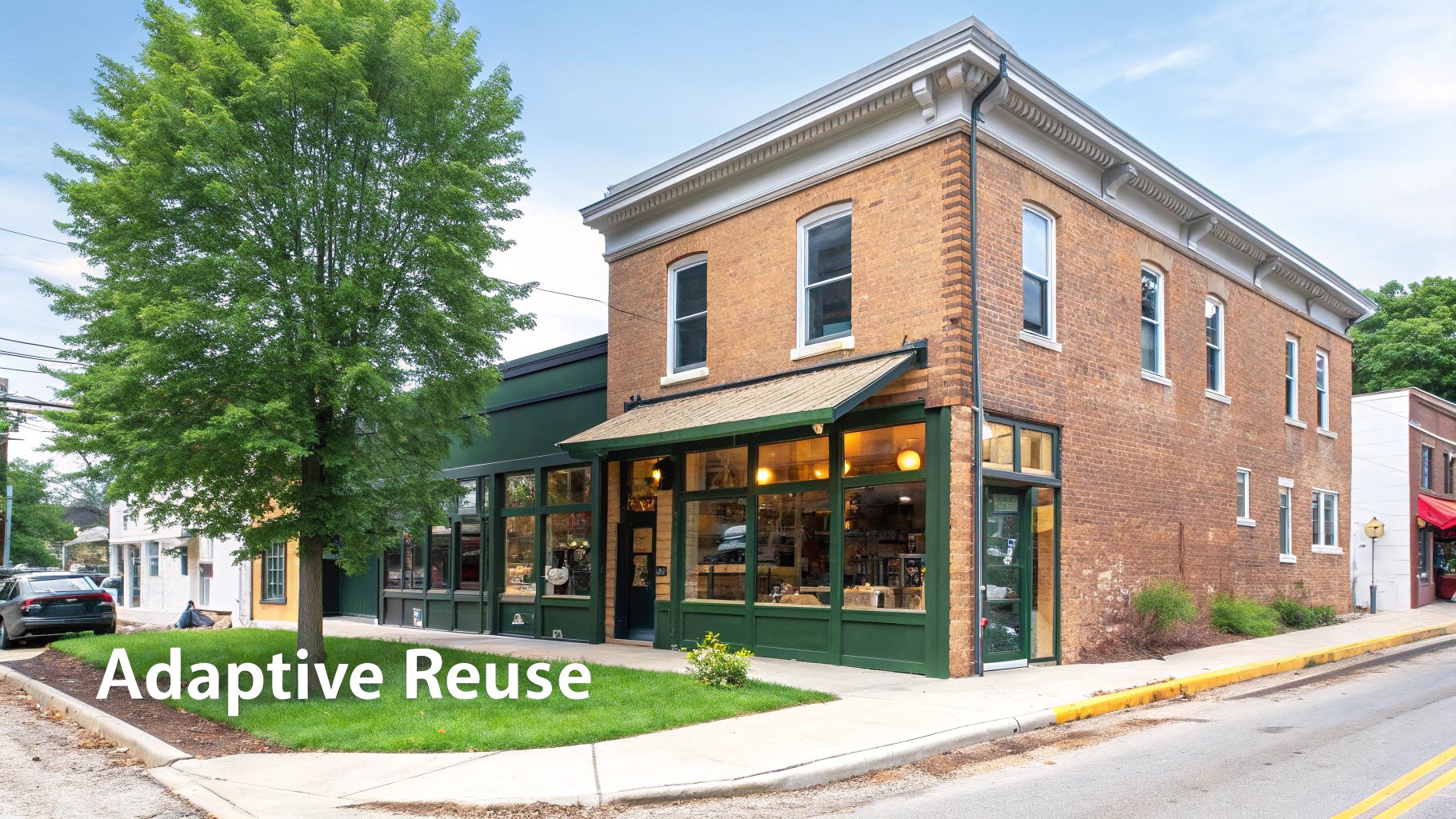
A historic brick building with a green storefront and an adaptive reuse sign on a sunny day.

The Rewards of Historic Preservation

Working with historic buildings has its challenges, but the payoff is huge. The goal of historic preservation is to honor a building's original character while carefully updating it for today's world. This is a delicate balancing act, and it’s where a specialized restaurant design service really shines.

It starts with a deep dive into the building’s past, researching original materials and construction methods to make sure any new additions feel right. It requires a sensitive touch to merge history with the demands of a modern restaurant, like figuring out how to integrate a high-tech kitchen ventilation system into a structure built a century ago.

The result is a space that feels deeply connected to its community. Exposed brick, original timber beams, and antique windows become part of the experience, creating an unforgettable atmosphere for your guests.

Historic preservation is about more than just saving an old building; it’s about curating an experience. When you preserve a structure's history, you give your guests a story to connect with, turning a simple meal into a memorable event.

As diners increasingly seek out unique experiences, these one-of-a-kind spaces are more valuable than ever. Architects excel at unlocking this potential, blending casual gathering spots with intimate nooks that encourage guests to stick around. With 60% of permanent restaurant closures tied to recent economic pressures, creating a distinct and resilient brand is crucial. You can dig deeper into these restaurant industry trends to see how they’re shaping design.

Turning History into a Financial Asset

Beyond the look and feel, historic preservation can offer some serious financial perks. But navigating the world of historic tax credits is a beast. An architecture firm with real experience in this niche is an invaluable partner, guiding you through the process to make the most of your investment.

These incentive programs exist at the federal, state, and local levels to encourage the restoration of historic properties. Getting them isn't easy—it involves a tough application and approval process, requiring meticulous documentation and a design that follows strict preservation rules.

An experienced architect can help you:

  • Identify eligible properties and figure out if they’re a good candidate for tax credits.
  • Navigate the application process with bodies like the State Historic Preservation Office (SHPO) and the National Park Service.
  • Develop a design that meets the Secretary of the Interior's Standards for Rehabilitation.
  • Document every single step to ensure you meet all compliance requirements for the credits.

These financial tools can significantly cut the overall cost of your project, turning a challenging renovation into a smart financial move. By using historic tax credits, you're not just creating a fantastic restaurant—you're making a sustainable investment that preserves a piece of your community's heritage.

How to Choose the Right Architecture Partner

Picking the right architect is probably the most critical decision you’ll make for your entire restaurant project. This isn't just about hiring someone to draw up some plans. It's about finding a true partner who gets your vision, protects your investment, and navigates the inevitable bumps in the road.

Think of them as your guide, advocate, and chief problem-solver, from the very first napkin sketch to the day you pass your final inspection.

Getting this choice wrong can be a nightmare. We’re talking about costly design flaws that kill your workflow, budgets that spiral out of control, and maddening delays that push your opening date back. Spending the time to properly vet your options upfront will pay you back tenfold.

Key Evaluation Criteria

How do you sort through the options and find "the one"? It comes down to asking the right questions and looking for specific proof points that separate the experts from the generalists.

Look for Relevant Experience

First things first: you need an architect with specific, hands-on restaurant experience. Sure, any architect can design a building, but a restaurant is a different beast entirely. It’s a highly specialized machine where every square inch matters.

A firm that lives and breathes restaurant design understands the delicate balance between a welcoming front-of-house vibe and a hyper-efficient back-of-house engine. When you're looking at their portfolio, don't just look for pretty pictures. Look for projects that are similar to yours in both size and style. An architect who’s a rockstar at designing fast-casual chains might not be the right fit for your intimate fine-dining concept.

Key Questions for Potential Partners

Once you have a shortlist, it’s time to have some serious conversations. A good interview process helps you get a feel for their working style and whether they’ll mesh with your team.

Here are a few questions you absolutely have to ask:

  • How do you approach budget management? You want a partner who designs to your budget, not one who just tells you when you've gone over. They should be proactive about value engineering and cost-conscious decisions from day one.
  • What does your communication process look like? You’re going to be in the trenches together for months. Make sure their communication style—who your main contact is, how often you’ll get updates—works for you.
  • Can I speak with a few of your past restaurant clients? Talking to other owners is non-negotiable. Ask them the tough questions: How did the architect handle problems? Were they responsive? Did they stick to the timeline?
  • How well do you know the local landscape? Deep knowledge of local zoning codes, permitting quirks, and having established relationships with city officials is a huge advantage. It can literally save you months of delays and thousands of dollars.

Choosing an architect is like casting the lead role in a play. You need someone who not only knows the lines but deeply understands the character of your business, ensuring every decision supports the final performance.

Finally, get total clarity on their fee structure right away. Whether they charge a fixed fee, an hourly rate, or a percentage of construction costs, you need to understand exactly what you're paying for. A true professional will provide a detailed proposal outlining the full scope of their restaurant design service. This kind of transparency is the bedrock of a great working relationship.

Architect Evaluation Checklist

To help you compare firms apples-to-apples, we've put together this checklist. Use it during your interviews to make sure you're covering all the essential bases and making an informed decision.

Evaluation Criteria What to Look For Why It Matters
Restaurant-Specific Portfolio Projects similar in scale, style, and complexity to yours. Look for a variety of concepts. Proves they understand the unique operational and aesthetic demands of food service spaces, not just general commercial design.
Local Knowledge & Relationships Experience navigating local zoning, building codes, and health department rules. Established contacts with city planners. This expertise dramatically speeds up the permitting and approval process, avoiding costly delays and redesigns.
Client References Eager to provide contacts for past restaurant clients. References should speak to problem-solving and communication. Honest feedback from other owners is the best indicator of how they'll perform under pressure and manage your project.
Communication & Process A clear, defined process for communication, meetings, and decision-making. A designated point of contact. A structured process prevents misunderstandings and ensures you're always informed, keeping the project on track.
Budget Management Approach Proactive strategies for cost control, value engineering, and transparent reporting. They design to your budget. Protects your investment by ensuring financial goals are a core part of the design process, not an afterthought.
Team & Consultant Network An established team of engineers (MEP, structural), kitchen designers, and other key consultants. A well-connected firm brings a vetted, cohesive team to the table, ensuring seamless coordination and expertise.

Ultimately, choosing your architect is about more than just qualifications; it's also about chemistry. This is a long-term relationship, so find a team you trust, respect, and genuinely enjoy working with.

Your Top Restaurant Design Questions, Answered

Jumping into a partnership with a design firm for your restaurant naturally brings up a lot of questions. You’re thinking about the process, the budget, and what you’re really getting for your money. Let's tackle some of the most common questions we hear from restaurateurs to clear things up. These are the real-world concerns that pop up when you're trying to bring a dining concept to life.

How Much Does a Restaurant Design Service Cost?

Architectural fees are almost always calculated as a percentage of the total construction cost, usually landing somewhere between 8% and 12%. Where your project falls in that range really depends on its complexity and exactly what you need us to do. A brand-new building from the ground up will be on the higher end, while a simpler interior fit-out for an existing space might be on the lower side.

It's easy to see that number as just another expense, but it's much better to think of it as an investment. A smart architect doesn't just cost you money; they save you money. We do this by designing floor plans that squeeze in more paying customers, creating meticulous construction plans that prevent expensive mistakes, and expertly navigating the permitting maze to avoid costly delays.

How Long Does the Entire Process Take?

The timeline for a restaurant project can swing wildly depending on the scope. A straightforward interior refresh? You might be looking at 4-6 months from our first meeting to your grand opening. But if we're talking about a new build from scratch or a tricky historic renovation, it’s not uncommon for the project to take 12-18 months, sometimes even longer.

To break that down, the design phase itself can take anywhere from 3 to 5 months. After that, you've got the permitting process, which can easily add another 1 to 3 months before a single hammer is swung. A seasoned architect will give you a realistic timeline right from the start and then actively manage that schedule to keep things on track.

The biggest mistake we see? People get so caught up in the look and feel that they forget about how the place actually works. A gorgeous dining room is useless if the kitchen is a chaotic mess or customers are constantly bumping into each other. True professional design is about striking that perfect balance between front-of-house vibe and back-of-house operational genius.

Can I Just Hire a Contractor and Skip the Architect?

For any serious restaurant project, trying to skip the architect is a gamble I wouldn't recommend. Think of your architect as your advocate and the person responsible for quality control. They're the ones who create the detailed "instruction manual"—the construction documents—that contractors use to give you accurate, apples-to-apples bids. This alone protects you from overpaying.

Once construction starts, the architect is on-site, making sure the work is being done correctly and that the finished product matches the vision you signed off on. Going it alone with just a contractor leaves you wide open to major risks like critical design flaws, massive budget overruns, code violations, and ending up with a space that just doesn't work for your business.


At Sherer Architects, LLC, we believe great design is the bedrock of a great business. We’re experts at bringing structure to life, guiding owners through every step to create spaces that are not only beautiful but also durable and profitable. See how we do it at shererarch.com.

Categories
Uncategorized

A Developer’s Guide to Material in Interior Design

When you’re developing a commercial property, the materials you choose are doing a lot more than just looking good. They’re a core part of your business strategy. The right choices can directly boost a building's profitability and long-term value, while the wrong ones can become a financial drain.

Why Material Selection Is a Critical Business Decision

For developers and property owners, materials aren't just finishes; they're working assets. Shifting your perspective from "what looks good" to "what performs best" is the key. Every single choice—from the flooring in a bustling lobby to the insulation you can't even see—carries serious financial weight.

Think of it like you're building a team. Each material has a job to do. One might need to withstand a constant stream of foot traffic, another's job is to slash energy bills, and a third has to meet strict fire codes. If you "hire" the wrong material for the job, you're setting yourself up for constant maintenance headaches, early replacement costs, and unhappy tenants. All of that eats away at your bottom line.

Balancing Aesthetics with Business Goals

The real trick is finding that sweet spot where great design meets smart business. It’s a puzzle with a few key pieces that all need to fit together perfectly.

  • Durability and Maintenance: How tough is this material, really? What’s it going to cost us in time and money to keep it looking good year after year?
  • Life-Cycle Cost: Don't just look at the purchase price. What's the total cost of ownership when you factor in installation, upkeep, and eventual replacement?
  • Regulatory Compliance: Is this material up to code? Does it meet all the building, safety, and energy requirements for where and how we’re using it?
  • Sustainability and Marketability: Does this choice resonate with today’s tenants? Does it align with green building standards that are becoming less of an option and more of an expectation?

For a developer, the spec sheet is a direct reflection of the asset's quality. Choosing materials wisely isn't just an operational decision; it's a strategic move that pays dividends for years to come.

This mindset is more important than ever. The global interior design market was valued at a staggering USD 145.3 billion in 2024, and it's still growing. Within that market, sustainable and durable materials are becoming the cornerstone of smart investment, especially in adaptive reuse projects that can give a building another 50 years of life. You can dive deeper into these financial trends in this PR Newswire report on the interior design market.

Understanding Materials for High-Traffic Environments

Choosing the right materials for a commercial space is a lot like casting for a movie. You need the right actor for the right role. You wouldn't cast a delicate, dramatic actor for a high-action stunt scene, and you certainly wouldn't put elegant hardwood flooring in a hospital emergency room. Each material has its own set of skills, and success comes from matching those skills to the demands of the environment.

Porcelain tile, for instance, is your rugged action hero. It’s tough, stands up to immense pressure, and resists scratches and stains, making it the go-to choice for punishing environments like lobbies and corridors. Luxury Vinyl Tile (LVT) is the versatile character actor; it can convincingly mimic stone, wood, or even abstract designs, giving you aesthetic flexibility without sacrificing performance in tenant spaces or retail shops.

This decision-making process isn't just about looks—it's about the money. Every choice ties directly back to the asset's profitability.

Flowchart illustrating material selection criteria: profitability, durability, maintenance, and compliance.

As you can see, durability, maintenance needs, and code compliance are all fundamental building blocks that support the financial performance of the property.

Core Properties for Commercial Success

To make smart choices, you have to look past the sample chip and understand the properties that dictate long-term value. These are the non-negotiables for any commercial project.

  • Durability: This isn't just about being "hard." True durability is a material's power to withstand constant foot traffic, resist scuffs from rolling carts, and shrug off daily impacts without showing its age. When you're dealing with a busy entryway or a bustling corridor, finding the best flooring for high-traffic areas is mission-critical to avoid constant, costly repairs.

  • Maintenance: What will it really cost to keep this surface looking good? Some materials look fantastic on day one but demand expensive, specialized cleaning crews and chemicals. Opting for low-maintenance finishes like sealed concrete or quartz directly reduces your operating expenses and boosts the property's Net Operating Income (NOI). It's that simple.

  • Acoustics: This is the one everyone forgets until it's too late. Hard surfaces bounce sound waves all over the place, creating an echo chamber that feels chaotic and kills productivity. Materials with good sound absorption—think acoustic ceiling tiles, commercial-grade carpet, or even fabric wall panels—can transform a noisy, stressful environment into a calm and focused one.

Comparing Core Commercial Flooring Materials

With so many options on the market, a side-by-side comparison can help clarify which material fits your specific needs. This table breaks down the essentials for some of the most common commercial flooring choices.

Material Type Durability Rating (1-5) Maintenance Level Typical Lifespan Best For
Luxury Vinyl Tile (LVT) 4 Low 15-25 years Retail, Healthcare, Corporate Offices
Porcelain Tile 5 Low 50+ years Lobbies, Restrooms, High-Traffic Corridors
Commercial Carpet Tile 3 Medium 10-15 years Offices, Conference Rooms, Hospitality
Sealed Concrete 5 Low 50+ years Industrial, Retail, Modern Lobbies
Sheet Vinyl 3 Low 10-20 years Healthcare, Labs, Educational Facilities

Ultimately, this table shows there's no single "best" material, only the best material for the job at hand. The goal is to align the performance characteristics with the demands of the space and your long-term budget.

Getting a handle on these core concepts allows you to have more productive conversations with your design and construction teams. It’s about ensuring the material palette doesn't just look great for the grand opening but continues to perform for years, protecting your investment and keeping tenants happy.

Calculating the True Cost and ROI of Materials

The price tag on a material is just the beginning of the story. For developers and property owners who know their stuff, the conversation quickly moves from the initial sticker shock to long-term value. This is where a life-cycle cost analysis (LCCA) becomes your best friend, giving you the full financial picture of a material over its entire life in your building.

Think of it this way: an LCCA goes way beyond the purchase price. It factors in everything—installation, ongoing maintenance, repairs, and even the eventual replacement cost. It’s the classic printer analogy: you can buy a cheap printer that guzzles expensive ink, or invest in a better model with affordable, high-yield cartridges. The first one feels like a win at the checkout, but the second one almost always saves you money in the long run.

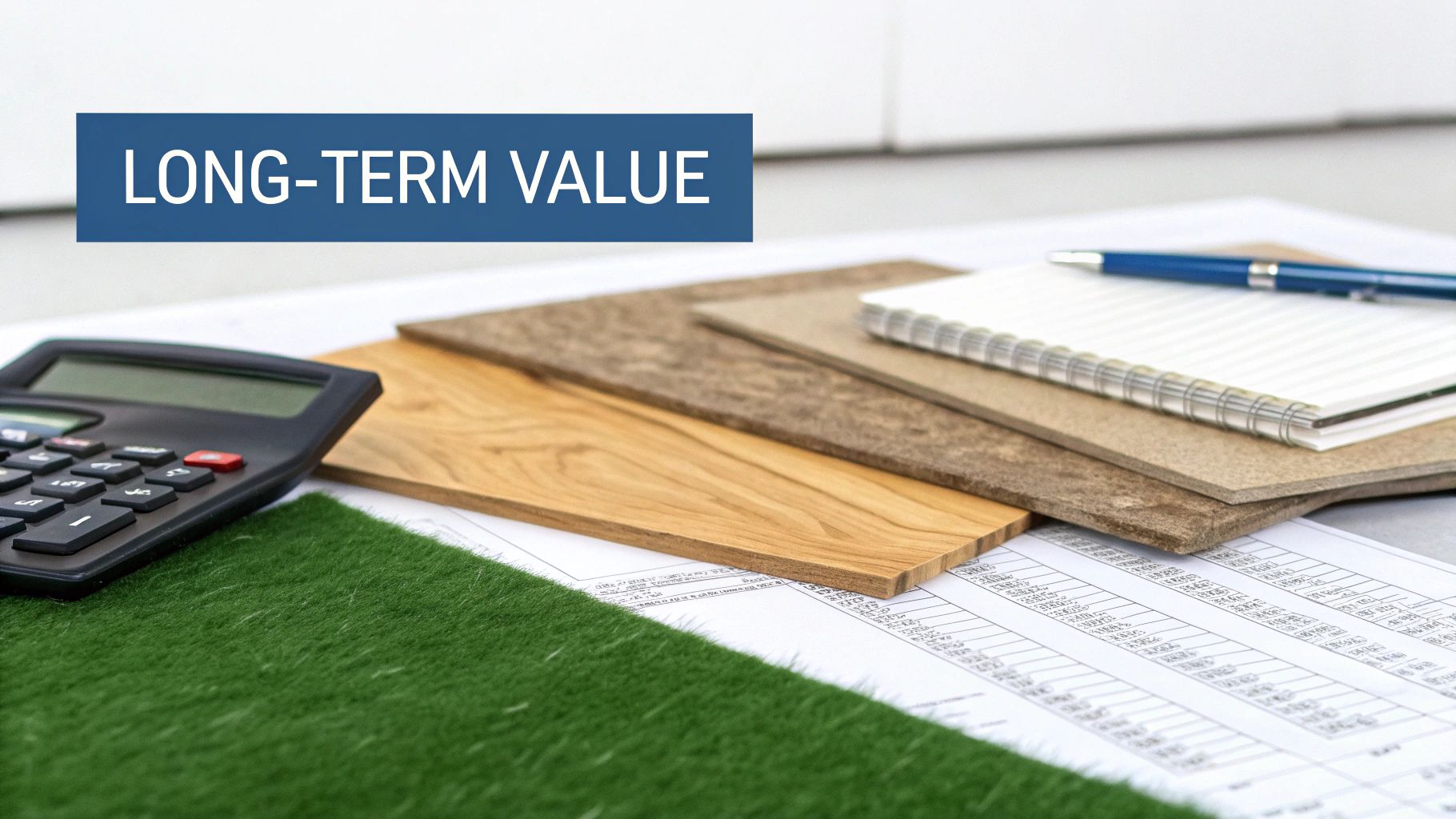
Various material samples (wood, grass), a calculator, and financial documents with 'LONG-TERM VALUE' banner.

A Practical Flooring Example

Let’s put this into practice with a decision every building owner faces: flooring for a high-traffic commercial lobby.

  • Option A (Low Upfront Cost): You go with a budget-friendly commercial carpet tile. It looks great on day one, but it demands frequent deep cleaning, shows wear and tear fast, and will likely need to be completely ripped out and replaced in about seven years.
  • Option B (Higher Upfront Cost): You opt for a durable porcelain tile. Yes, the initial investment is much higher. But its maintenance is a breeze—just routine cleaning—and it can easily last for over 30 years without needing a second thought.

Do the math over a 30-year timeframe. You might end up replacing that "cheap" carpet four separate times, paying for new materials and installation with every cycle. Meanwhile, the porcelain tile just keeps performing. When you add it all up, the "expensive" tile is revealed as the smarter, more economical choice by a long shot.

The most expensive material in interior design is often the one you have to replace. Focusing on life-cycle cost rather than the initial purchase price is a core strategy for maximizing asset value and minimizing operational drag.

This kind of forward-thinking is more critical than ever. Remodeling is now outpacing new construction, and with global spending in the sector hitting USD 4.9 trillion in 2023, every choice matters. You can dig into the numbers yourself by reviewing the latest interior design market outlook.

Ultimately, choosing durable, long-lasting materials is one of the most direct ways to protect and grow your property's Net Operating Income (NOI). It turns a simple design choice into a powerful financial lever.

Navigating Sustainability and Building Codes

For developers and owners, "sustainability" isn't just a buzzword anymore—it's a critical piece of a smart business plan. Choosing the right materials for your interior isn't just about ethics; it's a strategic move that directly boosts your asset's financial performance.

When you specify materials with high recycled content or insist on FSC-certified wood from well-managed forests, you're doing more than making an eco-conscious choice. You're building a more resilient, more marketable property that attracts the kind of tenants who will pay a premium for healthier, high-performance spaces.

The Financial Upside of Green Materials

The market is clearly rewarding this approach. Sustainable materials are no longer a niche product; they’re seeing a 12.5% compound annual growth rate from 2021-2024. This isn’t just a trend. It's driven by real demand from tenants looking for green certifications like LEED and the practical need for budget predictability when conventional material prices are all over the map. You can dig deeper into this in a market analysis of interior design trends.

These decisions ripple directly to your operational budget in a few key ways:

  • Lower Utility Bills: Think about high-performance insulation, low-emissivity (low-E) window coatings, or even something as simple as light-colored roofing. These choices actively reduce heating and cooling loads, which means lower energy bills month after month.
  • Tax Incentives and Rebates: Many government programs at the local and federal levels will literally pay you to use energy-efficient materials and systems. It’s direct cash back for making the right call.
  • Enhanced Marketability: A LEED certification isn't just a plaque for the lobby. It's a clear signal to potential tenants that your building is a high-quality, low-cost place to operate. That often translates directly to higher rents and lower vacancy rates.

Meeting and Exceeding Building Codes

Building and energy codes get stricter with every cycle. If you see them as just another hurdle to clear, you're missing the point. The smart way to think about codes is as a baseline for quality, not the finish line.

When you select materials with performance in mind from the start, code compliance becomes a natural result of good design, not a frantic scramble before an inspection.

Choosing sustainable materials is a proactive strategy for compliance. It ensures your building not only meets today's standards but is also prepared for the more stringent regulations of tomorrow, protecting its long-term value.

One of the most important areas to get right is indoor air quality. Specifying low-VOC (Volatile Organic Compound) paints, adhesives, and flooring is non-negotiable. These materials don't off-gas harmful chemicals, creating a much healthier environment for the people inside.

For designers and contractors, this means that verifying a material's safety is crucial. This is where professional indoor air quality VOC testing becomes essential to ensure the space isn't just code-compliant, but genuinely healthy. In a competitive commercial market, that commitment to wellness is a powerful differentiator.

Material Strategies for Adaptive Reuse and Historic Preservation

Stepping into an existing building project is a world away from starting with a clean slate. You’re not just building; you’re entering a conversation with the past. Instead of a blank canvas, you have a structure with a story, complete with all its character, quirks, and hidden potential. When we talk about materials for these projects, it's less about picking from a catalog and more about strategically weaving the old with the new.

This is the heart of adaptive reuse—taking a building designed for one purpose and giving it a new life. Think of an old textile mill being reborn as modern loft apartments. The first, most critical step is an honest, hands-on evaluation of what’s already there. Can that original heart pine flooring be salvaged? Is the exposed brick strong enough to be a feature wall, not just a facade?

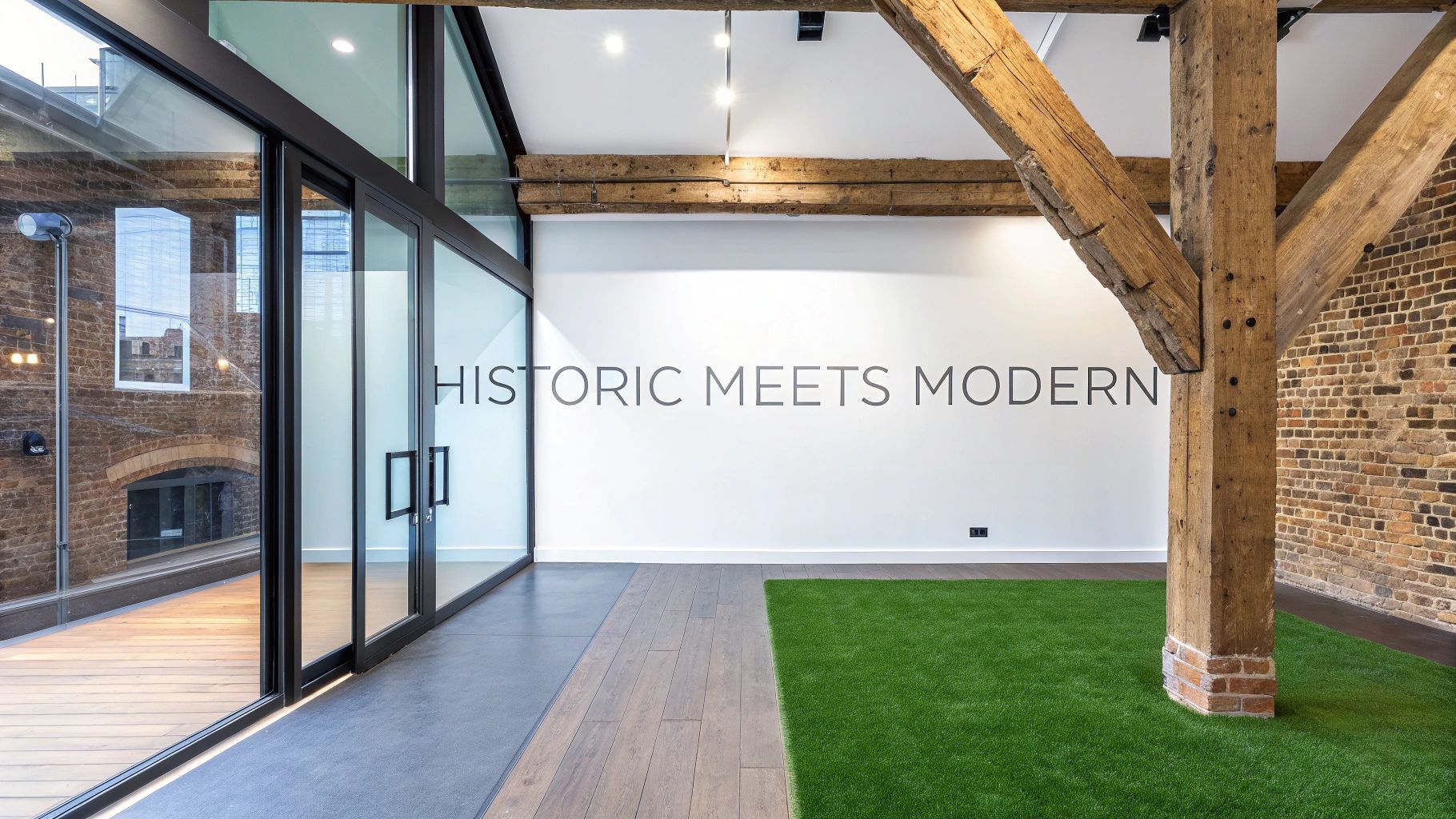
Modern interior with glass partitions, old wooden beams, brick, and a "HISTORIC MEETS MODERN" wall.

The real artistry is in the blend. It's about letting those beautiful, old-growth timber beams tell their story while seamlessly integrating a modern, energy-efficient HVAC system. It’s about pairing a historic masonry wall with high-R-value insulation, bringing a century-old structure up to today’s demanding energy codes without losing its soul.

Honoring The Past In Historic Preservation

Historic preservation projects take this philosophy even deeper. Here, the number one goal is to maintain the building’s historical integrity with painstaking accuracy. This work is part architectural forensics, part detective story, requiring deep dives into archives to identify the original materials and construction techniques.

But this isn’t just about being sentimental; it’s a savvy business strategy. The ability to carefully preserve a building’s character while artfully meeting modern code requirements is often the key to unlocking significant financial incentives.

For developers, historic preservation is a specialized field. Meticulous material choices can directly unlock substantial returns through state and federal historic tax credits, grants, and other programs designed to encourage the thoughtful stewardship of our built environment.

The Financial And Sustainable Case

Simply choosing to work with an existing building is a profoundly sustainable act. An adaptive reuse project can extend a building's functional life by 50 years or more, preventing the enormous carbon emissions and landfill waste that come with demolition and new construction.

The numbers often make a compelling case, too. While these projects certainly have their unique challenges, they can be far more cost-effective than building from the ground up. By leveraging the embodied energy and irreplaceable character of the original structure, developers can deliver a truly one-of-a-kind property that commands attention in a crowded market.

This specialized approach demands a team that knows how to:

  • Assess Existing Conditions: Perform a thorough analysis of all original materials to figure out what can be salvaged, what needs to be restored, and what must be replaced.
  • Specify Compatible New Materials: Choose modern products that work with—not against—historic elements. A great example is using breathable insulation on old brick to prevent trapping moisture that could cause serious damage over time.
  • Navigate Regulatory Approvals: Skillfully work with historic commissions and preservation boards to ensure every material choice satisfies their strict guidelines.

In the end, both adaptive reuse and historic preservation are about creating immense value from what already exists. It’s powerful proof that sometimes the most compelling material in interior design is the one that’s been there all along.

A Practical Framework for Your Next Project

So, how do we pull all of this together into a process you can actually use? The goal here is to stop guessing and start making confident, strategic decisions about the materials that define your space.

Picking the right material shouldn't be an overwhelming, last-minute choice. Think of it as a structured process that gets your entire team—from the architect to the contractor to the building manager—speaking the same language and working toward the same business goals. This isn't just about design; it's about building a common ground based on long-term value and smart operations.

Your Essential Material Selection Checklist

Before you sign off on any material specification, put it through this five-point filter. It’s a simple but powerful tool to spark the right conversations and ensure your choices will pay off for years to come.

  • Function and Program Alignment: Does this material actually work for what people will be doing in this space? Think hard about foot traffic, acoustics, and the real-world activities of your tenants. A beautiful floor that can't handle a rolling chair is a failure.

  • Durability and Maintenance: What’s the reality of wear and tear here? Even more critically, what will it cost in labor and specialized cleaning products to keep this material looking good year after year?

  • Life-Cycle Cost Analysis: Have you looked past the initial price tag? Do the math on the total cost of ownership over a 15 to 20-year period. That includes installation, regular upkeep, and eventual replacement.

  • Sustainability and Compliance: Does this material help you meet modern energy codes and green building standards like LEED? Is it a low-VOC product that contributes to a healthy indoor environment for the people inside?

This structured approach takes the mystery out of material selection. It shifts the focus from aesthetics alone to a balanced evaluation of performance, cost, and long-term asset value, empowering you to build with greater confidence and strategic foresight.

Answering Your Key Questions

When it comes to commercial real estate, developers and owners often have pointed questions about how design choices play out in the real world. Let's tackle some of the most common ones we hear about selecting materials for interior design.

How Does Material Selection Impact My Project Timeline and Budget?

Material selection is one of the biggest factors controlling your project's schedule and bottom line. If you specify custom or imported materials, be prepared for long lead times that can easily stall construction for weeks, if not months. On the flip side, choosing readily available, standard materials is a great way to keep a project humming along without those costly delays.

Financially, it’s all about balancing the upfront price tag with the total cost of ownership. A cheaper material might look great on the initial bid, but if it needs constant maintenance or has to be replaced in just a few years, it's going to cost you a lot more in the long run. A good architect helps you find that sweet spot—materials with reliable supply chains that offer the best life-cycle value for your investment.

Choosing a material isn't just an expense; it's a strategic decision that dictates future operational costs and capital expenditures. The goal is to minimize both timeline risk and long-term financial drain.

What’s the Most Important Factor for an Adaptive Reuse Project?

For any adaptive reuse project, the most critical element is the thoughtful integration of old and new. You want to honor the building's original character while making sure it meets modern standards for safety, comfort, and energy efficiency.

This always starts with a deep dive into the existing materials—think exposed brick, original heart pine floors, or heavy structural timbers. From there, the real work begins: selecting new materials that are both visually harmonious and functionally compatible. For example, pairing a historic masonry wall with modern insulation that still allows the wall to breathe is absolutely vital to prevent moisture damage down the line. It's a delicate and crucial balance between preservation and performance.

Can Sustainable Materials Be As Durable As Traditional Ones?

Absolutely. The old idea that "green" means "weak" is simply outdated. Many of today’s sustainable materials have been specifically engineered to withstand the punishing demands of a commercial environment.

Just look at these high-performance examples:

  • Commercial-grade bamboo flooring offers incredible hardness and durability, often outperforming traditional hardwoods.
  • Recycled-content carpet tiles are built from the ground up for high-traffic areas and allow for easy replacement of individual sections, which is a huge maintenance win.
  • Low-VOC paints now provide excellent longevity and washability without off-gassing chemicals that can harm your building's indoor air quality.

The key is simply proper specification. When you work with a firm that really understands the technical properties of these materials, you can be confident you're getting a solution that is both eco-friendly and built to last.


At Sherer Architects, LLC, we solve complex puzzles by aligning every material choice with your project's long-term business goals. See how our expertise in commercial design, adaptive reuse, and historic preservation can maximize the value of your next project by visiting our website.

Categories
Uncategorized

Material board for interior design: The Ultimate Guide to Elevate Spaces

A material board is a designer’s secret weapon. It’s a carefully curated collage of physical samples that brings a project to life, showcasing the actual colors, textures, and finishes you've selected. Think of it as the bridge between a brilliant idea and the finished space—it lets clients and the design team see and, more importantly, feel the materials before a single order is placed.

Why Material Boards Still Matter in a Digital World

A designer works on a laptop showing a room design, surrounded by color and material samples.

With stunningly realistic 3D renderings and immersive virtual walkthroughs at our fingertips, it's fair to ask if physical material boards are becoming obsolete. The short answer is no. They remain an absolutely essential part of the design process for one very human reason: they communicate what a screen simply cannot.

Digital tools are fantastic for showing scale, layout, and how light will play in a room. But they just can't capture the true sensory experience of a space. No render can perfectly replicate the subtle gleam of a glazed tile as you walk past it, the specific hand-feel of a commercial-grade textile, or the cool, solid weight of a quartz countertop. These tactile details are everything when it comes to a client truly understanding and signing off on the vision.

The Anchor in a Hybrid Design Workflow

The modern material board isn't at odds with digital design; it's the perfect partner. It acts as the physical anchor in a hybrid workflow, grounding all those beautiful digital images in reality. This integrated approach is no longer a trend—it's standard practice, combining the speed of technology with the irreplaceable value of physical touch.

The numbers back this up. Today, somewhere between 68–75% of design firms in North America and Europe use physical sample boards right alongside their digital tools. That’s a huge jump from 2018, when only 54% of firms were doing so, with many relying solely on digital presentations.

In a global interior design market valued at over USD 137 billion, where material prices can be incredibly volatile, having tangible samples is crucial for accurate budgeting and getting confident client approvals.

A material board is more than a presentation tool; it's a contract of trust. When a client touches and approves a physical sample, it eliminates ambiguity and sets clear expectations for the final outcome, protecting both the client and the designer.

Beyond Aesthetics to Practical Execution

A great material board is definitely a showstopper, but its job goes far beyond just looking pretty. It's a critical working document for actually getting the project built.

  • Client Confidence: It gives clients the power to make informed decisions with genuine confidence. This drastically cuts down the risk of expensive changes or disappointment after everything is installed.
  • Budget Alignment: Presenting real materials opens the door for honest conversations about cost. It helps clients see the value and investment tied to each finish, making budget talks much more transparent.
  • Procurement Accuracy: A clearly labeled board is the go-to reference for ordering. It minimizes errors and makes sure the exact products you specified are the ones that show up on-site.
  • Stakeholder Communication: It creates a single, unified vision for everyone involved—from contractors and architects to specialty vendors—ensuring the whole team is on the same page.

For a deeper look into the tech side of things, it's worth exploring the debate between photorealistic AI room design and manual methods. But at the end of the day, no matter how advanced our technology gets, the human need to connect with the physical world isn’t going anywhere. The material board honors that connection, cementing its place as an enduring and powerful tool in any designer’s arsenal.

Physical vs Digital Material Boards: A Hybrid Approach

Instead of choosing one over the other, the most effective strategy combines the strengths of both physical and digital boards. This hybrid model provides a comprehensive, flexible, and compelling presentation that covers all the bases—from initial concept to final sign-off.

Attribute Physical Board Digital Board Hybrid Advantage
Tactile Experience Excellent. Allows clients to feel texture, weight, and sheen. None. Relies on visual representation only. Grounds digital visuals with real-world sensory feedback.
Color Accuracy High. Shows true color under actual lighting conditions. Variable. Dependent on screen calibration and settings. Digital concepts are verified by true-to-life physical samples.
Accessibility Limited. Requires in-person meetings or shipping. Excellent. Instantly shareable with anyone, anywhere. Share digital boards for quick feedback, present physical boards for key decisions.
Scalability Poor. Can be cumbersome to create multiple versions. Excellent. Easily duplicated and modified for different schemes. Quickly iterate digitally, then build one final physical board for approval.
Contextualization Limited. Shows materials in isolation. Good. Can be shown within 3D renderings of the space. Use renderings to show scale and layout, and the physical board to confirm finishes.
Durability & Portability Moderate. Can be heavy and samples can get damaged. High. No physical wear and tear; stored in the cloud. A digital record serves as a permanent, easily accessible backup.

Ultimately, leveraging both formats creates a powerful, persuasive narrative. The digital board sells the big-picture vision, while the physical board closes the deal by making it real.

Building the Strategic Foundation for Your Board

Overhead view of an interior design material board with color swatches, samples, and 'design strategy' note.

Before you even think about ordering a single sample, the real work of creating a compelling material board for interior design begins. It all starts with strategy. This early planning is what turns a simple collection of finishes into a powerful tool—one that solves real problems, tells a story, and directly supports the project's business goals.

We have to move past vague aesthetic labels like "modern" or "industrial." Those don't mean much on their own. Instead, a successful board is built on a solid framework of well-defined criteria that will guide every single choice you make down the line.

Translating Vision into a Material Brief

The first, and arguably most important, step is to create a 'material brief.' Think of this as the constitution for your project. It's a practical document that spells out the non-negotiables and desired outcomes before you start falling in love with specific products.

Imagine you're tackling an adaptive reuse project—turning an old textile mill into a boutique hotel. The material brief wouldn't just say "rustic charm." It would get granular. It would specify performance requirements like commercial-grade durability for the high-traffic lobby flooring, specific acoustic ratings for guest room partitions, and the fire codes all finishes must meet.

Your material brief needs to articulate:

  • Performance Metrics: What do these materials need to do? We're talking slip resistance, cleanability, light reflectance values (LRV), and commercial wear ratings.
  • Sustainability Goals: Does the client mandate a certain percentage of recycled content? Are we aiming for low-VOC emissions or a specific certification like Cradle to Cradle?
  • Sensory Qualities: How should the space feel? Warm and inviting, or crisp and energetic? This is where you define the tactile experience, guiding your texture and finish selections.
  • Budgetary Constraints: Get real about the numbers from day one. Establishing a working budget for key categories prevents the team from specifying materials that are dead on arrival.

This document becomes your North Star, ensuring your final material board is a direct, thoughtful response to the project's unique challenges.

Balancing Aesthetics with Functionality

With a solid brief in hand, the curation can finally begin. This isn't just about finding pretty things; it's about finding the right things that tick all the boxes you just established. Every material has to earn its spot on the board by serving both the aesthetic vision and the hard functional requirements of the space.

For example, on a historic preservation project, you're constantly balancing character with performance. You might select a reclaimed heart pine for the flooring to match the building’s original era, but you’d pair it with a modern, low-sheen, high-durability finish that can actually handle commercial foot traffic. It’s a decision that respects history while meeting today's operational demands.

A strategically built material board tells a story of thoughtful problem-solving. It shows clients and stakeholders that you’ve considered not just how the space will look, but how it will perform, age, and serve its users for years to come.

This disciplined approach has a great side effect: it makes the sourcing process so much smoother. With a clear brief, you can request samples with precise specifications, cutting down on the endless back-and-forth with reps. It stops the team from getting attached to a beautiful tile that doesn't meet the required fire code or blows the budget.

When it's time to assemble everything, a professional backing is essential for a polished presentation. Many designers find that lightweight yet sturdy foam board options provide a clean, excellent foundation for arranging samples. Ultimately, this foundational phase elevates your material board from a simple mood board to a critical project tool that drives decisions and sets the stage for a successful build-out.

Getting Your Hands on the Right Materials

Once you’ve nailed down the strategy, it's time for the fun part: bringing your vision to life by gathering the actual materials. This phase is where logistics, relationships, and a good design eye all come together. Sourcing isn't just about clicking "order sample" online; it's about building a network of people you can count on and learning how to ask for exactly what you need to get it right the first time.

Your starting point is always your network of suppliers, manufacturers, and local artisans. For those of us working on commercial or historic preservation projects, these relationships are gold. A fabric rep who knows you well won't just dump the latest catalog on your desk. They'll actually understand your project's specific demands—like needing a certain durability rating for lobby seating or hitting a specific fire code—and will point you to the right options from the get-go.

These connections don't happen overnight, but the payoff is huge. Make a point to show up at local industry events, schedule coffee with your reps even when you don't have a project on the books, and always be upfront about your timelines and budget. A good relationship can mean getting that oversized sample you desperately need, a heads-up on new product launches, or critical intel on stock levels and lead times that can make or break a schedule.

How to Ask for Samples (and Actually Get What You Want)

When you're requesting samples, vagueness is your worst enemy. Asking for "a light wood flooring sample" is a surefire way to end up with a pile of useless options, wasting everyone's time. Your request needs to be as specific as the brief you wrote for the project.

Always be sure to specify:

  • The Details: Give them the full product name, the SKU or reference number, and the exact colorway or finish you're after.
  • Performance Needs: Spell out any non-negotiables. Think "must meet commercial wear layer standards" or "requires a Class A fire rating."
  • The Right Size: Don't leave this to chance. Be clear if you just need a small chip for color matching or a much larger piece to show the full pattern repeat or texture.

This level of detail means the samples that land on your desk are already pre-qualified, making the next step of curating the board so much more efficient.

Getting the Scale and Proportion Just Right

One of the most common rookie mistakes I see is using samples that are completely out of scale. A tiny 2×2 inch carpet square tells you absolutely nothing about how a broadloom product will feel across a massive hotel lobby. The goal here is to choose sample sizes that give an honest impression of the material's impact in the final space.

Your material board is a miniature version of the project. If the scale is off on the board, you’re setting your client up with skewed expectations of the finished room. A large-format tile absolutely needs a large sample to be understood.

Choosing the right sample size is key to building a board that's both beautiful and informative. It’s a bit of an art, but having some go-to guidelines helps keep everything in balance.

Here’s a quick reference I use to make sure the samples are scaled properly and tell the right story.

Recommended Sample Sizes for Common Materials

Material Type Recommended Minimum Size (cm/in) Reasoning
Flooring (Tile, Wood, LVT) 30 x 30 cm (12 x 12 in) This size is large enough to show texture, pattern variations, and the natural color shifts you see in materials like wood.
Carpet 45 x 45 cm (18 x 18 in) Anything smaller fails to capture the true scale of the pattern and the actual feel of the pile under your hand.
Wallcovering A3 size or 30 x 42 cm (12 x 17 in) You absolutely need this much space to see a full pattern repeat and judge the texture from a realistic distance.
Upholstery Fabric 25 x 25 cm (10 x 10 in) You need a piece big enough to drape and fold so you can see how it moves and how light plays with its texture.
Paint 20 x 25 cm (8 x 10 in) Painted Swatch A tiny paint chip is useless. A larger painted board shows the true color and sheen away from the influence of existing wall colors.
Laminates & Veneers 15 x 20 cm (6 x 8 in) This is a great size to show off wood grain, finish, and color while still fitting neatly on a crowded board.

By getting the scale right, you're presenting a more accurate, professional, and convincing design concept.

Of course, the final mix of materials will look very different depending on the project. A residential board might have 8–10 key samples, with 30–40% being engineered wood products. Flip to a commercial or hospitality job, and you'll see a heavy emphasis on fire-rated and high-performance laminates, often making up 45–55% of the finishes. In fact, firms that standardize their board templates for these larger projects have seen a 12–18% reduction in ordering mistakes and a 6–9% decrease in material waste. You can dive deeper into material trends in home and commercial furnishings to see how these numbers are evolving.

Taming the Sample Chaos

As those boxes of samples start rolling in, your studio can descend into chaos pretty quickly. A well-organized material library—whether it’s a whole room or just a smart system of labeled bins—is absolutely critical for your sanity and efficiency. The minute a sample arrives, label it with the core info: supplier, product name, and SKU. No exceptions.

This library becomes a living, breathing archive for your firm. When a new project kicks off, you’ll have a curated collection of go-to materials right at your fingertips, which makes that initial hunt so much faster. It’s what stops you from having that frantic, last-minute panic trying to find "that perfect tile we used two years ago," ensuring every choice you make is deliberate and perfectly aligned with your project's goals.

Assembling a Professional and Persuasive Board

You’ve sourced and curated a perfect collection of samples. Now comes the fun part: assembly. But don’t be fooled—a pile of beautiful materials isn’t enough to win over a client or, just as importantly, guide a construction team. The real magic of a material board for interior design is in its composition. It's how you arrange every single element to tell a clear, compelling story that transforms your design concept into a tangible, persuasive argument.

The goal is to create a visual hierarchy, guiding the viewer's eye through the design just as you would guide them through the finished space. Think like a composer. Start with your "hero" materials—the dominant finishes like flooring or a key wall treatment. Lay those down first; they’re the foundation of your design. From there, you can begin to layer in the secondary and accent materials, carefully arranging them to show exactly how they’ll interact.

Mastering Layout and Composition

There’s no single right way to lay out a board, but the most effective ones all share a common DNA: they’re logical. The key is to organize materials in a way that reflects their real-world application and scale. This intuitive flow helps clients and stakeholders get the design instantly, often without you having to say a word.

A classic and highly effective technique is to arrange samples spatially. Think of the board as a cross-section of the room. Place flooring materials along the bottom, wall finishes (paint, wallcovering, tile) in the middle, and any ceiling or feature lighting finishes toward the top. Upholstery fabrics and accent metals can then be grouped together nearby, representing the furniture and fixtures that will populate the space. It’s a simple trick that creates an intuitive map of your design.

Consider a few different approaches to your layout:

  • The Grid: This is a clean, buttoned-up approach where samples are cut to uniform sizes and arranged in a structured grid. It works beautifully for corporate or minimalist projects where precision and order are part of the design language.
  • The Layered Vignette: For a more organic, artful composition, you can create a small "scene" where samples overlap. Imagine draping a luxe fabric swatch over a piece of wood flooring, right next to the tile it will abut. This helps clients visualize the textural interplay in a much more tangible way.
  • Proportional Representation: The size of your sample should hint at its dominance in the space. The primary carpet sample should take up more real estate on the board than a tiny swatch for a single accent pillow. This visual cue helps manage expectations and communicates scale.

The most persuasive material boards are the ones that feel balanced and intentional. Every sample needs a reason to be there, and its placement should reinforce its relationship to every other material on the board.

Choosing the Right Foundation and Adhesives

The physical backing of your board says a lot about your professionalism. A neutral, sturdy base is non-negotiable. Heavy-duty foam core or Gatorboard in white, grey, or black are the industry go-to's for a reason. They're light enough to carry to a meeting but rigid enough that they won’t warp under the weight of heavy samples like stone or tile.

Just as important is how you stick everything down. Nothing tanks a presentation faster than a tile sample clattering onto the conference table. For heavy items, use a high-strength, fast-grabbing construction adhesive or a quality double-sided mounting tape. For lighter fabrics and papers, a clean spray adhesive or rubber cement applied neatly to the back prevents buckling and keeps everything looking crisp.

The sourcing process is the critical first step before you even think about adhesives, as this diagram shows.

Diagram of the material sourcing process showing three steps: network, specify, and organize with icons.

A great board is the culmination of methodical networking, precise specification, and diligent organization—it all starts long before you reach for the glue.

The Critical Role of Labeling and Documentation

A beautiful board without documentation is just a pretty picture; it’s not a working tool. Every single sample must be meticulously labeled. This is the step that elevates your presentation from a visual aid to an actionable specification document that the entire project team will rely on for pricing, procurement, and installation.

Your labeling system has to be clean, consistent, and easy for anyone to decipher. My team has always had success with a simple key system:

  1. Assign a unique code to each sample on the board. Think F-01 for flooring, WC-01 for wallcovering, P-01 for paint.
  2. Place a small, discreet label with that code next to its corresponding sample on the physical board.
  3. Create a separate specification sheet (or "key") that lists each code alongside all the vital product information.

This spec sheet is the board's essential partner. It’s what makes the design buildable. At a minimum, it should include:

  • The unique reference code (e.g., F-01)
  • A clear description ("White Oak Engineered Hardwood")
  • Manufacturer/Supplier name
  • The specific product name, number, or SKU
  • Color name and/or finish code
  • Dimensions or size information

This two-part system keeps the board itself looking clean and professional while providing all the granular detail needed to execute your vision. It eliminates guesswork and ensures that the materials you and your client fell in love with are the exact ones that get ordered and installed, protecting the integrity of your design right through to the finish line.

Advanced Material Strategies for Commercial Projects

When you step into the commercial design world, the material board evolves. It’s no longer just a creative exercise; it’s a technical document that has to work a lot harder. For projects like corporate offices, hotels, or bringing an old building back to life, the board must satisfy a whole different set of masters: building codes, sustainability goals, and long-term performance.

A commercial board is less about a particular taste and more about making a case. Every single sample has to earn its spot by proving it can handle heavy traffic, meet tough safety standards, and contribute to the health of the people inside. This is where a designer’s deep product knowledge is put to the test, turning a simple presentation tool into a document that manages risk and protects the client’s investment.

Weaving Sustainability and Wellness into the Narrative

Let's be clear: sustainability isn't an add-on anymore. It’s a core requirement for most commercial clients, driven by everything from corporate ESG (Environmental, Social, and Governance) goals to what their own tenants are demanding. Your material board is ground zero for showing them you get it.

This goes way beyond just pointing to bamboo flooring. You need to back up your selections with hard numbers. So instead of just showing a nice carpet sample, the spec sheet should call out its exact percentage of recycled content, its Cradle to Cradle certification, or its low-VOC (Volatile Organic Compound) emissions. Pulling data from an Environmental Product Declaration (EPD) turns a pretty choice into a powerful, defensible one.

A truly smart material board doesn't just show finishes. It shows choices that create healthier indoor air and support a more responsible supply chain. That's a language that speaks directly to clients who are laser-focused on their ESG metrics.

If you’re presenting to a client chasing a WELL or LEED certification, the board and its spec sheets are your evidence. Make it easy for them. Clearly tag materials that help earn specific credits, such as:

  • Acoustic Performance: Highlighting materials that kill noise bleed in an open office.
  • Light Reflectance Value (LRV): Calling out paints and surfaces that bounce daylight around, cutting down on electricity bills.
  • Material Transparency: Featuring products that come with health disclosures and a clear list of ingredients.

The Special Cases: Adaptive Reuse and Historic Preservation

Working with existing and historic buildings is its own beast. Here, the material board has to create a conversation between the old and the new. It's a delicate dance—you have to respect the building's history while getting it ready for a modern, functional future.

Take an adaptive reuse project, like turning an old warehouse into a buzzy tech office. Your board might pair the original, polished concrete floor with slick, high-performance acoustic felt panels. The story you're telling is one of contrast and complement. The new stuff doesn't hide the building's character; it celebrates it.

For a true historic preservation job, the work is even more detailed. Finding period-appropriate finishes that also meet today's codes is a real skill. Your board might need to showcase things like:

  • A custom-milled wood trim that’s an exact match for the original, but sourced from a sustainably managed forest.
  • A historically accurate paint color, but one that’s formulated with modern, durable, low-VOC chemistry.
  • A new tile that perfectly replicates an original encaustic pattern but also has a commercial-grade slip-resistance rating.

Communicating Technical Compliance with Clarity

For any commercial project, the board has one job that trumps all others: proving compliance. Looks don't matter if a material fails a fire code inspection. Your presentation has to make it crystal clear that all the technical boxes have been checked.

This means putting the critical performance specs right on your board’s key or the attached spec sheet. Don’t make the client or the contractor go digging for it. Think of your documentation as the single source of truth.

Key Technical Specs to Call Out:

  • Fire Ratings: State the ASTM E84 classification (Class A, B, or C) for every wall and ceiling finish. In public spaces, this is absolutely non-negotiable.
  • Slip Resistance: Note the DCOF (Dynamic Coefficient of Friction) rating for all flooring. You need to show it’s appropriate for where it’s going—a lobby has different needs than a commercial kitchen.
  • Durability Ratings: Include the wear layer thickness for LVT or the AC (abrasion class) rating for laminates to prove they can handle the expected foot traffic.
  • Accessibility Standards: Confirm that your specified materials and transitions meet ADA (Americans with Disabilities Act) guidelines.

When you bake these strategies into your process, your material board becomes so much more than a design pitch. It becomes a comprehensive, bulletproof plan that tackles the real-world complexities of commercial work. It gives clients the confidence that their investment isn't just beautiful—it's safe, sustainable, and built to last.

Answering Your Top Questions About Material Boards

Even after years in the field, pulling together the final material board can bring up some tricky last-minute questions. It’s the point where the creative vision meets the hard reality of budgets, sourcing, and client psychology. Let's tackle some of the most common hurdles I see designers face.

How Many Material Options Should I Put on a Board?

My rule of thumb? One board, one story. Your goal is to present a single, fully resolved design direction, not a collection of possibilities that leaves the client feeling overwhelmed. When you present too many choices on one board, it can dilute your vision and actually make it harder for the client to say "yes."

If you truly have two distinct concepts you want to explore—say, a warm, classic palette versus a cool, modern one—then create two separate, complete boards. Each one should feel like a finished thought. For a typical residential project, you might have 8-12 core materials working together. A commercial board, on the other hand, might be more focused, zeroing in on a smaller set of high-performance finishes that need to work across a large space.

Your job is to be the expert. Presenting a single, confident vision is far more effective than offering a buffet of options. It guides your client toward a clear decision and shows you’ve already done the hard work of editing.

What's the Best Way to Label Samples on a Physical Board?

Labels are all about clarity and professionalism. You want a system that looks clean on the board but connects to a wealth of detail behind the scenes. I find the best method is to use small, neatly printed tags next to each sample.

On the tag itself, keep it simple: a reference code (F-1 for Flooring 1, P-2 for Paint 2), the material name, the manufacturer, and the specific color or product code. That reference code is your secret weapon. It directly links each physical sample to your detailed specification sheet, which should always accompany the board. That spec sheet is where you’ll list everything needed for procurement—vendor contacts, pricing, lead times, the works.

Should I Charge a Separate Fee for Creating a Material Board?

In most cases, no. Creating the primary material board is a fundamental part of the design development phase. It’s how we communicate our vision and get final sign-off on the specs. As such, the time and effort are almost always baked into your overall design fee, whether that's hourly or a flat rate for the project.

The exception? Revisions and scope creep. If a client asks for multiple, extensive revisions or wants to see entirely new concepts that go far beyond what you originally agreed to, it's absolutely fair to charge for that extra work. This is when you’d bill for your additional time sourcing materials and assembling new boards, based on the hourly rate outlined in your contract.


At Sherer Architects, LLC, we know a well-crafted material board is more than just a presentation tool—it's the foundation of a successful project, ensuring the vision and reality align from day one. Our deep experience in commercial, adaptive reuse, and historic preservation projects means every material choice is strategic, sustainable, and beautiful. If you're ready to bring structure to your vision and create enduring results, explore our services and see how we work.

Categories
news

Interior Architecture vs Interior Design What to Choose

People often use the terms "interior architecture" and "interior design" interchangeably, but they're fundamentally different disciplines. Think of it like this: one professional reshapes the structural bones of a building, while the other perfects its aesthetic skin.

Interior architecture digs deep into structural integrity, building systems, and how the volume of a space works. Interior design, on the other hand, is all about the look, feel, and function within those spaces once they're defined.

Clarifying Core Professional Roles

An expansive, modern commercial interior with high ceilings and structured lighting, showcasing both architectural form and designed decor.

Getting this distinction right is absolutely critical for any commercial project. While these pros often work together, their primary responsibilities, qualifications, and the scope of what they do are worlds apart. Making the right choice from day one ensures your project isn't just beautiful but also structurally sound, legally compliant, and perfectly aligned with your business goals.

The demand for these skills is undeniable. The combined global Architecture and Interior Design market was valued at around USD 1.3 billion in 2023 and is expected to climb to about USD 2.44 billion by 2032. That growth shows just how much businesses rely on experts to create spaces that are both practical and inviting.

At a Glance Interior Architecture vs Interior Design

To really nail down the differences, this table offers a quick breakdown of their core functions. It's a handy cheat sheet for understanding where their expertise lies.

Aspect Interior Architecture Interior Design
Primary Focus The structural and technical "bones" of an interior. The aesthetic and functional "skin" of an interior.
Core Skills Structural engineering, building codes, spatial planning. Color theory, materials, furniture selection, styling.
Typical Changes Moves walls, alters layouts, integrates building systems. Selects finishes, arranges furniture, designs lighting.
Legal Authority Can sign off on construction drawings and permits. Typically cannot approve structural modifications.

The key takeaway is that interior architects create the space, while interior designers make that space livable and functional. One builds the canvas; the other paints the masterpiece.

This becomes even clearer when you look at their day-to-day duties and the kind of problems they solve. If you're interested in digging deeper into the creative side of the equation, it's worth understanding interior design in more detail. Ultimately, knowing their unique contributions is the first step in building the right team for a successful project.

Comparing Project Scope and Core Responsibilities

A sleek commercial office interior with defined zones, glass partitions, and integrated lighting, demonstrating the interplay between architectural layout and design elements.

The clearest way to tell interior architecture and interior design apart is to look at what they actually do on a project. While their paths definitely cross, their core responsibilities are rooted in different phases of the work. At its simplest, one fundamentally changes the space, while the other curates the human experience within it.

An interior architect’s world revolves around the structural and technical integrity of an interior. You bring them in when the layout itself is the problem. Their job is to redesign the space from a macro level, long before anyone starts thinking about paint colors or furniture.

The Architect's Role in Reshaping Space

Interior architects work on the "bones" of a building, a job that involves a whole host of complex and heavily regulated tasks. They are the ones legally qualified to make changes that affect a building’s safety, usability, and compliance with the law.

Their main responsibilities usually involve:

  • Altering Structural Layouts: This is their biggest differentiator. They have the expertise to design plans for moving or even removing walls—both load-bearing and non-load-bearing—to completely transform a floor plan.
  • Integrating Building Systems: They work hand-in-glove with engineers to make sure HVAC, electrical, and plumbing systems are woven seamlessly into the new layout. This requires technical drawings and a serious understanding of how these systems work together.
  • Ensuring Code Compliance: Every structural change is governed by strict building codes and accessibility standards. The interior architect is the one who steers the project through this legal maze and secures all the necessary permits.

An interior architect is constantly asking, "How can we change the physical container to better serve its purpose?" Their work lays the foundation for everything that comes after.

The Designer's Role in Optimizing Space

By contrast, an interior designer takes the baton once the structural "container" is set. They operate within the existing architectural footprint to make the space functional, efficient, and visually aligned with a client's brand and culture. Their focus is squarely on how people will interact with the space.

An interior architect makes sure a building is safe and structurally sound for people. An interior designer makes sure it’s an effective, comfortable, and inspiring place for them to be.

Key responsibilities for an interior designer include:

  • Optimizing Space Plans: They dive into the details, creating layouts for furniture, workstations, and traffic patterns within the given walls to boost efficiency and collaboration.
  • Selecting Materials and Finishes: This is the tactile part of the job—everything from flooring and paint to textiles and wallcoverings that create the desired atmosphere.
  • Procuring FF&E: They manage the whole process of selecting, sourcing, and installing Furniture, Fixtures, and Equipment (FF&E).
  • Designing Lighting Schemes: This is more than just picking pretty fixtures. They plan layered lighting—ambient, task, and accent—to set the mood and make the space work better.

A Commercial Office Renovation Example

Let's say a company wants to renovate an outdated office to make room for new teams.

  • They'd hire the interior architect first to knock down walls between small, private offices and create a large, open-plan area. This architect would also handle rerouting electrical wiring for the new workstations and adjusting the HVAC ducts to maintain proper airflow in the reconfigured space.
  • Once those structural changes get the green light and are finished, the interior designer steps in. They would be tasked with choosing ergonomic furniture, developing a branded color palette, selecting durable flooring, and crafting a lighting plan that cuts down on screen glare, ultimately making the new space both productive and welcoming for employees.

A Look at Professional Education and Credentials

When you're trying to figure out who to hire, understanding the training behind the titles is a great place to start. The journey to becoming an interior architect is steeped in the demanding, technical world of architecture. It’s a long road.

This path almost always requires a professional degree—either a Bachelor of Architecture (B.Arch) or a Master of Architecture (M.Arch) from an accredited program. The curriculum is a deep dive into structural engineering, complex building systems, and materials science. After graduation, they face a multi-year internship and must pass the grueling Architect Registration Examination (ARE) to get their state license. This isn't optional; it's a legal requirement that gives them the authority to sign off on structural plans and be legally responsible for public safety.

The Designer’s Path to Expertise

An interior designer's education, on the other hand, is all about the human experience inside a space. Many earn a bachelor's degree in interior design, and their studies focus on things like color theory, how people move through a room, the properties of textiles, lighting design, and ergonomics. Their training sharpens their skills in creating spaces that are not only beautiful but also work well and feel right.

While not every state requires a license for interior designers, the best in the field prove their expertise through certification. The gold standard is the National Council for Interior Design Qualification (NCIDQ) certification. Earning it involves a combination of formal education and real-world experience, capped off by a tough exam.

Key takeaway: An architectural license is a legal necessity for anyone changing a building's structure. A design certification like the NCIDQ, however, is a badge of professional excellence, signaling mastery in creating beautiful, functional interiors.

How Credentials Shape Careers

These different training paths naturally lead to different career focuses. A quick look at the numbers from the U.S. Bureau of Labor Statistics tells the story. In 2023, about 14,000 interior designers worked within architectural and engineering firms, collaborating closely with architects on projects.

At the same time, around 6,750 designers were employed directly in the furniture and home furnishings retail sector. This highlights how a large part of the profession is centered on aesthetics and sourcing products, not structural overhauls. You can dig deeper into the employment statistics for interior designers on the BLS website.

Ultimately, the credentials clarify the roles. An interior architect is a licensed architect with a specialty in interiors, fully qualified to knock down walls and reconfigure a building’s bones. An interior designer is a certified expert at elevating the function and feel within that existing structure, mastering the art and science of everything you see, touch, and experience inside.

Choosing The Right Expert For Your Project

Figuring out who to hire really boils down to a single, critical question: does your project involve changing the building's structure, or just what's inside it? It sounds simple, but getting this right from the start is the key to matching your project's needs with the right professional.

To make it tangible, let's walk through two very different commercial projects. Each one presents a unique set of problems that clearly points toward either an interior architect or an interior designer.

Case Study 1: The Warehouse Conversion

Picture this: a rapidly expanding tech startup buys an old, cavernous warehouse. They want to turn this raw, industrial shell into a dynamic, modern headquarters. This isn't just a simple paint-and-carpet job.

The challenges here are foundational and complex:

  • Structural Alterations: They need to build out a new second floor for executive suites, which means calculating loads and adding new support columns and beams.
  • Systems Integration: The entire building needs brand-new HVAC, electrical wiring, and plumbing to handle the demands of a high-density office.
  • Code Compliance: New doorways and stairwells must be created, and the whole space needs to be brought up to current fire safety and accessibility standards. This is a non-negotiable legal requirement.

The Right Hire: This job has interior architect written all over it. Only a licensed professional has the technical expertise to fundamentally redesign the building's interior structure, coordinate with engineers, and successfully navigate the maze of building permits. The result is a space that's not only transformed but also safe and legally sound.

Case Study 2: The Retail Brand Refresh

Now, let's consider a well-known retail brand looking to update its 50 stores across the country. Their goal is to create a fresh, consistent brand look and a more compelling customer experience. Critically, the building's structure won't be touched.

Here, the project's focus is on aesthetics and flow:

  • Customer Experience: The plan is to rethink store layouts for better traffic flow, design eye-catching product displays, and create a new, more efficient checkout area.
  • Brand Aesthetics: A new color palette, modern lighting, and custom fixtures are needed to communicate the brand's evolving identity.
  • Material and Furniture Sourcing: All the new furniture, fixtures, and finishes have to be carefully selected, purchased, and installed consistently across every single location.

The Right Hire: This is a perfect fit for an interior designer. Their expertise in spatial planning, color theory, material selection, and brand identity is exactly what this project needs to succeed. The designer will work within the existing architectural footprint to completely reimagine the customer experience, delivering a cohesive and attractive environment that helps boost sales.

This decision tree gives you a quick visual guide. Does your project go to the bones of the building, or does it focus on the look and feel within the existing walls?

Infographic decision tree showing 'Structural' projects leading to an 'Architect' and 'Aesthetic' projects leading to a 'Designer'.

This simple chart helps steer you in the right direction from the get-go. No matter who you hire, always look closely at their portfolio. Professionals who understand architectural photography best practices will be able to clearly showcase the quality and scope of their work.

In short: if you need to move walls, hire an interior architect. If you need to make the space within the walls work beautifully, hire an interior designer.

To help you decide with more clarity, here’s a quick-reference table matching common project tasks to the right expert.

Match Your Project to the Right Professional

Your Project Involves… Hire an Interior Architect Hire an Interior Designer
Knocking down or adding internal walls
Selecting new furniture, art, and décor
Changing window or door placements
Redesigning the lighting plan
Adding a mezzanine or new floor
Developing a new color scheme and material palette
Complying with building codes and permits
Space planning for better workflow or traffic

This table isn't exhaustive, but it covers the most common scenarios. Notice the overlap in areas like lighting and space planning—this is where collaboration often produces the best results. The key is identifying the primary driver of your project: is it structural change or aesthetic enhancement? Your answer points you to your lead professional.

Understanding Project Costs and Budgeting

When you’re weighing interior architecture against interior design, the financial side of things can often feel murky. It’s not just about the final price tag; it's about how that price is calculated. The way these professionals structure their fees is a direct reflection of the work they do and the risks they take on.

An interior architect’s fee is almost always tied to the high-stakes nature of their involvement. Think about it: they’re dealing with structural changes, building codes, and complex technical systems. Because of this, their fee is typically a percentage of the total construction cost. This isn't just an arbitrary number; it mirrors the immense responsibility and comprehensive oversight they provide, ensuring your project is safe, compliant, and built to last.

How Interior Designers Structure Fees

Interior designers, on the other hand, tend to have more flexible fee structures. Their focus is on the aesthetics, furnishings, and flow of a space within its existing shell, so their billing can be adapted to fit the project's unique demands.

You'll commonly see a few different models:

  • Hourly Rates: Perfect for consultations, space planning sessions, or ongoing project management.
  • Fixed Fees: A flat rate for the entire project, which gives you clear budget predictability from the start.
  • Cost-Plus Model: Here, the designer sources furniture and materials at their trade cost and then adds an agreed-upon percentage. It’s a transparent way to handle procurement.

The real story behind the cost difference is liability and scope. An architect’s percentage-based fee is baked into the massive responsibility of changing a building's bones. A designer’s flexible fees reflect their craft in curating the human experience within those walls.

Scope as the Primary Cost Driver

At the end of the day, what truly dictates your budget is the scope of your project. There's a world of difference between knocking down walls and simply refreshing the decor. A renovation that requires moving plumbing, rewiring electrical, and pulling permits will have a much higher cost base than one focused on aesthetics and workflow.

The interior design market, which thrives on these aesthetic and functional enhancements, is a massive industry for a reason. Valued at roughly USD 145.3 billion in 2024, it’s clear that businesses and homeowners invest heavily in refining the spaces they already have. In fact, the residential sector alone accounts for over 60% of that market. You can read more about the growth of the interior design market on grandviewresearch.com.

Knowing this helps you put your budget where it matters most. Are you looking to fundamentally change the structure, or are you aiming to perfect the experience inside it? Your answer will point you to the right professional and the right budget.

Finalizing Your Decision for a Commercial Project

Making the final call between an interior architect and an interior designer really comes down to the bones of your project. Before you even start making calls, a quick self-assessment can point you in the right direction and save you a lot of time.

Think of it as a simple gut check: are you changing the container, or are you changing the contents? That's the core difference.

Key Questions to Define Your Scope

Here are a few practical questions to ask yourself. The answers will make your choice a lot clearer.

  • Do I need a building permit? If you’re moving walls, rerouting plumbing, or touching anything that affects the building's core structure, the answer is a firm yes. That’s interior architect territory.

  • Is my main goal to improve workflow and aesthetics within the existing walls? If you’re focused on making the space work better and look great without demolition, an interior designer is who you need.

  • Does the project need both structural and aesthetic expertise? For a major gut renovation or a complete commercial fit-out, you’ll likely need both. It’s not an either/or situation.

On large-scale commercial jobs, these two roles are partners, not competitors. It's common for an interior architect to handle the heavy lifting of space planning and construction documents, with an interior designer then taking the lead on finishes, furniture, and bringing the brand's personality to life.

The best outcomes on complex renovations come from collaboration. The architect builds the stage, and the designer directs the play. This ensures the final space isn't just structurally sound and legally compliant, but also a place where people truly want to be.

When you get right down to it, defining whether you need structural change or aesthetic refinement is the key. Once you have that answer, you can confidently hire the right expert—or team—to execute your vision safely and effectively.

Frequently Asked Questions

When you're trying to figure out who to hire for your commercial project, the lines between interior architecture and interior design can seem blurry. Let's clear up a few of the most common questions that come up.

Can an Interior Designer Remove a Wall?

The short answer is no. Knocking down a wall—especially if it’s load-bearing—is a structural change. That means it requires a building permit and the trained eye of a licensed professional to ensure everything is safe and up to code.

This kind of work is the bread and butter of an interior architect. They have the technical training and legal sign-off to handle structural modifications. While a designer can certainly suggest new layouts, they can't approve or carry out the actual structural work themselves.

Is an Interior Architect More Expensive Than an Interior Designer?

This is a bit like comparing apples and oranges because their fees are based on completely different types of work. It’s not that one is inherently more expensive than the other.

An interior architect’s fee is often calculated as a percentage of the total construction budget. This makes sense when you consider the high liability and technical oversight involved in structural projects. A designer, on the other hand, might charge by the hour, a flat fee for the project, or a cost-plus model on furnishings and decor.

If your project involves moving walls or altering the building's core, it’s going to be more expensive by nature, which in turn makes the architect's fee seem larger.

The real question isn't about who costs more, but which fee structure fits your project. If you're making structural changes, you need to budget for architectural oversight. If you're focusing on aesthetics and furnishings, your budget will be geared toward design services and procurement.

Do I Need Both for My Commercial Renovation?

For a major overhaul, the answer is often a resounding yes. If you're planning a full commercial fit-out or a gut renovation, bringing both an interior architect and an interior designer to the table is a smart move.

Think of it this way: the architect handles the "bones" of the space—the structural redesign, permitting, and construction documents. The designer then steps in to bring that space to life, focusing on creating an environment that’s functional, on-brand, and beautiful. When they work together, you get a seamless result that’s both technically solid and perfectly aligned with your business goals.


For complex commercial projects involving adaptive reuse, historic preservation, or new construction in South Carolina, the expert team at Sherer Architects, LLC can bring structure to your vision. Learn more about our architectural services and how we can guide your project from concept to completion.