
Investing in commercial real estate offers immense opportunities, but overlooking a single detail can transform a promising venture into a significant financial liability. A meticulous due diligence process is your primary defense against unforeseen risks, ensuring the property you acquire aligns perfectly with your financial goals and operational requirements. This is where a robust commercial property due diligence checklist becomes an indispensable tool, acting as a systematic roadmap to navigate the complexities of any transaction. It protects you from costly surprises and hidden issues that could derail your investment long after closing.
This comprehensive guide is designed to walk you through every critical phase, from verifying legal ownership and assessing physical conditions to analyzing tenant leases and confirming regulatory compliance. We will break down each essential step with actionable insights and practical examples to empower you to make an informed, confident, and ultimately profitable investment decision. Think of this checklist not as a mere suggestion, but as a non-negotiable part of your acquisition strategy. In the high-stakes world of commercial property, neglecting these steps isn't just risky, it's a gamble you simply can't afford to take. Let's dive into the specifics of what you need to verify before you sign.
1. Title Search and Property Ownership Verification
A comprehensive title search is the bedrock of any sound commercial real estate transaction. This legal investigation delves into the property's history to confirm the seller possesses a "clear and marketable title." This means they have the undisputed right to sell the property, free from unexpected claims or encumbrances that could jeopardize your investment and ownership rights. The process involves a meticulous review of public records, including deeds, mortgages, and court records.

This step is non-negotiable because it uncovers potential deal-breakers that aren't visible during a physical inspection. Without it, you could unknowingly purchase a property with unresolved liens or boundary disputes.
Key Issues Uncovered by a Title Search
- Financial Encumbrances: Identifies outstanding mortgages, judgments, or mechanics' liens from contractors who were never paid for previous work.
- Ownership Claims: Reveals unresolved ownership claims, such as those from heirs of a previous owner or an ex-spouse.
- Use Restrictions: Uncovers easements granting others (like a utility company) the right to use a portion of your property, or covenants that restrict how the land can be developed.
- Clerical Errors: Detects errors in public records or deeds that could cloud the title.
Expert Insight: "A preliminary title report is your roadmap. Treat every exception or potential issue it lists as a red flag that requires immediate investigation and resolution before you proceed to closing."
Actionable Steps for Implementation
To properly execute this part of your commercial property due diligence checklist, engage a reputable title company or real estate attorney early in the process. They will issue a preliminary title report outlining their findings. Carefully review this document with your legal counsel and demand that the seller resolves (or "cures") any identified defects before the closing date. Finally, secure both an owner's and a lender's title insurance policy to protect your investment against any future claims that may arise from undiscovered historical issues.
2. Property Inspection and Condition Assessment
A detailed physical examination of the commercial property’s structural integrity, systems, and overall condition is vital in any commercial property due diligence checklist. Conducted by ASHI-certified or state-licensed inspectors, this process uncovers hidden defects, deferred maintenance, and safety concerns before you close the deal.
This step is non-negotiable because unseen issues can derail your ROI or expose you to major repair costs after acquisition.
Key Issues Uncovered by a Property Inspection
- HVAC Failure: Discovery of a failing HVAC system requiring a $50,000 replacement
- Roof Degradation: Identification of a roof nearing end-of-life that threatens interior damage
- Structural Defects: Detection of foundation settling or structural cracks compromising safety
- Electrical Hazards: Finding an outdated electrical panel creating a fire risk
Expert Insight: "Attending the inspection walkthrough lets you ask real-time questions and understand the full scope of repairs needed to protect your investment."
Actionable Steps for Implementation
- Engage ASHI-certified or state-licensed inspectors and schedule specialized roofing, HVAC, and structural evaluations.
- Participate in the on-site inspection to observe conditions firsthand and clarify concerns.
- Request a detailed written report with photos, cost estimates, and recommended timelines.
- Leverage inspection findings to negotiate seller concessions, repair allowances, or price adjustments.
- If major structural issues arise, consult a licensed structural engineer before finalizing your purchase.
For more on inspector credentials, visit the American Society of Home Inspectors (ASHI) at https://www.homeinspector.org.
3. Environmental Due Diligence and Phase I ESA
Environmental due diligence is a critical process for identifying potential environmental liabilities from past or present activities on a property. This investigation protects buyers from inheriting costly cleanup responsibilities and regulatory violations. The standard first step is a Phase I Environmental Site Assessment (ESA), which involves a non-intrusive review of records, a site inspection, and interviews to identify "recognized environmental conditions" (RECs).
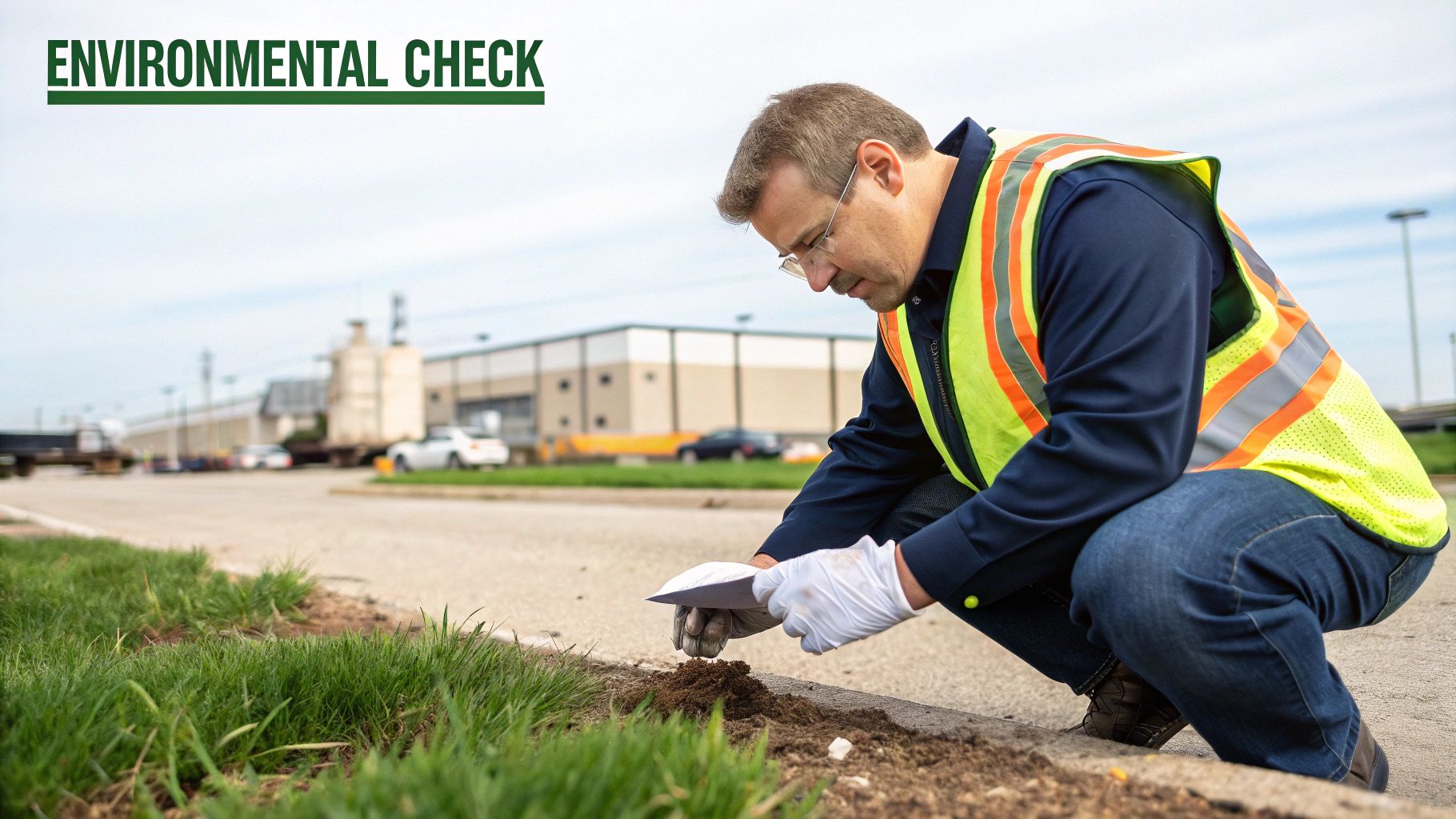
This step is essential because contamination issues are often hidden and can render a property undevelopable or require remediation costing millions. A Phase I ESA is a key part of any comprehensive commercial property due diligence checklist, providing crucial liability protection.
Key Issues Uncovered by a Phase I ESA
- Soil and Groundwater Contamination: Identifies potential contamination from sources like leaking underground storage tanks at former gas stations or hazardous spills from industrial operations.
- Hazardous Building Materials: Detects the likely presence of materials like asbestos-containing insulation, lead-based paint, or PCB-containing electrical equipment.
- Historical Land Use Concerns: Reveals if the property or adjacent sites were used for environmentally sensitive operations, such as dry cleaners, manufacturing plants, or landfills.
- Regulatory Non-Compliance: Uncovers recorded violations, permits, or enforcement actions from agencies like the EPA or state environmental departments.
Expert Insight: "A 'clean' Phase I ESA report is your green light. However, if it identifies any RECs, it's not a deal-killer; it's a signal to proceed with a Phase II investigation to quantify the risk before making a final decision."
Actionable Steps for Implementation
To properly conduct environmental due diligence, hire a qualified Environmental Professional who adheres to ASTM E1527 standards to perform the Phase I ESA. Thoroughly review their report for any identified RECs. If any are found, you must commission a Phase II ESA, which involves collecting and testing soil, groundwater, or building material samples. The results will determine the extent of contamination and the estimated cost of remediation, which can then be negotiated with the seller or used to obtain environmental liability insurance before closing.
4. Financial Analysis and Income Verification
A rigorous financial analysis is the engine driving a successful commercial real estate investment. This process moves beyond the seller's marketing materials to scrutinize the property's actual economic performance. It involves a deep dive into historical income and expenses to verify profitability and project future cash flows with confidence. A thorough financial review ensures the property can genuinely support its purchase price and your investment goals.
This step is critical because a seller's proforma often presents an idealized financial picture. Without independent verification, you risk overpaying for an underperforming asset, discovering undisclosed costs, or facing lower-than-expected returns.
Key Issues Uncovered by Financial Analysis
- Income Discrepancies: Identifies overstated rental income, uncollected rent (delinquencies), or non-recurring income that inflates performance.
- Hidden Expenses: Uncovers costs the seller may have paid personally or omitted, such as deferred maintenance, non-standard management fees, or upcoming capital expenditures.
- Unsustainable Projections: Reveals overly optimistic assumptions about future rent growth, vacancy rates, or expense control that don't align with market realities.
- Tenant Risk: Highlights issues with tenant creditworthiness, upcoming lease expirations, or concentration risk with a single large tenant.
Expert Insight: "Trust, but verify. The seller’s proforma is a sales document; your verified operating statements and tax returns are the reality. Base your underwriting solely on what you can prove."
Actionable Steps for Implementation
To properly complete this part of your commercial property due diligence checklist, start by requesting at least three years of financial documents, including profit and loss statements, rent rolls, and Schedule E tax forms. Cross-reference these documents with bank statements to confirm rent deposits and expense payments. Normalize the financials by removing any one-time expenses and adjusting for market-rate management fees. Finally, create your own conservative five-year proforma based on this verified data to model your expected return on investment.
5. Tenant Lease Review and Analysis
The tenants are the lifeblood of an income-producing commercial property, making a meticulous review of their leases a critical component of financial due diligence. This process involves a deep dive into every lease agreement to verify the property's income stream, understand tenant obligations, and identify potential risks. It confirms the rent roll is accurate and reveals the true operational and financial stability of the asset.
This step is essential because the leases dictate the property’s future cash flow. Without a thorough analysis, a buyer could inherit a property with significant near-term vacancy risk, below-market rents, or burdensome landlord obligations that severely impact profitability.
Key Issues Uncovered by a Lease Review
- Income Stability Risks: Identifies lease expiration clustering, where multiple major leases expire around the same time, threatening a sudden drop in revenue.
- Hidden Landlord Costs: Reveals obligations for significant tenant improvement allowances upon renewal or expensive maintenance responsibilities.
- Below-Market Rents: Uncovers leases with rental rates significantly lower than the current market, limiting the property's immediate income potential.
- Operational Restrictions: Discovers exclusivity clauses that prevent you from leasing space to competitors of an existing tenant, or co-tenancy clauses that could trigger rent reductions if an anchor tenant vacates.
Expert Insight: "The rent roll tells you what you should be collecting; the leases tell you what you're actually getting. Every discrepancy, every clause, and every date must be verified to understand the true value and risk profile of the asset."
Actionable Steps for Implementation
Begin by requesting and verifying a certified rent roll from the seller. Obtain complete, executed copies of all leases, amendments, and related correspondence. Create a lease abstract or summary for each tenant, noting key dates, financial terms, renewal options, and any unusual clauses. Effective tenant lease review is crucial to commercial property due diligence, and utilizing advanced best practices for contract management can significantly streamline this complex process. Pay close attention to the lease expiration schedule to assess rollover risk. Finally, send tenant estoppel certificates to have tenants formally confirm their lease terms, which prevents future disputes after closing.
6. Zoning Compliance and Land Use Verification
Confirming a property's zoning and land use permissions is a critical step in any commercial property due diligence checklist. This investigation ensures your intended use for the property is legally permissible under local municipal codes. It involves a detailed review of the property’s zoning classification, permitted uses, setback requirements, parking ratios, and other specific regulations that govern how the land and its structures can be utilized.
This step is fundamental because a zoning mismatch can render a property unusable for your business plan, leading to costly delays, required variances, or complete project failure. It protects you from purchasing a property based on assumptions that don't align with legal reality.
Key Issues Uncovered by Zoning Verification
- Prohibited Uses: Discovering that your intended use, such as a restaurant or light industrial facility, is not permitted in the current zone.
- Non-Conforming Status: Identifying if the property is a "legal non-conforming use," which may restrict your ability to rebuild or expand if the structure is significantly damaged.
- Physical Limitations: Revealing setback, height, or lot coverage restrictions that prevent planned expansions or additions, such as adding a new wing or expanding a parking lot.
- Parking Deficiencies: Finding that the existing number of parking spaces does not meet the required ratio for your proposed tenant or use, a common deal-breaker for retail and office properties.
Expert Insight: "Never assume the current use is the legally permitted use. Always obtain an official Zoning Verification Letter from the local planning department to get a definitive, written confirmation of the property's compliance and restrictions."
Actionable Steps for Implementation
To properly conduct this part of your due diligence, start by requesting an official zoning letter from the local municipality’s planning or zoning department. Review this document carefully alongside the full text of the local zoning ordinance to understand all nuances. If your plan requires a variance or a conditional use permit, investigate the likelihood of approval and the associated timeline. For complex situations or when future zoning changes are anticipated, engage a specialized land use attorney to provide a thorough analysis and guide your strategy.
7. Building Code and Regulatory Compliance
An assessment of the property's compliance with current building codes and regulations is a critical component of any commercial property due diligence checklist. This investigation ensures the asset is safe, legally occupiable, and not harboring hidden violations that could trigger expensive, mandatory retrofits. The process involves a thorough review of local ordinances, zoning laws, fire codes, and federal mandates like the Americans with Disabilities Act (ADA).
This step is vital because non-compliance can halt operations, result in significant fines, or require capital-intensive upgrades. Discovering that an office building lacks ADA-compliant access or that an industrial space violates fire codes post-acquisition can severely impact your investment's profitability.
Key Issues Uncovered by a Compliance Audit
- Accessibility Deficiencies: Identifies non-compliance with ADA requirements, such as a lack of ramps, accessible parking, or compliant restrooms.
- Fire & Safety Hazards: Reveals outdated or missing fire suppression systems (like sprinklers), inadequate emergency exits, or improper fire-rated construction.
- Occupancy Violations: Determines if the property's current use aligns with its official Certificate of Occupancy and local zoning laws.
- System Deficiencies: Uncovers issues with electrical, plumbing, or mechanical systems that do not meet current safety or energy codes.
Expert Insight: "Don't assume an existing Certificate of Occupancy means full compliance. Codes evolve, and a 'grandfathered' status may not protect you from required upgrades, especially if you plan significant renovations."
Actionable Steps for Implementation
To ensure a property is compliant, begin by obtaining its Certificate of Occupancy from the local municipality and reviewing any violation history with the building department. Hire a specialized consultant, such as an ADA expert or a building code professional, to conduct a thorough audit, especially for older or complex properties. Request and review fire marshal inspection reports and confirm that all life-safety systems, like elevators and fire alarms, have current certifications. Factoring potential code-mandated upgrades into your financial projections is an essential part of a complete due diligence process.
8. Survey and Boundary Verification
A professional land survey provides a precise, legally recognized map of a property, ensuring what you see in person matches the official legal description. This critical step in your commercial property due diligence checklist establishes the exact boundaries, identifies easements, and reveals any encroachments from neighboring properties. It is the only definitive way to confirm the physical extent and limitations of the land you intend to purchase.
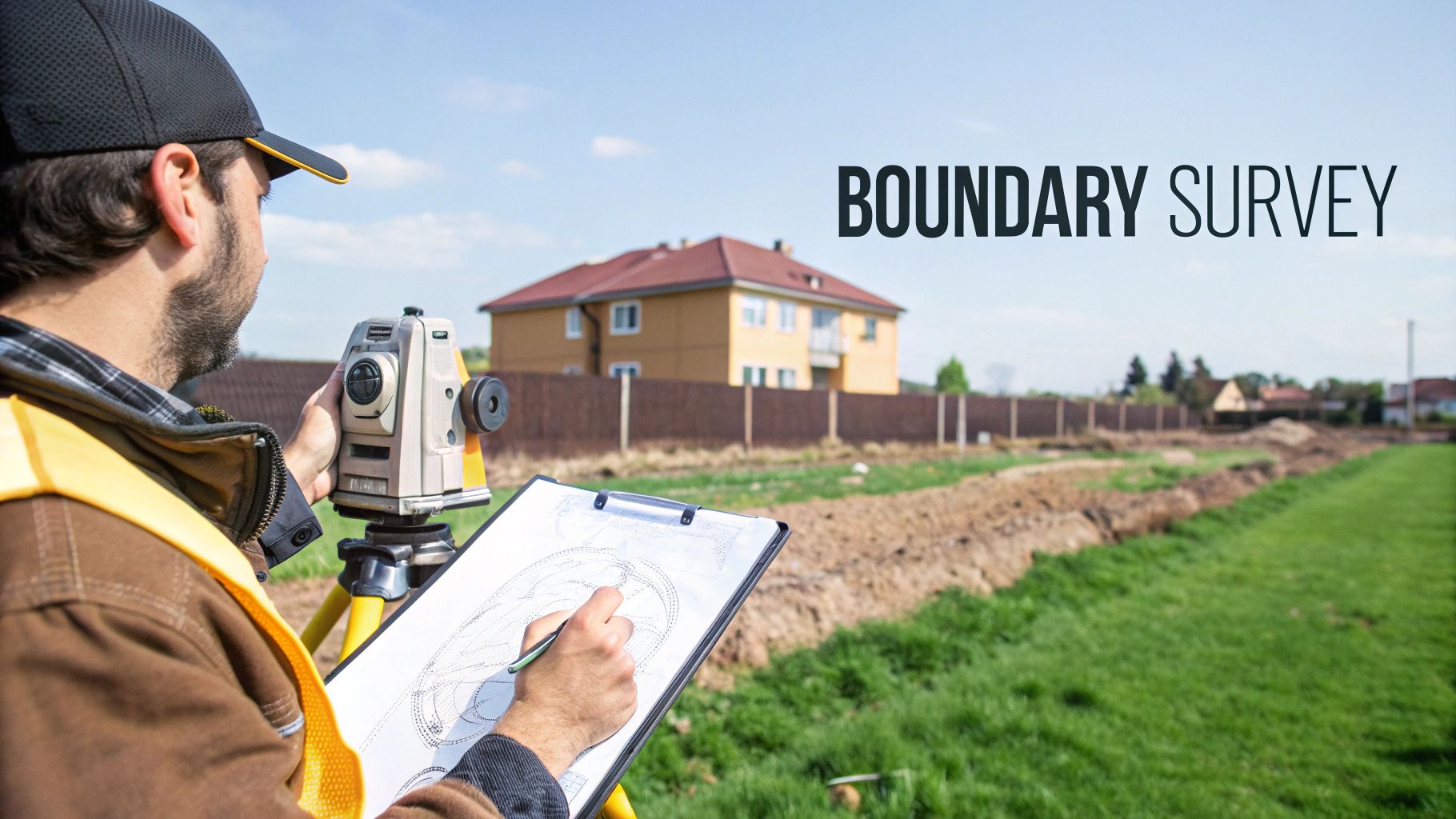
Neglecting a survey can lead to costly disputes over property lines or future development restrictions. It confirms you have the physical space and legal right to execute your business plans, whether that involves expansion, new construction, or simply utilizing the existing footprint.
Key Issues Uncovered by a Survey
- Boundary Discrepancies: Reveals if fences, structures, or natural features do not align with the legally recorded property lines.
- Encroachments: Identifies situations where a neighboring building, parking lot, or fence extends onto your property, or vice-versa.
- Undisclosed Easements: Uncovers physical evidence of utility lines or access roads not mentioned in the title report that grant others rights to use part of the land.
- Zoning Setback Violations: Confirms whether existing structures comply with local zoning regulations regarding distance from property lines.
Expert Insight: "An ALTA/NSPS Land Title Survey is the gold standard. It provides the comprehensive detail that both lenders and savvy investors require to fully understand a property's physical limitations and potential liabilities before closing the deal."
Actionable Steps for Implementation
Hire a licensed surveyor with extensive experience in commercial properties to conduct an ALTA/NSPS Land Title Survey, which is the most detailed type and often required by lenders. Review the completed survey map with your attorney, comparing it against the title report to identify any inconsistencies. If the survey reveals encroachments or other boundary issues, you must negotiate a resolution with the seller or the adjacent property owner before closing. These resolutions could include creating a formal easement or adjusting the purchase price to compensate for the issue.
9. Insurance Review and Risk Assessment
A thorough insurance review is a critical component of risk management in any commercial property transaction. This process involves a detailed evaluation of the property's existing insurance coverage, its claims history, and its overall insurability. The goal is to ensure you can obtain adequate and affordable coverage while identifying any potential risks, gaps, or historical issues that could lead to future liabilities or unexpected expenses. This analysis protects your investment from catastrophic loss.
This step is essential because a property's loss history can directly impact your future premiums and even its eligibility for certain types of coverage. Overlooking it could mean inheriting a high-risk asset with uninsurable problems or facing lender requirements you cannot meet.
Key Issues Uncovered by an Insurance Review
- High-Risk History: Reveals a history of frequent claims (e.g., multiple flood or fire incidents) that could lead to significantly higher premiums or make the property uninsurable.
- Coverage Gaps: Identifies missing endorsements or policy exclusions that leave your asset exposed to specific perils, such as windstorms or building code ordinance changes.
- Insurability Obstacles: Discovers conditions, like the property's location in a high-risk flood zone, that require expensive specialized policies.
- Lender Compliance Issues: Determines if existing or obtainable coverage meets the stringent requirements set forth by your lender.
Expert Insight: "The seller's loss-run report is the property's risk-and-liability resume. Analyze it closely, as it tells a story that a physical inspection alone cannot reveal about past problems and potential future costs."
Actionable Steps for Implementation
As a key part of your commercial property due diligence checklist, request a 3-to-5-year insurance claims history (a "loss-run report") from the current owner. Simultaneously, engage an experienced insurance broker to obtain new quotes based on the property’s specifics and your intended use. Review all policy details carefully, paying close attention to exclusions and coverage limits. For a deeper understanding of what to look for, consult a comprehensive guide to commercial property insurance to understand essential coverage details. Ensure all potential policies satisfy your lender’s requirements and consider adding business interruption coverage if it is an income-producing property.
10. Permits, Licenses, Conditional Use, and Debt/Lien Verification
This dual-focused investigation confirms the property's operational legality and financial clarity. It involves verifying all permits and licenses required for the current or intended business are active and transferable, while simultaneously conducting a deep search for any outstanding debts, liens, or encumbrances that could cloud the title. This process ensures the property can be legally operated as planned and that you will not inherit the seller's financial obligations.
Neglecting this step can lead to costly surprises, from being unable to operate your business due to a non-transferable liquor license to discovering a six-figure mechanic's lien that must be paid before you can secure a clear title. It is a critical part of any comprehensive commercial property due diligence checklist.
Key Issues Uncovered by this Verification
- Operational Restrictions: Reveals that a crucial Conditional Use Permit for something like outdoor seating or extended hours is set to expire soon.
- Transferability Problems: Uncovers that essential licenses, such as those for food service or specific professional practices, cannot be transferred to a new owner and require a lengthy re-application process.
- Hidden Debts: Identifies outstanding mechanics' liens from unpaid contractors or federal tax liens from the IRS that attach to the property.
- Compliance Violations: Discloses existing violations of health department or environmental permit conditions that could trigger fines or operational shutdowns.
Expert Insight: "Never assume a permit or license is a given. Always verify its status, conditions, and transferability directly with the issuing agency. A business's ability to operate legally is as important as the physical building itself."
Actionable Steps for Implementation
Begin by requesting a complete list of all current business licenses and operational permits from the seller. Independently contact each issuing agency (e.g., health department, zoning board, environmental protection) to confirm the status, compliance history, and transfer process for each one. For the financial component, scrutinize the preliminary title report for any recorded liens. Additionally, order a UCC search for liens against personal property included in the sale and have your attorney search public records for judgments or tax liens. Demand the seller provide payoff statements for all identified financial encumbrances to be settled at or before closing.
Commercial Property Due Diligence: 10-Point Comparison
| Item | Process Complexity 🔄 | Resource & Time ⚡ | Expected Outcomes 📊 | Ideal Use Cases 💡 | Key Advantages ⭐ |
|---|---|---|---|---|---|
| Title Search and Property Ownership Verification | Moderate — records review, legal analysis; may need title attorney | Document access and title company; typically 1–2 weeks | Clear chain of title; liens/easements and title defects identified | All purchases, high‑value or disputed‑history properties | Prevents disputed ownership; identifies hidden financial obligations |
| Property Inspection and Condition Assessment | Moderate — on‑site inspection with potential specialist follow‑ups | Inspector fees $500–$3,000+; 1–2 weeks; extra for specialists | Physical defects, safety/code issues, repair cost estimates | Older buildings, renovation projects, risk‑averse investors | Reveals costly repairs; provides negotiation leverage |
| Environmental Due Diligence and Phase I ESA | High — records review, site inspection; may trigger Phase II testing | Phase I $1.5k–$4k; Phase II $5k–$25k+; weeks to months | Recognized environmental conditions; remediation and liability assessment | Industrial sites, former gas stations, properties with hazardous past | Identifies contamination liabilities; informs remediation budgeting |
| Financial Analysis and Income Verification | Moderate — financial document review and tenant income verification | Time‑intensive; may require accountant/underwriter; several weeks | Verified NOI, cash flow, cap rate; income/expense discrepancies flagged | Income‑producing assets, refinancing, investment underwriting | Reveals true profitability; supports financing and valuation |
| Tenant Lease Review and Analysis | Moderate–High — legal lease interpretation and credit checks | Legal/consultant fees; rent roll verification; 1–3 weeks | Lease obligations, expirations, tenant credit and renewal risks | Multi‑tenant properties, retail centers, properties with anchors | Clarifies income stability; identifies contingent lease liabilities |
| Zoning Compliance and Land Use Verification | Moderate — regulatory research and municipal contact | Time to obtain zoning letter; weeks; possible planning dept fees | Permitted uses, setbacks, variances and development constraints | Change‑of‑use projects, expansions, new developments | Confirms legal use; prevents costly prohibited‑use surprises |
| Building Code and Regulatory Compliance | High — technical code review, specialist consultants and inspections | Consultant and retrofit costs; weeks to months; potential large upgrade costs | Code violations, ADA/fire safety issues, retrofit scope and costs | Renovations, occupancy transfers, older or historic buildings | Identifies safety risks and required upgrades; reduces liability |
| Survey and Boundary Verification | Moderate — licensed surveyor on‑site and legal comparison | Survey fees $1k–$5k+; typically 2–4 weeks | Accurate boundaries, easements, encroachments and legal match | Development, construction, financing, boundary dispute resolution | Confirms legal description; reveals encroachments affecting use |
| Insurance Review and Risk Assessment | Moderate — policy and claims history review with broker | Broker/insurer review and quotes; ~1–2 weeks; premium impacts | Coverage gaps, exclusions, premium expectations and insurability | All income properties, high‑risk locations, refinancing | Identifies insurance gaps; protects against catastrophic financial loss |
| Permits, Licenses, Conditional Use, and Debt/Lien Verification | High — multi‑agency checks plus lien and title searches | 5–10 business days typical; legal/title fees; possible long transfer timelines | Valid/transferable permits, outstanding liens, payoff amounts | Hospitality, regulated operations, properties with recent improvements | Ensures licenses/permits transferable; reveals liens before closing |
Turning Diligence into a Deal: Your Next Steps
Navigating the complexities of a commercial real estate transaction can feel like charting a course through a dense, unfamiliar landscape. The comprehensive commercial property due diligence checklist detailed in this guide serves as your essential map and compass, transforming potential pitfalls into strategic opportunities. By systematically addressing each checkpoint, from the legal intricacies of title searches to the physical realities of property inspections and the financial scrutiny of tenant lease reviews, you move beyond mere speculation into a position of informed power.
Due diligence is far more than a procedural formality; it is the bedrock of a sound investment strategy. It is the process that uncovers the hidden environmental liabilities during a Phase I ESA, verifies the true income potential through meticulous financial analysis, and confirms that the property’s zoning and land use align with your long-term vision. Each item on the checklist, whether it’s a boundary survey or a deep dive into building code compliance, provides a critical piece of the puzzle.
From Checklist to Confident Action
The true value of this process lies not just in identifying problems, but in quantifying them. An unexpected roof repair or an unresolved lien is not necessarily a deal-breaker. Instead, armed with concrete data and professional assessments, these findings become powerful negotiating tools. They allow you to:
- Renegotiate the Purchase Price: Presenting a well-documented list of necessary repairs or compliance issues can lead to significant price reductions.
- Secure Seller Concessions: You might negotiate for the seller to cover closing costs, fund an escrow account for future repairs, or resolve outstanding permit issues before closing.
- Make an Informed "Go/No-Go" Decision: Ultimately, the goal is to proceed with confidence. A thorough due diligence process ensures that if you move forward, you do so with a clear understanding of the property's risks and a solid plan to manage them.
Building Your Foundation for Success
Completing a rigorous due diligence investigation is the first step toward realizing the full potential of your commercial property. It mitigates risk, protects your capital, and sets the stage for a profitable and sustainable future. This checklist is your framework for building a team of experts-attorneys, environmental consultants, architects, and engineers-who will help you interpret the findings and make strategic decisions.
Remember, every question asked and every document reviewed contributes to the strength of your investment foundation. The effort invested in due diligence today pays dividends for the entire lifecycle of your asset, ensuring that your commercial real estate venture is not just a transaction, but a lasting success built on a platform of certainty and insight.
Ready to translate your due diligence findings into a viable project design? At Sherer Architects, LLC, we specialize in helping investors and developers navigate the complexities of adaptive reuse, historic preservation, and new commercial construction. Contact Sherer Architects, LLC today to see how our architectural expertise can help you maximize your property’s potential and bring your vision to life.