

At its most fundamental level, the difference between an architect and an engineer really boils down to vision versus execution. The architect is the creative mind, the one who imagines what a space could be, focusing on the art and science of designing places for people. The engineer, on the other hand, is the technical expert who figures out how to make that vision a reality—safely and efficiently.
The Art and Science of Building
Both architects and engineers are absolutely critical to any construction project, but their day-to-day thinking and core responsibilities couldn't be more different. An architect’s first question is often, "What will this space feel like?" They're obsessed with the human experience: the flow from one room to another, the visual appeal, and how the building will ultimately serve the people inside it. Their work is a delicate balance of artistic expression and practical design.
Engineers start from a completely different place. Their primary question is, "How will this structure stand up?" They apply hard science—physics, mathematics, and material science—to solve very concrete problems. They ensure the building is stable, the systems work, and everything meets strict safety codes. This core difference in perspective shapes everything they do, from their education all the way to the final project deliverables.
I've always said the simplest way to put it is this: Architects design the dream, and engineers make sure the dream doesn't collapse.
Here’s a quick look at where their priorities lie.
| Aspect | Architect's Focus | Engineer's Focus |
|---|---|---|
| Primary Goal | Design, Aesthetics, User Experience | Safety, Structural Integrity, Functionality |
| Core Question | "What is the vision?" | "Will the vision work?" |
| Main Skillset | Creative Design, Spatial Planning | Technical Analysis, Problem-Solving |
| Key Priority | Form and Space | Systems and Structure |
Comparing Education and Professional Licensing
The path to becoming a licensed architect or engineer is a demanding one, but the journeys look very different. These foundational differences start in the classroom and shape how each professional approaches their work on a project.
The Architect's Path: A Holistic Approach
For architects, it all starts with a professional degree from a program accredited by the National Architecture Accrediting Board (NAAB). This is typically a five-year Bachelor of Architecture (B.Arch) or a Master of Architecture (M.Arch). Their education is a deep dive into design theory, history, and countless hours in the studio, honing their creative and spatial reasoning skills.
After getting their degree, the real-world training begins. They have to complete the Architectural Experience Program (AXP), which is an intensive, paid internship program. This ensures they get hands-on experience in every aspect of the profession before they're even allowed to sit for the grueling, multi-part Architect Registration Examination (ARE).
The Engineer's Path: A Technical Specialization
Engineers take a much more specialized, analytical route. Their education begins with a four-year bachelor's degree in a specific discipline—like civil, structural, or mechanical engineering—from a program accredited by the Accreditation Board for Engineering and Technology (ABET). Their coursework is heavy on math, physics, and materials science.
The core difference is this: architects are trained to think broadly and creatively about the entire design, while engineers are trained to develop deep, technical expertise in specific systems.
To earn the coveted Professional Engineer (PE) license, a graduate first has to pass the Fundamentals of Engineering (FE) exam. Then, after clocking several years of supervised work experience under a licensed PE, they must pass the comprehensive Principles and Practice of Engineering (PE) exam for their chosen specialty.
So, when you look at an architect vs. an engineer, you're seeing the results of two distinct training philosophies. An architect’s training creates a design-minded generalist who understands the entire building process. An engineer’s training, on the other hand, produces a specialist laser-focused on making sure the building's systems are safe, stable, and functional.
Defining Roles and Project Responsibilities
When you step onto a commercial project site, you’ll find the architect and engineer working in tandem, each with distinct but deeply connected responsibilities. Think of the architect as the project visionary—the one who translates a client's abstract ideas into a tangible, functional design.
Their job is incredibly broad, covering everything that shapes the building's look and feel. They're the ones developing the initial concepts, sketching out detailed floor plans, and choosing materials that bring the visual story to life. Often, the process starts with simple conceptual tools, like an interior design bubble diagram, to map out how spaces will flow and connect.
An architect is the guardian of the project's form, function, and user experience, ensuring the final building not only stands but also inspires.
Ultimately, the architect owns the big picture. They ensure the design is beautiful, meets the client’s goals, and complies with all the local zoning laws and building codes.
The Engineer's Specialized Function
While the architect shapes the vision, the engineers are the technical masters who figure out how to make it a reality—safely and efficiently. They take the architect’s creative plans and apply hard science and mathematics to solve the practical puzzles of construction. This isn't just one person; it's a team of specialists.
Engineers are responsible for all the hidden systems that make a building work. Their specific contributions break down like this:
- Structural Engineers: These experts design the building’s skeleton. They meticulously calculate the loads for every beam, column, and foundation to ensure the structure can handle everything from its own weight to high winds or even earthquakes.
- MEP Engineers: This group is all about the building’s circulatory and nervous systems—Mechanical, Electrical, and Plumbing. They design the HVAC networks, lighting, power grids, and water systems that keep occupants comfortable and the building running.
- Civil Engineers: Their focus is on the land itself. They handle site grading, design drainage systems, and make sure the ground is perfectly prepped to support the building for decades to come.
This partnership is what makes modern construction possible. The architect dreams up what a building can be, and the engineering teams provide the technical blueprint to build it right.
A Look at Key Project Deliverables
If you want to understand the real difference between an architect and an engineer, just look at the documents they produce. An architect’s deliverables are focused on communicating the vision, the feel, and the flow of a space. They’re essentially writing the building's story in a visual language.
Engineers, on the other hand, create highly technical and analytical documents. Their deliverables provide the precise, data-driven instructions that guarantee the architect's vision can be built safely and will perform as expected. These documents form the technical backbone of the project.
This infographic breaks down the core distinction between an architect's design-centric vision and an engineer's focus on systems and structural integrity.
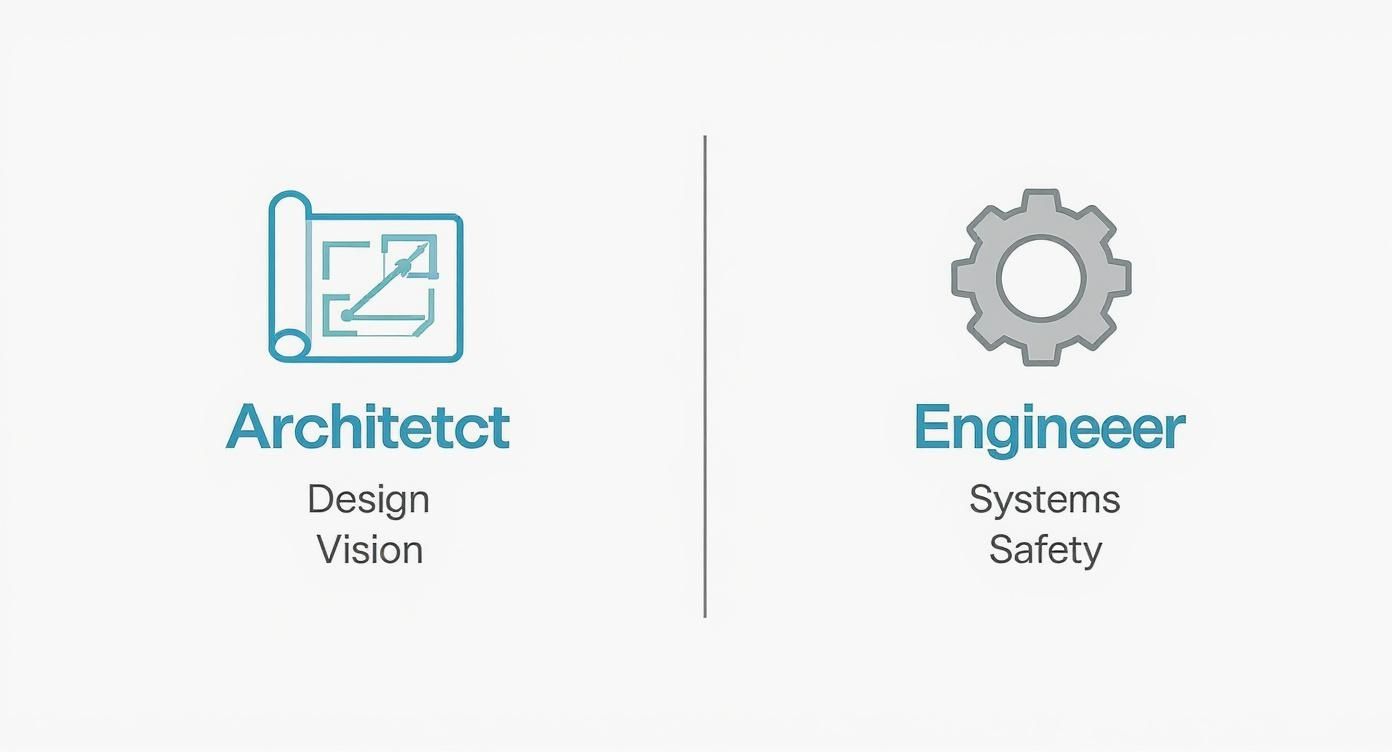
The image clearly shows how an architect's world revolves around the overall design concept, while an engineer is responsible for making sure the functional and safety systems are sound.
Defining the What vs. The How
The simplest way to think about it is this: architectural plans define the 'what', and engineering plans define the 'how'. One deals with creative intent and user experience; the other is all about execution and performance.
An architect’s blueprints might show a beautiful, expansive glass wall to maximize natural light. The structural engineer’s calculations and drawings will specify the exact steel beam thickness, bolt patterns, and foundation support needed to ensure that glass wall doesn't collapse under wind load.
Let’s take a look at the typical documents each professional creates during a commercial project.
Architect vs. Engineer: Key Project Deliverables
The table below offers a side-by-side comparison of the primary documents and plans you'll get from each discipline.
| Deliverable Type | Architect's Output | Engineer's Output |
|---|---|---|
| Conceptual Plans | Schematic designs and 3D renderings that show the building's form, layout, and appearance. | Feasibility studies and preliminary structural system analysis reports. |
| Construction Docs | Detailed architectural drawings (blueprints) with floor plans, elevations, and sections. | Structural load calculations, mechanical HVAC diagrams, and electrical schematics. |
| System Details | Specifications for materials, finishes, fixtures, and aesthetic components. | Plumbing and fire protection plans, and energy performance models. |
| Final Approvals | Documents for zoning and design review board approvals. | Calculations and reports for building code safety and compliance. |
Ultimately, while the architect's plans capture the soul of the building, the engineer's documents provide the critical instructions that ensure it will stand strong and function correctly for decades to come.
A Look at Salary and Career Paths
When you're weighing a career in architecture against one in engineering, money and long-term growth are always part of the conversation. It's a practical reality. An engineering degree often opens doors to a much broader range of industries—think technology, energy, or manufacturing, not just construction. This versatility can translate into higher average starting salaries and a wider net for job opportunities.
An architect's career path, on the other hand, is almost exclusively tied to the building and design world. It's a more focused journey, but that doesn't mean it's less lucrative. Elite architects who run their own successful firms or lead design at globally recognized studios can absolutely command high incomes, often on par with or even exceeding their engineering peers.
Comparing Earning Potential
Let's talk numbers, because they tell a big part of the story. According to the U.S. Bureau of Labor Statistics, the median annual salary for engineers across all disciplines hovers around $92,000. The top 10% in the field can pull in over $135,000.
For architects, the median salary is a bit lower at $89,000. However, that figure doesn't capture the whole picture. A senior architect leading high-profile commercial projects in a major city like New York or San Francisco can easily earn well into the six figures. You can find more detail on the earning potential for each profession in various analyses.
While the median salary might give engineers a slight edge on paper, an architect's earning potential is heavily tied to their reputation, design creativity, and business savvy. A successful firm owner can earn significantly more than a mid-level engineer.
At the end of the day, both fields offer stable, rewarding, and financially sound career paths. The choice really boils down to what drives you. Are you drawn to the wide-ranging technical problem-solving of engineering, or the focused, creative world of architecture? Both professions provide plenty of room to grow, lead, and earn a great living if you're dedicated and excel at what you do. The fundamental difference is simply in the nature of the work and the industries you'll be a part of.
How Architects and Engineers Work Together
Forget the idea of architects and engineers as separate players. The best projects emerge when their collaboration is seamless, a constant dialogue between creative vision and technical reality. It's not a simple hand-off from one to the other; it's an ongoing feedback loop that refines and strengthens the final design.

Imagine a modern library being designed. The architect might dream up a grand, open-span reading room with a soaring glass facade, designed to flood the space with natural light. This is the initial concept—the "what."
The Iterative Feedback Process
Once that initial vision takes shape, the engineering team steps in to figure out the "how." They don't analyze the architect’s plans to poke holes in them, but to find the smartest, most effective way to bring that vision to life. This back-and-forth involves a few key steps:
- Structural Review: A structural engineer looks at the open-span concept. They might suggest using laminated timber beams instead of steel to achieve the desired aesthetic while guaranteeing the roof can handle heavy snow loads.
- Systems Integration: An MEP (Mechanical, Electrical, and Plumbing) engineer calculates the exact HVAC requirements to maintain a stable climate for a rare book archive, carefully integrating ductwork so it doesn’t disrupt the architectural flow.
This partnership transforms an ambitious design into a functional, enduring building. The architect provides the creative direction, while the engineer ensures that direction is grounded in sound scientific and structural principles.
Constant communication is the bedrock of this process. Engineering requirements have to be integrated early, or you risk expensive redesigns down the line. While architects and engineers have always worked closely in traditional construction, new technologies are opening up different kinds of interactions. For example, a team might explore applications of additive manufacturing in architecture for creating complex, custom facade elements.
Ultimately, this partnership ensures the final structure is not only beautiful but also built to last, proving that the best results always happen when art and science work in lockstep.
Common Questions About Architects and Engineers
It’s easy to get the roles of architect and engineer mixed up. They work so closely together, but their training, skills, and perspectives are fundamentally different. Let's clear up a couple of the most common questions we hear.
Is Architecture or Engineering Harder?
This is a tough one, and the real answer is: it depends entirely on you and your natural abilities. There's no single "harder" path, just different kinds of challenges.
Architecture is incredibly demanding on your creative and artistic side. It requires a knack for spatial reasoning, a deep well of creativity, and the stamina to spend countless hours refining designs. If turning abstract ideas into visual, functional art doesn't come naturally to you, you'll find architecture to be a serious uphill battle.
Engineering, on the other hand, is all about cold, hard science. The difficulty here lies in the rigorous math and physics—applying complex calculations to make sure a structure is safe, sound, and efficient. If you’re a born problem-solver who loves logic and data, you’ll likely feel more at home in the engineering world.
Can an Architectural Engineer Become a Licensed Architect?
Absolutely, but it's not as simple as just switching hats. It’s a dedicated journey because the professions have completely separate licensing and educational requirements.
An engineer looking to become a licensed architect would need to go back to the drawing board, so to speak. They'd have to:
- Earn a professional degree from a program accredited by the National Architecture Accrediting Board (NAAB).
- Log the required real-world internship hours through the Architectural Experience Program (AXP).
- Pass all sections of the rigorous Architect Registration Examination (ARE).
Their engineering background gives them a huge advantage in understanding building systems, but they still have to prove their competency in architectural design and theory.
The core of the matter is that an engineer’s training focuses on making a building work, while an architect's focuses on how a building is experienced. Transitioning between them requires formally learning the other’s core discipline and meeting its unique professional standards.
Ultimately, this process ensures every licensed professional has mastered the essential skills for their title, whether they lean more creative or analytical. Both are crucial for a successful project, but they are built on different foundations.
Are you planning a commercial construction, adaptive reuse, or historic preservation project in South Carolina? The team at Sherer Architects, LLC brings decades of experience to transform your vision into an enduring, valuable asset. Start your project with us today.