

Architectural detail drawings are the zoom-ins, the close-up shots of a building's construction plans. While the main blueprints give you the wide-angle view, detail drawings show exactly how the critical pieces fit together. We're talking about everything from window installations to roof junctions—the spots where getting it right means the building will last for decades.
From Big Picture to Fine Print
Think of it this way: the main architectural plans are like a road map showing cities and highways. It gives you the general layout, enough to get from point A to point B. Architectural detail drawings, on the other hand, are the turn-by-turn GPS directions. They zoom right into the tricky intersections, showing you exactly which lane to be in and how the different roads connect.
These drawings are what bridge the gap between an idea on paper and a structure standing in the real world. They deliver the non-negotiable instructions that guide a builder through the most technically challenging parts of a project. Without them, contractors are left to guess, and that’s a recipe for costly mistakes, structural problems, and frustrating delays.
The Anatomy of a Detail Drawing
Every detail drawing is a super-concentrated packet of information. It strips away all the surrounding noise to focus on one specific construction assembly. You'll often see them drawn at a much larger scale than floor plans—sometimes 1:10, 1:5, or even full-size (1:1) —so that every tiny component and connection is crystal clear. This level of magnification is what allows architects to specify the exact materials and assembly order.
An architectural detail drawing is a promise. It’s a promise to the client that the building will perform as designed, and it's a promise to the builder that the design is achievable, logical, and thoroughly considered.
At the end of the day, these documents are less about artistry and more about clarity. They answer the nitty-gritty questions that general plans can't touch, like:
-
How is this window frame sealed to keep water out?
-
What are the exact layers in this wall assembly to hit the right insulation value?
-
How does the roof flashing meet the parapet to form a perfect, watertight seal?
By getting this specific, architectural detail drawings become the ultimate quality control tool on a construction site. They ensure the architect's vision for performance, durability, and aesthetics is built precisely as intended, turning a good design into a great building.
A good detail drawing packs a lot of information into a small space. Here’s a quick look at the essential information found in every effective architectural detail drawing.
Core Elements of a Detail Drawing
|
Component |
What It Tells the Builder |
|---|---|
|
Dimensions & Scale |
Provides the exact size of each component and its relationship to others. |
|
Material Symbols |
Uses standardized patterns (hatching) to identify materials like concrete, wood, or insulation. |
|
Annotations & Notes |
Specifies materials, fasteners, sealants, and the sequence of assembly. |
|
Reference Tags |
Links the detail back to its specific location on the main floor plans or elevations. |
With these elements in place, a builder has everything they need to execute the design flawlessly, leaving no room for interpretation or error.
Why Detail Drawings Are Non-Negotiable
Picture a construction team trying to assemble a state-of-the-art engine with nothing but a rough sketch. The odds of it actually working are slim to none. That’s exactly the kind of chaos architectural detail drawings prevent on a job site. They are the ultimate tool for turning ambiguity into actionable, crystal-clear instructions.
On any active construction site, guesswork is the enemy. It leads to mistakes, delays, and safety risks. Without a detail drawing, a contractor might install a window using a standard technique that’s completely wrong for a building in a high-wind zone, setting the stage for leaks or catastrophic failure down the road.
A proper detail drawing cuts through all that by specifying the exact flashing, sealants, and fasteners needed for a durable, weatherproof installation. This isn't just about avoiding errors; it's the very bedrock of quality control.
From Legal Safeguard to Quality Assurance
Think of architectural details as a crucial part of the legal contract between the client and the builder. They create a visual, indisputable record of what’s expected, protecting everyone involved. If a dispute pops up over the materials used or how something was assembled, these drawings are the final word. There's no room for debate.
This level of precision ensures the specified high-performance insulation actually gets installed, not a cheaper substitute. It guarantees that complex junctions where different materials meet are built to perform and last.
And creating these documents is getting easier and more integrated, thanks to modern tools. The rise of Building Information Modeling (BIM) has been a game-changer. By 2025, it's projected that 68% of professionals in the architecture, engineering, and construction space will be using BIM. A full 65% of them already say it delivers the highest ROI for their firms by enabling precise 3D models that boost accuracy from the get-go. You can learn more about future architecture trends and the impact of BIM on the industry.
A project without detail drawings is a project left to chance. It relies on assumptions, habits, and interpretations, which can lead to costly rework, project delays, and compromised structural integrity.
The True Cost of Ambiguity
Let’s talk about what this means in the real world. A project backed by a solid set of detail drawings moves forward with confidence and efficiency. The builder knows exactly how to construct a tricky roof eave to manage water runoff because every layer, material, and connection is clearly spelled out.
Now, flip that scenario. A project missing those details often grinds to a halt. The builder has to stop work to ask for clarification, a process that burns both time and money. Even worse, they might make an educated guess that turns out to be dead wrong, leading to demolition and reconstruction.
In the end, detail drawings aren't just another line item on the budget. They are a smart investment that saves an incredible amount of time, prevents expensive rework, and protects reputations by ensuring the final building performs exactly as it was designed to.
How to Read an Architectural Detail Drawing
At first glance, an architectural detail drawing can look pretty intimidating—almost like trying to read a new language. But once you get the hang of it, you'll see it’s really just a zoomed-in map that tells a very specific story about how a small part of the building fits together. Getting comfortable with these drawings is the key to turning an architect's vision into a well-built reality.
The first thing you’ll notice is the scale. Your main floor plans might be at a small scale like 1:100, where you see the whole picture. Detail drawings, on the other hand, are blown up to a much larger scale, often 1:10 or even 1:5. Think of it like this: the floor plan shows you the car, but the detail drawing pops the hood and shows you exactly how the engine is assembled. This close-up view is where the magic happens, revealing how different materials and components connect.
Understanding the Visual Language
Every single line, pattern, and symbol on a detail drawing means something. It's a visual shorthand that everyone on the job site—from the contractor to the tradesperson—can understand without needing a lengthy explanation. Keep an eye out for these key elements:
-
Material Hatching: These are standardized patterns that instantly tell you what material you're looking at. A series of diagonal lines might signify wood, while a speckled pattern with little triangles usually means concrete. This lets you see the makeup of an assembly at a glance.
-
Annotations and Dimensions: This is where the explicit instructions live. Annotations are text callouts pointing to specific materials, fasteners, or sealants. Dimensions give you the exact measurements down to the millimeter, removing all the guesswork from fabrication and installation.
-
Reference Tags: You'll see little bubbles or tags that act like a GPS, connecting the detail back to the main floor plans or elevations. This cross-referencing system shows you exactly where this magnified junction is located within the overall building design.
By combining scale, dimensions, symbols, and notes, a detail drawing tells a complete story of assembly. It’s a step-by-step guide that ensures the architect’s intent for performance and durability is perfectly executed on-site.
Learning to interpret these drawings is a fundamental skill for anyone in the construction world. If you want to dive deeper, this guide on how to read construction blueprints is a fantastic resource. Once you master this visual language, you’ll be able to spot potential issues, ensure top-notch quality, and play your part in a successful project.
Exploring Common Types of Detail Drawings
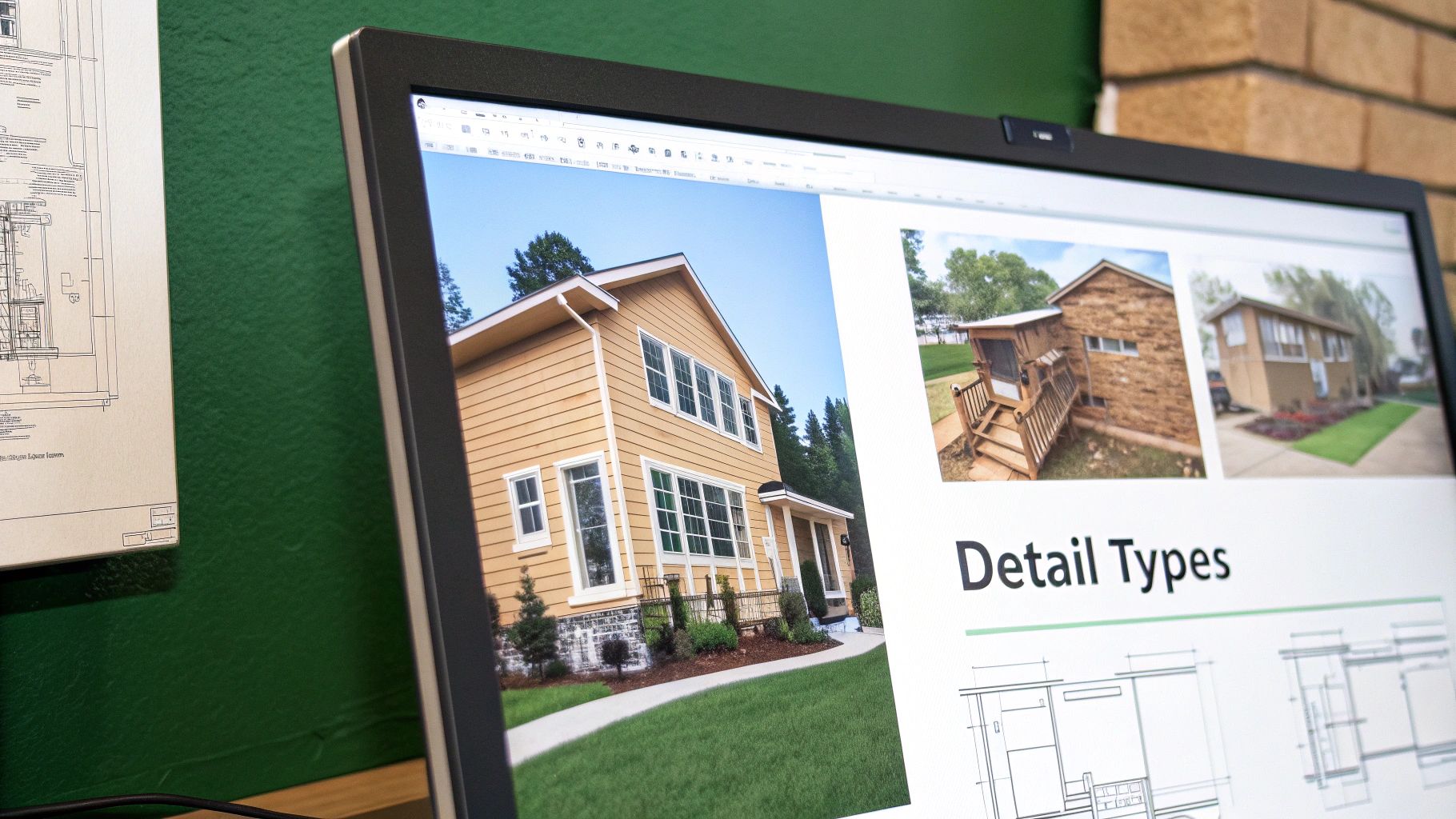
While every architectural detail drawing aims for clarity, they aren't one-size-fits-all. Think of them as specialized tools in an architect's toolkit, each designed to solve a very specific construction puzzle. They focus on the areas where things can go wrong—the complex joints and vulnerable transitions that define a building's performance.
Just like a surgeon wouldn't use the same instrument for every procedure, architects draft different types of details to tackle unique assembly challenges. Each one is a crucial piece of the puzzle, ensuring the building stands strong and performs well for decades to come.
Foundation and Wall Details
It all starts at the ground. Foundation details are the master plans for how a building connects with the earth. These drawings show precisely how concrete should be reinforced, the exact dimensions of the footings, and how waterproofing layers are applied. They are the building's first line of defense against moisture from the ground and are critical for preventing structural settling.
Moving up, wall section details give us a see-through slice of the wall, from the foundation right up to the roofline. They map out the entire assembly layer by layer: structural framing, insulation, vapor barriers, exterior siding, and interior finishes. Getting this right is what guarantees the building will be warm, dry, and energy-efficient. Even elements like built-in lighting are planned here; for instance, an expert recessed lighting layout guide helps integrate fixtures seamlessly into the wall and ceiling structure from the start.
Envelope and Junction Details
Every window and door is a hole in the building’s protective skin. That makes them potential hotspots for air and water leaks. Window and door details provide the step-by-step instructions for getting these installations perfect. They call out the specific flashing, sealants, and air-sealing tapes required to create a completely weatherproof connection between the window unit and the surrounding wall.
And what about keeping the building dry from above? That’s the job of roof details. These drawings zoom in on the tricky spots: where different roof slopes meet, where a roof joins a wall, or where vents and skylights pop through. They create a clear roadmap for installing flashing and underlayment to prevent water intrusion—one of the most common and costly problems a building can face.
To really understand how these drawings function, it helps to see their distinct roles side-by-side.
Comparing Key Architectural Detail Types
|
Detail Type |
Main Purpose |
Critical Information Provided |
|---|---|---|
|
Foundation Details |
Ensure structural stability and moisture control at the building’s base. |
Footing sizes, rebar placement, anchor bolt locations, and waterproofing methods. |
|
Wall Sections |
Define the thermal and weather-resistant performance of the exterior envelope. |
Material layers, insulation type and thickness, and air/vapor barrier locations. |
|
Window & Door Details |
Prevent air and water leakage at openings in the building envelope. |
Flashing sequences, sealant specifications, and integration with the weather barrier. |
|
Roof Details |
Guarantee a watertight and durable roofing system. |
Flashing at parapets and penetrations, material overlaps, and drainage slopes. |
As you can see, each detail type is a focused problem-solver. It anticipates a specific construction challenge—be it water, air, or structural load—and provides a clear, buildable solution before it ever becomes an issue on site.
Principles for Creating Effective Details
Crafting a great architectural detail drawing isn't about knowing every last feature in your drafting software. It’s about a mindset, one grounded in a handful of core principles that prioritize clarity above all else. The real goal is to create a drawing so clear it leaves no room for doubt. Shove too much information onto the page, and it becomes just as useless as a detail with too little—both lead to head-scratching and costly mistakes on site.
Think of yourself as writing the perfect set of instructions for a complex piece of furniture. Simplicity is your best friend. Every single line, note, and symbol has to earn its place. If it isn't essential for explaining how things go together, it's just noise. This keeps the builder focused on the design intent, not on solving a puzzle.
This idea of clarity has to be consistent across the entire set of drawings, too. The hatch pattern you use for concrete or the symbol for rigid insulation needs to be the same on every single sheet, no exceptions.
Prioritizing Buildability and Consistency
The most beautiful detail ever drawn is completely worthless if it can't be built efficiently in the real world. We call this concept buildability, and frankly, it's the most important principle of all. It forces you to step out of the architect's shoes and think like a builder. How will this be sequenced? Are these materials readily available? Does this align with how the trades actually work? A truly successful detail is one a contractor can glance at and immediately say, "Yep, I know how to build that."
Consistency is what holds a professional drawing set together. This isn't just a matter of preference; it's about making the entire document package easy to navigate.
-
Lineweights: Use different line thicknesses to create a visual hierarchy. Heavier lines for cut profiles and lighter lines for objects in the background make the drawing pop and guide the eye.
-
Notation Style: Keep your callouts and notes consistent. Use the same font, size, and phrasing everywhere to build a familiar language for the reader.
-
Symbol Libraries: A standardized set of symbols for materials and components is non-negotiable. Don't reinvent the wheel on every project.
When you maintain this kind of uniformity, you lower the mental effort required from the construction team. They can work faster, more confidently, and with far fewer calls back to your office.
The best architectural details drawings are a dialogue between the architect and the builder. They anticipate questions, provide clear answers, and demonstrate a deep respect for the craft of construction by being both logical and buildable.
Of course, technology is changing the game. AI-powered drafting tools are now handling some of the more repetitive work, allowing architects to explore dozens of layout options in the time it used to take to draw one. With cloud collaboration and green building now becoming standard practice, these tools are helping us create smarter, more sustainable projects. It’s worth exploring these top trends in architectural drafting to see just how quickly the field is moving forward.
At the end of the day, it's this commitment to clarity, consistency, and buildability that elevates a detail from a simple drawing to a powerful instrument for quality construction.
The Future of Architectural Detailing
For centuries, architectural detailing was about drawing static lines on a page. Today, it’s undergoing a radical shift, becoming a dynamic, data-rich discipline. The driving force behind this evolution is the industry's move away from traditional CAD and into the world of 3D Building Information Modeling, or BIM.
Within a BIM workflow, an architectural details drawing is no longer just an isolated sketch. It's a living piece of a comprehensive digital twin of the entire building. Think about it this way: a detail for a window installation now carries embedded data about the specific window model, its thermal performance, and even its material makeup. If you change one element in the model, every related detail and schedule updates automatically. This is a game-changer for reducing errors and ensuring consistency. We've gone from drawing objects to modeling intelligent systems.
This digital shift is a huge factor in the growth of the global Architectural Services Market. Valued at USD 184.1 billion in 2025, the market is on track to hit USD 330.1 billion by 2033. This boom is largely thanks to the integration of digital tools like AI and 3D visualization, which empower us to create far more complex and sustainable designs. For a deeper dive into these trends, check out the market growth analysis on Globenewswire.com.
AI and Immersive Technologies
Artificial intelligence and generative design are pushing the boundaries even further. AI algorithms can now sift through thousands of design options for a single connection, optimizing it for things like material efficiency, structural integrity, or ease of construction. This gives architects the ability to craft high-performance details that would be practically impossible to figure out through manual trial and error.
The future of detailing is not about replacing the architect but augmenting their abilities. It’s about using technology to make smarter, faster, and more informed decisions at a micro-level, leading to better-performing buildings.
Immersive technologies are also completely changing how these details are interpreted and built on-site.
-
Augmented Reality (AR): Construction crews can now use a tablet or smart glasses to overlay a 3D model of a detail directly onto the physical work area. This helps them visualize exactly how a complex assembly should come together in real-time.
-
Virtual Reality (VR): Before a single piece of material is ordered, teams can "walk through" a virtual mock-up of a critical junction. This allows them to spot potential clashes or constructability problems when it's still cheap and easy to fix them.
These tools are transforming detailing from a reactive process—where builders interpret drawings—to a proactive one of troubleshooting in a digital space. The time and money saved are enormous.
Common Questions About Detail Drawings
Getting into the weeds of architectural documents can definitely spark a few questions. Let's clear up some of the most common ones about architectural detail drawings and what makes them so crucial.
What Scale Are Detail Drawings Usually?
If you've ever looked at a floor plan, you've probably seen a scale like 1:100 (or 1/8”=1’-0”), which is great for seeing the big picture. Architectural detail drawings, however, are zoomed way in. Think scales like 1:10, 1:5, or even 1:2 (or in imperial units, 1”=1’-0”, 1 ½”=1’-0”, 3”=1’-0”).
Why the magnification? It’s all about clarity. This close-up view is the only way to show every single layer, fastener, and connection precisely. It removes the guesswork for the builder, ensuring they can assemble the component exactly as designed.
What Software Do Architects Use to Create Details?
The go-to tool in the industry today is Building Information Modeling (BIM) software. You'll hear names like Autodesk Revit thrown around a lot, and for good reason. These programs build an intelligent 3D model of the entire project, not just a collection of 2D lines.
When an architect pulls a detail from a BIM model, it's not a separate drawing—it's a live view of the actual building model. This connection ensures everything stays consistent and accurate across all the documents, which is a massive improvement over older 2D CAD programs like AutoCAD.
Architectural detail drawings are fundamentally different from general plans. General plans show what and where; detail drawings explain how. They are the assembly instructions for the most critical parts of a building.
The real difference is the level of information they provide. A floor plan tells you where a window goes. The detail drawing shows you exactly how to flash that window, seal it, and connect it to the wall system to make sure it never leaks. It's the difference between pointing to a spot on a map and providing turn-by-turn directions.
At Sherer Architects, LLC, we know from experience that exceptional buildings are born from meticulous detailing. Whether it's a modern commercial space or a sensitive historic preservation, we ensure every connection is designed for lasting performance. Let us help bring structure to your vision. Learn more at Sherer Architects, LLC.
Article created using Outrank