Construction contract administration is, simply put, the process of making sure what was designed and agreed upon is actually what gets built. Once the contracts are signed and the shovels hit the ground, this is the crucial phase where an architect or a designated administrator oversees the project to ensure it sticks to the plan—protecting the owner's interests every step of the way.
It’s about managing the relationship and the legal agreement between the owner and the contractor throughout the entire construction process. This isn’t just about shuffling papers; it’s the active, on-the-ground management that ensures the project is delivered on time, within budget, and to the quality standards laid out in the blueprints.
The Conductor of Your Construction Project

Think of the person handling construction contract administration as the conductor of an orchestra. The architectural plans and specifications are the musical score, and all the different players—the owner, the general contractor, the subcontractors—are the musicians.
Each musician is a master of their own instrument, but without a conductor to interpret the score and keep everyone in sync, you’d get noise instead of music. The contract administrator ensures every trade performs their part correctly and at the right time. They don't micromanage the "how" (like telling a violinist how to hold their bow), but they verify the "what"—making sure the final result perfectly matches the requirements of the contract documents. This oversight is what closes the gap between the design vision and the built reality.
Why This Process Matters More Than Ever
In today's booming construction market, having this kind of structured oversight is non-negotiable. The global market is massive and growing, expanding from $15.78 trillion in one year to $16.45 trillion the next. As projects become more complex, the need for skilled, professional administration only grows.
This isn’t just an extra layer of bureaucracy; it's a strategic shield for your project that provides real, tangible benefits.
- Protecting Your Investment: It’s the ultimate accountability check, ensuring you get exactly the quality and scope of work you paid for.
- Maintaining Quality Control: Through regular site visits and detailed reviews of materials and shop drawings, the administrator serves as your eyes and ears on the job site.
- Preventing Costly Disputes: By documenting everything and making impartial decisions based on the contract, potential issues are resolved long before they can escalate into messy, expensive conflicts.
A well-administered contract transforms the potentially adversarial relationship between owner and contractor into a collaborative partnership focused on a shared goal: a successfully completed building. It replaces assumptions with accountability.
This table provides a scannable overview of the primary responsibilities in CCA, helping you quickly grasp its scope and importance.
Core Functions of Construction Contract Administration
| Function | Primary Goal | Key Activities |
|---|---|---|
| Document Management | Ensure all parties work from the correct, most current set of plans and documents. | Processing RFIs, managing submittals and shop drawings, distributing contract updates. |
| Quality Assurance | Verify that work conforms to the contract documents, plans, and specifications. | Conducting regular site observations, reviewing materials, and inspecting work quality. |
| Financial Oversight | Keep the project on budget and ensure fair and timely payment for completed work. | Reviewing and certifying contractor pay applications, processing change orders, tracking costs. |
| Schedule Monitoring | Facilitate on-time project completion by tracking progress against the master schedule. | Attending project meetings, reviewing progress reports, identifying potential delays. |
| Risk Mitigation | Proactively identify and resolve issues before they become major problems or disputes. | Facilitating communication, mediating conflicts, documenting decisions and changes. |
Ultimately, these functions work together to provide a comprehensive system of checks and balances that keeps the project on track from start to finish.
The Legal Foundation
At its core, construction contract administration is about upholding the legal documents that bind the project together. The contract is the rulebook—it sets out everyone's responsibilities, defines the timeline, and dictates the payment terms.
To get a feel for the complexity, it's worth understanding the different types of architectural contracts and how they lay the groundwork for a project. By actively managing every clause in that agreement, the administrator gives the owner peace of mind and sets the stage for a successful build, from groundbreaking all the way to final handover.
The Key Players: Understanding Roles and Responsibilities
A construction project is like a three-legged stool, with each leg representing one of the core players: the Owner, the Architect, and the General Contractor. For the project to stay upright and stable, each leg has to be strong and do its job. Get this part wrong, and the whole thing wobbles.
This isn't just about titles on a business card. It’s a well-established system of checks and balances that fosters accountability and, when it works right, true collaboration. When everyone knows their role and respects the boundaries, what could easily become a contentious process turns into a partnership aimed at one thing: getting the project built successfully.
The Owner: The Vision and the Wallet
The Owner is the one who initiates the project, holds the vision, and, crucially, pays the bills. They are the ultimate decision-maker, and their role is far from passive once the shovels hit the ground. A disengaged owner is a recipe for delays and misunderstandings.
Think of the owner as the project's fuel. Their key responsibilities are all about keeping the engine running:
- Providing Timely Information: When the team needs an answer on a design choice or a scope question, the project can't wait. Quick, clear decisions are essential.
- Making Prompt Payments: Nothing grinds a project to a halt faster than late payments. Paying the contractor on time, as laid out in the contract, is fundamental to maintaining momentum and goodwill.
- Giving Necessary Approvals: From signing off on granite samples to authorizing a change order, the owner’s approval is the green light that allows work to proceed.
The Architect: The Impartial Administrator
In the world of construction contracts, the Architect often wears a second hat: that of the Contract Administrator. This is a unique and vital position. The architect serves as the owner's trusted agent, but they must also act as an impartial interpreter of the contract documents. They’re not there to tell the contractor how to do their job, but to observe that the job is being done according to the design.
The Architect’s role as administrator is to be the objective link between the owner’s vision and the contractor’s execution. They ensure fairness and adherence to the contract, protecting all parties by holding the project to the agreed-upon standards.
This dual function is what makes the system work. Here’s what it looks like in practice:
- Observing Progress: The architect conducts regular site visits to see how the work is progressing and check if it aligns with the plans and specifications.
- Certifying Payments: They review the contractor’s payment applications, verifying that the amount requested lines up with the actual work completed on site.
- Interpreting Documents: If there's a disagreement or confusion about what a drawing means, the architect is the one to provide clarification based on the original design intent.
- Managing Changes: When changes are needed, the architect processes the paperwork (the change orders) to make sure any shifts in scope, cost, or schedule are formally documented and approved by everyone.
The Contractor: The Master Builder
The General Contractor is the one who turns the two-dimensional drawings into a three-dimensional building. They are the experts in the how—the means, methods, techniques, and sequencing of construction. The job site is their domain.
The contractor’s focus is squarely on execution and safety:
- Construction Means and Methods: They are responsible for figuring out the best way to build the project, from managing subcontractors to choosing the right equipment.
- Site Safety: The contractor has sole responsibility for job site safety. This means ensuring a safe environment for every single person on site, period.
- Project Schedule and Budget: They are on the hook for getting the project built on time and within the agreed-upon budget, managing all the moving parts to hit those targets.
When these three roles are clearly defined and respected, you get a powerful, self-regulating system. The owner provides the vision and resources, the architect ensures that vision is being followed faithfully, and the contractor brings it all to life. That’s the foundation of good construction contract administration.
Navigating the Project Lifecycle Step by Step
Effective construction contract administration isn't a single action, but a journey that unfolds across the entire project. Think of it as the project’s operating system, guiding everything from the first planning meeting to the final handover and ensuring every milestone is met with precision and accountability.
This process is best understood as four distinct phases, each with its own mission-critical tasks. Knowing what to expect at each stage helps you anticipate challenges, manage expectations, and keep a firm hand on the tiller of your investment. Let’s walk through what this looks like on the ground.
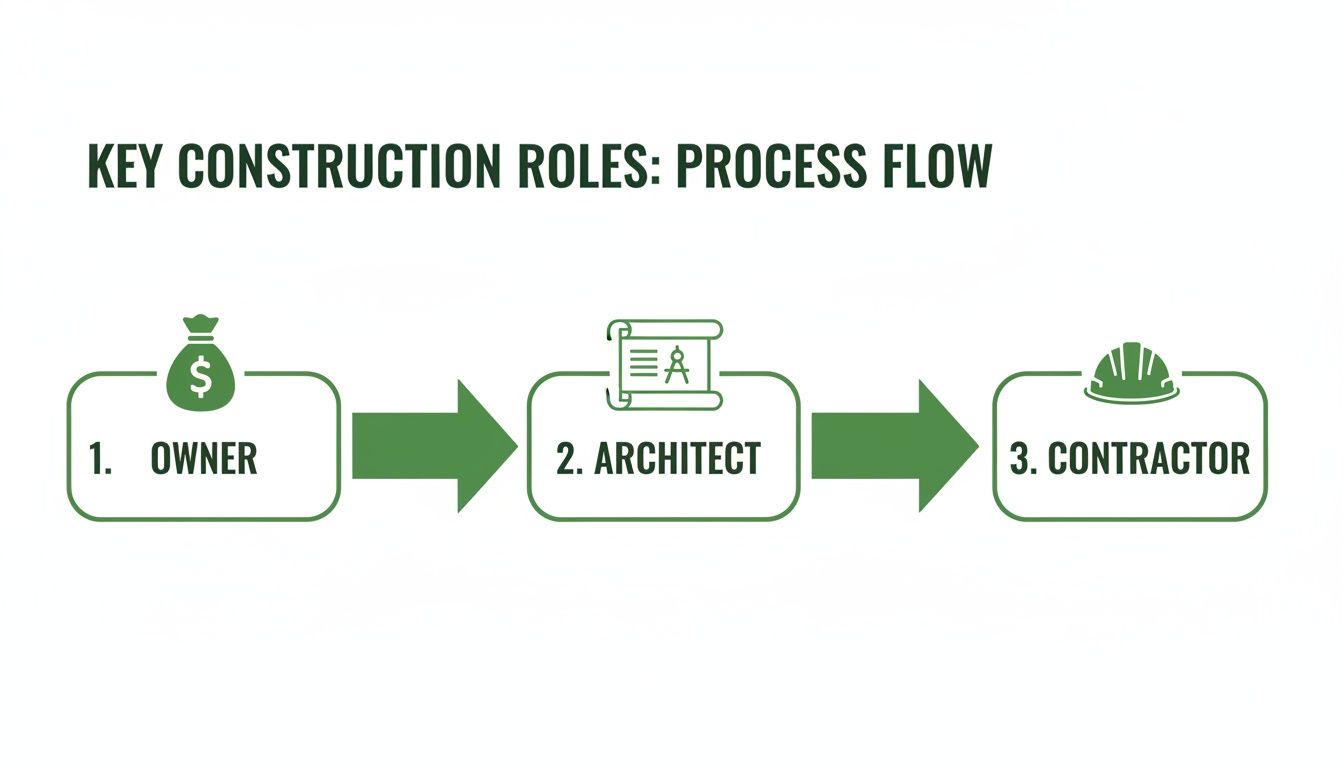
This simple diagram shows the fundamental flow of responsibility in a typical construction project.
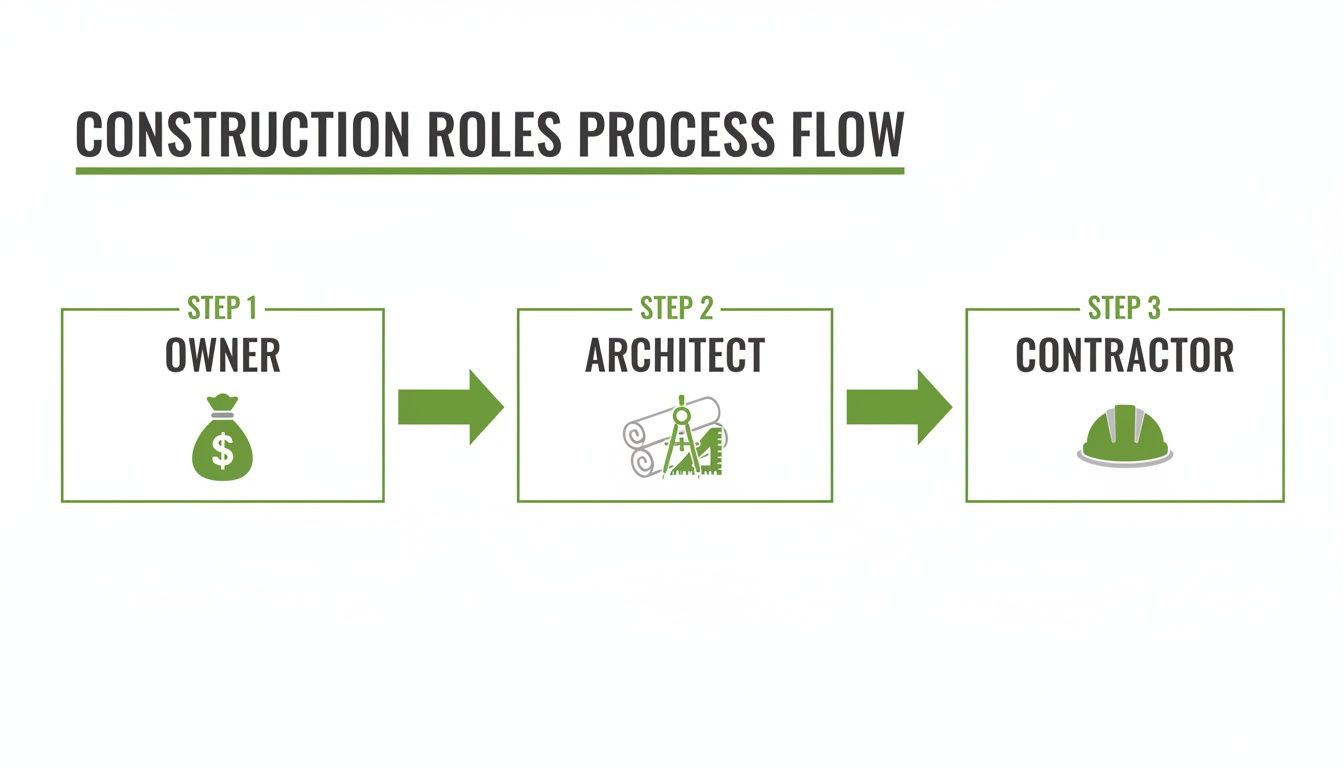
As you can see, the Owner kicks things off, the Architect translates that vision into the official contract documents, and the Contractor builds according to those plans.
Phase 1: The Pre-Construction Kickoff
Long before a single shovel hits the ground, the entire project team gathers for a pre-construction meeting. This is the bedrock of the project. Here, we set the rules of engagement, align on goals and schedules, and establish how we're all going to communicate. The whole point is to start with absolute clarity to head off confusion down the road.
A crucial document comes out of this phase: the Schedule of Values, submitted by the contractor.
What is a Schedule of Values?
It’s essentially a detailed, itemized breakdown of the total contract price, assigning a dollar value to every part of the work. This document becomes the basis for every payment application, allowing the contract administrator to accurately track progress and approve payments. A clean, logical Schedule of Values is often the first sign of a well-organized contractor.
This initial phase sets the tone for everything that follows, creating a collaborative framework for the owner, architect, and contractor.
Phase 2: The Active Construction Phase
Once construction starts, the project enters its most dynamic—and demanding—phase. Now, the contract administrator's role shifts into high gear. The focus is on constant monitoring, meticulous documentation, and clear communication to keep the project on schedule and on budget.
This is where the real work of construction contract administration happens day in and day out. Key activities include:
- Processing Submittals: The contractor will submit shop drawings, material data, and physical samples for review. The architect, acting as the administrator, meticulously checks these against the contract documents to confirm everything meets the specified quality and design intent.
- Managing Requests for Information (RFIs): When a contractor hits a snag or finds a discrepancy in the plans, they issue an RFI. The administrator’s job is to chase down a clear, timely answer from the design team so work doesn't grind to a halt.
- Handling Change Orders: Let's be honest, no project goes exactly to plan. When changes are needed, the administrator manages the formal process, making sure any adjustments to the scope, cost, or schedule are properly documented, justified, and approved by the owner before the work proceeds.
This phase is also where financial pressures really mount. With intense market competition, contractor profit margins can be razor-thin. Recent data shows that smaller commercial projects often see better margins at 10.6%, while larger ones average just 8.4%. This context is important—it highlights the cost pressures contractors are under and underscores why fair, efficient payment and change order processes are so critical. You can explore more on this in Turner & Townsend's global construction cost analysis.
Phase 3: Reaching Substantial Completion
Substantial Completion is arguably the single most important milestone in the project. It’s the official point where the building is complete enough for the owner to move in and use it for its intended purpose. It doesn't mean every last detail is perfect, but all the big stuff—like major systems—is operational, and the space is safe and functional.
Getting here is a formal process:
- The contractor declares they believe the project has reached Substantial Completion.
- The architect performs a thorough inspection to verify this claim.
- If the architect agrees, they issue a Certificate of Substantial Completion.
This certificate is a big deal legally. It officially marks the end of the construction period, which starts the clock on all warranties and formally transfers responsibility for the property (like utilities and insurance) from the contractor back to the owner.
Phase 4: Final Project Closeout
The final phase is all about tying up loose ends to officially close the books on the project. After Substantial Completion, the architect and owner will walk the site and create a punch list—a detailed list of all the minor fixes or incomplete items the contractor needs to address.
This could be anything from a paint touch-up to adjusting a finicky door or installing a final piece of hardware. The contractor works their way through this list, and once everything is done to the architect’s satisfaction, the final payment is released.
Closeout also involves the critical handover of all project documentation to the owner, which typically includes:
- Warranties for all materials and equipment
- Operation and maintenance (O&M) manuals for building systems
- Final "as-built" drawings that show exactly how the project was constructed, including any changes made along the way
With the final payment made and all documents in hand, the contract is fulfilled, and the project is truly complete. This structured, four-phase approach is what provides the control and oversight needed to turn a blueprint into a successful building.
Managing Risk with Proactive Administration
Think of construction contract administration as your project’s most powerful defense mechanism. It’s far more than just shuffling papers or checking off boxes; it’s a strategic form of project insurance. The architect, acting in this capacity, doesn’t just react to problems—they actively anticipate and neutralize threats before they ever have a chance to derail your budget, schedule, or the final quality.
This isn’t about being reactive. It's about a constant, forward-looking process of identifying what could go wrong—from a budget creep to a timeline slip—and using the right administrative tools to stop it in its tracks. It's about protecting your investment with genuine foresight.
Countering Common Project Threats
Every construction project, no matter its size, faces a predictable set of potential hurdles. An experienced contract administrator knows exactly what these hazards look like and has a proven playbook for dealing with them. This isn't about hoping for the best; it’s about preparing for reality.
Here’s a look at the most common risks and how we tackle them head-on:
Budget Overruns: We meticulously review every single pay application, cross-referencing it against the Schedule of Values to ensure you only pay for work that is verifiably complete and correct. We also put all change order requests under a microscope to confirm their validity and fairness, preventing scope creep from silently inflating your costs.
Schedule Delays: Through consistent monitoring of the contractor's schedule and regular site observations, we can spot the early warning signs of a project falling behind. From there, we step in to facilitate communication and resolve bottlenecks—whether it’s a late material delivery or a coordination jam between subcontractors—to keep things moving.
Quality Issues: The submittal and shop drawing review process is one of our most critical quality control checkpoints. We confirm that every material, fixture, and piece of equipment meets the exact standards defined in the contract documents before it gets installed. This simple step prevents incredibly costly and time-consuming rework down the line.
Proactive administration completely reframes the conversation. Instead of asking, "What went wrong?" after a crisis, a good administrator is constantly asking, "What could go wrong?" and putting measures in place to make sure it doesn't.
To make this process even more robust, we can use modern tools for things like ai contract review. This technology helps quickly flag non-standard clauses or potential liabilities, adding another valuable layer of protection.
Common Risks and Corresponding Administrative Solutions
To make this crystal clear, here’s a table connecting common project risks with the specific administrative tools used to mitigate them. This is how we turn abstract worries into concrete, actionable solutions.
| Project Risk | Key Administrative Tool | How It Protects the Owner |
|---|---|---|
| Scope Creep & Unauthorized Changes | Strict Change Order Management | Ensures every change is documented, justified, and fairly priced before approval. |
| Paying for Incomplete/Incorrect Work | Pay Application Certification | Verifies that billings accurately reflect the work completed on-site, preventing overpayment. |
| Substandard Materials or Workmanship | Submittal & Shop Drawing Review | Confirms all materials and methods align with design intent before installation. |
| Unforeseen Site Conditions | Request for Information (RFI) Process | Provides a formal channel to clarify uncertainties quickly, avoiding costly assumptions. |
| Project Falling Behind Schedule | Regular Progress Monitoring | Identifies potential delays early, allowing for corrective action before they cascade. |
| Disputes Over Contract Terms | Detailed Meeting Minutes | Creates a clear, agreed-upon record of all decisions and discussions. |
This systematic approach demystifies risk management, giving you a clear line of sight into how your interests are being protected at every stage.
Responding to External Pressures
Beyond the typical on-site challenges, today's projects are often impacted by major external forces. Diligent oversight becomes even more critical when factors outside the immediate project team—like the state of the labor market—come into play.
Right now, labor shortages are a serious challenge. The global construction industry is feeling the pressure, with North America alone needing to recruit roughly 500,000 additional skilled workers to meet current demand. This has a direct impact on projects, as contractors may be forced to rely on less experienced teams, which can unfortunately lead to lower-quality work and safety issues.
In this kind of environment, the administrator’s role in verifying quality is no longer just a best practice; it's an essential countermeasure. Meticulous site observations and a rigorous submittal review process are what ensure the integrity of your building isn't compromised by a stretched-thin workforce.
Ultimately, by viewing contract administration through a risk-management lens, we transform a standard process into your most reliable tool for achieving a predictable, high-quality outcome.
Navigating Complex Adaptive Reuse Projects
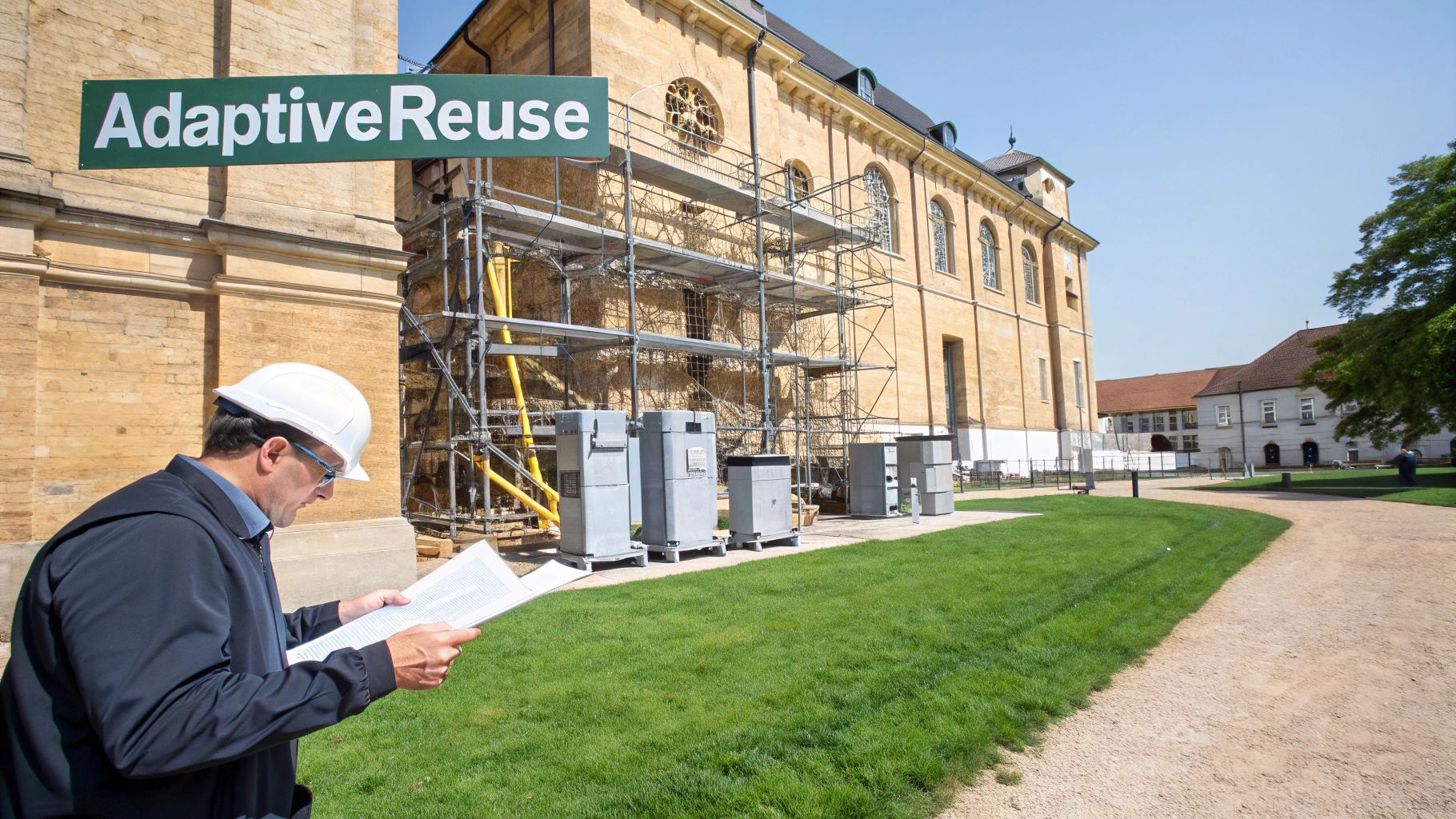
Managing a standard construction project has its challenges. But when you step into the world of adaptive reuse and historic preservation, you’re not just building something new—you’re in a constant dialogue with the past. The rulebook changes completely.
In these projects, the building itself is practically a key stakeholder, one filled with secrets and surprises that no set of blueprints could ever fully capture. The unexpected isn't just a risk; it's a guarantee. This is where an expert hand in contract administration becomes absolutely essential. It’s less about just checking boxes on a drawing and more about managing a live process of discovery, where unforeseen conditions are the norm, not the exception.
Anticipating the Unforeseen
Unlike a new build on a clean, predictable site, renovating a historic structure means peeling back layers of history. What you find behind a wall can completely derail the original scope, from discovering termite-ridden structural beams to realizing the century-old plumbing system is beyond repair and needs to be replaced entirely.
A seasoned contract administrator sees this coming. They work with the team to build contingencies right into the contract and, more importantly, establish clear, pre-agreed-upon protocols for how to handle these discoveries when they happen. This proactive mindset prevents the project from grinding to a halt in a state of panic. It turns a potential crisis into a manageable, documented problem that everyone knows how to solve.
The goal is to create a framework where surprises don’t immediately spark disputes. Instead, they trigger a fair and transparent process for evaluation, problem-solving, and resolution.
The Art of the Change Order in Historic Projects
In adaptive reuse, change orders aren't just for when an owner wants to add a new feature; they are the fundamental tool for responding to the building's hidden conditions. Navigating this process requires a delicate balance of fairness, meticulous documentation, and genuine creativity.
When an unforeseen issue pops up, a skilled administrator orchestrates a methodical response:
- Immediate Documentation: Before anything is touched, the condition is thoroughly photographed, measured, and documented in detail. This creates an objective record.
- Collaborative Evaluation: The administrator gets the owner, contractor, and relevant engineers in a room (or on a call) to assess the problem and brainstorm practical solutions.
- Transparent Quoting: The contractor provides a clear, itemized quote for the necessary work. The administrator then carefully vets it for fairness and accuracy.
- Formal Approval: A formal change order is drafted and issued, capturing the new scope, associated costs, and any impact on the schedule. Once signed, it officially amends the contract.
This rigorous process protects the owner from getting hit with inflated costs while making sure the contractor is compensated fairly for legitimate work that was impossible to foresee.
In historic preservation, the contract administrator often acts like a diplomat. They have to negotiate between the non-negotiable demands of modern building codes, the historical integrity of the structure, and the owner’s budget, finding a path forward that respects all three.
A Case Study in Discovery
Picture this: we’re overseeing the renovation of a beautiful 1920s commercial building. During interior demolition, the contractor uncovers a nasty surprise. A shoddy renovation back in the 1970s had removed a critical load-bearing wall, replacing it with a dangerously undersized beam. The ceiling above had been slowly sagging for decades.
Work stops immediately. Our team, acting as the contract administrator, gets on-site with structural engineers to document the finding. We then sit down with the owner and present clear, understandable options. We could go with a costly but straightforward steel beam replacement, or we could explore a more creative (and less expensive) solution involving reinforced columns that could be cleverly integrated into the new floor plan.
By carefully managing the RFI and change order process, we helped the owner make an informed decision that was structurally sound, budget-conscious, and actually enhanced the building’s historic character. The unforeseen problem was solved without conflict, and the project moved forward with minimal delay. This is construction contract administration at its most valuable—turning a potential disaster into a well-managed, successful outcome.
Your Blueprint for a Successful Project
If there’s one thing to take away from this guide, it’s that great construction contract administration isn't just about paperwork. It’s about building a proactive, collaborative partnership—the kind of solid foundation every project needs to finish on time, on budget, and to the quality you expect. This isn’t some final hurdle; it's the active stewardship of your vision from the first day on-site to the final handover.
Think back to our conductor analogy. The architect's role in administration is to make sure every trade, every material delivery, and every stakeholder is playing their part in perfect harmony. That leadership is what turns a potentially chaotic process into a well-orchestrated performance, delivering a final building that truly reflects the original design intent.
A well-administered contract is far more than a legal safety net. It's your project's single most important blueprint for success. It swaps ambiguity for accountability and turns risk into manageable, predictable outcomes.
This is the structured oversight that bridges the gap between a brilliant design on paper and a profitable, beautifully built reality. It gives you the control and certainty you need to protect your investment at every single stage.
These principles aren't just theory; they are fundamental to how we manage projects at Sherer Architects. We've seen time and again that expert administration unlocks the full potential of a building, whether it's a new commercial development or a sensitive historic preservation project. Our team is here to provide the diligent oversight that delivers certainty, value, and most importantly, peace of mind to owners and developers.
If you’re ready to bring this level of clarity and control to your next project, reach out to us at Sherer Architects. Let's talk about how our expert administration services can help you build with confidence.
Frequently Asked Questions
It’s natural to have questions when you’re navigating the complexities of a construction project. Let's clear up a few of the most common ones we hear from owners and developers about construction contract administration.
What Is the Difference Between Project Management and Contract Administration?
It's a great question, and the distinction is crucial. Think of it like this: project management is the big picture, while contract administration is the fine print.
A project manager, often the general contractor, is focused on the "what" and "when"—coordinating subcontractors, managing the overall schedule, and handling the day-to-day logistics of getting the job done.
Contract administration, on the other hand, is a specialized role typically handled by the architect. We act as your eyes and ears on-site, focusing on the "how." Our job is to make sure the work being done exactly matches what was agreed upon in the contract documents, from materials to workmanship. We observe progress and certify payments, but we don't tell the contractor how to do their job.
Who Is Responsible for Paying for a Change Order?
This really boils down to one thing: what caused the change? A good contract administrator is an impartial referee here, digging into the specifics to determine who should foot the bill.
Here’s a quick rundown of how it usually works:
- Owner-Requested Changes: If you decide you want marble countertops instead of granite, or want to add a new room, that cost is on you.
- Unforeseen Conditions: This is the stuff no one could have reasonably predicted. Think hitting solid rock during excavation or finding hidden structural rot in a historic renovation. These are generally considered owner-paid costs.
- Errors or Omissions: If a change is needed because something was missed or drawn incorrectly in the plans, the design professional may be responsible for the cost.
How Does Administration Work on Fast-Track Projects?
On a fast-track project—where construction kicks off before the design is 100% complete—contract administration goes from important to absolutely essential. Things are moving at lightning speed, so you need intense, real-time coordination.
On a fast-track job, the administrator becomes the central nervous system for information. We have to ensure the crew is always building from the most current set of drawings and that every single design tweak is tracked for its impact on cost and schedule. It’s a high-stakes, dynamic process that demands an incredibly responsive and experienced team.
Protecting your investment and ensuring a predictable, high-quality outcome all comes down to effective administration. At Sherer Architects, LLC, we provide the expert oversight needed to guide your project to a successful completion. Contact us to learn how we can bring clarity and control to your next build.