SHERER ARCHITECTS

Categories
Uncategorized

Unlocking the Design Processes in Architecture From Vision to Reality

Bringing a building to life is a journey, not a single leap. The design processes in architecture provide a structured, proven path that takes a project from a simple idea all the way to a finished structure. Think of it less as a rigid set of rules and more as a collaborative roadmap, ensuring your vision, budget, and goals are carefully translated into a functional, safe, and beautiful building.

Your Architectural Journey From First Sketch to Final Build

Starting an architectural project without a clear process is a bit like setting off on a cross-country road trip without a map. You know where you want to go, but the route is a mystery, full of wrong turns and unexpected delays. The architectural journey is a deliberate, multi-stage partnership between you and your architect, designed to turn your concept into a physical reality.

Each phase logically builds on the one before it. This ensures every decision is thoughtful, every detail is considered, and the final result is exactly what you hoped for. When you understand these stages, you’re no longer just a passenger; you become an informed co-pilot, ready to make smart decisions, manage your budget, and know what’s coming next. This professional, methodical approach is why the global architectural services market was valued at around $383.65 billion and is expected to climb to $557.29 billion by 2032. The value is in the guidance. If you're curious, you can explore more architecture industry statistics to get a sense of the industry's scale.

A Map of the Design Process

To get our bearings, let's visualize the entire journey as a timeline with six key destinations. Each stop is a critical phase where specific tasks are completed before we can move on to the next.

This flowchart lays out the six core stages of the architectural process, from the initial brainstorming sessions of pre-design to the final oversight during construction.
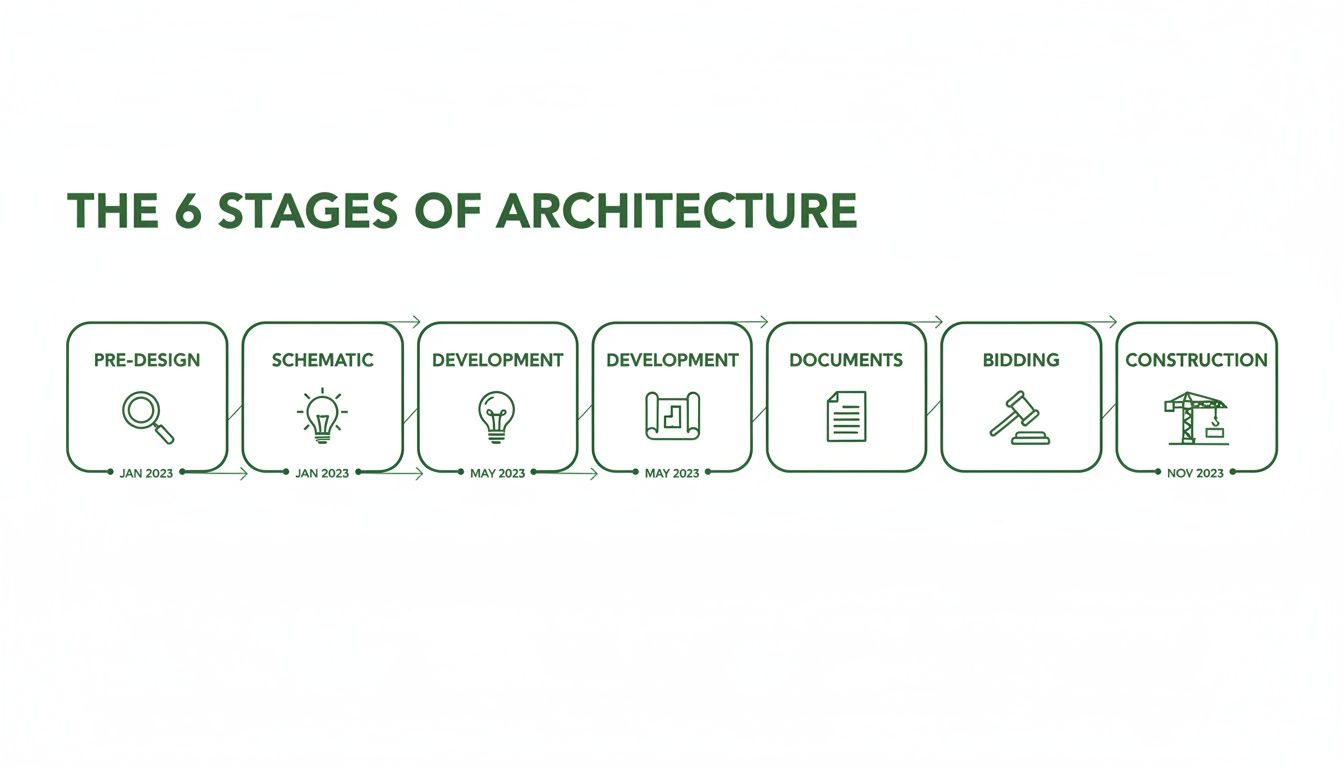
A comprehensive flowchart outlining the 6 stages of architecture, from pre-design to construction, with associated timelines.

As you can see, the process flows from big-picture ideas to incredibly fine-tuned technical details. This progression makes sure we get the foundation right before we start creating the final, detailed instructions for the builders.

Understanding Each Phase's Purpose

Every stage has a unique purpose, demanding different levels of input from you and producing specific documents and drawings. Knowing what’s happening at each step demystifies the whole experience and helps build a stronger, more effective partnership with your design team.

Great architecture is not born from a single moment of inspiration. It is the result of a rigorous, phased process that carefully balances vision with practicality, creativity with regulation, and budget with ambition.

To give you a quick reference, here's a look at the key stages in the architectural design process, their main goals, and how much of the project timeline they typically occupy.

The 6 Key Stages of Architectural Design

Phase Primary Goal Typical Timeline %
1. Pre-Design Define the project's goals, scope, and budget. 2–5%
2. Schematic Design Translate the program into broad design concepts. 10–15%
3. Design Development Refine the design, selecting materials and systems. 15–20%
4. Construction Docs Create detailed drawings for permitting and building. 35–40%
5. Bidding/Negotiation Select a contractor to build the project. 3–5%
6. Construction Admin Oversee construction to ensure it matches the design. 20–25%

This table provides a high-level snapshot. We'll dive much deeper into each of these phases throughout this guide, exploring what happens, who’s involved, and what it means for you.

Establishing the Foundation of Your Project
Architectural design workspace with house plans, a model, and a "DESIGN JOURNEY" notebook on a wooden desk.

This is the moment your vision starts its journey into the real world. The beginning of any architectural project is where the most critical decisions are made—the ones that ripple through every subsequent phase, impacting everything from your budget to your final move-in date. It's like laying the foundation for a skyscraper; if the base isn't meticulously planned and flawlessly executed, the entire structure is compromised.

We're going to walk through the first two key phases in the design processes in architecture: Pre-Design and Schematic Design. Think of them as the strategic heart of your project, turning abstract goals into something you can actually see and discuss. Honestly, this is where your input as a client matters most.

Pre-Design: The Discovery Phase

Before anyone even thinks about drawing a line, a great project begins with a conversation. In fact, it starts with a whole series of conversations. This is the Pre-Design phase, a deep-dive investigation where you and your architect collaborate to define the soul of the project. It's all about asking the right questions to make sure everyone is on the same page.

The main goal here is to develop a detailed architectural program. And no, that's not a piece of software. It’s a comprehensive document—a project playbook, really—that spells out exactly what this new building needs to be and do.

A solid program will cover:

  • Project Goals: What is the core purpose of this building? What problems is it meant to solve for you?
  • Functional Needs: How many rooms do you need? Just as important, how do people need to move between them? What specific activities will happen here?
  • Budgetary Constraints: This means having a frank, realistic discussion about the total project cost, from construction and materials to professional fees.
  • Site Analysis: We’ll study the property itself—zoning codes, the lay of the land, how the sun hits it, and any other environmental factors that will shape the design.

This phase is pure strategy. By nailing down the scope with this level of detail, we head off expensive changes and frustrating miscommunications down the line.

Schematic Design: Giving Ideas a Form

Once we have the program locked in, we can move into Schematic Design. This is where the magic really starts to happen, as all those abstract ideas from Pre-Design get translated into the very first visual concepts. It’s an exciting time, because you finally get to see what your project might look like.

Don't expect detailed blueprints yet. At this stage, your architect will be creating broad-stroke drawings and simple models. It's a highly creative and iterative process focused on exploring the big-picture possibilities, not getting bogged down in the tiny details.

Schematic Design is the bridge between the 'why' and the 'what.' It’s where we test big ideas, explore the building’s personality, and establish a clear direction that will guide the rest of the design process.

The work produced here is intentionally conceptual, designed to spark conversation and get your feedback. You’ll typically see things like:

  • Rough Sketches and Massing Models: Simple 3D models, either physical or digital, that show the building's overall size, shape, and how it sits on the property.
  • Basic Floor Plans: These diagrams illustrate the general layout and show how different rooms and spaces relate to one another.
  • Site Plans: These drawings show how the building connects to its surroundings, including things like driveways, walkways, and initial landscaping ideas.

To really get the functional relationships right, architects often use conceptual tools like an interior design bubble diagram to map out how different spaces should connect and flow. This helps ensure the layout feels intuitive and works efficiently before we commit to a specific design.

Your feedback during this phase is absolutely essential. Now is the time to say what you love, what you're not so sure about, and why. Moving a room is easy on a schematic sketch, but it becomes exponentially more difficult and expensive once we start creating detailed construction drawings. When you sign off on a schematic design, you’re setting the fundamental course for the entire project.

Refining the Blueprint for Construction
Two designers review architectural blueprints and tools on a table, with 'FIRST CONCEPTS' visible.

The creative energy of Schematic Design has given the project its soul and direction. But how do you turn those initial concepts into a building that can actually stand up? That critical jump from a broad idea to a buildable reality happens across two of the most technically demanding phases: Design Development (DD) and Construction Documents (CD).

If Schematic Design was the initial sketch on a napkin, these next two stages are where we create the incredibly detailed, full-color painting.

This is where the design processes in architecture shift from asking "what if?" to defining "exactly how." Your architect's team will start coordinating with a small army of specialized consultants—structural engineers, mechanical and electrical experts, civil engineers—to weave all the complex systems into the design. It's an intense period of problem-solving that solidifies every detail and sets the stage for a smooth construction process.

Design Development: Getting Serious with the Details

Think of the Design Development phase as the project's adolescence. The basic identity we established earlier begins to mature, gaining real substance and specific characteristics. The floor plans and exterior look you approved are now fleshed out with a much deeper layer of detail, and critical decisions get locked in for good.

This isn't just about aesthetics anymore; it's about performance. During DD, the team makes firm commitments on major building components that define the building's character and long-term durability.

Your job here is to make the final call on key selections. The big-picture layout is set, but we'll need your input on things like:

  • Material Selections: Finalizing the exterior materials like brick, siding, or metal panels, and choosing key interior finishes.
  • Fixture and Appliance Choices: Picking out the specific plumbing fixtures, lighting, and major appliances that will be installed.
  • Window and Door Specifications: Selecting the exact types, styles, and performance ratings for all windows and doors.

This phase results in a set of drawings and specifications far more detailed than anything you've seen yet. They show precisely how the building is put together, confirming that all its parts and systems work in harmony.

Construction Documents: Creating the Instruction Manual

Once Design Development is done and you've signed off on the refined design, the project moves into the Construction Documents (CD) phase. This is the longest and most demanding stage for the design team, often taking up 35-40% of the entire design schedule. The goal is simple but massive: create a comprehensive, legally binding set of instructions that tells a contractor exactly how to build your project.

Imagine you've bought a highly complex piece of furniture that arrives in hundreds of pieces. The Construction Documents are the hyper-detailed, step-by-step instruction manual that ensures every single bolt, panel, and screw ends up in the right place. Without it, you’d just have a pile of expensive parts.

The quality of the Construction Documents directly impacts the quality, cost, and timeline of the final build. Thorough, well-coordinated documents minimize ambiguity, leading to more accurate contractor bids and fewer expensive changes during construction.

This essential set of documents is made up of two main parts:

  1. The Drawings (Blueprints): This is the set of technical drawings that visually lays out the work. It includes everything from floor plans with precise dimensions to intricate detail drawings showing how a window is flashed into a wall.
  2. The Specifications (Specs): This is a hefty written document that works with the drawings. It provides detailed qualitative requirements for materials, equipment, installation standards, and workmanship. For example, the drawings show a wall, but the specs define the exact type of drywall, the stud spacing, the paint manufacturer and color, and the required quality of the finish.

This documentation is what you'll need to get building permits and what contractors will use to bid on the job. This is where the $249.2 billion global architectural services industry really proves its worth, managing incredible complexity to mitigate risk for clients. The industry is composed of around 326,000 businesses, all focused on turning intricate designs into tangible assets. For a closer look at the sector, you can review key architecture industry outlook data.

Protecting Your Investment Through Meticulous Planning

All the painstaking effort that goes into the DD and CD phases serves one primary purpose: to protect your investment. By solving design puzzles and coordinating all the building systems on paper, your architect prevents costly surprises and frustrating delays on the job site.

When a contractor has a clear, complete set of documents, they can give you a more accurate and competitive price. Ambiguity in the plans forces builders to guess, and they’ll often pad their bids to cover those unknowns. Worse, changes made once construction is underway are exponentially more expensive than changes made on paper. Thorough planning is the single best tool you have to keep your project on budget and on schedule.

Navigating Bids and Securing Approvals
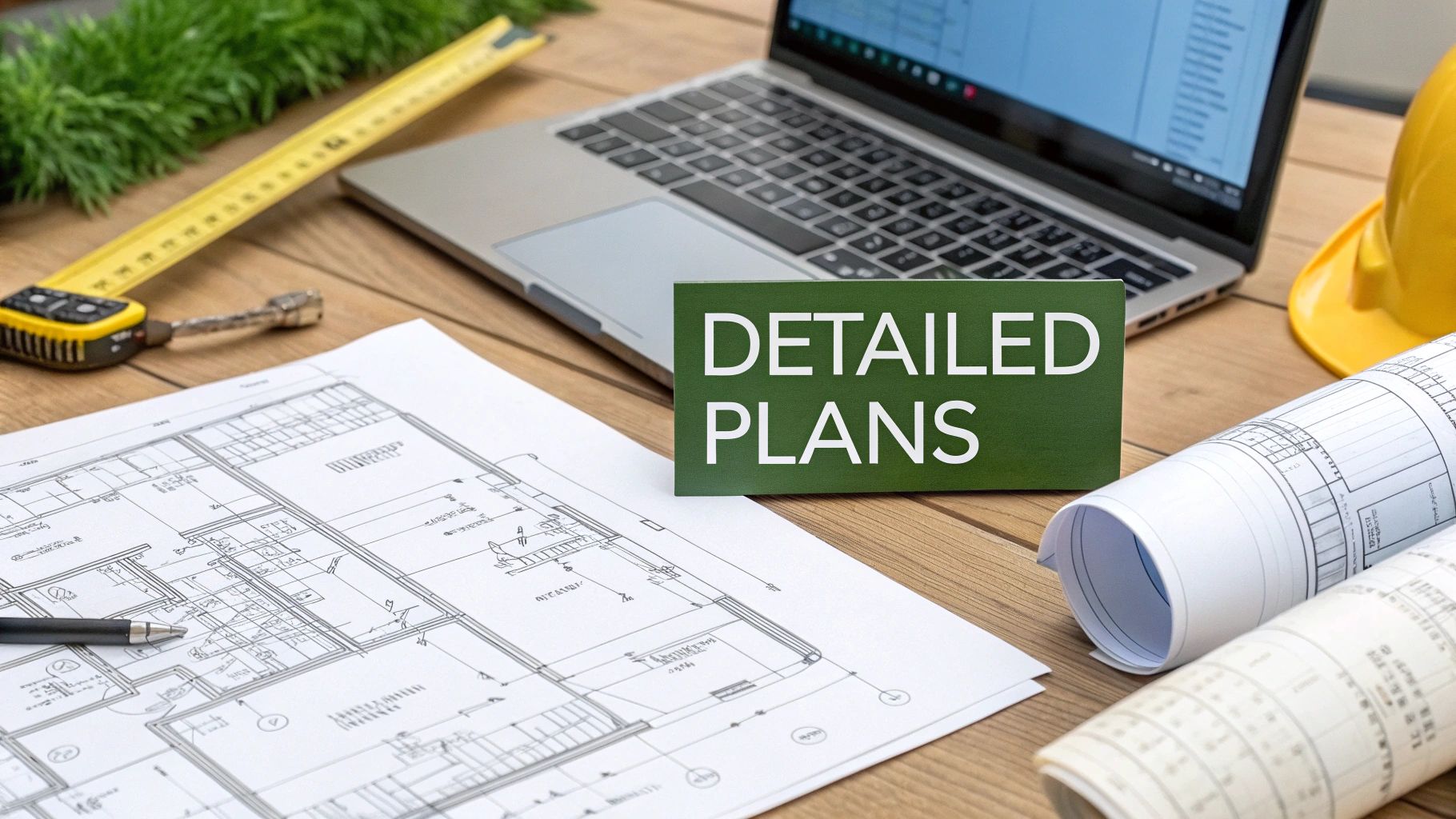
Desk with architectural blueprints, a laptop, measuring tape, hard hat, and a sign saying 'DETAILED PLANS'.

With a complete set of construction documents, your project has reached a critical fork in the road. This is the moment the design on paper gets tested against the hard numbers of construction pricing and the detailed scrutiny of city officials. Two essential processes now kick off at the same time: finding the right builder and getting the legal green light to start digging.

This part of the design processes in architecture can feel a bit like spinning plates, but it’s all about protecting your investment. Your architect’s role changes here. They shift from being the primary designer to your strategic guide and advocate, helping you navigate the contractor selection process and the often-intimidating world of permits. Their experience is key to making sure this administrative hurdle is cleared smoothly, setting the stage for a successful construction launch.

Selecting Your Builder: The Bidding Process

Think of the construction documents as the official rulebook for the game. This phase, known as Bidding or Negotiation, is where you invite contractors to tell you how much it will cost to build your project based on that rulebook. The objective is simple: find a great builder who can execute the plans on time and on budget.

Generally, you have two main ways to pick a general contractor. Each comes with its own pros and cons, depending on your project’s needs and how you prefer to work.

  • Competitive Bidding: This is the classic approach, especially for public works or big commercial jobs. Your architect will send the plans out to a handful of pre-vetted contractors. They each come back with a sealed, fixed-price bid, and you typically award the job to the lowest qualified bidder. It’s a great way to ensure price transparency and competition.
  • Negotiated Contract: With this method, you pick a contractor you trust early in the process—sometimes even before the design is finished. You then work directly with them to negotiate a fair price. This path is far more collaborative and lets the builder give valuable feedback on costs and buildability as the design takes shape. It’s a popular choice when you already have a great relationship with a builder.

Your architect is your most valuable player here. They’ll help you vet the contractors, dig into the bids to make sure you're comparing apples to apples, and guide you toward a smart decision.

The architect's responsibility during the bidding process is to act as the client's trusted advisor. This involves clarifying the design intent for bidders and ensuring the bids received accurately reflect the full scope and quality detailed in the construction documents.

Securing Legal Go-Ahead: The Approvals Process

While you’re busy picking a contractor, your architect is simultaneously wrestling with the all-important approvals process. You cannot build anything until the local authorities have reviewed and stamped your plans, confirming they meet every relevant code and regulation. This is an absolute must for every single project.

How complicated this gets really depends on where you're building. At a minimum, it means submitting the drawings to the local building department. They’ll check your plans against building, fire, and energy codes.

But it often doesn't stop there. Many projects need a thumbs-up from several other agencies, each with its own schedule and requirements. These can include:

  • Zoning Boards: They make sure your project fits within the local rules for things like building height, property line setbacks, and parking.
  • Design Review Boards: In many towns and cities, these groups look at the project's aesthetics to ensure it fits with the community's character.
  • Historic Preservation Commissions: If you're working on a historic landmark or in a historic district, this commission has the final say on whether your plans are respectful of the building’s heritage.

Getting all these approvals can be a long and winding road, but your architect is your expert guide. They’ll prepare the paperwork, answer the tough questions from officials, and make any necessary tweaks to the plans to get them approved. Their firsthand experience with local agencies is what keeps the project moving forward and gets you the official clearance to start construction.

Ensuring Quality During Construction

An architect's job doesn't end when the blueprints are handed over. In fact, it shifts into one of the most crucial phases of the entire project: Construction Administration (CA). Think of your architect as your dedicated representative on the ground, the expert whose job is to protect your investment and ensure the vision we've developed together comes to life exactly as planned.

I like to compare it to a conductor leading an orchestra. The construction documents are the sheet music, and the contractor's team are the skilled musicians. The conductor’s role isn’t to play the instruments, but to ensure everyone is playing the right notes, in the right key, and at the right time. Without that oversight, the beautiful symphony on the page can easily turn into noise.

The Architect as Your On-Site Advocate

During construction, your architect becomes your eyes and ears, observing progress and making sure the work aligns with the plans. This isn't about micromanaging the builder; it's about safeguarding your interests and the integrity of the design. This active involvement is built around a few key, recurring tasks.

These responsibilities typically include:

  • Scheduled Site Visits: We'll be on-site at regular intervals and critical milestones to see the work firsthand. This lets us catch potential issues before they become expensive problems and answer questions on the spot.
  • Reviewing Payment Applications: Before you cut a check to the contractor, your architect reviews their invoice. We verify that the work you're being billed for has actually been completed and meets the quality standards outlined in the contract.
  • Answering RFIs (Requests for Information): It's completely normal for builders to have technical questions. We provide clear, timely answers to keep the project moving forward correctly.
  • Managing Change Orders: Sometimes, unexpected site conditions pop up, or you might decide you want to make a change. The architect manages this process formally, negotiating fair pricing and making sure any adjustments fit seamlessly into the overall design.

Protecting the Design Vision

A huge part of quality control comes down to reviewing submittals. These are the data sheets, material samples, and detailed shop drawings the contractor sends for approval before anything gets ordered or built. For example, we'll review the exact model of the windows, the specific batch of bricks, or the finish on a light fixture to confirm it’s precisely what was specified.

This attention to detail is especially important for custom features that give a building its unique character. Elements like intricate custom stone work require meticulous oversight to ensure the final installation matches the design intent in both material and craftsmanship.

Construction administration is the essential follow-through that transforms a well-designed project on paper into a well-built reality. It bridges the gap between design intent and final execution, ensuring the quality you paid for is the quality you receive.

Ultimately, having the architect involved through construction is your best insurance policy. It ensures the final building isn’t just a building, but the exact one you and your architect worked so hard to imagine. This diligent final phase is what brings your vision to life, just as you pictured it.

Common Questions About Architectural Design

Stepping into an architectural project for the first time can feel like learning a new language. It's only natural to have a lot of questions about how it all works, how much it will cost, and what's expected of you.

Getting a handle on the timeline, fees, and your own responsibilities is the best way to become a confident and informed partner in the process. Let's break down some of the most common questions we hear from clients.

How Long Does the Architectural Design Process Typically Take?

This is usually the first question on everyone's mind, and the honest answer is: it really depends. There's no single timeline that fits every project.

A small-scale interior renovation might move from an idea to construction-ready plans in just 3-6 months. A custom home, on the other hand, with all its personal details and complexities, could easily take 6-12 months for the design and permitting phases alone—before a shovel ever hits the ground.

For larger commercial or institutional buildings, the design process can stretch over several years. A few key things will always influence the schedule:

  • Project Complexity: The more detailed the design and the more sophisticated the building systems (like HVAC and electrical), the more time the Design Development phase will require.
  • Regulatory Hurdles: This is often the biggest wild card. Navigating zoning laws, city design review boards, and historic commissions can add significant and sometimes unpredictable delays.
  • Client Decision-Making: The pace of the project is directly tied to how quickly you can provide feedback and make decisions. Your involvement keeps the momentum going.

How Are Architectural Fees Typically Structured?

Architectural fees aren't one-size-fits-all. They’re usually structured in one of three ways, chosen based on the project’s scope and predictability. Understanding them helps you see how you'll be billed as the project progresses.

Typically, payments are tied to major project milestones. For instance, you might see invoices after the completion of Schematic Design, Design Development, and the Construction Documents. Once construction starts, billing usually shifts to a monthly schedule for Construction Administration services.

Here are the three most common fee structures:

  1. Percentage of Construction Cost: The architect's fee is a set percentage of the final construction budget. This often ranges from 8-15% and naturally scales the fee to the size and complexity of the project.
  2. Fixed Fee: A single, lump-sum fee is agreed upon before any work begins. This is a great option for projects where the scope is crystal clear and the path forward is straightforward.
  3. Hourly Rate: The architect bills for their time on an hourly basis. This structure is common for smaller projects, initial feasibility studies, or phases where the full scope isn't yet known.

What Is the Client's Most Important Role?

Your most critical role is to be the keeper of the vision and the primary decision-maker. This is especially true in the early stages of design. While your architect brings the design and technical expertise, you provide the "why" behind the project.

The client is the keeper of the vision. Your ability to communicate goals clearly in the beginning and provide decisive feedback throughout the process is the single most important factor in keeping a project on track, on budget, and true to its original purpose.

A great project is a partnership, and your active participation is what drives it forward. Your biggest contributions happen in the first half of the process:

  • Providing a Clear Brief: During Pre-Design, it's all about sharing your detailed vision—what you need the space to do, how you want it to feel, and what your budget looks like.
  • Offering Decisive Feedback: Your clear "yes" or "no" on the initial concepts during Schematic Design sets the direction for everything that follows.
  • Making Timely Choices: During Design Development, you'll be asked to select materials, fixtures, and finishes. Making these decisions on time is crucial for keeping the project moving toward construction.

What Is the Difference Between Design-Bid-Build and Design-Build?

These terms describe two different ways of structuring the team. The traditional process we've been walking through is what's known as Design-Bid-Build, but it's good to understand the alternative.

Design-Bid-Build
This is the classic approach. You hire an architect under one contract and a contractor under a completely separate one. The architect finishes the entire set of design drawings first. Then, those plans are given to several contractors who "bid" on the job, and you choose one to build it. This method is great for fostering price competition.

Design-Build
In this model, you hire a single firm under one contract to handle both the design and the construction. The architect and contractor are on the same team from day one. This integration can lead to better communication, faster timelines, and a single point of responsibility for you.

The right choice really depends on your priorities—whether that's cost certainty, speed, or a streamlined management process.


At Sherer Architects, LLC, we believe an informed client is an empowered one. Our team is here to guide you through every stage, making sure your vision is realized with clarity and confidence. If you're planning a commercial, adaptive reuse, or historic preservation project, let's start the conversation. Explore our services and see how we can bring structure to your vision.
Categories
news

Mastering the Design for Buildings Process

Bringing a building from a rough idea to a physical reality is a complex dance of creativity, engineering, and meticulous planning. It's about a lot more than just drawing up some floor plans. This guide breaks down that entire process, giving you a clear, step-by-step look at what it really takes to design a modern building.

We'll cover everything from the very first spark of an idea all the way to the final construction documents that a builder can actually use.

Your Roadmap to a Successful Building Design

Kicking off a new construction project is a huge undertaking. The road from a concept sketched on a napkin to a fully-realized structure is filled with potential pitfalls. True success comes from a design process that’s structured to balance creative vision with the hard realities of technical specs, budgets, and regulations.

Think of it this way: the design process is the foundation you build before you even break ground. Each decision you make early on has a ripple effect on everything that follows. This guide is built to follow that same logical flow, helping you understand not just what to do, but why each stage is so critical to the final building.

Blueprints and architectural tools laid out on a table, illustrating the building design process.

What We'll Cover

Whether you’re a developer eyeing a new commercial project or a business owner looking to build your own space, this walkthrough will give you the practical knowledge you need. We're going to dive into how to:

  • Properly evaluate a site to understand its potential and its constraints.
  • Flesh out a strong concept that truly aligns with your project goals.
  • Navigate the maze of building codes and zoning laws without getting stuck.
  • Incorporate sustainable design for better long-term performance and value.
  • Prepare the construction documents that turn your vision into a buildable plan.

A great building design doesn't just produce a structure that works. It creates a space that genuinely enhances its surroundings, serves the people inside it, and holds its value for years to come.

The Tools of the Trade

These days, bringing a design to life is about more than just pen and paper. Architects and designers rely on sophisticated software to model, test, and perfect their ideas in a digital space long before any dirt is moved. This approach leads to incredible precision and makes it far easier for everyone—from engineers to clients—to stay on the same page.

To really sell a vision and get buy-in, you need the right tools. We're talking 3D models, virtual walk-throughs, and photorealistic images that make the project feel real. Checking out the Top Programs for Architectural Rendering is a great way to see how the pros create the stunning visuals that guide a project from a simple concept to a finished building.

With that, let's start by laying the groundwork for your project.

Starting with the Site and Concept

Every great building starts not with a floor plan, but with the piece of earth it will call home. You can always tell when a structure was designed in a vacuum, without any real connection to its surroundings. The best architecture, however, feels like it grew right out of the land.

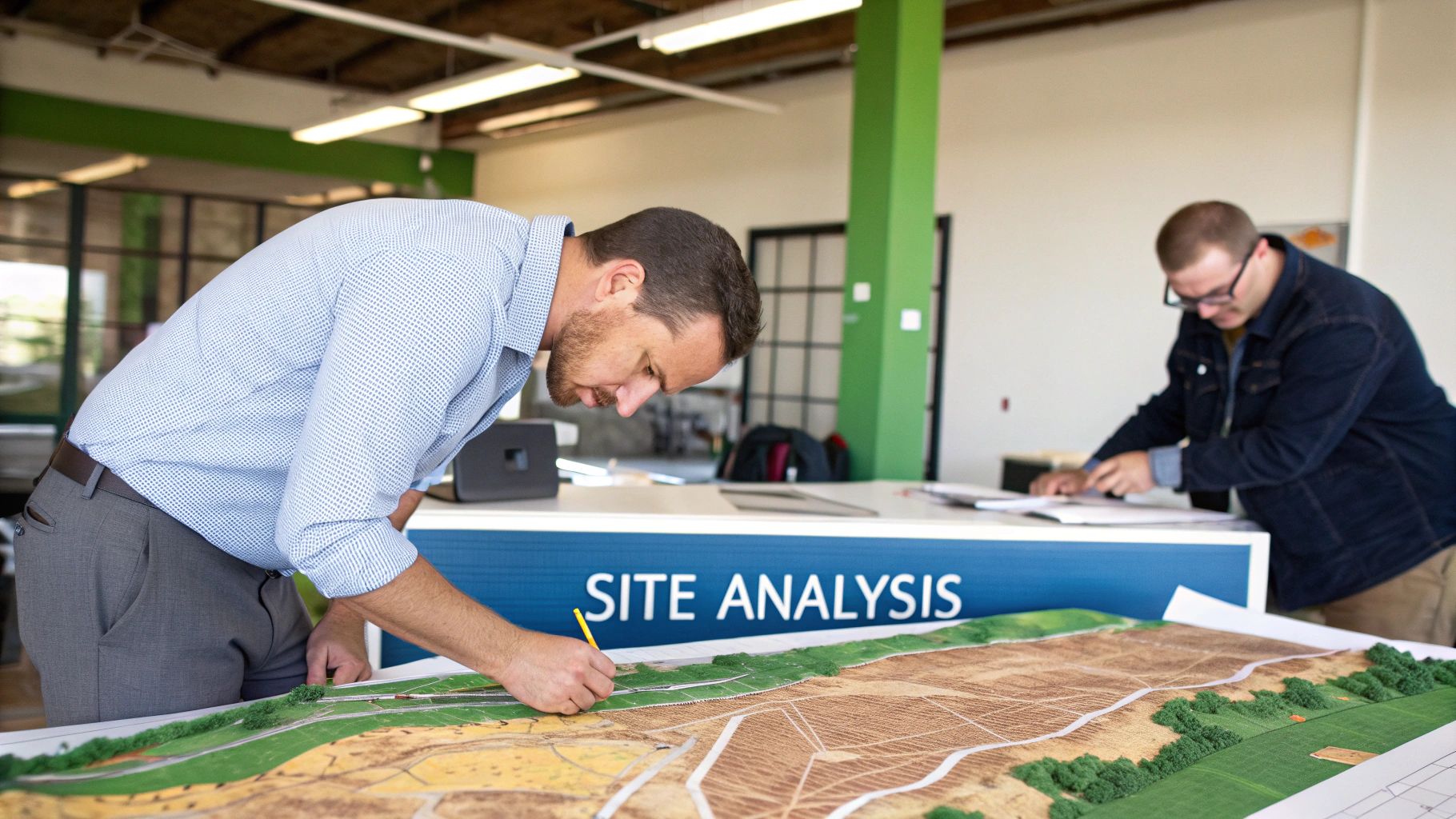
This is why a deep-dive site analysis is the non-negotiable first step. It’s far more than just verifying property lines; it’s about getting to know the land’s personality. We're looking for its quirks—the gentle slope you can use to your advantage, the path the sun takes across the sky, and even how the wind behaves on a blustery afternoon.

An architect reviewing site plans and a 3D model, illustrating the conceptual design phase.

Uncovering the Story of the Site

Every site has a story, and our job is to listen. This means blending hard data with simple, careful observation. We’re searching for clues that will directly shape the building’s form, its placement, and its overall feel.

Here’s what a proper site analysis really digs into:

  • Topography and Slope: Is the site pancake-flat or does it have a dramatic grade? A slope isn’t a hurdle; it’s an opportunity. I’ve seen hillside lots become the perfect setting for stunning multi-level homes with walk-out basements that capture incredible views.
  • Solar Orientation: We literally track the sun's path across the property through the seasons. This isn't just for fun—it tells us exactly where to place windows to flood rooms with natural light in the winter and where to use overhangs to block the harsh summer sun, which has a huge impact on energy costs down the line.
  • Prevailing Winds and Climate: Knowing which way the wind blows helps us place windows for cross-ventilation or create sheltered outdoor spaces. Local climate data dictates everything from insulation requirements to the type of exterior cladding that can withstand the elements.
  • Surrounding Context: What’s the neighborhood vibe? A good design respects the scale and materials of the buildings next door without being a carbon copy. We also map out views to capture, noise sources to mitigate, and how people will approach the building.

This isn't just a checklist. It's the raw material for genuine, creative problem-solving.

Translating Site Data into a Strong Concept

With a solid understanding of the site, we can finally start talking about the big idea. This is the conceptual design phase, where raw data gets an architectural soul. The goal here is to land on a core concept that brilliantly marries what the client wants with what the site offers.

Think of the concept as the project's north star—the single idea that guides every decision that follows. We're not drawing walls yet; we're establishing the "why" behind the design.

For example, on a tight urban lot, the concept might be "a column of light," using a central staircase and skylights to pull daylight down through multiple floors. For a retail store on a bustling corner, the concept could be "the community front porch," with massive windows and a welcoming entrance that engages everyone walking by.

The conceptual design is the crucial bridge between raw information and a compelling architectural vision. It ensures the final building isn't just placed on the site, but is truly of the site.

Developing Initial Massing and Layouts

Once the big idea is in place, we start exploring how the building will physically take up space. This is done through massing studies, which are basically simple 3D block models. These aren't fancy renderings; they're quick, iterative tools to figure out the building’s general shape, scale, and position.

These studies help us answer some fundamental questions:

  1. How does our building's size and shape feel next to its neighbors?
  2. Where are the absolute best spots for windows to frame a view or catch the morning sun?
  3. Can we shape the building to carve out a private courtyard or a sunny patio?

At the same time, we begin sketching out preliminary layouts, often as "bubble diagrams." These aren't detailed floor plans, but simple diagrams showing how different spaces relate to each other. In an office, for instance, it helps us map the journey from the public reception area to collaborative zones and quiet, private offices.

This part of the process is all about rapid exploration. We might create dozens of sketches and digital models, testing ideas and refining the approach until something just clicks. Getting this right early on is critical, because it sets the entire strategic direction, ensuring the final design is smart, responsive, and truly connected to its place in the world.

Navigating Building Codes and Zoning Rules

To an outsider, zoning laws and building codes can feel like an impossible web of red tape. But for those of us in the industry, we know they're the bedrock of safe, functional communities. They aren't there to kill your design creativity; they’re a framework to make sure every new building is a good neighbor and, most importantly, a safe place to be.

Getting a handle on this framework isn't just about checking a box for compliance—it's about designing smarter from day one.

Think of it this way: zoning ordinances tell you what you can build and where. They dictate things like land use (is it for homes or shops?), building height, how far you have to set back from the property line, and even how much parking you need. On the other hand, building codes are all about how you build it. They cover the nuts and bolts of construction—structural integrity, fire safety, accessibility, and mechanical systems.

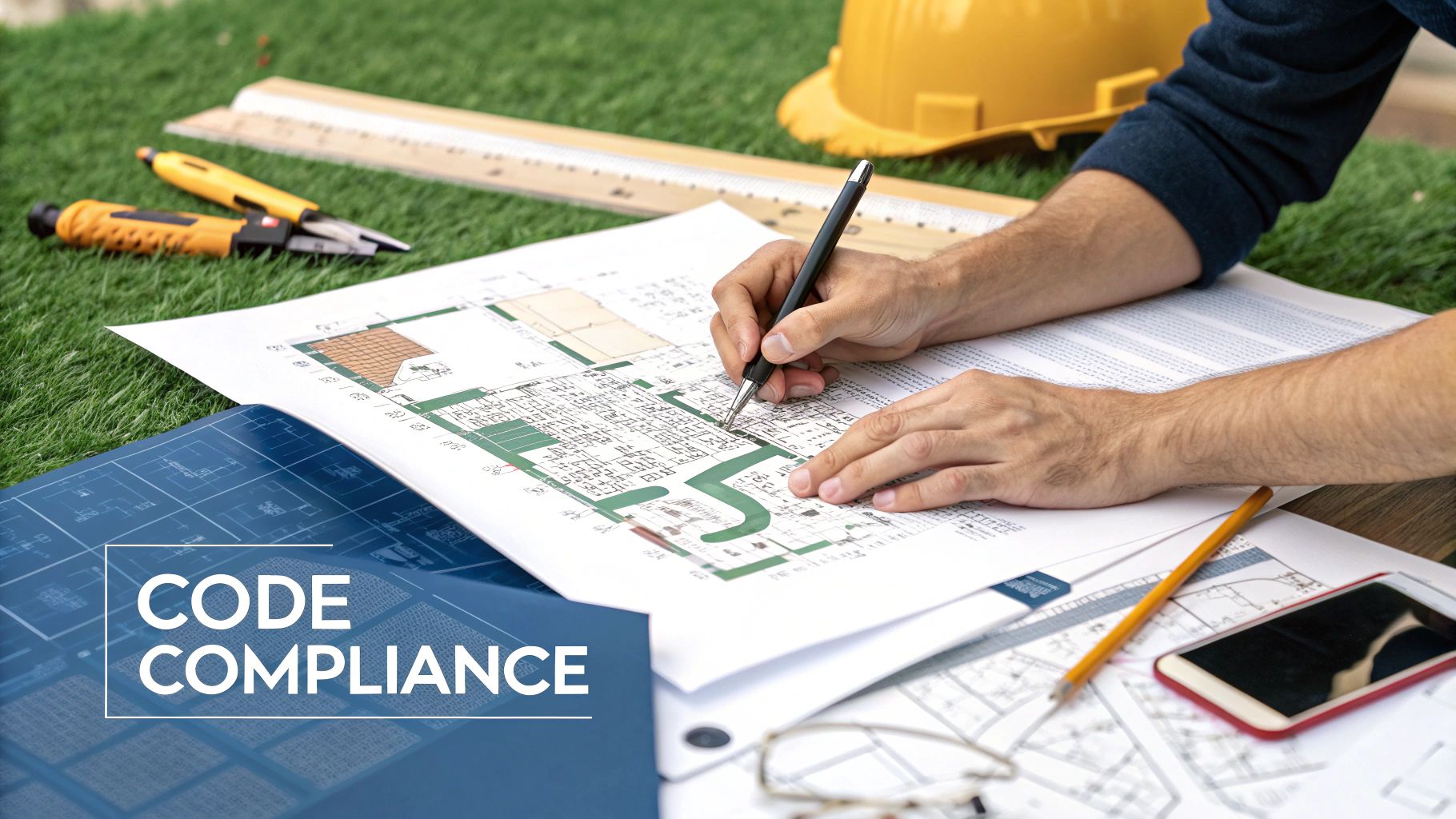
An architect pointing to specific details on a large city zoning map spread across a table.

Weaving these rules into your project from the very start is what separates a smooth permitting process from one that ends in costly, soul-crushing redesigns.

Decoding Local Zoning Ordinances

Before a single line gets sketched, your first move should be to dig into the local planning or zoning department's website. You'll usually find the zoning maps and ordinances right there online, and these documents are your roadmap for what's even possible on a property.

Let’s say you’re designing a small shop in a historic downtown. The zoning code will give you the hard facts:

  • Use Restrictions: Can you even put a retail store here? Sometimes it has to be a "mixed-use" zone.
  • Setbacks: How far back from the sidewalk does the building need to be? In many historic districts, the answer is zero to maintain that classic, continuous streetscape.
  • Height Limits: You might be capped at two or three stories to keep the new structure in scale with its older neighbors.
  • Parking Requirements: The code will have a formula for how many parking spots you need based on your square footage, which can dramatically impact your site layout.

Ignoring these details early on is a classic mistake. I once saw a great project get completely derailed because the initial design didn't account for a required 20-foot rear setback. The entire building footprint had to be redrawn, wasting weeks of work and a lot of money.

Interpreting Major Building Codes

While zoning is intensely local, building codes often stem from standardized models like the International Building Code (IBC). These provide a baseline for safety and performance that local governments adopt, sometimes with their own tweaks.

A huge part of an architect's job is translating these dense, technical manuals into real-world design features. The code influences almost everything, from the minimum width of a hallway to the specific type of fire-rated drywall required between apartments.

The real goal isn't just to meet the bare minimum. It's to understand the "why" behind the rule. That knowledge is what lets you find creative solutions that keep people safe without compromising your design vision.

Energy codes are a perfect example. The push for efficiency is global, but the follow-through can be inconsistent. Between 2022 and 2023, global floorspace grew by about five billion square meters. The problem? In emerging economies where most of that growth happened, over half of the new buildings went up without any energy codes at all. You can get a deeper look at these trends in the full 2024 report on the global status of buildings. It's a stark reminder of how critical robust local codes are for pushing energy performance forward.

A Practical Approach to Compliance

So, how do you actually make this work without getting buried in regulations? It all comes down to being proactive.

  1. Start with a Code Analysis. Early in the schematic design phase, your architect should put together a document that outlines every code that applies to your project. This flags key parameters like building type, occupancy classification, and required fire-resistance ratings right from the start.
  2. Talk to Officials Early. Don't be a stranger. A preliminary meeting with someone from the planning department to walk them through your concept can uncover red flags you might have missed. It also starts building a good working relationship with the very people who will review your final plans.
  3. Document Everything. As you make design decisions to meet code, note them directly on your drawings. This shows the plan reviewer you’ve done your homework and makes their job—and your approval—a whole lot easier.

If you treat codes and zoning as design partners instead of obstacles, you end up with buildings that aren't just beautiful, but are also safe, legal, and a true part of their community.

Integrating Smart and Sustainable Strategies

Great building design today is about more than just a striking look and a functional layout. It's about creating structures that are intelligent, highly efficient, and have a light touch on our planet. Thinking about sustainability isn't an afterthought or a "nice-to-have" anymore; it's a foundational principle that informs every decision, right from the first sketch.

The best approach blends timeless, low-tech wisdom with the sharpest new technology. The result? Buildings that cost less to run, are healthier for the people inside, and are ready for the future.

We always start with passive design strategies. This is about cleverly using the building's orientation, shape, and materials to work with the surrounding environment, not against it. Think of it as giving the building a huge head start on efficiency before a single switch is even flipped.

Once that foundation is solid, we layer in the active systems—the tech that generates and manages energy, like solar panels or high-efficiency HVAC. The final piece is smart building technology, which acts as the building's brain, using data and automation to fine-tune everything in real-time.

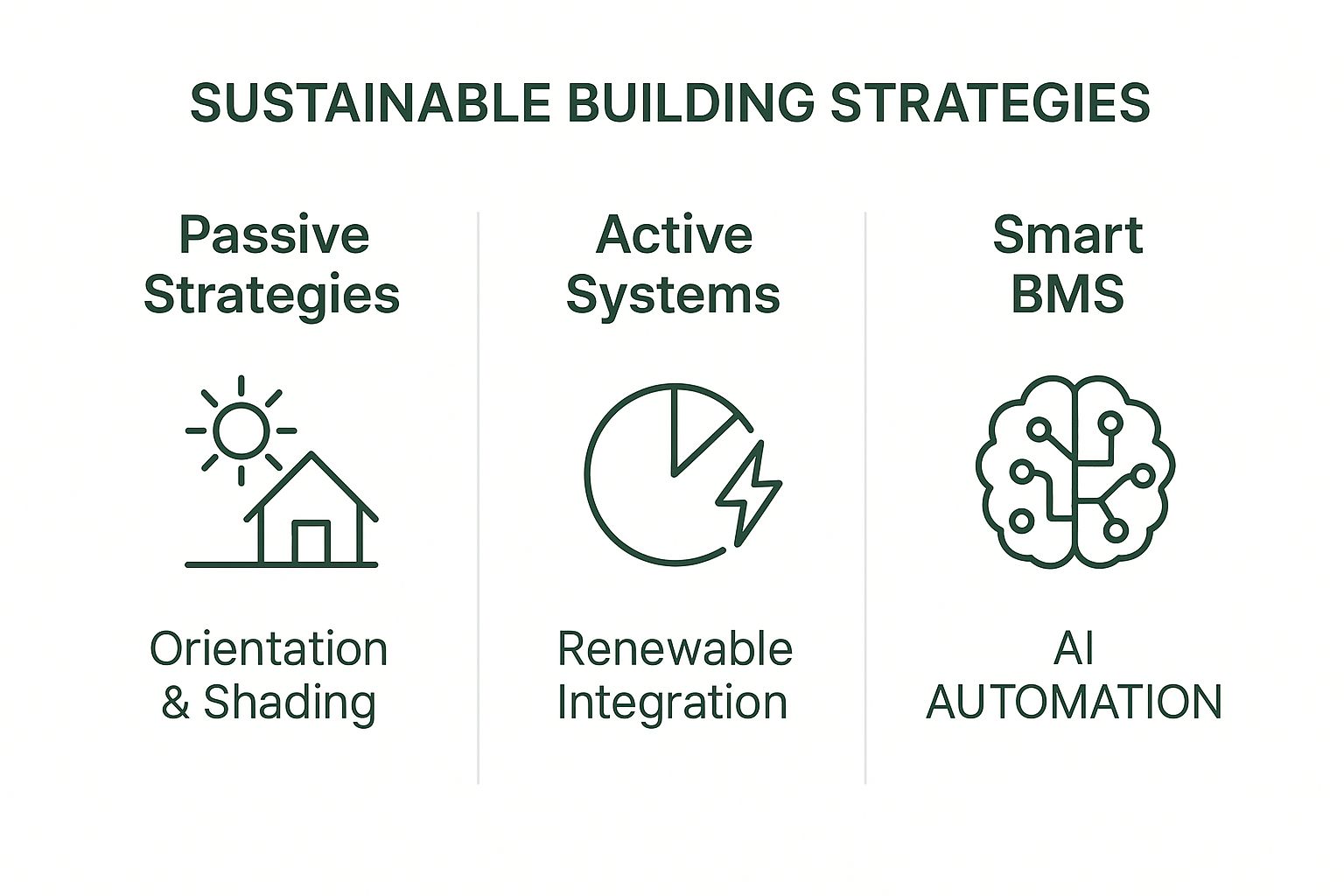
This infographic neatly breaks down these three pillars of modern, sustainable design.

Infographic comparing Passive Strategies like Orientation & Shading, Active Systems like Renewable Integration, and Smart BMS with AI Automation.

As you can see, a truly effective design layers these approaches, starting with simple, low-cost passive techniques and building up to sophisticated, data-driven automation.

Laying the Groundwork with Passive Design

Before we even think about specifying a solar panel, the most significant and cost-effective sustainable moves are made by thoughtfully shaping the building itself. These passive strategies are baked directly into the architectural DNA of a project, slashing the building's long-term energy needs from day one.

A perfect example is solar orientation. Here in South Carolina, we can orient a building to maximize sun exposure on its south-facing walls during the winter, giving us free passive heat. Then, we use carefully calculated roof overhangs or external shades to block the high-angle summer sun, which can dramatically cut cooling costs. It's a simple, elegant solution.

Other crucial passive strategies we always consider include:

  • Natural Ventilation: We design floor plans and window placements to encourage cross-breezes. This simple trick can eliminate the need for air conditioning during the milder months.
  • A High-Performance Envelope: This is the building's "skin"—its walls, roof, windows, and foundation. Using superior insulation and high-performance windows creates an airtight seal that prevents heat from escaping in the winter and seeping in during the summer.
  • Thermal Mass: We strategically use materials like concrete or stone that absorb the sun's heat during the day and slowly release it at night. This helps to naturally stabilize indoor temperatures year-round.

"The smartest building is the one that needs the least amount of energy in the first place. Passive design is the art of achieving that by working with nature, not fighting it."

Powering Up with Active Systems

Once our passive strategies have trimmed the building's energy appetite down to a minimum, we bring in active systems to meet the remaining demand as efficiently as possible. This is where modern technology really shines, generating clean energy on-site and using it with incredible precision.

To help you understand the two core philosophies, here’s a quick comparison of passive and active design approaches.

Comparing Passive vs Active Sustainable Design Strategies

This table outlines the key differences, benefits, and examples of passive and active strategies in sustainable building design to help readers understand their distinct roles.

Strategy Type Core Principle Examples Primary Benefit
Passive Uses natural elements and building form to manage energy. Building orientation, natural ventilation, shading, thermal mass. Reduces energy demand from the start with low ongoing costs.
Active Uses technology and mechanical systems to generate or conserve energy. Solar panels, geothermal heat pumps, high-efficiency HVAC. Meets remaining energy needs efficiently with clean sources.

By combining these two, we create a powerful, resilient, and low-impact building.

Sustainability is a global force in design now, influencing everything from regulations to material choices. A major trend is integrating multiple renewable sources—like solar, wind, and geothermal—with better energy storage to get buildings closer to self-sufficiency. You can learn more about how these sustainable building trends are shaping the future on blog.zeroconsulting.com.

Key active systems include:

  • Renewable Energy Generation: Photovoltaic (solar) panels are the most common choice, turning unused rooftops into mini power plants. Geothermal systems are another fantastic option, tapping into the earth's stable underground temperature for super-efficient heating and cooling.
  • High-Efficiency HVAC: Today's heating, ventilation, and air conditioning systems are miles ahead of older models. Technologies like Variable Refrigerant Flow (VRF) systems can deliver heating and cooling to different zones at the same time, using a fraction of the energy.
  • Water Conservation: While low-flow fixtures are a given, active systems take it further. We can design rainwater harvesting systems for landscape irrigation or even greywater recycling systems for non-potable uses, easing the burden on local water supplies.

Optimizing Performance with Smart Building Management

The final, powerful layer is intelligence. A Building Management System (BMS) is the central nervous system that monitors and controls all of a building's mechanical and electrical equipment. Today’s smart BMS platforms, powered by AI and the Internet of Things (IoT), are completely changing how buildings operate.

Instead of just running on a fixed schedule, a smart BMS uses a network of sensors to pull in real-time data on everything from room occupancy to outdoor air quality. For example, sensors can detect when a meeting room is empty and automatically dim the lights and dial back the thermostat.

This AI-driven automation doesn't just cut energy bills; it also creates a healthier, more comfortable environment for occupants. The system can monitor CO2 levels and automatically boost fresh air ventilation when the room gets stuffy. Over time, it learns occupant behavior, anticipates needs, and continually fine-tunes operations for peak efficiency. This constant, quiet optimization is what makes a building truly responsive and sustainable for the long haul.

How AI Is Reshaping Architectural Design

Artificial intelligence isn't some far-off concept anymore; it's a real tool in the modern architect's belt, and it's fundamentally changing how we design buildings. This isn't about AI replacing designers. It’s about arming them with incredible new capabilities to explore, optimize, and create in ways we couldn't just a few years ago.

This shift is helping firms solve incredibly complex problems with remarkable speed and creativity, truly pushing the envelope of what a building can be.

Exploring Possibilities with Generative Design

One of the most powerful applications of AI we're seeing is generative design. Instead of an architect sketching out one idea at a time, we now feed a set of goals and constraints directly into an algorithm. These parameters can be anything—from tight budget limits and material choices to specific structural loads and energy performance targets.

The AI then gets to work, generating thousands of viable design options, each one a distinct solution to the puzzle. This process lets architects stumble upon brilliant, highly optimized solutions they might never have landed on otherwise. Imagine designing a hospital and finding a layout that shaves minutes off nurses' walking times while giving every patient a view of natural light—that's the kind of problem generative design excels at solving.

AI-driven generative design doesn't just make us faster; it blows the doors wide open on creativity. The architect’s role evolves from being the sole creator to a curator, sifting through thousands of possibilities to find the most elegant and effective solution.

This approach gives design teams a huge head start. They can spend their valuable time and expertise refining the best computer-generated options instead of starting every project from scratch.

Making Building Information Modeling Smarter

Building Information Modeling (BIM) has long been the standard for creating detailed, data-rich 3D models. AI is now making those models exponentially more intelligent. By running machine learning algorithms on BIM data, systems can now automatically spot potential conflicts—or "clashes"—with an impressive degree of accuracy.

For example, an AI can flag a design where a new HVAC duct is routed straight through a primary structural beam. Catching that kind of mistake in the digital phase saves a massive amount of time, money, and headaches during construction.

AI also elevates project management within BIM. By analyzing data from past projects, it can generate much more precise construction schedules and cost estimates. It can even identify potential bottlenecks before they bring work to a standstill, leading to a much smoother, more predictable project from start to finish. We're seeing this play out across building systems, with new insights into how AI is transforming HVAC systems for unparalleled efficiency.

Revolutionizing Construction and Fabrication

The influence of AI doesn't stop at the digital model; it extends right onto the job site. AI-guided robotics and 3D printing are paving the way for new construction methods that are faster, safer, and generate significantly less waste.

We're in the middle of a major shift, with firms like Zaha Hadid Architects using AI not just for stunning aesthetics but to fine-tune a building's thermal performance. On the fabrication side, 3D printing guided by AI is completely changing how we use materials. We can now print complex components designed for maximum strength with an absolute minimum of waste.

These technologies make it possible to build complex, organic shapes that would be ridiculously expensive—if not impossible—with traditional methods. A huge win here is material optimization. An AI algorithm can design a structural element using the precise minimum amount of material required to meet all strength and safety codes.

This marriage of AI and fabrication isn't science fiction—it's happening right now, creating a more efficient and sustainable construction industry. As these tools become more common, they’ll continue to unlock new creative paths for designing the buildings of tomorrow.

Answering Your Questions About the Building Design Process

Even with a solid plan, you’re bound to have questions. Designing a building is a complex dance between timelines, professional roles, finances, and technology. Getting clear on these common points of confusion from the start helps demystify everything and gets the whole team—from you to the designers—on the same page.

Let’s tackle some of the most frequent questions that pop up during a project. Think of these as direct, practical insights into what you can really expect.

How Long Does the Building Design Process Typically Take?

This is probably the number one question we get, and honestly, it’s one of the toughest to answer with a single number. The real timeline comes down to a few key things: the project’s size, how complicated it is, and how quickly your local permitting office moves. No two jobs are ever the same.

A custom home, for instance, might sail through design and permitting in 6 to 12 months. But a big commercial project, like a new office building or a multi-family apartment complex, could easily take a few years of planning and approvals before anyone even thinks about breaking ground.

It helps to remember the process is broken into distinct phases, each with its own rhythm:

  • Schematic Design: Getting the big ideas on paper. This usually takes 1-2 months.
  • Design Development: This is where we flesh out the details and systems. Expect another 2-4 months.
  • Construction Documents: Creating the highly detailed blueprints for the builders is a heavy lift, often taking 3-6 months.

The real wild card here is permitting. Depending on your local jurisdiction and how complex the project is, getting all the necessary stamps of approval can take anywhere from a few months to over a year. The best thing you can do is sit down with your architect at the very beginning and map out a realistic schedule to manage everyone’s expectations.

What Is the Difference Between an Architect and a Building Designer?

People often use these terms interchangeably, but there's a major distinction, and it’s legally defined. The main differences boil down to licensing, education, and who is legally on the hook for the final product.

An architect is a licensed professional. You don't just get to call yourself one. The title is earned after completing a demanding, accredited degree, followed by a multi-year internship under other licensed architects, and finally, passing a grueling series of exams. This license legally empowers them to design any type of building, from a small house to a towering skyscraper.

A building designer, on the other hand, usually isn't a licensed architect. While many are very talented and have a ton of experience, their scope is often legally limited to certain projects, like single-family homes or small-scale commercial buildings, depending on state and local laws. An architect’s license is a seal of proven professional competence, and it holds them legally accountable for the health, safety, and welfare of the public.

How Can I Keep My Building Design on Budget?

Keeping a project on budget isn't magic—it's a team effort that starts on day one and doesn't stop until the keys are handed over. The whole game is about proactive communication and making disciplined decisions along the way.

First things first: set a realistic budget and be completely transparent about it with your design team. Your architect should be giving you detailed cost estimates at key milestones, like after the initial concept is done and again after the design is more developed. This gives you a chance to make smart adjustments before you’re too far down a path that’s getting expensive. It's also a good time to make a "must-have" vs. "nice-to-have" list.

The single biggest budget-killer? Late-stage design changes. Deciding to move a wall when the construction documents are nearly finished can create a ripple effect of costly revisions to the structural, mechanical, and electrical plans.

To protect yourself from surprises, always build a contingency fund of 10-15% of the total construction cost right into your budget. Another pro tip: bring a contractor into the loop early on for pre-construction feedback. Their real-world cost insights can be incredibly valuable.

What Is Building Information Modeling and Why Is It Important?

Building Information Modeling, or BIM, is a 3D model-based process that has become an absolute cornerstone of modern design. It’s so much more than just a digital drawing. A BIM model is an intelligent, data-rich digital version of the building itself.

Unlike a simple 3D model that just shows shapes, a BIM model has layers upon layers of information embedded within it. Every single element—from a wall to a window to a light fixture—carries data about its material, manufacturer, and even its cost. It effectively creates a "digital twin" of the physical building.

BIM is a game-changer for a few huge reasons:

  1. It boosts collaboration. Architects, engineers, and contractors can all work from a single, coordinated model, which cuts down on miscommunication and mistakes.
  2. It finds problems before they happen. The software can automatically run a "clash detection" to see where building systems conflict—like a pipe scheduled to run right through a structural beam. Catching this stuff on a screen saves a fortune compared to finding it on the construction site.
  3. It helps manage the building for life. After the project is built, the owner can use the BIM model for ongoing facility management, tracking maintenance, and planning future renovations.

Navigating the world of building design, from the first sketch to the final walkthrough, requires a partner with deep expertise and a genuine commitment to your vision. The team at Sherer Architects, LLC brings decades of experience to every project, ensuring your commercial, adaptive reuse, or historic preservation goals are met with precision and creativity.

Learn how Sherer Architects, LLC can bring structure to your vision and guide you through every stage of the design process.