
When we talk about risk management in construction, we’re really talking about a systematic way of looking into the future. It’s the process of identifying, analyzing, and responding to any potential threat that could throw a project off its timeline, bust the budget, or compromise quality. Think of it less as a rigid procedure and more as a proactive strategy—a way to turn uncertainty into a manageable part of the building process.
Why Proactive Risk Management Is Non-Negotiable
In construction, waiting for problems to happen is a recipe for disaster. That old-school "fire-fighting" approach just doesn't cut it anymore, especially with today’s volatile market conditions. A proactive mindset isn't just a nice-to-have; it's the only way to steer a modern project through its complexities and protect your bottom line.
Let's be clear: effective construction project risk management isn't about trying to create a risk-free project. That’s a fantasy. It’s about making smart, informed decisions that transform potential disasters into controllable challenges. This forward-thinking approach gives stakeholders confidence and provides a clear roadmap for handling whatever comes your way, from groundbreaking to the final punch list.
The Soaring Stakes of Modern Construction
The sheer scale of the industry underscores why a formal risk strategy is so critical. By 2025, global construction spending is projected to reach an astounding $15.7 trillion. But with that massive growth comes intensified risk. In fact, a staggering 98% of megaprojects hit delays or go over budget, often due to unpredictable factors like spiking material costs and persistent labor shortages.
A formal risk management process is your project's insurance policy against the unpredictable. It provides the structure needed to anticipate threats, from supply chain disruptions to sudden regulatory changes, rather than being blindsided by them.
The Four Pillars of Construction Risk Management
A solid risk management strategy isn't a one-time event; it's a continuous cycle built on four essential pillars. Each stage flows into the next, creating a living system that helps you stay in control of project outcomes.
This table breaks down the essential stages of the risk management lifecycle, showing the core objective of each phase.
| Stage | Core Objective |
|---|---|
| Identify | To uncover all potential risks that could affect the project, no matter how small. |
| Analyze | To evaluate the likelihood and potential impact of each identified risk. |
| Respond | To develop a clear action plan for addressing each significant risk. |
| Monitor | To continuously track risks and the effectiveness of your response plans. |
Getting these four stages right is the foundation of a resilient project. To get a better handle on the fundamentals, diving into some practical guides on effective risk management strategies in project management can be incredibly helpful. Now, let’s walk through what each of these critical stages looks like in the real world.
Uncovering Risks Before They Become Problems
You can't manage a risk you don't see coming. The whole game in construction risk management starts with a thorough, honest, and collaborative effort to hunt for potential trouble spots. This isn't about ticking boxes on a generic checklist; it's about digging deep into your project's unique DNA and tapping into the collective wisdom of your entire team.
The most effective tool I've seen is also the simplest: structured brainstorming sessions. Get everyone in a room—the architect, lead engineer, site supervisor, and even key subcontractors. You need to create an atmosphere where the plumbing foreman feels just as comfortable raising a red flag about material delivery as the project manager does about permitting delays.
Going Beyond the Conference Room
Team huddles are crucial, but some of the most expensive risks are found with boots on the ground. A comprehensive site investigation is completely non-negotiable. And I mean looking for more than just the obvious topographical challenges.
Are there tell-tale signs of undocumented utility lines? What about potential soil contamination from a previous industrial use that the initial survey missed? A solid walkthrough can expose issues like poor site access for heavy machinery or neighborhood noise restrictions that could absolutely wreck your schedule.
The most dangerous risks are often the ones you assume aren't there. Never take historical data or initial site surveys at face value; always verify with your own eyes. This simple act of due diligence can prevent catastrophic surprises down the line.
Another goldmine of information is your own company’s project history. Dig into the data from similar jobs you’ve wrapped up in the last five years. What were the most common change orders? Did you see recurring delays caused by a specific supplier? Spotting these patterns is how you stop history from repeating itself on your current job.
This process flow shows exactly why identification is the critical first step in the whole risk management cycle.
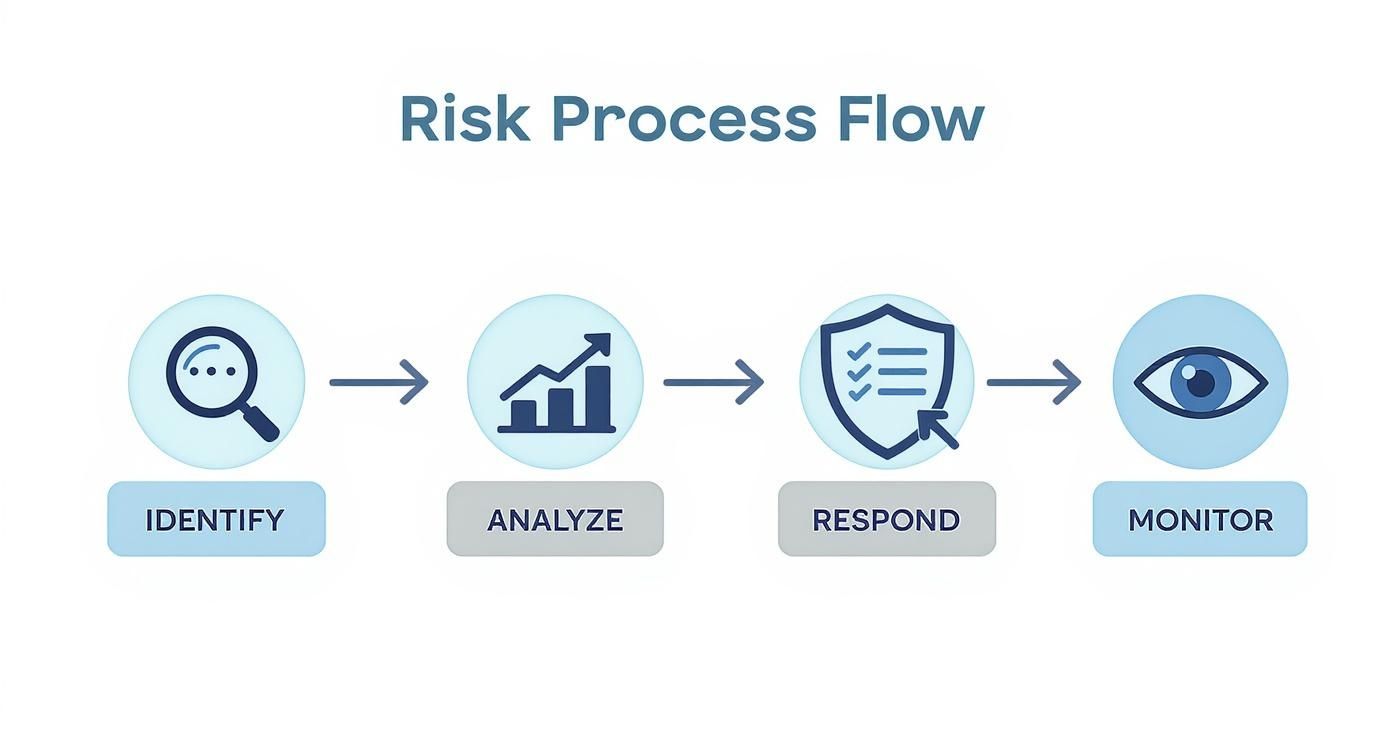
As you can see, if you fail to properly identify risks at the start, any analysis, response, and monitoring you do later will be far less effective. It all starts here.
Structuring Your Findings
Once you have a list of potential threats, you need a system to make sense of it all. This is where a Risk Breakdown Structure (RBS) becomes your best friend. Think of an RBS as a hierarchical chart that sorts your risks into logical buckets, making them much easier to analyze and tackle.
Common categories in a construction RBS might include:
- Technical Risks: Things like using an unproven building material or dealing with complex design elements that are a nightmare to execute.
- External Risks: These are the curveballs you can't directly control, like a sudden change in zoning laws or major supply chain disruptions.
- Organizational Risks: Problems that start from within the project team, such as poor communication between departments or a project that's underfunded from the get-go.
- Project Management Risks: Inadequate planning, wildly inaccurate cost estimates, or an unclear project scope all fall into this category.
By breaking down risks this way, you create a clear framework that turns a long, intimidating list of worries into a manageable set of categories. The ultimate goal is to build out a dynamic risk register—a living document that acts as the central hub for your entire construction project risk management plan.
How to Prioritize Your Project Risks Effectively
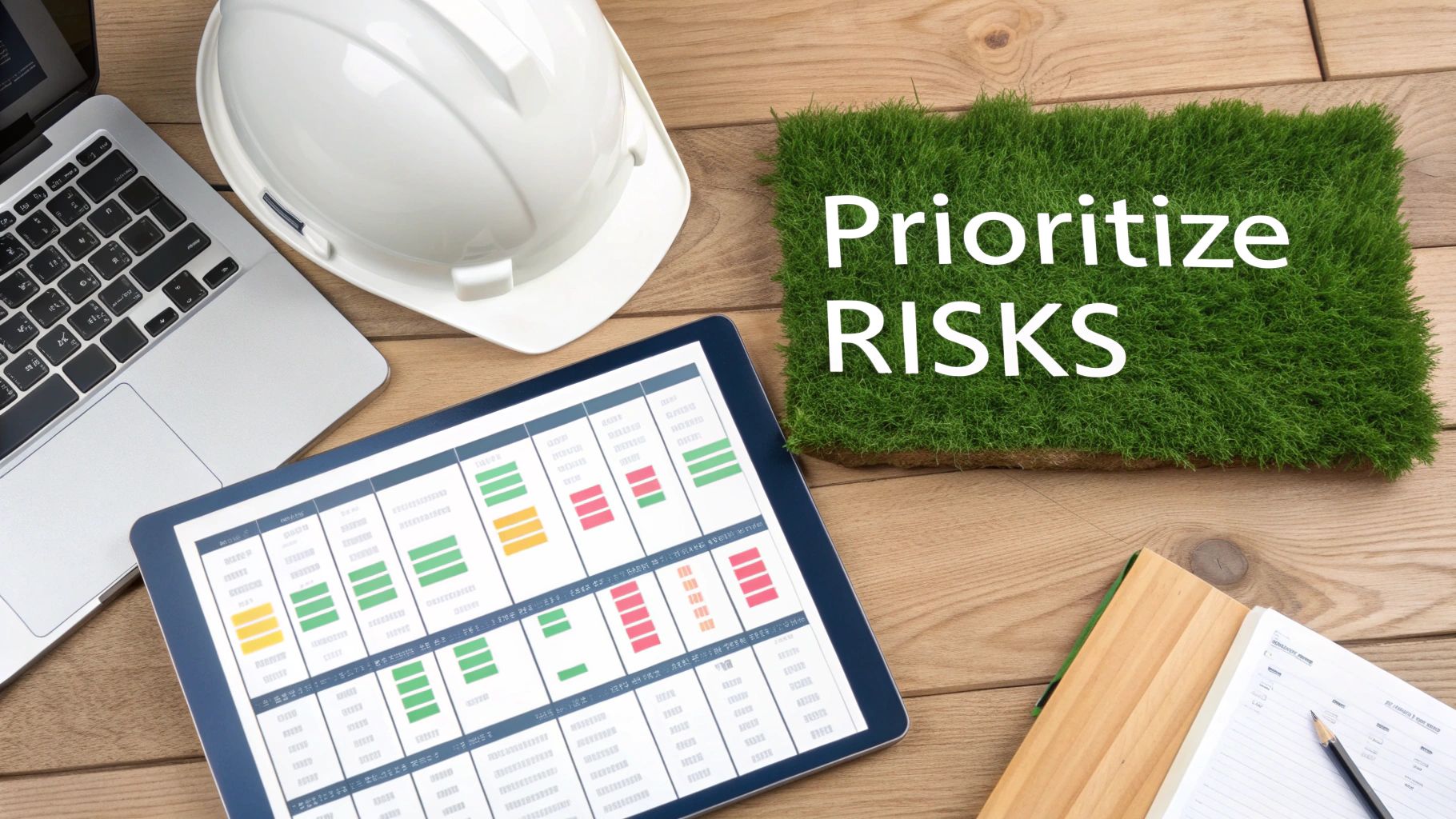
Okay, you’ve done the hard work of identifying risks, and now you have a risk register that’s probably a mile long. That’s actually a good sign—it means your team has been thorough. But now comes the real challenge: where do you even start?
You can’t treat every risk equally. Some are minor bumps in the road, while others are absolute project-killers waiting to happen. The key is to separate the serious threats from the background noise. Trying to tackle everything at once is a recipe for burning out your team and wasting valuable resources. This is where smart risk analysis comes into play.
Using the Probability-Impact Matrix
The most effective tool I've used for this is the probability-impact matrix. It’s a straightforward grid that helps you sort and visualize risks by asking two simple but critical questions: how likely is this to happen, and how bad will it be if it does?
You basically assign a score for both probability (say, from 1 for 'rare' to 5 for 'almost certain') and impact (1 for 'insignificant' to 5 for 'catastrophic'). Plotting these on the matrix gives you an instant, clear picture of your risk landscape.
It breaks down like this:
- High-Priority Risks: These are the ones in the top-right corner—high probability, high impact. Think of a critical supplier with a shaky track record on a project with zero float. These are your red alerts that need an immediate, robust response plan.
- Medium-Priority Risks: These land in the middle. Maybe it’s something very likely to happen but with a low impact (like a few days of rain slowing down earthwork), or something with a massive impact that’s extremely unlikely. These warrant attention, but not the all-hands-on-deck approach of the high-priority ones.
- Low-Priority Risks: Tucked away in the bottom-left, these are both unlikely and would have minimal impact if they occurred. For example, a brief shortage of a non-essential finishing material. You can often just accept these risks and move on.
This simple, qualitative approach is the foundation of solid construction project risk management and provides a clear roadmap for what to do next.
A probability-impact matrix is an excellent tool for visualizing and prioritizing risks. It helps teams quickly understand which issues demand immediate attention versus those that can be monitored or accepted. Below is a practical example of how you might structure one.
A Practical Probability-Impact Matrix
| Likelihood | Impact (Low) | Impact (Medium) | Impact (High) |
|---|---|---|---|
| High | Medium Priority | High Priority | High Priority |
| Medium | Low Priority | Medium Priority | High Priority |
| Low | Low Priority | Low Priority | Medium Priority |
By plotting each identified risk into a grid like this, your team can move from a long, overwhelming list to a clear, actionable set of priorities. This visual clarity ensures everyone is on the same page about where to focus their energy.
The real power of a risk matrix isn't just in the final scores; it's in the conversations your team has while assigning them. This process forces everyone to align on what truly matters and builds a shared understanding of the project's biggest vulnerabilities.
When Qualitative Isn't Enough
For massive, complex megaprojects with millions on the line, a simple matrix might not cut it. You’ll need to dig deeper with a quantitative approach. Methods like a Monte Carlo simulation, for example, use software to run a project through thousands of potential scenarios, modeling the combined financial fallout if multiple risks hit at once.
This level of detailed analysis is becoming more important as the industry faces growing disruption. Recent analyses have shown that up to 13.7% of planned global construction projects are being canceled due to geopolitical instability and soaring costs. Digging deeper, about one in every four projects gets scrapped during the planning stage alone, which really drives home the need for rigorous risk assessment right from the get-go. You can read more about how global uncertainty is impacting construction pipelines to understand the bigger picture.
No matter which method you choose, the goal is the same: to create a prioritized list that tells you exactly where to focus. Once you know which risks pose the greatest threat, you're ready to start building a smart, targeted response.
Building a Bulletproof Risk Response Plan
So, you’ve identified your project risks and figured out which ones could really cause some damage. That’s a huge step. But now comes the real work: deciding what you’re actually going to do about them.
This is where your analysis becomes an action plan. A solid response plan isn't just a list of potential fixes. It’s a playbook that gives clear ownership for each risk and defines exactly when to pull the trigger on a response. Nothing can be left to chance.
Every construction project risk management strategy I've ever seen boils down to four fundamental responses. The trick is knowing which one to use for the threat you’re facing. You have to be deliberate here, not just reactive.
The Four Core Response Strategies
Think of your response plan as your game plan for handling the unknown. Let's walk through the four main strategies you’ll use, with some real-world examples of how they play out on a construction site.
Sidestep the Problem Entirely (Avoidance)
This is your most direct move. When a risk is so big or so certain that it threatens the project's success, you find a way to cut it out of the plan completely. You're not ignoring it; you're fundamentally changing your approach to make it a non-issue.
For example, imagine a geotechnical survey comes back showing a pocket of highly unstable soil right where you planned to pour the main foundation. Instead of gambling on expensive and unpredictable soil remediation, the design team might redesign the building's footprint. By shifting the foundation onto solid ground, they've avoided that massive risk altogether.
Reduce the Threat (Mitigation)
Mitigation is your bread and butter. It's all about taking steps to reduce the chances of a risk happening, or at least lessening its impact if it does. This is the go-to strategy for most high-priority risks that you simply can't avoid.
A classic example is working at height, which is a leading cause of injuries on site. You can’t avoid it, but you can certainly mitigate it. A crucial part of any risk response plan is mandating appropriate working at height safety equipment and ensuring everyone follows the safety protocols to the letter. These proactive steps directly reduce the likelihood of a serious accident.
A risk response plan without clear ownership is just a piece of paper. For every risk, you absolutely must assign an "owner"—a specific person or team responsible for implementing the plan and keeping an eye on it. Accountability is everything.
Pass the Buck (Transfer)
Sometimes, the best move is to shift the financial hit of a risk onto someone else. This doesn't make the risk disappear, but it shields your project's budget from the direct fallout. Insurance and contracts are your primary tools here.
Let's say your project is in a flood-prone area. The general contractor can transfer the financial risk by getting a comprehensive builder's risk insurance policy that specifically covers flood damage. Another common move is subcontracting complex or dangerous work, like deep excavation. A good contract makes the subcontractor liable for any issues, like a shoring failure.
The scale of this is huge. Economic losses from natural disasters hit over $380 billion in 2024, putting immense pressure on construction insurance. This makes it critical for brokers, insurers, and contractors to communicate constantly to get the right coverage in place.
Live with It (Acceptance)
Finally, there are times when the cost and effort of fighting a risk are far greater than the potential damage it could cause. In these situations, the smart play is to simply accept it. This can be a passive choice (doing nothing) or an active one, where you put a little money aside in a contingency fund just in case.
Here’s a low-stakes scenario: a supplier for a non-critical material is known to have occasional shipping hiccups, potentially causing a one or two-day delay. The impact on the overall schedule is tiny. The project manager accepts this risk and allocates a small amount to the management reserve to cover minor overtime costs if the delay happens. No need to overreact.
Keeping Your Risk Plan Alive and Effective
Here’s a hard truth: a risk management plan isn't a trophy you put on a shelf. If you’re not actively using it, reviewing it, and updating it, the whole exercise was a waste of time. The real payoff in construction project risk management comes when you turn that plan into a living, breathing guide that informs daily decisions and bends with the project's reality.
This is where monitoring and communication come in. It’s all about keeping a constant pulse on the project’s health. Think of it as creating a feedback loop that tells you if your risk responses are actually working and helps you spot new threats before they become full-blown crises. Without this active oversight, your carefully crafted plan is obsolete the moment the first truck rolls onto the site.
More Than Just Another Meeting
The heart of good monitoring is the regular risk review meeting. But let's be honest, nobody needs more meetings. The trick is to make these sessions sharp, efficient, and action-oriented—not just a status update where everyone nods along.
This should be a dedicated time to tackle the highest-priority items in your risk register. For each major risk, you need to be asking a few tough questions:
- Is this risk still relevant? Some threats naturally fade as a project moves from foundation to finishing.
- Has its probability or impact shifted? A once-minor risk can suddenly become a much bigger deal.
- Is our response plan actually working? If it’s not, what are we going to do about it right now?
This process keeps your risk register dynamic and accurate, not just a static snapshot from week one. The whole point is to walk out of that room with clear action items and updated ownership, so everyone stays accountable.
Using Key Risk Indicators as an Early Warning System
Beyond meetings, you need a way to see trouble brewing in real time. That's where Key Risk Indicators (KRIs) are a game-changer. KRIs are specific, measurable metrics that act like a project's early warning system for your most significant threats. They give you data-driven signals that a risk is getting closer to becoming a reality.
Here are a few practical examples from the field:
- Financial KRI: If you're worried about budget overruns, a great KRI is "weekly material costs exceeding projections by more than 10%."
- Schedule KRI: To get ahead of delays, you could track "the number of RFIs taking longer than 5 days to close."
- Safety KRI: A critical safety KRI might be "the number of reported near-miss incidents per week."
When a KRI crosses a threshold you’ve already set, it automatically triggers a review of that risk and its response plan. It’s a proactive approach that lets you get ahead of problems instead of constantly putting out fires.
The most effective risk management culture is one where anyone on the site feels empowered to raise a concern without fear of blame. From the newest laborer to the senior architect, every person is an extra set of eyes, and their perspective is invaluable for catching risks others might miss.
Communicating Risk Across the Board
Finally, a plan is useless if it's locked in the site office. You have to get the right information to the right people, and that means tailoring your communication.
- The Client: They need high-level updates on the major risks that could hit the budget and final delivery. Keep it concise and focused on your mitigation strategy.
- The Project Team: This group needs the details. They need to know their specific responsibilities within the risk response plans.
- The On-Site Crew: Communication here needs to be clear, simple, and direct. Think toolbox talks about immediate safety hazards or process changes that affect their work today.
Opening up these channels of communication is the final, crucial piece of the puzzle. It builds a culture of shared ownership and turns your risk plan from a document into a powerful, collective mindset that guides the entire project to a successful finish.
Answering the Tough Questions About Construction Risk
Even the most meticulously crafted risk management plan is going to spark questions on the job site. That's just the nature of construction. Being able to answer those questions with confidence is what separates a good project manager from a great one. Let’s walk through a few of the questions I hear all the time.
"How much time should we really be spending on identifying risks?" The short answer? Probably more than you think. Cutting corners here is a rookie mistake I’ve seen cost teams dearly. When you rush through identification, you're almost guaranteed to overlook subtle threats that will inevitably blow up later, usually when fixing them is ten times more expensive.
Another big one is about getting the whole team on board. "How do I get my site super to care about this stuff when they're swamped?" You have to make it about their world. Forget abstract talk of "risk mitigation." Instead, talk about how a new safety check prevents the kind of accident that shuts down the site for a day, or how better material tracking means they won't have to scramble for a delivery over the weekend.
The only way to build a real risk-aware culture is to make it personal. You have to connect the dots between your risk plan and the day-to-day headaches and goals of every single person on the project, from the top brass to the crew pouring the concrete.
How Often Should a Risk Register Actually Be Updated?
Think of your risk register as a living document, not a "set it and forget it" file. It needs constant attention. As a baseline, I recommend a dedicated risk review meeting at least bi-weekly on a fast-paced job. For projects with a longer, steadier timeline, you can probably stretch that to monthly.
But schedules aren't everything. Certain events should automatically trigger a review, no matter when your next meeting is planned. These are the big ones:
- A major change order gets the green light.
- There's a serious safety incident or even a close call.
- Something outside your control happens, like a major supplier's facility flooding, threatening your material pipeline.
What's the Real Difference Between a Risk and an Issue?
This is a critical distinction that teams often get wrong, and it muddies the water. A risk is something that might happen in the future. For example, "There's a chance our primary concrete supplier's union will go on strike next month." It’s a potential problem.
An issue is a problem that is happening right now. For instance, "Our concrete supplier is on strike, and today's pour was just canceled."
Your entire risk management plan is built to stop risks from turning into issues. The moment one does, you have to shift gears from proactive planning to reactive firefighting. Keeping these two concepts separate helps the team stay focused on preventing future problems while effectively dealing with the ones already at their doorstep.
At Sherer Architects, LLC, we see expert architectural planning as the ultimate form of risk management. With decades of hands-on experience in commercial design, adaptive reuse, and historic preservation, we know how to spot and design around potential project pitfalls from day one. This ensures your project starts on a foundation of certainty, not guesswork. See how our forward-thinking approach can protect your next investment by visiting us at https://shererarch.com.