

In commercial and adaptive-reuse projects, maximizing value isn't just about cutting costs. It's about optimizing performance, lifecycle durability, and long-term profitability. Value engineering (VE) is the systematic process of analyzing function to identify and eliminate unnecessary costs without sacrificing quality, reliability, or aesthetic integrity. It is a proactive, creative, and collaborative approach that challenges assumptions and unlocks smarter, more efficient ways to build.
While often perceived as simple cost-cutting, true VE focuses on enhancing the overall project value, from initial design through to long-term operation. This strategic process extends beyond material swaps to encompass broader design choices. For example, focusing on aspects like maximizing natural light through strategic glazing is just one way of making design decisions that drive ROI by improving tenant well-being and reducing energy consumption over the building's life.
This guide moves beyond theory to provide tangible construction value engineering examples that project owners, developers, and contractors can implement. We will dissect eight powerful VE strategies, breaking down the problem, the proposed alternative, and the critical takeaways for your team. You will discover how to identify opportunities for significant improvements in cost, schedule, and performance, turning common design challenges into profitable and sustainable outcomes.
1. Substitution of Materials – High-Performance Concrete
A classic construction value engineering example involves substituting conventional concrete with High-Performance Concrete (HPC) or Self-Consolidating Concrete (SCC). This strategic shift focuses on lifecycle value over initial material cost. While HPC has a higher per-unit price, its superior strength, durability, and placement efficiency often lead to significant savings in labor, time, and long-term maintenance.
HPC is engineered for specific performance characteristics, such as high compressive strength, low permeability, and enhanced resistance to chemical and environmental degradation. SCC, a type of HPC, flows easily into complex formwork without mechanical consolidation, drastically reducing labor time and improving finish quality.
Strategic Analysis & Impact
The value proposition of HPC/SCC extends far beyond simple material replacement. It redefines structural possibilities and project timelines.
- Cost & Time Impact: Initial material costs can be 15-30% higher. However, labor costs for placement and finishing can decrease by up to 50% with SCC. Faster formwork cycling and earlier strength gain can shorten the overall project schedule by weeks or even months on large-scale projects.
- Performance Impact: The dense, impermeable nature of HPC extends the structure's service life, particularly in harsh marine or industrial environments. This reduces future repair costs, making it a powerful tool for lowering the total cost of ownership.
- Design Impact: Higher strength allows for smaller-profile structural elements like columns and beams. This can increase usable floor space, a direct value-add for commercial and adaptive reuse projects where every square foot counts.
Key Insight: The most effective use of this VE measure is when it's considered during the initial design phase. Retroactively substituting HPC can be challenging, but planning for it allows engineers to optimize the entire structural system around its unique properties.
Implementation & Takeaways
Successfully implementing HPC or SCC requires a shift in mindset from first-cost to lifecycle value analysis.
- Collaborate Early: Involve your structural engineer and a knowledgeable concrete supplier during the design development stage. Their expertise is crucial for mix design and logistical planning.
- Focus on Placement Efficiency: The primary savings often come from labor reduction and speed. Ensure the construction team is trained on the specific handling and quality control procedures for SCC to maximize these benefits.
- Model Lifecycle Costs: For owners and developers, a lifecycle cost analysis (LCCA) is essential. It will clearly demonstrate how the higher initial investment in HPC generates long-term returns through reduced maintenance and increased durability, justifying the upfront expenditure. The American Concrete Institute (www.concrete.org) provides extensive resources on HPC standards and applications.
2. Modular Construction and Prefabrication
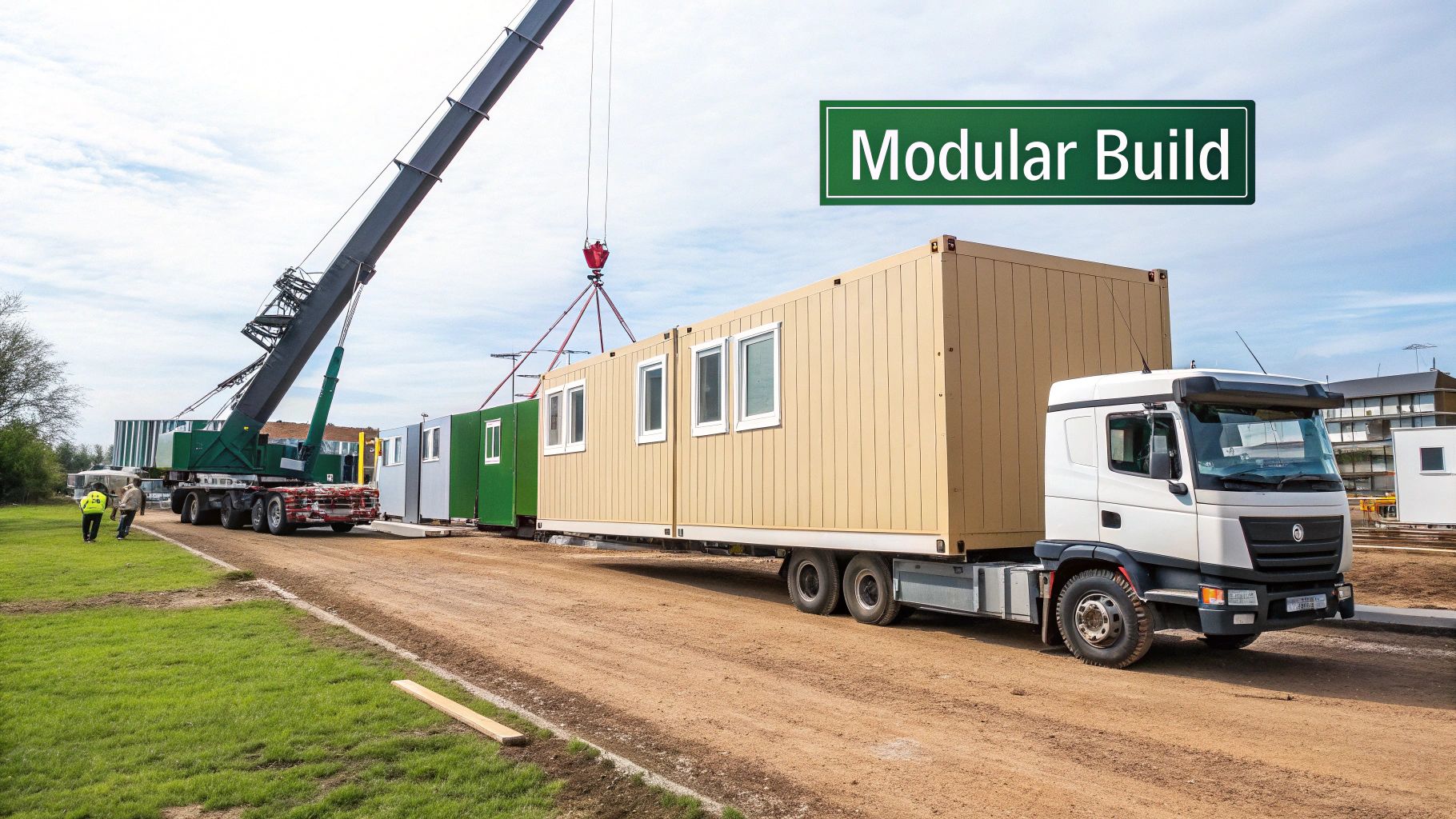
A powerful construction value engineering example is the shift from traditional stick-built methods to modular construction and prefabrication. This strategy involves manufacturing building components, from entire rooms to facade panels, in a controlled factory setting. These modules are then transported to the construction site for assembly, fundamentally changing the project delivery model from sequential to parallel processing.
This approach minimizes on-site variables like weather delays and skilled labor shortages while maximizing quality control. Companies like Factory OS are pioneering this technology for multi-family housing, and hotel chains like Marriott have successfully deployed prefabricated bathroom pods to accelerate project completion and ensure consistent quality across properties.
Strategic Analysis & Impact
Adopting modular construction is a strategic decision that impacts the entire project lifecycle, from financing and design to final assembly and turnover. It is less a material swap and more a fundamental process re-engineering.
- Cost & Time Impact: While direct material costs can be similar, the primary value comes from schedule compression. Projects can see a 30-50% reduction in overall duration because site preparation and foundation work occur simultaneously with factory module fabrication. This leads to significant savings in general conditions, financing costs, and faster revenue generation.
- Performance Impact: Factory production enables superior quality control, tighter building envelopes, and reduced material waste by up to 90%. This results in more energy-efficient buildings with lower long-term operating costs and predictable performance.
- Design Impact: This method thrives on standardization. It is ideal for projects with repetitive units like hotels, dormitories, or multi-family housing. The design must be locked in early, which imposes discipline but also ensures cost and schedule certainty.
Key Insight: The greatest barrier to modular adoption is logistical planning, not manufacturing. Success hinges on meticulously coordinating module transportation, site access for large cranes, and just-in-time delivery to avoid on-site storage issues.
Implementation & Takeaways
Implementing a modular or prefabricated strategy requires a paradigm shift towards early collaboration and detailed pre-planning.
- Engage Manufacturers Early: Bring a modular manufacturer like Factory OS or a specialized facade fabricator into the design process from the very beginning. Their input is critical to optimizing designs for factory production and transport.
- Design for Manufacturing and Assembly (DfMA): The architectural and engineering teams must design with the manufacturing process in mind. This includes standardizing MEP connections, module interfaces, and structural connection points to streamline both factory work and on-site assembly.
- Prioritize Logistics Planning: Develop a comprehensive logistics plan that covers transportation routes, delivery sequencing, and site staging. This plan is as critical as the architectural drawings and is essential for realizing the schedule benefits of this VE approach.
3. Value Engineering in HVAC System Design – Right-Sizing Equipment
A fundamental construction value engineering example in mechanical systems is the precise "right-sizing" of HVAC equipment. This strategy challenges the common, yet costly, practice of oversizing systems as a conservative safety measure. Instead, it focuses on meticulous load calculations to match equipment capacity directly to the building's actual thermal demands, optimizing both upfront capital and long-term operational costs.
Oversized HVAC units are not just more expensive to purchase; they operate inefficiently. They cycle on and off too frequently (short-cycling), which prevents them from effectively dehumidifying the air, increases component wear, and consumes excess energy. Right-sizing ensures the system runs for longer, more stable cycles, providing better comfort and performance at a lower operational cost.
Strategic Analysis & Impact
The value of right-sizing is realized through a holistic improvement in cost, performance, and sustainability. It's a shift from a "bigger is better" assumption to a data-driven, efficiency-focused approach. When considering Value Engineering in HVAC System Design, optimizing equipment choices and integrating advanced systems, such as implementing energy recovery ventilator technology, can significantly enhance overall system value and energy efficiency.
- Cost & Time Impact: Initial equipment costs can be reduced by 15-25% by avoiding oversized, higher-capacity units. Long-term energy savings can be substantial, with documented cases like the University of Pennsylvania reducing energy use by 35% after a right-sizing initiative.
- Performance Impact: Right-sized systems provide superior dehumidification and more consistent temperature control, directly improving occupant comfort and indoor air quality. This also reduces mechanical strain, leading to a longer equipment service life and fewer maintenance issues.
- Design Impact: Proper sizing requires early coordination between the architect and mechanical engineer. It forces a more integrated design process where building envelope performance (insulation, windows, air tightness) is directly tied to mechanical system selection, leading to a more efficient building overall.
Key Insight: Right-sizing isn't about under-sizing; it's about precision. It relies on accurate energy modeling and load calculations (like ASHRAE's Manual J for residential or similar commercial standards) that account for all variables, including solar gain, occupancy patterns, and lighting loads.
Implementation & Takeaways
Successful implementation moves beyond rule-of-thumb estimates to embrace detailed engineering analysis. This data-first approach de-risks the project and locks in future savings.
- Insist on Detailed Load Calculations: Do not accept sizing based on square footage alone. Mandate that your MEP engineer performs comprehensive load calculations using industry-standard software and methodologies from ASHRAE.
- Leverage Energy Modeling: Use energy modeling software during the design phase to simulate how different system sizes will perform under actual expected conditions. This helps visualize the operational cost impact of various equipment choices.
- Integrate Envelope and Systems: The best results are achieved when envelope improvements are coordinated with HVAC sizing. A better-insulated, tighter building requires a smaller, less expensive HVAC system, creating a cascading value effect.
4. Elimination of Architectural Non-Essentials
One of the most direct construction value engineering examples is the strategic elimination or modification of non-essential architectural elements. This process involves a critical review of decorative features that add significant cost but provide little to no functional or structural value. The goal is to preserve the core design intent and aesthetic appeal while optimizing the budget.
Common targets for this VE analysis include elaborate facade articulation, premium finish materials in non-critical areas, complex rooflines, and ornamental details that drive up material and labor costs. By scrutinizing these components, teams can reallocate funds to higher-impact areas or achieve substantial direct savings without compromising the building's overall quality or brand identity.
Strategic Analysis & Impact
This VE approach requires a delicate balance between cost control and design integrity. When done collaboratively, it can refine a project's focus and enhance its financial viability.
- Cost & Time Impact: This strategy can reduce overall project costs by 5-15% or more, depending on the initial design's complexity. Simplifying intricate facade details or storefront systems can significantly reduce labor hours and shorten the schedule for building envelope construction.
- Performance Impact: While primarily a cost-saving measure, eliminating complex geometries can sometimes improve building performance. Simpler forms can lead to a more continuous and effective thermal envelope, reducing thermal bridging and improving long-term energy efficiency.
- Design Impact: The key challenge is maintaining aesthetic appeal. This is achieved by focusing on form, proportion, and color rather than expensive ornamentation. For example, switching from a costly imported stone rainscreen to a high-quality insulated metal panel system can achieve a modern look while dramatically cutting costs.
Key Insight: This is not about making a building bland; it's about making smart design choices. The most successful applications occur when architects, owners, and contractors collaborate early to define which elements are "mission-critical" to the design vision and which are "nice-to-haves" that can be value-engineered.
Implementation & Takeaways
Implementing this strategy effectively hinges on open communication and a shared understanding of project priorities from the outset.
- Prioritize Design Elements: Early in the design phase, collaboratively rank architectural features based on their importance to the brand, user experience, and street appeal. This creates a clear hierarchy for VE discussions.
- Use High-Value Alternatives: Instead of eliminating a feature, find a more cost-effective way to achieve a similar effect. Use high-quality ceramic tile that mimics granite, or use architectural precast concrete panels to replicate the look of cut stone at a fraction of the cost.
- Leverage Mockups: Before committing to a large-scale material change, create physical or digital mockups. This allows stakeholders to visualize the alternative and ensure it aligns with the aesthetic goals, preventing costly dissatisfaction later. The National Institute of Building Sciences (www.nibs.org) offers extensive guidance on value methodology in design.
5. Constructability Review and Sequence Optimization
One of the most impactful construction value engineering examples shifts focus from what is being built to how it is being built. A constructability review involves a comprehensive analysis of construction methods, sequencing, and logistics during the design phase. By bringing construction professionals into the design process early, teams can identify and eliminate inefficiencies before they become costly rework or schedule delays on site.
This proactive approach, often formalized through methods like Integrated Project Delivery (IPD) or Early Contractor Involvement (ECI), integrates practical field knowledge into architectural and engineering plans. The goal is to ensure the design is not only sound but also efficient to build, considering factors like site access, material handling, labor availability, and safety.
Strategic Analysis & Impact
Integrating build-ability analysis early in the design process is a fundamental value engineering strategy that prevents problems rather than solving them. Its value is measured in reduced risk and enhanced efficiency.
- Cost & Time Impact: Early involvement of construction experts can reduce overall construction costs by 5-15%. This is achieved by minimizing change orders, optimizing schedules, and improving labor productivity. For example, large-scale mixed-use developments have seen schedule improvements of over 18 months by using an ECI approach to streamline sequencing.
- Performance Impact: A design optimized for construction leads to higher quality. Clash detection using Building Information Modeling (BIM) prevents MEP (Mechanical, Electrical, Plumbing) conflicts, reducing the need for field modifications that can compromise system integrity. This results in fewer defects and a better-performing final asset.
- Risk Impact: This process directly mitigates project risk. Identifying potential logistical bottlenecks, safety hazards, or sequencing conflicts during design allows the team to plan solutions in a controlled environment, rather than reacting under pressure during construction. Healthcare projects using IPD have reportedly reduced costly change orders by as much as 90%.
Key Insight: The value of a constructability review is directly proportional to how early it is implemented. Bringing a general contractor or construction manager on board during schematic design provides the greatest opportunity to influence key decisions that lock in cost and schedule efficiencies.
Implementation & Takeaways
Successful implementation requires a commitment to collaboration and the use of modern planning tools. It's a procedural shift that prioritizes integrated expertise over siloed design and construction phases.
- Establish a Collaborative Structure: Formalize the involvement of the construction team from the project's inception. Use an IPD or ECI contract structure to align the goals of the designer, contractor, and owner.
- Leverage BIM Technology: Utilize BIM for 4D sequencing simulations and advanced clash detection. This allows the entire team to visualize the construction process step-by-step, identifying potential conflicts and optimizing the schedule before breaking ground. Providers like Autodesk offer powerful tools for this analysis.
- Conduct Regular Workshops: Schedule dedicated constructability review workshops at key design milestones (e.g., 30%, 60%, and 90% design completion). These sessions should focus on specific building systems, site logistics, and trade sequencing. The Associated General Contractors of America (AGC) offers resources on best practices for these collaborative processes.
6. Foundation System Optimization – Spread Footings vs. Deep Foundations
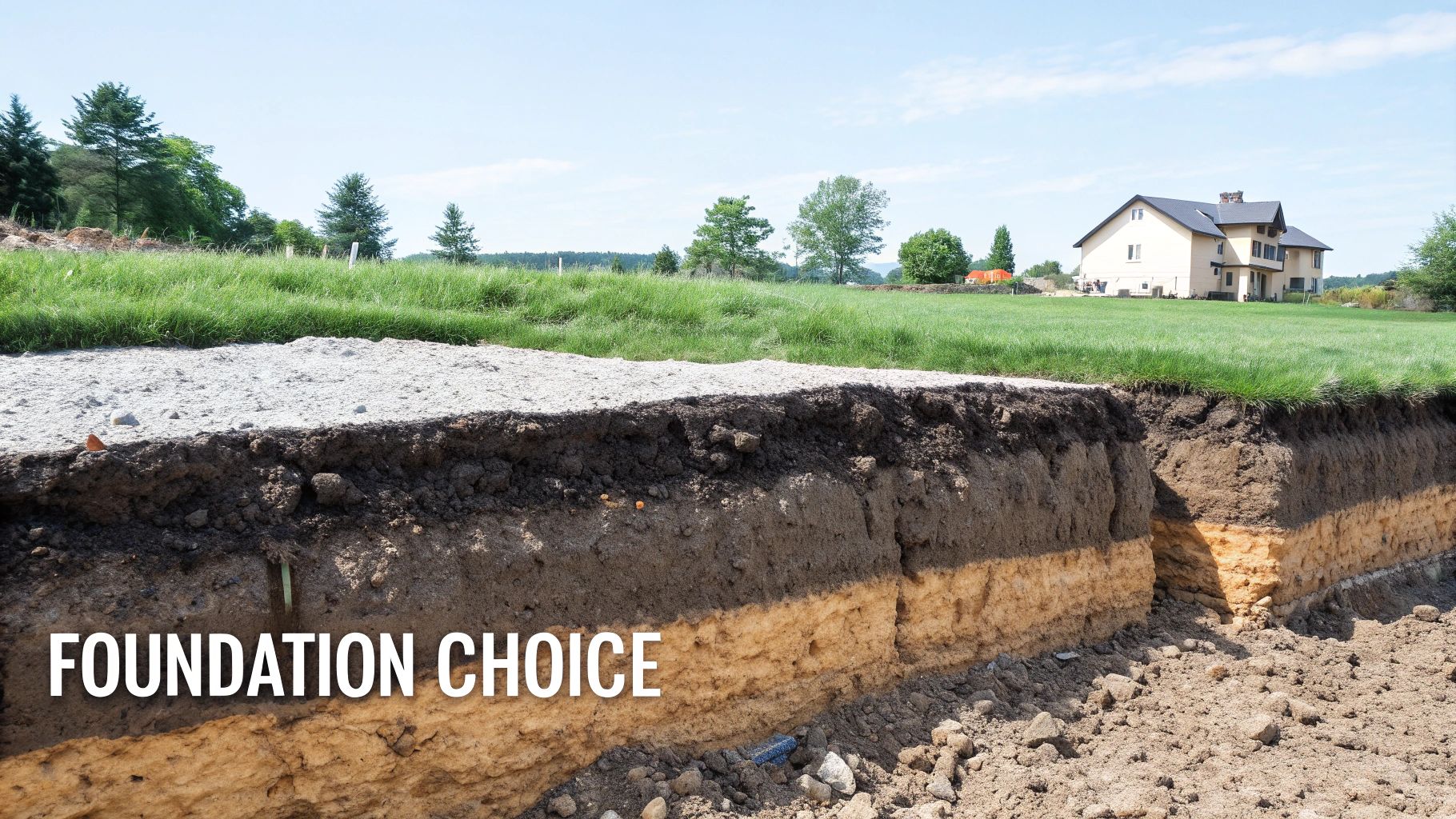
A pivotal construction value engineering example is the rigorous analysis and optimization of a building's foundation system. This strategy challenges initial assumptions by comparing deep foundations, such as driven piles or drilled piers, against shallow foundations like spread footings. A comprehensive geotechnical investigation can reveal that a less expensive shallow foundation is viable, or that a targeted hybrid approach is more efficient than a uniform deep system.
This VE analysis hinges on understanding the specific soil-bearing capacity and settlement characteristics of a site. Rather than defaulting to a conservative and costly deep foundation system, the goal is to precisely match the foundation solution to the actual ground conditions and structural loads, potentially saving a significant portion of the substructure budget.
Strategic Analysis & Impact
The value of foundation optimization goes directly to the project's bottom line, as the foundation can be one of the single largest cost centers. It's a clear example of how upfront investment in analysis yields major downstream savings.
- Cost & Time Impact: A switch from deep to shallow foundations can reduce foundation costs by 10-30% or more. A commercial development in Texas, for instance, saved an estimated $2.1M by shifting from pilings to spread footings after a detailed soil study. The construction schedule can also be accelerated by avoiding the time-consuming mobilization and installation of pile-driving equipment.
- Performance Impact: The goal is to achieve the required structural performance for the lowest cost, not to compromise it. A properly designed shallow foundation on suitable soil is just as reliable as a deep one. The key is ensuring the geotechnical data is accurate to prevent long-term settlement issues.
- Design Impact: Optimizing the foundation allows for more efficient load path distribution. On a shopping center project, a hybrid approach used robust drilled piers only under heavy column loads while employing simpler spread footings for lighter wall loads, reducing overall material and labor costs without sacrificing stability.
Key Insight: This value engineering opportunity is lost if not pursued early. Commissioning a comprehensive geotechnical boring program before the structural design is finalized is the most critical step. Waiting until later makes redesigning the entire structural load path prohibitively expensive and complex.
Implementation & Takeaways
Successful foundation optimization is a direct result of early and expert-led geotechnical due diligence.
- Invest in Geotechnical Data: Don't skimp on the initial soil investigation. A thorough report from a qualified geotechnical engineer provides the essential data needed to explore all viable foundation alternatives with confidence.
- Engage Experts Early: Involve the geotechnical engineer and structural engineer in collaborative design meetings from the schematic phase. This allows them to evaluate multiple options and align the structural grid with the most favorable soil conditions.
- Evaluate Hybrid Systems: The best solution isn't always "all or nothing." Analyze if a combination of deep and shallow foundations can be used to address variable soil conditions or differing structural loads across the building footprint, optimizing cost-effectiveness. The American Society of Civil Engineers (ASCE) provides extensive guidelines and standards for foundation design and soil analysis.
7. Structural Steel Value Engineering – Grade Selection and Connection Optimization
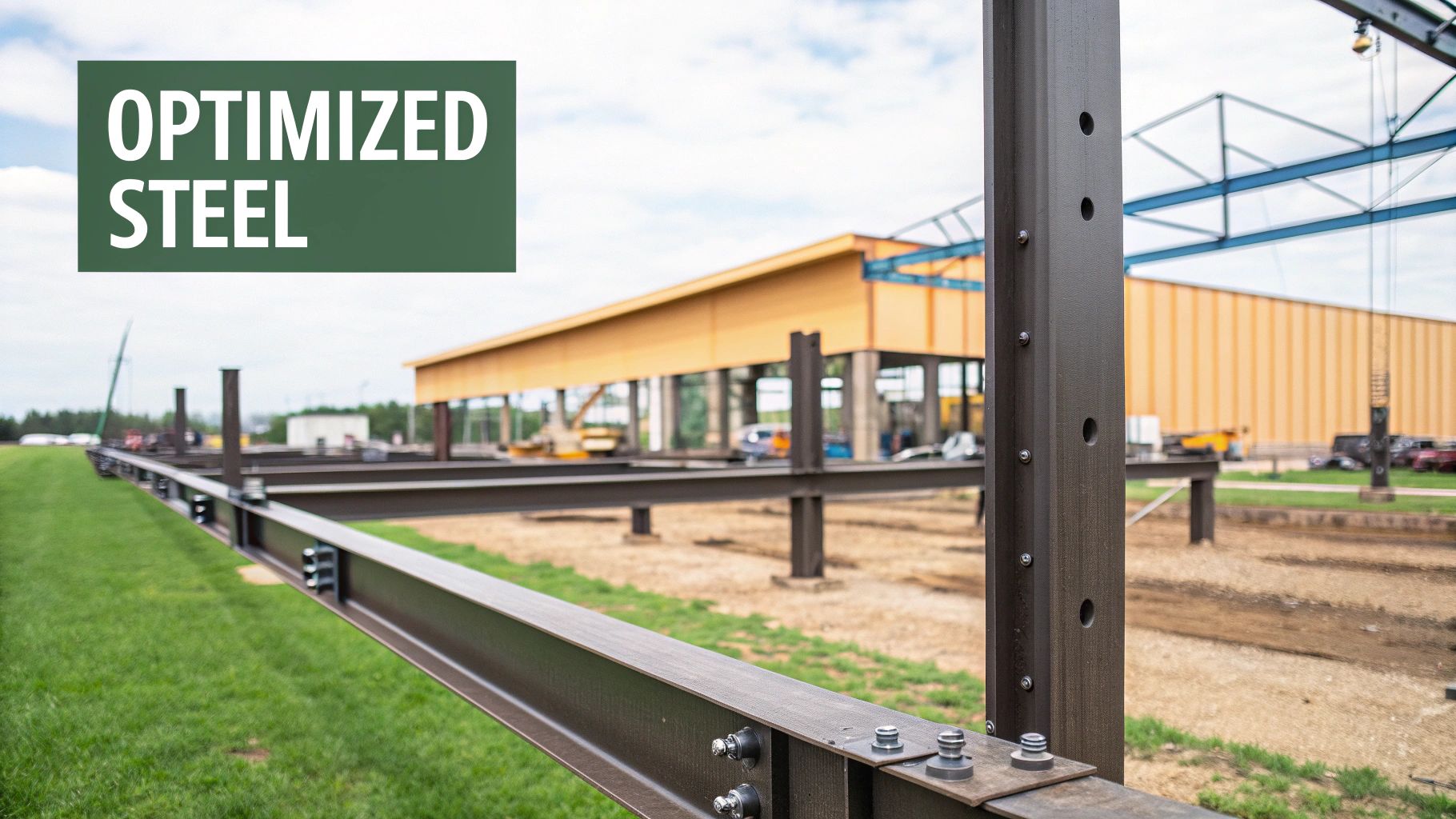
A powerful construction value engineering example in steel-framed projects is the strategic optimization of steel grades and connection designs. This approach moves beyond simply choosing the cheapest material and instead focuses on a holistic view of the entire steel package, from raw material to fabrication and final erection. By selecting higher-strength steel grades and simplifying connection details, teams can reduce tonnage, labor, and project timelines.
While higher-grade steel may have a greater cost per ton, its increased strength allows for smaller, lighter structural members. This reduction in overall weight has a cascading effect, saving on material, transportation, and erection costs. Similarly, optimizing connections to favor simpler, standardized, and repeatable designs significantly cuts down on complex and expensive fabrication labor.
Strategic Analysis & Impact
This VE measure is a system-based analysis that creates value by integrating design, fabrication, and erection considerations. It is not just about material cost but the total installed cost.
- Cost & Time Impact: Material savings from reduced tonnage can be significant, often in the 12-18% range for the structural steel package. More impactful are the time savings; for instance, a stadium project that simplified its bolted connections was able to reduce fabrication and erection time by three months, creating immense value in schedule compression.
- Performance Impact: Using higher-grade, lighter members does not compromise structural integrity. In fact, it can improve it by reducing the building's overall dead load, which can lead to smaller foundation requirements and better seismic performance.
- Design Impact: Lighter, smaller-profile steel members can increase clear spans and create more open, flexible interior spaces. This is a crucial benefit in commercial office and adaptive reuse projects where maximizing usable floor area is a primary driver of financial return.
Key Insight: The most significant savings are unlocked when the structural engineer, general contractor, and steel fabricator collaborate during the design phase. A fabricator's input on connection design is invaluable, as they can identify details that are difficult or time-consuming to produce with their specific equipment and processes.
Implementation & Takeaways
Implementing this strategy requires proactive collaboration and a focus on the total cost of the steel system, not just the per-ton price.
- Engage the Fabricator Early: Bring your steel fabricator onto the design team as early as possible. Their practical knowledge of efficient connection types (e.g., bolted vs. welded, standardized shear tabs) can prevent costly and time-consuming details from being locked into the design.
- Leverage BIM and Modeling: Use Building Information Modeling (BIM) and advanced structural analysis software to run multiple scenarios. This allows the team to precisely compare the total cost and schedule impact of different steel grades and connection strategies.
- Standardize Everything Possible: Work with the design team to standardize connection details and member sizes across the project as much as feasible. Repetition is the key to fabrication efficiency and can dramatically reduce both cost and the potential for errors. The American Institute of Steel Construction (www.aisc.org) offers extensive design guides and standards for optimizing steel structures.
8. Mechanical System Integration – Combined Systems and Heat Recovery
A powerful construction value engineering example moves beyond individual components to optimize entire building systems. This approach integrates multiple mechanical systems to reduce equipment redundancy, improve energy efficiency, and enhance occupant comfort. Instead of designing heating, ventilation, and air conditioning (HVAC) as separate, isolated units, this strategy creates a synergistic system where outputs from one process become inputs for another.
Common applications include combined heating and cooling hydronic loops, heat recovery ventilation (HRV) systems that capture energy from exhaust air, and integrated building automation systems (BAS) that intelligently manage system operations. While initial design complexity increases, the long-term benefits in operational savings and reduced capital costs are substantial.
Strategic Analysis & Impact
Integrating mechanical systems is a holistic strategy that transforms a building's energy profile and operational budget. The value is found in eliminating waste and maximizing efficiency across the entire mechanical infrastructure.
- Cost & Time Impact: Initial capital costs for integrated equipment and advanced controls can be higher. However, this is often offset by reducing the total amount of equipment needed, potentially saving 15-20% on mechanical systems. For example, a shared geothermal loop eliminates the need for individual chillers and boilers for each building zone.
- Performance Impact: The primary benefit is a significant reduction in energy consumption, often between 20-30%. An HRV system in a corporate headquarters can recover over 65% of the heat from exhaust air, drastically cutting annual heating costs. This directly lowers operational expenses and improves the building's environmental footprint.
- Design Impact: This approach requires more upfront coordination and dedicated space for centralized equipment. However, it can also reduce the need for bulky rooftop units or extensive ductwork, freeing up valuable architectural space and improving aesthetics.
Key Insight: The success of mechanical system integration hinges on early collaboration and sophisticated energy modeling. Engaging a mechanical engineer specializing in sustainable design during the schematic phase is critical to identifying opportunities and accurately quantifying the long-term return on investment.
Implementation & Takeaways
Implementing integrated systems requires a forward-thinking project team committed to performance over siloed design.
- Engage Experts Early: Bring your mechanical engineer and controls specialist into the design process from day one. Their expertise is essential for evaluating complementary system opportunities, such as linking a building’s data center cooling loop to its domestic hot water system.
- Leverage Energy Modeling: Use detailed energy modeling software to validate design choices and provide clear data on projected savings. This analysis is crucial for securing owner buy-in and justifying any initial cost premiums.
- Prioritize Commissioning and Training: Integrated systems are more complex. Thorough commissioning before occupancy is non-negotiable to ensure all components work together as designed. Operator training and clear maintenance protocols are vital for achieving and sustaining peak performance. For guidance on standards, organizations like ASHRAE (www.ashrae.org) offer extensive resources.
8-Point Construction Value Engineering Comparison
| Measure | Implementation Complexity 🔄 | Resource Requirements ⚡ | Expected Outcomes 📊 | Ideal Use Cases 💡 | Key Advantages ⭐ |
|---|---|---|---|---|---|
| Substitution of Materials – High-Performance Concrete | 🔄 Moderate–High: specialized mix design, strict QC, possible equipment mods | ⚡ Higher material cost (+20–30%), experienced suppliers, trained crews | 📊 Improved strength/durability, extended service life (100+ yrs), reduced lifecycle costs and placement time | 💡 High-rise, marine structures, parking structures, harsh environments | ⭐ Higher strength & durability; faster placement (SCC); smaller structural elements |
| Modular Construction and Prefabrication | 🔄 High upfront planning & coordination; factory workflows required | ⚡ Capital for factories, transport logistics, standardized tooling and interfaces | 📊 30–50% schedule reduction; 20–30% labor savings; better quality control; less waste | 💡 Repetitive residential, hotels, healthcare, large-volume or fast-track projects | ⭐ Faster delivery, predictable budgets, superior factory QC |
| Value Engineering in HVAC Design – Right-Sizing | 🔄 Moderate: detailed load calculations and control integration | ⚡ Modeling tools, HVAC design expertise, advanced controls and commissioning | 📊 15–25% equipment cost reduction; 20–30% annual energy savings; improved IAQ | 💡 Offices, institutional buildings, retrofits, occupancy-variable spaces | ⭐ Improved efficiency, performance, and lower operating costs |
| Elimination of Architectural Non-Essentials | 🔄 Low–Moderate: design choices and stakeholder alignment | ⚡ Minimal: alternative finishes, samples, potential mockups | 📊 10–20% savings on architectural scope; faster construction; lower maintenance | 💡 Retail, hotels, corporate offices, projects needing cost-controlled aesthetics | ⭐ Cost reduction while retaining acceptable aesthetics and simpler maintenance |
| Constructability Review & Sequence Optimization | 🔄 Moderate–High: collaborative IPD, BIM workflows, early contractor involvement | ⚡ BIM software, contractor time, workshops and collaborative processes | 📊 5–15% cost reduction; 10–20% schedule acceleration; fewer change orders | 💡 Complex projects, healthcare, infrastructure, mixed-use developments | ⭐ Reduced rework, improved coordination, better risk management |
| Foundation System Optimization | 🔄 Moderate: geotechnical investigations and comparative analysis | ⚡ Geotechnical borings, specialist engineering, possible ground improvement | 📊 10–30% foundation cost savings; faster build with suitable shallow solutions | 💡 Sites with variable soils; commercial and multi‑story developments | ⭐ Significant cost savings and optimized construction schedule/equipment |
| Structural Steel VE – Grade & Connection Optimization | 🔄 Moderate: structural analysis and fabricator collaboration | ⚡ Access to premium-grade steel, skilled fabricators, modeling tools | 📊 12–18% reduction in steel costs; reduced weight, shipping and fabrication time | 💡 High-rises, bridges, stadiums and large steel-framed projects | ⭐ Smaller members, faster installation, standardized/efficient connections |
| Mechanical System Integration – Combined Systems & Heat Recovery | 🔄 High: complex systems coordination, controls and commissioning | ⚡ Integrated equipment, advanced controls, commissioning and operator training | 📊 15–20% equipment cost reduction; 20–30% energy efficiency improvement | 💡 Corporate campuses, healthcare, net‑zero targets, large mixed-use buildings | ⭐ Lower OPEX, reduced footprint, improved resilience and energy recovery |
From Examples to Execution: Implementing a Value-First Mindset
The diverse array of construction value engineering examples detailed in this article, from optimizing foundation systems to integrating high-performance HVAC, share a common thread. They reveal that true value engineering is far more than a last-minute cost-cutting exercise; it is a proactive, strategic mindset woven into the fabric of a project from its earliest conception.
The transition from examining these examples to executing them requires a fundamental shift in perspective. Instead of asking, "How can we make this cheaper?" the value-first approach asks, "How can we achieve the essential function for the lowest lifecycle cost without sacrificing quality, durability, or performance?" This question transforms the project dynamic from a sequence of siloed tasks into a collaborative, value-seeking mission.
Recapping the Core Principles of Effective VE
Throughout the examples, several critical themes emerged as non-negotiable pillars of successful value engineering implementation:
- Early and Continuous Collaboration: The most impactful VE opportunities are identified long before ground is broken. Integrating contractors, engineers, and architects in the schematic design phase, as seen in the foundation and structural steel optimization examples, prevents costly redesigns and unlocks synergistic solutions.
- Lifecycle Cost Analysis (LCA) is Paramount: Initial savings are only part of the equation. As the HVAC right-sizing and high-performance concrete examples demonstrated, a higher upfront investment can yield substantial long-term returns through reduced energy consumption, lower maintenance, and increased durability. True value is measured over the building's entire lifespan.
- Function Over Form (Without Sacrificing Design): The principle of eliminating non-essential architectural elements is not about creating bland, utilitarian structures. It's about rigorously questioning every component's purpose and cost-benefit ratio to ensure the budget is allocated to features that deliver the highest functional and aesthetic return for the owner and end-users.
Your Actionable Roadmap to Implementing Value Engineering
Moving from theory to practice is the ultimate goal. For developers, owners, and contractors looking to leverage these principles, the path forward involves a structured, intentional approach. It’s not about applying a single tactic but about building a systemic process.
Strategic Insight: Value engineering should be a scheduled, non-negotiable part of the pre-construction process. Treat VE workshops with the same importance as budget reviews or zoning meetings to formalize their role in project delivery.
To put these ideas into action, consider the following steps:
- Assemble an Integrated Team Early: Break down traditional silos. Bring your general contractor, key subcontractors (like mechanical and structural), and design team to the table during the conceptual phase.
- Define Project Functions Clearly: Before exploring alternatives, ensure all stakeholders agree on the essential functions of each building system and space. What must it do? What performance criteria are non-negotiable?
- Mandate a Lifecycle Perspective: Require that major decisions, especially those concerning the building envelope, MEP systems, and structural components, are evaluated using LCA. Look beyond the initial bid price.
- Empower Your Team to Challenge Assumptions: Foster a culture where every team member feels empowered to question the status quo and propose innovative alternatives. The best construction value engineering examples often come from a fresh perspective challenging a long-held assumption.
By embracing this proactive and collaborative framework, you transform value engineering from a reactive tactic into a powerful strategic tool. It becomes the engine that drives innovation, enhances project feasibility, and ultimately maximizes the long-term profitability and performance of your real estate assets. This is not just about building cheaper; it’s about investing smarter, building better, and creating enduring value that stands the test of time.
Ready to apply a value-first mindset to your next commercial or adaptive-reuse project? The team at Sherer Architects, LLC specializes in integrating creative design with practical, performance-driven value engineering to maximize your return on investment. Explore our portfolio and see how we turn ambitious concepts into functional, cost-effective realities at Sherer Architects, LLC.