
Contract administration is what happens after the ink on the construction contract is dry. It’s the hands-on process of making sure everyone involved—from the owner to the general contractor—actually does what they promised to do. This covers everything: the budget, the schedule, the quality of work, and the final deliverables.
Think of it as the project's operating system. It's always running in the background, keeping every moving part coordinated and on track from groundbreaking to ribbon-cutting.
The Blueprint for Project Success

If a construction project were an orchestra, the architectural drawings would be the sheet music and the contractors the musicians. In this scenario, contract administration in construction is the conductor, cueing each section at the right moment to make sure the final performance is a masterpiece, not a mess.
Without a conductor, things can go sideways fast. Deadlines slip, budgets balloon, and arguments erupt over what was agreed upon in the first place. Good contract administration isn't about sitting back and filing papers; it's the active, daily work of enforcing the contract's rules on the ground.
More Than Just Paperwork
At its heart, this is the process of turning a legal document into a physical building. It’s a chain of critical tasks that connect the vision on paper to the reality of steel and concrete. A huge piece of this is maintaining strict What Is Contract Compliance, which is vital for shielding the project from unnecessary risk and legal trouble.
The core goals of contract administration are pretty straightforward:
- Ensuring Accountability: Keeping everyone honest. It makes sure the owner, architect, and contractor all stick to the duties laid out in the contract.
- Managing Communication: Creating a single, official channel for all project communication. This means every question, change, and decision leaves a clear paper trail.
- Controlling Costs and Schedule: Watching the budget and timeline like a hawk. This includes processing payments correctly and managing any changes that might throw things off course.
- Verifying Quality: Making sure the work and materials are up to snuff and match the specifications in the construction documents.
For developers and owners, solid contract administration is the most powerful tool you have for managing risk. It sets up the guardrails to prevent expensive fights, stop scope creep in its tracks, and guarantee the finished building is exactly what you paid for.
The Proactive Approach to Building
Ultimately, contract administration is the project’s central nervous system. It takes in information, helps guide decisions, and coordinates action across the entire site. This proactive management is what separates a smooth, successful project from one that's constantly fighting fires. It’s the discipline that ensures the promises made in the contract are the promises kept on completion day.
Understanding the Key Players and Their Roles
Think of a successful construction project like a three-legged stool. It needs the Owner, the Architect, and the Contractor all working in balance to stand strong. When it comes to contract administration, knowing exactly who is responsible for what isn't just about paperwork—it's the very foundation of a smooth, accountable project.
When everyone understands their role, decisions happen faster, disagreements are fewer, and the whole project keeps moving forward. Without that clarity, you’re setting the stage for confusion, delays, and the kind of disputes that can derail a project completely.
Let's break down who does what.
The Owner: The Vision and the Wallet
As the project Owner, you're the one who started it all. You have the vision, you own the property, and most importantly, you provide the funding that makes everything possible. While you hire experts to handle the day-to-day work, your role in administering the contract is anything but passive.
Here’s what’s on your plate:
- Making Timely Decisions: The project can't move forward without your input. You'll be asked to approve material choices, weigh in on design questions, and give the final say on any changes.
- Funding the Project: This is more than just writing the initial check. It means making progress payments to the contractor on time as they are certified by the architect. Consistent cash flow is the fuel that keeps the project running.
- Approving Final Changes: You have the ultimate authority. When changes to the scope, budget, or timeline are proposed, you give the final green light.
Your role is like that of a film producer. You might not be directing every scene, but you provide the resources and make the critical decisions that guide the entire production to a successful finish.
The Architect/Engineer: The Impartial Interpreter
More often than not, the Architect or Engineer who designed the project steps into the critical role of the Contract Administrator. This isn't about taking sides; it's about serving as a fair and impartial interpreter of the contract documents they created. Their loyalty isn't to the owner or the contractor, but to the project itself.
The bedrock of effective contract administration is impartiality. The architect’s duty is to ensure the contract is followed faithfully, protecting the design's integrity and the interests of everyone involved, exactly as laid out in the agreement.
Their list of administrative tasks is long. They review the contractor’s submittals to make sure materials meet specs, they field Requests for Information (RFIs) to clarify design details, and they prepare change orders for the owner’s approval. A huge part of their job is visiting the site to observe the work, verify it matches the plans, and certify the contractor's applications for payment based on the progress they see.
The Contractor: The Hands-On Builder
The General Contractor is the one who brings the blueprints to life. They are the on-the-ground leader, managing all the labor, materials, equipment, and subcontractors needed to turn a two-dimensional drawing into a three-dimensional building.
In the administrative process, their job is to build precisely what the contract calls for and to document everything along the way. This means preparing shop drawings for approval, sending RFIs when they need clarification, and putting together detailed payment applications. The contractor is also the master of the schedule, coordinating all the trades on site and ensuring a safe working environment for everyone.
To make these distinct roles even clearer, let's look at a side-by-side comparison of their core duties.
Key Responsibilities in Construction Contract Administration
This table breaks down the primary responsibilities for each key player during the construction phase, showing how their duties intersect and rely on one another.
| Responsibility Area | Owner | Architect/Engineer (Administrator) | Contractor |
|---|---|---|---|
| Project Funding | Provides all project financing and pays invoices. | Certifies the amount of payment due to the contractor. | Submits applications for payment for work completed. |
| Design & Quality | Holds the ultimate vision for the project's outcome. | Interprets contract documents and observes work for quality. | Builds the project according to the plans and specifications. |
| Changes & Scope | Gives final approval on all change orders and scope adjustments. | Prepares change order documents and analyzes cost/schedule impacts. | Prices proposed changes and performs the extra work once approved. |
| Communication | Is the primary decision-maker for project-level choices. | Acts as the central hub for formal RFI and submittal processes. | Initiates RFIs and submittals to clarify and confirm details. |
As you can see, successful contract administration is a collaborative effort. While each party has its own distinct lane, clear communication and mutual respect are what truly pave the way for a successful outcome.
The Construction Phase Step-by-Step
Once the ink is dry on the contracts and everyone knows their role, the real work begins. The construction phase is where blueprints start becoming a building, and it’s also where the theory of contract administration in construction gets put into practice every single day. This isn't just one task; it's a whole series of interconnected steps, each one depending on the last to keep the project on track.
You can think of it like a carefully choreographed performance. Every single move—from a contractor submitting a material sample to an architect approving a payment—has to be done precisely and in the right order. One small misstep can throw the whole thing off, leading to delays, budget blowouts, and a whole lot of frustration. This flow of information, approvals, and actions is what drives a project from a dirt lot to a finished building.
To get a clearer picture of how these roles work together, this diagram shows the essential workflow. It all starts with the owner, moves to the architect for interpretation and oversight, and then to the contractor who brings it all to life.
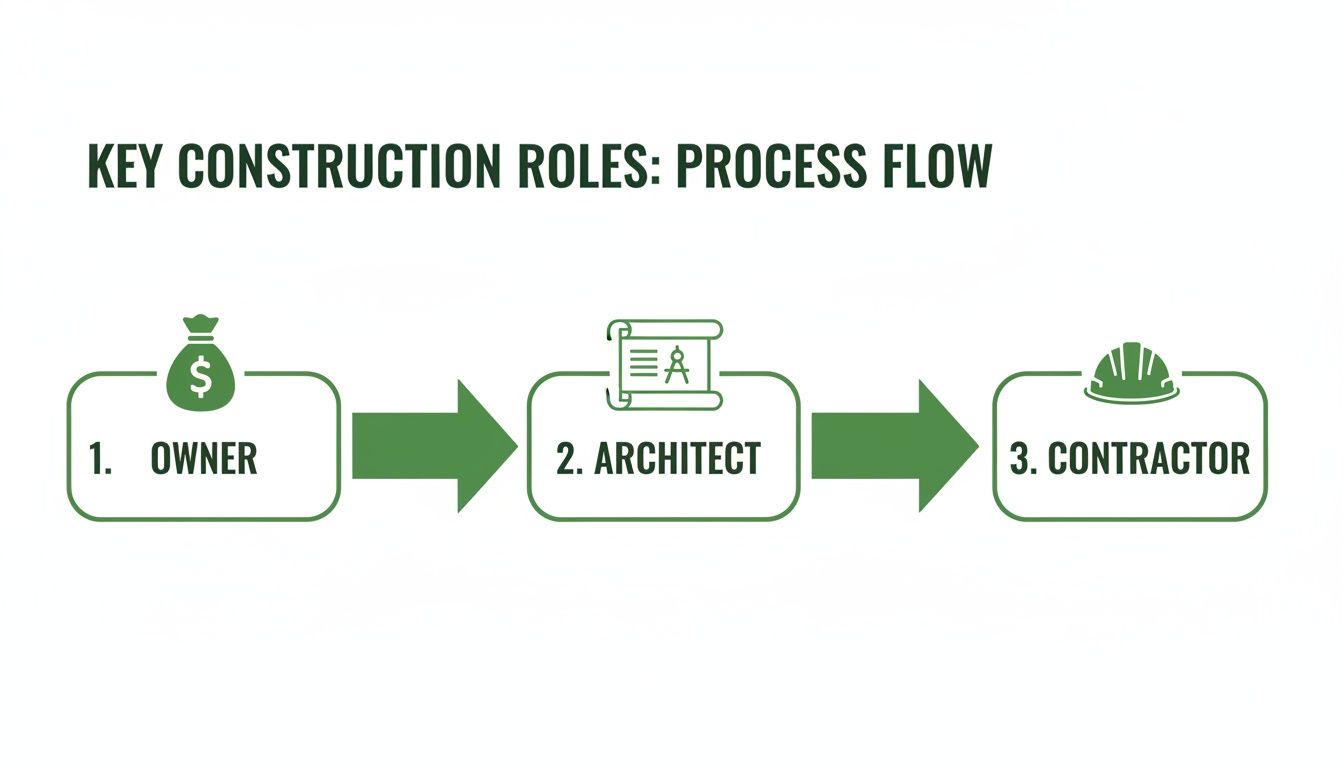
As you can see, the architect often sits in the middle, acting as the administrator who ensures the owner's vision and budget are translated correctly into the contractor's work on the ground.
Managing Submittals and Shop Drawings
Before a single steel beam is hoisted into place or a window is installed, the contractor needs to prove they’re using the right stuff. This is handled through submittals—a catch-all term for the documents, physical samples, or product data they provide to the architect for review. A critical type of submittal is a shop drawing, which is a super-detailed drawing from a supplier showing exactly how a component will be built and put in place.
Acting as the contract administrator, the architect pores over these submittals, comparing them against the original project specifications.
- What's the point? To make absolutely sure the materials, equipment, and building methods the contractor wants to use meet the required quality and design intent.
- Here's an example: Imagine an adaptive reuse project where new window trim needs to match the building's historic character. The contractor submits a sample of the custom-milled wood. The architect checks its species, dimensions, and finish against the specs before giving the green light for fabrication.
This verification step is a big deal. Getting it right upfront prevents the incredibly expensive and time-consuming mistake of having to rip out and replace work that wasn't approved.
Clarifying Details with Requests for Information
Let's be honest: no set of construction drawings is 100% perfect. Out on the job site, questions always come up. A Request for Information (RFI) is the official way contractors ask for clarification on the plans or specifications when they hit a gray area.
An RFI isn't just a quick text message; it's a formal, documented question that demands a formal, written answer from the architect. This process is essential for clearing up confusion before it turns into a construction mistake. A smoothly run RFI process keeps the project moving and leaves a paper trail of how every design question was answered. On the flip side, poor RFI management is a classic project-killer, causing work to grind to a halt while crews wait for answers.
A quick, clear response to an RFI is one of the most important jobs in contract administration. It stops guesswork on the site, slashes the risk of rework, and protects everyone by documenting the decision that was made.
Documenting Changes with Change Orders
Projects almost never finish exactly as they were first drawn. You might hit unexpected soil conditions, the owner might want to add a new feature, or a building code official might interpret something differently. When the original plan has to change, a change order makes it official. It's a formal amendment to the contract that documents the adjustment.
A proper change order does three key things:
- Describes the change to the scope of work.
- States the adjustment to the contract price (up or down).
- Specifies the impact on the project timeline.
This document isn’t valid until it’s signed by the owner, architect, and contractor. It’s the only way to make sure everyone is on the same page about the change and its consequences, which prevents ugly arguments over "he said, she said" agreements down the road. For example, if an owner decides to upgrade to high-efficiency HVAC units midway through the project, a change order will capture the new equipment cost and any extra time needed for installation.
Processing Payment Applications
Contractors don’t just get one big check. They get paid progressively by submitting monthly payment applications, which are detailed invoices showing the value of work completed so far. The application breaks down all the labor, materials, and subcontractor costs based on a "schedule of values" that was agreed upon at the start of the project.
The architect’s job here is to review the application, walk the site to confirm the work has actually been done, and then certify the payment amount for the owner. This crucial step protects the owner from paying for work that's behind schedule or done incorrectly. It keeps the cash flow tied directly to real, tangible progress.
This part of the process is so important because when contract administration gets sloppy, things can go south fast. A recent report pointed to contractual ambiguities as the number one cause of disputes, a problem that’s only gotten worse with global supply chain issues and volatile pricing. For a firm like ours, Sherer Architects, LLC, that specializes in commercial and adaptive reuse projects here in South Carolina, this reality hits home. Rigorous oversight is what ensures critical details like zoning, energy efficiency, and historic tax credits are managed correctly from day one to avoid costly conflicts later. You can get more insights on how these issues impact modern projects in the full report.
Done right, contract administration turns the payment process from a potential conflict into a predictable, transparent transaction. It’s the steady heartbeat of a healthy construction project.
How to Avoid Common Contract Administration Pitfalls
Think of contract administration in construction as the project's immune system. Its job is to spot and fight off problems before they can turn into a full-blown crisis. But without a watchful eye, even the best-laid plans can get derailed by common mistakes that cause delays, blow up the budget, and lead to nasty disputes. Knowing what these traps look like is the first step to keeping your project healthy.
The biggest issues rarely pop up overnight. They’re usually slow-burning problems that start small—a delayed answer to an RFI here, a verbal agreement that never gets written down there. These little slips start to pile up, chipping away at trust and leaving the project vulnerable to major setbacks.
Ineffective Communication and Slow Decision Making
Good, fast communication is the absolute lifeblood of any construction project. When messages get stuck or decisions drag on, everything can grind to a halt. A contractor who has to wait days for a simple design clarification can't move forward, which means crews are sitting idle and the schedule is slipping. Those delays can have a domino effect that lasts for weeks.
This isn't just an inconvenience; it's a huge source of financial loss and legal trouble. A recent industry report pointed to project management failures like poor communication and oversight as major drivers of conflict, made even worse by supply chain problems. For developers working on adaptive reuse projects, where you’re guaranteed to find surprises, tight contracts and quick communication are non-negotiable. You can dig into more of the challenges and how to handle them in the full report.
The best way to fight this is to set up a clear communication plan right from the start:
- Set Response Times: Your contract should spell out exactly how long someone has to respond to RFIs and submittals. Make it mandatory.
- Keep It Central: Use one platform or process for all official requests. This stops important things from getting buried in a hundred different email threads.
- Empower Your People: Make sure the owner's rep on-site has the authority to make decisions quickly to keep things moving.
Inadequate or Inconsistent Documentation
Here’s the golden rule of contract administration: if it’s not in writing, it didn’t happen. Weak documentation is an open invitation for claims, disputes, and "he said, she said" arguments you can't win. Every instruction given on-site, every meeting note, and every approval for a change needs to be documented.
I like to think of project documentation as legal armor. A complete and accurate paper trail is your best defense against claims. It creates an undeniable timeline of every decision, protecting the owner from liability and baseless back-charges.
A classic mistake is giving a verbal "okay" for extra work. A site superintendent might agree to a small tweak with the owner's rep, but if there's no signed change order, there’s no official record of the new scope or cost. You can bet that’s going to cause a massive headache when the invoice shows up.
Mismanaging Changes and Scope Creep
Change is a given in construction, but uncontrolled changes—what we call scope creep—will absolutely wreck a budget and schedule. This is what happens when lots of little adjustments are made without any formal process, and they slowly add up to a huge impact. To keep changes under control and avoid arguments, knowing how to write an addendum or a change order is a must-have skill.
The solution is to be incredibly strict with your change order process:
- Formal Request: Any proposed change has to be submitted in writing. No exceptions.
- Thorough Review: The architect needs to carefully analyze how the change will affect the cost and the schedule.
- Written Approval: No one touches anything until a formal change order is signed by the owner, architect, and contractor.
This disciplined approach means every single change is a deliberate, documented decision—not a casual conversation that comes back to bite you later. By getting ahead of these common pitfalls, you can protect your project from the things that most often cause it to fail and keep it on track for a successful finish.
Navigating Project Closeout and Final Payment
Crossing the finish line on a construction project feels like the final lap of a marathon. The end is in sight, but this last stretch—what we call project closeout—demands meticulous attention. This is where a sharp contract administrator ensures every loose end is tied up, transforming an active job site into a fully operational building and protecting your investment from future headaches.
This phase begins when the heavy lifting is done, but before the keys are officially handed over. It’s all about methodically confirming that every single promise in the contract has been fulfilled. Only then is the final payment released and the project truly complete.

Compiling and Managing the Punch List
The first order of business in the closeout process is to create the punch list. Think of it as the project’s final, detailed to-do list. It’s a formal document cataloging all the minor fixes and finishing touches needed before the owner officially accepts the work.
Punch list items aren't about major flaws; they're the small things that still need attention. You might find a scuff on a newly painted wall, a missing cabinet handle, or a light fixture that needs a final adjustment. Typically, the architect, owner, and contractor walk the site together to build this list, making sure everyone is on the same page about what’s left to do.
Reaching Substantial Completion
Once the contractor has worked through every item on the punch list, the project hits a major milestone: substantial completion. The architect formally certifies that the building is safe and ready for the owner to move in and use as intended. It doesn’t mean every tiny detail is perfect, but the core work is done.
The Certificate of Substantial Completion isn't just a piece of paper; it’s a legally critical document. It typically signals the end of the official construction timeline, which means the clock starts ticking on all warranties. It also transfers responsibility for insurance and security from the contractor to you, the owner.
Getting this certificate is a clear sign that the contractor has delivered on their main contractual obligations, setting the stage for the final handover.
Final Documentation and Handover
With the construction work wrapped up, the focus pivots to paperwork. This is a vital part of contract administration that arms the owner with everything they’ll need to manage and maintain their new building for decades to come.
The contractor is responsible for providing a complete closeout package, which includes:
- Warranties and Manuals: All the paperwork for equipment like HVAC units, elevators, and appliances, along with operating manuals for the building's core systems.
- As-Built Drawings: A final set of blueprints updated to reflect exactly how the project was built, capturing any and all changes made along the way.
- Lien Waivers: Signed legal forms from the general contractor and their subcontractors confirming they've been paid in full. This protects the owner from future claims against the property.
Final Payment and Release of Retainage
After the last punch list item is checked off and every document has been reviewed and accepted, it's time for the final financial step. The contract administrator will approve the contractor's last application for payment.
This final payment almost always includes the release of retainage. Retainage is a percentage of the contract value (usually 5-10%) that the owner withholds throughout the project as a form of insurance. Releasing these funds is the final handshake—it signifies the owner’s formal acceptance of the work and officially brings the project to a successful close.
The Architect's Real-World Impact on Project Success
Think of an experienced architect as the owner's boots on the ground—the expert who turns the black-and-white text of a construction contract into a predictable, successful project. Their role in contract administration goes far beyond just checking drawings. It’s about foreseeing trouble before it snowballs into a budget-breaking crisis.
For instance, an architect with a deep understanding of local zoning quirks, ever-changing building codes, and the nuances of historic preservation can shepherd a project through the approvals labyrinth with ease. This kind of proactive guidance is what sidesteps the bureaucratic logjams that can stall a project for months, saving everyone time and money.
From Problem to Solution: The Architect in Action
Where an architect's value really comes into focus is when the unexpected happens. Picture this: during an adaptive reuse project, workers uncover serious structural issues hidden within the old building. A seasoned architect doesn't panic; they get to work.
Here’s what that looks like in practice:
- First, they dig into the problem, figuring out the smartest, most effective fix.
- Next, they draft a crystal-clear change order that details the new work, what it will cost, and how it impacts the timeline.
- Then, they negotiate with the contractor to make sure the pricing is fair, keeping the project moving without unnecessary friction.
This isn't just problem-solving; it's turning a potential disaster into a managed, well-documented part of the process. It protects the owner’s budget and ensures everyone involved knows exactly what’s happening and why.
In construction, the best risk management tool you have is a rock-solid paper trail. An experienced architect makes sure every decision, every change, and every conversation is logged, creating a clear project history that protects the owner's investment.
Recent studies on construction disputes show that fuzzy contract terms and sloppy management are the root cause of most conflicts. These issues get even worse when you add in economic pressures, like tariffs on building materials. For a firm like Sherer Architects, LLC, guiding clients through intricate commercial and preservation work means leaving nothing to chance. They use modern contract analytics tools and maintain strict compliance with local codes and review boards.
This level of expertise is especially vital in adaptive reuse, where their portfolio of over 200 renovations proves there’s a cost-effective way to build sustainably. You can get more insights on where the industry is heading from this global construction report.
At the end of the day, having a dedicated architect as your partner isn't just an expense; it's an investment in minimizing risk, achieving predictable results, and seeing your vision become a successful reality.
Common Questions We Hear in the Field
Even the most seasoned developers have questions that pop up during the construction process. Let's tackle a few of the most common ones we encounter when managing contracts for our clients.
What’s the One Document I Can’t Live Without?
Hands down, it's the signed contract agreement, along with the complete set of drawings and specifications. This collection of "contract documents" is your project's single source of truth. It dictates the scope, quality standards, budget, and timeline that everyone has agreed to.
Without a rock-solid set of documents that everyone has bought into, you're setting yourself up for confusion and disputes. Every RFI, change order, and payment request gets measured against what's in that agreement.
Think of the contract documents as the project's constitution. It’s the law everyone has to follow on-site, and it's the final word when disagreements arise. A vague constitution is a recipe for chaos.
How Do I Keep Change Orders from Sinking My Project?
The best way to control change orders is to prevent them in the first place with meticulous pre-construction planning. But let's be realistic—some changes are inevitable. The key is having a well-defined process in your contract for how they're handled.
This process should spell out exactly how a change is requested, priced, approved, and formally documented. The golden rule is to get all cost and time impacts in writing and signed off before any new work begins. This transforms a potential budget-buster into a controlled, documented decision.
Who’s on the Hook if the Contractor Doesn’t Follow the Plans?
The contractor is ultimately responsible for executing the work as detailed in the approved plans and specifications. It's the contract administrator’s job—often the architect—to observe the construction and promptly report any deviations to you, the owner.
Once a deviation is identified, the contractor is contractually obligated to fix it on their own dime. This is exactly why regular site visits from an experienced administrator are non-negotiable. Catching a mistake early is a relatively simple fix; finding it after the fact can mean costly demolition and rework, derailing your entire schedule.
Successfully navigating the ins and outs of contract administration isn't just about paperwork; it's about having a partner who knows how to protect your investment. For over 30 years, Sherer Architects, LLC has been that partner for clients, steering projects to successful completion. We ensure the final product is delivered on time, within budget, and to the quality you expect.
Contact us today to discuss how we can bring that same structure and success to your next project.