
Designing a hospital today is about so much more than just bricks and mortar. It’s about creating a living, breathing environment that promotes healing, drives efficiency, and ensures long-term financial viability. Think of it less as a building and more as a strategic asset, one where patient-focused layouts and smart infection control are just as critical as the foundation itself. This approach builds resilient, future-proof, and profitable facilities from the very start.
The New Blueprint for Hospital Design
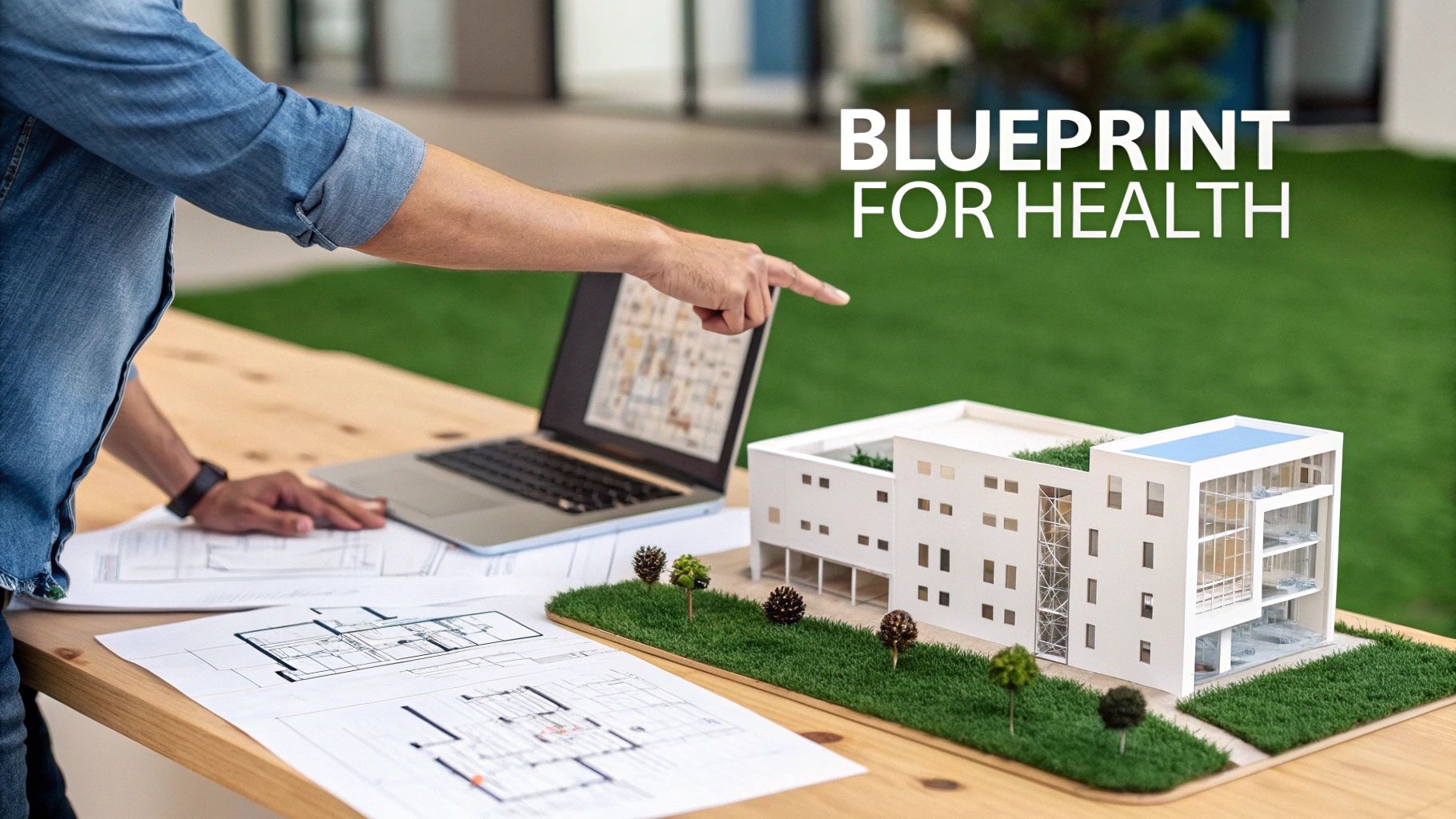
For commercial developers and investors, healthcare is a massive opportunity, fueled by an aging population and changing medical needs. The old view of a hospital as simply a place to treat the sick is long gone. Today, a successful facility is a complex system where every square foot is meticulously planned to improve patient outcomes, streamline operations, and deliver a solid return on investment.
This means that design choices have real financial weight. A thoughtfully designed hospital can lead to lower staff turnover, fewer hospital-acquired infections, and better patient satisfaction scores—all factors that directly impact the bottom line. You're not just building a structure; you're investing in a high-performance asset built to last and adapt.
Why Strategic Design Matters Now More Than Ever
The need for new and updated healthcare facilities is picking up speed. With the global population aged 60 and older expected to hit 2 billion by 2025, the demand for hospitals, clinics, and senior care centers is soaring. You can learn more about these healthcare construction industry trends and how they're shaping what’s next.
To really make the most of this boom, developers need to get a handle on the core principles of modern hospital architecture. These aren't just nice-to-haves anymore; they're the pillars of a successful project.
A modern hospital is a puzzle where every piece—from the emergency room's location to the choice of flooring material—must fit perfectly. The goal is to create an environment that actively supports healing for patients and provides an efficient, safe workplace for staff.
This guide is your roadmap. We’ll walk through how to create facilities that are not only compliant and functional but also resilient and financially sound. We'll dig into key areas like:
- Patient-Centered Layouts: Designing intuitive spaces that lower stress and make the patient’s journey smoother.
- Robust Infection Control: Building in features that stop pathogens in their tracks.
- Sustainable Infrastructure: Creating efficient systems that cut operating costs and improve durability.
- Adaptive Reuse Strategies: Finding hidden value by converting existing buildings for healthcare purposes.
At the end of the day, working with an experienced architecture firm is non-negotiable. They are the ones who can untangle the web of building codes, get the most out of your site, and deliver a facility that’s ready for whatever the future holds.
Strategic Site Planning: The Blueprint for a High-Performing Hospital
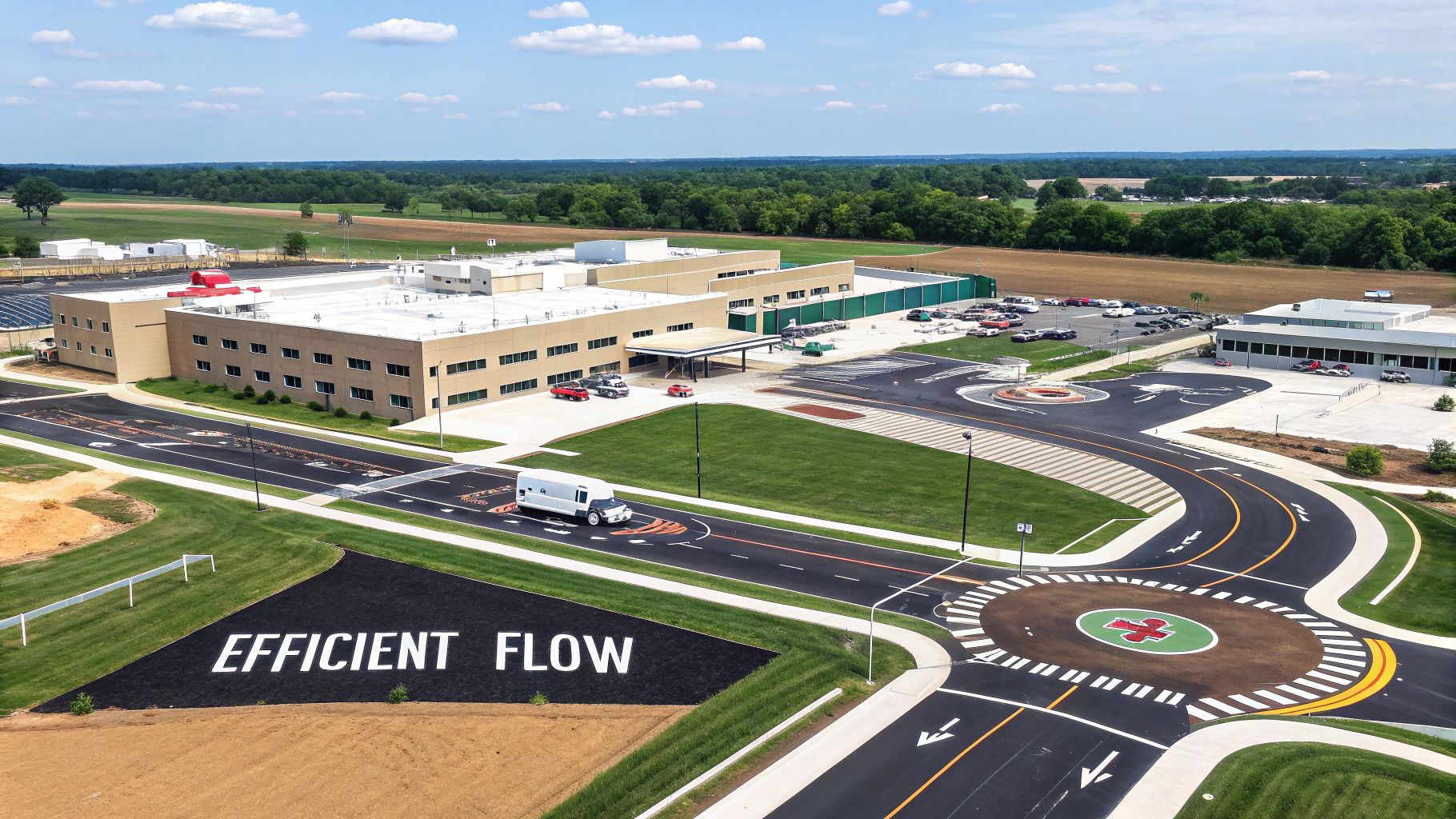
Long before the first shovel hits the ground, the ultimate success of a hospital is already taking shape in its master plan. Getting the site planning right is the absolute bedrock of a well-run healthcare facility. Think of it as choreographing a complex ballet: you have patients, staff, ambulances, and supply trucks, and they all need to move across the stage without ever colliding.
This initial phase sets the tone for everything. A site plan that’s an afterthought will create daily headaches, from gridlocked parking lots to inefficient patient transfers. On the other hand, a strategic layout is a direct investment in staff efficiency, a better patient experience, and the long-term value of the property itself.
Establishing Clear Zones of Access
A hospital campus is a convergence point for many different groups, each with their own unique path and purpose. The first order of business is carving out dedicated, intuitive routes to prevent a logistical nightmare. This isn't just about being organized; it’s about safety and speed when seconds truly matter.
You have to separate and optimize key access points:
- Public and Patient Access: The main entrance needs to be obvious, welcoming, and easy to find from the road. It requires convenient drop-off zones and plenty of parking. This is the hospital's first impression—your chance to reduce stress before patients even walk through the door.
- Emergency Vehicle Access: Ambulances need their own straight shot from the main road to the emergency department. This route has to be completely isolated from public traffic to guarantee a clear path for life-or-death situations.
- Staff and Service Access: A dedicated staff entrance helps manage the flow of people during shift changes. A separate service corridor for deliveries, waste removal, and maintenance keeps all the crucial "backstage" operations out of the public eye.
This careful separation means a delivery truck will never block an ambulance, and a visitor looking for the cafeteria won't accidentally end up in a restricted staff hallway. For a developer, this translates directly into a safer, more professional, and highly functional asset.
The Logic of Departmental Adjacency
Once you’ve nailed the external flow, the internal layout demands just as much attention. Departmental adjacency is the art of placing related functions next to each other to slash travel time for both patients and staff. Picture a trauma patient arriving in the ER. The trip to get an X-ray or CT scan has to be measured in feet, not hallways.
The goal is to build an efficient "clinical core." By clustering the emergency department, surgical suites, intensive care units (ICUs), and diagnostic imaging together, you create a powerful hub for acute care. This saves precious minutes and reduces the immense physical strain on staff, who can easily walk several miles during a single shift.
This logic applies everywhere. Outpatient services, for instance, should be clustered near the main entrance with their own reception areas. This keeps outpatients from having to navigate the maze of inpatient wings, which streamlines their visit and cuts down on foot traffic in critical care zones.
Planning for Future Growth and Adaptability
A hospital is never really "finished." Medical technology marches on, community demographics shift, and new service lines are always being added. One of the biggest mistakes in site planning is failing to look ahead. A smart master plan bakes in modular design and earmarks land for future vertical or horizontal expansion.
Think about incorporating these forward-thinking strategies from day one:
- Phased Construction: Design the initial building so that new wings can be seamlessly added later without shutting down existing operations.
- "Soft Space": Place departments that are relatively easy to move—like administrative offices—next to clinical areas that are prime candidates for expansion, such as radiology or the surgical department.
- Infrastructure Scalability: Make sure the central energy plant, data closets, and MEP (mechanical, electrical, plumbing) systems are built to handle a larger load down the road.
By planning for expansion from the very beginning, developers can sidestep the massive costs and disruptions of a major retrofit later on. This foresight doesn't just future-proof the facility; it dramatically increases its value as a long-term investment.
Designing For Patient Healing And Staff Well-Being
Once you get past the technical blueprints for MEP systems and the logistics of site planning, you arrive at the real heart of hospital design: creating spaces that actively help people heal. This isn't just about building a functional box to house medical equipment. A truly well-designed hospital treats the environment itself as a powerful tool in a patient's recovery.
At the same time, we have to remember the people providing the care—the nurses, doctors, and support staff. Their work is incredibly demanding, and the physical space can either be a source of constant friction or a genuine support system. Focusing on these human factors isn't a fluffy extra; it's a strategic move with a clear return on investment.
When patients feel safe and comfortable, their stress levels plummet, which is clinically proven to speed up recovery. For staff, a supportive workspace boosts efficiency, reduces medical errors, and improves retention. In short, every hospital design has to serve two clients at once: the patient and the provider.
Creating Environments That Promote Healing
This is where evidence-based design comes into play. It’s all about using solid research to connect specific design choices to real-world health benefits. For example, one of the single most impactful decisions a hospital can make is moving away from old-school multi-bed wards to private patient rooms. It’s not just about privacy; studies show that single rooms can slash the risk of healthcare-associated infections (HAIs) by more than 50% and lead to much better sleep.
Another game-changer is biophilic design—the simple idea of bringing the outdoors in. It’s amazing what a view of nature from a window can do. Research has shown it can actually reduce a patient's need for pain medication and shorten their hospital stay.
By incorporating natural light, views of greenery, indoor plants, and materials like wood and stone, we tap into our innate connection to nature. This simple strategy has a profound impact on reducing patient anxiety and creating a sense of calm in what is often a highly stressful setting.
We also have to think about the psychological stress of just getting around. A massive, unfamiliar building is intimidating. Clear and intuitive wayfinding systems that use color-coding, logical layouts, and simple signage empower patients and visitors. When people aren't worried about getting lost, they arrive at their appointments much calmer and more prepared.
Designing For Staff Efficiency And Morale
The well-being of hospital staff is just as critical as patient care. A burned-out, exhausted team is more likely to make mistakes, and high turnover is incredibly expensive. Smart hospital design tackles these problems head-on by creating workflows and support spaces that make a tough job more manageable.
A great example is the shift toward decentralized nursing stations. Instead of one massive, noisy hub, smaller stations are tucked closer to patient rooms. This one change dramatically cuts down on the miles nurses have to walk each day, keeps them more visible to patients, and gives them quieter spots for focused work.
And let's not forget the staff-only spaces. Thoughtfully designed break rooms with natural light, comfortable furniture, and quiet zones give staff a place where they can actually recharge. When you’re creating spaces for recovery and comfort, strategies for preventing sick building syndrome are essential to protect everyone’s health.
Weaving Technology Into The Human Experience
Looking ahead, technology is being woven into the very fabric of the hospital. We're seeing a major shift away from rigid, sterile buildings toward adaptive healing environments. In fact, the smart hospital market is growing at a staggering 21.9% annually worldwide. This means integrating IoT sensors, AI, telemedicine capabilities, and modular zones that can be easily reconfigured. You can find out more about how these hospital design trends are shaping the future.
The key is that all this tech has to serve the human experience, not complicate it. For a patient, this might be a smart bed that tracks vitals and adjusts for comfort, or a tablet to control the room's lighting and video chat with family. For staff, it could be a real-time location system that finds the nearest available IV pump, saving precious minutes. The goal is always to use technology to free up caregivers to do what only they can do: care for people.
The connection between patient-centered features and tangible returns is undeniable. The table below breaks down how specific design choices translate into operational and financial wins.
Patient-Centered Design Features And Their ROI
| Design Feature | Patient Benefit | Operational/Financial ROI |
|---|---|---|
| Private Patient Rooms | Reduced stress, improved sleep, better confidentiality, lower infection risk. | Lower rates of costly HAIs, higher patient satisfaction scores (HCAHPS), shorter lengths of stay. |
| Biophilic Design (Views of Nature, Natural Light) | Lowered anxiety, reduced need for pain medication, faster recovery. | Decreased pharmacy costs, shorter patient stays, improved patient and staff morale. |
| Clear Wayfinding & Signage | Reduced confusion and anxiety, on-time arrivals for appointments. | Fewer missed appointments, less staff time spent giving directions, improved patient flow. |
| Family-Friendly Spaces (In-Room Sleepers, Lounges) | Increased family support and involvement in care, improved comfort. | Higher patient satisfaction, better care coordination with family caregivers. |
Investing in these elements isn't just about creating a more pleasant space; it's a core business strategy for a modern healthcare facility. These features directly contribute to better patient outcomes, a more efficient staff, and a stronger financial bottom line.
Architectural Strategies for Infection Control
When you think about fighting infections in a hospital, you probably picture hand sanitizer and sterilization. But the truth is, a hospital’s first line of defense is its own architecture. The building itself—its layout, its airflow, the very materials used in its construction—can either help spread dangerous pathogens or actively work to contain them.
Good design builds safety right into the walls. It’s about creating an environment that inherently protects everyone inside, from the most vulnerable patients to the clinical staff on the front lines. For developers, this isn't just an added expense; it's a fundamental investment in patient safety, risk reduction, and the long-term viability of the facility.
Mastering Air Quality and Ventilation
A hospital's HVAC system is so much more than a climate control unit. Think of it as the building’s respiratory system, engineered to manage airflow with surgical precision. The entire goal is to trap and remove airborne contaminants before they can travel from a high-risk area into a clean one.
It’s a surprisingly sophisticated process, relying on a few key engineering principles:
- Pressure Differentials: This is where the magic happens. We design isolation rooms for patients with infectious diseases to have negative air pressure. This means air is constantly pulled into the room from the hallway and then exhausted directly outside through special filters. Contaminated air can't escape. On the flip side, rooms for highly vulnerable patients, like operating theaters or transplant units, use positive air pressure. Filtered air is pushed out of the room, creating a protective bubble that keeps germs from getting in.
- Advanced Filtration: All that air is run through high-efficiency particulate air (HEPA) filters. These aren't your standard home air filters; they are designed to capture microscopic particles like viruses and bacteria with 99.97% efficiency, constantly scrubbing the air clean as it circulates.
- Dedicated Exhaust Systems: You can't have the air from a pathology lab mixing with the air from the maternity ward. Critical areas like labs and isolation zones have their own dedicated exhaust systems to ensure contaminated air is removed from the building entirely, never entering the main circulation.
Material Selection and Surface Integrity
Every single surface in a hospital is a potential breeding ground for pathogens. Floors, countertops, door handles, bedrails—you name it. This makes material selection a critical part of a passive infection control strategy.
The best materials are smooth, non-porous, and tough enough to withstand constant, harsh cleaning without breaking down.
The core principle is to create a seamless environment with nowhere for germs to hide. This means choosing materials like solid-surface countertops, resilient sheet flooring with heat-welded seams, and even antimicrobial coatings for high-touch surfaces like elevator buttons and light switches.
Following effective strategies for preventing hospital-acquired infections is essential, and that includes specifying furniture and fixtures that are easy to wipe down, without lots of nooks and crannies where dust and microbes can settle.
Layout Strategies and Workflow Separation
Finally, the floor plan itself is a powerful tool for preventing cross-contamination. Smart design creates a clear separation between "clean" and "dirty" workflows. A great example is a sterile processing department, which should be designed as a one-way street. Dirty instruments come in one door, go through the sterilization process, and exit, clean and packaged, through another door on the other side. The two paths should never cross.
But perhaps the single biggest layout change in modern hospital design has been the shift to single-patient rooms. Eliminating shared rooms dramatically cuts down on the risk of infections spreading from one patient to another. It’s a simple change with a massive impact on safety.
This shift is part of a larger movement toward patient-centered design, where every architectural choice supports healing.
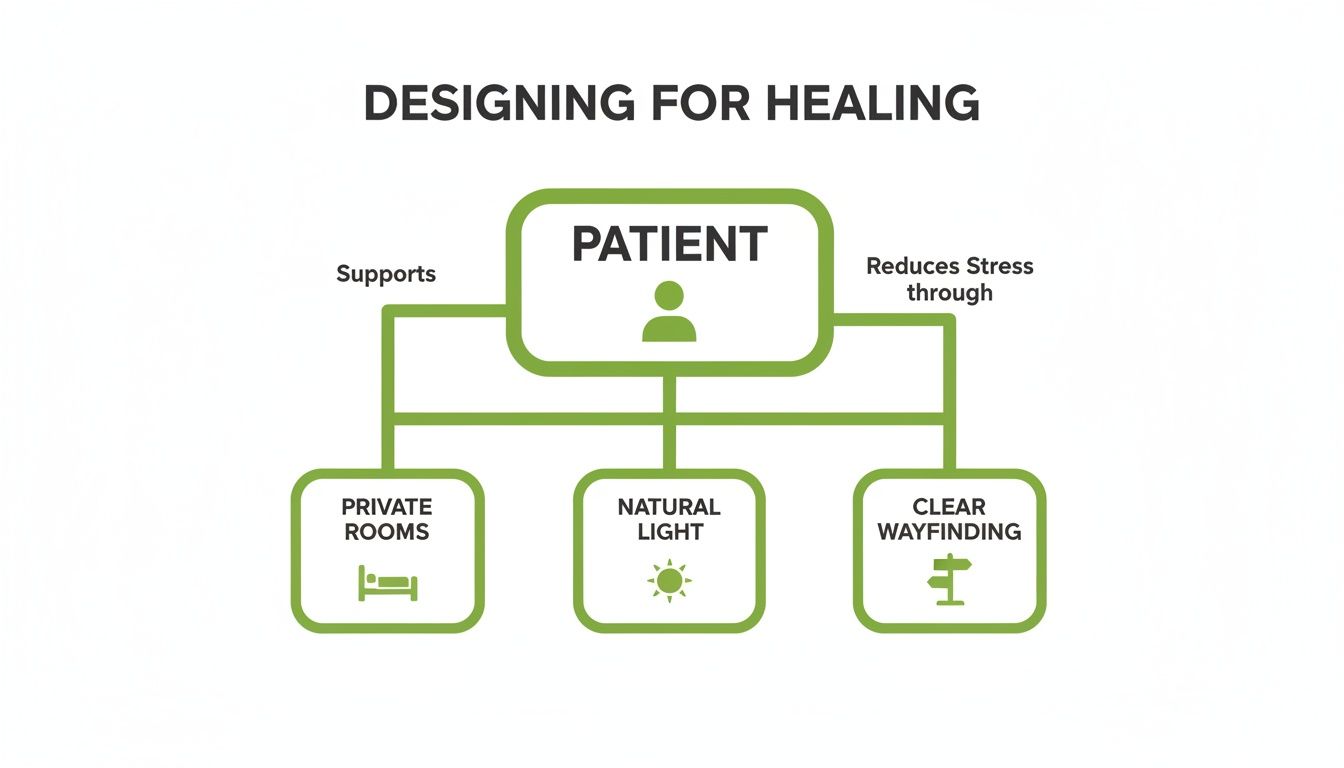
As you can see, things like private rooms, access to natural light, and easy-to-navigate hallways all work together. These aren't just features; they are carefully considered decisions that create a safer, calmer environment that actively helps people get well.
Building Resilient and Sustainable Hospitals
In the world of hospital design, "sustainability" has officially graduated from a buzzword to a core business strategy. Going green is no longer just about environmental stewardship; it's one of the smartest ways to create facilities that are both financially robust and operationally resilient. For developers, this approach isn't an expense—it's how you future-proof the investment by slashing long-term operating costs and boosting the property's market value.
Think of a sustainable hospital as its own self-sufficient ecosystem. Instead of being a massive drain on the local power grid and water supply, it's engineered to conserve resources at every turn. This creates a building that's not only cheaper to run day-to-day but is also far better equipped to handle disruptions, from a city-wide blackout to a hurricane.
The Financial Case for Green MEP Systems
If you want to find the real money-saver in a hospital's budget, look no further than its mechanical, electrical, and plumbing (MEP) systems. These networks are the building's heart and lungs, running 24/7. They're also where you can find the most dramatic cost savings through intelligent, sustainable design.
Putting capital into high-efficiency systems isn't just a one-time upgrade; it pays dividends for the entire life of the building.
- Energy-Efficient HVAC: Modern heating, ventilation, and air conditioning systems can cut a hospital's energy consumption by a staggering 40%. We're talking about technologies like geothermal heating and cooling, variable refrigerant flow (VRF) systems, and heat recovery ventilators that recycle energy from exhaust air.
- Smart Lighting and Controls: The switch to LED lighting is a no-brainer, but the real magic happens when you pair it with motion sensors and daylight harvesting systems. This ensures electricity is only used exactly when and where it's needed, often cutting lighting-related energy costs by half or more.
- Water Conservation Strategies: Simple things like low-flow fixtures make a big difference at scale. But you can go further with rainwater harvesting for landscaping and systems that recycle "greywater" from sinks and showers, drastically reducing a hospital's water bill.
A sustainable hospital design isn’t about compromise; it’s about optimization. By engineering efficiency into the building’s DNA, developers create an asset that’s less exposed to volatile energy prices and contributes directly to a healthier bottom line.
Building for Resilience and Continuity of Care
Beyond the daily savings, sustainability is inextricably linked to a hospital's ability to keep its doors open during a crisis. A truly resilient hospital is designed to function as an island, capable of providing uninterrupted care even when the surrounding infrastructure goes down. This is absolutely critical for community safety and a massive value proposition for any healthcare facility.
Key resilience strategies start with on-site power generation. Think solar panels on the roof paired with battery storage systems and robust backup generators. This ensures that life-support equipment, surgical suites, and critical IT systems stay online through any outage.
But resilience goes deeper than just power. The building's physical structure needs to withstand whatever Mother Nature throws at it. This could mean reinforcing the building envelope to handle high winds, elevating critical equipment above potential flood lines, or using durable, locally sourced materials that are proven to hold up in the regional climate. These steps don't just protect the physical asset—they ensure the hospital can stand as a beacon for the community when it's needed most.
Integrating Sustainable Practices into Construction
The push for more resilient and adaptable facilities is also changing how we build them. In the hospital design space, we're seeing a major shift toward design-build methodologies, and for good reason. This approach brings designers and contractors together as a single, unified team from day one.
It’s a far more collaborative and efficient way to work, which is why studies project design-build will account for over 47% of all U.S. construction spending by 2028—a figure representing $2.6 trillion. This integrated model is perfect for ensuring sustainability and resilience goals are woven into the project's fabric from the very beginning, not just tacked on as an afterthought.
The Value of Adaptive Reuse in Healthcare
Not every new hospital needs to start with a shovel in the ground. A powerful, practical approach is taking hold in healthcare development: adaptive reuse. This is simply the art of turning old, underused buildings—think empty big-box stores, quiet office parks, or even warehouses—into modern, efficient medical centers. For developers, this can be a much smarter play than building from scratch.
Instead of starting with a blank slate, you're unlocking the potential that's already there. It's often faster, more budget-friendly, and a whole lot greener. By working with the "bones" of an existing structure, you can slash project timelines and get the doors open far sooner than with a traditional build.
Navigating the Unique Challenges
Of course, it’s not as simple as just moving in some exam tables. A former Best Buy wasn't built to handle the complex needs of an outpatient surgery center. Success hinges on tackling a few key challenges that are specific to healthcare design.
This is where a good architectural partner earns their keep—they can spot the potential deal-breakers and turn them into solvable puzzles. The big things to watch for are:
- Upgrading Core Infrastructure: Medical facilities are power hogs. They have massive demands for electricity, data, specialized plumbing, and complex HVAC systems. The skeleton infrastructure in an old retail or office building just won't cut it.
- Meeting Modern Building Codes: Healthcare is one of the most heavily regulated industries for a reason. You'll be dealing with incredibly strict codes for everything from fire safety and accessibility (ADA) to very specific requirements for clinical spaces.
- Reconfiguring Inefficient Layouts: Good healthcare is all about flow—for patients, staff, and supplies. The wide-open floor plan of a department store or the choppy, cubicle-filled layout of an office building has to be completely rethought to create logical connections between departments.
Adaptive reuse is like solving a puzzle. You have to fit the demanding standards of modern medicine into a frame that was built for something else entirely. The goal isn't just to make it fit, but to make it feel like it was designed for patient care from day one.
The Strategic Advantages for Developers
Even with the technical hurdles, the payoff for adaptive reuse can be huge. For smart investors and developers, it offers a clear strategic edge.
The biggest win is often speed to market. You get to skip a lot of the time-consuming early steps, like lengthy site acquisition, zoning battles, and pouring a new foundation. This can easily shave months—sometimes even years—off a project, which means you start generating revenue that much faster.
Then there's the cost. Yes, you'll spend money on system upgrades, but reusing the main structure (the foundation, walls, and roof) can lead to major savings on materials and labor compared to a ground-up build. It’s also an inherently sustainable choice, which is more than just a feel-good story. Less landfill waste and a smaller carbon footprint can open the door to green building incentives and grants. For property owners, it’s a brilliant way to breathe new life into a struggling asset and turn it into a vital community resource.
Common Questions from Developers on Hospital Projects
If you're coming from a commercial development background, stepping into the world of hospital projects can feel like learning a new language. The stakes are higher, the regulations are tighter, and the entire process is just… different.
Let's tackle some of the most frequent questions we hear from developers and investors to help demystify the process.
How Long Is This Going to Take, Really?
There's no sugarcoating it: building a new hospital is a marathon, not a sprint. From the first sketch to the day the doors open, you're typically looking at a three- to five-year timeline. That window covers everything—initial strategy, finding and securing the right site, architectural design, navigating the maze of permits, and finally, construction.
Can you speed things up with an adaptive reuse project? Sometimes. Converting an existing building gives you a structural head start. But don't underestimate the challenge of retrofitting highly complex mechanical systems and bringing everything up to today's exacting healthcare codes. It’s still a massive undertaking.
Where Does All the Money Go? What Are the Biggest Cost Drivers?
While every project has its unique quirks, the big-ticket items in a hospital budget are remarkably consistent. The costs that often surprise developers new to healthcare are:
- Specialized MEP Systems: The mechanical, electrical, and plumbing systems are the hospital's circulatory and nervous systems. They are exponentially more complex and expensive than what you'd find in an office building or retail center, easily consuming a huge chunk of the budget.
- Medical Equipment: This is a major capital investment. Think MRI machines, CT scanners, and robotic surgical suites. The price tags for this kind of technology are astronomical.
- Interior Finishes: You can't just use standard commercial-grade materials. Everything from the flooring to the paint has to meet stringent requirements for infection control and durability, and that performance comes at a premium.
One of the easiest traps to fall into is underestimating the "soft costs." The fees for specialized design, engineering, consultants, and navigating the complex permitting process can be substantial. Getting an experienced healthcare architect involved from day one is the best way to build a realistic budget that won't give you sticker shock later on.
Why Can't I Just Use My Usual Commercial Architect?
Simply put, a hospital is not just another commercial building. It's one of the most complex and highly regulated environments you can build. An architect with deep healthcare experience isn't just drawing plans; they're your strategic guide through a minefield of regulations and operational complexities.
They understand how a surgeon moves in an OR, how a nurse's workflow can be made more efficient, and how to design spaces that prevent the spread of infection. This isn't just about meeting code—it's about creating a facility that is safe, efficient for staff, and healing for patients. That expertise directly protects your investment and ensures the final building actually works for the people inside it.
Ready to turn your vision for a healthcare facility into a successful, enduring asset? The team at Sherer Architects, LLC brings decades of expertise in commercial design, adaptive reuse, and strategic planning to guide you through every stage of your project. Contact us today to start the conversation.