The architectural design process is, at its heart, a detailed and collaborative roadmap. It’s the proven method architects use to take a client's initial spark of an idea and carefully shape it into a tangible, finished building. Think of it less as a rigid set of rules and more as a strategic framework for managing complexity, keeping an eye on costs, and making sure the project hits every one of its goals.
Your Blueprint for Project Success
Stepping into a major commercial, adaptive reuse, or historic preservation project can feel overwhelming. The sheer volume of decisions to be made, regulations to follow, and people to coordinate with is enough to make anyone’s head spin. This is exactly where the design process comes in—it brings order to the chaos.
It functions like your project’s operating system, breaking down thousands of individual tasks into a logical sequence of phases. Each stage has its own clear objectives, specific deliverables, and crucial decision points. This ensures every choice builds intelligently on the one before it, preventing expensive do-overs and keeping the entire team—from client to contractor—on the same page.
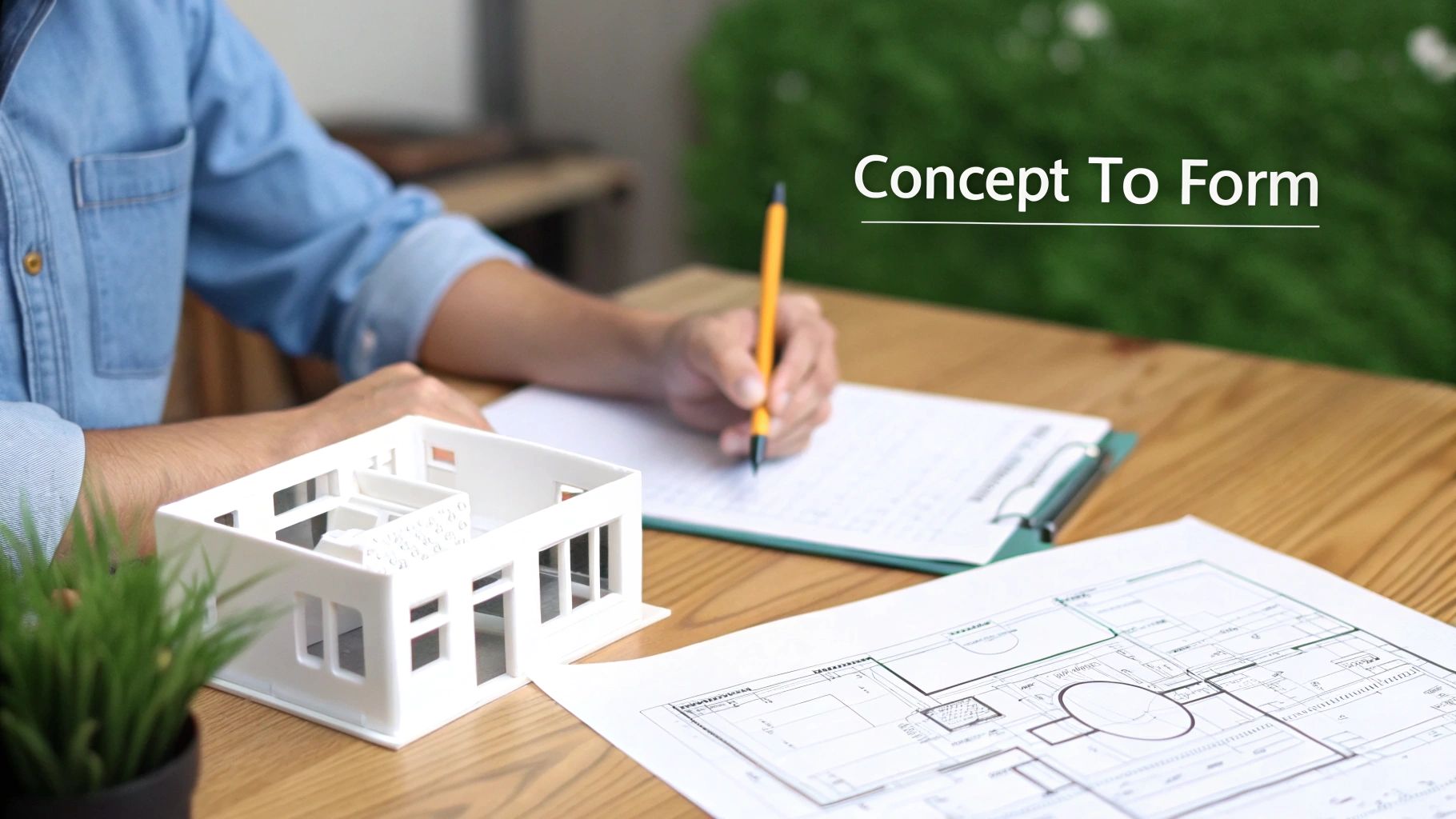
This simple workflow shows the high-level journey from an initial idea to the final built reality.
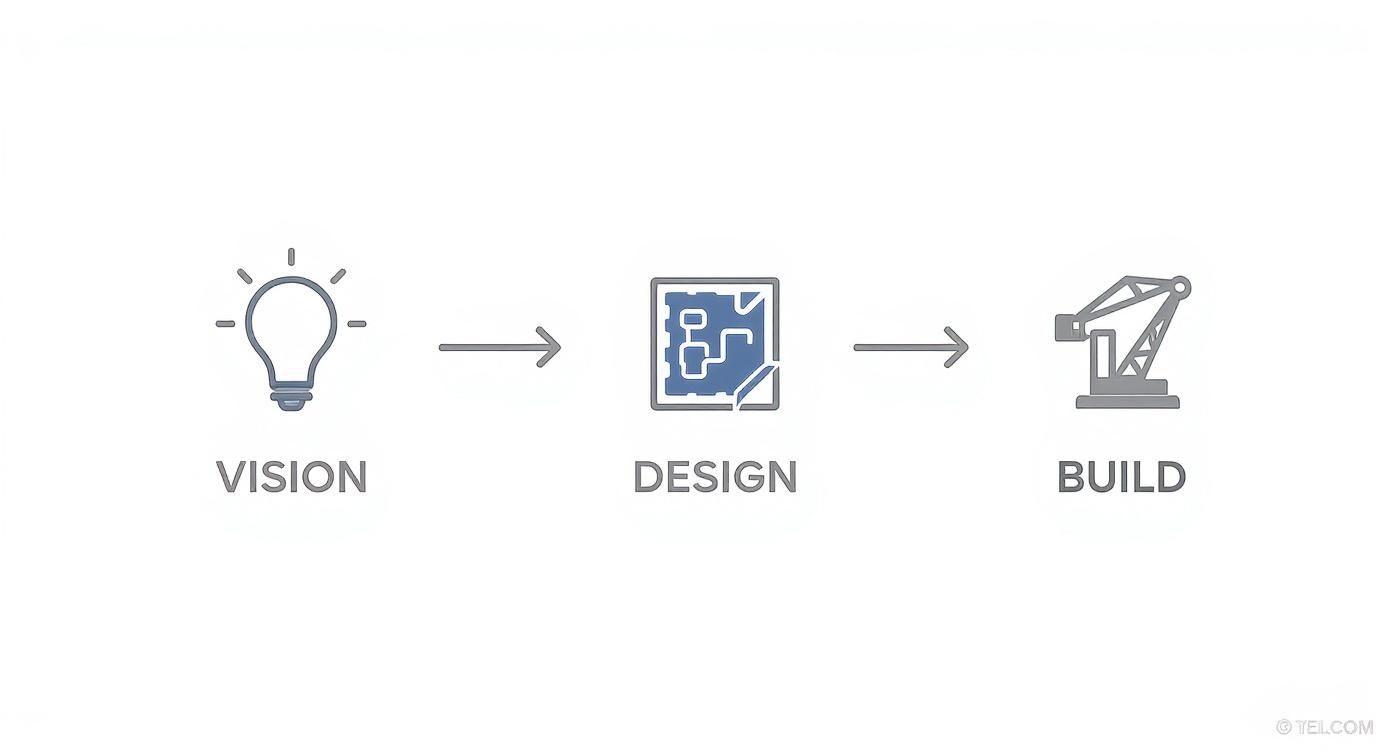
Here, the entire process is distilled into three core ideas: Vision, Design, and Build. It’s a powerful reminder of how each step logically flows into the next.
Why a Phased Approach Matters
Modern building projects are incredibly complex, and a disciplined process is no longer optional. The phased approach to architecture has evolved over decades into a global standard for a reason. A typical large-scale commercial project can easily require over 1,000 individual drawings and specifications, a number that demands a structured, methodical workflow. You can dive deeper into the evolution of these design phases to see how they became so essential.
This structured method delivers several critical benefits:
- Financial Predictability: By staging decisions at the right moments, you gain a much firmer grip on the budget and help prevent "scope creep"—when small additions slowly inflate the final cost.
- Risk Mitigation: The process front-loads all the important homework, like zoning research and site analysis, to uncover potential roadblocks before they become expensive problems.
- Informed Decision-Making: You get the right information at the right time, empowering you to make confident choices on everything from the big-picture layout to the fine details of material finishes.
- Quality Assurance: Every phase acts as a crucial quality-control checkpoint. The design is reviewed, refined, and vetted multiple times before a single shovel hits the ground.
To give you a clearer picture, here’s a quick overview of the stages we’ll be exploring.
The Architectural Design Process at a Glance
This table breaks down the entire journey into its core phases, showing what we aim to achieve at each step and the kinds of activities involved.
| Phase | Primary Goal | Key Activities |
|---|---|---|
| Discovery & Programming | Define project goals, constraints, and requirements. | Client interviews, site analysis, zoning research, budget and schedule definition. |
| Schematic Design | Explore broad concepts and establish the overall design direction. | Sketches, massing models, basic floor plans, initial site layouts. |
| Design Development | Refine the chosen design and select major building systems. | Detailed floor plans, elevations, material selection, structural/MEP coordination. |
| Construction Documents | Create detailed technical drawings and specifications for construction. | Final construction drawings, technical specs, material schedules, quality standards. |
| Permitting & Bidding | Secure building permits and select a contractor. | Submit documents to the city, manage bid process, negotiate contracts. |
| Construction Admin | Oversee construction to ensure it aligns with the design intent. | Site visits, review contractor submittals, answer questions, approve payments. |
| Post-Occupancy | Evaluate the building's performance and address any final issues. | Final walkthrough, project closeout, performance evaluation. |
This table provides a high-level map, but we'll be diving into the specifics of each phase throughout this guide.
Ultimately, the architectural design process is about the careful translation of abstract goals into a concrete, buildable reality. It provides the clarity and organization needed to guide your investment from a simple idea to an enduring, functional, and inspiring space.
Without this framework, a project can quickly spiral into a chaotic and reactive mess. But with it, you and your architect share a common language and a clear path forward, empowering you to navigate the complexities of design and construction with confidence.
Laying the Groundwork in Programming and Discovery
Every great building starts not with a sketch, but with a conversation. The programming and discovery phase is arguably the most critical stage in the entire design process architecture. It’s where we lay the foundation for everything that follows, translating your vision into a detailed, actionable brief. Think of it as mapping out the project's DNA—a unique code that will guide every single decision from here on out.
This isn't about jumping straight into floor plans. It's a deep dive into the core purpose of your project. We move beyond "what do you want to build?" to really get at the fundamental "why." Through a series of stakeholder interviews, careful site analysis, and digging into zoning regulations, your architect gets to the heart of your business goals, operational needs, and the specific ways the space needs to function.
Defining the Project Program
In the world of architecture, "programming" is simply the process of defining what the building needs to do. It's a methodical exercise where we outline every single requirement, from the exact square footage of each area to the intricate relationships between different departments or activities.
But this is much more than just making a list of rooms. It’s about understanding flow, efficiency, and human interaction. For an office redesign, for example, the program would map out things like:
- How many workstations are needed for focused, heads-down work?
- What kinds of collaborative spaces are required, and how big should they be?
- Which teams need to be close to each other? Should the engineers be right next to the workshop?
- How will people and materials move through the space without creating bottlenecks?
This strategic definition of needs is what separates a building that’s merely functional from one that actively boosts productivity and makes people’s day better. It ensures the final design is a solution built for your reality, not just a generic collection of spaces.
Of course, before a single wall goes up, the site itself must be ready. You can explore an in-depth guide to site preparation excavation to see just how much goes into the initial land clearing, grading, and compliance work. Getting this right ensures the physical ground is prepared for the vision we're establishing right now.
Your Role in the Discovery Phase
As the client, your active participation here is absolutely essential. This is your moment to get everything on the table—your vision, your worries, your budget, and your priorities. The more you share, the more closely the architectural solution will align with what you actually need.
To get the most out of these early meetings, try to pull together some key information:
- Business Objectives: Get specific about what this project needs to accomplish. Are you trying to improve efficiency, attract top-tier talent, or make a bold statement with your brand?
- Functional Needs: Show us how your team works. Bring organizational charts, walk us through a "day in the life," and point out the pain points in your current space.
- Budget and Schedule: Be upfront about your financial comfort zone and your ideal timeline. An honest conversation about money now saves a world of headaches and costly redesigns later.
- Aesthetic Vision: Feel free to bring inspiration images, but try to focus on the feeling you want the space to evoke, not just specific fixtures or colors.
This phase wraps up when we produce a key document: the architectural program. It summarizes everything we've learned—space requirements, project goals, site conditions, and budget—and becomes the official guidebook for the next stage. With this solid foundation in place, we can start exploring creative concepts with confidence, knowing we're solving the right problems from the very beginning.
Bringing Your Vision to Life with Design
With a solid program in hand, we move from investigation to creation. This is the exciting part where your project’s goals—things like efficiency, collaboration, and brand identity—start to take on a real, physical form. We’re essentially translating abstract ideas into tangible concepts, starting with broad sketches and methodically refining them into detailed plans.
This journey happens in two key phases: Schematic Design and Design Development. Think of them as the creative engine of the whole process, bridging the gap between your initial vision and the final construction-ready blueprints. It's a progressive refinement, moving from the big picture to the smallest, most crucial details.
From Big Ideas to Broad Concepts in Schematic Design
Schematic Design is all about exploring the possibilities. Your architect takes the approved program and begins sketching out broad design concepts. This is truly the "30,000-foot view," where the focus is on nailing down the overall form, flow, and character of the building without getting bogged down in the technical weeds.
During this phase, we test ideas quickly and efficiently. Your architect will generate a series of drawings to show the main design direction. It's important to remember these aren't final construction plans; they're tools for conversation and decision-making.
Here’s what you can expect to see during Schematic Design:
- Conceptual Site Plans: These show how the building sits on the property, mapping out key elements like parking, landscaping, and the main entry points.
- Basic Floor Plans: You’ll see the general arrangement of spaces, illustrating how different rooms and functions connect to one another.
- Simple Elevations or Massing Models: These give you a first glimpse of the building's exterior shape, scale, and proportions, often as simple 3D computer models or hand sketches.
Your main job at this checkpoint is to confirm the overall direction feels right. Does the layout work? Does the building’s form capture the spirit of your vision? Now is the time to make big changes, because adjusting a conceptual sketch is far easier and much less expensive than altering a fully detailed design later on.
Refining the Details in Design Development
Once you’ve signed off on a schematic direction, the project moves into Design Development (DD). This is where that broad-stroke concept gets meticulously refined and layered with a much greater level of detail. The "what" and "where" from the schematic phase now get a "how" and "with what" attached to them.
The building really starts to feel real here. The initial sketches are transformed into precise, scaled drawings, and we start making critical decisions about materials, systems, and finishes. Your architect also begins coordinating with other key consultants, like structural and mechanical engineers, to make sure their systems integrate seamlessly into the design.
For example, a simple line on a floor plan that represented a wall now becomes a detailed assembly—we define the studs, insulation, drywall, and even a specific paint color. Modern technology has massively improved this phase; computer-aided design (CAD) and building information modeling (BIM) are now standard tools in over 90% of architectural firms. BIM, in particular, lets us create highly detailed 3D models that help everyone visualize and coordinate every single component of the building. You can learn more about the technological tools architects use and see how they’ve shaped the modern design process.
Key Decisions in Design Development
During this phase, you’ll be asked to make more specific and lasting decisions. Don't worry, your architect will guide you through these choices with material samples, detailed drawings, and 3D renderings to help you visualize the final outcome.
Expect to make decisions on things like:
- Exterior Materials: Choosing the specific brick, stone, metal paneling, or siding.
- Interior Finishes: Selecting flooring, wall coverings, ceiling types, and paint colors.
- Building Systems: Finalizing the approach for HVAC, plumbing, and electrical systems.
- Windows and Doors: Deciding on the exact style, material, and performance features.
By the time Design Development is complete, the project is largely set in stone. The result is a comprehensive set of drawings and outline specifications that describe the size, character, and key components of the entire project. This creates a solid foundation for the final construction documents that follow.
Creating the Blueprint for Construction
With the creative vision locked in during Design Development, our focus now shifts to pure technical execution. This is where the design process architecture gets incredibly detailed. We're essentially translating the approved design into an exhaustive, highly specific set of instructions that a contractor will follow to the letter. The main goal here is to produce the Construction Documents (CDs)—a package that's far more than just a few floor plans.
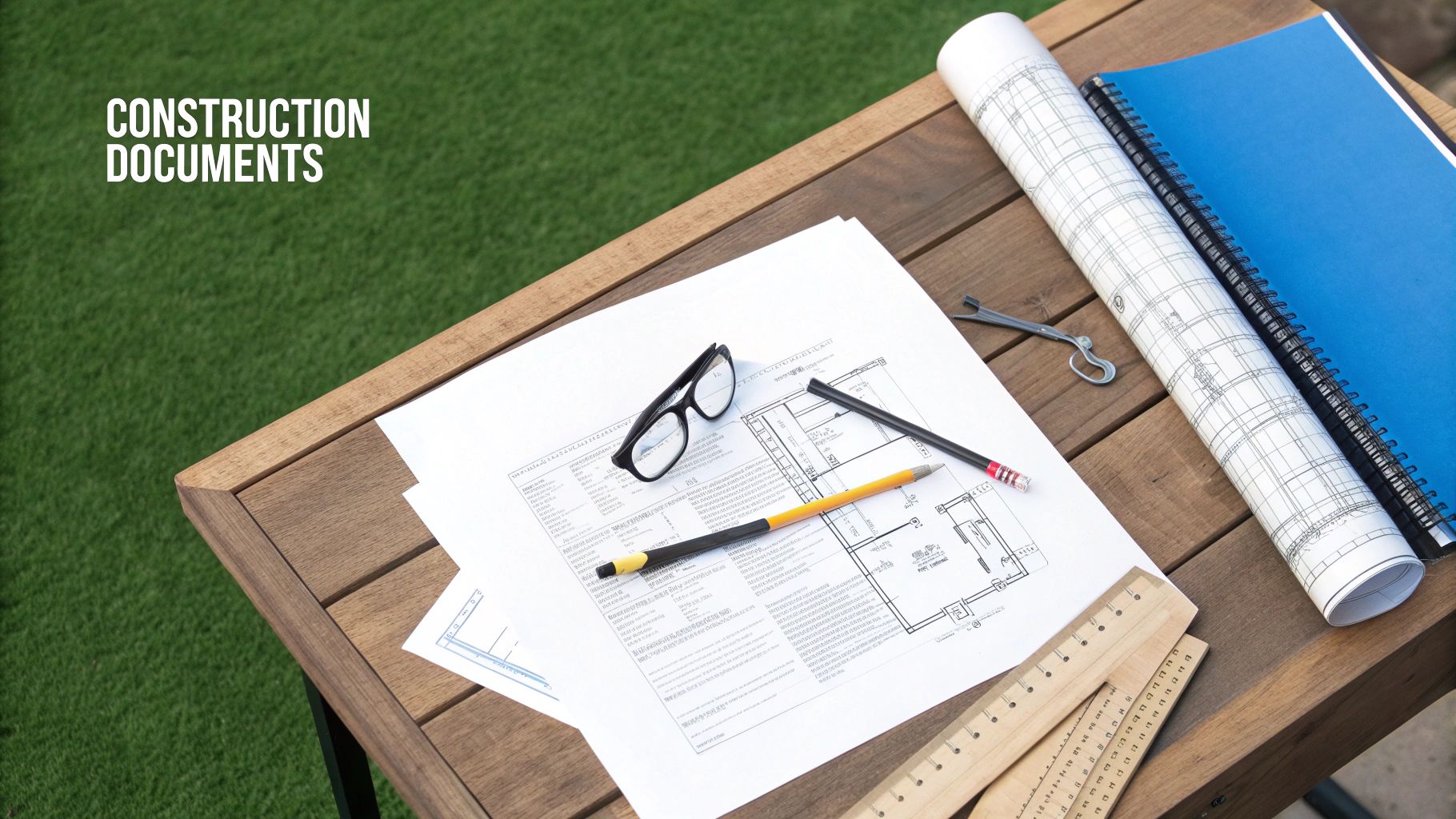
Think of the CDs as the project’s official instruction manual. These documents aren’t just guidelines; they become a legally binding part of your agreement with the builder, defining the exact quality, quantity, and assembly of every single element. Any ambiguity here can lead directly to expensive change orders and frustrating delays on site, so getting these documents right is absolutely crucial.
The Anatomy of Construction Documents
The CDs are an incredibly dense, coordinated set of drawings and written text. They leave nothing to chance, spelling out everything from the precise size of a steel beam to the exact brand and color of paint for the walls.
At this point, your role as the client is less about big design moves and more about a final review. You'll be confirming that this technical translation perfectly matches the decisions we made together in the earlier phases.
A complete set of Construction Documents almost always includes:
- Detailed Drawings: A comprehensive set of plans covering every discipline—architectural, structural, mechanical, electrical, and plumbing (MEP).
- Specifications (Specs): A book of written requirements detailing material quality, installation methods, and performance standards for everything from concrete to doorknobs.
- Schedules: These are organized tables that list every door, window, light fixture, and finish, ensuring total clarity and consistency across the project.
The details are the design. They show how every discipline, constraint, and regulation was reconciled into a coherent system. This is where abstract ambitions become physical agreements, ensuring the final build matches the intended vision.
Once you’ve signed off on these documents, they become the key that unlocks the next two steps: getting a building permit and finding the right contractor to bring your project to life.
As we move through the design journey, the deliverables from our team become progressively more detailed. Here's a quick look at what you can typically expect at each major milestone.
Key Deliverables Across Design Phases
| Design Phase | Typical Client Deliverables | Purpose |
|---|---|---|
| Discovery & Programming | Meeting notes, program document, existing conditions report, initial budget & schedule | To define the project's goals, scope, constraints, and functional needs. |
| Schematic Design | Conceptual sketches, simple floor plans, massing models, precedent imagery | To explore the big ideas and establish the overall design direction and feel. |
| Design Development | Detailed floor plans & elevations, 3D renderings, outline specifications, material samples | To refine the design, make key material choices, and define building systems. |
| Construction Documents | Complete set of drawings (all disciplines), detailed specifications book, final schedules | To provide a complete, legally binding set of instructions for permitting and construction. |
| Construction Administration | Site observation reports, responses to RFIs, submittal reviews, change order documentation | To ensure the project is built according to the documents and handle issues as they arise. |
This table provides a roadmap, so you always know what information you should have in hand to make informed decisions at every checkpoint.
Securing Permits and Navigating Approvals
Before a single shovel can hit the dirt, the Construction Documents have to be submitted to the local building department for review. This is the permitting process, and it’s a critical check to ensure the project meets all building codes, zoning laws, and life-safety requirements.
For historic preservation projects or buildings in special design districts, this step often includes another layer of review from a Design Review Board or Landmark Commission. It can be a winding road, but your architect manages the entire submission. We'll answer any questions from the plan reviewers and make any required tweaks to get that final, approved permit. A well-prepared set of CDs makes this process go much more smoothly.
Finding the Right Builder Through Bidding
With permitted documents in hand, it’s finally time to choose your builder. This usually happens through a bidding (or tendering) process where we send the CDs to a short list of qualified general contractors. They then use those documents to put together a proposal to build the project for a set price.
Your architect will guide you through this, step by step:
- Contractor Selection: We'll help you identify and vet builders who have proven experience with your specific type of project.
- Bid Distribution: The complete CDs are sent out to the chosen contractors.
- Answering Questions: We act as the single point of contact for all bidder questions, ensuring everyone is working from the same information.
- Bid Analysis: When the bids come in, we’ll help you analyze them to make sure they are complete and truly comparable, looking beyond just the bottom-line number.
Having a highly detailed set of Construction Documents is what makes this all work. It forces contractors to give you "apples-to-apples" bids, which is the only way to make a sound financial decision. This detailed blueprint removes the guesswork for the builder, dramatically lowers the risk of surprise costs, and sets the stage for a successful construction phase.
Guiding the Project Through Construction and Beyond
An architect’s role doesn't stop when the contractor breaks ground. In fact, some of their most critical work happens during construction and even after you’ve moved in.
With the detailed blueprints finalized, the project transitions into its last two major stages: Construction Administration and Post-Occupancy Evaluation. This is when your architect shifts from being a designer to your on-site advocate, making sure the vision you've spent months carefully crafting becomes a reality—exactly as planned.
This oversight is more important than ever. With global construction output projected to climb by 42% by 2030, projects are only getting more complex. Expert administration is essential to protect your investment in this growing market, a trend highlighted in this architectural industry report.
Acting as Your Eyes and Ears on Site
During the Construction Administration (CA) phase, your architect becomes your quality control expert and chief problem-solver on the job site. Construction is never a straight line; unexpected issues always pop up. Your architect is the one who navigates these challenges, protecting both the design’s integrity and your budget.
Think of them as the official translator between the paper plans and the physical structure. They're there to ensure the construction team doesn't just follow the drawings, but truly understands and correctly implements every detail.
Key responsibilities during this phase include:
- Regular Site Visits: The architect is your boots on the ground, visiting the site to monitor progress and workmanship. They’re checking to make sure everything aligns with the construction documents.
- Responding to RFIs: Contractors will have questions, formally known as Requests for Information (RFIs). The architect provides clear, timely answers to keep the project moving without delays.
- Reviewing Submittals: They meticulously review material samples, shop drawings, and product data from the contractor to ensure every window, fixture, and finish meets the specified quality.
- Approving Payment Applications: Before you release funds, the architect reviews the contractor's monthly payment requests, verifying that the work you’re paying for has been completed correctly.
This continuous oversight is your greatest defense against costly mistakes and shortcuts. It ensures that the quality you paid for is the quality you receive, transforming the detailed documents into a well-built, lasting structure.
Learning from the Finished Product
The final piece of a comprehensive design process is the Post-Occupancy Evaluation (POE). Once construction is wrapped up and you’ve had some time to use the space, the architect returns to see how the building is really performing. This isn't just a courtesy check-in; it’s an invaluable feedback loop.
This evaluation is all about answering practical questions:
- Does the floor plan actually work for your day-to-day operations?
- Are the building systems, like heating, cooling, and lighting, efficient and comfortable?
- Are there any unforeseen quirks or "pain points" that need tweaking?
By gathering this real-world feedback directly from you and your team, the architect can help troubleshoot any lingering issues and gain priceless insights. This commitment to evaluating the final product shows a genuine focus on your long-term success, not just on finishing the job. It’s what closes the loop on the design process architecture, ensuring the building truly serves your needs for years to come.
Navigating Adaptive Reuse and Historic Projects
When we’re working with an existing building—especially one with a story to tell—the standard design process architecture gets a serious makeover. Adaptive reuse and historic preservation aren't about starting from a blank slate. Instead, it’s more like a careful conversation with the past, demanding a unique mix of forensic investigation, creative problem-solving, and a deep respect for a building's soul.
Breathing new life into an old structure kicks off with an even more intensive discovery phase. Forget analyzing an empty lot; here, the architect becomes a building detective. We carefully peel back layers from past renovations to find the original structure, hunt for hidden decay, and piece together the story of how the building has evolved. This detective work is absolutely essential for understanding the building's "bones" and figuring out what can be saved, what needs restoration, and what can be thoughtfully adapted for a new purpose.
This deep dive goes beyond the physical structure; it’s also about wading through a complex maze of regulations. When you’re dealing with projects like this, understanding the ins and outs of renovating a heritage home is a non-negotiable part of the process.
Balancing Preservation With Modern Needs
The real tightrope walk in these projects is balancing our duty to protect historic character with the very real need to meet modern building codes and performance standards. Think about an old warehouse being turned into modern offices. It has to keep that raw, industrial vibe but also seamlessly integrate high-efficiency HVAC, modern data cables, and meet today’s accessibility requirements. Pulling that off takes a ton of skill and creativity.
Architects who specialize in this niche have to be masters of a few key things:
- Historic Materials: They need to know the right way to repair and bring back to life original materials like old-growth wood, historic brickwork, or original steel windows.
- Regulatory Navigation: This means working hand-in-glove with State Historic Preservation Offices (SHPOs) and local landmark commissions to make sure every change follows their strict guidelines.
- Sensitive Integration: It's about designing new systems and additions that feel like they belong, complementing the historic fabric of the building instead of clashing with it.
These projects are a masterclass in negotiation—a constant give-and-take between the building’s past and its future. The architect’s job is to find the elegant solution that honors both, creating a space that feels both timeless and perfectly suited for today.
The Powerful Sustainability of Reuse
Beyond saving a piece of history, adaptive reuse is one of the most powerful forms of sustainable design you can find. It’s true what they say: the greenest building is very often the one that’s already standing. Reusing an existing building has profound environmental benefits that new construction just can't touch.
The biggest win is the massive reduction in embodied carbon—that’s the sum of all the greenhouse gas emissions that come from making, shipping, and installing building materials. By keeping the original structure and shell, we dodge the huge carbon footprint that comes with producing new concrete, steel, and other materials from scratch.
Even better, adaptive reuse brings communities back to life by turning neglected or empty buildings into vibrant hubs, which helps prevent urban sprawl and encourages walkable neighborhoods. This approach doesn't just save buildings; it strengthens the very fabric of our cities, proving that thoughtful preservation is a forward-thinking investment in a more sustainable future.
Common Questions About the Design Process
Going through an architectural project for the first time can feel like learning a new language. You'll naturally have questions about how it all works. Getting a handle on the basics of timelines, costs, and your role will make you a much more confident and effective partner in the process.
Let's break down some of the most common questions we hear from clients.
How Long Does the Design Process Take?
This is the big one, and the honest answer is: it depends. A project’s timeline is a direct reflection of its size, complexity, and how fast the local permitting office moves. The design phase itself can vary dramatically.
For instance, a simple commercial interior refresh might get through the entire design process in just 3-6 months. But if you're building a new, medium-sized commercial building from the ground up, you should expect the design work alone to take anywhere from 9-18 months before a shovel ever hits the dirt.
Projects involving historic preservation or adaptive reuse almost always take longer. There’s a lot more detective work involved upfront to uncover what’s behind the walls, and these projects often face extra layers of review from historical commissions or design review boards. Your architect will map out a detailed, project-specific schedule early on so you know what to expect.
Think of your project schedule as a living document. Your architect sets the initial roadmap, but your ability to make timely decisions at key moments is the single biggest factor in keeping everything on track and avoiding expensive delays.
What Are the Biggest Project Cost Drivers?
It's crucial to understand where the money is really going. Architectural fees are part of the budget, of course—often calculated as a percentage of the total construction cost—but the real heavy hitters are the construction costs themselves.
A few key things tend to drive the budget up:
- Site Conditions: A challenging site with steep slopes, bad soil, or a lack of utility connections can add significant costs right from the start.
- Structural and MEP Systems: The building’s skeleton (structural system) and its nervous system (mechanical, electrical, and plumbing) are huge parts of the budget. The more complex they are, the more they cost.
- Quality of Materials: The level of finish you choose has a massive impact. From the type of brick on the outside to the light fixtures inside, high-end materials and custom-made elements will naturally cost more.
- Unforeseen Conditions: This is the wild card, especially in renovations. Tearing down a wall and discovering rotted framing or old, hazardous materials is the number one cause of unexpected costs.
How Can I Help the Process Go Smoothly?
The secret to being a great client boils down to two things: clear communication and decisive action. Your focused participation is the fuel that keeps the project moving forward successfully.
It all starts with being completely open about your goals, budget, and must-haves during the initial programming phase. The more your architect understands from the get-go, the more accurately they can design a space that truly works for you. Once design is rolling, your main job is to give clear feedback and make firm decisions when they're needed.
It's also incredibly helpful to name one person on your team as the official point of contact. This prevents your architect from getting mixed signals from different people, which is a classic recipe for confusion and delays. At the end of the day, trust the expertise you hired. Your architect’s guidance on building codes, materials, and construction methods is what will ultimately turn your vision into a real, functional building.
At Sherer Architects, LLC, we believe a transparent, collaborative design process is the foundation of every great project. We’re here to guide you through each stage, making sure your vision comes to life beautifully, on schedule, and within your budget. Learn more about our architectural design approach.