SHERER ARCHITECTS

Categories
Uncategorized

Sustainable Design in Architecture A Practical Guide

Sustainable design isn't just about bolting on a few solar panels and calling it a day. It’s a complete design philosophy that considers a building’s environmental footprint, its economic performance, and, most importantly, the well-being of the people inside it. It’s about designing and constructing buildings that are genuinely efficient, healthy, and resilient from their very foundation.

Rethinking Architecture Beyond Aesthetics
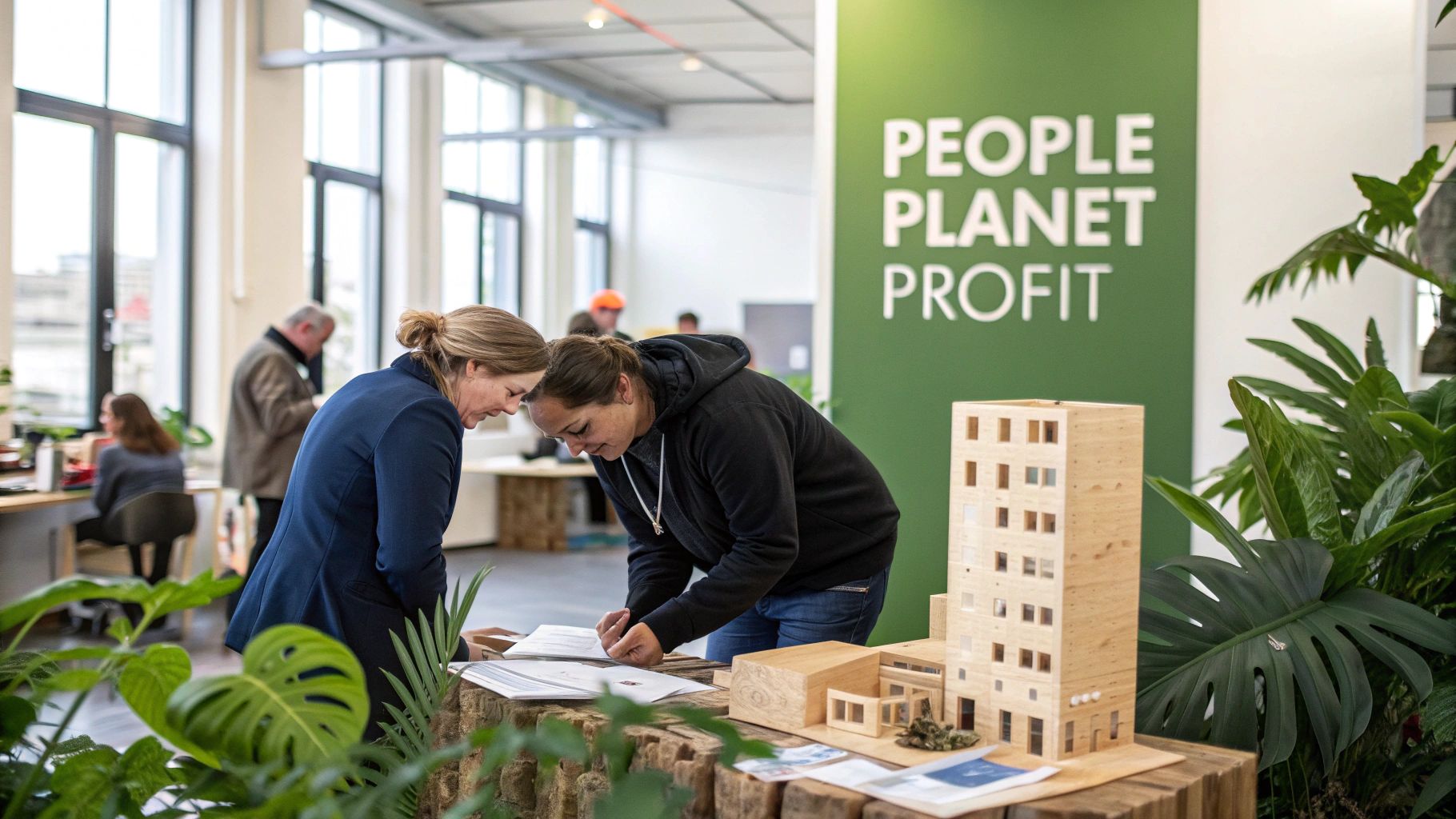
Two women discussing documents and a wooden architectural model at a sustainable design event.

For a long time, "green" building was seen as a fringe movement, something that came with a high price tag and experimental, sometimes odd, designs. That perception has been turned completely on its head. Sustainable design is no longer a "nice-to-have" add-on; it's now an essential practice. The shift is driven by hard economic realities, stricter regulations, and a growing recognition of the massive impact our buildings have on the world.

This isn’t just about surface-level changes or chasing a green certification. It’s a fundamental rethinking of how buildings are supposed to work and how they serve their occupants and the wider community over their entire lifetime.

At the heart of sustainable design is a simple but powerful set of core principles. We've outlined them below to provide a quick reference for the foundational ideas we'll be exploring.

Core Principles of Sustainable Architecture

Principle Objective
Conserve Energy Minimize the building's reliance on non-renewable energy through passive design, efficient systems, and on-site renewables.
Work with Climate Design structures that respond to the local climate, harnessing natural light, wind, and shading to reduce energy needs.
Minimize New Resources Reduce consumption of new materials by prioritizing reuse, recycled content, and responsibly sourced materials.
Respect the Site Preserve or restore the site's natural ecosystems and manage water responsibly to minimize environmental disruption.
Holistic Approach Integrate all design elements—from site planning to material selection—into a cohesive, high-performing system.

This framework shows how every decision contributes to a larger, integrated goal: creating a building that works better on every level.

The Triple Bottom Line in Building Design

At its core, true sustainable design runs on the "triple bottom line"—a framework that measures success not just by financial returns, but by its positive impact on people and the planet. When you apply this lens to architecture, you start to see how to create real, lasting value.

  • People: This is all about human well-being. A sustainable building actively promotes health and productivity with clean indoor air, abundant natural light, and a connection to the outdoors. It's a place people want to be in.
  • Planet: This pillar tackles environmental responsibility head-on. It’s about shrinking a building's carbon footprint by slashing energy and water use, choosing materials that are sustainably sourced, and cutting down on waste.
  • Profit: This is the economic engine. Sustainable buildings deliver clear financial wins through lower utility bills, reduced maintenance costs, higher property values, and an enhanced ability to attract and keep tenants.

Sustainable architecture is not a limitation on creativity. Instead, it is a powerful framework that guides architects to create smarter, more resourceful, and ultimately more impactful structures that deliver measurable, performance-driven results for owners and occupants alike.

A Framework for Smarter Structures

Looking at architecture this way changes everything. Decisions about a building’s orientation on a site, the type of insulation in its walls, or the efficiency of its HVAC system are no longer just technical line items. They become strategic choices that directly impact long-term operational costs, occupant satisfaction, and the building's overall resilience.

The market is responding in a big way. The global green building sector is set to explode, growing from $618.58 billion in 2025 to a projected $1,374.23 billion by 2034. This growth isn't a fluke; it's fueled by rising energy costs, stronger corporate sustainability goals, and the undeniable need for buildings that can stand up to future challenges. You can explore the latest green building trends here to see just how strong this momentum is.

This powerful economic shift confirms it: sustainable design is simply the new standard for intelligent, forward-thinking architecture.

Why Smart Buildings Are Sustainable Buildings

Making the move to sustainable design isn't just an environmental statement anymore; it's a strategic business decision with a clear, measurable bottom line. When you weave intelligent technology and forward-thinking design into the fabric of a building, it stops being a static shell and starts acting like a dynamic, high-performing asset. This is exactly where sustainability delivers its most powerful financial and operational punch.

At its heart, a smart building uses technology to automate and fine-tune everything from heating and cooling to lighting and security. When these systems are designed with sustainability as the goal, they work together beautifully. What you get is a structure that not only shrinks its environmental footprint but also boosts its economic value and becomes a better place for people to be.

Driving Down Operational Costs

The most immediate and concrete win from sustainable design is a massive cut in day-to-day running costs. Let's face it, buildings are energy hogs, and those utility bills make up a huge chunk of a property's lifelong expense. Smart, sustainable design tackles this problem head-on.

  • Energy Efficiency: Think of high-performance insulation, energy-smart windows, and intelligent HVAC systems as a team working to slash heating and cooling bills. Add in automated sensors that adjust lights and temperature when a room is empty, and you stop paying to heat or light empty space.
  • Water Conservation: Simple additions like low-flow fixtures, rainwater harvesting systems, and smart irrigation for landscaping can cut water use by 30% or more. That's a huge saving on your water bill.
  • Reduced Maintenance: When you choose durable, high-quality materials and design systems to last, you spend less time and money on repairs and replacements. This keeps long-term maintenance budgets in check and avoids disruptive downtime.

A sustainable building isn’t an expense; it’s an investment in radical efficiency. By designing for lower consumption from day one, you create an asset that pays you back every month through reduced utility bills and maintenance costs.

Increasing Asset Value and Mitigating Risk

Looking past the monthly savings, sustainable design is really about future-proofing your investment. In a market that’s growing more aware of climate risks and new regulations, green buildings are simply more valuable and resilient. It’s no surprise that properties with verified green credentials often fetch higher rental rates and sale prices.

This extra value comes from their built-in ability to handle risk. As energy codes get tighter and carbon taxes become a reality, a high-performance building is already ahead of the curve, saving you from expensive retrofits later. To get a full picture of these benefits, it’s worth exploring the various smart building solutions available that can seriously elevate a building's environmental performance. These technologies also make a property far more attractive to savvy investors and top-tier tenants who care about corporate responsibility and predictable costs.

Enhancing Health and Productivity

Maybe the most important benefit of all is the positive effect sustainable design has on people. The very things that make a building green—plenty of natural light, clean indoor air, and a connection to the outdoors—also happen to be the things that help people thrive. This human-centric approach delivers incredible returns.

Study after study shows that people working in green buildings report getting sick less often and being more productive. Things like low-VOC (volatile organic compound) paints, advanced air filtration, and biophilic design elements directly create a healthier place to be. For any commercial property, that's a huge competitive edge, helping you attract and keep the best talent. A building that takes care of its people is a building that performs better on every single level.

Practical Strategies for Green Building Design

Putting sustainable design principles into practice isn't about lofty ideals; it's about using a proven toolkit of actionable strategies to create buildings that truly perform. Architects draw from a few key playbooks, and each one plays a distinct role in a building's overall efficiency and the health of the people inside it.

You can think of it like building a high-performance race car. Some of the most important gains come from the car's fundamental shape—its aerodynamics—which helps it slice through the air with less resistance. Then you have the advanced engine and smart electronics that fine-tune fuel use for maximum power. Great architectural design works the same way, blending foundational passive strategies with sophisticated active systems.

Harnessing Nature with Passive Design

The smartest and often most budget-friendly place to start is with passive design. This is all about making the building work with its natural environment instead of fighting against it. It means using free, abundant resources like sunlight and airflow to do the heavy lifting that would otherwise demand energy-guzzling mechanical systems.

Here are some of the cornerstones of passive design:

  • Building Orientation: This is the first and most critical move. Simply positioning a building to capture the sun's warmth in the winter while shielding it from the intense summer sun can slash heating and cooling costs right from the start.
  • Daylighting: Thoughtfully placed windows, light shelves, and skylights can fill a space with natural light. This dramatically cuts down on the need for artificial lighting, which is a huge energy drain in most commercial buildings.
  • Natural Ventilation: Designing for cross-breezes with operable windows and vents allows fresh air to cool the building naturally, reducing the strain on air conditioning systems.
  • Thermal Mass: Materials like concrete, brick, and stone are fantastic for regulating indoor temperatures. They act like thermal batteries, absorbing heat during the day and slowly releasing it at night to keep the space comfortable.

This infographic does a great job of showing how these kinds of strategies translate directly into benefits for building owners and the people who use the space.
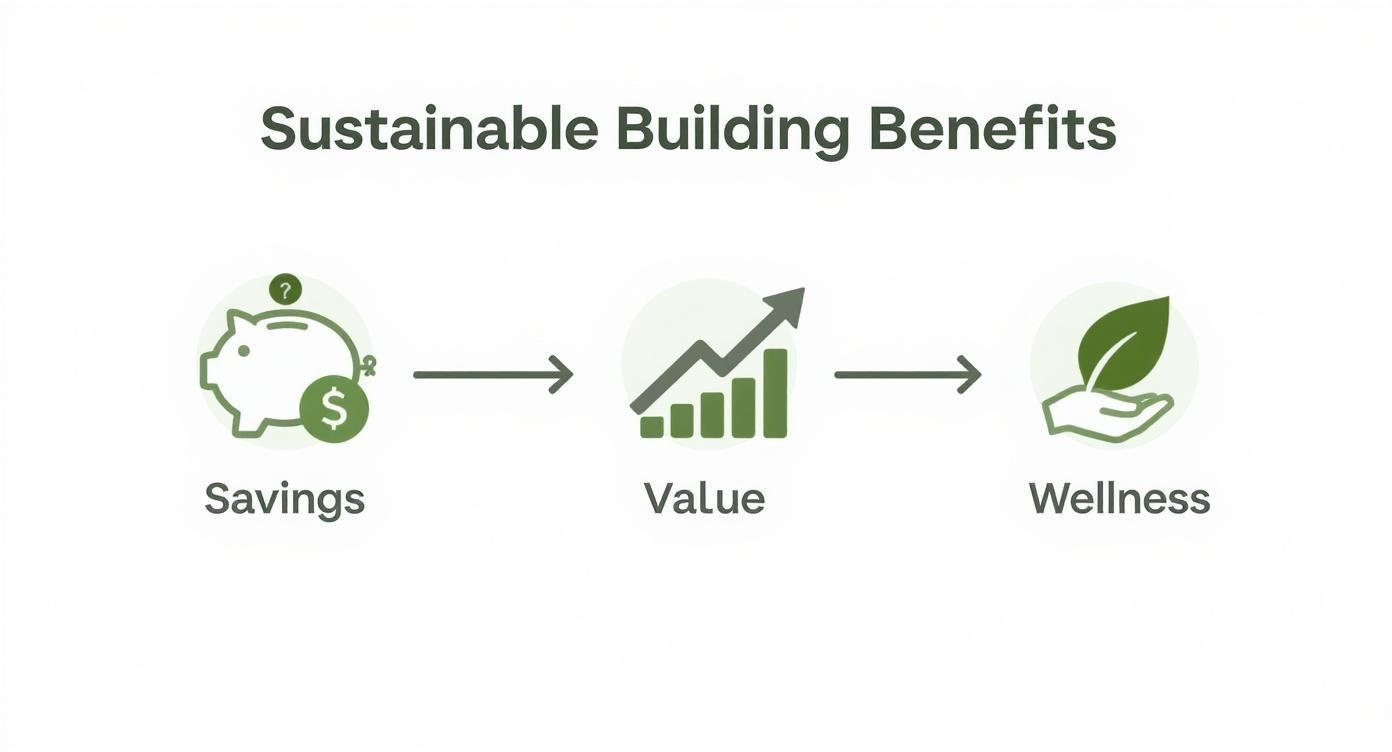
An infographic illustrating sustainable building benefits: savings, increased value, and improved wellness.

As you can see, the connection is clear: smarter design choices lead to real-world financial savings, higher property values, and healthier, more productive environments.

The Role of Passive vs. Active Strategies

To really grasp how these pieces fit together, it helps to see them side-by-side. Passive strategies are the "good bones" of the building, while active systems are the "smart muscles" that do the work when needed.

Passive vs. Active Sustainable Design Strategies

Strategy Type Examples Primary Benefit
Passive Building orientation, daylighting, natural ventilation, thermal mass, high-performance windows, green roofs. Reduces the fundamental energy demand of the building before any mechanical systems are turned on.
Active High-efficiency HVAC, geothermal systems, solar panels, low-flow plumbing fixtures, LED lighting with sensors. Optimizes energy and resource consumption through efficient technology and renewable sources.

A well-designed building leans heavily on its passive features first, significantly reducing the load—and the cost—of the active systems it needs.

Optimizing with Active Systems

While passive strategies lay the groundwork, active systems are the high-tech components that push performance to the next level. These are the technologies that consume energy, so the entire goal is to make them as lean and efficient as possible. When we design green buildings, integrating energy-saving measures like innovative alternative heating sources becomes a key part of the conversation.

Active systems should complement, not compensate for, poor passive design. An efficient HVAC system in a well-insulated, properly oriented building works far less and costs much less to run.

We're talking about technologies like geothermal heat pumps, high-efficiency HVAC units that recover energy from exhaust air, and intelligent building automation systems that adjust lighting and temperature based on who is in the room. The final layer is often renewable energy, like solar panels, which allow a building to generate its own clean power right on-site.

Choosing Smarter Materials

Every single material that goes into a building has an environmental footprint—from how it was sourced and manufactured to what happens to it when the building's life is over. Sustainable material selection is about choosing materials with the best lifecycle story. This is often guided by a life-cycle assessment (LCA), which is a deep dive into a material's impact from cradle to grave.

We prioritize materials that are:

  • Reclaimed or Recycled: Using salvaged wood, recycled steel, or crushed concrete reduces the demand for brand-new resources.
  • Locally Sourced: This minimizes transportation emissions and boosts the local economy.
  • Low-VOC: Choosing paints, adhesives, and flooring with low or no Volatile Organic Compounds is critical for maintaining healthy indoor air quality.
  • Sustainably Harvested: Products like Forest Stewardship Council (FSC) certified wood guarantee that they come from responsibly managed forests.

Buildings are responsible for roughly 37% of global carbon emissions, so our material choices matter immensely. This is where we see a major push toward eco-friendly materials like plant-based fibers, natural stone, and certified wood, alongside smart tech like Building Management Systems (BMS) that optimize resource use in real-time.

Managing Every Drop of Water

Finally, sustainable design treats water as the precious resource it is. Smart water management focuses on two things: reducing consumption and reusing water whenever possible.

This includes straightforward steps like installing low-flow fixtures and faucets, as well as more integrated solutions like designing landscapes with native, drought-tolerant plants. On a larger scale, we can implement systems for rainwater harvesting to use for irrigation or greywater recycling for non-potable needs like flushing toilets.

Measuring What Matters in Sustainable Design

In sustainable design, good intentions only get you so far. To make a real difference, we have to move past abstract goals and into the world of hard numbers. How do you actually prove a building is efficient, healthy, and kind to the environment?

It all comes down to measurement.

Think of it like a fitness tracker for your building. You monitor steps and heart rate to understand your personal health, right? We do the same for buildings, using specific metrics to gauge their performance. These data points turn "sustainability" from a fuzzy concept into tangible, trackable outcomes that demonstrate real-world value.

The Numbers That Tell the Story

When we want to know a building’s true environmental footprint, we focus on a few critical benchmarks. These metrics create a common language for setting and hitting sustainability goals, making it clear to everyone—from architects to investors—what success actually looks like.

Three of the most important are:

  • Energy Use Intensity (EUI): This is basically the building’s miles-per-gallon rating. It measures the total energy a building uses over a year, divided by its square footage (kBTU per square foot per year). A lower EUI means a more efficient building, which translates directly to smaller utility bills and a lighter carbon footprint.
  • Embodied Carbon: This metric uncovers the hidden environmental toll of a building before it even opens. It accounts for all the greenhouse gas emissions tied to making, shipping, and installing the materials—from the concrete in the foundation to the glass in the windows. Choosing materials with low embodied carbon is one of the most powerful moves we can make to cut a project's upfront climate impact.
  • Indoor Environmental Quality (IEQ): This one is all about the people. IEQ measures the things that make a space healthy and comfortable: air quality, thermal comfort, access to daylight, and acoustics. High IEQ scores are directly linked to happier, more productive people and fewer sick days. It’s a win-win.

Performance data is what separates genuine sustainable design from "greenwashing." Without credible numbers from metrics like EUI and IEQ, sustainability is just a marketing slogan. With them, it becomes a verifiable asset.

Why Third-Party Certifications Matter

While individual metrics are crucial, comprehensive certification systems offer a holistic, third-party stamp of approval. These programs provide a trusted roadmap for designing a green building and give owners a respected seal of approval to prove it.

Think of them as different standards of excellence. Each has a slightly different focus, but they all share the same goal: promoting better buildings. They lend credibility and make it much easier for owners to market their property’s sustainable features to savvy tenants and investors.

A Quick Look at the Major Certification Systems

Several globally recognized systems exist, and knowing their core focus helps you pick the right one for your project’s specific goals.

Here’s how the big ones stack up:

Certification Primary Focus Best For
LEED A balanced, market-driven approach covering energy, water, materials, and IEQ. It’s the most widely recognized system in North America. Commercial projects that need broad, credible validation to gain a competitive edge.
BREEAM A highly detailed, science-based assessment popular in Europe that digs deep into a wide range of sustainability categories. Projects that demand a rigorous, evidence-based approach to performance, especially in international markets.
Living Building Challenge The most ambitious standard out there, pushing for regenerative buildings that actually give more back to the environment than they take. Visionary projects aiming for the absolute peak of sustainability, like becoming net-positive for energy and water.

These frameworks aren't just checklists; they're powerful tools for holding everyone accountable. They ensure that a project’s green design is a verified reality, not just a plan. By embracing these measurement tools, we can create buildings that aren't just beautifully designed—they're measurably better for people, the planet, and the bottom line.

Making the Financial Case for Going Green

When we talk about sustainable architecture, the conversation often centers on environmental good. That’s important, but for developers and property owners, the most powerful argument is usually financial. Deciding to build green isn't just about altruism anymore; it's a hard-nosed business decision driven by regulations, powerful incentives, and a solid return on investment.

The regulatory landscape is constantly shifting under our feet. Building and energy codes are getting stricter every year. If you design a building to meet only the bare minimum standards of today, you’re setting yourself up for expensive, mandatory retrofits down the line. It’s a classic case of being penny-wise and pound-foolish.

Navigating Codes and Unlocking Incentives

This is where smart design comes in. By proactively designing beyond current codes, you not only protect your asset from future regulatory headaches, but you also open the door to a whole suite of financial incentives. These programs are specifically designed to make sustainability profitable.

Think of them as a financial toolkit to get your project off the ground:

  • Federal and State Tax Credits: These are a huge deal. They offer dollar-for-dollar reductions on your tax bill for things like renewable energy, major efficiency upgrades, and even sustainable practices within historic preservation projects.
  • Utility Rebates and Grants: Don't overlook your local utility company. They often offer direct cash rebates for installing high-efficiency HVAC systems, LED lighting, or better insulation, which immediately cuts your project costs.
  • Expedited Permitting: Time is money, right? Many cities will fast-track the permitting process for projects that meet specific green building standards, getting you to construction sooner.

These programs are game-changers. They help close the cost gap between a standard build and a high-performance one, making the financial choice a lot simpler.

Calculating the Long-Term ROI

Incentives help with the upfront investment, but the real financial muscle of sustainable design shows up over the life of the building. The long-term ROI is all about slashing operational expenses and boosting your asset's value.

A sustainable building is an asset engineered for performance. Every design choice aimed at reducing energy and water consumption directly translates into lower utility bills, creating a predictable and continuous financial return for the owner.

People often overestimate how long it takes to see a payback on green features. When you factor in lower utility bills, reduced maintenance from using more durable materials, and even improved productivity from happier tenants, the numbers start to look very attractive. For commercial properties, these savings—combined with the ability to attract and keep high-quality tenants—drive up net operating income and, ultimately, the building's market value.

The push for better building codes is happening worldwide. Still, there’s a long way to go, as over 50% of new global construction isn’t covered by any mandatory energy efficiency codes. Initiatives like the Buildings Breakthrough Agenda are working to change that, aiming to make near-zero emission buildings the global standard by 2030. You can learn more about these global efforts to advance building codes and see where the industry is headed.

Ultimately, sustainable design isn't just about checking a box. It’s about positioning your property to win in a market that demands efficiency, resilience, and proven financial performance.

Sustainable Design Principles in Action
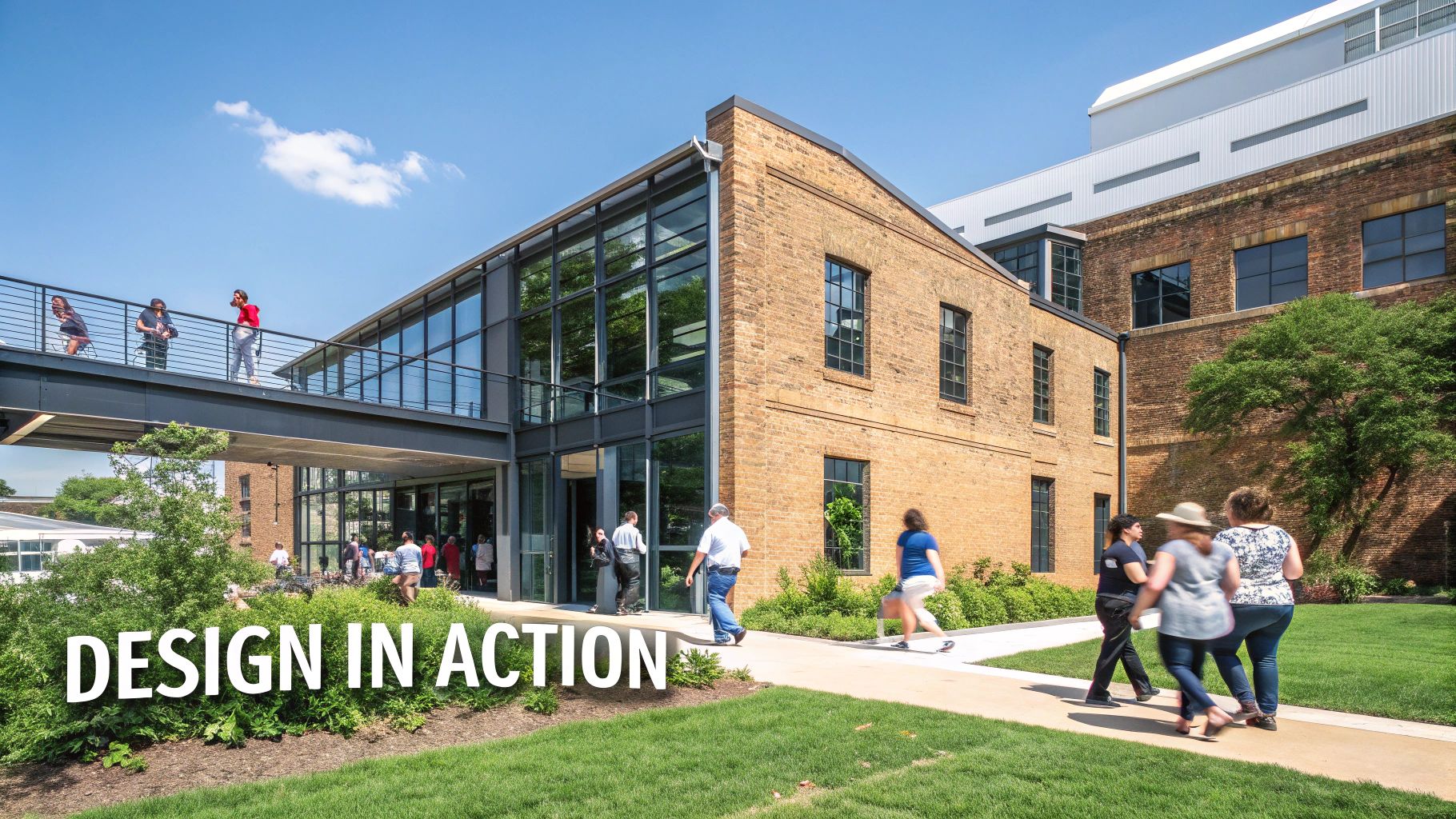
A vibrant scene of people interacting with a modern brick building featuring glass and an elevated walkway on a sunny day.

It’s one thing to talk about sustainable principles in theory, but it’s seeing them solve real-world problems that truly shows their power. Here at Sherer Architects, our portfolio is less a collection of projects and more a series of stories—stories of how smart design helped our clients achieve their business goals while creating beautiful, high-performing buildings that give back to their communities.

Every project is a fresh opportunity to apply these ideas, whether it's a brand-new commercial building or a careful historic renovation. The objective is always the same: to create a structure that's more efficient to run, healthier for the people inside, and gentler on the planet.

This isn't about chasing the latest trend. It’s about delivering lasting value through resourceful solutions built to stand the test of time.

Balancing Preservation and Performance

Adaptive reuse is one of our passions. It's the ultimate act of sustainability because it saves the massive amount of embodied carbon already locked into an existing building. The challenge, and the fun, is weaving modern performance into a historic structure without losing its soul.

Take a recent project we handled: converting a century-old warehouse into contemporary office space. The client loved the historic brick and old-growth timber framing but needed a building that could keep up with modern energy codes.

We focused on a few key moves:

  • High-Performance Insulation: By adding high-R-value insulation to the inside of the exterior walls and roof, we dramatically improved the building’s thermal performance without touching the historic brick facade.
  • Energy-Efficient Windows: We had windows custom-milled to match the original historic profiles, but with modern, low-e coated, insulated glass. This one change made a huge difference in cutting down heating and cooling needs.
  • Variable Refrigerant Flow (VRF) Systems: Instead of trying to force bulky, inefficient ductwork into the old structure, we used a VRF system. Its small refrigerant lines were easy to route, giving us zoned, highly efficient heating and cooling.

The final result is a building that celebrates its history while being fully ready for a high-performance future. By threading the needle between preservation and smart upgrades, we gave this structure a new lease on life for decades to come.

New Construction Designed for Efficiency

When we're starting from scratch on a new commercial building, we can optimize for performance right from day one. A great example is a new retail center we designed where the owner’s top priority was keeping long-term operating costs as low as possible.

We treat every commission like a puzzle, aligning all the pieces to deliver beautiful, enduring, and sustainable results. In new construction, passive design strategies are the cornerstone of that puzzle.

Our whole approach began with the basics of passive solar design. We oriented the building to soak up the low winter sun for passive heat, then used carefully calculated overhangs to block the high summer sun and ease the load on the air conditioning. Simple, but incredibly effective.

We layered on top of that foundation with daylighting controls, high-efficiency LED lighting, and a reflective "cool roof" to bounce away heat. Put it all together, and the final building uses about 40% less energy than a similar building constructed just to meet minimum code. That’s a direct savings of thousands of dollars every year for the owner, proving that great design is one of the smartest investments you can make.

Answering Your Questions About Sustainable Architecture

Even as sustainable design moves into the mainstream, it’s natural to have questions. Getting clear on the real-world costs, the lingo, and how it all comes together is key to moving forward with any project. Let's tackle some of the most common things we hear from clients and developers.

Does Sustainable Architecture Cost More?

This is the big one, and the answer isn't a simple yes or no. While some high-performance materials or systems might have a higher price tag upfront, a smart sustainable design process often finds savings elsewhere, like through more efficient material use. The real story, though, is about the long game.

The true financial benefit unfolds over the life of the building. You’ll see significant, predictable savings on energy, water, and maintenance that deliver a powerful return on your initial investment.

And that's before you even consider the financial incentives. When you factor in tax credits, utility rebates, and other programs, the business case for building sustainably becomes incredibly strong, often completely balancing out any higher initial costs.

What's the Difference Between "Green Building" and "Sustainable Design"?

People often use these terms interchangeably, but there's a helpful way to think about the distinction.

It really comes down to the "what" versus the "why."

  • Green Building is the "what." It points to the tangible things you can see and touch—the high-efficiency HVAC, the recycled steel beams, the low-flow plumbing fixtures. These are the products.
  • Sustainable Design is the "why" and the "how." It's the overarching philosophy that guides all those choices. This approach zooms out to consider the building’s entire lifecycle, from where the materials came from to how it operates day-to-day, its connection to the community, and what happens to it at the end of its life.

So, a green building is really the end result of a thoughtful, holistic sustainable design process.

Where Does Adaptive Reuse Fit In?

Adaptive reuse isn't just a component of sustainable architecture—it's one of its most impactful expressions. When we choose to renovate and repurpose an existing building, we are directly preserving its embodied carbon.

Think of embodied carbon as all the energy and emissions that were already spent to create the building in the first place—to manufacture the steel, fire the bricks, transport the materials, and put it all together. Demolishing a building essentially throws all of that away.

By opting for adaptive reuse, you sidestep the massive carbon footprint of both demolition and new construction. It's a triple win: you keep waste out of landfills, breathe new life into established neighborhoods, and save the unique character that makes a place special. Honestly, saving an existing building is often the most sustainable move you can make.


At Sherer Architects, LLC, we're passionate about making these principles work for our clients, creating buildings that are both profitable and high-performing. Whether you're planning a new commercial build, an adaptive reuse project, or a historic preservation effort, we're here to guide you. Learn how we can bring structure to your vision and create a beautiful, durable, and truly sustainable building.
Categories
Uncategorized

A Guide to Sustainable Design Architecture

Sustainable design is a term that gets thrown around a lot these days, but it’s so much more than just a buzzword. At its core, it’s a design philosophy—a way of creating buildings that are in conversation with their environment, rather than in conflict with it.

This approach is all about thinking ahead, focusing on long-term ecological health, smart resource use, and the well-being of the people inside, right from the very first sketch.

Why Sustainable Design Is a Necessity, Not a Trend

To really get a feel for what this means, let's try a simple comparison. Imagine a typical, conventional building is like a gas-guzzling car. It gets you from A to B, but it constantly consumes fuel, spits out exhaust, and requires a ton of maintenance just to keep running.

A sustainably designed building, on the other hand, is more like a well-tended garden. It’s part of a living ecosystem. It gives back, provides shelter, and works with the natural elements around it—the sun, the wind, the rain—to thrive.

This "living garden" approach isn't just a nice idea anymore; it's an urgent necessity. Buildings are one of the world's biggest resource hogs. In 2023 alone, the building sector was responsible for a staggering 32% of global energy demand and 34% of CO₂ emissions. The hard truth is, despite some good intentions, we’re falling behind on our climate goals, which makes this shift in thinking more critical than ever. You can dig into the numbers in the Global Status Report for Buildings and Construction 2024/25.

The Core Philosophy of Sustainable Architecture

When you strip it all down, sustainable architecture is about asking the right questions before you even break ground. How can this building use sunlight to cut down on electricity bills? Can we collect rainwater to irrigate the landscape? What materials can we find nearby that are both beautiful and responsibly sourced, cutting down on the carbon footprint from transportation?

Sustainable design isn't just about bolting solar panels onto a roof. It’s about creating a completely integrated system where the building, its inhabitants, and the natural world can coexist in a healthy, balanced way.

This kind of proactive thinking pays off in some incredibly powerful ways, and the benefits go far beyond just being "green." It's a complete strategy for building better spaces for everyone. The main advantages really boil down to three things:

  • Minimizing Environmental Harm: This is the most obvious one. It means a smaller carbon footprint, less strain on natural resources, and better protection for local ecosystems.
  • Boosting Human Health: We're talking about better indoor air quality and more natural light, which have been proven time and again to make people feel better, think clearer, and be more productive.
  • Delivering Long-Term Financial Value: This is where it really clicks for many owners. Lower utility bills, higher property values, and a building that's better prepared for a future where energy and water are more expensive.

At the end of the day, sustainable design isn't just a passing phase. It's the natural and necessary evolution of architecture, paving the way for a smarter, healthier, and more resilient future.

The Foundational Principles of Green Architecture

To move sustainable design from a lofty concept to a brick-and-mortar reality, architects lean on a set of core principles. These aren't just boxes to tick on a checklist; they're a series of interconnected strategies that create buildings that are better for us and for the planet. Think of them as the pillars holding up the entire structure of a green building.

Each principle tackles a different part of a building's life—from where it sits on the land to how it runs every day. The end game is a holistic system where every choice is made to boost efficiency, improve health, and leave the smallest possible environmental footprint. Let's dig into what these ideas look like in practice.

Optimizing Site Potential

Some of the smartest design decisions are made before a single shovel hits the dirt. True sustainable architecture starts with a profound respect for the land itself. It's about analyzing a site's unique character to work with nature, not against it.

This means studying the sun's path across the sky to capture natural light and warmth in the winter while creating shade in the summer. It also means mapping the prevailing winds to design for natural airflow, cutting down the need for power-hungry air conditioning. By carefully considering the existing landscape, topography, and local ecology, we can place a building to minimize disruption and make the most of what nature already provides.

Minimizing Energy Consumption

A massive goal of any green building is to slash its energy use. We achieve this largely through passive design strategies—clever, low-tech approaches that let the building’s very form and materials do the heavy lifting in maintaining a comfortable temperature.

This includes things like:

  • High-Performance Insulation: Essentially wrapping the building in a tight, thermal blanket to keep heat from escaping in winter or creeping in during summer.
  • Energy-Efficient Windows: Using double- or even triple-paned glass with special coatings to manage heat transfer.
  • Strategic Shading: Designing overhangs, awnings, or even planting trees to block the harsh sun during the hottest parts of the day.

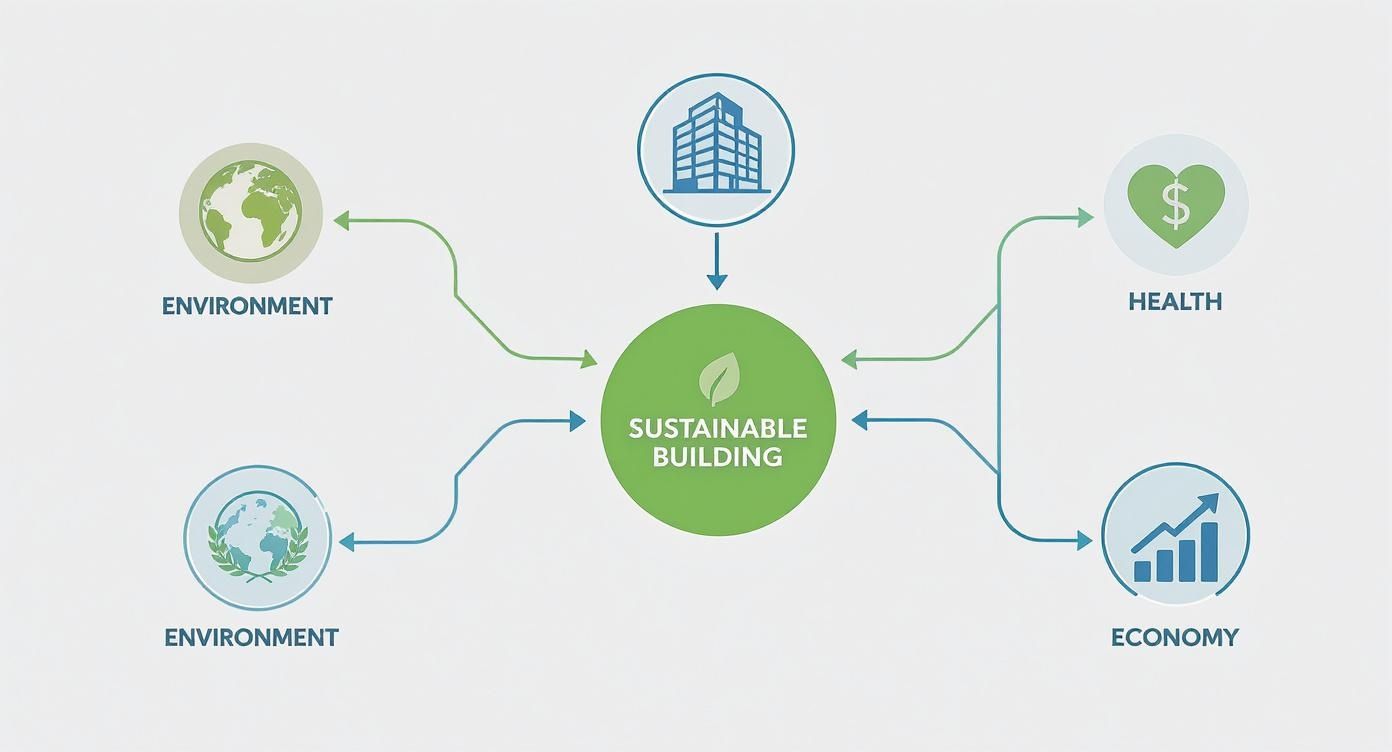
This infographic helps show how the key pillars of sustainable design—Environment, Health, and Economy—all feed into one another.

Infographic about sustainable design architecture

As you can see, a genuinely sustainable building pays dividends in all three areas. It’s about creating structures that are both balanced and built to last.

Conserving Water Resources

Water is a precious and finite resource, and sustainable buildings are designed to treat it that way. This goes far beyond just installing a few low-flow faucets; it means creating smart, integrated systems for managing every drop.

A key strategy is rainwater harvesting, where we collect precipitation from rooftops and store it in cisterns. This water can then be used for things that don't require treated drinking water, like irrigating the landscape or flushing toilets. This simple but incredibly effective technique can cut a building's reliance on municipal water by up to 50% or more.

Using Environmentally Preferable Materials

The materials we choose have a huge say in a building's final environmental toll. A cornerstone of green architecture is the thoughtful selection of sustainable materials for construction. We need to prioritize materials that are:

  • Renewable: Think sustainably harvested wood, cork, or fast-growing bamboo.
  • Recycled: Incorporating materials like reclaimed steel, recycled-content insulation, or crushed concrete.
  • Locally Sourced: This cuts down on the carbon emissions that come from trucking materials across the country.

Enhancing Indoor Environmental Quality

Finally, sustainable design turns its focus inward to create spaces that are genuinely healthy for the people inside them. This principle, known as Indoor Environmental Quality (IEQ), is all about making sure the air we breathe and the light we work in actually contribute to our well-being.

We get there by maximizing natural daylight, ensuring plenty of fresh air circulation, and using non-toxic, low-emission paints, sealants, and furnishings to keep indoor air clean. After all, a building that’s good for the environment should also be good for people.

The Tangible Benefits of Building Sustainably

When we talk about sustainable design, it’s easy to get lost in the ideals. But the truth is, the decision to build green isn't just about ethics—it’s about delivering clear, measurable advantages that you can see and feel.

These aren't abstract concepts. They are real-world gains that show up in your bank account, in the health of your family or employees, and in the resilience of your community. From conserving precious resources to creating spaces that just feel better to be in, the case for sustainable building is incredibly compelling.

And the market agrees. The green building sector is on track to become a $1.37 trillion industry by 2034, and that’s not by accident. This growth is fueled by proven results: buildings with 35% lower emissions and 16.9% reduced operational costs. With 84% of consumers now saying they prefer sustainable homes, it’s clear this is no longer a niche interest but a mainstream expectation. You can explore more of the data behind these green building statistics and market trends.

Environmental and Economic Advantages

The most obvious win for sustainable design is its gentle touch on the environment. When you intentionally design for energy efficiency, water conservation, and responsible material use, you automatically shrink the building’s ecological footprint. That means less pollution, lower carbon emissions, and less strain on local resources.

But here’s where it gets really interesting: those environmental victories translate directly into powerful economic ones. The smart design choices that lower energy and water use also slash your monthly utility bills. Over the life of a building, those savings can be massive.

Green buildings are also just better investments. They often command higher property values and attract discerning tenants willing to pay a premium for a healthier, more efficient space. On top of that, governments frequently offer tax credits and other incentives to encourage green construction, sweetening the deal for developers and owners alike.

Sustainable design turns a building into a high-performing asset. It’s not about spending more; it’s about investing wisely in a structure that costs less to operate, holds its value better, and contributes positively to its environment.

Thinking about the long game is crucial. A conventional building might seem cheaper upfront, but its true cost emerges over decades of high utility bills, maintenance, and lower eventual resale value. A sustainable building, on the other hand, is designed from day one to deliver value throughout its lifespan.

Green Building vs Conventional Building Long-Term Value

Metric Conventional Building Sustainable Building
Energy Costs Higher, subject to price volatility. 25-30% lower on average.
Water Usage High, inefficient fixtures. Up to 40% less water consumed.
Maintenance Frequent, often costly repairs. Lower due to durable materials.
Occupant Health Risk of "sick building syndrome." Improved air quality, better health.
Productivity Standard performance levels. Up to 11% productivity gains.
Resale Value Standard market appreciation. 7-10% higher on average.
Market Appeal Decreasing as standards shift. High and growing demand.

As the table shows, the initial investment in sustainable design pays dividends again and again, creating a building that is not only better for the planet but also a far superior financial asset.

Social and Health Benefits

Beyond the numbers, green architecture has a profound impact on the people who live and work inside. By insisting on non-toxic materials and high-performance ventilation systems, we create spaces with excellent indoor air quality. This simple change can dramatically reduce the risk of respiratory issues and allergies.

Sustainable design also prioritizes a connection to the natural world. Ample daylight isn't just a nice feature—it’s been proven to boost mood, reduce stress, and improve focus.

For a business, this translates into a real competitive edge. Employees in a well-designed green office are often healthier, more engaged, and more productive. In a home, it means creating a sanctuary that truly supports your family’s well-being. These buildings remind us that what’s good for the planet is also great for people.

Practical Strategies in Sustainable Design

Modern sustainable building with large windows and wooden accents

It’s one thing to talk about the principles of sustainable design, but it’s another to see how they come to life. These aren’t just abstract ideas; they are practical, hands-on techniques that architects use every day to create buildings that simply perform better. Let's look at a few of the most impactful strategies that turn green theory into architectural reality.

Think of each strategy as a tool in an architect's toolkit. When used together, they create a building that works with its environment, not against it.

Working with the Sun: Passive Solar Design

One of the most elegant and cost-effective strategies is passive solar design. At its core, this is simply the art of orienting and designing a building to make the most of the sun's free energy—soaking up heat in the winter and deflecting it in the summer. It's an ancient, common-sense approach, now supercharged with modern building science.

Here’s how it works in practice:

  • Strategic Window Placement: Large, south-facing windows are a must. They act like solar collectors, capturing maximum sunlight during colder months when the sun hangs low in the sky.
  • Smart Overhangs: Roof overhangs, awnings, or brise-soleils are precisely calculated to block the high, intense summer sun, preventing the building from overheating.
  • Thermal Mass: This is the building's internal battery. Materials like concrete, stone, or brick are used for floors and walls to absorb the sun's heat during the day and then slowly release it back into the space at night as temperatures drop.

This simple, thoughtful approach can dramatically slash the need for mechanical heating and cooling, which are typically the biggest energy hogs in any building.

The Building Envelope: A High-Performance Shell

Think of a building's envelope—its roof, walls, windows, and foundation—as its skin. A high-performance envelope is like wearing a top-of-the-line technical jacket; it keeps the inside comfortable no matter what the weather is doing outside. It's the building's first and most important line of defense against energy waste.

Creating one involves using advanced insulation to stop heat from moving in or out, and installing high-efficiency windows that insulate just as well as walls while still flooding rooms with natural light. The real goal is to create an airtight seal, eliminating drafts and uncontrolled air leaks. When you achieve that, the building's heating and cooling systems can finally relax.

A well-sealed building envelope is the bedrock of energy efficiency. It ensures the air you've paid to heat or cool actually stays inside, leading to significant and predictable savings on your utility bills, year after year.

Living Architecture: The Power of Green Roofs

A green roof is so much more than a pretty rooftop garden. It's a living, breathing system that delivers a whole host of benefits, both for the building and the environment around it. By covering a roof with vegetation, architects can fundamentally change how a building interacts with its surroundings.

A green roof system can:

  • Boost Insulation: The layers of soil and plants act as a natural insulator, cutting down on heating and cooling costs.
  • Manage Stormwater: Like a giant sponge, a green roof absorbs huge amounts of rainwater, which reduces runoff and eases the strain on city sewer systems.
  • Double a Roof's Lifespan: By shielding the underlying waterproof membrane from harsh UV radiation and extreme temperatures, a green roof can make it last two or even three times longer.

Smart technology is also pushing sustainable design forward. Buildings integrated with IoT and AI can cut energy bills by an incredible 30–50%. At the same time, circular construction methods can reduce on-site waste by up to 90%, leading to cleaner, faster projects. You can learn more about these top trends in sustainable architecture.

When applying these strategies to a home, even the interior details matter. For instance, selecting eco-friendly kitchen cabinets ensures that every part of the design contributes to the home's overall environmental performance.

Let's Talk About the Hurdles in Green Building

It's easy to get excited about the benefits, but let's have an honest conversation. Shifting to sustainable design isn't always a walk in the park. Architects, developers, and building owners run into real-world hurdles that are important to acknowledge.

The good news? These challenges are getting smaller and more manageable every year as the industry catches up.

That Big Question: What About the Upfront Cost?

This is usually the first thing people bring up. It’s true that some specialized materials and high-performance systems can carry a higher price tag than their conventional counterparts. That initial sticker shock can be enough to make anyone think twice and fall back on old, familiar methods.

But focusing only on the initial build cost is like judging a car's value by its down payment alone. You're missing the most important part of the story.

The smart way to look at it is through a life-cycle cost analysis. This just means we zoom out and look at the total cost of a building over its entire life, not just the day it's finished.

Think about it: when you add up decades of lower energy bills, fewer maintenance calls, and even higher property values down the road, that initial investment starts to look incredibly smart. It’s a classic case of spending a little more now to save a whole lot later.

Plus, the market is on our side. The more people demand green products, the more affordable they become. We're seeing the costs of sustainable materials and tech drop year after year. On top of that, there are tons of government incentives, tax credits, and grants out there designed to make the sustainable choice the easy choice.

Finding the Right Materials and People for the Job

Another real-world challenge is just getting your hands on the right stuff. Sourcing truly sustainable materials often takes more homework than just calling up your usual supplier. You have to verify where a product came from, what it’s made of, and make sure you can get it on site when you need it.

It's not just about materials, either. Green building often demands specific skills. Finding a crew that has real experience installing an airtight building envelope or a complex green roof system can be tough, depending on where your project is.

But here too, the tide is turning. These challenges are getting easier to overcome every day.

  • Better Supply Chains: The network of suppliers for certified green materials is growing fast. Online databases and improved logistics make it much simpler to find and order exactly what you need.
  • A More Skilled Workforce: Professional organizations and trade schools are stepping up with new training and certification programs. This is creating a much deeper pool of skilled green-building professionals.
  • Working Together from Day One: Smarter project management approaches, like Integrated Project Delivery (IPD), are becoming more common. This gets the architects, engineers, and builders in the same room from the very beginning, making sure the team has the right expertise to bring a sustainable vision to life.

Getting past these hurdles really comes down to planning ahead and working collaboratively. With the right strategy, these aren't roadblocks—they're just steps on the path to creating better, stronger, and more responsible buildings.

The Future of Sustainable Architecture

Futuristic sustainable building seamlessly integrated with nature

When we look at the horizon for sustainable design, we’re not just talking about fine-tuning what we already do. The real shift is in completely rethinking how our buildings relate to the world around them. The next wave of innovation is pushing past simple efficiency, aiming for structures that actively heal, adapt, and give back to their environment.

This forward-thinking mindset is already producing some game-changing ideas. Each one gives us a peek into a future where buildings act less like static objects and more like living, breathing parts of an ecosystem.

Key Innovations Shaping Tomorrow

Here are a few of the concepts that are truly pointing the way forward:

  • Net-Zero Buildings: Picture this: a building that generates as much energy as it uses over the course of a year. That’s the core idea behind net-zero design. By pairing hyper-efficient systems with on-site renewable energy, like solar panels, we can create structures that are completely self-sufficient.

  • Biophilic Design: This is about more than just scattering a few potted plants around. It’s a deep, meaningful integration of nature into the very fabric of a building. We're talking about living walls that clean the air, light wells that flood spaces with natural sunlight, and organic shapes that instinctively calm us and boost our well-being.

The ultimate goal is to erase the line between indoors and outdoors, fostering a constant, restorative connection to the natural world.

  • Circular Economy Principles: The old model was "build, use, demolish." The new way of thinking is to design for disassembly. Materials are no longer seen as disposable but as valuable assets to be recovered, reused, or repurposed. This turns buildings into "material banks" for the future and practically eliminates the idea of construction waste.

Pushing this evolution even faster are breakthroughs like smart materials that can adapt to changing temperatures or light, and AI-driven building management systems that optimize energy use second by second. The future of architecture isn't just green—it's resilient, restorative, and profoundly connected to nature.

Frequently Asked Questions

It’s completely normal to have questions when you first dive into sustainable design. There’s a lot of information out there, and it can be tough to sort through the buzzwords to find what really matters for your project.

We get it. To help clear things up, here are a few straightforward answers to the questions we hear most often.

How Is Sustainable Architecture Different from Regular Architecture?

Think about it like this: traditional architecture has always focused on two main things—how a building looks (aesthetics) and how it works (function). Sustainable architecture doesn't ignore those, but it adds a critical third dimension: long-term impact.

It’s about designing with a much wider lens. Instead of just solving for today, we're looking at the building's entire life, from where the materials come from all the way to how it might one day be repurposed. The goal is to create spaces that are not only beautiful and functional but also healthier for people and lighter on the planet.

Do Green Buildings Always Cost More to Build?

That’s probably the biggest myth we have to bust. While some high-tech green features can add to the upfront budget, smart sustainable design doesn't have to cost more. In fact, clever passive design strategies—like orienting a building to capture natural light and warmth—can actually reduce the need for expensive mechanical systems from day one.

The key is to think about the total cost of ownership, not just the initial price tag.

A sustainably designed building is an asset that pays you back over time. With lower utility bills, fewer maintenance needs, and higher property values, the long-term savings almost always make it the smarter financial choice.

Can Any Building Be Made Sustainable?

Yes, absolutely. While starting from scratch with a new build makes it simpler to integrate sustainable features, existing buildings represent a huge opportunity. We can take an older structure and thoughtfully retrofit it with modern, efficient systems and healthier materials.

This approach, known as adaptive reuse, is incredibly sustainable in its own right. It saves all the energy and carbon—the embodied carbon—that was spent to construct the building in the first place. With the right expertise, even a historic landmark can become a model of modern performance without losing an ounce of its character. It's a brilliant way to breathe new life into our communities while cutting down on waste.


At Sherer Architects, LLC, we're here to help you navigate the complexities of sustainable design, whether it's a new commercial building, an adaptive reuse project, or a historic preservation effort. We blend enduring design with future-focused performance.

Ready to start the conversation? Contact us today to bring your vision to life.

Categories
news

Sustainable Design Architects: Eco-Friendly Building Experts

Sustainable design architects are a different breed of professional. They create buildings designed from the ground up to have the smallest possible environmental footprint while being fantastic places for people to live and work. It's a holistic approach that blends energy efficiency, smart material choices, and a deep respect for the natural world. The result? Buildings that are better for the planet, cheaper to run, and healthier for everyone inside.

What a Sustainable Architect Really Does

A modern, sustainable building with large windows and greenery integrated into its design.

Think of a sustainable architect as a master integrator. A traditional architect might focus on aesthetics, space, and structure, but a sustainable architect brings another crucial perspective to the table: the long-term health of both the building's occupants and the environment itself. This job goes way beyond just drawing up plans.

From the very first conversation, these experts are thinking about a project’s total impact. They'll study the building site, local climate, and existing ecosystems to guide every single decision, from where a window should go to what the walls are made of. It’s all about being proactive to ensure the final building is efficient, resilient, and feels like it truly belongs in its environment.

More Than Just Solar Panels

A common myth is that sustainable architecture just means slapping some solar panels on the roof. While renewable energy is certainly part of the picture, the real philosophy is much more fundamental. True sustainability is baked into the design from day one.

Sustainable architects prioritize passive design strategies. This is the art of making the building do the work for you. Simple, brilliant things like orienting the structure to maximize sunlight and warmth in the winter, or designing for natural cross-ventilation to keep things cool in the summer without cranking the AC. It’s about building with nature, not fighting against it.

"The architectural sector plays a substantial role in global carbon emissions, accounting for approximately 37% of total emissions worldwide. Sustainable architecture is a direct response to this, aiming to create structures that give back more than they take."

This mindset completely changes the design process. Instead of just relying on brute-force mechanical systems to control temperature and light, the building’s own shape and materials are the first tools used to create a comfortable, hyper-efficient space.

Key Responsibilities and Focus Areas

The work of a sustainable architect spans the entire life of a building, from the initial sketch to long after the ribbon-cutting ceremony.

You'll find them focused on a few core areas:

  • Energy Optimization: This is about designing buildings that sip, rather than gulp, energy. Every choice is geared toward radically reducing the power needed for heating, cooling, and lighting.
  • Responsible Material Sourcing: They obsess over materials, choosing options that are non-toxic, made from recycled content, or sourced locally to minimize their environmental cost.
  • Water Conservation: They design clever systems like rainwater harvesting and install high-efficiency fixtures to ensure every drop of water is used wisely.
  • Indoor Environmental Quality: This is all about people. They work to create spaces with incredible air quality, abundant natural light, and a strong connection to the outdoors, which has been proven to boost health and productivity.

Ultimately, the goal is to create buildings that aren't just less bad, but are actually good—regenerative, beautiful, and built to last. A sustainable architect’s job is to prove that you don’t have to choose between world-class design and environmental stewardship; you can have both.

The Core Principles of Sustainable Design

A blueprint for a sustainable building, with notes on energy efficiency and eco-friendly materials.

Sustainable design isn't about ticking boxes or adding a few solar panels to a roof. It’s a philosophy. It sees a building not as an isolated box dropped onto a piece of land, but as an integral part of a much larger ecosystem. The principles that guide it are all interconnected, creating a framework that helps architects make smarter, more responsible choices from day one.

To really get what sustainable architects do, you have to understand the "why" behind their methods. These aren't just trendy ideas; they're the foundational pillars that separate a truly high-performing green building from one that just has a few eco-friendly gadgets. It's a completely different way of thinking about how we build and live in our spaces.

H3: Tread Lightly: Minimizing Site Impact

The first rule of sustainable design is simple: respect the land. This thinking starts long before a single shovel hits the dirt. A good sustainable architect walks the site and really studies its natural rhythms—the slope of the land, the existing trees and plants, how water flows, and where the sun travels across the sky.

The goal is to work with the site, not against it. Instead of bulldozing a flat patch and forcing a generic building onto it, the design is carefully shaped to fit the land's unique character. This might mean nestling the structure among mature trees to take advantage of natural shade or designing foundations that barely disturb the soil. You want the building to feel like it belongs there.

H3: A Smarter Approach to Energy Use

This is the principle most people think of, but it’s about so much more than just slapping on some solar panels. The real goal is to slash the building's energy needs from the get-go. This is done through passive design, a clever strategy that uses the building’s own shape and materials to keep people comfortable.

Here’s how it works:

  • Strategic Orientation: The building is positioned to catch the winter sun for free warmth and to shield itself from the hot summer sun, cutting down on air conditioning.
  • Natural Ventilation: Windows and vents are placed to create natural cross-breezes, letting the building breathe and cool itself down without a machine.
  • A High-Performance Envelope: This is like giving the building a high-tech coat. It involves using top-notch insulation, airtight construction, and energy-efficient windows to create a strong thermal barrier that keeps the indoor temperature steady.

Only after these passive strategies have done most of the heavy lifting do we look at active systems like high-efficiency HVAC or renewable energy. It ensures the building is fundamentally efficient, not just propped up by technology. While green solutions are key, it's also helpful to have a grasp of the fundamental architectural design concepts that underpin all great buildings.

H3: Protecting Our Water Resources

Water is precious, and sustainable architecture treats it that way. The approach is twofold: use less and reuse what you can.

Of course, it starts with the basics, like installing low-flow toilets, faucets, and showerheads. But a truly sustainable design goes further. Architects can design systems for harvesting rainwater from the roof to water the landscape. They can also set up graywater recycling, where water from sinks and showers is filtered and used again for things like flushing toilets. It all adds up to a huge reduction in the building’s thirst for city water.

H3: Building with Responsible Materials

Every single material that goes into a building—from the concrete foundation to the paint on the walls—has an environmental footprint. A sustainable architect carefully considers the entire lifecycle of each material: where it came from, how it was made, how far it had to travel, and what happens to it at the end of its life.

The building sector is a major player in global carbon emissions, responsible for about 37% of the world's total. A big part of this problem is our existing building stock, much of which is old and inefficient.

To combat this, architects look for materials with recycled content, source things locally to cut down on transportation fuel, and choose rapidly renewable resources like bamboo or cork. Just as important is avoiding materials that contain toxic chemicals that can harm both people and the planet.

H3: Creating Healthy Indoor Spaces

This final principle is all about the people inside. A building can save energy and be made from recycled steel, but if it makes people feel sick or uninspired, it’s a failure.

This focus on Indoor Environmental Quality (IEQ) is critical. It involves:

  • Flooding spaces with natural light, which has been proven to boost mood, focus, and productivity.
  • Ensuring the air is clean by using low-VOC (volatile organic compound) paints, glues, and furniture that don't release harmful chemicals into the air.
  • Connecting people with nature through views of the outdoors, indoor plants, and natural materials—a concept called biophilic design.

When you bring all five of these principles together, they create a building that is so much more than the sum of its parts. You get a structure that is not only better for the Earth, but also cheaper to run and a healthier, more enjoyable place for people to be.

The Tangible Benefits of Sustainable Architecture

While the ideals of sustainable design are easy to admire, its real power is in the results you can see and measure. For commercial clients, choosing to work with sustainable design architects isn't just about doing the right thing—it's a smart business decision with a clear return on investment.

These benefits aren't theoretical. They show up on your balance sheet, in your employees' well-being, and in the long-term market value of your property. By looking beyond the initial construction costs to the building's entire lifecycle, this approach reveals advantages that traditional building methods just can't offer.

Let's break down these benefits into three core areas: environmental, economic, and social. Each one builds on the others, creating a powerful argument for building green.

Environmental Gains for a Healthier Planet

The most obvious win is the positive impact on the natural world. Sustainable buildings are designed to be good neighbors in their ecosystem, minimizing their footprint and, in some cases, even helping to restore local environmental health.

This commitment to stewardship isn't just good for the planet; it tells a powerful brand story.

  • A Smaller Carbon Footprint: By leaning on passive design strategies, energy efficiency, and renewable power, sustainable buildings slash their greenhouse gas emissions. This is a crucial step, given the building sector's massive contribution to global emissions.
  • Smarter Resource Management: Thoughtful material selection, like using recycled steel or reclaimed wood, means we don't have to pull as many new resources from the earth. Water-saving systems like rainwater harvesting also go a long way in protecting precious local water supplies.
  • Protecting Local Ecosystems: A key goal is to disturb the site as little as possible. That means preserving mature trees, native plants, and natural drainage patterns, which helps protect local wildlife habitats and prevent soil erosion.

Economic Advantages and Long-Term Savings

This is where sustainable architecture really gets the attention of property owners and developers. While green projects can sometimes have a slightly higher upfront cost, they are engineered to save money month after month, year after year, delivering a strong and lasting return.

Sustainable design isn't an expense; it's an investment in future operational efficiency and asset value. The long-term financial rewards often far outweigh any initial premium, creating a more profitable and resilient property.

Lower utility bills are just the start. The complete financial picture is even more compelling:

  • Lower Utility Bills: Seriously lower. High-performance insulation, smart window placement, and efficient HVAC systems can cut energy use by 25% to 50%. On the water side, efficient fixtures and reuse systems can reduce consumption by 40% or more.
  • Higher Property Value: Green-certified buildings consistently fetch higher sale prices and rental rates. In fact, studies show that LEED-certified commercial buildings can see their asset value jump by over 10%.
  • Incentives and Rebates: Governments at all levels often offer tax credits, grants, and other financial perks for projects that meet specific green standards, which can significantly improve the project's bottom line.
  • Reduced Maintenance: When you build with durable, high-quality materials and well-designed systems, things last longer. This means less money spent on maintenance and replacement over the building's life.

When you look at the whole picture, the economic argument becomes clear. The table below breaks down how these financial and environmental benefits accumulate over the building's entire life.

Comparing Conventional vs Sustainable Building Lifecycles

This table illustrates the long-term economic and environmental differences between traditional construction and sustainable design, highlighting operational savings and value appreciation.

Lifecycle Stage Conventional Building Sustainable Building
Design & Construction Focuses on minimizing initial cost. Often uses standard, resource-intensive materials. Higher initial investment in design, high-performance systems, and certified materials.
Operation & Maintenance High, unpredictable energy and water costs. Frequent system maintenance and replacements. Significantly lower utility bills (25-50% savings). Durable materials reduce maintenance needs.
Occupancy Standard indoor air quality. Can lead to lower productivity and higher absenteeism. Enhanced indoor environmental quality, boosting occupant health, productivity, and satisfaction.
End of Life Demolition results in significant landfill waste. Materials are rarely repurposed. Designed for deconstruction. Materials are recycled, reused, or repurposed, minimizing waste.
Overall Value Value depreciates based on age and condition. Vulnerable to rising energy prices. Higher asset value and rental rates. Resilient to market shifts and regulatory changes.

As you can see, the initial investment in sustainability pays dividends at every stage, creating a more valuable and future-proof asset.

Social Benefits and Human Well-Being

The impact on the people inside the building is one of the most powerful, yet often overlooked, benefits. A space designed by skilled sustainable architects is simply a healthier, more pleasant place to be. That has a direct impact on business performance.

Focusing on Indoor Environmental Quality (IEQ) creates real, people-focused advantages:

  • Healthier Occupants: Using non-toxic materials and ensuring a constant flow of fresh air drastically reduces indoor pollutants. The result? Fewer allergies, fewer respiratory issues, and fewer sick days.
  • Better Focus and Productivity: It's been proven time and again: abundant natural light, views of nature, and comfortable indoor temperatures help people concentrate. This can boost employee productivity by as much as 18%.
  • A Magnet for Talent: A healthy, beautiful, and sustainable workplace is a powerful tool for attracting and keeping the best employees. It sends a clear signal that a company cares about its people and the planet.

How Sustainable Projects Get Built

Think about a typical construction project. It often feels like a relay race, where the client hands off plans to an architect, who passes them to an engineer, who finally gives them to a builder. Each person works in their own lane, which almost always leads to missed opportunities and expensive rework down the line.

Sustainable projects throw that entire model out the window. From the very beginning, the process is built on collaboration. It’s more like a well-choreographed team performance than a race. This approach, led by an experienced sustainable design architect, makes sure the final structure isn't just a building with a few "green" features tacked on. It's a high-performing system where every single piece works in harmony.

The Integrated Design Process

The secret sauce for a truly successful sustainable project is what we call the Integrated Design Process (IDP). Picture it as a master planning session that happens before anyone even thinks about drawing a blueprint. The architect, engineers, builders, and—most importantly—the client all gather around the same table from day one.

Getting everyone together early is critical. It aligns the entire team on the project’s core goals. Are we aiming for a specific energy target? A certain percentage of recycled materials? A LEED certification? By talking through the challenges and ideas at the start, the team can find smart solutions that would be impossible to add in later.

A project’s greatest potential for cost-effective sustainability improvements is in its earliest stages. Decisions made during the initial design phase have a far greater impact on long-term performance and operational savings than any changes made during construction.

For example, the structural engineer can work directly with the architect to design a frame that uses less steel. At the same time, the mechanical engineer can explain how turning the building just a few degrees will dramatically shrink the size of the HVAC system needed. This upfront teamwork prevents the siloed decisions that create big problems later.

Site Analysis and Passive Design

With the team’s goals set, the next step is to get to know the land itself. A sustainable architect doesn't just glance at the property lines; they study the site’s unique personality. This means doing a deep-dive site analysis to map out the key environmental factors:

  • Solar Path: We track the sun's journey across the site through every season. This tells us the perfect orientation to capture winter warmth and block summer heat.
  • Prevailing Winds: By identifying wind patterns, we can design for natural cross-ventilation, which cuts down the need for air conditioning.
  • Topography and Hydrology: We look at the natural slope and water flow to manage stormwater and prevent erosion.
  • Existing Ecology: We take an inventory of mature trees and native plants that can be saved to provide natural shade and habitat.

All this data feeds directly into the schematic design, where passive strategies become the star of the show. The building’s shape, the placement of windows, and the choice of materials are all carefully orchestrated to work with the local climate, not against it. The idea is to let nature do most of the heavy lifting before we have to flip a switch.

Sourcing Materials and Managing Waste

Once the design begins to solidify, our attention turns to the stuff the building is actually made of. A sustainable architect carefully researches and specifies materials based on strict environmental and health standards. This means we look way beyond the price tag to consider the product's entire lifecycle, from how it was sourced to what happens to it at the end of its life.

Transparency is non-negotiable here. We often ask for Environmental Product Declarations (EPDs), which are basically nutrition labels for building materials that detail their environmental footprint. We look for materials that are locally sourced, made with recycled content, rapidly renewable, and free of toxic chemicals. This process ensures the building itself helps create a healthier indoor environment for the people inside.

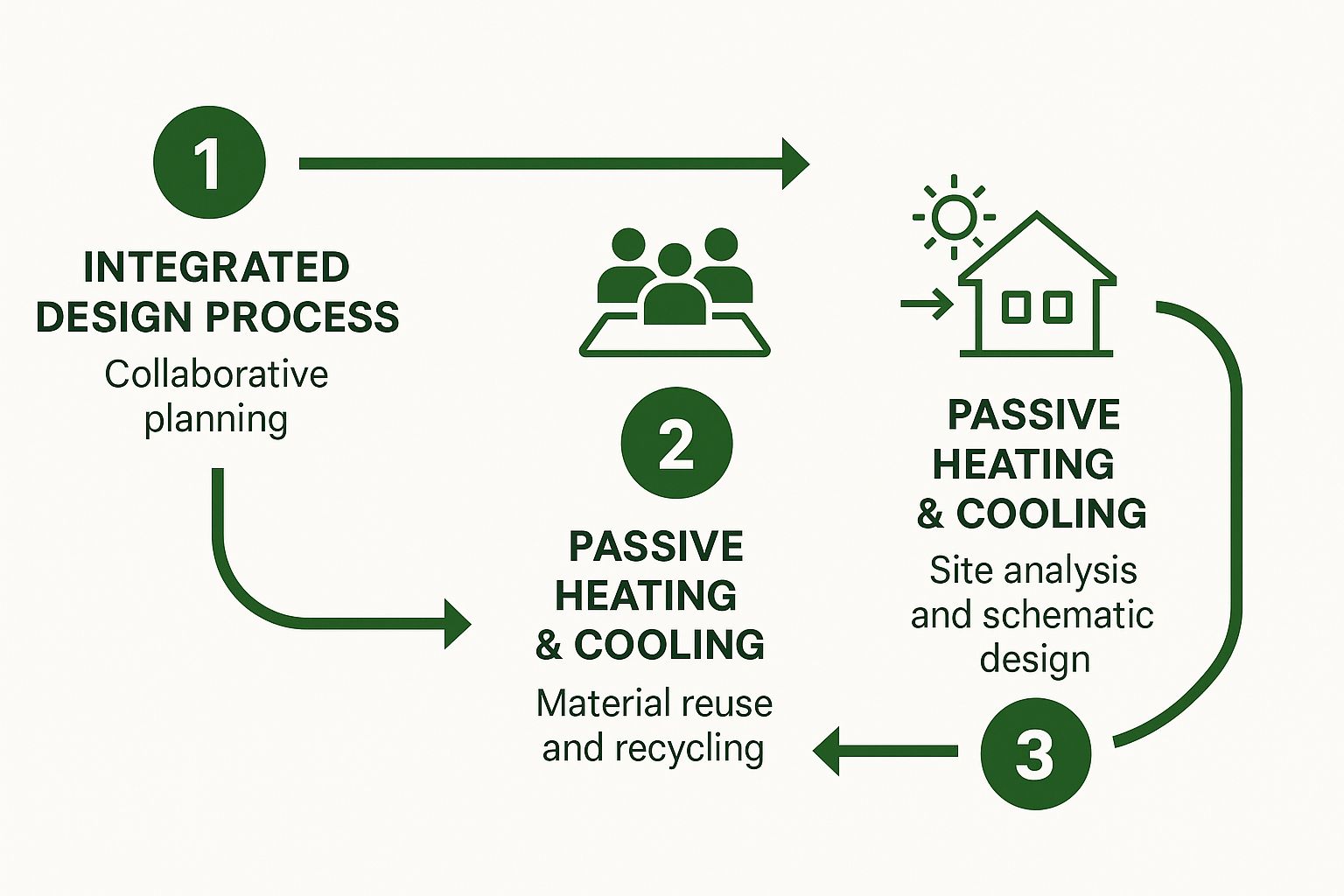
This infographic breaks down how these key phases—integrated design, passive strategies, and responsible construction—all connect to create a successful project.

Infographic about sustainable design architects

As you can see, that initial collaboration is what enables smarter design, which in turn leads to much more responsible construction practices.

That same commitment continues right through the construction phase with a sharp focus on waste management. Instead of just sending all the scraps to a landfill, we create a waste diversion plan. Wood, metal, drywall, and cardboard are all sorted on-site for recycling. Sometimes, we can even salvage materials for reuse in another part of the project, turning would-be trash into a valuable asset.

Incorporating Technology and Renewable Energy

Smart technology is becoming a huge part of modern sustainable architecture. The demand for architects with these skills is booming—the U.S. alone expects an 8% increase in architectural design jobs by 2032, largely driven by the push for net-zero buildings. Tools like Building Information Modeling (BIM) let teams create a detailed digital twin of a building, allowing us to simulate its energy performance and spot problems long before the first shovel hits the ground.

Renewable energy is often the final piece of the puzzle. After we've used passive design to drastically lower the building's energy demands, we can bring in systems like solar panels to cover the rest. For anyone curious about what that looks like on a smaller scale, a practical solar panel installation guide offers great insight. By taking this step-by-step approach, we make sure renewable energy systems are sized correctly, making them far more effective and maximizing their return on investment.

How to Choose the Right Architect for Your Project

A team of architects reviewing sustainable building blueprints in a modern office.

Finding the right architect is probably the single most important decision you'll make for your sustainable building. It's not just about finding someone who can sketch a beautiful facade; it's about partnering with a team that truly understands how to create buildings that perform—efficiently, healthily, and for the long haul.

Your investment's success depends on this choice. True sustainable design architects have a specific mindset and a proven track record. The key is to look past the "green" buzzwords and dig into their actual qualifications, portfolio, and design philosophy. Think of it as hiring a guide who knows the terrain of sustainable construction inside and out.

Look for Specialized Credentials

Certifications are your first objective checkpoint. They're a clear signal that an architect has put in the work to master the technical standards of sustainable design. They act as a third-party seal of approval, telling you this person or firm speaks the language of high-performance buildings fluently.

As you're vetting potential partners, keep an eye out for these key credentials:

  • LEED AP (Leadership in Energy and Environmental Design Accredited Professional): This is one of the most recognized certifications in the world. A LEED AP has a deep understanding of the entire LEED rating system, from energy modeling to indoor air quality.
  • BREEAM AP (Building Research Establishment Environmental Assessment Method Accredited Professional): A powerhouse in Europe and gaining ground globally, BREEAM signifies expertise in a science-backed approach to sustainability.
  • Passive House Certified Consultant (CPHC): This one is for the serious energy nerds. CPHC certification is incredibly rigorous and focuses on creating buildings so efficient they barely need any active heating or cooling. It's a masterclass in building science.

Spotting these on a firm's website shows they’ve invested heavily in their craft.

Scrutinize Their Portfolio

A slick website is nice, but a portfolio of finished, high-performing projects is everything. This is where you separate theory from reality. Don’t just scroll through the pretty pictures—look for the story behind each building.

Ask for case studies that are similar in scope and use to your own project. A team that excels at sustainable homes might not be the right fit for a sprawling commercial complex. And remember, the field is evolving fast. The 2025 Sustainable Construction Barometer noted that 67% of global stakeholders now grasp the concept, with 95% agreeing it's important. You need an architect who's a leader, not a follower. You can learn more about the survey and its insights into sustainable construction.

A portfolio should be more than a gallery of finished buildings. It should be a library of success stories, complete with performance data, client testimonials, and clear explanations of the sustainable strategies that were implemented.

When you're looking through their work, search for specifics. Are they orienting buildings to take advantage of the sun? Are they proudly pointing out their use of reclaimed wood or innovative water-saving tech? This is your chance to see their philosophy in action.

Ask the Right Questions During Interviews

The interview is where you get a feel for their passion and practical know-how. This is your chance to move beyond the resume and understand how they think and work. Come prepared with a handful of targeted questions.

Here are a few essential questions to get the conversation started with potential sustainable design architects:

  1. Can you show me how you've used climate-responsive design in past projects? This tests their grasp of passive design and their ability to create a building that works with its environment, not against it.
  2. How do you measure a building's performance after it's built? The best architects stick around. Look for firms that conduct post-occupancy evaluations to prove the building is actually delivering the promised energy savings and keeping occupants happy.
  3. Walk me through your approach to the Integrated Design Process. Their answer here is crucial. It tells you how they get engineers, builders, and other experts talking from day one to avoid costly mistakes down the line.
  4. How do you stay on top of new sustainable materials and technologies? This field changes in the blink of an eye. A great partner will be genuinely excited to talk about the latest innovations and how they could benefit your project.

Choosing your architect is a long-term investment. By taking the time to carefully vet their credentials, their work, and their way of thinking, you’ll find a partner who delivers not just a building, but a resilient and valuable environment for years to come.

Your Top Questions About Sustainable Architecture, Answered

Even when the principles and perks of sustainable architecture are clear, clients naturally have practical questions. It often comes down to the real-world stuff: cost, return on investment, and just trying to make sense of all the terminology. These are exactly the conversations we should be having.

An experienced architect’s job is to cut through the noise and address these concerns head-on. By providing clear, data-backed answers, they help clients feel confident in their decisions, making sure everyone is on the same page about the project's true value and long-term vision.

Let's dive into some of the questions we hear most often.

Does Sustainable Architecture Really Cost More Upfront?

This is the big one, and the answer isn't a simple yes or no. Sometimes it can, but the "green premium" you might have heard about is largely a thing of the past. The cost gap is shrinking fast, and a smart architect knows how to make the numbers work.

Think about it this way: investing more in a high-performance building envelope—better insulation, airtight sealing, and high-efficiency windows—might raise the initial budget for materials. But that investment means you can install a much smaller, less expensive heating and cooling system. The costs often end up balancing each other out. An integrated design process is all about finding these smart trade-offs from day one.

A lot of powerful sustainable features don't cost a penny. Things like orienting a building to capture natural light or take advantage of passive heating are purely the result of intelligent design, not expensive gadgets.

Besides, the data shows the cost difference is often negligible. On average, a project aiming for a certification like LEED might see an upfront cost bump of just 0% to 4%. When you start factoring in operational savings and tax incentives that kick in right away, that small initial difference is often recovered in no time. It's a sound financial decision from the get-go.

What's the Difference Between Green Building and Sustainable Design?

People tend to use these terms interchangeably, but there's a subtle and important difference in the way of thinking. Getting this distinction helps clarify the philosophy behind the work of the best architects in this field.

Here’s a simple way to look at it:

  • Green Building is often about the product. It focuses on adding specific eco-friendly components to a building, like recycled materials, low-flow toilets, or solar panels. It's a feature-driven approach aimed at doing less harm.
  • Sustainable Design is all about the process. It’s a holistic mindset that looks at the building’s entire relationship with its site, its occupants, and the wider environment, starting from the very first sketch. It’s about using smart, passive strategies first, before ever picking out a "green" product.

A green building might have a solar array on the roof. A sustainably designed building is first shaped and positioned so it needs less electricity in the first place. The best sustainable design architects use the philosophy of sustainable design to create truly effective green buildings. One is the mindset; the other is the result.

How Do I Calculate the Payback Period?

For any commercial client, the return on investment (ROI) is everything. The question isn't just if a sustainable building pays for itself, but when. This payback period is a critical number, and it's often much shorter than you'd think.

The fastest ROI comes from slashing your operating costs. It’s not uncommon for energy-efficient buildings to see utility savings between 25% and 50%. For a large commercial building, that’s thousands—or even hundreds of thousands—of dollars back in your pocket every year. Likewise, simple water conservation strategies can cut water and sewer bills by 40% or more.

Let's run a quick example:

  • A business invests an extra $100,000 in a high-efficiency HVAC system, LED lighting, and better insulation.
  • These upgrades save the company $25,000 a year in energy costs.
  • The simple payback period is just four years ($100,000 ÷ $25,000/year).

And that simple math doesn't even account for other financial upsides like tax credits, higher rental income, or proven boosts in employee productivity, all of which can make the payback period even shorter. A good architect will run a detailed lifecycle cost analysis for you, proving that sustainability isn't an expense—it's one of the smartest investments you can make.


At Sherer Architects, LLC, we believe that beautiful, enduring design and sustainable performance go hand in hand. Our team specializes in creating commercial spaces that are not only environmentally responsible but also economically sound, guiding clients through every stage to deliver results that stand the test of time. To discuss how we can bring structure and sustainability to your next project, visit us at https://shererarch.com.