

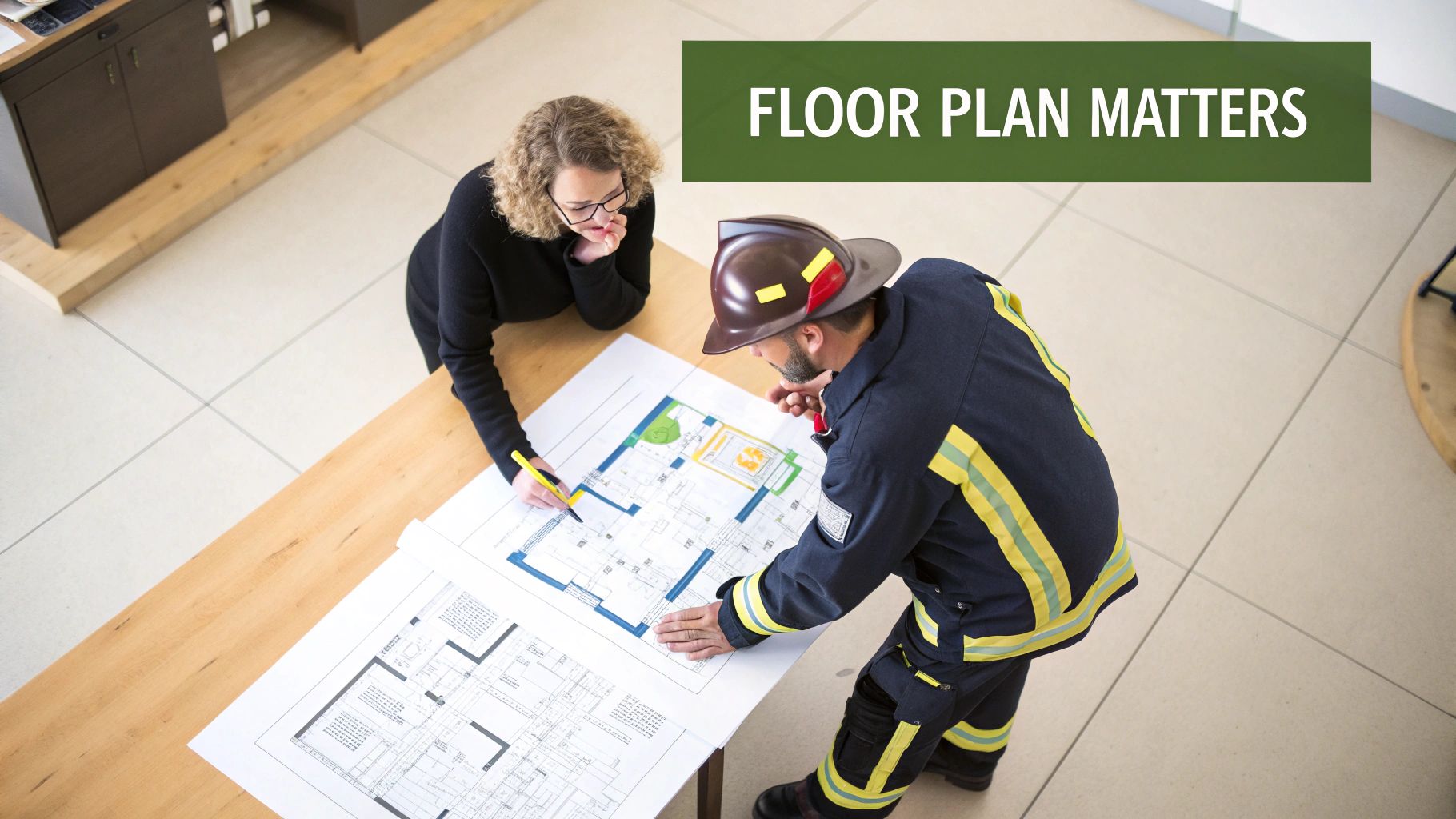
A firehouse floor plan is so much more than a set of drawings. It’s the operational heartbeat of the station and a silent partner on every single call. A well-designed layout can shave precious seconds off response times, protect the long-term health of firefighters, and create a building that serves the community for decades.
Beyond the Blueprint: Why Your Firehouse Floor Plan Matters
Looking at a blueprint, you're essentially seeing a puzzle where every single piece has a critical job to do. The ultimate goal is to design a building that runs like a well-oiled machine for emergencies but also functions as a safe, healthy second home for the crew.
A strategic firehouse floor plan isn't just about fitting rooms into a box; it's a careful balancing act between the urgent demands of emergency response and the day-to-day human needs of 24/7 living.
Core Components of a Modern Station
Today's fire stations are incredibly complex buildings. They have to serve multiple, distinct functions all at once, and each zone needs to be positioned just right for maximum efficiency and safety. To get this right, it pays to dig into optimal space planning strategies that can guide the layout.
Every effective plan is built around a few primary components:
- Apparatus Bay: Think of this as the launchpad. It’s built for getting vehicles out the door fast and maintaining them safely when they return.
- Decontamination Zone: This is a non-negotiable transition area. It’s the buffer that stops carcinogens and other contaminants from being tracked into the clean living spaces.
- Living Quarters: Often called the "cold zone," this is where firefighters eat, sleep, and recharge. It includes bunk rooms, a kitchen, a dayroom, and other personal spaces.
- Support & Administrative Areas: This bucket includes everything else needed to run the station—training rooms, fitness areas, gear storage, and offices.
Balancing Efficiency with Well-Being
The best floor plans manage to accomplish two things that seem completely at odds. First, they create the shortest, most direct path from the living quarters to the apparatus bay to ensure the fastest possible turnout.
But at the same time, they must create a deliberate, multi-step "dirty" path from the bay back into the living quarters to ensure firefighters can properly decontaminate.
A successful firehouse floor plan acts as a critical health and safety tool. It's designed to minimize exposure to hazards and support the long-term physical and mental well-being of the personnel who live and work within its walls.
This dual focus—operational speed on one hand, crew health on the other—is what truly defines modern fire station design. You can see it in projects like the new Bernalillo County Fire Station #36, which integrates 12 bunks and four apparatus bays into a layout that prioritizes both. A thoughtfully designed floor plan isn't an expense; it's a powerful investment in the safety of your crew and your community.
The Apparatus Bay: The Engine of Your Fire Station
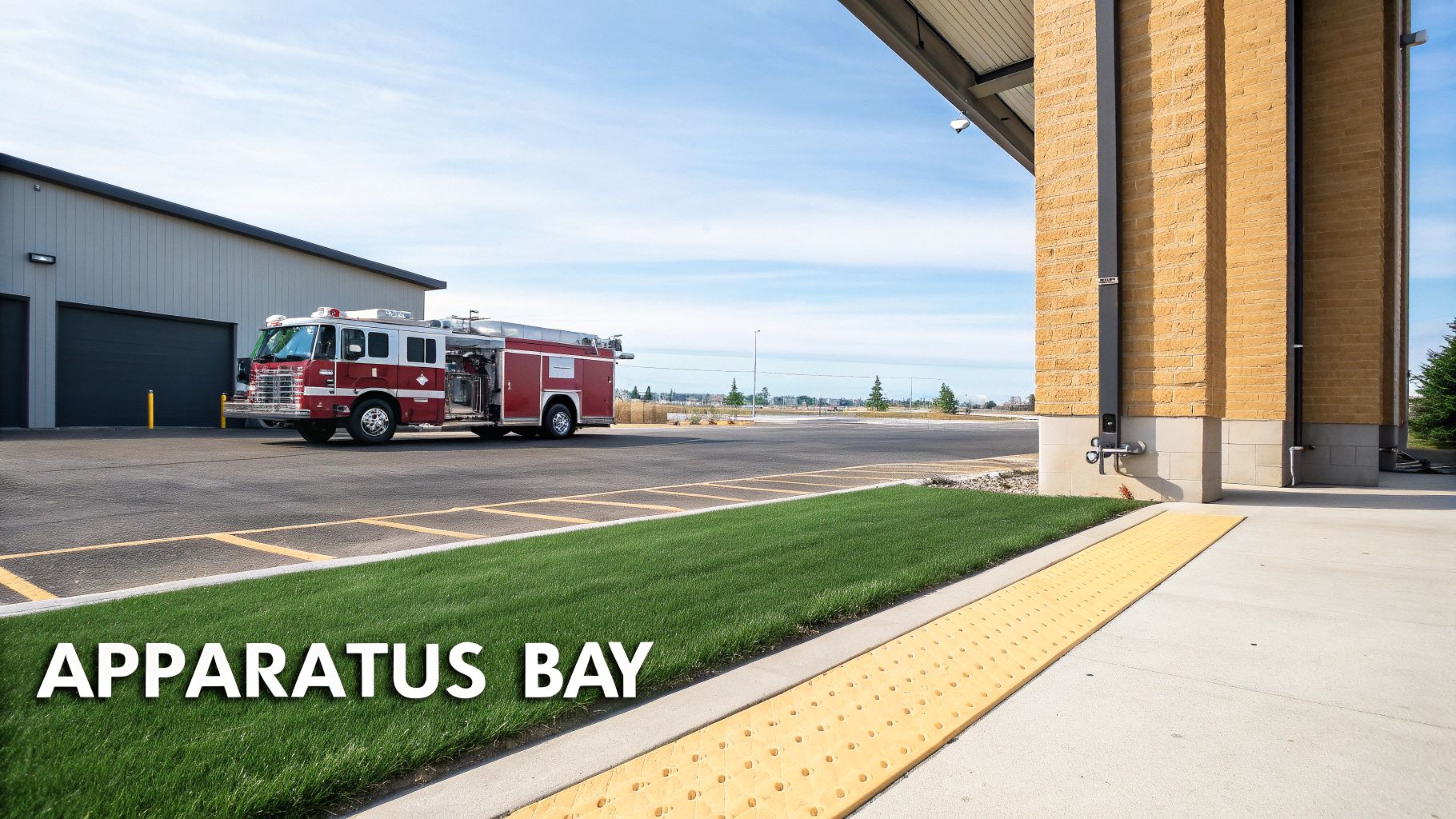
You can think of the apparatus bay as the heart of the entire fire station. It's far more than a glorified garage; it's the launchpad for every single emergency response. The design of this space—from the type of doors you choose to the slope of the floor drains—directly impacts how fast and safely your crew can get on the road.
The whole layout is about one thing: rapid deployment. It’s not just about finding a spot to park the trucks. It’s about creating a dead-simple, unobstructed path for firefighters to get from the living quarters into the rigs. Every second shaved off that process is a second that can save a life or a home out in the community.
Drive-Through or Back-In Bays
One of the first big forks in the road when designing the bay is deciding on its basic flow. The two main options each have their own pros and cons, usually dictated by the size of your lot and your department's standard operating procedures.
-
Back-In Bays: This is the traditional setup you see most often. Vehicles leave through the front doors and have to back in when they get back to the station. This layout is a real space-saver, making it a good fit for smaller or narrower properties. The downside is that it demands a lot of skill from the driver and requires spotters, and the whole process of backing in a massive ladder truck can bring other station activities to a halt.
-
Drive-Through Bays: With this design, the apparatus comes in through doors at the back of the bay and pulls straight through, parking nose-out and ready for the next call. This is by far the safer option because it eliminates almost all the risks that come with backing. Of course, it requires a bigger piece of land to allow access to both the front and rear, but it makes on-site circulation a breeze and dramatically cuts the time it takes to get rigs back in service.
Ultimately, choosing between these two is a classic balancing act between ideal operations and the practical constraints of land and budget. When the site allows for it, though, a drive-through design is almost always the preferred choice for safety and speed.
Calculating Critical Clearances
The geometry of the apparatus bay is a game of inches. Fire trucks, especially the newer ladder trucks and aerials, are bigger and heavier than ever. Your firehouse floor plan can't just account for the vehicle's footprint; it has to include the space people need to hustle around it without tripping over each other.
A rookie mistake is designing for the fleet you have today, not the one you'll have in the future. Apparatus only gets bigger, and the bay needs to be sized to handle vehicles the department might not even buy for another 15-20 years.
This kind of forward-thinking means adding generous clearances that act as a buffer for whatever comes next.
Essential Spatial Math
- Vertical Clearance: Bay doors need a minimum clear opening of 14 feet high and 14 feet wide. But honestly, 16 feet is becoming the new standard to be safe with modern aerials. The ceiling inside the bay needs to be even higher to give mechanics room to tilt the cab for engine work.
- Horizontal Clearance: You absolutely need at least four to five feet of clear walking space around every side of a parked rig. This "walk-around" room is non-negotiable for daily truck checks, opening compartments, and letting firefighters throw on their gear without being pinned against a wall.
- Bay Depth: The bay has to be long enough for your longest vehicle, plus a buffer of at least five feet at the front and the back. This simple cushion prevents expensive mishaps with the overhead doors and equipment.
Integrating Support Functions
A well-designed apparatus bay doesn't work in isolation. Its real power comes from the smart placement of all the support spaces that feed into it. The whole idea is to create a seamless workflow for everything from decontamination to maintenance and storing gear.
Key adjacent zones to plan for:
- Decontamination Area: This needs to be the first stop for crews coming back from a call. Placing it for immediate access is a critical step in protecting firefighter health.
- Workshop/Maintenance Bay: A dedicated spot for routine checks and small repairs keeps the fleet ready to roll at a moment's notice.
- Gear & SCBA Storage: Locating this right off the bay floor shaves critical seconds off turnout times.
- Hose Storage/Drying Tower: Taking proper care of hoses makes them last longer and perform reliably when it counts.
When you start treating the apparatus bay and its support areas as one integrated system, the firehouse floor plan evolves from a simple parking structure into a finely tuned operational hub.
Designing for the Crew: Crafting Effective Living Quarters
While the apparatus bay is the operational heart of a fire station, the living quarters are its soul. A fire station isn't just a place of work; it's a second home where crews live, eat, and sleep through 24-hour shifts. The environment has to support rest, recovery, and readiness, so a human-centric firehouse floor plan goes far beyond just providing shelter—it has to address the very real needs of modern first responders.
We've come to understand that a firefighter's performance is tied directly to their physical and mental well-being. The days of cramped, noisy communal dorms are fading fast. They're being replaced by thoughtfully designed spaces built to reduce stress, improve sleep, and forge strong team bonds. Every decision made in this "cold zone" is an investment in a healthier, more resilient, and more effective crew.
From Open Dorms to Private Bunk Rooms
One of the biggest shifts in fire station design is the move from large, open-bay dormitories to individual bunk rooms. Sure, the old-school dorms built a certain kind of shared experience, but they completely failed to provide the privacy and quiet needed for quality rest between calls. All it took was one person's snoring or a late-night stir to disrupt the entire shift's sleep.
Individual bunk rooms solve that problem head-on. They give each firefighter a personal space to decompress and get the deep, restorative sleep that's so critical for high-stakes decision-making. This isn't just a creature comfort; it's a powerful tool for recruitment and retention, helping create a more professional and inclusive environment for a diverse workforce.
A well-rested firefighter is a safer, more effective firefighter. Prioritizing individual sleeping quarters isn't an expense—it's an investment in operational readiness and long-term career sustainability.
These rooms don't need to be huge. A typical bunk room is an exercise in efficiency, usually just big enough for a bed, a small desk, and a personal locker or closet. The most important feature is the door that closes, giving each crew member a small slice of control over their own environment.
Where the Crew Becomes a Team: Communal Spaces
While private bunks are essential for individual rest, it's the communal areas where a group of firefighters truly becomes a team. These spaces are intentionally designed to spark interaction, collaboration, and the kind of informal bonding that proves critical in a high-stress profession. More often than not, the kitchen and dining area becomes the social hub of the entire station.
Here’s how these shared spaces bring a crew together:
- Kitchen & Dining: This is where stories are told and meals are shared. An open layout with a big, sturdy dining table encourages everyone to sit down together, strengthening relationships. The space has to be tough, with commercial-grade appliances and plenty of storage to handle the demands of multiple shifts.
- Dayroom: Think of this as the station's living room. It’s a place to unwind, watch TV, or hit the books. The key is comfortable, durable seating and a layout that can host a group watching a game or offer a quiet corner for someone to read.
- Outdoor Patio: Never underestimate the power of fresh air. A simple patio or outdoor seating area provides a much-needed escape, giving crews a place to decompress away from the constant state of readiness inside.
These zones are more than just amenities; they are foundational to building the trust and cohesion that a team relies on during an emergency. The design for Bernalillo County Fire Station #36, for instance, made the spacious kitchen and dayroom central components of its 12-bunk facility for exactly this reason.
Integrating Training and Support Zones
Beyond sleeping and eating, a modern fire station has to support continuous training and physical fitness. Weaving these support zones directly into the firehouse floor plan makes them accessible and encourages their use, which pays dividends in firefighter performance and safety.
Key support areas to include are:
- Fitness Center: Physical conditioning isn't a hobby; it's a core requirement of the job. An on-site fitness room with a good mix of cardio and strength-training equipment is non-negotiable. Critical design details include excellent ventilation and tough, resilient flooring.
- Training Classroom: This room is the hub for formal instruction, shift briefings, and studying for certifications. It needs to be a flexible space, outfitted with modern audiovisual tech to support different learning styles.
- Administrative Offices: The station captain and other officers need a dedicated space to handle reports, scheduling, and other administrative work without constant interruptions from the day-to-day station buzz.
By strategically placing these functions within the station, the design moves beyond a simple garage for fire trucks. It becomes a comprehensive facility where personnel can rest, train, and thrive throughout their careers.
Hot, Warm, and Cold Zones: A Modern Health-First Approach
One of the biggest shifts in fire station design over the past couple of decades has been a laser focus on protecting the long-term health of firefighters. The core principle is straightforward but vital: stop the invisible threats—carcinogens, soot, and chemical residues from a fire scene—from ever migrating into the station's living quarters. A well-designed firehouse floor plan accomplishes this by creating a clear, one-way path through distinct "hot," "warm," and "cold" zones.
Think of it like a cleanroom in a manufacturing plant or a sterile corridor in a hospital. You'd never see a surgeon walk straight from the parking lot into an operating theater. There's a mandatory, multi-step process of scrubbing, gowning, and transitioning. We now apply that same uncompromising logic to fire stations to contain hazardous materials and protect the crew.
This diagram lays out the decontamination workflow that is physically built into a modern firehouse floor plan, showing how a firefighter moves from a contaminated state to a clean one.
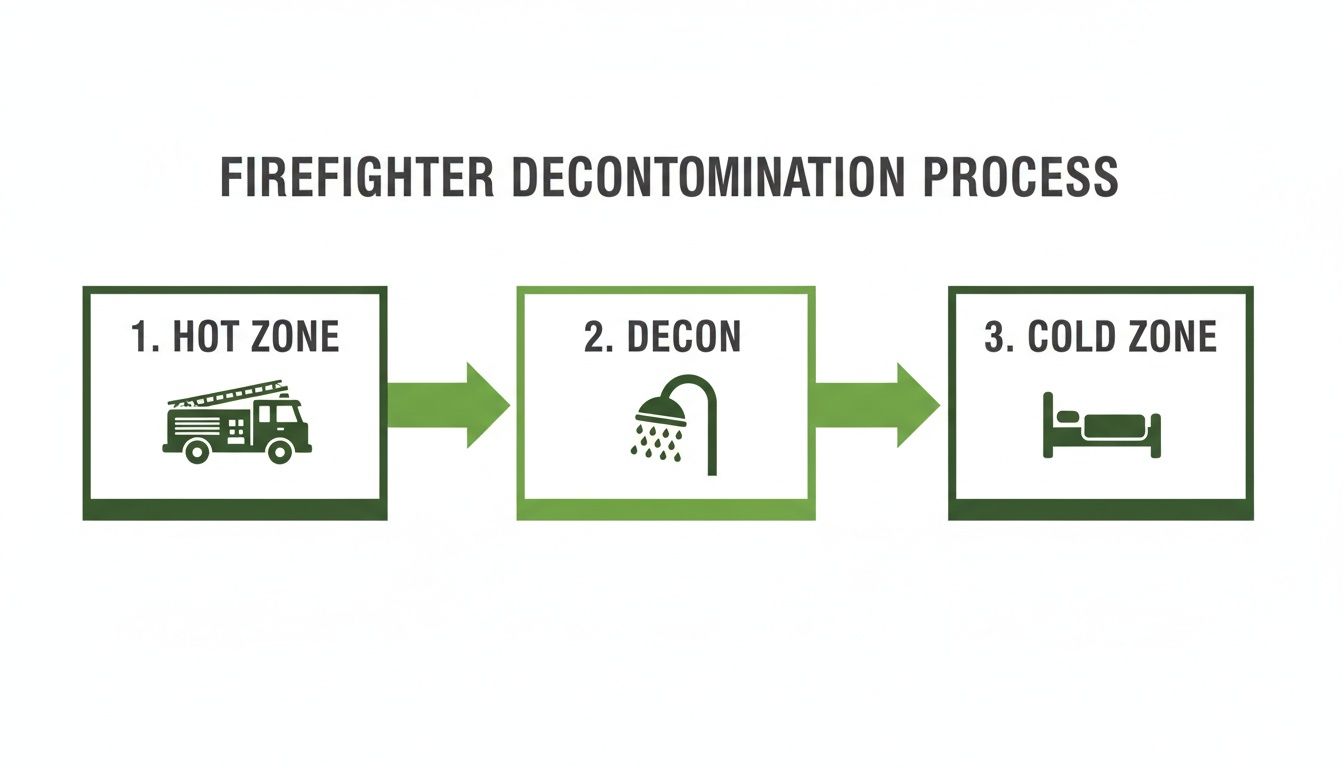
As you can see, the path from the apparatus bay to the living quarters isn't a straight line. It’s a deliberate, mandatory detour through a decontamination sequence.
Following the Decontamination Path
This entire process kicks off the second a truck pulls back into the station. The apparatus bay is the designated Hot Zone, the most contaminated space in the entire building. Before going any further, firefighters perform a "gross decon" right there, hosing down themselves and their gear to remove the worst of the grime.
Next, they step into the Warm Zone, which acts as a sophisticated airlock between the dirty bay and the clean living spaces. The workflow here is linear and non-negotiable, typically flowing through a few key areas:
- Turnout Gear Room: First, they enter a "dirty" room to shed all their contaminated bunker gear. That gear goes straight into specialized, heavy-duty extractors (washing machines) designed to handle hazardous materials.
- Decon Shower: After stripping off their gear, the firefighter moves directly into an adjacent pass-through shower. This isn't just for comfort; it's a critical health step to wash off any lingering particulates from their skin.
- Clean Room/Locker Area: Once showered, they emerge into a "clean" room on the other side. Here, they can finally access clean uniforms, towels, and personal items from lockers that have never been exposed to contaminants.
This sequence is not just a suggestion; it's a fundamental health and safety protocol that is physically enforced by the building's layout. The floor plan itself becomes an active partner in preventing job-related cancers and illnesses.
Only after running this entire gauntlet can a firefighter enter the Cold Zone—the kitchen, dayroom, bunk rooms, and offices—with full confidence that they aren't dragging carcinogens in with them.
The table below breaks down this essential workflow, showing how each action corresponds to a specific, purpose-built zone within the fire station floor plan.
Fire Station Decontamination Zone Workflow
This table outlines the sequential steps and corresponding floor plan zones for proper firefighter decontamination, preventing cross-contamination into living areas.
| Step | Action | Designated Zone | Key Design Feature |
|---|---|---|---|
| 1 | Truck returns to station, crew performs gross decon on apparatus and gear. | Hot Zone (Apparatus Bay) | Floor drains, exhaust extraction system, designated decon area. |
| 2 | Firefighter enters the station via a dedicated decon entrance. | Warm Zone (Transition) | Direct, isolated access from the bay, preventing entry to other areas. |
| 3 | Contaminated turnout gear, boots, and helmet are removed. | Warm Zone (Dirty Utility) | Durable, non-porous surfaces; direct access to gear extractor/washer. |
| 4 | Firefighter proceeds through a pass-through shower to remove contaminants. | Warm Zone (Decon Shower) | Pass-through layout connecting the "dirty" and "clean" sides. |
| 5 | Firefighter enters a clean space to access fresh clothes and personal items. | Warm Zone (Clean Utility) | Separate lockers for clean items, physically isolated from dirty gear. |
| 6 | Fully decontaminated firefighter enters administrative or living quarters. | Cold Zone (Living Quarters) | A secure door that can only be accessed after completing the full decon path. |
By embedding this process into the architecture, the station actively guides firefighters to follow best practices for their own health and safety every single time they return from a call.
Defending the Cold Zone's Air Quality
Physical separation is the first and most important line of defense, but a truly health-conscious design has to account for airborne threats, too. Contaminated air can easily migrate from one area to another if you're not careful. To combat this, hot zones are often designed with negative pressure ventilation, ensuring air is always being pulled out of the building and never flows into the clean zones.
Even with these precautions, achieving superior indoor air quality throughout the station is the final piece of the puzzle. This is especially true in the Cold Zone, where firefighters need to rest and recover. Exploring advanced solutions for improving indoor air quality like whole-building filtration adds another powerful layer of protection against any particles that may have slipped through. This commitment to clean air creates a genuine safe haven where the crew can breathe easy and recuperate before the next alarm sounds.
Building for Longevity: Site Planning and Sustainability
A great fire station isn't born on the drafting table; it begins with the piece of land it sits on. Before we even think about walls and windows, the big-picture decisions about site planning and orientation set the stage for a station that will serve its community well for decades. This is where you either bake in long-term value or miss the opportunity entirely.
Thinking about the site is a bit like a game of chess—you have to see several moves ahead. We're analyzing traffic patterns to make sure trucks can roll without a hitch, looking at community growth projections to place the station where it'll be needed most in ten or twenty years, and ensuring the site works for both emergency apparatus and public visitors.
Get these initial steps wrong, and it doesn't matter how perfect the interior layout is. A station on a perpetually congested road or in a neighborhood that's emptying out will see its effectiveness slowly bleed away over time.
Smart Orientation for Efficiency and Savings
Once we've got the right spot, the next question is how to place the building on it. The way a station is oriented on its lot directly impacts everything from how quickly crews can respond to how much the department pays in utility bills. A smart firehouse floor plan always works with the site's natural features, not against them.
For example, just aiming the apparatus bay doors toward the most common call direction can shave precious seconds off a response. At the same time, positioning the living quarters and administrative areas to capture natural daylight slashes the need for artificial lighting, which adds up to huge energy savings over the life of the building.
- Sunlight as an Ally: Placing dayrooms and offices with south-facing windows maximizes natural light and provides passive solar heat in the winter.
- Blocking the Wind: In colder climates, we can reduce heat loss simply by minimizing openings on the side of the building that gets hit hardest by the wind.
- Working with the Land: Using the natural slope for drainage can cut down on site prep costs and help manage stormwater more effectively.
The most resilient and cost-effective fire stations are the ones that are in tune with their environment. Thoughtful orientation is a zero-cost strategy that pays dividends for the entire life of the building.
This holistic view, treating the building and its site as one integrated system, is how you create a truly high-performing, sustainable facility. It’s about building a finely-tuned tool for community safety, not just a structure.
Adaptive Reuse: A Sustainable Alternative
While brand-new construction gets all the glory, one of the most powerful moves a community can make is adaptive reuse—taking an existing building and giving it a new life as a fire station. This approach is not only a big win for the environment but can often be a smarter financial decision than building from the ground up.
When you renovate an older building, whether it's a historic firehouse or even a solid commercial structure, you sidestep the massive carbon footprint that comes with demolition and new construction. It’s a way to preserve a piece of the community's story while updating it for modern firefighting. This kind of work is a specialty, requiring a deep understanding of how to weave the old and new together seamlessly.
This isn't a new idea. Back in the post-WWII boom from 1947 to 1963, Los Angeles moved away from ornate city firehouses to more practical, single-story designs to serve its sprawling suburbs. For firms with experience in this area, this history underscores the incredible potential of adaptive reuse. Upgrading these well-built, mid-century stations can extend their service life by another 50-75 years—often at a lower cost than a new build—all while keeping their unique character intact. You can dive deeper into this history by reviewing the City of Los Angeles's survey of post-WWII fire stations.
Benefits of Repurposing Existing Buildings
Opting to adapt an existing building brings a host of advantages that are perfect for communities trying to be both fiscally responsible and environmentally conscious.
- Cost Savings: Renovation is often less expensive than new construction, particularly when you factor in land acquisition and major site work.
- Faster Timelines: With the main structure already standing, project timelines are often shorter, which means getting the station up and running sooner.
- Sustainability: Reusing a building is the ultimate form of recycling. It keeps tons of material out of the landfill and reduces the demand for new resources.
- Community Character: Saving a familiar landmark or a well-built structure helps maintain the unique fabric of a neighborhood and fosters a sense of local pride.
- Financial Incentives: Many adaptive reuse projects, especially those involving historic buildings, can qualify for historic tax credits and other grants that can seriously lower the final price tag.
In the end, whether you build new or adapt an old structure, the goal is identical: to create a durable, efficient, and healthy firehouse floor plan that will stand the test of time. By starting with smart site planning and seriously considering sustainable options like adaptive reuse, a community can make a wise investment that protects both its first responders and its bottom line for years to come.
Future-Proofing Your Investment in Community Safety
Let's be honest: building a new fire station is a massive financial undertaking for any community. A great firehouse floor plan isn't just a blueprint for a building; it's a long-term investment in public safety, and it demands some serious fiscal stewardship. The days of putting up a simple, four-wall station on a shoestring budget are long behind us.
The sheer complexity and cost of these facilities have skyrocketed. Back in the 1980s, you might have paid $50-60 per square foot. Today, you’re looking at $190-250 per square foot, and often much more. That jump isn't just inflation—it’s because modern stations have to do so much more. They're part training academy, part decontamination facility, and part emergency command center, all wrapped into one, and built to incredibly tough codes.
This is a real challenge, especially when you consider that 43% of the 27,000+ fire departments in the U.S. are working out of stations that are over 40 years old. Smart, forward-thinking financial planning isn't just a good idea; it's essential. You can dig deeper into how modern fire station design is being shaped by these trends to see the full picture.
Smart Strategies for a Fiscally Responsible Build
So, how do you manage these costs without cutting corners on safety and function? The answer isn't just building the biggest station you can afford. It's about being strategic and designing a facility that maximizes value and can evolve over time.
Here are a few proven approaches we've seen work time and again:
- Phased Construction: Don't try to build for the next 50 years all at once. Design the station with a clear plan for future expansion. This lets you build what you absolutely need today while making it easy and cost-effective to add another apparatus bay or more bunk rooms when the community—and the budget—grows.
- Multi-Use Spaces: Every square foot should earn its keep. A training room doesn’t have to sit empty most of the week. With a little smart design, it can also serve as a public meeting space or a backup emergency operations center, which makes the building a far greater asset to the entire community.
- Data-Driven Site Selection: Where you build is just as important as what you build. Use real data—call volume, population growth projections, and response-time modeling—to pick a site that provides the best coverage not just on day one, but 20 years down the road. This simple step helps you avoid the incredibly expensive mistake of building a station that’s in the wrong place a decade from now.
Partnering for Long-Term Value
When you start viewing a fire station as a generational asset, the conversation shifts. It’s no longer just about minimizing upfront costs; it becomes about maximizing long-term value for the community.
An experienced architecture firm can guide you through this process. They help ensure the final design is a home run for your crews operationally while also being a sound and defensible investment of public funds.
By framing the firehouse plan as a strategic investment in safety, operational readiness, and firefighter retention, you build a facility that truly lasts. The right partner helps you navigate the financial realities and delivers a station that will serve your community with distinction for decades.
Common Questions About Firehouse Floor Plan Design
Whenever a community starts talking about a new fire station, a lot of questions pop up. It's natural. Fire chiefs, city managers, and community leaders all want to get it right, and getting on the same page early is key to a successful project. Let's tackle some of the most common questions we hear, breaking them down with straightforward, practical answers.
These aren't just minor details; they get to the heart of the station's purpose, its budget, and its ability to serve for decades to come. And it all comes back to the firehouse floor plan.
What Is the Most Important Factor in a Modern Firehouse Floor Plan?
If I had to pick just one thing, it's the strict separation of "hot" and "cold" zones. Hands down. This isn't just a design trend; it's a critical health and safety strategy.
Think of it as creating a one-way street for decontamination. When firefighters return from a call, they're covered in carcinogens and other nasty stuff. A well-designed floor plan forces them through a deliberate path—from the apparatus bay into a gear washing area, then to showers—before they can ever step foot in the "clean" living quarters. This focus on contaminant control is the single biggest thing we can do to protect the long-term health of the crew.
How Much Space Does a New Fire Station Need?
There’s no magic number here. The station's size is driven entirely by its mission. A small, rural volunteer station housing a single engine might only need 8,000 square feet. On the other hand, a bustling urban headquarters with multiple specialized trucks, administrative wings, and in-house training facilities could easily top 20,000 square feet.
The main factors that determine the final footprint are:
- The number and type of vehicles you need to house.
- How many firefighters are on shift, which dictates the size of the living quarters.
- Whether the building needs to serve other purposes, like a public meeting room or an emergency operations center.
The only way to get a real answer is to start with a thorough needs assessment. That's the first and most important step.
The goal isn't just to build for today's needs, but to anticipate future growth. The floor plan should be flexible enough to accommodate the apparatus and crew of tomorrow.
Should We Renovate Our Old Station or Build New?
This is the classic "renovate or rebuild" debate, and the answer comes down to a hard look at the existing building, the budget, and what you need the station to do. Sometimes, adapting an older station is a fantastic option. It can be more cost-effective, it's a sustainable choice, and it keeps a piece of community history alive.
But there are deal-breakers. If the old bay doors can't fit a modern ladder truck, if the building has major structural problems, or if its location is hamstringing your response times, then a new build on a better site is almost always the smarter long-term investment. An architect with public safety experience can help you weigh the pros and cons to see if the old station is a diamond in the rough or a money pit.
Navigating these decisions requires expertise in balancing modern operational needs with long-term value. At Sherer Architects, LLC, we specialize in designing commercial and public safety facilities that are efficient, sustainable, and built to last. Learn how we can guide you through every stage of your fire station project by visiting us at https://shererarch.com.