
Finding the right architects in Greenville SC is arguably the most critical decision you'll make for your entire project. It's a choice that shapes everything that follows. The secret to getting it right? It all starts with a clear, well-defined plan before you even start looking. Getting your ducks in a row first ensures you attract the right talent and build a partnership on solid ground from day one.
Starting Your Search for a Greenville Architect
It's easy to get swept up in the excitement of a new construction or renovation project. The temptation is to jump right into browsing stunning portfolios and calling local firms. But hold on. The most important work actually happens before you ever speak to an architect.
A great partnership is built on clear communication, and that clarity starts with you. You need to know exactly what you want and need. Taking the time now to create a detailed project brief will save you countless hours and headaches down the road. This isn't just a simple wish list; it's a comprehensive guide that shows you're serious and helps architects instantly see if they're a good fit for your vision.
Your Pre-Search Architect Selection Checklist
Before you start your deep dive into local firms, use this checklist to organize your thoughts. It’s a simple framework to ensure you have all the essential information ready to go.
| Checklist Item | Key Consideration | Why It Matters for Your Project |
|---|---|---|
| Project Type | Is this a custom home, commercial upfit, historic renovation, or addition? | Architects often specialize. Knowing your project type helps you find a specialist with relevant experience. |
| Core Functionality | How do you need the space to work day-to-day? | This defines the flow and layout. A home for entertaining has different needs than one focused on quiet family life. |
| Aesthetic Style | What's the look and feel? Modern, traditional, farmhouse, industrial? | This is the creative heart of the project. Having visual examples (e.g., a Pinterest board) is crucial for alignment. |
| Must-Haves | What are the non-negotiable features? (e.g., first-floor master, open-concept kitchen) | These are your deal-breakers and help an architect understand your absolute priorities from the start. |
| Budget Range | What is your realistic, all-in budget for the entire project? | Transparency here is key. It allows an architect to design within your means and avoids disappointment later. |
| Ideal Timeline | When do you hope to break ground and when do you need to be moved in? | This sets expectations for the design, permitting, and construction phases, all of which take significant time. |
Putting these details on paper will make your first conversations with potential architects incredibly productive.
Defining Your Project Scope
First things first, get specific. What, exactly, are you building? Are you dreaming of a new custom home from the ground up, planning a commercial upfit for your new downtown business, or tackling an adaptive reuse of one of Greenville's beautiful historic buildings?

Details are your best friend here. Instead of just "a new house," try something like, "a four-bedroom, modern farmhouse-style home around 3,500 square feet, with a big focus on natural light and a seamless indoor-outdoor living space." That one sentence gives an architect a massive amount of valuable information.
The clearer your initial vision, the more accurately an architect can provide feedback on feasibility, timeline, and preliminary costs. Vague ideas lead to vague proposals.
Key Elements of Your Project Brief
Think of your project brief as the story of your future space. It’s the document you'll hand over to prospective architects in Greenville SC to introduce them to your vision. Make sure it hits these key points:
- Functionality and Goals: What is this project meant to achieve? For a home, you might outline how your family gathers and entertains. For a commercial space, you might detail the daily workflow for your employees and the desired experience for customers.
- Aesthetic Vision: This is where you get to have fun. Collect images that inspire you. Create a Pinterest board, tear pages from magazines, or just snap photos of local buildings you admire. Visuals communicate a style far better than words alone.
- Budget and Timeline: Be honest and upfront about what you can spend and when you need the project done. This isn't the time to be shy. A realistic budget and timeline are the cornerstones of any serious discussion with a professional.
Finding an Architect Who Gets Your Greenville Vision
Greenville’s architectural landscape is a fascinating mix—from the classic Southern charm of historic homes to the raw, industrial vibe of repurposed mills and the sharp, clean look of new downtown construction. The key to a successful project is finding an architects in Greenville SC whose style genuinely clicks with yours. This is about more than just liking their photos; it's about ensuring you share a design philosophy.
Start by getting lost in their portfolios. Don't just skim—really look. Do you see a pattern? Maybe one firm consistently produces gorgeous, traditional homes that would feel right at home on Augusta Road. Another might specialize in the kind of sleek, modern designs popping up all over the city's core. Think of a portfolio as the architect's native tongue. You need to find someone who speaks your language.
What a Portfolio Really Tells You
As you're browsing through past projects, try to look beyond the beautiful final shots. A portfolio reveals an architect's problem-solving skills and their connection to the local environment. It tells a story about how they think.
Here's what I look for to spot a true professional:
- A Sense of Place: Do their buildings look like they belong? A modern design placed in a historic neighborhood can be stunning, but it has to feel thoughtful and deliberate, not like it was dropped in from outer space.
- Smart Solutions to Tough Problems: Keep an eye out for projects built on tricky sites—like a steep hillside lot or a narrow, crowded urban space. This is where an architect's creativity really shines, turning what could be a headache into a unique design feature.
- Mastery of Local Materials: A great Greenville architect knows what works here. They understand which materials can handle the South Carolina humidity and heat while still fitting in with the local aesthetic.
From Historic Roots to Modern Ambitions
Greenville has a rich architectural story. The city's 19th-century bones laid the groundwork for everything we see today, evolving from simple wooden structures to the iconic buildings that shaped our skyline. Understanding Greenville's foundational architecture can give you a real appreciation for how the past still influences the present. Your project might be a nod to that history or a bold step into the future.
A great project is a three-way conversation between your dream, the architect's skill, and the distinct spirit of Greenville. The right architect doesn't just design a building; they guide that conversation.
Let’s say you’re passionate about restoring an old building or transforming a warehouse, much like the inspiring adaptive reuse projects in the Village of West Greenville. You'll want an architect whose portfolio is packed with examples of breathing new life into historic structures.
On the other hand, if you’re dreaming of a minimalist home with tons of glass and clean lines, you need to find a firm that lives and breathes modern design. Don't make the common mistake of hiring a traditionalist and asking them to create something contemporary. Find the specialist who is already a master of the style you love.
Vetting an Architect's Credentials and Past Work
You've got a shortlist. Now comes the real work: making sure these firms are everything they claim to be. This is where you dig in and do your due diligence before you even think about signing a contract.
First things first, check their license. It's a simple but critical step. You can quickly verify any architects in Greenville SC through the public database maintained by the South Carolina Board of Architectural Examiners. A valid, active license is the absolute baseline. I also like to see affiliations with groups like the American Institute of Architects (AIA), which signals a commitment to a higher ethical standard.
Look Beyond the Pretty Pictures
A polished portfolio is table stakes—every architect will have one. What you really need is the story behind those glossy photos. This means talking to their past clients. And I don't mean asking, "So, were you happy?" That's a waste of a phone call.
You need to ask questions that reveal how they operate under real-world pressure. Try these instead:
- "How did the architect handle surprises during construction? Was there a moment when things didn't go to plan?"
- "Let's talk budget. Did they stick to it? If not, how did they explain the changes?"
- "What was their communication like? Were they easy to get ahold of when you had a question?"
An architect’s real talent shines when things go sideways, not just when the sun is out. Their ability to solve problems on the fly, under pressure, tells you everything you need to know about their professionalism.
To help narrow down your focus even further, think about your project's core style. This quick decision tree can help you match your needs with a firm's known specialty.
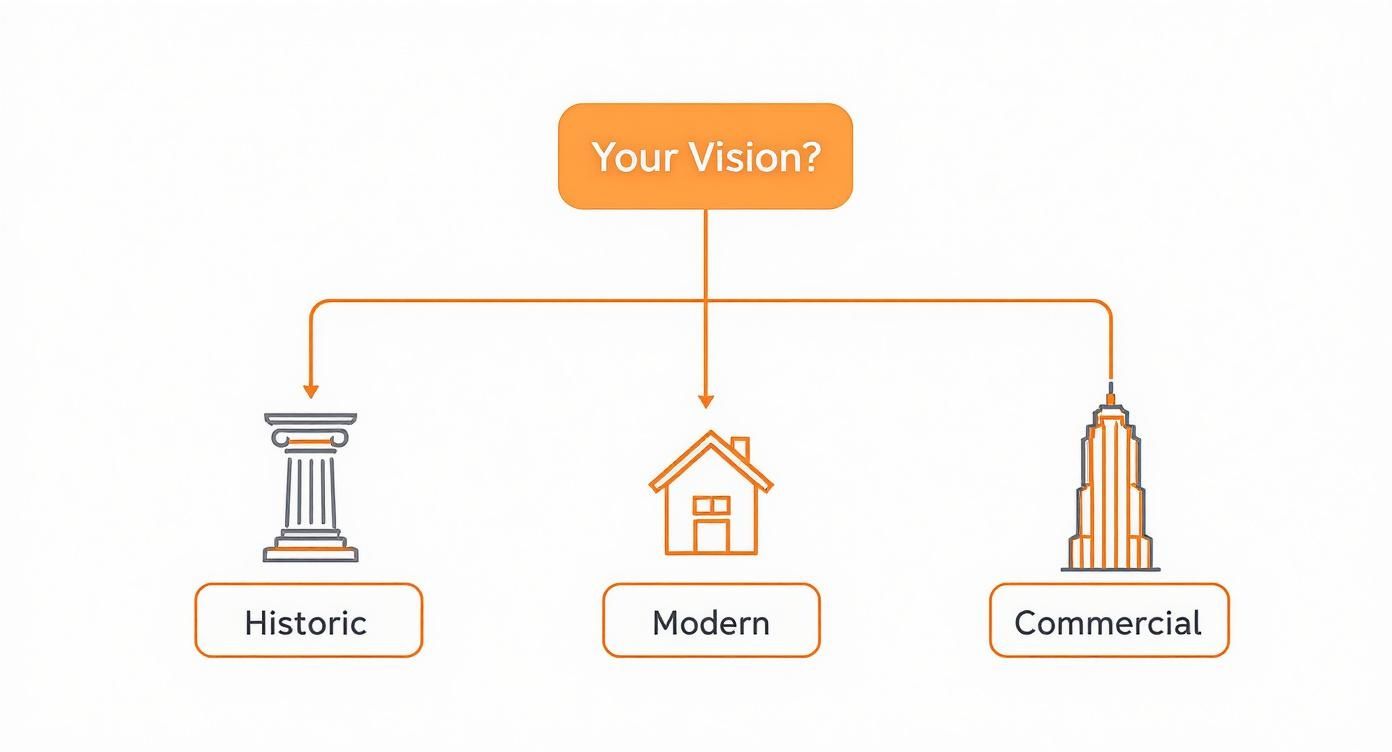
By figuring out whether you're aiming for something like historic preservation, clean modern lines, or a practical commercial space, you can immediately filter out firms that aren't the right fit. This bit of self-assessment saves a ton of time and ensures you’re judging potential partners on the criteria that truly matter for your Greenville project.
Talking About Budgets and Contracts with Confidence
https://www.youtube.com/embed/P4slsOVUN2Q
Let’s be honest: talking about money can feel awkward. But when you’re hiring an architect, it’s one of the most important conversations you’ll have. Getting everything on the table upfront is the key to a healthy, productive relationship and prevents nasty surprises down the road.
A true professional will welcome a direct discussion about your budget. It’s not about being shy; it’s about setting a realistic foundation for your dream project.
How Architects Charge for Their Work
Most architects in Greenville SC structure their fees in a few standard ways. Knowing the difference will help you figure out what makes sense for your specific project.
- Percentage of Construction Cost: This is a classic model, especially for new homes or major remodels. The architect’s fee is simply a percentage of the final construction bill, typically ranging from 8-15%. It aligns the architect's compensation with the overall scale of the project.
- Hourly Rate: For smaller jobs, initial design consultations, or projects where the full scope is still a bit fuzzy, an hourly rate is common. You're paying for the architect's time as you use it, offering a lot of flexibility.
- Fixed Fee (Stipulated Sum): If your project is exceptionally well-defined from day one, a fixed fee can be a great option. You both agree on a single price for the entire scope of architectural services, which gives you total cost certainty.
Making Sense of the Architectural Agreement
Once you've settled on a fee structure, it's time to look at the contract. Don't just skim it—this document is the blueprint for your entire working relationship. It’s there to protect you and the architect by making sure everyone is on the same page.
While the specifics will differ, you can get a general feel for how professional service agreements are structured by looking at examples like these essential contract templates used in other creative fields.
A good contract doesn’t create conflict—it prevents it. It ensures that everyone's expectations for deliverables, timelines, and payments are perfectly aligned before any design work begins.
When you get your agreement, pay close attention to the fine print. You’re looking for a crystal-clear scope of work that spells out exactly what services are included (and what’s not). You also need a realistic project schedule with major milestones and a payment schedule that details how much is due and when. Nailing down these details gives you the confidence to sign on the dotted line and get started.
Navigating Greenville Building Codes and Historic Districts
Building in Greenville is about more than a beautiful design; it’s about mastering a complex set of local rules. This is where hiring one of the right architects in Greenville SC isn't just a good idea—it's essential for keeping your project on time and within budget.
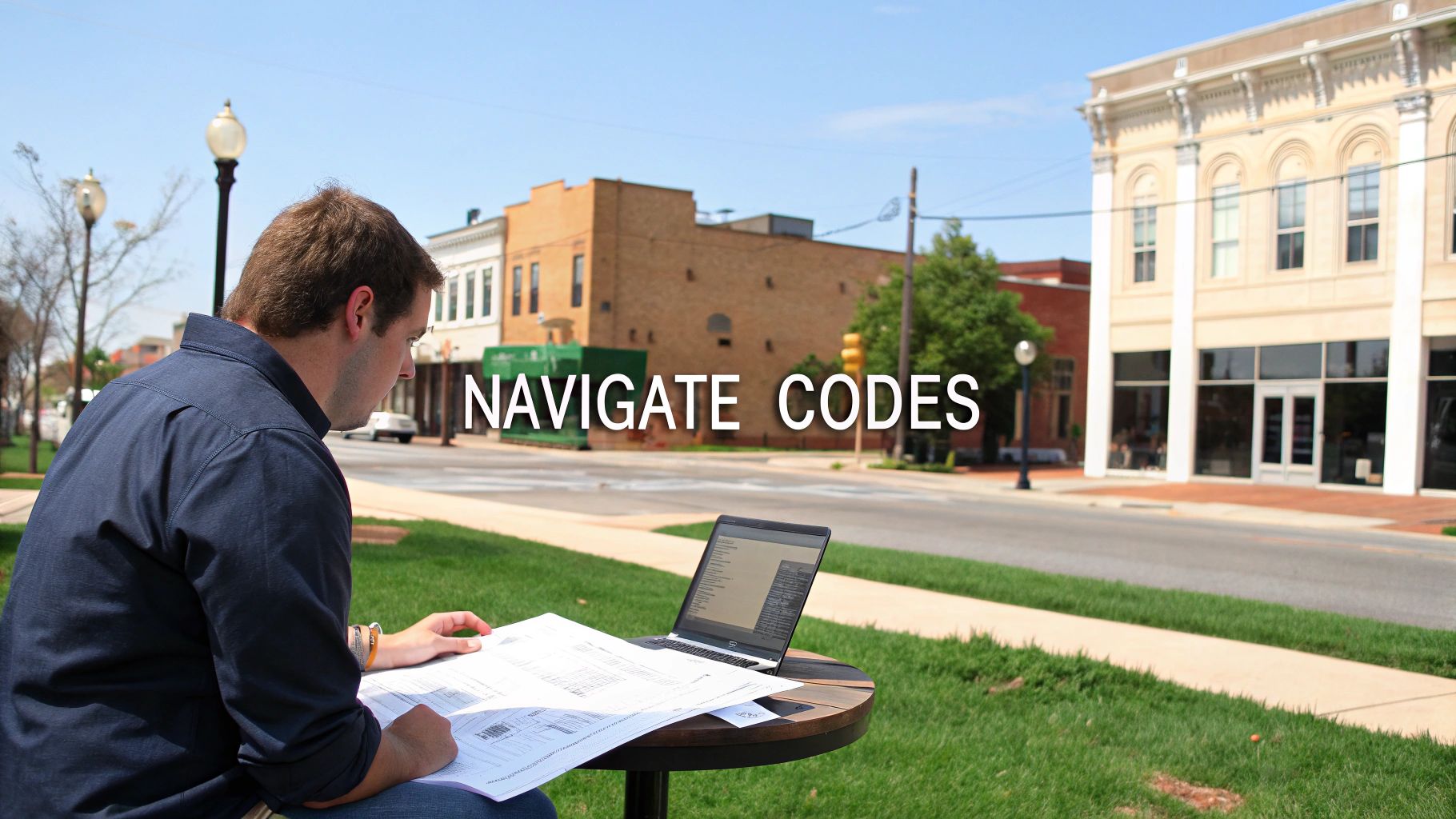
Think of a local architect as your expert guide through a maze of zoning laws and permitting applications. They understand the nuances that can easily derail a project, from setback requirements in newer developments to the specific material guidelines enforced in historic areas.
Plus, their established relationships with city officials and inspectors can be a game-changer, helping to streamline approvals and prevent frustrating delays.
Understanding Historic Preservation and Review Boards
If your project falls within one of Greenville's cherished historic districts, the stakes get even higher. The city's architectural heritage is a point of pride, and it's carefully protected.
A comprehensive survey from 1981 documented over 650 historic sites across the downtown area, forming the foundation for today's preservation efforts. You can get a sense of just how deep Greenville's architectural roots run by exploring the historic context survey/Research/Historic%20Contexts/Greenville%20Survey%202003.pdf).
This history is precisely why the Design Review Board (DRB) plays such a critical role. Any exterior changes in these designated areas must meet their strict criteria.
An experienced local architect doesn't just design a building that meets code; they create a design that the DRB will approve. They anticipate objections and prepare a submission that respects the historical context, saving you from costly and time-consuming redesigns.
An architect unfamiliar with these local expectations might get your project denied, forcing you back to the drawing board. A seasoned Greenville professional, on the other hand, knows how to balance your modern needs with the city’s preservation goals, ensuring your vision becomes a compliant, approved reality.
Answering Your Lingering Questions
Even after you’ve done your homework, it’s completely normal to have a few questions swirling around. Choosing an architect is a huge commitment, and you need to feel confident before you sign on the dotted line. Let's tackle some of the most common things people ask when searching for architects in Greenville SC.
How Long Does the Design Process Take?
Project timelines are almost always the first thing on a client's mind. For a custom home, you should realistically budget 6-12 months just for the design phase—that’s from the first concept sketches all the way to having a full set of plans ready for permitting.
Of course, a smaller renovation might be quicker, and a large commercial build will naturally have a more extended timeline. Remember, this is purely for the design; the actual construction schedule is a separate beast entirely.
What’s the Value of a Local Architect?
Another big question is cost. Most firms won't give you a hard number without a detailed project brief, but many offer a paid initial consultation. Think of this as a strategic investment. It gives you a chance to get professional feedback on your ideas, uncover potential roadblocks, and get a ballpark budget. It’s also the best way to get a feel for their working style and see if you click.
So, why not just hire a big-name firm from Atlanta or Charlotte? A Greenville architect brings something to the table that an outsider can't: a deep, intuitive understanding of this area's unique character. This isn't a new concept. Firms have been shaping our city's identity for generations. Take J.E. Sirrine, who was pivotal in defining Greenville's commercial look in the mid-20th century, evolving from a mill designer to the architect behind major local buildings. You can read more about the firm's incredible local impact on SAH Archipedia.
Hiring a local architect isn't just about convenience; it's about partnering with someone who understands Greenville’s DNA—its history, its regulations, and its future direction. This insight is something you simply can't get from an out-of-town firm.
This kind of embedded local knowledge ensures your project doesn't just get built, but that it feels like it truly belongs here.
At Sherer Architects, LLC, we blend decades of hands-on experience with a genuine passion for South Carolina's architectural landscape. We're here to guide you, whether you're envisioning a new commercial space, an adaptive reuse project, or the careful preservation of a historic gem. Our goal is always to deliver beautiful, enduring results.
See how our expertise can bring structure to your vision at https://shererarch.com.