When you think of an architect, you might picture someone designing a skyscraper or a modern home. But a special kind of architect focuses exclusively on the places where our children learn and grow: K-12 schools. These aren't just any buildings; they're the physical foundation for education, designed by professionals who understand that a school’s layout directly shapes a student's future.
Unpacking the Role of a K–12 Architect
A K–12 architect does far more than just draw up blueprints for classrooms and cafeterias. They are master planners of educational environments. Think of them as choreographers of the daily school experience, carefully crafting spaces that support how students learn, teachers teach, and communities connect.
Their real job is to take a school district's unique vision for education and translate it into a physical reality. This requires a delicate balancing act, blending the needs of students, the practicalities for faculty and staff, and the long-term goals of administrators and the community. It’s a role that demands a deep understanding of everything from child psychology and teaching methods to safety codes and sustainable building practices.
Beyond Walls and Windows
The difference between a generic building and a thoughtfully designed school is immense. The right architectural partner creates spaces that don't just house students but actively help them thrive.
- Student Engagement: Imagine classrooms that can easily shift from a lecture setup to small group pods for project-based learning. These flexible spaces naturally encourage collaboration and keep students motivated.
- Faculty Well-being: A well-designed school is also a functional and supportive workplace. When teachers have the resources and spaces they need to succeed, it has a massive impact on their morale and retention.
- Community Connection: Schools are often the heart of a neighborhood. An architect can design a building that feels welcoming, serving as a hub for after-hours events and strengthening the bond between the school and the people it serves.
A school is not just a container for education; it's an active participant in it. The layout of a classroom, the quality of light in a library, and the flow of a hallway all send subtle messages about how learning should happen. The K–12 architect’s primary job is to ensure those messages are positive, empowering, and supportive.
A Specialized and Growing Field
Because districts recognize how much school design matters, K–12 architecture has become a significant and growing field. This isn't a small niche; it's a major industry.
In 2023, the top 170 K-12 architecture firms saw major revenue growth. Industry leaders like PBK Architects brought in over $173 million from K-12 projects alone. This level of investment shows a clear, widespread understanding that the physical school environment is a critical tool for success. You can explore the full industry report on school architecture firm earnings to see the true scale for yourself.
Ultimately, choosing a K–12 architect is one of the most important decisions a school district can make. You’re not just putting up a building—you’re creating a lasting foundation for generations of students. The right firm acts as a true strategic partner, helping shape the future of education in your community for decades.
Core Priorities for Modern School Design
What really turns a school building into a powerful learning tool? It's not just about bricks and mortar. It’s about a handful of core design priorities that experienced K-12 architects know are absolutely non-negotiable.
These pillars are less about aesthetics and more about creating an environment where students and staff feel safe, focused, and ready to learn. Every choice, from window placement to wall material, has a direct, measurable impact on the daily life inside that school. It's a carefully calibrated ecosystem built for success.
Fostering Safety and Security
Before anything else, a school has to be safe. That’s the foundation. But the trick is achieving real security without making the campus feel like a fortress. An experienced architect knows how to strike that delicate balance between robust protection and a welcoming atmosphere.
We do this through smart, subtle strategies known as Crime Prevention Through Environmental Design (CPTED). This means designing clear sightlines across common areas, creating a single, easily monitored main entrance, and using landscaping to naturally guide visitors where you want them to go. Architects might also integrate solutions like security window film for schools to strengthen vulnerable glass without creating a visual barrier. The end goal is a campus that feels open and positive but is inherently secure by design.
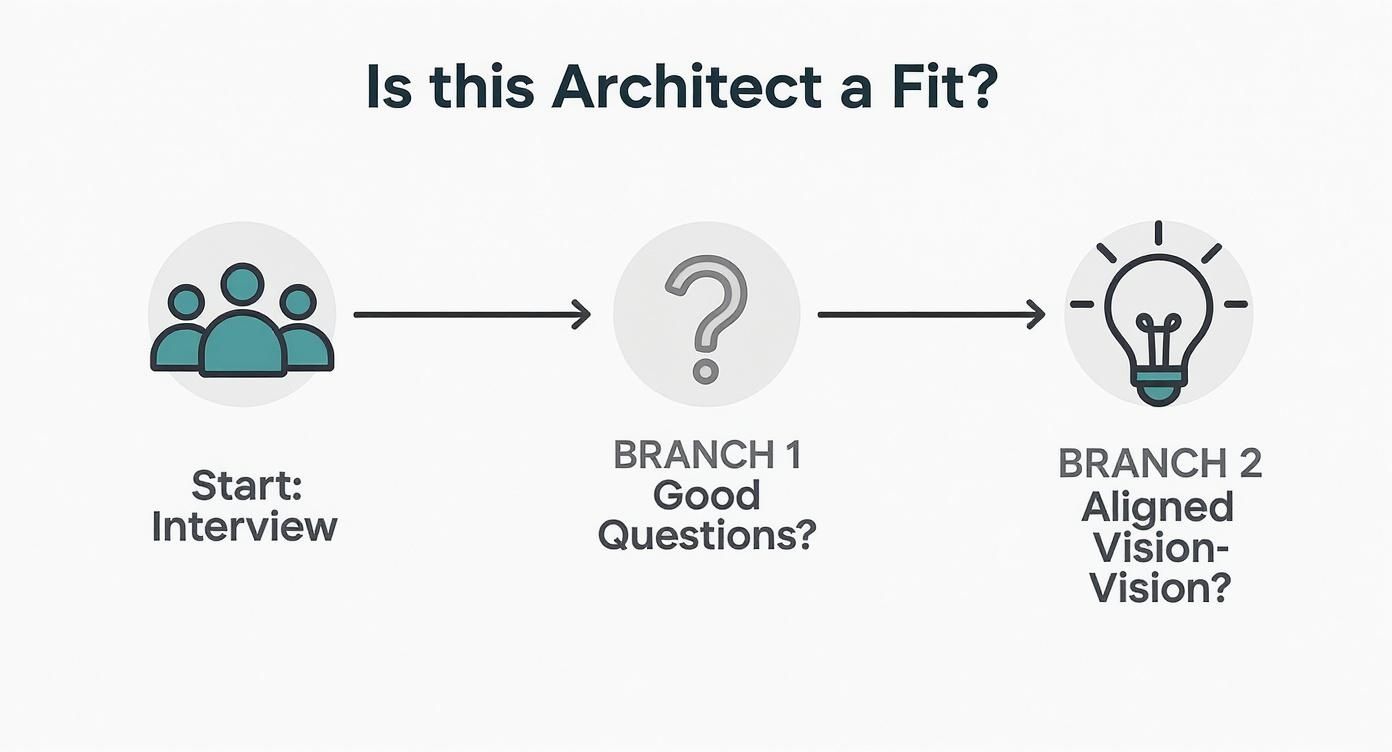
The diagram below really captures how an architect’s role is to connect the big-picture vision with the day-to-day student experience, creating a complete learning ecosystem.
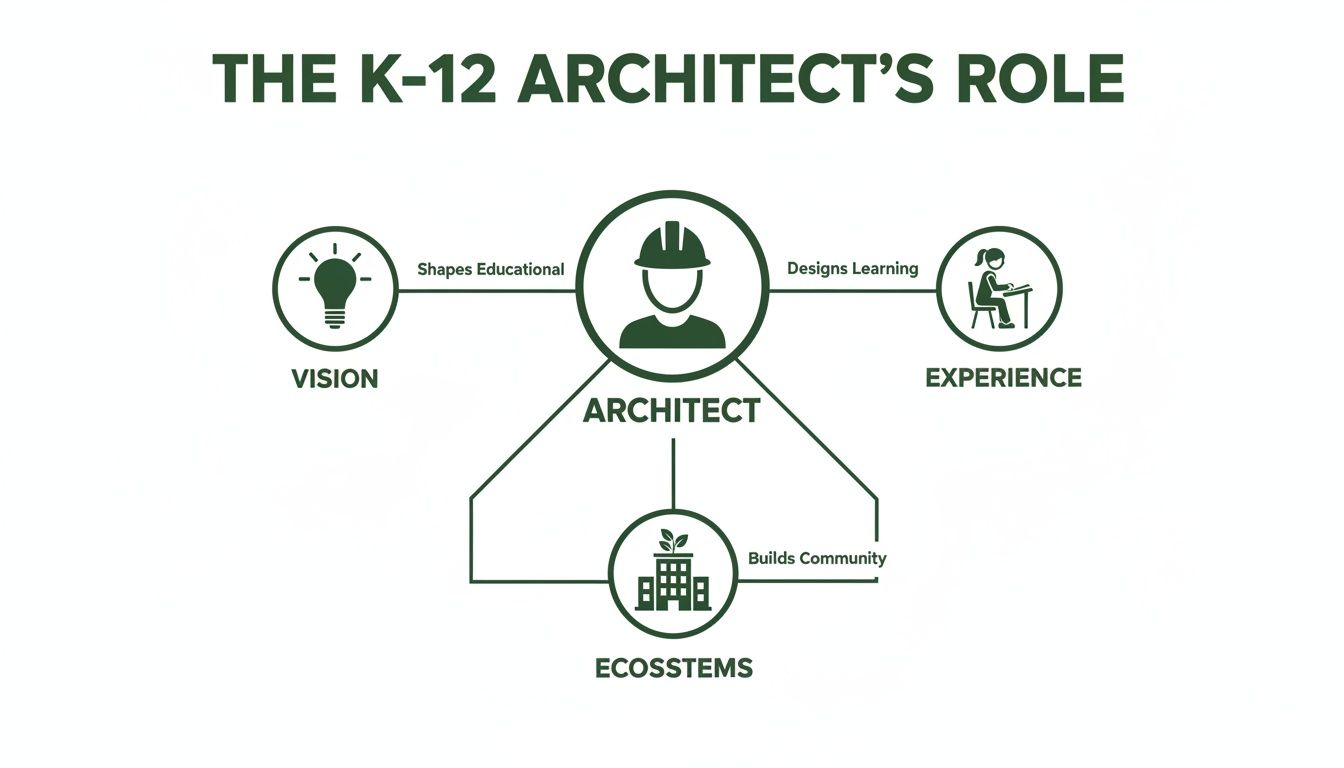
It’s a great visual reminder that our work isn't just about the physical building; it's about orchestrating an entire environment that helps a school achieve its goals.
Mastering Acoustic Design
Ever try to focus in a loud coffee shop? It’s nearly impossible. The same thing happens in a classroom, yet acoustics are often an afterthought in school design. When acoustics are poor, it leads directly to distractions, frustration, and students simply not hearing what the teacher is saying.
Skilled school architects tackle this head-on with a few key strategies:
- Sound Absorption: We use materials like acoustic ceiling tiles, carpet, and special wall panels that soak up ambient noise and kill echoes.
- Sound Isolation: This involves designing walls and floor-ceiling systems that actually block sound from traveling between spaces. You don’t want the library right next to the band room without it.
- HVAC Noise Control: We ensure the heating and air conditioning systems run quietly, eliminating that constant low-level hum that can be incredibly distracting.
Getting the acoustics right is critical. Research shows that in classrooms with bad acoustics, students can miss as much as one-third of what their teacher says. That's a huge barrier to learning.
A well-designed school minimizes unwanted noise, allowing the teacher's voice to be the primary sound students hear. It's about creating an auditory environment that supports concentration rather than competing with it.
Harnessing Daylighting and Views
Natural light is so much more than just a way to light up a room. It has a powerful, proven effect on our mood, health, and even our ability to learn. Giving students access to daylight and views of nature can lower stress, improve focus, and lead to better test scores.
That’s why K–12 architects obsess over daylighting. We orient buildings to catch the sun and use large windows, skylights, and light shelves to bounce natural light deep into the building’s core. It’s not just about brightness, either; it’s about quality. We have to control glare with shades or smart window placement to keep everyone comfortable. Simply connecting indoor spaces with views of green areas outside can make a world of difference for student and teacher well-being.
Designing for Future Flexibility
If there's one constant in education, it's change. Teaching methods evolve, technology marches on, and student needs shift. A school designed today has to be ready for whatever the future of education holds.
We call this future-proofing, and it’s all about designing spaces that are adaptable.
- Movable Walls: Think of partitions that can turn one large, open area into several smaller learning nooks in minutes.
- Flexible Furniture: Lightweight, modular desks and chairs that can be quickly rearranged for group projects, individual work, or lectures.
- Robust Infrastructure: This is the unseen stuff—making sure there’s plenty of power, great data connectivity, and systems that can be easily upgraded to support whatever technology comes next.
By building in this kind of flexibility from day one, an architect ensures a school district's investment will continue to pay dividends for decades, adapting to new educational models without needing a constant stream of expensive renovations.
Navigating School Project Regulations and Funding
Getting a school built is a lot like planning a major expedition. You know where you want to end up—with a beautiful, functional new school—but the journey is filled with a maze of state laws, local ordinances, and financial hurdles. A seasoned K-12 architect is your indispensable guide for that journey, navigating the entire complex process so you don't get lost.
Without that expert guidance, projects often hit dead ends. Trying to build without a deep knowledge of local zoning codes or state-specific educational facility standards is a recipe for disaster. These aren't just polite suggestions; they're rigid requirements that control everything from the square footage of a classroom to the placement of every fire exit. An architect who lives and breathes school design already knows this terrain, saving you from costly mistakes and frustrating delays down the road.
The Intricate Web of Compliance
Building a school isn't as simple as getting a standard construction permit. It means satisfying multiple, overlapping layers of regulations. An experienced school architect pieces this compliance puzzle together, protecting the district from the headaches of potential fines, stop-work orders, and expensive redesigns.
This process involves juggling several key oversight bodies:
- State Building Codes: These form the baseline safety rules for any construction, but states almost always have specific, more stringent addendums for K-12 facilities.
- Local Zoning Ordinances: These hyper-local rules govern how land can be used. They'll dictate everything from building height and setback from the street to parking ratios and stormwater management.
- Educational Facility Standards: Many states have incredibly detailed guidelines specifically for schools, covering everything from classroom acoustics and lighting to air quality. The goal is always to ensure a healthy and effective learning environment.
A great K-12 architect doesn't just design a building; they design a compliant building from day one. They see regulatory hurdles coming from a mile away and design solutions right into the blueprints, turning a potential roadblock into just another checked box on the project plan.
Unlocking Diverse Funding Streams
Beyond the red tape, the financial side of a school project is its own beast. Most districts piece together funding from multiple sources. A good architect becomes a key partner in this process, not just by aligning the design with the budget but also by helping to uncover new financial opportunities.
The funding landscape is rarely straightforward, often involving a patchwork of public and private money. When you're trying to fund a new school or a major renovation, it's critical to think strategically about how certain design elements, like integrating donor recognition into school capital projects, can be connected to specific fundraising campaigns.
Here are a few ways an architect helps a district make the most of its budget:
- Bond Referendum Support: They create clear, compelling visuals and realistic cost projections that help the community truly see and understand the value of a project. This kind of clarity is absolutely essential for getting public bond measures passed.
- Grant Application Assistance: Countless federal and state grants are available for projects that meet specific goals, like improving energy efficiency or upgrading security systems. Architects can design features that check all the right boxes for these grants and provide the technical documentation needed to submit a winning application.
- Value Engineering: This isn't just about cutting costs. It's the smart process of identifying more cost-effective materials or systems that don't compromise on quality or function. It’s about making every single dollar count.
- Phasing Strategy: For massive, multi-year projects, an architect can map out a logical construction sequence. This allows parts of the school to remain operational, which minimizes disruption for students and staff and helps spread the costs out over time.
In the end, a K-12 architect acts as a district's strategic partner. They steer the project through the maze of regulations and work tirelessly to maximize every available dollar, ensuring the final building is not only inspiring and functional but also fully compliant and financially sound.
How to Select the Right K-12 Architecture Firm
Picking an architectural partner for your school district is one of the most consequential decisions you’ll ever make. The buildings that result will shape your community’s educational experience for decades, long after the construction dust settles. This isn't just about hiring a vendor to draw up some blueprints; it's about finding a strategic partner who will walk with you from the earliest brainstorming sessions to the ribbon-cutting ceremony.
The whole selection process comes down to finding a team whose expertise, design philosophy, and even communication style truly click with your community's specific goals. To do that, you need a methodical approach—one that goes beyond the glossy portfolios and gets to the heart of a firm's real-world capabilities.
Evaluating Past Performance and Specialization
Let's be direct: the most reliable clue to future success is a firm’s past work. A generalist firm might be talented, but the tangled web of modern school design really calls for a specialist. You need a partner who is completely immersed in educational architecture—someone who keeps up with evolving teaching methods, new safety protocols, and the unique funding streams that schools rely on.
When you look at a firm’s history, look for depth, not just a wide array of projects. Having a couple of schools in a portfolio is one thing; having a deep, proven history of solving the exact kinds of problems your district is wrestling with is something else entirely. Get ready to ask some tough questions.
- Portfolio Relevance: Are their past projects for schools of a similar size, budget, and student population as yours?
- Project Challenges: Ask them to tell you a story about a project that hit major snags—a shoestring budget, a tricky site, or vocal community opposition. How did they navigate those problems?
- Longevity and Durability: How are their buildings holding up after 10 or 15 years? Are they still functional, beautiful spaces, or are they showing their age? Good design and durable materials should stand the test of time.
Assessing the Community Engagement Process
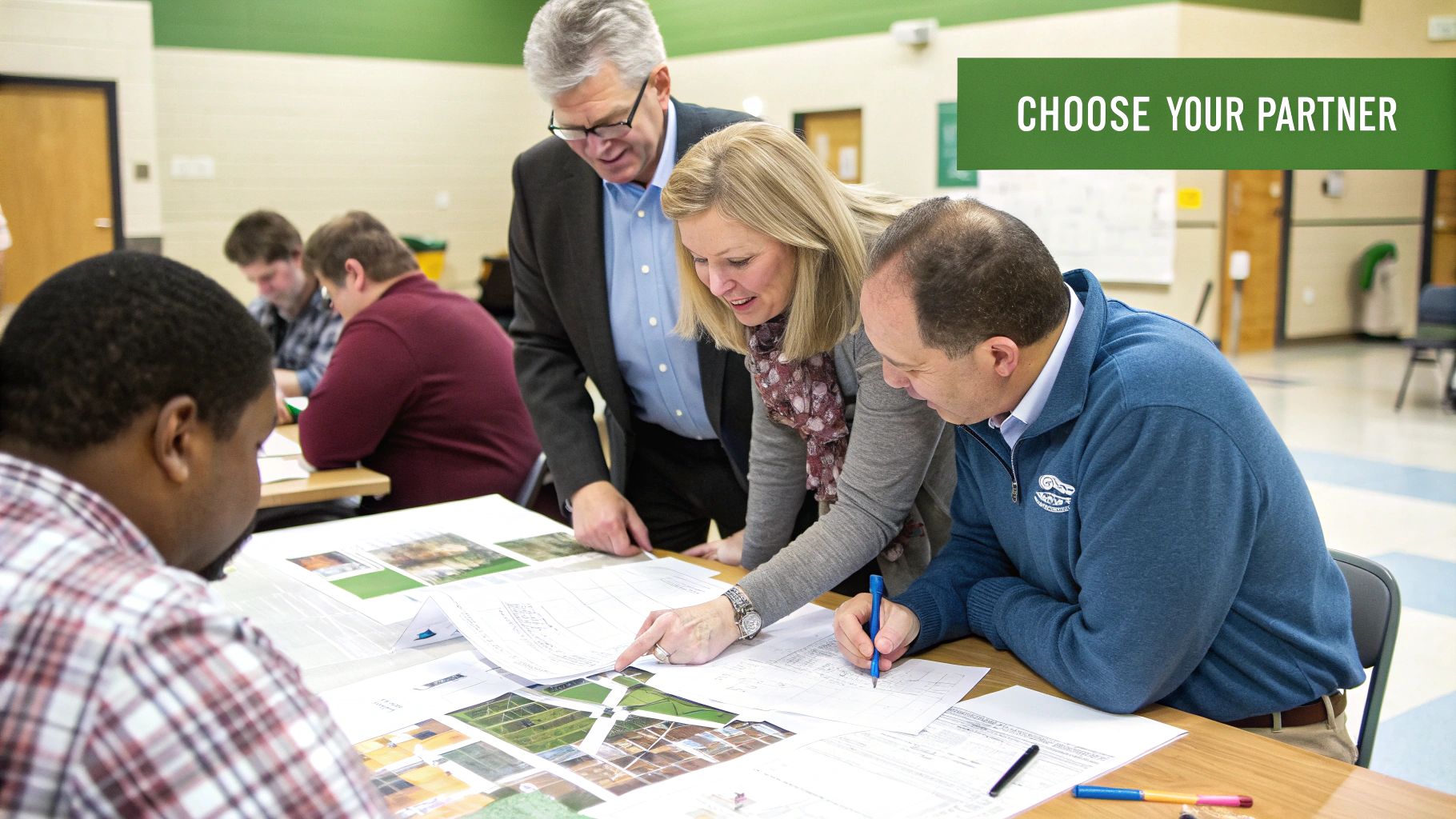
A new school isn't just a district project; it’s a community landmark. The design process has to reflect that reality from day one. A top-tier K–12 architecture firm will come to the table with a clear, well-oiled plan for bringing everyone into the conversation—not just the school board, but teachers, students, parents, and local residents.
This can't be just a box-checking exercise. It needs to be a genuine effort to listen and gather insights that will directly influence the final design. Ask them how they make this happen. Do they run interactive workshops? Use surveys and focus groups? A firm that truly prioritizes listening is far more likely to design a building that your whole community will feel proud of.
The best K–12 architects act as facilitators, translating the diverse voices of a community into a unified architectural vision. They don’t arrive with preconceived solutions; they arrive with a process for discovering the right solution together.
This collaborative spirit ensures the finished school meets the real, day-to-day needs of the people who will actually use it.
Verifying Financial Acumen and Budget Management
Now for the most pragmatic—and critical—part of the evaluation: managing the budget. School projects are funded with public money and operate under a microscope. There’s simply no room for financial surprises or mistakes. An architect’s ability to deliver on time and on budget isn't a "nice to have," it's non-negotiable.
Don't get tempted by a firm that just throws out the lowest number. Instead, dig into their process for cost control and financial transparency.
- Initial Cost Estimating: How do they build their first cost estimates? Ask to see examples. They should be detailed and grounded in current, local market data.
- Change Order History: What is their average change order rate on past K–12 projects? A low number is a good sign—it points to meticulous planning and solid bid documents.
- Reference Checks: When you call their past clients, get specific about budget management. Did the firm provide regular, easy-to-understand updates? Were there any last-minute financial shocks?
This financial due diligence is essential. You’re looking for a partner who respects taxpayer dollars as much as you do and has the proven systems in place to manage them with care. Fortunately, the talent pipeline for this demanding field remains strong. A recent report showed that 85% of new architects hold accredited degrees, ensuring a steady stream of qualified professionals. You can find more insights about the qualifications of today's architects to understand the high standard of expertise available. Finding the right fit is all about connecting that expertise with your district’s specific needs.
The Power of Adaptive Reuse for Schools
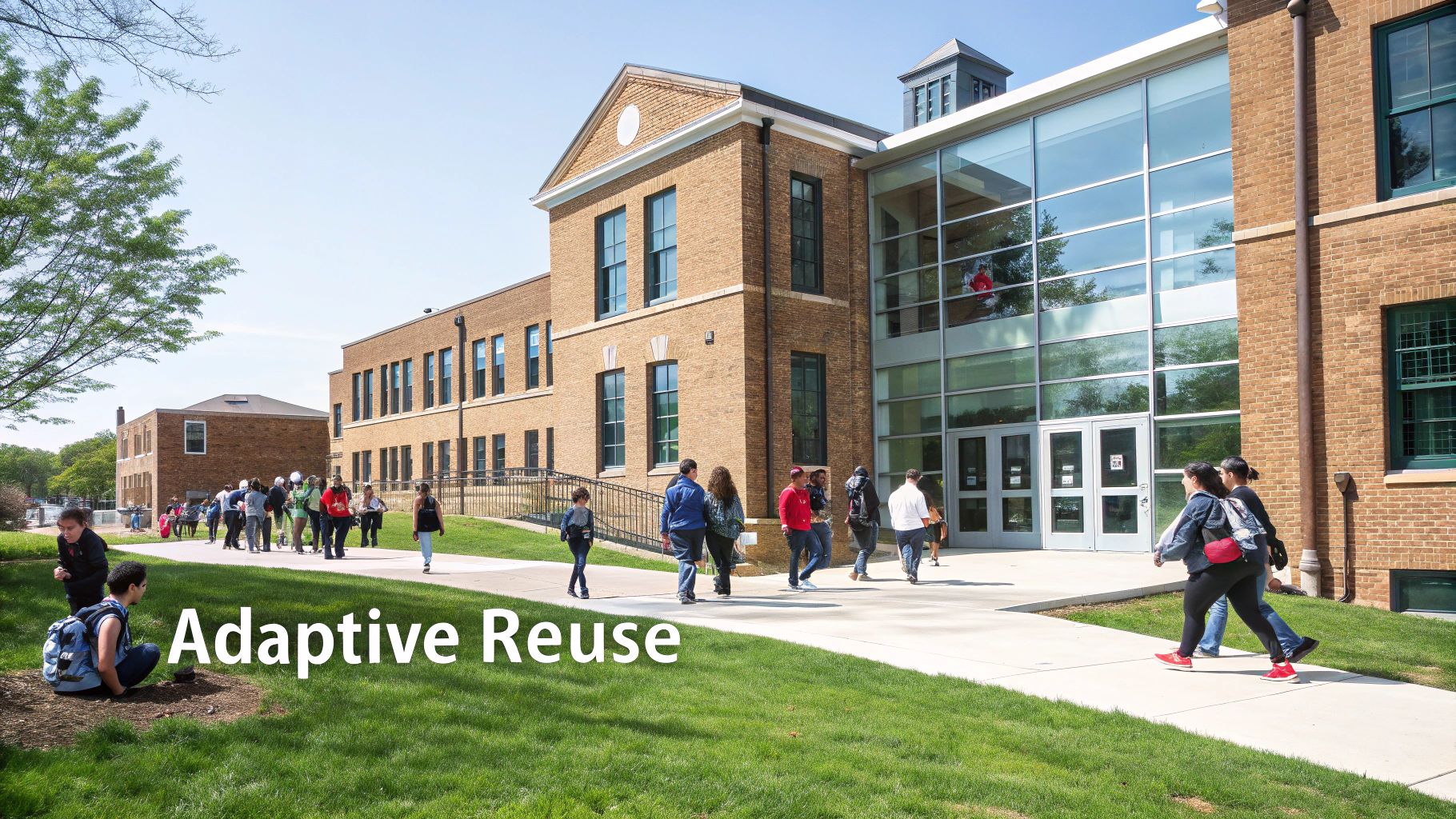
When a school district faces the need for a new building, the default image is often a groundbreaking ceremony on a patch of empty land. But building from scratch isn't the only way forward, and frankly, it's often not the best one. There's a smarter, more sustainable alternative that’s catching on: adaptive reuse, which is the art of transforming an existing building into a vibrant, modern school.
This approach takes forgotten structures—old warehouses, vacant office buildings, or even historic landmarks—and gives them a brand new purpose as centers for learning. For an experienced K-12 architect, these projects are like fascinating puzzles. They demand a special mix of creativity and deep technical skill to honor a building's history while outfitting it for the future of education.
Rewards Beyond the Classroom
Opting for adaptive reuse is about so much more than just slapping a new label on an old building. It’s a strategic move with ripple effects that benefit both the school district and the entire community, making it a powerful tool for revitalization and smart resource management.
The advantages are hard to ignore:
- Cost-Effectiveness: It's almost always cheaper to renovate an existing structure than to build a new one from the ground up. This frees up tight budgets, allowing districts to invest more in what really matters—educational programs and technology—instead of pouring it all into concrete and steel.
- Sustainability: Reusing a building is one of the greenest things you can do. It drastically cuts down the carbon footprint tied to demolition and new construction, keeping tons of materials out of landfills. It's recycling on an architectural scale.
- Community Revitalization: Turning a derelict, vacant building into a lively school can completely change the feel of a neighborhood. It brings in daily activity, positive energy, and a renewed sense of purpose that can become a source of community pride.
- Unique Character: You simply can't replicate the character of a repurposed building. Think exposed brick walls, soaring industrial ceilings, or one-of-a-kind historic details. These features create memorable, inspiring learning environments that stand out from the cookie-cutter norm.
Navigating the Unique Challenges
Of course, transforming an old building into a modern school has its own set of hurdles. This is exactly where the specialized experience of a K-12 architect who truly gets adaptive reuse becomes non-negotiable. They are the essential link between a building's past and its future.
Adaptive reuse is a dialogue between the old and the new. The architect's job is to respect the building's original story while seamlessly weaving in the modern chapters of safety, accessibility, and 21st-century learning.
An architect specializing in these projects knows how to expertly manage the critical tasks. They start with a deep-dive assessment of the existing structure, figuring out what can be saved and what must be upgraded—from the foundation right up to the roof.
A huge part of the puzzle is integrating modern systems into a building that was never designed for them. This means finding clever ways to route new HVAC, plumbing, and electrical systems without destroying the building’s historic charm. It also means making sure every last corner of the renovated space meets today's stringent building codes for K-12 facilities, covering everything from fire suppression to accessibility standards.
At the end of the day, the real power of adaptive reuse is its ability to create something truly special. These projects deliver state-of-the-art schools that honor the past, serve the present, and stand as powerful symbols of smart, sustainable community investment for years to come.
Finding the Right Partner for Your Next School Project
We’ve covered a lot of ground in this guide, and hopefully, it's clear just how much a dedicated, experienced K-12 architect brings to the table. This isn't just about hiring someone to draw up plans. It's about finding a true partner—a firm that will get in the trenches with you, listen intently, and help navigate your district from a glimmer of an idea to a fully realized learning environment.
At Sherer Architects, that’s exactly how we see our role. Every school project is a unique puzzle. Our job is to listen, ask the right questions, and then meticulously piece everything together to create a solution that’s not only beautiful and enduring but also a perfect fit for your community's specific needs.
Your Expert Guide in South Carolina
We know the ins and outs of South Carolina's specific zoning regulations and energy codes. It’s our home turf. That local knowledge is critical for guiding your project smoothly through every phase, avoiding the kinds of costly delays and compliance headaches that can derail a project.
We also have a special passion for adaptive reuse and historic preservation. So often, the most cost-effective and sustainable path isn’t to build new, but to breathe new life into an existing structure. With the global K-12 education market projected to hit $5.66 trillion by 2030, finding smart ways to modernize facilities is more important than ever. You can read more about the growth of the K-12 education market to get a sense of the scale.
We don't just see old buildings; we see opportunities. Our passion lies in transforming existing structures into state-of-the-art schools that honor their history while fully embracing the future of education. This approach maximizes your investment and creates truly one-of-a-kind learning environments.
Let's Build the Future Together
Choosing a K-12 architect is a decision with a long legacy—one that will impact your community for generations. You need a partner who gets the nuances of educational design, respects your budget, and truly shares your vision for helping students succeed.
At Sherer Architects, we are that partner. Let's start a conversation about your next project.
A Few Common Questions About K–12 Architecture
When your district is looking at a major construction or renovation project, a lot of questions come up. We've heard many of them over the years from school boards and community members. Here are some straightforward answers to the most common ones to help you feel more confident about the path ahead.
How Long Does It Take to Design and Build a School?
There's no single answer here, as every project is different. But we can give you a solid rule of thumb. Generally, the full design process—from kicking around initial ideas to having a final set of construction-ready plans—will take somewhere between 9 and 15 months.
Once the design is locked in, building a brand-new K-12 school from the ground up typically takes another 18 to 24 months. Of course, things like major renovations or adaptive reuse projects can often move a bit faster. A seasoned K–12 architect can give you a much more precise timeline after they've had a chance to really dig into your goals, the site conditions, and the local permitting landscape.
What Is 21st-Century Learning, and How Do Architects Design for It?
At its heart, 21st-century learning is a shift away from rote memorization and toward skills like collaboration, critical thinking, creativity, and communication. From an architect's point of view, our job is to create physical spaces that support this shift, moving beyond the old model of identical classrooms lined up along a hallway.
The goal is to create environments that are fluid and can adapt to different teaching methods and student needs, sometimes in the same day. It's about getting away from rigid rows of desks and embracing spaces that encourage hands-on, interactive learning.
So what does that actually look like? Here are a few key features:
- Movable walls that let you combine two classrooms into one large project space, or divide a larger area for small-group instruction.
- Flexible furniture—think tables on wheels and different types of seating—that can be quickly reconfigured for group work, presentations, or quiet study.
- Built-in technology that supports everything from laptops and tablets to interactive displays.
- Central "learning commons" that replace the old, quiet libraries with vibrant hubs for research, team projects, and collaboration.
How Can We Make Sure Our New School Is Sustainable?
Building a genuinely sustainable and energy-efficient school is about much more than just using recycled materials. A good architect will approach it with a comprehensive strategy, designing a high-performance building that not only lowers your long-term operating costs but also fosters a healthier environment for students and staff.
Your architect should be focused on a few key areas. For starters, maximizing natural daylight is huge—it slashes electricity bills and studies have shown it actually improves student performance. They'll also specify modern, high-performance HVAC systems for clean indoor air and select durable, locally sourced building materials to shrink the project's carbon footprint.
Beyond the basics, an architect can integrate clever features like rainwater harvesting systems to handle irrigation or design roofs that are ready for solar panels down the road. For districts that want to go all-in, pursuing a green building certification like LEED offers a clear, third-party framework for setting and hitting ambitious sustainability targets.
At Sherer Architects, LLC, we see ourselves as your partners in creating learning environments that are not just beautiful and functional, but also sustainable and built to last. Let's talk about your vision and how our team's experience can make it a reality.
Learn more about our architectural services and start your project with us today.