Finding the money to bring a historic property back to life is often the biggest hurdle. It’s a process that demands a smart strategy, rock-solid documentation proving your building's worth, and an application that tells a compelling story. It all starts with knowing where to look—and making sure your project is exactly what a funder wants to support.
Navigating the World of Preservation Funding
Before you even think about filling out an application, you need to get a lay of the land. The world of preservation grants can feel like a maze, but most funding flows from three main sources: federal agencies, state programs, and private nonprofits. Each operates differently, with its own mission, funding cycles, and pet projects. Not understanding this is probably the single biggest mistake applicants make, leading to a lot of time spent on applications that were doomed from the start.
Federal grants, often coming from big players like the National Park Service (NPS), can offer the largest awards. But they're also the most competitive. State-level funding, which you'll typically find through your State Historic Preservation Office (SHPO), is usually a bit easier to get and is focused on what matters locally. Then you have influential nonprofits, like the National Trust for Historic Preservation, which often fund very specific things like project planning, educational programs, or advocacy work.
Finding the Right Funder for Your Project
The secret is simple: match what you need with what a funder wants to accomplish. A grant program dedicated to architectural surveys isn't going to pay for your new roof, no matter how badly you need one.
- Federal Grants: These are the heavy hitters, often fueled by the Historic Preservation Fund (HPF). Think big—projects with national significance or major rehabilitation efforts.
- State Grants: Your SHPO is your best friend here. They manage funds that help with everything from restoring a Main Street storefront to documenting a local historic district. They're your go-to for most hands-on projects.
- Nonprofit and Local Grants: Don't overlook these. They're often the perfect fit for smaller, community-centered work. A local foundation could be the ideal partner for restoring the windows on a neighborhood landmark or creating new interpretive signs.
This flowchart breaks down how these different funding streams typically operate and interact.
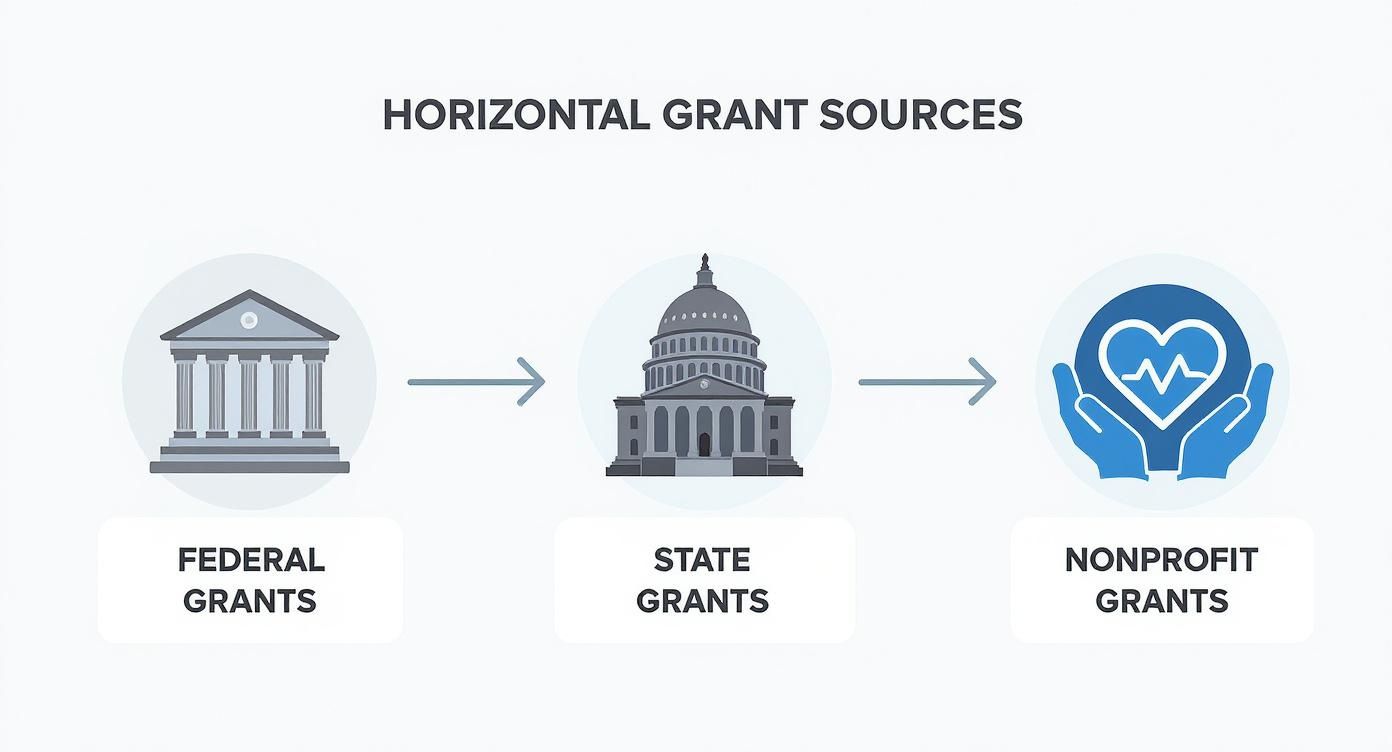
As you can see, the pathways often connect. Federal money frequently trickles down to state agencies, which then fund the on-the-ground work in your community.
Understanding the Financial Landscape
The grant process in the U.S. is well-established but fiercely competitive. Annually, more than $1 billion in grant funding is directed toward historic preservation efforts across the country. To put that in perspective, the Historic Preservation Fund (HPF), administered by the NPS, allocated nearly $189 million in fiscal year 2024 alone to support everything from documentation and planning to the actual "bricks and mortar" restoration work.
Key Takeaway: Success isn't just about having a worthy project; it's about presenting that project to the right audience. Researching a funder's past awards is one of the best ways to gauge if your proposal is a good fit.
To give you a clearer picture, here’s a quick rundown of the major players and what they typically look for.
Key Grant Sources and Their Primary Focus
| Funding Source Type | Primary Administrator(s) | Typical Project Focus | Common Applicant Type |
|---|---|---|---|
| Federal | National Park Service (NPS) | Large-scale restoration, surveys, disaster relief, major national landmarks | SHPOs, Tribal Historic Preservation Offices (THPOs), Certified Local Governments (CLGs) |
| State | State Historic Preservation Office (SHPO) | Building rehabilitation, historic structure reports, local district nominations, community planning | Nonprofits, municipalities, private property owners, CLGs |
| Nonprofit/Private | National Trust for Historic Preservation, local foundations, community trusts | Planning grants, feasibility studies, educational programs, smaller "bricks-and-mortar" projects | 501(c)(3) organizations, community groups, municipalities |
This table shows why it's so crucial to target your application. A private owner restoring a historic home will have more luck with their SHPO, while a city government trying to survey a large historic district might look to federal pass-through funds.
Finally, remember that preservation grants rarely cover 100% of a project's cost. It's wise to get familiar with the broader financial world by exploring various funding options, including grants that can help you pull together the required matching funds or cover expenses that your preservation grant won't.
Laying the Groundwork for a Winning Application
The secret to a successful grant application isn't just in the final submission—it’s in the meticulous preparation you do months before a deadline is even announced. This is where the real work happens, separating the projects that get funded from those that end up in the "no" pile.
Think of this as setting the stage. Getting your ducks in a row now means you're not scrambling later. It’s all about confirming your eligibility, building the right relationships, and nailing down the specifics of your project.
Step Zero: The Eligibility Check
Before you pour dozens of hours into writing, you have to be absolutely certain your project is eligible. This sounds basic, but you’d be surprised how many people trip up here. For most state and federal grants, everything hinges on one thing: official historic designation.
Typically, this means your property must be listed on the National Register of Historic Places. It can be listed individually or as a contributing building within a larger historic district. If it’s not, your first call should be to your State Historic Preservation Office (SHPO) to figure out the nomination process. Be warned: this can take a while, so don't wait.
The property is only half the equation; who you are also matters. Many grants are specifically for:
- Nonprofit 501(c)(3) organizations
- Government agencies like municipalities, especially those designated as a Certified Local Government (CLG)
- Tribal Historic Preservation Offices (THPOs)
Private homeowners and developers do have options, particularly at the state level, but they are generally more limited. The takeaway? Read the funder’s guidelines with a fine-tooth comb to confirm exactly who can apply.
Make Friends with Your SHPO
Your State Historic Preservation Office (SHPO) is your single most valuable ally in this process. So many applicants treat the SHPO like a bureaucratic obstacle or a gatekeeper to get past. That’s a huge mistake. These are the experts who live and breathe preservation in your state, and they genuinely want to see good projects come to life.
Get in touch with them long before you plan to apply. Introduce yourself, your property, and what you’re hoping to accomplish. Ask for their initial take and see if they know of any programs that might be a good fit. This early conversation can steer you away from a dead end and give you priceless insight into what grant reviewers are really looking for.
One of the best pieces of advice I ever received was to treat the SHPO staff like partners. They see hundreds of applications and know what works. A ten-minute phone call with them can provide more clarity than ten hours of reading guidelines alone.
This kind of outreach does more than just give you information; it shows you're serious and professional. When your application eventually lands on their desk, a familiar name is always better than a complete unknown.
Define Your Project and Get Real Numbers
Grant reviewers don't fund vague ideas. "Fix the old theater" is a wish, not a project. You need to present a concrete, well-defined plan that has a clear beginning, middle, and end.
Start by getting professional cost estimates. This isn't the time for a back-of-the-napkin guess. You'll need to bring in architects, engineers, or preservation consultants who know their way around historic buildings. Their detailed estimates become the backbone of your budget and prove to funders that you’ve done your homework.
A solid project scope needs to be broken down into specific, actionable pieces:
- Condition Assessment: A thorough report on what’s wrong and why it failed.
- Proposed Treatment: A detailed plan for the repairs that follows established preservation standards.
- Project Timeline: A realistic schedule, from mobilization to final inspection.
- Detailed Budget: An itemized list of every single cost, from labor and materials to scaffolding and permit fees.
Putting in this level of detail up front demonstrates that you’re a capable manager of their money and that their investment will lead to a tangible, lasting preservation outcome.
Crafting a Compelling Grant Proposal
Alright, this is where all your legwork comes together to tell a persuasive story. Think of your grant proposal less like a stack of forms and more like a pitch. You need to convince a review committee, who sees dozens of these, that your project is not just important but a sound investment of their very limited funds.
The three main pillars—the Statement of Significance, the Preservation Plan, and the Budget—can't exist in silos. They have to weave together, each part reinforcing the others to build an undeniable case for your project.
Telling Your Story in the Statement of Significance
This is the heart and soul of your application. The Statement of Significance needs to answer one critical question: "So what? Why does this place matter?" The most common mistake I see is people just listing historical dates or architectural jargon. That's a fact sheet, not a story. It won't move anyone.
Your real job here is to connect the bricks and mortar to a living, breathing community need. How did this building anchor the neighborhood? What pivotal events took place within its walls? Who are the people whose stories are tied to this place?
To really make an impact, your statement should hit these points:
- Architectural Value: Explain what makes the building special. Is it a rare example of a certain style? Does it feature unique construction techniques?
- Historical Association: Draw clear lines connecting the property to important people, events, or movements in your town, state, or even national history.
- Community Impact: This is crucial. Describe the building's role in your community's identity and, more importantly, how bringing it back to life will benefit the public today.
A great proposal tells a story that sticks with the funders. Brushing up on powerful storytelling strategies for nonprofits can make a huge difference in how your application is received.
Detailing Your Methods in the Preservation Plan
If your Statement of Significance is the "why," then the Preservation Plan is the "how." This is the technical document that proves you know what you’re doing. It’s where you show the review board you have a professional, well-reasoned approach for the hands-on work.
Your plan needs to be specific, methodical, and—this is non-negotiable—it must align with the Secretary of the Interior’s Standards for the Treatment of Historic Properties. These standards are the bible of preservation work. Referencing them signals that you're committed to doing the job correctly.
A solid plan will always include:
- A clear description of the property's current condition, supported by high-quality, well-labeled photos.
- A step-by-step breakdown of the proposed work for each part of the building (e.g., roof, windows, masonry).
- A solid justification for why you chose these specific treatments.
- An outline of the materials and methods you intend to use.
Pro Tip: Don’t try to write this in a vacuum. A preservation architect or a qualified historic contractor is your greatest asset here. Their input not only makes the plan technically sound but also gives it immediate credibility with the review committee. It shows you're taking a professional approach right from the start.
Building a Transparent and Trustworthy Budget
Your budget is where the rubber meets the road. It has to be detailed, easy to understand, and perfectly in sync with your Preservation Plan. A vague or poorly researched budget is one of the quickest tickets to the rejection pile.
Every single line item needs to make sense. Don't just put "Window Repair – $50,000." Break it down into something like, "Scrape, prime, and reglaze 25 historic wood windows at $1,800/window" and "Install historically appropriate storm windows at $200/unit." That level of detail shows you’ve done your homework and builds trust.
And don't forget to clearly document your matching funds. Almost every grant requires you to have some skin in the game. This can be:
- Cash Match: Money from your own reserves, a loan, or even another grant.
- In-Kind Contributions: The documented dollar value of donated professional services (like an architect's time), materials, or skilled volunteer labor.
Showcasing both types of matching funds proves your project has broad support and isn't entirely dependent on this one grant.
Knowing your funder helps, too. For instance, the National Trust for Historic Preservation often funds nonprofits and public agencies for planning and educational projects. In the 2023-2024 cycle alone, the National Trust awarded over $1 million to 196 projects, often favoring those that could show how their work would get the community involved.
When you're finished, these three documents should tell one cohesive story: The building is significant, the plan to save it is sound, and the budget proves you can pull it off responsibly.
Assembling a Flawless Submission Package
You’ve poured everything into the narrative and meticulously crunched the budget numbers. Now it’s time for the final push: pulling it all together into a professional package that makes a reviewer's job as easy as possible. This is where the little details really matter—they signal that you’re competent and respect the funder’s process.
Don't let all your hard work get derailed by a simple technicality. A sloppy or incomplete submission can get your brilliant proposal tossed before anyone even reads it. Think of this stage as the final quality check, ensuring your application gets judged on its merits.
Gathering Your Essential Supporting Documents
Beyond your core proposal, you need a solid collection of supporting documents to back up your claims. These materials aren't just filler; they add layers of credibility and paint a complete picture of your project’s importance and viability.
One of the most persuasive things you can include is a strong set of letters of support. These letters prove your project isn't just an idea floating in a vacuum—it has real backing from key people in your community.
- Who to ask? Think strategically. Reach out to your mayor, state representatives, the president of the local historical society, or even leaders of influential neighborhood associations.
- What should they say? A good letter is specific. It needs to move beyond generic praise and clearly state why the project matters to that person or their constituents.
These endorsements show a grant committee that their investment will be valued by the entire community.
The Power of Visual Storytelling
Words can only do so much. High-quality photographs and clear architectural drawings are essential storytelling tools, not just optional attachments. They provide undeniable visual proof of your property’s condition, its historic significance, and why the work is so urgent.
Your visual documentation should be:
- High-resolution: Grainy, poorly lit photos look unprofessional and can obscure important details.
- Well-labeled: Every file needs a descriptive name (e.g., "North_Facade_Water_Damage.jpg") and should be referenced directly in your narrative.
- Comprehensive: Include shots of the entire building in its setting, plus detailed close-ups of the specific areas you plan to work on.
This evidence helps a reviewer who has never laid eyes on your property understand exactly what you’re talking about. A sharp photo of crumbling mortar joints is infinitely more compelling than a paragraph trying to describe it.
Expert Insight: Never underestimate the power of a well-annotated "before" photo. Clearly marking areas of deterioration or specific architectural features helps the review committee quickly grasp the scope and necessity of your proposed interventions, connecting your budget directly to the visual evidence.
The Final Checklist Before You Submit
Before you hit that "submit" button or seal the envelope, one last methodical review is your best defense against common—and costly—errors. Every grant program has its own quirks and rules. For instance, many state and Certified Local Government (CLG) programs, which get their money from the federal Historic Preservation Fund (HPF), are notoriously strict on formatting. Since 2020, SHPOs have received an average of $57.7 million annually from the HPF, and they manage those funds with intense oversight.
Run through this practical checklist before you send anything:
- Read the Guidelines (Again): Match your final package against the funder’s instructions, item by item. Seriously.
- Check File Names and Formats: If you’re submitting online, stick to their exact naming conventions (e.g., "ProjectName_Budget.pdf") and required file types.
- Confirm All Signatures: A missing signature on a required form is an instant red flag and an easy reason for disqualification.
- Proofread Everything: Typos and grammar mistakes undermine your credibility. Get a fresh pair of eyes to look over the entire package.
- Verify Page Limits and Margins: Don’t let a simple formatting error knock you out of the running.
This final, careful pass is what separates the pros from the amateurs. It ensures your proposal is judged on its strength, not dismissed because of a preventable oversight. You’re showing the funder you are a thorough, reliable partner for their investment.
What Happens After You Click Submit
You’ve done it. Hours of research, writing, and painstaking budget calculations have all led to this moment. But hitting that "submit" button isn't the finish line—it's the starting pistol for the review phase. Let's walk through what actually happens behind the scenes so you know what to expect.
https://www.youtube.com/embed/Q_A22ukipwM
The first gate you have to pass is purely administrative. A program officer or staff member will give your application a quick once-over to make sure it’s actually complete. Did you sign everything? Are all the required attachments there? This is a simple pass/fail check, and it’s where a good checklist can save you from getting knocked out on a technicality before your project is even reviewed.
Navigating the Review Timeline
Once you've cleared the administrative check, your application moves into the real substance of the review. This is where a committee—usually a mix of preservation professionals, board members, and maybe even community stakeholders—gets to work. They'll score your proposal against the funder's specific criteria.
This part of the process can feel like a black box and requires a good dose of patience. The timeline can be anywhere from a few weeks to several months, depending entirely on the agency’s funding cycle and how many other applications they’re juggling.
The grant guidelines almost always publish a decision date. Mark it on your calendar and then try to put it out of your mind. Calling or emailing for constant updates before that date won’t do you any favors. However, if a program officer reaches out to you with a specific question, that's a great sign. It means they're digging into your proposal. Answer them promptly and clearly.
Understanding the Three Possible Outcomes
Eventually, the email or letter will arrive. It’s going to fall into one of three categories, and it helps to be mentally prepared for each one.
-
Awarded: The best news! You’ll get an official award letter spelling out the grant amount and what comes next. This isn't just free money; it's the beginning of a formal partnership.
-
Waitlisted: This is a good-but-frustrating outcome. It means your project was deemed worthy, but they ran out of funds before they got to you on the list. If another project doesn't move forward, you could get bumped up.
-
Rejected: No one likes seeing this, but don't take it personally. The competition for these grants is fierce, and fantastic projects get turned down all the time simply because there isn't enough money to go around.
Key Takeaway: A rejection is not a final judgment on your project's merit. Think of it as valuable data. The most persistent applicants I know have often applied two or three times, refining their proposal with feedback from each cycle before finally securing funding.
Your Next Steps After the Decision
How you respond matters, regardless of the news.
If you got the grant, your immediate focus shifts to the grant agreement. This is a binding contract. Read it carefully with your team before signing, as it will detail everything from the project scope and reporting deadlines to how you'll get paid. Now is also the time to get your financial tracking in order.
Grant programs, especially major federal ones, require meticulous documentation. For example, the U.S. State Department’s Ambassadors Fund for Cultural Preservation awards grants from $70,000 to over $400,000 for projects around the globe and is known for its stringent reporting. You can read the complete findings on these global preservation grant requirements to get a sense of the high standards you'll need to meet.
If you’re waitlisted, send a brief, polite note thanking the program officer and confirming that your project is still ready to go.
If you were rejected, your single most important next step is to ask for feedback. See if the program officer can share the reviewers' comments. That feedback is pure gold—it’s your roadmap for strengthening your application for the next round.
Common Questions About Historic Preservation Grants
Even with the best roadmap, the path to securing funding can feel a bit murky. As you get into the weeds of how to apply for historic preservation grants, you're bound to have questions. Let's tackle some of the most common ones we hear from property owners and developers.
Think of this as your final briefing before diving in. Getting these details straight now can save you a world of headaches down the line.
What Are the Most Common Reasons Preservation Grant Applications Are Rejected?
Getting a rejection letter is tough, but understanding why it happened is the key to improving your next shot. Most rejections, I've found, boil down to a handful of issues that are almost always preventable.
The most straightforward reason is simple ineligibility. This could mean your property isn’t officially listed on the National Register, or maybe you, as a private owner, don't qualify for a grant that’s only open to nonprofits or government agencies. Another classic mistake is an incomplete application. Missing a signature or a single required document is the quickest way to land in the "no" pile before anyone even reads about your project's merits.
Beyond those technical knockouts, a weak "Statement of Significance" is a common stumbling block. If you can't build a strong, persuasive case for why your building matters and how its restoration serves the public good, your application just won't stand out. Finally, grant reviewers are pros at spotting financial wobbles—unrealistic budgets, vague timelines, or a poorly explained plan for your matching funds all signal a project that isn't fully baked.
Can I Use a Grant to Pay for Work I Have Already Completed?
This is a big one, and it trips up a lot of enthusiastic owners. The answer is almost always a hard no. Preservation grants are meant to fund future work, not to reimburse you for projects you've already paid for or even started.
The logic here is all about oversight and compliance. Grant agreements are legal contracts. They're put in place before work begins to ensure every single step—from mortar repair to window restoration—meets strict guidelines like the Secretary of the Interior’s Standards for the Treatment of Historic Properties.
A Word of Warning: Kicking off any construction before a grant is officially awarded and you have a signed contract in hand can make those expenses completely ineligible for funding. In some situations, it could even put your entire award at risk. Always, always wait for the official green light.
How Important Are Letters of Support and Who Should I Ask for Them?
Don't mistake letters of support for a simple formality. They're powerful proof that your project has real, widespread community backing. They act as a third-party endorsement, showing funders that their investment will be valued and celebrated by the people it’s meant to serve.
You’ll want to gather support from a diverse and influential group. Think strategically.
- Elected Officials: Your mayor, city council members, and state representatives carry a lot of weight.
- Community Leaders: The heads of the local historical society, a neighborhood association, or a downtown business district.
- Relevant Experts: A school principal if your project has an educational component, or a prominent local business owner if it ties into economic revitalization.
The key to a great letter is specificity. A generic template is useless. The best letters are personal and clearly explain why the project matters to that individual and the community they represent.
What Is the Difference Between In-Kind and Cash Match Funds?
Most grants require you to have some "skin in the game," which they call a match. This shows the funder you’re just as invested in the project's success as they are. This match can come in two different flavors.
A "cash match" is exactly what it sounds like—real money you're putting toward the project. This can be cash from your organization's reserves, a bank loan, or funds from another donor earmarked for this purpose.
"In-kind match," on the other hand, is the documented value of non-cash contributions. This is a fantastic way to demonstrate community buy-in and resourcefulness. Common examples include:
- Donated professional services (like an architect or engineer waiving a portion of their fees).
- The market value of donated construction materials from a local supplier.
- The value of volunteer labor, which many grant programs allow you to calculate at a specific hourly rate.
In my experience, a strong application often shows a healthy mix of both cash and in-kind support. It paints a complete picture of a project that is both financially sound and passionately supported by its community.
Navigating the world of historic preservation grants takes more than just filling out forms; it requires a deep understanding of what funders are truly looking for. At Sherer Architects, LLC, we have decades of experience guiding clients through this exact process. We help craft compelling narratives, secure approvals, and get the funding needed to bring historic properties back to life. Learn how our preservation expertise can help you succeed.