SHERER ARCHITECTS

Categories
Uncategorized

What an Interior Architecture Firm Does and Why You Need One

An interior architecture firm does more than just decorate; it fundamentally reworks a building's structure and flow to reshape how the space actually functions. It's the difference between a stylist choosing an outfit and a surgeon reshaping the body underneath.

These firms are strategic partners. They focus on making your commercial property safe, efficient, and profitable by redesigning its "bones."

Thinking Beyond Decor: What Is an Interior Architecture Firm?

People often use "interior design" and "interior architecture" interchangeably, but they are worlds apart. While an interior designer is brilliant at aesthetics—choosing furniture, fabrics, and paint to make a space beautiful—an interior architecture firm starts much, much deeper. Their work begins long before anyone even thinks about a swatch of fabric.

These are licensed professionals who analyze and redesign the very structure of a building's interior. Their real expertise is in understanding how people move through and interact with their physical environment—a field often called environmental psychology. They solve complex spatial puzzles to make sure a building isn't just attractive, but is fundamentally sound and perfectly tuned for its purpose.

The Architect vs. The Decorator: An Analogy

Think of a building as a human body. An interior decorator is like a personal stylist. They pick the clothes (finishes), the accessories (furniture), and the makeup (color palette) to create an incredible final look. Their role is absolutely vital for appearance and expressing a specific style.

The interior architect, on the other hand, is like a surgeon and a kinesiologist rolled into one. They examine the skeleton (structural walls), the circulatory system (HVAC and plumbing), and the nervous system (electrical wiring). They can perform "surgery" by moving walls, rerouting systems, and completely changing the layout to improve the body's overall health and efficiency. They make sure the body can perform at its peak, not just look the part.

Core Responsibilities of an Interior Architecture Firm

An interior architecture firm's work goes far beyond aesthetics, covering critical technical and strategic ground. The main goal is to make the physical space support the business's objectives, which is especially important in commercial, adaptive reuse, and historic preservation projects.

Here’s a look at what they actually do:

  • Spatial Planning and Reconfiguration: This is all about analyzing and redesigning floor plans. They work to improve traffic flow, maximize every usable square foot, and make the experience better for everyone inside.
  • Structural Modifications: They have the expertise to legally and safely change a building’s interior structure. This includes complex tasks like removing or adding walls and integrating brand-new mechanical systems.
  • Code Compliance and Permitting: This is a big one. They navigate the maze of building codes, zoning laws, and accessibility standards (like the ADA) to ensure the project is fully compliant and can get all the necessary permits.
  • Project Management: They see the project through from the first sketch to the final construction walkthrough. This means coordinating with contractors, engineers, and vendors to make sure the vision becomes a reality, on time and on budget.

The Blueprint for Success: Core Architectural Services

Bringing a vision to life—turning an idea into a functional, beautiful space—isn't a single action. It’s a carefully managed journey. A seasoned interior architecture firm is your guide through a series of distinct phases, with each step building on the one before it to make sure the final result is exactly what you set out to achieve. This process is the blueprint that transforms abstract goals into tangible, valuable assets.

It all kicks off with a critical discovery phase we call Programming. This is so much more than a simple Q&A. Think of it as a deep-dive investigation into how your business operates, what your goals are, and what your space truly needs to accomplish. We ask the tough questions to understand not just what the space should look like, but how it needs to work for you, your staff, and your customers.

The architectural team gathers crucial data on workflow patterns, occupancy needs, brand identity, and even your plans for future growth. All of this information is distilled into a detailed project brief. This document becomes the north star for every single decision that follows.

From Concept to Concrete Plans

With the "what" and "why" sorted out during Programming, we move into the creative phases where the vision starts taking physical form. This is where ideas get explored, sharpened, and ultimately translated into the kind of technical specifications a construction team can build from.

This creative journey unfolds in three main stages:

  • Schematic Design: This is the big-picture, brainstorming part of the process. We develop broad-stroke concepts using tools like bubble diagrams, rough floor plans, and mood boards to pin down the overall look, feel, and flow of the space. The goal here is to explore the possibilities and agree on a clear direction before diving into the details.
  • Design Development (DD): Once a schematic concept gets the green light, the team starts refining it with a much greater level of detail. Specific materials are chosen, lighting plans are created, and interior elevations are drawn up. This phase adds a critical layer of precision, defining the project with enough clarity to start getting realistic cost estimates.
  • Construction Documents (CDs): This is where it all gets real. As the most technical and intensive phase, we produce a comprehensive set of drawings and specifications that become the legal instructions for the contractor. These documents detail everything from how walls are built and where outlets go to the exact paint colors and fixture models. Nothing is left to chance.

This methodical progression from a high-level idea to meticulously detailed plans is what keeps projects on track and on budget, eliminating costly surprises during construction.

The table below outlines this journey, showing how each phase serves a distinct purpose in bringing a project from an initial idea to a completed space.

| The Interior Architecture Project Lifecycle |
| :— | :— | :— |
| Project Phase | Primary Goal | Key Deliverables for the Client |
| Programming | Define project needs, goals, and constraints. | A detailed project brief, space requirements, and budget analysis. |
| Schematic Design | Explore broad concepts and establish the overall design direction. | Conceptual floor plans, mood boards, and initial 3D sketches. |
| Design Development | Refine the chosen concept with specific details and materials. | Detailed floor plans, interior elevations, and preliminary material selections. |
| Construction Documents | Create a complete set of technical drawings for bidding and permits. | A full set of architectural drawings, technical specs, and finish schedules. |
| Bidding & Permitting | Select a qualified contractor and obtain all necessary approvals. | Bid analysis, contractor recommendations, and approved building permits. |
| Construction Admin | Oversee construction to ensure it aligns with the design documents. | Site visit reports, change order management, and final punch list. |

This lifecycle ensures a smooth, predictable process where the client is informed and empowered at every step.

Navigating Regulations and Securing Bids

With a complete set of construction documents in hand, the project shifts from design to the practicalities of getting it built. The interior architecture firm’s role here is absolutely vital, acting as your advocate to navigate complex logistical and regulatory hurdles. This includes managing the Bidding and Negotiation process. We send the construction documents out to qualified general contractors, who then submit bids to build the project. We help you analyze these bids to ensure they are complete and competitive, then assist in negotiating the final contract.

At the same time, we're handling the intricate process of securing permits from local authorities. We submit the construction documents to city and county officials for their review, fielding any questions related to zoning laws, building codes, and safety regulations. This expert navigation is a huge risk-reducer for developers, preventing expensive delays and guaranteeing full compliance.

A skilled interior architecture firm doesn't just design a building; they pilot it through the administrative maze of design review boards, energy codes, and local ordinances, ensuring the project is both buildable and legally sound.

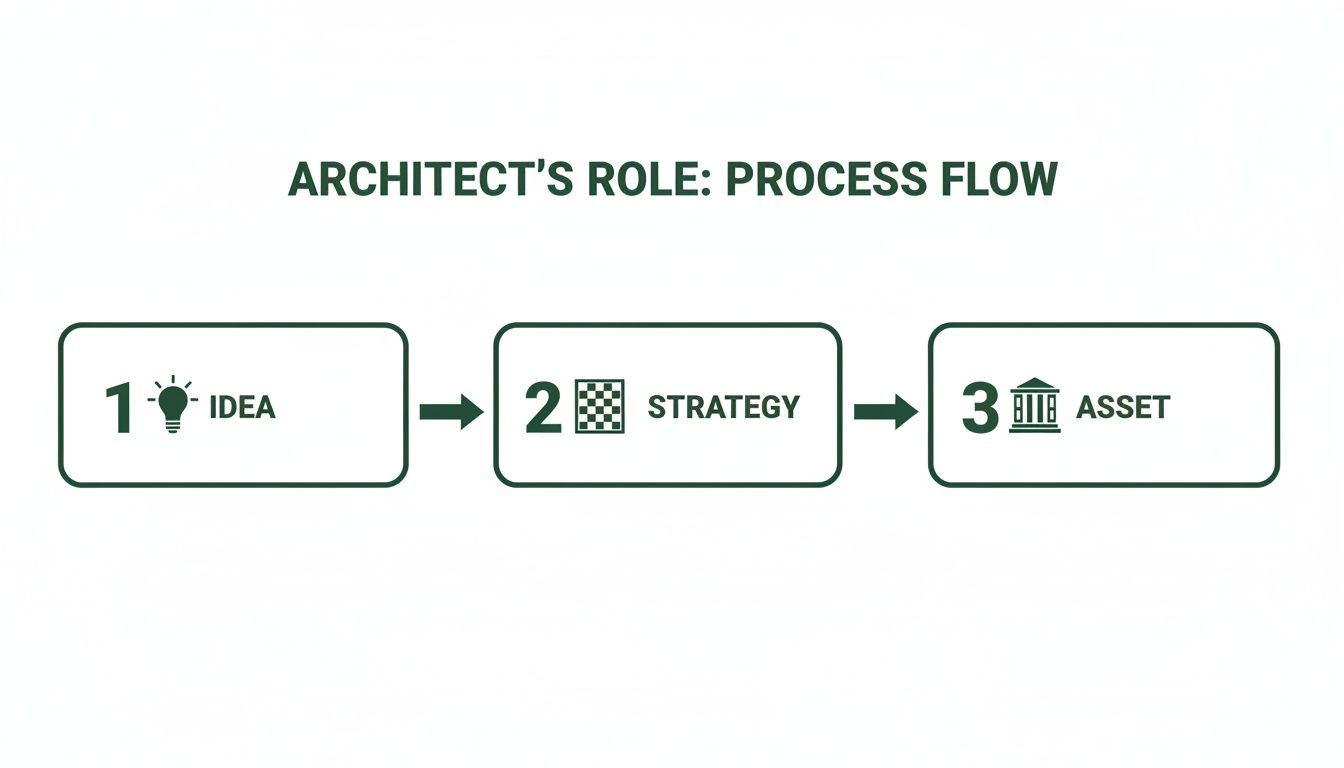
The following graphic helps visualize the different but complementary roles an interior architect and an interior decorator play over the course of a project.
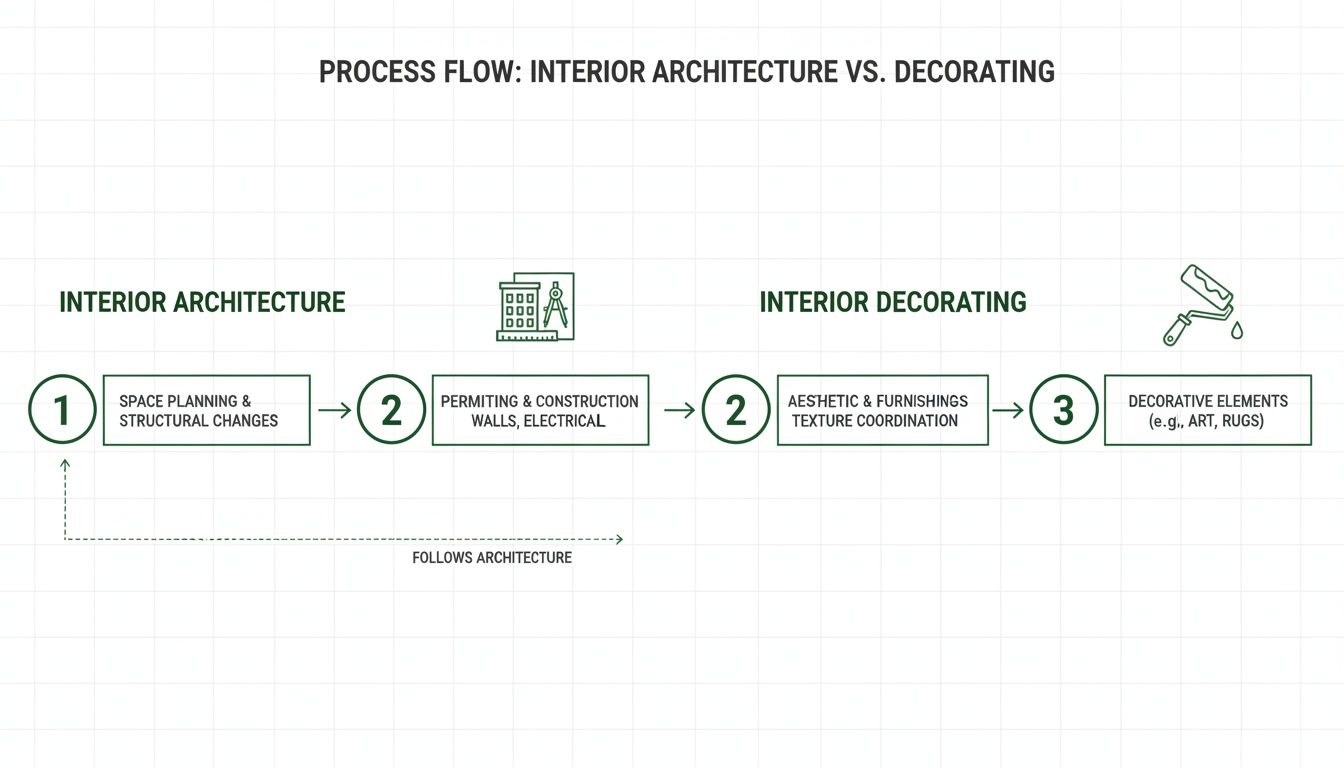
Process flow diagram illustrating the steps for interior architecture and interior decorating services.

As you can see, the architect’s work is foundational—it’s about the structure, systems, and very bones of the space. The decorator’s work then comes in to enhance and complete that environment.

Ensuring Vision Becomes Reality

The final stretch is Construction Administration, and this is where the architect becomes your eyes and ears on the job site. We conduct regular site visits, answer questions from the contractor, review the quality of the work being done, and approve payment applications. This oversight is what protects your investment and ensures the project is built exactly as specified in the documents.

This hands-on management holds the construction team accountable for delivering the quality you paid for. The architect's involvement doesn't stop until the final punch list is complete and you're ready to move into your new, fully realized space. It’s this end-to-end service that showcases the true value of an interior architecture firm, creating a seamless bridge from the first spark of an idea to the day you open your doors.

The U.S. interior design market hit USD 35,010.3 million in revenue in 2024, with remodeling being the fastest-growing segment. This trend perfectly aligns with the adaptive reuse projects we specialize in, which breathe new life into existing structures. You can learn more about the interior design market's growth and how it’s shaping development strategies today.

Unlocking Value with Adaptive Reuse and Preservation
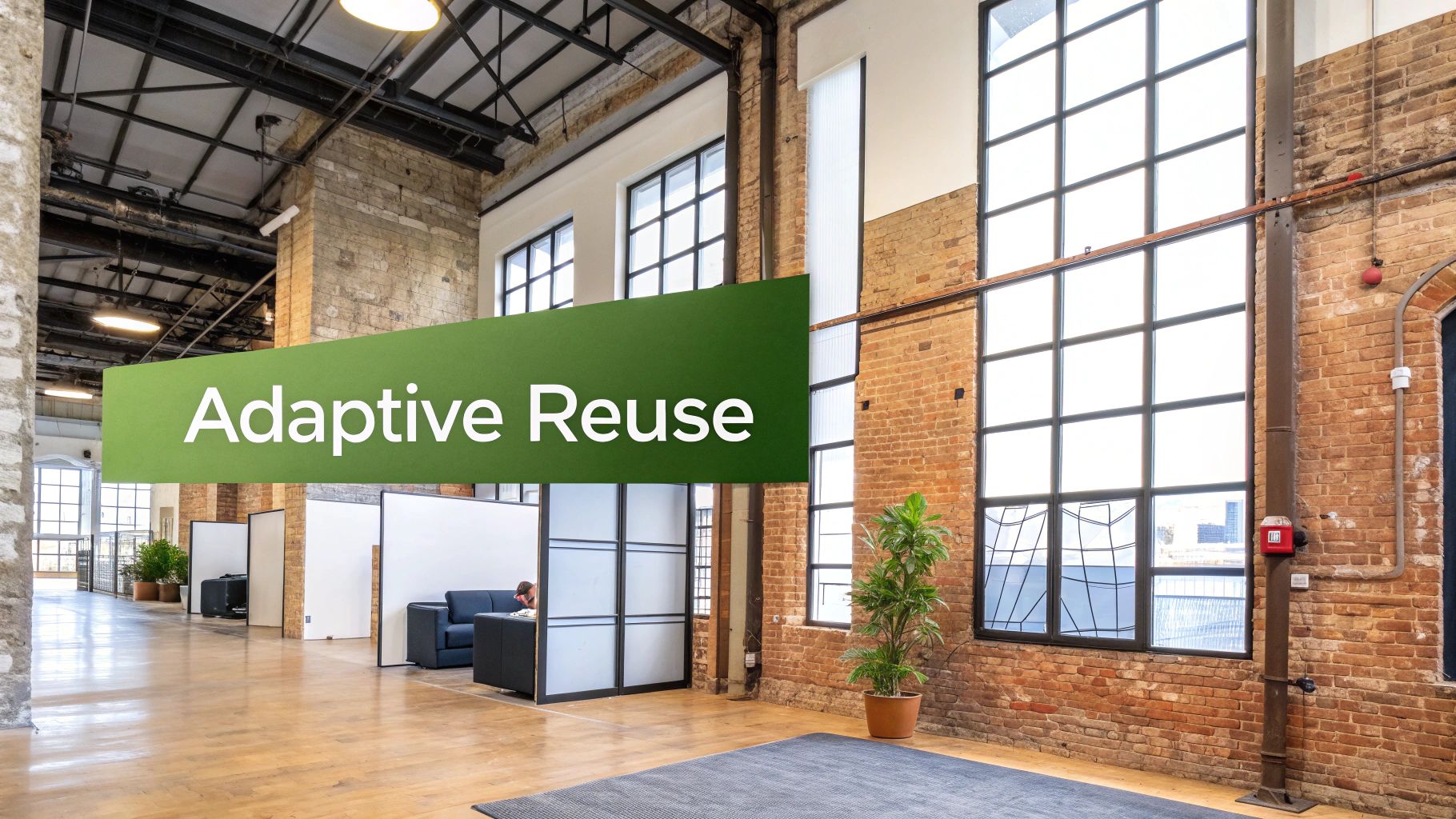
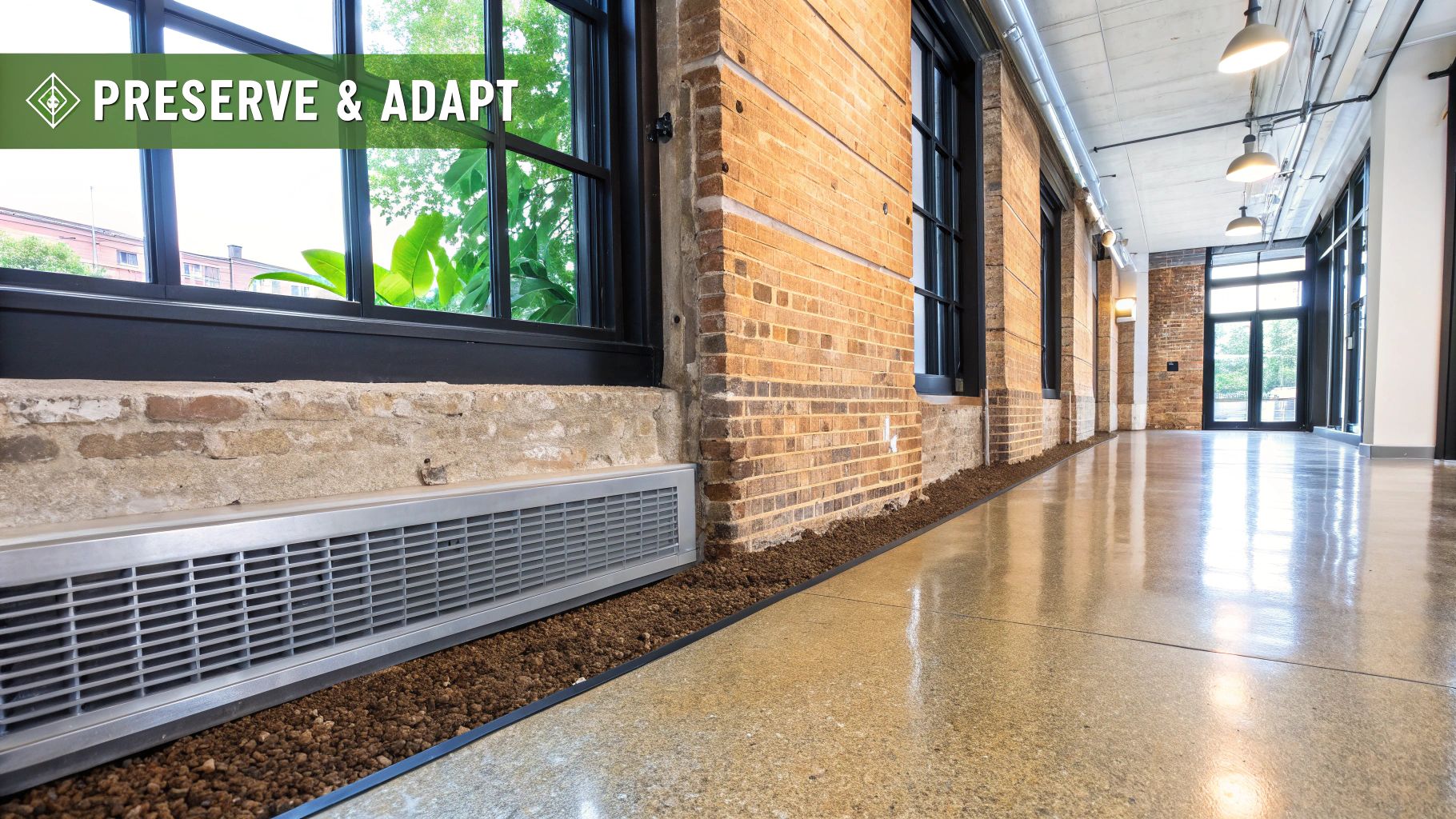
Spacious modern office interior featuring adaptive reuse design with exposed brick and large windows.

When many developers look at an old, tired building, they see a liability—something to be torn down. But a different kind of vision sees immense, untapped potential. This is the world of adaptive reuse, a smart strategy that breathes new life into aging structures, turning them into valuable, high-performing assets for today's market.

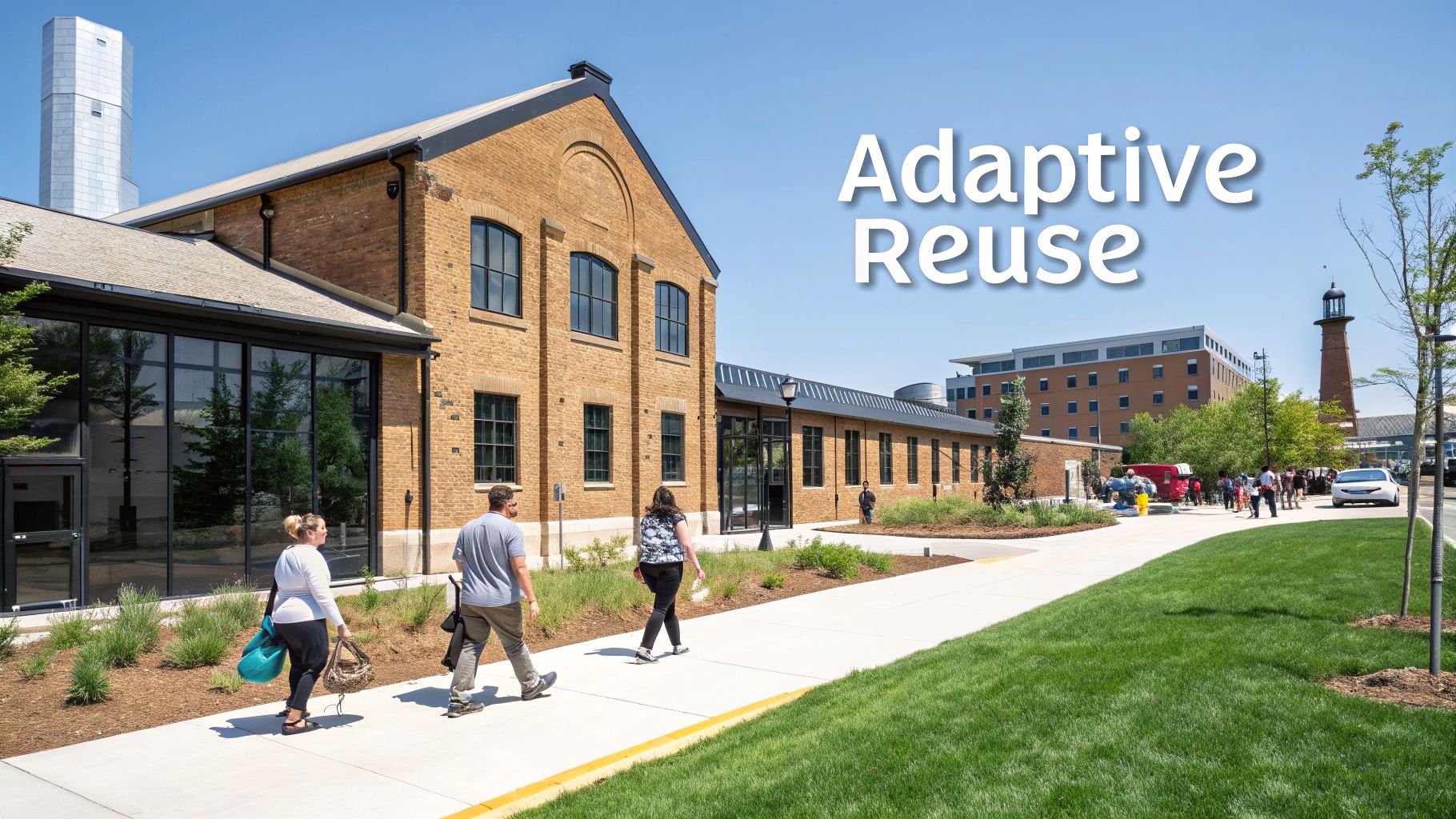
Adaptive reuse goes way beyond a simple renovation. It’s about strategically repurposing a building for an entirely new function while celebrating its original character. Think of an old textile mill buzzing with activity as a modern office hub, a forgotten warehouse finding new purpose as luxury lofts, or a grand old bank becoming a chic boutique hotel.

An interior architecture firm that specializes in this work is like a master puzzle-solver. They have the unique expertise to reconfigure outdated layouts for modern needs, weave in new mechanical and electrical systems without disrupting the building's soul, and navigate the intricate maze of historic preservation rules. The goal is always the same: create a space that feels contemporary and works beautifully, but is also rich with history and authenticity.

The Financial Case for Reimagining Old Buildings

The most powerful argument for adaptive reuse often comes down to the bottom line. For developers and property owners, choosing to repurpose an existing building instead of starting from scratch can offer a whole host of financial perks that are simply too good to ignore.

Demolition and new construction are expensive undertakings, both in time and money. Adaptive reuse projects, on the other hand, can be significantly more cost-effective. By keeping the building's "bones"—its core and shell—developers can see huge savings on materials and labor, often slashing project costs considerably.

Globally, the interior design market is projected to reach USD 214.35 billion by 2034, with commercial projects making up a huge piece of that pie. Adaptive reuse projects are frequently 40% cheaper than demolition and new construction, all while preserving historic character and opening doors to valuable tax incentives. Find out more about how market trends are favoring adaptive reuse projects.

These aren't just abstract savings. They directly translate into a healthier pro forma, a faster path to profitability, and a much higher return on investment for the developers who see the potential.

Beyond Cost Savings: The Strategic Advantages

The benefits of adaptive reuse don't stop with the budget. These projects have a built-in competitive edge that brand-new construction often struggles to match.

  • Accelerated Timelines: You get to skip the long demolition and site prep phases, meaning adaptive reuse projects often get to market much faster. This speed is a critical advantage, allowing you to start generating revenue sooner.
  • Unique Market Appeal: Today’s tenants and customers are looking for character. Exposed brick walls, original timber beams, and historic details create a unique sense of place that makes a property stand out from the cookie-cutter new builds, commanding higher rents and attracting top-tier tenants.
  • Environmental Sustainability: Reusing an entire building is one of the greenest things you can do in development. It drastically cuts down on landfill waste, preserves the embodied carbon locked into the original structure, and reduces the environmental toll of producing new materials.

Leveraging Historic Tax Credits for Maximum ROI

If the property has historical significance, the financial picture gets even brighter. A knowledgeable interior architecture firm becomes an essential partner in unlocking valuable historic tax credits. These government programs are specifically designed to encourage the preservation of landmark buildings by offering serious financial rewards.

Navigating the application process for these credits is a specialized skill. It requires a deep understanding of preservation standards, meticulous documentation, and careful negotiation with historical review boards. An experienced firm can guide you through every step, ensuring the design not only honors the building's past but also ticks every box required by the program.

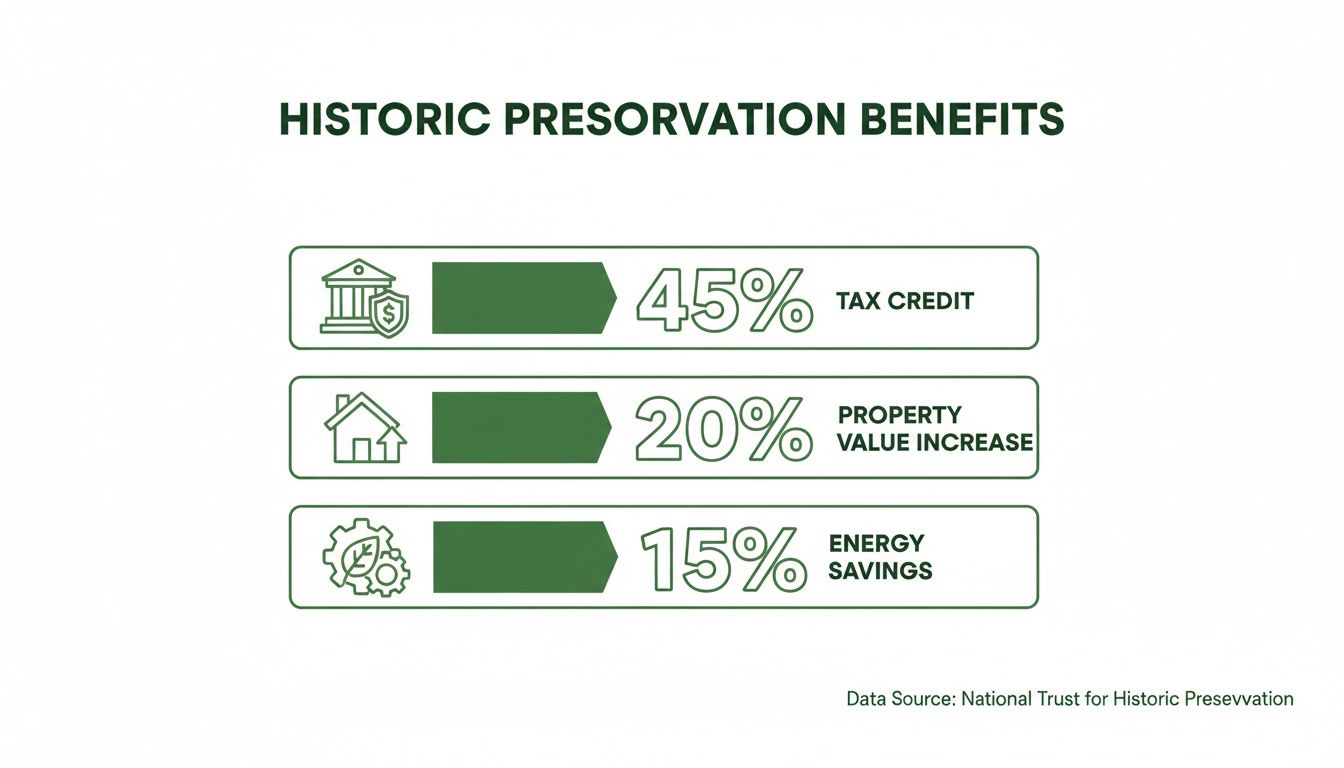
These tax credits can offset 20-30% of qualified renovation costs, which can fundamentally change the financial viability of a project. What might have seemed like a daunting preservation challenge can quickly become a highly profitable venture, turning a community landmark into a cornerstone of your portfolio.

Why This Matters for Your Bottom Line

Choosing to work with an interior architecture firm isn't just about making a space look good; it's a hard-nosed business decision that directly impacts your financial success. Every single design choice, whether it's moving a wall or picking a countertop, is an investment. The right firm makes sure that investment pays off, turning your physical space from a cost center into a high-performing asset.

We're talking about shifting the focus from creating a beautiful space to building a profitable one. It’s the difference between a building that just sits there and one that actively works to boost your revenue, strengthen your brand, and secure your place in the market for years to come.

Enhancing ROI Through Smarter Space Utilization

At the end of the day, commercial real estate is a game of inches—or rather, square feet. The goal is to squeeze maximum value out of every single one. This is where an interior architecture firm really shines, using strategic spatial planning to find revenue potential you didn't even know existed.

Think of them as a master chess player who sees moves on the board that others miss. They might reconfigure a floor plan to create more leasable area, improve the flow of foot traffic, or simply make the space function better for its intended purpose.

For instance, a clever office redesign can fit more employees comfortably, meaning you don't have to lease more space. In a retail shop, rethinking the customer journey can lead to a 10-15% increase in sales just by guiding shoppers past high-margin products. This kind of optimization doesn't just make your property more functional; it makes it far more attractive to top-tier tenants and future buyers, directly boosting occupancy rates and resale value.

A well-designed commercial space is a powerful magnet for tenants and customers. It’s not just about what the space looks like; it’s about how it performs for the businesses operating within it.

There's a reason the U.S. interior design services sector employs around 140,128 professionals. With 38% of global demand coming from offices and retail spaces seeking wellness-focused layouts, developers who get this right can see occupancy jump by 15-20%. You can dive deeper into how strategic design is driving commercial real estate trends on InteriorDesign.net.

Saving Time and Money Through Expert Navigation

The road from a design sketch to a finished building is littered with potential landmines: tangled zoning laws, constantly changing building codes, and bureaucratic permitting processes. Each one is a risk that can lead to expensive delays and budget blowouts.

An experienced interior architecture firm is your guide through this regulatory maze. Their in-depth knowledge of local ordinances and established relationships with review boards mean they can spot trouble long before it becomes a real problem.

This proactive approach takes a huge amount of risk off your plate and keeps the project on a smoother, more predictable timeline. Shaving even a few months off a project schedule by avoiding permitting headaches means you start generating revenue that much sooner—and that's a massive win for any developer's bottom line.

Future-Proofing Your Asset with Flexible Design

The only constant in business is change. The explosion of hybrid work, new patterns in consumer behavior, and emerging technologies all demand that commercial spaces be able to adapt. A forward-thinking interior architecture firm doesn't just design for today; they design for tomorrow.

This foresight is built directly into the space through elements like:

  • Modular Walls: Allowing office layouts to be reconfigured on the fly for different team sizes or project needs.
  • Multi-Use Common Areas: Designing lobbies, cafes, or break rooms that can easily transform into event spaces or collaboration hubs.
  • Scalable Infrastructure: Planning ahead for future tech needs, making upgrades simple and affordable instead of a major renovation.

This kind of thinking protects your investment from becoming outdated. A building designed for flexibility today will stay valuable and relevant for decades, saving you from costly overhauls down the line. It ensures your property can pivot to meet new market opportunities, maintaining its competitive edge and long-term profitability.

How to Choose the Right Firm for Your Project

Two men shaking hands across a table with a laptop and documents in a bright office.

Picking an interior architecture firm is easily one of the most important decisions you'll make for your entire project. This isn't just about flipping through a portfolio of pretty pictures. You’re selecting a long-term partner who will be responsible for guiding you through complex regulations, managing a significant budget, and turning your business goals into a tangible, profitable space.

The "best" firm isn't necessarily the one with the trendiest designs. It's the one whose specific experience and problem-solving skills align directly with the challenges of your project. A great design is the bare minimum; a successful project that meets its goals on time and on budget is the real test of a firm’s value.

Look Beyond the Portfolio

A slick portfolio is a good start, but it really only shows you the final, polished product. To get a real sense of a firm's ability, you have to dig into their process and see how they've handled real-world challenges. Every project looks perfect in a professional photograph, but the true value of a firm emerges in how they navigate the inevitable bumps in the road during design and construction.

Look for a history that matches your project's DNA. If you’re tackling an adaptive reuse project, for example, you need a firm that lives and breathes historic preservation and knows how to bring old buildings into the modern era. Their firsthand experience with the unique structural quirks and regulatory mazes of these projects is absolutely essential.

The right interior architecture firm acts as a translator—they convert your vision into a buildable plan, your budget into a realistic scope, and your business goals into a functional, revenue-generating space. Their role is to de-risk the entire venture for you.

The same logic applies to new commercial construction. A firm with deep roots in South Carolina, strong relationships with local planning departments, and an intimate knowledge of zoning codes is a massive advantage. That kind of local expertise can save you months of delays and thousands in unexpected costs, paving a much smoother road from blueprint to grand opening.

Questions That Reveal True Expertise

When you sit down to interview potential firms, it's time to get past the surface-level questions about their design "style." What you really need to understand is how they think. Their answers to specific, scenario-based questions will tell you far more about their capabilities than any curated gallery of images.

Don't be afraid to come prepared with a list of tough questions that test their practical knowledge and collaborative approach. This is your chance to get a feel for their communication style and determine if they're a good cultural fit for your team.

Here are a few questions that cut to the chase:

  • Problem-Solving: "Tell me about a past project that hit a major zoning or permitting snag. How did you get it back on track, and what was the final result for the client?"
  • Budget Management: "What's your process for keeping the design aligned with our budget from start to finish? How do you approach value engineering if we see costs start to climb?"
  • Collaboration and Communication: "Walk me through how you work with clients, general contractors, and engineers. How do you manage differing opinions or priorities to keep everyone moving forward?"
  • Local Knowledge: "What's your experience with the design review boards and building codes right here in this municipality? Are there any specific local challenges we should be prepared for?"
  • Project Management: "What tools and systems do you use to manage the project schedule and budget? How often will we get updates, and what will they look like?"

The way they answer these questions will paint a very clear picture of their competence, their transparency, and ultimately, whether they are the right strategic partner to bring your vision to life.

Your Partner in Building Lasting Value

Choosing an interior architecture firm isn't like picking a vendor; it's about bringing on a strategic partner who’s fully invested in your commercial success. Think of them as the conductor of a complex orchestra, expertly weaving together your vision, budget, regulations, and market demands to create a space that truly works. They’re the ones who turn abstract business goals into a tangible, high-performing physical asset.

The real value here goes far beyond beautiful finishes or trendy furniture. It’s found in a floor plan that actively maximizes your revenue, a design that sails through the permitting process without costly delays, and a building that will stay relevant and valuable for decades to come. A skilled interior architecture firm makes sure every single choice directly contributes to your bottom line.

The most successful projects begin with a shift in mindset—viewing architectural services not as an expense, but as the foundational investment in building enduring value. Your partner in this process is key to unlocking your property's full potential.

So, as you approach your next commercial or adaptive reuse project, think about the strategic advantage that expert guidance brings to the table. The right architectural partner doesn't just design a space for you. They help build your future, ensuring your investment delivers returns long after the dust has settled. It’s the smartest first step you can take.

Frequently Asked Questions

When you're dealing with commercial real estate and development, questions are bound to come up. Here are some of the most common ones we hear from clients thinking about working with an interior architecture firm.

What's the Difference Between an Interior Architect and an Interior Designer?

It's a common point of confusion, but the distinction is crucial. While both want to create great spaces, their roles are fundamentally different.

An interior architecture firm is run by licensed professionals who are legally qualified to change the structure of a building's interior. Think of them as dealing with the "bones" of the space—moving walls, integrating new plumbing and electrical systems, ensuring everything is up to code, and handling any structural work.

An interior designer, on the other hand, usually works on the surface level. Their expertise is in the finishing touches: furniture, paint colors, fabrics, and accessories that define the aesthetic. If your project involves a gut renovation, adaptive reuse, or major new construction, you need an interior architect to lead the charge.

How Much Does It Cost to Hire an Interior Architecture Firm?

There's no single answer here, as the cost really depends on your project's size, scope, and how complex it is. Generally, fees are handled in one of three ways:

  • A percentage of the total construction cost, typically landing between 8% and 15%.
  • A fixed, flat fee that's agreed upon before any work begins.
  • An hourly rate for design work and consultations.

It might feel like a big line item on the budget, but a good firm provides value that far exceeds its cost. They catch expensive mistakes before they happen, navigate the permitting maze to save you from costly delays, and design your space to get the most out of every square foot. It’s less of a cost and more of an investment in your property's future.

Hiring an expert firm is about risk mitigation. Their fee is a strategic investment to ensure your multi-million dollar project is executed correctly, compliantly, and profitably, preventing far costlier mistakes down the line.

How Long Does a Typical Commercial Project Take?

The timeline is completely tied to the scale of the job. A simple commercial upfit could be wrapped up in a few months. But a major adaptive reuse project or a brand-new building can easily stretch to a year or more.

The whole process breaks down into distinct phases: design (which includes schematics and detailed construction documents), bidding and permitting, and finally, construction itself. A seasoned firm will give you a realistic timeline from the get-go and has the project management chops to keep things moving forward.

Can a Firm Help with Historic Tax Credits?

Absolutely. In fact, this is one of the most valuable services a firm can offer if you're working on a historic property. Finding a local firm that has successfully navigated the state and federal historic tax credit programs is a game-changer. This isn't something you can just wing; it’s a specialized skill that can make or break the financial success of a project.

Firms with this expertise will walk you through the entire application, from documenting the building's historic importance to making sure every single detail of the renovation follows the strict Secretary of the Interior’s Standards. Their guidance is essential for maximizing your tax credits and transforming a piece of history into a profitable, modern asset.


Ready to transform your vision into a valuable, enduring property? At Sherer Architects, LLC, we specialize in guiding clients through every stage of design and construction, from innovative commercial spaces to complex historic preservation projects. Let's discuss how our strategic approach can bring structure, beauty, and profitability to your next venture.
Contact us today to schedule your consultation

Categories
Uncategorized

Architecture Greenville SC: architecture greenville sc Guide to Local Design

Kicking off a commercial building project in Greenville is about more than just finding a piece of dirt and hiring a crew. The projects that truly succeed—the ones that become landmarks and smart investments—are built on a solid foundation of strategy. This all happens long before anyone even thinks about drawing up blueprints. This initial phase is where you sidestep costly blunders and bake real value into your project from the very start.

Setting Your Greenville, SC Building Project Up For Success

A successful project isn't an accident; it's the result of a smart, foundational strategy. This isn't about checking boxes. It’s about making informed, deliberate decisions from day one that prevent expensive headaches later. It means you have to dig deep into the specifics of your site, nail down a crystal-clear scope, and establish a budget that’s grounded in reality, accounting for both what you know and what you don't.

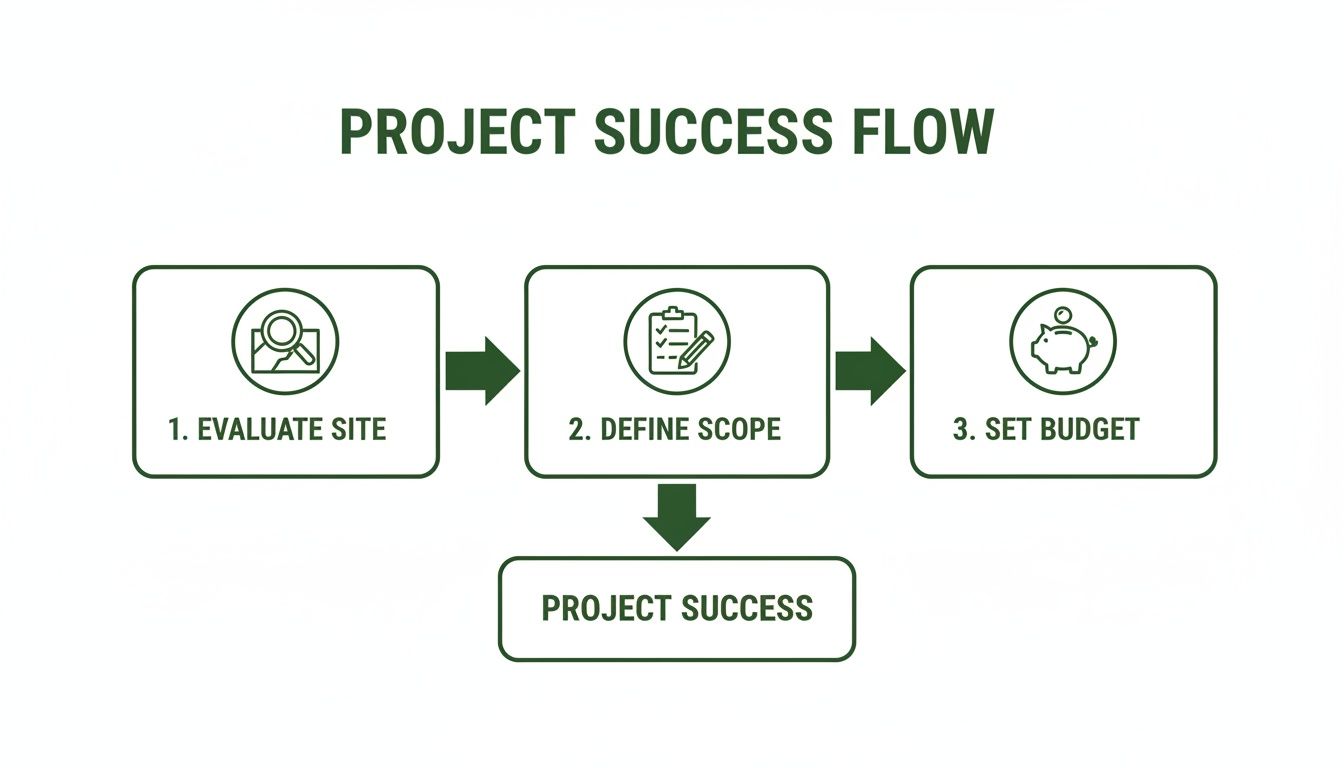
This strategic flow shows how these crucial first steps fit together, from evaluating the site to setting the budget.

A flowchart illustrates the project success flow with steps: Evaluate Site, Define Scope, and Set Budget.

As you can see, each stage builds directly on the one before it. Get this sequence right, and you're laying the groundwork for a smooth and successful project.

Evaluating Your Site and Its Hidden Potential

Your first real move is a thorough site evaluation that goes way beyond just the property lines. In a city like Greenville, with its unique history and distinct neighborhoods, every single property has its own story and context.

Think about its proximity to hotspots like the West End or the Village of West Greenville. Is it nestled within a historic district, like the Pettigru Historic District? That could unlock valuable preservation incentives, but it will also mean navigating extra layers of design review.

Beyond location, you've got to get real about the physical conditions. Does the site’s topography create a nightmare for foundation work? Are utilities already on-site, or is running new infrastructure going to be a major line item on your budget? If you're looking at an existing building, the investigation gets even more critical.

Assessing an Existing Building For Adaptive Reuse

If you’re considering an older building, a comprehensive condition assessment is absolutely non-negotiable. This isn’t a quick walkthrough; it's a deep dive into the building's guts. You need solid answers to some tough questions:

  • Structural Integrity: Is the foundation sound? Are there tell-tale signs of stress or failure in the load-bearing walls or roof structure?
  • MEP Systems: How old are the mechanical, electrical, and plumbing systems? Outdated or non-compliant systems can mean a full replacement, which is a massive budget hit.
  • Hazardous Materials: Are you dealing with asbestos, lead paint, or other nasty surprises that demand specialized—and expensive—abatement?
  • Building Envelope: What’s the state of the roof, windows, and masonry? Water intrusion is a project-killer if you don’t catch it and deal with it early.

Greenville’s rich stock of older buildings presents incredible opportunities for adaptive reuse. The city has a deep inventory of historic properties just waiting to be transformed into profitable, modern assets. A 2003 survey identified around 1,200 historic resources, and another 128 were added later. This just scratches the surface of the potential for preserving these unique structures for another 50–75 years of use. You can explore Greenville's historic property survey to get a feel for the city's amazing architectural heritage.

A classic misstep is underestimating what it costs to bring an old building up to modern code. What looks like a simple cosmetic facelift can quickly spiral into a full-gut renovation when you uncover the need for a new HVAC system, a complete electrical rewire, and major accessibility upgrades.

To guide you through these initial stages, here's a checklist of the key areas to investigate.

Initial Project Scoping Checklist

Evaluation Area Key Questions to Ask Why It Matters
Zoning & Land Use What is the current zoning? Are there overlays (e.g., historic, design review)? What are the permitted uses, setbacks, and height limits? Determines what you can legally build and sets the fundamental design constraints. Ignoring this can stop a project cold.
Site Conditions What is the topography? Are there environmental concerns? Where are the utility connections (water, sewer, electric)? Physical site issues directly impact foundation design, site work costs, and overall construction feasibility.
Building Condition (For existing buildings) What's the state of the structure, roof, and MEP systems? Is there evidence of hazardous materials? Uncovering major deficiencies early prevents catastrophic budget overruns and project delays during construction.
Market Feasibility Who is the target tenant/buyer? What are the current market rents or sales comps for this type of property in this location? Ensures your project vision aligns with market demand, making it a viable and profitable investment.
Preliminary Budget What are the anticipated hard costs (construction) and soft costs (fees, design, legal)? Have you included a contingency? A realistic, all-in budget from the start provides a critical reality check and guides all subsequent decisions.

Working through these questions forces you to think critically about every angle of the project before you've spent a dime on design.

Defining Your Scope and Setting a Realistic Budget

Once you have a complete picture of your site or building, it's time to define your project scope. This is your roadmap. It details everything from the square footage and how the space needs to function to the quality of the finishes. A vague scope is a surefire recipe for budget overruns and endless delays.

Get specific. Don’t just say "a modern office space." Define it as "a 10,000-square-foot office with an open floor plan for 50 employees, two conference rooms with full AV integration, and a Class A lobby finish." See the difference?

With a detailed scope in hand, you can finally build a budget you can trust. This needs to include more than just the hard costs of materials and labor. You have to account for soft costs, too—things like architectural and engineering fees, city permits, legal expenses, and financing.

And whatever you do, always build in a contingency fund. A buffer of 10-15% of the total construction cost is standard practice to cover the inevitable surprises that pop up in every single project. This disciplined approach is what separates the successful projects from the cautionary tales.

Finding the Right Architect for Your Greenville Project

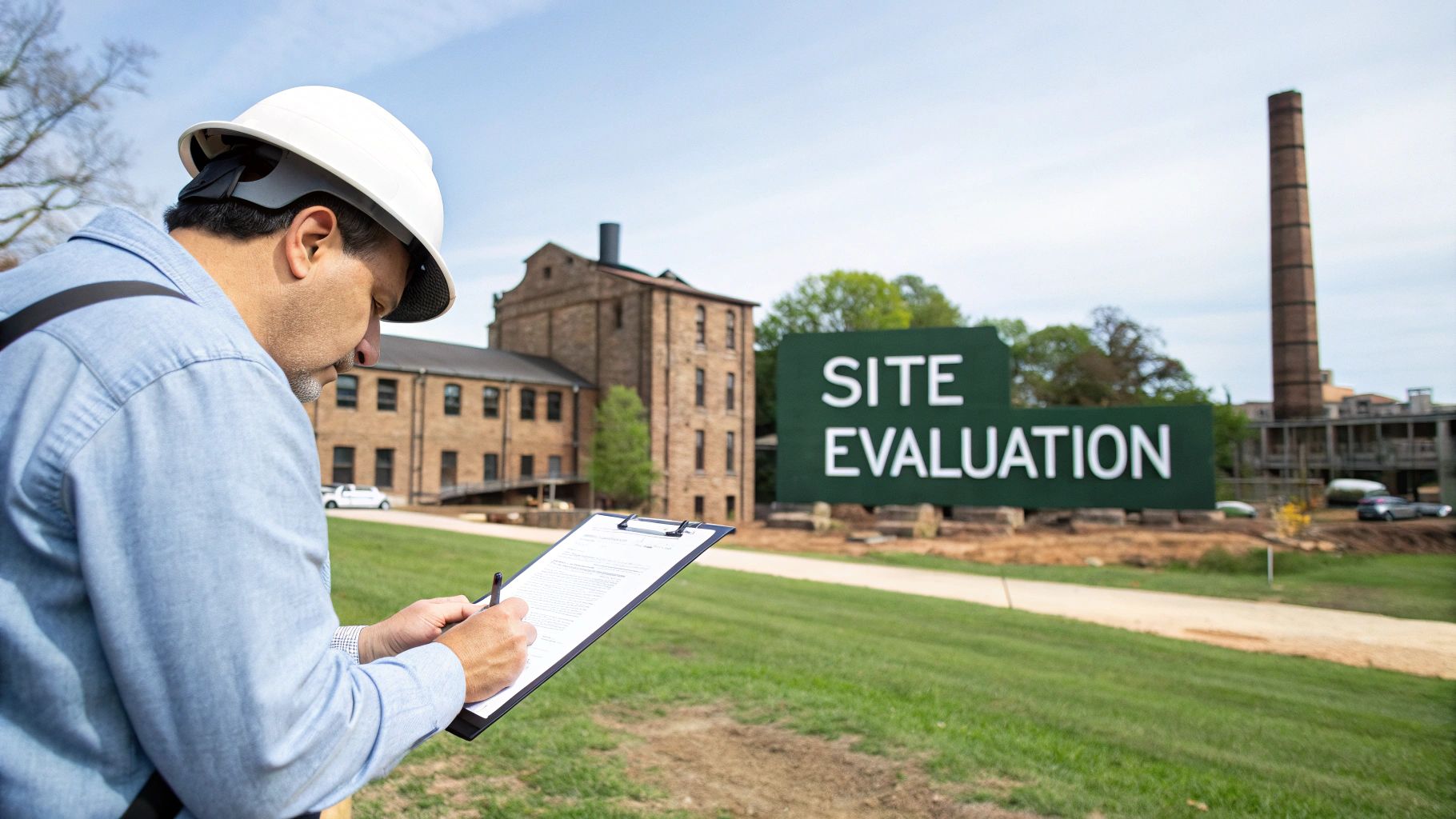
Engineer in hard hat evaluating an industrial site, writing on a clipboard with a 'SITE EVALUATION' sign.

Let's be clear: choosing your architect is probably the most consequential decision you’ll make for your entire commercial project. This isn't just about finding a firm with a slick portfolio. It's about securing a strategic partner who truly gets the intricate development landscape here in Greenville, SC.

The right architect does so much more than design buildings. They are your guide through the complex local systems that can make or break your investment. A stunning rendering is worthless if the design gets shot down by the city's Design Review Board (DRB) or clashes with the neighborhood’s character.

The best architecture Greenville SC has to offer comes from a deep, almost instinctual, understanding of local context. We're talking about everything from the brick facades along Main Street to the industrial grit of the West End. Your ideal partner will have a proven track record of navigating these specific local waters.

Look Beyond the Portfolio

When you start your search, it's incredibly easy to get dazzled by polished photos of finished projects. And while a strong portfolio is definitely a good sign, it's just the beginning of the story. The real value is in an architect's experience with the process, not just the final product.

You need someone who can anticipate the questions and concerns of Greenville's planning officials before they even come up. That kind of foresight only comes from years of hands-on experience and the professional relationships built along the way.

As you vet potential firms, here’s what you should really be focusing on:

  • Local Regulatory Fluency: Have they successfully steered multiple projects through Greenville’s specific zoning, permitting, and DRB hoops? Don't be shy—ask for concrete examples.
  • Adaptive Reuse Expertise: If you're working with an older building, does the firm have a solid portfolio of successful adaptive reuse projects? It's a highly specialized skill that not everyone possesses.
  • Historic Preservation Credentials: Is your project in a historic district or a designated landmark? Make sure the architect has direct experience with historic tax credits and the strict standards that come with preservation work.

This is the kind of specialized knowledge that separates a decent local architect from a truly great one. It’s the difference between a smooth, predictable process and one that’s bogged down by costly delays and frustrating redesigns.

Questions to Uncover True Expertise

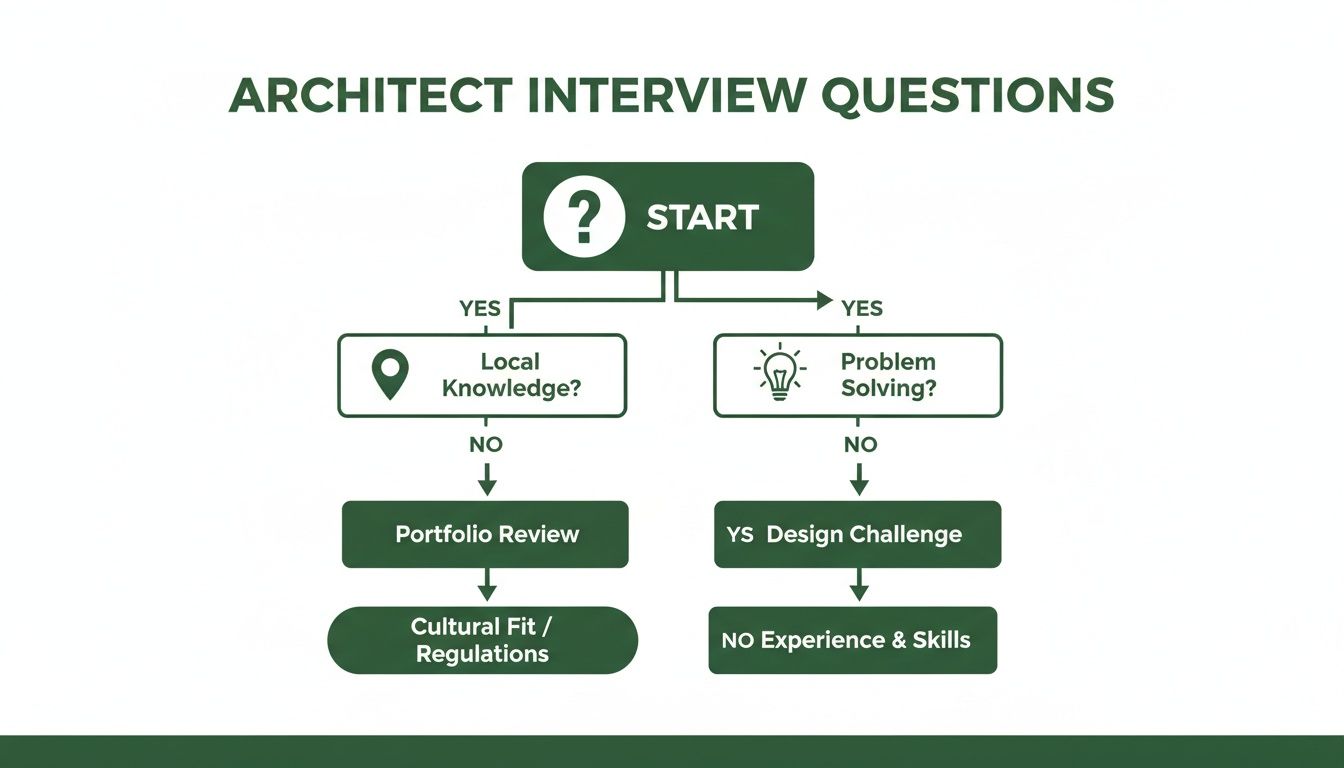
When you sit down for interviews, it's time to move past generic questions about design philosophy. Your mission is to understand how a firm thinks on its feet, solves problems, and collaborates when things get tough. You’re not just hiring a designer; you're hiring a problem-solver and a staunch advocate for your investment.

A common mistake is getting hung up on an architect's design style. A far more critical factor is their ability to fuse a great design with your business goals and the city’s regulatory demands. The goal is a project that's not just beautiful, but profitable and buildable.

To really get to the heart of their capabilities, try asking these pointed questions:

  1. Navigating the DRB: "Tell me about a time you presented a project to the Greenville DRB and got some tough feedback. How did you adapt the design to satisfy their concerns while still protecting the project's budget and our main goals?" This question reveals their real-world negotiation and problem-solving skills.

  2. Value Engineering: "Can you give me an example of how you used a creative design solution or a different material to bring down construction costs on a project without compromising the quality or the look?" This gets right to their ability to deliver value, not just a pretty picture.

  3. Collaboration Style: "What's your process for communicating with us and the contractor during the construction phase? How do you handle it when there's an on-site issue or a gap between the plans and what's actually being built?" This peels back the curtain on how they manage the messy, practical reality of a construction site.

The answers you get will tell you far more about a firm’s real-world chops than any portfolio. You’ll get a window into how they handle adversity, protect your bottom line, and ultimately act as a true partner. Your choice of architect shapes everything from day one to completion, so take the time to find a firm that brings both visionary design and pragmatic, on-the-ground expertise to your project.

Navigating Greenville's Zoning and Permitting Maze

Greenville’s rapid growth has, not surprisingly, led to a complex web of regulations. If you're a developer or property owner, this maze of zoning ordinances, landscape rules, and design guidelines can feel like a serious hurdle. Getting a project from a sketch on a napkin to a structure rising from the ground takes more than a great idea; it demands a smart, strategic approach to the entire approvals process.

Thinking about these local rules as just a checklist to get through is a mistake. When you understand them, you can actually use them to create a better, more valuable project that fits right into the city's unique character. This is where a seasoned local architect becomes your most valuable player—they know how to translate your vision into a language city officials and review boards will not only understand but also support.

Understanding Greenville's Zoning and Overlays

Before you fall in love with a specific design, your first reality check is always the city's zoning code. These are the foundational rules that dictate everything from what you can do with the building (its "use") to how tall it can be and how far it must sit from the property lines.

But in Greenville, the real game-changer is often the overlay districts. Think of these as special zones, like a historic district or a design review area, that layer extra standards on top of the basic zoning. A project on Main Street, for instance, is going to get a much closer look at its materials, size, and how it feels to a pedestrian than a warehouse in an industrial park.

Here’s how an experienced team tackles this:

  • Zoning Verification: The first move is to get a zoning verification letter from the city. This document officially confirms all the specific requirements for your property. No guesswork.
  • Deep-Dive Code Analysis: Next, your architect will dig deep, comparing your project goals against the code to spot any potential conflicts right away.
  • Proactive Strategy: This early homework lets you get ahead of problems. You might tweak the design slightly or start building a strong case for a variance if you know you'll need one.

Skipping this initial due diligence is a classic rookie mistake. I’ve seen it lead to months of delays and expensive redesigns when the planning staff flags an issue that could have been caught on day one.

The Influential Design Review Board

For projects in many of Greenville’s most desirable spots, your design’s fate lies with the Design Review Board (DRB). This board's job is to make sure new construction and major renovations add to the city's aesthetic and character, not detract from it. They aren’t just ticking boxes on a form; they’re making a subjective judgment on the quality and fit of your design.

Presenting to the DRB is both an art and a science. You need a compelling story that explains why your design choices make sense for that specific location.

A common pitfall is treating the DRB presentation as just another bureaucratic step. The board wants to see that you've thought deeply about the context, the materials you've chosen, and the building's overall scale. An architect who can clearly and confidently articulate the "why" behind the design is your greatest asset in that room.

Getting the DRB's approval often boils down to good preparation and a collaborative spirit. A smart architect engages with city staff for informal feedback long before the official hearing. This pre-review process helps you iron out the kinks and address concerns early, making the formal presentation a much smoother ride.

From Site Plan Approval to Building Permits

Once you’ve cleared the DRB and have conceptual approval, the process shifts from the big picture to the nitty-gritty technical details. This phase is a whirlwind of submissions to different city departments—engineering, landscaping, fire safety, and more. Each one will scrutinize your plans to ensure they meet every last code and ordinance.

This is where your architect and engineering team work in perfect sync, producing the highly detailed construction documents that will guide the build. These drawings spell out everything, from the structural system holding the building up to the layout of every electrical outlet.

The final leg of the journey is securing all necessary building permits and, at the very end, the project's final blessing. When dealing with Greenville's permitting process, it's vital to remember the last step: obtaining the Certificate of Occupancy. This is the city's official stamp of approval, declaring your building is safe and ready for business. You can't legally open your doors without it. Throughout this entire sequence, your architect acts as the project quarterback, coordinating with all the consultants and responding to city feedback to keep your project on track, on time, and on budget.

Why Adaptive Reuse Is Smart Business in Greenville

In a city like Greenville, where historic brick mills and century-old storefronts tell the story of its past, the bulldozer isn’t always the best tool for the job. We're seeing more and more developers recognize the immense value locked away in these older structures.

Adaptive reuse is simply the practice of breathing new life into old buildings—transforming them for modern uses while keeping their irreplaceable character. This isn't just about nostalgia; it's a savvy business strategy that often delivers a stronger ROI than starting from scratch.

When you choose to repurpose an existing building, you're not just saving a piece of history. You're leveraging its embodied carbon, making it a far more sustainable choice. You also get to sidestep the high costs and unpredictable timelines that come with demolition, site prep, and new foundation work, getting you to market faster. This approach lets you tap into a huge demand for authentic spaces that you just can't replicate with new construction.

Tapping Into Powerful Financial Incentives

One of the most compelling reasons to go the adaptive reuse route in Greenville is the significant financial support available. Renovating a historic property isn't just a feel-good decision; it can dramatically improve your project's bottom line through a range of powerful incentives.

These programs were put in place specifically to make preservation an attractive, and often more profitable, alternative to demolition. They can seriously reduce your initial investment, improve cash flow, and ultimately boost your property's long-term value.

Here are the key financial tools you should know about:

  • Federal Historic Tax Credits: This is the heavyweight champion of preservation incentives. It can provide a 20% income tax credit for the substantial rehabilitation of certified historic structures. For a multi-million dollar renovation, that credit can mean hundreds of thousands of dollars straight back into your pocket.
  • State Historic Tax Credits: South Carolina offers its own set of credits that you can stack with the federal program, making the deal even sweeter for developers.
  • Local Grants and Loans: Don't overlook local programs and specialized lenders. They often provide favorable terms for projects that help preserve Greenville's architectural heritage.

Navigating the complex applications and compliance for these programs is no small feat. This is where an architect with deep experience in historic preservation becomes absolutely essential.

The Balance Between Progress and Preservation

Greenville's story is one of constant evolution, and sometimes that progress came at a cost. During the early 20th century, the city’s push toward modernization led to the loss of some real architectural treasures. For instance, the original 1823 courthouse designed by Robert Mills—the visionary behind the Washington Monument—was torn down for a new "skyscraper." As you can read more about Greenville's Main Street history, this loss really highlights the tension between moving forward and holding onto the past.

Today, the most successful developers and city planners I work with recognize that the best projects find a way to honor the past while building for the future. Adaptive reuse isn't about freezing a building in time; it's about making it relevant and useful for generations to come.

This thoughtful approach is what gives Greenville its distinct sense of place. Buildings like Mills Mill, a Romanesque-style textile factory built in 1897, have been reborn as vibrant residential and commercial hubs. These projects prove that historic structures can be powerful economic engines, attracting tenants and customers who are willing to pay a premium for authenticity and unique design. Choosing adaptive reuse aligns your project with what the community values and helps create a more sustainable and culturally rich city.

Adaptive Reuse vs New Construction A Financial Snapshot

When you really crunch the numbers, especially with the available incentives factored in, the financial case for adaptive reuse becomes crystal clear. Here’s a high-level look at how the two approaches typically stack up for a commercial project in Greenville.

Financial Factor Adaptive Reuse / Historic Preservation New Construction
Initial Capital Outlay Often lower since you're leveraging the existing structure and avoiding major demolition. High costs for demolition, site work, foundation, and all-new structural systems.
Tax Incentives Eligible for substantial federal and state historic tax credits, directly reducing project costs. Generally not eligible for preservation-specific financial incentives.
Construction Timeline Can be faster by avoiding lengthy site prep and foundation phases. Subject to weather delays and potentially longer timelines for ground-up work.
Market Appeal High demand for unique, character-rich spaces that often command premium rents. Competes in a crowded market of standard, modern commercial spaces.

Ultimately, by partnering with an experienced architecture Greenville SC firm that understands the nuances of historic properties, you can transform what might look like a liability into a high-performing asset—creating a landmark that is both profitable and a source of community pride.

Bringing Your Project From Blueprint to Reality

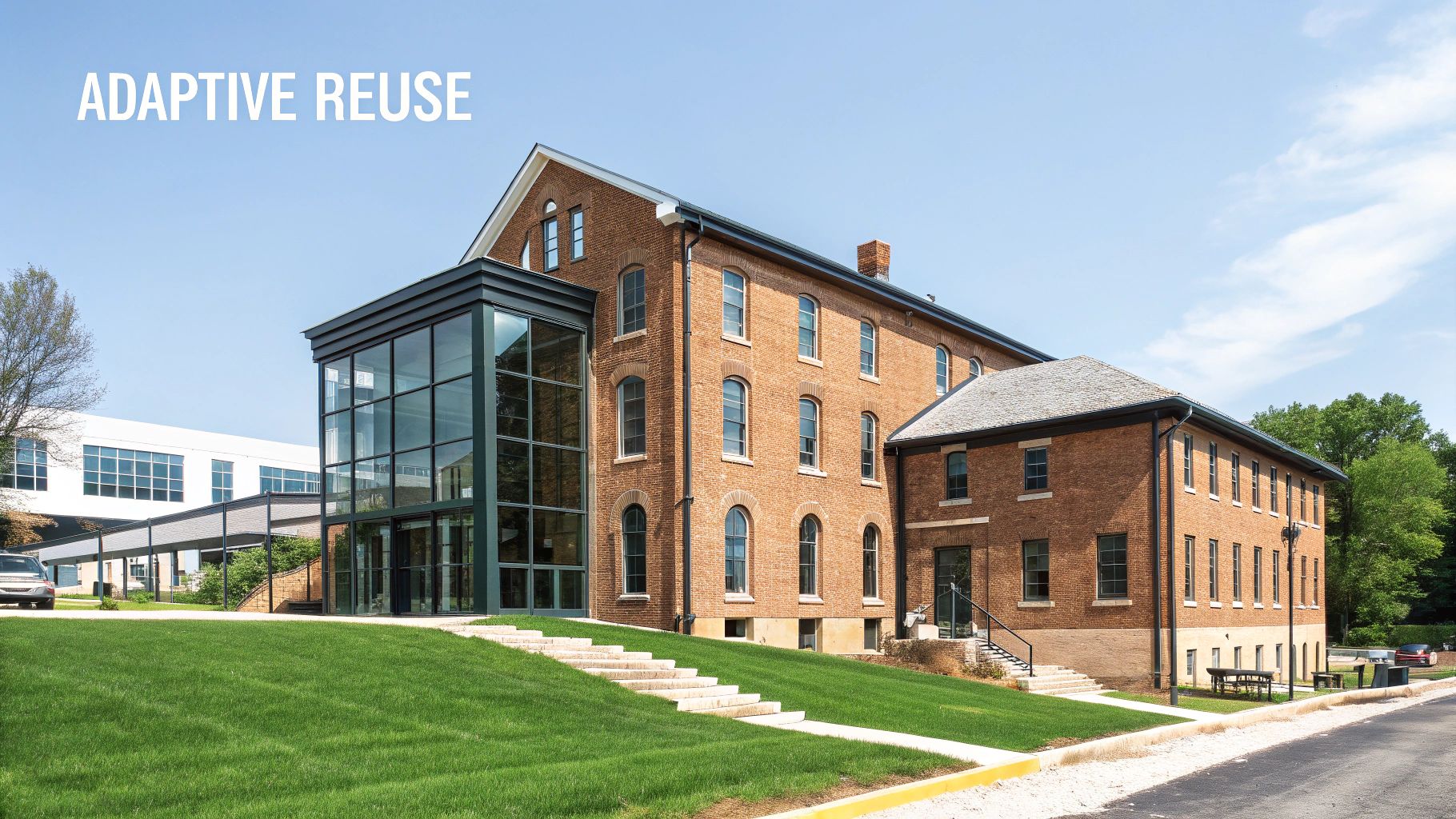
A beautiful historic brick building with a modern glass addition, exemplifying adaptive reuse architecture.

With the city’s stamp of approval on your plans, the project finally moves off the page and onto the job site. This is the construction administration phase—the moment your vision starts becoming a physical asset. Success from here on out hinges on a strong, collaborative partnership between you, your architect, and your general contractor. The real work starts now.

Don't make the mistake of thinking your architect's job is done. In many ways, their role becomes even more crucial during construction. They shift from being your designer to your advocate on the ground, making sure the contractor’s work matches the design's intent with precision and quality. This oversight is what protects your investment and ensures the final building is what you actually paid for.

Your Architect is Your Advocate on the Job Site

During the build, your architect is the essential link between the detailed plans and the day-to-day realities of the construction site. Their main job is to observe the progress and confirm that everything is being built according to the contract documents. This isn’t about micromanaging the crew; it’s about quality assurance.

Regular site visits are the backbone of this process. An experienced architect has a trained eye for the details, spotting potential issues long before they snowball into costly, time-consuming problems.

During these visits, they’re focused on key tasks:

  • Checking Work Conformance: Are the right materials being used? Is the craftsmanship up to standard? They verify that everything from the rebar in the foundation to the window installations matches the specifications.
  • Answering RFIs: Contractors will always have questions. Your architect provides timely, clear answers through Requests for Information (RFIs), which prevents guesswork and keeps the project from stalling.
  • Reviewing Pay Applications: They review the contractor’s invoices to certify that the amount billed accurately reflects the work completed. This simple check protects you from paying for work that hasn't been done yet.

Having your architect consistently on-site is fundamental to maintaining the integrity of high-quality architecture Greenville SC projects, from the first shovel in the ground to the final coat of paint.

It's a common myth that the general contractor is the only one responsible for quality control. While the GC manages the build, your architect is your independent expert, verifying the work is done right, not just done. Their loyalty is to you and the vision you both created.

Building a Problem-Solving Partnership

Let’s be realistic: no construction project goes exactly as planned. You might uncover an unexpected utility line during excavation, or a key material could be hit with a supply chain delay. These things happen. What defines a successful project is how the team—owner, architect, and contractor—handles these bumps in the road.

A collaborative, get-it-done mindset is essential. Pointing fingers only leads to wasted time and money. The goal is to create an environment where problems are brought to the table immediately and solved together. Your architect often leads these conversations, helping analyze the issue and proposing solutions that work for the design, the budget, and the schedule.

For example, if a specified brand of flooring suddenly goes on backorder for six months, your architect can quickly find and vet a suitable alternative that meets the same aesthetic and durability standards, keeping the project on track.

Keeping Timelines, Costs, and Changes in Check

Staying on top of the schedule and budget is a daily effort, and your architect is central to that effort through meticulous documentation and clear communication.

The most critical tool for managing this is the change order. This is a formal document used any time a deviation from the original plan will affect the project's cost or timeline. This could be an upgrade you decide to add or an adjustment needed to deal with an unforeseen site condition.

Here’s how a well-managed change order process works:

  1. Clear Scope: The architect clearly spells out the exact scope of the change.
  2. Transparent Pricing: The contractor provides a detailed cost breakdown for the new work.
  3. Formal Approval: You, as the owner, give the final sign-off before any work begins.

This disciplined approach prevents "scope creep" and eliminates nasty financial surprises when the final bill comes. By working as a tight-knit team with your architect and contractor, you can navigate the complexities of construction and see your vision brought to life—beautiful, durable, and exactly as you intended.

Your Top Questions About Greenville Architecture Projects

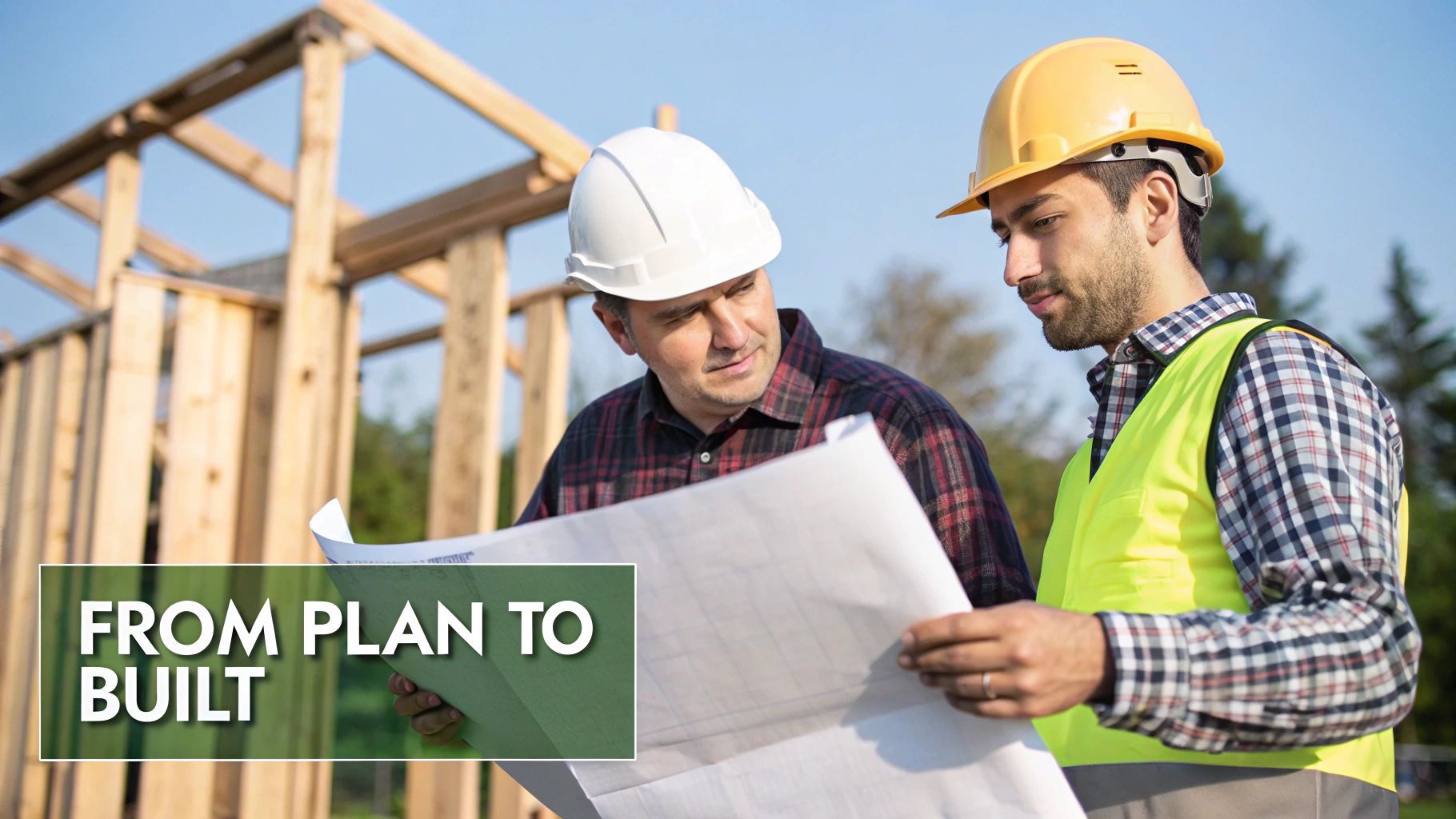
Two construction workers in hard hats review blueprints at a building site for a house.

Tackling a commercial development in Greenville brings up a lot of questions. I've seen property owners, seasoned developers, and new investors all start with similar concerns. Let’s walk through some of the most common ones to give you the clarity you need to get started.

How Long Does The Design And Permitting Process Take In Greenville?

This is usually the first question I get, and the honest answer is: it depends entirely on the project's scope. A simple interior upfit for a retail space will, of course, move much faster than a complex, ground-up hotel in a historic district.

As a rule of thumb, it’s smart to budget 3-6 months for the design phase alone. That covers everything from initial sketches to the detailed construction documents a builder needs. After that, you'll need to plan for another 3-5 months to get through the City's permitting process and, if applicable, the Design Review Board (DRB).

Keep in mind, projects with extra layers of complexity—like historic preservation reviews or requests for zoning variances—will add time to that schedule. A local architect who knows the ropes can give you a far more accurate timeline for your specific project and help you sidestep common delays.

What Are The Biggest Benefits Of Adaptive Reuse?

Deciding to repurpose an old building instead of starting from scratch is a smart move in a city like Greenville. The benefits are about much more than just saving a piece of history.

Financially, the advantages are compelling:

  • Cost Savings: You can save a significant amount on big-ticket items like demolition, major site work, and pouring a new foundation.
  • Tax Credits: Many adaptive reuse projects are eligible for federal and state historic tax credits, which can put a substantial amount of money back into your pocket.
  • Faster Timeline: Working with an existing structure often means you can get your doors open—and start generating revenue—much sooner.

Beyond the numbers, renovated historic buildings offer an inherent character and story that you simply can't manufacture. This authenticity is a massive draw, attracting discerning tenants and customers who crave unique, memorable spaces.

What Is The Role Of The Design Review Board?

Greenville’s Design Review Board, or DRB, is instrumental in maintaining the city's architectural quality. The board is responsible for reviewing new construction and major renovations within specific design districts to ensure they contribute positively to the urban fabric.

They look at the whole picture, evaluating key elements like:

  • The quality and type of building materials.
  • The building’s scale and how it relates to its neighbors.
  • Landscaping and how it enhances the streetscape.
  • Overall harmony with the character of the surrounding district.

The goal isn't to kill creativity; it's to foster thoughtful, high-caliber design that respects and improves our city. This is why working with an architect who has a strong, established relationship with the DRB is a non-negotiable for a smooth approval process.

How Do I Know If My Building Qualifies For Historic Tax Credits?

This is a big one. To be eligible for historic tax credits, your property has to be what's called a "certified historic structure." In simple terms, this means it must either be listed on the National Register of Historic Places or be a "contributing" building within a recognized historic district, such as the Pettigru Historic District.

The work itself also has to meet specific criteria. The renovation must be substantial and follow the Secretary of the Interior's Standards for Rehabilitation, which is a detailed set of guidelines. The documentation requirements are rigorous.

An architect who specializes in historic preservation is your most valuable asset here. They can quickly assess a property's eligibility, navigate the entire application maze for you, and design the project to meet every standard, ensuring you get the maximum financial benefit.


Navigating the complexities of a commercial project requires a partner who understands both visionary design and the practical realities of development in South Carolina. At Sherer Architects, LLC, we specialize in guiding clients through every phase, from initial site evaluation to final construction, ensuring your project is a beautiful, enduring, and profitable success.

Discover how we can bring your Greenville project to life.

Categories
Uncategorized

How to Hire South Carolina Architects for Your Commercial Project

Finding the right South Carolina architects for your project is more than just flipping through portfolios. You’re looking for a partner who gets the local landscape—someone who can navigate the demanding Design Review Boards in Charleston just as easily as they can meet Greenville's specific energy codes.

This decision is about finding a team with a proven track record of delivering profitable, lasting results, especially for complex commercial, adaptive reuse, and historic preservation work.

Finding the Right Architectural Partner in South Carolina

Two professionals review documents at an outdoor table, symbolizing partnership and agreement.

The success of your project really comes down to this one choice: picking an architect who not only understands your vision but also has deep roots in the local community. Here in South Carolina, that means finding a firm that is well-versed in the unique challenges and opportunities our region presents. A great local architect isn't just a vendor; they're your strategic guide from the first sketch to the final punch list.

This partnership is everything. An architect with a strong network can connect you with trusted contractors, steer you through byzantine zoning laws, and see potential roadblocks long before they become expensive problems. They know the climate, the materials, and what it takes to build something that isn't just visually striking but also durable and efficient.

Beyond the Blueprint: Why Local Expertise Matters

Let’s put this into a real-world context. Imagine you’re a developer planning to convert an old warehouse in Columbia's historic district into a boutique hotel. A firm without specific South Carolina experience might give you a decent design. But a team that specializes in local historic preservation? They bring a whole different level of value.

They’ll know precisely how to:

  • Secure Historic Tax Credits: They’ve been through the application process with the South Carolina Department of Archives and History (SCDAH) countless times.
  • Navigate Local Approvals: They have working relationships with the folks on local review boards, which can make all the difference in a smooth approval process.
  • Source Appropriate Materials: They know where to find materials that honor the building's history while still meeting today's building codes and performance standards.

This kind of specialized insight is what turns a decent project into a landmark investment. It’s the gap between just getting by and creating real, long-term value.

Your architect should be your advocate, using their local expertise to protect your interests, streamline approvals, and maximize your return on investment. A deep understanding of the Palmetto State’s regulatory and cultural environment is non-negotiable.

A Thriving Professional Landscape

Fortunately, South Carolina's architectural community is strong and growing. While national figures show a slight recent dip in the total number of licensed architects, the pipeline for new talent is actually expanding—the number of candidates working toward licensure has increased by 5%.

This creates a competitive, skilled pool of professionals for your project. You can learn more about these national trends from industry reports, but the bottom line is that developers have excellent options here when searching for a firm that’s the perfect fit for their project’s unique demands.

Turning Your Big Idea into a Clear Blueprint

Before you even pick up the phone to call a South Carolina architect, you need to get your own thoughts in order. The single most important tool you'll create is a project brief. This isn't just a simple wish list; it's the foundational document that can make the difference between a project that runs smoothly and one that spirals into a mess of delays and budget blowouts.

Think of it as the business plan for your building. It’s where you translate that brilliant vision in your head into a concrete set of requirements an architect can actually build from. A great brief tells the story of your project—its purpose, who it’s for, and the role you want it to play in the community.

Getting to the Heart of Your Project

Let's imagine you're an investor eyeing a historic warehouse on Charleston's Upper King Street for an adaptive reuse project. A vague brief might just say, "Convert this warehouse into a mixed-use space." That's not helpful. A strong brief digs much, much deeper.

You need to answer the questions that will truly drive the design. Start here:

  • What’s the Real Goal? Are you trying to maximize rental income? Create a landmark community hub? Or is the main objective to capitalize on historic tax credits for a specific ROI? Get specific about the business objective.
  • Who Is This For? Picture the people who will be in this space every day. Are they tech startups, high-end retail customers, or residents? Define their needs and what they expect from the environment.
  • What Are the Must-Haves? List the non-negotiables. This means things like the number of units, essential connections between spaces (like a kitchen needing to be next to a dining area), and any critical infrastructure.
  • What’s the Vibe? How should the space feel? Use descriptive words—industrial, sleek, traditional, welcoming. Go find images that capture the mood you're after. While many tools are for residential projects, even looking at things like exterior home design visualizer tools can help you gather ideas and visual language to share with your architect.

This deep dive is where the magic happens. It forces you to clarify your priorities, ensuring that every decision made down the line—from the floor plan to the faucet handles—supports your original strategic goals.

Talking Money and Time

Your brief is useless without a realistic budget and timeline. Be completely transparent about your numbers. This includes your "hard costs" for the actual construction and your "soft costs"—all the other things like architect fees, permits, engineering, and furniture.

A good architect can look at your vision and your budget and tell you immediately if they're in the same ballpark. If not, they can suggest smart ways to get more for your money without sacrificing the core idea.

A detailed project brief doesn’t just inform architects—it protects you. By clearly defining the scope from day one, you drastically reduce the risk of "scope creep" and ensure everyone is on the same page about what you're trying to achieve.

Finally, lay out your ideal schedule. Do you have a hard deadline, like a grand opening for the tourist season or an expiring lease? Being clear about this lets an architect honestly assess if they have the bandwidth to meet your needs.

With this comprehensive brief in your hands, you’re no longer just a dreamer. You’re a serious developer, ready to find the right firm to bring your vision to life.

How to Evaluate an Architect's Portfolio

A tablet displays a property portfolio on a wooden desk, surrounded by office supplies, suggesting evaluation.

An architect’s portfolio is much more than a collection of glossy photos. Think of it as a series of case studies. You’re looking for evidence of how they solve problems, not just how they design beautiful buildings. As you review work from potential South Carolina architects, your job is to look past the aesthetics and see if they’ve tackled challenges similar to yours.

Did they wrestle a functional commercial space out of a tight urban lot? Have they threaded modern HVAC and electrical systems through a historic structure without destroying its soul? The project descriptions are where you’ll find these stories. Don't just skim the pictures; read the narrative. A great portfolio explains the why behind the design, showing how the final building helped the client achieve their business goals.

Look for Relevant Local Experience

Your project's success hinges on finding an architect who gets South Carolina. This isn’t just about style; it’s about understanding the local regulations, climate, and culture. As you dig into their portfolio, keep an eye out for direct experience in three critical areas:

  • Commercial Expertise: Search for new builds or significant renovations of offices, retail storefronts, or mixed-use developments. Notice how they handled practicalities like customer flow, site access, and energy performance.
  • Adaptive Reuse Projects: Has the firm brought an old mill, warehouse, or downtown building back to life? This shows they can navigate the complexities of modernizing outdated infrastructure and meeting current building codes.
  • Historic Preservation: This is non-negotiable in cities like Charleston and Columbia. Look for specific examples where an architect successfully balanced strict preservation guidelines with the commercial realities of a project, earning approvals from tough local review boards.

The architectural fabric of South Carolina is woven from its colonial and antebellum history. This isn't just a quaint backdrop; it actively influences modern development. The Carnegie Survey documented many of our state's key architectural sites way back in the 1930s, and many of those landmarks inform the preservation standards we follow today. A good architect understands this lineage.

Analyze the Technical Details

Once you've confirmed they have the right kind of experience, it's time to look at how they do their work. The way a firm presents its technical drawings and visualizations tells you a lot about their process and attention to detail.

Pay attention to their use of tools like 3D architectural visualization. These renderings are more than just marketing fluff; they are critical for helping you and your stakeholders see the final product and make key decisions before a single shovel hits the ground.

Look for evidence of tangible results. Did their design help a client secure state and federal historic tax credits? Did they navigate a complex zoning variance that unlocked a property's true potential? These are the real-world wins that separate a great architect from a good one.

Finally, think about project scale and budget. A firm that exclusively designs massive corporate headquarters might not be the right fit for your boutique retail upfit, but their experience could still be relevant. The goal is to find a portfolio that shows you both a compelling creative vision and the practical, boots-on-the-ground expertise needed to bring your South Carolina project across the finish line.

To help you stay organized during your review, I've put together a simple checklist. Use it to compare firms side-by-side and make a more objective decision.

Architect Evaluation Checklist

Evaluation Criteria What to Look For Notes/Firm Rating
Local Commercial Experience Projects of similar type (office, retail, mixed-use) in South Carolina.
Adaptive Reuse/Historic Work Examples of successfully repurposing older buildings and navigating historic review boards.
Project Scale & Budget Past projects are in a similar financial and size range to yours.
Design Philosophy Does their aesthetic and problem-solving approach align with your vision?
Technical Documentation Clear, detailed drawings, plans, and visualizations.
Problem Solving "Before and after" examples, case studies showing how they overcame zoning, site, or budget challenges.
Client Goals Does the portfolio explain how the design met the client's business objectives?

This checklist isn't about finding a "perfect" score. It's about finding the firm that checks the most important boxes for your specific project.

Asking the Right Questions: How to Interview a South Carolina Architect

You’ve reviewed the portfolios and have a solid shortlist of architects. Now comes the real test: the interview. This isn’t just a chat about their design philosophy; it’s your chance to see if they have the grit, local savvy, and collaborative mindset to be a true partner on your project.

Forget the generic questions. They get you generic, rehearsed answers. To really understand how a firm operates, you need to dig deeper. Your goal is to hear how they’ve solved real-world problems, not just listen to them rattle off a list of past successes. You’re looking for a team that has navigated the trenches of South Carolina's unique building environment and come out the other side with successful, profitable projects for clients just like you.

Can They Handle the Local Red Tape?

This is where many projects get bogged down. An architect’s experience with local boards and commissions is often the difference between a smooth process and a costly delay. Don't be afraid to press them for specific examples that prove they know the landscape.

Here are a few questions I’ve found get right to the heart of their local expertise:

  • Zoning & Permitting: "Tell me about a time you had to get a complex zoning variance for a client in a tough jurisdiction like Charleston or Greenville. What was the sticking point, and what specific steps did you take to get it approved?"
  • Design Review Boards: "Walk me through your most challenging experience with a local Design Review Board. What was the issue, and how did you negotiate a solution that worked for both the board and your client's vision?"
  • Historic Tax Credits: "Let's talk about your process for securing state and federal historic tax credits. Can you describe the key documentation you prepared for a recent successful application?"

What you're listening for are detailed stories, not vague assurances. A seasoned pro will be able to recall the specific ordinances, the key players on the board, and the exact strategy they used to move the project forward.

How Do They Handle a Crisis?

Every single project hits a snag. It could be a contractor dispute, an unforeseen site condition, or a budget that suddenly tightens. How your architect responds in these moments is everything. You need a proactive problem-solver, not just a messenger of bad news.

The best architects don't just design beautiful buildings; they manage chaos. Your questions should force them to show you how they perform under pressure and protect your investment when things go sideways.

Try these to get a sense of their real-world approach:

  • Budget Management: "Let's imagine our material costs suddenly spike by 15% because of a supply chain disruption. What are the first three things you do?"
  • Contractor Issues: "Describe a situation where the general contractor was falling behind schedule or wasn't meeting quality standards. How did you step in to fix it?"
  • Client Communication: "What's your system for keeping me in the loop on progress and, more importantly, on potential problems? What's the frequency and format of your updates?"

Their answers here open a window into their communication style and their ability to think on their feet. A great architect will almost always talk in terms of "we" and "us," signaling they see your project's success as their own. That's the kind of partner you want.

Getting the Paperwork Right: Architectural Fees and Contracts

Once you’ve found the right South Carolina architect, the next big step is getting the contract finalized. This isn’t just a formality—it’s the single most important document that will guide your project. It lays out the scope, the schedule, and, of course, the cost. A solid contract is your best tool for keeping everyone on the same page and protecting your investment.

One of the first things you'll need to figure out is the project delivery method. In the commercial world, two models are most common: Design-Bid-Build and Design-Build.

With the traditional Design-Bid-Build approach, your architect designs the entire project first. You get a complete set of plans, which you then put out to bid with several general contractors. It’s a very linear process that clearly separates design from construction, which many owners appreciate for its transparency.

The other route is Design-Build. Here, you hire one firm—a team made up of the architect and contractor working together from day one. This unified approach can seriously speed things up and often saves money because the builder can provide cost feedback during the design phase. Which one is right for you? It really comes down to your project's complexity, your timeline, and how you prefer to manage the process.

How Architects Get Paid: Breaking Down the Fee Structures

With the delivery method sorted, you’ll dive into the architect's fee structure. There’s no single way architects charge for their work, so you’ll probably see a few different options. Knowing the pros and cons of each will help you negotiate a fair agreement.

You'll most likely encounter one of these common fee models:

  • Percentage of Construction Cost: This is a classic. The architect’s fee is simply a percentage of the total construction budget. It's easy to understand, but it's worth noting that if the project cost goes up, so does their fee.
  • Fixed Fee (Stipulated Sum): Everyone agrees on a single, fixed price for the architectural services. This is a great option when the project scope is crystal clear from the start because it gives you total cost certainty.
  • Hourly Rate (Time and Materials): You pay for the time spent on your project. This is perfect for initial planning phases, small-scale work, or when the full scope is still a big question mark. It offers flexibility but doesn’t have the budget predictability of a fixed fee.

Think of it this way: for a complicated historic renovation in Charleston where surprises are almost guaranteed, a fixed fee might give you the budget control you need. But for a straightforward new office building in a Greenville business park, a percentage-based fee could be a perfect fit. Talk through the options with your architect.

This flowchart lays out some of the crucial questions to ask during your interviews, which will naturally lead to a discussion about which contract and fee structure makes the most sense.

Flowchart detailing architect interview questions, covering local knowledge, problem-solving, portfolio review, and cultural fit.

As you can see, understanding an architect's local expertise and how they tackle problems is key to figuring out if they can deliver your project on time and on budget. These conversations are foundational to building a contract that sets everyone up for success.

Navigating Historic Tax Credits and Local Regulations

A man in a hard hat examines documents about historic tax credits near ancient brick buildings.

South Carolina’s historic properties are more than just beautiful old buildings—they’re serious investment opportunities. But transforming a piece of history into a profitable, modern asset means navigating a tangled web of local regulations and financial incentives. This is precisely where an architect with deep preservation experience becomes your most critical partner.

Let's be honest: the process of getting approvals and funding for a historic project can feel like a bureaucratic nightmare. An architect who’s been down this road before knows the shortcuts and the pitfalls. They aren’t just designing a building; they’re your guide, strategist, and advocate, helping you cut through the red tape.

Unlocking Value with Historic Tax Credits

For any developer looking at an adaptive reuse or preservation project, federal and state historic tax credits are the magic ingredient. These programs can fundamentally change your pro forma, turning a financially challenging renovation into a smart, lucrative venture. The trick is knowing how to qualify and what the demanding application process actually involves.
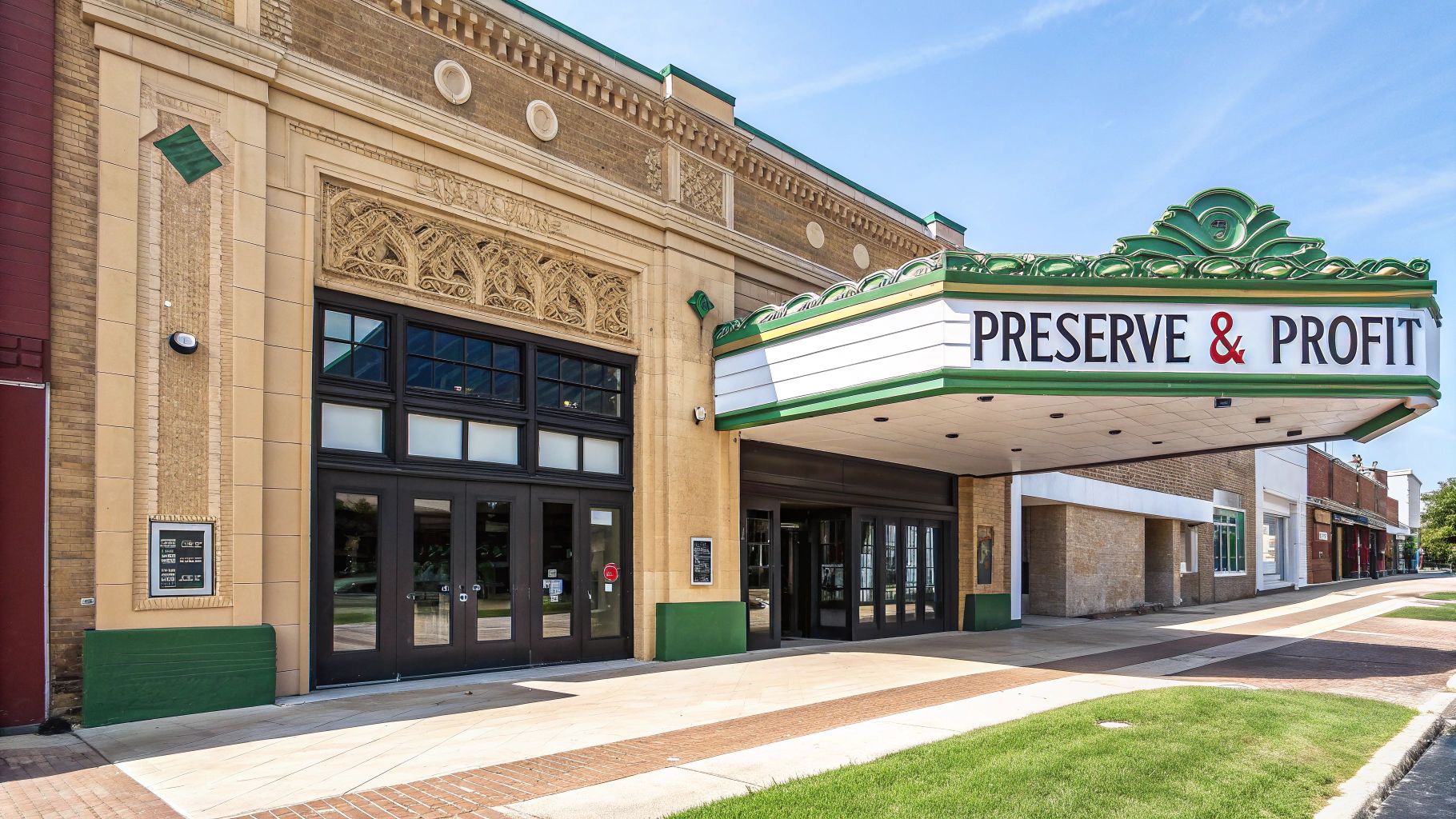
A seasoned architect doesn't just know about these programs—they know how to make them work for you.

Their expertise ensures your design doesn’t just meet your business goals but also ticks all the boxes needed to unlock these powerful financial tools.

The Role of the SCDAH and Local Expertise

Think of the SCDAH as the gatekeeper for historic preservation in the state. They manage the tax credit programs and oversee the South Carolina Statewide Survey of Historic Properties, a massive and invaluable resource for anyone working on these projects.

With a legacy as rich as South Carolina’s, that’s no small task. The Statewide Survey tracks over 82,000 buildings, structures, and sites across all 46 counties. A great architect uses this database to build a rock-solid case for your renovation plans, grounding your proposal in historical fact.

Choosing a South Carolina architect with a strong, established relationship with the SCDAH and local review boards is a strategic move. Their familiarity with the people and processes can dramatically smooth the path to project approval, saving you both time and money.

At the end of the day, bringing a preservation expert onto your team is about more than just compliance. It’s about using their specialized knowledge to turn a piece of South Carolina’s history into a thriving modern asset—all while maximizing your return on investment.

Getting Your Questions Answered About South Carolina Architects

If you're gearing up for a commercial project for the first time, it's natural to have a lot of questions. For developers and property owners, getting a handle on costs, timelines, and the legal side of things is the foundation of a successful venture. Let's tackle some of the most common questions we hear from clients looking to hire an architect in South Carolina.
How Much Does an Architect Actually Cost?

Architectural fees in South Carolina usually land somewhere between 5% and 15% of the total construction cost. Where your project falls on that spectrum really comes down to complexity. A straightforward new build will be on the lower end of that scale.

On the other hand, a complex historic renovation or an adaptive reuse project will naturally command a higher fee. This is because of the sheer amount of detailed research, documentation, and coordination with preservation boards and consultants that these projects demand.

Some firms might offer a fixed fee if the scope is crystal clear from the start, which is great for budget predictability. Others might work on an hourly rate, especially for initial consultations or feasibility studies. No matter the structure, make sure the contract spells out exactly what services are included for that fee.

What Kind of Timeline Should I Expect?

Project timelines can be all over the map, depending on the scale of your project and which municipality you’re working in.

  • A small commercial upfit? You could be looking at 3-6 months from initial design to grand opening.
  • A new, mid-sized commercial building? That’s a bigger lift, often requiring 12-24 months.

The process breaks down into phases: schematic design (1-2 months), design development (2-4 months), and then the creation of construction documents (3-6 months). Don't forget permitting—that alone can tack on another 1-3 months, and that window can vary wildly between places like Charleston, Greenville, and Columbia. A local architect who knows the ropes with the local review boards can give you the most realistic schedule.

Here's the bottom line: in South Carolina, a licensed architect's stamp is required for most commercial building permits. If your project involves structural changes, fire safety systems, or ADA compliance, it's not a suggestion—it's the law.

Do I Really Need an Architect for a Small Renovation?

The short answer is yes, almost certainly. It goes way beyond just the legal requirement for a permit stamp. An architect’s real value is in their ability to see potential you might miss.

They’ll optimize your space for the best possible flow and efficiency, maximizing your return on investment. They also navigate the labyrinth of building codes and help you manage contractors to sidestep expensive errors. Think of hiring an architect not as a cost, but as a critical investment in your property's future.
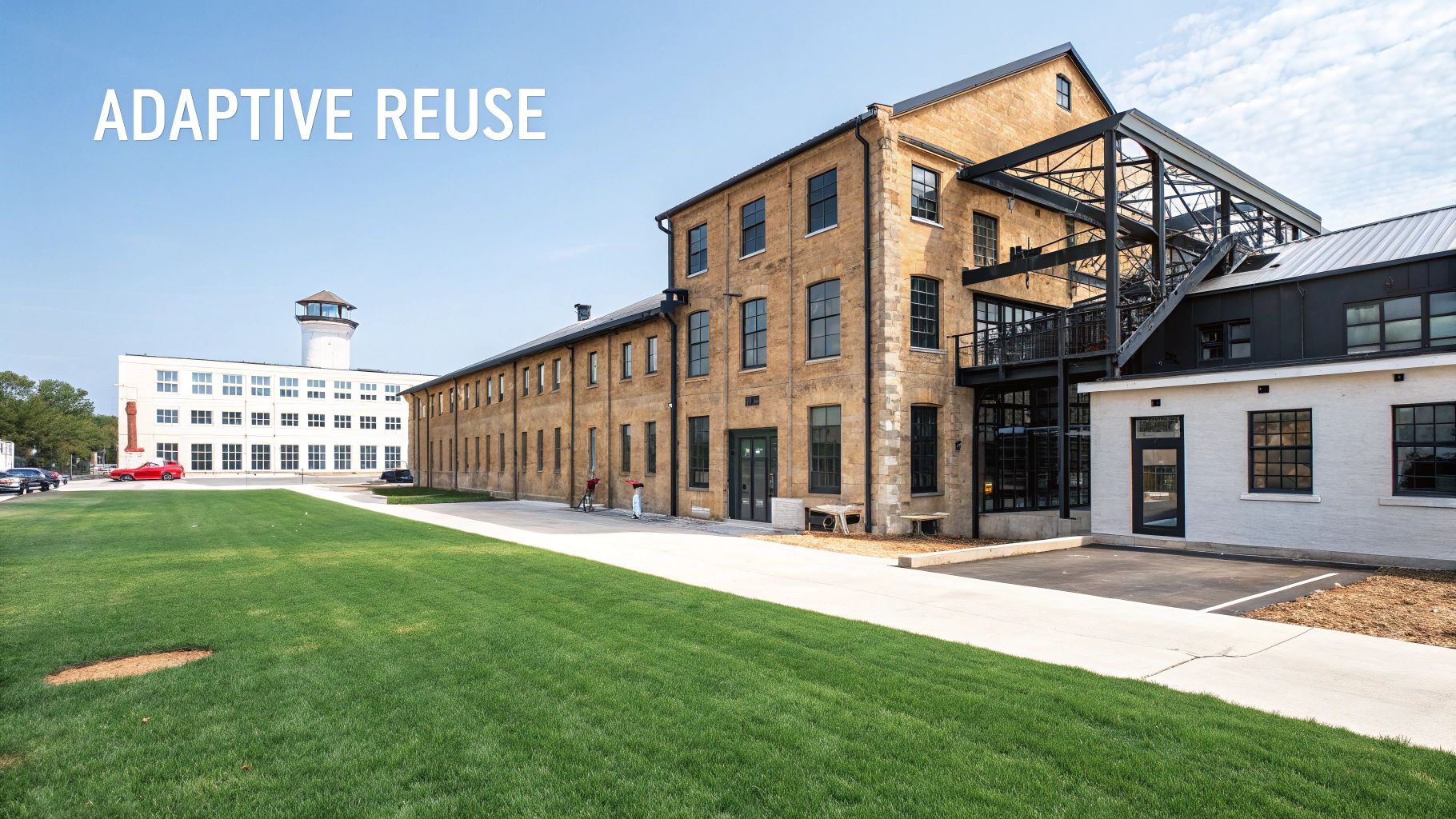

At Sherer Architects, LLC, we guide commercial property owners through every stage of design and construction, turning complex challenges into profitable, enduring results. If you're ready to bring your vision to life, visit us at https://shererarch.com.

Categories
Uncategorized

A Developer’s Blueprint for the Library in the Future

When you think "library," you probably picture dusty, silent stacks of books. It’s time to update that mental image. The library in the future is a buzzing, multi-purpose community hub—and, surprisingly, a highly valuable asset for developers and property owners. This isn't just a place for books; it's a dynamic platform for technology, education, and community connection that can drive real financial returns.

Reimagining the Library Beyond Bookshelves

The library has grown far beyond its original mission of lending books. For developers and investors, this evolution opens up a powerful opportunity. Instead of seeing a library as just a civic cost, it's time to see it as an economic driver.

A well-executed library project can anchor a neighborhood, pull in foot traffic, and bump up the value of surrounding properties. A modern library becomes a "third place"—that essential social spot that isn't home or work, where community life happens.

This new identity means the very design and purpose of a library have changed. The focus is less on the size of the collection and more on creating flexible, human-centered spaces that can adapt to a whole range of community needs, from quiet study nooks to lively workshop areas and public event venues.

This diagram breaks down the three pillars holding up this modern library model.

A diagram illustrates the future library supported by technology, community, and investment pillars.

As you can see, the success of the modern library depends on weaving together technology, a deep community focus, and smart investment.

A New Model for Community Investment

Getting a handle on this new model is the key to unlocking a library's true potential. The library in the future is a strategic asset that pays dividends across the board. For developers, this means figuring out how a new library can hit both civic and business targets. The secret is recognizing all the different hats it wears.

  • A Hub for Digital Equity: It offers free high-speed internet, computers, and digital skills training, closing the digital divide for local residents.
  • An Incubator for Local Talent: It provides maker spaces with 3D printers, recording studios, and co-working areas that give entrepreneurs and small businesses a leg up.
  • A Center for Lifelong Learning: It hosts everything from children's storytime to coding classes for adults and workshops for seniors, drawing in a huge cross-section of the community.

By designing spaces that support these activities, developers create a property that becomes an indispensable part of daily life. This deep engagement keeps the library relevant and busy, cementing its long-term value as both a community landmark and a solid investment.

Ultimately, investing in a library isn't just about putting up a building; it's about building a more resilient, connected, and prosperous community. Whether you're starting from scratch or giving an old building a new life, the opportunities are massive. This guide will walk you through the practical strategies—from digital infrastructure and flexible design to funding models and historic tax credits—that transform a library project into a smart, sustainable asset that can anchor urban renewal and deliver a clear return on investment.

Weaving Technology into the Architectural DNA

When we think about the library of the future, we need to stop treating digital infrastructure as an afterthought. It's not just another line item in the budget; it's as critical as the building's foundation. For developers and owners, this means planning for technology from the absolute beginning, treating it as the building’s central nervous system. This approach—embedding a robust and flexible tech ecosystem right into the blueprints—is the only way to avoid painful, expensive retrofits and ensure the library remains a vital asset for decades.

Modern library interior with people studying, reading, and relaxing in a bright, spacious environment.

This isn’t just about offering public Wi-Fi. It’s a fundamental shift in how we design a building's core systems. The real goal is to create an environment where technology is invisible, supportive, and ready for whatever comes next.

Moving Beyond the Server Room

The old model of walling off a huge, climate-controlled room for racks of servers is quickly becoming a relic. A forward-looking design doesn't get bogged down by today's hardware; it plans for agility and the certainty of future upgrades.

This is all about creating flexible pathways for power and data. Instead of dedicating a permanent server closet, architects need to design accessible, easily upgradable conduits and raceways that run throughout the building. This simple change allows technology to evolve without forcing disruptive—and costly—structural renovations later on.

Think of it like the plumbing in a house. You wouldn't build a new home without meticulously planning where the pipes need to go. Data flows the same way. It's a core utility that has to be designed into the very fabric of a modern library, powering everything from interactive displays to the countless devices visitors bring with them.

This design shift has a real impact on space allocation, too. By ditching the traditional server room, developers can reclaim valuable square footage. That space can then be used for revenue-generating or community-focused purposes, like a small café, private meeting pods, or an expanded area for workshops and events.

And the clock is ticking. Projections show that by 2026, academic libraries will be operating in almost completely digital environments. Cloud computing is set to become the standard for nearly all services, which demands ubiquitous, high-speed internet. With mobile devices already far outnumbering desktops, the need for seamless wireless connectivity will only intensify.

The Bones of a Modern Library: Power and Connectivity

To build a library that’s truly ready for the future, developers have to get two things right from the start: power and data. The old way of sprinkling a few outlets along the walls just doesn't cut it anymore for a community that depends on personal devices for everything.

Architectural planning needs to address these modern demands head-on. Here’s how:

  • Smart Electrical Grids: Design electrical systems that are built to expand. This means installing floor boxes with both power and data ports in open areas, placing outlets in unexpected places like outdoor seating, and using modular power systems that can be rearranged as the library’s layout evolves.
  • Pervasive Wireless Access: The building’s very structure must be designed to support flawless Wi-Fi coverage. This involves thinking critically about where to place wireless access points and avoiding signal-blocking materials like thick concrete or metal walls in key areas where people gather.
  • Redundant Connections: Don't rely on a single point of failure. The building should have multiple points of entry for fiber optic cables. This redundancy protects against service outages and provides the massive bandwidth needed for cloud services, virtual reality experiences, and large-scale data access.

The table below breaks down the shift in thinking required when designing a library's infrastructure.
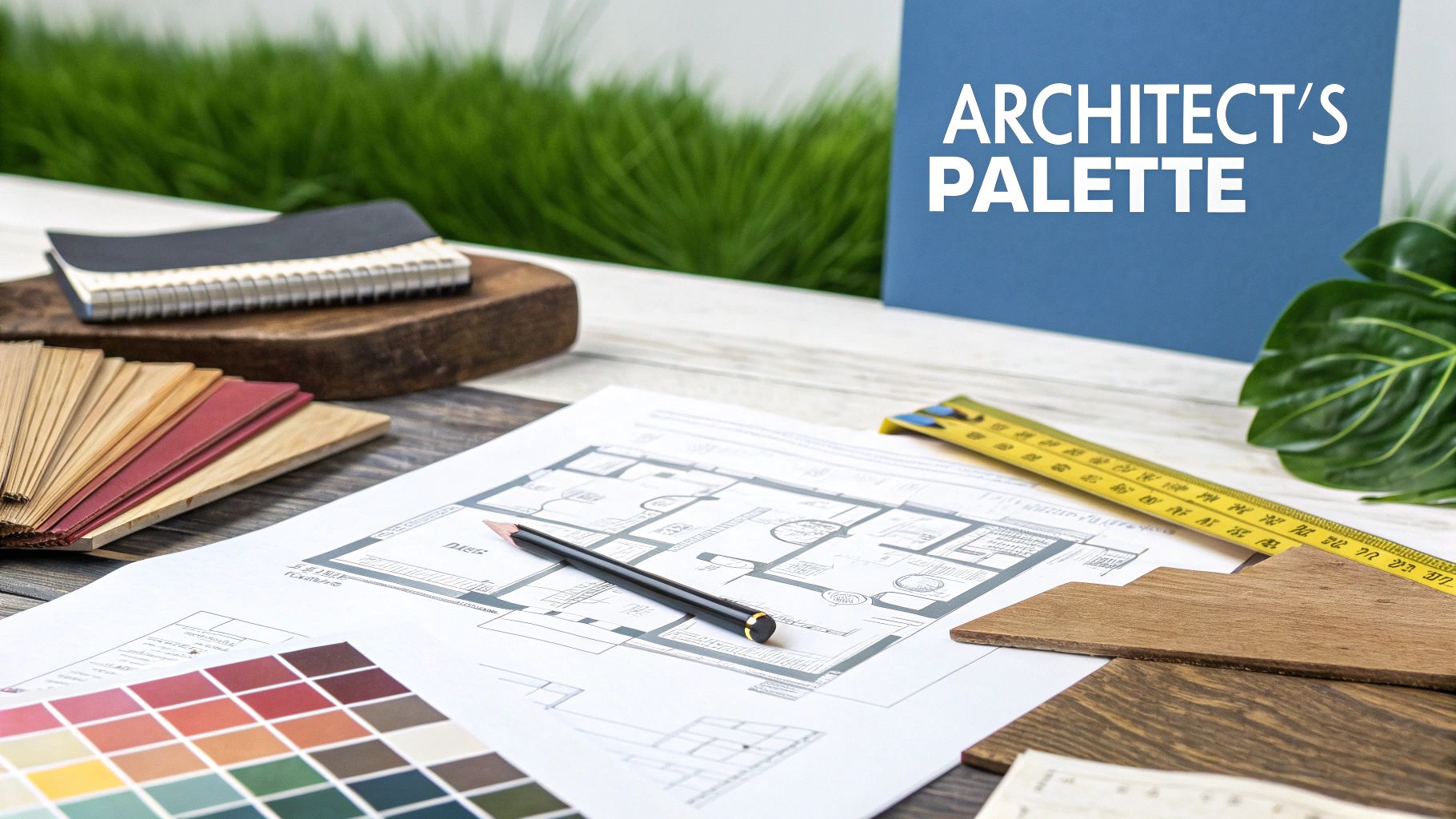
Future Library Tech vs. Traditional Library Infrastructure

Architectural Feature Traditional Library Approach Future Library Requirement
Data Infrastructure Centralized, fixed server room with heavy HVAC. Distributed, flexible conduits and raceways for easy upgrades.
Power Distribution Wall-mounted outlets placed intermittently. Integrated power grids with floor boxes, modular systems, and outdoor access.
Connectivity Basic Wi-Fi as an amenity. Building-wide, high-density Wi-Fi as a core utility.
Structural Planning Materials chosen for aesthetics and durability alone. Materials chosen to minimize signal interference; planned pathways for cabling.
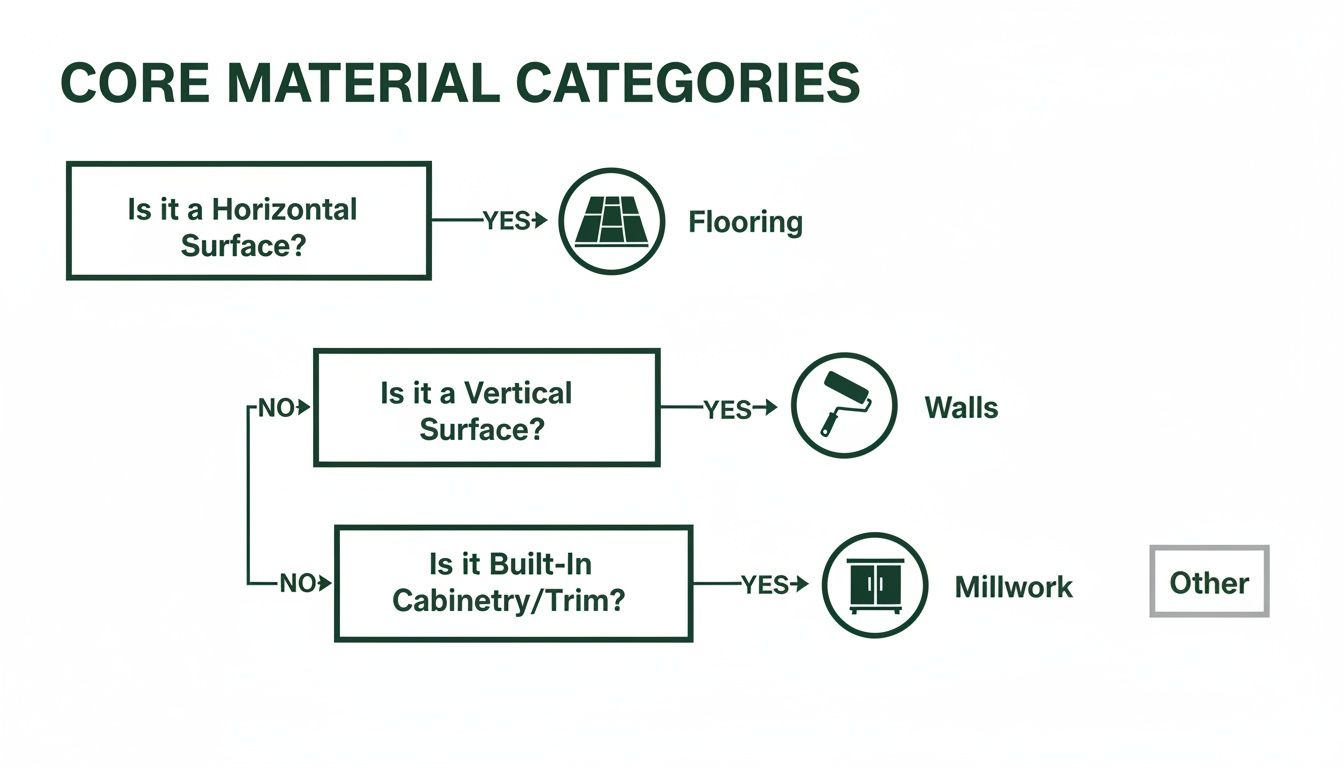

Space Allocation Significant square footage lost to server and IT closets. Reclaimed square footage for public-facing programs or leasable space.
Future-Proofing Retrofits are expensive and structurally invasive. Upgrades are managed through accessible pathways with minimal disruption.

As you can see, the architectural DNA of a future-ready library is fundamentally different. It anticipates change rather than reacting to it.

Of course, successfully weaving this digital framework into a building requires smart financial planning. Understanding how to secure specialized funding is a crucial piece of the puzzle. You can learn more about accessing this capital through resources focused on Winning Nonprofit Grants for Technology. By embedding this digital foundation from day one, developers create a resilient, adaptable asset that will maximize its utility and value for years to come.

Designing Spaces for People, Not Just Collections

Once you have a solid technology backbone, the real work begins. The focus for the library in the future isn't about infrastructure; it's about experience. We’re moving past the idea of libraries as mere warehouses for books and embracing them as dynamic, human-centric community hubs.

A library's true value lies in its role as a community "third place"—that essential spot that isn't home and isn't work. How well a library fills this role directly impacts its success and, from a developer's perspective, its return on investment.

This means we have to think beyond static, rigid layouts. Imagine a single large, open space that completely transforms throughout the day. It could be a quiet study zone in the morning, a buzzing, collaborative workshop in the afternoon, and an elegant event venue by night. This is the kind of flexibility that attracts a wide range of people and keeps them coming back.

To pull this off, you need a smart approach to space planning. For anyone looking to get a better handle on the fundamentals, there's a practical guide to interior design and space planning that offers a great starting point.

Creating Multifunctional Zones

The secret to a truly adaptable building is creating multifunctional zones. This isn't about adding more rooms; it's about making every single square foot work harder. Architects and developers can achieve this fluid design with a few key strategies that allow for rapid changes with minimal effort.

When these elements work in concert, they create an environment that can be reconfigured on the fly, responding almost instantly to what the community needs right then and there. This adaptability is what turns a good building into a great community asset.

Here are the core components that make it happen:

  • Modular Furniture: Think lightweight tables, chairs, and shelving on casters. These can be rearranged in minutes to support anything from individual work to large group sessions.
  • Smart Acoustic Paneling: Deployable acoustic dividers or smart panels can absorb or reflect sound as needed. This simple feature allows a noisy kids' program and a quiet reading group to exist peacefully in the same open space.
  • Adaptable Lighting Systems: With zoned, dimmable lighting controlled by a central system, you can instantly change the mood of a space—shifting from bright, focused task lighting to warm, ambient light for a social mixer.

Practical Examples of Human-Centric Design

Bringing these principles to life is where the magic happens. It’s all about adding features and amenities that fit modern lifestyles and solve real problems for patrons, making the library an indispensable part of their daily routine.

Take something as simple as integrating a small café or coffee bar. It does more than just serve refreshments; it encourages people to stay longer and use the library as a social meeting point. This one addition can completely change the building's atmosphere and dramatically increase how long people stick around.

Soundproof pods are another powerful example. These small, private enclosures are a perfect solution for patrons needing to take a video call, record a podcast, or just find a moment of true quiet in a busy public space. They directly meet the needs of an increasingly remote and flexible workforce.

The most forward-thinking libraries are even extending their footprint outdoors. Designing inviting outdoor reading gardens, patios with Wi-Fi access, or even children's nature-play areas creates new destinations within the library grounds, offering fresh air and a connection to the environment.

These design choices aren't just nice-to-haves; they are strategic investments in community engagement. Recent industry data confirms this shift in priorities. A 2025-2026 survey found that increasing physical visits is now the top goal for library marketers. The data, which saw a 15% increase in responses over the previous year, underscores that libraries are laser-focused on in-person experiences and building community trust. You can dive deeper into how libraries are prioritizing this in the latest state of library marketing report. This is clear proof that thoughtful, human-centric design directly supports core operational goals by drawing people in and keeping them there.

The Business Case for Adaptive Reuse and Historic Preservation

When you think about building a new library, starting from a clean slate seems like the obvious choice. But there’s a powerful, and frankly, often more profitable alternative: adaptive reuse. This is the art of taking an existing building and giving it a completely new purpose. For a savvy developer, this isn't about nostalgia; it's a strategic business move loaded with financial and logistical perks that can create an incredible vision for the library of the future.

Modern outdoor library with people reading and working in wooden pods on a sunny day.

Right off the bat, this approach tackles some of the biggest headaches in modern development. The upfront costs are often much lower than new construction because you already have the bones—the foundation, exterior walls, and maybe even major systems are in place. This translates into a more predictable budget and a much quicker path from acquisition to ribbon-cutting.

On top of that, adaptive reuse is inherently sustainable. By breathing new life into an old structure, you’re dramatically cutting the carbon footprint that comes from demolition and manufacturing new materials. This isn’t just good for the planet; it's a compelling story that resonates with communities and attracts environmentally-minded partners and patrons.

Unlocking Value with Historic Tax Credits

The financial picture gets even brighter when the building has a little history to it. Historic preservation is more than just protecting the past—it’s a proven economic engine. Developers can tap into substantial federal and state historic tax credits that can slash rehabilitation costs and make a project’s numbers work beautifully.

The Federal Historic Preservation Tax Incentives program, for example, offers a 20% income tax credit for the certified rehab of historic, income-producing buildings. This is a true credit, not a deduction. It’s a dollar-for-dollar reduction of your tax bill, making it one of the most powerful redevelopment tools out there.

This kind of financial leverage flips the script, turning a building’s unique character from a potential headache into a genuine asset. The very things that make a building historic—its detailed brickwork, soaring ceilings, or gritty industrial past—become the foundation for a landmark that draws in the community and builds real pride.

Think of an old, vacant downtown bank with its grand lobby and echoing ceilings. Through adaptive reuse, this eyesore can be reborn as a cutting-edge community hub. The vault becomes a one-of-a-kind children's reading nook, and the open teller hall transforms into a flexible event space—all while keeping the building’s soul intact.

Turning Perceived Liabilities into Profitable Assets

The potential for adaptive reuse is hiding in plain sight all over our cities. Visionary developers can spot opportunity where others just see decay. That forgotten warehouse, an empty big-box store, or even a decommissioned church can have the "good bones" needed for a spectacular library transformation.

These old structures often bring distinct advantages you just can't get with new builds:

  • Generous Interior Volume: Older industrial and commercial buildings frequently boast high ceilings and wide-open floor plans. This is a perfect canvas for creating the flexible, multi-use zones that modern libraries thrive on.
  • Prime Locations: Many of these buildings sit right in the heart of established neighborhoods. That means built-in foot traffic and community access that would be incredibly expensive—or even impossible—to secure with a new plot of land.
  • Unique Character and Story: An existing building comes with its own narrative. A library housed in a former textile mill, for instance, can weave the area's industrial heritage right into its identity. It creates an authentic sense of place that a new building could never replicate.

This mindset empowers developers to think beyond the default of demolition. You can create a project that is more cost-effective, gets to market faster, and is deeply woven into the fabric of its community. By using the financial tools of historic preservation and the sustainable nature of adaptive reuse, an old building becomes a profitable, community-enriching asset—the perfect home for the library of the future.

Funding Models and Measuring Your Return on Investment

A beautiful design for a future-focused library is one thing, but it's just a drawing without a smart financial strategy to back it up. For developers and property owners, the question is always the same: How do we pay for this, and what’s the actual return? It’s time to look past traditional municipal bonds and embrace a more diverse, collaborative toolkit for funding.

Modernly renovated historic brick building with large windows and people walking on a sunny day.

This approach reframes the library not as a simple public expense but as a joint venture in community building. It’s about creating a coalition of stakeholders—from private investors to local businesses—who all see a tangible benefit from the library's success.

Creative Capital Stacks

Putting together the financing for a modern library is a bit like assembling a puzzle. Each piece is a different funding source, and when you combine them, you create a stable financial foundation that doesn't depend too heavily on any single stream.

  • Public-Private Partnerships (P3s): These are agreements where private developers might finance, build, and even operate a public asset like a library. The payoff? It could be a long-term lease, the air rights to build apartments above the library, or other commercial perks that make the numbers work.
  • Corporate Sponsorships: Local and national companies are often looking for ways to connect with the community. This can be as straightforward as sponsoring a specific room—like a children’s wing or a tech lab—or funding entire programs, which provides a reliable stream of operational cash.
  • New Markets Tax Credits (NMTC): This federal program is designed to spark development in lower-income areas. By funneling investment into a library project through a Community Development Entity (CDE), investors get a significant tax credit, making it a very appealing financial tool.

The modern library is an economic engine, not a cost center. Proving this requires a shift from measuring circulation numbers to tracking tangible economic and social impacts that resonate with investors, city planners, and the community.

Thinking this way turns the library into a legitimate commercial real estate opportunity. This is especially true when you consider the booming market for digital services it supports. The global digital library market was already valued at $5,463 million by the end of 2025 and is on track to hit nearly $12 billion by 2033. North America is leading the charge, holding a 67.70% regional share. You can dig into the full market report to see just how significant this trend is.

Measuring Success Beyond the Books

To get these diverse funding partners on board, you have to prove the library delivers a measurable return on investment (ROI). The trick is to look beyond old-school metrics and start tracking the library's broader economic and social halo effect. You have to think like an analyst tracking the performance of any other commercial asset.

This data-driven approach doesn't just justify the investment; it builds a compelling story. It shows, in black and white, that a modern library is a catalyst for urban renewal and a sound financial bet.

Here are the key performance indicators (KPIs) to start tracking:

  1. Increased Property Values: Pull the real estate data for the blocks immediately surrounding the library. A lively community hub almost always leads to a noticeable bump in both commercial and residential property values.
  2. Local Business Revenue Growth: Team up with nearby cafes, shops, and restaurants to track foot traffic and sales. The library brings a steady flow of people into the area, which directly benefits the businesses next door.
  3. Community Engagement Metrics: Don't just count heads at the door. Track workshop attendance, meeting room bookings, and public Wi-Fi usage. These numbers show deep community integration and prove the library is providing real value.
  4. Workforce Development Outcomes: Find out how many people are using the library’s resources for job searching, resume writing, or skills training. This data positions the library as a vital part of the local economic development engine.

So, What's Next? Turning Vision into Reality

Bringing the library of the future to life isn’t about checking boxes on a generic development plan. It’s a creative process, a blend of smart technology, people-focused design, and strategic real estate development that creates a powerful anchor for any community. We’ve covered the core ingredients; now it's time to put them together into a practical game plan for your project.

It all starts with a mental shift: see the library not just as a public service, but as a genuine economic driver and a central community hub. Once you've made that leap, every decision—from wiring the building for future tech to designing spaces that can be a classroom one day and an event space the next—falls into place. This integrated approach is what elevates a library from a simple public amenity to a smart, lasting investment.

Your First Moves

To get from a great idea to breaking ground, you need to focus on a few critical first steps. Getting these right lays a solid foundation, reduces risk, and sets your project up for success right from the start.

  1. Get the Lay of the Land: Before you do anything else, you need to understand the context. Dive deep into local demographics, figure out what the community is missing, and weigh the pros and cons of adaptive reuse versus a brand-new build. This foundational data will shape every decision you make down the line.
  2. Build a Realistic Financial Model: It's time to map out your capital stack. Start exploring the public-private partnerships, historic tax credits, and other creative funding avenues we talked about. A solid, realistic financial proforma is non-negotiable for getting investors and partners on board.
  3. Find the Right Architect: This is a make-or-break decision. Look for a firm that has real-world, proven experience in commercial development, especially with projects involving historic preservation and adaptive reuse. Their expertise will be your guide through the maze of zoning laws, city approvals, and the practical challenges of turning a vision into a beautiful, functional building.

The modern library is a premier investment that anchors communities, stimulates local economies, and leaves a lasting legacy. It's a testament to what's possible when strategic development meets genuine community need.

With this roadmap in hand, you can confidently move your project forward. The next step is finding an expert partner who can help you navigate each stage, ensuring your library becomes both a profitable landmark and a source of community pride.

Frequently Asked Questions

When you’re thinking about a modern library project, a lot of practical questions come up, especially for developers, investors, and property owners. Let's tackle some of the most common ones, from keeping costs in check and getting the community on your side to making sure the investment pays off for years to come.

How Much Does a Modern Library Project Cost?

Trying to nail down a precise number is tough. The biggest factor is whether you're building from the ground up or breathing new life into an existing building through adaptive reuse.

New construction will almost always cost more per square foot. You're dealing with everything—site work, foundations, the whole structural system. It adds up quickly.

Adaptive reuse, on the other hand, can be a smarter financial move. This is especially true if you can tap into historic tax credits, which can cover up to 20% of the rehab costs. The trick is to get a solid feasibility study done right at the start. It will give you a clear picture, comparing the cost of upgrading an old building’s bones and systems against the price tag of a brand-new one.

How Do We Get Community Buy-In for a New Library?

Getting the community behind your project isn't just about good PR; it’s absolutely essential for navigating zoning approvals and unlocking public funding. The only way to do it right is to bring people into the conversation from day one.

Forget the old top-down approach. Instead, think about hands-on workshops and widespread surveys to find out what people in the neighborhood actually want and need.

  • Be direct: What services are they missing out on? What hours would make their lives easier? What kinds of spaces would really help out families, students, or the growing number of remote workers?
  • Build alliances: Team up with local schools, neighborhood groups, and business associations. A strong coalition is your best advocate.
  • Talk about the bottom line: Show them the data. A great library can boost property values, drive foot traffic to local businesses, and offer crucial job skills training.

When you take this kind of collaborative path, the project stops being something you’re doing to the community and becomes something you’re all building together.

What Makes a Library Project Sustainable Long-Term?

For a library in the future to truly last, it needs to stand on three strong pillars: financial stability, environmental responsibility, and unwavering community relevance.

A truly sustainable library isn't just about saving energy. It needs to be financially sound on its own and woven into the very fabric of its community. The design has to be nimble enough to meet needs that will change over the next 50 years.

Financially, this means getting creative with revenue. Think public-private partnerships, leasing space to a café or retailer, and renting out rooms for events. Environmentally, it’s about smart choices—durable materials, super-efficient HVAC systems, and a design that lets in plenty of natural light to slash utility bills.

But the most critical piece is relevance. By creating flexible spaces that can shift and change, and by offering programs that people genuinely need—from digital skills workshops to resources for small business owners—the library stays essential. It becomes a place people can't live without, securing its value for generations.


Are you ready to turn your vision for a modern community anchor into a profitable reality? The team at Sherer Architects, LLC has decades of experience in commercial development, adaptive reuse, and historic preservation. We guide owners through every stage of design and construction, transforming complex projects into beautiful, enduring, and sustainable assets. Learn how we can bring structure to your life's work at shererarch.com.

Categories
Uncategorized

A Developer’s Guide to Choosing Material for Interior Projects

Choosing the right material for an interior space is about so much more than just looks. It’s a foundational decision that directly shapes the building's performance, how tenants experience the space, and ultimately, its long-term value. Every material you specify is a piece of a larger puzzle, a careful balancing act between durability, cost, sustainability, and code compliance.

Why Your Choice of Interior Material Matters

For anyone developing or owning commercial, adaptive reuse, or historic properties, this isn't a minor detail—it's a critical part of the investment. This guide is designed to take you past the surface-level swatches and into the core of how materials influence everything from day-to-day operational budgets to the building's overall market appeal.

Think about it this way: deciding on something like hardwood flooring for kitchens in a multi-family project isn't just about aesthetics; it's a real-world test of balancing beautiful design with the practical demands of a high-traffic, spill-prone area.

We’ve built this framework to help you make smart, profitable decisions that ensure your project doesn't just look impressive on day one, but thrives for decades.

Two design professionals review various material samples on a table in a bright, modern showroom.

The Three Pillars of Material Performance

Before we even start talking about colors and textures, every single material for interior selection has to pass a tough, three-part exam. Think of it as the non-negotiable foundation: Durability, Fire Safety, and Acoustics. Get these wrong, and you’re looking at materials that wear out too fast, create serious safety risks, or make a space completely unusable for its occupants. It’s a surefire way to see your investment go down the drain.

Four upright panels showcasing different interior materials: dark wood, speckled cork, green felt, and light tiled wood.

I always think of durability like choosing the right tires for a car. You wouldn't put standard sedan tires on a heavy-duty truck that hauls materials all day, right? A high-traffic hotel lobby needs the architectural equivalent of those truck tires—something built to withstand constant punishment. Evaluating a material’s real-world wear resistance is absolutely critical.

Then there's fire safety. These codes aren't just bureaucratic red tape; they're hard-learned lessons written to save lives. Understanding the flame-spread ratings and classifications for your materials is a fundamental part of protecting not just the building, but everyone inside it.

Finally, you have acoustics—the unsung hero of good design. The right acoustic strategy can transform a space. By digging into metrics like NRC (Noise Reduction Coefficient) and STC (Sound Transmission Class), you can turn a noisy, chaotic open office into a place where people can actually focus and get work done.

Balancing Preservation and Modernization in Historic Buildings

Working on an adaptive reuse project feels like a delicate dance between the past and the present. When you're selecting interior materials for a historic building, you can't just pick what's new and popular; you need a strategy that blends the building's original character with today's performance standards.

The first step is always a deep dive into the building itself—a material audit, if you will. You have to figure out which architectural details define the building's soul and are worth preserving at all costs. At the same time, you need to identify what’s beyond repair and needs a modern, yet compatible, replacement.

This is where the real challenge begins: sourcing materials that look and feel like they belong to the building's original era but also meet all of today's stringent building codes. You're aiming for that sweet spot where your choices feel completely authentic to the space while still functioning for a 21st-century tenant.

Thoughtful material choices do more than just preserve history—they can be instrumental in securing historic tax credits. This turns preservation requirements into a significant financial advantage, boosting both your property's value and its unique story. This approach ensures the building's legacy continues for decades to come.

The True Cost of Interior Materials

When you're looking at a material's price tag, you're only seeing the first chapter of its financial story. The real cost—what we call lifecycle cost—unfolds over decades. It’s a shift in perspective, moving beyond the initial purchase price to consider the long-term expenses of maintenance, repairs, and eventual replacement.

Think about it this way: that cheaper flooring might seem like a win today, but if it needs constant upkeep and wears out in half the time, its lifetime expense can easily dwarf that of a more durable, premium alternative. It's the classic "buy nice or buy twice" scenario, but on a commercial scale.

This long-term view also has to account for sustainability. We're now looking closely at metrics like embodied carbon, which is the total greenhouse gas emissions generated to produce and transport a material. It's the environmental "cost" baked into the product before it ever reaches the job site.

Infographic showing historic preservation benefits: 45% tax credit, 20% property value increase, and 15% energy savings.

As you can see, making smart, forward-thinking choices isn't just about avoiding headaches; it can yield significant financial returns through incentives like tax credits and ongoing energy savings. Ultimately, selecting a durable, low-impact material for interior spaces isn't just an expense—it's a financially sound strategy for the entire life of the building.

Lifecycle Cost Comparison For Common Flooring Materials

To put this into practice, let's look at how three common commercial flooring options stack up when you consider their full lifecycle. The upfront cost is just one piece of the puzzle.

Material Upfront Cost (per sq ft) Average Lifespan Annual Maintenance Embodied Carbon End-of-Life
VCT (Vinyl Composite Tile) $2 – $4 15-20 years High (requires frequent stripping, waxing, buffing) Moderate to High Landfill; difficult to recycle
LVT (Luxury Vinyl Tile) $4 – $7 20-25 years Low (simple sweeping and mopping) Moderate Recyclable in some programs; often landfilled
Polished Concrete $3 – $8 50+ years Very Low (occasional cleaning and resealing) Low (utilizes existing slab) Reusable; can be covered or refinished

The table makes it clear: while VCT has the lowest initial price, its high maintenance needs and shorter lifespan mean you'll be paying for it over and over again. Polished concrete, on the other hand, might cost more upfront but delivers a much lower total cost of ownership over the long haul. This is the kind of analysis that separates good projects from great ones.

Best Practices for Material Procurement and Specification

You can pick the most brilliant material in the world, but if you don't specify and procure it correctly, that choice means nothing. It’s a classic project pitfall.

Vague specifications are where good intentions go to die. Using lazy terms like "or equal" in your documents is an open invitation for substitutions that might look the part but fail on performance. The key is to write iron-clad specs that leave no room for interpretation—define the exact performance criteria you expect.

Then there's the supply chain. You have to be realistic about what you can actually get. Global market forces have a huge impact on the material for interior finishes, influencing everything from cost to availability.

For example, the Asia-Pacific region dominates up to 58.1% of the automotive interior materials market. As you can imagine, that kind of market share affects lead times and pricing for related materials across the board. Diving into these market trends can give you a real edge in planning.

The secret to navigating all of this? Get everyone in the same room—metaphorically or literally. When architects, contractors, and owners are aligned from day one, you head off budget blow-ups and ensure the finished space actually reflects the original vision. No costly surprises.

Frequently Asked Questions About Interior Materials

When it's time to choose materials for a commercial interior, property owners and developers tend to ask the same handful of questions. It's completely understandable—the stakes are high, and the choices you make have long-term consequences.

For high-traffic areas, the big question is always durability versus budget. It's tempting to go with the cheaper option upfront, but experienced owners know to think in terms of lifecycle cost. A more expensive, hard-wearing material often pays for itself by avoiding replacement and repair costs down the road.

When you're working with a historic building, the first question is different: what has to stay? Before anything else, you need a thorough investigation to identify the character-defining features. This dictates everything that follows.

What about sustainability? The greenest choice is almost always the one you already have. Reusing existing materials is paramount. If that's not possible, look for locally sourced products with clear environmental product declarations (EPDs).

Getting a handle on the basics is key. For example, simply understanding the different cabinets types of material available can give you a solid foundation for making smarter, more informed decisions across the entire project.

Categories
Uncategorized

A Developer’s Guide to the Heyward House Historic Center

For today's real estate developers, the Heyward House Historic Center is more than just a charming relic; it's a powerful case study in turning historic properties into profitable, community-building assets. Its evolution from a private home into a public institution offers a masterclass in adaptive reuse and generating long-term ROI.

The Heyward House: A Blueprint For Modern Developers

Two men review blueprints for adaptive reuse in front of the Heyward House Historic Center.

Too often, developers see historic buildings as liabilities—riddled with constraints, hidden costs, and regulatory nightmares. But that mindset misses the bigger picture. An old structure isn't just a pile of aging materials; it’s a vessel of stories, character, and deep-seated community value just waiting to be tapped. The Heyward House proves that heritage can be a serious competitive advantage.

Its story is one of incredible resilience. Nestled in the heart of Bluffton's historic district, the Heyward House is a remarkable survivor. On June 4, 1863, Union troops shelled the town, starting fires that wiped out an astonishing 75% of Bluffton. Only eight homes and two churches from the antebellum era were left standing. The Heyward House is one of those precious few. You can learn more about its story as one of the few Civil War survivors directly from the Heyward House Historic Center.

This dramatic history of survival is the bedrock of its modern success. By leaning into its past, the property was reborn not as a stuffy, static museum, but as Bluffton’s official welcome center—a living, breathing part of the local economy.

The table below offers a quick snapshot of the building's key details.

Heyward House Historic Center At-a-Glance

Attribute Details
Built Circa 1841
Architecture Carolina Farmhouse (Carpenter Gothic)
Location 70 Boundary Street, Bluffton, SC
Historical Note One of only eight homes to survive the 1863 Burning of Bluffton.
Current Use Official Welcome Center for the Town of Bluffton.

This blend of history and modern function is what makes the property so compelling today.

From Private Home To Public Institution

The journey of the Heyward House provides a clear, practical roadmap for any developer considering an adaptive reuse project. The secret wasn't to erase its history but to build on it. This strategy delivers tangible benefits for modern developments:

  • Built-in Marketability: A property with a one-of-a-kind story and unique architecture already has a marketing narrative that new construction could never hope to match.
  • Community Buy-In: When you restore a beloved local landmark, you often get a groundswell of public goodwill and support. This can smooth the path for approvals and help build a loyal base of customers or tenants from day one.
  • Sustainable Development: Reusing an existing structure is simply a smarter, more environmentally responsible choice that dramatically reduces waste and conserves resources.

The journey of the Heyward House demonstrates a core principle we champion at Sherer Architects: thoughtful preservation isn't about freezing a building in time. It's about adapting it for the future to create lasting financial and cultural value.

Why the Carolina Farmhouse Design Endures

The Heyward House is far more than just an old building; it's a living lesson in architectural intelligence, perfectly adapted to its surroundings. Its design, what we know as the Carolina Farmhouse style, wasn't created to follow a trend. It was a deeply practical and brilliant solution to the unique challenges of living in the South Carolina Lowcountry.

For anyone looking at a historic property, understanding this connection between form and function is absolutely crucial. The building's original design isn't some dusty relic—it’s a roadmap to its inherent value. I often compare it to a classic car; the original engineering is what makes it a timeless, high-performance machine. If you start swapping out parts without understanding why they were chosen in the first place, you risk destroying the very thing that makes it special.

When you look at the Heyward House Historic Center, every architectural detail tells a story of survival and clever design. These features weren't just for looks; they were essential tools for living comfortably in a place that’s hot, humid, and prone to flooding.

Built for the Lowcountry Climate

The real genius of the Carolina Farmhouse is how it works with nature, not against it. Long before we had modern air conditioning, several key features allowed these homes to breathe and keep their inhabitants comfortable. It’s a masterclass in understanding local materials and the environment.

  • Expansive Porches: These weren't just for sipping sweet tea. They were the building's first line of defense against the relentless sun, creating a wide shade buffer that kept the interior walls cool and drastically reduced the heat beating down on the house.
  • Raised Foundations: Lifting the main living area off the ground on brick piers served two critical purposes. First, it protected the wooden structure from damp ground and potential floodwaters. Second, it created a pocket for air to circulate underneath the house, acting as a natural cooling system.
  • Timber Framing: The home’s skeleton was built with a robust timber frame, often using dense, resilient heart pine that could stand up to hurricane-force winds. The simple, open floor plans weren't just a style choice; they were designed to encourage cross-ventilation, letting breezes flow freely from room to room.

These elements prove that the original builders were master problem-solvers. This is precisely why our first step in any preservation project at Sherer Architects is deep architectural research.

By studying the original materials and building methods, we uncover the "architectural DNA" of a structure. This knowledge allows us to make informed decisions that honor the building's history while adapting it for a profitable, modern future.

Jumping into a project without this foundational knowledge is a recipe for expensive mistakes. A developer who doesn't grasp why the foundation was raised might accidentally introduce moisture problems. Someone who removes a porch for a more modern look could see their future energy costs skyrocket. The original design holds the keys not just to the building’s past, but to unlocking its future potential in a way that is both authentic and economically sound.

How the Heyward House Found Its New Purpose

For most of its life, the Heyward House was simply a private home. Its architectural importance and deep connection to the community were treasures known mainly to the people of Bluffton. But by the late 20th century, the house, like so many historic buildings, was facing a very uncertain future. A building’s story can easily end with a wrecking ball if no one steps in with a vision to carry it forward.

That critical moment came in 1998. The Bluffton Historical Preservation Society saw the building for what it was—irreplaceable—and acquired the property. This wasn't just a real estate transaction; it was a deliberate investment in the town's future. The plan wasn't just to save an old house, but to give it a new mission as Bluffton's official welcome center and a public museum.

From Private Residence to Public Asset

This journey from a quiet family home to a bustling public landmark is a perfect case study in adaptive reuse. Making it happen took a lot more than a fresh coat of paint. It required a meticulous restoration that honored the building's history while outfitting it for a new, public-facing role. The Preservation Society’s work guaranteed the structure would once again be at the heart of Bluffton's daily life.

The careful work became a masterclass in breathing new purpose into an old frame. Understanding the potential locked inside a distressed property is the first step in giving historic sites a second chance, just as the Heyward House found its calling.

This timeline illustrates how some of the key design elements of the Carolina Farmhouse style have evolved over the years.

You can see how enduring features like timber frames, wide porches, and raised foundations were fundamental to the building’s original, climate-smart design.

By turning the Heyward House into a welcome center, the community created a powerful hub for tourism and local pride. It became the first stop for visitors, instantly connecting them to the town's story. This strategy gets to the heart of what we believe at Sherer Architects.

Extending a building's useful life by 50-75 years through thoughtful adaptation is almost always a smarter, more sustainable, and more profitable investment than demolition and new construction. The Heyward House is proof that preservation pays dividends.

The project’s success isn't just measured in the historic materials saved, but in the real economic and cultural value it brings to the Town of Bluffton every single day. It shows how one building, repurposed with foresight, can energize a community and generate a return on investment that far outweighs the initial costs. It stands today as a living monument to strategic preservation.

Unlocking the Financial Value of Historic Properties

Preserving a landmark like the Heyward House Historic Center obviously pays off in cultural and historical rewards. But for savvy developers and investors, the real question is: does it make financial sense?

Too often, historic properties are seen as risky ventures, tangled in red tape and hidden costs. But here's the thing—with the right expert guidance, these buildings represent a fantastic opportunity to generate serious returns.

This is where a seasoned preservation architect becomes the most valuable player on your team. It's not just about restoring old features. It's a strategic puzzle that involves digging into materials research, navigating complex approval bodies like Design Review Boards, and, most importantly, unlocking a deep well of financial incentives. Your architect is your guide, turning potential headaches into profitable assets.

Think of it like restoring a classic car. Anyone can give it a new coat of paint, but a master mechanic—or in our case, a specialized architect—knows how to rebuild the engine for peak performance, ensuring every detail is authentic and adds to its long-term value.

Tapping into Powerful Financial Incentives

The financial landscape for historic preservation is surprisingly rich with opportunity, but you have to know where to look. Getting your hands on these benefits takes deep institutional knowledge and a proven process for documentation and applications. This is precisely where a firm like Sherer Architects can create immense value for clients.

Here are a few of the key financial tools available:

  • Federal Historic Tax Credits: This is the big one. It offers a 20% income tax credit for the qualified rehabilitation of historic, income-producing buildings. This isn't just a deduction; it's a direct, dollar-for-dollar reduction in what you owe in taxes, which can dramatically improve a project's bottom line.
  • State Historic Tax Credits: Many states, including South Carolina, have their own tax credit programs. The best part? They can often be stacked on top of federal incentives, making the financial picture even more attractive for developers.
  • Preservation Grants and Specialized Loans: Beyond tax credits, numerous foundations and government programs offer grants specifically for historic preservation. There are also specialized loan programs out there that can provide more favorable terms for projects that save historic structures.

For anyone looking at South Carolina's Lowcountry market, the Heyward House is a perfect example of this strategy in action. Honoring the building's historic character through detailed research—while securing tax credits and grants—delivers lasting value. It also builds community goodwill, which is a huge advantage in a major tourism-driven market. You can learn more about how the Heyward House serves its community.

De-Risking the Investment with Expert Guidance

Trying to navigate this complex world on your own is a huge risk. An architect specializing in historic preservation does more than just design; they build a financial and regulatory strategy from the ground up.

They do the legwork to prove a building's historical significance, prepare the mountains of documentation required for tax credit applications, and represent your project with credibility in front of review boards.

By partnering with an expert who knows how to unlock these financial tools, a developer can transform a historic property from a high-risk gamble into a predictable, high-return investment. The incentives are designed to make preservation the smart financial choice.

This kind of partnership effectively de-risks the entire project. It ensures that your renovation not only meets all historical standards but is also set up for maximum financial success right from the start, turning a community treasure into a profitable, legacy-building asset.

What Today's Developers Can Learn From This Project

Two men, a construction worker and a client, shake hands with a house in the background.

The story of the Heyward House Historic Center isn't just a fascinating piece of local history; it’s a practical playbook for developers aiming to build projects with both profit and legacy in mind. It teaches a powerful lesson: a building’s past isn't a liability to be managed, but its single greatest asset.

At the end of the day, successful development is about creating places people genuinely want to be. The Heyward House nails this by embracing its incredible story of survival and resilience. That narrative is more than just a historical footnote—it’s a powerful marketing tool that a brand-new building simply can't buy. Developers can learn from this by digging into the history of their own properties and using that story to build a real, authentic connection with the community.

Turning Character into Commerce

The Heyward House is living proof that preserving a building’s character pays real dividends, both financially and in terms of reputation. Its role as Bluffton's official welcome center shows how weaving a project into the fabric of the community drives foot traffic and creates lasting value.

The numbers back this up. Today, the Heyward House Historic Center is a major draw, earning a stellar 4.5/5 rating from 111 TripAdvisor reviews, with 71 of those visitors rating their experience as 'excellent.' This kind of public enthusiasm isn't an accident. It’s the direct result of a smart decision to make the building an essential part of the town’s modern identity, as highlighted in its heritage site overview.

The lesson for developers is crystal clear: adaptive reuse isn't just a sustainable choice; it's a smart business move. When you give a historic building a new life that serves the surrounding community, you create an asset with deep roots and a built-in audience.

Strategies for Your Next Project

Putting these ideas into practice means shifting your mindset. Stop seeing old buildings as problems to be solved and start seeing them as puzzles with incredible potential waiting to be unlocked.

Here are a few core strategies to take from the Heyward House model:

  • Lead with the Story: Don’t hide the building’s history in a dusty plaque. Make it the star of your design and marketing. This is what gives your property an identity that no one else can copy.
  • Find a Community Fit: The building’s new purpose should fill a real need, whether that’s retail, housing, or a public gathering place. A project that serves the community is a project that will last.
  • Bring in the Experts Early: Working with architects who live and breathe historic preservation, like Sherer Architects, isn't just another line item on the budget. It's an investment in getting the details right and maximizing the property's financial and cultural worth.

We Help Developers Build a Lasting Legacy

Historic properties are so much more than just old buildings; they're opportunities waiting to be rediscovered. Think of a place like the Heyward House Historic Center—each one is a unique puzzle. Cracking the code requires a deep dive into its history, meticulous research, and a clear vision for how to marry its heritage with the demands of today. It’s about seeing a vibrant future waiting within a structure's storied past.

Turning a potential headache into a profitable, legacy-building asset is no accident. It’s a deliberate process that hinges on a partnership built on genuine experience and a shared passion for preservation. For developers looking to make a real mark in South Carolina, the first step is always choosing the right guide.

Turning History into Opportunity

At Sherer Architects, we specialize in bringing these complex projects to life in a way that’s beautiful, sustainable, and built to last. We have a knack for looking past the immediate hurdles—the peeling paint, the outdated systems—to see the immense financial and cultural value locked within those historic walls.

Our approach is straightforward but thorough:

  • We start with a deep dive. Our team investigates every detail, from the original building materials to the construction techniques used, ensuring any restoration feels authentic.
  • We design for the future. Our plans don't just restore; they adapt. We thoughtfully extend a building's life, making sure it meets modern needs and building codes without sacrificing its character.
  • We navigate the financial side. We guide our clients through the process of securing historic tax credits and other incentives, helping them make the project financially successful.

For any developer serious about creating lasting value, the single most important decision you'll make is choosing an architect who lives and breathes preservation. It's the move that turns a piece of history into your next great opportunity. Let's build your legacy together.

Common Questions About Historic Preservation

For developers and property owners, taking on a historic preservation project can feel like stepping into a whole new world. It’s only natural to have questions about costs, regulations, and whether it’s a sound investment. Let’s tackle some of the most common concerns to clear things up.

Isn't Historic Preservation Just More Expensive Than Building New?

This is probably the number one question we get, and the answer might surprise you. While every project is different, adapting an existing historic building is often more cost-effective in the long run.

Think about it: the building’s core structure—its "good bones"—is already in place. That represents a massive amount of material and labor that's already been paid for. When you add powerful financial tools like federal and state historic tax credits into the mix, the final investment can be significantly lower. It's often the smarter financial move.

The goal isn't just about saving an old building; it's about creating a financially successful asset. A great preservation project strikes a perfect balance between historical character and modern needs, resulting in a one-of-a-kind property that new construction simply can't match.

How Can You Possibly Meet Modern Building Codes in a Centuries-Old Structure?

This is where the real expertise comes in. Bringing a historic building up to today's standards for safety, accessibility, and energy efficiency is a central part of any preservation project. The trick isn't to force modern systems into an old frame but to integrate them with skill and creativity.

This could mean:

  • Cleverly routing new electrical and plumbing to keep them out of sight.
  • Restoring and upgrading original windows for modern thermal performance instead of tearing them out.
  • Designing innovative accessibility features that feel like they belong, rather than being tacked on as an afterthought.

A seasoned preservation architect knows how to work with building officials to find solutions that satisfy the spirit of the code without sacrificing the building's historic soul. Beyond a landmark like the Heyward House, countless properties need this kind of thoughtful care. For anyone tasked with this responsibility, understanding what is property preservation is fundamental to protecting the investment for the long haul. It’s all about respecting the past while building a safe, functional, and valuable asset for the future.


At Sherer Architects, LLC, we live for these kinds of complex challenges. We help developers navigate every single step of a historic preservation project, turning what seem like obstacles into unique, profitable opportunities. Contact us today to see how we can help bring your vision to life.

Categories
Uncategorized

Warehouse Theatre in Greenville SC A Blueprint for Adaptive Reuse

The Warehouse Theatre in Greenville SC isn't just a place to see a great show; it’s a living blueprint for how to do adaptive reuse right. We're going to dive into how this simple textile warehouse was completely transformed into a vibrant cultural cornerstone for the city's West End, making it a compelling case study for any developer or property owner with an eye for potential.

From Industrial Relic to Cultural Icon in Greenville SC

Exterior view of the Cultural Revival building with illuminated marquee, people on the sidewalk, and a green lawn.

For anyone in the development world, the Warehouse Theatre is more than just a local success—it’s a masterclass in visionary placemaking. This guide will unpack how smart architectural choices and an unwavering focus on community turned an underused historic property into a profitable, soul-enriching asset.

This transformation really hammers home a core principle of modern urban development: sometimes the most valuable new buildings are the old ones. Instead of bringing in the wrecking ball, adaptive reuse preserves a structure's unique character while breathing new life and economic purpose into it.

A Model for Urban Revitalization

The journey of the Warehouse Theatre is a perfect example of the hidden potential locked inside aging industrial buildings. By reimagining a space once filled with looms and spindles as a venue for drama and art, the project became a true catalyst for change in Greenville's West End. It did more than just give a theater company a new home; it sparked a much wider economic and cultural revival.

The results speak for themselves. The Warehouse Theatre's 2025 season, for example, was a banner year, seeing a 32% surge in patrons across all its productions, education programs, and community events. By employing 143 local artists, the theater became a significant economic engine, driving critical foot traffic into a district that was once quiet after 5 PM. This kind of success mirrors what we see in other adaptive reuse wins, where thoughtful infrastructure upgrades can extend a building's functional life by 50 to 75 years. For more on the local arts scene's growth, check out the coverage in the Greenville Journal.

Adaptive reuse is about more than saving a building; it's about reinterpreting its story for a new generation. The Warehouse Theatre proves that historic structures can become the heart of a modern, thriving community.

This guide will break down the practical steps and strategic thinking that made this project a success, focusing on three key areas:

  • Historic Preservation: How to honor a building's original character while bringing it up to modern code and expectations.
  • Economic Revitalization: The strategy behind becoming a cultural anchor that boosts surrounding businesses.
  • Tangible ROI: A clear look at the financial and community returns that come from thoughtful, forward-thinking design.

To give you a quick, high-level overview, here's a snapshot of the project's key details. This is especially useful for developers weighing the pros and cons of taking on a similar historic property.

The Warehouse Theatre Project at a Glance

Attribute Details
Project Type Adaptive Reuse, Cultural Anchor
Original Use Textile Warehouse (circa 1920s)
Current Use Professional Live Theatre & Arts Venue
Location West End Historic District, Greenville, SC
Key Impact Catalyst for neighborhood revitalization
Patron Growth (2025) 32% increase across all programs
Local Artist Employment 143 artists employed in a single season
Primary Goal Create a community-centric cultural hub while preserving historic character.

This table neatly summarizes how a single project can hit multiple targets—preserving history, driving economic activity, and enriching the local community all at once.

Tracing the Theater's Journey of Transformation

Every great adaptive reuse project has a story, and the Warehouse Theatre’s is a masterclass in vision and grit. Its transformation wasn't a single, dramatic event. Instead, it was a series of smart, deliberate moves that show what it takes to turn an old building into a cultural cornerstone.

The story starts back in 1973. Founders Dr. Peter Smith and Jim Boivin didn't have a grand theater; they had sheer will. They carved out an intimate black box theater from a dingy annex at the Greenville Memorial Auditorium, proving that you don’t need a perfect space to create powerful art.

This humble beginning is a key lesson for any developer. Great projects often start small. They prove their concept, build a following, and create demand before taking on a massive investment. Those early years were about more than just staging plays—they were about building a brand and demonstrating that Greenville not only wanted but needed this kind of theater.

The Strategic Leap to the West End

By the mid-1990s, the theater had outgrown its starter home and was ready for its next act. The leadership team made a bold, calculated bet on Greenville’s West End, a neighborhood that was just beginning to stir with the promise of revitalization. This wasn't a safe move into an established arts district; it was a pioneering jump into an area with untapped potential.

They found their new canvas in a series of three historic storefronts, once part of a sprawling textile warehouse. Working with McMillan Pazdan Smith Architecture, they skillfully transformed the raw, industrial space into a state-of-the-art, 150-seat venue. The design brilliantly preserved the building's historic soul while meeting all the technical demands of a modern performance space.

The project was a triumph. It earned an AIA Greenville Merit Award in 1999 and cemented the Warehouse Theatre in Greenville SC as a true landmark. This kind of thoughtful adaptive reuse shows you can honor a building's past while giving it a vibrant new future. You can read more about this award-winning project and its history in American Theatre magazine.

The decision to move to the West End was more than a change of address; it was an investment in a neighborhood's potential. The theater didn't just join a community—it helped build one.

This history holds powerful lessons for developers today. The theater’s team saw opportunity where others saw decay. They understood that by becoming an early anchor in a neighborhood on the cusp of change, they could secure a unique home and actively shape the area's identity. It was a risk, absolutely, but one that paid off spectacularly for both the theater and the city of Greenville.

Balancing Performance Needs with Historic Preservation

Modern warehouse theater with a stage, blue curtains, rows of seats, green turf floor, and brick walls.

Turning a building meant for storing textiles into a stage for live performance is a heck of a puzzle. The real triumph of the Warehouse Theatre in Greenville SC is how it solved this puzzle, creating a masterclass in how to fuse modern theatrical demands with the soul of a historic building.

For any developer, this is the tightrope you have to walk. Get it right, and you have something special. Get it wrong, and you lose the magic. It's about so much more than just saving old brick—it’s about making that brick work for a purpose it was never designed for. The trick is to weave in all the essential theatrical guts without gutting the building's industrial character.

Think of it like restoring a vintage muscle car. You keep the iconic body and the classic feel, but you install modern brakes, a reliable engine, and air conditioning. You need it to be practical. In the same way, a theater has non-negotiable technical needs that you’d never find in an old warehouse.

Weaving Theatrical Tech into a Historic Shell

The team behind the Warehouse Theatre had to get creative to overcome some serious technical hurdles. Every fix had to complement the building's original bones, not fight against them.

Here’s what they were up against:

  • Acoustics: Brick walls and high ceilings are an acoustic nightmare, turning clear dialogue into a muddy echo. The solution involved adding sound-absorbing materials and shaping surfaces to control sound, all while keeping that gorgeous brick exposed.
  • Sightlines: Every single seat needs a clean view of the stage. But in a building dotted with original support columns, this meant building a custom-tiered seating plan that worked around the building’s quirks, not in spite of them.
  • Accessibility: Old buildings were built long before modern accessibility standards. Adding ramps, proper seating, and compliant restrooms into an existing footprint took some clever spatial gymnastics to meet ADA requirements.

The genius of the Warehouse Theatre’s design is how it makes modern systems look like they belong. HVAC ducts, lighting grids, and sound equipment are integrated so well they become part of the industrial vibe, not a clunky add-on.

Keeping the Character, Building the Function

The designers made a conscious decision to let the building’s history shine through. Instead of covering everything with drywall, they left the original brick walls and hefty structural beams exposed, making them a centerpiece of the design. This gives the space a gritty, authentic warmth a brand-new building could never fake.

Even backstage logistics were a challenge. Carving out space for dressing rooms, set storage, and tech booths from the existing floor plan required an incredibly efficient use of every last square foot. This is a great lesson for developers: sometimes, the limitations of a historic space force you to find smarter, more creative solutions.

The final result is a theater where the past and present are in a constant, beautiful conversation. For anyone looking to tackle a similar project, it’s worth reading up on the best practices for renovating a heritage home while preserving its charm. This delicate balance—honoring a building’s story while fitting it for a new one—is what separates a good project from a truly great one.

How the Theater Kickstarted the West End's Comeback

The real impact of an adaptive reuse project never stays inside its own walls. The Warehouse Theatre in Greenville, SC, is a textbook case of this, showing how one smart project can create economic shockwaves that lift an entire neighborhood. Its move to the West End wasn't just a change of address; it was the deliberate planting of a cultural anchor.

Before the theater's award-winning renovation, the West End was a neighborhood with great bones but no real reason for people to stick around after 5 p.m. By turning a forgotten old cotton warehouse into a lively performance space, the theater created a destination. All of a sudden, hundreds of people were flowing into the area on a regular basis, looking for a place to eat before a show or grab a drink afterward.

That steady stream of people is the secret sauce for urban revitalization. It sends a clear signal to other business owners that there's a market waiting for them. In effect, the theater took a lot of the risk out of the equation for other investors.

The Spark That Lit the Fire

The theater's success set off a chain reaction. Restaurants, bars, and art galleries started popping up nearby, eager to cater to the ready-made crowd the venue delivered night after night. This natural growth turned the West End from a sleepy, post-industrial pocket of the city into one of Greenville's most exciting districts.

Over its remarkable 50-year history, the Warehouse Theatre has come a long way, moving from shared, often animal-scented, spaces at the Municipal Auditorium to its iconic cotton warehouse home in 1999. Today, it’s a pillar of Greenville's arts scene, putting on multiple mainstage shows and the beloved Upstate Shakespeare Festival. It pumps both cultural and financial energy directly into the local economy, employing around 200 artists each year on a budget of less than $1 million. You can get a closer look at the theater's mission and its celebratory 50th anniversary season here.

The Warehouse Theatre didn’t just find a new home in the West End; it gave the West End a reason to come alive after dark. It became the steady heartbeat that attracted more investment and growth.

This really drives home a crucial lesson for developers: putting money into a cultural venue is about more than the direct return on that single property. It's about building an entire economic ecosystem.

The benefits spread out like ripples in a pond, touching the whole area:

  • Rising Property Values: As the neighborhood became a place people wanted to be, the value of surrounding properties went up.
  • A More Diverse Business Scene: The first wave of restaurants and bars was soon followed by retail stores and new residential projects.
  • A New Reputation: The West End became known as a creative and vibrant hub, drawing in even more visitors and new residents.

For any developer weighing a similar project, the story of the Warehouse Theatre is powerful proof of concept. It shows how a single project, when it truly connects with the community, can become a catalyst that delivers returns far beyond its own property lines—a smart way to turn an overlooked district into a thriving destination.

An Actionable Blueprint For Your Next Project

The story of the Warehouse Theatre in Greenville, SC, is more than just an inspiring tale; it's a practical, repeatable roadmap for anyone looking to tackle an adaptive reuse project. By digging into how they turned a forgotten building into a cultural gem, we can pull out real-world lessons that transform historic headaches into development home runs.

Let's move past the theory and get straight to the strategy.

It all starts with a shift in perspective—learning to see the promise where others only see problems. Look for properties with "good bones." We're talking about buildings with solid structural integrity, unique architectural details, and a location that’s just on the verge of a comeback. The team behind the Warehouse Theatre did exactly that, choosing a neglected corner of the West End because they knew a cultural anchor could redefine the whole neighborhood.

This is how a single venue can kickstart a domino effect of urban renewal.

Diagram showing a three-step urban renewal process, starting with a theater and ending with community.

As you can see, the theater’s revival directly feeds local business growth. That growth, in turn, helps build a more vibrant and connected community. It’s a powerful cycle.

Navigating The Financials And Winning Over The Community

Once you’ve found that diamond in the rough, it’s time to tackle the financial puzzle. The good news is that adaptive reuse projects often unlock a host of incentives that can make the numbers work. You just have to do your homework and chase down every lead.

Here are a few of the most powerful financial tools to look into:

  • Federal Historic Tax Credits: These are a game-changer, potentially covering 20% of your rehabilitation costs for certified historic buildings.
  • State Historic Tax Credits: South Carolina, like many other states, has its own tax credit programs that can often be combined with federal incentives.
  • Local Grants and Loans: Don't overlook city hall. Many municipalities have funds set aside to support projects that align with their own revitalization goals.

But money is only half the battle. Getting the community on your side is just as important. The Warehouse Theatre didn't just open its doors; it wove itself into the fabric of Greenville. You need to start conversations with neighborhood groups, local artists, and your future patrons early and often. Their enthusiasm is what gets you through zoning hearings and fills the seats on opening night.

A project's greatest asset isn't brick and mortar; it's the community that claims it as their own. Financial incentives might get a building open, but it's the people who keep it alive for decades.

For anyone taking on a project like this, building a sustainable business model from day one is non-negotiable. If you're new to the space, check out resources like a comprehensive guide to starting an events business. This kind of groundwork ensures your venue has a life long after the construction crews have packed up.

Why Quality Design Is Your Best Long-Term Investment

Finally, never, ever skimp on design. The team behind the Warehouse Theatre didn't just build a functional black box. They created an experience. They paid respect to the building's industrial soul by leaving brick exposed and highlighting original beams, all while seamlessly integrating the high-tech demands of a modern theater.

This commitment to quality design delivers on three critical fronts:

  1. It Creates a Destination: A truly unique and thoughtfully designed space gets people talking. It earns press, draws in patrons from all over, and becomes a landmark.
  2. It Enhances the Experience: Great design isn't just about looks; it solves problems. It perfects acoustics, ensures there isn't a bad seat in the house, and makes every visit memorable.
  3. It Boosts Long-Term Value: A well-designed building is simply worth more. It attracts better talent, stands the test of time, and proves that good design is always good business.

The Warehouse Theatre's success wasn't an accident. It was the result of a clear strategy: identifying hidden potential, mastering the incentives, earning community trust, and investing in quality design. It’s a blueprint for creating projects that are not only profitable but also powerful.

Adaptive Reuse Project Checklist

To make these lessons even more concrete, we’ve put together a checklist based on the Warehouse Theatre's journey. Use this to guide your thinking as you approach your own project.

Phase Key Action Item Why It Matters (Warehouse Example)
1. Discovery & Vision Identify a property with "good bones" in an underserved or emerging area. The theater was built in a neglected textile warehouse, seeing the potential before the West End became a destination.
2. Financial Strategy Aggressively research and apply for all available historic tax credits and local grants. A combination of federal and state incentives was crucial for bridging the funding gap and making the project financially viable.
3. Community Engagement Meet with neighborhood associations and local stakeholders before finalizing plans. Early buy-in helped the Warehouse Theatre become a beloved community asset, not an unwelcome disruption, ensuring long-term support.
4. Design & Preservation Hire architects who specialize in adaptive reuse and value historical character. The design preserved the building's industrial past (exposed brick, steel) while adding modern theatrical necessities.
5. Operational Planning Develop a sustainable business model for the venue's long-term operations. The theater established itself as a professional company with a strong programming schedule, ensuring it would thrive beyond the initial launch.
6. The Launch & Beyond Market the space not just as a venue, but as a community cultural hub. By programming diverse shows and events, the Warehouse became a central part of Greenville's cultural identity.

Following these steps won’t guarantee an easy road, but it provides a battle-tested framework for turning a piece of history into a vibrant part of the future.

Your Project's Turn in the Spotlight

So, what can we take away from the story of the Warehouse Theatre in Greenville, SC? It's more than just a successful project; it's a living blueprint for developers and property owners who see potential where others might only see a problem. The biggest lesson here is a shift in perspective: old buildings aren’t burdens. With the right vision, they’re incredible opportunities waiting to be unlocked.

When you get adaptive reuse right, you're not just restoring brick and mortar. You're creating spaces that deliver real financial returns while becoming the heart and soul of a neighborhood. It's about taking the best of the old and reimagining it for a new generation.

The real takeaway is that you can do this too. Your city is full of overlooked buildings with stories to tell. By applying the strategies we've seen with the Warehouse Theatre, you can build something that doesn't just make money—it makes a difference.

The journey of the Warehouse Theatre proves that one smart, thoughtful project can be the catalyst for so much more. It shows that by respecting a building's history, you can not only secure its future but also ignite the revival of an entire community.

Let this be your guide. Let it be the proof that great design and a genuine focus on community aren't just feel-good ideas; they're the foundation of lasting success.

Frequently Asked Questions About Adaptive Reuse

When developers and property owners look at an old building, they often see both incredible potential and a list of daunting questions. Let's tackle some of the most common concerns head-on, using the Warehouse Theatre in Greenville, SC, as a real-world example of how these challenges can be turned into triumphs.

It’s a bit like finding a classic car in a barn. The style is undeniable, but you're naturally worried about the engine, the rust, and whether the restoration will be worth it. Getting clear answers to a few key questions can make all the difference.

Is Adaptive Reuse More Expensive Than New Construction?

The short answer? Not always. In fact, it can often be the smarter financial move. People tend to focus on the costs of renovating an older structure, but they forget about the massive expenses of a new build—demolition, site preparation, and the soaring price of new materials.

Adaptive reuse gives you a huge head start by keeping the building's "good bones." With the Warehouse Theatre, the team didn't have to build a new structural frame or lay thousands of new bricks; that was all part of the package. That existing structure represented a massive savings in both materials and labor, and it also happened to be the very thing that gives the building its unique character.

Think of the existing building not as a liability, but as your greatest asset. The structure, materials, and history are already paid for.

On top of that, these kinds of projects often qualify for financial incentives that a new build simply can't get.

How Do You Secure Funding for These Projects?

Financing an adaptive reuse project isn't the same as getting a loan for a standard new construction. While traditional financing is certainly part of the mix, the real game-changer lies in the specialized programs designed specifically to encourage this kind of preservation.

Smart developers build a funding strategy that includes:

  • Federal Historic Preservation Tax Credits: This is a big one. It offers a 20% tax credit for the qualified costs of rehabilitating a historic building, which can dramatically improve a project's bottom line.
  • State and Local Grants: Don't overlook what's available in your own backyard. Many cities and states have grants aimed at revitalizing historic districts and supporting culturally significant projects.
  • Community Partnerships: The Warehouse Theatre is a perfect example of this. The project was fueled by incredible community buy-in, opening the door to private donations and local sponsorships that became essential to its success.

What Is the Biggest Non-Financial Hurdle?

Without a doubt, the biggest challenge is often navigating the maze of modern building codes, zoning regulations, and historic preservation standards. Old buildings weren't constructed with today's fire safety, accessibility, or energy efficiency requirements in mind.

The real puzzle is figuring out how to thread the needle—how do you integrate modern systems and meet code without stripping the building of its soul? This is where an experienced guide is non-negotiable. An architect who specializes in historic preservation knows how to find those elegant, creative solutions that satisfy inspectors while respecting the building’s heritage. They can turn what seems like a frustrating roadblock into an award-winning design feature.


At Sherer Architects, LLC, we see historic challenges as profitable opportunities. If you're weighing the potential of an adaptive reuse project, let's talk about how our decades of experience can bring your vision to life. Learn more about our approach to architecture.

Categories
Uncategorized

Designing a Theater (designing a theater): A Practical Guide to Site, Acoustics

Designing a theater is a massive undertaking, one where artistic vision has to mesh perfectly with architectural precision and financial reality. The process is all about defining a clear program, digging into potential sites, and making the big calls that will dictate how the venue works—and whether it succeeds—for decades to come.

Defining Your Vision: Program and Site Selection

Every great theater starts not with a blueprint, but with a question: what is this place for? The answer to that question becomes your "program," a document that essentially serves as the North Star for the entire project. If you don't have a solid program, the project will wander, leading to expensive changes and a final building that doesn't really serve anyone well.

This first phase is all about asking the hard questions. You need to figure out more than just what kind of shows you'll host, whether it's touring Broadway productions, intimate black-box plays, or community concerts. You have to map out the entire ecosystem. Who are you building this for? How many seats do they need? Will you be a presenting house, a producing company, or a rental venue?

Solidifying Your Theater's Program

A truly useful program gets down to the nitty-gritty, creating a detailed checklist for the design team. It's a huge mistake to focus only on the main stage. You have to think through the entire journey for every person who walks through the door.

  • Audience Experience: How big does the lobby need to be so people aren't crammed together before a show? What do you need for concessions, restrooms, and ticketing?
  • Performer Needs: What are the absolute must-haves for dressing rooms, a green room where artists can unwind, and dedicated rehearsal spaces?
  • Technical Support: How much room do you need for building sets (workshops), storing costumes, and housing the administrative staff who keep the place running?

Getting these answers right turns your vision into actual spatial requirements. A theater hoping to land large-scale musicals, for instance, is going to need a cavernous backstage area with a fly loft and ample wing space—far more than a venue designed for spoken-word poetry.

The Critical Choice: New Build vs. Adaptive Reuse

With your program in hand, the next major decision is finding a site. This is a classic fork in the road: do you build something new from the ground up, or do you adapt an existing building? Each option comes with its own unique set of pros and cons that will heavily influence your budget, timeline, and the ultimate feel of the venue.

This decision tree lays out the two primary paths you can take when planning your theater.

A flowchart outlining the decision-making process for a theater site development, including new build or adaptive reuse options.

The flowchart makes it clear: a new build offers a blank slate, while adaptive reuse can leverage existing character and sustainability. Neither is inherently better; they just require different strategies.

Let's break down what you're weighing with this decision. The table below compares the key factors you'll need to consider for each approach.

New Build vs Adaptive Reuse Key Considerations

Consideration New Build Approach Adaptive Reuse Approach
Creative Control Total freedom. The design is optimized perfectly for your program from day one. Constrained by the existing structure. You'll need creative solutions to fit your program into the building's bones.
Cost Often higher initial costs for land acquisition and new construction. Potentially lower acquisition cost, but renovation can uncover expensive surprises (e.g., hazmat, structural issues).
Timeline Can be longer due to zoning, permitting, and the entire construction process from scratch. May be faster if the building is sound, but unforeseen conditions can cause significant delays.
Character & Identity You create the identity from the ground up. It’s a blank canvas. Inherits the history and character of the existing building, which can be a huge community asset.
Sustainability An opportunity to incorporate the latest green building technologies and materials. Inherently sustainable by reusing an existing structure. Less embodied carbon.
Funding & Incentives Standard financing, but fewer unique funding streams. Eligible for historic preservation tax credits and specific grants, which can be a game-changer.

Ultimately, the choice between new construction and renovation depends heavily on your specific program, available sites, and, of course, your budget. A new build gives you complete control, but adapting an old building can give you a venue with a soul you just can't replicate.

Navigating Site Analysis and Constraints

Whether you're starting fresh or renovating, a rigorous site analysis is absolutely essential. You have to look at zoning laws, how easily patrons can get there (parking and public transit are huge), and how the building fits into the neighborhood. An urban site, for instance, might offer great visibility and foot traffic but come with headaches like a tight footprint and the need for serious noise control.

Once a site is chosen, one of the first and most critical steps is the foundation work. A detailed guide to footings excavation can give you a solid understanding of this crucial early phase. Getting the groundwork right is vital for the building's structural integrity, whether you're pouring a foundation for a massive new fly tower or reinforcing one that's a century old. The site itself will always shape the design, turning what look like constraints into opportunities for a theater that is truly one-of-a-kind.

The Heart of the House: Seating and Sightlines

The magic of live theater hinges on the connection between the audience and the stage. It’s that shared, electric moment when the house lights dim. As designers, our job is to foster that connection, and it all starts with the physical layout of the auditorium. Seating and sightlines aren't just technical exercises; they are the very tools we use to shape the audience's experience.

Multi-Aisle vs. Continental: Choosing Your Layout

One of the first big decisions you'll make is how to arrange the seats. This choice comes down to two classic approaches: the traditional multi-aisle layout or the more enveloping continental plan. Each one fundamentally changes the feel of the room and has real-world impacts on everything from ticket sales to how quickly the audience can get to their seats.

  • Multi-Aisle Seating: This is the layout most people know. You've got aisles down the center and along the sides. It's straightforward, making it easy for people to find their seats and for the house to clear out quickly. The downside? Those aisles take up space—space that could be filled with paying customers.

  • Continental Seating: Imagine a single, unbroken bank of seats stretching from one side of the room to the other. That’s continental seating. It pulls everyone closer, creating a more intimate, unified feel, and can boost your seat count by up to 15%. The trade-off is that building codes require wider rows and more exit doors along the walls to ensure everyone can get out safely in an emergency.

The choice really depends on the atmosphere you're trying to create. A multi-aisle setup feels familiar and orderly. A continental layout, on the other hand, can make even a large theater feel surprisingly personal, wrapping the performance around the audience.

The Science of a Perfect View

Once you've settled on a layout, the real work begins: ensuring there isn't a single bad seat in the house. A blocked view is more than just an annoyance for a patron; it’s a failure of the design itself. Our goal is to guarantee a completely clear view—both vertically and horizontally—for every single person.

This is where the "isacoustic curve" comes in. It’s a design principle that dictates the slope, or rake, of the seating floor. The concept is simple: your eyes need to clear the top of the head of the person sitting directly in front of you. For live theater, we typically aim this sightline at the stage floor, often called the "point of arrival."

Modeling these sightlines in design software is absolutely essential. We literally draw a line from an audience member's eye in one row, over the head of the person in the next, to the stage. We repeat this for every single row, which generates the perfect curve for the floor. Skipping this step is a recipe for disaster and can lead to incredibly expensive fixes down the line.

A rookie mistake is to design a floor with a single, straight slope. A properly designed rake is actually a parabola—gently sloped at the front and progressively steeper toward the back. This ensures everyone gets a great view, not just the folks in the premium seats.

Accessibility Is Non-Negotiable

Designing for accessibility isn't about ticking boxes on a checklist. It's about building a space where every single patron feels welcome and can enjoy the show without barriers. This thinking has to be baked into the design from day one—it's not only the law, but it's also fundamental to creating a truly public-facing venue.

This goes far beyond just designating a few spots for wheelchairs. We have to think about the entire journey.

  • Integrated Seating: Wheelchair-accessible spots should be distributed throughout the theater at different price points, not just shunted off to one area in the back. And you must have companion seating right next to them.
  • Clear Pathways: Every path—from the lobby to the seats, to the restrooms, to the concession stand—needs to be wide, clear, and easy to navigate. Any ramps have to be built at a comfortable, manageable slope.
  • Assistive Systems: Plan for assistive listening systems (ALS) from the start. Building in the infrastructure for induction loops or infrared systems makes a world of difference for patrons with hearing impairments.

When you treat accessibility as a core design principle instead of an afterthought, you create a theater where everyone can focus on what matters: the performance on stage. That kind of thoughtful, inclusive design is what separates a good venue from a great one.

Engineering the Performance: Stage, Acoustics, and Technology

An empty modern auditorium with curving rows of green seats, a large stage, and a bright white screen.

While we obsess over the audience's experience, let's not forget what a theater is really for: what happens on stage. Engineering the performance space is a delicate dance, a balancing act between artistic ambition and the hard realities of backstage logistics, acoustics, and tech. Get this part right, and you've built a space where magic can happen. Get it wrong, and you'll hamstring every production that walks through your doors.

One of the first, and most foundational, decisions you'll make is the type of stage. This choice fundamentally defines the relationship between performer and audience, shaping everything from scenic design to the very feel of a show.

Choosing the Right Stage Configuration

There are three classic stage configurations, and each brings its own unique character and operational demands. It's crucial to understand these nuances to make sure the physical space actually supports your artistic goals.

  • Proscenium Stage: This is the iconic "picture frame" stage. The audience looks through a large arch, creating a clear fourth wall between their world and the world of the play. It's the go-to for productions with elaborate scenery, complex backstage mechanics, and a need for tightly controlled sightlines.

  • Thrust Stage: Here, the stage juts out into the house, with the audience wrapping around three sides. This shatters the fourth wall, creating a much more intimate and dynamic experience. The action is right in your lap, which forces a more three-dimensional approach to directing and design.

  • Arena Stage (or Theatre-in-the-Round): With the audience on all four sides, this is the most intimate setup you can get. It creates an incredibly powerful connection, but it's also the most challenging. There's no "backstage" to hide things, so every entrance, exit, and scene change has to be meticulously choreographed.

The proscenium arch itself was a game-changer, born during the Renaissance. When it emerged in 16th-century Italy, it didn't just frame the action; it enabled a whole new scale of theater. By creating a distinct boundary, it allowed for painted backdrops with incredible perspective, making small stages feel vast. It also let venues pack in more people—sometimes increasing capacity by as much as 300%—and turned theater into the commercial powerhouse we know today. You can explore the rich history of stage design to see just how much this innovation shaped performance.

The Unseen World Backstage

The magic on stage is only possible because of a well-oiled machine running behind the scenes. This is the engine room, and treating it as an afterthought is a rookie mistake that can cripple a venue's potential. A flawless show depends entirely on the smooth flow of people and equipment just out of sight.

Think carefully about these key backstage areas:

  • Fly Loft and Rigging: In a proscenium house, the fly loft is the massive open space above the stage. It's used to fly scenery, lights, and curtains in and out. This requires serious height and robust structural engineering.
  • Wings: These are the offstage areas on either side of the stage. They need to be big enough for performers to wait for their cues and for scenery to be stored and prepped.
  • Dressing Rooms and Green Room: Your performers need functional, comfortable spaces. Don't just stuff them in a basement closet. Plan the number and size of dressing rooms based on the scale of shows you intend to host.
  • Workshops: If you're a producing house (meaning you build your own shows), then dedicated shops for scenery, props, and costumes are absolutely essential.

I’ve seen it a hundred times: backstage gets whatever space is left over. That’s a recipe for disaster. Design these critical support areas at the same time as the auditorium. The path from the loading dock to the workshop to the stage needs to be a straight, unobstructed shot.

Mastering Acoustics and Sound Isolation

Theater acoustics is where science meets art. The goal is simple but incredibly difficult: make sure every line and every note reaches every single seat with perfect clarity—ideally, without a microphone in sight. Achieving this comes down to the room's shape, the materials you choose, and a relentless focus on keeping unwanted noise out.

The shape of the room is your most powerful tool. Parallel walls are the enemy; they create awful "flutter echoes" that bounce sound back and forth. Angled or curved surfaces are your best friend, as they diffuse sound, spreading it evenly and naturally throughout the space.

Your choice of materials is just as critical. Hard surfaces like wood or plaster give a room "liveness," which can be fantastic for musical performances. But for spoken-word plays, you need to control the echo. That's where soft, absorptive materials like heavy curtains and upholstered seats come in. A great design finds the perfect balance to hit the target reverberation time—the time it takes for a sound to fully decay.

Weaving in Lighting and Audiovisual Systems

Modern theater is inseparable from its technology. Sophisticated lighting and audiovisual (AV) systems aren't just accessories; they are integral to the storytelling. You can't just staple them on at the end—the infrastructure has to be baked into the design from day one.

This means bringing lighting designers and AV consultants into the room early. They'll flag the non-negotiables that architects might miss:

  • Serious Power: Stage lighting and professional sound systems are power hogs. You need to plan for a massive electrical load.
  • Conduit and Cable Pathways: Trust me, you don't want to be drilling through finished concrete to run miles of cable. Design dedicated, easily accessible pathways from the very beginning.
  • Control Booth Location: The sound and lighting operators need a clear, dead-center view of the stage. No exceptions.
  • Lighting Positions: You need a flexible grid. That means planning for catwalks, box booms, and lighting bridges that are strategically placed and structurally sound.

By embedding these technical needs right into the architectural plans, you build a versatile, future-proof venue that's ready for whatever creative vision walks in the door.

Integrating Back of House Systems and Safety Codes

An empty modern theater stage with green and black curtains, acoustic panels, and audience seating.

A truly great theater runs on systems the audience never even thinks about. While everyone's eyes are on the stage, it's the unseen infrastructure—the back of house machinery and life safety features—that makes a venue comfortable, functional, and safe. Getting these systems right from the very beginning isn't just a good idea; it's non-negotiable.

Taming the Mechanical Dragon: HVAC Design

Heating, ventilation, and air conditioning (HVAC) in a theater is a unique beast. The system has to pull double duty, handling two conflicting jobs at once: it must be powerful enough to manage enormous heat loads, yet operate in near-total silence. A noisy air handler can ruin an intimate monologue just as easily as a stuffy room can make an audience antsy.

Think about the heat generated by hundreds of stage lights, racks of A/V equipment, and a full house of people. It’s immense. Your mechanical engineer has to design for this peak load to keep the temperature comfortable. This often means specifying oversized ductwork, which lets a huge volume of air move at a very low speed, dramatically cutting down on that "whooshing" sound you hear in typical commercial buildings.

We also have to be smart about where the vents go. The last thing you want is a draft blowing across the stage or onto the audience. Every detail matters, from acoustic insulation inside the ducts to vibration-dampening mounts for all the equipment. The goal is a system that is felt but never, ever heard.

Navigating Egress and Life Safety

When you gather hundreds of people into a dark room, making sure they can all get out safely in an emergency is your absolute highest priority. Modern building codes are incredibly strict and complex, dictating everything from the width of the aisles to the type of hardware on the exit doors.

A solid egress plan gives everyone a clear, intuitive path out of the building.

  • Exit Capacity: The total width of all your exits is calculated based on the theater’s maximum occupant load. This math directly tells you how many exit doors you need and how big they have to be.
  • Travel Distance: Codes put a hard limit on how far someone can walk before they reach an exit. In a big venue, this often means we have to add cross-aisles or vomitories (those exit tunnels from the seating bowl) that lead directly outside or into a protected corridor.
  • Emergency Lighting & Signage: Every exit path must be lit by emergency lights tied to a backup power source. You'll also need illuminated exit signs, and their placement is highly regulated.

Beyond just getting people out, the building itself has to be designed to contain a fire. This means using fire-rated construction for the walls separating the stage from the audience (the proscenium wall) and enclosing all the stairwells.

A critical, non-negotiable component is the fire curtain, a heavy, fire-resistant barrier tucked away just behind the proscenium arch. If a fire breaks out on stage, this curtain drops automatically, isolating the blaze from the auditorium and buying precious time for everyone to evacuate.

Demystifying Building Codes and Reviews

Life safety has been at the heart of theater design for centuries, especially after some devastating fires in the 1800s. The Industrial Revolution brought huge technological leaps, like the shift from gas lamps in the 1810s to electric lighting by the 1880s. That change alone slashed fire risks by over 90% and opened the door to stage effects no one had ever dreamed of.

Today, navigating building codes and design review boards is a huge part of the process. My best advice? Engage with your local fire marshal and building officials as early as possible. This will save you from costly redesigns down the road. Show up to these meetings prepared, with clear drawings that show exactly how your design meets or exceeds every code requirement. Be ready to answer their questions about fire suppression, accessibility, and structural integrity.

Looking beyond the physical structure, it's also smart to understand the framework of effective health and safety management systems. This kind of proactive approach helps ensure your venue isn't just compliant on opening day, but remains a safe environment for performers, crew, and audiences for years to come.

Making the Numbers Work with Historic Tax Credits

While the artistic vision is what gets everyone excited, the financial reality is what gets a theater built. As an owner, developer, or community leader, you know this is a major investment. So, let's switch gears from design and acoustics to the financial strategy that makes it all possible, especially when you’re breathing new life into an old building.

Financing a theater successfully is about more than just getting a bank loan. It demands a rock-solid budget, tight cost control, and, often, a phased construction plan that moves in lockstep with your funding. This lets you break the project into manageable chunks, finishing work as capital comes in—a common and highly effective approach for non-profits and community-driven projects.

The Power of Adaptive Reuse

In my experience, the smartest financial move in many theater projects isn't building new; it's adaptive reuse. Taking a forgotten old building—a grand former bank, a classic movie palace, or even a gritty industrial warehouse—and turning it into a cultural hub is more than just a sustainable choice. It's an incredibly savvy one.

Renovating an existing building certainly comes with its own set of design puzzles. But it also unlocks some powerful financial tools that new construction simply can't touch. Chief among them are federal and state historic tax credits. These aren't just deductions; they are direct, dollar-for-dollar credits against what you owe in taxes, and they can slash the real cost of a renovation.

The Federal Historic Preservation Tax Incentives program is one of the most effective tools our country has for sparking private investment in our communities. Since its start, it has spurred over $102.64 billion in private funds to save and revitalize historic buildings.

How to Qualify for Historic Tax Credits

So, how do you get your hands on this funding? First, your building has to be a "certified historic structure." This usually means it's already on the National Register of Historic Places or is a "contributing" building within a registered historic district.

Next, the renovation itself has to follow the Secretary of the Interior's Standards for Rehabilitation. This is to ensure you preserve the building's historic character, not destroy it. It’s a detailed process that requires careful coordination with your State Historic Preservation Office (SHPO) and the National Park Service, but the financial payoff is huge. An architect who has been through this gauntlet before is an absolute must.

How These Credits Supercharge Your ROI

Let's break down how these credits can fundamentally change your project's bottom line:

  • Federal Historic Tax Credit: This credit can cover 20% of your Qualified Rehabilitation Expenditures (QREs). On a multi-million dollar project, that's a massive reduction in your net cost.

  • State Historic Tax Credits: Many states offer their own historic credits, which can often be "piggybacked" right on top of the federal one. These vary, but it's not uncommon to see an additional 20-25% credit, making the numbers look even better.

  • New Markets Tax Credits: If your theater is in a designated low-income community, you might also be able to layer in New Markets Tax Credits, which can attract different investors and close a final funding gap.

This strategy isn't new; it's a modern continuation of what's always made American theater possible. The 'New Stagecraft' movement after 1945, for example, influenced theater design worldwide, but its success was tied to the financial viability of its venues. Historic tax credits play a key role today, often offsetting 25% of investment costs and making it profitable to extend the life of these culturally vital buildings. You can learn more about the evolution of American theater design and its financial underpinnings.

It's More Than Just the Money

Beyond the direct financial boost, a building’s historic character is a powerful marketing tool. An old theater with lovingly restored details has a soul and a story that a brand-new building can never replicate. This unique identity is what attracts audiences, inspires donors, and gets media attention, transforming a challenging renovation into a profitable and beloved community landmark.

Common Questions About Designing a Theater

Grand old theater building with 'PRESERVE & PROFIT' marquee and intricate facade details.

When you're starting the journey of bringing a new theater to life, the questions can feel overwhelming. Over the years, we've helped countless developers, owners, and community groups navigate this process, and a few key questions always come up. Here are some straightforward answers based on our experience.

How Long Does It Take to Design and Build a Theater?

There's no single, simple answer to this, as the timeline really depends on the project's scale and complexity. A smaller renovation for a community theater might wrap up in 12-18 months from the first sketch to opening night. But if you're looking at a brand-new, large performing arts center, you're realistically talking about a 3- to 5-year commitment, sometimes even longer.

The whole process unfolds in stages, each with its own rhythm:

  • Schematic Design: Getting the core concept right usually takes about 3-6 months.
  • Construction Documents: This is where we create the detailed blueprints, a process that can take another 6-12 months.
  • Construction: The actual build can be anywhere from 12 months for a simpler project to well over 24 months for a complex one.

And don't forget the external factors. Things like fundraising campaigns, navigating public approval processes, and securing historic preservation reviews can add significant time to the schedule.

What Is the Biggest Mistake to Avoid in Theater Design?

By far, the most common and costly mistake we see is under-planning the backstage and support areas. It's completely understandable to get excited about the auditorium and the lobby—the spaces your audience will see and love. But a theater is, at its heart, a factory for creating art, and that factory can't function without the right tools and space.

When you skimp on the "back-of-house," you create an operational bottleneck that can frustrate artists and severely limit the kinds of shows you can stage. A design simply won't work if it doesn't have:

  • Proper dressing rooms
  • A green room for performers to relax
  • Sufficient scenery workshops and storage
  • Well-designed, accessible loading docks

The best theater designs strike a perfect balance between an incredible audience experience and the practical, everyday needs of the artists and crew. Nail both, and you've got a venue that will thrive.

Is Converting an Old Movie Palace a Good Idea?

It can be a brilliant idea, but you have to go into it with your eyes wide open. Old movie palaces often have an incredible historic charm and a built-in sense of community that's impossible to replicate. The catch? They were built for movies, not live performances.

The most significant hurdles are almost always a shallow stage, a non-existent fly loft for scenery, and virtually no backstage wing space. Before you do anything else, you need a professional feasibility study. This will tell you if the building's structure can even handle the major modifications needed—like adding a proper stage house—without gutting its historic soul.

The good news is that these kinds of projects are often prime candidates for historic tax credits. These credits can be a game-changer, making the extensive structural work financially feasible and helping you create a truly one-of-a-kind venue that honors the past.


At Sherer Architects, LLC, we turn complex design puzzles into beautiful, functional, and successful venues. Whether you're planning a new build, adapting an existing building, or preserving a local landmark, our team has the expertise to guide you. See how we approach these challenges at https://shererarch.com.

Categories
Uncategorized

Hiring a Commercial Building Architect to Maximize ROI

A commercial building architect is much more than someone who just draws up blueprints. Think of them as the master strategist who turns your business vision into a real-world, functional, and profitable asset. Their job is a unique blend of creative design and technical discipline, making sure your project successfully clears every hurdle—from complex zoning laws to construction challenges—all while staying on budget.

Your Architect Is More Than Just a Designer

It’s a common mistake for developers and business owners to see an architect's role as being just about aesthetics and floor plans. And while great design is absolutely part of the equation, a truly skilled commercial architect acts more like a business strategist who happens to be an expert in building design. They are your primary advocate and the master coordinator who brings all the complicated pieces of the development puzzle together.

Here’s an analogy: building a commercial property is like launching a major new product. You'd never do that without a product manager who understands the market, manages the budget, and ensures the final product works for its users. Your architect plays that exact role for your physical investment.

The Strategic Partnership Model

When you start seeing your architect as a strategic partner, the whole dynamic changes. They’re no longer just a vendor you hire to deliver drawings. They become a core part of your team, laser-focused on maximizing the long-term value of your property. This partnership is all about making sure every decision supports your fundamental business goals.

This strategic role involves:

  • Aligning with Financial Goals: Making sure the design supports your ROI, whether that’s through maximizing leasable space, creating operational efficiencies, or elevating your brand.
  • Mitigating Risk: Spotting and solving potential problems—like site restrictions, tricky building codes, or contractor issues—before they turn into expensive headaches.
  • Future-Proofing Your Asset: Designing a building that can adapt to changing market demands, new technologies, and future tenant needs, which extends its lifespan and value.

A great commercial building architect doesn’t just ask, "What do you want to build?" They ask, "What does this building need to achieve for your business?" That single shift in perspective is what separates a decent building from a high-performing investment.

Blending Vision with Practical Execution

The real magic of an experienced commercial architect is their ability to connect an abstract idea to a concrete reality. They are the conductor of a complex orchestra, making sure engineers, contractors, city officials, and investors are all playing from the same sheet of music.

It’s a delicate balancing act between creative vision and disciplined execution. The architect has to protect the project's aesthetic and functional goals while being relentlessly practical about the hard realities of physics, regulations, and budgets. They take your big-picture vision and translate it into a precise set of instructions that a construction team can build perfectly.

Without that expert guidance, even the most brilliant concept can get bogged down by logistical nightmares and regulatory red tape, turning a promising venture into a project full of costly delays and frustration.

How Architects Turn Vision Into Reality

A commercial building architect is the essential bridge between a great idea and a real-world, high-performing asset. They guide a project through a structured journey that turns complexity into clarity, taking it from a rough vision to a physical reality. This isn't just about drawing plans; it's a disciplined approach to managing risk, creating value, and ensuring the finished building is compliant, efficient, and perfectly suited for its purpose.

The work starts long before anyone breaks ground. It begins with a deep dive into the project's core elements to build a solid strategy that informs every single decision down the line.

The diagram below shows how an experienced commercial building architect moves a project from an initial idea, through strategic planning, to the creation of a valuable physical asset.

A process flow diagram illustrating an architect's role, from idea generation to strategy and asset creation.

As you can see, an architect’s main job isn't just design—it's the strategic translation of a concept into a profitable, functional structure.

Mastering Site Analysis And Optimization

The very first step is a thorough site analysis. Here, the architect acts like a detective, uncovering all the hidden potential and limitations of a piece of land. They study everything from sun angles and prevailing winds to soil conditions and traffic patterns.

This isn't about just plopping a box on a lot. It’s about orienting the building to maximize natural light, minimize energy costs, and create the best possible experience for everyone who uses it. For example, simply positioning windows to capture morning sun can slash heating bills, while a well-planned entrance can streamline how cars and people move. This careful upfront work prevents expensive mistakes later and makes sure the building and its environment work together.

Navigating The Regulatory Maze

One of the most valuable things a commercial architect does is navigate the maze of zoning laws, building codes, and local rules. Every town has its own, often confusing, set of regulations about what you can build, where you can build it, and how it must be done. Trying to handle this without an expert is a classic recipe for delays and budget blowouts.

An experienced architect understands the local regulatory landscape inside and out. They anticipate potential hurdles with Design Review Boards or historical commissions, preparing thorough documentation and advocating on the client's behalf to secure necessary approvals efficiently.

This proactive approach keeps the project on track, saving you time, money, and a ton of frustration. It’s the difference between a smooth permitting process and getting stuck in bureaucratic limbo for months.

From Schematic Design To Construction Documents

Once they have a handle on the site and regulations, the architect moves into the design phases. This is where your vision gets tested and refined against the real world in a highly collaborative process.

  • Schematic Design: The architect starts with initial concepts, creating rough sketches, floor plans, and 3D models to explore different options and establish the project's overall look and feel.
  • Design Development: These concepts are then polished into a much more detailed set of drawings. The architect works with engineers to weave in the structural, mechanical, and electrical systems, making sure everything fits together.
  • Construction Documents: This is the final, most detailed phase. The architect creates the complete set of blueprints and specifications that contractors will use for construction. These documents are legally binding and leave no room for guesswork.

A huge part of how architects transform ideas into functional spaces involves meticulous planning, such as expert strategic office design space planning.

Throughout these stages, the architect constantly juggles three critical elements: your vision, your budget, and your schedule. This hands-on management ensures the final design is not just inspiring but also practical and achievable.

The table below breaks down these core project stages, showing what the architect does and how it directly benefits you.

Key Stages in a Commercial Architecture Project

Project Stage Architect's Core Responsibilities Client Outcome
Pre-Design & Feasibility Analyze site potential, research zoning codes, and help define project scope and budget. A clear, data-backed understanding of project viability and a solid strategic foundation.
Schematic Design Develop initial design concepts, floor plans, and 3D visualizations to explore possibilities. A tangible visual representation of the project's direction, allowing for early feedback and alignment.
Design Development Refine the design, coordinate with engineers (structural, MEP), and select key materials and systems. A detailed, integrated design that balances aesthetics, function, and technical requirements.
Construction Documents Create the comprehensive set of technical drawings and specifications for bidding and construction. A complete and legally sound set of "instructions" for contractors, minimizing ambiguity and risk.
Bidding & Permitting Assist in contractor selection, submit documents to authorities, and navigate the approval process. A qualified construction team and all necessary legal approvals to begin building.
Construction Administration Act as the owner's representative on-site, observing construction to ensure it matches the design intent. Quality control and assurance that the final building is constructed to specification and vision.

By following this progressive path, a commercial building architect methodically turns an initial idea into a fully realized, compliant, and valuable property.

Finding the Hidden ROI in Your Building Design

It's easy to look at architectural fees on a project's balance sheet and just see a big expense. But a savvy developer or business owner knows better—they see it as one of the most powerful drivers of return on investment. The decisions made in the design phase ripple out financially for the entire life of the building, creating value that goes way beyond the initial price tag.

This is where a skilled commercial building architect really earns their keep. They turn a simple structure into a high-performing financial asset by finding hidden ROI in places most people never look—from which way a building faces the sun to the exact materials chosen for its exterior. These choices have a direct line to long-term operating costs and the property's future worth.

Modern commercial building with 'HIDDEN ROI' sign, solar panels on the roof, and lush green landscaping.

Driving Long-Term Savings Through Smart Design

The real ROI in commercial architecture isn't just about what it costs to build. It’s about the Total Cost of Ownership (TCO). An experienced firm like Sherer Architects designs for the long haul, zeroing in on details that slash your operational expenses year after year.

This strategic thinking shows up in a few key areas:

  • Energy Efficiency: A well-designed building is a lean machine. Simple moves, like orienting windows to maximize natural daylight or specifying high-performance insulation, can chop a huge chunk off your monthly utility bills.
  • Maintenance Reduction: Architects can specify durable, high-quality materials that don't need constant repair or replacement. Choosing the right roofing system or cladding from the get-go can prevent a world of hurt from costly water damage down the line.
  • System Optimization: A commercial architect works hand-in-glove with engineers to ensure the HVAC and electrical systems are perfectly sized for the building. This avoids the common—and costly—mistake of installing oversized equipment that guzzles energy.

When you add it all up, a building that’s cheaper to run is simply more profitable. It’s also far more attractive to tenants, creating a positive feedback loop of value.

Future-Proofing Your Commercial Asset

A great commercial building isn't just built for today; it's designed with the next 50 years in mind. This idea of future-proofing is central to an architect's value. They create flexible, durable structures ready to adapt to new technologies, shifting tenant needs, and whatever the market throws at them.

A well-designed commercial building is a resilient asset. Its value isn't just in its current use, but in its ability to adapt and remain relevant for decades, ensuring it continues to generate returns long after it's paid for.

For instance, an architect might design an office with modular interior walls that can be reconfigured over a weekend as a tenant's business evolves. Or they might engineer the structure to support future additions like solar panels or EV charging stations. This adaptability is your best defense against your investment becoming obsolete.

The demand for these thoughtfully designed properties is only growing. Globally, the architecture services market is projected to expand from about $215.1 billion in 2025 to $273.9 billion by 2029. In a market this competitive, buildings optimized for their site, for daylight, and for the people inside are the ones that will capture the most value. You can dig deeper into the architecture industry’s growth on Startus Insights.

Connecting Design Choices to Your Bottom Line

Every single line an architect draws has a financial consequence. The trick is making sure those consequences are positive ones that beef up your bottom line. A commercial architect is essentially a translator between design ideas and financial outcomes.

They help you weigh the upfront cost of a feature against its long-term payback. For example:

  • Higher-quality windows might have a bigger price tag initially, but they can easily pay for themselves in energy savings within just a few years.
  • A green roof is a significant investment, but it can lower cooling costs, double the roof’s lifespan, and boost tenant satisfaction.

By guiding you through these strategic trade-offs, your architect ensures every dollar you spend is working to maximize your return. When you look at it that way, great architecture isn't an expense—it's one of the smartest business decisions you can make.

Why Modern Commercial Buildings Demand a Specialist

The landscape of commercial real estate is changing, and it's changing fast. We're seeing a major shift away from the traditional office buildings that once defined our skylines. In their place, highly complex, technology-driven facilities are rising—think massive data centers, advanced manufacturing plants, and sprawling logistics hubs.

These aren't just bigger versions of old buildings; they're a whole different animal. A commercial architect designing one of these mission-critical facilities needs a completely different skillset. They have to think in terms of operational resilience and long-term performance because these buildings are the very engines of modern industry. They’re built to run 24/7 and last for 50 to 75 years, so the stakes couldn't be higher.

The Rise of Mission-Critical Facilities

The numbers tell the story. While the overall Architecture, Engineering, and Construction (AEC) market is growing, the real action is in these complex, tech-focused projects. Data centers, for instance, have become one of the hottest segments in U.S. construction, with projections showing the market will blast past $150 billion by 2030. Meanwhile, spending on conventional office buildings is actually expected to shrink. You can dig deeper into the latest AEC industry trends and market shifts on OpenAsset.

This pivot from offices to operational hubs means architects must bring deep expertise to the table in several critical areas:

  • High-Performance Building Envelopes: The "skin" of the building isn't just for looks. It's a precisely engineered system that has to control temperature and humidity to protect millions of dollars worth of sensitive equipment inside.
  • Complex MEP Coordination: The Mechanical, Electrical, and Plumbing (MEP) systems in these facilities are incredibly sophisticated and intertwined. The architect's job is to act as the conductor, ensuring all these vital systems are perfectly integrated and don't clash.
  • Long-Life Structural Strategies: These buildings are built for the long haul. Their structural "skeletons" must be designed for incredible durability while also being adaptable enough to accommodate decades of technological evolution and operational demands.

Navigating Intricate Systems and Unforgiving Tolerances

Picture a modern data center. It’s less of a building and more of a living, breathing machine. The cooling systems have to hold a specific temperature with pinpoint accuracy to keep servers from frying, and the electrical infrastructure needs layers upon layers of backup power to guarantee 100% uptime. There is absolutely no room for error.

A specialist commercial architect gets this. They know that a one-degree temperature swing or a split-second power flicker could trigger a catastrophic failure, costing a client millions. Their role is to orchestrate the seamless integration of all these complex systems, making sure every component works in perfect concert. It’s a level of technical choreography that’s a universe away from designing a standard office.

In mission-critical facilities, the architecture serves the technology, not the other way around. The building itself is an integral part of the operational hardware, and its design must prioritize resilience, efficiency, and security above all else.

Beyond the high-tech systems, modern commercial buildings also demand expertise in protecting the physical structure itself. Understanding and preventing common environmental problems is key. For example, knowing the risks and signs of mold in commercial buildings allows an architect to design ventilation and moisture control systems that safeguard the asset from day one. It’s about foreseeing these potential issues and designing solutions to make sure they never happen.

Unlocking Value in Existing Buildings

Sometimes, the best commercial real estate opportunity isn’t an empty lot—it’s a building with a story. This is where a sharp commercial building architect truly proves their worth, transforming an overlooked or aging property into a high-performing asset through adaptive reuse and historic preservation. It's more than just a sustainable choice; it's a savvy financial strategy that can unlock incredible potential.

Think of an old building’s core structure as its "good bones." Instead of pouring a fortune into a brand-new foundation and frame, adaptive reuse works with what’s already there. This approach can seriously shorten project timelines and slash costs, giving the building a second life with modern systems and extending its usefulness for decades.

Exterior view of historic commercial buildings undergoing adaptive reuse, featuring brick and modern elements.

The Financial Case for Adaptive Reuse

Adaptive reuse is a smart pivot away from the high costs of demolition and new construction. By preserving a building's foundations and structural frame, developers can often sidestep 15–30% of the costs associated with extensive sitework and new structural systems. The strategy also dramatically cuts down on embodied carbon, making it a win for your bottom line and the planet.

With public-sector and civic modernization projects poised to pump around $29.7 billion into the architecture market this year, it’s clear that renovating existing buildings is a huge driver of work for experienced firms. You can dive deeper into the construction forecast at AIA.org.

An architect specializing in this area sees the possibilities others miss, reimagining an old warehouse as a buzzing mixed-use community hub or a forgotten factory as sleek, modern loft offices. They turn a potential liability into a unique and profitable asset.

Navigating Historic Preservation with an Expert

Historic preservation takes this a step further, focusing on buildings with true architectural or cultural significance. This work is part architecture, part history lesson, and part regulatory puzzle-solving. You absolutely need a commercial building architect with preservation expertise to succeed.

These projects play by a different set of rules. The architect is responsible for:

  • Researching Original Materials: They dig into the original construction techniques and materials to ensure renovations are authentic and respect the building’s heritage.
  • Securing Specialized Approvals: They work hand-in-glove with local historic preservation commissions, providing the meticulous documentation needed to get the project approved.
  • Integrating Modern Systems: The real art is skillfully weaving modern HVAC, electrical, and data infrastructure into the historic fabric without disrupting its character.

It’s a delicate balance that demands a deep understanding of both old-world craftsmanship and modern building science. The goal is a building that feels true to its past but functions perfectly for today's world.

When you preserve a historic building, you're not just saving bricks and mortar; you're preserving the story and soul of a place. An architect’s job is to make that story a tangible, profitable part of the building's future.

Turning History into a Financial Advantage

Beyond the charm and cultural value, historic preservation opens the door to some powerful financial incentives. An experienced commercial architect acts as your guide to leveraging these programs and making your project pencil out.

Key financial tools include:

  • Federal Historic Tax Credits: This is the big one. It can provide a tax credit of up to 20% of qualified rehabilitation expenses, directly knocking down the project's overall cost.
  • State and Local Incentives: Many states and cities sweeten the pot with their own tax credits, grants, or low-interest loans to encourage preservation.
  • Facade Easements: Donating the development rights of a historic facade to a preservation group can result in significant tax deductions.

An architect who knows these programs inside and out can structure the renovation to meet the specific requirements, ensuring you capture every available dollar. They turn the building's history from a potential roadblock into a real financial advantage, proving that our built heritage is full of opportunities just waiting to be rediscovered.

How to Choose the Right Architectural Partner

Choosing a commercial building architect is one of the most important decisions you'll make for your project. You're not just hiring someone to draw up blueprints; you're bringing on a strategic partner who will guide your investment from an idea to a fully realized, profitable asset. It’s tempting to be wowed by a slick portfolio, but finding a firm that truly understands your business goals is what really counts.

The right partner listens. They get your financial targets and have the technical chops to navigate the entire journey, from site selection to the final walkthrough. You need an advocate, someone who ensures every decision adds real, measurable value. That means your vetting process has to go deeper than just looking at pretty pictures.

Vetting Potential Firms Beyond the Portfolio

A beautiful portfolio is table stakes—it’s the bare minimum. While it shows what a firm can do aesthetically, it tells you nothing about how they handle a budget crisis, surprise soil conditions, or a tough zoning board. To really know who you're hiring, you have to look at the process behind the final product.

Focus your evaluation on three key areas:

  • Design Philosophy Alignment: Does their design approach actually line up with what you want to achieve? Some firms chase trends, while others, like us at Sherer Architects, concentrate on creating beautiful, practical, and sustainable buildings that honor the client's vision and the surrounding context.
  • Communication and Collaboration Style: How do they talk to people? A project’s success hinges on clear, proactive communication between you, the architect, the contractors, and the city officials.
  • Relevant Project Experience: Have they actually done this before? Look for experience with projects similar to yours in size, complexity, and type. Deep knowledge of local codes and building environments is a huge plus.

Asking the Right Questions in Your First Meeting

Those first meetings are your chance to see if there’s a real fit. Come prepared with questions that get to the heart of how they operate. This is where you find out how they think, solve problems, and manage the messy reality of a major construction project.

Finding the right architect is like casting the lead role in a movie. You need someone with the right skills and vision, but more importantly, you need a partner you can trust to see the project through when the cameras aren't rolling.

Here are the kinds of questions that will tell you what you really need to know:

  1. Budget and Schedule Management: "Tell me about a time a project went over budget or off schedule. What happened, how did you handle it, and what was the final result for the client?"
  2. Navigating Regulators: "What’s your relationship like with the local Design Review Board and permitting office? How do you get ahead of potential issues to keep the project from getting bogged down?"
  3. Handling Construction Challenges: "What’s your process when there's a disagreement with a contractor on site? Describe your role during the construction administration phase."
  4. Understanding Business Goals: "How will your design help us achieve our specific business goals, whether that’s maximizing leasable space, cutting long-term operating costs, or making our brand look great?"

By focusing on these practical, real-world situations, you’ll find a commercial building architect with more than just a good eye. You'll find a partner with the project management discipline and collaborative spirit to make your venture a genuine success. This kind of thorough vetting is what lays the groundwork for a smooth, predictable, and profitable project.

Got Questions? We've Got Answers

Stepping into a major commercial building project, whether it's a ground-up build or a complex renovation, always brings up some big questions. It’s a huge investment. Here are some straightforward answers to the things we get asked most often, designed to give you clarity on the process, the costs, and the real value an architect brings to the table.

How Much Does a Commercial Building Architect Cost?

There's no single price tag for architectural services because every project is unique. Fees are usually based on the project's specific needs and complexity and can be structured in a few different ways:

  • As a percentage of the total construction cost, which can range from 5% to 15%.
  • As a lump sum or fixed fee that's agreed upon before work begins.
  • Billed at an hourly rate for the time spent on your project.

It’s easy to see that number as just another expense, but that’s missing the forest for the trees. A good architect doesn't just cost money; they save you money. They do this by designing a building that runs more efficiently, making the most of every square foot for your business, and sidestepping costly mistakes during construction. The long-term value they create often far outweighs their fee.

Why Not Just Use a Design-Build Contractor?

Think of a commercial architect as your dedicated expert on the ground, whose only job is to look out for your best interests. While a design-build firm offers a single point of contact, that streamlined approach can remove the essential checks and balances that protect your investment.

Your architect is an independent advocate. Their focus is purely on quality, your vision, and your budget. They hold the contractor accountable to ensure you get exactly what you paid for, without any competing loyalties.

What’s the Difference Between Commercial and Residential Architects?

While both design buildings, a commercial architect operates in a completely different world from a residential one. Their expertise is honed for the unique challenges of buildings meant for business and public use.

They are masters of:

  • Complex Building Codes: They live and breathe the intricate rules for public safety, like the Americans with Disabilities Act (ADA) and fire codes.
  • Commercial Zoning Laws: They know the specific local rules that dictate what you can build and where.
  • Heavy-Duty Materials: They choose materials and systems built to last under the constant stress of public use.

This is a highly specialized skill set that's absolutely critical for creating a commercial space that is safe, legal, and profitable.

How Long Does the Design Process Take?

The timeline for design really depends on the size and scope of the job. A simple interior fit-out might move from concept to permitting in a few months. A brand-new, multi-story building, on the other hand, could easily spend a year or more in the design, documentation, and approval stages before a shovel ever hits the ground.

A reliable architect will give you a realistic schedule from day one, clearly mapping out each milestone so you always know what’s happening and what’s next.


At Sherer Architects, LLC, we're not just designing buildings; we're building value. With decades of proven expertise, we guide you through every step to turn your vision into a high-performing asset. Learn how we can bring structure to your vision and maximize your project's value.

Categories
Uncategorized

A Developer’s Guide to Materials of Interior Design

When an architect chooses the materials for an interior design project, they're doing more than just picking finishes. They are writing a story, solving practical problems, and building value from the ground up. For developers and business owners, these decisions go way past looks—they directly shape a building's durability, its day-to-day running costs, and how it’s perceived in the market.

The Architect's Palette: Understanding Interior Design Materials

An architect's desk with blueprints, color palette, wood samples, ruler, and a pencil, featuring an "Architect's Palette" sign.

Think of an architect's material library as their palette. A painter uses pigments to create a mood; an architect uses materials to craft an experience. A sleek, polished concrete floor instantly signals modern durability. On the other hand, reclaimed heart pine in an old warehouse conversion tells a story of history and warmth. Every single choice is a deliberate move, balancing creative vision with real-world practicality.

This guide is all about the thinking behind smart material selection, especially for commercial spaces, adaptive reuse projects, and historic restorations. Getting these choices right from the start means your investment won't just look great—it will be financially sound and built to endure. It's about setting up a framework for making informed decisions that line up with your business goals.

The Foundation of Strategic Material Selection

Before we get into specific materials, it’s critical to understand the "why" behind each selection. This isn’t about flipping through a catalog and picking what looks nice. It's a careful evaluation of performance, long-term cost, and compliance. Great material selection is a discipline where art and science meet, making sure every surface and fixture works toward the project's success.

Here's what's always on the checklist:

  • Function and Performance: How is the space actually going to be used? A busy corporate lobby needs flooring that can take a beating, while a focused office environment requires acoustic ceiling tiles to keep noise levels down.
  • Lifecycle and Maintenance: What will this cost over time? A cheaper initial material might end up costing a fortune in frequent replacements or specialized cleaning, wiping out any upfront savings.
  • Sustainability and Occupant Health: Is this a healthy choice for the people inside? Using low-VOC (Volatile Organic Compound) paints and responsibly sourced wood isn't a bonus anymore—it's an expectation.
  • Code Compliance: Does the material meet all fire, safety, and accessibility codes? A wrong choice here can trigger expensive rework and frustrating project delays.

Material selection is where design intent meets real-world constraints. The most successful projects are those where materials are chosen not just for how they look, but for how they perform under pressure, contribute to the building's narrative, and support the owner's financial objectives.

To see how this plays out in a highly specialized setting, a guide to lab workstation materials offers a great example of how performance needs dictate every choice, from countertops to finishes. Once you master these foundational principles, you can approach any design challenge with clarity and confidence.

Core Material Categories in Commercial Design

Diving into the world of commercial interior design materials can feel like trying to navigate a massive warehouse without a map. But there’s a simple way to make sense of it all: think in terms of functional categories. You wouldn't organize a library by the color of the book covers; you'd use sections like fiction, history, and science. We do the same with materials, grouping them by how they're used in a building.

This simple shift in thinking provides a clear roadmap. It helps you make smarter decisions, weigh your options, and see how every single choice—from the floor under your feet to the handle on a door—shapes the final space. It moves the conversation beyond "How does it look?" and into the real question: "What does this space need to do?"

To give you a high-level overview, here's a quick breakdown of the major material families and where they fit in.

Key Commercial Material Categories and Common Options

This table summarizes the main categories of materials you'll be working with, their primary role in a commercial project, and some of the most common options designers specify today.

Material Category Primary Function Common Material Examples
Flooring Withstanding traffic, defining zones, acoustics Luxury Vinyl Tile (LVT), Polished Concrete, Carpet Tile, Terrazzo, Engineered Wood
Wall & Ceiling Finishes Enclosing space, sound control, light reflection, brand identity Commercial-Grade Paint, Acoustic Panels, Type II Vinyl Wallcovering, Specialty Plasters
Millwork Custom-built functional elements, storage, feature pieces Plastic Laminate, Solid Surface, Wood Veneer, Engineered Quartz, Metal
Textiles Upholstery, drapery, acoustic absorption, softness & texture High-Performance Fabrics, Commercial-Grade Leather/Faux Leather, Acoustical Felts
Fixtures & Hardware Functional touchpoints, lighting, plumbing, accessibility Architectural Hardware, Commercial Lighting Fixtures, Plumbing Fittings, Signage

Each of these categories has its own set of performance requirements, aesthetic possibilities, and budget implications. Let's dig a little deeper into the big three.

The Groundwork: Flooring Materials

Flooring is easily the hardest-working surface in any commercial space. It's the literal foundation of the design, taking a constant beating from foot traffic, rolling carts, and inevitable spills, all while shaping the room's sound and look.

Your choice here has a massive impact on maintenance routines and long-term operational costs. What works for a high-traffic corporate lobby is completely different from what you'd put in a quiet hotel room.

Here are a few of the go-to options on the commercial side:

  • Luxury Vinyl Tile (LVT): LVT has become a dominant force for a reason. It's tough, water-resistant, and comes in an endless array of designs that convincingly mimic wood, stone, or abstract patterns. Because it’s modular, you can pop out a damaged tile without replacing the whole floor.
  • Polished Concrete: If you need something nearly indestructible with a modern, industrial vibe, this is it. Once sealed, polished concrete is a breeze to clean, making it perfect for busy retail stores, art galleries, and lobbies.
  • Carpet Tile: The standard for most office spaces. Carpet tile is fantastic for soaking up sound, it's comfortable to walk on, and offers huge design flexibility. The best part? If someone spills coffee, you just replace one tile. This can lead to a 20-30% maintenance saving over the carpet's life compared to traditional broadloom.
  • Engineered Hardwood: While you rarely see solid hardwood in busy commercial zones, engineered wood is a great compromise. It gives you the authentic warmth of real wood but with better stability, making it a solid choice for boardrooms, private offices, or high-end retail spots.

Vertical Surfaces: Wall and Ceiling Finishes

Walls and ceilings are much more than just the "box" that contains a room. They're active surfaces that bounce light, control sound, and set the entire mood of the interior. The right finish can make a cramped space feel open or a loud restaurant feel intimate.

In commercial design, wall and ceiling finishes are active participants in the building's performance. They manage sound, contribute to fire safety, and endure daily wear and tear far beyond what's expected in a residential setting.

Some of the key players here include:

  • Commercial-Grade Paint: This isn't the stuff you buy at the local hardware store. Commercial formulas are built to be scrubbed, resist stains, and hold up to abuse. Low-VOC and zero-VOC paints are now the industry standard to protect indoor air quality.
  • Acoustic Panels: Absolutely essential for open offices, conference rooms, and anywhere else noise is a problem. These panels absorb sound waves, cutting down on echo and making it easier to hear conversations. They come in countless decorative forms, so they can be a design feature, not an afterthought.
  • Wallcoverings (Vinyl and Textiles): Heavy-duty vinyl wallcovering is a workhorse in hotels and hospitals because it's tough as nails and easy to clean. For a more upscale feel, textile wallcoverings can add incredible texture, warmth, and a touch of luxury.
  • Specialty Finishes: This is where things get really creative. Think hand-troweled plaster, Venetian stucco, rich wood paneling, or even metal sheets. These are often reserved for feature walls to create a strong focal point that speaks to a company's brand.

The Finer Details: Millwork, Textiles, and Fixtures

This final group covers all the custom-built pieces and specified items that give a space its personality and make it work. Millwork is all the custom woodwork—reception desks, cabinetry, shelving. Textiles bring in color and softness. Fixtures are the functional workhorses of the space.

Getting these details right is what elevates a project from good to great. When exploring material options, for example, understanding what you can do with specialized glass products like Mirrors and Specialty Glass Styles can open up new possibilities for unique partitions, backsplashes, or eye-catching decorative elements.

Here’s a quick look at what’s involved:

  • Millwork Materials: The spectrum runs from budget-friendly and durable plastic laminates to premium wood veneers, solid surfaces, and engineered quartz for countertops. The final choice always comes down to a balance of look, budget, and performance needs.
  • Commercial Textiles: These are the fabrics for chairs, sofas, curtains, and wall panels. They are rigorously tested and rated for abrasion (look for Wyzenbeek or Martindale test results), fading, and fire resistance to meet strict building codes.
  • Fixtures and Hardware: This covers everything you touch—door handles, cabinet pulls, light switches—as well as light fixtures and plumbing. Every piece has to be tough enough for constant public use and comply with accessibility laws like the ADA (Americans with Disabilities Act).

Evaluating the Performance of Interior Materials

Picking the right materials of interior design goes way beyond aesthetics. It's a strategic move, an investment in how a property will perform and hold its value over the long haul.

Think of it like outfitting a delivery fleet. You could go with budget tires to save a few bucks upfront, but you know that premium all-season tires will give you better grip, last longer, and even improve fuel efficiency. In the end, they save you money. The same logic applies to design materials—the sticker price is just the beginning of the story.

To make smart choices, we have to evaluate materials against a core set of performance metrics. These criteria are our filter, helping us see past the surface and focus on how a material will actually hold up in a real-world commercial space. When you get this framework, you can translate technical jargon into practical business decisions, ensuring every selection boosts durability and operational efficiency.

Durability and Abrasion Resistance

First thing's first: can it take a beating? The most fundamental test for any commercial material is its ability to withstand daily abuse. Durability isn't some fuzzy concept; it's a measurable quality that tells you how well a surface will resist scratches, scuffs, impacts, and general wear and tear. A material that looks amazing on day one but falls apart in six months is just a future maintenance headache.

Take flooring in a busy hotel lobby or office hallway. It needs a high abrasion resistance rating, no question. We measure this with standardized tests like the Wyzenbeek method for fabrics or the Taber test for hard surfaces, which essentially simulate years of friction in a very short time. A fabric rated for 100,000 double rubs is built for public life, while a standard residential fabric might give out after just 15,000. Specifying the right durability rating from the start is your best defense against having to replace things prematurely.

The most expensive material is the one you have to replace. Investing in durability upfront is one of the most reliable ways to lower the total cost of ownership for a building's interior.

This decision tree shows that initial filtering process. Before you even think about specific products, you're sorting your needs into major categories based on how and where they’ll be used.

A flowchart illustrates core material categories, guiding classification into flooring, walls, millwork, or other.

By starting here, you immediately narrow down the universe of options, which makes the whole specification process much more manageable.

Fire and Life Safety Ratings

After durability, nothing is more important than how a material behaves in a fire. Building codes are, for very good reason, incredibly strict. They demand specific fire ratings for materials in commercial spaces to keep people safe and to slow the spread of fire and smoke.

Materials are tested and given a class rating based on two key things:

  1. Flame Spread Index: How quickly do flames move across the material's surface?
  2. Smoke Developed Index: How much smoke does it produce when it burns? This is crucial for keeping evacuation routes visible.

These tests result in a classification, usually Class A, B, or C. Class A materials—things like gypsum board or specially treated wood—have the lowest flame spread and produce the least smoke. They are mandatory for exit corridors, stairwells, and other critical escape paths. Choosing a non-compliant material isn't just a design mistake; it's a huge liability that will bring a project to a screeching halt during inspection, forcing costly tear-outs and delays.

Acoustic and Moisture Performance

Finally, let's talk about two environmental factors that have a massive impact on a building's success: sound and water. How a material handles these can be the difference between a comfortable, productive space and one filled with complaints and expensive repairs.

Acoustic performance is a huge deal in modern offices, healthcare, and hospitality settings. The name of the game is controlling noise transfer and echo. Materials are rated with a few key metrics:

  • Noise Reduction Coefficient (NRC): Measures how much sound a material absorbs. An NRC of 0.75 means it absorbs 75% of the sound that hits it.
  • Sound Transmission Class (STC): Rates how well a partition, like a wall, blocks sound from passing through to the other side.

Specifying acoustic ceiling tiles with a high NRC in an open office or building walls with the right STC rating between hotel rooms isn't a luxury—it directly improves the occupant experience.

Likewise, moisture resistance is non-negotiable in places like commercial kitchens, bathrooms, or basements in adaptive reuse projects. Materials have to stand up to humidity, water, and constant cleaning without warping, swelling, or growing mold. We specify products like porcelain tile, epoxy flooring, and water-resistant drywall not just because they look good, but because they prevent the kind of expensive water damage that causes buildings to decay from the inside out.

By consistently evaluating these performance criteria, you ensure the materials of interior design are truly working for you, protecting your investment for years to come.

The Business Case for Sustainable Materials

A retail store interior showcasing clothing on racks and a sign highlighting sustainable materials.

Choosing sustainable materials of interior design isn't just an ethical box to check anymore—it’s a powerful business strategy. What used to be a niche interest is now a core requirement for high-value commercial and adaptive-reuse projects. It’s about making decisions that are both financially sharp and environmentally sound, creating spaces that are healthier, more efficient, and far more marketable.

For developers and property owners, this means looking past the initial price tag on a material and thinking about its entire lifecycle. It’s a shift in perspective, one that allows you to build properties that not only lower their environmental footprint but also pull in premium tenants and deliver real, long-term value.

Demystifying Core Sustainability Concepts

To make truly smart decisions, you need to speak the language. These aren't just buzzwords; they are measurable frameworks that we as designers use to weigh the real-world impact of one material against another.

Here are the three big ideas you’ll run into:

  • Embodied Carbon: Think of this as the "carbon footprint" a material has before it even gets to your site. It’s all the CO2 emitted during its extraction, manufacturing, and shipping. A material like reclaimed wood has incredibly low embodied carbon, while something like new aluminum has a massive carbon bill attached.
  • Lifecycle Assessment (LCA): This is the full story of a material’s environmental impact, from cradle to grave. An LCA digs into everything—where the raw materials came from, the energy used to make it, how long it will last in the building, and what happens to it when it's eventually torn out.
  • The Circular Economy: The old model was "take, make, waste." A circular economy flips that script, aiming to keep materials in use for as long as humanly possible. This means designing with products that can be repaired, reused, or recycled back into something new, which radically cuts down on waste.

Choosing sustainable materials is fundamentally an act of future-proofing your investment. It reduces operational risks, enhances brand reputation, and creates healthier environments that people want to work and live in, all of which directly contributes to a stronger bottom line.

Tangible Benefits of Going Green

So, what does this actually do for your project’s performance? The advantages are clear and measurable, impacting everything from the air people breathe to your property's appeal in the market.

In our world, sustainable materials are a must-have, especially for firms focused on adaptive reuse projects that can extend a building's lifespan by 50-75 years. The global interior design market, valued at USD 145.3 billion, is set to climb to USD 222.2 billion by 2032, and a huge part of that growth is driven by client demand for green certifications. This has pushed materials like bamboo, reclaimed wood, and low-VOC paints from the fringe to the mainstream. You can discover more about these market trends and their financial implications.

Connecting Sustainability to Business Outcomes

Every sustainable choice you make can be tied directly to a positive business outcome. The logic is simple: better materials create better buildings, which attract better tenants and command higher value.

Here’s how these choices translate into real-world gains:

  • Improved Indoor Air Quality (IAQ): Specifying materials with low or zero Volatile Organic Compounds (VOCs) immediately improves the health of anyone using the space. Better IAQ is directly linked to higher productivity and fewer sick days—a huge selling point for corporate tenants.
  • Enhanced Marketability and Brand Value: Certifications like LEED or WELL are more than just plaques on the wall; they are powerful marketing tools. They broadcast a commitment to quality and responsibility that attracts top-tier tenants who will often pay a premium for a space that aligns with their values.
  • Operational Efficiency and Reduced Costs: Good material choices often lead to long-term savings. Using locally sourced materials cuts down on transportation costs, while specifying durable, recycled products means spending less on maintenance and replacement over the building's life.

Choosing Materials for Adaptive Reuse and Historic Preservation

A modern industrial corridor featuring exposed brick walls, large windows, a polished concrete floor, and overhead lighting.

Adaptive reuse and historic preservation projects are where the real art of material selection comes into play. You’re not starting with a blank canvas; you’re entering into a conversation with a building that already has a story. These projects challenge us to honor the past while designing a functional, profitable future—turning what looks like a set of constraints into a powerful design narrative.

Picking the right materials of interior design in this setting is like solving a complex puzzle. The goal is to gracefully integrate new, high-performance systems with the building's original character, creating a space that feels both authentic and current. This requires a deep dive into what’s already there and a clear vision for what the building is about to become.

Assessing a Building’s Material DNA

Before a single new material is specified, the first step is a thorough investigation of what you’re working with. Think of it as architectural archaeology. We aren't just looking at surfaces; we’re analyzing the building's very DNA to understand its history, its strengths, and its hidden vulnerabilities.

This detailed assessment means identifying the original materials—everything from the species of wood in the floorboards to the exact composition of the mortar. Getting this right is critical for two reasons: it tells us what we can save, and it guides how we can introduce new materials without accidentally causing long-term damage.

In adaptive reuse, the most valuable material is often the one you don't have to add. Preserving and showcasing a building's original fabric not only saves on costs and reduces embodied carbon but also creates a unique market identity that new construction can't replicate.

This deep dive into the building’s history is what allows us to make smart decisions that respect the structure's soul while preparing it for another century of life.

The Art of Blending Old and New

Once you have a handle on the existing materials, the real design challenge begins. You have to decide what to restore, what to replicate, and where to introduce modern elements. This isn't about creating a museum piece; it’s about weaving a coherent story where old and new can coexist and even elevate each other.

The key is to establish a clear visual language. Sometimes, this means making new interventions intentionally distinct—using sleek steel and glass, for instance, to contrast beautifully with historic brick and timber. Other times, the job requires meticulously replicating historic details to maintain a seamless look, especially when you're dealing with protected facades or significant interior features.

This strategic blend is especially obvious when it comes to modern building systems:

  • Mechanical Systems: HVAC ductwork can be artfully exposed to create an industrial vibe or cleverly concealed within custom millwork designed to match the historical period.
  • Lighting: You could integrate modern, energy-efficient LED fixtures into historic chandeliers, or use track lighting to highlight original architectural details like exposed beams or ornate plasterwork.
  • Accessibility: Adding ramps or elevators demands careful material choices to ensure they are functional and code-compliant without clashing with the historical flow of the space.

Sourcing and Financial Incentives

Finding historically appropriate materials is a specialized skill. It often means sourcing from salvage yards, working with specialty suppliers who can mill period-correct moldings, or even commissioning artisans to replicate unique tile patterns or plaster details. These choices aren't just for aesthetics—they’re crucial for projects seeking historic tax credits.

Government programs at both the federal and state level offer significant financial incentives for preserving historic buildings. Correctly restoring or replicating key architectural elements with the right materials is often a prerequisite for qualifying, turning a commitment to historical accuracy into a real financial benefit for the property owner.

This focus on revitalizing existing structures is a major force in the design world. Remodeling projects now drive a huge portion of material choices, with the global interior design market hitting USD 137,930.0 million thanks largely to this trend. As global remodeling spending surpasses USD 4.9 trillion, the demand for woods, metals, and textiles that can bridge the gap between old and new will only continue to grow. You can learn more about how remodeling is shaping the global interior design market and see the numbers for yourself.

Keeping a Lid on Material Costs and Market Swings

For any developer, the success of a project really boils down to the bottom line. But managing the cost of interior design materials isn't just about grabbing the cheapest option available. It’s a delicate balancing act—a strategic game of weighing upfront costs against long-term value to bring a vision to life without torpedoing the budget.

You have to look past the initial price tag and think about the material's entire lifecycle. That cheaper flooring might look great on the initial invoice, but it could end up costing you a small fortune in repairs and early replacement. On the flip side, investing in a higher-quality, more durable material often pays for itself through lower maintenance and a better return over the building's lifespan.

Riding Out Supply Chain and Price Waves

Beyond the long-term view, we’re all dealing with the very real headaches of price volatility and supply chain snags. These issues can completely derail project timelines and budgets if you aren't prepared for them. Imagine a sudden price hike on a specified material forcing you to make tough choices mid-stream—that’s how design integrity gets compromised.

Material costs have been all over the map, but smart choices in sustainable and engineered products can provide some much-needed stability. To give you an idea, recent market shifts saw steel jump by about $75 per ton and lumber by $120 per thousand board feet. Those aren't small numbers; they’re the kind of budget-busters that put projects on hold. For a deeper dive into these trends, you can read a full analysis of the interior design market. This is where seasoned architects earn their keep, building flexibility right into the project specs from day one.

It’s all about protecting the investment through proactive planning.

Smart Moves for Controlling Costs

To keep a project on track financially without cutting corners on quality, the pros have a few tricks up their sleeves. These aren't secrets, just smart strategies that build a financial cushion into the project, ensuring market surprises don't derail the final product.

Here are a few of the most reliable tactics:

  • Specify Viable Alternates: A good architect will almost always list a primary material and then one or two pre-approved alternatives. This gives the contractor the wiggle room they need to find the most cost-effective option when it's time to buy, all without a time-consuming redesign.
  • Buy Early and Store It: For materials known for wild price swings, purchasing them early and warehousing them on-site can lock in a good price before it has a chance to climb.
  • Think Local: Sourcing materials from local or regional manufacturers can slash shipping costs and lead times. It’s also a great way to sidestep the drama of international supply chain bottlenecks.

Protecting a project's budget isn't about being cheap; it's about being smart. When you anticipate market volatility and plan for it, you ensure the design's integrity and the quality of the materials never have to be sacrificed.

At the end of the day, skillful cost management is what separates a successful project from a stressful one. It’s how you safeguard both the financial goals and the aesthetic vision of the entire development.

Got Questions About Interior Design Materials? We've Got Answers.

When it comes to commercial interior design, the materials you choose can make or break your project—and your budget. Here are some straightforward answers to the questions we hear most often from developers, investors, and business owners.

What's the Single Biggest Mistake People Make When Choosing Materials?

Hands down, the most common and expensive mistake is chasing the lowest upfront price instead of thinking about lifecycle value.

It's tempting to go with a cheaper option, but if it can't handle the real-world wear and tear of your space—like putting light residential carpet in a busy office hallway—you're just setting yourself up for failure. Those initial savings get completely wiped out by the cost of repairs, replacements, and the operational headaches that come with it all.

How Much of My Budget Should Go to Interior Finishes?

This is a tough one because there's no magic number; it really depends on the project.

For a high-end space like a corporate headquarters or a boutique hotel, you could see finishes making up 20-30% of the total construction cost. In a more standard, functional commercial space, it might be closer to 10-15%. A good architect can give you a solid estimate tailored to your project's specific needs and goals.

Think of your finishes budget less as a "cost" and more as an investment. The right materials are workhorses that boost your property's performance, appeal, and long-term value, directly contributing to your bottom line.

Can I Save Money If I Source Materials Myself?

It seems like a smart way to cut costs, but this approach almost always backfires.

Architects and contractors have long-standing relationships with suppliers, which gives them access to trade pricing you simply can't get on your own. More importantly, they handle the entire logistical nightmare of ordering, coordinating deliveries, and checking materials for damage—all of which are critical for keeping your project on schedule and avoiding expensive delays.


At Sherer Architects, LLC, our job is to make the material selection process clear and strategic, making sure every choice supports your budget, brand, and financial goals. To see how our expertise in commercial, adaptive reuse, and historic preservation can add serious value to your next project, visit us at https://shererarch.com.